<?xml version="1.0" encoding="ISO-8859-1"?><article xmlns:mml="http://www.w3.org/1998/Math/MathML" xmlns:xlink="http://www.w3.org/1999/xlink" xmlns:xsi="http://www.w3.org/2001/XMLSchema-instance">
<front>
<journal-meta>
<journal-id>0034-7744</journal-id>
<journal-title><![CDATA[Revista de Biología Tropical]]></journal-title>
<abbrev-journal-title><![CDATA[Rev. biol. trop]]></abbrev-journal-title>
<issn>0034-7744</issn>
<publisher>
<publisher-name><![CDATA[Universidad de Costa Rica]]></publisher-name>
</publisher>
</journal-meta>
<article-meta>
<article-id>S0034-77442002000200016</article-id>
<title-group>
<article-title xml:lang="en"><![CDATA[Seed dissemination by frugivorous birds from forest fragments to adjacent pastures on the western slope of Volcán Barva, Costa Rica]]></article-title>
</title-group>
<contrib-group>
<contrib contrib-type="author">
<name>
<surname><![CDATA[Barrantes]]></surname>
<given-names><![CDATA[Gilbert]]></given-names>
</name>
<xref ref-type="aff" rid="A01"/>
</contrib>
<contrib contrib-type="author">
<name>
<surname><![CDATA[Pereira]]></surname>
<given-names><![CDATA[Ana]]></given-names>
</name>
<xref ref-type="aff" rid="A01"/>
</contrib>
</contrib-group>
<aff id="A01">
<institution><![CDATA[,Universidad de Costa Rica Escuela de Biología Museo de Zoología]]></institution>
<addr-line><![CDATA[San José ]]></addr-line>
<country>Costa Rica</country>
</aff>
<pub-date pub-type="pub">
<day>00</day>
<month>06</month>
<year>2002</year>
</pub-date>
<pub-date pub-type="epub">
<day>00</day>
<month>06</month>
<year>2002</year>
</pub-date>
<volume>50</volume>
<numero>2</numero>
<fpage>569</fpage>
<lpage>575</lpage>
<copyright-statement/>
<copyright-year/>
<self-uri xlink:href="http://www.scielo.sa.cr/scielo.php?script=sci_arttext&amp;pid=S0034-77442002000200016&amp;lng=en&amp;nrm=iso"></self-uri><self-uri xlink:href="http://www.scielo.sa.cr/scielo.php?script=sci_abstract&amp;pid=S0034-77442002000200016&amp;lng=en&amp;nrm=iso"></self-uri><self-uri xlink:href="http://www.scielo.sa.cr/scielo.php?script=sci_pdf&amp;pid=S0034-77442002000200016&amp;lng=en&amp;nrm=iso"></self-uri><abstract abstract-type="short" xml:lang="en"><p><![CDATA[Logging, cattle raising, and agricultural activities have caused the destruction of most forested areas in Costa Rica. In some middle and highlands the abrupt topography delayed the complete destruction of montane forest. Consequently, some fragments of almost pristine forest remain along streams that run in deep canyons. Frequently, these remnants serve as corridors between larger forested areas and as routes for movement of frugivorous birds. Eighteen bird species, e.g., Turdus plebejus, Elaenia frantzii and Ptilogonys caudatus are common dwellers of forest patches throughout the Pacific slope of the Volcán Barva. These species fly frequently from forest fragments to adjacent pastures. They defecated and regurgitated seeds of 28 plant species on stumps scattered on pasture areas. Isolated trees and specially the stumps are suitable microhabitats for germination of seeds and establishment of seedlings]]></p></abstract>
<abstract abstract-type="short" xml:lang="es"><p><![CDATA[La deforestación, la ganadería y las actividades agrícolas han causado la destrucción de la mayoría de los bosques en Costa Rica. Sin embargo, la abrupta topografía de las zonas medias y altas del país ha retardado este proceso de deforestación en el bosque montano. Es así como aún algunos fragmentos de bosques poco alterados estan todavía en pie a lo largo de riachuelos que corren en cañones profundos. Estos fragmentos sirven como corredores entre áreas más grandes de bosque y como rutas para el movimiento altitudinal de aves frugívoras. Dieciocho aves, e.g., Turdus plebejus, Elaenia frantzii y Ptilogonys caudatus son habitantes comunes de los parches de bosque presentes en la vertiente Pacífica del Volcán Barva. Estas especies vuelan frecuentemente entre los fragmentos de bosque y potreros adyacentes. Estas aves defecaron y regurgitaron semillas de 28 especies de plantas en troncos distribuidos en los potreros. Los árboles aislados y troncos son micro-hábitats adecuados para la germinación de semillas y el establecimiento de plántulas]]></p></abstract>
<kwd-group>
<kwd lng="en"><![CDATA[Deforestation]]></kwd>
<kwd lng="en"><![CDATA[ornithocory]]></kwd>
<kwd lng="en"><![CDATA[natural regeneration]]></kwd>
</kwd-group>
</article-meta>
</front><body><![CDATA[ <div style="text-align: center;"><span  style="font-family: arial; font-weight: bold;">Seed dissemination by frugivorous birds from forest fragments </span><br  style="font-family: arial; font-weight: bold;"> <span style="font-family: arial; font-weight: bold;">to adjacent pastures on the western slope of Volcán Barva, Costa Rica</span></div>     <p><font face="Arial" size="2">Gilbert Barrantes and Ana Pereira</font></p>     <p><font face="Arial" size="2">Museo de Zoología, Escuela de Biología, Universidad de Costa Rica, San José, Costa Rica.</font></p> <font face="Arial" size="2"><b> </b></font>     <p align="center"><font face="Arial" size="2">Received 28-III-2002.&nbsp;&nbsp;&nbsp;&nbsp; Corrected 30-X-2002.&nbsp;&nbsp;&nbsp;&nbsp; Accepted 27-II-2002.</font></p> <font face="Arial" size="2"><b>     <p>Abstract</p> </b></font>     <p><font face="Arial" size="2">Logging, cattle raising, and agricultural activities have caused the destruction of most forested areas in Costa Rica. In some middle and highlands the abrupt topography delayed the complete destruction of montane forest. Consequently, some fragments of almost pristine forest remain along streams that run in deep canyons. Frequently, these remnants serve as corridors between larger forested areas and as routes for movement of frugivorous birds. Eighteen bird species, <i>e.g</i>., <i>Turdus plebeju</i>s, <i>Elaenia frantzii </i>and <i>Ptilogonys caudatus </i>are common dwellers of forest patches throughout the Pacific slope of the Volcán Barva. These species fly frequently from forest fragments to adjacent pastures. They defecated and regurgitated seeds of 28 plant species on stumps scattered on pasture areas. Isolated trees and specially the stumps are suitable microhabitats for germination of seeds and establishment of seedlings.</font></p> <font face="Arial" size="2"><b></b></font>     <p><font face="Arial" size="2"><b>Key words: </b>Deforestation, ornithocory, natural regeneration.</font></p>     <p><font face="Arial" size="2">    <br> Deforestation in Costa Rica has increased steadily during the last half century as result of agricultural activities, cattle raising, and specially, logging activities (<a href="#Sader88">Sader and Joyce 1988</a>, <a href="#Rosero-Bixby98">Rosero-Bixby and Palloni 1998</a>). These human activities have devastated a large proportion of formerly forested areas of this country. Consequently, pristine forests have quickly been converted into islands contained in a matrix of agricultural systems (<a href="#Ewel83">Ewel 1983</a>). Many areas dedicated to agriculture or cattle raising turned out to be inappropriate for such activities due to local climate and soil conditions. In some cases, such areas are allowed to revert to natural conditions as it is occurring with pastures in some neotropical areas (</font><font  face="Arial" size="2"><a href="#Ewel83">Ewel 1983</a></font><font  face="Arial" size="2">).</font></p>     <p><font face="Arial" size="2">Several practices have been implemented to expedite the natural processes of regeneration in tropical ecosystems (<a href="#Uhl84">Uhl and Jordan 1984</a>, <a  href="#Janzen88a">Janzen 1988a, b</a>, <a href="#Uhl88">Uhl 1988</a>, <a href="#Virgilio97">Virgílio <i>et al.</i>1997</a>). One approach that has been frequently proposed is the natural regeneration that involves protection of the deforested area from further disturbances to allow natural successional processes to restore forest communities (<a  href="#Fournier77">Fournier 1977</a>, <a href="#Lamb97">Lamb <i>et al. </i>1997</a>). The natural recovery of an ecosystem usually takes very long. One of the causes of such a delay is the low availability of propagules and non-availability of suitable microhabitats for plant establishment (</font><font face="Arial" size="2"><a href="#Janzen88a">Janzen 1988a, b</a></font><font face="Arial" size="2">, </font><font  face="Arial" size="2"><a href="#Uhl88">Uhl 1988</a></font><font  face="Arial" size="2">).</font></p>     ]]></body>
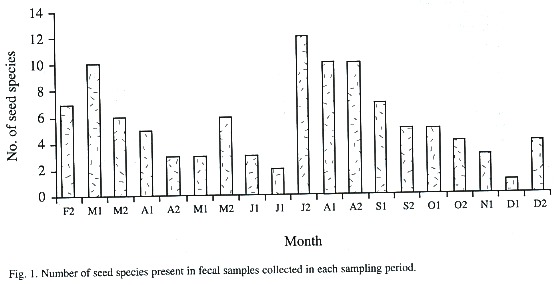
<body><![CDATA[<p><font face="Arial" size="2">Restoration time of natural forests may be reduced by introducing seeds or propagules of certain species that modify the environment and facilitate establishment of other species (<a  href="#Sun95">Sun <i>et al. </i>1995</a>). Planting particular trees is another technique that usually accelerates natural regeneration. There are several plant species that tolerate and ameliorate the adverse conditions prevailing in degraded ecosystems (</font><font  face="Arial" size="2"><a href="#Lamb97">Lamb <i>et al. </i>1997</a></font><font  face="Arial" size="2">). Other species not only tolerate such conditions but accelerate the colonization process by attracting seed-dispersing animals (<a href="#Lugo88">Lugo 1988</a>, <a  href="#Lugo93">Lugo <i>et al. </i>1993</a>, <a href="#Parrota92">Parrota 1992</a>). In this study we evaluated the role of stumps in pastures surrounded by forest remnants as collectors of bird-dispersed seeds and appropriate microhabitats for seedling establishment.</font></p> <font face="Arial" size="2"><b>     <p>Materials and methods</p> </b> </font>     <p><font face="Arial" size="2">We conducted this research from February through December 1986, on the western slope of the Volcán Barva in an area of <i>ca. </i>400 ha (84º07’|W, 10º09’|N). The study site, located at 1|800|m, consisted of patches of remnant montane forest (Holdridge 1967), mostly along small streams, immersed into a pasture matrix.</font></p>     <p><font face="Arial" size="2">We gathered bird feces from 11 stumps scattered throughout the pasture area every two weeks. We counted and identified (if possible) the seeds present in the feces. We also censused frugivorous birds and recorded number and species of fruits eaten by these birds along a 2|km transect at forest remnant edges. Changes in abundance of some seed species in fecal samples were analyzed using one sample Kolmogorov-Smirnov test. We also evaluated the association between amount of seed species in fecal samples and abundance of some bird species with Spearman correlation tests.</font></p> <font face="Arial" size="2"><b>     <p>Results</p> </b> </font>     <p><font face="Arial" size="2">We registered 18 frugivorous birds in the study site. Based on their habitat use, we divided these species into three categories (<a href="#t1">Table 1</a>). First, a group of birds that consisted of those species, such as <i>Pharomachrus mocinn</i>o, <i>Aulacorhynchus pracinu</i>s, and <i>Myadestes melanop</i>s, whose activity concentrated in forest fragments. These species were not observed on pastures and seldom at the edge of forest fragments. Other species, <i>e.g</i>., <i>Catharus ustulatus </i>and <i>Chlorospingus ophthalmicu</i>s, that exploited intensely forest edges and often flew between forest patches and isolated trees, constituted the second group. The last group is formed by birds that concentrated their activities either permanently or temporarily in pastures (scattered trees) and forest edges. Some of these birds, <i>e.g</i>., <i>Thraupis episcopus </i>and <i>Turdus gray</i>i, foraged commonly in pastures over all the study period, whereas other birds, <i>e.g</i>., <i>Turdus plebejus </i>and <i>Ptilogonys caudatu</i>s, used intensely the open areas only when some isolated trees <i>(e.g</i>., <i>Cornus disciflor</i>a) produced large fruit crops.</font></p>     <p align="center"><font face="Arial" size="2"><a name="t1"></a><img  src="/img/fbpe/rbt/v50n2/2813i1.JPG" title="" alt=""  style="width: 545px; height: 461px;"></font></p>     
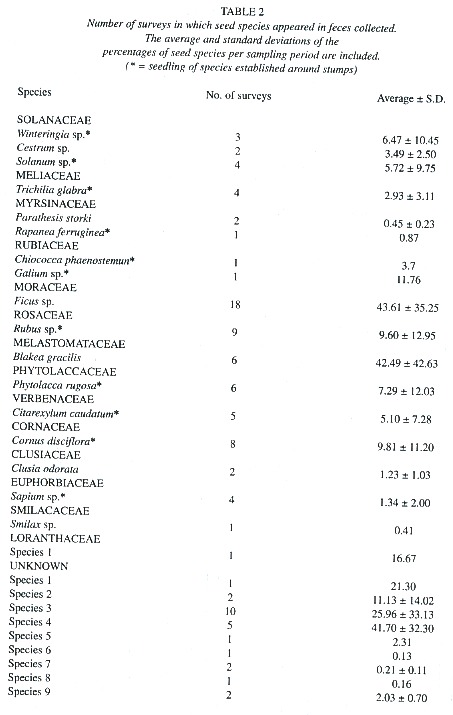
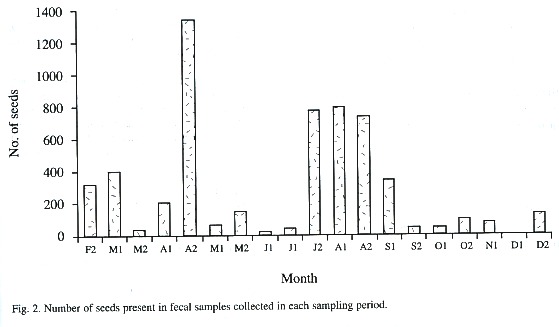
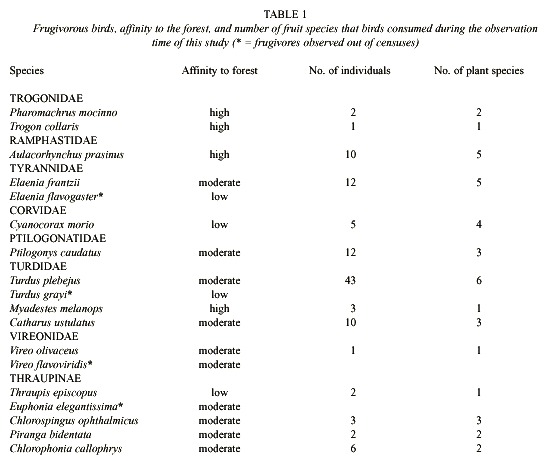
<p><font face="Arial" size="2">We collected 133 feces from which we identified 28 seed species (<a href="#t2">Table 2</a>). The number of species of seeds disseminated from forest patches to pastures did not vary significantly along the study period (D<sub>max</sub> = 0.1, p &gt; 0.20, n = 19, <a href="#f1">Fig. 1</a>). <i>Ficus </i>sp., followed by the unknown species 3, <i>Cornus disciflor</i>a, and <i>Rubus </i>sp., appeared in most of the surveys (<a href="#t2">Table 2</a>). Yet, the amount of these seed species varied greatly among samplings. <i>Ficus </i>sp. occurred in a very low proportion in February, April, and July, whilst, in May, August, and October, the proportion of this species increased significantly (D<sub>max</sub> = 0.54, p = 0.05, n = 13). <i>Cornus disciflora </i>was proportionally greater in September and October (D<sub>max</sub> = 0.88, P &lt; 0.001, n = 8), and <i>Rubus </i>sp. in March and September (D<sub>max</sub> = 0.88, p &lt; 0.001, n = 8). This intraspecific fluctuation affected the total amount of seeds counted biweekly from fecal samples (<a href="#f2">Fig. 2</a>).</font></p>     <p><font face="Arial" size="2">&nbsp;</font></p>     <div style="text-align: center;"><a name="f1"></a><img  src="/img/fbpe/rbt/v50n2/2813i2.JPG" title="" alt=""  style="width: 559px; height: 285px;">    
]]></body>
<body><![CDATA[<br>     <br> <a name="t2"></a><img src="/img/fbpe/rbt/v50n2/2813i3.JPG" title="" alt=""  style="width: 453px; height: 715px;">    
<br>     <br> <a name="f2"></a><img src="/img/fbpe/rbt/v50n2/2813i4.JPG" title="" alt=""  style="width: 559px; height: 327px;">    
<br>     <br> </div> <font face="Arial" size="2">We registered 14 birds during the study period feeding on fruits of 19 plant species in forest fragments (Table 3). Only seven out of these 19 seed species appeared in the fecal samples. Even some species on which birds fed heavily, <i>e.g</i>., <i>Trema micranth</i>a, and <i>Oreopanax xalapense </i>were not present on the feces collected. This showed either that some of the birds may not fly from fragments to nearby pastures or they did not defecate on stumps. Overall, the number of feces gathered on stumps was not directly related with the number of frugivorous birds counted on each sampling (r<sub>s</sub> = 0.3, p = 0.2, n = 19 ). We detected, however, a highly significant association between the number of fecal samples and abundance of <i>Turdus plebejus </i>during this study (r<sub>s</sub> = 0.61, p = 0.0005, n = 11). The importance of this species as possible disperser is supported by the fact that 38% of the birds observed feeding upon any type of fruit belong to this species (<a href="#t1">Table 1</a>).</font>     <p><font face="Arial" size="2">We also found several seedling species already established around the stumps. These seedlings mostly corresponded to the same species of plants dispersed by birds (<a  href="#t2">Table 2</a>). The establishment of seedlings around stumps supports the idea that these structures not only function as seed collectors but also proportionate an adequate microhabitat for seedling establishment.</font></p> <font face="Arial" size="2"><b>     <p>Discussion</p> </b> </font>     <p><font face="Arial" size="2">The number of seeds that each fruit contain varies enormously among plant species. For instance, each <i>Cornus disciflora </i>and <i>Trichilia glabra </i>fruit possesses few seeds (one and three respectively), whereas fruits of <i>Blakea gracilis </i>and <i>Conostegia oerstediana </i>contain a large number of seeds (more than 100). This difference in number of seeds per fruit determines, to a large extent, the fluctuation in seed species and seed number over the study period (<a href="#f2">Fig. 2)</a>. Other factors, such as crop size, fruiting period, and synchrony in fruit production, also affect availability of this resource and, therefore, its presence in the fecal samples (<a href="#Howe75">Howe and Primak 1975</a>, <a  href="#Herrera81">Herrera 1981</a>, <a href="#Moermond83">Moermond and Denslow 1983</a>, <a href="#Levey84">Levey <i>et al. </i>1984</a>).</font></p>     <p><font face="Arial" size="2">Species-specific behavior and pattern of habitat use of some birds affect seed dispersion from forests to open areas (<a href="#Herrera84">Herrera 1984</a>, <a href="#Wheelwright85">Wheelwright 1985</a>, <a href="#Moermond85">Moermond and Denslow 1985</a>). <i>Turdus plebeju</i>s, an altitudinal migrant, likely plays an important role in the mobilization of seeds from forest patches to adjacent pastures at middle-high elevations of the western slope of Costa Rican cordilleras. This species frequently flies back and forth between forest and isolated trees in pastures where it feeds on fruits. It is also common that <i>T. plebejus </i>perches and defecates on stumps (pers. obs.). Seeds are washed out by rainfall and deposited around the stumps where they germinate, relatively well protected from cattle grazing. By using a large variety of fruits, <i>T. plebejus </i>may be an excellent disperser in this environment. The variety of fruits that <i>T. plebejus </i>consumes makes it an important element in the natural regeneration of forests at middle and high elevations in Costa Rica. It feeds upon fruits of herbs <i>(e.g</i>., <i>Rubus </i>sp. and <i>Phytolacca rugos</i>a), bushes <i>(e.g</i>., <i>Parathesis storki </i>and <i>Solanum </i>sp.), and trees <i>(e.g</i>., <i>Cornus disciflora </i>and <i>Ficus </i>sp.). <i>Ptilogonys caudatu</i>s, another altitudinal migrant, also moves frequently between forest fragments and isolated trees in pastures. Yet, this species does not perch on stumps in open areas, so that most of the seeds are likely dropped beneath the crown of trees. Other bird species may play a much less important role on seed dispersion at the west slope of the Volcán Barva.</font></p> <font face="Arial" size="2"><b>     ]]></body>
<body><![CDATA[<p>Acknowledgments</p> </b> </font>     <p><font face="Arial" size="2">We thank J.M. Mora and anonymous reviewers for valuable comments on the manuscript.</font></p> <font face="Arial" size="2"><b>     <p>Resumen</p> </b> </font>     <p><font face="Arial" size="2">La deforestación, la ganadería y las actividades agrícolas han causado la destrucción de la mayoría de los bosques en Costa Rica. Sin embargo, la abrupta topografía de las zonas medias y altas del país ha retardado este proceso de deforestación en el bosque montano. Es así como aún algunos fragmentos de bosques poco alterados estan todavía en pie a lo largo de riachuelos que corren en cañones profundos. Estos fragmentos sirven como corredores entre áreas más grandes de bosque y como rutas para el movimiento altitudinal de aves frugívoras. Dieciocho aves, <i>e.g</i>., <i>Turdus plebeju</i>s, <i>Elaenia frantzii </i>y <i>Ptilogonys caudatus </i>son habitantes comunes de los parches de bosque presentes en la vertiente Pacífica del Volcán Barva. Estas especies vuelan frecuentemente entre los fragmentos de bosque y potreros adyacentes. Estas aves defecaron y regurgitaron semillas de 28 especies de plantas en troncos distribuidos en los potreros. Los árboles aislados y troncos son micro-hábitats adecuados para la germinación de semillas y el establecimiento de plántulas.</font></p> <font face="Arial" size="2"><b>     <p>References</p> </b> </font>     <!-- ref --><p><font face="Arial" size="2"><a name="Ewel83"></a>Ewel, J. 1983. Succession, p. 217-223. <i>In </i>F.B. Golley (ed.). Tropical rain forest ecosystems. Structure and function. Elsevier, New York. </font>&nbsp;&nbsp;&nbsp;&nbsp;&nbsp;&nbsp;&nbsp;&nbsp;[&#160;<a href="javascript:void(0);" onclick="javascript: window.open('/scielo.php?script=sci_nlinks&ref=1214685&pid=S0034-7744200200020001600001&lng=','','width=640,height=500,resizable=yes,scrollbars=1,menubar=yes,');">Links</a>&#160;]<!-- end-ref --><!-- ref --><p><font face="Arial" size="2"><a name="Fournier77"></a>Fournier, L.A. 1977. La sucesión ecológica como un método eficaz para la recuperación del bosque en Costa Rica. Agron. Costarricense 2: 53-55.</font>&nbsp;&nbsp;&nbsp;&nbsp;&nbsp;&nbsp;&nbsp;&nbsp;[&#160;<a href="javascript:void(0);" onclick="javascript: window.open('/scielo.php?script=sci_nlinks&ref=1214686&pid=S0034-7744200200020001600002&lng=','','width=640,height=500,resizable=yes,scrollbars=1,menubar=yes,');">Links</a>&#160;]<!-- end-ref --><!-- ref --><p><font face="Arial" size="2"><a name="Janzen88a"></a>Janzen, D.H. 1988a. Management of habitat fragments in a tropical dry forest: Growth. Ann. Miss. Bot. Garden 75: 105-116.</font>&nbsp;&nbsp;&nbsp;&nbsp;&nbsp;&nbsp;&nbsp;&nbsp;[&#160;<a href="javascript:void(0);" onclick="javascript: window.open('/scielo.php?script=sci_nlinks&ref=1214687&pid=S0034-7744200200020001600003&lng=','','width=640,height=500,resizable=yes,scrollbars=1,menubar=yes,');">Links</a>&#160;]<!-- end-ref --><!-- ref --><p><font face="Arial" size="2"><a name="Janzen88b"></a>Janzen, D.H. 1988b. Tropical dry forests. The most endangered major tropical ecosystem, p. 130-137. <i>In </i>W.O. Wilson (ed.). Biodiversity. National Academy, Washington, D. C.</font>&nbsp;&nbsp;&nbsp;&nbsp;&nbsp;&nbsp;&nbsp;&nbsp;[&#160;<a href="javascript:void(0);" onclick="javascript: window.open('/scielo.php?script=sci_nlinks&ref=1214688&pid=S0034-7744200200020001600004&lng=','','width=640,height=500,resizable=yes,scrollbars=1,menubar=yes,');">Links</a>&#160;]<!-- end-ref --><!-- ref --><p><font face="Arial" size="2"><a name="Lamb97"></a>Lamb, D., J. Parrota, R. Keenan &amp; N. Tucker. 1997. Rejoining habitat remnants: Restoring degradated rainforest lands, p. 366-385. <i>In </i>W.F. Laurence &amp; R.O. Bierregaard, Jr. (eds.). Tropical forest remnants. Ecology, management, and conservation of fragmented communities. University of Chicago, Chicago.</font>&nbsp;&nbsp;&nbsp;&nbsp;&nbsp;&nbsp;&nbsp;&nbsp;[&#160;<a href="javascript:void(0);" onclick="javascript: window.open('/scielo.php?script=sci_nlinks&ref=1214689&pid=S0034-7744200200020001600005&lng=','','width=640,height=500,resizable=yes,scrollbars=1,menubar=yes,');">Links</a>&#160;]<!-- end-ref --><!-- ref --><p><font face="Arial" size="2"><a name="Lugo88"></a>Lugo, A.E. 1988. The future of the forest: Ecosystem rehabilitation in the tropics. Environment 30: 16-20.</font>&nbsp;&nbsp;&nbsp;&nbsp;&nbsp;&nbsp;&nbsp;&nbsp;[&#160;<a href="javascript:void(0);" onclick="javascript: window.open('/scielo.php?script=sci_nlinks&ref=1214690&pid=S0034-7744200200020001600006&lng=','','width=640,height=500,resizable=yes,scrollbars=1,menubar=yes,');">Links</a>&#160;]<!-- end-ref --><!-- ref --><p><font face="Arial" size="2"><a name="Lugo93"></a>Lugo, A.E., J.A. Parrota &amp; S. Brown. 1993. Loss in species caused by tropical deforestation and their recovery through management. Ambio 22: 106-109.</font>&nbsp;&nbsp;&nbsp;&nbsp;&nbsp;&nbsp;&nbsp;&nbsp;[&#160;<a href="javascript:void(0);" onclick="javascript: window.open('/scielo.php?script=sci_nlinks&ref=1214691&pid=S0034-7744200200020001600007&lng=','','width=640,height=500,resizable=yes,scrollbars=1,menubar=yes,');">Links</a>&#160;]<!-- end-ref --><!-- ref --><p><font face="Arial" size="2"><a name="Herrera81"></a>Herrera, C.M. 1981. Fruit variation and competition for dispersers in natural populations of <i>Smilax asper</i>a. Oikos 36: 51-58.</font>&nbsp;&nbsp;&nbsp;&nbsp;&nbsp;&nbsp;&nbsp;&nbsp;[&#160;<a href="javascript:void(0);" onclick="javascript: window.open('/scielo.php?script=sci_nlinks&ref=1214692&pid=S0034-7744200200020001600008&lng=','','width=640,height=500,resizable=yes,scrollbars=1,menubar=yes,');">Links</a>&#160;]<!-- end-ref --><!-- ref --><p><font face="Arial" size="2"><a name="Herrera84"></a>Herrera, C.M. 1984. A study of avian frugivores, bird-dispersed plants, and their interaction in Mediterranean scrublands. Ecol. Monogr. 54: 1-23.</font>&nbsp;&nbsp;&nbsp;&nbsp;&nbsp;&nbsp;&nbsp;&nbsp;[&#160;<a href="javascript:void(0);" onclick="javascript: window.open('/scielo.php?script=sci_nlinks&ref=1214693&pid=S0034-7744200200020001600009&lng=','','width=640,height=500,resizable=yes,scrollbars=1,menubar=yes,');">Links</a>&#160;]<!-- end-ref --><!-- ref --><p><font face="Arial" size="2"><a name="Holdridge67"></a>Holdridge, L.R. 1967. Life zone ecology. Tropical Science Center, San José, Costa Rica. 216 p.</font>&nbsp;&nbsp;&nbsp;&nbsp;&nbsp;&nbsp;&nbsp;&nbsp;[&#160;<a href="javascript:void(0);" onclick="javascript: window.open('/scielo.php?script=sci_nlinks&ref=1214694&pid=S0034-7744200200020001600010&lng=','','width=640,height=500,resizable=yes,scrollbars=1,menubar=yes,');">Links</a>&#160;]<!-- end-ref --><!-- ref --><p><font face="Arial" size="2"><a name="Howe75"></a>Howe, H.F. &amp; R.B. Primak. 1975. Differential seed dispersal by birds of the tree <i>Casearia nitida </i>(Flacourtiaceae). Biotropica 7: 278-283.</font>&nbsp;&nbsp;&nbsp;&nbsp;&nbsp;&nbsp;&nbsp;&nbsp;[&#160;<a href="javascript:void(0);" onclick="javascript: window.open('/scielo.php?script=sci_nlinks&ref=1214695&pid=S0034-7744200200020001600011&lng=','','width=640,height=500,resizable=yes,scrollbars=1,menubar=yes,');">Links</a>&#160;]<!-- end-ref --><!-- ref --><p><font face="Arial" size="2"><a name="Levey84"></a>Levey, D.J., T.C. Moermond &amp; J.S. Denslow. 1984. Fruit choice in neotropical birds: The effect of distance between fruits on preference patterns. Ecology 65: 844-850.</font>&nbsp;&nbsp;&nbsp;&nbsp;&nbsp;&nbsp;&nbsp;&nbsp;[&#160;<a href="javascript:void(0);" onclick="javascript: window.open('/scielo.php?script=sci_nlinks&ref=1214696&pid=S0034-7744200200020001600012&lng=','','width=640,height=500,resizable=yes,scrollbars=1,menubar=yes,');">Links</a>&#160;]<!-- end-ref --><!-- ref --><p><font face="Arial" size="2"><a name="Moermond83"></a>Moermond, T.C. &amp; J.S. Denslow. 1983. Fruit choice in netropical birds: Effects of fruit type and accessibility on selectivity. J. Anim. Ecol. 52: 407-420.</font>&nbsp;&nbsp;&nbsp;&nbsp;&nbsp;&nbsp;&nbsp;&nbsp;[&#160;<a href="javascript:void(0);" onclick="javascript: window.open('/scielo.php?script=sci_nlinks&ref=1214697&pid=S0034-7744200200020001600013&lng=','','width=640,height=500,resizable=yes,scrollbars=1,menubar=yes,');">Links</a>&#160;]<!-- end-ref --><!-- ref --><p><font face="Arial" size="2"><a name="Moermond85"></a>Moermond, T.C. &amp; J.S. Denslow. 1985. Neotropical avian frugivores: Patterns of behavior, morphology, and nutrition with consequences for fruit selection. Ornithol. Mongr. 36: 865-897.</font>&nbsp;&nbsp;&nbsp;&nbsp;&nbsp;&nbsp;&nbsp;&nbsp;[&#160;<a href="javascript:void(0);" onclick="javascript: window.open('/scielo.php?script=sci_nlinks&ref=1214698&pid=S0034-7744200200020001600014&lng=','','width=640,height=500,resizable=yes,scrollbars=1,menubar=yes,');">Links</a>&#160;]<!-- end-ref --><!-- ref --><p><font face="Arial" size="2"><a name="Rosero-Bixby98"></a>Rosero-Bixby, L. &amp; A. Palloni. 1998. Población y deforestación en Costa Rica, p. 131-150. <i>In </i>Conservación del bosque en Costa Rica. Academia Nacional de Ciencias, Grafos S. A., San José, Costa Rica.</font>&nbsp;&nbsp;&nbsp;&nbsp;&nbsp;&nbsp;&nbsp;&nbsp;[&#160;<a href="javascript:void(0);" onclick="javascript: window.open('/scielo.php?script=sci_nlinks&ref=1214699&pid=S0034-7744200200020001600015&lng=','','width=640,height=500,resizable=yes,scrollbars=1,menubar=yes,');">Links</a>&#160;]<!-- end-ref --><!-- ref --><p><font face="Arial" size="2"><a name="Parrota92"></a>Parrota, J.A. 1992. The role of plantation forests in rehabiltating degraded ecosystems. Ag. Ecosyst. Environ. 41: 115-133.</font>&nbsp;&nbsp;&nbsp;&nbsp;&nbsp;&nbsp;&nbsp;&nbsp;[&#160;<a href="javascript:void(0);" onclick="javascript: window.open('/scielo.php?script=sci_nlinks&ref=1214700&pid=S0034-7744200200020001600016&lng=','','width=640,height=500,resizable=yes,scrollbars=1,menubar=yes,');">Links</a>&#160;]<!-- end-ref --><!-- ref --><p><font face="Arial" size="2"><a name="Sader88"></a>Sader, S.A. &amp; A.T. Joyce. 1988. Deforestation rates and trends in Costa Rica, 1940 to 1983. Biotropica 20: 11-19.</font>&nbsp;&nbsp;&nbsp;&nbsp;&nbsp;&nbsp;&nbsp;&nbsp;[&#160;<a href="javascript:void(0);" onclick="javascript: window.open('/scielo.php?script=sci_nlinks&ref=1214701&pid=S0034-7744200200020001600017&lng=','','width=640,height=500,resizable=yes,scrollbars=1,menubar=yes,');">Links</a>&#160;]<!-- end-ref --><!-- ref --><p><font face="Arial" size="2"><a name="Sun95"></a>Sun, D., G. Dickenson &amp; A. Bragg. 1995. Direct seeding of <i>Alphitonia peteri </i>for gully revegetation in tropical Northern Australia. Forest Ecol. Manage. 73: 249-257.</font>&nbsp;&nbsp;&nbsp;&nbsp;&nbsp;&nbsp;&nbsp;&nbsp;[&#160;<a href="javascript:void(0);" onclick="javascript: window.open('/scielo.php?script=sci_nlinks&ref=1214702&pid=S0034-7744200200020001600018&lng=','','width=640,height=500,resizable=yes,scrollbars=1,menubar=yes,');">Links</a>&#160;]<!-- end-ref --><!-- ref --><p><font face="Arial" size="2"><a name="Virgilio97"></a>Virgílio, M.V., A.A. J. Tabanez &amp; J.L.F. Batista. 1997. Dynamics and restoration of forest fragments in the Brazilian Atlantic moist forest, p. 351-365. <i>In </i>W.F. Laurence &amp; R.O. Bierregaard, Jr. (eds.). Tropical forest remnants. Ecology, management, and conservation of fragmented communities. University of Chicago, Chicago.</font>&nbsp;&nbsp;&nbsp;&nbsp;&nbsp;&nbsp;&nbsp;&nbsp;[&#160;<a href="javascript:void(0);" onclick="javascript: window.open('/scielo.php?script=sci_nlinks&ref=1214703&pid=S0034-7744200200020001600019&lng=','','width=640,height=500,resizable=yes,scrollbars=1,menubar=yes,');">Links</a>&#160;]<!-- end-ref --><!-- ref --><p><font face="Arial" size="2"><a name="Uhl88"></a>Uhl, C. 1988. Restoration of degraded lands in the Amazon Basin, p. 326-332. <i>In </i>W.O. Wilson (ed.). Biodiversity. National Academy, Washington, D. C.</font>&nbsp;&nbsp;&nbsp;&nbsp;&nbsp;&nbsp;&nbsp;&nbsp;[&#160;<a href="javascript:void(0);" onclick="javascript: window.open('/scielo.php?script=sci_nlinks&ref=1214704&pid=S0034-7744200200020001600020&lng=','','width=640,height=500,resizable=yes,scrollbars=1,menubar=yes,');">Links</a>&#160;]<!-- end-ref --><!-- ref --><p><font face="Arial" size="2"><a name="Uhl84"></a>Uhl, C. &amp; C. Jordan. 1984. Succession and nutrient dynamics following forest cutting and burning in Amazonia. Ecology 75: 377-407.</font>&nbsp;&nbsp;&nbsp;&nbsp;&nbsp;&nbsp;&nbsp;&nbsp;[&#160;<a href="javascript:void(0);" onclick="javascript: window.open('/scielo.php?script=sci_nlinks&ref=1214705&pid=S0034-7744200200020001600021&lng=','','width=640,height=500,resizable=yes,scrollbars=1,menubar=yes,');">Links</a>&#160;]<!-- end-ref --><!-- ref --><p><font face="Arial" size="2"><a name="Wheelwright85"></a>Wheelwright, N.T. 1985. Fruit size, gape width, and the diets of fruit-eating birds. Ecology 66: 808-818.</font>&nbsp;&nbsp;&nbsp;&nbsp;&nbsp;&nbsp;&nbsp;&nbsp;[&#160;<a href="javascript:void(0);" onclick="javascript: window.open('/scielo.php?script=sci_nlinks&ref=1214706&pid=S0034-7744200200020001600022&lng=','','width=640,height=500,resizable=yes,scrollbars=1,menubar=yes,');">Links</a>&#160;]<!-- end-ref --> ]]></body><back>
<ref-list>
<ref id="B1">
<nlm-citation citation-type="book">
<person-group person-group-type="author">
<name>
<surname><![CDATA[Ewel]]></surname>
<given-names><![CDATA[J]]></given-names>
</name>
<name>
<surname><![CDATA[Golley]]></surname>
<given-names><![CDATA[F.B]]></given-names>
</name>
</person-group>
<source><![CDATA[Succession]]></source>
<year>1983</year>
<page-range>217-223</page-range><publisher-loc><![CDATA[New York ]]></publisher-loc>
<publisher-name><![CDATA[Elsevier]]></publisher-name>
</nlm-citation>
</ref>
<ref id="B2">
<nlm-citation citation-type="journal">
<person-group person-group-type="author">
<name>
<surname><![CDATA[Fournier]]></surname>
<given-names><![CDATA[L.A]]></given-names>
</name>
</person-group>
<article-title xml:lang="es"><![CDATA[La sucesión ecológica como un método eficaz para la recuperación del bosque en Costa Rica]]></article-title>
<source><![CDATA[Agron. Costarricense]]></source>
<year>1977</year>
<volume>2</volume>
<page-range>53-55</page-range></nlm-citation>
</ref>
<ref id="B3">
<nlm-citation citation-type="journal">
<person-group person-group-type="author">
<name>
<surname><![CDATA[Janzen]]></surname>
<given-names><![CDATA[D.H]]></given-names>
</name>
</person-group>
<article-title xml:lang="en"><![CDATA[Management of habitat fragments in a tropical dry forest: Growth]]></article-title>
<source><![CDATA[Ann. Miss. Bot. Garden]]></source>
<year>1988</year>
<volume>75</volume>
<page-range>105-116</page-range></nlm-citation>
</ref>
<ref id="B4">
<nlm-citation citation-type="book">
<person-group person-group-type="author">
<name>
<surname><![CDATA[Janzen]]></surname>
<given-names><![CDATA[D.H]]></given-names>
</name>
<name>
<surname><![CDATA[Wilson]]></surname>
<given-names><![CDATA[W.O]]></given-names>
</name>
</person-group>
<source><![CDATA[Tropical dry forests: The most endangered major tropical ecosystem]]></source>
<year>1988</year>
<page-range>130-137</page-range><publisher-loc><![CDATA[Washington, D. C ]]></publisher-loc>
<publisher-name><![CDATA[National Academy]]></publisher-name>
</nlm-citation>
</ref>
<ref id="B5">
<nlm-citation citation-type="book">
<person-group person-group-type="author">
<name>
<surname><![CDATA[Lamb]]></surname>
<given-names><![CDATA[D]]></given-names>
</name>
<name>
<surname><![CDATA[Parrota]]></surname>
<given-names><![CDATA[J]]></given-names>
</name>
<name>
<surname><![CDATA[Keenan]]></surname>
<given-names><![CDATA[R]]></given-names>
</name>
<name>
<surname><![CDATA[Tucker]]></surname>
<given-names><![CDATA[N]]></given-names>
</name>
<name>
<surname><![CDATA[Laurence]]></surname>
<given-names><![CDATA[W.F]]></given-names>
</name>
<name>
<surname><![CDATA[Bierregaard]]></surname>
<given-names><![CDATA[R.O]]></given-names>
</name>
</person-group>
<source><![CDATA[Rejoining habitat remnants: Restoring degradated rainforest lands]]></source>
<year>1997</year>
<page-range>366-385</page-range><publisher-loc><![CDATA[Chicago ]]></publisher-loc>
<publisher-name><![CDATA[University of Chicago]]></publisher-name>
</nlm-citation>
</ref>
<ref id="B6">
<nlm-citation citation-type="journal">
<person-group person-group-type="author">
<name>
<surname><![CDATA[Lugo]]></surname>
<given-names><![CDATA[A.E]]></given-names>
</name>
</person-group>
<article-title xml:lang="en"><![CDATA[The future of the forest: Ecosystem rehabilitation in the tropics]]></article-title>
<source><![CDATA[Environment]]></source>
<year>1988</year>
<volume>30</volume>
<page-range>16-20</page-range></nlm-citation>
</ref>
<ref id="B7">
<nlm-citation citation-type="journal">
<person-group person-group-type="author">
<name>
<surname><![CDATA[Lugo]]></surname>
<given-names><![CDATA[A.E]]></given-names>
</name>
<name>
<surname><![CDATA[Parrota]]></surname>
<given-names><![CDATA[J.A]]></given-names>
</name>
<name>
<surname><![CDATA[Brown]]></surname>
<given-names><![CDATA[S]]></given-names>
</name>
</person-group>
<article-title xml:lang="en"><![CDATA[Loss in species caused by tropical deforestation and their recovery through management]]></article-title>
<source><![CDATA[Ambio]]></source>
<year>1993</year>
<volume>22</volume>
<page-range>106-109</page-range></nlm-citation>
</ref>
<ref id="B8">
<nlm-citation citation-type="journal">
<person-group person-group-type="author">
<name>
<surname><![CDATA[Herrera]]></surname>
<given-names><![CDATA[C.M]]></given-names>
</name>
</person-group>
<article-title xml:lang="en"><![CDATA[Fruit variation and competition for dispersers in natural populations of Smilax aspera]]></article-title>
<source><![CDATA[Oikos]]></source>
<year>1981</year>
<volume>36</volume>
<page-range>51-58</page-range></nlm-citation>
</ref>
<ref id="B9">
<nlm-citation citation-type="journal">
<person-group person-group-type="author">
<name>
<surname><![CDATA[Herrera]]></surname>
<given-names><![CDATA[C.M]]></given-names>
</name>
</person-group>
<article-title xml:lang="en"><![CDATA[A study of avian frugivores, bird-dispersed plants, and their interaction in Mediterranean scrublands]]></article-title>
<source><![CDATA[Ecol. Monogr]]></source>
<year>1984</year>
<volume>54</volume>
<page-range>1-23</page-range></nlm-citation>
</ref>
<ref id="B10">
<nlm-citation citation-type="book">
<person-group person-group-type="author">
<name>
<surname><![CDATA[Holdridge]]></surname>
<given-names><![CDATA[L.R]]></given-names>
</name>
</person-group>
<source><![CDATA[Life zone ecology]]></source>
<year>1967</year>
<page-range>216</page-range><publisher-loc><![CDATA[San José ]]></publisher-loc>
<publisher-name><![CDATA[Tropical Science Center]]></publisher-name>
</nlm-citation>
</ref>
<ref id="B11">
<nlm-citation citation-type="journal">
<person-group person-group-type="author">
<name>
<surname><![CDATA[Howe]]></surname>
<given-names><![CDATA[H.F]]></given-names>
</name>
<name>
<surname><![CDATA[Primak]]></surname>
<given-names><![CDATA[R.B]]></given-names>
</name>
</person-group>
<article-title xml:lang="en"><![CDATA[Differential seed dispersal by birds of the tree Casearia nitida (Flacourtiaceae)]]></article-title>
<source><![CDATA[Biotropica]]></source>
<year>1975</year>
<volume>7</volume>
<page-range>278-283</page-range></nlm-citation>
</ref>
<ref id="B12">
<nlm-citation citation-type="journal">
<person-group person-group-type="author">
<name>
<surname><![CDATA[Levey]]></surname>
<given-names><![CDATA[D.J]]></given-names>
</name>
<name>
<surname><![CDATA[Moermond]]></surname>
<given-names><![CDATA[T.C]]></given-names>
</name>
<name>
<surname><![CDATA[Denslow]]></surname>
<given-names><![CDATA[J.S]]></given-names>
</name>
</person-group>
<article-title xml:lang="en"><![CDATA[Fruit choice in neotropical birds: The effect of distance between fruits on preference patterns]]></article-title>
<source><![CDATA[Ecology]]></source>
<year>1984</year>
<volume>65</volume>
<page-range>844-850</page-range></nlm-citation>
</ref>
<ref id="B13">
<nlm-citation citation-type="journal">
<person-group person-group-type="author">
<name>
<surname><![CDATA[Moermond]]></surname>
<given-names><![CDATA[T.C]]></given-names>
</name>
<name>
<surname><![CDATA[Denslow]]></surname>
<given-names><![CDATA[J.S]]></given-names>
</name>
</person-group>
<article-title xml:lang="en"><![CDATA[Fruit choice in netropical birds: Effects of fruit type and accessibility on selectivity]]></article-title>
<source><![CDATA[J. Anim. Ecol]]></source>
<year>1983</year>
<volume>52</volume>
<page-range>407-420</page-range></nlm-citation>
</ref>
<ref id="B14">
<nlm-citation citation-type="journal">
<person-group person-group-type="author">
<name>
<surname><![CDATA[Moermond]]></surname>
<given-names><![CDATA[T.C]]></given-names>
</name>
<name>
<surname><![CDATA[Denslow]]></surname>
<given-names><![CDATA[J.S]]></given-names>
</name>
</person-group>
<article-title xml:lang="en"><![CDATA[Neotropical avian frugivores: Patterns of behavior, morphology, and nutrition with consequences for fruit selection]]></article-title>
<source><![CDATA[Ornithol. Mongr]]></source>
<year>1985</year>
<volume>36</volume>
<page-range>865-897</page-range></nlm-citation>
</ref>
<ref id="B15">
<nlm-citation citation-type="book">
<person-group person-group-type="author">
<name>
<surname><![CDATA[Rosero-Bixby]]></surname>
<given-names><![CDATA[L]]></given-names>
</name>
<name>
<surname><![CDATA[Palloni]]></surname>
<given-names><![CDATA[A]]></given-names>
</name>
</person-group>
<source><![CDATA[Población y deforestación en Costa Rica]]></source>
<year>1998</year>
<page-range>131-150</page-range><publisher-loc><![CDATA[San José ]]></publisher-loc>
<publisher-name><![CDATA[Academia Nacional de Ciencias, Grafos S. A]]></publisher-name>
</nlm-citation>
</ref>
<ref id="B16">
<nlm-citation citation-type="journal">
<person-group person-group-type="author">
<name>
<surname><![CDATA[Parrota]]></surname>
<given-names><![CDATA[J.A]]></given-names>
</name>
</person-group>
<article-title xml:lang="en"><![CDATA[The role of plantation forests in rehabiltating degraded ecosystems]]></article-title>
<source><![CDATA[Ag. Ecosyst. Environ]]></source>
<year>1992</year>
<volume>41</volume>
<page-range>115-133</page-range></nlm-citation>
</ref>
<ref id="B17">
<nlm-citation citation-type="journal">
<person-group person-group-type="author">
<name>
<surname><![CDATA[Sader]]></surname>
<given-names><![CDATA[S.A]]></given-names>
</name>
<name>
<surname><![CDATA[Joyce]]></surname>
<given-names><![CDATA[A.T]]></given-names>
</name>
</person-group>
<article-title xml:lang="en"><![CDATA[Deforestation rates and trends in Costa Rica, 1940 to 1983]]></article-title>
<source><![CDATA[Biotropica]]></source>
<year>1988</year>
<volume>20</volume>
<page-range>11-19</page-range></nlm-citation>
</ref>
<ref id="B18">
<nlm-citation citation-type="journal">
<person-group person-group-type="author">
<name>
<surname><![CDATA[Sun]]></surname>
<given-names><![CDATA[D]]></given-names>
</name>
<name>
<surname><![CDATA[Dickenson]]></surname>
<given-names><![CDATA[G]]></given-names>
</name>
<name>
<surname><![CDATA[Bragg]]></surname>
<given-names><![CDATA[A]]></given-names>
</name>
</person-group>
<article-title xml:lang="en"><![CDATA[Direct seeding of Alphitonia peteri for gully revegetation in tropical Northern Australia]]></article-title>
<source><![CDATA[Forest Ecol. Manage]]></source>
<year>1995</year>
<volume>73</volume>
<page-range>249-257</page-range></nlm-citation>
</ref>
<ref id="B19">
<nlm-citation citation-type="book">
<person-group person-group-type="author">
<name>
<surname><![CDATA[Virgílio]]></surname>
<given-names><![CDATA[M.V]]></given-names>
</name>
<name>
<surname><![CDATA[J. Tabanez]]></surname>
<given-names><![CDATA[A.A]]></given-names>
</name>
<name>
<surname><![CDATA[Batista]]></surname>
<given-names><![CDATA[J.L.F]]></given-names>
</name>
<name>
<surname><![CDATA[Laurence]]></surname>
<given-names><![CDATA[W.F]]></given-names>
</name>
<name>
<surname><![CDATA[Bierregaard]]></surname>
<given-names><![CDATA[R.O]]></given-names>
</name>
</person-group>
<source><![CDATA[Dynamics and restoration of forest fragments in the Brazilian Atlantic moist forest]]></source>
<year>1997</year>
<page-range>351-365</page-range><publisher-loc><![CDATA[Chicago ]]></publisher-loc>
<publisher-name><![CDATA[University of Chicago]]></publisher-name>
</nlm-citation>
</ref>
<ref id="B20">
<nlm-citation citation-type="book">
<person-group person-group-type="author">
<name>
<surname><![CDATA[Uhl]]></surname>
<given-names><![CDATA[C]]></given-names>
</name>
<name>
<surname><![CDATA[Wilson]]></surname>
<given-names><![CDATA[W.O]]></given-names>
</name>
</person-group>
<source><![CDATA[Restoration of degraded lands in the Amazon Basin]]></source>
<year>1988</year>
<page-range>326-332</page-range><publisher-loc><![CDATA[Washington, D. C ]]></publisher-loc>
<publisher-name><![CDATA[National Academy]]></publisher-name>
</nlm-citation>
</ref>
<ref id="B21">
<nlm-citation citation-type="journal">
<person-group person-group-type="author">
<name>
<surname><![CDATA[Uhl]]></surname>
<given-names><![CDATA[C]]></given-names>
</name>
<name>
<surname><![CDATA[Jordan]]></surname>
<given-names><![CDATA[C]]></given-names>
</name>
</person-group>
<article-title xml:lang="en"><![CDATA[Succession and nutrient dynamics following forest cutting and burning in Amazonia]]></article-title>
<source><![CDATA[Ecology]]></source>
<year>1984</year>
<volume>75</volume>
<page-range>377-407</page-range></nlm-citation>
</ref>
<ref id="B22">
<nlm-citation citation-type="journal">
<person-group person-group-type="author">
<name>
<surname><![CDATA[Wheelwright]]></surname>
<given-names><![CDATA[N.T]]></given-names>
</name>
</person-group>
<article-title xml:lang="en"><![CDATA[Fruit size, gape width, and the diets of fruit-eating birds]]></article-title>
<source><![CDATA[Ecology]]></source>
<year>1985</year>
<volume>66</volume>
<page-range>808-818</page-range></nlm-citation>
</ref>
</ref-list>
</back>
</article>