<?xml version="1.0" encoding="ISO-8859-1"?><article xmlns:mml="http://www.w3.org/1998/Math/MathML" xmlns:xlink="http://www.w3.org/1999/xlink" xmlns:xsi="http://www.w3.org/2001/XMLSchema-instance">
<front>
<journal-meta>
<journal-id>0034-7744</journal-id>
<journal-title><![CDATA[Revista de Biología Tropical]]></journal-title>
<abbrev-journal-title><![CDATA[Rev. biol. trop]]></abbrev-journal-title>
<issn>0034-7744</issn>
<publisher>
<publisher-name><![CDATA[Universidad de Costa Rica]]></publisher-name>
</publisher>
</journal-meta>
<article-meta>
<article-id>S0034-77442001000200011</article-id>
<title-group>
<article-title xml:lang="en"><![CDATA[Anoxia in a coastal bay: case study of a seasonal event]]></article-title>
</title-group>
<contrib-group>
<contrib contrib-type="author">
<name>
<surname><![CDATA[Lechuga-Devéze]]></surname>
<given-names><![CDATA[C. H.]]></given-names>
</name>
</contrib>
<contrib contrib-type="author">
<name>
<surname><![CDATA[Reyes-Salinas]]></surname>
<given-names><![CDATA[A.]]></given-names>
</name>
</contrib>
<contrib contrib-type="author">
<name>
<surname><![CDATA[Morquecho-Escamilla]]></surname>
<given-names><![CDATA[M. L.]]></given-names>
</name>
<xref ref-type="aff" rid="A01"/>
</contrib>
</contrib-group>
<aff id="A01">
<institution><![CDATA[,Centro de Investigaciones Biológicas del Noroeste  ]]></institution>
<addr-line><![CDATA[La Paz Baja California Sur]]></addr-line>
<country>México</country>
</aff>
<pub-date pub-type="pub">
<day>00</day>
<month>06</month>
<year>2001</year>
</pub-date>
<pub-date pub-type="epub">
<day>00</day>
<month>06</month>
<year>2001</year>
</pub-date>
<volume>49</volume>
<numero>2</numero>
<fpage>525</fpage>
<lpage>534</lpage>
<copyright-statement/>
<copyright-year/>
<self-uri xlink:href="http://www.scielo.sa.cr/scielo.php?script=sci_arttext&amp;pid=S0034-77442001000200011&amp;lng=en&amp;nrm=iso"></self-uri><self-uri xlink:href="http://www.scielo.sa.cr/scielo.php?script=sci_abstract&amp;pid=S0034-77442001000200011&amp;lng=en&amp;nrm=iso"></self-uri><self-uri xlink:href="http://www.scielo.sa.cr/scielo.php?script=sci_pdf&amp;pid=S0034-77442001000200011&amp;lng=en&amp;nrm=iso"></self-uri><abstract abstract-type="short" xml:lang="en"><p><![CDATA[Bahía Concepción (Gulf of California) was studied to describe some extremely low dissolved-oxygen values at the bottom of the bay. Surveys included measurements of vertical distribution of temperature, dissolved oxygen, nitrate, nitrite, phosphates and hydrogen sulfide. Thermal stratification from early spring to autumn and a well-mixed water column during the winter were present. Dissolved-oxygen concentration was homogeneous in the water column from winter to spring (5-7 mg L-1). From summer to autumn, bottom dissolved oxygen ( 20 m) decreased to reach conditions of hypoxia (1-2 mg L-1) or anoxia; nitrate, nitrite, and phosphates increased (up to 13, 1.7 and 2.2 *M) followed by a last short period of a deep hydrogen sulfide layer (up to 3.1 mg L-1). A back calculation to estimate the input of organic matter in the deep layer showed that 18 g C m-2y-1 needed to be trapped in the bottom to induce such an oxygen depletion. This period is thought to be unfavorable for bottom infauna in this bay.]]></p></abstract>
<abstract abstract-type="short" xml:lang="es"><p><![CDATA[Se midió seis variables físico-químicas en Bahía Concepción (Golfo de California, 1993 y 1994) para explicar el origen de valores muy bajos de oxígeno disuelto en el fondo. La estructura hidrográfica mostró una fuerte estratificación térmica vertical del inicio de la primavera hasta el otoño, mientras que durante el invierno se observa una columna de agua homogénea. Las concentraciones de oxígeno disuelto siguen el mismo patrón: homogéneas de invierno a primavera (5-7 mg L -1), mientras que del verano al otoño disminuyen en la capa de fondo ( 20-m) hasta alcanzar condiciones de hipoxia (1-2 mg L-1) o anoxia. Las concentraciones de nitrato, nitrito y ortofosfatos también aumentan en la capa de fondo (13, 1.7 y 2.2 *M respectivamente), seguido de un corto período de formación de sulfuro de hidrógeno (hasta 3.1 mg L-1). Por cálculos indirectos se establece que 18 g C m-2 a-1 de materia orgánica son atrapados en el fondo provocando la severa disminución del oxígeno disuelto. Este período se considera crítico para la fauna bentónica de esta bahía.]]></p></abstract>
<kwd-group>
<kwd lng="en"><![CDATA[Anoxic basin]]></kwd>
<kwd lng="en"><![CDATA[organic matter inputs]]></kwd>
<kwd lng="en"><![CDATA[hydrography]]></kwd>
<kwd lng="en"><![CDATA[nutrients]]></kwd>
<kwd lng="es"><![CDATA[Bahía Concepción]]></kwd>
<kwd lng="en"><![CDATA[Gulf of California]]></kwd>
</kwd-group>
</article-meta>
</front><body><![CDATA[ <center> <b><font face="Arial,Helvetica"><font size=-1>Anoxia in a coastal bay:&nbsp; case study of a seasonal event</font></font></b></center>      <center><font face="Arial,Helvetica"><font size=-1><b>C. H. Lechuga-Dev&eacute;ze&nbsp;&nbsp;&nbsp;&nbsp; A. Reyes-Salinas&nbsp;&nbsp;&nbsp;&nbsp; M. L. Morquecho-Escamilla&nbsp;<a NAME="1"></a></b><sup><a href="#1a">1</a></sup></font></font>     <p><font face="Arial,Helvetica"><font size=-1>Received 28-IX-2000. Corrected 4-X-2000. Accepted 9-10-2000</font></font></center>      <p><b><font face="Arial,Helvetica"><font size=-1>Abstract</font></font></b>     <p><font face="Arial,Helvetica"><font size=-1>Bah&iacute;a Concepci&oacute;n (Gulf of California) was studied to describe some extremely low dissolved-oxygen values at the bottom of the bay. Surveys included measurements of vertical distribution of temperature, dissolved oxygen, nitrate, nitrite, phosphates and hydrogen sulfide. Thermal stratification from early spring to autumn and a well-mixed water column during the winter were present. Dissolved-oxygen concentration was homogeneous in the water column from winter to spring (5-7 mg L</font><sup><font size=-2>-1</font></sup><font size=-1>). From summer to autumn, bottom dissolved oxygen (> 20 m) decreased to reach conditions of hypoxia (1-2 mg L</font><sup><font size=-2>-1</font></sup><font size=-1>) or anoxia; nitrate, nitrite, and phosphates increased (up to 13, 1.7 and 2.2 *M) followed by a last short period of a deep hydrogen sulfide layer (up to 3.1 mg L</font><sup><font size=-2>-1</font></sup><font size=-1>). A back calculation to estimate the input of organic matter in the deep layer showed that 18 g C m<sup>-</sup></font><sup><font size=-2>2</font></sup><font size=-1>y</font><sup><font size=-2>-1</font></sup><font size=-1> needed to be trapped in the bottom to induce such an oxygen depletion. This period is thought to be unfavorable for bottom infauna in this bay.</font></font>     <br>&nbsp;     <p><b><font face="Arial,Helvetica"><font size=-1>Key words</font></font></b>     <p><font face="Arial,Helvetica"><font size=-1>Anoxic basin, organic matter inputs, hydrography, nutrients, Bah&iacute;a Concepci&oacute;n, Gulf of California.</font></font>     <br>&nbsp;     <p><font face="Arial,Helvetica"><font size=-1>Seasonal anoxic or hypoxic conditions have often been observed in temperate coastal environments (May 1973, Santos and Simon 1980, J&oslash;rgensen 1990, Babenerd 1991, Prena 1994) and to a lesser extent in tropical marine environments (Vargas 1995). The frequency, severity, and length of hypoxic conditions are mainly a consequence of a hydrographic structure causing water stagnation (J&oslash;rgensen 1990), or by the inflow of deep oxygen-depleted waters from adjacent regions (Prena 1994). The decrease in dissolved oxygen in bottom waters together with a stable halocline or thermocline induces high periods of oxygen stress that may have severe ecological consequences on bottom fauna (Theede <i>et al.&nbsp;</i> 1969) and demersal fish (May 1973, Officer <i>et al.&nbsp;</i> 1984).</font></font>     ]]></body>
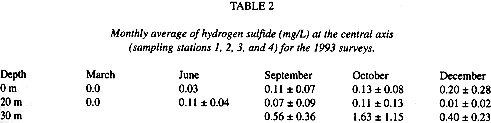
<body><![CDATA[<p><font face="Arial,Helvetica"><font size=-1>Along the Mexican Pacific coast, several events of fish mortality have been observed but never studied. In Bah&iacute;a Concepci&oacute;n (Gulf of California), aperiodic defaunation has occurred, mainly in soft-bottom mollusks. Some unpublished reports briefly explained such mass mortalities by abnormal increases in water temperature. Preliminary studies have identified also an abnormal decrease of dissolved oxygen (Reyes Salinas 1994). To describe this process of anoxia, we have monitored water quality variables and the physical structure of the water column. On the basis of the data obtained, we analyzed for either natural or anthropogenic influences, as causes of the environmental disturbances in this bay.</font></font>     <p><font face="Arial,Helvetica"><font size=-1><b>Bah&iacute;a Concepci&oacute;n: </b>Bah&iacute;a Concepci&oacute;n is one of the deepest and largest (282 km</font><sup><font size=-2>2</font></sup><font size=-1>) coastal bays on the western side of the Gulf of California, in an arid climate region (<a href="#img1">Fig. 1)</a>. A large shallow southern plain and a northern 10-m deep sill near the bay entrance border the bay’s central basin (30- to 35-m depth).</font></font>     <p><font face="Arial,Helvetica"><font size=-1>This bay has higher salinity (35.1 to 36.0‰, Gilmartin and Revelante 1978) than in the adjacent Gulf (&lt; 35.2‰) because of high evaporation, particularly during summer. The terrestrial area is desertic, with an annual rainfall of about 113 mm. According to Gilmartin and Revelante (1978), Bah&iacute;a Concepci&oacute;n has a total volume of 4553x10</font><sup><font size=-2>6</font></sup><font size=-1> m</font><sup><font size=-2>3</font></sup><font size=-1> and an intertidal volume of 221x10</font><sup><font size=-2>6</font></sup><font size=-1> m</font><sup><font size=-2>3</font></sup><font size=-1>, giving a relatively low flushing index of 0.05.</font></font>     <p><font face="Arial,Helvetica"><font size=-1>The only urban development, the village of Muleg&eacute;, is 3 km north of the entrance of the bay <a href="#img1">(Fig. 1)</a>. It has about 3,000 inhabitants. The exploitation of shellfish, as <i>Argopecten ventricosus, </i>(Sowerby II), was the main activity in the bay (Villalejo-Fuente and Ochoa-B&aacute;ez 1993), however, the annual yield was highly variable from year to year (1734 &plusmn; 1582 t, Sepesca, 1993).&nbsp; Extensive and local events of shellfish defaunation occurred mainly during the summer (Mass&oacute; and V&eacute;lez pers. comm.), probably contributing to the inconsistency of the yield.</font></font>     <br>&nbsp;     <p><b><font face="Arial,Helvetica"><font size=-1>Materials and Methods</font></font></b>     <p><font face="Arial,Helvetica"><font size=-1>Hydrographic surveys were made in 1993 in March, June, September, October, and December, and in 1994, in March, April, May, June, and July.</font></font>     <p><font face="Arial,Helvetica"><font size=-1>In the 1993 surveys, four stations were sampled along the axis of the central basin of the bay <a href="#img1">(Fig. 1)</a>.&nbsp; Water samples were taken with Van Dorn bottles at 0, 1, 3, 5, 7, 10, 15, and 20 m depths, except in October and December, when additional samples at 25 to 30 m depth were taken. During the 1994 surveys, three or four stations were sampled on a transverse axis of the bay (<a href="#img1">Fig. 1)</a> and water samples were taken at 0, 5, 10, 15, 20, 25, and 30 m.</font></font>     <p><font face="Arial,Helvetica"><font size=-1>Temperature was measured with a YSI or HACH probe. Dissolved-oxygen (DO) concentration was estimated by the Winkler titration technique, orthophosphate was estimated according to Murphy and Riley (1962), and nitrate and nitrite according to Parsons <i>et al.&nbsp;</i> (1984). Nutrient samples were filtered on Whatman GF/C filters. Analyses of hydrogen sulfide were made on samples from 0, 20, and 30-m depths using the iodometric procedure described in Clesceri <i>et al.&nbsp;</i> (1989).</font></font>     <center>     ]]></body>
<body><![CDATA[<p><a NAME="img1"></a><img SRC="/img/fbpe/rbt/v49n2/1010i1.GIF" height=792 width=260></center>      
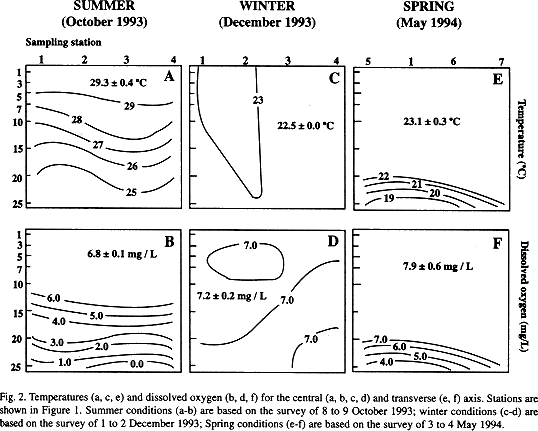
<p><font face="Arial,Helvetica"><font size=-1>Wind data (provided by the Comisi&oacute;n Nacional del Agua) were obtained from a meteorological station at Muleg&eacute;, 3 km north of the entrance of Bah&iacute;a Concepci&oacute;n (<a href="#img1">Fig. 1)</a>. Monthly wind averages were computed from the 1993 measurements.</font></font>     <br>&nbsp;     <p><b><font face="Arial,Helvetica"><font size=-1>Results</font></font></b>     <p><font face="Arial,Helvetica"><font size=-1>Our data were consistent with the seasonal water structure reported earlier (Lechuga-Dev&eacute;ze and Morquecho-Escamilla 1998). Summer is characterized by a stratified water column, identified by a well-developed thermocline and oxycline <a href="#img2">(Figs. 2a, 2b)</a>. This structure is broken in winter to a totally homogeneous water column. The temperature and oxygen shows a little variation along and across the central basin and depth (<a href="#img2">Figs. 2c, 2d)</a>. The restart to a stratified condition is in spring (<a href="#img2">Figs. 2e, 2f)</a> when the surface layer is again warmed by the seasonal warming.</font></font>     <center>     <p><a NAME="img2"></a><img SRC="/img/fbpe/rbt/v49n2/1010i2.GIF" height=431 width=538></center>      
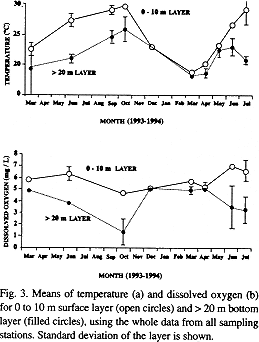
<p><font face="Arial,Helvetica"><font size=-1>According the expected vertical structure of temperature and dissolved oxygen, the whole data (sampling stations 1 to 7) were monthly pooled in 0 to 10 m layer (surface layer; <i>n</i> = 7 to 28), and >20 layer (bottom layer; <i>n</i> = 2 to 8). Lowest <i>n</i> numbers (7 and 2) were for March 1993 (data from sampling station 1). ANOVA and TUKEY test compared temperature and dissolved oxygen data of the two layers; depth and time were the independent variables. At 95% of confidence level, both layers were proved to be significantly different. The weight of this significance was the summer months. Temperature is consistently higher, up to 8 &deg;C, at the surface than in the bottom layer during March to October (<a href="#img3">Fig. 3a)</a>. In November-December, both surface and bottom layers are mixed by a decrease in temperature (around 22 &deg;C), and in March, the entire water column reaches its lowest temperature (around 18 &deg;C). From April to July, once again, the surface and bottom layers are divided by the thermocline.</font></font>     <p><font face="Arial,Helvetica"><font size=-1>During this period of thermal stratification, the bottom layer showed a decrease in dissolved oxygen concentration (<a href="#img3">Fig. 3b)</a>. The lowest values were in October (1.3 &plusmn; 1.1 mg O</font><sub><font size=-2>2</font></sub><font size=-1>/L), and this extended over the entire basin (<a href="#img2">Fig. 2b</a>).</font></font>     <p><font face="Arial,Helvetica"><font size=-1>By the period of thermal homogenization (winter), values of dissolved oxygen did not show differences between surface and bottom layers (<a href="#img2">Figs. 2d</a>, <a href="#img3">3b</a>). Once again, the cycle towards the stratification is restarted when the thermocline is developed, and the bottom oxygen is depleted.</font></font>     ]]></body>
<body><![CDATA[<p><font face="Arial,Helvetica"><font size=-1>Dissolved oxygen in the surface layer did not show a seasonal trend, remaining between 5 to 7 mg O</font><sub><font size=-2>2</font></sub><font size=-1>/L.</font></font>     <center>     <p><a NAME="img3"></a><img SRC="/img/fbpe/rbt/v49n2/1010i3.GIF" height=342 width=259>     
<p><a NAME="tab1"></a><img SRC="/img/fbpe/rbt/v49n2/1010ta1.GIF" height=416 width=534></center>      
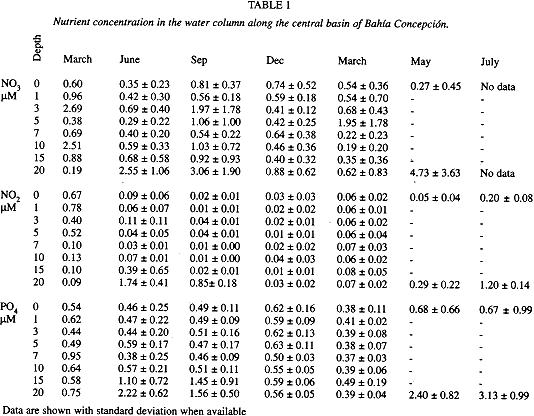
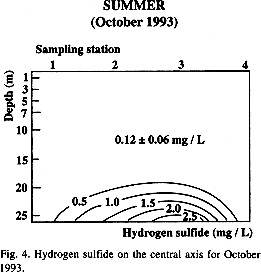
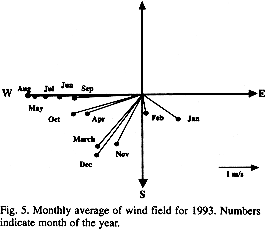
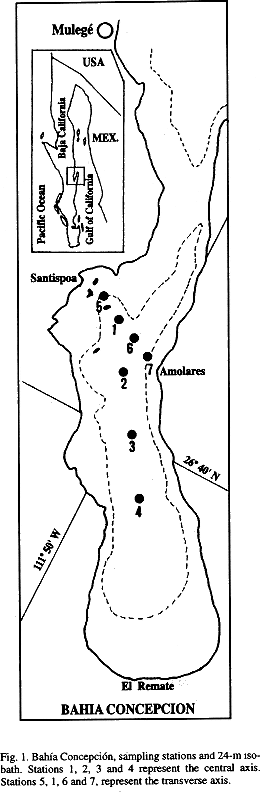
<p><font face="Arial,Helvetica"><font size=-1>The isolation of the bottom layer by the thermocline, depleted the dissolved oxygen by organic matter oxidation. This process is thought to be responsible for the increase of nitrates, nitrites, and orthophosphates during the summer <a href="#tab1">(table 1).</a> In spite of the high variability of nutrient concentration at surface and bottom layers, the bottom values clearly are well differentiated from those of the surface.</font></font>     <p><font face="Arial,Helvetica"><font size=-1>Low oxygen levels or bottom anoxia observed in October 1993 along the central axis of the bay, was also conducive to the production of hydrogen sulfide (<a href="#img4">Fig. 4</a>, <a href="#tab2">Table 2)</a>. The highest concentration (up to 3.1 mg L</font><sup><font size=-2>-1</font></sup><font size=-1>) was found at sampling station 3 when bottom anoxia was recorded (<a href="#img2">Fig. 2b</a> and<a href="#img4"> 4</a>). The slight increase in dissolved oxygen at 20 m was followed by a decrease in hydrogen sulfide (0.5 mg L</font><sup><font size=-2>-1</font></sup><font size=-1>) because dissolved sulfide oxidizes rapidly in the presence of oxygen. This hydrogen sulfide layer disappeared in the winter when the water column was mixed <a href="#tab2">(Table 2)</a>.</font></font>     <center>     <p><a NAME="img4"></a><img SRC="/img/fbpe/rbt/v49n2/1010i4.GIF" height=272 width=261>     
<br>&nbsp;     <p><a NAME="tab2"></a><img SRC="/img/fbpe/rbt/v49n2/1010ta2.GIF" height=123 width=491></center>      
]]></body>
<body><![CDATA[<p><b><font face="Arial,Helvetica"><font size=-1>Discussion</font></font></b>     <p><font face="Arial,Helvetica"><font size=-1><b>Origin of the anoxic layer: </b>The temperature structure in Bah&iacute;a Concepci&oacute;n is reasonably well defined throughout the annual cycle. In winter (December to March), the whole bay is well mixed probably by a) the convective processes forced by a NW-NE wind stress (Dressler 1981) that might drive waters from the Gulf of California into the bay, and/or b) the fast cooling of surface waters.</font></font>     <p><font face="Arial,Helvetica"><font size=-1>The beginning of thermal stratification could be a response to a change of hydrographic forces driven by the change of wind direction <a href="#img5">(Fig. 5)</a>. In early spring (April), this lowering of energy in the water column, and warming of air temperature, act together to create and maintain a strong pycnocline isolating the surface (0 to 10-m) from bottom waters (> 15-m).</font></font>     <center>     <p><a NAME="img5"></a><img SRC="/img/fbpe/rbt/v49n2/1010i5.GIF" height=229 width=265></center>      
<p><font face="Arial,Helvetica"><font size=-1>Changes in the oxygen concentration at the bottom layer could be correlated with a) the oxygen consumption from biological oxidation of organic matter (May 1973, Babenerd 1991, Llans&oacute; 1992), or b) intrusions of adjacent oxygen-depleted bottom waters advected by wind influence (Officer <i>et al.&nbsp;</i> 1984, Breitburg 1990, Prena 1994). The advection of low oxygen waters coming from the ocean into Bah&iacute;a Concepci&oacute;n does not seem to occur. The low DO waters of the Gulf of California (1.0 mg O</font><font size=-2><sub>2</sub> </font><font size=-1>L</font><sup><font size=-2>-1</font></sup><font size=-1>) are present at 300 m, and the thermocline is well-developed in summer acting as a barrier to impede the upwelling of this water (Emilsson 1993). Therefore we can explore the <i>in situ</i> inputs of oxidizable material to the bay.</font></font>     <p><font face="Arial,Helvetica"><font size=-1>Bah&iacute;a Concepci&oacute;n is in an arid area, where the annual precipitation averages 113 mm. There is no agricultural or industrial land use. The only inputs of organic matter from human activity originate at Muleg&eacute; village (3000 inhabitants). The urban wastewater is treated before being discharged into a small river flowing 3 km north of the mouth of the bay. Some tourist facilities are along the coast of the bay. The nutrient or carbon inputs from this very low population density, even though not measured, seem easily diluted upon reaching the bay.&nbsp; Natural inputs of organic matter seem be supplied by red tides of <i>Noctiluca scintillans</i> occurring every winter (G&aacute;rate-Liz&aacute;rraga 1991, 1995). Lechuga-Dev&eacute;ze and Morquecho-Escamilla (1999) showed, also in winter, a diatom-dominated population.</font></font>     <p><font face="Arial,Helvetica"><font size=-1>Mart&iacute;nez-L&oacute;pez and G&aacute;rate-Liz&aacute;rraga (1994) reported a widespread spawning of shellfish, again in the winter. It seems the physical and chemical conditions of winter render the whole bay capable of sustaining an environment rich in autotrophs and heterotrophs. This produces a high grazing pressure and therefore an increase in the settling of organic particles. Further, plankton biomass and organic debris could be trapped in the bottom layer by the density gradient formed during spring to summer.</font></font>     <p><font face="Arial,Helvetica"><font size=-1>The gradual decrease of dissolved oxygen at the bottom during spring and summer are directly correlated to an increase in nutrients. This process ends in late summer to mid-autumn when hypoxic conditions are reached. When the DO is depleted, and organic nitrogen has been oxidized into NO</font><sub><font size=-2>3</font></sub><font size=-1> and NO</font><sub><font size=-2>2</font></sub><font size=-1>, the anaerobic metabolism seems to be stimulated, promoting the production of hydrogen sulfide (Theede <i>et al.&nbsp;</i> 1969).</font></font>     <p><font face="Arial,Helvetica"><font size=-1><b>Rates of carbon degradation: </b>We can obtain a rough estimate of the rate of carbon degradation through the rates of oxygen consumption of the deep stagnant water (> 20 m). This assumes no significant oxygen exchange between surface and bottom layers (<i>e.g.</i> diffusion from the photic layer, tidal mixing, wind mixing), and the main input of organic matter is from the winter plankton biomass. The mean rate of oxygen consumption during March to October 1993 and March to July 1994, was 0.028 &plusmn; 0.006 mg O</font><sub><font size=-2>2</font></sub><font size=-1>L</font><sup><font size=-2>-1</font></sup><font size=-1> d</font><sup><font size=-2>-1</font></sup><font size=-1> (equals to 0.028 &plusmn; 0.006 g O<sub>2</sub> m</font><sup><font size=-2>-3</font></sup><font size=-1> d</font><sup><font size=-2>-1</font></sup><font size=-1>). Using a 10-m depth of stagnant bottom water (20 to 30 m depth), we obtained a consumption of 0.28 g O</font><sub><font size=-2>2</font></sub><font size=-1> m</font><sup><font size=-2>-2</font></sup><font size=-1> d</font><sup><font size=-2>-1</font></sup><font size=-1>. Because 3.47 g of oxygen is used to oxidize 1 g of organic carbon, we obtained a rate of 0.081 g C m</font><sup><font size=-2>-2</font></sup><font size=-1> d</font><sup><font size=-2>-1</font></sup><font size=-1>. To extrapolate for the total organic matter load, we again assumed a linear oxygen depletion during 225 days, obtaining 18 g C m</font><sup><font size=-2>-2</font></sup><font size=-1> y</font><sup><font size=-2>-1</font></sup><font size=-1> (1.6 mol C m</font><sup><font size=-2>-2</font></sup><font size=-1>y</font><sup><font size=-2>-1</font></sup><font size=-1>) accumulated during the winter in the bottom of Bah&iacute;a Concepci&oacute;n. Using the standard deviation of data (0.006) the range could extend from 14 to 22 g C m</font><sup><font size=-2>-2</font></sup><font size=-1> y</font><sup><font size=-2>-1</font></sup><font size=-1>.</font></font>     ]]></body>
<body><![CDATA[<p><font face="Arial,Helvetica"><font size=-1>Other environments affected by discharges of anthropogenic organic matter, as the Baltic Sea (the &Ouml;resund and Western Baltic), had rates and organic loads near the range obtained in this study. For the &Ouml;resund, Mattsson and Stigebrandt (1993) reported an oxygen consumption rate of 0.038 mg O<sub>2</sub> L</font><sup><font size=-2>-1</font></sup><font size=-1>d</font><sup><font size=-2>-1</font></sup><font size=-1> and an annual flux into the basin of 20.7 g C m</font><sup><font size=-2>-2</font></sup><font size=-1> y</font><sup><font size=-2>-1</font></sup><font size=-1>. For the Western Baltic, Balzer(1984) reported 2.5 mol C m</font><sup><font size=-2>-2</font></sup><font size=-1> y</font><sup><font size=-2>-1</font></sup><font size=-1> (30 g C m</font><sup><font size=-2>-2</font></sup><font size=-1> y</font><sup><font size=-2>-1</font></sup><font size=-1>) of organic matter decomposed at the sediment water interface.</font></font>     <center>     <p><a NAME="img6"></a><img SRC="/img/fbpe/rbt/v49n2/1010i6.GIF" height=265 width=256></center>      
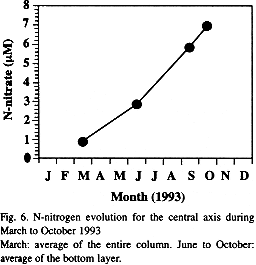
<p><font face="Arial,Helvetica"><font size=-1>The similarities with our rates may be fortuitous and very speculative. However to validate this first approach, we can also estimate the organic load through the N-nitrate release (<a href="#img6">Fig. 6</a>) using:</font></font>     <center>     <p><font face="Arial,Helvetica"><font size=-1>&nbsp;&nbsp;&nbsp;&nbsp;&nbsp;&nbsp;&nbsp;&nbsp;&nbsp;&nbsp;&nbsp; N-nitrate rate (mmol m</font><sup><font size=-2>-2</font></sup><font size=-1> d</font><sup><font size=-2>-1</font></sup><font size=-1>) = [(N<sub>f</sub> – N<sub>i</sub>)/ d<sub>t</sub>] S<sub>w</sub></font></font></center>      <p><font face="Arial,Helvetica"><font size=-1>where N</font><sub><font size=-2>i</font></sub><font size=-1> is the initial mean of N-nitrate concentration for the entire water column (March:&nbsp; 0.977 mmol m</font><sup><font size=-2>-3</font></sup><font size=-1>), N<sub>f</sub> is the final mean of N-nitrate concentration for the deep layer (October:&nbsp; 6.89 mmol m</font><sup><font size=-2>-3</font></sup><font size=-1>), d</font><sub><font size=-2>t</font></sub><font size=-1> is the number of days of this period (196 days), and S</font><sub><font size=-2>w</font></sub><font size=-1> is the depth of stagnant layer (10 m). Using this formula, we obtain an estimate of 0.3015 mmol N m</font><sup><font size=-2>-2</font></sup><font size=-1> d</font><sup><font size=-2>-1</font></sup><font size=-1>.</font></font>     <p><font face="Arial,Helvetica"><font size=-1>Calculating 225 days (21 March to 31 October) as the total period of water stagnation, we obtain a rate of 68 mmol N m</font><sup><font size=-2>-2</font></sup><font size=-1> y</font><sup><font size=-2>-1</font></sup><font size=-1>, or 5.4 g C m</font><sup><font size=-2>-2</font></sup><font size=-1>y</font><sup><font size=-2>-1</font></sup><font size=-1> [calculated by:&nbsp; mmol N x (N: P) x 12,where N: P = 106: 16, and 12 is the molecular weight of carbon], about one-third of the carbon computed from oxygen data in this work. This rate is near to that reported for the Western Baltic Sea (Balzer 1984). There, 160 mmol N m</font><sup><font size=-2>-2</font></sup><font size=-1> y</font><sup><font size=-2>-1</font></sup><font size=-1> or 12.7 g C m</font><sup><font size=-2>-2</font></sup><font size=-1> y</font><sup><font size=-2>-1</font></sup><font size=-1> represents a little less than one third of the oxidation of 30 g C m</font><sup><font size=-2>-2</font></sup><font size=-1> y</font><sup><font size=-2>-1</font></sup><font size=-1> (2.5 mol C m</font><sup><font size=-2>-2</font></sup><font size=-1> y</font><sup><font size=-2>-1</font></sup><font size=-1>).</font></font>     <p><font face="Arial,Helvetica"><font size=-1>We have assumed for this area there may have been no oxygen influences from the surface layers and the organic load comes from winter inputs. However, these assumptions could be inaccurate because of direct vertical episodic mixing or diffusion through the thermocline. Nevertheless, the calculated total organic matter load, certainly underestimated, represents an adequate approach that encourages further examination.</font></font>     <p><font face="Arial,Helvetica"><font size=-1><b>Causal effects of oxygen depletion:&nbsp; </b>Anthropic activities should promote coastal eutrophication resulting in an increased organic load and, consequently, increased oxygen demand leading to episodic or aperiodic anoxic conditions (May 1973, Llans&oacute; 1992, Prena 1994). However, the development of anoxia in Bah&iacute;a Concepci&oacute;n cannot be associated with human impact because the area has a low population density. Furthermore, according to Gilmartin and Revelante (1978) data on anoxic bottom, high nitrate and phosphate values were first observed in 1976. This could indicate that anoxic conditions are more related to natural influences.</font></font>     ]]></body>
<body><![CDATA[<p><font face="Arial,Helvetica"><font size=-1>Tilting fluctuation of isotherms originating from the tidal and wind motion of surface waters should induce a gentle upwelling into the shallows of the southern plain (El Remate) advecting the anoxic and hydrogen sulfide-rich bottom layer, where shellfish banks are located (F&eacute;lix-Pico 1987). If the tolerance to oxygen deficiency and hydrogen sulfide by marine bivalves is affected by high temperatures (Theede <i>et al.&nbsp;</i> 1969), and the mean lethal time in these conditions is around 4 days (Barthel 1984), then anoxia and hydrogen sulfide should be responsible for some sudden summer to autumn mollusk mortality. In the light of these data, Bah&iacute;a Concepci&oacute;n has recently been considered as an endangered area (Arriaga <i>et al.&nbsp;</i> 1998)</font></font>     <br>&nbsp;     <p><b><font face="Arial,Helvetica"><font size=-1>Conclusions</font></font></b>     <p><font face="Arial,Helvetica"><font size=-1>The decreased oxygen content in the deep layer of Bah&iacute;a Concepci&oacute;n is most likely a seasonal increase to oxidize natural inputs of organic matter. Extensive non-periodic shellfish mortality could be linked to wind- or tide-induced advection of the anoxic layer into the shellfish banks. It is evident that the coupling of natural processes of organic matter production, water mass structure, and biogeochemical transformations in the sediments dominates to a great extent the biological environment of Bah&iacute;a Concepci&oacute;n.</font></font>     <br>&nbsp;     <p><b><font face="Arial,Helvetica"><font size=-1>Acknowledgments</font></font></b>     <p><font face="Arial,Helvetica"><font size=-1>The authors are grateful to D. L&oacute;pez-Cort&eacute;s and J. Hern&aacute;ndez-Alfonso,&nbsp; for the coordination of several surveys; to F. Hern&aacute;ndez and I. Murillo, for skillful chemical analyses. Part of this work was presented by one of the authors (R.S.A.) to fulfill the requirements for a Bachelor Degree in Biology (UNAM). This work was financially supported by the Centro de Investigaciones Biol&oacute;gicas del Noroeste, S.C.:&nbsp; institutional projects E3 (1993), and E2 and E3 (1994). Valuable comments by A. Genin, J. Bustillos and anonymous reviewers are fully appreciated. R. Bowers† and E. Glazier edited the English-language manuscript.</font></font>     <br>&nbsp;     <p><b><font face="Arial,Helvetica"><font size=-1>Resumen</font></font></b>     <p><font face="Arial,Helvetica"><font size=-1>Se midi&oacute; seis variables f&iacute;sico-qu&iacute;micas en Bah&iacute;a Concepci&oacute;n (Golfo de California, 1993 y 1994) para explicar el origen de valores muy bajos de ox&iacute;geno disuelto en el fondo. La estructura hidrogr&aacute;fica mostr&oacute; una fuerte estratificaci&oacute;n t&eacute;rmica vertical del inicio de la primavera hasta el oto&ntilde;o, mientras que durante el invierno se observa una columna de agua homog&eacute;nea. Las concentraciones de ox&iacute;geno disuelto siguen el mismo patr&oacute;n:&nbsp; homog&eacute;neas de invierno a primavera (5-7 mg L </font><sup><font size=-2>–1</font></sup><font size=-1>), mientras que del verano al oto&ntilde;o disminuyen en la capa de fondo (> 20-m) hasta alcanzar condiciones de hipoxia (1-2 mg L<sup>-1</sup>) o anoxia. Las concentraciones de nitrato, nitrito y ortofosfatos tambi&eacute;n aumentan en la capa de fondo (13, 1.7 y 2.2 *M respectivamente), seguido de un corto per&iacute;odo&nbsp; de formaci&oacute;n de sulfuro de hidr&oacute;geno (hasta 3.1 mg L</font><sup><font size=-2>-1</font></sup><font size=-1>).&nbsp; Por c&aacute;lculos indirectos se establece que 18 g C m</font><sup><font size=-2>-2</font></sup><font size=-1> a</font><sup><font size=-2>-1</font></sup><font size=-1> de materia org&aacute;nica son atrapados en el fondo provocando la severa disminuci&oacute;n del ox&iacute;geno disuelto. Este per&iacute;odo se considera cr&iacute;tico para la fauna bent&oacute;nica de esta bah&iacute;a.</font></font>     ]]></body>
<body><![CDATA[<br>&nbsp;     <p><b><font face="Arial,Helvetica"><font size=-1>References</font></font></b>     <!-- ref --><p><font face="Arial,Helvetica"><font size=-1>Arriaga Cabrera, L., E. V&aacute;zquez-Dom&iacute;nguez, J. Gonz&aacute;lez-Cano, R. Jim&eacute;nez Rosenberg, E. Mu&ntilde;oz L&oacute;pez, V. Aguilar Sierra (coords). 1998. <i>Regiones prioritarias marinas de M&eacute;xico</i>. Comisi&oacute;n Nacional para el Conocimiento y Uso de la Biodiversidad, M&eacute;xico, 198 p.</font></font>    &nbsp;&nbsp;&nbsp;&nbsp;&nbsp;&nbsp;&nbsp;&nbsp;[&#160;<a href="javascript:void(0);" onclick="javascript: window.open('/scielo.php?script=sci_nlinks&ref=1348790&pid=S0034-7744200100020001100001&lng=','','width=640,height=500,resizable=yes,scrollbars=1,menubar=yes,');">Links</a>&#160;]<!-- end-ref --><!-- ref --><p><font face="Arial,Helvetica"><font size=-1>Baberned,B. 1991. Increasing oxygen deficiency in Kiel Bay (Western Baltic). A paradigm of progressing coastal eutrophication. Meeresforsch. 33: 121-140.</font></font>    &nbsp;&nbsp;&nbsp;&nbsp;&nbsp;&nbsp;&nbsp;&nbsp;[&#160;<a href="javascript:void(0);" onclick="javascript: window.open('/scielo.php?script=sci_nlinks&ref=1348791&pid=S0034-7744200100020001100002&lng=','','width=640,height=500,resizable=yes,scrollbars=1,menubar=yes,');">Links</a>&#160;]<!-- end-ref --><!-- ref --><p><font face="Arial,Helvetica"><font size=-1>Balzer,W. 1984. Organic matter degradation and biogenic element cycling in a nearshore sediment (Kiel Bight). Limnol. and Oceanogr. 29: 1231-1246.</font></font>    &nbsp;&nbsp;&nbsp;&nbsp;&nbsp;&nbsp;&nbsp;&nbsp;[&#160;<a href="javascript:void(0);" onclick="javascript: window.open('/scielo.php?script=sci_nlinks&ref=1348792&pid=S0034-7744200100020001100003&lng=','','width=640,height=500,resizable=yes,scrollbars=1,menubar=yes,');">Links</a>&#160;]<!-- end-ref --><!-- ref --><p><font face="Arial,Helvetica"><font size=-1>Barthel,D. 1984. Adenylate energy charge in three marine bivalve species during anoxia. Ophelia 23: 155-164.</font></font>    &nbsp;&nbsp;&nbsp;&nbsp;&nbsp;&nbsp;&nbsp;&nbsp;[&#160;<a href="javascript:void(0);" onclick="javascript: window.open('/scielo.php?script=sci_nlinks&ref=1348793&pid=S0034-7744200100020001100004&lng=','','width=640,height=500,resizable=yes,scrollbars=1,menubar=yes,');">Links</a>&#160;]<!-- end-ref --><!-- ref --><p><font face="Arial,Helvetica"><font size=-1>Breitburg,D.L. 1990. Near-shore hypoxia in the Chesapeake Bay: patterns and relationships among physical factors. Est. Coast. and Shelf. Sci. 30: 593-609.</font></font>    &nbsp;&nbsp;&nbsp;&nbsp;&nbsp;&nbsp;&nbsp;&nbsp;[&#160;<a href="javascript:void(0);" onclick="javascript: window.open('/scielo.php?script=sci_nlinks&ref=1348794&pid=S0034-7744200100020001100005&lng=','','width=640,height=500,resizable=yes,scrollbars=1,menubar=yes,');">Links</a>&#160;]<!-- end-ref --><!-- ref --><p><font face="Arial,Helvetica"><font size=-1>Clesceri. L.S, A.E. Greenberg &amp; R.R. Trussell. 1989. Standard Methods for the examination of water and wastewater 17h edition, American Public Health Association, American Water Works Association, Water Pollution Control Federation, Washington D.C., 4-197 p.</font></font>    &nbsp;&nbsp;&nbsp;&nbsp;&nbsp;&nbsp;&nbsp;&nbsp;[&#160;<a href="javascript:void(0);" onclick="javascript: window.open('/scielo.php?script=sci_nlinks&ref=1348795&pid=S0034-7744200100020001100006&lng=','','width=640,height=500,resizable=yes,scrollbars=1,menubar=yes,');">Links</a>&#160;]<!-- end-ref --><!-- ref --><p><font face="Arial,Helvetica"><font size=-1>Dressler,R. 1981. Preliminary knowledge of hydro-static summer conditions within Bah&iacute;a Concepci&oacute;n, Baja California. Technical Report,<i> </i>Centro de Investigaciones Cient&iacute;ficas y Estudios Superiores de Ensenada, M&eacute;xico,13 p.</font></font>    &nbsp;&nbsp;&nbsp;&nbsp;&nbsp;&nbsp;&nbsp;&nbsp;[&#160;<a href="javascript:void(0);" onclick="javascript: window.open('/scielo.php?script=sci_nlinks&ref=1348796&pid=S0034-7744200100020001100007&lng=','','width=640,height=500,resizable=yes,scrollbars=1,menubar=yes,');">Links</a>&#160;]<!-- end-ref --><!-- ref --><p><font face="Arial,Helvetica"><font size=-1>Emilsson,I. 1993. Oceanograf&iacute;a f&iacute;sico-qu&iacute;mica del Golfo de California. Technical Report,Centro Interdisciplinario de Ciencias Marinas, La Paz, B.C.S. 64 pp.</font></font>    &nbsp;&nbsp;&nbsp;&nbsp;&nbsp;&nbsp;&nbsp;&nbsp;[&#160;<a href="javascript:void(0);" onclick="javascript: window.open('/scielo.php?script=sci_nlinks&ref=1348797&pid=S0034-7744200100020001100008&lng=','','width=640,height=500,resizable=yes,scrollbars=1,menubar=yes,');">Links</a>&#160;]<!-- end-ref --><!-- ref --><p><font face="Arial,Helvetica"><font size=-1>F&eacute;lix-Pico,E.F. 1987. Scallop fishing in Conception Bay, Baja California Sur, M&eacute;xico. In: <i>Book of abstracts of the 6th International Pectinid Workshop</i>, Menai Bridge, 12 pp.</font></font>    &nbsp;&nbsp;&nbsp;&nbsp;&nbsp;&nbsp;&nbsp;&nbsp;[&#160;<a href="javascript:void(0);" onclick="javascript: window.open('/scielo.php?script=sci_nlinks&ref=1348798&pid=S0034-7744200100020001100009&lng=','','width=640,height=500,resizable=yes,scrollbars=1,menubar=yes,');">Links</a>&#160;]<!-- end-ref --><!-- ref --><p><font face="Arial,Helvetica"><font size=-1>G&aacute;rate-Liz&aacute;rraga,I. 1991. An&aacute;lisis de una marea roja causada por <i>Noctiluca scintillans</i> (McCartney) Ehr. en Bah&iacute;a Concepci&oacute;n, Baja California Sur, en febrero de 1989. Rev. Inv. Cient.<i> </i>Universidad Aut&oacute;noma de Baja California Sur 2: 35-43.</font></font>    &nbsp;&nbsp;&nbsp;&nbsp;&nbsp;&nbsp;&nbsp;&nbsp;[&#160;<a href="javascript:void(0);" onclick="javascript: window.open('/scielo.php?script=sci_nlinks&ref=1348799&pid=S0034-7744200100020001100010&lng=','','width=640,height=500,resizable=yes,scrollbars=1,menubar=yes,');">Links</a>&#160;]<!-- end-ref --><!-- ref --><p><font face="Arial,Helvetica"><font size=-1>G&aacute;rate-Liz&aacute;rragaI. 1995. Mareas rojas en Bah&iacute;a Concepci&oacute;n, B.C.S., M&eacute;xico. Bolet&iacute;n No<i>. </i>40, Centro Interdisciplinario de Ciencias Marinas, 2 p.</font></font>    &nbsp;&nbsp;&nbsp;&nbsp;&nbsp;&nbsp;&nbsp;&nbsp;[&#160;<a href="javascript:void(0);" onclick="javascript: window.open('/scielo.php?script=sci_nlinks&ref=1348800&pid=S0034-7744200100020001100011&lng=','','width=640,height=500,resizable=yes,scrollbars=1,menubar=yes,');">Links</a>&#160;]<!-- end-ref --><!-- ref --><p><font face="Arial,Helvetica"><font size=-1>Gilmartin, M. &amp; N. Revelante. 1978. The phytoplankton characteristics of the barrier island lagoons of the Gulf of California. Est. Coast. Mar. Sci. 7: 29-47.</font></font>    &nbsp;&nbsp;&nbsp;&nbsp;&nbsp;&nbsp;&nbsp;&nbsp;[&#160;<a href="javascript:void(0);" onclick="javascript: window.open('/scielo.php?script=sci_nlinks&ref=1348801&pid=S0034-7744200100020001100012&lng=','','width=640,height=500,resizable=yes,scrollbars=1,menubar=yes,');">Links</a>&#160;]<!-- end-ref --><!-- ref --><p><font face="Arial,Helvetica"><font size=-1>J&oslash;rgensen,B.B. 1990. Seasonal oxygen depletion in the bottom waters of a Danish fjord and its effects on the benthic community. Oikos 34: 68-76.</font></font>    &nbsp;&nbsp;&nbsp;&nbsp;&nbsp;&nbsp;&nbsp;&nbsp;[&#160;<a href="javascript:void(0);" onclick="javascript: window.open('/scielo.php?script=sci_nlinks&ref=1348802&pid=S0034-7744200100020001100013&lng=','','width=640,height=500,resizable=yes,scrollbars=1,menubar=yes,');">Links</a>&#160;]<!-- end-ref --><!-- ref --><p><font face="Arial,Helvetica"><font size=-1>Lechuga-Dev&eacute;ze, C.H. &amp; M.L. Morquecho-Escamilla. 1998.Early spring potentially harmful phytoplankton in Bah&iacute;a Concepci&oacute;n, Gulf of California. Bull. Mar. Sci.63: 503-512.</font></font>    &nbsp;&nbsp;&nbsp;&nbsp;&nbsp;&nbsp;&nbsp;&nbsp;[&#160;<a href="javascript:void(0);" onclick="javascript: window.open('/scielo.php?script=sci_nlinks&ref=1348803&pid=S0034-7744200100020001100014&lng=','','width=640,height=500,resizable=yes,scrollbars=1,menubar=yes,');">Links</a>&#160;]<!-- end-ref --><!-- ref --><p><font face="Arial,Helvetica"><font size=-1>Llans&oacute;,R. 1992. Effects of hypoxia on estuarine benthos: the lower Rappahannock river (Chesapeake Bay), a case study. Est. Coast. and Shelf. Sci.<i> </i>35: 491-515.</font></font>    &nbsp;&nbsp;&nbsp;&nbsp;&nbsp;&nbsp;&nbsp;&nbsp;[&#160;<a href="javascript:void(0);" onclick="javascript: window.open('/scielo.php?script=sci_nlinks&ref=1348804&pid=S0034-7744200100020001100015&lng=','','width=640,height=500,resizable=yes,scrollbars=1,menubar=yes,');">Links</a>&#160;]<!-- end-ref --><!-- ref --><p><font face="Arial,Helvetica"><font size=-1>Mart&iacute;nez-L&oacute;pez, A. &amp; I. G&aacute;rate-Liz&aacute;rraga. 1994. Cantidad y calidad de la materia org&aacute;nica particulada en Bah&iacute;a Concepci&oacute;n en la temporada de producci&oacute;n de almeja catarina <i>Argopecten circularis</i> (Sowerby, 1835). Ciencias Marinas 20: 301-320.</font></font>    &nbsp;&nbsp;&nbsp;&nbsp;&nbsp;&nbsp;&nbsp;&nbsp;[&#160;<a href="javascript:void(0);" onclick="javascript: window.open('/scielo.php?script=sci_nlinks&ref=1348805&pid=S0034-7744200100020001100016&lng=','','width=640,height=500,resizable=yes,scrollbars=1,menubar=yes,');">Links</a>&#160;]<!-- end-ref --><!-- ref --><p><font face="Arial,Helvetica"><font size=-1>Mattsson, J. &amp; A. Stigebrandt. 1993. The vertical flux of organic matter in the &Ouml;resund estimated by two different methods using oxygen measurements. Est. Coast. and Shelf. Sci. 37: 329-342.</font></font>    &nbsp;&nbsp;&nbsp;&nbsp;&nbsp;&nbsp;&nbsp;&nbsp;[&#160;<a href="javascript:void(0);" onclick="javascript: window.open('/scielo.php?script=sci_nlinks&ref=1348806&pid=S0034-7744200100020001100017&lng=','','width=640,height=500,resizable=yes,scrollbars=1,menubar=yes,');">Links</a>&#160;]<!-- end-ref --><!-- ref --><p><font face="Arial,Helvetica"><font size=-1>May,E.B. 1973. Extensive oxygen depletion in Mobile Bay, Alabama. Limnol. and Oceanogr.<i> </i>18: 353-366.</font></font>    &nbsp;&nbsp;&nbsp;&nbsp;&nbsp;&nbsp;&nbsp;&nbsp;[&#160;<a href="javascript:void(0);" onclick="javascript: window.open('/scielo.php?script=sci_nlinks&ref=1348807&pid=S0034-7744200100020001100018&lng=','','width=640,height=500,resizable=yes,scrollbars=1,menubar=yes,');">Links</a>&#160;]<!-- end-ref --><!-- ref --><p><font face="Arial,Helvetica"><font size=-1>Murphy, J. &amp; J.P. Riley. 1962. A modified single solution method for the determination of phosphate in natural waters. Anal. Chim. Acta 27: 31-36.</font></font>    &nbsp;&nbsp;&nbsp;&nbsp;&nbsp;&nbsp;&nbsp;&nbsp;[&#160;<a href="javascript:void(0);" onclick="javascript: window.open('/scielo.php?script=sci_nlinks&ref=1348808&pid=S0034-7744200100020001100019&lng=','','width=640,height=500,resizable=yes,scrollbars=1,menubar=yes,');">Links</a>&#160;]<!-- end-ref --><!-- ref --><p><font face="Arial,Helvetica"><font size=-1>Officer, C.B., R.B. Biggs, J.L. Taft, L.E. Cronin, M.A. Tyler &amp; W.R.Boynton. 1984. Chesapeake Bay anoxia: origin, development and significance. Science 223: 22-27.</font></font>    &nbsp;&nbsp;&nbsp;&nbsp;&nbsp;&nbsp;&nbsp;&nbsp;[&#160;<a href="javascript:void(0);" onclick="javascript: window.open('/scielo.php?script=sci_nlinks&ref=1348809&pid=S0034-7744200100020001100020&lng=','','width=640,height=500,resizable=yes,scrollbars=1,menubar=yes,');">Links</a>&#160;]<!-- end-ref --><!-- ref --><p><font face="Arial,Helvetica"><font size=-1>Parsons, T.R., Y. Maita &amp; C.M. Lalli. 1984. A manual of chemical and biological methods for seawater analyses. Pergamon Press, New York, 173 pp.</font></font>    &nbsp;&nbsp;&nbsp;&nbsp;&nbsp;&nbsp;&nbsp;&nbsp;[&#160;<a href="javascript:void(0);" onclick="javascript: window.open('/scielo.php?script=sci_nlinks&ref=1348810&pid=S0034-7744200100020001100021&lng=','','width=640,height=500,resizable=yes,scrollbars=1,menubar=yes,');">Links</a>&#160;]<!-- end-ref --><!-- ref --><p><font face="Arial,Helvetica"><font size=-1>Prena,J. 1994. Oxygen depletion in Wismar Bay (Western Baltic Sea) 1988. Arch. Fish. Mar. Res. 42: 77-87.</font></font>    &nbsp;&nbsp;&nbsp;&nbsp;&nbsp;&nbsp;&nbsp;&nbsp;[&#160;<a href="javascript:void(0);" onclick="javascript: window.open('/scielo.php?script=sci_nlinks&ref=1348811&pid=S0034-7744200100020001100022&lng=','','width=640,height=500,resizable=yes,scrollbars=1,menubar=yes,');">Links</a>&#160;]<!-- end-ref --><p><font face="Arial,Helvetica"><font size=-1>Reyes Salinas, A. 1994. Relaci&oacute;n entre estructura hidrogr&aacute;fica y la abundancia, distribuci&oacute;n y origen de diferentes expresiones de biomasa del seston org&aacute;nico en Bah&iacute;a Concepci&oacute;n, Golfo de California. Thesis. Escuela Nacional de Estudios Profesionales, Iztacala, UNAM. 53 p.</font></font>     <!-- ref --><p><font face="Arial,Helvetica"><font size=-1>Santos, S.L. &amp; J.L. Simon. 1980. Response of soft-bottom benthos to annual catastrophic disturbance in a south Florida estuary. Mar. Ecol. Progr. Ser. 3: 347-355.</font></font>    &nbsp;&nbsp;&nbsp;&nbsp;&nbsp;&nbsp;&nbsp;&nbsp;[&#160;<a href="javascript:void(0);" onclick="javascript: window.open('/scielo.php?script=sci_nlinks&ref=1348813&pid=S0034-7744200100020001100024&lng=','','width=640,height=500,resizable=yes,scrollbars=1,menubar=yes,');">Links</a>&#160;]<!-- end-ref --><!-- ref --><p><font face="Arial,Helvetica"><font size=-1>Sepesca (Secretar&iacute;a de Pesca). 1993. Sistema Descentralizado de Informaci&oacute;n Pesquera. Secretar&iacute;a de Pesca, Delegaci&oacute;n Federal de Pesca en La Paz, B.C.S., 117 p.</font></font>    &nbsp;&nbsp;&nbsp;&nbsp;&nbsp;&nbsp;&nbsp;&nbsp;[&#160;<a href="javascript:void(0);" onclick="javascript: window.open('/scielo.php?script=sci_nlinks&ref=1348814&pid=S0034-7744200100020001100025&lng=','','width=640,height=500,resizable=yes,scrollbars=1,menubar=yes,');">Links</a>&#160;]<!-- end-ref --><!-- ref --><p><font face="Arial,Helvetica"><font size=-1>Theede, H., A. Ponat, K. Hiroki &amp; C. Schlieper. 1969. Studies on the resistance of marine bottom invertebrates to oxygen-deficiency and hydrogen sulfide. Mar. Biol. 2: 325-337.</font></font>    &nbsp;&nbsp;&nbsp;&nbsp;&nbsp;&nbsp;&nbsp;&nbsp;[&#160;<a href="javascript:void(0);" onclick="javascript: window.open('/scielo.php?script=sci_nlinks&ref=1348815&pid=S0034-7744200100020001100026&lng=','','width=640,height=500,resizable=yes,scrollbars=1,menubar=yes,');">Links</a>&#160;]<!-- end-ref --><!-- ref --><p><font face="Arial,Helvetica"><font size=-1>Vargas, J.A. 1995. The Gulf of Nicoya estuary, Costa Rica: Past, present, and future cooperative research. Helgolander Meeres. 49: 821-828.</font></font>    &nbsp;&nbsp;&nbsp;&nbsp;&nbsp;&nbsp;&nbsp;&nbsp;[&#160;<a href="javascript:void(0);" onclick="javascript: window.open('/scielo.php?script=sci_nlinks&ref=1348816&pid=S0034-7744200100020001100027&lng=','','width=640,height=500,resizable=yes,scrollbars=1,menubar=yes,');">Links</a>&#160;]<!-- end-ref --><!-- ref --><p><font face="Arial,Helvetica"><font size=-1>Villalejo-Fuente, M. &amp; R.I. Ochoa-B&aacute;ez. 1993. El ciclo reproductor de almeja catarina <i>Argopecten circularis</i> (Sowerby, 1835), en relaci&oacute;n con la temporada y fotoper&iacute;odo en Bah&iacute;a Concepci&oacute;n, B.C.S., M&eacute;xico. Ciencias. Marinas 19: 181-202.</font></font>    &nbsp;&nbsp;&nbsp;&nbsp;&nbsp;&nbsp;&nbsp;&nbsp;[&#160;<a href="javascript:void(0);" onclick="javascript: window.open('/scielo.php?script=sci_nlinks&ref=1348817&pid=S0034-7744200100020001100028&lng=','','width=640,height=500,resizable=yes,scrollbars=1,menubar=yes,');">Links</a>&#160;]<!-- end-ref --><p><a NAME="1a"></a><font face="Arial,Helvetica"><sup><font size=-2><a href="#1">1</a></font></sup><font size=-1> Centro de Investigaciones Biol&oacute;gicas del Noroeste, S.C., P.O. Box 128, 23000 La Paz, Baja California Sur, M&eacute;xico, fax:&nbsp; +52 (112) 547 10; <a href="mailto:clechuga@cibnor.mx">clechuga@cibnor.mx</a></font></font>      ]]></body><back>
<ref-list>
<ref id="B1">
<nlm-citation citation-type="book">
<person-group person-group-type="author">
<name>
<surname><![CDATA[Arriaga Cabrera]]></surname>
<given-names><![CDATA[L.]]></given-names>
</name>
<name>
<surname><![CDATA[Vázquez-Domínguez]]></surname>
<given-names><![CDATA[E.]]></given-names>
</name>
<name>
<surname><![CDATA[González-Cano]]></surname>
<given-names><![CDATA[J.]]></given-names>
</name>
<name>
<surname><![CDATA[Jiménez Rosenberg]]></surname>
<given-names><![CDATA[R.]]></given-names>
</name>
<name>
<surname><![CDATA[Muñoz López]]></surname>
<given-names><![CDATA[E.]]></given-names>
</name>
<name>
<surname><![CDATA[Aguilar Sierra]]></surname>
<given-names><![CDATA[V.]]></given-names>
</name>
</person-group>
<source><![CDATA[Regiones prioritarias marinas de México]]></source>
<year>1998</year>
<page-range>198</page-range><publisher-name><![CDATA[Comisión Nacional para el Conocimiento y Uso de la Biodiversidad]]></publisher-name>
</nlm-citation>
</ref>
<ref id="B2">
<nlm-citation citation-type="journal">
<person-group person-group-type="author">
<name>
<surname><![CDATA[Baberned]]></surname>
<given-names><![CDATA[B.]]></given-names>
</name>
</person-group>
<article-title xml:lang="en"><![CDATA[Increasing oxygen deficiency in Kiel Bay (Western Baltic). A paradigm of progressing coastal eutrophication]]></article-title>
<source><![CDATA[Meeresforsch]]></source>
<year>1991</year>
<volume>33</volume>
<page-range>121-140</page-range></nlm-citation>
</ref>
<ref id="B3">
<nlm-citation citation-type="journal">
<person-group person-group-type="author">
<name>
<surname><![CDATA[Balzer]]></surname>
<given-names><![CDATA[W.]]></given-names>
</name>
</person-group>
<article-title xml:lang="en"><![CDATA[Organic matter degradation and biogenic element cycling in a nearshore sediment (Kiel Bight)]]></article-title>
<source><![CDATA[Limnol. and Oceanogr]]></source>
<year>1984</year>
<volume>29</volume>
<page-range>1231-1246</page-range></nlm-citation>
</ref>
<ref id="B4">
<nlm-citation citation-type="journal">
<person-group person-group-type="author">
<name>
<surname><![CDATA[Barthel]]></surname>
<given-names><![CDATA[D]]></given-names>
</name>
</person-group>
<article-title xml:lang="en"><![CDATA[Adenylate energy charge in three marine bivalve species during anoxia]]></article-title>
<source><![CDATA[Ophelia]]></source>
<year>1984</year>
<volume>23</volume>
<page-range>155-164</page-range></nlm-citation>
</ref>
<ref id="B5">
<nlm-citation citation-type="journal">
<person-group person-group-type="author">
<name>
<surname><![CDATA[Breitburg]]></surname>
<given-names><![CDATA[D.L.]]></given-names>
</name>
</person-group>
<article-title xml:lang="en"><![CDATA[Near-shore hypoxia in the Chesapeake Bay: patterns and relationships among physical factors]]></article-title>
<source><![CDATA[Est. Coast. and Shelf. Sci]]></source>
<year>1990</year>
<volume>30</volume>
<page-range>593-609</page-range></nlm-citation>
</ref>
<ref id="B6">
<nlm-citation citation-type="book">
<person-group person-group-type="author">
<name>
<surname><![CDATA[Clesceri]]></surname>
<given-names><![CDATA[L.S]]></given-names>
</name>
<name>
<surname><![CDATA[Greenberg]]></surname>
<given-names><![CDATA[A.E.]]></given-names>
</name>
<name>
<surname><![CDATA[Trussell]]></surname>
<given-names><![CDATA[R.R.]]></given-names>
</name>
</person-group>
<source><![CDATA[Standard Methods for the examination of water and wastewater]]></source>
<year>1989</year>
<edition>17h</edition>
<page-range>4-197</page-range><publisher-loc><![CDATA[Washington D.C ]]></publisher-loc>
<publisher-name><![CDATA[American Public Health Association, American Water Works Association, Water Pollution Control Federation]]></publisher-name>
</nlm-citation>
</ref>
<ref id="B7">
<nlm-citation citation-type="book">
<person-group person-group-type="author">
<name>
<surname><![CDATA[Dressler]]></surname>
<given-names><![CDATA[R.]]></given-names>
</name>
</person-group>
<source><![CDATA[Preliminary knowledge of hydro-static summer conditions within Bahía Concepción, Baja California]]></source>
<year>1981</year>
<page-range>13</page-range><publisher-name><![CDATA[Centro de Investigaciones Científicas y Estudios Superiores de Ensenada]]></publisher-name>
</nlm-citation>
</ref>
<ref id="B8">
<nlm-citation citation-type="book">
<person-group person-group-type="author">
<name>
<surname><![CDATA[Emilsson]]></surname>
<given-names><![CDATA[I.]]></given-names>
</name>
</person-group>
<source><![CDATA[Oceanografía físico-química del Golfo de California]]></source>
<year>1993</year>
<page-range>64</page-range><publisher-loc><![CDATA[La Paz^eB.C.S. B.C.S.]]></publisher-loc>
<publisher-name><![CDATA[Centro Interdisciplinario de Ciencias Marinas]]></publisher-name>
</nlm-citation>
</ref>
<ref id="B9">
<nlm-citation citation-type="confpro">
<person-group person-group-type="author">
<name>
<surname><![CDATA[Félix-Pico]]></surname>
<given-names><![CDATA[E.F.]]></given-names>
</name>
</person-group>
<article-title xml:lang="en"><![CDATA[Scallop fishing in Conception Bay, Baja California Sur, México]]></article-title>
<source><![CDATA[Book of abstracts]]></source>
<year>1987</year>
<conf-name><![CDATA[6th International Pectinid Workshop]]></conf-name>
<conf-loc>Menai Bridge </conf-loc>
<page-range>12</page-range></nlm-citation>
</ref>
<ref id="B10">
<nlm-citation citation-type="journal">
<person-group person-group-type="author">
<name>
<surname><![CDATA[Gárate-Lizárraga]]></surname>
<given-names><![CDATA[I.]]></given-names>
</name>
</person-group>
<article-title xml:lang="es"><![CDATA[Análisis de una marea roja causada por Noctiluca scintillans (McCartney) Ehr. en Bahía Concepción, Baja California Sur, en febrero de 1989]]></article-title>
<source><![CDATA[Rev. Inv. Cient. Universidad Autónoma de Baja California Sur]]></source>
<year>1991</year>
<volume>2</volume>
<page-range>35-43</page-range></nlm-citation>
</ref>
<ref id="B11">
<nlm-citation citation-type="journal">
<person-group person-group-type="author">
<name>
<surname><![CDATA[Gárate-Lizárraga]]></surname>
<given-names><![CDATA[I.]]></given-names>
</name>
</person-group>
<article-title xml:lang="es"><![CDATA[Mareas rojas en Bahía Concepción, B.C.S., México]]></article-title>
<source><![CDATA[Boletín]]></source>
<year>1995</year>
<numero>^s40</numero>
<issue>^s40</issue>
<supplement>40</supplement>
<page-range>2</page-range><publisher-name><![CDATA[Centro Interdisciplinario de Ciencias Marinas]]></publisher-name>
</nlm-citation>
</ref>
<ref id="B12">
<nlm-citation citation-type="journal">
<person-group person-group-type="author">
<name>
<surname><![CDATA[Gilmartin]]></surname>
<given-names><![CDATA[M.]]></given-names>
</name>
<name>
<surname><![CDATA[Revelante]]></surname>
<given-names><![CDATA[N.]]></given-names>
</name>
</person-group>
<article-title xml:lang="en"><![CDATA[The phytoplankton characteristics of the barrier island lagoons of the Gulf of California]]></article-title>
<source><![CDATA[Est. Coast. Mar. Sci]]></source>
<year>1978</year>
<volume>7</volume>
<page-range>29-47</page-range></nlm-citation>
</ref>
<ref id="B13">
<nlm-citation citation-type="journal">
<person-group person-group-type="author">
<name>
<surname><![CDATA[Jørgensen]]></surname>
<given-names><![CDATA[B.B.]]></given-names>
</name>
</person-group>
<article-title xml:lang="en"><![CDATA[Seasonal oxygen depletion in the bottom waters of a Danish fjord and its effects on the benthic community]]></article-title>
<source><![CDATA[Oikos]]></source>
<year>1990</year>
<volume>34</volume>
<page-range>68-76</page-range></nlm-citation>
</ref>
<ref id="B14">
<nlm-citation citation-type="journal">
<person-group person-group-type="author">
<name>
<surname><![CDATA[Lechuga-Devéze]]></surname>
<given-names><![CDATA[C.H.]]></given-names>
</name>
<name>
<surname><![CDATA[Morquecho-Escamilla]]></surname>
<given-names><![CDATA[M.L.]]></given-names>
</name>
</person-group>
<article-title xml:lang="en"><![CDATA[Early spring potentially harmful phytoplankton in Bahía Concepción, Gulf of California]]></article-title>
<source><![CDATA[Bull. Mar. Sci]]></source>
<year>1998</year>
<volume>63</volume>
<page-range>503-512</page-range></nlm-citation>
</ref>
<ref id="B15">
<nlm-citation citation-type="journal">
<person-group person-group-type="author">
<name>
<surname><![CDATA[Llansó]]></surname>
<given-names><![CDATA[R.]]></given-names>
</name>
</person-group>
<article-title xml:lang="en"><![CDATA[Effects of hypoxia on estuarine benthos: the lower Rappahannock river (Chesapeake Bay), a case study]]></article-title>
<source><![CDATA[Est. Coast. and Shelf. Sci]]></source>
<year>1992</year>
<volume>35</volume>
<page-range>491-515</page-range></nlm-citation>
</ref>
<ref id="B16">
<nlm-citation citation-type="journal">
<person-group person-group-type="author">
<name>
<surname><![CDATA[Martínez-López]]></surname>
<given-names><![CDATA[A.]]></given-names>
</name>
<name>
<surname><![CDATA[Gárate-Lizárraga]]></surname>
<given-names><![CDATA[I.]]></given-names>
</name>
</person-group>
<article-title xml:lang="es"><![CDATA[Cantidad y calidad de la materia orgánica particulada en Bahía Concepción en la temporada de producción de almeja catarina Argopecten circularis (Sowerby, 1835)]]></article-title>
<source><![CDATA[Ciencias Marinas]]></source>
<year>1994</year>
<volume>20</volume>
<page-range>301-320</page-range></nlm-citation>
</ref>
<ref id="B17">
<nlm-citation citation-type="journal">
<person-group person-group-type="author">
<name>
<surname><![CDATA[Mattsson]]></surname>
<given-names><![CDATA[J.]]></given-names>
</name>
<name>
<surname><![CDATA[Stigebrandt]]></surname>
<given-names><![CDATA[A.]]></given-names>
</name>
</person-group>
<article-title xml:lang="en"><![CDATA[The vertical flux of organic matter in the Öresund estimated by two different methods using oxygen measurements]]></article-title>
<source><![CDATA[Est. Coast. and Shelf. Sci]]></source>
<year>1993</year>
<volume>37</volume>
<page-range>329-342</page-range></nlm-citation>
</ref>
<ref id="B18">
<nlm-citation citation-type="journal">
<person-group person-group-type="author">
<name>
<surname><![CDATA[May]]></surname>
<given-names><![CDATA[E.B.]]></given-names>
</name>
</person-group>
<article-title xml:lang="en"><![CDATA[Extensive oxygen depletion in Mobile Bay, Alabama]]></article-title>
<source><![CDATA[Limnol. and Oceanogr]]></source>
<year>1973</year>
<volume>18</volume>
<page-range>353-366</page-range></nlm-citation>
</ref>
<ref id="B19">
<nlm-citation citation-type="journal">
<person-group person-group-type="author">
<name>
<surname><![CDATA[Murphy]]></surname>
<given-names><![CDATA[J.]]></given-names>
</name>
<name>
<surname><![CDATA[Riley]]></surname>
<given-names><![CDATA[J.P.]]></given-names>
</name>
</person-group>
<article-title xml:lang="en"><![CDATA[A modified single solution method for the determination of phosphate in natural waters]]></article-title>
<source><![CDATA[Anal. Chim. Acta]]></source>
<year>1962</year>
<volume>27</volume>
<page-range>31-36</page-range></nlm-citation>
</ref>
<ref id="B20">
<nlm-citation citation-type="journal">
<person-group person-group-type="author">
<name>
<surname><![CDATA[Officer]]></surname>
<given-names><![CDATA[C.B.]]></given-names>
</name>
<name>
<surname><![CDATA[Biggs]]></surname>
<given-names><![CDATA[R.B.]]></given-names>
</name>
<name>
<surname><![CDATA[Taft]]></surname>
<given-names><![CDATA[J.L.]]></given-names>
</name>
<name>
<surname><![CDATA[Cronin]]></surname>
<given-names><![CDATA[L.E.]]></given-names>
</name>
<name>
<surname><![CDATA[Tyler]]></surname>
<given-names><![CDATA[M.A.]]></given-names>
</name>
<name>
<surname><![CDATA[Boynton]]></surname>
<given-names><![CDATA[W.R.]]></given-names>
</name>
</person-group>
<article-title xml:lang="en"><![CDATA[Chesapeake Bay anoxia: origin, development and significance]]></article-title>
<source><![CDATA[Science]]></source>
<year>1984</year>
<volume>223</volume>
<page-range>22-27</page-range></nlm-citation>
</ref>
<ref id="B21">
<nlm-citation citation-type="book">
<person-group person-group-type="author">
<name>
<surname><![CDATA[Parsons]]></surname>
<given-names><![CDATA[T.R.]]></given-names>
</name>
<name>
<surname><![CDATA[Maita]]></surname>
<given-names><![CDATA[Y.]]></given-names>
</name>
<name>
<surname><![CDATA[Lalli]]></surname>
<given-names><![CDATA[C.M.]]></given-names>
</name>
</person-group>
<source><![CDATA[A manual of chemical and biological methods for seawater analyses]]></source>
<year>1984</year>
<page-range>173</page-range><publisher-loc><![CDATA[New York ]]></publisher-loc>
<publisher-name><![CDATA[Pergamon Press]]></publisher-name>
</nlm-citation>
</ref>
<ref id="B22">
<nlm-citation citation-type="journal">
<person-group person-group-type="author">
<name>
<surname><![CDATA[Prena]]></surname>
<given-names><![CDATA[J.]]></given-names>
</name>
</person-group>
<article-title xml:lang="en"><![CDATA[Oxygen depletion in Wismar Bay (Western Baltic Sea)]]></article-title>
<source><![CDATA[Arch. Fish. Mar. Res]]></source>
<year>1994</year>
<volume>42</volume>
<page-range>77-87</page-range></nlm-citation>
</ref>
<ref id="B23">
<nlm-citation citation-type="">
<person-group person-group-type="author">
<name>
<surname><![CDATA[Reyes Salinas]]></surname>
<given-names><![CDATA[A.]]></given-names>
</name>
</person-group>
<source><![CDATA[Relación entre estructura hidrográfica y la abundancia, distribución y origen de diferentes expresiones de biomasa del seston orgánico en Bahía Concepción, Golfo de California]]></source>
<year>1994</year>
<page-range>53</page-range></nlm-citation>
</ref>
<ref id="B24">
<nlm-citation citation-type="journal">
<person-group person-group-type="author">
<name>
<surname><![CDATA[Santos]]></surname>
<given-names><![CDATA[S.L.]]></given-names>
</name>
<name>
<surname><![CDATA[Simon]]></surname>
<given-names><![CDATA[J.L.]]></given-names>
</name>
</person-group>
<article-title xml:lang="en"><![CDATA[Response of soft-bottom benthos to annual catastrophic disturbance in a south Florida estuary]]></article-title>
<source><![CDATA[Mar. Ecol. Progr. Ser]]></source>
<year>1980</year>
<volume>3</volume>
<page-range>347-355</page-range></nlm-citation>
</ref>
<ref id="B25">
<nlm-citation citation-type="book">
<collab>Sepesca^dSecretaría de Pesca</collab>
<source><![CDATA[Sistema Descentralizado de Información Pesquera]]></source>
<year>1993</year>
<page-range>117</page-range><publisher-name><![CDATA[Secretaría de Pesca, Delegación Federal de Pesca en La PazB.C.S.]]></publisher-name>
</nlm-citation>
</ref>
<ref id="B26">
<nlm-citation citation-type="journal">
<person-group person-group-type="author">
<name>
<surname><![CDATA[Theede]]></surname>
<given-names><![CDATA[H.]]></given-names>
</name>
<name>
<surname><![CDATA[Ponat]]></surname>
<given-names><![CDATA[A.]]></given-names>
</name>
<name>
<surname><![CDATA[Hiroki]]></surname>
<given-names><![CDATA[K.]]></given-names>
</name>
<name>
<surname><![CDATA[Schlieper]]></surname>
<given-names><![CDATA[C.]]></given-names>
</name>
</person-group>
<article-title xml:lang="en"><![CDATA[Studies on the resistance of marine bottom invertebrates to oxygen-deficiency and hydrogen sulfide]]></article-title>
<source><![CDATA[Mar. Biol]]></source>
<year>1969</year>
<volume>2</volume>
<page-range>325-337</page-range></nlm-citation>
</ref>
<ref id="B27">
<nlm-citation citation-type="journal">
<person-group person-group-type="author">
<name>
<surname><![CDATA[Vargas]]></surname>
<given-names><![CDATA[J.A.]]></given-names>
</name>
</person-group>
<article-title xml:lang="en"><![CDATA[The Gulf of Nicoya estuary, Costa Rica: Past, present, and future cooperative research]]></article-title>
<source><![CDATA[Helgolander Meeres]]></source>
<year>1995</year>
<volume>49</volume>
<page-range>821-828</page-range></nlm-citation>
</ref>
<ref id="B28">
<nlm-citation citation-type="journal">
<person-group person-group-type="author">
<name>
<surname><![CDATA[Villalejo-Fuente]]></surname>
<given-names><![CDATA[M.]]></given-names>
</name>
<name>
<surname><![CDATA[Ochoa-Báez]]></surname>
<given-names><![CDATA[R.I.]]></given-names>
</name>
</person-group>
<article-title xml:lang="es"><![CDATA[El ciclo reproductor de almeja catarina Argopecten circularis (Sowerby, 1835), en relación con la temporada y fotoperíodo en Bahía Concepción, B.C.S., México]]></article-title>
<source><![CDATA[Ciencias. Marinas]]></source>
<year>1993</year>
<volume>19</volume>
<page-range>181-202</page-range></nlm-citation>
</ref>
</ref-list>
</back>
</article>