<?xml version="1.0" encoding="ISO-8859-1"?><article xmlns:mml="http://www.w3.org/1998/Math/MathML" xmlns:xlink="http://www.w3.org/1999/xlink" xmlns:xsi="http://www.w3.org/2001/XMLSchema-instance">
<front>
<journal-meta>
<journal-id>0034-7744</journal-id>
<journal-title><![CDATA[Revista de Biología Tropical]]></journal-title>
<abbrev-journal-title><![CDATA[Rev. biol. trop]]></abbrev-journal-title>
<issn>0034-7744</issn>
<publisher>
<publisher-name><![CDATA[Universidad de Costa Rica]]></publisher-name>
</publisher>
</journal-meta>
<article-meta>
<article-id>S0034-77442000000100026</article-id>
<title-group>
<article-title xml:lang="en"><![CDATA[Earthworms as bio-indicators of metal pollution in dump sites of Abeokuta City, Nigeria]]></article-title>
</title-group>
<contrib-group>
<contrib contrib-type="author">
<name>
<surname><![CDATA[Bamgbose]]></surname>
<given-names><![CDATA[O.]]></given-names>
</name>
<xref ref-type="aff" rid="A01"/>
</contrib>
<contrib contrib-type="author">
<name>
<surname><![CDATA[Odukoya]]></surname>
<given-names><![CDATA[O.]]></given-names>
</name>
<xref ref-type="aff" rid="A02"/>
</contrib>
<contrib contrib-type="author">
<name>
<surname><![CDATA[Arowolo]]></surname>
<given-names><![CDATA[T.O.A.]]></given-names>
</name>
<xref ref-type="aff" rid="A01"/>
</contrib>
</contrib-group>
<aff id="A01">
<institution><![CDATA[,University of Agriculture Department of Environmental Management and Toxicology ]]></institution>
<addr-line><![CDATA[Abeokuta ]]></addr-line>
<country>Nigeria</country>
</aff>
<aff id="A02">
<institution><![CDATA[,University of Agriculture Department of Chemical Sciences ]]></institution>
<addr-line><![CDATA[Abeokuta ]]></addr-line>
<country>Nigeria</country>
</aff>
<pub-date pub-type="pub">
<day>00</day>
<month>03</month>
<year>2000</year>
</pub-date>
<pub-date pub-type="epub">
<day>00</day>
<month>03</month>
<year>2000</year>
</pub-date>
<volume>48</volume>
<numero>1</numero>
<fpage>229</fpage>
<lpage>234</lpage>
<copyright-statement/>
<copyright-year/>
<self-uri xlink:href="http://www.scielo.sa.cr/scielo.php?script=sci_arttext&amp;pid=S0034-77442000000100026&amp;lng=en&amp;nrm=iso"></self-uri><self-uri xlink:href="http://www.scielo.sa.cr/scielo.php?script=sci_abstract&amp;pid=S0034-77442000000100026&amp;lng=en&amp;nrm=iso"></self-uri><self-uri xlink:href="http://www.scielo.sa.cr/scielo.php?script=sci_pdf&amp;pid=S0034-77442000000100026&amp;lng=en&amp;nrm=iso"></self-uri><abstract abstract-type="short" xml:lang="en"><p><![CDATA[Metal concentrations (Zn, Pb, Mn, Cu, Cd and Cr) and contents were measured in earthworms (Libyodrilus violaceus) and soil samples from three non-contaminated sites and ten dump sites located in Abeokuta, Nigeria. Samples from control sites show (in general) levels of metals to be higher in earthworms than in soil samples, as shown by the mean concentrations, (earthworms-soil: - Zn:7.02, 6.74, Pb:5.04, 4.94, Mn 10.54, 10.41, Cu:1.03, 1.60., Cd: 0.80, 0.81 and Cr:0.55, 0.49 µg/g) while for samples from dump sites, irrespective of the degree of pollution, the ratio of metal concentration in earthworms to soil samples were less than unity with the exception of Cd and Cr. The availability of metals in soils was also co-determined by the soil pH and soil organic matter which accounted for the trend of metal concentration at the various dump sites. For the control sites, the pH ranged from 5.40 - 6.74 and soil organic matter from 3.25% to 3.40%, while for the dump sites, values of 7.44-10.10 and 5.79% - 7.59% were obtained for soil pH and soil organic matter respectively. The metal ion concentration in both soil and earthworm samples followed the trend Pb > Zn > Mn > Cu > Cr > Cd. Dump sites with high levels of Pb were located by roadsides of busy highways.]]></p></abstract>
<kwd-group>
<kwd lng="en"><![CDATA[Earthworms]]></kwd>
<kwd lng="en"><![CDATA[metals]]></kwd>
<kwd lng="en"><![CDATA[dump sites]]></kwd>
<kwd lng="en"><![CDATA[soil]]></kwd>
<kwd lng="en"><![CDATA[organic matter]]></kwd>
</kwd-group>
</article-meta>
</front><body><![CDATA[ <center><b><font face="Arial,Helvetica"><font size=-1>Earthworms as bio-indicators of metal pollution in dump sites of</font></font></b>     <br><b><font face="Arial,Helvetica"><font size=-1>Abeokuta City, Nigeria</font></font></b>     <p><font face="Arial,Helvetica"><font size=-1><b>O. Bamgbose<a NAME="1"></a></b><sup><a href="#1b">1</a></sup><b>&nbsp; O. Odukoya<a NAME="2"></a></b><sup><a href="#2a">2</a></sup><b> and T.O.A. Arowolo<a NAME="1a"></a></b><sup><a href="#1b">1</a></sup></font></font>     <p><font face="Arial,Helvetica"><font size=-1>Received 12-I-1999. Corrected 7-X-1999. Accepted 20-X-1999.</font></font></center>      <p><b><font face="Arial,Helvetica"><font size=-1>Abstract</font></font></b>     <p><font face="Arial,Helvetica"><font size=-1>Metal concentrations (Zn, Pb, Mn, Cu, Cd and Cr) and contents were measured in earthworms (<i>Libyodrilus violaceus) </i>and soil samples from three non-contaminated sites and ten dump sites located in Abeokuta, Nigeria. Samples from control sites show (in general) levels of metals to be higher in earthworms than in soil samples, as shown by the mean concentrations, (earthworms-soil: - Zn:7.02, 6.74, Pb:5.04, 4.94, Mn 10.54, 10.41, Cu:1.03, 1.60., Cd: 0.80, 0.81 and Cr:0.55, 0.49 &micro;g/g) while for samples from dump sites, irrespective of the degree of pollution, the ratio of metal concentration in earthworms to soil samples were less than unity with the exception of Cd and Cr. The availability of metals in soils was also co-determined by the soil pH and soil organic matter which accounted for the trend of metal concentration at the various dump sites. For the control sites, the pH ranged from 5.40 - 6.74 and soil organic matter from 3.25% to 3.40%, while for the dump sites, values of 7.44-10.10 and 5.79% - 7.59% were obtained for soil pH and soil organic matter respectively. The metal ion concentration in both soil and earthworm samples followed the trend Pb > Zn > Mn > Cu > Cr > Cd. Dump sites with high levels of Pb were located by roadsides of busy highways.</font></font>     <br>&nbsp;     <p><b><font face="Arial,Helvetica"><font size=-1>Key words</font></font></b>     <p><font face="Arial,Helvetica"><font size=-1>Earthworms, metals, dump sites, soil, organic matter.</font></font>     <br>&nbsp;     ]]></body>
<body><![CDATA[<p><font face="Arial,Helvetica"><font size=-1><a href="#Ireland">Ireland (1983)</a> reported that earthworms can accumulate in their tissues heavy metals in contaminated and non-contaminated environments. That earthworms could serve as bio-indicators for metal pollution was shown by <a href="#Morgan88a">Morgan &amp; Morgan (1988a</a>, 1988b) and <a href="#Stafford">Stafford &amp; McGrath (1986)</a> who reported significant positive correlation between the earthworms and total (concentration of nitric acid extractable) soil Cu, Pb and Zn concentration from various metal contaminated sites.</font></font>     <p><font face="Arial,Helvetica"><font size=-1>As reviewed by <a href="#Edwards">Edwards &amp; Lofty (1997)</a> earthworms consume a significant amount of dirt and in this process help in enriching the soil and improving growing condition for plants. Dumpsites provide suitable environments for earthworm activity, by increasing the degree of mixing with soil microflora, facilitating further enzyme activity (<a href="#Stafford">Stafford <i>et al</i>. 1986</a>) and increasing the overall decomposition of organic matter (<a href="#Hamilton">Hamilton &amp; Dinda 1989</a>).</font></font>     <p><font face="Arial,Helvetica"><font size=-1>This paper reports on the use of earthworms as bio-indicators of metal pollution in dumpsite environments.</font></font>     <br>&nbsp;     <p>    <br>     <p><b><font face="Arial,Helvetica"><font size=-1>Materials and Methods</font></font></b>     <p><font face="Arial,Helvetica"><font size=-1><b>Sampling and sample preservation:</b> Ten dumpsites (Adatan, Ijaiye, Isale-Igbein, Imo, Iberekodo, Lafenwa, kuto, Obantoko, Ita-Oshin and Asero) in Abeokuta, Nigeria were selected as the sampling sites along with samples collected from the Alabata campus of the University of Agriculture, Abeokuta which served as controls (uncontaminated sites). The earthworms, identified as <i>Lybyodrilus violaceus</i> were collected by spraying the soil with 0.05% formalin and washed free of adhering soil particles and placed in petridishes then refrigerated at 10&deg;C for 24hrs in order to purge the soil in the gut, thereafter were then removed and rinsed slightly with deionised water and then frozen pending analysis. Soil samples were also collected at each of the dumpsite with the aid of a plastic spoon and transferred to cellophane bags.</font></font>     <p><font face="Arial,Helvetica"><font size=-1><b>Sample identification: </b>Reddish colour but the clitellium is greenish length: 9.2-11.5cm, width: 0.2-0.4cm, shape: round, segmentation: clear, Number of segments: 122-198, Prostomium: epilobus, spermathecal pore: unpaired located on segment 13, male pore: Unpaired located on segment 17, clitellium:- Annular shaped on segment 13 - 17, Dorsal pore: nil, Anus: posteriorly located.</font></font>     <p><font face="Arial,Helvetica"><font size=-1><b>Sample digestion</b>: 3g of the thawed earthworm samples were weighed and digested with 2ml concentrated nitric acid and heated to dryness on a hotplate. The digest was redissolved in 1ml concentrated nitric acid after which it was made up to 50ml with distilled water. The soil samples were allowed to dry at room temperature and passed through a 2mm sieve, 5g of the sieved soil sample were weighed and 10ml concentrated nitric acid added. The mixture in a beaker was covered with a watch glass and refluxed for 45 min. The watch glass was then removed and the content in the beaker evaporated to dryness, 5ml aqua regia was added and evaporated to dryness after which 10ml 1M nitric acid was added and the suspension filtered. The filtrate was then diluted to volume with distilled water in a 50ml volumetric flask.</font></font>     ]]></body>
<body><![CDATA[<p><font face="Arial,Helvetica"><font size=-1><b>Organic matter determination</b>: The soil samples were ground using a 0.5mm sieve after which they were weighed in duplicate and transferred to a 250ml erlenmeyer flask. Exactly 10ml of 1M potassium dichromate was pipetted into each flask and swirled gently to disperse the soil followed by addition of 20ml concentrated sulphuric acid. The flask was swirled gently until soil and reagents were thoroughly mixed. The mixture was then allowed to stand for 30 min. on a glass plate. 100ml distilled water was added followed by addition of 3-4 drops of ferroin indicator, after which it was titrated with 0.5N ferrous sulphate solution. A blank titration was similarly carried out.</font></font>     <p><font face="Arial,Helvetica"><font size=-1>The percentage organic carbon is given by the equation:</font></font>     <center>     <p><font face="Arial,Helvetica"><font size=-1>(Mek<sub>2</sub> Cr<sub>2</sub> 0<sub>7</sub> - MeFeSO<sub>4</sub>) x 0.0031 x 100 x F</font></font>     <br><font size=-1>___________________________________________</font>     <br><font face="Arial,Helvetica"><font size=-1>Mass (g) of air dried soil</font></font></center>      <p><font face="Arial,Helvetica"><font size=-1>F = Correction factor (1.33)</font></font>     <br><font face="Arial,Helvetica"><font size=-1>Me = Normality of solution x ml of solution used</font></font>     <br><font face="Arial,Helvetica"><font size=-1>% organic matter in soil = % organic carbon x 1.729.</font></font>     <p><font face="Arial,Helvetica"><font size=-1><b>Soil pH:</b> 20g of the air dried soil was weighed into a 50ml beaker and 20ml of distilled water added. The mixture was allowed to stand for 30 minutes with occasional stirring with a glassrod. The electrodes of the calibrated pH meter were then inserted into the partly settled suspension and the pH of the soil measured.</font></font>     ]]></body>
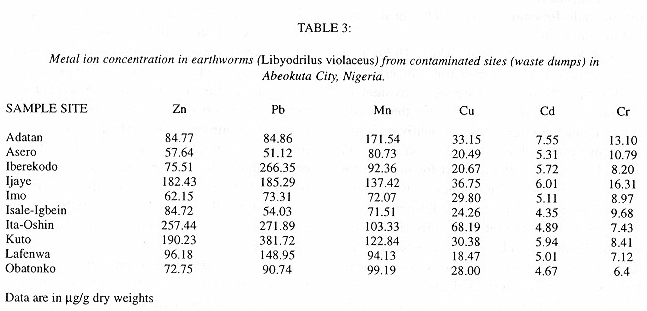
<body><![CDATA[<p><font face="Arial,Helvetica"><font size=-1><b>Quantitative analysis: </b>The sample digests were analysed using a Perkin Elmer 403 atomic absorption spectrometer at wavelengths specific to each metal at the soil laboratory, Ring Road, Ibadan, Oyo state, Nigeria.</font></font>     <br>&nbsp;     <p>    <br>     <p><b><font face="Arial,Helvetica"><font size=-1>Results</font></font></b>     <p><font face="Arial,Helvetica"><font size=-1>The results are presented in Tables <a href="#Tabla1">1</a>, <a href="#Tabla 2">2</a> and <a href="#Tabla3">3</a>. <a href="#Tabla1">Table 1</a> shows the results obtained from the control sites (uncontaminated) while <a href="#Tabla 2">Table 2</a> and <a href="#Tabla3">3</a> show the metal ion levels in the soil samples and earthworms samples respectively from the waste dumps (contaminated site).</font></font>     <br>&nbsp;     <p>    <br>     <center>     ]]></body>
<body><![CDATA[<p><a NAME="Tabla1"></a><img SRC="/img/fbpe/rbt/v48n1/0470i1.gif" height=235 width=642>     
<br>&nbsp;     <br>&nbsp;     <p><a NAME="Tabla 2"></a><img SRC="/img/fbpe/rbt/v48n1/0470i2.gif" height=312 width=642>     
<br>&nbsp;     <br>&nbsp;     <p><a NAME="Tabla3"></a><img SRC="/img/fbpe/rbt/v48n1/0470i3.gif" height=311 width=647></center>      
<br>&nbsp;     <p><b><font face="Arial,Helvetica"><font size=-1>Discussion</font></font></b><b><font face="Arial,Helvetica"><font size=-1></font></font></b>     <p><font face="Arial,Helvetica"><font size=-1><b>Soil pH : </b>Soil pH has being defined as the parameter most widely accepted as exerting a controlling influence on the availability of micro-nutrients to plants (<a href="#Sanders">Sanders 1982</a>). The pH values of soil from the uncontaminated sites obtained from the Alabata campus of the University of Agriculture, Abeokuta, ranged from 5.90-6.74 which is normal for ordinary soil as reported by <a href="#Banjoko">Banjoko &amp; Sobulo (1990)</a> for some Nigeria soils especially forest and savannah soil with a range of 5.70 -6.50.</font></font>     ]]></body>
<body><![CDATA[<p><font face="Arial,Helvetica"><font size=-1>The pH for the soil samples from the contaminated sites ranged from a lowest value of 7.44 for the Imo dump site to a highest value of 10.10 for the Ita-Oshin and Iberekodo dump sites. It has also been reported by <a href="#Sposito">Sposito <i>et al</i>. (1982)</a> that domino and greenfield composted sites have a pH value of 7.8 and 7.1 respectively, showing that waste contaminated soils have relatively high pH values which may affect plant growth.</font></font>     <p><font face="Arial,Helvetica"><font size=-1><b>Soil organic matter</b>: The organic matter content of soils from both uncontaminated and contaminated sites are presented in <a href="#Tabla1">Table 1</a> and <a href="#Tabla 2">2</a>. For the uncontaminated sites, the soil organic matter ranged from 3.25 -3.40% while for the contaminated sites, it ranged from 5.79% for the Isale-Igbehin site to 7.59% for the Ita-Oshin dump site.</font></font>     <p><font face="Arial,Helvetica"><font size=-1>For West African soil, <a href="#Ahm">Ahm (1970)</a> had reported that a good forest top soil contains between 3-4% organic carbon, equivalent to 5-7% obtained in this study and that waste contaminated soil tend to have relatively higher organic matter than non-waste contaminated soils. The low values obtained for the control sites may be due to the mono-cropping agricultural practice of the Alabata farmers</font></font>     <p><font face="Arial,Helvetica"><font size=-1><b>Level of heavy metals in soils and earthworms from control sites: </b>The results of the levels of accumulated metals in soil and earthworms from uncontaminated sites are presented in <a href="#Tabla1">Table1</a>. The levels showed slight variations in the metal concentrated and in nearly all cases the concentrations in the earthworms (<i>Libyodrilus violaceus</i>) being slightly higher than those of the soil samples as seen from the mean concentrations (&micro;g/g) of the metals in the earthworm and soil respectively e.g. Zn (6.74, 7.02), Pb(4.94,5.04), Mn (10.41, 10.54), Cu (1.60, 1.63), Cd (0.81, 0.806) and Cr (0.49, 0.55), the only exception being that of Cd in which there was no marked difference in its concentration in either of the samples. On a comparative basis the concentration of Mn was the highest (9.42-11.36 &micro;gg<sup>-1</sup>) for all the metals analysed while the lowest was Cd with a concentration range of 0.71 - 0.82 &micro;gg<sup> -1</sup>in the soil samples.</font></font>     <p><font face="Arial,Helvetica"><font size=-1>This trend of a highest Mn concentration and a lowest Cd concentration obtained in this study, is similar to the reported work of <a href="#Andersoon">Anderson &amp; Laursen (1982)</a> who worked <i>on Lumbricus terrestris</i> in uncontaminated soils. Furthermore the mean concentration of the metals were also comparable to the range obtained in this study, (Mn 11.71 -12.81 &micro;g/g, Pb.5.21 -5.44 &micro;g/g, Cd 0.77- 0.82 &micro;g/g)</font></font>     <p><font face="Arial,Helvetica"><font size=-1><b>Levels of heavy metals in soil and earthworms from contaminated sites: </b>In contrast to the earlier observation of earthworm metals concentration being higher than soil metal concentration we observed that in nearly all cases, the concentration of metals in the soil samples were higher than those of the earthworm samples, with the exception of Cd and Cr concentrations which had higher concentrations in earthworms than in soil samples. This observation may be due to the chemical changes which occur in the alientary tracts of earthworms and hence render various metals more available to plants. Also mineralization of dead earthworms releases accumulated heavy metals back to the environment (<a href="#Morgan93">Morgan &amp; Morgan 1993</a>). This trend also conforms with the work of <a href="#Weigmann">Weigmann (1991)</a> who reported higher levels of metals in worms from more polluted sites and that irrespective of the degree of pollution, the ratio of metal concentration in earthworms to soil samples is less than unity with the exception of a few metals such as Cd. (For the metals Zn, Pb, Mn and Cu in this study, this ratio was less than unity while for Cd and Cr the ratio is higher than unity).</font></font>     <p><font face="Arial,Helvetica"><font size=-1>The percentage of each metal ion concentration in an earthworm to a soil sample was computed based on the mean concentrations of each metal accumulated in all dump sites and were found to range between 85% to 91%. These percentages are similar to those obtained, by <a href="#Saciragac">Saciragic <i>et al</i>. (1990)</a> for the metals Zn (81%), Pb(79%), Mn (79%) Cu (88%), Cd (90%) and Cr (87%) in earthworms.</font></font>     <p><font face="Arial,Helvetica"><font size=-1>Similarly the Adatan dump accumulated the highest concentration of Mn (187.55&micro;g/g) and Cd (6.41 &micro;g/g) for soil samples and for earthworm samples (Mn 171.54 &micro;g/g, Cd 7.55 &micro;g/g) while the highest concentration of Pb and Cr in both soil and earthworms were found at the Kuto and Ijaiye dumpsites respectively. Whereas the amount of metals accumulated within earthworm tissues is partly dependent on the absolute concentration of the metal within a given soil, it is strongly co-determined by physicochemical edaphic interactions, including factors such as pH, Ca concentration, organic matter content and cation - exchange capacity (<a href="#Ma">Ma <i>et al</i>. 1983</a>, and <a href="#Morgan93">Morgan &amp; Morgan 1993</a>). The metals Mn, Cu and Zn are essential for plant growth and the availability of these metals is decreased as the soil pH is raised, (Morgan &amp; Morgan 1988b). This is in line with the observation that the Ita-Oshin waste dump with a high pH of 10.10 also had the highest concentration of zinc and copper. While the Adatan dump with a pH of 9.02 had the highest Mn concentration.</font></font>     <p><font face="Arial,Helvetica"><font size=-1><a href="#Shuman">Shuman (1979)</a> reported that Zn, Mn, and Cr are highest in fine textured high organic matter soils than in coarse textured low cation exchange capacity soils, as observed in this study for the Ita-Oshin dump site with an organic matter of 7.59% and the highest concentration of Zn and Cu, while the Adatan dump also with an organic matter of 6.20% had the highest Mn level of 187.55 &micro;gg<sup>-1</sup>.</font></font>     <p><font face="Arial,Helvetica"><font size=-1>The general trend of the metals concentrated either in the soil or in the earthworms show that Pb (381.72 - 443.36&micro;g/g) had the highest concentration while Cd had the lowest (6.41 - 7.55&micro;g/g) and follow a general trend of Pb > Zn > Mn > Cu > Cr > Cd. Though this trend may not be exclusive, it follows to an extent the reported trend of <a href="#Sposito">Sposito (1992)</a> on his work on trace metal in arid zone soils amended with sewage sludge of which the trend Mn > Zn > Pb > Cu > Cr > Cd was reported. The main variation observed lies with the lead concentration. However it has also been reported (<a href="#Gish">Gish &amp; Christensen 1973</a>, <a href="#Ash">Ash &amp; Lee 1980</a>) that soils near to busy roads are more polluted with respect to lead (due to the combustion of petrol in motor vehicles which account for over 80% of lead in air) and accounting for the high levels of Pb in soil and earthworms of their report. The difference in lead concentration (trend) as reported by <a href="#Sposito">Sposito (1992)</a> has been explained by the fact that the study was carried out farther away from busy roads, while the waste dumps used in this study were located inside the town and near busy roads. This accounts for the Kuto market waste dump which is located by the road side in having the highest Pb concentration of 443.36 &micro;g/g. Other dumps like the Iberekodo with a Pb concentration of 300.40&micro;g/g and Ita-Oshin(Pb concentration of 314.81&micro;g/g) are all located along the path of a busy highway. The lowest Pb concentration of 51.60&micro;g/g obtained for the Asero dump may also be as a result of its location which is far from a market place or indeed a busy network of roads.</font></font>     ]]></body>
<body><![CDATA[<p><font face="Arial,Helvetica"><font size=-1>In conclusion, this study confirms that the earthworm (<i>Lybyodrilus violaceus</i> ) can serve as a bio-indicator in dump site environments and that the levels of metals concentrated in the earthworms as a ratio to that in the soil samples is less than unity with the exception of Cadmium and Chromium. Furthermore, the availability of metals in soils were influenced by the soil pH and the soil organic matter accounting for the variation in metal concentrations from one dump site to the other. Finally, highest concentration of lead was found at dump site located at roadsides.</font></font>     <br>&nbsp;     <p>    <br>     <p><b><font face="Arial,Helvetica"><font size=-1>References</font></font></b>     <!-- ref --><p><a NAME="Ahm"></a><font face="Arial,Helvetica"><font size=-1>Ahm, P.M. 1970. West African Soils. Oxford University, London. 332.</font></font>    &nbsp;&nbsp;&nbsp;&nbsp;&nbsp;&nbsp;&nbsp;&nbsp;[&#160;<a href="javascript:void(0);" onclick="javascript: window.open('/scielo.php?script=sci_nlinks&ref=1215211&pid=S0034-7744200000010002600001&lng=','','width=640,height=500,resizable=yes,scrollbars=1,menubar=yes,');">Links</a>&#160;]<!-- end-ref --><!-- ref --><p><a NAME="Andersoon"></a><font face="Arial,Helvetica"><font size=-1>Andersoon, C. &amp; J. Laursen. 1982. Distribution of heavy metals in <i>Lumbricus terrestris, Aporrectode longe</i> and <i>A. rosea</i> measured by atomic absorption and X-ray fluorescence spectrometry. Pedobiologia. 24:347 - 56.</font></font>    &nbsp;&nbsp;&nbsp;&nbsp;&nbsp;&nbsp;&nbsp;&nbsp;[&#160;<a href="javascript:void(0);" onclick="javascript: window.open('/scielo.php?script=sci_nlinks&ref=1215212&pid=S0034-7744200000010002600002&lng=','','width=640,height=500,resizable=yes,scrollbars=1,menubar=yes,');">Links</a>&#160;]<!-- end-ref --><!-- ref --><p><a NAME="Ash"></a><font face="Arial,Helvetica"><font size=-1>Ash, C. P. J. &amp; D. I. Lee. 1980. Lead, Cadmium, Copper and Iron from roadside sites. Environ. Pollut. (Series A) 22:59 - 67.</font></font>    &nbsp;&nbsp;&nbsp;&nbsp;&nbsp;&nbsp;&nbsp;&nbsp;[&#160;<a href="javascript:void(0);" onclick="javascript: window.open('/scielo.php?script=sci_nlinks&ref=1215213&pid=S0034-7744200000010002600003&lng=','','width=640,height=500,resizable=yes,scrollbars=1,menubar=yes,');">Links</a>&#160;]<!-- end-ref --><!-- ref --><p><a NAME="Banjoko"></a><font face="Arial,Helvetica"><font size=-1>Banjoko, A. &amp; R. A. Sobulo. 1990. Particle size disrtribution of Fe, Mn, Zn, Cu, and B in some Nigeria Soils. Nig. J. Sci. 34: 60 - 163.</font></font>    &nbsp;&nbsp;&nbsp;&nbsp;&nbsp;&nbsp;&nbsp;&nbsp;[&#160;<a href="javascript:void(0);" onclick="javascript: window.open('/scielo.php?script=sci_nlinks&ref=1215214&pid=S0034-7744200000010002600004&lng=','','width=640,height=500,resizable=yes,scrollbars=1,menubar=yes,');">Links</a>&#160;]<!-- end-ref --><!-- ref --><p><a NAME="Edwards"></a><font face="Arial,Helvetica"><font size=-1>Edwards, C. A. &amp; J. R. Lofty. 1977. Biology of Earthworms. Chapman &amp; Hall, London.</font></font>    &nbsp;&nbsp;&nbsp;&nbsp;&nbsp;&nbsp;&nbsp;&nbsp;[&#160;<a href="javascript:void(0);" onclick="javascript: window.open('/scielo.php?script=sci_nlinks&ref=1215215&pid=S0034-7744200000010002600005&lng=','','width=640,height=500,resizable=yes,scrollbars=1,menubar=yes,');">Links</a>&#160;]<!-- end-ref --><!-- ref --><p><a NAME="Gish"></a><font face="Arial,Helvetica"><font size=-1>Gish, C. D. &amp; R. E. Christensen. 1973. Cadmium, Leadd and Zinc in earthworms from, roadside soil. Environ. Sci. Technol 7:1060 - 1062.</font></font>    &nbsp;&nbsp;&nbsp;&nbsp;&nbsp;&nbsp;&nbsp;&nbsp;[&#160;<a href="javascript:void(0);" onclick="javascript: window.open('/scielo.php?script=sci_nlinks&ref=1215216&pid=S0034-7744200000010002600006&lng=','','width=640,height=500,resizable=yes,scrollbars=1,menubar=yes,');">Links</a>&#160;]<!-- end-ref --><!-- ref --><p><a NAME="Hamilton"></a><font face="Arial,Helvetica"><font size=-1>Hamilton, W. E. &amp; D. L. Dindal. 1989. Impact of Landspread sewage sludge and earthworm introdution on established earthworms and soil structure. Bio. Fertility Soils 8:160 - 165.</font></font>    &nbsp;&nbsp;&nbsp;&nbsp;&nbsp;&nbsp;&nbsp;&nbsp;[&#160;<a href="javascript:void(0);" onclick="javascript: window.open('/scielo.php?script=sci_nlinks&ref=1215217&pid=S0034-7744200000010002600007&lng=','','width=640,height=500,resizable=yes,scrollbars=1,menubar=yes,');">Links</a>&#160;]<!-- end-ref --><!-- ref --><p><a NAME="Ireland"></a><font face="Arial,Helvetica"><font size=-1>Ireland, M. P. 1983. Heavy metal uptake and tissue distribution p. 245-265, In Satchell, J. E. (ed.). Earthworms ecology, from Darwin to vermi culture. Chapman &amp; Hall, London.</font></font>    &nbsp;&nbsp;&nbsp;&nbsp;&nbsp;&nbsp;&nbsp;&nbsp;[&#160;<a href="javascript:void(0);" onclick="javascript: window.open('/scielo.php?script=sci_nlinks&ref=1215218&pid=S0034-7744200000010002600008&lng=','','width=640,height=500,resizable=yes,scrollbars=1,menubar=yes,');">Links</a>&#160;]<!-- end-ref --><!-- ref --><p><a NAME="Ma"></a><font face="Arial,Helvetica"><font size=-1>Ma, W. C., Th. Edleman, I. Van Beersum &amp; Th. Jane, 1983. Uptake of Cadmium, Zinc, Lead and Copper in earthworms near a Zinc Smelting Complex:- Influence of soil pH and organic matter. Bull. Environ. Contam. Toxicol 30:424 - 427.</font></font>    &nbsp;&nbsp;&nbsp;&nbsp;&nbsp;&nbsp;&nbsp;&nbsp;[&#160;<a href="javascript:void(0);" onclick="javascript: window.open('/scielo.php?script=sci_nlinks&ref=1215219&pid=S0034-7744200000010002600009&lng=','','width=640,height=500,resizable=yes,scrollbars=1,menubar=yes,');">Links</a>&#160;]<!-- end-ref --><!-- ref --><p><a NAME="Morgan88a"></a><font size=-1><font face="Arial,Helvetica">Morgan, J. E. &amp; A. J. Morgan.1988a.</font><font face="Desdemona"> </font><font face="Arial,Helvetica">Cadmium Lead Interactions Involving earthworms, Part 1: The effect of exogenous calcium on Lead accumulatiion by earthworms under field and laboratory conditions. Environ. Pollut. 54:123 - 138.</font></font>    &nbsp;&nbsp;&nbsp;&nbsp;&nbsp;&nbsp;&nbsp;&nbsp;[&#160;<a href="javascript:void(0);" onclick="javascript: window.open('/scielo.php?script=sci_nlinks&ref=1215220&pid=S0034-7744200000010002600010&lng=','','width=640,height=500,resizable=yes,scrollbars=1,menubar=yes,');">Links</a>&#160;]<!-- end-ref --><!-- ref --><p><a NAME="Morgan93"></a><font face="Arial,Helvetica"><font size=-1>Morgan, J. E. &amp; A. J. Morgan. 1993. Seasonal changes in the tissue metal (Cd, Zn and Pb) concentration in two ecophysiologically dissimilar earthworm species, pollution monitoring implication. Environ. Pollut. 82: 1 - 7.</font></font>    &nbsp;&nbsp;&nbsp;&nbsp;&nbsp;&nbsp;&nbsp;&nbsp;[&#160;<a href="javascript:void(0);" onclick="javascript: window.open('/scielo.php?script=sci_nlinks&ref=1215221&pid=S0034-7744200000010002600011&lng=','','width=640,height=500,resizable=yes,scrollbars=1,menubar=yes,');">Links</a>&#160;]<!-- end-ref --><!-- ref --><p><a NAME="Saciragac"></a><font face="Arial,Helvetica"><font size=-1>Saciragac, B., N. Dimic. &amp; H. E. Velagic. 1990 Characterization of vermicompost obtained during growth of earthworms on sewage sludge. Soil and Fertilizers 38: 42 - 46.</font></font>    &nbsp;&nbsp;&nbsp;&nbsp;&nbsp;&nbsp;&nbsp;&nbsp;[&#160;<a href="javascript:void(0);" onclick="javascript: window.open('/scielo.php?script=sci_nlinks&ref=1215222&pid=S0034-7744200000010002600012&lng=','','width=640,height=500,resizable=yes,scrollbars=1,menubar=yes,');">Links</a>&#160;]<!-- end-ref --><!-- ref --><p><a NAME="Sanders"></a><font face="Arial,Helvetica"><font size=-1>Sanders, J. E. 1982. The Effect of pH upon the Cu and Cupric ion concentrations in soil solution. J. Soil Sci. 33:679 - 689.</font></font>    &nbsp;&nbsp;&nbsp;&nbsp;&nbsp;&nbsp;&nbsp;&nbsp;[&#160;<a href="javascript:void(0);" onclick="javascript: window.open('/scielo.php?script=sci_nlinks&ref=1215223&pid=S0034-7744200000010002600013&lng=','','width=640,height=500,resizable=yes,scrollbars=1,menubar=yes,');">Links</a>&#160;]<!-- end-ref --><!-- ref --><p><a NAME="Shuman"></a><font face="Arial,Helvetica"><font size=-1>Shuman, L. H. 1979. Zinc, Manganese and Copper in soil fractions. Soil Sci. 127:10 - 17.</font></font>    &nbsp;&nbsp;&nbsp;&nbsp;&nbsp;&nbsp;&nbsp;&nbsp;[&#160;<a href="javascript:void(0);" onclick="javascript: window.open('/scielo.php?script=sci_nlinks&ref=1215224&pid=S0034-7744200000010002600014&lng=','','width=640,height=500,resizable=yes,scrollbars=1,menubar=yes,');">Links</a>&#160;]<!-- end-ref --><!-- ref --><p><a NAME="Sposito"></a><font face="Arial,Helvetica"><font size=-1>Sposito, R. C. 1992. Trace metal chemistry in arid - zone field soils amended with sewage sludge I. Fractionation of Ni, Cu, Zn and Pb in solid phases. Soil Sci Soc. Am. J. 46: 260 - 264.</font></font>    &nbsp;&nbsp;&nbsp;&nbsp;&nbsp;&nbsp;&nbsp;&nbsp;[&#160;<a href="javascript:void(0);" onclick="javascript: window.open('/scielo.php?script=sci_nlinks&ref=1215225&pid=S0034-7744200000010002600015&lng=','','width=640,height=500,resizable=yes,scrollbars=1,menubar=yes,');">Links</a>&#160;]<!-- end-ref --><!-- ref --><p><a NAME="Stafford"></a><font face="Arial,Helvetica"><font size=-1>Stafford, E. A &amp; McGrath. 1986. The use of acid insoluble residue to correct for the presence of soil derived metals in the gut of earthworms used as bio-indicator organisms. Environ. Sci. Tech. 20:151 - 155.</font></font>    &nbsp;&nbsp;&nbsp;&nbsp;&nbsp;&nbsp;&nbsp;&nbsp;[&#160;<a href="javascript:void(0);" onclick="javascript: window.open('/scielo.php?script=sci_nlinks&ref=1215226&pid=S0034-7744200000010002600016&lng=','','width=640,height=500,resizable=yes,scrollbars=1,menubar=yes,');">Links</a>&#160;]<!-- end-ref --><!-- ref --><p><a NAME="Weigmann"></a><font face="Arial,Helvetica"><font size=-1>Weigmann, G. 1991. Heavy metal levels in earthworms of a forest ecosystem influenced by traffic and air pollution. Water, Air, Soil Poll. 57 - 58: 655 - 663.</font></font>    &nbsp;&nbsp;&nbsp;&nbsp;&nbsp;&nbsp;&nbsp;&nbsp;[&#160;<a href="javascript:void(0);" onclick="javascript: window.open('/scielo.php?script=sci_nlinks&ref=1215227&pid=S0034-7744200000010002600017&lng=','','width=640,height=500,resizable=yes,scrollbars=1,menubar=yes,');">Links</a>&#160;]<!-- end-ref --><p><a NAME="1b"></a><font face="Arial,Helvetica"><font size=-1><sup><a href="#1">1</a></sup> Department of Environmental Management and Toxicology, University of Agriculture, Abeokuta, Nigeria. Fax: 234-39-234650,<b> </b>e-mail: <a href="mailto:kaybam@unaab.edu.ng">kaybam@unaab.edu.ng</a></font></font>     <p><a NAME="2a"></a><font face="Arial,Helvetica"><font size=-1><sup><a href="#2">2</a></sup> Department of Chemical Sciences, University of Agriculture, Abeokuta, Nigeria.</font></font>      ]]></body><back>
<ref-list>
<ref id="B1">
<nlm-citation citation-type="book">
<person-group person-group-type="author">
<name>
<surname><![CDATA[Ahm]]></surname>
<given-names><![CDATA[P.M.]]></given-names>
</name>
</person-group>
<source><![CDATA[West African Soils]]></source>
<year>1970</year>
<page-range>332</page-range><publisher-loc><![CDATA[London ]]></publisher-loc>
<publisher-name><![CDATA[Oxford University]]></publisher-name>
</nlm-citation>
</ref>
<ref id="B2">
<nlm-citation citation-type="journal">
<person-group person-group-type="author">
<name>
<surname><![CDATA[Andersoon]]></surname>
<given-names><![CDATA[C.]]></given-names>
</name>
<name>
<surname><![CDATA[Laursen]]></surname>
<given-names><![CDATA[J.]]></given-names>
</name>
</person-group>
<article-title xml:lang="en"><![CDATA[Distribution of heavy metals in Lumbricus terrestris, Aporrectode longe and A. rosea measured by atomic absorption and X-ray fluorescence spectrometry]]></article-title>
<source><![CDATA[Pedobiologia]]></source>
<year>1982</year>
<volume>24</volume>
<page-range>347 - 56</page-range></nlm-citation>
</ref>
<ref id="B3">
<nlm-citation citation-type="journal">
<person-group person-group-type="author">
<name>
<surname><![CDATA[Ash]]></surname>
<given-names><![CDATA[C. P. J.]]></given-names>
</name>
<name>
<surname><![CDATA[Lee]]></surname>
<given-names><![CDATA[D. I.]]></given-names>
</name>
</person-group>
<article-title xml:lang="en"><![CDATA[Lead, Cadmium, Copper and Iron from roadside sites]]></article-title>
<source><![CDATA[Environ. Pollut. (Series A)]]></source>
<year>1980</year>
<volume>22</volume>
<page-range>59 - 67</page-range></nlm-citation>
</ref>
<ref id="B4">
<nlm-citation citation-type="journal">
<person-group person-group-type="author">
<name>
<surname><![CDATA[Banjoko]]></surname>
<given-names><![CDATA[A.]]></given-names>
</name>
<name>
<surname><![CDATA[Sobulo]]></surname>
<given-names><![CDATA[R. A.]]></given-names>
</name>
</person-group>
<article-title xml:lang="en"><![CDATA[Particle size disrtribution of Fe, Mn, Zn, Cu, and B in some Nigeria Soils]]></article-title>
<source><![CDATA[Nig. J. Sci.]]></source>
<year>1990</year>
<volume>34</volume>
<page-range>60 - 163</page-range></nlm-citation>
</ref>
<ref id="B5">
<nlm-citation citation-type="book">
<person-group person-group-type="author">
<name>
<surname><![CDATA[Edwards]]></surname>
<given-names><![CDATA[C. A.]]></given-names>
</name>
<name>
<surname><![CDATA[Lofty]]></surname>
<given-names><![CDATA[J. R.]]></given-names>
</name>
</person-group>
<source><![CDATA[Biology of Earthworms]]></source>
<year>1977</year>
<publisher-loc><![CDATA[London ]]></publisher-loc>
<publisher-name><![CDATA[Chapman & Hall]]></publisher-name>
</nlm-citation>
</ref>
<ref id="B6">
<nlm-citation citation-type="journal">
<person-group person-group-type="author">
<name>
<surname><![CDATA[Gish]]></surname>
<given-names><![CDATA[C. D.]]></given-names>
</name>
<name>
<surname><![CDATA[Christensen]]></surname>
<given-names><![CDATA[R. E.]]></given-names>
</name>
</person-group>
<article-title xml:lang="en"><![CDATA[Cadmium, Leadd and Zinc in earthworms from, roadside soil]]></article-title>
<source><![CDATA[Environ. Sci. Technol]]></source>
<year>1973</year>
<volume>7</volume>
<page-range>1060 - 1062</page-range></nlm-citation>
</ref>
<ref id="B7">
<nlm-citation citation-type="journal">
<person-group person-group-type="author">
<name>
<surname><![CDATA[Hamilton]]></surname>
<given-names><![CDATA[W. E.]]></given-names>
</name>
<name>
<surname><![CDATA[Dindal]]></surname>
<given-names><![CDATA[D. L.]]></given-names>
</name>
</person-group>
<article-title xml:lang="en"><![CDATA[Impact of Landspread sewage sludge and earthworm introdution on established earthworms and soil structure]]></article-title>
<source><![CDATA[Bio. Fertility Soils]]></source>
<year>1989</year>
<volume>8</volume>
<page-range>160 - 165</page-range></nlm-citation>
</ref>
<ref id="B8">
<nlm-citation citation-type="book">
<person-group person-group-type="author">
<name>
<surname><![CDATA[Ireland]]></surname>
<given-names><![CDATA[M. P.]]></given-names>
</name>
</person-group>
<article-title xml:lang="en"><![CDATA[Heavy metal uptake and tissue distribution]]></article-title>
<person-group person-group-type="editor">
<name>
<surname><![CDATA[Satchell]]></surname>
<given-names><![CDATA[J. E.]]></given-names>
</name>
</person-group>
<source><![CDATA[Earthworms ecology, from Darwin to vermi culture]]></source>
<year>1983</year>
<page-range>245-265</page-range><publisher-loc><![CDATA[London ]]></publisher-loc>
<publisher-name><![CDATA[Chapman & Hall]]></publisher-name>
</nlm-citation>
</ref>
<ref id="B9">
<nlm-citation citation-type="journal">
<person-group person-group-type="author">
<name>
<surname><![CDATA[Ma]]></surname>
<given-names><![CDATA[W. C.]]></given-names>
</name>
<name>
<surname><![CDATA[Edleman]]></surname>
<given-names><![CDATA[Th.]]></given-names>
</name>
<name>
<surname><![CDATA[Van Beersum]]></surname>
<given-names><![CDATA[I.]]></given-names>
</name>
<name>
<surname><![CDATA[Jane]]></surname>
<given-names><![CDATA[Th.]]></given-names>
</name>
</person-group>
<article-title xml:lang="en"><![CDATA[Uptake of Cadmium, Zinc, Lead and Copper in earthworms near a Zinc Smelting Complex:- Influence of soil pH and organic matter]]></article-title>
<source><![CDATA[Bull. Environ. Contam. Toxicol]]></source>
<year>1983</year>
<volume>30</volume>
<page-range>424 - 427</page-range></nlm-citation>
</ref>
<ref id="B10">
<nlm-citation citation-type="journal">
<person-group person-group-type="author">
<name>
<surname><![CDATA[Morgan]]></surname>
<given-names><![CDATA[J. E.]]></given-names>
</name>
<name>
<surname><![CDATA[Morgan]]></surname>
<given-names><![CDATA[A. J.]]></given-names>
</name>
</person-group>
<article-title xml:lang="en"><![CDATA[Cadmium Lead Interactions Involving earthworms: Part 1: The effect of exogenous calcium on Lead accumulatiion by earthworms under field and laboratory conditions]]></article-title>
<source><![CDATA[Environ. Pollut.]]></source>
<year>1988</year>
<volume>54</volume>
<page-range>123 - 138</page-range></nlm-citation>
</ref>
<ref id="B11">
<nlm-citation citation-type="journal">
<person-group person-group-type="author">
<name>
<surname><![CDATA[Morgan]]></surname>
<given-names><![CDATA[J. E.]]></given-names>
</name>
<name>
<surname><![CDATA[Morgan]]></surname>
<given-names><![CDATA[A. J.]]></given-names>
</name>
</person-group>
<article-title xml:lang="en"><![CDATA[Seasonal changes in the tissue metal (Cd, Zn and Pb) concentration in two ecophysiologically dissimilar earthworm species, pollution monitoring implication]]></article-title>
<source><![CDATA[Environ. Pollut.]]></source>
<year>1993</year>
<volume>82</volume>
<page-range>1 - 7</page-range></nlm-citation>
</ref>
<ref id="B12">
<nlm-citation citation-type="journal">
<person-group person-group-type="author">
<name>
<surname><![CDATA[Saciragac]]></surname>
<given-names><![CDATA[B.]]></given-names>
</name>
<name>
<surname><![CDATA[Dimic]]></surname>
<given-names><![CDATA[N.]]></given-names>
</name>
<name>
<surname><![CDATA[Velagic]]></surname>
<given-names><![CDATA[H. E.]]></given-names>
</name>
</person-group>
<article-title xml:lang="en"><![CDATA[Characterization of vermicompost obtained during growth of earthworms on sewage sludge]]></article-title>
<source><![CDATA[Soil and Fertilizers]]></source>
<year>1990</year>
<volume>38</volume>
<page-range>42 - 46</page-range></nlm-citation>
</ref>
<ref id="B13">
<nlm-citation citation-type="journal">
<person-group person-group-type="author">
<name>
<surname><![CDATA[Sanders]]></surname>
<given-names><![CDATA[J. E.]]></given-names>
</name>
</person-group>
<article-title xml:lang="en"><![CDATA[The Effect of pH upon the Cu and Cupric ion concentrations in soil solution]]></article-title>
<source><![CDATA[J. Soil Sci.]]></source>
<year>1982</year>
<volume>33</volume>
<page-range>679 - 689</page-range></nlm-citation>
</ref>
<ref id="B14">
<nlm-citation citation-type="journal">
<person-group person-group-type="author">
<name>
<surname><![CDATA[Shuman]]></surname>
<given-names><![CDATA[L. H.]]></given-names>
</name>
</person-group>
<article-title xml:lang="en"><![CDATA[Zinc, Manganese and Copper in soil fractions]]></article-title>
<source><![CDATA[Soil Sci.]]></source>
<year>1979</year>
<volume>127</volume>
<page-range>10 - 17</page-range></nlm-citation>
</ref>
<ref id="B15">
<nlm-citation citation-type="journal">
<person-group person-group-type="author">
<name>
<surname><![CDATA[Sposito]]></surname>
<given-names><![CDATA[R. C.]]></given-names>
</name>
</person-group>
<article-title xml:lang="en"><![CDATA[Trace metal chemistry in arid - zone field soils amended with sewage sludge: I. Fractionation of Ni, Cu, Zn and Pb in solid phases]]></article-title>
<source><![CDATA[Soil Sci Soc. Am. J.]]></source>
<year>1992</year>
<volume>46</volume>
<page-range>260 - 264</page-range></nlm-citation>
</ref>
<ref id="B16">
<nlm-citation citation-type="journal">
<person-group person-group-type="author">
<name>
<surname><![CDATA[Stafford]]></surname>
<given-names><![CDATA[E. A]]></given-names>
</name>
<name>
<surname><![CDATA[McGrath]]></surname>
</name>
</person-group>
<article-title xml:lang="en"><![CDATA[The use of acid insoluble residue to correct for the presence of soil derived metals in the gut of earthworms used as bio-indicator organisms]]></article-title>
<source><![CDATA[Environ. Sci. Tech.]]></source>
<year>1986</year>
<volume>20</volume>
<page-range>151 - 155</page-range></nlm-citation>
</ref>
<ref id="B17">
<nlm-citation citation-type="journal">
<person-group person-group-type="author">
<name>
<surname><![CDATA[Weigmann]]></surname>
<given-names><![CDATA[G.]]></given-names>
</name>
</person-group>
<article-title xml:lang="en"><![CDATA[Heavy metal levels in earthworms of a forest ecosystem influenced by traffic and air pollution]]></article-title>
<source><![CDATA[Water, Air, Soil Poll.]]></source>
<year>1991</year>
<volume>57 - 58</volume>
<page-range>655 - 663</page-range></nlm-citation>
</ref>
</ref-list>
</back>
</article>