<?xml version="1.0" encoding="ISO-8859-1"?><article xmlns:mml="http://www.w3.org/1998/Math/MathML" xmlns:xlink="http://www.w3.org/1999/xlink" xmlns:xsi="http://www.w3.org/2001/XMLSchema-instance">
<front>
<journal-meta>
<journal-id>0034-7744</journal-id>
<journal-title><![CDATA[Revista de Biología Tropical]]></journal-title>
<abbrev-journal-title><![CDATA[Rev. biol. trop]]></abbrev-journal-title>
<issn>0034-7744</issn>
<publisher>
<publisher-name><![CDATA[Universidad de Costa Rica]]></publisher-name>
</publisher>
</journal-meta>
<article-meta>
<article-id>S0034-77441999000300016</article-id>
<title-group>
<article-title xml:lang="es"><![CDATA[Efecto de jugos vegetales sobre la producción de Daphnia pulex (Cladocera: Daphnidae) en condiciones de laboratorio]]></article-title>
</title-group>
<contrib-group>
<contrib contrib-type="author">
<name>
<surname><![CDATA[Rojas]]></surname>
<given-names><![CDATA[Margarita L.]]></given-names>
</name>
<xref ref-type="aff" rid="A01"/>
</contrib>
<contrib contrib-type="author">
<name>
<surname><![CDATA[Navarrete]]></surname>
<given-names><![CDATA[Norma A.]]></given-names>
</name>
<xref ref-type="aff" rid="A01"/>
</contrib>
<contrib contrib-type="author">
<name>
<surname><![CDATA[Elías]]></surname>
<given-names><![CDATA[Guillermo]]></given-names>
</name>
<xref ref-type="aff" rid="A01"/>
</contrib>
<contrib contrib-type="author">
<name>
<surname><![CDATA[Contreras]]></surname>
<given-names><![CDATA[Gilberto]]></given-names>
</name>
<xref ref-type="aff" rid="A01"/>
</contrib>
</contrib-group>
<aff id="A01">
<institution><![CDATA[,Universidad Nacional Autónoma de México  ]]></institution>
<addr-line><![CDATA[Tlalnepantla Estado de México]]></addr-line>
</aff>
<pub-date pub-type="pub">
<day>00</day>
<month>09</month>
<year>1999</year>
</pub-date>
<pub-date pub-type="epub">
<day>00</day>
<month>09</month>
<year>1999</year>
</pub-date>
<volume>47</volume>
<numero>3</numero>
<fpage>429</fpage>
<lpage>435</lpage>
<copyright-statement/>
<copyright-year/>
<self-uri xlink:href="http://www.scielo.sa.cr/scielo.php?script=sci_arttext&amp;pid=S0034-77441999000300016&amp;lng=en&amp;nrm=iso"></self-uri><self-uri xlink:href="http://www.scielo.sa.cr/scielo.php?script=sci_abstract&amp;pid=S0034-77441999000300016&amp;lng=en&amp;nrm=iso"></self-uri><self-uri xlink:href="http://www.scielo.sa.cr/scielo.php?script=sci_pdf&amp;pid=S0034-77441999000300016&amp;lng=en&amp;nrm=iso"></self-uri><abstract abstract-type="short" xml:lang="en"><p><![CDATA[We tested the enriching effect of radish leaf (Raphanus sativus) and spinach leaf (Spinacea oleracea) extracts when added separately to the fermented wheat bran (Triticum aestivum) for producing Daphnia pulex. The experiments were conducted in 20 l glass bottles containing 14 l of dechorinated tap water. The initial inoculation density was 200 organisms/bottle. The cultures were allowed to grow for 21 days; during this time the controls received only the fermented wheat bran (Triticum aestivum), while the test containers received either extract of radish leaf (Raphanus sativus) or that of spinach leaf (Spinacea oleracea), in addition to ferment wheat bran (Triticum aestivum). We also measured some physico-chemical variables of the medium during the experimental period. These are: water temperature, dissolved oxygen, pH, conductivity, alkalinity and total hardness. These variables remained more or less the same in all test bottles reflecting non-significant variations. After the test period, the net production of D. pulex in terms of numbers was: 1 722 organisms/bottle in the controls while that receiving radish leaf (Raphanus sativus) extract with 7 997 organisms/bottle and that with spinach leaf (Spinacea oleracea) extract with 8 921 organisms/bottle. Test of analysis of variance showed significant differences among the cultures (Fisher p< 0.005). This study showed that the enrichment of fermented wheat bran (Triticum aestivum) with spinach (Spinacea oleracea) extract was a better nourishing source of food for culturing Daphnia pulex under laboratory conditions.]]></p></abstract>
<abstract abstract-type="short" xml:lang="es"><p><![CDATA[El objetivo fue probar el efecto enriquecedor del jugo de hojas de rábano (Raphanus sativus) y de espinaca (Spinacia oleracea), sobre un patrón de fermento de salvado de trigo (Triticum aestivum) en la producción de Daphnia pulex. Los experimentos se llevaron a cabo en botellas de vidrio de 20 l de capacidad, llenadas con agua del grifo desclorada a un volumen de 14 l. Los cultivos tuvieron una duración de 21 días, durante los cuales las botellas testigo tan solo recibieron fermento de salvado de trigo (Triticum aestivum) y las botellas experimentales (I, II y III), en el primer caso recibieron la combinación de fermento y el jugo de hojas de rábano (Raphanus sativus), y en el segundo caso el fermento y el jugo de espinaca (Spinacia oleracea). La tasa de siembra en ambos experimentos fue de 200 organismos/botella. Durante el desarrollo de los cultivos se evaluaron: temperatura del agua, oxígeno disuelto, pH, conductividad, alcalinidad y dureza total. Los parámetros ambientales se comportaron de manera similar en ambos experimentos, sin mostrar variaciones drásticas, ni grandes diferencias en sus registros. Las producciones netas obtenidas para la D. pulex fueron de: 1 722 organismos/botella en las testigo, 7 997 org/botella en las de rábano (Raphanus sativus), y de 8 921 org/botella en las de espinaca (Spinacia oleracea). De acuerdo con los datos de producción el análisis de varianza encontró diferencias significativas entre los cultivos (Fisher p< 0.005) y estableció que la combinación del fermento enriquecido con el jugo de espinaca (Spinacia oleracea) es la mejor alternativa alimenticia para la Daphnia pulex en condiciones de laboratorio.]]></p></abstract>
<kwd-group>
<kwd lng="en"><![CDATA[Daphnia pulex]]></kwd>
<kwd lng="en"><![CDATA[Cladocera]]></kwd>
<kwd lng="en"><![CDATA[net production]]></kwd>
<kwd lng="en"><![CDATA[source of food]]></kwd>
<kwd lng="en"><![CDATA[radish leaf (Raphanus sativus) extract]]></kwd>
<kwd lng="en"><![CDATA[spinach leaf (Spinacea oleracea) extract]]></kwd>
<kwd lng="en"><![CDATA[laboratory conditions]]></kwd>
</kwd-group>
</article-meta>
</front><body><![CDATA[ <CENTER><B><FONT FACE="Arial,Helvetica">Efecto de jugos vegetales sobre la producci&oacute;n de <I>Daphnia pulex</I> (Cladocera:</FONT></B></CENTER>      <CENTER><B><FONT FACE="Arial,Helvetica">Daphnidae) en condiciones de laboratorio</FONT></B></CENTER> <FONT SIZE=-1>&nbsp;</FONT>     <BR><FONT SIZE=-1><FONT FACE="Arial,Helvetica">&nbsp;</FONT></FONT>     <BR><FONT SIZE=-1>&nbsp;</FONT>     <CENTER><B><FONT FACE="Arial,Helvetica"><FONT SIZE=-1>Margarita L. Rojas, Norma A. Navarrete, Guillermo El&iacute;as y Gilberto Contreras&nbsp;<A NAME="1a"></A></FONT><SUP><FONT SIZE=-2><A HREF="#1b">1</A></FONT></SUP></FONT></B></CENTER>      <CENTER><FONT SIZE=-1></FONT>&nbsp;</CENTER> <FONT SIZE=-1></FONT>      <P><FONT SIZE=-1>&nbsp;</FONT>     <CENTER><FONT FACE="Arial,Helvetica"><FONT SIZE=-1>Recibido 14-VII-1998. Corregido 10-III-1999. Aceptado 18-III-1999.</FONT></FONT></CENTER> <FONT SIZE=-1>&nbsp;</FONT><FONT SIZE=-1></FONT>      <P><B><FONT FACE="Arial,Helvetica"><FONT SIZE=-1>Abstract</FONT></FONT></B><FONT FACE="Arial,Helvetica"><FONT SIZE=-1></FONT></FONT>      <P><FONT SIZE=-1><FONT FACE="Arial,Helvetica">We tested the enriching effect of radish leaf (<I>Raphanus sativus</I>) and spinach leaf (<I>Spinacea oleracea</I>) extracts when added separately to the fermented wheat bran (<I>Triticum aestivum</I>) for producing <I>Daphnia pulex</I>. The experiments were conducted in 20 l glass bottles containing 14 l of dechorinated tap water. The initial inoculation density was 200 organisms/bottle. The cultures were allowed to grow for 21 days; during this time the controls received only the fermented wheat bran (<I>Triticum aestivum</I>), while the test containers received either extract of radish leaf (<I>Raphanus sativus</I>) or that of spinach leaf (<I>Spinacea oleracea</I>), in addition to ferment wheat bran (<I>Triticum aestivum</I>). We also measured some physico-chemical variables of the medium during the experimental period. These are: water temperature, dissolved oxygen, pH, conductivity, alkalinity and total hardness. These variables remained more or less the same in all test bottles reflecting non-significant variations. After the test period, the net production of <I>D. pulex</I> in terms of numbers was: 1 722 organisms/bottle in the controls while that receiving radish leaf (<I>Raphanus sativus</I>) extract with 7 997 organisms/bottle and that with spinach leaf (<I>Spinacea oleracea</I>) extract with 8 921 organisms/bottle. Test of analysis of variance showed significant differences among the cultures (Fisher p&lt; 0.005). This study showed that the enrichment of fermented wheat bran (<I>Triticum aestivum</I>) with spinach (<I>Spinacea oleracea</I>) extract was a better nourishing source of food for culturing <I>Daphnia pulex</I> under laboratory conditions.</FONT></FONT><FONT SIZE=-1></FONT>      ]]></body>
<body><![CDATA[<P><B><FONT FACE="Arial,Helvetica"><FONT SIZE=-1>Key words</FONT></FONT></B><FONT FACE="Arial,Helvetica"><FONT SIZE=-1></FONT></FONT>      <P><FONT SIZE=-1><FONT FACE="Arial,Helvetica">Daphnia pulex, Cladocera, net production, source of food, radish leaf (Raphanus sativus) extract, spinach leaf (Spinacea oleracea) extract, laboratory conditions.</FONT></FONT>     <BR><FONT SIZE=-1><FONT FACE="Arial,Helvetica">&nbsp;</FONT></FONT><FONT SIZE=-1></FONT>      <P><FONT SIZE=-1><FONT FACE="Arial,Helvetica">La producci&oacute;n exitosa de peces y crust&aacute;ceos con fines acuaculturales depende, entre otras cosas, de la disponibilidad de organismos zooplanct&oacute;nicos de talla apropiada para la alimentaci&oacute;n de sus larvas (<A HREF="#Muthu">Muthu 1982</A>), dado que est&aacute; extensamente documentado el rol del zooplancton en las cadenas alimenticias acu&aacute;ticas, siendo la principal conducci&oacute;n de nutrientes entre los productores primarios y los altos niveles tr&oacute;ficos (<A HREF="#Conklin">Conklin &amp; Provasoli 1978</A>).</FONT></FONT><FONT SIZE=-1></FONT>      <P><FONT SIZE=-1><FONT FACE="Arial,Helvetica">Recientemente la eclosi&oacute;n de nauplios de artemia se ha vuelto un alimento popular utilizado en investigaci&oacute;n y acuacultura. Sin embargo, el alto costo de sus quistes ha sido la principal causa de incursionar en organismos zooplanct&oacute;nicos, los cuales presentan ventajas de cultivo a gran escala y a muy bajo costo, como es el caso de ciliados, rot&iacute;feros, cop&eacute;podos y clad&oacute;ceros (<A HREF="#Muthu">Muthu 1982</A>).</FONT></FONT><FONT SIZE=-1></FONT>      <P><FONT SIZE=-1><FONT FACE="Arial,Helvetica">Dentro de los clad&oacute;ceros han sido seleccionados los g&eacute;neros <I>Daphnia</I> y<I> Moina</I> puesto que ofrecen un alto contenido nutricional y facilidades de producci&oacute;n en cultivo (<A HREF="#Torrentera">Torrentera &amp; Tacon 1989</A>).</FONT></FONT><FONT SIZE=-1></FONT>      <P><FONT SIZE=-1><FONT FACE="Arial,Helvetica">En el caso del g&eacute;nero <I>Daphnia</I> estas facilidades de producci&oacute;n se deben a importantes cualidades como son: gran resistencia a las variaciones ambientales, corto tiempo generacional, alta tasa reproductiva y a su relativamente poca selectividad como organismo filtrador, lo que facilita la utilizaci&oacute;n de diversas dietas y la implementaci&oacute;n de cultivos masivos (<A HREF="#Tech">Tech 1982</A>, <A HREF="#Torrentera">Torrentera &amp; Tacon 1989</A>).</FONT></FONT><FONT SIZE=-1></FONT>      <P><FONT SIZE=-1><FONT FACE="Arial,Helvetica">Los medios de cultivo utilizados son variados, pudi&eacute;ndose agrupar en: medios minerales, org&aacute;nicos y enriquecidos. En este sentido tenemos los trabajos de <A HREF="#Nita">Nita (1982)</A> quien cultiv&oacute; <I>Daphnia pulex</I> utilizando gallinaza seca y fertilizantes minerales (Urea y Superfosfato Triple), <A HREF="#Porras">Porras (1982)</A> realiz&oacute; un cultivo rotatorio de <I>Daphnia </I>sp<I>.</I> con gallinaza seca y gallinaza seca combinada con<I> Spirulina maxima</I>, <A HREF="#Olivares">Olivares <I>et al</I>. (1993)</A> compararon la producci&oacute;n de <I>Daphnia </I>sp<I>.</I> utilizando esti&eacute;rcol de caballo y la infusi&oacute;n de esti&eacute;rcol de caballo y jugo de hojas de plantas, <A HREF="#Soriano">Soriano (1995)</A> cultiv&oacute; <I>Daphnia pulex</I> aplicando gallinaza seca a varias concentraciones y compar&aacute;ndolas con un testigo en base a harina de arroz.</FONT></FONT><FONT SIZE=-1></FONT>      <P><FONT SIZE=-1><FONT FACE="Arial,Helvetica">El objetivo del presente estudio fue probar el efecto del jugo de hojas verdes como son r&aacute;bano (<I>Raphanus sativus</I>) y espinaca (<I>Spinacia oleracea</I>), sobre un patr&oacute;n de fermento de salvado de trigo (<I>Triticum aestivum</I>) en la producci&oacute;n de <I>Daphnia pulex</I> (Leydig 1860), en condiciones de laboratorio.</FONT></FONT><FONT SIZE=-1></FONT>      <P><FONT SIZE=-1><FONT FACE="Arial,Helvetica">&nbsp;</FONT></FONT>     ]]></body>
<body><![CDATA[<BR><B><FONT FACE="Arial,Helvetica"><FONT SIZE=-1>Materiales y m&eacute;todos</FONT></FONT></B><FONT SIZE=-1></FONT>      <P><FONT SIZE=-1><FONT FACE="Arial,Helvetica">Los cultivos se llevaron a cabo en el Laboratorio de Producci&oacute;n de Peces e Invertebrados Acu&aacute;ticos del Campus Iztacala, Universidad Nacional Aut&oacute;noma de M&eacute;xico.</FONT></FONT><FONT SIZE=-1></FONT>      <P><FONT SIZE=-1><FONT FACE="Arial,Helvetica">Para su realizaci&oacute;n se utilizaron botellas de vidrio de 20 l de capacidad, las cuales fueron llenadas con agua del grifo a un volumen de 14 l y se dejaron reposar por tres d&iacute;as para la eliminaci&oacute;n del cloro.</FONT></FONT><FONT SIZE=-1></FONT>      <P><FONT SIZE=-1><FONT FACE="Arial,Helvetica">El medio de cultivo patr&oacute;n para los dos experimentos se prepar&oacute; con fermento de salvado de trigo (<I>Triticum aestivum</I>) (10 ml/l) adicionado con Sulfato de Calcio (0.50 g/l) y Cloruro de Sodio (0.25 g/l) (Secretar&iacute;a de Pesca-Acuacultura 1983, <I>In </I><A HREF="#Torrentera">Torrentera &amp; Tacon 1989</A>).</FONT></FONT><FONT SIZE=-1></FONT>      <P><FONT SIZE=-1><FONT FACE="Arial,Helvetica">En el primer experimento la botella testigo tan solo fue alimentada con el fermento de salvado de trigo (<I>Triticum aestivum</I>) una vez por semana y las botellas experimentales (I, II y III) con la combinaci&oacute;n del fermento de salvado de trigo (<I>Triticum aestivum</I>) y el jugo de hojas de r&aacute;bano (<I>Raphanus sativus</I>) a una proporci&oacute;n 1:50, dos veces por semana (Matsudaira 1943, <I>In </I><A HREF="#Tech">Tech 1982</A>).</FONT></FONT><FONT SIZE=-1></FONT>      <P><FONT SIZE=-1><FONT FACE="Arial,Helvetica">En el segundo experimento la variable en las botellas experimentales (I, II y III), fue el jugo de hojas de espinaca (<I>Spinacia oleracea</I>) a la misma proporci&oacute;n y dosificaci&oacute;n.</FONT></FONT><FONT SIZE=-1></FONT>      <P><FONT SIZE=-1><FONT FACE="Arial,Helvetica">En ambos experimentos la tasa de siembra de <I>Daphnia pulex</I> en todas las botellas (testigo y experimentales) fue de 200 organismos/botella. La cepa de <I>D. pulex </I>utilizada en estos experimentos, fue recolectada en noviembre de 1996 de unas piletas del Centro Pisc&iacute;cola "El Zarco", Ocoyoacac, Estado de M&eacute;xico y depurada un a&ntilde;o en nuestro laboratorio.</FONT></FONT><FONT SIZE=-1></FONT>      <P><FONT SIZE=-1><FONT FACE="Arial,Helvetica">El tiempo de cultivo fue de 21 d&iacute;as, durante los cuales se evaluaron dos veces por semana los siguientes par&aacute;metros ambientales: temperatura del agua (&deg;C) con un term&oacute;metro digital marca Elite, ox&iacute;geno disuelto (mg/l) mediante un ox&iacute;metro digital marca Cole Parmer, pH mediante un potenci&oacute;metro digital marca Cole Parmer; conductividad (&micro;mhos/cm<SUP>2</SUP>) con un conduct&iacute;metro digital marca Sprite 6000; alcalinidad (mg CaCO<SUB>3</SUB>/l) por medio de la titulaci&oacute;n con H<SUB>2</SUB>SO<SUB>4 </SUB>al 0.02 N y dureza total (mg CaCO<SUB>3</SUB>/l) por titulaci&oacute;n con EDTA al 0.1 M (<A HREF="#Anónimo">An&oacute;nimo 1989</A>).</FONT></FONT><FONT SIZE=-1></FONT>      <P><FONT SIZE=-1><FONT FACE="Arial,Helvetica">Al t&eacute;rmino de los per&iacute;odos de cultivo se realizaron las cosechas filtrando el 14.29 % del volumen total de las botellas a trav&eacute;s de una red para plancton de 125 &micro;m de luz de malla. La <I>Daphnia </I>colectada de todos los recipientes de ambos experimentos fue fijada con formalina al 4 % y almacenada en frascos viales para su cuantificaci&oacute;n.</FONT></FONT><FONT SIZE=-1></FONT>      <P><FONT SIZE=-1><FONT FACE="Arial,Helvetica">Para conocer la relaci&oacute;n de los par&aacute;metros ambientales con las producciones de <I>D. pulex</I> se realizaron an&aacute;lisis de correlaci&oacute;n simple.</FONT></FONT><FONT SIZE=-1></FONT>      ]]></body>
<body><![CDATA[<P><FONT SIZE=-1><FONT FACE="Arial,Helvetica">Y finalmente para evaluar las diferencias entre los par&aacute;metros ambientales evaluados en los dos experimentos y el efecto de los jugos de hojas de r&aacute;bano (<I>Raphanus sativus</I>) y de espinaca (<I>Spinacia oleracea</I>) combinado con el patr&oacute;n de fermento de salvado de trigo (<I>Triticum aestivum</I>) en la producci&oacute;n de <I>D. pulex</I>, se realizaron an&aacute;lisis de varianza para tres y dos variables de clasificaci&oacute;n (t&eacute;cnica de Fisher), a niveles de significancia de 0.99 y 0.995 (<A HREF="#Daniel">Daniel 1985</A>, <A HREF="#Reyes">Reyes 1987</A>).</FONT></FONT>     <BR><FONT SIZE=-1>&nbsp;</FONT>     <BR><FONT SIZE=-1>&nbsp;</FONT>     <BR><B><FONT FACE="Arial,Helvetica"><FONT SIZE=-1>Resultados</FONT></FONT></B><FONT SIZE=-1></FONT>      <P><FONT SIZE=-1><FONT FACE="Arial,Helvetica">En el <A HREF="#CUADRO 1">Cuadro 1</A> se presentan los valores m&aacute;ximos y m&iacute;nimos, el promedio y la desviaci&oacute;n est&aacute;ndar de los par&aacute;metros f&iacute;sico-qu&iacute;micos evaluados en los dos experimentos que comprendi&oacute; este estudio. En tanto que en las Fig. <A HREF="#Fig. 1">1 (A)</A> y <A HREF="#Fig. 1">(B)</A> tan solo se muestran los valores promedio de los mencionados par&aacute;metros ambientales.</FONT></FONT>     <BR><FONT SIZE=-1>&nbsp;</FONT>     <BR><FONT SIZE=-1>&nbsp;</FONT>     <CENTER><A NAME="CUADRO 1"></A><B><FONT FACE="Arial,Helvetica"><FONT SIZE=-1>CUADRO 1</FONT></FONT></B></CENTER>      <CENTER><FONT SIZE=-1>&nbsp;</FONT></CENTER>      <CENTER><FONT FACE="Arial,Helvetica"><FONT SIZE=-1><I>Par&aacute;metros ambientales en los cultivos de</I> Daphnia pulex</FONT></FONT></CENTER> <FONT SIZE=-1>&nbsp;</FONT>     ]]></body>
<body><![CDATA[<BR><FONT SIZE=-1>&nbsp;</FONT> <TABLE BORDER=0 CELLSPACING=0 CELLPADDING=4 WIDTH="100%" > <TR> <TD VALIGN=TOP WIDTH="12%">     <CENTER><FONT FACE="Arial,Helvetica"><FONT SIZE=-1>Par&aacute;metro</FONT></FONT></CENTER> </TD>  <TD VALIGN=TOP COLSPAN="4" WIDTH="29%">     <CENTER><FONT FACE="Arial,Helvetica"><FONT SIZE=-1>Testigo</FONT></FONT></CENTER> </TD>  <TD VALIGN=TOP COLSPAN="4" WIDTH="29%">     <CENTER><FONT FACE="Arial,Helvetica"><FONT SIZE=-1>R&aacute;bano</FONT></FONT></CENTER> </TD>  <TD VALIGN=TOP COLSPAN="4" WIDTH="31%">     <CENTER><FONT FACE="Arial,Helvetica"><FONT SIZE=-1>Espinaca</FONT></FONT></CENTER> </TD> </TR>  <TR> <TD VALIGN=TOP WIDTH="12%"><FONT FACE="Arial,Helvetica"><FONT SIZE=-1>&nbsp;</FONT></FONT></TD>  <TD VALIGN=TOP WIDTH="8%">     <CENTER><FONT FACE="Arial,Helvetica"><FONT SIZE=-1>m&aacute;x</FONT></FONT></CENTER> </TD>  <TD VALIGN=TOP WIDTH="8%">     <CENTER><FONT FACE="Arial,Helvetica"><FONT SIZE=-1>m&iacute;n</FONT></FONT></CENTER> </TD>  <TD VALIGN=TOP WIDTH="8%">     <CENTER><FONT FACE="Arial,Helvetica"><FONT SIZE=-1>prom</FONT></FONT></CENTER> </TD>  <TD VALIGN=TOP WIDTH="5%">     <CENTER><FONT FACE="Arial,Helvetica"><FONT SIZE=-1>ds</FONT></FONT></CENTER> </TD>  <TD VALIGN=TOP WIDTH="8%">     <CENTER><FONT FACE="Arial,Helvetica"><FONT SIZE=-1>m&aacute;x</FONT></FONT></CENTER> </TD>  <TD VALIGN=TOP WIDTH="8%">     ]]></body>
<body><![CDATA[<CENTER><FONT FACE="Arial,Helvetica"><FONT SIZE=-1>m&iacute;n</FONT></FONT></CENTER> </TD>  <TD VALIGN=TOP WIDTH="8%">     <CENTER><FONT FACE="Arial,Helvetica"><FONT SIZE=-1>prom</FONT></FONT></CENTER> </TD>  <TD VALIGN=TOP WIDTH="5%">     <CENTER><FONT FACE="Arial,Helvetica"><FONT SIZE=-1>ds</FONT></FONT></CENTER> </TD>  <TD VALIGN=TOP WIDTH="8%">     <CENTER><FONT FACE="Arial,Helvetica"><FONT SIZE=-1>m&aacute;x</FONT></FONT></CENTER> </TD>  <TD VALIGN=TOP WIDTH="8%">     <CENTER><FONT FACE="Arial,Helvetica"><FONT SIZE=-1>m&iacute;n</FONT></FONT></CENTER> </TD>  <TD VALIGN=TOP WIDTH="8%">     <CENTER><FONT FACE="Arial,Helvetica"><FONT SIZE=-1>prom</FONT></FONT></CENTER> </TD>  <TD VALIGN=TOP WIDTH="7%">     <CENTER><FONT FACE="Arial,Helvetica"><FONT SIZE=-1>ds</FONT></FONT></CENTER> </TD> </TR>  <TR> <TD VALIGN=TOP WIDTH="12%">     <CENTER><FONT FACE="Arial,Helvetica"><FONT SIZE=-1>Temperatura del Agua&nbsp;</FONT></FONT></CENTER>      <CENTER><FONT FACE="Arial,Helvetica"><FONT SIZE=-1>(&ordm;C)</FONT></FONT></CENTER> </TD>  <TD VALIGN=TOP WIDTH="8%">     <CENTER><FONT FACE="Arial,Helvetica"><FONT SIZE=-1>23.50</FONT></FONT></CENTER> </TD>  <TD VALIGN=TOP WIDTH="8%">     ]]></body>
<body><![CDATA[<CENTER><FONT FACE="Arial,Helvetica"><FONT SIZE=-1>21.50</FONT></FONT></CENTER> </TD>  <TD VALIGN=TOP WIDTH="8%">     <CENTER><FONT FACE="Arial,Helvetica"><FONT SIZE=-1>22.45</FONT></FONT></CENTER> </TD>  <TD VALIGN=TOP WIDTH="5%">     <CENTER><FONT FACE="Arial,Helvetica"><FONT SIZE=-1>0.74</FONT></FONT></CENTER> </TD>  <TD VALIGN=TOP WIDTH="8%">     <CENTER><FONT FACE="Arial,Helvetica"><FONT SIZE=-1>23.60</FONT></FONT></CENTER> </TD>  <TD VALIGN=TOP WIDTH="8%">     <CENTER><FONT FACE="Arial,Helvetica"><FONT SIZE=-1>21.20</FONT></FONT></CENTER> </TD>  <TD VALIGN=TOP WIDTH="8%">     <CENTER><FONT FACE="Arial,Helvetica"><FONT SIZE=-1>22.32</FONT></FONT></CENTER> </TD>  <TD VALIGN=TOP WIDTH="5%">     <CENTER><FONT FACE="Arial,Helvetica"><FONT SIZE=-1>0.97</FONT></FONT></CENTER> </TD>  <TD VALIGN=TOP WIDTH="8%">     <CENTER><FONT FACE="Arial,Helvetica"><FONT SIZE=-1>23.40</FONT></FONT></CENTER> </TD>  <TD VALIGN=TOP WIDTH="8%">     <CENTER><FONT FACE="Arial,Helvetica"><FONT SIZE=-1>21.80</FONT></FONT></CENTER> </TD>  <TD VALIGN=TOP WIDTH="8%">     <CENTER><FONT FACE="Arial,Helvetica"><FONT SIZE=-1>22.57</FONT></FONT></CENTER> </TD>  <TD VALIGN=TOP WIDTH="7%">     ]]></body>
<body><![CDATA[<CENTER><FONT FACE="Arial,Helvetica"><FONT SIZE=-1>0.58</FONT></FONT></CENTER> </TD> </TR>  <TR> <TD VALIGN=TOP WIDTH="12%">     <CENTER><FONT FACE="Arial,Helvetica"><FONT SIZE=-1>Ox&iacute;geno Disuelto&nbsp;</FONT></FONT></CENTER>      <CENTER><FONT FACE="Arial,Helvetica"><FONT SIZE=-1>(mg/l)</FONT></FONT></CENTER> </TD>  <TD VALIGN=TOP WIDTH="8%">     <CENTER><FONT FACE="Arial,Helvetica"><FONT SIZE=-1>7.50</FONT></FONT></CENTER> </TD>  <TD VALIGN=TOP WIDTH="8%">     <CENTER><FONT FACE="Arial,Helvetica"><FONT SIZE=-1>6.90</FONT></FONT></CENTER> </TD>  <TD VALIGN=TOP WIDTH="8%">     <CENTER><FONT FACE="Arial,Helvetica"><FONT SIZE=-1>7.20</FONT></FONT></CENTER> </TD>  <TD VALIGN=TOP WIDTH="5%">     <CENTER><FONT FACE="Arial,Helvetica"><FONT SIZE=-1>0.22</FONT></FONT></CENTER> </TD>  <TD VALIGN=TOP WIDTH="8%">     <CENTER><FONT FACE="Arial,Helvetica"><FONT SIZE=-1>7.00</FONT></FONT></CENTER> </TD>  <TD VALIGN=TOP WIDTH="8%">     <CENTER><FONT FACE="Arial,Helvetica"><FONT SIZE=-1>6.10</FONT></FONT></CENTER> </TD>  <TD VALIGN=TOP WIDTH="8%">     <CENTER><FONT FACE="Arial,Helvetica"><FONT SIZE=-1>6.47</FONT></FONT></CENTER> </TD>  <TD VALIGN=TOP WIDTH="5%">     ]]></body>
<body><![CDATA[<CENTER><FONT FACE="Arial,Helvetica"><FONT SIZE=-1>0.36</FONT></FONT></CENTER> </TD>  <TD VALIGN=TOP WIDTH="8%">     <CENTER><FONT FACE="Arial,Helvetica"><FONT SIZE=-1>7.40</FONT></FONT></CENTER> </TD>  <TD VALIGN=TOP WIDTH="8%">     <CENTER><FONT FACE="Arial,Helvetica"><FONT SIZE=-1>7.00</FONT></FONT></CENTER> </TD>  <TD VALIGN=TOP WIDTH="8%">     <CENTER><FONT FACE="Arial,Helvetica"><FONT SIZE=-1>7.25</FONT></FONT></CENTER> </TD>  <TD VALIGN=TOP WIDTH="7%">     <CENTER><FONT FACE="Arial,Helvetica"><FONT SIZE=-1>0.15</FONT></FONT></CENTER> </TD> </TR>  <TR> <TD VALIGN=TOP WIDTH="12%">     <CENTER><FONT FACE="Arial,Helvetica"><FONT SIZE=-1>pH&nbsp;</FONT></FONT></CENTER> </TD>  <TD VALIGN=TOP WIDTH="8%">     <CENTER><FONT FACE="Arial,Helvetica"><FONT SIZE=-1>8.40</FONT></FONT></CENTER> </TD>  <TD VALIGN=TOP WIDTH="8%">     <CENTER><FONT FACE="Arial,Helvetica"><FONT SIZE=-1>8.20</FONT></FONT></CENTER> </TD>  <TD VALIGN=TOP WIDTH="8%">     <CENTER><FONT FACE="Arial,Helvetica"><FONT SIZE=-1>8.32</FONT></FONT></CENTER> </TD>  <TD VALIGN=TOP WIDTH="5%">     <CENTER><FONT FACE="Arial,Helvetica"><FONT SIZE=-1>0.08</FONT></FONT></CENTER> </TD>  <TD VALIGN=TOP WIDTH="8%">     ]]></body>
<body><![CDATA[<CENTER><FONT FACE="Arial,Helvetica"><FONT SIZE=-1>8.40</FONT></FONT></CENTER> </TD>  <TD VALIGN=TOP WIDTH="8%">     <CENTER><FONT FACE="Arial,Helvetica"><FONT SIZE=-1>8.10</FONT></FONT></CENTER> </TD>  <TD VALIGN=TOP WIDTH="8%">     <CENTER><FONT FACE="Arial,Helvetica"><FONT SIZE=-1>8.22</FONT></FONT></CENTER> </TD>  <TD VALIGN=TOP WIDTH="5%">     <CENTER><FONT FACE="Arial,Helvetica"><FONT SIZE=-1>0.13</FONT></FONT></CENTER> </TD>  <TD VALIGN=TOP WIDTH="8%">     <CENTER><FONT FACE="Arial,Helvetica"><FONT SIZE=-1>8.30</FONT></FONT></CENTER> </TD>  <TD VALIGN=TOP WIDTH="8%">     <CENTER><FONT FACE="Arial,Helvetica"><FONT SIZE=-1>8.00</FONT></FONT></CENTER> </TD>  <TD VALIGN=TOP WIDTH="8%">     <CENTER><FONT FACE="Arial,Helvetica"><FONT SIZE=-1>8.18</FONT></FONT></CENTER> </TD>  <TD VALIGN=TOP WIDTH="7%">     <CENTER><FONT FACE="Arial,Helvetica"><FONT SIZE=-1>0.12</FONT></FONT></CENTER> </TD> </TR>  <TR> <TD VALIGN=TOP WIDTH="12%">     <CENTER><FONT FACE="Arial,Helvetica"><FONT SIZE=-1>Conductividad&nbsp;</FONT></FONT></CENTER>      <CENTER><FONT FACE="Arial,Helvetica"><FONT SIZE=-1>(&micro;mhos/cm<SUP>2</SUP>)&nbsp;</FONT></FONT></CENTER> </TD>  <TD VALIGN=TOP WIDTH="8%">     ]]></body>
<body><![CDATA[<CENTER><FONT FACE="Arial,Helvetica"><FONT SIZE=-1>1461.00</FONT></FONT></CENTER> </TD>  <TD VALIGN=TOP WIDTH="8%">     <CENTER><FONT FACE="Arial,Helvetica"><FONT SIZE=-1>1450.00</FONT></FONT></CENTER> </TD>  <TD VALIGN=TOP WIDTH="8%">     <CENTER><FONT FACE="Arial,Helvetica"><FONT SIZE=-1>1455.67</FONT></FONT></CENTER> </TD>  <TD VALIGN=TOP WIDTH="5%">     <CENTER><FONT FACE="Arial,Helvetica"><FONT SIZE=-1>4.18</FONT></FONT></CENTER> </TD>  <TD VALIGN=TOP WIDTH="8%">     <CENTER><FONT FACE="Arial,Helvetica"><FONT SIZE=-1>1567.00</FONT></FONT></CENTER> </TD>  <TD VALIGN=TOP WIDTH="8%">     <CENTER><FONT FACE="Arial,Helvetica"><FONT SIZE=-1>1546.00</FONT></FONT></CENTER> </TD>  <TD VALIGN=TOP WIDTH="8%">     <CENTER><FONT FACE="Arial,Helvetica"><FONT SIZE=-1>1556.17</FONT></FONT></CENTER> </TD>  <TD VALIGN=TOP WIDTH="5%">     <CENTER><FONT FACE="Arial,Helvetica"><FONT SIZE=-1>8.42</FONT></FONT></CENTER> </TD>  <TD VALIGN=TOP WIDTH="8%">     <CENTER><FONT FACE="Arial,Helvetica"><FONT SIZE=-1>1533.00</FONT></FONT></CENTER> </TD>  <TD VALIGN=TOP WIDTH="8%">     <CENTER><FONT FACE="Arial,Helvetica"><FONT SIZE=-1>1511.00</FONT></FONT></CENTER> </TD>  <TD VALIGN=TOP WIDTH="8%">     ]]></body>
<body><![CDATA[<CENTER><FONT FACE="Arial,Helvetica"><FONT SIZE=-1>1521.17</FONT></FONT></CENTER> </TD>  <TD VALIGN=TOP WIDTH="7%">     <CENTER><FONT FACE="Arial,Helvetica"><FONT SIZE=-1>8.52</FONT></FONT></CENTER> </TD> </TR>  <TR> <TD VALIGN=TOP WIDTH="12%">     <CENTER><FONT FACE="Arial,Helvetica"><FONT SIZE=-1>Alcalinidad&nbsp;</FONT></FONT></CENTER>      <CENTER><FONT FACE="Arial,Helvetica"><FONT SIZE=-1>(mg CaCO<SUB>3</SUB>/l)&nbsp;</FONT></FONT></CENTER> </TD>  <TD VALIGN=TOP WIDTH="8%">     <CENTER><FONT FACE="Arial,Helvetica"><FONT SIZE=-1>270.00</FONT></FONT></CENTER> </TD>  <TD VALIGN=TOP WIDTH="8%">     <CENTER><FONT FACE="Arial,Helvetica"><FONT SIZE=-1>259.50</FONT></FONT></CENTER> </TD>  <TD VALIGN=TOP WIDTH="8%">     <CENTER><FONT FACE="Arial,Helvetica"><FONT SIZE=-1>264.92</FONT></FONT></CENTER> </TD>  <TD VALIGN=TOP WIDTH="5%">     <CENTER><FONT FACE="Arial,Helvetica"><FONT SIZE=-1>4.31</FONT></FONT></CENTER> </TD>  <TD VALIGN=TOP WIDTH="8%">     <CENTER><FONT FACE="Arial,Helvetica"><FONT SIZE=-1>294.00</FONT></FONT></CENTER> </TD>  <TD VALIGN=TOP WIDTH="8%">     <CENTER><FONT FACE="Arial,Helvetica"><FONT SIZE=-1>284.00</FONT></FONT></CENTER> </TD>  <TD VALIGN=TOP WIDTH="8%">     ]]></body>
<body><![CDATA[<CENTER><FONT FACE="Arial,Helvetica"><FONT SIZE=-1>290.83</FONT></FONT></CENTER> </TD>  <TD VALIGN=TOP WIDTH="5%">     <CENTER><FONT FACE="Arial,Helvetica"><FONT SIZE=-1>3.76</FONT></FONT></CENTER> </TD>  <TD VALIGN=TOP WIDTH="8%">     <CENTER><FONT FACE="Arial,Helvetica"><FONT SIZE=-1>268.00</FONT></FONT></CENTER> </TD>  <TD VALIGN=TOP WIDTH="8%">     <CENTER><FONT FACE="Arial,Helvetica"><FONT SIZE=-1>243.00</FONT></FONT></CENTER> </TD>  <TD VALIGN=TOP WIDTH="8%">     <CENTER><FONT FACE="Arial,Helvetica"><FONT SIZE=-1>254.50</FONT></FONT></CENTER> </TD>  <TD VALIGN=TOP WIDTH="7%">     <CENTER><FONT FACE="Arial,Helvetica"><FONT SIZE=-1>9.91</FONT></FONT></CENTER> </TD> </TR>  <TR> <TD VALIGN=TOP WIDTH="12%">     <CENTER><FONT FACE="Arial,Helvetica"><FONT SIZE=-1>Dureza Total (mg CaCO<SUB>3</SUB>/l)&nbsp;</FONT></FONT></CENTER> </TD>  <TD VALIGN=TOP WIDTH="8%">     <CENTER><FONT FACE="Arial,Helvetica"><FONT SIZE=-1>372.30</FONT></FONT></CENTER> </TD>  <TD VALIGN=TOP WIDTH="8%">     <CENTER><FONT FACE="Arial,Helvetica"><FONT SIZE=-1>353.60</FONT></FONT></CENTER> </TD>  <TD VALIGN=TOP WIDTH="8%">     <CENTER><FONT FACE="Arial,Helvetica"><FONT SIZE=-1>358.17</FONT></FONT></CENTER> </TD>  <TD VALIGN=TOP WIDTH="5%">     ]]></body>
<body><![CDATA[<CENTER><FONT FACE="Arial,Helvetica"><FONT SIZE=-1>7.10</FONT></FONT></CENTER> </TD>  <TD VALIGN=TOP WIDTH="8%">     <CENTER><FONT FACE="Arial,Helvetica"><FONT SIZE=-1>403.20</FONT></FONT></CENTER> </TD>  <TD VALIGN=TOP WIDTH="8%">     <CENTER><FONT FACE="Arial,Helvetica"><FONT SIZE=-1>384.80</FONT></FONT></CENTER> </TD>  <TD VALIGN=TOP WIDTH="8%">     <CENTER><FONT FACE="Arial,Helvetica"><FONT SIZE=-1>393.07</FONT></FONT></CENTER> </TD>  <TD VALIGN=TOP WIDTH="5%">     <CENTER><FONT FACE="Arial,Helvetica"><FONT SIZE=-1>7.68</FONT></FONT></CENTER> </TD>  <TD VALIGN=TOP WIDTH="8%">     <CENTER><FONT FACE="Arial,Helvetica"><FONT SIZE=-1>420.20</FONT></FONT></CENTER> </TD>  <TD VALIGN=TOP WIDTH="8%">     <CENTER><FONT FACE="Arial,Helvetica"><FONT SIZE=-1>393.10</FONT></FONT></CENTER> </TD>  <TD VALIGN=TOP WIDTH="8%">     <CENTER><FONT FACE="Arial,Helvetica"><FONT SIZE=-1>402.37</FONT></FONT></CENTER> </TD>  <TD VALIGN=TOP WIDTH="7%">     <CENTER><FONT FACE="Arial,Helvetica"><FONT SIZE=-1>10.46</FONT></FONT></CENTER> </TD> </TR> </TABLE> <FONT SIZE=-1><FONT FACE="Arial,Helvetica">m&aacute;x = m&aacute;ximo, m&iacute;n= m&iacute;nimo, prom= promedio, ds = desviaci&oacute;n est&aacute;ndar</FONT></FONT>     <BR><FONT SIZE=-1>&nbsp;</FONT>     ]]></body>
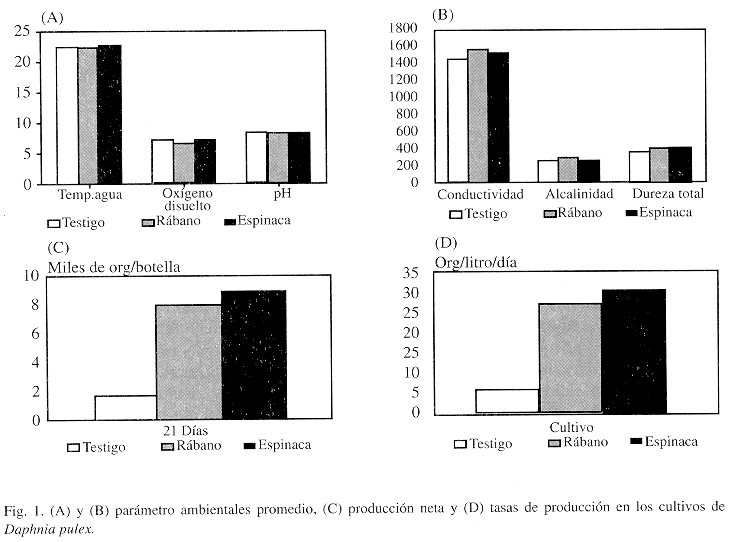
<body><![CDATA[<BR><FONT SIZE=-1>&nbsp;</FONT><FONT SIZE=-1></FONT>      <P><FONT SIZE=-1><FONT FACE="Arial,Helvetica">Como se puede observar en la <A HREF="#Fig. 1">Fig. 1 (A)</A> no existen grandes variaciones de temperatura del agua, ox&iacute;geno disuelto y pH, por ello el an&aacute;lisis de varianza tan solo fue significativo para el pH con p&lt; 0.01.</FONT></FONT><FONT SIZE=-1></FONT>      <P><FONT SIZE=-1><FONT FACE="Arial,Helvetica">En la <A HREF="#Fig. 1">Fig. 1 (B)</A> las diferencias en los par&aacute;metros de conductividad, alcalinidad y dureza total son algo m&aacute;s evidentes, siendo por tanto significativas para el an&aacute;lisis de varianza obteni&eacute;ndose en todas una p&lt; 0.005.</FONT></FONT><FONT SIZE=-1></FONT>      <P><FONT SIZE=-1><FONT FACE="Arial,Helvetica">En cuanto a la producci&oacute;n neta de <I>Daphnia pulex</I> a los 21 d&iacute;as de cultivo mostrada en la <A HREF="#Fig. 1">Fig. 1 (C)</A>, esta fue de 1 722 organismos/botella en las testigo, de 7 997 org/botella en las que recibieron jugo de hojas de r&aacute;bano (<I>Raphanus sativus</I>) y de 8 921 org/botella para las del jugo de hojas de espinaca (<I>Spinacia oleracea</I>), lo que determin&oacute; las tasas de producci&oacute;n siguientes y que se muestran en la <A HREF="#Fig. 1">Fig. 1 (D)</A>: testigo de 5.86 organismos/litro/d&iacute;a, r&aacute;bano (<I>Raphanus sativus</I>) de 27.20 org/litro/d&iacute;a y espinaca (<I>Spinacia oleracea</I>) de 30.34 org/litro/d&iacute;a.</FONT></FONT>     <BR><FONT SIZE=-1>&nbsp;</FONT><FONT SIZE=-1></FONT>      <P><A NAME="Fig. 1"></A><IMG SRC="/img/fbpe/rbt/v47n3/0551i01.GIF" HEIGHT=542 WIDTH=732><FONT SIZE=-1></FONT>     
<BR><FONT SIZE=-1>&nbsp;</FONT><FONT SIZE=-1></FONT>      <P><FONT SIZE=-1><FONT FACE="Arial,Helvetica">Del an&aacute;lisis de correlaci&oacute;n simple entre los par&aacute;metros ambientales y la producci&oacute;n de <I>D. pulex</I>, aquellos que mostraron los valores m&aacute;s altos fueron: la temperatura del agua con una r= 0.96 para las testigo y con una r= 0.94 para las del jugo de hojas de r&aacute;bano (<I>Raphanus sativus</I>), en el caso de las del jugo de hojas de espinaca (<I>Spinacia oleracea</I>) este par&aacute;metro tuvo una r= 0.89 que tambi&eacute;n es alta, pero aqu&iacute; destac&oacute; de manera particular la correlaci&oacute;n obtenida con la alcalinidad con una r= 0.96.</FONT></FONT><FONT SIZE=-1></FONT>      <P><FONT SIZE=-1><FONT FACE="Arial,Helvetica">Finalmente el an&aacute;lisis de varianza entre las producciones netas obtenidas entre los dos experimentos mostr&oacute; que s&iacute; existen diferencias entre los cultivos por lo que su p&lt; 0.005. Sin embargo para detectar si realmente la producci&oacute;n de <I>D. pulex </I>con el jugo de hojas de r&aacute;bano (<I>Raphanus sativus</I>) y con el jugo de hojas de espinaca (<I>Spinacia oleracea</I>) son significativamente diferentes, se realiz&oacute; otro an&aacute;lisis de varianza con dos variables de clasificaci&oacute;n y un nivel de significancia de 0.995, la cual tambi&eacute;n dio una p&lt; 0.005.</FONT></FONT><FONT SIZE=-1></FONT>      <P><FONT SIZE=-1><FONT FACE="Arial,Helvetica">&nbsp;</FONT></FONT>     ]]></body>
<body><![CDATA[<BR><B><FONT FACE="Arial,Helvetica"><FONT SIZE=-1>Discusi&oacute;n</FONT></FONT></B><FONT SIZE=-1></FONT>      <P><FONT SIZE=-1><FONT FACE="Arial,Helvetica">El medio de cultivo patr&oacute;n preparado en base al fermento de salvado de trigo (<I>Triticum aestivum</I>) adicionado con Sulfato de Calcio y Cloruro de Sodio, nos da un medio bastante estable para el desarrollo de <I>Daphnia pulex</I>, esto se muestra en el <A HREF="#CUADRO 1">Cuadro 1</A> y en las gr&aacute;ficas de las <A HREF="#Fig. 1">Fig. 1 (A)</A> y <A HREF="#Fig. 1">(B)</A>, donde se aprecia que los par&aacute;metros f&iacute;sico-qu&iacute;micos evaluados, no mostraron variaciones dr&aacute;sticas, ni existen grandes diferencias entre los registros de los cultivos testigo, con jugo de hojas de r&aacute;bano (<I>Raphanus sativus</I>) y con jugo de hojas de espinaca (<I>Spinacia oleracea</I>).</FONT></FONT><FONT SIZE=-1></FONT>      <P><FONT SIZE=-1><FONT FACE="Arial,Helvetica">La temperatura del agua tiene relaci&oacute;n con la producci&oacute;n de <I>D. pulex</I> en las botellas testigo y en las de r&aacute;bano (<I>Raphanus sativus</I>), cuya tendencia general de incremento determin&oacute; correlaciones positivas de 0.96 en las testigo y de 0.94 en las de r&aacute;bano (<I>Raphanus sativus</I>), adem&aacute;s consideramos que este par&aacute;metro tambi&eacute;n fue importante para las botellas con jugo de espinaca (<I>Spinacia oleracea</I>), ya que en los tres casos la temperatura promedio fue de 22.45, 22.32 y 22.57 &ordm;C respectivamente, valores que caen dentro del rango de ocurrencia de la especie en condiciones naturales, indicado por <A HREF="#Vázquez">V&aacute;zquez<I> et al</I>. (1986)</A> entre 15.8 y 24.1 &ordm;C.</FONT></FONT><FONT SIZE=-1></FONT>      <P><FONT SIZE=-1><FONT FACE="Arial,Helvetica">Autores como Birge (1898), Ward (1940) y Pratt ( 1943) (<I>In </I><A HREF="#Hazelwood">Hazelwood &amp; Parker 1961</A>), <A HREF="#Hall">Hall (1964)</A>, <A HREF="#Neill">Neill (1981)</A> y <A HREF="#Crosetti">Crossetti &amp; Margaritora (1987)</A> se&ntilde;alan a la temperatura como el factor f&iacute;sico m&aacute;s importante para determinar el incremento y el tama&ntilde;o de las poblaciones de clad&oacute;ceros en ambientes naturales y en condiciones de laboratorio.</FONT></FONT><FONT SIZE=-1></FONT>      <P><FONT SIZE=-1><FONT FACE="Arial,Helvetica">En el caso de la alcalinidad mostr&oacute; una correlaci&oacute;n positiva de 0.96 para las botellas enriquecidas con jugo de espinaca (<I>Spinacia oleracea</I>), esto evidencia que su incremento favoreci&oacute; el desarrollo de la <I>Daphnia</I>.</FONT></FONT><FONT SIZE=-1></FONT>      <P><FONT SIZE=-1><FONT FACE="Arial,Helvetica">Al respecto Borecky (1956) (<I>In</I> <A HREF="#Hazelwood">Hazelwood &amp; Parker 1961</A>) report&oacute; una muy alta correlaci&oacute;n entre la densidad total de clad&oacute;ceros y las concentraciones de bicarbonatos. Esto se apoya en el hecho de que la alcalinidad se refiere a la cantidad y clase de compuestos que en conjunto modifican el pH hacia el lado alcalino de la neutralidad, siendo principalmente los bicarbonatos, carbonatos e hidr&oacute;xidos los que la determinan, compuestos que son esenciales en la estabilidad y capacidad amortiguadora de los sistemas dulceacu&iacute;colas (<A HREF="#Anónimo">An&oacute;nimo 1989</A>, <A HREF="#Wetzel">Wetzel 1983</A>).</FONT></FONT><FONT SIZE=-1></FONT>      <P><FONT SIZE=-1><FONT FACE="Arial,Helvetica">Adem&aacute;s debemos agregar que el pH del cultivo enriquecido con espinaca (<I>Spinacia oleracea</I>) se ubic&oacute; en un rango de 8.00 a 8.30, con un promedio de 8.18 (ver <A HREF="#CUADRO 1">Cuadro 1</A>), valores alcalinos que caen dentro del intervalo &oacute;ptimo de pH para la especie, que de acuerdo con <A HREF="#Davis">Davis &amp; Ozburn (1969)</A> es de 7.0 a 8.7 en condiciones de laboratorio y para <A HREF="#Vázquez">V&aacute;zquez<I> et al. </I>(1986)</A> de 7.40 a 8.30 en ambientes naturales.</FONT></FONT><FONT SIZE=-1></FONT>      <P><FONT SIZE=-1><FONT FACE="Arial,Helvetica">En cuanto a las producciones netas obtenidas y a las tasas de producci&oacute;n, resulta claro que la adici&oacute;n de los jugos de hojas verdes, r&aacute;bano (<I>Raphanus sativus</I>) y espinaca (<I>Spinacia oleracea</I>), enriquecen el medio patr&oacute;n y suministran una mayor cantidad de alimento susceptible de ser pastoreado por la <I>D. pulex</I>, reflej&aacute;ndose en incrementos de la poblaci&oacute;n del orden de 464% en las de r&aacute;bano (<I>Raphanus sativus</I>) y de 518% en las de espinaca (<I>Spinacia oleracea</I>).</FONT></FONT><FONT SIZE=-1></FONT>      <P><FONT SIZE=-1><FONT FACE="Arial,Helvetica">El an&aacute;lisis de varianza mostr&oacute; diferencias significativas entre los cultivos. Sin embargo, para conocer si el jugo de hojas de r&aacute;bano (<I>Raphanus sativus</I>) y el jugo de hojas de espinaca (<I>Spinacia oleracea</I>) son enriquecedores significativamente diferentes, se aplic&oacute; un segundo an&aacute;lisis de varianza, el cual nos permiti&oacute; saber que la producci&oacute;n con espinaca (<I>Spinacia oleracea</I>) es definitivamente la mejor alternativa alimenticia para la <I>D. pulex</I>, en condiciones de laboratorio, como se plante&oacute; en este estudio.</FONT></FONT><FONT SIZE=-1></FONT>      <P><FONT SIZE=-1><FONT FACE="Arial,Helvetica">Datos de producciones de <I>Daphnia pulex</I> en condiciones de cultivo, solo tenemos las de <A HREF="#Nita">Nita (1982)</A> quien obtuvo de 0.63 a 1.25 organismos/litro/d&iacute;a utilizando gallinaza seca (200 g/m<SUP>3</SUP>) y fertilizantes minerales (Urea y Superfosfato Triple a 20 g/m<SUP>3</SUP>) y las de <A HREF="#Soriano">Soriano (1995)</A> con 458 org/litro/d&iacute;a adicionando 250 g gallinaza seca/600 litros.</FONT></FONT><FONT SIZE=-1></FONT>      ]]></body>
<body><![CDATA[<P><FONT SIZE=-1><FONT FACE="Arial,Helvetica">De acuerdo con nuestras tasas de producci&oacute;n que son de 27.20 org/litro/d&iacute;a en las de r&aacute;bano (<I>Raphanus sativus</I>) y de 30.34 org/litro/d&iacute;a en las de espinaca (<I>Spinacia oleracea</I>), resultan mejores que las de <A HREF="#Nita">Nita (1982)</A>, pero inferiores que las de <A HREF="#Soriano">Soriano (1995)</A>, sin embargo, consideramos que el uso de esti&eacute;rcoles como la gallinaza seca, no garantizan el estado sanitario de las daphnias cultivadas, pues esos subproductos con frecuencia son portadores de bacterias y de par&aacute;sitos altamente nocivos incluso para el hombre (<A HREF="#Osorio">Osorio &amp; De la Lanza 1990</A>).</FONT></FONT><FONT SIZE=-1></FONT>      <P><FONT SIZE=-1><FONT FACE="Arial,Helvetica">Finalmente debemos enfatizar la relevancia de este tipo de trabajos, por la posibilidad de producir masivamente clad&oacute;ceros de una forma totalmente as&eacute;ptica mediante el jugo de hojas verdes, que en algunos casos como el de las hojas de r&aacute;bano (<I>Raphanus sativus</I>) son desperdicios hort&iacute;colas. Esto concuerda con <A HREF="#Hall">Davis &amp; Ozburn (1969)</A>, ya que las daphnias resultan una excelente alternativa alimenticia para diferentes cultivos comerciales de peces y crust&aacute;ceos, ya sea para el consumo humano o para la ornamentaci&oacute;n.</FONT></FONT><FONT SIZE=-1></FONT>      <P><FONT SIZE=-1><FONT FACE="Arial,Helvetica">&nbsp;</FONT></FONT>     <BR><B><FONT FACE="Arial,Helvetica"><FONT SIZE=-1>Resumen</FONT></FONT></B><FONT SIZE=-1></FONT>      <P><FONT SIZE=-1><FONT FACE="Arial,Helvetica">El objetivo fue probar el efecto enriquecedor del jugo de hojas de r&aacute;bano (<I>Raphanus sativus</I>) y de espinaca (<I>Spinacia oleracea</I>), sobre un patr&oacute;n de fermento de salvado de trigo (<I>Triticum aestivum</I>) en la producci&oacute;n de <I>Daphnia pulex</I>. Los experimentos se llevaron a cabo en botellas de vidrio de 20 l de capacidad, llenadas con agua del grifo desclorada a un volumen de 14 l. Los cultivos tuvieron una duraci&oacute;n de 21 d&iacute;as, durante los cuales las botellas testigo tan solo recibieron fermento de salvado de trigo (<I>Triticum aestivum</I>) y las botellas experimentales (I, II y III), en el primer caso recibieron la combinaci&oacute;n de fermento y el jugo de hojas de r&aacute;bano (<I>Raphanus sativus</I>), y en el segundo caso el fermento y el jugo de espinaca (<I>Spinacia oleracea</I>). La tasa de siembra en ambos experimentos fue de 200 organismos/botella. Durante el desarrollo de los cultivos se evaluaron: temperatura del agua, ox&iacute;geno disuelto, pH, conductividad, alcalinidad y dureza total. Los par&aacute;metros ambientales se comportaron de manera similar en ambos experimentos, sin mostrar variaciones dr&aacute;sticas, ni grandes diferencias en sus registros. Las producciones netas obtenidas para la <I>D. pulex</I> fueron de: 1 722 organismos/botella en las testigo, 7 997 org/botella en las de r&aacute;bano (<I>Raphanus sativus</I>), y de 8 921 org/botella en las de espinaca (<I>Spinacia oleracea</I>). De acuerdo con los datos de producci&oacute;n el an&aacute;lisis de varianza encontr&oacute; diferencias significativas entre los cultivos (Fisher p&lt; 0.005) y estableci&oacute; que la combinaci&oacute;n del fermento enriquecido con el jugo de espinaca (<I>Spinacia oleracea</I>) es la mejor alternativa alimenticia para la <I>Daphnia pulex </I>en<I> </I>condiciones de laboratorio.</FONT></FONT><FONT SIZE=-1></FONT>      <P><FONT SIZE=-1><FONT FACE="Arial,Helvetica">&nbsp;</FONT></FONT>     <BR><B><FONT FACE="Arial,Helvetica"><FONT SIZE=-1>Referencias</FONT></FONT></B><FONT SIZE=-1></FONT>      <!-- ref --><P><A NAME="Anónimo"></A><FONT SIZE=-1><FONT FACE="Arial,Helvetica">An&oacute;nimo. 1989. Standard methods for the examination of water and wastewater. American Public Health Association, American Water Works Association, Water Pollution Control Federation. Washington. 1193 p.</FONT></FONT><FONT SIZE=-1></FONT>    &nbsp;&nbsp;&nbsp;&nbsp;&nbsp;&nbsp;&nbsp;&nbsp;[&#160;<a href="javascript:void(0);" onclick="javascript: window.open('/scielo.php?script=sci_nlinks&ref=1315300&pid=S0034-7744199900030001600001&lng=','','width=640,height=500,resizable=yes,scrollbars=1,menubar=yes,');">Links</a>&#160;]<!-- end-ref --><!-- ref --><P><A NAME="Conklin"></A><FONT SIZE=-1><FONT FACE="Arial,Helvetica">Conklin, D.E. &amp; L. Provasoli. 1978. Bifhasic particulate media for the culture of filter-feeders. Biol. Bull. 154: 47-54.</FONT></FONT><FONT SIZE=-1></FONT>    &nbsp;&nbsp;&nbsp;&nbsp;&nbsp;&nbsp;&nbsp;&nbsp;[&#160;<a href="javascript:void(0);" onclick="javascript: window.open('/scielo.php?script=sci_nlinks&ref=1315301&pid=S0034-7744199900030001600002&lng=','','width=640,height=500,resizable=yes,scrollbars=1,menubar=yes,');">Links</a>&#160;]<!-- end-ref --><!-- ref --><P><A NAME="Crosetti"></A><FONT SIZE=-1><FONT FACE="Arial,Helvetica">Crosetti, D. &amp; F.G. Margaritora. 1987. Distribution and life cycles of cladocerans in temporary pools from Central Italy. Freshwater Biol. 18:165-175.</FONT></FONT><FONT SIZE=-1></FONT>    &nbsp;&nbsp;&nbsp;&nbsp;&nbsp;&nbsp;&nbsp;&nbsp;[&#160;<a href="javascript:void(0);" onclick="javascript: window.open('/scielo.php?script=sci_nlinks&ref=1315302&pid=S0034-7744199900030001600003&lng=','','width=640,height=500,resizable=yes,scrollbars=1,menubar=yes,');">Links</a>&#160;]<!-- end-ref --><!-- ref --><P><A NAME="Daniel"></A><FONT SIZE=-1><FONT FACE="Arial,Helvetica">Daniel, W.W. 1985. Bioestad&iacute;stica: base para el an&aacute;lisis de las ciencias de la salud. Limusa, M&eacute;xico, D.F. 485 p.</FONT></FONT><FONT SIZE=-1></FONT>    &nbsp;&nbsp;&nbsp;&nbsp;&nbsp;&nbsp;&nbsp;&nbsp;[&#160;<a href="javascript:void(0);" onclick="javascript: window.open('/scielo.php?script=sci_nlinks&ref=1315303&pid=S0034-7744199900030001600004&lng=','','width=640,height=500,resizable=yes,scrollbars=1,menubar=yes,');">Links</a>&#160;]<!-- end-ref --><!-- ref --><P><A NAME="Davis"></A><FONT SIZE=-1><FONT FACE="Arial,Helvetica">Davis, P. &amp; G.W. Ozburn. 1969. The pH tolerance of <I>Daphnia pulex</I> (Leydig, emend., Richard). Can. J. Zool. 47: 1173-1175.</FONT></FONT><FONT SIZE=-1></FONT>    &nbsp;&nbsp;&nbsp;&nbsp;&nbsp;&nbsp;&nbsp;&nbsp;[&#160;<a href="javascript:void(0);" onclick="javascript: window.open('/scielo.php?script=sci_nlinks&ref=1315304&pid=S0034-7744199900030001600005&lng=','','width=640,height=500,resizable=yes,scrollbars=1,menubar=yes,');">Links</a>&#160;]<!-- end-ref --><!-- ref --><P><A NAME="Hall"></A><FONT SIZE=-1><FONT FACE="Arial,Helvetica">Hall, D.J. 1964. An experimental approach to the dynamics of a natural population of <I>Daphnia galeata mendotae</I>. Ecology 45: 94-112.</FONT></FONT><FONT SIZE=-1></FONT>    &nbsp;&nbsp;&nbsp;&nbsp;&nbsp;&nbsp;&nbsp;&nbsp;[&#160;<a href="javascript:void(0);" onclick="javascript: window.open('/scielo.php?script=sci_nlinks&ref=1315305&pid=S0034-7744199900030001600006&lng=','','width=640,height=500,resizable=yes,scrollbars=1,menubar=yes,');">Links</a>&#160;]<!-- end-ref --><!-- ref --><P><A NAME="Hazelwood"></A><FONT SIZE=-1><FONT FACE="Arial,Helvetica">Hazelwood, D.H. &amp; R.A. Parker. 1961. Population dynamics of some freshwater zooplankton. Ecology 42: 266-274.</FONT></FONT><FONT SIZE=-1></FONT>    &nbsp;&nbsp;&nbsp;&nbsp;&nbsp;&nbsp;&nbsp;&nbsp;[&#160;<a href="javascript:void(0);" onclick="javascript: window.open('/scielo.php?script=sci_nlinks&ref=1315306&pid=S0034-7744199900030001600007&lng=','','width=640,height=500,resizable=yes,scrollbars=1,menubar=yes,');">Links</a>&#160;]<!-- end-ref --><!-- ref --><P><A NAME="Muthu"></A><FONT SIZE=-1><FONT FACE="Arial,Helvetica">Muthu, M.S. 1982. Methods of culturing zooplankton. Manual of research methods for fish and shellfish nutrition. Centre of Advanced Studies in Mariculture, Central Marine Fisheries Research Institute. Cochin. p. 119-125.</FONT></FONT><FONT SIZE=-1></FONT>    &nbsp;&nbsp;&nbsp;&nbsp;&nbsp;&nbsp;&nbsp;&nbsp;[&#160;<a href="javascript:void(0);" onclick="javascript: window.open('/scielo.php?script=sci_nlinks&ref=1315307&pid=S0034-7744199900030001600008&lng=','','width=640,height=500,resizable=yes,scrollbars=1,menubar=yes,');">Links</a>&#160;]<!-- end-ref --><!-- ref --><P><A NAME="Nita"></A><FONT SIZE=-1><FONT FACE="Arial,Helvetica">Nita, T. 1982. Work on the growing of food organisms at Sakabumi freshwater aquaculture development center and other freswater stations in Indonesia. South China Sea Fisheries Development and Coordinating Programme. Manila, Filipinas. p. 155-156.</FONT></FONT><FONT SIZE=-1></FONT>    &nbsp;&nbsp;&nbsp;&nbsp;&nbsp;&nbsp;&nbsp;&nbsp;[&#160;<a href="javascript:void(0);" onclick="javascript: window.open('/scielo.php?script=sci_nlinks&ref=1315308&pid=S0034-7744199900030001600009&lng=','','width=640,height=500,resizable=yes,scrollbars=1,menubar=yes,');">Links</a>&#160;]<!-- end-ref --><!-- ref --><P><A NAME="Neill"></A><FONT SIZE=-1><FONT FACE="Arial,Helvetica">Neill, W.E. 1981. Developmental responses of juvenile <I>Daphnia rosea</I> to experimental alteration of temperature and natural seston concentration. Can. J. Fish. Aquat. Sci. 38: 1357-1362.</FONT></FONT><FONT SIZE=-1></FONT>    &nbsp;&nbsp;&nbsp;&nbsp;&nbsp;&nbsp;&nbsp;&nbsp;[&#160;<a href="javascript:void(0);" onclick="javascript: window.open('/scielo.php?script=sci_nlinks&ref=1315309&pid=S0034-7744199900030001600010&lng=','','width=640,height=500,resizable=yes,scrollbars=1,menubar=yes,');">Links</a>&#160;]<!-- end-ref --><!-- ref --><P><A NAME="Olivares"></A><FONT SIZE=-1><FONT FACE="Arial,Helvetica">Olivares, R., M.L. Rojas &amp; R. S&aacute;nchez. 1993. Producci&oacute;n de pulga de agua (<I>Daphnia </I>sp.) utilizando dos fertilizantes no convencionales, con algunas consideraciones econ&oacute;micas. Res&uacute;menes. XII Congreso Nacional de Zoolog&iacute;a. Monterrey, Nuevo Le&oacute;n. M&eacute;xico. p. 64.</FONT></FONT><FONT SIZE=-1></FONT>    &nbsp;&nbsp;&nbsp;&nbsp;&nbsp;&nbsp;&nbsp;&nbsp;[&#160;<a href="javascript:void(0);" onclick="javascript: window.open('/scielo.php?script=sci_nlinks&ref=1315310&pid=S0034-7744199900030001600011&lng=','','width=640,height=500,resizable=yes,scrollbars=1,menubar=yes,');">Links</a>&#160;]<!-- end-ref --><!-- ref --><P><A NAME="Osorio"></A><FONT SIZE=-1><FONT FACE="Arial,Helvetica">Osorio, I. &amp; G. De la Lanza. 1990. El uso de biodigestores en acuicultura. La acuicultura en M&eacute;xico: de los conceptos a la producci&oacute;n. Universidad Nacional Aut&oacute;noma de M&eacute;xico. M&eacute;xico, D.F. p. 291-309.</FONT></FONT><FONT SIZE=-1></FONT>    &nbsp;&nbsp;&nbsp;&nbsp;&nbsp;&nbsp;&nbsp;&nbsp;[&#160;<a href="javascript:void(0);" onclick="javascript: window.open('/scielo.php?script=sci_nlinks&ref=1315311&pid=S0034-7744199900030001600012&lng=','','width=640,height=500,resizable=yes,scrollbars=1,menubar=yes,');">Links</a>&#160;]<!-- end-ref --><!-- ref --><P><A NAME="Porras"></A><FONT SIZE=-1><FONT FACE="Arial,Helvetica">Porras, D. 1982. Aspectos del cultivo rotatorio de <I>Daphnia </I>sp. Investigaci&oacute;n Acu&iacute;cola. 1er. Informe de Trabajo. Universidad Aut&oacute;noma del Estado de Morelos, Secretar&iacute;a de Pesca y Centro Nacional de Parasitolog&iacute;a Animal. M&eacute;xico. p. 20-26.</FONT></FONT><FONT SIZE=-1></FONT>    &nbsp;&nbsp;&nbsp;&nbsp;&nbsp;&nbsp;&nbsp;&nbsp;[&#160;<a href="javascript:void(0);" onclick="javascript: window.open('/scielo.php?script=sci_nlinks&ref=1315312&pid=S0034-7744199900030001600013&lng=','','width=640,height=500,resizable=yes,scrollbars=1,menubar=yes,');">Links</a>&#160;]<!-- end-ref --><!-- ref --><P><A NAME="Reyes"></A><FONT SIZE=-1><FONT FACE="Arial,Helvetica">Reyes, C.P. 1987. Bioestad&iacute;stica aplicada. Trillas, M&eacute;xico, D.F. 216 p.</FONT></FONT><FONT SIZE=-1></FONT>    &nbsp;&nbsp;&nbsp;&nbsp;&nbsp;&nbsp;&nbsp;&nbsp;[&#160;<a href="javascript:void(0);" onclick="javascript: window.open('/scielo.php?script=sci_nlinks&ref=1315313&pid=S0034-7744199900030001600014&lng=','','width=640,height=500,resizable=yes,scrollbars=1,menubar=yes,');">Links</a>&#160;]<!-- end-ref --><!-- ref --><P><A NAME="Soriano"></A><FONT SIZE=-1><FONT FACE="Arial,Helvetica">Soriano, S.M.B. 1995. Utilizaci&oacute;n de gallinaza en el cultivo de pulga de agua <I>Daphnia pulex</I> en estanques de fibra de vidrio. Programa - Res&uacute;menes. XIII Congreso Nacional de Zoolog&iacute;a. Morelia, Michoac&aacute;n. M&eacute;xico. p. 118.</FONT></FONT><FONT SIZE=-1></FONT>    &nbsp;&nbsp;&nbsp;&nbsp;&nbsp;&nbsp;&nbsp;&nbsp;[&#160;<a href="javascript:void(0);" onclick="javascript: window.open('/scielo.php?script=sci_nlinks&ref=1315314&pid=S0034-7744199900030001600015&lng=','','width=640,height=500,resizable=yes,scrollbars=1,menubar=yes,');">Links</a>&#160;]<!-- end-ref --><!-- ref --><P><A NAME="Tech"></A><FONT SIZE=-1><FONT FACE="Arial,Helvetica">Tech, E. 1982. Culture of zooplancton (<I>Brachionus</I> and <I>Moina</I>). South China Sea Fisheries Development and Coordinating Programme. Manila, Filipinas. p. 35-58.</FONT></FONT><FONT SIZE=-1></FONT>    &nbsp;&nbsp;&nbsp;&nbsp;&nbsp;&nbsp;&nbsp;&nbsp;[&#160;<a href="javascript:void(0);" onclick="javascript: window.open('/scielo.php?script=sci_nlinks&ref=1315315&pid=S0034-7744199900030001600016&lng=','','width=640,height=500,resizable=yes,scrollbars=1,menubar=yes,');">Links</a>&#160;]<!-- end-ref --><!-- ref --><P><A NAME="Torrentera"></A><FONT SIZE=-1><FONT FACE="Arial,Helvetica">Torrentera, B.L. &amp; A.G.J. Tacon. 1989. La producci&oacute;n de alimento vivo y su importancia en acuacultura. FAO. Documento de Campo No. 12. Programa Cooperativo Gubernamental /Regi&oacute;n Am&eacute;rica Latina /075 /Italia. Bras&iacute;lia, Brasil. 90 p.</FONT></FONT><FONT SIZE=-1></FONT>    &nbsp;&nbsp;&nbsp;&nbsp;&nbsp;&nbsp;&nbsp;&nbsp;[&#160;<a href="javascript:void(0);" onclick="javascript: window.open('/scielo.php?script=sci_nlinks&ref=1315316&pid=S0034-7744199900030001600017&lng=','','width=640,height=500,resizable=yes,scrollbars=1,menubar=yes,');">Links</a>&#160;]<!-- end-ref --><!-- ref --><P><A NAME="Vázquez"></A><FONT SIZE=-1><FONT FACE="Arial,Helvetica">V&aacute;zquez, A., E. Solis, N. Macedo &amp; I. Rosas. 1986. Influencia de la calidad del agua sobre la ocurrencia de<I> Daphnia pulex</I> en la presa Jos&eacute; Antonio Alzate y algunos aspectos de su pesquer&iacute;a. Cont. Amb. 2:39-56.</FONT></FONT><FONT SIZE=-1></FONT>    &nbsp;&nbsp;&nbsp;&nbsp;&nbsp;&nbsp;&nbsp;&nbsp;[&#160;<a href="javascript:void(0);" onclick="javascript: window.open('/scielo.php?script=sci_nlinks&ref=1315317&pid=S0034-7744199900030001600018&lng=','','width=640,height=500,resizable=yes,scrollbars=1,menubar=yes,');">Links</a>&#160;]<!-- end-ref --><!-- ref --><P><A NAME="Wetzel"></A><FONT SIZE=-1><FONT FACE="Arial,Helvetica">Wetzel, R.G. 1983. Limnolog&iacute;a. Omega, Barcelona. 679 p.</FONT></FONT>    &nbsp;&nbsp;&nbsp;&nbsp;&nbsp;&nbsp;&nbsp;&nbsp;[&#160;<a href="javascript:void(0);" onclick="javascript: window.open('/scielo.php?script=sci_nlinks&ref=1315318&pid=S0034-7744199900030001600019&lng=','','width=640,height=500,resizable=yes,scrollbars=1,menubar=yes,');">Links</a>&#160;]<!-- end-ref --><BR><FONT SIZE=-1></FONT>&nbsp;<FONT SIZE=-1></FONT>      <P><A NAME="1b"></A><FONT SIZE=-1><FONT FACE="Arial,Helvetica"><SUP><A HREF="#1a">1</A></SUP> Universidad Nacional Aut&oacute;noma de M&eacute;xico, Campus Iztacala. Av. de los Barrios s/n Los Reyes Iztacala, Tlalnepantla, Estado de M&eacute;xico. A.P. 314. C.P. 54090. M&eacute;xico. Fax: 390-5900 y 565-1009. Correo electr&oacute;nico: <A HREF="mailto:normaa@servidor.unam.mx.">normaa@servidor.unam.mx.</A></FONT></FONT>      ]]></body><back>
<ref-list>
<ref id="B1">
<nlm-citation citation-type="book">
<person-group person-group-type="author">
<name>
</name>
<name>
</name>
</person-group>
<source><![CDATA[Standard methods for the examination of water and wastewater]]></source>
<year>1989</year>
<publisher-loc><![CDATA[^eWashington Washington]]></publisher-loc>
<publisher-name><![CDATA[American Public Health Association, American Water Works Association, Water Pollution Control Federation]]></publisher-name>
</nlm-citation>
</ref>
<ref id="B2">
<nlm-citation citation-type="journal">
<person-group person-group-type="author">
<name>
<surname><![CDATA[Conklin]]></surname>
<given-names><![CDATA[D.E.]]></given-names>
</name>
<name>
<surname><![CDATA[Provasoli]]></surname>
<given-names><![CDATA[L.]]></given-names>
</name>
</person-group>
<article-title xml:lang="en"><![CDATA[Bifhasic particulate media for the culture of filter-feeders]]></article-title>
<source><![CDATA[Biol. Bull.]]></source>
<year>1978</year>
<volume>154</volume>
<page-range>47-54</page-range></nlm-citation>
</ref>
<ref id="B3">
<nlm-citation citation-type="journal">
<person-group person-group-type="author">
<name>
<surname><![CDATA[Crosetti]]></surname>
<given-names><![CDATA[D.]]></given-names>
</name>
<name>
<surname><![CDATA[Margaritora]]></surname>
<given-names><![CDATA[F.G.]]></given-names>
</name>
</person-group>
<article-title xml:lang="en"><![CDATA[Distribution and life cycles of cladocerans in temporary pools from Central Italy]]></article-title>
<source><![CDATA[Freshwater Biol.]]></source>
<year>1987</year>
<volume>18</volume>
<page-range>165-175</page-range></nlm-citation>
</ref>
<ref id="B4">
<nlm-citation citation-type="book">
<person-group person-group-type="author">
<name>
<surname><![CDATA[Daniel]]></surname>
<given-names><![CDATA[W.W.]]></given-names>
</name>
</person-group>
<source><![CDATA[Bioestadística: base para el análisis de las ciencias de la salud]]></source>
<year>1985</year>
<page-range>485</page-range><publisher-loc><![CDATA[México, D.F. ]]></publisher-loc>
<publisher-name><![CDATA[Limusa]]></publisher-name>
</nlm-citation>
</ref>
<ref id="B5">
<nlm-citation citation-type="journal">
<person-group person-group-type="author">
<name>
<surname><![CDATA[Davis]]></surname>
<given-names><![CDATA[P.]]></given-names>
</name>
<name>
<surname><![CDATA[Ozburn]]></surname>
<given-names><![CDATA[G.W.]]></given-names>
</name>
</person-group>
<article-title xml:lang="en"><![CDATA[The pH tolerance of Daphnia pulex (Leydig, emend., Richard)]]></article-title>
<source><![CDATA[Can. J. Zool.]]></source>
<year>1969</year>
<volume>47</volume>
<page-range>1173-1175</page-range></nlm-citation>
</ref>
<ref id="B6">
<nlm-citation citation-type="journal">
<person-group person-group-type="author">
<name>
<surname><![CDATA[Hall]]></surname>
<given-names><![CDATA[D.J.]]></given-names>
</name>
</person-group>
<article-title xml:lang="en"><![CDATA[An experimental approach to the dynamics of a natural population of Daphnia galeata mendotae]]></article-title>
<source><![CDATA[Ecology]]></source>
<year>1964</year>
<volume>45</volume>
<page-range>94-112</page-range></nlm-citation>
</ref>
<ref id="B7">
<nlm-citation citation-type="journal">
<person-group person-group-type="author">
<name>
<surname><![CDATA[Hazelwood]]></surname>
<given-names><![CDATA[D.H.]]></given-names>
</name>
<name>
<surname><![CDATA[Parker]]></surname>
<given-names><![CDATA[R.A.]]></given-names>
</name>
</person-group>
<article-title xml:lang="en"><![CDATA[Population dynamics of some freshwater zooplankton]]></article-title>
<source><![CDATA[Ecology]]></source>
<year>1961</year>
<volume>42</volume>
<page-range>266-274</page-range></nlm-citation>
</ref>
<ref id="B8">
<nlm-citation citation-type="book">
<person-group person-group-type="author">
<name>
<surname><![CDATA[Muthu]]></surname>
<given-names><![CDATA[M.S]]></given-names>
</name>
</person-group>
<source><![CDATA[Methods of culturing zooplankton: Manual of research methods for fish and shellfish nutrition]]></source>
<year>1982</year>
<page-range>119-125</page-range><publisher-loc><![CDATA[Cochin ]]></publisher-loc>
<publisher-name><![CDATA[Centre of Advanced Studies in Mariculture, Central Marine Fisheries Research Institute]]></publisher-name>
</nlm-citation>
</ref>
<ref id="B9">
<nlm-citation citation-type="book">
<person-group person-group-type="author">
<name>
<surname><![CDATA[Nita]]></surname>
<given-names><![CDATA[T]]></given-names>
</name>
</person-group>
<source><![CDATA[Work on the growing of food organisms at Sakabumi freshwater aquaculture development center and other freswater stations in Indonesia]]></source>
<year>1982</year>
<page-range>155-156</page-range><publisher-loc><![CDATA[Manila ]]></publisher-loc>
<publisher-name><![CDATA[South China Sea Fisheries Development and Coordinating Programme]]></publisher-name>
</nlm-citation>
</ref>
<ref id="B10">
<nlm-citation citation-type="journal">
<person-group person-group-type="author">
<name>
<surname><![CDATA[Neill]]></surname>
<given-names><![CDATA[W.E]]></given-names>
</name>
</person-group>
<article-title xml:lang="en"><![CDATA[Developmental responses of juvenile Daphnia rosea to experimental alteration of temperature and natural seston concentration]]></article-title>
<source><![CDATA[Can. J. Fish. Aquat. Sci]]></source>
<year>1981</year>
<volume>38</volume>
<page-range>1357-1362</page-range></nlm-citation>
</ref>
<ref id="B11">
<nlm-citation citation-type="confpro">
<person-group person-group-type="author">
<name>
<surname><![CDATA[Olivares]]></surname>
<given-names><![CDATA[R]]></given-names>
</name>
<name>
<surname><![CDATA[Rojas]]></surname>
<given-names><![CDATA[M.L]]></given-names>
</name>
<name>
<surname><![CDATA[Sánchez]]></surname>
<given-names><![CDATA[R]]></given-names>
</name>
</person-group>
<source><![CDATA[Producción de pulga de agua (Daphnia sp.) utilizando dos fertilizantes no convencionales, con algunas consideraciones económicas: Resúmenes]]></source>
<year>1993</year>
<conf-name><![CDATA[XII Congreso Nacional de Zoología]]></conf-name>
<conf-loc>Monterrey Nuevo León</conf-loc>
<page-range>64</page-range></nlm-citation>
</ref>
<ref id="B12">
<nlm-citation citation-type="book">
<person-group person-group-type="author">
<name>
<surname><![CDATA[Osorio]]></surname>
<given-names><![CDATA[I]]></given-names>
</name>
<name>
<surname><![CDATA[De la Lanza]]></surname>
<given-names><![CDATA[G]]></given-names>
</name>
</person-group>
<source><![CDATA[El uso de biodigestores en acuicultura: La acuicultura en México: de los conceptos a la producción]]></source>
<year>1990</year>
<page-range>291-309</page-range><publisher-loc><![CDATA[México, D.F ]]></publisher-loc>
<publisher-name><![CDATA[Universidad Nacional Autónoma de México]]></publisher-name>
</nlm-citation>
</ref>
<ref id="B13">
<nlm-citation citation-type="book">
<person-group person-group-type="author">
<name>
<surname><![CDATA[Porras]]></surname>
<given-names><![CDATA[D]]></given-names>
</name>
</person-group>
<source><![CDATA[Aspectos del cultivo rotatorio de Daphnia sp. Investigación Acuícola: 1er. Informe de Trabajo]]></source>
<year>1982</year>
<page-range>20-26</page-range><publisher-name><![CDATA[Universidad Autónoma del Estado de Morelos, Secretaría de Pesca y Centro Nacional de Parasitología Animal]]></publisher-name>
</nlm-citation>
</ref>
<ref id="B14">
<nlm-citation citation-type="">
<person-group person-group-type="author">
<name>
<surname><![CDATA[Reyes]]></surname>
<given-names><![CDATA[C.P]]></given-names>
</name>
</person-group>
<source><![CDATA[Bioestadística aplicada]]></source>
<year>1987</year>
<publisher-loc><![CDATA[Trillas^eMéxico, D.F México, D.F]]></publisher-loc>
</nlm-citation>
</ref>
<ref id="B15">
<nlm-citation citation-type="confpro">
<person-group person-group-type="author">
<name>
<surname><![CDATA[Soriano]]></surname>
<given-names><![CDATA[S.M.B]]></given-names>
</name>
</person-group>
<source><![CDATA[Utilización de gallinaza en el cultivo de pulga de agua Daphnia pulex en estanques de fibra de vidrio. Programa: Resúmenes]]></source>
<year>1995</year>
<conf-name><![CDATA[XIII Congreso Nacional de Zoología]]></conf-name>
<conf-loc>Morelia Michoacán</conf-loc>
<page-range>118</page-range></nlm-citation>
</ref>
<ref id="B16">
<nlm-citation citation-type="book">
<person-group person-group-type="author">
<name>
<surname><![CDATA[Tech]]></surname>
<given-names><![CDATA[E]]></given-names>
</name>
</person-group>
<source><![CDATA[Culture of zooplancton (Brachionus and Moina)]]></source>
<year>1982</year>
<page-range>35-58</page-range><publisher-loc><![CDATA[Manila ]]></publisher-loc>
<publisher-name><![CDATA[South China Sea Fisheries Development and Coordinating Programme]]></publisher-name>
</nlm-citation>
</ref>
<ref id="B17">
<nlm-citation citation-type="book">
<person-group person-group-type="author">
<name>
<surname><![CDATA[Torrentera]]></surname>
<given-names><![CDATA[B.L]]></given-names>
</name>
<name>
<surname><![CDATA[Tacon]]></surname>
<given-names><![CDATA[A.G.J]]></given-names>
</name>
</person-group>
<source><![CDATA[La producción de alimento vivo y su importancia en acuacultura]]></source>
<year>1989</year>
<page-range>90</page-range><publisher-name><![CDATA[FAO]]></publisher-name>
</nlm-citation>
</ref>
<ref id="B18">
<nlm-citation citation-type="journal">
<person-group person-group-type="author">
<name>
<surname><![CDATA[Vázquez]]></surname>
<given-names><![CDATA[A]]></given-names>
</name>
<name>
<surname><![CDATA[Solis]]></surname>
<given-names><![CDATA[E]]></given-names>
</name>
<name>
<surname><![CDATA[Macedo]]></surname>
<given-names><![CDATA[N]]></given-names>
</name>
<name>
<surname><![CDATA[Rosas]]></surname>
<given-names><![CDATA[I]]></given-names>
</name>
</person-group>
<article-title xml:lang="es"><![CDATA[Influencia de la calidad del agua sobre la ocurrencia de Daphnia pulex en la presa José Antonio Alzate y algunos aspectos de su pesquería]]></article-title>
<source><![CDATA[Cont. Amb]]></source>
<year>1986</year>
<volume>2</volume>
<page-range>39-56</page-range></nlm-citation>
</ref>
<ref id="B19">
<nlm-citation citation-type="book">
<person-group person-group-type="author">
<name>
<surname><![CDATA[Wetzel]]></surname>
<given-names><![CDATA[R.G]]></given-names>
</name>
</person-group>
<source><![CDATA[Limnología]]></source>
<year>1983</year>
<page-range>679</page-range><publisher-loc><![CDATA[Barcelona ]]></publisher-loc>
<publisher-name><![CDATA[Omega]]></publisher-name>
</nlm-citation>
</ref>
</ref-list>
</back>
</article>
