<?xml version="1.0" encoding="ISO-8859-1"?><article xmlns:mml="http://www.w3.org/1998/Math/MathML" xmlns:xlink="http://www.w3.org/1999/xlink" xmlns:xsi="http://www.w3.org/2001/XMLSchema-instance">
<front>
<journal-meta>
<journal-id>0001-6002</journal-id>
<journal-title><![CDATA[Acta Médica Costarricense]]></journal-title>
<abbrev-journal-title><![CDATA[Acta méd. costarric]]></abbrev-journal-title>
<issn>0001-6002</issn>
<publisher>
<publisher-name><![CDATA[Colegio de Médicos y Cirujanos de Costa Rica]]></publisher-name>
</publisher>
</journal-meta>
<article-meta>
<article-id>S0001-60022014000100006</article-id>
<title-group>
<article-title xml:lang="es"><![CDATA[Neumonía por Stenotrophomonas maltophilia]]></article-title>
<article-title xml:lang="en"><![CDATA[Pneumonia due to Stenotrophomonas maltophilia]]></article-title>
</title-group>
<contrib-group>
<contrib contrib-type="author">
<name>
<surname><![CDATA[Huertas-Franco]]></surname>
<given-names><![CDATA[Verny]]></given-names>
</name>
<xref ref-type="aff" rid="A01"/>
</contrib>
<contrib contrib-type="author">
<name>
<surname><![CDATA[Lacayo-Pallais]]></surname>
<given-names><![CDATA[María Isabel]]></given-names>
</name>
<xref ref-type="aff" rid="A01"/>
</contrib>
</contrib-group>
<aff id="A01">
<institution><![CDATA[,Medico Internista  ]]></institution>
<addr-line><![CDATA[ ]]></addr-line>
</aff>
<aff id="A02">
<institution><![CDATA[,Hospital Clinica Biblica Laboratorio ]]></institution>
<addr-line><![CDATA[ ]]></addr-line>
</aff>
<pub-date pub-type="pub">
<day>00</day>
<month>03</month>
<year>2014</year>
</pub-date>
<pub-date pub-type="epub">
<day>00</day>
<month>03</month>
<year>2014</year>
</pub-date>
<volume>56</volume>
<numero>1</numero>
<fpage>27</fpage>
<lpage>30</lpage>
<copyright-statement/>
<copyright-year/>
<self-uri xlink:href="http://www.scielo.sa.cr/scielo.php?script=sci_arttext&amp;pid=S0001-60022014000100006&amp;lng=en&amp;nrm=iso"></self-uri><self-uri xlink:href="http://www.scielo.sa.cr/scielo.php?script=sci_abstract&amp;pid=S0001-60022014000100006&amp;lng=en&amp;nrm=iso"></self-uri><self-uri xlink:href="http://www.scielo.sa.cr/scielo.php?script=sci_pdf&amp;pid=S0001-60022014000100006&amp;lng=en&amp;nrm=iso"></self-uri><abstract abstract-type="short" xml:lang="es"><p><![CDATA[La Stenotrophomonas maltophilia es un bacilo gram negativo ambiental emergente que ha venido posicionándose entre el grupo de microorganismos multirresistentes como causa de infección en diversos órganos en ambiente hospitalario y en la comunidad. Se reporta este caso de insuficiencia respiratoria con neumonía severa por S. maltophilia adquirida en la comunidad en una paciente inmunocompetente que tuvo una rápida respuesta a tratamiento con trimetoprim sulfametoxazol cuando se logró identificar la bacteria.]]></p></abstract>
<abstract abstract-type="short" xml:lang="en"><p><![CDATA[Stenotrophomonas maltophilia is an emergent gram negative bacillus present in the environment. It has acquired relevance within a group of multidrug-resistant microorganisms as a cause of infection in different organs, both in hospitals and outside them. A case of respiratory failure with severe pneumonia due to S. maltophilia is reported. The immunocompetent patient got infected in the community and had a rapid response to trimethoprim sulphametoxazol once the bacteria were cultured]]></p></abstract>
<kwd-group>
<kwd lng="es"><![CDATA[Neumonía]]></kwd>
<kwd lng="es"><![CDATA[Stenotrophomonas maltophilia]]></kwd>
<kwd lng="es"><![CDATA[S. maltophilia]]></kwd>
<kwd lng="es"><![CDATA[paciente inmunocompetente]]></kwd>
<kwd lng="es"><![CDATA[infección extrahospitalaria]]></kwd>
<kwd lng="en"><![CDATA[Pneumonia]]></kwd>
<kwd lng="en"><![CDATA[Stenotophomonas maltophilia]]></kwd>
<kwd lng="en"><![CDATA[S. maltophilia]]></kwd>
<kwd lng="en"><![CDATA[-of-hospital infection]]></kwd>
</kwd-group>
</article-meta>
</front><body><![CDATA[ <div class="Section1">     <p class="MsoNormal" style="text-align: right;" align="right"><b  style=""><span  style="font-size: 12pt; line-height: 115%; font-family: Verdana;"  lang="ES-CR">Caso clínico<o:p></o:p></span></b></p>     <p style="text-align: center;" class="MsoNormal"><b style=""><span  style="font-size: 12pt; line-height: 115%; font-family: Verdana;"  lang="ES-CR">Neumonía por </span></b><b style=""><i><span  style="font-size: 12pt; line-height: 115%; font-family: Verdana;"  lang="ES-CR">Stenotrophomonas maltophilia<o:p></o:p></span></i></b></p>     <div style="text-align: center;"></div>     <p style="text-align: center;" class="MsoNormal"><b style=""><span  style="font-size: 12pt; line-height: 115%; font-family: Verdana;"  lang="ES-CR">Pneumonia due to Stenotrophomonas </span></b><b style=""><i><span  style="font-size: 12pt; line-height: 115%; font-family: Verdana;"  lang="ES-CR">maltophilia<o:p></o:p></span></i></b></p>     <div style="text-align: center;"></div>     <p style="text-align: center;" class="MsoNormal"><span  style="font-family: Verdana;" lang="ES-CR">Verny Huertas-Franco<sup><a href="#1_afi">1</a><a name="3afi"></a>*</sup> y María Isabel Lacayo-Pallais<sup><a href="#2_afi">2</a><a name="4afi"></a>*</sup><o:p></o:p></span></p>     <p class="MsoNormal"><b style=""><span style="font-family: Verdana;"  lang="ES-CR"></span></b></p> <hr style="width: 100%; height: 2px;">     <p class="MsoNormal"><b style=""><span style="font-family: Verdana;"  lang="ES-CR">Resumen<o:p></o:p></span></b></p>     <p style="text-align: justify;" class="MsoNormal"><span  style="font-size: 10pt; line-height: 115%; font-family: Verdana;"  lang="ES-CR">La </span><span  style="font-size: 10pt; line-height: 115%; font-family: Verdana;"  lang="ES-CR">Stenotrophomonas maltophilia </span><span  style="font-size: 10pt; line-height: 115%; font-family: Verdana;"  lang="ES-CR">es un bacilo gram negativo ambiental emergente que ha venido posicionándose entre el grupo de microorganismos multirresistentes como causa de infección en diversos órganos en ambiente hospitalario y en la comunidad. Se reporta este caso de insuficiencia respiratoria con neumonía severa por </span><span  style="font-size: 10pt; line-height: 115%; font-family: Verdana;"  lang="ES-CR">S.</span><span  style="font-size: 10pt; line-height: 115%; font-family: Verdana;"  lang="ES-CR"> </span><span  style="font-size: 10pt; line-height: 115%; font-family: Verdana;"  lang="ES-CR">maltophilia </span><span  style="font-size: 10pt; line-height: 115%; font-family: Verdana;"  lang="ES-CR">adquirida en la comunidad en una paciente inmunocompetente que tuvo una rápida respuesta a tratamiento con trimetoprim sulfametoxazol cuando se logró identificar la bacteria.<o:p></o:p></span></p>     ]]></body>
<body><![CDATA[<div style="text-align: justify;"></div>     <p style="text-align: justify;" class="MsoNormal"><b><span  style="font-size: 10pt; line-height: 115%; font-family: Verdana;"  lang="ES-CR">Descriptores: </span></b><span  style="font-size: 10pt; line-height: 115%; font-family: Verdana;"  lang="ES-CR">Neumonía, </span><span  style="font-size: 10pt; line-height: 115%; font-family: Verdana;"  lang="ES-CR">Stenotrophomonas maltophilia</span><span  style="font-size: 10pt; line-height: 115%; font-family: Verdana;"  lang="ES-CR">, </span><span  style="font-size: 10pt; line-height: 115%; font-family: Verdana;"  lang="ES-CR">S. maltophilia</span><span  style="font-size: 10pt; line-height: 115%; font-family: Verdana;"  lang="ES-CR">, paciente inmunocompetente, infección extrahospitalaria.<o:p></o:p></span></p>     <div style="text-align: justify;"></div>     <p style="text-align: justify;" class="MsoNormal"><b style=""><span  style="font-family: Verdana;" lang="EN-US">Abstract<o:p></o:p></span></b></p>     <div style="text-align: justify;"></div>     <p style="text-align: justify;" class="MsoNormal"><span  style="font-size: 10pt; line-height: 115%; font-family: Verdana;"  lang="EN-US">Stenotrophomonas maltophilia </span><span  style="font-size: 10pt; line-height: 115%; font-family: Verdana;"  lang="EN-US">is an emergent gram negative bacillus present in the environment. It has acquired relevance within a group of multidrug-resistant microorganisms as a cause of infection in different organs, both in hospitals and outside them. A case of respiratory failure with severe pneumonia due to </span><span  style="font-size: 10pt; line-height: 115%; font-family: Verdana;"  lang="EN-US">S. maltophilia </span><span  style="font-size: 10pt; line-height: 115%; font-family: Verdana;"  lang="EN-US">is reported. The immunocompetent patient got infected in the community and had a rapid response to trimethoprim sulphametoxazol once the bacteria were cultured.<o:p></o:p></span></p>     <div style="text-align: justify;"></div>     <p style="text-align: justify;" class="MsoNormal"><b><span  style="font-size: 10pt; line-height: 115%; font-family: Verdana;"  lang="EN-US">Key words: </span></b><span  style="font-size: 10pt; line-height: 115%; font-family: Verdana;"  lang="EN-US">Pneumonia, Stenotophomonas </span><span  style="font-size: 10pt; line-height: 115%; font-family: Verdana;"  lang="EN-US">maltophilia</span><span  style="font-size: 10pt; line-height: 115%; font-family: Verdana;"  lang="EN-US">, </span><span  style="font-size: 10pt; line-height: 115%; font-family: Verdana;"  lang="EN-US">S. maltophilia</span><span  style="font-size: 10pt; line-height: 115%; font-family: Verdana;"  lang="EN-US">, out-of-hospital infection.<o:p></o:p></span></p>     <div style="text-align: justify;"></div>     <p style="text-align: justify;" class="MsoNormal"><span  style="font-size: 10pt; line-height: 115%; font-family: Verdana;"  lang="ES-CR"></span></p> <hr style="width: 100%; height: 2px;">     ]]></body>
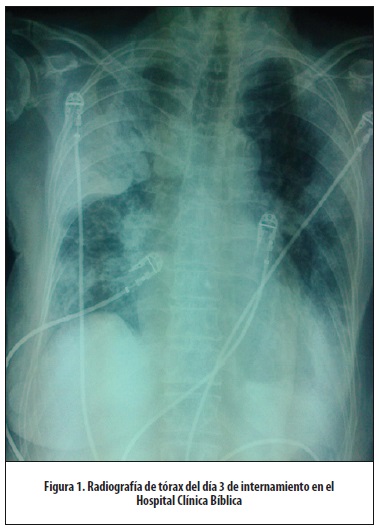
<body><![CDATA[<p style="text-align: justify;" class="MsoNormal"><span  style="font-size: 10pt; line-height: 115%; font-family: Verdana;"  lang="ES-CR">La neumonía ha presentado cambios bacteriológicos.<o:p></o:p></span></p>     <div></div>     <p style="text-align: justify;" class="MsoNormal"><span  style="font-size: 10pt; line-height: 115%; font-family: Verdana;"  lang="ES-CR">La terapia se ha modificado conforme se ha desarrollado la resistencia antibiótica y, a su vez, nuevos tratamientos han generado nuevas resistencias. Ejemplos de esto son los llamados microorganismos emergentes multirresistentes, dentro de los cuales se encuentra: la </span><i><span  style="font-size: 10pt; line-height: 115%; font-family: Verdana;"  lang="ES-CR">Stenotrophomonas maltophilia</span></i><span  style="font-size: 10pt; line-height: 115%; font-family: Verdana;"  lang="ES-CR">, así como el Staphylococcus aureus resistente a meticilina, el enterococo resistente a la vancomicina y los bacilos gran negativos, entre los que están: la Pseudomonas aeruginosa, la Escherichia coli, la Klebsiella pneumoniae, el Acinetobacter baumannii, la Burkholderia cepacia y la Ralstonia picketti, como principales componentes.<o:p></o:p></span></p>     <p class="MsoNormal"><b style=""><span style="font-family: Verdana;"  lang="ES-CR">Presentación de caso<o:p></o:p></span></b></p>     <p style="text-align: justify;" class="MsoNormal"><span  style="font-size: 10pt; line-height: 115%; font-family: Verdana;"  lang="ES-CR">Paciente femenina de 82 años de edad que ingresa al Hospital Clínica Bíblica con una historia de 3 días de decaimiento, hiporexia, somnolencia y malestar general. Al examen físico tiene fiebre de 38,5 C, saturación de oxígeno del 77% aire ambiente, TA 110/70, estertores crepitantes numerosos de base a ápex en hemitórax derecho e izquierdo. Rayos X de tórax con bronconeumonía bilateral. Las pruebas de laboratorio muestran leucocitos 22170, Hgb 15,5, plaquetas 199500, BUN 29, creatinina 1,42, PCR 351 y esputo cocos gram positivos y moderada presencia de leucocitos. Se admite al Hospital y requiere el 100% de oxígeno la primera noche, para saturar el 91-92%. Se inicia tratamiento con Invanz, Avelox, terapia respiratoria y nebulizaciones con Combivent.<o:p></o:p></span></p>     <div style="text-align: justify;"></div>     <p style="text-align: justify;" class="MsoNormal"><span  style="font-size: 10pt; line-height: 115%; font-family: Verdana;"  lang="ES-CR">Al día siguiente se logra pasar a cánula nasal con flujo de oxígeno de 5 litros por minuto. La placa de tórax muestra progresión de los infiltrados.<o:p></o:p></span></p>     <div style="text-align: justify;"></div>     <p style="text-align: justify;" class="MsoNormal"><span  style="font-size: 10pt; line-height: 115%; font-family: Verdana;"  lang="ES-CR">El día 3 inicia con problemas de saturación de oxígeno, requiriendo durante la noche el 100% de oxígeno. Amanece con severa insuficiencia respiratoria y fiebre de 38,5°C. Se dan esteroides endovenosos y se cambia antibióticoterapia a Meronen y amikacina. Los exámenes indican leucocitos 16100 y PCR 255, mientras que la placa de tórax muestra total consolidación del lóbulo superior derecho, e infiltrados neumónicos en lóbulo inferior y en todo el lóbulo superior izquierdo. (<a  href="/img/revistas/amc/v56n1/art06i1.jpg">Figura 1</a>)<o:p></o:p></span></p>     <div style="text-align: justify;"></div>     ]]></body>
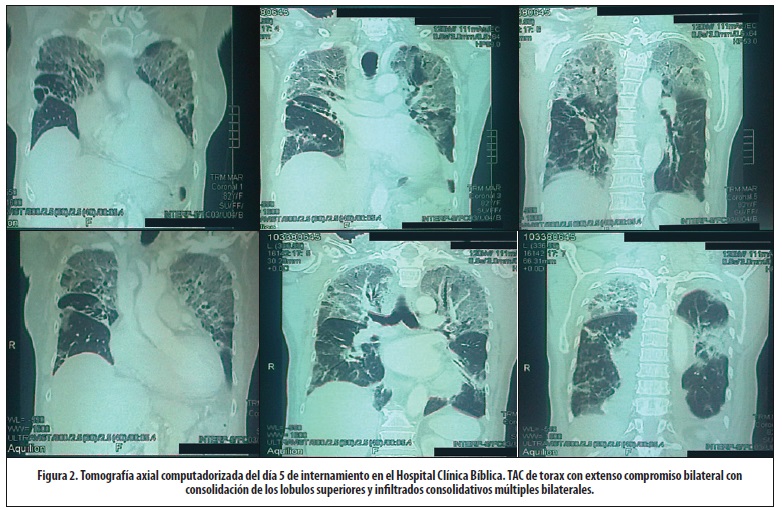
<body><![CDATA[<p style="text-align: justify;" class="MsoNormal"><span  style="font-size: 10pt; line-height: 115%; font-family: Verdana;"  lang="ES-CR">El día 4 sigue requiriendo un 100% de oxígeno para saturar un 93%, está afebril y respira un poco mejor. Primer cultivo de esputo es negativo. La placa de tórax no tiene cambio, PCR 214, leucograma 15800. Clínicamente, presenta severa insuficiencia respiratoria.<o:p></o:p></span></p>     <div style="text-align: justify;"></div>     <p style="text-align: justify;" class="MsoNormal"><span  style="font-size: 10pt; line-height: 115%; font-family: Verdana;"  lang="ES-CR">El día 5 continúa requiriendo el 100% de oxígeno, está afebril, con menos estertores en hemitórax derecho. La placa de tórax muestra densidad del lóbulo derecho menos densa.<o:p></o:p></span></p>     <div style="text-align: justify;"></div>     <p style="text-align: justify;" class="MsoNormal"><span  style="font-size: 10pt; line-height: 115%; font-family: Verdana;"  lang="ES-CR">Se realiza TAC de tórax con y sin contraste, que demuestran compromiso extenso bilateral del parénquima pulmonar de tipo consolidativo y ocupativo, alteraciones de naturaleza crónica conocidas preferentemente de lóbulo medio derecho, con evidencia de bronquiectasias fusiformes basales posteriores derechas y derrames pleurales bilaterales. (<a  href="/img/revistas/amc/v56n1/art06i2.jpg">Figura 2</a>)<o:p></o:p></span></p>     <p style="text-align: justify;" class="MsoNormal"><span  style="font-size: 10pt; line-height: 115%; font-family: Verdana;"  lang="ES-CR">El día 6 la paciente se encuentra sintomáticamente mejor, con leucograma 16300 y Hcto 41,5. El ecocardiograma muestra buena función biventricular, fracción de eyección del 61% e hipertensión pulmonar moderada. Por primera vez tiene oxigenación del 92%, con cánula nasal a flujo de 6 litros por minuto.<o:p></o:p></span></p>     <div style="text-align: justify;"></div>     <p style="text-align: justify;" class="MsoNormal"><span  style="font-size: 10pt; line-height: 115%; font-family: Verdana;"  lang="ES-CR">El día 7 muestra ligera mejoría radiológica, aunque continúa con dificultad para oxigenar con flujo de 6 litros por minuto, con una saturación del 88% y el 90%. El segundo cultivo de esputo es positivo por </span><i><span  style="font-size: 10pt; line-height: 115%; font-family: Verdana;"  lang="ES-CR">Xanthomonas maltophilia </span></i><span  style="font-size: 10pt; line-height: 115%; font-family: Verdana;"  lang="ES-CR">sensible a trimetoprim sulfametoxazol, por lo que se inicia el tratamiento de inmediato.<o:p></o:p></span></p>     <div style="text-align: justify;"></div>     <p style="text-align: justify;" class="MsoNormal"><span  style="font-size: 10pt; line-height: 115%; font-family: Verdana;"  lang="ES-CR">Durante los siguientes 6 días, la paciente tiene mejoría clínica y radiológica con disminución de los requerimientos de oxígeno. La proteína C reactiva y el leucograma se normalizan a los 8 días. Se continúa el tratamiento con trimetoprim sulfametoxazol hasta completar 15 días. La paciente presentó hiponatremia a partir del día 8 de hospitalización, que se fue normalizando lentamente en el curso de una semana.<o:p></o:p></span></p>     ]]></body>
<body><![CDATA[<div style="text-align: justify;"></div>     <p style="text-align: justify;" class="MsoNormal"><span  style="font-size: 10pt; line-height: 115%; font-family: Verdana;"  lang="ES-CR">Al estudiar la casa de habitación de la paciente se encontró como posible fuente del problema una fuga de agua debajo del piso de su dormitorio, donde había acumulación de agua y presencia de tierra húmeda orgánica, con musgos y mohos. Ella solía permanecer largo tiempo en su habitación con la puerta cerrada, usando un deshumidificador. (No se cultivó el material obtenido de la remodelación del dormitorio).<o:p></o:p></span></p>     <p class="MsoNormal"><b style=""><span style="font-family: Verdana;"  lang="ES-CR">Discusión<o:p></o:p></span></b></p>     <p style="text-align: justify;" class="MsoNormal"><span  style="font-size: 10pt; line-height: 115%; font-family: Verdana;"  lang="ES-CR">La </span><span  style="font-size: 10pt; line-height: 115%; font-family: Verdana;"  lang="ES-CR">Stenotrophomonas maltophilia </span><span  style="font-size: 10pt; line-height: 115%; font-family: Verdana;"  lang="ES-CR">es un bacilo gran negativo, aeróbico estricto, no fermentador, móvil, oxidasa negativo, no esporulado con una temperatura óptima de crecimiento de 35 grados C. Es un patógeno nosocomial emergente, oportunista y de amplia distribución ambiental. Fue aislado por primera vez en 1943, como Bacterium bookeri, y luego llamado Pseudomonas maltophilia.<a href="#1"><sup>1</sup></a> El análisis de tRNA determinó que era más apropiado llamarle Xanthomonas maltophilia. Los estudios de secuencia de hibridización DNAtRNA y mapeo amplificado de genes PCR 16S rRNA, han resultado en la clasificación y el nombre de </span><span  style="font-size: 10pt; line-height: 115%; font-family: Verdana;"  lang="ES-CR">Stenotrophomonas</span><span  style="font-size: 10pt; line-height: 115%; font-family: Verdana;"  lang="ES-CR"> </span><span  style="font-size: 10pt; line-height: 115%; font-family: Verdana;"  lang="ES-CR">maltophilia</span><span  style="font-size: 10pt; line-height: 115%; font-family: Verdana;"  lang="ES-CR">, desde 1993.<a href="#2"><sup>2</sup></a><o:p></o:p></span></p>     <div style="text-align: justify;"></div>     <p style="text-align: justify;" class="MsoNormal"><span  style="font-size: 10pt; line-height: 115%; font-family: Verdana;"  lang="ES-CR">Aunque la </span><i><span  style="font-size: 10pt; line-height: 115%; font-family: Verdana;"  lang="ES-CR">S. maltophilia </span></i><span  style="font-size: 10pt; line-height: 115%; font-family: Verdana;"  lang="ES-CR">es un microrganismo con limitada virulencia, posee, sin embargo, una resistencia intrínseca de alto grado que le confiere un carácter de multirresistencia, y en combinación con las resistencias adquiridas por presión selectiva de los antimicrobianos, esto le confiere una ventaja ecológica sobre otros posibles patógenos en el medio hospitalario.<o:p></o:p></span></p>     <div style="text-align: justify;"></div>     <p style="text-align: justify;" class="MsoNormal"><span  style="font-size: 10pt; line-height: 115%; font-family: Verdana;"  lang="ES-CR">Tiene una habilidad inherente por su superficie con cargas positivas y fimbrias, para adherirse a materiales extraños, formando películas y protegiéndose así de las defensas del huésped y de los antibióticos.<a  href="#2"><sup>2</sup></a><o:p></o:p></span></p>     <div style="text-align: justify;"></div>     <p style="text-align: justify;" class="MsoNormal"><span  style="font-size: 10pt; line-height: 115%; font-family: Verdana;"  lang="ES-CR">La </span><i><span  style="font-size: 10pt; line-height: 115%; font-family: Verdana;"  lang="ES-CR">S. maltophilia </span></i><span  style="font-size: 10pt; line-height: 115%; font-family: Verdana;"  lang="ES-CR">es un organismo ambiental. Se encuentra tanto en el ambiente hospitalario como en el extrahospitalario.<o:p></o:p></span></p>     ]]></body>
<body><![CDATA[<div style="text-align: justify;"></div>     <p style="text-align: justify;" class="MsoNormal"><span  style="font-size: 10pt; line-height: 115%; font-family: Verdana;"  lang="ES-CR">Tiene como hábitat sitios con agua, y se ha detectado en: la tierra, raíces, en animales, sistemas de tratamiento de agua, grifos, sumideros, jabones, agua de hemodiálisis y muestras de dializado, soluciones de limpieza de lentes de contacto, hieleras, catéteres de equipo utilizado para succión y administración de oxígeno, nebulizadores, mascarillas, agua de fuente de sodas en restaurantes, equipo dental de succión, endoscopios, catéteres urinarios, en casas afectadas por inundaciones y en las manos de personal hospitalario. La infección ocurre por contacto con la fuente.<o:p></o:p></span></p>     <p style="text-align: justify;" class="MsoNormal"><span  style="font-size: 10pt; line-height: 115%; font-family: Verdana;"  lang="ES-CR">Los días de estancia hospitalaria y la antibioticoterapia podrían seleccionar este microrganismo en las vías respiratorias, en el tracto gastrointestinal o en fuentes ambientales, lo cual explicaría su alta diversidad genómica.<a href="#3"><sup>3</sup></a> La variedad aislada en hospitales tiene una mayor tasa de mutación que la aislada extrahospitalariamente.<o:p></o:p></span></p>     <div style="text-align: justify;"></div>     <p style="text-align: justify;" class="MsoNormal"><span  style="font-size: 10pt; line-height: 115%; font-family: Verdana;"  lang="ES-CR">La </span><i><span  style="font-size: 10pt; line-height: 115%; font-family: Verdana;"  lang="ES-CR">S. maltophilia </span></i><span  style="font-size: 10pt; line-height: 115%; font-family: Verdana;"  lang="ES-CR">ha emergido como un importante patógeno en infecciones nosocomiales con mortalidad que oscila entre el 14-69% en pacientes con bacteremia.<a href="#4"><sup>4,5</sup></a> En un estudio de infecciones en unidades de cuidado intensivo en los Estados Unidos, entre 1993 y 2004, se reportó la </span><i><span  style="font-size: 10pt; line-height: 115%; font-family: Verdana;"  lang="ES-CR">S. maltophilia</span></i><span  style="font-size: 10pt; line-height: 115%; font-family: Verdana;"  lang="ES-CR"> entre los once microorganismos más frecuentemente aislados, representando el 4,3% de los 74 394 bacilos gram negativos.<a href="#6"><sup>6</sup></a><o:p></o:p></span></p>     <div style="text-align: justify;"></div>     <p style="text-align: justify;" class="MsoNormal"><span  style="font-size: 10pt; line-height: 115%; font-family: Verdana;"  lang="ES-CR">El registro de pacientes de la fundación de fibrosis quística de 1995-2005, demostró un aumento en la incidencia de </span><i><span  style="font-size: 10pt; line-height: 115%; font-family: Verdana;"  lang="ES-CR">S.</span></i><span  style="font-size: 10pt; line-height: 115%; font-family: Verdana;"  lang="ES-CR"> </span><i><span  style="font-size: 10pt; line-height: 115%; font-family: Verdana;"  lang="ES-CR">maltophilia </span></i><span  style="font-size: 10pt; line-height: 115%; font-family: Verdana;"  lang="ES-CR">del 3% al 13,8%, y en la prevalencia del 7% al 16,4%.<a href="#7"><sup>7</sup></a> Datos del SENTRY Antimicrobial Surveillance Program, de 1997 a 2008, revelaron una tasa de recuperación del 3,1% para </span><i><span  style="font-size: 10pt; line-height: 115%; font-family: Verdana;"  lang="ES-CR">S. maltophilia </span></i><span  style="font-size: 10pt; line-height: 115%; font-family: Verdana;"  lang="ES-CR">,en pacientes hospitalizados con neumonía, con tasas regionales del 3,3% para los Estados Unidos, el 3,2% para Europa y el 2,3% para América Latina.<a  href="#8"><sup>8</sup></a><o:p></o:p></span></p>     <div style="text-align: justify;"></div>     <p style="text-align: justify;" class="MsoNormal"><span  style="font-size: 10pt; line-height: 115%; font-family: Verdana;"  lang="ES-CR">Los pacientes con más riesgo de infección son los inmunocomprometidos, con cáncer, trasplantes de médula ósea y órganos sólidos, con Sida, fibrosis quística, EPOC, pacientes ingresados en unidades de cuidado intensivo con ventilación mecánica, cirugías recientes, trauma y antibioticoterapia con antimicrobianos de amplio espectro, como las cefalosporinas de tercera generación, carbapenems y fluoroquinonas. En pacientes pulmonares crónicos es una causa de neumonía y exacerbaciones de la enfermedad.<o:p></o:p></span></p>     <p style="text-align: justify;" class="MsoNormal"><span  style="font-size: 10pt; line-height: 115%; font-family: Verdana;"  lang="ES-CR">La infección puede ser adquirida en forma hospitalaria y se está observando con más frecuencia casos de infección extrahospitalaria. La edad avanzada y las enfermedades respiratorias son factores predisponentes.<a href="#9"><sup>9</sup></a><o:p></o:p></span></p>     ]]></body>
<body><![CDATA[<div style="text-align: justify;"></div>     <p style="text-align: justify;" class="MsoNormal"><span  style="font-size: 10pt; line-height: 115%; font-family: Verdana;"  lang="ES-CR">Las neumonías y las bacteremias son las infecciones más frecuentes en las que se ve involucrada la </span><i><span  style="font-size: 10pt; line-height: 115%; font-family: Verdana;"  lang="ES-CR">S. maltophilia</span></i><span  style="font-size: 10pt; line-height: 115%; font-family: Verdana;"  lang="ES-CR">, pero también puede producir infecciones en los ojos, como queratitis, escleritis y dacriocistitis; endocarditis, infección de vías biliares, meningitis, infección en huesos y articulaciones e infección urinaria con colonización de sondas.<a href="#10"><sup>10</sup></a> Su adherencia a las vías respiratorias altas y bajas, a catéteres, drenajes, etc., puede reflejar colonización y es difícil distinguir esta de la infección.<o:p></o:p></span></p>     <div style="text-align: justify;"></div>     <p style="text-align: justify;" class="MsoNormal"><span  style="font-size: 10pt; line-height: 115%; font-family: Verdana;"  lang="ES-CR">La </span><i><span  style="font-size: 10pt; line-height: 115%; font-family: Verdana;"  lang="ES-CR">S. maltophilia </span></i><span  style="font-size: 10pt; line-height: 115%; font-family: Verdana;"  lang="ES-CR">exhibe resistencia a una amplia variedad de antibióticos betalactámicos, incluyendo cefalosporinas de tercera generación y carbapenems (Betalactamasas), aminoglicósidos (inactivación enzimática e impermeabilidad) y fluoroquinonas (alteración de sitio blanco e impermeabilidad).<a href="#11"><sup>11</sup></a><o:p></o:p></span></p>     <p style="text-align: justify;" class="MsoNormal"><span  style="font-size: 10pt; line-height: 115%; font-family: Verdana;"  lang="ES-CR">El cloranfenicol tiene una susceptibilidad del 45%.<o:p></o:p></span></p>     <div style="text-align: justify;"></div>     <p style="text-align: justify;" class="MsoNormal"><span  style="font-size: 10pt; line-height: 115%; font-family: Verdana;"  lang="ES-CR">La presencia de un sistema de expulsión activa frente a diferentes antibióticos (Smec) puede contribuir a la resistencia bacteriana. La bacteria usa su maquinaria metabólica para detoxificar y destruir sustancias que le son dañinas, incluyendo los antibióticos. En su aislamiento se puede encontrar solao asociada a otros microorganismos como: </span><i><span  style="font-size: 10pt; line-height: 115%; font-family: Verdana;"  lang="ES-CR">Pseudomonas</span></i><span  style="font-size: 10pt; line-height: 115%; font-family: Verdana;"  lang="ES-CR"> </span><i><span  style="font-size: 10pt; line-height: 115%; font-family: Verdana;"  lang="ES-CR">aeruginosa</span></i><span  style="font-size: 10pt; line-height: 115%; font-family: Verdana;"  lang="ES-CR">, </span><i><span  style="font-size: 10pt; line-height: 115%; font-family: Verdana;"  lang="ES-CR">Staphylococcus aureus</span></i><span  style="font-size: 10pt; line-height: 115%; font-family: Verdana;"  lang="ES-CR">, </span><i><span  style="font-size: 10pt; line-height: 115%; font-family: Verdana;"  lang="ES-CR">Escherichia coli</span></i><span  style="font-size: 10pt; line-height: 115%; font-family: Verdana;"  lang="ES-CR">, </span><i><span  style="font-size: 10pt; line-height: 115%; font-family: Verdana;"  lang="ES-CR">Klebsiella</span></i><span  style="font-size: 10pt; line-height: 115%; font-family: Verdana;"  lang="ES-CR">, Enterobacter, </span><i><span  style="font-size: 10pt; line-height: 115%; font-family: Verdana;"  lang="ES-CR">Enterococcus</span></i><span  style="font-size: 10pt; line-height: 115%; font-family: Verdana;"  lang="ES-CR">, </span><i><span  style="font-size: 10pt; line-height: 115%; font-family: Verdana;"  lang="ES-CR">Bacteroides</span></i><span  style="font-size: 10pt; line-height: 115%; font-family: Verdana;"  lang="ES-CR">, </span><i><span  style="font-size: 10pt; line-height: 115%; font-family: Verdana;"  lang="ES-CR">Corynebacterium </span></i><span  style="font-size: 10pt; line-height: 115%; font-family: Verdana;"  lang="ES-CR">y </span><i><span  style="font-size: 10pt; line-height: 115%; font-family: Verdana;"  lang="ES-CR">Candida</span></i><span  style="font-size: 10pt; line-height: 115%; font-family: Verdana;"  lang="ES-CR">.<o:p></o:p></span></p>     <div style="text-align: justify;"></div>     <p style="text-align: justify;" class="MsoNormal"><span  style="font-size: 10pt; line-height: 115%; font-family: Verdana;"  lang="ES-CR">La presencia de un sistema de expulsión activa frente a diferentes antibióticos (Smec) puede contribuir a la resistencia bacteriana. La bacteria usa su maquinaria metabólica para detoxificar y destruir sustancias que le son dañinas, incluyendo los antibióticos. En su aislamiento se puede encontrar sola o asociada a otros microorganismos como: </span><i><span  style="font-size: 10pt; line-height: 115%; font-family: Verdana;"  lang="ES-CR">Pseudomonas</span></i><span  style="font-size: 10pt; line-height: 115%; font-family: Verdana;"  lang="ES-CR"> </span><i><span  style="font-size: 10pt; line-height: 115%; font-family: Verdana;"  lang="ES-CR">aeruginosa</span></i><span  style="font-size: 10pt; line-height: 115%; font-family: Verdana;"  lang="ES-CR">, </span><i><span  style="font-size: 10pt; line-height: 115%; font-family: Verdana;"  lang="ES-CR">Staphylococcus aureus</span></i><span  style="font-size: 10pt; line-height: 115%; font-family: Verdana;"  lang="ES-CR">, </span><i><span  style="font-size: 10pt; line-height: 115%; font-family: Verdana;"  lang="ES-CR">Escherichia coli</span></i><span  style="font-size: 10pt; line-height: 115%; font-family: Verdana;"  lang="ES-CR">, </span><i><span  style="font-size: 10pt; line-height: 115%; font-family: Verdana;"  lang="ES-CR">Klebsiella</span></i><span  style="font-size: 10pt; line-height: 115%; font-family: Verdana;"  lang="ES-CR">, Enterobacter, </span><i><span  style="font-size: 10pt; line-height: 115%; font-family: Verdana;"  lang="ES-CR">Enterococcus</span></i><span  style="font-size: 10pt; line-height: 115%; font-family: Verdana;"  lang="ES-CR">, </span><i><span  style="font-size: 10pt; line-height: 115%; font-family: Verdana;"  lang="ES-CR">Bacteroides</span></i><span  style="font-size: 10pt; line-height: 115%; font-family: Verdana;"  lang="ES-CR">, </span><i><span  style="font-size: 10pt; line-height: 115%; font-family: Verdana;"  lang="ES-CR">Corynebacterium </span></i><span  style="font-size: 10pt; line-height: 115%; font-family: Verdana;"  lang="ES-CR">y </span><i><span  style="font-size: 10pt; line-height: 115%; font-family: Verdana;"  lang="ES-CR">Candida</span></i><span  style="font-size: 10pt; line-height: 115%; font-family: Verdana;"  lang="ES-CR">.<o:p></o:p></span></p>     <div style="text-align: justify;"></div>     ]]></body>
<body><![CDATA[<p style="text-align: justify;" class="MsoNormal"><span  style="font-size: 10pt; line-height: 115%; font-family: Verdana;"  lang="ES-CR">Los sistemas comerciales disponibles, algunos de ellos automáticos, permiten identificar bien este microorganismo.<o:p></o:p></span></p>     <div style="text-align: justify;"></div>     <p style="text-align: justify;" class="MsoNormal"><span  style="font-size: 10pt; line-height: 115%; font-family: Verdana;"  lang="ES-CR">En pacientes con infección pulmonar, lo que se describe como el patrón más consistente en el TAC de tórax es la presencia de opacidades difusas con apariencia de vidrio molido, áreas multifocales bilaterales de consolidación, nódulos centrolobulares, bronquiectasias y engrosamiento bronquial.</span></p>     <p style="text-align: justify;" class="MsoNormal"><span  style="font-size: 10pt; line-height: 115%; font-family: Verdana;"  lang="ES-CR">Se aconseja el uso de TAC de tórax, además de la radiografia, cuando se busca como posibilidad S. maltophilia, sobre todo en pacientes con neutropenia febril. <a href="#13"><sup>13</sup></a>    <br> </span></p>     <div style="text-align: justify;"> </div>     <p style="text-align: justify;" class="MsoNormal"><span  style="font-size: 10pt; line-height: 115%; font-family: Verdana;"  lang="ES-CR">El compuesto bacteriostático trimetoprim sulfametoxazol es el agente con mayor potencia contra la </span><i><span  style="font-size: 10pt; line-height: 115%; font-family: Verdana;"  lang="ES-CR">S. maltophilia</span></i><span  style="font-size: 10pt; line-height: 115%; font-family: Verdana;"  lang="ES-CR">, con tasas de sensibilidad superiores al 90%.<a href="#6"><sup>6</sup></a> Se considera el tratamiento de elección en casos confirmados o sospechosos de infección por </span><i><span  style="font-size: 10pt; line-height: 115%; font-family: Verdana;"  lang="ES-CR">S. maltophilia</span></i><span  style="font-size: 10pt; line-height: 115%; font-family: Verdana;"  lang="ES-CR">. Los porcentajes de resistencia varían según áreas geográficas, siendo más resistente en Asia (30%) que en otros continentes (5-10%).<o:p></o:p></span></p>     <div style="text-align: justify;"></div>     <p style="text-align: justify;" class="MsoNormal"><span  style="font-size: 10pt; line-height: 115%; font-family: Verdana;"  lang="ES-CR">Ticarcilina-ácido clavulónico es el betalactámico con mejor actividad contra la </span><i><span  style="font-size: 10pt; line-height: 115%; font-family: Verdana;"  lang="ES-CR">S. maltophilia</span></i><span  style="font-size: 10pt; line-height: 115%; font-family: Verdana;"  lang="ES-CR">, con un 10-30% de resistencias en el estudio del SENTRY. Las nuevas fluoroquinonas presentan menos resistencia que la ciproxina, del 2-15% para gatifloxacino y trofloxacino, frente al 21-53% para ciprofloxacina. Los derivados de las tetraciclinas, monociclina y tigecilina, han demostrado buena actividad </span><i><span  style="font-size: 10pt; line-height: 115%; font-family: Verdana;"  lang="ES-CR">in vitro</span></i><span  style="font-size: 10pt; line-height: 115%; font-family: Verdana;"  lang="ES-CR">; no hay experiencia suficiente in vivo. De la misma manera, la </span><i><span  style="font-size: 10pt; line-height: 115%; font-family: Verdana;"  lang="ES-CR">S. maltophilia</span></i><span  style="font-size: 10pt; line-height: 115%; font-family: Verdana;"  lang="ES-CR"> presenta una alta resistencia intrínseca a los aminoglicósidos en monoterapia, por lo que estos no son de utilidad.<o:p></o:p></span></p>     <p style="text-align: justify;" class="MsoNormal"><span  style="font-size: 10pt; line-height: 115%; font-family: Verdana;"  lang="ES-CR">La terapia de combinación se indica en casos severos, más que la monoterapia.<a href="#14"><sup>14</sup></a> Las combinaciones sinérgicas trimetoprim sulfametoxazol con ticarcilina clavulanato o con ceftazidina, tienen el mayor sinergismo. Ceftazidina y amikacina, y ticarcilina clavulanato y amikacina, son otras posibles combinaciones sinérgicas.<a href="#15"><sup>15</sup></a><o:p></o:p></span></p>     ]]></body>
<body><![CDATA[<div style="text-align: justify;"></div>     <p style="text-align: justify;" class="MsoNormal"><span  style="font-size: 10pt; line-height: 115%; font-family: Verdana;"  lang="ES-CR">La combinación de doxyciclina con nebulizaciones de colistina fue efectiva en neumonía por </span><i><span  style="font-size: 10pt; line-height: 115%; font-family: Verdana;"  lang="ES-CR">S. maltophilia </span></i><span  style="font-size: 10pt; line-height: 115%; font-family: Verdana;"  lang="ES-CR">asociada a ventilador.<a href="#16"><sup>16</sup></a><o:p></o:p></span></p>     <div style="text-align: justify;"></div>     <p style="text-align: justify;" class="MsoNormal"><span  style="font-size: 10pt; line-height: 115%; font-family: Verdana;"  lang="ES-CR">Se muestra una paciente inmunocompetente que se encontraba en buen estado de salud, y que se infectó en su casa de habitación. Con una bronconeumonía muy severa, cuando estaba a punto de requerir soporte respiratorio se logró cultivar, en una segunda muestra de esputo, la </span><i><span  style="font-size: 10pt; line-height: 115%; font-family: Verdana;"  lang="ES-CR">S. maltophilia</span></i><span  style="font-size: 10pt; line-height: 115%; font-family: Verdana;"  lang="ES-CR">. Respondió muy bien al tratamiento con trimetoprim sulfametoxazol.<o:p></o:p></span></p>     <div style="text-align: justify;"></div>     <p style="text-align: justify;" class="MsoNormal"><span  style="font-size: 10pt; line-height: 115%; font-family: Verdana;"  lang="ES-CR">Es preciso tener en cuenta la </span><i><span  style="font-size: 10pt; line-height: 115%; font-family: Verdana;"  lang="ES-CR">S. maltophilia </span></i><span  style="font-size: 10pt; line-height: 115%; font-family: Verdana;"  lang="ES-CR">en neumonías severas. Los tratamientos de combinación antibiótica en los pacientes inmunocomprometidos no cubren rutinariamente a esta bacteria, por lo que es importante hacer un esfuerzo para identificarla en esa población, así como en los pacientes con fibrosis quística, pulmonares crónicos y en los todavía esporádicos casos de infecciones comunitarias.<o:p></o:p></span></p>     <div style="text-align: justify;"></div>     <p style="text-align: justify;" class="MsoNormal"><span  style="font-size: 10pt; line-height: 115%; font-family: Verdana;"  lang="ES-CR">Existe la posibilidad de que en el futuro este microorganismo cause más infecciones en pacientes que no son los del perfil de los usualmente infectados con la </span><i><span  style="font-size: 10pt; line-height: 115%; font-family: Verdana;"  lang="ES-CR">S. maltophilia</span></i><span  style="font-size: 10pt; line-height: 115%; font-family: Verdana;"  lang="ES-CR">, y eso se debe tener presente, por el tratamiento distinto que requiere este microorganismo para su erradicación.<o:p></o:p></span></p>     <p class="MsoNormal"><b style=""><span style="font-family: Verdana;"  lang="ES-CR"></span></b></p> <hr style="width: 100%; height: 2px;">     <p class="MsoNormal"><b style=""><span style="font-family: Verdana;"  lang="ES-CR">Referencias<o:p></o:p></span></b></p>     ]]></body>
<body><![CDATA[<!-- ref --><p class="MsoNormal"><span  style="font-size: 10pt; line-height: 115%; font-family: Verdana;"  lang="EN-US"><a name="1"></a>1. Hugh R, Leifsin E. A description of the type strain of Pseudomonas maltophilia. Int Bull Bacteriol Nomencl Taxon 1963;13:133-138<o:p></o:p></span>&nbsp;&nbsp;&nbsp;&nbsp;&nbsp;&nbsp;&nbsp;&nbsp;[&#160;<a href="javascript:void(0);" onclick="javascript: window.open('/scielo.php?script=sci_nlinks&ref=060936&pid=S0001-6002201400010000600001&lng=','','width=640,height=500,resizable=yes,scrollbars=1,menubar=yes,');">Links</a>&#160;]<!-- end-ref --><!-- ref --><p class="MsoNormal"><span  style="font-size: 10pt; line-height: 115%; font-family: Verdana;"  lang="EN-US"><a name="2"></a>2. Sara Stamps, Aimee Zaas. </span><i><span  style="font-size: 10pt; line-height: 115%; font-family: Verdana;"  lang="EN-US">Stenotrophomonas maltophilia</span></i><span  style="font-size: 10pt; line-height: 115%; font-family: Verdana;"  lang="EN-US">. UpToDate, Inc. 2012.    &nbsp;&nbsp;&nbsp;&nbsp;&nbsp;&nbsp;&nbsp;&nbsp;[&#160;<a href="javascript:void(0);" onclick="javascript: window.open('/scielo.php?script=sci_nlinks&ref=060937&pid=S0001-6002201400010000600002&lng=','','width=640,height=500,resizable=yes,scrollbars=1,menubar=yes,');">Links</a>&#160;]<!-- end-ref --><o:p></o:p></span></p>     <!-- ref --><p class="MsoNormal"><span  style="font-size: 10pt; line-height: 115%; font-family: Verdana;"  lang="EN-US"><a name="3"></a>3. W John Looney. Stenotrophomonas: An emerging opportunist human pathogen. Lancet Infect 2009; 9: 312-323<o:p></o:p></span>&nbsp;&nbsp;&nbsp;&nbsp;&nbsp;&nbsp;&nbsp;&nbsp;[&#160;<a href="javascript:void(0);" onclick="javascript: window.open('/scielo.php?script=sci_nlinks&ref=060939&pid=S0001-6002201400010000600003&lng=','','width=640,height=500,resizable=yes,scrollbars=1,menubar=yes,');">Links</a>&#160;]<!-- end-ref --><!-- ref --><p class="MsoNormal"><span  style="font-size: 10pt; line-height: 115%; font-family: Verdana;"  lang="EN-US"><a name="4"></a>4. Victor MA, Arpi M, Brunn B, Jonsson V, Hansen MM. Xanthomonas maltophilia in immune compromised hematological patients. Scand J Infect Dis 1994; 26:163-170.    &nbsp;&nbsp;&nbsp;&nbsp;&nbsp;&nbsp;&nbsp;&nbsp;[&#160;<a href="javascript:void(0);" onclick="javascript: window.open('/scielo.php?script=sci_nlinks&ref=060940&pid=S0001-6002201400010000600004&lng=','','width=640,height=500,resizable=yes,scrollbars=1,menubar=yes,');">Links</a>&#160;]<!-- end-ref --><o:p></o:p></span></p>     <!-- ref --><p class="MsoNormal"><span  style="font-size: 10pt; line-height: 115%; font-family: Verdana;"  lang="EN-US"><a name="5"></a>5. Jang TN, Wang LS, Liu CY. Xanthomonas maltophilia bacteremia: an analysis of 32 cases. J Formos Med Assoc 1992; 91:1170-1176.    &nbsp;&nbsp;&nbsp;&nbsp;&nbsp;&nbsp;&nbsp;&nbsp;[&#160;<a href="javascript:void(0);" onclick="javascript: window.open('/scielo.php?script=sci_nlinks&ref=060942&pid=S0001-6002201400010000600005&lng=','','width=640,height=500,resizable=yes,scrollbars=1,menubar=yes,');">Links</a>&#160;]<!-- end-ref --><o:p></o:p></span></p>     <!-- ref --><p class="MsoNormal"><span  style="font-size: 10pt; line-height: 115%; font-family: Verdana;"  lang="EN-US"><a name="6"></a>6. Lockhart SR. Antimicrobial resistance among gram negative Bacilli causing infections in intensive care unit patients in the United States between 1993-2004. J Clin Microbiol 2007; </span><span  style="font-size: 10pt; line-height: 115%; font-family: Verdana;"  lang="ES-CR">45:3352-3359.    &nbsp;&nbsp;&nbsp;&nbsp;&nbsp;&nbsp;&nbsp;&nbsp;[&#160;<a href="javascript:void(0);" onclick="javascript: window.open('/scielo.php?script=sci_nlinks&ref=060944&pid=S0001-6002201400010000600006&lng=','','width=640,height=500,resizable=yes,scrollbars=1,menubar=yes,');">Links</a>&#160;]<!-- end-ref --><o:p></o:p></span></p>     ]]></body>
<body><![CDATA[<!-- ref --><p class="MsoNormal"><span  style="font-size: 10pt; line-height: 115%; font-family: Verdana;"  lang="EN-US"><a name="7"></a>7. Razvi S. Respiratory microbiology of patients with cystic fibrosis in the United States 1995-2005. Chest 2009;136:1554-1560.    &nbsp;&nbsp;&nbsp;&nbsp;&nbsp;&nbsp;&nbsp;&nbsp;[&#160;<a href="javascript:void(0);" onclick="javascript: window.open('/scielo.php?script=sci_nlinks&ref=060946&pid=S0001-6002201400010000600007&lng=','','width=640,height=500,resizable=yes,scrollbars=1,menubar=yes,');">Links</a>&#160;]<!-- end-ref --><o:p></o:p></span></p>     <!-- ref --><p class="MsoNormal"><span  style="font-size: 10pt; line-height: 115%; font-family: Verdana;"  lang="EN-US"><a name="8"></a>8. Jones RN. Microbiological etiologies of Hospital acquired bacterial pneumonia and ventilator associated bacterial pneumonia. Clin Infect Dis 2010;51:881-887.    &nbsp;&nbsp;&nbsp;&nbsp;&nbsp;&nbsp;&nbsp;&nbsp;[&#160;<a href="javascript:void(0);" onclick="javascript: window.open('/scielo.php?script=sci_nlinks&ref=060948&pid=S0001-6002201400010000600008&lng=','','width=640,height=500,resizable=yes,scrollbars=1,menubar=yes,');">Links</a>&#160;]<!-- end-ref --><o:p></o:p></span></p>     <!-- ref --><p class="MsoNormal"><span  style="font-size: 10pt; line-height: 115%; font-family: Verdana;"  lang="EN-US"><a name="9"></a>9. Pearlman E, Butala S, Bilello L, Stauffer J. Stenotrophomona maltophilia (SM) in ambulatory patient population. 12th European Congress of Clinical Microbiology and infectious diseases. 2002 April 24-27, Milan, Italy. Abstract P1435.    &nbsp;&nbsp;&nbsp;&nbsp;&nbsp;&nbsp;&nbsp;&nbsp;[&#160;<a href="javascript:void(0);" onclick="javascript: window.open('/scielo.php?script=sci_nlinks&ref=060950&pid=S0001-6002201400010000600009&lng=','','width=640,height=500,resizable=yes,scrollbars=1,menubar=yes,');">Links</a>&#160;]<!-- end-ref --><o:p></o:p></span></p>     <!-- ref --><p class="MsoNormal"><span  style="font-size: 10pt; line-height: 115%; font-family: Verdana;"  lang="EN-US"><a name="10"></a>10. Brooke Joanna S. </span><i><span  style="font-size: 10pt; line-height: 115%; font-family: Verdana;"  lang="EN-US">Stenotrophomonas maltophilia</span></i><span  style="font-size: 10pt; line-height: 115%; font-family: Verdana;"  lang="EN-US">: An Emerging Global Opportunistic Pathogen. Clinical Microbiol Rev 2012; Vol 25 No.1:2-41.    &nbsp;&nbsp;&nbsp;&nbsp;&nbsp;&nbsp;&nbsp;&nbsp;[&#160;<a href="javascript:void(0);" onclick="javascript: window.open('/scielo.php?script=sci_nlinks&ref=060952&pid=S0001-6002201400010000600010&lng=','','width=640,height=500,resizable=yes,scrollbars=1,menubar=yes,');">Links</a>&#160;]<!-- end-ref --><o:p></o:p></span></p>     <!-- ref --><p class="MsoNormal"><span  style="font-size: 10pt; line-height: 115%; font-family: Verdana;"  lang="EN-US"><a name="11"></a>11. Gales AC, Jones RN, Forward KR, Liñares J, Sader HS, Verhoef J. Emerging importance of multidrug-resistance Acinetobacter species and </span><i><span  style="font-size: 10pt; line-height: 115%; font-family: Verdana;"  lang="EN-US">Stenotrophomonas maltophilia </span></i><span  style="font-size: 10pt; line-height: 115%; font-family: Verdana;"  lang="EN-US">as pathogens in seriously ill patients: geographic patterns, epidemiological features and trends in the Sentry Antimicrobial Surveillance Program (1997-1999). Clin Infect Dis 2001; 32 Suppl 2:104-13.    &nbsp;&nbsp;&nbsp;&nbsp;&nbsp;&nbsp;&nbsp;&nbsp;[&#160;<a href="javascript:void(0);" onclick="javascript: window.open('/scielo.php?script=sci_nlinks&ref=060954&pid=S0001-6002201400010000600011&lng=','','width=640,height=500,resizable=yes,scrollbars=1,menubar=yes,');">Links</a>&#160;]<!-- end-ref --><o:p></o:p></span></p>     ]]></body>
<body><![CDATA[<!-- ref --><p class="MsoNormal"><span  style="font-size: 10pt; line-height: 115%; font-family: Verdana;"  lang="EN-US"><a name="12"></a>12. Hae-Sung Chung, Seong Hong, Young ReeKim. Antimicrobial susceptibility of </span><i><span  style="font-size: 10pt; line-height: 115%; font-family: Verdana;"  lang="EN-US">Stenotrophomonas maltophilia </span></i><span  style="font-size: 10pt; line-height: 115%; font-family: Verdana;"  lang="EN-US">isolates from Korea and the activity of antimicrobial combinations against isolates. J Korean Med Society 2013 Vol 24 No.1:62-68.    &nbsp;&nbsp;&nbsp;&nbsp;&nbsp;&nbsp;&nbsp;&nbsp;[&#160;<a href="javascript:void(0);" onclick="javascript: window.open('/scielo.php?script=sci_nlinks&ref=060956&pid=S0001-6002201400010000600012&lng=','','width=640,height=500,resizable=yes,scrollbars=1,menubar=yes,');">Links</a>&#160;]<!-- end-ref --><o:p></o:p></span></p>     <!-- ref --><p class="MsoNormal"><span  style="font-size: 10pt; line-height: 115%; font-family: Verdana;"  lang="EN-US"><a name="13"></a>13. Wai Kan KT, Ka Lok RL, LI A. Computed tomography features of </span><i><span  style="font-size: 10pt; line-height: 115%; font-family: Verdana;"  lang="EN-US">Stenotrophomonas maltophilia </span></i><span  style="font-size: 10pt; line-height: 115%; font-family: Verdana;"  lang="EN-US">pneumonia in patients with neutropenic fever: Report of two cases. Multidisc, Respiratory Medicine 2013; 8:14.    &nbsp;&nbsp;&nbsp;&nbsp;&nbsp;&nbsp;&nbsp;&nbsp;[&#160;<a href="javascript:void(0);" onclick="javascript: window.open('/scielo.php?script=sci_nlinks&ref=060958&pid=S0001-6002201400010000600013&lng=','','width=640,height=500,resizable=yes,scrollbars=1,menubar=yes,');">Links</a>&#160;]<!-- end-ref --><o:p></o:p></span></p>     <!-- ref --><p class="MsoNormal"><span  style="font-size: 10pt; line-height: 115%; font-family: Verdana;"  lang="EN-US"><a name="14"></a>14. Li Xz, Zhang L, Poole K. Smec, an outer membrane multidrug efflux protein of </span><i><span  style="font-size: 10pt; line-height: 115%; font-family: Verdana;"  lang="EN-US">Stenotrophomonas maltophilia</span></i><span  style="font-size: 10pt; line-height: 115%; font-family: Verdana;"  lang="EN-US">. Antimicrob Agents Chemother 2002; 46:333-43.    &nbsp;&nbsp;&nbsp;&nbsp;&nbsp;&nbsp;&nbsp;&nbsp;[&#160;<a href="javascript:void(0);" onclick="javascript: window.open('/scielo.php?script=sci_nlinks&ref=060960&pid=S0001-6002201400010000600014&lng=','','width=640,height=500,resizable=yes,scrollbars=1,menubar=yes,');">Links</a>&#160;]<!-- end-ref --><o:p></o:p></span></p>     <!-- ref --><p class="MsoNormal"><span  style="font-size: 10pt; line-height: 115%; font-family: Verdana;"  lang="EN-US"><a name="15"></a>15. Martinez JL. Antibiotics and antibiotic resistance genes in natural environments. Science 2008; 321:365-367.    &nbsp;&nbsp;&nbsp;&nbsp;&nbsp;&nbsp;&nbsp;&nbsp;[&#160;<a href="javascript:void(0);" onclick="javascript: window.open('/scielo.php?script=sci_nlinks&ref=060962&pid=S0001-6002201400010000600015&lng=','','width=640,height=500,resizable=yes,scrollbars=1,menubar=yes,');">Links</a>&#160;]<!-- end-ref --><o:p></o:p></span></p>     <!-- ref --><p class="MsoNormal"><span  style="font-size: 10pt; line-height: 115%; font-family: Verdana;"  lang="EN-US"><a name="16"></a>16. Wood GC, Underwood EI, Crose MA, Swanson JM, Fabian TC. Treatment of Recurrent </span><i><span  style="font-size: 10pt; line-height: 115%; font-family: Verdana;"  lang="EN-US">Stenotrophomonas maltophilia </span></i><span  style="font-size: 10pt; line-height: 115%; font-family: Verdana;"  lang="EN-US">ventilator associated pneumonia with doxycycline and aerosolized colistin. </span><span  style="font-size: 10pt; line-height: 115%; font-family: Verdana;"  lang="ES-CR">Ann Pharmacother 2010; 44:1665-1668.    &nbsp;&nbsp;&nbsp;&nbsp;&nbsp;&nbsp;&nbsp;&nbsp;[&#160;<a href="javascript:void(0);" onclick="javascript: window.open('/scielo.php?script=sci_nlinks&ref=060964&pid=S0001-6002201400010000600016&lng=','','width=640,height=500,resizable=yes,scrollbars=1,menubar=yes,');">Links</a>&#160;]<!-- end-ref --><o:p></o:p></span></p>     ]]></body>
<body><![CDATA[<p class="MsoNormal"><span  style="font-size: 10pt; line-height: 115%; font-family: Verdana;"  lang="ES-CR">Trabajo realizado en el Hospital Clínica Bíblica.<o:p></o:p></span></p> <b><span  style="font-size: 10pt; line-height: 115%; font-family: Verdana;"  lang="ES-CR">Afiliación de los autores: </span></b><span  style="font-size: 10pt; line-height: 115%; font-family: Verdana;"  lang="ES-CR"><sup><a name="1_afi"></a><a href="#3afi">1</a></sup>Médico Internista, <sup><a name="2_afi"></a><a href="#4afi">2</a></sup>Laboratorio Hospital Clínica<o:p></o:p> Bíblica.</span><span  style="font-size: 10pt; line-height: 115%; font-family: Verdana;"  lang="ES-CR"> </span><span  style="font-size: 10pt; line-height: 115%; font-family: Verdana;"  lang="ES-CR">vernyhuertas@gmail.com<o:p></o:p></span>     <p class="MsoNormal"><b><span  style="font-size: 10pt; line-height: 115%; font-family: Verdana;"  lang="ES-CR"></span></b></p> <hr style="width: 100%; height: 2px;">     <div style="text-align: center;"><b><span  style="font-size: 10pt; line-height: 115%; font-family: Verdana;"  lang="ES-CR">Fecha recibido: </span></b><span  style="font-size: 10pt; line-height: 115%; font-family: Verdana;"  lang="ES-CR">3 de julio de 2013 </span><b><span  style="font-size: 10pt; line-height: 115%; font-family: Verdana;"  lang="ES-CR">Fecha aceptado: </span></b><span  style="font-size: 10pt; line-height: 115%; font-family: Verdana;"  lang="ES-CR">26 de setiembre de 2013<o:p></o:p></span></div>     <p class="MsoNormal"></p> </div>      ]]></body><back>
<ref-list>
<ref id="B1">
<label>1</label><nlm-citation citation-type="journal">
<person-group person-group-type="author">
<name>
<surname><![CDATA[Hugh]]></surname>
<given-names><![CDATA[R]]></given-names>
</name>
<name>
<surname><![CDATA[Leifsin]]></surname>
<given-names><![CDATA[E]]></given-names>
</name>
</person-group>
<article-title xml:lang="en"><![CDATA[A description of the type strain of Pseudomonas maltophilia]]></article-title>
<source><![CDATA[Int Bull Bacteriol Nomencl Taxon]]></source>
<year>1963</year>
<volume>13</volume>
<page-range>133-138</page-range></nlm-citation>
</ref>
<ref id="B2">
<label>2</label><nlm-citation citation-type="journal">
<person-group person-group-type="author">
<name>
<surname><![CDATA[Stamps]]></surname>
<given-names><![CDATA[Sara]]></given-names>
</name>
<name>
<surname><![CDATA[Zaas]]></surname>
<given-names><![CDATA[Aimee]]></given-names>
</name>
</person-group>
<article-title xml:lang="en"><![CDATA[Stenotrophomonas maltophilia]]></article-title>
<source><![CDATA[UpToDate, Inc]]></source>
<year>2012</year>
</nlm-citation>
</ref>
<ref id="B3">
<label>3</label><nlm-citation citation-type="journal">
<person-group person-group-type="author">
<name>
<surname><![CDATA[Looney]]></surname>
<given-names><![CDATA[W John]]></given-names>
</name>
</person-group>
<article-title xml:lang="en"><![CDATA[Stenotrophomonas: An emerging opportunist human pathogen]]></article-title>
<source><![CDATA[Lancet Infect]]></source>
<year>2009</year>
<volume>9</volume>
<page-range>312-323</page-range></nlm-citation>
</ref>
<ref id="B4">
<label>4</label><nlm-citation citation-type="journal">
<person-group person-group-type="author">
<name>
<surname><![CDATA[MA]]></surname>
<given-names><![CDATA[Victor]]></given-names>
</name>
<name>
<surname><![CDATA[M]]></surname>
<given-names><![CDATA[Arpi]]></given-names>
</name>
<name>
<surname><![CDATA[B]]></surname>
<given-names><![CDATA[Brunn]]></given-names>
</name>
<name>
<surname><![CDATA[V]]></surname>
<given-names><![CDATA[Jonsson]]></given-names>
</name>
<name>
<surname><![CDATA[MM]]></surname>
<given-names><![CDATA[Hansen]]></given-names>
</name>
</person-group>
<article-title xml:lang="en"><![CDATA[Xanthomonas maltophilia in immune compromised hematological patients]]></article-title>
<source><![CDATA[Scand J Infect Dis]]></source>
<year>1994</year>
<volume>26</volume>
<page-range>163-170</page-range></nlm-citation>
</ref>
<ref id="B5">
<label>5</label><nlm-citation citation-type="journal">
<person-group person-group-type="author">
<name>
<surname><![CDATA[Jang]]></surname>
<given-names><![CDATA[TN]]></given-names>
</name>
<name>
<surname><![CDATA[Wang]]></surname>
<given-names><![CDATA[LS]]></given-names>
</name>
<name>
<surname><![CDATA[Liu]]></surname>
<given-names><![CDATA[CY]]></given-names>
</name>
</person-group>
<article-title xml:lang="en"><![CDATA[Xanthomonas maltophilia bacteremia: an analysis of 32 cases]]></article-title>
<source><![CDATA[J Formos Med Assoc]]></source>
<year>1992</year>
<volume>91</volume>
<page-range>1170-1176</page-range></nlm-citation>
</ref>
<ref id="B6">
<label>6</label><nlm-citation citation-type="journal">
<person-group person-group-type="author">
<name>
<surname><![CDATA[Lockhart]]></surname>
<given-names><![CDATA[SR]]></given-names>
</name>
</person-group>
<article-title xml:lang="en"><![CDATA[Antimicrobial resistance among gram negative Bacilli causing infections in intensive care unit patients in the United States between 1993-2004]]></article-title>
<source><![CDATA[J Clin Microbiol]]></source>
<year>2007</year>
<volume>45</volume>
<page-range>3352-3359</page-range></nlm-citation>
</ref>
<ref id="B7">
<label>7</label><nlm-citation citation-type="journal">
<person-group person-group-type="author">
<name>
<surname><![CDATA[Razvi]]></surname>
<given-names><![CDATA[S]]></given-names>
</name>
</person-group>
<article-title xml:lang="en"><![CDATA[Respiratory microbiology of patients with cystic fibrosis in the United States 1995-2005]]></article-title>
<source><![CDATA[Chest]]></source>
<year>2009</year>
<volume>136</volume>
<page-range>1554-1560</page-range></nlm-citation>
</ref>
<ref id="B8">
<label>8</label><nlm-citation citation-type="journal">
<person-group person-group-type="author">
<name>
<surname><![CDATA[RN]]></surname>
<given-names><![CDATA[Jones]]></given-names>
</name>
</person-group>
<article-title xml:lang="en"><![CDATA[Microbiological etiologies of Hospital acquired bacterial pneumonia and ventilator associated bacterial pneumonia]]></article-title>
<source><![CDATA[Clin Infect Dis]]></source>
<year>010</year>
<volume>51</volume>
<page-range>881-887</page-range></nlm-citation>
</ref>
<ref id="B9">
<label>9</label><nlm-citation citation-type="confpro">
<person-group person-group-type="author">
<name>
<surname><![CDATA[Pearlman]]></surname>
<given-names><![CDATA[E]]></given-names>
</name>
<name>
<surname><![CDATA[Butala]]></surname>
<given-names><![CDATA[S]]></given-names>
</name>
<name>
<surname><![CDATA[Bilello]]></surname>
<given-names><![CDATA[L]]></given-names>
</name>
<name>
<surname><![CDATA[Stauffer]]></surname>
<given-names><![CDATA[J]]></given-names>
</name>
</person-group>
<source><![CDATA[Stenotrophomona maltophilia (SM) in ambulatory patient population]]></source>
<year></year>
<conf-name><![CDATA[12th European Congress of Clinical Microbiology and infectious diseases]]></conf-name>
<conf-date>2002 April 24-27</conf-date>
<conf-loc>Milan </conf-loc>
<page-range>Abstract P1435</page-range></nlm-citation>
</ref>
<ref id="B10">
<label>10</label><nlm-citation citation-type="journal">
<person-group person-group-type="author">
<name>
<surname><![CDATA[S]]></surname>
<given-names><![CDATA[Brooke Joanna]]></given-names>
</name>
</person-group>
<article-title xml:lang="en"><![CDATA[Stenotrophomonas maltophilia: An Emerging Global Opportunistic Pathogen]]></article-title>
<source><![CDATA[Clinical Microbiol Rev]]></source>
<year>2012</year>
<volume>Vol 25</volume>
<numero>No.1:2</numero>
<issue>No.1:2</issue>
<page-range>41</page-range></nlm-citation>
</ref>
<ref id="B11">
<label>11</label><nlm-citation citation-type="journal">
<person-group person-group-type="author">
<name>
<surname><![CDATA[Gales]]></surname>
<given-names><![CDATA[AC]]></given-names>
</name>
<name>
<surname><![CDATA[Jones]]></surname>
<given-names><![CDATA[RN]]></given-names>
</name>
<name>
<surname><![CDATA[Forward]]></surname>
<given-names><![CDATA[KR]]></given-names>
</name>
<name>
<surname><![CDATA[Liñares]]></surname>
<given-names><![CDATA[J]]></given-names>
</name>
<name>
<surname><![CDATA[Sader]]></surname>
<given-names><![CDATA[HS]]></given-names>
</name>
<name>
<surname><![CDATA[Verhoef]]></surname>
<given-names><![CDATA[J]]></given-names>
</name>
</person-group>
<article-title xml:lang="en"><![CDATA[Emerging importance of multidrug-resistance Acinetobacter species and Stenotrophomonas maltophilia as pathogens in seriously ill patients: patterns, epidemiological features and trends in the Sentry Antimicrobial Surveillance Program (1997-1999)]]></article-title>
<source><![CDATA[Clin Infect Dis]]></source>
<year>2001</year>
<volume>32</volume>
<numero>^sSuppl 2</numero>
<issue>^sSuppl 2</issue>
<supplement>Suppl 2</supplement>
<page-range>104-13</page-range></nlm-citation>
</ref>
<ref id="B12">
<label>12</label><nlm-citation citation-type="journal">
<person-group person-group-type="author">
<name>
<surname><![CDATA[Chung]]></surname>
<given-names><![CDATA[Hae-Sung]]></given-names>
</name>
<name>
<surname><![CDATA[Hong]]></surname>
<given-names><![CDATA[Seong]]></given-names>
</name>
<name>
<surname><![CDATA[ReeKim]]></surname>
<given-names><![CDATA[Young]]></given-names>
</name>
</person-group>
<article-title xml:lang="en"><![CDATA[Antimicrobial susceptibility of Stenotrophomonas maltophilia isolates from Korea and the activity of antimicrobial combinations against isolates]]></article-title>
<source><![CDATA[J Korean Med Society]]></source>
<year>2013</year>
<volume>Vol 24</volume>
<numero>No.1</numero>
<issue>No.1</issue>
<page-range>62-68</page-range></nlm-citation>
</ref>
<ref id="B13">
<label>13</label><nlm-citation citation-type="journal">
<person-group person-group-type="author">
<name>
<surname><![CDATA[Wai Kan]]></surname>
<given-names><![CDATA[KT]]></given-names>
</name>
<name>
<surname><![CDATA[Ka Lok]]></surname>
<given-names><![CDATA[RL]]></given-names>
</name>
<name>
<surname><![CDATA[LI]]></surname>
<given-names><![CDATA[A]]></given-names>
</name>
</person-group>
<article-title xml:lang="es"><![CDATA[Computed tomography features of Stenotrophomonas maltophilia pneumonia in patients with neutropenic fever: Report of two cases. Multidisc]]></article-title>
<source><![CDATA[Respiratory Medicine]]></source>
<year>2013</year>
<volume>8</volume>
<page-range>14</page-range></nlm-citation>
</ref>
<ref id="B14">
<label>14</label><nlm-citation citation-type="journal">
<person-group person-group-type="author">
<name>
<surname><![CDATA[Li]]></surname>
<given-names><![CDATA[Xz]]></given-names>
</name>
<name>
<surname><![CDATA[Zhang]]></surname>
<given-names><![CDATA[L]]></given-names>
</name>
<name>
<surname><![CDATA[Poole]]></surname>
<given-names><![CDATA[K]]></given-names>
</name>
</person-group>
<article-title xml:lang="en"><![CDATA[Smec, an outer membrane multidrug efflux protein of Stenotrophomonas maltophilia]]></article-title>
<source><![CDATA[Antimicrob Agents Chemother]]></source>
<year>2002</year>
<volume>46</volume>
<page-range>333-43</page-range></nlm-citation>
</ref>
<ref id="B15">
<label>15</label><nlm-citation citation-type="journal">
<person-group person-group-type="author">
<name>
<surname><![CDATA[Martinez]]></surname>
<given-names><![CDATA[JL]]></given-names>
</name>
</person-group>
<article-title xml:lang="en"><![CDATA[Antibiotics and antibiotic resistance genes in natural environments]]></article-title>
<source><![CDATA[Science]]></source>
<year>2008</year>
<volume>321</volume>
<page-range>365-367</page-range></nlm-citation>
</ref>
<ref id="B16">
<label>16</label><nlm-citation citation-type="journal">
<person-group person-group-type="author">
<name>
<surname><![CDATA[Wood]]></surname>
<given-names><![CDATA[GC]]></given-names>
</name>
<name>
<surname><![CDATA[Underwood]]></surname>
<given-names><![CDATA[EI]]></given-names>
</name>
<name>
<surname><![CDATA[Crose]]></surname>
<given-names><![CDATA[MA]]></given-names>
</name>
<name>
<surname><![CDATA[Swanson]]></surname>
<given-names><![CDATA[JM]]></given-names>
</name>
<name>
<surname><![CDATA[TC]]></surname>
<given-names><![CDATA[Fabian]]></given-names>
</name>
</person-group>
<article-title xml:lang="en"><![CDATA[Treatment of Recurrent Stenotrophomonas maltophilia ventilator associated pneumonia with doxycycline and aerosolized colistin]]></article-title>
<source><![CDATA[Ann Pharmacother]]></source>
<year>2010</year>
<volume>44</volume>
<page-range>1665-1668</page-range></nlm-citation>
</ref>
</ref-list>
</back>
</article>