<?xml version="1.0" encoding="ISO-8859-1"?><article xmlns:mml="http://www.w3.org/1998/Math/MathML" xmlns:xlink="http://www.w3.org/1999/xlink" xmlns:xsi="http://www.w3.org/2001/XMLSchema-instance">
<front>
<journal-meta>
<journal-id>0034-7744</journal-id>
<journal-title><![CDATA[Revista de Biología Tropical]]></journal-title>
<abbrev-journal-title><![CDATA[Rev. biol. trop]]></abbrev-journal-title>
<issn>0034-7744</issn>
<publisher>
<publisher-name><![CDATA[Universidad de Costa Rica]]></publisher-name>
</publisher>
</journal-meta>
<article-meta>
<article-id>S0034-77442014000300014</article-id>
<title-group>
<article-title xml:lang="en"><![CDATA[Macroperipatus ohausi: redescription and taxonomic notes on its status (Onychophora: Peripatidae)]]></article-title>
<article-title xml:lang="es"><![CDATA[Macroperipatus ohausi: redescripción y notas taxonómicas sobre su estatus (Onychophora: Peripatidae)]]></article-title>
</title-group>
<contrib-group>
<contrib contrib-type="author">
<name>
<surname><![CDATA[Chagas-Júnior]]></surname>
<given-names><![CDATA[Amazonas]]></given-names>
</name>
</contrib>
<contrib contrib-type="author">
<name>
<surname><![CDATA[Sampaio Costa]]></surname>
<given-names><![CDATA[Cristiano]]></given-names>
</name>
</contrib>
</contrib-group>
<aff id="A01">
<institution><![CDATA[,Universidade Federal de Mato Grosso  ]]></institution>
<addr-line><![CDATA[Cuiabá MT]]></addr-line>
<country>Brasil</country>
</aff>
<aff id="A02">
<institution><![CDATA[,Universidade de São Paulo  ]]></institution>
<addr-line><![CDATA[São Paulo SP]]></addr-line>
<country>Brasil</country>
</aff>
<pub-date pub-type="pub">
<day>00</day>
<month>09</month>
<year>2014</year>
</pub-date>
<pub-date pub-type="epub">
<day>00</day>
<month>09</month>
<year>2014</year>
</pub-date>
<volume>62</volume>
<numero>3</numero>
<fpage>977</fpage>
<lpage>985</lpage>
<copyright-statement/>
<copyright-year/>
<self-uri xlink:href="http://www.scielo.sa.cr/scielo.php?script=sci_arttext&amp;pid=S0034-77442014000300014&amp;lng=en&amp;nrm=iso"></self-uri><self-uri xlink:href="http://www.scielo.sa.cr/scielo.php?script=sci_abstract&amp;pid=S0034-77442014000300014&amp;lng=en&amp;nrm=iso"></self-uri><self-uri xlink:href="http://www.scielo.sa.cr/scielo.php?script=sci_pdf&amp;pid=S0034-77442014000300014&amp;lng=en&amp;nrm=iso"></self-uri><abstract abstract-type="short" xml:lang="en"><p><![CDATA[Onychophora have undergone a new wave of taxonomic revisions in the last three years. After a recent revision, only two species of Macroperipatus are registered from Brazil: Macroperipatus ohausi and Macroperipatus geayi. The former was only the second species of Onychophora to be described from Brazil, and is herein redescribed, illustrated, and its taxonomic status revised. Macroperipatus ohausi had only been collected at the type locality, Petrópolis, state of Rio de Janeiro, but has not been found there since its discovery. In 2009 we collected two specimens of this species in an Atlantic rain forest fragment in Nova Iguaçu in RPPN dos Petroleiros (also state of Rio de Jane iro). The color of the new specimens was interpreted and described based on the NBS/ISCC System of Color Designation, and corresponds only weakly to that described in earlier publications on M. ohausi. The identification of M. ohausi was based solely on its morphology and compared with its original description. In addition, a female syntype of M. ohausi deposited in the Zoologisches Museum (Hamburg) was examined. We reinvestigated its external morphology and concluded that the dorsal papillae have been misinterpreted in M. ohausi in previous studies of its integument. The new specimens examined are conspecific with M. ohausi mainly by having conical primary papillae, different sized accessory papillae, and by the number of legs. Our material resembles the original description of M. ohausi, for example, in spinous pad and nephridial tubercles, even though these features are not represented in the original description and rede- scription of M. ohausi; these features are further detailed here. We concluded that the dorsal papillae morphology of M. ohausi, shares diagnostic characters, for example, with representatives of the genera Peripatus and Epiperipatus. The dorsal papillae are rounded and not square as in the original description and redescription. Another argument that supports our conclusion is that the RPPN dos Petroleiros, the locality where the new samples were collected, belongs to the same mountain chain and Atlantic mosaic as the original material of M. ohausi. Furthermore, a male of M. ohausi is described here for the first time. Based on our morphological data, we transfered this species to the genus Epiperipatus, proposing a new combination, E. ohausi.]]></p></abstract>
<abstract abstract-type="short" xml:lang="es"><p><![CDATA[Onychophora experimentó una nueva serie de revisiones taxonómicas en los últimos tres años. Después de una reciente revisión, sólo dos especies de Macroperipatus fueron registradas para Brasil: Macroperipatus ohausi y Macroperipatus geayi. La primera fue solo la segunda especie de Onychophora en ser descrita en Brasil y aquí es redescrita, ilustrada, y su estatus taxonómico revisado. Macroperipatus ohausi sólo se había recolectado en la localidad tipo, Petropolis, Estado de Rio de Janeiro, pero no se ha encontrado allí desde su descubrimiento. En 2009, recolectamos dos ejemplares de esta especie en un fragmento de la &#8216;Mata Atlantica&#8217; en Nova Iguaçu en el RPPN de los Petroleiros (también en el estado de Rio de Janeiro). El color de los ejemplares nuevos fue interpretado y descrito, basado en el sistema NBS System/ISCC de designación de colores, y correspondió débilmente al descrito en publicaciones anteriores sobre M. ohausi. La identificación de M. ohausi se basó únicamente en su morfología, en comparación con la descripción original. Además, se examinó un sintipo hembra de M. ohausi depositado en Zoologisches Museum (Hamburgo). Nosotros reinvestigamos su morfología externa y concluimos que las papilas dorsales fueron mal interpretadas en M. ohausi en los estudios previos de su integumento. Los nuevos especímenes examinados son coespecíficos con M. ohausi principalmente por tener las papilas primarias cónicas, diferente tamaño de las papilas accesorias, y por el número de patas. Nuestro material se asemeja a la descripción original de M. ohausi, por ejemplo, la almohadilla espinosa y tubérculos nefridiales, aunque estas características no están representadas en la descripción original y redescripcion de M. ohausi, estas características también se detallan aquí. Llegamos a la conclusión de que la morfología de las papilas dorsales de M. ohausi, comparte caracteres de diagnóstico, por ejemplo, con los representantes de los géneros Peripatus y Epiperipatus. Las papilas dorsales son redondeadas y no cuadradas como en la descripción original y redescripción. Otro argumento que apoya nuestra conclusión es que la RPPN dos Petroleiros, la ubicación en la que se recogieron las nuevas muestras, pertenece a la misma cadena de montañas y al mosaico Atlántico, tal como el material original de M. ohausi. Por otra parte, se describe aquí por primera vez un macho de M. ohausi. Basado en nuestros datos morfológicos, transferimos esta especie al género Epiperipatus, que propone una nueva combinación, E. ohausi.]]></p></abstract>
<kwd-group>
<kwd lng="en"><![CDATA[velvet worms]]></kwd>
<kwd lng="en"><![CDATA[Peripatidae]]></kwd>
<kwd lng="en"><![CDATA[taxonomy]]></kwd>
<kwd lng="en"><![CDATA[geographical distribution]]></kwd>
<kwd lng="en"><![CDATA[Brazil]]></kwd>
<kwd lng="es"><![CDATA[gusanos de terciopelo]]></kwd>
<kwd lng="es"><![CDATA[Peripatidae]]></kwd>
<kwd lng="es"><![CDATA[taxo- nomía]]></kwd>
<kwd lng="es"><![CDATA[distribución geográfica]]></kwd>
<kwd lng="es"><![CDATA[Brasil]]></kwd>
</kwd-group>
</article-meta>
</front><body><![CDATA[ <div style="text-align: justify;">     <div style="text-align: center;"><font style="font-style: italic;"  size="4"><span style="font-family: verdana;">Macroperipatus ohausi:</span></font><font  style="font-weight: bold;" size="4"><span style="font-family: verdana;"> redescription and taxonomic notes on its status (Onychophora: Peripatidae)    <br>     <br> </span></font><font style="font-style: italic;" size="4"><span  style="font-family: verdana;">Macroperipatus ohausi: </span></font><font  style="font-weight: bold;" size="4"><span style="font-family: verdana;">redescripci&oacute;n y notas taxon&oacute;micas sobre su estatus </span></font><font  style="font-weight: bold;" size="4"><span style="font-family: verdana;">(Onychophora: Peripatidae)</span></font><font size="2"><span  style="font-family: verdana;"> </span></font></div> <br style="font-family: verdana;">     <div style="text-align: center;"><font size="2"><span  style="font-family: verdana;">Amazonas Chagas-J&uacute;nior<sup><a href="#1">1</a><a name="3"></a>*</sup> &amp; Cristiano Sampaio Costa<sup><a href="#2">2</a><a name="4"></a>*</sup></span></font><br  style="font-family: verdana;"> </div> <font size="2"><span style="font-family: verdana;"></span></font><br  style="font-family: verdana;"> <hr style="width: 100%; height: 2px;"><font style="font-weight: bold;"  size="3"><span style="font-family: verdana;">Abstract</span></font><br  style="font-family: verdana;"> <br style="font-family: verdana;"> <font size="2"><span style="font-family: verdana;">Onychophora have undergone a new wave of taxonomic revisions in the last three years. After a recent revision, only two species of <span style="font-style: italic;">Macroperipatus </span>are registered from Brazil:<span style="font-style: italic;"> Macroperipatus ohausi</span> and <span style="font-style: italic;">Macroperipatus geayi</span>. The former was only the second species of Onychophora to be described from Brazil, and is herein redescribed, illustrated, and its taxonomic status revised. </span></font><font  size="2"><span style="font-family: verdana;"><span  style="font-style: italic;">Macroperipatus ohausi</span></span></font><font  size="2"><span style="font-family: verdana;"> had only been collected at the type locality, Petr&oacute;polis, state of Rio de Janeiro, but has not been found there since its discovery. In 2009 we collected two specimens of this species in an Atlantic rain forest fragment in Nova Igua&ccedil;u in RPPN dos Petroleiros (also state of Rio de Janeiro). The color of the new specimens was interpreted and described based on the NBS/ISCC System of Color Designation, and corresponds only weakly to that described in earlier publications on </span></font><font size="2"><span  style="font-family: verdana;"><span style="font-style: italic;">M. ohausi</span></span></font><font size="2"><span  style="font-family: verdana;">. The identification of <span style="font-style: italic;">M. ohausi</span> was based solely on its morphology and compared with its original description. In addition, a female syntype of </span></font><font  size="2"><span style="font-family: verdana;"><span  style="font-style: italic;">M. ohausi</span></span></font><font  size="2"><span style="font-family: verdana;"> deposited in the Zoologisches Museum (Hamburg) was examined. We reinvestigated its external morphology and concluded that the dorsal papillae have been misinterpreted in </span></font><font size="2"><span  style="font-family: verdana;"><span style="font-style: italic;">M. ohausi</span></span></font><font size="2"><span  style="font-family: verdana;"> in previous studies of its integument. The new specimens examined are conspecific with </span></font><font  size="2"><span style="font-family: verdana;"><span  style="font-style: italic;">M. ohausi</span></span></font><font  size="2"><span style="font-family: verdana;"> mainly by having conical primary papillae, different sized accessory papillae, and by the number of legs. Our material resembles the original description of </span></font><font size="2"><span  style="font-family: verdana;"><span style="font-style: italic;">M. ohausi</span></span></font><font size="2"><span  style="font-family: verdana;">, for example, in spinous pad and nephridial tubercles, even though these features are not represented in the original description and rede- scription of </span></font><font  size="2"><span style="font-family: verdana;"><span  style="font-style: italic;">M. ohausi</span></span></font><font  size="2"><span style="font-family: verdana;">; these features are further detailed here. We concluded that the dorsal papillae morphology of </span></font><font size="2"><span  style="font-family: verdana;"><span style="font-style: italic;">M. ohausi</span></span></font><font size="2"><span  style="font-family: verdana;">, shares diagnostic characters, for example, with representatives of the genera Peripatus and Epiperipatus. The dorsal papillae are rounded and not square as in the original description and redescription. Another argument that supports our conclusion is that the RPPN dos Petroleiros, the locality where the new samples were collected, belongs to the same mountain chain and Atlantic mosaic as the original material of </span></font><font size="2"><span  style="font-family: verdana;"><span style="font-style: italic;">M. ohausi</span></span></font><font size="2"><span  style="font-family: verdana;">. Furthermore, a male of </span></font><font  size="2"><span style="font-family: verdana;"><span  style="font-style: italic;">M. ohausi</span></span></font><font  size="2"><span style="font-family: verdana;"> is described here for the first time. Based on our morphological data, we transfered this species to the genus <span  style="font-style: italic;">Epiperipatus</span>, proposing a new combination, <span style="font-style: italic;">E. ohausi</span>. </span></font><br  style="font-family: verdana;"> <br style="font-family: verdana;"> <font size="2"><span style="font-family: verdana;"><span  style="font-weight: bold;">Key words:</span> velvet worms, Peripatidae, taxonomy, geographical distribution, Brazil.</span></font><br  style="font-family: verdana;"> <br style="font-family: verdana;"> <font style="font-weight: bold;" size="3"><span  style="font-family: verdana;">Resumen</span></font><br  style="font-family: verdana;">     <br>     <font size="2"><span style="font-family: verdana;">Onychophora     experiment&oacute; una nueva     serie de revisiones taxon&oacute;micas en los &uacute;ltimos tres     a&ntilde;os. Despu&eacute;s de una reciente revisi&oacute;n,     ]]></body>
<body><![CDATA[s&oacute;lo dos especies de </span></font><font size="2"><span      style="font-family: verdana;"><span style="font-style: italic;">Macroperipatus</span></span></font><font      size="2"><span style="font-family: verdana;"> fueron registradas para     Brasil: </span></font><font size="2"><span      style="font-family: verdana;"><span style="font-style: italic;">Macroperipatus     ohausi</span></span></font><font size="2"><span      style="font-family: verdana;"> y </span></font><font size="2"><span      style="font-family: verdana;"><span style="font-style: italic;">Macroperipatus     geayi</span></span></font><font size="2"><span      style="font-family: verdana;">. La primera fue     ]]></body>
<body><![CDATA[solo la segunda especie de Onychophora en ser descrita en Brasil y     aqu&iacute; es redescrita, ilustrada, y su estatus taxon&oacute;mico     revisado. </span></font><font size="2"><span      style="font-family: verdana;"><span style="font-style: italic;">Macroperipatus     ohausi</span></span></font><font size="2"><span      style="font-family: verdana;"> s&oacute;lo se hab&iacute;a recolectado     en la localidad tipo, Petropolis, Estado de Rio de Janeiro, pero no se     ha encontrado all&iacute; desde su descubrimiento. En 2009,     recolectamos dos ejemplares de esta especie en un fragmento de la &#8216;Mata     Atlantica&#8217; en Nova Igua&ccedil;u en el RPPN de los Petroleiros     ]]></body>
<body><![CDATA[(tambi&eacute;n en el estado de Rio de Janeiro). El color de los     ejemplares nuevos fue interpretado y descrito, basado en el sistema NBS     System/ISCC de designaci&oacute;n de colores, y correspondi&oacute;     d&eacute;bilmente al descrito en publicaciones anteriores sobre </span></font><font      size="2"><span style="font-family: verdana;"><span      style="font-style: italic;">M. ohausi</span></span></font><font      size="2"><span style="font-family: verdana;">. La     identificaci&oacute;n de </span></font><font size="2"><span      style="font-family: verdana;"><span style="font-style: italic;">M.     ohausi</span></span></font><font size="2"><span     ]]></body>
<body><![CDATA[ style="font-family: verdana;"> se bas&oacute;     &uacute;nicamente en su morfolog&iacute;a, en comparaci&oacute;n con la     descripci&oacute;n original. Adem&aacute;s, se examin&oacute; un     sintipo hembra de </span></font><font size="2"><span      style="font-family: verdana;"><span style="font-style: italic;">M.     ohausi</span></span></font><font size="2"><span      style="font-family: verdana;"> depositado en Zoologisches Museum     (Hamburgo). Nosotros reinvestigamos su morfolog&iacute;a externa y     concluimos que las papilas dorsales fueron mal interpretadas en </span></font><font      size="2"><span style="font-family: verdana;"><span     ]]></body>
<body><![CDATA[ style="font-style: italic;">M. ohausi</span></span></font><font      size="2"><span style="font-family: verdana;"> en los estudios previos     de su integumento. Los nuevos     espec&iacute;menes examinados son coespec&iacute;ficos con </span></font><font      size="2"><span style="font-family: verdana;"><span      style="font-style: italic;">M. ohausi</span></span></font><font      size="2"><span style="font-family: verdana;">     principalmente por tener las papilas primarias c&oacute;nicas,     diferente tama&ntilde;o de las papilas accesorias, y por el     n&uacute;mero de patas. Nuestro material se asemeja a la     ]]></body>
<body><![CDATA[descripci&oacute;n original de </span></font><font size="2"><span      style="font-family: verdana;"><span style="font-style: italic;">M.     ohausi</span></span></font><font size="2"><span      style="font-family: verdana;">, por ejemplo, la almohadilla     espinosa y tub&eacute;rculos nefridiales, aunque estas     caracter&iacute;sticas no est&aacute;n representadas en la     descripci&oacute;n original y redescripcion de </span></font><font      size="2"><span style="font-family: verdana;"><span      style="font-style: italic;">M. ohausi</span></span></font><font      size="2"><span style="font-family: verdana;">, estas     ]]></body>
<body><![CDATA[caracter&iacute;sticas tambi&eacute;n se detallan aqu&iacute;. Llegamos     a la conclusi&oacute;n de que la morfolog&iacute;a de las papilas     dorsales de </span></font><font size="2"><span      style="font-family: verdana;"><span style="font-style: italic;">M.     ohausi</span></span></font><font size="2"><span      style="font-family: verdana;">, comparte caracteres de     diagn&oacute;stico, por     ejemplo, con los representantes de los g&eacute;neros Peripatus y </span></font><font      size="2"><span style="font-family: verdana;"><span      style="font-style: italic;">Epiperipatus</span></span></font><font     ]]></body>
<body><![CDATA[ size="2"><span style="font-family: verdana;">. Las papilas dorsales     son redondeadas y no cuadradas como     en la descripci&oacute;n original y redescripci&oacute;n. Otro     argumento que apoya nuestra conclusi&oacute;n es que la RPPN dos     Petroleiros, la ubicaci&oacute;n en la que se recogieron las nuevas     muestras, pertenece a la misma cadena de monta&ntilde;as y al mosaico     Atl&aacute;ntico, tal como el material original de </span></font><font      size="2"><span style="font-family: verdana;"><span      style="font-style: italic;">M. ohausi</span></span></font><font      size="2"><span style="font-family: verdana;">. Por otra     ]]></body>
<body><![CDATA[parte, se describe aqu&iacute; por primera vez un macho de </span></font><font      size="2"><span style="font-family: verdana;"><span      style="font-style: italic;">M. ohausi</span></span></font><font      size="2"><span style="font-family: verdana;">.     Basado en nuestros datos morfol&oacute;gicos, transferimos esta especie     al g&eacute;nero </span></font><font size="2"><span      style="font-family: verdana;"><span style="font-style: italic;">Epiperipatus</span></span></font><font      size="2"><span style="font-family: verdana;">, que propone una nueva     combinaci&oacute;n, </span></font><font size="2"><span      style="font-family: verdana;"><span style="font-style: italic;">E.     ]]></body>
<body><![CDATA[ohausi</span></span></font><font size="2"><span      style="font-family: verdana;">.</span></font><br      style="font-family: verdana;">     <br style="font-family: verdana;">     <font size="2"><span style="font-family: verdana;"><span      style="font-weight: bold;">Palabras clave:</span> gusanos de     terciopelo, Peripatidae, taxonom&iacute;a, distribuci&oacute;n     geogr&aacute;fica, Brasil.</span></font><br      style="font-family: verdana;">     <br style="font-family: verdana;">     ]]></body>
<body><![CDATA[<hr style="width: 100%; height: 2px;"><font size="2"><span      style="font-family: verdana;">Onychophorans,     commonly referred to     as velvet worms, are a small group of terrestrial invertebrates that     are predominantly found in soil,&nbsp; leaf&nbsp; litter,&nbsp;     or&nbsp; rotten&nbsp; wood. The&nbsp; species of Onychophora are     arranged in two large families, which display a Pangean distribution     (Morera-Brenes 2012, Murrienne et al. 2014). Currently 16 species are     known from Brazil, belonging&nbsp; to&nbsp; four&nbsp; genera&nbsp;     within&nbsp; the&nbsp; family Peripatidae (<span     ]]></body>
<body><![CDATA[ style="font-style: italic;">Peripatus </span>Guilding, 1826,     <span style="font-style: italic;">Epiperipatus&nbsp; </span>Clark,&nbsp;     1913,&nbsp; </span></font><font size="2"><span      style="font-family: verdana;"><span style="font-style: italic;">Macroperipatus</span></span></font><font      size="2"><span style="font-family: verdana;">&nbsp;     Clark, </span></font><font size="2"><span style="font-family: verdana;">1913,     and <span style="font-style: italic;">Oroperipatus </span>Cockerell,     1908). However, Sampaio-Costa, Chagas-Junior &amp; Baptista (2009)     recorded 24 morphospecies, of which half are undescribed.</span></font><br      style="font-family: verdana;">     ]]></body>
<body><![CDATA[<br style="font-family: verdana;">     <font size="2"><span style="font-family: verdana;">The second oldest     species described     from Brazil is <span style="font-style: italic;">Peripatus ohausi</span>     Bouvier, 1900 col- lected in the city     of Petr&oacute;polis (state of Rio de Janeiro). Bouvier (1900) gave a     modest description of P. ohausi, but singular enough to distinguish it     from other species known during that time. Its description was extended     in Bouvier (1905) based only on the syntypes. Clark (1913) proposed     the subgenus </span></font><font size="2"><span     ]]></body>
<body><![CDATA[ style="font-family: verdana;"><span style="font-style: italic;">Macroperipatus</span></span></font><font      size="2"><span style="font-family: verdana;"> to&nbsp; which&nbsp; <span      style="font-style: italic;">P.&nbsp; ohausi</span>&nbsp;     was&nbsp; allocated.&nbsp; In&nbsp; 1975, Peck revised the New World     Onychophora and considered </span></font><font size="2"><span      style="font-family: verdana;"><span style="font-style: italic;">Macroperipatus</span></span></font><font      size="2"><span style="font-family: verdana;"> a valid genus of     Peripatidae.     In 1988, Read studied the integument&nbsp; of&nbsp;&nbsp;</span></font><font      size="2"><span style="font-family: verdana;"><span     ]]></body>
<body><![CDATA[ style="font-style: italic;">Macroperipatus</span></span></font><font      size="2"><span style="font-family: verdana;"><span      style="font-style: italic;"> ohausi</span></span></font><font size="2"><span      style="font-family: verdana;">&nbsp; (Bouvier, 1900) and showed that     the     base of the primary papillae is rounded rather than quadrangular, as in     <span style="font-style: italic;">Macroperipatus torquatus</span> (von     Kennel, 1883), type species of </span></font><font size="2"><span      style="font-family: verdana;"><span style="font-style: italic;">Macroperipatus</span></span></font><font      size="2"><span style="font-family: verdana;">. Furthermore, Read     ]]></body>
<body><![CDATA[(1988) proposed an approach to     understand the morphology of the dorsal papillae using Scanning     Electron Microscopy (SEM) in taxonomic studies of Peripatidae. He     proposed to subdivide the genera of Peripatidae in three groups based     on the scalation and mor- phology of dorsal papillae.</span></font><br      style="font-family: verdana;">     <br style="font-family: verdana;">     <font size="2"><span style="font-family: verdana;">In a recent study of     Brazilian     peripatid onychophorans, Oliveira, Wieloch &amp; Mayer (2010) revised     ]]></body>
<body><![CDATA[two species previously classified as </span></font><font size="2"><span      style="font-family: verdana;"><span style="font-style: italic;">Macroperipatus</span></span></font><font      size="2"><span style="font-family: verdana;"> &#8211;M. acacioi and     <span style="font-style: italic;">M. machadoi</span> Oliveira &amp;     Wieloch, 2005&#8211; and also showed that the base     of the dermal papillae of these species are rounded rather than     quadrangular, according to their original descriptions (Marcus &amp;     Marcus, 1955; Oliveira &amp; Wieloch,</span></font> <font size="2"><span      style="font-family: verdana;">2005). In addition, the apical     pieces of the primary papillae are well developed and, there-     ]]></body>
<body><![CDATA[fore,&nbsp; they&nbsp; concluded&nbsp; that&nbsp; these&nbsp; two&nbsp;     species were not representatives of </span></font><font size="2"><span      style="font-family: verdana;"><span style="font-style: italic;">Macroperipatus</span></span></font><font      size="2"><span style="font-family: verdana;">. Because of the     presence of crural tubercles on only two pre-genital segments in males     (Clark, 1913; Peck, 1975), the rounded dorsal papillae, and the low     number of scale ranks in basal pieces of the primary papilla (Read,     1988), they included these two species in </span></font><font size="2"><span      style="font-family: verdana;"><span style="font-style: italic;">Epiperipatus</span></span></font><font      size="2"><span style="font-family: verdana;">.</span></font><br     ]]></body>
<body><![CDATA[ style="font-family: verdana;">     <br style="font-family: verdana;">     <font size="2"><span style="font-family: verdana;">As no specimen of </span></font><font      size="2"><span style="font-family: verdana;"><span      style="font-style: italic;">M. ohausi</span></span></font><font      size="2"><span style="font-family: verdana;"> had     been collected in the last thirty years and its taxonomic status has     not been reviewed, we redescribed and illustrated in this study its     color<span style="font-style: italic;"> in vivo</span>, and the     morphology of the dorsal integument using SEM.     ]]></body>
<body><![CDATA[Furthermore, its distribution was extended and its taxonomic status     revised.</span></font><br style="font-family: verdana;">     <br style="font-family: verdana;">     <font style="font-weight: bold;" size="3"><span      style="font-family: verdana;">Materials and Methods</span></font><br      style="font-family: verdana;">     <br style="font-family: verdana;">     <font size="2"><span style="font-family: verdana;"><span      style="font-weight: bold;">Material:</span> The two specimens were     col- lected in the Reserva Particular do Patrim&ocirc;nio Natural dos     ]]></body>
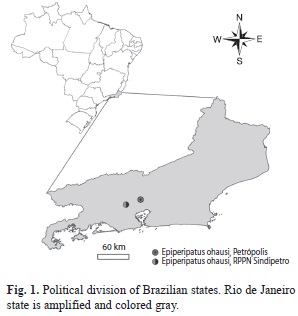
<body><![CDATA[Petroleiros (RPPN dos Petroleiros) (22o35&#8217;44.83&#8221; S - 43o26&#8217;7.62&#8221; W),     Nova Igua&ccedil;u, state of Rio de Janeiro (Brazil), about 28km from     Petr&oacute;polis (<a href="#Figura1">Fig. 1</a>). In respect of     syntypes, some characters of     the syntype (female) housed in the onychophoran collection of the     Zoolo-gisches Museum Hamburg (Hamburg, Germany) were verified by Hilke     Ruhberg (personal communication). Repository acronyms are as     follows:&nbsp; MNRJ-Museu&nbsp; Nacional/UFRJ,&nbsp; Rio de Janeiro,     State of Rio de Janeiro, Brazil and ZMH-Zoologisches Institut und     Zoologisches Museum, Hamburg, Germany.    ]]></body>
<body><![CDATA[<br> <br style="font-family: verdana;"> </span></font>     <div style="text-align: center;"><a name="Figura1"></a><img alt=""  src="/img/revistas/rbt/v62n3/a14i1.jpg"  style="width: 298px; height: 316px;">    <br> </div> <br style="font-family: verdana;"> <font size="2"><span style="font-family: verdana;"><span  style="font-weight: bold;">Fixation: </span>Specimen (MNRJ 0056) was fixed directly in alcohol 70%. Specimen (MNRJ0058) was previously anesthetized in ethyl acetate and then fixed in alcohol 70%, according to the protocol of Monge-N&aacute;jera &amp; Morera-Brenes (1994). After fixation, the specimens were sexed and examined under a stereomicroscope and with scanning electron microscope (SEM). SEM methods included: (1) Cleaning: pieces were rehydrated and cleaned with a 3% solution of Sodium Hypochlorite (NaClO) and distilled water. They were then dehydrated using an increasing alcoholic series: 30%, 50%, 70%, 80%, 90% and 100%. (2) Critical point: all the examined pieces with SEM were critical point dried in model Baltec CPD 030, and then covered by a coat of gold (approximately 200&Aring;=2.10-10m) in Denton Desk Iv gold sputter model.</span></font><br  style="font-family: verdana;"> <br style="font-family: verdana;"> <font size="2"><span style="font-family: verdana;"><span  style="font-weight: bold;">Nomenclature: </span>Dental formula and descriptive terminology follows Morera- Brenes &amp; Monge-N&aacute;jera (2010) and Oliveira et al. (2010), respectively.</span></font><br  style="font-family: verdana;"> <br style="font-family: verdana;"> <font size="2"><span style="font-family: verdana;"><span  style="font-weight: bold;">Color study:</span> Pictures were taken with a Fuji Finepix S1500 (4-mega pixels) camera. Coloration was described based on living specimens. Following Kury &amp; Orrico (2006), standard names of the 267 Color Centroids of NBS/ ISCC Color System (Mundie, 1995) were used in descriptions and given between parentheses.</span></font><br style="font-family: verdana;"> <br style="font-family: verdana;"> <font style="font-weight: bold;" size="3"><span  style="font-family: verdana;">Results</span></font><br  style="font-family: verdana;"> <br style="font-family: verdana;"> <font style="font-weight: bold;" size="2"><span  style="font-family: verdana;">Family Peripatidae</span></font><br  style="font-family: verdana; font-weight: bold;"> <br style="font-family: verdana; font-weight: bold;"> <font style="font-weight: bold;" size="2"><span  style="font-family: verdana;">Genus </span></font><font  style="font-weight: bold;" size="2"><span style="font-family: verdana;"><span  style="font-style: italic;">Epiperipatus</span></span></font><font  style="font-weight: bold;" size="2"><span style="font-family: verdana;"> Clark, 1913</span></font><br style="font-family: verdana;"> <br style="font-family: verdana;"> <font size="2"><span style="font-family: verdana;"><span  style="font-style: italic;">Epiperipatus</span></span></font><font  size="2"><span style="font-family: verdana;"> <span  style="font-style: italic;">ohausi </span>(Bouvier, 1900) new combination</span></font><br style="font-family: verdana;"> <br style="font-family: verdana;"> <font size="2"><span style="font-family: verdana;"><span  style="font-style: italic;">Peripatus ohausi</span></span></font><font  size="2"><span style="font-family: verdana;"> Bouvier, 1900: 67, 1905: 204.</span></font><br style="font-family: verdana;"> <br style="font-family: verdana;"> <font size="2"><span style="font-family: verdana;"><span  style="font-style: italic;">Peripatus </span>(</span></font><font  size="2"><span style="font-family: verdana;"><span  style="font-style: italic;">Macroperipatus</span></span></font><font  size="2"><span style="font-family: verdana;">) </span></font><font  size="2"><span style="font-family: verdana;"><span  style="font-style: italic;">ohausi</span></span></font><font size="2"><span  style="font-family: verdana;">: Clark, 1913: 17.</span></font><br style="font-family: verdana;"> <br style="font-family: verdana;"> <font size="2"><span style="font-family: verdana;"><span  style="font-style: italic;">Macroperipatus ohausi</span></span></font><font  size="2"><span style="font-family: verdana;">: Peck 1975: 347; Sampaio-Costa et al. 2009: 558; Oliveira et al. 2012:16.</span></font><br  style="font-family: verdana;"> <br style="font-family: verdana;"> <font style="font-weight: bold;" size="2"><span  style="font-family: verdana;">Fig. 2-12.</span></font><br  style="font-family: verdana;"> <br style="font-family: verdana;"> <font size="2"><span style="font-family: verdana;"><span  style="font-weight: bold;">Type material:</span> (Syntypes: two females (ZMH and MNHN), BRAZIL, Petr&oacute;polis, 31. I. 1900, Dr. Ohaus leg. (Not examined).</span></font><br  style="font-family: verdana;"> <br style="font-family: verdana;"> <font size="2"><span style="font-family: verdana;"><span  style="font-weight: bold;">Additional material examined: </span>BRAZIL, state of Rio de Janeiro, Nova Igua&ccedil;u, Reserva Particular do Patrim&ocirc;nio Natural dos Petroleiros, 23.XII.2009, Guipponi, A.L.; Sampaio-Costa, C. leg. (1 female, MNRJ 0056); <span  style="font-style: italic;">idem</span>, 11.III.2010, Chagas-Jr, A.; Giupponi, A.L.; Kury, A.; Sampaio-Costa, C. leg. (1 male, MNRJ 0058).</span></font><br style="font-family: verdana;"> <br style="font-family: verdana;"> <font size="2"><span style="font-family: verdana;"><span  style="font-weight: bold;">Diagnosis:</span> Antennae with 38 to 41 complete rings; outer jaw blade composed of one long curved principal tooth and an additional accessory tooth; inner jaw blade with one principal tooth, one accessory tooth, a diastema, and a series of 12 denticles; dorsal papillae rounded; basal piece of dorsal primary papillae conical; basal and apical pieces of dorsal pri- mary papillae with 7 to 8 and 3 to 4 scale ranks, respectively; leg pairs 27 to 29; ventral organs visible; anal glands of male indistinguishable.</span></font><br  style="font-family: verdana;"> <br style="font-family: verdana;">     <div style="text-align: center;"><font style="font-weight: bold;"      size="2"><span style="font-family: verdana;">Redescription</span></font><br      style="font-family: verdana;">     </div>     <br style="font-family: verdana;">     <font size="2"><span style="font-family: verdana;"><span      style="font-weight: bold;">Measurements:&nbsp; </span>Female&nbsp;     ]]></body>
<body><![CDATA[(MNRJ&nbsp; 0056) 54mm long and 5mm wide, and male (MNRJ 0058) 29mm     long, 3mm wide. Type (ZMH) 44mm long (syntype).</span></font><br      style="font-family: verdana;">     <br style="font-family: verdana;">     <font size="2"><span style="font-family: verdana;"><span      style="font-weight: bold;">Color (for living specimens): </span>Body     background brownish gray (64) with dorsal light spots (primary     papillae) pinkish gray (10). Dorsomedian furrow is pale violet (214),     with light olive gray parallel diamonds (112). The head is moderate     brown (58) and antennae are grayish to reddish purple (245) (<a     ]]></body>
<body><![CDATA[ href="/img/revistas/rbt/v62n3/a14i2.jpg">Fig. 2</a>).     Dorsal side of legs is grayish to purplish pink (253), ventral side is     pale purple (227), and the soles are yellowish white (92). The ventral     side is dark pink (6) with light pink (4) ventral organs and light     spots pinkish white (9), randomly dis- tributed (<a      href="/img/revistas/rbt/v62n3/a14i3.jpg">Fig. 3</a>). One syntype     (ZMH) is totally discolored.</span></font><br      style="font-family: verdana;">     <br style="font-family: verdana;">     <font size="2"><span style="font-family: verdana;"><span     ]]></body>
<body><![CDATA[ style="font-weight: bold;">Integument: </span>Twelve plicae per     segment, seven of these cross over to ventral side. The incomplete     plicae are interrupted over the legs (<a      href="/img/revistas/rbt/v62n3/a14i3.jpg">Fig. 6</a>).</span></font><br      style="font-family: verdana;">     <br style="font-family: verdana;">     <font size="2"><span style="font-family: verdana;"><span      style="font-weight: bold;">Hyaline organs: </span>On dorsal side,     between plicae and parallel to the dorsomedian furrow (<a      href="/img/revistas/rbt/v62n3/a14i3.jpg">Fig. 7</a>).</span></font><br     ]]></body>
<body><![CDATA[ style="font-family: verdana;">     <br style="font-family: verdana;">     <font size="2"><span style="font-family: verdana;"><span      style="font-weight: bold;">Dorsomedian furrow: </span>Slender, and     starts at mid-point of head and finishes near anus.</span></font><br      style="font-family: verdana;">     <br style="font-family: verdana;">     <font size="2"><span style="font-family: verdana;"><span      style="font-weight: bold;">Dorsal papillae:</span> Female (MNRJ     0056). The dorsal papillae are close to each other and the size varies.     ]]></body>
<body><![CDATA[Indistinct grooves can be present between two dorsal papillae (<a      href="/img/revistas/rbt/v62n3/a14i3.jpg">Fig. 6</a>).     The primary papillae are the biggest dorsal papillae (<a      href="/img/revistas/rbt/v62n3/a14i3.jpg">Fig. 6, 8 and 9</a>);     they are rarely in sequence or separated by accessory papillae. The     number of accessory papillae varies between two primary papillae. The     longest primary papillae are discolored with base diameter larger than     plicae. These papillae are always found on alternate plicae in     &#8220;longitudinal lines&#8221; present on dif- ferent aspects of dorsal side.     Depending on its relative position to the dorsomedian furrow, these     ]]></body>
<body><![CDATA[lines are composed of a different quantity of the largest primary     papillae.</span></font><br style="font-family: verdana;">     <br style="font-family: verdana;">     <font size="2"><span style="font-family: verdana;">The conical basal     piece of the     primary papillae has seven (<a href="/img/revistas/rbt/v62n3/a14i3.jpg">Fig.     8</a>) or nine scale ranks. But nine scale     ranks were observed only in the female (MNRJ 0056). These scales are     lanceolate and increase in length near the top (<a      href="/img/revistas/rbt/v62n3/a14i3.jpg">Fig. 8</a>). Constriction     ]]></body>
<body><![CDATA[between the base and top are evident. The apical piece is spherical,     asymmetrical and robust. The scales are narrow and as elongated as the     taller scales of the base. The scales around the bristle are smaller     and truncated (<a href="/img/revistas/rbt/v62n3/a1432.jpg">Fig. 8 and 9</a>).     The apical piece has three scale ranks on     posterior side and four on anterior side.</span></font><br      style="font-family: verdana;">     <br style="font-family: verdana;">     <font size="2"><span style="font-family: verdana;">The accessory     papillae are conical     ]]></body>
<body><![CDATA[and the smallest are the dorsal papillae. Usually the accessory     papillae have many in dorsal plicae where the largest primary papillae     are present (<a href="/img/revistas/rbt/v62n3/a14i3.jpg">Fig. 6</a>).     The scales on the bottom are more elongated than     on top.</span></font><br style="font-family: verdana;">     <br style="font-family: verdana;">     <font size="2"><span style="font-family: verdana;"><span      style="font-weight: bold;">Head</span>. Without evident structures.     <span style="font-weight: bold; font-style: italic;">Antennae</span>.     38 to 41 complete rings. One syntype (ZMH) has 38 rings. In     ]]></body>
<body><![CDATA[the collected female (MNRJ 0056) and male (MNRJ 0058) the first seven     rings belong to the antennal tip. On both specimens between the 8th and     30th antennal rings there is a sequence of narrow, even and large odd     rings. <span style="font-style: italic; font-weight: bold;">Frontal     organs</span>. Present at antennal base on ventral side with     length about equal to four fused antennal papillae. Eyes. One on each     antennal base. <span style="font-weight: bold; font-style: italic;">Mouth     parts.</span> Opening surrounded by one anterior oral     lobe (unpaired lip) and seven pairs of oral lips. In each pair of oral     lip there is a median series of small spines. One syntype (ZMH) has     ]]></body>
<body><![CDATA[seven pairs of lips. One collected specimen (MNRJ 0056) presents a     median series with 9 small spines, whereas the other (MNRJ 0058)     presents 7 small spines. <span style="font-weight: bold;">Jaws</span>.     <span style="font-weight: bold;">(MNRJ 0056). Outer jaw blade</span>.     Composed     of one long curved principal tooth and an additional accessory tooth     (formula: 1/1) (<a href="/img/revistas/rbt/v62n3/a14i2.jpg">Fig. 4</a>).     The accessory tooth is knife-shaped, curved at     the top edge and straight at the bottom edge. <span      style="font-weight: bold;">Inner jaw blade.</span> With one     ]]></body>
<body><![CDATA[principal tooth, one accessory tooth, a diastema, and a series of 12     denticles (formula: 1/1/12) (<a href="/img/revistas/rbt/v62n3/a14i2.jpg">Fig.     4 and 5</a>). The accessory tooth of both     blades is similar in shape.</span></font><br      style="font-family: verdana;">     <br style="font-family: verdana;">     <font size="2"><span style="font-family: verdana;"><span      style="font-weight: bold; font-style: italic;">Legs:</span> Female     with 29 and male with     28 pairs of legs. <span style="font-weight: bold; font-style: italic;">Spinous     ]]></body>
<body><![CDATA[pads.</span> Fourth and fifth legs have four spinous     pads with similar width, and length increases between the first three     pads (<a href="/img/revistas/rbt/v62n3/a14i4.jpg">Fig. 10 and 11</a>).     The length of the fourth spinous pad is similar     to that of the second. <span      style="font-weight: bold; font-style: italic;">Nephridial tubercle.</span>     Present on fourth and fifth     pairs of legs, between 3rd and 4th spinous pads. It is totally     connected with the third pad, articulating with the fourth, but is     free from it (<a href="/img/revistas/rbt/v62n3/a14i4.jpg">Fig. 10 and 11</a>).     ]]></body>
<body><![CDATA[<span style="font-weight: bold; font-style: italic;">Foot papillae.</span>     Feet have two anterior     and one posterior foot papillae. ventral foot surface with six     bristles: two pairs in proximal setiform ridge, and at least one     bristle on each distal setiform ridge (<a      href="/img/revistas/rbt/v62n3/a14i4.jpg">Fig. 12</a>). <span      style="font-weight: bold; font-style: italic;">Ventral organs.</span>     They     are clearly visible in vivo. Post-fixation they are represented by     depressions on the ventral integument. <span     ]]></body>
<body><![CDATA[ style="font-weight: bold; font-style: italic;">Genital opening.</span>     Located between     penultimate pair of legs in both sexes, but the morphology of the     genital opening is different among the sexes. The genital opening in     female is poorly preserved, but it seems to have two crossed furrows;     the transversal one is only weakly visible. Moreover, the male has a     single long furrow parallel to the main body.</span></font><br      style="font-family: verdana;">     <br style="font-family: verdana;">     <font size="2"><span style="font-family: verdana;"><span     ]]></body>
<body><![CDATA[ style="font-weight: bold;">Male characters:</span> Crural papillae     are pres- ent in one pre-genital pair of legs (a single tubercle per     leg). Anal glands are only recog- nized by their corresponding open     pores.</span></font><br style="font-family: verdana;">     <br style="font-family: verdana;">     <font size="2"><span style="font-family: verdana;"><span      style="font-weight: bold;">Type locality: </span>Petr&oacute;polis,     state of Rio de Janeiro, Brazil. </span></font><br      style="font-family: verdana;">     <br style="font-family: verdana;">     ]]></body>
<body><![CDATA[<font size="2"><span style="font-family: verdana;"><span      style="font-weight: bold;">Distribution:</span> State of Rio de     Janeiro (Petr&oacute;polis and Nova Igua&ccedil;u, new record), Brazil.</span></font><br      style="font-family: verdana;">     <br style="font-family: verdana;">     <font style="font-weight: bold;" size="3"><span      style="font-family: verdana;">Discussion</span></font><br      style="font-family: verdana;">     <br style="font-family: verdana;">     <font size="2"><span style="font-family: verdana;">The Neotropical     ]]></body>
<body><![CDATA[Onychophora are     traditionally divided into two well-characterized groups named Andean     and Caribbean peripatids. Our investigation shows that the two     specimens reported in this study are peripatid onychophorans based on     simple Caribbean group characteristics: (1) two anterior and one     posterior&nbsp; foot&nbsp; papillae;&nbsp; (2)&nbsp; legs&nbsp;     Iv&nbsp; and&nbsp; v with four spinous pads; and (3) nephridial     tubercle&nbsp; openings&nbsp; between&nbsp; the&nbsp; 3rd&nbsp;     and&nbsp; 4th pad. These characters are present in all representatives     of <span style="font-style: italic;">Peripatus</span>, </span></font><font     ]]></body>
<body><![CDATA[ size="2"><span style="font-family: verdana;"><span      style="font-style: italic;">Epiperipatus</span></span></font><font      size="2"><span style="font-family: verdana;">, </span></font><font      size="2"><span style="font-family: verdana;"><span      style="font-style: italic;">Macroperipatus</span></span></font><font      size="2"><span style="font-family: verdana;">, <span      style="font-style: italic;">Speleoperipatus </span>Peck, 1975     and <span style="font-style: italic;">Plicatoperipatus </span>Clark,     1913, but the presence of eyes and 12     plicae per segment distin- guishes them from Speleoperipatus and <span     ]]></body>
<body><![CDATA[ style="font-style: italic;">Plicatoperipatus</span>, respectively.</span></font><br      style="font-family: verdana;">     <br style="font-family: verdana;">     <font size="2"><span style="font-family: verdana;">Because of the     conical basal piece     with a roundish base and the spherical, asymmetrical and robust apical     piece, the primary papillae of the analyzed specimens suggest a higher     resemblance to <span style="font-style: italic;">Peripatus </span>and     </span></font><font size="2"><span style="font-family: verdana;"><span      style="font-style: italic;">Epiperipatus</span></span></font><font     ]]></body>
<body><![CDATA[ size="2"><span style="font-family: verdana;"> than&nbsp; to&nbsp; </span></font><font      size="2"><span style="font-family: verdana;"><span      style="font-style: italic;">Macroperipatus</span></span></font><font      size="2"><span style="font-family: verdana;">. According&nbsp;     to&nbsp; Read (1988), the quadrangular     shape of dorsal papillae seen in <span style="font-style: italic;">M.     torquatus</span> is caused by the outline     grooves. In addition, the scales of the basal piece are not arranged in     ranks in this species (Oliveira et al., 2010). Therefore analyzed     specimens do not belong to </span></font><font size="2"><span     ]]></body>
<body><![CDATA[ style="font-family: verdana;"><span style="font-style: italic;">Macroperipatus</span></span></font><font      size="2"><span style="font-family: verdana;">.</span></font><br      style="font-family: verdana;">     <br style="font-family: verdana;">     <font size="2"><span style="font-family: verdana;">The dorsal     integument of all     <span style="font-style: italic;">Macroperipatus </span>species is not     known in detail, although according to     Read (1988) the dorsal primary papillae of <span      style="font-style: italic;">M. acacioi</span>, </span></font><font     ]]></body>
<body><![CDATA[ size="2"><span style="font-family: verdana;"><span      style="font-style: italic;">M. ohausi</span></span></font><font      size="2"><span style="font-family: verdana;"> and <span      style="font-style: italic;">M.     guianensis</span> (Evans, 1903) are rounded and contrast with     quadrangular     primary papillae of </span></font><font size="2"><span      style="font-family: verdana;"><span style="font-style: italic;">M.     torquatus</span></span></font><font size="2"><span      style="font-family: verdana;">. In a recent review of two Brazilian     ]]></body>
<body><![CDATA[species previously regarded as </span></font><font size="2"><span      style="font-family: verdana;"><span style="font-style: italic;">Macroperipatus</span></span></font><font      size="2"><span style="font-family: verdana;">&#8211;</span></font><font      size="2"><span style="font-family: verdana;"><span      style="font-style: italic;">M. acacioi</span></span></font><font      size="2"><span style="font-family: verdana;"> and <span      style="font-style: italic;">M.     machadoi</span>&#8211; Oliveira et al. (2010) also showed that in these     species the     bases of the dermal papillae are roundish and covered with     ]]></body>
<body><![CDATA[well-developed conical scales, which are arranged in several ranks.     Therefore, Oliveira et al. (2010) transferred both species to the genus     </span></font><font size="2"><span style="font-family: verdana;"><span      style="font-style: italic;">Epiperipatus</span></span></font><font      size="2"><span style="font-family: verdana;">. They also suggested     that the dorsal papillae should be     reinvestigated in other species of </span></font><font size="2"><span      style="font-family: verdana;"><span style="font-style: italic;">Macroperipatus</span></span></font><font      size="2"><span style="font-family: verdana;"> by SEM.</span></font><br      style="font-family: verdana;">     ]]></body>
<body><![CDATA[<br style="font-family: verdana;">     <font size="2"><span style="font-family: verdana;">Read (1988)     registered one </span></font><font size="2"><span      style="font-family: verdana;"><span style="font-style: italic;">M.     ohausi</span></span></font><font size="2"><span      style="font-family: verdana;"> specimen, collected in 1981 by J. C.     Diniz and C. R.     Brand&atilde;o, in Petr&oacute;polis. We contacted C. R. Brand&atilde;o     and he informed us of the exact collection point where the specimen     was sampled (C. R. Brand&atilde;o pers. comm.). We returned several     ]]></body>
<body><![CDATA[times to this locality, but today this area is completely urbanized and     we did not find any onychophoran there. </span></font><br      style="font-family: verdana;">     <br style="font-family: verdana;">     <font size="2"><span style="font-family: verdana;">The&nbsp; two&nbsp;     new&nbsp;     specimens&nbsp; were&nbsp; collected 28km from Petr&oacute;polis, type     locality of </span></font><font size="2"><span      style="font-family: verdana;"><span style="font-style: italic;">M.     ohausi</span></span></font><font size="2"><span     ]]></body>
<body><![CDATA[ style="font-family: verdana;"> (<a      href="/img/revistas/rbt/v62n3/a14i1.jpg">Fig 1</a>). The characters     present in     these     specimens agree with the description of </span></font><font size="2"><span      style="font-family: verdana;"><span style="font-style: italic;">M.     ohausi</span></span></font><font size="2"><span      style="font-family: verdana;"> sensu Bouvier (1900,     1905), except for the number of leg pairs. The number of leg pairs is     not fixed in Neotropical Peripatidae species (Bouvier, 1905; Campiglia     ]]></body>
<body><![CDATA[&amp; Laval- lard, 1973). The number of leg pairs in our specimens is     28 and 29, and the type is 27. Bouvier (1900, 1905) poorly described </span></font><font      size="2"><span style="font-family: verdana;"><span      style="font-style: italic;">M. ohausi</span></span></font><font      size="2"><span style="font-family: verdana;">,&nbsp; based&nbsp;     mainly&nbsp; on&nbsp; the&nbsp;     description&nbsp; of the primary papillae morphology. Then, Read (1988)     included the number of scale ranks in the description of this species     based on recent specimens collected in 1981 by J. C. Diniz and C. R.     Brand&atilde;o in Petr&oacute;polis.</span></font><br     ]]></body>
<body><![CDATA[ style="font-family: verdana;">     <br style="font-family: verdana;">     <font size="2"><span style="font-family: verdana;">The dorsal primary     papillae     described by Read (1988, figs. A-D) were compared to the     specimens&nbsp; from&nbsp; RPPN&nbsp; dos&nbsp; Petroleiros&nbsp; and     also agree with them in morphology. The morphology of the dorsal     primary papillae and the range of leg pairs show that </span></font><font      size="2"><span style="font-family: verdana;"><span      style="font-style: italic;">Epiperipatus</span></span></font><font     ]]></body>
<body><![CDATA[ size="2"><span style="font-family: verdana;"> </span></font><font      size="2"><span style="font-family: verdana;"><span      style="font-style: italic;">ohausi</span></span></font><font size="2"><span      style="font-family: verdana;"> is more closely related to the species     of </span></font><font size="2"><span style="font-family: verdana;"><span      style="font-style: italic;">Epiperipatus</span></span></font><font      size="2"><span style="font-family: verdana;"> from the     state of Minas Gerais (Southeastern Brazil): <span      style="font-style: italic;">E. acacioi</span>, <span      style="font-style: italic;">E. machadoi</span>,     ]]></body>
<body><![CDATA[<span style="font-style: italic;">E. diadenoproctus</span> Oliveira,     Lacorte, Fonseca, Wieloch &amp; Mayer,     2011; <span style="font-style: italic;">E. adenocryptus</span>     Oliveira et al. 2011; and <span style="font-style: italic;">E.     paurognostus</span>     Oliveira et al. 2011. </span></font><font size="2"><span      style="font-family: verdana;"><span style="font-style: italic;">Epiperipatus</span></span></font><font      size="2"><span style="font-family: verdana;"> </span></font><font      size="2"><span style="font-family: verdana;"><span      style="font-style: italic;">ohausi</span></span></font><font size="2"><span     ]]></body>
<body><![CDATA[ style="font-family: verdana;"> has seven or eight scale     ranks on the base of the primary papillae, while </span></font><font      size="2"><span style="font-family: verdana;"><span      style="font-style: italic;">E. acacioi</span></span></font><font      size="2"><span style="font-family: verdana;">, </span></font><font      size="2"><span style="font-family: verdana;"><span      style="font-style: italic;">E. machadoi</span></span></font><font      size="2"><span style="font-family: verdana;">, </span></font><font      size="2"><span style="font-family: verdana;"><span      style="font-style: italic;">E. diadenoproctus</span></span></font><font     ]]></body>
<body><![CDATA[ size="2"><span style="font-family: verdana;">, </span></font><font      size="2"><span style="font-family: verdana;"><span      style="font-style: italic;">E. adenocryptus</span></span></font><font      size="2"><span style="font-family: verdana;"> have 5-6, 5-8, 5-8 and     5-7, respectively. Four scale ranks on </span></font><font size="2"><span      style="font-family: verdana;"><span style="font-style: italic;">E.     adenocryptus</span></span></font><font size="2"><span      style="font-family: verdana;">, three on </span></font><font size="2"><span      style="font-family: verdana;"><span style="font-style: italic;">E.     ohausi</span></span></font><font size="2"><span     ]]></body>
<body><![CDATA[ style="font-family: verdana;"> and </span></font><font size="2"><span      style="font-family: verdana;"><span style="font-style: italic;">E.     acacioi</span></span></font><font size="2"><span      style="font-family: verdana;">, and two on </span></font><font      size="2"><span style="font-family: verdana;"><span      style="font-style: italic;">E. paurognostus</span></span></font><font      size="2"><span style="font-family: verdana;"> were counted from the     posterior side of the apical piece, but for </span></font><font      size="2"><span style="font-family: verdana;"><span      style="font-style: italic;">E. diadenoproctus</span></span></font><font     ]]></body>
<body><![CDATA[ size="2"><span style="font-family: verdana;"> it was     not described.</span></font><br style="font-family: verdana;">     <br style="font-family: verdana;">     <font size="2"><span style="font-family: verdana;"><span      style="font-style: italic;">Epiperipatus</span></span></font><font      size="2"><span style="font-family: verdana;"> </span></font><font      size="2"><span style="font-family: verdana;"><span      style="font-style: italic;">ohausi</span></span></font><font size="2"><span      style="font-family: verdana;">, </span></font><font size="2"><span      style="font-family: verdana;"><span style="font-style: italic;">E.     ]]></body>
<body><![CDATA[acacioi</span></span></font><font size="2"><span      style="font-family: verdana;"> and </span></font><font size="2"><span      style="font-family: verdana;"><span style="font-style: italic;">E.     machadoi</span></span></font><font size="2"><span      style="font-family: verdana;"> have the asymmetrical apical piece in     common, though it is     spherical in the first species and ovate in latter two (although some </span></font><font      size="2"><span style="font-family: verdana;"><span      style="font-style: italic;">E. acacioi</span></span></font><font      size="2"><span style="font-family: verdana;"> specimens have a     ]]></body>
<body><![CDATA[globular shape as well). The sensory     bristles usually are needle-shaped and curved posteriorly, as observed     in </span></font><font size="2"><span style="font-family: verdana;"><span      style="font-style: italic;">E. acacioi</span></span></font><font      size="2"><span style="font-family: verdana;">, </span></font><font      size="2"><span style="font-family: verdana;"><span      style="font-style: italic;">E. machadoi</span></span></font><font      size="2"><span style="font-family: verdana;"> and </span></font><font      size="2"><span style="font-family: verdana;"><span      style="font-style: italic;">E. ohausi</span></span></font><font     ]]></body>
<body><![CDATA[ size="2"><span style="font-family: verdana;">. However, it is     spine-shaped     in the cryptic species from Minas Gerais (Oliveira et al., 2011). The     range of leg pairs is different among these six Brazilian Southeastern     species. In increasing order, the ranges are: 27 to 29 in </span></font><font      size="2"><span style="font-family: verdana;"><span      style="font-style: italic;">E. ohausi</span></span></font><font      size="2"><span style="font-family: verdana;">; 25     to 28 in </span></font><font size="2"><span      style="font-family: verdana;"><span style="font-style: italic;">E.     ]]></body>
<body><![CDATA[acacioi</span></span></font><font size="2"><span      style="font-family: verdana;"> (n=34); 26 to 29 in </span></font><font      size="2"><span style="font-family: verdana;"><span      style="font-style: italic;">E. paurognostus</span></span></font><font      size="2"><span style="font-family: verdana;"> (n=15, see     Oliveira et al., 2011); 26 to 30 in </span></font><font size="2"><span      style="font-family: verdana;"><span style="font-style: italic;">E.     adenocryptus</span></span></font><font size="2"><span      style="font-family: verdana;"> (n=25, see Oliveira     et al., 2011); </span></font><font size="2"><span     ]]></body>
<body><![CDATA[ style="font-family: verdana;"><span style="font-style: italic;">E.     diadenoproctus</span></span></font><font size="2"><span      style="font-family: verdana;"> (n=62, see Oliveira et al., 2011), and     27 to 31 in </span></font><font size="2"><span      style="font-family: verdana;"><span style="font-style: italic;">E.     machadoi</span></span></font><font size="2"><span      style="font-family: verdana;"> (n=21). The anal glands are absent in     males of </span></font><font size="2"><span      style="font-family: verdana;"><span style="font-style: italic;">E.     ohausi</span></span></font><font size="2"><span     ]]></body>
<body><![CDATA[ style="font-family: verdana;">, but the respective pores are present.     These pores are     observed on the ventral board of the anus. In </span></font><font      size="2"><span style="font-family: verdana;"><span      style="font-style: italic;">E. acacioi</span></span></font><font      size="2"><span style="font-family: verdana;"> and </span></font><font      size="2"><span style="font-family: verdana;"><span      style="font-style: italic;">E. machadoi</span></span></font><font      size="2"><span style="font-family: verdana;"> the anal glands seem     also to be absent, while in </span></font><font size="2"><span     ]]></body>
<body><![CDATA[ style="font-family: verdana;"><span style="font-style: italic;">E.     adenocryptus</span></span></font><font size="2"><span      style="font-family: verdana;">, </span></font><font size="2"><span      style="font-family: verdana;"><span style="font-style: italic;">E.     diadenoproctus</span></span></font><font size="2"><span      style="font-family: verdana;"> and </span></font><font size="2"><span      style="font-family: verdana;"><span style="font-style: italic;">E.     paurognostus</span></span></font><font size="2"><span      style="font-family: verdana;"> these structures     are present in the ventral board of the anus. The SEM primary papillae     ]]></body>
<body><![CDATA[(<a href="/img/revistas/rbt/v62n3/a14i2.jpg">Fig. 5</a>, <a      href="/img/revistas/rbt/v62n3/a14i3.jpg">7 and 8</a>) analysis of </span></font><font      size="2"><span style="font-family: verdana;"><span      style="font-style: italic;">M.     ohausi</span></span></font><font size="2"><span      style="font-family: verdana;"> showed that the base is not     square-shaped as in&nbsp; </span></font><font size="2"><span      style="font-family: verdana;"><span style="font-style: italic;">M.     torquatus</span></span></font><font size="2"><span      style="font-family: verdana;">,&nbsp; but&nbsp;     ]]></body>
<body><![CDATA[rounded&nbsp; as&nbsp; in&nbsp; Peripatus and </span></font><font      size="2"><span style="font-family: verdana;"><span      style="font-style: italic;">Epiperipatus</span></span></font><font      size="2"><span style="font-family: verdana;">.</span></font><br      style="font-family: verdana;">     <br style="font-family: verdana;">     <font size="2"><span style="font-family: verdana;">The new record of </span></font><font      size="2"><span style="font-family: verdana;"><span      style="font-style: italic;">E. ohausi</span></span></font><font      size="2"><span style="font-family: verdana;"> has     ]]></body>
<body><![CDATA[prompted us to redescribe and illustrate the color and integument of     the species in detail. Furthermore, we reviewed the taxonomic status     of this poorly known species.</span></font><br      style="font-family: verdana;">     <br style="font-family: verdana;">     <font style="font-weight: bold;" size="3"><span      style="font-family: verdana;">Acknowledgments</span></font><br      style="font-family: verdana;">     <br style="font-family: verdana;">     <font size="2"><span style="font-family: verdana;">We&nbsp; are&nbsp;     ]]></body>
<body><![CDATA[grateful&nbsp;     to&nbsp; Amanda&nbsp; Garcez&nbsp; da veiga for SEM operation at the     Center for Scanning Electron Microscopy of the Museu Nacional, UFRJ.     The establishment of this Center was made possible by a grant from     Cenpes/Petrobras, and is part of the company&#8217;s Thematic&nbsp;     Network&nbsp; for&nbsp; Marine&nbsp; Environmental Monitoring. We are     grateful to Dr. Hilke Ruhberg for providing information about the type     deposited in the Hamburg Museum. We are&nbsp; also&nbsp; grateful&nbsp;     to&nbsp; Nivaldo Alves&nbsp; da&nbsp; Silva (present Sindipetro     director) and Odirlei vieira da Fonseca for helping us find and collect     ]]></body>
<body><![CDATA[onychophorans in RPPN dos Petroleiros. We are grateful for the     additional comments made by colleagues who read the manuscript. This     research&nbsp; was&nbsp; partially&nbsp; supported&nbsp; by&nbsp;     grants from Funda&ccedil;&atilde;o de Amparo &agrave; Pesquisa do Esta-     do de S&atilde;o Paulo (process 2010/10388-8 and 2011/20211-0), awarded     to both authors. This research is also part of the Project     &#8220;Aracn&iacute;deos e Miri&aacute;podes da Mata Atl&acirc;ntica&#8221; (AMMA),     of the ARACNOLAB (Laboratory of arachnids of the Museu Nacional/UFRJ).</span></font><br      style="font-family: verdana;">     <br style="font-family: verdana;">     ]]></body>
<body><![CDATA[<hr style="width: 100%; height: 2px;"><font style="font-weight: bold;"      size="3"><span style="font-family: verdana;">References</span></font><br      style="font-family: verdana;">     <br style="font-family: verdana;">     <!-- ref --><div style="text-align: left;"><font size="2"><span  style="font-family: verdana;">Bouvier, E. L. (1900). Nouveau P&eacute;ripate des environs de Rio-de-Janeiro. <span  style="font-style: italic;">Bulletin de la Soci&eacute;t&eacute; Entomologique de France, 3</span>, 66-68.    &nbsp;&nbsp;&nbsp;&nbsp;&nbsp;&nbsp;&nbsp;&nbsp;[&#160;<a href="javascript:void(0);" onclick="javascript: window.open('/scielo.php?script=sci_nlinks&ref=1552302&pid=S0034-7744201400030001400001&lng=','','width=640,height=500,resizable=yes,scrollbars=1,menubar=yes,');">Links</a>&#160;]<!-- end-ref --><!-- ref --></span></font><br  style="font-family: verdana;"> <br style="font-family: verdana;"> <font size="2"><span style="font-family: verdana;">Bouvier, E. L. (1905). Monographie des Onychophores. <span style="font-style: italic;">Annales des Sciences Naturelles, Zoologie (9e S&eacute;r.), 2(1-3), 1-383.    &nbsp;&nbsp;&nbsp;&nbsp;&nbsp;&nbsp;&nbsp;&nbsp;[&#160;<a href="javascript:void(0);" onclick="javascript: window.open('/scielo.php?script=sci_nlinks&ref=1552303&pid=S0034-7744201400030001400002&lng=','','width=640,height=500,resizable=yes,scrollbars=1,menubar=yes,');">Links</a>&#160;]<!-- end-ref --><!-- ref --></span></span></font><br  style="font-family: verdana;"> <br style="font-family: verdana;"> <font size="2"><span style="font-family: verdana;">Campiglia, S. &amp; Lavallard, R. (1973). Contribution a la biologie de <span style="font-style: italic;">Peripatus acacioi </span>Marcus et Marcus: II. variations du poids des animaux en fonction du sexe et du nombre des lobopodes. <span style="font-style: italic;">Boletim de Zoologia e Biologia Marinha [Nova S&eacute;rie], 30</span>, 499-502.    &nbsp;&nbsp;&nbsp;&nbsp;&nbsp;&nbsp;&nbsp;&nbsp;[&#160;<a href="javascript:void(0);" onclick="javascript: window.open('/scielo.php?script=sci_nlinks&ref=1552304&pid=S0034-7744201400030001400003&lng=','','width=640,height=500,resizable=yes,scrollbars=1,menubar=yes,');">Links</a>&#160;]<!-- end-ref --><!-- ref --></span></font><br  style="font-family: verdana;"> <br style="font-family: verdana;"> <font size="2"><span style="font-family: verdana;">Clark, A. H. (1913). A revision of the American species of <span style="font-style: italic;">Peripatus</span>. <span style="font-style: italic;">Proceedings of the Biological Society of Washington, 26</span>, 15-19.    &nbsp;&nbsp;&nbsp;&nbsp;&nbsp;&nbsp;&nbsp;&nbsp;[&#160;<a href="javascript:void(0);" onclick="javascript: window.open('/scielo.php?script=sci_nlinks&ref=1552305&pid=S0034-7744201400030001400004&lng=','','width=640,height=500,resizable=yes,scrollbars=1,menubar=yes,');">Links</a>&#160;]<!-- end-ref --><!-- ref --></span></font><br  style="font-family: verdana;"> <br style="font-family: verdana;"> <font size="2"><span style="font-family: verdana;">Cockerell, T. D. A. (1908). Review of Monographie des Onychophores by E.L. BOUVIER. <span  style="font-style: italic;">Science 27</span>(694), 619-621.    &nbsp;&nbsp;&nbsp;&nbsp;&nbsp;&nbsp;&nbsp;&nbsp;[&#160;<a href="javascript:void(0);" onclick="javascript: window.open('/scielo.php?script=sci_nlinks&ref=1552306&pid=S0034-7744201400030001400005&lng=','','width=640,height=500,resizable=yes,scrollbars=1,menubar=yes,');">Links</a>&#160;]<!-- end-ref --><!-- ref --></span></font><br style="font-family: verdana;"> <br style="font-family: verdana;"> <font size="2"><span style="font-family: verdana;">Evans,&nbsp; R.&nbsp; (1903).&nbsp; On&nbsp; <span style="font-style: italic;">Peripatus&nbsp; guianensis</span>&nbsp; (sp.&nbsp; nov.). <span style="font-style: italic;">Quarterly Journal of Microscopical Science, 47</span>(186), 145-160.    &nbsp;&nbsp;&nbsp;&nbsp;&nbsp;&nbsp;&nbsp;&nbsp;[&#160;<a href="javascript:void(0);" onclick="javascript: window.open('/scielo.php?script=sci_nlinks&ref=1552307&pid=S0034-7744201400030001400006&lng=','','width=640,height=500,resizable=yes,scrollbars=1,menubar=yes,');">Links</a>&#160;]<!-- end-ref --><!-- ref --></span></font><br  style="font-family: verdana;"> <br style="font-family: verdana;"> <font size="2"><span style="font-family: verdana;">Guilding,&nbsp; L.&nbsp; (1826).&nbsp; Mollusca&nbsp; Caribbaeana.&nbsp;<span  style="font-style: italic;"> Zoologica Journal, 2</span>, 437-449.    &nbsp;&nbsp;&nbsp;&nbsp;&nbsp;&nbsp;&nbsp;&nbsp;[&#160;<a href="javascript:void(0);" onclick="javascript: window.open('/scielo.php?script=sci_nlinks&ref=1552308&pid=S0034-7744201400030001400007&lng=','','width=640,height=500,resizable=yes,scrollbars=1,menubar=yes,');">Links</a>&#160;]<!-- end-ref --><!-- ref --></span></font><br style="font-family: verdana;"> <br style="font-family: verdana;"> <font size="2"><span style="font-family: verdana;">Kury, A. B. &amp; Orrico, v.&nbsp; G. D. (2006). A new species of&nbsp; <span style="font-style: italic;">Lacronia&nbsp; </span>Strand,&nbsp; 1942&nbsp; from&nbsp; the&nbsp; highlands&nbsp; of Rio de Janeiro (Opiliones, Gonyleptidae, Pachylinae). <span  style="font-style: italic;">Revista Ib&eacute;rica de Aracnologia, Zaragoza, 13</span>, 147-153.    &nbsp;&nbsp;&nbsp;&nbsp;&nbsp;&nbsp;&nbsp;&nbsp;[&#160;<a href="javascript:void(0);" onclick="javascript: window.open('/scielo.php?script=sci_nlinks&ref=1552309&pid=S0034-7744201400030001400008&lng=','','width=640,height=500,resizable=yes,scrollbars=1,menubar=yes,');">Links</a>&#160;]<!-- end-ref --><!-- ref --></span></font><br  style="font-family: verdana;"> <br style="font-family: verdana;"> <font size="2"><span style="font-family: verdana;">Marcus, E. &amp; Marcus, E. (1955). A new Peripatus from Minas Gerais, Brazil. <span  style="font-style: italic;">Anais da Academia Brasileira de Ci&ecirc;ncias, 27</span>(2), 189-193.    &nbsp;&nbsp;&nbsp;&nbsp;&nbsp;&nbsp;&nbsp;&nbsp;[&#160;<a href="javascript:void(0);" onclick="javascript: window.open('/scielo.php?script=sci_nlinks&ref=1552310&pid=S0034-7744201400030001400009&lng=','','width=640,height=500,resizable=yes,scrollbars=1,menubar=yes,');">Links</a>&#160;]<!-- end-ref --><!-- ref --></span></font><br  style="font-family: verdana;"> <br style="font-family: verdana;"> <font size="2"><span style="font-family: verdana;">Monge-N&aacute;jera, J. &amp; Morera-Brenes, B. (1994). Morphological and physiological characteristics of two species of </span></font><font size="2"><span  style="font-family: verdana;"><span style="font-style: italic;">Epiperipatus</span></span></font><font  size="2"><span style="font-family: verdana;"> from Costa Rica (Onychophora: Peripatidae). <span style="font-style: italic;">Revista de Biologia Tropical, 42</span>(1/2), 181-188.    &nbsp;&nbsp;&nbsp;&nbsp;&nbsp;&nbsp;&nbsp;&nbsp;[&#160;<a href="javascript:void(0);" onclick="javascript: window.open('/scielo.php?script=sci_nlinks&ref=1552311&pid=S0034-7744201400030001400010&lng=','','width=640,height=500,resizable=yes,scrollbars=1,menubar=yes,');">Links</a>&#160;]<!-- end-ref --><!-- ref --></span></font><br style="font-family: verdana;"> <br style="font-family: verdana;"> <font size="2"><span style="font-family: verdana;">Morera-Brenes, B. &amp; Monge-N&aacute;jera, J. (2010). A new giant species of placented worm and the mechanism by which onychophorans weave their nets (Onychophora: Peripatidae). <span style="font-style: italic;">Revista de Biolog&iacute;a Tropical, 58</span>(4), 1127-1142.    &nbsp;&nbsp;&nbsp;&nbsp;&nbsp;&nbsp;&nbsp;&nbsp;[&#160;<a href="javascript:void(0);" onclick="javascript: window.open('/scielo.php?script=sci_nlinks&ref=1552312&pid=S0034-7744201400030001400011&lng=','','width=640,height=500,resizable=yes,scrollbars=1,menubar=yes,');">Links</a>&#160;]<!-- end-ref --><!-- ref --></span></font><br  style="font-family: verdana;"> <br style="font-family: verdana;"> <font size="2"><span style="font-family: verdana;">Morera-Brenes, B (2012). Los onic&oacute;foros, f&oacute;siles caminantes. <span  style="font-style: italic;">El Salvador Ciencia &amp; Tecnolog&iacute;a, 17</span>(23),    &nbsp;&nbsp;&nbsp;&nbsp;&nbsp;&nbsp;&nbsp;&nbsp;[&#160;<a href="javascript:void(0);" onclick="javascript: window.open('/scielo.php?script=sci_nlinks&ref=1552313&pid=S0034-7744201400030001400012&lng=','','width=640,height=500,resizable=yes,scrollbars=1,menubar=yes,');">Links</a>&#160;]<!-- end-ref --><!-- ref --> 8-13.</span></font><br  style="font-family: verdana;"> <br style="font-family: verdana;"> <font size="2"><span style="font-family: verdana;">Mundie, D. A. (1995). The NBS/ISCC Color System/ David A. Mundie Pittsburgh, PA: Polymath Systems 535.6 dc- 20. Retrieved from http://www.anthus.com/Colors/Cent.html.    &nbsp;&nbsp;&nbsp;&nbsp;&nbsp;&nbsp;&nbsp;&nbsp;[&#160;<a href="javascript:void(0);" onclick="javascript: window.open('/scielo.php?script=sci_nlinks&ref=1552314&pid=S0034-7744201400030001400013&lng=','','width=640,height=500,resizable=yes,scrollbars=1,menubar=yes,');">Links</a>&#160;]<!-- end-ref --><!-- ref --></span></font><br  style="font-family: verdana;"> <br style="font-family: verdana;"> <font size="2"><span style="font-family: verdana;">Murienne, J., Daniels, S. R., Buckey, T.R., Mayer, G. &amp; Giribet, G. (2014). A living fossil tale of Pangean biogeography. <span style="font-style: italic;">Proceedings of the Royal Society B: Biological Sciences, 281</span>: 20132648.    &nbsp;&nbsp;&nbsp;&nbsp;&nbsp;&nbsp;&nbsp;&nbsp;[&#160;<a href="javascript:void(0);" onclick="javascript: window.open('/scielo.php?script=sci_nlinks&ref=1552315&pid=S0034-7744201400030001400014&lng=','','width=640,height=500,resizable=yes,scrollbars=1,menubar=yes,');">Links</a>&#160;]<!-- end-ref --><!-- ref --></span></font><br  style="font-family: verdana;"> <br style="font-family: verdana;"> <font size="2"><span style="font-family: verdana;">Oliveira, I. &amp; Wieloch, A. H. (2005). </span></font><font size="2"><span  style="font-family: verdana;"><span style="font-style: italic;">Macroperipatus</span></span></font><font  size="2"><span style="font-family: verdana;"> <span  style="font-style: italic;">machadoi </span>sp. n. (Onychophora: Peripatidae) da Flo- resta Atl&acirc;ntica&nbsp; de Minas&nbsp; Gerais,&nbsp; Brasil.&nbsp; <span style="font-style: italic;">Lundiana 6</span>(supp.), 61-66.    &nbsp;&nbsp;&nbsp;&nbsp;&nbsp;&nbsp;&nbsp;&nbsp;[&#160;<a href="javascript:void(0);" onclick="javascript: window.open('/scielo.php?script=sci_nlinks&ref=1552316&pid=S0034-7744201400030001400015&lng=','','width=640,height=500,resizable=yes,scrollbars=1,menubar=yes,');">Links</a>&#160;]<!-- end-ref --><!-- ref --></span></font><br style="font-family: verdana;"> <br style="font-family: verdana;"> <font size="2"><span style="font-family: verdana;">Oliveira, I., Read, v. M. S. J., &amp; Mayer, G. (2012). A world checklist of Onychophora (velvet worms), with notes on nomenclature and status of names.<span  style="font-style: italic;"> ZooKeys, 211,</span> 1-70.    &nbsp;&nbsp;&nbsp;&nbsp;&nbsp;&nbsp;&nbsp;&nbsp;[&#160;<a href="javascript:void(0);" onclick="javascript: window.open('/scielo.php?script=sci_nlinks&ref=1552317&pid=S0034-7744201400030001400016&lng=','','width=640,height=500,resizable=yes,scrollbars=1,menubar=yes,');">Links</a>&#160;]<!-- end-ref --><!-- ref --></span></font><br style="font-family: verdana;"> <br style="font-family: verdana;"> <font size="2"><span style="font-family: verdana;">Oliveira, I., Wieloch, A. H., &amp; Mayer, G. (2010). Revised taxonomy and redescription of two species of the Peripatidae (Onychophora) from Brazil: a step towards consistent terminology of morphological characters. <span  style="font-style: italic;">Zootaxa, 2493,</span> 16-34.    &nbsp;&nbsp;&nbsp;&nbsp;&nbsp;&nbsp;&nbsp;&nbsp;[&#160;<a href="javascript:void(0);" onclick="javascript: window.open('/scielo.php?script=sci_nlinks&ref=1552318&pid=S0034-7744201400030001400017&lng=','','width=640,height=500,resizable=yes,scrollbars=1,menubar=yes,');">Links</a>&#160;]<!-- end-ref --><!-- ref --></span></font><br  style="font-family: verdana;"> <br style="font-family: verdana;"> <font size="2"><span style="font-family: verdana;">Oliveira, I., Lacorte, G. A., Fonseca, C. G., Wieloch, A. H., &amp; Mayer, G. (2011). Cryptic speciation in Brazilian </span></font><font size="2"><span  style="font-family: verdana;"><span style="font-style: italic;">Epiperipatus</span></span></font><font  size="2"><span style="font-family: verdana;"> (Onychophora: Peripatidae) reveals an underestimated diversity among the peripatid velvet worms. <span  style="font-style: italic;">Plos one, 6</span>(6), e19973.    &nbsp;&nbsp;&nbsp;&nbsp;&nbsp;&nbsp;&nbsp;&nbsp;[&#160;<a href="javascript:void(0);" onclick="javascript: window.open('/scielo.php?script=sci_nlinks&ref=1552319&pid=S0034-7744201400030001400018&lng=','','width=640,height=500,resizable=yes,scrollbars=1,menubar=yes,');">Links</a>&#160;]<!-- end-ref --><!-- ref --></span></font><br style="font-family: verdana;"> <br style="font-family: verdana;"> <font size="2"><span style="font-family: verdana;">Peck, S. B. (1975). A review of the New World Onychophora with the description of a new cavernicolous genus and species from Jamaica. <span style="font-style: italic;">Psyche, 82</span>(3-4), 341-358.    &nbsp;&nbsp;&nbsp;&nbsp;&nbsp;&nbsp;&nbsp;&nbsp;[&#160;<a href="javascript:void(0);" onclick="javascript: window.open('/scielo.php?script=sci_nlinks&ref=1552320&pid=S0034-7744201400030001400019&lng=','','width=640,height=500,resizable=yes,scrollbars=1,menubar=yes,');">Links</a>&#160;]<!-- end-ref --><!-- ref --></span></font><br style="font-family: verdana;"> <br style="font-family: verdana;"> <font size="2"><span style="font-family: verdana;">Read, v. M. S. J. (1988). The application of scanning electron microscopy to the systematics of the neotropical Peripatidae (Onychophora). <span  style="font-style: italic;">Zoological Journal of the Linnean Society of London, 93(</span>3), 187-223.    &nbsp;&nbsp;&nbsp;&nbsp;&nbsp;&nbsp;&nbsp;&nbsp;[&#160;<a href="javascript:void(0);" onclick="javascript: window.open('/scielo.php?script=sci_nlinks&ref=1552321&pid=S0034-7744201400030001400020&lng=','','width=640,height=500,resizable=yes,scrollbars=1,menubar=yes,');">Links</a>&#160;]<!-- end-ref --><!-- ref --></span></font><br  style="font-family: verdana;"> <br style="font-family: verdana;"> <font size="2"><span style="font-family: verdana;">Sampaio-Costa, C., Chagas-Junior, A., &amp; Baptista, R. L. C. (2009). Taxonomy and distribution of Brazilian Onychophora. <span style="font-style: italic;">Revista Brasileira de Zoologia, 26</span>(3), 553-561.    &nbsp;&nbsp;&nbsp;&nbsp;&nbsp;&nbsp;&nbsp;&nbsp;[&#160;<a href="javascript:void(0);" onclick="javascript: window.open('/scielo.php?script=sci_nlinks&ref=1552322&pid=S0034-7744201400030001400021&lng=','','width=640,height=500,resizable=yes,scrollbars=1,menubar=yes,');">Links</a>&#160;]<!-- end-ref --><!-- ref --></span></font><br  style="font-family: verdana;"> <br style="font-family: verdana;"> <font size="2"><span style="font-family: verdana;">von Kennel, J. (1883). Entwicklungsgeschichte von <span style="font-style: italic;">Peripatus</span>. <span style="font-style: italic;">Zoologischer Anzeiger, 6</span>(150), 531-537.    &nbsp;&nbsp;&nbsp;&nbsp;&nbsp;&nbsp;&nbsp;&nbsp;[&#160;<a href="javascript:void(0);" onclick="javascript: window.open('/scielo.php?script=sci_nlinks&ref=1552323&pid=S0034-7744201400030001400022&lng=','','width=640,height=500,resizable=yes,scrollbars=1,menubar=yes,');">Links</a>&#160;]<!-- end-ref --></span></font>    <br> <font size="2"><span style="font-family: verdana;"></span></font></div> <font size="2"><span style="font-family: verdana;"></span></font><font  size="2"><span style="font-family: verdana;">    <br> </span></font><font size="2"><span style="font-family: verdana;"><a  name="1"></a><a href="#3">1</a>. Departamento de Biologia e Zoologia, Instituto de Bioci&ecirc;ncias, Universidade Federal de Mato Grosso. Avenidan </span></font><font size="2"><span  style="font-family: verdana;">Fernando Correa da Costa, 2367, Boa Esperan&ccedil;a, CEP-78060-900, Cuiab&aacute;, MT, Brasil; amazonaschagas@gmail.com</span></font><br style="font-family: verdana;"> <font size="2"><span style="font-family: verdana;"><a name="2"></a><a  href="#4">2</a>. Departamento de Zoologia, Instituto de Bioci&ecirc;ncias, Universidade de S&atilde;o Paulo. Rua do Mat&atilde;o-Travessa 14, n&ordm; 321, Cidade Universit&aacute;ria, S&atilde;o Paulo, SP, Brasil. CEP 05508-090; csampaioc@gmail.com</span></font><br  style="font-family: verdana;"> <hr style="width: 100%; height: 2px;">     <div style="text-align: center;"><font style="font-weight: bold;"  size="2"><span style="font-family: verdana;">Received 20-vIII-2013.&nbsp;&nbsp;&nbsp;&nbsp;&nbsp;&nbsp;&nbsp;&nbsp; Corrected 06-Iv-2014.&nbsp;&nbsp;&nbsp;&nbsp;&nbsp;&nbsp; Accepted 05-v-2014.</span></font></div> </div>     ]]></body>
<body><![CDATA[ ]]></body><back>
<ref-list>
<ref id="B1">
<nlm-citation citation-type="journal">
<person-group person-group-type="author">
<name>
<surname><![CDATA[Bouvier]]></surname>
<given-names><![CDATA[E. L.]]></given-names>
</name>
</person-group>
<article-title xml:lang="pt"><![CDATA[Nouveau Péripate des environs de Rio-de-Janeiro.]]></article-title>
<source><![CDATA[Bulletin de la Société Entomologique de France]]></source>
<year>1900</year>
<volume>3</volume>
<page-range>66-68</page-range></nlm-citation>
</ref>
<ref id="B2">
<nlm-citation citation-type="journal">
<person-group person-group-type="author">
<name>
<surname><![CDATA[Bouvier]]></surname>
<given-names><![CDATA[E. L]]></given-names>
</name>
</person-group>
<article-title xml:lang="en"><![CDATA[Monographie des Onychophores]]></article-title>
<source><![CDATA[Annales des Sciences Naturelles, Zoologie]]></source>
<year>1905</year>
<volume>2</volume>
<numero>1-3</numero>
<issue>1-3</issue>
<page-range>1-383</page-range></nlm-citation>
</ref>
<ref id="B3">
<nlm-citation citation-type="journal">
<person-group person-group-type="author">
<name>
<surname><![CDATA[Campiglia]]></surname>
<given-names><![CDATA[S.]]></given-names>
</name>
<name>
<surname><![CDATA[Lavallard]]></surname>
<given-names><![CDATA[R.]]></given-names>
</name>
</person-group>
<article-title xml:lang="fr"><![CDATA[Contribution a la biologie de Peripatus acacioi Marcus et Marcus: II. variations du poids des animaux en fonction du sexe et du nombre des lobopodes.]]></article-title>
<source><![CDATA[Boletim de Zoologia e Biologia Marinha]]></source>
<year>1973</year>
<volume>30</volume>
<page-range>499-502</page-range></nlm-citation>
</ref>
<ref id="B4">
<nlm-citation citation-type="journal">
<person-group person-group-type="author">
<name>
<surname><![CDATA[Clark]]></surname>
<given-names><![CDATA[A. H.]]></given-names>
</name>
</person-group>
<article-title xml:lang="en"><![CDATA[A revision of the American species of Peripatus.]]></article-title>
<source><![CDATA[Proceedings of the Biological Society of Washington]]></source>
<year>1913</year>
<volume>26</volume>
<page-range>15-19</page-range></nlm-citation>
</ref>
<ref id="B5">
<nlm-citation citation-type="journal">
<person-group person-group-type="author">
<name>
<surname><![CDATA[Cockerell]]></surname>
<given-names><![CDATA[T. D. A.]]></given-names>
</name>
</person-group>
<article-title xml:lang="en"><![CDATA[Review of Monographie des Onychophores by E.L. BOUVIER.]]></article-title>
<source><![CDATA[Science]]></source>
<year>1908</year>
<volume>27</volume>
<numero>694</numero>
<issue>694</issue>
<page-range>619-621</page-range></nlm-citation>
</ref>
<ref id="B6">
<nlm-citation citation-type="journal">
<person-group person-group-type="author">
<name>
<surname><![CDATA[Evans]]></surname>
<given-names><![CDATA[R.]]></given-names>
</name>
</person-group>
<article-title xml:lang="en"><![CDATA[On Peripatus guianensis (sp. nov.).]]></article-title>
<source><![CDATA[Quarterly Journal of Microscopical Science]]></source>
<year>1903</year>
<volume>47</volume>
<numero>186</numero>
<issue>186</issue>
<page-range>145-160</page-range></nlm-citation>
</ref>
<ref id="B7">
<nlm-citation citation-type="journal">
<person-group person-group-type="author">
<name>
<surname><![CDATA[Guilding]]></surname>
<given-names><![CDATA[L.]]></given-names>
</name>
</person-group>
<article-title xml:lang="en"><![CDATA[Mollusca Caribbaeana.]]></article-title>
<source><![CDATA[Zoologica Journal]]></source>
<year>1826</year>
<volume>2</volume>
<page-range>437-449</page-range></nlm-citation>
</ref>
<ref id="B8">
<nlm-citation citation-type="journal">
<person-group person-group-type="author">
<name>
<surname><![CDATA[Kury]]></surname>
<given-names><![CDATA[A. B.]]></given-names>
</name>
<name>
<surname><![CDATA[Orrico]]></surname>
<given-names><![CDATA[v. G. D.]]></given-names>
</name>
</person-group>
<article-title xml:lang="en"><![CDATA[A new species of Lacronia Strand, 1942 from the highlands of Rio de Janeiro (Opiliones, Gonyleptidae, Pachylinae).]]></article-title>
<source><![CDATA[Revista Ibérica de Aracnologia, Zaragoza]]></source>
<year>2006</year>
<volume>13</volume>
<page-range>147-153</page-range></nlm-citation>
</ref>
<ref id="B9">
<nlm-citation citation-type="journal">
<person-group person-group-type="author">
<name>
<surname><![CDATA[Marcus]]></surname>
<given-names><![CDATA[E.]]></given-names>
</name>
<name>
<surname><![CDATA[Marcus]]></surname>
<given-names><![CDATA[E.]]></given-names>
</name>
</person-group>
<article-title xml:lang="en"><![CDATA[A new Peripatus from Minas Gerais, Brazil.]]></article-title>
<source><![CDATA[Anais da Academia Brasileira de Ciências]]></source>
<year>1955</year>
<volume>27</volume>
<numero>2</numero>
<issue>2</issue>
<page-range>189-193</page-range></nlm-citation>
</ref>
<ref id="B10">
<nlm-citation citation-type="journal">
<person-group person-group-type="author">
<name>
<surname><![CDATA[Monge-Nájera]]></surname>
<given-names><![CDATA[J.]]></given-names>
</name>
<name>
<surname><![CDATA[Morera-Brenes]]></surname>
<given-names><![CDATA[B.]]></given-names>
</name>
</person-group>
<article-title xml:lang="en"><![CDATA[Morphological and physiological characteristics of two species of Epiperipatus from Costa Rica (Onychophora: Peripatidae).]]></article-title>
<source><![CDATA[Revista de Biologia Tropical]]></source>
<year>1994</year>
<volume>42</volume>
<numero>1/2</numero>
<issue>1/2</issue>
<page-range>181-188</page-range></nlm-citation>
</ref>
<ref id="B11">
<nlm-citation citation-type="journal">
<person-group person-group-type="author">
<name>
<surname><![CDATA[Morera-Brenes]]></surname>
<given-names><![CDATA[B.]]></given-names>
</name>
<name>
<surname><![CDATA[Monge-Nájera]]></surname>
<given-names><![CDATA[J.]]></given-names>
</name>
</person-group>
<article-title xml:lang="en"><![CDATA[A new giant species of placented worm and the mechanism by which onychophorans weave their nets (Onychophora: Peripatidae).]]></article-title>
<source><![CDATA[Revista de Biología Tropical]]></source>
<year>2010</year>
<volume>58</volume>
<numero>4</numero>
<issue>4</issue>
<page-range>1127-1142</page-range></nlm-citation>
</ref>
<ref id="B12">
<nlm-citation citation-type="journal">
<person-group person-group-type="author">
<name>
<surname><![CDATA[Morera-Brenes]]></surname>
<given-names><![CDATA[B]]></given-names>
</name>
</person-group>
<article-title xml:lang="es"><![CDATA[Los onicóforos, fósiles caminantes.]]></article-title>
<source><![CDATA[El Salvador Ciencia & Tecnología]]></source>
<year>2012</year>
<volume>17</volume>
<numero>23</numero>
<issue>23</issue>
<page-range>8-13</page-range></nlm-citation>
</ref>
<ref id="B13">
<nlm-citation citation-type="">
<person-group person-group-type="author">
<name>
<surname><![CDATA[Mundie]]></surname>
<given-names><![CDATA[D. A]]></given-names>
</name>
</person-group>
<source><![CDATA[The NBS/ISCC Color System/ David A]]></source>
<year>1995</year>
<publisher-loc><![CDATA[Pittsburgh ]]></publisher-loc>
</nlm-citation>
</ref>
<ref id="B14">
<nlm-citation citation-type="journal">
<person-group person-group-type="author">
<name>
<surname><![CDATA[Murienne]]></surname>
<given-names><![CDATA[J.]]></given-names>
</name>
<name>
<surname><![CDATA[Daniels]]></surname>
<given-names><![CDATA[S. R.]]></given-names>
</name>
<name>
<surname><![CDATA[Buckey]]></surname>
<given-names><![CDATA[T.R.]]></given-names>
</name>
<name>
<surname><![CDATA[Mayer]]></surname>
<given-names><![CDATA[G.]]></given-names>
</name>
<name>
<surname><![CDATA[Giribet]]></surname>
<given-names><![CDATA[G.]]></given-names>
</name>
</person-group>
<article-title xml:lang="en"><![CDATA[A living fossil tale of Pangean biogeography.]]></article-title>
<source><![CDATA[Proceedings of the Royal Society B: Biological Sciences]]></source>
<year>2014</year>
<volume>281</volume>
<page-range>20132648</page-range></nlm-citation>
</ref>
<ref id="B15">
<nlm-citation citation-type="journal">
<person-group person-group-type="author">
<name>
<surname><![CDATA[Oliveira]]></surname>
<given-names><![CDATA[I.]]></given-names>
</name>
<name>
<surname><![CDATA[Wieloch]]></surname>
<given-names><![CDATA[A. H.]]></given-names>
</name>
</person-group>
<article-title xml:lang="pt"><![CDATA[Macroperipatus machadoi sp. n. (Onychophora: Peripatidae) da Flo- resta Atlântica de Minas Gerais, Brasil.]]></article-title>
<source><![CDATA[Lundiana]]></source>
<year>2005</year>
<volume>6</volume>
<numero>^ssupp</numero>
<issue>^ssupp</issue>
<supplement>supp</supplement>
<page-range>61-66</page-range></nlm-citation>
</ref>
<ref id="B16">
<nlm-citation citation-type="journal">
<person-group person-group-type="author">
<name>
<surname><![CDATA[Oliveira]]></surname>
<given-names><![CDATA[I.]]></given-names>
</name>
<name>
<surname><![CDATA[Read]]></surname>
<given-names><![CDATA[v. M. S. J.]]></given-names>
</name>
<name>
<surname><![CDATA[Mayer]]></surname>
<given-names><![CDATA[G.]]></given-names>
</name>
</person-group>
<article-title xml:lang="en"><![CDATA[A world checklist of Onychophora (velvet worms), with notes on nomenclature and status of names]]></article-title>
<source><![CDATA[ZooKeys]]></source>
<year>2012</year>
<volume>211</volume>
<page-range>1-70</page-range></nlm-citation>
</ref>
<ref id="B17">
<nlm-citation citation-type="journal">
<person-group person-group-type="author">
<name>
<surname><![CDATA[Oliveira]]></surname>
<given-names><![CDATA[I.]]></given-names>
</name>
<name>
<surname><![CDATA[Wieloch]]></surname>
<given-names><![CDATA[A. H.]]></given-names>
</name>
<name>
<surname><![CDATA[Mayer]]></surname>
<given-names><![CDATA[G.]]></given-names>
</name>
</person-group>
<article-title xml:lang="en"><![CDATA[Revised taxonomy and redescription of two species of the Peripatidae (Onychophora) from Brazil:: a step towards consistent terminology of morphological characters.]]></article-title>
<source><![CDATA[Zootaxa]]></source>
<year>2010</year>
<volume>2493</volume>
<page-range>16-34</page-range></nlm-citation>
</ref>
<ref id="B18">
<nlm-citation citation-type="journal">
<person-group person-group-type="author">
<name>
<surname><![CDATA[Oliveira]]></surname>
<given-names><![CDATA[I.]]></given-names>
</name>
<name>
<surname><![CDATA[Lacorte]]></surname>
<given-names><![CDATA[G. A.]]></given-names>
</name>
<name>
<surname><![CDATA[Fonseca]]></surname>
<given-names><![CDATA[C. G.]]></given-names>
</name>
<name>
<surname><![CDATA[Wieloch]]></surname>
<given-names><![CDATA[A. H.]]></given-names>
</name>
<name>
<surname><![CDATA[Mayer]]></surname>
<given-names><![CDATA[G.]]></given-names>
</name>
</person-group>
<article-title xml:lang="en"><![CDATA[Cryptic speciation in Brazilian Epiperipatus (Onychophora: Peripatidae) reveals an underestimated diversity among the peripatid velvet worms.]]></article-title>
<source><![CDATA[Plos one]]></source>
<year>2011</year>
<volume>6</volume>
<numero>6</numero>
<issue>6</issue>
<page-range>e19973</page-range></nlm-citation>
</ref>
<ref id="B19">
<nlm-citation citation-type="journal">
<person-group person-group-type="author">
<name>
<surname><![CDATA[Peck]]></surname>
<given-names><![CDATA[S. B.]]></given-names>
</name>
</person-group>
<article-title xml:lang="en"><![CDATA[A review of the New World Onychophora with the description of a new cavernicolous genus and species from Jamaica.]]></article-title>
<source><![CDATA[Psyche]]></source>
<year>1975</year>
<volume>82</volume>
<numero>3-4</numero>
<issue>3-4</issue>
<page-range>341-358</page-range></nlm-citation>
</ref>
<ref id="B20">
<nlm-citation citation-type="journal">
<person-group person-group-type="author">
<name>
<surname><![CDATA[Read]]></surname>
<given-names><![CDATA[v. M. S. J.]]></given-names>
</name>
</person-group>
<article-title xml:lang="en"><![CDATA[The application of scanning electron microscopy to the systematics of the neotropical Peripatidae (Onychophora).]]></article-title>
<source><![CDATA[Zoological Journal of the Linnean Society of London]]></source>
<year>1988</year>
<volume>93</volume>
<numero>3</numero>
<issue>3</issue>
<page-range>187-223</page-range></nlm-citation>
</ref>
<ref id="B21">
<nlm-citation citation-type="journal">
<person-group person-group-type="author">
<name>
<surname><![CDATA[Sampaio-Costa]]></surname>
<given-names><![CDATA[C.]]></given-names>
</name>
<name>
<surname><![CDATA[Chagas-Junior]]></surname>
<given-names><![CDATA[A.]]></given-names>
</name>
<name>
<surname><![CDATA[Baptista]]></surname>
<given-names><![CDATA[R. L. C.]]></given-names>
</name>
</person-group>
<article-title xml:lang="en"><![CDATA[Taxonomy and distribution of Brazilian Onychophora.]]></article-title>
<source><![CDATA[Revista Brasileira de Zoologia]]></source>
<year>2009</year>
<volume>26</volume>
<numero>3</numero>
<issue>3</issue>
<page-range>553-561</page-range></nlm-citation>
</ref>
<ref id="B22">
<nlm-citation citation-type="journal">
<person-group person-group-type="author">
<name>
<surname><![CDATA[von Kennel]]></surname>
<given-names><![CDATA[J.]]></given-names>
</name>
</person-group>
<article-title xml:lang="de"><![CDATA[Entwicklungsgeschichte von Peripatus.]]></article-title>
<source><![CDATA[Zoologischer Anzeiger]]></source>
<year>1883</year>
<volume>6</volume>
<numero>150</numero>
<issue>150</issue>
<page-range>531-537</page-range></nlm-citation>
</ref>
</ref-list>
</back>
</article>