<?xml version="1.0" encoding="ISO-8859-1"?><article xmlns:mml="http://www.w3.org/1998/Math/MathML" xmlns:xlink="http://www.w3.org/1999/xlink" xmlns:xsi="http://www.w3.org/2001/XMLSchema-instance">
<front>
<journal-meta>
<journal-id>0034-7744</journal-id>
<journal-title><![CDATA[Revista de Biología Tropical]]></journal-title>
<abbrev-journal-title><![CDATA[Rev. biol. trop]]></abbrev-journal-title>
<issn>0034-7744</issn>
<publisher>
<publisher-name><![CDATA[Universidad de Costa Rica]]></publisher-name>
</publisher>
</journal-meta>
<article-meta>
<article-id>S0034-77442012000300005</article-id>
<title-group>
<article-title xml:lang="en"><![CDATA[Testing aggregation hypotheses among Neotropical trees and shrubs: results from a 50-ha plot over 20 years of sampling]]></article-title>
</title-group>
<contrib-group>
<contrib contrib-type="author">
<name>
<surname><![CDATA[W. Myster]]></surname>
<given-names><![CDATA[Randall]]></given-names>
</name>
</contrib>
<contrib contrib-type="author">
<name>
<surname><![CDATA[P. Malahy]]></surname>
<given-names><![CDATA[Michael]]></given-names>
</name>
</contrib>
</contrib-group>
<aff id="A01">
<institution><![CDATA[,Oklahoma State University Biology Department ]]></institution>
<addr-line><![CDATA[ ]]></addr-line>
<country>USA</country>
</aff>
<aff id="A02">
<institution><![CDATA[,Oklahoma State University Botany Department ]]></institution>
<addr-line><![CDATA[ ]]></addr-line>
<country>USA</country>
</aff>
<pub-date pub-type="pub">
<day>00</day>
<month>09</month>
<year>2012</year>
</pub-date>
<pub-date pub-type="epub">
<day>00</day>
<month>09</month>
<year>2012</year>
</pub-date>
<volume>60</volume>
<numero>3</numero>
<fpage>1015</fpage>
<lpage>1023</lpage>
<copyright-statement/>
<copyright-year/>
<self-uri xlink:href="http://www.scielo.sa.cr/scielo.php?script=sci_arttext&amp;pid=S0034-77442012000300005&amp;lng=en&amp;nrm=iso"></self-uri><self-uri xlink:href="http://www.scielo.sa.cr/scielo.php?script=sci_abstract&amp;pid=S0034-77442012000300005&amp;lng=en&amp;nrm=iso"></self-uri><self-uri xlink:href="http://www.scielo.sa.cr/scielo.php?script=sci_pdf&amp;pid=S0034-77442012000300005&amp;lng=en&amp;nrm=iso"></self-uri><abstract abstract-type="short" xml:lang="en"><p><![CDATA[Spatial patterns of tropical trees and shrubs are important to understanding their interaction and the resultant structure of tropical rainforests. To assess this issue, we took advantage of previously collected data, on Neotropical tree and shrub stem identified to species and mapped for spatial coordinates in a 50ha plot, with a frequency of every five years and over a 20 year period. These stems data were first placed into four groups, regardless of species, depending on their location in the vertical strata of the rainforest (shrubs, understory trees, mid-sized trees, tall trees) and then used to generate aggregation patterns for each sampling year. We found shrubs and understory trees clumped at small spatial scales of a few meters for several of the years sampled. Alternatively, mid-sized trees and tall trees did not clump, nor did they show uniform (regular) patterns, during any sampling period. In general (1) groups found higher in the canopy did not show aggregation on the ground and (2) the spatial patterns of all four groups showed similarity among different sampling years, thereby supporting a &#8220;shifting mosaic&#8221; view of plant communities over large areas. Spatial analysis, such as this one, are critical to understanding and predicting tree spaces, tree-tree replacements and the Neotropical forest patterns, such as biodiversity and those needed for sustainability efforts, they produce.]]></p></abstract>
<abstract abstract-type="short" xml:lang="es"><p><![CDATA[Con datos obtenidos previamente, se identificaron especies de árboles y arbustos neotropicales y se ubicaron con coordenadas espaciales en una parcela de 50ha cada cinco años durante un período de 20 años. Estos datos primero se dividieron en cuatro grupos según los estratos verticales del bosque (arbustos, árboles del sotobosque, árboles medios y árboles altos); después se usaron tres para estudiar patrones de agregación en cada año de muestreo. Los arbustos y árboles del sotobosque se agruparon en pequeñas escalas espaciales de pocos metros en varios de los años del estudio, mientras que los árboles de tamaño medio y grande no se agregaron ni mostraron patrones regulares en ningún período de muestreo. En general: (1) Las especies más altas del dosel perdieron la agregación en el terreno y (2) Los patrones espaciales de todos los grupos de especies mostraron similitud entre los años de muestreo, lo que apoya la idea de un &#8220;mosaico cambiante&#8221; de las comunidades vegetales en grandes áreas. El análisis espacial, como este, es fundamental para comprender y predecir los espacios arbóreos, el reemplazo de árbol por árbol y los patrones de los bosques neotropicales, tal como la diversidad y aquellos esfuerzos necesarios para garantizar la sostenibilidad, que producen]]></p></abstract>
<kwd-group>
<kwd lng="en"><![CDATA[BCI]]></kwd>
<kwd lng="en"><![CDATA[rainforest]]></kwd>
<kwd lng="en"><![CDATA[Smithsonian]]></kwd>
<kwd lng="en"><![CDATA[O-ring spatial statistics]]></kwd>
</kwd-group>
</article-meta>
</front><body><![CDATA[ <div style="text-align: justify;">     <div style="text-align: justify;">     <div style="text-align: center;"><font style="font-weight: bold;"  size="4"><span style="font-family: verdana;">Testing aggregation hypotheses among Neotropical trees and shrubs: results from a 50-ha plot over 20 years of sampling</span></font><br style="font-family: verdana;"> </div> <br style="font-family: verdana;">     <div style="text-align: center;"><font size="2"><span  style="font-family: verdana;">Randall W. Myster<sup><a href="#1">1</a><a  name="3"></a>*</sup> &amp; Michael P. Malahy<sup><a href="#2">2</a><a name="4"></a>*</sup></span></font><br  style="font-family: verdana;"> </div>     <br> <font size="2"><span style="font-family: verdana;"><a  name="Correspondencia2"></a>*<a href="#Correspondencia1">Direcci&oacute;n para correspondencia</a></span></font><br style="font-family: verdana;"> <font size="2"></font> <hr style="width: 100%; height: 2px;"><br style="font-family: verdana;"> <font style="font-weight: bold;" size="3"><span  style="font-family: verdana;">Abstract</span></font><br  style="font-family: verdana;"> <font size="2"></font><br style="font-family: verdana;"> <font size="2"><span style="font-family: verdana;">Spatial patterns of tropical trees and shrubs are important to understanding their interaction and the resultant structure of tropical rainforests. To assess this issue, we took advantage of previously collected data, on Neotropical tree and shrub stem identified to species and mapped for spatial coordinates in a 50ha plot, with a frequency of every five years and over a 20 year period. These stems data were first placed into four groups, regardless of species, depending on their location in the vertical strata of the rainforest (shrubs, understory trees, mid-sized trees, tall trees) and then used to generate aggregation patterns for each sampling year. We found shrubs and understory trees clumped at small spatial scales of a few meters for several of the years sampled. Alternatively, mid-sized trees and tall trees did not clump, nor did they show uniform (regular) patterns, during any sampling period. In general (1) groups found higher in the canopy did not show aggregation on the ground and (2) the spatial patterns of all four groups showed similarity among different sampling years, thereby supporting a &#8220;shifting mosaic&#8221; view of plant communities over large areas. Spatial analysis, such as this one, are critical to understanding and predicting tree spaces, tree-tree replacements and the Neotropical forest patterns, such as biodiversity and those needed for sustainability efforts, they produce. </span></font><br  style="font-family: verdana;"> <font size="2"></font><br style="font-family: verdana;"> <font size="2"><span style="font-family: verdana;"><span  style="font-weight: bold;">Key words:</span> BCI, rainforest, Smithsonian, O-ring spatial statistics.</span></font><br  style="font-family: verdana;"> <font size="2"></font><br style="font-family: verdana;"> <font style="font-weight: bold;" size="3"><span  style="font-family: verdana;">Resumen</span></font><br  style="font-family: verdana;"> <font size="2"></font><br style="font-family: verdana;"> <font size="2"><span style="font-family: verdana;">Con datos obtenidos previamente, se identificaron especies de &aacute;rboles y arbustos neotropicales y se ubicaron con coordenadas espaciales en una parcela de 50ha cada cinco a&ntilde;os durante un per&iacute;odo de 20 a&ntilde;os. Estos datos primero se dividieron en cuatro grupos seg&uacute;n los estratos verticales del bosque (arbustos, &aacute;rboles del sotobosque, &aacute;rboles medios y &aacute;rboles altos); despu&eacute;s se usaron tres para estudiar patrones de agregaci&oacute;n en cada a&ntilde;o de muestreo. Los arbustos y &aacute;rboles del sotobosque se agruparon en peque&ntilde;as escalas espaciales de pocos metros en varios de los a&ntilde;os del estudio, mientras que los &aacute;rboles de tama&ntilde;o medio y grande no se agregaron ni mostraron patrones regulares en ning&uacute;n per&iacute;odo de muestreo. En general: (1) Las especies m&aacute;s altas del dosel perdieron la agregaci&oacute;n en el terreno y (2) Los patrones espaciales de todos los grupos de especies mostraron similitud entre los a&ntilde;os de muestreo, lo que apoya la idea de un &#8220;mosaico cambiante&#8221; de las comunidades vegetales en grandes &aacute;reas. El an&aacute;lisis espacial, como este, es fundamental para comprender y predecir los espacios arb&oacute;reos, el reemplazo de &aacute;rbol por &aacute;rbol y los patrones de los bosques neotropicales, tal como la diversidad y aquellos esfuerzos necesarios para garantizar la sostenibilidad, que producen.    <br>     <br> </span></font> <hr style="width: 100%; height: 2px;"><font size="2"><span  style="font-family: verdana;"></span></font><font size="2"><span  style="font-family: verdana;">Plants are sessile organisms and exhibit spatial patterns. Such patterns are either random, uniform (regular), or have different degrees of clumping (Ludwig &amp; Reynolds 1988), and have been observed in all plant communities (Van Gardingen et al. 1997, Wiegand <span style="font-style: italic;">et al</span>. 2006). They are at once the effect of plant mechanisms (e.g., dispersal, predation, pathogenic disease, herbivory) and tolerances (e.g., germination, competition) but can also affect the way those mechanisms and tolerances operate. For example, bird-dispersed trees that invade fields after abandonment from agriculture create perching sites that cause higher degrees of clumping for other bird-dispersed trees (Myster &amp; Pickett 1992). After dispersal, seed processes such as predation, pathogenic disease, and germination also have distinct spatial patterns and distinct spatial scales at which they operate (Verdu &amp; Garcia-Fayos 1998, Myster 2003, Svenning &amp; Wright 2005). Indeed the idea of a plant&#8217;s &#8220;neighborhood&#8221; (<span style="font-style: italic;">sensu</span> Turkington &amp; Harper 1979) presupposes a defined spatial area where each individual plant can influence local events, or be influenced by them, for example in competition with other plants.</span></font><br style="font-family: verdana;"> <font size="2"></font><br style="font-family: verdana;"> <font size="2"><span style="font-family: verdana;">Such concerns about both plant spatial patterns themselves, and how those patterns influence plant community structure, functions and dynamics, have long been issues in temperate and tropical forests (Janzen 1970, Gray &amp; Spies 1997, Condit <span style="font-style: italic;">et al</span>. 2000). The spatial pattern of species diversity and the mechanisms creating that pattern, for instance, have been of interest (He <span style="font-style: italic;">et al</span>. 1997, Itoh <span  style="font-style: italic;">et al</span>. 1997, Plotkin <span  style="font-style: italic;">et al</span>. 2000b, Myster 2012). Alternatively the spatial patterns of individual tree species, where most individual species clump at some spatial scale (Hubbell 1979, He <span style="font-style: italic;">et al</span>. 1997, Condit <span  style="font-style: italic;">et al</span>. 2000, Plotkin <span  style="font-style: italic;">et al</span>. 2000a, Picard <span  style="font-style: italic;">et al</span>. 2009), and how those patterns relate to a species&#8217; abundance (He <span  style="font-style: italic;">et al</span>. 1997, Condit <span style="font-style: italic;">et al</span>. 2000) and stem size (He <span style="font-style: italic;">et al</span>. 1997, Itoh <span style="font-style: italic;">et al</span>. 1997) has also generated studies. Interpretations of pattern have depended on the scale where expressed, ranging from small-scale biotic mechanisms (e.g., dispersal, predation, herbivory: Everham <span  style="font-style: italic;">et al</span>. 1996, Myster &amp; Santacruz 2005, Plotkin</span></font><br  style="font-family: verdana;"> <font size="2"><span style="font-family: verdana;"><span  style="font-style: italic;">et al</span>. 2000a) to larger-scale abiotic gradients (e.g., light, topography, edaphic factors: Svenning 1999). Important plant patterns, such as biodiversity, and long-tem management and conservation objectives, such as sustainability, are both consequences of how plant spaces create plant-plant replacements. Consequently, analysis of tropical tree spatial patterns is critical to the future of these forests.</span></font><br  style="font-family: verdana;"> <font size="2"></font><br style="font-family: verdana;"> <font size="2"><span style="font-family: verdana;">In this study we suggest that an analysis of horizontal spatial patterns, of groups of tree and shrub species that represent the vertical spatial structure of forests, may be a fruitful way to investigate this issue. We will expand on past spatial analysis of Neotropical trees to include: (1) stems down to 1cm dbh, (2) an entire 50ha plot, and (3) five consecutive samplings spanning 20 years of forest growth and dynamics. In addition we will use O-ring analysis &#8221; (Wiegand &amp; Moloney 2004), which is a refinement of Ripley&#8217;s K-function (Plotkin <span  style="font-style: italic;">et al</span>. 2000b) and an improvement of simpler aggregation methods (Hubbell 1979, Condit <span  style="font-style: italic;">et al</span>. 2000) used in past studies of rainforest tree spatial patterns.    <br>     <br>     We test     ]]></body>
<body><![CDATA[these four specific hypotheses suggested by previous forest tree     studies:</span></font><br style="font-family: verdana;">     <font size="2"></font><br style="font-family: verdana;">     <font size="2"><span style="font-family: verdana;"><span      style="font-weight: bold;">Hypothesis 1:</span> Shrubs     (&lt;4m     maximum height) and understory trees (4-10m) will clump at the small     scale of a few meters (Myster &amp; Pickett 1992, Condit et. al.2000,     Picard <span style="font-style: italic;">et al</span>. 2009).</span></font><br      style="font-family: verdana;">     ]]></body>
<body><![CDATA[<font size="2"></font><br style="font-family: verdana;">     <font size="2"><span style="font-family: verdana;"><span      style="font-weight: bold;">Hypothesis 2:</span>     Mid-sized (10-20m)     and tall (&gt;20m) trees will not show significant clumping at any     spatial scale and year of sampling due to the spacing out effects of     prolonged competition, but will show uniform (regular) tree spatial     patterns at some spatial scales as they do in Boreal forests (Pham <span      style="font-style: italic;">et     al</span>. 2004, Neeff <span style="font-style: italic;">et al</span>.     ]]></body>
<body><![CDATA[2005, Picard <span style="font-style: italic;">et al</span>. 2009).</span></font><br      style="font-family: verdana;">     <font size="2"></font><br style="font-family: verdana;">     <font size="2"><span style="font-family: verdana;"><span      style="font-weight: bold;">Hypothesis 3: </span>There     is a     relationship between vertical spatial structure and horizontal spatial     structure, where woody groups found farther up in the canopy are also     arranged farther apart on the ground, reducing clumping and promoting     random and uniform (regular) distribution patterns (Pham <span     ]]></body>
<body><![CDATA[ style="font-style: italic;">et al</span>. 2004,     Picard <span style="font-style: italic;">et al</span>. 2009).</span></font><br      style="font-family: verdana;">     <font size="2"></font><br style="font-family: verdana;">     <font size="2"><span style="font-family: verdana;"><span      style="font-weight: bold;">Hypothesis 4:</span> Trees     and shrubs will     aggregate at similar spatial scales &#8211;within their group&#8211; for different     sampling years, thus supporting a &#8220;shifting mosaic&#8221; perspective of     plant communities as individual trees die and new recruitment occurs     ]]></body>
<body><![CDATA[over time (Watt 1947, Hubbell 1979).</span></font><br      style="font-family: verdana;">     <font size="2"></font><br style="font-family: verdana;">     <font style="font-weight: bold;" size="3"><span      style="font-family: verdana;">Materials and methods</span></font><br      style="font-family: verdana;">     <font size="2"></font><br style="font-family: verdana;">     <font size="2"><span style="font-family: verdana;">In this study we     used data     collected in a 50ha plot (500mx1 000m) managed by the Smithsonian     ]]></body>
<body><![CDATA[Tropical Research Institute. The plot is located in Barro Colorado     Island (BCI: 9&deg;9&#8217; N, 79&deg;51&#8217; W) formed during the creationof the     Panama canal, where rainfall averages 2 500mm per year, with a four     month dry season between January and April, and with temperature ranges     of 38&deg;C-18&deg;C (Condit <span style="font-style: italic;">et al</span>.     2000). The plot was established in     1981 (Hubbell &amp; Foster 1983) and first sampled between 1981 and     1983, when all free-standing woody stems&#8805;1cm diameter at breast height     (dbh) were measured to the nearest millimeter, located on the ground at     least to the closest meter (x, y coordinates), and identified to     ]]></body>
<body><![CDATA[species (Condit <span style="font-style: italic;">et al</span>. 1996a,     Condit <span style="font-style: italic;">et al</span>. 1996b, Condit     1998). The     plot has been resampled in 1985, 1990, 1995, 2000, 2005 and 2010. One     may visit http://www.theplantlist.org/tpl/record/     kew-313975 for     nomenclature and https://ctfs.arnarb.harvard.edu/webatlas/datasets/bci/     for more information about the plot.</span></font><br      style="font-family: verdana;">     <font size="2"></font><br style="font-family: verdana;">     ]]></body>
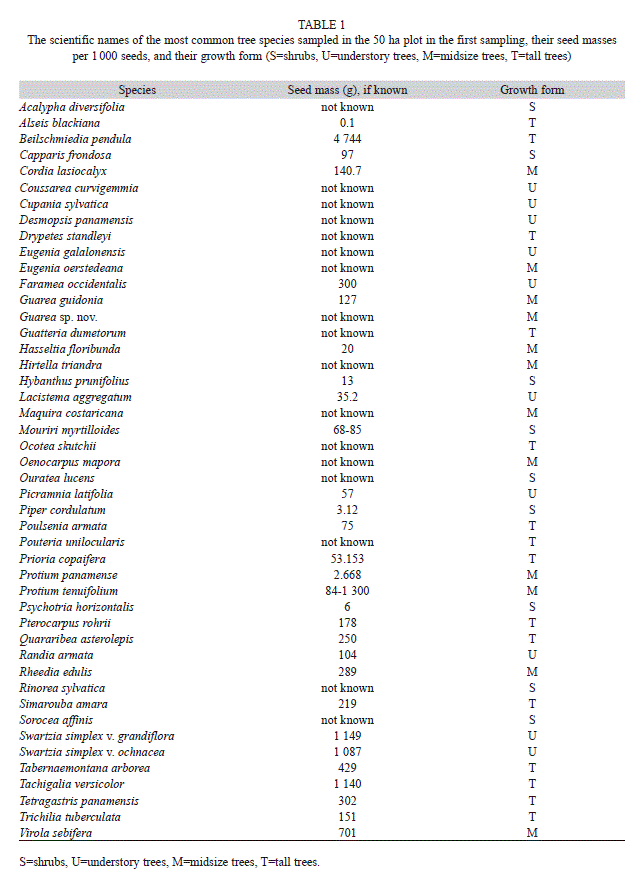
<body><![CDATA[<font size="2"><span style="font-family: verdana;">In a previous study     (Hubbell &amp;     Foster 1990), all species that had at least 1 000 stems in the first     sampling were divided into four groups (<a      href="/img/revistas/rbt/v60n3/a05t1.gif">Table 1</a>) based on their     role in     defining the strata and vertical structure of the rainforest: (1)     shrubs (&lt;4m maximum height), (2) understory trees (4-10m), (3)     mid-sized trees (10-20m) and (4) tall trees (&gt;20m). Together, the     stems in these four groups were over 80% of the total stems in that     ]]></body>
<body><![CDATA[first sampling (Hubbell &amp; Foster 1990). We first applied these     groups to data collected in 1985, 1990, 1995 and 2000, but could not     use data sampled in 2005 and 2010 because it is not yet generally     available. In future papers, we will be using the results from this     analysis as a baseline where we will compare and contrast the species     group spatial patterns with the spatial patterns from each individual     species mentioned in <a href="/img/revistas/rbt/v60n3/a05t1.gif">Table     1</a>. Finally, seed masses are given in <a      href="/img/revistas/rbt/v60n3/a05t1.gif">Table 1</a>     (Sautu <span style="font-style: italic;">et al</span>. 2006,     ]]></body>
<body><![CDATA[http://www.data.kew.org/sid/weight/htm)     as a     correlate to the species groupings and hence, further justification for     those groupings.<br style="font-family: verdana;">     </span></font><br style="font-family: verdana;">     <font size="2"><span style="font-family: verdana;">Then we used O-ring     spatial     statistics, which includes an edge correction improvement on the     popular Ripley&#8217;s K function (Ripley 1981, Plotkin <span      style="font-style: italic;">et al</span>. 2000b, Myster     ]]></body>
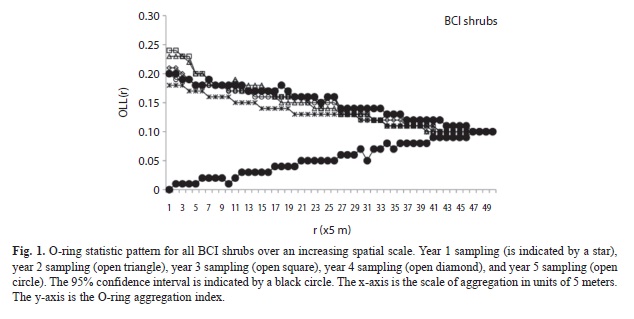
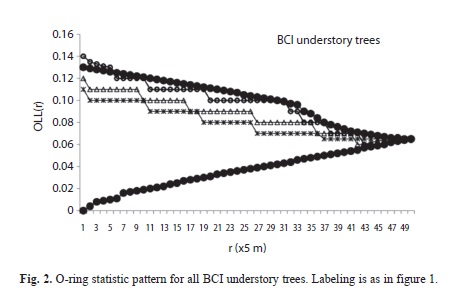
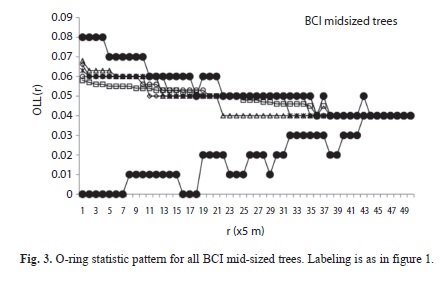
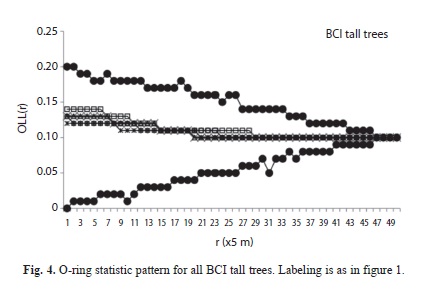
<body><![CDATA[2003, Loosmore &amp; Ford 2006, Picard <span      style="font-style: italic;">et al</span>. 2009, Myster &amp; Malahy     2010), to generate spatial patterns for all stems in each of the four     groups for every sampling year using Programita software (Wiegand &amp;     Moloney 2004). The O-ring statistic is a point-pattern statistic that     considers the mean number of neighbors in a ring of radius r around an     individual, thus isolating specific distance classes. This analysis     allows an exploration of clumping at different spatial scales with a     95% confidence interval calculated from the highest and lowest values     taken from 95 simulations of the null model, which defines significant     ]]></body>
<body><![CDATA[clumping at those scales where the computed point is above the     confidence interval and a significant uniform pattern at those scales     when the computed point is below the confidence interval. These     confidence intervals were computed for every year and species group,     but were so similar within each group that only the interval average is     given in the figures.</span></font><br style="font-family: verdana;">     <font size="2"></font><br style="font-family: verdana;">     <font style="font-weight: bold;" size="3"><span      style="font-family: verdana;">Results</span></font><br      style="font-family: verdana;">     ]]></body>
<body><![CDATA[<font size="2"></font><br style="font-family: verdana;">     <font size="2"><span style="font-family: verdana;">Over the five     samplings, shrubs had     a mean density of 1 502stems/ha, understory trees had a mean density of     1 087stems/ha, midsized trees had a mean density of 460stems/ha and     tall trees had a mean density of 769stems/ha. Both shrubs (<a      href="/img/revistas/rbt/v60n3/a05i1.jpg">Fig. 1</a>) and     understory trees (<a href="/img/revistas/rbt/v60n3/a05i2.jpg">Fig. 2</a>)     were significantly clumped at small spatial     scales of a few meters for several of the years sampled, supporting     ]]></body>
<body><![CDATA[hypothesis 1 for those years.    <br> </span></font>     <div style="text-align: center;"><font size="2"><span  style="font-family: verdana;"></span></font><br  style="font-family: verdana;"> <font size="2"><span style="font-family: verdana;"></span></font></div> <font size="2"><span style="font-family: verdana;">Hypothesis 2 was accepted when midsized trees (<a href="/img/revistas/rbt/v60n3/a05i3.jpg">Fig. 3</a>) and tall trees (<a href="/img/revistas/rbt/v60n3/a05i4.jpg">Fig. 4</a>) did not clump during any sampling period, but rejected when neither woody group showed significant uniform (regular) patterns at any sampling period either. Taking those results together leads to an acceptance of hypothesis 3. There was also support for hypothesis 4 because of the general similarity of the aggregation patterns within each woody group over the sampling years, as some individual trees of the same group die and others reproduce over the years.    <br>     </span></font>     <br style="font-family: verdana;">     <font style="font-weight: bold;" size="3"><span      style="font-family: verdana;">Discussion</span></font><br      style="font-family: verdana;">     <font size="2"></font><br style="font-family: verdana;">     ]]></body>
<body><![CDATA[<font size="2"><span style="font-family: verdana;">Because the spatial     placement of     plants affects how they reproduce and grow, it may be possible to infer     biological process from spatial patterns (Picard <span      style="font-style: italic;">et al</span>. 2009). The     significant clumping seen for those species dispersed by birds has been     demonstrated elsewhere where these species have been shown to have a     higher degree of clumping than wind and mammal dispersed species     (Hubbell 1979, Myster &amp; Pickett 1992, Seidler &amp; Plotkin 2006).     Indeed, mode of dispersal and its range have been thought to be key to     ]]></body>
<body><![CDATA[forest dynamics in general (He <span style="font-style: italic;">et al</span>.     1996, Clark <span style="font-style: italic;">et al</span>. 2005).     This     clumped distribution may also result from specialization for patchy     small-scale edaphic habitats (Itoh <span style="font-style: italic;">et     al</span>. 1997, Condit <span style="font-style: italic;">et al</span>.     2000),     lingering effects of past disturbance (tree fall gap formation: Condit     <span style="font-style: italic;">et al</span>. 2000; clearing for     agriculture: Myster 2007) or facilitation     ]]></body>
<body><![CDATA[among species in the same vertical strata group (Wiegand <span      style="font-style: italic;">et al</span>. 2006).</span></font><br      style="font-family: verdana;">     <font size="2"></font><br style="font-family: verdana;">     <font size="2"><span style="font-family: verdana;">There was no     significant clumping     for trees taller than 10m. The clumping seen for shrubs lower in the     canopy may have been lost as growth proceeded because of local     neighborhood (He <span style="font-style: italic;">et al</span>. 1997)     seed and seedling mortality mechanisms     ]]></body>
<body><![CDATA[such as predation, herbivory, and pathogenic attack, which may be most     intense near large conspecifics (Janzen 1970, Okuda &amp; Kachi 1995,     Itoh <span style="font-style: italic;">et al</span>. 1997). The loss     of pattern at larger scales may also be due     to the action of distance-dependent mortality agents such as     allelopathy, competition, litter fall, depletion of critical nutrients,     and shading (Okuda &amp; Kachi 1995). Larger trees are also more     widely-dispersed than smaller ones, which may also lead to a lessening     of aggregation (Thomson <span style="font-style: italic;">et al</span>.     2011).</span></font><br style="font-family: verdana;">     ]]></body>
<body><![CDATA[<font size="2"></font><br style="font-family: verdana;">     <font size="2"><span style="font-family: verdana;">Results supported,     to a degree, a     trend found in other tropical studies of clustering for small trees     shifting to regularity for medium sized trees, and finally randomness     for the largest trees, that is a shift to regularity with increasing     size. No Neotropical trees were uniformly distributed here however (as     seen in Picard <span style="font-style: italic;">et al</span>. 2009)     and so, it seems, competition was not     strong enough &#8211;in terms of its negative feedback effects&#8211; relative to     ]]></body>
<body><![CDATA[other mechanisms to produce regularity (Wright 1982, Picard <span      style="font-style: italic;">et al</span>.     2009). Taken together these results show that small scales are critical     to non-random spatial patterns (He et. al. 1996), suggesting that     small-scale phenomena such as dispersal and gap recruitment determine     spatial patterns more than adaptation to larger-scale topography, soil     differentiation, or water stress (Plokin <span      style="font-style: italic;">et al</span>. 2000a). Our results     then reinforce the view that deviation from randomness is generally     caused by either net positive or net negative plant interactions     ]]></body>
<body><![CDATA[(Wiegand <span style="font-style: italic;">et al</span>. 2006).</span></font><br      style="font-family: verdana;">     <font size="2"></font><br style="font-family: verdana;">     <font size="2"><span style="font-family: verdana;">In conclusion, the     analysis did not     show a minimum &#8220;critical distance&#8221; where regeneration increases due to     a greater chance of encountering a light gap (Okuda &amp; Kachi 1995).     Indeed the spare distribution of most species in tropical forests     suggests that density-dependence effects, such as competition, are not     overwhelming. We hope that this study can now serve as a baseline     ]]></body>
<body><![CDATA[dataset for comparison as more sampling occurs in the future. Also, for     further research on spatial issues among tropical trees, we plan a     follow up study using this same dataset focusing on the spatial     patterns of individual species, within each vertical strata group, over     the same 20 years sampling period in order to investigate the     within-group variation conformity to the pattern of the entire group,     and to see if it can be tied to more specific mechanisms and/or life     history strategies of the species.</span></font><br      style="font-family: verdana;">     <font size="2"></font><br style="font-family: verdana;">     ]]></body>
<body><![CDATA[<font size="2"><span style="font-family: verdana;">This large plot and     long-term     repeated sampling allows for a deeper understanding of the spatial     dynamics of Neotropical rainforests (Myster 2012). Our focus on     structural differences among common trees and shrubs further     illustrates how spatial patterns change with growth form and with plant     growth, both horizontal and vertical. In the tropics, important plant     patterns, such as biodiversity, and longtem management and conservation     objectives,such as sustainability, are both consequences of how plant     spaces create plant-plant replacements. As such, detailed analysis of     ]]></body>
<body><![CDATA[Neotropical tree spatial relationships are critical to the future of     these forests.</span></font><br style="font-family: verdana;">     <font size="2"></font><br style="font-family: verdana;">     <font style="font-weight: bold;" size="3"><span      style="font-family: verdana;">Acknowledgments</span></font><br      style="font-family: verdana;">     <font size="2"></font><br style="font-family: verdana;">     <font size="2"><span style="font-family: verdana;">The authors thank     Richard Condit     for allowing us access to the data set. The BCI forest dynamics plot     ]]></body>
<body><![CDATA[has been made possible through the generous support of the U.S.     National Science Foundation, The John D. and Catherine T. MacArthur     Foundation and the Smithsonian Tropical Research Institute and through     the hard work of over 100 people from 10 countries over the past two     decades. The BCI Forest Dynamics Plot is part of the Center for     Tropical Forest Science, a global network of large-scale demographic     tree plots.</span></font><br style="font-family: verdana;">     <font size="2"></font>     <hr style="width: 100%; height: 2px;"><br style="font-family: verdana;">     <font style="font-weight: bold;" size="3"><span     ]]></body>
<body><![CDATA[ style="font-family: verdana;">References</span></font><br      style="font-family: verdana;">     <font size="2"></font><br style="font-family: verdana;">     <font size="2"><span style="font-family: verdana;">Clark, C.J., J.R.     Poulsen, B.M.     Bolker, E.F. Conner &amp; V.T. Parker. 2005. Comparative seed shadows     <!-- ref -->of bird, monkey, and wind-dispersed trees. Ecology 86: 2684-2694.    &nbsp;&nbsp;&nbsp;&nbsp;&nbsp;&nbsp;&nbsp;&nbsp;[&#160;<a href="javascript:void(0);" onclick="javascript: window.open('/scielo.php?script=sci_nlinks&ref=1456418&pid=S0034-7744201200030000500001&lng=','','width=640,height=500,resizable=yes,scrollbars=1,menubar=yes,');">Links</a>&#160;]<!-- end-ref --><!-- ref --></span></font><br  style="font-family: verdana;"> <font size="2"></font><br style="font-family: verdana;"> <font size="2"><span style="font-family: verdana;">Condit, R., S.P. Hubbell, J.V. LaFrankie, R. Sukumar, N. Manokaran, R.B. Foster &amp; P.S. Ashton. 1996a. Species-area and species-Individual relationships for tropical trees: a comparison of three 50 ha plots. J. Ecol. 84: 549-562.    &nbsp;&nbsp;&nbsp;&nbsp;&nbsp;&nbsp;&nbsp;&nbsp;[&#160;<a href="javascript:void(0);" onclick="javascript: window.open('/scielo.php?script=sci_nlinks&ref=1456419&pid=S0034-7744201200030000500002&lng=','','width=640,height=500,resizable=yes,scrollbars=1,menubar=yes,');">Links</a>&#160;]<!-- end-ref --><!-- ref --></span></font><br  style="font-family: verdana;"> <font size="2"></font><br style="font-family: verdana;"> <font size="2"><span style="font-family: verdana;">Condit, R., S.P. Hubbell &amp; R.B. Foster. 1996b. Changes in tree species abundance in a Neotropical forest: impact of climate change. J. Trop. Ecol. 12: 231-256.    &nbsp;&nbsp;&nbsp;&nbsp;&nbsp;&nbsp;&nbsp;&nbsp;[&#160;<a href="javascript:void(0);" onclick="javascript: window.open('/scielo.php?script=sci_nlinks&ref=1456420&pid=S0034-7744201200030000500003&lng=','','width=640,height=500,resizable=yes,scrollbars=1,menubar=yes,');">Links</a>&#160;]<!-- end-ref --><!-- ref --></span></font><br  style="font-family: verdana;"> <font size="2"></font><br style="font-family: verdana;"> <font size="2"><span style="font-family: verdana;">Condit, R. 1998. Tropical Forest Census Plots. Springer-Verlag and R.G. Landes Company, Berlin, Germany.    &nbsp;&nbsp;&nbsp;&nbsp;&nbsp;&nbsp;&nbsp;&nbsp;[&#160;<a href="javascript:void(0);" onclick="javascript: window.open('/scielo.php?script=sci_nlinks&ref=1456421&pid=S0034-7744201200030000500004&lng=','','width=640,height=500,resizable=yes,scrollbars=1,menubar=yes,');">Links</a>&#160;]<!-- end-ref --><!-- ref --></span></font><br  style="font-family: verdana;"> <font size="2"></font><br style="font-family: verdana;"> <font size="2"><span style="font-family: verdana;">Condit, R., P.S. Ashton, P. Baker, S. Bunyavejchewin, S. Gunatilleke, N. Gunatilleke, S.P. Hubbell, R.B. Foster, A. Itoh, J.V. LaFrankie, H.S. Lee, E. Losos, N. Manokaran, R. Sukumar &amp; T. Yamakura. 2000. Spatial patterns in the distribution of tropical trees. Science 288: 1414-1418.    &nbsp;&nbsp;&nbsp;&nbsp;&nbsp;&nbsp;&nbsp;&nbsp;[&#160;<a href="javascript:void(0);" onclick="javascript: window.open('/scielo.php?script=sci_nlinks&ref=1456422&pid=S0034-7744201200030000500005&lng=','','width=640,height=500,resizable=yes,scrollbars=1,menubar=yes,');">Links</a>&#160;]<!-- end-ref --><!-- ref --></span></font><br  style="font-family: verdana;"> <font size="2"></font><br style="font-family: verdana;"> <font size="2"><span style="font-family: verdana;">Everham, E.M., R.W. Myster &amp; E. Van De Genachte. 1996. Effects of light, moisture, temperature, and litter on the regeneration of five tree species in the tropical montane wet forest of Puerto Rico. Am. J. Bot. 83: 1063-1068.    &nbsp;&nbsp;&nbsp;&nbsp;&nbsp;&nbsp;&nbsp;&nbsp;[&#160;<a href="javascript:void(0);" onclick="javascript: window.open('/scielo.php?script=sci_nlinks&ref=1456423&pid=S0034-7744201200030000500006&lng=','','width=640,height=500,resizable=yes,scrollbars=1,menubar=yes,');">Links</a>&#160;]<!-- end-ref --><!-- ref --></span></font><br  style="font-family: verdana;"> <font size="2"></font><br style="font-family: verdana;"> <font size="2"><span style="font-family: verdana;">Gray, A.N. &amp; T.A. Spies. 1997. Microsite controls on tree seedling establishment in conifer forest canopy gaps. Ecology 78: 2458-2473.    &nbsp;&nbsp;&nbsp;&nbsp;&nbsp;&nbsp;&nbsp;&nbsp;[&#160;<a href="javascript:void(0);" onclick="javascript: window.open('/scielo.php?script=sci_nlinks&ref=1456424&pid=S0034-7744201200030000500007&lng=','','width=640,height=500,resizable=yes,scrollbars=1,menubar=yes,');">Links</a>&#160;]<!-- end-ref --><!-- ref --></span></font><br  style="font-family: verdana;"> <font size="2"></font><br style="font-family: verdana;"> <font size="2"><span style="font-family: verdana;">He, F., P. Legendre &amp; J.V. LaFrankie. 1996. Spatial pattern of diversity in a tropical rain forest in Malaysia. J. Biogeogr. 23: 57-74.    &nbsp;&nbsp;&nbsp;&nbsp;&nbsp;&nbsp;&nbsp;&nbsp;[&#160;<a href="javascript:void(0);" onclick="javascript: window.open('/scielo.php?script=sci_nlinks&ref=1456425&pid=S0034-7744201200030000500008&lng=','','width=640,height=500,resizable=yes,scrollbars=1,menubar=yes,');">Links</a>&#160;]<!-- end-ref --><!-- ref --></span></font><br  style="font-family: verdana;"> <font size="2"></font><br style="font-family: verdana;"> <font size="2"><span style="font-family: verdana;">He, F., P. Legendre &amp; J.V. LaFrankie. 1997. Distribution patterns of tree species in a Malaysian tropical rain forest. J. Veg. Sci. 8: 105-114.    &nbsp;&nbsp;&nbsp;&nbsp;&nbsp;&nbsp;&nbsp;&nbsp;[&#160;<a href="javascript:void(0);" onclick="javascript: window.open('/scielo.php?script=sci_nlinks&ref=1456426&pid=S0034-7744201200030000500009&lng=','','width=640,height=500,resizable=yes,scrollbars=1,menubar=yes,');">Links</a>&#160;]<!-- end-ref --><!-- ref --></span></font><br  style="font-family: verdana;"> <font size="2"></font><br style="font-family: verdana;"> <font size="2"><span style="font-family: verdana;">Hubbell, S.P. 1979. Tree dispersion, abundance, and diversity in a tropical dry forest. Science 203: 1299-1309.    &nbsp;&nbsp;&nbsp;&nbsp;&nbsp;&nbsp;&nbsp;&nbsp;[&#160;<a href="javascript:void(0);" onclick="javascript: window.open('/scielo.php?script=sci_nlinks&ref=1456427&pid=S0034-7744201200030000500010&lng=','','width=640,height=500,resizable=yes,scrollbars=1,menubar=yes,');">Links</a>&#160;]<!-- end-ref --><!-- ref --></span></font><br style="font-family: verdana;"> <font size="2"></font><br style="font-family: verdana;"> <font size="2"><span style="font-family: verdana;">Hubbell, S.P. &amp; R.B. Foster. 1983. Diversity of canopy trees in Neotropical forest and implications for conservation, p 25-41. <span style="font-style: italic;">In</span> S.L. Sutton, T.C. Whitmore &amp; A.C. Chadwick (eds.). Tropical Rain Forest: Ecology and management. Blackwell, Oxford, England.    &nbsp;&nbsp;&nbsp;&nbsp;&nbsp;&nbsp;&nbsp;&nbsp;[&#160;<a href="javascript:void(0);" onclick="javascript: window.open('/scielo.php?script=sci_nlinks&ref=1456428&pid=S0034-7744201200030000500011&lng=','','width=640,height=500,resizable=yes,scrollbars=1,menubar=yes,');">Links</a>&#160;]<!-- end-ref --><!-- ref --></span></font><br  style="font-family: verdana;"> <font size="2"></font><br style="font-family: verdana;"> <font size="2"><span style="font-family: verdana;">Hubbell, S.P. &amp; R.B. Foster. 1990. Structure, dynamics and equilibrium status of old-growth forest on Barro Colorado Island, p 522-541. In A.H. Gentry (eds.). Four Neotropical Rain Forests. Yale University, New Haven, USA.    &nbsp;&nbsp;&nbsp;&nbsp;&nbsp;&nbsp;&nbsp;&nbsp;[&#160;<a href="javascript:void(0);" onclick="javascript: window.open('/scielo.php?script=sci_nlinks&ref=1456429&pid=S0034-7744201200030000500012&lng=','','width=640,height=500,resizable=yes,scrollbars=1,menubar=yes,');">Links</a>&#160;]<!-- end-ref --><!-- ref --></span></font><br  style="font-family: verdana;"> <font size="2"></font><br style="font-family: verdana;"> <font size="2"><span style="font-family: verdana;">Itoh, A., T. Yamakura, K. Ogino, H.S. Lee &amp; P.S. Ashton. 1997. Spatial distribution patterns of two predominant emergent trees in a tropical rainforest in Sarawak, Malaysia. Plant Ecol. 132: 121-136.    &nbsp;&nbsp;&nbsp;&nbsp;&nbsp;&nbsp;&nbsp;&nbsp;[&#160;<a href="javascript:void(0);" onclick="javascript: window.open('/scielo.php?script=sci_nlinks&ref=1456430&pid=S0034-7744201200030000500013&lng=','','width=640,height=500,resizable=yes,scrollbars=1,menubar=yes,');">Links</a>&#160;]<!-- end-ref --><!-- ref --></span></font><br  style="font-family: verdana;"> <font size="2"></font><br style="font-family: verdana;"> <font size="2"><span style="font-family: verdana;">Janzen, D.H. 1970. Herbivores and the number of tree species in a tropical forest. Am. Nat. 104: 501-528.    &nbsp;&nbsp;&nbsp;&nbsp;&nbsp;&nbsp;&nbsp;&nbsp;[&#160;<a href="javascript:void(0);" onclick="javascript: window.open('/scielo.php?script=sci_nlinks&ref=1456431&pid=S0034-7744201200030000500014&lng=','','width=640,height=500,resizable=yes,scrollbars=1,menubar=yes,');">Links</a>&#160;]<!-- end-ref --><!-- ref --></span></font><br  style="font-family: verdana;"> <font size="2"></font><br style="font-family: verdana;"> <font size="2"><span style="font-family: verdana;">Loosmore, N.B. &amp; E.D. Ford. 2006. Statistical inference using the G or K point pattern spatial statistics. Ecology 87: 1925-1931.    &nbsp;&nbsp;&nbsp;&nbsp;&nbsp;&nbsp;&nbsp;&nbsp;[&#160;<a href="javascript:void(0);" onclick="javascript: window.open('/scielo.php?script=sci_nlinks&ref=1456432&pid=S0034-7744201200030000500015&lng=','','width=640,height=500,resizable=yes,scrollbars=1,menubar=yes,');">Links</a>&#160;]<!-- end-ref --><!-- ref --></span></font><br  style="font-family: verdana;"> <font size="2"></font><br style="font-family: verdana;"> <font size="2"><span style="font-family: verdana;">Ludwig, J.A. &amp; J.F. Reynolds. 1988. Statistical ecology: a primer on methods and computing. John Wiley &amp; Sons, New York, USA.    &nbsp;&nbsp;&nbsp;&nbsp;&nbsp;&nbsp;&nbsp;&nbsp;[&#160;<a href="javascript:void(0);" onclick="javascript: window.open('/scielo.php?script=sci_nlinks&ref=1456433&pid=S0034-7744201200030000500016&lng=','','width=640,height=500,resizable=yes,scrollbars=1,menubar=yes,');">Links</a>&#160;]<!-- end-ref --><!-- ref --></span></font><br  style="font-family: verdana;"> <font size="2"></font><br style="font-family: verdana;"> <font size="2"><span style="font-family: verdana;">Myster, R.W. &amp; S.T.A. Pickett. 1992. Effects of palatability and dispersal mode on spatial patterns of trees in old fields. Bull. Torrey Bot. Club 119: 145-151.    &nbsp;&nbsp;&nbsp;&nbsp;&nbsp;&nbsp;&nbsp;&nbsp;[&#160;<a href="javascript:void(0);" onclick="javascript: window.open('/scielo.php?script=sci_nlinks&ref=1456434&pid=S0034-7744201200030000500017&lng=','','width=640,height=500,resizable=yes,scrollbars=1,menubar=yes,');">Links</a>&#160;]<!-- end-ref --><!-- ref --></span></font><br  style="font-family: verdana;"> <font size="2"></font><br style="font-family: verdana;"> <font size="2"><span style="font-family: verdana;">Myster, R.W. 2003. Seed regeneration mechanisms over fine spatial scales on recovering Coffee plantation and pasture in Puerto Rico. Plant Ecol. 166: 199-205.    &nbsp;&nbsp;&nbsp;&nbsp;&nbsp;&nbsp;&nbsp;&nbsp;[&#160;<a href="javascript:void(0);" onclick="javascript: window.open('/scielo.php?script=sci_nlinks&ref=1456435&pid=S0034-7744201200030000500018&lng=','','width=640,height=500,resizable=yes,scrollbars=1,menubar=yes,');">Links</a>&#160;]<!-- end-ref --><!-- ref --></span></font><br  style="font-family: verdana;"> <font size="2"></font><br style="font-family: verdana;"> <font size="2"><span style="font-family: verdana;">Myster, R.W. 2012. Plants replacing plants: the future of community modeling and research. The Botanical Review 78:2-9.    &nbsp;&nbsp;&nbsp;&nbsp;&nbsp;&nbsp;&nbsp;&nbsp;[&#160;<a href="javascript:void(0);" onclick="javascript: window.open('/scielo.php?script=sci_nlinks&ref=1456436&pid=S0034-7744201200030000500019&lng=','','width=640,height=500,resizable=yes,scrollbars=1,menubar=yes,');">Links</a>&#160;]<!-- end-ref --><!-- ref --></span></font><br style="font-family: verdana;"> <font size="2"></font><br style="font-family: verdana;"> <font size="2"><span style="font-family: verdana;">Myster, R.W. &amp; P.G. Santacruz. 2005. Una comparaci&oacute;n de campo de insectos de suelo-morarde Amazonas: Tierra firme y bosques de tierras inundadas vs. Espacios abiertos en el Parque Nacional Yasun&iacute;, Ecuador. Revista de la Pontificia Universidad Cat&oacute;lica 76: 111-124.    &nbsp;&nbsp;&nbsp;&nbsp;&nbsp;&nbsp;&nbsp;&nbsp;[&#160;<a href="javascript:void(0);" onclick="javascript: window.open('/scielo.php?script=sci_nlinks&ref=1456437&pid=S0034-7744201200030000500020&lng=','','width=640,height=500,resizable=yes,scrollbars=1,menubar=yes,');">Links</a>&#160;]<!-- end-ref --><!-- ref --></span></font><br  style="font-family: verdana;"> <font size="2"></font><br style="font-family: verdana;"> <font size="2"><span style="font-family: verdana;">Myster, R.W. 2007. Introduction, p. 3-21.<span style="font-style: italic;"> In </span>R.W. Myster (eds.). Post-agricultural succession in the Neotropics. Springer-Verlag, Berlin, Germany.    &nbsp;&nbsp;&nbsp;&nbsp;&nbsp;&nbsp;&nbsp;&nbsp;[&#160;<a href="javascript:void(0);" onclick="javascript: window.open('/scielo.php?script=sci_nlinks&ref=1456438&pid=S0034-7744201200030000500021&lng=','','width=640,height=500,resizable=yes,scrollbars=1,menubar=yes,');">Links</a>&#160;]<!-- end-ref --><!-- ref --></span></font><br  style="font-family: verdana;"> <font size="2"></font><br style="font-family: verdana;"> <font size="2"><span style="font-family: verdana;">Myster, R.W. &amp; M.P. Malahy. 2010. Spatial heterogeneity of Tornado damage and resprouting in the Cross timbers ecotone of Oklahoma. J. Plant Ecol. 3: 157-163.    &nbsp;&nbsp;&nbsp;&nbsp;&nbsp;&nbsp;&nbsp;&nbsp;[&#160;<a href="javascript:void(0);" onclick="javascript: window.open('/scielo.php?script=sci_nlinks&ref=1456439&pid=S0034-7744201200030000500022&lng=','','width=640,height=500,resizable=yes,scrollbars=1,menubar=yes,');">Links</a>&#160;]<!-- end-ref --><!-- ref --></span></font><br  style="font-family: verdana;"> <font size="2"></font><br style="font-family: verdana;"> <font size="2"><span style="font-family: verdana;">Neeff, T., G.S. Biging, L.V. Dutra, C.C. Freitas &amp; J.R. Dos Santos. 2005. Modeling spatial tree patterns in the Tapajos forest using interferometric height. Revista Brasil de Cartogr. 57: 1-6.    &nbsp;&nbsp;&nbsp;&nbsp;&nbsp;&nbsp;&nbsp;&nbsp;[&#160;<a href="javascript:void(0);" onclick="javascript: window.open('/scielo.php?script=sci_nlinks&ref=1456440&pid=S0034-7744201200030000500023&lng=','','width=640,height=500,resizable=yes,scrollbars=1,menubar=yes,');">Links</a>&#160;]<!-- end-ref --><!-- ref --></span></font><br  style="font-family: verdana;"> <font size="2"></font><br style="font-family: verdana;"> <font size="2"><span style="font-family: verdana;">Okuda, T &amp; N. Kachi. 1995. Spatial pattern of adult trees and seedling survivorshipin Pentaspadon motley in a lowland rain forest in peninsular Malaysia. J. Trop. For. Sci. 7: 475-489.    &nbsp;&nbsp;&nbsp;&nbsp;&nbsp;&nbsp;&nbsp;&nbsp;[&#160;<a href="javascript:void(0);" onclick="javascript: window.open('/scielo.php?script=sci_nlinks&ref=1456441&pid=S0034-7744201200030000500024&lng=','','width=640,height=500,resizable=yes,scrollbars=1,menubar=yes,');">Links</a>&#160;]<!-- end-ref --><!-- ref --></span></font><br style="font-family: verdana;"> <font size="2"></font><br style="font-family: verdana;"> <font size="2"><span style="font-family: verdana;">Pham, A.T., L. De-Grandpre, S. Gautheir &amp; Y. Bergeron. 2004. Gap dynamics and replacement patterns in gaps of the northeastern boreal forest of Quebec. J. For. Res. 34: 353-364.    &nbsp;&nbsp;&nbsp;&nbsp;&nbsp;&nbsp;&nbsp;&nbsp;[&#160;<a href="javascript:void(0);" onclick="javascript: window.open('/scielo.php?script=sci_nlinks&ref=1456442&pid=S0034-7744201200030000500025&lng=','','width=640,height=500,resizable=yes,scrollbars=1,menubar=yes,');">Links</a>&#160;]<!-- end-ref --><!-- ref --></span></font><br style="font-family: verdana;"> <font size="2"></font><br style="font-family: verdana;"> <font size="2"><span style="font-family: verdana;">Picard, N., A. Bar-Hen, F. Mortier &amp; J. Chadoeuf. 2009. Understanding the dynamics of an undisturbed tropical rain forest from the spatial pattern of trees. J. Ecol. 97: 97-108.    &nbsp;&nbsp;&nbsp;&nbsp;&nbsp;&nbsp;&nbsp;&nbsp;[&#160;<a href="javascript:void(0);" onclick="javascript: window.open('/scielo.php?script=sci_nlinks&ref=1456443&pid=S0034-7744201200030000500026&lng=','','width=640,height=500,resizable=yes,scrollbars=1,menubar=yes,');">Links</a>&#160;]<!-- end-ref --><!-- ref --></span></font><br style="font-family: verdana;"> <font size="2"></font><br style="font-family: verdana;"> <font size="2"><span style="font-family: verdana;">Plotkin, J.B., M.D. Potts, N. Leslie, N. Manokaran, J. LaFrankie &amp; P.S. Ashton. 2000a. Species-area curves, spatial aggregation and habitat specialization in tropical forests. J. Theor. Biol. 207: 81-99.    &nbsp;&nbsp;&nbsp;&nbsp;&nbsp;&nbsp;&nbsp;&nbsp;[&#160;<a href="javascript:void(0);" onclick="javascript: window.open('/scielo.php?script=sci_nlinks&ref=1456444&pid=S0034-7744201200030000500027&lng=','','width=640,height=500,resizable=yes,scrollbars=1,menubar=yes,');">Links</a>&#160;]<!-- end-ref --><!-- ref --></span></font><br  style="font-family: verdana;"> <font size="2"></font><br style="font-family: verdana;"> <font size="2"><span style="font-family: verdana;">Plotkin, J.B., M.D. Potts, D.W. Yu, S. Bunyavejcgewin, R. Condit, R.B. Foster, S.P. Hubbell, J.V. LaFrankie, N. Manokaran, H.S. Lee, R. Sukumar, M. Nowak &amp; P.S. Ashton. 2000b. Predicting species diversity in tropical forests. Proc. Nat. Acad. Sci. 97: 10850-10854.    &nbsp;&nbsp;&nbsp;&nbsp;&nbsp;&nbsp;&nbsp;&nbsp;[&#160;<a href="javascript:void(0);" onclick="javascript: window.open('/scielo.php?script=sci_nlinks&ref=1456445&pid=S0034-7744201200030000500028&lng=','','width=640,height=500,resizable=yes,scrollbars=1,menubar=yes,');">Links</a>&#160;]<!-- end-ref --><!-- ref --></span></font><br  style="font-family: verdana;"> <font size="2"></font><br style="font-family: verdana;"> <font size="2"><span style="font-family: verdana;">Ripley, B.D. 1981. Spatial statistics. John Wiley &amp; Sons, New York, USA.    &nbsp;&nbsp;&nbsp;&nbsp;&nbsp;&nbsp;&nbsp;&nbsp;[&#160;<a href="javascript:void(0);" onclick="javascript: window.open('/scielo.php?script=sci_nlinks&ref=1456446&pid=S0034-7744201200030000500029&lng=','','width=640,height=500,resizable=yes,scrollbars=1,menubar=yes,');">Links</a>&#160;]<!-- end-ref --><!-- ref --></span></font><br  style="font-family: verdana;"> <font size="2"></font><br style="font-family: verdana;"> <font size="2"><span style="font-family: verdana;">Sautu, A., J.M. Baskin, C.C. Baskin &amp; R. Condit. 2006. Studies on the seed biology of 100 native species of trees in a seasonal moist tropical forest, Panama, Central America. For. Ecol. Manag. 234: 245-263. (Also available online http://data.kew.org/sid/weight.htm).    &nbsp;&nbsp;&nbsp;&nbsp;&nbsp;&nbsp;&nbsp;&nbsp;[&#160;<a href="javascript:void(0);" onclick="javascript: window.open('/scielo.php?script=sci_nlinks&ref=1456447&pid=S0034-7744201200030000500030&lng=','','width=640,height=500,resizable=yes,scrollbars=1,menubar=yes,');">Links</a>&#160;]<!-- end-ref --><!-- ref --></span></font><br  style="font-family: verdana;"> <font size="2"></font><br style="font-family: verdana;"> <font size="2"><span style="font-family: verdana;">Seidler, T.G. &amp; J.B. Plokin. 2006. Seed dispersal and spatial pattern in Tropical trees. PLoS Biol 4: e344.    &nbsp;&nbsp;&nbsp;&nbsp;&nbsp;&nbsp;&nbsp;&nbsp;[&#160;<a href="javascript:void(0);" onclick="javascript: window.open('/scielo.php?script=sci_nlinks&ref=1456448&pid=S0034-7744201200030000500031&lng=','','width=640,height=500,resizable=yes,scrollbars=1,menubar=yes,');">Links</a>&#160;]<!-- end-ref --><!-- ref --></span></font><br style="font-family: verdana;"> <font size="2"></font><br style="font-family: verdana;"> <font size="2"><span style="font-family: verdana;">Svenning, J.C. 1999. Microhabitat specialization in a species-rich palm community in Amazonian Ecuador. J. Ecol. 87: 55-65.    &nbsp;&nbsp;&nbsp;&nbsp;&nbsp;&nbsp;&nbsp;&nbsp;[&#160;<a href="javascript:void(0);" onclick="javascript: window.open('/scielo.php?script=sci_nlinks&ref=1456449&pid=S0034-7744201200030000500032&lng=','','width=640,height=500,resizable=yes,scrollbars=1,menubar=yes,');">Links</a>&#160;]<!-- end-ref --><!-- ref --></span></font><br style="font-family: verdana;"> <font size="2"></font><br style="font-family: verdana;"> <font size="2"><span style="font-family: verdana;">Svenning, J.C. &amp; S.J. Wright. 2005. Seed limitation in a Panamanian forest. J. Ecol. 93: 853-862.    &nbsp;&nbsp;&nbsp;&nbsp;&nbsp;&nbsp;&nbsp;&nbsp;[&#160;<a href="javascript:void(0);" onclick="javascript: window.open('/scielo.php?script=sci_nlinks&ref=1456450&pid=S0034-7744201200030000500033&lng=','','width=640,height=500,resizable=yes,scrollbars=1,menubar=yes,');">Links</a>&#160;]<!-- end-ref --><!-- ref --></span></font><br  style="font-family: verdana;"> <font size="2"></font><br style="font-family: verdana;"> <font size="2"><span style="font-family: verdana;">Thomson, F.J., A.T. Moles, T.D. Auld &amp; R.T. Kimgsford. 2011. See dispersal distance is more strongly correlated with plant height than with seed mass. J. Ecol. 99: 1299-1307.    &nbsp;&nbsp;&nbsp;&nbsp;&nbsp;&nbsp;&nbsp;&nbsp;[&#160;<a href="javascript:void(0);" onclick="javascript: window.open('/scielo.php?script=sci_nlinks&ref=1456451&pid=S0034-7744201200030000500034&lng=','','width=640,height=500,resizable=yes,scrollbars=1,menubar=yes,');">Links</a>&#160;]<!-- end-ref --><!-- ref --></span></font><br style="font-family: verdana;"> <font size="2"></font><br style="font-family: verdana;"> <font size="2"><span style="font-family: verdana;">Turkington, R. &amp; J.L. Harper. 1979. The growth, distribution and neighbor relationships of <span style="font-style: italic;">Trifoliumrepens</span>: a permanent pasture. I Ordination, pattern andcontact. J. Ecol. 67: 201-218.    &nbsp;&nbsp;&nbsp;&nbsp;&nbsp;&nbsp;&nbsp;&nbsp;[&#160;<a href="javascript:void(0);" onclick="javascript: window.open('/scielo.php?script=sci_nlinks&ref=1456452&pid=S0034-7744201200030000500035&lng=','','width=640,height=500,resizable=yes,scrollbars=1,menubar=yes,');">Links</a>&#160;]<!-- end-ref --><!-- ref --></span></font><br style="font-family: verdana;"> <font size="2"></font><br style="font-family: verdana;"> <font size="2"><span style="font-family: verdana;">Van Gardingen, P.R., G.M. Foody &amp; P.J. Curran. 1997. Scaling-up: from cell to landscape. Society forexperimental biology seminar series 63. Cambridge University, Cambridge, United Kingdom.    &nbsp;&nbsp;&nbsp;&nbsp;&nbsp;&nbsp;&nbsp;&nbsp;[&#160;<a href="javascript:void(0);" onclick="javascript: window.open('/scielo.php?script=sci_nlinks&ref=1456453&pid=S0034-7744201200030000500036&lng=','','width=640,height=500,resizable=yes,scrollbars=1,menubar=yes,');">Links</a>&#160;]<!-- end-ref --><!-- ref --></span></font><br  style="font-family: verdana;"> <font size="2"></font><br style="font-family: verdana;"> <font size="2"><span style="font-family: verdana;">Verdu, M. &amp; P. Garcia-Fayos. 1998. Old field colonization by <span style="font-style: italic;">Daphne gnidium</span>: seedling distribution and spatial dependence at different scales. J. Veg. Sci. 9: 713-718.    &nbsp;&nbsp;&nbsp;&nbsp;&nbsp;&nbsp;&nbsp;&nbsp;[&#160;<a href="javascript:void(0);" onclick="javascript: window.open('/scielo.php?script=sci_nlinks&ref=1456454&pid=S0034-7744201200030000500037&lng=','','width=640,height=500,resizable=yes,scrollbars=1,menubar=yes,');">Links</a>&#160;]<!-- end-ref --><!-- ref --></span></font><br  style="font-family: verdana;"> <font size="2"></font><br style="font-family: verdana;"> <font size="2"><span style="font-family: verdana;">Watt, A.S. 1947. Pattern and process in the plant community. J. Ecol. 35: 1-22.    &nbsp;&nbsp;&nbsp;&nbsp;&nbsp;&nbsp;&nbsp;&nbsp;[&#160;<a href="javascript:void(0);" onclick="javascript: window.open('/scielo.php?script=sci_nlinks&ref=1456455&pid=S0034-7744201200030000500038&lng=','','width=640,height=500,resizable=yes,scrollbars=1,menubar=yes,');">Links</a>&#160;]<!-- end-ref --><!-- ref --></span></font><br  style="font-family: verdana;"> <font size="2"></font><br style="font-family: verdana;"> <font size="2"><span style="font-family: verdana;">Wiegand, T. &amp; K.A. Moloney. 2004. Rings, circles and null-models for point pattern analysis in ecology. Oikos 104: 209-229.    &nbsp;&nbsp;&nbsp;&nbsp;&nbsp;&nbsp;&nbsp;&nbsp;[&#160;<a href="javascript:void(0);" onclick="javascript: window.open('/scielo.php?script=sci_nlinks&ref=1456456&pid=S0034-7744201200030000500039&lng=','','width=640,height=500,resizable=yes,scrollbars=1,menubar=yes,');">Links</a>&#160;]<!-- end-ref --><!-- ref --></span></font><br  style="font-family: verdana;"> <font size="2"></font><br style="font-family: verdana;"> <font size="2"><span style="font-family: verdana;">Wiegand, T., W.D. Kissling, P.A. Cipriotti &amp; M.R. Aguiar. 2006. Extending point pattern analysis for objects of finite size and irregular shape. J. Ecol. 94: 43-56.    &nbsp;&nbsp;&nbsp;&nbsp;&nbsp;&nbsp;&nbsp;&nbsp;[&#160;<a href="javascript:void(0);" onclick="javascript: window.open('/scielo.php?script=sci_nlinks&ref=1456457&pid=S0034-7744201200030000500040&lng=','','width=640,height=500,resizable=yes,scrollbars=1,menubar=yes,');">Links</a>&#160;]<!-- end-ref --><!-- ref --></span></font><br  style="font-family: verdana;"> <font size="2"></font><br style="font-family: verdana;"> <font size="2"><span style="font-family: verdana;">Wright, S.J. 1982. Competition, differential mortality, and their effect on the spatial pattern of a desert perennial, <span style="font-style: italic;">Eriogonuminflatum</span> Torr and Frem (Polygonacaea). Oecologia 54: 266-269.    &nbsp;&nbsp;&nbsp;&nbsp;&nbsp;&nbsp;&nbsp;&nbsp;[&#160;<a href="javascript:void(0);" onclick="javascript: window.open('/scielo.php?script=sci_nlinks&ref=1456458&pid=S0034-7744201200030000500041&lng=','','width=640,height=500,resizable=yes,scrollbars=1,menubar=yes,');">Links</a>&#160;]<!-- end-ref --><br>     <br> <a name="Correspondencia1"></a><a href="#Correspondencia2">*</a>Correspondencia:</span></font><font  size="2"><span style="font-family: verdana;">    <br> Randall W. Myster: </span></font><font size="2"><span  style="font-family: verdana;">Biology Department, Oklahoma State University, Oklahoma City, OK 73107 USA. rwmyster@gmail.com</span></font>    ]]></body>
<body><![CDATA[<br> <font size="2"><span style="font-family: verdana;">Michael P. Malahy: </span></font><font size="2"><span  style="font-family: verdana;">Botany Department, Oklahoma State University, Stillwater, OK 74078 USA. mmalahy@okstate.edu    <br> </span></font><font size="2"><span style="font-family: verdana;"><a  name="1"></a><a href="#3">1</a>. Biology Department, Oklahoma State University, Oklahoma City, OK 73107 USA; rwmyster@gmail.com</span></font><br  style="font-family: verdana;"> <font size="2"><span style="font-family: verdana;"><a name="2"></a><a  href="#4">2</a>. Botany Department, Oklahoma State University, Stillwater, OK 74078 USA; mmalahy@okstate.edu</span></font><br  style="font-family: verdana;"> <font size="2"><span style="font-family: verdana;"></span></font><font  size="2"><span style="font-family: verdana;"></span></font> <hr style="width: 100%; height: 2px;"><font size="2"><span  style="font-family: verdana;"></span></font>     <div style="text-align: center;"><font style="font-weight: bold;"  size="2"><span style="font-family: verdana;">Received 20-VII-2011. Corrected 30-I-2012. Accepted 28-II-2012.</span></font><br  style="font-family: verdana;"> </div> </div> </div> <font size="2"></font>      ]]></body><back>
<ref-list>
<ref id="B1">
<nlm-citation citation-type="journal">
<person-group person-group-type="author">
<name>
<surname><![CDATA[Clark]]></surname>
<given-names><![CDATA[C.J]]></given-names>
</name>
<name>
<surname><![CDATA[Poulsen]]></surname>
<given-names><![CDATA[J.R]]></given-names>
</name>
<name>
<surname><![CDATA[Bolker]]></surname>
<given-names><![CDATA[B.M]]></given-names>
</name>
<name>
<surname><![CDATA[Conner]]></surname>
<given-names><![CDATA[E.F]]></given-names>
</name>
<name>
<surname><![CDATA[Parker]]></surname>
<given-names><![CDATA[V.T]]></given-names>
</name>
</person-group>
<article-title xml:lang="en"><![CDATA[Comparative seed shadows of bird, monkey, and wind-dispersed trees]]></article-title>
<source><![CDATA[Ecology]]></source>
<year>2005</year>
<volume>86</volume>
<page-range>2684-2694</page-range></nlm-citation>
</ref>
<ref id="B2">
<nlm-citation citation-type="journal">
<person-group person-group-type="author">
<name>
<surname><![CDATA[Condit]]></surname>
<given-names><![CDATA[R]]></given-names>
</name>
<name>
<surname><![CDATA[Hubbell]]></surname>
<given-names><![CDATA[S.P]]></given-names>
</name>
<name>
<surname><![CDATA[LaFrankie]]></surname>
<given-names><![CDATA[J.V]]></given-names>
</name>
<name>
<surname><![CDATA[Sukumar]]></surname>
<given-names><![CDATA[R]]></given-names>
</name>
<name>
<surname><![CDATA[Manokaran]]></surname>
<given-names><![CDATA[N]]></given-names>
</name>
<name>
<surname><![CDATA[Foster]]></surname>
<given-names><![CDATA[R.B]]></given-names>
</name>
<name>
<surname><![CDATA[Ashton]]></surname>
<given-names><![CDATA[P.S]]></given-names>
</name>
</person-group>
<article-title xml:lang="en"><![CDATA[Species-area and species-Individual relationships for tropical trees: a comparison of three 50 ha plots]]></article-title>
<source><![CDATA[J. Ecol]]></source>
<year></year>
<volume>84</volume>
<page-range>549-562</page-range></nlm-citation>
</ref>
<ref id="B3">
<nlm-citation citation-type="journal">
<person-group person-group-type="author">
<name>
<surname><![CDATA[Condit]]></surname>
<given-names><![CDATA[R]]></given-names>
</name>
<name>
<surname><![CDATA[Hubbell]]></surname>
<given-names><![CDATA[S.P]]></given-names>
</name>
<name>
<surname><![CDATA[Foster]]></surname>
<given-names><![CDATA[R.B]]></given-names>
</name>
</person-group>
<article-title xml:lang="en"><![CDATA[Changes in tree species abundance in a Neotropical forest: impact of climate change]]></article-title>
<source><![CDATA[J. Trop. Ecol]]></source>
<year></year>
<volume>12</volume>
<page-range>231-256</page-range></nlm-citation>
</ref>
<ref id="B4">
<nlm-citation citation-type="book">
<person-group person-group-type="author">
<name>
<surname><![CDATA[Condit]]></surname>
<given-names><![CDATA[R]]></given-names>
</name>
</person-group>
<source><![CDATA[Tropical Forest Census Plots]]></source>
<year>1998</year>
<publisher-loc><![CDATA[^eBerlin Berlin]]></publisher-loc>
<publisher-name><![CDATA[Springer-Verlag and R.G. Landes Company]]></publisher-name>
</nlm-citation>
</ref>
<ref id="B5">
<nlm-citation citation-type="journal">
<person-group person-group-type="author">
<name>
<surname><![CDATA[Condit]]></surname>
<given-names><![CDATA[R]]></given-names>
</name>
<name>
<surname><![CDATA[Ashton]]></surname>
<given-names><![CDATA[P.S]]></given-names>
</name>
<name>
<surname><![CDATA[Baker]]></surname>
<given-names><![CDATA[P]]></given-names>
</name>
<name>
<surname><![CDATA[Bunyavejchewin]]></surname>
<given-names><![CDATA[S]]></given-names>
</name>
<name>
<surname><![CDATA[Gunatilleke]]></surname>
<given-names><![CDATA[S]]></given-names>
</name>
<name>
<surname><![CDATA[Gunatilleke]]></surname>
<given-names><![CDATA[N]]></given-names>
</name>
<name>
<surname><![CDATA[Hubbell]]></surname>
<given-names><![CDATA[S.P]]></given-names>
</name>
<name>
<surname><![CDATA[Foster]]></surname>
<given-names><![CDATA[R.B]]></given-names>
</name>
<name>
<surname><![CDATA[Itoh]]></surname>
<given-names><![CDATA[A]]></given-names>
</name>
<name>
<surname><![CDATA[LaFrankie]]></surname>
<given-names><![CDATA[J.V]]></given-names>
</name>
<name>
<surname><![CDATA[Lee]]></surname>
<given-names><![CDATA[H.S]]></given-names>
</name>
<name>
<surname><![CDATA[Losos]]></surname>
<given-names><![CDATA[E]]></given-names>
</name>
<name>
<surname><![CDATA[Manokaran]]></surname>
<given-names><![CDATA[N]]></given-names>
</name>
<name>
<surname><![CDATA[Sukumar]]></surname>
<given-names><![CDATA[R]]></given-names>
</name>
<name>
<surname><![CDATA[Yamakura]]></surname>
<given-names><![CDATA[T]]></given-names>
</name>
</person-group>
<article-title xml:lang="en"><![CDATA[Spatial patterns in the distribution of tropical trees]]></article-title>
<source><![CDATA[Science]]></source>
<year>2000</year>
<volume>288</volume>
<page-range>1414-1418</page-range></nlm-citation>
</ref>
<ref id="B6">
<nlm-citation citation-type="journal">
<person-group person-group-type="author">
<name>
<surname><![CDATA[Everham]]></surname>
<given-names><![CDATA[E.M]]></given-names>
</name>
<name>
<surname><![CDATA[Myster]]></surname>
<given-names><![CDATA[R.W]]></given-names>
</name>
<name>
<surname><![CDATA[Van De Genachte]]></surname>
<given-names><![CDATA[E]]></given-names>
</name>
</person-group>
<article-title xml:lang="en"><![CDATA[Effects of light, moisture, temperature, and litter on the regeneration of five tree species in the tropical montane wet forest of Puerto Rico]]></article-title>
<source><![CDATA[Am. J. Bot]]></source>
<year>1996</year>
<volume>83</volume>
<page-range>1063-1068</page-range></nlm-citation>
</ref>
<ref id="B7">
<nlm-citation citation-type="journal">
<person-group person-group-type="author">
<name>
<surname><![CDATA[Gray]]></surname>
<given-names><![CDATA[A.N]]></given-names>
</name>
<name>
<surname><![CDATA[Spies]]></surname>
<given-names><![CDATA[T.A]]></given-names>
</name>
</person-group>
<article-title xml:lang="en"><![CDATA[Microsite controls on tree seedling establishment in conifer forest canopy gaps]]></article-title>
<source><![CDATA[Ecology]]></source>
<year>1997</year>
<volume>78</volume>
<page-range>2458-2473</page-range></nlm-citation>
</ref>
<ref id="B8">
<nlm-citation citation-type="journal">
<person-group person-group-type="author">
<name>
<surname><![CDATA[He]]></surname>
<given-names><![CDATA[F]]></given-names>
</name>
<name>
<surname><![CDATA[Legendre]]></surname>
<given-names><![CDATA[P]]></given-names>
</name>
<name>
<surname><![CDATA[LaFrankie]]></surname>
<given-names><![CDATA[J.V]]></given-names>
</name>
</person-group>
<article-title xml:lang="en"><![CDATA[Spatial pattern of diversity in a tropical rain forest in Malaysia]]></article-title>
<source><![CDATA[J. Biogeogr]]></source>
<year>1996</year>
<volume>23</volume>
<page-range>57-74</page-range></nlm-citation>
</ref>
<ref id="B9">
<nlm-citation citation-type="journal">
<person-group person-group-type="author">
<name>
<surname><![CDATA[He]]></surname>
<given-names><![CDATA[F]]></given-names>
</name>
<name>
<surname><![CDATA[Legendre]]></surname>
<given-names><![CDATA[P]]></given-names>
</name>
<name>
<surname><![CDATA[LaFrankie]]></surname>
<given-names><![CDATA[J.V]]></given-names>
</name>
</person-group>
<article-title xml:lang="en"><![CDATA[Distribution patterns of tree species in a Malaysian tropical rain forest]]></article-title>
<source><![CDATA[J. Veg. Sci]]></source>
<year>1997</year>
<volume>8</volume>
<page-range>105-114</page-range></nlm-citation>
</ref>
<ref id="B10">
<nlm-citation citation-type="journal">
<person-group person-group-type="author">
<name>
<surname><![CDATA[Hubbell]]></surname>
<given-names><![CDATA[S.P]]></given-names>
</name>
</person-group>
<article-title xml:lang="en"><![CDATA[Tree dispersion, abundance, and diversity in a tropical dry forest]]></article-title>
<source><![CDATA[Science]]></source>
<year>1979</year>
<volume>203</volume>
<page-range>1299-1309</page-range></nlm-citation>
</ref>
<ref id="B11">
<nlm-citation citation-type="book">
<person-group person-group-type="author">
<name>
<surname><![CDATA[Hubbell]]></surname>
<given-names><![CDATA[S.P]]></given-names>
</name>
<name>
<surname><![CDATA[Foster]]></surname>
<given-names><![CDATA[R.B]]></given-names>
</name>
</person-group>
<article-title xml:lang="en"><![CDATA[Diversity of canopy trees in Neotropical forest and implications for conservation]]></article-title>
<person-group person-group-type="editor">
<name>
<surname><![CDATA[Sutton]]></surname>
<given-names><![CDATA[S.L]]></given-names>
</name>
<name>
<surname><![CDATA[Whitmore]]></surname>
<given-names><![CDATA[T.C]]></given-names>
</name>
<name>
<surname><![CDATA[Chadwick]]></surname>
<given-names><![CDATA[A.C]]></given-names>
</name>
</person-group>
<source><![CDATA[Tropical Rain Forest: Ecology and management]]></source>
<year>1983</year>
<page-range>p 25-41</page-range><publisher-loc><![CDATA[Oxford ]]></publisher-loc>
<publisher-name><![CDATA[Blackwell]]></publisher-name>
</nlm-citation>
</ref>
<ref id="B12">
<nlm-citation citation-type="book">
<person-group person-group-type="author">
<name>
<surname><![CDATA[Hubbell]]></surname>
<given-names><![CDATA[S.P]]></given-names>
</name>
<name>
<surname><![CDATA[Foster]]></surname>
<given-names><![CDATA[R.B]]></given-names>
</name>
</person-group>
<article-title xml:lang="en"><![CDATA[Structure, dynamics and equilibrium status of old-growth forest on Barro Colorado Island]]></article-title>
<person-group person-group-type="editor">
<name>
<surname><![CDATA[Gentry]]></surname>
<given-names><![CDATA[A.H]]></given-names>
</name>
</person-group>
<source><![CDATA[Four Neotropical Rain Forests]]></source>
<year>1990</year>
<page-range>p 522-541</page-range><publisher-loc><![CDATA[New Haven ]]></publisher-loc>
<publisher-name><![CDATA[Yale University]]></publisher-name>
</nlm-citation>
</ref>
<ref id="B13">
<nlm-citation citation-type="journal">
<person-group person-group-type="author">
<name>
<surname><![CDATA[Itoh]]></surname>
<given-names><![CDATA[A]]></given-names>
</name>
<name>
<surname><![CDATA[Yamakura]]></surname>
<given-names><![CDATA[T]]></given-names>
</name>
<name>
<surname><![CDATA[Ogino]]></surname>
<given-names><![CDATA[K]]></given-names>
</name>
<name>
<surname><![CDATA[Lee]]></surname>
<given-names><![CDATA[H.S]]></given-names>
</name>
<name>
<surname><![CDATA[Ashton]]></surname>
<given-names><![CDATA[P.S]]></given-names>
</name>
</person-group>
<article-title xml:lang="en"><![CDATA[Spatial distribution patterns of two predominant emergent trees in a tropical rainforest in Sarawak, Malaysia]]></article-title>
<source><![CDATA[Plant Ecol]]></source>
<year>1997</year>
<volume>132</volume>
<page-range>121-136</page-range></nlm-citation>
</ref>
<ref id="B14">
<nlm-citation citation-type="journal">
<person-group person-group-type="author">
<name>
<surname><![CDATA[Janzen]]></surname>
<given-names><![CDATA[D.H]]></given-names>
</name>
</person-group>
<article-title xml:lang="en"><![CDATA[Herbivores and the number of tree species in a tropical forest]]></article-title>
<source><![CDATA[Am. Nat]]></source>
<year>1970</year>
<volume>104</volume>
<page-range>501-528</page-range></nlm-citation>
</ref>
<ref id="B15">
<nlm-citation citation-type="journal">
<person-group person-group-type="author">
<name>
<surname><![CDATA[Loosmore]]></surname>
<given-names><![CDATA[N.B]]></given-names>
</name>
<name>
<surname><![CDATA[Ford]]></surname>
<given-names><![CDATA[E.D]]></given-names>
</name>
</person-group>
<article-title xml:lang="en"><![CDATA[Statistical inference using the G or K point pattern spatial statistics]]></article-title>
<source><![CDATA[Ecology]]></source>
<year>2006</year>
<volume>87</volume>
<page-range>1925-1931</page-range></nlm-citation>
</ref>
<ref id="B16">
<nlm-citation citation-type="book">
<person-group person-group-type="author">
<name>
<surname><![CDATA[Ludwig]]></surname>
<given-names><![CDATA[J.A]]></given-names>
</name>
<name>
<surname><![CDATA[Reynolds]]></surname>
<given-names><![CDATA[J.F]]></given-names>
</name>
</person-group>
<source><![CDATA[Statistical ecology: a primer on methods and computing]]></source>
<year>1988</year>
<publisher-loc><![CDATA[New York ]]></publisher-loc>
<publisher-name><![CDATA[John Wiley & Sons]]></publisher-name>
</nlm-citation>
</ref>
<ref id="B17">
<nlm-citation citation-type="journal">
<person-group person-group-type="author">
<name>
<surname><![CDATA[Myster]]></surname>
<given-names><![CDATA[R.W]]></given-names>
</name>
<name>
<surname><![CDATA[Pickett]]></surname>
<given-names><![CDATA[S.T.A]]></given-names>
</name>
</person-group>
<article-title xml:lang="en"><![CDATA[Effects of palatability and dispersal mode on spatial patterns of trees in old fields]]></article-title>
<source><![CDATA[Bull. Torrey Bot. Club]]></source>
<year>1992</year>
<volume>119</volume>
<page-range>145-151</page-range></nlm-citation>
</ref>
<ref id="B18">
<nlm-citation citation-type="journal">
<person-group person-group-type="author">
<name>
<surname><![CDATA[Myster]]></surname>
<given-names><![CDATA[R.W]]></given-names>
</name>
</person-group>
<article-title xml:lang="en"><![CDATA[Seed regeneration mechanisms over fine spatial scales on recovering Coffee plantation and pasture in Puerto Rico]]></article-title>
<source><![CDATA[Plant Ecol]]></source>
<year>2003</year>
<volume>166</volume>
<page-range>199-205</page-range></nlm-citation>
</ref>
<ref id="B19">
<nlm-citation citation-type="journal">
<person-group person-group-type="author">
<name>
<surname><![CDATA[Myster]]></surname>
<given-names><![CDATA[R.W]]></given-names>
</name>
</person-group>
<article-title xml:lang="en"><![CDATA[Plants replacing plants: the future of community modeling and research]]></article-title>
<source><![CDATA[The Botanical Review]]></source>
<year>2012</year>
<volume>78</volume>
<page-range>2-9</page-range></nlm-citation>
</ref>
<ref id="B20">
<nlm-citation citation-type="journal">
<person-group person-group-type="author">
<name>
<surname><![CDATA[Myster]]></surname>
<given-names><![CDATA[R.W]]></given-names>
</name>
<name>
<surname><![CDATA[Santacruz]]></surname>
<given-names><![CDATA[P.G]]></given-names>
</name>
</person-group>
<article-title xml:lang="es"><![CDATA[Una comparación de campo de insectos de suelo-morarde Amazonas: Tierra firme y bosques de tierras inundadas vs. Espacios abiertos en el Parque Nacional Yasuní, Ecuador]]></article-title>
<source><![CDATA[Revista de la Pontificia Universidad Católica]]></source>
<year>2005</year>
<volume>76</volume>
<page-range>111-124</page-range></nlm-citation>
</ref>
<ref id="B21">
<nlm-citation citation-type="book">
<person-group person-group-type="author">
<name>
<surname><![CDATA[Myster]]></surname>
<given-names><![CDATA[R.W]]></given-names>
</name>
</person-group>
<article-title xml:lang="en"><![CDATA[Introduction]]></article-title>
<person-group person-group-type="editor">
<name>
<surname><![CDATA[Myster]]></surname>
<given-names><![CDATA[R.W]]></given-names>
</name>
</person-group>
<source><![CDATA[Post-agricultural succession in the Neotropics]]></source>
<year>2007</year>
<page-range>p. 3-21</page-range><publisher-loc><![CDATA[^eBerlin Berlin]]></publisher-loc>
<publisher-name><![CDATA[Springer-Verlag]]></publisher-name>
</nlm-citation>
</ref>
<ref id="B22">
<nlm-citation citation-type="journal">
<person-group person-group-type="author">
<name>
<surname><![CDATA[Myster]]></surname>
<given-names><![CDATA[R.W]]></given-names>
</name>
<name>
<surname><![CDATA[Malahy]]></surname>
<given-names><![CDATA[M.P]]></given-names>
</name>
</person-group>
<article-title xml:lang="en"><![CDATA[Spatial heterogeneity of Tornado damage and resprouting in the Cross timbers ecotone of Oklahoma]]></article-title>
<source><![CDATA[J. Plant Ecol]]></source>
<year>2010</year>
<volume>3</volume>
<page-range>157-163</page-range></nlm-citation>
</ref>
<ref id="B23">
<nlm-citation citation-type="journal">
<person-group person-group-type="author">
<name>
<surname><![CDATA[Neeff]]></surname>
<given-names><![CDATA[T]]></given-names>
</name>
<name>
<surname><![CDATA[Biging]]></surname>
<given-names><![CDATA[G.S]]></given-names>
</name>
<name>
<surname><![CDATA[Dutra]]></surname>
<given-names><![CDATA[L.V]]></given-names>
</name>
<name>
<surname><![CDATA[Freitas]]></surname>
<given-names><![CDATA[C.C]]></given-names>
</name>
<name>
<surname><![CDATA[Dos Santos]]></surname>
<given-names><![CDATA[J.R]]></given-names>
</name>
</person-group>
<article-title xml:lang="en"><![CDATA[Modeling spatial tree patterns in the Tapajos forest using interferometric height]]></article-title>
<source><![CDATA[Revista Brasil de Cartogr]]></source>
<year>2005</year>
<volume>57</volume>
<page-range>1-6</page-range></nlm-citation>
</ref>
<ref id="B24">
<nlm-citation citation-type="journal">
<person-group person-group-type="author">
<name>
<surname><![CDATA[Okuda]]></surname>
<given-names><![CDATA[T]]></given-names>
</name>
<name>
<surname><![CDATA[Kachi]]></surname>
<given-names><![CDATA[N]]></given-names>
</name>
</person-group>
<article-title xml:lang="en"><![CDATA[Spatial pattern of adult trees and seedling survivorshipin Pentaspadon motley in a lowland rain forest in peninsular Malaysia]]></article-title>
<source><![CDATA[J. Trop. For. Sci]]></source>
<year>1995</year>
<volume>7</volume>
<page-range>475-489</page-range></nlm-citation>
</ref>
<ref id="B25">
<nlm-citation citation-type="journal">
<person-group person-group-type="author">
<name>
<surname><![CDATA[Pham]]></surname>
<given-names><![CDATA[A.T]]></given-names>
</name>
<name>
<surname><![CDATA[De-Grandpre]]></surname>
<given-names><![CDATA[L]]></given-names>
</name>
<name>
<surname><![CDATA[Gautheir]]></surname>
<given-names><![CDATA[S]]></given-names>
</name>
<name>
<surname><![CDATA[Bergeron]]></surname>
<given-names><![CDATA[Y]]></given-names>
</name>
</person-group>
<article-title xml:lang="en"><![CDATA[Gap dynamics and replacement patterns in gaps of the northeastern boreal forest of Quebec]]></article-title>
<source><![CDATA[J. For. Res]]></source>
<year>2004</year>
<volume>34</volume>
<page-range>353-364</page-range></nlm-citation>
</ref>
<ref id="B26">
<nlm-citation citation-type="journal">
<person-group person-group-type="author">
<name>
<surname><![CDATA[Picard]]></surname>
<given-names><![CDATA[N]]></given-names>
</name>
<name>
<surname><![CDATA[Bar-Hen]]></surname>
<given-names><![CDATA[A]]></given-names>
</name>
<name>
<surname><![CDATA[Mortier]]></surname>
<given-names><![CDATA[F]]></given-names>
</name>
<name>
<surname><![CDATA[Chadoeuf]]></surname>
<given-names><![CDATA[J]]></given-names>
</name>
</person-group>
<article-title xml:lang="en"><![CDATA[Understanding the dynamics of an undisturbed tropical rain forest from the spatial pattern of trees]]></article-title>
<source><![CDATA[J. Ecol]]></source>
<year>2009</year>
<volume>97</volume>
<page-range>97-108</page-range></nlm-citation>
</ref>
<ref id="B27">
<nlm-citation citation-type="journal">
<person-group person-group-type="author">
<name>
<surname><![CDATA[Plotkin]]></surname>
<given-names><![CDATA[J.B]]></given-names>
</name>
<name>
<surname><![CDATA[Potts]]></surname>
<given-names><![CDATA[M.D]]></given-names>
</name>
<name>
<surname><![CDATA[Leslie]]></surname>
<given-names><![CDATA[N]]></given-names>
</name>
<name>
<surname><![CDATA[Manokaran]]></surname>
<given-names><![CDATA[N]]></given-names>
</name>
<name>
<surname><![CDATA[LaFrankie]]></surname>
<given-names><![CDATA[J]]></given-names>
</name>
<name>
<surname><![CDATA[Ashton]]></surname>
<given-names><![CDATA[P.S]]></given-names>
</name>
</person-group>
<article-title xml:lang="en"><![CDATA[Species-area curves, spatial aggregation and habitat specialization in tropical forests]]></article-title>
<source><![CDATA[J. Theor. Biol]]></source>
<year>2000</year>
<volume>207</volume>
<page-range>81-99</page-range></nlm-citation>
</ref>
<ref id="B28">
<nlm-citation citation-type="journal">
<person-group person-group-type="author">
<name>
<surname><![CDATA[Plotkin]]></surname>
<given-names><![CDATA[J.B]]></given-names>
</name>
<name>
<surname><![CDATA[Potts]]></surname>
<given-names><![CDATA[M.D]]></given-names>
</name>
<name>
<surname><![CDATA[Yu]]></surname>
<given-names><![CDATA[D.W]]></given-names>
</name>
<name>
<surname><![CDATA[Bunyavejcgewin]]></surname>
<given-names><![CDATA[S]]></given-names>
</name>
<name>
<surname><![CDATA[Condit]]></surname>
<given-names><![CDATA[R]]></given-names>
</name>
<name>
<surname><![CDATA[Foster]]></surname>
<given-names><![CDATA[R.B]]></given-names>
</name>
<name>
<surname><![CDATA[Hubbell]]></surname>
<given-names><![CDATA[S.P]]></given-names>
</name>
<name>
<surname><![CDATA[LaFrankie]]></surname>
<given-names><![CDATA[J.V]]></given-names>
</name>
<name>
<surname><![CDATA[Manokaran]]></surname>
<given-names><![CDATA[N]]></given-names>
</name>
<name>
<surname><![CDATA[Lee]]></surname>
<given-names><![CDATA[H.S]]></given-names>
</name>
<name>
<surname><![CDATA[Sukumar]]></surname>
<given-names><![CDATA[R]]></given-names>
</name>
<name>
<surname><![CDATA[Nowak]]></surname>
<given-names><![CDATA[M]]></given-names>
</name>
<name>
<surname><![CDATA[Ashton]]></surname>
<given-names><![CDATA[P.S]]></given-names>
</name>
</person-group>
<article-title xml:lang="en"><![CDATA[Predicting species diversity in tropical forests]]></article-title>
<source><![CDATA[Proc. Nat. Acad. Sci]]></source>
<year>2000</year>
<volume>97</volume>
<page-range>10850-10854</page-range></nlm-citation>
</ref>
<ref id="B29">
<nlm-citation citation-type="book">
<person-group person-group-type="author">
<name>
<surname><![CDATA[Ripley]]></surname>
<given-names><![CDATA[B.D]]></given-names>
</name>
</person-group>
<source><![CDATA[Spatial statistics]]></source>
<year>1981</year>
<publisher-loc><![CDATA[New York ]]></publisher-loc>
<publisher-name><![CDATA[John Wiley & Sons]]></publisher-name>
</nlm-citation>
</ref>
<ref id="B30">
<nlm-citation citation-type="journal">
<person-group person-group-type="author">
<name>
<surname><![CDATA[Sautu]]></surname>
<given-names><![CDATA[A]]></given-names>
</name>
<name>
<surname><![CDATA[Baskin]]></surname>
<given-names><![CDATA[J.M]]></given-names>
</name>
<name>
<surname><![CDATA[Baskin]]></surname>
<given-names><![CDATA[C.C]]></given-names>
</name>
<name>
<surname><![CDATA[Condit]]></surname>
<given-names><![CDATA[R]]></given-names>
</name>
</person-group>
<article-title xml:lang="en"><![CDATA[Studies on the seed biology of 100 native species of trees in a seasonal moist tropical forest, Panama, Central America]]></article-title>
<source><![CDATA[For. Ecol. Manag]]></source>
<year>2006</year>
<volume>234</volume>
<page-range>245-263</page-range></nlm-citation>
</ref>
<ref id="B31">
<nlm-citation citation-type="journal">
<person-group person-group-type="author">
<name>
<surname><![CDATA[Seidler]]></surname>
<given-names><![CDATA[T.G]]></given-names>
</name>
<name>
<surname><![CDATA[Plokin]]></surname>
<given-names><![CDATA[J.B]]></given-names>
</name>
</person-group>
<article-title xml:lang="en"><![CDATA[Seed dispersal and spatial pattern in Tropical trees]]></article-title>
<source><![CDATA[PLoS Biol]]></source>
<year>2006</year>
<volume>4</volume>
<page-range>e 344</page-range></nlm-citation>
</ref>
<ref id="B32">
<nlm-citation citation-type="journal">
<person-group person-group-type="author">
<name>
<surname><![CDATA[Svenning]]></surname>
<given-names><![CDATA[J.C]]></given-names>
</name>
</person-group>
<article-title xml:lang="en"><![CDATA[Microhabitat specialization in a species-rich palm community in Amazonian Ecuador]]></article-title>
<source><![CDATA[J. Ecol]]></source>
<year>1999</year>
<volume>87</volume>
<page-range>55-65</page-range></nlm-citation>
</ref>
<ref id="B33">
<nlm-citation citation-type="journal">
<person-group person-group-type="author">
<name>
<surname><![CDATA[Svenning]]></surname>
<given-names><![CDATA[J.C]]></given-names>
</name>
<name>
<surname><![CDATA[Wright]]></surname>
<given-names><![CDATA[S.J]]></given-names>
</name>
</person-group>
<article-title xml:lang="en"><![CDATA[Seed limitation in a Panamanian forest]]></article-title>
<source><![CDATA[J. Ecol]]></source>
<year>2005</year>
<volume>93</volume>
<page-range>853-862</page-range></nlm-citation>
</ref>
<ref id="B34">
<nlm-citation citation-type="journal">
<person-group person-group-type="author">
<name>
<surname><![CDATA[Thomson]]></surname>
<given-names><![CDATA[F.J]]></given-names>
</name>
<name>
<surname><![CDATA[Moles]]></surname>
<given-names><![CDATA[A.T]]></given-names>
</name>
<name>
<surname><![CDATA[Auld]]></surname>
<given-names><![CDATA[T.D]]></given-names>
</name>
<name>
<surname><![CDATA[Kimgsford]]></surname>
<given-names><![CDATA[R.T]]></given-names>
</name>
</person-group>
<article-title xml:lang="en"><![CDATA[See dispersal distance is more strongly correlated with plant height than with seed mass]]></article-title>
<source><![CDATA[J. Ecol]]></source>
<year>2011</year>
<volume>99</volume>
<page-range>1299-1307</page-range></nlm-citation>
</ref>
<ref id="B35">
<nlm-citation citation-type="journal">
<person-group person-group-type="author">
<name>
<surname><![CDATA[Turkington]]></surname>
<given-names><![CDATA[R]]></given-names>
</name>
<name>
<surname><![CDATA[Harper]]></surname>
<given-names><![CDATA[J.L]]></given-names>
</name>
</person-group>
<article-title xml:lang="en"><![CDATA[The growth, distribution and neighbor relationships of Trifoliumrepens: a permanent pasture. I Ordination, pattern andcontact]]></article-title>
<source><![CDATA[J. Ecol]]></source>
<year>1979</year>
<volume>67</volume>
<page-range>201-218</page-range></nlm-citation>
</ref>
<ref id="B36">
<nlm-citation citation-type="book">
<person-group person-group-type="author">
<name>
<surname><![CDATA[Van Gardingen]]></surname>
<given-names><![CDATA[P.R]]></given-names>
</name>
<name>
<surname><![CDATA[Foody]]></surname>
<given-names><![CDATA[G.M]]></given-names>
</name>
<name>
<surname><![CDATA[Curran]]></surname>
<given-names><![CDATA[P.J]]></given-names>
</name>
</person-group>
<source><![CDATA[Scaling-up: from cell to landscape]]></source>
<year>1997</year>
<publisher-loc><![CDATA[Cambridge^eUnited Kingdom United Kingdom]]></publisher-loc>
<publisher-name><![CDATA[Cambridge University]]></publisher-name>
</nlm-citation>
</ref>
<ref id="B37">
<nlm-citation citation-type="journal">
<person-group person-group-type="author">
<name>
<surname><![CDATA[Verdu]]></surname>
<given-names><![CDATA[M]]></given-names>
</name>
<name>
<surname><![CDATA[Garcia-Fayos]]></surname>
<given-names><![CDATA[P]]></given-names>
</name>
</person-group>
<article-title xml:lang="en"><![CDATA[Old field colonization by Daphne gnidium: seedling distribution and spatial dependence at different scales]]></article-title>
<source><![CDATA[J. Veg. Sci]]></source>
<year>1998</year>
<volume>9</volume>
<page-range>713-718</page-range></nlm-citation>
</ref>
<ref id="B38">
<nlm-citation citation-type="journal">
<person-group person-group-type="author">
<name>
<surname><![CDATA[Watt]]></surname>
<given-names><![CDATA[A.S]]></given-names>
</name>
</person-group>
<article-title xml:lang="en"><![CDATA[Pattern and process in the plant community]]></article-title>
<source><![CDATA[J. Ecol]]></source>
<year>1947</year>
<volume>35</volume>
<page-range>1-22</page-range></nlm-citation>
</ref>
<ref id="B39">
<nlm-citation citation-type="journal">
<person-group person-group-type="author">
<name>
<surname><![CDATA[Wiegand]]></surname>
<given-names><![CDATA[T]]></given-names>
</name>
<name>
<surname><![CDATA[Moloney]]></surname>
<given-names><![CDATA[K.A]]></given-names>
</name>
</person-group>
<article-title xml:lang="en"><![CDATA[Rings, circles and null-models for point pattern analysis in ecology]]></article-title>
<source><![CDATA[Oikos]]></source>
<year>2004</year>
<month>.</month>
<volume>104</volume>
<page-range>209-229</page-range></nlm-citation>
</ref>
<ref id="B40">
<nlm-citation citation-type="journal">
<person-group person-group-type="author">
<name>
<surname><![CDATA[Wiegand]]></surname>
<given-names><![CDATA[T]]></given-names>
</name>
<name>
<surname><![CDATA[Kissling]]></surname>
<given-names><![CDATA[W.D]]></given-names>
</name>
<name>
<surname><![CDATA[Cipriotti]]></surname>
<given-names><![CDATA[P.A]]></given-names>
</name>
<name>
<surname><![CDATA[Aguiar]]></surname>
<given-names><![CDATA[M.R]]></given-names>
</name>
</person-group>
<article-title xml:lang="en"><![CDATA[Extending point pattern analysis for objects of finite size and irregular shape]]></article-title>
<source><![CDATA[J. Ecol]]></source>
<year>2006</year>
<volume>94</volume>
<page-range>43-56</page-range></nlm-citation>
</ref>
<ref id="B41">
<nlm-citation citation-type="journal">
<person-group person-group-type="author">
<name>
<surname><![CDATA[Wright]]></surname>
<given-names><![CDATA[S.J]]></given-names>
</name>
</person-group>
<article-title xml:lang="en"><![CDATA[Competition, differential mortality, and their effect on the spatial pattern of a desert perennial, Eriogonuminflatum Torr and Frem (Polygonacaea)]]></article-title>
<source><![CDATA[Oecologia]]></source>
<year>1982</year>
<volume>54</volume>
<page-range>266-269</page-range></nlm-citation>
</ref>
</ref-list>
</back>
</article>