<?xml version="1.0" encoding="ISO-8859-1"?><article xmlns:mml="http://www.w3.org/1998/Math/MathML" xmlns:xlink="http://www.w3.org/1999/xlink" xmlns:xsi="http://www.w3.org/2001/XMLSchema-instance">
<front>
<journal-meta>
<journal-id>0034-7744</journal-id>
<journal-title><![CDATA[Revista de Biología Tropical]]></journal-title>
<abbrev-journal-title><![CDATA[Rev. biol. trop]]></abbrev-journal-title>
<issn>0034-7744</issn>
<publisher>
<publisher-name><![CDATA[Universidad de Costa Rica]]></publisher-name>
</publisher>
</journal-meta>
<article-meta>
<article-id>S0034-77442012000100004</article-id>
<title-group>
<article-title xml:lang="en"><![CDATA[Effect of artificial feeders on pollen loads of the hummingbirds of Cerro de La Muerte, Costa Rica]]></article-title>
</title-group>
<contrib-group>
<contrib contrib-type="author">
<name>
<surname><![CDATA[Avalos]]></surname>
<given-names><![CDATA[Gerardo]]></given-names>
</name>
<xref ref-type="aff" rid="A01"/>
</contrib>
<contrib contrib-type="author">
<name>
<surname><![CDATA[Soto]]></surname>
<given-names><![CDATA[Alejandra]]></given-names>
</name>
<xref ref-type="aff" rid="A03"/>
</contrib>
<contrib contrib-type="author">
<name>
<surname><![CDATA[Alfaro]]></surname>
<given-names><![CDATA[Willy]]></given-names>
</name>
<xref ref-type="aff" rid="A04"/>
</contrib>
</contrib-group>
<aff id="A01">
<institution><![CDATA[,Universidad de Costa Rica Escuela de Biología ]]></institution>
<addr-line><![CDATA[San Pedro San José]]></addr-line>
<country>Costa Rica</country>
</aff>
<aff id="A02">
<institution><![CDATA[,The School for Field Studies  ]]></institution>
<addr-line><![CDATA[ ]]></addr-line>
<country>USA</country>
</aff>
<aff id="A03">
<institution><![CDATA[,Elon University Ecology and Environmental Science ]]></institution>
<addr-line><![CDATA[San Pedro ]]></addr-line>
<country>Costa Rica</country>
</aff>
<aff id="A04">
<institution><![CDATA[,Costa Rica  ]]></institution>
<addr-line><![CDATA[San Ramón ]]></addr-line>
<country>Costa Rica</country>
</aff>
<pub-date pub-type="pub">
<day>00</day>
<month>03</month>
<year>2012</year>
</pub-date>
<pub-date pub-type="epub">
<day>00</day>
<month>03</month>
<year>2012</year>
</pub-date>
<volume>60</volume>
<numero>1</numero>
<fpage>65</fpage>
<lpage>73</lpage>
<copyright-statement/>
<copyright-year/>
<self-uri xlink:href="http://www.scielo.sa.cr/scielo.php?script=sci_arttext&amp;pid=S0034-77442012000100004&amp;lng=en&amp;nrm=iso"></self-uri><self-uri xlink:href="http://www.scielo.sa.cr/scielo.php?script=sci_abstract&amp;pid=S0034-77442012000100004&amp;lng=en&amp;nrm=iso"></self-uri><self-uri xlink:href="http://www.scielo.sa.cr/scielo.php?script=sci_pdf&amp;pid=S0034-77442012000100004&amp;lng=en&amp;nrm=iso"></self-uri><abstract abstract-type="short" xml:lang="en"><p><![CDATA[Although sugar-water feeders are commonly used by enthusiasts to attract hummingbirds, little is known about how they affect hummingbird behavior and flower use. We studied the highland hummingbird assemblage of Cerro de La Muerte, Costa Rica, both at a site with permanent feeders (La Georgina Restaurant) and further from it. We examined how feeder use and monopolization affected seasonal changes in pollen loads during four sampling periods, including dry and wet seasons, from 2003-2005. We expected that species monopolizing the feeders would carry little or no pollen whatsoever, and would have pollen loads characterized by low floral diversity, in contrast with species less dependent on feeders. We obtained pollen samples from 183 individuals of four hummingbird species captured around the feeders using mist nets, which were compared with a pollen reference collection of plants with a pollination syndrome by hummingbirds. The same methods were implemented at a site 3km away from the feeders. Feeder usage was quantified by counting the number of times hummingbirds drank from the feeders in periods of 4min separated by 1min. The effects of hummingbird species and season on pollen load categories were assessed using a nominal logistic regression. The alpha species at the site, the Fiery-throated Hummingbird (Panterpe insignis), dominated the feeders during the dry season. Meanwhile, in the wet season, feeder usage was more evenly distributed across species, with the exception of the Volcano Hummingbird, Selasphorus flammula, which occupies the last place in the dominance hierarchy. Pollen loads of hummingbirds captured near feeders were low in abundance (more than 50% of captured individuals had zero or low pollen loads), and low in species richness (96% of the hummingbirds with pollen from only one plant genus, Centropogon). Overall pollen loads increased during the dry season coinciding with peaks in flower availability, although the majority of captured hummingbirds carried no pollen. Mist nets located 3km from La Georgina returned few captures (one-to-three specimens) per sampling date, contrasting with observations made before feeders were present. These results suggest that sugar-water feeders gather hummingbirds in over considerable distances drawing them away from flowers. The competitive and antagonistic pattern shown between feeders and flowers indicate that natural pollination system could be significantly altered. Supplementing hummingbirds with food seems likely to interfere with pollination networks already stressed by many anthropogenic effects]]></p></abstract>
<abstract abstract-type="short" xml:lang="es"><p><![CDATA[El uso de comederos constituye una práctica común para atraer colibríes, a pesar de que sabemos poco acerca de sus efectos sobre las relaciones ecológicas entre colibríes y sus plantas asociadas. Estudiamos el grupo de colibríes del Cerro de La Muerte, Costa Rica, en un sitio con comederos permanentes (Restaurante La Georgina), así como en un lugar alejado de los comederos. Analizamos cómo el uso y monipolización estacional de los comederos afectaba la carga de polen en cuatro períodos de muestreo entre 2003 y 2005. Esperábamos que las especies que monopolizaban los comederos tuvieran poco o cero polen, y si lo presentaban que la carga de polen estuviera representada por pocas especies en comparación con especies menos dependientes de los comederos. En la estación seca, la especie alfa Panterpe insignis, dominó los comederos. En la estación lluviosa el uso de comederos fue más equitativo. La carga de polen fue muy baja en abundancia (50% de los colibríes tenían poco o cero polen) y diversidad (96% de los colibríes tenían polen solamente del género Centropogon). Encontramos una relación competitiva y antagonística entre la visitación de comederos y la abundancia de flores. La carga de polen aumentó en la estación seca al haber más flores, aunque la mayoría de los colibríes capturados no tenían polen. Durante la estación lluviosa, cuando hay menos flores disponibles, el uso de comederos aumenta y la carga de polen disminuye. El uso de comederos interfiere en redes de polinización y se combina con otros efectos antropológicos negativos, tales como el calentamiento global, fragmentación de hábitats, cambio en el uso del suelo, que hacen más difícil la conservación de complejas redes tróficas.]]></p></abstract>
<kwd-group>
<kwd lng="en"><![CDATA[Panterpe insignis]]></kwd>
<kwd lng="en"><![CDATA[Eugenes fulgens]]></kwd>
<kwd lng="en"><![CDATA[Selasphorus flammula]]></kwd>
<kwd lng="en"><![CDATA[Colibri thalassinus]]></kwd>
<kwd lng="en"><![CDATA[Cerro de la Muerte]]></kwd>
<kwd lng="en"><![CDATA[artificial feeders]]></kwd>
<kwd lng="en"><![CDATA[pollen loads]]></kwd>
<kwd lng="en"><![CDATA[foraging ecology]]></kwd>
<kwd lng="es"><![CDATA[Panterpe insignis]]></kwd>
<kwd lng="es"><![CDATA[Eugenes fulgens]]></kwd>
<kwd lng="es"><![CDATA[Selasphorus flammula]]></kwd>
<kwd lng="es"><![CDATA[Colibri thalassinus]]></kwd>
<kwd lng="es"><![CDATA[Cerro de la Muerte]]></kwd>
<kwd lng="es"><![CDATA[comederos artificiales]]></kwd>
<kwd lng="es"><![CDATA[carga de polen]]></kwd>
<kwd lng="es"><![CDATA[ecología de forrajeo]]></kwd>
</kwd-group>
</article-meta>
</front><body><![CDATA[ <div style="text-align: justify;">     <div style="text-align: justify;">     <div style="text-align: center;"><font style="font-weight: bold;"  size="4"><span style="font-family: verdana;">Effect of artificial feeders on pollen loads of the hummingbirds of Cerro de La Muerte, Costa Rica</span></font><br  style="font-family: verdana;"> </div> <br style="font-family: verdana;">     <div style="text-align: center;"><font size="2"><span  style="font-family: verdana;">Gerardo Avalos<sup><a href="#Afiliacion1">1</a><a  name="Afiliacion5"></a>*,<a href="#Afiliacion2">2</a><a  name="Afiliacion6"></a>*</sup>, Alejandra Soto<sup><a href="#Afiliacion3">3</a><a name="Afiliacion7"></a>*</sup> &amp; Willy Alfaro<sup><a href="#Afiliacion4">4</a><a name="Afiliacion8"></a>*</sup></span></font><br  style="font-family: verdana;"> </div> <font size="2"><span style="font-family: verdana;"><a  href="#correspondencia">    <br>     </a><a name="Correspondencia2"></a>*<a href="#Correspondencia1">Direcci&oacute;n     para correspondencia</a> </span></font><br      style="font-family: verdana;">     <font size="2"><span style="font-family: verdana;"></span></font>     <hr style="width: 100%; height: 2px;"><font style="font-weight: bold;"     ]]></body>
<body><![CDATA[ size="3"><span style="font-family: verdana;">Abstract</span></font><br      style="font-family: verdana;">     <font size="2"></font><br style="font-family: verdana;">     <font size="2"><span style="font-family: verdana;">Although sugar-water     feeders are     commonly used by enthusiasts to attract&nbsp; hummingbirds, little is     known about how they affect hummingbird behavior and flower use. We     studied the highland hummingbird assemblage of Cerro de La Muerte,     Costa Rica, both at a site with permanent feeders (La Georgina     Restaurant) and further from it. We examined how feeder use and     ]]></body>
<body><![CDATA[monopolization affected seasonal changes in pollen loads during four     sampling periods, including dry and wet seasons, from 2003-2005. We     expected that species monopolizing the feeders would carry little or no     pollen whatsoever, and would have pollen loads characterized by low     floral diversity, in contrast with species less dependent on feeders.     We obtained pollen samples from 183 </span></font><font size="2"><span      style="font-family: verdana;">individuals of four hummingbird     species captured around the feeders using mist nets, which were     compared with a pollen reference collection of plants with a     pollination syndrome by hummingbirds. The same methods were implemented     ]]></body>
<body><![CDATA[at a site 3km away from the feeders. Feeder usage was quantified by     counting the number of times hummingbirds drank from the feeders in     periods of 4min separated by 1min. The effects of hummingbird species     and season on pollen load categories were assessed using a nominal     logistic regression. The alpha species at the site, the Fiery-throated     Hummingbird (<span style="font-style: italic;">Panterpe insignis</span>),     dominated the feeders during the dry     season. Meanwhile, in the wet season, feeder usage was more evenly     distributed across species, with the exception of the Volcano     Hummingbird, <span style="font-style: italic;">Selasphorus flammula</span>,     ]]></body>
<body><![CDATA[which occupies the last place in the     dominance hierarchy. Pollen loads of hummingbirds captured near feeders     were low in abundance (more than 50%&nbsp; of captured individuals had     zero or low pollen loads), and low in species richness (96% of the     hummingbirds&nbsp; with pollen from only one plant genus, <span      style="font-style: italic;">Centropogon</span>).     Overall pollen loads increased during the dry season coinciding with     peaks in flower availability, although the majority of captured     hummingbirds carried no pollen. Mist nets located 3km from La Georgina     returned few captures (one-to-three specimens) per sampling date,     ]]></body>
<body><![CDATA[contrasting with observations made before feeders were present. These     results suggest that sugar-water feeders gather hummingbirds in over     considerable distances drawing them away from flowers. The competitive     and antagonistic pattern shown between feeders and flowers indicate     that natural pollination system could be significantly altered.     Supplementing hummingbirds with food seems likely to interfere with     pollination networks already stressed by many anthropogenic effects</span></font><br      style="font-family: verdana;">     <font size="2"></font><br style="font-family: verdana;">     <font size="2"><span style="font-family: verdana;"><span     ]]></body>
<body><![CDATA[ style="font-weight: bold;">Key words:</span> <span      style="font-style: italic;">Panterpe insignis,     Eugenes fulgens, Selasphorus flammula, Colibri thalassinus,</span>     Cerro de la     Muerte, artificial feeders, pollen loads, foraging ecology.</span></font><br      style="font-family: verdana;">     <font size="2"></font><br style="font-family: verdana;">     <font style="font-weight: bold;" size="3"><span      style="font-family: verdana;">Resumen</span></font><br      style="font-family: verdana;">     ]]></body>
<body><![CDATA[<font size="2"></font><br style="font-family: verdana;">     <font size="2"><span style="font-family: verdana;">El uso de comederos     constituye una     pr&aacute;ctica com&uacute;n para atraer colibr&iacute;es, a pesar de     que sabemos poco acerca de sus efectos sobre las relaciones     ecol&oacute;gicas entre colibr&iacute;es y sus plantas asociadas.     Estudiamos el grupo de colibr&iacute;es del Cerro de La Muerte, Costa     Rica, en un sitio con comederos permanentes (Restaurante La Georgina),     as&iacute; como en un lugar alejado de los comederos. Analizamos     c&oacute;mo el uso y monipolizaci&oacute;n estacional de los comederos     ]]></body>
<body><![CDATA[afectaba la carga de polen en cuatro per&iacute;odos de muestreo entre     2003 y 2005. Esper&aacute;bamos que las especies que monopolizaban los     comederos tuvieran poco o cero polen, y si lo presentaban que la carga     de polen estuviera representada por pocas especies en     comparaci&oacute;n con especies menos dependientes de los comederos. En     la estaci&oacute;n seca, la especie alfa <span      style="font-style: italic;">Panterpe insignis</span>,     domin&oacute; los comederos. En la estaci&oacute;n lluviosa el uso de     comederos fue m&aacute;s equitativo. La carga de polen fue muy baja en     abundancia (50% de los colibr&iacute;es ten&iacute;an poco o cero     ]]></body>
<body><![CDATA[polen) y diversidad (96% de los colibr&iacute;es ten&iacute;an polen     solamente del g&eacute;nero <span style="font-style: italic;">Centropogon</span>).     Encontramos una     relaci&oacute;n competitiva y antagon&iacute;stica entre la     visitaci&oacute;n de comederos y la abundancia de flores. La carga de     polen aument&oacute; en la estaci&oacute;n seca al haber m&aacute;s     flores, aunque la mayor&iacute;a de los colibr&iacute;es capturados no     ten&iacute;an polen. Durante la estaci&oacute;n lluviosa, cuando hay     menos flores disponibles, el uso de comederos aumenta y la carga de     polen disminuye. El uso de comederos interfiere en redes de     ]]></body>
<body><![CDATA[polinizaci&oacute;n y se combina con otros efectos     antropol&oacute;gicos negativos, tales&nbsp; como el calentamiento     global, fragmentaci&oacute;n de h&aacute;bitats, cambio en el uso del     suelo, que hacen m&aacute;s dif&iacute;cil la conservaci&oacute;n de     complejas redes tr&oacute;ficas.</span></font><br      style="font-family: verdana;">     <font size="2"></font><br style="font-family: verdana;">     <font size="2"><span style="font-family: verdana;"><span      style="font-weight: bold;">Palabras clave:</span> <span      style="font-style: italic;">Panterpe insignis,     ]]></body>
<body><![CDATA[Eugenes fulgens, Selasphorus flammula, Colibri thalassinus,</span>     Cerro de la     Muerte, comederos artificiales, carga de polen, ecolog&iacute;a de     forrajeo.</span></font><br style="font-family: verdana;">     <font size="2"></font><br style="font-family: verdana;">     <font size="2"><span style="font-family: verdana;"></span></font>     <hr style="width: 100%; height: 2px;"><font size="2"><span      style="font-family: verdana;">High elevation imposes major     physiological challenges on hummingbirds, a group already characterized     by having one of the highest metabolic rates found in vertebrates,     ]]></body>
<body><![CDATA[which combined with their small size and low volume to surface ratio     favors a rapid loss of body heat (Alshuler <span      style="font-style: italic;">&amp;</span> Dudley 2002). The 52     species of hummingbirds found in Costa Rica are mostly abundant in     lowland and premontane tropical forests, and their diversity decreases     with increasing elevation. This is consistent with the Amazonian origin     of the family Trochilidae, and the inferred pattern </span></font><font      size="2"><span style="font-family: verdana;">of subsequent     colonization of new     habitats, including highlands, as the family diversified (Bleiweiss     ]]></body>
<body><![CDATA[1998). To cope with the harsh conditions of high elevations,     hummingbirds rely on nectar, which provides a predictable source of     energy. In addition, torpor allows hummingbirds to reduce body     temperature during very cold nights thus saving energy (Hainsworth <span      style="font-style: italic;">et     al.</span> 1977), and species that inhabit high elevations also exhibit     changes in morphology that reduce energy consumption during hovering     flight (Alshuler <span style="font-style: italic;">&amp;</span> Dudley     2002). Floral nectar, which provides a     concentrated source of energy, is another factor in allowing the     ]]></body>
<body><![CDATA[colonization of harsh environments, including high elevations.     Although, foraging on insects by hummingbirds is common, and provides a     critical source of protein for growth and reproduction (Poulin <span      style="font-style: italic;">et al.</span>     1992, Stiles 1995), insects do not substitute for floral nectar (Brice     1992), and nectar availability drives the annual cycles of most     hummingbird species (Stiles 1980), especially in the highlands     (Hainsworth <span style="font-style: italic;">&amp;</span> Wolf 1972).</span></font><br      style="font-family: verdana;">     <font size="2"></font><br style="font-family: verdana;">     ]]></body>
<body><![CDATA[<font size="2"><span style="font-family: verdana;">An increasing number     of     restaurants, hotels and recreational areas, as well as numerous     hummingbird enthusiasts, maintain sugarwater hummingbird feeders on a     permanent basis. The underlying reasons for establishing feeders range     from purely economical (a tourist attraction) to the general belief     that the practice benefits the hummingbirds. Feeders satisfy the thrill     of attracting birds that are often difficult to observe in high numbers     under natural conditions. Notwithstanding this practice is widespread,     and feeders are regularly used in ecological (Powers 1987) and     ]]></body>
<body><![CDATA[ecophysiological research (Stromberg <span style="font-style: italic;">&amp;</span>     Johnsen 1990, Sandlin 2000),     including banding studies (Inouye <span style="font-style: italic;">et     al.</span> 1991), little is known of the     consequences of the continuous use of commercial feeders for the     biology of hummingbirds or for the reproductive success of their     associated plants (Arizmendi<span style="font-style: italic;"> et al. </span>2007,     McCaffrey <span style="font-style: italic;">&amp;</span> Wethington     2008). Pollinator diversion by feeder usage is more likely to affect     pollination systems in the highlands, where harsh environmental     ]]></body>
<body><![CDATA[conditions impose significant energy constraints on pollinators.</span></font><br      style="font-family: verdana;">     <font size="2"></font><br style="font-family: verdana;">     <font size="2"><span style="font-family: verdana;">The objective of     this study was to     assess how the use of artificial sugar-water feeders influences the     quantity and composition of pollen loads of the hummingbirds in the     highlands of Cerro de La Muerte, Costa Rica. Since 2001, the restaurant     La Georgina in </span></font><font size="2"><span      style="font-family: verdana;">Cerro de La Muerte has maintained     ]]></body>
<body><![CDATA[up to 15 permanent hummingbird feeders. We expected species     monopolizing the feeders to carry no pollen or small pollen loads     representing a low diversity of plant species, in comparison with     species that made less use of the feeders. We also sampled hummingbirds     at a site 3km away from La Georgina.</span></font><br      style="font-family: verdana;">     <font size="2"></font><br style="font-family: verdana;">     <font style="font-weight: bold;" size="3"><span      style="font-family: verdana;">Materials and methods</span></font><br      style="font-family: verdana;">     ]]></body>
<body><![CDATA[<font size="2"></font><br style="font-family: verdana;">     <font size="2"><span style="font-family: verdana;"><span      style="font-weight: bold;">Study site:</span> The study was carried     out at La Georgina Restaurant and Lodge in Cerro de la Muerte, Cartago,     Costa Rica (3 086masl, 09&ordm;33&#8217;28&#8217;&#8217; N - 83&ordm;43&#8217;25&#8217;&#8217; W) in the     Talamanca Mountain Range. This region is dominated by oak forests and     p&aacute;ramo ecosystems. Temperatures range from 25&deg;C-0&deg;C     (Wolf <span style="font-style: italic;">et al.</span> 1976), but may     approach -5oC before dawn and 28oC at     midday during the dry season. The dry season lasts from November-April,     ]]></body>
<body><![CDATA[and the wet season reaches a peak during September-October.</span></font><br      style="font-family: verdana;">     <font size="2"></font><br style="font-family: verdana;">     <font size="2"><span style="font-family: verdana;">We sampled four     periods over two     years: July 30-31, 2003 (wet season 2003); November 11-12, 2004 (early     dry season 2004); February 11-12, 2005 (peak dry season 2005); and     September 20-21, 2005 (peak wet season 2005). Four species of     hummingbirds are regular residents: the Volcano (<span      style="font-style: italic;">Selasphorus flammula</span>),     ]]></body>
<body><![CDATA[Fiery-throated (<span style="font-style: italic;">Panterpe insignis</span>),     Magnificent (<span style="font-style: italic;">Eugenes fulgens</span>)     and     Green Violet-eared (<span style="font-style: italic;">Colibri     thalassinus</span>) hummingbirds. All these     species are able to move across elevations following changes in nectar     resources (Stiles <span style="font-style: italic;">&amp;</span>     Skutch 1989). The ecological relationships and     hierarchy of dominance are described by Wolf <span      style="font-style: italic;">et al.</span> (1976) and Colwell     ]]></body>
<body><![CDATA[(1973).<span style="font-style: italic;"> P. insignis</span> is the     alpha species, followed by <span style="font-style: italic;">C.     thalassinus,     E. fulgens</span> and <span style="font-style: italic;">S. flammula</span>.</span></font><br      style="font-family: verdana;">     <font size="2"></font><br style="font-family: verdana;">     <font size="2"><span style="font-family: verdana;"><span      style="font-weight: bold;">Quantification of feeder     visitation:</span> For each sample we visited La Georgina for two days.     Data     ]]></body>
<body><![CDATA[were collected in the vicinity of the restaurant in the afternoon of     the first day (from 14pm-18pm) and during the morning of the second day     (from 7am-13am). All 15 feeders were filled up with the same sugar     solution by the restaurant owners, and were presented to the     hummingbirds at 6am and were refilled around 13pm every day of the     year. Feeders were located at approximately 8m above the ground,     immediately outside the windows on the second floor of the restaurant,     in an area overlooking a large cattle pasture and the oak forest     beyond. Feeders were evenly spaced by 1.5m.</span></font><br      style="font-family: verdana;">     ]]></body>
<body><![CDATA[<font size="2"></font><br style="font-family: verdana;">     <font size="2"><span style="font-family: verdana;">For 1min, every     4min, we recorded     the species and number of individuals per species </span></font><font      size="2"><span style="font-family: verdana;">that drank from every     feeder     simultaneously. A &#8220;visit&#8221; took place when the hummingbird drank     directly from the feeder. Multiple dips into the feeder were counted as     individual visits. This procedure measured only the actual use of the     feeders by the hummingbirds. It did not take into account interference     ]]></body>
<body><![CDATA[interactions, such as deterring other hummingbirds from using the     feeders by perching on or hovering around them.</span></font><br      style="font-family: verdana;">     <font size="2"></font><br style="font-family: verdana;">     <font size="2"><span style="font-family: verdana;"><span      style="font-weight: bold;">Pollen loads:</span> We captured     hummingbirds with three to four mist nets of 10m x 2.5m set up close to     the hummingbird feeders at La Georgina, as well as 3km away from the </span></font><font      size="2"><span style="font-family: verdana;">Restaurant in the edge     between a     ]]></body>
<body><![CDATA[cattle pasture and the oak forest following the same schedule as the     feeder observations (see above) at both locations. We used nail polish     of different colors to leave a painted mark on the hummingbird toenails     using a unique color and digit combination for each individual at each     sampling date. We made sure that the nail polish dried up before a bird     was released. To collect pollen samples, one piece of transparent     Scotch&#8482; tape per individual was dabbed gently against the bird&#8217;s     throat, forehead, chest, nape and beak, and then placed on a glass     microscope for later inspection and identification of the pollen type.     Hummingbirds with no pollen at all were recorded as &#8220;Zero&#8221;, those with     ]]></body>
<body><![CDATA[five or less pollen grains per slide were classified as &#8220;Low&#8221;, and     those with more than five pollen grains were classified as &#8220;High&#8221;.     These categories matched our former field observations before the     establishment of the feeders, with hummingbirds having high pollen     loads showing clusters of pollen that clearly surpassed the lower limit     for the &#8220;High&#8221; score category.</span></font><br      style="font-family: verdana;">     <font size="2"></font><br style="font-family: verdana;">     <font size="2"><span style="font-family: verdana;"><span      style="font-weight: bold;">Pollen reference collection:</span> Pollen     ]]></body>
<body><![CDATA[samples were collected from open flowers of plants identified to be     hummingbird pollinated (Wolf <span style="font-style: italic;">et al.</span>     1976), to establish a pollen     reference collection. We opened ripe anthers onto a microscope slide     and sealed each sample with a piece of transparent Scotch&#8482; tape. Pollen     was identified under a light microscope, and drawings and digital     photos of pollen grains were made to identify to genus (and species     when possible) the pollen grains carried by hummingbirds.</span></font><br      style="font-family: verdana;">     <font size="2"></font><br style="font-family: verdana;">     ]]></body>
<body><![CDATA[<font size="2"><span style="font-family: verdana;"><span      style="font-weight: bold;">Statistical analyses:</span> We used a     chi-square test to look for variation among hummingbird species and     seasons in the frequency of feeder visitation. To determine differences     in the frequency of occurrences of categories of pollen loads among     species and seasons we used a nominal logistic regression of the form     Log(P) <sub>ij</sub>=bo+b<sub>1</sub>X<sub>i</sub>+b<sub>2</sub>X<sub>j</sub>+e<sub>ij</sub>,     where P is the probability of occurrence of     a given pollen load category for a given season x species combination,     X<sub>i</sub> is the effect of the species, and X<sub>j</sub> is the     ]]></body>
<body><![CDATA[effect of the season     (sampling period), and e<sub>ij</sub> is the error term. Due to the low     frequency     of <span style="font-style: italic;">S. flammula</span> visits, we     excluded that species from the analysis. The     number of hummingbirds captured away from La Georgina was small (one to     three individuals per sampling period), preventing the inclusion of     these data in further statistical analyses. All analyses were carried     out using JMP 7.0 (SAS Institute, Cary, North Carolina, USA).</span></font><br      style="font-family: verdana;">     ]]></body>
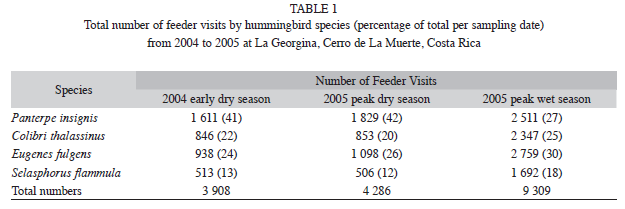
<body><![CDATA[<font size="2"></font><br style="font-family: verdana;">     <font style="font-weight: bold;" size="3"><span      style="font-family: verdana;">Results</span></font><br      style="font-family: verdana;">     <font size="2"></font><br style="font-family: verdana;">     <font size="2"><span style="font-family: verdana;"><span      style="font-weight: bold;">Feeder visitation:</span> Throughout the     early dry season of 2004 and the peak dry season of 2005 <span      style="font-style: italic;">P. insignis</span>     was by far the most dominant hummingbird at the feeders, while <span     ]]></body>
<body><![CDATA[ style="font-style: italic;">S.     flammula</span> made the least use of the feeders across all seasons. <span      style="font-style: italic;">E.     fulgens, P. insignis </span>and <span style="font-style: italic;">C.     thalassinus</span> made a similar use of feeders     during the peak 2005 wet season (Table 1). Feeder usage was clearly     dependent on season and hummingbird species (<span      style="font-style: italic;">x</span><sup>2</sup>=463.92, p&lt;0.001,     df=6). In addition, <span style="font-style: italic;">S. flammula</span>     made a greater percentage of the total     ]]></body>
<body><![CDATA[visits during the peak wet season than in the early dry or peak dry     seasons (<a href="/img/revistas/rbt/v60n1/a04t1.gif">Table 1</a>). The     feeders attracted a large number of     hummingbirds, and although we did not count how many hummingbirds of     each species were using the feeders, we feel that the patterns of     feeder monopolization closely resembled the abundance of each     hummingbird species around the feeders, as well as of those captured in     the mist nets. Most hummingbirds quit 15min before sunset, with only a     few <span style="font-style: italic;">P. insignis</span> remaining at     the feeders for at least 15 more minutes     ]]></body>
<body><![CDATA[after dusk.</span></font><br style="font-family: verdana;">     <font size="2"></font><br style="font-family: verdana;">     <font size="2"><span style="font-family: verdana;"><span      style="font-weight: bold;">Pollen loads: </span>Of the 183     hummingbirds captured in the mist nets over the course of the study 12     were recaptures, and were excluded from further analyses. No individual     captured at La Georgina was recaptured at our site 3km away from the     feeders.</span></font><br style="font-family: verdana;">     <font size="2"></font><br style="font-family: verdana;">     <font size="2"><span style="font-family: verdana;">More than 50% of the     ]]></body>
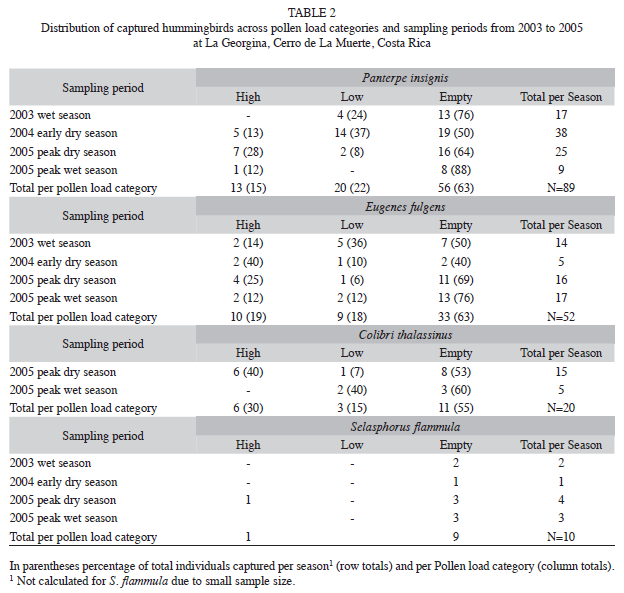
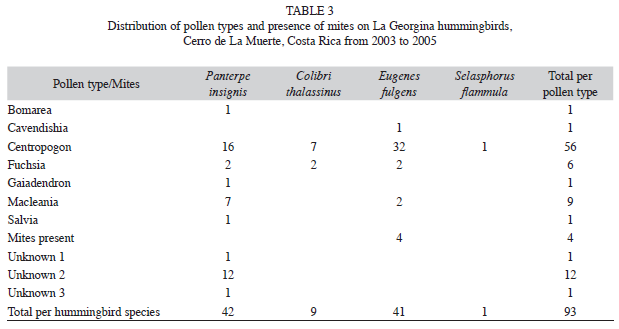
<body><![CDATA[birds captured     at each sampling period had zero or low pollen loads (<a      href="/img/revistas/rbt/v60n1/a04i1.jpg">Fig. 1</a>, <a      href="/img/revistas/rbt/v60n1/a04t2.gif">Table 2</a>).     If the &#8220;zero&#8221; and &#8220;low&#8221; categories are combined (or if only the &#8220;high&#8221;     category is considered), the percentage carrying little pollen     increases to 70% of the captured birds. Furthermore, only four <span      style="font-style: italic;">E.     fulgens</span> carried mites on their beaks (the presence of mites is     evidence     ]]></body>
<body><![CDATA[of flower visitation).</span></font><br style="font-family: verdana;">     <font size="2"></font><br style="font-family: verdana;">     <font size="2"><span style="font-family: verdana;">Logistic regression     showed a     significant effect of season (Wald test=18.38, p=0.005, df=6), but not     of species (Wald test=3.41, p=0.49, df=4), indicating that patterns of     pollen loads were similar for the three species considered in the     analysis (<span style="font-style: italic;">P. insignis, C. thalassinus</span>     and <span style="font-style: italic;">E. fulgens</span>). The effect     of     ]]></body>
<body><![CDATA[season continued to be significant even after excluding <span      style="font-style: italic;">C. thalassinus</span>     from the analysis (Wald test=16.69, p=0.01, df=6) since this species     was not captured either in the 2003 wet season or in the 2004 early dry     season (<a href="/img/revistas/rbt/v60n1/a04t2.gif">Table 2</a>). The     percentage of hummingbirds with high pollen loads     was greatest during the peak dry season of 2005, although most     hummingbirds still carried zero pollen. The lowest pollen loads were     observed during the peak wet season of 2005. For this period, there was     a reduction in the number of individuals per species with the exception     ]]></body>
<body><![CDATA[<span style="font-style: italic;">E. fulgens </span>(<a      href="/img/revistas/rbt/v60n1/a04t1.gif">Table 1</a>). Of the     four species, <span style="font-style: italic;">P. insignis</span> and     <span style="font-style: italic;">E. fulgens</span>     had the highest proportion of individuals with zero pollen across     sampling dates. Consistent with our expectation, in the early 2004 dry     season <span style="font-style: italic;">E. fulgens</span> decreased     its utilization of feeders, and the number     of individuals with high pollen loads increased (<a      href="/img/revistas/rbt/v60n1/a04t2.gif">Table 2</a>). In the peak     ]]></body>
<body><![CDATA[dry season of 2005 <span style="font-style: italic;">P. insignis</span>     and <span style="font-style: italic;">E. fulgens</span> had relatively     equal     proportions of birds with zero pollen. Similar patterns were found for     <span style="font-style: italic;">C. thalassinus</span> and <span      style="font-style: italic;">S. flammula</span>, although these two     species were not     well represented in the mist net data.    <br>     <br>     ]]></body>
<body><![CDATA[</span></font><font size="2"><span style="font-family: verdana;"><span      style="font-weight: bold;">Plant species represented in pollen     loads:</span> Species of Centropogon (<span style="font-style: italic;">C.     talamancensis</span> and <span style="font-style: italic;">C. valerii</span>)     dominated 61% of the pollen loads taken at La Georgina across sampling     periods; pollen of other plant species was uncommon (<a      href="/img/revistas/rbt/v60n1/a04t3.gif">Table 3</a>). 96% of     hummingbirds that carried pollen carried only one species. Mist nets     located away from the Restaurant returned a low number of hummingbirds     captured per sampling date (one-to-three specimens, with high pollen     ]]></body>
<body><![CDATA[loads, mostly from <span style="font-style: italic;">Centropogon</span>).     Although we increased the distance     from the Restaurant area, and set up the mist nets in habitats where     hummingbirds were observed to be formerly abundant (forest edges,     abandoned pastures with abundance of hummingbird pollinated plants),     the return in numbers of captured hummingbirds was low during the     sampling period (total n=10).</span></font><br      style="font-family: verdana;">     <font size="2"></font><br style="font-family: verdana;">     <font style="font-weight: bold;" size="3"><span     ]]></body>
<body><![CDATA[ style="font-family: verdana;">Discussion</span></font><br      style="font-family: verdana;">     <font size="2"></font><br style="font-family: verdana;">     <font size="2"><span style="font-family: verdana;">According to this     study,     sugar-water feeders appear to have the ability to attract hummingbirds     across considerable distances, drawing them away from flowers, at least     in some seasons. We captured few hummingbirds at a site 3km from the La     Georgina feeders, and sampling of other habitats away from the     Restaurant failed to alter this pattern. No hummingbird captured at La     ]]></body>
<body><![CDATA[Georgina was recaptured away from the Restaurant. Most hummingbirds     captured at feeders carried little pollen, or no pollen whatsoever. The     majority of those with pollen had only one type, mostly from     <span style="font-style: italic;">Centropogon</span>. These results     contrast with those from a one-year     monitoring study (G. Avalos, unpublished) done in the same area in     1991, well before the feeders at La Georgina were established. That     study recorded that two-to-three species of pollen were carried per     hummingbird species, and a higher pollen load across all species.     Furthermore, a sampling effort comparable to what we used here at sites     ]]></body>
<body><![CDATA[away from La Georgina, commonly returned 20 captures across all     hummingbird species (Wolf <span style="font-style: italic;">et al.</span>     1976). There have been no other major     changes in the landscape, or in plant distribution since feeders were     established. These same locations were used in the past </span></font><font      size="2"><span style="font-family: verdana;">in the vicinity of the     Restaurant     before the establishment of the feeders, and returned a larger number     of captures. Nowadays, hummingbirds are rarely observed or captured in     areas away from the Restaurant. It is likely that the distance between     ]]></body>
<body><![CDATA[the control sites and the restaurant was not large enough to enable us     to find a section of the hummingbird assemblage not influenced by the     feeders, suggesting that feeders are affecting hummingbird distribution     within an approximate 3km radius from the feeder&#8217;s location.</span></font><br      style="font-family: verdana;">     <font size="2"></font><br style="font-family: verdana;">     <font size="2"><span style="font-family: verdana;">The seasonality of     flowering     phenology determined the competitive and antagonistic pattern between     feeders and flowers found at Cerro de La Muerte. Here, <span     ]]></body>
<body><![CDATA[ style="font-style: italic;">Centropogon</span> </span></font><font      size="2"><span style="font-family: verdana;">shrubs (both <span      style="font-style: italic;">C. valerii</span> and <span      style="font-style: italic;">C.     talamancensis</span>) produce flowers continuously during the year, but     it is     in the dry season when this genus reaches a peak in flower production,     along with more than 20 hummingbird-pollinated plants abundant at the     site (Colwell 1973, Wolf<span style="font-style: italic;"> et al.</span>     1976). This explains the dry season     ]]></body>
<body><![CDATA[increase in pollen loads associated with the decrease in feeder     visitation. Inouye <span style="font-style: italic;">et al.</span>     (1991) observed a similar competitive and     antagonistic pattern between feeders and flowers in the Broad-tailed     Hummingbird (<span style="font-style: italic;">Selasphorous platycercus</span>)     in the Rocky Mountains of     Colorado: in years of high flower abundance hummingbirds decreased the     use of feeders, but in years of low flower abundance feeders drew     hummingbirds away from flowers. Similar results were found by McCaffrey     <span style="font-style: italic;">&amp;</span> Wethington (2008) in a     ]]></body>
<body><![CDATA[hummingbird assemblage in Southeastern     Arizona.</span></font><br style="font-family: verdana;">     <font size="2"></font><br style="font-family: verdana;">     <font size="2"><span style="font-family: verdana;">The competitive and     antagonistic     pattern shown here between feeders and flowers indicate that     pollination networks could be significantly altered. Feeders present a     superabundant, predictable resource, whose availability does not     decrease throughout the day or seasons, as is the case with hummingbird     pollinated plants (Hainsworth <span style="font-style: italic;">&amp;</span>     ]]></body>
<body><![CDATA[Wolf 1972, Wolf <span style="font-style: italic;">et al.</span> 1976,     Garrison <span style="font-style: italic;">&amp;</span> Gass 1999).     The long-term use of feeders may alter     migration routes, the spatial dispersion of hummingbird assemblages,     and behavioral interactions among hummingbird species. In at least one     study it has been established that feeders decrease plant reproductive     success (Arizmendi <span style="font-style: italic;">et al.</span>     2007).</span></font><br style="font-family: verdana;">     <font size="2"><span style="font-family: verdana;">&nbsp;</span></font><br      style="font-family: verdana;">     ]]></body>
<body><![CDATA[<font size="2"><span style="font-family: verdana;">Our results need to     be compared     with more diverse hummingbird assemblages over longer periods. The     harsh environmental conditions of the highlands (<span      style="font-style: italic;">i.e.</span>, cold nights and     hot and dry conditions during the day in the dry season, and cold     nights and rainy days in the wet season) increases the importance of     feeders for highland hummingbirds. In the lowlands and mid-elevations a     more diverse plant assemblage and more favorable environmental     conditions could favor a wider dispersal of hummingbirds over larger     ]]></body>
<body><![CDATA[areas, decreasing dependence and opportunistic use of feeders.     Preliminary observations done in June 2005 at the Monteverde cloud     forest, Costa Rica, (G. Avalos, pers. obs.), showed that territorial     trochilinidae hummingbirds, medium size and short-billed (i.e.,     Green-crowned Brilliant, <span style="font-style: italic;">Heliodoxa     jacula</span>, similar in size and overall     morphology to <span style="font-style: italic;">P. insignis</span>),     tend to monopolize feeders more often than     non-territorial hummingbirds, and that feeders are sparingly visited by     trapliners (Green Hermit, <span style="font-style: italic;">Phaetornis     ]]></body>
<body><![CDATA[guy</span>). Thus, trochilinidae     territorial hummingbirds are more likely to develop a strong dependence     on feeders. Borgella <span style="font-style: italic;">et al.</span>     (2001) analyzed a more diverse     hummingbird-plant assemblage, and found relatively high and diverse     pollen loads for the Long-tailed Hummingbird (<span      style="font-style: italic;">Phaetornis     superciliosus</span>), but just&nbsp; one pollen type for the     White-tipped     Sicklebill (<span style="font-style: italic;">Eutoxeres aquila</span>).     ]]></body>
<body><![CDATA[However, data were limited to the dry     season of 1998.</span></font><br style="font-family: verdana;">     <font size="2"></font><br style="font-family: verdana;">     <font size="2"><span style="font-family: verdana;">The actual effects     of artificial     feeders on pollination systems have been neglected in the literature.     By supplementing birds with food we are prone to interfere with     pollination networks&nbsp; already stressed by anthropogenic effects,     such as global warming, habitat fragmentation, land use changes, and     intense agricultural practices involving the use of pesticides and     ]]></body>
<body><![CDATA[herbicides (Kearns <span style="font-style: italic;">et al.</span>     1998). Healthy pollination systems perform a     critical environmental service to humankind, but are rarely quantified,     and much less, officially acknowledged. However, without knowledge on     the basic aspects of plant-pollinator interactions and how these are     affected by humans, it will be difficult to implement optimal     management decisions for conservation (Ghazoul 2005).</span></font><br      style="font-family: verdana;">     <font size="2"></font><br style="font-family: verdana;">     <font style="font-weight: bold;" size="3"><span     ]]></body>
<body><![CDATA[ style="font-family: verdana;">Acknowledgments</span></font><br      style="font-family: verdana;">     <font size="2"></font><br style="font-family: verdana;">     <font size="2"><span style="font-family: verdana;">We thank the     students and staff of     The School for Field Studies and volunteers from the University of     Costa Rica (Luis Sandoval, Mar&iacute;a Gabriela Gei, Sabrina Amador,     Esteban Berm&uacute;dez, Katya Barrantes and Minor Barboza) for their     help with fieldwork. We thank the staff and owners of La Georgina for     their hospitality and for the opportunity to work there. Jorge     ]]></body>
<body><![CDATA[P&eacute;rez-Em&aacute;n and Nickolas Waser provided key input which     significantly improved the manuscript. Mist nets were provided by the     organization IDEAWILD.</span></font><br style="font-family: verdana;">     <font size="2"></font><br style="font-family: verdana;">     <font size="2"><span style="font-family: verdana;"></span></font>     <hr style="width: 100%; height: 2px;"><font style="font-weight: bold;"      size="3"><span style="font-family: verdana;">References</span></font><br      style="font-family: verdana;">     <font size="2"></font><br style="font-family: verdana;">     <font size="2"><span style="font-family: verdana;">Altshuler, D.L. <span     ]]></body>
<body><![CDATA[ style="font-style: italic;">&amp;</span> R. Dudley.     2002. The ecological and evolutionary interface of hummingbird flight     <!-- ref -->physiology. J. Exp. Biol. 205: 2325-2336.    &nbsp;&nbsp;&nbsp;&nbsp;&nbsp;&nbsp;&nbsp;&nbsp;[&#160;<a href="javascript:void(0);" onclick="javascript: window.open('/scielo.php?script=sci_nlinks&ref=1414668&pid=S0034-7744201200010000400001&lng=','','width=640,height=500,resizable=yes,scrollbars=1,menubar=yes,');">Links</a>&#160;]<!-- end-ref --><!-- ref --></span></font><br  style="font-family: verdana;"> <font size="2"></font><br style="font-family: verdana;"> <font size="2"><span style="font-family: verdana;">Arizmendi, M.C., C. Monterrubio-Sol&iacute;s, L. Ju&aacute;rez, I. Flores-Moreno <span  style="font-style: italic;">&amp;</span> E. L&oacute;pez-Saut. 2007. Effect of the presence of nectar feeders on the breeding sucess of <span style="font-style: italic;">Salvia mexicana</span> and <span style="font-style: italic;">Salvia fulgens</span> in a suburban park near Mexico City. Biol. Conserv. 136: 155-158.    &nbsp;&nbsp;&nbsp;&nbsp;&nbsp;&nbsp;&nbsp;&nbsp;[&#160;<a href="javascript:void(0);" onclick="javascript: window.open('/scielo.php?script=sci_nlinks&ref=1414669&pid=S0034-7744201200010000400002&lng=','','width=640,height=500,resizable=yes,scrollbars=1,menubar=yes,');">Links</a>&#160;]<!-- end-ref --><!-- ref --></span></font><br  style="font-family: verdana;"> <font size="2"></font><br style="font-family: verdana;"> <font size="2"><span style="font-family: verdana;">Bleiweiss, R. 1998. Origin of hummingbird faunas. Biol. J. Linn. Soc. 65: 77-97.    &nbsp;&nbsp;&nbsp;&nbsp;&nbsp;&nbsp;&nbsp;&nbsp;[&#160;<a href="javascript:void(0);" onclick="javascript: window.open('/scielo.php?script=sci_nlinks&ref=1414670&pid=S0034-7744201200010000400003&lng=','','width=640,height=500,resizable=yes,scrollbars=1,menubar=yes,');">Links</a>&#160;]<!-- end-ref --><!-- ref --></span></font><br  style="font-family: verdana;"> <font size="2"></font><br style="font-family: verdana;"> <font size="2"><span style="font-family: verdana;">Borgella, R., A.A. Snow <span style="font-style: italic;">&amp;</span> T.A. Gavin. 2001. Species richness and pollen loads of hummingbirds using forest fragments in southern Costa Rica. Biotropica 33: 90-109.    &nbsp;&nbsp;&nbsp;&nbsp;&nbsp;&nbsp;&nbsp;&nbsp;[&#160;<a href="javascript:void(0);" onclick="javascript: window.open('/scielo.php?script=sci_nlinks&ref=1414671&pid=S0034-7744201200010000400004&lng=','','width=640,height=500,resizable=yes,scrollbars=1,menubar=yes,');">Links</a>&#160;]<!-- end-ref --><!-- ref --></span></font><br  style="font-family: verdana;"> <font size="2"></font><br style="font-family: verdana;"> <font size="2"><span style="font-family: verdana;">Brice, A.T. 1992. The essentiality of nectar and arthropods in the diet of the Anna&#8217;s hummingbird (<span  style="font-style: italic;">Calypte anna</span>). Comp. Biochem. Phys. A 101: 151-155.    &nbsp;&nbsp;&nbsp;&nbsp;&nbsp;&nbsp;&nbsp;&nbsp;[&#160;<a href="javascript:void(0);" onclick="javascript: window.open('/scielo.php?script=sci_nlinks&ref=1414672&pid=S0034-7744201200010000400005&lng=','','width=640,height=500,resizable=yes,scrollbars=1,menubar=yes,');">Links</a>&#160;]<!-- end-ref --><!-- ref --></span></font><br  style="font-family: verdana;"> <font size="2"></font><br style="font-family: verdana;"> <font size="2"><span style="font-family: verdana;">Colwell, R.K. 1973. Competition and coexistence in a simple tropical community. Am. Nat. 107: 737-760.    &nbsp;&nbsp;&nbsp;&nbsp;&nbsp;&nbsp;&nbsp;&nbsp;[&#160;<a href="javascript:void(0);" onclick="javascript: window.open('/scielo.php?script=sci_nlinks&ref=1414673&pid=S0034-7744201200010000400006&lng=','','width=640,height=500,resizable=yes,scrollbars=1,menubar=yes,');">Links</a>&#160;]<!-- end-ref --><!-- ref --></span></font><br  style="font-family: verdana;"> <font size="2"></font><br style="font-family: verdana;"> <font size="2"><span style="font-family: verdana;">Garrison, J.S.E. <span  style="font-style: italic;">&amp;</span> C.L. Gass. 1999. Response of a traplining hummingbird to changes in nectar availability. Behav. Ecol. 10: 714-725.    &nbsp;&nbsp;&nbsp;&nbsp;&nbsp;&nbsp;&nbsp;&nbsp;[&#160;<a href="javascript:void(0);" onclick="javascript: window.open('/scielo.php?script=sci_nlinks&ref=1414674&pid=S0034-7744201200010000400007&lng=','','width=640,height=500,resizable=yes,scrollbars=1,menubar=yes,');">Links</a>&#160;]<!-- end-ref --><!-- ref --></span></font><br  style="font-family: verdana;"> <font size="2"></font><br style="font-family: verdana;"> <font size="2"><span style="font-family: verdana;">Ghazoul, J. 2005. Buzziness as usual? Questioning the global pollination crisis. TREE 20: 367-373.    &nbsp;&nbsp;&nbsp;&nbsp;&nbsp;&nbsp;&nbsp;&nbsp;[&#160;<a href="javascript:void(0);" onclick="javascript: window.open('/scielo.php?script=sci_nlinks&ref=1414675&pid=S0034-7744201200010000400008&lng=','','width=640,height=500,resizable=yes,scrollbars=1,menubar=yes,');">Links</a>&#160;]<!-- end-ref --><!-- ref --></span></font><br  style="font-family: verdana;"> <font size="2"></font><br style="font-family: verdana;"> <font size="2"><span style="font-family: verdana;">Hainsworth, F.R. <span  style="font-style: italic;">&amp;</span> L.L. Wolf. 1972. Energetics of nectar extraction in a small, high altitude, tropical hummingbird, <span style="font-style: italic;">Selasphorus flammula.</span> J. Comp. Physiol. 80: 377-387.    &nbsp;&nbsp;&nbsp;&nbsp;&nbsp;&nbsp;&nbsp;&nbsp;[&#160;<a href="javascript:void(0);" onclick="javascript: window.open('/scielo.php?script=sci_nlinks&ref=1414676&pid=S0034-7744201200010000400009&lng=','','width=640,height=500,resizable=yes,scrollbars=1,menubar=yes,');">Links</a>&#160;]<!-- end-ref --><!-- ref --><br> <br style="font-family: verdana;"> </span></font><font size="2"><span style="font-family: verdana;">Hainsworth, F.R., B.G. Collins <span style="font-style: italic;">&amp;</span> L.L. Wolf. 1977. The function of torpor in hummingbirds. Physiol. Zool. 50: 215-222.    &nbsp;&nbsp;&nbsp;&nbsp;&nbsp;&nbsp;&nbsp;&nbsp;[&#160;<a href="javascript:void(0);" onclick="javascript: window.open('/scielo.php?script=sci_nlinks&ref=1414677&pid=S0034-7744201200010000400010&lng=','','width=640,height=500,resizable=yes,scrollbars=1,menubar=yes,');">Links</a>&#160;]<!-- end-ref --><!-- ref --></span></font><br style="font-family: verdana;"> <font size="2"></font><br style="font-family: verdana;"> <font size="2"><span style="font-family: verdana;">Inouye, D.W., W.A. Calder <span style="font-style: italic;">&amp;</span> N.M. Waser. 1991. The effect of floral abundance on feeder censuses of hummingbird populations. Condor 93: 279-285.    &nbsp;&nbsp;&nbsp;&nbsp;&nbsp;&nbsp;&nbsp;&nbsp;[&#160;<a href="javascript:void(0);" onclick="javascript: window.open('/scielo.php?script=sci_nlinks&ref=1414678&pid=S0034-7744201200010000400011&lng=','','width=640,height=500,resizable=yes,scrollbars=1,menubar=yes,');">Links</a>&#160;]<!-- end-ref --><!-- ref --></span></font><br  style="font-family: verdana;"> <font size="2"></font><br style="font-family: verdana;"> <font size="2"><span style="font-family: verdana;">Kearns, C.A., D.W. Inouye <span style="font-style: italic;">&amp;</span> N.M. Waser. 1998. Endangered mutualisms: The conservation of plant-pollinator interactions. Annu. Rev. Ecol. Syst. 29: 83-112.    &nbsp;&nbsp;&nbsp;&nbsp;&nbsp;&nbsp;&nbsp;&nbsp;[&#160;<a href="javascript:void(0);" onclick="javascript: window.open('/scielo.php?script=sci_nlinks&ref=1414679&pid=S0034-7744201200010000400012&lng=','','width=640,height=500,resizable=yes,scrollbars=1,menubar=yes,');">Links</a>&#160;]<!-- end-ref --><!-- ref --></span></font><br  style="font-family: verdana;"> <font size="2"></font><br style="font-family: verdana;"> <font size="2"><span style="font-family: verdana;">McCaffrey, R.E. <span  style="font-style: italic;">&amp;</span> S.M. Wethington. 2008. How the presence of feeders affects the use of local floral resources by hummingbirds: A case study from southern Arizona. Condor 110: 786-791.    &nbsp;&nbsp;&nbsp;&nbsp;&nbsp;&nbsp;&nbsp;&nbsp;[&#160;<a href="javascript:void(0);" onclick="javascript: window.open('/scielo.php?script=sci_nlinks&ref=1414680&pid=S0034-7744201200010000400013&lng=','','width=640,height=500,resizable=yes,scrollbars=1,menubar=yes,');">Links</a>&#160;]<!-- end-ref --><!-- ref --></span></font><br style="font-family: verdana;"> <font size="2"></font><br style="font-family: verdana;"> <font size="2"><span style="font-family: verdana;">Poulin, B., G. Lefebvre <span style="font-style: italic;">&amp;</span> R. McNeil. 1992. Tropical avian phenology in relation to abundance and exploitation of food resources. Ecology 73: 2295-2309.    &nbsp;&nbsp;&nbsp;&nbsp;&nbsp;&nbsp;&nbsp;&nbsp;[&#160;<a href="javascript:void(0);" onclick="javascript: window.open('/scielo.php?script=sci_nlinks&ref=1414681&pid=S0034-7744201200010000400014&lng=','','width=640,height=500,resizable=yes,scrollbars=1,menubar=yes,');">Links</a>&#160;]<!-- end-ref --><!-- ref --></span></font><br  style="font-family: verdana;"> <font size="2"></font><br style="font-family: verdana;"> <font size="2"><span style="font-family: verdana;">Powers, D.R. 1987. Effects of variation in food quality on the breeding territoriality of the male Anna&#8217;s Hummingbird. Condor 89: 103-111.    &nbsp;&nbsp;&nbsp;&nbsp;&nbsp;&nbsp;&nbsp;&nbsp;[&#160;<a href="javascript:void(0);" onclick="javascript: window.open('/scielo.php?script=sci_nlinks&ref=1414682&pid=S0034-7744201200010000400015&lng=','','width=640,height=500,resizable=yes,scrollbars=1,menubar=yes,');">Links</a>&#160;]<!-- end-ref --><!-- ref --></span></font><br  style="font-family: verdana;"> <font size="2"></font><br style="font-family: verdana;"> <font size="2"><span style="font-family: verdana;">Sandlin, E.A. 2000. Cue use affects resource subdivision among three coexisting hummingbird species. Behav. Ecol. 11: 550-559.    &nbsp;&nbsp;&nbsp;&nbsp;&nbsp;&nbsp;&nbsp;&nbsp;[&#160;<a href="javascript:void(0);" onclick="javascript: window.open('/scielo.php?script=sci_nlinks&ref=1414683&pid=S0034-7744201200010000400016&lng=','','width=640,height=500,resizable=yes,scrollbars=1,menubar=yes,');">Links</a>&#160;]<!-- end-ref --><!-- ref --></span></font><br style="font-family: verdana;"> <font size="2"></font><br style="font-family: verdana;"> <font size="2"><span style="font-family: verdana;">Stiles, F.G. 1980. The annual cycle in a tropical wet forest hummingbird community. Ibis 122: 322-343.    &nbsp;&nbsp;&nbsp;&nbsp;&nbsp;&nbsp;&nbsp;&nbsp;[&#160;<a href="javascript:void(0);" onclick="javascript: window.open('/scielo.php?script=sci_nlinks&ref=1414684&pid=S0034-7744201200010000400017&lng=','','width=640,height=500,resizable=yes,scrollbars=1,menubar=yes,');">Links</a>&#160;]<!-- end-ref --><!-- ref --></span></font><br  style="font-family: verdana;"> <font size="2"></font><br style="font-family: verdana;"> <font size="2"><span style="font-family: verdana;">Stiles, F.G. 1995. Behavioral, ecological and morphological correlates of foraging by arthropods by the hummingbirds of a tropical wet forest. Condor 97: 853-878.    &nbsp;&nbsp;&nbsp;&nbsp;&nbsp;&nbsp;&nbsp;&nbsp;[&#160;<a href="javascript:void(0);" onclick="javascript: window.open('/scielo.php?script=sci_nlinks&ref=1414685&pid=S0034-7744201200010000400018&lng=','','width=640,height=500,resizable=yes,scrollbars=1,menubar=yes,');">Links</a>&#160;]<!-- end-ref --><!-- ref --></span></font><br  style="font-family: verdana;"> <font size="2"></font><br style="font-family: verdana;"> <font size="2"><span style="font-family: verdana;">Stiles, F.G. <span  style="font-style: italic;">&amp;</span> A.F. Skutch. 1989. A guide to the birds of Costa Rica. Cornell University, Ithaca, New York, USA.    &nbsp;&nbsp;&nbsp;&nbsp;&nbsp;&nbsp;&nbsp;&nbsp;[&#160;<a href="javascript:void(0);" onclick="javascript: window.open('/scielo.php?script=sci_nlinks&ref=1414686&pid=S0034-7744201200010000400019&lng=','','width=640,height=500,resizable=yes,scrollbars=1,menubar=yes,');">Links</a>&#160;]<!-- end-ref --><!-- ref --></span></font><br style="font-family: verdana;"> <font size="2"></font><br style="font-family: verdana;"> <font size="2"><span style="font-family: verdana;">Stromberg, M.R. <span  style="font-style: italic;">&amp;</span> P.B. Johnsen. 1990. Hummingbird sweetness preferences: Taste or viscosity? Condor 92: 606-612.    &nbsp;&nbsp;&nbsp;&nbsp;&nbsp;&nbsp;&nbsp;&nbsp;[&#160;<a href="javascript:void(0);" onclick="javascript: window.open('/scielo.php?script=sci_nlinks&ref=1414687&pid=S0034-7744201200010000400020&lng=','','width=640,height=500,resizable=yes,scrollbars=1,menubar=yes,');">Links</a>&#160;]<!-- end-ref --><!-- ref --></span></font><br style="font-family: verdana;"> <font size="2"></font><br style="font-family: verdana;"> <font size="2"><span style="font-family: verdana;">Wolf, L.L., F.G. Stiles <span style="font-style: italic;">&amp;</span> F.R. Hainsworth. 1976. Ecological organization of a tropical high-land hummingbird community. J. Anim. Ecol. 32: 349-379.    &nbsp;&nbsp;&nbsp;&nbsp;&nbsp;&nbsp;&nbsp;&nbsp;[&#160;<a href="javascript:void(0);" onclick="javascript: window.open('/scielo.php?script=sci_nlinks&ref=1414688&pid=S0034-7744201200010000400021&lng=','','width=640,height=500,resizable=yes,scrollbars=1,menubar=yes,');">Links</a>&#160;]<!-- end-ref --></span></font><br  style="font-family: verdana;"> <font size="2"></font>    <br> <font size="2"><span style="font-family: verdana;"><a  name="Correspondencia1"></a><a href="#Correspondencia2">*</a>Correspondencia a:</span></font><font size="2"> <span style="font-family: verdana;">Gerardo Avalos; </span></font><font  size="2"><span style="font-family: verdana;">Escuela de Biolog&iacute;a, Universidad de Costa Rica, 2060 San Pedro, San Jos&eacute;, Costa Rica.</span></font><font  size="2"><span style="font-family: verdana;"> The School for Field Studies, Center for Sustainable Development Studies, 10 Federal St., Salem, MA 01970 USA; </span></font><a href="mailto:avalos@fieldstudies.org"><font  size="2"><span style="font-family: verdana;">avalos@fieldstudies.org</span></font></a><br  style="font-family: verdana;"> <font size="2"><span style="font-family: verdana;">    <br> Alejandra Soto; </span></font><font size="2"><span  style="font-family: verdana;">Elon University, Ecology and Environmental Science, Apdo. 1524-2050 San Pedro, Costa Rica; <a href="mailto:alekasoto@gmail.com">alekasoto@gmail.com</a></span></font><br  style="font-family: verdana;"> <font size="2"> <span style="font-family: verdana;">    <br> </span></font><small><span style="font-family: verdana;">Willy Alfaro; </span></small><font  size="2"><span style="font-family: verdana;">Apdo. 463, San Ram&oacute;n, 20203, Costa Rica; <a href="mailto:willyalfaro@amnet.co.cr">willyalfaro@amnet.co.cr</a>     <br>     <br> </span></font><font size="2"><span style="font-family: verdana;"><a  name="Afiliacion1"></a><a href="#Afiliacion5">1</a>. Escuela de Biolog&iacute;a, Universidad de Costa Rica, 2060 San Pedro, San Jos&eacute;, Costa Rica.</span></font><br  style="font-family: verdana;"> <font size="2"><span style="font-family: verdana;"><a name="Afiliacion2"></a><a  href="#Afiliacion6">2</a>. The School for Field Studies, Center for Sustainable Development Studies, 10 Federal St., Salem, MA 01970 USA; </span></font><a href="mailto:avalos@fieldstudies.org"><font  size="2"><span style="font-family: verdana;">avalos@fieldstudies.org</span></font></a><br  style="font-family: verdana;"> <font size="2"><span style="font-family: verdana;"><a name="Afiliacion3"></a><a  href="#Afiliacion7">3</a>. Elon University, Ecology and Environmental Science, Apdo. 1524-2050 San Pedro, Costa Rica; <a href="mailto:alekasoto@gmail.com">alekasoto@gmail.com</a></span></font><br  style="font-family: verdana;"> <font size="2"><span style="font-family: verdana;"><a name="Afiliacion4"></a><a  href="#Afiliacion8">4</a>. Apdo. 463, San Ram&oacute;n, 20203, Costa Rica; <a href="mailto:willyalfaro@amnet.co.cr">willyalfaro@amnet.co.cr </a></span></font><br style="font-family: verdana;"> <font size="2"><span style="font-family: verdana;"></span></font> <hr style="width: 100%; height: 2px;">     <div style="text-align: center;"><font size="2"><span  style="font-family: verdana;">Received 01-III-2011. Corrected 10-VI-2011. Accepted 11-VII-2011.</span></font><br  style="font-family: verdana;"> </div> </div>     ]]></body>
<body><![CDATA[<div style="text-align: center;"><font size="2"></font></div> </div> <font size="2"></font>      ]]></body><back>
<ref-list>
<ref id="B1">
<nlm-citation citation-type="journal">
<person-group person-group-type="author">
<name>
<surname><![CDATA[Altshuler]]></surname>
<given-names><![CDATA[D.L]]></given-names>
</name>
<name>
<surname><![CDATA[Dudley]]></surname>
<given-names><![CDATA[R]]></given-names>
</name>
</person-group>
<article-title xml:lang="en"><![CDATA[The ecological and evolutionary interface of hummingbird flight physiology]]></article-title>
<source><![CDATA[J. Exp. Biol]]></source>
<year>2002</year>
<volume>205</volume>
<page-range>2325-2336</page-range></nlm-citation>
</ref>
<ref id="B2">
<nlm-citation citation-type="journal">
<person-group person-group-type="author">
<name>
<surname><![CDATA[Arizmendi]]></surname>
<given-names><![CDATA[M.C]]></given-names>
</name>
<name>
<surname><![CDATA[Monterrubio-Solís]]></surname>
<given-names><![CDATA[C]]></given-names>
</name>
<name>
<surname><![CDATA[Juárez]]></surname>
<given-names><![CDATA[L]]></given-names>
</name>
<name>
<surname><![CDATA[Flores-Moreno]]></surname>
<given-names><![CDATA[I]]></given-names>
</name>
<name>
<surname><![CDATA[López-Saut]]></surname>
<given-names><![CDATA[E]]></given-names>
</name>
</person-group>
<article-title xml:lang="en"><![CDATA[Effect of the presence of nectar feeders on the breeding sucess of Salvia mexicana and Salvia fulgens in a suburban park near Mexico City]]></article-title>
<source><![CDATA[Biol. Conserv]]></source>
<year>2007</year>
<volume>136</volume>
<page-range>155-158</page-range></nlm-citation>
</ref>
<ref id="B3">
<nlm-citation citation-type="journal">
<person-group person-group-type="author">
<name>
<surname><![CDATA[Bleiweiss]]></surname>
<given-names><![CDATA[R]]></given-names>
</name>
</person-group>
<article-title xml:lang="en"><![CDATA[Origin of hummingbird faunas]]></article-title>
<source><![CDATA[Biol. J. Linn. Soc]]></source>
<year>1998</year>
<volume>65</volume>
<page-range>77-97</page-range></nlm-citation>
</ref>
<ref id="B4">
<nlm-citation citation-type="journal">
<person-group person-group-type="author">
<name>
<surname><![CDATA[Borgella]]></surname>
<given-names><![CDATA[R]]></given-names>
</name>
<name>
<surname><![CDATA[Snow]]></surname>
<given-names><![CDATA[A.A]]></given-names>
</name>
<name>
<surname><![CDATA[Gavin]]></surname>
<given-names><![CDATA[T.A]]></given-names>
</name>
</person-group>
<article-title xml:lang="en"><![CDATA[Species richness and pollen loads of hummingbirds using forest fragments in southern Costa Rica]]></article-title>
<source><![CDATA[Biotropica]]></source>
<year>2001</year>
<volume>33</volume>
<page-range>90-109</page-range></nlm-citation>
</ref>
<ref id="B5">
<nlm-citation citation-type="journal">
<person-group person-group-type="author">
<name>
<surname><![CDATA[Brice]]></surname>
<given-names><![CDATA[A.T]]></given-names>
</name>
</person-group>
<article-title xml:lang="en"><![CDATA[The essentiality of nectar and arthropods in the diet of the Anna&#8217;s hummingbird (Calypte anna)]]></article-title>
<source><![CDATA[Comp. Biochem. Phys. A]]></source>
<year>1992</year>
<volume>101</volume>
<page-range>151-155</page-range></nlm-citation>
</ref>
<ref id="B6">
<nlm-citation citation-type="journal">
<person-group person-group-type="author">
<name>
<surname><![CDATA[Colwell]]></surname>
<given-names><![CDATA[R.K]]></given-names>
</name>
</person-group>
<article-title xml:lang="en"><![CDATA[Competition and coexistence in a simple tropical community]]></article-title>
<source><![CDATA[Am. Nat]]></source>
<year>1973</year>
<volume>107</volume>
<page-range>737-760</page-range></nlm-citation>
</ref>
<ref id="B7">
<nlm-citation citation-type="journal">
<person-group person-group-type="author">
<name>
<surname><![CDATA[Garrison]]></surname>
<given-names><![CDATA[J.S.E]]></given-names>
</name>
<name>
<surname><![CDATA[Gass]]></surname>
<given-names><![CDATA[C.L]]></given-names>
</name>
</person-group>
<article-title xml:lang="en"><![CDATA[Response of a traplining hummingbird to changes in nectar availability]]></article-title>
<source><![CDATA[Behav. Ecol]]></source>
<year>1999</year>
<volume>10</volume>
<page-range>714-725</page-range></nlm-citation>
</ref>
<ref id="B8">
<nlm-citation citation-type="journal">
<person-group person-group-type="author">
<name>
<surname><![CDATA[Ghazoul]]></surname>
<given-names><![CDATA[J]]></given-names>
</name>
</person-group>
<article-title xml:lang="en"><![CDATA[Buzziness as usual?: Questioning the global pollination crisis]]></article-title>
<source><![CDATA[TREE]]></source>
<year>2005</year>
<volume>20</volume>
<page-range>367-373</page-range></nlm-citation>
</ref>
<ref id="B9">
<nlm-citation citation-type="journal">
<person-group person-group-type="author">
<name>
<surname><![CDATA[Hainsworth]]></surname>
<given-names><![CDATA[F.R]]></given-names>
</name>
<name>
<surname><![CDATA[Wolf]]></surname>
<given-names><![CDATA[L.L]]></given-names>
</name>
</person-group>
<article-title xml:lang="en"><![CDATA[Energetics of nectar extraction in a small, high altitude, tropical hummingbird, Selasphorus flammula]]></article-title>
<source><![CDATA[J. Comp. Physiol]]></source>
<year>1972</year>
<volume>80</volume>
<page-range>377-387</page-range></nlm-citation>
</ref>
<ref id="B10">
<nlm-citation citation-type="journal">
<person-group person-group-type="author">
<name>
<surname><![CDATA[Hainsworth]]></surname>
<given-names><![CDATA[F.R]]></given-names>
</name>
<name>
<surname><![CDATA[Collins]]></surname>
<given-names><![CDATA[B.G]]></given-names>
</name>
<name>
<surname><![CDATA[Wolf]]></surname>
<given-names><![CDATA[L.L]]></given-names>
</name>
</person-group>
<article-title xml:lang="en"><![CDATA[The function of torpor in hummingbirds]]></article-title>
<source><![CDATA[Physiol. Zool]]></source>
<year>1977</year>
<volume>50</volume>
<page-range>215-222</page-range></nlm-citation>
</ref>
<ref id="B11">
<nlm-citation citation-type="journal">
<person-group person-group-type="author">
<name>
<surname><![CDATA[Inouye]]></surname>
<given-names><![CDATA[D.W]]></given-names>
</name>
<name>
<surname><![CDATA[Calder]]></surname>
<given-names><![CDATA[W.A]]></given-names>
</name>
<name>
<surname><![CDATA[Waser]]></surname>
<given-names><![CDATA[N.M]]></given-names>
</name>
</person-group>
<article-title xml:lang="en"><![CDATA[The effect of floral abundance on feeder censuses of hummingbird populations]]></article-title>
<source><![CDATA[Condor]]></source>
<year>1991</year>
<volume>93</volume>
<page-range>279-285</page-range></nlm-citation>
</ref>
<ref id="B12">
<nlm-citation citation-type="journal">
<person-group person-group-type="author">
<name>
<surname><![CDATA[Kearns]]></surname>
<given-names><![CDATA[C.A]]></given-names>
</name>
<name>
<surname><![CDATA[Inouye]]></surname>
<given-names><![CDATA[D.W]]></given-names>
</name>
<name>
<surname><![CDATA[Waser]]></surname>
<given-names><![CDATA[N.M]]></given-names>
</name>
</person-group>
<article-title xml:lang="en"><![CDATA[Endangered mutualisms: The conservation of plant-pollinator interactions]]></article-title>
<source><![CDATA[Annu. Rev. Ecol. Syst]]></source>
<year>1998</year>
<volume>29</volume>
<page-range>83-112</page-range></nlm-citation>
</ref>
<ref id="B13">
<nlm-citation citation-type="journal">
<person-group person-group-type="author">
<name>
<surname><![CDATA[McCaffrey]]></surname>
<given-names><![CDATA[R.E]]></given-names>
</name>
<name>
<surname><![CDATA[Wethington]]></surname>
<given-names><![CDATA[S.M]]></given-names>
</name>
</person-group>
<article-title xml:lang="en"><![CDATA[How the presence of feeders affects the use of local floral resources by hummingbirds: A case study from southern Arizona]]></article-title>
<source><![CDATA[Condor]]></source>
<year>2008</year>
<volume>110</volume>
<page-range>786-791</page-range></nlm-citation>
</ref>
<ref id="B14">
<nlm-citation citation-type="journal">
<person-group person-group-type="author">
<name>
<surname><![CDATA[Poulin]]></surname>
<given-names><![CDATA[B]]></given-names>
</name>
<name>
<surname><![CDATA[Lefebvre]]></surname>
<given-names><![CDATA[G]]></given-names>
</name>
<name>
<surname><![CDATA[McNeil]]></surname>
<given-names><![CDATA[R]]></given-names>
</name>
</person-group>
<article-title xml:lang="en"><![CDATA[Tropical avian phenology in relation to abundance and exploitation of food resources]]></article-title>
<source><![CDATA[Ecology]]></source>
<year>1992</year>
<volume>73</volume>
<page-range>2295-2309</page-range></nlm-citation>
</ref>
<ref id="B15">
<nlm-citation citation-type="journal">
<person-group person-group-type="author">
<name>
<surname><![CDATA[Powers]]></surname>
<given-names><![CDATA[D.R]]></given-names>
</name>
</person-group>
<article-title xml:lang="en"><![CDATA[Effects of variation in food quality on the breeding territoriality of the male Anna&#8217;s Hummingbird]]></article-title>
<source><![CDATA[Condor]]></source>
<year>1987</year>
<volume>89</volume>
<page-range>103-111</page-range></nlm-citation>
</ref>
<ref id="B16">
<nlm-citation citation-type="journal">
<person-group person-group-type="author">
<name>
<surname><![CDATA[Sandlin]]></surname>
<given-names><![CDATA[E.A]]></given-names>
</name>
</person-group>
<article-title xml:lang="en"><![CDATA[Cue use affects resource subdivision among three coexisting hummingbird species]]></article-title>
<source><![CDATA[Behav. Ecol]]></source>
<year>2000</year>
<volume>11</volume>
<page-range>550-559</page-range></nlm-citation>
</ref>
<ref id="B17">
<nlm-citation citation-type="journal">
<person-group person-group-type="author">
<name>
<surname><![CDATA[Stiles]]></surname>
<given-names><![CDATA[F.G]]></given-names>
</name>
</person-group>
<article-title xml:lang="en"><![CDATA[The annual cycle in a tropical wet forest hummingbird community]]></article-title>
<source><![CDATA[Ibis]]></source>
<year>1980</year>
<volume>122</volume>
<page-range>322-343</page-range></nlm-citation>
</ref>
<ref id="B18">
<nlm-citation citation-type="journal">
<person-group person-group-type="author">
<name>
<surname><![CDATA[Stiles]]></surname>
<given-names><![CDATA[F.G]]></given-names>
</name>
</person-group>
<article-title xml:lang="en"><![CDATA[Behavioral, ecological and morphological correlates of foraging by arthropods by the hummingbirds of a tropical wet forest]]></article-title>
<source><![CDATA[Condor]]></source>
<year>1995</year>
<volume>97</volume>
<page-range>853-878</page-range></nlm-citation>
</ref>
<ref id="B19">
<nlm-citation citation-type="book">
<person-group person-group-type="author">
<name>
<surname><![CDATA[Stiles]]></surname>
<given-names><![CDATA[F.G]]></given-names>
</name>
<name>
<surname><![CDATA[Skutch]]></surname>
<given-names><![CDATA[A.F]]></given-names>
</name>
</person-group>
<source><![CDATA[A guide to the birds of Costa Rica]]></source>
<year>1989</year>
<publisher-loc><![CDATA[Ithaca^eNew York New York]]></publisher-loc>
<publisher-name><![CDATA[Cornell University]]></publisher-name>
</nlm-citation>
</ref>
<ref id="B20">
<nlm-citation citation-type="journal">
<person-group person-group-type="author">
<name>
<surname><![CDATA[Stromberg]]></surname>
<given-names><![CDATA[M.R]]></given-names>
</name>
<name>
<surname><![CDATA[Johnsen]]></surname>
<given-names><![CDATA[P.B]]></given-names>
</name>
</person-group>
<article-title xml:lang="en"><![CDATA[Hummingbird sweetness preferences: Taste or viscosity?]]></article-title>
<source><![CDATA[Condor]]></source>
<year>1990</year>
<volume>92</volume>
<page-range>606-612</page-range></nlm-citation>
</ref>
<ref id="B21">
<nlm-citation citation-type="journal">
<person-group person-group-type="author">
<name>
<surname><![CDATA[Wolf]]></surname>
<given-names><![CDATA[L.L]]></given-names>
</name>
<name>
<surname><![CDATA[Stiles]]></surname>
<given-names><![CDATA[F.G]]></given-names>
</name>
<name>
<surname><![CDATA[Hainsworth]]></surname>
<given-names><![CDATA[F.R]]></given-names>
</name>
</person-group>
<article-title xml:lang="en"><![CDATA[Ecological organization of a tropical high-land hummingbird community]]></article-title>
<source><![CDATA[J. Anim. Ecol]]></source>
<year>1976</year>
<volume>32</volume>
<page-range>349-379</page-range></nlm-citation>
</ref>
</ref-list>
</back>
</article>