<?xml version="1.0" encoding="ISO-8859-1"?><article xmlns:mml="http://www.w3.org/1998/Math/MathML" xmlns:xlink="http://www.w3.org/1999/xlink" xmlns:xsi="http://www.w3.org/2001/XMLSchema-instance">
<front>
<journal-meta>
<journal-id>0034-7744</journal-id>
<journal-title><![CDATA[Revista de Biología Tropical]]></journal-title>
<abbrev-journal-title><![CDATA[Rev. biol. trop]]></abbrev-journal-title>
<issn>0034-7744</issn>
<publisher>
<publisher-name><![CDATA[Universidad de Costa Rica]]></publisher-name>
</publisher>
</journal-meta>
<article-meta>
<article-id>S0034-77442011000400011</article-id>
<title-group>
<article-title xml:lang="en"><![CDATA[Diversity and distribution of Odonata (Insecta) larvae along an altitudinal gradient in Coalcomán mountains, Michoacán, Mexico]]></article-title>
</title-group>
<contrib-group>
<contrib contrib-type="author">
<name>
<surname><![CDATA[Gómez-Anaya]]></surname>
<given-names><![CDATA[José Antonio]]></given-names>
</name>
<xref ref-type="aff" rid="A01"/>
</contrib>
<contrib contrib-type="author">
<name>
<surname><![CDATA[Novelo-Gutiérrez]]></surname>
<given-names><![CDATA[Rodolfo]]></given-names>
</name>
<xref ref-type="aff" rid="A01"/>
</contrib>
<contrib contrib-type="author">
<name>
<surname><![CDATA[Bruce Campbell]]></surname>
<given-names><![CDATA[William]]></given-names>
</name>
<xref ref-type="aff" rid="A02"/>
</contrib>
</contrib-group>
<aff id="A01">
<institution><![CDATA[,Instituto de Ecología  ]]></institution>
<addr-line><![CDATA[Xalapa Veracruz]]></addr-line>
<country>Mexico</country>
</aff>
<aff id="A02">
<institution><![CDATA[,Cardno ENTRIX  ]]></institution>
<addr-line><![CDATA[Sacramento California]]></addr-line>
<country>USA</country>
</aff>
<pub-date pub-type="pub">
<day>00</day>
<month>12</month>
<year>2011</year>
</pub-date>
<pub-date pub-type="epub">
<day>00</day>
<month>12</month>
<year>2011</year>
</pub-date>
<volume>59</volume>
<numero>4</numero>
<fpage>1559</fpage>
<lpage>1577</lpage>
<copyright-statement/>
<copyright-year/>
<self-uri xlink:href="http://www.scielo.sa.cr/scielo.php?script=sci_arttext&amp;pid=S0034-77442011000400011&amp;lng=en&amp;nrm=iso"></self-uri><self-uri xlink:href="http://www.scielo.sa.cr/scielo.php?script=sci_abstract&amp;pid=S0034-77442011000400011&amp;lng=en&amp;nrm=iso"></self-uri><self-uri xlink:href="http://www.scielo.sa.cr/scielo.php?script=sci_pdf&amp;pid=S0034-77442011000400011&amp;lng=en&amp;nrm=iso"></self-uri><abstract abstract-type="short" xml:lang="en"><p><![CDATA[Evaluating components of landscape diversity is essential for the implementation of efficient conservation strategies. We evaluated the diversity of Odonata larval assemblages from the Coalcomán mountains (CM), Michoacán, Mexico, and related it to local (site-level) habitat variables. Larvae were collected from shores, riffles and pools in five streams, counted and identified to species, twice per season during 2005. The Shannon Diversity Index (H’), Margalef’s Richness Index (R), Simpson’s Index as a dominance measure (D) and Pielou’s Equitability (J) were used to describe the assemblages, and Renyi’s Diversity Profiles were used to order diversity. A Bray-Curtis Similarity Index (BC) was used to evaluate beta diversity. Theoretical richness was estimated using non-parametric and parametric methods. A Canonical Correspondence Analysis (CCA) was applied to explore the relationships of species with site-level environmental variables. A total of 12 245 larvae from 75 species, 28 genera and 8 families were recorded. Over all sites, the dominant species were Erpetogomphus elaps, Macrothemis pseudimitans and Argia pulla. The number of species per locality ranged from 18 to 36, and a high number of species (76%) occurred with relative abundances lower than 1%. A differential distribution of species and abundance in streams, time and strata was observed. Renyi’s diversity profiles showed diversity was higher in spring and on shores. Most BC similarity values were smaller than 25%, indicating a high turnover rate in the CM. The high turnover rate reflects a differential distribution of the species along the altitudinal gradient, supporting the hypothesis of Mexico as a betadiverse country. According to the slope of Clench’s curve, a reliable list of species was gathered. The CM larval assemblage is currently the largest reported for Mexico, and our results support previous proposals of the CM as a species-rich area for conservation. Rev. Biol. Trop. 59 (4): 1559-1577. Epub 2011 December 01.]]></p></abstract>
<abstract abstract-type="short" xml:lang="es"><p><![CDATA[Evaluar los componentes de la diversidad de paisaje es una tarea esencial para implementar estrategias eficientes de conservación. En este estudio se describe la variación geográfica, temporal y por hábitats de la diversidad de larvas de odonatos en un gradiente altitudinal en la sierra de Coalcomán, Michoacán, México, y se explora su relación con variables fisicoquímicas locales. Presentamos diferentes índices de diversidad y gráficos de perfiles de diversidad de Renyi, así como la riqueza teórica por métodos paramétricos y no paramétricos, el recambio de especies en la sierra y, mediante análisis canónico de correspondencias (ACC) la relación de las especies con las variables fisicoquímicas. Recolectamos un total 12 245 larvas de 75 especies, 28 géneros y 8 familias. En todos los hábitats un alto número de especies presentó una abundancia inferior al 1%. El número de especies en los arroyos varió entre 18 y 36, existe además un alto recambio en la sierra. La diversidad beta es un componente importante de la diversidad del paisaje; se apreció una alternancia en la dominancia estacional entre anisópteros y zygópteros y nuestros datos concuerdan con la hipótesis del Mexico betadiverso y también apoya propuestas previas de conservación de la sierra.]]></p></abstract>
<kwd-group>
<kwd lng="en"><![CDATA[dragonfly larvae]]></kwd>
<kwd lng="en"><![CDATA[diversity]]></kwd>
<kwd lng="en"><![CDATA[CCA]]></kwd>
<kwd lng="es"><![CDATA[Coalcomán Range]]></kwd>
<kwd lng="en"><![CDATA[Michoacán]]></kwd>
<kwd lng="en"><![CDATA[Mexico]]></kwd>
<kwd lng="es"><![CDATA[Odonata, larvas]]></kwd>
<kwd lng="es"><![CDATA[diversidad]]></kwd>
<kwd lng="es"><![CDATA[ACC]]></kwd>
<kwd lng="es"><![CDATA[Sierra de Coalcomán]]></kwd>
<kwd lng="es"><![CDATA[Michoacán]]></kwd>
<kwd lng="es"><![CDATA[México]]></kwd>
</kwd-group>
</article-meta>
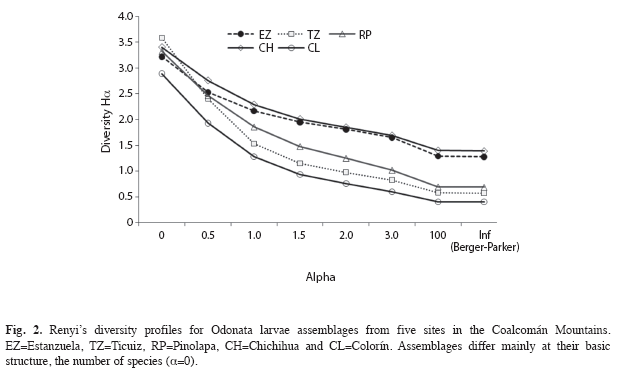
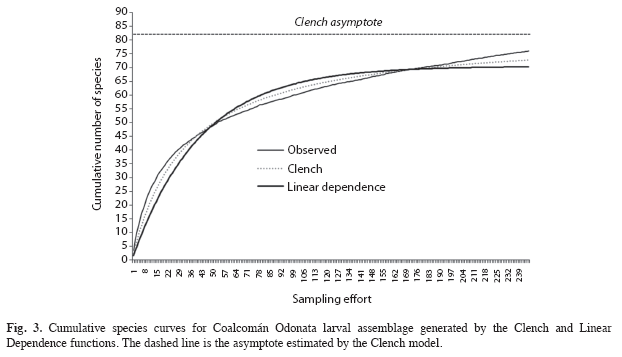
</front><body><![CDATA[ <div style="text-align: center;"><b><font face="Verdana" size="2"> <font size="+1">Diversity and distribution of Odonata (Insecta) larvae along an altitudinal gradient in Coalcom&aacute;n mountains, Michoac&aacute;n, Mexico</font></font></b>    <br> </div>     <p align="justify"><font face="Verdana" size="2">Jos&eacute; Antonio G&oacute;mez-Anaya<a href="#autor1"><sup><sub>1</sub></sup></a>, Rodolfo Novelo-Guti&eacute;rrez<a href="#autor1"><sup>1</sup></a> &amp; William Bruce Campbell<a href="#autor2"><sup>2</sup></a></font></p> <a name="autor1"></a><font face="Verdana" size="2">1. Instituto de Ecolog&iacute;a, A.C., Carretera Antigua a Coatepec 351, El Haya, 91070, Xalapa, Veracruz, Mexico; <a href="mailto:antonio.gomez@inecol.edu.mx">antonio.gomez@inecol.edu.mx</a>, <a href="mailto:rodolfo.novelo@inecol.edu.mx">rodolfo.novelo@inecol.edu.mx</a>    <br> <a name="autor2"></a>2. Cardno ENTRIX, 701 University Avenue, Suite 200, Sacramento, California, 95825, USA; </font><font  face="Verdana" size="2"><a href="mailto:bruce_campbell3@hotmail.com">bruce_campbell3@hotmail.com</a>    <br> </font>     <p align="justify"><font face="Verdana" size="2"><a  href="#correspondencia">Direcci&oacute;n para correspondencia</a>    <br> </font></p> <font size="2"> </font> <hr style="width: 100%; height: 2px;">     <p align="justify"><b><font face="Verdana" size="3">Abstract</font></b></p>     <div style="text-align: justify;"><font face="Verdana" size="2">Evaluating components of landscape diversity is essential for the implementation of efficient conservation strategies. We evaluated the diversity of Odonata larval assemblages from the Coalcom&aacute;n mountains (CM), Michoac&aacute;n, Mexico, and related it to local (site-level) habitat variables. Larvae were collected from shores, riffles and pools in five streams, counted and identified to species, twice per season during 2005. The Shannon Diversity Index (<i>H&#8217;</i>), Margalef&#8217;s Richness Index (<i>R</i>), Simpson&#8217;s Index as a dominance measure (<i>D</i>) and Pielou&#8217;s Equitability (<i>J</i>) were used to describe the assemblages, and Renyi&#8217;s Diversity Profiles were used to order diversity. A Bray-Curtis Similarity Index (BC) was used to evaluate beta diversity. Theoretical richness was estimated using non-parametric and parametric methods. A Canonical Correspondence Analysis (CCA) was applied to explore the relationships of species with site-level environmental variables. A total of 12 245 larvae from 75 species, 28 genera and 8 families were recorded. Over all sites, the dominant species were <i>Erpetogomphus elaps, Macrothemis pseudimitans </i>and <i>Argia pulla</i>. The number of species per locality ranged from 18 to 36, and a high number of species (76%) occurred with relative abundances lower than 1%. A differential distribution of species and abundance in streams, time and strata was observed. Renyi&#8217;s diversity profiles showed diversity was higher in spring and on shores. Most BC similarity values were smaller than 25%, indicating a high turnover rate in the CM. The high turnover rate reflects a differential distribution of the species along the altitudinal gradient, supporting the hypothesis of Mexico as a betadiverse country. According to the slope of Clench&#8217;s curve, a reliable list of species was gathered. The CM larval assemblage is currently the largest reported for Mexico, and our results support previous proposals of the CM as a species-rich area for conservation. Rev. Biol. Trop. 59 (4): 1559-1577. Epub 2011 December 01.</font></div>     <p align="justify"><font face="Verdana" size="2"><b>Key words: </b>dragonfly larvae, diversity, CCA, Coalcom&aacute;n Range, Michoac&aacute;n, Mexico.</font></p> <font face="Verdana" size="3"><b>     ]]></body>
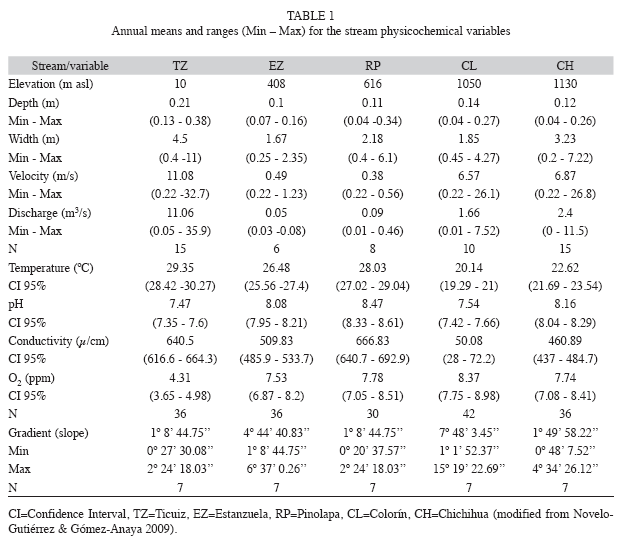
<body><![CDATA[<p align="justify">Resumen</p> </b></font><font size="2"> </font>     <p align="justify"><font face="Verdana" size="2">Evaluar los componentes de la diversidad de paisaje es una tarea esencial para implementar estrategias eficientes de conservaci&oacute;n. En este estudio se describe la variaci&oacute;n geogr&aacute;fica, temporal y por h&aacute;bitats de la diversidad de larvas de odonatos en un gradiente altitudinal en la sierra de Coalcom&aacute;n, Michoac&aacute;n, M&eacute;xico, y se explora su relaci&oacute;n con variables fisicoqu&iacute;micas locales. Presentamos diferentes &iacute;ndices de diversidad y gr&aacute;ficos de perfiles de diversidad de Renyi, as&iacute; como la riqueza te&oacute;rica por m&eacute;todos param&eacute;tricos y no param&eacute;tricos, el recambio de especies en la sierra y, mediante an&aacute;lisis can&oacute;nico de correspondencias (ACC) la relaci&oacute;n de las especies con las variables fisicoqu&iacute;micas. Recolectamos un total 12 245 larvas de 75 especies, 28 g&eacute;neros y 8 familias. En todos los h&aacute;bitats un alto n&uacute;mero de especies present&oacute; una abundancia inferior al 1%. El n&uacute;mero de especies en los arroyos vari&oacute; entre 18 y 36, existe adem&aacute;s un alto recambio en la sierra. La diversidad beta es un componente importante de la diversidad del paisaje; se apreci&oacute; una alternancia en la dominancia estacional entre anis&oacute;pteros y zyg&oacute;pteros y nuestros datos concuerdan con la hip&oacute;tesis del Mexico betadiverso y tambi&eacute;n apoya propuestas previas de conservaci&oacute;n de la sierra.</font></p>     <p style="text-align: left;"><font face="Verdana" size="2"><b>Palabras clave: </b>Odonata, larvas, diversidad, ACC, Sierra de Coalcom&aacute;n, Michoac&aacute;n, M&eacute;xico.</font></p>     <div style="text-align: left;"> <hr style="width: 100%; height: 2px;">     <p align="justify"><font face="Verdana" size="2">Given its topography, climatic diversity and geographical situation between two biogeographic regions (Neotropical and Nearctic), Mexico is a megadiverse country (Mittermeier <i>et al</i>. 1998). It is well known that the rate of species lost worldwide (Fraser <i>et al</i>. 1993) surpasses that by which taxonomic knowledge is increased. Thus, it is necessary to intensify studies focusing on diversity and from areas with an acceptable level of conservation.</font></p>     <p align="justify"><font face="Verdana" size="2">Presently, there are many taxonomic studies on larvae and imagoes of Mexican Odonata, but the ecological studies are relatively scarce, especially for short and long term evaluations on possible changes induced by human activities (e.g. climatic change). Additionally, ecological studies on richness and distribution at regional levels are few. It is well known that Odonata larvae are dependent on habitat characteristics (Watson <i>et al</i>. 1982), sensitive to abiotic factors, and play significant roles as predators and prey in the trophic structure of aquatic communities (Corbet 1999). They possess many desirable bioindicator qualities (Carle 1979, Samways 1993, Clark &amp; Samways 1996, Moore 1997, McGeoch 1998, Corbet 1999, Chovanec &amp; Waringer 2001, D&#8217;Amico <i>et al</i>. 2004), and many species have been used to study a variety of phenomena, such as tolerance to physicochemical factors (Carchini &amp; Rota 1985, Ferreras-Romero 1988, Rodr&iacute;guez 2003, Remsburg <i>et al</i>. 2008), accumulation of metals in larvae (Gupta 1995), effects of increased water temperature caused by nuclear reactors (Gentry <i>et al</i>. 1975, Thorp &amp; Diggins 1982), direct sewage discharge to rivers (Watson <i>et al</i>. 1982), pesticide contamination (Takamura <i>et al</i>. 1991, Hurtado-Gonz&aacute;lez <i>et al</i>. 2001), impact from cattle ranching on imago assemblages (Hornung &amp; Rice 2003, Foote &amp; Hornung 2005), relationships of assemblages with habitat characteristics (Castella 1987, Bul&aacute;nkov&aacute; 1997), and larvae as indicators of water quality (Trevino 1997), total richness (Sahl&eacute;n &amp; Ekestubbe 2001), and riparian quality (Smith <i>et al</i>. 2007). Several studies also have focused on their application in diversity and conservation assessment (Hawking &amp; New 2002, Clausnitzer 2003, Bried <i>et al</i>. 2007, Campbell &amp; Novelo-Guti&eacute;rrez 2007, Campbell <i>et al</i>. 2010).</font></p>     <p align="justify"><font face="Verdana" size="2">The objective of this study was to assess the variation of diversity in Odonata larval assemblages along an elevation gradient and their relation with stream habitat variables by season and habitat. Local and landscape information on assemblage diversity may be useful in supporting conservation efforts and in following short and long term changes in their diversity in the Coalcom&aacute;n Mountains.</font></p> <font face="Verdana" size="3"><b>     <p align="justify">Materials and methods</p> </b></font><font size="2"> </font></div>     <p style="text-align: justify;"><b><font face="Verdana" size="2">Study area: </font></b><font face="Verdana" size="2">The Coalcom&aacute;n Mountain Range (CM) in Michoac&aacute;n, Mexico, is located between 18&deg; 35&#8217;40"-19&deg;00&#8217;31" N and 102&deg;27&#8217;47"-103&deg;40&#8217;36" W. The climate is predominantly tropical (annual average temperature 26.5&deg;C), with a rainy period occurring in summer, and average annual precipitation ranging from 700mm in the lowlands to 1 300mm in the highlands (Antarami&aacute;n 2005). The CM is one of the least disturbed regions in Michoac&aacute;n. The studied assemblages are located in streams within Hydrological Priority Region 26 (R&iacute;o Coalcom&aacute;n and R&iacute;o Nexpa; Arriaga <i>et al</i>. 1998), and Terrestrial Priority Region 115 (Sierra de Coalcom&aacute;n; Arriaga <i>et al</i>. 2000) in Michoac&aacute;n State, Mexico. The sampled streams included Ticuiz (TZ), Estanzuela (EZ), R&iacute;o Pinolapa (RP), Color&iacute;n (CL) and Chichihua (CH). Details on water channels and averages of physicochemical data for the streams have been published by Novelo-Guti&eacute;rrez &amp; G&oacute;mez- Anaya (2009), and are summarized in <a href="/img/revistas/rbt/v59n4/a11t1.gif">Table 1</a>.    <br> </font></p>     ]]></body>
<body><![CDATA[<div style="text-align: justify;"><font face="Verdana" size="2"><b>Larval collection and physicochemical measures: </b>Larval sampling was conducted twice per season during 2005, as follows: February 17-21(winter); March 29-April 2 and May 31-June 4 (spring); July 6-10 and August 17-21 (summer); September 28-October 2 and November 8-12 (autumm) and January 18-22 (2006, winter). Larvae were collected during one day per stream, along a 500m stream segment using a D-frame aquatic net (0.2mm mesh). A stratified random sampling design was applied for stream margins, riffles and pools. A total of 12 samples were taken each time (3 samples in riffles, 3 samples in pools and the remaining 6 samples along margins). All samples were preserved in 96% ethanol with a replacement before 24h had elapsed. Odonata larvae were separated from the other fauna and stream debris using a stereomicroscope, counted and identified to species. All specimens were deposited in the Instituto de Ecolog&iacute;a, A.C., Entomological Collection (IEXA). Physicochemical data (pH, temperature, dissolved oxygen, and conductivity) were recorded during each trip using a digital water analyzer (ICM Model 51500, Industrial Chemical Measurement, Hillsboro, Oregon, USA). Stream width, depth and current velocity were measured using a metric power tape and a digital flow meter (Global Water Flow Probe, Forestry Suppliers, Jackson, Mississippi, USA). At each point where we measured the stream&#8217;s width, several measures of water depth and velocity were taken and averaged to calculate discharge as: width x average depth x average current velocity. Finally, gradient was calculated according to Resh <i>et al</i>. (1996).</font></div>     <p style="text-align: justify;"><font face="Verdana" size="2">For data analysis a one-way analysis of variance (ANOVA) was used to analyze the effect of stream on gradient, and a two-way multivariate analysis of variance (MANOVA) was applied to analyze the effect of stream and season on physicochemical variables. If significant effects were detected, we performed multiple comparisons using the Bonferroni <i>t</i>-test. All tests were performed using STATISTICA (StatSoft 2006).</font></p>     <div style="text-align: justify;"><font face="Verdana" size="2"><b>Diversity indices: </b>Richness and composition, Shannon Diversity Index (<i>H&#8217;</i>), Margalef&#8217;s Richness Index (<i>R</i>), Simpson&#8217;s Diversity Index as a dominance measure (<i>D</i>), and Pielou&#8217;s Equitability (<i>J</i>) (Moreno 2001) were used to describe the assemblages. To compare the diversity of the streams, Renyi&#8217;s profiles were generated (T&oacute;thm&eacute;r&eacute;sz 1995, 1998, Southwood &amp; Henderson 2000, Jakab <i>et al</i>. 2002) because they include the logarithm of species number, <i>H&#8217;</i>, <i>D</i>, and the logarithm of Berger-Parker diversity (T&oacute;thm&eacute;r&eacute;sz 1995). The profiles also have a scale parameter (</font><font face="Verdana" size="2">&#945;</font><font  face="Verdana" size="2">) such that when the value of the parameter is low, the method is extremely sensitive to the presence of rare species, but as the value of the parameter increases, the profile becomes less sensitive. As a large scale parameter, the method is sensitive only to the more frequent species. The result of this scale-dependent characterization of diversity can be presented in graphic form to visualize relationships among communities: the community&#8217;s diversity profile&#8217;. If the curves of two diversity profiles intersect, then one of the communities is more diverse for rare species, while the other is more diverse for frequent species.</font>    <br> </div> <font face="Verdana" size="2">    <br> </font>     <div style="text-align: justify;"><font face="Verdana" size="2"><b>Gamma richness estimation: </b>An estimation of the theoretical richness using nonparametric methods (presence/absence: Chao2, Jack2, Bootstrap; abundance: ACE, Chao1) was carried out using Estimate<i>S </i>8.0 (Colwell 2006). Additionally, parametric methods (richness estimators that use the observed species accumulation curve for modeling the addition of new species by extrapolation in relation to sampling effort) also were applied (Palmer 1990, Sober&oacute;n &amp; Llorente 1993), and included Clench&#8217;s (Clench 1979) and Linear Dependence (von Bertalanffy 1938) models, as well as the slope of the cumulative species curve to assess the completeness of assemblages (Jim&eacute;nez-Valverde &amp; Hortal 2003, Hortal &amp; Lobo 2005). Slopes were obtained by means of the first derivative of Clench&#8217;s and Linear Dependence functions (Novelo-Guti&eacute;rrez &amp; G&oacute;mez-Anaya 2009).</font></div>     <p style="text-align: justify;"><font face="Verdana" size="2"><b>Classification and ordination: </b>Cluster Analysis (CA) on a Bray-Curtis (BC) similarity matrix with unpaired group mean average (UPGMA) amalgamation was used to explore faunal similarities among streams and seasons. This analysis was performed using PC-ORD v4.5 (McCune &amp; Grace 2002). Additionally, a Canonical Correspondence Analysis (CCA) (CANOCO for Windows v4.5) was used to relate transformed species abundance [log(y+1)] to environmental variables (ter Braak 1986). The number of environmental variables was then reduced using the automatic forward selection option in CANOCO. Variables explaining most of the variation in the data were used to construct the final model. The statistical significance of the relationship between species and environmental variables was tested using a Monte Carlo permutation test (n=499), with an F-ratio as the sum of all eigenvalues for the test statistic (ter Braak &amp; Prentice 1988, ter Braak &amp; Smilauer 2002).</font></p>     <div style="text-align: left;"><font face="Verdana" size="3"><b>     <p align="justify">Results</p> </b></font></div>     <p style="text-align: justify;"><b><font face="Verdana" size="2">Physicochemical variables: </font></b><font face="Verdana" size="2">Streams had significantly different gradients (slopes) (oneway ANOVA: F4, 30=10.17, p&lt;0.01), and the Bonferroni paired <i>t-</i>test with multiple comparisons indicated that CL (Color&iacute;n) had the highest slope while RP (Pinolapa) and TZ (Ticuiz) had the lowest (<a  href="/img/revistas/rbt/v59n4/a11t1.gif">Table 1</a>). There was a significant difference among streams (one-way MANOVA: Wilk&#8217;s lambda= 0.46, F16, 141=2.53, p&lt;0.05) for width, depth, current velocity and discharge. The Bonferroni paired <i>t</i>-tests showed differences in depth and discharge for TZ with CH (Chichihua), EZ (Estanzuela) and RP. There was a significant difference in width between TZ and CL, while significant differences in current velocity were observed for TZ with EZ and RP. A two-way MANOVA showed a significant effect of stream (F16, 480.3=228.8, p&lt;0.05), seasons (F12, 415.7 =182.2, p&lt;0.05) and their interaction (F48, 606.8=17.6, p&lt;0.05) on physicochemical variables. A Bonferroni paired <i>t</i>-test showed significant differences (p&lt;0.05) in temperature among streams, except that of RP to EZ and TZ. Sites CL and CH exhibited the lowest average temperatures, 20.14&ordm;C and 22.62&ordm;C, respectively, while the highest were those of TZ (29.35 &ordm;C) and RP (28.03&ordm;C). Most of the Bonferroni contrasts were significant for pH, except those between CH-EZ and CL-TZ, and all sampling sites had a basic pH. The Bonferroni contrasts for temperature among seasons showed significant differences between autumn-spring, autumn-summer and springsummer. The average winter temperature was lower than that for the other seasons (<a  href="/img/revistas/rbt/v59n4/a11t2.gif">Table 2</a>). Most of the paired comparisons for conductivity showed significant differences among sites (p&lt;0.05), except those between EZ and CH, and between RP and TZ. CL exhibited the lowest average value of all streams (50.08</font><font face="Verdana" size="2">&#956;</font><font  face="Verdana" size="2">/cm). There was no significant difference in conductivity among seasons (p<i>&gt;</i>0.05). The Bonferroni contrasts for oxygen showed significant differences between TZ and the other four streams, and between EZ and CL, while there was no difference between RP-CL, RP-EZ, or between CH-CL and EZ-RP. The average oxygen concentration of TZ was lowest (4.31ppm) compared to other sites. The contrasts indicated that the seasons are very different for oxygen concentration, except during spring-summer.</font></p>     ]]></body>
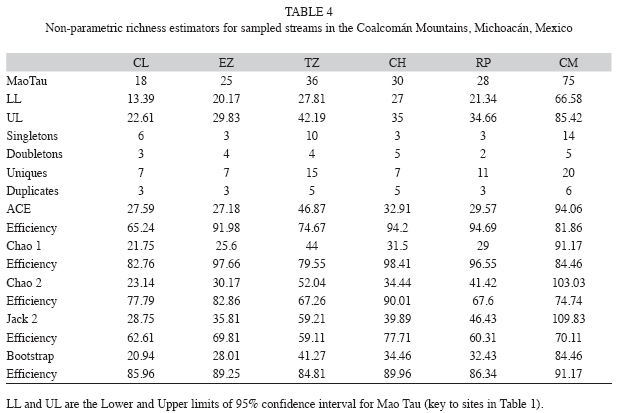
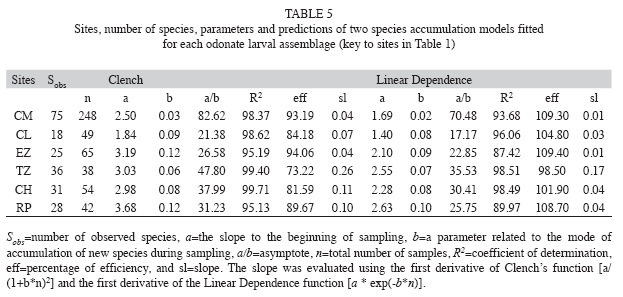
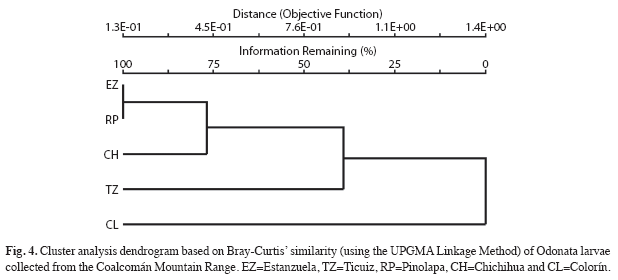
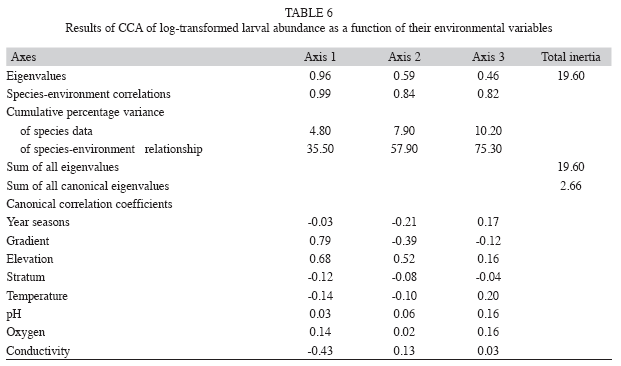
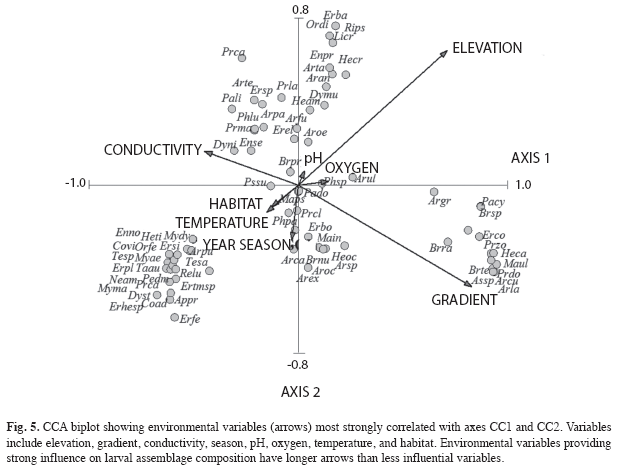
<body><![CDATA[<p style="text-align: justify;"><font face="Verdana" size="2"><b>Assemblage composition: </b>A total of 12 245 larvae from 75 species, 28 genera and 8 families were collected in 380 samples (<a  href="/img/revistas/rbt/v59n4/a11t3.gif">Table 3</a>). Numerically dominant species were <i>Erpetogomphus elaps </i>(24.8%), <i>Macrothemis pseudimitans </i>(12.2%) and <i>Argia pulla </i>(10.2%) (<a  href="/img/revistas/rbt/v59n4/a11i1.jpg">Fig. 1</a>). Most species (76%) had a relative abundance lower than 1%. The number of species ranged from 18 (CL) to 36 (TZ), and the highest relative abundance was 37.77% (EZ), while the lowest was 6.15% (CL).</font></p>     <p style="text-align: justify;"><font face="Verdana" size="2"><b>Diversity: </b><i>H&#8217; </i>for CM was 4.11, higher than any stream individually, and ranged from 1.85 (CL) to 3.31 (CH). CH and EZ had the highest site values (3.31 and 3.13, respectively), <i>J </i>ranged from 0.43 (TZ) to 0.67 (CH and EZ), <i>D </i>from 0.16 (EZ and CH) to 0.47 (CL), and <i>R </i>was highest in TZ (4.44), and lowest in CL (2.57) and EZ (2.84). According to Renyi&#8217;s profiles, diversity at CH was the highest and that for CL the lowest. The order of diversity by stream was CH&gt;EZ&gt;RP&gt;TZ&gt;CL (<a href="/img/revistas/rbt/v59n4/a11i2.jpg">Fig. 2</a>).</font></p>     <p style="text-align: justify;"><font face="Verdana" size="2"><b>Seasonal assemblages: </b>In spring, 54 species were recorded (22 Zygoptera and 32 Anisoptera), with <i>Argia pulla </i>(27.9%) dominating, followed by <i>Hetaerina capitalis </i>(13.1%) and <i>Erpetogomphus elaps </i>(10%). During summer, 42 species were recorded (21 Zygoptera and 21 Anisoptera), and <i>A. pulla </i>(37.3%) was again dominant, followed by <i>Argia oenea </i>(8.9%) and <i>E. elaps </i>(5%). During autumn, 54 species were recorded (17 Zygoptera and 37 Anisoptera), and <i>Macrothemis pseudimitans </i>(22%), <i>E. elaps </i>(18.4%), and <i>Phyllogomphoides apiculatus </i>(12%) were dominant. During winter, 49 species were recorded (23 Zygoptera and 26 Anisoptera), <i>E. elaps </i>(45.9%) dominated, followed by <i>Brechmorhoga praecox </i>(9.6%), <i>A. oenea </i>(6.7%) and <i>A. pulla </i>(6.1%). Abundance was highest in autumn (47.14%), followed by winter (31.07%), spring (15.77%) and summer (6.03%). <i>H&#8217; </i>varied from 2.26 (winter) to 2.71 (autumn), <i>J </i>varied from 0.58 (winter) to 0.68 (summer) and autumn, <i>R </i>was higher in spring (7.01) and lower in winter (5.70). Renyi&#8217;s diversity profiles showed that diversity declined from spring&gt;summer&gt;autumn&gt;winter.</font></p>     <p style="text-align: justify;"><font face="Verdana" size="2"><b>Habitat assemblages: </b>The observed number of species was highest along stream margins (59: 25 Zygoptera and 34 Anisoptera) and in riffles (50: 16 Zygoptera and 35 Anisoptera), and lowest in pools (23: 9 Zygoptera and 15 Anisoptera). Dominant species along stream margins were <i>Erpetogomphus elaps </i>(19.31%), followed by <i>Argia pulla </i>(12.39%) and <i>Macrothemis pseudimitans </i>(12.36%). In riffles, dominant species were <i>E. elaps </i>(37.70%), followed by <i>Brechmorhoga praecox </i>(16.59%) and <i>Argia oenea </i>(9.24%). Finally, dominant species in pools were <i>E. elaps </i>(63.37%), followed by <i>Hetaerina capitalis </i>(13.10%) and <i>Phyllogomphoides luisi </i>(11.23%). Abundance was similar along stream margins (48.01%) and riffles (46.36%), but was the poorest in pools (5.63%). Indexes <i>R </i>and <i>J </i>were higher along stream margins (6.98 and 0.72, respectively) than in riffles (5.93 and 0.60) or pools (3.57 and 0.59). <i>H&#8217; </i>was slightly higher along stream margins (2.98), followed by riffles (2.35) and pools (1.86). <i>D </i>was higher in pools (0.28) than in riffles (0.19) and stream margins (0.09). Renyi&#8217;s profiles showed that diversity of stream margins was the highest followed by riffles and pools</font></p>     <p style="text-align: justify;"><font face="Verdana" size="2"><b>Non-parametric estimators of gamma richness: </b>The estimates using Chao2, Jack2, Bootstrap and MaoTau were 103, 109.8, 84.5, and 76 species, respectively, yielding sampling efficiencies of 72.8%, 68.3%, 88.8% and 98.6%, respectively (<a href="/img/revistas/rbt/v59n4/a11t4.gif">Table 4</a>). These estimators predicted 9 to 34 species were missing from the list for the CM. The upper MaoTau limit predicted 85.4 species (87.8% efficiency) with 10 potential additional species. However, the non-parametric richness estimators that used abundance data (Chao1, ACE) estimated 91.2 and 94.1 species, respectively, yielding 82.3% and 79.7% sampling efficiencies. These estimators predicted 16 and 19 potential additional species. The best local estimation of richness was made by Chao 1 (EZ, CH, RP) and by Bootstrap (CL, TZ) yielding higher sampling efficiencies.</font></p>     <p style="text-align: justify;"><font face="Verdana" size="2"><b>Parametric models: </b>The Clench function fits the data better for each stream and for the CM (<a href="/img/revistas/rbt/v59n4/a11i3.jpg">Fig. 3</a>,<span  style="font-weight: bold;"> </span><a  href="/img/revistas/rbt/v59n4/a11t5.gif">Table 5</a>), with <i>R2 </i>ranging from 95.13% (RP) to 99.71% (CH) among streams, and being 98.37% for the CM. The theoretical number of missing species ranged from 2 (EZ) to 13 (TZ) among streams, and 8 for the CM. Curve slopes ranged from 0.04 (EZ) to 0.26 (TZ) among streams, and 0.04 for the CM.</font></p>     <div style="text-align: justify;"><font face="Verdana" size="2"><b>Cluster analysis: </b>Color&iacute;n (CL) separated first at a major distance (<a  href="/img/revistas/rbt/v59n4/a11i4.jpg">Fig. 4</a>), followed by Ticuiz (TZ). The CL fauna was the poorest, where <i>Hetaerina capitalis </i>dominated (almost 75% of the total abundance), and with many (55.56%) rare species (species with relative abundance less than 1%). TZ was the stream with the largest number of observed species, most (80.56%) of which were rare. Overall turnover rate was less than 25%, except in EZ-RP (48%). Considering the seasonal assemblages, the cluster analysis shows the formation of two groups of contiguous seasons: the first one formed by spring+summer and the second one for autumn+winter. The first group had the assemblages with the highest number of species and abundance, where the dominant species were the zygopterans <i>Argia pulla</i>, <i>H. capitalis </i>and <i>A. oenea</i>; while in the second group the anisopterans <i>Macrothemis pseudimitans </i>and <i>Erpetogomphus elaps </i>were dominant.</font></div>     <p style="text-align: justify;"><font face="Verdana" size="2"><b>Species-environment relationships: </b>The results of CCA were globally significant (trace=2.66, F=4.04, p=0.002, <a  href="/img/revistas/rbt/v59n4/a11t6.gif">Table 6</a>). The first three axes accounted for most of the variability (75.3%) for physiochemical variables and species abundance (inertia=19.60). The first canonical axis was statistically significant (eigenvalue=0.945, F=11.90, p=0.002) and explained 35.5% of the variance, while the second and third axes explained 22.4% and 17.4%, respectively. The most important environmental variables explaining larval variation were determined from axis correlations, with gradient and elevation exerting the strongest influence on axes 1 and 2, and axis 1 also influenced by conductivity to yield three putative groups (<a  href="/img/revistas/rbt/v59n4/a11i5.jpg">Fig. 5</a>).</font></p>     <div style="text-align: left;"><font face="Verdana" size="3"><b>     <p align="justify">Discussion</p> </b></font></div>     ]]></body>
<body><![CDATA[<p style="text-align: justify;"><font face="Verdana" size="2">As commonly occurs in Mexico, more Anisoptera (62.67%) were observed than Zygoptera (37.33%), and the Libellulidae and Coenagrionidae predominated (19 and 29 species, respectively) with the genus <i>Argia </i>having the most species (14) (Alonso-Egu&iacute;a Lis 2004, G&oacute;mez-Anaya <i>et al</i>. 2000, Novelo-Guti&eacute;rrez &amp; Gonz&aacute;lez-Soriano 1991, Novelo-Guti&eacute;rrez <i>et al</i>. 2002, Bond <i>et al</i>. 2006). However, some variation in the proportion of Anisoptera to Zygoptera species was observed: while the number of observed Anisoptera species was similar to that for Zygoptera in CH, CL and EZ, in RP and TZ five and nine more Anisoptera species were recorded, respectively. The extreme differences in number of species presented by TZ and CL can be explained because TZ possesses a mixed lotic-lentic environment, is low in altitude, open and sunny, has floating water lilies, <i>Eichhornia crassipes </i>(Mart. Solms), and submerged (<i>Egeria </i>sp.) macrophytes, and is exposed to continuous human impact. Our results could be explained by the intermediate disturbance hypothesis (Connell 1978) which states that diversity is low after a disturbance, when only a few species have survived or few colonizing species dominate under the new environmental conditions. Diversity is high when disturbances occur at an intermediate frequency or with intermediate intensity. In this respect, frequent dragging in the TZ channel to extract gravel can be regarded as a disturbance since it alters the habitat. Furthermore, dragging generates medium sized lentic habitats which are mainly occupied by opportunistic libellulids such as <i>Erythrodiplax, Erythemis, Miathyria, Micrathyria,Orthemis, </i>and <i>Perithemis</i>, increasing TZ diversity.</font></p>     <p style="text-align: justify;"><font face="Verdana" size="2">CL, on the other hand, is located in a ravine at medium altitude, is small in size and almost fully covered by riparian vegetation, is a stream structured as successive terraces, and has negligible human impact. These results support other studies showing species richness to be positively correlated with stream size and canopy openness (Kinvig &amp; Samways 2000, Clausnitzer 2003, Dijkstra &amp; Lempert 2003, Campbell <i>et al</i>. 2010).</font></p>     <p style="text-align: justify;"><font face="Verdana" size="2">The number of species among streams, and their abundance and numeric dominance also exhibited temporal variation. In the dendrogram generated by the CA, abundance and number of species were highest in the spring+summer assemblage, and were dominated by the zygopterans <i>Argia pulla</i>, <i>H. capitalis </i>and <i>A. oenea</i>, while the autumn+winter group had the lowest number of species and abundance was dominated by the anisopterans <i>Macrothemis pseudimitans </i>and <i>Erpetogomphus elaps</i>. The alteration in larval dominance may be related to the presence or absence of predators, with dominance by large anisopterans when predatory fish are absent, and by smaller zygopterans when predatory fish are present (Mikolajewski &amp; Johansson 2004). Large anisopteran larvae are more conspicuous to predators than smaller zygopterans.</font></p>     <p style="text-align: justify;"><font face="Verdana" size="2">Our ordering of diversity was based on Renyi&#8217;s profiles (T&oacute;thm&eacute;r&eacute;sz 1995) which have been proposed as an efficient method for comparisons (Southwood &amp; Henderson 2000), although infrequently used as such on the diversity of aquatic macroinvertebrate assemblages (e.g. Sipkay <i>et al</i>. 2007), and even less so for Odonata assemblages (e.g. Jakab <i>et al</i>. 2002). This lack of use may occur because this method involves more calculations than that for simple diversity indices (T&oacute;thm&eacute;r&eacute;sz 1995). The idea of ordering diversity was first proposed by Patil &amp; Taillie (1977, 1979) and Solomon (1979). By adding a new dimension to the ecological approach of diversity, it connects with the implications of proposals for diversity conservation that focus on recognizing areas of high diversity. We found this tool useful in comparing the diversity of Odonata larval assemblages within the CM. Using this method, we have shown that diversity at CL was the lowest, and that for CH the highest, with the latter being an ecologically preserved area in the state of Michoac&aacute;n. Among habitats, Renyi&#8217;s profiles showed that the highest diversity occurred along stream margins, compared to riffles or pools, even when stream margins and riffles were almost equal in abundance, 4 044 and 3 905, respectively. Additionally, different dominant species were observed among habitats, with <i>E. elaps </i>mainly recorded from riffles and <i>M. pseudimitans </i>and <i>A. pulla </i>mainly from stream margins. Finally, Renyi&#8217;s profiles showed a gradual decrease in seasonal diversity, spring&gt;summer&gt;autumn&gt;winter, without intercrossing of profiles. </font></p>     <p style="text-align: justify;"><font face="Verdana" size="2">Beta diversity has been poorly evaluated for Mexican invertebrates (Sober&oacute;n <i>et al. </i>2005, Escobar 2005, Favila 2005, Noguez <i>et al. </i>2005). Species turnover is the least studied and understood component of diversity, even though conservation efforts promote great interest in its evaluation (Gaston &amp; Blackburn 2000). There is an inverse relationship between regional beta diversity and the species distributions in a region (Harrison <i>et al</i>. 1992). If the species from a given region have small areas of distribution, such that sites differ in species composition, then a high beta diversity results. However, if species are widely distributed over most of the region, then sites will be more similar to each other in species composition, resulting in low beta diversity (Arita &amp; Le&oacute;n-Paniagua 1993, Scott <i>et al</i>. 1999; see also Campbell <i>et al</i>. 2010). In our study, beta diversity was evaluated as the complement of BC, a key element in understanding the relationship between the diversity in the CM (regional or gamma diversity), and diversity of each stream at the local, or alpha level (Cornell &amp; Lawton 1992, Ricklefs &amp; Schluter 1993). Most species showed a restricted distribution in the CM, which suggests a high turnover rate, a conclusion supported by the fact that most of the Bray-Curtis paired similarities were smaller than 25%. Hence, beta diversity is an important component of gamma diversity among these sites (Novelo-Guti&eacute;rrez &amp; G&oacute;mez-Anaya 2009). Our results also support the betadiverse Mexico hypothesis (Arita &amp; Le&oacute;n-Paniagua 1993, Sarukh&aacute;n <i>et al</i>. 1996), a result of high environmental heterogeneity in the CM. From the point of view of biological conservation, beta diversity is an important component that should be taken into account in the establishment of efficient conservation strategies of particular natural areas and/or species (Scott <i>et al</i>. 1999).</font></p>     <p style="text-align: justify;"><font face="Verdana" size="2">Considering that observed gamma diversity for the CM comes from sampling, we estimated the theoretical true gamma by using several non-parametric and parametric richness estimators. We used Clench&#8217;s model because it has been used often and it better fits this kind of data. For the non-parametric estimators we used both incidence and abundance data, because there is no strong recommendation for a particular one. According to the sampling efficiency Chao1 performed better for EZ, CH and RP, while Bootstrap performed better for TZ, CL, and over all sampled sites. On the other hand, Clench&#8217;s model better fit the data based on the coefficient of determination (<i>R</i>2), and we assessed the completeness of our Odonata larval lists using the slope of the curve at maximum effort for the extrapolation estimators provided by the first derivative of both the Clench and Linear Dependence functions. According to these values, the most complete lists were those with small slopes, where the increasing rate of species additions tended toward zero. These values agreed well with the fact that sampling effort was highest at EZ (n=65) where the lowest slope was found to be associated with the highest sampling efficiency and just two missing species. On the other hand, the number of species collected at TZ yielded 73.22% efficiency and 12 potentially missing species. These observations agree with the fact that a negative and significant correlation between the number of species collected and slope was observed (r=-0.76, p&lt;0.05), and also between slope and percentage efficiency (r=-0.90, p&lt;0.05).</font></p>     <p style="text-align: justify;"><font face="Verdana" size="2">Our CCA results show that larval abundance is primarily associated with elevation and stream slope. This observation is consistent with Hofmann &amp; Mason (2005) and Sato &amp; Riddiford (2008) who observed that current velocity is one of the most important factors related to the distribution and abundance of Odonata. As gradient (slope) increases with elevation, so does current velocity, leading to reduced species richness. Several studies have revealed odonate species richness declines with increasing altitude (Borisov 1987, Samways 1989, Vick 1989, Campbell <i>et al</i>. 2010), and in some places few or no Odonata occur above 2 000m (Laidlaw 1934). However, the size of a regional assemblage over a broad spatial area is a function of slope, latitude and altitude (Corbet 1999), as well as local factors such as stream morphology, aquatic vegetation, riparian coverage and physicochemical variables. The separation of CL first in <a  href="/img/revistas/rbt/v59n4/a11i5.jpg">Fig. 5</a> could be a result of such local differences. Among the sites surveyed, we found most species at 10m.a.s.l. (TZ), and the fewest at 1 050m.a.s.l. (CL). Campbell <i>et al</i>. (2010) calculated a Pearson correlation coefficient between elevation and species richness for all CM windward sites as r=-0.92 (p&gt;0.05). Even though they revealed a decline with increasing elevation, the marginal insignificance of the correlation was due to the low number of sites surveyed (n=3). Yet, despite the marginal insignificance, average taxonomic distinctness (a measure of phylogenetic diversity; e.g. Warwick &amp; Clarke 1995, Clarke &amp; Warwick 1998) was significantly and negatively correlated with observed species richness, suggesting the decline in species richness with elevation is real. It is known that altitude-related changes in species composition usually entail a progressive disappearance of the more abundant species at higher altitudes, although some taxa can have their centers of distribution at high and intermediate altitudes (Corbet 1999). In the CM we observed <i>Hetaerina capitalis </i>as the most common species at CL (1 050m, see <a  href="/img/revistas/rbt/v59n4/a11t2.gif">Table 2</a>), decreasing notably in larval abundance at CH (1 130m), while other species also present at CL such as <i>Progomphus zonatus, Brechmorhoga tepeaca </i>and <i>Macrothemis ultima </i>also decreased or disappeared in CH. Larvae from these four species were not found at lower elevations. We also observed that a higher number of species of Gomphidae (10 out of a total of 13), as well as most of the abundance of this family (more than 90%, but primarily from <i>Erpetogomphus elaps</i>) was recorded at intermediate altitudes, between 408m.a.s.l. and 560m.a.s.l. Notwithstanding, <i>Erpetogomphus elaps </i>was the most abundant and widespread species in the CM, its highest larval abundance occurred at 152m.a.s.l. On the other hand, Libellulidae were better represented with 22 species (from a total of 29) below 560m.a.s.l. Only 12 species from this family were recorded as larvae above 1 000m.a.s.l.; <i>Brechmorhoga tepeaca, Dythemis multipunctata, Macrothemis ultima </i>and <i>Paltothemis cyanosoma </i>were recorded exclusively above 1 000m.a.s.l. In contrast with Hoffmann (1991) who reported a predominance of species of <i>Rhionaeschna </i>(Aeshnidae) at higher elevations in the Peruvian Andes, this family was not well represented in the CM either in number of species or abundance. While most Coenagrionidae species were recorded at CH (11 out of a total of 19); two species, <i>Argia cuprea </i>and <i>A. lacrimans, </i>were exclusively recorded from 1 050m.a.s.l. (CL).</font></p>     <div style="text-align: justify;"><font face="Verdana" size="2">Finally, recommendations for the conservation of odonate diversity in the CM are based on the high beta diversity observed and on stream quality; as shown in the CCA analyses where it was possible to incorporate characteristics of local microhabitats. The conserved vegetation cover and the negligible human impact in CL are, for example, important factors to consider (Buchwald 1992, Remsburg <i>et al</i>. 2008). Alteration of plant cover could change the aquatic microclimate and lead to changes in Odonata diversity (e.g. Samways &amp; Sharratt 2009, Campbell <i>et al</i>. 2010). The CL fauna, although minor in assemblage size, comprises a particular group of infrequent species: <i>Argia cuprea, A. lacrimans, Aeshna williamsoniana </i>and <i>Paltothemis cyanosoma</i>, all of which occurred uniquely in this locality. Other species such as <i>Hetaerina capitalis, Erpetogomphus cophias, Progomphus zonatus, Brechmorhoga tepeaca </i>and <i>Macrothemis ultima </i>have their maximum and almost exclusive records at this site. It is feasible that their association with stream slope may be based on associations with conserved canopy, small size, shallow runs, small to moderate sized pools and sand banks with rough grains. This opens some questions: What is the importance of the ravines like CL as shelters for these infrequent species in a broader scale (e.g. in all the Michoac&aacute;n Mountain Ranges?) Are the odonate assemblages different in each ravine increasing the beta diversity? Our results support the suggestion for locally based conservation efforts along the windward transect (e.g. Campbell <i>et al</i>. 2010), and support proposals describing the CM as a biologically rich area for conservation.</font></div> <font face="Verdana" size="3"><b>     <p align="justify">Acknowledgments</p> </b></font><font size="2"> </font><font face="Verdana" size="2">     <p align="justify">Financial support was provided to RNG by Comisi&oacute;n Nacional de Ciencia y Tecnolog&iacute;a (CONACyT) grant 43091-Q.</p> </font><b><font size="2"> </font></b> <hr style="width: 100%; height: 2px;"><b><font face="Verdana" size="3">     ]]></body>
<body><![CDATA[<p align="justify">References</p> </font></b><font size="2"> </font>     <!-- ref --><p align="justify"><font face="Verdana" size="2">Alonso-Egu&iacute;a Lis, P.E. 2004. Ecolog&iacute;a de las asociaciones de Odonata en la zona de influencia de las microcuencas afectadas por la presa Zimap&aacute;n, Quer&eacute;taro e Hidalgo. Tesis Doctoral, Universidad Aut&oacute;noma de Quer&eacute;taro, M&eacute;xico.    &nbsp;&nbsp;&nbsp;&nbsp;&nbsp;&nbsp;&nbsp;&nbsp;[&#160;<a href="javascript:void(0);" onclick="javascript: window.open('/scielo.php?script=sci_nlinks&ref=1750827&pid=S0034-7744201100040001100001&lng=','','width=640,height=500,resizable=yes,scrollbars=1,menubar=yes,');">Links</a>&#160;]<!-- end-ref --></font></p>     <!-- ref --><p align="justify"><font face="Verdana" size="2">Antarami&aacute;n, H.E. 2005. Descripci&oacute;n f&iacute;sica y bi&oacute;tica. Clima, p. 25-28. <i>In </i>L.E. Villase&ntilde;or-G (ed.). La Biodiversidad en Michoac&aacute;n. Estudio de Estado. CONABIO-SUMA-MSNH, M&eacute;xico.    &nbsp;&nbsp;&nbsp;&nbsp;&nbsp;&nbsp;&nbsp;&nbsp;[&#160;<a href="javascript:void(0);" onclick="javascript: window.open('/scielo.php?script=sci_nlinks&ref=1750829&pid=S0034-7744201100040001100002&lng=','','width=640,height=500,resizable=yes,scrollbars=1,menubar=yes,');">Links</a>&#160;]<!-- end-ref --></font></p>     <!-- ref --><p align="justify"><font face="Verdana" size="2">Arita, H.T. &amp; L. Le&oacute;n-Paniagua. 1993. Diversidad de mam&iacute;feros terrestres. Ciencias (n&uacute;mero especial) 7: 13-22.    &nbsp;&nbsp;&nbsp;&nbsp;&nbsp;&nbsp;&nbsp;&nbsp;[&#160;<a href="javascript:void(0);" onclick="javascript: window.open('/scielo.php?script=sci_nlinks&ref=1750831&pid=S0034-7744201100040001100003&lng=','','width=640,height=500,resizable=yes,scrollbars=1,menubar=yes,');">Links</a>&#160;]<!-- end-ref --></font></p>     <!-- ref --><p align="justify"><font face="Verdana" size="2">Arriaga, L., V. Aguilar, J. Alcocer, R. Jim&eacute;nez, E. Mu&ntilde;oz &amp; E. V&aacute;zquez. 1998. Regiones hidrol&oacute;gicas prioritarias. Escala de trabajo 1:4 000,000. Comisi&oacute;n Nacional para el Conocimiento y Uso de la Biodiversidad, M&eacute;xico.    &nbsp;&nbsp;&nbsp;&nbsp;&nbsp;&nbsp;&nbsp;&nbsp;[&#160;<a href="javascript:void(0);" onclick="javascript: window.open('/scielo.php?script=sci_nlinks&ref=1750833&pid=S0034-7744201100040001100004&lng=','','width=640,height=500,resizable=yes,scrollbars=1,menubar=yes,');">Links</a>&#160;]<!-- end-ref --></font></p>     <!-- ref --><p align="justify"><font face="Verdana" size="2">Arriaga, L., J.M. Espinoza, C. Aguilar, E. Mart&iacute;nez, L. G&oacute;mez &amp; E. Loa. 2000<i>. </i>Regiones terrestres prioritarias de M&eacute;xico. Escala de trabajo 1:1 000,000. Comisi&oacute;n Nacional para el Conocimiento y Uso de la Biodiversidad, M&eacute;xico.    &nbsp;&nbsp;&nbsp;&nbsp;&nbsp;&nbsp;&nbsp;&nbsp;[&#160;<a href="javascript:void(0);" onclick="javascript: window.open('/scielo.php?script=sci_nlinks&ref=1750835&pid=S0034-7744201100040001100005&lng=','','width=640,height=500,resizable=yes,scrollbars=1,menubar=yes,');">Links</a>&#160;]<!-- end-ref --></font></p>     <!-- ref --><p align="justify"><font face="Verdana" size="2">Bond, J.G., R. Novelo-Guti&eacute;rrez, A. Ulloa, J.C. Rojas, H. Quiroz-Mart&iacute;nez &amp; T. Williams. 2006. Diversity, abundance, and disturbance response of Odonata associated with breeding sites of <i>Anopheles pseudopunctipennis </i>(Diptera: Culicidae) in Southern Mexico. Environ. Entomol. 35: 1561-1568.    &nbsp;&nbsp;&nbsp;&nbsp;&nbsp;&nbsp;&nbsp;&nbsp;[&#160;<a href="javascript:void(0);" onclick="javascript: window.open('/scielo.php?script=sci_nlinks&ref=1750837&pid=S0034-7744201100040001100006&lng=','','width=640,height=500,resizable=yes,scrollbars=1,menubar=yes,');">Links</a>&#160;]<!-- end-ref --> </font></p>     <!-- ref --><p align="justify"><font face="Verdana" size="2">Borisov, S.M. 1987. Ecology of two closely related dragonfly species in Tajikistan. Ekologiya 1: 85-87.    &nbsp;&nbsp;&nbsp;&nbsp;&nbsp;&nbsp;&nbsp;&nbsp;[&#160;<a href="javascript:void(0);" onclick="javascript: window.open('/scielo.php?script=sci_nlinks&ref=1750839&pid=S0034-7744201100040001100007&lng=','','width=640,height=500,resizable=yes,scrollbars=1,menubar=yes,');">Links</a>&#160;]<!-- end-ref --></font></p>     <!-- ref --><p align="justify"><font face="Verdana" size="2">Bried, J.T., B.D. Herman &amp; G.N. Ervin. 2007. Umbrella potential of plants and dragonflies for wetland conservation: a quantitative case study using the umbrella index. J. Appl. Ecol. 44: 833-842.    &nbsp;&nbsp;&nbsp;&nbsp;&nbsp;&nbsp;&nbsp;&nbsp;[&#160;<a href="javascript:void(0);" onclick="javascript: window.open('/scielo.php?script=sci_nlinks&ref=1750841&pid=S0034-7744201100040001100008&lng=','','width=640,height=500,resizable=yes,scrollbars=1,menubar=yes,');">Links</a>&#160;]<!-- end-ref --></font></p>     <!-- ref --><p align="justify"><font face="Verdana" size="2">Buchwald, R. 1992. Vegetation and dragonfly fauna characteristics and examples of biocenological field studies. Vegetatio 101: 99-107.    &nbsp;&nbsp;&nbsp;&nbsp;&nbsp;&nbsp;&nbsp;&nbsp;[&#160;<a href="javascript:void(0);" onclick="javascript: window.open('/scielo.php?script=sci_nlinks&ref=1750843&pid=S0034-7744201100040001100009&lng=','','width=640,height=500,resizable=yes,scrollbars=1,menubar=yes,');">Links</a>&#160;]<!-- end-ref --></font></p>     <!-- ref --><p align="justify"><font face="Verdana" size="2">Bul&aacute;nkov&aacute;, E. 1997. Dragonflies (Odonata) as bioindicators of environmental quality. Biol&oacute;gia (Bratislava) 52: 177-180.    &nbsp;&nbsp;&nbsp;&nbsp;&nbsp;&nbsp;&nbsp;&nbsp;[&#160;<a href="javascript:void(0);" onclick="javascript: window.open('/scielo.php?script=sci_nlinks&ref=1750845&pid=S0034-7744201100040001100010&lng=','','width=640,height=500,resizable=yes,scrollbars=1,menubar=yes,');">Links</a>&#160;]<!-- end-ref --></font></p>     <!-- ref --><p align="justify"><font face="Verdana" size="2">Campbell, W.B. &amp; R. Novelo-Guti&eacute;rrez. 2007. Reduction in odonate phylogenetic diversity associated with dam impoundment is revealed using taxonomic distinctness. Fund. Appl. Limnol. 168: 83-92.    &nbsp;&nbsp;&nbsp;&nbsp;&nbsp;&nbsp;&nbsp;&nbsp;[&#160;<a href="javascript:void(0);" onclick="javascript: window.open('/scielo.php?script=sci_nlinks&ref=1750847&pid=S0034-7744201100040001100011&lng=','','width=640,height=500,resizable=yes,scrollbars=1,menubar=yes,');">Links</a>&#160;]<!-- end-ref --></font></p>     <!-- ref --><p align="justify"><font face="Verdana" size="2">Campbell, W.B., R. Novelo-Guti&eacute;rrez &amp; J.A. G&oacute;mez-Anaya. 2010. Distributions of odonate richness and diversity with elevation depend on windward and leeward aspects: implications for research and conservation planning. Insect. Conserv. Diver. 3: 302-312.    &nbsp;&nbsp;&nbsp;&nbsp;&nbsp;&nbsp;&nbsp;&nbsp;[&#160;<a href="javascript:void(0);" onclick="javascript: window.open('/scielo.php?script=sci_nlinks&ref=1750849&pid=S0034-7744201100040001100012&lng=','','width=640,height=500,resizable=yes,scrollbars=1,menubar=yes,');">Links</a>&#160;]<!-- end-ref --></font></p>     <!-- ref --><p align="justify"><font face="Verdana" size="2">Carchini, G. &amp; E. Rota. 1985. Chemico-physical data on the habitats of rheophile Odonata from Central Italy. Odonatologica 14: 239-245.    &nbsp;&nbsp;&nbsp;&nbsp;&nbsp;&nbsp;&nbsp;&nbsp;[&#160;<a href="javascript:void(0);" onclick="javascript: window.open('/scielo.php?script=sci_nlinks&ref=1750851&pid=S0034-7744201100040001100013&lng=','','width=640,height=500,resizable=yes,scrollbars=1,menubar=yes,');">Links</a>&#160;]<!-- end-ref --></font></p>     <!-- ref --><p align="justify"><font face="Verdana" size="2">Carle, F.L. 1979. Environmental monitoring potential of the Odonata, with a list of rare and endangered Anisoptera of Virginia, United States. Odonatologica 8: 319-323.    &nbsp;&nbsp;&nbsp;&nbsp;&nbsp;&nbsp;&nbsp;&nbsp;[&#160;<a href="javascript:void(0);" onclick="javascript: window.open('/scielo.php?script=sci_nlinks&ref=1750853&pid=S0034-7744201100040001100014&lng=','','width=640,height=500,resizable=yes,scrollbars=1,menubar=yes,');">Links</a>&#160;]<!-- end-ref --></font></p>     <!-- ref --><p align="justify"><font face="Verdana" size="2">Castella, E. 1987. Larval Odonata distribution as a describer of fluvial ecosystems: the Rh&ocirc;ne and Ain Rivers, France. <i>Adv. </i>Odonatol. 3: 23-40.    &nbsp;&nbsp;&nbsp;&nbsp;&nbsp;&nbsp;&nbsp;&nbsp;[&#160;<a href="javascript:void(0);" onclick="javascript: window.open('/scielo.php?script=sci_nlinks&ref=1750855&pid=S0034-7744201100040001100015&lng=','','width=640,height=500,resizable=yes,scrollbars=1,menubar=yes,');">Links</a>&#160;]<!-- end-ref --></font></p>     <!-- ref --><p align="justify"><font face="Verdana" size="2">Chovanec, A. &amp; J.A. Waringer. 2001. Ecological integrity of river floodplain systems - assessment by dragonfly surveys (Insecta: Odonata). Regul. Rivers 17: 493-507.    &nbsp;&nbsp;&nbsp;&nbsp;&nbsp;&nbsp;&nbsp;&nbsp;[&#160;<a href="javascript:void(0);" onclick="javascript: window.open('/scielo.php?script=sci_nlinks&ref=1750857&pid=S0034-7744201100040001100016&lng=','','width=640,height=500,resizable=yes,scrollbars=1,menubar=yes,');">Links</a>&#160;]<!-- end-ref --></font></p>     <!-- ref --><p align="justify"><font face="Verdana" size="2">Clark, T.E. &amp; M.J. Samways. 1996. Dragonflies (Odonata) as indicators of biotope quality in the Kruger National Park, South Africa. J. Appl. Ecol. 33: 1001-1012.    &nbsp;&nbsp;&nbsp;&nbsp;&nbsp;&nbsp;&nbsp;&nbsp;[&#160;<a href="javascript:void(0);" onclick="javascript: window.open('/scielo.php?script=sci_nlinks&ref=1750859&pid=S0034-7744201100040001100017&lng=','','width=640,height=500,resizable=yes,scrollbars=1,menubar=yes,');">Links</a>&#160;]<!-- end-ref --></font></p>     <!-- ref --><p align="justify"><font face="Verdana" size="2">Clarke, K.R. &amp; R.M. Warwick. 1998. A taxonomic distinctness index and its statistical properties. J. Appl. Ecol. 35: 523-531.    &nbsp;&nbsp;&nbsp;&nbsp;&nbsp;&nbsp;&nbsp;&nbsp;[&#160;<a href="javascript:void(0);" onclick="javascript: window.open('/scielo.php?script=sci_nlinks&ref=1750861&pid=S0034-7744201100040001100018&lng=','','width=640,height=500,resizable=yes,scrollbars=1,menubar=yes,');">Links</a>&#160;]<!-- end-ref --></font></p>     <!-- ref --><p align="justify"><font face="Verdana" size="2">Clausnitzer, V. 2003. Dragonfly communities in coastal habitats of Kenya: indication of biotope quality and the need of conservation measures. Biodivers. Conserv. 12: 333-356.    &nbsp;&nbsp;&nbsp;&nbsp;&nbsp;&nbsp;&nbsp;&nbsp;[&#160;<a href="javascript:void(0);" onclick="javascript: window.open('/scielo.php?script=sci_nlinks&ref=1750863&pid=S0034-7744201100040001100019&lng=','','width=640,height=500,resizable=yes,scrollbars=1,menubar=yes,');">Links</a>&#160;]<!-- end-ref --></font></p>     <!-- ref --><p align="justify"><font face="Verdana" size="2">Clench, H. 1979. How to make regional lists of butterflies: some thoughts. J. Lepid. Soc. 33: 216-231.    &nbsp;&nbsp;&nbsp;&nbsp;&nbsp;&nbsp;&nbsp;&nbsp;[&#160;<a href="javascript:void(0);" onclick="javascript: window.open('/scielo.php?script=sci_nlinks&ref=1750865&pid=S0034-7744201100040001100020&lng=','','width=640,height=500,resizable=yes,scrollbars=1,menubar=yes,');">Links</a>&#160;]<!-- end-ref --></font></p>     <!-- ref --><p align="justify"><font face="Verdana" size="2">Colwell, R.K. 2006. Estimate<i>S</i>: statistical estimation of species richness and shared species from samples. Version 8.0. Department of Ecology and Evolutionary Biology, University of Connecticut, USA. (User&#8217;s guide and application published at: <a href="http://purl.oclc.org/estimates">http://purl.oclc.org/estimates</a>).    &nbsp;&nbsp;&nbsp;&nbsp;&nbsp;&nbsp;&nbsp;&nbsp;[&#160;<a href="javascript:void(0);" onclick="javascript: window.open('/scielo.php?script=sci_nlinks&ref=1750867&pid=S0034-7744201100040001100021&lng=','','width=640,height=500,resizable=yes,scrollbars=1,menubar=yes,');">Links</a>&#160;]<!-- end-ref --></font></p>     <!-- ref --><p align="justify"><font face="Verdana" size="2">Connell, J.H. 1978. Diversity in tropical rain forests and coral reefs. Science 199: 1304-1310.    &nbsp;&nbsp;&nbsp;&nbsp;&nbsp;&nbsp;&nbsp;&nbsp;[&#160;<a href="javascript:void(0);" onclick="javascript: window.open('/scielo.php?script=sci_nlinks&ref=1750869&pid=S0034-7744201100040001100022&lng=','','width=640,height=500,resizable=yes,scrollbars=1,menubar=yes,');">Links</a>&#160;]<!-- end-ref --></font></p>     <!-- ref --><p align="justify"><font face="Verdana" size="2">Corbet, P.S. 1999. Dragonflies. Behaviour and ecology of Odonata. Cornell University, Ithaca, New York, USA.    &nbsp;&nbsp;&nbsp;&nbsp;&nbsp;&nbsp;&nbsp;&nbsp;[&#160;<a href="javascript:void(0);" onclick="javascript: window.open('/scielo.php?script=sci_nlinks&ref=1750871&pid=S0034-7744201100040001100023&lng=','','width=640,height=500,resizable=yes,scrollbars=1,menubar=yes,');">Links</a>&#160;]<!-- end-ref --></font></p>     <!-- ref --><p align="justify"><font face="Verdana" size="2">Cornell, H.V. &amp; J.H. Lawton. 1992. Species interactions, local and regional processes, and limits to the richness of ecological communities: a theoretical perspective. J. Anim. Ecol. 61: 1-12.    &nbsp;&nbsp;&nbsp;&nbsp;&nbsp;&nbsp;&nbsp;&nbsp;[&#160;<a href="javascript:void(0);" onclick="javascript: window.open('/scielo.php?script=sci_nlinks&ref=1750873&pid=S0034-7744201100040001100024&lng=','','width=640,height=500,resizable=yes,scrollbars=1,menubar=yes,');">Links</a>&#160;]<!-- end-ref --></font></p>     <!-- ref --><p align="justify"><font face="Verdana" size="2">D&#8217;Amico, F., S. Darblade, S. Avignon, S. Blanc-Manel &amp; S.J. Ormerod. 2004. Odonates as indicators of shallow lake restoration by liming: comparing adult and larval responses. Restor. Ecol. 12: 439-446.    &nbsp;&nbsp;&nbsp;&nbsp;&nbsp;&nbsp;&nbsp;&nbsp;[&#160;<a href="javascript:void(0);" onclick="javascript: window.open('/scielo.php?script=sci_nlinks&ref=1750875&pid=S0034-7744201100040001100025&lng=','','width=640,height=500,resizable=yes,scrollbars=1,menubar=yes,');">Links</a>&#160;]<!-- end-ref --></font></p>     <!-- ref --><p align="justify"><font face="Verdana" size="2">Dijkstra, K-D.B. &amp; J. Lempert. 2003. Odonate assemblages of running waters in the Upper Guinean forest. Arch. Hydrobiol. 157: 397-412.    &nbsp;&nbsp;&nbsp;&nbsp;&nbsp;&nbsp;&nbsp;&nbsp;[&#160;<a href="javascript:void(0);" onclick="javascript: window.open('/scielo.php?script=sci_nlinks&ref=1750877&pid=S0034-7744201100040001100026&lng=','','width=640,height=500,resizable=yes,scrollbars=1,menubar=yes,');">Links</a>&#160;]<!-- end-ref --></font></p>     <!-- ref --><p align="justify"><font face="Verdana" size="2">Escobar, F. 2005. Diversidad, distribuci&oacute;n y uso de h&aacute;bitat de los escarabajos del esti&eacute;rcol (Coleoptera: Scarabaeideae: Scarabaeinae) en monta&ntilde;as de la Regi&oacute;n Neotropical. Tesis de Doctorado, Instituto de Ecolog&iacute;a, A.C, Xalapa, M&eacute;xico.    &nbsp;&nbsp;&nbsp;&nbsp;&nbsp;&nbsp;&nbsp;&nbsp;[&#160;<a href="javascript:void(0);" onclick="javascript: window.open('/scielo.php?script=sci_nlinks&ref=1750879&pid=S0034-7744201100040001100027&lng=','','width=640,height=500,resizable=yes,scrollbars=1,menubar=yes,');">Links</a>&#160;]<!-- end-ref --></font></p>     <!-- ref --><p align="justify"><font face="Verdana" size="2">Favila, M.E. 2005. Diversidad alfa y beta de los escarabajos del esti&eacute;rcol (Scarabaeinae) en Los Tuxtlas, M&eacute;xico, p. 209-219. <i>In </i>G. Halffter, J. Sober&oacute;n, P. Koleff &amp; A. Melic. Sobre diversidad biol&oacute;gica: el significado de las diversidades alfa, beta y gamma. Monograf&iacute;as Tercer Milenio, Sociedad Entomol&oacute;gica Aragonesa, Zaragoza, Espa&ntilde;a.    &nbsp;&nbsp;&nbsp;&nbsp;&nbsp;&nbsp;&nbsp;&nbsp;[&#160;<a href="javascript:void(0);" onclick="javascript: window.open('/scielo.php?script=sci_nlinks&ref=1750881&pid=S0034-7744201100040001100028&lng=','','width=640,height=500,resizable=yes,scrollbars=1,menubar=yes,');">Links</a>&#160;]<!-- end-ref --></font></p>     <!-- ref --><p align="justify"><font face="Verdana" size="2">Ferreras-Romero, M. 1988. New data on the ecological tolerance of some rheophilous Odonata in Mediterranean Europe (Sierra Morena, Southern Spain). Odonatologica 17: 121-126.    &nbsp;&nbsp;&nbsp;&nbsp;&nbsp;&nbsp;&nbsp;&nbsp;[&#160;<a href="javascript:void(0);" onclick="javascript: window.open('/scielo.php?script=sci_nlinks&ref=1750883&pid=S0034-7744201100040001100029&lng=','','width=640,height=500,resizable=yes,scrollbars=1,menubar=yes,');">Links</a>&#160;]<!-- end-ref --></font></p>     <!-- ref --><p align="justify"><font face="Verdana" size="2">Foote, A.L. &amp; C.L.R. Hornung. 2005. Odonates as biological indicators of grazing effects of Canadian prairie wetlands. Ecol. Entomol. 30: 273-283.    &nbsp;&nbsp;&nbsp;&nbsp;&nbsp;&nbsp;&nbsp;&nbsp;[&#160;<a href="javascript:void(0);" onclick="javascript: window.open('/scielo.php?script=sci_nlinks&ref=1750885&pid=S0034-7744201100040001100030&lng=','','width=640,height=500,resizable=yes,scrollbars=1,menubar=yes,');">Links</a>&#160;]<!-- end-ref --></font></p>     <!-- ref --><p align="justify"><font face="Verdana" size="2">Fraser, D.M.S., R.M. May, R. Pellew, T.H. Johnson &amp; K.R. Walter. 1993. How much do we know about the current extinction rate? Trends Ecol. Evol. 8: 75-378.    &nbsp;&nbsp;&nbsp;&nbsp;&nbsp;&nbsp;&nbsp;&nbsp;[&#160;<a href="javascript:void(0);" onclick="javascript: window.open('/scielo.php?script=sci_nlinks&ref=1750887&pid=S0034-7744201100040001100031&lng=','','width=640,height=500,resizable=yes,scrollbars=1,menubar=yes,');">Links</a>&#160;]<!-- end-ref --></font></p>     <!-- ref --><p align="justify"><font face="Verdana" size="2">Gaston, K.J. &amp; T.M. Blackburn. 2000. Pattern and process in Macroecology. Blackwell Science, Oxford, United Kingdom.    &nbsp;&nbsp;&nbsp;&nbsp;&nbsp;&nbsp;&nbsp;&nbsp;[&#160;<a href="javascript:void(0);" onclick="javascript: window.open('/scielo.php?script=sci_nlinks&ref=1750889&pid=S0034-7744201100040001100032&lng=','','width=640,height=500,resizable=yes,scrollbars=1,menubar=yes,');">Links</a>&#160;]<!-- end-ref --></font></p>     <!-- ref --><p align="justify"><font face="Verdana" size="2">Gentry, J.B., C.T. Garten, F.G. Howell &amp; M.H. Smith. 1975. Thermal ecology of dragonflies in habitats receiving reactor effluent, p. 563-574. <i>In </i>Environmental effect of cooling systems at nuclear power plants. International Atomic Energy Agency, Vienna, Austria.    &nbsp;&nbsp;&nbsp;&nbsp;&nbsp;&nbsp;&nbsp;&nbsp;[&#160;<a href="javascript:void(0);" onclick="javascript: window.open('/scielo.php?script=sci_nlinks&ref=1750891&pid=S0034-7744201100040001100033&lng=','','width=640,height=500,resizable=yes,scrollbars=1,menubar=yes,');">Links</a>&#160;]<!-- end-ref --></font></p>     <!-- ref --><p align="justify"><font face="Verdana" size="2">G&oacute;mez-Anaya, J.A., R. Novelo-Guti&eacute;rrez &amp; R. Arce-P&eacute;rez. 2000. Odonata de la zona de influencia de la Central Hidroel&eacute;ctrica "Ing. Fernando Hiriart Balderrama" (P.H. Zimap&aacute;n), Hidalgo, M&eacute;xico. Folia Entomol. Mexic. 108: 1-34.    &nbsp;&nbsp;&nbsp;&nbsp;&nbsp;&nbsp;&nbsp;&nbsp;[&#160;<a href="javascript:void(0);" onclick="javascript: window.open('/scielo.php?script=sci_nlinks&ref=1750893&pid=S0034-7744201100040001100034&lng=','','width=640,height=500,resizable=yes,scrollbars=1,menubar=yes,');">Links</a>&#160;]<!-- end-ref --></font></p>     <!-- ref --><p align="justify"><font face="Verdana" size="2">Gupta, A. 1995. Metal accumulation and loss by <i>Crocothemis servilia </i>(Drury) in a small lake in Shillong northeastern India (Anisoptera: Libellulidae). Odonatologica 24: 283-289.    &nbsp;&nbsp;&nbsp;&nbsp;&nbsp;&nbsp;&nbsp;&nbsp;[&#160;<a href="javascript:void(0);" onclick="javascript: window.open('/scielo.php?script=sci_nlinks&ref=1750895&pid=S0034-7744201100040001100035&lng=','','width=640,height=500,resizable=yes,scrollbars=1,menubar=yes,');">Links</a>&#160;]<!-- end-ref --></font></p>     <!-- ref --><p align="justify"><font face="Verdana" size="2">Harrison, S., S. Ross &amp; J.H. Lawton. 1992. Beta diversity on geographic gradients in Britain. J. Anim. Ecol. 67: 151-158.    &nbsp;&nbsp;&nbsp;&nbsp;&nbsp;&nbsp;&nbsp;&nbsp;[&#160;<a href="javascript:void(0);" onclick="javascript: window.open('/scielo.php?script=sci_nlinks&ref=1750897&pid=S0034-7744201100040001100036&lng=','','width=640,height=500,resizable=yes,scrollbars=1,menubar=yes,');">Links</a>&#160;]<!-- end-ref --></font></p>     <!-- ref --><p align="justify"><font face="Verdana" size="2">Hawking, J.H. &amp; T.R. New. 2002. Interpreting dragonfly diversity to aid in conservation assessment: lessons from the Odonata assemblage at Middle Creek, north-eastern Victoria, Australia. J. Insect. Conservat. 6: 171-178.    &nbsp;&nbsp;&nbsp;&nbsp;&nbsp;&nbsp;&nbsp;&nbsp;[&#160;<a href="javascript:void(0);" onclick="javascript: window.open('/scielo.php?script=sci_nlinks&ref=1750899&pid=S0034-7744201100040001100037&lng=','','width=640,height=500,resizable=yes,scrollbars=1,menubar=yes,');">Links</a>&#160;]<!-- end-ref --></font></p>     <!-- ref --><p align="justify"><font face="Verdana" size="2">Hoffmann, J. 1991. The distribution of the aeshnids (Anisoptera) in the Peruvian Andes. <i>In </i>11th International Symposium of Odonatology, Trevi, Italia.    &nbsp;&nbsp;&nbsp;&nbsp;&nbsp;&nbsp;&nbsp;&nbsp;[&#160;<a href="javascript:void(0);" onclick="javascript: window.open('/scielo.php?script=sci_nlinks&ref=1750901&pid=S0034-7744201100040001100038&lng=','','width=640,height=500,resizable=yes,scrollbars=1,menubar=yes,');">Links</a>&#160;]<!-- end-ref --></font></p>     <!-- ref --><p align="justify"><font face="Verdana" size="2">Hofmann, T.A. &amp; C.F. Mason. 2005. Habitat characteristics and the distribution of Odonata in a lowland river catchment in eastern England. Hydrobiologia 539: 137-147.    &nbsp;&nbsp;&nbsp;&nbsp;&nbsp;&nbsp;&nbsp;&nbsp;[&#160;<a href="javascript:void(0);" onclick="javascript: window.open('/scielo.php?script=sci_nlinks&ref=1750903&pid=S0034-7744201100040001100039&lng=','','width=640,height=500,resizable=yes,scrollbars=1,menubar=yes,');">Links</a>&#160;]<!-- end-ref --></font></p>     <!-- ref --><p align="justify"><font face="Verdana" size="2">Hornung, J.P. &amp; C.L. Rice. 2003. Odonata and wetland quality in southern Alberta, Canada: a preliminary study. Odonatologica 32: 119-129.    &nbsp;&nbsp;&nbsp;&nbsp;&nbsp;&nbsp;&nbsp;&nbsp;[&#160;<a href="javascript:void(0);" onclick="javascript: window.open('/scielo.php?script=sci_nlinks&ref=1750905&pid=S0034-7744201100040001100040&lng=','','width=640,height=500,resizable=yes,scrollbars=1,menubar=yes,');">Links</a>&#160;]<!-- end-ref --></font></p>     <!-- ref --><p align="justify"><font face="Verdana" size="2">Hortal, J. &amp; J.M. Lobo. 2005. An ED-based protocol for optimal sampling of biodiversity. Biodivers. Conserv. 14: 2913-2947.    &nbsp;&nbsp;&nbsp;&nbsp;&nbsp;&nbsp;&nbsp;&nbsp;[&#160;<a href="javascript:void(0);" onclick="javascript: window.open('/scielo.php?script=sci_nlinks&ref=1750907&pid=S0034-7744201100040001100041&lng=','','width=640,height=500,resizable=yes,scrollbars=1,menubar=yes,');">Links</a>&#160;]<!-- end-ref --></font></p>     <!-- ref --><p align="justify"><font face="Verdana" size="2">Hurtado-Gonz&aacute;lez, S., M.A. Rico &amp; P.J. Guti&eacute;rrez-Yurrita. 2001. Efecto del Malati&oacute;n (insecticida organofosforado) sobre los insectos acu&aacute;ticos de los afluentes de la Presa Zimap&aacute;n, Quer&eacute;taro-Hidalgo. XXX Congreso Nacional de Ciencias Fisiol&oacute;gicas, Monterrey, Nuevo Le&oacute;n, M&eacute;xico.    &nbsp;&nbsp;&nbsp;&nbsp;&nbsp;&nbsp;&nbsp;&nbsp;[&#160;<a href="javascript:void(0);" onclick="javascript: window.open('/scielo.php?script=sci_nlinks&ref=1750909&pid=S0034-7744201100040001100042&lng=','','width=640,height=500,resizable=yes,scrollbars=1,menubar=yes,');">Links</a>&#160;]<!-- end-ref --></font></p>     <!-- ref --><p align="justify"><font face="Verdana" size="2">Jakab, T., Z. M&uuml;ller, G.Y. D&eacute;vai &amp; B. T&oacute;thm&eacute;r&eacute;sz. 2002. Dragonfly assemblages of a shallow lake type reservoir (Tisza-T&oacute;, Hungary) and its surroundings. Acta Zool. Hung. 48: 161-171.    &nbsp;&nbsp;&nbsp;&nbsp;&nbsp;&nbsp;&nbsp;&nbsp;[&#160;<a href="javascript:void(0);" onclick="javascript: window.open('/scielo.php?script=sci_nlinks&ref=1750911&pid=S0034-7744201100040001100043&lng=','','width=640,height=500,resizable=yes,scrollbars=1,menubar=yes,');">Links</a>&#160;]<!-- end-ref --></font></p>     <!-- ref --><p align="justify"><font face="Verdana" size="2">Jim&eacute;nez-Valverde, A. &amp; J. Hortal. 2003. Las curvas de acumulaci&oacute;n de especies y la necesidad de evaluar la calidad de los inventarios biol&oacute;gicos. Rev. Ib&eacute;r. Arachnol. 8: 151-161.    &nbsp;&nbsp;&nbsp;&nbsp;&nbsp;&nbsp;&nbsp;&nbsp;[&#160;<a href="javascript:void(0);" onclick="javascript: window.open('/scielo.php?script=sci_nlinks&ref=1750913&pid=S0034-7744201100040001100044&lng=','','width=640,height=500,resizable=yes,scrollbars=1,menubar=yes,');">Links</a>&#160;]<!-- end-ref --></font></p>     <!-- ref --><p align="justify"><font face="Verdana" size="2">Kinvig, R.G. &amp; M.J. Samways. 2000. Conserving dragonflies (Odonata) along streams running through commercial forestry. Odonatologica 29: 195-208.    &nbsp;&nbsp;&nbsp;&nbsp;&nbsp;&nbsp;&nbsp;&nbsp;[&#160;<a href="javascript:void(0);" onclick="javascript: window.open('/scielo.php?script=sci_nlinks&ref=1750915&pid=S0034-7744201100040001100045&lng=','','width=640,height=500,resizable=yes,scrollbars=1,menubar=yes,');">Links</a>&#160;]<!-- end-ref --></font></p>     <!-- ref --><p align="justify"><font face="Verdana" size="2">Laidlaw, F.F. 1934. Notes on some Oriental dragonflies (Odonata), with description of a new species. Stylops 3: 99-103.    &nbsp;&nbsp;&nbsp;&nbsp;&nbsp;&nbsp;&nbsp;&nbsp;[&#160;<a href="javascript:void(0);" onclick="javascript: window.open('/scielo.php?script=sci_nlinks&ref=1750917&pid=S0034-7744201100040001100046&lng=','','width=640,height=500,resizable=yes,scrollbars=1,menubar=yes,');">Links</a>&#160;]<!-- end-ref --></font></p>     <!-- ref --><p align="justify"><font face="Verdana" size="2">McCune, B. &amp; J.B. Grace. 2002. Analysis of ecological communities. MjM Software, Gleneden Beach, Oregon, USA.    &nbsp;&nbsp;&nbsp;&nbsp;&nbsp;&nbsp;&nbsp;&nbsp;[&#160;<a href="javascript:void(0);" onclick="javascript: window.open('/scielo.php?script=sci_nlinks&ref=1750919&pid=S0034-7744201100040001100047&lng=','','width=640,height=500,resizable=yes,scrollbars=1,menubar=yes,');">Links</a>&#160;]<!-- end-ref --></font></p>     <!-- ref --><p align="justify"><font face="Verdana" size="2">McGeoch, M.A. 1998. The selection, testing and application of terrestrial insects as bioindicators. Biol. Rev. 73: 181-201.    &nbsp;&nbsp;&nbsp;&nbsp;&nbsp;&nbsp;&nbsp;&nbsp;[&#160;<a href="javascript:void(0);" onclick="javascript: window.open('/scielo.php?script=sci_nlinks&ref=1750921&pid=S0034-7744201100040001100048&lng=','','width=640,height=500,resizable=yes,scrollbars=1,menubar=yes,');">Links</a>&#160;]<!-- end-ref --></font></p>     <!-- ref --><p align="justify"><font face="Verdana" size="2">Mittermeier, R.A., N. Myers &amp; J.B. Thomsen. 1998. Biodiversity hotspots and major tropical wilderness areas: approaches to setting conservation priorities. Conservat. Biol. 12: 516-520.    &nbsp;&nbsp;&nbsp;&nbsp;&nbsp;&nbsp;&nbsp;&nbsp;[&#160;<a href="javascript:void(0);" onclick="javascript: window.open('/scielo.php?script=sci_nlinks&ref=1750923&pid=S0034-7744201100040001100049&lng=','','width=640,height=500,resizable=yes,scrollbars=1,menubar=yes,');">Links</a>&#160;]<!-- end-ref --></font></p>     <!-- ref --><p align="justify"><font face="Verdana" size="2">Mikolajewski, D.J. &amp; F. Johansson. 2004. Morphological and behavioral defenses in dragonfly larvae: trait compensation and cospecialization. Behav. Ecol. 4: 614-620.    &nbsp;&nbsp;&nbsp;&nbsp;&nbsp;&nbsp;&nbsp;&nbsp;[&#160;<a href="javascript:void(0);" onclick="javascript: window.open('/scielo.php?script=sci_nlinks&ref=1750925&pid=S0034-7744201100040001100050&lng=','','width=640,height=500,resizable=yes,scrollbars=1,menubar=yes,');">Links</a>&#160;]<!-- end-ref --></font></p>     <!-- ref --><p align="justify"><font face="Verdana" size="2">Moore, N.W. 1997. Status survey and conservation action plan. Dragonflies. IUCN/SSC Odonata Specialist Group, IUCN, Gland and Cambridge, United Kingdom.    &nbsp;&nbsp;&nbsp;&nbsp;&nbsp;&nbsp;&nbsp;&nbsp;[&#160;<a href="javascript:void(0);" onclick="javascript: window.open('/scielo.php?script=sci_nlinks&ref=1750927&pid=S0034-7744201100040001100051&lng=','','width=640,height=500,resizable=yes,scrollbars=1,menubar=yes,');">Links</a>&#160;]<!-- end-ref --></font></p>     <!-- ref --><p align="justify"><font face="Verdana" size="2">Moreno, C.E. 2001. M&eacute;todos para medir la biodiversidad. M&amp;T-Manuales y Tesis SEA, Zaragoza, Espa&ntilde;a.    &nbsp;&nbsp;&nbsp;&nbsp;&nbsp;&nbsp;&nbsp;&nbsp;[&#160;<a href="javascript:void(0);" onclick="javascript: window.open('/scielo.php?script=sci_nlinks&ref=1750929&pid=S0034-7744201100040001100052&lng=','','width=640,height=500,resizable=yes,scrollbars=1,menubar=yes,');">Links</a>&#160;]<!-- end-ref --></font></p>     <!-- ref --><p align="justify"><font face="Verdana" size="2">Noguez, A.M., H.T. Arita, A.E. Escalante, L.J. Forney, F. Garc&iacute;a-Oliva &amp; V. Souza. 2005. Microbial macroecology: highly structured prokaryotic soil assemblages in a tropical deciduous forest. Global Ecol. Biogeogr. 14: 241-248.    &nbsp;&nbsp;&nbsp;&nbsp;&nbsp;&nbsp;&nbsp;&nbsp;[&#160;<a href="javascript:void(0);" onclick="javascript: window.open('/scielo.php?script=sci_nlinks&ref=1750931&pid=S0034-7744201100040001100053&lng=','','width=640,height=500,resizable=yes,scrollbars=1,menubar=yes,');">Links</a>&#160;]<!-- end-ref --></font></p>     <!-- ref --><p align="justify"><font face="Verdana" size="2">Novelo-Guti&eacute;rrez, R. &amp; E. Gonz&aacute;lez-Soriano. 1991. Odonata de la Reserva de la Biosfera "La Michil&iacute;a", Durango, M&eacute;xico. Parte II. Larvas. Folia Entomol. Mex. 81: 107-164.    &nbsp;&nbsp;&nbsp;&nbsp;&nbsp;&nbsp;&nbsp;&nbsp;[&#160;<a href="javascript:void(0);" onclick="javascript: window.open('/scielo.php?script=sci_nlinks&ref=1750933&pid=S0034-7744201100040001100054&lng=','','width=640,height=500,resizable=yes,scrollbars=1,menubar=yes,');">Links</a>&#160;]<!-- end-ref --></font></p>     <!-- ref --><p align="justify"><font face="Verdana" size="2">Novelo-Guti&eacute;rrez, R. &amp; J.A. G&oacute;mez-Anaya. 2009. A comparative study of Odonata (Insecta) assemblages along an altitudinal gradient in the Sierra de Coalcom&aacute;n Mountains, Michoac&aacute;n, Mexico. Biodivers. Conserv. 18: 679-698.    &nbsp;&nbsp;&nbsp;&nbsp;&nbsp;&nbsp;&nbsp;&nbsp;[&#160;<a href="javascript:void(0);" onclick="javascript: window.open('/scielo.php?script=sci_nlinks&ref=1750935&pid=S0034-7744201100040001100055&lng=','','width=640,height=500,resizable=yes,scrollbars=1,menubar=yes,');">Links</a>&#160;]<!-- end-ref --></font></p>     <!-- ref --><p align="justify"><font face="Verdana" size="2">Novelo-Guti&eacute;rrez, R., J.A. G&oacute;mez-Anaya &amp; R. Arce-P&eacute;rez. 2002. Community structure of Odonata larvae in two streams in Zimap&aacute;n, Hidalgo, Mexico. Odonatologica 31: 273-286.    &nbsp;&nbsp;&nbsp;&nbsp;&nbsp;&nbsp;&nbsp;&nbsp;[&#160;<a href="javascript:void(0);" onclick="javascript: window.open('/scielo.php?script=sci_nlinks&ref=1750937&pid=S0034-7744201100040001100056&lng=','','width=640,height=500,resizable=yes,scrollbars=1,menubar=yes,');">Links</a>&#160;]<!-- end-ref --></font></p>     <!-- ref --><p align="justify"><font face="Verdana" size="2">Palmer, M.W. 1990. The estimation of species richness by extrapolation. Ecology 71: 1195-1198.    &nbsp;&nbsp;&nbsp;&nbsp;&nbsp;&nbsp;&nbsp;&nbsp;[&#160;<a href="javascript:void(0);" onclick="javascript: window.open('/scielo.php?script=sci_nlinks&ref=1750939&pid=S0034-7744201100040001100057&lng=','','width=640,height=500,resizable=yes,scrollbars=1,menubar=yes,');">Links</a>&#160;]<!-- end-ref --></font></p>     <!-- ref --><p align="justify"><font face="Verdana" size="2">Patil, G.P. &amp; C. Taillie. 1977. Diversity as a concept and its implications for random communities. Bull. Int. Stat. Inst. 47: 497-515.    &nbsp;&nbsp;&nbsp;&nbsp;&nbsp;&nbsp;&nbsp;&nbsp;[&#160;<a href="javascript:void(0);" onclick="javascript: window.open('/scielo.php?script=sci_nlinks&ref=1750941&pid=S0034-7744201100040001100058&lng=','','width=640,height=500,resizable=yes,scrollbars=1,menubar=yes,');">Links</a>&#160;]<!-- end-ref --></font></p>     <!-- ref --><p align="justify"><font face="Verdana" size="2">Patil, G.P. &amp; C. Taillie. 1979. An overview of diversity, p. 3-27. <i>In </i>J.F. Grassle, G.P. Patil, W. Smith &amp; C. Taillie (eds.). Ecological diversity in theory and practice. International Cooperative, Fairland, Maryland, USA.    &nbsp;&nbsp;&nbsp;&nbsp;&nbsp;&nbsp;&nbsp;&nbsp;[&#160;<a href="javascript:void(0);" onclick="javascript: window.open('/scielo.php?script=sci_nlinks&ref=1750943&pid=S0034-7744201100040001100059&lng=','','width=640,height=500,resizable=yes,scrollbars=1,menubar=yes,');">Links</a>&#160;]<!-- end-ref --></font></p>     <!-- ref --><p align="justify"><font face="Verdana" size="2">Remsburg, A.J., A.C. Olson &amp; M.J. Samways. 2008. Shade alone reduces adult dragonfly (Odonata: Libellulidae) abundance. J. Insect Behav. 21: 460-468.    &nbsp;&nbsp;&nbsp;&nbsp;&nbsp;&nbsp;&nbsp;&nbsp;[&#160;<a href="javascript:void(0);" onclick="javascript: window.open('/scielo.php?script=sci_nlinks&ref=1750945&pid=S0034-7744201100040001100060&lng=','','width=640,height=500,resizable=yes,scrollbars=1,menubar=yes,');">Links</a>&#160;]<!-- end-ref --></font></p>     <!-- ref --><p align="justify"><font face="Verdana" size="2">Resh, V.H., M.J Myers &amp; M.J. Hannaford. 1996. Macroinvertebrates as biotic indicators of environmental quality, p. 647-655. <i>In </i>F.R. Hauer &amp; G.A. Lamberti. <i>Methods in stream ecology</i>. Academic, London, United Kingdom.    &nbsp;&nbsp;&nbsp;&nbsp;&nbsp;&nbsp;&nbsp;&nbsp;[&#160;<a href="javascript:void(0);" onclick="javascript: window.open('/scielo.php?script=sci_nlinks&ref=1750947&pid=S0034-7744201100040001100061&lng=','','width=640,height=500,resizable=yes,scrollbars=1,menubar=yes,');">Links</a>&#160;]<!-- end-ref --></font></p>     <!-- ref --><p align="justify"><font face="Verdana" size="2">Ricklefs, R.E. &amp; D. Schluter. 1993. Species diversity in ecological communities, historical and geographical perspectives. University of Chicago, Chicago, USA.    &nbsp;&nbsp;&nbsp;&nbsp;&nbsp;&nbsp;&nbsp;&nbsp;[&#160;<a href="javascript:void(0);" onclick="javascript: window.open('/scielo.php?script=sci_nlinks&ref=1750949&pid=S0034-7744201100040001100062&lng=','','width=640,height=500,resizable=yes,scrollbars=1,menubar=yes,');">Links</a>&#160;]<!-- end-ref --></font></p>     <!-- ref --><p align="justify"><font face="Verdana" size="2">Rodr&iacute;guez, J.I. 2003. Asimilaci&oacute;n de plomo por la comunidad del macrobentos del &aacute;rea de influencia hidrol&oacute;gica de la presa Zimap&aacute;n y su importancia en la transmisi&oacute;n de este xenobi&oacute;tico a la tilapia <i>Oreochromis mossambicus</i>. Tesis de Licenciatura, Universidad Aut&oacute;noma de Quer&eacute;taro, Quer&eacute;taro, M&eacute;xico.    &nbsp;&nbsp;&nbsp;&nbsp;&nbsp;&nbsp;&nbsp;&nbsp;[&#160;<a href="javascript:void(0);" onclick="javascript: window.open('/scielo.php?script=sci_nlinks&ref=1750951&pid=S0034-7744201100040001100063&lng=','','width=640,height=500,resizable=yes,scrollbars=1,menubar=yes,');">Links</a>&#160;]<!-- end-ref --></font></p>     <!-- ref --><p align="justify"><font face="Verdana" size="2">Sahl&eacute;n, G. &amp; K. Ekestubbe. 2001. Identification of dragonflies (Odonata) as indicators of general species richness in boreal forest lakes. Biodivers. Conserv. 10: 673-690.    &nbsp;&nbsp;&nbsp;&nbsp;&nbsp;&nbsp;&nbsp;&nbsp;[&#160;<a href="javascript:void(0);" onclick="javascript: window.open('/scielo.php?script=sci_nlinks&ref=1750953&pid=S0034-7744201100040001100064&lng=','','width=640,height=500,resizable=yes,scrollbars=1,menubar=yes,');">Links</a>&#160;]<!-- end-ref --></font></p>     <!-- ref --><p align="justify"><font face="Verdana" size="2">Samways, M.J. &amp; N.J. Sharratt. 2009. Recovery of endemic dragonflies after removal of invasive alien trees. Conservat. Biol. 24: 267-277.    &nbsp;&nbsp;&nbsp;&nbsp;&nbsp;&nbsp;&nbsp;&nbsp;[&#160;<a href="javascript:void(0);" onclick="javascript: window.open('/scielo.php?script=sci_nlinks&ref=1750955&pid=S0034-7744201100040001100065&lng=','','width=640,height=500,resizable=yes,scrollbars=1,menubar=yes,');">Links</a>&#160;]<!-- end-ref --></font></p>     <!-- ref --><p align="justify"><font face="Verdana" size="2">Samways, M.J. 1989. Taxon turnover in odonates across a 3000 m altitudinal gradient in southern Africa. Odonatologica 18: 263-274.    &nbsp;&nbsp;&nbsp;&nbsp;&nbsp;&nbsp;&nbsp;&nbsp;[&#160;<a href="javascript:void(0);" onclick="javascript: window.open('/scielo.php?script=sci_nlinks&ref=1750957&pid=S0034-7744201100040001100066&lng=','','width=640,height=500,resizable=yes,scrollbars=1,menubar=yes,');">Links</a>&#160;]<!-- end-ref --></font></p>     <!-- ref --><p align="justify"><font face="Verdana" size="2">Samways, M.J. 1993. Dragonflies (Odonata) in taxic overlays and biodiversity conservation, p. 111-123. <i>In </i>K.L. Gaston, T.R. New &amp; M.J. Samways (eds.). Perspectives in insect conservation. Intercept, Andover, United Kingdom.    &nbsp;&nbsp;&nbsp;&nbsp;&nbsp;&nbsp;&nbsp;&nbsp;[&#160;<a href="javascript:void(0);" onclick="javascript: window.open('/scielo.php?script=sci_nlinks&ref=1750959&pid=S0034-7744201100040001100067&lng=','','width=640,height=500,resizable=yes,scrollbars=1,menubar=yes,');">Links</a>&#160;]<!-- end-ref --></font></p>     <!-- ref --><p align="justify"><font face="Verdana" size="2">Sarukh&aacute;n, J., J. Sober&oacute;n &amp; J. Larson-Guerra. 1996. Biological conservation in a high beta diversity country, p. 246-263. <i>In </i>E. di Castri &amp; T. Younes (eds.). Biodiversity, science and development: toward a new partnership. CAB International-IUBS, Paris, France.    &nbsp;&nbsp;&nbsp;&nbsp;&nbsp;&nbsp;&nbsp;&nbsp;[&#160;<a href="javascript:void(0);" onclick="javascript: window.open('/scielo.php?script=sci_nlinks&ref=1750961&pid=S0034-7744201100040001100068&lng=','','width=640,height=500,resizable=yes,scrollbars=1,menubar=yes,');">Links</a>&#160;]<!-- end-ref --></font></p>     <!-- ref --><p align="justify"><font face="Verdana" size="2">Sato, M. &amp; N. Riddiford. 2008. A preliminary study of the Odonata of S&#8217;Albufera Natural Park, Mallorca: status, conservation priorities and bio-indicator potential. J. Insect Conservat. 12: 539-548.    &nbsp;&nbsp;&nbsp;&nbsp;&nbsp;&nbsp;&nbsp;&nbsp;[&#160;<a href="javascript:void(0);" onclick="javascript: window.open('/scielo.php?script=sci_nlinks&ref=1750963&pid=S0034-7744201100040001100069&lng=','','width=640,height=500,resizable=yes,scrollbars=1,menubar=yes,');">Links</a>&#160;]<!-- end-ref --></font></p>     <!-- ref --><p align="justify"><font face="Verdana" size="2">Scott, J.M., E.A. Norse, H.T. Arita, A. Dobson, J.A. Estes, M. Foste, B. Gilbert, D. Jensen, R.L. Knight, D. Mattson &amp; M.E. Soul&eacute;. 1999. The issue of scale in selecting and designing biological reserves, p. 19-37. <i>In </i>M.E. Soul&eacute; &amp; J. Terborgh (eds.). Continental Conservation, Scientific Foundations of Regional Reserve Networks. Island, Washington, D.C., USA.    &nbsp;&nbsp;&nbsp;&nbsp;&nbsp;&nbsp;&nbsp;&nbsp;[&#160;<a href="javascript:void(0);" onclick="javascript: window.open('/scielo.php?script=sci_nlinks&ref=1750965&pid=S0034-7744201100040001100070&lng=','','width=640,height=500,resizable=yes,scrollbars=1,menubar=yes,');">Links</a>&#160;]<!-- end-ref --></font></p>     <!-- ref --><p align="justify"><font face="Verdana" size="2">Sipkay, C.S., L. Hufnagel, A. R&eacute;v&eacute;sz &amp; G. Petr&aacute;nyi. 2007. Seasonal dynamics of an aquatic macroinvertebrate assembly (Hydrobiological case study of Lake Balaton, No. 2). Appl. Ecol. Environ. Res. 5: 63-78.    &nbsp;&nbsp;&nbsp;&nbsp;&nbsp;&nbsp;&nbsp;&nbsp;[&#160;<a href="javascript:void(0);" onclick="javascript: window.open('/scielo.php?script=sci_nlinks&ref=1750967&pid=S0034-7744201100040001100071&lng=','','width=640,height=500,resizable=yes,scrollbars=1,menubar=yes,');">Links</a>&#160;]<!-- end-ref --></font></p>     <!-- ref --><p align="justify"><font face="Verdana" size="2">Smith, J., M.J. Samways &amp; S. Taylor. 2007. Assessing riparian quality using two complementary sets of bioindicators. Biodivers. Conserv. 16: 2695-2713.    &nbsp;&nbsp;&nbsp;&nbsp;&nbsp;&nbsp;&nbsp;&nbsp;[&#160;<a href="javascript:void(0);" onclick="javascript: window.open('/scielo.php?script=sci_nlinks&ref=1750969&pid=S0034-7744201100040001100072&lng=','','width=640,height=500,resizable=yes,scrollbars=1,menubar=yes,');">Links</a>&#160;]<!-- end-ref --></font></p>     <!-- ref --><p align="justify"><font face="Verdana" size="2">Sober&oacute;n, J. &amp; J. Llorente. 1993. The use of the species accumulation functions for the prediction of species richness. Conservat. Biol. 7: 480-488.    &nbsp;&nbsp;&nbsp;&nbsp;&nbsp;&nbsp;&nbsp;&nbsp;[&#160;<a href="javascript:void(0);" onclick="javascript: window.open('/scielo.php?script=sci_nlinks&ref=1750971&pid=S0034-7744201100040001100073&lng=','','width=640,height=500,resizable=yes,scrollbars=1,menubar=yes,');">Links</a>&#160;]<!-- end-ref --></font></p>     <!-- ref --><p align="justify"><font face="Verdana" size="2">Sober&oacute;n, J., J. Llorente &amp; A.M. Luis. 2005. Estimaci&oacute;n del componente beta del n&uacute;mero de especies de Papilionidae y Pieridae (Insecta: Lepidoptera) de M&eacute;xico por m&eacute;todos indirectos, p. 231-237. <i>In </i>G. Halffter, J. Sober&oacute;n, P. Koleff &amp; A. Meli&aacute; (eds.). Sobre diversidad biol&oacute;gica: el significado de las diversidades alfa, beta y gamma. Monograf&iacute;as Tercer Milenio, <i>Bol. Soc. Ent. Aragones, </i>Zaragoza, Espa&ntilde;a.    &nbsp;&nbsp;&nbsp;&nbsp;&nbsp;&nbsp;&nbsp;&nbsp;[&#160;<a href="javascript:void(0);" onclick="javascript: window.open('/scielo.php?script=sci_nlinks&ref=1750973&pid=S0034-7744201100040001100074&lng=','','width=640,height=500,resizable=yes,scrollbars=1,menubar=yes,');">Links</a>&#160;]<!-- end-ref --></font></p>     <!-- ref --><p align="justify"><font face="Verdana" size="2">Solomon, D.L. 1979. A comparative approach to species diversity, p. 29-35. <i>In </i>J.F. Grassle, G.P. Patil, W. Smith &amp; C. Taillie (eds.). Ecological diversity in theory and practice. International Cooperative Publishing House, Fairland, Maryland, USA.    &nbsp;&nbsp;&nbsp;&nbsp;&nbsp;&nbsp;&nbsp;&nbsp;[&#160;<a href="javascript:void(0);" onclick="javascript: window.open('/scielo.php?script=sci_nlinks&ref=1750975&pid=S0034-7744201100040001100075&lng=','','width=640,height=500,resizable=yes,scrollbars=1,menubar=yes,');">Links</a>&#160;]<!-- end-ref --></font></p>     <!-- ref --><p align="justify"><font face="Verdana" size="2">Southwood, T.R.E. &amp; P.A. Henderson. 2000. Ecological methods. Blackwell, Oxford, United Kingdom.    &nbsp;&nbsp;&nbsp;&nbsp;&nbsp;&nbsp;&nbsp;&nbsp;[&#160;<a href="javascript:void(0);" onclick="javascript: window.open('/scielo.php?script=sci_nlinks&ref=1750977&pid=S0034-7744201100040001100076&lng=','','width=640,height=500,resizable=yes,scrollbars=1,menubar=yes,');">Links</a>&#160;]<!-- end-ref --></font></p>     <!-- ref --><p align="justify"><font face="Verdana" size="2">StatSoft. 2006. STATISTICA (data analysis software system and computer program manual) Version 7.1. StatSoft Inc., Tulsa, Oklahoma, USA.    &nbsp;&nbsp;&nbsp;&nbsp;&nbsp;&nbsp;&nbsp;&nbsp;[&#160;<a href="javascript:void(0);" onclick="javascript: window.open('/scielo.php?script=sci_nlinks&ref=1750979&pid=S0034-7744201100040001100077&lng=','','width=640,height=500,resizable=yes,scrollbars=1,menubar=yes,');">Links</a>&#160;]<!-- end-ref --></font></p>     <!-- ref --><p align="justify"><font face="Verdana" size="2">Takamura, K., S. Hatakeyama &amp; H. Shiraishi. 1991. Odonatae larvae as an indicator of pesticide contamination. Appl. Entomol. Zool. 26: 321-326.    &nbsp;&nbsp;&nbsp;&nbsp;&nbsp;&nbsp;&nbsp;&nbsp;[&#160;<a href="javascript:void(0);" onclick="javascript: window.open('/scielo.php?script=sci_nlinks&ref=1750981&pid=S0034-7744201100040001100078&lng=','','width=640,height=500,resizable=yes,scrollbars=1,menubar=yes,');">Links</a>&#160;]<!-- end-ref --></font></p>     <!-- ref --><p align="justify"><font face="Verdana" size="2">ter Braak, C.J.F. 1986. Canonical correspondence analysis: a new eigenvector technique for multivariate direct gradient analysis. Ecology 67: 1167-1179.    &nbsp;&nbsp;&nbsp;&nbsp;&nbsp;&nbsp;&nbsp;&nbsp;[&#160;<a href="javascript:void(0);" onclick="javascript: window.open('/scielo.php?script=sci_nlinks&ref=1750983&pid=S0034-7744201100040001100079&lng=','','width=640,height=500,resizable=yes,scrollbars=1,menubar=yes,');">Links</a>&#160;]<!-- end-ref --></font></p>     <!-- ref --><p align="justify"><font face="Verdana" size="2">ter Braak, C.J.F. &amp; I.C. Prentice. 1988. A theory of gradient analysis. Adv. Ecol. Res. 18: 271-313.    &nbsp;&nbsp;&nbsp;&nbsp;&nbsp;&nbsp;&nbsp;&nbsp;[&#160;<a href="javascript:void(0);" onclick="javascript: window.open('/scielo.php?script=sci_nlinks&ref=1750985&pid=S0034-7744201100040001100080&lng=','','width=640,height=500,resizable=yes,scrollbars=1,menubar=yes,');">Links</a>&#160;]<!-- end-ref --></font></p>     <!-- ref --><p align="justify"><font face="Verdana" size="2">ter Braak, C.J.F. &amp; P. Smilauer. 2002. Canoco for Windows Version 4.5. Biometrics - Plant Research International, Wageningen, The Netherlands.    &nbsp;&nbsp;&nbsp;&nbsp;&nbsp;&nbsp;&nbsp;&nbsp;[&#160;<a href="javascript:void(0);" onclick="javascript: window.open('/scielo.php?script=sci_nlinks&ref=1750987&pid=S0034-7744201100040001100081&lng=','','width=640,height=500,resizable=yes,scrollbars=1,menubar=yes,');">Links</a>&#160;]<!-- end-ref --></font></p>     <!-- ref --><p align="justify"><font face="Verdana" size="2">Thorp, J.H. &amp; M.R. Diggins. 1982. Factors affecting depth distribution of dragonflies and other benthic insects in a thermally destabilized reservoir. Hydrobiologia 87: 33-44.    &nbsp;&nbsp;&nbsp;&nbsp;&nbsp;&nbsp;&nbsp;&nbsp;[&#160;<a href="javascript:void(0);" onclick="javascript: window.open('/scielo.php?script=sci_nlinks&ref=1750989&pid=S0034-7744201100040001100082&lng=','','width=640,height=500,resizable=yes,scrollbars=1,menubar=yes,');">Links</a>&#160;]<!-- end-ref --></font></p>     <!-- ref --><p align="justify"><font face="Verdana" size="2">T&oacute;thm&eacute;r&eacute;sz, B. 1995. Comparison of different methods for diversity ordering. J. Veg. Sci. 6: 283-290.    &nbsp;&nbsp;&nbsp;&nbsp;&nbsp;&nbsp;&nbsp;&nbsp;[&#160;<a href="javascript:void(0);" onclick="javascript: window.open('/scielo.php?script=sci_nlinks&ref=1750991&pid=S0034-7744201100040001100083&lng=','','width=640,height=500,resizable=yes,scrollbars=1,menubar=yes,');">Links</a>&#160;]<!-- end-ref --></font></p>     <!-- ref --><p align="justify"><font face="Verdana" size="2">T&oacute;thm&eacute;r&eacute;sz, B. 1998. On the characterization of scaledependent diversity. Abstracta Botanica 22: 149-156.    &nbsp;&nbsp;&nbsp;&nbsp;&nbsp;&nbsp;&nbsp;&nbsp;[&#160;<a href="javascript:void(0);" onclick="javascript: window.open('/scielo.php?script=sci_nlinks&ref=1750993&pid=S0034-7744201100040001100084&lng=','','width=640,height=500,resizable=yes,scrollbars=1,menubar=yes,');">Links</a>&#160;]<!-- end-ref --></font></p>     <!-- ref --><p align="justify"><font face="Verdana" size="2">Trevino, J. 1997. Dragonflies [sic] naiads as an indicator of water quality. Center for Watershed Prot., Silver Spring, MD, U.S. Environ. Prot. Agency. Tech. Note 99, Watershed Protection Techniques 2: 533-535.    &nbsp;&nbsp;&nbsp;&nbsp;&nbsp;&nbsp;&nbsp;&nbsp;[&#160;<a href="javascript:void(0);" onclick="javascript: window.open('/scielo.php?script=sci_nlinks&ref=1750995&pid=S0034-7744201100040001100085&lng=','','width=640,height=500,resizable=yes,scrollbars=1,menubar=yes,');">Links</a>&#160;]<!-- end-ref --></font></p>     <!-- ref --><p align="justify"><font face="Verdana" size="2">Vick, G.S. 1989. List of the dragonflies recorded from Nepal, with a summary of their altitudinal distribution (Odonata). Opusc. Zool. Flumin. 43: 1-21.    &nbsp;&nbsp;&nbsp;&nbsp;&nbsp;&nbsp;&nbsp;&nbsp;[&#160;<a href="javascript:void(0);" onclick="javascript: window.open('/scielo.php?script=sci_nlinks&ref=1750997&pid=S0034-7744201100040001100086&lng=','','width=640,height=500,resizable=yes,scrollbars=1,menubar=yes,');">Links</a>&#160;]<!-- end-ref --></font></p>     <!-- ref --><p align="justify"><font face="Verdana" size="2">Von Bertalanffy, L. 1938. A quantitative theory of organic growth. Hum. Biol. 10: 181-213.    &nbsp;&nbsp;&nbsp;&nbsp;&nbsp;&nbsp;&nbsp;&nbsp;[&#160;<a href="javascript:void(0);" onclick="javascript: window.open('/scielo.php?script=sci_nlinks&ref=1750999&pid=S0034-7744201100040001100087&lng=','','width=640,height=500,resizable=yes,scrollbars=1,menubar=yes,');">Links</a>&#160;]<!-- end-ref --></font></p>     <!-- ref --><p align="justify"><font face="Verdana" size="2">Warwick, R.M. &amp; K.C. Clarke. 1995. New "biodiversity" measures reveal a decrease in taxonomic distinctness with increasing stress. Mar. Ecol. Prog. Ser. 129: 301-305.    &nbsp;&nbsp;&nbsp;&nbsp;&nbsp;&nbsp;&nbsp;&nbsp;[&#160;<a href="javascript:void(0);" onclick="javascript: window.open('/scielo.php?script=sci_nlinks&ref=1751001&pid=S0034-7744201100040001100088&lng=','','width=640,height=500,resizable=yes,scrollbars=1,menubar=yes,');">Links</a>&#160;]<!-- end-ref --></font></p>     <!-- ref --><p align="justify"><font face="Verdana" size="2">Watson, J.A.L., A.H. Arthington &amp; D.L. Conrick. 1982. Effect of sewage effluent on dragonflies (Odonata) of Bulimba Creek, Brisbane. Aust. J. Mar. Freshwat. Res. 33: 517-528.    &nbsp;&nbsp;&nbsp;&nbsp;&nbsp;&nbsp;&nbsp;&nbsp;[&#160;<a href="javascript:void(0);" onclick="javascript: window.open('/scielo.php?script=sci_nlinks&ref=1751003&pid=S0034-7744201100040001100089&lng=','','width=640,height=500,resizable=yes,scrollbars=1,menubar=yes,');">Links</a>&#160;]<!-- end-ref --><br> </font></p> <font face="Verdana" size="2">    <br> <a name="correspondencia"></a>Correspondencia a: <font face="Verdana"  size="2">Jos&eacute; Antonio G&oacute;mez-Anaya &amp; </font></font><font face="Verdana" size="2"><font  face="Verdana" size="2">Rodolfo Novelo-Guti&eacute;rrez</font></font><font face="Verdana" size="2"><font  face="Verdana" size="2">. </font></font><font face="Verdana" size="2">Instituto de Ecolog&iacute;a, A.C., Carretera Antigua a Coatepec 351, El Haya, 91070, Xalapa, Veracruz, Mexico; <a href="mailto:antonio.gomez@inecol.edu.mx">antonio.gomez@inecol.edu.mx</a>, <a href="mailto:rodolfo.novelo@inecol.edu.mx">rodolfo.novelo@inecol.edu.mx</a></font>    ]]></body>
<body><![CDATA[<br> <font face="Verdana" size="2"><font face="Verdana" size="2">William Bruce Campbell. </font></font><font face="Verdana" size="2">Cardno ENTRIX, 701 University Avenue, Suite 200, Sacramento, California, 95825, USA; </font><a href="mailto:bruce_campbell3@hotmail.com"><font  face="Verdana" size="2">bruce_campbell3@hotmail.com</font></a><font  face="Verdana" size="2"> </font> <hr style="width: 100%; height: 2px;"><font face="Verdana" size="2">     <p align="center">Received 13-IX-2010. Corrected 12-II-2011. Accepted 16-III-2011.</p> </font><font size="2"> </font>      ]]></body><back>
<ref-list>
<ref id="B1">
<nlm-citation citation-type="">
<person-group person-group-type="author">
<name>
<surname><![CDATA[Alonso-Eguía Lis]]></surname>
<given-names><![CDATA[P.E]]></given-names>
</name>
</person-group>
<source><![CDATA[Ecología de las asociaciones de Odonata en la zona de influencia de las microcuencas afectadas por la presa Zimapán, Querétaro e Hidalgo]]></source>
<year>2004</year>
</nlm-citation>
</ref>
<ref id="B2">
<nlm-citation citation-type="book">
<person-group person-group-type="author">
<name>
<surname><![CDATA[Antaramián]]></surname>
<given-names><![CDATA[H.E]]></given-names>
</name>
</person-group>
<article-title xml:lang="es"><![CDATA[Descripción física y biótica. Clima]]></article-title>
<person-group person-group-type="editor">
<name>
<surname><![CDATA[Villaseñor-G]]></surname>
<given-names><![CDATA[L.E]]></given-names>
</name>
</person-group>
<source><![CDATA[La Biodiversidad en Michoacán: Estudio de Estado]]></source>
<year>2005</year>
<page-range>25-28</page-range><publisher-name><![CDATA[CONABIO-SUMA-MSNH]]></publisher-name>
</nlm-citation>
</ref>
<ref id="B3">
<nlm-citation citation-type="journal">
<person-group person-group-type="author">
<name>
<surname><![CDATA[Arita]]></surname>
<given-names><![CDATA[H.T]]></given-names>
</name>
<name>
<surname><![CDATA[León-Paniagua]]></surname>
<given-names><![CDATA[L]]></given-names>
</name>
</person-group>
<article-title xml:lang="es"><![CDATA[Diversidad de mamíferos terrestres]]></article-title>
<source><![CDATA[Ciencias]]></source>
<year>1993</year>
<numero>7</numero>
<issue>7</issue>
<page-range>13-22</page-range></nlm-citation>
</ref>
<ref id="B4">
<nlm-citation citation-type="book">
<person-group person-group-type="author">
<name>
<surname><![CDATA[Arriaga]]></surname>
<given-names><![CDATA[L]]></given-names>
</name>
<name>
<surname><![CDATA[Aguilar]]></surname>
<given-names><![CDATA[V]]></given-names>
</name>
<name>
<surname><![CDATA[Alcocer]]></surname>
<given-names><![CDATA[J]]></given-names>
</name>
<name>
<surname><![CDATA[Jiménez]]></surname>
<given-names><![CDATA[R]]></given-names>
</name>
<name>
<surname><![CDATA[Muñoz]]></surname>
<given-names><![CDATA[E]]></given-names>
</name>
<name>
<surname><![CDATA[Vázquez]]></surname>
<given-names><![CDATA[E]]></given-names>
</name>
</person-group>
<source><![CDATA[Regiones hidrológicas prioritarias. Escala de trabajo 1:4 000,000]]></source>
<year>1998</year>
<publisher-name><![CDATA[Comisión Nacional para el Conocimiento y Uso de la Biodiversidad]]></publisher-name>
</nlm-citation>
</ref>
<ref id="B5">
<nlm-citation citation-type="book">
<person-group person-group-type="author">
<name>
<surname><![CDATA[Arriaga]]></surname>
<given-names><![CDATA[L]]></given-names>
</name>
<name>
<surname><![CDATA[Espinoza]]></surname>
<given-names><![CDATA[J.M]]></given-names>
</name>
<name>
<surname><![CDATA[Aguilar]]></surname>
<given-names><![CDATA[C]]></given-names>
</name>
<name>
<surname><![CDATA[Martínez]]></surname>
<given-names><![CDATA[E]]></given-names>
</name>
<name>
<surname><![CDATA[Gómez]]></surname>
<given-names><![CDATA[L]]></given-names>
</name>
<name>
<surname><![CDATA[Loa]]></surname>
<given-names><![CDATA[E]]></given-names>
</name>
</person-group>
<source><![CDATA[Regiones terrestres prioritarias de México. Escala de trabajo 1:1 000,000]]></source>
<year>2000</year>
<publisher-name><![CDATA[Comisión Nacional para el Conocimiento y Uso de la Biodiversidad]]></publisher-name>
</nlm-citation>
</ref>
<ref id="B6">
<nlm-citation citation-type="journal">
<person-group person-group-type="author">
<name>
<surname><![CDATA[Bond]]></surname>
<given-names><![CDATA[J.G]]></given-names>
</name>
<name>
<surname><![CDATA[Novelo-Gutiérrez]]></surname>
<given-names><![CDATA[R]]></given-names>
</name>
<name>
<surname><![CDATA[Ulloa]]></surname>
<given-names><![CDATA[A]]></given-names>
</name>
<name>
<surname><![CDATA[Rojas]]></surname>
<given-names><![CDATA[J.C]]></given-names>
</name>
<name>
<surname><![CDATA[Quiroz-Martínez]]></surname>
<given-names><![CDATA[H]]></given-names>
</name>
<name>
<surname><![CDATA[Williams]]></surname>
<given-names><![CDATA[T]]></given-names>
</name>
</person-group>
<article-title xml:lang="en"><![CDATA[Diversity, abundance, and disturbance response of Odonata associated with breeding sites of Anopheles pseudopunctipennis (Diptera: Culicidae) in Southern Mexico]]></article-title>
<source><![CDATA[Environ. Entomol]]></source>
<year>2006</year>
<volume>35</volume>
<page-range>1561-1568</page-range></nlm-citation>
</ref>
<ref id="B7">
<nlm-citation citation-type="journal">
<person-group person-group-type="author">
<name>
<surname><![CDATA[Borisov]]></surname>
<given-names><![CDATA[S.M]]></given-names>
</name>
</person-group>
<article-title xml:lang="en"><![CDATA[Ecology of two closely related dragonfly species in Tajikistan]]></article-title>
<source><![CDATA[kologiya]]></source>
<year>987</year>
<volume>1</volume>
<page-range>85-87</page-range></nlm-citation>
</ref>
<ref id="B8">
<nlm-citation citation-type="journal">
<person-group person-group-type="author">
<name>
<surname><![CDATA[Bried]]></surname>
<given-names><![CDATA[J.T]]></given-names>
</name>
<name>
<surname><![CDATA[Herman]]></surname>
<given-names><![CDATA[B.D]]></given-names>
</name>
<name>
<surname><![CDATA[Ervin]]></surname>
<given-names><![CDATA[G.N]]></given-names>
</name>
</person-group>
<article-title xml:lang="en"><![CDATA[Umbrella potential of plants and dragonflies for wetland conservation: a quantitative case study using the umbrella index]]></article-title>
<source><![CDATA[J. Appl. Ecol]]></source>
<year>2007</year>
<volume>44</volume>
<page-range>833-842</page-range></nlm-citation>
</ref>
<ref id="B9">
<nlm-citation citation-type="journal">
<person-group person-group-type="author">
<name>
<surname><![CDATA[Buchwald]]></surname>
<given-names><![CDATA[R]]></given-names>
</name>
</person-group>
<article-title xml:lang="en"><![CDATA[Vegetation and dragonfly fauna characteristics and examples of biocenological field studies]]></article-title>
<source><![CDATA[Vegetatio]]></source>
<year>1992</year>
<volume>101</volume>
<page-range>99-107</page-range></nlm-citation>
</ref>
<ref id="B10">
<nlm-citation citation-type="journal">
<person-group person-group-type="author">
<name>
<surname><![CDATA[Bulánková]]></surname>
<given-names><![CDATA[E]]></given-names>
</name>
</person-group>
<article-title xml:lang="en"><![CDATA[Dragonflies (Odonata) as bioindicators of environmental quality]]></article-title>
<source><![CDATA[Biológia (Bratislava)]]></source>
<year>1997</year>
<volume>52</volume>
<page-range>177-180</page-range></nlm-citation>
</ref>
<ref id="B11">
<nlm-citation citation-type="journal">
<person-group person-group-type="author">
<name>
<surname><![CDATA[Campbell]]></surname>
<given-names><![CDATA[W.B]]></given-names>
</name>
<name>
<surname><![CDATA[Novelo-Gutiérrez]]></surname>
<given-names><![CDATA[R]]></given-names>
</name>
</person-group>
<article-title xml:lang="en"><![CDATA[Reduction in odonate phylogenetic diversity associated with dam impoundment is revealed using taxonomic distinctness]]></article-title>
<source><![CDATA[Fund. Appl. Limnol]]></source>
<year>2007</year>
<volume>168</volume>
<page-range>83-92</page-range></nlm-citation>
</ref>
<ref id="B12">
<nlm-citation citation-type="journal">
<person-group person-group-type="author">
<name>
<surname><![CDATA[Campbell]]></surname>
<given-names><![CDATA[W.B]]></given-names>
</name>
<name>
<surname><![CDATA[Novelo-Gutiérrez]]></surname>
<given-names><![CDATA[R]]></given-names>
</name>
<name>
<surname><![CDATA[Gómez-Anaya]]></surname>
<given-names><![CDATA[J.A]]></given-names>
</name>
</person-group>
<article-title xml:lang="en"><![CDATA[Distributions of odonate richness and diversity with elevation depend on windward and leeward aspects: implications for research and conservation planning]]></article-title>
<source><![CDATA[Insect. Conserv. Diver]]></source>
<year>2010</year>
<volume>3</volume>
<page-range>302-312</page-range></nlm-citation>
</ref>
<ref id="B13">
<nlm-citation citation-type="journal">
<person-group person-group-type="author">
<name>
<surname><![CDATA[Carchini]]></surname>
<given-names><![CDATA[G]]></given-names>
</name>
<name>
<surname><![CDATA[Rota]]></surname>
<given-names><![CDATA[E]]></given-names>
</name>
</person-group>
<article-title xml:lang="en"><![CDATA[Chemico-physical data on the habitats of rheophile Odonata from Central Italy]]></article-title>
<source><![CDATA[Odonatologica]]></source>
<year>1985</year>
<volume>14</volume>
<page-range>239-245</page-range></nlm-citation>
</ref>
<ref id="B14">
<nlm-citation citation-type="journal">
<person-group person-group-type="author">
<name>
<surname><![CDATA[Carle]]></surname>
<given-names><![CDATA[F.L]]></given-names>
</name>
</person-group>
<article-title xml:lang="en"><![CDATA[Environmental monitoring potential of the Odonata, with a list of rare and endangered Anisoptera of Virginia, United States]]></article-title>
<source><![CDATA[Odonatologica]]></source>
<year>1979</year>
<volume>8</volume>
<page-range>319-323</page-range></nlm-citation>
</ref>
<ref id="B15">
<nlm-citation citation-type="journal">
<person-group person-group-type="author">
<name>
<surname><![CDATA[Castella]]></surname>
<given-names><![CDATA[E]]></given-names>
</name>
</person-group>
<article-title xml:lang="en"><![CDATA[Larval Odonata distribution as a describer of fluvial ecosystems: the Rhône and Ain Rivers, France]]></article-title>
<source><![CDATA[Adv. Odonatol]]></source>
<year>987</year>
<volume>3</volume>
<page-range>23-40</page-range></nlm-citation>
</ref>
<ref id="B16">
<nlm-citation citation-type="journal">
<person-group person-group-type="author">
<name>
<surname><![CDATA[Chovanec]]></surname>
<given-names><![CDATA[A]]></given-names>
</name>
<name>
<surname><![CDATA[Waringer]]></surname>
<given-names><![CDATA[J.A]]></given-names>
</name>
</person-group>
<article-title xml:lang="en"><![CDATA[Ecological integrity of river floodplain systems - assessment by dragonfly surveys (Insecta: Odonata)]]></article-title>
<source><![CDATA[Regul. Rivers]]></source>
<year>2001</year>
<volume>17</volume>
<page-range>493-507</page-range></nlm-citation>
</ref>
<ref id="B17">
<nlm-citation citation-type="journal">
<person-group person-group-type="author">
<name>
<surname><![CDATA[Clark]]></surname>
<given-names><![CDATA[T.E]]></given-names>
</name>
<name>
<surname><![CDATA[Samways]]></surname>
<given-names><![CDATA[M.J]]></given-names>
</name>
</person-group>
<article-title xml:lang="en"><![CDATA[Dragonflies (Odonata) as indicators of biotope quality in the Kruger National Park, South Africa]]></article-title>
<source><![CDATA[J. Appl. Ecol]]></source>
<year>1996</year>
<volume>33</volume>
<page-range>1001-1012</page-range></nlm-citation>
</ref>
<ref id="B18">
<nlm-citation citation-type="journal">
<person-group person-group-type="author">
<name>
<surname><![CDATA[Clarke]]></surname>
<given-names><![CDATA[K.R]]></given-names>
</name>
<name>
<surname><![CDATA[Warwick]]></surname>
<given-names><![CDATA[R.M]]></given-names>
</name>
</person-group>
<article-title xml:lang="en"><![CDATA[A taxonomic distinctness index and its statistical properties]]></article-title>
<source><![CDATA[J. Appl. Ecol]]></source>
<year>1998</year>
<volume>35</volume>
<page-range>523-531</page-range></nlm-citation>
</ref>
<ref id="B19">
<nlm-citation citation-type="journal">
<person-group person-group-type="author">
<name>
<surname><![CDATA[Clausnitzer]]></surname>
<given-names><![CDATA[V]]></given-names>
</name>
</person-group>
<article-title xml:lang="en"><![CDATA[Dragonfly communities in coastal habitats of Kenya: indication of biotope quality and the need of conservation measures]]></article-title>
<source><![CDATA[Biodivers. Conserv]]></source>
<year>2003</year>
<volume>12</volume>
<page-range>333-356</page-range></nlm-citation>
</ref>
<ref id="B20">
<nlm-citation citation-type="journal">
<person-group person-group-type="author">
<name>
<surname><![CDATA[Clench]]></surname>
<given-names><![CDATA[H]]></given-names>
</name>
</person-group>
<article-title xml:lang="en"><![CDATA[How to make regional lists of butterflies: some thoughts]]></article-title>
<source><![CDATA[J. Lepid. Soc]]></source>
<year>1979</year>
<volume>33</volume>
<page-range>216-231</page-range></nlm-citation>
</ref>
<ref id="B21">
<nlm-citation citation-type="book">
<person-group person-group-type="author">
<name>
<surname><![CDATA[Colwell]]></surname>
<given-names><![CDATA[R.K]]></given-names>
</name>
</person-group>
<source><![CDATA[EstimateS: statistical estimation of species richness and shared species from samples]]></source>
<year>2006</year>
<publisher-name><![CDATA[Department of Ecology and Evolutionary Biology, University of Connecticut]]></publisher-name>
</nlm-citation>
</ref>
<ref id="B22">
<nlm-citation citation-type="journal">
<person-group person-group-type="author">
<name>
<surname><![CDATA[Connell]]></surname>
<given-names><![CDATA[J.H]]></given-names>
</name>
</person-group>
<article-title xml:lang="en"><![CDATA[Diversity in tropical rain forests and coral reefs]]></article-title>
<source><![CDATA[Science]]></source>
<year>1978</year>
<volume>199</volume>
<page-range>1304-1310</page-range></nlm-citation>
</ref>
<ref id="B23">
<nlm-citation citation-type="book">
<person-group person-group-type="author">
<name>
<surname><![CDATA[Corbet]]></surname>
<given-names><![CDATA[P.S]]></given-names>
</name>
</person-group>
<source><![CDATA[Dragonflies. Behaviour and ecology of Odonata]]></source>
<year>1999</year>
<publisher-loc><![CDATA[Ithaca^eNew York New York]]></publisher-loc>
<publisher-name><![CDATA[Cornell University]]></publisher-name>
</nlm-citation>
</ref>
<ref id="B24">
<nlm-citation citation-type="journal">
<person-group person-group-type="author">
<name>
<surname><![CDATA[Cornell]]></surname>
<given-names><![CDATA[H.V]]></given-names>
</name>
<name>
<surname><![CDATA[Lawton]]></surname>
<given-names><![CDATA[J.H]]></given-names>
</name>
</person-group>
<article-title xml:lang="en"><![CDATA[Species interactions, local and regional processes, and limits to the richness of ecological communities: a theoretical perspective]]></article-title>
<source><![CDATA[J. Anim. Ecol]]></source>
<year>1992</year>
<volume>61</volume>
<page-range>1-12</page-range></nlm-citation>
</ref>
<ref id="B25">
<nlm-citation citation-type="journal">
<person-group person-group-type="author">
<name>
<surname><![CDATA[D’Amico]]></surname>
<given-names><![CDATA[F]]></given-names>
</name>
<name>
<surname><![CDATA[Darblade]]></surname>
<given-names><![CDATA[S]]></given-names>
</name>
<name>
<surname><![CDATA[Avignon]]></surname>
<given-names><![CDATA[S]]></given-names>
</name>
<name>
<surname><![CDATA[Blanc-Manel]]></surname>
<given-names><![CDATA[S]]></given-names>
</name>
<name>
<surname><![CDATA[Ormerod]]></surname>
<given-names><![CDATA[S.J]]></given-names>
</name>
</person-group>
<article-title xml:lang="en"><![CDATA[Odonates as indicators of shallow lake restoration by liming: comparing adult and larval responses]]></article-title>
<source><![CDATA[Restor. Ecol]]></source>
<year>2004</year>
<volume>12</volume>
<page-range>439-446</page-range></nlm-citation>
</ref>
<ref id="B26">
<nlm-citation citation-type="journal">
<person-group person-group-type="author">
<name>
<surname><![CDATA[Dijkstra]]></surname>
<given-names><![CDATA[K-D.B]]></given-names>
</name>
<name>
<surname><![CDATA[Lempert]]></surname>
<given-names><![CDATA[J]]></given-names>
</name>
</person-group>
<article-title xml:lang="en"><![CDATA[Odonate assemblages of running waters in the Upper Guinean forest]]></article-title>
<source><![CDATA[Arch. Hydrobiol]]></source>
<year>2003</year>
<volume>157</volume>
<page-range>397-412</page-range></nlm-citation>
</ref>
<ref id="B27">
<nlm-citation citation-type="">
<person-group person-group-type="author">
<name>
<surname><![CDATA[Escobar]]></surname>
<given-names><![CDATA[F]]></given-names>
</name>
</person-group>
<source><![CDATA[Diversidad, distribución y uso de hábitat de los escarabajos del estiércol (Coleoptera: Scarabaeideae: Scarabaeinae) en montañas de la Región Neotropical]]></source>
<year>2005</year>
</nlm-citation>
</ref>
<ref id="B28">
<nlm-citation citation-type="book">
<person-group person-group-type="author">
<name>
<surname><![CDATA[Favila]]></surname>
<given-names><![CDATA[M.E]]></given-names>
</name>
</person-group>
<article-title xml:lang="es"><![CDATA[Diversidad alfa y beta de los escarabajos del estiércol (Scarabaeinae) en Los Tuxtlas, México]]></article-title>
<person-group person-group-type="editor">
<name>
<surname><![CDATA[Halffter]]></surname>
<given-names><![CDATA[G]]></given-names>
</name>
<name>
<surname><![CDATA[Soberón]]></surname>
<given-names><![CDATA[J]]></given-names>
</name>
<name>
<surname><![CDATA[Koleff]]></surname>
<given-names><![CDATA[P]]></given-names>
</name>
<name>
<surname><![CDATA[Melic]]></surname>
<given-names><![CDATA[A]]></given-names>
</name>
</person-group>
<source><![CDATA[Sobre diversidad biológica: el significado de las diversidades alfa, beta y gamma]]></source>
<year>2005</year>
<page-range>209-219</page-range><publisher-loc><![CDATA[Zaragoza ]]></publisher-loc>
<publisher-name><![CDATA[Sociedad Entomológica Aragonesa]]></publisher-name>
</nlm-citation>
</ref>
<ref id="B29">
<nlm-citation citation-type="journal">
<person-group person-group-type="author">
<name>
<surname><![CDATA[Ferreras-Romero]]></surname>
<given-names><![CDATA[M]]></given-names>
</name>
</person-group>
<article-title xml:lang="en"><![CDATA[New data on the ecological tolerance of some rheophilous Odonata in Mediterranean Europe (Sierra Morena, Southern Spain)]]></article-title>
<source><![CDATA[Odonatologica]]></source>
<year>1988</year>
<volume>17</volume>
<page-range>121-126</page-range></nlm-citation>
</ref>
<ref id="B30">
<nlm-citation citation-type="journal">
<person-group person-group-type="author">
<name>
<surname><![CDATA[Foote]]></surname>
<given-names><![CDATA[A.L]]></given-names>
</name>
<name>
<surname><![CDATA[Hornung]]></surname>
<given-names><![CDATA[C.L.R]]></given-names>
</name>
</person-group>
<article-title xml:lang="en"><![CDATA[Odonates as biological indicators of grazing effects of Canadian prairie wetlands]]></article-title>
<source><![CDATA[Ecol. Entomol]]></source>
<year>2005</year>
<volume>30</volume>
<page-range>273-283</page-range></nlm-citation>
</ref>
<ref id="B31">
<nlm-citation citation-type="journal">
<person-group person-group-type="author">
<name>
<surname><![CDATA[Fraser]]></surname>
<given-names><![CDATA[D.M.S]]></given-names>
</name>
<name>
<surname><![CDATA[May]]></surname>
<given-names><![CDATA[R.M]]></given-names>
</name>
<name>
<surname><![CDATA[Pellew]]></surname>
<given-names><![CDATA[R]]></given-names>
</name>
<name>
<surname><![CDATA[Johnson]]></surname>
<given-names><![CDATA[T.H]]></given-names>
</name>
<name>
<surname><![CDATA[Walter]]></surname>
<given-names><![CDATA[K.R]]></given-names>
</name>
</person-group>
<article-title xml:lang="en"><![CDATA[How much do we know about the current extinction rate]]></article-title>
<source><![CDATA[Trends Ecol. Evol]]></source>
<year>1993</year>
<volume>8</volume>
<page-range>75-378</page-range></nlm-citation>
</ref>
<ref id="B32">
<nlm-citation citation-type="book">
<person-group person-group-type="author">
<name>
<surname><![CDATA[Gaston]]></surname>
<given-names><![CDATA[K.J]]></given-names>
</name>
<name>
<surname><![CDATA[Blackburn]]></surname>
<given-names><![CDATA[T.M]]></given-names>
</name>
</person-group>
<source><![CDATA[Pattern and process in Macroecology]]></source>
<year>2000</year>
<publisher-loc><![CDATA[Oxford ]]></publisher-loc>
<publisher-name><![CDATA[Blackwell Science]]></publisher-name>
</nlm-citation>
</ref>
<ref id="B33">
<nlm-citation citation-type="book">
<person-group person-group-type="author">
<name>
<surname><![CDATA[Gentry]]></surname>
<given-names><![CDATA[J.B]]></given-names>
</name>
<name>
<surname><![CDATA[Garten]]></surname>
<given-names><![CDATA[C.T]]></given-names>
</name>
<name>
<surname><![CDATA[Howell]]></surname>
<given-names><![CDATA[F.G]]></given-names>
</name>
<name>
<surname><![CDATA[Smith]]></surname>
<given-names><![CDATA[M.H]]></given-names>
</name>
</person-group>
<article-title xml:lang="en"><![CDATA[Thermal ecology of dragonflies in habitats receiving reactor effluent]]></article-title>
<source><![CDATA[Environmental effect of cooling systems at nuclear power plants]]></source>
<year>1975</year>
<page-range>563-574</page-range><publisher-loc><![CDATA[Vienna ]]></publisher-loc>
<publisher-name><![CDATA[International Atomic Energy Agency]]></publisher-name>
</nlm-citation>
</ref>
<ref id="B34">
<nlm-citation citation-type="journal">
<person-group person-group-type="author">
<name>
<surname><![CDATA[Gómez-Anaya]]></surname>
<given-names><![CDATA[J.A]]></given-names>
</name>
<name>
<surname><![CDATA[Novelo-Gutiérrez]]></surname>
<given-names><![CDATA[R]]></given-names>
</name>
<name>
<surname><![CDATA[Arce-Pérez]]></surname>
<given-names><![CDATA[R]]></given-names>
</name>
</person-group>
<article-title xml:lang="es"><![CDATA[Odonata de la zona de influencia de la Central Hidroeléctrica "Ing. Fernando Hiriart Balderrama" (P.H. Zimapán), Hidalgo, México]]></article-title>
<source><![CDATA[Folia Entomol. Mexic]]></source>
<year>2000</year>
<volume>108</volume>
<page-range>1-34</page-range></nlm-citation>
</ref>
<ref id="B35">
<nlm-citation citation-type="journal">
<person-group person-group-type="author">
<name>
<surname><![CDATA[Gupta]]></surname>
<given-names><![CDATA[A]]></given-names>
</name>
</person-group>
<article-title xml:lang="en"><![CDATA[Metal accumulation and loss by Crocothemis servilia (Drury) in a small lake in Shillong northeastern India (Anisoptera: Libellulidae)]]></article-title>
<source><![CDATA[Odonatologica]]></source>
<year>1995</year>
<volume>24</volume>
<page-range>283-289</page-range></nlm-citation>
</ref>
<ref id="B36">
<nlm-citation citation-type="journal">
<person-group person-group-type="author">
<name>
<surname><![CDATA[Harrison]]></surname>
<given-names><![CDATA[S]]></given-names>
</name>
<name>
<surname><![CDATA[Ross]]></surname>
<given-names><![CDATA[S]]></given-names>
</name>
<name>
<surname><![CDATA[Lawton]]></surname>
<given-names><![CDATA[J.H]]></given-names>
</name>
</person-group>
<article-title xml:lang="en"><![CDATA[Beta diversity on geographic gradients in Britain]]></article-title>
<source><![CDATA[J. Anim. Ecol]]></source>
<year>1992</year>
<volume>67</volume>
<page-range>151-158</page-range></nlm-citation>
</ref>
<ref id="B37">
<nlm-citation citation-type="journal">
<person-group person-group-type="author">
<name>
<surname><![CDATA[Hawking]]></surname>
<given-names><![CDATA[J.H]]></given-names>
</name>
<name>
<surname><![CDATA[New]]></surname>
<given-names><![CDATA[T.R]]></given-names>
</name>
</person-group>
<article-title xml:lang="en"><![CDATA[Interpreting dragonfly diversity to aid in conservation assessment: lessons from the Odonata assemblage at Middle Creek, north-eastern Victoria, Australia]]></article-title>
<source><![CDATA[J. Insect. Conservat]]></source>
<year>2002</year>
<volume>6</volume>
<page-range>171-178</page-range></nlm-citation>
</ref>
<ref id="B38">
<nlm-citation citation-type="confpro">
<person-group person-group-type="author">
<name>
<surname><![CDATA[Hoffmann]]></surname>
<given-names><![CDATA[J]]></given-names>
</name>
</person-group>
<article-title xml:lang="en"><![CDATA[The distribution of the aeshnids (Anisoptera) in the Peruvian Andes]]></article-title>
<source><![CDATA[]]></source>
<year>1991</year>
<conf-name><![CDATA[11th International Symposium of Odonatology]]></conf-name>
<conf-loc>Trevi </conf-loc>
</nlm-citation>
</ref>
<ref id="B39">
<nlm-citation citation-type="journal">
<person-group person-group-type="author">
<name>
<surname><![CDATA[Hofmann]]></surname>
<given-names><![CDATA[T.A]]></given-names>
</name>
<name>
<surname><![CDATA[Mason]]></surname>
<given-names><![CDATA[C.F]]></given-names>
</name>
</person-group>
<article-title xml:lang="en"><![CDATA[Habitat characteristics and the distribution of Odonata in a lowland river catchment in eastern England]]></article-title>
<source><![CDATA[Hydrobiologia]]></source>
<year>2005</year>
<volume>539</volume>
<page-range>137-147</page-range></nlm-citation>
</ref>
<ref id="B40">
<nlm-citation citation-type="journal">
<person-group person-group-type="author">
<name>
<surname><![CDATA[Hornung]]></surname>
<given-names><![CDATA[J.P]]></given-names>
</name>
<name>
<surname><![CDATA[Rice]]></surname>
<given-names><![CDATA[C.L]]></given-names>
</name>
</person-group>
<article-title xml:lang="en"><![CDATA[Odonata and wetland quality in southern Alberta, Canada: a preliminary study]]></article-title>
<source><![CDATA[Odonatologica]]></source>
<year>2003</year>
<volume>32</volume>
<page-range>119-129</page-range></nlm-citation>
</ref>
<ref id="B41">
<nlm-citation citation-type="journal">
<person-group person-group-type="author">
<name>
<surname><![CDATA[Hortal]]></surname>
<given-names><![CDATA[J]]></given-names>
</name>
<name>
<surname><![CDATA[Lobo]]></surname>
<given-names><![CDATA[J.M]]></given-names>
</name>
</person-group>
<article-title xml:lang="en"><![CDATA[An ED-based protocol for optimal sampling of biodiversity]]></article-title>
<source><![CDATA[Biodivers. Conserv]]></source>
<year>2005</year>
<volume>14</volume>
<page-range>2913-2947</page-range></nlm-citation>
</ref>
<ref id="B42">
<nlm-citation citation-type="confpro">
<person-group person-group-type="author">
<name>
<surname><![CDATA[Hurtado-González]]></surname>
<given-names><![CDATA[S]]></given-names>
</name>
<name>
<surname><![CDATA[Rico]]></surname>
<given-names><![CDATA[M.A]]></given-names>
</name>
<name>
<surname><![CDATA[Gutiérrez-Yurrita]]></surname>
<given-names><![CDATA[P.J]]></given-names>
</name>
</person-group>
<source><![CDATA[Efecto del Malatión (insecticida organofosforado) sobre los insectos acuáticos de los afluentes de la Presa Zimapán, Querétaro-Hidalgo]]></source>
<year>2001</year>
<conf-name><![CDATA[XXX Congreso Nacional de Ciencias Fisiológicas]]></conf-name>
<conf-loc>Monterrey Nuevo León</conf-loc>
</nlm-citation>
</ref>
<ref id="B43">
<nlm-citation citation-type="journal">
<person-group person-group-type="author">
<name>
<surname><![CDATA[Jakab]]></surname>
<given-names><![CDATA[T]]></given-names>
</name>
<name>
<surname><![CDATA[Müller]]></surname>
<given-names><![CDATA[Z]]></given-names>
</name>
<name>
<surname><![CDATA[Dévai]]></surname>
<given-names><![CDATA[G.Y]]></given-names>
</name>
<name>
<surname><![CDATA[Tóthmérész]]></surname>
<given-names><![CDATA[B]]></given-names>
</name>
</person-group>
<article-title xml:lang="en"><![CDATA[Dragonfly assemblages of a shallow lake type reservoir (Tisza-Tó, Hungary) and its surroundings]]></article-title>
<source><![CDATA[Acta Zool. Hung]]></source>
<year>2002</year>
<volume>48</volume>
<page-range>161-171</page-range></nlm-citation>
</ref>
<ref id="B44">
<nlm-citation citation-type="journal">
<person-group person-group-type="author">
<name>
<surname><![CDATA[Jiménez-Valverde]]></surname>
<given-names><![CDATA[A]]></given-names>
</name>
<name>
<surname><![CDATA[Hortal]]></surname>
<given-names><![CDATA[J]]></given-names>
</name>
</person-group>
<article-title xml:lang="es"><![CDATA[Las curvas de acumulación de especies y la necesidad de evaluar la calidad de los inventarios biológicos]]></article-title>
<source><![CDATA[Rev. Ibér. Arachnol]]></source>
<year>2003</year>
<volume>8</volume>
<page-range>151-161</page-range></nlm-citation>
</ref>
<ref id="B45">
<nlm-citation citation-type="journal">
<person-group person-group-type="author">
<name>
<surname><![CDATA[Kinvig]]></surname>
<given-names><![CDATA[R.G]]></given-names>
</name>
<name>
<surname><![CDATA[Samways]]></surname>
<given-names><![CDATA[M.J]]></given-names>
</name>
</person-group>
<article-title xml:lang="en"><![CDATA[Conserving dragonflies (Odonata) along streams running through commercial forestry]]></article-title>
<source><![CDATA[Odonatologica]]></source>
<year>2000</year>
<volume>29</volume>
<page-range>195-208</page-range></nlm-citation>
</ref>
<ref id="B46">
<nlm-citation citation-type="journal">
<person-group person-group-type="author">
<name>
<surname><![CDATA[Laidlaw]]></surname>
<given-names><![CDATA[F.F]]></given-names>
</name>
</person-group>
<article-title xml:lang="en"><![CDATA[Notes on some Oriental dragonflies (Odonata), with description of a new species]]></article-title>
<source><![CDATA[Stylops]]></source>
<year>1934</year>
<volume>3</volume>
<page-range>99-103</page-range></nlm-citation>
</ref>
<ref id="B47">
<nlm-citation citation-type="book">
<person-group person-group-type="author">
<name>
<surname><![CDATA[McCune]]></surname>
<given-names><![CDATA[B]]></given-names>
</name>
<name>
<surname><![CDATA[Grace]]></surname>
<given-names><![CDATA[J.B]]></given-names>
</name>
</person-group>
<source><![CDATA[Analysis of ecological communities]]></source>
<year>2002</year>
<publisher-loc><![CDATA[Gleneden Beach^eOregon Oregon]]></publisher-loc>
<publisher-name><![CDATA[MjM Software]]></publisher-name>
</nlm-citation>
</ref>
<ref id="B48">
<nlm-citation citation-type="journal">
<person-group person-group-type="author">
<name>
<surname><![CDATA[McGeoch]]></surname>
<given-names><![CDATA[M.A]]></given-names>
</name>
</person-group>
<article-title xml:lang="en"><![CDATA[The selection, testing and application of terrestrial insects as bioindicators]]></article-title>
<source><![CDATA[Biol. Rev]]></source>
<year>1998</year>
<volume>73</volume>
<page-range>181-201</page-range></nlm-citation>
</ref>
<ref id="B49">
<nlm-citation citation-type="journal">
<person-group person-group-type="author">
<name>
<surname><![CDATA[Mittermeier]]></surname>
<given-names><![CDATA[R.A]]></given-names>
</name>
<name>
<surname><![CDATA[Myers]]></surname>
<given-names><![CDATA[N]]></given-names>
</name>
<name>
<surname><![CDATA[Thomsen]]></surname>
<given-names><![CDATA[J.B]]></given-names>
</name>
</person-group>
<article-title xml:lang="en"><![CDATA[Biodiversity hotspots and major tropical wilderness areas: approaches to setting conservation priorities]]></article-title>
<source><![CDATA[Conservat. Biol]]></source>
<year>1998</year>
<volume>12</volume>
<page-range>516-520</page-range></nlm-citation>
</ref>
<ref id="B50">
<nlm-citation citation-type="journal">
<person-group person-group-type="author">
<name>
<surname><![CDATA[Mikolajewski]]></surname>
<given-names><![CDATA[D.J]]></given-names>
</name>
<name>
<surname><![CDATA[Johansson]]></surname>
<given-names><![CDATA[F]]></given-names>
</name>
</person-group>
<article-title xml:lang="en"><![CDATA[Morphological and behavioral defenses in dragonfly larvae: trait compensation and cospecialization]]></article-title>
<source><![CDATA[Behav. Ecol]]></source>
<year>2004</year>
<volume>4</volume>
<page-range>614-620</page-range></nlm-citation>
</ref>
<ref id="B51">
<nlm-citation citation-type="book">
<person-group person-group-type="author">
<name>
<surname><![CDATA[Moore]]></surname>
<given-names><![CDATA[N.W]]></given-names>
</name>
</person-group>
<source><![CDATA[Status survey and conservation action plan: Dragonflies]]></source>
<year>1997</year>
<publisher-loc><![CDATA[Gland and Cambridge ]]></publisher-loc>
<publisher-name><![CDATA[IUCN/SSC Odonata Specialist Group, IUCN]]></publisher-name>
</nlm-citation>
</ref>
<ref id="B52">
<nlm-citation citation-type="book">
<person-group person-group-type="author">
<name>
<surname><![CDATA[Moreno]]></surname>
<given-names><![CDATA[C.E]]></given-names>
</name>
</person-group>
<source><![CDATA[Métodos para medir la biodiversidad]]></source>
<year>2001</year>
<publisher-loc><![CDATA[Zaragoza ]]></publisher-loc>
<publisher-name><![CDATA[M & T-Manuales y Tesis SEA]]></publisher-name>
</nlm-citation>
</ref>
<ref id="B53">
<nlm-citation citation-type="journal">
<person-group person-group-type="author">
<name>
<surname><![CDATA[Noguez]]></surname>
<given-names><![CDATA[A.M]]></given-names>
</name>
<name>
<surname><![CDATA[Arita]]></surname>
<given-names><![CDATA[H.T]]></given-names>
</name>
<name>
<surname><![CDATA[Escalante]]></surname>
<given-names><![CDATA[A.E]]></given-names>
</name>
<name>
<surname><![CDATA[Forney]]></surname>
<given-names><![CDATA[L.J]]></given-names>
</name>
<name>
<surname><![CDATA[García-Oliva]]></surname>
<given-names><![CDATA[F]]></given-names>
</name>
<name>
<surname><![CDATA[Souza]]></surname>
<given-names><![CDATA[V]]></given-names>
</name>
</person-group>
<article-title xml:lang="en"><![CDATA[Microbial macroecology: highly structured prokaryotic soil assemblages in a tropical deciduous forest]]></article-title>
<source><![CDATA[Global Ecol. Biogeogr]]></source>
<year>2005</year>
<volume>14</volume>
<page-range>241-248</page-range></nlm-citation>
</ref>
<ref id="B54">
<nlm-citation citation-type="journal">
<person-group person-group-type="author">
<name>
<surname><![CDATA[Novelo-Gutiérrez]]></surname>
<given-names><![CDATA[R]]></given-names>
</name>
<name>
<surname><![CDATA[González-Soriano]]></surname>
<given-names><![CDATA[E]]></given-names>
</name>
</person-group>
<article-title xml:lang="es"><![CDATA[Odonata de la Reserva de la Biosfera "La Michilía", Durango, México: Parte II. Larvas]]></article-title>
<source><![CDATA[Folia Entomol. Mex]]></source>
<year>1991</year>
<volume>81</volume>
<page-range>107-164</page-range></nlm-citation>
</ref>
<ref id="B55">
<nlm-citation citation-type="journal">
<person-group person-group-type="author">
<name>
<surname><![CDATA[Novelo-Gutiérrez]]></surname>
<given-names><![CDATA[R]]></given-names>
</name>
<name>
<surname><![CDATA[Gómez-Anaya]]></surname>
<given-names><![CDATA[J.A]]></given-names>
</name>
</person-group>
<article-title xml:lang="en"><![CDATA[A comparative study of Odonata (Insecta) assemblages along an altitudinal gradient in the Sierra de Coalcomán Mountains, Michoacán, Mexico]]></article-title>
<source><![CDATA[Biodivers. Conserv]]></source>
<year>2009</year>
<volume>18</volume>
<page-range>679-698</page-range></nlm-citation>
</ref>
<ref id="B56">
<nlm-citation citation-type="journal">
<person-group person-group-type="author">
<name>
<surname><![CDATA[Novelo-Gutiérrez]]></surname>
<given-names><![CDATA[R]]></given-names>
</name>
<name>
<surname><![CDATA[Gómez-Anaya]]></surname>
<given-names><![CDATA[J.A]]></given-names>
</name>
<name>
<surname><![CDATA[Arce-Pérez]]></surname>
<given-names><![CDATA[R]]></given-names>
</name>
</person-group>
<article-title xml:lang="en"><![CDATA[Community structure of Odonata larvae in two streams in Zimapán, Hidalgo, Mexico]]></article-title>
<source><![CDATA[Odonatologica]]></source>
<year>2002</year>
<volume>31</volume>
<page-range>273-286</page-range></nlm-citation>
</ref>
<ref id="B57">
<nlm-citation citation-type="journal">
<person-group person-group-type="author">
<name>
<surname><![CDATA[Palmer]]></surname>
<given-names><![CDATA[M.W]]></given-names>
</name>
</person-group>
<article-title xml:lang="en"><![CDATA[The estimation of species richness by extrapolation]]></article-title>
<source><![CDATA[Ecology]]></source>
<year>1990</year>
<volume>71</volume>
<page-range>1195-1198</page-range></nlm-citation>
</ref>
<ref id="B58">
<nlm-citation citation-type="journal">
<person-group person-group-type="author">
<name>
<surname><![CDATA[Patil]]></surname>
<given-names><![CDATA[.P]]></given-names>
</name>
<name>
<surname><![CDATA[Taillie]]></surname>
<given-names><![CDATA[C]]></given-names>
</name>
</person-group>
<article-title xml:lang="en"><![CDATA[Diversity as a concept and its implications for random communities]]></article-title>
<source><![CDATA[Bull. Int. Stat. Inst]]></source>
<year>1977</year>
<volume>47</volume>
<page-range>497-515</page-range></nlm-citation>
</ref>
<ref id="B59">
<nlm-citation citation-type="book">
<person-group person-group-type="author">
<name>
<surname><![CDATA[Patil]]></surname>
<given-names><![CDATA[G.P]]></given-names>
</name>
<name>
<surname><![CDATA[Taillie]]></surname>
<given-names><![CDATA[C]]></given-names>
</name>
</person-group>
<article-title xml:lang="en"><![CDATA[An overview of diversity]]></article-title>
<person-group person-group-type="editor">
<name>
<surname><![CDATA[Grassle]]></surname>
<given-names><![CDATA[J.F]]></given-names>
</name>
<name>
<surname><![CDATA[Patil]]></surname>
<given-names><![CDATA[G.P]]></given-names>
</name>
<name>
<surname><![CDATA[Smith]]></surname>
<given-names><![CDATA[W]]></given-names>
</name>
<name>
<surname><![CDATA[Taillie]]></surname>
<given-names><![CDATA[C]]></given-names>
</name>
</person-group>
<source><![CDATA[Ecological diversity in theory and practice]]></source>
<year>1979</year>
<page-range>3-27</page-range><publisher-loc><![CDATA[Fairland^earyland aryland]]></publisher-loc>
<publisher-name><![CDATA[International Cooperative]]></publisher-name>
</nlm-citation>
</ref>
<ref id="B60">
<nlm-citation citation-type="journal">
<person-group person-group-type="author">
<name>
<surname><![CDATA[Remsburg]]></surname>
<given-names><![CDATA[A.J]]></given-names>
</name>
<name>
<surname><![CDATA[Olson]]></surname>
<given-names><![CDATA[A.C]]></given-names>
</name>
<name>
<surname><![CDATA[Samways]]></surname>
<given-names><![CDATA[M.J]]></given-names>
</name>
</person-group>
<article-title xml:lang="en"><![CDATA[Shade alone reduces adult dragonfly (Odonata: Libellulidae) abundance]]></article-title>
<source><![CDATA[J. Insect Behav]]></source>
<year>2008</year>
<volume>21</volume>
<page-range>460-468</page-range></nlm-citation>
</ref>
<ref id="B61">
<nlm-citation citation-type="book">
<person-group person-group-type="author">
<name>
<surname><![CDATA[Resh]]></surname>
<given-names><![CDATA[V.H]]></given-names>
</name>
<name>
<surname><![CDATA[Myers]]></surname>
<given-names><![CDATA[M.J]]></given-names>
</name>
<name>
<surname><![CDATA[Hannaford]]></surname>
<given-names><![CDATA[M.J]]></given-names>
</name>
</person-group>
<article-title xml:lang="en"><![CDATA[Macroinvertebrates as biotic indicators of environmental quality]]></article-title>
<person-group person-group-type="editor">
<name>
<surname><![CDATA[Hauer]]></surname>
<given-names><![CDATA[F.R]]></given-names>
</name>
<name>
<surname><![CDATA[Lamberti]]></surname>
<given-names><![CDATA[G.A]]></given-names>
</name>
</person-group>
<source><![CDATA[Methods in stream ecology]]></source>
<year>1996</year>
<page-range>647-655</page-range><publisher-loc><![CDATA[London ]]></publisher-loc>
<publisher-name><![CDATA[Academic]]></publisher-name>
</nlm-citation>
</ref>
<ref id="B62">
<nlm-citation citation-type="book">
<person-group person-group-type="author">
<name>
<surname><![CDATA[Ricklefs]]></surname>
<given-names><![CDATA[R.E]]></given-names>
</name>
<name>
<surname><![CDATA[Schluter]]></surname>
<given-names><![CDATA[D]]></given-names>
</name>
</person-group>
<source><![CDATA[Species diversity in ecological communities, historical and geographical perspectives]]></source>
<year>1993</year>
<publisher-loc><![CDATA[^eChicago Chicago]]></publisher-loc>
<publisher-name><![CDATA[University of Chicago]]></publisher-name>
</nlm-citation>
</ref>
<ref id="B63">
<nlm-citation citation-type="">
<person-group person-group-type="author">
<name>
<surname><![CDATA[Rodríguez]]></surname>
<given-names><![CDATA[J.I]]></given-names>
</name>
</person-group>
<source><![CDATA[Asimilación de plomo por la comunidad del macrobentos del área de influencia hidrológica de la presa Zimapán y su importancia en la transmisión de este xenobiótico a la tilapia Oreochromis mossambicus]]></source>
<year>2003</year>
</nlm-citation>
</ref>
<ref id="B64">
<nlm-citation citation-type="journal">
<person-group person-group-type="author">
<name>
<surname><![CDATA[Sahlén]]></surname>
<given-names><![CDATA[G]]></given-names>
</name>
<name>
<surname><![CDATA[Ekestubbe]]></surname>
<given-names><![CDATA[K]]></given-names>
</name>
</person-group>
<article-title xml:lang="en"><![CDATA[Identification of dragonflies (Odonata) as indicators of general species richness in boreal forest lakes]]></article-title>
<source><![CDATA[Biodivers. Conserv]]></source>
<year>2001</year>
<volume>10</volume>
<page-range>673-690</page-range></nlm-citation>
</ref>
<ref id="B65">
<nlm-citation citation-type="journal">
<person-group person-group-type="author">
<name>
<surname><![CDATA[Samways]]></surname>
<given-names><![CDATA[M.J]]></given-names>
</name>
<name>
<surname><![CDATA[Sharratt]]></surname>
<given-names><![CDATA[N.J]]></given-names>
</name>
</person-group>
<article-title xml:lang="en"><![CDATA[Recovery of endemic dragonflies after removal of invasive alien trees]]></article-title>
<source><![CDATA[Conservat. Biol]]></source>
<year>2009</year>
<volume>24</volume>
<page-range>267-277</page-range></nlm-citation>
</ref>
<ref id="B66">
<nlm-citation citation-type="journal">
<person-group person-group-type="author">
<name>
<surname><![CDATA[Samways]]></surname>
<given-names><![CDATA[M.J]]></given-names>
</name>
</person-group>
<article-title xml:lang="en"><![CDATA[Taxon turnover in odonates across a 3000 m altitudinal gradient in southern Africa]]></article-title>
<source><![CDATA[Odonatologica]]></source>
<year>1989</year>
<volume>18</volume>
<page-range>263-274</page-range></nlm-citation>
</ref>
<ref id="B67">
<nlm-citation citation-type="book">
<person-group person-group-type="author">
<name>
<surname><![CDATA[Samways]]></surname>
<given-names><![CDATA[M.J]]></given-names>
</name>
</person-group>
<article-title xml:lang="en"><![CDATA[Dragonflies (Odonata) in taxic overlays and biodiversity conservation]]></article-title>
<person-group person-group-type="editor">
<name>
<surname><![CDATA[Gaston]]></surname>
<given-names><![CDATA[K.L]]></given-names>
</name>
<name>
<surname><![CDATA[New]]></surname>
<given-names><![CDATA[T.R]]></given-names>
</name>
<name>
<surname><![CDATA[Samways]]></surname>
<given-names><![CDATA[M.J]]></given-names>
</name>
</person-group>
<source><![CDATA[Perspectives in insect conservation]]></source>
<year>1993</year>
<page-range>111-123</page-range><publisher-loc><![CDATA[Andover ]]></publisher-loc>
<publisher-name><![CDATA[Intercept]]></publisher-name>
</nlm-citation>
</ref>
<ref id="B68">
<nlm-citation citation-type="book">
<person-group person-group-type="author">
<name>
<surname><![CDATA[Sarukhán]]></surname>
<given-names><![CDATA[J]]></given-names>
</name>
<name>
<surname><![CDATA[Soberón]]></surname>
<given-names><![CDATA[J]]></given-names>
</name>
<name>
<surname><![CDATA[Larson-Guerra]]></surname>
<given-names><![CDATA[J]]></given-names>
</name>
</person-group>
<article-title xml:lang="en"><![CDATA[Biological conservation in a high beta diversity country]]></article-title>
<person-group person-group-type="editor">
<name>
<surname><![CDATA[di Castri]]></surname>
<given-names><![CDATA[E]]></given-names>
</name>
<name>
<surname><![CDATA[Younes]]></surname>
<given-names><![CDATA[T]]></given-names>
</name>
</person-group>
<source><![CDATA[Biodiversity, science and development: toward a new partnership]]></source>
<year>1996</year>
<page-range>246-263</page-range><publisher-loc><![CDATA[Paris ]]></publisher-loc>
<publisher-name><![CDATA[CAB International-IUBS]]></publisher-name>
</nlm-citation>
</ref>
<ref id="B69">
<nlm-citation citation-type="journal">
<person-group person-group-type="author">
<name>
<surname><![CDATA[Sato]]></surname>
<given-names><![CDATA[M]]></given-names>
</name>
<name>
<surname><![CDATA[Riddiford]]></surname>
<given-names><![CDATA[N]]></given-names>
</name>
</person-group>
<article-title xml:lang="en"><![CDATA[A preliminary study of the Odonata of S’Albufera Natural Park, Mallorca: status, conservation priorities and bio-indicator potential]]></article-title>
<source><![CDATA[J. Insect Conservat]]></source>
<year>2008</year>
<volume>12</volume>
<page-range>539-548</page-range></nlm-citation>
</ref>
<ref id="B70">
<nlm-citation citation-type="book">
<person-group person-group-type="author">
<name>
<surname><![CDATA[Scott]]></surname>
<given-names><![CDATA[J.M]]></given-names>
</name>
<name>
<surname><![CDATA[Norse]]></surname>
<given-names><![CDATA[E.A]]></given-names>
</name>
<name>
<surname><![CDATA[Arita]]></surname>
<given-names><![CDATA[H.T]]></given-names>
</name>
<name>
<surname><![CDATA[Dobson]]></surname>
<given-names><![CDATA[A]]></given-names>
</name>
<name>
<surname><![CDATA[Estes]]></surname>
<given-names><![CDATA[J.A]]></given-names>
</name>
<name>
<surname><![CDATA[Foste]]></surname>
</name>
<name>
<surname><![CDATA[Gilbert]]></surname>
<given-names><![CDATA[B]]></given-names>
</name>
<name>
<surname><![CDATA[Jensen]]></surname>
<given-names><![CDATA[D]]></given-names>
</name>
<name>
<surname><![CDATA[Knight]]></surname>
<given-names><![CDATA[R.L]]></given-names>
</name>
<name>
<surname><![CDATA[Mattson]]></surname>
<given-names><![CDATA[D]]></given-names>
</name>
<name>
<surname><![CDATA[Soulé]]></surname>
<given-names><![CDATA[M.E]]></given-names>
</name>
</person-group>
<article-title xml:lang="en"><![CDATA[The issue of scale in selecting and designing biological reserves]]></article-title>
<person-group person-group-type="editor">
<name>
<surname><![CDATA[Soulé]]></surname>
<given-names><![CDATA[M.E]]></given-names>
</name>
<name>
<surname><![CDATA[Terborgh]]></surname>
<given-names><![CDATA[J]]></given-names>
</name>
</person-group>
<source><![CDATA[Continental Conservation]]></source>
<year>1999</year>
<page-range>19-37</page-range><publisher-loc><![CDATA[Island^eWashington, D.C Washington, D.C]]></publisher-loc>
<publisher-name><![CDATA[Scientific Foundations of Regional Reserve Networks]]></publisher-name>
</nlm-citation>
</ref>
<ref id="B71">
<nlm-citation citation-type="journal">
<person-group person-group-type="author">
<name>
<surname><![CDATA[Sipkay]]></surname>
<given-names><![CDATA[C.S]]></given-names>
</name>
<name>
<surname><![CDATA[Hufnagel]]></surname>
<given-names><![CDATA[L]]></given-names>
</name>
<name>
<surname><![CDATA[Révész]]></surname>
<given-names><![CDATA[A]]></given-names>
</name>
<name>
<surname><![CDATA[Petrányi]]></surname>
<given-names><![CDATA[G]]></given-names>
</name>
</person-group>
<article-title xml:lang="en"><![CDATA[Seasonal dynamics of an aquatic macroinvertebrate assembly (Hydrobiological case study of Lake Balaton, No. 2)]]></article-title>
<source><![CDATA[Appl. Ecol. Environ. Res]]></source>
<year>2007</year>
<volume>5</volume>
<page-range>63-78</page-range></nlm-citation>
</ref>
<ref id="B72">
<nlm-citation citation-type="journal">
<person-group person-group-type="author">
<name>
<surname><![CDATA[Smith]]></surname>
<given-names><![CDATA[J]]></given-names>
</name>
<name>
<surname><![CDATA[Samways]]></surname>
<given-names><![CDATA[M.J]]></given-names>
</name>
<name>
<surname><![CDATA[Taylor]]></surname>
<given-names><![CDATA[S]]></given-names>
</name>
</person-group>
<article-title xml:lang="en"><![CDATA[Assessing riparian quality using two complementary sets of bioindicators]]></article-title>
<source><![CDATA[Biodivers. Conserv]]></source>
<year>2007</year>
<volume>16</volume>
<page-range>2695-2713</page-range></nlm-citation>
</ref>
<ref id="B73">
<nlm-citation citation-type="journal">
<person-group person-group-type="author">
<name>
<surname><![CDATA[Soberón]]></surname>
<given-names><![CDATA[J]]></given-names>
</name>
<name>
<surname><![CDATA[Llorente]]></surname>
<given-names><![CDATA[J]]></given-names>
</name>
</person-group>
<article-title xml:lang="en"><![CDATA[The use of the species accumulation functions for the prediction of species richness]]></article-title>
<source><![CDATA[Conservat. Biol]]></source>
<year>1993</year>
<volume>7</volume>
<page-range>480-488</page-range></nlm-citation>
</ref>
<ref id="B74">
<nlm-citation citation-type="book">
<person-group person-group-type="author">
<name>
<surname><![CDATA[Soberón]]></surname>
<given-names><![CDATA[J]]></given-names>
</name>
<name>
<surname><![CDATA[Llorente]]></surname>
<given-names><![CDATA[J]]></given-names>
</name>
<name>
<surname><![CDATA[Luis]]></surname>
<given-names><![CDATA[A.M]]></given-names>
</name>
</person-group>
<article-title xml:lang="es"><![CDATA[Estimación del componente beta del número de especies de Papilionidae y Pieridae (Insecta: Lepidoptera) de México por métodos indirectos]]></article-title>
<person-group person-group-type="editor">
<name>
<surname><![CDATA[Halffter]]></surname>
<given-names><![CDATA[G]]></given-names>
</name>
<name>
<surname><![CDATA[Soberón]]></surname>
<given-names><![CDATA[J]]></given-names>
</name>
<name>
<surname><![CDATA[Koleff]]></surname>
<given-names><![CDATA[P]]></given-names>
</name>
<name>
<surname><![CDATA[Meliá]]></surname>
<given-names><![CDATA[A]]></given-names>
</name>
</person-group>
<source><![CDATA[Sobre diversidad biológica: el significado de las diversidades alfa, beta y gamma]]></source>
<year>2005</year>
<page-range>231-237</page-range><publisher-loc><![CDATA[Zaragoza ]]></publisher-loc>
<publisher-name><![CDATA[Bol. Soc. Ent. Aragones]]></publisher-name>
</nlm-citation>
</ref>
<ref id="B75">
<nlm-citation citation-type="book">
<person-group person-group-type="author">
<name>
<surname><![CDATA[Solomon]]></surname>
<given-names><![CDATA[D.L]]></given-names>
</name>
</person-group>
<article-title xml:lang="en"><![CDATA[A comparative approach to species diversity]]></article-title>
<person-group person-group-type="editor">
<name>
<surname><![CDATA[Grassle]]></surname>
<given-names><![CDATA[J.F]]></given-names>
</name>
<name>
<surname><![CDATA[Patil]]></surname>
<given-names><![CDATA[G.P]]></given-names>
</name>
<name>
<surname><![CDATA[Smith]]></surname>
<given-names><![CDATA[W]]></given-names>
</name>
<name>
<surname><![CDATA[Taillie]]></surname>
<given-names><![CDATA[C]]></given-names>
</name>
</person-group>
<source><![CDATA[Ecological diversity in theory and practice]]></source>
<year>1979</year>
<page-range>29-35</page-range><publisher-loc><![CDATA[Fairland^eMaryland Maryland]]></publisher-loc>
<publisher-name><![CDATA[International Cooperative Publishing House]]></publisher-name>
</nlm-citation>
</ref>
<ref id="B76">
<nlm-citation citation-type="book">
<person-group person-group-type="author">
<name>
<surname><![CDATA[Southwood]]></surname>
<given-names><![CDATA[T.R.E]]></given-names>
</name>
<name>
<surname><![CDATA[Henderson]]></surname>
<given-names><![CDATA[P.A]]></given-names>
</name>
</person-group>
<source><![CDATA[Ecological methods]]></source>
<year>2000</year>
<publisher-loc><![CDATA[Oxford ]]></publisher-loc>
<publisher-name><![CDATA[Blackwell]]></publisher-name>
</nlm-citation>
</ref>
<ref id="B77">
<nlm-citation citation-type="book">
<collab>StatSoft</collab>
<source><![CDATA[STATISTICA (data analysis software system and computer program manual) Version 7.1]]></source>
<year>2006</year>
<publisher-loc><![CDATA[Tulsa^eOklahoma Oklahoma]]></publisher-loc>
<publisher-name><![CDATA[StatSoft Inc]]></publisher-name>
</nlm-citation>
</ref>
<ref id="B78">
<nlm-citation citation-type="journal">
<person-group person-group-type="author">
<name>
<surname><![CDATA[Takamura]]></surname>
<given-names><![CDATA[K]]></given-names>
</name>
<name>
<surname><![CDATA[Hatakeyama]]></surname>
<given-names><![CDATA[S]]></given-names>
</name>
<name>
<surname><![CDATA[Shiraishi]]></surname>
<given-names><![CDATA[H]]></given-names>
</name>
</person-group>
<article-title xml:lang="en"><![CDATA[Odonatae larvae as an indicator of pesticide contamination]]></article-title>
<source><![CDATA[Appl. Entomol. Zool]]></source>
<year>1991</year>
<volume>26</volume>
<page-range>321-326</page-range></nlm-citation>
</ref>
<ref id="B79">
<nlm-citation citation-type="journal">
<person-group person-group-type="author">
<name>
<surname><![CDATA[ter Braak]]></surname>
<given-names><![CDATA[C.J.F]]></given-names>
</name>
</person-group>
<article-title xml:lang="en"><![CDATA[Canonical correspondence analysis: a new eigenvector technique for multivariate direct gradient analysis]]></article-title>
<source><![CDATA[Ecology]]></source>
<year>1986</year>
<volume>67</volume>
<page-range>1167-1179</page-range></nlm-citation>
</ref>
<ref id="B80">
<nlm-citation citation-type="journal">
<person-group person-group-type="author">
<name>
<surname><![CDATA[ter Braak]]></surname>
<given-names><![CDATA[C.J.F]]></given-names>
</name>
<name>
<surname><![CDATA[Prentice]]></surname>
<given-names><![CDATA[I.C]]></given-names>
</name>
</person-group>
<article-title xml:lang="en"><![CDATA[A theory of gradient analysis]]></article-title>
<source><![CDATA[Adv. Ecol. Res]]></source>
<year>1988</year>
<volume>18</volume>
<page-range>271-313</page-range></nlm-citation>
</ref>
<ref id="B81">
<nlm-citation citation-type="book">
<person-group person-group-type="author">
<name>
<surname><![CDATA[ter Braak]]></surname>
<given-names><![CDATA[C.J.F]]></given-names>
</name>
<name>
<surname><![CDATA[Smilauer]]></surname>
<given-names><![CDATA[P]]></given-names>
</name>
</person-group>
<source><![CDATA[Canoco for Windows Version 4.5]]></source>
<year>2002</year>
<publisher-loc><![CDATA[Wageningen ]]></publisher-loc>
<publisher-name><![CDATA[Biometrics - Plant Research International]]></publisher-name>
</nlm-citation>
</ref>
<ref id="B82">
<nlm-citation citation-type="journal">
<person-group person-group-type="author">
<name>
<surname><![CDATA[Thorp]]></surname>
<given-names><![CDATA[J.H]]></given-names>
</name>
<name>
<surname><![CDATA[Diggins]]></surname>
<given-names><![CDATA[M.R]]></given-names>
</name>
</person-group>
<article-title xml:lang="en"><![CDATA[Factors affecting depth distribution of dragonflies and other benthic insects in a thermally destabilized reservoir]]></article-title>
<source><![CDATA[Hydrobiologia]]></source>
<year>1982</year>
<volume>87</volume>
<page-range>33-44</page-range></nlm-citation>
</ref>
<ref id="B83">
<nlm-citation citation-type="journal">
<person-group person-group-type="author">
<name>
<surname><![CDATA[Tóthmérész]]></surname>
<given-names><![CDATA[B]]></given-names>
</name>
</person-group>
<article-title xml:lang="en"><![CDATA[Comparison of different methods for diversity ordering]]></article-title>
<source><![CDATA[J. Veg. Sci]]></source>
<year>1995</year>
<volume>6</volume>
<page-range>283-290</page-range></nlm-citation>
</ref>
<ref id="B84">
<nlm-citation citation-type="journal">
<person-group person-group-type="author">
<name>
<surname><![CDATA[Tóthmérész]]></surname>
<given-names><![CDATA[B]]></given-names>
</name>
</person-group>
<article-title xml:lang="en"><![CDATA[On the characterization of scaledependent diversity]]></article-title>
<source><![CDATA[Abstracta Botanica]]></source>
<year>1998</year>
<volume>22</volume>
<page-range>149-156</page-range></nlm-citation>
</ref>
<ref id="B85">
<nlm-citation citation-type="book">
<person-group person-group-type="author">
<name>
<surname><![CDATA[Trevino]]></surname>
<given-names><![CDATA[J]]></given-names>
</name>
</person-group>
<source><![CDATA[Dragonflies sic naiads as an indicator of water quality]]></source>
<year>1997</year>
<volume>2</volume>
<page-range>533-535</page-range><publisher-name><![CDATA[Center for Watershed Prot., Silver Spring, MD, U.S. Environ. Prot. Agency. Tech]]></publisher-name>
</nlm-citation>
</ref>
<ref id="B86">
<nlm-citation citation-type="journal">
<person-group person-group-type="author">
<name>
<surname><![CDATA[Vick]]></surname>
<given-names><![CDATA[G.S]]></given-names>
</name>
</person-group>
<article-title xml:lang="en"><![CDATA[List of the dragonflies recorded from Nepal, with a summary of their altitudinal distribution (Odonata)]]></article-title>
<source><![CDATA[Opusc. Zool. Flumin]]></source>
<year>1989</year>
<volume>43</volume>
<page-range>1-21</page-range></nlm-citation>
</ref>
<ref id="B87">
<nlm-citation citation-type="journal">
<person-group person-group-type="author">
<name>
<surname><![CDATA[Von Bertalanffy]]></surname>
<given-names><![CDATA[L]]></given-names>
</name>
</person-group>
<article-title xml:lang="en"><![CDATA[A quantitative theory of organic growth]]></article-title>
<source><![CDATA[Hum. Biol]]></source>
<year>1938</year>
<volume>10</volume>
<page-range>181-213</page-range></nlm-citation>
</ref>
<ref id="B88">
<nlm-citation citation-type="journal">
<person-group person-group-type="author">
<name>
<surname><![CDATA[Warwick]]></surname>
<given-names><![CDATA[R.M]]></given-names>
</name>
<name>
<surname><![CDATA[larke]]></surname>
<given-names><![CDATA[K.C]]></given-names>
</name>
</person-group>
<article-title xml:lang="en"><![CDATA[New "biodiversity" measures reveal a decrease in taxonomic distinctness with increasing stress]]></article-title>
<source><![CDATA[Mar. Ecol. Prog. Ser]]></source>
<year>1995</year>
<volume>129</volume>
<page-range>301-305</page-range></nlm-citation>
</ref>
<ref id="B89">
<nlm-citation citation-type="journal">
<person-group person-group-type="author">
<name>
<surname><![CDATA[Watson]]></surname>
<given-names><![CDATA[J.A.L]]></given-names>
</name>
<name>
<surname><![CDATA[Arthington]]></surname>
<given-names><![CDATA[A.H]]></given-names>
</name>
<name>
<surname><![CDATA[Conrick]]></surname>
<given-names><![CDATA[D.L]]></given-names>
</name>
</person-group>
<article-title xml:lang="en"><![CDATA[Effect of sewage effluent on dragonflies (Odonata) of Bulimba Creek, Brisbane]]></article-title>
<source><![CDATA[Aust. J. Mar. Freshwat. Res]]></source>
<year>1982</year>
<volume>33</volume>
<page-range>517-528</page-range></nlm-citation>
</ref>
</ref-list>
</back>
</article>