<?xml version="1.0" encoding="ISO-8859-1"?><article xmlns:mml="http://www.w3.org/1998/Math/MathML" xmlns:xlink="http://www.w3.org/1999/xlink" xmlns:xsi="http://www.w3.org/2001/XMLSchema-instance">
<front>
<journal-meta>
<journal-id>0034-7744</journal-id>
<journal-title><![CDATA[Revista de Biología Tropical]]></journal-title>
<abbrev-journal-title><![CDATA[Rev. biol. trop]]></abbrev-journal-title>
<issn>0034-7744</issn>
<publisher>
<publisher-name><![CDATA[Universidad de Costa Rica]]></publisher-name>
</publisher>
</journal-meta>
<article-meta>
<article-id>S0034-77442011000100037</article-id>
<title-group>
<article-title xml:lang="en"><![CDATA[Factors influencing rapid clonal propagation of Chlorophytum arundinaceum (Liliales: Liliaceae), an endangered medicinal plant]]></article-title>
</title-group>
<contrib-group>
<contrib contrib-type="author">
<name>
<surname><![CDATA[Samantaray]]></surname>
<given-names><![CDATA[Sanghamitra]]></given-names>
</name>
</contrib>
<contrib contrib-type="author">
<name>
<surname><![CDATA[Maiti]]></surname>
<given-names><![CDATA[Satyabrata]]></given-names>
</name>
</contrib>
</contrib-group>
<aff id="A01">
<institution><![CDATA[,Directorate of Medicinal and Aromatic Plants Research  ]]></institution>
<addr-line><![CDATA[Gujarat ]]></addr-line>
<country>India</country>
</aff>
<pub-date pub-type="pub">
<day>00</day>
<month>03</month>
<year>2011</year>
</pub-date>
<pub-date pub-type="epub">
<day>00</day>
<month>03</month>
<year>2011</year>
</pub-date>
<volume>59</volume>
<numero>1</numero>
<fpage>435</fpage>
<lpage>445</lpage>
<copyright-statement/>
<copyright-year/>
<self-uri xlink:href="http://www.scielo.sa.cr/scielo.php?script=sci_arttext&amp;pid=S0034-77442011000100037&amp;lng=en&amp;nrm=iso"></self-uri><self-uri xlink:href="http://www.scielo.sa.cr/scielo.php?script=sci_abstract&amp;pid=S0034-77442011000100037&amp;lng=en&amp;nrm=iso"></self-uri><self-uri xlink:href="http://www.scielo.sa.cr/scielo.php?script=sci_pdf&amp;pid=S0034-77442011000100037&amp;lng=en&amp;nrm=iso"></self-uri><abstract abstract-type="short" xml:lang="en"><p><![CDATA[Chlorophytum arundinaceum is an important medicinal plant and its tuberous roots are used for various health ailment treatments. It has become an endangered species in the Eastern Ghats, and a rare medicinal herb in India, due to its excessive collection from its natural habitat and its destructive harvesting techniques, coupled with poor seed germination and low vegetative multiplication ratio. In order to contribute to its production systems, an efficient protocol was developed for in vitro clonal propagation through shoot bud culture. For this, multiple shoots were induced from shoot bud explants on Murashige and Skoog&#8217;s medium supplemented with 2.5-3.0mg/L BAP, 0.01-0.1mg/L NAA and 3% (w/v) sucrose. Inclusion of Adenine Sulphate (25mg/L) in the culture medium improved the frequency of multiple shoot production and recovered the chlorotic symptoms of the leaves. Media having pH 5.9 and 4% sucrose showed significant improvement on shoot bud multiplication and growth. In vitro flowering was observed when the subcultures were carried out for over four months in the same multiplication media. Rooting was readily achieved upon transferring the shoots on to half- strength MS medium supplemented with 0.1mg/L IBA and 2% (w/v) sucrose. Micropropagated plantlets were hardened in the green house, successfully established, and flowered in the field. This method could effectively be applied for the conservation and clonal propagation to meet the demand of planting materials. Rev. Biol. Trop. 59 (1): 435-445. Epub 2011 March 01.]]></p></abstract>
<abstract abstract-type="short" xml:lang="es"><p><![CDATA[Chlorophytum arundinaceum es una planta medicinal importante y sus raíces se utilizan en diversos tratamientos contra enfermedades. Se ha convertido en una especie en peligro de extinción en el Ghats Oriental y una hierba medicinal rara en la India, debido a la recolecta excesiva en su hábitat natural y la manera destructiva de cosecharla, asociado con una mala germinación y pobre multiplicación vegetativa. Para contribuir con sus sistemas de producción, se desarrolló un protocolo eficiente para la propagación clonal in vitro a través del cultivo de brotes. Para ello, los retoños múltiples fueron inducidos a partir de sus brotes en un medio Murashige y Skoog enriquecido con 2.5-3.0mg/L de BAP, 0.01-0.1mg/L de NAA y el 3% (w/v) sucrosa. La inclusión de sulfato de adenina (25mg/L) en el medio de cultivo mejoró la frecuencia de producción de brotes múltiples y se recuperaron los síntomas de clorosis de las hojas. Los medios con un pH de 5.9 y 4% de sucrosa mostraron una mejoría significativa en la multiplicación y crecimiento de las yemas. En la floración in vitro se observó cuando los subcultivos se llevaron a cabo durante más de cuatro meses para los mismos medios de multiplicación. El enraizamiento se logró fácilmente al transferir los brotes a un medio MS de intensidad media enriquecido con 0.1 mg/l de IBA y 2% (w/v) de sucrosa. Las plántulas micropropagadas maduraron en el invernadero, se establecieron exitosamente y florearon en el campo. Este método se podría aplicar para la conservación y propagación clonal con el fin de satisfacer la demanda de material de siembra.]]></p></abstract>
<kwd-group>
<kwd lng="en"><![CDATA[Liliaceae]]></kwd>
<kwd lng="en"><![CDATA[medicinal plant]]></kwd>
<kwd lng="en"><![CDATA[pH]]></kwd>
<kwd lng="en"><![CDATA[sucrose]]></kwd>
</kwd-group>
</article-meta>
</front><body><![CDATA[ <p align="center"><b><font face="Verdana" size="4">Factors influencing rapid clonal propagation of </font></b><font face="Verdana" size="4"><i>Chlorophytum arundinaceum </i><b>(Liliales: Liliaceae), an endangered medicinal plant</b></font></p> <b><font face="Verdana" size="2"> </font></b>     <p style="font-weight: bold;" align="justify"><font face="Verdana"  size="2">Sanghamitra Samantaray &amp; Satyabrata Maiti</font></p>     <p align="justify"><font face="Verdana" size="2">Directorate of Medicinal and Aromatic Plants Research, Boriavi, Anand-387310, Gujarat, India; <a href="mailto:smitralok@rediffmail.com">smitralok@rediffmail.com</a>, <a href="mailto:smitraray@gmail.com">smitraray@gmail.com</a></font></p>     <p align="justify"><font face="Verdana" size="2"><a  href="#correspondencia">Direcci&oacute;n para correspondencia</a>     <br> </font></p> <b><font face="Verdana" size="3"> </font></b> <hr style="width: 100%; height: 2px;"><b><font face="Verdana" size="3">     <p align="justify">Abstract</p> </font></b>     <p align="justify"><font face="Verdana" size="2"><i>Chlorophytum arundinaceum </i>is an important medicinal plant and its tuberous roots are used for various health ailment treatments. It has become an endangered species in the Eastern Ghats, and a rare medicinal herb in India, due to its excessive collection from its natural habitat and its destructive harvesting techniques, coupled with poor seed germination and low vegetative multiplication ratio. In order to contribute to its production systems, an efficient protocol was developed for <i>in vitro </i>clonal propagation through shoot bud culture. For this, multiple shoots were induced from shoot bud explants on Murashige and Skoog&#8217;s medium supplemented with 2.5-3.0mg/L BAP, 0.01-0.1mg/L NAA and 3% (w/v) sucrose. Inclusion of Adenine Sulphate (25mg/L) in the culture medium improved the frequency of multiple shoot production and recovered the chlorotic symptoms of the leaves. Media having pH 5.9 and 4% sucrose showed significant improvement on shoot bud multiplication and growth. <i>In vitro </i>flowering was observed when the subcultures were carried out for over four months in the same multiplication media. Rooting was readily achieved upon transferring the shoots on to half- strength MS medium supplemented with 0.1mg/L IBA and 2% (w/v) sucrose. Micropropagated plantlets were hardened in the green house, successfully established, and flowered in the field. This method could effectively be applied for the conservation and clonal propagation to meet the demand of planting materials. Rev. Biol. Trop. 59 (1): 435-445. Epub 2011 March 01. </font></p>     <p align="justify"><font face="Verdana" size="2"><b>Key words: </b>Liliaceae, medicinal plant, pH, sucrose.</font></p> <b><font face="Verdana" size="3">     <p align="justify">Resumen</p> </font></b>     <p align="justify"><i><font face="Verdana" size="2">Chlorophytum arundinaceum </font></i><font face="Verdana" size="2">es una planta medicinal importante y sus ra&iacute;ces se utilizan en diversos tratamientos contra enfermedades. Se ha convertido en una especie en peligro de extinci&oacute;n en el Ghats Oriental y una hierba medicinal rara en la India, debido a la recolecta excesiva en su h&aacute;bitat natural y la manera destructiva de cosecharla, asociado con una mala germinaci&oacute;n y pobre multiplicaci&oacute;n vegetativa. Para contribuir con sus sistemas de producci&oacute;n, se desarroll&oacute; un protocolo eficiente para la propagaci&oacute;n clonal <i>in vitro </i>a trav&eacute;s del cultivo de brotes. Para ello, los reto&ntilde;os m&uacute;ltiples fueron inducidos a partir de sus brotes en un medio Murashige y Skoog enriquecido con 2.5-3.0mg/L de BAP, 0.01-0.1mg/L de NAA y el 3% (w/v) sucrosa. La inclusi&oacute;n de sulfato de adenina (25mg/L) en el medio de cultivo mejor&oacute; la frecuencia de producci&oacute;n de brotes m&uacute;ltiples y se recuperaron los s&iacute;ntomas de clorosis de las hojas. Los medios con un pH de 5.9 y 4% de sucrosa mostraron una mejor&iacute;a significativa en la multiplicaci&oacute;n y crecimiento de las yemas. En la floraci&oacute;n in vitro se observ&oacute; cuando los subcultivos se llevaron a cabo durante m&aacute;s de cuatro meses para los mismos medios de multiplicaci&oacute;n. El enraizamiento se logr&oacute; f&aacute;cilmente al transferir los brotes a un medio MS de intensidad media enriquecido con 0.1 mg/l de IBA y 2% (w/v) de sucrosa. Las pl&aacute;ntulas micropropagadas maduraron en el invernadero, se establecieron exitosamente y florearon en el campo. Este m&eacute;todo se podr&iacute;a aplicar para la conservaci&oacute;n y propagaci&oacute;n clonal con el fin de satisfacer la demanda de material de siembra.</font></p> <hr style="width: 100%; height: 2px;">     ]]></body>
<body><![CDATA[<p align="justify"><font face="Verdana" size="2"><i>Chlorophytum arundinaceum </i>Baker belongs to the family Liliaceae is an important medicinal plant, distributed in the Eastern Himalayas, Eastern Ghats, Assam, Bihar and Andhra Pradesh (Chopra <i>et al</i>. 1956, Anonymous 2000). It is popularly known as safed musli. Its tuberous roots are especially used in the treatment of rheumatism, and constitute the drug is considered as a valuable nervine and general tonic for strength and vigour (Anonymous 1992). Moreover, its active constituents especially steroidal sapogenins (Tandon &amp; Shukla 1993) are known to possess adoptogenic and aphrodisiac attributes. It also possesses significant antiulcer activity strengthening of the gastric mucosal barrier (Rachchh <i>et al</i>. 2005). It is also used in the treatment of wounds, ulcers and also as a vegetable.</font></p>     <p align="justify"><font face="Verdana" size="2">Excessive collections from its natural habitat and destructive harvesting techniques coupled with poor seed germination and low vegetative multiplication ratio have made this species endangered in the Eastern Ghats of India, and also it figures in top lists among the rare medicinal herbs of India (Narasimham &amp; Ravuru 2003). Moreover, exploitation of this species was made incessantly from the wild, due to the lack of organized commercial cultivation, contributing with the depletion of these natural populations at a high pace. This has justified the urgent need for conservation and multiplication management. Preservation of genetic stability in germplasm collections and micropropagation of elite plants through shoot tip culture allows recovery of genetically stable and true to type progeny (George &amp; Sherrington 1984, Hu &amp; Wang 1983). Since to date, there have been only a few reports available on the micropropagation of <i>C. arundinaceum </i>(Lattoo <i>et al</i>. 2006), the present investigation was undertaken with the objective to develop an efficient micropropagation protocol for mass production, to facilitate supply of quality planting materials and to conserve the existing germplasm of <i>C. arundinaceum</i>. At the same time, we report simultaneously some factors (pH, carbohydrates types and concentrations) affecting the shoot multiplication.</font></p> <b><font face="Verdana" size="3">     <p align="justify">Materials and methods</p> </font></b>     <p align="justify"><b><font face="Verdana" size="2">Plant material and surface sterilization: </font></b><font face="Verdana" size="2">This study was conducted at the Directorate of Medicinal and Aromatic Plants (DMAPR), Anand, Gujarat, India. Roots were collected from healthy plants of <i>C. arundinaceum </i>from the field, grown at the Directorate of Medicinal and Aromatic Plants in Anand, Gujarat, India. Roots were washed with 2% (v/v) detergent Teepol (Qualigen, Bombay,India) for 20 minutes, followed by rinsing five to six times with running tap water. Sterilization of roots was made with a mixture of 2% (w/v) Carbendazim and 1% (w/v) Streptomycin for 30 minutes, followed by surface sterilization with 0.2% (w/v) aqueous mercuric chloride solution for 15min; then they were rinsed three to four times with sterile double distilled water prior to inoculation. After surface sterilization, the root portions were cut leaving only the stem disc portion which was used for shoot bud sprouting. The sprouted shoot buds were used as explants.</font></p>     <p align="justify"><font face="Verdana" size="2"><b>Culture medium and condition: </b>The shoot buds raised <i>in vitro </i>from stem disc were placed on semi solid half-strength basal MS medium (Murashige &amp; Skoog 1962; MS), supplemented with different concentrations and combinations of 6-Benzyl Amino Purine (BAP) or Kinetin (Kn) at 0.0, 2.0, 2.5 and 3.0mg/L, Adenine Sulphate (Ads) (5, 10 and 25mg/L), Indole Acetic Acid (IAA) at 0.0, 0.01, 0.05, and 0.1mg/L or </font><!-- big --><font  style="font-family: times new roman;"><font size="2"><!-- big -->&#945;<!-- /big --></font></font><!-- /big --><font  face="Verdana" size="2">-naphthalene acetic acid (NAA) at 0.0, 0.01, 0.05 and 0.1 mg/L and 3%sucrose for bud proliferation and multiplication. The pH of the media was adjusted to 5.8 using 0.1M NaOH or HCl before autoclaving. The MS medium was gelled with 0.8% (w/v) agar (Qualigen, Bombay, India). Routinely, 25mL of molten media was dispensed in to culture tubes (25x150mm), plugged with non-absorbent cotton wrapped in one layer of cheesecloth and sterilized at 121&ordm;C for 15min. All cultures were incubated at temperature of 25&plusmn;2&ordm;C with 55</font><font style="font-style: italic;"  face="Verdana" size="2">&#956;</font><font face="Verdana" size="2"> moles/m<sup>2</sup>s illumination (cool, white fluorescent lamps) under 16h photoperiod. Cultures were subcultured at four-week interval on to fresh medium consisting of the same media composition for eight-week.</font></p>     <p align="justify"><font face="Verdana" size="2"><b>Effect of pH, and different concentrations and types of carbohydrates on shoot bud multiplication: </b>In the first experiment, for rapid multiplication, the single shoot bud (after the first subculture) was used per culture on the best proliferation and multiplication media containing 3.0mg/L BAP, 0.1mg/L NAA+25mg/L Ads along with four types of carbohydrates (3%) such as sucrose, glucose, fructose and commercial sugar to see the effect on shoot development and multiplication after four-week culture. Likewise, in the second and third experiment, four different pH values (5.7, 5.9, 6.1 and 6.3), and four concentrations of sucrose (2%, 4%, 6% and 8%) were tested in the best multiplication media (3.0mg/L BA, 0.1mg/L NAA+25mg/L Ads) to see the effect of rapid shoot bud multiplication after fourweek of culture.</font></p>     <p align="justify"><font face="Verdana" size="2"><b>Induction of rooting: </b>Microshoots (2-3cm long) were cultured on half-strength MS basal medium for root induction with different concentrations of IAA or IBA or NAA (0.0, 0.01, 0.1 and 0.25mg/L) and 2% (w/v) sucrose. One excised shoot was placed in each tube (25X150 mm) containing 15mL of the semi-solid culture media; 0.8% (w/v) agar (Qualigen, Bombay, India) was used as the gelling agent. All the cultures were incubated at 25&plusmn;2&ordm;C under 16h photoperiod with cool white fluorescent lamps.</font></p>     <p align="justify"><font face="Verdana" size="2"><b>Hardening and acclimatization: </b>Rooted plantlets were removed from culture vessels, washed thoroughly with running tap water and planted in pots containing a mixture of sand, soil and decomposed cow dung in the ratio of 1:1:1 (v/v/v). The plantlets were kept in a green house for two weeks for acclimatization before transferring to the field. </font></p>     <p align="justify"><font face="Verdana" size="2"><b>Observation of cultures and presentation of results: </b>Twenty cultures were used per treatment for shoot bud multiplication and fifteen cultures for root induction. Each experiment was repeated at least three times. The data of mean culture percentages showing the number of shoot/culture and number of roots/ shoot, were analyzed statistically using Duncan&#8217;s multiple Range Test (DMRT) in MSTAC Vr. 2.10. Between the treatments, the average figures followed by the same letters were not significantly different at p&lt;0.05 level. </font></p>     <p align="justify"><b><font face="Verdana" size="3">Results</font></b></p>     ]]></body>
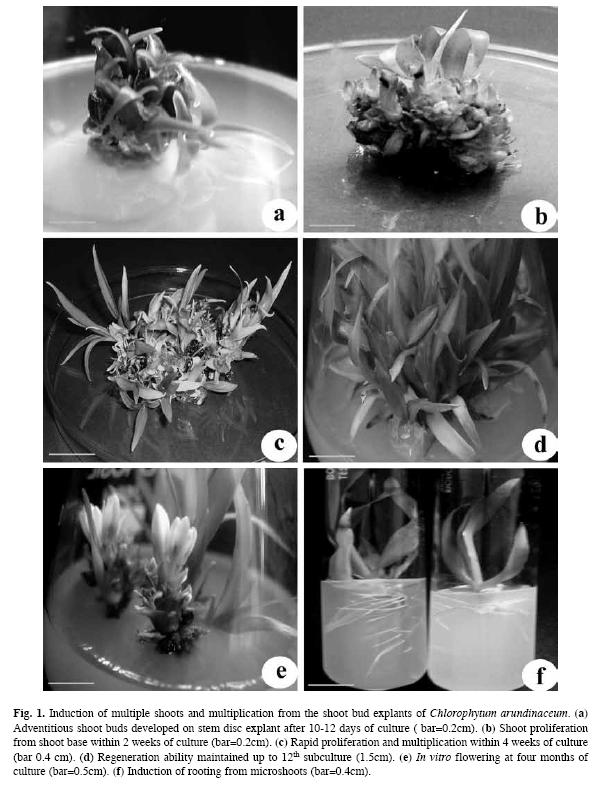
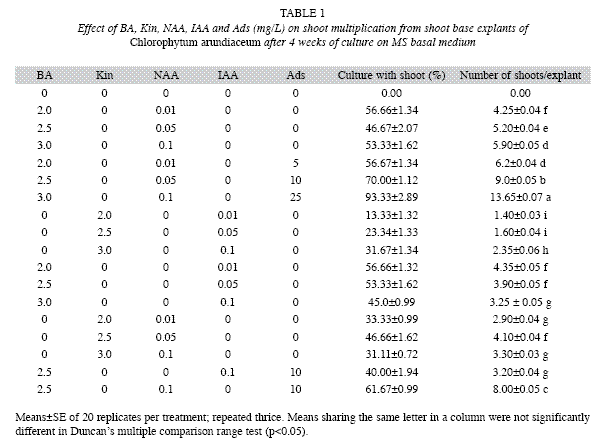
<body><![CDATA[<p align="justify"><b><font face="Verdana" size="2">Shoot bud proliferation from stem disc: </font></b><font face="Verdana" size="2">Shoot buds proliferated within 10-12 days of culture on &frac12; MS medium containing 1.0mg/L BAP, 3.0mg/L IAA and 3% (w/v) sucrose.; about 10-13 shoot buds were obtained from a stem disc (<a  href="/img/revistas/rbt/v59n1/a37f1.jpg">Fig. 1a</a>). High concentrations of Kn along with low concentrations of IAA or NAA did not show any promising result for shoot proliferation (data not shown). </font></p>     <p align="justify"><font face="Verdana" size="2"><b>Shoot proliferation and multiplication: </b>The shoot buds excised from <i>in vitro </i>grown stem disc proliferated within 10-12 days of culture on MS medium containing 2.0-3.0mg/L BAP along with 0.01-0.1mg/L NAA without intervening callus. The shoots proliferated and elongated to 1.0-1.5cm within two weeks of culture (<a href="/img/revistas/rbt/v59n1/a37f1.jpg">Fig. 1b</a>). There was no sign of shoot proliferation when shoot bud explants were cultured in media without cytokinin and auxin. At lower concentration of BAP or NAA, the rate of shoot proliferation declined (data not shown). Inclusion of NAA (0.01-0.1mg/L) in to the culture medium enhanced the rate of multiplication compared to the medium having BA+Ads. Rapid shoot bud proliferation and multiplication was achieved on MS medium containing 3.0mg/L BAP with 0.1mg/l NAA and a maximum of 13.65 shoots were produced per culture in different treatments within four week of culture (<a href="#tabla1">Table 1</a>, <a  href="/img/revistas/rbt/v59n1/a37f1.jpg">Fig. 1c</a>). Further, addition of Ads (5-25mg/L) enhanced the frequency of multiplication rate and recovered the chlorotic symptoms of the leaves. The rate of multiplication of shoots declined on medium containing kinetin in combination with IAA or NAA. The regeneration ability was maintained up to eight-week period on &frac12; MS+3.0mg/L BAP+0.1mg/L NAA+25 mg/L Ads by regular subculture at every four weeks (<a href="/img/revistas/rbt/v59n1/a37f1.jpg">Fig. 1d</a>).    <br> </font></p>     <p align="justify"><font face="Verdana" size="2">    <br>     <br> </font></p>     <p style="text-align: center;"><font face="Verdana" size="2">    <br> <a name="tabla1"></a><img src="/img/revistas/rbt/v59n1/a37t1.gif"  title="" alt="" style="width: 600px; height: 445px;">    <br>     <br> </font></p>     ]]></body>
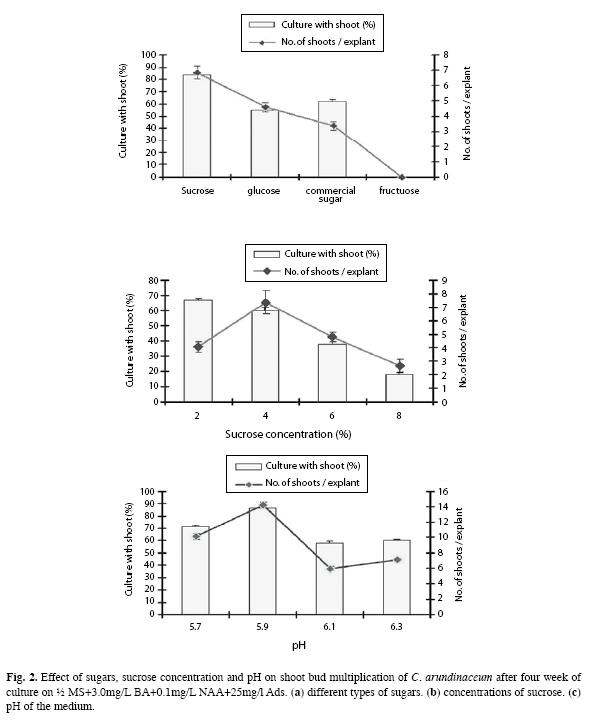
<body><![CDATA[<p align="justify"><font face="Verdana" size="2"><b>Effect of carbohydrates on shoot bud regeneration: </b>Among all the carbohydrates (sucrose, glucose, fructose and commercial sugar) tested, sucrose at 3% produced the highest number of shoot buds followed by glucose (<a href="#fig2">Fig. 2a</a>). The frequency of shoot bud/explant development decreased considerably in the presence of commercial sugar and was completely inhibited by fructose. Shoots developed in the presence of sucrose were healthy as compared with those produced in the presence of glucose. Shoots were short and slender and in most cases, the leaves turned yellow within a four week culture. Considerable variation in shoot bud regeneration was noted when the concentration of sucrose varied in the basal medium. The highest number of shoot buds was obtained in 4% sucrose (<a href="#fig2">Fig. 2b</a>); concentrations of sucrose more than 4% inhibited shoot growth with yellowing of leaves. Though 2% sucrose showed high response for shoot bud proliferation, however, the number of shoots/explants was found to be lower than 4% sucrose.    <br> </font></p>     <p align="justify"><font face="Verdana" size="2">    <br> </font></p>     <p style="text-align: center;"><font face="Verdana" size="2">    <br> <a name="fig2"></a><img src="/img/revistas/rbt/v59n1/a37f2.jpg" title=""  alt="" style="width: 592px; height: 724px;">    <br>     <br> </font></p>     <p align="justify"><font face="Verdana" size="2"><b>Effect of pH on shoot bud regeneration: </b>Shoot bud multiplication was obtained in media containing basal salts supplemented with 3.0mg/L BAP, 0.1mg/L NAA and 25mg/L Ads at pH 5.8. Significant variation on shoot bud multiplication was noted as the pH of the medium varied from 5.9 to 6.3 (<a href="#fig2">Fig. 2c</a>). The maximum rate of shoot proliferation (14.2&plusmn;0.39) and culture response (86.66&plusmn;0.99) was recorded in the medium having pH 5.9.</font></p>     <p align="justify"><font face="Verdana" size="2"><b><i>In vitro </i>flowering: </b>Shoots could flower <i>in vitro </i>when the shoot buds were subcultured every four weeks for four months on to &frac12; Ms+3.0mg/L BAP+0.1mg/L NAA+25mg/L Ads (<a href="/img/revistas/rbt/v59n1/a37f1.jpg">Fig. 1e</a>). The developing inflorescences appeared in the shoots and lasted for one to two months.</font></p>     ]]></body>
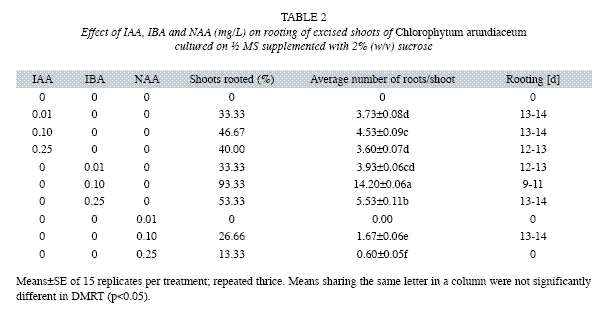
<body><![CDATA[<p align="justify"><font face="Verdana" size="2"><b>Induction of rooting: </b>Initiation of root from microshoots was inhibited in the medium without auxin. However, optimal rooting and growth of micro shoots were observed on medium containing 0.1mg/L IBA with 2% (w/v) sucrose within 9-11 days of transfer without intervening callus (<a  href="/img/revistas/rbt/v59n1/a37f1.jpg">Fig. 1f</a>). The percentage of shoots forming roots and the roots/shoot significantly varied with different concentrations of IAA, IBA and NAA. Though IAA and NAA induced rooting, however, the response is very low and time taken for rooting is also long. The percentage of rooting was 94.5% on MS media supplemented with 0.1mg/L IBA (<a href="#tabla2">Table 2</a>, <a href="#fig3">Fig. 3a</a>); the number of roots/shoot, however, varied among different treatments.    <br> </font></p>     <p align="justify"><font face="Verdana" size="2">    <br>     <br> </font></p>     <p style="text-align: center;"><font face="Verdana" size="2"><a  name="tabla2"></a><img src="/img/revistas/rbt/v59n1/a37t2.gif" title=""  alt="" style="width: 599px; height: 311px;">    <br> </font></p>     <p style="text-align: center;"><font face="Verdana" size="2">    <br>     <br> </font></p>     ]]></body>
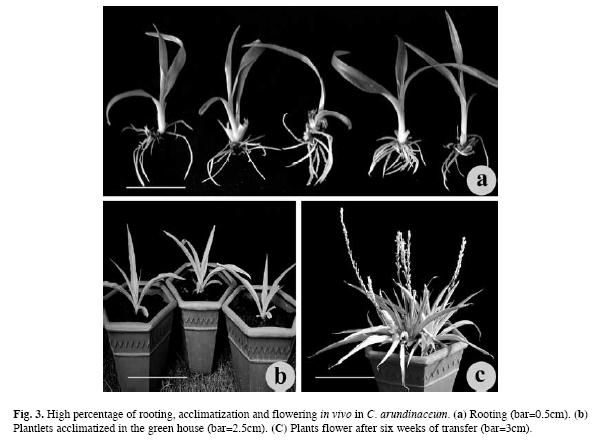
<body><![CDATA[<p style="text-align: center;"><font face="Verdana" size="2">    <br> <a name="fig3"></a><img src="/img/revistas/rbt/v59n1/a37f3.jpg" title=""  alt="" style="width: 599px; height: 440px;">    <br>     <br> </font></p>     <p align="justify"><font face="Verdana" size="2"><b>Acclimatization and field establishment: </b>About 98% of the plantlets established well and flowered after six weeks of transfer to pots (<a href="#fig3">Fig. 3b</a>, <a href="#fig3">c</a>). The acclimatized plants exhibited normal development and no gross morphological variation was noticed after transfer to the field. </font></p>     <p align="justify"><b><font face="Verdana" size="3">Discussion</font></b></p> <font face="Verdana" size="2"> </font>     <p align="justify"><font face="Verdana" size="2">The present study showed that it was possible to explore the morphogenetic potential of <i>C. arundiaceum </i>with the application of growth regulators. Besides, with an appropriate type and concentrations of sugars, and the media pH, play an important role for rapid shoot bud multiplication. The ratio of cytokinins to auxins in the culture medium is a crucial determinant for primordial induction and shoots formation. The type of exogenous cytokinin used in the medium has a marked effect on the frequency of shoot proliferation (Carmen <i>et al</i>. 2001, Fracaro &amp; Echeverrigaray 2001). Of the two cytokinins used, BAP was more effective for shoot bud proliferation than kinetin corroborated with Rout <i>et al</i>. (1999). The importance of Auxin and cytokinin balance has been reported in regulating the apical dominance as well as in morphogenetic events such as shoot formation and multiplication (Li &amp; Bangerth 2003, Werner <i>et al</i>. 2003, Nakagawa <i>et al</i>. 2005). Another factor that may influence the morphogenetic events during <i>in vitro </i>culture is a possible interaction between the endogenous concentrations of plant growth regulators and those present in the culture medium (Pinto <i>et al</i>. 1994, Mercier <i>et al</i>. 2003). As concentrations 2.5-3.0mg/L BAP favored the shoot bud proliferation and multiplication, this could be the optimum BA concentration for cytokinin and endogenous Auxin balance that resulted in release of the apical dominance in the culture conditions. Since apical meristems have been reported as Auxin producer centres (Nakagawa <i>et al</i>. 2005), therefore to balance auxin and cytokinin ratio, a higher concentration of BA showed significant effect on the shoot bud proliferation and multiplication. The data showed that combination of high concentrations of BAP with low concentrations of NAA enhanced the shoot bud multiplication as reported earlier (Prakash &amp; Staden 2008, Amoo <i>et al</i>. 2009). The combination of cytokinins and auxins triggered the rate of shoot multiplication in various medicinal plants (Francis <i>et al</i>. 2007, Sivanesan &amp; Jeong 2007, Samantaray &amp; Maiti 2008).</font></p>     <p align="justify"><font face="Verdana" size="2">Our results demonstrated that medium containing sucrose produced the highest average number of shoot buds per culture as compared to other carbohydrates used. Apparently, the osmoticum like sucrose conjugates with growth regulators to make sugar alcohols, a form of compounds that could be transported to the cellular system quickly and could help to maintain protein stability in the cell (Warieng &amp; Philips 1982). However, the frequency of shoot bud development decreased considerably in the presence of glucose and commercial sugar whereas a Fructose showed complete inhibition of shoot buds formation. Similar type of response was observed in <i>Zingiber officinalis </i>(Rout &amp; Das 1997). Hydrolysis of sucrose into glucose and fructose can bring about a relatively small change in osmotic potential in the medium whereas the incorporation of monosaccharides in to culture media may cause a relative large change in osmotic potential (Fujiwara &amp; Kozai 1995). Influence of various carbohydrates on shoot developments in nodal cultures of different genotypes of <i>Anacardium occidentale </i>was reported (Gammas &amp; Bessa 2006). The highest number of shoot buds was obtained in the media with 4% sucrose. However, concentrations of sucrose more than 4% inhibited shoot growth with yellowing of leaves. Possibly the higher concentrations of sucrose enhanced the level of polyphenols which resulted in inhibiting shoot bud differentiation. Similar effects of sucrose have been made earlier in Gentian (Zhang &amp; Leung 2002).</font></p>     <p align="justify"><font face="Verdana" size="2">Though a standard practice is to adjust the pH during media preparation, however, it is well known that the pH of the medium changes during autoclaving and also in the presence of living plant materials (Gamborg &amp; Shyluk 1981, Williams <i>et al</i>. 1990). The maximum rate of shoot proliferation and culture response was recorded in the medium of pH 5.9. The effect of different levels of pH in the medium on shoot multiplication was reported earlier (Ebrahim &amp; Ibrahim 2000). Our results showed <i>in vitro </i>flowering in the shoot buds subcultured every four weeks for four months. Though transition to flowering <i>in vitro </i>is regulated by an array of both external and internal factors (Bernier <i>et al</i>. 1993, Kinet 1993), however, cytokinins in combination with Auxins may promote <i>in vitro </i>flowering reported earlier (Naor <i>et al</i>. 2004, Qiao <i>et al</i>. 2008). Optimal rooting and growth of microshoots <i>C. arundiaceum </i>were observed on medium containing low concentration of IBA without intervening callus. Similar observations were made in various medicinal plants viz. <i>Aloe barbadensis, Vitex agnuscastus, Filipendula ulmaria </i>(Samantaray &amp; Maiti 2008, Balaraju <i>et al</i>. 2008, Yildirim &amp; Turker 2009).</font></p>     <p align="justify"><font face="Verdana" size="2">In conclusion, an attempt was made in this investigation in order to develop a rapid clonal propagation system of <i>C. arundinaceum </i>by manipulating growth regulators, carbohydrates and pH. The pattern of morphogenesis was dependent on various growth regulator regimes along with different factors like carbohydrates, sucrose levels and media pH. Though BA along with NAA and Ads helped in shoot proliferation and growth, the presence 4% sucrose with pH 5.9 promoted high frequency shoot proliferation. Mass multiplication of <i>C. arundinaceum </i>is feasible for field plantings to produce roots as the chief source of saponin for the pharmaceutical industries. This <i>in vitro </i>protocol would provide an effective strategy for the conservation and building up a nuclear base populations of this widely exploited plant species.</font></p> <b><font face="Verdana" size="3">     ]]></body>
<body><![CDATA[<p align="justify">Acknowledgments</p> </font></b><font face="Verdana" size="2">     <p align="justify">The authors wish to acknowledge the help of the Directorate of Medicinal and Aromatic Plants Research (DMAPR) Boriavi, Anand for providing necessary facilities. The authors are also thankful to K.A. Geetha, Senior Scientist (Plant Breeding) for providing the material for the study and helping in photography.</p> </font><b><font face="Verdana" size="3"> </font></b> <hr style="width: 100%; height: 2px;"><b><font face="Verdana" size="3">     <p align="justify">References</p> </font></b>     <!-- ref --><p align="justify"><font face="Verdana" size="2">Amoos, O., J.F. Finnie &amp; J. Van staden. 2009. <i>In vitro </i>propagation of <i>Huernia hystrix</i>: an endangered medicinal and ornamental succulent. Plant Cell Tiss. Org. Cult. 96: 273-278.    &nbsp;&nbsp;&nbsp;&nbsp;&nbsp;&nbsp;&nbsp;&nbsp;[&#160;<a href="javascript:void(0);" onclick="javascript: window.open('/scielo.php?script=sci_nlinks&ref=1715354&pid=S0034-7744201100010003700001&lng=','','width=640,height=500,resizable=yes,scrollbars=1,menubar=yes,');">Links</a>&#160;]<!-- end-ref --></font></p>     <!-- ref --><p align="justify"><font face="Verdana" size="2">Anonymous. 1992. The wealth of India: A dictionary of indian raw materials and industrial products. Vol.III. CSIR, New Delhi, India.    &nbsp;&nbsp;&nbsp;&nbsp;&nbsp;&nbsp;&nbsp;&nbsp;[&#160;<a href="javascript:void(0);" onclick="javascript: window.open('/scielo.php?script=sci_nlinks&ref=1715356&pid=S0034-7744201100010003700002&lng=','','width=640,height=500,resizable=yes,scrollbars=1,menubar=yes,');">Links</a>&#160;]<!-- end-ref --></font></p>     <!-- ref --><p align="justify"><font face="Verdana" size="2">Anonymous. 2000. The wealth of India: Raw materials. Vol. I. CSIR, New Delhi, India.    &nbsp;&nbsp;&nbsp;&nbsp;&nbsp;&nbsp;&nbsp;&nbsp;[&#160;<a href="javascript:void(0);" onclick="javascript: window.open('/scielo.php?script=sci_nlinks&ref=1715358&pid=S0034-7744201100010003700003&lng=','','width=640,height=500,resizable=yes,scrollbars=1,menubar=yes,');">Links</a>&#160;]<!-- end-ref --></font></p>     <!-- ref --><p align="justify"><font face="Verdana" size="2">Balaraju, K., P. Agastian, J.P. Preetamraj, S. Arokiyaraj &amp; S. Ignacimuthu. 2008. Micropropagation of <i>Vitex agnus-castus </i>(Verbenaceae)-a valuable medicinal plant. <i>In vitro </i>Cell. Dev-Pl. 44: 436-441.    &nbsp;&nbsp;&nbsp;&nbsp;&nbsp;&nbsp;&nbsp;&nbsp;[&#160;<a href="javascript:void(0);" onclick="javascript: window.open('/scielo.php?script=sci_nlinks&ref=1715360&pid=S0034-7744201100010003700004&lng=','','width=640,height=500,resizable=yes,scrollbars=1,menubar=yes,');">Links</a>&#160;]<!-- end-ref --></font></p>     <!-- ref --><p align="justify"><font face="Verdana" size="2">Bernier, G., A. Havelange, C. Houssa, A. Petitjean &amp; P. Lejeune. 1993. Physiological signals that induce flowering. Plant Cell. 5: 1147-1155.    &nbsp;&nbsp;&nbsp;&nbsp;&nbsp;&nbsp;&nbsp;&nbsp;[&#160;<a href="javascript:void(0);" onclick="javascript: window.open('/scielo.php?script=sci_nlinks&ref=1715362&pid=S0034-7744201100010003700005&lng=','','width=640,height=500,resizable=yes,scrollbars=1,menubar=yes,');">Links</a>&#160;]<!-- end-ref --></font></p>     <!-- ref --><p align="justify"><font face="Verdana" size="2">Carmen, S.J.M., A. Ballester &amp; A.M. Vieitez. 2001. Effect of Thidiazuron on multiple shoot induction and plant regeneration from cotyledonary nodes of chestnut. J. Hortic. Sci. Biotech. 76: 588-595.    &nbsp;&nbsp;&nbsp;&nbsp;&nbsp;&nbsp;&nbsp;&nbsp;[&#160;<a href="javascript:void(0);" onclick="javascript: window.open('/scielo.php?script=sci_nlinks&ref=1715364&pid=S0034-7744201100010003700006&lng=','','width=640,height=500,resizable=yes,scrollbars=1,menubar=yes,');">Links</a>&#160;]<!-- end-ref --></font></p>     <!-- ref --><p align="justify"><font face="Verdana" size="2">Chopra, R.N., S.L. Nayar &amp; I.C. Chopra. 1956. Glossary of Indian medicinal plants. CSIR, New Delhi.    &nbsp;&nbsp;&nbsp;&nbsp;&nbsp;&nbsp;&nbsp;&nbsp;[&#160;<a href="javascript:void(0);" onclick="javascript: window.open('/scielo.php?script=sci_nlinks&ref=1715366&pid=S0034-7744201100010003700007&lng=','','width=640,height=500,resizable=yes,scrollbars=1,menubar=yes,');">Links</a>&#160;]<!-- end-ref --></font></p>     <!-- ref --><p align="justify"><font face="Verdana" size="2">Ebrahim, M.K.H. &amp; I.A. Ibrahim. 2000. Influence of medium solidification and pH value on <i>in vitro </i>propagation of <i>Maranta leuconeura </i>cv. Kerchoviana. Sci. Hortic-Amsterdam 86: 211-221.    &nbsp;&nbsp;&nbsp;&nbsp;&nbsp;&nbsp;&nbsp;&nbsp;[&#160;<a href="javascript:void(0);" onclick="javascript: window.open('/scielo.php?script=sci_nlinks&ref=1715368&pid=S0034-7744201100010003700008&lng=','','width=640,height=500,resizable=yes,scrollbars=1,menubar=yes,');">Links</a>&#160;]<!-- end-ref --></font></p>     <!-- ref --><p align="justify"><font face="Verdana" size="2">Francis, S.V., S.K. Senapati &amp; G.R. Rout. 2007. Rapid clonal propagation of <i>Curculigo orchioides </i>Gaertn., an endangered medicinal plant. <i>In vitro </i>Cell. Dev-Pl. 43: 140-143.    &nbsp;&nbsp;&nbsp;&nbsp;&nbsp;&nbsp;&nbsp;&nbsp;[&#160;<a href="javascript:void(0);" onclick="javascript: window.open('/scielo.php?script=sci_nlinks&ref=1715370&pid=S0034-7744201100010003700009&lng=','','width=640,height=500,resizable=yes,scrollbars=1,menubar=yes,');">Links</a>&#160;]<!-- end-ref --></font></p>     <!-- ref --><p align="justify"><font face="Verdana" size="2">Fracaro, F. &amp; S. Echeverrigaray. 2001. Micropropagation of Cunila galioides, a popular medicinal plant of south Brazil. Plant Cell Tiss. Org. 64: 1-4.    &nbsp;&nbsp;&nbsp;&nbsp;&nbsp;&nbsp;&nbsp;&nbsp;[&#160;<a href="javascript:void(0);" onclick="javascript: window.open('/scielo.php?script=sci_nlinks&ref=1715372&pid=S0034-7744201100010003700010&lng=','','width=640,height=500,resizable=yes,scrollbars=1,menubar=yes,');">Links</a>&#160;]<!-- end-ref --><!-- ref --></font>&nbsp;&nbsp;&nbsp;&nbsp;&nbsp;&nbsp;&nbsp;&nbsp;[&#160;<a href="javascript:void(0);" onclick="javascript: window.open('/scielo.php?script=sci_nlinks&ref=1715373&pid=S0034-7744201100010003700011&lng=','','width=640,height=500,resizable=yes,scrollbars=1,menubar=yes,');">Links</a>&#160;]<!-- end-ref --></font>     <!-- ref --><p align="justify"><font face="Verdana" size="2">Gamborg, O.L. &amp; J.L. Shyluk. 1981. Nutrition media and characteristics of plant cell and tissue cultures, p. 21-44. <i>In </i>T.A. Thorpe. (eds.). Plant tissue culture methods and applications in agriculture. Academic, New York, USA.    &nbsp;&nbsp;&nbsp;&nbsp;&nbsp;&nbsp;&nbsp;&nbsp;[&#160;<a href="javascript:void(0);" onclick="javascript: window.open('/scielo.php?script=sci_nlinks&ref=1715375&pid=S0034-7744201100010003700012&lng=','','width=640,height=500,resizable=yes,scrollbars=1,menubar=yes,');">Links</a>&#160;]<!-- end-ref --></font></p>     <!-- ref --><p align="justify"><font face="Verdana" size="2">Gemas, V. &amp; A. Bessa. 2006. Influence of various carbohydrates in shoot development in nodal culture of Guinean <i>Anacardium occidentale </i>genotypes. Plant Cell Tiss. Org. Cult. 85: 103-108.    &nbsp;&nbsp;&nbsp;&nbsp;&nbsp;&nbsp;&nbsp;&nbsp;[&#160;<a href="javascript:void(0);" onclick="javascript: window.open('/scielo.php?script=sci_nlinks&ref=1715377&pid=S0034-7744201100010003700013&lng=','','width=640,height=500,resizable=yes,scrollbars=1,menubar=yes,');">Links</a>&#160;]<!-- end-ref --></font></p>     <!-- ref --><p align="justify"><font face="Verdana" size="2">George, E.F. &amp; P.D. Sherrington. 1984. Plant propagation by tissue culture. Exegetics, Eversley, England.    &nbsp;&nbsp;&nbsp;&nbsp;&nbsp;&nbsp;&nbsp;&nbsp;[&#160;<a href="javascript:void(0);" onclick="javascript: window.open('/scielo.php?script=sci_nlinks&ref=1715379&pid=S0034-7744201100010003700014&lng=','','width=640,height=500,resizable=yes,scrollbars=1,menubar=yes,');">Links</a>&#160;]<!-- end-ref --> </font></p>     ]]></body>
<body><![CDATA[<!-- ref --><p align="justify"><font face="Verdana" size="2">Hu, C.Y. &amp; P.J. Wang. 1983. Techniques for propagation and breeding, p. 177-277. <i>In </i>D.A. Evans, W.R. Sharp, P.V. Ammirato &amp; V. Yamada (eds.). Handbook of Plant Cell Culture. MacMillan Inc., New York, USA.    &nbsp;&nbsp;&nbsp;&nbsp;&nbsp;&nbsp;&nbsp;&nbsp;[&#160;<a href="javascript:void(0);" onclick="javascript: window.open('/scielo.php?script=sci_nlinks&ref=1715381&pid=S0034-7744201100010003700015&lng=','','width=640,height=500,resizable=yes,scrollbars=1,menubar=yes,');">Links</a>&#160;]<!-- end-ref --></font></p>     <!-- ref --><p align="justify"><font face="Verdana" size="2">Kinet, J.M. 1993. Environmental, chemical and genetic control of flowering. Hortic. Rev. 15: 279-334.    &nbsp;&nbsp;&nbsp;&nbsp;&nbsp;&nbsp;&nbsp;&nbsp;[&#160;<a href="javascript:void(0);" onclick="javascript: window.open('/scielo.php?script=sci_nlinks&ref=1715383&pid=S0034-7744201100010003700016&lng=','','width=640,height=500,resizable=yes,scrollbars=1,menubar=yes,');">Links</a>&#160;]<!-- end-ref --> </font></p>     <!-- ref --><p align="justify"><font face="Verdana" size="2">Lattoo, S.K., S. Bamotra, R.S. Dhar , S. Khan &amp; A.K. Dhar. 2006. Rapid plant regeneration and analysis of genetic fidelity of <i>in vitro </i>derived plants of <i>Chlorophytum arundinaceum </i>Baker-an endangered medicinal herb. Plant Cell Rep. 25: 499-506.    &nbsp;&nbsp;&nbsp;&nbsp;&nbsp;&nbsp;&nbsp;&nbsp;[&#160;<a href="javascript:void(0);" onclick="javascript: window.open('/scielo.php?script=sci_nlinks&ref=1715385&pid=S0034-7744201100010003700017&lng=','','width=640,height=500,resizable=yes,scrollbars=1,menubar=yes,');">Links</a>&#160;]<!-- end-ref --></font></p>     <!-- ref --><p align="justify"><font face="Verdana" size="2">Li, C. &amp; H. Bangerth. 2003. Stimulatory effect of Cytokinins and interaction with IAA on the release of lateral buds of pea plants from apical dominance. J. Plant Physiol. 160: 1059-1063.    &nbsp;&nbsp;&nbsp;&nbsp;&nbsp;&nbsp;&nbsp;&nbsp;[&#160;<a href="javascript:void(0);" onclick="javascript: window.open('/scielo.php?script=sci_nlinks&ref=1715387&pid=S0034-7744201100010003700018&lng=','','width=640,height=500,resizable=yes,scrollbars=1,menubar=yes,');">Links</a>&#160;]<!-- end-ref --></font></p>     <!-- ref --><p align="justify"><font face="Verdana" size="2">Mercier, H., B.M. Souza, J.E. Kraus, R.M. Hamasaki &amp; B. Sotta. 2003. Endogenous Auxin and Cytokinin contents associated with shoot formation in leaves of pineapple cultured <i>in vitro. </i>Braz. J. Plant Physiol. 15: 107-112.    &nbsp;&nbsp;&nbsp;&nbsp;&nbsp;&nbsp;&nbsp;&nbsp;[&#160;<a href="javascript:void(0);" onclick="javascript: window.open('/scielo.php?script=sci_nlinks&ref=1715389&pid=S0034-7744201100010003700019&lng=','','width=640,height=500,resizable=yes,scrollbars=1,menubar=yes,');">Links</a>&#160;]<!-- end-ref --></font></p>     ]]></body>
<body><![CDATA[<!-- ref --><p align="justify"><font face="Verdana" size="2">Murashige, T. &amp; F. Skoog. 1962. A revised medium for rapid growth and bioassays with tobacco tissue cultures. Physiol. Plantarum 15: 473-497.    &nbsp;&nbsp;&nbsp;&nbsp;&nbsp;&nbsp;&nbsp;&nbsp;[&#160;<a href="javascript:void(0);" onclick="javascript: window.open('/scielo.php?script=sci_nlinks&ref=1715391&pid=S0034-7744201100010003700020&lng=','','width=640,height=500,resizable=yes,scrollbars=1,menubar=yes,');">Links</a>&#160;]<!-- end-ref --></font></p>     <!-- ref --><p align="justify"><font face="Verdana" size="2">Nakagawa, H., C.J. Jiang, H. Sakakibara, M. Kojima, I. Honda, H. Ajisaka, T. Nishijima, M. Koshioka, T. Homma, L.N. Mander, H. Takatsuji. 2005. Overexpression of a petunia zinc-finger gene alters cytokinin metabolism and plant forms. Plant J. 41: 512-523.    &nbsp;&nbsp;&nbsp;&nbsp;&nbsp;&nbsp;&nbsp;&nbsp;[&#160;<a href="javascript:void(0);" onclick="javascript: window.open('/scielo.php?script=sci_nlinks&ref=1715393&pid=S0034-7744201100010003700021&lng=','','width=640,height=500,resizable=yes,scrollbars=1,menubar=yes,');">Links</a>&#160;]<!-- end-ref --></font></p>     <!-- ref --><p align="justify"><font face="Verdana" size="2">Naor, V., K. Kigel &amp; M. Ziv. 2004. Hormonal control of inflorescence development in plantlets of calla lily (<i>Zantedeschia </i>spp.) grown <i>in vitro</i>. Plant Growth Regul. 42: 7-14.    &nbsp;&nbsp;&nbsp;&nbsp;&nbsp;&nbsp;&nbsp;&nbsp;[&#160;<a href="javascript:void(0);" onclick="javascript: window.open('/scielo.php?script=sci_nlinks&ref=1715395&pid=S0034-7744201100010003700022&lng=','','width=640,height=500,resizable=yes,scrollbars=1,menubar=yes,');">Links</a>&#160;]<!-- end-ref --></font></p>     <!-- ref --><p align="justify"><font face="Verdana" size="2">Narasimham, K.R.S.L. &amp; B.K. Ravuru. 2003. A note on some endangered medicinal plants as NTFPs of Eastern Ghats, Andhra Pradesh. EPTRI-ENVIS Newsletter 9: 11-12.    &nbsp;&nbsp;&nbsp;&nbsp;&nbsp;&nbsp;&nbsp;&nbsp;[&#160;<a href="javascript:void(0);" onclick="javascript: window.open('/scielo.php?script=sci_nlinks&ref=1715397&pid=S0034-7744201100010003700023&lng=','','width=640,height=500,resizable=yes,scrollbars=1,menubar=yes,');">Links</a>&#160;]<!-- end-ref --> </font></p>     <!-- ref --><p align="justify"><font face="Verdana" size="2">Pinto, J.E.B.P., E.F. Arello, C.A.B.P. Pinto &amp; M.H.P. Barbosa. 1994. Uso de differentiates explantese concentracoes de benzilaminopurina na multiplicacao <i>in vitro </i>de brotos de <i>Kielmeyera coriaceae</i>. Pesqui. Agropecu. Bras. 29: 867-873.    &nbsp;&nbsp;&nbsp;&nbsp;&nbsp;&nbsp;&nbsp;&nbsp;[&#160;<a href="javascript:void(0);" onclick="javascript: window.open('/scielo.php?script=sci_nlinks&ref=1715399&pid=S0034-7744201100010003700024&lng=','','width=640,height=500,resizable=yes,scrollbars=1,menubar=yes,');">Links</a>&#160;]<!-- end-ref --></font></p>     ]]></body>
<body><![CDATA[<!-- ref --><p align="justify"><font face="Verdana" size="2">Prakash, S. &amp; J.V. Staden. 2008. Micropropagation of <i>Searsia dentate. In Vitro </i>Cell. Dev-Pl. 44: 338-341.    &nbsp;&nbsp;&nbsp;&nbsp;&nbsp;&nbsp;&nbsp;&nbsp;[&#160;<a href="javascript:void(0);" onclick="javascript: window.open('/scielo.php?script=sci_nlinks&ref=1715401&pid=S0034-7744201100010003700025&lng=','','width=640,height=500,resizable=yes,scrollbars=1,menubar=yes,');">Links</a>&#160;]<!-- end-ref --></font></p>     <!-- ref --><p align="justify"><font face="Verdana" size="2">Qioa, Q., F.W. Xing, Y.P. Xiao &amp; H.F. Chen. 2008. Somatic embryogenesis and <i>in vitro </i>flowering in <i>Saposhnikovia divaricata</i>. J. Plant Growth Regl. 28: 81-86.    &nbsp;&nbsp;&nbsp;&nbsp;&nbsp;&nbsp;&nbsp;&nbsp;[&#160;<a href="javascript:void(0);" onclick="javascript: window.open('/scielo.php?script=sci_nlinks&ref=1715403&pid=S0034-7744201100010003700026&lng=','','width=640,height=500,resizable=yes,scrollbars=1,menubar=yes,');">Links</a>&#160;]<!-- end-ref --></font></p>     <!-- ref --><p align="justify"><font face="Verdana" size="2">Rachchh, M.A., M.B. Shah, D.D. Santani &amp; S.S. Goswami. 2005. Study of <i>Chlorophytum arundinaceum </i>against experimental gastric ulcer. Pharm. Biol. 42: 592-598.    &nbsp;&nbsp;&nbsp;&nbsp;&nbsp;&nbsp;&nbsp;&nbsp;[&#160;<a href="javascript:void(0);" onclick="javascript: window.open('/scielo.php?script=sci_nlinks&ref=1715405&pid=S0034-7744201100010003700027&lng=','','width=640,height=500,resizable=yes,scrollbars=1,menubar=yes,');">Links</a>&#160;]<!-- end-ref --></font></p>     <!-- ref --><p align="justify"><font face="Verdana" size="2">Rout, G.R., C. Saxena, S. Samantaray &amp; P. Das. 1999. Rapid clonal propagation of <i>Plumbago zeylanica </i>Linn. Plant Growth Regul. 28: 1-4.    &nbsp;&nbsp;&nbsp;&nbsp;&nbsp;&nbsp;&nbsp;&nbsp;[&#160;<a href="javascript:void(0);" onclick="javascript: window.open('/scielo.php?script=sci_nlinks&ref=1715407&pid=S0034-7744201100010003700028&lng=','','width=640,height=500,resizable=yes,scrollbars=1,menubar=yes,');">Links</a>&#160;]<!-- end-ref --></font></p>     <!-- ref --><p align="justify"><font face="Verdana" size="2">Rout, G.R. &amp; P. Das. 1997. <i>In vitro </i>organogenesis in Ginger (<i>Zingiber officinale </i>Rosc.). J. Herbs Spices Med. Plants. 4: 41-51.    &nbsp;&nbsp;&nbsp;&nbsp;&nbsp;&nbsp;&nbsp;&nbsp;[&#160;<a href="javascript:void(0);" onclick="javascript: window.open('/scielo.php?script=sci_nlinks&ref=1715409&pid=S0034-7744201100010003700029&lng=','','width=640,height=500,resizable=yes,scrollbars=1,menubar=yes,');">Links</a>&#160;]<!-- end-ref --></font></p>     ]]></body>
<body><![CDATA[<!-- ref --><p align="justify"><font face="Verdana" size="2">Samantaray, S. &amp; S. Maiti. 2008. Rapid plant regeneration and assessment of genetic fidelity of <i>in vitro </i>raised plants in <i>Aloe barbadensis </i>Mill. Using RAPD markers. Acta Bot. Gallica. 155: 427-434.    &nbsp;&nbsp;&nbsp;&nbsp;&nbsp;&nbsp;&nbsp;&nbsp;[&#160;<a href="javascript:void(0);" onclick="javascript: window.open('/scielo.php?script=sci_nlinks&ref=1715411&pid=S0034-7744201100010003700030&lng=','','width=640,height=500,resizable=yes,scrollbars=1,menubar=yes,');">Links</a>&#160;]<!-- end-ref --></font></p>     <!-- ref --><p align="justify"><font face="Verdana" size="2">Sivanesan, I. &amp; B.R. Jeong. 2007. Direct shoot regeneration from nodal explants of <i>Sida cordifolia </i>Linn. In Vitro Cell. Dev-Pl. 43: 436-441.    &nbsp;&nbsp;&nbsp;&nbsp;&nbsp;&nbsp;&nbsp;&nbsp;[&#160;<a href="javascript:void(0);" onclick="javascript: window.open('/scielo.php?script=sci_nlinks&ref=1715413&pid=S0034-7744201100010003700031&lng=','','width=640,height=500,resizable=yes,scrollbars=1,menubar=yes,');">Links</a>&#160;]<!-- end-ref --></font></p>     <!-- ref --><p align="justify"><font face="Verdana" size="2">Tandon, M. &amp; Y.N. Shukla. 1993. A bibenzyle xyloside from <i>Chlorophytum arundinaceum. </i>Phytochemistry 32: 1624-1625.    &nbsp;&nbsp;&nbsp;&nbsp;&nbsp;&nbsp;&nbsp;&nbsp;[&#160;<a href="javascript:void(0);" onclick="javascript: window.open('/scielo.php?script=sci_nlinks&ref=1715415&pid=S0034-7744201100010003700032&lng=','','width=640,height=500,resizable=yes,scrollbars=1,menubar=yes,');">Links</a>&#160;]<!-- end-ref --></font></p>     <!-- ref --><p align="justify"><font face="Verdana" size="2">Wareing, P.F. &amp; I.D.J. Philips. 1982. Growth and differentiation in plants. Perganion, New York, USA.    &nbsp;&nbsp;&nbsp;&nbsp;&nbsp;&nbsp;&nbsp;&nbsp;[&#160;<a href="javascript:void(0);" onclick="javascript: window.open('/scielo.php?script=sci_nlinks&ref=1715417&pid=S0034-7744201100010003700033&lng=','','width=640,height=500,resizable=yes,scrollbars=1,menubar=yes,');">Links</a>&#160;]<!-- end-ref --></font></p>     <!-- ref --><p align="justify"><font face="Verdana" size="2">Werner, T., V. Motyka, V. Laucou, R. Smets, H. VanOnckelen &amp; T. Schmulling. 2003. Cytokinin-deficient transgenic <i>Arabidopsis </i>plants show multiple developmental alterations indicating opposite functions of cytokinins in the regulation of shoot and root meristem activity. Plant Cell. 15: 2532-2550.    &nbsp;&nbsp;&nbsp;&nbsp;&nbsp;&nbsp;&nbsp;&nbsp;[&#160;<a href="javascript:void(0);" onclick="javascript: window.open('/scielo.php?script=sci_nlinks&ref=1715419&pid=S0034-7744201100010003700034&lng=','','width=640,height=500,resizable=yes,scrollbars=1,menubar=yes,');">Links</a>&#160;]<!-- end-ref --></font></p>     ]]></body>
<body><![CDATA[<!-- ref --><p align="justify"><font face="Verdana" size="2">Williams, R.R., A.M. Taji &amp; K. Winney. 1990. The effect of <i>Ptilotus </i>plant tissue on pH of <i>in vitro </i>media. Plant Cell Tiss. Org. 22: 153-158.    &nbsp;&nbsp;&nbsp;&nbsp;&nbsp;&nbsp;&nbsp;&nbsp;[&#160;<a href="javascript:void(0);" onclick="javascript: window.open('/scielo.php?script=sci_nlinks&ref=1715421&pid=S0034-7744201100010003700035&lng=','','width=640,height=500,resizable=yes,scrollbars=1,menubar=yes,');">Links</a>&#160;]<!-- end-ref --></font></p>     <!-- ref --><p align="justify"><font face="Verdana" size="2">Yildirim, A.B. &amp; A.U. Turker . 2009. <i>In vitro </i>adventitious shoot regeneration of the medicinal plant meadowsweet (<i>Filipendula ulmaria </i>(L.) Maxim). In Vitro Cell. Dev-Pl. 45: 135-144.    &nbsp;&nbsp;&nbsp;&nbsp;&nbsp;&nbsp;&nbsp;&nbsp;[&#160;<a href="javascript:void(0);" onclick="javascript: window.open('/scielo.php?script=sci_nlinks&ref=1715423&pid=S0034-7744201100010003700036&lng=','','width=640,height=500,resizable=yes,scrollbars=1,menubar=yes,');">Links</a>&#160;]<!-- end-ref --></font></p>     <!-- ref --><p align="justify"><font face="Verdana" size="2">Zhang, G. &amp; D.W.M. Leung. 2002. Factors influencing the growth of micropropagated shoots and <i>in vitro </i>flowering of Gentian. Plant Growth Regul. 36: 245-251.    &nbsp;&nbsp;&nbsp;&nbsp;&nbsp;&nbsp;&nbsp;&nbsp;[&#160;<a href="javascript:void(0);" onclick="javascript: window.open('/scielo.php?script=sci_nlinks&ref=1715425&pid=S0034-7744201100010003700037&lng=','','width=640,height=500,resizable=yes,scrollbars=1,menubar=yes,');">Links</a>&#160;]<!-- end-ref --><br> </font></p>     <p align="justify"><font face="Verdana" size="2">    <br> </font></p>     <p align="justify"><font face="Verdana" size="2"><a  name="correspondencia"></a>Correspondencia a: </font><font  face="Verdana" size="2">Sanghamitra Samantaray &amp; Satyabrata Maiti. </font><font face="Verdana" size="2">Directorate of Medicinal and Aromatic Plants Research, Boriavi, Anand-387310, Gujarat, India; <a href="mailto:smitralok@rediffmail.com">smitralok@rediffmail.com</a>, <a href="mailto:smitraray@gmail.com">smitraray@gmail.com</a></font></p> <hr style="width: 100%; height: 2px;">     <p align="center"><font face="Verdana" size="2">Received 14-IV-2010. Corrected 03-X-2010. Accepted 01-XI-2010.</font></p>     ]]></body>
<body><![CDATA[ ]]></body><back>
<ref-list>
<ref id="B1">
<nlm-citation citation-type="journal">
<person-group person-group-type="author">
<name>
<surname><![CDATA[Amoos]]></surname>
<given-names><![CDATA[O]]></given-names>
</name>
<name>
<surname><![CDATA[Finnie]]></surname>
<given-names><![CDATA[J.F]]></given-names>
</name>
<name>
<surname><![CDATA[Van staden]]></surname>
<given-names><![CDATA[J]]></given-names>
</name>
</person-group>
<article-title xml:lang="en"><![CDATA[In vitro propagation of Huernia hystrix: an endangered medicinal and ornamental succulent]]></article-title>
<source><![CDATA[Plant Cell Tiss. Org. Cult]]></source>
<year>2009</year>
<volume>96</volume>
<page-range>273-278</page-range></nlm-citation>
</ref>
<ref id="B2">
<nlm-citation citation-type="book">
<person-group person-group-type="author">
<name>
</name>
<name>
</name>
</person-group>
<source><![CDATA[The wealth of India: A dictionary of indian raw materials and industrial products]]></source>
<year>1992</year>
<volume>III</volume>
<publisher-loc><![CDATA[New Delhi ]]></publisher-loc>
<publisher-name><![CDATA[CSIR]]></publisher-name>
</nlm-citation>
</ref>
<ref id="B3">
<nlm-citation citation-type="book">
<person-group person-group-type="author">
<name>
</name>
<name>
</name>
</person-group>
<source><![CDATA[The wealth of India: Raw materials]]></source>
<year>2000</year>
<volume>I</volume>
<publisher-loc><![CDATA[New Delhi ]]></publisher-loc>
<publisher-name><![CDATA[CSIR]]></publisher-name>
</nlm-citation>
</ref>
<ref id="B4">
<nlm-citation citation-type="journal">
<person-group person-group-type="author">
<name>
<surname><![CDATA[Balaraju]]></surname>
<given-names><![CDATA[K]]></given-names>
</name>
<name>
<surname><![CDATA[Agastian]]></surname>
<given-names><![CDATA[P]]></given-names>
</name>
<name>
<surname><![CDATA[Preetamraj]]></surname>
<given-names><![CDATA[J.P]]></given-names>
</name>
<name>
<surname><![CDATA[Arokiyaraj]]></surname>
<given-names><![CDATA[S]]></given-names>
</name>
<name>
<surname><![CDATA[Ignacimuthu]]></surname>
<given-names><![CDATA[S]]></given-names>
</name>
</person-group>
<article-title xml:lang="en"><![CDATA[Micropropagation of Vitex agnus-castus (Verbenaceae)-a valuable medicinal plant]]></article-title>
<source><![CDATA[In vitro Cell. Dev-Pl]]></source>
<year>2008</year>
<volume>44</volume>
<page-range>436-441</page-range></nlm-citation>
</ref>
<ref id="B5">
<nlm-citation citation-type="journal">
<person-group person-group-type="author">
<name>
<surname><![CDATA[Bernier]]></surname>
<given-names><![CDATA[G]]></given-names>
</name>
<name>
<surname><![CDATA[Havelange]]></surname>
<given-names><![CDATA[A]]></given-names>
</name>
<name>
<surname><![CDATA[Houssa]]></surname>
<given-names><![CDATA[C]]></given-names>
</name>
<name>
<surname><![CDATA[Petitjean]]></surname>
<given-names><![CDATA[A]]></given-names>
</name>
<name>
<surname><![CDATA[Lejeune]]></surname>
<given-names><![CDATA[P]]></given-names>
</name>
</person-group>
<article-title xml:lang="en"><![CDATA[Physiological signals that induce flowering]]></article-title>
<source><![CDATA[Plant Cell]]></source>
<year>1993</year>
<volume>5</volume>
<page-range>1147-1155</page-range></nlm-citation>
</ref>
<ref id="B6">
<nlm-citation citation-type="journal">
<person-group person-group-type="author">
<name>
<surname><![CDATA[Carmen]]></surname>
<given-names><![CDATA[S.J.M]]></given-names>
</name>
<name>
<surname><![CDATA[Ballester]]></surname>
<given-names><![CDATA[A]]></given-names>
</name>
<name>
<surname><![CDATA[Vieitez]]></surname>
<given-names><![CDATA[A.M]]></given-names>
</name>
</person-group>
<article-title xml:lang="en"><![CDATA[Effect of Thidiazuron on multiple shoot induction and plant regeneration from cotyledonary nodes of chestnut]]></article-title>
<source><![CDATA[J. Hortic. Sci. Biotech]]></source>
<year>2001</year>
<volume>76</volume>
<page-range>588-595</page-range></nlm-citation>
</ref>
<ref id="B7">
<nlm-citation citation-type="book">
<person-group person-group-type="author">
<name>
<surname><![CDATA[Chopra]]></surname>
<given-names><![CDATA[R.N]]></given-names>
</name>
<name>
<surname><![CDATA[Nayar]]></surname>
<given-names><![CDATA[S.L]]></given-names>
</name>
<name>
<surname><![CDATA[Chopra]]></surname>
<given-names><![CDATA[I.C]]></given-names>
</name>
</person-group>
<source><![CDATA[Glossary of Indian medicinal plants]]></source>
<year>1956</year>
<publisher-name><![CDATA[CSIR]]></publisher-name>
</nlm-citation>
</ref>
<ref id="B8">
<nlm-citation citation-type="journal">
<person-group person-group-type="author">
<name>
<surname><![CDATA[Ebrahim]]></surname>
<given-names><![CDATA[M.K.H]]></given-names>
</name>
<name>
<surname><![CDATA[Ibrahim]]></surname>
<given-names><![CDATA[I.A]]></given-names>
</name>
</person-group>
<article-title xml:lang="en"><![CDATA[Influence of medium solidification and pH value on in vitro propagation of Maranta leuconeura cv. Kerchoviana]]></article-title>
<source><![CDATA[Sci. Hortic-Amsterdam]]></source>
<year>2000</year>
<volume>86</volume>
<page-range>211-221</page-range></nlm-citation>
</ref>
<ref id="B9">
<nlm-citation citation-type="journal">
<person-group person-group-type="author">
<name>
<surname><![CDATA[Francis]]></surname>
<given-names><![CDATA[S.V]]></given-names>
</name>
<name>
<surname><![CDATA[Senapati]]></surname>
<given-names><![CDATA[S.K]]></given-names>
</name>
<name>
<surname><![CDATA[Rout]]></surname>
<given-names><![CDATA[G.R]]></given-names>
</name>
</person-group>
<article-title xml:lang="en"><![CDATA[Rapid clonal propagation of Curculigo orchioides Gaertn., an endangered medicinal plant]]></article-title>
<source><![CDATA[In vitro Cell. Dev-Pl]]></source>
<year>2007</year>
<volume>43</volume>
<page-range>140-143</page-range></nlm-citation>
</ref>
<ref id="B10">
<nlm-citation citation-type="journal">
<person-group person-group-type="author">
<name>
<surname><![CDATA[Fracaro]]></surname>
<given-names><![CDATA[F]]></given-names>
</name>
<name>
<surname><![CDATA[Echeverrigaray]]></surname>
<given-names><![CDATA[S]]></given-names>
</name>
</person-group>
<article-title xml:lang="en"><![CDATA[Micropropagation of Cunila galioides, a popular medicinal plant of south Brazil]]></article-title>
<source><![CDATA[Plant Cell Tiss. Org]]></source>
<year>2001</year>
<volume>64</volume>
<page-range>1-4</page-range></nlm-citation>
</ref>
<ref id="B11">
<nlm-citation citation-type="book">
<person-group person-group-type="author">
<name>
<surname><![CDATA[Fujiwara]]></surname>
<given-names><![CDATA[K]]></given-names>
</name>
<name>
<surname><![CDATA[Kozai]]></surname>
<given-names><![CDATA[T]]></given-names>
</name>
</person-group>
<article-title xml:lang="en"><![CDATA[Physical microenvironment and its effects]]></article-title>
<person-group person-group-type="editor">
<name>
<surname><![CDATA[Aitken-Christie]]></surname>
<given-names><![CDATA[J]]></given-names>
</name>
<name>
<surname><![CDATA[Kozai]]></surname>
<given-names><![CDATA[T]]></given-names>
</name>
<name>
<surname><![CDATA[Smith]]></surname>
<given-names><![CDATA[M.A.L]]></given-names>
</name>
</person-group>
<source><![CDATA[Automation and Environmental control in Plant Tissue Culture]]></source>
<year>1995</year>
<page-range>319-369</page-range><publisher-loc><![CDATA[Dordrecht ]]></publisher-loc>
<publisher-name><![CDATA[Kluwer Academic Publishers]]></publisher-name>
</nlm-citation>
</ref>
<ref id="B12">
<nlm-citation citation-type="book">
<person-group person-group-type="author">
<name>
<surname><![CDATA[Gamborg]]></surname>
<given-names><![CDATA[O.L]]></given-names>
</name>
<name>
<surname><![CDATA[Shyluk]]></surname>
<given-names><![CDATA[J.L]]></given-names>
</name>
</person-group>
<article-title xml:lang="en"><![CDATA[Nutrition media and characteristics of plant cell and tissue cultures]]></article-title>
<person-group person-group-type="editor">
<name>
<surname><![CDATA[Thorpe]]></surname>
<given-names><![CDATA[T.A]]></given-names>
</name>
</person-group>
<source><![CDATA[Plant tissue culture methods and applications in agriculture]]></source>
<year>1981</year>
<page-range>21-44</page-range><publisher-loc><![CDATA[New York ]]></publisher-loc>
<publisher-name><![CDATA[Academic]]></publisher-name>
</nlm-citation>
</ref>
<ref id="B13">
<nlm-citation citation-type="journal">
<person-group person-group-type="author">
<name>
<surname><![CDATA[Gemas]]></surname>
<given-names><![CDATA[V]]></given-names>
</name>
<name>
<surname><![CDATA[Bessa]]></surname>
<given-names><![CDATA[A]]></given-names>
</name>
</person-group>
<article-title xml:lang="en"><![CDATA[Influence of various carbohydrates in shoot development in nodal culture of Guinean Anacardium occidentale genotypes]]></article-title>
<source><![CDATA[Plant Cell Tiss. Org. Cult]]></source>
<year>2006</year>
<volume>85</volume>
<page-range>103-108</page-range></nlm-citation>
</ref>
<ref id="B14">
<nlm-citation citation-type="book">
<person-group person-group-type="author">
<name>
<surname><![CDATA[George]]></surname>
<given-names><![CDATA[E.F]]></given-names>
</name>
<name>
<surname><![CDATA[Sherrington]]></surname>
<given-names><![CDATA[P.D]]></given-names>
</name>
</person-group>
<source><![CDATA[Plant propagation by tissue culture]]></source>
<year>1984</year>
<publisher-loc><![CDATA[Eversley ]]></publisher-loc>
<publisher-name><![CDATA[Exegetics]]></publisher-name>
</nlm-citation>
</ref>
<ref id="B15">
<nlm-citation citation-type="book">
<person-group person-group-type="author">
<name>
<surname><![CDATA[Hu]]></surname>
<given-names><![CDATA[C.Y]]></given-names>
</name>
<name>
<surname><![CDATA[Wang]]></surname>
<given-names><![CDATA[P.J]]></given-names>
</name>
</person-group>
<article-title xml:lang="en"><![CDATA[Techniques for propagation and breeding]]></article-title>
<person-group person-group-type="editor">
<name>
<surname><![CDATA[Evans]]></surname>
<given-names><![CDATA[D.A]]></given-names>
</name>
<name>
<surname><![CDATA[Sharp]]></surname>
<given-names><![CDATA[W.R]]></given-names>
</name>
<name>
<surname><![CDATA[Ammirato]]></surname>
<given-names><![CDATA[P.V]]></given-names>
</name>
<name>
<surname><![CDATA[Yamada]]></surname>
<given-names><![CDATA[V]]></given-names>
</name>
</person-group>
<source><![CDATA[Handbook of Plant Cell Culture]]></source>
<year>1983</year>
<page-range>177-277</page-range><publisher-loc><![CDATA[New York ]]></publisher-loc>
<publisher-name><![CDATA[MacMillan Inc.]]></publisher-name>
</nlm-citation>
</ref>
<ref id="B16">
<nlm-citation citation-type="journal">
<person-group person-group-type="author">
<name>
<surname><![CDATA[Kinet]]></surname>
<given-names><![CDATA[J.M]]></given-names>
</name>
</person-group>
<article-title xml:lang="en"><![CDATA[Environmental, chemical and genetic control of flowering]]></article-title>
<source><![CDATA[Hortic. Rev]]></source>
<year>1993</year>
<volume>15</volume>
<page-range>279-334</page-range></nlm-citation>
</ref>
<ref id="B17">
<nlm-citation citation-type="journal">
<person-group person-group-type="author">
<name>
<surname><![CDATA[Lattoo]]></surname>
<given-names><![CDATA[S.K]]></given-names>
</name>
<name>
<surname><![CDATA[Bamotra]]></surname>
<given-names><![CDATA[S]]></given-names>
</name>
<name>
<surname><![CDATA[Dhar]]></surname>
<given-names><![CDATA[R.S]]></given-names>
</name>
<name>
<surname><![CDATA[Khan]]></surname>
<given-names><![CDATA[S]]></given-names>
</name>
<name>
<surname><![CDATA[Dhar]]></surname>
<given-names><![CDATA[A.K]]></given-names>
</name>
</person-group>
<article-title xml:lang="en"><![CDATA[Rapid plant regeneration and analysis of genetic fidelity of in vitro derived plants of Chlorophytum arundinaceum Baker-an endangered medicinal herb]]></article-title>
<source><![CDATA[Plant Cell Rep]]></source>
<year>2006</year>
<volume>25</volume>
<page-range>499-506</page-range></nlm-citation>
</ref>
<ref id="B18">
<nlm-citation citation-type="journal">
<person-group person-group-type="author">
<name>
<surname><![CDATA[Li]]></surname>
<given-names><![CDATA[C]]></given-names>
</name>
<name>
<surname><![CDATA[Bangerth]]></surname>
<given-names><![CDATA[H]]></given-names>
</name>
</person-group>
<article-title xml:lang="en"><![CDATA[Stimulatory effect of Cytokinins and interaction with IAA on the release of lateral buds of pea plants from apical dominance]]></article-title>
<source><![CDATA[J. Plant Physiol.]]></source>
<year>2003</year>
<volume>160</volume>
<page-range>1059-1063</page-range></nlm-citation>
</ref>
<ref id="B19">
<nlm-citation citation-type="journal">
<person-group person-group-type="author">
<name>
<surname><![CDATA[Mercier]]></surname>
<given-names><![CDATA[H]]></given-names>
</name>
<name>
<surname><![CDATA[Souza]]></surname>
<given-names><![CDATA[B.M]]></given-names>
</name>
<name>
<surname><![CDATA[Kraus]]></surname>
<given-names><![CDATA[J.E]]></given-names>
</name>
<name>
<surname><![CDATA[Hamasaki]]></surname>
<given-names><![CDATA[R.M]]></given-names>
</name>
<name>
<surname><![CDATA[Sotta]]></surname>
<given-names><![CDATA[B]]></given-names>
</name>
</person-group>
<article-title xml:lang="en"><![CDATA[Endogenous Auxin and Cytokinin contents associated with shoot formation in leaves of pineapple cultured in vitro. Braz]]></article-title>
<source><![CDATA[J. Plant Physiol]]></source>
<year>2003</year>
<volume>15</volume>
<page-range>107-112</page-range></nlm-citation>
</ref>
<ref id="B20">
<nlm-citation citation-type="journal">
<person-group person-group-type="author">
<name>
<surname><![CDATA[Murashige]]></surname>
<given-names><![CDATA[T]]></given-names>
</name>
<name>
<surname><![CDATA[Skoog]]></surname>
<given-names><![CDATA[F]]></given-names>
</name>
</person-group>
<article-title xml:lang="en"><![CDATA[A revised medium for rapid growth and bioassays with tobacco tissue cultures]]></article-title>
<source><![CDATA[Physiol. Plantarum]]></source>
<year>1962</year>
<volume>15</volume>
<page-range>473-497</page-range></nlm-citation>
</ref>
<ref id="B21">
<nlm-citation citation-type="journal">
<person-group person-group-type="author">
<name>
<surname><![CDATA[Nakagawa]]></surname>
<given-names><![CDATA[H]]></given-names>
</name>
<name>
<surname><![CDATA[Jiang]]></surname>
<given-names><![CDATA[C.J]]></given-names>
</name>
<name>
<surname><![CDATA[Sakakibara]]></surname>
<given-names><![CDATA[H]]></given-names>
</name>
<name>
<surname><![CDATA[Kojima]]></surname>
<given-names><![CDATA[M]]></given-names>
</name>
<name>
<surname><![CDATA[Honda]]></surname>
<given-names><![CDATA[I]]></given-names>
</name>
<name>
<surname><![CDATA[Ajisaka]]></surname>
<given-names><![CDATA[H]]></given-names>
</name>
<name>
<surname><![CDATA[Nishijima]]></surname>
<given-names><![CDATA[T]]></given-names>
</name>
<name>
<surname><![CDATA[Koshioka]]></surname>
<given-names><![CDATA[M]]></given-names>
</name>
<name>
<surname><![CDATA[Homma]]></surname>
<given-names><![CDATA[T]]></given-names>
</name>
<name>
<surname><![CDATA[Mander]]></surname>
<given-names><![CDATA[L.N]]></given-names>
</name>
<name>
<surname><![CDATA[Takatsuji]]></surname>
<given-names><![CDATA[H]]></given-names>
</name>
</person-group>
<article-title xml:lang="en"><![CDATA[Overexpression of a petunia zinc-finger gene alters cytokinin metabolism and plant forms]]></article-title>
<source><![CDATA[Plant J]]></source>
<year>2005</year>
<volume>41</volume>
<page-range>512-523</page-range></nlm-citation>
</ref>
<ref id="B22">
<nlm-citation citation-type="journal">
<person-group person-group-type="author">
<name>
<surname><![CDATA[Naor]]></surname>
<given-names><![CDATA[V]]></given-names>
</name>
<name>
<surname><![CDATA[Kigel]]></surname>
<given-names><![CDATA[K]]></given-names>
</name>
<name>
<surname><![CDATA[Ziv]]></surname>
<given-names><![CDATA[M]]></given-names>
</name>
</person-group>
<article-title xml:lang="en"><![CDATA[Hormonal control of inflorescence development in plantlets of calla lily (Zantedeschia spp.) grown in vitro]]></article-title>
<source><![CDATA[Plant Growth Regul]]></source>
<year>2004</year>
<volume>42</volume>
<page-range>7-14</page-range></nlm-citation>
</ref>
<ref id="B23">
<nlm-citation citation-type="journal">
<person-group person-group-type="author">
<name>
<surname><![CDATA[Narasimham]]></surname>
<given-names><![CDATA[K.R.S.L]]></given-names>
</name>
<name>
<surname><![CDATA[Ravuru]]></surname>
<given-names><![CDATA[B.K]]></given-names>
</name>
</person-group>
<article-title xml:lang="en"><![CDATA[A note on some endangered medicinal plants as NTFPs of Eastern Ghats, Andhra Pradesh]]></article-title>
<source><![CDATA[EPTRI-ENVIS Newsletter]]></source>
<year>2003</year>
<volume>9</volume>
<page-range>11-12</page-range></nlm-citation>
</ref>
<ref id="B24">
<nlm-citation citation-type="journal">
<person-group person-group-type="author">
<name>
<surname><![CDATA[Pinto]]></surname>
<given-names><![CDATA[J.E.B.P]]></given-names>
</name>
<name>
<surname><![CDATA[Arello]]></surname>
<given-names><![CDATA[E.F]]></given-names>
</name>
<name>
<surname><![CDATA[Pinto]]></surname>
<given-names><![CDATA[C.A.B.P]]></given-names>
</name>
<name>
<surname><![CDATA[Barbosa]]></surname>
<given-names><![CDATA[M.H.P]]></given-names>
</name>
</person-group>
<article-title xml:lang="en"><![CDATA[Uso de differentiates explantese concentracoes de benzilaminopurina na multiplicacao in vitro de brotos de Kielmeyera coriaceae]]></article-title>
<source><![CDATA[Pesqui. Agropecu. Bras]]></source>
<year>1994</year>
<volume>29</volume>
<page-range>867-873</page-range></nlm-citation>
</ref>
<ref id="B25">
<nlm-citation citation-type="journal">
<person-group person-group-type="author">
<name>
<surname><![CDATA[Prakash]]></surname>
<given-names><![CDATA[S]]></given-names>
</name>
<name>
<surname><![CDATA[Staden]]></surname>
<given-names><![CDATA[J.V]]></given-names>
</name>
</person-group>
<article-title xml:lang="en"><![CDATA[Micropropagation of Searsia dentate]]></article-title>
<source><![CDATA[In Vitro Cell. Dev-Pl]]></source>
<year>2008</year>
<volume>44</volume>
<page-range>338-341</page-range></nlm-citation>
</ref>
<ref id="B26">
<nlm-citation citation-type="journal">
<person-group person-group-type="author">
<name>
<surname><![CDATA[Qioa]]></surname>
<given-names><![CDATA[Q]]></given-names>
</name>
<name>
<surname><![CDATA[Xing]]></surname>
<given-names><![CDATA[F.W]]></given-names>
</name>
<name>
<surname><![CDATA[Xiao]]></surname>
<given-names><![CDATA[Y.P]]></given-names>
</name>
<name>
<surname><![CDATA[Chen]]></surname>
<given-names><![CDATA[H.F]]></given-names>
</name>
</person-group>
<article-title xml:lang="en"><![CDATA[Somatic embryogenesis and in vitro flowering in Saposhnikovia divaricata]]></article-title>
<source><![CDATA[J. Plant Growth Regl]]></source>
<year>2008</year>
<volume>28</volume>
<page-range>81-86</page-range></nlm-citation>
</ref>
<ref id="B27">
<nlm-citation citation-type="journal">
<person-group person-group-type="author">
<name>
<surname><![CDATA[Rachchh]]></surname>
<given-names><![CDATA[M.A]]></given-names>
</name>
<name>
<surname><![CDATA[Shah]]></surname>
<given-names><![CDATA[M.B]]></given-names>
</name>
<name>
<surname><![CDATA[Santani]]></surname>
<given-names><![CDATA[D.D]]></given-names>
</name>
<name>
<surname><![CDATA[Goswami]]></surname>
<given-names><![CDATA[S.S]]></given-names>
</name>
</person-group>
<article-title xml:lang="en"><![CDATA[Study of Chlorophytum arundinaceum against experimental gastric ulcer]]></article-title>
<source><![CDATA[Pharm. Biol]]></source>
<year>2005</year>
<volume>42</volume>
<page-range>592-598</page-range></nlm-citation>
</ref>
<ref id="B28">
<nlm-citation citation-type="journal">
<person-group person-group-type="author">
<name>
<surname><![CDATA[Rout]]></surname>
<given-names><![CDATA[G.R]]></given-names>
</name>
<name>
<surname><![CDATA[Saxena]]></surname>
<given-names><![CDATA[C]]></given-names>
</name>
<name>
<surname><![CDATA[Samantaray]]></surname>
<given-names><![CDATA[S]]></given-names>
</name>
<name>
<surname><![CDATA[Das]]></surname>
<given-names><![CDATA[P]]></given-names>
</name>
</person-group>
<article-title xml:lang="en"><![CDATA[Rapid clonal propagation of Plumbago zeylanica Linn]]></article-title>
<source><![CDATA[Plant Growth Regul]]></source>
<year>1999</year>
<volume>28</volume>
<page-range>1-4</page-range></nlm-citation>
</ref>
<ref id="B29">
<nlm-citation citation-type="journal">
<person-group person-group-type="author">
<name>
<surname><![CDATA[Rout]]></surname>
<given-names><![CDATA[G.R]]></given-names>
</name>
<name>
<surname><![CDATA[Das]]></surname>
<given-names><![CDATA[P]]></given-names>
</name>
</person-group>
<article-title xml:lang="en"><![CDATA[In vitro organogenesis in Ginger (Zingiber officinale Rosc.)]]></article-title>
<source><![CDATA[J. Herbs Spices Med. Plants]]></source>
<year>1997</year>
<volume>4</volume>
<page-range>41-51</page-range></nlm-citation>
</ref>
<ref id="B30">
<nlm-citation citation-type="journal">
<person-group person-group-type="author">
<name>
<surname><![CDATA[Samantaray]]></surname>
<given-names><![CDATA[S]]></given-names>
</name>
<name>
<surname><![CDATA[Maiti]]></surname>
<given-names><![CDATA[S]]></given-names>
</name>
</person-group>
<article-title xml:lang="en"><![CDATA[Rapid plant regeneration and assessment of genetic fidelity of in vitro raised plants in Aloe barbadensis Mill. Using RAPD markers]]></article-title>
<source><![CDATA[Acta Bot. Gallica]]></source>
<year>2008</year>
<volume>155</volume>
<page-range>427-434</page-range></nlm-citation>
</ref>
<ref id="B31">
<nlm-citation citation-type="journal">
<person-group person-group-type="author">
<name>
<surname><![CDATA[Sivanesan]]></surname>
<given-names><![CDATA[I]]></given-names>
</name>
<name>
<surname><![CDATA[Jeong]]></surname>
<given-names><![CDATA[B.R]]></given-names>
</name>
</person-group>
<article-title xml:lang="en"><![CDATA[Direct shoot regeneration from nodal explants of Sida cordifolia Linn]]></article-title>
<source><![CDATA[In Vitro Cell. Dev-Pl]]></source>
<year>2007</year>
<volume>43</volume>
<page-range>436-441</page-range></nlm-citation>
</ref>
<ref id="B32">
<nlm-citation citation-type="journal">
<person-group person-group-type="author">
<name>
<surname><![CDATA[Tandon]]></surname>
<given-names><![CDATA[M]]></given-names>
</name>
<name>
<surname><![CDATA[Shukla]]></surname>
<given-names><![CDATA[Y.N]]></given-names>
</name>
</person-group>
<article-title xml:lang="en"><![CDATA[A bibenzyle xyloside from Chlorophytum arundinaceum]]></article-title>
<source><![CDATA[Phytochemistry]]></source>
<year>1993</year>
<volume>32</volume>
<page-range>1624-1625</page-range></nlm-citation>
</ref>
<ref id="B33">
<nlm-citation citation-type="book">
<person-group person-group-type="author">
<name>
<surname><![CDATA[Wareing]]></surname>
<given-names><![CDATA[P.F]]></given-names>
</name>
<name>
<surname><![CDATA[Philips]]></surname>
<given-names><![CDATA[I.D.J]]></given-names>
</name>
</person-group>
<source><![CDATA[Growth and differentiation in plants]]></source>
<year>1982</year>
<publisher-loc><![CDATA[New York ]]></publisher-loc>
<publisher-name><![CDATA[Perganion]]></publisher-name>
</nlm-citation>
</ref>
<ref id="B34">
<nlm-citation citation-type="journal">
<person-group person-group-type="author">
<name>
<surname><![CDATA[Werner]]></surname>
<given-names><![CDATA[T]]></given-names>
</name>
<name>
<surname><![CDATA[Motyka]]></surname>
<given-names><![CDATA[V]]></given-names>
</name>
<name>
<surname><![CDATA[Laucou]]></surname>
<given-names><![CDATA[V]]></given-names>
</name>
<name>
<surname><![CDATA[Smets]]></surname>
<given-names><![CDATA[R]]></given-names>
</name>
<name>
<surname><![CDATA[VanOnckelen]]></surname>
<given-names><![CDATA[H]]></given-names>
</name>
<name>
<surname><![CDATA[Schmulling]]></surname>
<given-names><![CDATA[T]]></given-names>
</name>
</person-group>
<article-title xml:lang="en"><![CDATA[Cytokinin-deficient transgenic Arabidopsis plants show multiple developmental alterations indicating opposite functions of cytokinins in the regulation of shoot and root meristem activity]]></article-title>
<source><![CDATA[Plant Cell]]></source>
<year>2003</year>
<volume>15</volume>
<page-range>2532-2550</page-range></nlm-citation>
</ref>
<ref id="B35">
<nlm-citation citation-type="journal">
<person-group person-group-type="author">
<name>
<surname><![CDATA[Williams]]></surname>
<given-names><![CDATA[R.R]]></given-names>
</name>
<name>
<surname><![CDATA[Taji]]></surname>
<given-names><![CDATA[A.M]]></given-names>
</name>
<name>
<surname><![CDATA[Winney]]></surname>
<given-names><![CDATA[K]]></given-names>
</name>
</person-group>
<article-title xml:lang="en"><![CDATA[The effect of Ptilotus plant tissue on pH of in vitro media]]></article-title>
<source><![CDATA[Plant Cell Tiss. Org]]></source>
<year>1990</year>
<volume>22</volume>
<page-range>153-158</page-range></nlm-citation>
</ref>
<ref id="B36">
<nlm-citation citation-type="journal">
<person-group person-group-type="author">
<name>
<surname><![CDATA[Yildirim]]></surname>
<given-names><![CDATA[A.B]]></given-names>
</name>
<name>
<surname><![CDATA[Turker]]></surname>
<given-names><![CDATA[A.U]]></given-names>
</name>
</person-group>
<article-title xml:lang="en"><![CDATA[In vitro adventitious shoot regeneration of the medicinal plant meadowsweet (Filipendula ulmaria (L.) Maxim)]]></article-title>
<source><![CDATA[In Vitro Cell. Dev-Pl]]></source>
<year>2009</year>
<volume>45</volume>
<page-range>135-144</page-range></nlm-citation>
</ref>
<ref id="B37">
<nlm-citation citation-type="journal">
<person-group person-group-type="author">
<name>
<surname><![CDATA[Zhang]]></surname>
<given-names><![CDATA[G]]></given-names>
</name>
<name>
<surname><![CDATA[Leung]]></surname>
<given-names><![CDATA[D.W.M]]></given-names>
</name>
</person-group>
<article-title xml:lang="en"><![CDATA[Factors influencing the growth of micropropagated shoots and in vitro flowering of Gentian]]></article-title>
<source><![CDATA[Plant Growth Regul]]></source>
<year>2002</year>
<volume>36</volume>
<page-range>245-251</page-range></nlm-citation>
</ref>
</ref-list>
</back>
</article>