<?xml version="1.0" encoding="ISO-8859-1"?><article xmlns:mml="http://www.w3.org/1998/Math/MathML" xmlns:xlink="http://www.w3.org/1999/xlink" xmlns:xsi="http://www.w3.org/2001/XMLSchema-instance">
<front>
<journal-meta>
<journal-id>0034-7744</journal-id>
<journal-title><![CDATA[Revista de Biología Tropical]]></journal-title>
<abbrev-journal-title><![CDATA[Rev. biol. trop]]></abbrev-journal-title>
<issn>0034-7744</issn>
<publisher>
<publisher-name><![CDATA[Universidad de Costa Rica]]></publisher-name>
</publisher>
</journal-meta>
<article-meta>
<article-id>S0034-77442010000400035</article-id>
<title-group>
<article-title xml:lang="en"><![CDATA[Characterization of biominerals in species of Canna (Cannaceae)]]></article-title>
</title-group>
<contrib-group>
<contrib contrib-type="author">
<name>
<surname><![CDATA[Baran]]></surname>
<given-names><![CDATA[Enrique J]]></given-names>
</name>
<xref ref-type="aff" rid="A01"/>
</contrib>
<contrib contrib-type="author">
<name>
<surname><![CDATA[González-Baró]]></surname>
<given-names><![CDATA[Ana C]]></given-names>
</name>
<xref ref-type="aff" rid="A01"/>
</contrib>
<contrib contrib-type="author">
<name>
<surname><![CDATA[Ciciarelli]]></surname>
<given-names><![CDATA[María M]]></given-names>
</name>
<xref ref-type="aff" rid="A02"/>
</contrib>
<contrib contrib-type="author">
<name>
<surname><![CDATA[Rolleri]]></surname>
<given-names><![CDATA[Cristina H]]></given-names>
</name>
<xref ref-type="aff" rid="A02"/>
</contrib>
</contrib-group>
<aff id="A01">
<institution><![CDATA[,Universidad Nacional de la Plata Facultad de Ciencias Exactas Centro de Química Inorgánica]]></institution>
<addr-line><![CDATA[La Plata ]]></addr-line>
<country>Argentina</country>
</aff>
<aff id="A02">
<institution><![CDATA[,Facultad de Ciencias Naturales y Museo de La Plata Laboratorio de Estudios de Anatomía Vegetal Evolutiva y Sistemática ]]></institution>
<addr-line><![CDATA[La Plata ]]></addr-line>
<country>Argentina</country>
</aff>
<pub-date pub-type="pub">
<day>00</day>
<month>12</month>
<year>2010</year>
</pub-date>
<pub-date pub-type="epub">
<day>00</day>
<month>12</month>
<year>2010</year>
</pub-date>
<volume>58</volume>
<numero>4</numero>
<fpage>1507</fpage>
<lpage>1515</lpage>
<copyright-statement/>
<copyright-year/>
<self-uri xlink:href="http://www.scielo.sa.cr/scielo.php?script=sci_arttext&amp;pid=S0034-77442010000400035&amp;lng=en&amp;nrm=iso"></self-uri><self-uri xlink:href="http://www.scielo.sa.cr/scielo.php?script=sci_abstract&amp;pid=S0034-77442010000400035&amp;lng=en&amp;nrm=iso"></self-uri><self-uri xlink:href="http://www.scielo.sa.cr/scielo.php?script=sci_pdf&amp;pid=S0034-77442010000400035&amp;lng=en&amp;nrm=iso"></self-uri><abstract abstract-type="short" xml:lang="en"><p><![CDATA[Plant biominerals are not always well characterized, although this information is important for plant physiology and can be useful for taxonomic purposes. In this work, fresh plant material of seven wild neotropical species of genus Canna, C. ascendens, C. coccinea, C. indica, C. glauca, C. plurituberosa, C. variegatifolia and C. fuchsina sp. ined., taken from different habitats, were studied to characterize the biominerals in their internal tissues. For the first time, samples from primary and secondary veins of leaves were investigated by means of infrared spectroscopy, complemented with X-ray powder diffractometry and scanning electron microscopy. The spectroscopic results, supported by X-ray powder diffractometry, suggest that the calcium oxalate is present in the form of whewellite (CaC2O4×H2O) in all the investigated samples. It is interesting to emphasize that all IR spectra obtained were strongly similar in all species studied, thus indicating an identical chemical composition in terms of the biominerals found. In this sense, the results suggest that the species of Canna show similar ability to produce biogenic silica and produce an identical type of calcium oxalate within their tissues. These results can be an additional trait to support the relationship among the families of Zingiberales. Rev. Biol. Trop. 58 (4): 1507-1515. Epub 2010 December 01.]]></p></abstract>
<abstract abstract-type="short" xml:lang="es"><p><![CDATA[Los biominerales de las plantas no siempre han sido bien caracterizados aunque esta información es importante en fisiología vegetal y puede ser de utilidad para fines taxonómicos. En este trabajo se estudió material vegetal fresco de siete especies silvestres neotropicales: Canna, C. ascendens, C. coccinea, C. indica, C. glauca, C. plurituberosa, C. variegatifolia and C. fuchsina sp. ined., provenientes de diferentes localidades, con el fin de caracterizar los biominerales presentes en sus tejidos foliares internos. Por vez primera, muestras de venas primarias (ejes foliares) y secundarias de hojas de estas especies se investigaron por medio de espectroscopia de infarrojo, complementada con estudios por difracción de rayos X de polvos y microscopía electrónica de barrido. Los resultados indicaron la presencia de ópalo (sílice biogénica) y oxalato de calcio en los tejidos vegetales analizados. Además, se determinó que el oxalato de calcio está presente en forma de whewellita (CaC2O4×H2O), información nueva para el género. Tanto el ópalo como la whewellita están presentes en todas las especies analizadas, que representan aproximadamente un tercio de las especies silvestres del género. La capacidad de biomineralizar SiO2 en forma de ópalo en especies de Canna de diversos ambientes resulta también un rasgo altamente sugerente para futuros estudios.]]></p></abstract>
<kwd-group>
<kwd lng="en"><![CDATA[Canna]]></kwd>
<kwd lng="en"><![CDATA[Cannaceae]]></kwd>
<kwd lng="en"><![CDATA[biominerals]]></kwd>
<kwd lng="en"><![CDATA[infrared spectroscopy]]></kwd>
<kwd lng="en"><![CDATA[X-ray powder diffractometry]]></kwd>
<kwd lng="en"><![CDATA[opal]]></kwd>
<kwd lng="en"><![CDATA[biogenic silica]]></kwd>
<kwd lng="en"><![CDATA[calcium oxalate]]></kwd>
<kwd lng="en"><![CDATA[whewellite]]></kwd>
<kwd lng="es"><![CDATA[Canna]]></kwd>
<kwd lng="es"><![CDATA[Cannaceae]]></kwd>
<kwd lng="es"><![CDATA[biominerales]]></kwd>
<kwd lng="es"><![CDATA[espectroscopía de infrarrojo]]></kwd>
<kwd lng="es"><![CDATA[difractometría de rayos X]]></kwd>
<kwd lng="es"><![CDATA[ópalo]]></kwd>
<kwd lng="es"><![CDATA[sílice biogénica]]></kwd>
<kwd lng="es"><![CDATA[oxalato de calcio]]></kwd>
<kwd lng="es"><![CDATA[whewellita]]></kwd>
</kwd-group>
</article-meta>
</front><body><![CDATA[ <p align="center"><b><font face="Verdana" size="4">Characterization of biominerals in species of </font></b><font face="Verdana" size="4"><i>Canna </i><b>(Cannaceae)</b></font></p> <b><font size="2"> </font></b><font face="Verdana" size="2">     <p style="font-weight: bold;">Enrique J. Baran<a href="#autor1"><sup>1</sup></a>, Ana C. Gonz&aacute;lez-Bar&oacute;<a href="#autor1"><sup>1</sup></a>, Mar&iacute;a M. Ciciarelli<a href="#autor2"><sup>2</sup></a> &amp; Cristina H. Rolleri<a href="#autor2"><sup>2</sup></a></p>     <p><a name="autor1"></a>1. Centro de Qu&iacute;mica Inorg&aacute;nica (CEQUINOR, CONICET/UNLP), Facultad de Ciencias Exactas, Universidad Nacional de La Plata, 1900 La Plata, Argentina; <a href="mailto:baran@quimica.unlp.edu.ar">baran@quimica.unlp.edu.ar</a>, <a href="mailto:agb@quimica.unlp.edu.ar">agb@quimica.unlp.edu.ar</a>    <br> <a name="autor2"></a>2. Laboratorio de Estudios de Anatom&iacute;a Vegetal Evolutiva y Sistem&aacute;tica (LEAVES), Facultad de Ciencias Naturales y Museo de La Plata, 1900 La Plata, Argentina; <a href="mailto:mmciciar@yahoo.com.ar">mmciciar@yahoo.com.ar</a>, <a href="mailto:tinar@speedy.com.ar">tinar@speedy.com.ar</a>    <br> </p>     <p><a href="#Correspondencia">Direcci&oacute;n para correspondencia</a>    <br> </p> </font><b><font face="Verdana" size="3"> </font></b> <hr style="width: 100%; height: 2px;"><b><font face="Verdana" size="3">     <p>Abstract</p> </font><font size="2"> </font></b><font face="Verdana" size="2"></font>     <div style="text-align: justify;"><font face="Verdana" size="2">     <p>Plant biominerals are not always well characterized, although this information is important for plant physiology and can be useful for taxonomic purposes. In this work, fresh plant material of seven wild neotropical species of genus <i>Canna</i>, <i>C. ascendens</i>, <i>C. coccinea</i>, <i>C. indica</i>, <i>C. glauca</i>, <i>C. plurituberosa</i>, <i>C. variegatifolia </i>and <i>C. fuchsina </i>sp. ined<i>.</i>, taken from different habitats, were studied to characterize the biominerals in their internal tissues. For the first time, samples from primary and secondary veins of leaves were investigated by means of infrared spectroscopy, complemented with X-ray powder diffractometry and scanning electron microscopy. The spectroscopic results, supported by X-ray powder diffractometry, suggest that the calcium oxalate is present in the form of whewellite (CaC<sub>2</sub>O<sub>4</sub>&times;H<sub>2</sub>O) in all the investigated samples. It is interesting to emphasize that all IR spectra obtained were strongly similar in all species studied, thus indicating an identical chemical composition in terms of the biominerals found. In this sense, the results suggest that the species of <i>Canna </i>show similar ability to produce biogenic silica and produce an identical type of calcium oxalate within their tissues. These results can be an additional trait to support the relationship among the families of Zingiberales. Rev. Biol. Trop. 58 (4): 1507-1515. Epub 2010 December 01.</p> </font></div> <font face="Verdana" size="2"></font><b><font size="2"> </font></b>     ]]></body>
<body><![CDATA[<p><b><font face="Verdana" size="2">Keywords: </font></b><font  face="Verdana" size="2"><i>Canna</i>, Cannaceae, biominerals, infrared spectroscopy, X-ray powder diffractometry, opal, biogenic silica, calcium oxalate, whewellite.</font></p> <b><font face="Verdana" size="3">     <p>Resumen</p> </font></b><font size="2"> </font>     <p style="text-align: justify;"><font face="Verdana" size="2">Los biominerales de las plantas no siempre han sido bien caracterizados aunque esta informaci&oacute;n es importante en fisiolog&iacute;a vegetal y puede ser de utilidad para fines taxon&oacute;micos. En este trabajo se estudi&oacute; material vegetal fresco de siete especies silvestres neotropicales: <i>Canna</i>, <i>C. ascendens</i>, <i>C. coccinea</i>, <i>C. indica</i>, <i>C. glauca</i>, <i>C. plurituberosa</i>, <i>C. variegatifolia </i>and <i>C. fuchsina </i>sp. ined<i>.</i>, provenientes de diferentes localidades, con el fin de caracterizar los biominerales presentes en sus tejidos foliares internos. Por vez primera, muestras de venas primarias (ejes foliares) y secundarias de hojas de estas especies se investigaron por medio de espectroscopia de infarrojo, complementada con estudios por difracci&oacute;n de rayos X de polvos y microscop&iacute;a electr&oacute;nica de barrido. Los resultados indicaron la presencia de &oacute;palo (s&iacute;lice biog&eacute;nica) y oxalato de calcio en los tejidos vegetales analizados. Adem&aacute;s, se determin&oacute; que el oxalato de calcio est&aacute; presente en forma de whewellita (CaC<sub>2</sub>O<sub>4</sub>&times;H<sub>2</sub>O), informaci&oacute;n nueva para el g&eacute;nero. Tanto el &oacute;palo como la whewellita est&aacute;n presentes en todas las especies analizadas, que representan aproximadamente un tercio de las especies silvestres del g&eacute;nero. La capacidad de biomineralizar SiO2 en forma de &oacute;palo en especies de <i>Canna </i>de diversos ambientes resulta tambi&eacute;n un rasgo altamente sugerente para futuros estudios.</font></p> <b><font size="2"> </font></b>     <p><b><font face="Verdana" size="2">Palabras clave: </font></b><font  face="Verdana" size="2"><i>Canna</i>, Cannaceae, biominerales, espectroscop&iacute;a de infrarrojo, difractometr&iacute;a de rayos X, &oacute;palo, s&iacute;lice biog&eacute;nica, oxalato de calcio, whewellita.</font></p> <hr style="width: 100%; height: 2px;">     <p style="text-align: justify;"><font face="Verdana" size="2">The family <i>Cannaceae </i>Juss. belongs to the order Zingiberales, together with other families like Costaceae (K. Schum.) Nak., Heliconiaceae (Endl.) Nak., Lowiaceae Ridley; Marantaceae O. Petersen; Strelitiziaceae (K. Schum.) Hutch.; Musaceae Juss. and Zingiberaceae M. Adanson.</font></p>     <div style="text-align: justify;"></div>     <p style="text-align: justify;"><font face="Verdana" size="2">The order is considered monophyletic (Tomlinson 1962, 1969, Dahlgren &amp; Rassmusen 1983, Kress 1990, Chase <i>et al</i>. 1993, Smith <i>et al. </i>1993, Kress 1995, Stevenson &amp; Loconte 1995, Kress <i>et al. </i>2001) and the Cannaceae, Costaceae, Marantaceae and Zingiberaceae families would represent a unique clade, based on characters such as reduction of androecia to an only functional stamen, large and conspicuous staminodia, seeds with perisperm, absence of raphides in parenchymatic tissues and entire, firm and not torn leaves (Judd <i>et al. </i>2002).</font></p>     <div style="text-align: justify;"></div>     <p style="text-align: justify;"><font face="Verdana" size="2">The genus <i>Canna </i>L. is native of tropical America, although species of <i>Canna </i>are widespread in tropical and subtropical areas all over the world. In America wild species grow in the South of the United States, Mesoamerica and South America, from Venezuela to Argentina. The plants have been cultivated as ornamentals, because of their showy flowers, often large and intensely colored and also many horticultural varieties and hybrids were obtained. Some species naturalized after being introduced in Europe, Asia, Africa and Australia.</font></p>     <div style="text-align: justify;"></div>     ]]></body>
<body><![CDATA[<p style="text-align: justify;"><font face="Verdana" size="2">Tanaka (2001) has estimated the existence of 19 wild taxa of the genus. Ciciarelli (1995, 2007, Ciciarelli &amp; Rolleri 2008, Ciciarelli <i>et al. </i>2009) described other three species. Further studies are needed to expand the knowledge of the genus, the number of taxa included and the natural hybrids.</font></p>     <div style="text-align: justify;"></div>     <p style="text-align: justify;"><font face="Verdana" size="2">Plants of <i>Canna </i>are rhizomatous terrestrial or palustrine herbs that grow in dense colonies which individuals can reach up to 4m height. Terrestrial plants usually live in tropical and subtropical rain forests, montane, premontane and gallery forests. Palustrine plants grow in forest edges, wetlands, marshes and riversides. Many taxa are nitrophilous and mostly found in humic loose soils, near streams, in uncultivated public lands or on road sides. Leaves have large laminae, up to 60cm long, with a central well-developed primary vein, also referred to as foliar axis (Solereder &amp; Meyer 1930). Transversal sections of this vein show external parenchymatic tissues with numerous vascular bundles, and central aerenchyma with diaphragms.</font></p>     <div style="text-align: justify;"></div>     <p style="text-align: justify;"><font face="Verdana" size="2">Solereder &amp; Meyer (1930), Tomlinson (1961, 1962, 1969) and Ciciarelli (1986) have described the morphology of the foliar axis and blades in species of <i>Canna </i>and their work contains so far the unique available information on the presence of biominerals in foliar cells. Using the phenol test (Johansen 1940), Ciciarelli (1986, 1987, 1989) reported the presence of amorphous silica in hypodermal cells and tissues surrounding secondary veins of <i>C. coccinea </i>Mill. and <i>C. glauca </i>L. In the same study, the author detected calcium oxalate crystals, using the cupric acetate/ferric sulfate test (Johansen 1940). Calcium oxalate appears as crystalline sand in the epidermal cells, as large crystals or as amorphous aggregates in the cells of the hypodermis and as prismatic crystals in stellate cells of the diaphragms. Prychid &amp; Rudall (1999) reported oxalate crystals for the Zingiberales, but they did not analyze their composition; later Prychid <i>et al. </i>(2004) found silica in the form of opal.</font></p>     <p style="text-align: justify;"><font face="Verdana" size="2">In the present work we have investigated the existence, characteristics and chemical nature of the biominerals present in the leaves of seven neotropical species of <i>Canna </i>growing in several different habitats, using infrared spectroscopy and complemented with X-ray powder diffractometry.</font></p>     <div style="text-align: justify;"></div>     <p style="text-align: justify;"><font face="Verdana" size="2">Species under study were <i>C. ascendens </i>Ciciarelli, <i>C. coccinea</i>, <i>C. indica </i>L., <i>C. glauca</i>, <i>C. plurituberosa </i>Tanaka, <i>C. variegatifolia </i>Ciciarelli and <i>C. fuchsina </i>Ciciarelli sp. ined. (Ciciarelli <i>et al. </i>2009). With the exception of <i>C. glauca</i>, a palustrine or amphibious plant that commonly grows in wetlands and <i>C. plurituberosa</i>, a montane species only known from the Jujuy province (Argentina), where it grows up to 1 800m altitude, the remaining species are widespread terrestrial mesophytes. <i>Canna fuchsina </i>grows in wild, dense colonies, in humid riverside forests from Buenos Aires and Santa Fe provinces, Argentina.</font></p>     <p><b><font face="Verdana" size="3">Materials and methods</font></b></p> <b><font size="2"> </font></b><font face="Verdana" size="2"></font>     <div style="text-align: justify;"><font face="Verdana" size="2">     ]]></body>
<body><![CDATA[<p><span style="font-weight: bold;">Plant material:</span> Studies were performed with fresh plant material collected before this study by one of the authors (MMC). All the samples were collected during February 2009, a month in which plants are flowering, at the following locations in Argentina: a) Province Buenos Aires, City Bell: way Centenario and Lacroze (<i>C. ascendens</i>), Rodriguez creek (<i>C. indica</i>), way Pellegrini (<i>C. fuchsina</i>); Province Buenos Aires, Ensenada: way to Santiago Island (<i>C. coccinea</i>), La Balandra (<i>C. glauca</i>); c) Province Jujuy: way to Terma de Reyes (1 750m) (<i>C. plurituberosa</i>); Province Santa Fe: Road 11, near to Santa Fe City (<i>C. variegatifolia</i>). Three or four leaves of the middle part of each plant were collected and carefully washed with abundant distilled water to remove any possible external contamination. Then, primary and secondary veins were removed to be treated and analyzed. Part of the material was dried and deposited in the Herbarium of the Museo de La Plata.</p>     <p>Several transversal sections of laminae and foliar axes were hand-made to localize biominerals within internal tissues (parenchyma surrounding vascular strands, or in stellate cells of the diaphragms that traverse parenchyma of leaf). Sections were observed with light and/or scanning electronic microscopes.</p> </font><font size="2"> </font></div>     <p style="text-align: justify;"><font face="Verdana" size="2"><span  style="font-weight: bold;">Treatment of plant material:</span> </font><font face="Verdana" size="2">The fresh plant samples were treated as follows before its spectra were recorded: a) dry material was pulverized in a vibrating mill (ball mill Retsch, model MM-200) during different periods of time, up to 5 hours, using agate sample holders and balls; b) the milled material or the manually dispersed dry material, was heated in a muffle furnace in air, at different temperatures, up to 400&deg;C, as suggested by Lanning <i>et al. </i>(1958). Additionally, one sample of each of the investigated plants was treated with diluted (2M) HCl after heating and the obtained residues were washed several times with distilled water and finally dried at 100&deg;C.</font></p> <font size="2"> </font>     <p style="text-align: justify;"><font face="Verdana" size="2"><span  style="font-weight: bold;">Infrared spectra:</span> </font><font face="Verdana" size="2">The spectra were recorded on a FTIR-Bruker-EQUINOX-55 spectrophotometer in the range between 4 000 and 400/cm, using the KBr pellet technique (ca. 4mg of the powdered sample dispersed in 100mg of KBr).</font></p> <font size="2"> </font>     <p><font face="Verdana" size="2"><span style="font-weight: bold;">X-ray diffractometry:</span> </font><font face="Verdana" size="2">X-ray powder diagrams were obtained with a Philips PW 1710 diffractometer using monochromatic (Ni-filtered) Cu-K</font><sub style="font-family: times new roman;"><font  size="2">&#945;</font></sub><font face="Verdana" size="2"><sub  style="font-family: times new roman;"> </sub>radiation (</font><font  face="Verdana" size="2">&#955;</font><font face="Verdana" size="2">=1.5425 &Aring;).</font></p> <font size="2"> </font><font face="Verdana" size="2"></font>     <div style="text-align: justify;"><font face="Verdana" size="2">     <p><span style="font-weight: bold;">Scanning electron microscopy:</span> SEM analyses were carried out on fresh plant material using a Jeol-JSMT-100 scanning electron microscope, at the Servicio de Microscop&iacute;a Electr&oacute;nica de la Facultad de Ciencias Naturales y Museo de La Plata, Argentina. Transversal sections of the foliar axis and secondary veins were mounted on glass stubs and coated with Au/Pd in the usual way. The analyses were carried out using an acceleration voltage of 15kV.</p> </font></div> <font face="Verdana" size="2"></font><font style="font-weight: bold;"  face="Verdana" size="3">     <p>Results</p> </font><font size="2"> </font>     <p style="text-align: justify;"><font face="Verdana" size="2">Infrared spectra: </font><font face="Verdana" size="2">Infrared spectroscopy is a powerful tool for the investigation of plant material (Baran 2005) and we have successfully applied this methodology in the investigation of biominerals of vegetal origin (Monje &amp; Baran 1996, 1997, 2002a, 2004, 2005, Baran &amp; Rolleri 2010). Besides, it is interesting to remark that this is the first time that this methodology is used to the investigation of wild species of genus <i>Canna</i>.</font></p>     <div style="text-align: justify;"></div>     ]]></body>
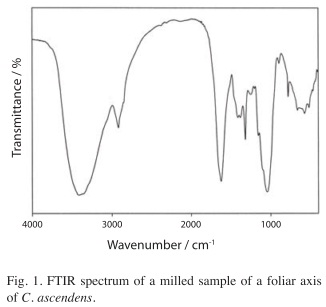
<body><![CDATA[<p style="text-align: justify;"><font face="Verdana" size="2">The first interesting result to be emphasized is the fact that in all cases the IR spectra obtained with the milled material of the foliar axis and the secondary veins were strongly similar: this indicates an identical chemical composition in terms of the biominerals found. Thus, the spectra of all the samples resulted comparable and only minor differences in band intensities and position were observed. Since the spectra are identical for the seven taxa, the results can be described and exemplified with any of them. However, there are some references to particular species in appropriate cases.</font></p>     <div style="text-align: justify;"></div>     <p style="text-align: justify;"><font face="Verdana" size="2">The IR spectrum recorded with the milled material of the foliar axis of a <i>C. ascendens </i>sample is shown in <a href="#fig1">Fig. 1</a>. The intense band located at 1 623/cm is characteristic of calcium oxalate and is assigned to the antisymmetric oxalate COO- stretching mode (Monje &amp; Baran 1996, 1997). The corresponding symmetric stretching vibration is surely responsible of the medium intensity band found at 1 319/cm. The other very strong band, centered at 1 042/cm is one of the characteristic opal bands (Kamatani 1971, Perry 1989). The remaining broad feature located between 800 and 450/cm includes both oxalate and opal unresolved bands. In the higher frequency side of the spectrum, a very strong and broad band, centered at about 3 415/cm with a shoulder at about 3 360/cm, is observed. This band is related to O-H stretching modes of water and of Si-OH groups. Although the second, medium intensity band, centered at 2 920/cm cannot be confidently assigned, it was observed in all the measured samples.    <br> </font></p>     <p><font face="Verdana" size="2">    <br> </font></p>     <div style="text-align: center;"><a name="fig1"></a><img  src="/img/revistas/rbt/v58n4/a35i1.jpg" title="" alt=""  style="width: 326px; height: 307px;">    <br>     <br> </div>     <p style="text-align: justify;"><font face="Verdana" size="2">Crystalline calcium oxalates have been found in two different hydration states in plants, either as the monohydrate (whewellite, CaC<sub>2</sub>O<sub>4</sub>&times;H<sub>2</sub>O) or as the dihydrate (weddellite, CaC<sub>2</sub>O<sub>4</sub>&times;2H<sub>2</sub>O) (Arnott 1982, Monje &amp; Baran 2002b, Franceschi &amp; Nakata 2005, Baran &amp; Monje 2008). It should be noted that it is rather difficult to establish the chemical nature of the calcium oxalate found in these plants. On the basis of the only relatively well defined oxalate IR band (located at 1 623/cm in the <i>C. ascendens </i>sample, <a href="#fig1">Fig. 1</a>) one could tentatively suggest the presence of whewellite since in pure whewellite this band is found at 1 622/cm whereas in weddellite it occurs at somewhat higher energies (Babi</font><font face="Verdana" size="2">&#263;-Ivan&#269;i&#263; </font><i><font  face="Verdana" size="2">et al. </font></i><font face="Verdana"  size="2">1986, Monje &amp; Baran, 1996, 1997). Interestingly, on the other hand, all of the measured spectra show a well-defined peak located at about 780/cm (cf. <a href="#fig1">Fig. 1</a>) which seems to be characteristic of the whewellite spectrum. Another fact to mention is that both, the high frequency and the low frequency ranges, which usually allow a clear differentiation between the two forms of calcium oxalate (Monje &amp; Baran 2002a), appear strongly overlapped by typical SiO<sub>2</sub> bands and are highly undefined.    ]]></body>
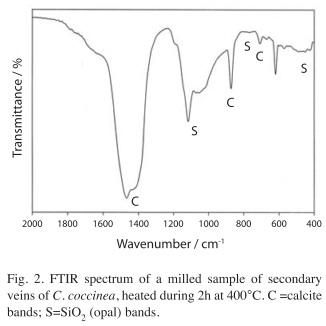
<body><![CDATA[<br> </font></p>     <p><font face="Verdana" size="2">    <br> </font></p>     <div style="text-align: center;"><a name="fig2"></a><img  src="/img/revistas/rbt/v58n4/a35i2.jpg" title="" alt=""  style="width: 326px; height: 326px;">    <br>     <br> </div>     <p style="text-align: justify;"><font face="Verdana" size="2">A clearly different IR spectrum is obtained if one of the milled samples or a dry sample of the plant material are slowly heated in a muffle furnace up to 400&deg;C and then maintained for 2-3 hours at this temperature. As an example, the spectrum obtained with a sample of <i>C. coccinea </i>is shown in <a href="#fig2">Fig. 2</a>. This spectrum reveals the presence of calcite showing bands at 1 467/cm (with a weak shoulder at 1 430/cm) (antisymmetric stretching, </font><font  face="Verdana" size="2">&#957;</font><font face="Verdana" size="2"><sub>3</sub>), 871/cm (out of plane deformation, </font><font face="Verdana" size="2">&#957;</font><font  face="Verdana" size="2"><sub>2</sub>), and 708/cm (in plane deformation, </font><font face="Verdana" size="2">&#957;</font><font  face="Verdana" size="2"><sub>4</sub>) (Ross 1972) and the presence of opal bands at 1 100-1 060, 780 and 455/cm (Kamatani 1971, Perry 1989). </font></p>     <div style="text-align: justify;"><font size="2"> </font></div>     <p style="text-align: justify;"><font face="Verdana" size="2"><span  style="font-weight: bold;">X-ray diffractometry:</span> </font><font face="Verdana" size="2">In order to obtain additional and independent information on the chemical nature of the biominerals we have attempted to record X-ray powder diagrams. In most cases, no clear signals could be obtained showing that the materials were highly amorphous. Usually only a broad and undefined feature in the 2</font><font face="Verdana"  size="2">&#952;</font><font face="Verdana" size="2">-range between 20 and 30&deg; was observed, which is characteristic of the diffraction pattern of biogenic opals (Kamatani 1971, Monje &amp; Baran 2004). Notwithstanding, in samples (primary and secondary veins) of <i>C. variegatifolia </i>and <i>C. fuchsina </i>together with this feature it was possible to observe the three strongest diffraction peaks of whewellite, those with d-values of 5.93, 5.79 and 3.65 (JCPDS PDF file 20-0231), respectively. This finding reinforces the conclusion of the spectroscopic analysis, suggesting that calcium oxalate is present in these plants in the form of the monohydrate.</font></p>     <div style="text-align: justify;"><font size="2"> </font></div>     ]]></body>
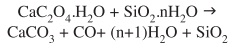
<body><![CDATA[<p style="text-align: justify;"><span style="font-weight: bold;"><font  face="Verdana" size="2">Scanning electron microscopy:</font></span> <font face="Verdana" size="2"><a  href="/img/revistas/rbt/v58n4/a35i3.jpg">Fig. 3</a> shows scanning electron microscopy (SEM) images found in foliar tissues of <i>Canna </i>species. In some taxa, such as <i>C. coccinea </i>(<a  href="/img/revistas/rbt/v58n4/a35i3.jpg">Fig. 3 A,B</a>), the cells of diaphragm of the foliar axes bear small but dense calcium oxalate deposits, while in the stellate cells of diaphragms of <i>C. ascendens </i>(<a  href="/img/revistas/rbt/v58n4/a35i3.jpg">Fig 3 C</a>), as well as in the cells near vascular strands in <i>C. glauca </i>(<a  href="/img/revistas/rbt/v58n4/a35i3.jpg">Fig. 3 D</a>) large pinacoid crystals occur. The shape of the calcium oxalate crystals seen in <a href="/img/revistas/rbt/v58n4/a35i3.jpg">Fig. 3 C,D</a> (rhomboid-shaped [100] pinacoids) is characteristic of whewellite (Hartl <i>et al. </i>2007), confirming additionally the presence of the monohydrate. In <i>C. ascendens</i>, amorphous opal bodies are clearly evident within the internal tissues of foliar axes (<a href="/img/revistas/rbt/v58n4/a35i3.jpg">Fig. 3 E</a>).</font></p> <font style="font-weight: bold;" face="Verdana" size="3">     <p>Discussion</p> </font><font size="2"> </font><font face="Verdana" size="2"></font>     <div style="text-align: justify;"><font face="Verdana" size="2">     <p>The performed spectroscopic studies supported by some X-ray powder diffraction measurements as well as by the obtained scanning electron microscopy images, definitively confirm the presence of calcium oxalate in the form of whewellite, in all the investigated samples. The presence of this biomineral is additionally supported by the chemical behavior of the investigated material. The heating of a calcium oxalate/opal mixture generates calcite, whereas opal remains unchanged, as was spectroscopically observed and may be due to the following reaction:</p> </font>    <br> <font face="Verdana" size="2">     <p></p> </font></div> <font face="Verdana" size="2"></font>     <div style="text-align: center;"><font face="Verdana" size="2">     <p><img src="/img/revistas/rbt/v58n4/a35ia.jpg" title="" alt=""  style="width: 236px; height: 48px;"></p> </font>    <br> </div> <font face="Verdana" size="2">     <p>The subsequent treatment of the obtained solid residue with HCl, decomposes the generated carbonate:    ]]></body>
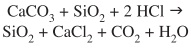
<body><![CDATA[<br> </p> </font>     <div style="text-align: center;"><font face="Verdana" size="2">     <p><img src="/img/revistas/rbt/v58n4/a35ib.jpg" title="" alt=""  style="width: 191px; height: 51px;">    <br> </p> </font></div> <font face="Verdana" size="2"> </font>     <p style="text-align: justify;"><font face="Verdana" size="2">And after washing, CaCl<sub>2</sub> is removed and only SiO<sub>2</sub> is recovered, as confirmed by the IR spectra which show only the three characteristic absorptions of biogenic silica, together with a weak unidentified feature at 945/cm. This spectrum is identical to those measured in other biogenic silica samples (Kamatani 1971).</font></p>     <div style="text-align: justify;"></div>     <p style="text-align: justify;"><font face="Verdana" size="2">Assuming that the number of wild species of the genus can be as high as 19-21 (Tanaka 2001, Ciciarelli &amp; Rolleri 2008, Delin &amp; Kress 2009), the number of species studied here represents one third of known taxa included in <i>Canna</i>, thus considered to be representative of what might happen in the genus as a whole.</font></p>     <div style="text-align: justify;"></div>     <p style="text-align: justify;"><font face="Verdana" size="2">As was mentioned previously, the <i>Cannaceae </i>shared the presence of biominerals (opal and calcium oxalate) with other six families, such as Costaceae, Heliconiaceae, Lowiaceae, Marantaceae, Strelitiziaceae, Musaceae and Zingiberaceae (Solereder &amp; Meyer 1930, Tomlinson 1961, 1962, 1969, Ciciarelli 1986). Although no studies like this have been done in other families of the order, the present one suggests that the character, once more investigated in relation to the nature of biominerals present in other Zingiberales, would additionally unify the families of this order and help to support the proposal that this is a monophyletic group.</font></p>     <div style="text-align: justify;"></div>     ]]></body>
<body><![CDATA[<p style="text-align: justify;"><font face="Verdana" size="2">The study of the biomineralization process in wild plants is still not very advanced, since most works relay on the study of crops, no natural vegetation and no studies like the one performed here are made on the Cannaceae and related families.</font></p>     <div style="text-align: justify;"></div>     <p style="text-align: justify;"><font face="Verdana" size="2">Interesting and intriguing aspects of plant biomineralization which remain to be clarified are the reason why plants accumulate these biominerals and their possible functions (Monje &amp; Baran 2002b, Nakata 2003, Baran &amp; Monje 2008). In the case of calcium oxalates, the diversity of crystal shapes and sizes, as well as their prevalence and spatial distribution, have led to a number of hypothesis on this aspect, including calcium homeostasis mechanisms, tissue support, plant protection, detoxification and even, light gathering and reflection. On the other hand, the reason why all plants are not highly silicified remains intriguing considering the abundance of silicon dioxide in soils, the high solubility of monosilicic acid in water and the relatively large volumes of water drawn up into the plant body and then lost by transpiration (Monje &amp; Baran 2002b). Regarding the possible functions of these biogenic silica deposits in the plant kingdom a variety of proposals and speculations exist in the literature, including strengthening and stiffening of vegetal structure, decreasing susceptibility to pathogens, detoxification (especially against aluminum and manganese) and improvement of photosynthetic capability (Epstein 1994, Monje &amp; Baran 2002b).</font></p> <font style="font-weight: bold;" face="Verdana" size="3">     <p>Acknowledgments</p> </font><font size="2"> </font><font face="Verdana" size="2"></font>     <div style="text-align: justify;"><font face="Verdana" size="2">     <p>This work has been supported by <i>Consejo Nacional de Investigaciones Cient&iacute;ficas y T&eacute;cnicas de la Rep&uacute;blica Argentina </i>(CONICET) and Universidad Nacional de La Plata. The authors are members of the Research Career of CONICET.</p> </font></div> <font face="Verdana" size="2"></font><font size="2"> </font> <hr style="width: 100%; height: 2px;"><font style="font-weight: bold;"  face="Verdana" size="3">     <p>References</p> </font><font size="2"> </font>     <!-- ref --><p><font face="Verdana" size="2">Arnott, H.J. 1982. Three systems of biomineralization in plants with comments on the associated organic matrix, p. 199-218. <i>In </i>G.H. Nancollas (ed.). Biological Mineralization and Demineralization. Springer, Berlin, Germany.    &nbsp;&nbsp;&nbsp;&nbsp;&nbsp;&nbsp;&nbsp;&nbsp;[&#160;<a href="javascript:void(0);" onclick="javascript: window.open('/scielo.php?script=sci_nlinks&ref=1405734&pid=S0034-7744201000040003500001&lng=','','width=640,height=500,resizable=yes,scrollbars=1,menubar=yes,');">Links</a>&#160;]<!-- end-ref --></font></p>     <!-- ref --><p><font face="Verdana" size="2">Babi</font><font face="Verdana"  size="2">&#263;-Ivan&#269;i&#263;, V., H. F&uuml;redi-Milhofer, B. Purgari&#263;, N.</font><font face="Verdana" size="2"> </font><font  face="Verdana" size="2">Brni&#269;evi&#263; &amp; Z. Despotovi&#263;. 1986. Precipitation of</font><font face="Verdana" size="2"> calcium oxalates from high ionic strength solutions. III. The Influence of reactant concentration on the properties of the precipitates. J. Cryst. Growth 71: 655-663.    &nbsp;&nbsp;&nbsp;&nbsp;&nbsp;&nbsp;&nbsp;&nbsp;[&#160;<a href="javascript:void(0);" onclick="javascript: window.open('/scielo.php?script=sci_nlinks&ref=1405736&pid=S0034-7744201000040003500002&lng=','','width=640,height=500,resizable=yes,scrollbars=1,menubar=yes,');">Links</a>&#160;]<!-- end-ref --></font></p>     <!-- ref --><p><font face="Verdana" size="2">Baran, E.J. 2005. Applications of vibrational spectroscopy to the investigation of plant material, p. 365-392. <i>In </i>H. Hemantaranjan (ed.). Advances in Plant Physiology Vol. 8. Scientific, Jodhpur, India.    &nbsp;&nbsp;&nbsp;&nbsp;&nbsp;&nbsp;&nbsp;&nbsp;[&#160;<a href="javascript:void(0);" onclick="javascript: window.open('/scielo.php?script=sci_nlinks&ref=1405738&pid=S0034-7744201000040003500003&lng=','','width=640,height=500,resizable=yes,scrollbars=1,menubar=yes,');">Links</a>&#160;]<!-- end-ref --></font></p>     <!-- ref --><p><font face="Verdana" size="2">Baran, E.J. &amp; P.V. Monje. 2008. Oxalate biominerals, p. 219-254. <i>In </i>A. Sigel, H. Sigel &amp; R.K.O. Sigel (eds.). Metal Ions in Life Sciences, 4. Wiley, Chichester, England.    &nbsp;&nbsp;&nbsp;&nbsp;&nbsp;&nbsp;&nbsp;&nbsp;[&#160;<a href="javascript:void(0);" onclick="javascript: window.open('/scielo.php?script=sci_nlinks&ref=1405740&pid=S0034-7744201000040003500004&lng=','','width=640,height=500,resizable=yes,scrollbars=1,menubar=yes,');">Links</a>&#160;]<!-- end-ref --></font></p>     <!-- ref --><p><font face="Verdana" size="2">Baran, E.J. &amp; C.H. Rolleri. 2010. IR-spectroscopic characterization of biominerals in the marattiaceaeus ferns. Rev. Bras. Bot<i>.</i>, in press.    &nbsp;&nbsp;&nbsp;&nbsp;&nbsp;&nbsp;&nbsp;&nbsp;[&#160;<a href="javascript:void(0);" onclick="javascript: window.open('/scielo.php?script=sci_nlinks&ref=1405742&pid=S0034-7744201000040003500005&lng=','','width=640,height=500,resizable=yes,scrollbars=1,menubar=yes,');">Links</a>&#160;]<!-- end-ref --></font></p>     <!-- ref --><p><font face="Verdana" size="2">Chase, M.W., D.E. Soltis, R.G. Olmstead, D. Morgan, D.H. Les, D. Mishler, M.R. Duvall, L.R. Price, H.G. Hills, Y. Qui, A. Kyron, J.H. Retting, E. Conti, J.D. Palmer, J.R. Manhart, K.J. Sytsma, H.J. Michaels, W.J. Kress, K.G. Karol, W.D. Clark, M. Hedren, B.S. Gaut, R.K. Jansen, K. Kim, C.F. Wimpee , J.F. Smith, G.R. Furnier, S.H. Strauss, Q. Xiang, G.M. Plunkett, P.S. Soltis, S.E. Swensen , S.E. Williams, P.A. Gadek, C.J. Quinn, L.E. Eguiarte, E. Golenberg, G.H. Learn Jr., S. Graham, C.H. Barrett, S. Dayanandan &amp; V.A. Albert. 1993. Phylogenetics of the seed plants: an analysis of nucleotide sequences from the plastid gene rbcL. Ann. Miss. Bot. Garden 80: 528-580.    &nbsp;&nbsp;&nbsp;&nbsp;&nbsp;&nbsp;&nbsp;&nbsp;[&#160;<a href="javascript:void(0);" onclick="javascript: window.open('/scielo.php?script=sci_nlinks&ref=1405744&pid=S0034-7744201000040003500006&lng=','','width=640,height=500,resizable=yes,scrollbars=1,menubar=yes,');">Links</a>&#160;]<!-- end-ref --></font></p>     <!-- ref --><p><font face="Verdana" size="2">Ciciarelli, M.M. 1986. Aportes al conocimiento histoqu&iacute;mica del mes&oacute;filo en especies de <i>Canna </i>L (Cannaceae). Notas Mus. La Plata, Bot. 21: 13-22.    &nbsp;&nbsp;&nbsp;&nbsp;&nbsp;&nbsp;&nbsp;&nbsp;[&#160;<a href="javascript:void(0);" onclick="javascript: window.open('/scielo.php?script=sci_nlinks&ref=1405746&pid=S0034-7744201000040003500007&lng=','','width=640,height=500,resizable=yes,scrollbars=1,menubar=yes,');">Links</a>&#160;]<!-- end-ref --></font></p>     <!-- ref --><p><font face="Verdana" size="2">Ciciarelli, M.M. 1987. Aplicaci&oacute;n del concepto de arquitectura foliar a la sistem&aacute;tica de especies de <i>Canna </i>L (Cannaceae) de la ribera del Plata. Notas Mus. de La Plata, Bot. 21: 87-97.    &nbsp;&nbsp;&nbsp;&nbsp;&nbsp;&nbsp;&nbsp;&nbsp;[&#160;<a href="javascript:void(0);" onclick="javascript: window.open('/scielo.php?script=sci_nlinks&ref=1405748&pid=S0034-7744201000040003500008&lng=','','width=640,height=500,resizable=yes,scrollbars=1,menubar=yes,');">Links</a>&#160;]<!-- end-ref --></font></p>     <!-- ref --><p><font face="Verdana" size="2">Ciciarelli, M.M. 1989. Las Cannaceae Link argentinas. Tesis Doctoral, Facultad de Ciencias Naturales y Museo de La Plata, La Plata, Argentina.    &nbsp;&nbsp;&nbsp;&nbsp;&nbsp;&nbsp;&nbsp;&nbsp;[&#160;<a href="javascript:void(0);" onclick="javascript: window.open('/scielo.php?script=sci_nlinks&ref=1405750&pid=S0034-7744201000040003500009&lng=','','width=640,height=500,resizable=yes,scrollbars=1,menubar=yes,');">Links</a>&#160;]<!-- end-ref --></font></p>     <!-- ref --><p><font face="Verdana" size="2">Ciciarelli, M.M. 1995. <i>Canna variegatifolia </i>Ciciarelli (Cannaceae-Zingiberales), una nueva especie para Argentina. Rev. Museo La Plata, Bot. 14: 333-341.    &nbsp;&nbsp;&nbsp;&nbsp;&nbsp;&nbsp;&nbsp;&nbsp;[&#160;<a href="javascript:void(0);" onclick="javascript: window.open('/scielo.php?script=sci_nlinks&ref=1405752&pid=S0034-7744201000040003500010&lng=','','width=640,height=500,resizable=yes,scrollbars=1,menubar=yes,');">Links</a>&#160;]<!-- end-ref --></font></p>     <!-- ref --><p><font face="Verdana" size="2">Ciciarelli, M.M. 2007. <i>Canna ascendens </i>Ciciarelli (Cannaceae) una nueva especie de la provincia de Buenos Aires y comentarios sobre otras especies argentinas de este g&eacute;nero. Dawiniana 45: 187-209.    &nbsp;&nbsp;&nbsp;&nbsp;&nbsp;&nbsp;&nbsp;&nbsp;[&#160;<a href="javascript:void(0);" onclick="javascript: window.open('/scielo.php?script=sci_nlinks&ref=1405754&pid=S0034-7744201000040003500011&lng=','','width=640,height=500,resizable=yes,scrollbars=1,menubar=yes,');">Links</a>&#160;]<!-- end-ref --></font></p>     <!-- ref --><p><font face="Verdana" size="2">Ciciarelli, M.M. &amp; C.H. Rolleri. 2008. Morfolog&iacute;a, taxonom&iacute;a y caracterizaci&oacute;n de siete especies neotropicales del g&eacute;nero <i>Canna </i>(Cannaceae, Zingiberales). Bot&aacute;nica Complutensis 32: 157-184.    &nbsp;&nbsp;&nbsp;&nbsp;&nbsp;&nbsp;&nbsp;&nbsp;[&#160;<a href="javascript:void(0);" onclick="javascript: window.open('/scielo.php?script=sci_nlinks&ref=1405756&pid=S0034-7744201000040003500012&lng=','','width=640,height=500,resizable=yes,scrollbars=1,menubar=yes,');">Links</a>&#160;]<!-- end-ref --></font></p>     <!-- ref --><p><font face="Verdana" size="2">Ciciarelli, M.M., C.H. Rolleri &amp; M.C. Gonz&aacute;lez Dubox. 2009. <i>Canna fuchsina</i>, una especie nueva para la ciencia, sus relaciones con otras especies silvestres del g&eacute;nero y con el grupo <i>C. x generalis </i>(Cannaceae-Zingiberales). Botanica Complutensis, in press.    &nbsp;&nbsp;&nbsp;&nbsp;&nbsp;&nbsp;&nbsp;&nbsp;[&#160;<a href="javascript:void(0);" onclick="javascript: window.open('/scielo.php?script=sci_nlinks&ref=1405758&pid=S0034-7744201000040003500013&lng=','','width=640,height=500,resizable=yes,scrollbars=1,menubar=yes,');">Links</a>&#160;]<!-- end-ref --></font></p>     <p><font face="Verdana" size="2"> </font></p>     <!-- ref --><p><font face="Verdana" size="2">Dahlgren, R.M. &amp; F.N. Rassmusen. 1983. Monocotyledon evolution: characters and phylogenetic estimation. Evol. Biol. 16: 187-209.    &nbsp;&nbsp;&nbsp;&nbsp;&nbsp;&nbsp;&nbsp;&nbsp;[&#160;<a href="javascript:void(0);" onclick="javascript: window.open('/scielo.php?script=sci_nlinks&ref=1405761&pid=S0034-7744201000040003500014&lng=','','width=640,height=500,resizable=yes,scrollbars=1,menubar=yes,');">Links</a>&#160;]<!-- end-ref --></font></p>     <!-- ref --><p><font face="Verdana" size="2">Delin, W. &amp; W.J. Kress. 2009. <i>Cannaceae</i>. <i>In </i>The Flora of China 24: 378. Science (Beijing) and Missouri Botanical Garden, St. Louis, Missouri, USA.    &nbsp;&nbsp;&nbsp;&nbsp;&nbsp;&nbsp;&nbsp;&nbsp;[&#160;<a href="javascript:void(0);" onclick="javascript: window.open('/scielo.php?script=sci_nlinks&ref=1405763&pid=S0034-7744201000040003500015&lng=','','width=640,height=500,resizable=yes,scrollbars=1,menubar=yes,');">Links</a>&#160;]<!-- end-ref --></font></p>     <!-- ref --><p><font face="Verdana" size="2">Epstein, E. 1994. The anomaly of silicon in plant biology. Proc. Natl. Acad. Sci. U.S.A. 91: 11-17.    &nbsp;&nbsp;&nbsp;&nbsp;&nbsp;&nbsp;&nbsp;&nbsp;[&#160;<a href="javascript:void(0);" onclick="javascript: window.open('/scielo.php?script=sci_nlinks&ref=1405765&pid=S0034-7744201000040003500016&lng=','','width=640,height=500,resizable=yes,scrollbars=1,menubar=yes,');">Links</a>&#160;]<!-- end-ref --></font></p>     ]]></body>
<body><![CDATA[<!-- ref --><p><font face="Verdana" size="2">Franceschi, V.R. &amp; P.A. Nakata. 2005. Calcium oxalate in plants: formation and function. Annu. Rev. Plant Biol. 56: 41-71.    &nbsp;&nbsp;&nbsp;&nbsp;&nbsp;&nbsp;&nbsp;&nbsp;[&#160;<a href="javascript:void(0);" onclick="javascript: window.open('/scielo.php?script=sci_nlinks&ref=1405767&pid=S0034-7744201000040003500017&lng=','','width=640,height=500,resizable=yes,scrollbars=1,menubar=yes,');">Links</a>&#160;]<!-- end-ref --></font></p>     <!-- ref --><p><font face="Verdana" size="2">Hartl, W.P., H. Klapper, B. Barbier, H.J. Ensikat, R. Dronskowski, P. M&uuml;ller, G. Ostendorp, A. Tye, R. Bauer &amp; W. Barthlott. 2007. Diversity of calcium oxalate crystals in Cactaceae. Canad. J. Bot. 85: 501-517.    &nbsp;&nbsp;&nbsp;&nbsp;&nbsp;&nbsp;&nbsp;&nbsp;[&#160;<a href="javascript:void(0);" onclick="javascript: window.open('/scielo.php?script=sci_nlinks&ref=1405769&pid=S0034-7744201000040003500018&lng=','','width=640,height=500,resizable=yes,scrollbars=1,menubar=yes,');">Links</a>&#160;]<!-- end-ref --></font></p>     <!-- ref --><p><font face="Verdana" size="2">Johansen, D.A. 1940. Plant Microtechnique. McGraw Hill, New York, USA.    &nbsp;&nbsp;&nbsp;&nbsp;&nbsp;&nbsp;&nbsp;&nbsp;[&#160;<a href="javascript:void(0);" onclick="javascript: window.open('/scielo.php?script=sci_nlinks&ref=1405771&pid=S0034-7744201000040003500019&lng=','','width=640,height=500,resizable=yes,scrollbars=1,menubar=yes,');">Links</a>&#160;]<!-- end-ref --></font></p>     <!-- ref --><p><font face="Verdana" size="2">Judd, W.S., C.S. Campbell, E.A. Kellog, P.F. Stevens &amp; M. Donoghue. 2002. Plant Systematics. A Phylogenetic Approach. Sinauer Assoc., Sunderland, Massachusetts, USA.    &nbsp;&nbsp;&nbsp;&nbsp;&nbsp;&nbsp;&nbsp;&nbsp;[&#160;<a href="javascript:void(0);" onclick="javascript: window.open('/scielo.php?script=sci_nlinks&ref=1405773&pid=S0034-7744201000040003500020&lng=','','width=640,height=500,resizable=yes,scrollbars=1,menubar=yes,');">Links</a>&#160;]<!-- end-ref --></font></p>     <!-- ref --><p><font face="Verdana" size="2">Kamatani, A. 1971. Physical and chemical characteristics of biogenous silica. Mar. Biol. 8: 89-95.    &nbsp;&nbsp;&nbsp;&nbsp;&nbsp;&nbsp;&nbsp;&nbsp;[&#160;<a href="javascript:void(0);" onclick="javascript: window.open('/scielo.php?script=sci_nlinks&ref=1405775&pid=S0034-7744201000040003500021&lng=','','width=640,height=500,resizable=yes,scrollbars=1,menubar=yes,');">Links</a>&#160;]<!-- end-ref --></font></p>     ]]></body>
<body><![CDATA[<!-- ref --><p><font face="Verdana" size="2">Kress, W.J. 1990. The phylogeny and classification of Zingiberales. Ann. Missouri. Bot. Garden 77: 698-721.    &nbsp;&nbsp;&nbsp;&nbsp;&nbsp;&nbsp;&nbsp;&nbsp;[&#160;<a href="javascript:void(0);" onclick="javascript: window.open('/scielo.php?script=sci_nlinks&ref=1405777&pid=S0034-7744201000040003500022&lng=','','width=640,height=500,resizable=yes,scrollbars=1,menubar=yes,');">Links</a>&#160;]<!-- end-ref --></font></p>     <!-- ref --><p><font face="Verdana" size="2">Kress, W.J. 1995. Phylogeny of the Zingiberaceae: Morphology and molecules, p. 443-460. <i>In </i>P.J. Rudall, P.J. Cribb, D.J. Cuttler &amp; C.J. Humphries (eds.). Monocotyledons: Systematics and Evolution. Royal Botanical Gardens, London, England.    &nbsp;&nbsp;&nbsp;&nbsp;&nbsp;&nbsp;&nbsp;&nbsp;[&#160;<a href="javascript:void(0);" onclick="javascript: window.open('/scielo.php?script=sci_nlinks&ref=1405779&pid=S0034-7744201000040003500023&lng=','','width=640,height=500,resizable=yes,scrollbars=1,menubar=yes,');">Links</a>&#160;]<!-- end-ref --></font></p> <font size="2"> </font><font face="Verdana" size="2"></font>     <!-- ref --><p><font face="Verdana" size="2">Kress, W.J., L.M. Prince, W.J. Hahn &amp; E.A. Zimmer. 2001. Unraveling the evolutionary radiation of the families of the Zingiberales using morphological and molecular evidence. System. Biol. 50: 926-944.    &nbsp;&nbsp;&nbsp;&nbsp;&nbsp;&nbsp;&nbsp;&nbsp;[&#160;<a href="javascript:void(0);" onclick="javascript: window.open('/scielo.php?script=sci_nlinks&ref=1405781&pid=S0034-7744201000040003500024&lng=','','width=640,height=500,resizable=yes,scrollbars=1,menubar=yes,');">Links</a>&#160;]<!-- end-ref --></font></p>     <!-- ref --><p><font face="Verdana" size="2">Lanning, F.C., B.W.X. Ponnaya &amp; F.C. Crumpton. 1958. The chemical nature of silica in plants. Plant Physiol. 33: 339-343.    &nbsp;&nbsp;&nbsp;&nbsp;&nbsp;&nbsp;&nbsp;&nbsp;[&#160;<a href="javascript:void(0);" onclick="javascript: window.open('/scielo.php?script=sci_nlinks&ref=1405783&pid=S0034-7744201000040003500025&lng=','','width=640,height=500,resizable=yes,scrollbars=1,menubar=yes,');">Links</a>&#160;]<!-- end-ref --></font></p>     <!-- ref --><p><font face="Verdana" size="2">Monje, P.V. &amp; E.J. Baran. 1996. On the formation of weddellite in <i>Chamaecereus silvestrii</i>, a cactaceae from northern Argentina. Z. Naturforsch. 51c: 426- 428.    &nbsp;&nbsp;&nbsp;&nbsp;&nbsp;&nbsp;&nbsp;&nbsp;[&#160;<a href="javascript:void(0);" onclick="javascript: window.open('/scielo.php?script=sci_nlinks&ref=1405785&pid=S0034-7744201000040003500026&lng=','','width=640,height=500,resizable=yes,scrollbars=1,menubar=yes,');">Links</a>&#160;]<!-- end-ref --></font></p>     ]]></body>
<body><![CDATA[<!-- ref --><p><font face="Verdana" size="2">Monje, P.V. &amp; E.J. Baran.1997. On the formation of whewellite in the cactaceae species <i>Opuntia microdasys</i>. Z. Naturforsch. 52c: 267-269.    &nbsp;&nbsp;&nbsp;&nbsp;&nbsp;&nbsp;&nbsp;&nbsp;[&#160;<a href="javascript:void(0);" onclick="javascript: window.open('/scielo.php?script=sci_nlinks&ref=1405787&pid=S0034-7744201000040003500027&lng=','','width=640,height=500,resizable=yes,scrollbars=1,menubar=yes,');">Links</a>&#160;]<!-- end-ref --></font></p>     <!-- ref --><p><font face="Verdana" size="2">Monje, P.V. &amp; E.J. Baran. 2002a. Characterization of calcium oxalates generated as biominerals in cacti. Plant Physiol. 128: 707-713.    &nbsp;&nbsp;&nbsp;&nbsp;&nbsp;&nbsp;&nbsp;&nbsp;[&#160;<a href="javascript:void(0);" onclick="javascript: window.open('/scielo.php?script=sci_nlinks&ref=1405789&pid=S0034-7744201000040003500028&lng=','','width=640,height=500,resizable=yes,scrollbars=1,menubar=yes,');">Links</a>&#160;]<!-- end-ref --></font></p>     <!-- ref --><p><font face="Verdana" size="2">Monje, P.V. &amp; E.J. Baran. 2002b. Plant biomineralization, p. 395-410. <i>In </i>H. Hemantaranjan (ed.). Advances in Plant Physiology Vol. 7. Scientific, Jodhpur, India.    &nbsp;&nbsp;&nbsp;&nbsp;&nbsp;&nbsp;&nbsp;&nbsp;[&#160;<a href="javascript:void(0);" onclick="javascript: window.open('/scielo.php?script=sci_nlinks&ref=1405791&pid=S0034-7744201000040003500029&lng=','','width=640,height=500,resizable=yes,scrollbars=1,menubar=yes,');">Links</a>&#160;]<!-- end-ref --></font></p>     <!-- ref --><p><font face="Verdana" size="2">Monje, P.V. &amp; E.J. Baran. 2004. Complex biomineralization pattern in cactaceae. J. Plant Physiol. 161: 121-123.    &nbsp;&nbsp;&nbsp;&nbsp;&nbsp;&nbsp;&nbsp;&nbsp;[&#160;<a href="javascript:void(0);" onclick="javascript: window.open('/scielo.php?script=sci_nlinks&ref=1405793&pid=S0034-7744201000040003500030&lng=','','width=640,height=500,resizable=yes,scrollbars=1,menubar=yes,');">Links</a>&#160;]<!-- end-ref --></font></p>     <!-- ref --><p><font face="Verdana" size="2">Monje, P.V. &amp; E.J. Baran. 2005. Evidence of formation of glushinskite as a biomineral in a cactaceae species. Phytochemistry 66: 611-614.    &nbsp;&nbsp;&nbsp;&nbsp;&nbsp;&nbsp;&nbsp;&nbsp;[&#160;<a href="javascript:void(0);" onclick="javascript: window.open('/scielo.php?script=sci_nlinks&ref=1405795&pid=S0034-7744201000040003500031&lng=','','width=640,height=500,resizable=yes,scrollbars=1,menubar=yes,');">Links</a>&#160;]<!-- end-ref --></font></p>     ]]></body>
<body><![CDATA[<!-- ref --><p><font face="Verdana" size="2">Nakata, P.A. 2003. Advances in our understanding of calcium oxalate crystal formation and function in plants. Plant Sci. 164: 901-909.    &nbsp;&nbsp;&nbsp;&nbsp;&nbsp;&nbsp;&nbsp;&nbsp;[&#160;<a href="javascript:void(0);" onclick="javascript: window.open('/scielo.php?script=sci_nlinks&ref=1405797&pid=S0034-7744201000040003500032&lng=','','width=640,height=500,resizable=yes,scrollbars=1,menubar=yes,');">Links</a>&#160;]<!-- end-ref --></font></p>     <!-- ref --><p><font face="Verdana" size="2">Perry, C.C. 1989. Chemical studies of biogenic silica, p. 223-256. <i>In </i>S. Mann, J. Webb &amp; R.J.P. Williams (eds.). Biomineralization. Chemical and Biochemical Perspectives, Chemie, Weinheim, Germany.    &nbsp;&nbsp;&nbsp;&nbsp;&nbsp;&nbsp;&nbsp;&nbsp;[&#160;<a href="javascript:void(0);" onclick="javascript: window.open('/scielo.php?script=sci_nlinks&ref=1405799&pid=S0034-7744201000040003500033&lng=','','width=640,height=500,resizable=yes,scrollbars=1,menubar=yes,');">Links</a>&#160;]<!-- end-ref --></font></p>     <!-- ref --><p><font face="Verdana" size="2">Prychid, C.J. &amp; P.J. Rudall. 1999. Calcium oxalate crystals in monocotyledons: A review of their structure and systematics. Ann. Bot. 84: 725-739.    &nbsp;&nbsp;&nbsp;&nbsp;&nbsp;&nbsp;&nbsp;&nbsp;[&#160;<a href="javascript:void(0);" onclick="javascript: window.open('/scielo.php?script=sci_nlinks&ref=1405801&pid=S0034-7744201000040003500034&lng=','','width=640,height=500,resizable=yes,scrollbars=1,menubar=yes,');">Links</a>&#160;]<!-- end-ref --></font></p>     <!-- ref --><p><font face="Verdana" size="2">Prychid, C.J., P.J. Rudall &amp; M. Gregory. 2004. Systematics and biology of silica bodies in monocotyledons. Bot. Rev. 69: 377-440.    &nbsp;&nbsp;&nbsp;&nbsp;&nbsp;&nbsp;&nbsp;&nbsp;[&#160;<a href="javascript:void(0);" onclick="javascript: window.open('/scielo.php?script=sci_nlinks&ref=1405803&pid=S0034-7744201000040003500035&lng=','','width=640,height=500,resizable=yes,scrollbars=1,menubar=yes,');">Links</a>&#160;]<!-- end-ref --></font></p>     <!-- ref --><p><font face="Verdana" size="2">Ross, S.D. 1972. Inorganic Infrared and Raman Spectra. McGraw-Hill, London, England.    &nbsp;&nbsp;&nbsp;&nbsp;&nbsp;&nbsp;&nbsp;&nbsp;[&#160;<a href="javascript:void(0);" onclick="javascript: window.open('/scielo.php?script=sci_nlinks&ref=1405805&pid=S0034-7744201000040003500036&lng=','','width=640,height=500,resizable=yes,scrollbars=1,menubar=yes,');">Links</a>&#160;]<!-- end-ref --></font></p> <font size="2"> </font><font face="Verdana" size="2">     ]]></body>
<body><![CDATA[<!-- ref --><p>Smith, J.F., W.J. Kress &amp; E.A. Zimmer. 1993. Phylogenetic analysis of the Zingiberales based on rbcL sequences. Ann. Missouri Bot. Garden 80: 50-66.    &nbsp;&nbsp;&nbsp;&nbsp;&nbsp;&nbsp;&nbsp;&nbsp;[&#160;<a href="javascript:void(0);" onclick="javascript: window.open('/scielo.php?script=sci_nlinks&ref=1405807&pid=S0034-7744201000040003500037&lng=','','width=640,height=500,resizable=yes,scrollbars=1,menubar=yes,');">Links</a>&#160;]<!-- end-ref --></p>     <!-- ref --><p>Solereder, H &amp; F. Meyer. 1930. Cannaceae, p. 56-62. <i>In </i>Systematische Anatomie der Monokotiledonen, Vol. 6. Gebr. Borntraeger, Berlin, Germany.    &nbsp;&nbsp;&nbsp;&nbsp;&nbsp;&nbsp;&nbsp;&nbsp;[&#160;<a href="javascript:void(0);" onclick="javascript: window.open('/scielo.php?script=sci_nlinks&ref=1405809&pid=S0034-7744201000040003500038&lng=','','width=640,height=500,resizable=yes,scrollbars=1,menubar=yes,');">Links</a>&#160;]<!-- end-ref --></p>     <!-- ref --><p>Stevenson, D.W. &amp; H. Loconte. 1995. Cladistic analysis of the monocot families, p. 543-578. <i>In </i>P.J. Rudall, P.J. Cribb, D.J. Cuttler &amp; C.J. Humphries (eds.). Monocotyledons: Systematics and Evolution. Royal Botanical Gardens, London, England.    &nbsp;&nbsp;&nbsp;&nbsp;&nbsp;&nbsp;&nbsp;&nbsp;[&#160;<a href="javascript:void(0);" onclick="javascript: window.open('/scielo.php?script=sci_nlinks&ref=1405811&pid=S0034-7744201000040003500039&lng=','','width=640,height=500,resizable=yes,scrollbars=1,menubar=yes,');">Links</a>&#160;]<!-- end-ref --></p>     <!-- ref --><p>Tanaka, N. 2001. Taxonomic revision of the family Cannaceae in the New World and Asia. Makinoa, New Ser. 1: 31-33.    &nbsp;&nbsp;&nbsp;&nbsp;&nbsp;&nbsp;&nbsp;&nbsp;[&#160;<a href="javascript:void(0);" onclick="javascript: window.open('/scielo.php?script=sci_nlinks&ref=1405813&pid=S0034-7744201000040003500040&lng=','','width=640,height=500,resizable=yes,scrollbars=1,menubar=yes,');">Links</a>&#160;]<!-- end-ref --></p>     <!-- ref --><p>Tomlinson, P.B. 1961. The anatomy of <i>Canna</i>. J. Linnean Soc. London (Botany) 56: 467-473.    &nbsp;&nbsp;&nbsp;&nbsp;&nbsp;&nbsp;&nbsp;&nbsp;[&#160;<a href="javascript:void(0);" onclick="javascript: window.open('/scielo.php?script=sci_nlinks&ref=1405815&pid=S0034-7744201000040003500041&lng=','','width=640,height=500,resizable=yes,scrollbars=1,menubar=yes,');">Links</a>&#160;]<!-- end-ref --></p>     ]]></body>
<body><![CDATA[<!-- ref --><p>Tomlinson, P.B. 1962. Phylogeny of the Scitamineae: morphological and anatomical considerations. Evolution 16: 192-213.    &nbsp;&nbsp;&nbsp;&nbsp;&nbsp;&nbsp;&nbsp;&nbsp;[&#160;<a href="javascript:void(0);" onclick="javascript: window.open('/scielo.php?script=sci_nlinks&ref=1405817&pid=S0034-7744201000040003500042&lng=','','width=640,height=500,resizable=yes,scrollbars=1,menubar=yes,');">Links</a>&#160;]<!-- end-ref --></p>     <!-- ref --><p>Tomlinson, P.B. 1969. Commelinales-Zingiberales, p.295- 421. <i>In </i>C.R. Metcalfe (ed.). Anatomy of the Monocotyledons. Clarendon, Oxford, England.    &nbsp;&nbsp;&nbsp;&nbsp;&nbsp;&nbsp;&nbsp;&nbsp;[&#160;<a href="javascript:void(0);" onclick="javascript: window.open('/scielo.php?script=sci_nlinks&ref=1405819&pid=S0034-7744201000040003500043&lng=','','width=640,height=500,resizable=yes,scrollbars=1,menubar=yes,');">Links</a>&#160;]<!-- end-ref --><br> </p>     <p>    <br> <a name="Correspondencia"></a>Correspondencia a: <font><font  face="Verdana" size="2">Enrique J. Baran &amp; </font></font><font><font  face="Verdana" size="2">Ana C. Gonz&aacute;lez-Bar&oacute;. </font></font><font><font face="Verdana"  size="2">Centro de Qu&iacute;mica Inorg&aacute;nica (CEQUINOR, CONICET/UNLP), Facultad de Ciencias Exactas, Universidad Nacional de La Plata, 1900 La Plata, Argentina; <a href="mailto:baran@quimica.unlp.edu.ar">baran@quimica.unlp.edu.ar</a>, <a href="mailto:agb@quimica.unlp.edu.ar">agb@quimica.unlp.edu.ar</a>.    <br> </font></font><font><font face="Verdana" size="2">Mar&iacute;a M. Ciciarelli &amp; Cristina H. Rolleri. </font></font><font><font face="Verdana" size="2">Laboratorio de Estudios de Anatom&iacute;a Vegetal Evolutiva y Sistem&aacute;tica (LEAVES), Facultad de Ciencias Naturales y Museo de La Plata, 1900 La Plata, Argentina; <a href="mailto:mmciciar@yahoo.com.ar">mmciciar@yahoo.com.ar</a>, <a href="mailto:tinar@speedy.com.ar">tinar@speedy.com.ar</a>.</font></font></p> </font><font size="2"> </font> <hr style="width: 100%; height: 2px;"><font size="2"></font><font  face="Verdana" size="2">     <p align="center">Received 05-XI-2009. Corrected 11-V-2010. Accepted 10-VI-2010.</p> </font>      ]]></body><back>
<ref-list>
<ref id="B1">
<nlm-citation citation-type="book">
<person-group person-group-type="author">
<name>
<surname><![CDATA[Arnott]]></surname>
<given-names><![CDATA[H.J]]></given-names>
</name>
</person-group>
<article-title xml:lang="en"><![CDATA[Three systems of biomineralization in plants with comments on the associated organic matrix]]></article-title>
<person-group person-group-type="editor">
<name>
<surname><![CDATA[Nancollas]]></surname>
<given-names><![CDATA[G.H]]></given-names>
</name>
</person-group>
<source><![CDATA[Biological Mineralization and Demineralization]]></source>
<year>1982</year>
<page-range>199-218</page-range><publisher-loc><![CDATA[Berlin ]]></publisher-loc>
<publisher-name><![CDATA[Springer]]></publisher-name>
</nlm-citation>
</ref>
<ref id="B2">
<nlm-citation citation-type="journal">
<person-group person-group-type="author">
<name>
<surname><![CDATA[Babi&#263;-Ivan&#269;i&#263;]]></surname>
<given-names><![CDATA[V]]></given-names>
</name>
<name>
<surname><![CDATA[Füredi-Milhofer]]></surname>
<given-names><![CDATA[H]]></given-names>
</name>
<name>
<surname><![CDATA[Purgari&#263;]]></surname>
<given-names><![CDATA[B]]></given-names>
</name>
<name>
<surname><![CDATA[Brni&#269;evi&#263;]]></surname>
<given-names><![CDATA[N]]></given-names>
</name>
<name>
<surname><![CDATA[Despotovi&#263;]]></surname>
<given-names><![CDATA[Z]]></given-names>
</name>
</person-group>
<article-title xml:lang="en"><![CDATA[Precipitation of calcium oxalates from high ionic strength solutions: III. The Influence of reactant concentration on the properties of the precipitates]]></article-title>
<source><![CDATA[J. Cryst. Growth]]></source>
<year>1986</year>
<volume>71</volume>
<page-range>655-663</page-range></nlm-citation>
</ref>
<ref id="B3">
<nlm-citation citation-type="book">
<person-group person-group-type="author">
<name>
<surname><![CDATA[Baran]]></surname>
<given-names><![CDATA[E.J]]></given-names>
</name>
</person-group>
<article-title xml:lang="en"><![CDATA[Applications of vibrational spectroscopy to the investigation of plant material]]></article-title>
<person-group person-group-type="editor">
<name>
<surname><![CDATA[Hemantaranjan]]></surname>
<given-names><![CDATA[H]]></given-names>
</name>
</person-group>
<source><![CDATA[Advances in Plant Physiology]]></source>
<year>2005</year>
<volume>8</volume>
<page-range>365-392</page-range><publisher-loc><![CDATA[Jodhpur ]]></publisher-loc>
<publisher-name><![CDATA[Scientific]]></publisher-name>
</nlm-citation>
</ref>
<ref id="B4">
<nlm-citation citation-type="book">
<person-group person-group-type="author">
<name>
<surname><![CDATA[Baran]]></surname>
<given-names><![CDATA[E.J]]></given-names>
</name>
<name>
<surname><![CDATA[Monje]]></surname>
<given-names><![CDATA[P.V]]></given-names>
</name>
</person-group>
<article-title xml:lang="en"><![CDATA[Oxalate biominerals]]></article-title>
<person-group person-group-type="editor">
<name>
<surname><![CDATA[Sigel]]></surname>
<given-names><![CDATA[A]]></given-names>
</name>
<name>
<surname><![CDATA[Sigel]]></surname>
<given-names><![CDATA[H]]></given-names>
</name>
<name>
<surname><![CDATA[Sigel]]></surname>
<given-names><![CDATA[R.K.O]]></given-names>
</name>
</person-group>
<source><![CDATA[Metal Ions in Life Sciences, 4]]></source>
<year>2008</year>
<page-range>219-254</page-range><publisher-loc><![CDATA[Chichester ]]></publisher-loc>
<publisher-name><![CDATA[Wiley]]></publisher-name>
</nlm-citation>
</ref>
<ref id="B5">
<nlm-citation citation-type="journal">
<person-group person-group-type="author">
<name>
<surname><![CDATA[Baran]]></surname>
<given-names><![CDATA[E.J]]></given-names>
</name>
<name>
<surname><![CDATA[Rolleri]]></surname>
<given-names><![CDATA[C.H]]></given-names>
</name>
</person-group>
<article-title xml:lang="en"><![CDATA[IR-spectroscopic characterization of biominerals in the marattiaceaeus ferns]]></article-title>
<source><![CDATA[Rev. Bras. Bot]]></source>
<year>2010</year>
</nlm-citation>
</ref>
<ref id="B6">
<nlm-citation citation-type="journal">
<person-group person-group-type="author">
<name>
<surname><![CDATA[Chase]]></surname>
<given-names><![CDATA[M.W]]></given-names>
</name>
<name>
<surname><![CDATA[Soltis]]></surname>
<given-names><![CDATA[D.E]]></given-names>
</name>
<name>
<surname><![CDATA[Olmstead]]></surname>
<given-names><![CDATA[R.G]]></given-names>
</name>
<name>
<surname><![CDATA[Morgan]]></surname>
<given-names><![CDATA[D]]></given-names>
</name>
<name>
<surname><![CDATA[Les]]></surname>
<given-names><![CDATA[D.H]]></given-names>
</name>
<name>
<surname><![CDATA[Mishler]]></surname>
<given-names><![CDATA[D]]></given-names>
</name>
<name>
<surname><![CDATA[Duvall]]></surname>
<given-names><![CDATA[M.R]]></given-names>
</name>
<name>
<surname><![CDATA[Price]]></surname>
<given-names><![CDATA[L.R]]></given-names>
</name>
<name>
<surname><![CDATA[Hills]]></surname>
<given-names><![CDATA[H.G]]></given-names>
</name>
<name>
<surname><![CDATA[Qui]]></surname>
<given-names><![CDATA[Y]]></given-names>
</name>
<name>
<surname><![CDATA[Kyron]]></surname>
<given-names><![CDATA[A]]></given-names>
</name>
<name>
<surname><![CDATA[Retting]]></surname>
<given-names><![CDATA[J.H]]></given-names>
</name>
<name>
<surname><![CDATA[Conti]]></surname>
<given-names><![CDATA[E]]></given-names>
</name>
<name>
<surname><![CDATA[Palmer]]></surname>
<given-names><![CDATA[J.D]]></given-names>
</name>
<name>
<surname><![CDATA[Manhart]]></surname>
<given-names><![CDATA[J.R]]></given-names>
</name>
<name>
<surname><![CDATA[Sytsma]]></surname>
<given-names><![CDATA[K.J]]></given-names>
</name>
<name>
<surname><![CDATA[Michaels]]></surname>
<given-names><![CDATA[H.J]]></given-names>
</name>
<name>
<surname><![CDATA[Kress]]></surname>
<given-names><![CDATA[W.J]]></given-names>
</name>
<name>
<surname><![CDATA[Karol]]></surname>
<given-names><![CDATA[K.G]]></given-names>
</name>
<name>
<surname><![CDATA[Clark]]></surname>
<given-names><![CDATA[W.D]]></given-names>
</name>
<name>
<surname><![CDATA[Hedren]]></surname>
<given-names><![CDATA[M]]></given-names>
</name>
<name>
<surname><![CDATA[Gaut]]></surname>
<given-names><![CDATA[B.S]]></given-names>
</name>
<name>
<surname><![CDATA[Jansen]]></surname>
<given-names><![CDATA[R.K]]></given-names>
</name>
<name>
<surname><![CDATA[Kim]]></surname>
<given-names><![CDATA[K]]></given-names>
</name>
<name>
<surname><![CDATA[Wimpee]]></surname>
<given-names><![CDATA[C.F]]></given-names>
</name>
<name>
<surname><![CDATA[Smith]]></surname>
<given-names><![CDATA[J.F]]></given-names>
</name>
<name>
<surname><![CDATA[Furnier]]></surname>
<given-names><![CDATA[G.R]]></given-names>
</name>
<name>
<surname><![CDATA[Strauss]]></surname>
<given-names><![CDATA[S.H]]></given-names>
</name>
<name>
<surname><![CDATA[Xiang]]></surname>
<given-names><![CDATA[Q]]></given-names>
</name>
<name>
<surname><![CDATA[Plunkett]]></surname>
<given-names><![CDATA[G.M]]></given-names>
</name>
<name>
<surname><![CDATA[Soltis]]></surname>
<given-names><![CDATA[P.S]]></given-names>
</name>
<name>
<surname><![CDATA[Swensen]]></surname>
<given-names><![CDATA[S.E]]></given-names>
</name>
<name>
<surname><![CDATA[Williams]]></surname>
<given-names><![CDATA[S.E]]></given-names>
</name>
<name>
<surname><![CDATA[Gadek]]></surname>
<given-names><![CDATA[P.A]]></given-names>
</name>
<name>
<surname><![CDATA[Quinn]]></surname>
<given-names><![CDATA[C.J]]></given-names>
</name>
<name>
<surname><![CDATA[Eguiarte]]></surname>
<given-names><![CDATA[L.E]]></given-names>
</name>
<name>
<surname><![CDATA[Golenberg]]></surname>
<given-names><![CDATA[E]]></given-names>
</name>
<name>
<surname><![CDATA[Learn Jr]]></surname>
<given-names><![CDATA[G.H]]></given-names>
</name>
<name>
<surname><![CDATA[Graham]]></surname>
<given-names><![CDATA[S]]></given-names>
</name>
<name>
<surname><![CDATA[Barrett]]></surname>
<given-names><![CDATA[C.H]]></given-names>
</name>
<name>
<surname><![CDATA[Dayanandan]]></surname>
<given-names><![CDATA[S]]></given-names>
</name>
<name>
<surname><![CDATA[Albert]]></surname>
<given-names><![CDATA[V.A]]></given-names>
</name>
</person-group>
<article-title xml:lang="en"><![CDATA[Phylogenetics of the seed plants: an analysis of nucleotide sequences from the plastid gene rbcL]]></article-title>
<source><![CDATA[Ann. Miss. Bot. Garden]]></source>
<year>1993</year>
<volume>80</volume>
<page-range>528-580</page-range></nlm-citation>
</ref>
<ref id="B7">
<nlm-citation citation-type="journal">
<person-group person-group-type="author">
<name>
<surname><![CDATA[Ciciarelli]]></surname>
<given-names><![CDATA[M.M]]></given-names>
</name>
</person-group>
<article-title xml:lang="es"><![CDATA[Aportes al conocimiento histoquímica del mesófilo en especies de Canna L (Cannaceae)]]></article-title>
<source><![CDATA[Notas Mus. La Plata, Bot]]></source>
<year>1986</year>
<volume>21</volume>
<page-range>13-22</page-range></nlm-citation>
</ref>
<ref id="B8">
<nlm-citation citation-type="journal">
<person-group person-group-type="author">
<name>
<surname><![CDATA[Ciciarelli]]></surname>
<given-names><![CDATA[M.M]]></given-names>
</name>
</person-group>
<article-title xml:lang="es"><![CDATA[Aplicación del concepto de arquitectura foliar a la sistemática de especies de Canna L (Cannaceae) de la ribera del Plata]]></article-title>
<source><![CDATA[Notas Mus. de La Plata, Bot]]></source>
<year>1987</year>
<volume>21</volume>
<page-range>87-97</page-range></nlm-citation>
</ref>
<ref id="B9">
<nlm-citation citation-type="">
<person-group person-group-type="author">
<name>
<surname><![CDATA[Ciciarelli]]></surname>
<given-names><![CDATA[M.M]]></given-names>
</name>
</person-group>
<source><![CDATA[Las Cannaceae Link argentinas]]></source>
<year>1989</year>
</nlm-citation>
</ref>
<ref id="B10">
<nlm-citation citation-type="journal">
<person-group person-group-type="author">
<name>
<surname><![CDATA[Ciciarelli]]></surname>
<given-names><![CDATA[M.M]]></given-names>
</name>
</person-group>
<article-title xml:lang="es"><![CDATA[Canna variegatifolia Ciciarelli (Cannaceae-Zingiberales), una nueva especie para Argentina]]></article-title>
<source><![CDATA[Rev. Museo La Plata, Bot]]></source>
<year>1995</year>
<volume>14</volume>
<page-range>333-341</page-range></nlm-citation>
</ref>
<ref id="B11">
<nlm-citation citation-type="journal">
<person-group person-group-type="author">
<name>
<surname><![CDATA[Ciciarelli]]></surname>
<given-names><![CDATA[M.M]]></given-names>
</name>
</person-group>
<article-title xml:lang="es"><![CDATA[Canna ascendens Ciciarelli (Cannaceae) una nueva especie de la provincia de Buenos Aires y comentarios sobre otras especies argentinas de este género]]></article-title>
<source><![CDATA[Dawiniana]]></source>
<year>2007</year>
<volume>45</volume>
<page-range>187-209</page-range></nlm-citation>
</ref>
<ref id="B12">
<nlm-citation citation-type="journal">
<person-group person-group-type="author">
<name>
<surname><![CDATA[Ciciarelli]]></surname>
<given-names><![CDATA[M.M]]></given-names>
</name>
<name>
<surname><![CDATA[Rolleri]]></surname>
<given-names><![CDATA[C.H]]></given-names>
</name>
</person-group>
<article-title xml:lang="es"><![CDATA[Morfología, taxonomía y caracterización de siete especies neotropicales del género Canna (Cannaceae, Zingiberales)]]></article-title>
<source><![CDATA[Botánica Complutensis]]></source>
<year>2008</year>
<volume>32</volume>
<page-range>157-184</page-range></nlm-citation>
</ref>
<ref id="B13">
<nlm-citation citation-type="journal">
<person-group person-group-type="author">
<name>
<surname><![CDATA[Ciciarelli]]></surname>
<given-names><![CDATA[M.M]]></given-names>
</name>
<name>
<surname><![CDATA[Rolleri]]></surname>
<given-names><![CDATA[C.H]]></given-names>
</name>
<name>
<surname><![CDATA[González Dubox]]></surname>
<given-names><![CDATA[M.C]]></given-names>
</name>
</person-group>
<article-title xml:lang="es"><![CDATA[Canna fuchsina, una especie nueva para la ciencia, sus relaciones con otras especies silvestres del género y con el grupo C. x generalis (Cannaceae-Zingiberales)]]></article-title>
<source><![CDATA[Botanica Complutensis]]></source>
<year>2009</year>
</nlm-citation>
</ref>
<ref id="B14">
<nlm-citation citation-type="journal">
<person-group person-group-type="author">
<name>
<surname><![CDATA[Dahlgren]]></surname>
<given-names><![CDATA[R.M]]></given-names>
</name>
<name>
<surname><![CDATA[Rassmusen]]></surname>
<given-names><![CDATA[F.N]]></given-names>
</name>
</person-group>
<article-title xml:lang="en"><![CDATA[Monocotyledon evolution: characters and phylogenetic estimation]]></article-title>
<source><![CDATA[Evol. Biol]]></source>
<year>1983</year>
<volume>16</volume>
<page-range>187-209</page-range></nlm-citation>
</ref>
<ref id="B15">
<nlm-citation citation-type="book">
<person-group person-group-type="author">
<name>
<surname><![CDATA[Delin]]></surname>
<given-names><![CDATA[W]]></given-names>
</name>
<name>
<surname><![CDATA[Kress]]></surname>
<given-names><![CDATA[W.J]]></given-names>
</name>
</person-group>
<article-title xml:lang="es"><![CDATA[Cannaceae]]></article-title>
<source><![CDATA[The Flora of China]]></source>
<year>2009</year>
<volume>24</volume>
<page-range>378</page-range><publisher-loc><![CDATA[St. Louis^eMissouri Missouri]]></publisher-loc>
<publisher-name><![CDATA[Science (Beijing) and Missouri Botanical Garden]]></publisher-name>
</nlm-citation>
</ref>
<ref id="B16">
<nlm-citation citation-type="journal">
<person-group person-group-type="author">
<name>
<surname><![CDATA[Epstein]]></surname>
<given-names><![CDATA[E]]></given-names>
</name>
</person-group>
<article-title xml:lang="en"><![CDATA[The anomaly of silicon in plant biology]]></article-title>
<source><![CDATA[Proc. Natl. Acad. Sci]]></source>
<year>1994</year>
<volume>91</volume>
<page-range>11-17</page-range></nlm-citation>
</ref>
<ref id="B17">
<nlm-citation citation-type="journal">
<person-group person-group-type="author">
<name>
<surname><![CDATA[Franceschi]]></surname>
<given-names><![CDATA[V.R]]></given-names>
</name>
<name>
<surname><![CDATA[Nakata]]></surname>
<given-names><![CDATA[P.A]]></given-names>
</name>
</person-group>
<article-title xml:lang="en"><![CDATA[Calcium oxalate in plants: formation and function]]></article-title>
<source><![CDATA[Annu. Rev. Plant Biol]]></source>
<year>2005</year>
<volume>56</volume>
<page-range>41-71</page-range></nlm-citation>
</ref>
<ref id="B18">
<nlm-citation citation-type="journal">
<person-group person-group-type="author">
<name>
<surname><![CDATA[Hartl]]></surname>
<given-names><![CDATA[W.P]]></given-names>
</name>
<name>
<surname><![CDATA[Klapper]]></surname>
<given-names><![CDATA[H]]></given-names>
</name>
<name>
<surname><![CDATA[Barbier]]></surname>
<given-names><![CDATA[B]]></given-names>
</name>
<name>
<surname><![CDATA[Ensikat]]></surname>
<given-names><![CDATA[H.J]]></given-names>
</name>
<name>
<surname><![CDATA[Dronskowski]]></surname>
<given-names><![CDATA[R]]></given-names>
</name>
<name>
<surname><![CDATA[Müller]]></surname>
<given-names><![CDATA[P]]></given-names>
</name>
<name>
<surname><![CDATA[Ostendorp]]></surname>
<given-names><![CDATA[G]]></given-names>
</name>
<name>
<surname><![CDATA[Tye]]></surname>
<given-names><![CDATA[A]]></given-names>
</name>
<name>
<surname><![CDATA[Bauer]]></surname>
<given-names><![CDATA[R]]></given-names>
</name>
<name>
<surname><![CDATA[Barthlott]]></surname>
<given-names><![CDATA[W]]></given-names>
</name>
</person-group>
<article-title xml:lang="en"><![CDATA[Diversity of calcium oxalate crystals in Cactaceae]]></article-title>
<source><![CDATA[Canad. J. Bot]]></source>
<year>2007</year>
<volume>85</volume>
<page-range>501-517</page-range></nlm-citation>
</ref>
<ref id="B19">
<nlm-citation citation-type="book">
<person-group person-group-type="author">
<name>
<surname><![CDATA[Johansen]]></surname>
<given-names><![CDATA[D.A]]></given-names>
</name>
</person-group>
<source><![CDATA[Plant Microtechnique]]></source>
<year>1940</year>
<publisher-loc><![CDATA[^eNew York New York]]></publisher-loc>
<publisher-name><![CDATA[McGraw Hill]]></publisher-name>
</nlm-citation>
</ref>
<ref id="B20">
<nlm-citation citation-type="book">
<person-group person-group-type="author">
<name>
<surname><![CDATA[Judd]]></surname>
<given-names><![CDATA[W.S]]></given-names>
</name>
<name>
<surname><![CDATA[Campbell]]></surname>
<given-names><![CDATA[C.S]]></given-names>
</name>
<name>
<surname><![CDATA[Kellog]]></surname>
<given-names><![CDATA[E.A]]></given-names>
</name>
<name>
<surname><![CDATA[Stevens]]></surname>
<given-names><![CDATA[P.F]]></given-names>
</name>
<name>
<surname><![CDATA[Donoghue]]></surname>
<given-names><![CDATA[M]]></given-names>
</name>
</person-group>
<source><![CDATA[Plant Systematics: A Phylogenetic Approach]]></source>
<year>2002</year>
<publisher-loc><![CDATA[Sunderland^eMassachusetts Massachusetts]]></publisher-loc>
<publisher-name><![CDATA[Sinauer Assoc]]></publisher-name>
</nlm-citation>
</ref>
<ref id="B21">
<nlm-citation citation-type="journal">
<person-group person-group-type="author">
<name>
<surname><![CDATA[Kamatani]]></surname>
<given-names><![CDATA[A]]></given-names>
</name>
</person-group>
<article-title xml:lang="en"><![CDATA[Physical and chemical characteristics of biogenous silica]]></article-title>
<source><![CDATA[Mar. Biol]]></source>
<year>1971</year>
<volume>8</volume>
<page-range>89-95</page-range></nlm-citation>
</ref>
<ref id="B22">
<nlm-citation citation-type="journal">
<person-group person-group-type="author">
<name>
<surname><![CDATA[Kress]]></surname>
<given-names><![CDATA[W.J]]></given-names>
</name>
</person-group>
<article-title xml:lang="en"><![CDATA[The phylogeny and classification of Zingiberales]]></article-title>
<source><![CDATA[Ann. Missouri. Bot. Garden]]></source>
<year>1990</year>
<volume>77</volume>
<page-range>698-721</page-range></nlm-citation>
</ref>
<ref id="B23">
<nlm-citation citation-type="book">
<person-group person-group-type="author">
<name>
<surname><![CDATA[Kress]]></surname>
<given-names><![CDATA[W.J]]></given-names>
</name>
</person-group>
<article-title xml:lang="en"><![CDATA[Phylogeny of the Zingiberaceae: Morphology and molecules]]></article-title>
<person-group person-group-type="editor">
<name>
<surname><![CDATA[Rudall]]></surname>
<given-names><![CDATA[P.J]]></given-names>
</name>
<name>
<surname><![CDATA[Cribb]]></surname>
<given-names><![CDATA[P.J]]></given-names>
</name>
<name>
<surname><![CDATA[Cuttler]]></surname>
<given-names><![CDATA[D.J]]></given-names>
</name>
<name>
<surname><![CDATA[Humphries]]></surname>
<given-names><![CDATA[C.J]]></given-names>
</name>
</person-group>
<source><![CDATA[Monocotyledons: Systematics and Evolution]]></source>
<year>1995</year>
<page-range>443-460</page-range><publisher-loc><![CDATA[London ]]></publisher-loc>
<publisher-name><![CDATA[Royal Botanical Gardens]]></publisher-name>
</nlm-citation>
</ref>
<ref id="B24">
<nlm-citation citation-type="journal">
<person-group person-group-type="author">
<name>
<surname><![CDATA[Kress]]></surname>
<given-names><![CDATA[W.J]]></given-names>
</name>
<name>
<surname><![CDATA[Prince]]></surname>
<given-names><![CDATA[L.M]]></given-names>
</name>
<name>
<surname><![CDATA[Hahn]]></surname>
<given-names><![CDATA[W.J]]></given-names>
</name>
<name>
<surname><![CDATA[Zimmer]]></surname>
<given-names><![CDATA[E.A]]></given-names>
</name>
</person-group>
<article-title xml:lang="en"><![CDATA[Unraveling the evolutionary radiation of the families of the Zingiberales using morphological and molecular evidence]]></article-title>
<source><![CDATA[System. Biol]]></source>
<year>2001</year>
<volume>50</volume>
<page-range>926-944</page-range></nlm-citation>
</ref>
<ref id="B25">
<nlm-citation citation-type="journal">
<person-group person-group-type="author">
<name>
<surname><![CDATA[Lanning]]></surname>
<given-names><![CDATA[F.C]]></given-names>
</name>
<name>
<surname><![CDATA[Ponnaya]]></surname>
<given-names><![CDATA[B.W.X]]></given-names>
</name>
<name>
<surname><![CDATA[Crumpton]]></surname>
<given-names><![CDATA[F.C]]></given-names>
</name>
</person-group>
<article-title xml:lang="en"><![CDATA[The chemical nature of silica in plants]]></article-title>
<source><![CDATA[Plant Physiol]]></source>
<year>1958</year>
<volume>33</volume>
<page-range>339-343</page-range></nlm-citation>
</ref>
<ref id="B26">
<nlm-citation citation-type="journal">
<person-group person-group-type="author">
<name>
<surname><![CDATA[Monje]]></surname>
<given-names><![CDATA[P.V]]></given-names>
</name>
<name>
<surname><![CDATA[Baran]]></surname>
<given-names><![CDATA[E.J]]></given-names>
</name>
</person-group>
<article-title xml:lang="en"><![CDATA[On the formation of weddellite in Chamaecereus silvestrii, a cactaceae from northern Argentina]]></article-title>
<source><![CDATA[Z. Naturforsch]]></source>
<year>1996</year>
<volume>51</volume>
<page-range>426- 428</page-range></nlm-citation>
</ref>
<ref id="B27">
<nlm-citation citation-type="journal">
<person-group person-group-type="author">
<name>
<surname><![CDATA[Monje]]></surname>
<given-names><![CDATA[P.V]]></given-names>
</name>
<name>
<surname><![CDATA[Baran]]></surname>
<given-names><![CDATA[E.J]]></given-names>
</name>
</person-group>
<article-title xml:lang="en"><![CDATA[On the formation of whewellite in the cactaceae species Opuntia microdasys]]></article-title>
<source><![CDATA[Z. Naturforsch]]></source>
<year>1997</year>
<volume>52</volume>
<page-range>267-269</page-range></nlm-citation>
</ref>
<ref id="B28">
<nlm-citation citation-type="journal">
<person-group person-group-type="author">
<name>
<surname><![CDATA[Monje]]></surname>
<given-names><![CDATA[P.V]]></given-names>
</name>
<name>
<surname><![CDATA[Baran]]></surname>
<given-names><![CDATA[E.J]]></given-names>
</name>
</person-group>
<article-title xml:lang="en"><![CDATA[Characterization of calcium oxalates generated as biominerals in cacti]]></article-title>
<source><![CDATA[Plant Physiol]]></source>
<year>2002</year>
<volume>128</volume>
<page-range>707-713</page-range></nlm-citation>
</ref>
<ref id="B29">
<nlm-citation citation-type="book">
<person-group person-group-type="author">
<name>
<surname><![CDATA[Monje]]></surname>
<given-names><![CDATA[P.V]]></given-names>
</name>
<name>
<surname><![CDATA[Baran]]></surname>
<given-names><![CDATA[E.J]]></given-names>
</name>
</person-group>
<article-title xml:lang="en"><![CDATA[Plant biomineralization]]></article-title>
<person-group person-group-type="editor">
<name>
<surname><![CDATA[Hemantaranjan]]></surname>
<given-names><![CDATA[H]]></given-names>
</name>
</person-group>
<source><![CDATA[Advances in Plant Physiology]]></source>
<year>2002</year>
<volume>7</volume>
<page-range>395-410</page-range><publisher-loc><![CDATA[Jodhpur ]]></publisher-loc>
<publisher-name><![CDATA[Scientific]]></publisher-name>
</nlm-citation>
</ref>
<ref id="B30">
<nlm-citation citation-type="journal">
<person-group person-group-type="author">
<name>
<surname><![CDATA[Monje]]></surname>
<given-names><![CDATA[P.V]]></given-names>
</name>
<name>
<surname><![CDATA[Baran]]></surname>
<given-names><![CDATA[E.J]]></given-names>
</name>
</person-group>
<article-title xml:lang="en"><![CDATA[Complex biomineralization pattern in cactaceae]]></article-title>
<source><![CDATA[J. Plant Physiol]]></source>
<year>2004</year>
<volume>161</volume>
<page-range>121-123</page-range></nlm-citation>
</ref>
<ref id="B31">
<nlm-citation citation-type="journal">
<person-group person-group-type="author">
<name>
<surname><![CDATA[Monje]]></surname>
<given-names><![CDATA[P.V]]></given-names>
</name>
<name>
<surname><![CDATA[Baran]]></surname>
<given-names><![CDATA[E.J]]></given-names>
</name>
</person-group>
<article-title xml:lang="en"><![CDATA[Evidence of formation of glushinskite as a biomineral in a cactaceae species]]></article-title>
<source><![CDATA[Phytochemistry]]></source>
<year>2005</year>
<volume>66</volume>
<page-range>611-614</page-range></nlm-citation>
</ref>
<ref id="B32">
<nlm-citation citation-type="journal">
<person-group person-group-type="author">
<name>
<surname><![CDATA[Nakata]]></surname>
<given-names><![CDATA[P.A]]></given-names>
</name>
</person-group>
<article-title xml:lang="en"><![CDATA[Advances in our understanding of calcium oxalate crystal formation and function in plants]]></article-title>
<source><![CDATA[Plant Sci]]></source>
<year>2003</year>
<volume>164</volume>
<page-range>901-909</page-range></nlm-citation>
</ref>
<ref id="B33">
<nlm-citation citation-type="book">
<person-group person-group-type="author">
<name>
<surname><![CDATA[Perry]]></surname>
<given-names><![CDATA[C.C]]></given-names>
</name>
</person-group>
<article-title xml:lang="en"><![CDATA[Chemical studies of biogenic silica]]></article-title>
<person-group person-group-type="editor">
<name>
<surname><![CDATA[Mann]]></surname>
<given-names><![CDATA[S]]></given-names>
</name>
<name>
<surname><![CDATA[Webb]]></surname>
<given-names><![CDATA[J]]></given-names>
</name>
<name>
<surname><![CDATA[Williams]]></surname>
<given-names><![CDATA[R.J.P]]></given-names>
</name>
</person-group>
<source><![CDATA[Biomineralization: Chemical and Biochemical Perspectives]]></source>
<year>1989</year>
<page-range>223-256</page-range><publisher-loc><![CDATA[Weinheim ]]></publisher-loc>
<publisher-name><![CDATA[Chemie]]></publisher-name>
</nlm-citation>
</ref>
<ref id="B34">
<nlm-citation citation-type="journal">
<person-group person-group-type="author">
<name>
<surname><![CDATA[Prychid]]></surname>
<given-names><![CDATA[C.J]]></given-names>
</name>
<name>
<surname><![CDATA[Rudall]]></surname>
<given-names><![CDATA[P.J]]></given-names>
</name>
</person-group>
<article-title xml:lang="en"><![CDATA[Calcium oxalate crystals in monocotyledons: A review of their structure and systematics]]></article-title>
<source><![CDATA[Ann. Bot]]></source>
<year>1999</year>
<volume>84</volume>
<page-range>725-739</page-range></nlm-citation>
</ref>
<ref id="B35">
<nlm-citation citation-type="journal">
<person-group person-group-type="author">
<name>
<surname><![CDATA[Prychid]]></surname>
<given-names><![CDATA[C.J]]></given-names>
</name>
<name>
<surname><![CDATA[Rudall]]></surname>
<given-names><![CDATA[P.J]]></given-names>
</name>
<name>
<surname><![CDATA[Gregory]]></surname>
<given-names><![CDATA[M]]></given-names>
</name>
</person-group>
<article-title xml:lang="en"><![CDATA[Systematics and biology of silica bodies in monocotyledons]]></article-title>
<source><![CDATA[Bot. Rev]]></source>
<year>2004</year>
<volume>69</volume>
<page-range>377-440</page-range></nlm-citation>
</ref>
<ref id="B36">
<nlm-citation citation-type="book">
<person-group person-group-type="author">
<name>
<surname><![CDATA[Ross]]></surname>
<given-names><![CDATA[S.D]]></given-names>
</name>
</person-group>
<source><![CDATA[Inorganic Infrared and Raman Spectra]]></source>
<year>1972</year>
<publisher-loc><![CDATA[London ]]></publisher-loc>
<publisher-name><![CDATA[McGraw-Hill]]></publisher-name>
</nlm-citation>
</ref>
<ref id="B37">
<nlm-citation citation-type="journal">
<person-group person-group-type="author">
<name>
<surname><![CDATA[Smith]]></surname>
<given-names><![CDATA[J.F]]></given-names>
</name>
<name>
<surname><![CDATA[Kress]]></surname>
<given-names><![CDATA[W.J]]></given-names>
</name>
<name>
<surname><![CDATA[Zimmer]]></surname>
<given-names><![CDATA[E.A]]></given-names>
</name>
</person-group>
<article-title xml:lang="en"><![CDATA[Phylogenetic analysis of the Zingiberales based on rbcL sequences]]></article-title>
<source><![CDATA[Ann. Missouri Bot. Garden]]></source>
<year>1993</year>
<volume>80</volume>
<page-range>50-66</page-range></nlm-citation>
</ref>
<ref id="B38">
<nlm-citation citation-type="book">
<person-group person-group-type="author">
<name>
<surname><![CDATA[Solereder]]></surname>
<given-names><![CDATA[H]]></given-names>
</name>
<name>
<surname><![CDATA[Meyer]]></surname>
<given-names><![CDATA[F]]></given-names>
</name>
</person-group>
<article-title xml:lang="en"><![CDATA[Cannaceae]]></article-title>
<source><![CDATA[Systematische Anatomie der Monokotiledonen]]></source>
<year>1930</year>
<volume>6</volume>
<page-range>56-62</page-range><publisher-loc><![CDATA[Berlin ]]></publisher-loc>
<publisher-name><![CDATA[Gebr. Borntraeger]]></publisher-name>
</nlm-citation>
</ref>
<ref id="B39">
<nlm-citation citation-type="book">
<person-group person-group-type="author">
<name>
<surname><![CDATA[Stevenson]]></surname>
<given-names><![CDATA[D.W]]></given-names>
</name>
<name>
<surname><![CDATA[Loconte]]></surname>
<given-names><![CDATA[H]]></given-names>
</name>
</person-group>
<article-title xml:lang="en"><![CDATA[Cladistic analysis of the monocot families]]></article-title>
<person-group person-group-type="editor">
<name>
<surname><![CDATA[Rudall]]></surname>
<given-names><![CDATA[P.J]]></given-names>
</name>
<name>
<surname><![CDATA[Cribb]]></surname>
<given-names><![CDATA[P.J]]></given-names>
</name>
<name>
<surname><![CDATA[Cuttler]]></surname>
<given-names><![CDATA[D.J]]></given-names>
</name>
<name>
<surname><![CDATA[Humphries]]></surname>
<given-names><![CDATA[C.J]]></given-names>
</name>
</person-group>
<source><![CDATA[Monocotyledons: Systematics and Evolution]]></source>
<year>1995</year>
<page-range>543-578</page-range><publisher-loc><![CDATA[London ]]></publisher-loc>
<publisher-name><![CDATA[Royal Botanical Gardens]]></publisher-name>
</nlm-citation>
</ref>
<ref id="B40">
<nlm-citation citation-type="journal">
<person-group person-group-type="author">
<name>
<surname><![CDATA[Tanaka]]></surname>
<given-names><![CDATA[N]]></given-names>
</name>
</person-group>
<article-title xml:lang="en"><![CDATA[Taxonomic revision of the family Cannaceae in the New World and Asia]]></article-title>
<source><![CDATA[Makinoa, New Ser]]></source>
<year>2001</year>
<volume>1</volume>
<page-range>31-33</page-range></nlm-citation>
</ref>
<ref id="B41">
<nlm-citation citation-type="journal">
<person-group person-group-type="author">
<name>
<surname><![CDATA[Tomlinson]]></surname>
<given-names><![CDATA[P.B]]></given-names>
</name>
</person-group>
<article-title xml:lang="en"><![CDATA[The anatomy of Canna]]></article-title>
<source><![CDATA[J. Linnean Soc]]></source>
<year>1961</year>
<volume>56</volume>
<page-range>467-473</page-range><publisher-loc><![CDATA[London ]]></publisher-loc>
</nlm-citation>
</ref>
<ref id="B42">
<nlm-citation citation-type="journal">
<person-group person-group-type="author">
<name>
<surname><![CDATA[Tomlinson]]></surname>
<given-names><![CDATA[P.B]]></given-names>
</name>
</person-group>
<article-title xml:lang="en"><![CDATA[Phylogeny of the Scitamineae: morphological and anatomical considerations]]></article-title>
<source><![CDATA[Evolution]]></source>
<year>1962</year>
<volume>16</volume>
<page-range>192-213</page-range></nlm-citation>
</ref>
<ref id="B43">
<nlm-citation citation-type="book">
<person-group person-group-type="author">
<name>
<surname><![CDATA[Tomlinson]]></surname>
<given-names><![CDATA[P.B]]></given-names>
</name>
</person-group>
<article-title xml:lang="en"><![CDATA[Commelinales-Zingiberales]]></article-title>
<person-group person-group-type="editor">
<name>
<surname><![CDATA[Metcalfe]]></surname>
<given-names><![CDATA[C.R]]></given-names>
</name>
</person-group>
<source><![CDATA[Anatomy of the Monocotyledons]]></source>
<year>1969</year>
<page-range>295- 421</page-range><publisher-loc><![CDATA[Oxford ]]></publisher-loc>
<publisher-name><![CDATA[Clarendon]]></publisher-name>
</nlm-citation>
</ref>
</ref-list>
</back>
</article>