<?xml version="1.0" encoding="ISO-8859-1"?><article xmlns:mml="http://www.w3.org/1998/Math/MathML" xmlns:xlink="http://www.w3.org/1999/xlink" xmlns:xsi="http://www.w3.org/2001/XMLSchema-instance">
<front>
<journal-meta>
<journal-id>0034-7744</journal-id>
<journal-title><![CDATA[Revista de Biología Tropical]]></journal-title>
<abbrev-journal-title><![CDATA[Rev. biol. trop]]></abbrev-journal-title>
<issn>0034-7744</issn>
<publisher>
<publisher-name><![CDATA[Universidad de Costa Rica]]></publisher-name>
</publisher>
</journal-meta>
<article-meta>
<article-id>S0034-77442009000300023</article-id>
<title-group>
<article-title xml:lang="en"><![CDATA[Diversity and distribution of vascular epiphytes in an insular Brazilian coastal forest]]></article-title>
</title-group>
<contrib-group>
<contrib contrib-type="author">
<name>
<surname><![CDATA[de Andrade Kersten]]></surname>
<given-names><![CDATA[Rodrigo]]></given-names>
</name>
<xref ref-type="aff" rid="A01"/>
</contrib>
<contrib contrib-type="author">
<name>
<surname><![CDATA[Borgo]]></surname>
<given-names><![CDATA[Marília]]></given-names>
</name>
<xref ref-type="aff" rid="A02"/>
</contrib>
<contrib contrib-type="author">
<name>
<surname><![CDATA[Menezes Silva]]></surname>
<given-names><![CDATA[Sandro]]></given-names>
</name>
<xref ref-type="aff" rid="A03"/>
</contrib>
</contrib-group>
<aff id="A01">
<institution><![CDATA[,Pontifícia Universidade Católica do Paraná  ]]></institution>
<addr-line><![CDATA[Curitiba Paraná]]></addr-line>
<country>Brazil</country>
</aff>
<aff id="A02">
<institution><![CDATA[,Pontifícia Universidade Católica do Paraná Sociedade de Pesquisa em Vida Selvagem e Educação Ambiental (SPVS) ]]></institution>
<addr-line><![CDATA[Curitiba Paraná]]></addr-line>
<country>Brazil</country>
</aff>
<aff id="A03">
<institution><![CDATA[,Conservation International Brazil (CI)  ]]></institution>
<addr-line><![CDATA[Campo Grande Mato Grosso do Sul]]></addr-line>
<country>Brazil</country>
</aff>
<pub-date pub-type="pub">
<day>00</day>
<month>09</month>
<year>2009</year>
</pub-date>
<pub-date pub-type="epub">
<day>00</day>
<month>09</month>
<year>2009</year>
</pub-date>
<volume>57</volume>
<numero>3</numero>
<fpage>749</fpage>
<lpage>759</lpage>
<copyright-statement/>
<copyright-year/>
<self-uri xlink:href="http://www.scielo.sa.cr/scielo.php?script=sci_arttext&amp;pid=S0034-77442009000300023&amp;lng=en&amp;nrm=iso"></self-uri><self-uri xlink:href="http://www.scielo.sa.cr/scielo.php?script=sci_abstract&amp;pid=S0034-77442009000300023&amp;lng=en&amp;nrm=iso"></self-uri><self-uri xlink:href="http://www.scielo.sa.cr/scielo.php?script=sci_pdf&amp;pid=S0034-77442009000300023&amp;lng=en&amp;nrm=iso"></self-uri><abstract abstract-type="short" xml:lang="en"><p><![CDATA[The study was carried out in a 3 000m2 area of coastal Atlantic rain forest at Ilha do Mel island (25o30’’S 48o23’W), on 100 assorted trees separated into 2 meter-high strata starting from the ground. In each stratum all of the occurring epiphytic species were recorded. The sampled species were grouped into three categories: exclusive, preferential, and indifferent, according to their abundance in each strata, and selective, preferential and indifferent, according to abundance on the forophytes. Intermediate strata registered the highest diversity. Six species were considered exclusive to one or two strata, 15 were restricted to some strata and 5 presented a broad distribution. No epiphytic species showed uniform horizontal distribution on the area. The epiphyte richness in a host tree varied from zero to 30. Regarding to fidelity on host tree species, few selective or preferential, and mainly indifferent epiphyte species, were found. A total of 82 epiphyte species were sampled in the surveyed tree, and the Wittaker plot indicate a highly dominant assemblage. Rev. Biol. Trop. 57 (3): 749-759. Epub 2009 September 30.]]></p></abstract>
<abstract abstract-type="short" xml:lang="es"><p><![CDATA[El estudio se realizó en un área 3 000 m2 de bosque atlántico húmedo en una isla brasileña, Ilha do Mel (25o30’’ S 48o23’ W). Seleccionamos 100 árboles de las 10 principales especies y las dividimos en estratos de dos metros a partir de la superficie del suelo. En cada estrato registramos todas las especies epífitas observadas. Las especies muestreadas fueron agrupadas en tres categorías: exclusivas, preferenciales, e indiferentes (según su abundancia en los estratos), y selectivas, preferenciales e indiferentes (según su abundancia en los árboles). Los estratos intermedios registraron las más altas diversidades. Seis especies fueron consideradas exclusivas a uno o dos estratos, 15 estuvieron limitadas a algunos estratos y 5 presentaron amplia distribución. Para ninguna especie epífita hubo distribución horizontal uniforme. La riqueza de las epífitas en un forofito varió de cero a 30 especies. Según la fidelidad de las epífitas en los árboles, registramos pocas especies selectivas o preferenciales y muchas indiferentes. En los 100 árboles examinados encontramos 82 especies de epífitas, y el diagrama del Wittaker indicó alta dominancia de unas pocas especies.]]></p></abstract>
<kwd-group>
<kwd lng="en"><![CDATA[epiphyte ecology]]></kwd>
<kwd lng="en"><![CDATA[spatial distribution]]></kwd>
<kwd lng="en"><![CDATA[host preference]]></kwd>
<kwd lng="en"><![CDATA[coastal Atlantic forest]]></kwd>
<kwd lng="es"><![CDATA[ecología de epífitas]]></kwd>
<kwd lng="es"><![CDATA[distribución espacial]]></kwd>
<kwd lng="es"><![CDATA[bosque Atlántico costero]]></kwd>
</kwd-group>
</article-meta>
</front><body><![CDATA[  <font face="Verdana" size="2">     <p> </p> </font><b><font face="Verdana" size="4"> </font></b>     <div style="text-align: center;"><b><font face="Verdana" size="4">     <p>Diversity and distribution of vascular epiphytes in an insular Brazilian coastal forest </p> </font></b></div>     <p><font face="Verdana" size="2" style="font-weight: bold;">Rodrigo de Andrade Kersten</font><sup style="font-weight: bold;"><font  face="Verdana" size="1"><a name="a1"></a><a href="#a2">1</a></font></sup><font  face="Verdana" size="2" style="font-weight: bold;">, Marília Borgo</font><sup style="font-weight: bold;"><font face="Verdana"  size="1"><a href="#a2">2</a> </font></sup><font face="Verdana"  size="2" style="font-weight: bold;">&amp; Sandro Menezes Silva</font><sup><font  face="Verdana" size="1"><a href="#a2"><span style="font-weight: bold;">3</span></a> </font></sup></p>     <p><font face="Verdana" size="2"><a name="a2"></a><a href="#a1">1.</a> Pontifícia Universidade Católica do Paraná, CCBS, Herbário HUCP, Rua Imaculada Conceição 1155, CEP 80215901, Curitiba, Paraná, Brazil; <a href="mailto:kersten@pop.com.br">kersten@pop.com.br</a> </font></p>     <p><font face="Verdana" size="2"><a href="#a1">2.</a> Sociedade de Pesquisa em Vida Selvagem e Educação Ambiental (SPVS), R. Isaias Bevilacqua, 999, CEP 80430-040, Curitiba, Paraná, Brazil; <a href="mailto:maborgo@yahoo.com">maborgo@yahoo.com</a> </font></p>     <p><font face="Verdana" size="2"><a href="#a1">3.</a> Conservation International Brazil (CI), Rua Paraná, 32, CEP 79020-290, Campo Grande, Mato Grosso do Sul, Brazil; <a href="mailto:s.menezes@conservacao.org">s.menezes@conservacao.org</a> </font></p>     <p><font face="Verdana" size="2"> </font></p> <hr style="width: 100%; height: 2px;">     <p><font face="Verdana" size="2"><b>Abstract: </b>The study was carried out in a 3 000m</font><sup><font face="Verdana" size="1">2 </font></sup><font  face="Verdana" size="2">area of coastal Atlantic rain forest at Ilha do Mel island (25</font><sup><font face="Verdana" size="1">o</font></sup><font  face="Verdana" size="2">30’’S 48</font><sup><font face="Verdana"  size="1">o</font></sup><font face="Verdana" size="2">23’W), on 100 assorted trees separated into 2 meter-high strata starting from the ground. In each stratum all of the occurring epiphytic species were recorded. The sampled species were grouped into three categories: exclusive, preferential, and indifferent, according to their abundance in each strata, and selective, preferential and indifferent, according to abundance on the forophytes. Intermediate strata registered the highest diversity. Six species were considered exclusive to one or two strata, 15 were restricted to some strata and 5 presented a broad distribution. No epiphytic species showed uniform horizontal distribution on the area. The epiphyte richness in a host tree varied from zero to 30. Regarding to fidelity on host tree species, few selective or preferential, and mainly indifferent epiphyte species, were found. A total of 82 epiphyte species were sampled in the surveyed tree, and the Wittaker plot indicate a highly dominant assemblage. Rev. Biol. Trop. 57 (3): 749-759. Epub 2009 September 30. </font></p>     ]]></body>
<body><![CDATA[<p><font face="Verdana" size="2"><b>Key words: </b>epiphyte ecology, spatial distribution, host preference, coastal Atlantic forest.</font></p> <hr style="width: 100%; height: 2px;">     <p><font face="Verdana" size="2"> </font></p>     <p><font face="Verdana" size="2">Stratification in tropical forests is closely </font><font face="Verdana" size="2">related to the vertical environmental variance </font><font face="Verdana" size="2">found from the forest floor to the canopy </font><font face="Verdana"  size="2">(Johansson 1974). This variation influences </font><font  face="Verdana" size="2">not only the distribution of plant but also of&nbsp;</font><font face="Verdana"  size="2">birds, mammals and insects, some of them&nbsp;</font><font  face="Verdana" size="2">exclusive to the canopy (Nadkarni 1994). Like&nbsp;</font><font face="Verdana" size="2">any other kind of life, epiphytes are influenced&nbsp;</font><font face="Verdana" size="2">by the forest. Temperature, moisture and light&nbsp;</font><font face="Verdana"  size="2">incidence, for instance, are important factors&nbsp;</font><font  face="Verdana" size="2">in distribution patterns definition (Benzing&nbsp;</font><font face="Verdana" size="2"> 1995).    <br> </font></p>     <p><font face="Verdana" size="2">The distributions of epiphyte depend on&nbsp;</font><font face="Verdana" size="2">the forophyte species, age and characteristics&nbsp;</font><font face="Verdana" size="2">such as shape, bark texture, branching patterns&nbsp;</font><font face="Verdana" size="2">and height (Freiberg 1996). Also crown shape,&nbsp;</font><font  face="Verdana" size="2">size of leaves and canopy density, affect the</font><font  face="Verdana" size="2"> </font><font face="Verdana" size="2">total rain retention and rearrangement, which&nbsp; also influences the distribution of epiphytes&nbsp; (Parker 1995). In addition to environmental&nbsp; characteristics, intra and interspecific interac tions can also control the distribution patterns&nbsp; of some species (Yeaton &amp; Gladstone 1982,&nbsp; Hietz &amp; Hietz-Seifert 1995).&nbsp;     <br> </font></p>     <p><font face="Verdana" size="2">Distribution of epiphytes among different host species is related to factors such as&nbsp; moisture retention, chemical composition and&nbsp; bark morphology, which can be decisive on the establishing and developing of some species (Benzing 1990).&nbsp; The objective of this study was to describe&nbsp; the vascular epiphyte community, its spatial&nbsp; distribution patterns and composition on different host tree species. </font></p>     <p><font face="Verdana" size="3"><span style="font-weight: bold;">Materials and methods</span> </font></p>     <p><font face="Verdana" size="2"><b>Study Site: </b>The research was carried out at <span style="font-style: italic;">Estação Ecológica da Ilha do Mel</span>, Ilha do Mel Island, southern Brazil (25º 30"S 48º 23’W). This protected area consists of 2.241ha of coastal plain forest. The sampled area (3 000 m</font><sup><font  face="Verdana" size="1">2</font></sup><font face="Verdana" size="2">), had its’ tree community structure (Silva and Britez 2005) and vascular epiphyte checklist (Kersten &amp; Silva 2006) previously analyzed. Its semi-hydromorphic soil is flooded during the rainy seasons, the forest contains three main strata: lower stratum contains herbaceous plants, leaf litter and shoots, middle stratum with bushes and samplings, and the upper stratum (canopy) with only few species trees, which may reach over 20 m (Silva &amp; Britez 2005). </font></p>     <p><font face="Verdana" size="2"><b>Sampling: </b>Ten forophyte individuals from each of the ten most important species were previously chosen: <i>Tapirira guianensis </i>(Anacardiaceae)<i>, Calophyllum brasiliense </i>(Clusiaceae), <i>Faramea marginata </i>(Rubiaceae), <i>Myrcia racemosa, Myrcia insularis </i>and <i>Eugenia sulcata </i>(Myrtaceae), <i>Ocotea pulchella </i>(Lauraceae)<i>, Alchornea triplinervia </i>and <i>Pera glabrata </i>(Euphorbiaceae) and <i>Schefflera angustissima </i>(Araliaceae). Acronyms were constructed with the first letter of the genera and the two firsts of the epithet. Due to high mortality rate only 8 individuals from this last specie were sampled. A total of 98 host trees were then surveyed. Canopy access was realized with an aluminum leather (7.5 m) associated with modified mountaineering technique and manual climbing. The names of the species and authors were checked at TROPICOS (2008) and the synonyms at World Cheklist of Selected Plant Families (2008). </font></p>     ]]></body>
<body><![CDATA[<p><font face="Verdana" size="2">Host tree bark aspect was classified following Ribeiro <i>et al. </i>(1999). As epiphyte individuals are not always discernible, we use the Kersten &amp; Silva (2001) system of 2-meter-vertical division (strata) from ground to canopies, were every observed epiphyte species was recorded, young individuals were not considered. </font></p>     <p><font face="Verdana" size="2"><b>Statistical analyses: </b>The abundance of the species was evaluated by its frequency on the strata and on the forophytes. The total number of species registered on each stratum was added-up to get the number of observation per tree, with was considered analogous to dominance. A rank-abundance plot (Wittaker Plot - Magurran 2004) for the epiphyte species was elaborated using a log</font><sub><font face="Verdana" size="1">10 </font></sub><font  face="Verdana" size="2">scale. The spatial distribution was considered to be the vertical (on strata) and horizontal distribution (on individual forophytes and on forophyte species). </font></p>     <p><font face="Verdana" size="2">To analyze vertical distribution patterns tree &#945;-diversity index (alpha-diversity, Chao’s estimator of the absolute number of species, Margalef’s &#945;-diversity index) and two even</font><font face="Verdana" size="2">ness measures (Simpson’s index and Shannon evenness measure) were considered. According to species distribution, the epiphytes were divided into groups: </font></p>     <p><font face="Verdana" size="2">1. On the Strata (vertical distribution): </font></p>     <p><font face="Verdana" size="2">- Exclusive: species observed only in one or two successive strata; </font></p>     <p><font face="Verdana" size="2">- Restrict: species with more than 50% of frequency in one stratum or more than 60% in two or three successive strata; </font></p>     <p><font face="Verdana" size="2">- Broad: when the total frequency of any three successive strata is less than 60%. </font></p>     <p><font face="Verdana" size="2">Only species observed more than 10 times (in number of forest strata) or more than 5 times (when restricted to a single stratum) were considered in this analysis. </font></p>     <p><font face="Verdana" size="2">Shannon’s diversity index (H’), based on Waechter (1998), was calculated using the species abundance (number of times observed) on host trees. </font></p>     <p><font face="Verdana" size="2">2. On host trees species: </font></p>     ]]></body>
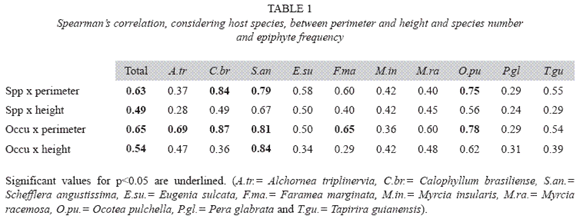
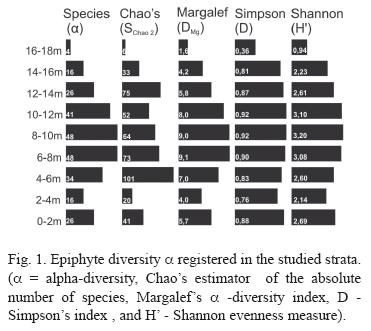
<body><![CDATA[<p><font face="Verdana" size="2">- Specialist – when found in only one species of host tree; </font></p>     <p><font face="Verdana" size="2">- Selective – when frequently found on few species of host trees, and rarely on other species (more than 40% on one species, more than 60% on two species, or 100% on three species); </font></p>     <p><font face="Verdana" size="2">- Preferential – when found with higher frequency on some host trees, but also with relevant frequency on other species; </font></p>     <p><font face="Verdana" size="2">- Indifferent - when found with similar frequency on the host tree species. </font></p> <font face="Verdana" size="2"> </font>     <p><font face="Verdana" size="2">Spearman’s correlations between number of species, abundance and host tree perimeter and height were analyzed, numbers higher than 0.6 when significant (&#945; = 0.05) were considered to indicate associations.    <br> <font face="Verdana" size="2">    <br> The similarity of epiphyte communities on host tree species was evaluated by Ellenberg’s similarity index (Mueller-Dombois &amp; Ellenberg 1974), that was used to make a dendrogram (Ward) and by correspondence analysis using forophyte specie as x-factor and epiphyte frequency of species as response. </font></font></p>     <p><font face="Verdana" size="2"><font face="Verdana" size="3"><span  style="font-weight: bold;">Results</span> </font></font></p>     <p><font face="Verdana" size="2"><font face="Verdana" size="2"><b>Vertical Distribution: </b>Intermediate strata registered highest diversity (<a href="#f1">Fig. 1</a> and <a  href="#f2">2</a>). Six species (7%) were considered exclusive, tree to one stratum and tree to two strata, 15 (18%) were restricted to some strata and 5 (6%) presented a broad distribution (<a href="#f2">Fig. 2</a>); 56 (69%) low frequency species were not classified.     <br> </font></font></p>     ]]></body>
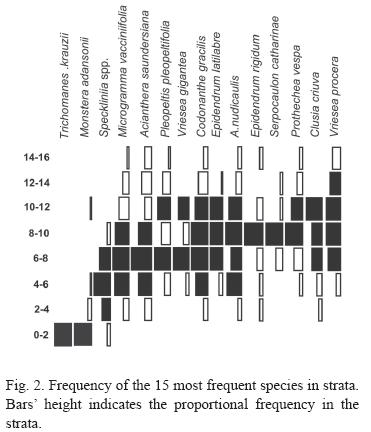
<body><![CDATA[<p><font face="Verdana" size="2"><font face="Verdana" size="2">    <br> <a name="f1"></a></font></font></p>     <div style="text-align: center;"><font face="Verdana" size="2"><font  face="Verdana" size="2"><img src="/img/revistas/rbt/v57n3/art23i1.jpg"  title="" alt="" style="width: 371px; height: 331px;"></font></font>    <br> </div>     <p><font face="Verdana" size="2"><font face="Verdana" size="2">    <br> <a name="f2"></a></font></font></p>     <div style="text-align: center;"><font face="Verdana" size="2"><font  face="Verdana" size="2"><img src="/img/revistas/rbt/v57n3/art23i2.jpg"  title="" alt="" style="width: 371px; height: 432px;"></font></font>    <br> </div>     <p><font face="Verdana" size="2"><font face="Verdana" size="2">The species exclusive to one strata (<i>Trichomanes krausii</i>, <i>Campyloneurum acrocarpon </i>and <i>Peperomia urocarpa</i>) were all observed on the 0-2 m stratum and species exclusive to two strata (<i>Vriesea gigantea, V</i>. <i>vagans </i>and <i>Pleopeltis hirsutissima</i>) were found on the 6-8 m and 8-10 m strata. Four restrict species occurred more frequently in only one stratum: <i>Monstera adansonii </i>(0-2 m), <i>Epidendrum rigidum </i>and <i>Serpocaulon catharinae </i>(8-10 m), and <i>Tillandsia tenuifolia </i>(12-14 m). Eleven species (<i>Microgramma vacciniifolia, Aechmea nudicaulis, Codonanthe devosiana</i>, <i>C. gracilis, Clusia criuva, Prosthechea vespa, Epidendrum latilabre</i>, <i>Pleurothallis </i>spp, <i>Acianthera saundersiana</i>, <i>Vriesea procera </i>and <i>Campyloneurum nitidum</i>) were found mostly in two or three strata. Five species (19%) have broad distribution and occurred with similar frequency in many strata (<i>Oncidium uniflorum</i>, <i>Peperomia glabella</i>, <i>Philodendron corcovadense </i>and <i>Scaphyglottis modesta</i>). </font></font></p>     <p><font face="Verdana" size="2"><font face="Verdana" size="2"><b>Distribuition on forophytes: </b>Vascular epiphytes were not regularly distributed on individuals or forophyte species. On individual host trees the number of epiphytes varied from zero to 30 epiphyte species (average of 6 ± 6.3). Highest richness was found at an <i>Ocotea pulchella </i>(30 species) and a <i>Calophylum brasiliense </i>(27 species). Other 17 individuals (six <i>Calophyllum brasiliense</i>, four <i>Tapirira guianensis, </i>two <i>Ocotea pulchella</i>, two <i>Schefflera. angustissima</i>, one <i>Alchornea triplinervia, </i>one <i>Eugenia sulcata </i>and one <i>Pera glabrata</i>) hosted 10 or more epiphytic species. In 11 host trees (five <i>Myrcia insularis</i>, two <i>Pera glabrata, </i>one <i>Alchornea triplinervia, </i>one <i>Myrcia racemosa, </i>one <i>Faramea marginata </i>and one <i>Tapirira guianensis</i>) no epiphyte were observed. </font></font></p>     ]]></body>
<body><![CDATA[<p><font face="Verdana" size="2"><font face="Verdana" size="2">Different forophyte species also had different epiphyte richness and abundance. <i>Calophyllum brasiliense </i>supported the greater epiphyte community (55 species and 315 observations), followed by <i>Ocotea pulchella </i>(46 species and 193 observations), <i>Tapirira guianensis </i>(40 species and 127 observations) and <i>Eugenia sulcata </i>(37 species and 107 observations). Considering averages, the richness species were <i>Calophyllum brasiliense </i>(15 ± 7.3), <i>Ocotea pulchella</i> (9 ± 8.3), <i>Tapirira guianensis </i>(8 ± 4.5) and <i>Eugenia sulcata </i>(7 ± 5.4). </font></font></p>     <p><font face="Verdana" size="2"><font face="Verdana" size="2">Epiphyte abundance was not always related to the size of the forophyte (<a href="#t1">Table 1</a>). From 10 species, only <i>Calophyllum. brasiliense</i>, <i>Schefflera angustissima </i>and <i>Ocotea pulchella </i>the number of species and abundance were correlated to diameter; and in <i>Alchornea triplinervia </i>and <i>Faramea marginata </i>only the abundance. Considering host tree height only <i>Schefflera angustissima </i>had significant values.    <br> </font></font></p>     <p><font face="Verdana" size="2"><font face="Verdana" size="2">    <br> <a name="t1"></a></font></font></p>     <div style="text-align: center;"><font face="Verdana" size="2"><font  face="Verdana" size="2"><img src="/img/revistas/rbt/v57n3/art23t1.gif"  title="" alt="" style="width: 580px; height: 219px;"></font></font>    <br> <font face="Verdana" size="2"><font face="Verdana" size="2"> </font></font></div>     <p><font face="Verdana" size="2"><font face="Verdana" size="2">Regarding fidelity, epiphytes were classified on three categories (selective, preferential and indifferents), none were classified as specialist, 58 low frequency species were not classified. </font></font></p>     <p><font face="Verdana" size="2"><font face="Verdana" size="2">1) Selective –12 species in two subgroups: </font></font></p>     <p><font face="Verdana" size="2"><font face="Verdana" size="2">a) <b>On one forophyte species</b>: Eight species, of which six were found more frequently on <i>Calophyllum brasiliense: Clusia criuva, Acianthera saundersiana, Epidendrum rigidum, Tillandsia tenuifolia, Campyloneurum nitidum </i>and <i>Peperomia glabella </i>(whith 80% of its abundance on this host tree species). Two other species (<i>Scaphyglottis modesta </i>and <i>Vriesea vagans</i>) were found more frequently on <i>Tapirira guianensis</i>. <b>    ]]></body>
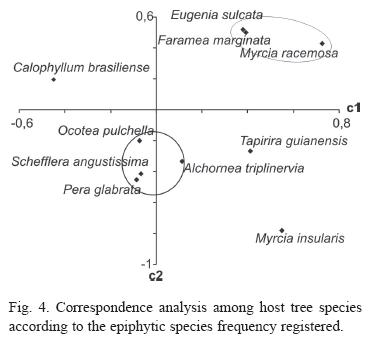
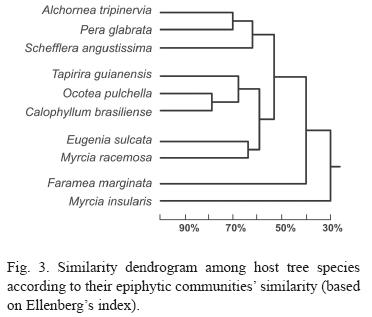
<body><![CDATA[<br> </b></font></font></p>     <p><font face="Verdana" size="2"><font face="Verdana" size="2">b)<b> On two forophyte species</b>: <i>Codonanthe gracilis </i>and <i>C. devosiana </i>over <i>Calophyllum brasiliense </i>and <i>Ocotea pulchella</i>, and <i>Pleurothallis </i>spp over <i>Eugenia sulcata </i>and <i>Myrcia racemosa</i>.    <br> </font></font></p>     <p><font face="Verdana" size="2"><font face="Verdana" size="2">2) Preferential - three species: <span style="font-style: italic;">Monstera adansonii, Pleopeltis pleopeltifolia </span>and <span  style="font-style: italic;">Trichomanes krauzii</span>, all over <span  style="font-style: italic;">Calophyllum brasiliense</span>.    <br> </font></font></p>     <p><font face="Verdana" size="2"><font face="Verdana" size="2">3) Indifferent - nine species: <span style="font-style: italic;">Microgramma vacciniifolia, Vriesea procera, Aechmea nudicaulis, Epidendrum latilabre, Prosthechea vespa, Serpocaulon catharinae, Vriesea gigatnea, Oncidium uniflorum</span> and <span style="font-style: italic;">Pleopeltis hirsutissima</span>.    <br> </font></font></p>     <p><font face="Verdana" size="2"><font face="Verdana" size="2">The similarities of the host tree species epiphyte communities are shown on <a href="#f3">figure 3</a>. Cluster’s analysis formed three major groups. On the correspondence analysis (<a href="#f4">Fig. 4</a>), the two fist exes explain only 38% of the variation, 95% of the variation is explained by the first 8 axes. Seven species formed two groups and tree species remained isolated.    <br> </font></font></p>     <p><font face="Verdana" size="2"><font face="Verdana" size="2">    ]]></body>
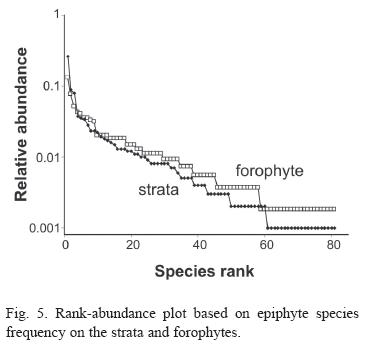
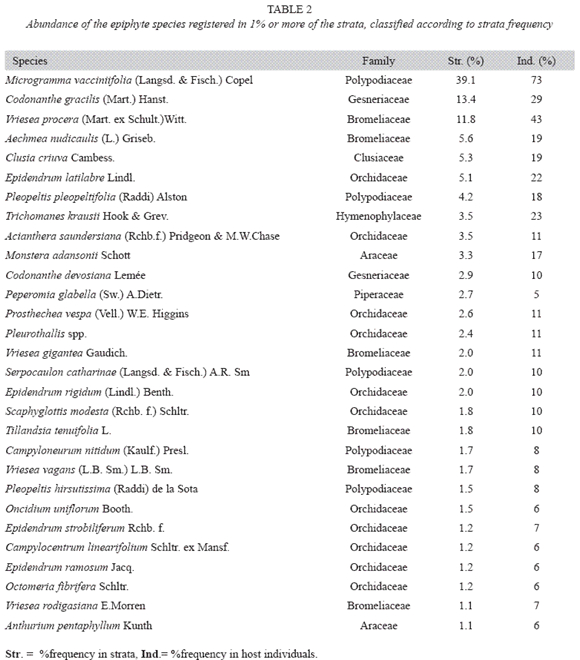
<body><![CDATA[<br> <a name="f3"></a></font></font></p>     <div style="text-align: center;"><font face="Verdana" size="2"><font  face="Verdana" size="2"><img src="/img/revistas/rbt/v57n3/art23i3.jpg"  title="" alt="" style="width: 372px; height: 317px;"></font></font>    <br> </div>     <p><font face="Verdana" size="2"><font face="Verdana" size="2">    <br> <a name="f4"></a></font></font></p>     <div style="text-align: center;"><font face="Verdana" size="2"><font  face="Verdana" size="2"><img src="/img/revistas/rbt/v57n3/art23i4.jpg"  title="" alt="" style="width: 372px; height: 340px;"></font></font>    <br> <font face="Verdana" size="2"><font face="Verdana" size="2"> </font></font></div>     <p><font face="Verdana" size="2"><font face="Verdana" size="2"><b>Species Diversity and Abundance: </b>We found 82 species in the 673 strata analyzed totalizing 995 registers. Shannon’s index (H’) was 3.74, while equity (J) was 0.85. About 45% of the strata and 11% of host trees (11) showed no epiphyte. </font></font></p>     <p><font face="Verdana" size="2"><font face="Verdana" size="2">Considering species abundance (<a href="#t2">Table 2</a>) only three species were registered to more than 10% of the strata and 18 to more than 10% of the forophyte. Thirty-three species were found only once or twice. The first four species (<i>Microgramma vacciniifolia, Vriesea procera, Codonanthe gracilis </i>and <i>Epidendrum latilabre</i>) are responsible for more than 30% of strata frequency; meanwhile the 35 least frequent species represent about 10% of total strata frequency. The morphospecie <i>Pleurothallis </i>spp. includes <i>Pleurothallis seriata </i>Lindl, <i>Pleurothalli matinhensis </i>Hoehne and <i>Specklinia marginalis </i>(Rchb.f.) F. Barros., which were very similar when not flowering. On the rank-abundance plot (<a  href="#f5">Fig. 5</a>), both slopes are indicative of log series distribution. </font></font></p> <font face="Verdana" size="2"><font face="Verdana" size="1">    <br>     ]]></body>
<body><![CDATA[<br> <a name="t2"></a></font></font>     <div style="text-align: center;"><font face="Verdana" size="2"><font  face="Verdana" size="1"><img src="/img/revistas/rbt/v57n3/art23t2.gif"  title="" alt="" style="width: 580px; height: 660px;"></font></font>    <br> </div> <font face="Verdana" size="2"><font face="Verdana" size="1">    <br>     <br> <a name="f5"></a></font></font>     <div style="text-align: center;"><font face="Verdana" size="2"><font  face="Verdana" size="1"><img src="/img/revistas/rbt/v57n3/art23i5.jpg"  title="" alt="" style="width: 372px; height: 347px;"></font></font>    <br> </div>     <p><font face="Verdana" size="2"><font face="Verdana" size="3"><span  style="font-weight: bold;">Discussion</span> </font></font></p>     <p><font face="Verdana" size="2"><font face="Verdana" size="2"><b>Species Distribution: </b>Unequal distribution along vertical column in forests (<a href="#f1">Figs. 1</a> and <a href="#f2">2</a>) is regularly explained by variation on moisture, luminosity, substrate availability substrate characteristics (Waechter 1980, 1992, Gill &amp; Onyibe 1986, Steege &amp; Cornelissen 1989, Zimmermman &amp; Olmsted 1992, Kernan &amp; Fowler 1995, Kersten &amp; Silva 2001, 2002). Brown (1990) stated that variations of microclimate, and substrate diameter, are the main factors responsible for epiphyte distribution pattern. These studies also noticed highest epiphytic diversity in the intermediate strata. </font></font><font face="Verdana" size="2"><font  face="Verdana" size="2">The exception is Kersten &amp; Silva (2001) that </font></font><font  face="Verdana" size="2"><font face="Verdana" size="2">registered the lower strata as the richest.     <br> </font></font></p>     ]]></body>
<body><![CDATA[<p><font face="Verdana" size="2"><font face="Verdana" size="2">Taxonomic and ecological categories distri</font></font><font face="Verdana" size="2"><font face="Verdana"  size="2">bution is unequal along vegetal column (<a href="#f2">Fig. 2</a>).</font></font><font  face="Verdana" size="2"><font face="Verdana" size="2"> </font></font><font  face="Verdana" size="2"><font face="Verdana" size="2">While hemiepiphytes and facultative epiphytes </font></font><font  face="Verdana" size="2"><font face="Verdana" size="2">occupy lower strata, holoepiphytes prefer inter</font></font><font face="Verdana" size="2"><font  face="Verdana" size="2">mediate and upper strata. Most pteridophyte</font></font><span  style="font-family: verdana;"> </span><font face="Verdana" size="2"><font  face="Verdana" size="2">families (Blechnaceae, Nephrolepidaceae,&nbsp; Hymenophyllaceae, i.e.) occurs more frequently close to the ground, while upper strata are occupied by angiosperms and two pteridophyte&nbsp; families – Polypodiaceae and Lycopodiaceae;&nbsp; curiously in evolutionary terms one is among the most derived families (Polypodiaceae) and the&nbsp; other among the most basal (Lycopodiaceae). </font></font></p>     <p><font face="Verdana" size="2"><font face="Verdana" size="2">Gill &amp; Onyibe (1986) considered ten important environmental factors to the establishment of epiphytic flora: host age, inclination, luminosity, humus deposition, host tree size, daily weather variation, seed dispersion, temperature, moisture and wind. Ingram &amp; Nadkarni (1993) observed positive correlation between epiphytic biomass and branch size, and negative between biomass and branch inclination. </font></font></p>     <p><font face="Verdana" size="2"><font face="Verdana" size="2">In this study, branch inclination and space availability along with luminosity and moisture explains the observed distribution pattern. Intermediate strata regularly have more branches and ramifications, and therefore larger areas available for colonization. At the same time, organic matter accumulation increase available water in places protected from direct sunrays incidence but with higher luminosity than forest floor. </font></font></p>     <p><font face="Verdana" size="2"><font face="Verdana" size="2">In upper strata although the branche prufusion, they are thin and young. The sunlight level and stronger winds increase desiccation and difficult species development. In lower strata (0-6 m) moisture is sufficient, but lower light and strait vertical bark are straining. However, the 0-2m height stratum was richer than 2-4 strata (Fig. 1) due to accidental, facultative and hemiepiphytes species. </font></font></p>     <p><font face="Verdana" size="2"><font face="Verdana" size="2">Two of the four species that preferred the 0-2 m stratum are facultative and another one is a primary hemiepiphyte closely related to soil. Though the <i>T. krauzii </i>is a typical holoepiphyte, it’s a Hymenophyllaceae, a very hydro-sensible family. Even though most species preferred intermediate strata, none or then were restrict to them, again indicating the space availability as an important aspect in epiphyte distribution. The one specie that really preferred higher strata (<i>T. tenuifolia</i>) is a well known atmospheric bromeliad, forming dense groups in unfavorable environments such as isolated trees and with high light exposition (Reitz 1983). </font></font></p>     <p><font face="Verdana" size="2"><font face="Verdana" size="2">The broad distribution of some species usually comes along with significant morphological variation. In Orchidaceae there is a noticeable variation in succulence and size, in Bromeliaceae and Gesneriaceae, the individuals differ in color and size, the ones in higher strata are smaller, more succulent and present a reddish pigment. Also, stomata variations (Hietz &amp; Briones 1998) are mentioned as related to habitat diversity in the same tree. </font></font></p>     <p><font face="Verdana" size="2"><font face="Verdana" size="2">Maximum number of species over one single tree, although not exceptional (Johansson 1989, Waechter 1992, Freiberg 1996), can be considered high when compared to other field-works in similar areas. Kersten &amp; Silva (2001) found 21 species over one tree. Waechter (1998; 1992) found 16 and 19 species respectively. The studied area, in spite of being humid, is a medium size forest (average height = 12m), and so is the epiphytic richness when compared to other forests. Johansson (1989) registered more than 50 species over one host tree that was higher than 30m. In the other hand, Kersten &amp; Silva (2001) observed 21 species on a host tree that presented average height of 7.5m. </font></font></p>     <p><font face="Verdana" size="2"><font face="Verdana" size="2"><b>Distribuition on forophytes: </b>The frequency of vascular epiphytes over different host trees can be explained by forophyte species traits, such as size, age, architecture, and bark type. <i>Calophyllum brasiliense </i>had the biggest individuals (180 cm of diameter and 20m high) has a deeply cracked bark. <i>O. pulchella </i>and <i>T. guianensis </i>has rough bark as well as favorable architecture for epiphyte fixation (great number of thick horizontal branches). Brown (1990) also observed that host trees with scabrous barks support more epiphytes. The forophyte species with the fourth highest epiphyte (<i>E. sulcata</i>) presents defoliating suber that do not totally detach from tree. Trunk and branches become recovered by many suber layers, which accumulate moisture and facilitate the fixation and development of epiphytes. </font></font></p>     <p><font face="Verdana" size="2"><font face="Verdana" size="2">While these four species are suitable for epiphytic development, others like <i>F. marginata </i>and <i>M. insularis </i>are, otherwise, unfavorable for the development of this flora. Kernan &amp; Fowler (1995), Zimmerman &amp; Olmsted (1992) and Steege &amp; Cornelissen (1989) presented similar results, indicating that the bark texture influences the epiphyte distribution, facilitating it (with rugged barks) or making it difficult (when totally loose). Zimmerman &amp; Olmsted (1992) registered that 8% of host trees did not have any epiphyte (in contrast to 11% in this study). It is important to notice that this work was also realized in a seasonally flooded forest. In Brown (1990) 22% of trees did not have epiphytes, possibly due to seasonal climate. </font></font></p>     <p><font face="Verdana" size="2"><font face="Verdana" size="2">Size and number of branches and ramifications influence epiphyte occurrence, as long as they increase the fixation area, host tree age is also important. As no relation between perimeter and quantity of epiphytes was observed to host tree species in this work, size is not a major factor influencing epiphyte distribution, though it can influences great part of the variation (Brown 1990, Zimmerman &amp; Olmsted 1992, Ingram &amp; Nadkarni 1993). </font></font></p>     ]]></body>
<body><![CDATA[<p><font face="Verdana" size="2"><font face="Verdana" size="2">In opposition to Waechter (1980), the specificity analysis among epiphytes and host trees revealed no exclusive species. Steege &amp; Cornelissen (1989) registered seven epiphyte species significantly more frequent on some host trees. Despite that, in this study, many epiphytes showed preference for some hosts, the greatest values were often registered to the same host species (<i>C. brasiliense </i>and <i>O. pulchella</i>), therefore little of epiphyte preference is due to internal traits, but host’s features (bark roughness, architecture, etc.) facilitate or not the establishment and development of this flora. </font></font></p>     <p><font face="Verdana" size="2"><font face="Verdana" size="2">Two cases, however, deserve special attention: <i>Peperomia glabella </i>and <i>Pleurothallis </i>spp. In the first case, 78% of occurrences were registered on <i>C. brasiliense. </i>This may be explained by its facultative habit can being found either living on trees or the ground. Not being exclusively epiphytic it cannot grow in any substrate, but only in favorable trees. </font></font></p>     <p><font face="Verdana" size="2"><font face="Verdana" size="2">In the second case, the group – <i>Pleurothallis </i>spp. – preferred Myrtaceae species with stripping bark (<i>E. sulcata </i>and <i>M racemosa</i>). Similar analysis can be realized in other areas to confirm if this is a real preference of the species for this type of bark or whether it is only a coincidence. </font></font></p>     <p><font face="Verdana" size="2"><font face="Verdana" size="2">The analysis of epiphyte communities on host species was based on Ellenberg’s index and correspondence. Both index indicated that relatively homogeneous groups exist (<a href="#f3">Fig. 3</a>). The dendrogram group composed by <i>C. brasiliense</i>, <i>O. puchella </i>and <i>T. guianensis </i>was defined because these are the host tree species with more epiphyte. In the same way <i>M. insularis </i>and <i>F. marginata </i>were excluded from groups due to their low epiphytic level. </font></font></p>     <p><font face="Verdana" size="2"><font face="Verdana" size="2">The two other groups perhaps are the most interesting. Presenting profuse abundance and richness, the group with defoliating suber (<i>M. racemosa </i>and <i>E. sulcata</i>) seems to indicate that this feature may be important to the epiphytes, influencing their distribution. The last group, specially the proximity between <i>A. triplinervia </i>and <i>P. glabrata</i> (71%), can also be explained by their bark similarity. </font></font></p>     <p><font face="Verdana" size="2"><font face="Verdana" size="2">On the correspondences analysis the c1 axe does not represent the species diversity nor the abundance, even thought may seem to, due to <i>Schefflera angustissima </i>position next to <i>Ocotea pulchella </i>and <i>Eugenia sulcata </i>next to <i>Faramea marginata </i>and <i>Myrcia racemosa</i>. The two groups were formed by the proportional frequency of specific species on them and both support the dendrogram analysis. </font></font></p>     <p><font face="Verdana" size="2"><font face="Verdana" size="2">Bennett (1986), with similar results, observed that epiphytic community was correlated to host tree species, but explained only 16% of variation, Dislich (1996) reported some epiphyte preferences for host species and Freiberg (1996) observed restricted epiphyte occurrences in some host species. </font></font></p> <font face="Verdana" size="2">     <p><span style="font-weight: bold;">Species Diversity and Abundance:</span> <font face="Verdana" size="2"><font  face="Verdana" size="2">Considering the complete checklist (Kersten &amp; Silva 2006) 80% of species 94% of genera and 94% of families were observed in the sampling. If we put together the 22 species observed only in the floristic survey and the 23 species registered once on this analysis, 45% of the species might be called rare. On the Wittaker Plot the log series distribution are indicative of high dominance assemblage with few species what seems to be the rule on atlantic forest epiphyte assemblage (Waechter 1992, 1998, Kersten &amp; Silva 2001, Gonçalves &amp; Waechter 2002, Giongo &amp; Waechter 2004). </font></font></p> </font>     <p><font face="Verdana" size="2"><i><font face="Verdana" size="2">Microgramma vacciniifolia, </font></i><font face="Verdana" size="2">was, by far, the most frequent one. Occurring widely in the Tropical America (Sehnem 1970) it was also abundant in other studies (Table 3). Therefore it can be considered the most abundant vascular epiphyte in coastal plain forests from south Brazil. Yet, on studies in seasonal forest (Dislich 1996) and Araucaria forest (subtropical rainforest) (Kersten &amp; Silva 2002), another specie from the same genus (<i>M. squamulosa</i>) was the most frequent. This plasticity, showed by it geographic distribution, explains its occurrence in all host species, the abundance can be also explained by is creeping rhizomes that grows all over the host tree, increasing their frequency. At the same time, as a sporocoric fern it does not depend on mutualism to establish, as orchids do. </font></font></p>     <p><font face="Verdana" size="2"><font face="Verdana" size="2"><i>Codonanthe gracilis</i>, has creeping or hanging stems what allows it to climb the host tree and also colonize lower branches and can be considered also typical of the Atlantic rain forest. According to Chautems (1997), this species is found in coastal regions from Bahia State (northeastern Brazil) to Rio Grande do Sul State (south Brazil), being mentioned in three other studies (Waechter 1986, Fontoura et al. 1997, Kersten &amp; Silva 2001). </font></font></p> <hr style="width: 100%; height: 2px;">     ]]></body>
<body><![CDATA[<p><font face="Verdana" size="2"><font face="Verdana" size="2"><span  style="font-weight: bold;">Resumen</span> </font></font></p>     <p><font face="Verdana" size="2"><font face="Verdana" size="2">El estudio se realizó en un área 3 000 m</font><sup><font face="Verdana" size="1">2 </font></sup><font  face="Verdana" size="2">de bosque atlántico húmedo en una isla brasileña, Ilha do Mel (25</font><sup><font face="Verdana" size="1">o</font></sup><font  face="Verdana" size="2">30’’ S 48</font><sup><font face="Verdana"  size="1">o</font></sup><font face="Verdana" size="2">23’ W). Seleccionamos 100 árboles de las 10 principales especies y las dividimos en estratos de dos metros a partir de la superficie del suelo. En cada estrato registramos todas las especies epífitas observadas. Las especies muestreadas fueron agrupadas en tres categorías: exclusivas, preferenciales, e indiferentes (según su abundancia en los estratos), y selectivas, preferenciales e indiferentes (según su abundancia en los árboles). Los estratos intermedios registraron las más altas diversidades. Seis especies fueron consideradas exclusivas a uno o dos estratos, 15 estuvieron limitadas a algunos estratos y 5 presentaron amplia distribución. Para ninguna especie epífita hubo distribución horizontal uniforme. La riqueza de las epífitas en un forofito varió de cero a 30 especies. Según la fidelidad de las epífitas en los árboles, registramos pocas especies selectivas o preferenciales y muchas indiferentes. En los 100 árboles examinados encontramos 82 especies de epífitas, y el diagrama del Wittaker indicó alta dominancia de unas pocas especies. </font></font></p>     <p><font face="Verdana" size="2"><font face="Verdana" size="2"><b>Palabras clave: </b>ecología de epífitas, distribución espacial, bosque Atlántico costero.    <br> </font></font></p> <hr style="width: 100%; height: 2px;">     <p style="text-align: center;"><font face="Verdana" size="2"><font  face="Verdana" size="2">Received 21-VIII-2008. Corrected 15-X-2008. Accepted 16-XI-2008.</font></font></p> <font face="Verdana" size="2"><font face="Verdana" size="2"> <font size="3">     <p><span style="font-weight: bold;">References</span> </p> </font></font><font face="Verdana" size="2">     <!-- ref --><p>Bennet B.C. 1986. Patchiness, diversity and abundance relationships of vascular epiphytes. Selbyana 9: 70-75. &nbsp;&nbsp;&nbsp;&nbsp;&nbsp;&nbsp;&nbsp;&nbsp;[&#160;<a href="javascript:void(0);" onclick="javascript: window.open('/scielo.php?script=sci_nlinks&ref=1377253&pid=S0034-7744200900030002300001&lng=','','width=640,height=500,resizable=yes,scrollbars=1,menubar=yes,');">Links</a>&#160;]<!-- end-ref --><!-- ref --><p>Benzing D.H. 1990. Vascular epiphytes. Cambridge University Press. Cambridge. &nbsp;&nbsp;&nbsp;&nbsp;&nbsp;&nbsp;&nbsp;&nbsp;[&#160;<a href="javascript:void(0);" onclick="javascript: window.open('/scielo.php?script=sci_nlinks&ref=1377254&pid=S0034-7744200900030002300002&lng=','','width=640,height=500,resizable=yes,scrollbars=1,menubar=yes,');">Links</a>&#160;]<!-- end-ref --><!-- ref --><p>Benzing D.H. 1995. The physical mosaic and plant variety in forest canopies. Selbyana 16: 159-168. &nbsp;&nbsp;&nbsp;&nbsp;&nbsp;&nbsp;&nbsp;&nbsp;[&#160;<a href="javascript:void(0);" onclick="javascript: window.open('/scielo.php?script=sci_nlinks&ref=1377255&pid=S0034-7744200900030002300003&lng=','','width=640,height=500,resizable=yes,scrollbars=1,menubar=yes,');">Links</a>&#160;]<!-- end-ref --><!-- ref --><p>Brown D.A. 1990. El epifitismo en las selvas montanas del Parque Nacional "El Rey" Argentina: Composición florística y padrón de distribución. Rev. Biol.Trop. 38: 155-166. &nbsp;&nbsp;&nbsp;&nbsp;&nbsp;&nbsp;&nbsp;&nbsp;[&#160;<a href="javascript:void(0);" onclick="javascript: window.open('/scielo.php?script=sci_nlinks&ref=1377256&pid=S0034-7744200900030002300004&lng=','','width=640,height=500,resizable=yes,scrollbars=1,menubar=yes,');">Links</a>&#160;]<!-- end-ref --><!-- ref --><p>Chautems A. 1997. New Gesneriaceae from São Paulo Brazil Candollea 52: 159-169. &nbsp;&nbsp;&nbsp;&nbsp;&nbsp;&nbsp;&nbsp;&nbsp;[&#160;<a href="javascript:void(0);" onclick="javascript: window.open('/scielo.php?script=sci_nlinks&ref=1377257&pid=S0034-7744200900030002300005&lng=','','width=640,height=500,resizable=yes,scrollbars=1,menubar=yes,');">Links</a>&#160;]<!-- end-ref --><!-- ref --><p>Dislich R. 1996. Florística e estrutura do componente epifítico vascular na mata da reserva da Cidade Universitária "Armando de Salles Oliveira", São Paulo, SP. Dissertation, University of São Paulo. &nbsp;&nbsp;&nbsp;&nbsp;&nbsp;&nbsp;&nbsp;&nbsp;[&#160;<a href="javascript:void(0);" onclick="javascript: window.open('/scielo.php?script=sci_nlinks&ref=1377258&pid=S0034-7744200900030002300006&lng=','','width=640,height=500,resizable=yes,scrollbars=1,menubar=yes,');">Links</a>&#160;]<!-- end-ref --><!-- ref --><p>Fischer E.A, Araujo A.C. 1995. Spatial organization of a bromeliads community in the Atlantic rainforest, southeastern Brazil. J. Trop. Ecol. 11: 559-567. &nbsp;&nbsp;&nbsp;&nbsp;&nbsp;&nbsp;&nbsp;&nbsp;[&#160;<a href="javascript:void(0);" onclick="javascript: window.open('/scielo.php?script=sci_nlinks&ref=1377259&pid=S0034-7744200900030002300007&lng=','','width=640,height=500,resizable=yes,scrollbars=1,menubar=yes,');">Links</a>&#160;]<!-- end-ref --><!-- ref --><p>Fontoura T. 1995. Distribution patterns of five bromeliad genera in Atlantic rain forest, Rio de Janeiro State, Brazil. Selbyana 16: 79-93. &nbsp;&nbsp;&nbsp;&nbsp;&nbsp;&nbsp;&nbsp;&nbsp;[&#160;<a href="javascript:void(0);" onclick="javascript: window.open('/scielo.php?script=sci_nlinks&ref=1377260&pid=S0034-7744200900030002300008&lng=','','width=640,height=500,resizable=yes,scrollbars=1,menubar=yes,');">Links</a>&#160;]<!-- end-ref --><!-- ref --><p>Fontoura T., Sylvestre L.S., Vaz A.M.S. &amp; Vieira, C.M. 1997. Epífitas vasculares, hemiepífitas e hemiparasitas da Reserva Ecológica de Macaé de Cima, p. 89-101. <i>In </i>Lima H C, Guedes-Bruni R R (eds.) Serra de Macaé de Cima: diversidade florística e conservação da Mata Atlântica, Editora do Jardim Botânico do Rio de Janeiro. &nbsp;&nbsp;&nbsp;&nbsp;&nbsp;&nbsp;&nbsp;&nbsp;[&#160;<a href="javascript:void(0);" onclick="javascript: window.open('/scielo.php?script=sci_nlinks&ref=1377261&pid=S0034-7744200900030002300009&lng=','','width=640,height=500,resizable=yes,scrollbars=1,menubar=yes,');">Links</a>&#160;]<!-- end-ref --><!-- ref --><p>Freiberg M. 1996. Spatial distribution of vascular epiphytes on three emergent canopy trees in French Guyana. Biotropica 28: 345-355. &nbsp;&nbsp;&nbsp;&nbsp;&nbsp;&nbsp;&nbsp;&nbsp;[&#160;<a href="javascript:void(0);" onclick="javascript: window.open('/scielo.php?script=sci_nlinks&ref=1377262&pid=S0034-7744200900030002300010&lng=','','width=640,height=500,resizable=yes,scrollbars=1,menubar=yes,');">Links</a>&#160;]<!-- end-ref --><!-- ref --><p>Gentry A.H. &amp; Dodson C.H. 1987. Diversity and biogeography of neotropical vascular epiphytes. An. Mo. Bot. Gard. 74: 205-233. &nbsp;&nbsp;&nbsp;&nbsp;&nbsp;&nbsp;&nbsp;&nbsp;[&#160;<a href="javascript:void(0);" onclick="javascript: window.open('/scielo.php?script=sci_nlinks&ref=1377263&pid=S0034-7744200900030002300011&lng=','','width=640,height=500,resizable=yes,scrollbars=1,menubar=yes,');">Links</a>&#160;]<!-- end-ref --><!-- ref --><p>Gill L.S., Onyibe H.I. 1986. Phytossociological studies of epiphytic flora of oil palm (<i>Elaeis guineensis </i>Jack.) in Benin City, Nigeria. Feddes Repertorium 97: 691-695. &nbsp;&nbsp;&nbsp;&nbsp;&nbsp;&nbsp;&nbsp;&nbsp;[&#160;<a href="javascript:void(0);" onclick="javascript: window.open('/scielo.php?script=sci_nlinks&ref=1377264&pid=S0034-7744200900030002300012&lng=','','width=640,height=500,resizable=yes,scrollbars=1,menubar=yes,');">Links</a>&#160;]<!-- end-ref --><!-- ref --><p>Giongo, C. &amp; Waechter J.L. 2004. Composição florística e estrutura comunitária de epífitos vasculares em uma floresta de galeria na Depressão Central do Rio Grande do Sul. Ver. Brás. Bot. 27: 563-572. &nbsp;&nbsp;&nbsp;&nbsp;&nbsp;&nbsp;&nbsp;&nbsp;[&#160;<a href="javascript:void(0);" onclick="javascript: window.open('/scielo.php?script=sci_nlinks&ref=1377265&pid=S0034-7744200900030002300013&lng=','','width=640,height=500,resizable=yes,scrollbars=1,menubar=yes,');">Links</a>&#160;]<!-- end-ref --><!-- ref --><p>Gonçalves C.N. &amp; Waechter J.L. 2002. Epífitos vasculares sobre espécimes de Ficus organensis isolados no norte da planície costeira do Rio Grande do Sul: Padrões de abundância e distribuição. Acta bot. Bras. 16: 429-441. &nbsp;&nbsp;&nbsp;&nbsp;&nbsp;&nbsp;&nbsp;&nbsp;[&#160;<a href="javascript:void(0);" onclick="javascript: window.open('/scielo.php?script=sci_nlinks&ref=1377266&pid=S0034-7744200900030002300014&lng=','','width=640,height=500,resizable=yes,scrollbars=1,menubar=yes,');">Links</a>&#160;]<!-- end-ref --><!-- ref --><p>Hazen W E 1966. Analysis of spatial patterns in epiphytes. Ecology 47: 634-635. &nbsp;&nbsp;&nbsp;&nbsp;&nbsp;&nbsp;&nbsp;&nbsp;[&#160;<a href="javascript:void(0);" onclick="javascript: window.open('/scielo.php?script=sci_nlinks&ref=1377267&pid=S0034-7744200900030002300015&lng=','','width=640,height=500,resizable=yes,scrollbars=1,menubar=yes,');">Links</a>&#160;]<!-- end-ref --><!-- ref --><p>Hietz P., Briones O. 1998. Correlation between water relations and within-canopy distribution of epiphytic ferns in a Mexican Cloud Forest. Oecologia 114: 305-316. &nbsp;&nbsp;&nbsp;&nbsp;&nbsp;&nbsp;&nbsp;&nbsp;[&#160;<a href="javascript:void(0);" onclick="javascript: window.open('/scielo.php?script=sci_nlinks&ref=1377268&pid=S0034-7744200900030002300016&lng=','','width=640,height=500,resizable=yes,scrollbars=1,menubar=yes,');">Links</a>&#160;]<!-- end-ref --><!-- ref --><p>Hietz P., Hietz-Seifert U. 1995. Intra and interspecific relations within an epiphyte community in a Mexican humid montane forest. Selbyana 16: 135-140. &nbsp;&nbsp;&nbsp;&nbsp;&nbsp;&nbsp;&nbsp;&nbsp;[&#160;<a href="javascript:void(0);" onclick="javascript: window.open('/scielo.php?script=sci_nlinks&ref=1377269&pid=S0034-7744200900030002300017&lng=','','width=640,height=500,resizable=yes,scrollbars=1,menubar=yes,');">Links</a>&#160;]<!-- end-ref --><!-- ref --><p>Ingram S.W., Nadkarni N.M. 1993.Composition and distribution of epiphytic organic matter in a Neotropical cloud forest, Costa Rica. Biotropica 25: 370-383. &nbsp;&nbsp;&nbsp;&nbsp;&nbsp;&nbsp;&nbsp;&nbsp;[&#160;<a href="javascript:void(0);" onclick="javascript: window.open('/scielo.php?script=sci_nlinks&ref=1377270&pid=S0034-7744200900030002300018&lng=','','width=640,height=500,resizable=yes,scrollbars=1,menubar=yes,');">Links</a>&#160;]<!-- end-ref --><!-- ref --><p>Johansson D.R. 1974. Ecology of vascular epiphytes in West African rain forest. Acta Phytogeographyca Suecica 59: 1-136. &nbsp;&nbsp;&nbsp;&nbsp;&nbsp;&nbsp;&nbsp;&nbsp;[&#160;<a href="javascript:void(0);" onclick="javascript: window.open('/scielo.php?script=sci_nlinks&ref=1377271&pid=S0034-7744200900030002300019&lng=','','width=640,height=500,resizable=yes,scrollbars=1,menubar=yes,');">Links</a>&#160;]<!-- end-ref --><!-- ref --><p>Johansson D.R. 1989. Vascular epiphytes in Africa p. 183-194. <i>In </i>H. Lieth &amp; M.J.A. Werger (eds.) Ecosystems of the world vol. 14b: Tropical Rain Forest Ecosystems. Amsterdam &nbsp;&nbsp;&nbsp;&nbsp;&nbsp;&nbsp;&nbsp;&nbsp;[&#160;<a href="javascript:void(0);" onclick="javascript: window.open('/scielo.php?script=sci_nlinks&ref=1377272&pid=S0034-7744200900030002300020&lng=','','width=640,height=500,resizable=yes,scrollbars=1,menubar=yes,');">Links</a>&#160;]<!-- end-ref --><!-- ref --><p>Kelly D.L. 1985. Epiphytes and climbers of a Jamaican rain forest: vertical distributions, life forms and life history. J. Biogeog. 2: 233-243.    &nbsp;&nbsp;&nbsp;&nbsp;&nbsp;&nbsp;&nbsp;&nbsp;[&#160;<a href="javascript:void(0);" onclick="javascript: window.open('/scielo.php?script=sci_nlinks&ref=1377273&pid=S0034-7744200900030002300021&lng=','','width=640,height=500,resizable=yes,scrollbars=1,menubar=yes,');">Links</a>&#160;]<!-- end-ref --><!-- ref --> Kernan C, Fowler N 1995, Different substrate use by epiphytes in Corcovado National Park, Costa Rica: a source of guild structure. J. Ecol. 83: 65-73. &nbsp;&nbsp;&nbsp;&nbsp;&nbsp;&nbsp;&nbsp;&nbsp;[&#160;<a href="javascript:void(0);" onclick="javascript: window.open('/scielo.php?script=sci_nlinks&ref=1377274&pid=S0034-7744200900030002300022&lng=','','width=640,height=500,resizable=yes,scrollbars=1,menubar=yes,');">Links</a>&#160;]<!-- end-ref --><!-- ref --><p>Kersten R.A. 2006. Métodos quantitativos de estudo da flora epífita. <i>In </i>Os avanços da Botânica no início do séulo XXI ed. Mariath J.E.A. &amp; Santos R.P. Sociedade Botânica do Brasil, Porto Alegre. &nbsp;&nbsp;&nbsp;&nbsp;&nbsp;&nbsp;&nbsp;&nbsp;[&#160;<a href="javascript:void(0);" onclick="javascript: window.open('/scielo.php?script=sci_nlinks&ref=1377275&pid=S0034-7744200900030002300023&lng=','','width=640,height=500,resizable=yes,scrollbars=1,menubar=yes,');">Links</a>&#160;]<!-- end-ref --><!-- ref --><p>Kersten R.A., Silva S.M. 2001. Composição florística e distribuição espacial de epífitas vasculares em floresta da planície litorânea da Ilha do Mel, Paraná, Brazil. Rev. Bras. Bot. 24: 213-226. &nbsp;&nbsp;&nbsp;&nbsp;&nbsp;&nbsp;&nbsp;&nbsp;[&#160;<a href="javascript:void(0);" onclick="javascript: window.open('/scielo.php?script=sci_nlinks&ref=1377276&pid=S0034-7744200900030002300024&lng=','','width=640,height=500,resizable=yes,scrollbars=1,menubar=yes,');">Links</a>&#160;]<!-- end-ref --><!-- ref --><p>Kersten R.A., Silva S.M. 2002. Florística e estrutura do componente epifítico vascular em floresta ombrófila mista aluvial do rio Barigüi, Paraná, Brasil. Rev. Bras. Bot. 25: 259-267. &nbsp;&nbsp;&nbsp;&nbsp;&nbsp;&nbsp;&nbsp;&nbsp;[&#160;<a href="javascript:void(0);" onclick="javascript: window.open('/scielo.php?script=sci_nlinks&ref=1377277&pid=S0034-7744200900030002300025&lng=','','width=640,height=500,resizable=yes,scrollbars=1,menubar=yes,');">Links</a>&#160;]<!-- end-ref --><!-- ref --><p>Kersten R.A., SILVA S.M. 2005. Florística e estrutura de comunidades de epífitas vasculares da planície litorânea. <i>In </i>História natural e conservação da Ilha do Mel, eds. Marques M.C.M. &amp; Britez R.M. Ed Universidade Federal do Paraná, Curitiba. &nbsp;&nbsp;&nbsp;&nbsp;&nbsp;&nbsp;&nbsp;&nbsp;[&#160;<a href="javascript:void(0);" onclick="javascript: window.open('/scielo.php?script=sci_nlinks&ref=1377278&pid=S0034-7744200900030002300026&lng=','','width=640,height=500,resizable=yes,scrollbars=1,menubar=yes,');">Links</a>&#160;]<!-- end-ref --><!-- ref --><p>Kersten R.A., Silva S.M. 2006. The Floristic Compositions of Vascular Epiphytes of a Seasonally Inundated Forest on the Coastal Plain of Ilha do Mel Island, Brazil. Rev. Biol. Trop. 54: 935-942. &nbsp;&nbsp;&nbsp;&nbsp;&nbsp;&nbsp;&nbsp;&nbsp;[&#160;<a href="javascript:void(0);" onclick="javascript: window.open('/scielo.php?script=sci_nlinks&ref=1377279&pid=S0034-7744200900030002300027&lng=','','width=640,height=500,resizable=yes,scrollbars=1,menubar=yes,');">Links</a>&#160;]<!-- end-ref --><!-- ref --><p>Kress W.J. 1986. The systematic distribution of vascular epiphytes: an update. Selbyana 9: 2-22. &nbsp;&nbsp;&nbsp;&nbsp;&nbsp;&nbsp;&nbsp;&nbsp;[&#160;<a href="javascript:void(0);" onclick="javascript: window.open('/scielo.php?script=sci_nlinks&ref=1377280&pid=S0034-7744200900030002300028&lng=','','width=640,height=500,resizable=yes,scrollbars=1,menubar=yes,');">Links</a>&#160;]<!-- end-ref --><!-- ref --><p>Maddison M. 1977. Vascular epiphytes: their systematic occurrence and salient features. Selbyana 2: 1-13. &nbsp;&nbsp;&nbsp;&nbsp;&nbsp;&nbsp;&nbsp;&nbsp;[&#160;<a href="javascript:void(0);" onclick="javascript: window.open('/scielo.php?script=sci_nlinks&ref=1377281&pid=S0034-7744200900030002300029&lng=','','width=640,height=500,resizable=yes,scrollbars=1,menubar=yes,');">Links</a>&#160;]<!-- end-ref --><!-- ref --><p>Mueller-Dombois E. &amp; Ellenberg H. 1974. Aims and methods of vegetation ecology. Ed. John Wiley &amp; Sons, Nova York. &nbsp;&nbsp;&nbsp;&nbsp;&nbsp;&nbsp;&nbsp;&nbsp;[&#160;<a href="javascript:void(0);" onclick="javascript: window.open('/scielo.php?script=sci_nlinks&ref=1377282&pid=S0034-7744200900030002300030&lng=','','width=640,height=500,resizable=yes,scrollbars=1,menubar=yes,');">Links</a>&#160;]<!-- end-ref --><!-- ref --><p>Nadkarni N.M. 1994. Diversity of species and interaction in the upper tree canopy of forest ecosystems. Amer. Zool. 34: 70-78. &nbsp;&nbsp;&nbsp;&nbsp;&nbsp;&nbsp;&nbsp;&nbsp;[&#160;<a href="javascript:void(0);" onclick="javascript: window.open('/scielo.php?script=sci_nlinks&ref=1377283&pid=S0034-7744200900030002300031&lng=','','width=640,height=500,resizable=yes,scrollbars=1,menubar=yes,');">Links</a>&#160;]<!-- end-ref --><!-- ref --><p>Parker G.G. 1995. Structure and microclimate of forest canopies p. 73-106. <i>In </i>M.D. Lowman &amp; N.M. Nadkarni (eds.) Forest Canopies. Academic Press, San Diego. &nbsp;&nbsp;&nbsp;&nbsp;&nbsp;&nbsp;&nbsp;&nbsp;[&#160;<a href="javascript:void(0);" onclick="javascript: window.open('/scielo.php?script=sci_nlinks&ref=1377284&pid=S0034-7744200900030002300032&lng=','','width=640,height=500,resizable=yes,scrollbars=1,menubar=yes,');">Links</a>&#160;]<!-- end-ref --><!-- ref --><p>Reitz R. 1983. Bromeliáceas e a Malária-bromélia endêmica -Flora Ilustrada Catarinense, Herbário Barbosa Rodrigues, Itajaí. &nbsp;&nbsp;&nbsp;&nbsp;&nbsp;&nbsp;&nbsp;&nbsp;[&#160;<a href="javascript:void(0);" onclick="javascript: window.open('/scielo.php?script=sci_nlinks&ref=1377285&pid=S0034-7744200900030002300033&lng=','','width=640,height=500,resizable=yes,scrollbars=1,menubar=yes,');">Links</a>&#160;]<!-- end-ref --><!-- ref --><p>Ribeiro, J.E.L.S.; Hopkins, M.J.G.; Vicentine, A.;Sothers, C.A.; Costa, M.A.S.; Brito, J.M.; Sousa, M.A.D; Martins, L.H.P.; Cohmann, L.G.; Assunção, P.A.C.L.; Pereira, E.C.; Silva, C.F.; Mesquita, M.R. &amp; Procópio, L.C. 1999. Flora da Reserva Ducke. INPA-DFID. Manaus. &nbsp;&nbsp;&nbsp;&nbsp;&nbsp;&nbsp;&nbsp;&nbsp;[&#160;<a href="javascript:void(0);" onclick="javascript: window.open('/scielo.php?script=sci_nlinks&ref=1377286&pid=S0034-7744200900030002300034&lng=','','width=640,height=500,resizable=yes,scrollbars=1,menubar=yes,');">Links</a>&#160;]<!-- end-ref --><!-- ref --><p>Sehnem A. 1970. Polipodiáceas -Flora Ilustrada Catarinense, Herbário Barbosa Rodrigues, Itajaí. &nbsp;&nbsp;&nbsp;&nbsp;&nbsp;&nbsp;&nbsp;&nbsp;[&#160;<a href="javascript:void(0);" onclick="javascript: window.open('/scielo.php?script=sci_nlinks&ref=1377287&pid=S0034-7744200900030002300035&lng=','','width=640,height=500,resizable=yes,scrollbars=1,menubar=yes,');">Links</a>&#160;]<!-- end-ref --><!-- ref --><p>Silva, S.M. &amp; Britez, R.M. 2005. A vegetação da planície costeira. In História natural e conservação da Ilha do Mel -(M.C.M. Marques &amp; R.M. Britez, orgs). Ed Universidade Federal do Paraná, Curitiba. Pp. 125-144. &nbsp;&nbsp;&nbsp;&nbsp;&nbsp;&nbsp;&nbsp;&nbsp;[&#160;<a href="javascript:void(0);" onclick="javascript: window.open('/scielo.php?script=sci_nlinks&ref=1377288&pid=S0034-7744200900030002300036&lng=','','width=640,height=500,resizable=yes,scrollbars=1,menubar=yes,');">Links</a>&#160;]<!-- end-ref --><!-- ref --><p>Steege H., Cornelissen J.H.C. 1989. Distribution and ecology of vascular epiphytes in Lowland rain forest of Guyana. Biotropica 21: 331-339. &nbsp;&nbsp;&nbsp;&nbsp;&nbsp;&nbsp;&nbsp;&nbsp;[&#160;<a href="javascript:void(0);" onclick="javascript: window.open('/scielo.php?script=sci_nlinks&ref=1377289&pid=S0034-7744200900030002300037&lng=','','width=640,height=500,resizable=yes,scrollbars=1,menubar=yes,');">Links</a>&#160;]<!-- end-ref --><!-- ref --><p>Waechter J.L. 1992. O epifitismo vascular na planície costeira do Rio Grande do Sul. PhD. Thesis Universidade Federal de São Carlos, São Carlos. &nbsp;&nbsp;&nbsp;&nbsp;&nbsp;&nbsp;&nbsp;&nbsp;[&#160;<a href="javascript:void(0);" onclick="javascript: window.open('/scielo.php?script=sci_nlinks&ref=1377290&pid=S0034-7744200900030002300038&lng=','','width=640,height=500,resizable=yes,scrollbars=1,menubar=yes,');">Links</a>&#160;]<!-- end-ref --><!-- ref --><p>Waechter J.L. 1980. Estudo fitosociológico das orquidáceas epifíticas da mata paludosa do Faxinal, Torres, Rio Grande do Sul. Dissertation Universidade Federal do Rio Grande do Sul, Porto Alegre. &nbsp;&nbsp;&nbsp;&nbsp;&nbsp;&nbsp;&nbsp;&nbsp;[&#160;<a href="javascript:void(0);" onclick="javascript: window.open('/scielo.php?script=sci_nlinks&ref=1377291&pid=S0034-7744200900030002300039&lng=','','width=640,height=500,resizable=yes,scrollbars=1,menubar=yes,');">Links</a>&#160;]<!-- end-ref --><!-- ref --><p>Waechter J.L. 1998. Epifitismo vascular em uma floresta de restinga do Brazil Subtropical. Revista Ciência e Natura 20: 43-66. &nbsp;&nbsp;&nbsp;&nbsp;&nbsp;&nbsp;&nbsp;&nbsp;[&#160;<a href="javascript:void(0);" onclick="javascript: window.open('/scielo.php?script=sci_nlinks&ref=1377292&pid=S0034-7744200900030002300040&lng=','','width=640,height=500,resizable=yes,scrollbars=1,menubar=yes,');">Links</a>&#160;]<!-- end-ref --><!-- ref --><p>Yeaton R.I, Gladstone D.E. 1982. The patterns of colonization of epiphytes on calabash trees (<i>Crescentia alata </i>H.B.K.) in Guanacaste province, Costa Rica. Biotropica 14: 137-140. &nbsp;&nbsp;&nbsp;&nbsp;&nbsp;&nbsp;&nbsp;&nbsp;[&#160;<a href="javascript:void(0);" onclick="javascript: window.open('/scielo.php?script=sci_nlinks&ref=1377293&pid=S0034-7744200900030002300041&lng=','','width=640,height=500,resizable=yes,scrollbars=1,menubar=yes,');">Links</a>&#160;]<!-- end-ref --><!-- ref --><p>Zimmerman J.K, Olmsted I.C. 1992. Host Tree utilization by vascular epiphytes in a seasonally innundated forest (Tintal) in Mexico. Biotropica 24: 402-407. &nbsp;&nbsp;&nbsp;&nbsp;&nbsp;&nbsp;&nbsp;&nbsp;[&#160;<a href="javascript:void(0);" onclick="javascript: window.open('/scielo.php?script=sci_nlinks&ref=1377294&pid=S0034-7744200900030002300042&lng=','','width=640,height=500,resizable=yes,scrollbars=1,menubar=yes,');">Links</a>&#160;]<!-- end-ref --><p><span style="font-weight: bold;">Internet references</span> </p> </font></font><font face="Verdana" size="2">     <!-- ref --><p>Tropicos 2008 <a href="http://Tropicos.org">Tropicos.org</a>. Missouri Botanical Garden. &lt;<a href="http://www.tropicos.org">http://www.tropicos.org</a>&gt;. accessed Jul. 2008. &nbsp;&nbsp;&nbsp;&nbsp;&nbsp;&nbsp;&nbsp;&nbsp;[&#160;<a href="javascript:void(0);" onclick="javascript: window.open('/scielo.php?script=sci_nlinks&ref=1377296&pid=S0034-7744200900030002300043&lng=','','width=640,height=500,resizable=yes,scrollbars=1,menubar=yes,');">Links</a>&#160;]<!-- end-ref --><!-- ref --><p>World Checklist of Selected Plant Families. 2008. The Board of Trustees of the Royal Botanic Gardens, Kew. Published on the Internet; <a href="http://www.kew.org/wcsp/">http://www.kew.org/ wcsp/</a> accessed Jul. 2008. &nbsp;&nbsp;&nbsp;&nbsp;&nbsp;&nbsp;&nbsp;&nbsp;[&#160;<a href="javascript:void(0);" onclick="javascript: window.open('/scielo.php?script=sci_nlinks&ref=1377297&pid=S0034-7744200900030002300044&lng=','','width=640,height=500,resizable=yes,scrollbars=1,menubar=yes,');">Links</a>&#160;]<!-- end-ref --> ]]></body><back>
<ref-list>
<ref id="B1">
<nlm-citation citation-type="journal">
<person-group person-group-type="author">
<name>
<surname><![CDATA[Bennet]]></surname>
<given-names><![CDATA[B.C]]></given-names>
</name>
</person-group>
<article-title xml:lang="en"><![CDATA[Patchiness, diversity and abundance relationships of vascular epiphytes]]></article-title>
<source><![CDATA[Selbyana]]></source>
<year>1986</year>
<volume>9</volume>
<page-range>70-75</page-range></nlm-citation>
</ref>
<ref id="B2">
<nlm-citation citation-type="book">
<person-group person-group-type="author">
<name>
<surname><![CDATA[Benzing]]></surname>
<given-names><![CDATA[D.H]]></given-names>
</name>
</person-group>
<source><![CDATA[Vascular epiphytes]]></source>
<year>1990</year>
<publisher-loc><![CDATA[Cambridge ]]></publisher-loc>
<publisher-name><![CDATA[Cambridge University Press]]></publisher-name>
</nlm-citation>
</ref>
<ref id="B3">
<nlm-citation citation-type="journal">
<person-group person-group-type="author">
<name>
<surname><![CDATA[Benzing]]></surname>
<given-names><![CDATA[D.H]]></given-names>
</name>
</person-group>
<article-title xml:lang="en"><![CDATA[The physical mosaic and plant variety in forest canopies]]></article-title>
<source><![CDATA[Selbyana]]></source>
<year>1995</year>
<volume>16</volume>
<page-range>159-168</page-range></nlm-citation>
</ref>
<ref id="B4">
<nlm-citation citation-type="journal">
<person-group person-group-type="author">
<name>
<surname><![CDATA[Brown]]></surname>
<given-names><![CDATA[D.A]]></given-names>
</name>
</person-group>
<article-title xml:lang="es"><![CDATA[El epifitismo en las selvas montanas del Parque Nacional "El Rey" Argentina: Composición florística y padrón de distribución]]></article-title>
<source><![CDATA[Rev. Biol.Trop]]></source>
<year>1990</year>
<volume>38</volume>
<page-range>155-166</page-range></nlm-citation>
</ref>
<ref id="B5">
<nlm-citation citation-type="journal">
<person-group person-group-type="author">
<name>
<surname><![CDATA[Chautems]]></surname>
<given-names><![CDATA[A]]></given-names>
</name>
</person-group>
<article-title xml:lang="en"><![CDATA[New Gesneriaceae from São Paulo Brazil]]></article-title>
<source><![CDATA[Candollea]]></source>
<year>1997</year>
<volume>52</volume>
<page-range>159-169</page-range></nlm-citation>
</ref>
<ref id="B6">
<nlm-citation citation-type="">
<person-group person-group-type="author">
<name>
<surname><![CDATA[Dislich]]></surname>
<given-names><![CDATA[R]]></given-names>
</name>
</person-group>
<source><![CDATA[Florística e estrutura do componente epifítico vascular na mata da reserva da Cidade Universitária "Armando de Salles Oliveira", São Paulo, SP]]></source>
<year>1996</year>
</nlm-citation>
</ref>
<ref id="B7">
<nlm-citation citation-type="journal">
<person-group person-group-type="author">
<name>
<surname><![CDATA[Fischer]]></surname>
<given-names><![CDATA[E.A]]></given-names>
</name>
<name>
<surname><![CDATA[Araujo]]></surname>
<given-names><![CDATA[A.C]]></given-names>
</name>
</person-group>
<article-title xml:lang="en"><![CDATA[Spatial organization of a bromeliads community in the Atlantic rainforest, southeastern Brazil]]></article-title>
<source><![CDATA[J. Trop. Ecol]]></source>
<year>1995</year>
<volume>11</volume>
<page-range>559-567</page-range></nlm-citation>
</ref>
<ref id="B8">
<nlm-citation citation-type="journal">
<person-group person-group-type="author">
<name>
<surname><![CDATA[Fontoura]]></surname>
<given-names><![CDATA[T]]></given-names>
</name>
</person-group>
<article-title xml:lang="en"><![CDATA[Distribution patterns of five bromeliad genera in Atlantic rain forest, Rio de Janeiro State, Brazil]]></article-title>
<source><![CDATA[Selbyana]]></source>
<year>1995</year>
<volume>16</volume>
<page-range>79-93</page-range></nlm-citation>
</ref>
<ref id="B9">
<nlm-citation citation-type="book">
<person-group person-group-type="author">
<name>
<surname><![CDATA[Fontoura]]></surname>
<given-names><![CDATA[T]]></given-names>
</name>
<name>
<surname><![CDATA[Sylvestre]]></surname>
<given-names><![CDATA[L.S]]></given-names>
</name>
<name>
<surname><![CDATA[Vaz]]></surname>
<given-names><![CDATA[A.M.S]]></given-names>
</name>
<name>
<surname><![CDATA[Vieira]]></surname>
<given-names><![CDATA[C.M]]></given-names>
</name>
</person-group>
<article-title xml:lang="es"><![CDATA[Epífitas vasculares, hemiepífitas e hemiparasitas da Reserva Ecológica de Macaé de Cima]]></article-title>
<person-group person-group-type="editor">
<name>
<surname><![CDATA[Lima]]></surname>
<given-names><![CDATA[H C]]></given-names>
</name>
<name>
<surname><![CDATA[Guedes-Bruni]]></surname>
<given-names><![CDATA[R R]]></given-names>
</name>
</person-group>
<source><![CDATA[Serra de Macaé de Cima: diversidade florística e conservação da Mata Atlântica]]></source>
<year>1997</year>
<page-range>89-101</page-range><publisher-name><![CDATA[Editora do Jardim Botânico do Rio de Janeiro]]></publisher-name>
</nlm-citation>
</ref>
<ref id="B10">
<nlm-citation citation-type="journal">
<person-group person-group-type="author">
<name>
<surname><![CDATA[Freiberg]]></surname>
<given-names><![CDATA[M]]></given-names>
</name>
</person-group>
<article-title xml:lang="en"><![CDATA[Spatial distribution of vascular epiphytes on three emergent canopy trees in French Guyana]]></article-title>
<source><![CDATA[Biotropica]]></source>
<year>1996</year>
<volume>28</volume>
<page-range>345-355</page-range></nlm-citation>
</ref>
<ref id="B11">
<nlm-citation citation-type="journal">
<person-group person-group-type="author">
<name>
<surname><![CDATA[Gentry]]></surname>
<given-names><![CDATA[A.H]]></given-names>
</name>
<name>
<surname><![CDATA[Dodson]]></surname>
<given-names><![CDATA[C.H]]></given-names>
</name>
</person-group>
<article-title xml:lang="en"><![CDATA[Diversity and biogeography of neotropical vascular epiphytes]]></article-title>
<source><![CDATA[An. Mo. Bot. Gard]]></source>
<year>1987</year>
<volume>74</volume>
<page-range>205-233</page-range></nlm-citation>
</ref>
<ref id="B12">
<nlm-citation citation-type="journal">
<person-group person-group-type="author">
<name>
<surname><![CDATA[Gill]]></surname>
<given-names><![CDATA[L.S]]></given-names>
</name>
<name>
<surname><![CDATA[Onyibe]]></surname>
<given-names><![CDATA[H.I]]></given-names>
</name>
</person-group>
<article-title xml:lang="en"><![CDATA[Phytossociological studies of epiphytic flora of oil palm (Elaeis guineensis Jack.) in Benin City, Nigeria]]></article-title>
<source><![CDATA[Feddes Repertorium]]></source>
<year>1986</year>
<volume>97</volume>
<page-range>691-695</page-range></nlm-citation>
</ref>
<ref id="B13">
<nlm-citation citation-type="journal">
<person-group person-group-type="author">
<name>
<surname><![CDATA[Giongo]]></surname>
<given-names><![CDATA[C]]></given-names>
</name>
<name>
<surname><![CDATA[Waechter]]></surname>
<given-names><![CDATA[J.L]]></given-names>
</name>
</person-group>
<article-title xml:lang="pt"><![CDATA[Composição florística e estrutura comunitária de epífitos vasculares em uma floresta de galeria na Depressão Central do Rio Grande do Sul]]></article-title>
<source><![CDATA[Ver. Brás. Bot]]></source>
<year>2004</year>
<volume>27</volume>
<page-range>563-572</page-range></nlm-citation>
</ref>
<ref id="B14">
<nlm-citation citation-type="journal">
<person-group person-group-type="author">
<name>
<surname><![CDATA[Gonçalves]]></surname>
<given-names><![CDATA[C.N]]></given-names>
</name>
<name>
<surname><![CDATA[Waechter]]></surname>
<given-names><![CDATA[J.L]]></given-names>
</name>
</person-group>
<article-title xml:lang="pt"><![CDATA[Epífitos vasculares sobre espécimes de Ficus organensis isolados no norte da planície costeira do Rio Grande do Sul: Padrões de abundância e distribuição]]></article-title>
<source><![CDATA[Acta bot. Bras]]></source>
<year>2002</year>
<volume>16</volume>
<page-range>429-441</page-range></nlm-citation>
</ref>
<ref id="B15">
<nlm-citation citation-type="journal">
<person-group person-group-type="author">
<name>
<surname><![CDATA[Hazen]]></surname>
<given-names><![CDATA[W E]]></given-names>
</name>
</person-group>
<article-title xml:lang="en"><![CDATA[Analysis of spatial patterns in epiphytes]]></article-title>
<source><![CDATA[Ecology]]></source>
<year>1966</year>
<volume>47</volume>
<page-range>634-635</page-range></nlm-citation>
</ref>
<ref id="B16">
<nlm-citation citation-type="journal">
<person-group person-group-type="author">
<name>
<surname><![CDATA[Hietz]]></surname>
<given-names><![CDATA[P]]></given-names>
</name>
<name>
<surname><![CDATA[Briones]]></surname>
<given-names><![CDATA[O]]></given-names>
</name>
</person-group>
<article-title xml:lang="en"><![CDATA[Correlation between water relations and within-canopy distribution of epiphytic ferns in a Mexican Cloud Forest]]></article-title>
<source><![CDATA[Oecologia]]></source>
<year>1998</year>
<volume>114</volume>
<page-range>305-316</page-range></nlm-citation>
</ref>
<ref id="B17">
<nlm-citation citation-type="journal">
<person-group person-group-type="author">
<name>
<surname><![CDATA[Hietz]]></surname>
<given-names><![CDATA[P]]></given-names>
</name>
<name>
<surname><![CDATA[Hietz-Seifert]]></surname>
<given-names><![CDATA[U]]></given-names>
</name>
</person-group>
<article-title xml:lang="en"><![CDATA[Intra and interspecific relations within an epiphyte community in a Mexican humid montane forest]]></article-title>
<source><![CDATA[Selbyana]]></source>
<year>1995</year>
<volume>16</volume>
<page-range>135-140</page-range></nlm-citation>
</ref>
<ref id="B18">
<nlm-citation citation-type="journal">
<person-group person-group-type="author">
<name>
<surname><![CDATA[Ingram]]></surname>
<given-names><![CDATA[S.W]]></given-names>
</name>
<name>
<surname><![CDATA[Nadkarni]]></surname>
<given-names><![CDATA[N.M]]></given-names>
</name>
</person-group>
<article-title xml:lang="en"><![CDATA[Composition and distribution of epiphytic organic matter in a Neotropical cloud forest, Costa Rica]]></article-title>
<source><![CDATA[Biotropica]]></source>
<year>1993</year>
<volume>25</volume>
<page-range>370-383</page-range></nlm-citation>
</ref>
<ref id="B19">
<nlm-citation citation-type="journal">
<person-group person-group-type="author">
<name>
<surname><![CDATA[Johansson]]></surname>
<given-names><![CDATA[D.R]]></given-names>
</name>
</person-group>
<article-title xml:lang="en"><![CDATA[Ecology of vascular epiphytes in West African rain forest]]></article-title>
<source><![CDATA[Acta Phytogeographyca Suecica]]></source>
<year>1974</year>
<volume>59</volume>
<page-range>1-136</page-range></nlm-citation>
</ref>
<ref id="B20">
<nlm-citation citation-type="">
<person-group person-group-type="author">
<name>
<surname><![CDATA[Johansson]]></surname>
<given-names><![CDATA[D.R]]></given-names>
</name>
</person-group>
<article-title xml:lang="en"><![CDATA[Vascular epiphytes in Africa]]></article-title>
<person-group person-group-type="editor">
<name>
<surname><![CDATA[Lieth]]></surname>
<given-names><![CDATA[H]]></given-names>
</name>
<name>
<surname><![CDATA[Werger]]></surname>
<given-names><![CDATA[M.J.A]]></given-names>
</name>
</person-group>
<source><![CDATA[Ecosystems of the world vol. 14b: Tropical Rain Forest Ecosystems]]></source>
<year>1989</year>
<page-range>183-194</page-range><publisher-loc><![CDATA[Amsterdam ]]></publisher-loc>
</nlm-citation>
</ref>
<ref id="B21">
<nlm-citation citation-type="journal">
<person-group person-group-type="author">
<name>
<surname><![CDATA[Kelly]]></surname>
<given-names><![CDATA[D.L]]></given-names>
</name>
</person-group>
<article-title xml:lang="en"><![CDATA[Epiphytes and climbers of a Jamaican rain forest: vertical distributions, life forms and life history]]></article-title>
<source><![CDATA[J. Biogeog]]></source>
<year>1985</year>
<volume>2</volume>
<page-range>233-243</page-range></nlm-citation>
</ref>
<ref id="B22">
<nlm-citation citation-type="journal">
<person-group person-group-type="author">
<name>
<surname><![CDATA[Kernan]]></surname>
<given-names><![CDATA[C]]></given-names>
</name>
<name>
<surname><![CDATA[Fowler]]></surname>
<given-names><![CDATA[N]]></given-names>
</name>
</person-group>
<article-title xml:lang="en"><![CDATA[Different substrate use by epiphytes in Corcovado National Park, Costa Rica: a source of guild structure]]></article-title>
<source><![CDATA[J. Ecol]]></source>
<year>1995</year>
<volume>83</volume>
<page-range>65-73</page-range></nlm-citation>
</ref>
<ref id="B23">
<nlm-citation citation-type="book">
<person-group person-group-type="author">
<name>
<surname><![CDATA[Kersten]]></surname>
<given-names><![CDATA[R.A]]></given-names>
</name>
</person-group>
<article-title xml:lang="pt"><![CDATA[Métodos quantitativos de estudo da flora epífita]]></article-title>
<person-group person-group-type="editor">
<name>
<surname><![CDATA[Mariath]]></surname>
<given-names><![CDATA[J.E.A]]></given-names>
</name>
<name>
<surname><![CDATA[Santos]]></surname>
<given-names><![CDATA[R.P]]></given-names>
</name>
</person-group>
<source><![CDATA[Os avanços da Botânica no início do séulo]]></source>
<year>2006</year>
<edition>XXI</edition>
<publisher-loc><![CDATA[Porto Alegre ]]></publisher-loc>
<publisher-name><![CDATA[Sociedade Botânica do Brasil]]></publisher-name>
</nlm-citation>
</ref>
<ref id="B24">
<nlm-citation citation-type="journal">
<person-group person-group-type="author">
<name>
<surname><![CDATA[Kersten]]></surname>
<given-names><![CDATA[R.A]]></given-names>
</name>
<name>
<surname><![CDATA[Silva]]></surname>
<given-names><![CDATA[S.M]]></given-names>
</name>
</person-group>
<article-title xml:lang="pt"><![CDATA[Composição florística e distribuição espacial de epífitas vasculares em floresta da planície litorânea da Ilha do Mel, Paraná, Brazil]]></article-title>
<source><![CDATA[Rev. Bras. Bot]]></source>
<year>2001</year>
<volume>24</volume>
<page-range>213-226</page-range></nlm-citation>
</ref>
<ref id="B25">
<nlm-citation citation-type="journal">
<person-group person-group-type="author">
<name>
<surname><![CDATA[Kersten]]></surname>
<given-names><![CDATA[R.A]]></given-names>
</name>
<name>
<surname><![CDATA[Silva]]></surname>
<given-names><![CDATA[S.M]]></given-names>
</name>
</person-group>
<article-title xml:lang="pt"><![CDATA[Florística e estrutura do componente epifítico vascular em floresta ombrófila mista aluvial do rio Barigüi, Paraná, Brasil]]></article-title>
<source><![CDATA[Rev. Bras. Bot]]></source>
<year>2002</year>
<volume>25</volume>
<page-range>259-267</page-range></nlm-citation>
</ref>
<ref id="B26">
<nlm-citation citation-type="book">
<person-group person-group-type="author">
<name>
<surname><![CDATA[Kersten]]></surname>
<given-names><![CDATA[R.A]]></given-names>
</name>
</person-group>
<collab>SILVA S.M</collab>
<article-title xml:lang="pt"><![CDATA[Florística e estrutura de comunidades de epífitas vasculares da planície litorânea]]></article-title>
<person-group person-group-type="editor">
<name>
<surname><![CDATA[Marques]]></surname>
<given-names><![CDATA[M.C.M]]></given-names>
</name>
<name>
<surname><![CDATA[Britez]]></surname>
<given-names><![CDATA[R.M]]></given-names>
</name>
</person-group>
<source><![CDATA[História natural e conservação da Ilha do Mel]]></source>
<year>2005</year>
<publisher-loc><![CDATA[Curitiba ]]></publisher-loc>
<publisher-name><![CDATA[Ed Universidade Federal do Paraná]]></publisher-name>
</nlm-citation>
</ref>
<ref id="B27">
<nlm-citation citation-type="journal">
<person-group person-group-type="author">
<name>
<surname><![CDATA[Kersten]]></surname>
<given-names><![CDATA[R.A]]></given-names>
</name>
<name>
<surname><![CDATA[Silva]]></surname>
<given-names><![CDATA[S.M]]></given-names>
</name>
</person-group>
<article-title xml:lang="en"><![CDATA[The Floristic Compositions of Vascular Epiphytes of a Seasonally Inundated Forest on the Coastal Plain of Ilha do Mel Island, Brazil]]></article-title>
<source><![CDATA[Rev. Biol. Trop]]></source>
<year>2006</year>
<volume>54</volume>
<page-range>935-942</page-range></nlm-citation>
</ref>
<ref id="B28">
<nlm-citation citation-type="journal">
<person-group person-group-type="author">
<name>
<surname><![CDATA[Kress]]></surname>
<given-names><![CDATA[W.J]]></given-names>
</name>
</person-group>
<article-title xml:lang="en"><![CDATA[The systematic distribution of vascular epiphytes: an update]]></article-title>
<source><![CDATA[Selbyana]]></source>
<year>1986</year>
<volume>9</volume>
<page-range>2-22</page-range></nlm-citation>
</ref>
<ref id="B29">
<nlm-citation citation-type="journal">
<person-group person-group-type="author">
<name>
<surname><![CDATA[Maddison]]></surname>
<given-names><![CDATA[M]]></given-names>
</name>
</person-group>
<article-title xml:lang="en"><![CDATA[Vascular epiphytes: their systematic occurrence and salient features]]></article-title>
<source><![CDATA[Selbyana]]></source>
<year>1977</year>
<volume>2</volume>
<page-range>1-13</page-range></nlm-citation>
</ref>
<ref id="B30">
<nlm-citation citation-type="book">
<person-group person-group-type="author">
<name>
<surname><![CDATA[Mueller-Dombois]]></surname>
<given-names><![CDATA[E]]></given-names>
</name>
<name>
<surname><![CDATA[Ellenberg]]></surname>
<given-names><![CDATA[H]]></given-names>
</name>
</person-group>
<source><![CDATA[Aims and methods of vegetation ecology]]></source>
<year>1974</year>
<publisher-loc><![CDATA[Nova York ]]></publisher-loc>
<publisher-name><![CDATA[Ed. John Wiley & Sons]]></publisher-name>
</nlm-citation>
</ref>
<ref id="B31">
<nlm-citation citation-type="journal">
<person-group person-group-type="author">
<name>
<surname><![CDATA[Nadkarni]]></surname>
<given-names><![CDATA[N.M]]></given-names>
</name>
</person-group>
<article-title xml:lang="en"><![CDATA[Diversity of species and interaction in the upper tree canopy of forest ecosystems]]></article-title>
<source><![CDATA[Amer. Zool]]></source>
<year>1994</year>
<volume>34</volume>
<page-range>70-78</page-range></nlm-citation>
</ref>
<ref id="B32">
<nlm-citation citation-type="book">
<person-group person-group-type="author">
<name>
<surname><![CDATA[Parker]]></surname>
<given-names><![CDATA[G.G]]></given-names>
</name>
</person-group>
<article-title xml:lang="en"><![CDATA[Structure and microclimate of forest canopies]]></article-title>
<person-group person-group-type="editor">
<name>
<surname><![CDATA[Lowman]]></surname>
<given-names><![CDATA[M.D]]></given-names>
</name>
<name>
<surname><![CDATA[Nadkarni]]></surname>
<given-names><![CDATA[N.M]]></given-names>
</name>
</person-group>
<source><![CDATA[Forest Canopies]]></source>
<year>1995</year>
<page-range>73-106</page-range><publisher-loc><![CDATA[San Diego ]]></publisher-loc>
<publisher-name><![CDATA[Academic Press]]></publisher-name>
</nlm-citation>
</ref>
<ref id="B33">
<nlm-citation citation-type="">
<person-group person-group-type="author">
<name>
<surname><![CDATA[Reitz]]></surname>
<given-names><![CDATA[R]]></given-names>
</name>
</person-group>
<source><![CDATA[Bromeliáceas e a Malária-bromélia endêmica -Flora Ilustrada Catarinense, Herbário Barbosa Rodrigues, Itajaí]]></source>
<year>1983</year>
</nlm-citation>
</ref>
<ref id="B34">
<nlm-citation citation-type="book">
<person-group person-group-type="author">
<name>
<surname><![CDATA[Ribeiro]]></surname>
<given-names><![CDATA[J.E.L.S]]></given-names>
</name>
<name>
<surname><![CDATA[Hopkins]]></surname>
<given-names><![CDATA[M.J.G]]></given-names>
</name>
<name>
<surname><![CDATA[Vicentine]]></surname>
<given-names><![CDATA[A]]></given-names>
</name>
<name>
<surname><![CDATA[Sothers]]></surname>
<given-names><![CDATA[C.A]]></given-names>
</name>
<name>
<surname><![CDATA[Costa]]></surname>
<given-names><![CDATA[M.A.S]]></given-names>
</name>
<name>
<surname><![CDATA[Brito]]></surname>
<given-names><![CDATA[J.M]]></given-names>
</name>
<name>
<surname><![CDATA[Sousa]]></surname>
<given-names><![CDATA[M.A.D]]></given-names>
</name>
<name>
<surname><![CDATA[Martins]]></surname>
<given-names><![CDATA[L.H.P]]></given-names>
</name>
<name>
<surname><![CDATA[Cohmann]]></surname>
<given-names><![CDATA[L.G]]></given-names>
</name>
<name>
<surname><![CDATA[Assunção]]></surname>
<given-names><![CDATA[P.A.C.L]]></given-names>
</name>
<name>
<surname><![CDATA[Pereira]]></surname>
<given-names><![CDATA[E.C]]></given-names>
</name>
<name>
<surname><![CDATA[Silva]]></surname>
<given-names><![CDATA[C.F]]></given-names>
</name>
<name>
<surname><![CDATA[Mesquita]]></surname>
<given-names><![CDATA[M.R]]></given-names>
</name>
<name>
<surname><![CDATA[Procópio]]></surname>
<given-names><![CDATA[L.C]]></given-names>
</name>
</person-group>
<source><![CDATA[Flora da Reserva Ducke]]></source>
<year>1999</year>
<publisher-loc><![CDATA[Manaus ]]></publisher-loc>
<publisher-name><![CDATA[INPA-DFID]]></publisher-name>
</nlm-citation>
</ref>
<ref id="B35">
<nlm-citation citation-type="">
<person-group person-group-type="author">
<name>
<surname><![CDATA[Sehnem]]></surname>
<given-names><![CDATA[A]]></given-names>
</name>
</person-group>
<source><![CDATA[Polipodiáceas -Flora Ilustrada Catarinense, Herbário Barbosa Rodrigues, Itajaí]]></source>
<year>1970</year>
</nlm-citation>
</ref>
<ref id="B36">
<nlm-citation citation-type="book">
<person-group person-group-type="author">
<name>
<surname><![CDATA[Silva]]></surname>
<given-names><![CDATA[S.M]]></given-names>
</name>
<name>
<surname><![CDATA[Britez]]></surname>
<given-names><![CDATA[R.M]]></given-names>
</name>
</person-group>
<article-title xml:lang="pt"><![CDATA[A vegetação da planície costeira]]></article-title>
<source><![CDATA[História natural e conservação da Ilha do Mel]]></source>
<year>2005</year>
<page-range>125-144</page-range><publisher-loc><![CDATA[Curitiba ]]></publisher-loc>
<publisher-name><![CDATA[Ed Universidade Federal do Paraná]]></publisher-name>
</nlm-citation>
</ref>
<ref id="B37">
<nlm-citation citation-type="journal">
<person-group person-group-type="author">
<name>
<surname><![CDATA[Steege]]></surname>
<given-names><![CDATA[H]]></given-names>
</name>
<name>
<surname><![CDATA[Cornelissen]]></surname>
<given-names><![CDATA[J.H.C]]></given-names>
</name>
</person-group>
<article-title xml:lang="en"><![CDATA[Distribution and ecology of vascular epiphytes in Lowland rain forest of Guyana]]></article-title>
<source><![CDATA[Biotropica]]></source>
<year>1989</year>
<volume>21</volume>
<page-range>331-339</page-range></nlm-citation>
</ref>
<ref id="B38">
<nlm-citation citation-type="">
<person-group person-group-type="author">
<name>
<surname><![CDATA[Waechter]]></surname>
<given-names><![CDATA[J.L]]></given-names>
</name>
</person-group>
<source><![CDATA[O epifitismo vascular na planície costeira do Rio Grande do Sul]]></source>
<year>1992</year>
</nlm-citation>
</ref>
<ref id="B39">
<nlm-citation citation-type="">
<person-group person-group-type="author">
<name>
<surname><![CDATA[Waechter]]></surname>
<given-names><![CDATA[J.L]]></given-names>
</name>
</person-group>
<source><![CDATA[Estudo fitosociológico das orquidáceas epifíticas da mata paludosa do Faxinal, Torres, Rio Grande do Sul]]></source>
<year>1980</year>
</nlm-citation>
</ref>
<ref id="B40">
<nlm-citation citation-type="journal">
<person-group person-group-type="author">
<name>
<surname><![CDATA[Waechter]]></surname>
<given-names><![CDATA[J.L]]></given-names>
</name>
</person-group>
<article-title xml:lang="pt"><![CDATA[Epifitismo vascular em uma floresta de restinga do Brazil Subtropical]]></article-title>
<source><![CDATA[Revista Ciência e Natura]]></source>
<year>1998</year>
<volume>20</volume>
<page-range>43-66</page-range></nlm-citation>
</ref>
<ref id="B41">
<nlm-citation citation-type="journal">
<person-group person-group-type="author">
<name>
<surname><![CDATA[Yeaton]]></surname>
<given-names><![CDATA[R.I]]></given-names>
</name>
<name>
<surname><![CDATA[Gladstone]]></surname>
<given-names><![CDATA[D.E]]></given-names>
</name>
</person-group>
<article-title xml:lang="en"><![CDATA[The patterns of colonization of epiphytes on calabash trees (Crescentia alata H.B.K.) in Guanacaste province, Costa Rica]]></article-title>
<source><![CDATA[Biotropica]]></source>
<year>1982</year>
<volume>14</volume>
<page-range>137-140</page-range></nlm-citation>
</ref>
<ref id="B42">
<nlm-citation citation-type="journal">
<person-group person-group-type="author">
<name>
<surname><![CDATA[Zimmerman]]></surname>
<given-names><![CDATA[J.K]]></given-names>
</name>
<name>
<surname><![CDATA[Olmsted]]></surname>
<given-names><![CDATA[I.C]]></given-names>
</name>
</person-group>
<article-title xml:lang="en"><![CDATA[Host Tree utilization by vascular epiphytes in a seasonally innundated forest (Tintal) in Mexico]]></article-title>
<source><![CDATA[Biotropica]]></source>
<year>1992</year>
<volume>24</volume>
<page-range>402-407</page-range></nlm-citation>
</ref>
<ref id="B43">
<nlm-citation citation-type="">
<collab>Tropicos</collab>
<source><![CDATA[Missouri Botanical Garden]]></source>
<year>2008</year>
</nlm-citation>
</ref>
<ref id="B44">
<nlm-citation citation-type="">
<collab>World Checklist of Selected Plant Families</collab>
<source><![CDATA[The Board of Trustees of the Royal Botanic Gardens, Kew]]></source>
<year>2008</year>
</nlm-citation>
</ref>
</ref-list>
</back>
</article>