<?xml version="1.0" encoding="ISO-8859-1"?><article xmlns:mml="http://www.w3.org/1998/Math/MathML" xmlns:xlink="http://www.w3.org/1999/xlink" xmlns:xsi="http://www.w3.org/2001/XMLSchema-instance">
<front>
<journal-meta>
<journal-id>0034-7744</journal-id>
<journal-title><![CDATA[Revista de Biología Tropical]]></journal-title>
<abbrev-journal-title><![CDATA[Rev. biol. trop]]></abbrev-journal-title>
<issn>0034-7744</issn>
<publisher>
<publisher-name><![CDATA[Universidad de Costa Rica]]></publisher-name>
</publisher>
</journal-meta>
<article-meta>
<article-id>S0034-77442009000300022</article-id>
<title-group>
<article-title xml:lang="en"><![CDATA[Fecundity, growth, and survival of the angelfish Pterophyllum scalare (Perciformes: Cichlidae) under laboratory conditions]]></article-title>
</title-group>
<contrib-group>
<contrib contrib-type="author">
<name>
<surname><![CDATA[Ortega-Salas]]></surname>
<given-names><![CDATA[Armando A]]></given-names>
</name>
<xref ref-type="aff" rid="A01"/>
</contrib>
<contrib contrib-type="author">
<name>
<surname><![CDATA[Cortés G]]></surname>
<given-names><![CDATA[Isabel]]></given-names>
</name>
<xref ref-type="aff" rid="A02"/>
</contrib>
<contrib contrib-type="author">
<name>
<surname><![CDATA[Reyes-Bustamante]]></surname>
<given-names><![CDATA[Hugo]]></given-names>
</name>
<xref ref-type="aff" rid="A01"/>
</contrib>
</contrib-group>
<aff id="A01">
<institution><![CDATA[,UNAM Instituto de Ciencias del Mar y Limnología ]]></institution>
<addr-line><![CDATA[Mazatlán Sinaloa]]></addr-line>
<country>México</country>
</aff>
<aff id="A02">
<institution><![CDATA[,Universidad de Sonora Depto. de Investigaciones Científicas y Tecnológicas ]]></institution>
<addr-line><![CDATA[ Sonora]]></addr-line>
<country>México</country>
</aff>
<pub-date pub-type="pub">
<day>00</day>
<month>09</month>
<year>2009</year>
</pub-date>
<pub-date pub-type="epub">
<day>00</day>
<month>09</month>
<year>2009</year>
</pub-date>
<volume>57</volume>
<numero>3</numero>
<fpage>741</fpage>
<lpage>747</lpage>
<copyright-statement/>
<copyright-year/>
<self-uri xlink:href="http://www.scielo.sa.cr/scielo.php?script=sci_arttext&amp;pid=S0034-77442009000300022&amp;lng=en&amp;nrm=iso"></self-uri><self-uri xlink:href="http://www.scielo.sa.cr/scielo.php?script=sci_abstract&amp;pid=S0034-77442009000300022&amp;lng=en&amp;nrm=iso"></self-uri><self-uri xlink:href="http://www.scielo.sa.cr/scielo.php?script=sci_pdf&amp;pid=S0034-77442009000300022&amp;lng=en&amp;nrm=iso"></self-uri><abstract abstract-type="short" xml:lang="en"><p><![CDATA[The freshwater angelfishes (Pterophyllum) are South American cichlids that have become very popular among aquarists, yet scarce information on their culture and aquarium husbandry exists. We studied Pterophyllum scalare to analyze dietary effects on fecundity, growth, and survival of eggs and larvae during 135 days. Three diets were used: A) decapsulated cysts of Artemia, B) commercial dry fish food, and C) a mix diet of the rotifer Brachionus plicatilis and the cladoceran Daphnia magna. The initial larval density was 100 organisms in each 40L aquarium. With diet A, larvae reached a maximum weight of 3.80g, a total length of 6.3 cm, and a height of 5.8cm; with diet B: 2.80g, 4.81cm, and 4.79cm, and with diet C: 3.00g, 5.15cm, and 5.10cm, respectively. Significant differences were observed between diet A, and diet B and C, but no significantly differences were observed between diets B and C. Fecundity varied from 234 to 1 082 eggs in 20 and 50g females, respectively. Egg survival ranged from 87.4% up to 100%, and larvae survival (80 larvae/40L aquarium) from 50% to 66.3% using diet B and A, respectively. Live food was better for growing fish than the commercial balanced food diet. Fecundity and survival are important factors in planning a good production of angelfish. Rev. Biol. Trop. 57 (3): 741-747. Epub 2009 September 30.]]></p></abstract>
<abstract abstract-type="short" xml:lang="es"><p><![CDATA[Se realizaron estudios de cultivo en laboratorio del pez ángel, Pterophyllum scalare, para analizar los efectos de su dieta en la fecundidad, crecimiento y sobrevivencia en huevos y larvas por un período 135 días. Tres dietas diferentes se utilizaron A) quistes decapsulados de Artemia, B) comida comercial seca para pez, C) una mezcla de rotíferos, Brachionus plicatilis y el cladocero, Daphnia magna. La densidad inicial de larvas en acuarios de 40L fue de 100 organismos. Utilizando la dieta A, las larvas alcanzaron un peso máximo de 3.80g, una longitud total de 6.3cm y una altura de 5.8cm; utilizando la dieta B, fue de 2.80g, 4.81cm y 4.79cm y con la dieta C, fue de 3.00g, 5.15cm y 5.10cm, respectivamente. Diferencias significativas se observaron entre la dieta A y las dietas B y C. La fecundidad varió de 234 a 1082 huevos en hembras de 20 y 50g, respectivamente. La sobrevivencia de los huevos varió de 87.4% a 100% y la sobrevivencia de las larvas (80 larvas por acuario de 40L) varió entre 50 y 66.3% con las dietas B y A, respectivamente. Los resultados indicaron, que la comida viva fue mejor para el crecimiento de los peces, que los alimentados con la comida comercial balanceada. La fecundidad y la sobrevivencia son factores importantes para la planificación de una buena producción del pez ángel.]]></p></abstract>
<kwd-group>
<kwd lng="en"><![CDATA[angelfish]]></kwd>
<kwd lng="en"><![CDATA[Pterophyllum scalare (Perciformes: Cichlidae)]]></kwd>
<kwd lng="en"><![CDATA[culture]]></kwd>
<kwd lng="en"><![CDATA[fecundity]]></kwd>
<kwd lng="en"><![CDATA[growth]]></kwd>
<kwd lng="en"><![CDATA[survival]]></kwd>
<kwd lng="es"><![CDATA[pez ángel]]></kwd>
<kwd lng="es"><![CDATA[Pterophyllum scalare (Perciformes: Cichlidae)]]></kwd>
<kwd lng="es"><![CDATA[cultivo]]></kwd>
<kwd lng="es"><![CDATA[fecundidad]]></kwd>
<kwd lng="es"><![CDATA[crecimiento]]></kwd>
<kwd lng="es"><![CDATA[sobrevivencia]]></kwd>
</kwd-group>
</article-meta>
</front><body><![CDATA[  <font face="Verdana" size="2">     <p> </p> </font>     <p style="text-align: center;"><b><font face="Verdana" size="4">Fecundity, growth, and survival of the angelfish </font></b><font face="Verdana" size="4"><i>Pterophyllum scalare </i><b>(Perciformes: Cichlidae) under laboratory conditions </b></font></p>     <p><font face="Verdana" size="2" style="font-weight: bold;">Armando A. Ortega-Salas<a name="a1"></a><a href="#a2"><sup>1*</sup></a></font><font  face="Verdana" size="2" style="font-weight: bold;">, Isabel Cortés G.</font><sup style="font-weight: bold;"><font  face="Verdana" size="1"><a href="#a2">2</a> </font></sup><font  face="Verdana" size="2" style="font-weight: bold;">&amp; Hugo Reyes-Bustamante</font><sup><font face="Verdana" size="1"><a href="#a2"><span  style="font-weight: bold;">1</span></a> </font></sup></p>     <p><font face="Verdana" size="2"><a name="a2"></a><a href="#a1">1.</a> Instituto de Ciencias del Mar y Limnología, UNAM. Calzada Joel Montes Camarena s/n Apdo. Post. 811, Mazatlán, 82040 Sinaloa, México; <a  href="mailto:ortsal@mar.icmyl.unam.mx">ortsal@mar.icmyl.unam.mx</a> </font></p>     <p><font face="Verdana" size="2"><a href="#a1">2.</a> Depto. de Investigaciones Científicas y Tecnológicas, Universidad de Sonora, Rosales y Niños Héroes s/n, Col. Centro, Apdo. Postal 1819, Hermosillo 83000, Sonora, México. </font></p>     <p><font face="Verdana" size="2"><a href="#a1">*</a> Corresponding author </font></p>     <p><font face="Verdana" size="2"> </font></p> <hr style="width: 100%; height: 2px;">     <p><font face="Verdana" size="2"><b>Abstract: </b>The freshwater angelfishes (<i>Pterophyllum</i>) are South American cichlids that have become very popular among aquarists, yet scarce information on their culture and aquarium husbandry exists. We studied <i>Pterophyllum scalare </i>to analyze dietary effects on fecundity, growth, and survival of eggs and larvae during 135 days. Three diets were used: A) decapsulated cysts of <i>Artemia, </i>B) commercial dry fish food, and C) a mix diet of the rotifer <i>Brachionus plicatilis </i>and the cladoceran <i>Daphnia magna</i>. The initial larval density was 100 organisms in each 40L aquarium. With diet A, larvae reached a maximum weight of 3.80g, a total length of 6.3 cm, and a height of 5.8cm; with diet B: 2.80g, 4.81cm, and 4.79cm, and with diet C: 3.00g, 5.15cm, and 5.10cm, respectively. Significant differences were observed between diet A, and diet B and C, but no significantly differences were observed between diets B and C. Fecundity varied from 234 to 1 082 eggs in 20 and 50g females, respectively. Egg survival ranged from 87.4% up to 100%, and larvae survival (80 larvae/40L aquarium) from 50% to 66.3% using diet B and A, respectively. Live food was better for growing fish than the commercial balanced food diet. Fecundity and survival are important factors in planning a good production of angelfish. Rev. Biol. Trop. 57 (3): 741-747. Epub 2009 September 30. </font></p>     <p><font face="Verdana" size="2"><b>Key words: </b>angelfish, <i>Pterophyllum scalare </i>(Perciformes: Cichlidae), culture, fecundity, growth, survival.</font></p> <hr style="width: 100%; height: 2px;">     ]]></body>
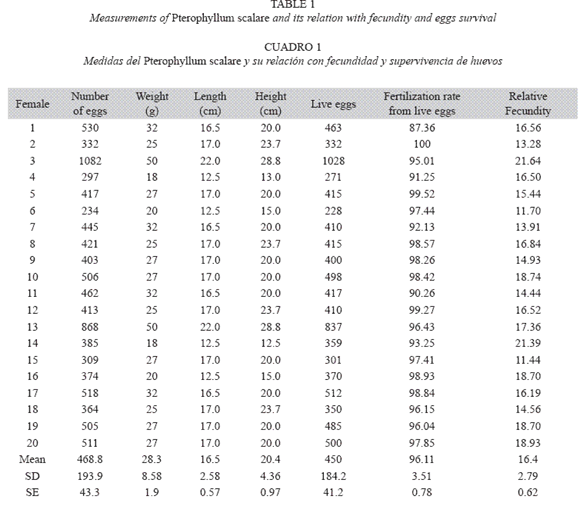
<body><![CDATA[<p><font face="Verdana" size="2"> </font></p>     <p><font face="Verdana" size="2">The freshwater angelfishes (<i>Pterophyllum</i>) </font><font face="Verdana" size="2">are South American cichlids that originate </font><font face="Verdana" size="2">from the Guyana, and the Orinoco and Amazon </font><font face="Verdana" size="2">River basins. In the wild, their reproductive </font><font face="Verdana"  size="2">season is around January, at a water tempera</font><font face="Verdana" size="2">ture between 28 and 30°C. Angelfishes are very </font><font face="Verdana"  size="2">popular among aquarists all over the world, </font><font  face="Verdana" size="2">yet scarce information on their culture and </font><font face="Verdana" size="2">aquarium husbandry exists (Axelrod &amp; Shaw </font><font face="Verdana"  size="2">1967, Pérez 1984), and little has been reported </font><font face="Verdana"  size="2">regarding scientific measurements of its growth </font><font  face="Verdana" size="2">and fecundity (Martty 1977).    <br> </font></p>     <p><font face="Verdana" size="2">Nutrition has an important influence </font><font  face="Verdana" size="2">on growth and reproductive potential of </font><font face="Verdana" size="2">aquarium fishes, and live foods are often </font><font face="Verdana" size="2">advocated as a means to enhance these</font><font face="Verdana" size="2"> </font><font  face="Verdana" size="2">factors. For example, Reyes-Bustamante&nbsp; (1999), studying the goldfish (<i>Carassius&nbsp;</i> <i>auratus</i>), fighting fish <i>(Betta splendens</i>) and&nbsp; gourami (<i>Trichogaster trichopterus</i>), showed that juvenile fish raised on live rotifera&nbsp; (<i>Brachionus plicatilis</i>) and the cladoceran&nbsp; (<i>Daphnia magna</i>) yielded better growth than&nbsp; those fed with two different formulations of&nbsp; commercial dry fish food.&nbsp;     <br> </font></p>     <p><font face="Verdana" size="2">Similar nutritional studies using live foods&nbsp; have been documented for angelfish. For example, Figueroa <i>et al. </i>(1977) found that angelfish fed exclusively with <i>D. pulex </i>produced larger&nbsp; and more frequent spawnings with greater fry&nbsp; survival than those fed exclusively on a com mercial dry flake.</font></p>     <p><font face="Verdana" size="2">The aim of this study was to quantify fecundity, growth, and survival of eggs and larvae of angelfish cultured under laboratory conditions, and using two different live food diets and one commercial dry diet. </font></p>     <p><font face="Verdana" size="3"><span style="font-weight: bold;">Materials and methods</span> </font></p>     <p><font face="Verdana" size="2">The study was performed under laboratory conditions at the Autonomous University of Sinaloa in Mazatlán, Sinaloa, Mexico. </font></p>     <p><font face="Verdana" size="2"><b>Fish: </b>Mature angelfish, 9 to 10 months old, were used for the study. These fish were second generation stock that had been bred on site (<a href="#t1">Table 1</a>).    ]]></body>
<body><![CDATA[<br> </font></p>     <p><font face="Verdana" size="2">    <br> <a name="t1"></a></font></p>     <div style="text-align: center;"><font face="Verdana" size="2"><img  src="/img/revistas/rbt/v57n3/art22t1.gif" title="" alt=""  style="width: 580px; height: 516px;"></font>    <br> <font face="Verdana" size="2"> </font></div>     <p><font face="Verdana" size="2"><b>Water conditions: </b>Throughout the study, fish were maintained under the following water parameters: temperature 24.3 to 30°C; pH 7.8 to 9.0. Water quality was maintained by bio-filtration and total water changes were performed every 15 days, after the first 30 days (weaning). </font></p>     <p><font face="Verdana" size="2"><b>Spawning conditions: </b>Fish were settled in an 80L aquarium, and allowed to pair naturally. Each formed pair was transferred to its own aquarium containing a plastic plate positioned diagonally, to serve as a spawning surface. After spawning, the eggs were reared artificially. The plastic plate with the eggs attached was transferred to another aquarium and an air supply was placed near the egg clutch to create water movement and aeration. </font></p>     <p><font face="Verdana" size="2"><b>Measurements: </b>Data was registered from 20 spawnings. The eggs within each clutch were counted (number of eggs), then the mother fish was measured (length mm and height mm), and weighed (weight g) to obtain the relative fecundity: En=z/W, where En=number of eggs per weight (g) of fish; z=number of eggs; W=total weight of fish. The rate of fecundity for weight was calculated using the regression line, Number of eggs=a + b (W), where W: total weight, a: y-intercept, b: slope. Additionally, live larvae were counted to obtain the fertilization rate: live eggs/number of eggs x 100 (<a href="#t1">Table 1</a>). </font></p>     <p><font face="Verdana" size="2"><b>Rearing diets: </b>Three different diets were used during 135 days to calculate the growth in length and height of 100 larvae in 40L aquariums. </font></p>     <p><font face="Verdana" size="2"><b>Diet A: </b>Decapsulated cysts of <i>Artemia </i>sp. were used to feed angelfish larvae once a day at a rate of 4cysts/mL for 10 days, thereafter a rate of 6cysts/mL was used until the end of the study. The fish eat <i>ad libitum</i>. </font></p>     ]]></body>
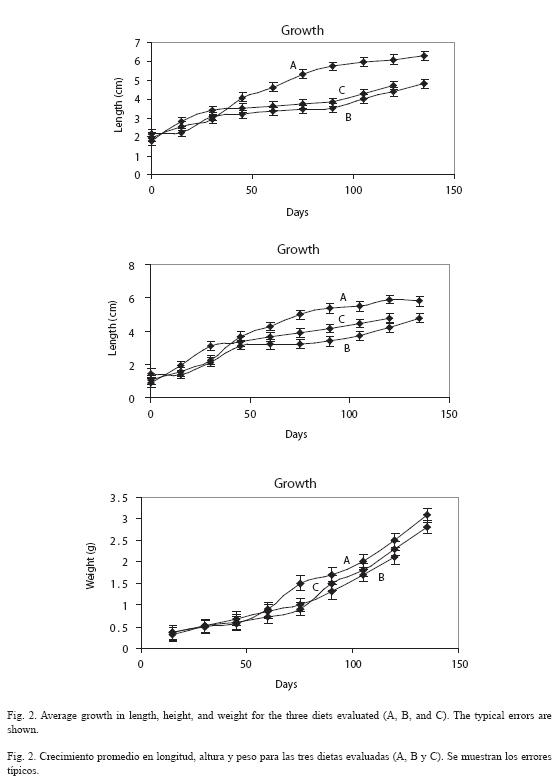
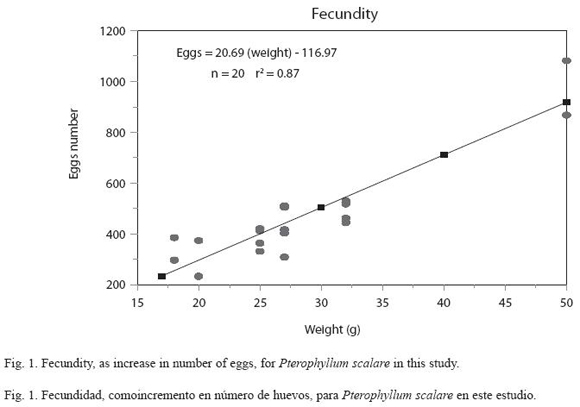
<body><![CDATA[<p><font face="Verdana" size="2"><b>Diet B: </b>Small flakes of "Tetramin" balanced food to fit the size of the mouth were given at about 6% to the fish biomass in three rations per day. </font></p>     <p><font face="Verdana" size="2"><b>Diet C: </b>Once the vitellarium sac had been absorbed, rotifers, <i>Brachionus <u>p</u>licatilis, </i>were given at a rate of 10/mL for 10 days; thereafter, 2 cladocerans <i>D. magna </i>7/mL were given three times per day until the end of the study. The fish eat <i>ad libitum. </i></font></p>     <p><font face="Verdana" size="2">To calculate growth an average of ten fish were used every 15 days. The length (cm) and height (cm) of angelfish larvae samples were first measured using a hematocytometer under a stereoscopic microscope. Later, when the larvae reached more than 5mm in length, a petri dish with millimetric paper was used. Fry wet weight was measured with an Ohaus 480 scale balance (0.001g) using the difference between a known water volume and one with fry. </font></p>     <p><font face="Verdana" size="2">Also, during 135 days (November 1st to March 15</font><sup><font face="Verdana" size="1">th</font></sup><font  face="Verdana" size="2">), using the three different diets mentioned before, the instantaneous total mortality rate (Z) was estimated for 80 larvae/40 L aquarium through the Beverton &amp; Holt (1959) method and described in Ricker (1975), Nt=N</font><sub><font face="Verdana"  size="1">0 </font></sub><font face="Verdana" size="2">e –Z t, where N</font><sub><font  face="Verdana" size="1">0 </font></sub><font face="Verdana" size="2">and Nt are the number of born fish larvae at the beginning and at the end of the period of the culture time (t). Survival (S) of eggs and larvae was also calculated as follows, S=Nt/N</font><sub><font face="Verdana"  size="1">0 </font></sub><font face="Verdana" size="2">and mortality M=1- S, expressed as percentage. The Excel program was used. The multiple comparisons of Tukey of the growth slops were estimated. </font></p>     <p><font face="Verdana" size="3"><span style="font-weight: bold;">Results</span> </font></p>     <p><font face="Verdana" size="2"><b>Fecundity and eggs survival: </b><a  href="#t1">Table 1</a> shows that there was a maximum of 1082 eggs for a female weight of 50g, length of 22.0, and height of 28.8cm and a minimum of 234 eggs for another of 20g weight, length of 12.5, and height of 15cm, with an average of 468.8 (SD±193.97) eggs per fish. The relative fecundity varied from 11.44 to 21.64 eggs per gram of female with an average of 16.39 (SD±2.79). The number of eggs increased 20.69 for each unit of weight (<a href="#f1">Fig. 1</a>). The relation between number of eggs per live eggs was as follows: Number of eggs=0.9464 (live eggs)+6.3618, R</font><sup><font  face="Verdana" size="1">2</font></sup><font face="Verdana" size="2">=0.9924, n=20. Yield survival larvae varied from 87 to 100% with an average of 96% in 60 days.    <br> </font></p>     <p><font face="Verdana" size="2">    <br> <a name="f1"></a></font></p>     <div style="text-align: center;"><font face="Verdana" size="2"><img  src="/img/revistas/rbt/v57n3/art22i1.jpg" title="" alt=""  style="width: 580px; height: 407px;"></font>    ]]></body>
<body><![CDATA[<br> <font face="Verdana" size="2"> </font></div>     <p><font face="Verdana" size="2"><b>Growth: </b>The length, height, and weight growth of the fish larvae born from November 1</font><sup><font  face="Verdana" size="1">st </font></sup><font face="Verdana" size="2">to March 15</font><sup><font face="Verdana" size="1">th </font></sup><font  face="Verdana" size="2">using the three different diets are depicted in <a href="#f2">Fig. 2</a>. The best growth was attained with diet A, reaching 6.3cm in length, 5.9cm in height, and 3.62g in weight, followed by diet C with 5.15cm, 5.10cm, and 3.00g, respectively, and the lowest was attained with diet B yielding 4.81cm, 4.79cm, and 2.8g, respectively. Tukey method confirmed that diet A was significantly different from diets B and C, and this two diets themselves showed no differences in growths at P&gt;0.50.    <br> </font></p>     <p><font face="Verdana" size="2">    <br> <a name="f2"></a></font></p>     <div style="text-align: center;"><font face="Verdana" size="2"><img  src="/img/revistas/rbt/v57n3/art22i2.jpg" title="" alt=""  style="width: 557px; height: 782px;"></font>    <br> <font face="Verdana" size="2"> </font></div>     <p><font face="Verdana" size="2">In general, the greater the fish grows more eggs will be produced, as mentioned before. Although there are statistical differences in growth, it is important to note that diets A (<i>Artemia </i>cysts<i>) </i>and C (rotiferscladocerans) have a higher cost than diet B (balanced inert food). </font></p>     <p><font face="Verdana" size="2"><b>Mortality: </b>Total mortality for 2 fish larvae/mL in 40L aquarium in 135 days using the three different diets (<a href="#f3">Fig. 3</a>); the instantaneous total mortality rate (Z) was 0.0026, 0.0043, and 0.0040, respectively; with diet A the mortality was 33.8%; with diet C, 43.8%; and with diet B, 50.0 %. The best survival percentage was attained with diet A at 66.25%.    <br> </font></p>     ]]></body>
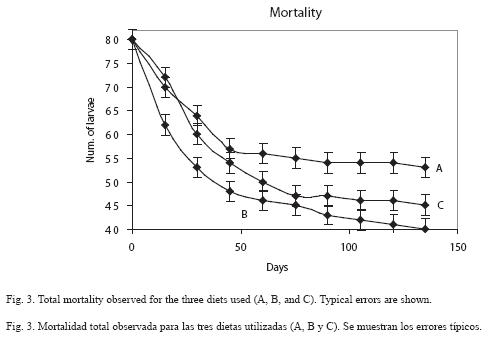
<body><![CDATA[<p><font face="Verdana" size="2">    <br> <a name="f3"></a></font></p>     <div style="text-align: center;"><font face="Verdana" size="2"><img  src="/img/revistas/rbt/v57n3/art22i3.jpg" title="" alt=""  style="width: 494px; height: 337px;"></font>    <br> <font face="Verdana" size="2"> </font></div>     <p><font face="Verdana" size="3"><span style="font-weight: bold;">Discussion</span> </font></p>     <p><font face="Verdana" size="2">Temperatures recorded in this study are suitable for culturing angelfish according to Martty &amp; Couto (1976). Aries (1972) recommends a temperature variation between 28 to 30°C for reproduction as found in this experiment. </font></p>     <p><font face="Verdana" size="2">Swingle (1961) recommended a pH variation between 6.5 and 9, values higher or lower prevent reproduction, although Axelrod (1976) reported that angelfish prefer a pH lower than 7 in the Amazon River effluents. In this paper was between 7.8 and 9.0. </font></p>     <p><font face="Verdana" size="2">The type of food has an important influence on the nutrition of fish larvae. Shirota (1970) related the size of the mouth of marine fish larvae and the prey size by an index. Lavens &amp; Sorgeloos (1996) and Coutteau (1996) mentioned those fish larvae of 2 to 3mm preys on 300µm organisms, whereas fish larvae of 3 to 5mm prey on 1mm organisms. Rottmann (1989) mentioned that adults of <i>Moina </i>(700-1 000µm) are bigger than <i>Artemia </i>nauplii (500µM) and three times more than rotifers. <i>D. magna </i>is twice as big as <i>Moina, </i>reason for which it is recommended to feed angelfish larvae older than 10 days. </font></p>     <p><font face="Verdana" size="2"><font face="Verdana" size="2">In commercial fish culture, rotifers are the first live food given, from day 2 to 20; actually no other live food substitute has yet been used (Maeda &amp; Hino 1991).<span style="font-family: verdana;">    <br>     ]]></body>
<body><![CDATA[<br> </span>Watanabe <i>et al. </i>(1983) and Tamaru <i>et al</i>. (1991) reported that fish larvae of 2 to 3mm should be fed with rotifers during the first 30 days until they reach 7 to 10mm length, and then fed them with a mix of copepods and cladocerans or <i>Artemia </i>nauplii. Once the larvae are 10mm long, the food could be fish flour, and larvae size ends when they reach 30 to 50mm. Degani (1993) found that juvenile angelfish increase growth adding live <i>Artemia </i>to different diets with high protein, he suggest <i>Artemia </i>contains a micro-element that is absent in artificial food. In the present paper the best growth was using live <i>Artemia </i>cysts as food<i>, </i>also survival was higher than using artificial food.<span  style="font-family: verdana;">    <br>     <br> </span>Figueroa <i>et al</i>. (1977) found that angelfish fed with <i>D. pulex </i>spawned between 857 and 959 eggs, whereas with "Wardley" (balance food) spawning reached only 363 eggs. Survival was of 91% fed with <i>D. pulex </i>versus 62% fed with "Wardley". In this work a similar food as "Wardley", "Tetramin" was used. The results show less growth and higher mortality than using live food.</font></font></p>     <p><font face="Verdana" size="2"><font face="Verdana" size="2">Knowledge on fecundity and survival are important issues for planning a good production of angelfish larvae and juveniles; besides, it is relevant to know that live food is much better for growing fish than most of the commercial balanced foods. </font></font></p> <font face="Verdana" size="2"><font face="Verdana" size="2"><font  face="Verdana" size="2"> <font size="3">     <p><span style="font-weight: bold;">Acknowledgments</span> </p> </font>     <p>We appreciate the technical support of A. Aguilar A., A. Nuñez P. and C. Ramírez J. </p> </font></font></font> <hr style="width: 100%; height: 2px;"><font face="Verdana" size="2"><font  face="Verdana" size="2"><font face="Verdana" size="2">     <p><span style="font-weight: bold;">Resumen</span> </p> </font> </font></font>     <p><font face="Verdana" size="2"><font face="Verdana" size="2"><font  face="Verdana" size="2">Se realizaron estudios de cultivo en laboratorio del pez ángel, <i>Pterophyllum scalare, </i>para analizar los efectos de su dieta en la fecundidad, crecimiento y sobrevivencia en huevos y larvas por un período 135 días. Tres dietas diferentes se utilizaron A) quistes decapsulados de <i>Artemia</i>, B) comida comercial seca para pez, C) una mezcla de rotíferos, <i>Brachionus plicatilis </i>y el cladocero, <i>Daphnia magna</i>. La densidad inicial de larvas en acuarios de 40L fue de 100 organismos. Utilizando la dieta A, las larvas alcanzaron un peso máximo de 3.80g, una longitud total de 6.3cm y una altura de 5.8cm; utilizando la dieta B, fue de 2.80g, 4.81cm y 4.79cm y con la dieta C, fue de 3.00g, 5.15cm y 5.10cm, respectivamente. Diferencias significativas se observaron entre la dieta A y las dietas B y C. La fecundidad varió de 234 a 1082 huevos en hembras de 20 y 50g, respectivamente. La sobrevivencia de los huevos varió de 87.4% a 100% y la sobrevivencia de las larvas (80 larvas por acuario de 40L) varió entre 50 y 66.3% con las dietas B y A, respectivamente. Los resultados indicaron, que la comida viva fue mejor para el crecimiento de los peces, que los alimentados con la comida comercial balanceada. La fecundidad y la sobrevivencia son factores importantes para la planificación de una buena producción del pez ángel. </font></font></font></p>     <p><font face="Verdana" size="2"><font face="Verdana" size="2"><font  face="Verdana" size="2"><b>Palabras clave: </b>pez ángel, <i>Pterophyllum scalare </i>(Perciformes: Cichlidae), cultivo, fecundidad, crecimiento, sobrevivencia.    <br> </font></font></font></p> <hr style="width: 100%; height: 2px;">     ]]></body>
<body><![CDATA[<p><font face="Verdana" size="2"><font face="Verdana" size="2"><font  face="Verdana" size="2"></font></font></font></p>     <p style="text-align: center;"><font face="Verdana" size="2"><font  face="Verdana" size="2"><font face="Verdana" size="2">Received 17-X-2006. Corrected 05-IV-2009. Accepted 07-V-2009.</font></font></font></p> <font face="Verdana" size="2"><font face="Verdana" size="2"><font  face="Verdana" size="2"> <font size="3">     <p><span style="font-weight: bold;">References</span> </p> </font></font><font face="Verdana" size="2">     <!-- ref --><p>Aries, S.S. 1972. Discus &amp; Scalare. Ediciones Littec, Buenos Aires, Argentine. &nbsp;&nbsp;&nbsp;&nbsp;&nbsp;&nbsp;&nbsp;&nbsp;[&#160;<a href="javascript:void(0);" onclick="javascript: window.open('/scielo.php?script=sci_nlinks&ref=1367490&pid=S0034-7744200900030002200001&lng=','','width=640,height=500,resizable=yes,scrollbars=1,menubar=yes,');">Links</a>&#160;]<!-- end-ref --><!-- ref --><p>Axelrod, H. R. 1976. Breeding aquarium fishes. T.F.H. Publications, Neptune City, New Jersey, USA. &nbsp;&nbsp;&nbsp;&nbsp;&nbsp;&nbsp;&nbsp;&nbsp;[&#160;<a href="javascript:void(0);" onclick="javascript: window.open('/scielo.php?script=sci_nlinks&ref=1367491&pid=S0034-7744200900030002200002&lng=','','width=640,height=500,resizable=yes,scrollbars=1,menubar=yes,');">Links</a>&#160;]<!-- end-ref --><!-- ref --><p>Axelrod, H. R, &amp; S.R. Shaw. 1967. Breeding aquarium fishes. T.F.H. Publications, Neptune City, New Jersey, USA. &nbsp;&nbsp;&nbsp;&nbsp;&nbsp;&nbsp;&nbsp;&nbsp;[&#160;<a href="javascript:void(0);" onclick="javascript: window.open('/scielo.php?script=sci_nlinks&ref=1367492&pid=S0034-7744200900030002200003&lng=','','width=640,height=500,resizable=yes,scrollbars=1,menubar=yes,');">Links</a>&#160;]<!-- end-ref --><!-- ref --><p>Beverton, R.J.H. &amp; S.J. Holt. 1959. A review of the life span and mortality rates of fish in nature, and their relation to growth and other physiological characteristics. CIBA Found. Colloq Age. 5: 142-177. &nbsp;&nbsp;&nbsp;&nbsp;&nbsp;&nbsp;&nbsp;&nbsp;[&#160;<a href="javascript:void(0);" onclick="javascript: window.open('/scielo.php?script=sci_nlinks&ref=1367493&pid=S0034-7744200900030002200004&lng=','','width=640,height=500,resizable=yes,scrollbars=1,menubar=yes,');">Links</a>&#160;]<!-- end-ref --><!-- ref --><p>Coutteau, P. 1996. Microalgae, p. 7-47. <i>In </i>Manual on the production and use of live food for aquaculture. FAO Fish. Tech. Pap. 361. FAO, Rome, Italy. &nbsp;&nbsp;&nbsp;&nbsp;&nbsp;&nbsp;&nbsp;&nbsp;[&#160;<a href="javascript:void(0);" onclick="javascript: window.open('/scielo.php?script=sci_nlinks&ref=1367494&pid=S0034-7744200900030002200005&lng=','','width=640,height=500,resizable=yes,scrollbars=1,menubar=yes,');">Links</a>&#160;]<!-- end-ref --><!-- ref --><p>Figueroa, T.J., R.G. Berrum &amp; F.J. Luna. 1977. Reproducción del pez ángel <i>Pterophyllum scalare </i>var. <i>Perlada, </i>p. 109. <i>In </i>V Congreso Nacional de Ictiología, Mazatlán Sinaloa, Mexico. &nbsp;&nbsp;&nbsp;&nbsp;&nbsp;&nbsp;&nbsp;&nbsp;[&#160;<a href="javascript:void(0);" onclick="javascript: window.open('/scielo.php?script=sci_nlinks&ref=1367495&pid=S0034-7744200900030002200006&lng=','','width=640,height=500,resizable=yes,scrollbars=1,menubar=yes,');">Links</a>&#160;]<!-- end-ref --><!-- ref --><p>Degani, G. 1993. Growth and body composition of juveniles of <i>Pterophyllum scalare </i>(Lichtenstein) (Pisces: Cichlidae) at different densities and diets. Aquaculture and Fisheries Management 24: 725-73. &nbsp;&nbsp;&nbsp;&nbsp;&nbsp;&nbsp;&nbsp;&nbsp;[&#160;<a href="javascript:void(0);" onclick="javascript: window.open('/scielo.php?script=sci_nlinks&ref=1367496&pid=S0034-7744200900030002200007&lng=','','width=640,height=500,resizable=yes,scrollbars=1,menubar=yes,');">Links</a>&#160;]<!-- end-ref --><!-- ref --><p>Lavens, P. &amp; P. Sorgeloos. 1996. Manual on the production, and use of live food for aquaculture. FAO, Fish. Tech. Pap. 361. Rome, Italy. &nbsp;&nbsp;&nbsp;&nbsp;&nbsp;&nbsp;&nbsp;&nbsp;[&#160;<a href="javascript:void(0);" onclick="javascript: window.open('/scielo.php?script=sci_nlinks&ref=1367497&pid=S0034-7744200900030002200008&lng=','','width=640,height=500,resizable=yes,scrollbars=1,menubar=yes,');">Links</a>&#160;]<!-- end-ref --><!-- ref --><p>Maeda, M. &amp; A. Hino. 1991. Environmental management for mass culture of the rotifer<i>, Brachionus plicatilis, </i>p.125-134. <i>In </i>Rotifer and micro-algae culture system. W. Fulks &amp; K. L. Main (eds.). Proceedings of a US-Asia Workshop. The Oceanic Institute, Honolulu, Hawaii, USA. &nbsp;&nbsp;&nbsp;&nbsp;&nbsp;&nbsp;&nbsp;&nbsp;[&#160;<a href="javascript:void(0);" onclick="javascript: window.open('/scielo.php?script=sci_nlinks&ref=1367498&pid=S0034-7744200900030002200009&lng=','','width=640,height=500,resizable=yes,scrollbars=1,menubar=yes,');">Links</a>&#160;]<!-- end-ref --><!-- ref --><p>Martty, A.H<b>. </b>1977. Alimentación de peces ornamentales. Albatros, Buenos Aires, Argentine. &nbsp;&nbsp;&nbsp;&nbsp;&nbsp;&nbsp;&nbsp;&nbsp;[&#160;<a href="javascript:void(0);" onclick="javascript: window.open('/scielo.php?script=sci_nlinks&ref=1367499&pid=S0034-7744200900030002200010&lng=','','width=640,height=500,resizable=yes,scrollbars=1,menubar=yes,');">Links</a>&#160;]<!-- end-ref --><!-- ref --><p>Martty, A.H. &amp; D.D. Coutto. 1976. Peces tropicales y el novicio. Albatros, Buenos Aires, Argentine. &nbsp;&nbsp;&nbsp;&nbsp;&nbsp;&nbsp;&nbsp;&nbsp;[&#160;<a href="javascript:void(0);" onclick="javascript: window.open('/scielo.php?script=sci_nlinks&ref=1367500&pid=S0034-7744200900030002200011&lng=','','width=640,height=500,resizable=yes,scrollbars=1,menubar=yes,');">Links</a>&#160;]<!-- end-ref --><!-- ref --><p>Pérez, S.L.A. 1984. Piscicultura. El manual moderno. &nbsp;&nbsp;&nbsp;&nbsp;&nbsp;&nbsp;&nbsp;&nbsp;[&#160;<a href="javascript:void(0);" onclick="javascript: window.open('/scielo.php?script=sci_nlinks&ref=1367501&pid=S0034-7744200900030002200012&lng=','','width=640,height=500,resizable=yes,scrollbars=1,menubar=yes,');">Links</a>&#160;]<!-- end-ref --><!-- ref --><p>Reyes-Bustamante, H. 1999. Evaluación y optimización de la producción de microalgas del rotífero <i>Brachionus plicatilis </i>y del cladócero, <i>Daphnia magna </i>bajo diferentes condiciones de cultivo. Tesis Doctoral. Colegio de Ciencias y Humanidades, Unidad Académica de los Ciclos Profesionales y de Posgrado, Universidad Nacional Autónoma de México, Mexico. &nbsp;&nbsp;&nbsp;&nbsp;&nbsp;&nbsp;&nbsp;&nbsp;[&#160;<a href="javascript:void(0);" onclick="javascript: window.open('/scielo.php?script=sci_nlinks&ref=1367502&pid=S0034-7744200900030002200013&lng=','','width=640,height=500,resizable=yes,scrollbars=1,menubar=yes,');">Links</a>&#160;]<!-- end-ref --><!-- ref --><p>Ricker, W.E. 1975. Computation, and interpretation of biological statistics of fish populations. Bull. Fish. Res. Canada 191. &nbsp;&nbsp;&nbsp;&nbsp;&nbsp;&nbsp;&nbsp;&nbsp;[&#160;<a href="javascript:void(0);" onclick="javascript: window.open('/scielo.php?script=sci_nlinks&ref=1367503&pid=S0034-7744200900030002200014&lng=','','width=640,height=500,resizable=yes,scrollbars=1,menubar=yes,');">Links</a>&#160;]<!-- end-ref --><!-- ref --><p>Rottmann, R.W. 1989<i>. Daphnia </i>culture. Florida.Aquarium Farms Inc. 1: 99-123. &nbsp;&nbsp;&nbsp;&nbsp;&nbsp;&nbsp;&nbsp;&nbsp;[&#160;<a href="javascript:void(0);" onclick="javascript: window.open('/scielo.php?script=sci_nlinks&ref=1367504&pid=S0034-7744200900030002200015&lng=','','width=640,height=500,resizable=yes,scrollbars=1,menubar=yes,');">Links</a>&#160;]<!-- end-ref --><!-- ref --><p>Shirota, A. 1970. Studies on the mouth size of fish larvae<i>. </i>Bull. Japan. Soc. Sci. Fish. 36: 353-368. &nbsp;&nbsp;&nbsp;&nbsp;&nbsp;&nbsp;&nbsp;&nbsp;[&#160;<a href="javascript:void(0);" onclick="javascript: window.open('/scielo.php?script=sci_nlinks&ref=1367505&pid=S0034-7744200900030002200016&lng=','','width=640,height=500,resizable=yes,scrollbars=1,menubar=yes,');">Links</a>&#160;]<!-- end-ref --><!-- ref --><p>Swingle, H.S. 1961. Relationships of pH of pond waters to their suitability for fish culture. Proceed. Pac. Sci. Cong. 9: 72-75. &nbsp;&nbsp;&nbsp;&nbsp;&nbsp;&nbsp;&nbsp;&nbsp;[&#160;<a href="javascript:void(0);" onclick="javascript: window.open('/scielo.php?script=sci_nlinks&ref=1367506&pid=S0034-7744200900030002200017&lng=','','width=640,height=500,resizable=yes,scrollbars=1,menubar=yes,');">Links</a>&#160;]<!-- end-ref --><!-- ref --><p>Tamaru, C.S., Lee, C. &amp; H. Ako. 1991. Improving the larval rearing of striped mullet (<i>Mugil cephalus</i>) by manipulating quantity and quality of the rotifer, <i>Brachionus plicatilis</i>, p. 89-104. <i>In </i>Rotifer and micro-algae culture system, W. Fulks &amp; K. L. Main (eds.). Proceedings US-Asia Works, The Oceanic Institute, Hawaii, USA. &nbsp;&nbsp;&nbsp;&nbsp;&nbsp;&nbsp;&nbsp;&nbsp;[&#160;<a href="javascript:void(0);" onclick="javascript: window.open('/scielo.php?script=sci_nlinks&ref=1367507&pid=S0034-7744200900030002200018&lng=','','width=640,height=500,resizable=yes,scrollbars=1,menubar=yes,');">Links</a>&#160;]<!-- end-ref --><!-- ref --><p>Watanabe, T., C. Jitajima &amp; S. Fujita. 1983. Nutritional value of live food organisms used in Japan for mass culture of fish. Rev. Aqua. 34: 115-143. &nbsp;&nbsp;&nbsp;&nbsp;&nbsp;&nbsp;&nbsp;&nbsp;[&#160;<a href="javascript:void(0);" onclick="javascript: window.open('/scielo.php?script=sci_nlinks&ref=1367508&pid=S0034-7744200900030002200019&lng=','','width=640,height=500,resizable=yes,scrollbars=1,menubar=yes,');">Links</a>&#160;]<!-- end-ref --> ]]></body><back>
<ref-list>
<ref id="B1">
<nlm-citation citation-type="book">
<person-group person-group-type="author">
<name>
<surname><![CDATA[Aries]]></surname>
<given-names><![CDATA[S.S]]></given-names>
</name>
</person-group>
<source><![CDATA[Discus & Scalare]]></source>
<year>1972</year>
<publisher-loc><![CDATA[Buenos Aires ]]></publisher-loc>
<publisher-name><![CDATA[Ediciones Littec]]></publisher-name>
</nlm-citation>
</ref>
<ref id="B2">
<nlm-citation citation-type="">
<person-group person-group-type="author">
<name>
<surname><![CDATA[Axelrod]]></surname>
<given-names><![CDATA[H. R]]></given-names>
</name>
</person-group>
<source><![CDATA[]]></source>
<year>1976</year>
</nlm-citation>
</ref>
<ref id="B3">
<nlm-citation citation-type="book">
<person-group person-group-type="author">
<name>
<surname><![CDATA[Axelrod]]></surname>
<given-names><![CDATA[H. R]]></given-names>
</name>
<name>
<surname><![CDATA[Shaw]]></surname>
<given-names><![CDATA[S.R]]></given-names>
</name>
</person-group>
<source><![CDATA[Breeding aquarium fishes]]></source>
<year>1967</year>
<publisher-loc><![CDATA[Neptune City^eNew Jersey New Jersey]]></publisher-loc>
<publisher-name><![CDATA[T.F.H. Publications]]></publisher-name>
</nlm-citation>
</ref>
<ref id="B4">
<nlm-citation citation-type="journal">
<person-group person-group-type="author">
<name>
<surname><![CDATA[Beverton]]></surname>
<given-names><![CDATA[R.J.H]]></given-names>
</name>
<name>
<surname><![CDATA[Holt]]></surname>
<given-names><![CDATA[S.J]]></given-names>
</name>
</person-group>
<article-title xml:lang="en"><![CDATA[A review of the life span and mortality rates of fish in nature, and their relation to growth and other physiological characteristics]]></article-title>
<source><![CDATA[CIBA Found. Colloq Age]]></source>
<year>1959</year>
<volume>5</volume>
<page-range>142-177</page-range></nlm-citation>
</ref>
<ref id="B5">
<nlm-citation citation-type="book">
<person-group person-group-type="author">
<name>
<surname><![CDATA[Coutteau]]></surname>
<given-names><![CDATA[P]]></given-names>
</name>
</person-group>
<article-title xml:lang="en"><![CDATA[Microalgae]]></article-title>
<source><![CDATA[Manual on the production and use of live food for aquaculture]]></source>
<year>1996</year>
<volume>361</volume>
<page-range>7-47</page-range><publisher-loc><![CDATA[Rome ]]></publisher-loc>
<publisher-name><![CDATA[FAO]]></publisher-name>
</nlm-citation>
</ref>
<ref id="B6">
<nlm-citation citation-type="confpro">
<person-group person-group-type="author">
<name>
<surname><![CDATA[Figueroa]]></surname>
<given-names><![CDATA[T.J]]></given-names>
</name>
<name>
<surname><![CDATA[Berrum]]></surname>
<given-names><![CDATA[R.G]]></given-names>
</name>
<name>
<surname><![CDATA[Luna]]></surname>
<given-names><![CDATA[F.J]]></given-names>
</name>
</person-group>
<article-title xml:lang="en"><![CDATA[Reproducción del pez ángel Pterophyllum scalare var. Perlada]]></article-title>
<source><![CDATA[]]></source>
<year>1977</year>
<conf-name><![CDATA[V Congreso Nacional de Ictiología]]></conf-name>
<conf-loc>Mazatlán Sinaloa</conf-loc>
<page-range>109</page-range></nlm-citation>
</ref>
<ref id="B7">
<nlm-citation citation-type="journal">
<person-group person-group-type="author">
<name>
<surname><![CDATA[Degani]]></surname>
<given-names><![CDATA[G]]></given-names>
</name>
</person-group>
<article-title xml:lang="en"><![CDATA[Growth and body composition of juveniles of Pterophyllum scalare (Lichtenstein) (Pisces: Cichlidae) at different densities and diets]]></article-title>
<source><![CDATA[Aquaculture and Fisheries Management]]></source>
<year>1993</year>
<volume>24</volume>
<page-range>725-73</page-range></nlm-citation>
</ref>
<ref id="B8">
<nlm-citation citation-type="journal">
<person-group person-group-type="author">
<name>
<surname><![CDATA[Lavens]]></surname>
<given-names><![CDATA[P]]></given-names>
</name>
<name>
<surname><![CDATA[Sorgeloos]]></surname>
<given-names><![CDATA[P]]></given-names>
</name>
</person-group>
<article-title xml:lang="en"><![CDATA[Manual on the production, and use of live food for aquaculture]]></article-title>
<source><![CDATA[FAO, Fish. Tech. Pap]]></source>
<year>1996</year>
<volume>361</volume>
<publisher-loc><![CDATA[Rome ]]></publisher-loc>
</nlm-citation>
</ref>
<ref id="B9">
<nlm-citation citation-type="book">
<person-group person-group-type="author">
<name>
<surname><![CDATA[Maeda]]></surname>
<given-names><![CDATA[M]]></given-names>
</name>
<name>
<surname><![CDATA[Hino]]></surname>
<given-names><![CDATA[A]]></given-names>
</name>
</person-group>
<article-title xml:lang="en"><![CDATA[Environmental management for mass culture of the rotifer, Brachionus plicatilis]]></article-title>
<person-group person-group-type="editor">
<name>
<surname><![CDATA[Fulks]]></surname>
<given-names><![CDATA[W]]></given-names>
</name>
<name>
<surname><![CDATA[Main]]></surname>
<given-names><![CDATA[K. L]]></given-names>
</name>
</person-group>
<collab>Rotifer and micro-algae culture system</collab>
<source><![CDATA[Proceedings of a US-Asia Workshop]]></source>
<year>1991</year>
<page-range>125-134</page-range><publisher-loc><![CDATA[Honolulu^eHawaii Hawaii]]></publisher-loc>
<publisher-name><![CDATA[The Oceanic Institute]]></publisher-name>
</nlm-citation>
</ref>
<ref id="B10">
<nlm-citation citation-type="book">
<person-group person-group-type="author">
<name>
<surname><![CDATA[Martty]]></surname>
<given-names><![CDATA[A.H]]></given-names>
</name>
</person-group>
<source><![CDATA[Alimentación de peces ornamentales]]></source>
<year>1977</year>
<publisher-loc><![CDATA[Buenos Aires ]]></publisher-loc>
<publisher-name><![CDATA[Albatros]]></publisher-name>
</nlm-citation>
</ref>
<ref id="B11">
<nlm-citation citation-type="book">
<person-group person-group-type="author">
<name>
<surname><![CDATA[Martty]]></surname>
<given-names><![CDATA[A.H]]></given-names>
</name>
<name>
<surname><![CDATA[Coutto]]></surname>
<given-names><![CDATA[D.D]]></given-names>
</name>
</person-group>
<source><![CDATA[Peces tropicales y el novicio]]></source>
<year>1976</year>
<publisher-loc><![CDATA[Buenos Aires ]]></publisher-loc>
<publisher-name><![CDATA[Albatros]]></publisher-name>
</nlm-citation>
</ref>
<ref id="B12">
<nlm-citation citation-type="">
<person-group person-group-type="author">
<name>
<surname><![CDATA[Pérez]]></surname>
<given-names><![CDATA[S.L.]]></given-names>
</name>
</person-group>
<source><![CDATA[Piscicultura: El manual moderno]]></source>
<year>1984</year>
</nlm-citation>
</ref>
<ref id="B13">
<nlm-citation citation-type="">
<person-group person-group-type="author">
<name>
<surname><![CDATA[Reyes-Bustamante]]></surname>
<given-names><![CDATA[H]]></given-names>
</name>
</person-group>
<source><![CDATA[Evaluación y optimización de la producción de microalgas del rotífero Brachionus plicatilis y del cladócero, Daphnia magna bajo diferentes condiciones de cultivo]]></source>
<year>1999</year>
</nlm-citation>
</ref>
<ref id="B14">
<nlm-citation citation-type="journal">
<person-group person-group-type="author">
<name>
<surname><![CDATA[Ricker]]></surname>
<given-names><![CDATA[W.E]]></given-names>
</name>
</person-group>
<article-title xml:lang="en"><![CDATA[Computation, and interpretation of biological statistics of fish populations]]></article-title>
<source><![CDATA[Bull. Fish. Res. Canada]]></source>
<year>1975</year>
<volume>191</volume>
</nlm-citation>
</ref>
<ref id="B15">
<nlm-citation citation-type="journal">
<person-group person-group-type="author">
<name>
<surname><![CDATA[Rottmann]]></surname>
<given-names><![CDATA[R.W]]></given-names>
</name>
</person-group>
<article-title xml:lang="en"><![CDATA[Daphnia culture: Florida]]></article-title>
<source><![CDATA[Aquarium Farms Inc]]></source>
<year>1989</year>
<volume>1</volume>
<page-range>99-123</page-range></nlm-citation>
</ref>
<ref id="B16">
<nlm-citation citation-type="journal">
<person-group person-group-type="author">
<name>
<surname><![CDATA[Shirota]]></surname>
<given-names><![CDATA[A]]></given-names>
</name>
</person-group>
<article-title xml:lang="en"><![CDATA[Studies on the mouth size of fish larvae]]></article-title>
<source><![CDATA[Bull. Japan. Soc. Sci. Fish]]></source>
<year>1970</year>
<volume>36</volume>
<page-range>353-368</page-range></nlm-citation>
</ref>
<ref id="B17">
<nlm-citation citation-type="journal">
<person-group person-group-type="author">
<name>
<surname><![CDATA[Swingle]]></surname>
<given-names><![CDATA[H.S]]></given-names>
</name>
</person-group>
<article-title xml:lang="en"><![CDATA[Relationships of pH of pond waters to their suitability for fish culture]]></article-title>
<source><![CDATA[Proceed. Pac. Sci. Cong]]></source>
<year>1961</year>
<volume>9</volume>
<page-range>72-75</page-range></nlm-citation>
</ref>
<ref id="B18">
<nlm-citation citation-type="book">
<person-group person-group-type="author">
<name>
<surname><![CDATA[Tamaru]]></surname>
<given-names><![CDATA[C.S]]></given-names>
</name>
<name>
<surname><![CDATA[Lee]]></surname>
<given-names><![CDATA[C]]></given-names>
</name>
<name>
<surname><![CDATA[Ako]]></surname>
<given-names><![CDATA[H]]></given-names>
</name>
</person-group>
<article-title xml:lang="en"><![CDATA[Improving the larval rearing of striped mullet (Mugil cephalus) by manipulating quantity and quality of the rotifer, Brachionus plicatilis]]></article-title>
<person-group person-group-type="editor">
<name>
<surname><![CDATA[Fulks]]></surname>
<given-names><![CDATA[W]]></given-names>
</name>
<name>
<surname><![CDATA[Main]]></surname>
<given-names><![CDATA[K. L]]></given-names>
</name>
</person-group>
<collab>Rotifer and micro-algae culture system</collab>
<source><![CDATA[Proceedings US-Asia Works]]></source>
<year>1991</year>
<page-range>89-104</page-range><publisher-loc><![CDATA[Hawaii ]]></publisher-loc>
<publisher-name><![CDATA[The Oceanic Institute]]></publisher-name>
</nlm-citation>
</ref>
<ref id="B19">
<nlm-citation citation-type="journal">
<person-group person-group-type="author">
<name>
<surname><![CDATA[Watanabe]]></surname>
<given-names><![CDATA[T]]></given-names>
</name>
<name>
<surname><![CDATA[Jitajima]]></surname>
<given-names><![CDATA[C]]></given-names>
</name>
<name>
<surname><![CDATA[Fujita]]></surname>
<given-names><![CDATA[S]]></given-names>
</name>
</person-group>
<article-title xml:lang="en"><![CDATA[Nutritional value of live food organisms used in Japan for mass culture of fish]]></article-title>
<source><![CDATA[Rev. Aqua]]></source>
<year>1983</year>
<volume>34</volume>
<page-range>115-143</page-range></nlm-citation>
</ref>
</ref-list>
</back>
</article>