<?xml version="1.0" encoding="ISO-8859-1"?><article xmlns:mml="http://www.w3.org/1998/Math/MathML" xmlns:xlink="http://www.w3.org/1999/xlink" xmlns:xsi="http://www.w3.org/2001/XMLSchema-instance">
<front>
<journal-meta>
<journal-id>0034-7744</journal-id>
<journal-title><![CDATA[Revista de Biología Tropical]]></journal-title>
<abbrev-journal-title><![CDATA[Rev. biol. trop]]></abbrev-journal-title>
<issn>0034-7744</issn>
<publisher>
<publisher-name><![CDATA[Universidad de Costa Rica]]></publisher-name>
</publisher>
</journal-meta>
<article-meta>
<article-id>S0034-77442008000400039</article-id>
<title-group>
<article-title xml:lang="en"><![CDATA[Antifeedant activity of botanical crude extracts and their fractions on Bemisia tabaci (Homoptera: Aleyrodidae) adults: I. Gliricidia sepium (Fabaceae)]]></article-title>
</title-group>
<contrib-group>
<contrib contrib-type="author">
<name>
<surname><![CDATA[Flores]]></surname>
<given-names><![CDATA[Guillermo]]></given-names>
</name>
</contrib>
<contrib contrib-type="author">
<name>
<surname><![CDATA[Hilje]]></surname>
<given-names><![CDATA[Luko]]></given-names>
</name>
</contrib>
<contrib contrib-type="author">
<name>
<surname><![CDATA[Mora]]></surname>
<given-names><![CDATA[Gerardo A]]></given-names>
</name>
</contrib>
<contrib contrib-type="author">
<name>
<surname><![CDATA[Carballo]]></surname>
<given-names><![CDATA[Manuel]]></given-names>
</name>
</contrib>
</contrib-group>
<aff id="A01">
<institution><![CDATA[,Ministry of Agriculture and Animal Husbandry (MAG)  ]]></institution>
<addr-line><![CDATA[Cartago ]]></addr-line>
<country>Costa Rica</country>
</aff>
<aff id="A02">
<institution><![CDATA[,Agricultural Research and Higher Education Center Department of Agriculture and Agroforestry ]]></institution>
<addr-line><![CDATA[Turrialba ]]></addr-line>
<country>Costa Rica</country>
</aff>
<aff id="A03">
<institution><![CDATA[,Universidad de Costa Rica Natural Products Research Center (CIPRONA) Associate Researcher]]></institution>
<addr-line><![CDATA[San José ]]></addr-line>
<country>Costa Rica</country>
</aff>
<pub-date pub-type="pub">
<day>00</day>
<month>12</month>
<year>2008</year>
</pub-date>
<pub-date pub-type="epub">
<day>00</day>
<month>12</month>
<year>2008</year>
</pub-date>
<volume>56</volume>
<numero>4</numero>
<fpage>2099</fpage>
<lpage>2113</lpage>
<copyright-statement/>
<copyright-year/>
<self-uri xlink:href="http://www.scielo.sa.cr/scielo.php?script=sci_arttext&amp;pid=S0034-77442008000400039&amp;lng=en&amp;nrm=iso"></self-uri><self-uri xlink:href="http://www.scielo.sa.cr/scielo.php?script=sci_abstract&amp;pid=S0034-77442008000400039&amp;lng=en&amp;nrm=iso"></self-uri><self-uri xlink:href="http://www.scielo.sa.cr/scielo.php?script=sci_pdf&amp;pid=S0034-77442008000400039&amp;lng=en&amp;nrm=iso"></self-uri><abstract abstract-type="short" xml:lang="en"><p><![CDATA[Bemisia tabaci is an important virus vector on a number of crops worldwide. Therefore, a preventive approach to deal with viral epidemics may be the deployment of repellents or phagodeterrents at earlier stages of plant development (critical period). Thus, the crude extract and four fractions thereof (water, water:methanol, methanol, and diethyl ether) of mother-of-cocoa (Gliricidia sepium, Fabaceae) were tested for phagodeterrence to B. tabaci adults under greenhouse conditions, on tomato plants, in Costa Rica. Both restricted-choice and unrestricted-choice experiments showed that the crude extract and some fractions exerted such effect on the insect. In the former (in sleeve cages), three fractions caused deterrence at doses as low as 0.1% (methanol), 0.5% (water:methanol) and 1.5% (diethyl ether). However, in the latter (plants exposed in a greenhouse) no one of the fractions performed well, suggesting that the deterrent principles somehow decomposed under the experimental conditions. Rev. Biol. Trop. 56 (4): 2099-2113. Epub 2008 December 12.]]></p></abstract>
<abstract abstract-type="short" xml:lang="es"><p><![CDATA[Mundialmente, Bemisia tabaci es un importante vector de virus en numerosos cultivos. Por tanto, un enfoque preventivo para enfrentar las epidemias virales podría ser el empleo de sustancias repelentes o fagodisuasivas en las etapas tempranas del desarrollo de las plantas (período crítico). Así, tanto el extracto crudo como cuatro fracciones (agua, agua:metanol, metanol y éter dietílico) del madero negro (Gliricidia sepium, Fabaceae) fueron evaluadas en cuanto a su actividad fagodisuasiva sobre los adultos de B. tabaci en condiciones de invernadero, utilizando plantas de tomate, en Turrialba, Costa Rica. Tanto los experimentos de escogencia restringida como los de escogencia irrestricta revelaron que el extracto crudo y algunas fracciones mostraron dicha actividad. En los primeros experimentos (en jaulas de manga), tres fracciones causaron fagodisuasión a dosis tan bajas como 0.1% (metanol), 0.5% (agua:metanol) y 1.5% (éter dietílico). Sin embargo, en los segundos (plantas expuestas dentro de un invernadero) ninguna de las fracciones lo hizo, lo cual sugiere que los principios fagodisuasivos perdieron su actividad en esas condiciones experimentales.]]></p></abstract>
<kwd-group>
<kwd lng="en"><![CDATA[Bemisia tabaci]]></kwd>
<kwd lng="en"><![CDATA[plant extracts]]></kwd>
<kwd lng="en"><![CDATA[mother-of-cocoa]]></kwd>
<kwd lng="en"><![CDATA[Gliricidia sepium]]></kwd>
<kwd lng="en"><![CDATA[phagodeterrence]]></kwd>
<kwd lng="es"><![CDATA[Bemisia tabaci]]></kwd>
<kwd lng="es"><![CDATA[extractos vegetales]]></kwd>
<kwd lng="es"><![CDATA[madero negro]]></kwd>
<kwd lng="es"><![CDATA[Gliricidia sepium]]></kwd>
<kwd lng="es"><![CDATA[fagodisuasión]]></kwd>
</kwd-group>
</article-meta>
</front><body><![CDATA[  <font face="Verdana"></font>     <p align="center"></p> <font face="Verdana"><b></b></font>     <p align="center"><font face="Verdana"><b>Antifeedant activity of botanical crude extracts and their fractions on </b><i>Bemisia tabaci </i><b>(Homoptera: Aleyrodidae) adults: I. </b><i>Gliricidia sepium </i><b>(Fabaceae)</b></font></p> <font face="Verdana" size="2"> <b></b></font>     <p><font face="Verdana" size="2"><b>Guillermo Flores<sup>1</sup>, Luko Hilje<sup>2</sup>, Gerardo A. Mora<sup>3 </sup>&amp; Manuel Carballo<sup>2</sup></b></font> <font face="Verdana" size="2">    <br> </font></p>     <p><font face="Verdana" size="2">1. Ministry of Agriculture and Animal Husbandry (MAG). Cartago, Costa Rica.</font> <font face="Verdana" size="2">    <br> </font></p>     <p><font face="Verdana" size="2">2. Department of Agriculture and Agroforestry. Tropical Agricultural Research and Higher Education Center (CATIE). Turrialba, Costa Rica. Fax (506) 2558-2043, <a  href="mailto:lhilje@catie.ac.cr">lhilje@catie.ac.cr</a></font><a  href="mailto:lhilje@catie.ac.cr"> </a><font face="Verdana" size="2">    <br> &nbsp;    <br> 3. Associate Researcher. Natural Products Research Center (CIPRONA). Universidad de Costa Rica. San José, Costa Rica.</font></p> <hr style="width: 100%; height: 2px;">     ]]></body>
<body><![CDATA[<p><font face="Verdana" size="2"> </font></p>     <p><font face="Verdana" size="2"> </font></p> <font face="Verdana" size="2"><b></b></font>     <p><font face="Verdana" size="2"><b>Abstract: </b><i>Bemisia tabaci </i>is an important virus vector on a number of crops worldwide. Therefore, a preventive approach to deal with viral epidemics may be the deployment of repellents or phagodeterrents at earlier stages of plant development (critical period). Thus, the crude extract and four fractions thereof (water, water:methanol, methanol, and diethyl ether) of mother-of-cocoa (<i>Gliricidia sepium</i>, Fabaceae) were tested for phagodeterrence to <i>B. tabaci </i>adults under greenhouse conditions, on tomato plants, in Costa Rica. Both restricted-choice and unrestricted-choice experiments showed that the crude extract and some fractions exerted such effect on the insect. In the former (in sleeve cages), three fractions caused deterrence at doses as low as 0.1% (methanol), 0.5% (water:methanol) and 1.5% (diethyl ether). However, in the latter (plants exposed in a greenhouse) no one of the fractions performed well, suggesting that the deterrent principles somehow decomposed under the experimental conditions. Rev. Biol. Trop. 56 (4): 2099-2113. Epub 2008 December 12. </font></p> <font face="Verdana" size="2"><b></b></font>     <p><font face="Verdana" size="2"><b>Key words: </b><i>Bemisia tabaci</i>, plant extracts, mother-of-cocoa, <i>Gliricidia sepium</i>, phagodeterrence.</font></p> <hr style="width: 100%; height: 2px;">     <p><font face="Verdana" size="2"> </font></p> <font face="Verdana" size="2"><i> </i></font>     <p><font face="Verdana" size="2"><i>Bemisia tabaci </i>(Gennadius) is a cosmopolitan insect and a key pest in many tropical and subtropical cropping systems, causing economic losses of several hundreds or even thousands of millions of dollars a year, worldwide (Oliveira <i>et al. </i>2001). Crop damage on some 30 cash and staple crops worldwide (including tomato, pepper, melon, watermelon, soybean, cotton, beans and cassava) may occur directly through excessive sap removal, or indirectly by promoting the growth of sooty mold, inducing syndromes through feeding, or by vectoring plant viruses (Schuster <i>et al. </i>1996). </font></p>     <p><font face="Verdana" size="2">For tomato, virus impact on yields depends on plant age at time of infection (i.e., the earlier the infection, the greater the severity of the disease and its effect on yield). The critical period of susceptibility for several tomato begomoviruses (family Geminiviridae), for merly geminiviruses, encompasses about the first 50-60 days after emergence (Franke <i>et al</i>. 1983; Schuster <i>et al. </i>1996). In Costa Rica, since the action threshold for the vector is very low (0.3 adults/plant) (Hilje 2001), a preven tive approach is being sought, focusing on this critical early period to minimize contact between the vector and the host plant, empha sizing: production of virus-free seedlings for 30 days under tunnels covered by fine nets; and post-transplant protection by combinations of cultural practices that could be complemented with repellents or deterrents (Hilje 1993, 2001). </font></p>     <p><font face="Verdana" size="2">In spite of being a highly polyphagous pest, which can develop or reproduce on over 500 different plant species belonging to 74 families (Greathead,1986), <i>B. tabaci </i>adults can be affected by substances present in some plant extracts (Hilje and Stansly 2001; Aguiar <i>et al. </i>2003) acting as allomones, either as suppressants, deterrents or anorexigenics (Warthen and Morgan 1990). One of such plants is motherof-cocoa (<i>Gliricidia sepium </i>(Jacquin) Kunth ex Walpers (Fabaceae), so that the objective of this research was to confirm preliminary results (Hilje and Stansly 2001), as well as to test some of its fractions to gain insight into more specific groups of substances causing phagodeterrence. </font></p> <b><font face="Verdana" size="3"> </font></b>     <p><b><font face="Verdana" size="3">Material and methods</font></b><font  face="Verdana" size="2"> </font></p> <font face="Verdana" size="2"><b> </b></font>     <p><font face="Verdana" size="2"><b>Location: </b>Greenhouse experiments were carried out at CATIE, in Turrialba, within the Caribbean watershed of Costa Rica, at 9° 52’ N, 83° 38’Wand 640 m.a.s.l., with annual averages of 22 ºC, 2479 mm (rainfall) and 87% RH. </font></p> <font face="Verdana" size="2"><b></b></font>     ]]></body>
<body><![CDATA[<p><font face="Verdana" size="2"><b>Extract preparation: </b>Plant material was collected from a single location and at the same time, within CATIE’s grounds, in Turrialba, Costa Rica, in order to avoid variability due to geographic or seasonal differences. </font></p>     <p><font face="Verdana" size="2">Hydroalcoholic extracts were prepared at the Natural Products Research Center (CIPRONA), Universidad de Costa Rica, as follows: leaves were dried in an oven at 40 ºC, ground and extracted with 70% methanol in a suitable flask for 24 h; the solvent was drained and the residue was extracted again with methanol for 24 h. The pooled extracts were filtered through a Whatman No. 4 filter paper, and concentrated at 40 ºC using a rotary evaporator. The final residue was freeze-dried to eliminate any water remaining in the crude extract. </font></p>     <p><font face="Verdana" size="2">To fractionate the crude extract, a column 31 cm high and 4.5 cm diameter was filled with 170 g of the synthetic resin Diaion HP-20 (Mitsubishi Chemical Industry). The resin was washed with portions of water, water: methanol (1:1), methanol, and diethyl ether and then the order was reversed, prior to placing the sample on the column. A maximum of 10 g of the crude freeze-dried extract per 100 g of stationary phase (synthetic resin) (18 g in total) was placed on the column and eluted with 1 L each of the solvents, starting with water and finishing with diethyl ether. The column was used three times to completely process one batch of 72 g of crude extract. The stationary phase was washed reversing the solvents each time it was reused. The solvents were evaporated and freeze-dried, if necessary, to give 37.65 g (52.29% of the crude extract), 8.60 g (11.94% of the crude extract), 9 g (12.5% of the crude extract), and 0.29 g (0.40% of the crude extract), respectively for the water, water: methanol, methanol and diethyl ether fractions. </font></p>     <p><font face="Verdana" size="2">The dry weight of each fraction was used to determine its equivalent dose with respect to the weight of the crude extract. A description of the procedure used is shown in the next section. </font></p>     <p><font face="Verdana" size="2">Both the freeze-dried crude extract and the respective fractions were kept hermetic, refrigerated and in darkness, to avoid their chemical decomposition or contamination by fungi. </font></p> <font face="Verdana" size="2"><b></b></font>     <p><font face="Verdana" size="2"><b>Preparation of fraction solutions: </b>Initially the crude extract was evaluated for biological activity at 0.1, 0.5, 1.0, and 1.5% w/v (weight/volume); so, the fractions were evaluated at the corresponding concentrations, equivalent to those of the crude extract, according to the relative concentration of the fraction in the crude extract. In the text, we refer to the concentrations of the fractions as 0.1, 0.5, 1.0, and 1.5% w/v but these are equivalent concentrations. The real fraction concentration is different, as described below. To prepare the solutions, the amount required for each fraction, in accordance to the yield of the fractionation process, was weighed and dissolved into 100 mL of the respective solvent. </font></p>     <p><font face="Verdana" size="2">Thus, eight treatments (with four replicates each) were obtained, corresponding to four concentrations (0.1, 0.5, 1.0 and 1.5% w/v) of each of the four fractions. Therefore, such treatments (w/v) were: 0.0125%, 0.0625%, 0.1250% and 0.1875% (methanol fraction); 0.05229%, 0.26145%, 0.5229% and 0.7844% (water fraction); 0.01194%, 0.0597%, 0.1194% and 0.1791% (water: methanol fraction); and 0.0004%, 0.0020%, 0.0040% and 0.0060% (diethyl ether fraction). </font></p>     <p><font face="Verdana" size="2">A stock solution was prepared at the highest concentration; other solutions were prepared by dilution. In the case of the fractions with organic solvents (methanol and diethyl ether) it was necessary to change solvents, because of phytotoxicity. It was found that, when methanol or diethyl ether was used, necrosis of the leaves occurred. Thus, the methanol fraction was dissolved in 20% methanol in water, and the diethyl ether fraction was dissolved in 20% acetone in water. These mixtures were found to be the least toxic, most compatible solvents for each fraction. The solvent for the water: methanol fraction was maintained as 50% methanol in water. </font></p>     <p><font face="Verdana" size="2">All solutions were prepared just before the experiment was set up, with distilled water as a carrier. </font></p> <font face="Verdana" size="2"><b> </b></font>     <p><font face="Verdana" size="2"><b>Experiments: </b>Both the crude extract and four fractions (water, water: methanol, methanol, and diethyl ether) were assessed for their feeding deterrence and oviposition response on <i>B. tabaci </i>adults (belonging to the A biotype). Insects were taken from a colony kept in a greenhouse at CATIE, and reared on a mixture of eggplant and tomato plants. </font></p>     ]]></body>
<body><![CDATA[<p><font face="Verdana" size="2">The crude extract and its fractions were tested by means of restricted-choice experiments (in a closed space), whereas only the most promising doses of each fraction were compared through an unrestricted-choice experiment (in an open space). </font></p> <font face="Verdana" size="2"><b></b></font>     <p><font face="Verdana" size="2"><b>Restricted-choice experiments: </b>In this case, adult whiteflies were exposed to a treated and an untreated potted tomato plant within a sleeve cage, so that they had to choose between two alternatives or remain flying and resting on the cage´s walls. </font></p>     <p><font face="Verdana" size="2">A first experiment was run with a crude freeze-dried extract, aiming at confirming previous results by Cubillo <i>et al. </i>(1999) and Hilje and Stansly (2001), as well as determining the minimum dose at which deterrence could be detected, to use it as reference for further experiments. Then an experiment was run for each of the four fractions, tested at the equivalent of such a dose along with the respective solvents, as controls, to rule out any effects of them on <i>B. tabaci </i>adults.</font></p>     <p><font face="Verdana" size="2"> </font></p>     <p><font face="Verdana" size="2">For these restricted-choice experiments, two pots, each one with a tomato plant, were placed in a sleeve cage. One of the plants was sprayed with either the crude extract, each one of its fractions or the control solvents, whereas the other was treated with distilled water. Experiments were run using a completely randomized design (as environmental conditions were quite homogenous inside the greenhouse where cages were located), with four replicates, the experimental unit being represented by each potted plant receiving a given treatment. </font></p>     <p><font face="Verdana" size="2">The crude extract, as well as each one of its fractions were tested in individual experiments at the doses of 0.1, 0.5, 1.0 and 1.5% w/v, or their equivalent (see above). They were compared with an insecticide (endosulfan), a control treatment (distilled water), and Aceite Agrícola 81 SC, which is an agricultural oil that strongly deters whitefly adults (Hilje, unpubl.), and the emulsifier Citowett. Endosulfan (Thiodan 35% CE; Hoechst, Germany) (350 g a.i./L) was used at its recommended commercial dose (2.5 mL/L water), as was Aceite Agrícola 81 SC (1.5% v/v) (Mobil Oil Corp., Memphis, Tennessee). Citowett (BASF, Germany) was added to all treatments at the same dosage (0.25 mL/L, i.e., 0.025%, which is half of what is commercially recommended) to improve adherence to foliage. </font></p>     <p><font face="Verdana" size="2">In all cases, treatments were applied to tomato plants (var. Hayslip) with three true-leaves. This was done with a Devilbiss 15 hand-sprayer, with an adjustable tip (The Devilbiss, Somerset, Pennsylvania), which was connected to an air pump, under a constant pressure (10 kg/cm<sup>2</sup>). Plants from each treatment were sprayed separately with each solution in an isolated room, for which they were placed on a table and thoroughly sprayed to run-off. </font></p>     <p><font face="Verdana" size="2">Treated plants were introduced into sleeve cages (30 cm x 30 cm x 45 cm, with walls made of wood, a fine net, and glass) 30 min after being sprayed. Fifty <i>B. tabaci </i>adults were collected from the colony with a hand aspirator and released into each cage. Release took place between 8:30-10:30 h; 2 min later, the aspirator flask was checked, in order to count and release additional adults to replace those which had died due to handling. </font></p> <font face="Verdana" size="2"><b></b></font>     <p><font face="Verdana" size="2"><b>Unrestricted-choice experiments: </b>In this case, tomato plants were exposed to flying whiteflies inside a greenhouse where their colony is maintained, so that they had no restrictions in choosing where to settle. </font></p>     <p><font face="Verdana" size="2">These experiments were performed for the lowest doses causing deterrence in the previous experiments: diethyl ether (0.1%), water (0.5%) and water: methanol (0.5%). They were compared with the same controls, except for endosulfan, in order not to disturb colony development. </font></p>     ]]></body>
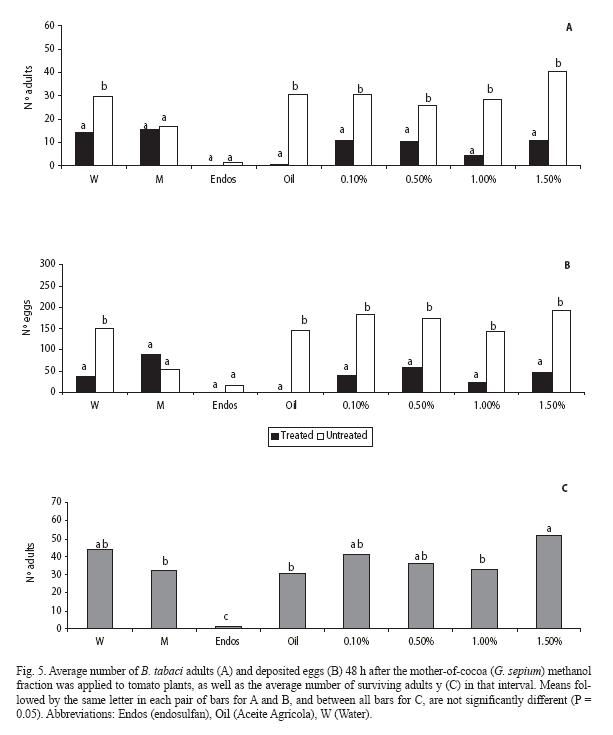
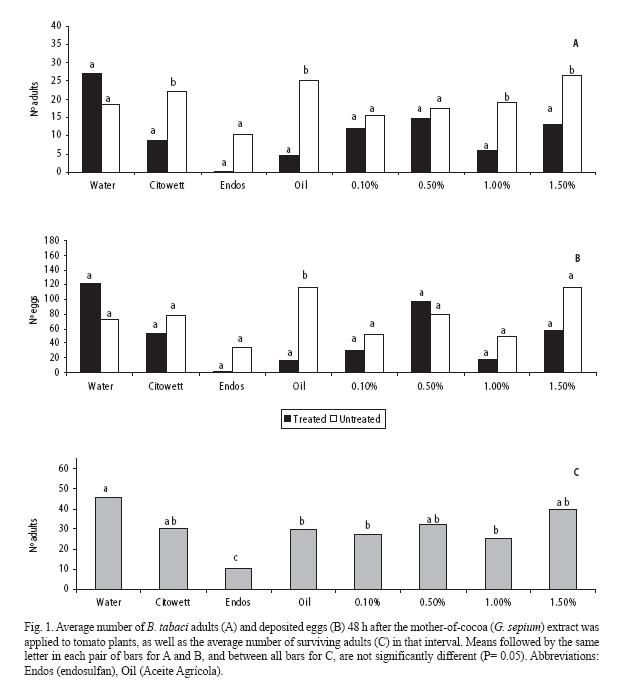
<body><![CDATA[<p><font face="Verdana" size="2">Potted tomato plants (treated as in the restricted-choice experiments) were placed on a bench and arranged in a randomized complete block design, with four replicates. The experimental unit was represented by each potted plant receiving a given treatment. </font></p> <font face="Verdana" size="2"><b></b></font>     <p><font face="Verdana" size="2"><b>Analysis: </b>For the restricted-choice experiments, counts were made on the foliage of the whole plant. The criterion to appraise feeding deterrence was the number of adults on each plant at 48 h, in combination with the number of those surviving within that interval. Oviposition response was appraised by counting the number of eggs laid over 48 h on one leaf per plant; eggs were counted under a stereo-microscope. </font></p>     <p><font face="Verdana" size="2">Mortality was determined by counting the total number of living adults in each cage (on both plants) at 48 h, and subtracting the sum from 50; in this case, the experimental unit was represented by each cage (both two potted plants), as adult whiteflies are very mobile and would be expected to make contact with both plants and get killed if substances present in a given treatments are toxic. </font></p>     <p><font face="Verdana" size="2">For the unrestricted-choice experiments counts were also made on the foliage of the whole plant 1, 2, 8 and 15 days after plant treatment. Nymph numbers (instars I and II) were counted at the end of the experiment by counting a 1 cm<sup>2 </sup>square on one of the leaves, under a stereo-microscope. </font></p>     <p><font face="Verdana" size="2">To determine feeding deterrence and oviposition response for both types of experiments, the number of either adults or eggs present on each plant within each cage were subjected to analysis of variance (ANOvA), and mean values were compared using a Duncan´s test (SAS Institute 1985), at a significance level of &#945; = 0.05. For determining mortality, the total numbers of living adults in each cage were also subjected to ANOvA and mean values were compared using a Duncan´s test. </font></p>     <p><font face="Verdana" size="2">Since the coefficients of variation were high (&gt; 20%) for data resulting from the unrestricted-choice experiments, they were transformed by the logarithmic method, in order to stabilize variance and meet the assumptions underlying ANOVA. In all cases, such assumptions were verified. </font></p> <b><font face="Verdana" size="3"> </font></b>     <p><b><font face="Verdana" size="3">Results</font></b><font  face="Verdana" size="2"> </font></p> <font face="Verdana" size="2"><b> </b></font>     <p><font face="Verdana" size="2"><b>Restricted-choice experiments: </b>Because of the nature of the experiments, comparisons about feeding deterrence and oviposition response were valid only between both plants within each cage, and not between cages. However, for mortality, comparisons were valid between cages. </font></p>     <p><font face="Verdana" size="2">For the freeze-dried crude extract, there were fewer adults landed (p &lt; 0.05) at the two highest doses (1.0 and 1.5%), as well as in the mineral oil and the crude extract (<a  href="#i1">Fig. 1A</a>). In the water control and endosulfan treatments there was no difference between both plants (p &gt; 0.05) but in the latter case, numbers strongly decreased in both plants. In the case of the Citowett treatment there was an unexpected difference between both plants (p &lt; 0.05). General trends held for the oviposition response, but at the two highest doses there were no differences (p &gt; 0.05) (<a href="#i1">Fig. 1B</a>), although there were fewer eggs in those plants treated with these fractions. </font></p>     <p><font face="Verdana" size="2">Regarding mortality, plants treated with endosulfan had the lowest number of surviving adults, in contrast with all the crude extract treatments (<a href="#i1">Fig. 1C</a>), which did not differ between them (p &gt; 0.05) and barely did from the water control.    ]]></body>
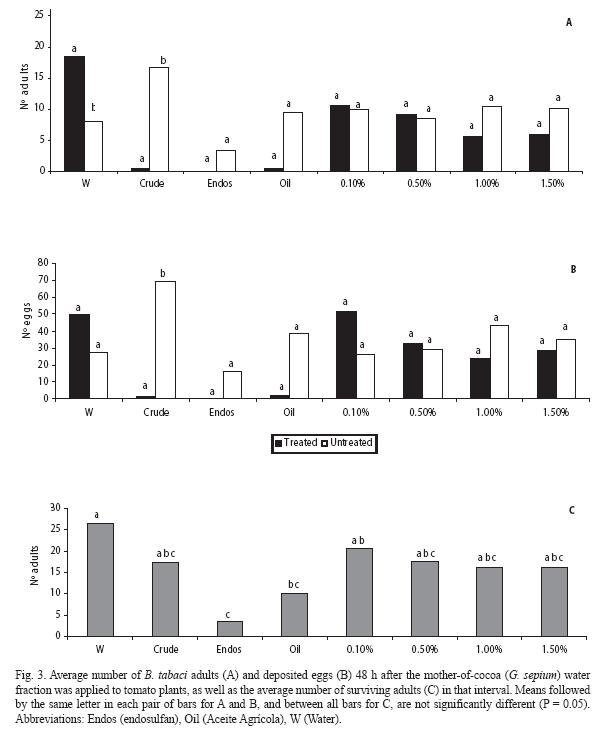
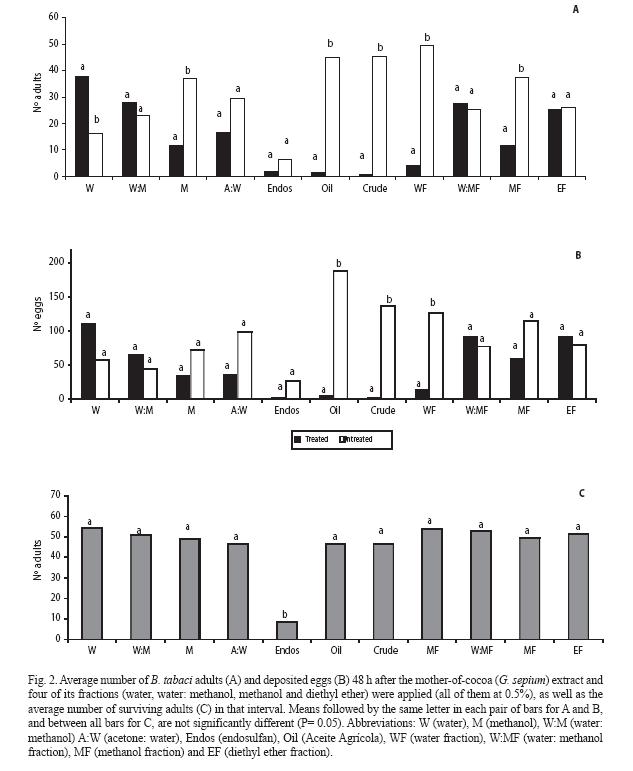
<body><![CDATA[<br> </font></p>     <p style="text-align: center;"><font face="Verdana" size="2"><img  src="/img/revistas/rbt/v56n4/art39img1.jpg" title="" alt=""  style="width: 628px; height: 692px;"><a name="i1"></a>    <br> </font></p>     <p><font face="Verdana" size="2"> </font></p>     <p><font face="Verdana" size="2">In the following experiment, the lowest dose of the crude extract causing deterrence (0.5%) was selected as a baseline reference. The fewest adults were counted on the plant treated with the methanol and diethyl ether control there was an unexpected difference fractions (<a href="#i2">Fig. 2A</a>), as well as for the crude between both plants (p &lt; 0.05). Such trends extract, the mineral oil, and one of the control held for the oviposition response, except for treatments (methanol). In the case of the water the methanol fraction, methanol itself and the water control (<a  href="#i2">Fig. 2B</a>). As for mortality, there was a sharp contrast between endosulfan and the rest of treatments (<a href="#i2">Fig. 2C</a>).    <br> </font></p>     <p style="text-align: center;"><font face="Verdana" size="2"><img  src="/img/revistas/rbt/v56n4/art39img2.jpg" title="" alt=""  style="width: 633px; height: 771px;"><a name="i2"></a>    <br> </font></p>     <p><font face="Verdana" size="2">For the water fraction, numbers of adults landed did not differ (p &gt; 0.05) for any of the doses, with differences detected only for the mineral oil and, nexpectedly, for the water control (<a href="#i3">Fig. 3A</a>). Trends held for the oviposition response, except for the water and the crude extract; in the latter there was a sharp contrast between both plants (<a href="#i3">Fig. 3B</a>). Concerning mortality, trends were kind of erratic trends, with endosulfan causing highest mortality, even though it did not differed from the majority of the treatments (<a href="#i3">Fig. 3C</a>).    <br> </font></p>     ]]></body>
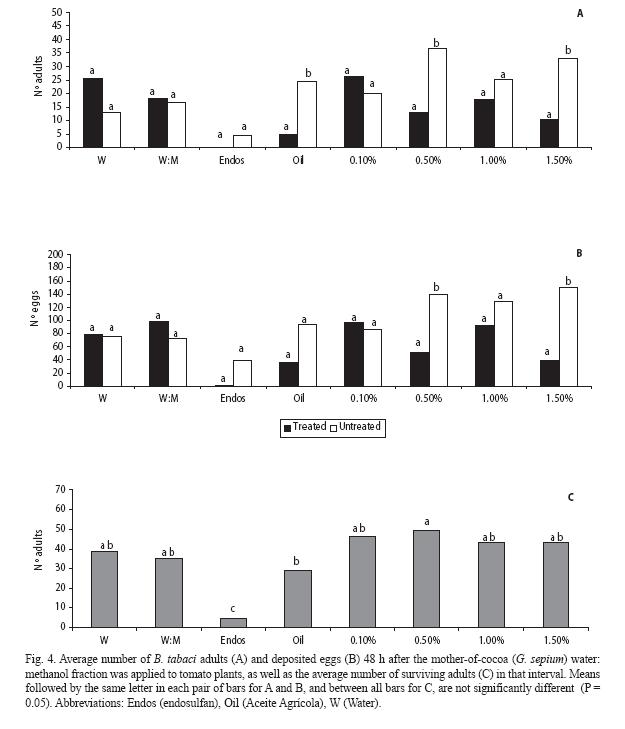
<body><![CDATA[<p style="text-align: center;"><font face="Verdana" size="2"><img  src="/img/revistas/rbt/v56n4/art39img3.jpg" title="" alt=""  style="width: 609px; height: 736px;"><a name="i3"></a>    <br> </font></p>     <p><font face="Verdana" size="2">For the water: methanol fraction, there were fewer adults landed (p &lt; 0.05) at two of the doses (0.5 and 1.5%) as well as in the mineral oil (<a href="#i4">Fig. 4A</a>). Such trends held for the oviposition response (<a href="#i4">Fig. 4B</a>). As for mortality, endosulfan clearly contrasted with the rest of treatments (<a href="#i4">Fig. 4C</a>), and the extract treatments did not differ between them (p &gt; 0.05) nor from the water control.    <br> </font></p>     <p style="text-align: center;"><font face="Verdana" size="2"><img  src="/img/revistas/rbt/v56n4/art39img4.jpg" title="" alt=""  style="width: 625px; height: 729px;"><a name="i4"></a>    <br> </font></p>     <p><font face="Verdana" size="2">For the methanol fraction there was a sharp contrast in the low number of adults landed on the treated plant for all doses (p &lt; 0.05), as well as with the mineral oil (<a  href="#i5">Fig. 5A</a>), whereas in the water control there was an unexpected difference between both plants (p &lt; 0.05). Similar trends were observed for the oviposition response (<a href="#i5">Fig. 5B</a>). Regarding mortality, endosulfan boldly contrasted with the rest of treatments (<a href="#i5">Fig. 5C</a>), whereas the extract treatments did not differ between them (p &gt; 0.05) nor from the water control.    <br> </font></p>     <p style="text-align: center;"><font face="Verdana" size="2"><img  src="/img/revistas/rbt/v56n4/art39img5.jpg" title="" alt=""  style="width: 613px; height: 735px;"><a name="i5"></a>    <br> </font></p>     ]]></body>
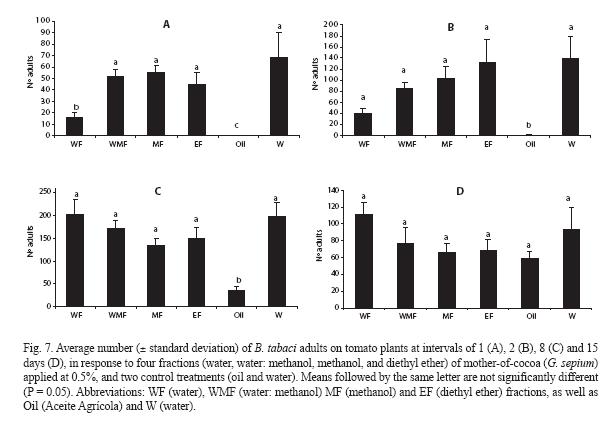
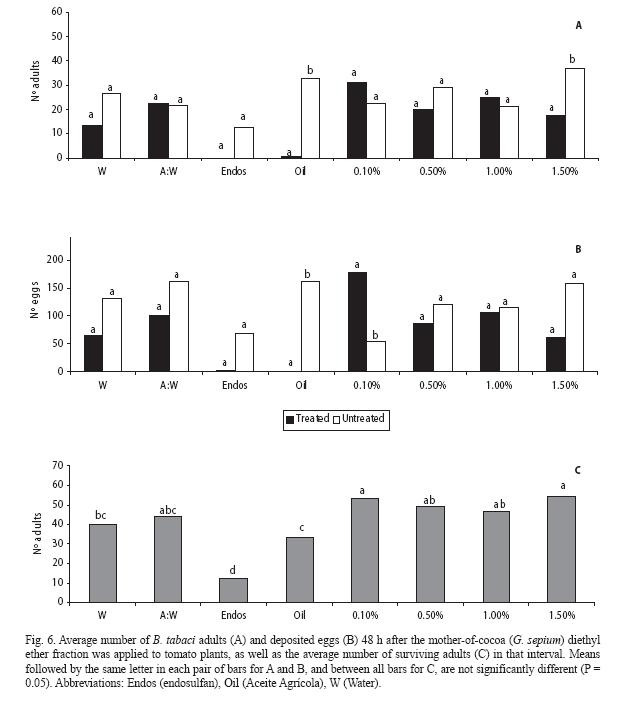
<body><![CDATA[<p><font face="Verdana" size="2">For the diethyl ether fraction there were fewer adults landed (p &lt; 0.05) only at the highest dose (1.5%), as it also occurred with the mineral oil (<a href="#i6">Fig. 6A</a>). Such trends held for the oviposition response, except for one of the doses (0.1%) where, unexpectedly, there were more eggs (p &lt; 0.05) in treated plant (<a href="#i6">Fig. 6B</a>). As for mortality, endosulfan clearly contrasted with the rest of treatments (<a href="#i6">Fig. 6C</a>), whereas the extract treatments did not differ between them (p &gt; 0.05) and barely did from the water control.</font></p>     <p><font face="Verdana" size="2">    <br> </font></p>     <div style="text-align: center;"><font face="Verdana" size="2"><img  src="/img/revistas/rbt/v56n4/art39img6.jpg" title="" alt=""  style="width: 625px; height: 705px;"><a name="i6"></a></font>    <br> <font face="Verdana" size="2"> </font></div> <font face="Verdana" size="2"><b></b></font>     <p><font face="Verdana" size="2"><b>Unrestricted-choice experiments: </b>In this case, comparisons about feeding deterrence and nymphal development were valid between treatments, as all of them were equally exposed to the same group of adult whiteflies. </font></p>     <p><font face="Verdana" size="2"> </font></p>     <p><font face="Verdana" size="2">For the first count, 24 h after the fractions were sprayed, there was a very strong contrast between treatments (p &lt; 0.05), one extreme being occupied by the mineral oil, with the lowest number of adults and the other by the water control along with three of the fractions (<a href="#i7">Fig. 7A</a>); the water fraction occupied an intermediate position. Such trends in general held a day later, with adult numbers increasing for all treatments and a single adult being recorded in the mineral oil treatment (<a href="#i7">Fig. 7B</a>). A week later (<a href="#i7">Fig. 7C</a>) numbers increased for all treatments, with no difference between them, except for the mineral oil. Finally, two weeks later there were no differences among treatments (p &gt; 0.05) (<a href="#i7">Fig. 7D</a>). </font></p>     <p><font face="Verdana" size="2">Concerning nymph numbers, they were lowest for the plants treated with the mineral oil, both for instars I (<a  href="#i8">Fig. 8A</a>) and II (<a href="#i8">Fig. 8B</a>).    <br> </font></p>     ]]></body>
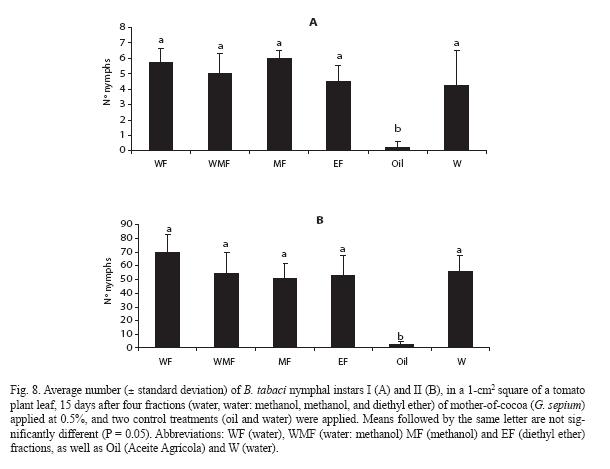
<body><![CDATA[<p style="text-align: center;"><font face="Verdana" size="2"><img  src="/img/revistas/rbt/v56n4/art39img7.jpg" title="" alt=""  style="width: 610px; height: 425px;"><a name="i7"></a>    <br> </font></p> <b><font face="Verdana" size="3"> </font></b>     <p style="text-align: center;"><b><font face="Verdana" size="3"><img  src="/img/revistas/rbt/v56n4/art39img8.jpg" title="" alt=""  style="width: 610px; height: 469px;"><a name="i8"></a>    <br> </font></b></p>     <p><b><font face="Verdana" size="3">Discussion</font></b><font  face="Verdana" size="2"> </font></p>     <p><font face="Verdana" size="2">Prior to inserting their stylets into plant tissue, <i>B. tabaci </i>adults rub or tap the apex of their labium on the plant surface. There are several pairs of sensilla at the apex, whose ultrastructure suggests that they can act either as chemoreceptors or mechano-chemoreceptors (Walker and Gordh 1989). Therefore, it is expected that they will react to the presence of plant substances acting against insects. </font></p>     <p><font face="Verdana" size="2">Some of these substances, known as allomones, include suppressants which inhibit the initiation of feeding or oviposition, deterrents which impede the continuation of such processes, and anorexigenics which cause a loss of appetite (Warthen and Morgan 1990). It is very difficult to differentiate and recognize such effects, unless highly sensitive and sophisticated equipment and tools are available, such as an electronic feeding monitor, which provides electrical penetration waveforms or graphs (EPG) when a wired insect feeds or oviposits (Walker and Perring 1994). </font></p>     <p><font face="Verdana" size="2"> </font></p>     <p><font face="Verdana" size="2">Therefore, for the purposes of this paper the term deterrent <i>sensu lato </i>will be used here, assuming that the lower number of settled adults on tomato plants after treatment with a given extract is an expression of feeding deterrence. Thus, such a response was revealed by the reluctance of whitefly adults to remain on the tomato plant treated with a given extract once they have landed on it and, presumably, made contact with the deterrent substances present in the extract, so that over time they tended to gather on the untreated plant. </font></p>     <p><font face="Verdana" size="2">Our findings with the freeze-dried crude extract confirm preliminary results from Hilje and Stansly (2001) regarding the presence of phagodeterrent principles for <i>B. tabaci </i>in mother-of-cocoa extracts. The lower number of landed adults on tomato plants after treating them with the extract was an expression of feeding deterrence. It would be expected that once adults land on a treated plant make contact with the deterrent substances, so that over time they accumulate in the untreated plant. In addition, some of the fractions yielded similar results, although there was a great deal of variation between them. </font></p>     ]]></body>
<body><![CDATA[<p><font face="Verdana" size="2">For instance, in the experiment at which the lowest dose of the crude extract causing deterrence (1.0%) was compared to the fractions at that same dose, the water fraction performed very well, with a pattern analogous to that of the crude extract and the mineral oil, but when such a fraction was tested alone none of its doses provoked a phagodeterrent response. On the contrary, the water: methanol and the diethyl ether fractions showed this response at several doses (0.5 and 1.5%, as well as 1.5%, respectively) but they had not shown it in the initial experiment. Thus, the only consistent data between both experiments were those for the methanol fraction, although in the first experiment, when used as a control, methanol itself had acted as a phagodeterrent. </font></p>     <p><font face="Verdana" size="2">Inconsistencies regarding adult responses to some of the treatments may be due to a number of factors. In some cases there was a great deal of variation between replicates of a given treatment, which in turn affected the average response of adults to that particular treatment. Such variability could be explained not in terms of extract quality, as both the freeze-dried crude extract and the fractions were kept hermetic, refrigerated and in darkness. Moreover, illogical trends were also detected in two cases with the water control and in one case with Citowett, suggesting that awkward trends were explained by adult response to some treatments, perhaps due to adult age and vigor as well as different sex ratios in each replicate, which were factors not controlled, in order not to affect adult survival resulting from impairment associated with their manipulation. </font></p>     <p><font face="Verdana" size="2">Concerning oviposition response, with a few exceptions, fewer eggs were recorded on treated plants, which can be explained by the lower number of females present on them, rather than in terms of oviposition deterrence, although the latter can not be ruled out altogether. Likewise, in the unrestricted-choice experiment, nymph numbers were probably a direct expression of female abundance and egg-laying activity in each treatment. </font></p>     <p><font face="Verdana" size="2">As for mortality, adults in plants treated with either the crude extract or the fractions showed low or intermediate levels, almost always sharply contrasting with endosulfan. Adult mortality observed in treated plants, which was always dose-independent, may be attributed either to an indirect effect of strong deterrence, causing heat stress, energy depletion or dehydration (veierov 1996), or to direct toxicity of the crude extract or the fractions to very susceptible adults. </font></p>     <p><font face="Verdana" size="2">The observed effects are probably explained by the specific chemicals present in mother-of-cocoa´s foliage, which contains a wide array of compounds, including terpenoids, flavonoids, arilpropanoids and isoflavonoids (López 1995), some of which may have deterrent activity. The stronger effect of the aqueous fraction could be accounted for by considering that most of these compounds are found as glycosides in the plant and, thus, could be concentrated in the aqueous fraction. </font></p>     <p><font face="Verdana" size="2">Despite the methanol fraction consistently performed well as having phagodeterrent activity, it did quite poorly in the unrestricted-choice experiment, along with the other fractions. The same occurred with nymph numbers. None of them did better than the mineral oil, a trend that lasted for a week. This suggests that the deterrent principles somehow decomposed under the experimental conditions. Even though freeze-dried extracts and fractions were kept under protective conditions to prevent decomposition, it is possible that those conditions had not been enough. A plausible explanation could involve decomposition by reaction with water or oxygen, catalyzed by light or heat. Some of these reactions occur with some derivatives of coumarins, like furanocoumarins (Schmitt <i>et al. </i>1995). Some compounds could evaporate, especially under the conditions prevailing in the greenhouse, which included relative high temperatures and air drafts. </font></p>     <p><font face="Verdana" size="2">If some of the shortcomings so far noticed could be circumvented, some of the motherof-cocoa extracts could become attractive to the agrichemical industry for developing commercial deterrents, for a number of reasons. For instance, even though toxicological aspects of extracts from this plant remain unknown, they seem not to pose risks to humans and other mammals, as their leaves and shoots are normally used as fodder for ruminants (CATIE 1991). Moreover, there would not be problems of availability of raw material in large enough amounts to supply the industry on a continuous and reliable basis. Mother of cocoa is a perennial shrub that occurs in tropical seasonal lowlands, from Mexico to Panama, reaching up to 15 m in height and 40 cm in diameter (CATIE 1991). It is commonly used in agroforestry systems to provide shade to cacao and coffee plantations, and the trees are also used as living supports for growing black pepper and vanilla, as living fences, in alley cropping systems, and as fodder. </font></p>     <p><font face="Verdana" size="2">Nowadays, when the issue of biodiversity has received so much attention, industrialization of products from plants with an untapped potential as sources of active principles against insect pests, such as <i>G. sepium</i>, could become a model of utilization of neotropical biodiversity associated with man-made environments, such as agroforestry systems. This could also represent an additional source of income for resource-poor cacao and coffee farmers, thus contributing to sustainable development, for the economic and social benefit of farmers and of society as a whole. </font></p> <b><font face="Verdana" size="3"> </font></b>     <p><b><font face="Verdana" size="3">Acknowledgmets</font></b><font  face="Verdana" size="2"> </font></p>     <p><font face="Verdana" size="2">This paper is a partial result of a CATIE’s M.Sc. thesis, partially supported by the Unidad de Manejo de la Cuenca del Río Reventazón (UMCRE), from the Instituto Costarricense de Electricidad (ICE). Thanks are due to Arturo Ramírez and Gustavo López (CATIE) for their logistical support, as well as to Juan Carlos Brenes (CIPRONA) for preparing the extracts for the experiments, and to Norman Farnsworth (Chief Editor of NAPRALERT), for granting access to the database.    ]]></body>
<body><![CDATA[<br> </font></p> <hr style="width: 100%; height: 2px;">     <p><font face="Verdana" size="2"> </font></p> <font face="Verdana" size="2"><b> </b></font>     <p><font face="Verdana" size="2"><b>Resumen</b> </font></p>     <p><font face="Verdana" size="2">Mundialmente, <i>Bemisia tabaci </i>es un importante vector de virus en numerosos cultivos. Por tanto, un enfoque preventivo para enfrentar las epidemias virales podría ser el empleo de sustancias repelentes o fagodisuasivas en las etapas tempranas del desarrollo de las plantas (período crítico). Así, tanto el extracto crudo como cuatro fracciones (agua, agua:metanol, metanol y éter dietílico) del madero negro (<i>Gliricidia sepium</i>, Fabaceae) fueron evaluadas en cuanto a su actividad fagodisuasiva sobre los adultos de <i>B. tabaci </i>en condiciones de invernadero, utilizando plantas de tomate, en Turrialba, Costa Rica. Tanto los experimentos de escogencia restringida como los de escogencia irrestricta revelaron que el extracto crudo y algunas fracciones mostraron dicha actividad. En los primeros experimentos (en jaulas de manga), tres fracciones causaron fagodisuasión a dosis tan bajas como 0.1% (metanol), 0.5% (agua:metanol) y 1.5% (éter dietílico). Sin embargo, en los segundos (plantas expuestas dentro de un invernadero) ninguna de las fracciones lo hizo, lo cual sugiere que los principios fagodisuasivos perdieron su actividad en esas condiciones experimentales. </font></p> <font face="Verdana" size="2"><b></b></font>     <p><font face="Verdana" size="2"><b>Palabras clave: </b><i>Bemisia tabaci</i>, extractos vegetales, madero negro, <i>Gliricidia sepium</i>, fagodisuasión.</font></p> <hr style="width: 100%; height: 2px;">     <p><font face="Verdana" size="2"> </font></p>     <p align="center"><font face="Verdana" size="2">&nbsp;    <br> Received 08-XI-2007. Corrected 18-II-2007. Accepted 04-IV-2008.</font></p> <b><font face="Verdana" size="3"> </font></b>     <p><b><font face="Verdana" size="3">References </font></b><font  face="Verdana" size="2"> </font></p>     <!-- ref --><p><font face="Verdana" size="2">Aguiar, A., D.C. Kass, G.A. Mora &amp; L. Hilje. 2003. Fagodisuasión de tres extractos vegetales sobre los adultos de <i>Bemisia tabaci</i>. Man. Integ. Plagas Agroecol. (Costa Rica) 68: 62-70.    &nbsp;&nbsp;&nbsp;&nbsp;&nbsp;&nbsp;&nbsp;&nbsp;[&#160;<a href="javascript:void(0);" onclick="javascript: window.open('/scielo.php?script=sci_nlinks&ref=1692868&pid=S0034-7744200800040003900001&lng=','','width=640,height=500,resizable=yes,scrollbars=1,menubar=yes,');">Links</a>&#160;]<!-- end-ref --> </font></p>     <!-- ref --><p><font face="Verdana" size="2">CATIE, 1991. Madero Negro (<i>Gliricidia sepium </i>(Jacquin) Kunth ex Walpers), Arbol de Uso Múltiple en América Central. Serie Técnica. Informe Técnico No. 180. CATIE. Turrialba, Costa Rica.    &nbsp;&nbsp;&nbsp;&nbsp;&nbsp;&nbsp;&nbsp;&nbsp;[&#160;<a href="javascript:void(0);" onclick="javascript: window.open('/scielo.php?script=sci_nlinks&ref=1692870&pid=S0034-7744200800040003900002&lng=','','width=640,height=500,resizable=yes,scrollbars=1,menubar=yes,');">Links</a>&#160;]<!-- end-ref --> </font></p>     <!-- ref --><p><font face="Verdana" size="2">Cubillo, D., G. Sanabria &amp; L. Hilje. 1999. Evaluación de la repelencia y mortalidad causada por insecticidas comerciales y extractos vegetales sobre Bemisia tabaci. Man. Integr. Plagas (Costa Rica) 53: 65-71.    &nbsp;&nbsp;&nbsp;&nbsp;&nbsp;&nbsp;&nbsp;&nbsp;[&#160;<a href="javascript:void(0);" onclick="javascript: window.open('/scielo.php?script=sci_nlinks&ref=1692872&pid=S0034-7744200800040003900003&lng=','','width=640,height=500,resizable=yes,scrollbars=1,menubar=yes,');">Links</a>&#160;]<!-- end-ref --> </font></p>     <!-- ref --><p><font face="Verdana" size="2">Franke, G., L. van Balen and E. Debrot. 1983. Efecto de la época de infección por el mosaico amarillo sobre el rendimiento del tomate. Rev. Fac. Agron. Univ. Zulia (venezuela) 6: 741-743.    &nbsp;&nbsp;&nbsp;&nbsp;&nbsp;&nbsp;&nbsp;&nbsp;[&#160;<a href="javascript:void(0);" onclick="javascript: window.open('/scielo.php?script=sci_nlinks&ref=1692874&pid=S0034-7744200800040003900004&lng=','','width=640,height=500,resizable=yes,scrollbars=1,menubar=yes,');">Links</a>&#160;]<!-- end-ref --> </font></p>     <!-- ref --><p><font face="Verdana" size="2">Greathead, A.H. 1986. Host plants. <i>In </i>M.J.W. Cock (ed.). <i>Bemisia tabaci</i>- A Literature Survey. CAB Intl. Inst. Biol. Control, Silwood Park, UK.    &nbsp;&nbsp;&nbsp;&nbsp;&nbsp;&nbsp;&nbsp;&nbsp;[&#160;<a href="javascript:void(0);" onclick="javascript: window.open('/scielo.php?script=sci_nlinks&ref=1692876&pid=S0034-7744200800040003900005&lng=','','width=640,height=500,resizable=yes,scrollbars=1,menubar=yes,');">Links</a>&#160;]<!-- end-ref --> </font></p>     <!-- ref --><p><font face="Verdana" size="2">Hilje, L. 1993. Un esquema conceptual para el manejo integrado de la mosca blanca (<i>Bemisia tabaci</i>) en el cultivo del tomate. Man. Integ. Plagas (Costa Rica) 29: 51-57.    &nbsp;&nbsp;&nbsp;&nbsp;&nbsp;&nbsp;&nbsp;&nbsp;[&#160;<a href="javascript:void(0);" onclick="javascript: window.open('/scielo.php?script=sci_nlinks&ref=1692878&pid=S0034-7744200800040003900006&lng=','','width=640,height=500,resizable=yes,scrollbars=1,menubar=yes,');">Links</a>&#160;]<!-- end-ref --> </font></p>     <!-- ref --><p><font face="Verdana" size="2">Hilje, L. 2001. Avances hacia el manejo sostenible del complejo <i>Bemisia tabaci</i>-geminivirus en tomate, en Costa Rica. Man. Integ. Plagas (Costa Rica) 61: 70-81.    &nbsp;&nbsp;&nbsp;&nbsp;&nbsp;&nbsp;&nbsp;&nbsp;[&#160;<a href="javascript:void(0);" onclick="javascript: window.open('/scielo.php?script=sci_nlinks&ref=1692880&pid=S0034-7744200800040003900007&lng=','','width=640,height=500,resizable=yes,scrollbars=1,menubar=yes,');">Links</a>&#160;]<!-- end-ref --> </font></p>     <!-- ref --><p><font face="Verdana" size="2">Hilje, L. &amp; P.A. Stansly. 2001. Development of crop associations for managing geminiviruses vectored by whiteflies in tomatoes. Final Report. U.S. Department of Agriculture (USDA). CATIE. Turrialba, Costa Rica.    &nbsp;&nbsp;&nbsp;&nbsp;&nbsp;&nbsp;&nbsp;&nbsp;[&#160;<a href="javascript:void(0);" onclick="javascript: window.open('/scielo.php?script=sci_nlinks&ref=1692882&pid=S0034-7744200800040003900008&lng=','','width=640,height=500,resizable=yes,scrollbars=1,menubar=yes,');">Links</a>&#160;]<!-- end-ref --> </font></p>     <!-- ref --><p><font face="Verdana" size="2">López, S. 1995. Evaluación de compuestos secundarios y consumo voluntario de cinco procedencias de <i>Gliricidia sepium </i>(Jacq.) Walp, en dos épocas del año, en el trópico húmedo de Costa Rica. M.Sc. Thesis. CATIE. Turrialba, Costa Rica.    &nbsp;&nbsp;&nbsp;&nbsp;&nbsp;&nbsp;&nbsp;&nbsp;[&#160;<a href="javascript:void(0);" onclick="javascript: window.open('/scielo.php?script=sci_nlinks&ref=1692884&pid=S0034-7744200800040003900009&lng=','','width=640,height=500,resizable=yes,scrollbars=1,menubar=yes,');">Links</a>&#160;]<!-- end-ref --> </font></p>     <!-- ref --><p><font face="Verdana" size="2">Oliveira, M.R.v., Henneberry, T.J. &amp; P. Anderson. 2001. History, current status, and collaborative research projects for <i>Bemisia tabaci</i>. Crop Prot. 20: 709-723.    &nbsp;&nbsp;&nbsp;&nbsp;&nbsp;&nbsp;&nbsp;&nbsp;[&#160;<a href="javascript:void(0);" onclick="javascript: window.open('/scielo.php?script=sci_nlinks&ref=1692886&pid=S0034-7744200800040003900010&lng=','','width=640,height=500,resizable=yes,scrollbars=1,menubar=yes,');">Links</a>&#160;]<!-- end-ref --> </font></p>     <!-- ref --><p><font face="Verdana" size="2">Perring, T.M. 2001. The <i>Bemisia tabaci </i>species concept. Crop Prot. 20: 725-737.    &nbsp;&nbsp;&nbsp;&nbsp;&nbsp;&nbsp;&nbsp;&nbsp;[&#160;<a href="javascript:void(0);" onclick="javascript: window.open('/scielo.php?script=sci_nlinks&ref=1692888&pid=S0034-7744200800040003900011&lng=','','width=640,height=500,resizable=yes,scrollbars=1,menubar=yes,');">Links</a>&#160;]<!-- end-ref --> </font></p>     <!-- ref --><p><font face="Verdana" size="2">Polston, J.E. &amp; P.K. Anderson. 1997. The emergence of whitefly-transmitted geminiviruses in tomato in the Western Hemisphere. Plant Dis. 81: 1358-1369.    &nbsp;&nbsp;&nbsp;&nbsp;&nbsp;&nbsp;&nbsp;&nbsp;[&#160;<a href="javascript:void(0);" onclick="javascript: window.open('/scielo.php?script=sci_nlinks&ref=1692890&pid=S0034-7744200800040003900012&lng=','','width=640,height=500,resizable=yes,scrollbars=1,menubar=yes,');">Links</a>&#160;]<!-- end-ref --> </font></p>     <!-- ref --><p><font face="Verdana" size="2">SAS Institute, 1985. Guide for personal computers. version 6 ed. SAS Institute Inc. Cary, North Carolina.    &nbsp;&nbsp;&nbsp;&nbsp;&nbsp;&nbsp;&nbsp;&nbsp;[&#160;<a href="javascript:void(0);" onclick="javascript: window.open('/scielo.php?script=sci_nlinks&ref=1692892&pid=S0034-7744200800040003900013&lng=','','width=640,height=500,resizable=yes,scrollbars=1,menubar=yes,');">Links</a>&#160;]<!-- end-ref --> </font></p>     <!-- ref --><p><font face="Verdana" size="2">Schmitt, I.M., Chimentti, S. &amp; F.P. Gasparro. 1995. New trends in photobiology. Psoralen-protein photochemistry- a forgotten field. Jour. Photochem. Photobiol. B27: 101-107.    &nbsp;&nbsp;&nbsp;&nbsp;&nbsp;&nbsp;&nbsp;&nbsp;[&#160;<a href="javascript:void(0);" onclick="javascript: window.open('/scielo.php?script=sci_nlinks&ref=1692894&pid=S0034-7744200800040003900014&lng=','','width=640,height=500,resizable=yes,scrollbars=1,menubar=yes,');">Links</a>&#160;]<!-- end-ref --> </font></p>     <p><font face="Verdana" size="2">Schuster, D.J., Stansly, P.A. &amp; J.E. Polston. 1996. Expressions of plant damage of <i>Bemisia</i>. <i>In </i>D. Gerling &amp; R.T. Mayer (eds.). Bemisia 1995: Taxonomy, biology, damage, control and management. Intercept, UK. </font></p>     <!-- ref --><p><font face="Verdana" size="2">Walker, G.P. &amp; G. Gordh. 1989. The occurrence of apical labial sensilla in the Aleyrodidae and evidence for a contact chemosensory function. Entomol. Exp. Appl. 51: 215-224.    &nbsp;&nbsp;&nbsp;&nbsp;&nbsp;&nbsp;&nbsp;&nbsp;[&#160;<a href="javascript:void(0);" onclick="javascript: window.open('/scielo.php?script=sci_nlinks&ref=1692897&pid=S0034-7744200800040003900016&lng=','','width=640,height=500,resizable=yes,scrollbars=1,menubar=yes,');">Links</a>&#160;]<!-- end-ref --></font></p>     ]]></body>
<body><![CDATA[<p><font face="Verdana" size="2"> </font></p>     <!-- ref --><p><font face="Verdana" size="2">Walker, G.P. &amp; T.M. Perring. 1994. Feeding and oviposition behavior of whiteflies (Homoptera: Aleyrodidae) interpreted from AC electronic feeding monitor waveforms. Ann. Entomol. Soc. Amer. 87(3): 363-374.    &nbsp;&nbsp;&nbsp;&nbsp;&nbsp;&nbsp;&nbsp;&nbsp;[&#160;<a href="javascript:void(0);" onclick="javascript: window.open('/scielo.php?script=sci_nlinks&ref=1692900&pid=S0034-7744200800040003900017&lng=','','width=640,height=500,resizable=yes,scrollbars=1,menubar=yes,');">Links</a>&#160;]<!-- end-ref --> </font></p>     <!-- ref --><p><font face="Verdana" size="2">Warthen, J.D. &amp; Morgan, E.D. 1990. Insect feeding deterrents. <i>In </i>E.D. Morgan &amp; N.v. Mandava (eds.). CRC handbook of natural pesticides. vol. 6: Insect attractants and repellents. CRC Press. Boca Raton, Florida.    &nbsp;&nbsp;&nbsp;&nbsp;&nbsp;&nbsp;&nbsp;&nbsp;[&#160;<a href="javascript:void(0);" onclick="javascript: window.open('/scielo.php?script=sci_nlinks&ref=1692902&pid=S0034-7744200800040003900018&lng=','','width=640,height=500,resizable=yes,scrollbars=1,menubar=yes,');">Links</a>&#160;]<!-- end-ref --> </font></p>     <!-- ref --><p><font face="Verdana" size="2">Veierov, D. 1996. Physically and behaviorally active formulations for control of <i>Bemisia</i>. <i>In </i>D. Gerling &amp; R.T. Mayer (eds.). Bemisia 1995: Taxonomy, biology, damage, control and management. Intercept, UK.    &nbsp;&nbsp;&nbsp;&nbsp;&nbsp;&nbsp;&nbsp;&nbsp;[&#160;<a href="javascript:void(0);" onclick="javascript: window.open('/scielo.php?script=sci_nlinks&ref=1692904&pid=S0034-7744200800040003900019&lng=','','width=640,height=500,resizable=yes,scrollbars=1,menubar=yes,');">Links</a>&#160;]<!-- end-ref --> </font></p>      ]]></body><back>
<ref-list>
<ref id="B1">
<nlm-citation citation-type="journal">
<person-group person-group-type="author">
<name>
<surname><![CDATA[Aguiar]]></surname>
<given-names><![CDATA[A]]></given-names>
</name>
<name>
<surname><![CDATA[Kass]]></surname>
<given-names><![CDATA[D.C]]></given-names>
</name>
<name>
<surname><![CDATA[Mora]]></surname>
<given-names><![CDATA[G.A]]></given-names>
</name>
<name>
<surname><![CDATA[Hilje]]></surname>
<given-names><![CDATA[L]]></given-names>
</name>
</person-group>
<article-title xml:lang="es"><![CDATA[Fagodisuasión de tres extractos vegetales sobre los adultos de Bemisia tabaci]]></article-title>
<source><![CDATA[Man. Integ. Plagas Agroecol. (Costa Rica)]]></source>
<year>2003</year>
<volume>68</volume>
<page-range>62-70</page-range></nlm-citation>
</ref>
<ref id="B2">
<nlm-citation citation-type="book">
<collab>CATIE</collab>
<source><![CDATA[Madero Negro (Gliricidia sepium (Jacquin) Kunth ex Walpers), Arbol de Uso Múltiple en América Central]]></source>
<year>1991</year>
<publisher-loc><![CDATA[Turrialba ]]></publisher-loc>
<publisher-name><![CDATA[CATIE]]></publisher-name>
</nlm-citation>
</ref>
<ref id="B3">
<nlm-citation citation-type="journal">
<person-group person-group-type="author">
<name>
<surname><![CDATA[Cubillo]]></surname>
<given-names><![CDATA[D]]></given-names>
</name>
<name>
<surname><![CDATA[Sanabria]]></surname>
<given-names><![CDATA[G]]></given-names>
</name>
<name>
<surname><![CDATA[Hilje]]></surname>
<given-names><![CDATA[L]]></given-names>
</name>
</person-group>
<article-title xml:lang="es"><![CDATA[Evaluación de la repelencia y mortalidad causada por insecticidas comerciales y extractos vegetales sobre Bemisia tabaci]]></article-title>
<source><![CDATA[Man. Integr. Plagas (Costa Rica)]]></source>
<year>1999</year>
<volume>53</volume>
<page-range>65-71</page-range></nlm-citation>
</ref>
<ref id="B4">
<nlm-citation citation-type="journal">
<person-group person-group-type="author">
<name>
<surname><![CDATA[Franke]]></surname>
<given-names><![CDATA[G]]></given-names>
</name>
<name>
<surname><![CDATA[Van Balen]]></surname>
<given-names><![CDATA[L]]></given-names>
</name>
<name>
<surname><![CDATA[Debrot]]></surname>
<given-names><![CDATA[E]]></given-names>
</name>
</person-group>
<article-title xml:lang="es"><![CDATA[Efecto de la época de infección por el mosaico amarillo sobre el rendimiento del tomate]]></article-title>
<source><![CDATA[Rev. Fac. Agron. Univ. Zulia (venezuela)]]></source>
<year>1983</year>
<volume>6</volume>
<page-range>741-743</page-range></nlm-citation>
</ref>
<ref id="B5">
<nlm-citation citation-type="book">
<person-group person-group-type="author">
<name>
<surname><![CDATA[Greathead]]></surname>
<given-names><![CDATA[A.H]]></given-names>
</name>
</person-group>
<article-title xml:lang="en"><![CDATA[Host plants]]></article-title>
<person-group person-group-type="editor">
<name>
<surname><![CDATA[Cock]]></surname>
<given-names><![CDATA[M.J.W]]></given-names>
</name>
</person-group>
<source><![CDATA[Bemisia tabaci- A Literature Survey]]></source>
<year>1986</year>
<publisher-name><![CDATA[CAB Intl. Inst. Biol. ControlSilwood Park]]></publisher-name>
</nlm-citation>
</ref>
<ref id="B6">
<nlm-citation citation-type="journal">
<person-group person-group-type="author">
<name>
<surname><![CDATA[Hilje]]></surname>
<given-names><![CDATA[L]]></given-names>
</name>
</person-group>
<article-title xml:lang="es"><![CDATA[Un esquema conceptual para el manejo integrado de la mosca blanca (Bemisia tabaci) en el cultivo del tomate]]></article-title>
<source><![CDATA[Man. Integ. Plagas (Costa Rica)]]></source>
<year>1993</year>
<volume>29</volume>
<page-range>51-57</page-range></nlm-citation>
</ref>
<ref id="B7">
<nlm-citation citation-type="journal">
<person-group person-group-type="author">
<name>
<surname><![CDATA[Hilje]]></surname>
<given-names><![CDATA[L]]></given-names>
</name>
</person-group>
<article-title xml:lang="es"><![CDATA[Avances hacia el manejo sostenible del complejo Bemisia tabaci-geminivirus en tomate, en Costa Rica]]></article-title>
<source><![CDATA[Man. Integ. Plagas (Costa Rica)]]></source>
<year>2001</year>
<volume>61</volume>
<page-range>70-81</page-range></nlm-citation>
</ref>
<ref id="B8">
<nlm-citation citation-type="book">
<person-group person-group-type="author">
<name>
<surname><![CDATA[Hilje]]></surname>
<given-names><![CDATA[L]]></given-names>
</name>
<name>
<surname><![CDATA[Stansly]]></surname>
<given-names><![CDATA[P.A]]></given-names>
</name>
</person-group>
<source><![CDATA[Development of crop associations for managing geminiviruses vectored by whiteflies in tomatoes]]></source>
<year>2001</year>
<publisher-loc><![CDATA[Turrialba ]]></publisher-loc>
<publisher-name><![CDATA[CATIE]]></publisher-name>
</nlm-citation>
</ref>
<ref id="B9">
<nlm-citation citation-type="">
<person-group person-group-type="author">
<name>
<surname><![CDATA[López]]></surname>
<given-names><![CDATA[S]]></given-names>
</name>
</person-group>
<source><![CDATA[Evaluación de compuestos secundarios y consumo voluntario de cinco procedencias de Gliricidia sepium (Jacq.) Walp, en dos épocas del año, en el trópico húmedo de Costa Rica]]></source>
<year>1995</year>
</nlm-citation>
</ref>
<ref id="B10">
<nlm-citation citation-type="journal">
<person-group person-group-type="author">
<name>
<surname><![CDATA[Oliveira]]></surname>
<given-names><![CDATA[M.R.V]]></given-names>
</name>
<name>
<surname><![CDATA[Henneberry]]></surname>
<given-names><![CDATA[T.J]]></given-names>
</name>
<name>
<surname><![CDATA[Anderson]]></surname>
<given-names><![CDATA[P]]></given-names>
</name>
</person-group>
<article-title xml:lang="en"><![CDATA[History, current status, and collaborative research projects for Bemisia tabaci]]></article-title>
<source><![CDATA[Crop Prot.]]></source>
<year>2001</year>
<volume>20</volume>
<page-range>709-723</page-range></nlm-citation>
</ref>
<ref id="B11">
<nlm-citation citation-type="journal">
<person-group person-group-type="author">
<name>
<surname><![CDATA[Perring]]></surname>
<given-names><![CDATA[T.M]]></given-names>
</name>
</person-group>
<article-title xml:lang="en"><![CDATA[The Bemisia tabaci species concept]]></article-title>
<source><![CDATA[Crop Prot.]]></source>
<year>2001</year>
<volume>20</volume>
<page-range>725-737</page-range></nlm-citation>
</ref>
<ref id="B12">
<nlm-citation citation-type="journal">
<person-group person-group-type="author">
<name>
<surname><![CDATA[Polston]]></surname>
<given-names><![CDATA[J.E]]></given-names>
</name>
<name>
<surname><![CDATA[Anderson]]></surname>
<given-names><![CDATA[P.K]]></given-names>
</name>
</person-group>
<article-title xml:lang="en"><![CDATA[The emergence of whitefly-transmitted geminiviruses in tomato in the Western Hemisphere]]></article-title>
<source><![CDATA[Plant Dis.]]></source>
<year>1997</year>
<volume>81</volume>
<page-range>1358-1369</page-range></nlm-citation>
</ref>
<ref id="B13">
<nlm-citation citation-type="book">
<collab>SAS Institute</collab>
<source><![CDATA[Guide for personal computers]]></source>
<year>1985</year>
<edition>6</edition>
<publisher-loc><![CDATA[Cary ]]></publisher-loc>
<publisher-name><![CDATA[SAS Institute Inc]]></publisher-name>
</nlm-citation>
</ref>
<ref id="B14">
<nlm-citation citation-type="journal">
<person-group person-group-type="author">
<name>
<surname><![CDATA[Schmitt]]></surname>
<given-names><![CDATA[I.M]]></given-names>
</name>
<name>
<surname><![CDATA[Chimentti]]></surname>
<given-names><![CDATA[S]]></given-names>
</name>
<name>
<surname><![CDATA[Gasparro]]></surname>
<given-names><![CDATA[F.P]]></given-names>
</name>
</person-group>
<article-title xml:lang="en"><![CDATA[New trends in photobiology. Psoralen-protein photochemistry- a forgotten field]]></article-title>
<source><![CDATA[Jour. Photochem. Photobiol.]]></source>
<year>1995</year>
<volume>B27</volume>
<page-range>101-107</page-range></nlm-citation>
</ref>
<ref id="B15">
<nlm-citation citation-type="book">
<person-group person-group-type="author">
<name>
<surname><![CDATA[Schuster]]></surname>
<given-names><![CDATA[D.J]]></given-names>
</name>
<name>
<surname><![CDATA[Stansly]]></surname>
<given-names><![CDATA[P.A]]></given-names>
</name>
<name>
<surname><![CDATA[Polston]]></surname>
<given-names><![CDATA[J.E]]></given-names>
</name>
</person-group>
<article-title xml:lang="en"><![CDATA[Expressions of plant damage of Bemisia]]></article-title>
<person-group person-group-type="editor">
<name>
<surname><![CDATA[Gerling]]></surname>
<given-names><![CDATA[D]]></given-names>
</name>
<name>
<surname><![CDATA[Mayer]]></surname>
<given-names><![CDATA[R.T]]></given-names>
</name>
</person-group>
<source><![CDATA[Bemisia 1995: Taxonomy, biology, damage, control and management]]></source>
<year>1996</year>
<publisher-name><![CDATA[Intercept]]></publisher-name>
</nlm-citation>
</ref>
<ref id="B16">
<nlm-citation citation-type="journal">
<person-group person-group-type="author">
<name>
<surname><![CDATA[Walker]]></surname>
<given-names><![CDATA[G.P]]></given-names>
</name>
<name>
<surname><![CDATA[Gordh]]></surname>
<given-names><![CDATA[G]]></given-names>
</name>
</person-group>
<article-title xml:lang="en"><![CDATA[The occurrence of apical labial sensilla in the Aleyrodidae and evidence for a contact chemosensory function]]></article-title>
<source><![CDATA[Entomol. Exp. Appl.]]></source>
<year>1989</year>
<volume>51</volume>
<page-range>215-224</page-range></nlm-citation>
</ref>
<ref id="B17">
<nlm-citation citation-type="journal">
<person-group person-group-type="author">
<name>
<surname><![CDATA[Walker]]></surname>
<given-names><![CDATA[G.P]]></given-names>
</name>
<name>
<surname><![CDATA[Perring]]></surname>
<given-names><![CDATA[T.M]]></given-names>
</name>
</person-group>
<article-title xml:lang="en"><![CDATA[Feeding and oviposition behavior of whiteflies (Homoptera: Aleyrodidae) interpreted from AC electronic feeding monitor waveforms]]></article-title>
<source><![CDATA[Ann. Entomol. Soc. Amer.]]></source>
<year>1994</year>
<volume>87</volume>
<numero>3</numero>
<issue>3</issue>
<page-range>363-374</page-range></nlm-citation>
</ref>
<ref id="B18">
<nlm-citation citation-type="book">
<person-group person-group-type="author">
<name>
<surname><![CDATA[Warthen]]></surname>
<given-names><![CDATA[J.D]]></given-names>
</name>
<name>
<surname><![CDATA[Morgan]]></surname>
<given-names><![CDATA[E.D]]></given-names>
</name>
</person-group>
<article-title xml:lang="en"><![CDATA[Insect feeding deterrents]]></article-title>
<person-group person-group-type="editor">
<name>
<surname><![CDATA[Morgan]]></surname>
<given-names><![CDATA[E.D]]></given-names>
</name>
<name>
<surname><![CDATA[Mandava]]></surname>
<given-names><![CDATA[N.V]]></given-names>
</name>
</person-group>
<source><![CDATA[CRC handbook of natural pesticides. vol. 6: Insect attractants and repellents]]></source>
<year>1990</year>
<publisher-loc><![CDATA[Boca Raton ]]></publisher-loc>
<publisher-name><![CDATA[CRC Press]]></publisher-name>
</nlm-citation>
</ref>
<ref id="B19">
<nlm-citation citation-type="book">
<person-group person-group-type="author">
<name>
<surname><![CDATA[Veierov]]></surname>
<given-names><![CDATA[D]]></given-names>
</name>
</person-group>
<article-title xml:lang="en"><![CDATA[Physically and behaviorally active formulations for control of Bemisia]]></article-title>
<person-group person-group-type="editor">
<name>
<surname><![CDATA[Gerling]]></surname>
<given-names><![CDATA[D]]></given-names>
</name>
<name>
<surname><![CDATA[Mayer]]></surname>
<given-names><![CDATA[R.T]]></given-names>
</name>
</person-group>
<source><![CDATA[Bemisia 1995: Taxonomy, biology, damage, control and management]]></source>
<year>1996</year>
<publisher-name><![CDATA[Intercept]]></publisher-name>
</nlm-citation>
</ref>
</ref-list>
</back>
</article>