<?xml version="1.0" encoding="ISO-8859-1"?><article xmlns:mml="http://www.w3.org/1998/Math/MathML" xmlns:xlink="http://www.w3.org/1999/xlink" xmlns:xsi="http://www.w3.org/2001/XMLSchema-instance">
<front>
<journal-meta>
<journal-id>0034-7744</journal-id>
<journal-title><![CDATA[Revista de Biología Tropical]]></journal-title>
<abbrev-journal-title><![CDATA[Rev. biol. trop]]></abbrev-journal-title>
<issn>0034-7744</issn>
<publisher>
<publisher-name><![CDATA[Universidad de Costa Rica]]></publisher-name>
</publisher>
</journal-meta>
<article-meta>
<article-id>S0034-77442008000300005</article-id>
<title-group>
<article-title xml:lang="en"><![CDATA[The impact of local extinction on genetic structure of wild populations of lima beans (Phaseolus lunatus) in the Central Valley of Costa Rica: consequences for the conservation of plant genetic resources]]></article-title>
</title-group>
<contrib-group>
<contrib contrib-type="author">
<name>
<surname><![CDATA[Barrantes]]></surname>
<given-names><![CDATA[Daniel]]></given-names>
</name>
</contrib>
<contrib contrib-type="author">
<name>
<surname><![CDATA[Macaya]]></surname>
<given-names><![CDATA[Gabriel]]></given-names>
</name>
</contrib>
<contrib contrib-type="author">
<name>
<surname><![CDATA[Guarino]]></surname>
<given-names><![CDATA[Luigi]]></given-names>
</name>
</contrib>
<contrib contrib-type="author">
<name>
<surname><![CDATA[Baudoin]]></surname>
<given-names><![CDATA[Jean Pierre]]></given-names>
</name>
</contrib>
<contrib contrib-type="author">
<name>
<surname><![CDATA[Rocha]]></surname>
<given-names><![CDATA[Oscar J]]></given-names>
</name>
</contrib>
</contrib-group>
<aff id="A01">
<institution><![CDATA[,Universidad de Costa Rica Escuela de Biología ]]></institution>
<addr-line><![CDATA[San Pedro de Montes de Oca San José]]></addr-line>
<country>Costa Rica</country>
</aff>
<aff id="A02">
<institution><![CDATA[,Universidad de Costa Rica Centro de Investigación en Biología Celular y Molecular ]]></institution>
<addr-line><![CDATA[San Pedro de Montes de Oca San José]]></addr-line>
<country>Costa Rica</country>
</aff>
<aff id="A03">
<institution><![CDATA[,Regional Office for the Americas International Plant Genetic Resources Institute ]]></institution>
<addr-line><![CDATA[Cali ]]></addr-line>
<country>Colombia</country>
</aff>
<aff id="A04">
<institution><![CDATA[,Gembloux Agricultural University Department of Tropical Crop Husbandry and Horticulture ]]></institution>
<addr-line><![CDATA[Gembloux ]]></addr-line>
<country>Belgium</country>
</aff>
<aff id="A05">
<institution><![CDATA[,Kent State University Department of Biological Sciences ]]></institution>
<addr-line><![CDATA[ ]]></addr-line>
</aff>
<pub-date pub-type="pub">
<day>00</day>
<month>09</month>
<year>2008</year>
</pub-date>
<pub-date pub-type="epub">
<day>00</day>
<month>09</month>
<year>2008</year>
</pub-date>
<volume>56</volume>
<numero>3</numero>
<fpage>1023</fpage>
<lpage>1041</lpage>
<copyright-statement/>
<copyright-year/>
<self-uri xlink:href="http://www.scielo.sa.cr/scielo.php?script=sci_arttext&amp;pid=S0034-77442008000300005&amp;lng=en&amp;nrm=iso"></self-uri><self-uri xlink:href="http://www.scielo.sa.cr/scielo.php?script=sci_abstract&amp;pid=S0034-77442008000300005&amp;lng=en&amp;nrm=iso"></self-uri><self-uri xlink:href="http://www.scielo.sa.cr/scielo.php?script=sci_pdf&amp;pid=S0034-77442008000300005&amp;lng=en&amp;nrm=iso"></self-uri><abstract abstract-type="short" xml:lang="en"><p><![CDATA[Plant populations may experience local extinction and at the same time new populations may appear in nearby suitable locations. Species may also colonize the same site on multiple occasions. Here, we examined the impact of local extinction and recolonization on the genetic structure of wild populations of lima beans (Phaseolus lunatus) in the Central valley of Costa Rica. We compared genetic diversity from the samples taken from the populations before and after extinction at 13 locations using microsatellite markers. Locations were classified according to the occurrence of extinction episodes during the previous five years into three groups: 1) populations that experienced extinction for more than one year, and were later recolonized (recolonized), 2) populations that did not experience local extinction (control), and 3) populations that did not experience local extinction during the study, but were cut to experimentally simulate extinction (experimental). Our data did not show a clear tendency in variation in allele frequencies, expected heterozygosity, and effective number of alleles within and between groups of populations. However, we found that the level of genetic differentiation between samples collected at different times at the same location was different in the three groups of populations. Recolonized locations showed the highest level of genetic differentiation (mean Fst= 0.2769), followed by control locations (mean Fst= 0.0576) and experimental locations (mean Fst= 0.0189). Similar findings were observed for Nei’s genetic distance between samples (di,j= 0.1786, 0.0400, and 0.0037, respectively). Our results indicate that genetic change in lima beans depends on the duration and frequency of local extinction episodes. These findings also showed that control populations are not in equilibrium. Implications of these results for the establishment of conservation strategies of genetic resources of lima beans are discussed. Rev. Biol. Trop. 56 (3): 1023-1041. Epub 2008 September 30.]]></p></abstract>
<abstract abstract-type="short" xml:lang="es"><p><![CDATA[Las poblaciones de plantas pueden experimentar extinción local, y al mismo tiempo, pueden surgir a sus alrededores nuevas poblaciones. Algunas especies pueden colonizar el mismo sitio en múltiples ocasiones. Aquí examinamos el impacto de la extinción local y recolonización en la estructura genética de poblaciones silvestres del frijol lima (Phaseolus lunatus) en el valle Central de Costa Rica. Comparamos la diversidad genética de muestras tomadas en poblaciones, antes y después de la extinción, en 13 sitios, usando marcadores de microsatélite. Según los episodios de extinción durante los cinco años previos, clasificamos los sitios así: 1) poblaciones que han experimentado extinción por más de un año, y después han recolonizado (recolonizado), 2) poblaciones que no han experimentado extinción local (control), y 3) poblaciones que no han experimentado extinción local durante el estudio, pero fueron cortadas experimentalmente, simulando una extinción (experimental). Nuestros datos no mostraron una clara tendencia en la variación de las frecuencias alélicas, heterozigosidad, o número efectivo de alelos en y entre grupos de poblaciones. Los niveles de diferenciación genética entre muestras recolectadas en diferentes momentos en el mismo sitio fueron diferentes en los tres grupos de poblaciones. Los sitios recolonizados mostraron el mayor nivel de diferenciación genética (Fst = 0.2769), seguidos de los sitios control (Fst= 0.0576) y sitios experimentales (Fst= 0.0189). Obtuvimos resultados similares en la distancia genética Neis entre muestras (d i,j = 0.1786, 0.0400, y 0.0037, respectivamente). Los cambios genéticos en los frijoles lima dependen de la duración y frecuencia de los episodios de extinción local. Las poblaciones "control" no están en equilibrio. Las implicaciones de estos resultados para el establecimiento de estrategias de conservación de los recursos genéticos de habas se encuentran en discusión.]]></p></abstract>
<kwd-group>
<kwd lng="en"><![CDATA[genetic diversity]]></kwd>
<kwd lng="en"><![CDATA[metapopulation]]></kwd>
<kwd lng="en"><![CDATA[genetic differentiation]]></kwd>
<kwd lng="en"><![CDATA[soil seed bank]]></kwd>
<kwd lng="en"><![CDATA[in situ conservation]]></kwd>
<kwd lng="en"><![CDATA[lima beans]]></kwd>
<kwd lng="en"><![CDATA[Phaseolus lunatus]]></kwd>
<kwd lng="en"><![CDATA[local extinction]]></kwd>
<kwd lng="en"><![CDATA[recolonization]]></kwd>
<kwd lng="en"><![CDATA[genetic resources]]></kwd>
<kwd lng="es"><![CDATA[diversidad genética]]></kwd>
<kwd lng="es"><![CDATA[metapoblación]]></kwd>
<kwd lng="es"><![CDATA[diferenciación genética]]></kwd>
<kwd lng="es"><![CDATA[banco de semillas del suelo]]></kwd>
<kwd lng="es"><![CDATA[conservación in situ]]></kwd>
<kwd lng="es"><![CDATA[frijol lima]]></kwd>
<kwd lng="es"><![CDATA[Phaseolus lunatus]]></kwd>
<kwd lng="es"><![CDATA[extinción local]]></kwd>
<kwd lng="es"><![CDATA[recolonización]]></kwd>
<kwd lng="es"><![CDATA[recursos genéticos]]></kwd>
</kwd-group>
</article-meta>
</front><body><![CDATA[  <font face="Verdana" size="2">     <p> </p> </font>     <p style="text-align: center;"><b><font face="Verdana" size="4">The impact of local extinction on genetic structure of wild populations of lima beans (</font></b><font  face="Verdana" size="4">Phaseolus lunatus<b>) in the Central Valley of Costa Rica: consequences for the conservation of plant genetic resources </b></font></p>     <p><font face="Verdana" size="2" style="font-weight: bold;">Daniel Barrantes<a name="a1"></a></font><a href="#a2"><sup  style="font-weight: bold;"><font face="Verdana" size="1">1</font></sup></a><font  face="Verdana" size="2" style="font-weight: bold;">, Gabriel Macaya</font><a href="#a2"><sup style="font-weight: bold;"><font  face="Verdana" size="1">2</font></sup></a><font face="Verdana" size="2"  style="font-weight: bold;">, Luigi Guarino</font><a href="#a2"><sup  style="font-weight: bold;"><font face="Verdana" size="1">3</font></sup></a><font  face="Verdana" size="2" style="font-weight: bold;">, Jean Pierre Baudoin</font><sup style="font-weight: bold;"><font face="Verdana"  size="1"><a href="#a2">4</a> </font></sup><font face="Verdana"  size="2" style="font-weight: bold;">&amp; Oscar J. Rocha</font><sup><font  face="Verdana" size="1"><span style="font-weight: bold;"><a href="#a2">1</a>,<a  href="#a2">5</a></span> </font></sup></p>     <p><font face="Verdana" size="2"><a name="a2"></a><a href="#a1">1.</a> Escuela de Biología, Universidad de Costa Rica, Ciudad Universitaria Rodrigo Facio, San Pedro de Montes de Oca, San José, Costa Rica. </font></p>     <p><font face="Verdana" size="2"><a href="#a1">2.</a> Centro de Investigación en Biología Celular y Molecular, Universidad de Costa Rica, Ciudad Universitaria Rodrigo Facio, San Pedro de Montes de Oca, San José, Costa Rica. </font></p>     <p><font face="Verdana" size="2"><a href="#a1">3.</a> International Plant Genetic Resources Institute, Regional Office for the Americas, IPGRI c/o CIAT, A.A. 6713. Cali, Colombia. </font></p>     <p><font face="Verdana" size="2"><a href="#a1">4.</a> Department of Tropical Crop Husbandry and Horticulture, Gembloux Agricultural University, 2 Passage des Déportés, B. 5030 Gembloux, Belgium. </font></p>     <p><font face="Verdana" size="2"><a href="#a1">5.</a> Department of Biological Sciences, Kent State University, Kent, Ohio, 44242, USA; <a  href="mailto:orocha@kent.edu">orocha@kent.edu</a> </font></p>     <p><font face="Verdana" size="2"> </font></p> <hr style="width: 100%; height: 2px;">     ]]></body>
<body><![CDATA[<p><font face="Verdana" size="2"><b>Abstract: </b>Plant populations may experience local extinction and at the same time new populations may appear in nearby suitable locations. Species may also colonize the same site on multiple occasions. Here, we examined the impact of local extinction and recolonization on the genetic structure of wild populations of lima beans <i>(Phaseolus lunatus</i>) in the Central valley of Costa Rica. We compared genetic diversity from the samples taken from the populations before and after extinction at 13 locations using microsatellite markers. Locations were classified according to the occurrence of extinction episodes during the previous five years into three groups: 1) populations that experienced extinction for more than one year, and were later recolonized (recolonized), 2) populations that did not experience local extinction (control), and 3) populations that did not experience local extinction during the study, but were cut to experimentally simulate extinction (experimental). Our data did not show a clear tendency in variation in allele frequencies, expected heterozygosity, and effective number of alleles within and between groups of populations. However, we found that the level of genetic differentiation between samples collected at different times at the same location was different in the three groups of populations. Recolonized locations showed the highest level of genetic differentiation (mean </font><sub>Fst</sub><font face="Verdana"  size="2">= 0.2769), followed by control locations (mean F<sub>st</sub>= 0.0576) and experimental locations (mean F<sub>st</sub>= 0.0189). Similar findings were observed for Nei</font><sup><font face="Verdana" size="1">’</font></sup><font  face="Verdana" size="2">s genetic distance between samples (d</font><sub>i,j</sub><font  face="Verdana" size="2">= 0.1786, 0.0400, and 0.0037, respectively). Our results indicate that genetic change in lima beans depends on the duration and frequency of local extinction episodes. These findings also showed that control populations are not in equilibrium. Implications of these results for the establishment of conservation strategies of genetic resources of lima beans are discussed. Rev. Biol. Trop. 56 (3): 1023-1041. Epub 2008 September 30. </font></p>     <p><font face="Verdana" size="2"><b>Keywords: </b>genetic diversity, metapopulation, genetic differentiation, soil seed bank, <i>in situ </i>conservation, lima beans, <i>Phaseolus lunatus</i>, local extinction, recolonization, genetic resources.</font></p> <hr style="width: 100%; height: 2px;">     <p><font face="Verdana" size="2"> </font></p>     <p><font face="Verdana" size="2">It is well known that wild populations of </font><font face="Verdana" size="2">plants may go extinct on a local scale, and </font><font face="Verdana" size="2">new populations may appear at other suit</font><font face="Verdana" size="2">able nearby sites (Levins 1969, Hanski 1991, Hanski 1991, </font><font  face="Verdana" size="2">Hanski and Gilpin 1991, Husband and Barrett </font><font face="Verdana" size="2">1996, Álvarez-Buylla <i>et al. </i>1996, Sork <i>et al. </i></font><font  face="Verdana" size="2">1999). Over the course of time, a species may</font><span style="font-family: verdana;"> </span><font  face="Verdana" size="2">colonize the same site on multiple occasions,&nbsp; as ephemeral habitats disappear and form again periodically (Poschlod 1996, Gillman 1997,&nbsp; Menges <i>et al. </i>1998, Rocha <i>et&nbsp;</i> <i>al. </i>2002). These phenomena cause popula<i> </i>tions to fluctuate in size and to change in their&nbsp; spatial distribution (Menges 1990, Husband and Barrett 1996, Álvarez-Buylla <i>et al. </i>1996). The term metapopulation has been coined to describe circumstances where individuals of a target species are found in groups or assemblies of dynamic, interacting populations that need to be studied as a whole in order to obtain an accurate portrayal of the species. Metapopulation models have the advantage of recognizing that local populations are dynamic (Harrison and Quinn 1989, Silvertown 1991, Olivieri 1990, Hanski 1991, Sork <i>et al. </i>1999). </font></p>     <p><font face="Verdana" size="2">Metapopulation dynamics also affects genetic structure and population diversity and differentiation (Slatkin 1977, 1987, Wade and Mc Cauley 1988, Mc Cauley 1993, Gliddon and Goudet 1994, Giles and Goudet 1997, Pannell and Charlesworth 2000). Slatkin (1977) pointed out that there are two factors determining the effects of local extinction and recolonization on genetic differentiation: 1) a sampling process of individuals from the previous population to form the propagules that recolonize the site, and 2) the dispersal of propagules between populations. In general, the direction and magnitude of the effects of an extinction episode depend on the role that population size, genetic drift, founder effect, and pollen movement and migration play (Slatkin 1977, 1987, Wade and Mc Cauley 1988, Hamrick and Godt 1989, Hanson 1991, Mc Cauley 1993, Ellstrand and Elam 1993, Álvarez-Buylla <i>et al. </i>1996, Husband and Barrett 1996, Hanski and Gilpin 1997). </font></p>     <p><font face="Verdana" size="2">Gene flow (pollen movement and seed migration) is an important factor determining genetic structure at the landscape level. Metapopulation structure may break down under high disturbance rates (valverde and Silverton 1997, Husband and Barret 1996, Ouborg <i>et al. </i>1999). Habitat fragmentation and patch isolation may lessen the probability of recolonization events (Giles and Goudet 1997, Gillman 1997, Ouborg <i>et al. </i>1999). Thus, isolation by distance may result in a disruption of the structure of the metapopulation (Giles and Goudet 1997, Gillman 1997). On the other hand, some authors have shown that gene flow appears to be high for tropical plants even in severely disturbed landscapes (Nason <i>et al. </i>1997, White and Boshier 2000, Rocha and Aguilar 2001, Céspedes <i>et al. </i>2003). </font></p>     <p><font face="Verdana" size="2">Metapopulation studies provide a new approach to study the ecology and genetics of populations at the landscape level that is of special interest for conservation biology (Gliddon and Goudet 1994, Hanski 1999). Human activity creates metapopulation scenarios, e.g. intensive land use, changes in agricultural practices, and urban development result in fragmentation of the landscape and temporal degradation of suitable habitats (Rocha <i>et al. </i>1997, Rocha <i>et al. </i>2002, Barrantes 2003). However, more information is needed about the impacts of human activities on dispersal, as it plays a key role in maintaining the integrity of metapopulations. </font></p>     <p><font face="Verdana" size="2">This study was part of a project which systematically gathered detailed ecogeographic, demographic, phenological and genetic data, and used these to develop and implement an effective, sustainable conservation strategy for a wild crop relative, the wild lima bean (Baudoin <i>et al</i>. 2004). Wild and weedy relatives of cultigens are an extremely important source of genes for crop improvement, but these crucial genetic resources are coming under increasing pressure the world over, as wild habitats are altered and lost. Previous studies have revealed the occurrence of multiple extinction and recolonization events in lima beans (Rocha <i>et al. </i>2002, Barrantes 2003), but their consequences on genetic diversity have not been studied in detail. </font></p>     <p><font face="Verdana" size="2">Here, we examine the impact of local extinction on the levels of genetic diversity and differentiation of wild populations of lima beans. We sampled locations where wild lima beans disappeared for more than one year and later recolonized the site. We compared these data with those from control populations that did not experience extinction events during the same period of time. We also conducted an experimental removal of all plants in selected locations and examined its impact on the genetic diversity of the population that recolonized the site. </font></p>     <p><font face="Verdana" size="3"><span style="font-weight: bold;">Materials and methods</span> </font></p>     ]]></body>
<body><![CDATA[<p><font face="Verdana" size="2"><b>Study area: </b>This study was conducted in the Central valley of Costa Rica. This region is located in the geographic center of the country and comprises two intermontane valleys separated by the low Ochomogo pass at the continental divide: the Central valley of the Pacific slope and the much smaller valle del Guarco on the Caribbean side. However, most of this study was conducted in the upper valley and watershed of the Río Grande de Tárcoles (latitude range 9º 54’ N-10º 07’ N, longitude range 83º 50’ W-84º 28’ W). We also included in this study a portion of the valle del Guarco and the small valley of Acosta. As a whole, the study area is approximately 2,100 km</font><sup><font face="Verdana" size="1">2</font></sup><font  face="Verdana" size="2">. </font></p>     <p><font face="Verdana" size="2">In early November 1992, we started a large-scale survey of populations of <i>Phaseolus lunatus </i>L. in the study area. When we surveyed a given area, we examined all roads and trails looking for plants. We also interviewed local farmers in order to find out whether the species was present in the area or not, and asked for permission to visit their farms. Where <i>P. lunatus </i>was found, we defined as one population any group of plants separated (regardless of its size) by at least 500 meters from other plants. For each population, we collected a voucher specimen, fruit and seed samples, and described the site with parameters such as size of the population, topography, associated vegetation and geographical coordinates using a Garmin 48 GPS unit. Similar surveys were conducted again in 1993, 1994 and 1999. </font></p>     <p><font face="Verdana" size="2">Previous studies revealed the occurrence of multiple extinction and recolonization events among wild populations of lima beans (Rocha <i>et al. </i>2002, Barrantes 2003). Monthly monitoring of 106 populations for six year (from November 1994 to December 2000) showed that 39 populations experienced local extinction that lasted for more than one year. Only sixteen of these locations were recolonized (41%) in later years. The data also that only 28 populations produced seeds every year, indicating that a sizable fraction of the populations do not contribute to genetic flow among populations. However, many populations, including    <br> those that produced seeds every year, often experienced anthropogenic disturbances that diminished their size (Barrantes 2003). </font></p>     <p><font face="Verdana" size="2"><b>Model species: </b>The wild lima bean has a climber habit and it is considered a short-lived perennial species. Typically, it grows during the rainy season; while in the dry season it loses its leaves and remains dormant. Dispersion of seeds takes place by means of the explosive opening of the pods (Degreef <i>et al. </i>1997, Degreef 1998, Zoro Bi 1999). An important characteristic of <i>P. lunatus </i>is its ability to maintain reserves of seeds in the soil. These seeds can remain viable for up to three years after being dispersed (Degreef <i>et al. </i>1997, Degreef 1998). The dormancy of seeds is induced during the dry season in response to dry conditions. Germination is induced by the increase in soil humidity at the beginning of the rainy season (Degreef <i>et al. </i>1997, Degreef 1998, Degreef <i>et al. </i>2002). </font></p>     <p><font face="Verdana" size="2">Lima bean flowers are very similar to those of the common bean (<i>P. vulgaris</i>). They present themselves in pseudo-clusters and they require the visit of insect pollinators to transfer the pollen successfully from the anthers to the stigma. The species is self-compatible and inbreeding is very common; however, the outcrossing rate can vary significantly within and between populations (Maquet <i>et al. </i>1996, 1997, Zoro Bi 1999, 2003, 2005). </font></p>     <p><font face="Verdana" size="2"><b>Effects of local extinction: </b>In order to determine the effect of local extinction and recolonization on genetic diversity at a given location, the genetic structure of 12 populations was studied using microsatellite markers. The selected locations were classified into three groups according to the occurrence of extinction episodes during the previous five years (<a href="#t1">Table 1</a>) and the availability of seeds from previous years in our seed bank collection. In the first group were sites where the population experienced local extinction for more than one year, and were later recolonized (recolonization). In the second group were populations that did not experience local extinction during the study period, but were cut to experimentally</font><font face="Verdana" size="2"> simulate an extinction episode (experimental).</font><font face="Verdana"  size="2">&nbsp;</font><font face="Verdana" size="2">In the last group were populations that did not&nbsp;</font><font face="Verdana" size="2">experience local extinction during the study&nbsp;</font><font face="Verdana" size="2">period, and served as control (control). The&nbsp;</font><font face="Verdana"  size="2">selected populations were distributed through</font><font  face="Verdana" size="2">out the Central valley, and their geographical </font><font face="Verdana" size="2">locations are shown in <a href="#t1">Table 1</a>. For each loca</font><font  face="Verdana" size="2">tion, genetic diversity was compared between </font><font  face="Verdana" size="2">the samples taken from the populations present </font><font face="Verdana" size="2">at two different times. At least twenty-five </font><font face="Verdana"  size="2">individuals were randomly chosen from the </font><font  face="Verdana" size="2">population present at each collecting date.    <br> </font></p>     <p><font face="Verdana" size="2">    <br> <a name="t1"></a></font></p>     ]]></body>
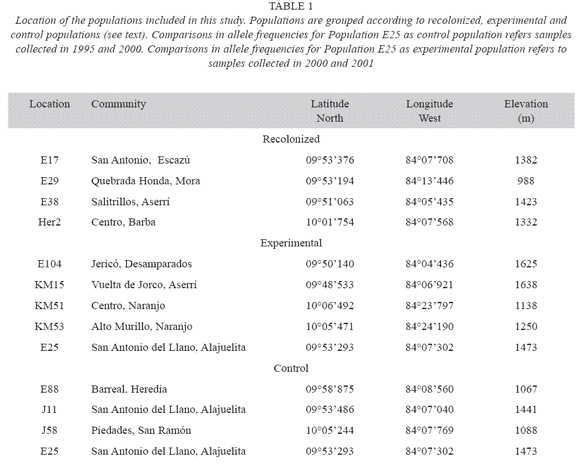
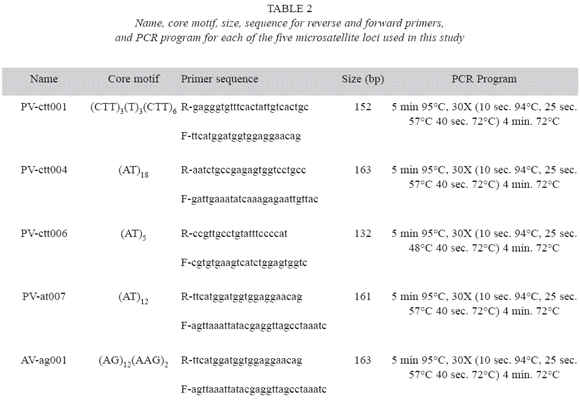
<body><![CDATA[<div style="text-align: center;"><font face="Verdana" size="2"><img  src="/img/revistas/rbt/v56n3/art05t1.gif" title="" alt=""  style="width: 580px; height: 472px;"></font>    <br> </div>     <p><font face="Verdana" size="2">Four locations were included in the recolo</font><font face="Verdana" size="2">nization group. The populations present in these </font><font face="Verdana"  size="2">sites suffered at least one period of local extinc</font><font face="Verdana" size="2">tion and recolonization. In addition, these loca</font><font face="Verdana"  size="2">tions were selected because there were seeds, </font><font  face="Verdana" size="2">collected prior to the extinction episode, stored</font><font face="Verdana" size="2"> in a seed collection maintained as part of this&nbsp; project. This group included sites Her2, E17,&nbsp; E29 and E38. These populations differed in the&nbsp; number of extinction episodes that they expe rienced and the number of years in which they produced seeds. Location E17 experienced three&nbsp; extinction episodes during our study, and populations E38, HER2, and E29 experienced only&nbsp; one. However, location E38 and HER2 were&nbsp; recolonized two years after extinction, while&nbsp; location H29 was colonized after one year.&nbsp;     <br> </font></p>     <p><font face="Verdana" size="2">Five locations were included in the second&nbsp; group (experimental). These locations showed similar conditions to those of the control group,&nbsp; i.e. no history of local extinction. A sample of 25 individuals was collected from each of these populations, and then all lima bean plants pres ent were cut. All experimental manipulations&nbsp; were conducted between May 2000 and April 2001, i.e. before the time of fruit maturation and seed dispersal. All sites were recolonized the following rainy season. In order to compare the genetic diversity of the populations present before and after the experimental manipulation, leaf tissue was collected from 25 individuals from each newly established population. Two of these populations (E104 and E25) were exposed to a partial disturbance, letting a small patch of isolated individuals complete its reproduction period and disperse seeds. In addition, it is important to point out that population E25 was selected as control population (samples from 1995 and 2000) and experimental population (samples from 2000 and 2001). These transient extinction events are frequently observed in lima bean populations throughout the Central valley. </font></p>     <p><font face="Verdana" size="2">The last group of locations included sites that had not experienced local extinction since November of 1994 (control). In addition, these populations were successful in producing seeds every year. In this case, genetic diversity was compared between a sample of seeds collected in the same location in 1995, and a sample of the individuals present in May 2001. </font></p>     <p><font face="Verdana" size="2"><b>DNA extraction: </b>Total genomic DNA was extracted from leaves of lima beans using the protocol developed by Lodhi <i>et al. </i>(1994), with some modifications based on the protocol proposed by Centro de Investigación en Agricultura Tropical (CIAT) for DNA extraction from common bean (González <i>et al</i>. 1995). Approximately 250 mg of leaf tissue was ground in liquid nitrogen with a pestle in a 1.5 ml Eppendorf tube. The ground tissue was mixed with 600 (l of 0.1 M Tris-HCl pH 8.0, 1.0 M NaCl, 2% CTAB, 2% PvP, and 1 % ( mercatoethanol extraction buffer. The mix was incubated at 60 (C for 40 minutes with agitation every 10 minutes. The samples were then centrifuged for 10 minutes at 12,000 g at 10 (C. The supernnatant solution was placed in another tube, and one volume of chloroformoctanol (24:1) was added, mixed gently, and centrifuged for 10 minutes. The supernatant was transferred to another tube where 1/10 volume of 3M NaAC pH 5.2 and 0.6 volume of ice-cold isopropanol was added. The mixture was kept at 5 (C for 10 to 20 hours. DNA was precipitated with 70% ethanol, air dried, and later resuspended in 100 (l of 1.0 M TE buffer. </font></p>     <p><font face="Verdana" size="2"><b>Genetic analysis: </b>Five microsatellites marker genes were used to determine genetic diversity. Primers for these loci were developed by Yu <i>et al. </i>(2000) for common bean (<i>P. vulgaris</i>). <a href="#t2">Table 2</a> describes the forward and reverse primers for each microsatellite locus, and the conditions for the polymerase chain reactions (PCR). PCR reactions were conducted using an air heated Rapid Cycler (Idaho Tecnology), and the reaction products were visualized on 40 cm long polyacrilamide gels using silver staining (Promega). The different alleles for each locus were identified according to their molecular weight, where the most anodal allele was arbitrarily identified as "1", and the remaining alleles numbered sequentially.    <br> </font></p>     <p><font face="Verdana" size="2">    ]]></body>
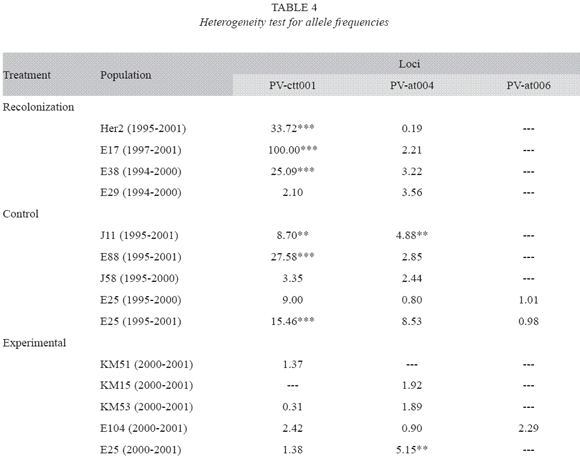
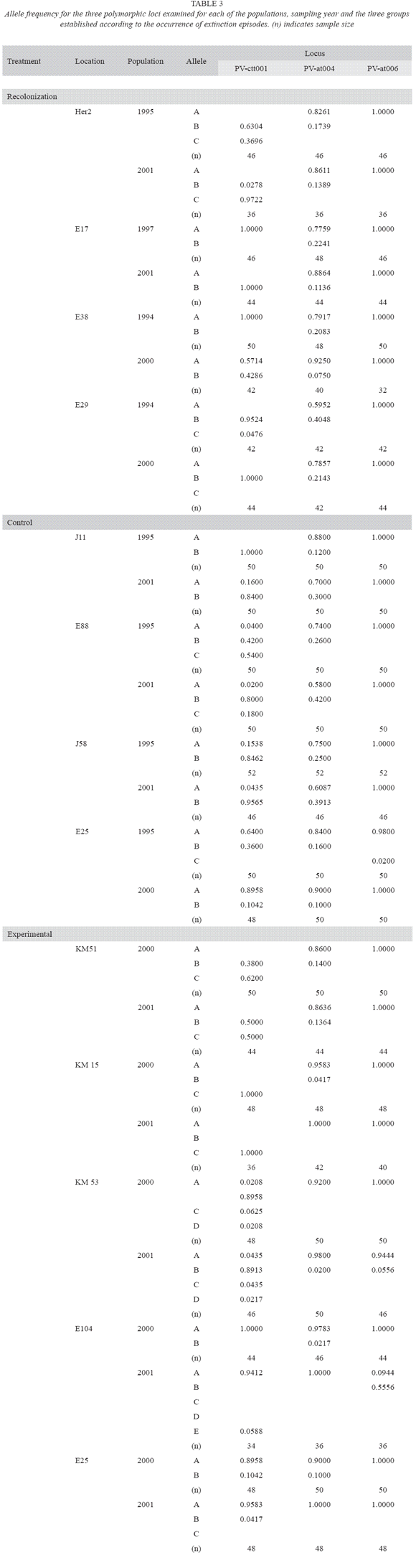
<body><![CDATA[<br> <a name="t2"></a></font></p>     <div style="text-align: center;"><font face="Verdana" size="2"><img  src="/img/revistas/rbt/v56n3/art05t2.gif" title="" alt=""  style="width: 580px; height: 403px;"></font>    <br> <font face="Verdana" size="2"> </font></div>     <p><font face="Verdana" size="2"><b>Data Analysis: </b>Genetic diversity in each sample was quantified in terms of allele frequencies, number of alleles per locus (A), effective number of alleles per locus (A<sub>E</sub>), observed heterozygosity (H</font><sub><font  face="Verdana" size="1">O</font></sub><font face="Verdana" size="2">), and Nei’s expected heterozygosity (H</font><sub><font face="Verdana"  size="1">E</font></sub><font face="Verdana" size="2">) (Nei 1973) averaged over all loci. The significance of allele frequency differences between locations was assessed using the exact test (Weir 1996). The effective number of alleles was estimated as the reciprocal of the homozygosity (Hartl and Clark 1989). In addition, genetic differentiation was determined using the infinite allele model Fst (Weir and Cockerham 1984). The degree of relatedness between locations, based on Nei’s genetic distances, was represented in a tree using UPGMA. Bootstrap sampling of loci tested the robustness of clusters of the tree, using 10</font><sup><font face="Verdana" size="1">3 </font></sup><font  face="Verdana" size="2">simulations. These analyses were conducted using the program POPGENE 1.31 (Yeh <i>et al. </i>1999). </font></p>     <p><font face="Verdana" size="3"><span style="font-weight: bold;">Results</span> </font></p>     <p><font face="Verdana" size="2"><b>Genetic diversity: </b>In order to study the genetic diversity of the three groups of populations we determined the allelic frequencies and the number of alleles for three microsatellite loci. We only found one allele in two of the loci that we examined; namely, loci PV-AT007 and VA-AG001. <a  href="/img/revistas/rbt/v56n3/art05t3.gif">Table 3</a> shows the allelic frequencies for the three polymorphic loci for each population, sampling year, and population group. The data revealed that the populations in the first group (recolonized) tended to experience an increase in the frequency of the most common allele at locus PV-AT004. For locus PV-ctt001, the trend in allele frequencies is not clear. In population E29, the most common allele at that locus became fixed, and the least frequent allele disappeared from the population. However, in the other three populations the most common alleles before the extinction episode experienced a reduction in frequency. Our data also revealed significant heterogeneity in allele frequencies observed at locus Pv-ctt001 between samples taken at different times (1994-1995 vs. 2000-2001) in the same location for all populations (<a href="#t4">Table 4</a>).    <br> </font></p>     <div style="text-align: center;">    <br> </div>     <p><font face="Verdana" size="2">    ]]></body>
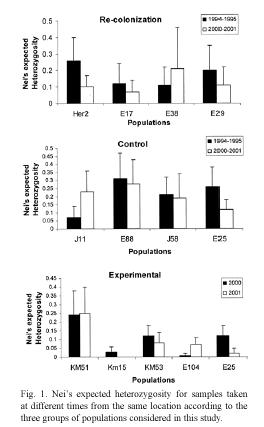
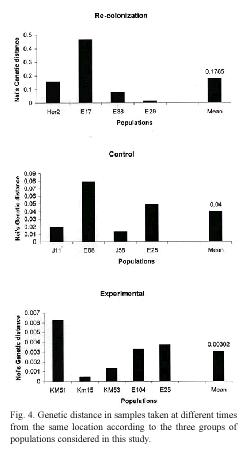
<body><![CDATA[<br> <a name="t4"></a></font></p>     <div style="text-align: center;"><font face="Verdana" size="2"><img  src="/img/revistas/rbt/v56n3/art05t4.gif" title="" alt=""  style="width: 580px; height: 465px;"></font>    <br> <font face="Verdana" size="2"> </font></div>     <p><font face="Verdana" size="2">We did not find a clear trend in the variation in allele frequencies in the control population (<a  href="/img/revistas/rbt/v56n3/art05t3.gif">Table 3</a>). The most common allele at locus PV-ctt001 only experienced an increase in frequency in two populations (J58 and E25), while the same only happened in one population (E25) at locus PV-at004. Overall, these findings revealed significant changes in allele frequencies over the study period in the control populations. We found significant heterogeneity in allele frequencies between samples taken at different times from the same location for all populations at locus PV-ctt001 and for two populations at locus PV-at004 (<a href="#t4">Table 4</a>). </font></p>     <p><font face="Verdana" size="2">There were also changes in allele frequencies in the samples taken from locations subjected to experimental manipulation (<a href="/img/revistas/rbt/v56n3/art05t3.gif">Table 3</a>). For example, our data revealed that in three of the five locations the allele with the lowest frequency disappeared at locus PV-at004. There <font><font face="Verdana"  size="2">was only a minor change in allele frequencies </font></font><font><font  face="Verdana" size="2">at the same locus for the other population. </font></font><font><font face="Verdana" size="2">However, the changes in allele frequencies at </font></font><font><font  face="Verdana" size="2">locus PV-ctt001 were more variable. We did </font></font><font><font  face="Verdana" size="2">not find major changes in allele frequencies </font></font><font><font  face="Verdana" size="2">in two populations (Km15 and Km53). We </font></font><font><font  face="Verdana" size="2">observed the appearance of a new allele in one </font></font><font><font face="Verdana"  size="2">population (E104), an increase in the frequency </font></font><font><font  face="Verdana" size="2">of the most abundant allele in one population </font></font><font><font  face="Verdana" size="2">(Km51). We also recorded the appearance of a </font></font><font><font  face="Verdana" size="2">new allele at locus Pv-at006 in one population </font></font><font><font face="Verdana"  size="2">(E104).</font></font><font><font face="Verdana" size="2">    <br> </font></font></font></p> <font face="Verdana" size="2"><font face="Verdana" size="2"> </font></font>     <p><font face="Verdana" size="2"><font face="Verdana" size="2"><font><font><font  face="Verdana" size="2"><font face="Verdana" size="2">Genetic diversity, as indicated by Nei’s&nbsp;</font></font></font></font><font><font><font  face="Verdana" size="2"><font face="Verdana" size="2">expected heterozygosity, tended to be affected&nbsp;</font></font></font></font><font><font><font  face="Verdana" size="2"><font face="Verdana" size="2">by extinction (<a  href="#f1">Fig. 1</a>). Three recolonized loca</font></font></font></font><font><font><font  face="Verdana" size="2"><font face="Verdana" size="2">tions showed a reduction in expected heterozy</font></font></font></font><font><font><font  face="Verdana" size="2"><font face="Verdana" size="2">gosity and one showed an increase. In contrast,</font></font></font></font><font><font face="Verdana" size="2"> </font></font>there was no clear tendency in the change&nbsp; in heterozygosity in the populations in control locations. Similarly, there was no clear&nbsp; tendency among populations in experimental&nbsp; locations.&nbsp;     <br> </font></font></p>     <p><font face="Verdana" size="2"><font face="Verdana" size="2">    <br>     ]]></body>
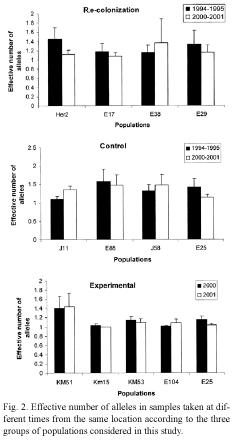
<body><![CDATA[<br> </font></font></p>     <div style="text-align: center;"><img src="/img/revistas/rbt/v56n3/art05i1.jpg" title=""  alt="" style="width: 264px; height: 427px;"><a name="f1"></a>    <br> </div> <font face="Verdana" size="2"><font face="Verdana" size="2"> </font></font><font face="Verdana" size="2"><font face="Verdana"  size="2">     <p>Our data also revealed changes in the&nbsp; effective number of alleles in the three groups&nbsp; of populations (<a href="#f2">Fig. 2</a>). For example, three of&nbsp; the four locations in the recolonization group&nbsp; showed a reduction in the effective number of (E25), and a decrease in the frequency of the alleles. In contrast, one location (E38) showed most abundant allele in another population an increase in the effective number of alleles. Variation in the effective number of alleles was&nbsp; also observed in locations in the control group,&nbsp; where effective number of alleles increased in&nbsp; two populations but decreased in the other two.&nbsp; Only one population (E25) showed an important change in the effective number of alleles among the experimental populations (from&nbsp; 1.15 to 1.03).    <br> </p>     <p>    <br>     <br> </p> </font></font>     <div style="text-align: center;"><img src="/img/revistas/rbt/v56n3/art05i2.jpg" title=""  alt="" style="width: 236px; height: 442px;">    <br> </div> <font face="Verdana" size="2"><font face="Verdana" size="2"> </font></font>     ]]></body>
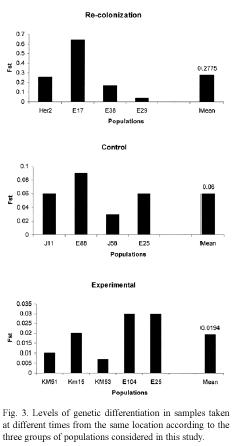
<body><![CDATA[<p><font face="Verdana" size="2"><b><font face="Verdana" size="2">Genetic differentiation: </font></b><font face="Verdana" size="2">The impact of local extinction on genetic diversity was also investigated by examining the genetic distance and the level of population differentiation in samples collected at different times at the same location. The data indicate that genetic differentiation and genetic distance between populations sampled in each location are affected by the occurrence of extinction events (<a  href="#f3">Fig. 3</a>). In locations where lima bean populations experienced long term extinction and subsequent recolonization, the level of genetic differentiation (Fst) ranged from 0.0407 to 0.6371 (mean Fst = 0.2769). In contrast, in control locations, genetic differentiation between the samples collected in 1995 and that of 2000 or 2001 ranged between 0.0263-0.0860 (mean Fst = 0.0576). Similar findings were observed for genetic distance between populations: for recolonized locations genetic distances were, on average, larger than that of control populations (Nei´s genetic distance, 0.1786 and 0.0400 respectively).</font></font></p>     <p><font face="Verdana" size="2"><font face="Verdana" size="2">    <br> </font></font></p>     <div style="text-align: center;"><font face="Verdana" size="2"><font  face="Verdana" size="2"><img src="/img/revistas/rbt/v56n3/art05i3.jpg" title="" alt=""  style="width: 239px; height: 446px;"><a name="f3"></a></font></font>    <br> </div>     <div style="text-align: center;"><font face="Verdana" size="2"><font  face="Verdana" size="2">    <br> </font></font></div>     <p><font face="Verdana" size="2"><font face="Verdana" size="2">The populations subjected to experimental manipulation showed the lowest level of genetic differentiation (mean Fst = 0.0189), and also the lowest genetic distance (mean Nei´s genetic distance = 0.0030) between plants present before and after the transient extinction (<a  href="#f4">Fig. 4</a>). These findings indicate that populations of lima beans may experience short anthropogenic extinction and still preserve their genetic diversity. These populations successfully produced seeds every year, except for the year when they were cut. In these locations, a new population of lima beans was easily reestablished after the experimental manipulation.    <br> </font></font></p>     <p><font face="Verdana" size="2"><font face="Verdana" size="2">    ]]></body>
<body><![CDATA[<br> </font></font></p>     <div style="text-align: center;"><font face="Verdana" size="2"><font  face="Verdana" size="2"><img src="/img/revistas/rbt/v56n3/art05i4.jpg" title="" alt=""  style="width: 246px; height: 449px;"><a name="f4"></a></font></font>    <br> </div>     <div style="text-align: center;">    <br> <font face="Verdana" size="2"><font face="Verdana" size="2"> </font></font></div> <font face="Verdana" size="2"><font face="Verdana" size="2"><font  face="Verdana" size="2"><font face="Verdana" size="2"><font  face="Verdana" size="2"><font face="Verdana" size="2"> <font size="3">     <p><span style="font-weight: bold;">Discussion</span> </p> </font>     <p>We evaluated the changes in genetic structure after the occurrence of local disturbances that caused population extinction in wild populations of <i>P. lunatus </i>in Central valley of Costa Rica. Demographic information revealed the occurrence of frequent events of local extinction and recolonization, suggesting a metapopulation structure for this species (Degreef <font face="Verdana" size="2"><font  face="Verdana" size="2"><font face="Verdana" size="2"><font  face="Verdana" size="2"><font face="Verdana" size="2"><i><font  face="Verdana" size="2">et al. </font></i><font face="Verdana" size="2">1997, Rocha <i>et al. </i>1997, Degreef 1998, Rocha <i>et al. </i>2002, Barrantes 2003). Our results revealed a complex dynamic in the genetic structure of the populations considered in this study, which includes changes in the allele frequencies, loss and gain of alleles, and changes in the levels of population differentiation between samples collected at different times at the same location. Overall, the magnitude of these changes is, on average, accelerated by prolonged local extinction. </font></font></font></font></font></font></p> </font></font></font></font></font></font>     <p><font face="Verdana" size="2"><font face="Verdana" size="2"><font  face="Verdana" size="2"><font face="Verdana" size="2"><font  face="Verdana" size="2"><font face="Verdana" size="2"><b>Genetic diversity: </b>The level of genetic variation within populations has received considerable attention because it is considered an indicator of its evolutionary potential to respond to environmental changes (Frankel and Soulé 1981, Hamrick and Godt 1989, Heywood 1991, Newman and Pilson 1997, Hanski 1999, Cruzan 2001). It has been argued that losses in viability are caused by reduction in the number of alleles due to increases in endogamy and genetic drift (Frankel and Soulé 1981, Ellstrand and Elam 1993). Such losses may be the result of, among other causes, the fixation of deleterious alleles or the loss of heterozygous advantage (Ellstrand and Elam 1993, Newman and Pilson 1997, Cruzan 2001). Our results indicate that the level of disturbance, as well as time elapsed between sampling, influenced the magnitude of the changes in the allelic frequencies and the number of alleles present in populations. Local extinction increased the variation in allelic frequencies, favoring allele loss in sites where lima beans experienced extinction and recolonization. In contrast, experimental populations that only experienced transit extinction tended to preserve their alleles. In addition, these populations also experienced small changes in allele frequencies. Overall, variation in allelic frequencies was larger among populations in recolonized sites than among the populations in the other two groups. </font></font></font></font></font></font></p>     <p><font face="Verdana" size="2"><font face="Verdana" size="2"><font  face="Verdana" size="2"><font face="Verdana" size="2"><font  face="Verdana" size="2"><font face="Verdana" size="2">Several factors might explain the observed changes in allele frequencies. The number and the duration of the extinction episodes can explain, at least in part, some of these changes. For example, the number of extinction episodes was variable among populations in recolonized sites. One population (E17) experienced two extinction episodes during our study, while populations E38, HER2, and E29 experienced only one. As predicted, genetic change was larger in populations that experienced multiple extinction episodes. In addition, the duration of the extinction episodes in location E17 lasted for more than 15 months each. In locations E38 and E29 the only extinction episode lasted for nearly 22 months, and in location E29 it only lasted 12 months. </font></font></font></font></font></font></p> <font face="Verdana" size="2"><font face="Verdana" size="2"><font  face="Verdana" size="2"><font face="Verdana" size="2"><font  face="Verdana" size="2"><font face="Verdana" size="1"> </font></font></font></font></font></font>     <p><font face="Verdana" size="2"><font face="Verdana" size="2"><font  face="Verdana" size="2"><font face="Verdana" size="2"><font  face="Verdana" size="2"><font face="Verdana" size="2">It has been argued that local extinction results in population bottlenecks and elevated inbreeding during the recolonization of the site (Pannell and Dorken 2006). In this study, population E17, from the recolonization group, not only experienced two extinction episodes, but also showed the smallest mean population size during the study period. It is expected that under such conditions inbreeding should be high. Among the other three populations in this group, population E29 showed the largest mean population size, and shows the lowest F<sub>st</sub>. These findings suggest that multiple extinctions lead to more severe bottlenecks, hence resulting in more differentiation between samples taken form the same location. Moreover, the likelihood of extinction is also related to population size, as small populations are more likely to disappear (Rocha <i>et al</i>. 2002, Barrantes 2003), which suggests that such populations may be more susceptible to genetic losses. </font></font></font></font></font></font></p>     ]]></body>
<body><![CDATA[<p><font face="Verdana" size="2"><font face="Verdana" size="2"><font  face="Verdana" size="2"><font face="Verdana" size="2"><font  face="Verdana" size="2"><font face="Verdana" size="2">Extinction episodes are often related to failure of reproduction, and hence facilitate changes in genetic diversity (Degreff 1998, Rocha <i>et al. </i>2002). Absence of seed production has a negative effect on the size and the genetic diversity of the soil seed bank (Kalisz <i>et al. </i>1997, Degreef <i>et al</i>. 2003). Plants in population E17 failed to produce seeds during the study period, and this population experienced the greatest genetic change during this study. It is possible to argue that such failure to reproduce significantly affects the size of the soil seed bank of lima beans, hence the population that recolonized this site was probably not a random sample of the population previously present. Studies of the dynamics of the seed bank revealed that nearly 98% of the seed in the soil germinate or die within three years after dispersal. This finding supports the notion that the seed bank may be depleted in some of these populations (Degreef <i>et al</i>. 2002). On the other hand, seeds were produced almost every year in location E29, and the integrity of the seed bank may explain the low level of genetic differentiation between samples taken at different times.     <br> </font></font></font></font></font></font></p>     <p><font face="Verdana" size="2"><font face="Verdana" size="2"><font  face="Verdana" size="2"><font face="Verdana" size="2"><font  face="Verdana" size="2"><font face="Verdana" size="2">Variation in allele frequencies was also observed in control populations. These sites had large populations, and were not expected to suffer the negative effects of genetic drift; however, they all experienced significant genetic change. In two populations (J11 and E88), the most abundant allele experienced a reduction in frequency at all polymorphic loci. In one population (E25), the most abundant allele experienced an increase in frequency at all polymorphic loci. In another population (J58), the most abundant allele experienced an increase in frequency at one polymorphic locus and a reduction at another. These findings strongly suggest that these populations are not in equilibrium. These changes might result from the arrival of genes from adjacent populations, as the level of genetic differentiation between populations is high (Maquet <i>et al. </i>1997, Zoro Bi <i>et al. </i>2003), or from complex dynamic processes resulting from within populations structure (Zoro bi <i>et al. </i>1997) and/or changes in seed dispersal within populations (Hardy <i>et al. </i>1997).</font></font></font></font></font></font></p>     <p><font face="Verdana" size="2"><font face="Verdana" size="2"><font  face="Verdana" size="2"><font face="Verdana" size="2"><font  face="Verdana" size="2"><font face="Verdana" size="2">Experimental populations underwent the smallest changes in allele frequency among the loci examined. Most of these changes were not significant. We suggest that this limited change illustrates the role of a healthy soil seed bank in the conservation of genetic diversity. Our findings suggest that a constantly renewed soil seed bank maintained a representative sample of the allele frequencies found in the population. The levels of genetic change observed in these populations may result from sampling error, or internal dynamics driving these populations to equilibrium. </font></font></font></font></font></font></p>     <p><font face="Verdana" size="2"><font face="Verdana" size="2"><font  face="Verdana" size="2"><font face="Verdana" size="2"><font  face="Verdana" size="2"><font face="Verdana" size="2">Changes in expected heterozygosity can also serve as an indicator of the impact of local extinction on genetic diversity. It has been proposed that the low allelic richness and heterozygote deficiency observed in wild populations of lima beans could be attributed to frequent population bottlenecks, founder effect, steady selfing, assortative mating, biparental imbreeding, selection favoring homozygote individuals and Wahlund effect (Rocha <i>et al. </i>1997, Zoro Bi 1999, Zoro Bi <i>et al</i>. 1997, 2003, Rocha <i>et al. </i>2002). The majority of the populations considered in this study showed a reduction in heterozygosity. On average, the locations that suffered local extinction experienced greater reduction in heterozygosity. This contrasts with populations in control locations, which exhibited both increases and reductions in heterozygosity. Moreover, despite having larger initial heterozygosity, control location exhibited, on average, smaller reductions in this parameter than recolonized locations. In addition, control populations were, in general, larger than populations in recolonized locations. Finally, experimental populations showed the smallest reduction in heterozygosity. In general, these findings support the notion that local extinction reduces genetic diversity, but our findings indicate that it is not the only factor involved. </font></font></font></font></font></font></p>     <p><font face="Verdana" size="2"><font face="Verdana" size="2"><font  face="Verdana" size="2"><font face="Verdana" size="2"><font  face="Verdana" size="2"><font face="Verdana" size="2"><b>Genetic differentiation: </b>Several studies have examined the effect of extinction-colonization on genetic differentiation (Slatkin 1977, Wade and McCauley 1988, McCauley 1993, Barton and Whitlock 1997). These studies show that local extinction and recolonization can enhance or reduce genetic differentiation between populations as result of gene flow (Hanski 1999, Pannell and Charlesworth 2000, Pannell and Dorken 2006). Whitlock and McCauley (1990) proposed that the effect of extinction and recolonization depends on two key factors: the patterns of gene flow and the number of individuals establishing the new population. Overall, we found that genetic differentiation between populations increased with time. In 1994-95, the genetic differentiation was smaller than was observed in 2000-01 (F= 0.34 and F</font><sub>st</sub><font face="Verdana" size="2">= 0.42, respectively). These values are similar to those reported by Zoro Bi <i>et al. </i>(2003) among 29 wild populations of lima beans using 23 isozyme loci. However, significant genetic differentiation between samples taken from each location over time was also observed in this study. </font></font></font></font></font></font></p>     <p><font face="Verdana" size="2"><font face="Verdana" size="2"><font  face="Verdana" size="2"><font face="Verdana" size="2"><font  face="Verdana" size="2"><font face="Verdana" size="2">Overall, samples taken from recolonized populations in 1994-95 and 2000-01 revealed the highest level of differentiation and genetic distance, followed by control (1994-95 and 2000-01) and experimental populations (2000 and 2001). The levels of genetic differentiation that we found suggest that, in recolonized populations, there is limited gene flow between samples. This can result from the decay of the soil seed bank or from gene flow from adjacent populations. Moreover, our data also revealed that population E29, which only experienced one extinction episode, but where seeds were produced more frequently, showed lower differentiation than the other populations in this group. Meanwhile, population E17, which failed to produce seeds during this study, experienced the highest differentiation. Genetic differentiation between samples taken before and after experimental manipulation was also low, indicating that transient extinctions do not result in significant genetic change. This is especially true if lima beans have been producing seeds consistently prior to extinction. </font></font></font></font></font></font></p>     <p><font face="Verdana" size="2"><font face="Verdana" size="2"><font  face="Verdana" size="2"><font face="Verdana" size="2"><font  face="Verdana" size="2"><font face="Verdana" size="2">A similar pattern is revealed when comparing genetic distances between samples. Our data revealed that the genetic distance between samples taken from the same location is larger at sites that experienced extinction episodes that lasted at least one year. Similarly, genetic distances increased as the number of extinction episodes or the number of failed reproductive episodes increased. These findings suggest that genetic distance is a more sensitive indicator of genetic change due to fragmentation, population bottlenecks and inbreeding. </font></font></font></font></font></font></p>     <p><font face="Verdana" size="2"><font face="Verdana" size="2"><font  face="Verdana" size="2"><font face="Verdana" size="2"><font  face="Verdana" size="2"><font face="Verdana" size="2">Overall, our findings support the notion that lima beans populations are not in equilibrium. This results from complex demographic dynamics typical of this species, as they colonize ephemeral habitat and are likely to experience local extinction as environmental conditions change. In habitats where human activities such as agriculture, establishment of pasture and other practices maintain favorable environmental conditions for long periods, lima bean populations develop a genetic structure with a high level of population differentiation, and a within population substructure resulting from high levels of inbreeding and selfing and the occurrence of severe bottlenecks and founder effect. </font></font></font></font></font></font></p>     <p><font face="Verdana" size="2"><font face="Verdana" size="2"><font  face="Verdana" size="2"><font face="Verdana" size="2"><font  face="Verdana" size="2"><font face="Verdana" size="2"><b>Implications for conservation: </b>The results of this study illustrate the importance of genetic monitoring for conservation biology. As pointed our by other authors (Schwartz <i>et al</i>. 2006), genetic monitoring can provide valuable information to help the decision making process leading to the establishment of adequate management strategies for the conservation of genetic diversity. Of particular relevance to this study are inbreeding coefficients, expected heterozygosity, temporal variances in allele frequencies and allele richness. Our data also support the notion that genetic and demographic data can be useful for identifying management units (see Palsbøll <i>et al</i>. 2006). Moreover, this study expands the uses of genetic data in management, as it examined levels of genetic differentiation over time, revealing that episodes of extinction and colonization may play an important role in determining spatial differentiation between population (Pannell and Dorkens, 2006). </font></font></font></font></font></font></p>     ]]></body>
<body><![CDATA[<p><font face="Verdana" size="2"><font face="Verdana" size="2"><font  face="Verdana" size="2"><font face="Verdana" size="2"><font  face="Verdana" size="2"><font face="Verdana" size="2">Two of our findings have important implications for the adequate conservation of genetic resources of wild lima beans. First, small populations that undergo local extinction are often more likely to undergo changes in their genetic diversity than larger populations. These populations deserve special attention if they posses unique alleles, or other significant morphological or physiological traits, because they are likely to disappear in a random manner. However, because of within population structure, and other life history traits, large populations are not exempt from genetic change. Second, the integrity of the soil seed bank, as indicated by the production of seeds every year, also appears to have a significant effect on the conservation of genetic resources. Dormant seeds in the soil not only allow rapid recovery after disturbances, but also appear to maintain a good sample of the genetic diversity of the extant population. </font></font></font></font></font></font></p>     <p><font face="Verdana" size="2"><font face="Verdana" size="2"><font  face="Verdana" size="2"><font face="Verdana" size="2"><font  face="Verdana" size="2"><font face="Verdana" size="2">Other authors have pointed out the role of severe genetic bottleneck in tropical plants (Aldrich and Hamrick 1998, Cespedes <i>et al. </i>2003). They pointed out that such bottlenecks should be anticipated in the development of conservation strategies. However, long distance gene flow, via pollen or seed, may counter their negative effects (Mildén <i>et a</i>l. 2006, Pannell and Dorken 2006). The genetic structure of wild lima beans in the Central valley of Costa Rica strongly suggests that flow (via pollen and seed) between populations is limited. However, more detailed studies are needed to elucidate its importance. We do not know the mechanisms for long distance dispersal in lima beans, but colonization events at new sites are not rare. We have recorded new populations of lima beans at sites where they have not been recorded since 1993 when we conducted our first large scale survey (Rocha <i>et al. </i>1997, Barrantes 2003). Such dispersal events could explain, at least in part, the high levels of genetic differentiation between populations, and might represent an important factor in the dynamics of this species. </font></font></font></font></font></font></p>     <p><font face="Verdana" size="2"><font face="Verdana" size="2"><font  face="Verdana" size="2"><font face="Verdana" size="2"><font  face="Verdana" size="2"><font face="Verdana" size="3"><span  style="font-weight: bold;">Acknowledgments</span> </font></font></font></font></font></font></p>     <p><font face="Verdana" size="2"><font face="Verdana" size="2"><font  face="Verdana" size="2"><font face="Verdana" size="2"><font  face="Verdana" size="2"><font face="Verdana" size="2">The authors thank M.E. Zaldivar, L. Castro, E. Castro, G. Aguilar, M. Artavia, and Ana Araya for advice, comments, and/or criticisms on a previous version of this manuscript. This work was supported by the Belgium’s Direction Générale de la Coopération au Development and a University of Costa Rica grant (VI-111-91-223) to OJR. </font></font></font></font></font></font></p> <hr style="width: 100%; height: 2px;">     <p><font face="Verdana" size="2"><font face="Verdana" size="2"><font  face="Verdana" size="2"><font face="Verdana" size="2"><font  face="Verdana" size="2"><font face="Verdana" size="2"><span  style="font-weight: bold;">Resumen</span> </font></font></font></font></font></font></p> <font face="Verdana" size="2"><font face="Verdana" size="2"><font  face="Verdana" size="2"><font face="Verdana" size="2"><font  face="Verdana" size="2"><font face="Verdana" size="2"> </font><font face="Verdana" size="2"></font><font face="Verdana"  size="2"></font></font></font></font></font></font>     <p><font face="Verdana" size="2"><font face="Verdana" size="2"><font  face="Verdana" size="2"><font face="Verdana" size="2"><font  face="Verdana" size="2"><font face="Verdana" size="2">Las poblaciones de plantas pueden experimentar extinción local, y al mismo tiempo, pueden surgir a sus alrededores nuevas poblaciones. Algunas especies pueden colonizar el mismo sitio en múltiples ocasiones. Aquí examinamos el impacto de la extinción local y recolonización en la estructura genética de poblaciones silvestres del frijol lima <i>(Phaseolus lunatus</i>) en el valle Central de Costa Rica. Comparamos la diversidad genética de muestras tomadas en poblaciones, antes y después de la extinción, en 13 sitios, usando marcadores de microsatélite. Según los episodios de extinción durante los cinco años previos, clasificamos los sitios así: 1) poblaciones que han experimentado extinción por más de un año, y después han recolonizado (recolonizado), 2) poblaciones que no han experimentado extinción local (control), y 3) poblaciones que no han experimentado extinción local durante el estudio, pero fueron cortadas experimentalmente, simulando una extinción (experimental). Nuestros datos no mostraron una clara tendencia en la variación de las frecuencias alélicas, heterozigosidad, o número efectivo de alelos <i>en </i>y <i>entre </i>grupos de poblaciones. Los niveles de diferenciación genética entre muestras recolectadas en diferentes momentos en el mismo sitio fueron diferentes en los tres grupos de poblaciones. Los sitios recolonizados mostraron el mayor nivel de diferenciación genética (</font><sub><font  face="Verdana" size="2">Fst</font></sub><sub><font face="Verdana"  size="2"> </font></sub><font face="Verdana" size="2">= 0.2769), seguidos de los sitios control (F<sub>st</sub>= 0.0576) y sitios experimentales (F<sub>st</sub>= 0.0189). Obtuvimos <font  face="Verdana" size="2"><font face="Verdana" size="2"><font  face="Verdana" size="2"><font face="Verdana" size="2"><font  face="Verdana" size="2"><font face="Verdana" size="2">resultados similares en la distancia genética Neis entre muestras (d</font><sub>i,j </sub><font face="Verdana" size="2">= 0.1786, 0.0400, y 0.0037, respectivamente). Los cambios genéticos en los frijoles lima dependen de la duración y frecuencia de los episodios de extinción local. Las poblaciones "control" no están en equilibrio. Las implicaciones de estos resultados para el establecimiento de estrategias de conservación de los recursos genéticos de habas se encuentran en discusión. </font></font></font></font></font></font></font></font></font></font></font></font></p>     <p><font face="Verdana" size="2"><font face="Verdana" size="2"><font  face="Verdana" size="2"><font face="Verdana" size="2"><font  face="Verdana" size="2"><font face="Verdana" size="2"><font  face="Verdana" size="2"><font face="Verdana" size="2"><font  face="Verdana" size="2"><font face="Verdana" size="2"><font  face="Verdana" size="2"><font face="Verdana" size="2"><b>Palabras clave: </b>diversidad genética, metapoblación, diferenciación genética, banco de semillas del suelo, conservación <i>in situ</i>, frijol lima, <i>Phaseolus lunatus</i>, extinción local, recolonización, recursos genéticos.    <br> </font></font></font></font></font></font></font></font></font></font></font></font></p> <hr style="width: 100%; height: 2px;">     <p><font face="Verdana" size="2"><font face="Verdana" size="2"><font  face="Verdana" size="2"><font face="Verdana" size="2"><font  face="Verdana" size="2"><font face="Verdana" size="2"><font  face="Verdana" size="2"><font face="Verdana" size="2"><font  face="Verdana" size="2"><font face="Verdana" size="2"><font  face="Verdana" size="2"><font face="Verdana" size="2"></font></font></font></font></font></font></font></font></font></font></font></font></p>     <p style="text-align: center;"><font face="Verdana" size="2"><font  face="Verdana" size="2"><font face="Verdana" size="2"><font  face="Verdana" size="2"><font face="Verdana" size="2"><font  face="Verdana" size="2"><font face="Verdana" size="2"><font  face="Verdana" size="2"><font face="Verdana" size="2"><font  face="Verdana" size="2"><font face="Verdana" size="2"><font  face="Verdana" size="2">Received 30-IV-2007. Corrected 30-X-2007. Accepted 21-IV-2008.</font></font></font></font></font></font></font></font></font></font></font></font></p> <font face="Verdana" size="2"><font face="Verdana" size="2"><font  face="Verdana" size="2"><font face="Verdana" size="2"><font  face="Verdana" size="2"><font face="Verdana" size="2"><font  face="Verdana" size="2"><font face="Verdana" size="2"><font  face="Verdana" size="2"><font face="Verdana" size="2"><font  face="Verdana" size="2"><font face="Verdana" size="2"> <font size="3">     ]]></body>
<body><![CDATA[<p><span style="font-weight: bold;">References</span> </p> </font></font><font face="Verdana" size="2"> </font></font></font></font></font></font></font></font></font></font></font></font>     <!-- ref --><p><font face="Verdana" size="2"><font face="Verdana" size="2"><font  face="Verdana" size="2"><font face="Verdana" size="2"><font  face="Verdana" size="2"><font face="Verdana" size="2"><font  face="Verdana" size="2"><font face="Verdana" size="2"><font  face="Verdana" size="2"><font face="Verdana" size="2"><font  face="Verdana" size="2"><font face="Verdana" size="2">Aldrich P.R. &amp; J.L. Hamrick. 1998. Reproductive dominance of pasture trees in a fragmented tropical forest mosaic. Science. 281: 103-105.    &nbsp;&nbsp;&nbsp;&nbsp;&nbsp;&nbsp;&nbsp;&nbsp;[&#160;<a href="javascript:void(0);" onclick="javascript: window.open('/scielo.php?script=sci_nlinks&ref=1699390&pid=S0034-7744200800030000500001&lng=','','width=640,height=500,resizable=yes,scrollbars=1,menubar=yes,');">Links</a>&#160;]<!-- end-ref --> </font></font></font></font></font></font></font></font></font></font></font></font></p>     <!-- ref --><p><font face="Verdana" size="2"><font face="Verdana" size="2"><font  face="Verdana" size="2"><font face="Verdana" size="2"><font  face="Verdana" size="2"><font face="Verdana" size="2"><font  face="Verdana" size="2"><font face="Verdana" size="2"><font  face="Verdana" size="2"><font face="Verdana" size="2"><font  face="Verdana" size="2"><font face="Verdana" size="2">Alvarez-Buylla, E.R., A.Chaos, D.Pinero &amp; A. Garay . 1996. Demographic genetics of a pioneer tropical tree species: Patch dynamics, seed dispersal, and seed banks. <i>Evolution. </i>50<i>: </i>1155-1166.    &nbsp;&nbsp;&nbsp;&nbsp;&nbsp;&nbsp;&nbsp;&nbsp;[&#160;<a href="javascript:void(0);" onclick="javascript: window.open('/scielo.php?script=sci_nlinks&ref=1699392&pid=S0034-7744200800030000500002&lng=','','width=640,height=500,resizable=yes,scrollbars=1,menubar=yes,');">Links</a>&#160;]<!-- end-ref --> </font></font></font></font></font></font></font></font></font></font></font></font></p>     <!-- ref --><p><font face="Verdana" size="2"><font face="Verdana" size="2"><font  face="Verdana" size="2"><font face="Verdana" size="2"><font  face="Verdana" size="2"><font face="Verdana" size="2"><font  face="Verdana" size="2"><font face="Verdana" size="2"><font  face="Verdana" size="2"><font face="Verdana" size="2"><font  face="Verdana" size="2"><font face="Verdana" size="2">Barrantes D. 2003. Efecto de las Extinciones Locales sobre la Estructura Genética de Poblaciones Silvestres de Frijol Lima (<i>Phaseolus lunatus</i>) en el Valle Central de Costa Rica. Master’s thesis, SEP, University of Costa Rica, San José, Costa Rica.    &nbsp;&nbsp;&nbsp;&nbsp;&nbsp;&nbsp;&nbsp;&nbsp;[&#160;<a href="javascript:void(0);" onclick="javascript: window.open('/scielo.php?script=sci_nlinks&ref=1699394&pid=S0034-7744200800030000500003&lng=','','width=640,height=500,resizable=yes,scrollbars=1,menubar=yes,');">Links</a>&#160;]<!-- end-ref --> </font></font></font></font></font></font></font></font></font></font></font></font></p>     <!-- ref --><p><font face="Verdana" size="2"><font face="Verdana" size="2"><font  face="Verdana" size="2"><font face="Verdana" size="2"><font  face="Verdana" size="2"><font face="Verdana" size="2"><font  face="Verdana" size="2"><font face="Verdana" size="2"><font  face="Verdana" size="2"><font face="Verdana" size="2"><font  face="Verdana" size="2"><font face="Verdana" size="2">Barton N.H. &amp; M.G. Whitlock. 1997. The evolution of metapopulations. <i>In </i>I.A. Hanski , M.E. Gilpin (eds.). Metapopulation biology: ecology, genetics and evolution, Academic, San Diego, California, 183-214.    &nbsp;&nbsp;&nbsp;&nbsp;&nbsp;&nbsp;&nbsp;&nbsp;[&#160;<a href="javascript:void(0);" onclick="javascript: window.open('/scielo.php?script=sci_nlinks&ref=1699396&pid=S0034-7744200800030000500004&lng=','','width=640,height=500,resizable=yes,scrollbars=1,menubar=yes,');">Links</a>&#160;]<!-- end-ref --> </font></font></font></font></font></font></font></font></font></font></font></font></p>     <!-- ref --><p><font face="Verdana" size="2"><font face="Verdana" size="2"><font  face="Verdana" size="2"><font face="Verdana" size="2"><font  face="Verdana" size="2"><font face="Verdana" size="2"><font  face="Verdana" size="2"><font face="Verdana" size="2"><font  face="Verdana" size="2"><font face="Verdana" size="2"><font  face="Verdana" size="2"><font face="Verdana" size="2">Baudoin J.P., O.J. Rocha, J. Degreef, A. Maquet &amp; L. Guarino. 2004. Ecogeography, demography diversity and conservation of <i>Phaseolus lunatus </i>L. in the Central Valley of Costa Rica. Systematic and Ecogeographic studies on crop gene pools 12. International Plant Genetic Resources Institute, Rome, Italy.    &nbsp;&nbsp;&nbsp;&nbsp;&nbsp;&nbsp;&nbsp;&nbsp;[&#160;<a href="javascript:void(0);" onclick="javascript: window.open('/scielo.php?script=sci_nlinks&ref=1699398&pid=S0034-7744200800030000500005&lng=','','width=640,height=500,resizable=yes,scrollbars=1,menubar=yes,');">Links</a>&#160;]<!-- end-ref --> </font></font></font></font></font></font></font></font></font></font></font></font></p>     <!-- ref --><p><font face="Verdana" size="2"><font face="Verdana" size="2"><font  face="Verdana" size="2"><font face="Verdana" size="2"><font  face="Verdana" size="2"><font face="Verdana" size="2"><font  face="Verdana" size="2"><font face="Verdana" size="2"><font  face="Verdana" size="2"><font face="Verdana" size="2"><font  face="Verdana" size="2"><font face="Verdana" size="2">Cespedes M., M.V. Gutierrez, N.M. Holbrooke &amp; O.J. Rocha. 2003. Restoration of genetic diversity in the dry forest tree <i>Swietenia macrophylla </i>(Meliaceae) after pasture abandonment in Costa Rica. Mol. Ecol. 12: 3210-3212.    &nbsp;&nbsp;&nbsp;&nbsp;&nbsp;&nbsp;&nbsp;&nbsp;[&#160;<a href="javascript:void(0);" onclick="javascript: window.open('/scielo.php?script=sci_nlinks&ref=1699400&pid=S0034-7744200800030000500006&lng=','','width=640,height=500,resizable=yes,scrollbars=1,menubar=yes,');">Links</a>&#160;]<!-- end-ref --> </font></font></font></font></font></font></font></font></font></font></font></font></p>     <!-- ref --><p><font face="Verdana" size="2"><font face="Verdana" size="2"><font  face="Verdana" size="2"><font face="Verdana" size="2"><font  face="Verdana" size="2"><font face="Verdana" size="2"><font  face="Verdana" size="2"><font face="Verdana" size="2"><font  face="Verdana" size="2"><font face="Verdana" size="2"><font  face="Verdana" size="2"><font face="Verdana" size="2">Cruzan M.B. 2001. Population size and fragmentation thresholds for the maintenance of genetic diversity in the herbaceous endemic <i>Scutellaria Montana </i>(Lamiaceae). <i>Evolution </i>55: 1569-1580.    &nbsp;&nbsp;&nbsp;&nbsp;&nbsp;&nbsp;&nbsp;&nbsp;[&#160;<a href="javascript:void(0);" onclick="javascript: window.open('/scielo.php?script=sci_nlinks&ref=1699402&pid=S0034-7744200800030000500007&lng=','','width=640,height=500,resizable=yes,scrollbars=1,menubar=yes,');">Links</a>&#160;]<!-- end-ref --> </font></font></font></font></font></font></font></font></font></font></font></font></p>     <!-- ref --><p><font face="Verdana" size="2"><font face="Verdana" size="2"><font  face="Verdana" size="2"><font face="Verdana" size="2"><font  face="Verdana" size="2"><font face="Verdana" size="2"><font  face="Verdana" size="2"><font face="Verdana" size="2"><font  face="Verdana" size="2"><font face="Verdana" size="2"><font  face="Verdana" size="2"><font face="Verdana" size="2">Degreef J., J.P. Baudoin &amp; O.J. Rocha. 1997. Case studies on breeding systems and its consequences for germplasm conservation. 2. Demography of wild Lima bean populations in the Central Valley of Costa Rica. Genet. Resour. Crop. Ev. 44: 429-438.    &nbsp;&nbsp;&nbsp;&nbsp;&nbsp;&nbsp;&nbsp;&nbsp;[&#160;<a href="javascript:void(0);" onclick="javascript: window.open('/scielo.php?script=sci_nlinks&ref=1699404&pid=S0034-7744200800030000500008&lng=','','width=640,height=500,resizable=yes,scrollbars=1,menubar=yes,');">Links</a>&#160;]<!-- end-ref --> </font></font></font></font></font></font></font></font></font></font></font></font></p>     <!-- ref --><p><font face="Verdana" size="2"><font face="Verdana" size="2"><font  face="Verdana" size="2"><font face="Verdana" size="2"><font  face="Verdana" size="2"><font face="Verdana" size="2"><font  face="Verdana" size="2"><font face="Verdana" size="2"><font  face="Verdana" size="2"><font face="Verdana" size="2"><font  face="Verdana" size="2"><font face="Verdana" size="2">Degreef J. 1998. Développement d’un Model Démographique et Application à la Conservation <i>In Situ </i>des Populations Sauvages de Haricot de Lima (<i>Phaseolus lunatus </i>L.) dans la vallée Centrale du Costa Rica. Doctoral thesis, University of Agronomic Sciences, Gembloux, Belgium, 191 pp.    &nbsp;&nbsp;&nbsp;&nbsp;&nbsp;&nbsp;&nbsp;&nbsp;[&#160;<a href="javascript:void(0);" onclick="javascript: window.open('/scielo.php?script=sci_nlinks&ref=1699406&pid=S0034-7744200800030000500009&lng=','','width=640,height=500,resizable=yes,scrollbars=1,menubar=yes,');">Links</a>&#160;]<!-- end-ref --> </font></font></font></font></font></font></font></font></font></font></font></font></p>     <!-- ref --><p><font face="Verdana" size="2"><font face="Verdana" size="2"><font  face="Verdana" size="2"><font face="Verdana" size="2"><font  face="Verdana" size="2"><font face="Verdana" size="2"><font  face="Verdana" size="2"><font face="Verdana" size="2"><font  face="Verdana" size="2"><font face="Verdana" size="2"><font  face="Verdana" size="2"><font face="Verdana" size="2">Degreef J., O.J. Rocha, T. Vanderborght &amp; J.P. Baudoin. 2002. Soil seed bank and seed dormancy in wild populations of Lima bean (<i>Fabaceae</i>): considerations for <i>in situ </i>and <i>ex situ </i>conservation. Am. J. Bot<i>. </i>89:1644-1650.    &nbsp;&nbsp;&nbsp;&nbsp;&nbsp;&nbsp;&nbsp;&nbsp;[&#160;<a href="javascript:void(0);" onclick="javascript: window.open('/scielo.php?script=sci_nlinks&ref=1699408&pid=S0034-7744200800030000500010&lng=','','width=640,height=500,resizable=yes,scrollbars=1,menubar=yes,');">Links</a>&#160;]<!-- end-ref --> </font></font></font></font></font></font></font></font></font></font></font></font></p>     <!-- ref --><p><font face="Verdana" size="2"><font face="Verdana" size="2"><font  face="Verdana" size="2"><font face="Verdana" size="2"><font  face="Verdana" size="2"><font face="Verdana" size="2"><font  face="Verdana" size="2"><font face="Verdana" size="2"><font  face="Verdana" size="2"><font face="Verdana" size="2"><font  face="Verdana" size="2"><font face="Verdana" size="2">Ellstrand N.C. &amp; D.R. Elam. 1993. Population genetic consequences of small population size: implications for plant conservation. Annu. Rev. Ecol. Syst. 24: 217-242.    &nbsp;&nbsp;&nbsp;&nbsp;&nbsp;&nbsp;&nbsp;&nbsp;[&#160;<a href="javascript:void(0);" onclick="javascript: window.open('/scielo.php?script=sci_nlinks&ref=1699410&pid=S0034-7744200800030000500011&lng=','','width=640,height=500,resizable=yes,scrollbars=1,menubar=yes,');">Links</a>&#160;]<!-- end-ref --> </font></font></font></font></font></font></font></font></font></font></font></font></p>     <!-- ref --><p><font face="Verdana" size="2"><font face="Verdana" size="2"><font  face="Verdana" size="2"><font face="Verdana" size="2"><font  face="Verdana" size="2"><font face="Verdana" size="2"><font  face="Verdana" size="2"><font face="Verdana" size="2"><font  face="Verdana" size="2"><font face="Verdana" size="2"><font  face="Verdana" size="2"><font face="Verdana" size="2">Frankel O.H &amp; M.E. Soulé. 1981. Conservation and evolution. Cambridge University, Cambridge. U.K.    &nbsp;&nbsp;&nbsp;&nbsp;&nbsp;&nbsp;&nbsp;&nbsp;[&#160;<a href="javascript:void(0);" onclick="javascript: window.open('/scielo.php?script=sci_nlinks&ref=1699412&pid=S0034-7744200800030000500012&lng=','','width=640,height=500,resizable=yes,scrollbars=1,menubar=yes,');">Links</a>&#160;]<!-- end-ref --> </font></font></font></font></font></font></font></font></font></font></font></font></p>     <!-- ref --><p><font face="Verdana" size="2"><font face="Verdana" size="2"><font  face="Verdana" size="2"><font face="Verdana" size="2"><font  face="Verdana" size="2"><font face="Verdana" size="2"><font  face="Verdana" size="2"><font face="Verdana" size="2"><font  face="Verdana" size="2"><font face="Verdana" size="2"><font  face="Verdana" size="2"><font face="Verdana" size="2">Giles B.E &amp; J, Goudet. 1997. Genetic differentiation in <i>Silene dioica </i>metapopulations: estimation of spatiotemporal effects in a successional plant species. <i>Am. Nat. </i>149: 507-526 </font></font></font></font></font></font></font></font></font></font></font></font>&nbsp;&nbsp;&nbsp;&nbsp;&nbsp;&nbsp;&nbsp;&nbsp;[&#160;<a href="javascript:void(0);" onclick="javascript: window.open('/scielo.php?script=sci_nlinks&ref=1699414&pid=S0034-7744200800030000500013&lng=','','width=640,height=500,resizable=yes,scrollbars=1,menubar=yes,');">Links</a>&#160;]<!-- end-ref --><!-- ref --><p><font face="Verdana" size="2"><font face="Verdana" size="2"><font  face="Verdana" size="2"><font face="Verdana" size="2"><font  face="Verdana" size="2"><font face="Verdana" size="2"><font  face="Verdana" size="2"><font face="Verdana" size="2"><font  face="Verdana" size="2"><font face="Verdana" size="2"><font  face="Verdana" size="2"><font face="Verdana" size="2">Gillman M. 1997. Plant population ecology. <i>In </i>N. Maxted, B.V Ford-Lloyd, J.G Hawkes (eds.). Plant genetic conservation: the in situ approach. Chapman and Hall, London, England. 114-131.    &nbsp;&nbsp;&nbsp;&nbsp;&nbsp;&nbsp;&nbsp;&nbsp;[&#160;<a href="javascript:void(0);" onclick="javascript: window.open('/scielo.php?script=sci_nlinks&ref=1699415&pid=S0034-7744200800030000500014&lng=','','width=640,height=500,resizable=yes,scrollbars=1,menubar=yes,');">Links</a>&#160;]<!-- end-ref --> </font></font></font></font></font></font></font></font></font></font></font></font></p>     <!-- ref --><p><font face="Verdana" size="2"><font face="Verdana" size="2"><font  face="Verdana" size="2"><font face="Verdana" size="2"><font  face="Verdana" size="2"><font face="Verdana" size="2"><font  face="Verdana" size="2"><font face="Verdana" size="2"><font  face="Verdana" size="2"><font face="Verdana" size="2"><font  face="Verdana" size="2"><font face="Verdana" size="2">Gliddon C. &amp; J. Goudet. 1994. The genetic structure of metapopulations and conservation biology. <i>In </i>V. Loeschke, J. Tomiuk, SK Jain (eds.). Conserv. Genet. 107-114.    &nbsp;&nbsp;&nbsp;&nbsp;&nbsp;&nbsp;&nbsp;&nbsp;[&#160;<a href="javascript:void(0);" onclick="javascript: window.open('/scielo.php?script=sci_nlinks&ref=1699417&pid=S0034-7744200800030000500015&lng=','','width=640,height=500,resizable=yes,scrollbars=1,menubar=yes,');">Links</a>&#160;]<!-- end-ref --> </font></font></font></font></font></font></font></font></font></font></font></font></p>     ]]></body>
<body><![CDATA[<!-- ref --><p><font face="Verdana" size="2"><font face="Verdana" size="2"><font  face="Verdana" size="2"><font face="Verdana" size="2"><font  face="Verdana" size="2"><font face="Verdana" size="2"><font  face="Verdana" size="2"><font face="Verdana" size="2"><font  face="Verdana" size="2"><font face="Verdana" size="2"><font  face="Verdana" size="2"><font face="Verdana" size="2">González D.O., Palacios N., Gallego C. &amp; J. Tohme. 1995. Protocolos para marcadores moleculares. Unidad de Investigación en Biotecnología. Centro de Agricultura Tropical (CIAT). Colombia.    &nbsp;&nbsp;&nbsp;&nbsp;&nbsp;&nbsp;&nbsp;&nbsp;[&#160;<a href="javascript:void(0);" onclick="javascript: window.open('/scielo.php?script=sci_nlinks&ref=1699419&pid=S0034-7744200800030000500016&lng=','','width=640,height=500,resizable=yes,scrollbars=1,menubar=yes,');">Links</a>&#160;]<!-- end-ref --> </font></font></font></font></font></font></font></font></font></font></font></font></p>     <!-- ref --><p><font face="Verdana" size="2"><font face="Verdana" size="2"><font  face="Verdana" size="2"><font face="Verdana" size="2"><font  face="Verdana" size="2"><font face="Verdana" size="2"><font  face="Verdana" size="2"><font face="Verdana" size="2"><font  face="Verdana" size="2"><font face="Verdana" size="2"><font  face="Verdana" size="2"><font face="Verdana" size="2">Hamrick J.L. &amp; MJW Godt. 1989. Allozymes diversity in plant species. <i>In </i>AHD Brown, MT Clegg, AL Kahler, BS Weir (eds.). Plant Population Genetics, Breeding and Genetic Resources. Sinauer Associates, Sunderland, Massachusetts, USA. 43–63.    &nbsp;&nbsp;&nbsp;&nbsp;&nbsp;&nbsp;&nbsp;&nbsp;[&#160;<a href="javascript:void(0);" onclick="javascript: window.open('/scielo.php?script=sci_nlinks&ref=1699421&pid=S0034-7744200800030000500017&lng=','','width=640,height=500,resizable=yes,scrollbars=1,menubar=yes,');">Links</a>&#160;]<!-- end-ref --> </font></font></font></font></font></font></font></font></font></font></font></font></p>     <!-- ref --><p><font face="Verdana" size="2"><font face="Verdana" size="2"><font  face="Verdana" size="2"><font face="Verdana" size="2"><font  face="Verdana" size="2"><font face="Verdana" size="2"><font  face="Verdana" size="2"><font face="Verdana" size="2"><font  face="Verdana" size="2"><font face="Verdana" size="2"><font  face="Verdana" size="2"><font face="Verdana" size="2">Hanski I. 1991. Single-species metapopulation dynamics: concepts, models and observations. Biol. J. Linn. Soc. 42:17–38.    &nbsp;&nbsp;&nbsp;&nbsp;&nbsp;&nbsp;&nbsp;&nbsp;[&#160;<a href="javascript:void(0);" onclick="javascript: window.open('/scielo.php?script=sci_nlinks&ref=1699423&pid=S0034-7744200800030000500018&lng=','','width=640,height=500,resizable=yes,scrollbars=1,menubar=yes,');">Links</a>&#160;]<!-- end-ref --> </font></font></font></font></font></font></font></font></font></font></font></font></p>     <!-- ref --><p><font face="Verdana" size="2"><font face="Verdana" size="2"><font  face="Verdana" size="2"><font face="Verdana" size="2"><font  face="Verdana" size="2"><font face="Verdana" size="2"><font  face="Verdana" size="2"><font face="Verdana" size="2"><font  face="Verdana" size="2"><font face="Verdana" size="2"><font  face="Verdana" size="2"><font face="Verdana" size="2">Hanski I. 1999. Metapopulation ecology. Oxford Series in Ecology and Evolution. Oxford University, New York, USA.    &nbsp;&nbsp;&nbsp;&nbsp;&nbsp;&nbsp;&nbsp;&nbsp;[&#160;<a href="javascript:void(0);" onclick="javascript: window.open('/scielo.php?script=sci_nlinks&ref=1699425&pid=S0034-7744200800030000500019&lng=','','width=640,height=500,resizable=yes,scrollbars=1,menubar=yes,');">Links</a>&#160;]<!-- end-ref --> </font></font></font></font></font></font></font></font></font></font></font></font></p>     <!-- ref --><p><font face="Verdana" size="2"><font face="Verdana" size="2"><font  face="Verdana" size="2"><font face="Verdana" size="2"><font  face="Verdana" size="2"><font face="Verdana" size="2"><font  face="Verdana" size="2"><font face="Verdana" size="2"><font  face="Verdana" size="2"><font face="Verdana" size="2"><font  face="Verdana" size="2"><font face="Verdana" size="2">Hanski I. &amp; M. Gilpin. 1991. Metapopulation dynamics: brief history and conceptual domain. Biol. J. Linn. Soc. 42: 3-16.    &nbsp;&nbsp;&nbsp;&nbsp;&nbsp;&nbsp;&nbsp;&nbsp;[&#160;<a href="javascript:void(0);" onclick="javascript: window.open('/scielo.php?script=sci_nlinks&ref=1699427&pid=S0034-7744200800030000500020&lng=','','width=640,height=500,resizable=yes,scrollbars=1,menubar=yes,');">Links</a>&#160;]<!-- end-ref --> </font></font></font></font></font></font></font></font></font></font></font></font></p>     ]]></body>
<body><![CDATA[<!-- ref --><p><font face="Verdana" size="2"><font face="Verdana" size="2"><font  face="Verdana" size="2"><font face="Verdana" size="2"><font  face="Verdana" size="2"><font face="Verdana" size="2"><font  face="Verdana" size="2"><font face="Verdana" size="2"><font  face="Verdana" size="2"><font face="Verdana" size="2"><font  face="Verdana" size="2"><font face="Verdana" size="2">Hanski I. &amp; M.E. Gilpin. 1997. Metapopulation Biology: Ecology, Genetics and Evaluation. Academic, New York, USA.    &nbsp;&nbsp;&nbsp;&nbsp;&nbsp;&nbsp;&nbsp;&nbsp;[&#160;<a href="javascript:void(0);" onclick="javascript: window.open('/scielo.php?script=sci_nlinks&ref=1699429&pid=S0034-7744200800030000500021&lng=','','width=640,height=500,resizable=yes,scrollbars=1,menubar=yes,');">Links</a>&#160;]<!-- end-ref --> </font></font></font></font></font></font></font></font></font></font></font></font></p>     <!-- ref --><p><font face="Verdana" size="2"><font face="Verdana" size="2"><font  face="Verdana" size="2"><font face="Verdana" size="2"><font  face="Verdana" size="2"><font face="Verdana" size="2"><font  face="Verdana" size="2"><font face="Verdana" size="2"><font  face="Verdana" size="2"><font face="Verdana" size="2"><font  face="Verdana" size="2"><font face="Verdana" size="2">Hanson L. 1991. Dispersal and connectivity in metapopulations. Biol. J. Linn. Soc. 42: 89-103.    &nbsp;&nbsp;&nbsp;&nbsp;&nbsp;&nbsp;&nbsp;&nbsp;[&#160;<a href="javascript:void(0);" onclick="javascript: window.open('/scielo.php?script=sci_nlinks&ref=1699431&pid=S0034-7744200800030000500022&lng=','','width=640,height=500,resizable=yes,scrollbars=1,menubar=yes,');">Links</a>&#160;]<!-- end-ref --> </font></font></font></font></font></font></font></font></font></font></font></font></p>     <!-- ref --><p><font face="Verdana" size="2"><font face="Verdana" size="2"><font  face="Verdana" size="2"><font face="Verdana" size="2"><font  face="Verdana" size="2"><font face="Verdana" size="2"><font  face="Verdana" size="2"><font face="Verdana" size="2"><font  face="Verdana" size="2"><font face="Verdana" size="2"><font  face="Verdana" size="2"><font face="Verdana" size="2">Hardy O., S. Dubois, I. Zoro Bi &amp; J.P. Baudoin. 1997. Gene dispersal and its consequences on the genetic structure of wild populations of Lima bean (<i>Phaseolus lunatus</i>) in Costa Rica. Plant Genetic Res. Newsl.109:1-6.    &nbsp;&nbsp;&nbsp;&nbsp;&nbsp;&nbsp;&nbsp;&nbsp;[&#160;<a href="javascript:void(0);" onclick="javascript: window.open('/scielo.php?script=sci_nlinks&ref=1699433&pid=S0034-7744200800030000500023&lng=','','width=640,height=500,resizable=yes,scrollbars=1,menubar=yes,');">Links</a>&#160;]<!-- end-ref --> </font></font></font></font></font></font></font></font></font></font></font></font></p>     <!-- ref --><p><font face="Verdana" size="2"><font face="Verdana" size="2"><font  face="Verdana" size="2"><font face="Verdana" size="2"><font  face="Verdana" size="2"><font face="Verdana" size="2"><font  face="Verdana" size="2"><font face="Verdana" size="2"><font  face="Verdana" size="2"><font face="Verdana" size="2"><font  face="Verdana" size="2"><font face="Verdana" size="2">Harrison S. &amp; J.F. Quinn. 1989. Correlated environments and the persistence of metapopulations. Oikos 56: 293-298.    &nbsp;&nbsp;&nbsp;&nbsp;&nbsp;&nbsp;&nbsp;&nbsp;[&#160;<a href="javascript:void(0);" onclick="javascript: window.open('/scielo.php?script=sci_nlinks&ref=1699435&pid=S0034-7744200800030000500024&lng=','','width=640,height=500,resizable=yes,scrollbars=1,menubar=yes,');">Links</a>&#160;]<!-- end-ref --> </font></font></font></font></font></font></font></font></font></font></font></font></p>     <!-- ref --><p><font face="Verdana" size="2"><font face="Verdana" size="2"><font  face="Verdana" size="2"><font face="Verdana" size="2"><font  face="Verdana" size="2"><font face="Verdana" size="2"><font  face="Verdana" size="2"><font face="Verdana" size="2"><font  face="Verdana" size="2"><font face="Verdana" size="2"><font  face="Verdana" size="2"><font face="Verdana" size="2">Hartl D.L. &amp; A.G. Clark. 1989. Principles of population genetic. Second Edition. Sinauer, Sunderland, Massachusetts, USA.    &nbsp;&nbsp;&nbsp;&nbsp;&nbsp;&nbsp;&nbsp;&nbsp;[&#160;<a href="javascript:void(0);" onclick="javascript: window.open('/scielo.php?script=sci_nlinks&ref=1699437&pid=S0034-7744200800030000500025&lng=','','width=640,height=500,resizable=yes,scrollbars=1,menubar=yes,');">Links</a>&#160;]<!-- end-ref --> </font></font></font></font></font></font></font></font></font></font></font></font></p>     ]]></body>
<body><![CDATA[<!-- ref --><p><font face="Verdana" size="2"><font face="Verdana" size="2"><font  face="Verdana" size="2"><font face="Verdana" size="2"><font  face="Verdana" size="2"><font face="Verdana" size="2"><font  face="Verdana" size="2"><font face="Verdana" size="2"><font  face="Verdana" size="2"><font face="Verdana" size="2"><font  face="Verdana" size="2"><font face="Verdana" size="2">Husband B.C. &amp; S.C.H. Barrett. 1996. A metapopulation perspective in plant population biology. J. Ecol. 84: 461-469.    &nbsp;&nbsp;&nbsp;&nbsp;&nbsp;&nbsp;&nbsp;&nbsp;[&#160;<a href="javascript:void(0);" onclick="javascript: window.open('/scielo.php?script=sci_nlinks&ref=1699439&pid=S0034-7744200800030000500026&lng=','','width=640,height=500,resizable=yes,scrollbars=1,menubar=yes,');">Links</a>&#160;]<!-- end-ref --> </font></font></font></font></font></font></font></font></font></font></font></font></p>     <!-- ref --><p><font face="Verdana" size="2"><font face="Verdana" size="2"><font  face="Verdana" size="2"><font face="Verdana" size="2"><font  face="Verdana" size="2"><font face="Verdana" size="2"><font  face="Verdana" size="2"><font face="Verdana" size="2"><font  face="Verdana" size="2"><font face="Verdana" size="2"><font  face="Verdana" size="2"><font face="Verdana" size="2">Kalisz S., Horth L. &amp; M.A. McPeek. 1997. Fragmentation and the Role of Seed Banks in Promoting Persistence of Collinsia verna in Isolated Populations. <i>In </i>MW Schwartz (ed.). Conservation in Highly Fragmented Landscapes. Chapman and Hall, New York, USA. 268-312.    &nbsp;&nbsp;&nbsp;&nbsp;&nbsp;&nbsp;&nbsp;&nbsp;[&#160;<a href="javascript:void(0);" onclick="javascript: window.open('/scielo.php?script=sci_nlinks&ref=1699441&pid=S0034-7744200800030000500027&lng=','','width=640,height=500,resizable=yes,scrollbars=1,menubar=yes,');">Links</a>&#160;]<!-- end-ref --> </font></font></font></font></font></font></font></font></font></font></font></font></p>     <!-- ref --><p><font face="Verdana" size="2"><font face="Verdana" size="2"><font  face="Verdana" size="2"><font face="Verdana" size="2"><font  face="Verdana" size="2"><font face="Verdana" size="2"><font  face="Verdana" size="2"><font face="Verdana" size="2"><font  face="Verdana" size="2"><font face="Verdana" size="2"><font  face="Verdana" size="2"><font face="Verdana" size="2">Levins R. 1969. Some demographic and genetic consequences of environmental heterogeneity for biological control. B. Entomol. 15: 237-240.    &nbsp;&nbsp;&nbsp;&nbsp;&nbsp;&nbsp;&nbsp;&nbsp;[&#160;<a href="javascript:void(0);" onclick="javascript: window.open('/scielo.php?script=sci_nlinks&ref=1699443&pid=S0034-7744200800030000500028&lng=','','width=640,height=500,resizable=yes,scrollbars=1,menubar=yes,');">Links</a>&#160;]<!-- end-ref --> </font></font></font></font></font></font></font></font></font></font></font></font></p>     <!-- ref --><p><font face="Verdana" size="2"><font face="Verdana" size="2"><font  face="Verdana" size="2"><font face="Verdana" size="2"><font  face="Verdana" size="2"><font face="Verdana" size="2"><font  face="Verdana" size="2"><font face="Verdana" size="2"><font  face="Verdana" size="2"><font face="Verdana" size="2"><font  face="Verdana" size="2"><font face="Verdana" size="2">Lodhi M.A., Ye G.N., Weeden N.F. &amp; B.I. Reisch. 1994. A simple and efficient method for DNA extraction from grapevine cultivars and vitis species. Plant. Mol. Biol. Rep. 12: 6-13.    &nbsp;&nbsp;&nbsp;&nbsp;&nbsp;&nbsp;&nbsp;&nbsp;[&#160;<a href="javascript:void(0);" onclick="javascript: window.open('/scielo.php?script=sci_nlinks&ref=1699445&pid=S0034-7744200800030000500029&lng=','','width=640,height=500,resizable=yes,scrollbars=1,menubar=yes,');">Links</a>&#160;]<!-- end-ref --> </font></font></font></font></font></font></font></font></font></font></font></font></p>     <!-- ref --><p><font face="Verdana" size="2"><font face="Verdana" size="2"><font  face="Verdana" size="2"><font face="Verdana" size="2"><font  face="Verdana" size="2"><font face="Verdana" size="2"><font  face="Verdana" size="2"><font face="Verdana" size="2"><font  face="Verdana" size="2"><font face="Verdana" size="2"><font  face="Verdana" size="2"><font face="Verdana" size="2">Maquet A., I. Zoro Bi, O.J. Rocha &amp; J.P. Baudoin. 1996. Case studies on breeding systems and its consequences for germplasm conservation. 1. Isozyme diversity in wild Lima bean populations in the Central valley of Costa Rica. Genet. Resour. Crop. Ev. 43: 309-318.    &nbsp;&nbsp;&nbsp;&nbsp;&nbsp;&nbsp;&nbsp;&nbsp;[&#160;<a href="javascript:void(0);" onclick="javascript: window.open('/scielo.php?script=sci_nlinks&ref=1699447&pid=S0034-7744200800030000500030&lng=','','width=640,height=500,resizable=yes,scrollbars=1,menubar=yes,');">Links</a>&#160;]<!-- end-ref --> </font></font></font></font></font></font></font></font></font></font></font></font></p>     ]]></body>
<body><![CDATA[<!-- ref --><p><font face="Verdana" size="2"><font face="Verdana" size="2"><font  face="Verdana" size="2"><font face="Verdana" size="2"><font  face="Verdana" size="2"><font face="Verdana" size="2"><font  face="Verdana" size="2"><font face="Verdana" size="2"><font  face="Verdana" size="2"><font face="Verdana" size="2"><font  face="Verdana" size="2"><font face="Verdana" size="2">Maquet A., I. Zoro Bi, M. Delvaux, B. Wathelet &amp; J.P. Baudoin. 1997. Genetic structure of a Lima bean base collection using allozyme markers. Theor. Appl. Genetics 95: 980-991.    &nbsp;&nbsp;&nbsp;&nbsp;&nbsp;&nbsp;&nbsp;&nbsp;[&#160;<a href="javascript:void(0);" onclick="javascript: window.open('/scielo.php?script=sci_nlinks&ref=1699449&pid=S0034-7744200800030000500031&lng=','','width=640,height=500,resizable=yes,scrollbars=1,menubar=yes,');">Links</a>&#160;]<!-- end-ref --> </font></font></font></font></font></font></font></font></font></font></font></font></p>     <!-- ref --><p><font face="Verdana" size="2"><font face="Verdana" size="2"><font  face="Verdana" size="2"><font face="Verdana" size="2"><font  face="Verdana" size="2"><font face="Verdana" size="2"><font  face="Verdana" size="2"><font face="Verdana" size="2"><font  face="Verdana" size="2"><font face="Verdana" size="2"><font  face="Verdana" size="2"><font face="Verdana" size="2">McCauley DE. 1993. Evolution in metapopulations with frequent local extinction and recolonization. <i>In </i>D Futuyma &amp; J. Antonovics (eds.). Oxford Surveys in Evolutionary Biology, Volume 9 Oxford University, Oxford, UK. 109-134.    &nbsp;&nbsp;&nbsp;&nbsp;&nbsp;&nbsp;&nbsp;&nbsp;[&#160;<a href="javascript:void(0);" onclick="javascript: window.open('/scielo.php?script=sci_nlinks&ref=1699451&pid=S0034-7744200800030000500032&lng=','','width=640,height=500,resizable=yes,scrollbars=1,menubar=yes,');">Links</a>&#160;]<!-- end-ref --> </font></font></font></font></font></font></font></font></font></font></font></font></p>     <!-- ref --><p><font face="Verdana" size="2"><font face="Verdana" size="2"><font  face="Verdana" size="2"><font face="Verdana" size="2"><font  face="Verdana" size="2"><font face="Verdana" size="2"><font  face="Verdana" size="2"><font face="Verdana" size="2"><font  face="Verdana" size="2"><font face="Verdana" size="2"><font  face="Verdana" size="2"><font face="Verdana" size="2">Menges E.S. 1990. Population viability analysis of an endangered plant. Conserv. Biol. 4: 52-62.    &nbsp;&nbsp;&nbsp;&nbsp;&nbsp;&nbsp;&nbsp;&nbsp;[&#160;<a href="javascript:void(0);" onclick="javascript: window.open('/scielo.php?script=sci_nlinks&ref=1699453&pid=S0034-7744200800030000500033&lng=','','width=640,height=500,resizable=yes,scrollbars=1,menubar=yes,');">Links</a>&#160;]<!-- end-ref --> </font></font></font></font></font></font></font></font></font></font></font></font></p>     <!-- ref --><p><font face="Verdana" size="2"><font face="Verdana" size="2"><font  face="Verdana" size="2"><font face="Verdana" size="2"><font  face="Verdana" size="2"><font face="Verdana" size="2"><font  face="Verdana" size="2"><font face="Verdana" size="2"><font  face="Verdana" size="2"><font face="Verdana" size="2"><font  face="Verdana" size="2"><font face="Verdana" size="2">Menges E.S., C.V. Hawkes, W.J. Platt &amp; K.R. Peet. 1998. Interactive effects of fire and microhabitat on plants of Florida scrub. Ecol. Appl. 8: 935-946.    &nbsp;&nbsp;&nbsp;&nbsp;&nbsp;&nbsp;&nbsp;&nbsp;[&#160;<a href="javascript:void(0);" onclick="javascript: window.open('/scielo.php?script=sci_nlinks&ref=1699455&pid=S0034-7744200800030000500034&lng=','','width=640,height=500,resizable=yes,scrollbars=1,menubar=yes,');">Links</a>&#160;]<!-- end-ref --> </font></font></font></font></font></font></font></font></font></font></font></font></p>     <!-- ref --><p><font face="Verdana" size="2"><font face="Verdana" size="2"><font  face="Verdana" size="2"><font face="Verdana" size="2"><font  face="Verdana" size="2"><font face="Verdana" size="2"><font  face="Verdana" size="2"><font face="Verdana" size="2"><font  face="Verdana" size="2"><font face="Verdana" size="2"><font  face="Verdana" size="2"><font face="Verdana" size="2">Mildén M., Z. Münzbergová, T. Heven &amp; Ehrlén. 2006. Metapopulation dynamics of a perennial plant, Succisa pratensis, in an agricultural landscape. Ecol. Model. 199: 464-475.    &nbsp;&nbsp;&nbsp;&nbsp;&nbsp;&nbsp;&nbsp;&nbsp;[&#160;<a href="javascript:void(0);" onclick="javascript: window.open('/scielo.php?script=sci_nlinks&ref=1699457&pid=S0034-7744200800030000500035&lng=','','width=640,height=500,resizable=yes,scrollbars=1,menubar=yes,');">Links</a>&#160;]<!-- end-ref --> </font></font></font></font></font></font></font></font></font></font></font></font></p>     ]]></body>
<body><![CDATA[<!-- ref --><p><font face="Verdana" size="2"><font face="Verdana" size="2"><font  face="Verdana" size="2"><font face="Verdana" size="2"><font  face="Verdana" size="2"><font face="Verdana" size="2"><font  face="Verdana" size="2"><font face="Verdana" size="2"><font  face="Verdana" size="2"><font face="Verdana" size="2"><font  face="Verdana" size="2"><font face="Verdana" size="2">Nason J.D., P.R. Aldrich &amp; J.L. Hamrick. 1997. Dispersal and the dynamics of genetic structure in fragmented tropical tree populations. <i>In </i>Tropical forest remnants: ecology management and conservation of fragmented communities. Laurance WF, Bierrgaad RO Jr (eds.). University of Chicago, Chicago, Illinois, USA. 304-320.    &nbsp;&nbsp;&nbsp;&nbsp;&nbsp;&nbsp;&nbsp;&nbsp;[&#160;<a href="javascript:void(0);" onclick="javascript: window.open('/scielo.php?script=sci_nlinks&ref=1699459&pid=S0034-7744200800030000500036&lng=','','width=640,height=500,resizable=yes,scrollbars=1,menubar=yes,');">Links</a>&#160;]<!-- end-ref --> </font></font></font></font></font></font></font></font></font></font></font></font></p>     <!-- ref --><p><font face="Verdana" size="2"><font face="Verdana" size="2"><font  face="Verdana" size="2"><font face="Verdana" size="2"><font  face="Verdana" size="2"><font face="Verdana" size="2"><font  face="Verdana" size="2"><font face="Verdana" size="2"><font  face="Verdana" size="2"><font face="Verdana" size="2"><font  face="Verdana" size="2"><font face="Verdana" size="2">Nei M. 1973. Analysis of genetic diversity in subdivided populations. P. Natl. Acad. Sci. USA. 70: 33213323.    &nbsp;&nbsp;&nbsp;&nbsp;&nbsp;&nbsp;&nbsp;&nbsp;[&#160;<a href="javascript:void(0);" onclick="javascript: window.open('/scielo.php?script=sci_nlinks&ref=1699461&pid=S0034-7744200800030000500037&lng=','','width=640,height=500,resizable=yes,scrollbars=1,menubar=yes,');">Links</a>&#160;]<!-- end-ref --> </font></font></font></font></font></font></font></font></font></font></font></font></p>     <!-- ref --><p><font face="Verdana" size="2"><font face="Verdana" size="2"><font  face="Verdana" size="2"><font face="Verdana" size="2"><font  face="Verdana" size="2"><font face="Verdana" size="2"><font  face="Verdana" size="2"><font face="Verdana" size="2"><font  face="Verdana" size="2"><font face="Verdana" size="2"><font  face="Verdana" size="2"><font face="Verdana" size="2">Newman D. &amp; D. Pilson. 1997. Increased Probability of Extinction Due to Decreased Genetic Effective Population Size: Experimental Populations of Clarkia pulchella. Evolution. 51: 354-362.    &nbsp;&nbsp;&nbsp;&nbsp;&nbsp;&nbsp;&nbsp;&nbsp;[&#160;<a href="javascript:void(0);" onclick="javascript: window.open('/scielo.php?script=sci_nlinks&ref=1699463&pid=S0034-7744200800030000500038&lng=','','width=640,height=500,resizable=yes,scrollbars=1,menubar=yes,');">Links</a>&#160;]<!-- end-ref --> </font></font></font></font></font></font></font></font></font></font></font></font></p>     <!-- ref --><p><font face="Verdana" size="2"><font face="Verdana" size="2"><font  face="Verdana" size="2"><font face="Verdana" size="2"><font  face="Verdana" size="2"><font face="Verdana" size="2"><font  face="Verdana" size="2"><font face="Verdana" size="2"><font  face="Verdana" size="2"><font face="Verdana" size="2"><font  face="Verdana" size="2"><font face="Verdana" size="2">Olivieri I., D. Couvert &amp; P.H. Gouyon. 1990. The genetics of transient populations: research at the metapopulation level. Trends Ecol. Evol. 5: 207–210.    &nbsp;&nbsp;&nbsp;&nbsp;&nbsp;&nbsp;&nbsp;&nbsp;[&#160;<a href="javascript:void(0);" onclick="javascript: window.open('/scielo.php?script=sci_nlinks&ref=1699465&pid=S0034-7744200800030000500039&lng=','','width=640,height=500,resizable=yes,scrollbars=1,menubar=yes,');">Links</a>&#160;]<!-- end-ref --> </font></font></font></font></font></font></font></font></font></font></font></font></p>     <!-- ref --><p><font face="Verdana" size="2"><font face="Verdana" size="2"><font  face="Verdana" size="2"><font face="Verdana" size="2"><font  face="Verdana" size="2"><font face="Verdana" size="2"><font  face="Verdana" size="2"><font face="Verdana" size="2"><font  face="Verdana" size="2"><font face="Verdana" size="2"><font  face="Verdana" size="2"><font face="Verdana" size="2">Ouborg N.J., Y. Piquot &amp; J.M. Van Groenendael. 1999 Population genetics, molecular markers and the study of dispersal in plants. <i>J. Ecol. </i>87: 551-568.    &nbsp;&nbsp;&nbsp;&nbsp;&nbsp;&nbsp;&nbsp;&nbsp;[&#160;<a href="javascript:void(0);" onclick="javascript: window.open('/scielo.php?script=sci_nlinks&ref=1699467&pid=S0034-7744200800030000500040&lng=','','width=640,height=500,resizable=yes,scrollbars=1,menubar=yes,');">Links</a>&#160;]<!-- end-ref --> </font></font></font></font></font></font></font></font></font></font></font></font></p>     ]]></body>
<body><![CDATA[<!-- ref --><p><font face="Verdana" size="2"><font face="Verdana" size="2"><font  face="Verdana" size="2"><font face="Verdana" size="2"><font  face="Verdana" size="2"><font face="Verdana" size="2"><font  face="Verdana" size="2"><font face="Verdana" size="2"><font  face="Verdana" size="2"><font face="Verdana" size="2"><font  face="Verdana" size="2"><font face="Verdana" size="2">Palsbøll P.J., M. Bérubé &amp; A.W. Allendorf. 2006. Identification of management units using population genetic data. Trends Ecol. Evol. 22: 11-16.    &nbsp;&nbsp;&nbsp;&nbsp;&nbsp;&nbsp;&nbsp;&nbsp;[&#160;<a href="javascript:void(0);" onclick="javascript: window.open('/scielo.php?script=sci_nlinks&ref=1699469&pid=S0034-7744200800030000500041&lng=','','width=640,height=500,resizable=yes,scrollbars=1,menubar=yes,');">Links</a>&#160;]<!-- end-ref --> </font></font></font></font></font></font></font></font></font></font></font></font></p>     <!-- ref --><p><font face="Verdana" size="2"><font face="Verdana" size="2"><font  face="Verdana" size="2"><font face="Verdana" size="2"><font  face="Verdana" size="2"><font face="Verdana" size="2"><font  face="Verdana" size="2"><font face="Verdana" size="2"><font  face="Verdana" size="2"><font face="Verdana" size="2"><font  face="Verdana" size="2"><font face="Verdana" size="2">Pannell J.R. &amp; B. Charlesworth. 2000. Effects of metapopulation processes on the measures of genetic diversity. Phil. Trans. Roy. Soc. London Series B 355: 1851-1854.    &nbsp;&nbsp;&nbsp;&nbsp;&nbsp;&nbsp;&nbsp;&nbsp;[&#160;<a href="javascript:void(0);" onclick="javascript: window.open('/scielo.php?script=sci_nlinks&ref=1699471&pid=S0034-7744200800030000500042&lng=','','width=640,height=500,resizable=yes,scrollbars=1,menubar=yes,');">Links</a>&#160;]<!-- end-ref --> </font></font></font></font></font></font></font></font></font></font></font></font></p>     <!-- ref --><p><font face="Verdana" size="2"><font face="Verdana" size="2"><font  face="Verdana" size="2"><font face="Verdana" size="2"><font  face="Verdana" size="2"><font face="Verdana" size="2"><font  face="Verdana" size="2"><font face="Verdana" size="2"><font  face="Verdana" size="2"><font face="Verdana" size="2"><font  face="Verdana" size="2"><font face="Verdana" size="2">Pannell J.R. &amp; M.E. Dorken. 2006. Colonization as a commoen denominator in plant metapopulations and range expansions: effects on genetic diversity and sexual systems. Landscape Ecol. 21: 837-848.    &nbsp;&nbsp;&nbsp;&nbsp;&nbsp;&nbsp;&nbsp;&nbsp;[&#160;<a href="javascript:void(0);" onclick="javascript: window.open('/scielo.php?script=sci_nlinks&ref=1699473&pid=S0034-7744200800030000500043&lng=','','width=640,height=500,resizable=yes,scrollbars=1,menubar=yes,');">Links</a>&#160;]<!-- end-ref --> </font></font></font></font></font></font></font></font></font></font></font></font></p>     <!-- ref --><p><font face="Verdana" size="2"><font face="Verdana" size="2"><font  face="Verdana" size="2"><font face="Verdana" size="2"><font  face="Verdana" size="2"><font face="Verdana" size="2"><font  face="Verdana" size="2"><font face="Verdana" size="2"><font  face="Verdana" size="2"><font face="Verdana" size="2"><font  face="Verdana" size="2"><font face="Verdana" size="2">Poschlod P. 1996. The metapopulation concept-a consideration from the plant ecological viewpoint. Ziets. Okol. Naturschultz. 5: 161-185.    &nbsp;&nbsp;&nbsp;&nbsp;&nbsp;&nbsp;&nbsp;&nbsp;[&#160;<a href="javascript:void(0);" onclick="javascript: window.open('/scielo.php?script=sci_nlinks&ref=1699475&pid=S0034-7744200800030000500044&lng=','','width=640,height=500,resizable=yes,scrollbars=1,menubar=yes,');">Links</a>&#160;]<!-- end-ref --> </font></font></font></font></font></font></font></font></font></font></font></font></p>     <!-- ref --><p><font face="Verdana" size="2"><font face="Verdana" size="2"><font  face="Verdana" size="2"><font face="Verdana" size="2"><font  face="Verdana" size="2"><font face="Verdana" size="2"><font  face="Verdana" size="2"><font face="Verdana" size="2"><font  face="Verdana" size="2"><font face="Verdana" size="2"><font  face="Verdana" size="2"><font face="Verdana" size="2">Rocha O.J., G. Macaya &amp; J.P. Baudoin. 1997. Causes of local extintion and recolonization, determined by 3 years of monitoring wild populations of <i>Phaseolus lunatus </i>L. in the Central Valley of Costa Rica. Plant Genetic Res. Newsl. 112: 44-48.    &nbsp;&nbsp;&nbsp;&nbsp;&nbsp;&nbsp;&nbsp;&nbsp;[&#160;<a href="javascript:void(0);" onclick="javascript: window.open('/scielo.php?script=sci_nlinks&ref=1699477&pid=S0034-7744200800030000500045&lng=','','width=640,height=500,resizable=yes,scrollbars=1,menubar=yes,');">Links</a>&#160;]<!-- end-ref --> </font></font></font></font></font></font></font></font></font></font></font></font></p>     ]]></body>
<body><![CDATA[<!-- ref --><p><font face="Verdana" size="2"><font face="Verdana" size="2"><font  face="Verdana" size="2"><font face="Verdana" size="2"><font  face="Verdana" size="2"><font face="Verdana" size="2"><font  face="Verdana" size="2"><font face="Verdana" size="2"><font  face="Verdana" size="2"><font face="Verdana" size="2"><font  face="Verdana" size="2"><font face="Verdana" size="2">Rocha O.J., Degreef J., D. Barrantes, E. Castro, G. Macaya &amp; L. Guarino. 2002. Metapopulation dynamics of Lima bean (<i>Phaseolus lunatus </i>L.) in the Central Valley of Costa Rica. <i>In </i>JMMM Engels, V Ramanatha, AHD Brown, MT Jackson (eds.). Managing Plant Genetic Diversity, CABI Publishing, Wallingford, UK, 205–215.    &nbsp;&nbsp;&nbsp;&nbsp;&nbsp;&nbsp;&nbsp;&nbsp;[&#160;<a href="javascript:void(0);" onclick="javascript: window.open('/scielo.php?script=sci_nlinks&ref=1699479&pid=S0034-7744200800030000500046&lng=','','width=640,height=500,resizable=yes,scrollbars=1,menubar=yes,');">Links</a>&#160;]<!-- end-ref --> </font></font></font></font></font></font></font></font></font></font></font></font></p>     <!-- ref --><p><font face="Verdana" size="2"><font face="Verdana" size="2"><font  face="Verdana" size="2"><font face="Verdana" size="2"><font  face="Verdana" size="2"><font face="Verdana" size="2"><font  face="Verdana" size="2"><font face="Verdana" size="2"><font  face="Verdana" size="2"><font face="Verdana" size="2"><font  face="Verdana" size="2"><font face="Verdana" size="2">Rocha O.J. &amp; G. Aguilar. 2001. Reproductive biology of the dry forest tree <i>Enterolobium cyclocarpum </i>(Guanacaste) in Costa Rica: a comparison between trees left in pastures and trees in continuous forest. Am. J. Bot. 88: 1607-1614.    &nbsp;&nbsp;&nbsp;&nbsp;&nbsp;&nbsp;&nbsp;&nbsp;[&#160;<a href="javascript:void(0);" onclick="javascript: window.open('/scielo.php?script=sci_nlinks&ref=1699481&pid=S0034-7744200800030000500047&lng=','','width=640,height=500,resizable=yes,scrollbars=1,menubar=yes,');">Links</a>&#160;]<!-- end-ref --> </font></font></font></font></font></font></font></font></font></font></font></font></p>     <!-- ref --><p><font face="Verdana" size="2"><font face="Verdana" size="2"><font  face="Verdana" size="2"><font face="Verdana" size="2"><font  face="Verdana" size="2"><font face="Verdana" size="2"><font  face="Verdana" size="2"><font face="Verdana" size="2"><font  face="Verdana" size="2"><font face="Verdana" size="2"><font  face="Verdana" size="2"><font face="Verdana" size="2">Schwartz M.K., Luikart Gordon &amp; R.S. Waples. 2006. Genetic monitoring as a promising tool for conservation and management. Trends Ecol. Evol. 22: 25-33.    &nbsp;&nbsp;&nbsp;&nbsp;&nbsp;&nbsp;&nbsp;&nbsp;[&#160;<a href="javascript:void(0);" onclick="javascript: window.open('/scielo.php?script=sci_nlinks&ref=1699483&pid=S0034-7744200800030000500048&lng=','','width=640,height=500,resizable=yes,scrollbars=1,menubar=yes,');">Links</a>&#160;]<!-- end-ref --> </font></font></font></font></font></font></font></font></font></font></font></font></p>     <!-- ref --><p><font face="Verdana" size="2"><font face="Verdana" size="2"><font  face="Verdana" size="2"><font face="Verdana" size="2"><font  face="Verdana" size="2"><font face="Verdana" size="2"><font  face="Verdana" size="2"><font face="Verdana" size="2"><font  face="Verdana" size="2"><font face="Verdana" size="2"><font  face="Verdana" size="2"><font face="Verdana" size="2">Silvertown J. 1991. Dorothy’s dilemma and the unification of plant population biology. Trends Ecol. Evol. 6: 346-348.    &nbsp;&nbsp;&nbsp;&nbsp;&nbsp;&nbsp;&nbsp;&nbsp;[&#160;<a href="javascript:void(0);" onclick="javascript: window.open('/scielo.php?script=sci_nlinks&ref=1699485&pid=S0034-7744200800030000500049&lng=','','width=640,height=500,resizable=yes,scrollbars=1,menubar=yes,');">Links</a>&#160;]<!-- end-ref --> </font></font></font></font></font></font></font></font></font></font></font></font></p>     <!-- ref --><p><font face="Verdana" size="2"><font face="Verdana" size="2"><font  face="Verdana" size="2"><font face="Verdana" size="2"><font  face="Verdana" size="2"><font face="Verdana" size="2"><font  face="Verdana" size="2"><font face="Verdana" size="2"><font  face="Verdana" size="2"><font face="Verdana" size="2"><font  face="Verdana" size="2"><font face="Verdana" size="2">Slatkin M. 1977. Gene flow and genetic drift in a species subject to frequent local extinctions. Theor. Popul. Biol. 12: 253-262.    &nbsp;&nbsp;&nbsp;&nbsp;&nbsp;&nbsp;&nbsp;&nbsp;[&#160;<a href="javascript:void(0);" onclick="javascript: window.open('/scielo.php?script=sci_nlinks&ref=1699487&pid=S0034-7744200800030000500050&lng=','','width=640,height=500,resizable=yes,scrollbars=1,menubar=yes,');">Links</a>&#160;]<!-- end-ref --> </font></font></font></font></font></font></font></font></font></font></font></font></p>     ]]></body>
<body><![CDATA[<!-- ref --><p><font face="Verdana" size="2"><font face="Verdana" size="2"><font  face="Verdana" size="2"><font face="Verdana" size="2"><font  face="Verdana" size="2"><font face="Verdana" size="2"><font  face="Verdana" size="2"><font face="Verdana" size="2"><font  face="Verdana" size="2"><font face="Verdana" size="2"><font  face="Verdana" size="2"><font face="Verdana" size="2">Slatkin M. 1987. Gene flow and the geographic structure of natural population. Science . 236:87–92.    &nbsp;&nbsp;&nbsp;&nbsp;&nbsp;&nbsp;&nbsp;&nbsp;[&#160;<a href="javascript:void(0);" onclick="javascript: window.open('/scielo.php?script=sci_nlinks&ref=1699489&pid=S0034-7744200800030000500051&lng=','','width=640,height=500,resizable=yes,scrollbars=1,menubar=yes,');">Links</a>&#160;]<!-- end-ref --> </font></font></font></font></font></font></font></font></font></font></font></font></p>     <!-- ref --><p><font face="Verdana" size="2"><font face="Verdana" size="2"><font  face="Verdana" size="2"><font face="Verdana" size="2"><font  face="Verdana" size="2"><font face="Verdana" size="2"><font  face="Verdana" size="2"><font face="Verdana" size="2"><font  face="Verdana" size="2"><font face="Verdana" size="2"><font  face="Verdana" size="2"><font face="Verdana" size="2">Sork V.I., J. Nason, D.R. Campbell &amp; J.F. Fernández. 1999. Landscape approaches to historical and contemporary gene flow in plants. Trends Ecol. Evol. 14: 219-224.    &nbsp;&nbsp;&nbsp;&nbsp;&nbsp;&nbsp;&nbsp;&nbsp;[&#160;<a href="javascript:void(0);" onclick="javascript: window.open('/scielo.php?script=sci_nlinks&ref=1699491&pid=S0034-7744200800030000500052&lng=','','width=640,height=500,resizable=yes,scrollbars=1,menubar=yes,');">Links</a>&#160;]<!-- end-ref --> </font></font></font></font></font></font></font></font></font></font></font></font></p>     <!-- ref --><p><font face="Verdana" size="2"><font face="Verdana" size="2"><font  face="Verdana" size="2"><font face="Verdana" size="2"><font  face="Verdana" size="2"><font face="Verdana" size="2"><font  face="Verdana" size="2"><font face="Verdana" size="2"><font  face="Verdana" size="2"><font face="Verdana" size="2"><font  face="Verdana" size="2"><font face="Verdana" size="2">Valverde T. &amp; J. Silvertown. 1997. A metapopulation model for <i>Primula vulgaris</i>, a temperate forest under-storey herb. J. Ecol<i>. </i>85: 193–210.    &nbsp;&nbsp;&nbsp;&nbsp;&nbsp;&nbsp;&nbsp;&nbsp;[&#160;<a href="javascript:void(0);" onclick="javascript: window.open('/scielo.php?script=sci_nlinks&ref=1699493&pid=S0034-7744200800030000500053&lng=','','width=640,height=500,resizable=yes,scrollbars=1,menubar=yes,');">Links</a>&#160;]<!-- end-ref --> </font></font></font></font></font></font></font></font></font></font></font></font></p>     <!-- ref --><p><font face="Verdana" size="2"><font face="Verdana" size="2"><font  face="Verdana" size="2"><font face="Verdana" size="2"><font  face="Verdana" size="2"><font face="Verdana" size="2"><font  face="Verdana" size="2"><font face="Verdana" size="2"><font  face="Verdana" size="2"><font face="Verdana" size="2"><font  face="Verdana" size="2"><font face="Verdana" size="2">Wade M.J. &amp; D.E. McCauley. 1988. Extinction and recolonization: their effects on the genetic differentiation of local populations. Evolution. 42: 995–1005.    &nbsp;&nbsp;&nbsp;&nbsp;&nbsp;&nbsp;&nbsp;&nbsp;[&#160;<a href="javascript:void(0);" onclick="javascript: window.open('/scielo.php?script=sci_nlinks&ref=1699495&pid=S0034-7744200800030000500054&lng=','','width=640,height=500,resizable=yes,scrollbars=1,menubar=yes,');">Links</a>&#160;]<!-- end-ref --> </font></font></font></font></font></font></font></font></font></font></font></font></p>     <!-- ref --><p><font face="Verdana" size="2"><font face="Verdana" size="2"><font  face="Verdana" size="2"><font face="Verdana" size="2"><font  face="Verdana" size="2"><font face="Verdana" size="2"><font  face="Verdana" size="2"><font face="Verdana" size="2"><font  face="Verdana" size="2"><font face="Verdana" size="2"><font  face="Verdana" size="2"><font face="Verdana" size="2">Whitlock MC &amp; D.E. McCauley. 1990. Some population genetic consequences of colony formation and extinction genetic correlations within founding groups. Evolution. 44: 1717-1724.    &nbsp;&nbsp;&nbsp;&nbsp;&nbsp;&nbsp;&nbsp;&nbsp;[&#160;<a href="javascript:void(0);" onclick="javascript: window.open('/scielo.php?script=sci_nlinks&ref=1699497&pid=S0034-7744200800030000500055&lng=','','width=640,height=500,resizable=yes,scrollbars=1,menubar=yes,');">Links</a>&#160;]<!-- end-ref --> </font></font></font></font></font></font></font></font></font></font></font></font></p>     ]]></body>
<body><![CDATA[<!-- ref --><p><font face="Verdana" size="2"><font face="Verdana" size="2"><font  face="Verdana" size="2"><font face="Verdana" size="2"><font  face="Verdana" size="2"><font face="Verdana" size="2"><font  face="Verdana" size="2"><font face="Verdana" size="2"><font  face="Verdana" size="2"><font face="Verdana" size="2"><font  face="Verdana" size="2"><font face="Verdana" size="2">White G. &amp; H. Boshier. 2000. Fragmentation in Central American dry forests: impacts on Swietenia humilis (Meliaceae). In: A.G. Young &amp; G.M. Clarke (eds.). Genetics demography and viability of fragmented populations, Cambridge University, UK, 293-311.    &nbsp;&nbsp;&nbsp;&nbsp;&nbsp;&nbsp;&nbsp;&nbsp;[&#160;<a href="javascript:void(0);" onclick="javascript: window.open('/scielo.php?script=sci_nlinks&ref=1699499&pid=S0034-7744200800030000500056&lng=','','width=640,height=500,resizable=yes,scrollbars=1,menubar=yes,');">Links</a>&#160;]<!-- end-ref --> </font></font></font></font></font></font></font></font></font></font></font></font></p>     <!-- ref --><p><font face="Verdana" size="2"><font face="Verdana" size="2"><font  face="Verdana" size="2"><font face="Verdana" size="2"><font  face="Verdana" size="2"><font face="Verdana" size="2"><font  face="Verdana" size="2"><font face="Verdana" size="2"><font  face="Verdana" size="2"><font face="Verdana" size="2"><font  face="Verdana" size="2"><font face="Verdana" size="2">Wier B.S. &amp; C.C. Cockerham. 1984. Estimating F-statistics for the analysis of population structure. Evolution. 38: 1358-1370.    &nbsp;&nbsp;&nbsp;&nbsp;&nbsp;&nbsp;&nbsp;&nbsp;[&#160;<a href="javascript:void(0);" onclick="javascript: window.open('/scielo.php?script=sci_nlinks&ref=1699501&pid=S0034-7744200800030000500057&lng=','','width=640,height=500,resizable=yes,scrollbars=1,menubar=yes,');">Links</a>&#160;]<!-- end-ref --> </font></font></font></font></font></font></font></font></font></font></font></font></p>     <!-- ref --><p><font face="Verdana" size="2"><font face="Verdana" size="2"><font  face="Verdana" size="2"><font face="Verdana" size="2"><font  face="Verdana" size="2"><font face="Verdana" size="2"><font  face="Verdana" size="2"><font face="Verdana" size="2"><font  face="Verdana" size="2"><font face="Verdana" size="2"><font  face="Verdana" size="2"><font face="Verdana" size="2">Yeh F.C., R. Yang &amp; T. Boyle. 1999. POPGENE version 1.31: Microsoft Windows-based Freeware for Population Genetic Analysis. University of Alberta, Edmonton, Canada.    &nbsp;&nbsp;&nbsp;&nbsp;&nbsp;&nbsp;&nbsp;&nbsp;[&#160;<a href="javascript:void(0);" onclick="javascript: window.open('/scielo.php?script=sci_nlinks&ref=1699503&pid=S0034-7744200800030000500058&lng=','','width=640,height=500,resizable=yes,scrollbars=1,menubar=yes,');">Links</a>&#160;]<!-- end-ref --> </font></font></font></font></font></font></font></font></font></font></font></font></p>     <!-- ref --><p><font face="Verdana" size="2"><font face="Verdana" size="2"><font  face="Verdana" size="2"><font face="Verdana" size="2"><font  face="Verdana" size="2"><font face="Verdana" size="2"><font  face="Verdana" size="2"><font face="Verdana" size="2"><font  face="Verdana" size="2"><font face="Verdana" size="2"><font  face="Verdana" size="2"><font face="Verdana" size="2">Yu K., SJ Park, V Poysa &amp; P. Gepts. 2000. Integration of Simple Sequence Repeat (SSR) Markers into a Molecular Linkage Map of Common Bean (<i>Phaseolus vulgaris </i>L.). J. Hered. 91: 429-434 </font></font></font></font></font></font></font></font></font></font></font></font>&nbsp;&nbsp;&nbsp;&nbsp;&nbsp;&nbsp;&nbsp;&nbsp;[&#160;<a href="javascript:void(0);" onclick="javascript: window.open('/scielo.php?script=sci_nlinks&ref=1699505&pid=S0034-7744200800030000500059&lng=','','width=640,height=500,resizable=yes,scrollbars=1,menubar=yes,');">Links</a>&#160;]<!-- end-ref --><!-- ref --><p><font face="Verdana" size="2"><font face="Verdana" size="2"><font  face="Verdana" size="2"><font face="Verdana" size="2"><font  face="Verdana" size="2"><font face="Verdana" size="2"><font  face="Verdana" size="2"><font face="Verdana" size="2"><font  face="Verdana" size="2"><font face="Verdana" size="2"><font  face="Verdana" size="2"><font face="Verdana" size="2">Zoro Bi I., A. Maquet &amp; J.P. Baudoin. 1997. Spatial patterns of allozyme variants within three wild populations of <i>Phaseolus lunatus </i>L. from the Central Valley of Costa Rica. Belgium. Trends Ecol. Evol. 129: 149-155.    &nbsp;&nbsp;&nbsp;&nbsp;&nbsp;&nbsp;&nbsp;&nbsp;[&#160;<a href="javascript:void(0);" onclick="javascript: window.open('/scielo.php?script=sci_nlinks&ref=1699506&pid=S0034-7744200800030000500060&lng=','','width=640,height=500,resizable=yes,scrollbars=1,menubar=yes,');">Links</a>&#160;]<!-- end-ref --> </font></font></font></font></font></font></font></font></font></font></font></font></p>     <!-- ref --><p><font face="Verdana" size="2"><font face="Verdana" size="2"><font  face="Verdana" size="2"><font face="Verdana" size="2"><font  face="Verdana" size="2"><font face="Verdana" size="2"><font  face="Verdana" size="2"><font face="Verdana" size="2"><font  face="Verdana" size="2"><font face="Verdana" size="2"><font  face="Verdana" size="2"><font face="Verdana" size="2">Zoro Bi I. 1999. Variabilité Génétique des Populations Sauvages de <i>Phaseolus lunatus </i>L. dans la vallée Centrale du Costa Rica et ses Implications dans la Mise au Point d’une Stratégie de Conservation <i>In Situ</i>. Doctoral thesis, Faculté Universitaire des Sciences Agronomiques, Gembloux, Belgium, 194 pp.    &nbsp;&nbsp;&nbsp;&nbsp;&nbsp;&nbsp;&nbsp;&nbsp;[&#160;<a href="javascript:void(0);" onclick="javascript: window.open('/scielo.php?script=sci_nlinks&ref=1699508&pid=S0034-7744200800030000500061&lng=','','width=640,height=500,resizable=yes,scrollbars=1,menubar=yes,');">Links</a>&#160;]<!-- end-ref --> </font></font></font></font></font></font></font></font></font></font></font></font></p>     <!-- ref --><p><font face="Verdana" size="2"><font face="Verdana" size="2"><font  face="Verdana" size="2"><font face="Verdana" size="2"><font  face="Verdana" size="2"><font face="Verdana" size="2"><font  face="Verdana" size="2"><font face="Verdana" size="2"><font  face="Verdana" size="2"><font face="Verdana" size="2"><font  face="Verdana" size="2"><font face="Verdana" size="2">Zoro Bi I., A. Maquet &amp; J.P. Baudoin. 2003. Population genetic structure of wild <i>Phaseolus lunatus </i>(Fabaceae), with special reference to population sizes. American. J Bot. 90: 897-904 </font></font></font></font></font></font></font></font></font></font></font></font>&nbsp;&nbsp;&nbsp;&nbsp;&nbsp;&nbsp;&nbsp;&nbsp;[&#160;<a href="javascript:void(0);" onclick="javascript: window.open('/scielo.php?script=sci_nlinks&ref=1699510&pid=S0034-7744200800030000500062&lng=','','width=640,height=500,resizable=yes,scrollbars=1,menubar=yes,');">Links</a>&#160;]<!-- end-ref --><!-- ref --><p><font face="Verdana" size="2"><font face="Verdana" size="2"><font  face="Verdana" size="2"><font face="Verdana" size="2"><font  face="Verdana" size="2"><font face="Verdana" size="2"><font  face="Verdana" size="2"><font face="Verdana" size="2"><font  face="Verdana" size="2"><font face="Verdana" size="2"><font  face="Verdana" size="2"><font face="Verdana" size="2">Zoro Bi I., A Maquet &amp; J.P. Baudoin. 2005. Mating system of wild <i>Phaseolus lunatus L</i>. and its relationship to population size. J. Hered. 94: 153-158.    &nbsp;&nbsp;&nbsp;&nbsp;&nbsp;&nbsp;&nbsp;&nbsp;[&#160;<a href="javascript:void(0);" onclick="javascript: window.open('/scielo.php?script=sci_nlinks&ref=1699511&pid=S0034-7744200800030000500063&lng=','','width=640,height=500,resizable=yes,scrollbars=1,menubar=yes,');">Links</a>&#160;]<!-- end-ref --> </font></font></font></font></font></font></font></font></font></font></font></font></p>      ]]></body><back>
<ref-list>
<ref id="B1">
<nlm-citation citation-type="journal">
<person-group person-group-type="author">
<name>
<surname><![CDATA[Aldrich]]></surname>
<given-names><![CDATA[P.R]]></given-names>
</name>
<name>
<surname><![CDATA[Hamrick]]></surname>
<given-names><![CDATA[J.L]]></given-names>
</name>
</person-group>
<article-title xml:lang="en"><![CDATA[Reproductive dominance of pasture trees in a fragmented tropical forest mosaic]]></article-title>
<source><![CDATA[Science]]></source>
<year>1998</year>
<volume>281</volume>
<page-range>103-105</page-range></nlm-citation>
</ref>
<ref id="B2">
<nlm-citation citation-type="journal">
<person-group person-group-type="author">
<name>
<surname><![CDATA[Alvarez-Buylla]]></surname>
<given-names><![CDATA[E.R]]></given-names>
</name>
<name>
<surname><![CDATA[Chaos]]></surname>
<given-names><![CDATA[A]]></given-names>
</name>
<name>
<surname><![CDATA[Pinero]]></surname>
<given-names><![CDATA[D]]></given-names>
</name>
<name>
<surname><![CDATA[Garay]]></surname>
<given-names><![CDATA[A]]></given-names>
</name>
</person-group>
<article-title xml:lang="en"><![CDATA[Demographic genetics of a pioneer tropical tree species: Patch dynamics, seed dispersal, and seed banks]]></article-title>
<source><![CDATA[Evolution]]></source>
<year>1996</year>
<volume>50</volume>
<page-range>1155-1166</page-range></nlm-citation>
</ref>
<ref id="B3">
<nlm-citation citation-type="">
<person-group person-group-type="author">
<name>
<surname><![CDATA[Barrantes]]></surname>
<given-names><![CDATA[D]]></given-names>
</name>
</person-group>
<source><![CDATA[Efecto de las Extinciones Locales sobre la Estructura Genética de Poblaciones Silvestres de Frijol Lima (Phaseolus lunatus) en el valle Central de Costa Rica]]></source>
<year>2003</year>
</nlm-citation>
</ref>
<ref id="B4">
<nlm-citation citation-type="book">
<person-group person-group-type="author">
<name>
<surname><![CDATA[Barton]]></surname>
<given-names><![CDATA[N.H]]></given-names>
</name>
<name>
<surname><![CDATA[Whitlock]]></surname>
<given-names><![CDATA[M.G]]></given-names>
</name>
</person-group>
<article-title xml:lang="en"><![CDATA[The evolution of metapopulations]]></article-title>
<person-group person-group-type="editor">
<name>
<surname><![CDATA[Hanski]]></surname>
<given-names><![CDATA[I.A]]></given-names>
</name>
<name>
<surname><![CDATA[Gilpin]]></surname>
<given-names><![CDATA[M.E]]></given-names>
</name>
</person-group>
<source><![CDATA[Metapopulation biology: ecology, genetics and evolution]]></source>
<year>1997</year>
<page-range>183-214</page-range><publisher-loc><![CDATA[San Diego ]]></publisher-loc>
<publisher-name><![CDATA[Academic]]></publisher-name>
</nlm-citation>
</ref>
<ref id="B5">
<nlm-citation citation-type="book">
<person-group person-group-type="author">
<name>
<surname><![CDATA[Baudoin]]></surname>
<given-names><![CDATA[J.P]]></given-names>
</name>
<name>
<surname><![CDATA[Rocha]]></surname>
<given-names><![CDATA[O.J]]></given-names>
</name>
<name>
<surname><![CDATA[Degreef]]></surname>
<given-names><![CDATA[J]]></given-names>
</name>
<name>
<surname><![CDATA[Maquet]]></surname>
<given-names><![CDATA[A]]></given-names>
</name>
<name>
<surname><![CDATA[Guarino]]></surname>
<given-names><![CDATA[L]]></given-names>
</name>
</person-group>
<source><![CDATA[Ecogeography, demography diversity and conservation of Phaseolus lunatus L. in the Central Valley of Costa Rica. Systematic and Ecogeographic studies on crop gene pools 12.]]></source>
<year>2004</year>
<publisher-loc><![CDATA[Rome ]]></publisher-loc>
<publisher-name><![CDATA[International Plant Genetic Resources Institute]]></publisher-name>
</nlm-citation>
</ref>
<ref id="B6">
<nlm-citation citation-type="journal">
<person-group person-group-type="author">
<name>
<surname><![CDATA[Cespedes]]></surname>
<given-names><![CDATA[M]]></given-names>
</name>
<name>
<surname><![CDATA[Gutierrez]]></surname>
<given-names><![CDATA[M.V]]></given-names>
</name>
<name>
<surname><![CDATA[Holbrooke]]></surname>
<given-names><![CDATA[N.M]]></given-names>
</name>
<name>
<surname><![CDATA[Rocha]]></surname>
<given-names><![CDATA[O.J]]></given-names>
</name>
</person-group>
<article-title xml:lang="en"><![CDATA[Restoration of genetic diversity in the dry forest tree Swietenia macrophylla (Meliaceae) after pasture abandonment in Costa Rica]]></article-title>
<source><![CDATA[Mol. Ecol]]></source>
<year>2003</year>
<volume>12</volume>
<page-range>3210-3212</page-range></nlm-citation>
</ref>
<ref id="B7">
<nlm-citation citation-type="journal">
<person-group person-group-type="author">
<name>
<surname><![CDATA[Cruzan]]></surname>
<given-names><![CDATA[M.B]]></given-names>
</name>
</person-group>
<article-title xml:lang="en"><![CDATA[Population size and fragmentation thresholds for the maintenance of genetic diversity in the herbaceous endemic Scutellaria Montana (Lamiaceae)]]></article-title>
<source><![CDATA[Evolution]]></source>
<year>2001</year>
<volume>55</volume>
<page-range>1569-1580</page-range></nlm-citation>
</ref>
<ref id="B8">
<nlm-citation citation-type="journal">
<person-group person-group-type="author">
<name>
<surname><![CDATA[Degreef]]></surname>
<given-names><![CDATA[J]]></given-names>
</name>
<name>
<surname><![CDATA[Baudoin]]></surname>
<given-names><![CDATA[J.P]]></given-names>
</name>
<name>
<surname><![CDATA[Rocha]]></surname>
<given-names><![CDATA[O.J]]></given-names>
</name>
</person-group>
<article-title xml:lang="en"><![CDATA[Case studies on breeding systems and its consequences for germplasm conservation. 2. Demography of wild Lima bean populations in the Central valley of Costa Rica.]]></article-title>
<source><![CDATA[Genet. Resour. Crop. Ev]]></source>
<year>1997</year>
<volume>44</volume>
<page-range>429-438</page-range></nlm-citation>
</ref>
<ref id="B9">
<nlm-citation citation-type="">
<person-group person-group-type="author">
<name>
<surname><![CDATA[Degreef]]></surname>
<given-names><![CDATA[J]]></given-names>
</name>
</person-group>
<source><![CDATA[Développement d’un Model Démographique et Application à la Conservation In Situ des Populations Sauvages de Haricot de Lima (Phaseolus lunatus L.) dans la vallée Centrale du Costa Rica]]></source>
<year>1998</year>
<page-range>191</page-range></nlm-citation>
</ref>
<ref id="B10">
<nlm-citation citation-type="journal">
<person-group person-group-type="author">
<name>
<surname><![CDATA[Degreef]]></surname>
<given-names><![CDATA[J]]></given-names>
</name>
<name>
<surname><![CDATA[Rocha]]></surname>
<given-names><![CDATA[O.J]]></given-names>
</name>
<name>
<surname><![CDATA[Vanderborght]]></surname>
<given-names><![CDATA[T]]></given-names>
</name>
<name>
<surname><![CDATA[Baudoin]]></surname>
<given-names><![CDATA[J.P]]></given-names>
</name>
</person-group>
<article-title xml:lang="en"><![CDATA[Soil seed bank and seed dormancy in wild populations of Lima bean (Fabaceae): considerations for in situ and ex situ conservation]]></article-title>
<source><![CDATA[Am. J. Bot]]></source>
<year>2002</year>
<volume>89</volume>
<page-range>1644-1650</page-range></nlm-citation>
</ref>
<ref id="B11">
<nlm-citation citation-type="journal">
<person-group person-group-type="author">
<name>
<surname><![CDATA[Ellstrand]]></surname>
<given-names><![CDATA[N.C]]></given-names>
</name>
<name>
<surname><![CDATA[Elam]]></surname>
<given-names><![CDATA[D.R]]></given-names>
</name>
</person-group>
<article-title xml:lang="en"><![CDATA[Population genetic consequences of small population size: implications for plant conservation]]></article-title>
<source><![CDATA[Annu. Rev. Ecol. Syst]]></source>
<year>1993</year>
<volume>24</volume>
<page-range>217-242</page-range></nlm-citation>
</ref>
<ref id="B12">
<nlm-citation citation-type="book">
<person-group person-group-type="author">
<name>
<surname><![CDATA[Frankel]]></surname>
<given-names><![CDATA[O.H]]></given-names>
</name>
<name>
<surname><![CDATA[Soulé]]></surname>
<given-names><![CDATA[M.E]]></given-names>
</name>
</person-group>
<source><![CDATA[Conservation and evolution]]></source>
<year>1981</year>
<publisher-loc><![CDATA[Cambridge ]]></publisher-loc>
<publisher-name><![CDATA[Cambridge University]]></publisher-name>
</nlm-citation>
</ref>
<ref id="B13">
<nlm-citation citation-type="journal">
<person-group person-group-type="author">
<name>
<surname><![CDATA[Giles]]></surname>
<given-names><![CDATA[B.E]]></given-names>
</name>
<name>
<surname><![CDATA[Goudet]]></surname>
<given-names><![CDATA[J]]></given-names>
</name>
</person-group>
<article-title xml:lang="en"><![CDATA[Genetic differentiation in Silene dioica metapopulations: estimation of spatiotemporal effects in a successional plant species]]></article-title>
<source><![CDATA[Am. Nat]]></source>
<year>1997</year>
<volume>149</volume>
<page-range>507-526</page-range></nlm-citation>
</ref>
<ref id="B14">
<nlm-citation citation-type="book">
<person-group person-group-type="author">
<name>
<surname><![CDATA[Gillman]]></surname>
<given-names><![CDATA[M]]></given-names>
</name>
</person-group>
<article-title xml:lang="en"><![CDATA[Plant population ecology]]></article-title>
<person-group person-group-type="editor">
<name>
<surname><![CDATA[Maxted]]></surname>
<given-names><![CDATA[N]]></given-names>
</name>
<name>
<surname><![CDATA[Ford-Lloyd]]></surname>
<given-names><![CDATA[B.V]]></given-names>
</name>
<name>
<surname><![CDATA[Hawkes]]></surname>
<given-names><![CDATA[J.G]]></given-names>
</name>
</person-group>
<source><![CDATA[Plant genetic conservation: the in situ approach]]></source>
<year>1997</year>
<page-range>114-131</page-range><publisher-loc><![CDATA[London ]]></publisher-loc>
<publisher-name><![CDATA[Chapman and Hall]]></publisher-name>
</nlm-citation>
</ref>
<ref id="B15">
<nlm-citation citation-type="">
<person-group person-group-type="author">
<name>
<surname><![CDATA[Gliddon]]></surname>
<given-names><![CDATA[C]]></given-names>
</name>
<name>
<surname><![CDATA[Goudet]]></surname>
<given-names><![CDATA[J]]></given-names>
</name>
</person-group>
<article-title xml:lang="en"><![CDATA[The genetic structure of metapopulations and conservation biology]]></article-title>
<person-group person-group-type="editor">
<name>
<surname><![CDATA[Loeschke]]></surname>
<given-names><![CDATA[V]]></given-names>
</name>
<name>
<surname><![CDATA[Tomiuk]]></surname>
<given-names><![CDATA[J]]></given-names>
</name>
<name>
<surname><![CDATA[Jain]]></surname>
<given-names><![CDATA[SK]]></given-names>
</name>
</person-group>
<source><![CDATA[Conserv. Genet]]></source>
<year>1994</year>
<page-range>107-114</page-range></nlm-citation>
</ref>
<ref id="B16">
<nlm-citation citation-type="book">
<person-group person-group-type="author">
<name>
<surname><![CDATA[González]]></surname>
<given-names><![CDATA[D.O]]></given-names>
</name>
<name>
<surname><![CDATA[Palacios]]></surname>
<given-names><![CDATA[N]]></given-names>
</name>
<name>
<surname><![CDATA[Gallego]]></surname>
<given-names><![CDATA[C]]></given-names>
</name>
<name>
<surname><![CDATA[Tohme]]></surname>
<given-names><![CDATA[J]]></given-names>
</name>
</person-group>
<source><![CDATA[Protocolos para marcadores moleculares]]></source>
<year>1995</year>
<publisher-name><![CDATA[Unidad de Investigación en Biotecnología. Centro de Agricultura Tropical (CIAT)]]></publisher-name>
</nlm-citation>
</ref>
<ref id="B17">
<nlm-citation citation-type="book">
<person-group person-group-type="author">
<name>
<surname><![CDATA[Hamrick]]></surname>
<given-names><![CDATA[J.L]]></given-names>
</name>
<name>
<surname><![CDATA[Godt]]></surname>
<given-names><![CDATA[MJW]]></given-names>
</name>
</person-group>
<article-title xml:lang="en"><![CDATA[Allozymes diversity in plant species]]></article-title>
<person-group person-group-type="editor">
<name>
<surname><![CDATA[Brown]]></surname>
<given-names><![CDATA[AHD]]></given-names>
</name>
<name>
<surname><![CDATA[Clegg]]></surname>
<given-names><![CDATA[MT]]></given-names>
</name>
<name>
<surname><![CDATA[Kahler]]></surname>
<given-names><![CDATA[AL]]></given-names>
</name>
<name>
<surname><![CDATA[Weir]]></surname>
<given-names><![CDATA[BS]]></given-names>
</name>
</person-group>
<source><![CDATA[Plant Population Genetics, Breeding and Genetic Resources]]></source>
<year>1989</year>
<page-range>43-63</page-range><publisher-loc><![CDATA[Sunderland^eMassachusetts Massachusetts]]></publisher-loc>
<publisher-name><![CDATA[Sinauer Associates]]></publisher-name>
</nlm-citation>
</ref>
<ref id="B18">
<nlm-citation citation-type="journal">
<person-group person-group-type="author">
<name>
<surname><![CDATA[Hanski]]></surname>
<given-names><![CDATA[I]]></given-names>
</name>
</person-group>
<article-title xml:lang="en"><![CDATA[Single-species metapopulation dynamics: concepts, models and observations]]></article-title>
<source><![CDATA[Biol. J. Linn. Soc]]></source>
<year>1991</year>
<volume>42</volume>
<page-range>17-38</page-range></nlm-citation>
</ref>
<ref id="B19">
<nlm-citation citation-type="book">
<person-group person-group-type="author">
<name>
<surname><![CDATA[Hanski]]></surname>
<given-names><![CDATA[I]]></given-names>
</name>
</person-group>
<source><![CDATA[Metapopulation ecology]]></source>
<year>1999</year>
<publisher-loc><![CDATA[New York ]]></publisher-loc>
<publisher-name><![CDATA[Oxford University]]></publisher-name>
</nlm-citation>
</ref>
<ref id="B20">
<nlm-citation citation-type="journal">
<person-group person-group-type="author">
<name>
<surname><![CDATA[Hanski]]></surname>
<given-names><![CDATA[I]]></given-names>
</name>
<name>
<surname><![CDATA[Gilpin]]></surname>
<given-names><![CDATA[M]]></given-names>
</name>
</person-group>
<article-title xml:lang="en"><![CDATA[Metapopulation dynamics: brief history and conceptual domain]]></article-title>
<source><![CDATA[Biol. J. Linn. Soc]]></source>
<year>1991</year>
<volume>42</volume>
<page-range>3-16</page-range></nlm-citation>
</ref>
<ref id="B21">
<nlm-citation citation-type="book">
<person-group person-group-type="author">
<name>
<surname><![CDATA[Hanski]]></surname>
<given-names><![CDATA[I]]></given-names>
</name>
<name>
<surname><![CDATA[Gilpin]]></surname>
<given-names><![CDATA[M.E]]></given-names>
</name>
</person-group>
<source><![CDATA[Metapopulation Biology: Ecology, Genetics and Evaluation]]></source>
<year>1997</year>
<publisher-loc><![CDATA[New York ]]></publisher-loc>
<publisher-name><![CDATA[Academic]]></publisher-name>
</nlm-citation>
</ref>
<ref id="B22">
<nlm-citation citation-type="journal">
<person-group person-group-type="author">
<name>
<surname><![CDATA[Hanson]]></surname>
<given-names><![CDATA[L]]></given-names>
</name>
</person-group>
<article-title xml:lang="en"><![CDATA[Dispersal and connectivity in metapopulations]]></article-title>
<source><![CDATA[Biol. J. Linn. Soc]]></source>
<year>1991</year>
<volume>42</volume>
<page-range>89-103</page-range></nlm-citation>
</ref>
<ref id="B23">
<nlm-citation citation-type="journal">
<person-group person-group-type="author">
<name>
<surname><![CDATA[Hardy]]></surname>
<given-names><![CDATA[O]]></given-names>
</name>
<name>
<surname><![CDATA[Dubois]]></surname>
<given-names><![CDATA[S]]></given-names>
</name>
<name>
<surname><![CDATA[Zoro Bi]]></surname>
<given-names><![CDATA[I]]></given-names>
</name>
<name>
<surname><![CDATA[Baudoin]]></surname>
<given-names><![CDATA[J.P]]></given-names>
</name>
</person-group>
<article-title xml:lang="en"><![CDATA[Gene dispersal and its consequences on the genetic structure of wild populations of Lima bean (Phaseolus lunatus) in Costa Rica]]></article-title>
<source><![CDATA[Plant Genetic Res]]></source>
<year>1997</year>
<volume>109</volume>
<page-range>1-6</page-range></nlm-citation>
</ref>
<ref id="B24">
<nlm-citation citation-type="journal">
<person-group person-group-type="author">
<name>
<surname><![CDATA[Harrison]]></surname>
<given-names><![CDATA[S]]></given-names>
</name>
<name>
<surname><![CDATA[Quinn]]></surname>
<given-names><![CDATA[J.F]]></given-names>
</name>
</person-group>
<article-title xml:lang="en"><![CDATA[Correlated environments and the persistence of metapopulations]]></article-title>
<source><![CDATA[Oikos]]></source>
<year>1989</year>
<volume>56</volume>
<page-range>293-298</page-range></nlm-citation>
</ref>
<ref id="B25">
<nlm-citation citation-type="book">
<person-group person-group-type="author">
<name>
<surname><![CDATA[Hartl]]></surname>
<given-names><![CDATA[D.L]]></given-names>
</name>
<name>
<surname><![CDATA[Clark]]></surname>
<given-names><![CDATA[A.G]]></given-names>
</name>
</person-group>
<source><![CDATA[Principles of population genetic]]></source>
<year>1989</year>
<edition>Second</edition>
<publisher-loc><![CDATA[Sunderland^eMassachusetts Massachusetts]]></publisher-loc>
<publisher-name><![CDATA[Sinauer]]></publisher-name>
</nlm-citation>
</ref>
<ref id="B26">
<nlm-citation citation-type="journal">
<person-group person-group-type="author">
<name>
<surname><![CDATA[Husband]]></surname>
<given-names><![CDATA[B.C]]></given-names>
</name>
<name>
<surname><![CDATA[Barrett]]></surname>
<given-names><![CDATA[S.C.H]]></given-names>
</name>
</person-group>
<article-title xml:lang="en"><![CDATA[A metapopulation perspective in plant population biology]]></article-title>
<source><![CDATA[J. Ecol]]></source>
<year>1996</year>
<volume>84</volume>
<page-range>461-469</page-range></nlm-citation>
</ref>
<ref id="B27">
<nlm-citation citation-type="book">
<person-group person-group-type="author">
<name>
<surname><![CDATA[Kalisz]]></surname>
<given-names><![CDATA[S]]></given-names>
</name>
<name>
<surname><![CDATA[Horth]]></surname>
<given-names><![CDATA[L]]></given-names>
</name>
<name>
<surname><![CDATA[McPeek]]></surname>
<given-names><![CDATA[M.A]]></given-names>
</name>
</person-group>
<article-title xml:lang="en"><![CDATA[Fragmentation and the Role of Seed Banks in Promoting Persistence of Collinsia verna in Isolated Populations]]></article-title>
<person-group person-group-type="editor">
<name>
<surname><![CDATA[Schwartz]]></surname>
<given-names><![CDATA[MW]]></given-names>
</name>
</person-group>
<source><![CDATA[Conservation in Highly Fragmented Landscapes]]></source>
<year>1997</year>
<page-range>268-312</page-range><publisher-loc><![CDATA[New York ]]></publisher-loc>
<publisher-name><![CDATA[Chapman and Hall]]></publisher-name>
</nlm-citation>
</ref>
<ref id="B28">
<nlm-citation citation-type="journal">
<person-group person-group-type="author">
<name>
<surname><![CDATA[Levins]]></surname>
<given-names><![CDATA[R]]></given-names>
</name>
</person-group>
<article-title xml:lang="en"><![CDATA[Some demographic and genetic consequences of environmental heterogeneity for biological control]]></article-title>
<source><![CDATA[B. Entomol]]></source>
<year>1969</year>
<volume>15</volume>
<page-range>237-240</page-range></nlm-citation>
</ref>
<ref id="B29">
<nlm-citation citation-type="journal">
<person-group person-group-type="author">
<name>
<surname><![CDATA[Lodhi]]></surname>
<given-names><![CDATA[M.A]]></given-names>
</name>
<name>
<surname><![CDATA[Ye]]></surname>
<given-names><![CDATA[G.N]]></given-names>
</name>
<name>
<surname><![CDATA[Weeden]]></surname>
<given-names><![CDATA[N.F]]></given-names>
</name>
<name>
<surname><![CDATA[Reisch]]></surname>
<given-names><![CDATA[B.I]]></given-names>
</name>
</person-group>
<article-title xml:lang="en"><![CDATA[A simple and efficient method for DNA extraction from grapevine cultivars and vitis species]]></article-title>
<source><![CDATA[Plant. Mol. Biol. Rep]]></source>
<year>1994</year>
<volume>12</volume>
<page-range>6-13</page-range></nlm-citation>
</ref>
<ref id="B30">
<nlm-citation citation-type="journal">
<person-group person-group-type="author">
<name>
<surname><![CDATA[Maquet]]></surname>
<given-names><![CDATA[A]]></given-names>
</name>
<name>
<surname><![CDATA[Zoro Bi]]></surname>
<given-names><![CDATA[I]]></given-names>
</name>
<name>
<surname><![CDATA[Rocha]]></surname>
<given-names><![CDATA[O.J]]></given-names>
</name>
<name>
<surname><![CDATA[Baudoin]]></surname>
<given-names><![CDATA[J.P]]></given-names>
</name>
</person-group>
<article-title xml:lang="en"><![CDATA[Case studies on breeding systems and its consequences for germplasm conservation. 1. Isozyme diversity in wild Lima bean populations in the Central valley of Costa Rica]]></article-title>
<source><![CDATA[Genet. Resour. Crop. Ev]]></source>
<year>1996</year>
<volume>43</volume>
<page-range>309-318</page-range></nlm-citation>
</ref>
<ref id="B31">
<nlm-citation citation-type="journal">
<person-group person-group-type="author">
<name>
<surname><![CDATA[Maquet]]></surname>
<given-names><![CDATA[A]]></given-names>
</name>
<name>
<surname><![CDATA[Zoro Bi]]></surname>
<given-names><![CDATA[I]]></given-names>
</name>
<name>
<surname><![CDATA[Delvaux]]></surname>
<given-names><![CDATA[M]]></given-names>
</name>
<name>
<surname><![CDATA[Wathelet]]></surname>
<given-names><![CDATA[B]]></given-names>
</name>
<name>
<surname><![CDATA[Baudoin]]></surname>
<given-names><![CDATA[J.P]]></given-names>
</name>
</person-group>
<article-title xml:lang="en"><![CDATA[Genetic structure of a Lima bean base collection using allozyme markers]]></article-title>
<source><![CDATA[Theor. Appl. Genetics]]></source>
<year>1997</year>
<volume>95</volume>
<page-range>980-991</page-range></nlm-citation>
</ref>
<ref id="B32">
<nlm-citation citation-type="book">
<person-group person-group-type="author">
<name>
<surname><![CDATA[McCauley]]></surname>
<given-names><![CDATA[DE]]></given-names>
</name>
</person-group>
<article-title xml:lang="en"><![CDATA[Evolution in metapopulations with frequent local extinction and recolonization]]></article-title>
<person-group person-group-type="editor">
<name>
<surname><![CDATA[Futuyma]]></surname>
<given-names><![CDATA[D]]></given-names>
</name>
<name>
<surname><![CDATA[Antonovics]]></surname>
<given-names><![CDATA[J]]></given-names>
</name>
</person-group>
<source><![CDATA[Oxford Surveys in Evolutionary Biology]]></source>
<year>1993</year>
<volume>9</volume>
<page-range>109-134</page-range><publisher-loc><![CDATA[Oxford ]]></publisher-loc>
<publisher-name><![CDATA[Oxford University]]></publisher-name>
</nlm-citation>
</ref>
<ref id="B33">
<nlm-citation citation-type="journal">
<person-group person-group-type="author">
<name>
<surname><![CDATA[Menges]]></surname>
<given-names><![CDATA[E.S]]></given-names>
</name>
</person-group>
<article-title xml:lang="en"><![CDATA[Population viability analysis of an endangered plant]]></article-title>
<source><![CDATA[Conserv. Biol]]></source>
<year>1990</year>
<volume>4</volume>
<page-range>52-62</page-range></nlm-citation>
</ref>
<ref id="B34">
<nlm-citation citation-type="journal">
<person-group person-group-type="author">
<name>
<surname><![CDATA[Menges]]></surname>
<given-names><![CDATA[E.S]]></given-names>
</name>
<name>
<surname><![CDATA[Hawkes]]></surname>
<given-names><![CDATA[C.V]]></given-names>
</name>
<name>
<surname><![CDATA[Platt]]></surname>
<given-names><![CDATA[W.J]]></given-names>
</name>
<name>
<surname><![CDATA[Peet]]></surname>
<given-names><![CDATA[K.R]]></given-names>
</name>
</person-group>
<article-title xml:lang="en"><![CDATA[Interactive effects of fire and microhabitat on plants of Florida scrub]]></article-title>
<source><![CDATA[Ecol. Appl]]></source>
<year>1998</year>
<volume>8</volume>
<page-range>935-946</page-range></nlm-citation>
</ref>
<ref id="B35">
<nlm-citation citation-type="journal">
<person-group person-group-type="author">
<name>
<surname><![CDATA[Mildén]]></surname>
<given-names><![CDATA[M]]></given-names>
</name>
<name>
<surname><![CDATA[Münzbergová]]></surname>
<given-names><![CDATA[Z]]></given-names>
</name>
<name>
<surname><![CDATA[Heven]]></surname>
<given-names><![CDATA[T]]></given-names>
</name>
</person-group>
<article-title xml:lang="en"><![CDATA[Metapopulation dynamics of a perennial plant, Succisa pratensis, in an agricultural landscape]]></article-title>
<source><![CDATA[Ecol. Model]]></source>
<year>2006</year>
<volume>199</volume>
<page-range>464-475</page-range></nlm-citation>
</ref>
<ref id="B36">
<nlm-citation citation-type="book">
<person-group person-group-type="author">
<name>
<surname><![CDATA[Nason]]></surname>
<given-names><![CDATA[J.D]]></given-names>
</name>
<name>
<surname><![CDATA[Aldrich]]></surname>
<given-names><![CDATA[P.R]]></given-names>
</name>
<name>
<surname><![CDATA[Hamrick]]></surname>
<given-names><![CDATA[J.L]]></given-names>
</name>
</person-group>
<article-title xml:lang="en"><![CDATA[Dispersal and the dynamics of genetic structure in fragmented tropical tree populations]]></article-title>
<person-group person-group-type="editor">
<name>
<surname><![CDATA[Laurance]]></surname>
<given-names><![CDATA[WF]]></given-names>
</name>
<name>
<surname><![CDATA[Bierrgaad]]></surname>
<given-names><![CDATA[RO Jr]]></given-names>
</name>
</person-group>
<source><![CDATA[Tropical forest remnants: ecology management and conservation of fragmented communities]]></source>
<year>1997</year>
<page-range>304-320</page-range><publisher-loc><![CDATA[Chicago^eIllinois Illinois]]></publisher-loc>
<publisher-name><![CDATA[University of Chicago]]></publisher-name>
</nlm-citation>
</ref>
<ref id="B37">
<nlm-citation citation-type="journal">
<person-group person-group-type="author">
<name>
<surname><![CDATA[Nei]]></surname>
<given-names><![CDATA[M]]></given-names>
</name>
</person-group>
<article-title xml:lang="en"><![CDATA[Analysis of genetic diversity in subdivided populations]]></article-title>
<source><![CDATA[P. Natl. Acad. Sci. USA]]></source>
<year>1973</year>
<volume>70</volume>
<page-range>3321-3323</page-range></nlm-citation>
</ref>
<ref id="B38">
<nlm-citation citation-type="journal">
<person-group person-group-type="author">
<name>
<surname><![CDATA[Newman]]></surname>
<given-names><![CDATA[D]]></given-names>
</name>
<name>
<surname><![CDATA[Pilson]]></surname>
<given-names><![CDATA[D]]></given-names>
</name>
</person-group>
<article-title xml:lang="en"><![CDATA[Increased Probability of Extinction Due to Decreased Genetic Effective Population Size: Experimental Populations of Clarkia pulchella]]></article-title>
<source><![CDATA[Evolution]]></source>
<year>1997</year>
<volume>51</volume>
<page-range>354-362</page-range></nlm-citation>
</ref>
<ref id="B39">
<nlm-citation citation-type="journal">
<person-group person-group-type="author">
<name>
<surname><![CDATA[Olivieri]]></surname>
<given-names><![CDATA[I]]></given-names>
</name>
<name>
<surname><![CDATA[Couvert]]></surname>
<given-names><![CDATA[D]]></given-names>
</name>
<name>
<surname><![CDATA[Gouyon]]></surname>
<given-names><![CDATA[P.H]]></given-names>
</name>
</person-group>
<article-title xml:lang="en"><![CDATA[The genetics of transient populations: research at the metapopulation level]]></article-title>
<source><![CDATA[Trends Ecol. Evol]]></source>
<year>1990</year>
<volume>5</volume>
<page-range>207-210</page-range></nlm-citation>
</ref>
<ref id="B40">
<nlm-citation citation-type="journal">
<person-group person-group-type="author">
<name>
<surname><![CDATA[Ouborg]]></surname>
<given-names><![CDATA[N.J]]></given-names>
</name>
<name>
<surname><![CDATA[Piquot]]></surname>
<given-names><![CDATA[Y]]></given-names>
</name>
<name>
<surname><![CDATA[van Groenendael]]></surname>
<given-names><![CDATA[J.M]]></given-names>
</name>
</person-group>
<article-title xml:lang="en"><![CDATA[Population genetics, molecular markers and the study of dispersal in plants]]></article-title>
<source><![CDATA[J. Ecol]]></source>
<year>1999</year>
<volume>87</volume>
<page-range>551-568</page-range></nlm-citation>
</ref>
<ref id="B41">
<nlm-citation citation-type="journal">
<person-group person-group-type="author">
<name>
<surname><![CDATA[Palsbøll]]></surname>
<given-names><![CDATA[P.J]]></given-names>
</name>
<name>
<surname><![CDATA[Bérubé]]></surname>
<given-names><![CDATA[M]]></given-names>
</name>
<name>
<surname><![CDATA[Allendorf]]></surname>
<given-names><![CDATA[A.W]]></given-names>
</name>
</person-group>
<article-title xml:lang="en"><![CDATA[Identification of management units using population genetic data]]></article-title>
<source><![CDATA[Trends Ecol. Evol]]></source>
<year>2006</year>
<volume>22</volume>
<page-range>11-16</page-range></nlm-citation>
</ref>
<ref id="B42">
<nlm-citation citation-type="journal">
<person-group person-group-type="author">
<name>
<surname><![CDATA[Pannell]]></surname>
<given-names><![CDATA[J.R]]></given-names>
</name>
<name>
<surname><![CDATA[Charlesworth]]></surname>
<given-names><![CDATA[B]]></given-names>
</name>
</person-group>
<article-title xml:lang="en"><![CDATA[Effects of metapopulation processes on the measures of genetic diversity]]></article-title>
<source><![CDATA[Phil. Trans. Roy. Soc. London Series]]></source>
<year>2000</year>
<volume>355</volume>
<page-range>1851-1854</page-range></nlm-citation>
</ref>
<ref id="B43">
<nlm-citation citation-type="journal">
<person-group person-group-type="author">
<name>
<surname><![CDATA[Pannell]]></surname>
<given-names><![CDATA[J.R]]></given-names>
</name>
<name>
<surname><![CDATA[Dorken]]></surname>
<given-names><![CDATA[M.E]]></given-names>
</name>
</person-group>
<article-title xml:lang="en"><![CDATA[Colonization as a commoen denominator in plant metapopulations and range expansions: effects on genetic diversity and sexual systems]]></article-title>
<source><![CDATA[Landscape Ecol]]></source>
<year>2006</year>
<volume>21</volume>
<page-range>837-848</page-range></nlm-citation>
</ref>
<ref id="B44">
<nlm-citation citation-type="journal">
<person-group person-group-type="author">
<name>
<surname><![CDATA[Poschlod]]></surname>
<given-names><![CDATA[P]]></given-names>
</name>
</person-group>
<article-title xml:lang="en"><![CDATA[The metapopulation concept-a consideration from the plant ecological viewpoint]]></article-title>
<source><![CDATA[Ziets. Okol. Naturschultz]]></source>
<year>1996</year>
<volume>5</volume>
<page-range>161-185</page-range></nlm-citation>
</ref>
<ref id="B45">
<nlm-citation citation-type="journal">
<person-group person-group-type="author">
<name>
<surname><![CDATA[Rocha]]></surname>
<given-names><![CDATA[O.J]]></given-names>
</name>
<name>
<surname><![CDATA[Macaya]]></surname>
<given-names><![CDATA[G]]></given-names>
</name>
<name>
<surname><![CDATA[Baudoin]]></surname>
<given-names><![CDATA[J.P]]></given-names>
</name>
</person-group>
<article-title xml:lang="en"><![CDATA[Causes of local extintion and recolonization, determined by 3 years of monitoring wild populations of Phaseolus lunatus L. in the Central valley of Costa Rica]]></article-title>
<source><![CDATA[Plant Genetic Res. Newsl]]></source>
<year>1997</year>
<volume>112</volume>
<page-range>44-48</page-range></nlm-citation>
</ref>
<ref id="B46">
<nlm-citation citation-type="book">
<person-group person-group-type="author">
<name>
<surname><![CDATA[Rocha]]></surname>
<given-names><![CDATA[O.J]]></given-names>
</name>
<name>
<surname><![CDATA[Degreef]]></surname>
<given-names><![CDATA[J]]></given-names>
</name>
<name>
<surname><![CDATA[Barrantes]]></surname>
<given-names><![CDATA[D]]></given-names>
</name>
<name>
<surname><![CDATA[Castro]]></surname>
<given-names><![CDATA[E]]></given-names>
</name>
<name>
<surname><![CDATA[Macaya]]></surname>
<given-names><![CDATA[G]]></given-names>
</name>
<name>
<surname><![CDATA[Guarino]]></surname>
<given-names><![CDATA[L]]></given-names>
</name>
</person-group>
<article-title xml:lang="en"><![CDATA[Metapopulation dynamics of Lima bean (Phaseolus lunatus L.) in the Central valley of Costa Rica]]></article-title>
<person-group person-group-type="editor">
<name>
<surname><![CDATA[Engels]]></surname>
<given-names><![CDATA[JMMM]]></given-names>
</name>
<name>
<surname><![CDATA[Ramanatha]]></surname>
<given-names><![CDATA[V]]></given-names>
</name>
<name>
<surname><![CDATA[Brown]]></surname>
<given-names><![CDATA[AHD]]></given-names>
</name>
<name>
<surname><![CDATA[Jackson]]></surname>
<given-names><![CDATA[MT]]></given-names>
</name>
</person-group>
<source><![CDATA[Managing Plant Genetic Diversity]]></source>
<year>2002</year>
<page-range>205-215</page-range><publisher-loc><![CDATA[Wallingford ]]></publisher-loc>
<publisher-name><![CDATA[CABI Publishing]]></publisher-name>
</nlm-citation>
</ref>
<ref id="B47">
<nlm-citation citation-type="journal">
<person-group person-group-type="author">
<name>
<surname><![CDATA[Rocha]]></surname>
<given-names><![CDATA[O.J]]></given-names>
</name>
<name>
<surname><![CDATA[Aguilar]]></surname>
<given-names><![CDATA[G]]></given-names>
</name>
</person-group>
<article-title xml:lang="en"><![CDATA[Reproductive biology of the dry forest tree Enterolobium cyclocarpum (Guanacaste) in Costa Rica: a comparison between trees left in pastures and trees in continuous forest]]></article-title>
<source><![CDATA[Am. J. Bot]]></source>
<year>2001</year>
<volume>88</volume>
<page-range>1607-1614</page-range></nlm-citation>
</ref>
<ref id="B48">
<nlm-citation citation-type="journal">
<person-group person-group-type="author">
<name>
<surname><![CDATA[Schwartz]]></surname>
<given-names><![CDATA[M.K]]></given-names>
</name>
<name>
<surname><![CDATA[Gordon]]></surname>
<given-names><![CDATA[Luikart]]></given-names>
</name>
<name>
<surname><![CDATA[Waples]]></surname>
<given-names><![CDATA[R.S]]></given-names>
</name>
</person-group>
<article-title xml:lang="en"><![CDATA[Genetic monitoring as a promising tool for conservation and management]]></article-title>
<source><![CDATA[Trends Ecol. Evol]]></source>
<year>2006</year>
<volume>22</volume>
<page-range>25-33</page-range></nlm-citation>
</ref>
<ref id="B49">
<nlm-citation citation-type="journal">
<person-group person-group-type="author">
<name>
<surname><![CDATA[Silvertown]]></surname>
<given-names><![CDATA[J]]></given-names>
</name>
</person-group>
<article-title xml:lang="en"><![CDATA[Dorothy’s dilemma and the unification of plant population biology]]></article-title>
<source><![CDATA[Trends Ecol. Evol]]></source>
<year>1991</year>
<volume>6</volume>
<page-range>346-348</page-range></nlm-citation>
</ref>
<ref id="B50">
<nlm-citation citation-type="journal">
<person-group person-group-type="author">
<name>
<surname><![CDATA[Slatkin]]></surname>
<given-names><![CDATA[M]]></given-names>
</name>
</person-group>
<article-title xml:lang="en"><![CDATA[Gene flow and genetic drift in a species subject to frequent local extinctions]]></article-title>
<source><![CDATA[Theor. Popul. Biol]]></source>
<year>1977</year>
<volume>12</volume>
<page-range>253-262</page-range></nlm-citation>
</ref>
<ref id="B51">
<nlm-citation citation-type="journal">
<person-group person-group-type="author">
<name>
<surname><![CDATA[Slatkin]]></surname>
<given-names><![CDATA[M]]></given-names>
</name>
</person-group>
<article-title xml:lang="en"><![CDATA[Gene flow and the geographic structure of natural population]]></article-title>
<source><![CDATA[Science]]></source>
<year>1987</year>
<volume>236</volume>
<page-range>87-92</page-range></nlm-citation>
</ref>
<ref id="B52">
<nlm-citation citation-type="journal">
<person-group person-group-type="author">
<name>
<surname><![CDATA[Sork]]></surname>
<given-names><![CDATA[V.I]]></given-names>
</name>
<name>
<surname><![CDATA[Nason]]></surname>
<given-names><![CDATA[J]]></given-names>
</name>
<name>
<surname><![CDATA[Campbel]]></surname>
<given-names><![CDATA[D.R]]></given-names>
</name>
<name>
<surname><![CDATA[Fernández]]></surname>
<given-names><![CDATA[J.F]]></given-names>
</name>
</person-group>
<article-title xml:lang="en"><![CDATA[Landscape approaches to historical and contemporary gene flow in plants]]></article-title>
<source><![CDATA[Trends Ecol. Evol]]></source>
<year>1999</year>
<month>.</month>
<volume>14</volume>
<page-range>219-224</page-range></nlm-citation>
</ref>
<ref id="B53">
<nlm-citation citation-type="journal">
<person-group person-group-type="author">
<name>
<surname><![CDATA[Valverde]]></surname>
<given-names><![CDATA[T]]></given-names>
</name>
<name>
<surname><![CDATA[Silvertown]]></surname>
<given-names><![CDATA[J]]></given-names>
</name>
</person-group>
<article-title xml:lang="en"><![CDATA[A metapopulation model for Primula vulgaris, a temperate forest under-storey herb]]></article-title>
<source><![CDATA[J. Ecol]]></source>
<year>1997</year>
<volume>85</volume>
<page-range>193-210</page-range></nlm-citation>
</ref>
<ref id="B54">
<nlm-citation citation-type="journal">
<person-group person-group-type="author">
<name>
<surname><![CDATA[Wade]]></surname>
<given-names><![CDATA[M.J]]></given-names>
</name>
<name>
<surname><![CDATA[McCauley]]></surname>
<given-names><![CDATA[D.E]]></given-names>
</name>
</person-group>
<article-title xml:lang="en"><![CDATA[Extinction and recolonization: their effects on the genetic differentiation of local populations]]></article-title>
<source><![CDATA[Evolution]]></source>
<year>1988</year>
<volume>42</volume>
<page-range>995-1005</page-range></nlm-citation>
</ref>
<ref id="B55">
<nlm-citation citation-type="journal">
<person-group person-group-type="author">
<name>
<surname><![CDATA[Whitlock]]></surname>
<given-names><![CDATA[MC]]></given-names>
</name>
<name>
<surname><![CDATA[McCauley]]></surname>
<given-names><![CDATA[D.E]]></given-names>
</name>
</person-group>
<article-title xml:lang="en"><![CDATA[Some population genetic consequences of colony formation and extinction genetic correlations within founding groups]]></article-title>
<source><![CDATA[Evolution]]></source>
<year>1990</year>
<volume>44</volume>
<page-range>1717-1724</page-range></nlm-citation>
</ref>
<ref id="B56">
<nlm-citation citation-type="book">
<person-group person-group-type="author">
<name>
<surname><![CDATA[White]]></surname>
<given-names><![CDATA[G]]></given-names>
</name>
<name>
<surname><![CDATA[Boshier]]></surname>
<given-names><![CDATA[H]]></given-names>
</name>
</person-group>
<article-title xml:lang="en"><![CDATA[Fragmentation in Central American dry forests: impacts on Swietenia humilis (Meliaceae)]]></article-title>
<person-group person-group-type="editor">
<name>
<surname><![CDATA[Young]]></surname>
<given-names><![CDATA[A.G]]></given-names>
</name>
<name>
<surname><![CDATA[Clarke]]></surname>
<given-names><![CDATA[G.M]]></given-names>
</name>
</person-group>
<source><![CDATA[Genetics demography and viability of fragmented populations]]></source>
<year>2000</year>
<page-range>293-311</page-range><publisher-name><![CDATA[Cambridge University]]></publisher-name>
</nlm-citation>
</ref>
<ref id="B57">
<nlm-citation citation-type="journal">
<person-group person-group-type="author">
<name>
<surname><![CDATA[Wier]]></surname>
<given-names><![CDATA[B.S]]></given-names>
</name>
<name>
<surname><![CDATA[Cockerham]]></surname>
<given-names><![CDATA[C.C]]></given-names>
</name>
</person-group>
<article-title xml:lang="en"><![CDATA[Estimating F-statistics for the analysis of population structure]]></article-title>
<source><![CDATA[Evolution]]></source>
<year>1984</year>
<volume>38</volume>
<page-range>1358-1370</page-range></nlm-citation>
</ref>
<ref id="B58">
<nlm-citation citation-type="book">
<person-group person-group-type="author">
<name>
<surname><![CDATA[Yeh]]></surname>
<given-names><![CDATA[F.C]]></given-names>
</name>
<name>
<surname><![CDATA[Yang]]></surname>
<given-names><![CDATA[R]]></given-names>
</name>
<name>
<surname><![CDATA[Boyle]]></surname>
<given-names><![CDATA[T]]></given-names>
</name>
</person-group>
<source><![CDATA[POPGENE version 1.31: Microsoft Windows-based Freeware for Population Genetic Analysis]]></source>
<year>1999</year>
<publisher-loc><![CDATA[Edmonton ]]></publisher-loc>
<publisher-name><![CDATA[University of Alberta]]></publisher-name>
</nlm-citation>
</ref>
<ref id="B59">
<nlm-citation citation-type="journal">
<person-group person-group-type="author">
<name>
<surname><![CDATA[Yu]]></surname>
<given-names><![CDATA[K]]></given-names>
</name>
<name>
<surname><![CDATA[Park]]></surname>
<given-names><![CDATA[SJ]]></given-names>
</name>
<name>
<surname><![CDATA[Poysa]]></surname>
<given-names><![CDATA[V]]></given-names>
</name>
<name>
<surname><![CDATA[Gepts]]></surname>
<given-names><![CDATA[P]]></given-names>
</name>
</person-group>
<article-title xml:lang="en"><![CDATA[Integration of Simple Sequence Repeat (SSR) Markers into a Molecular Linkage Map of Common Bean (Phaseolus vulgaris L.)]]></article-title>
<source><![CDATA[J. Hered]]></source>
<year>2000</year>
<volume>91</volume>
<page-range>429-434</page-range></nlm-citation>
</ref>
<ref id="B60">
<nlm-citation citation-type="journal">
<person-group person-group-type="author">
<name>
<surname><![CDATA[Zoro]]></surname>
<given-names><![CDATA[Bi I]]></given-names>
</name>
<name>
<surname><![CDATA[Maquet]]></surname>
<given-names><![CDATA[A]]></given-names>
</name>
<name>
<surname><![CDATA[Baudoin]]></surname>
<given-names><![CDATA[J.P]]></given-names>
</name>
</person-group>
<article-title xml:lang="en"><![CDATA[Spatial patterns of allozyme variants within three wild populations of Phaseolus lunatus L. from the Central valley of Costa Rica. Belgium]]></article-title>
<source><![CDATA[Trends Ecol. Evol]]></source>
<year>1997</year>
<volume>129</volume>
<page-range>149-155</page-range></nlm-citation>
</ref>
<ref id="B61">
<nlm-citation citation-type="">
<person-group person-group-type="author">
<name>
<surname><![CDATA[Zoro]]></surname>
<given-names><![CDATA[Bi I]]></given-names>
</name>
</person-group>
<source><![CDATA[Variabilité Génétique des Populations Sauvages de Phaseolus lunatus L. dans la vallée Centrale du Costa Rica et ses Implications dans la Mise au Point d’une Stratégie de Conservation]]></source>
<year>1999</year>
<page-range>194</page-range></nlm-citation>
</ref>
<ref id="B62">
<nlm-citation citation-type="journal">
<person-group person-group-type="author">
<name>
<surname><![CDATA[Zoro]]></surname>
<given-names><![CDATA[Bi I]]></given-names>
</name>
<name>
<surname><![CDATA[Maquet]]></surname>
<given-names><![CDATA[A]]></given-names>
</name>
<name>
<surname><![CDATA[Baudoin]]></surname>
<given-names><![CDATA[J.P]]></given-names>
</name>
</person-group>
<article-title xml:lang="en"><![CDATA[Population genetic structure of wild Phaseolus lunatus (Fabaceae), with special reference to population sizes]]></article-title>
<source><![CDATA[American. J Bot]]></source>
<year>2003</year>
<volume>90</volume>
<page-range>897-904</page-range></nlm-citation>
</ref>
<ref id="B63">
<nlm-citation citation-type="journal">
<person-group person-group-type="author">
<name>
<surname><![CDATA[Zoro]]></surname>
<given-names><![CDATA[Bi I]]></given-names>
</name>
<name>
<surname><![CDATA[Maquet]]></surname>
<given-names><![CDATA[A]]></given-names>
</name>
<name>
<surname><![CDATA[Baudoin]]></surname>
<given-names><![CDATA[J.P]]></given-names>
</name>
</person-group>
<article-title xml:lang="en"><![CDATA[Mating system of wild Phaseolus lunatus L. and its relationship to population size]]></article-title>
<source><![CDATA[J. Hered]]></source>
<year>2005</year>
<volume>94</volume>
<page-range>153-158</page-range></nlm-citation>
</ref>
</ref-list>
</back>
</article>