<?xml version="1.0" encoding="ISO-8859-1"?><article xmlns:mml="http://www.w3.org/1998/Math/MathML" xmlns:xlink="http://www.w3.org/1999/xlink" xmlns:xsi="http://www.w3.org/2001/XMLSchema-instance">
<front>
<journal-meta>
<journal-id>0034-7744</journal-id>
<journal-title><![CDATA[Revista de Biología Tropical]]></journal-title>
<abbrev-journal-title><![CDATA[Rev. biol. trop]]></abbrev-journal-title>
<issn>0034-7744</issn>
<publisher>
<publisher-name><![CDATA[Universidad de Costa Rica]]></publisher-name>
</publisher>
</journal-meta>
<article-meta>
<article-id>S0034-77442008000300004</article-id>
<title-group>
<article-title xml:lang="en"><![CDATA[Mortality rate estimation for eelgrass Zostera marina (Potamogetonaceae) using projections from Leslie matrices]]></article-title>
</title-group>
<contrib-group>
<contrib contrib-type="author">
<name>
<surname><![CDATA[Flores Uzeta]]></surname>
<given-names><![CDATA[Olga]]></given-names>
</name>
</contrib>
<contrib contrib-type="author">
<name>
<surname><![CDATA[Solana Arellano]]></surname>
<given-names><![CDATA[Elena]]></given-names>
</name>
</contrib>
<contrib contrib-type="author">
<name>
<surname><![CDATA[Echavarría Heras]]></surname>
<given-names><![CDATA[Héctor]]></given-names>
</name>
</contrib>
</contrib-group>
<aff id="A01">
<institution><![CDATA[,Centro de Investigación Científica y Educación Superior de Ensenada Departamento de Ecología Marina ]]></institution>
<addr-line><![CDATA[Ensenada ]]></addr-line>
<country>Baja California México</country>
</aff>
<pub-date pub-type="pub">
<day>00</day>
<month>09</month>
<year>2008</year>
</pub-date>
<pub-date pub-type="epub">
<day>00</day>
<month>09</month>
<year>2008</year>
</pub-date>
<volume>56</volume>
<numero>3</numero>
<fpage>1015</fpage>
<lpage>1022</lpage>
<copyright-statement/>
<copyright-year/>
<self-uri xlink:href="http://www.scielo.sa.cr/scielo.php?script=sci_arttext&amp;pid=S0034-77442008000300004&amp;lng=en&amp;nrm=iso"></self-uri><self-uri xlink:href="http://www.scielo.sa.cr/scielo.php?script=sci_abstract&amp;pid=S0034-77442008000300004&amp;lng=en&amp;nrm=iso"></self-uri><self-uri xlink:href="http://www.scielo.sa.cr/scielo.php?script=sci_pdf&amp;pid=S0034-77442008000300004&amp;lng=en&amp;nrm=iso"></self-uri><abstract abstract-type="short" xml:lang="en"><p><![CDATA[The main goal of this study is to provide estimations of mean mortality rate of vegetative shoots of the seagrass Zostera marina in a meadow near Ensenada Baja California, using a technique that minimizes destructive sampling. Using cohorts and Leslie matrices, three life tables were constructed, each representing a season within the period of monthly sampling (April 1999 to April 2000). Ages for the cohorts were established in terms of Plastochrone Interval (PI). The matrices were projected through time to estimate the mean total number of individuals at time t, n(t) as well as mortality. We found no statistical differences between observed and predicted mean values for these variables (t=-0.11, p=0.92 for n(t) and t=0.69, p=0.5 for mean rate of mortality). We found high correlation coefficient values between observed and projected values for monthly number of individuals (r=0.70, p=0.007) and monthly mortality rates (r=0.81, p=0.001). If at a certain time t a sudden environmental change occurs, and as long as the perturbation does not provoke the killing of all the individuals of a given age i for 0 &#8804; i &#8804; x - 1, there will be a prevailing number of individuals of age or stage x at a time t+1. This nondestructive technique reduces the number of field visits and samples needed for the demographic analysis of Z. marina, and therefore decreases the disturbance caused by researches to the ecosystem. Rev. Biol. Trop. 56 (3): 1015-1022. Epub 2008 September 30]]></p></abstract>
<abstract abstract-type="short" xml:lang="es"><p><![CDATA[El propósito principal de este estudio es el de proveer estimaciones de tasas promedio de mortalidad de tallos vegetativos de Zostera marina en una pradera cercana a Ensenada Baja California, utilizando una técnica que minimiza los muestreos destructivos para estos pastos marinos. Mediante la utilización de cohortes y matrices de Leslie, se construyeron tres tablas de vida, cada una representando a una estación dentro de período anual de muestreos mensuales (Abril 1999 a Abril 2000). Las edades de los cohortes fueron estimadas en términos de Intervalos de Plastocrono (IP). Las matrices de Leslie fueron proyectadas a través del tiempo para estimar el número total de individuos a un tiempo t, n(t) así como las tasas de mortalidad. No se encontraron diferencias significativas entre los valores medios observados y proyectados para estas variables (t=0.11, p=0.92 para n(t) y t=0.69, p=0.5 para la tasa media de mortalidad). Se encontraron altas correlaciones los valores observados y proyectados tanto en el número de individuos (r=0.70, p=0.007) como las tasas mensuales de mortalidad (r=0.81, p=0.001). Si a cierto tiempo t ocurre un cambio ambiental repentino, de tal manera que la perturbación no provoque la muerte de todos los individuos de una edad i para 0 &#8804; i &#8804; x-1, prevalecerá un número de individuos de edad o estadio x al tiempo t+1. Esta técnica no destructiva reduce el número de visitas al campo y de muestras necesarias para un análisis demográfico de Z. marina y por lo tanto decrece el disturbio causado al ecosistema.]]></p></abstract>
<kwd-group>
<kwd lng="en"><![CDATA[matrix models]]></kwd>
<kwd lng="en"><![CDATA[demography]]></kwd>
<kwd lng="en"><![CDATA[Zostera marina]]></kwd>
<kwd lng="en"><![CDATA[mortality rates]]></kwd>
<kwd lng="es"><![CDATA[modelos de matrices]]></kwd>
<kwd lng="es"><![CDATA[demografía]]></kwd>
<kwd lng="es"><![CDATA[Zostera marina]]></kwd>
<kwd lng="es"><![CDATA[tasa de mortalidad]]></kwd>
</kwd-group>
</article-meta>
</front><body><![CDATA[ <div class="Section1">     <p align="center" style="text-align: center;"><b><span lang="EN-US"  style="font-size: 13.5pt; font-family: Verdana;">Mortality rate estimation for eelgrass </span></b><span class="SpellE"><span lang="EN-US"  style="font-size: 13.5pt; font-family: Verdana;">Zostera</span></span><span  lang="EN-US" style="font-size: 13.5pt; font-family: Verdana;"> marina <b>(<span class="SpellE">Potamogetonaceae</span>) using projections from Leslie matrices<o:p></o:p></b></span></p>     <p><b style=""><span style="font-size: 10pt; font-family: Verdana;">Olga Flores <span class="SpellE">Uzeta</span>, Elena Solana Arellano &amp; Héctor Echavarría Heras <o:p></o:p></span></b></p>     <p><span style="font-size: 10pt; font-family: Verdana;">Departamento de Ecología Marina, Centro de Investigación Científica y Educación Superior de Ensenada, Ensenada, Baja California México, <span class="SpellE">P.O</span>. Box 430222, San Diego, CA. 92143-0222, <span class="SpellE">USA.Fax</span>: (646) 175 05 00; <a href="mailto:oflores@cicese.mx"><span class="SpellE">oflores@cicese</span>.<span  class="SpellE"><span class="GramE">mx</span></span></a>; <a href="mailto:esolana@cicese.mx"><span class="SpellE">esolana@cicese.mx</span></a>; <a href="mailto:hechavar@cicese.mx"><span class="SpellE">hechavar@cicese.mx</span></a> <o:p></o:p></span></p> <hr style="width: 100%; height: 2px;">     <p><b><span lang="EN-US" style="font-size: 10pt; font-family: Verdana;">Abstract: </span></b><span lang="EN-US"  style="font-size: 10pt; font-family: Verdana;">The main goal of this study is to provide estimations of mean mortality rate of vegetative shoots of the <span  class="SpellE">seagrass</span> <span class="SpellE"><i>Zostera</i></span><i> marina </i>in a meadow near <st1:place w:st="on"><st1:city w:st="on">Ensenada</st1:city> <st1:state w:st="on">Baja California</st1:state></st1:place>, using a technique that minimizes destructive sampling. Using cohorts and Leslie matrices, three life tables were constructed, each representing a season within the period of monthly sampling (April 1999 to April 2000). Ages for the cohorts were established in terms of <span class="SpellE">Plastochrone</span> Interval (PI). The matrices were projected through time to estimate the mean total number of individuals at time t, <span class="GramE">n(</span>t) as well as mortality. We found no statistical differences between observed and predicted mean values for these variables (t=-0.11, p=0.92 for <span  class="GramE">n(</span>t) and t=0.69, p=0.5 for mean rate of mortality). We found high correlation coefficient values between observed and projected values for monthly number of individuals (r=0.70, p=0.007) and monthly mortality rates (r=0.81, p=0.001). If at a certain time t a sudden environmental change occurs, and as long as the perturbation does not provoke the killing of all the individuals of a given age <span class="SpellE">i</span> for 0 &#8804; <span class="SpellE">i</span> &#8804; x – 1, there will be a prevailing number of individuals of age or stage x at a time t+1. This nondestructive technique reduces the number of field visits and samples needed for the demographic analysis of <i>Z. marina</i>, and therefore decreases the disturbance caused by researches to the ecosystem. Rev. Biol. Trop. 56 (3): 1015-1022. <span class="SpellE">Epub</span> 2008 September 30. <o:p></o:p></span></p>     <p><b><span lang="EN-US" style="font-size: 10pt; font-family: Verdana;">Key words: </span></b><span lang="EN-US"  style="font-size: 10pt; font-family: Verdana;">matrix models, demography, <span class="SpellE"><i>Zostera</i></span><i> marina, </i>mortality rates.</span></p> <hr style="width: 100%; height: 2px;">     <p><span lang="EN-US" style="font-size: 10pt; font-family: Verdana;"> <o:p></o:p></span></p>     <p><span class="SpellE"><span lang="EN-US"  style="font-size: 10pt; font-family: Verdana;">Seagrass</span></span><span  lang="EN-US" style="font-size: 10pt; font-family: Verdana;"> meadows are very important in the ecology of coastal waters (Mann 1982), </span><span  lang="EN-US" style="font-size: 10pt; font-family: Verdana;">but are very susceptible to <span class="GramE">both anthropogenic </span></span><span  lang="EN-US" style="font-size: 10pt; font-family: Verdana;">and climatic perturbations. This means that </span><span lang="EN-US"  style="font-size: 10pt; font-family: Verdana;"><span class="SpellE">mortality</span> and recruitment are going to be </span><span lang="EN-US"  style="font-size: 10pt; font-family: Verdana;">responsible for changes in density and shoot </span><span lang="EN-US"  style="font-size: 10pt; font-family: Verdana;">coverage (<span class="SpellE">Olesen</span> and Sand-Jensen 1994) and </span><span  lang="EN-US" style="font-size: 10pt; font-family: Verdana;">therefore the study of these processes is crucial </span><span lang="EN-US"  style="font-size: 10pt; font-family: Verdana;">to <span class="GramE">understand</span> the demography of <span class="SpellE">seagrasses</span>. </span><span  lang="EN-US" style="font-size: 10pt; font-family: Verdana;">Since these plants are modular, with con</span><span lang="EN-US"  style="font-size: 10pt; font-family: Verdana;"><span class="SpellE">tinuous</span> branching and expansion of rhizomes </span><span lang="EN-US"  style="font-size: 10pt; font-family: Verdana;">(Gallegos 1995), it is reasonable to assume that </span><span lang="EN-US"  style="font-size: 10pt; font-family: Verdana;">recruitment is constant over time. Moreover </span><span lang="EN-US"  style="font-size: 10pt; font-family: Verdana;">Solana-Arellano (2004) showed through an </span><span lang="EN-US"  style="font-size: 10pt; font-family: Verdana;">analysis of variance, that recruitment rates for </span><span lang="EN-US"  style="font-size: 10pt; font-family: Verdana;"><span class="SpellE"><i>Zostera</i></span><i> marina </i>is constant (F=1.4, p=0.48) at </span><span lang="EN-US"  style="font-size: 10pt; font-family: Verdana;"><span class="GramE">our study site.</span></span><span lang="EN-US"  style="font-size: 10pt; font-family: Verdana;">     <br> </span></p>     <p><span lang="EN-US" style="font-size: 10pt; font-family: Verdana;">Even though <span class="SpellE">seagrasses</span> are widely <span  class="SpellE">dis</span><span class="SpellE">tributed</span> in temperate waters throughout the&nbsp; northern hemisphere (den <span class="SpellE">Hartog</span> 1970), shoots&nbsp; demography has not been studied is for <span class="SpellE">ter</span> <span  class="SpellE">restrial</span> plants for which the general patterns&nbsp; of shoot density regulation via shoot <span class="SpellE">natality</span>&nbsp; or shoot mortality are known (Lovett 1981,&nbsp; <span class="SpellE">Schmid</span> and Harper 1985). Moreover demographic techniques to explore population have been applied to <span class="SpellE">seagrasses</span> only to evaluate&nbsp; the potential of a population in terms of den <span class="SpellE">sity</span> increments or decrements at the level of&nbsp; the whole meadow dynamics (<span class="SpellE">Patriquin</span> 1973,&nbsp; <span class="SpellE">Durako</span> and <span class="SpellE">Moffler</span> 1987, Cox and Tomlinson&nbsp; 1988, Duarte and Sand-Jensen 1990, Duarte&nbsp; <i>et al. </i>1994). <span class="GramE">In addition, the use of these tech</span><span class="SpellE"><span class="GramE">niques</span></span> has been restricted to only three sea</span><span class="GramE"><span  lang="EN-US" style="font-size: 10pt; font-family: Verdana;">grass</span></span><span  lang="EN-US" style="font-size: 10pt; font-family: Verdana;"> species; <span  class="SpellE"><i>Posidonia</i></span><i> <span class="SpellE">oceanica</span> </i>(<span class="SpellE">Pergent</span> and <span class="SpellE">Pergent</span>-Martini 1990), <span class="SpellE"><i>Thalassia</i></span><i> <span  class="SpellE">testudinum</span> </i>(<span class="SpellE">Patriquin</span> 1973, Gallegos <i>et al</i>. 1993, <span class="SpellE">Durako</span> 1994) <span class="SpellE"><i>Cymodocea</i></span><i> <span class="SpellE">nodosa</span> </i>(Duarte and Sand-Jensen 1990, <span  class="SpellE">Pérez</span> <i>et al</i>. 1994, <span class="SpellE">Vidondo</span> <i>et al</i>. 1997). <o:p></o:p></span></p>     ]]></body>
<body><![CDATA[<p><span lang="EN-US" style="font-size: 10pt; font-family: Verdana;">Specifically for <i>C. <span class="SpellE">nodosa</span></i>, <span  class="SpellE">Pérez</span> <i>et al. </i>(1994) gave an estimate of mean mortality rates (in logarithmic units) from the exponential reduction of shoots density grouped in consecutive annual cohorts structured by age. This relatively easy method, besides being destructive, gives no details of the mathematical assumptions necessary to obtain mortality rates for <i>C. <span class="SpellE">nodosa</span></i>. On the other hand, the powerful reconstructive methods proposed by <span class="SpellE">Pergent</span> and <span  class="SpellE">Pergent</span>-Martini (1990) and Duarte <i>et al. </i>(1994), which are non-destructive, are only suitable for long-lived <span class="SpellE">seagrasses</span>. For <i>Z. marina</i>, the study of <span class="SpellE">Olesen</span> and Sand-Jensen (1994) is the first work based on cohorts structured by age. They describe the relationship between growth and age of a shoot in terms of <span class="SpellE">plastochrones</span>, seasonal production, above ground biomass, and shoot density regulation through recruitment and mortality. Solana-Arellano (2004) used cohorts and the <span  class="SpellE">Pérez</span> <i>et al. </i>(1994) method to describe the demography of a Mexican <i>Z. marina </i>meadow. <o:p></o:p></span></p>     <p><span lang="EN-US" style="font-size: 10pt; font-family: Verdana;">To study shoot demography, it is necessary to construct life history tables, defined by Ebert (1999), as the schedule of probabilities of things that may happen to individuals with particular attributes. The most general choice for attribute is age. We then projected these life tables to visualize trends in population demography, given parameters of birth and death. The projection of a life table matrix for a population was defined by <span  class="SpellE">Keyfitz</span> (1972) as an assay that describes what is going to happen with the population density given certain parameters. According with Chapman (1986), life tables can be applied to plants and even marine algae if individuals can be differentiated. <o:p></o:p></span></p>     <p><span lang="EN-US" style="font-size: 10pt; font-family: Verdana;">The purpose of this work is to compare a series of observed mortality rates with projected rates based on only one or a few field samples. These rate estimations were obtained </span><span class="GramE"><span lang="EN-US"  style="font-size: 10pt; font-family: Verdana;">through</span></span><span  lang="EN-US" style="font-size: 10pt; font-family: Verdana;"> the projection of the Leslie matrix life table with entries given in terms of survival and fecundity rates. A reasonable correspondence of observed and predicted rates would allow us calculate some characteristic of the population without the use of destructive samplings. Besides contributing to the knowledge of demographic strategies, our findings would justify drastically reduce the number of field samplings needed per year. <o:p></o:p></span></p>     <p><span lang="EN-US" style="font-size: 12pt; font-family: Verdana;"><span  style="font-weight: bold;">Materials and methods</span> <o:p></o:p></span></p>     <p><b><span lang="EN-US" style="font-size: 10pt; font-family: Verdana;">Field, laboratory and statistical methods: </span></b><span lang="EN-US"  style="font-size: 10pt; font-family: Verdana;">data were generated biweekly from February 1999 to April <st1:metricconverter  productid="2000 in" w:st="on">2000 in</st1:metricconverter> a <i>Z. marina </i>meadow<i>. </i>At Punta Banda Estuary on the Pacific coast of <st1:state w:st="on"><st1:place  w:st="on">Baja California</st1:place></st1:state>, México (31</span><sup><span  lang="EN-US" style="font-size: 7.5pt; font-family: Verdana;">°</span></sup><span  lang="EN-US" style="font-size: 10pt; font-family: Verdana;">40</span><sup><span  lang="EN-US" style="font-size: 7.5pt; font-family: Verdana;">’</span></sup><span  lang="EN-US" style="font-size: 10pt; font-family: Verdana;">- 31</span><sup><span lang="EN-US"  style="font-size: 7.5pt; font-family: Verdana;">°</span></sup><span  lang="EN-US" style="font-size: 10pt; font-family: Verdana;">48</span><sup><span  lang="EN-US" style="font-size: 7.5pt; font-family: Verdana;">’ </span></sup><span  lang="EN-US" style="font-size: 10pt; font-family: Verdana;">N, and 116</span><sup><span lang="EN-US"  style="font-size: 7.5pt; font-family: Verdana;">°</span></sup><span  lang="EN-US" style="font-size: 10pt; font-family: Verdana;">37</span><sup><span  lang="EN-US" style="font-size: 7.5pt; font-family: Verdana;">’ </span></sup><span  lang="EN-US" style="font-size: 10pt; font-family: Verdana;">-116</span><sup><span  lang="EN-US" style="font-size: 7.5pt; font-family: Verdana;">°</span></sup><span  lang="EN-US" style="font-size: 10pt; font-family: Verdana;">40</span><sup><span  lang="EN-US" style="font-size: 7.5pt; font-family: Verdana;">’ </span></sup><span lang="EN-US"  style="font-size: 10pt; font-family: Verdana;">W). For a complete description of the sample site see Solana-Arellano (2004). On each sampling date, all shoots on 20 randomly selected rhizomes were marked using the technique of <span  class="SpellE">Kentula</span> and McIntire (1986). After fifteen days, we harvested the previously marked shoots, and marked a new set. Samples were taken to the laboratory where the following measurements where made: number of leaves per shoot, number shoots per meter of rhizome, number of new shoots and leaves. Age of each shoot and biweekly <span class="SpellE">Plastochrone</span> Interval (PI) were calculated. The projections of the Leslie matrices were developed using the program Maple V (1998) for symbolic manipulation. The STATISTICA (1999) package was used for the data analysis. <o:p></o:p></span></p>     <p><b><span lang="EN-US" style="font-size: 10pt; font-family: Verdana;">Data management: </span></b><span lang="EN-US"  style="font-size: 10pt; font-family: Verdana;">the mean annual <span  class="SpellE">Plastochrone</span> Interval (PI) was calculated using the criteria Jacobs (1979). The PI is defined as the time interval between the <span class="GramE">initiation</span> of two successive leaves on one shoot. For <i>Z. marina</i>, Jacobs (1979) introduced a formula for the calculation of the PI which consists of multiplying the total number of marked shoots by times days of exposure and dividing by the number of new leaves on marked shoots. The age of each shoot, in <span class="SpellE">Plastochrone</span> Intervals, was calculated adding the number of standing </span><span class="GramE"><span  lang="EN-US" style="font-size: 10pt; font-family: Verdana;">leaves</span></span><span  lang="EN-US" style="font-size: 10pt; font-family: Verdana;"> plus leaf scars from shed leaves (Duarte and Sand-Jensen 1990). Monthly cohorts and the life tables were constructed using 1999 data as a preliminary analysis. Based on the result of this analysis, (see result section), we constructed three life tables: Life table I, with data gathered on April 1999 and projecting the interval of May-August 1999, Life table II, with data based on August 1999 and projecting the interval September-December 1999 and Life table III, with data of December 1999 that projected the time interval of January-April 2000. With each projection, mean monthly mortality rates were calculated and compared statistically with observed values. <o:p></o:p></span></p>     <p><b><span lang="EN-US" style="font-size: 10pt; font-family: Verdana;">Theoretical methods: </span></b><span lang="EN-US"  style="font-size: 10pt; font-family: Verdana;">we define a cohort as a collection of individuals that share some trait or a group of traits for purposes of study. Then, our collection of shoots from a particular sampling date classified by age can be considered as a cohort (Harper 1994, Ebert 1999). The groups of statistics that conform the life tables were defined as in Ebert (1999) so that n<sub>x</sub> denotes is the number of individuals of age x. By means of <span class="SpellE">m<sub>x</sub> we</span> represent the number </span><span class="GramE"><span lang="EN-US"  style="font-size: 10pt; font-family: Verdana;">of</span></span><span  lang="EN-US" style="font-size: 10pt; font-family: Verdana;"> offspring produced by an individual that enters the age x and survives the entire period x to x+<st1:metricconverter  productid="1. A" w:st="on">1. A</st1:metricconverter> correction has to be made for m<sub>x</sub> to</span> <span class="GramE"><span lang="EN-US"  style="font-size: 10pt; font-family: Verdana;">adjust</span></span><span  lang="EN-US" style="font-size: 10pt; font-family: Verdana;"> fir changes of fecundity during the time interval. This fecundity can be concentrated at one point during a time interval as a pulse, or incorporated continuously over the interval t, to </span><span class="GramE"><span lang="EN-US"  style="font-size: 10pt; font-family: Verdana;">t + 1.</span></span><span  lang="EN-US" style="font-size: 10pt; font-family: Verdana;"> Since our intervals are of different sizes </span><span class="GramE"><span lang="EN-US"  style="font-size: 10pt; font-family: Verdana;">then</span></span><span  lang="EN-US" style="font-size: 10pt; font-family: Verdana;"> a second correction (m</span><sup><span lang="EN-US"  style="font-size: 7.5pt; font-family: Verdana;">*</span></sup><span  lang="EN-US" style="font-size: 10pt; font-family: Verdana;"><sub>x</sub>) has to be made</span> <span class="GramE"><span lang="EN-US"  style="font-size: 10pt; font-family: Verdana;">to</span></span><span  lang="EN-US" style="font-size: 10pt; font-family: Verdana;"> the value of m<sub>x</sub> that will be concentrated at</span> <span class="GramE"><span lang="EN-US"  style="font-size: 10pt; font-family: Verdana;">x</span></span><span  lang="EN-US" style="font-size: 10pt; font-family: Verdana;"> (Ebert 1999). The symbol <span class="SpellE">l<sub>x</sub> stands</span> for the</span> <span class="GramE"><span lang="EN-US"  style="font-size: 10pt; font-family: Verdana;">probability</span></span><span  lang="EN-US" style="font-size: 10pt; font-family: Verdana;"> that an individual (age 0) is alive at the beginning of age x. Finally <span  class="SpellE">p<sub>x</sub> represents</span></span> <span  class="GramE"><span lang="EN-US"  style="font-size: 10pt; font-family: Verdana;">the</span></span><span  lang="EN-US" style="font-size: 10pt; font-family: Verdana;"> probability that an individual of age x survives one time period and so is conditional on an individual being alive at the beginning of the time interval. Then, in terms of number of individuals we can define: <o:p></o:p></span></p>     <p style="text-align: center;"><i><span lang="PT-BR"  style="font-size: 10pt; font-family: Verdana;">lx = <span  style="text-decoration: underline;">n<sub>x</sub></span></span></i></p>     <p style="text-align: center;"><i><span lang="PT-BR"  style="font-size: 10pt; font-family: Verdana;">&nbsp;&nbsp;&nbsp;&nbsp; &nbsp; &nbsp; &nbsp; &nbsp; &nbsp; &nbsp; &nbsp; &nbsp; &nbsp; &nbsp; &nbsp; &nbsp; &nbsp; &nbsp; &nbsp; &nbsp; &nbsp; &nbsp; &nbsp; &nbsp; &nbsp; &nbsp; &nbsp; &nbsp; &nbsp; &nbsp; &nbsp; &nbsp; &nbsp;&nbsp; n<sub>0 &nbsp; &nbsp; &nbsp; &nbsp; &nbsp; &nbsp; &nbsp; &nbsp; &nbsp; &nbsp; &nbsp; &nbsp; &nbsp; &nbsp; &nbsp; &nbsp; &nbsp; &nbsp; &nbsp; &nbsp; &nbsp; &nbsp; &nbsp; &nbsp; &nbsp; &nbsp; &nbsp; &nbsp; &nbsp; &nbsp; &nbsp; &nbsp; &nbsp; </sub></span></i><span lang="PT-BR"  style="font-size: 10pt; font-family: Verdana;">(1)</span><i><span  lang="PT-BR" style="font-size: 10pt; font-family: Verdana;"> <o:p></o:p></span></i></p>     <p style="text-align: center;"><span lang="EN-US"  style="font-size: 10pt; font-family: Verdana;"><span  style="font-style: italic;">p<sub>x</sub> = <span  style="text-decoration: underline;">l<sub>x</sub> + l<sub>x+1</sub>    ]]></body>
<body><![CDATA[<br> </span>&nbsp;&nbsp;&nbsp;&nbsp;&nbsp; &nbsp; &nbsp; &nbsp; &nbsp; &nbsp; &nbsp; &nbsp; &nbsp; &nbsp; &nbsp; &nbsp; &nbsp; &nbsp; &nbsp; &nbsp; &nbsp; &nbsp; &nbsp; &nbsp; &nbsp; &nbsp; &nbsp; &nbsp; &nbsp; &nbsp; &nbsp; &nbsp; l<sub>x-1</sub> + l<sub>x</sub>&nbsp;&nbsp;&nbsp;&nbsp;&nbsp;&nbsp;&nbsp;&nbsp;&nbsp;&nbsp;&nbsp;&nbsp;&nbsp;&nbsp;&nbsp;&nbsp;&nbsp;&nbsp;&nbsp;&nbsp;&nbsp;&nbsp;&nbsp;&nbsp;&nbsp;&nbsp;&nbsp;&nbsp;&nbsp;&nbsp;&nbsp;&nbsp;&nbsp;&nbsp;&nbsp;&nbsp;&nbsp;&nbsp; &nbsp; &nbsp; &nbsp;&nbsp;&nbsp;&nbsp;&nbsp;&nbsp; </span>(2)    <br> </span></p>     <p style="text-align: center;"><span lang="EN-US"  style="font-size: 10pt; font-family: Verdana;"><span  style="font-style: italic;">p<sub>0</sub> = <span  style="text-decoration: underline;">l<sub>0</sub> + l<sub>1</sub></span>    <br> &nbsp;&nbsp;&nbsp;&nbsp;&nbsp;&nbsp;&nbsp;&nbsp;&nbsp;&nbsp;&nbsp;&nbsp;&nbsp;&nbsp;&nbsp;&nbsp;&nbsp;&nbsp;&nbsp;&nbsp;&nbsp;&nbsp;&nbsp;&nbsp;&nbsp;&nbsp;&nbsp;&nbsp;&nbsp;&nbsp;&nbsp;&nbsp;&nbsp;&nbsp;&nbsp;&nbsp;&nbsp;&nbsp;&nbsp;&nbsp;&nbsp;&nbsp;&nbsp;&nbsp;&nbsp;&nbsp;&nbsp;&nbsp;&nbsp;&nbsp;&nbsp;&nbsp;&nbsp;&nbsp;&nbsp;&nbsp;&nbsp;&nbsp;&nbsp;&nbsp;&nbsp;&nbsp;&nbsp; </span>2<span style="font-style: italic;">&nbsp;&nbsp;&nbsp;&nbsp;&nbsp;&nbsp;&nbsp;&nbsp;&nbsp;&nbsp;&nbsp;&nbsp;&nbsp;&nbsp;&nbsp;&nbsp;&nbsp;&nbsp;&nbsp;&nbsp;&nbsp;&nbsp;&nbsp;&nbsp;&nbsp;&nbsp;&nbsp;&nbsp;&nbsp;&nbsp;&nbsp;&nbsp;&nbsp;&nbsp;&nbsp;&nbsp;&nbsp;&nbsp;&nbsp;&nbsp;&nbsp;&nbsp;&nbsp;&nbsp;&nbsp;&nbsp;&nbsp;&nbsp; &nbsp;&nbsp; &nbsp;&nbsp; </span>(3)    <br> </span></p>     <div style="text-align: center;"><span lang="EN-US"  style="font-size: 10pt; font-family: Verdana;"><span  style="font-style: italic;">m*<sub>x</sub> = <span  style="text-decoration: underline;">m<sub>x-1</sub> + pxmx    <br> </span></span></span>&nbsp;&nbsp;&nbsp;&nbsp;&nbsp;&nbsp;&nbsp;&nbsp;&nbsp;&nbsp;&nbsp;&nbsp;&nbsp;&nbsp;&nbsp;&nbsp;&nbsp;&nbsp;&nbsp;&nbsp;&nbsp;&nbsp;&nbsp;&nbsp;&nbsp;&nbsp;&nbsp;&nbsp;&nbsp;&nbsp;&nbsp;&nbsp;&nbsp;&nbsp;&nbsp;&nbsp;&nbsp;&nbsp;&nbsp;&nbsp;&nbsp;&nbsp;&nbsp;&nbsp;&nbsp;&nbsp;&nbsp;&nbsp;&nbsp;&nbsp;&nbsp;&nbsp;&nbsp;&nbsp;&nbsp;&nbsp;&nbsp;&nbsp;&nbsp;&nbsp; &nbsp; &nbsp; &nbsp;&nbsp;&nbsp;&nbsp;&nbsp;&nbsp;&nbsp;&nbsp;&nbsp;&nbsp;&nbsp;&nbsp;&nbsp; &nbsp;&nbsp; <font size="-1"><span style="font-family: verdana;">2&nbsp;&nbsp;&nbsp;&nbsp;&nbsp;&nbsp;&nbsp;&nbsp;&nbsp;&nbsp;&nbsp;&nbsp;&nbsp;&nbsp;&nbsp;&nbsp;&nbsp;&nbsp;&nbsp;&nbsp;&nbsp;&nbsp;&nbsp; &nbsp; &nbsp;&nbsp;&nbsp;&nbsp;&nbsp;&nbsp;&nbsp;&nbsp;&nbsp;&nbsp;&nbsp;&nbsp;&nbsp;&nbsp;&nbsp; &nbsp; &nbsp; &nbsp; &nbsp; &nbsp;&nbsp; (4)</span></font>    <br> </div>     <p><span lang="EN-US" style="font-size: 10pt; font-family: Verdana;"><o:p></o:p></span></p>     <p><span lang="EN-US" style="font-size: 10pt; font-family: Verdana;">The recruitment rate was calculated as: <o:p></o:p></span></p>     ]]></body>
<body><![CDATA[<p style="text-align: left;"><i><span lang="EN-US"  style="font-size: 10pt; font-family: Verdana;">&nbsp;&nbsp;&nbsp;&nbsp;&nbsp;&nbsp;&nbsp;&nbsp;&nbsp;&nbsp;&nbsp;&nbsp;&nbsp;&nbsp;&nbsp;&nbsp;&nbsp;&nbsp;&nbsp;&nbsp;&nbsp;&nbsp;&nbsp;&nbsp;&nbsp;&nbsp;&nbsp;&nbsp;&nbsp;&nbsp;&nbsp;&nbsp;&nbsp;&nbsp;&nbsp;&nbsp;&nbsp; b&nbsp; = &nbsp;<span style="text-decoration: underline;"> &nbsp; </span></span></i><span  class="GramE" style="text-decoration: underline;"><i><span lang="EN-US"  style="font-size: 10pt; font-family: Verdana;">number</span></i></span><i  style="text-decoration: underline;"><span lang="EN-US"  style="font-size: 10pt; font-family: Verdana;"> of new born at time t&nbsp;&nbsp;&nbsp;     <br> </span></i><span class="GramE"><i><span lang="EN-US"  style="font-size: 10pt; font-family: Verdana;">&nbsp;&nbsp;&nbsp;&nbsp;&nbsp;&nbsp;&nbsp;&nbsp;&nbsp;&nbsp;&nbsp;&nbsp;&nbsp;&nbsp;&nbsp;&nbsp;&nbsp;&nbsp;&nbsp;&nbsp;&nbsp;&nbsp;&nbsp;&nbsp;&nbsp;&nbsp;&nbsp;&nbsp;&nbsp;&nbsp;&nbsp;&nbsp;&nbsp;&nbsp;&nbsp;&nbsp;&nbsp;&nbsp;&nbsp;&nbsp;&nbsp;&nbsp;&nbsp;&nbsp;&nbsp;&nbsp;&nbsp; number</span></i></span><i><span lang="EN-US"  style="font-size: 10pt; font-family: Verdana;"> of survivors from t - l to t&nbsp;&nbsp;&nbsp;&nbsp;&nbsp;&nbsp;&nbsp;&nbsp;&nbsp;&nbsp;&nbsp;&nbsp;&nbsp;&nbsp;&nbsp;&nbsp;&nbsp;&nbsp;&nbsp;&nbsp;&nbsp;&nbsp;&nbsp;&nbsp;&nbsp;&nbsp;&nbsp;&nbsp;&nbsp;&nbsp;&nbsp;&nbsp;&nbsp;&nbsp;&nbsp;&nbsp;&nbsp;&nbsp; (5)<o:p></o:p></span></i></p>     <p><i><span lang="EN-US" style="font-size: 10pt; font-family: Verdana;"><o:p></o:p></span></i></p>     <p><span lang="EN-US" style="font-size: 10pt; font-family: Verdana;">Similarly, survival rate is: <o:p></o:p></span></p>     <p style="text-align: center;"><i><span lang="EN-US"  style="font-size: 10pt; font-family: Verdana;">&nbsp;&nbsp;&nbsp;&nbsp;&nbsp;&nbsp;&nbsp;&nbsp;&nbsp;&nbsp;&nbsp;&nbsp;&nbsp;&nbsp;&nbsp;&nbsp;&nbsp;&nbsp;&nbsp;&nbsp; &nbsp; &nbsp; &nbsp; &nbsp; &nbsp;&nbsp; &nbsp; s=&nbsp;&nbsp;&nbsp;&nbsp; </span></i><span class="GramE"  style="text-decoration: underline;"><i><span lang="EN-US"  style="font-size: 10pt; font-family: Verdana;">number</span></i></span><i  style="text-decoration: underline;"><span lang="EN-US"  style="font-size: 10pt; font-family: Verdana;"> of survivors from t - l to t</span></i><i><span lang="EN-US"  style="font-size: 10pt; font-family: Verdana;">&nbsp;&nbsp;&nbsp;&nbsp;&nbsp;&nbsp;&nbsp;&nbsp; &nbsp; &nbsp; &nbsp; &nbsp; &nbsp;&nbsp; &nbsp;&nbsp;&nbsp;&nbsp;&nbsp;&nbsp;&nbsp;&nbsp;&nbsp;&nbsp;&nbsp;&nbsp;&nbsp;&nbsp; (6)</span></i><span class="GramE"><i><span lang="EN-US"  style="font-size: 10pt; font-family: Verdana;">    <br> number</span></i></span><i><span lang="EN-US"  style="font-size: 10pt; font-family: Verdana;"> individuals at time t - l</span></i><i><span lang="EN-US"  style="font-size: 10pt; font-family: Verdana;"> <o:p></o:p></span></i></p>     <p><i><span lang="EN-US" style="font-size: 10pt; font-family: Verdana;"><o:p></o:p></span></i></p>     <p><i><span lang="EN-US" style="font-size: 10pt; font-family: Verdana;"><o:p></o:p></span></i></p>     <p><span lang="EN-US" style="font-size: 10pt; font-family: Verdana;">Then we can obtain mortality rate defined as <o:p></o:p></span></p>     <p style="text-align: center;"><i><span lang="EN-US"  style="font-size: 10pt; font-family: Verdana;">&nbsp;&nbsp;&nbsp;&nbsp;&nbsp;&nbsp;&nbsp;&nbsp;&nbsp;&nbsp;&nbsp;&nbsp;&nbsp;&nbsp;&nbsp;&nbsp;&nbsp;&nbsp;&nbsp;&nbsp;&nbsp;&nbsp;&nbsp;&nbsp;&nbsp;&nbsp;&nbsp;&nbsp;&nbsp;&nbsp;&nbsp;&nbsp;&nbsp;&nbsp;&nbsp; &nbsp; &nbsp; &nbsp; &nbsp; &nbsp; &nbsp; &nbsp;&nbsp; q =1-s&nbsp;&nbsp;&nbsp;&nbsp;&nbsp;&nbsp;&nbsp;&nbsp;&nbsp;&nbsp;&nbsp;&nbsp;&nbsp;&nbsp;&nbsp;&nbsp;&nbsp;&nbsp;&nbsp;&nbsp;&nbsp; &nbsp; &nbsp; &nbsp; &nbsp; &nbsp; &nbsp; &nbsp; &nbsp;&nbsp;&nbsp; &nbsp; &nbsp; &nbsp; &nbsp; &nbsp; &nbsp; &nbsp; &nbsp; &nbsp; &nbsp; &nbsp;&nbsp;&nbsp;&nbsp; </span></i><span lang="EN-US"  style="font-size: 10pt; font-family: Verdana;">(7) <o:p></o:p></span></p>     ]]></body>
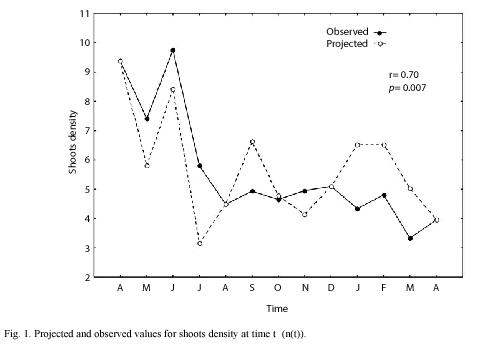
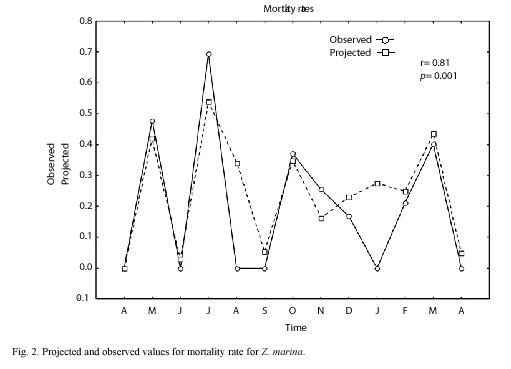
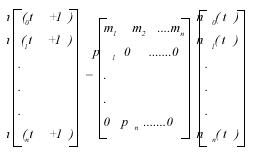
<body><![CDATA[<p><span lang="EN-US" style="font-size: 10pt; font-family: Verdana;">Now, let A be the life table matrix for our population, so A will contain information about the above statistics and will be projected in time to produce the number of individuals of age x at time t+1<i>. </i>That is, <o:p></o:p></span></p>     <p style="text-align: center;"><span class="SpellE"><span class="GramE"><i><span  lang="EN-US" style="font-size: 10pt; font-family: Verdana;">&nbsp;&nbsp;&nbsp;&nbsp;&nbsp;&nbsp;&nbsp;&nbsp;&nbsp;&nbsp;&nbsp;&nbsp;&nbsp;&nbsp;&nbsp;&nbsp;&nbsp;&nbsp;&nbsp;&nbsp;&nbsp;&nbsp;&nbsp;&nbsp;&nbsp;&nbsp;&nbsp;&nbsp;&nbsp;&nbsp;&nbsp;&nbsp;&nbsp; &nbsp; &nbsp; &nbsp; &nbsp; &nbsp; &nbsp; &nbsp; &nbsp;&nbsp; &nbsp; n</span></i><i><sub><span  lang="EN-US" style="font-size: 7.5pt; font-family: Verdana;">x</span></sub></i></span></span><i><sub><span  lang="EN-US" style="font-size: 7.5pt; font-family: Verdana;"> </span></sub></i><span lang="EN-US"  style="font-size: 10pt; font-family: Verdana;">(<i>t +1</i>) <i>= <span  class="SpellE">An<sub><span style="font-size: 7.5pt;">x</span></sub></span></i></span><i><sub><span  lang="EN-US" style="font-size: 7.5pt; font-family: Verdana;"> </span></sub></i><span lang="EN-US"  style="font-size: 10pt; font-family: Verdana;">(<i>t </i>) &nbsp; &nbsp;&nbsp; &nbsp; &nbsp; &nbsp; &nbsp; &nbsp; &nbsp; &nbsp; &nbsp; &nbsp; &nbsp; &nbsp; &nbsp; &nbsp; &nbsp; &nbsp; &nbsp; &nbsp; &nbsp; &nbsp; &nbsp; (8) <o:p></o:p></span></p>     <p><span lang="EN-US" style="font-size: 10pt; font-family: Verdana;">Or, in matrix form, we have. <o:p></o:p></span></p>     <div style="text-align: center;"><img src="/img/revistas/rbt/v56n3/art04f1.jpg" title=""  alt="" style="width: 255px; height: 155px;">    <br> </div>     <p><span lang="EN-US" style="font-size: 7.5pt; font-family: Verdana;">&nbsp;<o:p></o:p></span></p>     <p><span lang="EN-US" style="font-size: 10pt; font-family: Verdana;">Matrix A on the right side of equation (8) is known as a Leslie matrix (Caswell 2001). With information on the above equation we can obtain the projected number of individuals and with equation (6) and (7) the mean monthly mortality rates. <o:p></o:p></span></p>     <p><span lang="EN-US" style="font-size: 12pt; font-family: Verdana;"><span  style="font-weight: bold;">Results</span> <o:p></o:p></span></p>     <p><span lang="EN-US" style="font-size: 10pt; font-family: Verdana;">We sampled 820 rhizomes with a total of 4 014 shoots. The mean annual PI was 8.2 with <span class="GramE">an</span> standard error of ±0.26. Using the 1999 data, we made monthly projections and compared all projected densities, finding that projections of April and August were statistically different from the rest of the projected months (<span class="SpellE">ANOVA</span>, p=0.02). Based on these results and taking into account an assumed seasonal growth pattern for <i>Z. marina, </i>(<span class="SpellE">McRoy</span> 1970, Jacobs 1979, Solana-Arellano <i>et al</i>. 1997) we defined three seasons, winter-spring (January-April); Summer-Autumn (May-August) and Autumn-Winter (September-December). These three seasons were projected using life tables I, II and III as described in the data management section and we found a good correspondence between projected and observed values for the total number of individuals at time t (<span class="SpellE"><span class="GramE">nt</span></span>) (<a href="#f1">Fig. 1</a>). Moreover we found no statistical differences between projected and observed values for <span class="GramE">n(</span>t) (t=-0.11, p=0.92). Using this information and equation (6), we estimated the mean </span><span  class="GramE"><span lang="EN-US"  style="font-size: 10pt; font-family: Verdana;">monthly</span></span><span  lang="EN-US" style="font-size: 10pt; font-family: Verdana;"> rates of mortality and (<a href="#f2">Fig. 2</a>) shows the projected and observed rates for the sampled period. We performed a Student’s t test, and found no statistical differences between mean projected and mean observed values for mortality rate (t=0.69, p=0.5). The correlation between projected and observed rates was 0.81 (p=0.001). This along with <a href="#f2">Fig. 2</a> showed that the projections of life tables gave a reliable prediction of the aforementioned rates for </span><span  class="GramE"><i><span lang="EN-US"  style="font-size: 10pt; font-family: Verdana;">Z. marina</span></i><span  lang="EN-US" style="font-size: 10pt; font-family: Verdana;">.    <br> </span></span></p>     ]]></body>
<body><![CDATA[<div style="text-align: center;"><img src="/img/revistas/rbt/v56n3/art04i1.jpg" title=""  alt="" style="width: 478px; height: 346px;"><a name="f1"></a>    <br>     <br> <img src="/img/revistas/rbt/v56n3/art04i2.jpg" title="" alt=""  style="width: 511px; height: 369px;"><a name="f2"></a><span  lang="EN-US" style="font-size: 10pt; font-family: Verdana;">    <br> </span></div>     <div style="text-align: center;"><span lang="EN-US"  style="font-size: 10pt; font-family: Verdana;">&nbsp;<o:p></o:p></span></div>     <p><span lang="EN-US" style="font-size: 12pt; font-family: Verdana;"><span  style="font-weight: bold;">Discussion</span> <o:p></o:p></span></p>     <p><span lang="EN-US" style="font-size: 10pt; font-family: Verdana;">Competitive species regulate their population sizes through shoot recruitment (<span class="SpellE">Schmid</span> and Harper 1985). Furthermore, some authors (<span class="SpellE">Miyanishi</span> <i>et al. </i>1979, Duarte and <span class="SpellE">Kalf</span> 1987, Hutchings and <span  class="SpellE">Mogie</span> 1990) argue that sea-grasses and in general <span class="SpellE">clonal</span> plants have a vigorous vegetative growth that results in vegetative expansion of clones. This is considered density-independent mortality which is a consequence of their growth strategy and not competition for substratum. On the other </span><span class="GramE"><span lang="EN-US"  style="font-size: 10pt; font-family: Verdana;">hand</span></span><span  lang="EN-US" style="font-size: 10pt; font-family: Verdana;">, plants with an opportunistic growth strategy tend to control n<sub>x</sub>(t) through mortality</span> <span class="GramE"><span lang="EN-US"  style="font-size: 10pt; font-family: Verdana;">rate</span></span><span  lang="EN-US" style="font-size: 10pt; font-family: Verdana;"> (Lovett 1981, <span class="SpellE">Schmid</span> and Harper 1985). Therefore, the study of mortality rates in these ecosystems is very important. <o:p></o:p></span></p>     <p><span class="SpellE"><span lang="EN-US"  style="font-size: 10pt; font-family: Verdana;">Seagrass</span></span><span  lang="EN-US" style="font-size: 10pt; font-family: Verdana;"> meadows are very vulnerable to sudden climatic changes and anthropogenic perturbation (Short and <span class="SpellE">Neckless</span> 1999, <span  class="SpellE">Echavarria-Heras</span> <i>et al. </i>2006). In fact, <span class="SpellE">Olesen</span> and Sand-Jensen (1994) stated that shoot density is influenced by environmental factors and/or internal growth rhythms in <span class="SpellE">seagrasses</span>. This and the expensive and tedious marking techniques and lengthy laboratory procedures make necessary the development of rapid and non-destructive sampling techniques. The projection of a few seasonal life tables proved to be an effective tool for demographic analysis. <o:p></o:p></span></p>     <p><span lang="EN-US" style="font-size: 10pt; font-family: Verdana;">Within reasonable limits, whenever a population is ecologically stable, any sudden perturbation would induce a response allowing the population to prevail. Parameter identification and statistical <span class="SpellE">contrastation</span> of predictions </span><span class="GramE"><span lang="EN-US"  style="font-size: 10pt; font-family: Verdana;">versus</span></span><span  lang="EN-US" style="font-size: 10pt; font-family: Verdana;"> observed dynamics are basic steps of a model selection procedure. Once suitability has been found to be satisfactory, the assumptions that sustain the model are expected to be reasonably close to the phenomenological properties of the real system. Particularly a matrix population model as the one invoked in the present work is able to predict the persistence of the population after a sequence of <span  class="SpellE">adaptative</span> steps characterized by delayed responses induced by environmental perturbations. Moreover the demographic parameters are defined in such a way that their values at a given time <span class="GramE">depend</span> recursively on former values. For instance, <span class="SpellE">l<sub>x</sub> can</span> be defined as the product of p<sub>i</sub></span><span lang="EN-US"  style="font-size: 7.5pt; font-family: Verdana;"><sub> </sub></span><span lang="EN-US"  style="font-size: 10pt; font-family: Verdana;">values which stand for the probability that an individual of age <span class="SpellE">i</span> survives one period of time, for 0 &#8804; <span class="SpellE">i</span> &#8804; x – 1. Hence <span class="SpellE">lthe</span> probability that a given individual is alive at age x will take a value different from zero if and only if none of the p</span><sub><span  lang="EN-US" style="font-size: 7.5pt; font-family: Verdana;">i </span></sub><span  class="GramE"><span lang="EN-US"  style="font-size: 10pt; font-family: Verdana;">values vanishes. If at a certain time t a sudden environmental change occurs, then as long as the perturbation does not</span></span><span lang="EN-US"  style="font-size: 10pt; font-family: Verdana;"> provoke the killing of all the individuals of a given age <span class="SpellE">i</span> for 0 &#8804; <span  class="SpellE">i</span> &#8804; x – 1, then at a time t+1 there will be a prevailing number of individuals of age or stage x. That is, a sample taken in a given interval is demographically determined by the past history of the population up to that time. Hence the identification of the addressed model permitted to obtain reasonable values for the invoked demographic parameters. In other words, population stability and model suitability explain why our projection method produces consistent predictions. <o:p></o:p></span></p>     <p><span class="SpellE"><span lang="EN-US"  style="font-size: 10pt; font-family: Verdana;">Clonal</span></span><span  lang="EN-US" style="font-size: 10pt; font-family: Verdana;"> plants respond to perturbations or environmental variability by modifying the morphological arrangement of their modules (Franco 1986). Furthermore, the utilization of plant resources depends on their ability to make physiological adjustments (<span class="SpellE">Kays</span> and Harper 1974). Other authors argued that both perturbations and environmental changes determine the expansion and growth patterns of modular populations but that the degree of adjustment is a characteristic of each species. Nevertheless, the adjustments are not <span class="GramE">instantaneous,</span> in fact they depend on the different growth strategies with morphological extremes denoted by Lovett-<span class="SpellE">Doust</span> (1981) as guerilla and flange. The plasticity of the plant to adopt each of these strategies requires an amount of time. Solana-Arellano 2004 found that <i>Z. marina </i>adjusted its growth pattern from guerilla to flange and vise versa depending on the environment but this adjustment is not instantaneous. Therefore, even on sudden environmental changes the meadow will adjust after period of time. Hence the surviving individual will determine the demographic parameters; this implies that just two or three sampling visits per year on a stable population will provide a good basis for projection. On the other hand, suppose we have a projection based on data unaffected by sudden changes; assume that this has been proved to produce reasonable estimations. If a sudden non-catastrophic event occurs, then a sample taken after that event will give us estimations of the effect of such event on the meadow. This will be a crucial output for monitoring and management of the ecosystem. <o:p></o:p></span></p>     ]]></body>
<body><![CDATA[<p><span lang="EN-US" style="font-size: 10pt; font-family: Verdana;">The high correlation coefficient (0.81) between observed and projected mortality rates values through time showed that there is a good correspondence between observed ad projected rates Therefore we conclude that the contribution of a non-destructive technique for demographic analysis of a <i>Z. marina </i>population reduces number of field visits and quantity of samples and therefore the disturbances by researches to the ecosystem and is then an important practical contribution. <o:p></o:p></span></p>     <p><span lang="EN-US" style="font-size: 12pt; font-family: Verdana;"><span  style="font-weight: bold;">Acknowlegments</span> <o:p></o:p></span></p>     <p><span lang="EN-US" style="font-size: 10pt; font-family: Verdana;">This paper is part of the research on eelgrass production partially funded by CONACYT by grant 26665-B and by CICESE. We greatly acknowledge José Ma. <span class="SpellE">Domiguez</span> and Francisco Javier Ponce for the fine work in the figures. We deeply thank Stephen Bullock and Ernesto Franco for the revision of this manuscript. <o:p></o:p></span></p> <hr style="width: 100%; height: 2px;">     <p><span style="font-size: 10pt; font-family: Verdana;"><span  style="font-weight: bold;">Resumen</span> <o:p></o:p></span></p>     <p><span style="font-size: 10pt; font-family: Verdana;">El propósito principal de este estudio es el de proveer estimaciones de tasas promedio de mortalidad de tallos vegetativos de <i>Zostera marina </i>en una pradera cercana a Ensenada Baja California, utilizando una técnica que minimiza los muestreos destructivos para estos pastos marinos. Mediante la utilización de cohortes y matrices de Leslie, se construyeron tres tablas de vida, cada una representando a una estación dentro de período anual de muestreos mensuales (Abril <st1:metricconverter  productid="1999 a" w:st="on">1999 a</st1:metricconverter> Abril 2000). Las edades de los cohortes fueron estimadas en términos de Intervalos de <span  class="SpellE">Plastocrono</span> (IP). Las matrices de Leslie fueron proyectadas a través del tiempo para estimar el número total de individuos a un tiempo t, <span class="GramE">n(</span>t) así como las tasas de mortalidad. No se encontraron diferencias significativas entre los valores medios observados y proyectados para estas variables (t=0.11, p=0.92 para <span class="GramE">n(</span>t) y t=0.69, p=0.5 para la tasa media de mortalidad). Se encontraron altas correlaciones los valores observados y proyectados tanto en el número de individuos (r=0.70, p=0.007) como las tasas mensuales de mortalidad (r=0.81, p=0.001). Si a cierto tiempo <i>t </i>ocurre un cambio ambiental repentino, de tal manera que la perturbación no provoque la muerte de todos los individuos de una edad <i>i </i>para 0 &#8804; <i>i </i>&#8804; <i>x</i>-1, prevalecerá un número de individuos de edad o estadio <i>x </i>al tiempo t+1. Esta técnica no destructiva reduce el número de visitas al campo y de muestras necesarias para un análisis demográfico de <i>Z. marina </i>y por lo tanto decrece el disturbio causado al ecosistema. <o:p></o:p></span></p>     <p><b><span style="font-size: 10pt; font-family: Verdana;">Palabras clave: </span></b><span style="font-size: 10pt; font-family: Verdana;">modelos de matrices, demografía, <i>Zostera marina</i>, tasa de mortalidad.</span></p> <hr style="width: 100%; height: 2px;">     <p><span style="font-size: 10pt; font-family: Verdana;"> <o:p></o:p></span></p>     <p><span style="font-size: 10pt; font-family: Verdana;"><o:p></o:p></span></p>     <p style="text-align: center;"><span class="GramE"><span lang="EN-US"  style="font-size: 10pt; font-family: Verdana;">Received 28-VIII-2006.</span></span><span  lang="EN-US" style="font-size: 10pt; font-family: Verdana;"> <span  class="GramE">Corrected 30-VI-2008.</span> <span class="GramE">Accepted 31-VII-2008.</span> <o:p></o:p></span></p>     <p><span lang="EN-US" style="font-size: 10pt; font-family: Verdana;"><o:p></o:p></span></p>     ]]></body>
<body><![CDATA[<p><span lang="EN-US" style="font-size: 12pt; font-family: Verdana;"><span  style="font-weight: bold;">References</span> <o:p></o:p></span></p>     <!-- ref --><p><span lang="EN-US" style="font-size: 10pt; font-family: Verdana;">Caswell, H. 2001. Matrix population models: Construction, analysis and interpretation. <span class="SpellE"><span class="GramE">Sinauer</span></span><span  class="GramE"> Associates, Sunderland, <st1:place w:st="on"><st1:city  w:st="on"><span class="SpellE">Massachussetts</span></st1:city>, <st1:country-region  w:st="on">USA</st1:country-region></st1:place>.    &nbsp;&nbsp;&nbsp;&nbsp;&nbsp;&nbsp;&nbsp;&nbsp;[&#160;<a href="javascript:void(0);" onclick="javascript: window.open('/scielo.php?script=sci_nlinks&ref=1699173&pid=S0034-7744200800030000400001&lng=','','width=640,height=500,resizable=yes,scrollbars=1,menubar=yes,');">Links</a>&#160;]<!-- end-ref --></span> <o:p></o:p></span></p>     <!-- ref --><p><span lang="EN-US" style="font-size: 10pt; font-family: Verdana;">Chapman, P. 1986. <span class="GramE">Nutrient cycling in marine ecosystems.</span> J. <span class="SpellE">Limnol</span>. Soc. S. Afr. 12:22-24.    &nbsp;&nbsp;&nbsp;&nbsp;&nbsp;&nbsp;&nbsp;&nbsp;[&#160;<a href="javascript:void(0);" onclick="javascript: window.open('/scielo.php?script=sci_nlinks&ref=1699175&pid=S0034-7744200800030000400002&lng=','','width=640,height=500,resizable=yes,scrollbars=1,menubar=yes,');">Links</a>&#160;]<!-- end-ref --> <o:p></o:p></span></p>     <!-- ref --><p><span class="GramE"><span lang="EN-US"  style="font-size: 10pt; font-family: Verdana;">Cox, P.A. &amp; P.B. Tomlinson.</span></span><span lang="EN-US"  style="font-size: 10pt; font-family: Verdana;"> 1988. Pollination ecology of <span class="SpellE">seagrass</span>, <span  class="SpellE"><i>Thalassia</i></span><i> <span class="SpellE">testudinum</span> </i>(<span class="SpellE">Hydrocharitaceae</span>), in <st1:place  w:st="on">St. Croix</st1:place>. Am. J. Bot. 75: 958-965.    &nbsp;&nbsp;&nbsp;&nbsp;&nbsp;&nbsp;&nbsp;&nbsp;[&#160;<a href="javascript:void(0);" onclick="javascript: window.open('/scielo.php?script=sci_nlinks&ref=1699177&pid=S0034-7744200800030000400003&lng=','','width=640,height=500,resizable=yes,scrollbars=1,menubar=yes,');">Links</a>&#160;]<!-- end-ref --> <o:p></o:p></span></p>     <!-- ref --><p><span class="GramE"><span lang="EN-US"  style="font-size: 10pt; font-family: Verdana;">den</span></span><span  lang="EN-US" style="font-size: 10pt; font-family: Verdana;"> <span  class="SpellE">Hartog</span>, C. 1970. <span class="GramE">The <span class="SpellE">seagrasses</span> of the world.</span> North Holland Publishing Company, <st1:city w:st="on">Amsterdam</st1:city>, <st1:city w:st="on"><st1:place w:st="on">Holland</st1:place></st1:city>.    &nbsp;&nbsp;&nbsp;&nbsp;&nbsp;&nbsp;&nbsp;&nbsp;[&#160;<a href="javascript:void(0);" onclick="javascript: window.open('/scielo.php?script=sci_nlinks&ref=1699179&pid=S0034-7744200800030000400004&lng=','','width=640,height=500,resizable=yes,scrollbars=1,menubar=yes,');">Links</a>&#160;]<!-- end-ref --> <o:p></o:p></span></p>     <!-- ref --><p><span lang="PT-BR" style="font-size: 10pt; font-family: Verdana;">Duarte, <span class="SpellE">C.M.</span> &amp; J. <span class="SpellE">Kalf</span>. 1987. </span><span class="SpellE"><span class="GramE"><span  lang="EN-US" style="font-size: 10pt; font-family: Verdana;">Weigth</span></span></span><span  class="GramE"><span lang="EN-US"  style="font-size: 10pt; font-family: Verdana;">-density relationships in submerged <span class="SpellE">macrophytes</span>.</span></span><span  lang="EN-US" style="font-size: 10pt; font-family: Verdana;"> <span  class="SpellE">Oecologia</span> 72: 612-617.    &nbsp;&nbsp;&nbsp;&nbsp;&nbsp;&nbsp;&nbsp;&nbsp;[&#160;<a href="javascript:void(0);" onclick="javascript: window.open('/scielo.php?script=sci_nlinks&ref=1699181&pid=S0034-7744200800030000400005&lng=','','width=640,height=500,resizable=yes,scrollbars=1,menubar=yes,');">Links</a>&#160;]<!-- end-ref --> <o:p></o:p></span></p>     <!-- ref --><p><st1:city w:st="on"><st1:place w:st="on"><span lang="EN-US"  style="font-size: 10pt; font-family: Verdana;">Duarte</span></st1:place></st1:city><span  lang="EN-US" style="font-size: 10pt; font-family: Verdana;">, C.M. &amp; K. Sand-Jensen. 1990. <span class="SpellE">Seagrass</span> colonization: biomass development and shoot demography in <span  class="SpellE">Cymodocea</span> <span class="SpellE">nodosa</span> patches. </span><span lang="PT-BR"  style="font-size: 10pt; font-family: Verdana;">Mar. Ecol. <span  class="SpellE">Prog</span>. Ser. </span><span lang="PT-BR"  style="font-size: 10pt; font-family: Verdana;">67: 97-103.    &nbsp;&nbsp;&nbsp;&nbsp;&nbsp;&nbsp;&nbsp;&nbsp;[&#160;<a href="javascript:void(0);" onclick="javascript: window.open('/scielo.php?script=sci_nlinks&ref=1699183&pid=S0034-7744200800030000400006&lng=','','width=640,height=500,resizable=yes,scrollbars=1,menubar=yes,');">Links</a>&#160;]<!-- end-ref --> <o:p></o:p></span></p>     <!-- ref --><p><span lang="PT-BR" style="font-size: 10pt; font-family: Verdana;">Duarte, <span class="SpellE">C.M.</span>, N. <span class="SpellE">Marbà</span> &amp; N. <span class="SpellE">Agawin</span>. </span><span lang="EN-US"  style="font-size: 10pt; font-family: Verdana;">1994. Reconstruction of <span class="SpellE">seagrass</span> dynamics: age determinations and associated tools for the <span class="SpellE">seagrass</span> ecologist. Mar. Ecol. <span class="SpellE">Prog</span>. Ser. 107: 195-209.    &nbsp;&nbsp;&nbsp;&nbsp;&nbsp;&nbsp;&nbsp;&nbsp;[&#160;<a href="javascript:void(0);" onclick="javascript: window.open('/scielo.php?script=sci_nlinks&ref=1699185&pid=S0034-7744200800030000400007&lng=','','width=640,height=500,resizable=yes,scrollbars=1,menubar=yes,');">Links</a>&#160;]<!-- end-ref --> <o:p></o:p></span></p>     <!-- ref --><p><span class="SpellE"><span class="GramE"><span lang="EN-US"  style="font-size: 10pt; font-family: Verdana;">Durako</span></span></span><span  class="GramE"><span lang="EN-US"  style="font-size: 10pt; font-family: Verdana;">, M.J. &amp; M.D. <span  class="SpellE">Moffler</span>.</span></span><span lang="EN-US"  style="font-size: 10pt; font-family: Verdana;"> 1987. Factors affecting the reproductive ecology of <span  class="SpellE"><i>Thalassia</i></span><i> <span class="SpellE">testudinum</span> </i>(<span class="SpellE">Hydrocharitaceae</span>). <span class="SpellE"><span class="GramE">Aquat</span></span><span  class="GramE">.</span> Bot. 27: 79-85.    &nbsp;&nbsp;&nbsp;&nbsp;&nbsp;&nbsp;&nbsp;&nbsp;[&#160;<a href="javascript:void(0);" onclick="javascript: window.open('/scielo.php?script=sci_nlinks&ref=1699187&pid=S0034-7744200800030000400008&lng=','','width=640,height=500,resizable=yes,scrollbars=1,menubar=yes,');">Links</a>&#160;]<!-- end-ref --> <o:p></o:p></span></p>     <!-- ref --><p><span class="SpellE"><span lang="EN-US"  style="font-size: 10pt; font-family: Verdana;">Durako</span></span><span  lang="EN-US" style="font-size: 10pt; font-family: Verdana;">, M.J. 1994. <span class="SpellE">Seagrass</span> die-off in Florida Bay (USA): changes in shoot demography characteristics and population dynamics in <span  class="SpellE"><i>Thalassia</i></span><i> <span class="SpellE">testudinum</span></i>. Mar. Ecol. <span  class="SpellE">Prog</span>. Ser. 110: 59-66.    &nbsp;&nbsp;&nbsp;&nbsp;&nbsp;&nbsp;&nbsp;&nbsp;[&#160;<a href="javascript:void(0);" onclick="javascript: window.open('/scielo.php?script=sci_nlinks&ref=1699189&pid=S0034-7744200800030000400009&lng=','','width=640,height=500,resizable=yes,scrollbars=1,menubar=yes,');">Links</a>&#160;]<!-- end-ref --> <o:p></o:p></span></p>     <!-- ref --><p><span lang="EN-US" style="font-size: 10pt; font-family: Verdana;">Ebert, T.A. 1999. Plant and animal populations: methods in demography. </span><span  class="SpellE"><span style="font-size: 10pt; font-family: Verdana;">Academic</span></span><span  style="font-size: 10pt; font-family: Verdana;">, <span class="SpellE">New</span> York, <span class="SpellE">New</span> York, USA.    &nbsp;&nbsp;&nbsp;&nbsp;&nbsp;&nbsp;&nbsp;&nbsp;[&#160;<a href="javascript:void(0);" onclick="javascript: window.open('/scielo.php?script=sci_nlinks&ref=1699191&pid=S0034-7744200800030000400010&lng=','','width=640,height=500,resizable=yes,scrollbars=1,menubar=yes,');">Links</a>&#160;]<!-- end-ref --> <o:p></o:p></span></p>     <!-- ref --><p><span style="font-size: 10pt; font-family: Verdana;">Echavarría-Heras, H., E. Solana-Arellano &amp; E. <span class="SpellE">Francoviscaíno</span>. </span><span  lang="EN-US" style="font-size: 10pt; font-family: Verdana;">2006. The role of increase sea surface <span class="SpellE">temperatura</span> on eelgrass leaf dynamics: Onset of El Niño as a proxy for global climatic change in San <span class="SpellE">Quintin</span>, Bay Baja California. Bull. <span class="GramE">South.</span> <st1:state w:st="on"><st1:place  w:st="on">Calif.</st1:place></st1:state> Acad. Sci. 105: 113-127.    &nbsp;&nbsp;&nbsp;&nbsp;&nbsp;&nbsp;&nbsp;&nbsp;[&#160;<a href="javascript:void(0);" onclick="javascript: window.open('/scielo.php?script=sci_nlinks&ref=1699193&pid=S0034-7744200800030000400011&lng=','','width=640,height=500,resizable=yes,scrollbars=1,menubar=yes,');">Links</a>&#160;]<!-- end-ref --> <o:p></o:p></span></p>     <!-- ref --><p><span lang="EN-US" style="font-size: 10pt; font-family: Verdana;">Franco, M. 1986. <span class="GramE">The influence of neighbors on growth of modular organisms with an example from trees.</span> Philos. T. Roy. Soc. 313: 209-255.    &nbsp;&nbsp;&nbsp;&nbsp;&nbsp;&nbsp;&nbsp;&nbsp;[&#160;<a href="javascript:void(0);" onclick="javascript: window.open('/scielo.php?script=sci_nlinks&ref=1699195&pid=S0034-7744200800030000400012&lng=','','width=640,height=500,resizable=yes,scrollbars=1,menubar=yes,');">Links</a>&#160;]<!-- end-ref --> <o:p></o:p></span></p>     <!-- ref --><p><span class="GramE"><span lang="EN-US"  style="font-size: 10pt; font-family: Verdana;">Gallegos, M., M. Merino, N. <span class="SpellE">Marbà</span> &amp; C.M. Duarte.</span></span><span lang="EN-US"  style="font-size: 10pt; font-family: Verdana;"> 1993. Biomass and dynamics of <span class="SpellE"><i>Thalassia</i></span><i> <span  class="SpellE">testudinum</span> </i>in the Mexican Caribbean: <span class="SpellE">eludanting</span> rhizome growth. </span><span style="font-size: 10pt; font-family: Verdana;">Mar. Ecol. <span class="SpellE">Prog</span>. Ser. 95: 185-192.    &nbsp;&nbsp;&nbsp;&nbsp;&nbsp;&nbsp;&nbsp;&nbsp;[&#160;<a href="javascript:void(0);" onclick="javascript: window.open('/scielo.php?script=sci_nlinks&ref=1699197&pid=S0034-7744200800030000400013&lng=','','width=640,height=500,resizable=yes,scrollbars=1,menubar=yes,');">Links</a>&#160;]<!-- end-ref --> <o:p></o:p></span></p>     <!-- ref --><p><span style="font-size: 10pt; font-family: Verdana;">Gallegos, M. 1995. Dinámica de poblaciones y crecimiento de los pastos marinos caribeños <span  class="SpellE"><i>Thalassia</i></span><i> <span class="SpellE">testudinum</span> </i><span class="SpellE">Bank</span> ex <span class="SpellE">Köning</span>, <span class="SpellE">Syringodium</span> filiforme <span class="SpellE">Kütz</span>, y <span class="SpellE">Halodule</span> <span class="SpellE">wrightii</span> <span class="SpellE">Ascherson</span>. </span><span class="SpellE"><span  class="GramE"><span lang="EN-US"  style="font-size: 10pt; font-family: Verdana;">Tesis</span></span></span><span  class="GramE"><span lang="EN-US"  style="font-size: 10pt; font-family: Verdana;"> de <span  class="SpellE">doctorado</span>, UNAM, México.    &nbsp;&nbsp;&nbsp;&nbsp;&nbsp;&nbsp;&nbsp;&nbsp;[&#160;<a href="javascript:void(0);" onclick="javascript: window.open('/scielo.php?script=sci_nlinks&ref=1699199&pid=S0034-7744200800030000400014&lng=','','width=640,height=500,resizable=yes,scrollbars=1,menubar=yes,');">Links</a>&#160;]<!-- end-ref --></span></span><span  lang="EN-US" style="font-size: 7.5pt; font-family: Verdana;"> <o:p></o:p></span></p>     <!-- ref --><p><span class="GramE"><span lang="EN-US"  style="font-size: 10pt; font-family: Verdana;">Harper, J.L. 1994.</span></span><span  lang="EN-US" style="font-size: 10pt; font-family: Verdana;"> <span  class="GramE">The Population Biology of Plants.</span> <span  class="GramE">Academic, <st1:place w:st="on"><st1:city w:st="on">New York</st1:city>, <st1:state  w:st="on">New York</st1:state>, <st1:country-region w:st="on">USA</st1:country-region></st1:place>.    &nbsp;&nbsp;&nbsp;&nbsp;&nbsp;&nbsp;&nbsp;&nbsp;[&#160;<a href="javascript:void(0);" onclick="javascript: window.open('/scielo.php?script=sci_nlinks&ref=1699201&pid=S0034-7744200800030000400015&lng=','','width=640,height=500,resizable=yes,scrollbars=1,menubar=yes,');">Links</a>&#160;]<!-- end-ref --></span> <o:p></o:p></span></p>     <!-- ref --><p><span class="GramE"><span lang="EN-US"  style="font-size: 10pt; font-family: Verdana;">Hutchings, M.J. &amp; M. <span class="SpellE">Mogie</span>.</span></span><span lang="EN-US"  style="font-size: 10pt; font-family: Verdana;"> 1990. The <span class="SpellE">spacial</span> structure of <span  class="SpellE">clonal</span> plants: control and consequences, p 57-<st1:metricconverter  productid="76. In" w:st="on">76. <i>In</i></st1:metricconverter><i> </i>J. van <span class="SpellE">Groenendael</span> &amp; H. de <span class="SpellE">Kroon</span> (<span class="GramE">eds</span>.). <span class="SpellE">Clonal</span> growth in plants: regulation and <span  class="SpellE">funtion</span>. SPB Academic Publishing, <st1:city w:st="on">The Hague</st1:city>, <st1:city  w:st="on"><st1:place w:st="on">Holland</st1:place></st1:city>.    &nbsp;&nbsp;&nbsp;&nbsp;&nbsp;&nbsp;&nbsp;&nbsp;[&#160;<a href="javascript:void(0);" onclick="javascript: window.open('/scielo.php?script=sci_nlinks&ref=1699203&pid=S0034-7744200800030000400016&lng=','','width=640,height=500,resizable=yes,scrollbars=1,menubar=yes,');">Links</a>&#160;]<!-- end-ref --> <o:p></o:p></span></p>     <!-- ref --><p><span lang="EN-US" style="font-size: 10pt; font-family: Verdana;">Jacobs, R.P.W.M. 1979. <span class="GramE">Distribution and aspects of the production and biomass of eelgrass, <span class="SpellE"><i>Zostera</i></span><i> marina </i>L., at <st1:place w:st="on"><st1:city w:st="on"><span  class="SpellE">Roscoff</span></st1:city>, <st1:country-region  w:st="on">France</st1:country-region></st1:place>.</span> <span  class="SpellE"><span class="GramE">Aquat</span></span><span  class="GramE">.</span> Bot. 7: 151-172.    &nbsp;&nbsp;&nbsp;&nbsp;&nbsp;&nbsp;&nbsp;&nbsp;[&#160;<a href="javascript:void(0);" onclick="javascript: window.open('/scielo.php?script=sci_nlinks&ref=1699205&pid=S0034-7744200800030000400017&lng=','','width=640,height=500,resizable=yes,scrollbars=1,menubar=yes,');">Links</a>&#160;]<!-- end-ref --><!-- big --> <o:p></o:p><!-- /big --></span></p>     <!-- ref --><p><!-- big --><span class="SpellE"><span class="GramE"><span lang="EN-US"  style="font-size: 10pt; font-family: Verdana;">Kays</span></span></span><span  class="GramE"><span lang="EN-US"  style="font-size: 10pt; font-family: Verdana;">, S. &amp; J.L. Harper.</span></span><span  lang="EN-US" style="font-size: 10pt; font-family: Verdana;"> 1974. The regulation of plant tiller in grass sward. J. Ecol. 62:97-105.    &nbsp;&nbsp;&nbsp;&nbsp;&nbsp;&nbsp;&nbsp;&nbsp;[&#160;<a href="javascript:void(0);" onclick="javascript: window.open('/scielo.php?script=sci_nlinks&ref=1699207&pid=S0034-7744200800030000400018&lng=','','width=640,height=500,resizable=yes,scrollbars=1,menubar=yes,');">Links</a>&#160;]<!-- end-ref --></span><!-- /big --></p>     <!-- ref --><p><st1:place w:st="on"><st1:city w:st="on"><span class="SpellE"><span  class="GramE"><span lang="EN-US"  style="font-size: 10pt; font-family: Verdana;"><!-- big -->Kentula<!-- /big --></span></span></span></st1:city><span  class="GramE"><span lang="EN-US"  style="font-size: 10pt; font-family: Verdana;"><!-- big -->, <st1:state  w:st="on">M.E.</st1:state><!-- /big --></span></span></st1:place><span  class="GramE"><span lang="EN-US"  style="font-size: 10pt; font-family: Verdana;"><!-- big --> &amp; C.D. McIntire.<!-- /big --></span></span><span lang="EN-US"  style="font-size: 10pt; font-family: Verdana;"><!-- big --> 1986. The <span class="SpellE">autoecology</span> and production dynamics of eelgrass (<span class="SpellE"><i>Zostera</i></span><i> marina </i>L.) in <st1:place w:st="on"><st1:city w:st="on"><span class="SpellE">Netarts</span> Bay</st1:city>, <st1:state w:st="on">Oregon</st1:state></st1:place>. Estuaries 9: 188-199.    &nbsp;&nbsp;&nbsp;&nbsp;&nbsp;&nbsp;&nbsp;&nbsp;[&#160;<a href="javascript:void(0);" onclick="javascript: window.open('/scielo.php?script=sci_nlinks&ref=1699209&pid=S0034-7744200800030000400019&lng=','','width=640,height=500,resizable=yes,scrollbars=1,menubar=yes,');">Links</a>&#160;]<!-- end-ref --> <o:p></o:p><!-- /big --></span></p>     <!-- ref --><p><span class="SpellE"><span class="GramE"><span lang="EN-US"  style="font-size: 10pt; font-family: Verdana;"><!-- big -->Keyfitz<!-- /big --></span></span></span><span  class="GramE"><span lang="EN-US"  style="font-size: 10pt; font-family: Verdana;"><!-- big -->, N. 1972.<!-- /big --></span></span><span  lang="EN-US" style="font-size: 10pt; font-family: Verdana;"><!-- big --> <span  class="GramE">On future population.</span> J. <span class="SpellE">Ame</span>. Stat. Assoc. 67: 347-363.    &nbsp;&nbsp;&nbsp;&nbsp;&nbsp;&nbsp;&nbsp;&nbsp;[&#160;<a href="javascript:void(0);" onclick="javascript: window.open('/scielo.php?script=sci_nlinks&ref=1699211&pid=S0034-7744200800030000400020&lng=','','width=640,height=500,resizable=yes,scrollbars=1,menubar=yes,');">Links</a>&#160;]<!-- end-ref --> <o:p></o:p><!-- /big --></span></p>     <!-- ref --><p><span lang="EN-US" style="font-size: 10pt; font-family: Verdana;"><!-- big -->Lovett, D. 1981. Population dynamics and local specialization in a <span  class="SpellE">clonal</span> perennial (Ranunculus <span  class="SpellE">repens</span>). I. The dynamics of <span class="SpellE">ramets</span> in contrasting habitats. J. Ecol. 69: 743-755.    &nbsp;&nbsp;&nbsp;&nbsp;&nbsp;&nbsp;&nbsp;&nbsp;[&#160;<a href="javascript:void(0);" onclick="javascript: window.open('/scielo.php?script=sci_nlinks&ref=1699213&pid=S0034-7744200800030000400021&lng=','','width=640,height=500,resizable=yes,scrollbars=1,menubar=yes,');">Links</a>&#160;]<!-- end-ref --> <o:p></o:p><!-- /big --></span></p>     <!-- ref --><p><span lang="EN-US" style="font-size: 10pt; font-family: Verdana;"><!-- big -->Mann, K.H. 1982. <span class="GramE">The ecology of coastal waters.</span> <span class="GramE">A system approach.</span> <span class="GramE">Blackwell Scientific, <st1:place w:st="on"><st1:city w:st="on">Oxford</st1:city>, <st1:country-region w:st="on">England</st1:country-region></st1:place>.    &nbsp;&nbsp;&nbsp;&nbsp;&nbsp;&nbsp;&nbsp;&nbsp;[&#160;<a href="javascript:void(0);" onclick="javascript: window.open('/scielo.php?script=sci_nlinks&ref=1699215&pid=S0034-7744200800030000400022&lng=','','width=640,height=500,resizable=yes,scrollbars=1,menubar=yes,');">Links</a>&#160;]<!-- end-ref --></span> <o:p></o:p><!-- /big --></span></p>     <!-- ref --><p><span lang="EN-US" style="font-size: 10pt; font-family: Verdana;"><!-- big -->Mc Roy, C.P. 1970. <span class="GramE">Standing stocks and other features of eelgrass (<span class="SpellE"><i>Zostera</i></span><i> marina</i>) populations on the coast of <st1:state w:st="on"><st1:place w:st="on">Alaska</st1:place></st1:state>.</span> J. Fish. Res. Board <st1:country-region w:st="on"><st1:place w:st="on">Can.</st1:place></st1:country-region> l 27: 1811-1821.    &nbsp;&nbsp;&nbsp;&nbsp;&nbsp;&nbsp;&nbsp;&nbsp;[&#160;<a href="javascript:void(0);" onclick="javascript: window.open('/scielo.php?script=sci_nlinks&ref=1699217&pid=S0034-7744200800030000400023&lng=','','width=640,height=500,resizable=yes,scrollbars=1,menubar=yes,');">Links</a>&#160;]<!-- end-ref --> <o:p></o:p><!-- /big --></span></p>     <!-- ref --><p><span class="SpellE"><span class="GramE"><span lang="EN-US"  style="font-size: 10pt; font-family: Verdana;"><!-- big -->Miyanishi<!-- /big --></span></span></span><span  class="GramE"><span lang="EN-US"  style="font-size: 10pt; font-family: Verdana;"><!-- big -->, K., A.R. Hot &amp; P.B. Cavers.<!-- /big --></span></span><span lang="EN-US"  style="font-size: 10pt; font-family: Verdana;"> <st1:metricconverter productid="1979. A" w:st="on"><!-- big -->1979. A<!-- /big --></st1:metricconverter> <!-- big -->generalized law of self-thinning in plant populations (<span  class="SpellE">selfthinning</span> in plants populations). J. <span class="SpellE">Theor</span>. Biol. 78: 439-442.    &nbsp;&nbsp;&nbsp;&nbsp;&nbsp;&nbsp;&nbsp;&nbsp;[&#160;<a href="javascript:void(0);" onclick="javascript: window.open('/scielo.php?script=sci_nlinks&ref=1699219&pid=S0034-7744200800030000400024&lng=','','width=640,height=500,resizable=yes,scrollbars=1,menubar=yes,');">Links</a>&#160;]<!-- end-ref --> <o:p></o:p><!-- /big --></span></p>     <!-- ref --><p><span class="SpellE"><span lang="EN-US"  style="font-size: 10pt; font-family: Verdana;"><!-- big -->Olesen<!-- /big --></span></span><span  lang="EN-US" style="font-size: 10pt; font-family: Verdana;"><!-- big -->, B. &amp; K. Sand-Jensen. 1994. Demography of shallow eelgrass (<span class="SpellE"><i>Zostera</i></span><i> marina</i>) populations-shoot dynamics and <span class="SpellE">biomasa</span> <span class="SpellE">developtment</span>. J. Ecol. 82: 379-390.    &nbsp;&nbsp;&nbsp;&nbsp;&nbsp;&nbsp;&nbsp;&nbsp;[&#160;<a href="javascript:void(0);" onclick="javascript: window.open('/scielo.php?script=sci_nlinks&ref=1699221&pid=S0034-7744200800030000400025&lng=','','width=640,height=500,resizable=yes,scrollbars=1,menubar=yes,');">Links</a>&#160;]<!-- end-ref --> <o:p></o:p><!-- /big --></span></p>     <!-- ref --><p><span class="SpellE"><span lang="EN-US"  style="font-size: 10pt; font-family: Verdana;"><!-- big -->Patriquin<!-- /big --></span></span><span  lang="EN-US" style="font-size: 10pt; font-family: Verdana;"><!-- big -->, D.G. 1973. <span class="GramE">Estimation of growth rate, production and age of the marine angiosperm, <span class="SpellE">Thalassia</span> <span  class="SpellE">testudinum</span>, <span class="SpellE">Konig</span>.</span> <span class="SpellE"><span  class="GramE">Caribb</span></span><span class="GramE">.</span> J. Sci. 13: 111-123.    &nbsp;&nbsp;&nbsp;&nbsp;&nbsp;&nbsp;&nbsp;&nbsp;[&#160;<a href="javascript:void(0);" onclick="javascript: window.open('/scielo.php?script=sci_nlinks&ref=1699223&pid=S0034-7744200800030000400026&lng=','','width=640,height=500,resizable=yes,scrollbars=1,menubar=yes,');">Links</a>&#160;]<!-- end-ref --> <o:p></o:p><!-- /big --></span></p>     <!-- ref --><p><span class="SpellE"><span lang="EN-US"  style="font-size: 10pt; font-family: Verdana;"><!-- big -->Pergent<!-- /big --></span></span><span  lang="EN-US" style="font-size: 10pt; font-family: Verdana;"><!-- big -->, G. &amp; C. <span class="SpellE">Pergent</span>-Martini. 1990. Some applications of <span class="SpellE">lepidochronological</span> <span  class="SpellE">abalysis</span> in the <span class="SpellE">seagrass</span> <span class="SpellE">Posidonia</span> <span class="SpellE">oceanica</span>. Bot. Mar. 33: 299-310.    &nbsp;&nbsp;&nbsp;&nbsp;&nbsp;&nbsp;&nbsp;&nbsp;[&#160;<a href="javascript:void(0);" onclick="javascript: window.open('/scielo.php?script=sci_nlinks&ref=1699225&pid=S0034-7744200800030000400027&lng=','','width=640,height=500,resizable=yes,scrollbars=1,menubar=yes,');">Links</a>&#160;]<!-- end-ref --> <o:p></o:p><!-- /big --></span></p>     <!-- ref --><p><span class="SpellE"><span class="GramE"><span lang="EN-US"  style="font-size: 10pt; font-family: Verdana;"><!-- big -->Pérez<!-- /big --></span></span></span><span  class="GramE"><span lang="EN-US"  style="font-size: 10pt; font-family: Verdana;"><!-- big -->, M., C.M. Duarte, J. Romero, K. Sand-Jensen &amp; T. <span class="SpellE">Alcoverro</span>.<!-- /big --></span></span><span  lang="EN-US" style="font-size: 10pt; font-family: Verdana;"><!-- big --> 1994. Growth plasticity in <span class="SpellE"><i>Cymodocea</i></span><i> <span  class="SpellE">nodosa</span> </i>stands: the importance of nutrient supply. <span class="SpellE"><span  class="GramE">Aquat</span></span><span class="GramE">.</span> Bot. 47: 249-264.    &nbsp;&nbsp;&nbsp;&nbsp;&nbsp;&nbsp;&nbsp;&nbsp;[&#160;<a href="javascript:void(0);" onclick="javascript: window.open('/scielo.php?script=sci_nlinks&ref=1699227&pid=S0034-7744200800030000400028&lng=','','width=640,height=500,resizable=yes,scrollbars=1,menubar=yes,');">Links</a>&#160;]<!-- end-ref --> <o:p></o:p><!-- /big --></span></p>     <!-- ref --><p><span class="SpellE"><span class="GramE"><span lang="EN-US"  style="font-size: 10pt; font-family: Verdana;"><!-- big -->Schmid<!-- /big --></span></span></span><span  class="GramE"><span lang="EN-US"  style="font-size: 10pt; font-family: Verdana;"><!-- big -->, B. &amp; J.L. Harper.<!-- /big --></span></span><span lang="EN-US"  style="font-size: 10pt; font-family: Verdana;"><!-- big --> 1985. <span  class="SpellE">Clonal</span> growth in grassland perennials. I. Density and pattern-dependent competition between plans with different growth forms. J. Ecol. 73: 793-808.    &nbsp;&nbsp;&nbsp;&nbsp;&nbsp;&nbsp;&nbsp;&nbsp;[&#160;<a href="javascript:void(0);" onclick="javascript: window.open('/scielo.php?script=sci_nlinks&ref=1699229&pid=S0034-7744200800030000400029&lng=','','width=640,height=500,resizable=yes,scrollbars=1,menubar=yes,');">Links</a>&#160;]<!-- end-ref --> <o:p></o:p><!-- /big --></span></p>     <!-- ref --><p><span class="GramE"><span lang="EN-US"  style="font-size: 10pt; font-family: Verdana;"><!-- big -->Short, F.T. &amp; H.A. <span class="SpellE">Neckles</span>.<!-- /big --></span></span><span  lang="EN-US" style="font-size: 10pt; font-family: Verdana;"> <!-- big -->1999. The effects of global climate change on <span class="SpellE">seagrasses</span>. <span class="SpellE"><span class="GramE">Aquat</span></span><span  class="GramE">.</span> Bot. 63: 169-196.    &nbsp;&nbsp;&nbsp;&nbsp;&nbsp;&nbsp;&nbsp;&nbsp;[&#160;<a href="javascript:void(0);" onclick="javascript: window.open('/scielo.php?script=sci_nlinks&ref=1699231&pid=S0034-7744200800030000400030&lng=','','width=640,height=500,resizable=yes,scrollbars=1,menubar=yes,');">Links</a>&#160;]<!-- end-ref --> <o:p></o:p><!-- /big --></span></p>     <!-- ref --><p><span class="GramE"><span lang="EN-US"  style="font-size: 10pt; font-family: Verdana;"><!-- big -->Short, F.T. &amp; H.A. <span class="SpellE">Neckles</span>.<!-- /big --></span></span><span  lang="EN-US" style="font-size: 10pt; font-family: Verdana;"> <!-- big -->1999. The effects of global climate change on <span class="SpellE">seagrasses</span>. <span class="SpellE"><span class="GramE">Aquat</span></span><span  class="GramE">.</span> Bot. 63: 169-196.    &nbsp;&nbsp;&nbsp;&nbsp;&nbsp;&nbsp;&nbsp;&nbsp;[&#160;<a href="javascript:void(0);" onclick="javascript: window.open('/scielo.php?script=sci_nlinks&ref=1699233&pid=S0034-7744200800030000400031&lng=','','width=640,height=500,resizable=yes,scrollbars=1,menubar=yes,');">Links</a>&#160;]<!-- end-ref --> <o:p></o:p><!-- /big --></span></p>     <!-- ref --><p><span class="GramE"><span lang="EN-US"  style="font-size: 10pt; font-family: Verdana;"><!-- big -->Solana-Arellano, E., H. <span class="SpellE">Echavarria-Heras</span> &amp; S.E. Ibarra-<span class="SpellE">Obando</span>.<!-- /big --></span></span><span  lang="EN-US" style="font-size: 10pt; font-family: Verdana;"> <!-- big -->1997. Leaf size dynamics for <span class="SpellE"><i>Zostera</i></span><i> marina </i>L. In San <st1:place w:st="on"><st1:city w:st="on"><span  class="SpellE">Quintin</span> Bay</st1:city>, <st1:country-region  w:st="on">Mexico</st1:country-region></st1:place>: A theoretical study. <!-- /big --></span><span class="SpellE"><span  style="font-size: 10pt; font-family: Verdana;"><!-- big -->Estuar<!-- /big --></span></span><span  style="font-size: 10pt; font-family: Verdana;"><!-- big -->. Coast. <span  class="SpellE">Shelf</span>. S. 44: 351-359.    &nbsp;&nbsp;&nbsp;&nbsp;&nbsp;&nbsp;&nbsp;&nbsp;[&#160;<a href="javascript:void(0);" onclick="javascript: window.open('/scielo.php?script=sci_nlinks&ref=1699235&pid=S0034-7744200800030000400032&lng=','','width=640,height=500,resizable=yes,scrollbars=1,menubar=yes,');">Links</a>&#160;]<!-- end-ref --> <o:p></o:p><!-- /big --></span></p>     <!-- ref --><p><span style="font-size: 10pt; font-family: Verdana;"><!-- big -->Solana-Arellano, E. 2004. Métodos Analíticos para la caracterización de la dinámica foliar en <i>Zostera marina </i>L. tesis de doctorado. Universidad Autónoma Metropolitana, México D.F., México.    &nbsp;&nbsp;&nbsp;&nbsp;&nbsp;&nbsp;&nbsp;&nbsp;[&#160;<a href="javascript:void(0);" onclick="javascript: window.open('/scielo.php?script=sci_nlinks&ref=1699237&pid=S0034-7744200800030000400033&lng=','','width=640,height=500,resizable=yes,scrollbars=1,menubar=yes,');">Links</a>&#160;]<!-- end-ref --> <o:p></o:p><!-- /big --></span></p>     <!-- ref --><p><span class="SpellE"><span class="GramE"><span  style="font-size: 10pt; font-family: Verdana;"><!-- big -->Vidondo<!-- /big --></span></span></span><span  style="font-size: 10pt; font-family: Verdana;"><!-- big -->, B., <span  class="SpellE">C.M</span>. Duarte, <span class="SpellE">A.L</span>. <span  class="SpellE">Middelboe</span>, K. <span class="SpellE">Stefansen</span>, T. <span class="SpellE">Lützen</span> &amp; S.L. Nielsen. <!-- /big --></span><span lang="EN-US"  style="font-size: 10pt; font-family: Verdana;"><!-- big -->1997. Dynamics of a landscape, mosaic: size and age distributions, growth and demography of <span class="SpellE">seagrass</span> <span class="SpellE"><i>Cymodocea</i></span><i> <span class="SpellE">nodosa</span></i>. <!-- /big --></span><span style="font-size: 10pt; font-family: Verdana;"><!-- big -->Mar. Ecol. <span class="SpellE">Prog</span>. Ser. 158: 131-138.    &nbsp;&nbsp;&nbsp;&nbsp;&nbsp;&nbsp;&nbsp;&nbsp;[&#160;<a href="javascript:void(0);" onclick="javascript: window.open('/scielo.php?script=sci_nlinks&ref=1699239&pid=S0034-7744200800030000400034&lng=','','width=640,height=500,resizable=yes,scrollbars=1,menubar=yes,');">Links</a>&#160;]<!-- end-ref --> <o:p></o:p><!-- /big --></span></p> </div>      ]]></body><back>
<ref-list>
<ref id="B1">
<nlm-citation citation-type="book">
<person-group person-group-type="author">
<name>
<surname><![CDATA[Caswell]]></surname>
<given-names><![CDATA[H]]></given-names>
</name>
</person-group>
<source><![CDATA[Matrix population models: Construction, analysis and interpretation]]></source>
<year>2001</year>
<publisher-loc><![CDATA[Sunderland^eMassachussetts Massachussetts]]></publisher-loc>
<publisher-name><![CDATA[Sinauer Associates]]></publisher-name>
</nlm-citation>
</ref>
<ref id="B2">
<nlm-citation citation-type="journal">
<person-group person-group-type="author">
<name>
<surname><![CDATA[Chapman]]></surname>
<given-names><![CDATA[P]]></given-names>
</name>
</person-group>
<article-title xml:lang="en"><![CDATA[Nutrient cycling in marine ecosystems]]></article-title>
<source><![CDATA[J. Limnol. Soc. S. Afr]]></source>
<year>1986</year>
<volume>12</volume>
<page-range>22-24</page-range></nlm-citation>
</ref>
<ref id="B3">
<nlm-citation citation-type="journal">
<person-group person-group-type="author">
<name>
<surname><![CDATA[Cox]]></surname>
<given-names><![CDATA[P.A]]></given-names>
</name>
<name>
<surname><![CDATA[Tomlinson]]></surname>
<given-names><![CDATA[P.B]]></given-names>
</name>
</person-group>
<article-title xml:lang="en"><![CDATA[Pollination ecology of seagrass, Thalassia testudinum (Hydrocharitaceae), in St. Croix]]></article-title>
<source><![CDATA[Am. J. Bot]]></source>
<year>1988</year>
<volume>75</volume>
<page-range>958-965</page-range></nlm-citation>
</ref>
<ref id="B4">
<nlm-citation citation-type="book">
<person-group person-group-type="author">
<name>
<surname><![CDATA[den Hartog]]></surname>
<given-names><![CDATA[C]]></given-names>
</name>
</person-group>
<source><![CDATA[The seagrasses of the world]]></source>
<year>1970</year>
<publisher-loc><![CDATA[Amsterdam ]]></publisher-loc>
<publisher-name><![CDATA[North Holland Publishing Company]]></publisher-name>
</nlm-citation>
</ref>
<ref id="B5">
<nlm-citation citation-type="journal">
<person-group person-group-type="author">
<name>
<surname><![CDATA[Duarte]]></surname>
<given-names><![CDATA[C.M]]></given-names>
</name>
<name>
<surname><![CDATA[Kalf]]></surname>
<given-names><![CDATA[J]]></given-names>
</name>
</person-group>
<article-title xml:lang="en"><![CDATA[Weigth-density relationships in submerged macrophytes]]></article-title>
<source><![CDATA[Oecologia]]></source>
<year>1987</year>
<volume>72</volume>
<page-range>612-617</page-range></nlm-citation>
</ref>
<ref id="B6">
<nlm-citation citation-type="journal">
<person-group person-group-type="author">
<name>
<surname><![CDATA[Duarte]]></surname>
<given-names><![CDATA[C.M]]></given-names>
</name>
<name>
<surname><![CDATA[Sand-Jensen]]></surname>
<given-names><![CDATA[K]]></given-names>
</name>
</person-group>
<article-title xml:lang="en"><![CDATA[Seagrass colonization: biomass development and shoot demography in Cymodocea nodosa patches]]></article-title>
<source><![CDATA[Mar. Ecol. Prog. Ser]]></source>
<year>1990</year>
<volume>67</volume>
<page-range>97-103</page-range></nlm-citation>
</ref>
<ref id="B7">
<nlm-citation citation-type="journal">
<person-group person-group-type="author">
<name>
<surname><![CDATA[Duarte]]></surname>
<given-names><![CDATA[C.M]]></given-names>
</name>
<name>
<surname><![CDATA[Marbà]]></surname>
<given-names><![CDATA[N]]></given-names>
</name>
<name>
<surname><![CDATA[Agawin]]></surname>
<given-names><![CDATA[N]]></given-names>
</name>
</person-group>
<article-title xml:lang="en"><![CDATA[Reconstruction of seagrass dynamics: age determinations and associated tools for the seagrass ecologist]]></article-title>
<source><![CDATA[Mar. Ecol. Prog. Ser]]></source>
<year>1994</year>
<volume>107</volume>
<page-range>195-209</page-range></nlm-citation>
</ref>
<ref id="B8">
<nlm-citation citation-type="journal">
<person-group person-group-type="author">
<name>
<surname><![CDATA[Durako]]></surname>
<given-names><![CDATA[M.J]]></given-names>
</name>
<name>
<surname><![CDATA[Moffler]]></surname>
<given-names><![CDATA[M.D]]></given-names>
</name>
</person-group>
<article-title xml:lang="en"><![CDATA[Factors affecting the reproductive ecology of Thalassia testudinum (Hydrocharitaceae)]]></article-title>
<source><![CDATA[Aquat. Bot]]></source>
<year>1987</year>
<volume>27</volume>
<page-range>79-85</page-range></nlm-citation>
</ref>
<ref id="B9">
<nlm-citation citation-type="journal">
<person-group person-group-type="author">
<name>
<surname><![CDATA[Durako]]></surname>
<given-names><![CDATA[M.J]]></given-names>
</name>
</person-group>
<article-title xml:lang="en"><![CDATA[Seagrass die-off in Florida Bay (USA): changes in shoot demography characteristics and population dynamics in Thalassia testudinum.]]></article-title>
<source><![CDATA[Mar. Ecol. Prog. Ser]]></source>
<year>1994</year>
<volume>110</volume>
<page-range>59-66</page-range></nlm-citation>
</ref>
<ref id="B10">
<nlm-citation citation-type="book">
<person-group person-group-type="author">
<name>
<surname><![CDATA[Ebert]]></surname>
<given-names><![CDATA[T.A]]></given-names>
</name>
</person-group>
<source><![CDATA[Plant and animal populations: methods in demography]]></source>
<year>1999</year>
<publisher-loc><![CDATA[New York ]]></publisher-loc>
<publisher-name><![CDATA[Academic, New York]]></publisher-name>
</nlm-citation>
</ref>
<ref id="B11">
<nlm-citation citation-type="journal">
<person-group person-group-type="author">
<name>
<surname><![CDATA[Echavarría-Heras]]></surname>
<given-names><![CDATA[H]]></given-names>
</name>
<name>
<surname><![CDATA[Solana-Arellano]]></surname>
<given-names><![CDATA[E]]></given-names>
</name>
<name>
<surname><![CDATA[Francoviscaíno]]></surname>
<given-names><![CDATA[E]]></given-names>
</name>
</person-group>
<article-title xml:lang="en"><![CDATA[The role of increase sea surface temperatura on eelgrass leaf dynamics: Onset of El Niño as a proxy for global climatic change in San Quintin, Bay Baja California]]></article-title>
<source><![CDATA[Bull. South. Calif. Acad. Sci]]></source>
<year>2006</year>
<volume>105</volume>
<page-range>113-127</page-range></nlm-citation>
</ref>
<ref id="B12">
<nlm-citation citation-type="journal">
<person-group person-group-type="author">
<name>
<surname><![CDATA[Franco]]></surname>
<given-names><![CDATA[M]]></given-names>
</name>
</person-group>
<article-title xml:lang="en"><![CDATA[The influence of neighbors on growth of modular organisms with an example from trees]]></article-title>
<source><![CDATA[Philos. T. Roy. Soc]]></source>
<year>1986</year>
<volume>313</volume>
<page-range>209-255</page-range></nlm-citation>
</ref>
<ref id="B13">
<nlm-citation citation-type="journal">
<person-group person-group-type="author">
<name>
<surname><![CDATA[Gallegos]]></surname>
<given-names><![CDATA[M]]></given-names>
</name>
<name>
<surname><![CDATA[Merino]]></surname>
<given-names><![CDATA[M]]></given-names>
</name>
<name>
<surname><![CDATA[Marbà]]></surname>
<given-names><![CDATA[N]]></given-names>
</name>
<name>
<surname><![CDATA[Duarte]]></surname>
<given-names><![CDATA[C.M]]></given-names>
</name>
</person-group>
<article-title xml:lang="en"><![CDATA[Biomass and dynamics of Thalassia testudinum in the Mexican Caribbean: eludanting rhizome growth]]></article-title>
<source><![CDATA[Mar. Ecol. Prog. Ser]]></source>
<year>1993</year>
<volume>95</volume>
<page-range>185-192</page-range></nlm-citation>
</ref>
<ref id="B14">
<nlm-citation citation-type="">
<person-group person-group-type="author">
<name>
<surname><![CDATA[Gallegos]]></surname>
<given-names><![CDATA[M]]></given-names>
</name>
</person-group>
<source><![CDATA[Dinámica de poblaciones y crecimiento de los pastos marinos caribeños Thalassia testudinum Bank ex Köning, Syringodium filiforme Kütz, y Halodule wrightii Ascherson]]></source>
<year>1995</year>
</nlm-citation>
</ref>
<ref id="B15">
<nlm-citation citation-type="book">
<person-group person-group-type="author">
<name>
<surname><![CDATA[Harper]]></surname>
<given-names><![CDATA[J.L]]></given-names>
</name>
</person-group>
<source><![CDATA[The Population Biology of Plants]]></source>
<year>1994</year>
<publisher-loc><![CDATA[New York ]]></publisher-loc>
<publisher-name><![CDATA[Academic, New York]]></publisher-name>
</nlm-citation>
</ref>
<ref id="B16">
<nlm-citation citation-type="book">
<person-group person-group-type="author">
<name>
<surname><![CDATA[Hutchings]]></surname>
<given-names><![CDATA[M.J]]></given-names>
</name>
<name>
<surname><![CDATA[Mogie]]></surname>
<given-names><![CDATA[M]]></given-names>
</name>
</person-group>
<article-title xml:lang="en"><![CDATA[The spacial structure of clonal plants: control and consequences]]></article-title>
<person-group person-group-type="editor">
<name>
<surname><![CDATA[van Groenendael]]></surname>
<given-names><![CDATA[J]]></given-names>
</name>
<name>
<surname><![CDATA[de Kroon]]></surname>
<given-names><![CDATA[H]]></given-names>
</name>
</person-group>
<source><![CDATA[Clonal growth in plants: regulation and funtion]]></source>
<year>1990</year>
<page-range>57-76</page-range><publisher-loc><![CDATA[The Hague ]]></publisher-loc>
<publisher-name><![CDATA[SPB Academic Publishing]]></publisher-name>
</nlm-citation>
</ref>
<ref id="B17">
<nlm-citation citation-type="journal">
<person-group person-group-type="author">
<name>
<surname><![CDATA[Jacobs]]></surname>
<given-names><![CDATA[R.P.W.M]]></given-names>
</name>
</person-group>
<article-title xml:lang="en"><![CDATA[Distribution and aspects of the production and biomass of eelgrass, Zostera marina L., at Roscoff, France]]></article-title>
<source><![CDATA[Aquat. Bot]]></source>
<year>1979</year>
<volume>7</volume>
<page-range>151-172</page-range></nlm-citation>
</ref>
<ref id="B18">
<nlm-citation citation-type="journal">
<person-group person-group-type="author">
<name>
<surname><![CDATA[Kays]]></surname>
<given-names><![CDATA[S]]></given-names>
</name>
<name>
<surname><![CDATA[Harper]]></surname>
<given-names><![CDATA[J.L]]></given-names>
</name>
</person-group>
<article-title xml:lang="en"><![CDATA[The regulation of plant tiller in grass sward]]></article-title>
<source><![CDATA[J. Ecol]]></source>
<year>1974</year>
<volume>62</volume>
<page-range>97-105</page-range></nlm-citation>
</ref>
<ref id="B19">
<nlm-citation citation-type="journal">
<person-group person-group-type="author">
<name>
<surname><![CDATA[Kentula]]></surname>
<given-names><![CDATA[M.E]]></given-names>
</name>
<name>
<surname><![CDATA[McIntire]]></surname>
<given-names><![CDATA[C.D]]></given-names>
</name>
</person-group>
<article-title xml:lang="en"><![CDATA[The autoecology and production dynamics of eelgrass (Zostera marina L.) in Netarts Bay, Oregon]]></article-title>
<source><![CDATA[Estuaries]]></source>
<year>1986</year>
<volume>9</volume>
<page-range>188-199</page-range></nlm-citation>
</ref>
<ref id="B20">
<nlm-citation citation-type="journal">
<person-group person-group-type="author">
<name>
<surname><![CDATA[Keyfitz]]></surname>
<given-names><![CDATA[N]]></given-names>
</name>
</person-group>
<article-title xml:lang="en"><![CDATA[On future population]]></article-title>
<source><![CDATA[J. Ame. Stat. Assoc]]></source>
<year>1972</year>
<volume>67</volume>
<page-range>347-363</page-range></nlm-citation>
</ref>
<ref id="B21">
<nlm-citation citation-type="journal">
<person-group person-group-type="author">
<name>
<surname><![CDATA[Lovett]]></surname>
<given-names><![CDATA[D]]></given-names>
</name>
</person-group>
<article-title xml:lang="en"><![CDATA[Population dynamics and local specialization in a clonal perennial (Ranunculus repens). I. The dynamics of ramets in contrasting habitats]]></article-title>
<source><![CDATA[J. Ecol]]></source>
<year>1981</year>
<volume>69</volume>
<page-range>743-755</page-range></nlm-citation>
</ref>
<ref id="B22">
<nlm-citation citation-type="book">
<person-group person-group-type="author">
<name>
<surname><![CDATA[Mann]]></surname>
<given-names><![CDATA[K.H]]></given-names>
</name>
</person-group>
<source><![CDATA[The ecology of coastal waters. A system approach]]></source>
<year>1982</year>
<publisher-loc><![CDATA[Oxford ]]></publisher-loc>
<publisher-name><![CDATA[Blackwell Scientific]]></publisher-name>
</nlm-citation>
</ref>
<ref id="B23">
<nlm-citation citation-type="journal">
<person-group person-group-type="author">
<name>
<surname><![CDATA[Mc Roy]]></surname>
<given-names><![CDATA[C.P]]></given-names>
</name>
</person-group>
<article-title xml:lang="en"><![CDATA[Standing stocks and other features of eelgrass (Zostera marina) populations on the coast of Alaska]]></article-title>
<source><![CDATA[J. Fish. Res. Board Can]]></source>
<year>1970</year>
<volume>27</volume>
<page-range>1811-1821</page-range></nlm-citation>
</ref>
<ref id="B24">
<nlm-citation citation-type="journal">
<person-group person-group-type="author">
<name>
<surname><![CDATA[Miyanishi]]></surname>
<given-names><![CDATA[K]]></given-names>
</name>
<name>
<surname><![CDATA[Hot]]></surname>
<given-names><![CDATA[A.R]]></given-names>
</name>
<name>
<surname><![CDATA[Cavers]]></surname>
<given-names><![CDATA[P.B]]></given-names>
</name>
</person-group>
<article-title xml:lang="en"><![CDATA[A generalized law of self-thinning in plant populations (selfthinning in plants populations)]]></article-title>
<source><![CDATA[J. Theor. Biol]]></source>
<year>1979</year>
<volume>78</volume>
<page-range>439-442</page-range></nlm-citation>
</ref>
<ref id="B25">
<nlm-citation citation-type="journal">
<person-group person-group-type="author">
<name>
<surname><![CDATA[Olesen]]></surname>
<given-names><![CDATA[B]]></given-names>
</name>
<name>
<surname><![CDATA[Sand-Jensen]]></surname>
<given-names><![CDATA[K]]></given-names>
</name>
</person-group>
<article-title xml:lang="en"><![CDATA[Demography of shallow eelgrass (Zostera marina) populations-shoot dynamics and biomasa developtment]]></article-title>
<source><![CDATA[J. Ecol]]></source>
<year>1994</year>
<volume>82</volume>
<page-range>379-390</page-range></nlm-citation>
</ref>
<ref id="B26">
<nlm-citation citation-type="journal">
<person-group person-group-type="author">
<name>
<surname><![CDATA[Patriquin]]></surname>
<given-names><![CDATA[D.G]]></given-names>
</name>
</person-group>
<article-title xml:lang="en"><![CDATA[Estimation of growth rate, production and age of the marine angiosperm, Thalassia testudinum, Konig. Caribb]]></article-title>
<source><![CDATA[J. Sci]]></source>
<year>1973</year>
<volume>13</volume>
<page-range>111-123</page-range></nlm-citation>
</ref>
<ref id="B27">
<nlm-citation citation-type="journal">
<person-group person-group-type="author">
<name>
<surname><![CDATA[Pergent]]></surname>
<given-names><![CDATA[G]]></given-names>
</name>
<name>
<surname><![CDATA[Pergent-Martini]]></surname>
<given-names><![CDATA[C]]></given-names>
</name>
</person-group>
<article-title xml:lang="en"><![CDATA[Some applications of lepidochronological abalysis in the seagrass Posidonia oceanica]]></article-title>
<source><![CDATA[Bot. Mar]]></source>
<year>1990</year>
<volume>33</volume>
<page-range>299-310</page-range></nlm-citation>
</ref>
<ref id="B28">
<nlm-citation citation-type="journal">
<person-group person-group-type="author">
<name>
<surname><![CDATA[Pérez]]></surname>
<given-names><![CDATA[M]]></given-names>
</name>
<name>
<surname><![CDATA[Duarte]]></surname>
<given-names><![CDATA[C.M]]></given-names>
</name>
<name>
<surname><![CDATA[Romero]]></surname>
<given-names><![CDATA[J]]></given-names>
</name>
<name>
<surname><![CDATA[Sand-Jensen]]></surname>
<given-names><![CDATA[K]]></given-names>
</name>
<name>
<surname><![CDATA[Alcoverro]]></surname>
<given-names><![CDATA[T]]></given-names>
</name>
</person-group>
<article-title xml:lang="en"><![CDATA[Growth plasticity in Cymodocea nodosa stands: the importance of nutrient supply]]></article-title>
<source><![CDATA[Aquat. Bot]]></source>
<year>1994</year>
<volume>47</volume>
<page-range>249-264</page-range></nlm-citation>
</ref>
<ref id="B29">
<nlm-citation citation-type="journal">
<person-group person-group-type="author">
<name>
<surname><![CDATA[Schmid]]></surname>
<given-names><![CDATA[B]]></given-names>
</name>
<name>
<surname><![CDATA[Harper]]></surname>
<given-names><![CDATA[J.L]]></given-names>
</name>
</person-group>
<article-title xml:lang="en"><![CDATA[Clonal growth in grassland perennials. I. Density and pattern-dependent competition between plans with different growth forms]]></article-title>
<source><![CDATA[J. Ecol]]></source>
<year>1985</year>
<volume>73</volume>
<page-range>793-808</page-range></nlm-citation>
</ref>
<ref id="B30">
<nlm-citation citation-type="journal">
<person-group person-group-type="author">
<name>
<surname><![CDATA[Short]]></surname>
<given-names><![CDATA[F.T]]></given-names>
</name>
<name>
<surname><![CDATA[Neckles]]></surname>
<given-names><![CDATA[H.A]]></given-names>
</name>
</person-group>
<article-title xml:lang="en"><![CDATA[The effects of global climate change on seagrasses]]></article-title>
<source><![CDATA[Aquat. Bot]]></source>
<year>1999</year>
<volume>63</volume>
<page-range>169-196</page-range></nlm-citation>
</ref>
<ref id="B31">
<nlm-citation citation-type="journal">
<person-group person-group-type="author">
<name>
<surname><![CDATA[Short]]></surname>
<given-names><![CDATA[F.T]]></given-names>
</name>
<name>
<surname><![CDATA[Neckles]]></surname>
<given-names><![CDATA[H.A]]></given-names>
</name>
</person-group>
<article-title xml:lang="en"><![CDATA[The effects of global climate change on seagrasses]]></article-title>
<source><![CDATA[Aquat. Bot]]></source>
<year>1999</year>
<volume>63</volume>
<page-range>169-196</page-range></nlm-citation>
</ref>
<ref id="B32">
<nlm-citation citation-type="journal">
<person-group person-group-type="author">
<name>
<surname><![CDATA[Solana-Arellano]]></surname>
<given-names><![CDATA[E]]></given-names>
</name>
<name>
<surname><![CDATA[Echavarria-Heras]]></surname>
<given-names><![CDATA[H]]></given-names>
</name>
<name>
<surname><![CDATA[Ibarra-Obando]]></surname>
<given-names><![CDATA[S.E]]></given-names>
</name>
</person-group>
<article-title xml:lang="en"><![CDATA[Leaf size dynamics for Zostera marina L. In San Quintin Bay, Mexico: A theoretical study]]></article-title>
<source><![CDATA[Estuar. Coast. Shelf. S]]></source>
<year>1997</year>
<volume>44</volume>
<page-range>351-359</page-range></nlm-citation>
</ref>
<ref id="B33">
<nlm-citation citation-type="">
<person-group person-group-type="author">
<name>
<surname><![CDATA[Solana-Arellano]]></surname>
<given-names><![CDATA[E]]></given-names>
</name>
</person-group>
<source><![CDATA[Métodos Analíticos para la caracterización de la dinámica foliar en Zostera marina L.]]></source>
<year>2004</year>
</nlm-citation>
</ref>
<ref id="B34">
<nlm-citation citation-type="journal">
<person-group person-group-type="author">
<name>
<surname><![CDATA[Vidondo]]></surname>
<given-names><![CDATA[B]]></given-names>
</name>
<name>
<surname><![CDATA[Duarte]]></surname>
<given-names><![CDATA[C.M]]></given-names>
</name>
<name>
<surname><![CDATA[Middelboe]]></surname>
<given-names><![CDATA[A.L]]></given-names>
</name>
<name>
<surname><![CDATA[Stefansen]]></surname>
<given-names><![CDATA[K]]></given-names>
</name>
<name>
<surname><![CDATA[Lützen]]></surname>
<given-names><![CDATA[T]]></given-names>
</name>
<name>
<surname><![CDATA[Nielsen]]></surname>
<given-names><![CDATA[S.L]]></given-names>
</name>
</person-group>
<article-title xml:lang="es"><![CDATA[Dynamics of a landscape, mosaic: size and age distributions, growth and demography of seagrass Cymodocea nodosa]]></article-title>
<source><![CDATA[Mar. Ecol. Prog. Ser]]></source>
<year>1997</year>
<volume>158</volume>
<page-range>131-138</page-range></nlm-citation>
</ref>
</ref-list>
</back>
</article>