<?xml version="1.0" encoding="ISO-8859-1"?><article xmlns:mml="http://www.w3.org/1998/Math/MathML" xmlns:xlink="http://www.w3.org/1999/xlink" xmlns:xsi="http://www.w3.org/2001/XMLSchema-instance">
<front>
<journal-meta>
<journal-id>0034-7744</journal-id>
<journal-title><![CDATA[Revista de Biología Tropical]]></journal-title>
<abbrev-journal-title><![CDATA[Rev. biol. trop]]></abbrev-journal-title>
<issn>0034-7744</issn>
<publisher>
<publisher-name><![CDATA[Universidad de Costa Rica]]></publisher-name>
</publisher>
</journal-meta>
<article-meta>
<article-id>S0034-77442008000200011</article-id>
<title-group>
<article-title xml:lang="en"><![CDATA[Fecundity of the crustacean Mysidopsis californica (Mysida, Mysidae) under semi-controlled conditions]]></article-title>
</title-group>
<contrib-group>
<contrib contrib-type="author">
<name>
<surname><![CDATA[Ortega-Salas]]></surname>
<given-names><![CDATA[Armando A]]></given-names>
</name>
<xref ref-type="aff" rid="A01"/>
</contrib>
<contrib contrib-type="author">
<name>
<surname><![CDATA[Núñez-Pastén]]></surname>
<given-names><![CDATA[Arturo]]></given-names>
</name>
<xref ref-type="aff" rid="A01"/>
</contrib>
<contrib contrib-type="author">
<name>
<surname><![CDATA[Camacho M]]></surname>
<given-names><![CDATA[Humberto A]]></given-names>
</name>
<xref ref-type="aff" rid="A01"/>
</contrib>
</contrib-group>
<aff id="A01">
<institution><![CDATA[,Instituto de Ciencias del Mar y Limnología Unidad Académica Mazatlán ]]></institution>
<addr-line><![CDATA[Mazatlán Sinaloa]]></addr-line>
<country>México</country>
</aff>
<pub-date pub-type="pub">
<day>00</day>
<month>06</month>
<year>2008</year>
</pub-date>
<pub-date pub-type="epub">
<day>00</day>
<month>06</month>
<year>2008</year>
</pub-date>
<volume>56</volume>
<numero>2</numero>
<fpage>535</fpage>
<lpage>539</lpage>
<copyright-statement/>
<copyright-year/>
<self-uri xlink:href="http://www.scielo.sa.cr/scielo.php?script=sci_arttext&amp;pid=S0034-77442008000200011&amp;lng=en&amp;nrm=iso"></self-uri><self-uri xlink:href="http://www.scielo.sa.cr/scielo.php?script=sci_abstract&amp;pid=S0034-77442008000200011&amp;lng=en&amp;nrm=iso"></self-uri><self-uri xlink:href="http://www.scielo.sa.cr/scielo.php?script=sci_pdf&amp;pid=S0034-77442008000200011&amp;lng=en&amp;nrm=iso"></self-uri><abstract abstract-type="short" xml:lang="en"><p><![CDATA[Mysid crustaceans are frequently used in the laboratory to feed cephalopods and fish, but not along the Pacific coast, where they are scarce. There is no commercial aquaculture of mysids in the Pacific Ocean. To change this situation, we calculate fecundity, survival, and sex ratio of Mysidopsis californica under semi-controlled conditions. Mysids were collected manually using a 500 µm-mesh net along the rocky coast of Mazatlán, Sinaloa, Mexico. They were transferred to three 30 L seawater aquaria in the laboratory, and fed (ad libitum) Artemia nauplii and rotifers. Two generations were obtained. The relationship between the number of juveniles born and parent female lengths showed a rate of 1.56 juveniles released per each unit of increasing parent female length. An average parent female length of 6.92 mm (SD=0.82) gave 9.96 (SD=4.29) released juveniles. The frequency of female length showed a mean of 7.3 mm (SD=0.54), whereas that of juveniles showed a mean of 1.7 mm (SD=0.16). Survival and sex ratios (females-males) varied from 77.7 % to 88.6 % and 2.5:1 to 3.0:1, respectively. Rev. Biol. Trop. 56 (2): 535-539. Epub 2008 June 30.]]></p></abstract>
<abstract abstract-type="short" xml:lang="es"><p><![CDATA[El objetivo de este trabajo fue calcular la fecundidad, supervivencia y la proporción de sexos de Mysidopsis californica en condiciones semi-controladas. Los animales fueron recolectados manualmente utilizando una red con malla de 500 µm a lo largo de la costa rocosa de Mazatlán, Sinaloa, México. Una vez en el laboratorio fueron colocados en tres acuarios de 30 L cada uno y alimentados con nauplios de Artemia y rotíferos; estudiándose dos generaciones. La relación entre el número de jóvenes nacidos y la longitud de las madres dio una tasa de 1.56 jóvenes nacidos por cada unidad de incremento de la longitud de la hembra. En promedio, hembras de 6.92 mm (SD=0.82) producían 9.96 (SD=4.29) jóvenes. La frecuencia de la longitud promedio de la hembra fue de 7.3 mm (SD=0.54), mientras que los jóvenes medían en promedio 1.7 mm (SD=0.16). La supervivencia y la proporción de sexos (hembrasmachos) varió entre 77.7 % y 88.6 % y entre 2.5:1 y 3.0:1, respectivamente.]]></p></abstract>
<kwd-group>
<kwd lng="en"><![CDATA[Mysidopsis californica (Mysida, Mysidae)]]></kwd>
<kwd lng="en"><![CDATA[fecundity]]></kwd>
<kwd lng="en"><![CDATA[survival]]></kwd>
<kwd lng="en"><![CDATA[sex ratio]]></kwd>
<kwd lng="en"><![CDATA[Mexican Pacific Ocean]]></kwd>
<kwd lng="es"><![CDATA[Mysidopsis californica (Mysida, Mysidae)]]></kwd>
<kwd lng="es"><![CDATA[fecundidad]]></kwd>
<kwd lng="es"><![CDATA[supervivencia]]></kwd>
<kwd lng="es"><![CDATA[proporción de sexos]]></kwd>
<kwd lng="es"><![CDATA[Océano Pacifico Mexicano]]></kwd>
</kwd-group>
</article-meta>
</front><body><![CDATA[ <div style="text-align: center;"><font face="Courier New" size="4"  style="font-family: verdana;">     <p><span style="font-weight: bold;">Fecundity of the crustacean <span  style="font-style: italic;">Mysidopsis californica</span> (Mysida, Mysidae) under semi-controlled conditions</span> </p> </font></div> <font face="Courier New" size="2" style="font-family: verdana;">     <p><span style="font-weight: bold;">Armando A. Ortega-Salas, Arturo Núñez-Pastén &amp; Humberto A. Camacho M.</span> </p>     <p>Instituto de Ciencias del Mar y Limnología, Unidad Académica Mazatlán, Calzada Joel M., Camarena s/n. Playa Sur, Código postal 82040, Apdo. post: 811, Mazatlán, Sinaloa, México; <a href="mailto:ortsal@ola.icmyl.unam.mx">ortsal@ola.icmyl.unam.mx</a> </p>     <p> </p> </font> <hr style="width: 100%; height: 2px;"><font face="Courier New" size="2"  style="font-family: verdana;">     <p><span style="font-weight: bold;">Abstract:</span> Mysid crustaceans are frequently used in the laboratory to feed cephalopods and fish, but not along the Pacific coast, where they are scarce. There is no commercial aquaculture of mysids in the Pacific Ocean. To change this situation, we calculate fecundity, survival, and sex ratio of <span style="font-style: italic;">Mysidopsis californica</span> under semi-controlled conditions. Mysids were collected manually using a 500 µm-mesh net along the rocky coast of Mazatlán, Sinaloa, Mexico. They were transferred to three 30 L seawater aquaria in the laboratory, and fed (ad libitum) Artemia nauplii and rotifers. Two generations were obtained. The relationship between the number of juveniles born and parent female lengths showed a rate of 1.56 juveniles released per each unit of increasing parent female length. An average parent female length of 6.92 mm (SD=0.82) gave 9.96 (SD=4.29) released juveniles. The frequency of female length showed a mean of 7.3 mm (SD=0.54), whereas that of juveniles showed a mean of 1.7 mm (SD=0.16). Survival and sex ratios (females-males) varied from 77.7 % to 88.6 % and 2.5:1 to 3.0:1, respectively. Rev. Biol. Trop. 56 (2): 535-539. Epub 2008 June 30. </p>     <p><span style="font-weight: bold;">Key words:</span> <span  style="font-style: italic;">Mysidopsis californica</span> (Mysida, Mysidae), fecundity, survival, sex ratio, Mexican Pacific Ocean.</p> </font> <hr style="width: 100%; height: 2px;"><font face="Courier New" size="2"  style="font-family: verdana;">     <p> </p>     <p>A distinguishing characteristic of mysids is their broad pouch or ventral marsupium in mature females, where the embryos develop directly into juveniles, possessing many adult characters. Wortham-Neal and Price (2001) studied the marsupial developmental stages in <span  style="font-style: italic;">Americamysis bahia</span> (Mysida: Mysidae and Lophogastridae). Most shallow waters mysids measure between 2 and 30 mm in length, but some bathypelagic species such as <span  style="font-style: italic;">Gnathophausia</span>, grow up to 35 cm. Most mysids are omnivorous. </p>     <p>In the natural environment, mysids often congregate in large groups and constitute the diet of many large marine organisms (Ruppert and Barnes 1996). Hence, mysids are frequently used in the laboratory to feed juveniles of cephalopods (Clarke <span style="font-style: italic;">et al</span>. 1989, Hanlon <span style="font-style: italic;">et al</span>. 1991, Dominguez <span style="font-style: italic;">et al</span>. 2004) as well as fish (Woods 2005, Foster <span style="font-style: italic;">et al</span>. 2001, Reicher 2003). </p>     ]]></body>
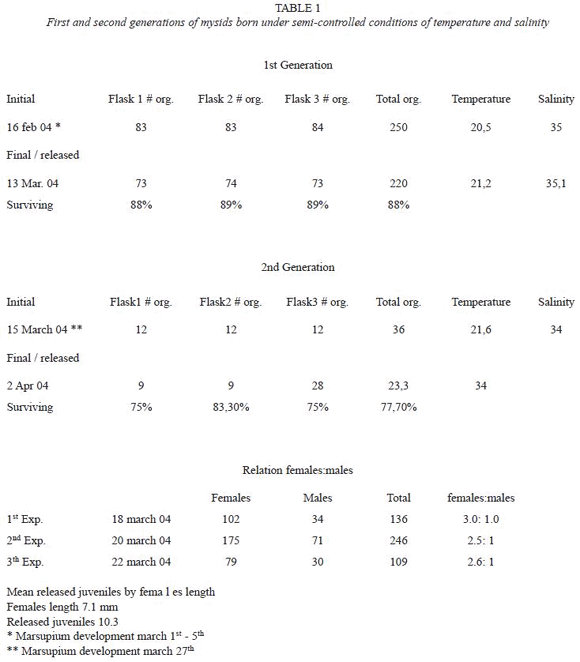
<body><![CDATA[<p>Mysids along the Pacific coast are scarce and as a consequence are rarely used as a food source in the laboratory. There is no commercial aquaculture of mysids in the Pacific Ocean. Therefore the purpose of this study is to estimate fecundity, frequency of reproduction, survival, and sex ratio of <span style="font-style: italic;">Mysidopsis californica </span>under semi-controlled conditions, these results may help in planning mass culture of mysids for feeding some laboratory raised and maintained marine specimens. </p> <font size="3">     <p><span style="font-weight: bold;">Materials and methods</span> </p> </font>     <p>Mysids were collected manually using a 500 µm-mesh net in the Mazatlán Bay along the rocky coast of Mazatlán, Sinaloa (Mexico) on February 10, 2003 and January 15, 2004. They were transferred to three 30 L seawater aquaria in the laboratory, and fed (<span  style="font-style: italic;">ad libitum</span>) <span  style="font-style: italic;">Artemia</span> nauplii and rotifers. From these, 406 brooding females were selected and placed individually in 150 ml plastic containers and fed <span style="font-style: italic;">Artemia</span> nauplii. The juveniles of each female were counted and measured as they dropped from the marsupia of females. From January 15th sampling, 250 juveniles were settled in three 2 L flasks. Two generations were obtained to register the time of marsupium development and release of juveniles; from the second generation 36 juveniles were settled likewise to obtain the same parameters. Released juveniles by females were counted. Survival was also calculated. The adult`s sex ratio of reproductively active mysids was also calculated in three occasions in January 15th 2004 sampling settled in the 30 L aquaria. </p> <font size="3">     <p><span style="font-weight: bold;">Results</span> </p> </font>     <p><a href="#t1">Table 1</a> shows that from 250 juveniles settled in three 2 L flasks on 16th february, a mature marsupium appeared between March 1 to 5 (13-17 days), then they released the brood 6-7 days later (March 13) of the first generation, the parents showed a survival rate of 88 %, at a range temperature between 20.5 and 21.2º C, and salinity of 35 o/oo. From these, 36 juveniles of the second generation were moved to other three 2 L flasks on 15th March. In these juveniles a mature marsupium appeared in about 12 days (March 27), then they released the brood in about six days (April 2), the parents showed a survival rate of 77.7 %, at a temperature range of 21.6 to 23.3ºC, and salinity of 34 o/oo. An average female length of 6.96 mm (SD=0.82) released 9.96 (SD=4.29) juveniles. The females-males ratio varied from 2.5:1 to 3.0:1. They were fed with <span style="font-style: italic;">Artemia</span> nauplii and rotifers (<span style="font-style: italic;">ad libitum</span>).    <br> </p>     <p>    <br> <a name="t1"></a></p> </font>     <div style="text-align: center;"><img  src="/img/revistas/rbt/v56n2/art11t1.gif" title="" alt=""  style="width: 580px; height: 662px;">    <br> </div> <font face="Courier New" size="2" style="font-family: verdana;"> </font><font face="Courier New" size="2" style="font-family: verdana;">     ]]></body>
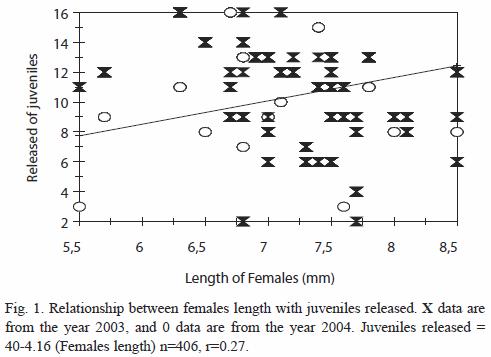
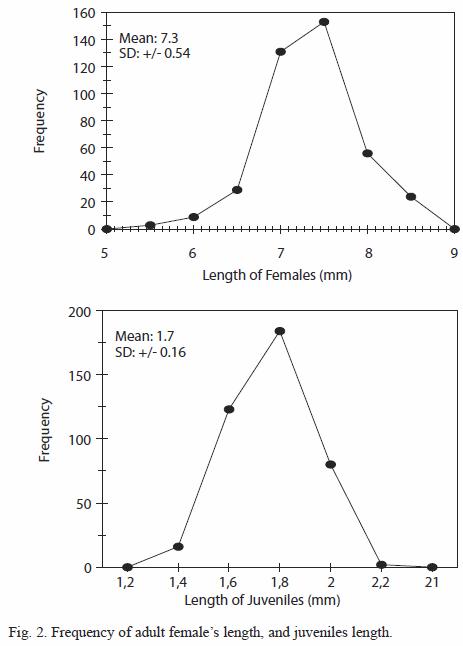
<body><![CDATA[<p><a href="#f1">Fig. 1</a> depicts the relationship between the number of released juveniles and the maternal lengths, revealing a low correlation (r=0.27, p=0.1969), which is not significant. Although relationship shows that 1.56 juveniles are released per unit of length increase. Four hundred and six female parents yielded a mean length of 7.1 mm (SD=0.54) and a mean juveniles release of 10.3 (SD=3.15). <a  href="#f2">Fig. 2</a> depicts the length frequency histogram of females and juveniles revealing a mean of 7.3 mm (SD=0.54) and a mean of 1.7 mm (SD=0.16), respectively.    <br> </p>     <p>    <br> <a name="f1"></a></p> </font>     <div style="text-align: center;"><img  src="/img/revistas/rbt/v56n2/art11i1.jpg" title="" alt=""  style="width: 491px; height: 357px;">    <br> </div> <font face="Courier New" size="2" style="font-family: verdana;"> </font><font face="Courier New" size="2" style="font-family: verdana;">     <p>    <br> <a name="f2"></a></p> </font>     <div style="text-align: center;"><img  src="/img/revistas/rbt/v56n2/art11i2.jpg" title="" alt=""  style="width: 463px; height: 646px;">    <br> </div> <font face="Courier New" size="2" style="font-family: verdana;"> </font><font face="Courier New" size="2" style="font-family: verdana;">     ]]></body>
<body><![CDATA[<p>The information obtained from this study may be helpful in planning mass cultures of mysids for feeding some laboratory raised and maintained marine specimens. </p> <font size="3">     <p><span style="font-weight: bold;">Discussion</span> </p> </font>     <p><font><font face="Courier New" size="2" style="font-family: verdana;">Wittmann (1984) found that temperature is </font></font><font><font  face="Courier New" size="2" style="font-family: verdana;">an </font></font><font><font  face="Courier New" size="2" style="font-family: verdana;">important environmental factor for marsupi</font></font><font><font  face="Courier New" size="2" style="font-family: verdana;">al development. Many species of mysids have </font></font>an incubation period between eight and 180 <font><font face="Courier New" size="2"  style="font-family: verdana;">days at temperatures between 3 °C and 23 °C, </font></font>respectively. In this study the temperature varied from 20.5 to 23.3 °C. In Mazatlán Bay the marsupium developed well, but at higher temperatures is difficult to find <span style="font-style: italic;">M. californica</span>. </p> </font><font face="Courier New" size="2" style="font-family: verdana;">     <p>The number of embryos among differ ent species varies: <span style="font-style: italic;">Bowmaniella floridiana</span> yielded between 2 and 55 embryos per each mature female, <span style="font-style: italic;">Eucopia unguiculata</span> (<span style="font-style: italic;">E. hanseni</span>) between 8 and 23 embryos (Casanova 1977), and Metamysidopsis swifti between 3 and 42 embryos (Clutter 1967). Mauchline (1973a, 1973b) found that brooding females of Pranus inermis of 13 and 15 mm length produce between 7 and 32 embryos, respectively. The same author (1973b) found also that, in 133 mysids species, the female length varied between 1.8 and 145 mm, the number of brood was between 1 and 245 and the eggs diameter was between 0.2 and 4 mm. This study shows that females between 5.5 to 8.5 mm produced between 2 to 16 juveniles; an average female length of 7 mm produced an average brood of 10 juveniles. </p>     <p>Mauchline (1973a) and Wittmann (1981) calculated a mortality rate of 10 % during development of embryos in the wild due to premature expulsion from the marsupium. The mortality rate included cannibalism and the effect of parasite isopods. The present study revealed a mortality rate between 12 and 23 %, at temperatures between 20.5 and 23.3 °C, respectively. </p>     <p>The results of this study provide data that can be useful for aquaculture of this mysid species as a food source for fish larvae and crustaceans kept in the laboratory. Regarding culture of <span  style="font-style: italic;">M. californica</span>, it is important to have enough live Artemia as food, temperatures around 20 ±2 °C, to clean the daily debris, and to provide adequate aeration. </p>     <p> </p> <font size="3">     <p><span style="font-weight: bold;">Acknowledgments</span> </p> </font>     <p>We thank S. Rendón R. and C. Ramírez J. for their technical assistance. </p> </font> <hr style="width: 100%; height: 2px;"><font face="Courier New" size="2"  style="font-family: verdana;">     <p><span style="font-weight: bold;">Resumen</span> </p>     ]]></body>
<body><![CDATA[<p>El objetivo de este trabajo fue calcular la fecundidad, supervivencia y la proporción de sexos de <span  style="font-style: italic;">Mysidopsis californica</span> en condiciones semi-controladas. Los animales fueron recolectados manualmente utilizando una red con malla de 500 µm a lo largo de la costa rocosa de Mazatlán, Sinaloa, México. Una vez en el laboratorio fueron colocados en tres acuarios de 30 L cada uno y alimentados con nauplios de Artemia y rotíferos; estudiándose dos generaciones. La relación entre el número de jóvenes nacidos y la longitud de las madres dio una tasa de 1.56 jóvenes nacidos por cada unidad de incremento de la longitud de la hembra. En promedio, hembras de 6.92 mm (SD=0.82) producían 9.96 (SD=4.29) jóvenes. La frecuencia de la longitud promedio de la hembra fue de 7.3 mm (SD=0.54), mientras que los jóvenes medían en promedio 1.7 mm (SD=0.16). La supervivencia y la proporción de sexos (hembrasmachos) varió entre 77.7 % y 88.6 % y entre 2.5:1 y 3.0:1, respectivamente. </p>     <p><span style="font-weight: bold;">Palabras clave:</span> <span  style="font-style: italic;">Mysidopsis californica</span> (Mysida, Mysidae), fecundidad, supervivencia, proporción de sexos, Océano Pacifico Mexicano.    <br> </p> </font> <hr style="width: 100%; height: 2px;"><font face="Courier New" size="2"  style="font-family: verdana;">     <p></p> </font>     <div style="text-align: center;"><font><font face="Courier New" size="2"  style="font-family: verdana;">Received 19-III-2007. Corrected 20-XI-2007. Accepted 28-IV-2008.</font></font></div> <font face="Courier New" size="2" style="font-family: verdana;">     <p> </p> <font size="3">     <p><span style="font-weight: bold;">References</span> </p> </font>     <!-- ref --><p>Casanova, J.P. 1977. La faune pelagique profonde (zooplancton et micronecton) de la province Atlanta-Mediterranéenne. Aspects taxonomique, biologique et zoogeographique. Doctoral dissertation, degree in Natural Sciences, Université de Provence, Marseille, France. &nbsp;&nbsp;&nbsp;&nbsp;&nbsp;&nbsp;&nbsp;&nbsp;[&#160;<a href="javascript:void(0);" onclick="javascript: window.open('/scielo.php?script=sci_nlinks&ref=1251135&pid=S0034-7744200800020001100001&lng=','','width=640,height=500,resizable=yes,scrollbars=1,menubar=yes,');">Links</a>&#160;]<!-- end-ref --><!-- ref --><p>Clutter, R.I. 1967. Zonation of near shore mysids. Ecology 48: 200-208. &nbsp;&nbsp;&nbsp;&nbsp;&nbsp;&nbsp;&nbsp;&nbsp;[&#160;<a href="javascript:void(0);" onclick="javascript: window.open('/scielo.php?script=sci_nlinks&ref=1251136&pid=S0034-7744200800020001100002&lng=','','width=640,height=500,resizable=yes,scrollbars=1,menubar=yes,');">Links</a>&#160;]<!-- end-ref --><!-- ref --><p>Domingues, P., A. Sykes, A. Sommerfield, E. Almansa, A. Lorenzo &amp; J.P. Andrade. 2004. Growth and survival of cuttlefish (<span  style="font-style: italic;">Sepia officinalis</span>) of different ages fed crustaceans and fish. Effects of frozen and live prey. Aquaculture 229: 239-254. &nbsp;&nbsp;&nbsp;&nbsp;&nbsp;&nbsp;&nbsp;&nbsp;[&#160;<a href="javascript:void(0);" onclick="javascript: window.open('/scielo.php?script=sci_nlinks&ref=1251137&pid=S0034-7744200800020001100003&lng=','','width=640,height=500,resizable=yes,scrollbars=1,menubar=yes,');">Links</a>&#160;]<!-- end-ref --><!-- ref --><p>Foster, E.G., D.A. Ritz, J.E. Osborn &amp; K.M. Swading. 2001. Schooling affects the feeding success of Australian salmon <span  style="font-style: italic;">Arripis trutta</span> when preying on mysid swarms <span style="font-style: italic;">Paramesopodopsis rufa</span>. J. Exper. Mar. Biol. Ecol. 261: 93-106. &nbsp;&nbsp;&nbsp;&nbsp;&nbsp;&nbsp;&nbsp;&nbsp;[&#160;<a href="javascript:void(0);" onclick="javascript: window.open('/scielo.php?script=sci_nlinks&ref=1251138&pid=S0034-7744200800020001100004&lng=','','width=640,height=500,resizable=yes,scrollbars=1,menubar=yes,');">Links</a>&#160;]<!-- end-ref --><!-- ref --><p>Hanlon, R.T., P.E. Turk &amp; P.G. Lee. 1991. Squid and cuttlefish mariculture: an update perspective. J. Cephal. Biol. 2: 31-40. &nbsp;&nbsp;&nbsp;&nbsp;&nbsp;&nbsp;&nbsp;&nbsp;[&#160;<a href="javascript:void(0);" onclick="javascript: window.open('/scielo.php?script=sci_nlinks&ref=1251139&pid=S0034-7744200800020001100005&lng=','','width=640,height=500,resizable=yes,scrollbars=1,menubar=yes,');">Links</a>&#160;]<!-- end-ref --><!-- ref --><p>Mauchline, J. 1973a. The broods of British Mysidacea (Crustacea). J. Mar. Biol. Assoc. U. K. 53: 801-817. &nbsp;&nbsp;&nbsp;&nbsp;&nbsp;&nbsp;&nbsp;&nbsp;[&#160;<a href="javascript:void(0);" onclick="javascript: window.open('/scielo.php?script=sci_nlinks&ref=1251140&pid=S0034-7744200800020001100006&lng=','','width=640,height=500,resizable=yes,scrollbars=1,menubar=yes,');">Links</a>&#160;]<!-- end-ref --><!-- ref --><p>Mauchline, J. 1973b. The broods of British Mysidacea (Crustacea). J. Mar. Biol. Assoc. U. K. 53: 569-572. &nbsp;&nbsp;&nbsp;&nbsp;&nbsp;&nbsp;&nbsp;&nbsp;[&#160;<a href="javascript:void(0);" onclick="javascript: window.open('/scielo.php?script=sci_nlinks&ref=1251141&pid=S0034-7744200800020001100007&lng=','','width=640,height=500,resizable=yes,scrollbars=1,menubar=yes,');">Links</a>&#160;]<!-- end-ref --><!-- ref --><p>Reichert, M.J.M. 2003. Diet, consumption, and growth of juvenile fringed flounder (<span style="font-style: italic;">Etropus crossotus</span>): a test of the ‘maximum growth/optimum food hypotheses in a subtropical nursery area. J. Sea Res. 50: 97-116. &nbsp;&nbsp;&nbsp;&nbsp;&nbsp;&nbsp;&nbsp;&nbsp;[&#160;<a href="javascript:void(0);" onclick="javascript: window.open('/scielo.php?script=sci_nlinks&ref=1251142&pid=S0034-7744200800020001100008&lng=','','width=640,height=500,resizable=yes,scrollbars=1,menubar=yes,');">Links</a>&#160;]<!-- end-ref --><!-- ref --><p>Ruppert, E &amp; R. Barnes. 1996. Zoología de los Invertebrados. McGraw-Hill Interamericana, México D.F., México. &nbsp;&nbsp;&nbsp;&nbsp;&nbsp;&nbsp;&nbsp;&nbsp;[&#160;<a href="javascript:void(0);" onclick="javascript: window.open('/scielo.php?script=sci_nlinks&ref=1251143&pid=S0034-7744200800020001100009&lng=','','width=640,height=500,resizable=yes,scrollbars=1,menubar=yes,');">Links</a>&#160;]<!-- end-ref --><!-- ref --><p>Wittmann, K.J. 1981. On the breeding biology and physiology of marsupial development in Mediterranean Leptomysis (Mysidacea: Crustacea) with special reference to the effects of temperature and egg size. J. Exper. Mar. Biol. Ecol. 53: 261–279. &nbsp;&nbsp;&nbsp;&nbsp;&nbsp;&nbsp;&nbsp;&nbsp;[&#160;<a href="javascript:void(0);" onclick="javascript: window.open('/scielo.php?script=sci_nlinks&ref=1251144&pid=S0034-7744200800020001100010&lng=','','width=640,height=500,resizable=yes,scrollbars=1,menubar=yes,');">Links</a>&#160;]<!-- end-ref --><!-- ref --><p>Wittmann, K.J. 1984. Ecophysiology of marsupial development and reproduction in Mysidacea (Crustacea). Ocean. Mar. Biol. Ann. Rev. 22: 393-428. &nbsp;&nbsp;&nbsp;&nbsp;&nbsp;&nbsp;&nbsp;&nbsp;[&#160;<a href="javascript:void(0);" onclick="javascript: window.open('/scielo.php?script=sci_nlinks&ref=1251145&pid=S0034-7744200800020001100011&lng=','','width=640,height=500,resizable=yes,scrollbars=1,menubar=yes,');">Links</a>&#160;]<!-- end-ref --><!-- ref --><p>Woods, C.M.C. 2005. Growth of cultured seahorses (<span  style="font-style: italic;">Hippocampus abdominalis</span>) in relation to feed ration. Aquacult. Internat. 13: 305–314. &nbsp;&nbsp;&nbsp;&nbsp;&nbsp;&nbsp;&nbsp;&nbsp;[&#160;<a href="javascript:void(0);" onclick="javascript: window.open('/scielo.php?script=sci_nlinks&ref=1251146&pid=S0034-7744200800020001100012&lng=','','width=640,height=500,resizable=yes,scrollbars=1,menubar=yes,');">Links</a>&#160;]<!-- end-ref --><!-- ref --><p>Wortham-Neal, J.L. &amp; W.W. Price. 2001. Marsupial developmental stages in <span style="font-style: italic;">Americamysis bahia</span> (Mysida: Mysidae). J. Crust. Biol. 22: 98-112. &nbsp;&nbsp;&nbsp;&nbsp;&nbsp;&nbsp;&nbsp;&nbsp;[&#160;<a href="javascript:void(0);" onclick="javascript: window.open('/scielo.php?script=sci_nlinks&ref=1251147&pid=S0034-7744200800020001100013&lng=','','width=640,height=500,resizable=yes,scrollbars=1,menubar=yes,');">Links</a>&#160;]<!-- end-ref --><p> </p>     <p>&nbsp;</p>     <p>&nbsp;</p> </font>      ]]></body><back>
<ref-list>
<ref id="B1">
<nlm-citation citation-type="">
<person-group person-group-type="author">
<name>
<surname><![CDATA[Casanova]]></surname>
<given-names><![CDATA[J.P]]></given-names>
</name>
</person-group>
<source><![CDATA[La faune pelagique profonde (zooplancton et micronecton) de la province Atlanta-Mediterranéenne: Aspects taxonomique, biologique et zoogeographique]]></source>
<year>1977</year>
</nlm-citation>
</ref>
<ref id="B2">
<nlm-citation citation-type="journal">
<person-group person-group-type="author">
<name>
<surname><![CDATA[Clutter]]></surname>
<given-names><![CDATA[R.I]]></given-names>
</name>
</person-group>
<article-title xml:lang="en"><![CDATA[Zonation of near shore mysids]]></article-title>
<source><![CDATA[Ecology]]></source>
<year>1967</year>
<volume>48</volume>
<page-range>200-208</page-range></nlm-citation>
</ref>
<ref id="B3">
<nlm-citation citation-type="journal">
<person-group person-group-type="author">
<name>
<surname><![CDATA[Domingues]]></surname>
<given-names><![CDATA[P]]></given-names>
</name>
<name>
<surname><![CDATA[Sykes]]></surname>
<given-names><![CDATA[A]]></given-names>
</name>
<name>
<surname><![CDATA[Sommerfield]]></surname>
<given-names><![CDATA[A]]></given-names>
</name>
<name>
<surname><![CDATA[Almansa]]></surname>
<given-names><![CDATA[E]]></given-names>
</name>
<name>
<surname><![CDATA[Lorenzo]]></surname>
<given-names><![CDATA[A]]></given-names>
</name>
<name>
<surname><![CDATA[Andrade]]></surname>
<given-names><![CDATA[J.P]]></given-names>
</name>
</person-group>
<article-title xml:lang="en"><![CDATA[Growth and survival of cuttlefish (Sepia officinalis) of different ages fed crustaceans and fish: Effects of frozen and live prey]]></article-title>
<source><![CDATA[Aquaculture]]></source>
<year>2004</year>
<volume>229</volume>
<page-range>239-254</page-range></nlm-citation>
</ref>
<ref id="B4">
<nlm-citation citation-type="journal">
<person-group person-group-type="author">
<name>
<surname><![CDATA[Foster]]></surname>
<given-names><![CDATA[E.G]]></given-names>
</name>
<name>
<surname><![CDATA[Ritz]]></surname>
<given-names><![CDATA[D.A]]></given-names>
</name>
<name>
<surname><![CDATA[Osborn]]></surname>
<given-names><![CDATA[J.E]]></given-names>
</name>
<name>
<surname><![CDATA[Swading]]></surname>
<given-names><![CDATA[K.M]]></given-names>
</name>
</person-group>
<article-title xml:lang="en"><![CDATA[Schooling affects the feeding success of Australian salmon Arripis trutta when preying on mysid swarms Paramesopodopsis rufa]]></article-title>
<source><![CDATA[J. Exper. Mar. Biol. Ecol]]></source>
<year>2001</year>
<volume>261</volume>
<page-range>93-106</page-range></nlm-citation>
</ref>
<ref id="B5">
<nlm-citation citation-type="journal">
<person-group person-group-type="author">
<name>
<surname><![CDATA[Hanlon]]></surname>
<given-names><![CDATA[R.T]]></given-names>
</name>
<name>
<surname><![CDATA[Turk]]></surname>
<given-names><![CDATA[P.E]]></given-names>
</name>
<name>
<surname><![CDATA[Lee]]></surname>
<given-names><![CDATA[P.G]]></given-names>
</name>
</person-group>
<article-title xml:lang="en"><![CDATA[Squid and cuttlefish mariculture: an update perspective]]></article-title>
<source><![CDATA[J. Cephal. Biol]]></source>
<year>1991</year>
<volume>2</volume>
<page-range>31-40</page-range></nlm-citation>
</ref>
<ref id="B6">
<nlm-citation citation-type="journal">
<person-group person-group-type="author">
<name>
<surname><![CDATA[Mauchline]]></surname>
<given-names><![CDATA[J]]></given-names>
</name>
</person-group>
<article-title xml:lang="en"><![CDATA[The broods of British Mysidacea (Crustacea)]]></article-title>
<source><![CDATA[J. Mar. Biol. Assoc. U. K]]></source>
<year>1973</year>
<volume>53</volume>
<page-range>801-817</page-range></nlm-citation>
</ref>
<ref id="B7">
<nlm-citation citation-type="journal">
<person-group person-group-type="author">
<name>
<surname><![CDATA[Mauchline]]></surname>
<given-names><![CDATA[J]]></given-names>
</name>
</person-group>
<article-title xml:lang="en"><![CDATA[The broods of British Mysidacea (Crustacea)]]></article-title>
<source><![CDATA[J. Mar. Biol. Assoc. U. K]]></source>
<year>1973</year>
<volume>53</volume>
<page-range>569-572</page-range></nlm-citation>
</ref>
<ref id="B8">
<nlm-citation citation-type="journal">
<person-group person-group-type="author">
<name>
<surname><![CDATA[Reichert]]></surname>
<given-names><![CDATA[M.J.M]]></given-names>
</name>
</person-group>
<article-title xml:lang="en"><![CDATA[Diet, consumption, and growth of juvenile fringed flounder (Etropus crossotus): a test of the ‘maximum growth/optimum food hypotheses in a subtropical nursery area]]></article-title>
<source><![CDATA[J. Sea Res]]></source>
<year>2003</year>
<volume>50</volume>
<page-range>97-116</page-range></nlm-citation>
</ref>
<ref id="B9">
<nlm-citation citation-type="book">
<person-group person-group-type="author">
<name>
<surname><![CDATA[Ruppert]]></surname>
<given-names><![CDATA[E]]></given-names>
</name>
<name>
<surname><![CDATA[Barnes]]></surname>
<given-names><![CDATA[R]]></given-names>
</name>
</person-group>
<source><![CDATA[Zoología de los Invertebrados]]></source>
<year>1996</year>
<publisher-loc><![CDATA[^eMéxico D.F México D.F]]></publisher-loc>
<publisher-name><![CDATA[McGraw-Hill Interamericana]]></publisher-name>
</nlm-citation>
</ref>
<ref id="B10">
<nlm-citation citation-type="journal">
<person-group person-group-type="author">
<name>
<surname><![CDATA[Wittmann]]></surname>
<given-names><![CDATA[K.J]]></given-names>
</name>
</person-group>
<article-title xml:lang="en"><![CDATA[On the breeding biology and physiology of marsupial development in Mediterranean Leptomysis (Mysidacea: Crustacea) with special reference to the effects of temperature and egg size]]></article-title>
<source><![CDATA[J. Exper. Mar. Biol. Ecol]]></source>
<year>1981</year>
<volume>53</volume>
<page-range>261-279</page-range></nlm-citation>
</ref>
<ref id="B11">
<nlm-citation citation-type="journal">
<person-group person-group-type="author">
<name>
<surname><![CDATA[Wittmann]]></surname>
<given-names><![CDATA[K.J]]></given-names>
</name>
</person-group>
<article-title xml:lang="en"><![CDATA[Ecophysiology of marsupial development and reproduction in Mysidacea (Crustacea)]]></article-title>
<source><![CDATA[Ocean. Mar. Biol. Ann. Rev]]></source>
<year>1984</year>
<volume>22</volume>
<page-range>393-428</page-range></nlm-citation>
</ref>
<ref id="B12">
<nlm-citation citation-type="journal">
<person-group person-group-type="author">
<name>
<surname><![CDATA[Woods]]></surname>
<given-names><![CDATA[C.M.C]]></given-names>
</name>
</person-group>
<article-title xml:lang="en"><![CDATA[Growth of cultured seahorses (Hippocampus abdominalis) in relation to feed ration]]></article-title>
<source><![CDATA[Aquacult. Internat]]></source>
<year>2005</year>
<volume>13</volume>
<page-range>305-314</page-range></nlm-citation>
</ref>
<ref id="B13">
<nlm-citation citation-type="journal">
<person-group person-group-type="author">
<name>
<surname><![CDATA[Wortham-Neal]]></surname>
<given-names><![CDATA[J.L]]></given-names>
</name>
<name>
<surname><![CDATA[Price]]></surname>
<given-names><![CDATA[W.W]]></given-names>
</name>
</person-group>
<article-title xml:lang="en"><![CDATA[Marsupial developmental stages in Americamysis bahia (Mysida: Mysidae)]]></article-title>
<source><![CDATA[J. Crust. Biol]]></source>
<year>2001</year>
<volume>22</volume>
<page-range>98-112</page-range></nlm-citation>
</ref>
</ref-list>
</back>
</article>