<?xml version="1.0" encoding="ISO-8859-1"?><article xmlns:mml="http://www.w3.org/1998/Math/MathML" xmlns:xlink="http://www.w3.org/1999/xlink" xmlns:xsi="http://www.w3.org/2001/XMLSchema-instance">
<front>
<journal-meta>
<journal-id>0034-7744</journal-id>
<journal-title><![CDATA[Revista de Biología Tropical]]></journal-title>
<abbrev-journal-title><![CDATA[Rev. biol. trop]]></abbrev-journal-title>
<issn>0034-7744</issn>
<publisher>
<publisher-name><![CDATA[Universidad de Costa Rica]]></publisher-name>
</publisher>
</journal-meta>
<article-meta>
<article-id>S0034-77442006000600008</article-id>
<title-group>
<article-title xml:lang="en"><![CDATA[A vision for regular, rapid assessments of the tropical northwestern Atlantic’s coral reefs]]></article-title>
</title-group>
<contrib-group>
<contrib contrib-type="author">
<name>
<surname><![CDATA[Lang]]></surname>
<given-names><![CDATA[Judith C]]></given-names>
</name>
<xref ref-type="aff" rid="A01"/>
</contrib>
<contrib contrib-type="author">
<name>
<surname><![CDATA[Ginsburg]]></surname>
<given-names><![CDATA[Robert N]]></given-names>
</name>
<xref ref-type="aff" rid="A02"/>
</contrib>
</contrib-group>
<aff id="A01">
<institution><![CDATA[,Ophelia  ]]></institution>
<addr-line><![CDATA[ ]]></addr-line>
</aff>
<aff id="A02">
<institution><![CDATA[,University of Miami  ]]></institution>
<addr-line><![CDATA[ Florida]]></addr-line>
<country>USA</country>
</aff>
<pub-date pub-type="pub">
<day>00</day>
<month>12</month>
<year>2006</year>
</pub-date>
<pub-date pub-type="epub">
<day>00</day>
<month>12</month>
<year>2006</year>
</pub-date>
<volume>54</volume>
<fpage>23</fpage>
<lpage>29</lpage>
<copyright-statement/>
<copyright-year/>
<self-uri xlink:href="http://www.scielo.sa.cr/scielo.php?script=sci_arttext&amp;pid=S0034-77442006000600008&amp;lng=en&amp;nrm=iso"></self-uri><self-uri xlink:href="http://www.scielo.sa.cr/scielo.php?script=sci_abstract&amp;pid=S0034-77442006000600008&amp;lng=en&amp;nrm=iso"></self-uri><self-uri xlink:href="http://www.scielo.sa.cr/scielo.php?script=sci_pdf&amp;pid=S0034-77442006000600008&amp;lng=en&amp;nrm=iso"></self-uri><abstract abstract-type="short" xml:lang="en"><p><![CDATA[The Atlantic and Gulf Rapid Reef Assessment (AGRRA) Program, consisting of non-fixed, transect- based visual surveys, provides "snapshot" characterizations of a number of structurally or functionally important benthic and fish indicators on tropical northwestern Atlantic (TNWA) coral reefs and Brazil. To ameliorate the confounding factors inherent in multiyear temporal variation, a region-wide collaborative program for conducting rapid reef assessments at regular (five-year) intervals in sites that are representative of each sub-region of the TNWA is proposed. Member institutions of the Association of Marine Laboratories of the Caribbean (AMLC) and individual colleagues are invited to join in developing the vision. Rev. Biol. Trop. 54 (Suppl. 3): 23-29. Epub 2007 Jan. 15.]]></p></abstract>
<abstract abstract-type="short" xml:lang="es"><p><![CDATA[El Programa de Evaluación Rápida del Atlántico y el Golfo (AGRRA, por sus siglas en inglés) consiste en sondeos visuales no-fijos, basados en transectos, que permiten caracterizaciones puntuales de un número de peces y organismos bénticos que sean estructural o funcionalmente importantes como indicadores en arrecifes del Atlántico tropical noroeste (ATNO) y de Brasil. Para disminuir los factores de confusión inherentes a variaciones temporales multianuales, se propone un programa de colaboración a nivel regional, que sirva para conducir evaluaciones rápidas de los arrecifes en intervalos regulares (cinco años), en los sitios que sean representativos de cada sub-región del ATNO. Se invita a las instituciones miembro de la Asociación de Laboratorios Marinos y del Caribe (ALMC), así cómo a colegas individuales para participar en el desarrollo de esta visión.]]></p></abstract>
<kwd-group>
<kwd lng="en"><![CDATA[coral reefs]]></kwd>
<kwd lng="en"><![CDATA[rapid assessment]]></kwd>
<kwd lng="en"><![CDATA[AGRRA]]></kwd>
<kwd lng="en"><![CDATA[AMLC]]></kwd>
<kwd lng="en"><![CDATA[long-term monitoring]]></kwd>
<kwd lng="en"><![CDATA[monitoring]]></kwd>
<kwd lng="en"><![CDATA[coral reef integrity]]></kwd>
<kwd lng="es"><![CDATA[arrecifes de coral]]></kwd>
<kwd lng="es"><![CDATA[evaluación rápida]]></kwd>
<kwd lng="es"><![CDATA[AGRRA]]></kwd>
<kwd lng="es"><![CDATA[AMLC]]></kwd>
<kwd lng="es"><![CDATA[monitoreo a largo plazo]]></kwd>
<kwd lng="es"><![CDATA[monitoreo]]></kwd>
<kwd lng="es"><![CDATA[integridad de los arrecifes de coral]]></kwd>
</kwd-group>
</article-meta>
</front><body><![CDATA[  <b><font face="Arial">     <p align="center">A vision for regular, rapid assessments of the tropical northwestern Atlantic’s coral reefs</p> </font></b><font face="Arial" size="2"></font>     <p><font face="Arial" size="2">Judith C. Lang<a name="1"></a><sup><a  href="#2">1</a>,<a href="#2">2</a></sup> &amp; Robert N. Ginsburg<a  href="#2"><sup>2</sup></a> </font></p>     <p><font face="Arial" size="2"><a name="2"></a><a href="#1">1</a> P.O. Box 539, Ophelia, Virginia 22530, USA. Fax 01 804 453-6605; <a  href="mailto:info@agrra.org">info@agrra.org</a> </font></p>     <p><font face="Arial" size="2"><a href="#1">2</a> Marine Geology and Geophysics, Rosenstiel School of Marine and Atmospheric Science, University of Miami, 4600 Rickenbacker Causeway, Miami, Florida 33149, USA. Fax 01 305 421-4094; <a href="mailto:rginsburg@rsmas.miami.edu">rginsburg@rsmas.miami.edu</a></font></p>     <p align="center"><font face="Arial" size="2">Received 06-VI-2006. Corrected 02-X-2006. Accepted 13-X-2006.</font></p> <font face="Arial" size="2"><b></b></font>     <p><font face="Arial" size="2"><b>Abstract: </b>The Atlantic and Gulf Rapid Reef Assessment (AGRRA) Program, consisting of non-fixed, transect- based visual surveys, provides "snapshot" characterizations of a number of structurally or functionally important benthic and fish indicators on tropical northwestern Atlantic (TNWA) coral reefs and Brazil. To ameliorate the confounding factors inherent in multiyear temporal variation, a region-wide collaborative program for conducting rapid reef assessments at regular (five-year) intervals in sites that are representative of each sub-region of the TNWA is proposed. Member institutions of the Association of Marine Laboratories of the Caribbean (AMLC) and individual colleagues are invited to join in developing the vision. Rev. Biol. Trop. 54 (Suppl. 3): 23-29. Epub 2007 Jan. 15.</font></p> <font face="Arial" size="2"><b></b></font>     <p><font face="Arial" size="2"><b>Key words: </b>coral reefs, rapid assessment, AGRRA, AMLC, long-term monitoring, monitoring, coral reef integrity.</font></p>     <p><font face="Arial" size="2">Coral reefs in the wider Caribbean have recently experienced notable losses from diseases, bleaching, overfishing, algal encroachment and poor water quality. Conspicuous deterioration by the early 1990s near marine laboratories and other institutional members of the AMLC (<a href="#gi94">Ginsburg and Glynn 1994</a>) helped spur the development of intensive monitoring programs, particularly in Florida, the U.S Virgin Islands and Colombia. Not known at the time was the extent to which these well-studied reefs were representative of the region as a whole, or how much local impacts were affecting the decline of reefs in densely populated areas like the Florida Keys. The AGRRA Program (<a href="http://www.agrra.org/">http://www.agrra.org/</a>) was developed to address these broad-scale concerns with a standardized protocol that could be applied relatively inexpensively at large numbers of reef sites over wide geographic areas. A long-term goal of the program is to be able to provide standardized, quantitative data suitable for evaluation of reef condition across the entire TNWA (after <a href="#gi03">Ginsburg and Lang 2003</a>).</font></p>     <p><font face="Arial" size="2">Initially focused on the health of stony corals, that can grow large enough to contribute to reef formation, and using approaches adapted from the pioneering studies of <a href="#du94">Dustan (1994)</a> and <a href="#di95">Diaz <i>et al. </i>(1995)</a>, the AGRRA Protocols quickly evolved to include algal groups, certain fishes, particularly herbivores and large predators, and the echinoid <i>Diadema antillarum</i>. Thus its primary indicators are based on key contributors to the structure (stony corals) and function (algae, fishes, <i>Diadema) </i>of Caribbean-area reef ecosystems (<a  href="#kr03">Kramer 2003</a>) with piscivorous fishes also serving as a fisheries-independent estimate of fishing intensity.</font></p>     ]]></body>
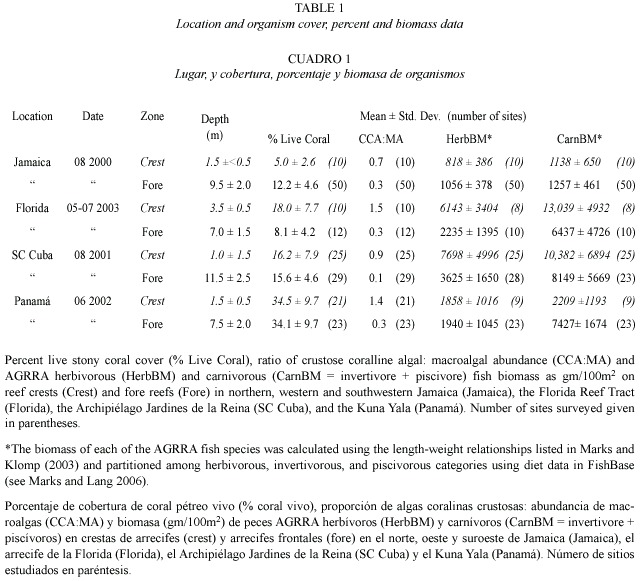
<body><![CDATA[<p><font face="Arial" size="2">The AGRRA Program’s accomplishments to date include: (1) working relationships with reef scientists or managers in most western Atlantic countries having significant reefs; (2) capacity building during workshops and less formal training sessions; (3) survey expeditions to many of the Caribbean area’s sub-regions (<a href="#f1">Fig. 1</a>); (4) periodic revisions of the protocol as warranted by experience (Version 4 was released online in June, 2005); (5)descriptions, and a summary, of the early (to mid-2000) assessments (<a href="#la03">Lang 2003</a>); (6) maintaining the only large-scale, directly comparable, biological datasets for TNWA reefs; (7) unrestricted access (the 1997-2003 databases with 64 230 stony corals, 22 693 algal quadrats, and 188 418 fishes and diverse derived summary products were posted online in August, 2005). Meantime many national or regional groups (including government agencies, universities, non-governmental organizations and environmental consultants) have adopted or adapted the AGRRA Protocols for use in other rapid-assessment or non-fixed-monitoring programs.</font></p> <a name="f1"></a>     <div style="text-align: center;"><img src="/img/fbpe/rbt/v54s3/3390i1.JPG" title=""  alt="" style="width: 414px; height: 354px;"></div>     
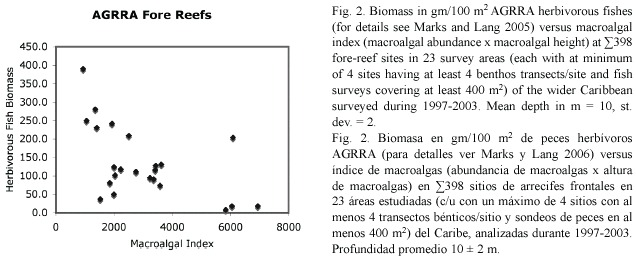
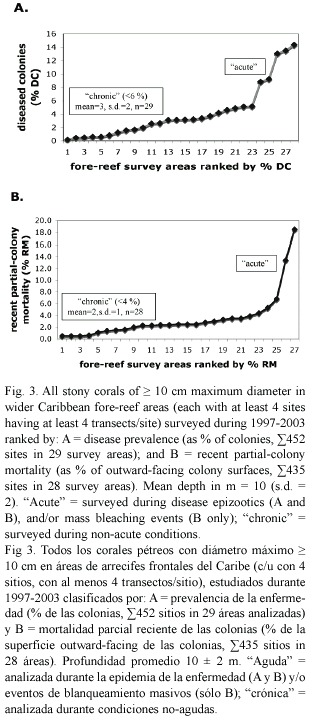
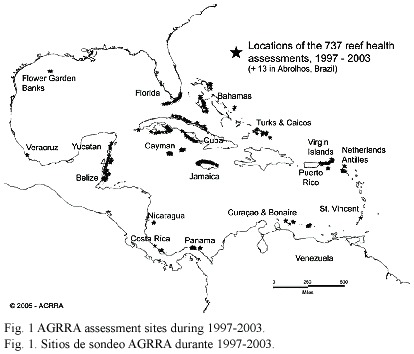
<p><font face="Arial" size="2">As exemplified in <a href="#t1">Table 1</a>, we have learned that parameters such as percent live coral cover, the ratio of crustose coralline algal: macroalgal abundance, and herbivorous or carnivorous fish biomass can vary across spatial scales that vary from the local to sub-regional. Similar to the findings of <a  href="#wi01">Williams and Polunin (2001)</a>, in the near-absence of <i>Diadema </i>,we find that herbivorous fish biomass is inversely correlated with macroalgal index (a proxy for macroalgal biomass) on fore reefs in many of the surveyed areas (<a href="#f2">Fig. 2</a>). We believe we are very close to establishing regional "chronic condition norms" for some ecologically relevant parameters, two of which are illustrated in <a  href="#f3">Figure 3</a>.</font></p> <a name="t1"></a>     <div style="text-align: center;"><img src="/img/fbpe/rbt/v54s3/3390i2.JPG" title=""  alt="" style="width: 643px; height: 581px;">    
<br>     <br> </div> <a name="f2"></a>     <div style="text-align: center;"><img src="/img/fbpe/rbt/v54s3/3390i3.JPG" title=""  alt="" style="width: 636px; height: 258px;">    
<br> </div>     <br> <a name="f3"></a>     <div style="text-align: center;"><img src="/img/fbpe/rbt/v54s3/3390i4.JPG" title=""  alt="" style="width: 315px; height: 721px;">    
]]></body>
<body><![CDATA[<br> </div>     <p><font face="Arial" size="2">The AGRRA data have been used to examine reef fish assembly patterns (<a href="#se04">Semmens and Auster 2004</a>), evaluate the status of <i>Acropora </i>spp. (<a href="#bi05">Biological Review Team 2005</a>), and construct quantitative interpretive frameworks for some of the ecological indicators used in the Healthy Mesoamerican Reef Ecosystem Initiative (McField and Kramer 2005). As efforts mount to "build resilience" into the planning and management of coral reef resources, and to design integrated networks of marine protected areas (<a href="#we03">West and Salm 2003</a>), the perceived value of its large datasets will increase.</font></p>     <p><font face="Arial" size="2">Mean values for the AGRRA indicators in each area also constitute current baselines against which future changes in local reef condition and finfish resources can be compared. Nonetheless, regional-scale interpretations of these data are inevitably constrained by the confounding of temporal and spatial variation that has occurred throughout the nine years during which the assessments were conducted. For example, in areas originally surveyed in 1998 or 1999, live stony coral cover significantly declined on many reefs that were severely affected by the 1998 ENSO-related mortality event (Belize – <a href="#rob04">Robbart <i>et al. </i>2004</a>; Mexico – <a href="#ro04">Roy 2004</a>; Bahamas– Lang, pers. obs.), even as conditions were improving in a few sites (Jamaica- <a  href="#ed01">Edmunds and Carpenter 2001</a>, <a href="#id06">Idjadi <i>et al. </i>2006</a>).</font></p>     <p><font face="Arial" size="2">To overcome the inherent constraints of multiyear temporal variation, we envision a region-wide collaborative program in which reef assessments are conducted at regular intervals. Given the rapid pace at which reef ecosystems are currently changing (<a  href="#pr06">Precht and Aronson 2006</a>), a sampling interval of five-years, at least for the short-term, was proposed at the AMLC’s 32<sup>nd</sup> scientific meeting in June 2005. The urgency of the need for periodic reassessments of Caribbean-area reefs was subsequently underscored when unusually warm seawater temperatures caused extremely high levels of bleaching and bleaching-related mortality on many reefs in the eastern and northern TNWA. Disease outbreaks, first noticed as stony corals were recovering their coloration in some sites, are still on-going as of May 2006 (B.V.I. – S. Gore pers. comm.; Martinique – J. P. Maréchal and C. Cowan, pers. comm.; Puerto Rico – E. Weil pers. comm.).</font></p>     <p><font face="Arial" size="2">It is beyond our scope at present to provide a detailed implementation plan, but we can offer some indications of what will be needed in terms of protocols, candidate sampling sites, and logistics.</font></p> <font face="Arial" size="2"><b></b></font>     <p><font face="Arial" size="2"><b>Elements of a Plan for Regional Visits to assess the Condition of Representative Reef Communities: </b>From our experience with the AGRRA Program, we believe that the assessments must include key elements of the reef ecosystem–stony corals, fishes and algae. We know that protocols can be designed to allow a team of about five, trained researchers to complete a survey of one site in a single dive. Selecting the candidate survey sites is not simple, given the extent of the region, the variability of reef types, their spatial distribution, relationships to the ocean current systems, and exposure to seas and swells. Information in the AGRRA Database, our understanding of the extent of anthropogenic impacts and fishing pressures (e.g., <a href="#bu04">Burke and Maidens 2004</a>), any existing legal protections, and other local knowledge about habitats and community condition must also be considered. </font></p>     <p><font face="Arial" size="2">Earlier efforts in developing a sampling design (<a href="#kr03">Kramer 2003</a>) were focused on the tactics of site-specific activities (e.g., the number of transects, corals or algal quadrats/site), rather than dealing strategically with overall survey designs to reduce variance in population and community parameters. Now that statistical methods (<a href="#au02">Ault <i>et al. </i>2002</a>) based on classical sampling techniques (<a  href="#co77">Cochran 1977</a>) are available for coral reefs, we have received funds for an analysis of the existing AGRRA coral dataset at various spatial scales to determine appropriate sample unit sizes, sampling strata boundaries, and survey domain areas. Analyses focused on size classes (approximate life history stages) of several species in each of five, common scleractinian genera <i>(Montastraea, Diploria, Siderastrea, Agaricia, </i>and <i>Porites) </i>would allow us to identify data outliers or errors, completeness over the expected temporal and spatial domains, gaps, and estimation properties (e.g., precision) of primary indicators and derived variables (J. Ault, pers. comm.). New regional classifications, such as the geomorphological maps being produced by the Millennium Coral Reef Mapping Project (<a  href="http://imars.usf.edu/corals/index.html">http://imars.usf.edu/corals/index.html</a>) and any available habitat maps (e.g., <a href="#ke01">Kendall <i>et al. </i>2001</a>), would be used to generate GIS products in which sampling domains would be stratified according to principal environmental variables (bathymetry, geomorphology, oceanography, etc.). </font></p>     <p><font face="Arial" size="2">Results of these analyses may well warrant modifications to the current versions of the AGGRA benthos sampling protocols. After identification of a preferred sampling design, sampling units would be optimally allocated within strata among locales according to a weighted relationship between stratum area and variance. Specific sampling sites within a stratum for the first regional survey would be randomly selected from the complete list of potential sample units. Use of a discrete uniform probability distribution that assigns equal selection probability to each unit would ensure that the collected data are fully representative of the entire TNWA reefal area. The design would be re-run for every five-year assessment, ideally each time with a refined sampling allocation allowing improved sensitivity (lower coefficient of variation) for detecting change at the scales of interest (P.A. Kramer, pers. comm.).</font></p>     <p><font face="Arial" size="2">At least two ways of executing the assessments need to be considered: (1)sub-regional teams of assessors thoroughly trained in the protocols could be responsible for making the surveys in each sub-region; (2) one or more vessels, fully equipped for diving, could be chartered for a series of cruises involving core teams of trained assessors and locally trained participants in each sub-region. (Live-aboard dive boats that can support scientific research are available: we know one that was used most effectively for fish and benthos assessments covering the entire, 350-km long, Florida Reef Tract.)</font></p>     <p><font face="Arial" size="2">Geographic separation of our insular and continental nations creates expensive challenges in coordinating international programs. The AMLC is an organization with a record of fostering regional collaboration, and collectively its members represent the entire region. Hence, our gratitude that the AMLC Executive Board agreed to be the first international organization to endorse a resolution supporting "the immediate establishment of a long term program for assessing representative reefs, their related biological communities, and relevant physical environmental parameters periodically into the future." Many details are yet to be decided, and member institutions and individual members of the AMLC network, as well as other colleagues, are invited to join with us to help develop this new phase of regional rapid assessment in the wider Caribbean. </font></p> <font face="Arial" size="2"><b>     ]]></body>
<body><![CDATA[<p>Acknowledgments </p> </b></font>     <p><font face="Arial" size="2">JCL thanks the Ocean Research and Education Foundation for financial support to attend the 32<sup>nd</sup> Scientific Meeting of the AMLC at Curaçao, in June 2005. Ingrid Morgan kindly provided <a href="#f2">Fig. 2</a>. Steve LaGore, the AMLC Executive Director, is thanked for his encouragement and guidance of our efforts. We appreciate Norman Quinn’s thoughtful review of the initial manuscript. </font></p> <font face="Arial" size="2"><b>     <p>Resumen </p> </b></font>     <p><font face="Arial" size="2">El Programa de Evaluación Rápida del Atlántico y el Golfo (AGRRA, por sus siglas en inglés) consiste en sondeos visuales no-fijos, basados en transectos, que permiten caracterizaciones puntuales de un número de peces y organismos bénticos que sean estructural o funcionalmente importantes como indicadores en arrecifes del Atlántico tropical noroeste (ATNO) y de Brasil. Para disminuir los factores de confusión inherentes a variaciones temporales multianuales, se propone un programa de colaboración a nivel regional, que sirva para conducir evaluaciones rápidas de los arrecifes en intervalos regulares (cinco años), en los sitios que sean representativos de cada sub-región del ATNO. Se invita a las instituciones miembro de la Asociación de Laboratorios Marinos y del Caribe (ALMC), así cómo a colegas individuales para participar en el desarrollo de esta visión.</font></p> <font face="Arial" size="2"><b></b></font>     <p><font face="Arial" size="2"><b>Palabras clave: </b>arrecifes de coral, evaluación rápida, AGRRA, AMLC, monitoreo a largo plazo, monitoreo, integridad de los arrecifes de coral. </font></p> <font face="Arial" size="2"><b>     <p>References </p> </b></font>     <!-- ref --><p><font face="Arial" size="2"><a name="au02"></a>Ault, J. S., S. G. Smith, J. Lao, G. A. Meester, J. A. Bohnsack &amp; S. L. Miller. 2002. Baseline multispecies coral reef fish stock assessment for the Dry Tortugas. NOAA Tech. Memo. NMFS-SEFSC-487. 117 p.</font>&nbsp;&nbsp;&nbsp;&nbsp;&nbsp;&nbsp;&nbsp;&nbsp;[&#160;<a href="javascript:void(0);" onclick="javascript: window.open('/scielo.php?script=sci_nlinks&ref=1241794&pid=S0034-7744200600060000800001&lng=','','width=640,height=500,resizable=yes,scrollbars=1,menubar=yes,');">Links</a>&#160;]<!-- end-ref --><!-- ref --><p><font face="Arial" size="2"><a name="bi05"></a>Biological Review Team (convened by NOAA Fisheries Service). 2005. Atlantic <i>Acropora </i>Status Review Document. CD. National Oceanic and Atmospheric Administration, Silver Spring, Maryland, USA.</font>&nbsp;&nbsp;&nbsp;&nbsp;&nbsp;&nbsp;&nbsp;&nbsp;[&#160;<a href="javascript:void(0);" onclick="javascript: window.open('/scielo.php?script=sci_nlinks&ref=1241795&pid=S0034-7744200600060000800002&lng=','','width=640,height=500,resizable=yes,scrollbars=1,menubar=yes,');">Links</a>&#160;]<!-- end-ref --><!-- ref --><p><font face="Arial" size="2"><a name="bu04"></a>Burke, L. &amp; J. Maidens. 2004. Reefs at Risk in the Caribbean. World Resources Institute, Washington, D.C. 80 p.</font>&nbsp;&nbsp;&nbsp;&nbsp;&nbsp;&nbsp;&nbsp;&nbsp;[&#160;<a href="javascript:void(0);" onclick="javascript: window.open('/scielo.php?script=sci_nlinks&ref=1241796&pid=S0034-7744200600060000800003&lng=','','width=640,height=500,resizable=yes,scrollbars=1,menubar=yes,');">Links</a>&#160;]<!-- end-ref --><!-- ref --><p><font face="Arial" size="2"><a name="co77"></a>Cochran, W. G. 1977. Sampling Techniques, 3<sup>rd</sup> edition. John Wiley, New York, New York, USA. 428 p.</font>&nbsp;&nbsp;&nbsp;&nbsp;&nbsp;&nbsp;&nbsp;&nbsp;[&#160;<a href="javascript:void(0);" onclick="javascript: window.open('/scielo.php?script=sci_nlinks&ref=1241797&pid=S0034-7744200600060000800004&lng=','','width=640,height=500,resizable=yes,scrollbars=1,menubar=yes,');">Links</a>&#160;]<!-- end-ref --><!-- ref --><p><font face="Arial" size="2"><a name="di95"></a>Diaz, J. M., J. Garzón-Ferreira &amp; S. Zea. 1995. Los Arrecifes coralinos de la Isla de San Andrés, Colombia: Estado actual y perspectivas para su conservación. Acad. Col. Cienc. Exac., Fís. Natur. Edit. Guadalupe, Colombia. 150 p.</font>&nbsp;&nbsp;&nbsp;&nbsp;&nbsp;&nbsp;&nbsp;&nbsp;[&#160;<a href="javascript:void(0);" onclick="javascript: window.open('/scielo.php?script=sci_nlinks&ref=1241798&pid=S0034-7744200600060000800005&lng=','','width=640,height=500,resizable=yes,scrollbars=1,menubar=yes,');">Links</a>&#160;]<!-- end-ref --><!-- ref --><p><font face="Arial" size="2"><a name="du94"></a>Dustan, P. 1994. Developing methods for assessing coral reef vitality: a tale of two scales, p. 38-44. In R.N. Ginsburg (compiler), Proceedings of the Colloquium on Global Aspects of Coral Reefs: Health, Hazards, and History. Rosenstiel School Mar. Atm. Sci., Univ. Miami, Miami, USA.</font>&nbsp;&nbsp;&nbsp;&nbsp;&nbsp;&nbsp;&nbsp;&nbsp;[&#160;<a href="javascript:void(0);" onclick="javascript: window.open('/scielo.php?script=sci_nlinks&ref=1241799&pid=S0034-7744200600060000800006&lng=','','width=640,height=500,resizable=yes,scrollbars=1,menubar=yes,');">Links</a>&#160;]<!-- end-ref --><!-- ref --><p><font face="Arial" size="2"><a name="ed01"></a>Edmunds, P. J. &amp; R. C. Carpenter. 2001. Recovery of <i>Diadema antillarum </i>reduces macrolagal cover and increases abundance of juvenile corals on a Caribbean reef. Proc. Natl. Acad. Sci. USA 98: 5067-5071.</font>&nbsp;&nbsp;&nbsp;&nbsp;&nbsp;&nbsp;&nbsp;&nbsp;[&#160;<a href="javascript:void(0);" onclick="javascript: window.open('/scielo.php?script=sci_nlinks&ref=1241800&pid=S0034-7744200600060000800007&lng=','','width=640,height=500,resizable=yes,scrollbars=1,menubar=yes,');">Links</a>&#160;]<!-- end-ref --><!-- ref --><p><font face="Arial" size="2"><a name="gi94"></a>Ginsburg, R. N. &amp; P. D. Glynn. 1994. Summary of the colloquium and forum on global aspects of coral reefs: health, hazards, and history, p. i-viii. In R. N. Ginsburg (compiler), Proceedings of the Colloquium on Global Aspects of Coral Reefs: Health, Hazards, and History. Rosenstiel School Mar. Atm. Sci., Univ. Miami, Miami.</font>&nbsp;&nbsp;&nbsp;&nbsp;&nbsp;&nbsp;&nbsp;&nbsp;[&#160;<a href="javascript:void(0);" onclick="javascript: window.open('/scielo.php?script=sci_nlinks&ref=1241801&pid=S0034-7744200600060000800008&lng=','','width=640,height=500,resizable=yes,scrollbars=1,menubar=yes,');">Links</a>&#160;]<!-- end-ref --><!-- ref --><p><font face="Arial" size="2"><a name="gi03"></a>Ginsburg, R. N. &amp; J. C. Lang. 2003. Forward, p. vii-xiii. In J. C. Lang (ed.). Status of Coral Reefs in the Western Atlantic: Results of Initial Surveys, Atlantic and Gulf Rapid Reef Assessment (AGRRA) Program. Atoll Res. Bull. 496.</font>&nbsp;&nbsp;&nbsp;&nbsp;&nbsp;&nbsp;&nbsp;&nbsp;[&#160;<a href="javascript:void(0);" onclick="javascript: window.open('/scielo.php?script=sci_nlinks&ref=1241802&pid=S0034-7744200600060000800009&lng=','','width=640,height=500,resizable=yes,scrollbars=1,menubar=yes,');">Links</a>&#160;]<!-- end-ref --><!-- ref --><p><font face="Arial" size="2"><a name="id06"></a>Idjadi, J. A., S. C. Lee, J. F. Bruno, W. F Precht, L. Allen-Requa &amp; P. J. Edmunds. 2006. Rapid phase-shift reversal on a Jamaican coral reef. Coral Reefs 25: 209-211.</font>&nbsp;&nbsp;&nbsp;&nbsp;&nbsp;&nbsp;&nbsp;&nbsp;[&#160;<a href="javascript:void(0);" onclick="javascript: window.open('/scielo.php?script=sci_nlinks&ref=1241803&pid=S0034-7744200600060000800010&lng=','','width=640,height=500,resizable=yes,scrollbars=1,menubar=yes,');">Links</a>&#160;]<!-- end-ref --><!-- ref --><p><font face="Arial" size="2"><a name="ke01"></a>Kendall, M. S., M. E. Monaco, K. R. Buja, J. D. Christensen, C. R. Kruer, M. Finkbeiner &amp; R. A. Warner. 2001. (Online).<b> </b>Methods Used to Map the Benthic Habitats of Puerto Rico and the U.S. Virgin Islands. URL: <a  href="http://biogeo.nos.noaa.gov/projects/mapping/caribbean/startup.htm">http://biogeo.nos.noaa.gov/projects/mapping/caribbean/startup.htm</a>. Also available on U.S. National Oceanic and Atmospheric Administration. National Ocean Service, National Centers for Coastal Ocean Science Biogeography Program. 2001. (CD-ROM). Benthic Habitats of Puerto Rico and the U.S. Virgin Islands. National Oceanic and Atmospheric Administration, Silver Spring, Maryland. </font>&nbsp;&nbsp;&nbsp;&nbsp;&nbsp;&nbsp;&nbsp;&nbsp;[&#160;<a href="javascript:void(0);" onclick="javascript: window.open('/scielo.php?script=sci_nlinks&ref=1241804&pid=S0034-7744200600060000800011&lng=','','width=640,height=500,resizable=yes,scrollbars=1,menubar=yes,');">Links</a>&#160;]<!-- end-ref --><!-- ref --><p><font face="Arial" size="2"><a name="kr03"></a>Kramer, P. A. 2003. Synthesis of coral reef health indicators for the western Atlantic: results of the AGRRA program (1997-2000), p. 1-55. In J. C. Lang (ed.). Status of Coral Reefs in the Western Atlantic: Results of Initial Surveys, Atlantic and Gulf Rapid Reef Assessment (AGRRA) Program<i>. </i>Atoll Res. Bull. 496.</font>&nbsp;&nbsp;&nbsp;&nbsp;&nbsp;&nbsp;&nbsp;&nbsp;[&#160;<a href="javascript:void(0);" onclick="javascript: window.open('/scielo.php?script=sci_nlinks&ref=1241805&pid=S0034-7744200600060000800012&lng=','','width=640,height=500,resizable=yes,scrollbars=1,menubar=yes,');">Links</a>&#160;]<!-- end-ref --><!-- ref --><p><font face="Arial" size="2"><a name="la03"></a>Lang, J.C. 2003. (ed.). Status of Coral Reefs in the Western Atlantic: Results of Initial Surveys, Atlantic and Gulf Rapid Reef Assessment (AGRRA) Program<i>. </i>Atoll Res. Bull. 496. 630 p.</font>&nbsp;&nbsp;&nbsp;&nbsp;&nbsp;&nbsp;&nbsp;&nbsp;[&#160;<a href="javascript:void(0);" onclick="javascript: window.open('/scielo.php?script=sci_nlinks&ref=1241806&pid=S0034-7744200600060000800013&lng=','','width=640,height=500,resizable=yes,scrollbars=1,menubar=yes,');">Links</a>&#160;]<!-- end-ref --><!-- ref --><p><font face="Arial" size="2"><a name="ma05"></a>Macfield, M. D. &amp; P. R. Kramer. 2005. The Healthy Mesoamerican Reef Ecosystem Initiative: a conceptual framework for evaluatin reef ecosystem health. Proc. 10<sup>th</sup> Int. Coral Reef Symp. Okinawa: 1118-1123.</font>&nbsp;&nbsp;&nbsp;&nbsp;&nbsp;&nbsp;&nbsp;&nbsp;[&#160;<a href="javascript:void(0);" onclick="javascript: window.open('/scielo.php?script=sci_nlinks&ref=1241807&pid=S0034-7744200600060000800014&lng=','','width=640,height=500,resizable=yes,scrollbars=1,menubar=yes,');">Links</a>&#160;]<!-- end-ref --><!-- ref --><p><font face="Arial" size="2"><a name="ma06"></a>Marks, K. W. &amp; J. C. Lang. 2006. "AGRRA Summary Products, version (10/2006)."</font>&nbsp;&nbsp;&nbsp;&nbsp;&nbsp;&nbsp;&nbsp;&nbsp;[&#160;<a href="javascript:void(0);" onclick="javascript: window.open('/scielo.php?script=sci_nlinks&ref=1241808&pid=S0034-7744200600060000800015&lng=','','width=640,height=500,resizable=yes,scrollbars=1,menubar=yes,');">Links</a>&#160;]<!-- end-ref --><!-- ref --><p><font face="Arial" size="2"><a name="ma03"></a>Marks, K. W. &amp; K. D. Klomp. 2003. Appendix Two Fish biomass conversion equations. p. 625-628. <i>In </i>J.C. Lang (ed.), Status of Coral Reefs in the Western Atlantic: Results of initial Surveys, Atlantic and Gulf Rapid Reef Assessment (AGRRA) Program. Atoll Res. Bull. 496.</font>&nbsp;&nbsp;&nbsp;&nbsp;&nbsp;&nbsp;&nbsp;&nbsp;[&#160;<a href="javascript:void(0);" onclick="javascript: window.open('/scielo.php?script=sci_nlinks&ref=1241809&pid=S0034-7744200600060000800016&lng=','','width=640,height=500,resizable=yes,scrollbars=1,menubar=yes,');">Links</a>&#160;]<!-- end-ref --><!-- ref --><p><font face="Arial" size="2"><a name="pr06"></a>Precht, W. F &amp; R. B. Aronson. 2006. Death and resurrection of Caribbean coral reefs: A paleoecological perspective, p. 40-77. In I. Côté &amp; J. Reynolds (eds.). Coral Reef Conservation. Zool. Soc. London, Cambridge University Press, Cambridge.</font>&nbsp;&nbsp;&nbsp;&nbsp;&nbsp;&nbsp;&nbsp;&nbsp;[&#160;<a href="javascript:void(0);" onclick="javascript: window.open('/scielo.php?script=sci_nlinks&ref=1241810&pid=S0034-7744200600060000800017&lng=','','width=640,height=500,resizable=yes,scrollbars=1,menubar=yes,');">Links</a>&#160;]<!-- end-ref --><!-- ref --><p><font face="Arial" size="2"><a name="rob04"></a>Robbart, M. L., P. Peckol, S. P. Scordilis, H. A. Curran &amp; J. Brown-Saracino. 2004. Population recovery and differential heat shock protein expression for the corals <i>Agaricia agaricites </i>and <i>A. tenuifolia </i>in Belize. Mar. Ecol. Prog. Ser. 283: 151-160.</font>&nbsp;&nbsp;&nbsp;&nbsp;&nbsp;&nbsp;&nbsp;&nbsp;[&#160;<a href="javascript:void(0);" onclick="javascript: window.open('/scielo.php?script=sci_nlinks&ref=1241811&pid=S0034-7744200600060000800018&lng=','','width=640,height=500,resizable=yes,scrollbars=1,menubar=yes,');">Links</a>&#160;]<!-- end-ref --><!-- ref --><p><font face="Arial" size="2"><a name="ro04"></a>Roy, R. E. 2004. Akumal’s reefs: Stony coral communities along the developing Mexican Caribbean coastline. Rev. Biol. Trop. 52: 869-881.</font>&nbsp;&nbsp;&nbsp;&nbsp;&nbsp;&nbsp;&nbsp;&nbsp;[&#160;<a href="javascript:void(0);" onclick="javascript: window.open('/scielo.php?script=sci_nlinks&ref=1241812&pid=S0034-7744200600060000800019&lng=','','width=640,height=500,resizable=yes,scrollbars=1,menubar=yes,');">Links</a>&#160;]<!-- end-ref --><!-- ref --><p><font face="Arial" size="2"><a name="se04"></a>Semmens, B. X. &amp; P. J. Auster. 2004. Analysis of Caribbean-wide reef fish data using multilple community assembly rule models. 10<sup>th</sup> Int. Coral Reef Symp., Okinawa. Abstract. p. 199.</font>&nbsp;&nbsp;&nbsp;&nbsp;&nbsp;&nbsp;&nbsp;&nbsp;[&#160;<a href="javascript:void(0);" onclick="javascript: window.open('/scielo.php?script=sci_nlinks&ref=1241813&pid=S0034-7744200600060000800020&lng=','','width=640,height=500,resizable=yes,scrollbars=1,menubar=yes,');">Links</a>&#160;]<!-- end-ref --><!-- ref --><p><font face="Arial" size="2"><a name="we03"></a>West, J. M. &amp; R. V. Salm. 2003. Resistance and resilience to coral bleaching: implications for coral reef conservation and management. Conserv. Biol. 17: 956-967.</font>&nbsp;&nbsp;&nbsp;&nbsp;&nbsp;&nbsp;&nbsp;&nbsp;[&#160;<a href="javascript:void(0);" onclick="javascript: window.open('/scielo.php?script=sci_nlinks&ref=1241814&pid=S0034-7744200600060000800021&lng=','','width=640,height=500,resizable=yes,scrollbars=1,menubar=yes,');">Links</a>&#160;]<!-- end-ref --><!-- ref --><p><font face="Arial" size="2"><a name="wi01"></a>Williams, I. D. &amp; N. V. C. Polunin. 2001. Large-scale associations between macroalgal cover and grazer biomass on mid-depth reefs in the Caribbean. Coral Reefs 19: 358-366. </font>&nbsp;&nbsp;&nbsp;&nbsp;&nbsp;&nbsp;&nbsp;&nbsp;[&#160;<a href="javascript:void(0);" onclick="javascript: window.open('/scielo.php?script=sci_nlinks&ref=1241815&pid=S0034-7744200600060000800022&lng=','','width=640,height=500,resizable=yes,scrollbars=1,menubar=yes,');">Links</a>&#160;]<!-- end-ref --> ]]></body><back>
<ref-list>
<ref id="B1">
<nlm-citation citation-type="">
<person-group person-group-type="author">
<name>
<surname><![CDATA[Ault]]></surname>
<given-names><![CDATA[J. S]]></given-names>
</name>
<name>
<surname><![CDATA[Smith]]></surname>
<given-names><![CDATA[S. G]]></given-names>
</name>
<name>
<surname><![CDATA[Lao]]></surname>
<given-names><![CDATA[J]]></given-names>
</name>
<name>
<surname><![CDATA[Meester]]></surname>
<given-names><![CDATA[G. A]]></given-names>
</name>
<name>
<surname><![CDATA[Bohnsack]]></surname>
<given-names><![CDATA[J. A]]></given-names>
</name>
<name>
<surname><![CDATA[Miller]]></surname>
<given-names><![CDATA[S. L]]></given-names>
</name>
</person-group>
<source><![CDATA[Baseline multispecies coral reef fish stock assessment for the Dry Tortugas. NOAA Tech. Memo. NMFS-SEFSC-487]]></source>
<year>2002</year>
<page-range>117</page-range></nlm-citation>
</ref>
<ref id="B2">
<nlm-citation citation-type="book">
<collab>Biological Review Team (convened by NOAA Fisheries Service)</collab>
<source><![CDATA[Atlantic Acropora Status Review Document. CD]]></source>
<year>2005</year>
<publisher-loc><![CDATA[Silver Spring^eMaryland Maryland]]></publisher-loc>
<publisher-name><![CDATA[National Oceanic and Atmospheric Administration]]></publisher-name>
</nlm-citation>
</ref>
<ref id="B3">
<nlm-citation citation-type="book">
<person-group person-group-type="author">
<name>
<surname><![CDATA[Burke]]></surname>
<given-names><![CDATA[L]]></given-names>
</name>
<name>
<surname><![CDATA[Maidens]]></surname>
<given-names><![CDATA[J]]></given-names>
</name>
</person-group>
<source><![CDATA[Reefs at Risk in the Caribbean]]></source>
<year>2004</year>
<page-range>80</page-range><publisher-loc><![CDATA[^eWashington, D.C Washington, D.C]]></publisher-loc>
<publisher-name><![CDATA[World Resources Institute]]></publisher-name>
</nlm-citation>
</ref>
<ref id="B4">
<nlm-citation citation-type="book">
<person-group person-group-type="author">
<name>
<surname><![CDATA[Cochran]]></surname>
<given-names><![CDATA[W. G]]></given-names>
</name>
</person-group>
<source><![CDATA[Sampling Techniques]]></source>
<year>1977</year>
<edition>3</edition>
<page-range>428</page-range><publisher-loc><![CDATA[New York^eNew York New York]]></publisher-loc>
<publisher-name><![CDATA[John Wiley]]></publisher-name>
</nlm-citation>
</ref>
<ref id="B5">
<nlm-citation citation-type="book">
<person-group person-group-type="author">
<name>
<surname><![CDATA[Diaz]]></surname>
<given-names><![CDATA[J. M]]></given-names>
</name>
<name>
<surname><![CDATA[Garzón-Ferreira]]></surname>
<given-names><![CDATA[J]]></given-names>
</name>
<name>
<surname><![CDATA[Zea]]></surname>
<given-names><![CDATA[S]]></given-names>
</name>
</person-group>
<source><![CDATA[Los Arrecifes coralinos de la Isla de San Andrés, Colombia: Estado actual y perspectivas para su conservación]]></source>
<year>1995</year>
<page-range>150</page-range><publisher-name><![CDATA[Edit. Guadalupe]]></publisher-name>
</nlm-citation>
</ref>
<ref id="B6">
<nlm-citation citation-type="book">
<person-group person-group-type="author">
<name>
<surname><![CDATA[Dustan]]></surname>
<given-names><![CDATA[P]]></given-names>
</name>
</person-group>
<article-title xml:lang="en"><![CDATA[Developing methods for assessing coral reef vitality: a tale of two scales]]></article-title>
<person-group person-group-type="editor">
<name>
<surname><![CDATA[Ginsburg]]></surname>
<given-names><![CDATA[R.N]]></given-names>
</name>
</person-group>
<source><![CDATA[Proceedings of the Colloquium on Global Aspects of Coral Reefs: Health, Hazards, and History]]></source>
<year>1994</year>
<page-range>38-44</page-range><publisher-loc><![CDATA[Miami ]]></publisher-loc>
<publisher-name><![CDATA[Rosenstiel School Mar. Atm. Sci., Univ. Miami]]></publisher-name>
</nlm-citation>
</ref>
<ref id="B7">
<nlm-citation citation-type="journal">
<person-group person-group-type="author">
<name>
<surname><![CDATA[Edmunds]]></surname>
<given-names><![CDATA[P. J]]></given-names>
</name>
<name>
<surname><![CDATA[Carpenter]]></surname>
<given-names><![CDATA[R. C]]></given-names>
</name>
</person-group>
<article-title xml:lang="en"><![CDATA[Recovery of Diadema antillarum reduces macrolagal cover and increases abundance of juvenile corals on a Caribbean reef]]></article-title>
<source><![CDATA[Proc. Natl. Acad. Sci]]></source>
<year>2001</year>
<volume>98</volume>
<page-range>5067-5071</page-range></nlm-citation>
</ref>
<ref id="B8">
<nlm-citation citation-type="book">
<person-group person-group-type="author">
<name>
<surname><![CDATA[Ginsburg]]></surname>
<given-names><![CDATA[R. N]]></given-names>
</name>
<name>
<surname><![CDATA[Glynn]]></surname>
<given-names><![CDATA[P. D]]></given-names>
</name>
</person-group>
<article-title xml:lang="en"><![CDATA[Summary of the colloquium and forum on global aspects of coral reefs: health, hazards, and history]]></article-title>
<person-group person-group-type="editor">
<name>
<surname><![CDATA[Ginsburg]]></surname>
<given-names><![CDATA[R. N]]></given-names>
</name>
</person-group>
<source><![CDATA[Proceedings of the Colloquium on Global Aspects of Coral Reefs: Health, Hazards, and History]]></source>
<year>1994</year>
<page-range>i-viii</page-range><publisher-loc><![CDATA[Miami ]]></publisher-loc>
<publisher-name><![CDATA[Rosenstiel School Mar. Atm. Sci., Univ. Miami]]></publisher-name>
</nlm-citation>
</ref>
<ref id="B9">
<nlm-citation citation-type="">
<person-group person-group-type="author">
<name>
<surname><![CDATA[Ginsburg]]></surname>
<given-names><![CDATA[R. N]]></given-names>
</name>
<name>
<surname><![CDATA[Lang]]></surname>
<given-names><![CDATA[J. C]]></given-names>
</name>
</person-group>
<article-title xml:lang="en"><![CDATA[Forward]]></article-title>
<person-group person-group-type="editor">
<name>
<surname><![CDATA[Lang]]></surname>
<given-names><![CDATA[J. C]]></given-names>
</name>
</person-group>
<source><![CDATA[Status of Coral Reefs in the Western Atlantic: Results of Initial Surveys, Atlantic and Gulf Rapid Reef Assessment (AGRRA) Program]]></source>
<year>2003</year>
<page-range>vii-xiii</page-range><page-range>496</page-range></nlm-citation>
</ref>
<ref id="B10">
<nlm-citation citation-type="journal">
<person-group person-group-type="author">
<name>
<surname><![CDATA[Idjadi]]></surname>
<given-names><![CDATA[J. A]]></given-names>
</name>
<name>
<surname><![CDATA[Lee]]></surname>
<given-names><![CDATA[S. C]]></given-names>
</name>
<name>
<surname><![CDATA[Bruno]]></surname>
<given-names><![CDATA[J. F]]></given-names>
</name>
<name>
<surname><![CDATA[Precht]]></surname>
<given-names><![CDATA[W. F]]></given-names>
</name>
<name>
<surname><![CDATA[Allen-Requa]]></surname>
<given-names><![CDATA[L]]></given-names>
</name>
<name>
<surname><![CDATA[Edmunds]]></surname>
<given-names><![CDATA[P. J]]></given-names>
</name>
</person-group>
<article-title xml:lang="en"><![CDATA[Rapid phase-shift reversal on a Jamaican coral reef]]></article-title>
<source><![CDATA[Coral Reefs]]></source>
<year>2006</year>
<volume>25</volume>
<page-range>209-211</page-range></nlm-citation>
</ref>
<ref id="B11">
<nlm-citation citation-type="book">
<person-group person-group-type="author">
<name>
<surname><![CDATA[Kendall]]></surname>
<given-names><![CDATA[M. S]]></given-names>
</name>
<name>
<surname><![CDATA[Monaco]]></surname>
<given-names><![CDATA[M. E]]></given-names>
</name>
<name>
<surname><![CDATA[Buja]]></surname>
<given-names><![CDATA[K. R]]></given-names>
</name>
<name>
<surname><![CDATA[Christensen]]></surname>
<given-names><![CDATA[J. D]]></given-names>
</name>
<name>
<surname><![CDATA[Kruer]]></surname>
<given-names><![CDATA[C. R]]></given-names>
</name>
<name>
<surname><![CDATA[Finkbeiner]]></surname>
<given-names><![CDATA[M]]></given-names>
</name>
<name>
<surname><![CDATA[Warner]]></surname>
<given-names><![CDATA[R. A]]></given-names>
</name>
</person-group>
<source><![CDATA[). Methods Used to Map the Benthic Habitats of Puerto Rico and the U.S. Virgin Islands]]></source>
<year>2001</year>
<publisher-loc><![CDATA[Silver Spring^eMaryland Maryland]]></publisher-loc>
<publisher-name><![CDATA[National Oceanic and Atmospheric Administration]]></publisher-name>
</nlm-citation>
</ref>
<ref id="B12">
<nlm-citation citation-type="">
<person-group person-group-type="author">
<name>
<surname><![CDATA[Kramer]]></surname>
<given-names><![CDATA[P. A]]></given-names>
</name>
</person-group>
<article-title xml:lang="en"><![CDATA[Synthesis of coral reef health indicators for the western Atlantic: results of the AGRRA program (1997-2000)]]></article-title>
<person-group person-group-type="editor">
<name>
<surname><![CDATA[Lang]]></surname>
<given-names><![CDATA[J. C]]></given-names>
</name>
</person-group>
<source><![CDATA[Status of Coral Reefs in the Western Atlantic: Results of Initial Surveys, Atlantic and Gulf Rapid Reef Assessment (AGRRA) Program]]></source>
<year>2003</year>
<page-range>1-55</page-range><page-range>496</page-range></nlm-citation>
</ref>
<ref id="B13">
<nlm-citation citation-type="">
<person-group person-group-type="author">
<name>
<surname><![CDATA[Lang]]></surname>
<given-names><![CDATA[J.C]]></given-names>
</name>
</person-group>
<source><![CDATA[Status of Coral Reefs in the Western Atlantic: Results of Initial Surveys, Atlantic and Gulf Rapid Reef Assessment (AGRRA) Program]]></source>
<year>2003</year>
<page-range>630</page-range></nlm-citation>
</ref>
<ref id="B14">
<nlm-citation citation-type="journal">
<person-group person-group-type="author">
<name>
<surname><![CDATA[Macfield]]></surname>
<given-names><![CDATA[M. D]]></given-names>
</name>
<name>
<surname><![CDATA[Kramer]]></surname>
<given-names><![CDATA[P. R]]></given-names>
</name>
</person-group>
<article-title xml:lang="en"><![CDATA[The Healthy Mesoamerican Reef Ecosystem Initiative: a conceptual framework for evaluatin reef ecosystem health]]></article-title>
<source><![CDATA[Proc. 10th Int. Coral Reef Symp]]></source>
<year>2005</year>
<page-range>1118-1123</page-range><publisher-loc><![CDATA[Okinawa ]]></publisher-loc>
</nlm-citation>
</ref>
<ref id="B15">
<nlm-citation citation-type="">
<person-group person-group-type="author">
<name>
<surname><![CDATA[Marks]]></surname>
<given-names><![CDATA[K. W]]></given-names>
</name>
<name>
<surname><![CDATA[Lang]]></surname>
<given-names><![CDATA[J. C]]></given-names>
</name>
</person-group>
<source><![CDATA[AGRRA Summary Products, version (10/2006)]]></source>
<year>2006</year>
</nlm-citation>
</ref>
<ref id="B16">
<nlm-citation citation-type="">
<person-group person-group-type="author">
<name>
<surname><![CDATA[Marks]]></surname>
<given-names><![CDATA[K. W]]></given-names>
</name>
<name>
<surname><![CDATA[Klomp]]></surname>
<given-names><![CDATA[K. D]]></given-names>
</name>
</person-group>
<article-title xml:lang="en"><![CDATA[Appendix Two Fish biomass conversion equations]]></article-title>
<person-group person-group-type="editor">
<name>
<surname><![CDATA[Lang]]></surname>
<given-names><![CDATA[J.C]]></given-names>
</name>
</person-group>
<source><![CDATA[Status of Coral Reefs in the Western Atlantic: Results of initial Surveys, Atlantic and Gulf Rapid Reef Assessment (AGRRA) Program]]></source>
<year>2003</year>
<page-range>625-628</page-range><page-range>496</page-range></nlm-citation>
</ref>
<ref id="B17">
<nlm-citation citation-type="book">
<person-group person-group-type="author">
<name>
<surname><![CDATA[Precht]]></surname>
<given-names><![CDATA[W. F]]></given-names>
</name>
<name>
<surname><![CDATA[Aronson]]></surname>
<given-names><![CDATA[R. B]]></given-names>
</name>
</person-group>
<article-title xml:lang="en"><![CDATA[Death and resurrection of Caribbean coral reefs: A paleoecological perspective]]></article-title>
<person-group person-group-type="editor">
<name>
<surname><![CDATA[Côté]]></surname>
<given-names><![CDATA[I]]></given-names>
</name>
<name>
<surname><![CDATA[Reynolds]]></surname>
<given-names><![CDATA[J]]></given-names>
</name>
</person-group>
<source><![CDATA[Coral Reef Conservation]]></source>
<year>2006</year>
<page-range>40-77</page-range><publisher-loc><![CDATA[Cambridge ]]></publisher-loc>
<publisher-name><![CDATA[Zool. Soc. London, Cambridge University Press]]></publisher-name>
</nlm-citation>
</ref>
<ref id="B18">
<nlm-citation citation-type="journal">
<person-group person-group-type="author">
<name>
<surname><![CDATA[Robbart]]></surname>
<given-names><![CDATA[M. L]]></given-names>
</name>
<name>
<surname><![CDATA[Peckol]]></surname>
<given-names><![CDATA[P]]></given-names>
</name>
<name>
<surname><![CDATA[Scordilis]]></surname>
<given-names><![CDATA[S. P]]></given-names>
</name>
<name>
<surname><![CDATA[Curran]]></surname>
<given-names><![CDATA[H. A]]></given-names>
</name>
<name>
<surname><![CDATA[Brown-Saracino]]></surname>
<given-names><![CDATA[J]]></given-names>
</name>
</person-group>
<article-title xml:lang="en"><![CDATA[Population recovery and differential heat shock protein expression for the corals Agaricia agaricites and A. tenuifolia in Belize]]></article-title>
<source><![CDATA[Mar. Ecol. Prog. Ser]]></source>
<year>2004</year>
<volume>283</volume>
<page-range>151-160</page-range></nlm-citation>
</ref>
<ref id="B19">
<nlm-citation citation-type="journal">
<person-group person-group-type="author">
<name>
<surname><![CDATA[Roy]]></surname>
<given-names><![CDATA[R. E]]></given-names>
</name>
</person-group>
<article-title xml:lang="en"><![CDATA[Akumal’s reefs: Stony coral communities along the developing Mexican Caribbean coastline]]></article-title>
<source><![CDATA[Rev. Biol. Trop]]></source>
<year>2004</year>
<volume>52</volume>
<page-range>869-881</page-range></nlm-citation>
</ref>
<ref id="B20">
<nlm-citation citation-type="">
<person-group person-group-type="author">
<name>
<surname><![CDATA[Semmens]]></surname>
<given-names><![CDATA[B. X]]></given-names>
</name>
<name>
<surname><![CDATA[Auster]]></surname>
<given-names><![CDATA[P. J]]></given-names>
</name>
</person-group>
<source><![CDATA[Analysis of Caribbean-wide reef fish data using multilple community assembly rule models. 10th Int. Coral Reef Symp., Okinawa. Abstract]]></source>
<year>2004</year>
<page-range>199</page-range></nlm-citation>
</ref>
<ref id="B21">
<nlm-citation citation-type="journal">
<person-group person-group-type="author">
<name>
<surname><![CDATA[West]]></surname>
<given-names><![CDATA[J. M]]></given-names>
</name>
<name>
<surname><![CDATA[Salm]]></surname>
<given-names><![CDATA[R. V]]></given-names>
</name>
</person-group>
<article-title xml:lang="en"><![CDATA[Resistance and resilience to coral bleaching: implications for coral reef conservation and management]]></article-title>
<source><![CDATA[Conserv. Biol]]></source>
<year>2003</year>
<volume>17</volume>
<page-range>956-967</page-range></nlm-citation>
</ref>
<ref id="B22">
<nlm-citation citation-type="journal">
<person-group person-group-type="author">
<name>
<surname><![CDATA[Williams]]></surname>
<given-names><![CDATA[I. D]]></given-names>
</name>
<name>
<surname><![CDATA[Polunin]]></surname>
<given-names><![CDATA[N. V. C]]></given-names>
</name>
</person-group>
<article-title xml:lang="en"><![CDATA[Large-scale associations between macroalgal cover and grazer biomass on mid-depth reefs in the Caribbean]]></article-title>
<source><![CDATA[Coral Reefs]]></source>
<year>2001</year>
<volume>19</volume>
<page-range>358-366</page-range></nlm-citation>
</ref>
</ref-list>
</back>
</article>