<?xml version="1.0" encoding="ISO-8859-1"?><article xmlns:mml="http://www.w3.org/1998/Math/MathML" xmlns:xlink="http://www.w3.org/1999/xlink" xmlns:xsi="http://www.w3.org/2001/XMLSchema-instance">
<front>
<journal-meta>
<journal-id>0034-7744</journal-id>
<journal-title><![CDATA[Revista de Biología Tropical]]></journal-title>
<abbrev-journal-title><![CDATA[Rev. biol. trop]]></abbrev-journal-title>
<issn>0034-7744</issn>
<publisher>
<publisher-name><![CDATA[Universidad de Costa Rica]]></publisher-name>
</publisher>
</journal-meta>
<article-meta>
<article-id>S0034-77442006000400016</article-id>
<title-group>
<article-title xml:lang="es"><![CDATA[Posible influencia de los rametes en la estructura poblacional y distribución del árbol gigante Warszewiczia uxpanapensis, Cordillera de Tilarán, Costa Rica]]></article-title>
</title-group>
<contrib-group>
<contrib contrib-type="author">
<name>
<surname><![CDATA[Cambronero]]></surname>
<given-names><![CDATA[Liz Brenes]]></given-names>
</name>
<xref ref-type="aff" rid="A01"/>
</contrib>
<contrib contrib-type="author">
<name>
<surname><![CDATA[Di Stéfano]]></surname>
<given-names><![CDATA[José Francisco]]></given-names>
</name>
<xref ref-type="aff" rid="A02"/>
</contrib>
</contrib-group>
<aff id="A01">
<institution><![CDATA[,Universidad de Costa Rica Programa de Investigaciones del Bosque Premontano ]]></institution>
<addr-line><![CDATA[San Ramón ]]></addr-line>
<country>Costa Rica</country>
</aff>
<aff id="A02">
<institution><![CDATA[,Universidad de Costa Rica Programa de Investigaciones del Bosque Premontano ]]></institution>
<addr-line><![CDATA[ San José]]></addr-line>
<country>Costa Rica</country>
</aff>
<pub-date pub-type="pub">
<day>00</day>
<month>12</month>
<year>2006</year>
</pub-date>
<pub-date pub-type="epub">
<day>00</day>
<month>12</month>
<year>2006</year>
</pub-date>
<volume>54</volume>
<numero>4</numero>
<fpage>1179</fpage>
<lpage>1188</lpage>
<copyright-statement/>
<copyright-year/>
<self-uri xlink:href="http://www.scielo.sa.cr/scielo.php?script=sci_arttext&amp;pid=S0034-77442006000400016&amp;lng=en&amp;nrm=iso"></self-uri><self-uri xlink:href="http://www.scielo.sa.cr/scielo.php?script=sci_abstract&amp;pid=S0034-77442006000400016&amp;lng=en&amp;nrm=iso"></self-uri><self-uri xlink:href="http://www.scielo.sa.cr/scielo.php?script=sci_pdf&amp;pid=S0034-77442006000400016&amp;lng=en&amp;nrm=iso"></self-uri><abstract abstract-type="short" xml:lang="en"><p><![CDATA[Possible influence of ramets on the population structure and distribution of the giant tree Warszewiczia uxpanapensis, Tilarán Mountain Range, Costa Rica. The distribution and population structure of Warszewiczia (=Elaeagia) uxpanapensis , a tree that reaches a height of 45 m, a DBH of 1.40 m and 8 m tall buttresses, was studied on two 1-ha plots of premontane pluvial forest. It had a frequency of 49 % and a mean dominance of 6.5 %. The adult distribution was random (mean distance to the nearest neighboring tree in plot 1, it was 14.26 m, n= 15; Clark-Evans Index (IC-E)= 1.07; in plot 2, it was 15.33 m, n= 18, IC-E= 1.34,). The seedlings represented 60.3 % of the sampled population (plot 1, n= 94; plot 2, n= 85). This species has a very high capability of propagating itself vegetatively through clones ("ramets"), which influence its distribution and population structure. With a ramet density in plot 1 of 0.8 and in plot 2 of 0.3/ 100 m², its propagation could be from fallen trees or branches (which also create clearings in the forest) or from standing trees and even live branches that produce adventitious roots. Rev. Biol. Trop. 54 (4): 1179-1188. Epub 2006 Dec. 15]]></p></abstract>
<abstract abstract-type="short" xml:lang="es"><p><![CDATA[Se estudió los rametes, la distribución y estructura de la población de Warszewiczia uxpanapensis, en 2 ha de bosque pluvial premontano. Este árbol alcanza hasta 45 m de altura, DAPs hasta de 1.40 m y gambas de 8 m de altura. Su frecuencia fue de 49 % y su cobertura promedio de 6.5 %. La distribución de los adultos fue aleatoria (distancia promedio al vecino más cercano en la parcela 1 de 14.26 m, IC-E= 1.07, n= 15 en la parcela 2 de 15.33 m, n= 18, IC-E= 1.34). Sus plántulas representaron el 60.3 % de la población estudiada (parcela 1, n= 94; parcela 2, n= 85). Se descubrió que esta especie tiene una alta capacidad de propagarse vegetativamente por rametes, los cuales influyen en la estructura de población y distribución de la especie (con una densidad de rametes parcela 1, 0.8 y parcela 2, 0.3 rametes/100 m²). Su propagación vegetativa puede ser a partir de troncos caídos o ramas desprendidas (las cuales abren claros en el bosque), rebrotes de árboles, o ramas todavía adheridas a los árboles que son capaces de producir raíces adventicias aéreas]]></p></abstract>
<kwd-group>
<kwd lng="en"><![CDATA[clone]]></kwd>
<kwd lng="en"><![CDATA[damage]]></kwd>
<kwd lng="en"><![CDATA[population structure]]></kwd>
<kwd lng="en"><![CDATA[ramets]]></kwd>
<kwd lng="en"><![CDATA[Rubiaceae]]></kwd>
<kwd lng="en"><![CDATA[vegetative propagation]]></kwd>
<kwd lng="es"><![CDATA[clon]]></kwd>
<kwd lng="es"><![CDATA[daños]]></kwd>
<kwd lng="es"><![CDATA[estructura de población]]></kwd>
<kwd lng="es"><![CDATA[rametes]]></kwd>
<kwd lng="es"><![CDATA[Rubiaceae]]></kwd>
<kwd lng="es"><![CDATA[propagación vegetativa]]></kwd>
</kwd-group>
</article-meta>
</front><body><![CDATA[ <div style="text-align: center;"><small><!-- big --><span  style="font-family: arial;"><span style="font-weight: bold;">Posible influencia de los rametes en la estructura poblacional y distribuci&oacute;n del &aacute;rbol gigante</span> <span  style="font-style: italic;">Warszewiczia uxpanapensis</span>, <span  style="font-weight: bold;">Cordillera de Tilar&aacute;n, Costa Rica</span></span><!-- /big --></small><br  style="font-family: arial;"> </div> <small><!-- big --><br style="font-family: arial;"> <span style="font-family: arial;"><small>Liz Brenes Cambronero<sup>1</sup> &amp; Jos&eacute; Francisco Di St&eacute;fano</small><sup><small>2</small>    <br> <br style="font-family: arial;"> </sup></span><!-- /big --><span style="font-family: arial;">1 Programa de Investigaciones del Bosque Premontano, Sede de Occidente, Universidad de Costa Rica, Apdo. Postal </span><span style="font-family: arial;">111-4250, San Ram&oacute;n, Costa Rica, Fax 506 445 74&nbsp; 01; <a href="mailto:lmbrenes@cariari.ucr.ac.cr">lmbrenes@cariari.ucr.ac.cr</a>    <br> <br style="font-family: arial;"> </span><span style="font-family: arial;">2 Escuela de Biolog&iacute;a, Universidad de Costa Rica, 2060 San Jos&eacute;, Costa Rica; <a href="mailto:jdistefa@cariari.ucr.ac.cr">jdistefa@cariari.ucr.ac.cr</a></span><br  style="font-family: arial;"> <br style="font-family: arial;"> </small>     <div style="text-align: center;"><small><span  style="font-family: arial;">Recibido 07-VII-2003. Corregido 13-XII-2005. Aceptado 10-V-2006.</span></small><br  style="font-family: arial;"> </div>     <p align="justify"> <small><br style="font-family: arial;"> </small></p>     <div style="text-align: left;"><small><span style="font-family: arial;"><span      style="font-weight: bold;">Abstract</span>:<span      style="font-weight: bold;"> Possible influence of ramets on the     population structure and distribution of the giant tree</span> </span><span      style="font-family: arial;"><span style="font-style: italic;">Warszewiczia     ]]></body>
<body><![CDATA[uxpanapensis</span>, <span style="font-weight: bold;">Tilar&aacute;n     Mountain Range, Costa Rica</span>. The distribution and population     structure of <span style="font-style: italic;">Warszewiczia</span> (<span      style="font-style: italic;">=Elaeagia</span>)<span      style="font-style: italic;"> uxpanapensis</span> , a tree that reaches     a height of 45 m, a DBH of 1.40 m and 8 m tall buttresses, was studied     on two 1-ha plots     of premontane pluvial forest. It had a frequency of 49 % and a mean     dominance of 6.5 %. The adult distribution     was random (mean distance to the nearest neighboring tree in plot 1, it     ]]></body>
<body><![CDATA[was 14.26 m, n= 15; Clark-Evans     Index (IC-E)= 1.07; in plot 2, it was 15.33 m, n= 18, IC-E= 1.34,). The     seedlings represented 60.3 %     of the sampled population (plot 1, n= 94; plot 2, n= 85). This species     has a very high capability of     propagating itself vegetatively through clones (&#8220;ramets&#8221;), which     influence its distribution and population     structure. With a ramet density in plot 1 of 0.8 and in plot 2 of 0.3/     100 m<sup>2</sup>, its propagation could </span><span      style="font-family: arial;">be from fallen trees or branches (which     ]]></body>
<body><![CDATA[also create clearings in the forest) or from standing trees and even     live </span><span style="font-family: arial;">branches that produce     adventitious roots. Rev. Biol. Trop. 54 (4): 1179-1188. Epub 2006 Dec.     15.</span></small><br style="font-family: arial;">     <small></small><br style="font-family: arial;">     <small><span style="font-family: arial;"><span      style="font-weight: bold;">Key     words</span>: clone, damage, population structure, ramets, Rubiaceae,     vegetative propagation.</span></small><br style="font-family: arial;">     <small></small><br style="font-family: arial;">     ]]></body>
<body><![CDATA[<small><span style="font-family: arial;">En condiciones naturales,     muchas     plantas </span><span style="font-family: arial;">pueden propagarse     vegetativamente por </span><span style="font-family: arial;">tallos     rastreros, estolones, rizomas o ra&iacute;ces </span><span      style="font-family: arial;">(Barnes 1969, Sakai y Sharik 1988, Harada </span><span      style="font-family: arial;"><span style="font-style: italic;">et al</span>.     1997), a partir de yemas laterales de </span><span      style="font-family: arial;">ramas (Gartner 1989, Brenes y Di     St&eacute;fano </span><span style="font-family: arial;">1996-1997) o     ]]></body>
<body><![CDATA[troncos ca&iacute;dos (Botina 1990, </span><span      style="font-family: arial;">Brenes y Di St&eacute;fano 1996-1997).     Estos clones </span><span style="font-family: arial;">pueden     representar una estrategia efectiva </span><span      style="font-family: arial;">cuando las condiciones de     reproducci&oacute;n por </span><span style="font-family: arial;">semillas     y establecimiento de las pl&aacute;ntulas </span><span      style="font-family: arial;">(genete) son dif&iacute;ciles. En los     tr&oacute;picos esta </span><span style="font-family: arial;">condici&oacute;n     se presenta en ecosistemas con </span><span style="font-family: arial;">alg&uacute;n     ]]></body>
<body><![CDATA[tipo de estr&eacute;s y en bosques secundarios </span><span      style="font-family: arial;">(Richards 1996). Adem&aacute;s de los     competidores, </span><span style="font-family: arial;">las plantas     clonales muestran plasticidad </span><span style="font-family: arial;">morfol&oacute;gica     en su crecimiento, que es considerada </span><span      style="font-family: arial;">importante para la eficiente     obtenci&oacute;n </span><span style="font-family: arial;">de recursos     (Streitwolf-Engel <span style="font-style: italic;">et al</span>.     1997).</span></small><br style="font-family: arial;">     <small></small><br style="font-family: arial;">     ]]></body>
<body><![CDATA[<small><span style="font-family: arial;">Una vez establecidos, los     brotes     pueden </span><span style="font-family: arial;">formar unidades     independientes o rametes </span><span style="font-family: arial;">(Alpert     1996). Esta propagaci&oacute;n clonal tiene </span><span      style="font-family: arial;">repercusiones en la estructura     demogr&aacute;fica y </span><span style="font-family: arial;">gen&eacute;tica     poblacional en un sitio determinado, </span><span      style="font-family: arial;">logrando desarrollar una colonia de     plantas </span><span style="font-family: arial;">fisiol&oacute;gicamente     ]]></body>
<body><![CDATA[independientes con el mismo </span><span style="font-family: arial;">genotipo     (Begon y Mortimer 1992).</span></small><br style="font-family: arial;">     <small></small><br style="font-family: arial;">     <small><span style="font-family: arial;">Por ejemplo, se estudi&oacute;     <span style="font-style: italic;">Tetramerista glabra</span> </span><span      style="font-family: arial;">(en Borneo, Indonesia) un &aacute;rbol     dominante </span><span style="font-family: arial;">del dosel en     ecosistemas pantanosos, el cual </span><span      style="font-family: arial;">produce un &#8220;banco de rametes&#8221; que funciona     </span><span style="font-family: arial;">parecido a un banco de     ]]></body>
<body><![CDATA[pl&aacute;ntulas y as&iacute; facilita la </span><span      style="font-family: arial;">producci&oacute;n de reservorios de     rametes, inclusive </span><span style="font-family: arial;">llega a     dominar el reclutamiento en estadios juveniles </span><span      style="font-family: arial;">de algunas especies (Gavin y Pearl 1999). </span><span      style="font-family: arial;">En Canad&aacute; y Norte de Estados     Unidos, <span style="font-style: italic;">Populus </span></span><span      style="font-family: arial;"><span style="font-style: italic;">tremuloides</span>     y <span style="font-style: italic;">P. grandidentata</span> forman     clones </span><span style="font-family: arial;">a partir del sistema     ]]></body>
<body><![CDATA[radicular (Barnes 1969). Richards (1996) se&ntilde;ala a <span      style="font-style: italic;">Dimorphandra conjugata, </span></span><span      style="font-family: arial;"><span style="font-style: italic;">Cyrilla     racemiflora</span> y <span style="font-style: italic;">Grewia coriacea</span>,     los </span><span style="font-family: arial;">cuales tambi&eacute;n se     propagan por rametes.</span></small><br style="font-family: arial;">     <small></small><br style="font-family: arial;">     <small><span style="font-family: arial;"><span      style="font-style: italic;">Elaeagia     pastoensis</span> D. Lorence (&aacute;rbol </span><span     ]]></body>
<body><![CDATA[ style="font-family: arial;">encontrado en Colombia) produce rametes a </span><span      style="font-family: arial;">partir de troncos o ramas ca&iacute;das     (Botina 1993) </span><span style="font-family: arial;">al igual que lo     se&ntilde;alan Sch&ouml;ers <span style="font-style: italic;">et al</span>.     (1996) en </span><span style="font-family: arial;"><span      style="font-style: italic;">E. auriculata</span> (&aacute;rbol en la     Reserva Biol&oacute;gica </span><span style="font-family: arial;">Alberto     Manuel Brenes -ReBAMB). Brenes </span><span style="font-family: arial;">y     Di St&eacute;fano (1996-1997) lograron que estacas </span><span      style="font-family: arial;">de <span style="font-style: italic;">Warszewiczia     ]]></body>
<body><![CDATA[uxpanapensis</span> subsp. </span><span style="font-family: arial;"><span      style="font-style: italic;">meridionalis</span> (<span      style="font-style: italic;">Sin. Elaeagia</span>)(Lorence) (Taylor </span><span      style="font-family: arial;">2001) desarrollaran hojas y ra&iacute;ces     en condiciones </span><span style="font-family: arial;">de invernadero.</span></small><br      style="font-family: arial;">     <small></small><br style="font-family: arial;">     <small><span style="font-family: arial;">El objetivo principal del     presente     estudio </span><span style="font-family: arial;">fue determinar la     ]]></body>
<body><![CDATA[estructura y distribuci&oacute;n </span><span      style="font-family: arial;">espacial poblacional de <span      style="font-style: italic;">W. uxpanapensis</span> en un</span><span      style="font-family: arial;"> bosque pluvial premontano, y el posible     aporte </span><span style="font-family: arial;">que puede hacer la     propagaci&oacute;n por rametes a </span><span      style="font-family: arial;">estos aspectos. Adem&aacute;s, se     evaluaron los da&ntilde;os </span><span style="font-family: arial;">y     la epifilia en las pl&aacute;ntulas y brinzales. </span></small><br      style="font-family: arial;">     ]]></body>
<body><![CDATA[<small></small><br style="font-family: arial;">     <small><small><!-- big --><b><span style="font-family: arial;">M</span><span      style="font-family: arial;">ateriales y m&eacute;todos</span></b><!-- /big --></small></small><br      style="font-family: arial;">     <small><!-- big --><!-- /big --></small><br style="font-family: arial;">     <small><span style="font-family: arial;">Este trabajo se realiz&oacute;     en el     per&iacute;odo de enero </span><span style="font-family: arial;">1997     a marzo 1998, en la Reserva Alberto Manuel </span><span      style="font-family: arial;">Brenes, ubicada en la Cordillera de     ]]></body>
<body><![CDATA[Tilar&aacute;n, </span><span style="font-family: arial;">Costa Rica     (10&ordm;15&#8217;-10&ordm; 10&#8217; N, 84&ordm;40&#8217;-84&ordm;35&#8217; W). </span><span      style="font-family: arial;">Dicho lugar presenta precipitaci&oacute;n     anual total de </span><span style="font-family: arial;">3 500 mm y     temperatura anual promedio de 21 </span><span      style="font-family: arial;">&ordm;C (Brenes 1999). La zona de vida     corresponde </span><span style="font-family: arial;">al bosque pluvial     premontano de acuerdo con el </span><span style="font-family: arial;">mapa     de Bola&ntilde;os y Watson (1993).</span></small><br      style="font-family: arial;">     ]]></body>
<body><![CDATA[<small></small><br style="font-family: arial;">     <small><span style="font-family: arial;">Para el estudio de la     estructura     poblacional </span><span style="font-family: arial;">y la     distribuci&oacute;n espacial, se establecieron dos </span><span      style="font-family: arial;">parcelas cuadradas de 1 ha cada una,     divididas </span><span style="font-family: arial;">en subparcelas de     10 x 10 m, donde se asegur&oacute; </span><span      style="font-family: arial;">la presencia de individuos de <span      style="font-style: italic;">W. uxpanapensis</span> </span><span     ]]></body>
<body><![CDATA[ style="font-family: arial;">(Reg. No.58474 USJ, Herbario de la Escuela     de </span><span style="font-family: arial;">Biolog&iacute;a,     Universidad de Costa Rica). &eacute;stas se </span><span      style="font-family: arial;">encontraban cercanas a la Estaci&oacute;n     Biol&oacute;gica </span><span style="font-family: arial;">en la cuenca     del r&iacute;o San Lorencito, a una altitud </span><span      style="font-family: arial;">de unos 850 msnm, separado en l&iacute;nea     recta por </span><span style="font-family: arial;">espacio aprox. de 1     km. Ambas presentaban </span><span style="font-family: arial;">fuertes     pendientes.</span></small><br style="font-family: arial;">     ]]></body>
<body><![CDATA[<small></small><br style="font-family: arial;">     <small><span style="font-family: arial;">Se registraron &aacute;rboles,     juveniles y pl&aacute;ntulas, </span><span style="font-family: arial;">bajo     las siguientes categor&iacute;as diam&eacute;tricas y </span><span      style="font-family: arial;">de altura: &#8805;10 cm de DAP (adultos), &lt;10     cm a </span><span style="font-family: arial;">5 cm DAP (juveniles),     &lt;5 cm de DAP y &gt;1.5 m </span><span style="font-family: arial;">de     altura (latizales), y &#8804; 1.5 m altura (que agrup&oacute; </span><span      style="font-family: arial;">pl&aacute;ntulas y brinzales); esta     &uacute;ltima se subdividi&oacute; </span><span     ]]></body>
<body><![CDATA[ style="font-family: arial;">en cinco subclases basales: 1 a 10, de 11     a 20, </span><span style="font-family: arial;">21 a 30, 31 a 40 y     &gt;41 mm. A cada individuo se </span><span style="font-family: arial;">le     midi&oacute; la altura (estimada con un clin&oacute;metro) </span><span      style="font-family: arial;">DAP (di&aacute;metro a 1.35 m del suelo o     arriba de las </span><span style="font-family: arial;">gambas), altura     de gambas, el largo y ancho de </span><span style="font-family: arial;">la     copa. A los latizales, brinzales y pl&aacute;ntulas se </span><span      style="font-family: arial;">les midi&oacute; la altura (o longitud) y     di&aacute;metro de la </span><span style="font-family: arial;">base     ]]></body>
<body><![CDATA[del tallo (DAB). Tambi&eacute;n se registraron los </span><span      style="font-family: arial;">&aacute;rboles muertos en pie, troncos     ca&iacute;dos (reconocidos </span><span style="font-family: arial;">por     su madera color pardo rojiza) y ramas </span><span      style="font-family: arial;">desprendidas. </span></small><br      style="font-family: arial;">     <small></small><br style="font-family: arial;">     <small><span style="font-family: arial;">La ubicaci&oacute;n de las     plantas     fue establecida </span><span style="font-family: arial;">en un mapa a     ]]></body>
<body><![CDATA[escala de cada una de las parcelas. </span><span      style="font-family: arial;">Luego, se utiliz&oacute; la f&oacute;rmula     de Clark y Evans </span><span style="font-family: arial;">de la     distancia al individuo m&aacute;s cercano (Krebs </span><span      style="font-family: arial;">1989) para caracterizar el patr&oacute;n     de distribuci&oacute;n.</span></small><br style="font-family: arial;">     <small></small><br style="font-family: arial;">     <small><span style="font-family: arial;">Para determinar la influencia     de los     rametes </span><span style="font-family: arial;">en la estructura de     ]]></body>
<body><![CDATA[la poblaci&oacute;n, se registraron </span><span      style="font-family: arial;">como rametes potenciales (RP) a todos los </span><span      style="font-family: arial;">brotes a&eacute;reos de una rama o tronco     ca&iacute;do, que </span><span style="font-family: arial;">les     correspondiera un anclaje (o ra&iacute;z que penetraba </span><span      style="font-family: arial;">en el suelo) o tambi&eacute;n a una rama     de un </span><span style="font-family: arial;">individuo en pie que     tuviera brotes radiculares </span><span style="font-family: arial;">con     anclajes. Al entrar en contacto con el suelo, </span><span      style="font-family: arial;">estas ra&iacute;ces permiten a esas     ]]></body>
<body><![CDATA[ramificaciones </span><span style="font-family: arial;">vegetativas     continuar su desarrollo independiente </span><span      style="font-family: arial;">de la planta madre (Botina 1990). Si     el&nbsp; </span><span style="font-family: arial;">brotea&eacute;reo no     pose&iacute;a ning&uacute;n anclaje radical, no </span><span      style="font-family: arial;">se registr&oacute; como RP. A los RP se     les enumer&oacute; </span><span style="font-family: arial;">separadamente     incluyendo a todos (de rama </span><span style="font-family: arial;">o     tronco ca&iacute;do). A &eacute;stos se les midi&oacute; la altura, </span><span      style="font-family: arial;">DAP o DAB, seg&uacute;n correspondiera, y     ]]></body>
<body><![CDATA[n&uacute;mero </span><span style="font-family: arial;">de anclajes     (NA). Es importante se&ntilde;alar que fue </span><span      style="font-family: arial;">m&aacute;s f&aacute;cil identificar a los     individuos propagados </span><span style="font-family: arial;">a     partir de rametes, &uacute;nicamente en la categor&iacute;a </span><span      style="font-family: arial;">donde incluy&oacute; pl&aacute;ntulas y     brinzales, debido a </span><span style="font-family: arial;">que el     tronco o rama que los produjo todav&iacute;a </span><span      style="font-family: arial;">no se ha descompuesto totalmente. No     siempre </span><span style="font-family: arial;">es posible encontrar     ]]></body>
<body><![CDATA[en el bosque las evidencias </span><span style="font-family: arial;">claras     de si su origen fue por propagaci&oacute;n vegetativa </span><span      style="font-family: arial;">o por reproducci&oacute;n sexual. </span></small><br      style="font-family: arial;">     <small></small><br style="font-family: arial;">     <small><span style="font-family: arial;">Las pl&aacute;ntulas y     brinzales se     observaron cualitativamente </span><span style="font-family: arial;">(una     sola vez), tomando en cuenta </span><span style="font-family: arial;">su     grado de herbivor&iacute;a (HB, hojas comidas por insectos), presencia     ]]></body>
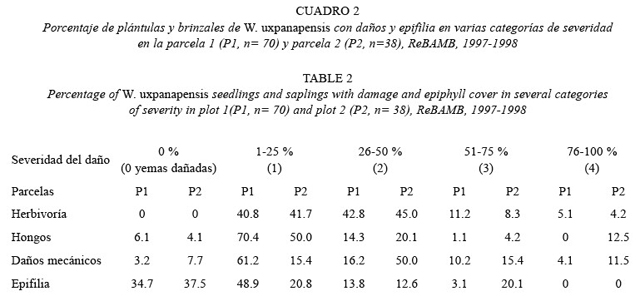
<body><![CDATA[de hongos (H, manchas </span><span style="font-family: arial;">necrosadas     en l&aacute;mina foliar), da&ntilde;os mec&aacute;nicos </span><span      style="font-family: arial;">(DM, quebraduras, hojas enrolladas por     acci&oacute;n </span><span style="font-family: arial;">de insectos o     ara&ntilde;as), as&iacute; como epifilia (EP). La </span><span      style="font-family: arial;">escala utilizada fue 0 (ausencia del     da&ntilde;o y la </span><span style="font-family: arial;">epifilia)     hasta 4 (de 76 a 100 % de presencia del </span><span      style="font-family: arial;">da&ntilde;o). Estos factores se     correlacionaron linealmente </span><span style="font-family: arial;">con     ]]></body>
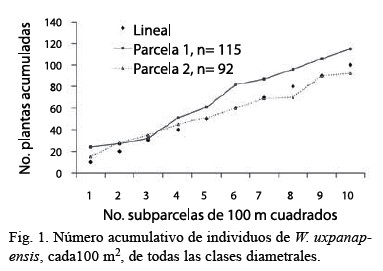
<body><![CDATA[la altura.</span></small><br style="font-family: arial;">     <small></small><br style="font-family: arial;">     <small><small><!-- big --><span style="font-family: arial; font-weight: 700;">Resultados</span><!-- /big --></small></small><br      style="font-family: arial;">     <small><!-- big --><!-- /big --></small><br style="font-family: arial;">     <small><span style="font-family: arial;">Se encontr&oacute; una     densidad     promedio de </span><span style="font-family: arial;">adultos y     juveniles de 1.15 (parcela 1) y 0.92 </span><span      style="font-family: arial;">(parcela 2) ind de <span     ]]></body>
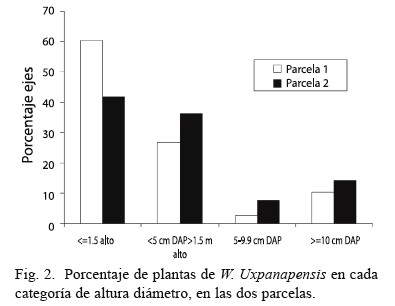
<body><![CDATA[ style="font-style: italic;">W. uxpanapensis</span>/100 m<sup>2</sup>     (<a href="#figura1">Fig. 1</a>). Las pl&aacute;ntulas y brinzales     ten&iacute;an una densidad </span><span style="font-family: arial;">de     0.69 y 0.70, los juveniles de 0.34 y     0.38, y </span><span style="font-family: arial;">los adultos de 0.12 y     0.13/100 m<sup>2</sup>, en la parcela </span><span      style="font-family: arial;">1 y 2, respectivamente. El mayor     porcentaje de </span><span style="font-family: arial;">plantas de <span      style="font-style: italic;">W. uxpanapensis</span> estuvo comprendido </span><span      style="font-family: arial;">en la clase &#8804;1.5 m de altura en las dos     ]]></body>
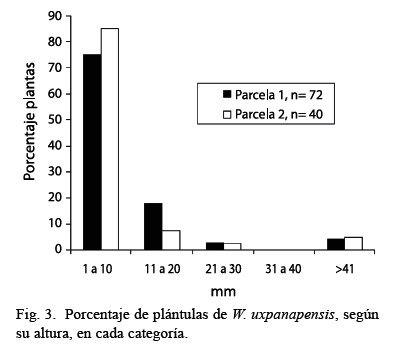
<body><![CDATA[parcelas </span><span style="font-family: arial;">(60.3 y 41.7 %), y     el menor en las dos clases </span><span style="font-family: arial;">subsiguientes     (<a href="#figura2">Fig. 2</a>). Se observ&oacute; un incremento </span><span      style="font-family: arial;">en la &uacute;ltima clase (&gt;10 cm de     DAP).</span></small><br style="font-family: arial;">     <small></small><br style="font-family: arial;">     <small><span style="font-family: arial;">En la categor&iacute;a de     pl&aacute;ntulas y brinzales </span><span style="font-family: arial;">se     registr&oacute; un porcentaje muy alto (parcela 1, </span><span      style="font-family: arial;">75.1 % y parcela 2, 85 %) de individuos en     ]]></body>
<body><![CDATA[la </span><span style="font-family: arial;">clase diam&eacute;trica     basal de 1 a 10 mm, mientras </span><span style="font-family: arial;">que     la de 41 mm represent&oacute; un 5.74 %, en las </span><span      style="font-family: arial;">dos parcelas. La densidad de     &aacute;rboles muertos </span><span style="font-family: arial;">(se     encontraron troncos ca&iacute;dos de hasta 42 m de </span><span      style="font-family: arial;">longitud) fue de 11/ha en la parcela 1 y     cinco </span><span style="font-family: arial;">en la parcela 2.</span></small><br      style="font-family: arial;">     <small></small><br style="font-family: arial;">     ]]></body>
<body><![CDATA[<small><span style="font-family: arial;">La poblaci&oacute;n de <span      style="font-style: italic;">W. uxpanapensis</span> ten&iacute;a una </span><span      style="font-family: arial;">frecuencia total (n&uacute;mero de     subparcelas en que </span><span style="font-family: arial;">apareci&oacute;     la especie en cada parcela) de 45 % </span><span      style="font-family: arial;">(parcela 1) y 39 % (parcela 2). En la     parcela 1 </span><span style="font-family: arial;">la frecuencia de     &aacute;rboles adultos fue de 7 % y en </span><span      style="font-family: arial;">la parcela 2 de 11 %.&nbsp; </span></small>    <br> <small><span style="font-family: arial;"></span></small><br  style="font-family: arial;"> <small><span style="font-family: arial;"></span><span  style="font-family: arial;">Para la parcela 1 se estim&oacute; una distribuci&oacute;n </span><span  style="font-family: arial;">aleatoria en &aacute;rboles (&Iacute;ndice de Clark </span><span style="font-family: arial;">y Evans (IC-E)= 1.07, p&lt;0.1, n= 15), en </span><span style="font-family: arial;">individuos mayores a 5 cm de DAP, y en las&nbsp; </span><span  style="font-family: arial;">pl&aacute;ntulas y brinzales una distribuci&oacute;n agrupada </span><span style="font-family: arial;">(IC-E= 0.028, p&lt;0.1, n= 18). En la parcela 2, </span><span  style="font-family: arial;">la distribuci&oacute;n tambi&eacute;n fue aleatoria con tendencia </span><span style="font-family: arial;">a la distribuci&oacute;n uniforme en &aacute;rboles </span><span  style="font-family: arial;">(IC-E= 1.34, p&lt;0.1, n= 18), y en las pl&aacute;ntulas y brinzales, una distribuci&oacute;n agregada (IC-E= </span><span  style="font-family: arial;">0.025, p&lt;1, n= 79). La distancia promedio al </span><span style="font-family: arial;">vecino m&aacute;s cercano en los&nbsp; adultos fue de 14.26 </span><span  style="font-family: arial;">m (&plusmn;8.94 DE) en la parcela 1, y de 15.33 m </span><span style="font-family: arial;">(&plusmn;5.14 DE) en la parcela 2.</span></small></div>     ]]></body>
<body><![CDATA[<p align="center"><a name="figura1"> <img style="border: 0px solid ; width: 383px; height: 271px;"  src="/img/fbpe/rbt/v54n4/3502i1.JPG" title="" alt=""></a><small><a name="figura2"><img  style="border: 0px solid ; width: 395px; height: 306px;"  src="/img/fbpe/rbt/v54n4/3502i2.JPG" title="" alt=""></a></small></p>     
<p align="center"><a name="figura3"> <img style="border: 0px solid ; width: 404px; height: 350px;"  src="/img/fbpe/rbt/v54n4/3502i3.JPG" title="" alt=""></a></p>     
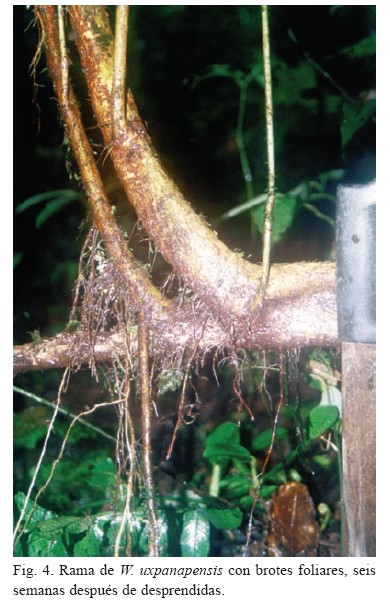
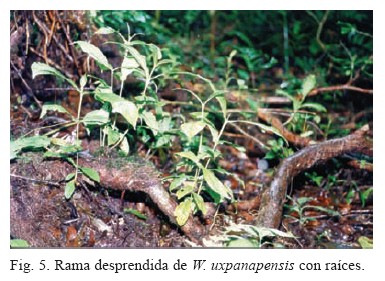
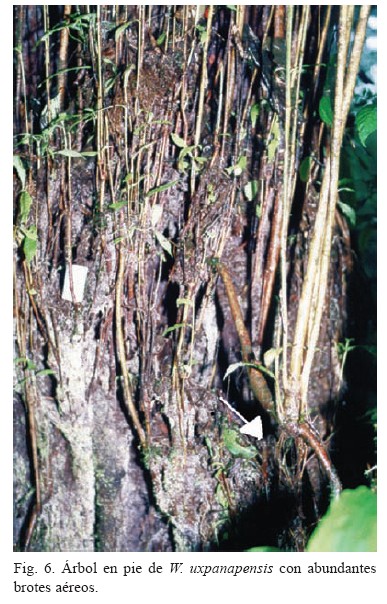
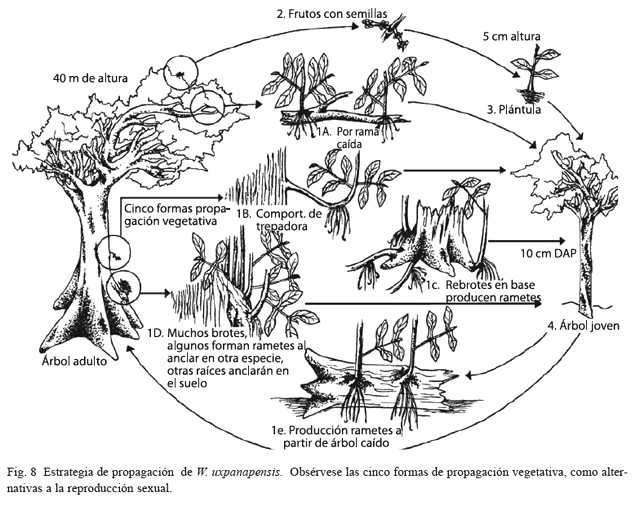
<p align="justify"><small><br style="font-family: arial;"> <br style="font-family: arial;"> </small></p>     <div style="text-align: left;"><small><span style="font-family: arial;">Los individuos observados de <span style="font-style: italic;">W. uxpanapensis </span></span><span style="font-family: arial;">med&iacute;an desde 11 cm hasta alrededor </span><span style="font-family: arial;">de 45 m de altura, y se encontraron individuos </span><span style="font-family: arial;">desde 1 mm hasta 1.40 m de di&aacute;metro. El &aacute;rea </span><span  style="font-family: arial;">basal de los siete &aacute;rboles con DAP &gt;10 cm, </span><span style="font-family: arial;">encontrados en la parcela 1 fue de 3.05 m2/ha, y </span><span style="font-family: arial;">de 5.38 m<sup>2</sup>/ha con 11 &aacute;rboles en la parcela 2. </span></small>    <br> <small><span style="font-family: arial;"></span></small><br  style="font-family: arial;"> <small><span style="font-family: arial;"><span  style="font-style: italic;">W. uxpanapensis</span> present&oacute; gambas de 0.3 m de altura en individuos de 8 m de altura, y de hasta 4 m en &aacute;rboles de unos 45 m (estos dos par&aacute;metros se correlacionaron r= 0.94, n= 20, p&lt;0.01). Su fuste es angular, y en una secci&oacute;n transversal, &eacute;ste es irregular. Tiene una corteza pardo-rojiza, desprendible en escamas, sin </span><span style="font-family: arial;">patr&oacute;n de distribuci&oacute;n definido. Se observ&oacute; en </span><span  style="font-family: arial;">un &aacute;rbol reci&eacute;n ca&iacute;do de 35 m de largo, que </span><span style="font-family: arial;">mostraba un sistema radicular superficial, con </span><span  style="font-family: arial;">tres ra&iacute;ces gruesas y el resto eran peque&ntilde;as y </span><span style="font-family: arial;">muy abundantes.</span></small><br style="font-family: arial;"> <small></small><br style="font-family: arial;"> <small><span style="font-family: arial;">Las longitudes o alturas oscilaron de 2.5 a </span><span style="font-family: arial;">30 m (&plusmn;15.81 DE). No se encontr&oacute; una correlaci&oacute;n </span><span  style="font-family: arial;">lineal entre las categor&iacute;as de di&aacute;metro y </span><span style="font-family: arial;">de altura, con respecto a la pendiente (parcela </span><span  style="font-family: arial;">1 r= 0.18, n= 115, p&gt;0.1; parcela 2 r= 0.14, </span><span style="font-family: arial;">n= 92, p&gt;0.1). En las 2 ha analizadas, <span style="font-style: italic;">W. uxpanapensis</span> </span><span style="font-family: arial;">se ubic&oacute; tanto en pendientes suaves </span><span style="font-family: arial;">como abruptas (1 a 52 grados).</span></small><br style="font-family: arial;"> <small></small><br style="font-family: arial;"> <small><span style="font-family: arial;">Se observaron troncos y ramas ca&iacute;dos con </span><span style="font-family: arial;">brotes. Estas &uacute;ltimas produjeron brotes a&eacute;reos </span><span  style="font-family: arial;">al cabo de seis semanas (<a href="#figura4">Fig. 4</a>), y nueve meses </span><span style="font-family: arial;">despu&eacute;s ya ten&iacute;an brotes radiculares (una rama </span><span  style="font-family: arial;">ca&iacute;da en abril de 1994, presentaba ra&iacute;ces en&nbsp; </span><span style="font-family: arial;">febrero de 1995, <a href="#figura5">Fig. 5</a>). En la parcela 2, se </span><span  style="font-family: arial;">desprendieron tres ramas de tres &aacute;rboles diferentes, </span><span style="font-family: arial;">cada uno con 35, 70 y 200 brotes a&eacute;reos, </span><span  style="font-family: arial;">pero a&uacute;n no pose&iacute;an brotes radiculares al final </span><span style="font-family: arial;">de esta investigaci&oacute;n.</span></small><br style="font-family: arial;"> <small></small><br style="font-family: arial;"> <small><span style="font-family: arial;">Tambi&eacute;n se encontr&oacute; que &aacute;rboles en pie </span><span style="font-family: arial;">mayores de 35 m de altura mostraban disposici&oacute;n </span><span  style="font-family: arial;">a producir rebrotes en su fuste, y algunos de </span><span style="font-family: arial;">estos brotes parec&iacute;an &#8220;saltar&#8221; hacia otros sustratos </span><span  style="font-family: arial;">para luego producir ra&iacute;ces (<a  href="#figura6">Fig. 6</a>, <a href="#figura8">8</a>).</span></small><br style="font-family: arial;"> <small></small><br style="font-family: arial;"> <small><span style="font-family: arial;">La ca&iacute;da de las ramas provoc&oacute; la apertura </span><span style="font-family: arial;">de claros de hasta unos 20 m de radio, los cuales </span><span  style="font-family: arial;">aparentemente facilitan que los prop&aacute;gulos </span><span style="font-family: arial;">vegetativos se establezcan y sobrevivan. Se </span><span  style="font-family: arial;">observ&oacute; que pl&aacute;ntulas, brinzales y latizales </span><span style="font-family: arial;">en pie con tallo muy delgado, buscaban la luz creciendo y f&aacute;cilmente se inclinaban formando </span><span style="font-family: arial;">&aacute;ngulos de 35 a 45 grados. Dicha inclinaci&oacute;n </span><span  style="font-family: arial;">estimul&oacute;, en algunos individuos, la aparici&oacute;n de </span><span style="font-family: arial;">brotes radiculares en el tallo. </span></small></div>     <p align="center"><small><a name="figura4"> <img style="border: 0px solid ; width: 390px; height: 605px;"  src="/img/fbpe/rbt/v54n4/3502i4.JPG" title="" alt=""></a><a name="figura5"><img  style="border: 0px solid ; width: 385px; height: 281px;"  src="/img/fbpe/rbt/v54n4/3502i5.JPG" title="" alt=""></a></small></p>     
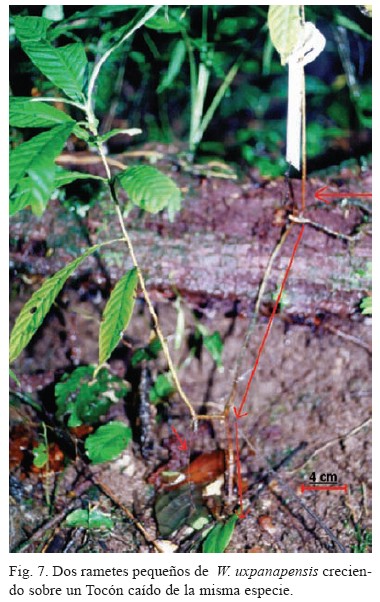
<p align="justify"><small><span style="font-family: arial;">     <br> <br style="font-family: arial;"> </span></small></p>     <div style="text-align: left;"><small><span style="font-family: arial;">Muchas de las plantas registradas en las </span><span style="font-family: arial;">parcelas 1 y 2 crec&iacute;an sobre troncos de &aacute;rboles </span><span  style="font-family: arial;">muertos de <span  style="font-style: italic;">W. uxpanapensis</span> (<a href="#figura7">Fig. 7</a>, <a href="#figura8">8</a>). En&nbsp; algunos de los 11 tocones presentes en la parcela </span><span  style="font-family: arial;">1 y de los cinco en la parcela 2, se pudo </span><span  style="font-family: arial;">observar individuos creciendo muy cercanos a&nbsp; </span><span style="font-family: arial;">ellos, y las ramas que los mantuvieron unidos </span><span style="font-family: arial;">al tronco, en proceso de descomposici&oacute;n. En&nbsp; </span><span  style="font-family: arial;">la parcela 1, ocho brinzales presentaban dicha </span><span style="font-family: arial;">condici&oacute;n, y en la parcela 2, 13.</span></small><br style="font-family: arial;"> <small></small><br style="font-family: arial;"> <small><span style="font-family: arial;">En la parcela 1 se encontr&oacute; un total de 94 </span><span style="font-family: arial;">individuos. Si adem&aacute;s se incluyen los 34 rametes </span><span  style="font-family: arial;">potenciales hallados en trece unidades*, la </span><span style="font-family: arial;">poblaci&oacute;n de pl&aacute;ntulas aumentar&iacute;a en 26.6 % y </span><span  style="font-family: arial;">la poblaci&oacute;n total a 128 individuos. En la parcela </span><span style="font-family: arial;">2 se registraron 85 individuos y 12 RP en&nbsp; </span><span  style="font-family: arial;">cinco unidades, lo que corresponde a un incremento </span><span style="font-family: arial;">de 12.4 % de las pl&aacute;ntulas. Para esta </span><span style="font-family: arial;">parcela, la poblaci&oacute;n podr&iacute;a aumentar a 97. En </span><span  style="font-family: arial;">t&eacute;rminos de densidad, se encontr&oacute; un promedio&nbsp; </span><span  style="font-family: arial;">de 0.8 y 0.31 RP/100 m<sup>2</sup>, respectivamente.</span></small></div>     <p align="justify">&nbsp;</p>     ]]></body>
<body><![CDATA[<p align="center"><a name="figura6"> <img style="border: 0px solid ; width: 387px; height: 604px;"  src="/img/fbpe/rbt/v54n4/3502i6.JPG" title="" alt=""></a><a name="figura7"><img  style="border: 0px solid ; width: 380px; height: 602px;"  src="/img/fbpe/rbt/v54n4/3502i7.JPG" title="" alt=""></a></p>     
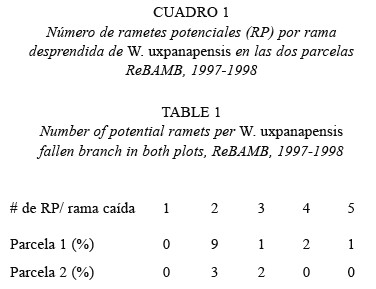
<p align="justify"><small><br style="font-family: arial;"> <br style="font-family: arial;"> </small></p>     <div style="text-align: left;"><small><span style="font-family: arial;">El n&uacute;mero de RP en las ramas desprendidas, </span><span style="font-family: arial;">que ocurri&oacute; durante el estudio, vari&oacute; </span><span  style="font-family: arial;">entre dos y cinco, y el mayor n&uacute;mero de ramas desprendidas con dos rametes, se encontr&oacute; en la </span><span style="font-family: arial;">parcela 1 (<a  href="#cuadro1">Cuadro 1</a>).</span></small><br  style="font-family: arial;"> <small></small><br style="font-family: arial;"> <small><span style="font-family: arial;">La mayor&iacute;a de las pl&aacute;ntulas, brinzales o </span><span style="font-family: arial;">latizales presentaban alg&uacute;n da&ntilde;o y epif&iacute;lia. </span><span  style="font-family: arial;">Aunque los valores variaron de una parcela a </span><span style="font-family: arial;">otra, la mayor severidad se observ&oacute; para la herbivor&iacute;a </span><span  style="font-family: arial;">foliar por cortadores, y para los da&ntilde;os </span><span style="font-family: arial;">mec&aacute;nicos. La epifilia fue la menos evidente, ya que al 34.7 y 37.5 % de las plantas, en las </span><span style="font-family: arial;">parcelas 1 y 2, no se les observ&oacute; este fen&oacute;meno </span><span  style="font-family: arial;">(<a href="#cuadro2">Cuadro 2</a>). Los da&ntilde;os no se correlacionaron </span><span style="font-family: arial;">linealmente con la altura de la planta, o no fueron </span><span  style="font-family: arial;">consistentes entre las parcelas.</span></small></div>     <p align="justify">&nbsp;</p>     <p align="center"><a name="cuadro1"> <img style="border: 0px solid ; width: 376px; height: 289px;"  src="/img/fbpe/rbt/v54n4/3502i8.JPG" title="" alt=""></a></p>     
<p align="center">&nbsp;</p>     <p align="justify"><a name="figura8">     <br> </a></p>     <div style="text-align: center;"><img src="/img/fbpe/rbt/v54n4/3502i9.JPG" title=""  alt="" style="width: 640px; height: 506px;">    
<br> </div>     ]]></body>
<body><![CDATA[<p align="justify"><small><br style="font-family: arial;"> <br style="font-family: arial;"> </small></p>     <div style="text-align: left;"><small><span  style="font-family: arial; font-weight: 700;">Discusi&oacute;n</span></small><br  style="font-family: arial;"> <br style="font-family: arial;"> <small><span style="font-family: arial;">Hubbell y Foster (1987) indican que cada especie limita el crecimiento de su poblaci&oacute;n m&aacute;s que el de las otras especies, de manera que los procesos denso-dependientes impiden a cualquier especie hacerse completamente dominante, en muchos ecosistemas. <span style="font-style: italic;">W. uxpanapensis </span> </span><span style="font-family: arial;">en las dos parcelas analizadas tiene una </span><span style="font-family: arial;">alta dominancia en t&eacute;rminos de su densidad, </span><span style="font-family: arial;">frecuencia, &aacute;rea basal y cobertura, considerando </span><span  style="font-family: arial;">las categor&iacute;as diam&eacute;tricas. Con una densidad </span><span style="font-family: arial;">relativamente alta, <span style="font-style: italic;">W. uxpanapensis</span> alcanz&oacute; en&nbsp; </span><span style="font-family: arial;">la ReBAMB un &iacute;ndice de valor de importancia </span><span  style="font-family: arial;">del 40 % con respecto a 94 especies de &aacute;rboles </span><span style="font-family: arial;">encontrados en 1 ha (Wattenberg <span style="font-style: italic;">et al</span>. 1996).</span></small><br  style="font-family: arial;"> <br style="font-family: arial;"> <small><span style="font-family: arial;">La densidad relativamente alta de este </span><span style="font-family: arial;">&aacute;rbol, en este estudio, coincide con lo observado </span><span  style="font-family: arial;">por Wattemberg <span  style="font-style: italic;">et al</span>. (1996) quienes </span><span  style="font-family: arial;">determinaron dominante a esta especie, en </span><span  style="font-family: arial;">los alrededores de la Estaci&oacute;n Biol&oacute;gica de la </span><span style="font-family: arial;">ReBAMB.</span></small><br  style="font-family: arial;"> <br style="font-family: arial;"> <small><span style="font-family: arial;">La estructura de poblaci&oacute;n de &#8220;J&#8221; invertida </span><span style="font-family: arial;">puede deberse al establecimiento de pl&aacute;ntulas </span><span  style="font-family: arial;">producidas por semilla, pero los rametes deben </span><span style="font-family: arial;">estar jugando un papel importante en este caso </span><span style="font-family: arial;">(se demostr&oacute; que esta especie tiene una elevada </span><span  style="font-family: arial;">capacidad para rebrotar a partir de ramas o </span><span style="font-family: arial;">troncos ca&iacute;dos, e inclusive de fustes en pie y </span><span style="font-family: arial;">que estos produzcan ra&iacute;ces, como se discutir&aacute; </span><span  style="font-family: arial;">m&aacute;s adelante). La diferencia de cerca de 21 % entre las parcelas 1 y 2, en plantas menores a </span><span  style="font-family: arial;">1.5 m de altura podr&iacute;a deberse a que en la parcela </span> <!-- big --><span style="font-family: arial;"><small>1 se encontraron m&aacute;s rametes potenciales.</small></span><!-- /big --></small></div>     <p align="justify"><small><!-- big --><span style="font-family: arial;"> </span><!-- /big --></small></p>     <p align="justify"><a name="cuadro2">     <br> </a></p>     <div style="text-align: center;"><img src="/img/fbpe/rbt/v54n4/3502i10.JPG" title=""  alt="" style="width: 640px; height: 306px;">    
<br> </div>     <p align="justify"><small><br style="font-family: arial;"> </small><small><span style="font-family: arial;">La mayor&iacute;a de los RP se encontraron en </span><span style="font-family: arial;">la categor&iacute;a de pl&aacute;ntulas con una probable alta </span><span  style="font-family: arial;">mortalidad despu&eacute;s. Esto podr&iacute;a deberse a que </span><span style="font-family: arial;">los RP tienen que competir por los mismos </span><span  style="font-family: arial;">recursos de la rama madre o del suelo, o como </span><span style="font-family: arial;">consecuencia de mayores ataques de herb&iacute;voros </span><span style="font-family: arial;">o enfermedades. En este tipo de bosque, la </span><span  style="font-family: arial;">luz resulta un factor cr&iacute;tico y afecta las posibilidades </span><span style="font-family: arial;">de que las pl&aacute;ntulas se establezcan </span><span  style="font-family: arial;">y sobrevivan (R&ouml;mich <span  style="font-style: italic;">et al</span>. 1996). Se supone </span><span  style="font-family: arial;">que la probabilidad de que todos los RP/unidad </span><span style="font-family: arial;">alcancen clases diam&eacute;tricas superiores es baja, </span><span  style="font-family: arial;">pero que al menos uno lo logre es alta debido a </span><span style="font-family: arial;">la gran cantidad de rebrotes producidos.</span></small><br style="font-family: arial;"> </p>     <div style="text-align: left;"><small></small><br      style="font-family: arial;">     ]]></body>
<body><![CDATA[<small><span style="font-family: arial;">Semejante a <span      style="font-style: italic;">W. uxpanapensis</span>, las ramas </span><span      style="font-family: arial;">desprendidas de <span      style="font-style: italic;">E. pastoensis</span> (Botina 1993) </span><span      style="font-family: arial;">en Colombia, y <span      style="font-style: italic;">E. auriculata</span> (Sch&ouml;ers <span      style="font-style: italic;">et al</span>. </span><span      style="font-family: arial;">1996) en la ReBAMB cuando caen&nbsp;     dentro de la </span><span style="font-family: arial;">materia     org&aacute;nica que cubre el suelo, enra&iacute;zan y </span><span     ]]></body>
<body><![CDATA[ style="font-family: arial;">pueden dar origen a una nueva planta.     Tambi&eacute;n </span><span style="font-family: arial;">se agrega que     la regeneraci&oacute;n natural de <span style="font-style: italic;">E.     </span></span><span style="font-family: arial;"><span      style="font-style: italic;">pastoensis</span> puede ocurrir a partir     de tocones,&nbsp; </span><span style="font-family: arial;">troncos     ca&iacute;dos producto de la tala o derribo </span><span      style="font-family: arial;">y de ramas ca&iacute;das al quebrarse o     por corte </span><span style="font-family: arial;">(Botina 1993). En     el Alto Montclar, Colombia, </span><span style="font-family: arial;">y     ]]></body>
<body><![CDATA[en la Sede de Occidente, Universidad de </span><span      style="font-family: arial;">Costa Rica, se simul&oacute;     artificialmente la reproducci&oacute;n </span><span      style="font-family: arial;">asexual por estacas con &eacute;xito en <span      style="font-style: italic;">E. </span></span><span      style="font-family: arial;"><span style="font-style: italic;">pastoensis</span>     y <span style="font-style: italic;">W. uxpanapensis, </span>respectivamente     </span><span style="font-family: arial;">(Mej&iacute;a 1981, Botina     1993, Brenes y Di St&eacute;fano </span><span      style="font-family: arial;">1996-1997).</span></small><br     ]]></body>
<body><![CDATA[ style="font-family: arial;">     <small></small><br style="font-family: arial;">     <small><span style="font-family: arial;">La capacidad de     producci&oacute;n de     brotes </span><span style="font-family: arial;">a&eacute;reos y     radiculares en &aacute;rboles en pie debe </span><span      style="font-family: arial;">estar influenciada por cambios     fenot&iacute;picos, </span><span style="font-family: arial;">formas de     alteraci&oacute;n, variaciones ambientales y </span><span      style="font-family: arial;">disponibilidad de recursos (Harada <span     ]]></body>
<body><![CDATA[ style="font-style: italic;">et al.</span> 1997). </span><span      style="font-family: arial;">La plasticidad morfol&oacute;gica es     importante en la </span><span style="font-family: arial;">eficiencia     de obtener recursos para las plantas </span><span      style="font-family: arial;">(Streitwolf-Engel <span      style="font-style: italic;">et al.</span> 1997). Por ello es posible </span><span      style="font-family: arial;">que en este &aacute;rbol sea una forma     v&aacute;lida para </span><span style="font-family: arial;">obtener     luz en un bosque con alta competencia </span><span      style="font-family: arial;">inter-espec&iacute;fica.</span></small><br     ]]></body>
<body><![CDATA[ style="font-family: arial;">     <small></small><br style="font-family: arial;">     <small><span style="font-family: arial;">La propagaci&oacute;n     vegetativa     parece ser una </span><span style="font-family: arial;">estrategia muy     importante en este taxa, tal vez </span><span      style="font-family: arial;">debido a que las semillas son     da&ntilde;adas severamente. </span><span style="font-family: arial;">Aunque     se desconoce la efectividad de </span><span style="font-family: arial;">su     reproducci&oacute;n sexual, <span style="font-style: italic;">W.     ]]></body>
<body><![CDATA[uxpanapensis</span> la utiliza, </span><span      style="font-family: arial;">se localiz&oacute; al menos una     pl&aacute;ntula de 7 cm </span><span style="font-family: arial;">de     altura creciendo sobre un tronco ca&iacute;do de un </span><span      style="font-family: arial;">helecho arborescente. Durante este estudio     se </span><span style="font-family: arial;">recolectaron frutos     directamente de un &aacute;rbol, y </span><span      style="font-family: arial;">m&aacute;s del 95 % de las semillas     estaban depredadas </span><span style="font-family: arial;">por el     gorgojo <span style="font-style: italic;">Eurechliof</span> sp.     ]]></body>
<body><![CDATA[(Brenes y Di </span><span style="font-family: arial;">St&eacute;fano,     en prep.). Las semillas de esta especie, </span><span      style="font-family: arial;">cercanas a 1 mm de longitud y los frutos </span><span      style="font-family: arial;">dehiscentes, hace pensar que la     dispersi&oacute;n de </span><span style="font-family: arial;">semillas     sea anem&oacute;cona (Brenes 1999).</span></small><br      style="font-family: arial;">     <small></small><br style="font-family: arial;">     <small><span style="font-family: arial;"><span      style="font-style: italic;">W.     ]]></body>
<body><![CDATA[uxpanapensis</span> presenta alto potencial </span><span      style="font-family: arial;">para la regeneraci&oacute;n natural por     medio de propagaci&oacute;n vegetativa. &eacute;sta podr&iacute;a     requerir </span><span style="font-family: arial;">de claros producidos     por la ca&iacute;da de ramas o </span><span style="font-family: arial;">&aacute;rboles     para el establecimiento de los rametes. </span><span      style="font-family: arial;">Clark y Clark (1987), y Hubbell y Foster </span><span      style="font-family: arial;">(1987) han se&ntilde;alado que las     especies intolerantes </span><span style="font-family: arial;">a la     sombra (umbr&oacute;filas) deben presentar </span><span     ]]></body>
<body><![CDATA[ style="font-family: arial;">poca regeneraci&oacute;n durante mucho     tiempo,&nbsp; </span><span style="font-family: arial;">porque claros     grandes aparecen con mucho </span><span style="font-family: arial;">menos     frecuencia que claros peque&ntilde;os. Tal vez </span><span      style="font-family: arial;">en esos estudios no se consider&oacute;     esta estrategia </span><span style="font-family: arial;">de     propagaci&oacute;n.</span></small><br style="font-family: arial;">     <small></small><br style="font-family: arial;">     <small><span style="font-family: arial;">Este comportamiento facilita     la     ]]></body>
<body><![CDATA[efectiva </span><span style="font-family: arial;">y r&aacute;pida     propagaci&oacute;n vegetativa en el medio </span><span      style="font-family: arial;">natural poco favorable, y asegura el     mantenimiento </span><span style="font-family: arial;">de las     poblaciones naturales (Zanoni </span><span style="font-family: arial;">1975,     Wong y Jones 1986) a trav&eacute;s de la </span><span      style="font-family: arial;">producci&oacute;n de un reservorio de RP,     parecido </span><span style="font-family: arial;">al banco de genetes     (Gavin y Peart 1999). Sin </span><span style="font-family: arial;">embargo,     afectar&aacute; la estructura gen&eacute;tica de la </span><span     ]]></body>
<body><![CDATA[ style="font-family: arial;">poblaci&oacute;n (Hamrick y Nasson 1996)     haciendo </span><span style="font-family: arial;">que &eacute;sta sea     m&aacute;s homog&eacute;nea. Adem&aacute;s, es un </span><span      style="font-family: arial;">tipo de reproducci&oacute;n pasiva     (Pulliam 1996) a </span><span style="font-family: arial;">corta     distancia.</span></small><br style="font-family: arial;">     <small></small><br style="font-family: arial;">     <small><span style="font-family: arial;">En las parcelas investigadas     se     encontr&oacute; </span><span style="font-family: arial;">una cantidad     ]]></body>
<body><![CDATA[abundante de ramas y troncos </span><span style="font-family: arial;">ca&iacute;dos.     La ca&iacute;da de estos individuos con relativa </span><span      style="font-family: arial;">frecuencia puede deberse a que <span      style="font-style: italic;">W. uxpanapensis </span></span><span      style="font-family: arial;">tiene la capacidad de establecerse en     sitios </span><span style="font-family: arial;">con pendientes hasta     de 44 grados, lugares que </span><span style="font-family: arial;">son     susceptibles a la erosi&oacute;n y deslizamientos </span><span      style="font-family: arial;">debido a las fuertes precipitaciones,     t&iacute;picas de </span><span style="font-family: arial;">la zona o     ]]></body>
<body><![CDATA[en eventos especiales como el hurac&aacute;n </span><span      style="font-family: arial;">C&eacute;sar (ocurrido en 1996).     Aparentemente cuenta </span><span style="font-family: arial;">con un     sistema radicular superficial que le dificulta </span><span      style="font-family: arial;">mantener un peso enorme en pie. Sprenger </span><span      style="font-family: arial;">et al. (1996) se&ntilde;alan que las     lluvias fuertes en </span><span style="font-family: arial;">pendientes     escarpadas con suelos poco profundos </span><span      style="font-family: arial;">favorecen la ca&iacute;da de los     &aacute;rboles de <span style="font-style: italic;">Plinia </span></span><span     ]]></body>
<body><![CDATA[ style="font-family: arial;"><span style="font-style: italic;">salticola</span>     McVauhg, en la ReBAMB.</span></small><br style="font-family: arial;">     <small></small><br style="font-family: arial;">     <small><span style="font-family: arial;">La ca&iacute;da de ramas puede     darse     por ataques </span><span style="font-family: arial;">de hongos u otros     pat&oacute;genos, o un lento </span><span style="font-family: arial;">proceso     de muerte (proceso interno). La combinaci&oacute;n </span><span      style="font-family: arial;">de esos factores, unido al hecho de </span><span      style="font-family: arial;">que las copas de estos &aacute;rboles del     ]]></body>
<body><![CDATA[dosel son </span><span style="font-family: arial;">asim&eacute;tricas,     aumentan las probabilidades de </span><span style="font-family: arial;">desprender     ramas (Van der Meer y Bongers </span><span style="font-family: arial;">1996;     <a href="#figura8">Fig. 8</a>), especialmente cuando se presentan </span><span      style="font-family: arial;">vientos fuertes.</span></small><br      style="font-family: arial;">     <small></small><br style="font-family: arial;">     <small><span style="font-family: arial;">En el caso de <span      style="font-style: italic;">W. uxpanapensis</span>, se observ&oacute; </span><span      style="font-family: arial;">una distribuci&oacute;n agrupada en     ]]></body>
<body><![CDATA[pl&aacute;ntulas y </span><span style="font-family: arial;">juveniles,     lo cual debe estar respondiendo a </span><span      style="font-family: arial;">su estrategia de propagaci&oacute;n     vegetativa. Las </span><span style="font-family: arial;">plantas     propagadas de esta manera tienden a </span><span      style="font-family: arial;">encontrarse cerca del &aacute;rbol padre,     entre m&aacute;s </span><span style="font-family: arial;">alejados se     encuentren, m&aacute;s importante es la </span><span      style="font-family: arial;">propagaci&oacute;n vegetativa&nbsp;     (Harada <span style="font-style: italic;">et al</span>. 1997).</span></small><br     ]]></body>
<body><![CDATA[ style="font-family: arial;">     <small></small><br style="font-family: arial;">     <small><span style="font-family: arial;">La mayor&iacute;a de las     pl&aacute;ntulas y brinzales de </span><span      style="font-family: arial;"><span style="font-style: italic;">W.     uxpanapensis</span> se encontraron da&ntilde;ados por </span><span      style="font-family: arial;">herbivor&iacute;a, hongos, o/y     mec&aacute;nicos, aunque la </span><span style="font-family: arial;">severidad     en &eacute;stos fue baja en su mayor&iacute;a. Di </span><span      style="font-family: arial;">St&eacute;fano y Hurtado (1996)     ]]></body>
<body><![CDATA[encontraron que un </span><span style="font-family: arial;">13.5 % de     la vegetaci&oacute;n le&ntilde;osa del sotobosque&nbsp; </span><span      style="font-family: arial;">e la ReBAMB, no present&oacute;     alg&uacute;n tipo de </span><span style="font-family: arial;">da&ntilde;o,     y cuando aparec&iacute;an &eacute;stos, en general, </span><span      style="font-family: arial;">eran bajos. Tales da&ntilde;os     podr&iacute;an eventualmente </span><span style="font-family: arial;">causar     mortalidad y provocar cambios en </span><span      style="font-family: arial;">la din&aacute;mica de poblaciones     vegetales en este </span><span style="font-family: arial;">bosque, por     ]]></body>
<body><![CDATA[ende, afecta la abundancia y distribuci&oacute;n </span><span      style="font-family: arial;">de los rametes.</span></small><br      style="font-family: arial;">     <small></small><br style="font-family: arial;">     <small><span style="font-family: arial;">En un estudio realizado en la     isla de     Barro </span><span style="font-family: arial;">Colorado, con 47     especies forestales, Coley </span><span style="font-family: arial;">(1987)     encontr&oacute; bases para apoyar la teor&iacute;a </span><span      style="font-family: arial;">de que las diferencias     ]]></body>
<body><![CDATA[interespec&iacute;ficas, en la </span><span style="font-family: arial;">defensa     de las plantas, puede ser explicada por </span><span      style="font-family: arial;">el desequilibrio en la disponibilidad del     carbono </span><span style="font-family: arial;">y nitr&oacute;geno.     Datos obtenidos, por este autor con </span><span      style="font-family: arial;">plantas de diferentes categor&iacute;as de     altura, muestran </span><span style="font-family: arial;">que las     m&aacute;s peque&ntilde;as (posiblemente m&aacute;s </span><span      style="font-family: arial;">j&oacute;venes) se defienden mejor. Los     factores bi&oacute;ticos </span><span style="font-family: arial;">son     ]]></body>
<body><![CDATA[tan importantes como los abi&oacute;ticos en el </span><span      style="font-family: arial;">establecimiento y distribuci&oacute;n de     la vegetaci&oacute;n </span><span style="font-family: arial;">(Howe y     Smallwood 1982, Clark y Clark 1985, </span><span      style="font-family: arial;">Hubbel y Foster 1987, Sprenger <span      style="font-style: italic;">et al</span>. 1996).</span></small><br      style="font-family: arial;">     <small></small><br style="font-family: arial;">     <small><span style="font-family: arial;">La alta diversidad de especies     de     ]]></body>
<body><![CDATA[plantas, </span><span style="font-family: arial;">caracter&iacute;stica     de comunidades tropicales, </span><span style="font-family: arial;">ha     sido atribuida a patrones espaciales de </span><span      style="font-family: arial;">la mortalidad de semillas y     pl&aacute;ntulas, como </span><span style="font-family: arial;">resultado     de herbivor&iacute;a (Janzen 1970, Connell </span><span      style="font-family: arial;">1971). Estudios en rametes de<span      style="font-style: italic;"> Piper arieianum</span> </span><span      style="font-family: arial;">C.DC. en La Selva, Costa Rica, realizados     por </span><span style="font-family: arial;">Marquis (1987), afirman     ]]></body>
<body><![CDATA[que la fauna herb&iacute;vora </span><span style="font-family: arial;">da&ntilde;a     m&aacute;s a ciertas plantas individuales debido </span><span      style="font-family: arial;">a sus caracter&iacute;sticas     gen&eacute;ticas.</span></small><br style="font-family: arial;">     <small></small><br style="font-family: arial;">     <small><span style="font-family: arial;">Los da&ntilde;os     mec&aacute;nicos     tuvieron mayor incidencia </span><span style="font-family: arial;">en     las escalas desde el 1 hasta el 50 % y </span><span      style="font-family: arial;">apenas un porcentaje del 3.2 (parcela 1) y     ]]></body>
<body><![CDATA[7.7 (parcela 2) no los presentaron. Esto es similar a </span><span      style="font-family: arial;">lo encontrado por Di St&eacute;fano y     Hurtado (1996) </span><span style="font-family: arial;">en otro     estudio, donde menos del 7 % de las </span><span      style="font-family: arial;">plantas del sotobosque presentaron     quebraduras </span><span style="font-family: arial;">provocadas entre     otros aspectos por el viento y </span><span style="font-family: arial;">la     ca&iacute;da de material de estratos superiores.</span></small><br      style="font-family: arial;">     <small></small><br style="font-family: arial;">     ]]></body>
<body><![CDATA[<small><span style="font-family: arial;">Muchas especies han     desarrollado     mecanismos </span><span style="font-family: arial;">evolutivos     (fisiol&oacute;gicos, demogr&aacute;ficos </span><span      style="font-family: arial;">y de comportamiento), o han     dise&ntilde;ado estrategias </span><span style="font-family: arial;">para     aprovechar los recursos y oportunidades </span><span      style="font-family: arial;">de reproducci&oacute;n para provocar     variaciones </span><span style="font-family: arial;">de     distribuci&oacute;n en el espacio y en el tiempo </span><span     ]]></body>
<body><![CDATA[ style="font-family: arial;">(Rhodes y Odum 1996).</span></small><br      style="font-family: arial;">     <small></small><br style="font-family: arial;">     <small><small><!-- big --><span style="font-family: arial; font-weight: 700;">Agradecimientos</span><!-- /big --></small></small><br      style="font-family: arial;">     <small></small><br style="font-family: arial;">     <small><span style="font-family: arial;">Agradecemos a la     Vicerrector&iacute;a     </span><span style="font-family: arial;">de Investigaci&oacute;n, a     trav&eacute;s del Programa de </span><span style="font-family: arial;">Investigaciones     ]]></body>
<body><![CDATA[del Bosque Premontano, y de </span><span style="font-family: arial;">manera     especial, a Allan Artavia y a Ronald&nbsp; </span><span      style="font-family: arial;">S&aacute;nchez, por su ayuda en el trabajo     de campo.</span></small><br style="font-family: arial;">     <small></small><br style="font-family: arial;">     <small><small><!-- big --><span style="font-family: arial; font-weight: 700;">Resumen</span><!-- /big --></small></small><br      style="font-family: arial;">     <small></small><br style="font-family: arial;">     <small><span style="font-family: arial;">Se estudi&oacute; los rametes,     la     ]]></body>
<body><![CDATA[distribuci&oacute;n y estructura </span><span      style="font-family: arial;">de la poblaci&oacute;n de <span      style="font-style: italic;">Warszewiczia uxpanapensis</span>, en 2 ha     de </span><span style="font-family: arial;">bosque pluvial premontano.     Este &aacute;rbol alcanza hasta 45 </span><span      style="font-family: arial;">m de altura, DAPs hasta de 1.40 m y gambas     de 8 m de </span><span style="font-family: arial;">altura. Su     frecuencia fue de 49 % y su cobertura promedio </span><span      style="font-family: arial;">de 6.5 %. La distribuci&oacute;n de los     adultos fue aleatoria </span><span style="font-family: arial;">(distancia     ]]></body>
<body><![CDATA[promedio al vecino m&aacute;s cercano en la parcela 1 </span><span      style="font-family: arial;">de 14.26 m, IC-E= 1.07, n= 15 en la     parcela 2 de 15.33 m, </span><span style="font-family: arial;">n= 18,     IC-E= 1.34). Sus pl&aacute;ntulas representaron el 60.3 % </span><span      style="font-family: arial;">de la poblaci&oacute;n estudiada (parcela     1, n= 94; parcela 2, n=&nbsp; </span><span style="font-family: arial;">85).     Se descubri&oacute; que esta especie tiene una alta capacidad </span><span      style="font-family: arial;">de propagarse vegetativamente por&nbsp;     rametes, los cuales </span><span style="font-family: arial;">influyen     en la estructura de poblaci&oacute;n y distribuci&oacute;n de </span><span     ]]></body>
<body><![CDATA[ style="font-family: arial;">la especie (con una densidad de rametes     parcela 1, 0.8 y </span><span style="font-family: arial;">parcela 2,     0.3 rametes/100 m<sup>2</sup>). Su propagaci&oacute;n vegetativa </span><span      style="font-family: arial;">puede ser a partir de troncos     ca&iacute;dos o ramas desprendidas </span><span      style="font-family: arial;">(las cuales abren claros en el bosque),     rebrotes de &aacute;rboles, </span><span style="font-family: arial;">o     ramas todav&iacute;a adheridas a los &aacute;rboles que son capaces de </span><span      style="font-family: arial;">producir ra&iacute;ces adventicias     a&eacute;reas.</span></small><br style="font-family: arial;">     ]]></body>
<body><![CDATA[<small></small><br style="font-family: arial;">     <small><span style="font-family: arial;"><span      style="font-weight: bold;">Palabras     clave</span>: clon, da&ntilde;os, estructura de poblaci&oacute;n,     rametes, Rubiaceae, propagaci&oacute;n vegetativa.</span></small><br      style="font-family: arial;">     <small></small><br style="font-family: arial;">     <small><small><!-- big --><span style="font-family: arial; font-weight: 700;">Referencias</span><!-- /big --></small></small><br      style="font-family: arial;">     <small></small><br style="font-family: arial;">     ]]></body>
<body><![CDATA[<small><span style="font-family: arial;">Alpert, A. 1996. Nutrient     sharing in     natural clonal fragments </span><span style="font-family: arial;">of     Fragaria chiloensis. J. Ecol. 84: 395-406.</span></small><br      style="font-family: arial;">     <small></small><br style="font-family: arial;">     <!-- ref --><small><span style="font-family: arial;">    &nbsp;&nbsp;&nbsp;&nbsp;&nbsp;&nbsp;&nbsp;&nbsp;[&#160;<a href="javascript:void(0);" onclick="javascript: window.open('/scielo.php?script=sci_nlinks&ref=1366033&pid=S0034-7744200600040001600001&lng=','','width=640,height=500,resizable=yes,scrollbars=1,menubar=yes,');">Links</a>&#160;]<!-- end-ref --><!-- ref -->Barnes, B.V. 1969. Natural variation and delineation of </span><span style="font-family: arial;">clones of Populus tremuloides and P. grandidentata </span><span  style="font-family: arial;">in northern lower Michigan. Silvae. Genet. 18: 130- </span><span style="font-family: arial;">142.</span></small><br  style="font-family: arial;"> <small></small><br style="font-family: arial;"> <small><span style="font-family: arial;">    &nbsp;&nbsp;&nbsp;&nbsp;&nbsp;&nbsp;&nbsp;&nbsp;[&#160;<a href="javascript:void(0);" onclick="javascript: window.open('/scielo.php?script=sci_nlinks&ref=1366034&pid=S0034-7744200600040001600002&lng=','','width=640,height=500,resizable=yes,scrollbars=1,menubar=yes,');">Links</a>&#160;]<!-- end-ref --><!-- ref -->Begon, M. &amp; M. Mortimer. 1992. Population ecology, </span><span style="font-family: arial;">a unified study of animals and plants. Blackwell, </span><span  style="font-family: arial;">Cambridge, Massachussetts, EEUU. 220 p.</span></small><br  style="font-family: arial;"> <small></small><br style="font-family: arial;"> <small><span style="font-family: arial;">    &nbsp;&nbsp;&nbsp;&nbsp;&nbsp;&nbsp;&nbsp;&nbsp;[&#160;<a href="javascript:void(0);" onclick="javascript: window.open('/scielo.php?script=sci_nlinks&ref=1366035&pid=S0034-7744200600040001600003&lng=','','width=640,height=500,resizable=yes,scrollbars=1,menubar=yes,');">Links</a>&#160;]<!-- end-ref --><!-- ref -->Bola&ntilde;os, R.A. &amp; C.V. Watson. 1993. Mapa ecol&oacute;gico de </span><span  style="font-family: arial;">Costa Rica, seg&uacute;n el sistema de clasificaci&oacute;n de </span><span style="font-family: arial;">zonas de vida del mundo de L.R. Holdridge. Centro </span><span  style="font-family: arial;">Cient&iacute;fico Tropical, San Jos&eacute;, Costa Rica.</span></small><br style="font-family: arial;"> <small></small><br style="font-family: arial;"> <small><span style="font-family: arial;">    &nbsp;&nbsp;&nbsp;&nbsp;&nbsp;&nbsp;&nbsp;&nbsp;[&#160;<a href="javascript:void(0);" onclick="javascript: window.open('/scielo.php?script=sci_nlinks&ref=1366036&pid=S0034-7744200600040001600004&lng=','','width=640,height=500,resizable=yes,scrollbars=1,menubar=yes,');">Links</a>&#160;]<!-- end-ref --><!-- ref -->Botina, J.R. 1990. El barniz o mopa-mopa, Elaeagia </span><span style="font-family: arial;">pastoensis Mora (Rubiaceae): estado actual de su </span><span  style="font-family: arial;">conocimiento en Colombia. Corporaci&oacute;n Aut&oacute;noma </span><span  style="font-family: arial;">Regional del Putumayo, Mocoa, Colombia. 86 p.</span></small><br style="font-family: arial;"> <small></small><br style="font-family: arial;"> <small><span style="font-family: arial;">    &nbsp;&nbsp;&nbsp;&nbsp;&nbsp;&nbsp;&nbsp;&nbsp;[&#160;<a href="javascript:void(0);" onclick="javascript: window.open('/scielo.php?script=sci_nlinks&ref=1366037&pid=S0034-7744200600040001600005&lng=','','width=640,height=500,resizable=yes,scrollbars=1,menubar=yes,');">Links</a>&#160;]<!-- end-ref --><!-- ref -->Botina, J.R. 1993. Avances sobre el conocimiento del </span><span style="font-family: arial;">barniz Elaeagia pastoensis Mora (Rubiaceae), en </span><span  style="font-family: arial;">el Departamento Putumayo; per&iacute;odo 1990-1992. </span><span style="font-family: arial;">Corporaci&oacute;n Aut&oacute;noma Regional del Putumayo, </span><span  style="font-family: arial;">Colombia. 45 p.</span></small><br  style="font-family: arial;"> <small></small><br style="font-family: arial;"> <small><span style="font-family: arial;">    &nbsp;&nbsp;&nbsp;&nbsp;&nbsp;&nbsp;&nbsp;&nbsp;[&#160;<a href="javascript:void(0);" onclick="javascript: window.open('/scielo.php?script=sci_nlinks&ref=1366038&pid=S0034-7744200600040001600006&lng=','','width=640,height=500,resizable=yes,scrollbars=1,menubar=yes,');">Links</a>&#160;]<!-- end-ref --><!-- ref -->Brenes, L. 1999. Autoecolog&iacute;a de Elaeagia uxpanapensis </span><span style="font-family: arial;">D. Lorence (Rubiacaeae) en la Reserva Biol&oacute;gica </span><span  style="font-family: arial;">Alberto Manuel Brenes, San Ram&oacute;n, Costa Rica. </span><span style="font-family: arial;">Tesis de Maestr&iacute;a, Universidad de Costa Rica, San </span><span  style="font-family: arial;">Jos&eacute;, Costa Rica. 116 p.</span></small><br  style="font-family: arial;"> <small></small><br style="font-family: arial;"> <small><span style="font-family: arial;">    &nbsp;&nbsp;&nbsp;&nbsp;&nbsp;&nbsp;&nbsp;&nbsp;[&#160;<a href="javascript:void(0);" onclick="javascript: window.open('/scielo.php?script=sci_nlinks&ref=1366039&pid=S0034-7744200600040001600007&lng=','','width=640,height=500,resizable=yes,scrollbars=1,menubar=yes,');">Links</a>&#160;]<!-- end-ref --><!-- ref -->Brenes, L. &amp; J.F. Di St&eacute;fano. 1996-1997. Potencial de </span><span  style="font-family: arial;">propagaci&oacute;n por estacas de Elaeagia uxpanapensis. </span><span style="font-family: arial;">Rev. Biol. Trop. 44/45: 605-608.</span></small><br style="font-family: arial;"> <small></small><br style="font-family: arial;"> <small><span style="font-family: arial;">    &nbsp;&nbsp;&nbsp;&nbsp;&nbsp;&nbsp;&nbsp;&nbsp;[&#160;<a href="javascript:void(0);" onclick="javascript: window.open('/scielo.php?script=sci_nlinks&ref=1366040&pid=S0034-7744200600040001600008&lng=','','width=640,height=500,resizable=yes,scrollbars=1,menubar=yes,');">Links</a>&#160;]<!-- end-ref --><!-- ref -->Clark, D.A. &amp; D. Clark. 1985. Spacing dynamics of a tropical </span><span style="font-family: arial;">rain forest tree: evaluation of the Janzen-Connel </span><span  style="font-family: arial;">model. Am. Nat. 124: 769-789.</span></small><br  style="font-family: arial;"> <small></small><br style="font-family: arial;"> <small><span style="font-family: arial;">    &nbsp;&nbsp;&nbsp;&nbsp;&nbsp;&nbsp;&nbsp;&nbsp;[&#160;<a href="javascript:void(0);" onclick="javascript: window.open('/scielo.php?script=sci_nlinks&ref=1366041&pid=S0034-7744200600040001600009&lng=','','width=640,height=500,resizable=yes,scrollbars=1,menubar=yes,');">Links</a>&#160;]<!-- end-ref --><!-- ref -->Clark, D.A. &amp; D. Clark. 1987. An&aacute;lisis de la regeneraci&oacute;n </span><span  style="font-family: arial;">de &aacute;rboles del dosel en bosque muy h&uacute;medo tropical: </span><span style="font-family: arial;">aspectos te&oacute;ricos y pr&aacute;cticos. Rev. Biol. Trop. </span><span  style="font-family: arial;">35(Supl.1): 41-54.</span></small><br  style="font-family: arial;"> <small></small><br style="font-family: arial;"> <small><span style="font-family: arial;">    &nbsp;&nbsp;&nbsp;&nbsp;&nbsp;&nbsp;&nbsp;&nbsp;[&#160;<a href="javascript:void(0);" onclick="javascript: window.open('/scielo.php?script=sci_nlinks&ref=1366042&pid=S0034-7744200600040001600010&lng=','','width=640,height=500,resizable=yes,scrollbars=1,menubar=yes,');">Links</a>&#160;]<!-- end-ref --><!-- ref -->Coley, P. 1987. Patrones en las defensas de las plantas: </span><span style="font-family: arial;">&iquest;porqu&eacute; los herb&iacute;voros prefieren ciertas especies? </span><span  style="font-family: arial;">Rev. Biol. Trop. 35(Supl.1): 151-164.</span></small><br  style="font-family: arial;"> <small></small><br style="font-family: arial;"> <small><span style="font-family: arial;">    &nbsp;&nbsp;&nbsp;&nbsp;&nbsp;&nbsp;&nbsp;&nbsp;[&#160;<a href="javascript:void(0);" onclick="javascript: window.open('/scielo.php?script=sci_nlinks&ref=1366043&pid=S0034-7744200600040001600011&lng=','','width=640,height=500,resizable=yes,scrollbars=1,menubar=yes,');">Links</a>&#160;]<!-- end-ref --><!-- ref -->Connell, J.H. 1971. On the role of natural enemies in </span><span style="font-family: arial;">preventing competitive exclusion in some marine </span><span  style="font-family: arial;">animals and rain forest trees, p. 298-312. In P.J. den Boer &amp; G.R. Gradwell (eds.). Dynamics of </span><span  style="font-family: arial;">populations. Centre for Agricultural Publishing and </span><span style="font-family: arial;">Documentation, Wageningen, Holanda.</span></small><br style="font-family: arial;"> <small></small><br style="font-family: arial;"> <small><span style="font-family: arial;">    &nbsp;&nbsp;&nbsp;&nbsp;&nbsp;&nbsp;&nbsp;&nbsp;[&#160;<a href="javascript:void(0);" onclick="javascript: window.open('/scielo.php?script=sci_nlinks&ref=1366044&pid=S0034-7744200600040001600012&lng=','','width=640,height=500,resizable=yes,scrollbars=1,menubar=yes,');">Links</a>&#160;]<!-- end-ref --><!-- ref -->Di St&eacute;fano, J.F. &amp; F. Hurtado. 1996. Da&ntilde;os en plantas de </span><span  style="font-family: arial;">un sotobosque pluvial, Costa Rica. Rev. Biol. Trop. </span><span style="font-family: arial;">44: 275-277.</span></small><br  style="font-family: arial;"> <small></small><br style="font-family: arial;"> <small><span style="font-family: arial;">    &nbsp;&nbsp;&nbsp;&nbsp;&nbsp;&nbsp;&nbsp;&nbsp;[&#160;<a href="javascript:void(0);" onclick="javascript: window.open('/scielo.php?script=sci_nlinks&ref=1366045&pid=S0034-7744200600040001600013&lng=','','width=640,height=500,resizable=yes,scrollbars=1,menubar=yes,');">Links</a>&#160;]<!-- end-ref --><!-- ref -->Gartner, B.L. 1989. Breakage and regrowth of Piper </span><span style="font-family: arial;">species in Rain forest understory. Biotropica 21: </span><span  style="font-family: arial;">303-307.</span></small><br  style="font-family: arial;"> <small></small><br style="font-family: arial;"> <small><span style="font-family: arial;">    &nbsp;&nbsp;&nbsp;&nbsp;&nbsp;&nbsp;&nbsp;&nbsp;[&#160;<a href="javascript:void(0);" onclick="javascript: window.open('/scielo.php?script=sci_nlinks&ref=1366046&pid=S0034-7744200600040001600014&lng=','','width=640,height=500,resizable=yes,scrollbars=1,menubar=yes,');">Links</a>&#160;]<!-- end-ref --><!-- ref -->Gavin, D.G. &amp; D.R. Pearl. 1999. Vegetative life history </span><span style="font-family: arial;">of a dominant rain forest canopy tree. Biotropica 31: </span><span  style="font-family: arial;">88-294.</span></small><br  style="font-family: arial;"> <small></small><br style="font-family: arial;"> <small><span style="font-family: arial;">    &nbsp;&nbsp;&nbsp;&nbsp;&nbsp;&nbsp;&nbsp;&nbsp;[&#160;<a href="javascript:void(0);" onclick="javascript: window.open('/scielo.php?script=sci_nlinks&ref=1366047&pid=S0034-7744200600040001600015&lng=','','width=640,height=500,resizable=yes,scrollbars=1,menubar=yes,');">Links</a>&#160;]<!-- end-ref --><!-- ref -->Hamrick, J.L. &amp; J.D. Nasson. 1996. Consequences of </span><span style="font-family: arial;">dispersal in plants, p.144-165. In O.E. Rhodes, R. </span><span  style="font-family: arial;">Chesser &amp; M.H. Smith (eds.). Population dynamics </span><span style="font-family: arial;">in ecological space and time. University of Chicago, </span><span  style="font-family: arial;">Chicago, Illinois, EEUU.</span></small><br  style="font-family: arial;"> <small></small><br style="font-family: arial;"> <small><span style="font-family: arial;">    &nbsp;&nbsp;&nbsp;&nbsp;&nbsp;&nbsp;&nbsp;&nbsp;[&#160;<a href="javascript:void(0);" onclick="javascript: window.open('/scielo.php?script=sci_nlinks&ref=1366048&pid=S0034-7744200600040001600016&lng=','','width=640,height=500,resizable=yes,scrollbars=1,menubar=yes,');">Links</a>&#160;]<!-- end-ref --><!-- ref -->Harada, y., S. Kawano &amp; y. Iwasa. 1997. Probability of </span><span style="font-family: arial;">clonal identity: inferring he relative success of sexual </span><span  style="font-family: arial;">versus clonal reproduction from spatial genetic patterns. </span><span style="font-family: arial;">J.Ecol. 85: 591-600.</span></small><br style="font-family: arial;"> <small></small><br style="font-family: arial;"> <small><span style="font-family: arial;">    &nbsp;&nbsp;&nbsp;&nbsp;&nbsp;&nbsp;&nbsp;&nbsp;[&#160;<a href="javascript:void(0);" onclick="javascript: window.open('/scielo.php?script=sci_nlinks&ref=1366049&pid=S0034-7744200600040001600017&lng=','','width=640,height=500,resizable=yes,scrollbars=1,menubar=yes,');">Links</a>&#160;]<!-- end-ref --><!-- ref -->Howe, H.F. &amp; J. Smallwood. 1982. Ecology of seed dispersal. </span><span style="font-family: arial;">Ann. Rev. Ecol. Syst. 13: 201-228. </span></small>    &nbsp;&nbsp;&nbsp;&nbsp;&nbsp;&nbsp;&nbsp;&nbsp;[&#160;<a href="javascript:void(0);" onclick="javascript: window.open('/scielo.php?script=sci_nlinks&ref=1366050&pid=S0034-7744200600040001600018&lng=','','width=640,height=500,resizable=yes,scrollbars=1,menubar=yes,');">Links</a>&#160;]<!-- end-ref --><!-- ref --><br> <small><span style="font-family: arial;"></span></small><br  style="font-family: arial;"> <small><span style="font-family: arial;"></span><span  style="font-family: arial;">Hubbel, S.P. &amp; R.B. Foster. 1987. La estructura espacial en </span><span  style="font-family: arial;">gran escala de un bosque neotropical. Rev. Biol. Trop. </span><span style="font-family: arial;">35(Supl.1): 7-22.</span></small><br  style="font-family: arial;"> <small></small><br style="font-family: arial;"> <small><span style="font-family: arial;">    &nbsp;&nbsp;&nbsp;&nbsp;&nbsp;&nbsp;&nbsp;&nbsp;[&#160;<a href="javascript:void(0);" onclick="javascript: window.open('/scielo.php?script=sci_nlinks&ref=1366051&pid=S0034-7744200600040001600019&lng=','','width=640,height=500,resizable=yes,scrollbars=1,menubar=yes,');">Links</a>&#160;]<!-- end-ref --><!-- ref -->Janzen, D. 1970. Herbivores and the number of tree species </span><span style="font-family: arial;">in tropical forest. Am. Nat. 104: 501-508. </span><span  style="font-family: arial;">    &nbsp;&nbsp;&nbsp;&nbsp;&nbsp;&nbsp;&nbsp;&nbsp;[&#160;<a href="javascript:void(0);" onclick="javascript: window.open('/scielo.php?script=sci_nlinks&ref=1366052&pid=S0034-7744200600040001600020&lng=','','width=640,height=500,resizable=yes,scrollbars=1,menubar=yes,');">Links</a>&#160;]<!-- end-ref --><!-- ref -->Krebs, C.J. 1989. Ecological methodology. Harper &amp; Row, </span><span style="font-family: arial;">Nueva york, EEUU. 653 p.</span></small><br style="font-family: arial;"> <small></small><br style="font-family: arial;"> <small><span style="font-family: arial;">    &nbsp;&nbsp;&nbsp;&nbsp;&nbsp;&nbsp;&nbsp;&nbsp;[&#160;<a href="javascript:void(0);" onclick="javascript: window.open('/scielo.php?script=sci_nlinks&ref=1366053&pid=S0034-7744200600040001600021&lng=','','width=640,height=500,resizable=yes,scrollbars=1,menubar=yes,');">Links</a>&#160;]<!-- end-ref --><!-- ref -->Marquis, R.J. 1987. Variaci&oacute;n en la herbivor&iacute;a foliar </span><span style="font-family: arial;">y su importancia selectiva en Piper arieianum </span><span  style="font-family: arial;">(Piperaceae). Rev. Biol.Trop. 35(Supl.1): 133-150.</span></small><br style="font-family: arial;"> <small></small><br style="font-family: arial;"> <small><span style="font-family: arial;">    &nbsp;&nbsp;&nbsp;&nbsp;&nbsp;&nbsp;&nbsp;&nbsp;[&#160;<a href="javascript:void(0);" onclick="javascript: window.open('/scielo.php?script=sci_nlinks&ref=1366054&pid=S0034-7744200600040001600022&lng=','','width=640,height=500,resizable=yes,scrollbars=1,menubar=yes,');">Links</a>&#160;]<!-- end-ref --><!-- ref -->Mej&iacute;a, G.M. 1981. El Piedemonte Putumayense; econom&iacute;a </span><span  style="font-family: arial;">b&aacute;sica. Corporaci&oacute;n Araracuara, Bogot&aacute;, Colombia. </span><span  style="font-family: arial;">55 p.</span></small><br  style="font-family: arial;"> <small></small><br style="font-family: arial;"> <small><span style="font-family: arial;">    &nbsp;&nbsp;&nbsp;&nbsp;&nbsp;&nbsp;&nbsp;&nbsp;[&#160;<a href="javascript:void(0);" onclick="javascript: window.open('/scielo.php?script=sci_nlinks&ref=1366055&pid=S0034-7744200600040001600023&lng=','','width=640,height=500,resizable=yes,scrollbars=1,menubar=yes,');">Links</a>&#160;]<!-- end-ref --><!-- ref -->Pulliam, R. 1996. Sources and sinks: empirical evidence </span><span style="font-family: arial;">and population consequences, p 45-69. In O.E. </span><span  style="font-family: arial;">Rhodes, R. Chesser &amp; M.H. Smith (eds.). Population </span><span style="font-family: arial;">dynamics in ecological space and time. University of </span><span  style="font-family: arial;">Chicago, Chicago, Illinois, EEUU.</span></small><br  style="font-family: arial;"> <small></small><br style="font-family: arial;"> <small><span style="font-family: arial;">    &nbsp;&nbsp;&nbsp;&nbsp;&nbsp;&nbsp;&nbsp;&nbsp;[&#160;<a href="javascript:void(0);" onclick="javascript: window.open('/scielo.php?script=sci_nlinks&ref=1366056&pid=S0034-7744200600040001600024&lng=','','width=640,height=500,resizable=yes,scrollbars=1,menubar=yes,');">Links</a>&#160;]<!-- end-ref --><!-- ref -->Rhodes, O.E. &amp; E. Odum. 1996. Spatiotemporal approaches </span><span style="font-family: arial;">in ecology and genetics: the road less traveled, p. </span><span  style="font-family: arial;">1-7. In O.E. Rhodes, R. Chesser &amp; M.H. Smith (eds.). </span><span style="font-family: arial;">Population dynamics in ecological space and time. </span><span  style="font-family: arial;">University of Chicago, Chicago, Illinois, EEUU.</span></small><br style="font-family: arial;"> <small></small><br style="font-family: arial;"> <small><span style="font-family: arial;">    &nbsp;&nbsp;&nbsp;&nbsp;&nbsp;&nbsp;&nbsp;&nbsp;[&#160;<a href="javascript:void(0);" onclick="javascript: window.open('/scielo.php?script=sci_nlinks&ref=1366057&pid=S0034-7744200600040001600025&lng=','','width=640,height=500,resizable=yes,scrollbars=1,menubar=yes,');">Links</a>&#160;]<!-- end-ref --><!-- ref -->Richards, P.W. 1996. The tropical rain forest. Cambridge, </span><span style="font-family: arial;">Cambridge, Inglaterra. 575 p.</span></small><br style="font-family: arial;"> <small></small><br style="font-family: arial;"> <small><span style="font-family: arial;">    &nbsp;&nbsp;&nbsp;&nbsp;&nbsp;&nbsp;&nbsp;&nbsp;[&#160;<a href="javascript:void(0);" onclick="javascript: window.open('/scielo.php?script=sci_nlinks&ref=1366058&pid=S0034-7744200600040001600026&lng=','','width=640,height=500,resizable=yes,scrollbars=1,menubar=yes,');">Links</a>&#160;]<!-- end-ref --><!-- ref -->R&ouml;mich, B., W. Breckle &amp; R. Ortiz Vargas. 1996. </span><span style="font-family: arial;">Morfolog&iacute;a, fenolog&iacute;a y exposici&oacute;n a la luz de </span><span  style="font-family: arial;">Inga leonis y Pterocarpus hayesii. Rev. Pensamiento </span><span style="font-family: arial;">Actual 2: 21-31.</span></small><br  style="font-family: arial;"> <small></small><br style="font-family: arial;"> <small><span style="font-family: arial;">    &nbsp;&nbsp;&nbsp;&nbsp;&nbsp;&nbsp;&nbsp;&nbsp;[&#160;<a href="javascript:void(0);" onclick="javascript: window.open('/scielo.php?script=sci_nlinks&ref=1366059&pid=S0034-7744200600040001600027&lng=','','width=640,height=500,resizable=yes,scrollbars=1,menubar=yes,');">Links</a>&#160;]<!-- end-ref --><!-- ref -->Sakai, A.K. &amp; T.L. Sharik. 1988. Clonal growth of male </span><span style="font-family: arial;">and female bigtooth aspen (Populus grandidentata). </span><span  style="font-family: arial;">Ecology 69: 2031-2033.</span></small><br  style="font-family: arial;"> <small></small><br style="font-family: arial;"> <small><span style="font-family: arial;">    &nbsp;&nbsp;&nbsp;&nbsp;&nbsp;&nbsp;&nbsp;&nbsp;[&#160;<a href="javascript:void(0);" onclick="javascript: window.open('/scielo.php?script=sci_nlinks&ref=1366060&pid=S0034-7744200600040001600028&lng=','','width=640,height=500,resizable=yes,scrollbars=1,menubar=yes,');">Links</a>&#160;]<!-- end-ref --><!-- ref -->Sch&ouml;ers, S., R. Ortiz &amp; S. Breckle. 1996. Apuntes sobre </span><span style="font-family: arial;">Elaeagia auriculata (Rubiaceae). Rev. Pensamiento </span><span  style="font-family: arial;">Actual 2: 41-43.</span></small><br  style="font-family: arial;"> <small></small><br style="font-family: arial;"> <small><span style="font-family: arial;">    &nbsp;&nbsp;&nbsp;&nbsp;&nbsp;&nbsp;&nbsp;&nbsp;[&#160;<a href="javascript:void(0);" onclick="javascript: window.open('/scielo.php?script=sci_nlinks&ref=1366061&pid=S0034-7744200600040001600029&lng=','','width=640,height=500,resizable=yes,scrollbars=1,menubar=yes,');">Links</a>&#160;]<!-- end-ref --><!-- ref -->Sprenger, A., S. Breckle &amp; R. Ortiz Vargas. 1996. </span><span style="font-family: arial;">Investigaciones ecol&oacute;gicas y demogr&aacute;ficas sobre </span><span  style="font-family: arial;">Plinia salticola (Myrtaceae) en un bosque h&uacute;medo </span><span style="font-family: arial;">premontano en&nbsp; Costa Rica. Rev. Pensamiento Actual </span><span  style="font-family: arial;">2: 45-52.</span></small><br  style="font-family: arial;"> <small></small><br style="font-family: arial;"> <small><span style="font-family: arial;">    &nbsp;&nbsp;&nbsp;&nbsp;&nbsp;&nbsp;&nbsp;&nbsp;[&#160;<a href="javascript:void(0);" onclick="javascript: window.open('/scielo.php?script=sci_nlinks&ref=1366062&pid=S0034-7744200600040001600030&lng=','','width=640,height=500,resizable=yes,scrollbars=1,menubar=yes,');">Links</a>&#160;]<!-- end-ref --><!-- ref -->Streitwolf-Engel, R., T. Boller, A. Wiemken &amp; I.R. Sanders. </span><span style="font-family: arial;">1997. Clonal growth traits of two Prunella species </span><span  style="font-family: arial;">are determined by co-ocurring arbuscular mycorrhizal </span><span style="font-family: arial;">fungi from a calcareous grassland. J. Ecol. 85: </span><span  style="font-family: arial;">181-191.</span></small><br  style="font-family: arial;"> <small></small><br style="font-family: arial;"> <small><span style="font-family: arial;">    &nbsp;&nbsp;&nbsp;&nbsp;&nbsp;&nbsp;&nbsp;&nbsp;[&#160;<a href="javascript:void(0);" onclick="javascript: window.open('/scielo.php?script=sci_nlinks&ref=1366063&pid=S0034-7744200600040001600031&lng=','','width=640,height=500,resizable=yes,scrollbars=1,menubar=yes,');">Links</a>&#160;]<!-- end-ref --><!-- ref -->Taylor, C.M. 2001. Rubiacearum Americanarum Magna </span><span style="font-family: arial;">Hama Pars IV: New taxa and Combinations in </span><span  style="font-family: arial;">Elaeagia and Warszewiczia (Rondeletieae) from </span><span style="font-family: arial;">Mexico, Central America, and Colombia. Novon 11: </span><span style="font-family: arial;">274-27.</span></small><br  style="font-family: arial;"> <small></small><br style="font-family: arial;"> <small><span style="font-family: arial;">    &nbsp;&nbsp;&nbsp;&nbsp;&nbsp;&nbsp;&nbsp;&nbsp;[&#160;<a href="javascript:void(0);" onclick="javascript: window.open('/scielo.php?script=sci_nlinks&ref=1366064&pid=S0034-7744200600040001600032&lng=','','width=640,height=500,resizable=yes,scrollbars=1,menubar=yes,');">Links</a>&#160;]<!-- end-ref --><!-- ref -->Van der Meer, P.J. &amp; F. Bongers. 1996. Patterns of tree </span><span style="font-family: arial;">fall and branch fall in a tropical rain forest in French </span><span  style="font-family: arial;">Guiana. J. Ecol. 84: 19-29.</span></small><br  style="font-family: arial;"> <small></small><br style="font-family: arial;"> <small><span style="font-family: arial;">    &nbsp;&nbsp;&nbsp;&nbsp;&nbsp;&nbsp;&nbsp;&nbsp;[&#160;<a href="javascript:void(0);" onclick="javascript: window.open('/scielo.php?script=sci_nlinks&ref=1366065&pid=S0034-7744200600040001600033&lng=','','width=640,height=500,resizable=yes,scrollbars=1,menubar=yes,');">Links</a>&#160;]<!-- end-ref --><!-- ref -->Wattenberg, I., W. Breckle &amp; R. Ortiz Vargas. 1996. La </span><span style="font-family: arial;">diversidad de especies de &aacute;rboles y la estructura de </span><span  style="font-family: arial;">un bosque muy h&uacute;medo premontano en la Reserva </span><span style="font-family: arial;">Biol&oacute;gica Alberto Brenes. Rev. Pensamiento Actual </span><span  style="font-family: arial;">2: 11- 19.</span></small><br  style="font-family: arial;"> <small></small><br style="font-family: arial;"> <small><span style="font-family: arial;">    &nbsp;&nbsp;&nbsp;&nbsp;&nbsp;&nbsp;&nbsp;&nbsp;[&#160;<a href="javascript:void(0);" onclick="javascript: window.open('/scielo.php?script=sci_nlinks&ref=1366066&pid=S0034-7744200600040001600034&lng=','','width=640,height=500,resizable=yes,scrollbars=1,menubar=yes,');">Links</a>&#160;]<!-- end-ref --><!-- ref -->Wong, C.y. &amp; N. Jones. 1986. Improving tree form </span><span style="font-family: arial;">through vegetative propagation of Gmelina arborea. </span><span  style="font-family: arial;">Commonw. For. Rev. 65: 321-325.</span></small><br  style="font-family: arial;"> <small></small><br style="font-family: arial;"> <small><span style="font-family: arial;">    &nbsp;&nbsp;&nbsp;&nbsp;&nbsp;&nbsp;&nbsp;&nbsp;[&#160;<a href="javascript:void(0);" onclick="javascript: window.open('/scielo.php?script=sci_nlinks&ref=1366067&pid=S0034-7744200600040001600035&lng=','','width=640,height=500,resizable=yes,scrollbars=1,menubar=yes,');">Links</a>&#160;]<!-- end-ref --><!-- ref -->Zanoni M., C.A. 1975. Propagaci&oacute;n vegetativa por estacas </span><span  style="font-family: arial;">de ocho especies forestales. Tesis de Maestr&iacute;a, </span><span style="font-family: arial;">CATIE, Turrialba, Costa Rica. 100 p.</span></small></div>    &nbsp;&nbsp;&nbsp;&nbsp;&nbsp;&nbsp;&nbsp;&nbsp;[&#160;<a href="javascript:void(0);" onclick="javascript: window.open('/scielo.php?script=sci_nlinks&ref=1366068&pid=S0034-7744200600040001600036&lng=','','width=640,height=500,resizable=yes,scrollbars=1,menubar=yes,');">Links</a>&#160;]<!-- end-ref --> ]]></body><back>
<ref-list>
<ref id="B1">
<nlm-citation citation-type="journal">
<person-group person-group-type="author">
<name>
<surname><![CDATA[Alpert]]></surname>
<given-names><![CDATA[A]]></given-names>
</name>
</person-group>
<article-title xml:lang="es"><![CDATA[Nutrient sharing in natural clonal fragments of Fragaria chiloensis]]></article-title>
<source><![CDATA[J. Ecol]]></source>
<year>1996</year>
<volume>84</volume>
<page-range>395-406</page-range></nlm-citation>
</ref>
<ref id="B2">
<nlm-citation citation-type="journal">
<person-group person-group-type="author">
<name>
<surname><![CDATA[Barnes]]></surname>
<given-names><![CDATA[B.V]]></given-names>
</name>
</person-group>
<article-title xml:lang="en"><![CDATA[Natural variation and delineation of clones of Populus tremuloides and P. grandidentata in northern lower Michigan]]></article-title>
<source><![CDATA[Silvae. Genet]]></source>
<year>1969</year>
<volume>18</volume>
<page-range>130- 142</page-range></nlm-citation>
</ref>
<ref id="B3">
<nlm-citation citation-type="book">
<person-group person-group-type="author">
<name>
<surname><![CDATA[Begon]]></surname>
<given-names><![CDATA[M]]></given-names>
</name>
<name>
<surname><![CDATA[Mortimer]]></surname>
<given-names><![CDATA[M]]></given-names>
</name>
</person-group>
<source><![CDATA[Population ecology, a unified study of animals and plants]]></source>
<year>1992</year>
<page-range>220</page-range><publisher-loc><![CDATA[Cambridge^eMassachussetts Massachussetts]]></publisher-loc>
<publisher-name><![CDATA[Blackwell]]></publisher-name>
</nlm-citation>
</ref>
<ref id="B4">
<nlm-citation citation-type="book">
<person-group person-group-type="author">
<name>
<surname><![CDATA[Bolaños]]></surname>
<given-names><![CDATA[R.A]]></given-names>
</name>
<name>
<surname><![CDATA[Watson]]></surname>
<given-names><![CDATA[C.V]]></given-names>
</name>
</person-group>
<source><![CDATA[Mapa ecológico de Costa Rica, según el sistema de clasificación de zonas de vida del mundo de L.R. Holdridge]]></source>
<year>1993</year>
<publisher-loc><![CDATA[^eSan José San José]]></publisher-loc>
<publisher-name><![CDATA[Centro Científico Tropical]]></publisher-name>
</nlm-citation>
</ref>
<ref id="B5">
<nlm-citation citation-type="book">
<person-group person-group-type="author">
<name>
<surname><![CDATA[Botina]]></surname>
<given-names><![CDATA[J.R]]></given-names>
</name>
</person-group>
<source><![CDATA[El barniz o mopa-mopa, Elaeagia pastoensis Mora (Rubiaceae): estado actual de su conocimiento en Colombia]]></source>
<year>1990</year>
<page-range>86</page-range><publisher-loc><![CDATA[^eMocoa Mocoa]]></publisher-loc>
<publisher-name><![CDATA[Corporación Autónoma Regional del Putumayo]]></publisher-name>
</nlm-citation>
</ref>
<ref id="B6">
<nlm-citation citation-type="book">
<person-group person-group-type="author">
<name>
<surname><![CDATA[Botina]]></surname>
<given-names><![CDATA[J.R]]></given-names>
</name>
</person-group>
<source><![CDATA[Avances sobre el conocimiento del barniz Elaeagia pastoensis Mora (Rubiaceae), en el Departamento Putumayo; período 1990-1992]]></source>
<year>1993</year>
<page-range>45</page-range><publisher-name><![CDATA[Corporación Autónoma Regional del Putumayo]]></publisher-name>
</nlm-citation>
</ref>
<ref id="B7">
<nlm-citation citation-type="">
<person-group person-group-type="author">
<name>
<surname><![CDATA[Brenes]]></surname>
<given-names><![CDATA[L]]></given-names>
</name>
</person-group>
<source><![CDATA[Autoecología de Elaeagia uxpanapensis D. Lorence (Rubiacaeae) en la Reserva Biológica Alberto Manuel Brenes, San Ramón, Costa Rica]]></source>
<year>1999</year>
<page-range>116</page-range></nlm-citation>
</ref>
<ref id="B8">
<nlm-citation citation-type="journal">
<person-group person-group-type="author">
<name>
<surname><![CDATA[Brenes]]></surname>
<given-names><![CDATA[L]]></given-names>
</name>
<name>
<surname><![CDATA[Di Stéfano]]></surname>
<given-names><![CDATA[J.F]]></given-names>
</name>
</person-group>
<article-title xml:lang="es"><![CDATA[Potencial de propagación por estacas de Elaeagia uxpanapensis]]></article-title>
<source><![CDATA[Rev. Biol. Trop]]></source>
<year>1996</year>
<volume>44/45</volume>
<page-range>605-608</page-range></nlm-citation>
</ref>
<ref id="B9">
<nlm-citation citation-type="journal">
<person-group person-group-type="author">
<name>
<surname><![CDATA[Clark]]></surname>
<given-names><![CDATA[D.A]]></given-names>
</name>
<name>
<surname><![CDATA[Clark]]></surname>
<given-names><![CDATA[D]]></given-names>
</name>
</person-group>
<article-title xml:lang="en"><![CDATA[Spacing dynamics of a tropical rain forest tree: evaluation of the Janzen-Connel model]]></article-title>
<source><![CDATA[Am. Nat]]></source>
<year>1985</year>
<volume>124</volume>
<page-range>769-789</page-range></nlm-citation>
</ref>
<ref id="B10">
<nlm-citation citation-type="journal">
<person-group person-group-type="author">
<name>
<surname><![CDATA[Clark]]></surname>
<given-names><![CDATA[D.A]]></given-names>
</name>
<name>
<surname><![CDATA[Clark]]></surname>
<given-names><![CDATA[D]]></given-names>
</name>
</person-group>
<article-title xml:lang="es"><![CDATA[Análisis de la regeneración de árboles del dosel en bosque muy húmedo tropical: aspectos teóricos y prácticos]]></article-title>
<source><![CDATA[Rev. Biol. Trop]]></source>
<year>1987</year>
<volume>35</volume>
<numero>^sSupl.1</numero>
<issue>^sSupl.1</issue>
<supplement>Supl.1</supplement>
<page-range>41-54</page-range></nlm-citation>
</ref>
<ref id="B11">
<nlm-citation citation-type="journal">
<person-group person-group-type="author">
<name>
<surname><![CDATA[Coley]]></surname>
<given-names><![CDATA[P]]></given-names>
</name>
</person-group>
<article-title xml:lang="es"><![CDATA[Patrones en las defensas de las plantas: &iquest;porqué los herbívoros prefieren ciertas especies?]]></article-title>
<source><![CDATA[Rev. Biol. Trop]]></source>
<year>1987</year>
<volume>35</volume>
<numero>^sSupl.1</numero>
<issue>^sSupl.1</issue>
<supplement>Supl.1</supplement>
<page-range>151-164</page-range></nlm-citation>
</ref>
<ref id="B12">
<nlm-citation citation-type="book">
<person-group person-group-type="author">
<name>
<surname><![CDATA[Connell]]></surname>
<given-names><![CDATA[J.H]]></given-names>
</name>
</person-group>
<article-title xml:lang="en"><![CDATA[On the role of natural enemies in preventing competitive exclusion in some marine animals and rain forest trees]]></article-title>
<person-group person-group-type="editor">
<name>
<surname><![CDATA[den Boer]]></surname>
<given-names><![CDATA[P.J]]></given-names>
</name>
<name>
<surname><![CDATA[Gradwell]]></surname>
<given-names><![CDATA[G.R]]></given-names>
</name>
</person-group>
<source><![CDATA[Dynamics of populations]]></source>
<year>1971</year>
<page-range>298-312</page-range><publisher-loc><![CDATA[^eWageningen Wageningen]]></publisher-loc>
<publisher-name><![CDATA[Centre for Agricultural Publishing and Documentation]]></publisher-name>
</nlm-citation>
</ref>
<ref id="B13">
<nlm-citation citation-type="journal">
<person-group person-group-type="author">
<name>
<surname><![CDATA[Di Stéfano]]></surname>
<given-names><![CDATA[J.F]]></given-names>
</name>
<name>
<surname><![CDATA[Hurtado]]></surname>
<given-names><![CDATA[F]]></given-names>
</name>
</person-group>
<article-title xml:lang="es"><![CDATA[Daños en plantas de un sotobosque pluvial, Costa Rica]]></article-title>
<source><![CDATA[Rev. Biol. Trop]]></source>
<year>1996</year>
<volume>44</volume>
<page-range>275-277</page-range></nlm-citation>
</ref>
<ref id="B14">
<nlm-citation citation-type="journal">
<person-group person-group-type="author">
<name>
<surname><![CDATA[Gartner]]></surname>
<given-names><![CDATA[B.L]]></given-names>
</name>
</person-group>
<article-title xml:lang="en"><![CDATA[Breakage and regrowth of Piper species in Rain forest understory]]></article-title>
<source><![CDATA[Biotropica]]></source>
<year>1989</year>
<volume>21</volume>
<page-range>303-307</page-range></nlm-citation>
</ref>
<ref id="B15">
<nlm-citation citation-type="journal">
<person-group person-group-type="author">
<name>
<surname><![CDATA[Gavin]]></surname>
<given-names><![CDATA[D.G]]></given-names>
</name>
<name>
<surname><![CDATA[Pearl]]></surname>
<given-names><![CDATA[D.R]]></given-names>
</name>
</person-group>
<article-title xml:lang="en"><![CDATA[Vegetative life history of a dominant rain forest canopy tree]]></article-title>
<source><![CDATA[Biotropica]]></source>
<year>1999</year>
<volume>31</volume>
<page-range>88-294</page-range></nlm-citation>
</ref>
<ref id="B16">
<nlm-citation citation-type="book">
<person-group person-group-type="author">
<name>
<surname><![CDATA[Hamrick]]></surname>
<given-names><![CDATA[J.L]]></given-names>
</name>
<name>
<surname><![CDATA[Nasson]]></surname>
<given-names><![CDATA[J.D]]></given-names>
</name>
</person-group>
<article-title xml:lang="en"><![CDATA[Consequences of dispersal in plants]]></article-title>
<person-group person-group-type="editor">
<name>
<surname><![CDATA[Rhodes]]></surname>
<given-names><![CDATA[O.E]]></given-names>
</name>
<name>
<surname><![CDATA[Chesser]]></surname>
<given-names><![CDATA[R]]></given-names>
</name>
<name>
<surname><![CDATA[Smith]]></surname>
<given-names><![CDATA[M.H]]></given-names>
</name>
</person-group>
<source><![CDATA[Population dynamics in ecological space and time]]></source>
<year>1996</year>
<page-range>144-165</page-range><publisher-loc><![CDATA[^eChicago^eIllinois ChicagoIllinois]]></publisher-loc>
<publisher-name><![CDATA[University of Chicago]]></publisher-name>
</nlm-citation>
</ref>
<ref id="B17">
<nlm-citation citation-type="journal">
<person-group person-group-type="author">
<name>
<surname><![CDATA[Harada]]></surname>
<given-names><![CDATA[Y]]></given-names>
</name>
<name>
<surname><![CDATA[Kawano]]></surname>
<given-names><![CDATA[S]]></given-names>
</name>
<name>
<surname><![CDATA[Iwasa]]></surname>
<given-names><![CDATA[Y]]></given-names>
</name>
</person-group>
<article-title xml:lang="en"><![CDATA[Probability of clonal identity: inferring he relative success of sexual versus clonal reproduction from spatial genetic patterns]]></article-title>
<source><![CDATA[J.Ecol]]></source>
<year>1997</year>
<volume>85</volume>
<page-range>591-600</page-range></nlm-citation>
</ref>
<ref id="B18">
<nlm-citation citation-type="journal">
<person-group person-group-type="author">
<name>
<surname><![CDATA[Howe]]></surname>
<given-names><![CDATA[H.F]]></given-names>
</name>
<name>
<surname><![CDATA[Smallwood]]></surname>
<given-names><![CDATA[J]]></given-names>
</name>
</person-group>
<article-title xml:lang="en"><![CDATA[Ecology of seed dispersal]]></article-title>
<source><![CDATA[Ann. Rev. Ecol. Syst]]></source>
<year>1982</year>
<volume>13</volume>
<page-range>201-228</page-range></nlm-citation>
</ref>
<ref id="B19">
<nlm-citation citation-type="journal">
<person-group person-group-type="author">
<name>
<surname><![CDATA[Hubbel]]></surname>
<given-names><![CDATA[S.P]]></given-names>
</name>
<name>
<surname><![CDATA[Foster]]></surname>
<given-names><![CDATA[R.B]]></given-names>
</name>
</person-group>
<article-title xml:lang="en"><![CDATA[La estructura espacial en gran escala de un bosque neotropical]]></article-title>
<source><![CDATA[Rev. Biol. Trop]]></source>
<year>1987</year>
<volume>35</volume>
<numero>^sSupl.1</numero>
<issue>^sSupl.1</issue>
<supplement>Supl.1</supplement>
<page-range>7-22</page-range></nlm-citation>
</ref>
<ref id="B20">
<nlm-citation citation-type="journal">
<person-group person-group-type="author">
<name>
<surname><![CDATA[Janzen]]></surname>
<given-names><![CDATA[D]]></given-names>
</name>
</person-group>
<article-title xml:lang="en"><![CDATA[Herbivores and the number of tree species in tropical forest]]></article-title>
<source><![CDATA[Am. Nat]]></source>
<year>1970</year>
<volume>104</volume>
<page-range>501-508</page-range></nlm-citation>
</ref>
<ref id="B21">
<nlm-citation citation-type="book">
<person-group person-group-type="author">
<name>
<surname><![CDATA[Krebs]]></surname>
<given-names><![CDATA[C.J]]></given-names>
</name>
</person-group>
<source><![CDATA[Ecological methodology]]></source>
<year>1989</year>
<page-range>653</page-range><publisher-loc><![CDATA[^eNueva york Nueva york]]></publisher-loc>
<publisher-name><![CDATA[Harper & Row]]></publisher-name>
</nlm-citation>
</ref>
<ref id="B22">
<nlm-citation citation-type="journal">
<person-group person-group-type="author">
<name>
<surname><![CDATA[Marquis]]></surname>
<given-names><![CDATA[R.J]]></given-names>
</name>
</person-group>
<article-title xml:lang="es"><![CDATA[Variación en la herbivoría foliar y su importancia selectiva en Piper arieianum (Piperaceae)]]></article-title>
<source><![CDATA[Rev. Biol.Trop]]></source>
<year>1987</year>
<volume>35</volume>
<numero>^sSupl.1</numero>
<issue>^sSupl.1</issue>
<supplement>Supl.1</supplement>
<page-range>133-150</page-range></nlm-citation>
</ref>
<ref id="B23">
<nlm-citation citation-type="book">
<person-group person-group-type="author">
<name>
<surname><![CDATA[Mejía]]></surname>
<given-names><![CDATA[G.M]]></given-names>
</name>
</person-group>
<source><![CDATA[El Piedemonte Putumayense; economía básica]]></source>
<year>1981</year>
<page-range>55</page-range><publisher-loc><![CDATA[^eBogotá Bogotá]]></publisher-loc>
<publisher-name><![CDATA[Corporación Araracuara]]></publisher-name>
</nlm-citation>
</ref>
<ref id="B24">
<nlm-citation citation-type="book">
<person-group person-group-type="author">
<name>
<surname><![CDATA[Pulliam]]></surname>
<given-names><![CDATA[R]]></given-names>
</name>
</person-group>
<article-title xml:lang="en"><![CDATA[Sources and sinks: empirical evidence and population consequences]]></article-title>
<person-group person-group-type="editor">
<name>
<surname><![CDATA[Rhodes]]></surname>
<given-names><![CDATA[O.E]]></given-names>
</name>
<name>
<surname><![CDATA[Chesser]]></surname>
<given-names><![CDATA[R]]></given-names>
</name>
<name>
<surname><![CDATA[Smith]]></surname>
<given-names><![CDATA[M.H]]></given-names>
</name>
</person-group>
<source><![CDATA[Population dynamics in ecological space and time]]></source>
<year>1996</year>
<page-range>45-69</page-range><publisher-loc><![CDATA[^eChicago^eIllinois ChicagoIllinois]]></publisher-loc>
<publisher-name><![CDATA[University of Chicago]]></publisher-name>
</nlm-citation>
</ref>
<ref id="B25">
<nlm-citation citation-type="book">
<person-group person-group-type="author">
<name>
<surname><![CDATA[Rhodes]]></surname>
<given-names><![CDATA[O.E]]></given-names>
</name>
<name>
<surname><![CDATA[Odum]]></surname>
<given-names><![CDATA[E]]></given-names>
</name>
</person-group>
<article-title xml:lang="en"><![CDATA[Spatiotemporal approaches in ecology and genetics: the road less traveled]]></article-title>
<person-group person-group-type="editor">
<name>
<surname><![CDATA[Rhodes]]></surname>
<given-names><![CDATA[O.E]]></given-names>
</name>
<name>
<surname><![CDATA[Chesser]]></surname>
<given-names><![CDATA[R]]></given-names>
</name>
<name>
<surname><![CDATA[Smith]]></surname>
<given-names><![CDATA[M.H]]></given-names>
</name>
</person-group>
<source><![CDATA[Population dynamics in ecological space and time]]></source>
<year>1996</year>
<page-range>1-7</page-range><publisher-loc><![CDATA[^eChicago^eIllinois ChicagoIllinois]]></publisher-loc>
<publisher-name><![CDATA[University of Chicago]]></publisher-name>
</nlm-citation>
</ref>
<ref id="B26">
<nlm-citation citation-type="book">
<person-group person-group-type="author">
<name>
<surname><![CDATA[Richards]]></surname>
<given-names><![CDATA[P.W]]></given-names>
</name>
</person-group>
<source><![CDATA[The tropical rain forest]]></source>
<year>1996</year>
<page-range>575</page-range><publisher-loc><![CDATA[^eCambridge Cambridge]]></publisher-loc>
<publisher-name><![CDATA[Cambridge]]></publisher-name>
</nlm-citation>
</ref>
<ref id="B27">
<nlm-citation citation-type="journal">
<person-group person-group-type="author">
<name>
<surname><![CDATA[Römich]]></surname>
<given-names><![CDATA[B]]></given-names>
</name>
<name>
<surname><![CDATA[Breckle]]></surname>
<given-names><![CDATA[W]]></given-names>
</name>
<name>
<surname><![CDATA[Ortiz Vargas]]></surname>
<given-names><![CDATA[R]]></given-names>
</name>
</person-group>
<article-title xml:lang="en"><![CDATA[Morfología, fenología y exposición a la luz de Inga leonis y Pterocarpus hayesii]]></article-title>
<source><![CDATA[Rev. Pensamiento Actual]]></source>
<year>1996</year>
<volume>2</volume>
<page-range>21-31</page-range></nlm-citation>
</ref>
<ref id="B28">
<nlm-citation citation-type="journal">
<person-group person-group-type="author">
<name>
<surname><![CDATA[Sakai]]></surname>
<given-names><![CDATA[A.K]]></given-names>
</name>
<name>
<surname><![CDATA[Sharik]]></surname>
<given-names><![CDATA[T.L]]></given-names>
</name>
</person-group>
<article-title xml:lang="en"><![CDATA[Clonal growth of male and female bigtooth aspen (Populus grandidentata)]]></article-title>
<source><![CDATA[Ecology]]></source>
<year>1988</year>
<volume>69</volume>
<page-range>2031-2033</page-range></nlm-citation>
</ref>
<ref id="B29">
<nlm-citation citation-type="journal">
<person-group person-group-type="author">
<name>
<surname><![CDATA[Schöers]]></surname>
<given-names><![CDATA[S]]></given-names>
</name>
<name>
<surname><![CDATA[Ortiz]]></surname>
<given-names><![CDATA[R]]></given-names>
</name>
<name>
<surname><![CDATA[Breckle]]></surname>
<given-names><![CDATA[S]]></given-names>
</name>
</person-group>
<article-title xml:lang="eS"><![CDATA[Apuntes sobre Elaeagia auriculata (Rubiaceae)]]></article-title>
<source><![CDATA[Rev. Pensamiento Actual]]></source>
<year>1996</year>
<volume>2</volume>
<page-range>41-43</page-range></nlm-citation>
</ref>
<ref id="B30">
<nlm-citation citation-type="journal">
<person-group person-group-type="author">
<name>
<surname><![CDATA[Sprenger]]></surname>
<given-names><![CDATA[A]]></given-names>
</name>
<name>
<surname><![CDATA[Breckle]]></surname>
<given-names><![CDATA[S]]></given-names>
</name>
<name>
<surname><![CDATA[Ortiz Vargas]]></surname>
<given-names><![CDATA[R]]></given-names>
</name>
</person-group>
<article-title xml:lang="es"><![CDATA[Investigaciones ecológicas y demográficas sobre Plinia salticola (Myrtaceae) en un bosque húmedo premontano en Costa Rica]]></article-title>
<source><![CDATA[Rev. Pensamiento Actual]]></source>
<year>1996</year>
<volume>2</volume>
<page-range>45-52</page-range></nlm-citation>
</ref>
<ref id="B31">
<nlm-citation citation-type="journal">
<person-group person-group-type="author">
<name>
<surname><![CDATA[Streitwolf-Engel]]></surname>
<given-names><![CDATA[R]]></given-names>
</name>
<name>
<surname><![CDATA[Boller]]></surname>
<given-names><![CDATA[T]]></given-names>
</name>
<name>
<surname><![CDATA[Wiemken]]></surname>
<given-names><![CDATA[A]]></given-names>
</name>
<name>
<surname><![CDATA[Sanders]]></surname>
<given-names><![CDATA[I.R]]></given-names>
</name>
</person-group>
<article-title xml:lang="es"><![CDATA[Clonal growth traits of two Prunella species are determined by co-ocurring arbuscular mycorrhizal fungi from a calcareous grassland]]></article-title>
<source><![CDATA[J. Ecol]]></source>
<year>1997</year>
<volume>85</volume>
<page-range>181-191</page-range></nlm-citation>
</ref>
<ref id="B32">
<nlm-citation citation-type="journal">
<person-group person-group-type="author">
<name>
<surname><![CDATA[Taylor]]></surname>
<given-names><![CDATA[C.M]]></given-names>
</name>
</person-group>
<article-title xml:lang="en"><![CDATA[Rubiacearum Americanarum Magna Hama Pars IV: New taxa and Combinations in Elaeagia and Warszewiczia (Rondeletieae) from Mexico, Central America, and Colombia]]></article-title>
<source><![CDATA[Novon]]></source>
<year>2001</year>
<volume>11</volume>
<page-range>274-27</page-range></nlm-citation>
</ref>
<ref id="B33">
<nlm-citation citation-type="journal">
<person-group person-group-type="author">
<name>
<surname><![CDATA[Van der Meer]]></surname>
<given-names><![CDATA[P.J]]></given-names>
</name>
<name>
<surname><![CDATA[Bongers]]></surname>
<given-names><![CDATA[F]]></given-names>
</name>
</person-group>
<article-title xml:lang="en"><![CDATA[Patterns of tree fall and branch fall in a tropical rain forest in French Guiana]]></article-title>
<source><![CDATA[J. Ecol]]></source>
<year>1996</year>
<volume>84</volume>
<page-range>19-29</page-range></nlm-citation>
</ref>
<ref id="B34">
<nlm-citation citation-type="journal">
<person-group person-group-type="author">
<name>
<surname><![CDATA[Wattenberg]]></surname>
<given-names><![CDATA[I]]></given-names>
</name>
<name>
<surname><![CDATA[Breckle]]></surname>
<given-names><![CDATA[W]]></given-names>
</name>
<name>
<surname><![CDATA[Ortiz Vargas]]></surname>
<given-names><![CDATA[R]]></given-names>
</name>
</person-group>
<article-title xml:lang="es"><![CDATA[La diversidad de especies de árboles y la estructura de un bosque muy húmedo premontano en la Reserva Biológica Alberto Brenes]]></article-title>
<source><![CDATA[Rev. Pensamiento Actual]]></source>
<year>1996</year>
<volume>2</volume>
<page-range>11- 19</page-range></nlm-citation>
</ref>
<ref id="B35">
<nlm-citation citation-type="journal">
<person-group person-group-type="author">
<name>
<surname><![CDATA[Wong]]></surname>
<given-names><![CDATA[C.Y.]]></given-names>
</name>
<name>
<surname><![CDATA[Jones]]></surname>
<given-names><![CDATA[N]]></given-names>
</name>
</person-group>
<article-title xml:lang="en"><![CDATA[Improving tree form through vegetative propagation of Gmelina arborea]]></article-title>
<source><![CDATA[Commonw. For. Rev]]></source>
<year>1986</year>
<volume>65</volume>
<page-range>321-325</page-range></nlm-citation>
</ref>
<ref id="B36">
<nlm-citation citation-type="">
<person-group person-group-type="author">
<name>
<surname><![CDATA[Zanoni]]></surname>
<given-names><![CDATA[M., C.A.]]></given-names>
</name>
</person-group>
<source><![CDATA[Propagación vegetativa por estacas de ocho especies forestales]]></source>
<year>1975</year>
<page-range>100</page-range></nlm-citation>
</ref>
</ref-list>
</back>
</article>