<?xml version="1.0" encoding="ISO-8859-1"?><article xmlns:mml="http://www.w3.org/1998/Math/MathML" xmlns:xlink="http://www.w3.org/1999/xlink" xmlns:xsi="http://www.w3.org/2001/XMLSchema-instance">
<front>
<journal-meta>
<journal-id>0034-7744</journal-id>
<journal-title><![CDATA[Revista de Biología Tropical]]></journal-title>
<abbrev-journal-title><![CDATA[Rev. biol. trop]]></abbrev-journal-title>
<issn>0034-7744</issn>
<publisher>
<publisher-name><![CDATA[Universidad de Costa Rica]]></publisher-name>
</publisher>
</journal-meta>
<article-meta>
<article-id>S0034-77442006000400012</article-id>
<title-group>
<article-title xml:lang="es"><![CDATA[Fotosíntesis en tres poblaciones altitudinales de la planta andina Espeletia schultzii (Compositae)]]></article-title>
</title-group>
<contrib-group>
<contrib contrib-type="author">
<name>
<surname><![CDATA[Castrillo]]></surname>
<given-names><![CDATA[Marisol]]></given-names>
</name>
<xref ref-type="aff" rid="A01"/>
</contrib>
</contrib-group>
<aff id="A01">
<institution><![CDATA[,Universidad Simón Bolívar Depto. Biología de Organismos ]]></institution>
<addr-line><![CDATA[ Caracas]]></addr-line>
<country>Venezuela</country>
</aff>
<pub-date pub-type="pub">
<day>00</day>
<month>12</month>
<year>2006</year>
</pub-date>
<pub-date pub-type="epub">
<day>00</day>
<month>12</month>
<year>2006</year>
</pub-date>
<volume>54</volume>
<numero>4</numero>
<fpage>1143</fpage>
<lpage>1149</lpage>
<copyright-statement/>
<copyright-year/>
<self-uri xlink:href="http://www.scielo.sa.cr/scielo.php?script=sci_arttext&amp;pid=S0034-77442006000400012&amp;lng=en&amp;nrm=iso"></self-uri><self-uri xlink:href="http://www.scielo.sa.cr/scielo.php?script=sci_abstract&amp;pid=S0034-77442006000400012&amp;lng=en&amp;nrm=iso"></self-uri><self-uri xlink:href="http://www.scielo.sa.cr/scielo.php?script=sci_pdf&amp;pid=S0034-77442006000400012&amp;lng=en&amp;nrm=iso"></self-uri><abstract abstract-type="short" xml:lang="en"><p><![CDATA[Photosynthesis in three altitudinal populations of the Andean plant Espeletia schultzii (Compositae). Photosynthesis was compared in three altitudinal populations of Espeletia schultzii: 3 100, 3 550 and 4 200 masl. The measured parameters were Rubisco activity (EC 4.1.139), chlorophyll, soluble protein and soluble sugars contents, and specific leaf area (SLA). The 4 200 m population had a higher Rubisco activity (at 4 &deg;C) followed by those at 3 550 m and 3 100 m. There were no significant differences between populations at 3 100 m and 3 550 m (ANOVA), but their activities were different from those of the 4 200 m population. Chlorophyll a content decreased slightly with elevation, while chlorophyll b was constant; therefore, the Ra/b ratio decreased with elevation, but not significantly. The leaf soluble sugars content increased along the altitudinal gradient. Leaf protein content did not differ. The SLA decreased with altitude. The increase in Rubisco activity might reflect higher enzyme activation and not higher enzyme protein. The increase in soluble sugars is probably associated to Rubisco activity. Three out of the five measured parameters revealed differences with altitude, suggesting a compromise between a higher metabolic activity and a smaller cellular volume. Rev. Biol. Trop. 54 (4): 1143-1149. Epub 2006 Dec. 15]]></p></abstract>
<abstract abstract-type="short" xml:lang="es"><p><![CDATA[Resumen Se establece una comparación de algunos parámetros fotosintéticos: actividad Rubisco (Ribulosa 1, 5-bis-fosfato carboxilasa EC 4.1.1.39) contenidos de clorofilas, azúcares solubles totales y proteínas solubles totales y área foliar específica (AFE), en tres poblaciones altitudinales de Espeletia schultzii ubicadas a 3 100, 3 550 y 4 200 msnm. De acuerdo con el análisis de varianza la población a 4 200 m presentó una actividad Rubisco significativamente mayor que las otras dos, en cuyos casos los valores no fueron diferentes. Los contenidos de clorofila a presentan una leve tendencia a la disminución con la altura; mientras que la clorofila b se mantiene constante, razón por la cual la relación a/b (R a/b) disminuye con la elevación, aunque, las diferencias no son significativas. El contenido de azúcares en cada una de las poblaciones estudiadas (gm-2), aumenta con la elevación; las diferencias entre las poblaciones son significativas. Con relación al contenido de proteínas, no existen diferencias entre las poblaciones estudiadas. El área foliar específica (AFE) disminuye significativamente con la altura. Es probable que el incremento en la actividad Rubisco sea producido por una mayor activación de la enzima y no por el mayor contenido de proteína. Los azúcares solubles presentan incremento significativo, este hecho es probable que se encuentre asociado con la actividad Rubisco. De los cinco parámetros fotosintéticos medidos, tres presentan diferencias significativas asociadas con la altitud. Esto representa un compromiso entre una mayor actividad metabólica mantenida en un menor volumen celular]]></p></abstract>
<kwd-group>
<kwd lng="en"><![CDATA[chlorophyll]]></kwd>
<kwd lng="en"><![CDATA[Espeletia]]></kwd>
<kwd lng="en"><![CDATA[paramo]]></kwd>
<kwd lng="en"><![CDATA[rubisco]]></kwd>
<kwd lng="en"><![CDATA[soluble proteins]]></kwd>
<kwd lng="en"><![CDATA[soluble sugars]]></kwd>
<kwd lng="en"><![CDATA[specific leaf area]]></kwd>
<kwd lng="es"><![CDATA[clorofila]]></kwd>
<kwd lng="es"><![CDATA[Espeletia]]></kwd>
<kwd lng="es"><![CDATA[páramo]]></kwd>
<kwd lng="es"><![CDATA[rubisco]]></kwd>
<kwd lng="es"><![CDATA[proteínas solubles]]></kwd>
<kwd lng="es"><![CDATA[azúcares solubles]]></kwd>
<kwd lng="es"><![CDATA[área foliar específica]]></kwd>
</kwd-group>
</article-meta>
</front><body><![CDATA[ <div style="text-align: center;"><span style="font-family: arial;"><span  style="font-weight: bold;">Fotos&iacute;ntesis en tres poblaciones altitudinales de la planta andina</span> <span  style="font-style: italic;">Espeletia schultzii </span><span  style="font-weight: bold;">(Compositae)</span></span><br  style="font-family: arial;"> </div> <small><br style="font-family: arial;"> <!-- big --><span style="font-family: arial;"><small>Marisol Castrillo</small>    <br> <br style="font-family: arial;"> </span><!-- /big --><span style="font-family: arial;">Depto. Biolog&iacute;a de Organismos, Universidad Sim&oacute;n Bol&iacute;var. Apdo. Postal 89000, Caracas 1080&ordf;, Venezuela; </span><a href="mailto:mcastr@usb.ve"><span  style="font-family: arial;">mcastr@usb.ve</span></a><br  style="font-family: arial;"> <br style="font-family: arial;"> </small>     <div style="text-align: center;"><small><span  style="font-family: arial;">Recibido 04-VIII-2003. Corregido 08-IX-2005. Aceptado 12-V-2006.</span></small><br  style="font-family: arial;"> </div>     <p align="justify"> <small><br style="font-family: arial;"> </small></p>     <div style="text-align: left;"><small><span style="font-family: arial;"><span      style="font-weight: bold;">Abstract:     Photosynthesis in three altitudinal populations of the Andean plant</span>     <span style="font-style: italic;">Espeletia schultzii </span></span><span      style="font-family: arial;"><span style="font-weight: bold;">(Compositae)</span>.     Photosynthesis was compared in three altitudinal populations of <span     ]]></body>
<body><![CDATA[ style="font-style: italic;">Espeletia schultzii</span>: 3 100, 3 550     and 4 200 masl. The measured parameters     were Rubisco activity (EC 4.1.139), chlorophyll, soluble protein and     soluble sugars contents, and specific leaf     area (SLA). The 4 200 m population had a higher Rubisco activity (at 4     &deg;C) followed by those at 3 550 m and     3 100 m. There were no significant differences between populations at 3     100 m and 3 550 m (ANOVA), but their     activities were different from those of the 4 200 m population.     Chlorophyll a content decreased slightly     ]]></body>
<body><![CDATA[with elevation, while chlorophyll b was constant; therefore, the Ra/b     ratio decreased with elevation, but not     significantly. The leaf soluble sugars content increased along the     altitudinal gradient. Leaf     protein content did not differ. The SLA decreased with altitude. The     increase in Rubisco activity     might reflect higher enzyme activation and not higher enzyme protein.     The increase in soluble sugars is     probably associated to Rubisco activity. Three out of the five measured     parameters revealed differences with altitude, suggesting a compromise     ]]></body>
<body><![CDATA[between     a higher metabolic activity and a smaller cellular volume. Rev. Biol. </span><span      style="font-family: arial;">Trop. 54 (4): 1143-1149. Epub 2006 Dec. 15.</span></small><br      style="font-family: arial;">     <small></small><br style="font-family: arial;">     <small><span style="font-family: arial;"><span      style="font-weight: bold;">Key     words</span>: chlorophyll, <span style="font-style: italic;">Espeletia</span>,     paramo, rubisco, soluble proteins, soluble sugars, specific leaf area.</span></small><br      style="font-family: arial;">     ]]></body>
<body><![CDATA[<small></small><br style="font-family: arial;">     <small><span style="font-family: arial;">El p&aacute;ramo es un bioma     neotropical de alta </span><span style="font-family: arial;">monta&ntilde;a;     Meinzer <span style="font-style: italic;">et al</span>. (1985) lo     describen </span><span style="font-family: arial;">como una zona     caracterizada por elevada </span><span style="font-family: arial;">radiaci&oacute;n     solar y baja energ&iacute;a t&eacute;rmica; los&nbsp; </span><span      style="font-family: arial;">suelos son poco profundos con escaso     contenido </span><span style="font-family: arial;">de nutrientes     (Vareschi 1970, Baruch </span><span style="font-family: arial;">1979,     ]]></body>
<body><![CDATA[Monasterio 1980). En este clima tropical </span><span      style="font-family: arial;">andino, las plantas est&aacute;n expuestas     a cambios&nbsp; </span><span style="font-family: arial;">clim&aacute;ticos     diarios en lugar de estacionales; </span><span      style="font-family: arial;">igualmente pueden estar sometidas a     frecuentes </span><span style="font-family: arial;">episodios de     congelamiento (Monasterio </span><span style="font-family: arial;">1980).     A lo largo del gradiente altitudinal, la </span><span      style="font-family: arial;">temperatura del aire y la     precipitaci&oacute;n disminuyen </span><span     ]]></body>
<body><![CDATA[ style="font-family: arial;">con la elevaci&oacute;n, mientras la     velocidad </span><span style="font-family: arial;">del viento, la     radiaci&oacute;n total y ultravioleta </span><span      style="font-family: arial;">y la tasa de evaporaci&oacute;n aumentan a     mayor </span><span style="font-family: arial;">elevaci&oacute;n.     Goldstein <span style="font-style: italic;">et al</span>. (1985)     registraron </span><span style="font-family: arial;">valores para la     temperatura m&iacute;nima promedio </span><span      style="font-family: arial;">y la precipitaci&oacute;n anual de 6.23     &deg;C (estimada)&nbsp; </span><span style="font-family: arial;">y 1     ]]></body>
<body><![CDATA[213 mm para 3 100 m de altitud, 4.77 &deg;C </span><span      style="font-family: arial;">y 969 mm para 3 550 m, y -0.02 &deg;C y     789 mm </span><span style="font-family: arial;">para 4 200 m.</span></small><br      style="font-family: arial;">     <small></small><br style="font-family: arial;">     <small><span style="font-family: arial;">La vegetaci&oacute;n dominante     est&aacute; constituida </span><span style="font-family: arial;">por     rosetas gigantes, arbustos y gram&iacute;neas. </span><span      style="font-family: arial;">(Baruch 1979, 1984). Frailej&oacute;n es     el nombre </span><span style="font-family: arial;">com&uacute;n de las     ]]></body>
<body><![CDATA[especies del g&eacute;nero <span style="font-style: italic;">Espeletia</span>.     La </span><span style="font-family: arial;">especie <span      style="font-style: italic;">Espeletia schultzii</span> es una planta     roseta </span><span style="font-family: arial;">que crece en los Andes     venezolanos (Sierra </span><span style="font-family: arial;">Nevada de     M&eacute;rida 8&deg;5&acute; N, 70&deg;45&acute; W; Estado </span><span      style="font-family: arial;">M&eacute;rida, Venezuela); sus poblaciones     est&aacute;n distribuidas </span><span style="font-family: arial;">a     trav&eacute;s del &aacute;mbito altitudinal de los </span><span      style="font-family: arial;">p&aacute;ramos desde 2 600 hasta 4 200     ]]></body>
<body><![CDATA[msnm y est&aacute;n </span><span style="font-family: arial;">diferenciadas     por el grado de resistencia a la </span><span      style="font-family: arial;">sequ&iacute;a, siendo las m&aacute;s     resistentes aqu&eacute;llas que </span><span      style="font-family: arial;">se encuentran a mayor elevaci&oacute;n;     tambi&eacute;n es </span><span style="font-family: arial;">caracter&iacute;stico     que la pubescencia y el grosor de </span><span      style="font-family: arial;">las hojas aumenten con la elevaci&oacute;n     (Baruch </span><span style="font-family: arial;">1979, Meinzer <span      style="font-style: italic;">et al</span>. 1985). El congelamiento de     ]]></body>
<body><![CDATA[las hojas en condiciones naturales no ha sido </span><span      style="font-family: arial;">informado para las especies de <span      style="font-style: italic;">Espeletia</span> y el </span><span      style="font-family: arial;">punto de sobre-enfriamiento decrece a lo     largo </span><span style="font-family: arial;">del gradiente     altitudinal entre -6.5 y -10.5 &deg;C </span><span      style="font-family: arial;">(Goldstein <span      style="font-style: italic;">et al.</span> 1985). El sobre-enfriamiento     </span><span style="font-family: arial;">no altera el estado     h&iacute;drico y los procesos metab&oacute;licos </span><span     ]]></body>
<body><![CDATA[ style="font-family: arial;">contin&uacute;an a temperaturas por debajo     de </span><span style="font-family: arial;">0 &deg;C, aunque a tasas     reducidas.</span></small><br style="font-family: arial;">     <small></small><br style="font-family: arial;">     <small><span style="font-family: arial;">Diversos estudios del     g&eacute;nero <span style="font-style: italic;">Espeletia</span> han </span><span      style="font-family: arial;">sido publicados, tales como     demograf&iacute;a comparativa </span><span style="font-family: arial;">entre     dos especies <span style="font-style: italic;">E. timotensis</span> y <span      style="font-style: italic;">E </span></span><span     ]]></body>
<body><![CDATA[ style="font-family: arial;"><span style="font-style: italic;">spicata</span>     (Silva <span style="font-style: italic;">et al</span>. 2000);     filogenia molecular </span><span style="font-family: arial;">del     complejo<span style="font-style: italic;"> Espeletia</span>     (Asteraceae) (Rauscher </span><span style="font-family: arial;">2002);     identificaci&oacute;n de aceites naturales </span><span      style="font-family: arial;">(Khouri <span style="font-style: italic;">et     al</span>. 2000, Usubillaga <span style="font-style: italic;">et al</span>.     2001); </span><span style="font-family: arial;">evaluaci&oacute;n     fitoqu&iacute;mica y actividad antibacterial </span><span     ]]></body>
<body><![CDATA[ style="font-family: arial;">(De los R&iacute;os <span      style="font-style: italic;">et al</span>.1999).</span></small><br      style="font-family: arial;">     <small></small><br style="font-family: arial;">     <small><span style="font-family: arial;">Con relaci&oacute;n a los     efectos     elevacionales </span><span style="font-family: arial;">sobre la     fotos&iacute;ntesis, los resultados pueden ser </span><span      style="font-family: arial;">contradictorios. Machler y Nosberger     (1977) </span><span style="font-family: arial;">trabajando con     ]]></body>
<body><![CDATA[ecotipos de <span style="font-style: italic;">Trifolium</span> <span      style="font-style: italic;">repens</span> </span><span      style="font-family: arial;">encontraron que aquellos ubicados a mayor </span><span      style="font-family: arial;">altitud requieren menores temperaturas     para </span><span style="font-family: arial;">fotosintetizar; mientras     que Kemp y William </span><span style="font-family: arial;">(1977) no     observaron diferencias en fotos&iacute;ntesis </span><span      style="font-family: arial;">neta, fotorrespiraci&oacute;n y     transpiraci&oacute;n en </span><span style="font-family: arial;">poblaciones     altitudinales de <span style="font-style: italic;">Taraxacum officinale</span>.     ]]></body>
<body><![CDATA[</span><span style="font-family: arial;">En tres poblaciones de <span      style="font-style: italic;">E. schultzii</span>, 3 100, </span><span      style="font-family: arial;">3 550 y 4 200 msnm, la tasa de     fijaci&oacute;n de CO<sub>2</sub> </span><span      style="font-family: arial;">aumenta con la temperatura, los valores de     </span><span style="font-family: arial;">Vmax para la actividad Rubisco     son mayores </span><span style="font-family: arial;">en la     poblaci&oacute;n ubicada a mayor altitud; la&nbsp; </span><span      style="font-family: arial;">Km (CO<sub>2</sub>) incrementa con la     temperatura y es&nbsp; </span><span style="font-family: arial;">similar     ]]></body>
<body><![CDATA[entre las poblaciones (Castrillo 1995). </span><span      style="font-family: arial;">El contenido foliar de carbohidratos     totales no </span><span style="font-family: arial;">estructurales,     expresados sobre&nbsp; peso seco, no es </span><span      style="font-family: arial;">significativamente diferente entre las     poblaciones </span><span style="font-family: arial;">(Castrillo y     Simoes 1997).</span></small><br style="font-family: arial;">     <small></small><br style="font-family: arial;">     <small><span style="font-family: arial;">El objetivo del presente     trabajo     ]]></body>
<body><![CDATA[interpretar </span><span style="font-family: arial;">el efecto de la     altitud en el metabolismo fotosint&eacute;tico </span><span      style="font-family: arial;">de <span style="font-style: italic;">E.     schultzii</span>, continuando con los </span><span      style="font-family: arial;">estudios que, sobre esta especie     t&iacute;pica de los </span><span style="font-family: arial;">Andes     Venezolanos, hemos venido realizando. </span><span      style="font-family: arial;">Para ello se analizaron los siguientes     par&aacute;metros </span><span style="font-family: arial;">fotosint&eacute;ticos:     actividad Rubisco (Ribulosa </span><span style="font-family: arial;">1,     ]]></body>
<body><![CDATA[5-bis-fosfato carboxilasa EC 4.1.1.39); contenidos </span><span      style="font-family: arial;">de clorofila, az&uacute;cares solubles     totales </span><span style="font-family: arial;">y prote&iacute;nas     solubles y &aacute;rea foliar espec&iacute;fica </span><span      style="font-family: arial;">(AFE) en tres poblaciones de la especie     ubicadas </span><span style="font-family: arial;">a 3 100, 3 550 y 4     200 msnm.</span></small><br style="font-family: arial;">     <small></small><br style="font-family: arial;">     <small><small><b>     <!-- big --><span style="font-family: arial;">M</span><!-- /big --><font size="3"><small><span     ]]></body>
<body><![CDATA[ style="font-family: arial;">ateriales y m&eacute;todos</span></small></font></b></small></small><br      style="font-family: arial;">     <small></small><br style="font-family: arial;">     <small><span style="font-family: arial;">Se tomaron diez plantas de     cada     poblaci&oacute;n. </span><span style="font-family: arial;">De cada una     de ellas fueron recolectadas hojas </span><span      style="font-family: arial;">j&oacute;venes reci&eacute;n expandidas,     cercanas al &aacute;pice.</span></small><br style="font-family: arial;">     <small></small><br style="font-family: arial;">     ]]></body>
<body><![CDATA[<small><span style="font-family: arial;">La poblaci&oacute;n de 3 100     msnm fue     obtenida </span><span style="font-family: arial;">en las     cercan&iacute;as del Hotel Los Frailes; la de </span><span      style="font-family: arial;">3 550 m, en las adyacencias de la Laguna     de </span><span style="font-family: arial;">Mucubaj&iacute;, y la de 4     200 m, en la v&iacute;a hacia el </span><span      style="font-family: arial;">caser&iacute;o de Pi&ntilde;ango. Estas     localidades est&aacute;n </span><span style="font-family: arial;">ubicadas     en el Estado M&eacute;rida (8&deg;5&acute; N, 70&deg;45&acute; </span><span     ]]></body>
<body><![CDATA[ style="font-family: arial;">W). El muestreo fue realizado entre las     11:00 </span><span style="font-family: arial;">y 15:00 h. Las hojas     fueron almacenadas en </span><span style="font-family: arial;">bolsas     pl&aacute;sticas mantenidas en hielo en envases </span><span      style="font-family: arial;">port&aacute;tiles y transportadas de     inmediato al laboratorio </span><span style="font-family: arial;">por     v&iacute;a a&eacute;rea (aproximadamente 3 h).</span></small><br      style="font-family: arial;">     <small></small><br style="font-family: arial;">     <small><span style="font-family: arial;">El peso fresco y el seco     ]]></body>
<body><![CDATA[(luego de     mantener </span><span style="font-family: arial;">las hojas en una     estufa por 48 h a 80 &deg;C) fueron </span><span      style="font-family: arial;">determinados en una balanza     anal&iacute;tica. El &aacute;rea </span><span      style="font-family: arial;">foliar fue medida con un&nbsp;     plan&iacute;metro (Lasiko- </span><span style="font-family: arial;">Est     1929, Los Angeles Scientific instrument </span><span      style="font-family: arial;">Co., inc., Los Angeles, California, EEUU).     </span></small><br style="font-family: arial;">     ]]></body>
<body><![CDATA[<small></small><br style="font-family: arial;">     <small><span style="font-family: arial;">Las hojas fueron mantenidas en     nitr&oacute;geno </span><span style="font-family: arial;">l&iacute;quido     hasta ser utilizadas para los an&aacute;lisis </span><span      style="font-family: arial;">(de una a ocho semanas despu&eacute;s de     colectadas). </span><span style="font-family: arial;">Diez     &#8220;r&eacute;plicas&#8221; provenientes de diez </span><span      style="font-family: arial;">plantas individuales fueron usadas en tres     </span><span style="font-family: arial;">repeticiones.</span></small><br      style="font-family: arial;">     ]]></body>
<body><![CDATA[<small></small><br style="font-family: arial;">     <small><span style="font-family: arial;">Se sigui&oacute; la     metodolog&iacute;a utilizada por </span><span      style="font-family: arial;">Castrillo (1995) para la extracci&oacute;n     (en fr&iacute;o) y </span><span style="font-family: arial;">ensayo de     la actividad Rubisco. El medio de </span><span      style="font-family: arial;">extracci&oacute;n conten&iacute;a: 0.2 M     Tricina-NaOH, pH&nbsp; </span><span style="font-family: arial;">8.2,     0.02 M MgCl<sub>2</sub>, 0.01 M NaHCO<sub>3</sub>, 0.0002 M </span><span      style="font-family: arial;">EDTA (&aacute;cido     ]]></body>
<body><![CDATA[etilendiamintetrac&eacute;tico), 0.02 M </span><span      style="font-family: arial;">2-Mercaptoetanol y 20 g/l de     polivinilpolipirrolidona </span><span style="font-family: arial;">(PVPP).     La vena central de las hojas fue </span><span      style="font-family: arial;">removida, el mes&oacute;filo cortado en     segmentos </span><span style="font-family: arial;">de 0.25 cm<sup>2</sup>     y homogeneizado en una relaci&oacute;n </span><span      style="font-family: arial;">1:10 (p/v). La mezcla fue homogeneizada     en&nbsp; </span><span style="font-family: arial;">una licuadora por 1     min a baja y 2 min a m&aacute;s </span><span     ]]></body>
<body><![CDATA[ style="font-family: arial;">alta velocidad. El homogenato fue filtrado     a </span><span style="font-family: arial;">trav&eacute;s de cuatro     capas de muselina. El filtrado </span><span style="font-family: arial;">fue     desalado por centrifugaci&oacute;n a trav&eacute;s de </span><span      style="font-family: arial;">una columna Sephadex G-25. La actividad     Rubisco fue medida a la temperatura de 4 &deg;C, </span><span      style="font-family: arial;">que representa el promedio de los valores     de </span><span style="font-family: arial;">temperatura registrados en     las tres altitudes </span><span style="font-family: arial;">en las     tres poblaciones estudiadas. El medio </span><span     ]]></body>
<body><![CDATA[ style="font-family: arial;">de ensayo conten&iacute;a, en un volumen     final de </span><span style="font-family: arial;">200 &#956;l, 0.15 M     Tricina-NaOH, pH 8.2, 0.02 </span><span style="font-family: arial;">M     MgCl<sub>2</sub>, 0.04 M 2-Mercaptoetanol, 0.002M </span><span      style="font-family: arial;">RuBP, 0.01 M NaH<sup>14</sup>CO<sub>3</sub>     (3.7 MBq/mmol); </span><span style="font-family: arial;">la     reacci&oacute;n comenz&oacute; con la adici&oacute;n de 30 &#956;l </span><span      style="font-family: arial;">del extracto foliar. El tiempo de     reacci&oacute;n fue </span><span style="font-family: arial;">1min, la     reacci&oacute;n fue detenida con 200 &#956;l </span><span     ]]></body>
<body><![CDATA[ style="font-family: arial;">de &aacute;cido ac&eacute;tico al 25 %. La     radioactividad </span><span style="font-family: arial;">incorporada en     &aacute;cidos estables fue medida en </span><span      style="font-family: arial;">un contador de centelleo l&iacute;quido     (LKB Wallac </span><span style="font-family: arial;">1217 Rackbeta).     Los ensayos fueron realizados </span><span style="font-family: arial;">por     duplicado.</span></small><br style="font-family: arial;">     <small></small><br style="font-family: arial;">     <small><span style="font-family: arial;">En el extracto foliar     utilizado para     ]]></body>
<body><![CDATA[el ensayo </span><span style="font-family: arial;">enzim&aacute;tico,     se determinaron los contenidos </span><span style="font-family: arial;">de     clorofila, az&uacute;cares y prote&iacute;nas. El de clorofila </span><span      style="font-family: arial;">en acetona al 80 %, siguiendo el     m&eacute;todo </span><span style="font-family: arial;">de Bruinsma     (1963). El de az&uacute;cares solubles, </span><span      style="font-family: arial;">utilizando el m&eacute;todo de antrona     (150 mg </span><span style="font-family: arial;">antrona/100 ml de     &aacute;cido sulf&uacute;rico al 75 %); </span><span      style="font-family: arial;">se incub&oacute; por 20 min a 40 &deg;C, y     ]]></body>
<body><![CDATA[se midi&oacute; la </span><span style="font-family: arial;">absorbancia     a 620 nm; fue utilizada una curva </span><span      style="font-family: arial;">de calibraci&oacute;n con soluciones de     sacarosa (Van </span><span style="font-family: arial;">Handel 1968).     El contenido de prote&iacute;nas fue </span><span      style="font-family: arial;">medido por el m&eacute;todo de Bradford     (1976) utilizando </span><span style="font-family: arial;">alb&uacute;mina     s&eacute;rica de bovino para la curva </span><span      style="font-family: arial;">de calibraci&oacute;n.</span></small><br      style="font-family: arial;">     ]]></body>
<body><![CDATA[<small></small><br style="font-family: arial;">     <small><span style="font-family: arial;">Un an&aacute;lisis de varianza     (ANOVA)fue utilizado </span><span style="font-family: arial;">para el     tratamiento estad&iacute;stico de los </span><span      style="font-family: arial;">resultados (Sokal y Rohlf 1969).</span></small><br      style="font-family: arial;">     <small></small><br style="font-family: arial;">     <small><small><!-- big --><span style="font-family: arial; font-weight: 700;">Resultados</span><!-- /big --></small></small><br      style="font-family: arial;">     <small></small><br style="font-family: arial;">     ]]></body>
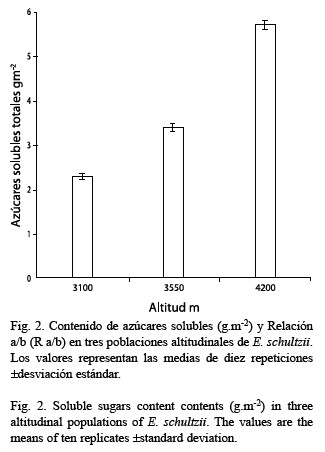
<body><![CDATA[<small><span style="font-family: arial;">En el <a href="#CUADRO1">Cuadro     1</a> se presentan los     valores </span><span style="font-family: arial;">de la actividad     Rubisco expresados en </span><span style="font-family: arial;">&micro;mol<sup>14</sup>CO<sub>2</sub>m<sup>-2</sup>min<sup>-1</sup>,     medida a 4 &deg;C en las </span><span style="font-family: arial;">tres     poblaciones altitudinales estudiadas. La&nbsp; </span><span      style="font-family: arial;">poblaci&oacute;n ubicada a 4 200 m     present&oacute; mayor </span><span style="font-family: arial;">actividad     seguida por las poblaciones a 3 550 </span><span      style="font-family: arial;">y a 3 100 m El an&aacute;lisis de varianza     ]]></body>
<body><![CDATA[revel&oacute; que </span><span style="font-family: arial;">no existen     diferencias significativas entre las </span><span      style="font-family: arial;">poblaciones a 3 100 y 3 550 m pero     s&iacute;, entre </span><span style="font-family: arial;">estas dos y     aqu&eacute;lla que se encuentra a 4 200 m </span><span      style="font-family: arial;">(F= 10.233, gl= 2, p=0.0016).</span></small></div>     <p align="center"><a name="CUADRO1"> <img style="border: 0px solid ; width: 314px; height: 322px;"  src="/img/fbpe/rbt/v54n4/3498i1.JPG" title="" alt=""></a><small><span  style="font-family: arial;">    
<br> &nbsp;</span></small></p>     <p align="justify"><small><span style="font-family: arial;">     <br> </span></small></p>     ]]></body>
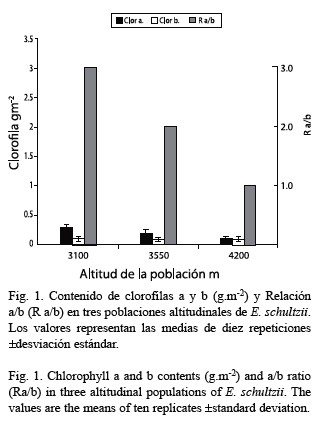
<body><![CDATA[<div style="text-align: left;"><small><span style="font-family: arial;">En la <a href="#FIGURA1">Fig. 1</a> se observa que los contenidos de clorofila a muestran una leve tendencia a la disminuci&oacute;n con la altura, mientras que la clorofila b se mantiene constante, raz&oacute;n por la cual la relaci&oacute;n a/b (R a/b) disminuye con la elevaci&oacute;n. No obstante, el ANOVA revela que las diferencias entre las poblaciones no son significativas (F= 1.690, gl= 2, p=0.2005).</span></small></div>     <p align="center"><a name="FIGURA1"> <img style="border: 0px solid ; width: 334px; height: 424px;"  src="/img/fbpe/rbt/v54n4/3498i2.JPG" title="" alt=""></a></p>     
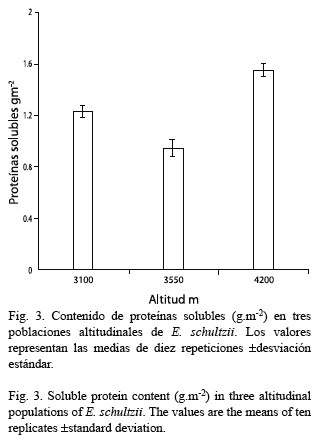
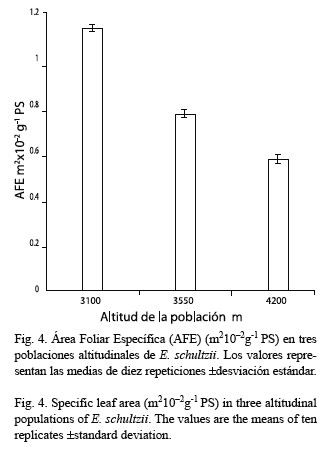
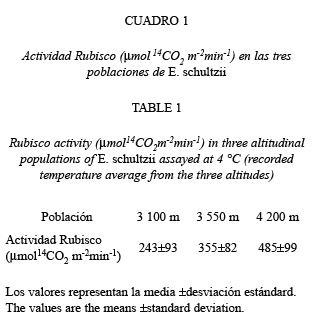
<p align="justify"><small><span style="font-family: arial;">    <br>     <br> </span></small></p>     <div style="text-align: left;"><small><span style="font-family: arial;">El contenido de az&uacute;cares (gm<sup>-2</sup>) es mostrado en la <a  href="#FIGURA2">Fig. 2</a>; se observa un aumento con la elevaci&oacute;n; el an&aacute;lisis de varianza revela diferencias significativas entre las tres poblaciones (F= 20.314, gl= 2, p=0.0001).</span></small><br  style="font-family: arial;"> <small></small><br style="font-family: arial;"> <small><span style="font-family: arial;">El contenido de prote&iacute;nas se presenta en la <a href="#FIGURA3">Fig. 3</a>; aqu&iacute; el valor mayor lo presenta la poblaci&oacute;n </span><span  style="font-family: arial;">ubicada a 4 200 m, y el menor contenido </span><span  style="font-family: arial;">se presenta a 3 550 m; la&nbsp; poblaci&oacute;n ubicada a </span><span style="font-family: arial;">3 100 m presenta un valor intermedio. El an&aacute;lisis </span><span  style="font-family: arial;">de varianza, sin embargo, mostr&oacute; que no hay </span><span style="font-family: arial;">diferencias significativas entre las poblaciones&nbsp; </span><span  style="font-family: arial;">(F=1.770, gl= 2, p=0.2009).</span></small>    <br> <small><span style="font-family: arial;"></span></small><br  style="font-family: arial;"> <small><span style="font-family: arial;"></span><span  style="font-family: arial;">La <a href="#FIGURA4">Fig. 4</a> muestra los valores obtenidos </span><span style="font-family: arial;">para el &aacute;rea foliar espec&iacute;fica (AFE) expresados </span><span  style="font-family: arial;">en m<sup>2</sup>10<sup>-2</sup>g<sup>-1</sup> PS; el an&aacute;lisis de varianza </span><span  style="font-family: arial;">demuestra que existen diferencias significativas </span><span style="font-family: arial;">entre las poblaciones (F= 32.957, gl= 2, </span><span style="font-family: arial;">p&lt;0.0001).</span></small><br  style="font-family: arial;"> <small></small><br style="font-family: arial;"> <small></small>     <div style="text-align: left;"><small><small><!-- big --><span  style="font-family: arial; font-weight: 700;">Discusi&oacute;n</span><!-- /big --></small></small><br  style="font-family: arial;"> </div> <small></small><br style="font-family: arial;"> <small><span style="font-family: arial;">Se evidencia una mayor actividad de </span><span style="font-family: arial;">Rubisco en la poblaci&oacute;n ubicada a mayor </span><span style="font-family: arial;">elevaci&oacute;n. Aumentos de la tasa de fijaci&oacute;n de </span><span  style="font-family: arial;">CO<sub>2</sub> y de Vmax en Rubisco con la altitud en </span><span style="font-family: arial;"><span  style="font-style: italic;">E. schultzii</span> fueron encontrados por Castrillo </span><span style="font-family: arial;">(1995), lo que concuerda con el incremento en </span><span style="font-family: arial;">actividad observado a 4 200 m. Este aumento </span><span  style="font-family: arial;">de la actividad Rubisco con la altitud pudiera </span><span style="font-family: arial;">deberse a mayor contenido de prote&iacute;nas y/o </span><span  style="font-family: arial;">mayor activaci&oacute;n de esta enzima.</span></small></div>     <div style="text-align: left;"></div>     <p style="text-align: left;"><small><span style="font-family: arial;">Al igual que lo obtenido en este trabajo, </span><span style="font-family: arial;">en <span  style="font-style: italic;">Taraxacum officinale</span> se mostr&oacute; aumento de </span><span style="font-family: arial;">la actividad Rubisco con la altitud (Oulton <span  style="font-style: italic;">et </span></span><span  style="font-family: arial;"><span style="font-style: italic;">al</span>. 1979). Por otra parte, en un estudio sobre </span><span  style="font-family: arial;">poblaciones de <span  style="font-style: italic;">E. schultzii</span>, se encontr&oacute; que las </span><span style="font-family: arial;">plantas provenientes de localizaciones a mayor </span><span style="font-family: arial;">altura y sometidas a aclimataci&oacute;n en fr&iacute;o,&nbsp; </span><span  style="font-family: arial;">mostraron altas tasas de asimilaci&oacute;n, mientras </span><span style="font-family: arial;">que aqu&eacute;llas provenientes de sitios de menor </span><span  style="font-family: arial;">altitud, presentaron elevadas tasas a mayores </span><span style="font-family: arial;">temperaturas de aclimataci&oacute;n (Baruch 1979). </span><span  style="font-family: arial;">Asimismo, Rada <span  style="font-style: italic;">et al</span>. (1992) comunicaron una disminuci&oacute;n del &oacute;ptimo de temperatura foliar para la fotos&iacute;ntesis acoplada a una disminuci&oacute;n de la temperatura del aire a lo largode un gradiente para dos poblaciones de <span style="font-style: italic;">E. schultzii</span> desde 2 950 hasta 4 000 m. Se ha informado tambi&eacute;n, que existen diferencias significativas en la tasa de asimilaci&oacute;n de CO<sub>2</sub> en tres poblaciones altitudinales de <span style="font-style: italic;">E. schultzii</span>, entre la estaci&oacute;n seca y la de lluvias y una diferenciaci&oacute;n en este intercambio gaseoso con la altitud. La disminuci&oacute;n en este par&aacute;metro con el gradiente altitudinal es explicada por factores </span><span  style="font-family: arial;">como pubescencia, baja conductancia foliar </span><span style="font-family: arial;">y menor contenido de nitr&oacute;geno en el suelo </span><span style="font-family: arial;">(Rada <span style="font-style: italic;">et al</span>. 1998).</span></small></p>     ]]></body>
<body><![CDATA[<p align="center"><small><br style="font-family: arial;"> <br style="font-family: arial;"> <a name="FIGURA2"><img  style="border: 0px solid ; width: 325px; height: 452px;"  src="/img/fbpe/rbt/v54n4/3498i3.JPG" title="" alt=""></a></small></p>     
<p align="center"><small><a name="FIGURA3"><img  style="border: 0px solid ; width: 324px; height: 445px;"  src="/img/fbpe/rbt/v54n4/3498i4.JPG" title="" alt=""></a></small></p>     
<p align="center"><a name="FIGURA4"> <img style="border: 0px solid ; width: 331px; height: 451px;"  src="/img/fbpe/rbt/v54n4/3498i5.JPG" title="" alt=""></a></p>     
<p align="left">&nbsp;</p>     <p style="text-align: left;"><small><span style="font-family: arial;">La     diferencia no significativa en el     contenido </span><span style="font-family: arial;">de clorofila, entre     las poblaciones altitudinales, </span><span style="font-family: arial;">puede     deberse al efecto protector de las </span><span      style="font-family: arial;">pubescencia, que incrementa con la     ]]></body>
<body><![CDATA[elevaci&oacute;n, </span><span style="font-family: arial;">(demostrado     por Baruch 1979, Meinzer<span style="font-style: italic;"> et al</span>.     </span><span style="font-family: arial;">1985, Rada <span      style="font-style: italic;">et al</span>. 1998 y observado en nuestro </span><span      style="font-family: arial;">laboratorio) previniendo as&iacute; a la     clorofila de </span><span style="font-family: arial;">la     fotoxidaci&oacute;n. En el an&aacute;lisis del contenido </span><span      style="font-family: arial;">de clorofila, no se obtuvo una     disminuci&oacute;n </span><span style="font-family: arial;">significativa     con la altitud, tal y como se ha </span><span     ]]></body>
<body><![CDATA[ style="font-family: arial;">informado en poblaciones alpinas     (Tranquilini </span><span style="font-family: arial;">1979); el efecto     fotooxidativo de la radiaci&oacute;n </span><span      style="font-family: arial;">sobre la clorofila puede ser atenuado por     el </span><span style="font-family: arial;">efecto protector que     pudiera ejercer el incremento </span><span style="font-family: arial;">en     la pubescencia con la elevaci&oacute;n. Es </span><span      style="font-family: arial;">as&iacute; que una adaptaci&oacute;n     morfol&oacute;gica protege del </span><span style="font-family: arial;">efecto     adverso de excesiva radiaci&oacute;n asociado </span><span     ]]></body>
<body><![CDATA[ style="font-family: arial;">con la elevaci&oacute;n.</span><br      style="font-family: arial;">     <br style="font-family: arial;">     <span style="font-family: arial;">Se observa un notable aumento en el     contenido </span><span style="font-family: arial;">de az&uacute;cares     con la elevaci&oacute;n; este hecho </span><span      style="font-family: arial;">es atribuible a la mayor actividad     carboxilasa </span><span style="font-family: arial;">de la Rubisco. El     aumento en el contenido de </span><span style="font-family: arial;">az&uacute;cares     solubles, principalmente sacarosa, ha </span><span     ]]></body>
<body><![CDATA[ style="font-family: arial;">sido observado en especies     herb&aacute;ceas y le&ntilde;osas </span><span      style="font-family: arial;">sometidas a tratamiento gradual en     fr&iacute;o, asociado </span><span style="font-family: arial;">a una     funci&oacute;n crioprotectora y de ajuste </span><span      style="font-family: arial;">osm&oacute;tico para la protecci&oacute;n     contra el stress por </span><span style="font-family: arial;">enfriamiento     y por d&eacute;ficit h&iacute;drico (Levitt 1980). </span><span      style="font-family: arial;">Figuereido-Ribeiro y Dietrich (1983)&nbsp;     trabajando </span><span style="font-family: arial;">con xilopodios de <span     ]]></body>
<body><![CDATA[ style="font-style: italic;">Ocimum nudicaule</span>, una </span><span      style="font-family: arial;">roseta herb&aacute;cea peque&ntilde;a, que     crece en la sabana </span><span style="font-family: arial;">brasilera,     observaron un aumento en el contenido </span><span      style="font-family: arial;">de az&uacute;cares&nbsp; solubles, bajo un     r&eacute;gimen de </span><span style="font-family: arial;">almacenamiento     a 5-28 &deg;C comparado con 5 &deg;C </span><span      style="font-family: arial;">constante . Estos autores concluyen en que     se </span><span style="font-family: arial;">trata de una respuesta     bioqu&iacute;mica r&aacute;pida a las </span><span     ]]></body>
<body><![CDATA[ style="font-family: arial;">condiciones tropicales y subtropicales,     donde </span><span style="font-family: arial;">las plantas pueden     estar sujetas a variaciones </span><span style="font-family: arial;">cortas     de temperaturas. Existen evidencias de </span><span      style="font-family: arial;">aumento de temperatura interna foliar     diurna </span><span style="font-family: arial;">en el frailej&oacute;n     debido al efecto de la incidencia </span><span      style="font-family: arial;">de la radiaci&oacute;n solar sobre la     pubescencia y la </span><span style="font-family: arial;">geometr&iacute;a     de la roseta (Larcher 1980, Meinzer </span><span     ]]></body>
<body><![CDATA[ style="font-family: arial;">y Goldstein 1985) lo cual contrastado con     las </span><span style="font-family: arial;">bajas temperaturas     nocturnas detectadas en el </span><span style="font-family: arial;">p&aacute;ramo     y por extrapolaci&oacute;n, resultar&iacute;a comparable </span><span      style="font-family: arial;">con la situaci&oacute;n descrita por     Figuereido-</span><span style="font-family: arial;">Ribeiro y Dietrich     (1983).</span><br style="font-family: arial;">     <br style="font-family: arial;">     <span style="font-family: arial;">En referencia al contenido de     prote&iacute;nas, </span><span style="font-family: arial;">s&iacute;     ]]></body>
<body><![CDATA[bien se observan diferencias, las mismas no </span><span      style="font-family: arial;">son significativas y esto nos permite     inferir que </span><span style="font-family: arial;">el aumento en la     actividad Rubisco se debe a </span><span style="font-family: arial;">mayor     activaci&oacute;n de la enzima con la elevaci&oacute;n; </span><span      style="font-family: arial;">lo que a su vez soportar&iacute;a los     crecientes valores </span><span style="font-family: arial;">de     az&uacute;cares solubles obtenidos con la altitud. </span><span      style="font-family: arial;">En la relaci&oacute;n entre el contenido     de prote&iacute;nas y </span><span style="font-family: arial;">la     ]]></body>
<body><![CDATA[temperatura, existen evidencias contradictorias, </span><span      style="font-family: arial;">ya que algunos estudios indican aumento </span><span      style="font-family: arial;">a bajas temperaturas y otros no; Levitt     (1980) explica estas contradicciones bas&aacute;ndose en el </span><span      style="font-family: arial;">m&eacute;todo de extracci&oacute;n     empleado.</span><br style="font-family: arial;">     <br style="font-family: arial;">     <span style="font-family: arial;">El &aacute;rea foliar     espec&iacute;fica (AFE) disminuye </span><span      style="font-family: arial;">a valores altos de radiaci&oacute;n; este     ]]></body>
<body><![CDATA[descenso es </span><span style="font-family: arial;">principalmente     debido a la reducci&oacute;n del &aacute;rea </span><span      style="font-family: arial;">foliar con la altitud y al aumento del     peso seco. </span><span style="font-family: arial;">Torres (1980)     encontr&oacute; una reducci&oacute;n del tama&ntilde;o </span><span      style="font-family: arial;">celular y de los espacios intercelulares     en las </span><span style="font-family: arial;">poblaciones de mayor     elevaci&oacute;n de <span style="font-style: italic;">E. schultzii</span>,     </span><span style="font-family: arial;">lo cual apoya&nbsp; los     valores de AFE obtenidos </span><span style="font-family: arial;">en     ]]></body>
<body><![CDATA[este trabajo. Adicionalmente, Milthorpe y </span><span      style="font-family: arial;">Newton (1963) demostraron que a valores     altos </span><span style="font-family: arial;">de radiaci&oacute;n     solar hay disminuci&oacute;n del &aacute;rea </span><span      style="font-family: arial;">foliar debido a reducci&oacute;n del     tama&ntilde;o celular, </span><span style="font-family: arial;">pero     que el n&uacute;mero de c&eacute;lulas aumenta hasta </span><span      style="font-family: arial;">un valor constante. K&ouml;rner (1989)     afirma que </span><span style="font-family: arial;">la     disminuci&oacute;n de AFE es la tendencia morfol&oacute;gica </span><span     ]]></body>
<body><![CDATA[ style="font-family: arial;">m&aacute;s consistente en hojas a lo largo     de un </span><span style="font-family: arial;">gradiente altitudinal;     esta afirmaci&oacute;n coincide </span><span      style="font-family: arial;">con los resultados aqu&iacute;     presentados. Con la </span><span style="font-family: arial;">elevaci&oacute;n     ocurre un aumento por unidad de </span><span      style="font-family: arial;">&aacute;rea de la actividad carboxilasa de     la Rubisco </span><span style="font-family: arial;">y del contenido de     az&uacute;cares solubles, lo cual </span><span      style="font-family: arial;">indica una actividad metab&oacute;lica     ]]></body>
<body><![CDATA[superior soportada </span><span style="font-family: arial;">por el     incremento en radiaci&oacute;n solar y tasa </span><span      style="font-family: arial;">fotosint&eacute;tica, para compensar el     requerimiento </span><span style="font-family: arial;">de aumento de     la pubescencia foliar como </span><span style="font-family: arial;">adaptaci&oacute;n     a condiciones extremas tales como </span><span      style="font-family: arial;">excesivas radiaciones solar y     ultravioleta, causantes </span><span style="font-family: arial;">de la     fotooxidaci&oacute;n del clorofila.</span><br      style="font-family: arial;">     ]]></body>
<body><![CDATA[<br style="font-family: arial;">     <span style="font-family: arial;">De los par&aacute;metros medidos en     las tres </span><span style="font-family: arial;">poblaciones     estudiadas, tres presentan diferencias </span><span      style="font-family: arial;">significativas asociadas con la altitud:     actividad </span><span style="font-family: arial;">Rubisco, contenido     de az&uacute;cares solubles y </span><span style="font-family: arial;">AFE,     mientras que los contenidos de clorofilas </span><span      style="font-family: arial;">y prote&iacute;nas no la muestran. Esto     representa un </span><span style="font-family: arial;">equilibrio     ]]></body>
<body><![CDATA[(&#8220;compromiso&#8221;) entre una mayor actividad&nbsp; </span><span      style="font-family: arial;">metab&oacute;lica y un menor volumen     celular.</span><br style="font-family: arial;">     <br style="font-family: arial;">     <!-- big --><small><span style="font-family: arial; font-weight: 700;">Agradecimiento</span></small><br      style="font-family: arial;">     <!-- /big --><br style="font-family: arial;">     <span style="font-family: arial;">Agradezco al Decanato de     investigaci&oacute;n y </span><span style="font-family: arial;">Desarrollo     de la Universidad Sim&oacute;n Bol&iacute;var por </span><span     ]]></body>
<body><![CDATA[ style="font-family: arial;">el apoyo financiero, a O. Arenas por su     asesor&iacute;a </span><span style="font-family: arial;">en el     tratamiento estad&iacute;stico de los resultados y </span><span      style="font-family: arial;">finalmente a Elena ilarraza y David     Querales </span><span style="font-family: arial;">por su ayuda en la     extracci&oacute;n foliar.</span><br style="font-family: arial;">     <br style="font-family: arial;">     <span style="font-family: arial; font-weight: 700;">Resumen</span><br      style="font-family: arial;">     <br style="font-family: arial;">     ]]></body>
<body><![CDATA[<span style="font-family: arial;">Se establece una comparaci&oacute;n     de algunos par&aacute;metros </span><span style="font-family: arial;">fotosint&eacute;ticos:     actividad Rubisco (Ribulosa 1, 5-bis-fosfato </span><span      style="font-family: arial;">carboxilasa EC 4.1.1.39) contenidos de     clorofilas, az&uacute;cares </span><span style="font-family: arial;">solubles     totales y prote&iacute;nas solubles totales y &aacute;rea foliar </span><span      style="font-family: arial;">espec&iacute;fica (AFE), en tres     poblaciones altitudinales de </span><span style="font-family: arial;"><span      style="font-style: italic;">Espeletia schultzii</span> ubicadas a 3     100, 3 550 y 4 200 msnm. </span><span style="font-family: arial;">De     ]]></body>
<body><![CDATA[acuerdo con el an&aacute;lisis de varianza la poblaci&oacute;n a </span><span      style="font-family: arial;">4 200 m present&oacute; una actividad     Rubisco significativamente </span><span style="font-family: arial;">mayor     que las otras dos, en cuyos casos los valores no </span><span      style="font-family: arial;">fueron diferentes. Los contenidos de     clorofila a presentan </span><span style="font-family: arial;">una     leve tendencia a la disminuci&oacute;n con la altura; mientras </span><span      style="font-family: arial;">que la clorofila b se mantiene constante,     raz&oacute;n por la cual la </span><span style="font-family: arial;">relaci&oacute;n     a/b (R a/b) disminuye con la elevaci&oacute;n, aunque, las </span><span     ]]></body>
<body><![CDATA[ style="font-family: arial;">diferencias no son significativas. El     contenido de az&uacute;cares </span><span style="font-family: arial;">en     cada una de las poblaciones estudiadas (gm<sup>-2</sup>), aumenta </span><span      style="font-family: arial;">con la elevaci&oacute;n; las diferencias     entre las poblaciones son </span><span style="font-family: arial;">significativas.     Con relaci&oacute;n al contenido de prote&iacute;nas, no </span><span      style="font-family: arial;">existen diferencias entre las poblaciones     estudiadas. El &aacute;rea </span><span style="font-family: arial;">foliar     espec&iacute;fica (AFE) disminuye significativamente con la </span><span      style="font-family: arial;">altura. Es probable que el incremento en     ]]></body>
<body><![CDATA[la actividad Rubisco </span><span style="font-family: arial;">sea     producido por una mayor activaci&oacute;n de la enzima y no </span><span      style="font-family: arial;">por el mayor contenido de prote&iacute;na.     Los az&uacute;cares solubles </span><span style="font-family: arial;">presentan     incremento significativo, este hecho es probable </span><span      style="font-family: arial;">que se encuentre asociado con la actividad     Rubisco. De </span><span style="font-family: arial;">los cinco     par&aacute;metros fotosint&eacute;ticos medidos, tres presentan </span><span      style="font-family: arial;">diferencias significativas asociadas con     la altitud. Esto representa </span><span style="font-family: arial;">un     ]]></body>
<body><![CDATA[compromiso entre una mayor actividad metab&oacute;lica </span><span      style="font-family: arial;">mantenida en un menor volumen celular.</span><br      style="font-family: arial;">     <br style="font-family: arial;">     <span style="font-weight: bold; font-family: arial;">Palabras clave</span><span      style="font-family: arial;">: clorofila, <span      style="font-style: italic;">Espeletia</span>, p&aacute;ramo, rubisco,     prote&iacute;nas solubles, az&uacute;cares solubles, &aacute;rea foliar     espec&iacute;fica.</span><br style="font-family: arial;">     <br style="font-family: arial;">     ]]></body>
<body><![CDATA[<span style="font-family: arial; font-weight: 700;">Referencias</span><br      style="font-family: arial;">     <br style="font-family: arial;">     <span style="font-family: arial;">Baruch, Z. 1979. Elevational     differentiation in <span style="font-style: italic;">Espeletia </span></span><span      style="font-family: arial;"><span style="font-style: italic;">schultzii</span>     (Compositae), a giant rosette plants of the </span><span      style="font-family: arial;">Venezuela paramos. Ecology 60: 85-98.</span><br      style="font-family: arial;">     <br style="font-family: arial;">     ]]></body>
<body><![CDATA[<!-- ref --><span style="font-family: arial;">    &nbsp;&nbsp;&nbsp;&nbsp;&nbsp;&nbsp;&nbsp;&nbsp;[&#160;<a href="javascript:void(0);" onclick="javascript: window.open('/scielo.php?script=sci_nlinks&ref=1354204&pid=S0034-7744200600040001200001&lng=','','width=640,height=500,resizable=yes,scrollbars=1,menubar=yes,');">Links</a>&#160;]<!-- end-ref --><!-- ref -->Baruch, Z. 1984. Ordination and Classification of vegetation </span><span style="font-family: arial;">along an altitudinal gradient in the Venezuela </span><span  style="font-family: arial;">paramos. Vegetatio 5: 115-126.</span><br  style="font-family: arial;"> <br style="font-family: arial;"> <span style="font-family: arial;">    &nbsp;&nbsp;&nbsp;&nbsp;&nbsp;&nbsp;&nbsp;&nbsp;[&#160;<a href="javascript:void(0);" onclick="javascript: window.open('/scielo.php?script=sci_nlinks&ref=1354205&pid=S0034-7744200600040001200002&lng=','','width=640,height=500,resizable=yes,scrollbars=1,menubar=yes,');">Links</a>&#160;]<!-- end-ref --><!-- ref -->Bradford, M.M. 1976. A rapid and sensitive method for the </span><span style="font-family: arial;">quantitation of microgram quantities of protein-dye </span><span  style="font-family: arial;">utilizing the principle of protein dye binding. Anal. </span><span style="font-family: arial;">Biochem. 72: 248-254.</span><br style="font-family: arial;"> <br style="font-family: arial;"> <span style="font-family: arial;">    &nbsp;&nbsp;&nbsp;&nbsp;&nbsp;&nbsp;&nbsp;&nbsp;[&#160;<a href="javascript:void(0);" onclick="javascript: window.open('/scielo.php?script=sci_nlinks&ref=1354206&pid=S0034-7744200600040001200003&lng=','','width=640,height=500,resizable=yes,scrollbars=1,menubar=yes,');">Links</a>&#160;]<!-- end-ref --><!-- ref -->Bruinsma, J. 1963. The quantitative analysis of chlorophylss </span><span style="font-family: arial;">a and b in plant extracts. Photochem. </span><span  style="font-family: arial;">Photobiol. 2: 241-249.</span><br  style="font-family: arial;"> <br style="font-family: arial;"> <span style="font-family: arial;">    &nbsp;&nbsp;&nbsp;&nbsp;&nbsp;&nbsp;&nbsp;&nbsp;[&#160;<a href="javascript:void(0);" onclick="javascript: window.open('/scielo.php?script=sci_nlinks&ref=1354207&pid=S0034-7744200600040001200004&lng=','','width=640,height=500,resizable=yes,scrollbars=1,menubar=yes,');">Links</a>&#160;]<!-- end-ref --><!-- ref -->Castrillo, M. 1995. Ribulose-1, 5-bis-phosphate carboxylase </span><span style="font-family: arial;">activity in altitudinal populations of <span style="font-style: italic;">Espeletia </span></span><span style="font-family: arial;"><span  style="font-style: italic;">schultzii</span> Wedd. Oecologia 101: 193-196. </span><br style="font-family: arial;"> <br style="font-family: arial;"> <span style="font-family: arial;">    &nbsp;&nbsp;&nbsp;&nbsp;&nbsp;&nbsp;&nbsp;&nbsp;[&#160;<a href="javascript:void(0);" onclick="javascript: window.open('/scielo.php?script=sci_nlinks&ref=1354208&pid=S0034-7744200600040001200005&lng=','','width=640,height=500,resizable=yes,scrollbars=1,menubar=yes,');">Links</a>&#160;]<!-- end-ref --><!-- ref -->Castrillo, M. &amp; M. Simoes. 1997. Leaf non-strutural </span><span style="font-family: arial;">carbohydrates and leaf dry weight per area in three </span><span  style="font-family: arial;">altitudinal populations of <span  style="font-style: italic;">Espeletia schultzii</span> Wedd. </span><span  style="font-family: arial;">Folia Geobot. Phytotax. 32: 355-360.</span><br  style="font-family: arial;"> <br style="font-family: arial;"> <span style="font-family: arial;">    &nbsp;&nbsp;&nbsp;&nbsp;&nbsp;&nbsp;&nbsp;&nbsp;[&#160;<a href="javascript:void(0);" onclick="javascript: window.open('/scielo.php?script=sci_nlinks&ref=1354209&pid=S0034-7744200600040001200006&lng=','','width=640,height=500,resizable=yes,scrollbars=1,menubar=yes,');">Links</a>&#160;]<!-- end-ref --><!-- ref -->De los R&iacute;os, C., D.H. Baez, Q. Contreras, O. Crescente &amp; </span><span style="font-family: arial;">A. Caserta. 1999. Phytochemical evaluation and antibacterial </span><span  style="font-family: arial;">activity of <span  style="font-style: italic;">Espeletia schlutzii</span> (Asteraceae). </span><span  style="font-family: arial;">Ciencia 1: 72-77.</span><br  style="font-family: arial;"> <br style="font-family: arial;"> <span style="font-family: arial;">    &nbsp;&nbsp;&nbsp;&nbsp;&nbsp;&nbsp;&nbsp;&nbsp;[&#160;<a href="javascript:void(0);" onclick="javascript: window.open('/scielo.php?script=sci_nlinks&ref=1354210&pid=S0034-7744200600040001200007&lng=','','width=640,height=500,resizable=yes,scrollbars=1,menubar=yes,');">Links</a>&#160;]<!-- end-ref --><!-- ref -->Figuereido-Ribeiro, R.C.L. &amp; S.M.C. Dietrich. 1983. Sugar </span><span style="font-family: arial;">content and metabolic activities in cold -stored fragmented </span><span  style="font-family: arial;">xylopodium of <span  style="font-style: italic;">Ocimum nudicaule</span> Benth var. </span><span  style="font-family: arial;">anisifolia Giul (<span  style="font-style: italic;">Labiateae</span>). J. Exp. Bot. 34: 476-483.</span><br style="font-family: arial;"> <br style="font-family: arial;"> <span style="font-family: arial;">    &nbsp;&nbsp;&nbsp;&nbsp;&nbsp;&nbsp;&nbsp;&nbsp;[&#160;<a href="javascript:void(0);" onclick="javascript: window.open('/scielo.php?script=sci_nlinks&ref=1354211&pid=S0034-7744200600040001200008&lng=','','width=640,height=500,resizable=yes,scrollbars=1,menubar=yes,');">Links</a>&#160;]<!-- end-ref --><!-- ref -->Goldstein, G., F. Rada &amp; A. Azocar. 1985. Cold hardiness </span><span style="font-family: arial;">and supercooling along an altitudinal gradient in </span><span  style="font-family: arial;">andean giant rosette. Oecologia 68: 147-152.</span><br style="font-family: arial;"> <br style="font-family: arial;"> <span style="font-family: arial;">    &nbsp;&nbsp;&nbsp;&nbsp;&nbsp;&nbsp;&nbsp;&nbsp;[&#160;<a href="javascript:void(0);" onclick="javascript: window.open('/scielo.php?script=sci_nlinks&ref=1354212&pid=S0034-7744200600040001200009&lng=','','width=640,height=500,resizable=yes,scrollbars=1,menubar=yes,');">Links</a>&#160;]<!-- end-ref --><!-- ref -->Kemp, P.R. &amp; G.J.iii William. 1977. Temperature relations </span><span style="font-family: arial;">of gas exchange in altitudinal populations of </span><span  style="font-family: arial;"><span style="font-style: italic;">Taraxacum officinale</span>. Can J. Bot. 55: 2496-2502.</span><br  style="font-family: arial;"> <br style="font-family: arial;"> <span style="font-family: arial;">    &nbsp;&nbsp;&nbsp;&nbsp;&nbsp;&nbsp;&nbsp;&nbsp;[&#160;<a href="javascript:void(0);" onclick="javascript: window.open('/scielo.php?script=sci_nlinks&ref=1354213&pid=S0034-7744200600040001200010&lng=','','width=640,height=500,resizable=yes,scrollbars=1,menubar=yes,');">Links</a>&#160;]<!-- end-ref --><!-- ref -->Khouri, N., A. Usubillaga, L.B. Rojas &amp; F. Gal&aacute;rraga. </span><span style="font-family: arial;">2000. The essential oil of <span style="font-style: italic;">Espeletia weddeli</span> Sch. Bip. </span><span style="font-family: arial;">Ex Wedd. Flavour Fragance J. 15: 263-265.</span><br  style="font-family: arial;"> <br style="font-family: arial;"> <span style="font-family: arial;">    &nbsp;&nbsp;&nbsp;&nbsp;&nbsp;&nbsp;&nbsp;&nbsp;[&#160;<a href="javascript:void(0);" onclick="javascript: window.open('/scielo.php?script=sci_nlinks&ref=1354214&pid=S0034-7744200600040001200011&lng=','','width=640,height=500,resizable=yes,scrollbars=1,menubar=yes,');">Links</a>&#160;]<!-- end-ref --><!-- ref -->K&ouml;rner, C.H. 1989. The nutritional status of plants from </span><span  style="font-family: arial;">high altitudes. A worldwide comparison. Oecologia </span><span style="font-family: arial;">81: 379-391.</span><br  style="font-family: arial;"> <br style="font-family: arial;"> <span style="font-family: arial;">    &nbsp;&nbsp;&nbsp;&nbsp;&nbsp;&nbsp;&nbsp;&nbsp;[&#160;<a href="javascript:void(0);" onclick="javascript: window.open('/scielo.php?script=sci_nlinks&ref=1354215&pid=S0034-7744200600040001200012&lng=','','width=640,height=500,resizable=yes,scrollbars=1,menubar=yes,');">Links</a>&#160;]<!-- end-ref --><!-- ref -->Larcher, W. 1980. Physiological plant ecology. Springer, </span><span style="font-family: arial;">Berl&iacute;n, Alemania. 303 p.</span><br style="font-family: arial;"> <br style="font-family: arial;"> <span style="font-family: arial;">    &nbsp;&nbsp;&nbsp;&nbsp;&nbsp;&nbsp;&nbsp;&nbsp;[&#160;<a href="javascript:void(0);" onclick="javascript: window.open('/scielo.php?script=sci_nlinks&ref=1354216&pid=S0034-7744200600040001200013&lng=','','width=640,height=500,resizable=yes,scrollbars=1,menubar=yes,');">Links</a>&#160;]<!-- end-ref --><!-- ref -->Levitt, J. 1980. Responses of plants to environmental </span><span style="font-family: arial;">stress Vol. ii. Chilling, freezing and high temperature </span><span  style="font-family: arial;">stresses Physiological Ecology Series. Academic, </span><span style="font-family: arial;">Nueva York, EEUU. 497 p.</span><br style="font-family: arial;"> <br style="font-family: arial;"> <span style="font-family: arial;">    &nbsp;&nbsp;&nbsp;&nbsp;&nbsp;&nbsp;&nbsp;&nbsp;[&#160;<a href="javascript:void(0);" onclick="javascript: window.open('/scielo.php?script=sci_nlinks&ref=1354217&pid=S0034-7744200600040001200014&lng=','','width=640,height=500,resizable=yes,scrollbars=1,menubar=yes,');">Links</a>&#160;]<!-- end-ref --><!-- ref -->Machler, F. &amp; J. Nosberger. 1977. Effect of light intensity </span><span style="font-family: arial;">and temperature on apparent photosynthesis of altitudinal </span><span  style="font-family: arial;">ecotypes of <span  style="font-style: italic;">Trifolium repens</span> L. Oecologia </span><span  style="font-family: arial;">31: 73-78.</span><br  style="font-family: arial;"> <br style="font-family: arial;"> <span style="font-family: arial;">    &nbsp;&nbsp;&nbsp;&nbsp;&nbsp;&nbsp;&nbsp;&nbsp;[&#160;<a href="javascript:void(0);" onclick="javascript: window.open('/scielo.php?script=sci_nlinks&ref=1354218&pid=S0034-7744200600040001200015&lng=','','width=640,height=500,resizable=yes,scrollbars=1,menubar=yes,');">Links</a>&#160;]<!-- end-ref --><!-- ref -->Meinzer, F. &amp; G. Goldstein. 1985. Some consequences </span><span style="font-family: arial;">of leaf pubescence in the andean giant rosette plant </span><span  style="font-family: arial;"><span style="font-style: italic;">Espeletia timotensis</span>. Ecology 66: 512-520.</span><br  style="font-family: arial;"> <br style="font-family: arial;"> <span style="font-family: arial;">    &nbsp;&nbsp;&nbsp;&nbsp;&nbsp;&nbsp;&nbsp;&nbsp;[&#160;<a href="javascript:void(0);" onclick="javascript: window.open('/scielo.php?script=sci_nlinks&ref=1354219&pid=S0034-7744200600040001200016&lng=','','width=640,height=500,resizable=yes,scrollbars=1,menubar=yes,');">Links</a>&#160;]<!-- end-ref --><!-- ref -->Meinzer, F., G. Goldstein &amp; P. Rundell. 1985. Morphological </span><span style="font-family: arial;">changes and altitudinal gradient and their consequences </span><span  style="font-family: arial;">for an Andean giant rosette plant. Oecologia </span><span style="font-family: arial;">65: 278-283.</span><br  style="font-family: arial;"> <br style="font-family: arial;"> <span style="font-family: arial;">    &nbsp;&nbsp;&nbsp;&nbsp;&nbsp;&nbsp;&nbsp;&nbsp;[&#160;<a href="javascript:void(0);" onclick="javascript: window.open('/scielo.php?script=sci_nlinks&ref=1354220&pid=S0034-7744200600040001200017&lng=','','width=640,height=500,resizable=yes,scrollbars=1,menubar=yes,');">Links</a>&#160;]<!-- end-ref --><!-- ref -->Milthorpe, F.L. &amp; D. Newton. 1963. Studies on the expansion </span><span style="font-family: arial;">of the leaf surface III. The influence of radiation </span><span  style="font-family: arial;">on cell division and expansion. J. Exp. Bot. 14:</span><span style="font-family: arial;">483-495.</span><br  style="font-family: arial;"> <br style="font-family: arial;"> <span style="font-family: arial;">    &nbsp;&nbsp;&nbsp;&nbsp;&nbsp;&nbsp;&nbsp;&nbsp;[&#160;<a href="javascript:void(0);" onclick="javascript: window.open('/scielo.php?script=sci_nlinks&ref=1354221&pid=S0034-7744200600040001200018&lng=','','width=640,height=500,resizable=yes,scrollbars=1,menubar=yes,');">Links</a>&#160;]<!-- end-ref --><!-- ref -->Monasterio, M. 1980. Estudios ecol&oacute;gicos en los </span><span style="font-family: arial;">p&aacute;ramos andinos. Universidad de Los Andes, </span><span  style="font-family: arial;">M&eacute;rida, Venezuela. 312 p.</span><br  style="font-family: arial;"> <br style="font-family: arial;"> <span style="font-family: arial;">    &nbsp;&nbsp;&nbsp;&nbsp;&nbsp;&nbsp;&nbsp;&nbsp;[&#160;<a href="javascript:void(0);" onclick="javascript: window.open('/scielo.php?script=sci_nlinks&ref=1354222&pid=S0034-7744200600040001200019&lng=','','width=640,height=500,resizable=yes,scrollbars=1,menubar=yes,');">Links</a>&#160;]<!-- end-ref --><!-- ref -->Oulton, K., G.J. III Williams &amp; D.S. May. 1979. Ribulose-</span><span style="font-family: arial;">1, 5-bis-phosphate carboxylase in <span style="font-style: italic;">Taraxacum officinale</span>. </span><span style="font-family: arial;">Photosynthetica 13: 15-20.</span><br style="font-family: arial;"> <br style="font-family: arial;"> <span style="font-family: arial;">    &nbsp;&nbsp;&nbsp;&nbsp;&nbsp;&nbsp;&nbsp;&nbsp;[&#160;<a href="javascript:void(0);" onclick="javascript: window.open('/scielo.php?script=sci_nlinks&ref=1354223&pid=S0034-7744200600040001200020&lng=','','width=640,height=500,resizable=yes,scrollbars=1,menubar=yes,');">Links</a>&#160;]<!-- end-ref --><!-- ref -->Rada, F., J. Gonzalez, A. Azocar, B. Brice&ntilde;o &amp; R. Jaimez.</span><span style="font-family: arial;">1992. Net photosynthesis-leaf temperature relations </span><span  style="font-family: arial;">in plant species with different height along an altitudinal</span><br style="font-family: arial;"> <span style="font-family: arial;">gradient. Acta Oecol. 13: 535-542.</span><br  style="font-family: arial;"> <br style="font-family: arial;"> <span style="font-family: arial;">    &nbsp;&nbsp;&nbsp;&nbsp;&nbsp;&nbsp;&nbsp;&nbsp;[&#160;<a href="javascript:void(0);" onclick="javascript: window.open('/scielo.php?script=sci_nlinks&ref=1354224&pid=S0034-7744200600040001200021&lng=','','width=640,height=500,resizable=yes,scrollbars=1,menubar=yes,');">Links</a>&#160;]<!-- end-ref --><!-- ref -->Rada, F., A. Azocar, J. Gonzalez &amp; B. Brice&ntilde;o. 1998. Leaf </span><span  style="font-family: arial;">gas exchange in <span  style="font-style: italic;">Espeletia schultzii</span> a giant caulescent </span><span style="font-family: arial;">rosette plant along an altitudinal gradient in the </span><span  style="font-family: arial;">Venezuelan Andes. Acta Oecol. 19: 73-79.</span><br  style="font-family: arial;"> <br style="font-family: arial;"> <span style="font-family: arial;">    &nbsp;&nbsp;&nbsp;&nbsp;&nbsp;&nbsp;&nbsp;&nbsp;[&#160;<a href="javascript:void(0);" onclick="javascript: window.open('/scielo.php?script=sci_nlinks&ref=1354225&pid=S0034-7744200600040001200022&lng=','','width=640,height=500,resizable=yes,scrollbars=1,menubar=yes,');">Links</a>&#160;]<!-- end-ref --><!-- ref -->Rauscher, J.T. 2002. Molecular phylogenetics of the </span><span style="font-family: arial;"><span  style="font-style: italic;">Espeletia</span> complex (<span  style="font-style: italic;">Asteraceae</span>): evidence from </span><span  style="font-family: arial;">nrDNA ITS sequences on the closest relatives of an </span><span style="font-family: arial;">Andean adaptive radiation. Am. J. Bot. 89: 1074-</span><span  style="font-family: arial;">1084.</span><br style="font-family: arial;"> <br style="font-family: arial;"> <span style="font-family: arial;">    &nbsp;&nbsp;&nbsp;&nbsp;&nbsp;&nbsp;&nbsp;&nbsp;[&#160;<a href="javascript:void(0);" onclick="javascript: window.open('/scielo.php?script=sci_nlinks&ref=1354226&pid=S0034-7744200600040001200023&lng=','','width=640,height=500,resizable=yes,scrollbars=1,menubar=yes,');">Links</a>&#160;]<!-- end-ref --><!-- ref -->Silva, J., M.C. Trevisan, C.A. Estrada &amp; M. Monasterio. </span><span style="font-family: arial;">2000. Comparative demography of two giant caulescent </span><span  style="font-family: arial;">rosettes (<span style="font-style: italic;">Espeletia timotensis</span> and <span style="font-style: italic;">E. spicata</span>) </span><span style="font-family: arial;">from the high tropical Andes. Global Ecol. Biogeogr. </span><span style="font-family: arial;">9: 403-411.</span><br style="font-family: arial;"> <br style="font-family: arial;"> <span style="font-family: arial;">    &nbsp;&nbsp;&nbsp;&nbsp;&nbsp;&nbsp;&nbsp;&nbsp;[&#160;<a href="javascript:void(0);" onclick="javascript: window.open('/scielo.php?script=sci_nlinks&ref=1354227&pid=S0034-7744200600040001200024&lng=','','width=640,height=500,resizable=yes,scrollbars=1,menubar=yes,');">Links</a>&#160;]<!-- end-ref --><!-- ref -->Sokal, R.R. &amp; F.J. Rohlf. 1969. Biometry. W.M. Freman, </span><span style="font-family: arial;">California, EEUU. 776 p.</span><br style="font-family: arial;"> <br style="font-family: arial;"> <span style="font-family: arial;">    &nbsp;&nbsp;&nbsp;&nbsp;&nbsp;&nbsp;&nbsp;&nbsp;[&#160;<a href="javascript:void(0);" onclick="javascript: window.open('/scielo.php?script=sci_nlinks&ref=1354228&pid=S0034-7744200600040001200025&lng=','','width=640,height=500,resizable=yes,scrollbars=1,menubar=yes,');">Links</a>&#160;]<!-- end-ref --><!-- ref -->Torres, F. 1980. Modificaci&oacute;n de la anatom&iacute;a foliar de </span><span  style="font-family: arial;"><span style="font-style: italic;">Espeletia schultzii</span> Wedd a lo largo de un gradiente </span><span  style="font-family: arial;">altitudinal entre 2 600 y 4 200 msnm. <span  style="font-style: italic;">In</span> Memorias </span><span  style="font-family: arial;">Viii Congreso Venezolano de Bot&aacute;nica, Venezuela.</span><span style="font-family: arial;">170 p.</span><br style="font-family: arial;"> <br style="font-family: arial;"> <span style="font-family: arial;">    &nbsp;&nbsp;&nbsp;&nbsp;&nbsp;&nbsp;&nbsp;&nbsp;[&#160;<a href="javascript:void(0);" onclick="javascript: window.open('/scielo.php?script=sci_nlinks&ref=1354229&pid=S0034-7744200600040001200026&lng=','','width=640,height=500,resizable=yes,scrollbars=1,menubar=yes,');">Links</a>&#160;]<!-- end-ref --><!-- ref -->Tranquilini, W. 1979. Physiological ecology of the alpine </span><span style="font-family: arial;">timberline. Ecological studies 31. Springer, Berlin, </span><span  style="font-family: arial;">Alemania. 137 p.</span><br  style="font-family: arial;"> <br style="font-family: arial;"> <span style="font-family: arial;">    &nbsp;&nbsp;&nbsp;&nbsp;&nbsp;&nbsp;&nbsp;&nbsp;[&#160;<a href="javascript:void(0);" onclick="javascript: window.open('/scielo.php?script=sci_nlinks&ref=1354230&pid=S0034-7744200600040001200027&lng=','','width=640,height=500,resizable=yes,scrollbars=1,menubar=yes,');">Links</a>&#160;]<!-- end-ref --><!-- ref -->Usubillaga, A., N. Khouri, L.B. Rojas &amp; L. Morillo. 2001. </span><span style="font-family: arial;">Essential oil of the leaves from <span style="font-style: italic;">Espeletia</span> batata </span><span style="font-family: arial;">Cuatrec. J. Essent. Oil Res. 13: 450-451.</span><br style="font-family: arial;"> <br style="font-family: arial;"> <span style="font-family: arial;">    &nbsp;&nbsp;&nbsp;&nbsp;&nbsp;&nbsp;&nbsp;&nbsp;[&#160;<a href="javascript:void(0);" onclick="javascript: window.open('/scielo.php?script=sci_nlinks&ref=1354231&pid=S0034-7744200600040001200028&lng=','','width=640,height=500,resizable=yes,scrollbars=1,menubar=yes,');">Links</a>&#160;]<!-- end-ref --><!-- ref -->Van Handel, E. 1968. Direct microdetermination of sucrose. </span><span style="font-family: arial;">Anal. Biochem. 22: 280-283.</span><br style="font-family: arial;"> <br style="font-family: arial;"> <span style="font-family: arial;">    &nbsp;&nbsp;&nbsp;&nbsp;&nbsp;&nbsp;&nbsp;&nbsp;[&#160;<a href="javascript:void(0);" onclick="javascript: window.open('/scielo.php?script=sci_nlinks&ref=1354232&pid=S0034-7744200600040001200029&lng=','','width=640,height=500,resizable=yes,scrollbars=1,menubar=yes,');">Links</a>&#160;]<!-- end-ref --><!-- ref -->Vareschi, V. 1970. La flora de los P&aacute;ramos. Universidad de </span><span style="font-family: arial;">Los Andes, M&eacute;rida, Venezuela. 337 p.</span></small>&nbsp;&nbsp;&nbsp;&nbsp;&nbsp;&nbsp;&nbsp;&nbsp;[&#160;<a href="javascript:void(0);" onclick="javascript: window.open('/scielo.php?script=sci_nlinks&ref=1354233&pid=S0034-7744200600040001200030&lng=','','width=640,height=500,resizable=yes,scrollbars=1,menubar=yes,');">Links</a>&#160;]<!-- end-ref --> ]]></body><back>
<ref-list>
<ref id="B1">
<nlm-citation citation-type="journal">
<person-group person-group-type="author">
<name>
<surname><![CDATA[Baruch]]></surname>
<given-names><![CDATA[Z]]></given-names>
</name>
</person-group>
<article-title xml:lang="en"><![CDATA[Elevational differentiation in Espeletia schultzii (Compositae), a giant rosette plants of the Venezuela paramos]]></article-title>
<source><![CDATA[Ecology]]></source>
<year>1979</year>
<volume>60</volume>
<page-range>85-98</page-range></nlm-citation>
</ref>
<ref id="B2">
<nlm-citation citation-type="journal">
<person-group person-group-type="author">
<name>
<surname><![CDATA[Baruch]]></surname>
<given-names><![CDATA[Z]]></given-names>
</name>
</person-group>
<article-title xml:lang="en"><![CDATA[Ordination and Classification of vegetation along an altitudinal gradient in the Venezuela paramos]]></article-title>
<source><![CDATA[Vegetatio]]></source>
<year>1984</year>
<volume>5</volume>
<page-range>115-126</page-range></nlm-citation>
</ref>
<ref id="B3">
<nlm-citation citation-type="journal">
<person-group person-group-type="author">
<name>
<surname><![CDATA[Bradford]]></surname>
<given-names><![CDATA[M.M]]></given-names>
</name>
</person-group>
<article-title xml:lang="en"><![CDATA[A rapid and sensitive method for the quantitation of microgram quantities of protein-dye utilizing the principle of protein dye binding]]></article-title>
<source><![CDATA[Anal. Biochem]]></source>
<year>1976</year>
<volume>72</volume>
<page-range>248-254</page-range></nlm-citation>
</ref>
<ref id="B4">
<nlm-citation citation-type="journal">
<person-group person-group-type="author">
<name>
<surname><![CDATA[Bruinsma]]></surname>
<given-names><![CDATA[J]]></given-names>
</name>
</person-group>
<article-title xml:lang="en"><![CDATA[The quantitative analysis of chlorophylss a and b in plant extracts]]></article-title>
<source><![CDATA[Photochem. Photobiol]]></source>
<year>1963</year>
<volume>2</volume>
<page-range>241-249</page-range></nlm-citation>
</ref>
<ref id="B5">
<nlm-citation citation-type="journal">
<person-group person-group-type="author">
<name>
<surname><![CDATA[Castrillo]]></surname>
<given-names><![CDATA[M]]></given-names>
</name>
</person-group>
<article-title xml:lang="en"><![CDATA[Ribulose-1, 5-bis-phosphate carboxylase activity in altitudinal populations of Espeletia schultzii Wedd]]></article-title>
<source><![CDATA[Oecologia]]></source>
<year>1995</year>
<volume>101</volume>
<page-range>193-196</page-range></nlm-citation>
</ref>
<ref id="B6">
<nlm-citation citation-type="journal">
<person-group person-group-type="author">
<name>
<surname><![CDATA[Castrillo]]></surname>
<given-names><![CDATA[M]]></given-names>
</name>
<name>
<surname><![CDATA[Simoes]]></surname>
<given-names><![CDATA[M]]></given-names>
</name>
</person-group>
<article-title xml:lang="en"><![CDATA[Leaf non-strutural carbohydrates and leaf dry weight per area in three altitudinal populations of Espeletia schultzii Wedd]]></article-title>
<source><![CDATA[Folia Geobot. Phytotax]]></source>
<year>1997</year>
<volume>32</volume>
<page-range>355-360</page-range></nlm-citation>
</ref>
<ref id="B7">
<nlm-citation citation-type="journal">
<person-group person-group-type="author">
<name>
<surname><![CDATA[De los Ríos]]></surname>
<given-names><![CDATA[C]]></given-names>
</name>
<name>
<surname><![CDATA[Baez]]></surname>
<given-names><![CDATA[D.H]]></given-names>
</name>
<name>
<surname><![CDATA[Contreras]]></surname>
<given-names><![CDATA[Q]]></given-names>
</name>
<name>
<surname><![CDATA[Crescente]]></surname>
<given-names><![CDATA[O]]></given-names>
</name>
<name>
<surname><![CDATA[Caserta]]></surname>
<given-names><![CDATA[A]]></given-names>
</name>
</person-group>
<article-title xml:lang="en"><![CDATA[Phytochemical evaluation and antibacterial activity of Espeletia schlutzii (Asteraceae)]]></article-title>
<source><![CDATA[Ciencia]]></source>
<year>1999</year>
<volume>1</volume>
<page-range>72-77</page-range></nlm-citation>
</ref>
<ref id="B8">
<nlm-citation citation-type="journal">
<person-group person-group-type="author">
<name>
<surname><![CDATA[Figuereido-Ribeiro]]></surname>
<given-names><![CDATA[R.C.L]]></given-names>
</name>
<name>
<surname><![CDATA[Dietrich]]></surname>
<given-names><![CDATA[S.M.C]]></given-names>
</name>
</person-group>
<article-title xml:lang="en"><![CDATA[Sugar content and metabolic activities in cold -stored fragmented xylopodium of Ocimum nudicaule Benth var. anisifolia Giul (Labiateae)]]></article-title>
<source><![CDATA[J. Exp. Bot]]></source>
<year>1983</year>
<volume>34</volume>
<page-range>476-483</page-range></nlm-citation>
</ref>
<ref id="B9">
<nlm-citation citation-type="journal">
<person-group person-group-type="author">
<name>
<surname><![CDATA[Goldstein]]></surname>
<given-names><![CDATA[G]]></given-names>
</name>
<name>
<surname><![CDATA[Rada]]></surname>
<given-names><![CDATA[F]]></given-names>
</name>
<name>
<surname><![CDATA[Azocar]]></surname>
<given-names><![CDATA[A]]></given-names>
</name>
</person-group>
<article-title xml:lang="en"><![CDATA[Cold hardiness and supercooling along an altitudinal gradient in andean giant rosette]]></article-title>
<source><![CDATA[Oecologia]]></source>
<year>1985</year>
<volume>68</volume>
<page-range>147-152</page-range></nlm-citation>
</ref>
<ref id="B10">
<nlm-citation citation-type="journal">
<person-group person-group-type="author">
<name>
<surname><![CDATA[Kemp]]></surname>
<given-names><![CDATA[P.R]]></given-names>
</name>
<name>
<surname><![CDATA[III William]]></surname>
<given-names><![CDATA[G.J.]]></given-names>
</name>
</person-group>
<article-title xml:lang="en"><![CDATA[Temperature relations of gas exchange in altitudinal populations of Taraxacum officinale]]></article-title>
<source><![CDATA[Can J. Bot]]></source>
<year>1977</year>
<volume>55</volume>
<page-range>2496-2502</page-range></nlm-citation>
</ref>
<ref id="B11">
<nlm-citation citation-type="journal">
<person-group person-group-type="author">
<name>
<surname><![CDATA[Khouri]]></surname>
<given-names><![CDATA[N]]></given-names>
</name>
<name>
<surname><![CDATA[Usubillaga]]></surname>
<given-names><![CDATA[A]]></given-names>
</name>
<name>
<surname><![CDATA[Rojas]]></surname>
<given-names><![CDATA[L.B]]></given-names>
</name>
<name>
<surname><![CDATA[Galárraga]]></surname>
<given-names><![CDATA[F]]></given-names>
</name>
</person-group>
<article-title xml:lang="en"><![CDATA[The essential oil of Espeletia weddeli Sch. Bip. Ex Wedd]]></article-title>
<source><![CDATA[Flavour Fragance J]]></source>
<year>2000</year>
<volume>15</volume>
<page-range>263-265</page-range></nlm-citation>
</ref>
<ref id="B12">
<nlm-citation citation-type="journal">
<person-group person-group-type="author">
<name>
<surname><![CDATA[Körner]]></surname>
<given-names><![CDATA[C.H]]></given-names>
</name>
</person-group>
<article-title xml:lang="en"><![CDATA[The nutritional status of plants from high altitudes. A worldwide comparison]]></article-title>
<source><![CDATA[Oecologia]]></source>
<year>1989</year>
<volume>81</volume>
<page-range>379-391</page-range></nlm-citation>
</ref>
<ref id="B13">
<nlm-citation citation-type="">
<person-group person-group-type="author">
<name>
<surname><![CDATA[Larcher]]></surname>
<given-names><![CDATA[W]]></given-names>
</name>
</person-group>
<source><![CDATA[Physiological plant ecology]]></source>
<year>1980</year>
<page-range>303</page-range><publisher-loc><![CDATA[Springer^eBerlín Berlín]]></publisher-loc>
</nlm-citation>
</ref>
<ref id="B14">
<nlm-citation citation-type="book">
<person-group person-group-type="author">
<name>
<surname><![CDATA[Levitt]]></surname>
<given-names><![CDATA[J]]></given-names>
</name>
</person-group>
<source><![CDATA[Responses of plants to environmental stress]]></source>
<year>1980</year>
<volume>II</volume>
<page-range>497</page-range><publisher-loc><![CDATA[^eNueva York Nueva York]]></publisher-loc>
<publisher-name><![CDATA[Academic]]></publisher-name>
</nlm-citation>
</ref>
<ref id="B15">
<nlm-citation citation-type="journal">
<person-group person-group-type="author">
<name>
<surname><![CDATA[Machler]]></surname>
<given-names><![CDATA[F]]></given-names>
</name>
<name>
<surname><![CDATA[Nosberger]]></surname>
<given-names><![CDATA[J]]></given-names>
</name>
</person-group>
<article-title xml:lang="en"><![CDATA[Effect of light intensity and temperature on apparent photosynthesis of altitudinal ecotypes of Trifolium repens L]]></article-title>
<source><![CDATA[Oecologia]]></source>
<year>1977</year>
<volume>31</volume>
<page-range>73-78</page-range></nlm-citation>
</ref>
<ref id="B16">
<nlm-citation citation-type="journal">
<person-group person-group-type="author">
<name>
<surname><![CDATA[Meinzer]]></surname>
<given-names><![CDATA[F]]></given-names>
</name>
<name>
<surname><![CDATA[Goldstein]]></surname>
<given-names><![CDATA[G]]></given-names>
</name>
</person-group>
<article-title xml:lang="en"><![CDATA[Some consequences of leaf pubescence in the andean giant rosette plant Espeletia timotensis]]></article-title>
<source><![CDATA[Ecology]]></source>
<year>1985</year>
<volume>66</volume>
<page-range>512-520</page-range></nlm-citation>
</ref>
<ref id="B17">
<nlm-citation citation-type="journal">
<person-group person-group-type="author">
<name>
<surname><![CDATA[Meinzer]]></surname>
<given-names><![CDATA[F]]></given-names>
</name>
<name>
<surname><![CDATA[Goldstein]]></surname>
<given-names><![CDATA[G]]></given-names>
</name>
<name>
<surname><![CDATA[Rundell]]></surname>
<given-names><![CDATA[P]]></given-names>
</name>
</person-group>
<article-title xml:lang="en"><![CDATA[Morphological changes and altitudinal gradient and their consequences for an Andean giant rosette plant]]></article-title>
<source><![CDATA[Oecologia]]></source>
<year>1985</year>
<volume>65</volume>
<page-range>278-283</page-range></nlm-citation>
</ref>
<ref id="B18">
<nlm-citation citation-type="journal">
<person-group person-group-type="author">
<name>
<surname><![CDATA[Milthorpe]]></surname>
<given-names><![CDATA[F.L]]></given-names>
</name>
<name>
<surname><![CDATA[Newton]]></surname>
<given-names><![CDATA[D]]></given-names>
</name>
</person-group>
<article-title xml:lang="en"><![CDATA[Studies on the expansion of the leaf surface III. The influence of radiation on cell division and expansion]]></article-title>
<source><![CDATA[J. Exp. Bot]]></source>
<year>1963</year>
<volume>14</volume>
<page-range>483-495</page-range></nlm-citation>
</ref>
<ref id="B19">
<nlm-citation citation-type="book">
<person-group person-group-type="author">
<name>
<surname><![CDATA[Monasterio]]></surname>
<given-names><![CDATA[M]]></given-names>
</name>
</person-group>
<source><![CDATA[Estudios ecológicos en los páramos andinos]]></source>
<year>1980</year>
<page-range>312</page-range><publisher-loc><![CDATA[^eMérida Mérida]]></publisher-loc>
<publisher-name><![CDATA[Universidad de Los Andes]]></publisher-name>
</nlm-citation>
</ref>
<ref id="B20">
<nlm-citation citation-type="journal">
<person-group person-group-type="author">
<name>
<surname><![CDATA[Oulton]]></surname>
<given-names><![CDATA[K]]></given-names>
</name>
<name>
<surname><![CDATA[III Williams]]></surname>
<given-names><![CDATA[G.J]]></given-names>
</name>
<name>
<surname><![CDATA[May]]></surname>
<given-names><![CDATA[D.S]]></given-names>
</name>
</person-group>
<article-title xml:lang="es"><![CDATA[Ribulose-1, 5-bis-phosphate carboxylase in Taraxacum officinale]]></article-title>
<source><![CDATA[Photosynthetica]]></source>
<year>1979</year>
<volume>13</volume>
<page-range>15-20</page-range></nlm-citation>
</ref>
<ref id="B21">
<nlm-citation citation-type="journal">
<person-group person-group-type="author">
<name>
<surname><![CDATA[Rada]]></surname>
<given-names><![CDATA[F]]></given-names>
</name>
<name>
<surname><![CDATA[Gonzalez]]></surname>
<given-names><![CDATA[J]]></given-names>
</name>
<name>
<surname><![CDATA[Azocar]]></surname>
<given-names><![CDATA[A]]></given-names>
</name>
<name>
<surname><![CDATA[Briceño]]></surname>
<given-names><![CDATA[B]]></given-names>
</name>
<name>
<surname><![CDATA[Jaimez]]></surname>
<given-names><![CDATA[R]]></given-names>
</name>
</person-group>
<article-title xml:lang="en"><![CDATA[Net photosynthesis-leaf temperature relations in plant species with different height along an altitudinal gradient]]></article-title>
<source><![CDATA[Acta Oecol]]></source>
<year>1992</year>
<volume>13</volume>
<page-range>535-542</page-range></nlm-citation>
</ref>
<ref id="B22">
<nlm-citation citation-type="journal">
<person-group person-group-type="author">
<name>
<surname><![CDATA[Rada]]></surname>
<given-names><![CDATA[F]]></given-names>
</name>
<name>
<surname><![CDATA[Azocar]]></surname>
<given-names><![CDATA[A]]></given-names>
</name>
<name>
<surname><![CDATA[Gonzalez]]></surname>
<given-names><![CDATA[J]]></given-names>
</name>
<name>
<surname><![CDATA[Briceño]]></surname>
<given-names><![CDATA[B]]></given-names>
</name>
</person-group>
<article-title xml:lang="en"><![CDATA[Leaf gas exchange in Espeletia schultzii a giant caulescent rosette plant along an altitudinal gradient in the Venezuelan Andes]]></article-title>
<source><![CDATA[Acta Oecol]]></source>
<year>1998</year>
<volume>19</volume>
<page-range>73-79</page-range></nlm-citation>
</ref>
<ref id="B23">
<nlm-citation citation-type="journal">
<person-group person-group-type="author">
<name>
<surname><![CDATA[Rauscher]]></surname>
<given-names><![CDATA[J.T]]></given-names>
</name>
</person-group>
<article-title xml:lang="en"><![CDATA[Molecular phylogenetics of the Espeletia complex (Asteraceae): evidence from nrDNA ITS sequences on the closest relatives of an Andean adaptive radiation]]></article-title>
<source><![CDATA[Am. J. Bot]]></source>
<year>2002</year>
<volume>89</volume>
<page-range>1074-1084</page-range></nlm-citation>
</ref>
<ref id="B24">
<nlm-citation citation-type="journal">
<person-group person-group-type="author">
<name>
<surname><![CDATA[Silva]]></surname>
<given-names><![CDATA[J]]></given-names>
</name>
<name>
<surname><![CDATA[Trevisan]]></surname>
<given-names><![CDATA[M.C]]></given-names>
</name>
<name>
<surname><![CDATA[Estrada]]></surname>
<given-names><![CDATA[C.A]]></given-names>
</name>
<name>
<surname><![CDATA[Monasterio]]></surname>
<given-names><![CDATA[M]]></given-names>
</name>
</person-group>
<article-title xml:lang="en"><![CDATA[Comparative demography of two giant caulescent rosettes (Espeletia timotensis and E. spicata) from the high tropical Andes]]></article-title>
<source><![CDATA[Global Ecol. Biogeogr]]></source>
<year>2000</year>
<volume>9</volume>
<page-range>403-411</page-range></nlm-citation>
</ref>
<ref id="B25">
<nlm-citation citation-type="book">
<person-group person-group-type="author">
<name>
<surname><![CDATA[Sokal]]></surname>
<given-names><![CDATA[R.R]]></given-names>
</name>
<name>
<surname><![CDATA[Rohlf]]></surname>
<given-names><![CDATA[F.J]]></given-names>
</name>
</person-group>
<source><![CDATA[Biometry]]></source>
<year>1969</year>
<page-range>776</page-range><publisher-loc><![CDATA[^eCalifornia California]]></publisher-loc>
<publisher-name><![CDATA[W.M. Freman]]></publisher-name>
</nlm-citation>
</ref>
<ref id="B26">
<nlm-citation citation-type="confpro">
<person-group person-group-type="author">
<name>
<surname><![CDATA[Torres]]></surname>
<given-names><![CDATA[F]]></given-names>
</name>
</person-group>
<article-title xml:lang="es"><![CDATA[Modificación de la anatomía foliar de Espeletia schultzii Wedd a lo largo de un gradiente altitudinal entre 2 600 y 4 200 msnm]]></article-title>
<source><![CDATA[]]></source>
<year>1980</year>
<conf-name><![CDATA[ VIII Congreso Venezolano de Botánica]]></conf-name>
<conf-loc> </conf-loc>
</nlm-citation>
</ref>
<ref id="B27">
<nlm-citation citation-type="book">
<person-group person-group-type="author">
<name>
<surname><![CDATA[Tranquilini]]></surname>
<given-names><![CDATA[W]]></given-names>
</name>
</person-group>
<article-title xml:lang="en"><![CDATA[Physiological ecology of the alpine timberline]]></article-title>
<source><![CDATA[]]></source>
<year>1979</year>
<numero>^s31</numero>
<issue>^s31</issue>
<supplement>31</supplement>
<page-range>137</page-range><publisher-loc><![CDATA[Berlin ]]></publisher-loc>
<publisher-name><![CDATA[Springer]]></publisher-name>
</nlm-citation>
</ref>
<ref id="B28">
<nlm-citation citation-type="journal">
<person-group person-group-type="author">
<name>
<surname><![CDATA[Usubillaga]]></surname>
<given-names><![CDATA[A]]></given-names>
</name>
<name>
<surname><![CDATA[Khouri]]></surname>
<given-names><![CDATA[N]]></given-names>
</name>
<name>
<surname><![CDATA[Rojas]]></surname>
<given-names><![CDATA[L.B]]></given-names>
</name>
<name>
<surname><![CDATA[Morillo]]></surname>
<given-names><![CDATA[L]]></given-names>
</name>
</person-group>
<article-title xml:lang="en"><![CDATA[Essential oil of the leaves from Espeletia batata Cuatrec]]></article-title>
<source><![CDATA[J. Essent. Oil Res]]></source>
<year>2001</year>
<volume>13</volume>
<page-range>450-451</page-range></nlm-citation>
</ref>
<ref id="B29">
<nlm-citation citation-type="journal">
<person-group person-group-type="author">
<name>
<surname><![CDATA[Van Handel]]></surname>
<given-names><![CDATA[E]]></given-names>
</name>
</person-group>
<article-title xml:lang="en"><![CDATA[Direct microdetermination of sucrose]]></article-title>
<source><![CDATA[Anal. Biochem]]></source>
<year>1968</year>
<volume>22</volume>
<page-range>280-283</page-range></nlm-citation>
</ref>
<ref id="B30">
<nlm-citation citation-type="book">
<person-group person-group-type="author">
<name>
<surname><![CDATA[Vareschi]]></surname>
<given-names><![CDATA[V]]></given-names>
</name>
</person-group>
<source><![CDATA[La flora de los Páramos]]></source>
<year>1970</year>
<page-range>337</page-range><publisher-loc><![CDATA[^eMérida Mérida]]></publisher-loc>
<publisher-name><![CDATA[Universidad de Los Andes]]></publisher-name>
</nlm-citation>
</ref>
</ref-list>
</back>
</article>