<?xml version="1.0" encoding="ISO-8859-1"?><article xmlns:mml="http://www.w3.org/1998/Math/MathML" xmlns:xlink="http://www.w3.org/1999/xlink" xmlns:xsi="http://www.w3.org/2001/XMLSchema-instance">
<front>
<journal-meta>
<journal-id>0034-7744</journal-id>
<journal-title><![CDATA[Revista de Biología Tropical]]></journal-title>
<abbrev-journal-title><![CDATA[Rev. biol. trop]]></abbrev-journal-title>
<issn>0034-7744</issn>
<publisher>
<publisher-name><![CDATA[Universidad de Costa Rica]]></publisher-name>
</publisher>
</journal-meta>
<article-meta>
<article-id>S0034-77442003000100014</article-id>
<title-group>
<article-title xml:lang="en"><![CDATA[Littoral Decapods of Socorro Island, Revillagigedo Archipelago, Mexico]]></article-title>
</title-group>
<contrib-group>
<contrib contrib-type="author">
<name>
<surname><![CDATA[Mille-Pagaza]]></surname>
<given-names><![CDATA[Silvia]]></given-names>
</name>
<xref ref-type="aff" rid="A01"/>
</contrib>
<contrib contrib-type="author">
<name>
<surname><![CDATA[Pérez-Chi]]></surname>
<given-names><![CDATA[A.]]></given-names>
</name>
<xref ref-type="aff" rid="A01"/>
</contrib>
<contrib contrib-type="author">
<name>
<surname><![CDATA[Sánchez-Salazar]]></surname>
<given-names><![CDATA[M. E.]]></given-names>
</name>
<xref ref-type="aff" rid="A01"/>
</contrib>
</contrib-group>
<aff id="A01">
<institution><![CDATA[,Escuela Nacional de Ciencias Biológicas Departamento de Zoología Lab. de Ecología]]></institution>
<addr-line><![CDATA[ México, D. F]]></addr-line>
<country>México</country>
</aff>
<pub-date pub-type="pub">
<day>00</day>
<month>03</month>
<year>2003</year>
</pub-date>
<pub-date pub-type="epub">
<day>00</day>
<month>03</month>
<year>2003</year>
</pub-date>
<volume>51</volume>
<numero>1</numero>
<fpage>175</fpage>
<lpage>182</lpage>
<copyright-statement/>
<copyright-year/>
<self-uri xlink:href="http://www.scielo.sa.cr/scielo.php?script=sci_arttext&amp;pid=S0034-77442003000100014&amp;lng=en&amp;nrm=iso"></self-uri><self-uri xlink:href="http://www.scielo.sa.cr/scielo.php?script=sci_abstract&amp;pid=S0034-77442003000100014&amp;lng=en&amp;nrm=iso"></self-uri><self-uri xlink:href="http://www.scielo.sa.cr/scielo.php?script=sci_pdf&amp;pid=S0034-77442003000100014&amp;lng=en&amp;nrm=iso"></self-uri><abstract abstract-type="short" xml:lang="en"><p><![CDATA[Decapod community inhabiting the rocky littoral of eight bays from Socorro island, Revillagigedo Archipelago, was studied during March 1992. Samples were collected from one-square meter plots placed following transects drawn perpendicularly to the shoreline along the intertidal zone. Species richness and abundance were determined in each bay, as well as the similarity between bays using Morisita’s index. Organisms collected belong to six families, 20 genera and 26 species of the Brachyura and Anomura infraorders. Xanthidae was the family with the highest number of species, and the highest species richness was recorded at the V. Lozano bay. Pachygrapsus transversus, Xanthodius cooksoni and Calcinus explorator were the most abundant species in nearly all localities. Dendrogram obtained define two groups of bays at a similarity level above 0.67, given the similarity in the crab’s species richness and their abundance between bays in the island.]]></p></abstract>
<abstract abstract-type="short" xml:lang="es"><p><![CDATA[Se estudió la comunidad de cangrejos del litoral rocoso de ocho bahías de la Isla Socorro, Archipiélago Revillagigedo en marzo de 1992. Las muestras fueron colectadas en cuadrantes de un m² a lo largo de transectos perpendiculares a la costa en la zona intermareal. Se determinó la riqueza específica, la abundancia por especie para cada bahía, así como la similitud entre bahías mediante el índice de Morisita. Los organismos colectados pertenecen a seis familias, 20 géneros y 26 especies de los infraordenes Brachyura y Anomura. La familia con el mayor número de especies fue Xanthidae y la mayor riqueza específica se registró en la bahía V. Lozano. Pachygrapsus transversus, Xanthodius cooksoni y Calcinus explorator fueron las más abundantes en casi todas las localidades. En el dendrograma se definen dos agrupaciones con nivel de similitud superior a 0.67, dada la semejanza en la riqueza específica de cangrejos y las abundancias entre las bahías.]]></p></abstract>
<kwd-group>
<kwd lng="en"><![CDATA[brachyurans]]></kwd>
<kwd lng="en"><![CDATA[anomurans]]></kwd>
<kwd lng="en"><![CDATA[richness]]></kwd>
<kwd lng="en"><![CDATA[abundance]]></kwd>
<kwd lng="en"><![CDATA[rocky coast]]></kwd>
<kwd lng="en"><![CDATA[Mexico]]></kwd>
</kwd-group>
</article-meta>
</front><body><![CDATA[ <CENTER><B><FONT FACE="Arial">Littoral Decapods of Socorro Island, Revillagigedo Archipelago, Mexico</FONT></B></CENTER>      <CENTER>&nbsp;</CENTER>      <CENTER>&nbsp;</CENTER>      <CENTER><FONT SIZE=-1><FONT FACE="Arial">Silvia Mille-Pagaza </FONT><SUP><FONT FACE="Arial,Helvetica"><A HREF="#A1">1</A></FONT></SUP><FONT FACE="Arial">, A. P&eacute;rez-Chi </FONT><SUP><FONT FACE="Arial,Helvetica"><A HREF="#A1">1</A></FONT></SUP><FONT FACE="Arial"> and M. E. S&aacute;nchez-Salazar&nbsp;<A NAME="R1"></A></FONT><SUP><FONT FACE="Arial,Helvetica"><A HREF="#A1">1</A></FONT></SUP></FONT></CENTER> <FONT FACE="Arial,Helvetica">&nbsp;</FONT>     <BR>&nbsp;     <CENTER><FONT FACE="Arial"><FONT SIZE=-1>Received 07-X-2000. Corrected 28-VI-2001. Accepted 13-IX-2002.</FONT></FONT></CENTER>       <P><B><FONT FACE="Arial"><FONT SIZE=-1>Abstract</FONT></FONT></B>      <P><FONT FACE="Arial"><FONT SIZE=-1>Decapod community inhabiting the rocky littoral of eight bays from Socorro island, Revillagigedo Archipelago, was studied during March 1992. Samples were collected from one-square meter plots placed following transects drawn perpendicularly to the shoreline along the intertidal zone. Species richness and abundance were determined in each bay, as well as the similarity between bays using Morisita’s index. Organisms collected belong to six families, 20 genera and 26 species of the Brachyura and Anomura infraorders. Xanthidae was the family with the highest number of species, and the highest species richness was recorded at the V. Lozano bay. <I>Pachygrapsus transversu</I>s, <I>Xanthodius cooksoni </I>and <I>Calcinus explorator </I>were the most abundant species in nearly all localities. Dendrogram obtained define two groups of bays at a similarity level above 0.67, given the similarity in the crab’s species richness and their abundance between bays in the island.</FONT></FONT>      <P><FONT FACE="Arial"><FONT SIZE=-1><B>Key words: </B>brachyurans, anomurans, richness, abundance, rocky coast, Mexico.</FONT></FONT>      <P><FONT FACE="Arial"><FONT SIZE=-1>The Revillagigedo Archipelago, Mexico, is constituted by the Clarion, San Benedicto, Roca Partida and Socorro islands. The latter is the largest of all, and because of its volcanic origin, it offers a wide variety of habitats for the development of various kinds of benthonic invertebrates. Research works on the carcino-logical fauna for this Archipelago are scarce. The studies by <A HREF="#Rathbun18">Rathbun (1918, 1925, 1930)</A>, included some species collected in any of these islands, while those by <A HREF="#Hernandez86">Hern&aacute;ndez-Aguilera <I>et al</I>. (1986)</A> and <A HREF="#Hernandez92">Hern&aacute;ndez-Aguilera and Mart&iacute;nez-Guzm&aacute;n (1992)</A> refer to decapods and stomatopods and were conducted at Clarion. Socorro Island’s carcinofauna is less well studied, research works were carried out more than 40 years ago and they basically provide descriptions and lists of species. In her publications on the carcinological fauna of the Pacific Ocean, Rathbun describes some species that were collected in Socorro Island.</FONT></FONT>      ]]></body>
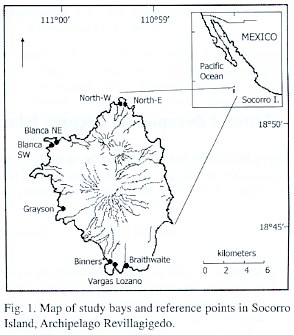
<body><![CDATA[<P><FONT FACE="Arial"><FONT SIZE=-1>Afterwards, <A HREF="#Garth58">Garth (1958)</A> reports majid species collected during the Allan Hancock Society’s expeditions in this island; likewise <A HREF="#Haig60">Haig (1960)</A> includes the species collected in these same expeditions in his monograph on porcellanids. <A HREF="#Adem">Adem <I>et a</I>l. (1960)</A> notify the presence of the Xanthidae and Grapsidae families at the southern portion of the island. <A HREF="#Garth92">Garth (1992)</A> publishes a study of brachyuran crabs from the Revillagigedo islands, emphasizing their insular endemism, based on the 1934 and 1939 collection trips carried out by the "Velero" ship. Last, <A HREF="#Hendrickx95">Hendrickx (1995a, b)</A> includes some of the species present in the island in his review about decapod crabs of the eastern tropical Pacific.</FONT></FONT>      <P><FONT FACE="Arial"><FONT SIZE=-1>To date no quantitative descriptions of the carcinofauna inhabiting Socorro Island have been reported. For this reason, this paper reports the species richness, abundance and distribution of brachyuran and anomuran crabs found inhabiting the rocky coast of the bays located to the north and south of this island as an attempt to broaden the ecological knowledge of these taxonomical groups in the island.</FONT></FONT>      <P><B><FONT FACE="Arial"><FONT SIZE=-1>Materials and methods</FONT></FONT></B>      <P><FONT FACE="Arial"><FONT SIZE=-1><B>Study area: </B>Socorro Island (<A HREF="#fig1">Fig. 1</A>), with an extension of 150 km 2 , is located at 18&ordm;47’ North Lat. and 110&ordm; 59’ West Long., 480 km from the southern edge of Baja California and 716 km off Manzanillo, Colima (<A HREF="#Adem">Adem <I>et al</I>. 1960</A>). It has several bays: three to the south (V. Lozano, Braithwaite and Binners), one to the southwest (Grayson), one to the northwest (Blanca) and one to the north (North Bay), the latter two with two inlets each. All bays are frequently washed by strong waves and are inhabited at its central portion by small coral reef colonies at depths between 4 and 8 m. Rest of the island’s littoral is inaccessible because of its cliffs and rocky outcrops. Abrief description of the main features in these bays follow:</FONT></FONT>     <BR>&nbsp;     <CENTER><A NAME="fig1"></A><IMG SRC="/img/fbpe/rbt/v51n1/2403i01.JPG" HEIGHT=335 WIDTH=294></CENTER> &nbsp;     
<BR><FONT FACE="Arial"><FONT SIZE=-1><B>Vargas Lozano.</B> Constituted by fragmented and eroded biogenic elements and by sand, gravel and igneous rocks of variable dimensions. At one end it is delimited by a cliff with fissures, cavities and large rocks with fragments of coral or gravel under them, and forming some small intertidal pools. The other end is made of large, relatively unstable rocks.</FONT></FONT>      <P><FONT FACE="Arial"><FONT SIZE=-1><B>Binners.</B> It includes a beach integrated by coarse coral reef elements along with gravel of igneous and biogenic origin. On one end there is an area of large eroded rocks with rocky out-crops; on the other the bay changes to a wide and low rocky coast with intertidal pools, fissures and cavities.</FONT></FONT>      <P><FONT FACE="Arial"><FONT SIZE=-1><B>Braithwaite </B>. An open bay that includes at its central portion large eroded rocks. It is delimited at both ends by compacted rocks, which include areas of rocky substrate in plateaus with a smooth slope, delimiting a wide supra- and mesolittoral fringe washed by the sea. The wavefront shows numerous crevices, caverns, cavities and intertidal pools.</FONT></FONT>      <P><FONT FACE="Arial"><FONT SIZE=-1><B>Grayson</B>. Small inlet that includes small crevices, cavities and a small sand plain with an intertidal zone constituted by large unstable stones along a steep slope. It is surrounded by abrupt cliffs and loose crags.</FONT></FONT>      ]]></body>
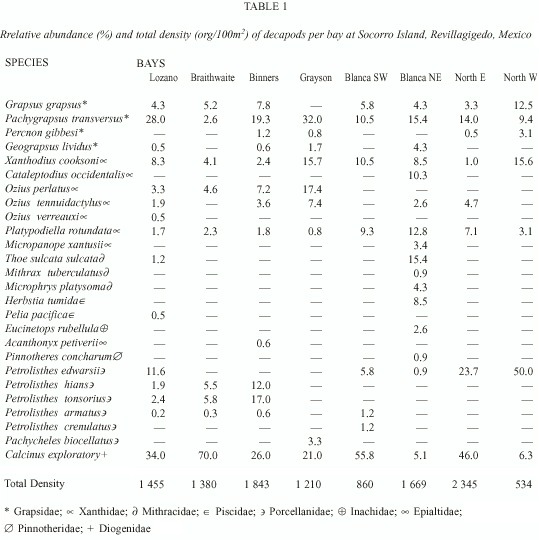
<body><![CDATA[<P><FONT FACE="Arial"><FONT SIZE=-1><B>Blanca.</B> Constituted by two inlets separated from one another by a prominent rocky out-crop.</FONT></FONT>      <P><FONT FACE="Arial"><FONT SIZE=-1>The northeastern inlet (Blanca NE), is relatively shallow with a smoothly-sloped sub-strate including dead coral reef elements, flat stones cover by filamentous algae and abundant organic matter. The southwestern inlet (Blanca SW) is a small bay that includes large stones with small tide pools and rocky out-crops at its central portion.</FONT></FONT>      <P><FONT FACE="Arial"><FONT SIZE=-1><B>North Bay</B>. It comprises two small bays separated by a volcanic formation. The eastern bay (North-E) has a moderate slope and a sub-strate made of fine sand. At one of its ends there is an abrupt high cliff formed by nonconsolidated materials, at the other end the coast is made of a low rocky outcrop. The western bay (North-W) is sandy, at one end is limited by a fringe of large round stones, crags and rocky outcrops including crevices, cavities and intertidal pools with a permanent water exchange. Avertical cliff limits the other end.</FONT></FONT>      <P><FONT FACE="Arial"><FONT SIZE=-1>One expedition was conducted to Socorro Island during March, 1992 and included all bays mentioned above. In each bay, sampling included the supralittoral and high- and mid-mesolittoral</FONT></FONT>      <P><FONT FACE="Arial"><FONT SIZE=-1>zones. It was done along transects placed perpendicularly to the coastline, separated from one another by 20 m approximately. Each transect included several one-square meter plots located at 2 m intervals (<A HREF="#Miles">Miles and Miles 1966</A>, <A HREF="#Holme">Holme and McIntyre 1984</A>). The number of plots sampled in each bay depended on the extension of the bay as well as on the conditions of tides and surges that prevailed during sampling (<A HREF="#Mille">Mille-Pagaza <I>et al</I>. 1994</A>). It is worth mentioning that during this period a wide portion of the intertidal zone was accessible because of the occurrence of a particularly pronounced low tide.</FONT></FONT>      <P><FONT FACE="Arial"><FONT SIZE=-1>Sampling was done manually by lifting rocks and crushing portions of dead coral.</FONT></FONT>      <P><FONT FACE="Arial"><FONT SIZE=-1>Determination of crab species was based on identification keys and descriptions by <A HREF="#Rathbun18">Rathbun (1918, 1930)</A>, <A HREF="#Garth58">Garth (1958)</A>, <A HREF="#Haig60">Haig (1960, 1966)</A>, <A HREF="#Brusca">Brusca (1980)</A>, <A HREF="#Garcia">Garc&iacute;a-Madrigal (1994)</A> and <A HREF="#Hendrickx95">Hendrickx (1995b)</A>.</FONT></FONT>      <P><FONT FACE="Arial"><FONT SIZE=-1>Species richness, defined as the number of species present (<A HREF="#Krebs94">Krebs 1994</A>, <A HREF="#Stiling">Stiling 1999</A>), total density (number of organisms/100 m<SUP>2</SUP> ) and relative abundance of each species were determined. Similarity among bays was calculated by means of the Morisita’s index,<B> </B>and these values were used to classify the bays, grouping them according to the Unweighed Per-Group Method using Arithmetic Averages (UPGMA) (<A HREF="#Ludwig">Ludwig and Reynolds 1988</A>, <A HREF="#Krebs89">Krebs 1989</A>).</FONT></FONT>      <P><B><FONT FACE="Arial"><FONT SIZE=-1>Results</FONT></FONT></B>      <P><FONT FACE="Arial"><FONT SIZE=-1>Organisms registered belong to four families, 17 genera and 19 species of the Brachyura infraorder, and two families, three genera and seven species of the Anomura infraorder. Taxonomical groups with the highest species richness (<A HREF="#table1">Table 1</A>) were Majoidea, Xanthidae and Grapsidae with seven, seven and four species, respectively. Among anomurans, porcellanids showed the highest species richness, with six species. Bays with the highest species richness were V. Lozano and Blanca NE, with 15 and 16 species, respectively (<A HREF="#table1">Table 1</A>).</FONT></FONT>     ]]></body>
<body><![CDATA[<BR><FONT FACE="Arial"><FONT SIZE=-1>&nbsp;</FONT></FONT>     <CENTER><A NAME="table1"></A><IMG SRC="/img/fbpe/rbt/v51n1/2403t01.JPG" HEIGHT=540 WIDTH=559></CENTER> &nbsp;     
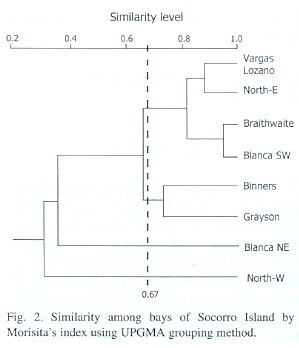
<BR><FONT FACE="Arial"><FONT SIZE=-1>In general, grapsids and xanthids had the widest distribution in the island, with several species present in all bays. By contrast, Pinnotheridae had the most restricted distribution, being found only at Blanca NE with a very low abundance. Species with the widest distribution were <I>Grapsus grapsus </I>(Linnaeus 1758) and <I>Pachygrapsus transversus </I>(Gibbes 1850<I>), Xanthodius cooksoni </I>(Miers 1877), <I>Platypodiella rotundata </I>(Stimpson 1860) and <I>Calcinus explorator </I>Boone 1932.</FONT></FONT>      <P><FONT FACE="Arial"><FONT SIZE=-1>The highest total density was registered at Binners and North-E (1 843 and 2 345 org./100 m<SUP>2</SUP> , respectively). Grapsidae represent the dominant family in the island, with the Diogenidae anomurans also dominating in some bays. Xanthids tend to be less dominant, having intermediate values, whereas majids present very low abundance in general (<A HREF="#table1">Tabla 1</A>).</FONT></FONT>      <P><FONT FACE="Arial"><FONT SIZE=-1>Dendrogram (<A HREF="#fig2">Fig. 2</A>) obtained from the Morisita’s index showed that two groups are formed at 0.67 level, the first one also with two subgroups, one including Blanca SW and Braithwaite, with the highest similarity (0.95) and the other including North-E and V. Lozano with a similarity of about 0.85. Another group, with a lower similarity (0.75), was constituted by Grayson and Binners.</FONT></FONT>      <P><FONT FACE="Arial"><FONT SIZE=-1>Last, Blanca NE and North-W bays appear as the most dissimilar ones.</FONT></FONT>     <BR>&nbsp;     <CENTER>&nbsp;<A NAME="fig2"></A><IMG SRC="/img/fbpe/rbt/v51n1/2403i02.JPG" HEIGHT=348 WIDTH=299></CENTER> &nbsp;     
<BR><B><FONT FACE="Arial"><FONT SIZE=-1>Discussion</FONT></FONT></B>      <P><FONT FACE="Arial"><FONT SIZE=-1>Species richness recorded in March 1992, particularly at the V. Lozano bay, can be attributed to habitat’s complexity (<A HREF="#Abele">Abele 1974</A>, <A HREF="#Birch">Birch 1981</A>, <A HREF="#Raffaelli">Raffaelli and Hawkins 1997</A>, <A HREF="#Krohne">Krohne 1998</A>). This bay provides protection and food to several grapsid, xanthid and porcellanid crabs. <I>P. transversus </I>is one of the species that stand out, developing abundantly in fissures and cavities, from which it emerges at low tide to feed on algae adhered to rocks, like other species of this genus in several other localities (<A HREF="#Abele">Abele 1974</A>, <A HREF="#Ricketts">Ricketts <I>et a</I>l. 1985</A>). Xanthids remain among gravel or pieces of coral below rocks, where they feed on detritus; and porcellanids find shelter among crevices or under rocks, where they filter diatoms and organic detritus as they do at northern locations of the American Pacific coast (<A HREF="#Ricketts">Ricketts <I>et a</I>l. 1985</A>). At Blanca NE the highest diversity was achieved by majids in relation to a particular habitat constituted by a zone of super-imposed flat rocks, with abundant filamentous algae and that retain slime among which these crabs live, constituting very characteristic associations (<A HREF="#Sanders">Sanders 1968</A>).</FONT></FONT>      ]]></body>
<body><![CDATA[<P><FONT FACE="Arial"><FONT SIZE=-1>In Socorro Island there are species that inhabit different habitats, like <I>C. explorator </I>and <I>P. transversu</I>s, which can be found below and above rocks and even at intertidal pools. By contrast, there are species which prefer a particular habitat type, as in the case of majids, as well as <I>Cataleptodius occidentalis </I>(Stimpson, 1871) and <I>Pinnotheres concharum</I>, that were found associated with flat rock-algae-slime, or <I>Acanthonyx petiveri </I>Milne Edwards 1834 that was only collected at Binners bay in intertidal pools with algal growth, possibly forming part of another kind of association, or <I>Pachycheles biocellatus </I>and <I>Petrolisthes crenulatu</I>s, only present in one of the bays associated with fractions of coral reef below rocks.</FONT></FONT>      <P><FONT FACE="Arial"><FONT SIZE=-1>Species richness found in this work (26 species) does not coincide with the data reported by <A HREF="#Garth92">Garth (1992)</A>, who mentions 36 brachyuran species for Socorro Island collected during several expeditions. This is attributed to the fact that Garth included species found at the infralittoral fringe. Composition by genera partially coincides with data reported by <A HREF="#Hernandez86">Hern&aacute;ndez-Aguilera <I>et al</I>. (1986)</A> and <A HREF="#Garth92">Garth (1992)</A>, since they only mention <I>Acanthony</I> x, <I>Herbsti</I>a, <I>Cataleptodiu</I>s, <I>Ozius </I>and <I>Geograpsus </I>as part of the carcinofauna of Clarion. Despite the fact that <I>Gecarcinus planatus </I>was frequently seen in all bays, this species was not included in any of our plots. Likewise, it is worth noting that <I>Xanthodius hebe</I> s, mentioned by <A HREF="#Llinas">Llinas-Guti&eacute;rrez <I>et al</I>. (1993)</A> as an inhabitant of intertidal pools, was neither found in any bay nor it even appears included in Garth’s lists (<A HREF="#Garth92">1992</A>).</FONT></FONT>      <P><FONT FACE="Arial"><FONT SIZE=-1>Differences in total density among bays can also be explained as a function of habitat complexity (<A HREF="#Abele">Abele 1974</A>, <A HREF="#Garcia">Garc&iacute;a-Madrigal 1994</A>, <A HREF="#Hendrickx96">Hendrickx 1996</A>). Those inlets with highest values present intertidal pools, super-imposed flat rocks with light waves and also various kinds of algae that offer protection and food to crabs, as well as a wide variety of microhabitats. By contrast, inlets with lower densities showed a large amount of nearly smooth superimposed rocks that are constantly hit by strong waves and show a scarce plant cover. This is markedly perceivable at Grayson and North-W bays, where perturbations derived from the constant movement of round stones restricts the development of majids and favor species like <I>P. transversus </I>or <I>C. explorato</I>r, which reach high densities under these conditions.</FONT></FONT>      <P><FONT FACE="Arial"><FONT SIZE=-1>Most species show a clear relationship between abundance and the particular habitat type they inhabit (<A HREF="#Crane">Crane 1947</A>, <A HREF="#Abele">Abele 1974</A>, <A HREF="#Villalobos">Villalobos-Hiriart <I>et al.</I> 1989</A>, <A HREF="#Hendrickx98">Hendrickx and V&aacute;zquez-Cure&ntilde;o, 1998</A>). Thus, the <I>Petrolisthes </I>species better develop in areas with superim-posed rocks, relatively protected from strong waves. Particularly, <I>P. edwarsii </I>reached up to 556 org./100 m<SUP>2</SUP> at North-W (50% of total abundance). By contrast, xanthids were more abundant at the lowest zone of rocks, among gravel, as in the case of <I>X. cooksoni </I>and some species of the genus <I>Ozius </I>that under these conditions recorded up to 414 and 210 org./100 m<SUP>2</SUP> , respectively. Most majids species also show a marked preference for places protected by rocks or intertidal pools with abundant algae and organic matter, although they are always present at very low densities, as mentioned by <A HREF="#Crane">Crane (1947)</A> for several islands in the Pacific ocean and by <A HREF="#Garcia">Garc&iacute;a-Madrigal (1994)</A> for the Maruata bay, Michoacan. However, <I>Micropanope xantusi</I>i, mentioned as an inhabitant of coral reef exclusively (<A HREF="#Garth60">Garth 1960, 1961</A>), was found under rocks among filamentous algae in this study. This close relationship between crab abundance and habitat availability was also observed at Blanca NE and North-W bays, where <I>C. explorator </I>showed the lowest densities due to absence of coral reef fragments and gravel under rocks, present at other bays where this hermit crab develops abundantly. Species with the lowest density varied in each bay according to their physiographic features.</FONT></FONT>      <P><FONT FACE="Arial"><FONT SIZE=-1>Species recorded at all bays include <I>P.transversu</I> s, classified as an amphi-american tropical cosmopolitan species (<A HREF="#Crane">Crane 1947</A>, <A HREF="#Martinez">Mart&iacute;nez-Guzm&aacute;n and Hern&aacute;ndez-Aguilera 1993</A>), as well as <I>X. cookson</I> i, mentioned as an endemic insular species (<A HREF="#Garth92">Garth 1992</A>). <I>G. grapsus </I>and <I>C. explorator </I>were seen in all bays. The former is widely distributed in rocky shores of the Mexican Pacific coast (<A HREF="#Crane">Crane 1947</A>, <A HREF="#Garth60">Garth 1960</A>, <A HREF="#Villalobos">Villalobos-Hiriart <I>et al</I>. 1989</A>, <A HREF="#Hendrickx95">Hendrickx 1995a and b</A>) and the latter constitutes a conspicuous element of the fauna in the Cabo San Lucas area, classified by <A HREF="#Garth60">Garth (1960)</A> as having an insular character. <I>Platypodiella rotundata</I>, found under mid-sized rocks among gravel, has also been mentioned for Clarion (<A HREF="#Hernandez86">Hern&aacute;ndez-Aguilera <I>et al. </I>1986</A>, <A HREF="#Hernandez92">Hern&aacute;ndez-Aguilera and Mart&iacute;nez-Guzm&aacute;n 1992</A>), Maruata, Michoacan (<A HREF="#Garcia">Garc&iacute;a-Madrigal 1994</A>), Clipperton (<A HREF="#Hertlein">Hertlein and Emerson 1957</A>, <A HREF="#Garth65">Garth 1965</A>) and Galapagos islands, Ecuador (<A HREF="#Villalobos">Villalobos-Hiriart <I>et al.</I> 1989</A>). This is indicative of the wide distribution of these species, as well as of the fact that the composition of fauna in this island includes both continental and insular species.</FONT></FONT>      <P><FONT FACE="Arial"><FONT SIZE=-1>The presence of <I>Percnon gibbesi</I>, <I>Geograpsus lividu</I>s, <I>Petrolisthes armatus </I>and <I>P. crenulatu</I> s, both in northern and southern bays, could indicate that their distribution comprises the whole island with low densities, since they have been recorded along the Pacific coast from Baja California and the Gulf of California down to Chile and in Clarion, Maria Madre, Clipperton and Galapagos (<A HREF="#Crane">Crane 1947</A>, <A HREF="#Hertlein">Hertlein and Emerson 1957</A>, <A HREF="#Garth60">Garth 1960</A>, <A HREF="#Villalobos">Villalobos-Hiriart <I>et al</I>. 1989</A>, <A HREF="#Garth92">Garth 1992</A>, <A HREF="#Hernandez92">Hern&aacute;ndez-Aguilera and Mart&iacute;nez-Guzm&aacute;n 1992</A>).</FONT></FONT>      <P><FONT FACE="Arial"><FONT SIZE=-1>Socorro Island is added to the distribution range of species of <I>Cataleptodiu</I>s, <I>Oziu</I>s, <I>Herbstia </I>and <I>Acanthony</I>x, which were not considered by <A HREF="#Garth92">Garth (1992)</A> despite their being found down to Chile and Panama. This omission could be due to the scarce information regarding littoral fauna in most parts of the island.</FONT></FONT>      <P><FONT FACE="Arial"><FONT SIZE=-1>The list of species found in this work, compared with that of Clarion Island (<A HREF="#Crane">Crane 1947</A>, <A HREF="#Garth61">Garth 1961</A>, <A HREF="#Hernandez86">Hern&aacute;ndez-Aguilera <I>et al</I>. 1986</A>, <A HREF="#Garth92">Garth 1992</A>, <A HREF="#Hernandez92">Hern&aacute;ndez-Aguilera and Mart&iacute;nez-Guzm&aacute;n 1992</A>), confirm that these islands share a large number of species: four grapsids, five xanthids, five majids, one diogenid and four porcellanids, most probably due to its closeness.</FONT></FONT>      <P><FONT FACE="Arial"><FONT SIZE=-1><A HREF="#Llinas">Llinas-Guti&eacute;rrez <I>et a</I>l. (1993)</A> mention that "the Revillagigedo Archipelago can be considered as a tropical zone with interannual variations that define it as a transition area; therefore, its fauna is constituted by tropical and temperate elements". According to this, it could be expected that the crab fauna of Socorro Island’s littoral show the same type of components. However, the fauna is fundamentally Panamic (18 species), in addition to other four species <I>(Thoe sulcata sulcata</I> , <I>Eucinetops rubellula, Petrolisthes armatus </I>and <I>P. crenulatus</I>) that belong to the Mexican province defined by <A HREF="#Briggs">Briggs (1974)</A>, and two insular species, <I>X. cooksoni </I>and <I>C. explorator </I>(<A HREF="#Garth92">Garth 1992</A>). These faunistic elements indicate that Socorro island is clearly an element of the Panamic province as indicated by <A HREF="#Briggs">Briggs (1974)</A>, where the temperate component mentioned by <A HREF="#Llinas">Llinas-Guti&eacute;rrez <I>et al. </I>(1993)</A> is missing.</FONT></FONT>      <P><FONT FACE="Arial"><FONT SIZE=-1>Composition and abundance of brachyurans and anomurans in the different bays indicate that there is a relative homogeneity throughout the area, with some differences derived from habitat complexity in some bays, as clearly reflected in the dendrogram (<A HREF="#fig2">Fig. 2</A>). Similarity between V. Lozano and North-E can be partially explained in terms of their similar physiographic features, with scarce intertidal pools and superimposed rocks with fissures and cavities and with a scarce plant cover, where the abundance of one or two species prevails. A similar situation is detected at Braithwaite and Blanca-SW, both having intertidal pools covered by algae that determine the occurrence of a higher crab diversity with a clear predominance of <I>C. explorator </I>over the remaining species. Binners bay was grouped with Grayson, even when their physiographic conditions differ, which can be explained as a result of the high densities that <I>P. transversus </I>showed compared to other species. The remaining bays are clearly separated, Blanca-NE because of the high majid diversity and North-W because its inhospitable conditions limit the occurrence of a high decapod diversity.</FONT></FONT>      ]]></body>
<body><![CDATA[<P><FONT FACE="Arial"><FONT SIZE=-1>It is possible to state that the diversity of littoral crabs at Socorro Island varies along its rocky coast, depending on habitat complexity and resource availability. This becomes evident both in differences in species richness and in species’ relative abundance. Furthermore, variations through time in these parameters suggest the existence of a complex dynamics in crab community structure inhabiting the littoral fringe, influenced by variations in environmental conditions.</FONT></FONT>      <P><B><FONT FACE="Arial"><FONT SIZE=-1>Acknowledgments</FONT></FONT></B>      <P><FONT FACE="Arial"><FONT SIZE=-1>We wish to thank Jos&eacute; L. Villalobos H. who provided literature and for his assistance in the species identification, and Francisco Cruz V&aacute;zquez for his assistance in collecting organisms and species identification. We thank anonymous reviewers for their valuable constructive comments and suggestions.</FONT></FONT>      <P><B><FONT FACE="Arial"><FONT SIZE=-1>Resumen</FONT></FONT></B>      <P><FONT FACE="Arial"><FONT SIZE=-1>Se estudi&oacute; la comunidad de cangrejos del litoral rocoso de ocho bah&iacute;as de la Isla Socorro, Archipi&eacute;lago Revillagigedo en marzo de 1992. Las muestras fueron colectadas en cuadrantes de un m<SUP>2</SUP> a lo largo de transectos perpendiculares a la costa en la zona intermareal. Se determin&oacute; la riqueza espec&iacute;fica, la abundancia por especie para cada bah&iacute;a, as&iacute; como la similitud entre bah&iacute;as mediante el &iacute;ndice de Morisita. Los organismos colectados pertenecen a seis familias, 20 g&eacute;neros y 26 especies de los infraordenes Brachyura y Anomura. La familia con el mayor n&uacute;mero de especies fue Xanthidae y la mayor riqueza espec&iacute;fica se registr&oacute; en la bah&iacute;a V. Lozano. <I>Pachygrapsus transversu</I>s, <I>Xanthodius cooksoni </I>y <I>Calcinus explorator </I>fueron las m&aacute;s abundantes en casi todas las localidades. En el dendrograma se definen dos agrupaciones con nivel de similitud superior a 0.67, dada la semejanza en la riqueza espec&iacute;fica de cangrejos y las abundancias entre las bah&iacute;as.</FONT></FONT>      <P><B><FONT FACE="Arial"><FONT SIZE=-1>References</FONT></FONT></B>      <!-- ref --><P><A NAME="Abele"></A><FONT FACE="Arial"><FONT SIZE=-1>Abele, L.G. 1974. Species Diversity of Decapod Crustaceans in Marine Habitats. Ecology 55: 156-161.</FONT></FONT>    &nbsp;&nbsp;&nbsp;&nbsp;&nbsp;&nbsp;&nbsp;&nbsp;[&#160;<a href="javascript:void(0);" onclick="javascript: window.open('/scielo.php?script=sci_nlinks&ref=1221326&pid=S0034-7744200300010001400001&lng=','','width=640,height=500,resizable=yes,scrollbars=1,menubar=yes,');">Links</a>&#160;]<!-- end-ref --><P><A NAME="Adem"></A><FONT FACE="Arial"><FONT SIZE=-1>Adem, J., E. Cobo, L. Bl&aacute;zquez, F. Miranda, A. Villalobos, T. Herrera, B. Villa &amp; L. V&aacute;zquez. 1960. La Isla Socorro, Archipi&eacute;lago de las Revillagigedo. Monog. Inst. Geof&iacute;sica/2. UNAM. M&eacute;xico. 234 p.</FONT></FONT>      <!-- ref --><P><A NAME="Birch"></A><FONT FACE="Arial"><FONT SIZE=-1>Birch, D. W. 1981. Dominance in Marine Ecosystems. Am. Nat. 118(2): 262-273.</FONT></FONT>    &nbsp;&nbsp;&nbsp;&nbsp;&nbsp;&nbsp;&nbsp;&nbsp;[&#160;<a href="javascript:void(0);" onclick="javascript: window.open('/scielo.php?script=sci_nlinks&ref=1221328&pid=S0034-7744200300010001400003&lng=','','width=640,height=500,resizable=yes,scrollbars=1,menubar=yes,');">Links</a>&#160;]<!-- end-ref --><!-- ref --><P><A NAME="Briggs"></A><FONT FACE="Arial"><FONT SIZE=-1>Briggs, J.C. 1974. Marine Zoogeography. McGraw-Hill. New York. 473 p.</FONT></FONT>    &nbsp;&nbsp;&nbsp;&nbsp;&nbsp;&nbsp;&nbsp;&nbsp;[&#160;<a href="javascript:void(0);" onclick="javascript: window.open('/scielo.php?script=sci_nlinks&ref=1221329&pid=S0034-7744200300010001400004&lng=','','width=640,height=500,resizable=yes,scrollbars=1,menubar=yes,');">Links</a>&#160;]<!-- end-ref --><!-- ref --><P><A NAME="Brusca"></A><FONT FACE="Arial"><FONT SIZE=-1>Brusca, R.C. 1980. Intertidal invertebrates of the Gulf of California, Univ. of Arizona. 513 p.</FONT></FONT>    &nbsp;&nbsp;&nbsp;&nbsp;&nbsp;&nbsp;&nbsp;&nbsp;[&#160;<a href="javascript:void(0);" onclick="javascript: window.open('/scielo.php?script=sci_nlinks&ref=1221330&pid=S0034-7744200300010001400005&lng=','','width=640,height=500,resizable=yes,scrollbars=1,menubar=yes,');">Links</a>&#160;]<!-- end-ref --><P><A NAME="Crane"></A><FONT FACE="Arial"><FONT SIZE=-1>Crane, J. 1947. Eastern Pacific Expeditions of the New York Zoological Society. Intertidal Brachygnathous crabs from the West coast of tropical America with special reference to ecology. Zoologica. 22: 47-78.</FONT></FONT>      <P><A NAME="Garcia"></A><FONT FACE="Arial"><FONT SIZE=-1>Garc&iacute;a-Madrigal, M.S. 1994. Brachyura (Crustacea: Decapoda) de la Bah&iacute;a de Maruata, Michoac&aacute;n, M&eacute;xico. Contr. Zool. Consultor&iacute;a e Investigaci&oacute;n Ambiental (1): 1-58. M&eacute;xico.</FONT></FONT>      <!-- ref --><P><A NAME="Garth58"></A><FONT FACE="Arial"><FONT SIZE=-1>Garth, J.S. 1958. Brachyura of the Pacific coast of America. Oxyrhyncha. Allan Hancock Pac. Exp. 21:1-854.</FONT></FONT>    &nbsp;&nbsp;&nbsp;&nbsp;&nbsp;&nbsp;&nbsp;&nbsp;[&#160;<a href="javascript:void(0);" onclick="javascript: window.open('/scielo.php?script=sci_nlinks&ref=1221333&pid=S0034-7744200300010001400006&lng=','','width=640,height=500,resizable=yes,scrollbars=1,menubar=yes,');">Links</a>&#160;]<!-- end-ref --><!-- ref --><P><A NAME="Garth60"></A><FONT FACE="Arial"><FONT SIZE=-1>Garth, J.S. 1960. Distribution and Affinities of the Brachyuran Crustacea. <I>In </I>The biogeography of Baja California and adjacents seas. Part II. Marine biotas. Syst. Zool. 9:105-123.</FONT></FONT>    &nbsp;&nbsp;&nbsp;&nbsp;&nbsp;&nbsp;&nbsp;&nbsp;[&#160;<a href="javascript:void(0);" onclick="javascript: window.open('/scielo.php?script=sci_nlinks&ref=1221334&pid=S0034-7744200300010001400007&lng=','','width=640,height=500,resizable=yes,scrollbars=1,menubar=yes,');">Links</a>&#160;]<!-- end-ref --><P><A NAME="Garth61"></A><FONT FACE="Arial"><FONT SIZE=-1>Garth, J.S. 1961. Eastern Pacific Expeditions of the New York Zoological Society. XLV. Non-Intertidal Brachygnathous crabs from the West Coast of Tropical America. Part 2: Brachygnatha Brachyrhyncha. Zoologica: 46: 133-159.</FONT></FONT>      <!-- ref --><P><A NAME="Garth65"></A><FONT FACE="Arial"><FONT SIZE=-1>Garth, J.S. 1965. The brachyuran decapod crustaceans of Clipperton Island. Proc. Calif. Acad. Sci, 33: 1-64.</FONT></FONT>    &nbsp;&nbsp;&nbsp;&nbsp;&nbsp;&nbsp;&nbsp;&nbsp;[&#160;<a href="javascript:void(0);" onclick="javascript: window.open('/scielo.php?script=sci_nlinks&ref=1221336&pid=S0034-7744200300010001400008&lng=','','width=640,height=500,resizable=yes,scrollbars=1,menubar=yes,');">Links</a>&#160;]<!-- end-ref --><P><A NAME="Garth92"></A><FONT FACE="Arial"><FONT SIZE=-1>Garth, J.S. 1992. The brachyuran crabs of the Revillagigedo Islands, Colima, M&eacute;xico, with remarks on insular endemism in the Eastern Tropical Pacific. Proc. San Diego Soc. Nat. Hist. 24: 1-6.</FONT></FONT>      <!-- ref --><P><A NAME="Haig60"></A><FONT FACE="Arial"><FONT SIZE=-1>Haig, J. 1960. The Porcellanidae (Crustacea, Anomura) of the eastern Pacific. Allan Hancock Pac. Exp. 24: 1-400.</FONT></FONT>    &nbsp;&nbsp;&nbsp;&nbsp;&nbsp;&nbsp;&nbsp;&nbsp;[&#160;<a href="javascript:void(0);" onclick="javascript: window.open('/scielo.php?script=sci_nlinks&ref=1221338&pid=S0034-7744200300010001400009&lng=','','width=640,height=500,resizable=yes,scrollbars=1,menubar=yes,');">Links</a>&#160;]<!-- end-ref --><!-- ref --><P><A NAME="Haig66"></A><FONT FACE="Arial"><FONT SIZE=-1>Haig, J. 1966. Porcellanid crabs (Crustacea, Anomura) Results Scient. Comp. Calypso 7: 351-358.</FONT></FONT>    &nbsp;&nbsp;&nbsp;&nbsp;&nbsp;&nbsp;&nbsp;&nbsp;[&#160;<a href="javascript:void(0);" onclick="javascript: window.open('/scielo.php?script=sci_nlinks&ref=1221339&pid=S0034-7744200300010001400010&lng=','','width=640,height=500,resizable=yes,scrollbars=1,menubar=yes,');">Links</a>&#160;]<!-- end-ref --><!-- ref --><P><A NAME="Hendrickx95"></A><FONT FACE="Arial"><FONT SIZE=-1>Hendrickx, M.E. 1995. Checklist of brachyuran crabs (Crustacea: Decapoda) from the eastern tropical Pacific. Bull. Inst. Royal Scienc. Nat. De Belgique 65: 125-150.</FONT></FONT>    &nbsp;&nbsp;&nbsp;&nbsp;&nbsp;&nbsp;&nbsp;&nbsp;[&#160;<a href="javascript:void(0);" onclick="javascript: window.open('/scielo.php?script=sci_nlinks&ref=1221340&pid=S0034-7744200300010001400011&lng=','','width=640,height=500,resizable=yes,scrollbars=1,menubar=yes,');">Links</a>&#160;]<!-- end-ref --><P><FONT FACE="Arial"><FONT SIZE=-1>Hendrickx, M.E. 1995. Cangrejos. pp. 565-636. <I>In </I>W. Fisher, F. Krupp, W. Schneider, C. Sommer, K.E. Carpenter y V.H. Niem (eds.). Gu&iacute;a FAO para la identificaci&oacute;n de especies para los fines de la pesca. Pac&iacute;fico centro-Oriental. Vol. 1. Plantas e Invertebrados. Roma, Italia.</FONT></FONT>      <!-- ref --><P><A NAME="Hendrickx96"></A><FONT FACE="Arial"><FONT SIZE=-1>Hendrickx, M.E. 1996. Habitats and biodiversity of decapod crustaceans in the SE Gulf of California, Mexico. Rev. Biol. Trop. 44: 603-617.</FONT></FONT>    &nbsp;&nbsp;&nbsp;&nbsp;&nbsp;&nbsp;&nbsp;&nbsp;[&#160;<a href="javascript:void(0);" onclick="javascript: window.open('/scielo.php?script=sci_nlinks&ref=1221342&pid=S0034-7744200300010001400012&lng=','','width=640,height=500,resizable=yes,scrollbars=1,menubar=yes,');">Links</a>&#160;]<!-- end-ref --><!-- ref --><P><A NAME="Hendrickx98"></A><FONT FACE="Arial"><FONT SIZE=-1>Hendrickx, M.E. &amp; L.A. V&aacute;zquez-Cure&ntilde;o. 1998. Composition and Zoogeographical Affinities of the Stomatopod and Decapod Crustacea Fauna Collected During the Ceemex P4 Cruise in the Gulf of Tehuantepec, M&eacute;xico. Bull. Inst. Royal Scienc. Nat. De Belgique 68: 135-144.</FONT></FONT>    &nbsp;&nbsp;&nbsp;&nbsp;&nbsp;&nbsp;&nbsp;&nbsp;[&#160;<a href="javascript:void(0);" onclick="javascript: window.open('/scielo.php?script=sci_nlinks&ref=1221343&pid=S0034-7744200300010001400013&lng=','','width=640,height=500,resizable=yes,scrollbars=1,menubar=yes,');">Links</a>&#160;]<!-- end-ref --><!-- ref --><P><A NAME="Hernandez86"></A><FONT FACE="Arial"><FONT SIZE=-1>Hern&aacute;ndez-Aguilera, J.L., I. L&oacute;pez-Salgado &amp; P. Sosa-Hern&aacute;ndez. 1986. Fauna carcinol&oacute;gica insular de M&eacute;xico I. Crust&aacute;ceos estomat&oacute;podos y dec&aacute;podos de la Isla Clari&oacute;n. Inv. Ocean. 3: 183-250.</FONT></FONT>    &nbsp;&nbsp;&nbsp;&nbsp;&nbsp;&nbsp;&nbsp;&nbsp;[&#160;<a href="javascript:void(0);" onclick="javascript: window.open('/scielo.php?script=sci_nlinks&ref=1221344&pid=S0034-7744200300010001400014&lng=','','width=640,height=500,resizable=yes,scrollbars=1,menubar=yes,');">Links</a>&#160;]<!-- end-ref --><P><A NAME="Hernandez92"></A><FONT FACE="Arial"><FONT SIZE=-1>Hern&aacute;ndez-Aguilera, J.L. &amp; L.A. Mart&iacute;nez-Guzm&aacute;n. 1992. Notas acerca de la distribuci&oacute;n de los estomat&oacute;podos y dec&aacute;podos de aguas someras de Isla Clari&oacute;n, Archipi&eacute;lago Revillagigedo, Colima, M&eacute;xico. Proc. San Diego Soc. Nat. Hist. 19: 1-6.</FONT></FONT>      <!-- ref --><P><A NAME="Hertlein"></A><FONT FACE="Arial"><FONT SIZE=-1>Hertlein, G.L. &amp; W.K. Emerson 1957. Additional notes on the invertebrate fauna of Clipperton Island. Am. Mus. Nov. 1859: 1-9.</FONT></FONT>    &nbsp;&nbsp;&nbsp;&nbsp;&nbsp;&nbsp;&nbsp;&nbsp;[&#160;<a href="javascript:void(0);" onclick="javascript: window.open('/scielo.php?script=sci_nlinks&ref=1221346&pid=S0034-7744200300010001400015&lng=','','width=640,height=500,resizable=yes,scrollbars=1,menubar=yes,');">Links</a>&#160;]<!-- end-ref --><!-- ref --><P><A NAME="Holme"></A><FONT FACE="Arial"><FONT SIZE=-1>Holme, N. A. &amp; A.D. McIntyre 1984. Methods for the Study of Marine Benthos. Blackwell, Oxford. 387 p.</FONT></FONT>    &nbsp;&nbsp;&nbsp;&nbsp;&nbsp;&nbsp;&nbsp;&nbsp;[&#160;<a href="javascript:void(0);" onclick="javascript: window.open('/scielo.php?script=sci_nlinks&ref=1221347&pid=S0034-7744200300010001400016&lng=','','width=640,height=500,resizable=yes,scrollbars=1,menubar=yes,');">Links</a>&#160;]<!-- end-ref --><!-- ref --><P><A NAME="Krebs89"></A><FONT FACE="Arial"><FONT SIZE=-1>Krebs, C. J. 1989. Ecological Methodology. Harper and Row. New York. 654 p.</FONT></FONT>    &nbsp;&nbsp;&nbsp;&nbsp;&nbsp;&nbsp;&nbsp;&nbsp;[&#160;<a href="javascript:void(0);" onclick="javascript: window.open('/scielo.php?script=sci_nlinks&ref=1221348&pid=S0034-7744200300010001400017&lng=','','width=640,height=500,resizable=yes,scrollbars=1,menubar=yes,');">Links</a>&#160;]<!-- end-ref --><!-- ref --><P><A NAME="Krebs94"></A><FONT FACE="Arial"><FONT SIZE=-1>Krebs, C. J. 1994. Ecology. The Experimental Analysis of Distribution and Abundance. Addison-Wesley. New York. 900 p.</FONT></FONT>    &nbsp;&nbsp;&nbsp;&nbsp;&nbsp;&nbsp;&nbsp;&nbsp;[&#160;<a href="javascript:void(0);" onclick="javascript: window.open('/scielo.php?script=sci_nlinks&ref=1221349&pid=S0034-7744200300010001400018&lng=','','width=640,height=500,resizable=yes,scrollbars=1,menubar=yes,');">Links</a>&#160;]<!-- end-ref --><!-- ref --><P><A NAME="Krohne"></A><FONT FACE="Arial"><FONT SIZE=-1>Krohne, D.T. 1998. General Ecology. Wadsworth. New York. 722 p.</FONT></FONT>    &nbsp;&nbsp;&nbsp;&nbsp;&nbsp;&nbsp;&nbsp;&nbsp;[&#160;<a href="javascript:void(0);" onclick="javascript: window.open('/scielo.php?script=sci_nlinks&ref=1221350&pid=S0034-7744200300010001400019&lng=','','width=640,height=500,resizable=yes,scrollbars=1,menubar=yes,');">Links</a>&#160;]<!-- end-ref --><!-- ref --><P><A NAME="Ludwig"></A><FONT FACE="Arial"><FONT SIZE=-1>Ludwig, J.A. &amp; J.F. Reynolds. 1988. Statistical Ecology. Wiley. New York. 337 p.</FONT></FONT>    &nbsp;&nbsp;&nbsp;&nbsp;&nbsp;&nbsp;&nbsp;&nbsp;[&#160;<a href="javascript:void(0);" onclick="javascript: window.open('/scielo.php?script=sci_nlinks&ref=1221351&pid=S0034-7744200300010001400020&lng=','','width=640,height=500,resizable=yes,scrollbars=1,menubar=yes,');">Links</a>&#160;]<!-- end-ref --><P><A NAME="Llinas"></A><FONT FACE="Arial"><FONT SIZE=-1>Llinas-Guti&eacute;rrez, J., D. Lluch-Cota, A. Castellanos, &amp; A. Ortega-Rubio. 1993. La Isla Socorro, Revillagigedo, pp. 520-534. <I>In </I>S.I. Salazar-Vallejo and N.E. Gonz&aacute;lez (eds.). Biodiversidad marina y costera de M&eacute;xico. Comisi&oacute;n Nacional de Biodiversidad y Centro de Investigaciones de Quintana Roo, M&eacute;xico.</FONT></FONT>      <!-- ref --><P><A NAME="Martinez"></A><FONT FACE="Arial"><FONT SIZE=-1>Mart&iacute;nez-Guzm&aacute;n, L. &amp; J.L. Hern&aacute;ndez-Aguilera. 1993. Crustaceos Estomat&oacute;podos y Dec&aacute;podos del Arrecife Alacr&aacute;n, Yucat&aacute;n, pp. 609-629. <I>In </I>S.I. Salazar-Vallejo and N.E. Gonz&aacute;lez (eds.). Biodiversidad Marina Costera de M&eacute;xico. Comisi&oacute;n Nacional de Biodiversidad y Centro de Investigaciones de Quintana Roo, M&eacute;xico.</FONT></FONT>    &nbsp;&nbsp;&nbsp;&nbsp;&nbsp;&nbsp;&nbsp;&nbsp;[&#160;<a href="javascript:void(0);" onclick="javascript: window.open('/scielo.php?script=sci_nlinks&ref=1221353&pid=S0034-7744200300010001400021&lng=','','width=640,height=500,resizable=yes,scrollbars=1,menubar=yes,');">Links</a>&#160;]<!-- end-ref --><!-- ref --><P><A NAME="Miles"></A><FONT FACE="Arial"><FONT SIZE=-1>Miles, P.M. &amp; Miles H.B. 1966. Hulton’s Biological Field Studies Seashore Ecology. Hulton Educational Limited. London. 96 p.</FONT></FONT>    &nbsp;&nbsp;&nbsp;&nbsp;&nbsp;&nbsp;&nbsp;&nbsp;[&#160;<a href="javascript:void(0);" onclick="javascript: window.open('/scielo.php?script=sci_nlinks&ref=1221354&pid=S0034-7744200300010001400022&lng=','','width=640,height=500,resizable=yes,scrollbars=1,menubar=yes,');">Links</a>&#160;]<!-- end-ref --><!-- ref --><P><A NAME="Mille"></A><FONT FACE="Arial"><FONT SIZE=-1>Mille-Pagaza, S., A. P&eacute;rez-Chi &amp; O. Holguin-Qui&ntilde;ones. 1994. Fauna malacol&oacute;gica bent&oacute;nica del litoral de Isla Socorro, Revillagigedo, M&eacute;xico. Cienc. Mar. 20: 467-486.</FONT></FONT>    &nbsp;&nbsp;&nbsp;&nbsp;&nbsp;&nbsp;&nbsp;&nbsp;[&#160;<a href="javascript:void(0);" onclick="javascript: window.open('/scielo.php?script=sci_nlinks&ref=1221355&pid=S0034-7744200300010001400023&lng=','','width=640,height=500,resizable=yes,scrollbars=1,menubar=yes,');">Links</a>&#160;]<!-- end-ref --><!-- ref --><P><A NAME="Raffaelli"></A><FONT FACE="Arial"><FONT SIZE=-1>Raffaelli, D. &amp; Hawkins S. 1997. Intertidal Ecology. Chapman and Hall. Great Britain. 356 p.</FONT></FONT>    &nbsp;&nbsp;&nbsp;&nbsp;&nbsp;&nbsp;&nbsp;&nbsp;[&#160;<a href="javascript:void(0);" onclick="javascript: window.open('/scielo.php?script=sci_nlinks&ref=1221356&pid=S0034-7744200300010001400024&lng=','','width=640,height=500,resizable=yes,scrollbars=1,menubar=yes,');">Links</a>&#160;]<!-- end-ref --><P><A NAME="Rathbun18"></A><FONT FACE="Arial"><FONT SIZE=-1>Rathbun, M.J. 1918. The Grapsoid crabs of America. Smithsonian Inst. U. S. Nat. Mus. 97: 461p.</FONT></FONT>      <P><A NAME="Rathbun25"></A><FONT FACE="Arial"><FONT SIZE=-1>Rathbun, M.J. 1925. Oxymatous and allied crabs of America. Smithsonian Inst. U.S. Nat. Mus. 129: 585 p.</FONT></FONT>      <!-- ref --><P><A NAME="Rathbun30"></A><FONT FACE="Arial"><FONT SIZE=-1>Rathbun, M.J. 1930. The cancroid crabs of America. Smithsonian Inst. U.S. Nat. Mus.152: 609 p.</FONT></FONT>    &nbsp;&nbsp;&nbsp;&nbsp;&nbsp;&nbsp;&nbsp;&nbsp;[&#160;<a href="javascript:void(0);" onclick="javascript: window.open('/scielo.php?script=sci_nlinks&ref=1221359&pid=S0034-7744200300010001400025&lng=','','width=640,height=500,resizable=yes,scrollbars=1,menubar=yes,');">Links</a>&#160;]<!-- end-ref --><!-- ref --><P><A NAME="Ricketts"></A><FONT FACE="Arial"><FONT SIZE=-1>Ricketts, E.F., J. Calvin &amp; J.W. Hedgpeth 1985. Between Pacific Tides. Stanford Univ. California. 614 p.</FONT></FONT>    &nbsp;&nbsp;&nbsp;&nbsp;&nbsp;&nbsp;&nbsp;&nbsp;[&#160;<a href="javascript:void(0);" onclick="javascript: window.open('/scielo.php?script=sci_nlinks&ref=1221360&pid=S0034-7744200300010001400026&lng=','','width=640,height=500,resizable=yes,scrollbars=1,menubar=yes,');">Links</a>&#160;]<!-- end-ref --><!-- ref --><P><A NAME="Sanders"></A><FONT FACE="Arial"><FONT SIZE=-1>Sanders, H.L. 1968. Marine Benthic Diversity. A Comparative Study. Am. Nat. 102: 493-532.</FONT></FONT>    &nbsp;&nbsp;&nbsp;&nbsp;&nbsp;&nbsp;&nbsp;&nbsp;[&#160;<a href="javascript:void(0);" onclick="javascript: window.open('/scielo.php?script=sci_nlinks&ref=1221361&pid=S0034-7744200300010001400027&lng=','','width=640,height=500,resizable=yes,scrollbars=1,menubar=yes,');">Links</a>&#160;]<!-- end-ref --><!-- ref --><P><A NAME="Stiling"></A><FONT FACE="Arial"><FONT SIZE=-1>Stiling, P. 1999. Ecology. Theories and Applications. Prentice Hall. New Jersey. 638     &nbsp;&nbsp;&nbsp;&nbsp;&nbsp;&nbsp;&nbsp;&nbsp;[&#160;<a href="javascript:void(0);" onclick="javascript: window.open('/scielo.php?script=sci_nlinks&ref=1221362&pid=S0034-7744200300010001400028&lng=','','width=640,height=500,resizable=yes,scrollbars=1,menubar=yes,');">Links</a>&#160;]<!-- end-ref -->p.</FONT></FONT>      <P><A NAME="Villalobos"></A><FONT FACE="Arial"><FONT SIZE=-1>Villalobos-Hiriart, J.L., J.C. Nates Rodr&iacute;guez, A. Cant&uacute; D&iacute;az Barriga, M.D. Valle Mart&iacute;nez, P. Flores Hern&aacute;ndez, E. Lira Fern&aacute;ndez &amp; P. Schmidtsdorf Valencia. 1989. Listados Faun&iacute;sticos de M&eacute;xico I. Crust&aacute;ceos estomat&oacute;podos y dec&aacute;podos inter-mareales de las islas del Golfo de California, M&eacute;xico. Inst. Biol. Univ. Nal. Aut&oacute;n. M&eacute;xico, 114 p.</FONT></FONT>     <BR><FONT FACE="Arial"><FONT SIZE=-1>&nbsp;</FONT></FONT>     <BR>&nbsp;     <BR><A NAME="A1"></A><FONT SIZE=-1><FONT FACE="Arial"><A HREF="#R1">1</A> Departamento de Zoolog&iacute;a, Lab. de Ecolog&iacute;a. Escuela Nacional de Ciencias Biol&oacute;gicas. I. P. N. M&eacute;xico, D. F. CP 11340 M&eacute;xico. FAX (5) 396 35 03. </FONT><FONT FACE="Arial,Helvetica"><A HREF="mailto:aperezchi@hotmail.com">aperezchi@hotmail.com</A></FONT></FONT>      ]]></body><back>
<ref-list>
<ref id="B1">
<nlm-citation citation-type="journal">
<person-group person-group-type="author">
<name>
<surname><![CDATA[Abele]]></surname>
<given-names><![CDATA[L.G]]></given-names>
</name>
</person-group>
<article-title xml:lang="en"><![CDATA[Species Diversity of Decapod Crustaceans in Marine Habitats]]></article-title>
<source><![CDATA[Ecology]]></source>
<year>1974</year>
<volume>55</volume>
<page-range>156-161</page-range></nlm-citation>
</ref>
<ref id="B2">
<nlm-citation citation-type="book">
<person-group person-group-type="author">
<name>
<surname><![CDATA[Adem]]></surname>
<given-names><![CDATA[J]]></given-names>
</name>
<name>
<surname><![CDATA[Cobo]]></surname>
<given-names><![CDATA[E]]></given-names>
</name>
<name>
<surname><![CDATA[Blázquez]]></surname>
<given-names><![CDATA[L]]></given-names>
</name>
</person-group>
<source><![CDATA[La Isla Socorro, Archipiélago de las Revillagigedo]]></source>
<year>1960</year>
<page-range>234</page-range><publisher-name><![CDATA[UNAM]]></publisher-name>
</nlm-citation>
</ref>
<ref id="B3">
<nlm-citation citation-type="journal">
<person-group person-group-type="author">
<name>
<surname><![CDATA[Birch]]></surname>
<given-names><![CDATA[D. W]]></given-names>
</name>
</person-group>
<article-title xml:lang="en"><![CDATA[Dominance in Marine Ecosystems]]></article-title>
<source><![CDATA[Am. Nat]]></source>
<year>1981</year>
<volume>118</volume>
<numero>^s2</numero>
<issue>^s2</issue>
<supplement>2</supplement>
<page-range>262-273</page-range></nlm-citation>
</ref>
<ref id="B4">
<nlm-citation citation-type="book">
<person-group person-group-type="author">
<name>
<surname><![CDATA[Briggs]]></surname>
<given-names><![CDATA[J.C]]></given-names>
</name>
</person-group>
<source><![CDATA[Marine Zoogeography]]></source>
<year>1974</year>
<page-range>473</page-range><publisher-loc><![CDATA[New York ]]></publisher-loc>
<publisher-name><![CDATA[McGraw-Hill]]></publisher-name>
</nlm-citation>
</ref>
<ref id="B5">
<nlm-citation citation-type="book">
<person-group person-group-type="author">
<name>
<surname><![CDATA[Brusca]]></surname>
<given-names><![CDATA[R.C]]></given-names>
</name>
</person-group>
<source><![CDATA[Intertidal invertebrates of the Gulf of California]]></source>
<year>1980</year>
<page-range>513</page-range><publisher-name><![CDATA[Univ. of Arizona]]></publisher-name>
</nlm-citation>
</ref>
<ref id="B6">
<nlm-citation citation-type="journal">
<person-group person-group-type="author">
<name>
<surname><![CDATA[Garth]]></surname>
<given-names><![CDATA[J.S]]></given-names>
</name>
</person-group>
<article-title xml:lang="en"><![CDATA[Brachyura of the Pacific coast of America. Oxyrhyncha]]></article-title>
<source><![CDATA[Allan Hancock Pac. Exp]]></source>
<year>1958</year>
<volume>21</volume>
<page-range>1-854</page-range></nlm-citation>
</ref>
<ref id="B7">
<nlm-citation citation-type="journal">
<person-group person-group-type="author">
<name>
<surname><![CDATA[Garth]]></surname>
<given-names><![CDATA[J.S]]></given-names>
</name>
</person-group>
<article-title xml:lang="en"><![CDATA[Distribution and Affinities of the Brachyuran Crustacea. In The biogeography of Baja California and adjacents seas. Part II]]></article-title>
<source><![CDATA[Marine biotas. Syst. Zool]]></source>
<year>1960</year>
<volume>9</volume>
<page-range>105-123</page-range></nlm-citation>
</ref>
<ref id="B8">
<nlm-citation citation-type="journal">
<person-group person-group-type="author">
<name>
<surname><![CDATA[Garth]]></surname>
<given-names><![CDATA[J.S]]></given-names>
</name>
</person-group>
<article-title xml:lang="en"><![CDATA[The brachyuran decapod crustaceans of Clipperton Island]]></article-title>
<source><![CDATA[Proc. Calif. Acad. Sci]]></source>
<year>1965</year>
<volume>33</volume>
<page-range>1-64</page-range></nlm-citation>
</ref>
<ref id="B9">
<nlm-citation citation-type="journal">
<person-group person-group-type="author">
<name>
<surname><![CDATA[Haig]]></surname>
<given-names><![CDATA[J]]></given-names>
</name>
</person-group>
<article-title xml:lang="en"><![CDATA[The Porcellanidae (Crustacea, Anomura) of the eastern Pacific]]></article-title>
<source><![CDATA[Allan Hancock Pac. Exp]]></source>
<year>1960</year>
<volume>24</volume>
<page-range>1-400</page-range></nlm-citation>
</ref>
<ref id="B10">
<nlm-citation citation-type="journal">
<person-group person-group-type="author">
<name>
<surname><![CDATA[Haig]]></surname>
<given-names><![CDATA[J]]></given-names>
</name>
</person-group>
<article-title xml:lang="en"><![CDATA[Porcellanid crabs (Crustacea, Anomura) Results Scient. Comp]]></article-title>
<source><![CDATA[Calypso]]></source>
<year>1966</year>
<volume>7</volume>
<page-range>351-358</page-range></nlm-citation>
</ref>
<ref id="B11">
<nlm-citation citation-type="journal">
<person-group person-group-type="author">
<name>
<surname><![CDATA[Hendrickx]]></surname>
<given-names><![CDATA[M.E]]></given-names>
</name>
</person-group>
<article-title xml:lang="en"><![CDATA[Checklist of brachyuran crabs (Crustacea: Decapoda) from the eastern tropical Pacific]]></article-title>
<source><![CDATA[Bull. Inst. Royal Scienc. Nat. De Belgique]]></source>
<year>1995</year>
<volume>65</volume>
<page-range>125-150</page-range></nlm-citation>
</ref>
<ref id="B12">
<nlm-citation citation-type="journal">
<person-group person-group-type="author">
<name>
<surname><![CDATA[Hendrickx]]></surname>
<given-names><![CDATA[M.E]]></given-names>
</name>
</person-group>
<article-title xml:lang="en"><![CDATA[Habitats and biodiversity of decapod crustaceans in the SE Gulf of California, Mexico]]></article-title>
<source><![CDATA[Rev. Biol. Trop]]></source>
<year>1996</year>
<volume>44</volume>
<page-range>603-617</page-range></nlm-citation>
</ref>
<ref id="B13">
<nlm-citation citation-type="journal">
<person-group person-group-type="author">
<name>
<surname><![CDATA[Hendrickx]]></surname>
<given-names><![CDATA[M.E]]></given-names>
</name>
<name>
<surname><![CDATA[Vázquez-Cureño]]></surname>
<given-names><![CDATA[L.A]]></given-names>
</name>
</person-group>
<article-title xml:lang="en"><![CDATA[Composition and Zoogeographical Affinities of the Stomatopod and Decapod Crustacea Fauna Collected During the Ceemex P4 Cruise in the Gulf of Tehuantepec, México]]></article-title>
<source><![CDATA[Bull. Inst. Royal Scienc. Nat. De Belgique]]></source>
<year>1998</year>
<volume>68</volume>
<page-range>135-144</page-range></nlm-citation>
</ref>
<ref id="B14">
<nlm-citation citation-type="journal">
<person-group person-group-type="author">
<name>
<surname><![CDATA[Hernández-Aguilera]]></surname>
<given-names><![CDATA[J.L]]></given-names>
</name>
<name>
<surname><![CDATA[López-Salgado]]></surname>
<given-names><![CDATA[I]]></given-names>
</name>
<name>
<surname><![CDATA[Sosa-Hernández]]></surname>
<given-names><![CDATA[P]]></given-names>
</name>
</person-group>
<article-title xml:lang="es"><![CDATA[Fauna carcinológica insular de México I. Crustáceos estomatópodos y decápodos de la Isla Clarión]]></article-title>
<source><![CDATA[Inv. Ocean]]></source>
<year>1986</year>
<volume>3</volume>
<page-range>183-250</page-range></nlm-citation>
</ref>
<ref id="B15">
<nlm-citation citation-type="journal">
<person-group person-group-type="author">
<name>
<surname><![CDATA[Hertlein]]></surname>
<given-names><![CDATA[G.L]]></given-names>
</name>
<name>
<surname><![CDATA[Emerson]]></surname>
<given-names><![CDATA[W.K]]></given-names>
</name>
</person-group>
<article-title xml:lang="en"><![CDATA[Additional notes on the invertebrate fauna of Clipperton Island]]></article-title>
<source><![CDATA[Am. Mus. Nov]]></source>
<year>1957</year>
<month>18</month>
<day>59</day>
<page-range>1-9</page-range></nlm-citation>
</ref>
<ref id="B16">
<nlm-citation citation-type="book">
<person-group person-group-type="author">
<name>
<surname><![CDATA[Holme]]></surname>
<given-names><![CDATA[N. A]]></given-names>
</name>
<name>
<surname><![CDATA[McIntyre]]></surname>
<given-names><![CDATA[A.D]]></given-names>
</name>
</person-group>
<source><![CDATA[Methods for the Study of Marine Benthos]]></source>
<year>1984</year>
<page-range>387</page-range><publisher-loc><![CDATA[Oxford ]]></publisher-loc>
<publisher-name><![CDATA[Blackwell]]></publisher-name>
</nlm-citation>
</ref>
<ref id="B17">
<nlm-citation citation-type="">
<person-group person-group-type="author">
<name>
<surname><![CDATA[Krebs]]></surname>
<given-names><![CDATA[C. J]]></given-names>
</name>
</person-group>
<source><![CDATA[Ecological Methodology]]></source>
<year>1989</year>
<page-range>654</page-range><publisher-loc><![CDATA[Harper and Row^eNew York New York]]></publisher-loc>
</nlm-citation>
</ref>
<ref id="B18">
<nlm-citation citation-type="book">
<person-group person-group-type="author">
<name>
<surname><![CDATA[Krebs]]></surname>
<given-names><![CDATA[C. J]]></given-names>
</name>
</person-group>
<source><![CDATA[Ecology. The Experimental Analysis of Distribution and Abundance]]></source>
<year>1994</year>
<page-range>900</page-range><publisher-loc><![CDATA[New York ]]></publisher-loc>
<publisher-name><![CDATA[Addison-Wesley]]></publisher-name>
</nlm-citation>
</ref>
<ref id="B19">
<nlm-citation citation-type="">
<person-group person-group-type="author">
<name>
<surname><![CDATA[Krohne]]></surname>
<given-names><![CDATA[D.T]]></given-names>
</name>
</person-group>
<source><![CDATA[General Ecology]]></source>
<year>1998</year>
<page-range>722</page-range><publisher-loc><![CDATA[Wadsworth^eNew York New York]]></publisher-loc>
</nlm-citation>
</ref>
<ref id="B20">
<nlm-citation citation-type="book">
<person-group person-group-type="author">
<name>
<surname><![CDATA[Ludwig]]></surname>
<given-names><![CDATA[J.A]]></given-names>
</name>
<name>
<surname><![CDATA[Reynolds]]></surname>
<given-names><![CDATA[J.F]]></given-names>
</name>
</person-group>
<source><![CDATA[Statistical Ecology]]></source>
<year>1988</year>
<page-range>337</page-range><publisher-loc><![CDATA[New York ]]></publisher-loc>
<publisher-name><![CDATA[Wiley]]></publisher-name>
</nlm-citation>
</ref>
<ref id="B21">
<nlm-citation citation-type="book">
<person-group person-group-type="author">
<name>
<surname><![CDATA[Martínez-Guzmán]]></surname>
<given-names><![CDATA[L]]></given-names>
</name>
<name>
<surname><![CDATA[Hernández-Aguilera]]></surname>
<given-names><![CDATA[J.L]]></given-names>
</name>
</person-group>
<article-title xml:lang="en"><![CDATA[Crustaceos Estomatópodos y Decápodos del Arrecife Alacrán, Yucatán]]></article-title>
<person-group person-group-type="editor">
<name>
<surname><![CDATA[Salazar-Vallejo]]></surname>
<given-names><![CDATA[S.I]]></given-names>
</name>
<name>
<surname><![CDATA[González]]></surname>
<given-names><![CDATA[N.E]]></given-names>
</name>
</person-group>
<source><![CDATA[Biodiversidad Marina Costera de México]]></source>
<year>1993</year>
<page-range>609-629</page-range><publisher-name><![CDATA[Comisión Nacional de Biodiversidad y Centro de Investigaciones de Quintana Roo]]></publisher-name>
</nlm-citation>
</ref>
<ref id="B22">
<nlm-citation citation-type="book">
<person-group person-group-type="author">
<name>
<surname><![CDATA[Miles]]></surname>
<given-names><![CDATA[P.M]]></given-names>
</name>
<name>
<surname><![CDATA[Miles]]></surname>
<given-names><![CDATA[H.B]]></given-names>
</name>
</person-group>
<source><![CDATA[Hulton’s Biological Field Studies Seashore Ecology]]></source>
<year>1966</year>
<page-range>96</page-range><publisher-loc><![CDATA[London ]]></publisher-loc>
<publisher-name><![CDATA[Hulton Educational Limited]]></publisher-name>
</nlm-citation>
</ref>
<ref id="B23">
<nlm-citation citation-type="journal">
<person-group person-group-type="author">
<name>
<surname><![CDATA[Mille-Pagaza]]></surname>
<given-names><![CDATA[S]]></given-names>
</name>
<name>
<surname><![CDATA[Pérez-Chi]]></surname>
<given-names><![CDATA[A]]></given-names>
</name>
<name>
<surname><![CDATA[Holguin-Quiñones]]></surname>
<given-names><![CDATA[O]]></given-names>
</name>
</person-group>
<article-title xml:lang="es"><![CDATA[Fauna malacológica bentónica del litoral de Isla Socorro, Revillagigedo, México]]></article-title>
<source><![CDATA[Cienc. Mar]]></source>
<year>1994</year>
<volume>20</volume>
<page-range>467-486</page-range></nlm-citation>
</ref>
<ref id="B24">
<nlm-citation citation-type="book">
<person-group person-group-type="author">
<name>
<surname><![CDATA[Raffaelli]]></surname>
<given-names><![CDATA[D]]></given-names>
</name>
<name>
<surname><![CDATA[Hawkins]]></surname>
<given-names><![CDATA[S]]></given-names>
</name>
</person-group>
<source><![CDATA[Intertidal Ecology]]></source>
<year>1997</year>
<page-range>356</page-range><publisher-name><![CDATA[Chapman and Hall]]></publisher-name>
</nlm-citation>
</ref>
<ref id="B25">
<nlm-citation citation-type="journal">
<person-group person-group-type="author">
<name>
<surname><![CDATA[Rathbun]]></surname>
<given-names><![CDATA[M.J]]></given-names>
</name>
</person-group>
<article-title xml:lang="en"><![CDATA[The cancroid crabs of America. Smithsonian Inst. U.S]]></article-title>
<source><![CDATA[Nat. Mus]]></source>
<year>1930</year>
<volume>152</volume>
<page-range>609</page-range></nlm-citation>
</ref>
<ref id="B26">
<nlm-citation citation-type="book">
<person-group person-group-type="author">
<name>
<surname><![CDATA[Ricketts]]></surname>
<given-names><![CDATA[E.F]]></given-names>
</name>
<name>
<surname><![CDATA[Calvin]]></surname>
<given-names><![CDATA[J]]></given-names>
</name>
<name>
<surname><![CDATA[Hedgpeth]]></surname>
<given-names><![CDATA[J.W]]></given-names>
</name>
</person-group>
<source><![CDATA[Between Pacific Tides]]></source>
<year>1985</year>
<page-range>614</page-range><publisher-name><![CDATA[Stanford Univ. California]]></publisher-name>
</nlm-citation>
</ref>
<ref id="B27">
<nlm-citation citation-type="journal">
<person-group person-group-type="author">
<name>
<surname><![CDATA[Sanders]]></surname>
<given-names><![CDATA[H.L]]></given-names>
</name>
</person-group>
<article-title xml:lang="en"><![CDATA[Marine Benthic Diversity. A Comparative Study]]></article-title>
<source><![CDATA[Am. Nat]]></source>
<year>196</year>
<volume>102</volume>
<page-range>493-532</page-range></nlm-citation>
</ref>
<ref id="B28">
<nlm-citation citation-type="book">
<person-group person-group-type="author">
<name>
<surname><![CDATA[Stiling]]></surname>
<given-names><![CDATA[P]]></given-names>
</name>
</person-group>
<source><![CDATA[Ecology. Theories and Applications]]></source>
<year>1999</year>
<page-range>638</page-range><publisher-loc><![CDATA[New Jersey ]]></publisher-loc>
<publisher-name><![CDATA[Prentice Hall]]></publisher-name>
</nlm-citation>
</ref>
</ref-list>
</back>
</article>