<?xml version="1.0" encoding="ISO-8859-1"?><article xmlns:mml="http://www.w3.org/1998/Math/MathML" xmlns:xlink="http://www.w3.org/1999/xlink" xmlns:xsi="http://www.w3.org/2001/XMLSchema-instance">
<front>
<journal-meta>
<journal-id>0034-7744</journal-id>
<journal-title><![CDATA[Revista de Biología Tropical]]></journal-title>
<abbrev-journal-title><![CDATA[Rev. biol. trop]]></abbrev-journal-title>
<issn>0034-7744</issn>
<publisher>
<publisher-name><![CDATA[Universidad de Costa Rica]]></publisher-name>
</publisher>
</journal-meta>
<article-meta>
<article-id>S0034-77442003000100006</article-id>
<title-group>
<article-title xml:lang="en"><![CDATA[Calvatia sporocristata sp. nov. (Gasteromycetes) from Costa Rica]]></article-title>
</title-group>
<contrib-group>
<contrib contrib-type="author">
<name>
<surname><![CDATA[Calonge]]></surname>
<given-names><![CDATA[F.D.]]></given-names>
</name>
<xref ref-type="aff" rid="A01"/>
</contrib>
<contrib contrib-type="author">
<name>
<surname><![CDATA[Mata]]></surname>
<given-names><![CDATA[Milagro]]></given-names>
</name>
<xref ref-type="aff" rid="A02"/>
</contrib>
<contrib contrib-type="author">
<name>
<surname><![CDATA[Carranza]]></surname>
<given-names><![CDATA[Julieta]]></given-names>
</name>
<xref ref-type="aff" rid="A03"/>
</contrib>
</contrib-group>
<aff id="A01">
<institution><![CDATA[,CSIC Real Jardín Botánico ]]></institution>
<addr-line><![CDATA[ Madrid]]></addr-line>
<country>España</country>
</aff>
<aff id="A02">
<institution><![CDATA[,Instituto Nacional de Biodiversidad  ]]></institution>
<addr-line><![CDATA[Santo Domingo Heredia]]></addr-line>
<country>Costa Rica</country>
</aff>
<aff id="A03">
<institution><![CDATA[,Universidad de Costa Rica Escuela de Biología ]]></institution>
<addr-line><![CDATA[San José ]]></addr-line>
<country>Costa Rica</country>
</aff>
<pub-date pub-type="pub">
<day>00</day>
<month>03</month>
<year>2003</year>
</pub-date>
<pub-date pub-type="epub">
<day>00</day>
<month>03</month>
<year>2003</year>
</pub-date>
<volume>51</volume>
<numero>1</numero>
<fpage>79</fpage>
<lpage>84</lpage>
<copyright-statement/>
<copyright-year/>
<self-uri xlink:href="http://www.scielo.sa.cr/scielo.php?script=sci_arttext&amp;pid=S0034-77442003000100006&amp;lng=en&amp;nrm=iso"></self-uri><self-uri xlink:href="http://www.scielo.sa.cr/scielo.php?script=sci_abstract&amp;pid=S0034-77442003000100006&amp;lng=en&amp;nrm=iso"></self-uri><self-uri xlink:href="http://www.scielo.sa.cr/scielo.php?script=sci_pdf&amp;pid=S0034-77442003000100006&amp;lng=en&amp;nrm=iso"></self-uri><abstract abstract-type="short" xml:lang="en"><p><![CDATA[Calvatia sporocristata, Gasteromycetes, is described and illustrated as a new species. Its taxonomic characters are discussed and compared with other closely related species of the genus. Few studies have been carried out on tropical Gasteromycetes. The new species here proposed has, as the main features: exoperidium corky, smooth, one-layered, pseudoparenchymatous; endoperidium thin, papyraceous, dextrinoid; subgleba cellular; capillitium septate, dissociated at the septal site, lycoperdon type, without pores, elastic and spores amigdaloid, 4-6 (-7) x 2.5-4.5 µm with spines aligned, forming crests, 0.8 µm high.]]></p></abstract>
<abstract abstract-type="short" xml:lang="es"><p><![CDATA[Se describe e ilustra una especie nueva de Gasteromycete para Costa Rica, Calvatia sporocristata. Las características más importantes que distinguen esta nueva especie son: exoperidio corchoso, suave, uniestratificado, pseudoparenquimatoso; endoperidio delgado, papiráceo, dextrinoide; subgleba celular; capilicio septado, disociado en el septo, de tipo lycoperdon, sin poros, elástico y esporas amigdaloides, 4-6(-7) x 2.5-4.5 µm con equinulaciones alineadas formando crestas, 0,8-1 µm de altura.]]></p></abstract>
<kwd-group>
<kwd lng="en"><![CDATA[Gasteromycetes]]></kwd>
<kwd lng="en"><![CDATA[Lycoperdales]]></kwd>
<kwd lng="en"><![CDATA[taxonomy]]></kwd>
<kwd lng="en"><![CDATA[tropical fungi]]></kwd>
<kwd lng="en"><![CDATA[Costa Rica]]></kwd>
</kwd-group>
</article-meta>
</front><body><![CDATA[ <CENTER><B><FONT FACE="Arial">Calvatia <I>sporocristata</I> sp. nov. (Gasteromycetes) from Costa Rica</FONT></B></CENTER> &nbsp;     <BR>&nbsp;     <CENTER><FONT SIZE=-1><FONT FACE="Arial">F.D. Calonge&nbsp;<A NAME="R1"></A></FONT><SUP><FONT FACE="Arial,Helvetica"><A HREF="#A1">1</A></FONT></SUP><FONT FACE="Arial"> , Milagro Mata </FONT><SUP><FONT FACE="Arial,Helvetica"><A HREF="#A1">2</A></FONT></SUP><FONT FACE="Arial"> y Julieta Carranza </FONT><SUP><FONT FACE="Arial,Helvetica"><A HREF="#A1">3</A></FONT></SUP></FONT></CENTER> &nbsp;     <BR>&nbsp;     <CENTER><FONT FACE="Arial"><FONT SIZE=-1>&nbsp;Received 02-XI-2002. Corrected 29-I-2003. Accepted 10-II-2002.</FONT></FONT></CENTER> &nbsp;     <BR><B><FONT FACE="Arial"><FONT SIZE=-1>Abstract</FONT></FONT></B>     <BR><FONT FACE="Arial"><FONT SIZE=-1>&nbsp;</FONT></FONT>     <BR><FONT FACE="Arial"><FONT SIZE=-1>Calvatia sporocristat a, Gasteromycetes, is described and illustrated as a new species. Its taxonomic characters are discussed and compared with other closely related species of the genus. Few studies have been carried out on tropical Gasteromycetes. The new species here proposed has, as the main features: exoperidium corky, smooth, one-layered, pseudoparenchymatous; endoperidium thin, papyraceous, dextrinoid; subgleba cellular; capillitium septate, dissociated at the septal site, lycoperdon type, without pores, elastic and spores amigdaloid, 4-6 (-7) x 2.5-4.5 &micro;m with spines aligned, forming crests, 0.8 &micro;m high.</FONT></FONT>      <P><FONT FACE="Arial"><FONT SIZE=-1><B>Key words: </B>Gasteromycetes, Lycoperdales, taxonomy, tropical fungi, Costa Rica.</FONT></FONT>     <BR>&nbsp;     ]]></body>
<body><![CDATA[<BR>&nbsp;     <BR><FONT FACE="Arial"><FONT SIZE=-1>The genus Calvatia was established by Fries in 1849 and it includes 35 species (<A HREF="#Hawksworth">Hawksworth <I>et al</I>. 1995</A>). Due to the conspicuous size of most of the species on this genus, it has been studied in detail in several countries: <A HREF="#Ahmad">Ahmad (1980)</A> in Pakistan, <A HREF="#Bottomley">Bottomley (1948)</A> in South Africa, Dissing and Lange (1962) and <A HREF="#Dring">Dring (1964)</A> in Central Africa, <A HREF="#Coker">Coker and Couch (1928)</A> and <A HREF="#Zeller64">Zeller and Smith (1964)</A> in USA, <A HREF="#Cunningham">Cunningham (1944)</A> in Australia and New Zealand, <A HREF="#Demoulin">Demoulin (1968)</A> in Belgium, <A HREF="#Calonge">Calonge (1998)</A> in Spain and Portugal, <A HREF="#Hollos">Holl&oacute;s (1904)</A> in Hungary, <A HREF="#Smarda">Smarda (1958)</A> in former Czechoslovakia, <A HREF="#Kreisel73">Kreisel (1973)</A> in Germany, <A HREF="#Liu">Liu (1984)</A> in China, <A HREF="#Lange90">Lange (1990)</A> in the Arctic regions, etc. Recently, <A HREF="#Kreisel89">Kreisel (1989, 1992, 1994)</A> has carried out several contributions on the Calvatia complex, proposing some new systematic arrangements.</FONT></FONT>      <P><B><FONT FACE="Arial"><FONT SIZE=-1>Materials and methods</FONT></FONT></B>      <P><FONT FACE="Arial"><FONT SIZE=-1>The material studied is deposited at the USJ herbarium and was collected in Costa Rica, in the following localities: Cartago, Guarco, La Estrella, immature, 31-V-1994, leg. B.A. Strack, USJ 55147; Guarco, under Quercus sp., two almost mature basidiomata, 15-VI-1996, leg. J. Ammiratii, USJ 64256; Cartago, Turrialba, CATIE, Bosque Florencia, a mature basidioma in process of disintegration, 14-III-1977, leg. L. San Rom&aacute;n, USJ 21675. Microscopic observations were carried out using 5% KOH as mounting medium, and ultramicroscopic ones coating samples of gleba with gold-palladium. Photographs were taken using an Hitachi S-2360 belonging to the Centro de Investigaci&oacute;n en Estructuras Mi-crosc&oacute;picas at the University of Costa Rica.</FONT></FONT>      <P><FONT FACE="Arial"><FONT SIZE=-1>DESCRIPTION</FONT></FONT>     <CENTER><I><FONT FACE="Arial"><FONT SIZE=-1>Calvatia sporocristata</FONT></FONT></I></CENTER>      <CENTER><FONT FACE="Arial"><FONT SIZE=-1>Calonge, sp. nov. Figs. 1-5</FONT></FONT></CENTER>       <P><FONT FACE="Arial"><FONT SIZE=-1>Etym.: sporocristata, spores with spines forming crests.</FONT></FONT>      <P><FONT FACE="Arial"><FONT SIZE=-1><I>Basidiomata turbinata vel subglobosa, 13-30 x 12-25 cm. Exoperidium brunneum laeve</I>. <I>Endoperidium tenue, dextrinoideum. Gleba inmatura luteo-brunnea, matura brunnea, lanosa. Subgleba cellularis, atro-brunnea. Capillitium hyalinum, septatum, non perforatum, fragile, 3-6 &micro;m latum. Sporae ellipsoideae, 4-6 x 2.5-3.5 &micro;m, cum cristae echinulatae, apedicellatae.</I></FONT></FONT>      <P><FONT FACE="Arial"><FONT SIZE=-1><B>Holotypus: </B>Costa Rica, Cartago, Guarco, La Estrella, subter Quercus sp., 15-VI-1996, leg. J. Ammiratii, USJ 64256, Universitatis Costaricensis. <B>Isotypus:</B> MA-Fungi 52002, Hortus Botanicus Matritensis.</FONT></FONT>     ]]></body>
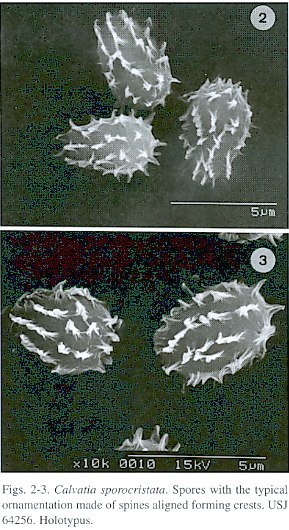
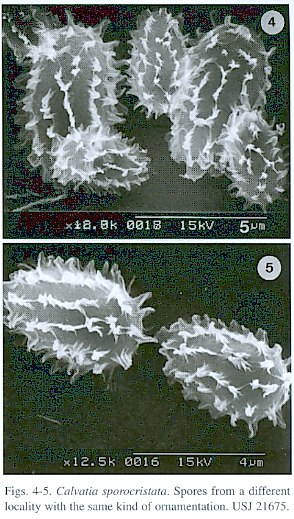
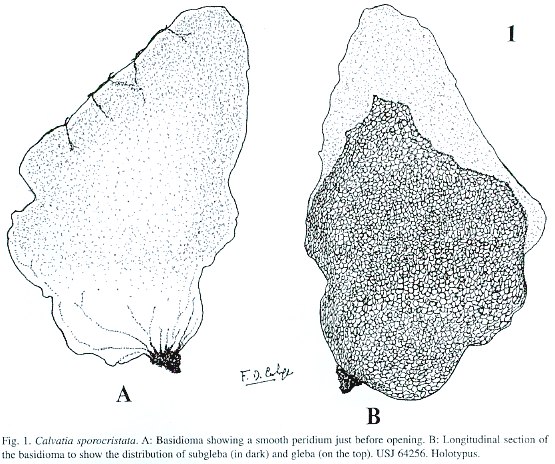
<body><![CDATA[<BR><FONT FACE="Arial"><FONT SIZE=-1>&nbsp;</FONT></FONT>     <BR><FONT FACE="Arial"><FONT SIZE=-1>Basidioma turbinate to subglobose (<A HREF="#fig1">Fig. 1</A>), 13-30 x 12-25 cm. Exoperidium corky, brownish, dark on the top but paler towards the base, smooth, one-layered, pseudoparenchy-matous, with elements up to 80 x 50 &micro;m diam, polymorphous from globose to polygonal. Endoperidium thin, papyraceous, dextrinoid, made of 3-5 &micro;m diam, septate, branched, hyaline hyphae. Gleba occupying one fourth of the basidioma, yellowish-brown before maturity, then dark brownish, woolly. Subgleba taking the rest of the basidioma, chocolate brown, cellular (<A HREF="#fig1">Fig. 1</A>). Capillitium hyaline, 2-6 &micro;m diam, septate, dissociating at the septa, lycoperdon type, smooth, without pores, elastic, with 1 &micro;m thick walls. Spores ellipsoid to amygdaloid, 4-6(-7) x 2.5-3.5(-4.5) &micro;m, excluding the spines, which are aligned forming crests, 0.8-1 &micro;m high (<A HREF="#fig2-3">Figs. 2-5</A>).</FONT></FONT>     <BR>&nbsp;     <CENTER><A NAME="fig1"></A><IMG SRC="/img/fbpe/rbt/v51n1/2395i01.JPG" HEIGHT=464 WIDTH=555></CENTER>      
<CENTER>&nbsp;</CENTER>      <CENTER><A NAME="fig2-3"></A><IMG SRC="/img/fbpe/rbt/v51n1/2395i02.JPG" HEIGHT=530 WIDTH=289></CENTER>      
<CENTER>&nbsp;&nbsp;<A NAME="fig4-5"></A><IMG SRC="/img/fbpe/rbt/v51n1/2395i03.JPG" HEIGHT=519 WIDTH=294></CENTER> &nbsp;     
<BR><B><FONT FACE="Arial"><FONT SIZE=-1>Discussion</FONT></FONT></B>      <P><FONT FACE="Arial"><FONT SIZE=-1>The literature on Calvatia does not show any taxon matching C. sporocristata, but several species show some similarities, for instance, <A HREF="#Kreisel94">Kreisel (1994)</A> pointed out that C. lepidophora (Ell. and Ev.) Coker and Couch has ellipsoid, verruculose to verrucose spores, but <A HREF="#Coker">Coker and Couch (1928)</A> and <A HREF="#Bottomley">Bottomley (1948)</A> said that the spores of this species are spherical. Another close species is C. longi-cauda (P. Henn.) C. G. Lloyd ( = C. agaricoides Dissing and M. Lange), which shows an agaricoid shape, with the upper part of the basidioma flattened, 3-7 cm broad, 1-2 cm high, often clearly grooved to lobed, with a distinct pseudostipe, 4-6 cm high, 1-2 cm broad. Exoperidium velvety to fibrillose, two-layered. The capillitium is pitted with dichotomous branching (<A HREF="#Dissing">Dissing and Lange 1962</A>). All these characters separate C. longicauda from C. sporocristata, although the spores are similar, 4-5 x 3.2-3.8 &micro;m, ovoid and echinulate with the spines not aligned in crests (<A HREF="#Dissing">Dissing and Lange 1962</A>).</FONT></FONT>      <P><FONT FACE="Arial"><FONT SIZE=-1>Other related species is C. ochrogleba Zeller, which has a basidioma of the same shape, peridium duplex and similar size and colour, but the capillitium is pitted and subglobose to almost spherical, spores without crests (<A HREF="#Zeller47">Zeller 1947</A>), and C. tatrensis Holl&oacute;s, which presents similar shape, but has quite different microscopy (<A HREF="#Zeller64">Zeller and Smith 1964</A>). Su&aacute;rez and Wright (unpublished) have found a new species, C. oblongispora Su&aacute;rez and Wright, which shows similar spores, both in shape and size, to our C. sporocristata, growing in a tropical habitat in Brazil. However, the study of a sample of such collection has shown clear differences. For instance, in C. oblongispora the basidioma is smaller, less than 10 cm diam, exoperidium is two-layered and the capillitium has abundant pores. Thus, the only two features which suggest a common origin for both species are the tropical habitat and the amygdaliform spores, with the spines aligned in crests.</FONT></FONT>      ]]></body>
<body><![CDATA[<P><FONT FACE="Arial"><FONT SIZE=-1>Then, we believe that C. sporocristata and C. oblongispora could well be included in a new section; Sporocristata Calonge, within the subgenus Calvatia, following the classification proposed by <A HREF="#Lange93">Lange (1993)</A>.</FONT></FONT>      <P><FONT FACE="Arial"><FONT SIZE=-1>Thus, the combination of the above mentioned characters: a dextrinoid endoperidium, a non pitted capillitium, ellipsoid to amygdali-form spores with an ornamentation made of spines aligned in crests, differentiates this taxon from the previously known species, and support the proposal of C. sporocristata as a new species.</FONT></FONT>      <P><B><FONT FACE="Arial"><FONT SIZE=-1>Acknowledgments</FONT></FONT></B>      <P><FONT FACE="Arial"><FONT SIZE=-1>The authors are grateful to H. Kreisel and J.E. Wright for critical revision of the text and useful comments; to Chuck Mora and to the Centro de Investigaci&oacute;n en Estructuras Microsc&oacute;picas at the University of Costa Rica for their valuable help with the SEM. The senior author acknowledges the financial support obtained from the Spanish Ministry of Education, that allowed him to travel and stay in Costa Rica. The specimen chosen as holotype was collected under the NSF Grant projects No. NSFDEB 9972018 and NSFDEB9972027.</FONT></FONT>      <P><B><FONT FACE="Arial"><FONT SIZE=-1>Resumen</FONT></FONT></B>      <P><FONT FACE="Arial"><FONT SIZE=-1>Se describe e ilustra una especie nueva de Gasteromycete para Costa Rica, Calvatia sporocristata. Las caracter&iacute;sticas m&aacute;s importantes que distinguen esta nueva especie son: exoperidio corchoso, suave, uniestratificado, pseudoparenquimatoso; endoperidio delgado, papir&aacute;ceo, dextrinoide; subgleba celular; capilicio septado, disociado en el septo, de tipo lycoperdon, sin poros, el&aacute;stico y esporas amigdaloides, 4-6(-7) x 2.5-4.5 &micro;m con equinulaciones alineadas formando crestas, 0,8-1 &micro;m de altura.</FONT></FONT>      <P><B><FONT FACE="Arial"><FONT SIZE=-1>References</FONT></FONT></B>      <!-- ref --><P><A NAME="Ahmad"></A><FONT FACE="Arial"><FONT SIZE=-1>Ahmad, S. 1980. Gasteromycetes of West Pakistan. Pub. Dep. Bot. Univ. of The Panjab. Dehra Dun. 92 p.</FONT></FONT>    &nbsp;&nbsp;&nbsp;&nbsp;&nbsp;&nbsp;&nbsp;&nbsp;[&#160;<a href="javascript:void(0);" onclick="javascript: window.open('/scielo.php?script=sci_nlinks&ref=1222726&pid=S0034-7744200300010000600001&lng=','','width=640,height=500,resizable=yes,scrollbars=1,menubar=yes,');">Links</a>&#160;]<!-- end-ref --><!-- ref --><P><A NAME="Bottomley"></A><FONT FACE="Arial"><FONT SIZE=-1>Bottomley, A.M. 1948. Gasteromycetes of South Africa. Bothalia 4: 473-810.</FONT></FONT>    &nbsp;&nbsp;&nbsp;&nbsp;&nbsp;&nbsp;&nbsp;&nbsp;[&#160;<a href="javascript:void(0);" onclick="javascript: window.open('/scielo.php?script=sci_nlinks&ref=1222727&pid=S0034-7744200300010000600002&lng=','','width=640,height=500,resizable=yes,scrollbars=1,menubar=yes,');">Links</a>&#160;]<!-- end-ref --><!-- ref --><P><A NAME="Calonge"></A><FONT FACE="Arial"><FONT SIZE=-1>Calonge, F.D. 1998. Gasteromycetes, I. Lycoperdales, Nidulariales, Phallales, Sclerodermatales, Tulostomatales. Fl. Mycol. Iberica 3: 1-271.</FONT></FONT>    &nbsp;&nbsp;&nbsp;&nbsp;&nbsp;&nbsp;&nbsp;&nbsp;[&#160;<a href="javascript:void(0);" onclick="javascript: window.open('/scielo.php?script=sci_nlinks&ref=1222728&pid=S0034-7744200300010000600003&lng=','','width=640,height=500,resizable=yes,scrollbars=1,menubar=yes,');">Links</a>&#160;]<!-- end-ref --><!-- ref --><P><A NAME="Coker"></A><FONT FACE="Arial"><FONT SIZE=-1>Coker, W.C. &amp; J.N. Couch. 1928. The Gasteromycetes of the Eastern United States and Canada. Dover. New York. 201 p.</FONT></FONT>    &nbsp;&nbsp;&nbsp;&nbsp;&nbsp;&nbsp;&nbsp;&nbsp;[&#160;<a href="javascript:void(0);" onclick="javascript: window.open('/scielo.php?script=sci_nlinks&ref=1222729&pid=S0034-7744200300010000600004&lng=','','width=640,height=500,resizable=yes,scrollbars=1,menubar=yes,');">Links</a>&#160;]<!-- end-ref --><!-- ref --><P><A NAME="Cunningham"></A><FONT FACE="Arial"><FONT SIZE=-1>Cunningham, G.H. 1944. The Gasteromycetes of Australia and New Zealand. J. Cramer. Vaduz (reprint 1979).</FONT></FONT>    &nbsp;&nbsp;&nbsp;&nbsp;&nbsp;&nbsp;&nbsp;&nbsp;[&#160;<a href="javascript:void(0);" onclick="javascript: window.open('/scielo.php?script=sci_nlinks&ref=1222730&pid=S0034-7744200300010000600005&lng=','','width=640,height=500,resizable=yes,scrollbars=1,menubar=yes,');">Links</a>&#160;]<!-- end-ref --><P><A NAME="Demoulin"></A><FONT FACE="Arial"><FONT SIZE=-1>Demoulin, V. 1968. Gasteromycetes de Belgique: Sclerodermatales, Tulostomatales, Lycoperdales. Bol. Jard. Bot. Nat. Belgique 38: 1-101.</FONT></FONT>      <!-- ref --><P><A NAME="Dissing"></A><FONT FACE="Arial"><FONT SIZE=-1>Dissing, H. &amp; M. Lange. 1962. Gasteromycetes of Congo. Bull Jard. Bot. Brux. 32: 325-416.</FONT></FONT>    &nbsp;&nbsp;&nbsp;&nbsp;&nbsp;&nbsp;&nbsp;&nbsp;[&#160;<a href="javascript:void(0);" onclick="javascript: window.open('/scielo.php?script=sci_nlinks&ref=1222732&pid=S0034-7744200300010000600006&lng=','','width=640,height=500,resizable=yes,scrollbars=1,menubar=yes,');">Links</a>&#160;]<!-- end-ref --><!-- ref --><P><A NAME="Dring"></A><FONT FACE="Arial"><FONT SIZE=-1>Dring, D.M. 1964. Gasteromycetes of West Tropical Africa. Mycol. Papers 98: 1-60.</FONT></FONT>    &nbsp;&nbsp;&nbsp;&nbsp;&nbsp;&nbsp;&nbsp;&nbsp;[&#160;<a href="javascript:void(0);" onclick="javascript: window.open('/scielo.php?script=sci_nlinks&ref=1222733&pid=S0034-7744200300010000600007&lng=','','width=640,height=500,resizable=yes,scrollbars=1,menubar=yes,');">Links</a>&#160;]<!-- end-ref --><!-- ref --><P><A NAME="Fries"></A><FONT FACE="Arial"><FONT SIZE=-1>Fries, E. 1849. Summa Vegetabilium Scandinaviae. Holmiae et Lipsiae. 202 p.</FONT></FONT>    &nbsp;&nbsp;&nbsp;&nbsp;&nbsp;&nbsp;&nbsp;&nbsp;[&#160;<a href="javascript:void(0);" onclick="javascript: window.open('/scielo.php?script=sci_nlinks&ref=1222734&pid=S0034-7744200300010000600008&lng=','','width=640,height=500,resizable=yes,scrollbars=1,menubar=yes,');">Links</a>&#160;]<!-- end-ref --><P><A NAME="Hawksworth"></A><FONT FACE="Arial"><FONT SIZE=-1>Hawksworth, D.L. Kirk, P.M., Sutton, B.C. &amp; D.N. Pegler. 1995. Ainsworth and Bisby’s dictionary of the fungi. 8 ed. CAB International. Wallingford. 616 p.</FONT></FONT>      <!-- ref --><P><A NAME="Hollos"></A><FONT FACE="Arial"><FONT SIZE=-1>Holl&oacute;s, L. 1904. Die Gasteromyceten Ungarns. Nemecke vydani. 278 p.</FONT></FONT>    &nbsp;&nbsp;&nbsp;&nbsp;&nbsp;&nbsp;&nbsp;&nbsp;[&#160;<a href="javascript:void(0);" onclick="javascript: window.open('/scielo.php?script=sci_nlinks&ref=1222736&pid=S0034-7744200300010000600009&lng=','','width=640,height=500,resizable=yes,scrollbars=1,menubar=yes,');">Links</a>&#160;]<!-- end-ref --><!-- ref --><P><A NAME="Kreisel73"></A><FONT FACE="Arial"><FONT SIZE=-1>Kreisel, H. 1973. Die Lycoperdaceae der DDR, Nachtr&auml;gen 1962-1971. Bibliotheca Mycol. 36: 1-13.</FONT></FONT>    &nbsp;&nbsp;&nbsp;&nbsp;&nbsp;&nbsp;&nbsp;&nbsp;[&#160;<a href="javascript:void(0);" onclick="javascript: window.open('/scielo.php?script=sci_nlinks&ref=1222737&pid=S0034-7744200300010000600010&lng=','','width=640,height=500,resizable=yes,scrollbars=1,menubar=yes,');">Links</a>&#160;]<!-- end-ref --><!-- ref --><P><A NAME="Kreisel89"></A><FONT FACE="Arial"><FONT SIZE=-1>Kreisel, H. 1989. Studies in the Calvatia complex (Basidiomycetes). Nova Hedwigia 48: 281-296.</FONT></FONT>    &nbsp;&nbsp;&nbsp;&nbsp;&nbsp;&nbsp;&nbsp;&nbsp;[&#160;<a href="javascript:void(0);" onclick="javascript: window.open('/scielo.php?script=sci_nlinks&ref=1222738&pid=S0034-7744200300010000600011&lng=','','width=640,height=500,resizable=yes,scrollbars=1,menubar=yes,');">Links</a>&#160;]<!-- end-ref --><P><A NAME="Kreisel92"></A><FONT FACE="Arial"><FONT SIZE=-1>Kreisel, H. 1992. An emendation and preliminary survey of the genus Calvatia (Gasteromycetes). Persoonia 14: 431-439.</FONT></FONT>      <P><A NAME="Kreisel94"></A><FONT FACE="Arial"><FONT SIZE=-1>Kreisel, H. 1994. Studies in the Calvatia complex (Basidiomycetes). II Feddes Repert. 105: 369-376.</FONT></FONT>      <!-- ref --><P><A NAME="Lange90"></A><FONT FACE="Arial"><FONT SIZE=-1>Lange, M. 1990. Arctic Gasteromycetes II. Calvatia in Greenland, Svalbard and Iceland. Nord. J. Bot. 9: 525-546.</FONT></FONT>    &nbsp;&nbsp;&nbsp;&nbsp;&nbsp;&nbsp;&nbsp;&nbsp;[&#160;<a href="javascript:void(0);" onclick="javascript: window.open('/scielo.php?script=sci_nlinks&ref=1222741&pid=S0034-7744200300010000600012&lng=','','width=640,height=500,resizable=yes,scrollbars=1,menubar=yes,');">Links</a>&#160;]<!-- end-ref --><!-- ref --><P><A NAME="Lange93"></A><FONT FACE="Arial"><FONT SIZE=-1>Lange, M. 1993. Classification in the Calvatia group. Blyttia NR. 3-4: 141.</FONT></FONT>    &nbsp;&nbsp;&nbsp;&nbsp;&nbsp;&nbsp;&nbsp;&nbsp;[&#160;<a href="javascript:void(0);" onclick="javascript: window.open('/scielo.php?script=sci_nlinks&ref=1222742&pid=S0034-7744200300010000600013&lng=','','width=640,height=500,resizable=yes,scrollbars=1,menubar=yes,');">Links</a>&#160;]<!-- end-ref --><!-- ref --><P><A NAME="Liu"></A><FONT FACE="Arial"><FONT SIZE=-1>Liu, B. 1984. The Gasteromycetes of China. Beih. Nova Hedwigia 76: 1-135.</FONT></FONT>    &nbsp;&nbsp;&nbsp;&nbsp;&nbsp;&nbsp;&nbsp;&nbsp;[&#160;<a href="javascript:void(0);" onclick="javascript: window.open('/scielo.php?script=sci_nlinks&ref=1222743&pid=S0034-7744200300010000600014&lng=','','width=640,height=500,resizable=yes,scrollbars=1,menubar=yes,');">Links</a>&#160;]<!-- end-ref --><P><A NAME="Smarda"></A><FONT FACE="Arial"><FONT SIZE=-1>Smarda, F. 1958. Calvatia, pp. 264-30 4. In A. Pil&aacute;t (ed.). Fl. CSR, Gasteromycetes.</FONT></FONT>      <P><A NAME="Zeller47"></A><FONT FACE="Arial"><FONT SIZE=-1>Zeller, S.M. 1947. More notes on Gasteromycetes. Mycologia 39: 282-312.</FONT></FONT>      <P><A NAME="Zeller64"></A><FONT FACE="Arial"><FONT SIZE=-1>Zeller, S.M. &amp; A.H. Smith. 1964. The genus Calvatia in North America. Lloydia 27: 148-186.</FONT></FONT>     <BR><FONT FACE="Arial"><FONT SIZE=-1>&nbsp;</FONT></FONT>     <BR>&nbsp;     ]]></body>
<body><![CDATA[<BR><A NAME="A1"></A><FONT SIZE=-1><FONT FACE="Arial"><A HREF="#R1">1</A> Real Jard&iacute;n Bot&aacute;nico, CSIC, Plaza de Murillo, 2. 28014 Madrid, Espa&ntilde;a</FONT><FONT FACE="Arial,Helvetica">; <A HREF="mailto:calonge@ma-rjb.csic.es">calonge@ma-rjb.csic.es</A></FONT></FONT>      <P><FONT FACE="Arial,Helvetica"><FONT SIZE=-1><A HREF="#R1">2</A> INBio, Instituto Nacional de Biodiversidad, A.P. 22-3100, Santo Domingo, Heredia, Costa Rica; <A HREF="mailto:mmata@inbio.ac.cr">mmata@inbio.ac.cr</A></FONT></FONT>      <P><FONT FACE="Arial,Helvetica"><FONT SIZE=-1><A HREF="#R1">3</A> Escuela de Biolog&iacute;a, Universidad de Costa Rica, San Jos&eacute;, Costa Rica; <A HREF="mailto:julietac@biologia.ucr.ac.cr">julietac@biologia.ucr.ac.cr</A></FONT></FONT>      ]]></body><back>
<ref-list>
<ref id="B1">
<nlm-citation citation-type="book">
<person-group person-group-type="author">
<name>
<surname><![CDATA[Ahmad]]></surname>
<given-names><![CDATA[S]]></given-names>
</name>
</person-group>
<source><![CDATA[Gasteromycetes of West Pakistan]]></source>
<year>1980</year>
<page-range>92</page-range><publisher-name><![CDATA[Dep. Bot. Univ. of The Panjab]]></publisher-name>
</nlm-citation>
</ref>
<ref id="B2">
<nlm-citation citation-type="journal">
<person-group person-group-type="author">
<name>
<surname><![CDATA[Bottomley]]></surname>
<given-names><![CDATA[A.M]]></given-names>
</name>
</person-group>
<article-title xml:lang="en"><![CDATA[Gasteromycetes of South Africa]]></article-title>
<source><![CDATA[Bothalia]]></source>
<year>1948</year>
<volume>4</volume>
<page-range>473-810</page-range></nlm-citation>
</ref>
<ref id="B3">
<nlm-citation citation-type="journal">
<person-group person-group-type="author">
<name>
<surname><![CDATA[Calonge]]></surname>
<given-names><![CDATA[F.D]]></given-names>
</name>
</person-group>
<article-title xml:lang="en"><![CDATA[Gasteromycetes, I. Lycoperdales, Nidulariales, Phallales, Sclerodermatales, Tulostomatales]]></article-title>
<source><![CDATA[Fl. Mycol. Iberica]]></source>
<year>1998</year>
<volume>3</volume>
<page-range>1-271</page-range></nlm-citation>
</ref>
<ref id="B4">
<nlm-citation citation-type="">
<person-group person-group-type="author">
<name>
<surname><![CDATA[Coker]]></surname>
<given-names><![CDATA[W.C]]></given-names>
</name>
<name>
<surname><![CDATA[Couch]]></surname>
<given-names><![CDATA[J.N]]></given-names>
</name>
</person-group>
<source><![CDATA[The Gasteromycetes of the Eastern United States and Canada]]></source>
<year>1928</year>
<page-range>201</page-range><publisher-loc><![CDATA[DoverNew York ]]></publisher-loc>
</nlm-citation>
</ref>
<ref id="B5">
<nlm-citation citation-type="">
<person-group person-group-type="author">
<name>
<surname><![CDATA[Cunningham]]></surname>
<given-names><![CDATA[G.H]]></given-names>
</name>
</person-group>
<article-title xml:lang="en"><![CDATA[The Gasteromycetes of Australia and New Zealand J. Cramer. Vaduz]]></article-title>
<source><![CDATA[]]></source>
<year>1944</year>
</nlm-citation>
</ref>
<ref id="B6">
<nlm-citation citation-type="journal">
<person-group person-group-type="author">
<name>
<surname><![CDATA[Dissing]]></surname>
<given-names><![CDATA[H]]></given-names>
</name>
<name>
<surname><![CDATA[Lange]]></surname>
<given-names><![CDATA[M]]></given-names>
</name>
</person-group>
<article-title xml:lang="en"><![CDATA[Gasteromycetes of Congo]]></article-title>
<source><![CDATA[Bull Jard. Bot. Brux]]></source>
<year>1962</year>
<volume>32</volume>
<page-range>325-416</page-range></nlm-citation>
</ref>
<ref id="B7">
<nlm-citation citation-type="journal">
<person-group person-group-type="author">
<name>
<surname><![CDATA[Dring]]></surname>
<given-names><![CDATA[D.M]]></given-names>
</name>
</person-group>
<article-title xml:lang="en"><![CDATA[Gasteromycetes of West Tropical Africa]]></article-title>
<source><![CDATA[Mycol. Papers]]></source>
<year>1964</year>
<volume>98</volume>
<page-range>1-60</page-range></nlm-citation>
</ref>
<ref id="B8">
<nlm-citation citation-type="book">
<person-group person-group-type="author">
<name>
<surname><![CDATA[Fries]]></surname>
<given-names><![CDATA[E]]></given-names>
</name>
</person-group>
<source><![CDATA[Summa Vegetabilium Scandinaviae]]></source>
<year>1849</year>
<page-range>202</page-range><publisher-name><![CDATA[Holmiae et Lipsiae]]></publisher-name>
</nlm-citation>
</ref>
<ref id="B9">
<nlm-citation citation-type="book">
<person-group person-group-type="author">
<name>
<surname><![CDATA[Hollós]]></surname>
<given-names><![CDATA[L]]></given-names>
</name>
</person-group>
<source><![CDATA[Die Gasteromyceten Ungarns]]></source>
<year>1904</year>
<page-range>278</page-range><publisher-name><![CDATA[Nemecke vydani]]></publisher-name>
</nlm-citation>
</ref>
<ref id="B10">
<nlm-citation citation-type="journal">
<person-group person-group-type="author">
<name>
<surname><![CDATA[Kreisel]]></surname>
<given-names><![CDATA[H]]></given-names>
</name>
</person-group>
<article-title xml:lang="en"><![CDATA[Die Lycoperdaceae der DDR, Nachträgen 1962-1971]]></article-title>
<source><![CDATA[Bibliotheca Mycol]]></source>
<year>1973</year>
<volume>36</volume>
<page-range>1-13</page-range></nlm-citation>
</ref>
<ref id="B11">
<nlm-citation citation-type="journal">
<person-group person-group-type="author">
<name>
<surname><![CDATA[Kreisel]]></surname>
<given-names><![CDATA[H]]></given-names>
</name>
</person-group>
<article-title xml:lang="en"><![CDATA[Studies in the Calvatia complex (Basidiomycetes)]]></article-title>
<source><![CDATA[Nova Hedwigia]]></source>
<year>1989</year>
<volume>48</volume>
<page-range>281-296</page-range></nlm-citation>
</ref>
<ref id="B12">
<nlm-citation citation-type="journal">
<person-group person-group-type="author">
<name>
<surname><![CDATA[Lange]]></surname>
<given-names><![CDATA[M]]></given-names>
</name>
</person-group>
<article-title xml:lang="en"><![CDATA[Arctic Gasteromycetes II. Calvatia in Greenland, Svalbard and Iceland]]></article-title>
<source><![CDATA[Nord. J. Bot]]></source>
<year>1990</year>
<volume>9</volume>
<page-range>525-546</page-range></nlm-citation>
</ref>
<ref id="B13">
<nlm-citation citation-type="journal">
<person-group person-group-type="author">
<name>
<surname><![CDATA[Lange]]></surname>
<given-names><![CDATA[M]]></given-names>
</name>
</person-group>
<article-title xml:lang="en"><![CDATA[Classification in the Calvatia group]]></article-title>
<source><![CDATA[Blyttia NR]]></source>
<year>1993</year>
<volume>3-4</volume>
<page-range>141</page-range></nlm-citation>
</ref>
<ref id="B14">
<nlm-citation citation-type="journal">
<person-group person-group-type="author">
<name>
<surname><![CDATA[Liu]]></surname>
<given-names><![CDATA[B]]></given-names>
</name>
</person-group>
<article-title xml:lang="en"><![CDATA[The Gasteromycetes of China]]></article-title>
<source><![CDATA[Beih. Nova Hedwigia]]></source>
<year>1984</year>
<volume>76</volume>
<page-range>1-135</page-range></nlm-citation>
</ref>
</ref-list>
</back>
</article>