In the Hybrida group Elaphoglossum erinaceum (Fée) T. Moore complex is mentioned as difficult because is very variable in blade shape and size, rhizome scale size and color and habitat as is mentioned in Mickel 1991a, 1992b, 1995, Mickel and Beitel 1988. Several species has been segregated of this complex, for example: Elaphoglossum albomarginatum (Smith 1975), E. crispatum var. crispatum and var. beitelii (Mickel 1987); E. polyblepharum and E. heteroglossum (Mickel 1991b); E. pallidiforme (Mickel 1992a), E. gomezianum (Rojas 1996b). On this paper other new species are segregated.
Materials and methods
The new taxa are circumscribed on the basis of material seen at Museo Nacional de Costa Rica (CR), Instituto Politécnico Nacional (ENCB), Field Museum of Natural History (F), Universidad Nacional Autónoma de México, Ciudad Universitaria (FCME), Harvard University (GH), Instituto de Ecología, A. C. (Sede Regional del Bajío) (IEB), Instituto Nacional de Biodiversidad (INB), Universidad Nacional Autónoma de México, Iztacala (IZTA), Universidad Nacional Autónoma de México (MEXU), Missouri Botanical Garden (MO), New York Botanical Garden (NY), Universidad Autónoma Metropolitana, Iztapalapa (UAMIZ), University of California (UC) and Smithsonian Institution (US). The species have been compared with other neotropical treatments and papers as: Mickel 1987, 1991a, 1991b, 1992a, 1992b, 1995, Mickel and Beitel 1988, Rojas 1996a, 1996b, 2002, Smith 1975. The names according with index herbariorum in (Anomimous 2002).
The types that I saw are indicated with admiration marks, the types that I could not see are indicated with -n.s. as abbreviation of not seen. Some herbaria that probably have a specimen cited here but not revised are indicated with interrogation marks.
The countries indicated in bold represent the new distribution no previously reported.
NEW SPECIES ]]>
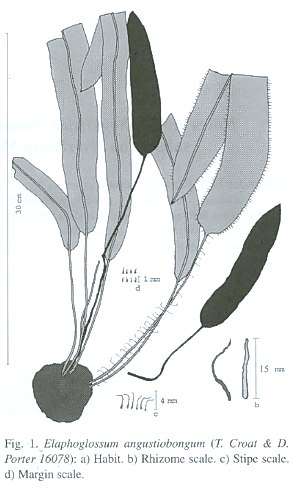
Elaphoglossum angustioblongum A. Rojas, sp. nov. (Fig. 1). Type: PANAMA. Chiriquí: Las Cumbres, hogback ridge N of Quebrada Iglesia, near town of Cerro Punta, 22 July 1971, T. Croat & D. Porter 16078 (Holotype: MO).Epiphytic; rhizome 5-8 mm diam, compact; rhizome scales (10-) 15-20 x ca, 1 mm, linear to linear-lanceolate, brown, lustrous, marginally entire; phyllopodia 2-5 mm long (few evident by the scales); fronds (30-) 40-65 cm long, 4.0-5.6 cm wide, fasciculate; stipes 1/3-2/5 the frond length, with scales 3-5 mm long, dark brown to blackish, subulate, widely spreading; blade (20-) 30-45 x 2.5-4.6 cm, narrowly oblong, chartaceous, basically obtuse to rounded, apically acuminate; veins evident, free, simple or once-forked, 1-2 mm apart, at ca. 80° from costa; hydathodes lacking; blade scales 1-2 x 0.2-0.5 mm, subulate, dark brown to black, marginally entire, present only on the margin; fertile fronds 25-40 cm long; stipes 2/3-3/4 the frond length; fertile blades 12-18 x 2.2-3.0 cm, lanceolate, basically obtuse to rounded, apically acute; intersporangial scales absent.
Distribution: Costa Rica and Panama; known only from Cordillera de Talamanca at 1450-2200 m.
Paratypes: COSTA RICA. Puntarenas: foothills of Cordillera de Talamanca, along Río Vella Vista, NW of Las Alturas, ca. 8°57’ N, 82°51’ W, 1450-1600 m, G. Davidse 24334 (MO). PANAMA. Chiriquí: Bugaba, Cerro Punta, 8°52’ N, 82°33’ W, 2200 m, H. Werff & J. Herrera 6271 (MO), from STRI house to edge of mountain across the river, H. Werff & J. Herrera 6303 (MO).
The indument of this species is very similar to that of E. gomezianum A. Rojas, but it differs from that species by longer (1/3-2/5 of the frond length vs. 1/6-1/3) stipe, narrower (2.5-4.3 vs. 4.5-5.5 cm) and narrowly oblong (vs. elliptic) blades and obtuse to rounded (vs. cuneate) blade base. The name of this species refers to blade shape.
Elaphoglossum baquianorum A. Rojas, sp. nov. (Fig. 2). Type: COSTA RICA. Limón-/Puntarenas: Talamanca/Coto Brus, Parque Internacional La Amistad, Cordillera de Talamanca, sendero a Cerro Kámuk, entre Cerro Kasir y Cerro Nai, 9° 11’ 50" N, 83° 3’ 30" W, 2940-3100 m, 8 November 1996, A. Rojas et al. 3208 (Holotype: INB; Isotypes: CR, MEXU, MO, NY, UC, US).
]]>
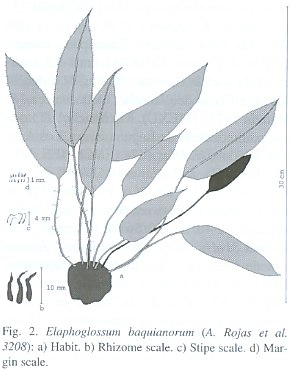
Epiphytic; rhizome compact, 3-8 mm diam.; rhizome scales 5-12 x 0.5-0.8 mm, linear, brown to atropurpureous, marginally entire; phyllopodia 5-12 mm; fronds (15-) 20-42 cm long; stipes 2/5-3/5 the frond length; stipe scales 2-4 x ca. 0.2 mm, linear-lanceolate to subulate, dark-brown, dispersed, marginally entire; blades 9-22 x 3.0-5.8 cm, chartaceous, lanceolate to oblong-elliptic, basically obtuse to truncate, apically acuminate to cuspidate; blade scales 0.7-1.2 x 0.1-0.3 mm, linear to subulate, dark-brown, dispersed, marginally entire, only on blade margin; veins evident, 1-2-forked, 1-1.5 mm apart, diverging at 65-75° from costa; hydathodes absent; fertile fronds 17-28 cm long; stipes 3/5-3/4 the frond length; fertile blades 4.5-10.5 x 1.3-2.8 cm, lanceolate, basically obtuse to truncate, apically acute; intersporangial scales absent.
Distribution: Mexico, Guatemala, Honduras, El Salvador, Costa Rica and Panama; known from Eje Neovolcánico, Sierra de Juárez, Sierra Norte de Chiapas, Sierra de Chiapas, Montañas de Celaque, Montañas de Santa Ana and Cordillera de Talamanca at 2000-3300 m.
Paratypes: MEXICO. Chiapas: Mpio. Tenejapa, near Paraje Banadil, 2713 m, D. Breedlove 53379 (NY ); Mpio. Motozintla de Mendoza, near summit of Cerro Mozotal, 2750 m, D. Breedlove & B. Bartholomew 55847 (MEXU); Mpio. Motozintla de Mendoza, N and W slope of Cerro Mozotal below the microwave tower along the road from Huixtla to El Porvenir and Siltepec, 3000 m, D. Breedlove & A. Smith 22804 (ENCB, NY); Mpio. San Cristóbal de Las Casas, Cerro Huitepec, (Muk-’ta Vits) W of San Cristóbal de Las Casas, 2700 m, D. Breedlove & A. Smith 32046 (NY); 9.4 mi. S of Linda Vista Tropical Biological Station, Pueblo Nuevo Solistahuacan, Gittins 4157 (NY); Siera Madre de Chiapas, along trail to from high point on road to between Finca Liquidambar and Nueva Colombia, 15° 40’ N, 92° 44’ W, J. Luteyn & M. Lebrón 11601 (NY). Jalisco: Colimas, 7000 ft., C. Pringle 5530 (GH). México: km 14 Zacualpan-Estración Corona, 2050 m, J. Amaya 16 (IZTA); Mpio. Ocoyoacac, cruce de caminos Marquesa-Chalma y Marquesa-Tenancingo, 19°14’03" N, 99°23’25" W, 2850 m, R. Cisnéros & D. Tejero 54 (IZ-TA); km 6-14 carretera Zacualpan-Coronas, 1900 m, R. Fragoso 32 (IZTA); km 4-8 Za-cualpan- Subestación Corona, 1900 m, M. López 4 (IZTA); Cerro de Venacho, Amecameca, E. Matuda 18795 (MEXU). Michoacán: Zinapécuaro, alrededores de Laguna Larga, Los Azufres, 2750 m, H. Díaz 4674 (ENCB, IEB, MEXU, UAMIZ), J. Rzedowski 46176 (IEB, MEXU, UAMIZ); 0.1 km W of km post # 198 on México Hwy. 15, between Morelia and Ciudad Hidalgo, 19°40’ N, 100°56’ W, 800 m, G. Yatskievych 81-417 (NY). Oaxaca: Mpio. Zapotitlán de Méndez, 2 km al NE de Zapotitlán, 20°01’ N, 97°43’ W, A. Campos et al. 499 (MEXU, NY); Dist. Ixtlán, Sierra de Juárez, camino de Capulalpan a Llano Verde, a 15 km al NE de Capulalpan, 2400 m, D. Lorence & R. Cedillo 4214 (NY); Dist. Ixtlán, trail from San Pedro Nolasco, N to the Llano Verde, 6000-7000 ft, J. Mickel & R. Hellwig 3772 (ENCB, MEXU, NY, UC, US); Dist. Central, N slope of Cerro San Felipe, 7800-8400 ft., J. Mickel & R. Hellwig 4052 (NY); Dist. Teotitlán, 26-29 km NE of Teotitlán del Camino, vicinity of pass at Puerto Soledad, 7000-7400 ft., J. Mickel & L: Hellwig 4119b (NY); Dist. Ixtlán, ca. 8 km E of Ixtlán, on trail N of Capulalpan, toward Cerro Malacate, ca. 8000 ft., J. Mickel & S. Leonard 5325 (NY); Dist. Ixtlán, 2-6 km NE of Natividad, on trail from San Pedro Nolasco to the Llano Verde, 6000-7000 ft., J. Mickel & L. Pardue 7040 (NY); Mpio. Santiago Zacatepec, carretera Mitla-Zacatepec, 21.6 km de Ayutla rumbo a Zacatepec, costado N del Cerro Zempoaltepetl, 17° 16’ 38" N, 96° 00’ 17" W, 2480 m, A. Rojas et al. 4436 (INB, UA-MIZ); about 15 km E of Ixtlán, near Natividad, along trail leading to Llano Verde, 6000-7000 ft, A. Smith 503 (UC); E slope of Sierra de Juárez, about 25-26 mi. SW of bridge over Río Valle Nacional along Rte. 175, P. Sumers et al. 371 (NY). GUATEMALA. Chimaltenango: Cerro de Tecpám, región of Santa Elena, 2400-2700 m, P. Standley 61034 (F, US); Barranca de La Sierra, SE of Patzúm, 2100 m, P. Standley 61523 (F, US). Quezaltenango: cumbre de Tuilacán, SW of San Martín Chile Verde, about 2400 m, P. Standley 67804 (F, US); region of Boxantín, SE of San Martín Chile Verde, 2400 m, P. Standley 83830 (F, US); El Pocito, S of San Martín Chile Verde on road to Colomba, 2200 m, P. Standley 84927 (F); vicinity of Fuentes Georginas, slopes of Volcán of Zunil, 2300-2500 m, P. Standley 85977 (F); P. Standley 85979 (F), P. Standley 86030 (F). San Marcos: El Pocito, S of San Martín Chile Verde, on road to Colomba, about 2200 m, P. Standley 84927 (F); along Quebrada Canjulá, between Sibinal and Canjulá, Volcán Tacaná, 2200-2500 m, J. Steyermark s. n. (F); along road between San Sebastián at km 21 and km 8, 8-18 mi. NW of San Marcos, 2700-3800 m, J. Steyermark 35762 (F); slopes of Volcán Tajumulco, between Las Canojas and top of te bridge, 7 mi. from San Sebastián, 3300-3900 m, J. Steyermark 35821 (F), J. Steyermark 35870 (F); along Quebrada Canjulá, between Sibinal and Canjulá, 3 mi. from Guatemala-México boundary, in vicinity of San Rafael, 2500-3000 m, J. Steyermark 36171 (F); Barranca Eminencia, road beteen San Marcos and San Rafael Pie de La Cuesta, in upper part of the barranca between Finca La Lucha and Buena Vista, 2500-2900 m, P. Standley 86512 (F); near Aldea Fraternidad, between San Rafael Pie de La Cuesta and Palo Gordo, W facing slope of the Sierra Madre Mountains, 1800-2400 m, L. Williams et al. 25777 (F). HONDURAS. Lempira: Celaque National Park, trail from Camp 1 to Río Naranjal, 14°33’ N, 88°40’ W, 2000 m, R. Moran 5547 (MO, NY). El Paraíso: Quebrada Tapahuasca, 1300 m, A. Molina 14654 (F, NY). EL SALVADOR. Santa Ana: Bosque de Montecristo, 2250 m, R. Seiler 290 (F); Cerro Montecristo, 2300 m, R. Seiler 688 (NY). COSTA RICA. Heredia: along Río Ciruelas, Paso Llano, S slope of Volcán Barva, 6 km N of San José de La Montaña, 2000 m, J. Montgomery & D. Huttleston 85-96 (NY). Limón/Puntarenas: Talamanca-/Coto Brus, Parque Internacional La Amistad, Cordillera de Talamanca, sendero a Cerro Kámuk, entre Cerro Kasir y Cerro Nai, 9°11’50" N, 83°3’30" W, 2940-3100 m, A. Rojas et al. 3208 (CR, INB, MEXU, MO, NY, UC, US). Cartago/San José: along Río Tiribí, upstream from Planta Eléctrica María del Rosario (SW of Rancho Redondo), 9°57’ N, 83°57.5’ W, 1800-1900 m, M. Grayum & G. Stiles 5294 (MO). Paraíso/Pérez Zeledón, Carretera Interamericana, entre Cerro Estaquero y la entrada a las torres, 9°33’35" N, 83°45’25" W, 3100- 3300 m, A. Rojas 4525 (CR, INB). PANAMA. Chiriquí: Potrero Muleto to summit, Volcán de Chiriquí, 3100-4000 m, R. Woodson & Schery 355 (MO).
Elaphoglossum baquianorum resembles E. tambillense (Hook.) T. Moore in form of the blades, with the scales only on the costa and margin, but differs in its thicker rhizome (0.5-0.8 mm diam. vs. 0.3-0.5 cm), longer rhizome scales (5-10 x 0.5-0.8 mm vs. 4-7 x 0.2- 0.5 mm), longer fronds [the sterile (15-) 20-45 cm vs. 15-25 cm, and the fertile 17-28 cm vs. 5-10 cm], bigger fertile blade (4.5-10.5 x 1.3- 2.8 cm vs. 2.5-3.5 x 1.2-1.5 cm), hydathodes absent (vs. present), and scaly blade margin (vs. no scaly). The shape of the blades of E. baquianorum is similar to that of E. pallidum (Baker ex Jenman) C. Chr., but the rhizome scales are plane and yellowish (vs. twisted and blackish), with shorter blade (3.0-3.8 vs. 4.3-6.4 times longer than wide), and scaly blade margin (vs. no scaly). Also is similar to E. erinaceum in blade shape, but differs in narrow (0.5-0.8 mm 1.0-2.5 mm) and brown to blackish (vs. yellow to orange) rhizome scales, more dense stipe scales, larger [9-22 x 3.0-5.8 cm vs.(14-) 20-40 (-65) x (4-) 5-9 (-11.5) cm] blade, smaller [0.7-1.2 x 0.1-0.3 mm vs. 2-6 x 0.2-0.6 (-1) mm] and present only in margin (vs. costa and margin) blade scales.
This species is dedicated to park rangers Bernardo Picado and Errol Morales, to trail-blazers ("baqueanos") Freddy Acuña, Eduardo Alfaro, Rodrigo Mora and Juan Solano, and to engineer Ricardo Segura from La Amistad International Park.
Elaphoglossum cotoi A. Rojas, sp. nov. (Fig. 3). Type: COSTA RICA. San José: Dota, Cordillera de Talamanca, San Gerardo de Dota, Finca de la Familia Víquez, 9°32’50" N, 83°49’50" W, 2300-2400 m, 17 July 1996, A. Rojas & M. Coto 2790 (Holotype: INB; Isotypes: CR, MO, NY, UC). ]]>
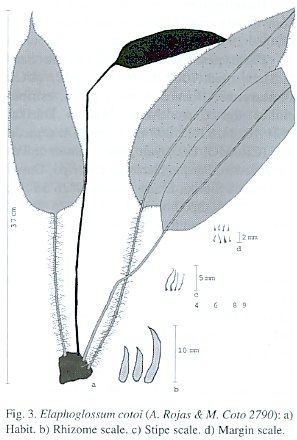
Terrestrial; rhizome 6-12 mm diam, compact; rhizome scales 10-15 x 0.7-1.5 mm, linear to linear-lanceolate, pale brown, flaccid, marginally entire to occasionally dentate; phyllopodia 10-17 mm long; fronds 33-83 cm long; stipes 1/3-1/2 the frond length; stipe scales 2-5 x 0.2-0.4 mm, subulate, pale brown on the base, the others brown, dense, marginally entire, mixed with glandular hairs less than 0.2 mm long; blades 20-49 x 6.3-10.3 cm, subcoriaceous, lanceolate to oblong-lanceolate, basically broadly cuneate to rounded, apically acuminate to cuspidate; costa glabrous to dispersedly scaly only on base, the scales similar to those of the stipe scales; marginal scales 1.0-2.5 x 0.2-0.5 mm, linear-lanceolate to subulate, pale brown to brown, dense, marginally entire; abaxial blade surface glabrous or occasionally with stellate hairs 0.1-0.3 mm long, pale to dark brown, dispersed; veins evident, simple to 2-forked, 1-1.5 mm apart, diverging at 65-80° from costa; hydathodes absent; fertile fronds 42-57 cm long; stipes 1/2-3/4 the frond length; fertile blades 12-22 x 2.8-5.2 cm, lanceolate to oblong-lanceolate, basically broadly cuneate to obtuse, apically acute to acuminate; intersporangial scales absent.
Distribution: Costa Rica and Panama; known only from Cordillera de Talamanca at (1700-) 2000-3000 (-3300) m. Paratypes: COSTA RICA. Estrella- Santa María road, 7000 ft., H. Stork 1521 (UC). Puntarenas: Buenos Aires, Ujarrás, estribaciones del Cerro Amú, Macizo Dúrika, 9°21’10" N, 83°17’30" W, 2500 m, A. Chacón 478 (CR, MO, UC). San José: Cantón de Pérez Zeledón, Parque Nacional Chirripó, Cuenca Térraba-Sierpe, Llano Bonito, 9°26’58" N, 83°31’25" W, 3200 m, R. Aguilar 5076 (INB); Dota, hills around Río Savegre, near Finca Sacatales, 9°35’ N, 83°47’ W, 2000-2400 m, H. Gay et al. 1551 (CR, MO); Dota, Cordillera de Talamanca, San Gerardo de Dota, finca de la Familia Víquez, 9°32’50" N, 83°49’50" W, 2300-2400 m, A. Rojas & M. Coto 2790 (CR, INB, MO, NY, UC). Cartago: El Guarco, Cordillera de Talamanca, Finca Los Lagos, Madre-selva, 9°40’34" N, 83°52’38" W, 2700 m, M. Chavarría et al. 567 (CR, INB); Paraíso, Cordillera de Talamanca, Finca El Sitio, Sendero La Catarata, 9°34’30" N, 83°41’10" W, 2650 m, B. Gamboa & A. Picado 371 (INB, MO). Puntarenas: Buenos Aires, Ujarrás, estribaciones del Cerro Amú, Macizo Dúrika, 9°21’10" N, 83°17 30" W, 2500 m, A. Chacón 478 CR, F, INB, MO, NY, UC); Buenos Aires, Parque Internacional La Amistad, Cordillera de Talamanca, Cerro Frantzius, sobre sendero, 9°03’25" N, 82°59’20" W, 2130 m, M. Moraga et al. 303 (CR, INB, MO, NY); Coto Brus, Parque Internacional La Amistad, Cordillera de Talamanca, Valle del Silencio, entre sitio de acampar y Casacoca, 9°07’15" N, 82°57’55" W, 1700-2500 m, F. Quesada et al. 1464 (CR, INB, MO, NY). San José: Pérez Zeledón, Parque Nacional Chirripó, Llano Bonito, 9°26’58" N, 83°31’25" W, 3200 m, R. Aguilar 5076 (INB); road from Copey de Dota to Providencia, ca. 2.6 km from Copey de Dota at edge of forest on ridge, A. Evans & D. Lellinger 223 (US); near end of road ca. 5 km E of Copey de Dota, 2300 m, D. Lellinger et al. 1799 (INB, US); Dota, Cordillera de Talamanca, camino a San Gerardo de Dota, entrando por Jaboncillo, 9°36’15" N, 83°49’20" W, 2400-3000 m, A. Rojas & M. Coto 2710 (CR, INB, MO); Dota, Hills around Río Savegre, near Finca Zacatales, 9°35’ N, 83°47’ W, 2000-2400 m, H. Gay et al. 1551 (CR, INB, MO); Pérez Zeledón, Parque Nacional Chirripó, Cordillera de Talamanca, Monte sin Fé, 9°27’05" N, 83°31’25" W, 2900-3300 m, A. Rojas 2861 (CR, INB, MO, NY); near Laguna de La Escuadra, NE of El Copey, 2000-2200 m, P. Standley 42044 (US), P. Standley 42079 (US); Estrella-Santa María road, 7000 ft., H. Stork 1521 (UC). COSTA RICA/PANAMA. Puntarenas/Chiriquí: Coto Brus, Parque Internacional La Amistad, Cordillera de Talamanca, sendero entre Mellizas y Cerro Quijada del Diablo, linea divisoria, 8°54’25" N, 82°44’55" W, 1700-2130 m, A. Rojas et al. 3286 (INB, MO).
Elaphoglossum cotoi resembles E. erinaceum in having orange rhizome scales and blackish brown stipes and blade scales, but it differs in its terrestrial (vs. epiphytic) habitat, pale brown (vs. orange-yellowish) rhizome scales, lanceolate (vs. elliptic) blades, basically rounded to truncate (vs. cuneate to obtuse) and glabrous (vs. scaly) costa.
C. V. Morton 5524 identified as Elaphoglossum christii H. Chr. (unpublished) is probably E. cotoi, but I did not see the holotype, only a photograph.
This species is dedicated to M. Sc. Mateo Coto Rutherford, North American ecologist, and cocollector of the type material.
Elaphoglossum jinoteganum A. Rojas, sp. nov. (Fig. 4). Type: NICARAGUA. Jinotega: along Hwy 3, ca 1 km NW of La Fundadora entrance, unnamed peak ca. 500 m W of Hwy, 13° 01’ N, 85° 56’ W, 1450-1520 m, 24 May 1981, W. Stevens et al. 20411 (Holotype: CR; Isotype: MO).
]]>
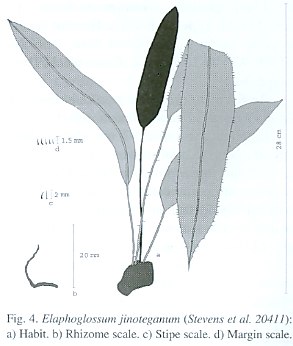
Epiphytic; rhizome 3-5 mm diam, compact; rhizome scales (8-) 12-22 x 0.5-1.0 mm, linear-lanceolate, orange-yellowish to orange- reddish, marginally entire; phyllopodia 5-10 mm long (not visible for the scales); fronds 17-45 cm long; stipes 1/5-1/4 the frond length; stipe scales 1.0-3.5 x 0.2-0.4 mm, subulate, dark brown to blackish, very dispersed, marginally entire; blades 14-30 x 3.0- 5.2 cm, narrowly elliptic to oblong-elliptic, basically cuneate, apically acuminate; costal glabrous to dispersely scaly only on the base, similar to stipe scales; marginal scales 1.0-1.5 x 0.2-0.4 mm, linear-lanceolate to subulate, dark brown to blackish, dispersed, marginally entire; abaxial blade surfaces glabrous; veins evident, simple or 1-forked, 1.0-1.5 mm apart, diverging at 70-80° from costa; hydat-hodes absent; fertile fronds 26 cm long; stipes ca. 1/2 the frond length; fertile blades 12 x 2.2 cm, oblong-elliptic, basically cuneate to obtuse, apically acute to obtuse; intersporangial scales absent.
Distribution: Nicaragua; known only from Cordillera Isabelia at 1450-1600 m.
Paratype: NICARAGUA. Estelí: Cerro Quiabú, situado a unos 8 km NO de la ciudad de Estelí, 1500-1600 m, A. Grijalva & M. Araquistain 618 (CR).
Elaphoglossum jinoteganum resembles E. erinaceum in having pale rhizome scales and blackish stipe and blade scales, but differs in its narrower and longer rhizome scales [(8-) 12-22 x 0.5-1 mm vs. 6-12 (-15) x 1.0- 2.5 mm], orange-yellowish to orange-reddish (vs. pale brown-yellowish to orange-yellowish); shorter stipes of the sterile blades (1/5-1/3 vs. 1/3-1/2) narrowly elliptic to oblong-elliptic (vs. elliptic to broadly elliptic), 3-5.2 cm vs. (4-) 5-11 cm wide, glabrous to very sparsely scaly (vs. scaly) on costa; stipe and blade margin dispersely scaly (vs. densely scaly), smaller scales (stipe scales 1.0-3.5 mm vs. 3-8 mm, blade margin scales 1-1.5 mm vs. 1.5-3.0 mm). The blades shape and size recall E. mexicanum (Liebm.) A. Rojas, but the rhizome scales are orange-yellowish to orange-reddish (vs. pale to dark brown), and the costa is glabrous and dispersely scaly on the stipe and margin (vs. costa, stipe and margin densely scaly); smaller scales (costa and stipe scales 1-3.5 mm vs. 3-5 mm, blade margin scales 1.0-1.5 mm vs. 1.5-3 mm).
The name of this species refers to the type locality.
Elaphoglossum neeanum A. Rojas, sp. nov. (Fig. 5). Type: PANAMA. Darién: Middle slopes on W side of Cerro Pirre, 7°56’ N, 77°45’ W, 800-1050 m, T. Croat 68931 (Holotype: MO).
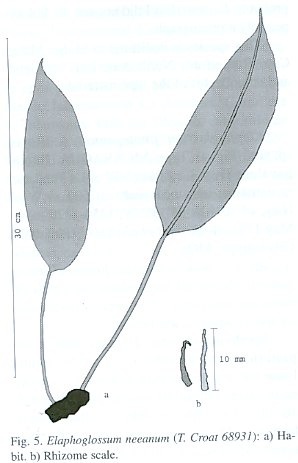
Distribution: Panama and Colombia; known from Serranía del Darién and Cordillera de Los Andes at 800-1850 m.
Paratypes: COLOMBIA. Antioquia: Guatapé, Vereda Santa Rita, ca. 1850 m, L. Atehortua 1169 (MO); Urrao, Las Orquídeas, Vereda Calles, Parque Nacional Natural Las Orquídeas, Quebrada Honda, al NW de la Cabaña Calles, 6°29’ N, 76°14’ W, 1330m, J. Pipoly et al. 16855 (MO).
Elaphoglossum neeanum resembles E. cinctum Rosenst. in blade shape and size, but differs in short-creeping (vs. compact) rhizome and brown (vs. yellowish) rhizome scales and broader [3.1-5.4 cm vs. 1.7-3 (-3.5) cm] blade. Also is very similar to E. albomarginatum A. R. Sm. by the brown rhizome scales and glabrous blade, but the rhizome is short-creeping (vs. compact) and dorsiventral (vs. radial), the rhizome scales are longer and narrower (7-15 x 0.3-1.0 mm vs. 7-10 x 1-2 mm) and has green blade margin (vs. yellowish to whitish).
The specific epithet is in honor to Dr. Michael Nee of New York Botanical Garden, for the many interesting collections in ferns.
Elaphoglossum silencioanum A. Rojas, sp. nov. (Fig. 6). Type: COSTA RICA. Limón-/Puntarenas: Talamanca/Coto Brus, Parque Internacional La Amistad, Cordillera de Talamanca, Valle del Silencio, entre sitio de acampar y Casacoca, 9°07’15" N, 82°57’55" W, 1700-2500 m, 14 April 1996, F. Quesada et al. 1421 (Holotype: INB; Isotypes: CR, MO, NY).
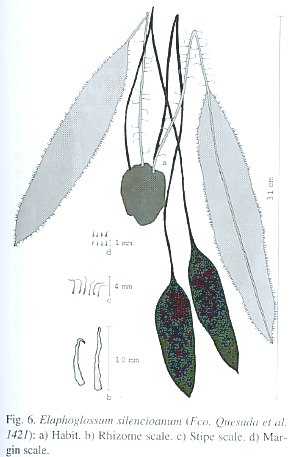
Epiphytic; rhizome compact, 4-7 mm diam.; rhizome scales 7-15 x 0.3-1.0 mm, linear to linear-lanceolate, pale-brown to atropurpureous, marginally entire to occasionally dentate; phyllopodia 2-6 mm (not visible for the scales); fronds 23-52 cm long; stipes 2/5-1/2 the frond length; stipe scales 1.5-4.0 x ca. 0.1-0.2 mm, linear to subulate, dark brown, dispersed, marginally entire; blades 14-31 x 3.1-5.4 cm, subcoriaceous, narrowly elliptic to oblong-elliptic, basically cuneate, apically acute to cuspidate; blade scales 1-2 x 0.1-0.3 mm, linear to subulate, dark brown to atropur-pureous, dense, marginally entire, only on blade margin and rarely on base of costa, dispersed; few evident veins, simple or 1-forked, 1-2 mm apart, diverging at 60-75° from costa; hy-dathodes absent; fertile fronds 30-45 cm long; stipes 3/5-4/5 the frond length; fertile blades 10.5-17 x 2.6-3.2 cm, lanceolate to elliptic, basically cuneate to obtuse, apically acute to acuminate; interporangial scales absent.
Distribution: Costa Rica and Panama; present only in Valle del Silencio and Fortuna Lake at (1100-) 2300-2500 m. Paratypes: COSTA RICA. Limón: Talamanca, Cordillera de Talamanca, Atlantic slope, along the Río Terbi, 0.5-1.5 airline km W of the Costa Rican-Panamanian border, 2300- 2400 m, 98º8’ N, 82°57’ W, G. Davidse et al. 28731 (CR, MO); Cordillera de Talamanca, Atlantic slope, Cerros Tararia (locally known as Tres Picos), 9°09’ N, 82°58’ W, 2400-2600 m, G. Davidse et al. 28795 (MO); south side of unnamed cordillera between the Río Terbi and Río Siní, 2-4 airline km W of the Costa Rican-Panamanian border, 9°09’-9°11’ N, 82°57’-82°58’ W, G. Davidse et al. 28940 (CR, MO); Parque Internacional La Amistad, Valle del Silencio, sobre sendero, 9°07’15" N, 82°57’55" W, 2450 m, M. Moraga et al. 327 (CR, INB, MO, NY). San José: Cerro Chirripó, lower SW slopes along trail from Canaán to summit, 5500-7000 ft., A. Evans et al. 40 (US). PANAMA. Chiriquí: Along road between Fortuna Lake and Chiriquí Grande, 4.5-5 km N of dam over Fortuna Lake, 8°43’ N, 82°17’ W, 1100-1135 m, T. Croat & M. Grayum 59970 (MO, UC).
Elaphoglossum silencioanum resembles E. erinaceum in blade shape and stipe length, but differs in its narrower (0.3-1 mm vs. 1-2.5 mm), brown-yellowish to dark brown (vs. pale brown-yellowish to orange-yellowish) rhizome scales, relatively longer stipes (2/5- 1/2 vs. 1/3-2/5 of the frond length), narrowly elliptic to oblong-elliptic (vs. elliptic to broadly elliptic) and smaller [14-31 x 3.1- .4 cm vs. (14) 20-40 (65) x (4) 5-9 (11.5) cm] blades, glabrous (vs. scaly) costae and higher elevation habitat [2300-2500 m vs. 700-2000 (2600) m]. The blades and stipe size recalls E. baquianum, but E. silencioanum differs in its narrowly elliptic to oblong-elliptic (vs. lanceolate to oblong-elliptic), subcoriaceous (vs. chartaceous) blades basically cuneate (vs. obtuse to truncate), and blade margin scales dense (vs dispersed).
The name of this species refers to the type locality.
NEW COMBINATION WITH RANGE EXTENSION
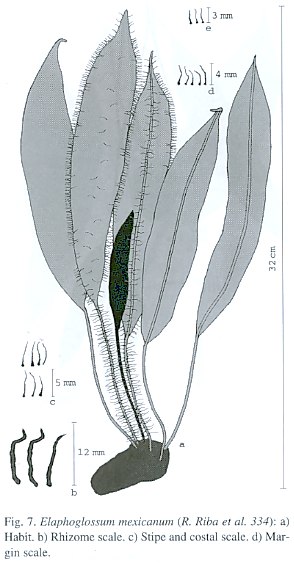
Elaphoglossum mexicanum (E. Fourn.) A. Rojas, comb. nov. (Fig. 7). Acrostichum mexicanum E. Fourn., Mexic. Pl. 1: 63-64. 1872. Type: MEXICO. Puebla: Teziutlán, Barranca de Chinantla, 6500-7000 ft., F. Liebmann s.n. (Holotype: P!; Isotype: K-n.s.).
NEW RECORDS
Elaphoglossum barbatum (H. Karst.) Hieron., Bot. Jahrb. Syst. 34: 553. 1904. Acrostichum barbatum H. Karst., Fl. Columb. 2: 155. t. 181. 1869. Type: Colombia, Bogotá, Lindig 111 (no localized)
Distribution: Previously known from Colombia, Ecuador and Peru, but now also from Mexico, Guatemala and Costa Rica (probably also in Panama). This is present in Sierra de Juárez, Sierra Madre de Chiapas, Cordillera de Talamanca and Cordillera de Los Andes at 2200-2900 (-3300) m.
Material of new distribution: MEXICO. Oaxaca: along road from Teotitlán del Camino to Huautla de Jiménez, 16.7-18.2 mi by road above Teotitlán del Camino, 2250-2300 m, W. Anderson & C. Anderson 4728 (ENCB, IEB, NY); Teotitlán, 26-29 km NE of Teotitlán del camino, vicinity of pass at Puerto Soledad, 7000-7400 ft., J. Mickel & R. Hellwig 4119 (NY); Dist. Mixes, SE shoulder of Cerro Zem-poaltepetl, below Patio de Arena, 8200 ft., J. Mickel & S. Leonard 4904 (NY); Santiago Zacatepec, Sierra de Juárez, al costado N de Cerro Zempoaltepetl, orilla de quebrada, 17°12’38" N, 96°00’50" W, 2210 m, A. Rojas et al. 4444 (INB, MEXU, NY, UAMIZ). GUATEMALA. Quezaltenango: Fuentes Georginas, western slope of Volcán de Zunil, about 2850 m, P. Standley 67451 (US). COSTA RI-CA. Cartago: Paraíso, investigation area of the CATIE, 9°33’30" N, 83°41’30" W, 2600- 2700 m, J. Bittner 161 (CR, MO, NY); Villa Mills (pilot area CATIE project), 2700 m, Y. Widmer 28 (NY). Limón/Puntarenas: Talamanca/ Coto Brus, Parque Internacional La Amistad, Cordillera de Talamanca, sendero a Cerro Kámuk, entre Cerro Kasir y Cerro Nai, 9°11’50" N, 83°3’30" W, 2940-3100 m, A. Rojas et al. 3203 (CR, INB, MO, NY, UC, US); entre Cerro Nai y Cerro Dudu, 9°13’05" N, 83°4’30" W, 2750-3100 m, A. Rojas et al. 3231 (CR, INB, MO, NY). San José: Pérez Zeledón, Parque Nacional Chirripó, Cordillera de Talamanca, sendero entre Llano Bonito y Monte sin Fé, 9°26’55" N, 83°32’05" W, 2600-2900 m, A. Rojas et al. 2834 (INB, NY); Pérez Zeledón, Parque Nacional Chirripó, Cordillera de Talamanca, Monte sin Fé, 9°27’05" N, 83°31’25" W, 2900-3300 m, A. Rojas 2856 (CR, INB, NY).
Elaphoglossum barbatum resembles E. erinaceum in having pale brown-yellowish rhizome scales and blackish brown stipe and blade scales, but differs in its linear-lanceolate blades (vs. elliptic or oblong-elliptic) basically obtuse to truncate (vs. cuneate to obtuse) and scaly on abaxial blade surface (vs. mostly glabrous, scaly only on costa and margin).
Elaphoglossum scolopendrifolium (Raddi) J. Sm. Bot. Mag. 72: 17. 1846. Acrostichum scolopendrifolium Raddi, Critt. Bras. 1.4, t. 16. 1825. Type: Brazil, Rio de Janeiro, Raddi s.n. (Holotype: PI-n.s.). Acrostichum nitidum Liebm., Kongel. Danske Vidensk. Selsk. Skr., Naturvidensk. Math. Afd., Ser. 5, 1: 168. 1849. Type: Mexico, Puebla, Chinautla, Barranca, 7000 ft., Liebmann [Mex. Pl. 2421] (Holotype: C-n.s.; Isotype: P!). Nomen novum: Elaphoglossum fimbriatum T. Moore, Index Fil. 356. 1862. Elaphoglossum hybridum var. nitidum (Liebm.) H. Christ, Primitiae Florae Costaricensis 3: 7. 1901.
Distribution: Previously known only from Brazil, but now also from Mexico. Present in Sierra Madre Occidental, Sierra de Manantlán, Eje Neovolcánico, Sierra Madre Oriental, and Atlantic slope of Altiplanicie del Brasil at (350-) 1500-2600 m.
Material of new distribution: MEXICO. Cuernavaca: Barranca de Chalchichuapán, al NE de Tetela del Monte, 1800 m, B. Pérez et al. 793 (IEB). Guerrero: N slope of Cerro Alquitrán, 10-14 km by road W of México, highway 95 and Mazatlán, 2250-2450 m, W. Anderson & Laskowski 4449 (ENCB); Mpio. Milantepec, aprox. 3 km al S de Paraje Montero, ladera N del Cerro Tlalpitzahuac, 2150 m, F. Lorea 1916 (FCME); Mpio. Tlacotepec, 9 km al S de Verba Santa, F. Lorea 2225 (FCME, IEB); Mpio. Atoyac de Alvarez, 2 km sobre la desv. a El Iris, camino que va de Puerto del Gallo a Atoyac, 2200 m, F. Lorea 2320 (FCME); Cerro El Huisteco, 4 km al N de Taxco, 2480 m, F. Lorea 3324 (FCME, IEB); Mpio. Taxco, aprox. 2 km al SO de San Juan Tenerias, camino a Puerto Oscuro, 2300 m, F. Lorea 3380 (FCME, IEB); Mpio. Atoya de Alvarez, 2100 m, F. Lorea 3992 (FC-ME, IEB); Cerro El Huisteco, 4 km al N de Taxco, 2380 m, F. Lorea 4482 (FCME, IEB, ME-XU); Chilpancingo, Cerro Alquitrán, cerca de Mazatlán, 2450 m, J. Rzedowski 23682 (ENCB, NY); Cruz del Rosario, 7 km al NW de taxco, sobre el camino a Tetipac, 2250 m, J. Rzedowski 26011 (ENCB, NY). Jalisco: Sierra de Minantlán, dirt road a Durazno, S slope, 6000 ft., Boutin & Brandt 2570 (MEXU, NY); 10-12 mi. S of Talpa de Allende, in the head waters of an E branch of Río de Talpa, 3 mi. above Los Sauces, 1400 m, R. McVaugh 21439 (NY); Sierra de Manantlán, (30-35 km SE of Autlán), 1-4 km below of summit called "La Cumbre", near the lumber-road between El Chante and Cuzalapa, and above the abandoned site of Durazno, 19°32’ N, 104°14’ W, 1500-1900 m, R. Mc-Vaugh 23196 (ENCB, NY). México: Mpio. Valle de Bravo, 13.2 km N of Temascaltepec on the road to Valle de Bravo, 2150 m, B. Bartholomew et al. 2968 (NY, UC); Tenancingo, Pte. Santa María, entre santa Ana y Villa Guerrero, 18°55’03" N, 99°37’48" W, 2130 m, M. Evangelista & D. Tejero 16 (IEB). Temascaltepec, Mina dde Agua, 1990 m, B. Hinton 1867 (GH, MEXU); Valle de Bravo, E. Lyonnet 500900003 (MEXU), E. Lyonnet 510900016 (MEXU); Ocuilan, km 14 de Sta Monica Ocuilan a Cuernavaca, 18°59’ N, 99°21’ 44" W, 2200 m, Maqueda & D. Tejero 35 (MEXU); Amecameca, Cerro Venacho, 2600 m, E. Matuda 18795 (ME-XU); about 6 miles S of Tenancingo and 8 miles N of Villa Guerrero on Route 55, 2600 m, J. Mickel 706 (ENCB, NY); km 14 Zacualpan, Estación Corona, 2050m, A. Santamaría 17 (ENCB); Tenancingo, Pte. Santa María, entre santa Ana y Villa Guerrero, 18°55’03" N, 99°37’48" W, 2130 m, L. Villasana & D. Tejero 161 (MEXU). Michoacán: Morelia, Campana-rio, F. Arsène s. n. (GH); Vicinity of Morelia, Campanario, 2200 m, F. Arsène 8473 (MO, NY); Villa Madero, Porvas, 2200 m, H. Díaz 2266 (ENCB, IEB, UAMIZ); Ziracuaretiro, 5 km al Nede San Andrés Corú, 1820 m, H. Díaz 3519 (ENCB, IEB, UAMIZ); Morelia, Echequeo, Cañada La Cascada, 2200 m, H. Díaz & S. Zamudio 3654 (ENCB); Barranca del Chilar, Pueblo Nuevo, San Juan Nuevo, C. Díaz 9306 (NY); Tierras Balnca, ca. De Gallineros, Sierra de Cotija (Sierra del Tigre), 2000 m, I. García & J. Nava 3069 (IEB); Tancitaro, Uruapan, Barranca, 2000 m, B. Hinton et al. 15609 (MO); Morelia, 2 km al S de San Miguel del Monte, 2350 m, J. Rzedowski 25175 (ENCB, NY); J. Rzedowski 39749 (ENCB); Morelia, 4 km al S de San Miguel del Monte, 2400 m, J. Rzedowski 44912 (IEB, UAMIZ); J. Rzedowski 46499 (IEB, UAMIZ). Morelos: Sierra de Ocuila, rumbo a Mexicapa, E. Lyonnet 2863 (FCME, IEB, MO, UAMIZ); Sierra de Ocuila, Barranca de Las Canoas, 1900 m, E. Lyonnet 3335 (MEXU); Cuernavaca, cañada del Tecolote, cerca del fracto del bosque Rancho Cortés, 18°57’49" N, 99°17’32" W, 2120 m, A. Mendoza et al. 102 (MEXU, UAMIZ); Santa María Ahuacatitlán, C. Morton 199 (UAMIZ); Cuernavaca, Barranca de Chalchichuapan al NE de Tetela del Monte, 1800 m, B. Pérez et al. 793 (MEXU, UAMIZ), B. Pérez et al. 796 (UAMIZ), B. Pérez et al. 806 (UAMIZ); Barranca above Cuernavaca, 6500 ft., C. Pringle 6546 (MO, NY, UAMIZ); Mountain canyon above Cuernavaca, 6500 ft., C. Pringle 15713 (MO); Tlalnepantla, "Xalpa", a 1 km de la secundaria de Tlalnepantla, 19°1’ N, 99°00’ W, 2080 m, Y. Sandoval et al. 71 (IEB, MEXU). Sinaloa: Sierra Madre Occidental, Barranca Rancho Liebre, 1 mi. S of El Palmito on Hwy. 40 and 1 mi. W of the Hwy., 6900 ft., A. Sanders et al. 4409 (NY); Concordia, El Palmito y alrededores, 2000 m, R. Vega et al. 3131 (ENCB).
Elaphoglossum scolopendrifolium resembles E. erinaceum in having pale rhizome scales and similar frond size, but differs in its narrower (0.5-1 mm vs. 1-2.5 mm), orange-yellowish to orange-reddish (vs. pale brown-yellowish to orange-yellowish) rhizome scales, brown-yellowish to brown (vs. dark brown-reddish to blackish) stipe and blade scales, oblong-lanceolate to oblong-elliptic (vs. elliptic to broadly elliptic) and narrower [(3.2) 4-5.3 cm vs. (4) 5-11.5 cm] blades. The blade shape and size recalls E. jinoteganum, but E. scolopendrifolium has shorter rhizome scales [5-10 mm vs. (8-) 12-22 mm], longer stipes [(1/3-) 2/5-1/2 vs. 1/5-1/3], scaly (vs. glabrous) costal, brown-yellowish to brown (vs. dark brown-reddish to blackish) stipe and blade margin scales, and longer (3-5 x 0.3- 0.8 mm vs. 1-3.5 x 0.2-0.4 mm) stipe scales. ]]>
This name was been utilized by C. Pringle between 1986-1900 as determined him in C. Pringle 6546 (GH) and C. Pringle 15713 (GH), but he don’t made an official publication.REDEFINED CONCEPT
Elaphoglossum erinaceum (Fée) T. Moore, Index Fil. 9. 1857. Acrostichum erinaceum Fée, Mém. Foug. 2: 41. 1845. Type: Guadeloupe. Rivière de Saint-Louis, Thiouville s. n. (Syntype: P-n.s.).
Distribution: Mexico, Central America, Colombia, Venezuela, Ecuador, Peru, Bolivia, Brazil and Antilles, in all wet mountains at (300-) 800-2000 (-2800) m.
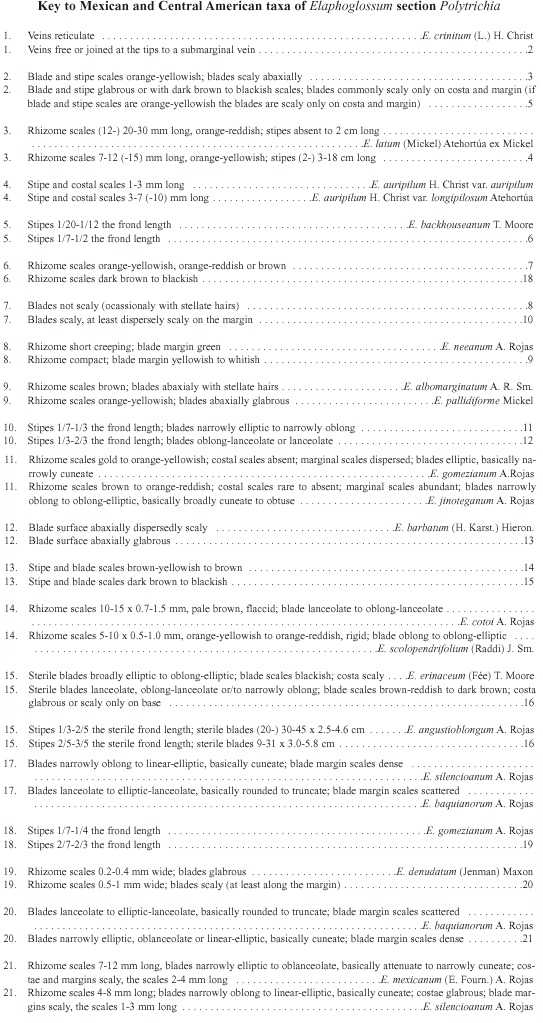
Many plants of the Sect. Polytrichia Subsect. Hybrida has been identified as E. erinaceum (sensu lato), but this species is characteri-zed by epiphytic habit (rarely terrestrial) and the combination of broad, yellow light and flaccid rhizome scales, oblong blade and black stipe and blade scales. In Mexico and Central America the typical rhizome scales of E. erinaceum is also present in E. cotoi and E. barbatum, but the second species have lanceolate blade, brown stipe and blade scales and terrestrial habit, while the third have scales on abaxial blade (vs. only on costa and margin) and terrestrial habit. For determinate the other species see the key. The typical altitudinal distribution of this species is 800-2000 m, but in the mountains of Costa Rica and Panama a variant with blade scales similar to E. silencioanum is present in higher elevation.
Elaphoglossum tambillense (Hook.) T. Moore, Index Fil. 15. 1857. Acrostichum tambillense Hook., Icon. pl. 7: t. 656. 1844. Type: Ecuador, Tambillo, Jameson s. n. (Holotype: K-n. s.; Isotype: P!).
Distribution: Mexico, Guatemala, Colombia, Venezuela Ecuador and Peru; present in Sierra Madre de Chiapas and Cordillera de Los Andes at 2500-3000 m. Previous reports of this species from Costa Rica and Panama (Mickel 1988, 1995), probably represent E. baquianoru m, because according with all the material revised from Costa Rica and Panama of related species none correspond with E. tambillense. This is the only species of section Polytrichia subsection Hybrida with hydathodes, and it is easily determinated for this reason.
REJECTED SPECIES
Elaphoglossum pallidum (Baker ex Jenman) C. Chr., Index Filic. 312. 1905. Acrostichum pallidum Baker ex Jenman, J. Bot. 17: 263. 1879. Type: Jamaica, Jenman s. n. (Holotype: K-n.s.).
Elaphoglossum pallidum is characterized by dark brown rhizome scales, stipes ca. 2/5 of the frond length, blades 4.3-6.4 times longer than wide, narrowly lanceolate to oblong-lanceolate, subcoriaceous blade, glabrous stipe and blade margin, and truncate to cordiform blade base of fertile blades. ]]>
In general, all the material with dark brown to atropurpureous rhizome scales has been identified as E. pallidu m. Nevertheless, the rhizome scale color is variable on various species of subsection Hybrida. In other cases, the material with glabrous or very dispersely scaly fronds has been identified as this species. In contrast, E. baquianorum (this paper) has blades 3.0-3.8 times longer than wide, chartaceous, lanceola-te to oblong-elliptic, basically obtuse to truncate, apically acuminate to cuspidate, dispersely scaly stipe and blade margin, and cuneate to obtuse blade base of fertile blades; E. gomezianum A. Rojas (Rojas 1996) has shorter stipes (1/6-1/3 of the frond length), elliptic to widely elliptic blades, and scaly stipes and blade margins; E. jinoteganum (this paper) has orange-yellowish to orange-reddish rhizome scales, stipes 1/5-1/3 of the frond length, narrowly elliptic to oblong-elliptic blades, and dispersed scales on the stipes and blade margins; E. mexicanum (this paper) has elliptic to linear-elliptic blades, and densely scaly stipes, costal and blade margins.Distribution: Jamaica and Hispaniola at 1400-1700 m.
Acknowledgments
This work has been possible thanks to the agreement between INBio-SINAC. The following herbaria that loaned specimens (CR, ENCB, F, FCME, GH, INB, IZTA, MEXU, MO, NY, UAMIZ, UC and US), Robbin Moran for comments on the manuscript, Teresa Terrazas for the critical revision, Daniel Tejero and anonyms revisors for their help, and to all who, in one way or another, made this work possible.
Resumen
Seis especies nuevas son descritas: Elaphoglossum angustioblongum A. Rojas, E. baquianorum A. Rojas, E. cotoi A. Rojas, E. jinoteganum A. Rojas, E. neeanum A. Rojas y E. silencioanum A. Rojas. La especie Elaphoglossum mexicanum (E. Fourn.) A. Rojas es combinada; las especies E. barbatum (H. Karst.) Hieron. y E. scolopendrifolium (Raddi) J. Sm. son registradas; además, E. erinaceum (Fée) T. Moore y E. tambillense (Hook.) T. Moore son redefinidas, y E. pallidum (Baker ex Jenman) C. Chr. no se distribuye en México y Centroamérica. De las especies nuevas sólo E. neeanum se encuentra fuera de la región. Se proporciona una clave para reconocer las especies de México y Centro América.
References
Mickel, J.T. 1987. New species of Elaphoglossum (Elaphoglossaceae) from northern South America. Brittonia 39: 313-339. [ Links ]
Mickel, J.T. 1991a. Elaphoglossum. In R. Tryon & R. Stolze (ed.). Pteridophyta of Peru, part IV. Fieldiana, Bot. n. s., no. 27: 110-166. [ Links ]
Mickel, J.T. 1991b. Four new species of Elaphoglossum (Elaphoglossaceae) from Venezuela. Ann. Missouri Bot. Gard. 78: 259-261. [ Links ]
Mickel, J.T. 1992a. New species of the fern genus Elaphoglossum from Mesoamerica. Novon 2: 368-382. [ Links ]
Mickel, J.T. 1992b. Elaphoglossum, pp. 266-281. In R. McVaugh (ed.). Flora Novo-Galiciana. Vol. 17. Gymnosperms and Pteridophytes. [ Links ]
Mickel, J.T. 1995. Elaphoglossum, pp. 250-283. In R.C. Moran & R. Riba (ed.). Flora Mesoamericana. Volumen 1. Psilotaceae a Salviniaceae. Universidad Nacional Autónoma de México. México, D. F.
Mickel, J.T. and J. M. Beitel. 1988. Pteridophyte Flora of Oaxaca, Mexico. Mem. New York Bot. Gard. 46: 168-186. [ Links ]
Rojas, A.F. 1996a. Aportes a la Flora Pteridophyta Costarricense. I. Informes. Brenesia 45-46: 1-6. [ Links ]
Rojas, A.F. 1996b. Twelve new species of Elaphoglossum (Elaphoglossaceae) from Costa Rica and Panama. Brenesia 45-46: 7-26. [ Links ]
Rojas-Alvarado, A.F. 2002. New species, new combinations and new distributions in neotropical species of Elaphoglossum (Lomariopsidaceae). Rev. Biol. Trop. 50: 969-1006. [ Links ]
Smith, A.R. 1975. New species and new combinations of ferns from Chiapas, Mexico. Proc. Calif. Acad. Sci. 40: 220. [ Links ]
Internet references
Anonymous. 2002. Index Herbariorum. The New York Botanical Garden. (Downloaded: April 5, 2002. http://www.nybg.org/bsci/ih/) .
1 Coordinación de docencia y atención a alumnos, División de Ciencias Biológicas y de la Salud, Universidad Autónoma Metropolitana, sede Iztapalapa, Av. Michoacán y La Purísima s. n., Col. Vicentina, 09340, México, D. F.
E-mail: arojas@xanum.uam.mx , afrojasa@hotmail.com
2 Instituto Nacional de Biodiversidad, Apdo. 22-3100, Sto. Domingo, Heredia, Costa Rica.
]]>