<?xml version="1.0" encoding="ISO-8859-1"?><article xmlns:mml="http://www.w3.org/1998/Math/MathML" xmlns:xlink="http://www.w3.org/1999/xlink" xmlns:xsi="http://www.w3.org/2001/XMLSchema-instance">
<front>
<journal-meta>
<journal-id>0034-7744</journal-id>
<journal-title><![CDATA[Revista de Biología Tropical]]></journal-title>
<abbrev-journal-title><![CDATA[Rev. biol. trop]]></abbrev-journal-title>
<issn>0034-7744</issn>
<publisher>
<publisher-name><![CDATA[Universidad de Costa Rica]]></publisher-name>
</publisher>
</journal-meta>
<article-meta>
<article-id>S0034-77442002000300020</article-id>
<title-group>
<article-title xml:lang="en"><![CDATA[Changes in composition and structure of a tropical dry forest following intermittent Cattle grazing]]></article-title>
</title-group>
<contrib-group>
<contrib contrib-type="author">
<name>
<surname><![CDATA[Stern]]></surname>
<given-names><![CDATA[Margaret]]></given-names>
</name>
<xref ref-type="aff" rid="A01"/>
</contrib>
<contrib contrib-type="author">
<name>
<surname><![CDATA[Quesada]]></surname>
<given-names><![CDATA[Mauricio]]></given-names>
</name>
<xref ref-type="aff" rid="A02"/>
</contrib>
<contrib contrib-type="author">
<name>
<surname><![CDATA[Stoner]]></surname>
<given-names><![CDATA[Kathryn E.]]></given-names>
</name>
<xref ref-type="aff" rid="A02"/>
</contrib>
</contrib-group>
<aff id="A01">
<institution><![CDATA[,The New York Botanical Garden Institute of Economic Botany ]]></institution>
<addr-line><![CDATA[Bronx New York]]></addr-line>
<country>U.S.A</country>
</aff>
<aff id="A02">
<institution><![CDATA[,Universidad Nacional Autónoma de México Departamento de Ecología de los Recursos Naturales Instituto de Ecología]]></institution>
<addr-line><![CDATA[Morelia Michoacán]]></addr-line>
<country>México</country>
</aff>
<pub-date pub-type="pub">
<day>00</day>
<month>12</month>
<year>2002</year>
</pub-date>
<pub-date pub-type="epub">
<day>00</day>
<month>12</month>
<year>2002</year>
</pub-date>
<volume>50</volume>
<numero>3-4</numero>
<fpage>1021</fpage>
<lpage>1034</lpage>
<copyright-statement/>
<copyright-year/>
<self-uri xlink:href="http://www.scielo.sa.cr/scielo.php?script=sci_arttext&amp;pid=S0034-77442002000300020&amp;lng=en&amp;nrm=iso"></self-uri><self-uri xlink:href="http://www.scielo.sa.cr/scielo.php?script=sci_abstract&amp;pid=S0034-77442002000300020&amp;lng=en&amp;nrm=iso"></self-uri><self-uri xlink:href="http://www.scielo.sa.cr/scielo.php?script=sci_pdf&amp;pid=S0034-77442002000300020&amp;lng=en&amp;nrm=iso"></self-uri><abstract abstract-type="short" xml:lang="en"><p><![CDATA[In northwestern Costa Rica, cattle are being used as a "management tool" to reduce the amount of combustible material, mainly dominated by Hyparrhenia rufa, an African grass. This project is being developed within Parque Nacional Palo Verde and Reserva Biológica Lomas Barbudal, both of which fonn part of the only remaining tropical dry forests in Mesoamerica. To determine the short-term effects of cattle grazing on the natural vegetation, we compared the floristic composition within Palo Verde in an area under intermittent cattle grazing with an area that has not been grazed. There were significantly fewer plant species in the area with intermittent cattle grazing compared to the area with no grazing. Floristic composition of these two habitats was different as reflected by both Fisher's alpha values and the Shannon index of diversity, both of which were significantly higher in the ungrazed site. The ungrazed area contained more plant species and was more similar to mature forest. The structure of the vegetation was significantly different between the intermittently grazed and ungrazed sites with more small stems (1-5 cm dbh) and fewer large stems (>5 cm dbh) in the intermittently grazed habitat. These results indicate that cattle grazing has an impact on the dry forest by reducing the relative abundance and density of larger tree species and by changing the species composition and structure of the community. The current management plan implemented in Palo Verde and Lomas Barbudal is not appropriate because of the impact that cattle have on the structure of the natural vegetation and should not be considered a viable alternative in other protected areas of dry forest in the Neotropics. We suggest that alternative fire prevention measures be evaluated including hand-cutting H. rufa, the creation of more frequent and larger fire breaks, and the development of green breaks.]]></p></abstract>
<abstract abstract-type="short" xml:lang="es"><p><![CDATA[En el noroeste de Costa Rica se utiliza ganado como una "herramienta de manejo" para reducir la cantidad de material combustible, principalmente Hyparrhenia rufa, un zacate que proviene de Africa. Este proyecto se desarrolla dentro del Parque Nacional Palo Verde y la Reserva Biológica Lomas Barbudal, ambos forman parte de los últimos remanentes de bosque tropical seco de Mesoamérica. Con el fin de determinar los efectos a corto plazo del pastoreo de ganado vacuno sobre la vegetación natural, realizamos un muestreo dentro de Palo Verde para comparar la composición florística de un área de pastoreo intermitente con un área sin pastoreo. Encontramos significativamente menos especies de plantas en el área con pastoreo intermitente comparado con el área sin pastoreo. La composición florística de estos dos hábitats fue significativamente diferente basada en una comparación del alfa de Fisher y el índice de Shannon de diversidad; ambos fueron significativamente más altos en el área sin pastoreo. El área no pastoreado tuvo mayor número de especies y mayor semejanza con bosque maduro. La estructura de la vegetación fue significativamente diferente entre las dos áreas pastoreadas y no pastoreadas, con mayor número de individuos de diámetros pequeños (1-2.5 cm) y menor número de individuos de diámetros grandes (>5 cm) en el área con pastoreo intermitente. Estos resultados sugieren que el ganado reduce la abundancia relativa y la densidad de las especies de árboles y cambia la composición florística y estructura del bosque tropical seco. El plan de manejo actual de Palo Verde y Lomas Barbudal no es apropriado debido al impacto que el ganado tiene sobre la estructura de la vegetación natural y no debe ser considerado como una alternativa viable para otras áreas protegidas del neotropico. Sugirimos que se evalúen métodos alternativos para prevenir incendios, como el corte de jaragua (Hyparrhenia rufa) con machetes, la creación de rompefuegos en mayor cantidad y magnitud, y rompefuegos verdes.]]></p></abstract>
<kwd-group>
<kwd lng="en"><![CDATA[Cattle]]></kwd>
<kwd lng="en"><![CDATA[Costa Rica]]></kwd>
<kwd lng="en"><![CDATA[grazing]]></kwd>
<kwd lng="en"><![CDATA[Hyparrhenia rufa]]></kwd>
<kwd lng="en"><![CDATA[management]]></kwd>
<kwd lng="en"><![CDATA[Palo Verde National Park]]></kwd>
<kwd lng="en"><![CDATA[tropical dry forest]]></kwd>
</kwd-group>
</article-meta>
</front><body><![CDATA[ <center></center>          <center><b><font face="Arial">Changes in composition and structure of a tropical  dry forest</font></b></center>          <center><b><font face="Arial">following intermittent Cattle grazing</font></b></center>           <p><font face="Arial"><font size="-1">&nbsp;</font></font> </p>       <center><b><font size="-1"><font face="Arial">Margaret Stern&nbsp;<a name="1"></a>  </font><sup><font face="Arial,Helvetica"><a href="#1a">1</a>  </font></sup><font face="Arial">, Mauricio Quesada </font><sup><font face="Arial,Helvetica"><a href="#1">  2</a>  </font></sup><font face="Arial"> and Kathryn E. Stoner </font><sup><font face="Arial,Helvetica"><a href="#1">  2</a>  </font></sup></font></b></center>           <p><font face="Arial"><font size="-1">&nbsp;</font></font> </p>       <center></center>          <center><font face="Arial"><font size="-1">Received 21-III-2002. Corrected  14-VI-2002. Accepted 18-VI-2002.</font></font></center>   &nbsp;<b><font face="Arial"><font size="-1"></font></font></b>        <p><b><font face="Arial"><font size="-1">Abstract</font></font></b>  </p>       <div align="Justify">      ]]></body>
<body><![CDATA[<p><font face="Arial"><font size="-1">In northwestern Costa Rica, cattle are being used as a "management tool" to reduce the amount of combustible material, mainly dominated by <i>Hyparrhenia rufa, </i>an African grass. This project is being developed within Parque Nacional Palo Verde and Reserva Biol&oacute;gica Lomas Barbudal, both of which fonn part of the only remaining tropical dry forests in Mesoamerica. To determine the short-term effects of cattle grazing on the natural vegetation, we compared the floristic composition within Palo Verde in an area under intermittent cattle grazing with an area that has not been grazed. There were significantly fewer plant species in the area with intermittent cattle grazing compared to the area with no grazing. Floristic composition of these two habitats was different as reflected by both Fisher's alpha values and the Shannon index of diversity, both of which were significantly higher in the ungrazed site. The ungrazed area contained more plant species and was more similar to mature forest. The structure of the vegetation was significantly different between the intermittently grazed and ungrazed sites with more small stems (1-5 cm dbh) and fewer large stems (&gt;5 cm dbh) in the intermittently grazed habitat. These results indicate that cattle grazing has an impact on the dry forest by reducing the relative abundance and density of larger tree species and by changing the species composition and structure of the community. The current management plan implemented in Palo Verde and Lomas Barbudal is not appropriate because of the impact that cattle have on the structure of the natural vegetation and should not be considered a viable alternative in other protected areas of dry forest in the Neotropics. We suggest that alternative fire<b> </b>prevention measures be evaluated including hand-cutting <i>H. rufa, </i>the creation of more frequent and larger fire breaks, and the development of green breaks.</font></font>   </p>       <p><b><font face="Arial"><font size="-1">Keywords</font></font></b>  </p>       <p><font face="Arial"><font size="-1">Cattle, Costa Rica, grazing, <i>Hyparrhenia  rufa, </i>management, Palo Verde National Park, tropical dry forest.</font></font>    </p>       <p><font face="Arial"><font size="-1">&nbsp;</font></font>     <br>  <font size="-1"><font face="Arial">Tropical dry forests are among the most  endangered ecosystems in the world with less than 0.1% of the original dry  forests of Pacific Mesoamerica under protection (Murphy and Lugo 1986, <a href="#Janzen88">  Janzen 1988</a>  ). Deforestation for the development of cattle pastures has been the principal  cause of tropical dry forest conversion throughout Mexico and Central America  (<a href="#Quesada74">Quesada 1974</a>  , <a href="#Toledo92">Toledo 1992</a>  , <a href="#Maass">Maass 1995</a>  , <a href="#Quesada03">Quesada and Stoner 2003</a>  ). The conversion of tropical dry forests lo pasture lands results in a reduction in biodiversity (<a href="#Lugo">Lugo 1986</a>  , <a href="#Toledo88">Toledo 1988</a>  ). Although most tropical dry forests are less biologically diverse compared  to tropical humid or wet forests, their threatened status and high endemism  elevate their conservation value (<a href="#Toledo88">Toledo 1988</a>  , <a href="#Ceballos">Ceballos 1995</a>  ). In addition lo reduction in species diversity (<a href="#Guevara">Guevara  <i>et al. </i>1992</a>  ), other ecological consequences of tropical forest conversion include: (1) reduction in vegetative cover, (2) disruption of the water cycle, (3) changes in soil nutrients and status, and (4) soil compaction (<a href="#Buschbacher">  Buschbacher <i>et al. </i>1988</a>  , </font><font face="Arial,Helvetica"><a href="#Uhl">Uhl <i>et al. </i>1988</a>  </font><font face="Arial">, <a href="#Garcia-Oliva">Garc&iacute;a-Oliva <i> et al. </i>1994</a>  , <a href="#Maass">Maass 1995</a>  , <a href="#Johnson">Johnson and Wedin 1997</a>  ).</font></font>  </p>       <p><font face="Arial"><font size="-1">lt has been emphasized recently that  despite Costa Rica's renowned conservation efforts of establishing protected  areas (<a href="#Boza">Boza 1993</a>  ), the agriculture, cattle, and timber industries still threaten the biodiversity  of this small country (<a href="#Hunter">Hunter 1994</a>  , <a href="#Vandermeer">Vandermeer and Perfecto 1995</a>  , <a href="#Sanchez-Azofeifa">S&aacute;nchez Azofeifa <i>et al. </i>2001</a>  , <a href="#Quesada03">Quesada and Stoner 2003</a>  , <a href="#Stoner">Stoner and Timm 2003</a>  ). Although the establishment of extensive pastures for cattle grazing has  been one of the major threats to tropical dry forests in Costa Rica, cattle  are being used as a management tool within some protected areas of this country  (<a href="#Stoner">Stoner and Timm 2003</a>  , <a href="#Quesada03">Quesada and Stoner 2003</a>  ). The management plan implemented by the Tempisque Conservation Area, Guanacaste,  includes the use of cattle within the boundaries of Parque Nacional Palo Verde and neighboring Reserva Biol&oacute;gica Lomas Barbudal (<a href="#Vaughan">  Vaughan et <i>al. </i>1995</a>  ). The decision to use cattle to control fires and to promote regeneration  of the forest was based on a survey that concluded that cattle grazing reduce  tires by controlling the expansion of "African star-grass" <i>(Hyparrhenia  rufa)</i> and favor the fast succession of dry forest (<a href="#Barboza95">  Barboza 1995</a>  , <a href="#Barboza96">1996</a>  ). A review of cattle grazing at Palo Verde and its impact on wildlife is  provided by <a href="#Stoner">Stoner and Timm (2003)</a>  .</font></font>  </p>       <p><font face="Arial"><font size="-1">Whether or not cattle significantly  reduce the fire hazard remains questionable since this grass species is not consumed by cows during the dry season when it is tall, dry, and low in nutritional value (<a href="#Daubenmire">Daubenmire 1972</a>  ). In the tropical dry forest of Brazil it has been demonstrated that as  much as 60% of cattle's diet comes from browsing on seedlings, trees and shrubs during the dry season (<a href="#Thomas">Thomas <i>et al. </i>1983</a>  ). In Guanacaste, Costa Rica, cattle browse on at least 16 native tree and  shrub species common to this tropical dry forest (<a href="#Conklin">Conklin  1987</a>  ). Regardless if cattle are consuming <i>H. rufa, </i>it is important to  document the effect that they may have on the structure and composition of  the tropical dry forest before this practice is adopted in other protected  areas within the Neotropics.</font></font>  </p>       <p><font face="Arial"><font size="-1">The objective of our research was to  compare the vegetation within an ungrazed area of tropical dry forest with  an area that has experienced intermittant cattle grazing to determine the  short-term effects of cattle grazing on the vegetation. We compare species  diversity, floristic composition, and vegetation structure in nearby sites  with no grazing and with intermittent cattle grazing within a national park.</font></font>    </p>       <p><b><font face="Arial"><font size="-1">&nbsp;</font></font></b>     <br>  <b><font face="Arial"><font size="-1">Materials and methods</font></font></b>    </p>       ]]></body>
<body><![CDATA[<p><font face="Arial"><font size="-1"><b>Study site and land use history:  </b>Parque Nacional Palo Verde and Reserva Biol&oacute;gica Lomas Barbudal  are located in the Tempisque watershed, Guanacaste Province, northwestern  Costa Rica. These two protected sites cover an area of approximately 20 000 hectares and encompass a variety of habitats including dry deciduous forest, regenerating dry deciduous forest of various ages, riparian and spring forests, savanna, mesic forest, mangrove forest and wetlands (<a href="#Frankie"> Frankie  <i>et al. </i>1993</a>  ). Annual rainfall is approximately 1.5 m and average annual temperature  about 27&ordm; C (<a href="#Maldonado">Maldonado <i>et al. </i>1995</a>  ).</font></font>  </p>       <p><font face="Arial"><font size="-1">The region of Palo Verde (more area  than is presently park lands) was the Stewart family cattle ranch from 1923  until 1979 and has contained cattle under different densities throughout this time (D.A. Stewart, pers. com.). Approximately 18 000 cattle were rotated  within an area of 1 00 000 ha including parts of the present-day national  park (i.e. Laguna Palo Verde) from 1923-1949. These records also indicate  a decline to an average of 7 000 head of livestock per year on 23 000 hectares  from 1963-1979. During this period, the cattle were regularly rotated from  uplands outside of the Palo Verde area during the rainy season to the Laguna  Palo Verde and adjacent pastures during the dry season (D.A. Stewart, pers.  com.). In 1975, 18 000 ha were expropriated from the Stewart family by the  Costa Rica government as part of a settlement program (<a href="#Mozo">Mozo  1995</a>  ). In 1977 part of the lands expropriated were designated as a national wildlife refuge (Executive Decree No. 6942-A, April 18, 1977) and in 1979 all cattle were removed from the newly created protected arca (D.A. Stewart, pers. com.). In 1990 the wildlife refuge and the adjacent arca were fused into a single park, Parque Nacional Palo Verde. In 1991, cattle were introduced to some areas of Palo Verde including the wetlands and flat lowlands. This was a result of the Tempisque Conservation Arca deciding to utilize cattle as a "management tool" to control fires and to manage the wetlands (<a href="#McCoy">  McCoy 1994</a>  , <a href="#Mozo">Mozo 1995</a>  ).</font></font>  </p>       <p><font face="Arial"><font size="-1">Our study sites were chosen based on  aerial photographs of Parque Nacional Palo Verde from 1956, 1970, and 1986  (Instituto Geogr&aacute;fico Nacional, Costa Rica), and interpreted Landsat  TM satellite images from 1992 (<a href="#Maldonado">Maldonado <i>et al. </i> 1995</a>  ). These photographs and images indicate that the lowlands and the hills  between the ridges in the arca between Cerro La Carreta and Cerro El Jocote  were covered with forest in 1970 and 1986. At the end of the 1980's severas  fires went through this region of the park eliminating much of the forest  cover originally present in the 1970 and 1986 aerial photographs (<a href="#Vaughan">  Vaughan <i>et al. </i>1995</a>  ). In 1991, with the implementation of the management program in Palo Verde,  cattle were introduced into the park and allowed to graze within a 200 ha  fenced-in arca called La Carreta. Cattle were maintained within this arca  from May until January and the density varied between 1.0 and 1.4 head per  ha; occasionally cattle were removed when there was not sufficient food for  them to eat within the arca (<a href="#Barboza95">Barboza 1995</a>  ).</font></font>  </p>       <p><font face="Arial"><font size="-1">Vegetation surveys were conducted in  two sites (treatments) that were located near each other: (a) intermittently  grazed; and (b) ungrazed. The arca of La Carreta where cattle were regularly  introduced between 1990-1996 and allowed to graze was considered vegetation  influenced by intermittent cattle grazing. This arca contained <i>Hyparrenia  rufa </i>interspersed with shrubs and small trees. The arca between Cerro  La Carreta and Cerro El Jocote where cattle were never observed nor were there signs such as tracks, manure, or trampled or grazed seedlings, was considered ungrazed.</font></font>  </p>       <p><font face="Arial"><font size="-1"><i>H. ruffa </i>was not observed in  this arca. Interviews with park personnel and one of the former owners of  the Palo Verde ranch (D.A. Stewart) indicate that cattle were not found in  this arca either when it<b> </b>was a ranch, or more recently when the cattle  program was reinitiated within Palo Verde. Since the aerial photographs showed  both our grazed and ungrazed habitats to consist of forest in 1970 and 1986  and fires have passed through this entire arca in subsequent years, we assume  that any differences in the vegetation between the two treatments are due  to the effects of cattle grazing.</font></font>  </p>       <p><font face="Arial"><font size="-1"><b>Vegetative sampling protocol: </b>  Data were collected in July, 1996. The method of variable arca sampling was  used to compare floristic diversity, composition, and vegetation structure  (<a href="#Stern">Stern 1998</a>  ) between the intermittently grazed and ungrazed sites. This vegetation rapid sampling method was developed for and used by the Conservation International  Rapid Assessment Program (web site: <a href="http://www.conservation.org/">  http://www.conservation.org</a>  </font></font> <font face="Arial"><font size="-1">). Sampled stems were divided into the following three size classes (diameter at breast height, 1.3 m; dbh): (a) 1.0-2.5 cm, (b) &gt;2.5-5 cm, and (c) &gt;5 cm. Six transects two meters wide were conducted within each type of habitat and all stems greater than 1.0 cm dbh were identified to species. A relatively narrow transect  width of 2 m was selected to minimize oversampling spatially-clumped stems  often of a single species. Each transect was continued until 50 stems were  recorded for each of the three size classes, for a total of 150 stems (each  stem was considered an individual). In two transects, both at the intermittently  grazed site, 50 stems of the large size elass (&gt;5.0 cm) were not found  in which case the transect was discontinued after a distance of 1 km; these  two cases both included &gt; 40 stems. To compare size classes between the  two sites, we recognized category (c) as &gt;5-10 cm and later extrapolated  a fourth category (d) of &gt;10 cm based on field data. Plant species determinations  were made in the field by local experts and with the aid of <a href="#Janzen80">  Janzen and Leisner (1980)</a>   and <a href="#Gentry">Gentry (1993)</a>  .</font></font>  </p>       <p><font face="Arial"><font size="-1"><b>Data analysis: </b>A chi-square test was used to determine differences between the intermittently grazed and ungrazed sites in terms of: (a) number of plant species, (b) number of stems in the small (1.0-2.5 cm dbh) and large (&gt;5 cm dbh) size class of the fifteen most common species, and (c) number of stems in the small/medium (here lumped, 1.0-5.0 cm dbh) and large (&gt;5 cm dbh) size class of the 20 species recognized by <a href="#Hartshorn">Hartshorn (1983)</a>   as representative of mature dry forest at Palo Verde.</font></font>  </p>       <p><font face="Arial"><font size="-1">Fisher's alpha was the algorithm used  lo compare plant species diversity between the intermittently grazed and ungrazed samples; this test, based on species presence and not relative abundance,  is appropriate and reliable for comparative purposes when sample sizes are  relatively small (<a href="#Condit">Condit <i>et al. </i>1998</a>  ). A Mann-Whitney U test was used to compare differences in Fisher's alpha  between the six transects of the intermittently grazed and ungrazed sites.  Fisher's alpha was also calculated for larger (&gt;10 cm dbh) trees only,  and for <a href="#Hartshorn">Hartshorn's (1983)</a>   tree data from Palo Verde mature forest. In 1970, <a href="#Hartshorn"> Hartshorn (1983)</a>   established a 4 ha permanent plot in Palo Verde and all trees (&gt;10 cm  dbh) were identified. According to Hartshorn this forest had experienced little human intervention and cattle grazing had been minimal. The data obtained  by Hartshorn (1983) represents the only plant species database of original  mature forest available for this tropical dry forest. Finally, a Shannon index of diversity using the 6 replicates of each treatment was calculated lo compare diversity between the grazed and ungrazed sites and the Shannon t-test was used lo test for differences between these habitats (<a href="#Magurran">  Magurran 1988</a>  ).</font></font>  </p>       <p><font face="Arial"><font size="-1">&nbsp;</font></font>     <br>  <b><font face="Arial"><font size="-1">Results</font></font></b>  </p>       ]]></body>
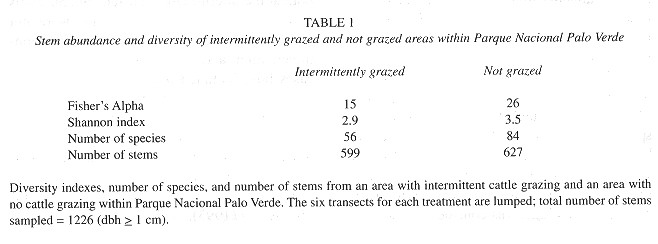
<body><![CDATA[<p><font face="Arial"><font size="-1">The number of plant species was significantly  different between sampling sites <i>(X<sup>2</sup> =</i> 5.6, <i>p &lt; </i> 0.025, <i>df = </i>1). The ungrazed habitat had 84 plant species compared  lo 56 species in the intermittently grazed area (<a href="#tabla1">Table 1</a>  ). A Mann-Whitney U test comparing Fisher's alpha values from the 12 transects  indicated that plant species diversity of these two sites was significantly  different (W = 24, <i>p &lt; </i>0.01). Alpha values were significantly lower  in the six transects where cattle grazed intermittently compared lo the alpha  values calculated for the six transects with no grazing (7.56 versus 12.59  median ranks, respectively). Similarly, a total Fisher's alpha value calculated  for each treatment revealed a two times greater diversity in the ungrazed  habitat compared to the intermittently grazed area (<a href="#tabla1">Table  1</a>  ). The Shannon diversity index also was significantly greater in the ungrazed  sites than the intermittently grazed sites, again representing a higher species  diversity in areas without grazing (t 3.14, p &lt; 0.005, df<i> </i>= 743;  <a href="#tabla1">Table 1</a>  ).</font></font> </p>       <center><a name="tabla1"></a>  <img src="/img/fbpe/rbt/v50n2-3/2134i01.JPG" height="244" width="658">  </center>   &nbsp;     
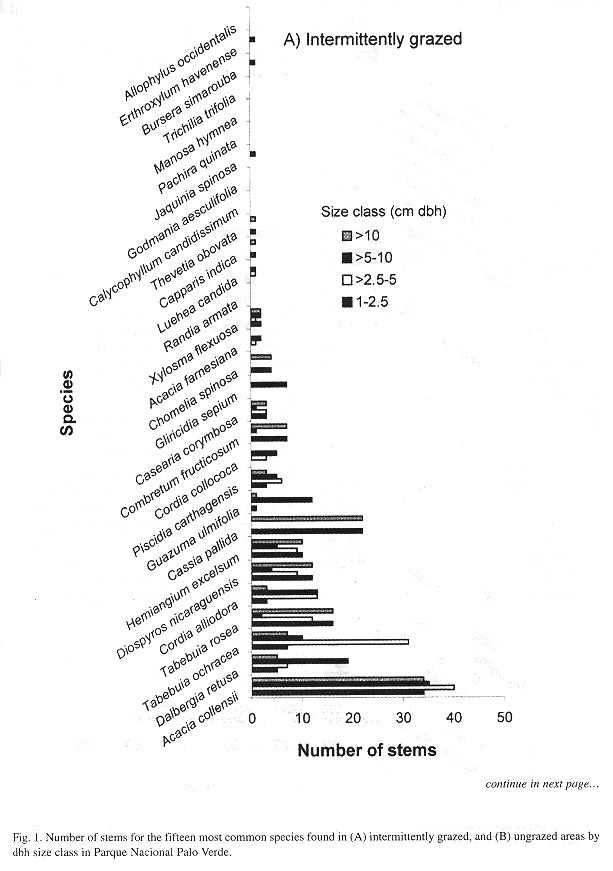
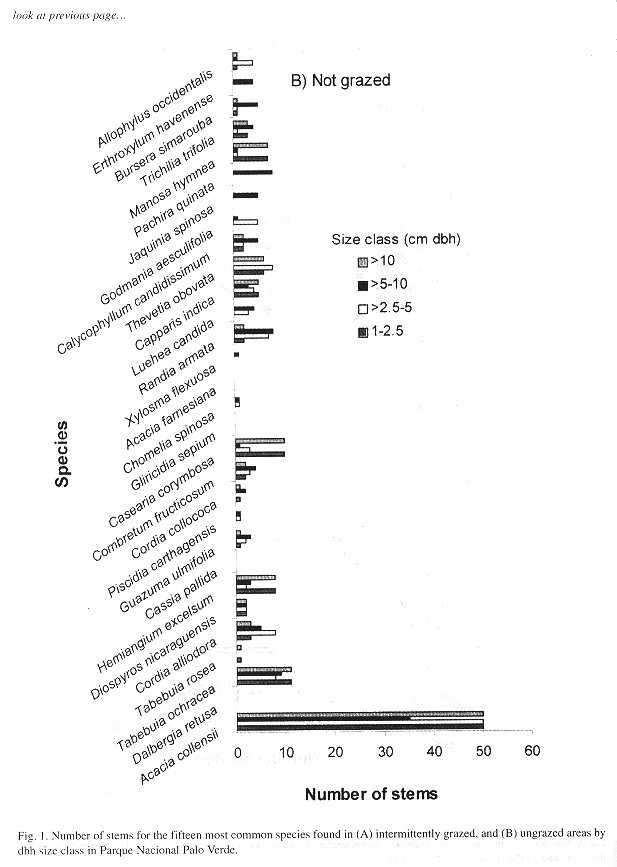
<br>  &nbsp;     <br>  <font face="Arial"><font size="-1">When the fifteen most common species at each site were compared and divided into size classes, floristic differences  between the two habitats were even greater (<a href="#fig1">Fig. 1</a>  ). Nine of the fifteen most common species in ungrazed habitat were not found  in the fifteen most common species in the grazed area. Furthermore, the size class structure between the two habitats was significantly different (X<sup> 2</sup> = 5.7, <i>p &lt; </i>0.016, df =1), with greater representation of small stems (1.0-2.5 cm) in the intermittently grazed area and a greater representation of large stems (&gt;10 cm) in the ungrazed area (<a href="#fig1"> Fig. 1</a>  ).</font></font>       <center><a name="fig1"></a>  <img src="/img/fbpe/rbt/v50n2-3/2134i02.JPG" height="871" width="613">  </center>          
<center><img src="/img/fbpe/rbt/v50n2-3/2134i03.JPG" height="867" width="617">  </center>   &nbsp;     
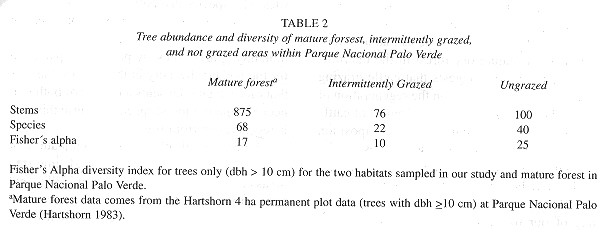
<br>  &nbsp;     <br>  <font face="Arial"><font size="-1">Further evidence of the impact that grazing  has on the floristic composition and structure of the Palo Verde tropical  dry forest was demonstrated by comparing Fisher's alpha values for large trees only from the grazed and ungrazed sites with <a href="#Hartshorn">Hartshorn's  (1983)</a>   permanent tree plot data in Palo Verde mature forest (<a href="#tabla2">  Table 2</a>  ). The ungrazed area is more similar to the forest in the Hartshorn plot  than to the nearby intermittently grazed site. lt should be noted that the  Hartshorn plot is located approximately 20 km from our sampling area and data were collected in 1970.</font></font>     <br>  <font face="Arial"><font size="-1">&nbsp;</font></font>       <center><a name="tabla2"></a>  <img src="/img/fbpe/rbt/v50n2-3/2134i04.JPG" height="235" width="609">  </center>   &nbsp;     
]]></body>
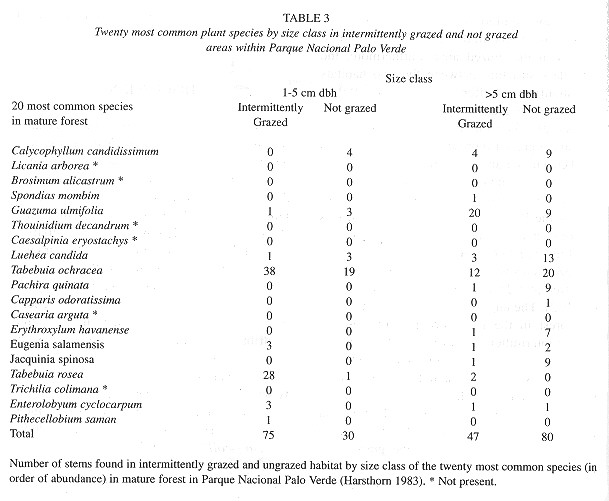
<body><![CDATA[<br>  &nbsp;     <br>  <font face="Arial"><font size="-1">Finally, there was a significant difference  in the number of small stems (1.0-5 cm) and large stems and trees (&gt; 5  cm) in the grazed and ungrazed treatments when comparing only the 20 species  most commonly found in Hartshorn's mature forest <i>(X<sup>2</sup> = </i>  27.3, p &lt; 0.0001, df =<i> </i>1; <a href="#tabla3">Table 3</a>  ). While the intermittently grazed area had a greater abundance of small  stems (of the 20 species considered) than the ungrazed area (75 versus 30  stems, respectively), this ratio changed as the cohort aged (large stems,  30 versus 80 stems, respectively) as many small stems were possibly eaten  by cattle, trampled, or killed by other factors.</font></font>     <br>  &nbsp;       <center>&nbsp;<a name="tabla3"></a>  <img src="/img/fbpe/rbt/v50n2-3/2134i05.JPG" height="501" width="609">  </center>   <font face="Arial"><font size="-1">&nbsp;</font></font>        
<p><b><font face="Arial"><font size="-1">Discussion</font></font></b>  </p>       <p><font face="Arial"><font size="-1">Impact of cattle grazing on vegetation  structure and composition: We demonstrate that the floristic structure and  composition of the intermittently grazed sites sampled were different from  the sites sampled with no cattle grazing. The analysis of floristic composition  showed significantly lower species diversity at the sites where intermittent  cattle grazing occurred than at the sites with no grazing (<a href="#tabla1">  Table 1</a>  ). Although the habitat with intermittent grazing was less diverse at the  species level, 14 species were unique to this area thus contributing to the  overall diversity of the landscape; however, the area with no grazing contributed  more to the overall species diversity with 42 species unique to this habitat.</font></font>    </p>       <p><font face="Arial"><font size="-1">Species that were abundant in both intermittently grazed and ungrazed areas, included <i>Acacia collinsii, Dalbergia retusa, and</i> <i>Tabebuia ochraceae. </i>Some of the most abundant species in the intermittently grazed area included severas early successional species such as <i>Tabebuia rosea, Cassia pallida, </i>and <i>Piscidia carthagenensis.  </i>In contrast, severas of the most common species in the ungrazed area included species characteristic of mature tropical dry forest (<a href="#Hartshorn">  Hartshorn, 1983</a>  ) such as <i>Luehea</i> <i>candida, Calycophyllum candidissimum, Jacquinia  spinosa, and Pachira quinata. </i>The significant difference in size class  distributions between intermittently grazed and ungrazed areas emphasizes  the impact that cattle have on the structure of tropical dry forest (<a href="#fig1">  Fig. 1</a>  ). There were significantly more small stems in the intermittently grazed  area and significantly fewer large stems. The low abundance of even the smallest size class of species that are characteristic of mature dry forest in the intermittently grazed area suggests that cattle grazing have a detrimental  effect on the regeneration of tropical dry forest, and that the impact of  cattle may direct a change in the spec&iacute;es composition of the forest  as the small class matures.</font></font>  </p>       <p><font face="Arial"><font size="-1">Of the twenty most common tree species  in the Hartshorn plot from mature forest within Palo Verde, six species were not found in any of our transects. Twelve of the 20 most common species from the Hartshorn plot were found in our transects from both intermittently grazed and ungrazed sites. The ungrazed sites contained 12 common mature forest species in greater abundance's and from larger size classes than in transects from the intermittently grazed sites. The species diversity (Fisher's Alpha values) of the Hartshom plot was intermediate between the diversity of our ungrazed and intermittently grazed sites. A possible explanado for the highest diversity in the ungrazed area is that this habitat represents a mosaic of both pioneer and mature forest species because this area is regenerating  from fires.</font></font>  </p>       <p><font face="Arial"><font size="-1">Since aereal photographs indicate that  both our intermittently grazed and ungrazed areas consistes of forest in 1970 and 1986, and fires probably affected both of these areas equally since they are adjacent lo each other, the subsequent changes in vegetation are most likely due to the effect of cattle grazing. Alternatively, severas other  factors undoubtedly have contributed to the differences observed in these  two habitats. The presence of <i>H. rufa</i> in the intermittently grazed  area may prevent the establishment of other plants since grasses often inhibit  the establishement of woody and herbaceous species in open areas (<a href="#Guariguata">  Guariguata <i>et al. </i>1995</a>  , <a href="#Zahawi">Zahawi and Augspurger 1999</a>  ). Furthermore, grazing promotes the horizontal expansion of <i>H. rufa,  </i>allowing this aggressive grass to outeompete other woody colonizers (<a href="#Parsons">  Parsons 1972</a>  , <a href="#McNaughton">McNaughton 1985</a>  , <a href="#Milchunas">Milchunas <i>et al. </i>1988</a>  ). Finally, abiotic factors encountered by seeds in the more open areas in the intermittently grazed habitat likely decrease the survival of small seedlings in this area (<a href="#Nepstad90">Nepstad <i>et al. </i>1990</a>  , <a href="#Gerhardt">Gerhardt 1993</a>  , <a href="#Nepstad96">Nespstad <i>et al. </i>1996</a>  ).</font></font>  </p>       <p><font face="Arial"><font size="-1">Many studies in western North America  have demonstrated that grazing by domestic livestock in native ecosystems  results in changes in plant species composition, disruption of ecosystem function, alteration of ecosystem structure, and changes in faunal diversity (for a review see Tables 1-4 in <a href="#Fleischner">Fleischner 1994</a>  ). In general, these studies show a decrease in plant species diversity accompanied  by a change in floristic composition and structure within areas grazed by domestic livestock (<a href="#Cottam">Cottam and Evans 1945</a>  , <a href="#Gardner">Gardner 1950</a>  , <a href="#Rummel">Rummell 1951</a>  , <a href="#Blydenstein">Blydenstein et al. 1957</a>  , <a href="#Winegar">Winegar 1977</a>  , <a href="#Webb">Webb and Stielstra 1979</a>  , <a href="#Reynolds">Reynolds and Trost 1980</a>  , <a href="#Szaro83">Szaro and Pase 1983</a>  , <a href="#Bock84">Bock <i>et al. </i>1984</a>  , <a href="#Brady">Brady <i>et al. </i>1989</a>  , <a href="#Schulz">Schulz and Leiniger 1990</a>  ). Furthermore, numerous researchers have documented the negative impacts  of cattle grazing on native vertebrate populations (<a href="#Berry">Berry  1978</a>  , <a href="#Duff">Duff 1979</a>  , <a href="#Reynolds">Reynolds and Trost 1980</a>  , <a href="#Jones81">Jones 1981</a>  , <a href="#Jones88">1988</a>  , <a href="#Crouch">Crouch 1982</a>  , <a href="#Mosconi">Mosconi and Hutto 1982</a>  , <a href="#Szaro85">Szaro <i>et al. </i>1985</a>  , <a href="#Taylor86">Taylor 1986</a>  , <a href="#Taylor-Litt86">Taylor and Littlefield 1986</a>  , <a href="#Campbell">Campbell 1988</a>  , <a href="#Medin">Medin and Clary 1989</a>  , <a href="#Bowen">Bowen and Kruse 1993</a>  , <a href="#Stoner">Stoner and Timm 2003</a>  ).</font></font>  </p>       ]]></body>
<body><![CDATA[<p><font face="Arial"><font size="-1">Studies evaluating the impact of domestic  grazing on tropical ecosystems also have documented changes in vegetation  structure and composition. In the Western Ghats, Kamataka, India, dry forests  expanded into former pasture/savanna habitats when protected from human impacts of fire and grazing (<a href="#Puyravaud">Puyravaud <i>et al. </i> 1994</a>  ). In the eastern Amazonian rainforest of Par&aacute;, Brazil, the success  of forest regeneration in pasture lands depended on the intensity of pasture  use. Furthermore, the composition and structure of recovered mature forest  was not always similar to the mature forest prior to land clearing (<a href="#Buschbacher">  Buschbacher <i>et al. </i>1988</a>  , <a href="#Uhl">Uhl <i>et al. </i>1988</a>  ). A study in Curagao, Netherlands Antilles, documented that vegetation composition  and structure was significantly different between rock vegetation with livestock grazing compared to rock vegetation with no livestock (<a href="#Debrot">  Debrot and Freitas 1993</a>  ).</font></font>  </p>       <p><font face="Arial"><font size="-1">Implications for management: The management  objectives of the Tempisque Conservation Arca for the cattle project in Parque Nacional Palo Verde and Reserva Biol&oacute;gica Lomas Barbudal include the following: (1) reduce the risk of forest fires by managing the amount of combustible material, (2) minimize the impact of fire on biodiversity, (3) facilitate ecological restoration by using controlled grazing, and (4) generate a socio-economic benefit for participating cattle owners (<a href="#Mozo">  Mozo 1995</a>  ). A parameter that was not considered in the management objectives of the  Tempisque Conservation Arca is the impact that cattle have on the regeneration  of tropical dry forest.</font></font>  </p>       <p><font face="Arial"><font size="-1">The management plan that is currently  being implemented, claims that the Palo Verde area has been exposed to disturbance  caused by cattle grazing during the last 400 years (<a href="#Vaughan">Vaughan  <i>et al. </i>1995</a>  ), however, no data is presented to confirm this statement. <a href="#McCoy">  McCoy (1994)</a>   and <a href="#Vaughan">Vaughan <i>et al. </i>(1995)</a>   argue that this disturbance has maintained a high diversity<b> </b>of plant  species in dry forest communities and interpret this phenomenon as a result  of the intermediate disturbance hypothesis proposed by <a href="#Connell">  Connell (1978)</a>  . Therefore, according to the management plan, cattle are essential for the regeneration of tropical dry forest communities and must be maintained in these areas perpetually (<a href="#Vaughan">Vaughan <i>et al. </i>1995</a>  ).</font></font>  </p>       <p><font face="Arial"><font size="-1">In contrast to the management plan,  the earliest records of cattle in the Palo Verde region come from 1923 when  the Stewart family began a cattle ranch in this area (D.A. Stewart, pers.  com.). Furthermore, it is difficult to interpret the disturbance of cattle  at Palo Verde in the context of Connell's intermediate disturbance hypothesis  as suggested by the management plan. This hypothesis suggests that highest  diversity will be observed at intermediate levels of frequency and intensity  of natural disturbances (<a href="#Connell">Connell 1978</a>  ). Cattle are not native animals of tropical dry forests of Mesoamerica and  they do not represent a natural disturbance. Their presence within an area  creates a constant disturbance in terms of both frequency and intensity that is determined by human intervention. The intensity of land use (i.e. disturbance by cows) depends largely upon the density of animals in a given area and the availability of forage. These two variables are controlled by human interests. For example, the density of cattle in the Palo Verde region when it<b> </b> was managed as a cattle ranch from 1923-1979 varied from 0.18-0.30 head of cattle per hectare. Since the implementation of the cattle program in Palo Verde and Lomas Barbudal the density has increased to 0.7-1.0 head of cattle per hectare (<a href="#Mozo">Mozo 1995</a>  ), for a total of approximately 4000 cattle in 1998. In contrast to the cattle  rotation schedule utilized by the Stewart family when Palo Verde was a ranch, the current management plan assigns specific sites to the participating cattle owners that result in areas with high animal density and no rotation. This practice may cause an incalculable damage to the structure and dynamics of this tropical dry forest.</font></font>  </p>       <p><font face="Arial"><font size="-1">An analysis of change in land-use of  the area of Palo Verde and Lomas Barbudal was obtained using interpretad images of aerial photographs from 1956 and compared to satellite images interpretad  in 1993 (<a href="#Maldonado">Maldonado et <i>al. </i>1995</a>  ). This analysis shows that the area covered with pastures increased from  5% in 1956 to 12% in 1993 within Palo Verde and Lomas Barbudal. In contrast,  Parque Nacional Guanacaste, another tropical dry forest also located in northwestem Costa Rica, has experienced an overall decrease in pasture land from 1979 to 1985. In only 6 years, 28% of the pasture land became successional deciduous or evergreen forest (<a href="#Kramer">Kramer 1997</a>  ). Restoration of pastures to forest in Parque Nacional Guanacaste depends  upon the distance to the seed sources, the seed dispersal mode of the plant  species, the proximity to the forest patches, and the number and species of animals involved (<a href="#Janzen86">Janzen 1986</a>  ). Cattle, which were formerly present in this park, have been eliminated  from this area and are not considered to be a viable management tool for controlling tires.</font></font>  </p>       <p><font face="Arial"><font size="-1">Our study shows that cattle grazing  changes the floristic composition and decreases the structural complexity  of the vegetation in tropical dry forest. Although the ultimase long-term  impact of cattle grazing on tropical dry forest ecosystems is still unknown,  there is no doubt that cattle are a risk factor to the maintenance of biological  diversity of dry tropical forest vegetation. The long-term ecological cost  of preventing fires with the use of cattle will be much greater than the short-term economic cost of investing in alternative fire manamenent programs. The effectiveness of alternative fire prevention measures should be evaluated, such as: (1) hand-cutting <i>H. rufa</i> with machetes, (2) the creation of more frequent and larger fire breaks, and (3) the development of "green" fire breaks consisting of fast-growing fire-resistant native plant species. The economic cost of cach of these alternatives should be evaluated in the context of available resources and infrastructure. Concurrently, community-based environmental education programs that promote safe burning practices should be continued and expanded. Finally, future studies should determine the effect of fire on the regeneration of this ecosystem to better understand the interaction  between grazing and fire. The strategy of utilizing cattle to "manage" natural  ecosystems in the rangelands of western North America has been criticized  previously as a large uncontrolled experiment (Bock <i>et al. </i>1993, Noss  1994). it now appears that the Tempisque Conservation Area in Guanacaste,  Costa Rica, is similarly initiating an uncontrolled experiment within one  of the few remnants of tropical dry forests in Central America.</font></font>    </p>       <p><font face="Arial"><font size="-1">&nbsp;</font></font>     <br>  <b><font face="Arial"><font size="-1">Acknowledgments</font></font></b>  </p>       <p><font face="Arial"><font size="-1">We thank the student participants of  OTS 96-9 (Tropical Plant Systematics) for help with field work. The help of N. Zamora, U. Chavarr&iacute;a, and R. Espinoza for field assistance and  plant identifications is also gratefully acknowledged. We thank J. Stanford,  R. M. Timm, and an anonymous reviewer for helpful comments on an earlier draft of this manuscript.</font></font>  </p>       <p><font face="Arial"><font size="-1">&nbsp;</font></font>     ]]></body>
<body><![CDATA[<br>  <b><font face="Arial"><font size="-1">Resumen</font></font></b>  </p>       <p><font face="Arial"><font size="-1">En el noroeste de Costa Rica se utiliza  ganado como una "herramienta de manejo" para reducir la cantidad de material  combustible, principalmente <i>Hyparrhenia rufa,</i> un zacate que proviene  de Africa. Este proyecto se desarrolla dentro del Parque Nacional Palo Verde  y la Reserva Biol&oacute;gica Lomas Barbudal, ambos forman parte de los &uacute;ltimos  remanentes de bosque tropical seco de Mesoam&eacute;rica. Con el fin de determinar  los efectos a corto plazo del pastoreo de ganado vacuno sobre la vegetaci&oacute;n  natural, realizamos un muestreo dentro de Palo Verde para comparar la composici&oacute;n  flor&iacute;stica de un &aacute;rea de pastoreo intermitente con un &aacute;rea  sin pastoreo. Encontramos significativamente menos especies de plantas en  el &aacute;rea con pastoreo intermitente comparado con el &aacute;rea sin  pastoreo. La composici&oacute;n flor&iacute;stica de estos dos h&aacute;bitats  fue significativamente diferente basada en una comparaci&oacute;n del alfa  de Fisher y el &iacute;ndice de Shannon de diversidad; ambos fueron significativamente  m&aacute;s altos en el &aacute;rea sin pastoreo. El &aacute;rea no pastoreado  tuvo mayor n&uacute;mero de especies y mayor semejanza con bosque maduro.  La estructura de la vegetaci&oacute;n fue significativamente diferente entre  las dos &aacute;reas pastoreadas y no pastoreadas, con mayor n&uacute;mero  de individuos de di&aacute;metros peque&ntilde;os (1-2.5 cm) y menor n&uacute;mero  de individuos de di&aacute;metros grandes (&gt;5 cm) en el &aacute;rea con  pastoreo intermitente. Estos resultados sugieren que el ganado reduce la abundancia relativa y la densidad de las especies de &aacute;rboles y cambia la composici&oacute;n flor&iacute;stica y estructura del bosque tropical seco. El plan de manejo actual de Palo Verde y Lomas Barbudal no es apropriado debido al impacto que el ganado tiene sobre la estructura de la vegetaci&oacute;n natural y no debe ser considerado como una alternativa viable para otras &aacute;reas protegidas del neotropico. Sugirimos que se eval&uacute;en m&eacute;todos  alternativos para prevenir incendios, como el corte de jaragua (Hy<i>parrhenia  rufa) </i>con machetes, la creaci&oacute;n de rompefuegos en mayor cantidad  y magnitud, y rompefuegos verdes.</font></font>  </p>       <p><font face="Arial"><font size="-1">&nbsp;</font></font>     <br>  <b><font face="Arial"><font size="-1">References</font></font></b>  </p>       <!-- ref --><p><a name="Barboza95"></a>  <font face="Arial"><font size="-1">Barboza, G. 1995. Pastoreo controlado  para control de incendios y restauraci&oacute;n de bosque tropical seco, en el Parque Nacional Palo Verde, Guanacaste, Costa Rica. Informe de avance de resultados de monitoreo del proyecto, 12 de junio de 1995. Organizaci&oacute;n  para Estudios Tropicales, San Jos&eacute;, Costa Rica.    &nbsp;&nbsp;&nbsp;&nbsp;&nbsp;&nbsp;&nbsp;&nbsp;[&#160;<a href="javascript:void(0);" onclick="javascript: window.open('/scielo.php?script=sci_nlinks&ref=1695775&pid=S0034-7744200200030002000001&lng=','','width=640,height=500,resizable=yes,scrollbars=1,menubar=yes,');">Links</a>&#160;]<!-- end-ref --></font></font>  </p>       <p><a name="Barboza96"></a>  <font face="Arial"><font size="-1">Barboza, G. 1996. Pastoreo controlado  evita incendios y ayuda a ganaderos. Organizaci&oacute;n para Estudios Tropicales,  OET al D&iacute;a 1: 4.</font></font>  </p>       <!-- ref --><p><a name="Berry"></a>  <font face="Arial"><font size="-1">Berry, K.H. 1978. Livestock grazing and  the desert tortoise. Trans. North Amer. Wildlife Natur. Resources Conf. 43:  505-519.    &nbsp;&nbsp;&nbsp;&nbsp;&nbsp;&nbsp;&nbsp;&nbsp;[&#160;<a href="javascript:void(0);" onclick="javascript: window.open('/scielo.php?script=sci_nlinks&ref=1695778&pid=S0034-7744200200030002000003&lng=','','width=640,height=500,resizable=yes,scrollbars=1,menubar=yes,');">Links</a>&#160;]<!-- end-ref --></font></font>  </p>       <!-- ref --><p><a name="Blydenstein"></a>  <font face="Arial"><font size="-1">Blydenstein, J., C.R. Hungerford, G.I.  Day &amp; R.R. Humphrey. 1957. Effect of domestic livestock exclusion on vegetation in the Sonoran Desert. Ecol. 38: 239-242.    &nbsp;&nbsp;&nbsp;&nbsp;&nbsp;&nbsp;&nbsp;&nbsp;[&#160;<a href="javascript:void(0);" onclick="javascript: window.open('/scielo.php?script=sci_nlinks&ref=1695780&pid=S0034-7744200200030002000004&lng=','','width=640,height=500,resizable=yes,scrollbars=1,menubar=yes,');">Links</a>&#160;]<!-- end-ref --></font></font>  </p>       <!-- ref --><p><a name="Bock84"></a>  <font face="Arial"><font size="-1">Bock, C.E., J.H. Bock, W.R. Kenney &amp;  VM. Hawthome. 1984. Responses of birds, rodents, and vegetation to livestock  exclosure in a semidesert grassland site. J. Range Manage. 37: 239-242.    &nbsp;&nbsp;&nbsp;&nbsp;&nbsp;&nbsp;&nbsp;&nbsp;[&#160;<a href="javascript:void(0);" onclick="javascript: window.open('/scielo.php?script=sci_nlinks&ref=1695782&pid=S0034-7744200200030002000005&lng=','','width=640,height=500,resizable=yes,scrollbars=1,menubar=yes,');">Links</a>&#160;]<!-- end-ref --></font></font>    </p>       <!-- ref --><p><a name="Bock93"></a>  <font face="Arial"><font size="-1">Bock, C.E., J.H. Bock &amp; H.M. Smith.  1993. Proposal for a system of federal livestock exclosures on public rangelands  in the western United States. Conserv. Biol. 7: 731-733.    &nbsp;&nbsp;&nbsp;&nbsp;&nbsp;&nbsp;&nbsp;&nbsp;[&#160;<a href="javascript:void(0);" onclick="javascript: window.open('/scielo.php?script=sci_nlinks&ref=1695784&pid=S0034-7744200200030002000006&lng=','','width=640,height=500,resizable=yes,scrollbars=1,menubar=yes,');">Links</a>&#160;]<!-- end-ref --></font></font>  </p>       <!-- ref --><p><a name="Bowen"></a>  <font face="Arial"><font size="-1">Bowen, B.S. &amp; A.D. Kruse. 1993. Effects  of grazing on nesting by upland sandpipers in southcentral North Dakota. J. Wildlife Manage. 57: 291-301.    &nbsp;&nbsp;&nbsp;&nbsp;&nbsp;&nbsp;&nbsp;&nbsp;[&#160;<a href="javascript:void(0);" onclick="javascript: window.open('/scielo.php?script=sci_nlinks&ref=1695786&pid=S0034-7744200200030002000007&lng=','','width=640,height=500,resizable=yes,scrollbars=1,menubar=yes,');">Links</a>&#160;]<!-- end-ref --></font></font>  </p>       <!-- ref --><p><a name="Boza"></a>  <font face="Arial"><font size="-1">Boza, M.A. 1993. Conservation in action:  past, present, and future of the national park system of Costa Rica. Conserv.  Biol. 7: 239-247.    &nbsp;&nbsp;&nbsp;&nbsp;&nbsp;&nbsp;&nbsp;&nbsp;[&#160;<a href="javascript:void(0);" onclick="javascript: window.open('/scielo.php?script=sci_nlinks&ref=1695788&pid=S0034-7744200200030002000008&lng=','','width=640,height=500,resizable=yes,scrollbars=1,menubar=yes,');">Links</a>&#160;]<!-- end-ref --></font></font>  </p>       <!-- ref --><p><a name="Brady"></a>  <font face="Arial"><font size="-1">Brady, W.W., M.R. Stromberg, E. F. Aldon,  D.D. Bonham &amp; S.H. Henry. 1989. Response of a semidesert grassland to  16 years of rest from grazing. J. Range Manage. 42: 284-288.    &nbsp;&nbsp;&nbsp;&nbsp;&nbsp;&nbsp;&nbsp;&nbsp;[&#160;<a href="javascript:void(0);" onclick="javascript: window.open('/scielo.php?script=sci_nlinks&ref=1695790&pid=S0034-7744200200030002000009&lng=','','width=640,height=500,resizable=yes,scrollbars=1,menubar=yes,');">Links</a>&#160;]<!-- end-ref --></font></font>    </p>       <!-- ref --><p><a name="Buschbacher"></a>  <font face="Arial"><font size="-1">Buschbacher, R., C. Uhl, E.A.S. Serr&aacute;o.  1988. Abandoned pastures in eastern Amazonia. 11. Nutrient stocks in the soil and vegetation. J. Ecol. 76: 682-699.    &nbsp;&nbsp;&nbsp;&nbsp;&nbsp;&nbsp;&nbsp;&nbsp;[&#160;<a href="javascript:void(0);" onclick="javascript: window.open('/scielo.php?script=sci_nlinks&ref=1695792&pid=S0034-7744200200030002000010&lng=','','width=640,height=500,resizable=yes,scrollbars=1,menubar=yes,');">Links</a>&#160;]<!-- end-ref --></font></font>  </p>       <p><a name="Campbell"></a>  <font face="Arial"><font size="-1">Campbell, F.T. 1988. The desert tortoise.  pp. 567-581. In J. Chandler (ed.). Audubon Wildlife Report 1988-1989. Acadeniic,  San Diego, Califomia.</font></font>  </p>       <p><a name="Ceballos"></a>  <font face="Arial"><font size="-1">Ceballos, G. 1995. Vertebrate diversity,  ecology, and conservation in neotropical dry forests pp. 195-220. In S.H.  Bullock, H.A. Mooney &amp; E. Medina (eds.). Seasonally dry tropical forests.  Cambridge University, Cainbridge, United Kingdom.</font></font>  </p>       <!-- ref --><p><a name="Condit"></a>  <font face="Arial"><font size="-1">Condit, R., R.B. Foster, S.P. Hubt&gt;ell,  R. Sukumar, E.G. Leigh, N. Manokaran, S. Loo de Lao, J.V LaFrankie &amp; P.S. Ashton. 1998. Assessing forest diversity on small plots: calibration using species-individual curves from 50-ha plots, pp. 247-268. In F. Dallmeier &amp; J.A. Comiskey (eds.). Forest biodiversity research, monitoring and modeling: conceptual background and Old World case studies, UNESCO and Parthenon Publishing, Paris, France.    &nbsp;&nbsp;&nbsp;&nbsp;&nbsp;&nbsp;&nbsp;&nbsp;[&#160;<a href="javascript:void(0);" onclick="javascript: window.open('/scielo.php?script=sci_nlinks&ref=1695796&pid=S0034-7744200200030002000013&lng=','','width=640,height=500,resizable=yes,scrollbars=1,menubar=yes,');">Links</a>&#160;]<!-- end-ref --></font></font>  </p>       <!-- ref --><p><a name="Conklin"></a>  <font face="Arial"><font size="-1">Conklin, N.L. 1987. The potential nutritional  value to cattle of some tropical browse species from Guanacaste, Costa Rica.  Ph.D. thesis, Cornell University, New York.    &nbsp;&nbsp;&nbsp;&nbsp;&nbsp;&nbsp;&nbsp;&nbsp;[&#160;<a href="javascript:void(0);" onclick="javascript: window.open('/scielo.php?script=sci_nlinks&ref=1695798&pid=S0034-7744200200030002000014&lng=','','width=640,height=500,resizable=yes,scrollbars=1,menubar=yes,');">Links</a>&#160;]<!-- end-ref --></font></font>  </p>       <!-- ref --><p><a name="Connell"></a>  <font face="Arial"><font size="-1">Connell, J.H. 1978. Diversity in tropical  rainforests and coral reefs. Science 199: 1302-1310.    &nbsp;&nbsp;&nbsp;&nbsp;&nbsp;&nbsp;&nbsp;&nbsp;[&#160;<a href="javascript:void(0);" onclick="javascript: window.open('/scielo.php?script=sci_nlinks&ref=1695800&pid=S0034-7744200200030002000015&lng=','','width=640,height=500,resizable=yes,scrollbars=1,menubar=yes,');">Links</a>&#160;]<!-- end-ref --></font></font>  </p>       <!-- ref --><p><a name="Cottam"></a>  <font face="Arial"><font size="-1">Cottam, W.P. &amp; F.R. Evans. 1945. A comparative study of the vegetation of grazed and ungrazed canyons of the  Wasatch Range, Utah. Ecol. 26: 171-181.    &nbsp;&nbsp;&nbsp;&nbsp;&nbsp;&nbsp;&nbsp;&nbsp;[&#160;<a href="javascript:void(0);" onclick="javascript: window.open('/scielo.php?script=sci_nlinks&ref=1695802&pid=S0034-7744200200030002000016&lng=','','width=640,height=500,resizable=yes,scrollbars=1,menubar=yes,');">Links</a>&#160;]<!-- end-ref --></font></font>  </p>       <!-- ref --><p><a name="Crouch"></a>  <font face="Arial"><font size="-1">Crouch, G.L. 1982. Wildlife on ungrazed  and grazed bottom-lands on the South Platte River, northeastem Colorado, pp. 186-198. In L. Nelson, J.M. Peek &amp; P.D. Dalke (eds.). Proceedings of the wildlife-livestock relationships syniposium. Forest, Wildlife, and Range Experiment Station, University of Idaho, Moscow, Idaho.    &nbsp;&nbsp;&nbsp;&nbsp;&nbsp;&nbsp;&nbsp;&nbsp;[&#160;<a href="javascript:void(0);" onclick="javascript: window.open('/scielo.php?script=sci_nlinks&ref=1695804&pid=S0034-7744200200030002000017&lng=','','width=640,height=500,resizable=yes,scrollbars=1,menubar=yes,');">Links</a>&#160;]<!-- end-ref --></font></font>   </p>       <!-- ref --><p><a name="Daubenmire"></a>  <font face="Arial"><font size="-1">Daubenmire, R. 1972. Some ecologic consequences  of converting forest to savanna in northwestern Costa Rica. Trop. Ecol. 13:  31-51.    &nbsp;&nbsp;&nbsp;&nbsp;&nbsp;&nbsp;&nbsp;&nbsp;[&#160;<a href="javascript:void(0);" onclick="javascript: window.open('/scielo.php?script=sci_nlinks&ref=1695806&pid=S0034-7744200200030002000018&lng=','','width=640,height=500,resizable=yes,scrollbars=1,menubar=yes,');">Links</a>&#160;]<!-- end-ref --></font></font>  </p>       <!-- ref --><p><a name="Debrot"></a>  <font face="Arial"><font size="-1">Debrot, A.O. &amp; J.A. de Freitas. 1993.  A cornparison of ungrazed and livestock-grazed rock vegetations in Curagao.  Biotropica 25: 270-280.    &nbsp;&nbsp;&nbsp;&nbsp;&nbsp;&nbsp;&nbsp;&nbsp;[&#160;<a href="javascript:void(0);" onclick="javascript: window.open('/scielo.php?script=sci_nlinks&ref=1695808&pid=S0034-7744200200030002000019&lng=','','width=640,height=500,resizable=yes,scrollbars=1,menubar=yes,');">Links</a>&#160;]<!-- end-ref --></font></font>  </p>       <!-- ref --><p><a name="Duff"></a>  <font face="Arial"><font size="-1">Duff, D.A. 1979. Riparian habitat recovery  on Big Creek, Rich County, Utah, pp. 91-92. <i>In </i>O.B. Cope (ed.). Proceedings  of the Forum-grazing and riparian/stream ecosystems. Trout unlimited, Denver,  Colorado.    &nbsp;&nbsp;&nbsp;&nbsp;&nbsp;&nbsp;&nbsp;&nbsp;[&#160;<a href="javascript:void(0);" onclick="javascript: window.open('/scielo.php?script=sci_nlinks&ref=1695810&pid=S0034-7744200200030002000020&lng=','','width=640,height=500,resizable=yes,scrollbars=1,menubar=yes,');">Links</a>&#160;]<!-- end-ref --></font></font>  </p>       <!-- ref --><p><a name="Fleischner"></a>  <font face="Arial"><font size="-1">Fleischner, T.L. 1994. Ecological costs  of livestock grazing in western North America. Conserv. Biol. 8: 629-644.    &nbsp;&nbsp;&nbsp;&nbsp;&nbsp;&nbsp;&nbsp;&nbsp;[&#160;<a href="javascript:void(0);" onclick="javascript: window.open('/scielo.php?script=sci_nlinks&ref=1695812&pid=S0034-7744200200030002000021&lng=','','width=640,height=500,resizable=yes,scrollbars=1,menubar=yes,');">Links</a>&#160;]<!-- end-ref --></font></font>    </p>       <!-- ref --><p><a name="Frankie"></a>  <font face="Arial"><font size="-1">Frankie, G.W., L. Newstrom, S.B. Vinson  &amp; J.F. Barthell. 1993. Nesting-habit preferences of selected <i>Centris  </i>bee species in Costa Rican dry forest. Biotropica 25:322-333.    &nbsp;&nbsp;&nbsp;&nbsp;&nbsp;&nbsp;&nbsp;&nbsp;[&#160;<a href="javascript:void(0);" onclick="javascript: window.open('/scielo.php?script=sci_nlinks&ref=1695814&pid=S0034-7744200200030002000022&lng=','','width=640,height=500,resizable=yes,scrollbars=1,menubar=yes,');">Links</a>&#160;]<!-- end-ref --></font></font>    </p>       <!-- ref --><p><a name="Garcia-Oliva"></a>  <font face="Arial"><font size="-1">Garc&iacute;a-Oliva, F., I. Cesar, P.  Morales &amp; J.M. Maass. 1994. Forest-to-pasture conversion influecnes on  soil organic carbon dynamics in a tropical deciduous forest. Oecologia 99:  392-396.    &nbsp;&nbsp;&nbsp;&nbsp;&nbsp;&nbsp;&nbsp;&nbsp;[&#160;<a href="javascript:void(0);" onclick="javascript: window.open('/scielo.php?script=sci_nlinks&ref=1695816&pid=S0034-7744200200030002000023&lng=','','width=640,height=500,resizable=yes,scrollbars=1,menubar=yes,');">Links</a>&#160;]<!-- end-ref --></font></font>  </p>       <p><a name="Gardner"></a>  <font face="Arial"><font size="-1">Gardner, J.L. 1950. Effeets of thirty  years of protection from grazing in desert grassland. Ecol. 31: 44-50.</font></font>    </p>       <!-- ref --><p><a name="Gentry"></a>  <font face="Arial"><font size="-1">Gentry A.H. 1993. A field guide to the  families and genera of woody plants of northwest South America (Colombia,  Ecuador, Peru) with supplementary notes on herbaceous taxa (R. V&aacute;squez,  illustrator). The University of Chicago Press, Chicago, Illinois.    &nbsp;&nbsp;&nbsp;&nbsp;&nbsp;&nbsp;&nbsp;&nbsp;[&#160;<a href="javascript:void(0);" onclick="javascript: window.open('/scielo.php?script=sci_nlinks&ref=1695819&pid=S0034-7744200200030002000025&lng=','','width=640,height=500,resizable=yes,scrollbars=1,menubar=yes,');">Links</a>&#160;]<!-- end-ref --></font></font>    </p>       ]]></body>
<body><![CDATA[<!-- ref --><p><a name="Gerhardt"></a>  <font face="Arial"><font size="-1">Gerhardt, K. 1993. Tree seedling development  in tropical dry abandoned pasture and secondary forest in Costa Rica. J. Veg. Sci. 4: 45-102.    &nbsp;&nbsp;&nbsp;&nbsp;&nbsp;&nbsp;&nbsp;&nbsp;[&#160;<a href="javascript:void(0);" onclick="javascript: window.open('/scielo.php?script=sci_nlinks&ref=1695821&pid=S0034-7744200200030002000026&lng=','','width=640,height=500,resizable=yes,scrollbars=1,menubar=yes,');">Links</a>&#160;]<!-- end-ref --></font></font>  </p>       <!-- ref --><p><a name="Guariguata"></a>  <font face="Arial"><font size="-1">Guariguata, M.R., R. Rhenigans &amp; E Montagnini. 1995. Early woody invasion under tree plantations in Costa Rica: implicaions for forest restoration. Rest. Ecol. 3: 252-260.    &nbsp;&nbsp;&nbsp;&nbsp;&nbsp;&nbsp;&nbsp;&nbsp;[&#160;<a href="javascript:void(0);" onclick="javascript: window.open('/scielo.php?script=sci_nlinks&ref=1695823&pid=S0034-7744200200030002000027&lng=','','width=640,height=500,resizable=yes,scrollbars=1,menubar=yes,');">Links</a>&#160;]<!-- end-ref --></font></font>    </p>       <!-- ref --><p><a name="Guevara"></a>  <font face="Arial"><font size="-1">Guevara, S., J. Meave, P. Moreno-Cassasola  &amp; J. Laborde. 1992. Floristic composition and structure of vegetation  under isolated trees in neotropical pastures. J. Veg. Sci. 3: 655-664.    &nbsp;&nbsp;&nbsp;&nbsp;&nbsp;&nbsp;&nbsp;&nbsp;[&#160;<a href="javascript:void(0);" onclick="javascript: window.open('/scielo.php?script=sci_nlinks&ref=1695825&pid=S0034-7744200200030002000028&lng=','','width=640,height=500,resizable=yes,scrollbars=1,menubar=yes,');">Links</a>&#160;]<!-- end-ref --></font></font>    </p>       <!-- ref --><p><a name="Hartshorn"></a>  <font face="Arial"><font size="-1">Hartshorn, G.S. 1983. Plants: Introduction,  p. 11 8-157. <i>In</i> D. H. Janzen (ed.). Costa Rican natural history. University  of Chicago, Chicago, Illinois.    &nbsp;&nbsp;&nbsp;&nbsp;&nbsp;&nbsp;&nbsp;&nbsp;[&#160;<a href="javascript:void(0);" onclick="javascript: window.open('/scielo.php?script=sci_nlinks&ref=1695827&pid=S0034-7744200200030002000029&lng=','','width=640,height=500,resizable=yes,scrollbars=1,menubar=yes,');">Links</a>&#160;]<!-- end-ref --></font></font>  </p>       <!-- ref --><p><a name="Hunter"></a>  <font face="Arial"><font size="-1">Hunter, J.R. 1994. Is Costa Rica truly  conservation-minded? Conserv. Biol. 8: 592-595.    &nbsp;&nbsp;&nbsp;&nbsp;&nbsp;&nbsp;&nbsp;&nbsp;[&#160;<a href="javascript:void(0);" onclick="javascript: window.open('/scielo.php?script=sci_nlinks&ref=1695829&pid=S0034-7744200200030002000030&lng=','','width=640,height=500,resizable=yes,scrollbars=1,menubar=yes,');">Links</a>&#160;]<!-- end-ref --></font></font>  </p>       ]]></body>
<body><![CDATA[<!-- ref --><p><a name="Janzen86"></a>  <font face="Arial"><font size="-1">Janzen, D.H. 1986. Guanacaste National  Park: tropical ecological and cultural restoration. Editorial Universidad  Estatal a Distancia, San Jos&eacute;, Costa Rica.    &nbsp;&nbsp;&nbsp;&nbsp;&nbsp;&nbsp;&nbsp;&nbsp;[&#160;<a href="javascript:void(0);" onclick="javascript: window.open('/scielo.php?script=sci_nlinks&ref=1695831&pid=S0034-7744200200030002000031&lng=','','width=640,height=500,resizable=yes,scrollbars=1,menubar=yes,');">Links</a>&#160;]<!-- end-ref --></font></font>  </p>       <!-- ref --><p><a name="Janzen88"></a>  <font face="Arial"><font size="-1">Janzen, D.H. 1988. Tropical dry forests:  The most endangered major tropical ecosystem, pp. 130-137. In E.O. Wilson  (ed.). Biodiversity, National Academy Press, Washington, D.C.    &nbsp;&nbsp;&nbsp;&nbsp;&nbsp;&nbsp;&nbsp;&nbsp;[&#160;<a href="javascript:void(0);" onclick="javascript: window.open('/scielo.php?script=sci_nlinks&ref=1695833&pid=S0034-7744200200030002000032&lng=','','width=640,height=500,resizable=yes,scrollbars=1,menubar=yes,');">Links</a>&#160;]<!-- end-ref --></font></font>    </p>       <!-- ref --><p><a name="Janzen80"></a>  <font face="Arial"><font size="-1">Janzen, D.H. &amp; R. Liesner. 1980. Annotated check-list of plants of lowland Guanacaste Province, Costa Rica, exclusive of grasses and non-vascular cryptogains. Brenesia 18: 15-90.    &nbsp;&nbsp;&nbsp;&nbsp;&nbsp;&nbsp;&nbsp;&nbsp;[&#160;<a href="javascript:void(0);" onclick="javascript: window.open('/scielo.php?script=sci_nlinks&ref=1695835&pid=S0034-7744200200030002000033&lng=','','width=640,height=500,resizable=yes,scrollbars=1,menubar=yes,');">Links</a>&#160;]<!-- end-ref --></font></font>    </p>       <!-- ref --><p><a name="Johnson"></a>  <font face="Arial"><font size="-1">Johnson, N.C. &amp; D.A. Wedin. 1997.  Soil carbon, nutrients, and mycorrhizae during conversion of dry tropical  forest to grassland. Ecol. Applications 7: 171-182.    &nbsp;&nbsp;&nbsp;&nbsp;&nbsp;&nbsp;&nbsp;&nbsp;[&#160;<a href="javascript:void(0);" onclick="javascript: window.open('/scielo.php?script=sci_nlinks&ref=1695837&pid=S0034-7744200200030002000034&lng=','','width=640,height=500,resizable=yes,scrollbars=1,menubar=yes,');">Links</a>&#160;]<!-- end-ref --></font></font>  </p>       <!-- ref --><p><a name="Jones81"></a>  <font face="Arial"><font size="-1">Jones, K.B. 1981. Effects of grazing on lizard abundance and diversity in western Arizona. Southwestern Naturalist  26: 107-115.    &nbsp;&nbsp;&nbsp;&nbsp;&nbsp;&nbsp;&nbsp;&nbsp;[&#160;<a href="javascript:void(0);" onclick="javascript: window.open('/scielo.php?script=sci_nlinks&ref=1695839&pid=S0034-7744200200030002000035&lng=','','width=640,height=500,resizable=yes,scrollbars=1,menubar=yes,');">Links</a>&#160;]<!-- end-ref --></font></font>  </p>       ]]></body>
<body><![CDATA[<!-- ref --><p><a name="Jones88"></a>  <font face="Arial"><font size="-1">Jones, K.B. 1988. Comparison of herpetofaunas  of a natural and altered riparian ecoysystem, pp. 222-227. In R.C. Szaro,  K.E. Severson &amp; D.R. Patton (eds.). Management of amphibians, reptiles,  and small mammals in North America: General Technical Report RM- 166. U.S.  Forest Service, Rocky Mountain Forest and Range Experiment Station, Fort Collins, Colorado.    &nbsp;&nbsp;&nbsp;&nbsp;&nbsp;&nbsp;&nbsp;&nbsp;[&#160;<a href="javascript:void(0);" onclick="javascript: window.open('/scielo.php?script=sci_nlinks&ref=1695841&pid=S0034-7744200200030002000036&lng=','','width=640,height=500,resizable=yes,scrollbars=1,menubar=yes,');">Links</a>&#160;]<!-- end-ref --></font></font>  </p>       <!-- ref --><p><a name="Kramer"></a>  <font face="Arial"><font size="-1">Kramer, E. 1997. Measuring landscape changes in remnant tropical dry forest, pp. 386-399. In W.F. Laurance &amp; R.O. Bierregaard, Jr. (eds.). Tropical forest remnants: ecology, management and conservation of fragmented communities. The University of Chicago Press,  Chicago, Illinois.    &nbsp;&nbsp;&nbsp;&nbsp;&nbsp;&nbsp;&nbsp;&nbsp;[&#160;<a href="javascript:void(0);" onclick="javascript: window.open('/scielo.php?script=sci_nlinks&ref=1695843&pid=S0034-7744200200030002000037&lng=','','width=640,height=500,resizable=yes,scrollbars=1,menubar=yes,');">Links</a>&#160;]<!-- end-ref --></font></font>  </p>       <!-- ref --><p><a name="Lugo"></a>  <font face="Arial"><font size="-1">Lugo, A.E. 1986. Estimating reductions  in die diversity of tropical forest species, pp. 58-70. In E.O. Wilson (ed.).  Biodiversity. National Academy, Washington D.C.    &nbsp;&nbsp;&nbsp;&nbsp;&nbsp;&nbsp;&nbsp;&nbsp;[&#160;<a href="javascript:void(0);" onclick="javascript: window.open('/scielo.php?script=sci_nlinks&ref=1695845&pid=S0034-7744200200030002000038&lng=','','width=640,height=500,resizable=yes,scrollbars=1,menubar=yes,');">Links</a>&#160;]<!-- end-ref --></font></font>  </p>       <!-- ref --><p><a name="Maass"></a>  <font face="Arial"><font size="-1">Maass, J.M. 1995. Conversion of tropical  dry forest to pasture and agriculture, pp. 399-422. In S.H. Bullock, H.A.  Mooney &amp; E. Medina (eds.). Seasonally dry tropical forests. Cambridge  University, Cambridge, United Kingdom.    &nbsp;&nbsp;&nbsp;&nbsp;&nbsp;&nbsp;&nbsp;&nbsp;[&#160;<a href="javascript:void(0);" onclick="javascript: window.open('/scielo.php?script=sci_nlinks&ref=1695847&pid=S0034-7744200200030002000039&lng=','','width=640,height=500,resizable=yes,scrollbars=1,menubar=yes,');">Links</a>&#160;]<!-- end-ref --></font></font>  </p>       <!-- ref --><p><a name="Magurran"></a>  <font face="Arial"><font size="-1">Magurran, A.E. 1988. Ecological diversity  and its measurement. Princeton University, Princeton, New Jersey.    &nbsp;&nbsp;&nbsp;&nbsp;&nbsp;&nbsp;&nbsp;&nbsp;[&#160;<a href="javascript:void(0);" onclick="javascript: window.open('/scielo.php?script=sci_nlinks&ref=1695849&pid=S0034-7744200200030002000040&lng=','','width=640,height=500,resizable=yes,scrollbars=1,menubar=yes,');">Links</a>&#160;]<!-- end-ref --></font></font>    </p>       ]]></body>
<body><![CDATA[<!-- ref --><p><a name="Maldonado"></a>  <font face="Arial"><font size="-1">Maldonado, T., J. Bravo, G. Castro, Q.  Jim&eacute;nez, O. Sahor&iacute;o &amp; L. Paniagua. 1995. Evaluaci&oacute;n  ecol&oacute;gica r&aacute;pida regi&oacute;n del Tempisque Guanacaste, Costa  Rica. Fundaci&oacute;n Neotr&oacute;pica, San Jos&eacute;, Costa Rica.    &nbsp;&nbsp;&nbsp;&nbsp;&nbsp;&nbsp;&nbsp;&nbsp;[&#160;<a href="javascript:void(0);" onclick="javascript: window.open('/scielo.php?script=sci_nlinks&ref=1695851&pid=S0034-7744200200030002000041&lng=','','width=640,height=500,resizable=yes,scrollbars=1,menubar=yes,');">Links</a>&#160;]<!-- end-ref --></font></font>    </p>       <!-- ref --><p><a name="McCoy"></a>  <font face="Arial"><font size="-1">McCoy, M.B. 1994. Seasonal, freshwater  marshes in the tropics: a case study in which cattle grazing is not detrimental,  Essay 12C, pp. 352-353. In G.K. Meffe &amp; C.R. Carroll (eds.). Principles  of conservation biology. Sinauer Associates, Sunderland, Massachusetts.    &nbsp;&nbsp;&nbsp;&nbsp;&nbsp;&nbsp;&nbsp;&nbsp;[&#160;<a href="javascript:void(0);" onclick="javascript: window.open('/scielo.php?script=sci_nlinks&ref=1695853&pid=S0034-7744200200030002000042&lng=','','width=640,height=500,resizable=yes,scrollbars=1,menubar=yes,');">Links</a>&#160;]<!-- end-ref --></font></font>    </p>       <!-- ref --><p><a name="McNaughton"></a>  <font face="Arial"><font size="-1">McNaughton, S.J. 1985. Ecology of a grazing  ecosystem: The Serengeti. Ecol. Monogr. 55: 259-294.    &nbsp;&nbsp;&nbsp;&nbsp;&nbsp;&nbsp;&nbsp;&nbsp;[&#160;<a href="javascript:void(0);" onclick="javascript: window.open('/scielo.php?script=sci_nlinks&ref=1695855&pid=S0034-7744200200030002000043&lng=','','width=640,height=500,resizable=yes,scrollbars=1,menubar=yes,');">Links</a>&#160;]<!-- end-ref --></font></font>  </p>       <!-- ref --><p><a name="Milchunas"></a>  <font face="Arial"><font size="-1">Milchunas, D.G., O.E. Sala &amp; W.K.  Lauenroth. 1988. A generalizad model of the effects of grazing by large herbivores  on grassland community structure. Am. Nat. 132: 87-106.    &nbsp;&nbsp;&nbsp;&nbsp;&nbsp;&nbsp;&nbsp;&nbsp;[&#160;<a href="javascript:void(0);" onclick="javascript: window.open('/scielo.php?script=sci_nlinks&ref=1695857&pid=S0034-7744200200030002000044&lng=','','width=640,height=500,resizable=yes,scrollbars=1,menubar=yes,');">Links</a>&#160;]<!-- end-ref --></font></font>  </p>       <!-- ref --><p><a name="Medin"></a>  <font face="Arial"><font size="-1">Medin, D.E., and W.R Clary. 1989. Small  mainmal populations in a grazed and ungrazed riparian habitat in Nevada. Research Paper INT-413. U.S. Forest Service, Intermountain Research Station, Odgen, Utah.    &nbsp;&nbsp;&nbsp;&nbsp;&nbsp;&nbsp;&nbsp;&nbsp;[&#160;<a href="javascript:void(0);" onclick="javascript: window.open('/scielo.php?script=sci_nlinks&ref=1695859&pid=S0034-7744200200030002000045&lng=','','width=640,height=500,resizable=yes,scrollbars=1,menubar=yes,');">Links</a>&#160;]<!-- end-ref --></font></font>  </p>       ]]></body>
<body><![CDATA[<!-- ref --><p><a name="Mosconi"></a>  <font face="Arial"><font size="-1">Mosconi, S.L. &amp; R.L. Hutto. 1982.  The effect of grazing on the land birds of a westem Montana riparian. pp.  221-233. In L. Nelson, J.M. Peek &amp; P.D. Dalke (eds.). Proceedings of the wildlife-livestock relationships symposium. Forest, Wildlife, and Range Experiment Station, University of Idaho, Moscow, Idaho.    &nbsp;&nbsp;&nbsp;&nbsp;&nbsp;&nbsp;&nbsp;&nbsp;[&#160;<a href="javascript:void(0);" onclick="javascript: window.open('/scielo.php?script=sci_nlinks&ref=1695861&pid=S0034-7744200200030002000046&lng=','','width=640,height=500,resizable=yes,scrollbars=1,menubar=yes,');">Links</a>&#160;]<!-- end-ref --></font></font>  </p>       <!-- ref --><p><a name="Mozo"></a>  <font face="Arial"><font size="-1">Mozo, E.T. 1995. Pastoreo con ganado vacuno, una alternativa del ACT para prevenci&oacute;n de incendios forestales, recuperaci&oacute;n de humedales y restaruraci&oacute;n del bosque tropical seco. Convenio MIRENEM-Opci&oacute;n Colombia, Universidad Sergio Arboleda, Bagaces, Costa Rica.    &nbsp;&nbsp;&nbsp;&nbsp;&nbsp;&nbsp;&nbsp;&nbsp;[&#160;<a href="javascript:void(0);" onclick="javascript: window.open('/scielo.php?script=sci_nlinks&ref=1695863&pid=S0034-7744200200030002000047&lng=','','width=640,height=500,resizable=yes,scrollbars=1,menubar=yes,');">Links</a>&#160;]<!-- end-ref --></font></font>   </p>       <!-- ref --><p><a name="Murphy"></a>  <font face="Arial"><font size="-1">Murphy, RG. &amp; A.E. Lugo. 1986. Ecology  of tropical dry forest. An. Rev. Ecol. Sys. 17: 67-88.    &nbsp;&nbsp;&nbsp;&nbsp;&nbsp;&nbsp;&nbsp;&nbsp;[&#160;<a href="javascript:void(0);" onclick="javascript: window.open('/scielo.php?script=sci_nlinks&ref=1695865&pid=S0034-7744200200030002000048&lng=','','width=640,height=500,resizable=yes,scrollbars=1,menubar=yes,');">Links</a>&#160;]<!-- end-ref --></font></font>  </p>       <!-- ref --><p><a name="Nepstad90"></a>  <font face="Arial"><font size="-1">Nepstad, D.C., C. Uhl &amp; E.A.S. Serr&aacute;o.  1990. Surmounting barriers to forest regeneration in abandoned highly degraded  pastures: a case study form the Paragominas, Par&aacute;, Brazil, pp. 215-229.  In A.B. Anderson (ed.). Altematives to deforestation: steps toward sustainable  use of the Amazon rain forest. Columbia University, New York, New York.    &nbsp;&nbsp;&nbsp;&nbsp;&nbsp;&nbsp;&nbsp;&nbsp;[&#160;<a href="javascript:void(0);" onclick="javascript: window.open('/scielo.php?script=sci_nlinks&ref=1695867&pid=S0034-7744200200030002000049&lng=','','width=640,height=500,resizable=yes,scrollbars=1,menubar=yes,');">Links</a>&#160;]<!-- end-ref --></font></font>    </p>       <!-- ref --><p><a name="Nepstad96"></a>  <font face="Arial"><font size="-1">Nepstad, D.C., C. Uhl, C.A. Pereira &amp;  J.M.C. Da Silva. 1996. A comparative study of tree establishment in abandoned  pasture and mature forest of eastern Amazonia. Oikos 76: 25-39.    &nbsp;&nbsp;&nbsp;&nbsp;&nbsp;&nbsp;&nbsp;&nbsp;[&#160;<a href="javascript:void(0);" onclick="javascript: window.open('/scielo.php?script=sci_nlinks&ref=1695869&pid=S0034-7744200200030002000050&lng=','','width=640,height=500,resizable=yes,scrollbars=1,menubar=yes,');">Links</a>&#160;]<!-- end-ref --></font></font>    </p>       ]]></body>
<body><![CDATA[<!-- ref --><p><a name="Noss"></a>  <font face="Arial"><font size="-1">Noss, R.F. 1994. Cows and conservation  biology. Conserv. Biol. 8: 613-616.    &nbsp;&nbsp;&nbsp;&nbsp;&nbsp;&nbsp;&nbsp;&nbsp;[&#160;<a href="javascript:void(0);" onclick="javascript: window.open('/scielo.php?script=sci_nlinks&ref=1695871&pid=S0034-7744200200030002000051&lng=','','width=640,height=500,resizable=yes,scrollbars=1,menubar=yes,');">Links</a>&#160;]<!-- end-ref --></font></font>  </p>       <!-- ref --><p><a name="Parsons"></a>  <font face="Arial"><font size="-1">Parsons, J.J. 1972. Spread of African  pasture grasses to the American tropics. J. Range Manage. 25: 12-17.    &nbsp;&nbsp;&nbsp;&nbsp;&nbsp;&nbsp;&nbsp;&nbsp;[&#160;<a href="javascript:void(0);" onclick="javascript: window.open('/scielo.php?script=sci_nlinks&ref=1695873&pid=S0034-7744200200030002000052&lng=','','width=640,height=500,resizable=yes,scrollbars=1,menubar=yes,');">Links</a>&#160;]<!-- end-ref --></font></font>    </p>       <!-- ref --><p><a name="Puyravaud"></a>  <font face="Arial"><font size="-1">Puyravaud, J.R, J.R Pascal &amp; C. Bufour.  1994. Ecotone structure as an indicator of changing forest-savanna boundaries.  J. Biogeogr. 21: 581-593.    &nbsp;&nbsp;&nbsp;&nbsp;&nbsp;&nbsp;&nbsp;&nbsp;[&#160;<a href="javascript:void(0);" onclick="javascript: window.open('/scielo.php?script=sci_nlinks&ref=1695875&pid=S0034-7744200200030002000053&lng=','','width=640,height=500,resizable=yes,scrollbars=1,menubar=yes,');">Links</a>&#160;]<!-- end-ref --></font></font>  </p>       <!-- ref --><p><a name="Quesada03"></a>  <font face="Arial"><font size="-1">Quesada, M. &amp; K.E. Stoner. 2003. Threats to the conservation of tropical dry forest in Costa Rica. In G.W. Frankie, A. Mata &amp; S.B. Vinson (eds.). Biodiversity Conservation in Costa Rica: Learning the leasons in the seasonal dry forest. University of California  Press, Berkeley, California.    &nbsp;&nbsp;&nbsp;&nbsp;&nbsp;&nbsp;&nbsp;&nbsp;[&#160;<a href="javascript:void(0);" onclick="javascript: window.open('/scielo.php?script=sci_nlinks&ref=1695877&pid=S0034-7744200200030002000054&lng=','','width=640,height=500,resizable=yes,scrollbars=1,menubar=yes,');">Links</a>&#160;]<!-- end-ref --></font></font>  </p>       <p><a name="Quesada74"></a>  <font face="Arial"><font size="-1">Quesada, R. 1974. La forja de una naci&oacute;n,  Tomo II. Tesis de Licenciatura en derecho. Universidad de Costa Rica, San  Jos&eacute;, Costa Rica.</font></font>  </p>       <!-- ref --><p><a name="Reynolds"></a>  <font face="Arial"><font size="-1">Reynolds, T.D. &amp; C.H. Trost. 1980.  The response of native vertebrate populations to crested wheatgrass plantings  and grazing by sheep. J. Range Manage. 33: 122-125.    &nbsp;&nbsp;&nbsp;&nbsp;&nbsp;&nbsp;&nbsp;&nbsp;[&#160;<a href="javascript:void(0);" onclick="javascript: window.open('/scielo.php?script=sci_nlinks&ref=1695880&pid=S0034-7744200200030002000056&lng=','','width=640,height=500,resizable=yes,scrollbars=1,menubar=yes,');">Links</a>&#160;]<!-- end-ref --></font></font>  </p>       <!-- ref --><p><a name="Rummel"></a>  <font face="Arial"><font size="-1">Rummel, R.S. 1951. Some effects of livestock  grazing on ponderoso pine forest and range in central Washington. Ecol. 32:  100-103.    &nbsp;&nbsp;&nbsp;&nbsp;&nbsp;&nbsp;&nbsp;&nbsp;[&#160;<a href="javascript:void(0);" onclick="javascript: window.open('/scielo.php?script=sci_nlinks&ref=1695882&pid=S0034-7744200200030002000057&lng=','','width=640,height=500,resizable=yes,scrollbars=1,menubar=yes,');">Links</a>&#160;]<!-- end-ref --></font></font>  </p>       <!-- ref --><p><a name="Sanchez-Azofeifa"></a>  <font face="Arial"><font size="-1">S&aacute;nchez-Azofeifa, G.A., R.C. Harris  &amp; D.L. Skole. Deforestation in Costa Rica: A quantitative analysis using  remote sensing imagery. Biotropica 33: 378-384.    &nbsp;&nbsp;&nbsp;&nbsp;&nbsp;&nbsp;&nbsp;&nbsp;[&#160;<a href="javascript:void(0);" onclick="javascript: window.open('/scielo.php?script=sci_nlinks&ref=1695884&pid=S0034-7744200200030002000058&lng=','','width=640,height=500,resizable=yes,scrollbars=1,menubar=yes,');">Links</a>&#160;]<!-- end-ref --></font></font>  </p>       <!-- ref --><p><a name="Schulz"></a>  <font face="Arial"><font size="-1">Schulz, T.T. &amp; W.C. Leininger. 1990.  Differences in riparian vegetation structure between grazed areas and exclosures.  J. Range Manage. 43: 295-299.    &nbsp;&nbsp;&nbsp;&nbsp;&nbsp;&nbsp;&nbsp;&nbsp;[&#160;<a href="javascript:void(0);" onclick="javascript: window.open('/scielo.php?script=sci_nlinks&ref=1695886&pid=S0034-7744200200030002000059&lng=','','width=640,height=500,resizable=yes,scrollbars=1,menubar=yes,');">Links</a>&#160;]<!-- end-ref --></font></font>  </p>       <!-- ref --><p><a name="Stern"></a>  <font face="Arial"><font size="-1">Stern, M.J. 1998. Field comparisons of  two rapid vegetation assessment techniques with permanent plot inventory data in Amazonian Peru, pp. 273-288. In E Dallmeier &amp; J.A. Comiskey (eds.).  Forest biodiversity research, monitoring and modeling: conceptual background  and Old World case studies. UNESCO and Parthenon, Paris, France.    &nbsp;&nbsp;&nbsp;&nbsp;&nbsp;&nbsp;&nbsp;&nbsp;[&#160;<a href="javascript:void(0);" onclick="javascript: window.open('/scielo.php?script=sci_nlinks&ref=1695888&pid=S0034-7744200200030002000060&lng=','','width=640,height=500,resizable=yes,scrollbars=1,menubar=yes,');">Links</a>&#160;]<!-- end-ref --></font></font>    </p>       <!-- ref --><p><a name="Stoner"></a>  <font face="Arial"><font size="-1">Stoner, K.E. &amp; R.M. Timm. 2003. Tropical  dry forest mammals: Conservation priorities in a changing landscape. In G.W.  Frankie, A. Mata &amp; S. B. Vinson (eds.). Biodiversity Conservation in Costa Rica: Learning the leasons in the seasonal dry forest. University of California, Berkeley, California.    &nbsp;&nbsp;&nbsp;&nbsp;&nbsp;&nbsp;&nbsp;&nbsp;[&#160;<a href="javascript:void(0);" onclick="javascript: window.open('/scielo.php?script=sci_nlinks&ref=1695890&pid=S0034-7744200200030002000061&lng=','','width=640,height=500,resizable=yes,scrollbars=1,menubar=yes,');">Links</a>&#160;]<!-- end-ref --></font></font>  </p>       <!-- ref --><p><a name="Szaro83"></a>  <font face="Arial"><font size="-1">Szaro, R.C. &amp; C.P. Pase. 1983. Short-term  changes in a cottonwood-ash-willow association on a grazed and an ungrazed  portion of Little Ash Creek in Central Arizona. J. Range Manage. 36: 382-384.    &nbsp;&nbsp;&nbsp;&nbsp;&nbsp;&nbsp;&nbsp;&nbsp;[&#160;<a href="javascript:void(0);" onclick="javascript: window.open('/scielo.php?script=sci_nlinks&ref=1695892&pid=S0034-7744200200030002000062&lng=','','width=640,height=500,resizable=yes,scrollbars=1,menubar=yes,');">Links</a>&#160;]<!-- end-ref --></font></font>    </p>       <!-- ref --><p><a name="Szaro85"></a>  <font face="Arial"><font size="-1">Szaro, R.C., S.C. Belfit, J.K. Aitkin  &amp; J.N. Rinne. 1985. Impact of grazing on a riparian garter snake, pp.  359363. In R.R. Johnson, C.D. Ziebell, D.R. Patton, P.F. Folliott &amp; EH.  Hamre (eds.). Riparian ecosystems and their management: reconciling conflicting  uses, General Technical Report RM- 120, U. S. Forest Service, Rocky Mountain  Forest and Range Experiment Station, Fort Collins, Colorado.    &nbsp;&nbsp;&nbsp;&nbsp;&nbsp;&nbsp;&nbsp;&nbsp;[&#160;<a href="javascript:void(0);" onclick="javascript: window.open('/scielo.php?script=sci_nlinks&ref=1695894&pid=S0034-7744200200030002000063&lng=','','width=640,height=500,resizable=yes,scrollbars=1,menubar=yes,');">Links</a>&#160;]<!-- end-ref --></font></font>    </p>       <!-- ref --><p><a name="Taylor86"></a>  <font face="Arial"><font size="-1">Taylor, D.M. 1986. Effects of cattie grazing on passerine birds nesting in riparian habitat. J. Range Manage. 39: 254-258.    &nbsp;&nbsp;&nbsp;&nbsp;&nbsp;&nbsp;&nbsp;&nbsp;[&#160;<a href="javascript:void(0);" onclick="javascript: window.open('/scielo.php?script=sci_nlinks&ref=1695896&pid=S0034-7744200200030002000064&lng=','','width=640,height=500,resizable=yes,scrollbars=1,menubar=yes,');">Links</a>&#160;]<!-- end-ref --></font></font>   </p>       <!-- ref --><p><a name="Taylor-Litt86"></a>  <font face="Arial"><font size="-1">Taylor, D.M. &amp; C.D. Littlefield. 1986. Willow flycatcher and yellow warbler response to cattle grazing. American  Birds 40: 1169-1173.    &nbsp;&nbsp;&nbsp;&nbsp;&nbsp;&nbsp;&nbsp;&nbsp;[&#160;<a href="javascript:void(0);" onclick="javascript: window.open('/scielo.php?script=sci_nlinks&ref=1695898&pid=S0034-7744200200030002000065&lng=','','width=640,height=500,resizable=yes,scrollbars=1,menubar=yes,');">Links</a>&#160;]<!-- end-ref --></font></font>  </p>       <!-- ref --><p><a name="Thomas"></a>  <font face="Arial"><font size="-1">Thomas, D., R.P. de Andrade, W. Couto,  C.P. Moore &amp; C.M.C. de Rocha. 1983. Pasture development in the tropical  savanna region of Brazil. World Rev. An. Prod. 19: 37-44.    &nbsp;&nbsp;&nbsp;&nbsp;&nbsp;&nbsp;&nbsp;&nbsp;[&#160;<a href="javascript:void(0);" onclick="javascript: window.open('/scielo.php?script=sci_nlinks&ref=1695900&pid=S0034-7744200200030002000066&lng=','','width=640,height=500,resizable=yes,scrollbars=1,menubar=yes,');">Links</a>&#160;]<!-- end-ref --></font></font>  </p>       <!-- ref --><p><a name="Toledo88"></a>  <font face="Arial"><font size="-1">Toledo, V.M. 1988. La diversidad biol&oacute;gica  de M&eacute;xico. Ciencia y Desarrollo 8: 7-16.    &nbsp;&nbsp;&nbsp;&nbsp;&nbsp;&nbsp;&nbsp;&nbsp;[&#160;<a href="javascript:void(0);" onclick="javascript: window.open('/scielo.php?script=sci_nlinks&ref=1695902&pid=S0034-7744200200030002000067&lng=','','width=640,height=500,resizable=yes,scrollbars=1,menubar=yes,');">Links</a>&#160;]<!-- end-ref --></font></font>  </p>       <!-- ref --><p><a name="Toledo92"></a>  <font face="Arial"><font size="-1">Toledo, V.M. 1992. Bio-economic cost,  pp. 63-71. In T. Downing, S. Hecht &amp; H. Pearson (eds.). Development or  destruction? The Conversion of tropical lorest to pasture in Latin America.  Westview, New York.    &nbsp;&nbsp;&nbsp;&nbsp;&nbsp;&nbsp;&nbsp;&nbsp;[&#160;<a href="javascript:void(0);" onclick="javascript: window.open('/scielo.php?script=sci_nlinks&ref=1695904&pid=S0034-7744200200030002000068&lng=','','width=640,height=500,resizable=yes,scrollbars=1,menubar=yes,');">Links</a>&#160;]<!-- end-ref --></font></font>  </p>       <!-- ref --><p><a name="Uhl"></a>  <font face="Arial"><font size="-1">Uhl, C., R.B. Buschbacher &amp; E.A.S.  Serr&aacute;o. 1988. Abandoned pastures in castern Amazonia. I. Patterns of plant succession. J. Ecol. 76: 663-681.    &nbsp;&nbsp;&nbsp;&nbsp;&nbsp;&nbsp;&nbsp;&nbsp;[&#160;<a href="javascript:void(0);" onclick="javascript: window.open('/scielo.php?script=sci_nlinks&ref=1695906&pid=S0034-7744200200030002000069&lng=','','width=640,height=500,resizable=yes,scrollbars=1,menubar=yes,');">Links</a>&#160;]<!-- end-ref --></font></font>  </p>       <!-- ref --><p><a name="Vandermeer"></a>  <font face="Arial"><font size="-1">Vandermeer, J. &amp; I. Perfecto. 1995.  Breakfast of biodiversity: The truth about rain forest destruction. The Institute  for Food and Development Policy, Oakland, California.    &nbsp;&nbsp;&nbsp;&nbsp;&nbsp;&nbsp;&nbsp;&nbsp;[&#160;<a href="javascript:void(0);" onclick="javascript: window.open('/scielo.php?script=sci_nlinks&ref=1695908&pid=S0034-7744200200030002000070&lng=','','width=640,height=500,resizable=yes,scrollbars=1,menubar=yes,');">Links</a>&#160;]<!-- end-ref --></font></font>  </p>       <!-- ref --><p><a name="Vaughan"></a>  <font face="Arial"><font size="-1">Vaughan, C., M. McCoy, J. Fallas, H. Chaves, G. Barboza, G. Wong, M. Carbonell, J. Rau &amp; M. Carranza. 1995, Plan de manejo y desarrollo del Parque Nacional Palo Verde y Reserva Biol&oacute;gica  Lomas Barbudal. Contrato SENARA-BID-MIRENEM-UNA. Universidad Nacional, Heredia,  Costa Rica.    &nbsp;&nbsp;&nbsp;&nbsp;&nbsp;&nbsp;&nbsp;&nbsp;[&#160;<a href="javascript:void(0);" onclick="javascript: window.open('/scielo.php?script=sci_nlinks&ref=1695910&pid=S0034-7744200200030002000071&lng=','','width=640,height=500,resizable=yes,scrollbars=1,menubar=yes,');">Links</a>&#160;]<!-- end-ref --></font></font>  </p>       <!-- ref --><p><a name="Webb"></a>  <font face="Arial"><font size="-1">Webb, R.H. &amp; S.S. Stielstra. 1979.  Sheep grazing effects on Mojave Desert vegetation and soils. Environmental  Manage. 3: 517-529.    &nbsp;&nbsp;&nbsp;&nbsp;&nbsp;&nbsp;&nbsp;&nbsp;[&#160;<a href="javascript:void(0);" onclick="javascript: window.open('/scielo.php?script=sci_nlinks&ref=1695912&pid=S0034-7744200200030002000072&lng=','','width=640,height=500,resizable=yes,scrollbars=1,menubar=yes,');">Links</a>&#160;]<!-- end-ref --></font></font>  </p>       <!-- ref --><p><a name="Winegar"></a>  <font face="Arial"><font size="-1">Winegar, H.H. 1977. Camp Creek channel  fencing-plant, wildlife, soil and water responsos. Rangeman's J. 4: 10-12</font></font>    &nbsp;&nbsp;&nbsp;&nbsp;&nbsp;&nbsp;&nbsp;&nbsp;[&#160;<a href="javascript:void(0);" onclick="javascript: window.open('/scielo.php?script=sci_nlinks&ref=1695914&pid=S0034-7744200200030002000073&lng=','','width=640,height=500,resizable=yes,scrollbars=1,menubar=yes,');">Links</a>&#160;]<!-- end-ref --><!-- ref --><p><a name="Zahawi"></a>  <font face="Arial"><font size="-1">Zahawi, R.A. &amp; C.K. Augspurger. 1999.  Early plant succession in abandoned pastures in Ecuador. Biotropica 31: 540-552.    &nbsp;&nbsp;&nbsp;&nbsp;&nbsp;&nbsp;&nbsp;&nbsp;[&#160;<a href="javascript:void(0);" onclick="javascript: window.open('/scielo.php?script=sci_nlinks&ref=1695915&pid=S0034-7744200200030002000074&lng=','','width=640,height=500,resizable=yes,scrollbars=1,menubar=yes,');">Links</a>&#160;]<!-- end-ref --></font></font>       <br>  <font face="Arial"><font size="-1">&nbsp;</font></font>     <br>  <font face="Arial"><font size="-1">&nbsp;</font></font>     <br>  <font face="Arial"><font size="-1">&nbsp;</font></font>     <br>  <a name="1a"></a>  <font face="Arial"><font size="-1"><a href="#1">1</a>  . Institute of Economic Botany, T'he New York Botanical Garden, Bronx, New  York, 10458-5126, U.S.A.</font></font>     ]]></body>
<body><![CDATA[<br>  &nbsp;     <br>  <font face="Arial"><font size="-1"><a href="#1">2</a>  . Instituto de Ecolog&iacute;a, Departamento de Ecolog&iacute;a de los Recursos  Naturales, Universidad Nacional Aut&oacute;noma de M&eacute;xico, Apartado  Postal 27-3 (Xangari) Morelia, Michoac&aacute;n M&eacute;xico 58089. Fax:  52 (443) 322-2712. <a href="mailto:mquesada@oikos.unam.mx">mquesada@oikos.unam.mx</a>  </font></font> <font face="Arial"><font size="-1">; <a href="mailto:kstoner@oikos.unam.mx">  kstoner@oikos.unam.mx</a>  </font></font> </p>  </div>        ]]></body><back>
<ref-list>
<ref id="B1">
<nlm-citation citation-type="book">
<person-group person-group-type="author">
<name>
<surname><![CDATA[Barboza]]></surname>
<given-names><![CDATA[G]]></given-names>
</name>
</person-group>
<source><![CDATA[Pastoreo controlado para control de incendios y restauración de bosque tropical seco, en el Parque Nacional Palo Verde, Guanacaste, Costa Rica: Informe de avance de resultados de monitoreo del proyecto, 12 de junio de 1995]]></source>
<year>1995</year>
<publisher-loc><![CDATA[San José ]]></publisher-loc>
<publisher-name><![CDATA[Organización para Estudios Tropicales]]></publisher-name>
</nlm-citation>
</ref>
<ref id="B2">
<nlm-citation citation-type="journal">
<person-group person-group-type="author">
<name>
<surname><![CDATA[Barboza]]></surname>
<given-names><![CDATA[G]]></given-names>
</name>
</person-group>
<article-title xml:lang="es"><![CDATA[Pastoreo controlado evita incendios y ayuda a ganaderos]]></article-title>
<source><![CDATA[OET al Día]]></source>
<year>1996</year>
<volume>1</volume>
<page-range>4</page-range><publisher-name><![CDATA[Organización para Estudios Tropicales]]></publisher-name>
</nlm-citation>
</ref>
<ref id="B3">
<nlm-citation citation-type="journal">
<person-group person-group-type="author">
<name>
<surname><![CDATA[Berry]]></surname>
<given-names><![CDATA[K.H]]></given-names>
</name>
</person-group>
<article-title xml:lang="en"><![CDATA[Livestock grazing and the desert tortoise]]></article-title>
<source><![CDATA[Trans. North Amer. Wildlife Natur. Resources Conf]]></source>
<year>1978</year>
<volume>43</volume>
<page-range>505-519</page-range></nlm-citation>
</ref>
<ref id="B4">
<nlm-citation citation-type="journal">
<person-group person-group-type="author">
<name>
<surname><![CDATA[Blydenstein]]></surname>
<given-names><![CDATA[J]]></given-names>
</name>
<name>
<surname><![CDATA[Hungerford]]></surname>
<given-names><![CDATA[C.R]]></given-names>
</name>
<name>
<surname><![CDATA[Day]]></surname>
<given-names><![CDATA[G.I]]></given-names>
</name>
<name>
<surname><![CDATA[Humphrey]]></surname>
<given-names><![CDATA[R.R]]></given-names>
</name>
</person-group>
<article-title xml:lang="en"><![CDATA[Effect of domestic livestock exclusion on vegetation in the Sonoran Desert]]></article-title>
<source><![CDATA[Ecol]]></source>
<year>1957</year>
<volume>38</volume>
<page-range>239-242</page-range></nlm-citation>
</ref>
<ref id="B5">
<nlm-citation citation-type="journal">
<person-group person-group-type="author">
<name>
<surname><![CDATA[Bock]]></surname>
<given-names><![CDATA[C.E]]></given-names>
</name>
<name>
<surname><![CDATA[Bock]]></surname>
<given-names><![CDATA[J.H]]></given-names>
</name>
<name>
<surname><![CDATA[Kenney]]></surname>
<given-names><![CDATA[W.R]]></given-names>
</name>
<name>
<surname><![CDATA[Hawthome]]></surname>
<given-names><![CDATA[VM]]></given-names>
</name>
</person-group>
<article-title xml:lang="en"><![CDATA[Responses of birds, rodents, and vegetation to livestock exclosure in a semidesert grassland site]]></article-title>
<source><![CDATA[J. Range Manage]]></source>
<year>1984</year>
<volume>37</volume>
<page-range>239-242</page-range></nlm-citation>
</ref>
<ref id="B6">
<nlm-citation citation-type="journal">
<person-group person-group-type="author">
<name>
<surname><![CDATA[Bock]]></surname>
<given-names><![CDATA[C.E]]></given-names>
</name>
<name>
<surname><![CDATA[Bock]]></surname>
<given-names><![CDATA[J.H]]></given-names>
</name>
<name>
<surname><![CDATA[Smith]]></surname>
<given-names><![CDATA[H.M]]></given-names>
</name>
</person-group>
<article-title xml:lang="en"><![CDATA[Proposal for a system of federal livestock exclosures on public rangelands in the western United States]]></article-title>
<source><![CDATA[Conserv. Biol]]></source>
<year>1993</year>
<volume>7</volume>
<page-range>731-733</page-range></nlm-citation>
</ref>
<ref id="B7">
<nlm-citation citation-type="journal">
<person-group person-group-type="author">
<name>
<surname><![CDATA[Bowen]]></surname>
<given-names><![CDATA[B.S]]></given-names>
</name>
<name>
<surname><![CDATA[Kruse]]></surname>
<given-names><![CDATA[A.D]]></given-names>
</name>
</person-group>
<article-title xml:lang="en"><![CDATA[Effects of grazing on nesting by upland sandpipers in southcentral North Dakota]]></article-title>
<source><![CDATA[J. Wildlife Manage]]></source>
<year>1993</year>
<volume>57</volume>
<page-range>291-301</page-range></nlm-citation>
</ref>
<ref id="B8">
<nlm-citation citation-type="journal">
<person-group person-group-type="author">
<name>
<surname><![CDATA[Boza]]></surname>
<given-names><![CDATA[M.A]]></given-names>
</name>
</person-group>
<article-title xml:lang="en"><![CDATA[Conservation in action: past, present, and future of the national park system of Costa Rica]]></article-title>
<source><![CDATA[Conserv. Biol]]></source>
<year>1993</year>
<volume>7</volume>
<page-range>239-247</page-range></nlm-citation>
</ref>
<ref id="B9">
<nlm-citation citation-type="journal">
<person-group person-group-type="author">
<name>
<surname><![CDATA[Brady]]></surname>
<given-names><![CDATA[W.W]]></given-names>
</name>
<name>
<surname><![CDATA[Stromberg]]></surname>
<given-names><![CDATA[M.R]]></given-names>
</name>
<name>
<surname><![CDATA[Aldon]]></surname>
<given-names><![CDATA[E. F]]></given-names>
</name>
<name>
<surname><![CDATA[Bonham]]></surname>
<given-names><![CDATA[D.D]]></given-names>
</name>
<name>
<surname><![CDATA[Henry]]></surname>
<given-names><![CDATA[S.H]]></given-names>
</name>
</person-group>
<article-title xml:lang="en"><![CDATA[Response of a semidesert grassland to 16 years of rest from grazing]]></article-title>
<source><![CDATA[J. Range Manage]]></source>
<year>1989</year>
<volume>42</volume>
<page-range>284-288</page-range></nlm-citation>
</ref>
<ref id="B10">
<nlm-citation citation-type="journal">
<person-group person-group-type="author">
<name>
<surname><![CDATA[Buschbacher]]></surname>
<given-names><![CDATA[R]]></given-names>
</name>
<name>
<surname><![CDATA[Uhl]]></surname>
<given-names><![CDATA[C]]></given-names>
</name>
<name>
<surname><![CDATA[Serráo]]></surname>
<given-names><![CDATA[E.A.S]]></given-names>
</name>
</person-group>
<article-title xml:lang="en"><![CDATA[Abandoned pastures in eastern Amazonia. 11. Nutrient stocks in the soil and vegetation]]></article-title>
<source><![CDATA[J. Ecol]]></source>
<year>1988</year>
<volume>76</volume>
<page-range>682-699</page-range></nlm-citation>
</ref>
<ref id="B11">
<nlm-citation citation-type="book">
<person-group person-group-type="author">
<name>
<surname><![CDATA[Campbell]]></surname>
<given-names><![CDATA[F.T]]></given-names>
</name>
</person-group>
<article-title xml:lang="en"><![CDATA[The desert tortoise]]></article-title>
<person-group person-group-type="editor">
<name>
<surname><![CDATA[Chandler]]></surname>
<given-names><![CDATA[J]]></given-names>
</name>
</person-group>
<source><![CDATA[Audubon Wildlife Report 1988-1989]]></source>
<year>1988</year>
<publisher-loc><![CDATA[San Diego^eCalifornia California]]></publisher-loc>
<publisher-name><![CDATA[Academic]]></publisher-name>
</nlm-citation>
</ref>
<ref id="B12">
<nlm-citation citation-type="book">
<person-group person-group-type="author">
<name>
<surname><![CDATA[Ceballos]]></surname>
<given-names><![CDATA[G]]></given-names>
</name>
</person-group>
<article-title xml:lang="en"><![CDATA[Vertebrate diversity, ecology, and conservation in neotropical dry forests]]></article-title>
<person-group person-group-type="editor">
<name>
<surname><![CDATA[Bullock]]></surname>
<given-names><![CDATA[S.H]]></given-names>
</name>
<name>
<surname><![CDATA[Mooney]]></surname>
<given-names><![CDATA[H.A]]></given-names>
</name>
<name>
<surname><![CDATA[Medina]]></surname>
<given-names><![CDATA[E]]></given-names>
</name>
</person-group>
<source><![CDATA[Seasonally dry tropical forests]]></source>
<year>1995</year>
<publisher-loc><![CDATA[Cambridge ]]></publisher-loc>
<publisher-name><![CDATA[Cambridge University]]></publisher-name>
</nlm-citation>
</ref>
<ref id="B13">
<nlm-citation citation-type="book">
<person-group person-group-type="author">
<name>
<surname><![CDATA[Condit]]></surname>
<given-names><![CDATA[R]]></given-names>
</name>
<name>
<surname><![CDATA[Foster]]></surname>
<given-names><![CDATA[R.B]]></given-names>
</name>
<name>
<surname><![CDATA[Hubtell]]></surname>
<given-names><![CDATA[S.P]]></given-names>
</name>
<name>
<surname><![CDATA[Sukumar]]></surname>
<given-names><![CDATA[R]]></given-names>
</name>
<name>
<surname><![CDATA[Leigh]]></surname>
<given-names><![CDATA[E.G]]></given-names>
</name>
<name>
<surname><![CDATA[Manokaran]]></surname>
<given-names><![CDATA[N]]></given-names>
</name>
<name>
<surname><![CDATA[Loo de Lao]]></surname>
<given-names><![CDATA[S]]></given-names>
</name>
<name>
<surname><![CDATA[LaFrankie]]></surname>
<given-names><![CDATA[J.V]]></given-names>
</name>
<name>
<surname><![CDATA[Ashton]]></surname>
<given-names><![CDATA[P.S]]></given-names>
</name>
</person-group>
<article-title xml:lang="en"><![CDATA[Assessing forest diversity on small plots: calibration using species-individual curves from 50-ha plots]]></article-title>
<person-group person-group-type="editor">
<name>
<surname><![CDATA[Dallmeier]]></surname>
<given-names><![CDATA[F]]></given-names>
</name>
<name>
<surname><![CDATA[Comiskey]]></surname>
<given-names><![CDATA[J.A]]></given-names>
</name>
</person-group>
<source><![CDATA[Forest biodiversity research, monitoring and modeling: conceptual background and Old World case studies]]></source>
<year>1998</year>
<publisher-loc><![CDATA[Paris ]]></publisher-loc>
<publisher-name><![CDATA[UNESCO and Parthenon Publishing]]></publisher-name>
</nlm-citation>
</ref>
<ref id="B14">
<nlm-citation citation-type="">
<person-group person-group-type="author">
<name>
<surname><![CDATA[Conklin]]></surname>
<given-names><![CDATA[N.L]]></given-names>
</name>
</person-group>
<source><![CDATA[The potential nutritional value to cattle of some tropical browse species from Guanacaste, Costa Rica]]></source>
<year>1987</year>
</nlm-citation>
</ref>
<ref id="B15">
<nlm-citation citation-type="journal">
<person-group person-group-type="author">
<name>
<surname><![CDATA[Connell]]></surname>
<given-names><![CDATA[J.H]]></given-names>
</name>
</person-group>
<article-title xml:lang="en"><![CDATA[Diversity in tropical rainforests and coral reefs]]></article-title>
<source><![CDATA[Science]]></source>
<year>1978</year>
<volume>199</volume>
<page-range>1302-1310</page-range></nlm-citation>
</ref>
<ref id="B16">
<nlm-citation citation-type="journal">
<person-group person-group-type="author">
<name>
<surname><![CDATA[Cottam]]></surname>
<given-names><![CDATA[W.P]]></given-names>
</name>
<name>
<surname><![CDATA[Evans]]></surname>
<given-names><![CDATA[F.R]]></given-names>
</name>
</person-group>
<article-title xml:lang="en"><![CDATA[A comparative study of the vegetation of grazed and ungrazed canyons of the Wasatch Range, Utah]]></article-title>
<source><![CDATA[Ecol]]></source>
<year>1945</year>
<volume>26</volume>
<page-range>171-181</page-range></nlm-citation>
</ref>
<ref id="B17">
<nlm-citation citation-type="book">
<person-group person-group-type="author">
<name>
<surname><![CDATA[Crouch]]></surname>
<given-names><![CDATA[G.L]]></given-names>
</name>
</person-group>
<article-title xml:lang="en"><![CDATA[Wildlife on ungrazed and grazed bottom-lands on the South Platte River, northeastem Colorado]]></article-title>
<person-group person-group-type="editor">
<name>
<surname><![CDATA[Nelson]]></surname>
<given-names><![CDATA[L]]></given-names>
</name>
<name>
<surname><![CDATA[Peek]]></surname>
<given-names><![CDATA[J.M]]></given-names>
</name>
<name>
<surname><![CDATA[Dalke]]></surname>
<given-names><![CDATA[P.D]]></given-names>
</name>
</person-group>
<source><![CDATA[Proceedings of the wildlife-livestock relationships syniposium]]></source>
<year>1982</year>
<publisher-loc><![CDATA[Moscow^eIdaho Idaho]]></publisher-loc>
<publisher-name><![CDATA[Forest, Wildlife, and Range Experiment Station]]></publisher-name>
</nlm-citation>
</ref>
<ref id="B18">
<nlm-citation citation-type="journal">
<person-group person-group-type="author">
<name>
<surname><![CDATA[Daubenmire]]></surname>
<given-names><![CDATA[R]]></given-names>
</name>
</person-group>
<article-title xml:lang="en"><![CDATA[Some ecologic consequences of converting forest to savanna in northwestern Costa Rica]]></article-title>
<source><![CDATA[Trop. Ecol]]></source>
<year>1972</year>
<volume>13</volume>
<page-range>31-51</page-range></nlm-citation>
</ref>
<ref id="B19">
<nlm-citation citation-type="journal">
<person-group person-group-type="author">
<name>
<surname><![CDATA[Debrot]]></surname>
<given-names><![CDATA[A.O]]></given-names>
</name>
<name>
<surname><![CDATA[de Freitas]]></surname>
<given-names><![CDATA[J.A]]></given-names>
</name>
</person-group>
<article-title xml:lang="en"><![CDATA[A cornparison of ungrazed and livestock-grazed rock vegetations in Curagao]]></article-title>
<source><![CDATA[Biotropica]]></source>
<year>1993</year>
<volume>25</volume>
<page-range>270-280</page-range></nlm-citation>
</ref>
<ref id="B20">
<nlm-citation citation-type="book">
<person-group person-group-type="author">
<name>
<surname><![CDATA[Duff]]></surname>
<given-names><![CDATA[D.A]]></given-names>
</name>
</person-group>
<article-title xml:lang="en"><![CDATA[Riparian habitat recovery on Big Creek, Rich County, Utah]]></article-title>
<person-group person-group-type="editor">
<name>
<surname><![CDATA[Cope]]></surname>
<given-names><![CDATA[O.B]]></given-names>
</name>
</person-group>
<source><![CDATA[Proceedings of the Forum-grazing and riparian/stream ecosystems]]></source>
<year>1979</year>
<publisher-loc><![CDATA[Denver^eColorado Colorado]]></publisher-loc>
<publisher-name><![CDATA[Trout unlimited]]></publisher-name>
</nlm-citation>
</ref>
<ref id="B21">
<nlm-citation citation-type="journal">
<person-group person-group-type="author">
<name>
<surname><![CDATA[Fleischner]]></surname>
<given-names><![CDATA[T.L]]></given-names>
</name>
</person-group>
<article-title xml:lang="en"><![CDATA[Ecological costs of livestock grazing in western North America]]></article-title>
<source><![CDATA[Conserv. Biol]]></source>
<year>1994</year>
<volume>8</volume>
<page-range>629-644</page-range></nlm-citation>
</ref>
<ref id="B22">
<nlm-citation citation-type="journal">
<person-group person-group-type="author">
<name>
<surname><![CDATA[Frankie]]></surname>
<given-names><![CDATA[G.W]]></given-names>
</name>
<name>
<surname><![CDATA[Newstrom]]></surname>
<given-names><![CDATA[L]]></given-names>
</name>
<name>
<surname><![CDATA[Vinson]]></surname>
<given-names><![CDATA[S.B]]></given-names>
</name>
<name>
<surname><![CDATA[Barthell]]></surname>
<given-names><![CDATA[J.F]]></given-names>
</name>
</person-group>
<article-title xml:lang="en"><![CDATA[Nesting-habit preferences of selected Centris bee species in Costa Rican dry forest]]></article-title>
<source><![CDATA[Biotropica]]></source>
<year>1993</year>
<volume>25</volume>
<page-range>322-333</page-range></nlm-citation>
</ref>
<ref id="B23">
<nlm-citation citation-type="journal">
<person-group person-group-type="author">
<name>
<surname><![CDATA[García-Oliva]]></surname>
<given-names><![CDATA[F]]></given-names>
</name>
<name>
<surname><![CDATA[Cesar]]></surname>
<given-names><![CDATA[I]]></given-names>
</name>
<name>
<surname><![CDATA[Morales]]></surname>
<given-names><![CDATA[P]]></given-names>
</name>
<name>
<surname><![CDATA[Maass]]></surname>
<given-names><![CDATA[J.M]]></given-names>
</name>
</person-group>
<article-title xml:lang="en"><![CDATA[Forest-to-pasture conversion influecnes on soil organic carbon dynamics in a tropical deciduous forest]]></article-title>
<source><![CDATA[Oecologia]]></source>
<year>1994</year>
<volume>99</volume>
<page-range>392-396</page-range></nlm-citation>
</ref>
<ref id="B24">
<nlm-citation citation-type="journal">
<person-group person-group-type="author">
<name>
<surname><![CDATA[Gardner]]></surname>
<given-names><![CDATA[J.L]]></given-names>
</name>
</person-group>
<article-title xml:lang="en"><![CDATA[Effects of thirty years of protection from grazing in desert grassland]]></article-title>
<source><![CDATA[Ecol]]></source>
<year>1950</year>
<volume>31</volume>
<page-range>44-50</page-range></nlm-citation>
</ref>
<ref id="B25">
<nlm-citation citation-type="book">
<person-group person-group-type="author">
<name>
<surname><![CDATA[Gentry]]></surname>
<given-names><![CDATA[A.H]]></given-names>
</name>
</person-group>
<source><![CDATA[A field guide to the families and genera of woody plants of northwest South America (Colombia, Ecuador, Peru) with supplementary notes on herbaceous taxa (R. Vásquez, illustrator)]]></source>
<year>1993</year>
<publisher-loc><![CDATA[Chicago^eIllinois Illinois]]></publisher-loc>
<publisher-name><![CDATA[The University of Chicago Press]]></publisher-name>
</nlm-citation>
</ref>
<ref id="B26">
<nlm-citation citation-type="journal">
<person-group person-group-type="author">
<name>
<surname><![CDATA[Gerhardt]]></surname>
<given-names><![CDATA[K]]></given-names>
</name>
</person-group>
<article-title xml:lang="en"><![CDATA[Tree seedling development in tropical dry abandoned pasture and secondary forest in Costa Rica]]></article-title>
<source><![CDATA[J. Veg. Sci]]></source>
<year>1993</year>
<volume>4</volume>
<page-range>45-102</page-range></nlm-citation>
</ref>
<ref id="B27">
<nlm-citation citation-type="journal">
<person-group person-group-type="author">
<name>
<surname><![CDATA[Guariguata]]></surname>
<given-names><![CDATA[M.R]]></given-names>
</name>
<name>
<surname><![CDATA[Rhenigans]]></surname>
<given-names><![CDATA[R]]></given-names>
</name>
<name>
<surname><![CDATA[Montagnini]]></surname>
<given-names><![CDATA[E]]></given-names>
</name>
</person-group>
<article-title xml:lang="en"><![CDATA[Early woody invasion under tree plantations in Costa Rica: implicaions for forest restoration]]></article-title>
<source><![CDATA[Rest. Ecol]]></source>
<year>1995</year>
<volume>3</volume>
<page-range>252-260</page-range></nlm-citation>
</ref>
<ref id="B28">
<nlm-citation citation-type="journal">
<person-group person-group-type="author">
<name>
<surname><![CDATA[Guevara]]></surname>
<given-names><![CDATA[S]]></given-names>
</name>
<name>
<surname><![CDATA[Meave]]></surname>
<given-names><![CDATA[J]]></given-names>
</name>
<name>
<surname><![CDATA[Moreno-Cassasola]]></surname>
<given-names><![CDATA[P]]></given-names>
</name>
<name>
<surname><![CDATA[Laborde]]></surname>
<given-names><![CDATA[J]]></given-names>
</name>
</person-group>
<article-title xml:lang="en"><![CDATA[Floristic composition and structure of vegetation under isolated trees in neotropical pastures]]></article-title>
<source><![CDATA[J. Veg. Sci]]></source>
<year>1992</year>
<volume>3</volume>
<page-range>655-664</page-range></nlm-citation>
</ref>
<ref id="B29">
<nlm-citation citation-type="book">
<person-group person-group-type="author">
<name>
<surname><![CDATA[Hartshorn]]></surname>
<given-names><![CDATA[G.S]]></given-names>
</name>
</person-group>
<article-title xml:lang="en"><![CDATA[Plants: ntroduction]]></article-title>
<person-group person-group-type="editor">
<name>
<surname><![CDATA[Janzen]]></surname>
<given-names><![CDATA[D. H]]></given-names>
</name>
</person-group>
<source><![CDATA[Costa Rican natural history]]></source>
<year>1983</year>
<publisher-loc><![CDATA[Chicago^eIllinois Illinois]]></publisher-loc>
<publisher-name><![CDATA[University of Chicago]]></publisher-name>
</nlm-citation>
</ref>
<ref id="B30">
<nlm-citation citation-type="journal">
<person-group person-group-type="author">
<name>
<surname><![CDATA[Hunter]]></surname>
<given-names><![CDATA[J.R]]></given-names>
</name>
</person-group>
<article-title xml:lang="en"><![CDATA[Is Costa Rica truly conservation-minded?]]></article-title>
<source><![CDATA[Conserv. Biol]]></source>
<year>1994</year>
<volume>8</volume>
<page-range>592-595</page-range></nlm-citation>
</ref>
<ref id="B31">
<nlm-citation citation-type="book">
<person-group person-group-type="author">
<name>
<surname><![CDATA[Janzen]]></surname>
<given-names><![CDATA[D.H]]></given-names>
</name>
</person-group>
<source><![CDATA[Guanacaste National Park: tropical ecological and cultural restoration]]></source>
<year>1986</year>
<publisher-loc><![CDATA[San José ]]></publisher-loc>
<publisher-name><![CDATA[Editorial Universidad Estatal a Distancia]]></publisher-name>
</nlm-citation>
</ref>
<ref id="B32">
<nlm-citation citation-type="book">
<person-group person-group-type="author">
<name>
<surname><![CDATA[Janzen]]></surname>
<given-names><![CDATA[D.H]]></given-names>
</name>
</person-group>
<article-title xml:lang="en"><![CDATA[Tropical dry forests: The most endangered major tropical ecosystem]]></article-title>
<person-group person-group-type="editor">
<name>
<surname><![CDATA[Wilson]]></surname>
<given-names><![CDATA[E.O]]></given-names>
</name>
</person-group>
<source><![CDATA[Biodiversity]]></source>
<year>1988</year>
<publisher-loc><![CDATA[Washington, D.C ]]></publisher-loc>
<publisher-name><![CDATA[National Academy Press]]></publisher-name>
</nlm-citation>
</ref>
<ref id="B33">
<nlm-citation citation-type="journal">
<person-group person-group-type="author">
<name>
<surname><![CDATA[Janzen]]></surname>
<given-names><![CDATA[D.H]]></given-names>
</name>
<name>
<surname><![CDATA[Liesner]]></surname>
<given-names><![CDATA[R]]></given-names>
</name>
</person-group>
<article-title xml:lang="en"><![CDATA[Annotated check-list of plants of lowland Guanacaste Province, Costa Rica, exclusive of grasses and non-vascular cryptogains]]></article-title>
<source><![CDATA[Brenesia]]></source>
<year>1980</year>
<volume>18</volume>
<page-range>15-90</page-range></nlm-citation>
</ref>
<ref id="B34">
<nlm-citation citation-type="journal">
<person-group person-group-type="author">
<name>
<surname><![CDATA[Johnson]]></surname>
<given-names><![CDATA[N.C]]></given-names>
</name>
<name>
<surname><![CDATA[Wedin]]></surname>
<given-names><![CDATA[D.A]]></given-names>
</name>
</person-group>
<article-title xml:lang="en"><![CDATA[Soil carbon, nutrients, and mycorrhizae during conversion of dry tropical forest to grassland]]></article-title>
<source><![CDATA[Ecol. Applications]]></source>
<year>1997</year>
<volume>7</volume>
<page-range>171-182</page-range></nlm-citation>
</ref>
<ref id="B35">
<nlm-citation citation-type="journal">
<person-group person-group-type="author">
<name>
<surname><![CDATA[Jones]]></surname>
<given-names><![CDATA[K.B]]></given-names>
</name>
</person-group>
<article-title xml:lang="en"><![CDATA[Effects of grazing on lizard abundance and diversity in western Arizona]]></article-title>
<source><![CDATA[Southwestern Naturalist]]></source>
<year>1981</year>
<volume>26</volume>
<page-range>107-115</page-range></nlm-citation>
</ref>
<ref id="B36">
<nlm-citation citation-type="book">
<person-group person-group-type="author">
<name>
<surname><![CDATA[Jones]]></surname>
<given-names><![CDATA[K.B]]></given-names>
</name>
</person-group>
<article-title xml:lang="en"><![CDATA[Comparison of herpetofaunas of a natural and altered riparian ecoysystem]]></article-title>
<person-group person-group-type="editor">
<name>
<surname><![CDATA[Szaro]]></surname>
<given-names><![CDATA[R.C]]></given-names>
</name>
<name>
<surname><![CDATA[Severson]]></surname>
<given-names><![CDATA[K.E]]></given-names>
</name>
<name>
<surname><![CDATA[Patton]]></surname>
<given-names><![CDATA[D.R]]></given-names>
</name>
</person-group>
<source><![CDATA[Management of amphibians, reptiles, and small mammals in North America: General Technical Report RM- 166]]></source>
<year>1988</year>
<publisher-loc><![CDATA[Fort Collins^eColorado Colorado]]></publisher-loc>
<publisher-name><![CDATA[U.S. Forest Service, Rocky Mountain Forest and Range Experiment Station]]></publisher-name>
</nlm-citation>
</ref>
<ref id="B37">
<nlm-citation citation-type="book">
<person-group person-group-type="author">
<name>
<surname><![CDATA[Kramer]]></surname>
<given-names><![CDATA[E]]></given-names>
</name>
</person-group>
<article-title xml:lang="en"><![CDATA[Measuring landscape changes in remnant tropical dry forest]]></article-title>
<person-group person-group-type="editor">
<name>
<surname><![CDATA[Laurance]]></surname>
<given-names><![CDATA[W.F]]></given-names>
</name>
<name>
<surname><![CDATA[Bierregaard]]></surname>
<given-names><![CDATA[R.O]]></given-names>
</name>
</person-group>
<source><![CDATA[Tropical forest remnants: ecology, management and conservation of fragmented communities]]></source>
<year>1997</year>
<publisher-loc><![CDATA[Chicago^eIllinois Illinois]]></publisher-loc>
<publisher-name><![CDATA[The University of Chicago Press]]></publisher-name>
</nlm-citation>
</ref>
<ref id="B38">
<nlm-citation citation-type="book">
<person-group person-group-type="author">
<name>
<surname><![CDATA[Lugo]]></surname>
<given-names><![CDATA[A.E]]></given-names>
</name>
</person-group>
<article-title xml:lang="en"><![CDATA[Estimating reductions in die diversity of tropical forest species]]></article-title>
<person-group person-group-type="editor">
<name>
<surname><![CDATA[Wilson]]></surname>
<given-names><![CDATA[E.O]]></given-names>
</name>
</person-group>
<source><![CDATA[Biodiversity]]></source>
<year>1986</year>
<publisher-loc><![CDATA[Washington D.C ]]></publisher-loc>
<publisher-name><![CDATA[National Academy]]></publisher-name>
</nlm-citation>
</ref>
<ref id="B39">
<nlm-citation citation-type="book">
<person-group person-group-type="author">
<name>
<surname><![CDATA[Maass]]></surname>
<given-names><![CDATA[J.M]]></given-names>
</name>
</person-group>
<article-title xml:lang="en"><![CDATA[Conversion of tropical dry forest to pasture and agriculture]]></article-title>
<person-group person-group-type="editor">
<name>
<surname><![CDATA[Bullock]]></surname>
<given-names><![CDATA[S.H]]></given-names>
</name>
<name>
<surname><![CDATA[Mooney]]></surname>
<given-names><![CDATA[H.A]]></given-names>
</name>
<name>
<surname><![CDATA[Medina]]></surname>
<given-names><![CDATA[E]]></given-names>
</name>
</person-group>
<source><![CDATA[Seasonally dry tropical forests]]></source>
<year>1995</year>
<publisher-loc><![CDATA[Cambridge ]]></publisher-loc>
<publisher-name><![CDATA[Cambridge University]]></publisher-name>
</nlm-citation>
</ref>
<ref id="B40">
<nlm-citation citation-type="book">
<person-group person-group-type="author">
<name>
<surname><![CDATA[Magurran]]></surname>
<given-names><![CDATA[A.E]]></given-names>
</name>
</person-group>
<source><![CDATA[Ecological diversity and its measurement]]></source>
<year>1988</year>
<publisher-loc><![CDATA[Princeton^eNew Jersey New Jersey]]></publisher-loc>
<publisher-name><![CDATA[Princeton University]]></publisher-name>
</nlm-citation>
</ref>
<ref id="B41">
<nlm-citation citation-type="book">
<person-group person-group-type="author">
<name>
<surname><![CDATA[Maldonado]]></surname>
<given-names><![CDATA[T]]></given-names>
</name>
<name>
<surname><![CDATA[Bravo]]></surname>
<given-names><![CDATA[J]]></given-names>
</name>
<name>
<surname><![CDATA[Castro]]></surname>
<given-names><![CDATA[G]]></given-names>
</name>
<name>
<surname><![CDATA[Jiménez]]></surname>
<given-names><![CDATA[Q]]></given-names>
</name>
<name>
<surname><![CDATA[Sahorío]]></surname>
<given-names><![CDATA[O]]></given-names>
</name>
<name>
<surname><![CDATA[Paniagua]]></surname>
<given-names><![CDATA[L]]></given-names>
</name>
</person-group>
<source><![CDATA[Evaluación ecológica rápida región del Tempisque Guanacaste, Costa Rica]]></source>
<year>1995</year>
<publisher-loc><![CDATA[San José ]]></publisher-loc>
<publisher-name><![CDATA[Fundación Neotrópica]]></publisher-name>
</nlm-citation>
</ref>
<ref id="B42">
<nlm-citation citation-type="book">
<person-group person-group-type="author">
<name>
<surname><![CDATA[McCoy]]></surname>
<given-names><![CDATA[M.B]]></given-names>
</name>
</person-group>
<article-title xml:lang="en"><![CDATA[Seasonal, freshwater marshes in the tropics: a case study in which cattle grazing is not detrimental, Essay 12C]]></article-title>
<person-group person-group-type="editor">
<name>
<surname><![CDATA[Meffe]]></surname>
<given-names><![CDATA[G.K]]></given-names>
</name>
<name>
<surname><![CDATA[Carroll]]></surname>
<given-names><![CDATA[C.R]]></given-names>
</name>
</person-group>
<source><![CDATA[Principles of conservation biology]]></source>
<year>1994</year>
<publisher-loc><![CDATA[Sunderland^eMassachusetts Massachusetts]]></publisher-loc>
<publisher-name><![CDATA[Sinauer Associates]]></publisher-name>
</nlm-citation>
</ref>
<ref id="B43">
<nlm-citation citation-type="journal">
<person-group person-group-type="author">
<name>
<surname><![CDATA[McNaughton]]></surname>
<given-names><![CDATA[S.J]]></given-names>
</name>
</person-group>
<article-title xml:lang="en"><![CDATA[Ecology of a grazing ecosystem: The Serengeti]]></article-title>
<source><![CDATA[Ecol. Monogr]]></source>
<year>1985</year>
<volume>55</volume>
<page-range>259-294</page-range></nlm-citation>
</ref>
<ref id="B44">
<nlm-citation citation-type="journal">
<person-group person-group-type="author">
<name>
<surname><![CDATA[Milchunas]]></surname>
<given-names><![CDATA[D.G]]></given-names>
</name>
<name>
<surname><![CDATA[Sala]]></surname>
<given-names><![CDATA[O.E]]></given-names>
</name>
<name>
<surname><![CDATA[Lauenroth]]></surname>
<given-names><![CDATA[W.K]]></given-names>
</name>
</person-group>
<article-title xml:lang="en"><![CDATA[A generalizad model of the effects of grazing by large herbivores on grassland community structure]]></article-title>
<source><![CDATA[Am. Nat]]></source>
<year>1988</year>
<volume>132</volume>
<page-range>87-106</page-range></nlm-citation>
</ref>
<ref id="B45">
<nlm-citation citation-type="book">
<person-group person-group-type="author">
<name>
<surname><![CDATA[Medin]]></surname>
<given-names><![CDATA[D.E]]></given-names>
</name>
<name>
<surname><![CDATA[Clary]]></surname>
<given-names><![CDATA[W.R]]></given-names>
</name>
</person-group>
<source><![CDATA[Small mainmal populations in a grazed and ungrazed riparian habitat in Nevada]]></source>
<year>1989</year>
<publisher-loc><![CDATA[Odgen^eUtah Utah]]></publisher-loc>
<publisher-name><![CDATA[Research Paper INT-413. U.S. Forest Service, Intermountain Research Station]]></publisher-name>
</nlm-citation>
</ref>
<ref id="B46">
<nlm-citation citation-type="book">
<person-group person-group-type="author">
<name>
<surname><![CDATA[Mosconi]]></surname>
<given-names><![CDATA[S.L]]></given-names>
</name>
<name>
<surname><![CDATA[Hutto]]></surname>
<given-names><![CDATA[R.L]]></given-names>
</name>
</person-group>
<article-title xml:lang="en"><![CDATA[The effect of grazing on the land birds of a westem Montana riparian]]></article-title>
<person-group person-group-type="editor">
<name>
<surname><![CDATA[Nelson]]></surname>
<given-names><![CDATA[L]]></given-names>
</name>
<name>
<surname><![CDATA[Peek]]></surname>
<given-names><![CDATA[J.M]]></given-names>
</name>
<name>
<surname><![CDATA[Dalke]]></surname>
<given-names><![CDATA[P.D]]></given-names>
</name>
</person-group>
<source><![CDATA[Proceedings of the wildlife-livestock relationships symposium]]></source>
<year>1982</year>
<publisher-loc><![CDATA[Moscow^eIdaho Idaho]]></publisher-loc>
<publisher-name><![CDATA[University of Idaho]]></publisher-name>
</nlm-citation>
</ref>
<ref id="B47">
<nlm-citation citation-type="book">
<person-group person-group-type="author">
<name>
<surname><![CDATA[Mozo]]></surname>
<given-names><![CDATA[E.T]]></given-names>
</name>
</person-group>
<source><![CDATA[Pastoreo con ganado vacuno, una alternativa del ACT para prevención de incendios forestales, recuperación de humedales y restaruración del bosque tropical seco]]></source>
<year>1995</year>
<publisher-loc><![CDATA[Bagaces ]]></publisher-loc>
<publisher-name><![CDATA[Universidad Sergio Arboleda]]></publisher-name>
</nlm-citation>
</ref>
<ref id="B48">
<nlm-citation citation-type="journal">
<person-group person-group-type="author">
<name>
<surname><![CDATA[Murphy]]></surname>
<given-names><![CDATA[RG]]></given-names>
</name>
<name>
<surname><![CDATA[Lugo]]></surname>
<given-names><![CDATA[A.E]]></given-names>
</name>
</person-group>
<article-title xml:lang="en"><![CDATA[Ecology of tropical dry forest]]></article-title>
<source><![CDATA[An. Rev. Ecol. Sys]]></source>
<year>1986</year>
<volume>17</volume>
<page-range>67-88</page-range></nlm-citation>
</ref>
<ref id="B49">
<nlm-citation citation-type="book">
<person-group person-group-type="author">
<name>
<surname><![CDATA[Nepstad]]></surname>
<given-names><![CDATA[D.C]]></given-names>
</name>
<name>
<surname><![CDATA[Uhl]]></surname>
<given-names><![CDATA[C]]></given-names>
</name>
<name>
<surname><![CDATA[Serráo]]></surname>
<given-names><![CDATA[E.A.S]]></given-names>
</name>
</person-group>
<article-title xml:lang="en"><![CDATA[Surmounting barriers to forest regeneration in abandoned highly degraded pastures: a case study form the Paragominas, Pará, Brazil]]></article-title>
<person-group person-group-type="editor">
<name>
<surname><![CDATA[Anderson]]></surname>
<given-names><![CDATA[A.B.]]></given-names>
</name>
</person-group>
<source><![CDATA[Altematives to deforestation: steps toward sustainable use of the Amazon rain forest]]></source>
<year>1990</year>
<publisher-loc><![CDATA[New York^eNew York New York]]></publisher-loc>
<publisher-name><![CDATA[Columbia University]]></publisher-name>
</nlm-citation>
</ref>
<ref id="B50">
<nlm-citation citation-type="journal">
<person-group person-group-type="author">
<name>
<surname><![CDATA[Nepstad]]></surname>
<given-names><![CDATA[D.C]]></given-names>
</name>
<name>
<surname><![CDATA[Uhl]]></surname>
<given-names><![CDATA[C]]></given-names>
</name>
<name>
<surname><![CDATA[Pereira]]></surname>
<given-names><![CDATA[C.A]]></given-names>
</name>
<name>
<surname><![CDATA[Da Silva]]></surname>
<given-names><![CDATA[J.M.C]]></given-names>
</name>
</person-group>
<article-title xml:lang="en"><![CDATA[A comparative study of tree establishment in abandoned pasture and mature forest of eastern Amazonia]]></article-title>
<source><![CDATA[Oikos]]></source>
<year>1996</year>
<volume>76</volume>
<page-range>25-39</page-range></nlm-citation>
</ref>
<ref id="B51">
<nlm-citation citation-type="journal">
<person-group person-group-type="author">
<name>
<surname><![CDATA[Noss]]></surname>
<given-names><![CDATA[R.F]]></given-names>
</name>
</person-group>
<article-title xml:lang="en"><![CDATA[Cows and conservation biology]]></article-title>
<source><![CDATA[Conserv. Biol]]></source>
<year>1994</year>
<volume>8</volume>
<page-range>613-616</page-range></nlm-citation>
</ref>
<ref id="B52">
<nlm-citation citation-type="journal">
<person-group person-group-type="author">
<name>
<surname><![CDATA[Parsons]]></surname>
<given-names><![CDATA[J.J]]></given-names>
</name>
</person-group>
<article-title xml:lang="en"><![CDATA[Spread of African pasture grasses to the American tropics]]></article-title>
<source><![CDATA[J. Range Manage]]></source>
<year>1972</year>
<volume>25</volume>
<page-range>12-17</page-range></nlm-citation>
</ref>
<ref id="B53">
<nlm-citation citation-type="journal">
<person-group person-group-type="author">
<name>
<surname><![CDATA[Puyravaud]]></surname>
<given-names><![CDATA[J.R]]></given-names>
</name>
<name>
<surname><![CDATA[Pascal]]></surname>
<given-names><![CDATA[J.R]]></given-names>
</name>
<name>
<surname><![CDATA[Bufour]]></surname>
<given-names><![CDATA[C]]></given-names>
</name>
</person-group>
<article-title xml:lang="en"><![CDATA[Ecotone structure as an indicator of changing forest-savanna boundaries]]></article-title>
<source><![CDATA[J. Biogeogr]]></source>
<year>1994</year>
<volume>21</volume>
<page-range>581-593</page-range></nlm-citation>
</ref>
<ref id="B54">
<nlm-citation citation-type="book">
<person-group person-group-type="author">
<name>
<surname><![CDATA[Quesada]]></surname>
<given-names><![CDATA[M]]></given-names>
</name>
<name>
<surname><![CDATA[Stoner]]></surname>
<given-names><![CDATA[K.E]]></given-names>
</name>
</person-group>
<article-title xml:lang="en"><![CDATA[Threats to the conservation of tropical dry forest in Costa Rica]]></article-title>
<person-group person-group-type="editor">
<name>
<surname><![CDATA[Frankie]]></surname>
<given-names><![CDATA[G.W]]></given-names>
</name>
<name>
<surname><![CDATA[Mata]]></surname>
<given-names><![CDATA[A]]></given-names>
</name>
<name>
<surname><![CDATA[Vinson]]></surname>
<given-names><![CDATA[S.B]]></given-names>
</name>
</person-group>
<source><![CDATA[Biodiversity Conservation in Costa Rica: Learning the leasons in the seasonal dry forest]]></source>
<year>2003</year>
<publisher-loc><![CDATA[Berkeley^eCalifornia California]]></publisher-loc>
<publisher-name><![CDATA[University of California Press]]></publisher-name>
</nlm-citation>
</ref>
<ref id="B55">
<nlm-citation citation-type="">
<person-group person-group-type="author">
<name>
<surname><![CDATA[Quesada]]></surname>
<given-names><![CDATA[R]]></given-names>
</name>
</person-group>
<source><![CDATA[La forja de una nación]]></source>
<year>1974</year>
</nlm-citation>
</ref>
<ref id="B56">
<nlm-citation citation-type="journal">
<person-group person-group-type="author">
<name>
<surname><![CDATA[Reynolds]]></surname>
<given-names><![CDATA[T.D]]></given-names>
</name>
<name>
<surname><![CDATA[Trost]]></surname>
<given-names><![CDATA[C.H]]></given-names>
</name>
</person-group>
<article-title xml:lang="en"><![CDATA[The response of native vertebrate populations to crested wheatgrass plantings and grazing by sheep]]></article-title>
<source><![CDATA[J. Range Manage]]></source>
<year>1980</year>
<volume>33</volume>
<page-range>122-125</page-range></nlm-citation>
</ref>
<ref id="B57">
<nlm-citation citation-type="journal">
<person-group person-group-type="author">
<name>
<surname><![CDATA[Rummel]]></surname>
<given-names><![CDATA[R.S]]></given-names>
</name>
</person-group>
<article-title xml:lang="en"><![CDATA[Some effects of livestock grazing on ponderoso pine forest and range in central Washington]]></article-title>
<source><![CDATA[Ecol]]></source>
<year>1951</year>
<volume>32</volume>
<page-range>100-103</page-range></nlm-citation>
</ref>
<ref id="B58">
<nlm-citation citation-type="journal">
<person-group person-group-type="author">
<name>
<surname><![CDATA[Sánchez-Azofeifa]]></surname>
<given-names><![CDATA[G.A]]></given-names>
</name>
<name>
<surname><![CDATA[Harris]]></surname>
<given-names><![CDATA[R.C]]></given-names>
</name>
<name>
<surname><![CDATA[Skole]]></surname>
<given-names><![CDATA[D.L]]></given-names>
</name>
</person-group>
<article-title xml:lang="en"><![CDATA[Deforestation in Costa Rica: A quantitative analysis using remote sensing imagery]]></article-title>
<source><![CDATA[Biotropica]]></source>
<year></year>
<volume>33</volume>
<page-range>378-384</page-range></nlm-citation>
</ref>
<ref id="B59">
<nlm-citation citation-type="journal">
<person-group person-group-type="author">
<name>
<surname><![CDATA[Schulz]]></surname>
<given-names><![CDATA[T.T]]></given-names>
</name>
<name>
<surname><![CDATA[Leininger]]></surname>
<given-names><![CDATA[W.C]]></given-names>
</name>
</person-group>
<article-title xml:lang="en"><![CDATA[Differences in riparian vegetation structure between grazed areas and exclosures]]></article-title>
<source><![CDATA[J. Range Manage]]></source>
<year>1990</year>
<volume>43</volume>
<page-range>295-299</page-range></nlm-citation>
</ref>
<ref id="B60">
<nlm-citation citation-type="book">
<person-group person-group-type="author">
<name>
<surname><![CDATA[Stern]]></surname>
<given-names><![CDATA[M.J]]></given-names>
</name>
</person-group>
<article-title xml:lang="en"><![CDATA[Field comparisons of two rapid vegetation assessment techniques with permanent plot inventory data in Amazonian Peru]]></article-title>
<person-group person-group-type="editor">
<name>
<surname><![CDATA[Dallmeier]]></surname>
<given-names><![CDATA[E]]></given-names>
</name>
<name>
<surname><![CDATA[Comiskey]]></surname>
<given-names><![CDATA[J.A]]></given-names>
</name>
</person-group>
<source><![CDATA[Forest biodiversity research, monitoring and modeling: conceptual background and Old World case studies]]></source>
<year>1998</year>
<publisher-loc><![CDATA[Paris ]]></publisher-loc>
<publisher-name><![CDATA[UNESCO and Parthenon]]></publisher-name>
</nlm-citation>
</ref>
<ref id="B61">
<nlm-citation citation-type="book">
<person-group person-group-type="author">
<name>
<surname><![CDATA[Stoner]]></surname>
<given-names><![CDATA[K.E]]></given-names>
</name>
<name>
<surname><![CDATA[Timm]]></surname>
<given-names><![CDATA[R.M]]></given-names>
</name>
</person-group>
<article-title xml:lang="en"><![CDATA[Tropical dry forest mammals: Conservation priorities in a changing landscape]]></article-title>
<person-group person-group-type="editor">
<name>
<surname><![CDATA[Frankie]]></surname>
<given-names><![CDATA[G.W]]></given-names>
</name>
<name>
<surname><![CDATA[Mata]]></surname>
<given-names><![CDATA[A]]></given-names>
</name>
<name>
<surname><![CDATA[Vinson]]></surname>
<given-names><![CDATA[S. B]]></given-names>
</name>
</person-group>
<source><![CDATA[Biodiversity Conservation in Costa Rica: Learning the leasons in the seasonal dry forest]]></source>
<year>2003</year>
<publisher-loc><![CDATA[Berkeley^eCalifornia California]]></publisher-loc>
<publisher-name><![CDATA[University of California]]></publisher-name>
</nlm-citation>
</ref>
<ref id="B62">
<nlm-citation citation-type="journal">
<person-group person-group-type="author">
<name>
<surname><![CDATA[Szaro]]></surname>
<given-names><![CDATA[R.C]]></given-names>
</name>
<name>
<surname><![CDATA[Pase]]></surname>
<given-names><![CDATA[C.P]]></given-names>
</name>
</person-group>
<article-title xml:lang="en"><![CDATA[Short-term changes in a cottonwood-ash-willow association on a grazed and an ungrazed portion of Little Ash Creek in Central Arizona]]></article-title>
<source><![CDATA[J. Range Manage]]></source>
<year>1983</year>
<volume>36</volume>
<page-range>382-384</page-range></nlm-citation>
</ref>
<ref id="B63">
<nlm-citation citation-type="book">
<person-group person-group-type="author">
<name>
<surname><![CDATA[Szaro]]></surname>
<given-names><![CDATA[R.C]]></given-names>
</name>
<name>
<surname><![CDATA[Belfit]]></surname>
<given-names><![CDATA[S.C]]></given-names>
</name>
<name>
<surname><![CDATA[Aitkin]]></surname>
<given-names><![CDATA[J.K]]></given-names>
</name>
<name>
<surname><![CDATA[Rinne]]></surname>
<given-names><![CDATA[J.N]]></given-names>
</name>
</person-group>
<article-title xml:lang="en"><![CDATA[Impact of grazing on a riparian garter snake]]></article-title>
<person-group person-group-type="editor">
<name>
<surname><![CDATA[Johnson]]></surname>
<given-names><![CDATA[R.R]]></given-names>
</name>
<name>
<surname><![CDATA[Ziebell]]></surname>
<given-names><![CDATA[C.D]]></given-names>
</name>
<name>
<surname><![CDATA[Patton]]></surname>
<given-names><![CDATA[D.R]]></given-names>
</name>
<name>
<surname><![CDATA[Folliott]]></surname>
<given-names><![CDATA[P.F]]></given-names>
</name>
<name>
<surname><![CDATA[Hamre]]></surname>
<given-names><![CDATA[EH]]></given-names>
</name>
</person-group>
<source><![CDATA[Riparian ecosystems and their management: reconciling conflicting uses]]></source>
<year>1985</year>
<publisher-loc><![CDATA[Fort Collins^eColorado Colorado]]></publisher-loc>
<publisher-name><![CDATA[U. S. Forest Service, Rocky Mountain Forest and Range Experiment Station]]></publisher-name>
</nlm-citation>
</ref>
<ref id="B64">
<nlm-citation citation-type="journal">
<person-group person-group-type="author">
<name>
<surname><![CDATA[Taylor]]></surname>
<given-names><![CDATA[D.M]]></given-names>
</name>
</person-group>
<article-title xml:lang="en"><![CDATA[Effects of cattie grazing on passerine birds nesting in riparian habitat]]></article-title>
<source><![CDATA[J. Range Manage]]></source>
<year>1986</year>
<volume>39</volume>
<page-range>254-258</page-range></nlm-citation>
</ref>
<ref id="B65">
<nlm-citation citation-type="journal">
<person-group person-group-type="author">
<name>
<surname><![CDATA[Taylor]]></surname>
<given-names><![CDATA[D.M]]></given-names>
</name>
<name>
<surname><![CDATA[Littlefield]]></surname>
<given-names><![CDATA[C.D]]></given-names>
</name>
</person-group>
<article-title xml:lang="en"><![CDATA[Willow flycatcher and yellow warbler response to cattle grazing]]></article-title>
<source><![CDATA[American Birds]]></source>
<year>1986</year>
<volume>40</volume>
<page-range>1169-1173</page-range></nlm-citation>
</ref>
<ref id="B66">
<nlm-citation citation-type="journal">
<person-group person-group-type="author">
<name>
<surname><![CDATA[Thomas]]></surname>
<given-names><![CDATA[D]]></given-names>
</name>
<name>
<surname><![CDATA[de Andrade]]></surname>
<given-names><![CDATA[R.P]]></given-names>
</name>
<name>
<surname><![CDATA[Couto]]></surname>
<given-names><![CDATA[W]]></given-names>
</name>
<name>
<surname><![CDATA[Moore]]></surname>
<given-names><![CDATA[C.P]]></given-names>
</name>
<name>
<surname><![CDATA[de Rocha]]></surname>
<given-names><![CDATA[C.M.C]]></given-names>
</name>
</person-group>
<article-title xml:lang="en"><![CDATA[Pasture development in the tropical savanna region of Brazil]]></article-title>
<source><![CDATA[World Rev. An. Prod]]></source>
<year>1983</year>
<volume>19</volume>
<page-range>37-44</page-range></nlm-citation>
</ref>
<ref id="B67">
<nlm-citation citation-type="journal">
<person-group person-group-type="author">
<name>
<surname><![CDATA[Toledo]]></surname>
<given-names><![CDATA[V.M]]></given-names>
</name>
</person-group>
<article-title xml:lang="es"><![CDATA[La diversidad biológica de México]]></article-title>
<source><![CDATA[Ciencia y Desarrollo]]></source>
<year>1988</year>
<volume>8</volume>
<page-range>7-16</page-range></nlm-citation>
</ref>
<ref id="B68">
<nlm-citation citation-type="book">
<person-group person-group-type="author">
<name>
<surname><![CDATA[Toledo]]></surname>
<given-names><![CDATA[V.M]]></given-names>
</name>
</person-group>
<article-title xml:lang="en"><![CDATA[Bio-economic cost]]></article-title>
<person-group person-group-type="editor">
<name>
<surname><![CDATA[Downing]]></surname>
<given-names><![CDATA[T]]></given-names>
</name>
<name>
<surname><![CDATA[Hecht]]></surname>
<given-names><![CDATA[S]]></given-names>
</name>
<name>
<surname><![CDATA[Pearson]]></surname>
<given-names><![CDATA[H]]></given-names>
</name>
</person-group>
<source><![CDATA[Development or destruction? The Conversion of tropical lorest to pasture in Latin America]]></source>
<year>1992</year>
<publisher-loc><![CDATA[New York ]]></publisher-loc>
<publisher-name><![CDATA[Westview]]></publisher-name>
</nlm-citation>
</ref>
<ref id="B69">
<nlm-citation citation-type="journal">
<person-group person-group-type="author">
<name>
<surname><![CDATA[Uhl]]></surname>
<given-names><![CDATA[C]]></given-names>
</name>
<name>
<surname><![CDATA[Buschbacher]]></surname>
<given-names><![CDATA[R.B]]></given-names>
</name>
<name>
<surname><![CDATA[Serráo]]></surname>
<given-names><![CDATA[E.A.S]]></given-names>
</name>
</person-group>
<article-title xml:lang="en"><![CDATA[Abandoned pastures in castern Amazonia. I. Patterns of plant succession]]></article-title>
<source><![CDATA[J. Ecol]]></source>
<year>1988</year>
<volume>76</volume>
<page-range>663-681</page-range></nlm-citation>
</ref>
<ref id="B70">
<nlm-citation citation-type="book">
<person-group person-group-type="author">
<name>
<surname><![CDATA[Vandermeer]]></surname>
<given-names><![CDATA[J]]></given-names>
</name>
<name>
<surname><![CDATA[Perfecto]]></surname>
<given-names><![CDATA[I]]></given-names>
</name>
</person-group>
<source><![CDATA[Breakfast of biodiversity: The truth about rain forest destruction]]></source>
<year>1995</year>
<publisher-loc><![CDATA[Oakland^eCalifornia California]]></publisher-loc>
<publisher-name><![CDATA[The Institute for Food and Development Policy]]></publisher-name>
</nlm-citation>
</ref>
<ref id="B71">
<nlm-citation citation-type="book">
<person-group person-group-type="author">
<name>
<surname><![CDATA[Vaughan]]></surname>
<given-names><![CDATA[C]]></given-names>
</name>
<name>
<surname><![CDATA[McCoy]]></surname>
<given-names><![CDATA[M]]></given-names>
</name>
<name>
<surname><![CDATA[Fallas]]></surname>
<given-names><![CDATA[J]]></given-names>
</name>
<name>
<surname><![CDATA[Chaves]]></surname>
<given-names><![CDATA[H]]></given-names>
</name>
<name>
<surname><![CDATA[Barboza]]></surname>
<given-names><![CDATA[G]]></given-names>
</name>
<name>
<surname><![CDATA[Wong]]></surname>
<given-names><![CDATA[G]]></given-names>
</name>
<name>
<surname><![CDATA[Carbonell]]></surname>
<given-names><![CDATA[M]]></given-names>
</name>
<name>
<surname><![CDATA[Rau]]></surname>
<given-names><![CDATA[J]]></given-names>
</name>
<name>
<surname><![CDATA[Carranza]]></surname>
<given-names><![CDATA[M]]></given-names>
</name>
</person-group>
<source><![CDATA[Plan de manejo y desarrollo del Parque Nacional Palo Verde y Reserva Biológica Lomas Barbudal. Contrato SENARA-BID-MIRENEM-UNA]]></source>
<year>1995</year>
<publisher-loc><![CDATA[Heredia ]]></publisher-loc>
<publisher-name><![CDATA[Universidad Nacional]]></publisher-name>
</nlm-citation>
</ref>
<ref id="B72">
<nlm-citation citation-type="journal">
<person-group person-group-type="author">
<name>
<surname><![CDATA[Webb]]></surname>
<given-names><![CDATA[R.H]]></given-names>
</name>
<name>
<surname><![CDATA[Stielstra]]></surname>
<given-names><![CDATA[S.S]]></given-names>
</name>
</person-group>
<article-title xml:lang="en"><![CDATA[Sheep grazing effects on Mojave Desert vegetation and soils]]></article-title>
<source><![CDATA[Environmental Manage]]></source>
<year>1979</year>
<volume>3</volume>
<page-range>517-529</page-range></nlm-citation>
</ref>
<ref id="B73">
<nlm-citation citation-type="journal">
<person-group person-group-type="author">
<name>
<surname><![CDATA[Winegar]]></surname>
<given-names><![CDATA[H.H]]></given-names>
</name>
</person-group>
<article-title xml:lang="en"><![CDATA[Camp Creek channel fencing-plant, wildlife, soil and water responsos]]></article-title>
<source><![CDATA[Rangeman's J]]></source>
<year>1977</year>
<volume>4</volume>
<page-range>10-12</page-range></nlm-citation>
</ref>
<ref id="B74">
<nlm-citation citation-type="journal">
<person-group person-group-type="author">
<name>
<surname><![CDATA[Zahawi]]></surname>
<given-names><![CDATA[R.A]]></given-names>
</name>
<name>
<surname><![CDATA[Augspurger]]></surname>
<given-names><![CDATA[C.K]]></given-names>
</name>
</person-group>
<article-title xml:lang="en"><![CDATA[Early plant succession in abandoned pastures in Ecuador]]></article-title>
<source><![CDATA[Biotropica]]></source>
<year>1999</year>
<volume>31</volume>
<page-range>540-552</page-range></nlm-citation>
</ref>
</ref-list>
</back>
</article>