<?xml version="1.0" encoding="ISO-8859-1"?><article xmlns:mml="http://www.w3.org/1998/Math/MathML" xmlns:xlink="http://www.w3.org/1999/xlink" xmlns:xsi="http://www.w3.org/2001/XMLSchema-instance">
<front>
<journal-meta>
<journal-id>0034-7744</journal-id>
<journal-title><![CDATA[Revista de Biología Tropical]]></journal-title>
<abbrev-journal-title><![CDATA[Rev. biol. trop]]></abbrev-journal-title>
<issn>0034-7744</issn>
<publisher>
<publisher-name><![CDATA[Universidad de Costa Rica]]></publisher-name>
</publisher>
</journal-meta>
<article-meta>
<article-id>S0034-77442001000200007</article-id>
<title-group>
<article-title xml:lang="en"><![CDATA[Biological activity of Ruta chalepensis (Rutaceae) and Sechium pittieri (Cucurbitaceae) extracts on Hypsipyla grandella (Lepidoptera: Pyralidae) larvae]]></article-title>
</title-group>
<contrib-group>
<contrib contrib-type="author">
<name>
<surname><![CDATA[Mancebo]]></surname>
<given-names><![CDATA[Fernando]]></given-names>
</name>
<xref ref-type="aff" rid="A01"/>
</contrib>
<contrib contrib-type="author">
<name>
<surname><![CDATA[Hilje]]></surname>
<given-names><![CDATA[Luko]]></given-names>
</name>
<xref ref-type="aff" rid="A02"/>
</contrib>
<contrib contrib-type="author">
<name>
<surname><![CDATA[Mora]]></surname>
<given-names><![CDATA[Gerardo A.]]></given-names>
</name>
<xref ref-type="aff" rid="A03"/>
</contrib>
<contrib contrib-type="author">
<name>
<surname><![CDATA[Castro]]></surname>
<given-names><![CDATA[Víctor H.]]></given-names>
</name>
<xref ref-type="aff" rid="A03"/>
</contrib>
<contrib contrib-type="author">
<name>
<surname><![CDATA[Salazar]]></surname>
<given-names><![CDATA[Rodolfo]]></given-names>
</name>
<xref ref-type="aff" rid="A04"/>
</contrib>
</contrib-group>
<aff id="A01">
<institution><![CDATA[,Fertilizantes Químicos Dominicanos (FERQUIDO)  ]]></institution>
<addr-line><![CDATA[Santo Domingo ]]></addr-line>
<country>Dominican Republic</country>
</aff>
<aff id="A02">
<institution><![CDATA[,CATIE Unidad de Fitoprotección ]]></institution>
<addr-line><![CDATA[Turrialba ]]></addr-line>
<country>Costa Rica</country>
</aff>
<aff id="A03">
<institution><![CDATA[,Universidad de Costa Rica Centro de Investigación en Productos Naturales (CIPRONA) ]]></institution>
<addr-line><![CDATA[ ]]></addr-line>
</aff>
<aff id="A04">
<institution><![CDATA[,CATIE Proyecto de Semillas Forestales (PROSEFOR) ]]></institution>
<addr-line><![CDATA[Turrialba ]]></addr-line>
<country>Costa Rica</country>
</aff>
<pub-date pub-type="pub">
<day>00</day>
<month>06</month>
<year>2001</year>
</pub-date>
<pub-date pub-type="epub">
<day>00</day>
<month>06</month>
<year>2001</year>
</pub-date>
<volume>49</volume>
<numero>2</numero>
<fpage>501</fpage>
<lpage>508</lpage>
<copyright-statement/>
<copyright-year/>
<self-uri xlink:href="http://www.scielo.sa.cr/scielo.php?script=sci_arttext&amp;pid=S0034-77442001000200007&amp;lng=en&amp;nrm=iso"></self-uri><self-uri xlink:href="http://www.scielo.sa.cr/scielo.php?script=sci_abstract&amp;pid=S0034-77442001000200007&amp;lng=en&amp;nrm=iso"></self-uri><self-uri xlink:href="http://www.scielo.sa.cr/scielo.php?script=sci_pdf&amp;pid=S0034-77442001000200007&amp;lng=en&amp;nrm=iso"></self-uri><abstract abstract-type="short" xml:lang="en"><p><![CDATA[Biological activity of a plant extract (common rue, Ruta chalepensis) and a semi purifíed fraction (from "tacaco cimarrón", Sechium pittieri) on mahogany shootborer larvas (Hypsipyla grandella) was studied. A randomized complete block design, with four replications, was used. H. grandella third instar larvas were exposed for 24 h to Cedrela odorata leaf discs dipped in several treatment dissolutions of each extract (0.1, 0.32, 1.0, 3.20, and 10%); afterwards, each larva was transferred to a flask containing an artificial diet and was allowed to complete its development. Variables measured included food consumption (foliar area eaten in 24 h), mortality, and developmental effects (developmental time for each larval instar and the pupa, and pupal weight). The common rue extract showed a clear antifeedant activity at a concentration as low as 0.32%, whereas the "tacaco cimarrón" fraction caused toxicity, especially at the two highest concentrations (3.20 and 10%).]]></p></abstract>
<abstract abstract-type="short" xml:lang="es"><p><![CDATA[Se estudió la actividad biológica de un extracto de follaje de ruda (Ruta chalepensis) y de una fracción semipurificada de "tacaco cimarrón" (Sechium pittieri) sobre las larvas del gusano barrenador de las meliáceas (Hypsipyla grandella). Se utilizó un diseño de bloques completos al azar, con cuatro repeticiones. Durante 24 h se expusieron larvas de tercer estadio de H. grandella a discos de follaje de Cedrela odorata impregnados con cada tratamiento. Estos consistieron en disoluciones de cada extracto (0.1, 0.32, 1.0, 3.20 y 10%); posteriormente cada larva se transfirió a un frasco que contenía dieta artificial, donde se le permitió completar su desarrollo. Las variables de respuesta fueron el consumo de alimento (área foliar comida en 24 h), la mortalidad y efectos sobre el desarrollo (tiempo de desarrollo de cada estadio larval y de la pupa, y el peso de la pupa). El extracto de ruda causó fagodisuasión a una concentración de apenas 0.32%, mientras que la fracción de "tacaco cimarrón" provocó toxicidad especialmente a las dos mayores concentraciones (3.20 y 10%).]]></p></abstract>
<kwd-group>
<kwd lng="la"><![CDATA[Hypsipyla grandella]]></kwd>
<kwd lng="en"><![CDATA[mahogany shootborer]]></kwd>
<kwd lng="en"><![CDATA[Meliaceae]]></kwd>
<kwd lng="en"><![CDATA[plant extracts]]></kwd>
<kwd lng="en"><![CDATA[common rue]]></kwd>
<kwd lng="es"><![CDATA["tacaco cimarrón"]]></kwd>
<kwd lng="en"><![CDATA[antifeedant]]></kwd>
<kwd lng="en"><![CDATA[mortality]]></kwd>
</kwd-group>
</article-meta>
</front><body><![CDATA[ <center><b><font face="Arial">Biological activity of <i>Ruta chalepensis </i>(Rutaceae) and <i>Sechium pittieri</i></font></b>     <br><b><font face="Arial">(Cucurbitaceae) extracts on <i>Hypsipyla grandella </i>(Lepidoptera: Pyralidae) larvae</font></b>     <p><font face="Arial"><b><font size=-1>Fernando Mancebo<a NAME="1"></a></font></b><sup><font size=-2><a href="#1a">1</a></font></sup><b><font size=-1>Luko Hilje<a NAME="2*"></a></font><sup><font size=-2><a href="#2a">2*</a></font></sup><font size=-1> Gerardo A. Mora<a NAME="3"></a></font></b><font size=-1><sup><a href="#3a">3</a></sup><b> V&iacute;ctor H. Castro<a NAME="3a"></a></b><sup><a href="#3ab">3</a></sup><b> Rodolfo Salazar<a NAME="4"></a></b><sup><a href="#4a">4</a></sup></font></font>     <p><font face="Arial"><font size=-1>Received 7-VI-2000. Con-ected 27-X-2000. Accepted 13-XI-2000.</font></font></center>      <p><b><font face="Arial"><font size=-1>Abstract</font></font></b>     <p><font face="Arial"><font size=-1>Biological activity of a plant extract (common rue, <i>Ruta chalepensis) </i>and a semi purif&iacute;ed fraction (from "tacaco cimarr&oacute;n", <i>Sechium pittieri) </i>on mahogany shootborer larvas <i>(Hypsipyla grandella) </i>was studied. A randomized complete block design, with four replications, was used. <i>H. grandella </i>third instar larvas were exposed for 24 h to <i>Cedrela odorata </i>leaf discs dipped in several treatment dissolutions of each extract (0.1, 0.32, 1.0, 3.20, and 10%); afterwards, each larva was transferred to a flask containing an artificial diet and was allowed to complete its development. Variables measured included food consumption (foliar area eaten in 24 h), mortality, and developmental effects (developmental time for each larval instar and the pupa, and pupal weight). The common rue extract showed a clear antifeedant activity at a concentration as low as 0.32%, whereas the "tacaco cimarr&oacute;n" fraction caused toxicity, especially at the two highest concentrations (3.20 and 10%).</font></font>     <br>&nbsp;     <p><b><font face="Arial"><font size=-1>Key words</font></font></b>     <p><font face="Arial"><font size=-1><i>Hypsipyla grandella, </i>mahogany shootborer, Meliaceae, plant extracts, common rue, "tacaco cimarr&oacute;n", antifeedant, mortality.</font></font>     <br>&nbsp;     ]]></body>
<body><![CDATA[<p><font face="Arial"><font size=-1>The mahogany shootborer, <i>Hypsipylagrandella (Ze</i>ller) (Lepidoptera: Pyralidae), is a key Neotropical forest pest, because it causes harm to precious wood trees of the Meliaceae family, such as mahoganies <i>(Swietenia </i>spp.) and cedars <i>(Cedrela spp.)</i> (Schabel <i>el al. </i>1999). This pest bores into terminal shoots of young host plants, breaking the apical dominance, which causes forking of the stems and excessive production of lateral branches, rendering trees unmarketable. Therefore, it has precluded attempts to establish commercial plantations of mahoganies and cedars in Latin America and the Caribbean (Grijpma and Ramalho 1973).</font></font>     <p><font face="Arial"><font size=-1>In spite of a considerable amount of research aimed at managing <i>H. grandella</i> (Grijpma 1973, Whitmore 1976a, b, Newton <i>et al. </i>1993, Mayhew and Newton 1998), management practices have not been feasible. This is so because a single borer larva can destroy the apical meristem, giving rise lo trees of poor form for utilization as timber. Thus, this low damage threshold calls for a preventive approach, in which either deterrents or repellents could play an important role, along with the planting of tolerant genotypes (Mes&eacute;n 1999) and other biointensive practices (Newton <i>et al. </i>1993, Speight 1997).</font></font>     <p><font face="Arial"><font size=-1>As a result of insect-plant coevolution, substances acting as insect deterrents and repellents are expected to be more common in nature than those causing acute mortality (Isman 1999). In fact an antifeedant effect on <i>H. grandella </i>larvae has been shown to occur with both wood and leaf extracts of the bitterwood tree <i>(Quassia amara </i>L. ex Blom, Simaroubaceae) (Mancebo <i>et al.</i> 2000a). Since <i>H. grandella </i>is specific to Meliaceae, It is very likely that chemical principles present in plants belonging to other families may act as deterrents, repellents, growth disrupters or insecticides (Mancebo <i>et al. </i>2000b). In preliminary trials, methanolic extracts of foliage of common rue <i>(Ruta chalepensis </i>L. Rutaceae) and fruits of "tacaco cimarr&oacute;n" <i>(Sechium pittieri</i> (Cogn.) C. Jeffrey, Cucurbitaceae) reduced feeding by <i>H. grandella </i>larvae (Mancebo <i>et al.</i> 2000b), but it was unknown if this happened because of deterrence or toxicity. Therefore, the objective of this research was to determine, through laboratory bioassays, possible antifeedant or insecticidal effects of both extracts, as well as minimum concentrations causing these effects, on <i>H. grandella </i>larvae.</font></font>     <br>&nbsp;     <p><b><font face="Arial"><font size=-1>Materials and Methods</font></font></b>     <p><font face="Arial"><font size=-1>Plant material included common rue (R. <i>chalepensis) </i>foliage, collected from Turrialba, and fruits of "tacaco cimarr&oacute;n" <i>(S. pittieri),</i> from Orosi, both locations in Cartago, Costa Rica. Methanolic extracts of common rue were prepared along with other plant extracts to be tested against <i>H. grandella (Mancebo et al.</i> 2000b), whereas the semi purified fraction of "tacaco cimarr&oacute;n" was already prepared for other kind of experiments (Castro <i>et al. </i>1997)</font></font>     <p><font face="Arial"><font size=-1>Common rue extracts were prepared at CIPRONA (Research Center on Natural Products), as follows: Plant material was dried in an oven at 40&deg;C, ground and placed in 70% methanol in a suitable flask for 24 h; the solvent was drained and the residue was treated again with methanol for 24 h. The pooled extracts were filtered through a Whatman No. 4 filter paper, and concentrated at 40&deg;C using a rotary evaporator. The final residue was freeze-dried to eliminate any water remaining in the crude extract. In the case of "tacaco cimarr&oacute;n", the fresh fruits were extracted with methanol and the extract was concentrated <i>in vacuo </i>to give an aqueous suspension which was passed through a column of MCI gel Diaion HP-20. The column was washed with water, 50% methanol/water, methanol and ethyl acetate. The third fraction was concentrated by evaporation <i>in vacuo.</i></font></font>     <p><font face="Arial"><font size=-1>Laboratory bioassays were carried out at CATIE, in Turrialba, Costa Rica, in two environmental chambers (Percival I-35L) set at 22&deg;C, 80-90% RH, and 12: 12 (L: D) photoperiod.</font></font>     <p><font face="Arial"><font size=-1><i>Hypsipyla grandella </i>larvae were taken from colonies maintained at CATIE, where they were initially reared on tender foliage of Spanish cedar <i>(Cedrela odorata) </i>and later transferred to an artificial diet (Vargas and Shannon, unpublished). Third-instar larvae, which had been fed exclusively on cedar foliage, were selected because their size allowed easy handling.</font></font>     <p><font face="Arial"><font size=-1>Bioassays included treatment with both plant extracts, at five increasing concentrations of each extract (0.1, 0.316, 1.0, 3.162, and 10%) mixed with a surfactant (Nu film<b> </b>17, at 0.03%). They were compared to two relative controls (70% methanol, and Nu film<b> </b>17 at 0.03%), and an absolute control treatment (distilled water). All dissolutions were prepared just before the experiment was set up, with distilled water as a carrier.</font></font>     ]]></body>
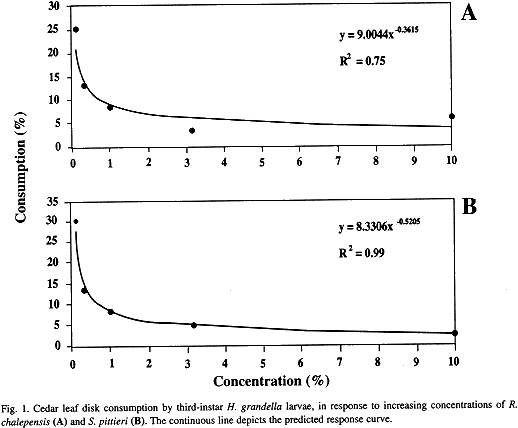
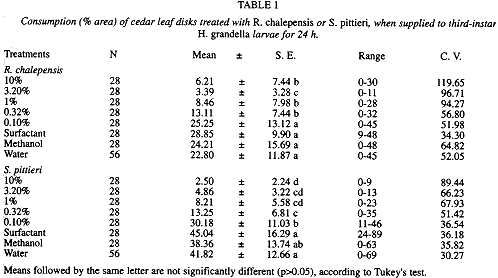
<body><![CDATA[<p><font face="Arial"><font size=-1>Disks of Spanish cedar tender foliage (2.3 cm in diameter) were cut with a cork-borer, dipped in the selected treatment for 10 sec, and allowed to dry for 30 min. Treated disks were placed individually in 30 ml glass flasks, along with a third-instar <i>H. grandella </i>larva which had been deprived of food for 3 h. A piece of paper towel was fastened with the lid of each flask and was moistened periodically, in order to retain leaf turgor.</font></font>     <p><font face="Arial"><font size=-1>A randomized complete block design, with four replications, was used. The experimental unit consistes of seven larvae, except in the control (14 larvae). Blocks were represented by plastic trays, and flasks representing each treatment were randomized within each tray.</font></font>     <p><font face="Arial"><font size=-1>After being exposed to the treatment for 24 h, each larva was transferred to a flask containing about 6 ml of artificial diet, where it was allowed to complete its development; larvae were transferred to other flasks in cases where it was judged that the diet was not suitable for their development.</font></font>     <p><font face="Arial"><font size=-1>Three types of variables were measured in response to plant extract treatinents: food consumption, mortality, and developmental effects. Food consumption was assessed for each disk, by recording the percentage of foliar area that was consumed in 24 h. This was done by means of a visual scale of the program Distrain 1.0 (Tomerlin and Howell 1988). Mortality was determined for each larva every 24 h, and the instar at which mortality occurred was recorded; cessation of movement and color change to black were the criteria used for judging mortality. Developmental effects included developmental time for each larval instar and the pupa, as well as pupal weight on the day after pupation; dates for larval moulting, moulting into pupae and adult emergence were recorded.</font></font>     <p><font face="Arial"><font size=-1>Data were analyzed by means of ANOVA procedures, and means were compared by the Tukey's test, at a significance level of a= 0.05. For leaf consumption, analyses were performed with the original data, since even after transfortnation with various approaches (the arcsin, logarithmic, and square root methods), the distribution of the data did show significant deviations from normality. In addition, regression analyses were performed for leaf consumption in response to plant extract concentrations.</font></font>     <br>&nbsp;     <p><b><font face="Arial"><font size=-1>Results</font></font></b>     <p><font face="Arial"><font size=-1><b>Food consumption: </b>In terms of leaf disk consumption by <i>H. grandella </i>larvae, there were very large differences between treatments for both common rue (F= 26.23, d.f= 7, 21, p &lt; 0.0001) and "tacaco cimarr&oacute;n" (F= 82.95. d.f= 7, 21, p &lt; 0.0001).</font></font>     <p><font face="Arial"><font size=-1>For the common rue extract, there were three groups of treatments, <b>wi&uacute;i </b>the lower consumption averages attained at the 3.16%, followed by 0.32, 1.0 and 10% concentrations, which did not differ among themselves <a href="#tab1">(Table 1)</a>. The 0.1% concentration did not differ from the<b> </b>control treatments. The response curve for the extract concentrations and leaf disk consumption was best fitted by a potencial model <a href="#img1">(Fig. 1A)</a>. For the "tacaco cimarr&oacute;n" fraction, all treatments differed from the<b> </b>control treatments, excepting the<b> </b>0.1% concentration, which did not differ from the methanol treatment <a href="#tab1">(Table 1)</a>. Leaf consumption averages decreased as concentrations increased, with the response curve being best fitted by a potential model <a href="#img1">(Fig. 1B</a>).</font></font>     <center>     ]]></body>
<body><![CDATA[<p><a NAME="tab1"></a><img SRC="/img/fbpe/rbt/v49n2/1006ta1.GIF" height=278 width=498>     
<br>&nbsp;     <br>&nbsp;     <p><a NAME="img1"></a><img SRC="/img/fbpe/rbt/v49n2/1006i1.GIF" height=428 width=518></center>      
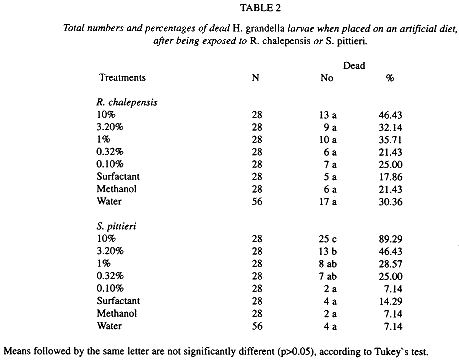
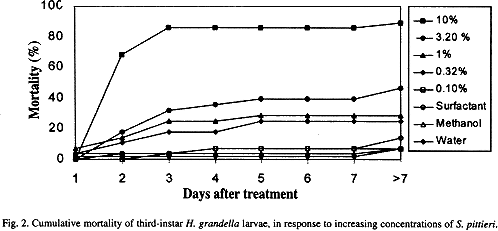
<p><font face="Arial"><font size=-1><b>Larval mortality: </b>In terms of larval mortality, there were no differences between treatments for the common rue extract (F= 1.14, d.f= 7, 21, p > 0.05). Mortality values ranged from 21-46% of the exposed larvae to common rue treatments <a href="#tab2">(Table 2</a>), with death occurring by the first day after exposure.</font></font>     <p><font face="Arial"><font size=-1>On the contrary, for the "tacaco cimarr&oacute;n" fraction, differences between treatments were very large (F= 29.21, d.f= 7, 21, p &lt; 0.0001) <a href="#tab2">(Table 2)</a>. Mortality ranged from 7-89% of the exposed larvae, with the higher values (89 and 46%) occurring at the highest 10 and 3.16% concentradons, respectively. Its value at the 10% concentration differed from the other concentrations, whereas that at 3.16% did not differ from the two subsequent lower concentrations (1 and 0.32%).</font></font>     <p><font face="Arial"><font size=-1>Even trough larval mortality occurred at different intervals, for die 10%<b> </b>concentration 68% of the larvae were dead one day after exposure, and 85% of mortality was attained by day 3 <a href="#img2">(Fig. 2)</a>. For the following three concentrations, mortality values as high as 32,25 and 17% were achieved by day 3 (at 3.16, 1.0 and 0.32%, respectively) and mortality remained quite stable from then on. In the control treatments, as well as at the 0. 1 % concentration, mortality was very low, with a maximum of 14%.</font></font>     <p><font face="Arial"><font size=-1><b>Developmental effects: </b>For the common rue extract, developmental times for both 4</font><sup><font size=-2>th</font></sup><font size=-1> (F= 0.65, d.f= 7, 21, p > 0.05) and 5</font><sup><font size=-2>th</font></sup><font size=-1> larval instars (F= 0.77, d.f.= 7, 21, p > 0.05), as well as for pupae (F= 1.07, d.f.= 7, 21, p > 0.05), did not differ between treatments. Pupal weight, which ranged from 0. 115-0.133 g, did</font></font>     <p><font face="Arial"><font size=-1>not differ between treatments (F= 0.35, d.f.= 7, 21, p > 0.05). These trends held for the "tacaco cimarr&oacute;n" fraction, with the following values: 4</font><sup><font size=-2>th</font></sup><font size=-1> instar (F= 0.45, d.f.= 7, 21, p > 0.05), 5</font><sup><font size=-2>th</font></sup><font size=-1> instar (F= 1.04, d.f= 7, 21, p > 0.05), pupae (F= 1.27, d.f.= 7, 21, p > 0.05), and pupal weight (F= 1.73, d.f.= 7, 21, p > 0.05); pupal weight values ranged from 0. 172-0.189 g.</font></font>     <center>     ]]></body>
<body><![CDATA[<p><a NAME="tab2"></a><img SRC="/img/fbpe/rbt/v49n2/1006ta2.GIF" height=360 width=459>     
<br>&nbsp;     <p><a NAME="img2"></a><img SRC="/img/fbpe/rbt/v49n2/1006i2.GIF" height=231 width=498></center>      
<p><b><font face="Arial"><font size=-1>Discussion</font></font></b>     <p><font face="Arial"><font size=-1>The selected methodological approach allowed to clearly discriminate between antifeedant and insecticidal effects in response to plant extracts, both of which were demonstrated.</font></font>     <p><font face="Arial"><font size=-1>Substances present in the common rue extract showed antifeedant activity against H. <i>grandella </i>larvae, at the highest four concentrations of this extract. Evidence of antifeedant was that at a concentration as high as 0.32% of the extract, larvae barely consumed treated leaf disks and showed low mortality once they were transferred to artificial diet. This was also shown for wood and leaf extracts of bitter<i>wood (Quassia amara, </i>Simaroubaceae) in parallel experiments (Mancebo <i>et al. 2000a). H.</i> <i>grandella </i>larvae possess deterrent receptors in a sensilla styloconica located on the maxillae (Schoonhoven 1980).</font></font>     <p><font face="Arial"><font size=-1>Antifeedant effect by common rue extracts was also demonstrated for the Colorado potato <i>beetle, Leptinotarsa decemlineata </i>(Coleoptera: Coccinellidae) 4<sup>th</sup> instar larvae and adults (Hough-Goldstein 1990), and repellency was shown for the cat flea, <i>Ctenocephalides canis</i> (Siphonaptera: Pulicidae) (Cox 1980). Common rue foliage contains a number of chemicals, such as fenilpropanoids (anethol glycol), benzenoids (anisic acid), quinoline and acridone alkaloids, terpenoids (bergamoten derivatives) and coumarins (bergapten) (Torres 1950, Vasudevan and Lukner 1968, Kong <i>et al. </i>1984), but it remains unknown if any of them are responsible for causing either antifeedant or repellent activities.</font></font>     <p><font face="Arial"><font size=-1>Concernig other effects, none of the concentrations tested affected neither development of immature stages nor pupal weight, and there was no evidence of toxicity. Richter <i>et al.</i> (1990) showed that ethanolic extracts of common rue foliage affect molting duration in the last nymphal instar of the American cockroach <i>Periplaneta americana </i>(Blattaria: Blattidae). Also, Sasanelli (1997) tested aqueous extracts of common rue foliage and roots on several nematode species and found that the former highly reduced hatching in <i>Meloidogyne spp.</i></font></font>     <p><font face="Arial"><font size=-1>In regards to the "tacaco cimarr&oacute;n" fraction, its effect in reducing leaf disk consumption at the highest concentrations was due not to antifeedant activity, but to larval mortality. Larval death occurred quickly at the highest concentration (10%), whereas at the other concentrations mortality was lower and delayed, possibly due to consumption of smaller quantities of foliage that were treated with lower concentrations of the fraction. Plant chemicals responsable for causing mortality remain unknown, although probably they are a series of glycosides known as tacacosides, which are very bitter and irritating. Six of these bayogenin saponins have been isolated from fruits and aerial parts of <i>S. pittieri and S. talamancense (Castro et al. </i>1997), in an effort to look for antiproliferative principies in neotropical plants. Cucurbitacins, which have severas kinds of activities, including toxicity and feeding deterrence (Mabry and Gill 1979), were not found in this fraction nor in the plant.</font></font>     <p><font face="Arial"><font size=-1>In summary, these findings substantiate the presence of antifeedant or toxic principles against <i>H. grandella </i>larvae, in plants belonging to families taxonomically unrelated to Meliaceae, such as Rutaceae and Cucurbitaceae, as well as in Simaroubaceae (Mancebo <i>et al. </i>2000a). Nonedieless, even pantropical Meliaceae, such as the neem tree <i>(Azadirachta indica </i>A. Juss.) harbor either growth disrupting or toxic principles against such neotropical pest (Mancebo <i>et al.</i> 2000c). <i>H. grandella </i>is a rather monophagous insect, which is restricted to at least 17 neotropical Meliaceae species (Becker 1976).</font></font>     ]]></body>
<body><![CDATA[<p><font face="Arial"><font size=-1>Those toxic principles, as well as others present in other tropical plant species (Mancebo et al. 2000b), could be a source of promising chemicals to be used either as crude extracts by resource-poor growers, or as more refined formulations. Nevertheless, the role of plant extracts in integrated pest management (IPM) programs for <i>H. grandella </i>would make sense as long as they could contribute to developing preventative management schemes for this insect. For a pest with a very stringent damage threshold (i.e. one larva per tree), like <i>H. grandella,</i> convencional chemical control is limited because of the high cost of repeated applications through many years, as well as some operational factors, such as inaccessibility of the larvae, high rainfall, and application methods (Newton <i>et al.</i>1993). Therefore, novel systemic substances preventing newly emerged larvae from entering the shoots and causing irreversible damage would be preferable.</font></font>     <p><font face="Arial"><font size=-1>Thus, if their systemic effect is demonstrated, either antifeedant or toxic substances present in common rue and "tacaco cimarr&oacute;n", respecfively, could be formulated as controlled-release materials. Some systemic insecticides, such as methomyl and carbofuran, were applied in pellet form, at planting of Spanish cedar trees, and provided complete control of <i>H. grandella </i>for several months (Allan <i>et al. </i>, 1973; Wilkins <i>et al. ,</i> 1976). Currently, there are semi-rustic methods for manufacturing these types of formulations (Richard M. Wilkins 1998, Newcastle University, England, pers. comm.), which could allow lo make low cost formulations, especially suited for small farmers in the tropics.</font></font>     <p><font face="Arial"><font size=-1>Protection from <i>H. grandella </i>is especially important during the first 5-8 years of tree development, depending on the region (Cibri&aacute;n <i>et al. </i>1995). Thus, in order to protect trees during this critical period of susceptibility, fomulated plant extracts could be applied at transplantation, in complementarity with other IPM preventative approaches, such as the deployment of tolerant genotypes, silvicultural practices, and biological control (Newton <i>et al.</i> 1993, Speight 1997, Mes&eacute;n 1999).</font></font>     <br>&nbsp;     <p><b><font face="Arial"><font size=-1>Acknowledgements</font></font></b>     <p><font face="Arial"><font size=-1>This paper is a partial result of a CATIE's M.Sc. thesis by the first author, which was funded by Fundatr&oacute;picos and IICA (Instituto Interamericano de Cooperaci&oacute;n para la Agricultura). Thanks to Bernal Valverde, Phillip J. Shannon, Carlos Vargas, Johnny P&eacute;rez, Francisco L&oacute;pez, Douglas Cubillo, Guido Sanabria, Arturo Ram&iacute;rez, Claudio Arroyo, Alfonso Gonz&aacute;lez, Marvin Hem&aacute;ndez, Manuel Carballo and Eduardo Molina (CATIE), as well as to Juan Carlos Brenes (CEPRONA), for their intellectual or logistical support.</font></font>     <br>&nbsp;     <p><b><font face="Arial"><font size=-1>Resumen</font></font></b>     <p><font face="Arial"><font size=-1>Se estudi&oacute; la actividad biol&oacute;gica de un extracto de follaje de ruda <i>(Ruta chalepensis) </i>y de una fracci&oacute;n semipurificada de "tacaco cimarr&oacute;n" <i>(Sechium pittieri) </i>sobre las larvas del gusano barrenador de las meli&aacute;ceas <i>(Hypsipyla grandella). </i>Se utiliz&oacute; un dise&ntilde;o de bloques completos al azar, con cuatro repeticiones. Durante 24 h se expusieron larvas de tercer estadio de <i>H. grandella </i>a discos de follaje de <i>Cedrela odorata </i>impregnados con cada tratamiento. Estos consistieron en disoluciones de cada extracto (0.1, 0.32, 1.0, 3.20 y 10%); posteriormente cada larva se transfiri&oacute; a un frasco que conten&iacute;a dieta artificial, donde se le permiti&oacute; completar su desarrollo. Las variables de respuesta fueron el consumo de alimento (&aacute;rea foliar comida en 24 h), la mortalidad y efectos sobre el desarrollo (tiempo de desarrollo de cada estadio larval y de la pupa, y el peso de la pupa). El extracto de ruda caus&oacute; fagodisuasi&oacute;n a una concentraci&oacute;n de apenas 0.32%, mientras que la fracci&oacute;n de "tacaco cimarr&oacute;n" provoc&oacute; toxicidad especialmente a las dos mayores concentraciones (3.20 y 10%).</font></font>     <br>&nbsp;     ]]></body>
<body><![CDATA[<p><b><font face="Arial"><font size=-1>References</font></font></b>     <p><font face="Arial"><font size=-1>Allan, G.G., R.I. Gara &amp; R.M. Wilkins. 1973. The evaluation of some systemic insecticides for the control</font></font>     <br><font face="Arial"><font size=-1>of larvae in <i>Cedrela odorata </i>L., p. 40-48. <i>In </i>P. Grijpma (ed.). Studies on the shootborer <i>Hypsipyla</i></font></font>     <br><font face="Arial"><font size=-1><i>grandella</i> (Zeller). Lep. Pyralidae. Vol I. IICA Misc. Publ. No. 101. IICA, Turrialba, Costa Rica.</font></font>     <p><font face="Arial"><font size=-1>Beeker, V.O. 1976. Microlepid&oacute;pteros asociados con <i>Carapa, Cedrela y Swietenia </i>en Costa Rica, p. 75-101. <i>In</i> J.L. Whitmore (ed.). Studies on the shootbor<i>er Hypsipyla grandella </i>(Zeller). Lep. Pyralidae. Vol II. IICA Misc. Pub&iexcl;. No. 101</font></font>     <!-- ref --><p><font face="Arial"><font size=-1>Castro, V., E. Ram&iacute;rez, G. Mora, Y. Iwase, T. Nagao, H. Okabe, H. Matsunaga, M. Katano &amp; M. Mori. Structures and antiproliferative activity of saponins from <i>Sechium pittieri and S. talamancense. Chem. </i>&amp; Pharm. Bull. 45: 349-358.</font></font>    &nbsp;&nbsp;&nbsp;&nbsp;&nbsp;&nbsp;&nbsp;&nbsp;[&#160;<a href="javascript:void(0);" onclick="javascript: window.open('/scielo.php?script=sci_nlinks&ref=1348344&pid=S0034-7744200100020000700003&lng=','','width=640,height=500,resizable=yes,scrollbars=1,menubar=yes,');">Links</a>&#160;]<!-- end-ref --><p><font face="Arial"><font size=-1>Cibri&aacute;n, D., J.T. M&eacute;ndez, R. Campos, H.0. Yates III &amp; J.E. Flores. 1995. Insectos forestales de M&eacute;xico.</font></font>     <br><font face="Arial"><font size=-1>Universidad Aut&oacute;noma de Chapingo-Comisi&oacute;n Forestal de Am&eacute;rica del Norte (COFAN). Publ. No. 6.</font></font>     <br><font face="Arial"><font size=-1>M&eacute;xico D.F., M&eacute;xico. 453 p.</font></font>     <!-- ref --><p><font face="Arial"><font size=-1>Cox, N.D. 1980. Flea treatment composition for animals. Patent-US-4,193,986 (USA). 3 p.</font></font>    &nbsp;&nbsp;&nbsp;&nbsp;&nbsp;&nbsp;&nbsp;&nbsp;[&#160;<a href="javascript:void(0);" onclick="javascript: window.open('/scielo.php?script=sci_nlinks&ref=1348348&pid=S0034-7744200100020000700005&lng=','','width=640,height=500,resizable=yes,scrollbars=1,menubar=yes,');">Links</a>&#160;]<!-- end-ref --><p><font face="Arial"><font size=-1>Grijpma, P. (ed.). 1973. Studies on the shootborer <i>Hypsipyla grandella </i>(Zeller). Lep., Pyralidae. Vol. I.</font></font>     <br><font face="Arial"><font size=-1>IICA Misc. Publ. No. 101. 91 p.</font></font>     <p><font face="Arial"><font size=-1>Grijpma, P. &amp; R. Ramalho. 1973. <i>Toona </i>spp., posibles alternativas para el problema del barrenador</font></font>     <br><font face="Arial"><font size=-1><i>Hypsipyla</i> g<i>randella </i>de las Meliaceae en Am&eacute;rica Latina, p. 3-17. <i>In </i>P. Grijpma (ed.). Studies on the</font></font>     <br><font face="Arial"><font size=-1>shootborer <i>Hypsipyla grandella </i>(Zeller). Lep. Pyralidae. Vol I. IICA Misc. Publ. No. 101. IICA, Turrialba,</font></font>     <br><font face="Arial"><font size=-1>Costa Rica.</font></font>     <p><font face="Arial"><font size=-1>Hough-Goldstein, J.A.<b> </b>1990. Antifeedant effects of common herbs on the<b> </b>colorado potato beetle</font></font>     <br><font face="Arial"><font size=-1>(Coleoptera: Chrysomelidae). Environmental Entomology 19: 234-238.</font></font>     <p><font face="Arial"><font size=-1>Isman, M.B. 1999. Neem and related natural products. p. 139-153. <i>In</i> FR. Hall &amp; JJ Menn (eds.).</font></font>     <br><font face="Arial"><font size=-1>Biopesticides: Use and delivery. New Jersey, Humana Press.</font></font>     ]]></body>
<body><![CDATA[<p><font face="Arial"><font size=-1>Kong, Y.C., C. Lau, P.P.H. But, K.F. Cheng &amp; R.C. Cambie. 1984. Quinoline alkaloids from <i>Ruta</i></font></font>     <br><font face="Arial"><font size=-1><i>chalepensis. </i>Fitoterapia 55: 67-71.</font></font>     <p><font face="Arial"><font size=-1>Mabry, T.M. &amp; J.E. Gill. 1979. Sesquiterpenene lactones and other terpenoids. p. 501-537. In G.A.</font></font>     <br><font face="Arial"><font size=-1>Rosenthal &amp; D.H. Janzen (eds.). Herbivores: Their interaction with secondary plant metabolites. New</font></font>     <br><font face="Arial"><font size=-1>York, Academic Press.</font></font>     <!-- ref --><p><font face="Arial"><font size=-1>Mancebo, E, L. Hilje, G. Mora &amp; R. Salazar. 2000a. Antifeedant activity of <i>Quassia</i> <i>amara</i> (Simaroubaceae) extracts on <i>Hypsipyla grandella</i> (Lepidoptera: Pyralidae) larvae. Crop Protection 19: 301-305.</font></font>    &nbsp;&nbsp;&nbsp;&nbsp;&nbsp;&nbsp;&nbsp;&nbsp;[&#160;<a href="javascript:void(0);" onclick="javascript: window.open('/scielo.php?script=sci_nlinks&ref=1348364&pid=S0034-7744200100020000700012&lng=','','width=640,height=500,resizable=yes,scrollbars=1,menubar=yes,');">Links</a>&#160;]<!-- end-ref --><p><font face="Arial"><font size=-1>Mancebo, F., L. Hilje, G. Mora &amp; R. Salazar. 2000b. Efecto de extractos vegetales sobre larvas de</font></font>     <br><font face="Arial"><font size=-1><i>Hypsipyla grandella. </i>Manejo Integrado de Plagas (Costa Rica) 55: 12-23.</font></font>     <p><font face="Arial"><font size=-1>Mancebo, F., L. Hilje, G. Mora &amp; R. Salazar. 2000c. Biological activity of two neem <i>(Azadirachta indica</i></font></font>     <br><font face="Arial"><font size=-1><i>A.</i> Juss., Meliaceae) products on <i>Hypsipyla grandella</i> (Lepidoptera: Pyralidae) larvae Crop Protection.</font></font>     ]]></body>
<body><![CDATA[<br><font face="Arial"><font size=-1>(Submitted).</font></font>     <!-- ref --><p><font face="Arial"><font size=-1>Mayhew, J.E. &amp; A.C. Newton. 1998. The silvicultura of mahogany. CABI Publ. Wallingford, UK. 226 p.</font></font>    &nbsp;&nbsp;&nbsp;&nbsp;&nbsp;&nbsp;&nbsp;&nbsp;[&#160;<a href="javascript:void(0);" onclick="javascript: window.open('/scielo.php?script=sci_nlinks&ref=1348370&pid=S0034-7744200100020000700015&lng=','','width=640,height=500,resizable=yes,scrollbars=1,menubar=yes,');">Links</a>&#160;]<!-- end-ref --><p><font face="Arial"><font size=-1>Mes&eacute;n, E 1999. Avances en el mejoramiento gen&eacute;tico de meli&aacute;ceas con referencia especial a Am&eacute;rica</font></font>     <br><font face="Arial"><font size=-1>Central. <i>In</i> Consulta Mesoarnericana sobre Conservaci&oacute;n de Recursos Gen&eacute;ticos Forestales, con Enfasis</font></font>     <br><font face="Arial"><font size=-1>Especial en Meli&aacute;ceas. REDCA. San Salvador, El Salvador. 19 p. (Manuscript).</font></font>     <p><font face="Arial"><font size=-1>Newton, A.C., P Baker, S. Ramnarine, J.F<b>. </b>Mes&eacute;n &amp; R.R.B. Leakey. 1993. The mahogany shoot borer:</font></font>     <br><font face="Arial"><font size=-1>Prospects for control. Forest Ecol. Manag. 57: 301-328.</font></font>     <p><font face="Arial"><font size=-1>Richter, K., R. Nothlich, A. Stacke &amp; H. Penzlin. 1990. Moulting inhibiting effect of extracts from</font></font>     <br><font face="Arial"><font size=-1>Rutaceac in the cockroach <i>Periplaneta americana. </i>Zool. Jahr., Abt. Allgem. Zool. &amp; Physiol. Tiere 94:</font></font>     <br><font face="Arial"><font size=-1>63-72.</font></font>     ]]></body>
<body><![CDATA[<!-- ref --><p><font face="Arial"><font size=-1>Sasanelli, N. 1997. Perspectives for the use of nematicidal plants. Rev. Suisse Agric. 29: 157-158.</font></font>    &nbsp;&nbsp;&nbsp;&nbsp;&nbsp;&nbsp;&nbsp;&nbsp;[&#160;<a href="javascript:void(0);" onclick="javascript: window.open('/scielo.php?script=sci_nlinks&ref=1348379&pid=S0034-7744200100020000700019&lng=','','width=640,height=500,resizable=yes,scrollbars=1,menubar=yes,');">Links</a>&#160;]<!-- end-ref --><p><font face="Arial"><font size=-1>Schabel, H., L. Hilje, K.S.S. Nair &amp; R.V. Varma. 1999. Economic entomology in tropical forest</font></font>     <br><font face="Arial"><font size=-1>plantations: An update. Jour. Trop. For. Sci. 11: 303-315.</font></font>     <!-- ref --><p><font face="Arial"><font size=-1>Schoonhoven, L.M. 1982. Biological aspects of antifeedants. Entomol. exp. et applic. 31: 57-69.</font></font>    &nbsp;&nbsp;&nbsp;&nbsp;&nbsp;&nbsp;&nbsp;&nbsp;[&#160;<a href="javascript:void(0);" onclick="javascript: window.open('/scielo.php?script=sci_nlinks&ref=1348382&pid=S0034-7744200100020000700021&lng=','','width=640,height=500,resizable=yes,scrollbars=1,menubar=yes,');">Links</a>&#160;]<!-- end-ref --><p><font face="Arial"><font size=-1>Schoonhoven, L.M. 1982. Perception of azadirachtin by some tepidopterous larvae. p. 105-108. <i>In</i> H.</font></font>     <br><font face="Arial"><font size=-1>Schmutterer, K.R.S. Ascher &amp; H. Rembold, (eds.). Natural pesticides from the neem tree <i>(Azadirachta</i></font></font>     <br><font face="Arial"><font size=-1><i>indica </i>A. Juss). GTZ. Eschborn, Germany.</font></font>     <p><font face="Arial"><font size=-1>Speight, M.R. 1997. Forest pests in the tropics: Current status and future threats. p. 207-227. <i>In</i></font></font>     <br><font face="Arial"><font size=-1>A.D.Watt, N.E. Stork &amp; M.D. Hunter (eds.). Forest and insects. London., Chapman &amp; Hall.</font></font>     <p><font face="Arial"><font size=-1>Tomerlin, J.R. &amp; T. Howell. 1988. DISTRAIN: A computer program for training people to estimate disease</font></font>     ]]></body>
<body><![CDATA[<br><font face="Arial"><font size=-1>severity on cereal leaves. Plant Dis. 72: 455 459.</font></font>     <p><font face="Arial"><font size=-1>Torres, J.C. 1950. Pharmacognostic study of rue leaf- Its principle component rutoside and essence.</font></font>     <br><font face="Arial"><font size=-1>Farmacognosia 10: 275-361.</font></font>     <p><font face="Arial"><font size=-1>Vasudevan, T.N. &amp; M. Lukner. 1968. Alkaloids from <i>Ruta</i> <i>angustifolia, Ruta chalepensis and Ruta</i></font></font>     <br><font face="Arial"><font size=-1><i>Montana.</i> Pharmazie 23: 520-526.</font></font>     <p><font face="Arial"><font size=-1>Whitmore, J. L. (ed.). 1976a. Studies on the shootborer <i>Hypsipyla Arandella </i>(Zeller). Lep., Pyralidac. Vol.</font></font>     <br><font face="Arial"><font size=-1>Il. IICA Misc. Publ. No. 101. 139 p.</font></font>     <p><font face="Arial"><font size=-1>Whitmore, J. L. (ed.). 1976b. Studies on the shootborer <i>Hypsipyla grandella </i>(Zeller). Lep., Pyralidae.</font></font>     <br><font face="Arial"><font size=-1>Vol. III. IICA Misc. Publ. No. 101. 116 p.</font></font>     <p><font face="Arial"><font size=-1>Wilkins, R.M., G.G. Allan &amp; R.I. Gara. 1976. Protection of Spanish cedar with controlled release</font></font>     ]]></body>
<body><![CDATA[<br><font face="Arial"><font size=-1>insecticidas. p. 63-70. <i>In</i> J.L. Whitmore (ed.). Studies on the shootborer <i>Hypsipyla grandella </i>(Zeller). Lep.</font></font>     <br><font face="Arial"><font size=-1>Pyralidae. Vol III. IICA Misc. Publ. No. 1. IICA, Turrialba, Costa Rica.</font></font>     <br>&nbsp;     <p><a NAME="1a"></a><font face="Arial"><sup><font size=-2><a href="#1">1</a></font></sup><font size=-1> Fertilizantes Qu&iacute;micos Dominicanos (FERQUIDO). Santo Domingo, Dominican Republic.</font></font>     <p><a NAME="2a"></a><font face="Arial"><sup><font size=-2><a href="#2*">2</a></font></sup><font size=-1> Unidad de Fitoprotecci&oacute;n, CATIE. Turrialba, Costa Rica.</font></font>     <p><a NAME="3ab"></a><font face="Arial"><sup><font size=-2><a href="#3a">3</a></font></sup><font size=-1> Centro de Investigaci&oacute;n en Productos Naturales (CIPRONA). Universidad de Costa Rica.</font></font>     <p><a NAME="4a"></a><font face="Arial"><sup><font size=-2><a href="#4">4</a></font></sup><font size=-1> Proyecto de Semillas Forestales (PROSEFOR). CATIE. Turrialba, Costa Rica.</font></font>     <br><font face="Arial"><font size=-1>Address for correspondence: Unidad de Fitoprotecci&oacute;n, CATIE. Turrialba, Costa Rica.</font></font>     <br><font face="Arial"><font size=-1>Fax (506) 556-0606, lhilje@catie.ac.cr</font></font>      ]]></body><back>
<ref-list>
<ref id="B1">
<nlm-citation citation-type="book">
<person-group person-group-type="author">
<name>
<surname><![CDATA[Allan]]></surname>
<given-names><![CDATA[G.G.]]></given-names>
</name>
<name>
<surname><![CDATA[Gara]]></surname>
<given-names><![CDATA[R.I.]]></given-names>
</name>
<name>
<surname><![CDATA[Wilkins]]></surname>
<given-names><![CDATA[R.M.]]></given-names>
</name>
</person-group>
<article-title xml:lang="en"><![CDATA[The evaluation of some systemic insecticides for the control of larvae in Cedrela odorata L.]]></article-title>
<person-group person-group-type="editor">
<name>
<surname><![CDATA[Grijpma]]></surname>
<given-names><![CDATA[P.]]></given-names>
</name>
</person-group>
<source><![CDATA[Studies on the shootborer Hypsipyla grandella (Zeller): Lep. Pyralidae]]></source>
<year>1973</year>
<volume>I</volume>
<page-range>40-48</page-range><publisher-loc><![CDATA[Turrialba ]]></publisher-loc>
<publisher-name><![CDATA[IICA]]></publisher-name>
</nlm-citation>
</ref>
<ref id="B2">
<nlm-citation citation-type="">
<person-group person-group-type="author">
<name>
<surname><![CDATA[Beeker]]></surname>
<given-names><![CDATA[V.O.]]></given-names>
</name>
</person-group>
<article-title xml:lang="es"><![CDATA[Microlepidópteros asociados con Carapa, Cedrela y Swietenia en Costa Rica]]></article-title>
<person-group person-group-type="editor">
<name>
<surname><![CDATA[Whitmore]]></surname>
<given-names><![CDATA[J.L.]]></given-names>
</name>
</person-group>
<source><![CDATA[Studies on the shootborer Hypsipyla grandella (Zeller): Lep. Pyralidae]]></source>
<year>1976</year>
<volume>II</volume>
<page-range>75-101</page-range></nlm-citation>
</ref>
<ref id="B3">
<nlm-citation citation-type="journal">
<person-group person-group-type="author">
<name>
<surname><![CDATA[Castro]]></surname>
<given-names><![CDATA[V.]]></given-names>
</name>
<name>
<surname><![CDATA[Ramírez]]></surname>
<given-names><![CDATA[E.]]></given-names>
</name>
<name>
<surname><![CDATA[Mora]]></surname>
<given-names><![CDATA[G.]]></given-names>
</name>
<name>
<surname><![CDATA[Iwase]]></surname>
<given-names><![CDATA[Y.]]></given-names>
</name>
<name>
<surname><![CDATA[Nagao]]></surname>
<given-names><![CDATA[T.]]></given-names>
</name>
<name>
<surname><![CDATA[Okabe]]></surname>
<given-names><![CDATA[H.]]></given-names>
</name>
<name>
<surname><![CDATA[Matsunaga]]></surname>
<given-names><![CDATA[H.]]></given-names>
</name>
<name>
<surname><![CDATA[Katano]]></surname>
<given-names><![CDATA[M.]]></given-names>
</name>
<name>
<surname><![CDATA[Mori]]></surname>
<given-names><![CDATA[M.]]></given-names>
</name>
</person-group>
<article-title xml:lang="en"><![CDATA[Structures and antiproliferative activity of saponins from Sechium pittieri and S. talamancense]]></article-title>
<source><![CDATA[Chem. & Pharm. Bull]]></source>
<year></year>
<volume>45</volume>
<page-range>349-358</page-range></nlm-citation>
</ref>
<ref id="B4">
<nlm-citation citation-type="book">
<person-group person-group-type="author">
<name>
<surname><![CDATA[Cibrián]]></surname>
<given-names><![CDATA[D.]]></given-names>
</name>
<name>
<surname><![CDATA[Méndez]]></surname>
<given-names><![CDATA[J.T.]]></given-names>
</name>
<name>
<surname><![CDATA[Campos]]></surname>
<given-names><![CDATA[R.]]></given-names>
</name>
<name>
<surname><![CDATA[Yates III]]></surname>
<given-names><![CDATA[H.0.]]></given-names>
</name>
<name>
<surname><![CDATA[Flores]]></surname>
<given-names><![CDATA[J.E.]]></given-names>
</name>
</person-group>
<source><![CDATA[Insectos forestales de México]]></source>
<year>1995</year>
<volume>6</volume>
<page-range>453</page-range><publisher-name><![CDATA[Universidad Autónoma de Chapingo-Comisión Forestal de América del Norte (COFAN)]]></publisher-name>
</nlm-citation>
</ref>
<ref id="B5">
<nlm-citation citation-type="">
<person-group person-group-type="author">
<name>
<surname><![CDATA[Cox]]></surname>
<given-names><![CDATA[N.D.]]></given-names>
</name>
</person-group>
<source><![CDATA[Flea treatment composition for animals]]></source>
<year>1980</year>
<page-range>3</page-range></nlm-citation>
</ref>
<ref id="B6">
<nlm-citation citation-type="book">
<person-group person-group-type="author">
<name>
<surname><![CDATA[Grijpma]]></surname>
<given-names><![CDATA[P.]]></given-names>
</name>
</person-group>
<source><![CDATA[Studies on the shootborer Hypsipyla grandella (Zeller): Lep., Pyralidae]]></source>
<year>1973</year>
<volume>I</volume>
<page-range>91</page-range><publisher-name><![CDATA[IICA Misc. Publ. No. 101]]></publisher-name>
</nlm-citation>
</ref>
<ref id="B7">
<nlm-citation citation-type="book">
<person-group person-group-type="author">
<name>
<surname><![CDATA[Grijpma]]></surname>
<given-names><![CDATA[P.]]></given-names>
</name>
<name>
<surname><![CDATA[Ramalho]]></surname>
<given-names><![CDATA[R.]]></given-names>
</name>
</person-group>
<article-title xml:lang="es"><![CDATA[Toona spp., posibles alternativas para el problema del barrenador Hypsipyla grandella de las Meliaceae en América Latina]]></article-title>
<person-group person-group-type="editor">
<name>
<surname><![CDATA[Grijpma]]></surname>
<given-names><![CDATA[P.]]></given-names>
</name>
</person-group>
<source><![CDATA[Studies on the shootborer Hypsipyla grandella (Zeller): Lep. Pyralidae]]></source>
<year>1973</year>
<volume>I</volume>
<page-range>3-17</page-range><publisher-loc><![CDATA[Turrialba ]]></publisher-loc>
<publisher-name><![CDATA[IICA]]></publisher-name>
</nlm-citation>
</ref>
<ref id="B8">
<nlm-citation citation-type="journal">
<person-group person-group-type="author">
<name>
<surname><![CDATA[Hough-Goldstein]]></surname>
<given-names><![CDATA[J.A.]]></given-names>
</name>
</person-group>
<article-title xml:lang="en"><![CDATA[Antifeedant effects of common herbs on the colorado potato beetle (Coleoptera: Chrysomelidae)]]></article-title>
<source><![CDATA[Environmental Entomology]]></source>
<year>1990</year>
<volume>19</volume>
<page-range>234-238</page-range></nlm-citation>
</ref>
<ref id="B9">
<nlm-citation citation-type="book">
<person-group person-group-type="author">
<name>
<surname><![CDATA[Isman]]></surname>
<given-names><![CDATA[M.B.]]></given-names>
</name>
</person-group>
<article-title xml:lang="en"><![CDATA[Neem and related natural products]]></article-title>
<person-group person-group-type="editor">
<name>
<surname><![CDATA[Hall]]></surname>
<given-names><![CDATA[FR.]]></given-names>
</name>
<name>
<surname><![CDATA[Menn]]></surname>
<given-names><![CDATA[JJ]]></given-names>
</name>
</person-group>
<source><![CDATA[Biopesticides: Use and delivery]]></source>
<year>1999</year>
<page-range>139-153</page-range><publisher-loc><![CDATA[New Jersey ]]></publisher-loc>
<publisher-name><![CDATA[Humana Press]]></publisher-name>
</nlm-citation>
</ref>
<ref id="B10">
<nlm-citation citation-type="journal">
<person-group person-group-type="author">
<name>
<surname><![CDATA[Kong]]></surname>
<given-names><![CDATA[Y.C.]]></given-names>
</name>
<name>
<surname><![CDATA[Lau]]></surname>
<given-names><![CDATA[C.]]></given-names>
</name>
<name>
<surname><![CDATA[But]]></surname>
<given-names><![CDATA[P.P.H.]]></given-names>
</name>
<name>
<surname><![CDATA[Cheng]]></surname>
<given-names><![CDATA[K.F.]]></given-names>
</name>
<name>
<surname><![CDATA[Cambie]]></surname>
<given-names><![CDATA[R.C.]]></given-names>
</name>
</person-group>
<article-title xml:lang="en"><![CDATA[Quinoline alkaloids from Ruta chalepensis]]></article-title>
<source><![CDATA[Fitoterapia]]></source>
<year>1984</year>
<volume>55</volume>
<page-range>67-71</page-range></nlm-citation>
</ref>
<ref id="B11">
<nlm-citation citation-type="book">
<person-group person-group-type="author">
<name>
<surname><![CDATA[Mabry]]></surname>
<given-names><![CDATA[T.M.]]></given-names>
</name>
<name>
<surname><![CDATA[Gill]]></surname>
<given-names><![CDATA[J.E.]]></given-names>
</name>
</person-group>
<article-title xml:lang="en"><![CDATA[Sesquiterpenene lactones and other terpenoids]]></article-title>
<person-group person-group-type="editor">
<name>
<surname><![CDATA[Rosenthal]]></surname>
<given-names><![CDATA[G.A.]]></given-names>
</name>
<name>
<surname><![CDATA[Janzen]]></surname>
<given-names><![CDATA[D.H.]]></given-names>
</name>
</person-group>
<source><![CDATA[Herbivores: Their interaction with secondary plant metabolites]]></source>
<year>1979</year>
<page-range>501-537</page-range><publisher-loc><![CDATA[New York ]]></publisher-loc>
<publisher-name><![CDATA[Academic Press]]></publisher-name>
</nlm-citation>
</ref>
<ref id="B12">
<nlm-citation citation-type="journal">
<person-group person-group-type="author">
<name>
<surname><![CDATA[Mancebo]]></surname>
<given-names><![CDATA[E]]></given-names>
</name>
<name>
<surname><![CDATA[Hilje]]></surname>
<given-names><![CDATA[L.]]></given-names>
</name>
<name>
<surname><![CDATA[Mora]]></surname>
<given-names><![CDATA[G.]]></given-names>
</name>
<name>
<surname><![CDATA[Salazar]]></surname>
<given-names><![CDATA[R.]]></given-names>
</name>
</person-group>
<article-title xml:lang="en"><![CDATA[Antifeedant activity of Quassia amara (Simaroubaceae) extracts on Hypsipyla grandella (Lepidoptera: Pyralidae) larvae]]></article-title>
<source><![CDATA[Crop Protection]]></source>
<year>2000</year>
<volume>19</volume>
<page-range>301-305</page-range></nlm-citation>
</ref>
<ref id="B13">
<nlm-citation citation-type="journal">
<person-group person-group-type="author">
<name>
<surname><![CDATA[Mancebo]]></surname>
<given-names><![CDATA[F.]]></given-names>
</name>
<name>
<surname><![CDATA[Hilje]]></surname>
<given-names><![CDATA[L.]]></given-names>
</name>
<name>
<surname><![CDATA[Mora]]></surname>
<given-names><![CDATA[G.]]></given-names>
</name>
<name>
<surname><![CDATA[Salazar]]></surname>
<given-names><![CDATA[R.]]></given-names>
</name>
</person-group>
<article-title xml:lang="es"><![CDATA[Efecto de extractos vegetales sobre larvas de Hypsipyla grandella]]></article-title>
<source><![CDATA[Manejo Integrado de Plagas]]></source>
<year>2000</year>
<volume>55</volume>
<page-range>12-23</page-range></nlm-citation>
</ref>
<ref id="B14">
<nlm-citation citation-type="">
<person-group person-group-type="author">
<name>
<surname><![CDATA[Mancebo]]></surname>
<given-names><![CDATA[F.]]></given-names>
</name>
<name>
<surname><![CDATA[Hilje]]></surname>
<given-names><![CDATA[L.]]></given-names>
</name>
<name>
<surname><![CDATA[Mora]]></surname>
<given-names><![CDATA[G.]]></given-names>
</name>
<name>
<surname><![CDATA[Salazar]]></surname>
<given-names><![CDATA[R.]]></given-names>
</name>
</person-group>
<source><![CDATA[Biological activity of two neem (Azadirachta indica A. Juss., Meliaceae) products on Hypsipyla grandella (Lepidoptera: Pyralidae) larvae Crop Protection]]></source>
<year>2000</year>
</nlm-citation>
</ref>
<ref id="B15">
<nlm-citation citation-type="book">
<person-group person-group-type="author">
<name>
<surname><![CDATA[Mayhew]]></surname>
<given-names><![CDATA[J.E.]]></given-names>
</name>
<name>
<surname><![CDATA[Newton]]></surname>
<given-names><![CDATA[A.C.]]></given-names>
</name>
</person-group>
<source><![CDATA[The silvicultura of mahogany]]></source>
<year>1998</year>
<page-range>226</page-range><publisher-loc><![CDATA[Wallingford ]]></publisher-loc>
<publisher-name><![CDATA[CABI Publ.]]></publisher-name>
</nlm-citation>
</ref>
<ref id="B16">
<nlm-citation citation-type="book">
<person-group person-group-type="author">
<name>
<surname><![CDATA[Mesén]]></surname>
<given-names><![CDATA[E]]></given-names>
</name>
</person-group>
<article-title xml:lang="en"><![CDATA[Avances en el mejoramiento genético de meliáceas con referencia especial a América Central]]></article-title>
<source><![CDATA[Consulta Mesoarnericana sobre Conservación de Recursos Genéticos Forestales, con Enfasis Especial en Meliáceas]]></source>
<year>1999</year>
<volume>19</volume>
<publisher-loc><![CDATA[San Salvador ]]></publisher-loc>
<publisher-name><![CDATA[REDCA]]></publisher-name>
</nlm-citation>
</ref>
<ref id="B17">
<nlm-citation citation-type="journal">
<person-group person-group-type="author">
<name>
<surname><![CDATA[Newton]]></surname>
<given-names><![CDATA[A.C.]]></given-names>
</name>
<name>
<surname><![CDATA[Baker]]></surname>
<given-names><![CDATA[P]]></given-names>
</name>
<name>
<surname><![CDATA[Ramnarine]]></surname>
<given-names><![CDATA[S.]]></given-names>
</name>
<name>
<surname><![CDATA[Mesén]]></surname>
<given-names><![CDATA[J.F.]]></given-names>
</name>
<name>
<surname><![CDATA[Leakey]]></surname>
<given-names><![CDATA[R.R.B.]]></given-names>
</name>
</person-group>
<article-title xml:lang="en"><![CDATA[The mahogany shoot borer: Prospects for control]]></article-title>
<source><![CDATA[Forest Ecol. Manag]]></source>
<year>1993</year>
<volume>57</volume>
<page-range>301-328</page-range></nlm-citation>
</ref>
<ref id="B18">
<nlm-citation citation-type="journal">
<person-group person-group-type="author">
<name>
<surname><![CDATA[Richter]]></surname>
<given-names><![CDATA[K.]]></given-names>
</name>
<name>
<surname><![CDATA[Nothlich]]></surname>
<given-names><![CDATA[R.]]></given-names>
</name>
<name>
<surname><![CDATA[Stacke]]></surname>
<given-names><![CDATA[A.]]></given-names>
</name>
<name>
<surname><![CDATA[Penzlin]]></surname>
<given-names><![CDATA[H.]]></given-names>
</name>
</person-group>
<article-title xml:lang="en"><![CDATA[Moulting inhibiting effect of extracts from Rutaceac in the cockroach Periplaneta americana]]></article-title>
<source><![CDATA[Zool. Jahr., Abt. Allgem. Zool. & Physiol. Tiere]]></source>
<year>1990</year>
<volume>94</volume>
<page-range>63-72</page-range></nlm-citation>
</ref>
<ref id="B19">
<nlm-citation citation-type="journal">
<person-group person-group-type="author">
<name>
<surname><![CDATA[Sasanelli]]></surname>
<given-names><![CDATA[N.]]></given-names>
</name>
</person-group>
<article-title xml:lang="en"><![CDATA[Perspectives for the use of nematicidal plants]]></article-title>
<source><![CDATA[Rev. Suisse Agric.]]></source>
<year>1997</year>
<volume>29</volume>
<page-range>157-158</page-range></nlm-citation>
</ref>
<ref id="B20">
<nlm-citation citation-type="journal">
<person-group person-group-type="author">
<name>
<surname><![CDATA[Schabel]]></surname>
<given-names><![CDATA[H.]]></given-names>
</name>
<name>
<surname><![CDATA[Hilje]]></surname>
<given-names><![CDATA[L.]]></given-names>
</name>
<name>
<surname><![CDATA[Nair]]></surname>
<given-names><![CDATA[K.S.S.]]></given-names>
</name>
<name>
<surname><![CDATA[Varma]]></surname>
<given-names><![CDATA[R.V.]]></given-names>
</name>
</person-group>
<article-title xml:lang="en"><![CDATA[Economic entomology in tropical forest plantations: An update]]></article-title>
<source><![CDATA[Jour. Trop. For. Sci]]></source>
<year>1999</year>
<volume>11</volume>
<page-range>303-315</page-range></nlm-citation>
</ref>
<ref id="B21">
<nlm-citation citation-type="journal">
<person-group person-group-type="author">
<name>
<surname><![CDATA[Schoonhoven]]></surname>
<given-names><![CDATA[L.M.]]></given-names>
</name>
</person-group>
<article-title xml:lang="en"><![CDATA[Biological aspects of antifeedants]]></article-title>
<source><![CDATA[Entomol. exp. et applic]]></source>
<year>1982</year>
<volume>31</volume>
<page-range>57-69</page-range></nlm-citation>
</ref>
<ref id="B22">
<nlm-citation citation-type="book">
<person-group person-group-type="author">
<name>
<surname><![CDATA[Schoonhoven]]></surname>
<given-names><![CDATA[L.M.]]></given-names>
</name>
</person-group>
<article-title xml:lang="en"><![CDATA[Perception of azadirachtin by some tepidopterous larvae]]></article-title>
<person-group person-group-type="editor">
<name>
<surname><![CDATA[Schmutterer]]></surname>
<given-names><![CDATA[H.]]></given-names>
</name>
<name>
<surname><![CDATA[Ascher]]></surname>
<given-names><![CDATA[K.R.S.]]></given-names>
</name>
<name>
<surname><![CDATA[Rembold]]></surname>
<given-names><![CDATA[H.]]></given-names>
</name>
</person-group>
<source><![CDATA[Natural pesticides from the neem tree (Azadirachta indica A. Juss)]]></source>
<year>1982</year>
<page-range>105-108</page-range><publisher-loc><![CDATA[Eschborn ]]></publisher-loc>
<publisher-name><![CDATA[GTZ]]></publisher-name>
</nlm-citation>
</ref>
<ref id="B23">
<nlm-citation citation-type="book">
<person-group person-group-type="author">
<name>
<surname><![CDATA[Speight]]></surname>
<given-names><![CDATA[M.R.]]></given-names>
</name>
</person-group>
<article-title xml:lang="en"><![CDATA[Forest pests in the tropics: Current status and future threats]]></article-title>
<person-group person-group-type="editor">
<name>
<surname><![CDATA[Watt]]></surname>
<given-names><![CDATA[A.D.]]></given-names>
</name>
<name>
<surname><![CDATA[Stork]]></surname>
<given-names><![CDATA[N.E.]]></given-names>
</name>
<name>
<surname><![CDATA[Hunter]]></surname>
<given-names><![CDATA[M.D.]]></given-names>
</name>
</person-group>
<source><![CDATA[Forest and insects]]></source>
<year>1997</year>
<page-range>207-227</page-range><publisher-loc><![CDATA[London ]]></publisher-loc>
<publisher-name><![CDATA[Chapman & Hall]]></publisher-name>
</nlm-citation>
</ref>
<ref id="B24">
<nlm-citation citation-type="journal">
<person-group person-group-type="author">
<name>
<surname><![CDATA[Tomerlin]]></surname>
<given-names><![CDATA[J.R.]]></given-names>
</name>
<name>
<surname><![CDATA[Howell]]></surname>
<given-names><![CDATA[T.]]></given-names>
</name>
</person-group>
<article-title xml:lang="en"><![CDATA[DISTRAIN: A computer program for training people to estimate disease severity on cereal leaves]]></article-title>
<source><![CDATA[Plant Dis]]></source>
<year>1988</year>
<volume>72</volume>
<page-range>455 459</page-range></nlm-citation>
</ref>
<ref id="B25">
<nlm-citation citation-type="journal">
<person-group person-group-type="author">
<name>
<surname><![CDATA[Torres]]></surname>
<given-names><![CDATA[J.C.]]></given-names>
</name>
</person-group>
<article-title xml:lang="en"><![CDATA[Pharmacognostic study of rue leaf- Its principle component rutoside and essence]]></article-title>
<source><![CDATA[Farmacognosia]]></source>
<year>1950</year>
<volume>10</volume>
<page-range>275-361</page-range></nlm-citation>
</ref>
<ref id="B26">
<nlm-citation citation-type="journal">
<person-group person-group-type="author">
<name>
<surname><![CDATA[Vasudevan]]></surname>
<given-names><![CDATA[T.N.]]></given-names>
</name>
<name>
<surname><![CDATA[Lukner]]></surname>
<given-names><![CDATA[M.]]></given-names>
</name>
</person-group>
<article-title xml:lang="en"><![CDATA[Alkaloids from Ruta angustifolia, Ruta chalepensis and Ruta Montana]]></article-title>
<source><![CDATA[Pharmazie]]></source>
<year>1968</year>
<volume>23</volume>
<page-range>520-526</page-range></nlm-citation>
</ref>
<ref id="B27">
<nlm-citation citation-type="book">
<person-group person-group-type="author">
<name>
<surname><![CDATA[Whitmore]]></surname>
<given-names><![CDATA[J. L.]]></given-names>
</name>
</person-group>
<source><![CDATA[Studies on the shootborer Hypsipyla Arandella (Zeller)]]></source>
<year>1976</year>
<volume>Il</volume>
<page-range>139</page-range><publisher-name><![CDATA[Lep., Pyralidac]]></publisher-name>
</nlm-citation>
</ref>
<ref id="B28">
<nlm-citation citation-type="book">
<person-group person-group-type="author">
<name>
<surname><![CDATA[Whitmore]]></surname>
<given-names><![CDATA[J. L.]]></given-names>
</name>
</person-group>
<source><![CDATA[Studies on the shootborer Hypsipyla grandella (Zeller): Lep., Pyralidae]]></source>
<year>1976</year>
<volume>III</volume>
<page-range>116</page-range><publisher-name><![CDATA[IICA Misc. Publ No. 101]]></publisher-name>
</nlm-citation>
</ref>
<ref id="B29">
<nlm-citation citation-type="book">
<person-group person-group-type="author">
<name>
<surname><![CDATA[Wilkins]]></surname>
<given-names><![CDATA[R.M.]]></given-names>
</name>
<name>
<surname><![CDATA[Allan]]></surname>
<given-names><![CDATA[G.G.]]></given-names>
</name>
<name>
<surname><![CDATA[Gara]]></surname>
<given-names><![CDATA[R.I.]]></given-names>
</name>
</person-group>
<article-title xml:lang="en"><![CDATA[Protection of Spanish cedar with controlled release insecticidas]]></article-title>
<person-group person-group-type="editor">
<name>
<surname><![CDATA[Whitmore]]></surname>
<given-names><![CDATA[J.L.]]></given-names>
</name>
</person-group>
<source><![CDATA[Studies on the shootborer Hypsipyla grandella (Zeller): Lep. Pyralidae]]></source>
<year>1976</year>
<volume>III</volume>
<page-range>63-70</page-range><publisher-loc><![CDATA[Turrialba ]]></publisher-loc>
<publisher-name><![CDATA[IICA]]></publisher-name>
</nlm-citation>
</ref>
</ref-list>
</back>
</article>