<?xml version="1.0" encoding="ISO-8859-1"?><article xmlns:mml="http://www.w3.org/1998/Math/MathML" xmlns:xlink="http://www.w3.org/1999/xlink" xmlns:xsi="http://www.w3.org/2001/XMLSchema-instance">
<front>
<journal-meta>
<journal-id>0034-7744</journal-id>
<journal-title><![CDATA[Revista de Biología Tropical]]></journal-title>
<abbrev-journal-title><![CDATA[Rev. biol. trop]]></abbrev-journal-title>
<issn>0034-7744</issn>
<publisher>
<publisher-name><![CDATA[Universidad de Costa Rica]]></publisher-name>
</publisher>
</journal-meta>
<article-meta>
<article-id>S0034-77442001000100033</article-id>
<title-group>
<article-title xml:lang="es"><![CDATA[Dos nuevas especies de Phrynopus(Anura: Leptodactylidae) de los bosques nublados de Bolivia]]></article-title>
</title-group>
<contrib-group>
<contrib contrib-type="author">
<name>
<surname><![CDATA[Aguayo Vedia]]></surname>
<given-names><![CDATA[Cidar Rodrigo]]></given-names>
</name>
<xref ref-type="aff" rid="A01"/>
</contrib>
<contrib contrib-type="author">
<name>
<surname><![CDATA[Harvey]]></surname>
<given-names><![CDATA[Michael B.]]></given-names>
</name>
<xref ref-type="aff" rid="A02"/>
</contrib>
</contrib-group>
<aff id="A01">
<institution><![CDATA[,Universidad Mayor de San Simón Unidad de Biodiversidad y Genética ]]></institution>
<addr-line><![CDATA[Cochabamba ]]></addr-line>
<country>Bolivia</country>
</aff>
<aff id="A02">
<institution><![CDATA[,Tennessee State University Department of Biological Sciences ]]></institution>
<addr-line><![CDATA[ ]]></addr-line>
</aff>
<pub-date pub-type="pub">
<day>00</day>
<month>03</month>
<year>2001</year>
</pub-date>
<pub-date pub-type="epub">
<day>00</day>
<month>03</month>
<year>2001</year>
</pub-date>
<volume>49</volume>
<numero>1</numero>
<fpage>333</fpage>
<lpage>345</lpage>
<copyright-statement/>
<copyright-year/>
<self-uri xlink:href="http://www.scielo.sa.cr/scielo.php?script=sci_arttext&amp;pid=S0034-77442001000100033&amp;lng=en&amp;nrm=iso"></self-uri><self-uri xlink:href="http://www.scielo.sa.cr/scielo.php?script=sci_abstract&amp;pid=S0034-77442001000100033&amp;lng=en&amp;nrm=iso"></self-uri><self-uri xlink:href="http://www.scielo.sa.cr/scielo.php?script=sci_pdf&amp;pid=S0034-77442001000100033&amp;lng=en&amp;nrm=iso"></self-uri><abstract abstract-type="short" xml:lang="en"><p><![CDATA[We describe two new species of Phrynopus from cloud forests in Cochabamba, Bolivia. The new species are assigned to the P. peruanus group and are characterized by the presence of basal webbing, distinctive coloration, and by having the first finger shorter than the second. The first of these new species was collected near Montepunko in Parque Nacional Carrasco and is known from eight males and six females. Among its distinctive characteristics are round cream-colored glands on its flanks. A second species is known from one male and one female collected near "Zona de Aguirre" near the northwest border of the park. V and X-shaped blotches and a dorsum that is smooth except for dorsolateral and scapular folds characterize this species. Musculature has rarely been described for species of Phrynopus. The species from Montepunko has unusual gular and thigh musculature that is quite unlike other species of the genus.]]></p></abstract>
<abstract abstract-type="short" xml:lang="es"><p><![CDATA[Se describe dos nuevas especies de Phrynopus de la Ceja de monte Yungueña de Cochabamba, Bolivia, P. adenopleurus y P. iatamasi. Ambas especies son asignables al grupo peruanus y se diferencian de las otras cuatro especies que existen en el país por presentar el primer dedo más corto que el segundo, tener membrana basal y por sus colores y diseños dorsales y ventrales. La musculatura ha sido pocas veces descrita para especies de Phrynopus. Phrynopus adenopleurus, especie nueva, posee una inusual musculatura mandibular y del muslo, muy poco parecida a lo descrito para otras especies del género.]]></p></abstract>
<kwd-group>
<kwd lng="en"><![CDATA[Phrynopus]]></kwd>
<kwd lng="en"><![CDATA[Anura]]></kwd>
<kwd lng="en"><![CDATA[Leptodactylidae]]></kwd>
<kwd lng="en"><![CDATA[new species]]></kwd>
<kwd lng="en"><![CDATA[Bolivia]]></kwd>
<kwd lng="en"><![CDATA[musculature]]></kwd>
</kwd-group>
</article-meta>
</front><body><![CDATA[ <CENTER><B><FONT FACE="Arial,Helvetica">Dos nuevas especies de Phrynopus(Anura: Leptodactylidae) de los bosques nublados de Bolivia</FONT></B></CENTER> <FONT FACE="Arial,Helvetica"><FONT SIZE=-1>&nbsp;</FONT></FONT>     <BR><FONT FACE="Arial,Helvetica"><FONT SIZE=-1>&nbsp;</FONT></FONT>     <BR><FONT FACE="Arial,Helvetica"><FONT SIZE=-1>Cidar Rodrigo Aguayo Vedia<SUP><A HREF="#A1">1</A></SUP> &amp; Michael B. Harvey<A NAME="R1"></A><SUP><A HREF="#A1">2</A></SUP></FONT></FONT>     <BR><FONT FACE="Arial,Helvetica"><FONT SIZE=-1></FONT></FONT>&nbsp;<FONT FACE="Arial,Helvetica"><FONT SIZE=-1></FONT></FONT>      <P><FONT FACE="Arial,Helvetica"><FONT SIZE=-1>Recibido 25-VIII-1999. Corregido 17-VII-2000.&nbsp; Aceptado 9-VIII-2000.</FONT></FONT><FONT FACE="Arial,Helvetica"><FONT SIZE=-1></FONT></FONT>      <P><B><FONT FACE="Arial,Helvetica"><FONT SIZE=-1>Abstract</FONT></FONT></B><FONT FACE="Arial,Helvetica"><FONT SIZE=-1></FONT></FONT>      <P><FONT FACE="Arial,Helvetica"><FONT SIZE=-1>We describe two new species of <I>Phrynopus</I> from cloud forests in Cochabamba, Bolivia. The new species are assigned to the <I>P. peruanus</I> group and are characterized by the presence of basal webbing, distinctive coloration, and by having the first finger shorter than the second. The first of these new species was collected near Montepunko in Parque Nacional Carrasco and is known from eight males and six females. Among its distinctive characteristics are round cream-colored glands on its flanks. A second species is known from one male and one female collected near “Zona de Aguirre” near the northwest border of the park. V and X-shaped blotches and a dorsum that is smooth except for dorsolateral and scapular folds characterize this species. Musculature has rarely been described for species of <I>Phrynopus</I>. The species from Montepunko has unusual gular and thigh musculature that is quite unlike other species of the genus.</FONT></FONT><FONT FACE="Arial,Helvetica"><FONT SIZE=-1></FONT></FONT>      <P><FONT FACE="Arial,Helvetica"><FONT SIZE=-1><B>Key words</B>: <I>Phrynopus</I>, Anura, Leptodactylidae, new species, Bolivia, musculature.</FONT></FONT><FONT FACE="Arial,Helvetica"><FONT SIZE=-1></FONT></FONT>      <P><FONT FACE="Arial,Helvetica"><FONT SIZE=-1>&nbsp;</FONT></FONT><FONT FACE="Arial,Helvetica"><FONT SIZE=-1></FONT></FONT>      <P><FONT FACE="Arial,Helvetica"><FONT SIZE=-1>De las 22 especies conocidas actualmente dentro el g&eacute;nero <I>Phrynopus </I>(<A HREF="#Ardila">Ardila-Robayo <I>et al. </I>1996</A>, <A HREF="#Harvey">Harvey &amp; Ergueta 1998</A>),<I> </I>cuatro especies habitan en los bosques nublados de la “ceja de monte” de Bolivia. Hasta hace una d&eacute;cada, solamente una especie de este g&eacute;nero estaba registrada para Bolivia,<I> P. laplacai</I> (<A HREF="#Cei">Cei 1968</A>). Recientemente, gracias al aumento progresivo de la investigaci&oacute;n y prospecci&oacute;n herpetol&oacute;gica en Bolivia, se han descrito y registrado m&aacute;s especies de estas ranas leptodact&iacute;lidas: <I>P.kempffi</I> fue descrito por <A HREF="#DelaRiva">De la Riva (1992)</A><I>, </I><A HREF="#Kohler">K&ouml;hler (1995)</A><I> </I>cita para Bolivia <I>P. peruvianus </I>y recientemente <A HREF="#Harvey">Harvey &amp; Ergueta (1998)</A> describieron <I>P. pinguis.</I></FONT></FONT><FONT FACE="Arial,Helvetica"><FONT SIZE=-1></FONT></FONT>      ]]></body>
<body><![CDATA[<P><FONT FACE="Arial,Helvetica"><FONT SIZE=-1>Durante el trabajo de campo del estudio ecol&oacute;gico de la herpetofauna del Parque Nacional Carrasco, se encontraron ejemplares correspondientes a dos especies, peque&ntilde;as, hasta ahora no descritas de <I>Phrynopus</I>. En el presente trabajo damos nombre a estas nuevas especies.</FONT></FONT>     <BR>    <BR> <B><FONT FACE="Arial,Helvetica"><FONT SIZE=-1>Materiales y m&eacute;todos</FONT></FONT></B>     <BR><B><FONT FACE="Arial,Helvetica"><FONT SIZE=-1>&nbsp;</FONT></FONT></B>     <BR><FONT FACE="Arial,Helvetica"><FONT SIZE=-1>La terminolog&iacute;a, medidas y caracteres empleados en la descripci&oacute;n siguen a <A HREF="#Lynch75">Lynch (1975, 1986)</A>.</FONT></FONT><FONT FACE="Arial,Helvetica"><FONT SIZE=-1></FONT></FONT>      <P><FONT FACE="Arial,Helvetica"><FONT SIZE=-1>Las medidas fueron tomadas usando un calibrador de 0.02 mm de sensibilidad bajo estereomicroscopio. El sexo y madurez fueron determinados por la presencia de hendiduras vocales desarrollados y/o la presencia de huevos desarrollados en los ovarios.</FONT></FONT><FONT FACE="Arial,Helvetica"><FONT SIZE=-1></FONT></FONT>      <P><FONT FACE="Arial,Helvetica"><FONT SIZE=-1>En la secci&oacute;n de anatom&iacute;a interna, mencionamos la forma de algunos m&uacute;sculos y nervios que nos interesan y que son variables dentro los leptodact&iacute;lidos. Para la observaci&oacute;n m&uacute;sculos y nervios, usamos la tinci&oacute;n reversible de azul de metileno (en etanol al 70%) bajo un estereomicroscopio. <A HREF="#Lynch93">Lynch (1993)</A> discuti&oacute; la definici&oacute;n de haces y f&oacute;rmulas empleados por <A HREF="#Starrett">Starrett (1968)</A>, <A HREF="#Savage">Savage (1987)</A> y <A HREF="#Griffith54">Griffith (1954, 1963)</A> para definir n&uacute;mero de haces y sus tama&ntilde;os relativos. No empleamos f&oacute;rmulas, y estamos de acuerdo con <A HREF="#Lynch93">Lynch (1993)</A> en que las f&oacute;rmulas implican homolog&iacute;as que no existen. Usamos el termino “haz” sensu Lynch para referirnos a or&iacute;genes de los mismos que est&aacute;n bien separados y sin las fibras adyacentes. No definimos un haz solamente porque tiene su origen en alg&uacute;n elemento diferente que el resto del m&uacute;sculo.</FONT></FONT><FONT FACE="Arial,Helvetica"><FONT SIZE=-1></FONT></FONT>      <P><FONT FACE="Arial,Helvetica"><FONT SIZE=-1>Los ejemplares examinados, la localidad de procedencia y los n&uacute;meros de los museos se detallan en el Ap&eacute;ndice. Abreviaciones de colecciones: MHNC, Museo de Historia Natural de Cochabamba, Bolivia; UTA, University of Texas at Arlington, EE.UU.</FONT></FONT><FONT FACE="Arial,Helvetica"><FONT SIZE=-1></FONT></FONT>      <P><B><FONT FACE="Arial,Helvetica"><FONT SIZE=-1>Resultados</FONT></FONT></B><FONT FACE="Arial,Helvetica"><FONT SIZE=-1></FONT></FONT>      <P><I><FONT FACE="Arial,Helvetica"><FONT SIZE=-1>Phrynopus adenopleurus<B> </B></FONT></FONT></I><FONT FACE="Arial,Helvetica"><FONT SIZE=-1>sp. nov., (<A HREF="#fig1">Fig. 1</A>)</FONT></FONT><FONT FACE="Arial,Helvetica"><FONT SIZE=-1></FONT></FONT>      ]]></body>
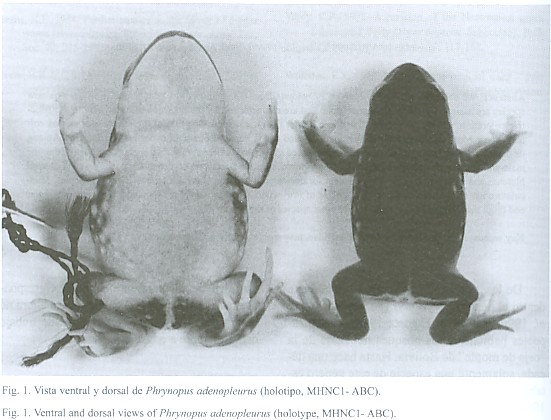
<body><![CDATA[<P><FONT FACE="Arial,Helvetica"><FONT SIZE=-1><B>Holotipo: </B>MHNC 1-ABC, macho adulto recolectado a 10 km al N de la poblaci&oacute;n de Monte Punko (Parque Nacional Carrasco), departamento de Cochabamba, Bolivia (17&deg; 33’ S, 65&deg; 17’ O), a 3350 m, por C. Rodrigo Aguayo V. y Elva Villegas N., el 25 de febrero de 1997.</FONT></FONT><FONT FACE="Arial,Helvetica"><FONT SIZE=-1></FONT></FONT>      <P><FONT FACE="Arial,Helvetica"><FONT SIZE=-1><B>Paratopotipos: </B>MHNC-1ABA-ABB-ABD-ABE-ABF-ABH-ABJ-ABN-ABM (cinco machos, cuatro hembras). UTA.52478-52481 (dos hembras y dos machos), todos recolectados en la localidad tipo por C. Rodrigo Aguayo V. y Elva Villegas N., en febrero y marzo de 1997.</FONT></FONT><FONT FACE="Arial,Helvetica"><FONT SIZE=-1></FONT></FONT>      <P><FONT FACE="Arial,Helvetica"><FONT SIZE=-1><B>Diagnosis:</B> Una especie peque&ntilde;a del g&eacute;nero <I>Phrynopus </I>(m&aacute;ximo de 21.72 mm de longitud rostro-cloacal LRC) caracterizada por la siguiente combinaci&oacute;n de caracteres: 1) piel dorsal lisa y piel ventral tenuemente rugosa; 2) primer dedo de la mano m&aacute;s corto que el segundo; 3) extremos de los dedos escasamente dilatados, no expandidos lateralmente; 4) membrana basal presente entre los dedos de las patas; rebordes cut&aacute;neos ausentes; 5) dos tub&eacute;rculos metatarsales de igual tama&ntilde;o, el interno redondeado y el externo ligeramente ovalado; 6) tub&eacute;rculo y pliegue tarsal ausentes; 7) t&iacute;mpano presente, oculto bajo la piel; 8) rostro redondeado en vista dorsal y lateral; 9) saco y hendiduras vocales presentes; 10) dientes vomerianos y procesos dent&iacute;geros ausentes; 11) dorso caf&eacute;-gris&aacute;ceo oscuro con manchas glandulares redondas de color crema-blanquecino en los flancos; 12) vientre color crema.</FONT></FONT><FONT FACE="Arial,Helvetica"><FONT SIZE=-1></FONT></FONT>      <P><FONT FACE="Arial,Helvetica"><FONT SIZE=-1><I>Phrynopus adenopleurus</I> es la &uacute;nica especie del g&eacute;nero, con una hilera de gl&aacute;ndulas en los flancos. Es asignable al grupo <I>peruanus</I> (<A HREF="#Lynch75">Lynch, 1975</A>). Se distingue de las otras especies del grupo que no habitan en Bolivia por tener el t&iacute;mpano oculto bajo la piel (contra t&iacute;mpano ausente en<I> P. cophites</I>, t&iacute;mpano parcialmente oculto en <I>P. wettsteini</I> y t&iacute;mpano visible y prominente en <I>P. peruanus</I>.). De <I>P. montium</I>, la nueva especie se distingue por tener los tub&eacute;rculos metatarsales del mismo tama&ntilde;o (contra tub&eacute;rculo metatarsal interno mucho m&aacute;s grande que el externo).</FONT></FONT><FONT FACE="Arial,Helvetica"><FONT SIZE=-1></FONT></FONT>      <P><FONT FACE="Arial,Helvetica"><FONT SIZE=-1>En Bolivia se han registrado cuatro especies del g&eacute;nero <I>Phrynopus</I>; de las que la nueva especie difiere (en adici&oacute;n a las gl&aacute;ndulas laterales) por la siguiente combinaci&oacute;n de caracteres externos: <I>P. adenopleurus </I>se diferencia de <I>P. laplacai </I>por tener (<I>P. laplacai</I> entre par&eacute;ntesis) tama&ntilde;o peque&ntilde;o, 13.38- 21.88 mm de LRC (tama&ntilde;o mediano, 24.8-33.4 mm de LRC, ver <A HREF="#Ergueta">Ergueta, 1993</A>); piel dorsal lisa (piel dorsal rugosa); primer dedo de la mano m&aacute;s corto que el segundo (primer dedo m&aacute;s largo que el segundo); rostro redondeado en vista lateral (rostro truncado en vista lateral); membrana basal presente (sin membrana basal); se distingue de <I>P. peruvianus</I> por las siguientes caracter&iacute;sticas: primer dedo m&aacute;s corto que el segundo (primer dedo poco m&aacute;s largo o igual que el segundo), membrana basal presente (sin membrana basal), ausencia de tub&eacute;rculos en el tarso (con tub&eacute;rculo tarsal interno), t&iacute;mpano oculto bajo la piel (t&iacute;mpano parcialmente oculto bajo la piel), rostro redondeado en vista lateral (rostro truncado en vista lateral), y dientes vomerianos ausentes (dientes vomerianos presentes); se diferencia de <I>P. kempffi </I>por: rostro redondeado en vista lateral (rostro inclinado en vista lateral), membrana basal presente (sin membrana basal), dorso (en vivo) color gris&aacute;ceo oscuro (dorso caf&eacute;-rojizo), y vientre color crema oscuro con peque&ntilde;os gr&aacute;nulos de color naranja (vientre color crema con manchas blancas y/o negras). Esta nueva especie se distingue de <I>P. pinguis </I>(a la que es m&aacute;s parecida) por tener cabeza m&aacute;s angosta que el cuerpo (cabeza del mismo ancho que el cuerpo); color dorsal (en alcohol) caf&eacute;-gris&aacute;ceo oscuro (dorso gris cenizo) y vientre color crema (vientre gris-cenizo).</FONT></FONT>     <BR><FONT FACE="Arial,Helvetica"><FONT SIZE=-1>&nbsp;</FONT></FONT>     <CENTER><A NAME="fig1"></A><IMG SRC="/img/fbpe/rbt/v49n1/2351i01.JPG" HEIGHT=420 WIDTH=551></CENTER> <FONT FACE="Arial,Helvetica"><FONT SIZE=-1>&nbsp;</FONT></FONT>     
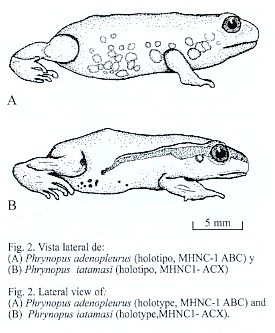
<BR><FONT FACE="Arial,Helvetica"><FONT SIZE=-1><B>Descripci&oacute;n del holotipo: </B>Un macho adulto que posee las siguientes dimensiones (en mm): LRC 17.44; longitud cef&aacute;lica (desde la comisura bucal a la punta del rostro) 4.18; ancho de la cabeza (a nivel de la comisura bucal) 5.74; distancia interorbital 1.56; distancia ojo-narina (desde el &aacute;ngulo anterior de la &oacute;rbita al extremo anterior de la narina) 1.26; di&aacute;metro anteroposterior de la &oacute;rbita 1.84; ancho del p&aacute;rpado superior 1.34; longitud de la tibia 4.78; largo de la pata (desde el extremo distal del tub&eacute;rculo metatarsal interno hasta el punto distal del cuarto dedo) 4.80.</FONT></FONT><FONT FACE="Arial,Helvetica"><FONT SIZE=-1></FONT></FONT>      <P><FONT FACE="Arial,Helvetica"><FONT SIZE=-1>Cuerpo robusto, cabeza m&aacute;s angosta que el cuerpo; cabeza m&aacute;s ancha que larga: longitud cef&aacute;lica equivalente al 72.8 % del ancho de la cabeza y al 24% de la LRC; rostro redondeado en vista dorsal y lateral; crestas craneales ausentes; regi&oacute;n interorbital plana; narinas externas ovoides, no prominentes, localizadas a igual distancia del extremo rostral que del &aacute;ngulo anterior de la &oacute;rbita; canto rostral ligeramente c&oacute;ncavo en vista dorsal y obtuso en corte transversal; regi&oacute;n loreal ligeramente c&oacute;ncava, apenas ensanchada hacia los labios superiores, los cuales son tenuemente abultados; t&iacute;mpano oculto bajo la piel, apenas distinguible externamente por una depresi&oacute;n en la regi&oacute;n temporal; pliegue supratimp&aacute;nico poco prominente; lengua carnosa, ovalada, m&aacute;s larga que ancha y libre en su tercio posterior; coanas muy peque&ntilde;as (di&aacute;metro &lt;0.1mm), redondeadas, ubicadas en los bordes anterolaterales del palatino y separadas entre s&iacute; por 1.6 mm; saco vocal con piel rugosa; hendiduras vocales ubicadas poco antes de la comisura bucal; dientes vomerianos y procesos dent&iacute;geros ausentes; piel dorsal de la cabeza, tronco y miembros lisa, con gl&aacute;ndulas redondeadas distribuidas en la regi&oacute;n lateral del tronco hasta la parte anterior de la ingle (<A HREF="#fig2">Fig. 2</A>); piel ventral tenuemente rugosa; pliegue discoidal ausente.</FONT></FONT>     <BR><FONT FACE="Arial,Helvetica"><FONT SIZE=-1>&nbsp;</FONT></FONT>     ]]></body>
<body><![CDATA[<CENTER><A NAME="fig2"></A><IMG SRC="/img/fbpe/rbt/v49n1/2351i02.JPG" HEIGHT=333 WIDTH=275></CENTER>      
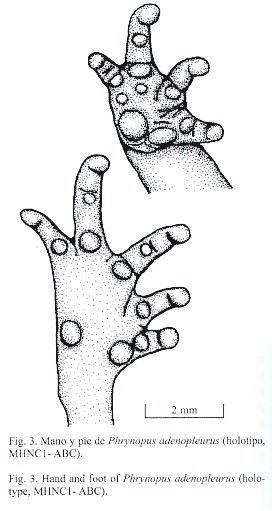
<CENTER>&nbsp;</CENTER>      <CENTER><A NAME="fig3"></A><IMG SRC="/img/fbpe/rbt/v49n1/2351i03.JPG" HEIGHT=511 WIDTH=272></CENTER> <FONT FACE="Arial,Helvetica"><FONT SIZE=-1></FONT></FONT>      
<P><FONT FACE="Arial,Helvetica"><FONT SIZE=-1>Extremidades, manos y patas cortas; las manos y las patas de aspecto obeso; longitud de la tibia equivalente al 99.58% del largo de la pata; tub&eacute;rculo palmar redondeado y casi dos veces m&aacute;s grande que el tenar<I> </I>ovalado (<A HREF="#fig3">Fig 3</A>); tub&eacute;rculos subarticulares planos, redondeados y simples; tub&eacute;rculo subarticular distal presente en dedo III; subarticulares</FONT></FONT><FONT FACE="Arial,Helvetica"><FONT SIZE=-1></FONT></FONT>      <P><FONT FACE="Arial,Helvetica"><FONT SIZE=-1>distales en dedos I, II y IV ausentes u ocultos por la apariencia hinchada de la mano; dos tub&eacute;rculos supernumerarios se distinguen entre el tub&eacute;rculo palmar y los tub&eacute;rculos subarticulares del cuarto y tercer dedo; el tub&eacute;rculo supernumerario del cuarto dedo equivalente a casi la mitad del tama&ntilde;o del tub&eacute;rculo subarticular adyacente; el supernumerio adyacente al tercer dedo equivalente a 1/3 del tama&ntilde;o del subarticular de ese dedo; extremos digitales escasamente dilatados, pero no expandidos lateralmente; membrana basal presente; cuando se juntan, primer dedo m&aacute;s corto que el segundo; largo relativo de los dedos: III > IV > II > I.</FONT></FONT><FONT FACE="Arial,Helvetica"><FONT SIZE=-1></FONT></FONT>      <P><FONT FACE="Arial,Helvetica"><FONT SIZE=-1>Tub&eacute;rculos y pliegue tarsal ausentes; tub&eacute;rculos metatarsales aproximadamente del mismo tama&ntilde;o, planos (<A HREF="#fig3">Fig. 3</A>), externo ligeramente ovalado, interno redondeado; tub&eacute;rculos supernumerarios ausentes; tub&eacute;rculos subarticulares proximales redondeados y planos; tub&eacute;rculos subarticulares distales apenas visibles en dedos III y IV, aparentemente ausentes en dedos I, II y V; tub&eacute;rculo metatarsal interno pr&oacute;ximo al subarticular del primer dedo; membrana basal gruesa entre los dedos de los pies; longitud relativa de los dedos del pie, de mayor a menor, IV>III>V>II>I.</FONT></FONT><FONT FACE="Arial,Helvetica"><FONT SIZE=-1></FONT></FONT>      <P><FONT FACE="Arial,Helvetica"><FONT SIZE=-1><B>Color en alcohol: </B>Superficies dorsales de la cabeza, cuerpo y extremidades caf&eacute;-gris&aacute;ceo, gl&aacute;ndulas de los flancos de color crema-blanquecino; l&iacute;nea mediodorsal clara desde la regi&oacute;n sacra hasta la cloaca (bordea completamente la cloaca), donde se divide y contin&uacute;a en la regi&oacute;n posterior de cada muslo; regi&oacute;n inguinal crema; extremos distales de los dedos (manos y patas) crema en vista dorsal (los dedos IV y V de la pata gris&aacute;ceos); superficies de la regi&oacute;n abdominal, pectoral y de los miembros anteriores crema; regi&oacute;n gular y precloacal caf&eacute; claro; palmas de color crema; plantas en la parte posterior de color caf&eacute; oscuro.</FONT></FONT><FONT FACE="Arial,Helvetica"><FONT SIZE=-1></FONT></FONT>      <P><FONT FACE="Arial,Helvetica"><FONT SIZE=-1><B>Color en vida:</B> Superficies expuestas gris oscuro, con gl&aacute;ndulas redondas crema-blanquecino en los flancos y puntas de los dedos (manos y patas) naranja rojizo; ventralmente, la regi&oacute;n gular, las palmas y las plantas naranja rojizo; el vientre crema oscuro con peque&ntilde;as granulaciones rojizas dispersas; superficies ventrales de brazos y piernas gris oscuro.</FONT></FONT><FONT FACE="Arial,Helvetica"><FONT SIZE=-1></FONT></FONT>      <P><FONT FACE="Arial,Helvetica"><FONT SIZE=-1><B>Variaci&oacute;n:</B> El color y dise&ntilde;o del dorso pueden variar desde caf&eacute; claro (presente en siete individuos), caf&eacute;-gris&aacute;ceo (tres individuos) hasta una coloraci&oacute;n m&aacute;s oscura (gris oscuro en tres individuos). La l&iacute;nea vertebral es variable en presencia y tama&ntilde;o; est&aacute; ausente en siete individuos y es incompleta como en el holotipo y en dos paratipos. En tres paratipos, la l&iacute;nea vertebral se extiende desde la regi&oacute;n internasal y continua a la regi&oacute;n cloacal; en un individuo, la l&iacute;nea vertebral parte desde la regi&oacute;n media del cuerpo y contin&uacute;a hasta la regi&oacute;n cloacal.</FONT></FONT><FONT FACE="Arial,Helvetica"><FONT SIZE=-1></FONT></FONT>      <P><FONT FACE="Arial,Helvetica"><FONT SIZE=-1>Ventralmente, la mancha preanal est&aacute; ausente en siete individuos, y la coloraci&oacute;n caf&eacute; en la regi&oacute;n gular se desvanece o reduce quedando s&oacute;lo un color crema oscuro, crema amarillento o crema blanquecino en todos los individuos, exceptuando un individuo macho que tiene la regi&oacute;n gular de color caf&eacute; oscuro. En vivo, los individuos capturados presentaban variaci&oacute;n de las manchas glandulares de los flancos que iban desde amarillo suave hasta naranja rojizo.</FONT></FONT><FONT FACE="Arial,Helvetica"><FONT SIZE=-1></FONT></FONT>      ]]></body>
<body><![CDATA[<P><FONT FACE="Arial,Helvetica"><FONT SIZE=-1>Externamente, los individuos machos carecen de caracteres sexuales secundarios (como, callosidades o desarrollo del antebrazo), pero tienen dos hendiduras vocales grandes ubicadas poco antes de la comisura vocal. <I>Phrynopus adenonopleurus</I> posee un saco vocal simple que se extiende posteriormente hasta el nivel de la axila. Al parecer, los individuos machos poseen el vientre m&aacute;s fuertemente rugosa que las hembras. Variaci&oacute;n morfol&oacute;gica de <I>P. adenopleurus</I> se presenta en el <A HREF="#cuadro1">Cuadro 1</A>.</FONT></FONT>     <BR><FONT FACE="Arial,Helvetica"><FONT SIZE=-1>&nbsp;</FONT></FONT>     <CENTER><A NAME="cuadro1"></A><FONT FACE="Arial,Helvetica"><FONT SIZE=-1>CUADRO 1</FONT></FONT></CENTER>      <CENTER><FONT FACE="Arial,Helvetica"><FONT SIZE=-1><I>Proporciones morfom&eacute;tricas de dos especies de </I>Phrynopus<I>. Para </I>Phrynopus adenopleurus<I> &aacute;mbitos est&aacute;n seguidos por promedios &plusmn; desviaci&oacute;n estandard; proporciones del holotipo de </I>P. iatamasi<I> est&aacute;n seguidos por los proporciones del paratopotipo.</I></FONT></FONT></CENTER>      <CENTER><FONT FACE="Arial,Helvetica"><FONT SIZE=-1>&nbsp;</FONT></FONT></CENTER>      <CENTER><FONT FACE="Arial,Helvetica"><FONT SIZE=-1>TABLE 1</FONT></FONT></CENTER>      <CENTER><FONT FACE="Arial,Helvetica"><FONT SIZE=-1><I>Morphometric ratios of two species of </I>Phrynopus. <I>For </I>Phrynopus adenopleurus,<I> ranges are followed by means &plusmn; standart deviations; ratios o thef holotype of </I>P. Iatamasi are <I>followed by ratios of the paratopotype.</I></FONT></FONT></CENTER> <FONT FACE="Arial,Helvetica"><FONT SIZE=-1>&nbsp;</FONT></FONT>     <CENTER><TABLE BORDER=0 CELLSPACING=4 CELLPADDING=0 WIDTH="70%" > <TR> <TD VALIGN=TOP WIDTH="247" class="Normal">     <DIV style="TEXT-ALIGN: justify"><B><FONT FACE="Arial,Helvetica"><FONT SIZE=-1>Medidas/Especies</FONT></FONT></B></DIV> </TD>  <TD VALIGN=TOP COLSPAN="2" WIDTH="228" class="Normal">     <DIV style="TEXT-ALIGN: justify"><B><I><FONT FACE="Arial,Helvetica"><FONT SIZE=-1>P. adenopleurus</FONT></FONT></I></B></DIV> </TD>  <TD VALIGN=TOP COLSPAN="2" WIDTH="115" class="Normal">     ]]></body>
<body><![CDATA[<DIV style="TEXT-ALIGN: justify"><B><I><FONT FACE="Arial,Helvetica"><FONT SIZE=-1>P. iatamasi&nbsp;</FONT></FONT></I></B></DIV> </TD> </TR>  <TR> <TD VALIGN=TOP WIDTH="247" class="Normal"><FONT FACE="Arial,Helvetica"><FONT SIZE=-1>&nbsp;</FONT></FONT></TD>  <TD VALIGN=TOP WIDTH="114" class="Normal">     <DIV style="TEXT-ALIGN: justify">     <CENTER><FONT FACE="Arial,Helvetica"><FONT SIZE=-1>Machos (N=8)</FONT></FONT></CENTER> </DIV> </TD>  <TD VALIGN=TOP COLSPAN="2" WIDTH="114" class="Normal">     <DIV style="TEXT-ALIGN: justify">     <CENTER><FONT FACE="Arial,Helvetica"><FONT SIZE=-1>Hembras (N=6)</FONT></FONT></CENTER> </DIV> </TD>  <TD VALIGN=TOP WIDTH="114" class="Normal"><FONT FACE="Arial,Helvetica"><FONT SIZE=-1>&nbsp;</FONT></FONT></TD> </TR>  <TR> <TD VALIGN=TOP WIDTH="247" class="Normal">     <DIV style="TEXT-ALIGN: justify"><FONT FACE="Arial,Helvetica"><FONT SIZE=-1>Longitud Rostro-Cloacal (mm)</FONT></FONT></DIV> </TD>  <TD VALIGN=TOP WIDTH="114" class="Normal">     <DIV style="TEXT-ALIGN: justify">     <CENTER><FONT FACE="Arial,Helvetica"><FONT SIZE=-1>12.84 – 17.44</FONT></FONT></CENTER> </DIV> </TD>  <TD VALIGN=TOP COLSPAN="2" WIDTH="114" class="Normal">     <DIV style="TEXT-ALIGN: justify">     <CENTER><FONT FACE="Arial,Helvetica"><FONT SIZE=-1>14.6 – 21.88</FONT></FONT></CENTER> </DIV> </TD>  <TD VALIGN=TOP WIDTH="114" class="Normal">     ]]></body>
<body><![CDATA[<DIV style="TEXT-ALIGN: justify">     <CENTER><FONT FACE="Arial,Helvetica"><FONT SIZE=-1>16.48, 15.74</FONT></FONT></CENTER> </DIV> </TD> </TR>  <TR> <TD VALIGN=TOP WIDTH="247" class="Normal">     <DIV style="TEXT-ALIGN: justify"><FONT FACE="Arial,Helvetica"><FONT SIZE=-1>Longitud Cephalica/Ancho de la Cabeza</FONT></FONT></DIV> </TD>  <TD VALIGN=TOP WIDTH="114" class="Normal">     <DIV style="TEXT-ALIGN: justify">     <CENTER><FONT FACE="Arial,Helvetica"><FONT SIZE=-1>69 – 84%</FONT></FONT></CENTER> </DIV>      <CENTER><FONT FACE="Arial,Helvetica"><FONT SIZE=-1>(75 &plusmn; 4)</FONT></FONT></CENTER> </TD>  <TD VALIGN=TOP COLSPAN="2" WIDTH="114" class="Normal">     <DIV style="TEXT-ALIGN: justify">     <CENTER><FONT FACE="Arial,Helvetica"><FONT SIZE=-1>65 – 81%</FONT></FONT></CENTER> </DIV>      <CENTER><FONT FACE="Arial,Helvetica"><FONT SIZE=-1>(73 &plusmn; 6)</FONT></FONT></CENTER> </TD>  <TD VALIGN=TOP WIDTH="114" class="Normal">     <DIV style="TEXT-ALIGN: justify">     ]]></body>
<body><![CDATA[<CENTER><FONT FACE="Arial,Helvetica"><FONT SIZE=-1>82%, 75%</FONT></FONT></CENTER> </DIV> </TD> </TR>  <TR> <TD VALIGN=TOP WIDTH="247" class="Normal">     <DIV style="TEXT-ALIGN: justify"><FONT FACE="Arial,Helvetica"><FONT SIZE=-1>Ancho del P&aacute;rpado/Distancia Interorbital</FONT></FONT></DIV> </TD>  <TD VALIGN=TOP WIDTH="114" class="Normal">     <DIV style="TEXT-ALIGN: justify">     <CENTER><FONT FACE="Arial,Helvetica"><FONT SIZE=-1>59 – 86%</FONT></FONT></CENTER> </DIV>      <CENTER><FONT FACE="Arial,Helvetica"><FONT SIZE=-1>(69 &plusmn; 8)</FONT></FONT></CENTER> </TD>  <TD VALIGN=TOP COLSPAN="2" WIDTH="114" class="Normal">     <DIV style="TEXT-ALIGN: justify">     <CENTER><FONT FACE="Arial,Helvetica"><FONT SIZE=-1>62 – 100%</FONT></FONT></CENTER> </DIV>      <CENTER><FONT FACE="Arial,Helvetica"><FONT SIZE=-1>(76 &plusmn; 13)</FONT></FONT></CENTER> </TD>  <TD VALIGN=TOP WIDTH="114" class="Normal">     <DIV style="TEXT-ALIGN: justify">     <CENTER><FONT FACE="Arial,Helvetica"><FONT SIZE=-1>54%, 44%</FONT></FONT></CENTER> </DIV> </TD> </TR>  <TR> <TD VALIGN=TOP WIDTH="247" class="Normal">     ]]></body>
<body><![CDATA[<DIV style="TEXT-ALIGN: justify"><FONT FACE="Arial,Helvetica"><FONT SIZE=-1>Distancia Ojo-Narina/Di&aacute;metro de la Orbita</FONT></FONT></DIV> </TD>  <TD VALIGN=TOP WIDTH="114" class="Normal">     <DIV style="TEXT-ALIGN: justify">     <CENTER><FONT FACE="Arial,Helvetica"><FONT SIZE=-1>68 – 93%</FONT></FONT></CENTER> </DIV>      <CENTER><FONT FACE="Arial,Helvetica"><FONT SIZE=-1>(80 &plusmn; 10)</FONT></FONT></CENTER> </TD>  <TD VALIGN=TOP COLSPAN="2" WIDTH="114" class="Normal">     <DIV style="TEXT-ALIGN: justify">     <CENTER><FONT FACE="Arial,Helvetica"><FONT SIZE=-1>59 – 85%</FONT></FONT></CENTER> </DIV>      <CENTER><FONT FACE="Arial,Helvetica"><FONT SIZE=-1>(77 &plusmn; 9)</FONT></FONT></CENTER> </TD>  <TD VALIGN=TOP WIDTH="114" class="Normal">     <DIV style="TEXT-ALIGN: justify">     <CENTER><FONT FACE="Arial,Helvetica"><FONT SIZE=-1>76%, 73%</FONT></FONT></CENTER> </DIV> </TD> </TR>  <TR> <TD VALIGN=TOP WIDTH="247" class="Normal">     <DIV style="TEXT-ALIGN: justify"><FONT FACE="Arial,Helvetica"><FONT SIZE=-1>Longitud Tibial/Largo de la Pata</FONT></FONT></DIV> </TD>  <TD VALIGN=TOP WIDTH="114" class="Normal">     ]]></body>
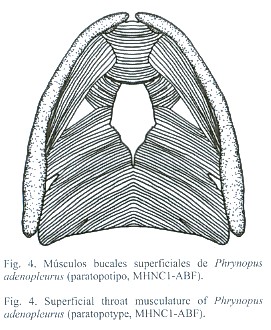
<body><![CDATA[<DIV style="TEXT-ALIGN: justify">     <CENTER><FONT FACE="Arial,Helvetica"><FONT SIZE=-1>94 - 115%</FONT></FONT></CENTER> </DIV>      <CENTER><FONT FACE="Arial,Helvetica"><FONT SIZE=-1>(100 &plusmn; 8)</FONT></FONT></CENTER> </TD>  <TD VALIGN=TOP COLSPAN="2" WIDTH="114" class="Normal">     <DIV style="TEXT-ALIGN: justify">     <CENTER><FONT FACE="Arial,Helvetica"><FONT SIZE=-1>90 – 105%</FONT></FONT></CENTER> </DIV>      <CENTER><FONT FACE="Arial,Helvetica"><FONT SIZE=-1>(96 &plusmn; 6)</FONT></FONT></CENTER> </TD>  <TD VALIGN=TOP WIDTH="114" class="Normal">     <DIV style="TEXT-ALIGN: justify">     <CENTER><FONT FACE="Arial,Helvetica"><FONT SIZE=-1>96%, 92%</FONT></FONT></CENTER> </DIV> </TD> </TR> </TABLE></CENTER>      <CENTER>&nbsp;</CENTER> <FONT FACE="Arial,Helvetica"><FONT SIZE=-1></FONT></FONT>      <P><FONT FACE="Arial,Helvetica"><FONT SIZE=-1><B>Anatom&iacute;a interna: </B>En <I>P. adenopleurus</I>, el <I>septum</I> mandibular se encuentra en el margen posterior del <I>m. interhyoideus</I>. El <I>m</I>. <I>submentalis</I> (<A HREF="#fig4">Fig. 4</A>) es arr&aacute;fico y de tama&ntilde;o mediano (<A HREF="#Tyler">Tyler 1971</A>). El <I>m</I>. <I>intermandibularis</I> tiene una aponeurosis grande con forma de diamante. Las fibras de este m&uacute;sculo est&aacute;n divididas en tres elementos: un elemento apical (sensu <A HREF="#Tyler">Tyler 1971</A>) con fibras dirigidas medio-posteriormente y superpuesto por el <I>m</I>. <I>submentalis, </I>un elemento anterolateral que se inserta ventralmente en el <I>m</I>. <I>submentalis</I>, y un tercer elemento normal y m&aacute;s grande que los anteriores. Una aponeurosis triangular separa lateralmente el elemento apical de la tercera parte del m&uacute;sculo. El <I>m</I>. <I>interhyoideus</I> muestra desarollo anterior moderado (<A HREF="#Tyler">Tyler 1971</A>); su margen posterior es casi recto; este m&uacute;sculo es arr&aacute;fico, pero tiene una peque&ntilde;a continuaci&oacute;n de la aponeurosis del <I>m</I>. <I>intermandibularis</I>. Las aberturas vocales son alargadas (“elongate slits”, <A HREF="#Tyler">Tyler 1971</A>) y adyacentes al cornete anterior del hioideo.</FONT></FONT><FONT FACE="Arial,Helvetica"><FONT SIZE=-1></FONT></FONT>      ]]></body>
<body><![CDATA[<P><FONT FACE="Arial,Helvetica"><FONT SIZE=-1>La rama mandibular del nervio trig&eacute;mino es superficial al <I>m</I>. <I>adductor</I> <I>mandibulae</I> (condici&oacute;n S de <A HREF="#Starrett">Starrett 1968</A>). El <I>m</I>. <I>depressor mandibulae</I> tiene dos haces (sensu <A HREF="#Lynch93">Lynch 1993</A>). Un haz delgado (posterior) se origina en la fascia dorsal de la esc&aacute;pula; pocas fibras tienen su origen en el <I>annulus tympanicus</I>. El otro haz (anterior) tiene su origen en la fascia encima del <I>m</I>. <I>levator posteior longus</I> y la rama &oacute;tica del escamoso. El haz posterior es m&aacute;s largo y, en n&uacute;mero de fibras, equivale aproximadamente al 15% del ancho del haz anterior.</FONT></FONT><FONT FACE="Arial,Helvetica"><FONT SIZE=-1></FONT></FONT>      <P><FONT FACE="Arial,Helvetica"><FONT SIZE=-1>El <I>m. iliacus externus</I> se extiende aproximadamente 85% del largo del ileon (estado D del car&aacute;cter 17 de Heyer 1975); el <I>m. tensor fasciae latae</I> se fija anterior y ventralmente al <I>m. iliacus externus</I> y los dos van contiguos por considerable distancia (estado F del car&aacute;cter 18 de <A HREF="#Heyer">Heyer 1975</A>). Los <I>mm. sartorius, semitendinosus </I>y <I>gracilus major</I> est&aacute;n separados y forman juntos un tend&oacute;n en la superficie ventral de la tibia-peron&eacute;. Los haces interno y externo del <I>m. semitendinosus</I> son casi iguales en tama&ntilde;o (estado A del car&aacute;cter 19 de <A HREF="#Heyer">Heyer 1975</A>); el haz externo est&aacute; unido al interno por un tend&oacute;n ancho. No se pudo distinguir separados los <I>mm. pectineus, adductor longus</I>, ni <I>adductor magnus</I>; los tres parecen estar fusionados en un aductor &uacute;nico y grande que est&aacute; inserto en toda la extensi&oacute;n del f&eacute;mur y por un tend&oacute;n corto a la aponeurosis de la rodilla. Las fibras de los <I>mm. gracilis minor </I>tienen su origen en la piel y en un tend&oacute;n largo, que tambi&eacute;n da origen a los <I>mm. gracilis major</I>. Las fibras de estos dos m&uacute;sculos se fusionan distalmente; en la parte proximal las fibras de los <I>mm. gracilis minor</I> est&aacute;n &iacute;ntimamente conectadas a la piel.</FONT></FONT><FONT FACE="Arial,Helvetica"><FONT SIZE=-1></FONT></FONT>      <P><FONT FACE="Arial,Helvetica"><FONT SIZE=-1><B>Distribuci&oacute;n y ecolog&iacute;a: </B>La localidad tipo de <I>P. adenopleurus </I>se encuentra a 10 km al Norte de la poblaci&oacute;n de Monte Punko, dentro de los l&iacute;mites del Parque Nacional Carrasco, Departamento de Cochabamba, Bolivia (17&deg; 33’ S, 65&deg; 17’ O). Todos los individuos fueron capturados en Febrero y Marzo de 1997, entre las gram&iacute;neas (<I>Festuca hieronymi</I>) y entre 3250-3400 m de altitud.</FONT></FONT><FONT FACE="Arial,Helvetica"><FONT SIZE=-1></FONT></FONT>      <P><FONT FACE="Arial,Helvetica"><FONT SIZE=-1>La mayor&iacute;a de los individuos fueron localizados y capturados siguiendo el canto de los machos, que es un silbido corto. Tres individuos se obtuvieron del regurgito de la culebra <I>Tachymenis peruviana </I>(MHNC3-AAG),<I> </I>capturada muy cerca del lugar de donde proven&iacute;an los dem&aacute;s individuos de <I>P. adenopleurus.</I></FONT></FONT><FONT FACE="Arial,Helvetica"><FONT SIZE=-1></FONT></FONT>      <P><FONT FACE="Arial,Helvetica"><FONT SIZE=-1>La zona donde fue encontrada esta especie est&aacute; ubicada en la Regi&oacute;n Yungue&ntilde;a, muy cercana a la regi&oacute;n Andina, con bioclima pluvial y dentro de los l&iacute;mites del piso bioclim&aacute;tico supratropical (sensu <A HREF="#Navarro">Navarro 1997</A>), tambi&eacute;n conocido como Ceja de monte yunge&ntilde;a. El h&aacute;bitat esta caracterizado por un bosque cl&iacute;max de <I>Polylepis racemosa, Simplococos nana, Weimmannia microphylla, Oreopanax macroephalum, O. rusbyi </I>y<I> Hesperomeles lanuginosa. </I>La vegetaci&oacute;n serial est&aacute; constituida por <I>Blechom butchtieni, Pernettya prostrata, Bacharis latifolia </I>y el pajonal por <I>Festuca hieronymi, Deyeuxia boliviensis </I>y <I>Agrostis tarmensis </I>(mas detalles en <A HREF="#Navarro">Navarro, 1997</A>).</FONT></FONT><FONT FACE="Arial,Helvetica"><FONT SIZE=-1></FONT></FONT>      <P><FONT FACE="Arial,Helvetica"><FONT SIZE=-1>Otros anuros presentes en la localidad tipo de <I>P. Adenopleurus </I>son <I>Eleutherodactylus platydactylus, Hyla andina, Gastrotheca marsupiata y Telmatobius </I>cf<I>. simonsi. </I>Entre los reptiles encontrados en esta &aacute;rea est&aacute;n: <I>Ophiodes </I>cf<I>. Intermedius, Mabuya cochabambae </I>y<I> Tachymenis peruviana.</I></FONT></FONT><FONT FACE="Arial,Helvetica"><FONT SIZE=-1></FONT></FONT>      <P><FONT FACE="Arial,Helvetica"><FONT SIZE=-1><B>Etimolog&iacute;a: </B>El ep&iacute;teto espec&iacute;fico <I>adenopleurus</I> proviene de las ra&iacute;ces griegas “<I>adenos” </I>que significa gl&aacute;ndula y “<I>pleura</I>” que significa flanco, en referencia a las gl&aacute;ndulas en los flancos, presentes caracter&iacute;sticamente en esta especie.</FONT></FONT>     <BR><FONT FACE="Arial,Helvetica"><FONT SIZE=-1>&nbsp;</FONT></FONT>     <BR><FONT FACE="Arial,Helvetica"><FONT SIZE=-1><B>English Description: </B><I>Phrynopus adenopleurus</I> is a small species; males reach 17.44 mm and females reach 21.88 mm. This species has a smooth dorsum and granular venter. When adpressed, the first finger is shorter than the second. Distally, the digits are only slightly dilated and not expanded laterally. The hands and feet are webbed basally; keels are absent from the digits; the inner metatarsal tubercle is oval and the outer metatarsal tubercle rounded. Tarsal tubercles and folds are absent. The tympanum is present and hidden beneath the skin. The snout is round in dorsal and lateral view, and dentigerous processes of the vomers are absent. Dorsally, this species is grayish brown with round cream-colored glands on the flanks. The venter is cream; a preanal blotch is present in some specimens. Males have large vocal slits positioned just anterior to the rictus and opening into a single large vocal sac. Externally, males lack accessory sexual characteristics such as nuptial excresences; their venters appear to be more granular than the venters of females.</FONT></FONT><FONT FACE="Arial,Helvetica"><FONT SIZE=-1></FONT></FONT>     <CENTER><A NAME="fig4"></A><IMG SRC="/img/fbpe/rbt/v49n1/2351i05.JPG" HEIGHT=330 WIDTH=271></CENTER>      
]]></body>
<body><![CDATA[<CENTER>&nbsp;</CENTER>      <CENTER><A NAME="fig5"></A><IMG SRC="/img/fbpe/rbt/v49n1/2351i06.JPG" HEIGHT=358 WIDTH=540></CENTER>      
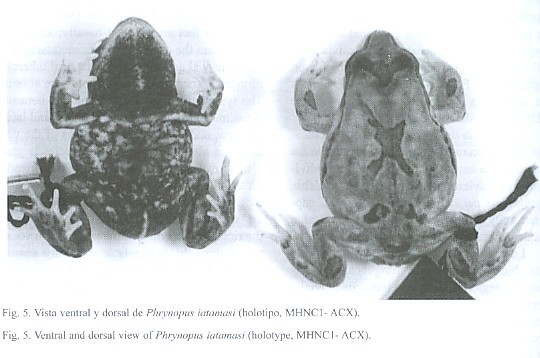
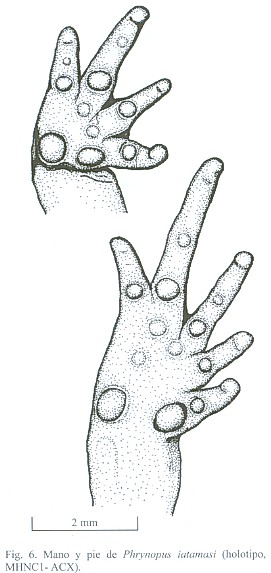
<CENTER>&nbsp;</CENTER> <FONT FACE="Arial,Helvetica"><FONT SIZE=-1><I>Phrynopus iatamasi</I> sp. nov., (<A HREF="#fig5">Fig. 5</A>)</FONT></FONT><FONT FACE="Arial,Helvetica"><FONT SIZE=-1></FONT></FONT>      <P><FONT FACE="Arial,Helvetica"><FONT SIZE=-1><B>Holotipo: </B>MHNC1-ACX, macho adulto recolectado a 70 km de la carretera antigua al Chapare, “Zona de Aguirre” (l&iacute;mite NO del Parque Nacional Carrasco), departamento de Cochabamba, Bolivia (17&deg; 12’ S, 65&deg; 41’ O), 3450m, por C. Rodrigo Aguayo V. y Elva Villegas N., el 23 de Septiembre de 1997.</FONT></FONT><FONT FACE="Arial,Helvetica"><FONT SIZE=-1></FONT></FONT>      <P><FONT FACE="Arial,Helvetica"><FONT SIZE=-1><B>Paratopotipo: </B>UTA-A52482, una hembra, recolectado junto con el holotipo.</FONT></FONT><FONT FACE="Arial,Helvetica"><FONT SIZE=-1></FONT></FONT>      <P><FONT FACE="Arial,Helvetica"><FONT SIZE=-1><B>Diagnosis: </B>Una especie peque&ntilde;a del g&eacute;nero <I>Phrynopus </I>(m&aacute;ximo de 16.48 mm de LRC) distinguible por la siguiente combinaci&oacute;n de caracteres: 1) piel dorsal lisa con pliegues dorsolaterales y escapulares; piel ventral tenuemente rugosa (ver discusi&oacute;n); 2) primer dedo de la mano m&aacute;s corto que el segundo; 3) extremos de los dedos no dilatados lateralmente; 4) membrana basal presente en los dedos de las patas; rebordes cut&aacute;neos ausentes; 5) dos tub&eacute;rculos metatarsales, el interno ligeramente ovalado y el externo redondeado; 6) tub&eacute;rculos y pliegue tarsal ausentes; 7) t&iacute;mpano presente, oculto bajo la piel; 8) rostro redondeado en vista dorsal y lateral; 9) saco y hendiduras vocales presentes; 10) dientes vomerianos y procesos dent&iacute;geros ausentes; 11) dorso caf&eacute; claro con manchas dorsales oscuras en forma de “V” (regi&oacute;n interorbital), en forma de “X” (regi&oacute;n medio-dorsal) y manchas ovales peque&ntilde;as en las extremidades y region sacral; 12) vientre de color crema con manchas peque&ntilde;as (puntos) oscuras dispersas.</FONT></FONT><FONT FACE="Arial,Helvetica"><FONT SIZE=-1></FONT></FONT>      <P><FONT FACE="Arial,Helvetica"><FONT SIZE=-1><I>Phrynopus iatamasi</I> es asignable al grupo <I>peruanus</I> de <A HREF="#Lynch75">Lynch (1975)</A>. De las cuatro especies del g&eacute;nero <I>Phrynopus</I> que han sido registradas para Bolivia: <I>P. laplacai, P. peruvianus, P. kempffi </I>y<I> P. pinguis</I>, adem&aacute;s de<I> P. adenopleurus </I>que se describe en este trabajo, esta nueva especie es a continuaci&oacute;n diferenciada. Se diferencia de <I>P. laplacai </I>(en par&eacute;ntesis) por: tama&ntilde;o peque&ntilde;o, m&aacute;ximo 16.48 mm de LRC (tama&ntilde;o mediano, 24.8-33.4 mm de LRC <A HREF="#Ergueta">Ergueta, 1993</A>), piel dorsal lisa (piel dorsal rugosa), el primer dedo de la mano m&aacute;s corto que el segundo (primer dedo m&aacute;s largo que el segundo), rostro redondeado en vista lateral (rostro truncado en vista lateral) y membrana basal presente (sin membrana basal); se distingue de <I>P. peruvianus</I> por tener el vientre poco rugoso (piel ventral lisa), primer dedo m&aacute;s corto que el segundo (primer dedo poco m&aacute;s grande o igual que el segundo), membrana basal presente (sin membrana basal), ausencia de tub&eacute;rculos tarsales (con tub&eacute;rculo tarsal interno), t&iacute;mpano oculto bajo la piel (t&iacute;mpano parcialmente oculto bajo la piel), rostro redondeado en vista lateral (truncado en vista lateral) y dientes vomerianos ausentes (dientes vomerianos presentes); <I>P. iatamasi </I>es<I> </I>distinguible de <I>P. kempffi </I>por tener el rostro redondeado en vista lateral, presencia de membrana basal, pliegues en forma de ” X “ en la regi&oacute;n escapular y vientre con puntos negros peque&ntilde;os (contra<I> </I>rostro inclinado en vista lateral, membrana basal ausente, pliegues escapulares ausentes y vientre con grandes manchas negras); se distingue de <I>P. pinguis</I> por tener piel ventral rugosa (piel ventral lisa); cabeza m&aacute;s angosta que el cuerpo (cabeza no distinguible del cuerpo); color dorsal caf&eacute; claro (dorso gris carb&oacute;n); y vientre color crema con manchas (puntos) peque&ntilde;as, abundantes y oscuras (vientre amarillo o gris- cenizo sin manchas); de <I>P. adenopleurus </I>se diferencia por la ausencia de manchas glandulares en los flancos, presencia de pliegues dorsolaterales y escapulares y por el color y dise&ntilde;o dorsal y ventral.</FONT></FONT><FONT FACE="Arial,Helvetica"><FONT SIZE=-1></FONT></FONT>      <P><FONT FACE="Arial,Helvetica"><FONT SIZE=-1><B>Descripci&oacute;n del holotipo: </B>Un macho adulto que posee las siguientes dimensiones (en mm): LRC 16.48; longitud cef&aacute;lica 4.24; ancho de la cabeza 5.12; distancia interorbital 1.84; distancio ojo-narina 1.30; di&aacute;metro anteroposterior de la orbita 1.70; ancho del p&aacute;rpado superior 1.00; longitud de la tibia 4.94; largo de la pata 5.14.</FONT></FONT><FONT FACE="Arial,Helvetica"><FONT SIZE=-1></FONT></FONT>      <P><FONT FACE="Arial,Helvetica"><FONT SIZE=-1>Cuerpo robusto, cabeza m&aacute;s angosta que el cuerpo; cabeza m&aacute;s ancha que larga (longitud cef&aacute;lica equivalente al 82.8% del ancho de la cabeza), la longitud cef&aacute;lica equivale al 25% de la LRC; rostro redondeado en vista dorsal y lateral; crestas craneales ausentes; regi&oacute;n interorbital plana; narinas externas ovoides, no prominentes, localizadas m&aacute;s cerca del extremo rostral que del &aacute;ngulo anterior de la &oacute;rbita; canto rostral evidente, ligeramente c&oacute;ncavo en vista lateral y obtuso en corte transversal; regi&oacute;n loreal ligeramente c&oacute;ncava, poco ensanchada hacia los labios superiores, los cuales son tenuemente abultados; t&iacute;mpano oculto bajo la piel, apenas distinguible externamente por una depresi&oacute;n en la regi&oacute;n temporal; sin pliegue supratimp&aacute;nico; lengua carnosa, ovalada, casi tan larga como ancha y libre en su tercio posterior; coanas muy peque&ntilde;as (di&aacute;metro &lt; 0.1 mm), redondeadas, ubicadas en los bordes anterolaterales de la tabla palatal de la maxila y separados entre s&iacute; por 1.5 mm; saco vocal con piel ligeramente rugosa; hendiduras vocales presentes, ubicadas poco antes de la comisura vocal; dientes vomerianos y procesos dent&iacute;geros ausentes; piel dorsal de la cabeza, tronco y miembros lisa, con numerosos gr&aacute;nulos peque&ntilde;os dispersos y pliegues prominentes evidentes solo en vivo (ver discusi&oacute;n); piel ventral tenuemente rugosa; pliegue discoidal ausente.</FONT></FONT><FONT FACE="Arial,Helvetica"><FONT SIZE=-1></FONT></FONT>      <P><FONT FACE="Arial,Helvetica"><FONT SIZE=-1>Extremidades, manos y patas cortas; manos y patas de apariencia hinchada; longitud de la tibia escasamente menor a la longitud de la pata; tub&eacute;rculo palmar redondeado y casi dos veces m&aacute;s grande que el tenar<I> </I>ovalado (<A HREF="#fig6">Fig. 6</A>); tub&eacute;rculos subarticulares planos, redondeados y simples; tub&eacute;rculos subarticulares distales apenas visibles en dedos III y IV, ausentes u ocultos por la apariencia hinchada de la mano en dedos I y II; dos tub&eacute;rculos supernumerarios se distinguen dif&iacute;cilmente, uno adyacente al tub&eacute;rculo subarticular del tercer dedo y el otro pr&oacute;ximo al tub&eacute;rculo tenar; extremos de los dedos de las manos delgados, de contornos redondeados, sin ning&uacute;n ensanchamiento lateral; membrana basal presente; cuando se juntan, el primer dedo m&aacute;s corto que el segundo; largo relativo de los dedos de la mano, de mayor a menor, III > IV > II > I.</FONT></FONT><FONT FACE="Arial,Helvetica"><FONT SIZE=-1></FONT></FONT>      ]]></body>
<body><![CDATA[<P><FONT FACE="Arial,Helvetica"><FONT SIZE=-1>Tub&eacute;rculos y pliegue en el tarso ausentes; tub&eacute;rculos metatarsales aproximadamente del mismo tama&ntilde;o (<A HREF="#fig6">Fig. 6</A>), externo redondeado, interno ligeramente ovalado; tres tub&eacute;rculos supernumerarios apenas distinguibles, dos pr&oacute;ximos a los tub&eacute;rculos subarticulares del tercer y cuarto dedo, el restante ubicado entre el tub&eacute;rculo metacarpal externo y el supernumerario pr&oacute;ximo al cuarto dedo; tub&eacute;rculos subarticulares proximales redondeados y planos; tub&eacute;rculos subarticulares distales apenas visibles en III y IV dedo, aparentemente ausentes en los dem&aacute;s dedos; tub&eacute;rculo metatarsal interno muy cerca del subarticular del primer dedo; membrana basal gruesa entre los dedos de los pies, los cuales decrecen en tama&ntilde;o de la siguiente manera: IV > III > V > II > I.</FONT></FONT><FONT FACE="Arial,Helvetica"><FONT SIZE=-1></FONT></FONT>     <CENTER><A NAME="fig6"></A><IMG SRC="/img/fbpe/rbt/v49n1/2351i07.JPG" HEIGHT=573 WIDTH=271></CENTER> <FONT FACE="Arial,Helvetica"><FONT SIZE=-1></FONT></FONT>      
<P><FONT FACE="Arial,Helvetica"><FONT SIZE=-1><B>Color en alcohol: </B>Superficies dorsales de la cabeza, cuerpo y extremidades caf&eacute;-crema, con manchas de color caf&eacute; oscuro de diferentes formas y tama&ntilde;os que se distribuyen as&iacute;: una mancha en forma de “V” en la regi&oacute;n interorbital; una mancha en forma de “X” en la regi&oacute;n escapular; peque&ntilde;as manchas ovaladas en la regi&oacute;n sacra, en los muslos, en las piernas, en los antebrazos, al final de cada tarso y en la uni&oacute;n del IV y V dedo de las patas. Una banda lateral de color caf&eacute; oscuro se extiende desde la regi&oacute;n postorbital (donde es m&aacute;s ancha) hasta la regi&oacute;n ventral pr&oacute;xima a la ingle; una l&iacute;nea clara bordea la cloaca y recorre las regiones posteriores de los muslos y piernas, adem&aacute;s de las superficies ventrales de los tarsos y parte de las patas; &eacute;sta l&iacute;nea se extiende ventralmente hasta la regi&oacute;n inferior abdominal.</FONT></FONT><FONT FACE="Arial,Helvetica"><FONT SIZE=-1></FONT></FONT>      <P><FONT FACE="Arial,Helvetica"><FONT SIZE=-1>La superficie ventral de las regiones pectoral y abdominal son de color crema, con peque&ntilde;as manchas (puntos) redondeadas de color caf&eacute; oscuro, dispersas, abundantes, y poco definidas (dando la impresi&oacute;n, sin lupa, de color continuo) en las regiones gular y precloacal; las superficies ventrales de las patas tienen manchas de color caf&eacute; oscuro, cubriendo cerca de la mitad de la extensi&oacute;n de los tarsos.</FONT></FONT>     <CENTER><FONT FACE="Arial,Helvetica"><FONT SIZE=-1>&nbsp;</FONT></FONT></CENTER> <FONT FACE="Arial,Helvetica"><FONT SIZE=-1><B>Color en vida:</B> Superficies expuestas caf&eacute; claro, con las manchas dorsales caf&eacute; oscuro, los pliegues y los gr&aacute;nulos caf&eacute;-rojizo; ventralmente, las patas y las manos crema-naranja; las manchas (puntos) ventrales caf&eacute;-gris&aacute;ceo.</FONT></FONT><FONT FACE="Arial,Helvetica"><FONT SIZE=-1></FONT></FONT>      <P><FONT FACE="Arial,Helvetica"><FONT SIZE=-1><B>Variaci&oacute;n:</B> El dise&ntilde;o dorsal del paratopotipo es muy similar al del holotipo; existe variaci&oacute;n en el color que es m&aacute;s oscuro (caf&eacute;) en todas las superficies dorsales y las manchas caf&eacute; negruzco, adem&aacute;s de poseer una l&iacute;nea delgada vertebral. Ventralmente las regiones gular, pectoral, abdominal y gran parte de las superficies ventrales de las extremidades tienen una coloraci&oacute;n oscura (caf&eacute; negruzco). Variaci&oacute;n morfol&oacute;gica del paratopotipo se presenta en el <A HREF="#cuadro1">Cuadro 1</A>.</FONT></FONT>     <BR><FONT FACE="Arial,Helvetica"><FONT SIZE=-1>&nbsp;</FONT></FONT>     <BR><FONT FACE="Arial,Helvetica"><FONT SIZE=-1><B>Distribuci&oacute;n y ecolog&iacute;a:</B> La localidad tipo de <I>P. iatamasi </I>se encuentra a 70 km de la carretera antigua al Chapare, dentro de los l&iacute;mites del Parque Nacional Carrasco, en el Departamento de Cochabamba, Bolivia (17&deg; 12’ S, 65&deg; 41’ O), a 3350 m de altitud.</FONT></FONT><FONT FACE="Arial,Helvetica"><FONT SIZE=-1></FONT></FONT>      <P><FONT FACE="Arial,Helvetica"><FONT SIZE=-1>Los dos individuos fueron ubicados por el canto del macho y capturados (de d&iacute;a), entre los musgos adheridos a rocas en el suelo de un bosque alto de <I>Weimmannia microphylla</I>. La zona est&aacute; dentro de la Regi&oacute;n Yungue&ntilde;a caracterizada por bosque cl&iacute;max de <I>Polylepis racemosa</I> y <I>Weinmmannia microphylla</I> y sus etapas seriales.</FONT></FONT><FONT FACE="Arial,Helvetica"><FONT SIZE=-1></FONT></FONT>      <P><FONT FACE="Arial,Helvetica"><FONT SIZE=-1>La comunidad de anuros que vive sint&oacute;picamente con <I>P. iatamasi </I>en la localidad tipo esta compuesta por <I>Eleutherodactylus platydactylus, Hyla andina y Gastrotheca marsupiata.</I></FONT></FONT><FONT FACE="Arial,Helvetica"><FONT SIZE=-1></FONT></FONT>      ]]></body>
<body><![CDATA[<P><FONT FACE="Arial,Helvetica"><FONT SIZE=-1><B>Etimolog&iacute;a: </B>El ep&iacute;teto espec&iacute;fico <I>iatamasi</I> es un apositivo latinizado y se deriva de las palabras Quechuas “Llajta<I>”</I> que significa tierra donde se nace y “masi” cong&eacute;nere. El nombre es fon&eacute;tico y se pronuncia como “y&aacute; - ta - ma - si,” igual que la palabra Quechua “llajtamasi” usada por los campesinos, para referirse a otra persona que naci&oacute; en el mismo lugar que ellos.</FONT></FONT><FONT FACE="Arial,Helvetica"><FONT SIZE=-1></FONT></FONT>      <P><FONT FACE="Arial,Helvetica"><FONT SIZE=-1><B>English Description: </B><I>Phrynopus iatamasi</I> is a small species known to reach 16.48 mm snout-vent in males and 15.74 mm in females. This species has a smooth dorsum with dorsolateral and scapular folds. The venter is weakly granular. When adpressed, the first finger is shorter than the second. The digital tips are not dilated, the hands and feet are webbed basally, and tarsal tubercles and folds are absent. The inner metatarsal tubercle is oval-shaped and the external metatarsal tubercle is rounded. A tympanum is present, though not visible externally. The snout is round in lateral and dorsal views. Males of this species have paired vocal slits opening into a single vocal sac. Dentigerous processes of the vomer are absent. Dorsal surfaces are brown with dorsal blotches forming a “V” in the interorbital region and an “X” in the middorsal region. Small oval spots are present on the extremities and in the sacral region. In the holotype, the venter is cream with widely dispersed brown spots. The venter of the paratype is chocolate brown.</FONT></FONT>     <BR><FONT FACE="Arial,Helvetica"><FONT SIZE=-1>&nbsp;</FONT></FONT>     <BR><B><FONT FACE="Arial,Helvetica"><FONT SIZE=-1>Discusi&oacute;n</FONT></FONT></B>     <BR><B><FONT FACE="Arial,Helvetica"><FONT SIZE=-1>&nbsp;</FONT></FONT></B>     <BR><FONT FACE="Arial,Helvetica"><FONT SIZE=-1>La musculatura de <I>Phrynopus</I> es poco conocida. En su an&aacute;lisis filogen&eacute;tico de los Leptodactylidae, <A HREF="#Heyer">Heyer (1975)</A> incluy&oacute; datos sobre <I>P. peraccai</I> (bajo el sin&oacute;nimo <I>Niceforonia festae</I>). Junto con la descripci&oacute;n externa de <I>P. adenobrachius</I>, <A HREF="#Ardila">Ardila-Robayo <I>et al. </I>(1996)</A> describieron la musculatura bucal superficial, la condici&oacute;n del <I>m. depressor mandibulae</I> y la condici&oacute;n del nervio trig&eacute;mino. En un estudio de la musculatura de la mano y la musculatura bucal superficial de los Leptodactylidae, <A HREF="#Burton">Burton (1998)</A> incluy&oacute; cuatro especies: <I>P. biligoniger, P. flavomaculata, P. parkeri </I>y<I> P. peruvianus</I>.</FONT></FONT><FONT FACE="Arial,Helvetica"><FONT SIZE=-1></FONT></FONT>      <P><FONT FACE="Arial,Helvetica"><FONT SIZE=-1>Algunos caracteres citados de la musculatura de <I>P. adenopleurus</I>, como la condici&oacute;n de algunos m&uacute;sculos de la pierna, no han sido mencionados en ninguno de estos estudios. Dentro de los Leptodactylidae, existen dos patrones referentes a la relaci&oacute;n entre los <I>mm. intermandibularis</I> y <I>submentalis</I> (<A HREF="#Burton">Burton 1998</A>). En los Telmatobiinae, las fibras anteriores del <I>m. intermandibularis</I> est&aacute;n dirigidas posteriomedialmente, exceptuando los Eleutherodactylini, en los que est&aacute;n dirigidas anteromedialmente. Las fibras del <I>m. intermandibularis</I> de la especie colombiana <I>P. adenobrachius</I> est&aacute;n de acuerdo con este patr&oacute;n. Sin embargo, las fibras anteriores de <I>P. adenopleurus</I> est&aacute;n dirigidas posteriomedialmente, mostrando el patr&oacute;n de los dem&aacute;s Telmatobiinae.</FONT></FONT><FONT FACE="Arial,Helvetica"><FONT SIZE=-1></FONT></FONT>      <P><FONT FACE="Arial,Helvetica"><FONT SIZE=-1><A HREF="#Burton">Burton (1998)</A> mencion&oacute; a grandes rasgos, haces apicales y anterolaterales que observ&oacute; en algunos Leptodactylidae, pero no hizo &eacute;nfasis sistem&aacute;tico en su presencia. No mencion&oacute; si existen o no estos haces en las especies de <I>Phrynopus</I> que &eacute;l examin&oacute;. Tampoco vio haces del <I>m. intermandibularis</I> en las 87 especies del g&eacute;nero <I>Eleutherodactylus</I>.</FONT></FONT><FONT FACE="Arial,Helvetica"><FONT SIZE=-1></FONT></FONT>      <P><FONT FACE="Arial,Helvetica"><FONT SIZE=-1>A pesar de que los m&uacute;sculos bucales superficiales han sido descritos completamente en solamente dos especies de <I>Phrynopus</I>, es obvio que existe variaci&oacute;n considerable: <I>P. adenobrachius</I> carece de haces en el <I>m. intermandibularis</I>, mientras que <I>P. adenopleurus </I>tiene dos tipos de haces; la especie colombiana tiene una aponeurosis medial angosta que se extiende hasta el borde posterior del <I>m. interhyoideus, </I>mientras que la aponeurosis es m&aacute;s corta y mucho m&aacute;s ancha en <I>P. adenopleurus</I>. Las fibras anteriores de la especie colombiana est&aacute;n dirigidas anteromedialmente mientras que en la especie aqu&iacute; descrita est&aacute;n dirigidas posteriomedialmente. M&uacute;sculos de m&aacute;s especies de <I>Phrynopus</I> deber&iacute;an ser estudiados para conocer la importancia de su variaci&oacute;n.</FONT></FONT><FONT FACE="Arial,Helvetica"><FONT SIZE=-1></FONT></FONT>      <P><FONT FACE="Arial,Helvetica"><FONT SIZE=-1><I>Phrynopus adenopleurus y P. iatamasi</I> son especies asignables al grupo <I>peruanus</I> (<A HREF="#Lynch75">Lynch 1975</A>), el cual contiene a <I>P. cophites, P. laplacai, P. montium, P. peruanus,</I> <I>P. wettsteini </I>adem&aacute;s de <I>P. kempffi y P. pinguis </I>asignadas recientemente a este grupo por <A HREF="#DelaRiva">De la Riva (1992)</A> y <A HREF="#Harvey">Harvey &amp; Ergueta(1998)</A> respectivamente. Sin embargo, <I>P. adenopleurus</I> y <I>P. iatamasi </I>tienen caracter&iacute;sticas que no son propias del grupo como (1) piel dorsal lisa, presente tambi&eacute;n en<I> P. peruanus</I>,<I><B> </B>P. kempffi </I>(aunque estos con peque&ntilde;as granulaciones), y <I>P. pinguis</I> (contra piel dorsal rugosa en el resto de las especies del grupo) y (2) presencia de membrana basal, tambi&eacute;n presente en <I>P. pinguis</I> (el resto del grupo carece de este caracter). Con el grupo <I>simonsii </I>comparten varios caracteres, pero estas especies carecen de reborde cut&aacute;neo en los dedos de las patas (presente en el grupo <I>simonsii</I>) y presentan los tub&eacute;rculos metatarsales aproximadamente del mismo tama&ntilde;o (contra el tub&eacute;rculo metatarsal interno m&aacute;s grande que el externo en el grupo <I>simonsii</I>).</FONT></FONT><FONT FACE="Arial,Helvetica"><FONT SIZE=-1></FONT></FONT>      ]]></body>
<body><![CDATA[<P><FONT FACE="Arial,Helvetica"><FONT SIZE=-1>La textura de la piel ventral y dorsal de estas especies parece estar fuertemente afectada por los conservantes o preservativos. En <I>P. adenopleurus</I> el vientre en vida var&iacute;a de rugoso a fuertemente rugoso; despu&eacute;s, una vez preservado, el vientre se muestra liso en cinco ejemplares y los restantes presentan la piel tenuemente rugosa, especialmente en la parte posterior del vientre y los lados. En <I>P. iatamasi </I>se observa algo parecido, donde los ejemplares en vida presentan la piel ventral rugosa y el dorso con muchos tub&eacute;rculos, con pliegues dorsolaterales y pliegues en la regi&oacute;n escapular; luego, en preservaci&oacute;n estos individuos presentan la piel dorsal lisa, sin pliegues escapulares, los dorsolaterales apenas evidentes y el vientre muy tenuemente rugoso.</FONT></FONT><FONT FACE="Arial,Helvetica"><FONT SIZE=-1></FONT></FONT>      <P><FONT FACE="Arial,Helvetica"><FONT SIZE=-1>Similares observaciones al respecto hace <A HREF="#Lynch75">Lynch (1975)</A> en <I>P. nanus</I>,<I> </I>en la cual la piel ventral aparece lisa (excepto posteriormente) despu&eacute;s de que fuera descrita por <A HREF="#Goin">Goin &amp; Cochran (1963)</A>, como fuertemente rugosa. Lynch &amp; Duellman (1997) confirman que la textura del vientre y el dorso (si son rugosas), pueden verse afectados por varios motivos, como la calidad de los l&iacute;quidos de preservaci&oacute;n, las t&eacute;cnicas de preservaci&oacute;n, la muerte por desecaci&oacute;n y/o estr&eacute;s y deshidrataci&oacute;n por los l&iacute;quidos preservantes.</FONT></FONT>     <BR><FONT FACE="Arial,Helvetica"><FONT SIZE=-1>&nbsp;</FONT></FONT>     <BR><B><FONT FACE="Arial,Helvetica"><FONT SIZE=-1>Agradecimientos</FONT></FONT></B><FONT FACE="Arial,Helvetica"><FONT SIZE=-1></FONT></FONT>      <P><FONT FACE="Arial,Helvetica"><FONT SIZE=-1>Agradecemos a J. Campbell, de la Universidad de Texas en Arlington (UTA) por permitirnos trabajar en su instituci&oacute;n y examinar los ejemplares a su cargo. A M. Zalles (Museo Noel Kempff Mercado, Santa Cruz, Bolivia), R. Reynolds (USNM), y W.E Duellman (KU) por dar espacio de trabajo y el pr&eacute;stamo de ejemplares a M. B. Harvey. Agradecemos a R. Shiels (Milligan University) y A. K. LeCroy (ETSU) hicieron valiosas sugerencias sobre la ortograf&iacute;a apropriada de <I>iatamasi</I>. El primer autor agradece al Centro Universitario de Ecolog&iacute;a, Ambiente y Desarrollo (CUEMAD), Universidad Mayor de San Sim&oacute;n (UMSS), Cochabamba, Bolivia y a la Universidad de Leicester, UK, (proyecto: “Mapeo de Unidades Ambientales del PNC”) por el apoyo log&iacute;stico prestado para el trabajo de campo, as&iacute; como al director I. Davalos y los guardaparques del Parque Nacional Carrasco. Un agradecimiento especial a los compa&ntilde;eros de campo del primer autor: A. Vargas, S. Arias, E. Villegas y C. Coca.</FONT></FONT>     <BR><FONT FACE="Arial,Helvetica"><FONT SIZE=-1>&nbsp;</FONT></FONT>     <BR><B><FONT FACE="Arial,Helvetica"><FONT SIZE=-1>Resumen</FONT></FONT></B>     <BR><B><FONT FACE="Arial,Helvetica"><FONT SIZE=-1>&nbsp;</FONT></FONT></B>     <BR><FONT FACE="Arial,Helvetica"><FONT SIZE=-1>Se describe dos nuevas especies de <I>Phrynopus</I> de la Ceja de monte Yungue&ntilde;a de Cochabamba, Bolivia, <I>P. adenopleurus </I>y <I>P. iatamasi</I>. Ambas especies son asignables al grupo <I>peruanus</I> y se diferencian de las otras cuatro especies que existen en el pa&iacute;s por presentar el primer dedo m&aacute;s corto que el segundo, tener membrana basal y por sus colores y dise&ntilde;os dorsales y ventrales. La musculatura ha sido pocas veces descrita para especies de <I>Phrynopus</I>. <I>Phrynopus adenopleurus</I>, especie nueva, posee una inusual musculatura mandibular y del muslo, muy poco parecida a lo descrito para otras especies del g&eacute;nero.</FONT></FONT>     <BR><FONT FACE="Arial,Helvetica"><FONT SIZE=-1>&nbsp;</FONT></FONT>     ]]></body>
<body><![CDATA[<BR><B><FONT FACE="Arial,Helvetica"><FONT SIZE=-1>Referencias</FONT></FONT></B>     <BR><B><FONT FACE="Arial,Helvetica"><FONT SIZE=-1>&nbsp;</FONT></FONT></B>     <!-- ref --><BR><A NAME="Ardila"></A><FONT FACE="Arial,Helvetica"><FONT SIZE=-1>Ardila-Robayo, M. C., P.M. Ruiz-C &amp; M. Barrera-R. 1996. Una nueva especie de <I>Phrynopus</I> (Amphibia, Anura, Leptodactylidae) de la Cordillera Central Colombiana. Lozania 67: 1-10.</FONT></FONT><FONT FACE="Arial,Helvetica"><FONT SIZE=-1></FONT></FONT>    &nbsp;&nbsp;&nbsp;&nbsp;&nbsp;&nbsp;&nbsp;&nbsp;[&#160;<a href="javascript:void(0);" onclick="javascript: window.open('/scielo.php?script=sci_nlinks&ref=1358236&pid=S0034-7744200100010003300001&lng=','','width=640,height=500,resizable=yes,scrollbars=1,menubar=yes,');">Links</a>&#160;]<!-- end-ref --><!-- ref --><P><A NAME="Burton"></A><FONT FACE="Arial,Helvetica"><FONT SIZE=-1>Burton, T. C. 1998. Variation in the hand and superficial throat musculature of Neotropical leptodactylid frogs. Herpetologica 54: 53-72.</FONT></FONT><FONT FACE="Arial,Helvetica"><FONT SIZE=-1></FONT></FONT>    &nbsp;&nbsp;&nbsp;&nbsp;&nbsp;&nbsp;&nbsp;&nbsp;[&#160;<a href="javascript:void(0);" onclick="javascript: window.open('/scielo.php?script=sci_nlinks&ref=1358237&pid=S0034-7744200100010003300002&lng=','','width=640,height=500,resizable=yes,scrollbars=1,menubar=yes,');">Links</a>&#160;]<!-- end-ref --><!-- ref --><P><A NAME="Cei"></A><FONT FACE="Arial,Helvetica"><FONT SIZE=-1>Cei, J. M. 1968. A new frog of the genus <I>Syrrophus</I> from the Bolivian plateau. J. Herpetol. 2: 137-141.</FONT></FONT><FONT FACE="Arial,Helvetica"><FONT SIZE=-1></FONT></FONT>    &nbsp;&nbsp;&nbsp;&nbsp;&nbsp;&nbsp;&nbsp;&nbsp;[&#160;<a href="javascript:void(0);" onclick="javascript: window.open('/scielo.php?script=sci_nlinks&ref=1358238&pid=S0034-7744200100010003300003&lng=','','width=640,height=500,resizable=yes,scrollbars=1,menubar=yes,');">Links</a>&#160;]<!-- end-ref --><!-- ref --><P><A NAME="DelaRiva"></A><FONT FACE="Arial,Helvetica"><FONT SIZE=-1>De la Riva, I. 1992. A new species of <I>Phrynopus </I>from Bolivia (Anura: Leptodactylidae). Herpetologica 48: 111-114.</FONT></FONT><FONT FACE="Arial,Helvetica"><FONT SIZE=-1></FONT></FONT>    &nbsp;&nbsp;&nbsp;&nbsp;&nbsp;&nbsp;&nbsp;&nbsp;[&#160;<a href="javascript:void(0);" onclick="javascript: window.open('/scielo.php?script=sci_nlinks&ref=1358239&pid=S0034-7744200100010003300004&lng=','','width=640,height=500,resizable=yes,scrollbars=1,menubar=yes,');">Links</a>&#160;]<!-- end-ref --><P><A NAME="Ergueta"></A><FONT FACE="Arial,Helvetica"><FONT SIZE=-1>Ergueta, S., P. 1993. Aspectos de la biolog&iacute;a y ecolog&iacute;a de <I>Phrynopus laplacai</I> (Anura Leptodactylidae) en un bosque nublado de altura de yungas (La Paz, Bolivia). Ecolog&iacute;a en Bolivia 21: 19-29.</FONT></FONT><FONT FACE="Arial,Helvetica"><FONT SIZE=-1></FONT></FONT>      <!-- ref --><P><A NAME="Goin"></A><FONT FACE="Arial,Helvetica"><FONT SIZE=-1>Goin, C. J. &amp; D. M. Cochran. 1963. Two new genera of leptodactylid frogs from Colombia. Proc. California Acad. Sci. 31: 499-505.</FONT></FONT><FONT FACE="Arial,Helvetica"><FONT SIZE=-1></FONT></FONT>    &nbsp;&nbsp;&nbsp;&nbsp;&nbsp;&nbsp;&nbsp;&nbsp;[&#160;<a href="javascript:void(0);" onclick="javascript: window.open('/scielo.php?script=sci_nlinks&ref=1358241&pid=S0034-7744200100010003300005&lng=','','width=640,height=500,resizable=yes,scrollbars=1,menubar=yes,');">Links</a>&#160;]<!-- end-ref --><!-- ref --><P><A NAME="Griffith54"></A><FONT FACE="Arial,Helvetica"><FONT SIZE=-1>Griffith, I. 1954. On the “otic element “ in Amphibia Salientia. Proc. Zool. Soc. London 124: 35-50.</FONT></FONT><FONT FACE="Arial,Helvetica"><FONT SIZE=-1></FONT></FONT>    &nbsp;&nbsp;&nbsp;&nbsp;&nbsp;&nbsp;&nbsp;&nbsp;[&#160;<a href="javascript:void(0);" onclick="javascript: window.open('/scielo.php?script=sci_nlinks&ref=1358242&pid=S0034-7744200100010003300006&lng=','','width=640,height=500,resizable=yes,scrollbars=1,menubar=yes,');">Links</a>&#160;]<!-- end-ref --><!-- ref --><P><A NAME="Griffith63"></A><FONT FACE="Arial,Helvetica"><FONT SIZE=-1>Griffith, I. 1963. The phylogeny of the Salientia. Biol. Rev. 38: 241-292.</FONT></FONT><FONT FACE="Arial,Helvetica"><FONT SIZE=-1></FONT></FONT>    &nbsp;&nbsp;&nbsp;&nbsp;&nbsp;&nbsp;&nbsp;&nbsp;[&#160;<a href="javascript:void(0);" onclick="javascript: window.open('/scielo.php?script=sci_nlinks&ref=1358243&pid=S0034-7744200100010003300007&lng=','','width=640,height=500,resizable=yes,scrollbars=1,menubar=yes,');">Links</a>&#160;]<!-- end-ref --><!-- ref --><P><A NAME="Harvey"></A><FONT FACE="Arial,Helvetica"><FONT SIZE=-1>Harvey, M. B. &amp; P. Ergueta. S. 1998. A new Species of <I>Phrynopus </I>(Anura : Leptodactylidae) from Elfin Forest in the Bolivian Andes. J. Herpetol. 32: 536-540.</FONT></FONT><FONT FACE="Arial,Helvetica"><FONT SIZE=-1></FONT></FONT>    &nbsp;&nbsp;&nbsp;&nbsp;&nbsp;&nbsp;&nbsp;&nbsp;[&#160;<a href="javascript:void(0);" onclick="javascript: window.open('/scielo.php?script=sci_nlinks&ref=1358244&pid=S0034-7744200100010003300008&lng=','','width=640,height=500,resizable=yes,scrollbars=1,menubar=yes,');">Links</a>&#160;]<!-- end-ref --><!-- ref --><P><A NAME="Heyer"></A><FONT FACE="Arial,Helvetica"><FONT SIZE=-1>Heyer, W. R. 1975. A preliminary analysis of the intergeneric relationships of&nbsp; the frog family Leptodactylidae. Smithsonian Contrib. Zool. 199: 1-55.</FONT></FONT><FONT FACE="Arial,Helvetica"><FONT SIZE=-1></FONT></FONT>    &nbsp;&nbsp;&nbsp;&nbsp;&nbsp;&nbsp;&nbsp;&nbsp;[&#160;<a href="javascript:void(0);" onclick="javascript: window.open('/scielo.php?script=sci_nlinks&ref=1358245&pid=S0034-7744200100010003300009&lng=','','width=640,height=500,resizable=yes,scrollbars=1,menubar=yes,');">Links</a>&#160;]<!-- end-ref --><P><A NAME="Kohler"></A><FONT FACE="Arial,Helvetica"><FONT SIZE=-1>K&ouml;hler, J. 1995. Erstnachweis von <I>Hyla marmorata</I>, <I>Leptodactylus syphax</I> und <I>Phrynopus peruvianus</I> fur Bolivien. Herpetofauna 17: 6-8.</FONT></FONT><FONT FACE="Arial,Helvetica"><FONT SIZE=-1></FONT></FONT>      <!-- ref --><P><A NAME="Lynch75"></A><FONT FACE="Arial,Helvetica"><FONT SIZE=-1>Lynch, J. D. 1975. A review of the Andean leptodactylid frog genus <I>Phrynopus.</I> Occ. Pap. Mus. Nat. Hist. Univ. Kansas 72: 1-57.</FONT></FONT><FONT FACE="Arial,Helvetica"><FONT SIZE=-1></FONT></FONT>    &nbsp;&nbsp;&nbsp;&nbsp;&nbsp;&nbsp;&nbsp;&nbsp;[&#160;<a href="javascript:void(0);" onclick="javascript: window.open('/scielo.php?script=sci_nlinks&ref=1358247&pid=S0034-7744200100010003300010&lng=','','width=640,height=500,resizable=yes,scrollbars=1,menubar=yes,');">Links</a>&#160;]<!-- end-ref --><!-- ref --><P><A NAME="Lynch86"></A><FONT FACE="Arial,Helvetica"><FONT SIZE=-1>Lynch, J. D. 1986. New species of minute leptodactylid frogs from the Andes of Ecuador and Peru. J. Herpetol. 20: 423-431.</FONT></FONT><FONT FACE="Arial,Helvetica"><FONT SIZE=-1></FONT></FONT>    &nbsp;&nbsp;&nbsp;&nbsp;&nbsp;&nbsp;&nbsp;&nbsp;[&#160;<a href="javascript:void(0);" onclick="javascript: window.open('/scielo.php?script=sci_nlinks&ref=1358248&pid=S0034-7744200100010003300011&lng=','','width=640,height=500,resizable=yes,scrollbars=1,menubar=yes,');">Links</a>&#160;]<!-- end-ref --><P><A NAME="Lynch93"></A><FONT FACE="Arial,Helvetica"><FONT SIZE=-1>Lynch, J. D. 1993. The value of the <I>m. depressor mandibulae</I> in phylogenetics hypotheses for <I>Eleutherodactylus </I>and its allies (Amphibia: Leptodactylidae). Herpetologica 49: 32-41.</FONT></FONT><FONT FACE="Arial,Helvetica"><FONT SIZE=-1></FONT></FONT>      <!-- ref --><P><FONT FACE="Arial,Helvetica"><FONT SIZE=-1>Lynch, J. D. &amp; W. E. Duellman. 1997. Frogs of the genus <I>Eleutherodactylus </I>in western Ecuador. Nat. Hist. Mus. Univ. Kansas Spec. Publ. 23: 1-236.</FONT></FONT><FONT FACE="Arial,Helvetica"><FONT SIZE=-1></FONT></FONT>    &nbsp;&nbsp;&nbsp;&nbsp;&nbsp;&nbsp;&nbsp;&nbsp;[&#160;<a href="javascript:void(0);" onclick="javascript: window.open('/scielo.php?script=sci_nlinks&ref=1358250&pid=S0034-7744200100010003300012&lng=','','width=640,height=500,resizable=yes,scrollbars=1,menubar=yes,');">Links</a>&#160;]<!-- end-ref --><!-- ref --><P><A NAME="Navarro"></A><FONT FACE="Arial,Helvetica"><FONT SIZE=-1>Navarro, G. 1997. Clasificaci&oacute;n ecol&oacute;gica y flor&iacute;stica de los bosques de Bolivia. Rev. Bol. Ecol. 2: 3-37.</FONT></FONT><FONT FACE="Arial,Helvetica"><FONT SIZE=-1></FONT></FONT>    &nbsp;&nbsp;&nbsp;&nbsp;&nbsp;&nbsp;&nbsp;&nbsp;[&#160;<a href="javascript:void(0);" onclick="javascript: window.open('/scielo.php?script=sci_nlinks&ref=1358251&pid=S0034-7744200100010003300013&lng=','','width=640,height=500,resizable=yes,scrollbars=1,menubar=yes,');">Links</a>&#160;]<!-- end-ref --><P><A NAME="Savage"></A><FONT FACE="Arial,Helvetica"><FONT SIZE=-1>Savage, J. M. 1987. Systematics and distribition of the Mexican and Central American rainfrogs of the <I>Eleutherodactylus gollmeri </I>group (Amphibia: Leptodactylidae). Fieldiana Zool., new ser. (33): 1-57.</FONT></FONT><FONT FACE="Arial,Helvetica"><FONT SIZE=-1></FONT></FONT>      <!-- ref --><P><A NAME="Starrett"></A><FONT FACE="Arial,Helvetica"><FONT SIZE=-1>Starrett, P. 1968. The phylogenetic significance of the jaw musculatura in Anuran amphibians. Ph. Disertation, Univ. Michigan. 177p.</FONT></FONT><FONT FACE="Arial,Helvetica"><FONT SIZE=-1></FONT></FONT>    &nbsp;&nbsp;&nbsp;&nbsp;&nbsp;&nbsp;&nbsp;&nbsp;[&#160;<a href="javascript:void(0);" onclick="javascript: window.open('/scielo.php?script=sci_nlinks&ref=1358253&pid=S0034-7744200100010003300014&lng=','','width=640,height=500,resizable=yes,scrollbars=1,menubar=yes,');">Links</a>&#160;]<!-- end-ref --><!-- ref --><P><A NAME="Tyler"></A><FONT FACE="Arial,Helvetica"><FONT SIZE=-1>Tyler, M. J. 1971. The Phylogenetic significance of vocal sac structure in hylid frogs. Univ. Kansas Publ. Mus. Nat. Hist. 19: 319-360.</FONT></FONT>    &nbsp;&nbsp;&nbsp;&nbsp;&nbsp;&nbsp;&nbsp;&nbsp;[&#160;<a href="javascript:void(0);" onclick="javascript: window.open('/scielo.php?script=sci_nlinks&ref=1358254&pid=S0034-7744200100010003300015&lng=','','width=640,height=500,resizable=yes,scrollbars=1,menubar=yes,');">Links</a>&#160;]<!-- end-ref --><BR><B><FONT FACE="Arial,Helvetica"><FONT SIZE=-1>&nbsp;</FONT></FONT></B>     <BR><FONT FACE="Arial,Helvetica"><FONT SIZE=-1><B>APENDICE</B></FONT></FONT><FONT FACE="Arial,Helvetica"><FONT SIZE=-1></FONT></FONT>      <P><FONT FACE="Arial,Helvetica"><FONT SIZE=-1><B>Ejemplares examinados: </B>Las especies est&aacute;n ordenadas por localidad y n&uacute;mero de museo. Las abreviaciones son: CBF (Colecci&oacute;n Boliviana de Fauna, La Paz, Bolivia); KU (Univerity of Kansas, Lawrence, Kansas); MHNC (Museo de Historia Natural de Cochabamba, Cochabamba, Bolivia); MNK (Museo Noel Kempff Mercado, Santa Cruz, Bolivia); USNM (United States National Museum, Washington, D.C.).</FONT></FONT><FONT FACE="Arial,Helvetica"><FONT SIZE=-1></FONT></FONT>      <P><FONT FACE="Arial,Helvetica"><FONT SIZE=-1><I>Phrynopus kempffi</I> (9): Bolivia: Cochabamba: KU 220067-68, MHNC 1-ABQ-V, MNK 480; <I>P. laplacai</I> (56): Bolivia: La Paz: CBF 85-86,689-692,827,852,1679-1702,1710-33; <I>P. peruvianus</I> (14): Per&uacute;: Cuzco: USNM 29831-13; <I>P. pinguis</I> (8): CBF 1906-08, 1911-12; UTA 48731-33.</FONT></FONT>     <BR><FONT FACE="Arial,Helvetica"><FONT SIZE=-1>&nbsp;</FONT></FONT>     <BR><FONT FACE="Arial,Helvetica"><FONT SIZE=-1>&nbsp;</FONT></FONT>     <BR><A NAME="A1"></A><FONT FACE="Arial,Helvetica"><FONT SIZE=-1><SUP><A HREF="#R1">1</A></SUP>Unidad de Biodiversidad y Gen&eacute;tica, Universidad Mayor de San Sim&oacute;n, Apartado 538, c. Sucre y Parque La Torre, Cochabamba, Bolivia. Fax: 591-4-540364; <A HREF="mailto:phrynopus@latinmail.com">phrynopus@latinmail.com</A>, <A HREF="mailto:biodiv@fcyt.umss.edu.bo">biodiv@fcyt.umss.edu.bo</A></FONT></FONT><FONT FACE="Arial,Helvetica"><FONT SIZE=-1></FONT></FONT>      <P><FONT FACE="Arial,Helvetica"><FONT SIZE=-1><SUP><A HREF="#R1">2</A></SUP>Department of Biological Sciences, Box 70703, East Tennessee State University, Johnson City, TN 37614, EEUU; <A HREF="mailto:harveym@access.etsu.edu">harveym@access.etsu.edu</A></FONT></FONT>     <BR><FONT FACE="Arial,Helvetica"><FONT SIZE=-1>&nbsp;</FONT></FONT>     ]]></body>
<body><![CDATA[ ]]></body><back>
<ref-list>
<ref id="B1">
<nlm-citation citation-type="journal">
<person-group person-group-type="author">
<name>
<surname><![CDATA[Ardila-Robayo]]></surname>
<given-names><![CDATA[M. C]]></given-names>
</name>
<name>
<surname><![CDATA[Ruiz-C]]></surname>
<given-names><![CDATA[P.M]]></given-names>
</name>
<name>
<surname><![CDATA[Barrera-R]]></surname>
<given-names><![CDATA[M]]></given-names>
</name>
</person-group>
<article-title xml:lang="es"><![CDATA[Una nueva especie de Phrynopus (Amphibia, Anura, Leptodactylidae) de la Cordillera Central Colombiana]]></article-title>
<source><![CDATA[Lozania]]></source>
<year>1996</year>
<volume>67</volume>
<page-range>1-10</page-range></nlm-citation>
</ref>
<ref id="B2">
<nlm-citation citation-type="journal">
<person-group person-group-type="author">
<name>
<surname><![CDATA[Burton]]></surname>
<given-names><![CDATA[T. C]]></given-names>
</name>
</person-group>
<article-title xml:lang="en"><![CDATA[Variation in the hand and superficial throat musculature of Neotropical leptodactylid frogs]]></article-title>
<source><![CDATA[Herpetologica]]></source>
<year>1998</year>
<volume>54</volume>
<page-range>53-72</page-range></nlm-citation>
</ref>
<ref id="B3">
<nlm-citation citation-type="journal">
<person-group person-group-type="author">
<name>
<surname><![CDATA[Cei]]></surname>
<given-names><![CDATA[J. M]]></given-names>
</name>
</person-group>
<article-title xml:lang="en"><![CDATA[A new frog of the genus Syrrophus from the Bolivian plateau]]></article-title>
<source><![CDATA[J. Herpetol]]></source>
<year>1968</year>
<volume>2</volume>
<page-range>137-141</page-range></nlm-citation>
</ref>
<ref id="B4">
<nlm-citation citation-type="journal">
<person-group person-group-type="author">
<name>
<surname><![CDATA[De la Riva]]></surname>
<given-names><![CDATA[I]]></given-names>
</name>
</person-group>
<article-title xml:lang="en"><![CDATA[A new species of Phrynopus from Bolivia (Anura: Leptodactylidae)]]></article-title>
<source><![CDATA[Herpetologica]]></source>
<year>1992</year>
<volume>48</volume>
<page-range>111-114</page-range></nlm-citation>
</ref>
<ref id="B5">
<nlm-citation citation-type="journal">
<person-group person-group-type="author">
<name>
<surname><![CDATA[Goin]]></surname>
<given-names><![CDATA[C. J]]></given-names>
</name>
<name>
<surname><![CDATA[Cochran]]></surname>
<given-names><![CDATA[D. M]]></given-names>
</name>
</person-group>
<article-title xml:lang="en"><![CDATA[Two new genera of leptodactylid frogs from Colombia]]></article-title>
<source><![CDATA[Proc. California Acad. Sci]]></source>
<year>1963</year>
<volume>31</volume>
<page-range>499-505</page-range></nlm-citation>
</ref>
<ref id="B6">
<nlm-citation citation-type="journal">
<person-group person-group-type="author">
<name>
<surname><![CDATA[Griffith]]></surname>
<given-names><![CDATA[I]]></given-names>
</name>
</person-group>
<article-title xml:lang="en"><![CDATA[On the "otic element " in Amphibia Salientia]]></article-title>
<source><![CDATA[Proc. Zool. Soc. London]]></source>
<year>1954</year>
<volume>124</volume>
<page-range>35-50</page-range></nlm-citation>
</ref>
<ref id="B7">
<nlm-citation citation-type="journal">
<person-group person-group-type="author">
<name>
<surname><![CDATA[Griffith]]></surname>
<given-names><![CDATA[I]]></given-names>
</name>
</person-group>
<article-title xml:lang="en"><![CDATA[The phylogeny of the Salientia]]></article-title>
<source><![CDATA[Biol. Rev]]></source>
<year>1963</year>
<volume>38</volume>
<page-range>241-292</page-range></nlm-citation>
</ref>
<ref id="B8">
<nlm-citation citation-type="journal">
<person-group person-group-type="author">
<name>
<surname><![CDATA[Harvey]]></surname>
<given-names><![CDATA[M. B]]></given-names>
</name>
<name>
<surname><![CDATA[Ergueta. S]]></surname>
<given-names><![CDATA[P]]></given-names>
</name>
</person-group>
<article-title xml:lang="en"><![CDATA[A new Species of Phrynopus (Anura : Leptodactylidae) from Elfin Forest in the Bolivian Andes]]></article-title>
<source><![CDATA[J. Herpetol]]></source>
<year>1998</year>
<volume>32</volume>
<page-range>536-540</page-range></nlm-citation>
</ref>
<ref id="B9">
<nlm-citation citation-type="journal">
<person-group person-group-type="author">
<name>
<surname><![CDATA[Heyer]]></surname>
<given-names><![CDATA[W. R]]></given-names>
</name>
</person-group>
<article-title xml:lang="en"><![CDATA[A preliminary analysis of the intergeneric relationships of the frog family Leptodactylidae]]></article-title>
<source><![CDATA[Smithsonian Contrib. Zool]]></source>
<year>1975</year>
<volume>199</volume>
<page-range>1-55</page-range></nlm-citation>
</ref>
<ref id="B10">
<nlm-citation citation-type="journal">
<person-group person-group-type="author">
<name>
<surname><![CDATA[Lynch]]></surname>
<given-names><![CDATA[J. D]]></given-names>
</name>
</person-group>
<article-title xml:lang="en"><![CDATA[A review of the Andean leptodactylid frog genus Phrynopus]]></article-title>
<source><![CDATA[Occ. Pap. Mus. Nat. Hist. Univ. Kansas]]></source>
<year>1975</year>
<volume>72</volume>
<page-range>1-57</page-range></nlm-citation>
</ref>
<ref id="B11">
<nlm-citation citation-type="journal">
<person-group person-group-type="author">
<name>
<surname><![CDATA[Lynch]]></surname>
<given-names><![CDATA[J. D]]></given-names>
</name>
</person-group>
<article-title xml:lang="en"><![CDATA[New species of minute leptodactylid frogs from the Andes of Ecuador and Peru]]></article-title>
<source><![CDATA[J. Herpetol]]></source>
<year>1986</year>
<volume>20</volume>
<page-range>423-431</page-range></nlm-citation>
</ref>
<ref id="B12">
<nlm-citation citation-type="journal">
<person-group person-group-type="author">
<name>
<surname><![CDATA[Lynch]]></surname>
<given-names><![CDATA[J. D]]></given-names>
</name>
<name>
<surname><![CDATA[Duellman]]></surname>
<given-names><![CDATA[W. E]]></given-names>
</name>
</person-group>
<article-title xml:lang="en"><![CDATA[Frogs of the genus Eleutherodactylus in western Ecuador]]></article-title>
<source><![CDATA[Nat. Hist. Mus. Univ. Kansas Spec. Publ]]></source>
<year>1997</year>
<volume>23</volume>
<page-range>1-236</page-range></nlm-citation>
</ref>
<ref id="B13">
<nlm-citation citation-type="journal">
<person-group person-group-type="author">
<name>
<surname><![CDATA[Navarro]]></surname>
<given-names><![CDATA[G]]></given-names>
</name>
</person-group>
<article-title xml:lang="es"><![CDATA[Clasificación ecológica y florística de los bosques de Bolivia]]></article-title>
<source><![CDATA[Rev. Bol. Ecol]]></source>
<year>1997</year>
<volume>2</volume>
<page-range>3-37</page-range></nlm-citation>
</ref>
<ref id="B14">
<nlm-citation citation-type="book">
<person-group person-group-type="author">
<name>
<surname><![CDATA[Starrett]]></surname>
<given-names><![CDATA[P]]></given-names>
</name>
</person-group>
<source><![CDATA[The phylogenetic significance of the jaw musculatura in Anuran amphibians]]></source>
<year>1968</year>
<page-range>177</page-range><publisher-name><![CDATA[Univ. Michigan]]></publisher-name>
</nlm-citation>
</ref>
<ref id="B15">
<nlm-citation citation-type="journal">
<person-group person-group-type="author">
<name>
<surname><![CDATA[Tyler]]></surname>
<given-names><![CDATA[M. J]]></given-names>
</name>
</person-group>
<article-title xml:lang="en"><![CDATA[The Phylogenetic significance of vocal sac structure in hylid frogs]]></article-title>
<source><![CDATA[Univ. Kansas Publ. Mus. Nat. Hist]]></source>
<year>1971</year>
<volume>19</volume>
<page-range>319-360</page-range></nlm-citation>
</ref>
</ref-list>
</back>
</article>