<?xml version="1.0" encoding="ISO-8859-1"?><article xmlns:mml="http://www.w3.org/1998/Math/MathML" xmlns:xlink="http://www.w3.org/1999/xlink" xmlns:xsi="http://www.w3.org/2001/XMLSchema-instance">
<front>
<journal-meta>
<journal-id>0034-7744</journal-id>
<journal-title><![CDATA[Revista de Biología Tropical]]></journal-title>
<abbrev-journal-title><![CDATA[Rev. biol. trop]]></abbrev-journal-title>
<issn>0034-7744</issn>
<publisher>
<publisher-name><![CDATA[Universidad de Costa Rica]]></publisher-name>
</publisher>
</journal-meta>
<article-meta>
<article-id>S0034-77442001000100007</article-id>
<title-group>
<article-title xml:lang="en"><![CDATA[Short-term aggressive behavior in scleractinian corals from La Blanquilla reef, Veracruz Reef System]]></article-title>
</title-group>
<contrib-group>
<contrib contrib-type="author">
<name>
<surname><![CDATA[Ferriz-Domínguez]]></surname>
<given-names><![CDATA[Norma]]></given-names>
</name>
<xref ref-type="aff" rid="A01"/>
</contrib>
<contrib contrib-type="author">
<name>
<surname><![CDATA[Horta-Puga]]></surname>
<given-names><![CDATA[Guillermo]]></given-names>
</name>
<xref ref-type="aff" rid="A02"/>
</contrib>
</contrib-group>
<aff id="A01">
<institution><![CDATA[,Pronatura Península de Yucatán  ]]></institution>
<addr-line><![CDATA[Mérida Yucatán]]></addr-line>
<country>México</country>
</aff>
<aff id="A02">
<institution><![CDATA[,Universidad Nacional Autónoma de México  ]]></institution>
<addr-line><![CDATA[Tlalnepantla ]]></addr-line>
<country>México</country>
</aff>
<pub-date pub-type="pub">
<day>00</day>
<month>03</month>
<year>2001</year>
</pub-date>
<pub-date pub-type="epub">
<day>00</day>
<month>03</month>
<year>2001</year>
</pub-date>
<volume>49</volume>
<numero>1</numero>
<fpage>67</fpage>
<lpage>75</lpage>
<copyright-statement/>
<copyright-year/>
<self-uri xlink:href="http://www.scielo.sa.cr/scielo.php?script=sci_arttext&amp;pid=S0034-77442001000100007&amp;lng=en&amp;nrm=iso"></self-uri><self-uri xlink:href="http://www.scielo.sa.cr/scielo.php?script=sci_abstract&amp;pid=S0034-77442001000100007&amp;lng=en&amp;nrm=iso"></self-uri><self-uri xlink:href="http://www.scielo.sa.cr/scielo.php?script=sci_pdf&amp;pid=S0034-77442001000100007&amp;lng=en&amp;nrm=iso"></self-uri><abstract abstract-type="short" xml:lang="en"><p><![CDATA[The short-term aggressive behavior of scleractinian corals from La Blanquilla Reef, Veracruz Reef System, Gulf of Mexico was determined. Unilateral aggression, bilateral aggression and indifference were observed through experimental interspecific encounters in situ, in aquarium conditions and through direct observation of natural encounters on the reef. Species were characterized as highly aggressive, moderately aggressive and not very aggressive establishing a hierarchy with two competitive rings representing similar aggressive abilities among some species. Most observations of aggression were of extracoelenteric digestion. Mussa angulosa was the most aggressive species and Oculina diffusa the least. Apparently there is a direct relationship among aggressiveness and relative coverage as three of the most abundant corals at dephts of 4-9 m Montastraea cavernosa, Colpophyllia natans and Montastraea annularis, are all highly aggressive, have massive growth and have a high relative coverage. Siderastrea siderea is the only dominant species that was not ranked as highly aggressive; its high coverage is due to other reasons.]]></p></abstract>
<abstract abstract-type="short" xml:lang="es"><p><![CDATA[Se determinó el comportamiento agresivo a corto plazo de los corales escleractinios del arrecife La Blanquilla, Sistema Arrecifal Veracruzano, en el Golfo de México por medio de pares experimentales interespecíficos en condiciones de acuario y campo, así como de la observación directa de encuentros interespecíficos naturales. Las especies de coral fueron caracterizadas como altamente agresivas, moderadamente agresivas y no muy agresivas, estableciéndose una jerarquía en la que se incluyen dos anillos competitivos en los cuales las especies tienen una capacidad agresiva similar. La digestión extracelentérica fue el mecanismo de agresión más frecuentemente observado. La especie más agresiva fue Mussa angulosa y la menos agresiva Oculina diffusa. Aparentemente existe una relación directa entre la capacidad agresiva y la cobertura relativa de las tres especies más abundantes a profundidades entre 4-9 m Montastraea cavernosa, Colpophyllia natans y M. annularis, ya que todas fueron clasificadas como altamente agresivas, tienen un crecimiento masivo y una cobertura relativa alta. Siderastrea siderea es la única especie dominante que no fue clasificada como altamente agresiva, por lo que su cobertura alta es debida a otros factores.]]></p></abstract>
<kwd-group>
<kwd lng="en"><![CDATA[Scleractinian]]></kwd>
<kwd lng="en"><![CDATA[coral]]></kwd>
<kwd lng="en"><![CDATA[aggression]]></kwd>
<kwd lng="en"><![CDATA[behavior]]></kwd>
<kwd lng="en"><![CDATA[Veracruz]]></kwd>
</kwd-group>
</article-meta>
</front><body><![CDATA[ <CENTER><B><FONT FACE="Arial,Helvetica">Short-term aggressive behavior in scleractinian corals from La Blanquilla reef,</FONT></B></CENTER>      <CENTER><B><FONT FACE="Arial,Helvetica">Veracruz Reef System</FONT></B></CENTER> &nbsp;     <BR>&nbsp;     <BR><FONT FACE="Arial,Helvetica"><FONT SIZE=-1>Norma Ferriz-Dom&iacute;nguez<SUP><A HREF="#A1">1</A></SUP> and Guillermo Horta-Puga&nbsp;<A NAME="R1"></A><SUP><A HREF="#A1">2</A></SUP></FONT></FONT>     <BR>&nbsp;     <BR>&nbsp;     <BR><FONT FACE="Arial,Helvetica"><FONT SIZE=-1>Recibido&nbsp; 5-II-1999.&nbsp;&nbsp; Corregido&nbsp;&nbsp; 29-III-2000.&nbsp;&nbsp; Aceptado&nbsp; 31-VII-2000</FONT></FONT>     <BR><FONT FACE="Arial,Helvetica"><FONT SIZE=-1>&nbsp;</FONT></FONT>     <BR><B><FONT FACE="Arial,Helvetica"><FONT SIZE=-1>Abstract</FONT></FONT></B>      <P><FONT FACE="Arial,Helvetica"><FONT SIZE=-1>The short-term aggressive behavior of scleractinian corals from La Blanquilla Reef, Veracruz Reef System, Gulf of Mexico was determined. Unilateral aggression, bilateral aggression and indifference were observed through experimental interspecific encounters <I>in situ</I>, in aquarium conditions and through direct observation of natural encounters on the reef. Species were characterized as highly aggressive<B>, </B>moderately aggressive and not very aggressive establishing a hierarchy with two competitive rings representing similar aggressive abilities among some species. Most observations of aggression were of extracoelenteric digestion. <I>Mussa angulosa</I> was the most aggressive species and <I>Oculina diffusa</I> the least. Apparently there is a direct relationship among aggressiveness and relative coverage as three of the most abundant corals at dephts of&nbsp; 4-9 m <I>Montastraea cavernosa, Colpophyllia natans</I> and <I>Montastraea annularis</I>, are all highly aggressive, have massive growth and have a high relative coverage. <I>Siderastrea siderea</I> is the only dominant species that was not ranked as highly aggressive; its high coverage is due to other reasons.</FONT></FONT>      ]]></body>
<body><![CDATA[<P><FONT FACE="Arial,Helvetica"><FONT SIZE=-1><B>Key words</B>:&nbsp; Scleractinian, coral, aggression, behavior, Veracruz.</FONT></FONT>     <BR><FONT FACE="Arial,Helvetica"><FONT SIZE=-1>&nbsp;</FONT></FONT>     <BR><FONT FACE="Arial,Helvetica"><FONT SIZE=-1>&nbsp;</FONT></FONT>     <BR><FONT FACE="Arial,Helvetica"><FONT SIZE=-1>The available space in a coral reef is a limited resource (<A HREF="#Bak75">Bak 1975</A>, <A HREF="#Connell">Connell, 1976</A>). As a result, the scleractinian corals have developed diverse mechanisms that allow them to gain and maintain the space that they occupy (<A HREF="#Lang90">Lang and Chornesky 1990</A>). Corals may directly cause tissue damage in some neighboring organisms and possibly cause their death, mainly through aggression (<A HREF="#Porter">Porter 1974</A>, <A HREF="#Lang90">Lang and Chornesky 1990</A>, <A HREF="#Genin">Genin <I>et al.&nbsp;</I> 1994</A>). Aggression is carried out by means of specialized structures called sweeper tentacles (<A HREF="#Den">Den Hartog 1977</A>, <A HREF="#Richardson">Richardson <I>et al.&nbsp;</I> 1979</A>, <A HREF="#Wellington">Wellington 1980</A>, <A HREF="#Chornesky">Chornesky 1983</A>, <A HREF="#Ates">Ates 1989</A>), or through extracoelenteric digestion, using the mesenteric filaments of the gastrovascular cavity (<A HREF="#Lang70">Lang 1970</A>, <A HREF="#Lang73">1973</A>, <A HREF="#Logan84">Logan 1984</A>, <A HREF="#Sheppard79">Sheppard 1979</A>, <A HREF="#Cope">Cope 1981</A>, <A HREF="#Yamazato">Yamazato and Yeemin 1986</A>). Field studies have been carried out in scleractinian corals, facing species against each other, to determine which species are more aggressive and therefore dominant (<A HREF="#Lang70">Lang 1970</A>, <A HREF="#Lang73">1973</A>, <A HREF="#Logan84">Logan 1984</A>, <A HREF="#Sheppard79">Sheppard 1979</A>, <A HREF="#Cope">Cope 1981</A>, <A HREF="#Yamazato">Yamazato and Yeemin 1986</A>). These studies have allowed researchers to classify and to rank coral species as highly aggressive, moderately aggressive and not very aggressive. Complex and not always linear patterns of aggressive dominance have been established (<A HREF="#Logan84">Logan 1984</A>). Active aggression by scleractinian corals contributes to the determination of reef coral community structure (<A HREF="#Lang70">Lang 1970</A>, <A HREF="#Lang73">1973</A>; <A HREF="#Sheppard80a">Sheppard 1980a, b</A>, <A HREF="#Bak82">Bak <I>et al.&nbsp;</I> 1982</A>, <A HREF="#Lang90">Lang and Chornesky 1990</A>). Additionally some experiments in ahermatypic corals have demonstrated that a competitive dominant may influence the abundance and population structure of a subordinate by reducing its sexual reproductive output, increasing larval mortality and altering recruitment patterns (<A HREF="#Chadwick">Chadwick 1991</A>). Aggressive behavior has also been used as a taxonomic character to differentiate species of the same genus, as in <I>Scolymia</I> (<A HREF="#Lang71">Lang 1971</A>), <I>Acropora </I>(<A HREF="#Potts">Potts 1978</A>) and <I>Montastraea </I>(<A HREF="#Weil">Weil and Knowlton 1994</A>).</FONT></FONT>      <P><FONT FACE="Arial,Helvetica"><FONT SIZE=-1>Like other attributes (<I>e.g.</I> color, shape) the patterns of aggressive behavior can slightly vary for the same species in different localities. Lang (<A HREF="#Lang71">1971</A>, <A HREF="#Lang73">1973</A>) proposed a linear hierarchy in the extra-coelenteric digestive dominance pattern of corals from Jamaica, while <A HREF="#Logan84">Logan (1984)</A> found that there might not be a clear dominance among some species. These results suggest regional differences that should be assessed. The objective of the present study was to determine the pattern of short-term of aggressive dominance in scleractinian corals from La Blanquilla reef, Veracruz Reef System (VRS), based on observations of corals in aquarium conditions and in the field. The VRS is located at the western limit of the coral reef distribution in the Atlantic (<A HREF="#Horta-Puga">Horta-Puga <I>et al.&nbsp;</I> 1997</A>), which confers to it particular characteristics that make it different from the other reef areas previously studied in the Caribbean biogeographic area.</FONT></FONT>     <BR><FONT FACE="Arial,Helvetica"><FONT SIZE=-1>&nbsp;</FONT></FONT>     <BR><B><FONT FACE="Arial,Helvetica"><FONT SIZE=-1>Materials and methods</FONT></FONT></B>     <BR><FONT FACE="Arial,Helvetica"><FONT SIZE=-1>&nbsp;</FONT></FONT>     <BR><FONT FACE="Arial,Helvetica"><FONT SIZE=-1>The study was carried out between February 1987 and August 1988, on the Blanquilla reef (19&deg; 13&acute; 35” N, 96&deg; 05&acute; 54” W) in the VRS. The experimental design consisted of establishing interspecific encounters, <I>in situ</I> and in aquarium conditions, as much as possible, between each of the readily-available scleractinian species. Experimental pairs were formed by tying two colonies of different species together with plastic wire, in such a way that the living tissue of each coral were in direct contact. Care was take in order to not damage the soft tissues while tying corals each other. We replicated, when possible, each experimental pair at least once. After a variable lapse of time, we recorded the results of the interaction in each pair as:&nbsp; (1) unilateral aggression, when just one species showed signs of tissue necrosis, having a dominant (winner) and a subordinate species, (2) bilateral aggression, when both organisms presented significant damage in the contact area, implying that both species were aggressive, but neither dominated, and (3) indifference, determined when no specimen showed tissue damage, also indicating that neither was dominant. Our results for the <I>Montastraea annularis</I> complex (<A HREF="#Weil">Weil and Knowlton 1994</A>) were recorded without any distinction among the species involved, for obviously reasons.</FONT></FONT>      <P><FONT FACE="Arial,Helvetica"><FONT SIZE=-1><B>Experimental determination of aggression under aquarium conditions</B>:&nbsp;<B> </B>To carry out this part of the study, we manually gathered numerous healthy colonies, 10 cm apart from other corals,&nbsp; and with a diameter of >7 cm in the&nbsp; N, S and W slopes of the reef at depths of 4-10 m. We placed the colonies in polyethylene bags with sea water from the collection site, stirring the water occasionally and avoiding direct sunlight. The corals were&nbsp; taken to the lab in mainland within 30 min of&nbsp; collection, where they were placed in 40 l glass aquariums, each with a continuous flow of recirculated water, obtained from reef. The aquariums were located outdoors, indirectly exposed to the sun. The following day after collection, we formed experimental pairs, always keeping one colony of each species alone as control in order to detect if the aquarium environmental conditions were not the cause of tissue damage. In order to determine the behavior pattern of each species every 3 hours we checked the schedule of activity and the mechanism being used for aggression, if any, during a period of up to 192 hrs. According to <A HREF="#Lang70">Lang (1970)</A> this is enough time to determine the extracoelenteric digestion responses of corals.</FONT></FONT>      ]]></body>
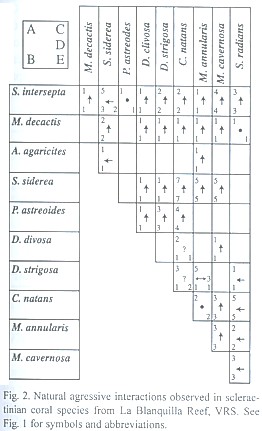
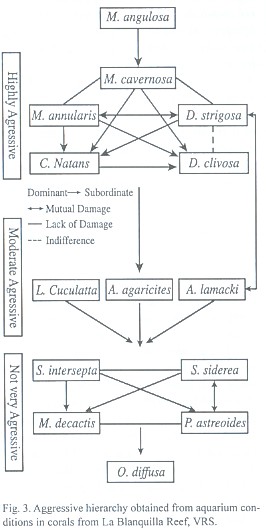
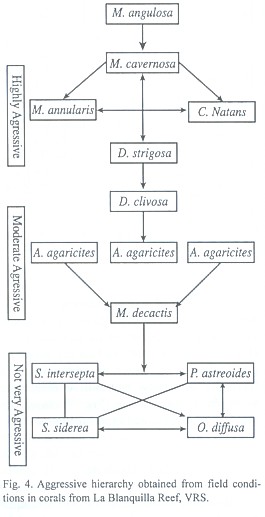
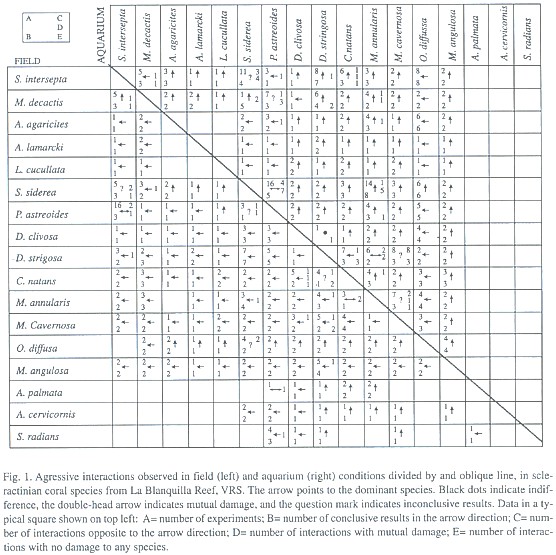
<body><![CDATA[<P><FONT FACE="Arial,Helvetica"><FONT SIZE=-1><B>Experimental determination of the aggression on the reef</B>:&nbsp; The field study was carried out at 4-9 m on the same N, E and W slopes of La Blanquilla reef. We collected numerous specimens and tied them underwater, forming experimental pairs, that were positioned as close as possible to the places at which they have been collected. We checked each of the 300 experimental pairs after 192 hrs to look for signs of aggressive behavior. As experimental controls, we placed healthy colonies in the same area, to verify that transplantion was not the reason for any observed responses.</FONT></FONT>      <P><FONT FACE="Arial,Helvetica"><FONT SIZE=-1><B>Natural interactions observed in the reef</B>:&nbsp; During the numerous dives carried out to collect the specimens for the study, we made direct observations of the natural interactions among corals in the reef. Each interaction was carefully observed and data such as:&nbsp; participating species and type of interaction were recorded.</FONT></FONT>      <P><B><FONT FACE="Arial,Helvetica"><FONT SIZE=-1>Results</FONT></FONT></B>      <P><FONT FACE="Arial,Helvetica"><FONT SIZE=-1><B>Aggressive behavior under aquarium conditions</B>:&nbsp; We obtained results for 345 experimental pairs that implied interactions among 16 species, of which 280 gave conclusive results (<A HREF="#fig1">Fig. 1</A>). In the remaining pairs the corals died during the course of the experiment. Extracoelenteric digestion by the extrusion of the mesenteric filaments was the only observed mechanism used by the dominant colony to attack the subordinate species, causing tissue necrosis to the latter. In <I>Agaricia agaricites</I>, <I>A. lamarcki</I>, <I>Leptoseris cucullata</I> and <I>Oculina diffusa</I>, we did not see mesenteric filaments, even when they were dominant in different interspecific encounters. <A HREF="#Chornesky">Chornesky (1983)</A> recorded sweeper tentacles in <I>Agaricia</I>, but they were not observed here, possibly due to the fact that they only develop after several weeks of tissue contact. However, the damage inflicted by these species on the subordinate species was similar to&nbsp; that of the filament extruding species. <A HREF="#Bak82">Bak <I>et al.&nbsp;</I> (1982)</A> reported that in <I>Agaricia agaricites</I> the filaments are very small and their observation is only possible under a microscope. Almost all the species extruded their mesenteric filaments during the night, generally 6-9 hrs after the beginning of the contact. <I>Montastraea cavernosa</I> and <I>Colpophyllia natans</I> were the only ones that extruded their filaments during the day. We observed three or four extruded filaments per polyp in most of the aggressive colonies. However, in some colonies of <I>Montastraea cavernosa</I>, there were as many as approximately 30 extruded filaments per polyp. The time for the manifestation of a clear aggressive dominance was variable for each species. Thus, while <I>Montastraea cavernosa</I> was dominant over <I>Stephanocoenia intersepta</I> in 24 hrs, <I>Colpophyllia natans</I> took up to 120 hrs to dominate this same species.</FONT></FONT>     <BR><FONT FACE="Arial,Helvetica"><FONT SIZE=-1>&nbsp;</FONT></FONT>     <CENTER><A NAME="fig1"></A><IMG SRC="/img/fbpe/rbt/v49n1/2325i01.JPG" HEIGHT=555 WIDTH=556></CENTER> <FONT FACE="Arial,Helvetica"><FONT SIZE=-1>&nbsp;</FONT></FONT>     
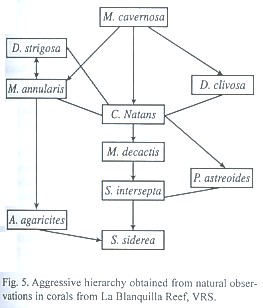
<BR><FONT FACE="Arial,Helvetica"><FONT SIZE=-1>Based in the results of these experimental interspecific encounters, we determined a hierarchy of aggressive dominance (<A HREF="#fig3">Fig. 3</A>), in which the studied scleractinian species are classified as being highly aggressive, moderately aggressive or not very aggressive on the basis of their rank in the hierarchy and on the number of subordinate species. The hierarchy is not completely linear, since two groups with similar aggressive capacity were formed, implying the lack of a definitive dominance of any single species over the others. In these cases we observed bilateral damage, indifference or opposite results among the species of the corresponding in the replicates. <I>Mussa angulosa</I> was the most aggressive species, followed by the first group formed by <I>Montastraea </I>spp., <I>Diploria</I> spp. and <I>Colpophyllia natans</I>, which were also classified as highly aggressive. <I>Agaricia agaricites</I>, <I>A. lamarcki</I> and <I>Leptoseris cucullata </I>were classified as moderately aggressive species. <I>Madracis decactis</I>, <I>Stephanocoenia intersepta</I>, <I>Porites astreoides</I>, <I>Siderastrea siderea</I> and <I>Oculina diffusa</I> formed the second group and were not very aggressive species dominated by other species of corals. Species such as <I>Acropora </I>spp<I>., Agaricia fragilis, Siderastrea radians, Porites porites, P. branneri, Favia conferta, Scolymia </I>spp<I>., Oculina valenciennesi </I>and<I> Astrangia solitaria</I>, although present in the reef (<A HREF="#Bravo">Bravo and Camacho, 1989</A>) were not included in this part of the study either because they did not survive the experimental conditions or were not found during the collection dives.</FONT></FONT>      <P><FONT FACE="Arial,Helvetica"><FONT SIZE=-1><B>Aggressive behavior in field conditions</B>:&nbsp; Conclusive results were obtained in 219 of&nbsp; 300 experimental pairs in the field (<A HREF="#fig1">Fig. 1</A>). <I>Acropora cervicornis, A. palmata and Siderastrea radians</I> were included in these studies. Some experimental pairs were separated by the action of surf, currents or fishes or other reef organisms. Contrary to our results for the aquarium conditions, it was not always possible to observe the aggression mechanism(s) used by every species. The resulting classification as highly aggressive, moderately aggressive and not very aggressive species is similar to that determined under aquarium conditions. There are slight differences on the arrangement of species within the “competitive rings” (<A HREF="#fig4">Fig. 4</A>). <I>Acropora cervicornis, A. palmata </I>and<I> Siderastrea radians, </I>although they are not show in the hierarchy, were considered not very aggressive since they were subordinate to the highly aggressive species, although due to the small number of experimental pairs for these species, it is not possible to draw conclusive results about their behavior.</FONT></FONT>      <P><FONT FACE="Arial,Helvetica"><FONT SIZE=-1><B>Records of natural interactions</B>:&nbsp; We recorded 88 natural interactions among corals of 11 different species in La Blanquilla reef (<A HREF="#fig2">Fig. 2</A>). We only observed two interaction types, unilateral aggression or indifference. The hierarchy of natural aggresssive dominance using these observations (<A HREF="#fig5">Fig. 5</A>) closely resembles those obtained experimentally.</FONT></FONT>     <CENTER><A NAME="fig2"></A><IMG SRC="/img/fbpe/rbt/v49n1/2325i02.JPG" HEIGHT=431 WIDTH=262></CENTER>      
]]></body>
<body><![CDATA[<CENTER>&nbsp;</CENTER>      <CENTER><A NAME="fig3"></A><IMG SRC="/img/fbpe/rbt/v49n1/2325i03.JPG" HEIGHT=531 WIDTH=266></CENTER>      
<CENTER>&nbsp;</CENTER>      <CENTER><A NAME="fig4"></A><IMG SRC="/img/fbpe/rbt/v49n1/2325i04.JPG" HEIGHT=517 WIDTH=265></CENTER>      
<CENTER>&nbsp;</CENTER>      <CENTER><A NAME="fig5"></A><IMG SRC="/img/fbpe/rbt/v49n1/2325i05.JPG" HEIGHT=308 WIDTH=263></CENTER> <B><FONT FACE="Arial,Helvetica"><FONT SIZE=-1>&nbsp;</FONT></FONT></B>     
<BR><B><FONT FACE="Arial,Helvetica"><FONT SIZE=-1>Discussion</FONT></FONT></B>     <BR><B><FONT FACE="Arial,Helvetica"><FONT SIZE=-1>&nbsp;</FONT></FONT></B>     <BR><FONT FACE="Arial,Helvetica"><FONT SIZE=-1>Based on the results from field and aquarium observations, scleractinian corals of La Blanquilla reef can be classified in:&nbsp; (1) “highly aggressive” species:&nbsp; <I>Mussa angulosa, Montastraea annularis complex, M. cavernosa, Diploria strigosa, D. clivosa </I>and<I> Colpophyllia natans</I>, (2) “moderately aggressive” species<I>:&nbsp; Agaricia agaricites, A. lamarcki and Leptoseris cucullata, </I>and (3) “not very aggressive” species:&nbsp; <I>Stephanocoenia intersepta, Siderastrea siderea, Madracis decactis, Porites astreoides, Oculina diffusa, Acropora palmata, A. cervicornis, Siderastrea radians, Porites branneri </I>and<I> Porites porites</I>. This classification does not represent a strictly linear model of dominance (hierarchy), since some species in categories 1 and 3 showed similar capacities of interspecific aggression. Although we did not observe the development of sweeper tentacles or any other known aggression mechanism in any species, they could be involved in the interactions. Hence, a possible explanation for the lack of a definitive dominance among the coral species that formed the groups, is that more than one aggression mechanisms could be used. Thus, the ability of any species to compete could be variable (Lang, pers. comm.).</FONT></FONT>      <P><FONT FACE="Arial,Helvetica"><FONT SIZE=-1>There were no important differences among the dominance patterns found in this study, and those previously noted in Jamaica (<A HREF="#Lang70">Lang 1970</A>, <A HREF="#Lang73">1973</A>) and Bermuda (<A HREF="#Logan84">Logan 1984</A>), and the more recent study in Curacao (<A HREF="#Van">Van Veghel <I>et al.&nbsp;</I> 1996</A>), where the scleractinian fauna is similar. <A HREF="#Lang73">Lang (1973)</A> ranked <I>M. cavernosa</I> lower in the hierarchy than <I>Diploria</I> spp. and <I>M. annularis</I>, and <A HREF="#Logan84">Logan (1984)</A> ranked this sames species higher. This can be considered an evidence for our suggestion of the existence of a group of higher rank of similar aggressive capacities, in addition of that proposed for the weakly-aggressive species. Unfortunately, the absence of some species for each studied geographic area, could not permit a thorough comparison of the hierarchies. The small differences in the aggressive capacity registered for each species in each area, could be explained by:&nbsp; (1) the state of health of the used colonies, (2) physical, chemical, seasonal and/or geographical variations as was suggested by Logan (<A HREF="#Logan84">1984</A>, <A HREF="#Logan86">1986</A>), and (3) the use of more than one mechanisms of aggression (<A HREF="#Lang90">Lang and Chornesky 1990</A>).</FONT></FONT>      ]]></body>
<body><![CDATA[<P><FONT FACE="Arial,Helvetica"><FONT SIZE=-1>The coral community structure in the reef slopes of La Blanquilla reef is well known (<A HREF="#Bravo">Bravo <I>et al.&nbsp;</I> 1989</A>). The most abundant species on the reef slopes between 4-9 m depth in order of importance are:&nbsp; <I>Montastraea cavernosa</I> (28%), <I>Colpophyllia natans</I> (20%), <I>Siderastrea siderea</I> (20%) and <I>Montastraea annularis</I> (13%). Each of this species, except <I>Siderastrea</I> <I>siderea,</I> is characterized as highly aggressive. The aggressive character of these species could explain in part their high coverage in the reef, as was pointed out for <I>Montastraea annularis </I>complex<I> </I>by <A HREF="#Van">Van Veghel <I>et al.&nbsp;</I> (1996)</A>. All are also massive colonies that grow slower than ramose and leafy colonies, like <I>Acropora</I> and <I>Agaricia </I>respectivelly. Our results constitute an additional evidence that some corals use aggressive behavior to compete against the fast-growing species and each other, in order to gain and maintain the space in the reef (<A HREF="#Lang70">Lang 1970</A>, <A HREF="#Lang73">1973</A>, <A HREF="#Sheppard80a">Sheppard 1980a, b</A>, <A HREF="#Bak82">Bak <I>et al.&nbsp;</I> 1982</A>, <A HREF="#Genin">Genin <I>et al.&nbsp;</I> 1994</A>).</FONT></FONT>      <P><FONT FACE="Arial,Helvetica"><FONT SIZE=-1>In the case of&nbsp; <I>Siderastrea siderea</I>, its high bottom coverage could be explained by its high reproductive potential (Szmant 1986) and its capacity to adapt to variable environmental conditions (<A HREF="#Bak76">Bak and Elgershuizen 1976</A>, <A HREF="#Bak76">Loya, 1976</A>). <I>Mussa angulosa</I> constitutes an exceptional case, although it is the most aggressive coral species, it is not abundant in La Blanquilla reef (relative coverage &lt;&lt;1%), thus, its aggressive capacity either play a secondary role in the determination of its coverage and/or distribution,and due that grows and reproduces slowly, without its high digestive dominance and ability to tolerate some shade, it might no longer exist at all.</FONT></FONT>      <P><FONT FACE="Arial,Helvetica"><FONT SIZE=-1>The VRS is a marginal reef environment, that has lower faunal diversity (<I>e.g.</I> corals, fish, annelids, mollusks) than other Caribbean reef areas, indicating an impoverished ecosystem that has developed at the limit of tolerable environmental conditions possibly mediated by low winter temperatures and high sedimentation rates (<A HREF="#Gutierrez">Guti&eacute;rrez <I>et al.&nbsp;</I> 1993</A>, <A HREF="#Carricart">Carricart-Ganivet and Horta-Puga 1993</A>, <A HREF="#Vargas">Vargas-Hern&aacute;ndez <I>et al.&nbsp;</I> 1993</A>). These reefs have also been imperiled for centuries, from the arrival of the Spaniards at the beginning of the 16th century, to the present. The anthropogenic impacts on these reefs include chemical pollution, over-fishing, accidental oil spills, unrestricted tourism, ship groundings, discharges of sewage effluents, dredging, boat anchoring, and the extraction of coral for building purposes (<A HREF="#Horta-Puga">Horta-Puga <I>et al.&nbsp;</I> 1997</A>). In spite of this severe environmental framework for the VRS, the coral species exhibit the same aggressive capacities as in other reef areas of the Western Atlantic.</FONT></FONT>     <BR><FONT FACE="Arial,Helvetica"><FONT SIZE=-1>&nbsp;</FONT></FONT>     <BR><B><FONT FACE="Arial,Helvetica"><FONT SIZE=-1>Acknowledgments</FONT></FONT></B>      <P><FONT FACE="Arial,Helvetica"><FONT SIZE=-1>Many thanks to Judy Lang for her thoroughly review and her suggestions that notably improved the manuscript. We also thank Leonardo Alcantar, Juan Pablo Carricart, Ricardo Saenz, Joel Reyes, Jaime Camacho, Juan Bravo, Hugo Castro and Miguel Fuentes for their help in the experimental design and sampling. Thanks to Guillermina Sedas for her support during the field work.</FONT></FONT>     <BR><FONT FACE="Arial,Helvetica"><FONT SIZE=-1>&nbsp;</FONT></FONT>     <BR><B><FONT FACE="Arial,Helvetica"><FONT SIZE=-1>Resumen</FONT></FONT></B>     <BR><FONT FACE="Arial,Helvetica"><FONT SIZE=-1>&nbsp;</FONT></FONT>     <BR><FONT FACE="Arial,Helvetica"><FONT SIZE=-1>Se determin&oacute; el comportamiento agresivo a corto plazo de los corales escleractinios del arrecife La Blanquilla, Sistema Arrecifal Veracruzano, en el Golfo de M&eacute;xico por medio de pares experimentales interespec&iacute;ficos en condiciones de acuario y campo, as&iacute; como de la observaci&oacute;n directa de encuentros interespec&iacute;ficos naturales. Las especies de coral fueron caracterizadas como altamente agresivas, moderadamente agresivas y no muy agresivas, estableci&eacute;ndose una jerarqu&iacute;a en la que se incluyen dos anillos competitivos en los cuales las especies tienen una capacidad agresiva similar. La digesti&oacute;n extracelent&eacute;rica fue el mecanismo de agresi&oacute;n m&aacute;s frecuentemente observado. La especie m&aacute;s agresiva fue <I>Mussa angulosa</I> y la menos agresiva <I>Oculina diffusa</I>. Aparentemente existe una relaci&oacute;n directa entre la capacidad agresiva y la cobertura relativa de las tres especies m&aacute;s abundantes a profundidades entre 4-9 m <I>Montastraea cavernosa</I>, <I>Colpophyllia natans</I> y <I>M. annularis</I>, ya que todas fueron clasificadas como altamente agresivas, tienen un crecimiento masivo y una cobertura relativa alta. <I>Siderastrea siderea</I> es la &uacute;nica especie dominante que no fue clasificada como altamente agresiva, por lo que su cobertura alta es debida a otros factores.</FONT></FONT>     ]]></body>
<body><![CDATA[<BR><FONT FACE="Arial,Helvetica"><FONT SIZE=-1>&nbsp;</FONT></FONT>     <BR><B><FONT FACE="Arial,Helvetica"><FONT SIZE=-1>Referencias</FONT></FONT></B>      <!-- ref --><P><A NAME="Ates"></A><FONT FACE="Arial,Helvetica"><FONT SIZE=-1>Ates, R. 1989. Aggressive behavior in corals. Freshwater Mar. Aquarium 12: 181-190.</FONT></FONT>    &nbsp;&nbsp;&nbsp;&nbsp;&nbsp;&nbsp;&nbsp;&nbsp;[&#160;<a href="javascript:void(0);" onclick="javascript: window.open('/scielo.php?script=sci_nlinks&ref=1344557&pid=S0034-7744200100010000700001&lng=','','width=640,height=500,resizable=yes,scrollbars=1,menubar=yes,');">Links</a>&#160;]<!-- end-ref --><!-- ref --><P><A NAME="Bak75"></A><FONT FACE="Arial,Helvetica"><FONT SIZE=-1>Bak, R.P.M. 1975. Ecological aspects of the distribution of reef corals in the Netherland Antilles. Bijd. Dierk. 45: 181-190.</FONT></FONT>    &nbsp;&nbsp;&nbsp;&nbsp;&nbsp;&nbsp;&nbsp;&nbsp;[&#160;<a href="javascript:void(0);" onclick="javascript: window.open('/scielo.php?script=sci_nlinks&ref=1344558&pid=S0034-7744200100010000700002&lng=','','width=640,height=500,resizable=yes,scrollbars=1,menubar=yes,');">Links</a>&#160;]<!-- end-ref --><!-- ref --><P><A NAME="Bak76"></A><FONT FACE="Arial,Helvetica"><FONT SIZE=-1>Bak, R.P.M. &amp; J.H.B.W. Elgershuizen. 1976. Patterns of oil-sediment rejection in corals. Mar. Biol. 69: 215-222.</FONT></FONT>    &nbsp;&nbsp;&nbsp;&nbsp;&nbsp;&nbsp;&nbsp;&nbsp;[&#160;<a href="javascript:void(0);" onclick="javascript: window.open('/scielo.php?script=sci_nlinks&ref=1344559&pid=S0034-7744200100010000700003&lng=','','width=640,height=500,resizable=yes,scrollbars=1,menubar=yes,');">Links</a>&#160;]<!-- end-ref --><!-- ref --><P><A NAME="Bak82"></A><FONT FACE="Arial,Helvetica"><FONT SIZE=-1>Bak, R.P.M., R.M. Termaat &amp; R. Dekker. 1982. Complexity of coral interactions: Influence of time, location of interaction and epifauna. Mar. Biol. 69: 215-222.</FONT></FONT>    &nbsp;&nbsp;&nbsp;&nbsp;&nbsp;&nbsp;&nbsp;&nbsp;[&#160;<a href="javascript:void(0);" onclick="javascript: window.open('/scielo.php?script=sci_nlinks&ref=1344560&pid=S0034-7744200100010000700004&lng=','','width=640,height=500,resizable=yes,scrollbars=1,menubar=yes,');">Links</a>&#160;]<!-- end-ref --><!-- ref --><P><A NAME="Bravo"></A><FONT FACE="Arial,Helvetica"><FONT SIZE=-1>Bravo-Ruiz, J., E. J. Camacho-Ruiz &amp; J.P. Carricart-Ganivet. 1989. Composici&oacute;n de especies y zonaci&oacute;n de corales escleractinios en el arrecife "La Blanquilla", Veracruz. Programa y res&uacute;menes. X Congreso Nacional de Zoolog&iacute;a, M&eacute;xico, D.F.</FONT></FONT>    &nbsp;&nbsp;&nbsp;&nbsp;&nbsp;&nbsp;&nbsp;&nbsp;[&#160;<a href="javascript:void(0);" onclick="javascript: window.open('/scielo.php?script=sci_nlinks&ref=1344561&pid=S0034-7744200100010000700005&lng=','','width=640,height=500,resizable=yes,scrollbars=1,menubar=yes,');">Links</a>&#160;]<!-- end-ref --><!-- ref --><P><A NAME="Carricart"></A><FONT FACE="Arial,Helvetica"><FONT SIZE=-1>Carricart-Ganivet, J.P. &amp; G. Horta-Puga. 1993. Arrecifes de coral en M&eacute;xico, p. 80-90. In S.I. Salazar-Vallejo, y N.E. Gonz&aacute;lez (eds.), Biodiversidad Marina y Costera de M&eacute;xico. Com. Nal. Biodiv. y CIQRO, M&eacute;xico, D.F.</FONT></FONT>    &nbsp;&nbsp;&nbsp;&nbsp;&nbsp;&nbsp;&nbsp;&nbsp;[&#160;<a href="javascript:void(0);" onclick="javascript: window.open('/scielo.php?script=sci_nlinks&ref=1344562&pid=S0034-7744200100010000700006&lng=','','width=640,height=500,resizable=yes,scrollbars=1,menubar=yes,');">Links</a>&#160;]<!-- end-ref --><!-- ref --><P><A NAME="Connell"></A><FONT FACE="Arial,Helvetica"><FONT SIZE=-1>Connell, J.H. 1976. Competitive interactions and the species diversity of corals, p. 51-58.&nbsp; In: G.O. Mackie, (ed.), Coelenterate ecology and behavior. Plenum Press, New York.</FONT></FONT>    &nbsp;&nbsp;&nbsp;&nbsp;&nbsp;&nbsp;&nbsp;&nbsp;[&#160;<a href="javascript:void(0);" onclick="javascript: window.open('/scielo.php?script=sci_nlinks&ref=1344563&pid=S0034-7744200100010000700007&lng=','','width=640,height=500,resizable=yes,scrollbars=1,menubar=yes,');">Links</a>&#160;]<!-- end-ref --><!-- ref --><P><A NAME="Cope"></A><FONT FACE="Arial,Helvetica"><FONT SIZE=-1>Cope, M. 1981. Interspecific coral interactions in Hong Kong. Proc. 4<SUP>th</SUP> Int. Coral Reef Symp., Manila, Philippines 2: 357-362.</FONT></FONT>    &nbsp;&nbsp;&nbsp;&nbsp;&nbsp;&nbsp;&nbsp;&nbsp;[&#160;<a href="javascript:void(0);" onclick="javascript: window.open('/scielo.php?script=sci_nlinks&ref=1344564&pid=S0034-7744200100010000700008&lng=','','width=640,height=500,resizable=yes,scrollbars=1,menubar=yes,');">Links</a>&#160;]<!-- end-ref --><!-- ref --><P><A NAME="Chadwick"></A><FONT FACE="Arial,Helvetica"><FONT SIZE=-1>Chadwick N E. 1991. Spatial distribution and the effects of competition on some temperate Scleractinia and Corallimorpharia. Mar. Ecol. Progr. Ser. 70: 39-48.</FONT></FONT>    &nbsp;&nbsp;&nbsp;&nbsp;&nbsp;&nbsp;&nbsp;&nbsp;[&#160;<a href="javascript:void(0);" onclick="javascript: window.open('/scielo.php?script=sci_nlinks&ref=1344565&pid=S0034-7744200100010000700009&lng=','','width=640,height=500,resizable=yes,scrollbars=1,menubar=yes,');">Links</a>&#160;]<!-- end-ref --><!-- ref --><P><A NAME="Chornesky"></A><FONT FACE="Arial,Helvetica"><FONT SIZE=-1>Chornesky E.A. 1983. Induced development of sweeper tentacles on the reef coral <I>Agaricia agaricites</I>: A response to direct competition. Biol. Bull. 165: 569-581.</FONT></FONT>    &nbsp;&nbsp;&nbsp;&nbsp;&nbsp;&nbsp;&nbsp;&nbsp;[&#160;<a href="javascript:void(0);" onclick="javascript: window.open('/scielo.php?script=sci_nlinks&ref=1344566&pid=S0034-7744200100010000700010&lng=','','width=640,height=500,resizable=yes,scrollbars=1,menubar=yes,');">Links</a>&#160;]<!-- end-ref --><!-- ref --><P><A NAME="Den"></A><FONT FACE="Arial,Helvetica"><FONT SIZE=-1>Den Hartog, J.C. 1977. The marginal tentacles of <I>Rhodactis sanctithomae</I> (Corallimorpharia) and the sweeper tentacles of <I>Montastrea cavernosa</I> (Scleractinia); their cnidom and possible function. Proc. 3<SUP>rd</SUP> Int. Coral Reef Symp., Miami, Florida 1: 463-469.</FONT></FONT>    &nbsp;&nbsp;&nbsp;&nbsp;&nbsp;&nbsp;&nbsp;&nbsp;[&#160;<a href="javascript:void(0);" onclick="javascript: window.open('/scielo.php?script=sci_nlinks&ref=1344567&pid=S0034-7744200100010000700011&lng=','','width=640,height=500,resizable=yes,scrollbars=1,menubar=yes,');">Links</a>&#160;]<!-- end-ref --><!-- ref --><P><A NAME="Genin"></A><FONT FACE="Arial,Helvetica"><FONT SIZE=-1>Genin, A., L. Karp &amp; A. Miroz. 1994. Effects of flow on competitive superiority in scleractinian corals. Limnol. Oceanogr. 39: 913-924.</FONT></FONT>    &nbsp;&nbsp;&nbsp;&nbsp;&nbsp;&nbsp;&nbsp;&nbsp;[&#160;<a href="javascript:void(0);" onclick="javascript: window.open('/scielo.php?script=sci_nlinks&ref=1344568&pid=S0034-7744200100010000700012&lng=','','width=640,height=500,resizable=yes,scrollbars=1,menubar=yes,');">Links</a>&#160;]<!-- end-ref --><!-- ref --><P><A NAME="Gutierrez"></A><FONT FACE="Arial,Helvetica"><FONT SIZE=-1>Guti&eacute;rrez, D., C. Garc&iacute;a-Saez, M. Lara &amp; C. Padilla. 1993. Comparaci&oacute;n de Arrecifes coralinos Veracruz y Quintana Roo, p. 787-806. In S.I. Salazar-Vallejo y N.E. Gonz&aacute;lez (eds.), Biodiversidad Marina y Costera de M&eacute;xico. Com. Nal. Biodiv. y CIQRO, M&eacute;xico, D.F.</FONT></FONT>    &nbsp;&nbsp;&nbsp;&nbsp;&nbsp;&nbsp;&nbsp;&nbsp;[&#160;<a href="javascript:void(0);" onclick="javascript: window.open('/scielo.php?script=sci_nlinks&ref=1344569&pid=S0034-7744200100010000700013&lng=','','width=640,height=500,resizable=yes,scrollbars=1,menubar=yes,');">Links</a>&#160;]<!-- end-ref --><!-- ref --><P><A NAME="Horta-Puga"></A><FONT FACE="Arial,Helvetica"><FONT SIZE=-1>Horta-Puga, G., G. Barba-Santos &amp; J.L. Tello-Musi. 1997. The Veracruz Reef System in the Gulf of Mexico: An Environmental Review. Symp. Ecosist. Acuat. M&eacute;x., M&eacute;xico D.F., M&eacute;xico. Programa: 015.</FONT></FONT>    &nbsp;&nbsp;&nbsp;&nbsp;&nbsp;&nbsp;&nbsp;&nbsp;[&#160;<a href="javascript:void(0);" onclick="javascript: window.open('/scielo.php?script=sci_nlinks&ref=1344570&pid=S0034-7744200100010000700014&lng=','','width=640,height=500,resizable=yes,scrollbars=1,menubar=yes,');">Links</a>&#160;]<!-- end-ref --><!-- ref --><P><A NAME="Lang70"></A><FONT FACE="Arial,Helvetica"><FONT SIZE=-1>Lang, J.C. 1970. Inter-specific aggression within the scleractinian reef corals. Ph.D. Thesis, Yale Univ., New Haven, Connectticutt. 80 p.</FONT></FONT>    &nbsp;&nbsp;&nbsp;&nbsp;&nbsp;&nbsp;&nbsp;&nbsp;[&#160;<a href="javascript:void(0);" onclick="javascript: window.open('/scielo.php?script=sci_nlinks&ref=1344571&pid=S0034-7744200100010000700015&lng=','','width=640,height=500,resizable=yes,scrollbars=1,menubar=yes,');">Links</a>&#160;]<!-- end-ref --><!-- ref --><P><A NAME="Lang71"></A><FONT FACE="Arial,Helvetica"><FONT SIZE=-1>Lang, J.C. 1971. Interspecific aggression by scleractinian corals. 1. The rediscovery of <I>Scolymia cubensis</I> (Milne-Edwards and Haime). Bull. Mar. Sci. 21: 952-959.</FONT></FONT>    &nbsp;&nbsp;&nbsp;&nbsp;&nbsp;&nbsp;&nbsp;&nbsp;[&#160;<a href="javascript:void(0);" onclick="javascript: window.open('/scielo.php?script=sci_nlinks&ref=1344572&pid=S0034-7744200100010000700016&lng=','','width=640,height=500,resizable=yes,scrollbars=1,menubar=yes,');">Links</a>&#160;]<!-- end-ref --><!-- ref --><P><A NAME="Lang73"></A><FONT FACE="Arial,Helvetica"><FONT SIZE=-1>Lang, J.C. 1973. Interspecific aggression by scleractinian corals. 2. Why the race is not only to the swift. Bull. Mar. Sci. 23: 260-279.</FONT></FONT>    &nbsp;&nbsp;&nbsp;&nbsp;&nbsp;&nbsp;&nbsp;&nbsp;[&#160;<a href="javascript:void(0);" onclick="javascript: window.open('/scielo.php?script=sci_nlinks&ref=1344573&pid=S0034-7744200100010000700017&lng=','','width=640,height=500,resizable=yes,scrollbars=1,menubar=yes,');">Links</a>&#160;]<!-- end-ref --><!-- ref --><P><A NAME="Lang90"></A><FONT FACE="Arial,Helvetica"><FONT SIZE=-1>Lang, J. C. &amp; E.A. Chornesky. 1990. Competition between scleractinian reef corals- A review of mechanisms and effects, p. 209-252. In Dubinsky, Z. (Ed.). Coral Reefs. Ecosystems of the World 25. Elsevier, Amsterdam.</FONT></FONT>    &nbsp;&nbsp;&nbsp;&nbsp;&nbsp;&nbsp;&nbsp;&nbsp;[&#160;<a href="javascript:void(0);" onclick="javascript: window.open('/scielo.php?script=sci_nlinks&ref=1344574&pid=S0034-7744200100010000700018&lng=','','width=640,height=500,resizable=yes,scrollbars=1,menubar=yes,');">Links</a>&#160;]<!-- end-ref --><!-- ref --><P><A NAME="Logan84"></A><FONT FACE="Arial,Helvetica"><FONT SIZE=-1>Logan, A. 1984. Interspecific aggression in hermatypic corals from Bermuda. Coral Reefs 3: 131-138.</FONT></FONT>    &nbsp;&nbsp;&nbsp;&nbsp;&nbsp;&nbsp;&nbsp;&nbsp;[&#160;<a href="javascript:void(0);" onclick="javascript: window.open('/scielo.php?script=sci_nlinks&ref=1344575&pid=S0034-7744200100010000700019&lng=','','width=640,height=500,resizable=yes,scrollbars=1,menubar=yes,');">Links</a>&#160;]<!-- end-ref --><!-- ref --><P><A NAME="Logan86"></A><FONT FACE="Arial,Helvetica"><FONT SIZE=-1>Logan, A. 1986. Aggressive behavior in reef corals: A strategy for survival. Sea Frontiers/Sea Secrets 32: 347-351.</FONT></FONT>    &nbsp;&nbsp;&nbsp;&nbsp;&nbsp;&nbsp;&nbsp;&nbsp;[&#160;<a href="javascript:void(0);" onclick="javascript: window.open('/scielo.php?script=sci_nlinks&ref=1344576&pid=S0034-7744200100010000700020&lng=','','width=640,height=500,resizable=yes,scrollbars=1,menubar=yes,');">Links</a>&#160;]<!-- end-ref --><!-- ref --><P><A NAME="Loya"></A><FONT FACE="Arial,Helvetica"><FONT SIZE=-1>Loya, Y. 1976. Effects of water turbidity and sedimentation on the community structure of Puerto Rican corals. Bull. Mar. Sci. 26: 450-466.</FONT></FONT>    &nbsp;&nbsp;&nbsp;&nbsp;&nbsp;&nbsp;&nbsp;&nbsp;[&#160;<a href="javascript:void(0);" onclick="javascript: window.open('/scielo.php?script=sci_nlinks&ref=1344577&pid=S0034-7744200100010000700021&lng=','','width=640,height=500,resizable=yes,scrollbars=1,menubar=yes,');">Links</a>&#160;]<!-- end-ref --><!-- ref --><P><A NAME="Porter"></A><FONT FACE="Arial,Helvetica"><FONT SIZE=-1>Porter, J.W. 1974. Community structure of coral reefs on opposite side of the isthmus of Panama. Science 186: 543-545.</FONT></FONT>    &nbsp;&nbsp;&nbsp;&nbsp;&nbsp;&nbsp;&nbsp;&nbsp;[&#160;<a href="javascript:void(0);" onclick="javascript: window.open('/scielo.php?script=sci_nlinks&ref=1344578&pid=S0034-7744200100010000700022&lng=','','width=640,height=500,resizable=yes,scrollbars=1,menubar=yes,');">Links</a>&#160;]<!-- end-ref --><!-- ref --><P><A NAME="Potts"></A><FONT FACE="Arial,Helvetica"><FONT SIZE=-1>Potts, D.C. 1978. Differentiation in coral populations. Atoll Res. Bull. 220: 55-74.</FONT></FONT>    &nbsp;&nbsp;&nbsp;&nbsp;&nbsp;&nbsp;&nbsp;&nbsp;[&#160;<a href="javascript:void(0);" onclick="javascript: window.open('/scielo.php?script=sci_nlinks&ref=1344579&pid=S0034-7744200100010000700023&lng=','','width=640,height=500,resizable=yes,scrollbars=1,menubar=yes,');">Links</a>&#160;]<!-- end-ref --><!-- ref --><P><A NAME="Richardson"></A><FONT FACE="Arial,Helvetica"><FONT SIZE=-1>Richardson, C.A., P. Dustan &amp; J.C. Lang. 1979. Maintenance of living space by sweeper tentacles of <I>Montastrea cavernosa</I>, a Caribbean reef coral. Mar. Biol. 55: 181-186.</FONT></FONT>    &nbsp;&nbsp;&nbsp;&nbsp;&nbsp;&nbsp;&nbsp;&nbsp;[&#160;<a href="javascript:void(0);" onclick="javascript: window.open('/scielo.php?script=sci_nlinks&ref=1344580&pid=S0034-7744200100010000700024&lng=','','width=640,height=500,resizable=yes,scrollbars=1,menubar=yes,');">Links</a>&#160;]<!-- end-ref --><!-- ref --><P><A NAME="Sheppard79"></A><FONT FACE="Arial,Helvetica"><FONT SIZE=-1>Sheppard, C.R.C. 1979. Interspecific aggression between reef corals with reference to their distribution. Mar. Ecol. Prog. Ser. 1: 237-247.</FONT></FONT>    &nbsp;&nbsp;&nbsp;&nbsp;&nbsp;&nbsp;&nbsp;&nbsp;[&#160;<a href="javascript:void(0);" onclick="javascript: window.open('/scielo.php?script=sci_nlinks&ref=1344581&pid=S0034-7744200100010000700025&lng=','','width=640,height=500,resizable=yes,scrollbars=1,menubar=yes,');">Links</a>&#160;]<!-- end-ref --><!-- ref --><P><A NAME="Sheppard80a"></A><FONT FACE="Arial,Helvetica"><FONT SIZE=-1>Sheppard, C.R.C. 1980a. Roles of interspecific and intraspecific competition on coral zonation. Progr. Underwater Sci. 6: 57-60.</FONT></FONT>    &nbsp;&nbsp;&nbsp;&nbsp;&nbsp;&nbsp;&nbsp;&nbsp;[&#160;<a href="javascript:void(0);" onclick="javascript: window.open('/scielo.php?script=sci_nlinks&ref=1344582&pid=S0034-7744200100010000700026&lng=','','width=640,height=500,resizable=yes,scrollbars=1,menubar=yes,');">Links</a>&#160;]<!-- end-ref --><!-- ref --><P><A NAME="Sheppard80b"></A><FONT FACE="Arial,Helvetica"><FONT SIZE=-1>Sheppard, C.R.C. 1980b. Coral cover, zonation and diversity on reef slopes of Chagos Atolls, and population structures of the major species. Mar. Ecol. Progr. Ser. 6: 57-60.</FONT></FONT>    &nbsp;&nbsp;&nbsp;&nbsp;&nbsp;&nbsp;&nbsp;&nbsp;[&#160;<a href="javascript:void(0);" onclick="javascript: window.open('/scielo.php?script=sci_nlinks&ref=1344583&pid=S0034-7744200100010000700027&lng=','','width=640,height=500,resizable=yes,scrollbars=1,menubar=yes,');">Links</a>&#160;]<!-- end-ref --><!-- ref --><P><A NAME="Szmant"></A><FONT FACE="Arial,Helvetica"><FONT SIZE=-1>Szmant, A.M. 1986. Reproductive ecology of Caribbean reef corals. Coral Reefs 5: 43-54.</FONT></FONT>    &nbsp;&nbsp;&nbsp;&nbsp;&nbsp;&nbsp;&nbsp;&nbsp;[&#160;<a href="javascript:void(0);" onclick="javascript: window.open('/scielo.php?script=sci_nlinks&ref=1344584&pid=S0034-7744200100010000700028&lng=','','width=640,height=500,resizable=yes,scrollbars=1,menubar=yes,');">Links</a>&#160;]<!-- end-ref --><!-- ref --><P><A NAME="Tunnell"></A><FONT FACE="Arial,Helvetica"><FONT SIZE=-1>Tunnell, J.W. 1992. Natural versus human impacts to Southern Gulf of Mexico coral reef resources. Proc. 7th Int. Coral Reef Symp., Guam 1: 300-306.</FONT></FONT>    &nbsp;&nbsp;&nbsp;&nbsp;&nbsp;&nbsp;&nbsp;&nbsp;[&#160;<a href="javascript:void(0);" onclick="javascript: window.open('/scielo.php?script=sci_nlinks&ref=1344585&pid=S0034-7744200100010000700029&lng=','','width=640,height=500,resizable=yes,scrollbars=1,menubar=yes,');">Links</a>&#160;]<!-- end-ref --><!-- ref --><P><A NAME="Van"></A><FONT FACE="Arial,Helvetica"><FONT SIZE=-1>Van Veghel, M.L.J., D.F.R. Cleary &amp; R.P.M. Bak. 1996. Interspecific interactions and competitive ability of the polymorphic reef-building coral <I>Montastrea annularis</I>. Bull. Mar. Sci. 58: 792-803.</FONT></FONT>    &nbsp;&nbsp;&nbsp;&nbsp;&nbsp;&nbsp;&nbsp;&nbsp;[&#160;<a href="javascript:void(0);" onclick="javascript: window.open('/scielo.php?script=sci_nlinks&ref=1344586&pid=S0034-7744200100010000700030&lng=','','width=640,height=500,resizable=yes,scrollbars=1,menubar=yes,');">Links</a>&#160;]<!-- end-ref --><!-- ref --><P><A NAME="Vargas"></A><FONT FACE="Arial,Helvetica"><FONT SIZE=-1>Vargas-Hern&aacute;ndez, J.M., A. Hern&aacute;ndez-Guti&eacute;rrez &amp; L.F. Carrera-Parra. 1993. Sistema Arrecifal Veracruzano, p. 559-575. In: S.I. Salazar-Vallejo, y N.E. Gonz&aacute;lez (eds.), Biodiversidad Marina y Costera de M&eacute;xico. Com. Nal. Biodiv. y CIQRO, M&eacute;xico, D.F.</FONT></FONT>    &nbsp;&nbsp;&nbsp;&nbsp;&nbsp;&nbsp;&nbsp;&nbsp;[&#160;<a href="javascript:void(0);" onclick="javascript: window.open('/scielo.php?script=sci_nlinks&ref=1344587&pid=S0034-7744200100010000700031&lng=','','width=640,height=500,resizable=yes,scrollbars=1,menubar=yes,');">Links</a>&#160;]<!-- end-ref --><!-- ref --><P><A NAME="Weil"></A><FONT FACE="Arial,Helvetica"><FONT SIZE=-1>Weil, E. &amp; N. Knowlton. 1994. A multi-character analysis of the caribbean coral Montastraea annularis (Ellis and Solander, 1786) and its two sibling species, M-faveolata (Ellis and Solander, 1786) and M-franksi (Gregory, 1895). Bull. Mar. Sci. 55: 151-175.</FONT></FONT>    &nbsp;&nbsp;&nbsp;&nbsp;&nbsp;&nbsp;&nbsp;&nbsp;[&#160;<a href="javascript:void(0);" onclick="javascript: window.open('/scielo.php?script=sci_nlinks&ref=1344588&pid=S0034-7744200100010000700032&lng=','','width=640,height=500,resizable=yes,scrollbars=1,menubar=yes,');">Links</a>&#160;]<!-- end-ref --><!-- ref --><P><A NAME="Wellington"></A><FONT FACE="Arial,Helvetica"><FONT SIZE=-1>Wellington, G.M. 1980. Reversal digestive interactions between pacific reef corals: Mediation by sweeper tentacles. Oecologia 65: 516-525.</FONT></FONT>    &nbsp;&nbsp;&nbsp;&nbsp;&nbsp;&nbsp;&nbsp;&nbsp;[&#160;<a href="javascript:void(0);" onclick="javascript: window.open('/scielo.php?script=sci_nlinks&ref=1344589&pid=S0034-7744200100010000700033&lng=','','width=640,height=500,resizable=yes,scrollbars=1,menubar=yes,');">Links</a>&#160;]<!-- end-ref --><!-- ref --><P><A NAME="Yamazato"></A><FONT FACE="Arial,Helvetica"><FONT SIZE=-1>Yamazato, K. &amp; T. Yeemin. 1986. Preliminary study on the inter- and intraspecific interactions among corals of Khang Khao Island, the Sichang Islands, Gulf of Thailand. Galaxea, 5: 163-174</FONT></FONT>    &nbsp;&nbsp;&nbsp;&nbsp;&nbsp;&nbsp;&nbsp;&nbsp;[&#160;<a href="javascript:void(0);" onclick="javascript: window.open('/scielo.php?script=sci_nlinks&ref=1344590&pid=S0034-7744200100010000700034&lng=','','width=640,height=500,resizable=yes,scrollbars=1,menubar=yes,');">Links</a>&#160;]<!-- end-ref --><BR><FONT FACE="Arial,Helvetica"><FONT SIZE=-1>&nbsp;</FONT></FONT>     <BR><A NAME="A1"></A><FONT FACE="Arial,Helvetica"><FONT SIZE=-1><A HREF="#R1">1</A> Pronatura Pen&iacute;nsula de Yucat&aacute;n, A.C. Calle No. 1-D 254-A. Col. Campestre. M&eacute;rida, Yucat&aacute;n 97120, M&eacute;xico; <A HREF="mailto:ppy@pibil.finred.com.mx">ppy@pibil.finred.com.mx</A></FONT></FONT>      <P><FONT FACE="Arial,Helvetica"><FONT SIZE=-1><A HREF="#R1">2</A> INVEMAR, UBIPRO, ENEP Iztacala, Universidad Nacional Aut&oacute;noma de M&eacute;xico. Av. de los Barrios s/n, Los Reyes Iztacala, Tlalnepantla, M&eacute;xico 54090. Fax:&nbsp; +(52) 56231225; <A HREF="mailto:horta@servidor.unam.mx">horta@servidor.unam.mx</A></FONT></FONT>      ]]></body><back>
<ref-list>
<ref id="B1">
<nlm-citation citation-type="journal">
<person-group person-group-type="author">
<name>
<surname><![CDATA[Ates]]></surname>
<given-names><![CDATA[R]]></given-names>
</name>
</person-group>
<article-title xml:lang="en"><![CDATA[Aggressive behavior in corals. Freshwater Mar]]></article-title>
<source><![CDATA[Aquarium]]></source>
<year>1989</year>
<volume>12</volume>
<page-range>181-190</page-range></nlm-citation>
</ref>
<ref id="B2">
<nlm-citation citation-type="journal">
<person-group person-group-type="author">
<name>
<surname><![CDATA[Bak]]></surname>
<given-names><![CDATA[R.P.M]]></given-names>
</name>
</person-group>
<article-title xml:lang="en"><![CDATA[Ecological aspects of the distribution of reef corals in the Netherland Antilles]]></article-title>
<source><![CDATA[Bijd. Dierk]]></source>
<year>1975</year>
<volume>45</volume>
<page-range>181-190</page-range></nlm-citation>
</ref>
<ref id="B3">
<nlm-citation citation-type="journal">
<person-group person-group-type="author">
<name>
<surname><![CDATA[Bak]]></surname>
<given-names><![CDATA[R.P.M]]></given-names>
</name>
<name>
<surname><![CDATA[Elgershuizen]]></surname>
<given-names><![CDATA[J.H.B.W]]></given-names>
</name>
</person-group>
<article-title xml:lang="en"><![CDATA[Patterns of oil-sediment rejection in corals]]></article-title>
<source><![CDATA[Mar. Biol]]></source>
<year>1976</year>
<volume>69</volume>
<page-range>215-222</page-range></nlm-citation>
</ref>
<ref id="B4">
<nlm-citation citation-type="journal">
<person-group person-group-type="author">
<name>
<surname><![CDATA[Bak]]></surname>
<given-names><![CDATA[R.P.M]]></given-names>
</name>
<name>
<surname><![CDATA[Termaat]]></surname>
<given-names><![CDATA[R.M]]></given-names>
</name>
<name>
<surname><![CDATA[Dekker]]></surname>
<given-names><![CDATA[R]]></given-names>
</name>
</person-group>
<article-title xml:lang="en"><![CDATA[Complexity of coral interactions: Influence of time, location of interaction and epifauna]]></article-title>
<source><![CDATA[Mar. Biol]]></source>
<year>1982</year>
<volume>69</volume>
<page-range>215-222</page-range></nlm-citation>
</ref>
<ref id="B5">
<nlm-citation citation-type="confpro">
<person-group person-group-type="author">
<name>
<surname><![CDATA[Bravo-Ruiz]]></surname>
<given-names><![CDATA[J]]></given-names>
</name>
<name>
<surname><![CDATA[Camacho-Ruiz]]></surname>
<given-names><![CDATA[E. J]]></given-names>
</name>
<name>
<surname><![CDATA[Carricart-Ganivet]]></surname>
<given-names><![CDATA[J.P]]></given-names>
</name>
</person-group>
<source><![CDATA[Composición de especies y zonación de corales escleractinios en el arrecife "La Blanquilla", Veracruz]]></source>
<year>1989</year>
<conf-name><![CDATA[X Congreso Nacional de Zoología]]></conf-name>
<conf-loc>México, D.F México, D.F</conf-loc>
</nlm-citation>
</ref>
<ref id="B6">
<nlm-citation citation-type="book">
<person-group person-group-type="author">
<name>
<surname><![CDATA[Carricart-Ganivet]]></surname>
<given-names><![CDATA[J.P]]></given-names>
</name>
<name>
<surname><![CDATA[Horta-Puga]]></surname>
<given-names><![CDATA[G]]></given-names>
</name>
</person-group>
<article-title xml:lang="es"><![CDATA[Arrecifes de coral en México]]></article-title>
<person-group person-group-type="editor">
<name>
<surname><![CDATA[Salazar-Vallejo]]></surname>
<given-names><![CDATA[S.I]]></given-names>
</name>
<name>
<surname><![CDATA[González]]></surname>
<given-names><![CDATA[N.E]]></given-names>
</name>
</person-group>
<source><![CDATA[Biodiversidad Marina y Costera de México]]></source>
<year>1993</year>
<publisher-name><![CDATA[Com. Nal. Biodiv. y CIQRO]]></publisher-name>
</nlm-citation>
</ref>
<ref id="B7">
<nlm-citation citation-type="book">
<person-group person-group-type="author">
<name>
<surname><![CDATA[Connell]]></surname>
<given-names><![CDATA[J.H]]></given-names>
</name>
</person-group>
<article-title xml:lang="en"><![CDATA[Competitive interactions and the species diversity of corals]]></article-title>
<person-group person-group-type="editor">
<name>
<surname><![CDATA[Mackie]]></surname>
<given-names><![CDATA[G.O]]></given-names>
</name>
</person-group>
<source><![CDATA[Coelenterate ecology and behavior]]></source>
<year>1976</year>
<publisher-loc><![CDATA[New York ]]></publisher-loc>
<publisher-name><![CDATA[Plenum Press]]></publisher-name>
</nlm-citation>
</ref>
<ref id="B8">
<nlm-citation citation-type="confpro">
<person-group person-group-type="author">
<name>
<surname><![CDATA[Cope]]></surname>
<given-names><![CDATA[M]]></given-names>
</name>
</person-group>
<source><![CDATA[Interspecific coral interactions in Hong Kong]]></source>
<year>1981</year>
<conf-name><![CDATA[4th Int. Coral Reef Symp]]></conf-name>
<conf-loc>Manila </conf-loc>
<page-range>357-362</page-range></nlm-citation>
</ref>
<ref id="B9">
<nlm-citation citation-type="journal">
<person-group person-group-type="author">
<name>
<surname><![CDATA[Chadwick]]></surname>
<given-names><![CDATA[N E]]></given-names>
</name>
</person-group>
<article-title xml:lang="en"><![CDATA[Spatial distribution and the effects of competition on some temperate Scleractinia and Corallimorpharia]]></article-title>
<source><![CDATA[Mar. Ecol. Progr. Ser]]></source>
<year>1991</year>
<volume>70</volume>
<page-range>39-48</page-range></nlm-citation>
</ref>
<ref id="B10">
<nlm-citation citation-type="journal">
<person-group person-group-type="author">
<name>
<surname><![CDATA[Chornesky]]></surname>
<given-names><![CDATA[E.A]]></given-names>
</name>
</person-group>
<article-title xml:lang="en"><![CDATA[Induced development of sweeper tentacles on the reef coral Agaricia agaricites: A response to direct competition]]></article-title>
<source><![CDATA[Biol. Bull]]></source>
<year>1983</year>
<volume>165</volume>
<page-range>569-581</page-range></nlm-citation>
</ref>
<ref id="B11">
<nlm-citation citation-type="confpro">
<person-group person-group-type="author">
<name>
<surname><![CDATA[Den Hartog]]></surname>
<given-names><![CDATA[J.C]]></given-names>
</name>
</person-group>
<source><![CDATA[The marginal tentacles of Rhodactis sanctithomae (Corallimorpharia) and the sweeper tentacles of Montastrea cavernosa (Scleractinia); their cnidom and possible function]]></source>
<year>1977</year>
<conf-name><![CDATA[3rd Int. Coral Reef Symp]]></conf-name>
<conf-loc>Miami Florida</conf-loc>
<page-range>463-469</page-range></nlm-citation>
</ref>
<ref id="B12">
<nlm-citation citation-type="journal">
<person-group person-group-type="author">
<name>
<surname><![CDATA[Genin]]></surname>
<given-names><![CDATA[A]]></given-names>
</name>
<name>
<surname><![CDATA[Karp]]></surname>
<given-names><![CDATA[L]]></given-names>
</name>
<name>
<surname><![CDATA[Miroz]]></surname>
<given-names><![CDATA[A]]></given-names>
</name>
</person-group>
<article-title xml:lang="en"><![CDATA[Effects of flow on competitive superiority in scleractinian corals]]></article-title>
<source><![CDATA[Limnol. Oceanogr]]></source>
<year>1994</year>
<volume>39</volume>
<page-range>913-924</page-range></nlm-citation>
</ref>
<ref id="B13">
<nlm-citation citation-type="book">
<person-group person-group-type="author">
<name>
<surname><![CDATA[Gutiérrez]]></surname>
<given-names><![CDATA[D]]></given-names>
</name>
<name>
<surname><![CDATA[García-Saez]]></surname>
<given-names><![CDATA[C]]></given-names>
</name>
<name>
<surname><![CDATA[Lara]]></surname>
<given-names><![CDATA[M]]></given-names>
</name>
<name>
<surname><![CDATA[Padilla]]></surname>
<given-names><![CDATA[C]]></given-names>
</name>
</person-group>
<article-title xml:lang="es"><![CDATA[Comparación de Arrecifes coralinos Veracruz y Quintana Roo]]></article-title>
<person-group person-group-type="editor">
<name>
<surname><![CDATA[Salazar-Vallejo]]></surname>
<given-names><![CDATA[S.I.]]></given-names>
</name>
<name>
<surname><![CDATA[González]]></surname>
<given-names><![CDATA[N.E]]></given-names>
</name>
</person-group>
<source><![CDATA[Biodiversidad Marina y Costera de México]]></source>
<year>1993</year>
<publisher-name><![CDATA[Com. Nal. Biodiv. y CIQRO]]></publisher-name>
</nlm-citation>
</ref>
<ref id="B14">
<nlm-citation citation-type="confpro">
<person-group person-group-type="author">
<name>
<surname><![CDATA[Horta-Puga]]></surname>
<given-names><![CDATA[G]]></given-names>
</name>
<name>
<surname><![CDATA[Barba-Santos]]></surname>
<given-names><![CDATA[G]]></given-names>
</name>
<name>
<surname><![CDATA[Tello-Musi]]></surname>
<given-names><![CDATA[J.L]]></given-names>
</name>
</person-group>
<source><![CDATA[The Veracruz Reef System in the Gulf of Mexico: An Environmental Review]]></source>
<year>1997</year>
<conf-name><![CDATA[ Symp. Ecosist. Acuat. Méx]]></conf-name>
<conf-loc>México D.F México D.F</conf-loc>
<page-range>015</page-range><publisher-name><![CDATA[Programa]]></publisher-name>
</nlm-citation>
</ref>
<ref id="B15">
<nlm-citation citation-type="">
<person-group person-group-type="author">
<name>
<surname><![CDATA[Lang]]></surname>
<given-names><![CDATA[J.C]]></given-names>
</name>
</person-group>
<source><![CDATA[Inter-specific aggression within the scleractinian reef corals]]></source>
<year>1970</year>
<page-range>80</page-range></nlm-citation>
</ref>
<ref id="B16">
<nlm-citation citation-type="journal">
<person-group person-group-type="author">
<name>
<surname><![CDATA[Lang]]></surname>
<given-names><![CDATA[J.C]]></given-names>
</name>
</person-group>
<article-title xml:lang="en"><![CDATA[Interspecific aggression by scleractinian corals. 1. The rediscovery of Scolymia cubensis (Milne-Edwards and Haime)]]></article-title>
<source><![CDATA[Bull. Mar. Sci]]></source>
<year>1971</year>
<volume>21</volume>
<page-range>952-959</page-range></nlm-citation>
</ref>
<ref id="B17">
<nlm-citation citation-type="journal">
<person-group person-group-type="author">
<name>
<surname><![CDATA[Lang]]></surname>
<given-names><![CDATA[J.C]]></given-names>
</name>
</person-group>
<article-title xml:lang="en"><![CDATA[Interspecific aggression by scleractinian corals. 2. Why the race is not only to the swift]]></article-title>
<source><![CDATA[Bull. Mar. Sci]]></source>
<year>1973</year>
<volume>23</volume>
<page-range>260-279</page-range></nlm-citation>
</ref>
<ref id="B18">
<nlm-citation citation-type="book">
<person-group person-group-type="author">
<name>
<surname><![CDATA[Lang]]></surname>
<given-names><![CDATA[J. C]]></given-names>
</name>
<name>
<surname><![CDATA[Chornesky]]></surname>
<given-names><![CDATA[E.A]]></given-names>
</name>
</person-group>
<article-title xml:lang="en"><![CDATA[Competition between scleractinian reef corals- A review of mechanisms and effects]]></article-title>
<person-group person-group-type="editor">
<name>
<surname><![CDATA[Dubinsky]]></surname>
<given-names><![CDATA[Z]]></given-names>
</name>
</person-group>
<source><![CDATA[Coral Reefs]]></source>
<year>1990</year>
<volume>25</volume>
<publisher-loc><![CDATA[Amsterdam ]]></publisher-loc>
<publisher-name><![CDATA[Elsevier]]></publisher-name>
</nlm-citation>
</ref>
<ref id="B19">
<nlm-citation citation-type="journal">
<person-group person-group-type="author">
<name>
<surname><![CDATA[Logan]]></surname>
<given-names><![CDATA[A]]></given-names>
</name>
</person-group>
<article-title xml:lang="en"><![CDATA[Interspecific aggression in hermatypic corals from Bermuda]]></article-title>
<source><![CDATA[Coral Reefs]]></source>
<year>1984</year>
<volume>3</volume>
<page-range>131-138</page-range></nlm-citation>
</ref>
<ref id="B20">
<nlm-citation citation-type="journal">
<person-group person-group-type="author">
<name>
<surname><![CDATA[Logan]]></surname>
<given-names><![CDATA[A]]></given-names>
</name>
</person-group>
<article-title xml:lang="en"><![CDATA[Aggressive behavior in reef corals: A strategy for survival]]></article-title>
<source><![CDATA[Sea Frontiers/Sea Secrets]]></source>
<year>1986</year>
<volume>32</volume>
<page-range>347-351</page-range></nlm-citation>
</ref>
<ref id="B21">
<nlm-citation citation-type="journal">
<person-group person-group-type="author">
<name>
<surname><![CDATA[Loya]]></surname>
<given-names><![CDATA[Y]]></given-names>
</name>
</person-group>
<article-title xml:lang="en"><![CDATA[Effects of water turbidity and sedimentation on the community structure of Puerto Rican corals]]></article-title>
<source><![CDATA[Bull. Mar. Sci]]></source>
<year>1976</year>
<volume>26</volume>
<page-range>450-466</page-range></nlm-citation>
</ref>
<ref id="B22">
<nlm-citation citation-type="journal">
<person-group person-group-type="author">
<name>
<surname><![CDATA[Porter]]></surname>
<given-names><![CDATA[J.W]]></given-names>
</name>
</person-group>
<article-title xml:lang="en"><![CDATA[Community structure of coral reefs on opposite side of the isthmus of Panama]]></article-title>
<source><![CDATA[Science]]></source>
<year>1974</year>
<month>18</month>
<day>6</day>
<page-range>543-545</page-range></nlm-citation>
</ref>
<ref id="B23">
<nlm-citation citation-type="journal">
<person-group person-group-type="author">
<name>
<surname><![CDATA[Potts]]></surname>
<given-names><![CDATA[D.C]]></given-names>
</name>
</person-group>
<article-title xml:lang="en"><![CDATA[Differentiation in coral populations]]></article-title>
<source><![CDATA[Atoll Res. Bull]]></source>
<year>1978</year>
<volume>220</volume>
<page-range>55-74</page-range></nlm-citation>
</ref>
<ref id="B24">
<nlm-citation citation-type="journal">
<person-group person-group-type="author">
<name>
<surname><![CDATA[Richardson]]></surname>
<given-names><![CDATA[C.A]]></given-names>
</name>
<name>
<surname><![CDATA[Dustan]]></surname>
<given-names><![CDATA[P]]></given-names>
</name>
<name>
<surname><![CDATA[Lang]]></surname>
<given-names><![CDATA[J.C]]></given-names>
</name>
</person-group>
<article-title xml:lang="en"><![CDATA[Maintenance of living space by sweeper tentacles of Montastrea cavernosa, a Caribbean reef coral]]></article-title>
<source><![CDATA[Mar. Biol]]></source>
<year>1979</year>
<volume>55</volume>
<page-range>181-186</page-range></nlm-citation>
</ref>
<ref id="B25">
<nlm-citation citation-type="journal">
<person-group person-group-type="author">
<name>
<surname><![CDATA[Sheppard]]></surname>
<given-names><![CDATA[C.R.C]]></given-names>
</name>
</person-group>
<article-title xml:lang="en"><![CDATA[Interspecific aggression between reef corals with reference to their distribution]]></article-title>
<source><![CDATA[Mar. Ecol. Prog. Ser]]></source>
<year>1979</year>
<volume>1</volume>
<page-range>237-247</page-range></nlm-citation>
</ref>
<ref id="B26">
<nlm-citation citation-type="journal">
<person-group person-group-type="author">
<name>
<surname><![CDATA[Sheppard]]></surname>
<given-names><![CDATA[C.R.C]]></given-names>
</name>
</person-group>
<article-title xml:lang="en"><![CDATA[Roles of interspecific and intraspecific competition on coral zonation. Progr]]></article-title>
<source><![CDATA[Underwater Sci]]></source>
<year>1980</year>
<volume>6</volume>
<page-range>57-60</page-range></nlm-citation>
</ref>
<ref id="B27">
<nlm-citation citation-type="journal">
<person-group person-group-type="author">
<name>
<surname><![CDATA[Sheppard]]></surname>
<given-names><![CDATA[C.R.C]]></given-names>
</name>
</person-group>
<article-title xml:lang="en"><![CDATA[Coral cover, zonation and diversity on reef slopes of Chagos Atolls, and population structures of the major species]]></article-title>
<source><![CDATA[Mar. Ecol. Progr. Ser]]></source>
<year>1980</year>
<volume>6</volume>
<page-range>57-60</page-range></nlm-citation>
</ref>
<ref id="B28">
<nlm-citation citation-type="journal">
<person-group person-group-type="author">
<name>
<surname><![CDATA[Szmant]]></surname>
<given-names><![CDATA[A.M]]></given-names>
</name>
</person-group>
<article-title xml:lang="en"><![CDATA[Reproductive ecology of Caribbean reef corals]]></article-title>
<source><![CDATA[Coral Reefs]]></source>
<year>1986</year>
<volume>5</volume>
<page-range>43-54</page-range></nlm-citation>
</ref>
<ref id="B29">
<nlm-citation citation-type="confpro">
<person-group person-group-type="author">
<name>
<surname><![CDATA[Tunnell]]></surname>
<given-names><![CDATA[J.W]]></given-names>
</name>
</person-group>
<article-title xml:lang="en"><![CDATA[Natural versus human impacts to Southern Gulf of Mexico coral reef resources]]></article-title>
<source><![CDATA[]]></source>
<year>1992</year>
<conf-name><![CDATA[7th Int. Coral Reef Symp]]></conf-name>
<conf-loc> </conf-loc>
</nlm-citation>
</ref>
<ref id="B30">
<nlm-citation citation-type="journal">
<person-group person-group-type="author">
<name>
<surname><![CDATA[Van Veghel]]></surname>
<given-names><![CDATA[M.L.J]]></given-names>
</name>
<name>
<surname><![CDATA[Cleary]]></surname>
<given-names><![CDATA[D.F.R]]></given-names>
</name>
<name>
<surname><![CDATA[Bak]]></surname>
<given-names><![CDATA[R.P.M]]></given-names>
</name>
</person-group>
<article-title xml:lang="en"><![CDATA[Interspecific interactions and competitive ability of the polymorphic reef-building coral Montastrea annularis]]></article-title>
<source><![CDATA[Bull. Mar. Sci]]></source>
<year>1996</year>
<volume>58</volume>
<page-range>792-803</page-range></nlm-citation>
</ref>
<ref id="B31">
<nlm-citation citation-type="book">
<person-group person-group-type="author">
<name>
<surname><![CDATA[Vargas-Hernández]]></surname>
<given-names><![CDATA[J.M]]></given-names>
</name>
<name>
<surname><![CDATA[Hernández-Gutiérrez]]></surname>
<given-names><![CDATA[A]]></given-names>
</name>
<name>
<surname><![CDATA[Carrera-Parra]]></surname>
<given-names><![CDATA[L.F]]></given-names>
</name>
</person-group>
<article-title xml:lang="es"><![CDATA[Sistema Arrecifal Veracruzano]]></article-title>
<person-group person-group-type="editor">
<name>
<surname><![CDATA[Salazar-Vallejo]]></surname>
<given-names><![CDATA[S.I]]></given-names>
</name>
<name>
<surname><![CDATA[González]]></surname>
<given-names><![CDATA[N.E]]></given-names>
</name>
</person-group>
<source><![CDATA[Biodiversidad Marina y Costera de México]]></source>
<year>1993</year>
<publisher-loc><![CDATA[^eMéxico, D.F México, D.F]]></publisher-loc>
<publisher-name><![CDATA[Com. Nal. Biodiv. y CIQRO]]></publisher-name>
</nlm-citation>
</ref>
<ref id="B32">
<nlm-citation citation-type="journal">
<person-group person-group-type="author">
<name>
<surname><![CDATA[Weil]]></surname>
<given-names><![CDATA[E]]></given-names>
</name>
<name>
<surname><![CDATA[Knowlton]]></surname>
<given-names><![CDATA[N]]></given-names>
</name>
</person-group>
<article-title xml:lang="en"><![CDATA[A multi-character analysis of the caribbean coral Montastraea annularis (Ellis and Solander, 1786) and its two sibling species, M-faveolata (Ellis and Solander, 1786) and M-franksi (Gregory, 1895)]]></article-title>
<source><![CDATA[Bull. Mar. Sci]]></source>
<year>1994</year>
<volume>55</volume>
<numero>^s151-175</numero>
<issue>^s151-175</issue>
<supplement>151-175</supplement>
</nlm-citation>
</ref>
<ref id="B33">
<nlm-citation citation-type="journal">
<person-group person-group-type="author">
<name>
<surname><![CDATA[Wellington]]></surname>
<given-names><![CDATA[G.M]]></given-names>
</name>
</person-group>
<article-title xml:lang="en"><![CDATA[Reversal digestive interactions between pacific reef corals: Mediation by sweeper tentacles]]></article-title>
<source><![CDATA[Oecologia]]></source>
<year>1980</year>
<volume>65</volume>
<page-range>516-525</page-range></nlm-citation>
</ref>
<ref id="B34">
<nlm-citation citation-type="journal">
<person-group person-group-type="author">
<name>
<surname><![CDATA[Yamazato]]></surname>
<given-names><![CDATA[K]]></given-names>
</name>
<name>
<surname><![CDATA[Yeemin]]></surname>
<given-names><![CDATA[T]]></given-names>
</name>
</person-group>
<article-title xml:lang="en"><![CDATA[Preliminary study on the inter- and intraspecific interactions among corals of Khang Khao Island, the Sichang Islands, Gulf of Thailand]]></article-title>
<source><![CDATA[Galaxea]]></source>
<year>1986</year>
<volume>5</volume>
<page-range>163-174</page-range></nlm-citation>
</ref>
</ref-list>
</back>
</article>