<?xml version="1.0" encoding="ISO-8859-1"?><article xmlns:mml="http://www.w3.org/1998/Math/MathML" xmlns:xlink="http://www.w3.org/1999/xlink" xmlns:xsi="http://www.w3.org/2001/XMLSchema-instance">
<front>
<journal-meta>
<journal-id>0034-7744</journal-id>
<journal-title><![CDATA[Revista de Biología Tropical]]></journal-title>
<abbrev-journal-title><![CDATA[Rev. biol. trop]]></abbrev-journal-title>
<issn>0034-7744</issn>
<publisher>
<publisher-name><![CDATA[Universidad de Costa Rica]]></publisher-name>
</publisher>
</journal-meta>
<article-meta>
<article-id>S0034-77442000000200004</article-id>
<title-group>
<article-title xml:lang="es"><![CDATA[A new species of Trapania (Nudibranchia: Goniodorididae) from the Pacific coast of Central America]]></article-title>
</title-group>
<contrib-group>
<contrib contrib-type="author">
<name>
<surname><![CDATA[Camacho-García]]></surname>
<given-names><![CDATA[Yolanda]]></given-names>
</name>
<xref ref-type="aff" rid="A01"/>
</contrib>
<contrib contrib-type="author">
<name>
<surname><![CDATA[Ortea]]></surname>
<given-names><![CDATA[Jesús]]></given-names>
</name>
<xref ref-type="aff" rid="A02"/>
</contrib>
</contrib-group>
<aff id="A01">
<institution><![CDATA[,Academia de Ciencias  ]]></institution>
<addr-line><![CDATA[San Francisco California]]></addr-line>
</aff>
<aff id="A02">
<institution><![CDATA[,Universidad de Oviedo  ]]></institution>
<addr-line><![CDATA[Oviedo ]]></addr-line>
<country>Spain</country>
</aff>
<pub-date pub-type="pub">
<day>00</day>
<month>06</month>
<year>2000</year>
</pub-date>
<pub-date pub-type="epub">
<day>00</day>
<month>06</month>
<year>2000</year>
</pub-date>
<volume>48</volume>
<numero>2-3</numero>
<fpage>317</fpage>
<lpage>322</lpage>
<copyright-statement/>
<copyright-year/>
<self-uri xlink:href="http://www.scielo.sa.cr/scielo.php?script=sci_arttext&amp;pid=S0034-77442000000200004&amp;lng=en&amp;nrm=iso"></self-uri><self-uri xlink:href="http://www.scielo.sa.cr/scielo.php?script=sci_abstract&amp;pid=S0034-77442000000200004&amp;lng=en&amp;nrm=iso"></self-uri><self-uri xlink:href="http://www.scielo.sa.cr/scielo.php?script=sci_pdf&amp;pid=S0034-77442000000200004&amp;lng=en&amp;nrm=iso"></self-uri><abstract abstract-type="short" xml:lang="en"><p><![CDATA[A new marine gastropod species of the genus Trapania Pruvot-Fol, 1931, is described from Cabo Blanco, Puntarenas, Costa Rica and from Islas Secas, Panamá. Trapania inbiotica sp. nov. has a white body with red patches, white rhinophores with some little red patches, yellow appendages with partially red bases. The radula is composed of 28 rows of teeth. Each tooth has a large conical cusp with 21-24 denticles. Two or three of those denticles on the inner side of the cusp are smaller than the others. There are also 1-3 small denticles on the outside of the cusp. The jaw elements are very irregular.]]></p></abstract>
<abstract abstract-type="short" xml:lang="es"><p><![CDATA[A partir de dos ejemplares recolectados en la costa pacífica de Costa Rica y Panamá, se describe una nueva especie Trapania inbiotica sp. nov., la cual se distingue por tener el cuerpo blanco con manchas rojas y rinóforos blancos con algunas manchas amarillas pequeñas. La rádula está compuesta por 28 filas de dientes donde cada diente tiene de 21-25 dentículos y una cúspide cónica y larga situada cerca del lado exterior. Dos o tres de esos dentículos localizados en la parte interna de la cúspide son más pequeños que los otros. También están presentes de 1-3 dentículos en la parte externa de la cúspide. La armadura labial está compuesta por uncinos muy irregulares.]]></p></abstract>
<kwd-group>
<kwd lng="en"><![CDATA[Mollusca]]></kwd>
<kwd lng="en"><![CDATA[Opisthobranchia]]></kwd>
<kwd lng="en"><![CDATA[Nudibranchia]]></kwd>
<kwd lng="en"><![CDATA[Goniodorididae]]></kwd>
<kwd lng="en"><![CDATA[Trapania]]></kwd>
<kwd lng="es"><![CDATA[Costa Rica]]></kwd>
<kwd lng="es"><![CDATA[Panamá]]></kwd>
<kwd lng="en"><![CDATA[Pacific Ocean]]></kwd>
</kwd-group>
</article-meta>
</front><body><![CDATA[ <center><b><font face="Arial,Helvetica">A new species of <i>Trapania</i> (Nudibranchia: Goniodorididae)</font></b>     <br><b><font face="Arial,Helvetica">from the Pacific coast of Central America</font></b>     <p><font face="Arial,Helvetica"><font size=-1><b>Yolanda Camacho-Garc&iacute;a<a NAME="1"></a></b><sup><a href="#1a">1</a></sup><b> and Jes&uacute;s Ortea&nbsp;<a NAME="2"></a></b><sup><a href="#2b">2</a></sup></font></font>     <br>&nbsp;     <p><font face="Arial,Helvetica"><font size=-1>Received 8-I-2000. Corrected 10-II-2000. Accepted 8-III-2000.</font></font></center>      <p>    <br>     <p><b><font face="Arial,Helvetica"><font size=-1>Abstract</font></font></b>     <p><font face="Arial,Helvetica"><font size=-1>A new marine gastropod species of the genus <i>Trapania</i> Pruvot-Fol, 1931, is described from Cabo Blanco, Puntarenas, Costa Rica and from Islas Secas, Panam&aacute;. <i>Trapania inbiotica</i> sp. nov. has a white body with red patches, white rhinophores with some little red patches, yellow appendages with partially red bases. The radula is composed of 28 rows of teeth. Each tooth has a large conical cusp with 21-24 denticles. Two or three of those denticles on the inner side of the cusp are smaller than the others. There are also 1-3 small denticles on the outside of the cusp. The jaw elements are very irregular.</font></font>     <p><b><font face="Arial,Helvetica"><font size=-1>Key words</font></font></b>     ]]></body>
<body><![CDATA[<p><font face="Arial,Helvetica"><font size=-1>Mollusca, Opisthobranchia, Nudibranchia, Goniodorididae, <i>Trapania</i>, Costa Rica, Panam&aacute;, Pacific Ocean.</font></font>     <br>&nbsp;     <br>&nbsp;     <p><font face="Arial,Helvetica"><font size=-1>The genus <i>Trapania</i> Pruvot-Fol, 1931, comprises seven valid Pacific species. The first reference to the genus from the Pacific Ocean was the description of Trapania velox from California by <a href="#Cockerell">Cockerell (1901)</a>. Later, <a href="#Baba35">Baba (1935)</a> introduced <i>Trapania japonica</i>, from Japan, and <a href="#Miller">Miller (1981)</a> described <i>Trapania rudmani</i>, a new species from New Zealand. <a href="#Rudman">Rudman (1987)</a> revised the genus <i>Trapania</i> from the Indo-West Pacific. According to Rudman there are seven valid species in this area including <i>Trapania japonica</i>, which was later redescribed by <a href="#Baba90">Baba (1990)</a>.</font></font>     <p><font face="Arial,Helvetica"><font size=-1>Until now, <i>Trapania velox</i> (<a href="#Cockerell">Cockerell 1901</a>) was the only member of the genus <i>Trapania</i> reported from the Pacific coast of the Americas. The present paper describes a second species of this genus from the Pacific Coast of Costa Rica and Panam&aacute;.</font></font>     <br>&nbsp;     <p><b><font face="Arial,Helvetica"><font size=-1>Species Description</font></font></b>     <p><font face="Arial,Helvetica"><font size=-1>Family <b>Goniodorididae</b> H. and A. Adams, 1854</font></font>     <p><font face="Arial,Helvetica"><font size=-1>Genus <i>Trapania</i> Pruvot-Fol, 1931</font></font>     <p><font face="Arial,Helvetica"><font size=-1><i>Trapania inbiotica</i>, sp nov</font></font>     ]]></body>
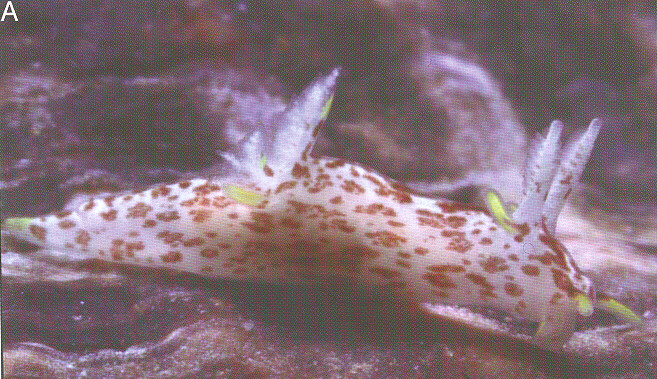
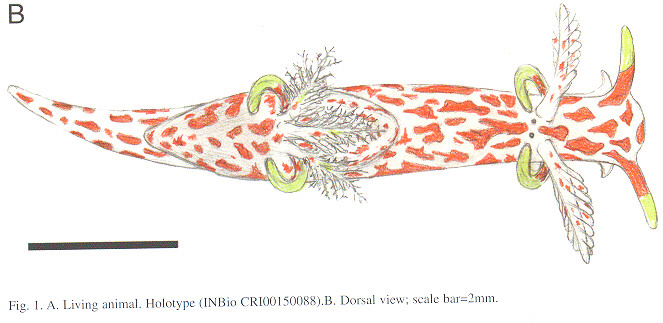
<body><![CDATA[<p><font face="Arial,Helvetica"><font size=-1>(Figs <a href="#Fig. 1A">1A</a>-<a href="#Fig. 1B">B</a>)</font></font>     <p><font face="Arial,Helvetica"><font size=-1><b>Type Material:</b> Holotype: INBio CRI00150088, Estaci&oacute;n San Miguel, Reserva Absoluta de Cabo Blanco (Area de Conservaci&oacute;n Tempisque), Cabuya, C&oacute;bano, Puntarenas, Costa Rica (9&deg;34'49''N, 85&deg;08'28"W), 16 May, 1998; 1 specimen 2.5 mm preserved length, collected by snorkeling in the intertidal rocky shore under rocks, 1 m depth.</font></font>     <p><font face="Arial,Helvetica"><font size=-1><b>Paratype:</b> CASIZ 088159, 3 km South of anchorage, Islas Secas, Pacific coast of Panam&aacute;, 22 April 1993; 1 specimen 6 mm preserved length, 11 m depth collected by Terry Gosliner.</font></font>     <br>&nbsp;     <br>&nbsp;     <br>     <br>     <center>     <p><a NAME="Fig. 1A"></a><img SRC="/img/fbpe/rbt/v48n2-3/0846i01.JPG" height=379 width=657>     
<br><a NAME="Fig. 1B"></a><img SRC="/img/fbpe/rbt/v48n2-3/0846i02.JPG" height=323 width=663></center>      
]]></body>
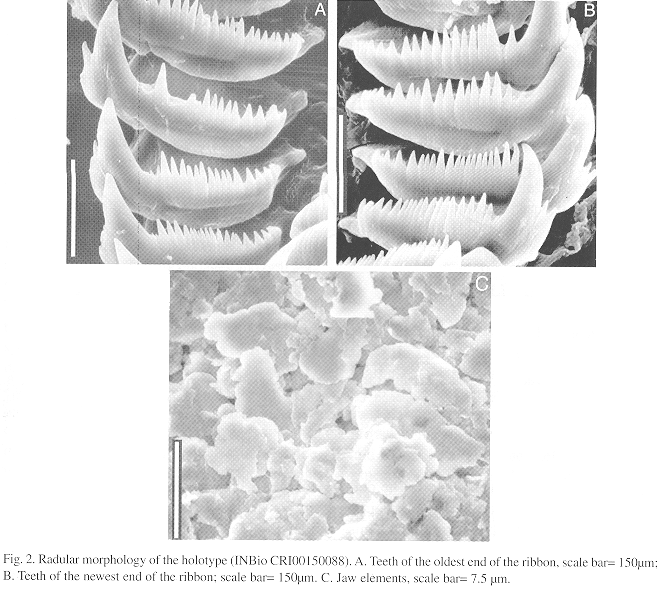
<body><![CDATA[<p>    <br>     <br>     <br>     <p><font face="Arial,Helvetica"><font size=-1><b>External Morphology:</b> The length of the living animal is 10 mm. The body is limaciform, soft and elongate. The two pairs of dorsolateral extra-rhinophoral and extra-branchial appendages are digitiform, equal in size and shorter than the rhinophores and branchial leaves. There is an extranbranchial appendage situated alongside each rhinophore and an extrabranchial appendage on each side of the gill. The rhinophores have a lamellate club with 9-10 very wide lamellae. The gill consists of three tripinnate branchial leaves arranged perpendicularly to the body, located about halfway down the body in the dorsal midline. The axis of the rhinophores and the rachis of the branchial leaves are conical. There is a pair of relatively short oral tentacles at the end of the head, and below the leading edge of the foot is extended laterally into tentacular foot corners. The pointed posterior end of the foot is about one fifth of the length.</font></font>     <p><font face="Arial,Helvetica"><font size=-1>The general color of the body is white with irregular red patches arranged over the entire dorsum (Figs <a href="#Fig. 1A">1A</a>-<a href="#Fig. 1B">B</a>). The patches vary in shape and size. The larger ones are located dorsally, from the head to the gills, and are generally composed of an aggregate of red punctations. The smaller ones are located on the lateral portions of the body. The rhinophores are white with some little red spots. The bases of the extrarhinophoral and extrabranchial appendages are basally red with the rest of the legth yellow. The branchial leaves are white. The anterior and posterior sides of the rachis have some red or yellow spots. The labial papillae are yellow with red bases. The foot is white, however the tentacular foot corners are white with yellow and red spots in the bases.</font></font>     <p><font face="Arial,Helvetica"><font size=-1><b>Jaws: </b>The radular formula is 28 x (1.0.1). The radula consists of two series of 28 elongated teeth. Each tooth has a large, conical cusp (or a large denticle) which is displaced towards the side of the radula. The teeth increase in size from the oldest to the newest end of the ribbon. There are usually 1-3 small denticles outside the cusp and 21-24 on the inside. Two or three of those denticles inside the cusp are smaller than the others (<a href="#Fig. 2">Figs 2A-B</a>). The jaws have a number of irregular elements (<a href="#Fig. 2">Fig 2C</a>).</font></font>     <br>&nbsp;     <p>    <br>     ]]></body>
<body><![CDATA[<center>     <p><a NAME="Fig. 2"></a><img SRC="/img/fbpe/rbt/v48n2-3/0846i03.GIF" height=594 width=661></center>      
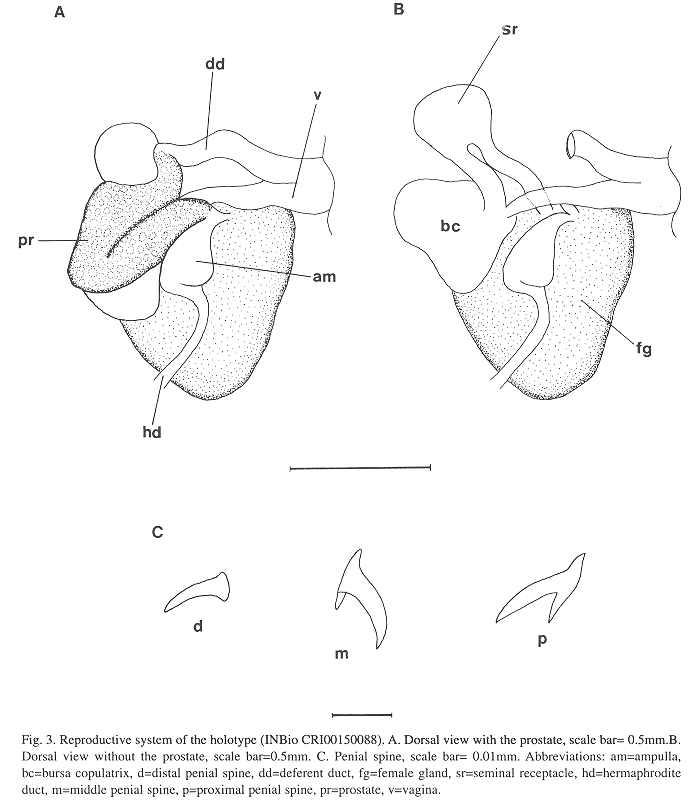
<p>    <br>     <br>     <br>     <p><font face="Arial,Helvetica"><font size=-1><b>Reproductive System:</b> The thick hermaphroditic duct leads to a pyriform ampulla. It joins the prostatic portion of the vas deferens, which is short and wider in the middle part. The proximal oviduct is short. The deferent duct is long and narrow and opens into a common atrium with the vagina. The penis is composed of 20 rows of penial hooks of different sizes and shapes. The distal hooks are smaller and less curved than those in the middle, which are more curved and conical. In constrast, the proximal hooks are bigger than those in the middle but less curved (<a href="#Fig. 3">Fig. 3C</a>). The long and wide vagina connects to the large and irregular shaped bursa copulatrix. From the bursa copulatrix leads another wide duct that connects to the seminal receptacle and the uterine duct. The bursa copulatrix is about twice as large as the seminal receptacle (<a href="#Fig. 3">Figs 3A-B</a>).</font></font>     <center>     <p><a NAME="Fig. 3"></a><img SRC="/img/fbpe/rbt/v48n2-3/0846i04.GIF" height=803 width=697></center>      
<p>    ]]></body>
<body><![CDATA[<br>     <br>     <br>     <p><font face="Arial,Helvetica"><font size=-1><b>Etymology:</b> The name of this species is a combination of “INBio” (Instituto Nacional de Biodiversidad) and “tica” the feminine gender of the colloquial term used for the Costa Rican things and people. We want to conmemorate INBio on its tenth anniversary (October, 1999) dedicated to the conservation of the Costa Rican Biodiversity.</font></font>     <br>&nbsp;     <p><b><font face="Arial,Helvetica"><font size=-1>Discussion</font></font></b>     <p><font face="Arial,Helvetica"><font size=-1><i>Trapania velox</i> (<a href="#Cockerell">Cockerell 1901</a>) is the only valid species of the genus <i>Trapania</i> reported from the Pacific coast of the Americas. <a href="#MacFarland">MacFarland (1966)</a> and <a href="#McDonald">McDonald (1983)</a> redescribed this species based on specimens from California with a length between 15 to 25mm. According to these authors, <i>Trapania velox</i> has yellow to orange rhinophores, anterior tentacles, branchial leaves, extrabranchial appendages and tail. The body is marked with dark brown lines extending down the midline and on to the extra-branchial appendages, down the tail and along the sides (<a href="#MacFarland">MacFarland 1966</a>). In contrast, <i>T. inbiotica</i> has white rhinophores speckled with red. The appendages and oral tentacles are yellow distally and red proximally. The posterior portion of the foot is white with red patches. Another difference between these species is that the radular formula of <i>T. velox</i> as described by <a href="#MacFarland">MacFarland (1966)</a> is 24 x(1.0.1) and by <a href="#McDonald">McDonald (1983)</a> is 22x(1.0.1), whereas that of our species is 28x(1.0.1). In <i>T. velox</i>, each tooth has a long pointed cusp and, unlike <i>T. inbiotica</i>, there are not denticles outside the inner edge of it. The number of the unequal sharp denticles inwards from the cusp is only 8-11, instead of 21-24 as in <i>T. inbiotica</i>. <i>Trapania velox</i> has about 2 larger denticles close to the cusp which are larger than the others. In <i>T. inbiotica</i> these denticles are smaller than the others.</font></font>     <p><font face="Arial,Helvetica"><font size=-1>There is another unnamed species of <i>Trapania</i> (see <a href="#Bertsch84">Bertsch &amp; Kerstitch, 1984</a>, <a href="#Bertsch89">Bertsch in Kerstitch, 1989</a>) from the Pacific coast of the Americas. It is being described by <a href="#Millen">Millen and Bertsch</a> (in press, TheVeliger), and differs significantly from our new species in external coloration and morphology, radular morphology and meristics, and details of the reproductive system.</font></font>     <p><font face="Arial,Helvetica"><font size=-1>The Indo-West Pacific species described by <a href="#Rudman">Rudman (1987)</a> and <a href="#Miller">Miller (1981)</a> are different in color from our species. <i>Trapania aureopunctata</i><a href="#Rudman">Rudman, 1987</a>, <i>T. toddi</i> <a href="#Rudman">Rudman, 1987</a>, <i>T. aurata</i><a href="#Rudman">Rudman, 1987</a>, <i>T. davelli</i><a href="#Rudman">Rudman, 1987</a> and <i>T. rudmani</i> <a href="#Miller">Miller, 1981</a> have a white body marked with yellow and brown. Others, like <i>T. brunnea</i><a href="#Rudman">Rudman, 1987</a>, <i>T. benni</i> <a href="#Rudman">Rudman, 1987</a> and <i>T. reticulata</i> are brown with white and yellow patches. Also, the radular morphology of these species is very different from those of <i>T. inbiotica</i>. <i>Trapania japonica</i> <a href="#Baba35">Baba, 1935</a> is the only species that, externally is similar to <i>T. inbiotica</i>, because of the white color of the body and the arrangement of the brown spots. However, the radular teeth of <i>T. japonica</i> have a median main cusp which is flanked by a row of denticles on each side, those of <i>T. inbiotica</i> have the cusp situated further of the outer edge.</font></font>     <br>&nbsp;     ]]></body>
<body><![CDATA[<p><b><font face="Arial,Helvetica"><font size=-1>Acknowledgements</font></font></b>     <p><font face="Arial,Helvetica"><font size=-1>The authors are grateful to the members of the “II Taller Internacional de Moluscos Marinos” and the Reserva Natural Absoluta de Cabo Blanco for their support during the workshop. We are indebted to Terry Gosliner who provided us with the material from Panam&aacute; and &Aacute;ngel Vald&eacute;s who helped in several aspects of this paper. Leopoldo Moro Abad photographed the living animal. The electron microscope work was done at the California Academy of Sciences and the Unidad de Microscop&iacute;a Electr&oacute;nica (Universidad de Costa Rica). This research was financed by the Norwegian Agency for Development Cooperation (NORAD) through the project "Development of Biodiversity Knowledge and Sustainable Use in Costa Rica" conducted by the National Biodiversity Institute of Costa Rica (INBio). This research was also possible thanks to the Cooperation Agreement between the Ministry of Environment and Energy (MINAE) and INBio.</font></font>     <br>&nbsp;     <p><b><font face="Arial,Helvetica"><font size=-1>Resumen</font></font></b>     <p><font face="Arial,Helvetica"><font size=-1>A partir de dos ejemplares recolectados en la costa pac&iacute;fica de Costa Rica y Panam&aacute;, se describe una nueva especie <i>Trapania inbiotica</i> sp. nov., la cual se distingue por tener el cuerpo blanco con manchas rojas y rin&oacute;foros blancos con algunas manchas amarillas peque&ntilde;as. La r&aacute;dula est&aacute; compuesta por 28 filas de dientes donde cada diente tiene de 21-25 dent&iacute;culos y una c&uacute;spide c&oacute;nica y larga situada cerca del lado exterior. Dos o tres de esos dent&iacute;culos localizados en la parte interna de la c&uacute;spide son m&aacute;s peque&ntilde;os que los otros. Tambi&eacute;n est&aacute;n presentes de 1-3 dent&iacute;culos en la parte externa de la c&uacute;spide. La armadura labial est&aacute; compuesta por uncinos muy irregulares.</font></font>     <br>&nbsp;     <p><b><font face="Arial,Helvetica"><font size=-1>&nbsp; References</font></font></b>     <!-- ref --><p><a NAME="Baba35"></a><font face="Arial,Helvetica"><font size=-1>Baba, K. 1935. Report of the Biological Survey of Mutsu Bay (27) Nudibranchia of Mutsu Bay. Science Report of the Tohoku Imperial University, Fourth Series, Biology. Vol. X, No.2, Sendai, Japan.</font></font>    &nbsp;&nbsp;&nbsp;&nbsp;&nbsp;&nbsp;&nbsp;&nbsp;[&#160;<a href="javascript:void(0);" onclick="javascript: window.open('/scielo.php?script=sci_nlinks&ref=1199661&pid=S0034-7744200000020000400001&lng=','','width=640,height=500,resizable=yes,scrollbars=1,menubar=yes,');">Links</a>&#160;]<!-- end-ref --><!-- ref --><p><a NAME="Baba90"></a><font face="Arial,Helvetica"><font size=-1>Baba, K. 1990. Notes on the rare genera <i>Trapania</i> and <i>Ancula</i> from Japan with the description of a new species (Nudibranchia: Goniodorididae). Venus 49: 8-18.</font></font>    &nbsp;&nbsp;&nbsp;&nbsp;&nbsp;&nbsp;&nbsp;&nbsp;[&#160;<a href="javascript:void(0);" onclick="javascript: window.open('/scielo.php?script=sci_nlinks&ref=1199662&pid=S0034-7744200000020000400002&lng=','','width=640,height=500,resizable=yes,scrollbars=1,menubar=yes,');">Links</a>&#160;]<!-- end-ref --><!-- ref --><p><a NAME="Behrens"></a><font face="Arial,Helvetica"><font size=-1>Behrens, D. 1991. Pacific Coast Nudibranchs: A guide to the Opisthobranchs, Alaska to Baja California. Sea Challengers, Monterey, California. 107 p.</font></font>    &nbsp;&nbsp;&nbsp;&nbsp;&nbsp;&nbsp;&nbsp;&nbsp;[&#160;<a href="javascript:void(0);" onclick="javascript: window.open('/scielo.php?script=sci_nlinks&ref=1199663&pid=S0034-7744200000020000400003&lng=','','width=640,height=500,resizable=yes,scrollbars=1,menubar=yes,');">Links</a>&#160;]<!-- end-ref --><!-- ref --><p><a NAME="Bertsch89"></a><font face="Arial,Helvetica"><font size=-1>Bertsch, H. 1989. Opisthobranchia. In: Kerstitch, A.,1989, Sea of Cortez Marine Invertebrates. Sea Challengers, Monterey, California. 54-68 p.</font></font>    &nbsp;&nbsp;&nbsp;&nbsp;&nbsp;&nbsp;&nbsp;&nbsp;[&#160;<a href="javascript:void(0);" onclick="javascript: window.open('/scielo.php?script=sci_nlinks&ref=1199664&pid=S0034-7744200000020000400004&lng=','','width=640,height=500,resizable=yes,scrollbars=1,menubar=yes,');">Links</a>&#160;]<!-- end-ref --><!-- ref --><p><a NAME="Bertsch84"></a><font face="Arial,Helvetica"><font size=-1>Bertsch, H. &amp; A. Kerstitch, 1984. Distribution and radular morphology of various nudibranchs (Gastropoda: Opisthobranchia) from the Gulf of California, Mexico. Veliger 26: 264-273.</font></font>    &nbsp;&nbsp;&nbsp;&nbsp;&nbsp;&nbsp;&nbsp;&nbsp;[&#160;<a href="javascript:void(0);" onclick="javascript: window.open('/scielo.php?script=sci_nlinks&ref=1199665&pid=S0034-7744200000020000400005&lng=','','width=640,height=500,resizable=yes,scrollbars=1,menubar=yes,');">Links</a>&#160;]<!-- end-ref --><!-- ref --><p><a NAME="Cockerell"></a><font face="Arial,Helvetica"><font size=-1>Cockerell, T.D.A. 1901. Three new nudibranchs from California. J. Malacol. 8: 85-87.</font></font>    &nbsp;&nbsp;&nbsp;&nbsp;&nbsp;&nbsp;&nbsp;&nbsp;[&#160;<a href="javascript:void(0);" onclick="javascript: window.open('/scielo.php?script=sci_nlinks&ref=1199666&pid=S0034-7744200000020000400006&lng=','','width=640,height=500,resizable=yes,scrollbars=1,menubar=yes,');">Links</a>&#160;]<!-- end-ref --><!-- ref --><p><a NAME="MacFarland"></a><font face="Arial,Helvetica"><font size=-1>MacFarland, F.M. 1966. Studies of opisthobranchiate mollusks of the Pacific coast of North America. Mem. Calif. Acad. of Sci. 6: 1-546.</font></font>    &nbsp;&nbsp;&nbsp;&nbsp;&nbsp;&nbsp;&nbsp;&nbsp;[&#160;<a href="javascript:void(0);" onclick="javascript: window.open('/scielo.php?script=sci_nlinks&ref=1199667&pid=S0034-7744200000020000400007&lng=','','width=640,height=500,resizable=yes,scrollbars=1,menubar=yes,');">Links</a>&#160;]<!-- end-ref --><!-- ref --><p><a NAME="McDonald"></a><font face="Arial,Helvetica"><font size=-1>McDonald, G. R. 1983. A review of the nudibranchs of the California coast. Malacologia 24: 114-276.</font></font>    &nbsp;&nbsp;&nbsp;&nbsp;&nbsp;&nbsp;&nbsp;&nbsp;[&#160;<a href="javascript:void(0);" onclick="javascript: window.open('/scielo.php?script=sci_nlinks&ref=1199668&pid=S0034-7744200000020000400008&lng=','','width=640,height=500,resizable=yes,scrollbars=1,menubar=yes,');">Links</a>&#160;]<!-- end-ref --><!-- ref --><p><a NAME="Millen"></a><font face="Arial,Helvetica"><font size=-1>Millen, S.V. &amp; H. Bertsch. 1999. Three new nudibranchs (Opisthobranchia: Doridacea) from southern California, U.S.A., and the Baja California peninsula, Mexico. Veliger (in press).</font></font>    &nbsp;&nbsp;&nbsp;&nbsp;&nbsp;&nbsp;&nbsp;&nbsp;[&#160;<a href="javascript:void(0);" onclick="javascript: window.open('/scielo.php?script=sci_nlinks&ref=1199669&pid=S0034-7744200000020000400009&lng=','','width=640,height=500,resizable=yes,scrollbars=1,menubar=yes,');">Links</a>&#160;]<!-- end-ref --><!-- ref --><p><a NAME="Miller"></a><font face="Arial,Helvetica"><font size=-1>Miller, M.C. 1981. <i>Trapania rudmani</i>, a new dorid nudibranch (Gastropoda: Opisthobranchia) from New Zealand. New Zeal. J. Zool. 8: 5-9.</font></font>    &nbsp;&nbsp;&nbsp;&nbsp;&nbsp;&nbsp;&nbsp;&nbsp;[&#160;<a href="javascript:void(0);" onclick="javascript: window.open('/scielo.php?script=sci_nlinks&ref=1199670&pid=S0034-7744200000020000400010&lng=','','width=640,height=500,resizable=yes,scrollbars=1,menubar=yes,');">Links</a>&#160;]<!-- end-ref --><!-- ref --><p><a NAME="Rudman"></a><font face="Arial,Helvetica"><font size=-1>Rudman, W.B. 1987. The genus <i>Trapania</i> (Nudibranchia, Goniodorididae) in the Indo-West Pacific. J. Moll. Stud. 53: 189-212.</font></font>    &nbsp;&nbsp;&nbsp;&nbsp;&nbsp;&nbsp;&nbsp;&nbsp;[&#160;<a href="javascript:void(0);" onclick="javascript: window.open('/scielo.php?script=sci_nlinks&ref=1199671&pid=S0034-7744200000020000400011&lng=','','width=640,height=500,resizable=yes,scrollbars=1,menubar=yes,');">Links</a>&#160;]<!-- end-ref --><p><a NAME="1a"></a><font face="Arial,Helvetica"><font size=-1><sup><a href="#1">1</a></sup> Academia&nbsp; de Ciencias, California, Golden Gate Park, San Francisco, California 94118. Fax: 415-750-7090. E-mail: <a href="mailto:ycamacho-garcia@calacademy.org">ycamacho-garcia@calacademy.org</a></font></font>     <p><a NAME="2b"></a><font face="Arial,Helvetica"><font size=-1><sup><a href="#2">2</a></sup> Departamento de Biolog&iacute;a de Organismos y Sistemas, Laboratorio de Zoolog&iacute;a, Universidad de Oviedo, c<img SRC="/img/fbpe/rbt/v48n2-3/ese.JPG" height=18 width=10 align=ABSBOTTOM> Catedr&aacute;tico Rodrigo Ur&iacute;a s<img SRC="/img/fbpe/rbt/v48n2-3/ese.JPG" height=18 width=10 align=ABSBOTTOM>n, 33071 Oviedo, Spain. Fax: (348) 5104868. E-mail: <a href="mailto:kankel@teleline.es">kankel@teleline.es</a></font></font>     
]]></body>
<body><![CDATA[<br>&nbsp;      ]]></body><back>
<ref-list>
<ref id="B1">
<nlm-citation citation-type="journal">
<person-group person-group-type="author">
<name>
<surname><![CDATA[Baba]]></surname>
<given-names><![CDATA[K.]]></given-names>
</name>
</person-group>
<article-title xml:lang="en"><![CDATA[Report of the Biological Survey of Mutsu Bay (27) Nudibranchia of Mutsu Bay]]></article-title>
<source><![CDATA[Tohoku Imperial University, Fourth Series, Biology]]></source>
<year>1935</year>
<volume>X</volume>
<numero>^s2</numero>
<issue>^s2</issue>
<supplement>2</supplement>
<publisher-loc><![CDATA[Sendai ]]></publisher-loc>
</nlm-citation>
</ref>
<ref id="B2">
<nlm-citation citation-type="journal">
<person-group person-group-type="author">
<name>
<surname><![CDATA[Baba]]></surname>
<given-names><![CDATA[K]]></given-names>
</name>
</person-group>
<article-title xml:lang="en"><![CDATA[Notes on the rare genera Trapania and Ancula from Japan with the description of a new species (Nudibranchia: Goniodorididae)]]></article-title>
<source><![CDATA[Venus]]></source>
<year>1990</year>
<volume>49</volume>
<page-range>8-18</page-range></nlm-citation>
</ref>
<ref id="B3">
<nlm-citation citation-type="book">
<person-group person-group-type="author">
<name>
<surname><![CDATA[Behrens]]></surname>
<given-names><![CDATA[D]]></given-names>
</name>
</person-group>
<source><![CDATA[Pacific Coast Nudibranchs: A guide to the Opisthobranchs, Alaska to Baja California]]></source>
<year>1991</year>
<page-range>107</page-range><publisher-loc><![CDATA[Monterey^eCalifornia California]]></publisher-loc>
<publisher-name><![CDATA[Sea Challengers]]></publisher-name>
</nlm-citation>
</ref>
<ref id="B4">
<nlm-citation citation-type="book">
<person-group person-group-type="author">
<name>
<surname><![CDATA[Bertsch]]></surname>
<given-names><![CDATA[H]]></given-names>
</name>
</person-group>
<article-title xml:lang="en"><![CDATA[Opisthobranchia]]></article-title>
<person-group person-group-type="editor">
<name>
<surname><![CDATA[Kerstitch]]></surname>
<given-names><![CDATA[A]]></given-names>
</name>
</person-group>
<source><![CDATA[Sea of Cortez Marine Invertebrates]]></source>
<year>1989</year>
<month>19</month>
<day>89</day>
<page-range>54-68</page-range><publisher-loc><![CDATA[Monterey^eCalifornia California]]></publisher-loc>
<publisher-name><![CDATA[Sea Challengers]]></publisher-name>
</nlm-citation>
</ref>
<ref id="B5">
<nlm-citation citation-type="journal">
<person-group person-group-type="author">
<name>
<surname><![CDATA[Bertsch]]></surname>
<given-names><![CDATA[H]]></given-names>
</name>
<name>
<surname><![CDATA[Kerstitch]]></surname>
<given-names><![CDATA[A]]></given-names>
</name>
</person-group>
<article-title xml:lang="en"><![CDATA[Distribution and radular morphology of various nudibranchs (Gastropoda: Opisthobranchia) from the Gulf of California, Mexico]]></article-title>
<source><![CDATA[Veliger]]></source>
<year>1984</year>
<volume>26</volume>
<page-range>264-273</page-range></nlm-citation>
</ref>
<ref id="B6">
<nlm-citation citation-type="journal">
<person-group person-group-type="author">
<name>
<surname><![CDATA[Cockerell]]></surname>
<given-names><![CDATA[T.D.A]]></given-names>
</name>
</person-group>
<article-title xml:lang="en"><![CDATA[Three new nudibranchs from California]]></article-title>
<source><![CDATA[J. Malacol]]></source>
<year>1901</year>
<volume>8</volume>
<page-range>85-87</page-range></nlm-citation>
</ref>
<ref id="B7">
<nlm-citation citation-type="journal">
<person-group person-group-type="author">
<name>
<surname><![CDATA[MacFarland]]></surname>
<given-names><![CDATA[F.M]]></given-names>
</name>
</person-group>
<article-title xml:lang="en"><![CDATA[Studies of opisthobranchiate mollusks of the Pacific coast of North America]]></article-title>
<source><![CDATA[Mem. Calif. Acad. of Sci.]]></source>
<year>1966</year>
<volume>6</volume>
<page-range>1-546</page-range></nlm-citation>
</ref>
<ref id="B8">
<nlm-citation citation-type="journal">
<person-group person-group-type="author">
<name>
<surname><![CDATA[McDonald]]></surname>
<given-names><![CDATA[G. R.]]></given-names>
</name>
</person-group>
<article-title xml:lang="en"><![CDATA[A review of the nudibranchs of the California coast]]></article-title>
<source><![CDATA[Malacologia]]></source>
<year>1983</year>
<volume>24</volume>
<page-range>114-276</page-range></nlm-citation>
</ref>
<ref id="B9">
<nlm-citation citation-type="book">
<person-group person-group-type="author">
<name>
<surname><![CDATA[Millen]]></surname>
<given-names><![CDATA[S.V]]></given-names>
</name>
<name>
<surname><![CDATA[Bertsch]]></surname>
<given-names><![CDATA[H.]]></given-names>
</name>
</person-group>
<source><![CDATA[Three new nudibranchs (Opisthobranchia: Doridacea) from southern California, U.S.A., and the Baja California peninsula, Mexico]]></source>
<year>1999</year>
<publisher-name><![CDATA[Veliger]]></publisher-name>
</nlm-citation>
</ref>
<ref id="B10">
<nlm-citation citation-type="journal">
<person-group person-group-type="author">
<name>
<surname><![CDATA[Miller]]></surname>
<given-names><![CDATA[M.C]]></given-names>
</name>
</person-group>
<article-title xml:lang="en"><![CDATA[Trapania rudmani, a new dorid nudibranch (Gastropoda: Opisthobranchia) from New Zealand]]></article-title>
<source><![CDATA[New Zeal. J. Zool]]></source>
<year>1981</year>
<volume>8</volume>
<page-range>5-9</page-range></nlm-citation>
</ref>
<ref id="B11">
<nlm-citation citation-type="journal">
<person-group person-group-type="author">
<name>
<surname><![CDATA[Rudman]]></surname>
<given-names><![CDATA[W.B]]></given-names>
</name>
</person-group>
<article-title xml:lang="en"><![CDATA[The genus Trapania (Nudibranchia, Goniodorididae) in the Indo-West Pacific]]></article-title>
<source><![CDATA[J. Moll. Stud]]></source>
<year>1987</year>
<volume>53</volume>
<page-range>189-212</page-range></nlm-citation>
</ref>
</ref-list>
</back>
</article>