<?xml version="1.0" encoding="ISO-8859-1"?><article xmlns:mml="http://www.w3.org/1998/Math/MathML" xmlns:xlink="http://www.w3.org/1999/xlink" xmlns:xsi="http://www.w3.org/2001/XMLSchema-instance">
<front>
<journal-meta>
<journal-id>0034-7744</journal-id>
<journal-title><![CDATA[Revista de Biología Tropical]]></journal-title>
<abbrev-journal-title><![CDATA[Rev. biol. trop]]></abbrev-journal-title>
<issn>0034-7744</issn>
<publisher>
<publisher-name><![CDATA[Universidad de Costa Rica]]></publisher-name>
</publisher>
</journal-meta>
<article-meta>
<article-id>S0034-77441998000400022</article-id>
<title-group>
<article-title xml:lang="en"><![CDATA[Interspecific competition between Metagonystilum minense (Diptera: Tachinidae) and Cotesia flavipes (Hymenotera: Braconidae) parasitosis of sugarcane borers (Diatraea spp., Lepidoptera:Pyralidae)]]></article-title>
</title-group>
<contrib-group>
<contrib contrib-type="author">
<name>
<surname><![CDATA[Weir L.]]></surname>
<given-names><![CDATA[Enrique H.]]></given-names>
</name>
<xref ref-type="aff" rid="A01"/>
</contrib>
<contrib contrib-type="author">
<name>
<surname><![CDATA[Sagarzazu]]></surname>
<given-names><![CDATA[Luis]]></given-names>
</name>
<xref ref-type="aff" rid="A02"/>
</contrib>
</contrib-group>
<aff id="A01">
<institution><![CDATA[,Universidad del Zulia Facultad Experimental de Ciencias ]]></institution>
<addr-line><![CDATA[Maracaibo ]]></addr-line>
<country>Venezuela</country>
</aff>
<aff id="A02">
<institution><![CDATA[,Universidad Catolica Andres Bello Escuela de Edcación ]]></institution>
<addr-line><![CDATA[Caracas ]]></addr-line>
<country>Venezuela</country>
</aff>
<pub-date pub-type="pub">
<day>00</day>
<month>12</month>
<year>1998</year>
</pub-date>
<pub-date pub-type="epub">
<day>00</day>
<month>12</month>
<year>1998</year>
</pub-date>
<volume>46</volume>
<numero>4</numero>
<fpage>1135</fpage>
<lpage>1139</lpage>
<copyright-statement/>
<copyright-year/>
<self-uri xlink:href="http://www.scielo.sa.cr/scielo.php?script=sci_arttext&amp;pid=S0034-77441998000400022&amp;lng=en&amp;nrm=iso"></self-uri><self-uri xlink:href="http://www.scielo.sa.cr/scielo.php?script=sci_abstract&amp;pid=S0034-77441998000400022&amp;lng=en&amp;nrm=iso"></self-uri><self-uri xlink:href="http://www.scielo.sa.cr/scielo.php?script=sci_pdf&amp;pid=S0034-77441998000400022&amp;lng=en&amp;nrm=iso"></self-uri><abstract abstract-type="short" xml:lang="en"><p><![CDATA[We evaluated the effect of interspecific competition between M. minense and C. flavipes larvae on survival in both species and on the growth of M. minense. Interspecific competition was evaluated by the inoculation of M. minense larvae (1 or 2 per host larvae: D. sacharalis) 1 to 5 days before or 3 to 8 days after the inoculation of C. flavipes eggs (one inoculation = 45 - 50 eggs). All experiments were done with ten replicas. We found a significant effect of interspecific competition on larval and pupal survival in both parasitoids and body weight in M. minense. M. minense dominated over C. flavipes, except when M. minense was inoculated 5 or more days after C. flavipes.]]></p></abstract>
<abstract abstract-type="short" xml:lang="es"><p><![CDATA[Evaluamos el efecto de la competencia interespecífica entre larvas de M. minense y C. flavipes en la supervivencia de la progenie de ambas especies y en el crecimiento de M. minense. La competencia interespecífica fue evaluada mediante la inoculación de larvas de M. minense (1 o 2 por larva del hospedador: D. saccharalis) 1 a 5 días antes o 3 a 8 días después de la inoculación de huevos de C. flavipes (una inoculación = 45 a 50 huevos). Se hicieron diez repeticiones de todos los experimentos. Encontramos un efecto significativo de competencia en la supervivencia larval y pupal en ambas especies parasitoides y en el peso corporal de M. minense. M. minense predominó sobre C. flavipes, excepto cuando M. minense fue inoculado 5 o mas días después de C. flavipes.]]></p></abstract>
<kwd-group>
<kwd lng="en"><![CDATA[Metagonystilum minense]]></kwd>
<kwd lng="en"><![CDATA[Cotesia flavipes]]></kwd>
<kwd lng="en"><![CDATA[parasitoids]]></kwd>
<kwd lng="en"><![CDATA[Diatraea]]></kwd>
<kwd lng="en"><![CDATA[sugarcane]]></kwd>
</kwd-group>
</article-meta>
</front><body><![CDATA[ <CENTER><B><FONT FACE="Arial,Helvetica">Interspecific competition between <I>Metagonystilum minense</I> (Diptera:</FONT></B></CENTER>      <CENTER><B><FONT FACE="Arial,Helvetica">Tachinidae) and <I>Cotesia flavipes</I> (Hymenotera: Braconidae) parasitoids</FONT></B></CENTER>      <CENTER><B><FONT FACE="Arial,Helvetica">of sugarcane borers (<I>Diatraea</I> spp., Lepidoptera:Pyralidae)</FONT></B></CENTER>      <CENTER>&nbsp;</CENTER>      <CENTER>&nbsp;</CENTER>      <CENTER><FONT FACE="Arial,Helvetica"><FONT SIZE=-1>&nbsp;<B>Enrique H. Weir L.&nbsp;<A NAME="1"></A></B><SUP><A HREF="#1a">1</A></SUP><B>&nbsp;&nbsp;&nbsp; Luis Sagarzazu&nbsp;<A NAME="2"></A></B><SUP><A HREF="#2a">2</A></SUP></FONT></FONT></CENTER>      <CENTER></CENTER>      <CENTER>&nbsp;</CENTER>      <CENTER></CENTER>      <CENTER><FONT FACE="Arial,Helvetica"><FONT SIZE=-1>Received 11-V-1998. Corrected 7-IX-1998. Accepted 2-X-1998.</FONT></FONT></CENTER>       ]]></body>
<body><![CDATA[<P><B><FONT FACE="Arial,Helvetica"><FONT SIZE=-1>&nbsp;Abstract</FONT></FONT></B>      <P><FONT FACE="Arial,Helvetica"><FONT SIZE=-1>We evaluated the effect of interspecific competition between<I> M. minense</I> and <I>C. flavipes</I> larvae on survival in both species and on the growth of <I>M. minense.</I> Interspecific competition was evaluated by the inoculation of <I>M. minense</I> larvae (1 or 2 per host larvae:<I> D. sacharalis</I>) 1 to 5 days before or 3 to 8 days after the inoculation of <I>C. flavipes</I> eggs (one inoculation = 45 - 50 eggs). All experiments were done with ten replicas. We found a significant effect of interspecific competition on larval and pupal survival in both parasitoids and body weight in <I>M. minense</I>. <I>M. minense</I> dominated over <I>C. flavipes</I>, except when <I>M. minense</I> was inoculated 5 or more days after <I>C. flavipes</I>.</FONT></FONT>     <BR><FONT FACE="Arial,Helvetica"><FONT SIZE=-1>&nbsp;</FONT></FONT>      <P><B><FONT FACE="Arial,Helvetica"><FONT SIZE=-1>Key words</FONT></FONT></B>      <P><FONT FACE="Arial,Helvetica"><FONT SIZE=-1><I>Metagonystilum minense</I>, <I>Cotesia flavipes</I>, parasitoids, <I>Diatraea</I>, sugarcane</FONT></FONT>     <BR><FONT FACE="Arial,Helvetica"><FONT SIZE=-1>&nbsp;</FONT></FONT>      <P><FONT FACE="Arial,Helvetica"><FONT SIZE=-1>Parasitoid insects are the most effective facultative agents in the regulation of insect pests population in agroecosystems. This is attributable to the nature of the parasitoid, which has an obligatory lifeform association with a host insect, which is the only food source of the larval stage of the parasitoid (<A HREF="#May">May and Hassell 1988</A>, <A HREF="#Begon">Begon<I> et al</I>. 1996</A>).</FONT></FONT>      <P><FONT FACE="Arial,Helvetica"><FONT SIZE=-1>This obligatory dependence can generate intra or interspecific competition when the number of parasitoids per host reduces the availability of food and thus affects the survival, fecundity, growth and development of one or both parasitoids as well as the host species (<A HREF="#Vinson">Vinson and Iwantsch 1980</A>, <A HREF="#Taylor1988a.">Taylor 1988 a</A>, <A HREF="#Taylor1988b.">b</A>, <A HREF="#Begon">Begon <I>et al</I>. 1996</A>).</FONT></FONT>      <P><FONT FACE="Arial,Helvetica"><FONT SIZE=-1>In this work we evaluate the effect of interspecific competition between the amazonian fly <I>Metagonystilum minense</I> Myers (<I>Diptera:Tachinidae</I>) and the wasp <I>Cotesia flavipes</I> Cameron (<I>Hymenoptera:Braconidae</I>), parasitoids of the sugarcane borer, <I>Diatraea saccharalis</I> Fabricius (<I>Lepidotera: Pyralidae</I>), and other species of <I>Diatraea</I> in sugarcane crops in Venezuela. Interspecific competition effects on larval weight and larval mortality has been studied by <A HREF="#Pschorn-Walcher1971">Pschorn-Walcher (1971</A>) between the tachinid flies<I> M. minense,</I> <I>Paratheresia claripalpis and Lixophaga diatreae</I>.</FONT></FONT>      <P><FONT FACE="Arial,Helvetica"><FONT SIZE=-1>In Venezuela, <I>M. minense</I> is the main biological control of some species of the genus<I> Diatraea</I>. This parasitoid has been produced under laboratory conditions since 1953 (<A HREF="#Box">Box 1956</A>). The wasp <I>C. flavipes</I> is an alternative biological control agent of the amazonian fly of <I>Diatraea</I> in sugarcane (<A HREF="#Ferrer1990">Ferrer <I>et al</I>. 1990</A>). It has been produced under laboratory conditions in Venezuela since 1987, while its commercial production began in 1989 (<A HREF="#Ferrer1990">Ferrer<I> et al</I>. 1990</A>, <A HREF="#Micale">Micale 1995</A>). <I>D. saccharalis</I> is the main pest of sugarcane crops in Venezuela; but since 1953 it has been controlled by <I>M. minense</I> (<A HREF="#Box">Box 1956</A>).</FONT></FONT>     ]]></body>
<body><![CDATA[<BR>&nbsp;      <P><B><FONT FACE="Arial,Helvetica"><FONT SIZE=-1>Materials and Methods</FONT></FONT></B>      <P><FONT FACE="Arial,Helvetica"><FONT SIZE=-1>This study was done at the Entomology Laboratory of The Santa Teresa Farm, El Consejo, Aragua State, Venezuela, from 1992 to 1995 at 28 &deg; C, 12 hours of illumination and 70-80 % RH. Population samples of the two parasitoid species<I> </I>and the host were selected from populations reared in the Entomology Laboratory.</FONT></FONT>      <P><FONT FACE="Arial,Helvetica"><FONT SIZE=-1>One hundred larvae of <I>D. saccharalis</I> were reared on corn ears in 3.7 liter glass boxes. When they pupated were placed in groups of up to 50 in 30 x 50 cm. cylindrical cages covered with a plastic screen. The inner surface of the walls were covered with wax paper for oviposition and the bottom was covered with filter paper. After five days, the wax paper containing the eggs was removed. Sections of this wax paper were placed in petri plates and were sprayed with water. When the larvae emerged they were placed in a 3.7 liter glass box to continue the rearing. <I>Diatraea</I> larvae of ten to thirteen days old were inoculated with larvae of <I>Metagonystylum minense</I> or <I>Cotesia flavipes</I>.</FONT></FONT>      <P><FONT FACE="Arial,Helvetica"><FONT SIZE=-1>For the inoculation with <I>M. minense</I>, a gravid female fly was placed under a dissecting microscope and dissected in a petri dish containing a physiological solution. With the help of a fine brush one or two parasitoid larvae were transferred to the dorsum of each <I>Diatraea</I>. The parasitized hosts were placed in vials with a corn diet, one per vial. For the inoculation with <I>C. flavipes, </I>a gravid female wasp was placed with the host in a 3.7 liter glass box until she oviposited in one larvae. Each oviposition contained 45 to 50 wasp eggs.</FONT></FONT>      <P><FONT FACE="Arial,Helvetica"><FONT SIZE=-1>For the competition experiments, both inoculation processes were done. A set of experiments where eggs of wasps were oviposited one to five days after inoculation of the fly larvae. A set of experiments where fly larvae were inoculated three to eight days after oviposition by the wasp. Each experiment were done with ten replicas. After each inoculation, the host was placed in a vial with corn diet, one per vial. When the parasitoids emerged, changes in pupal weight, number of pupae and pupal survival in <I>M. minense</I>, and number of pupae and pupal survival in <I>C.flavipes</I>, were recorded.</FONT></FONT>      <P><FONT FACE="Arial,Helvetica"><FONT SIZE=-1>We evaluated the normality of variance by Kolmogorov-Smirnov test, and the variance homogeneity by Scheffe-Box test. The effects of interspecific competition were evaluated by parametric variance analysis.</FONT></FONT>     <BR>&nbsp;      <P><B><FONT FACE="Arial,Helvetica"><FONT SIZE=-1>Results</FONT></FONT></B>      <P><FONT FACE="Arial,Helvetica"><FONT SIZE=-1>The results of the effects of interspecific competition were evaluated by parametric variance analysis with the following factors: inoculation time (days) of <I>C. flavipes</I> eggs after <I>M. minense</I> larvae or <I>M. minense</I> larvae after <I>C. flavipes</I> eggs, age of <I>Diatraea</I> host larvae, and number of larvae of <I>M. minense</I> inoculated per host.</FONT></FONT>      ]]></body>
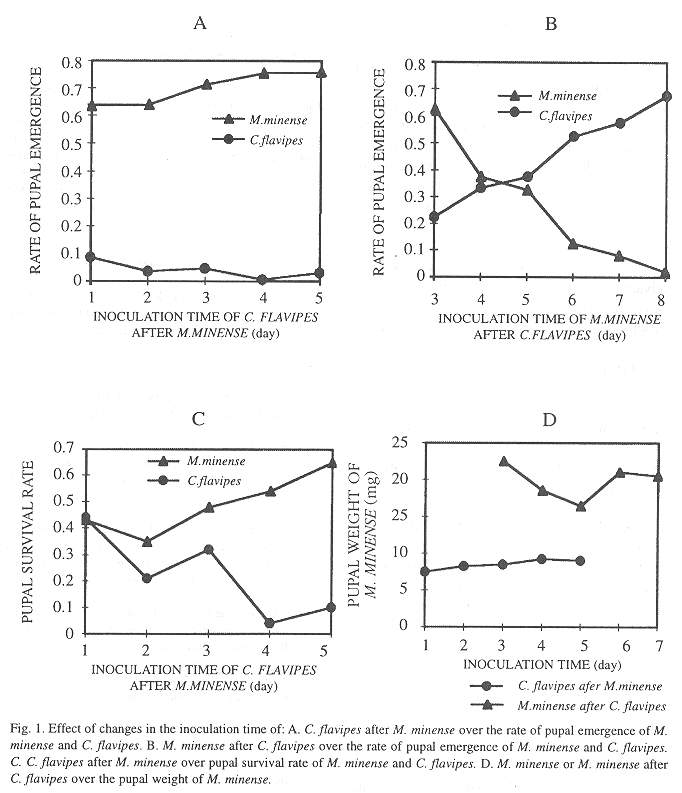
<body><![CDATA[<P><FONT FACE="Arial,Helvetica"><FONT SIZE=-1>A covariance analysis showed a significant relationship between changes in <I>M. minense</I> pupal emergence rate with changes in <I>C. flavipes</I> pupal emergence rate (F=65.99, a = 0.0001). When the inoculation time of <I>C. flavipes</I> increased from one to five days, a significant increase in the pupal emergence rate (F=65.99, a = 0.0001), pupal survival rate (F=31.21, a = 0.0001) and pupal weight (F=89.67, a = 0.0001) of <I>M. minense</I> is observed with a decrease in the pupal emergence rate and pupal survival rate (F=65.99, a = 0.002) of <I>C. flavipes</I> (<A HREF="#FIG1">Fig. 1</A>). The intensity of all these effects was greater when we inoculated two larvae of the fly per host. A significant increase in the pupal emergence rate (F=2.54, a = 0.038) and pupal weight (F=18.32, a = 0.0001) of <I>M.minense</I> with an increase in age of the larval host, except in experiments with thirteen day old larvae is</FONT></FONT>     <BR><FONT FACE="Arial,Helvetica"><FONT SIZE=-1>observed.</FONT></FONT>     <BR>&nbsp;     <CENTER></CENTER>      <CENTER><A NAME="FIG1"></A><IMG SRC="/img/fbpe/rbt/v46n4/0303i01.GIF" HEIGHT=793 WIDTH=682></CENTER> &nbsp;     
<BR>&nbsp;      <P><FONT FACE="Arial,Helvetica"><FONT SIZE=-1>The wasp won only when fly larvae were inoculated five or more days later than the wasp (<A HREF="#FIG1">Fig.1</A>). With this timing, there was a significant decrease in rate of pupal emergence of <I>M.minense</I> (F=19.895, a = 0.0001) but an increase for that of <I>C. flavipes</I> (F=3.218, a = 0.007). These effects are independent of the age of the larval host or number of <I>M. minense</I> larvae inoculated per host. The changes in pupal survival rate of <I>M. minense</I> are not significant. However, a decrease with respect to inoculation time is observed (<A HREF="#FIG1">Fig. 1</A>)</FONT></FONT>      <P><FONT FACE="Arial,Helvetica"><FONT SIZE=-1>Pupal weight in the fly (F=6.82, a = 0.005) and the pupal survival rate of the wasp (F=11.49, a = 0.0008) decreases with the number of <I>M. minense</I> larvae inoculated per host. With respect to the age of host larvae, no changes for any parameters were noted.</FONT></FONT>     <BR>&nbsp;      <P><B><FONT FACE="Arial,Helvetica"><FONT SIZE=-1>Discussion</FONT></FONT></B>      ]]></body>
<body><![CDATA[<P><FONT FACE="Arial,Helvetica"><FONT SIZE=-1>The existence of interspecific competition between the amazonian fly<I> M. minense</I> and the wasp <I>C. flavipes</I>, produced by the reduction in food availability is evident. This competition produces a decrease in larval and pupal survival rates, in both parasitoids, and in body weight in the amazonian fly. Generally the fly dominated over the wasp, except in cases when the larval inoculation time of <I>M. minense</I> was five or more days after oviposition by <I>C.flavipes</I>.</FONT></FONT>      <P><FONT FACE="Arial,Helvetica"><FONT SIZE=-1>The fly might have had a competitive advantage over the wasp because of a shorter developmental time. <A HREF="#Pschorn-Walcher1971">Pschorn-Walcher (1971</A>) observed this effect in competition experiments between <I>M. minense</I>,<I> Paratheresia claripalpis</I> and<I> Lixophaga diatreae</I>; where<I> P. claripalpis</I> and<I> L. diatreae</I> dominated over <I>M. minense</I> due to shorter developmental time. <A HREF="#Gaviria">Gaviria (1974</A>) reported that the Peruvian race of <I>Paratheresia claripalpis</I> had a competitive advantage over the colombian race because a shorter developmental time.</FONT></FONT>      <P><FONT FACE="Arial,Helvetica"><FONT SIZE=-1>A litter of 40 to 60 eggs per host of <I>C. flavipes</I> (<A HREF="#Brewer">Brewer and King 1980</A>,<A HREF="#Ferrer1987"> Ferrer 1987</A>, <A HREF="#Overholt">Overholt and Smith 1990</A>) versus one to four larvae per host in <I>M. minense</I> (<A HREF="#Box">Box 1956</A>, <A HREF="#Pschorn-Walcher1979">Pschorn-Walcher 1979</A>, <A HREF="#Ferrer1987">Ferrer 1987</A>) may constitute an advantage for the wasp in farm areas, although the higher egg and larval mortality reduced this advantage.</FONT></FONT>      <P><FONT FACE="Arial,Helvetica"><FONT SIZE=-1>&nbsp;</FONT></FONT>     <BR><B><FONT FACE="Arial,Helvetica"><FONT SIZE=-1>Acknowledgements</FONT></FONT></B>      <P><FONT FACE="Arial,Helvetica"><FONT SIZE=-1>This research was supported by the Entomology Laboratory of Santa Teresa Farm. We thank Roque Morejon and Williams Contreras for their assistance in this study and Clark Casler for reviewing and improving this manuscript.</FONT></FONT>     <BR>&nbsp;      <P><B><FONT FACE="Arial,Helvetica"><FONT SIZE=-1>Resumen</FONT></FONT></B>      <P><FONT FACE="Arial,Helvetica"><FONT SIZE=-1>Evaluamos el efecto de la competencia interespec&iacute;fica entre larvas de<I> M. minense</I> y <I>C. flavipes</I> en la supervivencia de la progenie de ambas especies y en el crecimiento de <I>M. minense</I>. La competencia interespec&iacute;fica fue evaluada mediante la inoculaci&oacute;n de larvas de <I>M. minense</I> (1 o 2 por larva del hospedador:<I> D. saccharalis</I>) 1 a 5 d&iacute;as antes o 3 a 8 d&iacute;as despu&eacute;s de la inoculaci&oacute;n de huevos de <I>C. flavipes </I>(una inoculaci&oacute;n = 45 a 50 huevos). Se hicieron diez repeticiones de todos los experimentos. Encontramos un efecto significativo de competencia en la supervivencia larval y pupal en ambas especies parasitoides y en el peso corporal de<I> M. minense</I>. <I>M. minense</I> predomin&oacute; sobre <I>C. flavipes</I>, excepto cuando <I>M. minense</I> fue inoculado 5 o mas d&iacute;as despu&eacute;s de <I>C. flavipes</I>.</FONT></FONT>     <BR>&nbsp;      ]]></body>
<body><![CDATA[<P><B><FONT FACE="Arial,Helvetica"><FONT SIZE=-1>References</FONT></FONT></B>      <!-- ref --><P><A NAME="Begon"></A><FONT FACE="Arial,Helvetica"><FONT SIZE=-1>Begon, M., J. L. Harper &amp; C. R. Townsend. 1996. 3erd. ed. Ecology: Individual, Populations and Communities. Blackwell Scientific, Oxford, England.</FONT></FONT>    &nbsp;&nbsp;&nbsp;&nbsp;&nbsp;&nbsp;&nbsp;&nbsp;[&#160;<a href="javascript:void(0);" onclick="javascript: window.open('/scielo.php?script=sci_nlinks&ref=1156025&pid=S0034-7744199800040002200001&lng=','','width=640,height=500,resizable=yes,scrollbars=1,menubar=yes,');">Links</a>&#160;]<!-- end-ref --><!-- ref --><P><A NAME="Box"></A><FONT FACE="Arial,Helvetica"><FONT SIZE=-1>Box, H. 1956. The biological control of moth-borers (Diatraea) in Venezuela. Battle against Venezuela's cane borer. Preliminary investigations and the launching of a general campaign. Sugar. May: 25-30.</FONT></FONT>    &nbsp;&nbsp;&nbsp;&nbsp;&nbsp;&nbsp;&nbsp;&nbsp;[&#160;<a href="javascript:void(0);" onclick="javascript: window.open('/scielo.php?script=sci_nlinks&ref=1156026&pid=S0034-7744199800040002200002&lng=','','width=640,height=500,resizable=yes,scrollbars=1,menubar=yes,');">Links</a>&#160;]<!-- end-ref --><!-- ref --><P><A NAME="Brewer"></A><FONT FACE="Arial,Helvetica"><FONT SIZE=-1>Brewer, F. D. &amp; E. G. King, 1980. Food consumption and utilization by sugarcane borers parasitized by <I>Apanteles flavipes</I>. J. Georgia Ento. Soc. 16: 185-192.</FONT></FONT>    &nbsp;&nbsp;&nbsp;&nbsp;&nbsp;&nbsp;&nbsp;&nbsp;[&#160;<a href="javascript:void(0);" onclick="javascript: window.open('/scielo.php?script=sci_nlinks&ref=1156027&pid=S0034-7744199800040002200003&lng=','','width=640,height=500,resizable=yes,scrollbars=1,menubar=yes,');">Links</a>&#160;]<!-- end-ref --><!-- ref --><P><A NAME="Ferrer1987"></A><FONT FACE="Arial,Helvetica"><FONT SIZE=-1>Ferrer, F. 1987. Algunas consideraciones en la producci&oacute;n comercial de nuevos controladores biol&oacute;gicos. I Jornadas T&eacute;cnicas Manejo Integrado de Plagas en Ca&ntilde;a de Az&uacute;car. Acarigua. Venezuela: 1-9.</FONT></FONT>    &nbsp;&nbsp;&nbsp;&nbsp;&nbsp;&nbsp;&nbsp;&nbsp;[&#160;<a href="javascript:void(0);" onclick="javascript: window.open('/scielo.php?script=sci_nlinks&ref=1156028&pid=S0034-7744199800040002200004&lng=','','width=640,height=500,resizable=yes,scrollbars=1,menubar=yes,');">Links</a>&#160;]<!-- end-ref --><!-- ref --><P><A NAME="Ferrer1990"></A><FONT FACE="Arial,Helvetica"><FONT SIZE=-1>Ferrer, F. , E. Guedez &amp; L. Proano. 1990. El efecto del control biol&oacute;gico de <I>Cotesia flavipes</I> (Hym: Brachonidae) sobre<I> Diatraea</I> spp. (Lep: Pyralidae) en el &aacute;rea de influencia de la azucarera R&iacute;o Turbio, durante los a&ntilde;os 1986-1990. III Congreso Sociedad Colombiana de T&eacute;cnicos de la Ca&ntilde;a de Az&uacute;car: 1- 10.</FONT></FONT>    &nbsp;&nbsp;&nbsp;&nbsp;&nbsp;&nbsp;&nbsp;&nbsp;[&#160;<a href="javascript:void(0);" onclick="javascript: window.open('/scielo.php?script=sci_nlinks&ref=1156029&pid=S0034-7744199800040002200005&lng=','','width=640,height=500,resizable=yes,scrollbars=1,menubar=yes,');">Links</a>&#160;]<!-- end-ref --><!-- ref --><P><A NAME="Gaviria"></A><FONT FACE="Arial,Helvetica"><FONT SIZE=-1>Gaviria, M. J. D. 1974. Control Biol&oacute;gico del <I>Diatraea saccharalis</I> Fabr. en el Ingenio Riopaila Ltda. Memorias. II Congreso de la Sociedad Colombiana de Entomolog&iacute;a: 113-144</FONT></FONT>    &nbsp;&nbsp;&nbsp;&nbsp;&nbsp;&nbsp;&nbsp;&nbsp;[&#160;<a href="javascript:void(0);" onclick="javascript: window.open('/scielo.php?script=sci_nlinks&ref=1156030&pid=S0034-7744199800040002200006&lng=','','width=640,height=500,resizable=yes,scrollbars=1,menubar=yes,');">Links</a>&#160;]<!-- end-ref --><!-- ref --><P><A NAME="May"></A><FONT FACE="Arial,Helvetica"><FONT SIZE=-1>May, R. M. &amp; M. P. Hassell. 1988. Population dynamic sand biological control. Philosophical. Trans. Roy. Soc. London.B 318:129-169.</FONT></FONT>    &nbsp;&nbsp;&nbsp;&nbsp;&nbsp;&nbsp;&nbsp;&nbsp;[&#160;<a href="javascript:void(0);" onclick="javascript: window.open('/scielo.php?script=sci_nlinks&ref=1156031&pid=S0034-7744199800040002200007&lng=','','width=640,height=500,resizable=yes,scrollbars=1,menubar=yes,');">Links</a>&#160;]<!-- end-ref --><!-- ref --><P><A NAME="Micale"></A><FONT FACE="Arial,Helvetica"><FONT SIZE=-1>Micale, E. 1995. Programa de manejo integrado de los insectos plagas de la ca&ntilde;a de az&uacute;car. XIV Congreso Venezolano de Entomolog&iacute;a. Barquisimeto. p: 1-28.</FONT></FONT>    &nbsp;&nbsp;&nbsp;&nbsp;&nbsp;&nbsp;&nbsp;&nbsp;[&#160;<a href="javascript:void(0);" onclick="javascript: window.open('/scielo.php?script=sci_nlinks&ref=1156032&pid=S0034-7744199800040002200008&lng=','','width=640,height=500,resizable=yes,scrollbars=1,menubar=yes,');">Links</a>&#160;]<!-- end-ref --><!-- ref --><P><A NAME="Overholt"></A><FONT FACE="Arial,Helvetica"><FONT SIZE=-1>Overholt, W. A. &amp; J. W. Smith, Jr. 1990. Comparative evaluation of three exotic insect parasites (Hymenoptera : Braconidae) against the southwestern corn borer (Lepidoptera: Pyralidae) in corn. Environ. Ento. 19 : 1155-62</FONT></FONT>    &nbsp;&nbsp;&nbsp;&nbsp;&nbsp;&nbsp;&nbsp;&nbsp;[&#160;<a href="javascript:void(0);" onclick="javascript: window.open('/scielo.php?script=sci_nlinks&ref=1156033&pid=S0034-7744199800040002200009&lng=','','width=640,height=500,resizable=yes,scrollbars=1,menubar=yes,');">Links</a>&#160;]<!-- end-ref --><!-- ref --><P><A NAME="Pschorn-Walcher1971"></A><FONT FACE="Arial,Helvetica"><FONT SIZE=-1>Pschorn-Walcher, H. 1971. Experiments on inter-specific competition between three tachinids attacking the sugar cane moth borer <I>Diatraea saccharalis</I> F. Entomophaga 16: 125-131.</FONT></FONT>    &nbsp;&nbsp;&nbsp;&nbsp;&nbsp;&nbsp;&nbsp;&nbsp;[&#160;<a href="javascript:void(0);" onclick="javascript: window.open('/scielo.php?script=sci_nlinks&ref=1156034&pid=S0034-7744199800040002200010&lng=','','width=640,height=500,resizable=yes,scrollbars=1,menubar=yes,');">Links</a>&#160;]<!-- end-ref --><!-- ref --><P><A NAME="Pschorn-Walcher1979"></A><FONT FACE="Arial,Helvetica"><FONT SIZE=-1>Pschorn-Walcher, H. 1979. Intra-spezifische Konkurrenz bei Raupenfliegen (Dipt.: Tachinidae) des gemeinen Zuckerrohrbohrers, <I>Diatraea saccharalis</I> F. (Lep.: Pyralidae). Z. ang. Ent. 88: 403-414.</FONT></FONT>    &nbsp;&nbsp;&nbsp;&nbsp;&nbsp;&nbsp;&nbsp;&nbsp;[&#160;<a href="javascript:void(0);" onclick="javascript: window.open('/scielo.php?script=sci_nlinks&ref=1156035&pid=S0034-7744199800040002200011&lng=','','width=640,height=500,resizable=yes,scrollbars=1,menubar=yes,');">Links</a>&#160;]<!-- end-ref --><!-- ref --><P><A NAME="Taylor1988a."></A><FONT FACE="Arial,Helvetica"><FONT SIZE=-1>Taylor, A. 1988a. Host effects on larval competition in gregarious parasitoid <I>Bracon hebetor</I>. J. Anim. Ecol. 57: 163- 172.</FONT></FONT>    &nbsp;&nbsp;&nbsp;&nbsp;&nbsp;&nbsp;&nbsp;&nbsp;[&#160;<a href="javascript:void(0);" onclick="javascript: window.open('/scielo.php?script=sci_nlinks&ref=1156036&pid=S0034-7744199800040002200012&lng=','','width=640,height=500,resizable=yes,scrollbars=1,menubar=yes,');">Links</a>&#160;]<!-- end-ref --><!-- ref --><P><A NAME="Taylor1988b."></A><FONT FACE="Arial,Helvetica"><FONT SIZE=-1>Taylor, A. 1988b. Host effects on functional and ovipositional responses of <I>Bracon hebetor</I>. J. Anim. Ecol. 57: 173- 184.</FONT></FONT>    &nbsp;&nbsp;&nbsp;&nbsp;&nbsp;&nbsp;&nbsp;&nbsp;[&#160;<a href="javascript:void(0);" onclick="javascript: window.open('/scielo.php?script=sci_nlinks&ref=1156037&pid=S0034-7744199800040002200013&lng=','','width=640,height=500,resizable=yes,scrollbars=1,menubar=yes,');">Links</a>&#160;]<!-- end-ref --><!-- ref --><P><A NAME="Vinson"></A><FONT FACE="Arial,Helvetica"><FONT SIZE=-1>Vinson, S. B. &amp; G. F. Iwatsch. 1980. Host suitability for insect parasitoids. Ann. Rev. Ento. 25: 397-419.</FONT></FONT>    &nbsp;&nbsp;&nbsp;&nbsp;&nbsp;&nbsp;&nbsp;&nbsp;[&#160;<a href="javascript:void(0);" onclick="javascript: window.open('/scielo.php?script=sci_nlinks&ref=1156038&pid=S0034-7744199800040002200014&lng=','','width=640,height=500,resizable=yes,scrollbars=1,menubar=yes,');">Links</a>&#160;]<!-- end-ref --><P><A NAME="1a"></A><FONT FACE="Arial,Helvetica"><FONT SIZE=-1><SUP><A HREF="#1">1 </A></SUP>Universidad del Zulia, Facultad Experimental de Ciencias, Departamento de Biolog&iacute;a, Apartado 526,Maracaibo 4001A, Venezuela. Fax 5861-529432. email: <A HREF="mailto:eweir@solidos.ciens.luz.ve">eweir@solidos.ciens.luz.ve</A></FONT></FONT>      <P><A NAME="2a"></A><FONT FACE="Arial,Helvetica"><FONT SIZE=-1><SUP><A HREF="#2">2</A></SUP> Universidad Catolica Andres Bello, Escuela de Educaci&oacute;n, Departamento de Biolog&iacute;a, Caracas, Venezuela</FONT></FONT>      ]]></body><back>
<ref-list>
<ref id="B1">
<nlm-citation citation-type="book">
<person-group person-group-type="author">
<name>
<surname><![CDATA[Begon]]></surname>
<given-names><![CDATA[M.]]></given-names>
</name>
<name>
<surname><![CDATA[Harper]]></surname>
<given-names><![CDATA[J. L.]]></given-names>
</name>
<name>
<surname><![CDATA[Townsend]]></surname>
<given-names><![CDATA[C. R.]]></given-names>
</name>
</person-group>
<source><![CDATA[Ecology: Individual, Populations and Communities.]]></source>
<year>1996</year>
<edition>3</edition>
<publisher-loc><![CDATA[Oxford ]]></publisher-loc>
<publisher-name><![CDATA[Blackwell Scientific]]></publisher-name>
</nlm-citation>
</ref>
<ref id="B2">
<nlm-citation citation-type="journal">
<person-group person-group-type="author">
<name>
<surname><![CDATA[Box]]></surname>
<given-names><![CDATA[H.]]></given-names>
</name>
</person-group>
<article-title xml:lang="en"><![CDATA[The biological control of moth-borers (Diatraea) in Venezuela. Battle against Venezuela's cane borer.: Preliminary investigations and the launching of a general campaign.]]></article-title>
<source><![CDATA[Sugar.]]></source>
<year>1956</year>
<numero>May:</numero>
<issue>May:</issue>
<page-range>25-30</page-range></nlm-citation>
</ref>
<ref id="B3">
<nlm-citation citation-type="journal">
<person-group person-group-type="author">
<name>
<surname><![CDATA[Brewer]]></surname>
<given-names><![CDATA[F. D.]]></given-names>
</name>
<name>
<surname><![CDATA[King]]></surname>
<given-names><![CDATA[E. G.]]></given-names>
</name>
</person-group>
<article-title xml:lang="en"><![CDATA[Food consumption and utilization by sugarcane borers parasitized by Apanteles flavipes]]></article-title>
<source><![CDATA[J. Georgia Ento. Soc.]]></source>
<year>1980</year>
<volume>16</volume>
<page-range>185-192</page-range></nlm-citation>
</ref>
<ref id="B4">
<nlm-citation citation-type="confpro">
<person-group person-group-type="author">
<name>
<surname><![CDATA[Ferrer]]></surname>
<given-names><![CDATA[F.]]></given-names>
</name>
</person-group>
<source><![CDATA[Algunas consideraciones en la producción comercial de nuevos controladores biológicos.]]></source>
<year>1987</year>
<conf-name><![CDATA[I Jornadas Técnicas Manejo Integrado de Plagas en Caña de Azúcar.]]></conf-name>
<conf-loc>Acarigua </conf-loc>
<page-range>1-9</page-range></nlm-citation>
</ref>
<ref id="B5">
<nlm-citation citation-type="confpro">
<person-group person-group-type="author">
<name>
<surname><![CDATA[Ferrer]]></surname>
<given-names><![CDATA[F.]]></given-names>
</name>
<name>
<surname><![CDATA[Guedez]]></surname>
<given-names><![CDATA[E.]]></given-names>
</name>
<name>
<surname><![CDATA[Proano]]></surname>
<given-names><![CDATA[L.]]></given-names>
</name>
</person-group>
<source><![CDATA[El efecto del control biológico de Cotesia flavipes (Hym: Brachonidae) sobre Diatraea spp. (Lep: Pyralidae) en el área de influencia de la azucarera Río Turbio, durante los años 1986-1990.]]></source>
<year>1990</year>
<conf-name><![CDATA[III Congreso Sociedad Colombiana de Técnicos de la Caña de Azúcar]]></conf-name>
<conf-loc> </conf-loc>
<page-range>1- 10.</page-range></nlm-citation>
</ref>
<ref id="B6">
<nlm-citation citation-type="confpro">
<person-group person-group-type="author">
<name>
<surname><![CDATA[Gaviria]]></surname>
<given-names><![CDATA[M. J. D.]]></given-names>
</name>
</person-group>
<source><![CDATA[Control Biológico del Diatraea saccharalis Fabr. en el Ingenio Riopaila Ltda.: Memorias]]></source>
<year>1974</year>
<conf-name><![CDATA[II Congreso de la Sociedad Colombiana de Entomología]]></conf-name>
<conf-loc> </conf-loc>
<page-range>113-144</page-range></nlm-citation>
</ref>
<ref id="B7">
<nlm-citation citation-type="journal">
<person-group person-group-type="author">
<name>
<surname><![CDATA[May]]></surname>
<given-names><![CDATA[R. M.]]></given-names>
</name>
<name>
<surname><![CDATA[Hassell.]]></surname>
<given-names><![CDATA[M. P.]]></given-names>
</name>
</person-group>
<article-title xml:lang="en"><![CDATA[Population dynamic sand biological control. Philosophical.]]></article-title>
<source><![CDATA[Trans. Roy. Soc.]]></source>
<year>1988</year>
<volume>B 318</volume>
<page-range>129-169</page-range><publisher-loc><![CDATA[London. ]]></publisher-loc>
</nlm-citation>
</ref>
<ref id="B8">
<nlm-citation citation-type="confpro">
<person-group person-group-type="author">
<name>
<surname><![CDATA[Micale]]></surname>
<given-names><![CDATA[E.]]></given-names>
</name>
</person-group>
<source><![CDATA[Programa de manejo integrado de los insectos plagas de la caña de azúcar.]]></source>
<year>1995</year>
<conf-name><![CDATA[XIV Congreso Venezolano de Entomología. Barquisimeto]]></conf-name>
<conf-loc> </conf-loc>
<page-range>1-28</page-range></nlm-citation>
</ref>
<ref id="B9">
<nlm-citation citation-type="journal">
<person-group person-group-type="author">
<name>
<surname><![CDATA[Overholt]]></surname>
<given-names><![CDATA[W. A.]]></given-names>
</name>
<name>
<surname><![CDATA[Smith, Jr.]]></surname>
<given-names><![CDATA[J. W.]]></given-names>
</name>
</person-group>
<article-title xml:lang="en"><![CDATA[Comparative evaluation of three exotic insect parasites (Hymenoptera : Braconidae) against the southwestern corn borer (Lepidoptera: Pyralidae) in corn.]]></article-title>
<source><![CDATA[Environ. Ento.]]></source>
<year>1990</year>
<volume>19</volume>
<page-range>1155-62</page-range></nlm-citation>
</ref>
<ref id="B10">
<nlm-citation citation-type="journal">
<person-group person-group-type="author">
<name>
<surname><![CDATA[Pschorn-Walcher]]></surname>
<given-names><![CDATA[H.]]></given-names>
</name>
</person-group>
<article-title xml:lang="en"><![CDATA[Experiments on inter-specific competition between three tachinids attacking the sugar cane moth borer Diatraea saccharalis]]></article-title>
<source><![CDATA[F. Entomophaga]]></source>
<year>1971</year>
<volume>16</volume>
<page-range>125-131</page-range></nlm-citation>
</ref>
<ref id="B11">
<nlm-citation citation-type="journal">
<person-group person-group-type="author">
<name>
<surname><![CDATA[Pschorn-Walcher]]></surname>
<given-names><![CDATA[H.]]></given-names>
</name>
</person-group>
<article-title xml:lang="en"><![CDATA[Intra-spezifische Konkurrenz bei Raupenfliegen (Dipt.: Tachinidae) des gemeinen Zuckerrohrbohrers, Diatraea saccharalis F. (Lep.: Pyralidae).]]></article-title>
<source><![CDATA[Z. ang. Ent.]]></source>
<year>1979</year>
<volume>88</volume>
<page-range>403-414</page-range></nlm-citation>
</ref>
<ref id="B12">
<nlm-citation citation-type="journal">
<person-group person-group-type="author">
<name>
<surname><![CDATA[Taylor]]></surname>
<given-names><![CDATA[A.]]></given-names>
</name>
</person-group>
<article-title xml:lang="en"><![CDATA[Host effects on larval competition in gregarious parasitoid Bracon hebetor]]></article-title>
<source><![CDATA[J. Anim. Ecol.]]></source>
<year>1988</year>
<month>a</month>
<volume>57</volume>
<page-range>163- 172</page-range></nlm-citation>
</ref>
<ref id="B13">
<nlm-citation citation-type="journal">
<person-group person-group-type="author">
<name>
<surname><![CDATA[Taylor]]></surname>
<given-names><![CDATA[A.]]></given-names>
</name>
</person-group>
<article-title xml:lang="en"><![CDATA[Host effects on functional and ovipositional responses of Bracon hebetor.]]></article-title>
<source><![CDATA[J. Anim. Ecol.]]></source>
<year>1988</year>
<month>b</month>
<volume>57</volume>
<page-range>173- 184</page-range></nlm-citation>
</ref>
<ref id="B14">
<nlm-citation citation-type="journal">
<person-group person-group-type="author">
<name>
<surname><![CDATA[Vinson]]></surname>
<given-names><![CDATA[S. B.]]></given-names>
</name>
<name>
<surname><![CDATA[Iwatsch]]></surname>
<given-names><![CDATA[G. F.]]></given-names>
</name>
</person-group>
<article-title xml:lang="en"><![CDATA[Host suitability for insect parasitoids.]]></article-title>
<source><![CDATA[Ann. Rev. Ento.]]></source>
<year>1980</year>
<volume>25</volume>
<page-range>397-419</page-range></nlm-citation>
</ref>
</ref-list>
</back>
</article>
