<?xml version="1.0" encoding="ISO-8859-1"?><article xmlns:mml="http://www.w3.org/1998/Math/MathML" xmlns:xlink="http://www.w3.org/1999/xlink" xmlns:xsi="http://www.w3.org/2001/XMLSchema-instance">
<front>
<journal-meta>
<journal-id>0034-7744</journal-id>
<journal-title><![CDATA[Revista de Biología Tropical]]></journal-title>
<abbrev-journal-title><![CDATA[Rev. biol. trop]]></abbrev-journal-title>
<issn>0034-7744</issn>
<publisher>
<publisher-name><![CDATA[Universidad de Costa Rica]]></publisher-name>
</publisher>
</journal-meta>
<article-meta>
<article-id>S0034-77441998000300021</article-id>
<title-group>
<article-title xml:lang="en"><![CDATA[Reproductive patterns of Aratus pisonii (Decapoda: Grapsidae) from an estuarine area of São Paulo Northern Coast, Brazil]]></article-title>
</title-group>
<contrib-group>
<contrib contrib-type="author">
<name>
<surname><![CDATA[de Arruda Leme]]></surname>
<given-names><![CDATA[Maria Helena]]></given-names>
</name>
<xref ref-type="aff" rid="A01"/>
</contrib>
<contrib contrib-type="author">
<name>
<surname><![CDATA[Negreiros-Fransozo]]></surname>
<given-names><![CDATA[Maria Lucia]]></given-names>
</name>
<xref ref-type="aff" rid="A02"/>
</contrib>
</contrib-group>
<aff id="A01">
<institution><![CDATA[,Universidade Estadual Paulista Departamento de Zoología ]]></institution>
<addr-line><![CDATA[ ]]></addr-line>
<country>Brasil</country>
</aff>
<aff id="A02">
<institution><![CDATA[,Universidade Estadual Paulista Departamento de Zoología ]]></institution>
<addr-line><![CDATA[ ]]></addr-line>
<country>Brasil</country>
</aff>
<pub-date pub-type="pub">
<day>00</day>
<month>09</month>
<year>1998</year>
</pub-date>
<pub-date pub-type="epub">
<day>00</day>
<month>09</month>
<year>1998</year>
</pub-date>
<volume>46</volume>
<numero>3</numero>
<fpage>673</fpage>
<lpage>678</lpage>
<copyright-statement/>
<copyright-year/>
<self-uri xlink:href="http://www.scielo.sa.cr/scielo.php?script=sci_arttext&amp;pid=S0034-77441998000300021&amp;lng=en&amp;nrm=iso"></self-uri><self-uri xlink:href="http://www.scielo.sa.cr/scielo.php?script=sci_abstract&amp;pid=S0034-77441998000300021&amp;lng=en&amp;nrm=iso"></self-uri><self-uri xlink:href="http://www.scielo.sa.cr/scielo.php?script=sci_pdf&amp;pid=S0034-77441998000300021&amp;lng=en&amp;nrm=iso"></self-uri><abstract abstract-type="short" xml:lang="en"><p><![CDATA[This paper describes the frequency of occurrence and reproductive patterns of the tree mangrove crab Aratus pisonii. Monthly samples were taken from January 1993 to June 1994 in an estuarine mangrove from Ubatuba region. Brazil. A total of 1 078 animals 489 males and 589 females (131 ovigerous females) were collected. Carapace width ranged from 4.2 to 25.9 mm. A summer reproductive peak followed by a recruitment juvenile pulse was verified. Females were more abundant than males in the intermediate size classes. The sex-ratio in several months was biased towards females, suggesting a poligynous population and migration of females to mangrove fringes at the time of incubation and apawning.]]></p></abstract>
<kwd-group>
<kwd lng="en"><![CDATA[Grapsidae]]></kwd>
<kwd lng="en"><![CDATA[Reproduction]]></kwd>
<kwd lng="en"><![CDATA[Sex-ratio]]></kwd>
<kwd lng="en"><![CDATA[aratus pisonii]]></kwd>
<kwd lng="en"><![CDATA[Brazil]]></kwd>
</kwd-group>
</article-meta>
</front><body><![CDATA[ <CENTER><B><FONT FACE="Arial,Helvetica">Reproductive patterns of <I>Aratus pisonii</I> (Decapoda: Grapsidae)</FONT></B></CENTER>      <CENTER><B><FONT FACE="Arial,Helvetica">from an estuarine area of S&atilde;o Paulo Northern Coast, Brazil</FONT></B></CENTER>      <CENTER>&nbsp;</CENTER>      <CENTER>&nbsp;</CENTER>      <CENTER><FONT FACE="Arial,Helvetica"><FONT SIZE=-1><B>Maria Helena de Arruda Leme<A NAME="1"></A></B><SUP><A HREF="#1a">1&nbsp;</A></SUP><B>&nbsp;&nbsp; Maria Lucia Negreiros-Fransozo<A NAME="2"></A></B><SUP><A HREF="#2a">2</A></SUP></FONT></FONT></CENTER>      <CENTER>&nbsp;</CENTER>      <CENTER>&nbsp;</CENTER>      <CENTER><FONT FACE="Arial,Helvetica"><FONT SIZE=-1>Received 8-VIII-1997. Corrected 8-VI-1998. Accepted 18-VI-1998.</FONT></FONT></CENTER>       <P>&nbsp;     <BR><B><FONT FACE="Arial,Helvetica"><FONT SIZE=-1>Abstract</FONT></FONT></B>      ]]></body>
<body><![CDATA[<P><FONT FACE="Arial,Helvetica"><FONT SIZE=-1>This paper describes the frequency of occurrence and reproductive patterns of the tree mangrove crab <I>Aratus pisonii.</I> Monthly samples were taken from January 1993 to June 1994 in an estuarine mangrove from Ubatuba region, Brazil. A total of 1 078 animals, 489 males and 589 females (131 ovigerous females) were collected. Carapace width ranged from 4.2 to 25.9 mm. A summer reproductive peak followed by a recruitment juvenile pulse was verified. Females were more abundant than males in the intermediate size classes. The sex-ratio in several months was biased towards females, suggesting a poligynous population and migration of females to mangrove fringes at the time of incubation and spawning.</FONT></FONT>     <BR>&nbsp;      <P><B><FONT FACE="Arial,Helvetica"><FONT SIZE=-1>Key words</FONT></FONT></B>      <P><FONT FACE="Arial,Helvetica"><FONT SIZE=-1>Grapsidae, Reproduction, Sex-ratio, <I>Aratus pisonii</I>, Brazil.</FONT></FONT>     <BR>&nbsp;      <P><FONT FACE="Arial,Helvetica"><FONT SIZE=-1>The tree crab <I>Aratus pisonii</I> (H. Milne Edwards 1837) is a tropical sesarminae species widely distributed in the western Atlantic from central Florida to Brazil, and in the eastern Pacific from Nicaragua to Peru (<A HREF="#Melo G. A.">Melo 1996</A>), being commonly found on the upper littoral zone in mangroves<I>.</I></FONT></FONT>      <P><FONT FACE="Arial,Helvetica"><FONT SIZE=-1>Many aspects concerning to the life cycle and population biology of <I>A. pisonii </I>have been studied in several environments (<A HREF="#Hartnoll R. G. 1965.">Hartnoll 1965</A>, <A HREF="#Warner G. F. 1967.">Warner 1967</A>, <A HREF="#Díaz H.">D&iacute;az and Conde 1989</A>, <A HREF="#Conde J. E. & H. Díaz. 1989a.">Conde and D&iacute;az 1989a</A> <A HREF="#Conde J. E. & H. Díaz. 1989b.">b</A>). Those studies have revealed the large plasticity of the life history features shown by this species’ populations inhabiting different environments.</FONT></FONT>      <P><FONT FACE="Arial,Helvetica"><FONT SIZE=-1>It is well known that reproductive periodicity may vary along a latitudinal gradient as a function of environmental changes. The relative importance of a given factor as cueing the initiation of reproductive activities varies among species and habitats. The identification of this factor can clarify the causes of annual abundance fluctuations in natural populations.</FONT></FONT>      <P><FONT FACE="Arial,Helvetica"><FONT SIZE=-1>The frequency of occurrence and the reproductive period of the tree mangrove crab <I>A. pisonii</I> in subtropical estuarine mangrove system (23<SUP>0 </SUP>29’ S, 45<SUP>0</SUP>10’ W) near the austral limit of its Western Atlantic distribution are analyzed in this study to provide information for further comparative work.</FONT></FONT>     <BR>&nbsp;<B><FONT FACE="Arial,Helvetica"><FONT SIZE=-1></FONT></FONT></B>      ]]></body>
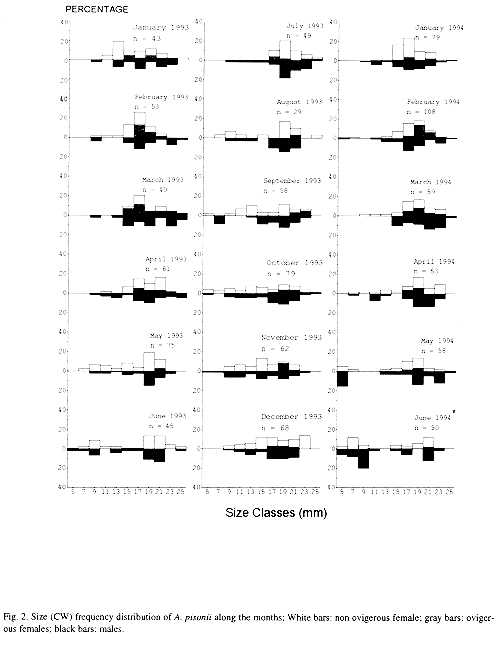
<body><![CDATA[<P><B><FONT FACE="Arial,Helvetica"><FONT SIZE=-1>Materials and Methods</FONT></FONT></B>      <P><FONT FACE="Arial,Helvetica"><FONT SIZE=-1>Ubatuba is located in the northern coast of S&atilde;o Paulo State, Brazil. The climate in this region is tropical humid tending to subtropical. Rainfall is more intense from September to March (spring to summer). The "Comprido" and "Escuro" streams are the freshwater resource of the area and they drain into the Fortaleza Bay. The salinity varies widely due the mixed tide regime in that region.</FONT></FONT>      <P><FONT FACE="Arial,Helvetica"><FONT SIZE=-1>Monthly samples were carried out from January 1993 to June 1994 in the fringe area of mangrove near to the water, where the abundance of <I>A. pisonii</I> had been previously observed to be higher than in inlet areas. The animals were captured by hand from the roots and branches of the mangrove trees. Samplings consisted of 1 hour catch-effort sessions conducted by two people during low tide. All crabs were sexed and presence or absence of eggs in the females was recorded. Their carapace width (CW) was measured to the nearest 0.1 mm using a Vernier caliper. The crabs were grouped into eleven size classes from 4.1 to 26.0 mm CW.</FONT></FONT>      <P><FONT FACE="Arial,Helvetica"><FONT SIZE=-1>Recruitment pulses were verified in frequency of individuals measuring from 4.1 to 8.0 mm CW. Individuals smaller than 4.1 mm CW were not considered due to the difficulty to determine accurately their sex.</FONT></FONT>      <P><FONT FACE="Arial,Helvetica"><FONT SIZE=-1>The reproductive period was determined based on ovigerous female frequency in relation to mature female along the year. Since the smallest ovigerous females obtained measured 15.0 mm CW, only crabs grouped in the 14.1-16.0 mm size class or larger were regarded mature. Reproductive periodicity was statistically examined by means of binomial proportion analyses (<A HREF="#Goodman L.">Goodman 1965</A>). The sex ratio in each month and size class were examined by this analysis too. The significance level adopted for all analyses were 5%.</FONT></FONT>      <P><FONT FACE="Arial,Helvetica"><FONT SIZE=-1>Due to the terrestrial habits of this species the association between proportion of ovigerous females and two factors (monthly average air temperature and rainfall) was analyzed. Temperature and rainfall data were obtained in a nearby (4 Km) meteorological station of the University of S&atilde;o Paulo.</FONT></FONT>     <BR>&nbsp;      <P><B><FONT FACE="Arial,Helvetica"><FONT SIZE=-1>Results</FONT></FONT></B>      <P><FONT FACE="Arial,Helvetica"><FONT SIZE=-1>During the study period, a total of 1 078 crabs were obtained; 489 males, 589 females, of which 131 were ovigerous.</FONT></FONT>     <BR><FONT FACE="Arial,Helvetica"><FONT SIZE=-1>The size of the individuals ranged from 4.2 to 25.9 mm CW. The overall size frequency distribution presented an unimodal and slightly asymmetric shape skewed to the left (<A HREF="#fig.1">Fig. 1</A>). Average size of both males and females was 16.8 mm CW.</FONT></FONT>     ]]></body>
<body><![CDATA[<BR>&nbsp;     <BR>&nbsp;     <CENTER></CENTER>      <CENTER><A NAME="fig.1"></A><IMG SRC="/img/fbpe/rbt/v46n3/0203i01.GIF" HEIGHT=361 WIDTH=298></CENTER> &nbsp;     
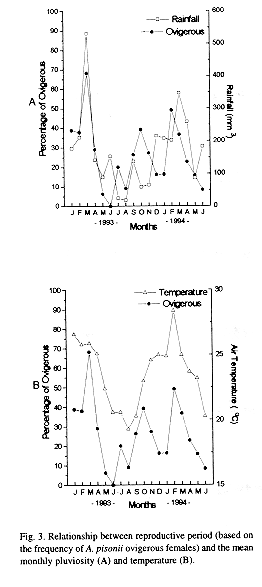
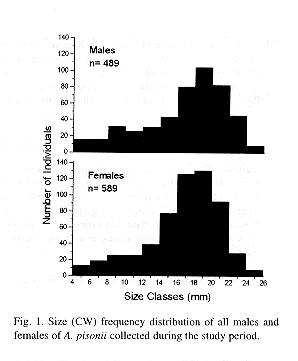
<BR>&nbsp;      <P><FONT FACE="Arial,Helvetica"><FONT SIZE=-1>As shown in the <A HREF="#fig.2">Fig. 2</A>, juvenile crabs from 4.1 to 8.0 mm CW were scarce being the highest frequencies recorded in June 1993, May and June 1994 (winter). Ovigerous females had been present during almost all the months, varying from 0 (June 1993) to 68.2 % (March 1993) of the adult female population. Mean size of ovigerous females was 19.2 &plusmn; 2.2 mm CW, ranging from 15.0 mm to 25.0 mm CW. The ovigerous-ratio (<A HREF="#fig.3">Fig. 3A and B</A>) was positively correlated with monthly average rainfall (Pearson’s linear correlation, r =0.61; p &lt; 0.01) and temperature (r = 0.70; p &lt; 0.005).</FONT></FONT>     <BR>&nbsp;     <BR>&nbsp;     <BR>&nbsp;     <CENTER></CENTER>      ]]></body>
<body><![CDATA[<CENTER><A NAME="fig.2"></A><IMG SRC="/img/fbpe/rbt/v46n3/0203i02.GIF" HEIGHT=652 WIDTH=495></CENTER>      
<CENTER>&nbsp;</CENTER>      <CENTER></CENTER>      <CENTER><A NAME="fig.3"></A><IMG SRC="/img/fbpe/rbt/v46n3/0203i03.GIF" HEIGHT=587 WIDTH=262></CENTER> &nbsp;     
<BR>&nbsp;      <P><FONT FACE="Arial,Helvetica"><FONT SIZE=-1>Overall sex-ratio was 1: 1.2, not differing statistically from the 1 : 1 ratio. Remarkable deviations from 1 : 1 ratio were registered in January, February and May 1993 and in January 1994, favouring females. Only in May and June 1994 males outnumbered females (<A HREF="#Table 1">Table 1</A>).</FONT></FONT>     <CENTER></CENTER>      <CENTER><A NAME="Table 1"></A><FONT FACE="Arial,Helvetica"><FONT SIZE=-1>Table 1</FONT></FONT></CENTER>      <CENTER><FONT FACE="Arial,Helvetica"><FONT SIZE=-1><I>Variation in the sex-ratio of </I>A. pisonii<I> in each month.</I></FONT></FONT></CENTER> &nbsp;     <BR>&nbsp;     ]]></body>
<body><![CDATA[<CENTER><TABLE BORDER=0 CELLSPACING=0 CELLPADDING=3 WIDTH="688" > <TR> <TD VALIGN=TOP WIDTH="38%">     <CENTER><FONT FACE="Arial,Helvetica"><FONT SIZE=-1>Month/ year</FONT></FONT></CENTER> <FONT FACE="Arial,Helvetica"><FONT SIZE=-1>&nbsp;</FONT></FONT></TD>  <TD VALIGN=TOP WIDTH="25%">     <CENTER><FONT FACE="Arial,Helvetica"><FONT SIZE=-1>Sample size</FONT></FONT>&nbsp;</CENTER>      <CENTER><FONT FACE="Arial,Helvetica"><FONT SIZE=-1>male/ female</FONT></FONT></CENTER> </TD>  <TD VALIGN=TOP WIDTH="38%">     <CENTER><FONT FACE="Arial,Helvetica"><FONT SIZE=-1>Proportion&nbsp;</FONT></FONT></CENTER> </TD> </TR>  <TR> <TD VALIGN=TOP WIDTH="38%">     <CENTER><FONT FACE="Arial,Helvetica"><FONT SIZE=-1>Jan / 1993</FONT></FONT></CENTER> </TD>  <TD VALIGN=TOP WIDTH="25%">     <CENTER><FONT FACE="Arial,Helvetica"><FONT SIZE=-1>43</FONT></FONT></CENTER> </TD>  <TD VALIGN=TOP WIDTH="38%">     <CENTER><FONT FACE="Arial,Helvetica"><FONT SIZE=-1>1 : 1.86<A HREF="#* table 1">*</A></FONT></FONT></CENTER> </TD> </TR>  <TR> <TD VALIGN=TOP WIDTH="38%">     <CENTER><FONT FACE="Arial,Helvetica"><FONT SIZE=-1>Feb</FONT></FONT></CENTER> </TD>  <TD VALIGN=TOP WIDTH="25%">     <CENTER><FONT FACE="Arial,Helvetica"><FONT SIZE=-1>53</FONT></FONT></CENTER> </TD>  <TD VALIGN=TOP WIDTH="38%">     ]]></body>
<body><![CDATA[<CENTER><FONT FACE="Arial,Helvetica"><FONT SIZE=-1>1 : 1.52<A HREF="#* table 1">*</A></FONT></FONT></CENTER> </TD> </TR>  <TR> <TD VALIGN=TOP WIDTH="38%">     <CENTER><FONT FACE="Arial,Helvetica"><FONT SIZE=-1>Mar</FONT></FONT></CENTER> </TD>  <TD VALIGN=TOP WIDTH="25%">     <CENTER><FONT FACE="Arial,Helvetica"><FONT SIZE=-1>49&nbsp;</FONT></FONT></CENTER> </TD>  <TD VALIGN=TOP WIDTH="38%">     <CENTER><FONT FACE="Arial,Helvetica"><FONT SIZE=-1>1 : 1.04</FONT></FONT></CENTER> </TD> </TR>  <TR> <TD VALIGN=TOP WIDTH="38%">     <CENTER><FONT FACE="Arial,Helvetica"><FONT SIZE=-1>Apr</FONT></FONT></CENTER> </TD>  <TD VALIGN=TOP WIDTH="25%">     <CENTER><FONT FACE="Arial,Helvetica"><FONT SIZE=-1>61</FONT></FONT></CENTER> </TD>  <TD VALIGN=TOP WIDTH="38%">     <CENTER><FONT FACE="Arial,Helvetica"><FONT SIZE=-1>1 : 1.35</FONT></FONT></CENTER> </TD> </TR>  <TR> <TD VALIGN=TOP WIDTH="38%">     <CENTER><FONT FACE="Arial,Helvetica"><FONT SIZE=-1>May</FONT></FONT></CENTER> </TD>  <TD VALIGN=TOP WIDTH="25%">     <CENTER><FONT FACE="Arial,Helvetica"><FONT SIZE=-1>75</FONT></FONT></CENTER> </TD>  <TD VALIGN=TOP WIDTH="38%">     <CENTER><FONT FACE="Arial,Helvetica"><FONT SIZE=-1>1 : 1.50<A HREF="#* table 1">*</A></FONT></FONT></CENTER> </TD> </TR>  <TR> <TD VALIGN=TOP WIDTH="38%">     ]]></body>
<body><![CDATA[<CENTER><FONT FACE="Arial,Helvetica"><FONT SIZE=-1>Jun</FONT></FONT></CENTER> </TD>  <TD VALIGN=TOP WIDTH="25%">     <CENTER><FONT FACE="Arial,Helvetica"><FONT SIZE=-1>45</FONT></FONT></CENTER> </TD>  <TD VALIGN=TOP WIDTH="38%">     <CENTER><FONT FACE="Arial,Helvetica"><FONT SIZE=-1>1 : 1.04</FONT></FONT></CENTER> </TD> </TR>  <TR> <TD VALIGN=TOP WIDTH="38%">     <CENTER><FONT FACE="Arial,Helvetica"><FONT SIZE=-1>Jul</FONT></FONT></CENTER> </TD>  <TD VALIGN=TOP WIDTH="25%">     <CENTER><FONT FACE="Arial,Helvetica"><FONT SIZE=-1>49</FONT></FONT></CENTER> </TD>  <TD VALIGN=TOP WIDTH="38%">     <CENTER><FONT FACE="Arial,Helvetica"><FONT SIZE=-1>1 : 1.04</FONT></FONT></CENTER> </TD> </TR>  <TR> <TD VALIGN=TOP WIDTH="38%">     <CENTER><FONT FACE="Arial,Helvetica"><FONT SIZE=-1>Aug</FONT></FONT></CENTER> </TD>  <TD VALIGN=TOP WIDTH="25%">     <CENTER><FONT FACE="Arial,Helvetica"><FONT SIZE=-1>29</FONT></FONT></CENTER> </TD>  <TD VALIGN=TOP WIDTH="38%">     <CENTER><FONT FACE="Arial,Helvetica"><FONT SIZE=-1>1 : 1.23</FONT></FONT></CENTER> </TD> </TR>  <TR> <TD VALIGN=TOP WIDTH="38%">     <CENTER><FONT FACE="Arial,Helvetica"><FONT SIZE=-1>Sep</FONT></FONT></CENTER> </TD>  <TD VALIGN=TOP WIDTH="25%">     ]]></body>
<body><![CDATA[<CENTER><FONT FACE="Arial,Helvetica"><FONT SIZE=-1>58</FONT></FONT></CENTER> </TD>  <TD VALIGN=TOP WIDTH="38%">     <CENTER><FONT FACE="Arial,Helvetica"><FONT SIZE=-1>1 : 1.15</FONT></FONT></CENTER> </TD> </TR>  <TR> <TD VALIGN=TOP WIDTH="38%">     <CENTER><FONT FACE="Arial,Helvetica"><FONT SIZE=-1>Oct</FONT></FONT></CENTER> </TD>  <TD VALIGN=TOP WIDTH="25%">     <CENTER><FONT FACE="Arial,Helvetica"><FONT SIZE=-1>79</FONT></FONT></CENTER> </TD>  <TD VALIGN=TOP WIDTH="38%">     <CENTER><FONT FACE="Arial,Helvetica"><FONT SIZE=-1>1 : 1.02</FONT></FONT></CENTER> </TD> </TR>  <TR> <TD VALIGN=TOP WIDTH="38%">     <CENTER><FONT FACE="Arial,Helvetica"><FONT SIZE=-1>Nov</FONT></FONT></CENTER> </TD>  <TD VALIGN=TOP WIDTH="25%">     <CENTER><FONT FACE="Arial,Helvetica"><FONT SIZE=-1>62</FONT></FONT></CENTER> </TD>  <TD VALIGN=TOP WIDTH="38%">     <CENTER><FONT FACE="Arial,Helvetica"><FONT SIZE=-1>1 : 1.06</FONT></FONT></CENTER> </TD> </TR>  <TR> <TD VALIGN=TOP WIDTH="38%">     <CENTER><FONT FACE="Arial,Helvetica"><FONT SIZE=-1>Dec</FONT></FONT></CENTER> </TD>  <TD VALIGN=TOP WIDTH="25%">     <CENTER><FONT FACE="Arial,Helvetica"><FONT SIZE=-1>68</FONT></FONT></CENTER> </TD>  <TD VALIGN=TOP WIDTH="38%">     ]]></body>
<body><![CDATA[<CENTER><FONT FACE="Arial,Helvetica"><FONT SIZE=-1>1 : 1.34</FONT></FONT></CENTER> </TD> </TR>  <TR> <TD VALIGN=TOP WIDTH="38%">     <CENTER><FONT FACE="Arial,Helvetica"><FONT SIZE=-1>Jan / 1994</FONT></FONT></CENTER> </TD>  <TD VALIGN=TOP WIDTH="25%">     <CENTER><FONT FACE="Arial,Helvetica"><FONT SIZE=-1>79</FONT></FONT></CENTER> </TD>  <TD VALIGN=TOP WIDTH="38%">     <CENTER><FONT FACE="Arial,Helvetica"><FONT SIZE=-1>1 : 1.82<A HREF="#* table 1">*</A></FONT></FONT></CENTER> </TD> </TR>  <TR> <TD VALIGN=TOP WIDTH="38%">     <CENTER><FONT FACE="Arial,Helvetica"><FONT SIZE=-1>Feb</FONT></FONT></CENTER> </TD>  <TD VALIGN=TOP WIDTH="25%">     <CENTER><FONT FACE="Arial,Helvetica"><FONT SIZE=-1>108</FONT></FONT></CENTER> </TD>  <TD VALIGN=TOP WIDTH="38%">     <CENTER><FONT FACE="Arial,Helvetica"><FONT SIZE=-1>1 : 1.35</FONT></FONT></CENTER> </TD> </TR>  <TR> <TD VALIGN=TOP WIDTH="38%">     <CENTER><FONT FACE="Arial,Helvetica"><FONT SIZE=-1>Mar</FONT></FONT></CENTER> </TD>  <TD VALIGN=TOP WIDTH="25%">     <CENTER><FONT FACE="Arial,Helvetica"><FONT SIZE=-1>59</FONT></FONT></CENTER> </TD>  <TD VALIGN=TOP WIDTH="38%">     <CENTER><FONT FACE="Arial,Helvetica"><FONT SIZE=-1>1 : 1.27</FONT></FONT></CENTER> </TD> </TR>  <TR> <TD VALIGN=TOP WIDTH="38%">     ]]></body>
<body><![CDATA[<CENTER><FONT FACE="Arial,Helvetica"><FONT SIZE=-1>Apr</FONT></FONT></CENTER> </TD>  <TD VALIGN=TOP WIDTH="25%">     <CENTER><FONT FACE="Arial,Helvetica"><FONT SIZE=-1>53</FONT></FONT></CENTER> </TD>  <TD VALIGN=TOP WIDTH="38%">     <CENTER><FONT FACE="Arial,Helvetica"><FONT SIZE=-1>1 : 1.04</FONT></FONT></CENTER> </TD> </TR>  <TR> <TD VALIGN=TOP WIDTH="38%">     <CENTER><FONT FACE="Arial,Helvetica"><FONT SIZE=-1>May</FONT></FONT></CENTER> </TD>  <TD VALIGN=TOP WIDTH="25%">     <CENTER><FONT FACE="Arial,Helvetica"><FONT SIZE=-1>58</FONT></FONT></CENTER> </TD>  <TD VALIGN=TOP WIDTH="38%">     <CENTER><FONT FACE="Arial,Helvetica"><FONT SIZE=-1>1.41 : 1</FONT></FONT></CENTER> </TD> </TR>  <TR> <TD VALIGN=TOP WIDTH="38%">     <CENTER><FONT FACE="Arial,Helvetica"><FONT SIZE=-1>Jun</FONT></FONT></CENTER> </TD>  <TD VALIGN=TOP WIDTH="25%">     <CENTER><FONT FACE="Arial,Helvetica"><FONT SIZE=-1>50</FONT></FONT></CENTER> </TD>  <TD VALIGN=TOP WIDTH="38%">     <CENTER><FONT FACE="Arial,Helvetica"><FONT SIZE=-1>1.38 : 1</FONT></FONT></CENTER> </TD> </TR> </TABLE></CENTER> &nbsp;     <BR><A NAME="* table 1"></A><FONT FACE="Arial,Helvetica"><FONT SIZE=-1>*Statistically different (Goodman test, p &lt; 0.05)</FONT></FONT>      ]]></body>
<body><![CDATA[<P><FONT FACE="Arial,Helvetica"><FONT SIZE=-1>Deviations were observed in some size classes, these differences being statistically significant in some cases (<A HREF="#Table 2">Table 2</A>). Females were more numerous in the intermediate size classes, from 14.1 to 18.0 mm CW. Immature individuals from 4.1 to 14.0 mm CW did not present differences in sexual proportions. In large crabs from 22 to 24 mm CW, males were significantly more numerous than females (<A HREF="#Hartnoll R. G. 1965.">Goodman</A>’s test, p &lt; 0.05). Only a few specimens larger than 24.0 mm were obtained.</FONT></FONT>     <BR>&nbsp;     <BR>&nbsp;     <BR>&nbsp;     <CENTER></CENTER>      <CENTER><A NAME="Table 2"></A><FONT FACE="Arial,Helvetica"><FONT SIZE=-1>Table 2</FONT></FONT></CENTER>      <CENTER><FONT FACE="Arial,Helvetica"><FONT SIZE=-1><I>Variation in the sex-ratio of A</I>. pisonii<I> in each size class.</I></FONT></FONT></CENTER>      <CENTER><I><FONT FACE="Arial,Helvetica"><FONT SIZE=-1>&nbsp;</FONT></FONT></I></CENTER>      <CENTER><TABLE BORDER=0 CELLSPACING=0 CELLPADDING=3 WIDTH="672" > <TR> <TD VALIGN=TOP WIDTH="43%">     <CENTER><FONT FACE="Arial,Helvetica"><FONT SIZE=-1>Size class (mm)</FONT></FONT></CENTER> <FONT FACE="Arial,Helvetica"><FONT SIZE=-1>&nbsp;</FONT></FONT></TD>  <TD VALIGN=TOP WIDTH="23%">     ]]></body>
<body><![CDATA[<CENTER><FONT FACE="Arial,Helvetica"><FONT SIZE=-1>Sample size</FONT></FONT></CENTER> <FONT FACE="Arial,Helvetica"><FONT SIZE=-1>&nbsp;</FONT></FONT></TD>  <TD VALIGN=TOP WIDTH="34%">     <CENTER><FONT FACE="Arial,Helvetica"><FONT SIZE=-1>Proportion male/</FONT></FONT>&nbsp;</CENTER>      <CENTER><FONT FACE="Arial,Helvetica"><FONT SIZE=-1>female</FONT></FONT></CENTER> </TD> </TR>  <TR> <TD VALIGN=TOP WIDTH="43%">     <CENTER><FONT FACE="Arial,Helvetica"><FONT SIZE=-1>4.1 -- 6.0</FONT></FONT></CENTER> </TD>  <TD VALIGN=TOP WIDTH="23%">     <CENTER><FONT FACE="Arial,Helvetica"><FONT SIZE=-1>29</FONT></FONT></CENTER> </TD>  <TD VALIGN=TOP WIDTH="34%">     <CENTER><FONT FACE="Arial,Helvetica"><FONT SIZE=-1>1.23 : 1</FONT></FONT></CENTER> </TD> </TR>  <TR> <TD VALIGN=TOP WIDTH="43%">     <CENTER><FONT FACE="Arial,Helvetica"><FONT SIZE=-1>6.1 -- 8.0</FONT></FONT></CENTER> </TD>  <TD VALIGN=TOP WIDTH="23%">     <CENTER><FONT FACE="Arial,Helvetica"><FONT SIZE=-1>35</FONT></FONT></CENTER> </TD>  <TD VALIGN=TOP WIDTH="34%">     <CENTER><FONT FACE="Arial,Helvetica"><FONT SIZE=-1>1 : 1.19</FONT></FONT></CENTER> </TD> </TR>  <TR> <TD VALIGN=TOP WIDTH="43%">     <CENTER><FONT FACE="Arial,Helvetica"><FONT SIZE=-1>8.1 -- 10.0</FONT></FONT></CENTER> </TD>  <TD VALIGN=TOP WIDTH="23%">     ]]></body>
<body><![CDATA[<CENTER><FONT FACE="Arial,Helvetica"><FONT SIZE=-1>58</FONT></FONT></CENTER> </TD>  <TD VALIGN=TOP WIDTH="34%">     <CENTER><FONT FACE="Arial,Helvetica"><FONT SIZE=-1>1.23 : 1</FONT></FONT></CENTER> </TD> </TR>  <TR> <TD VALIGN=TOP WIDTH="43%">     <CENTER><FONT FACE="Arial,Helvetica"><FONT SIZE=-1>10.1 -- 12.0</FONT></FONT></CENTER> </TD>  <TD VALIGN=TOP WIDTH="23%">     <CENTER><FONT FACE="Arial,Helvetica"><FONT SIZE=-1>52</FONT></FONT></CENTER> </TD>  <TD VALIGN=TOP WIDTH="34%">     <CENTER><FONT FACE="Arial,Helvetica"><FONT SIZE=-1>1 : 1</FONT></FONT></CENTER> </TD> </TR>  <TR> <TD VALIGN=TOP WIDTH="43%">     <CENTER><FONT FACE="Arial,Helvetica"><FONT SIZE=-1>12.1 -- 14.0</FONT></FONT></CENTER> </TD>  <TD VALIGN=TOP WIDTH="23%">     <CENTER><FONT FACE="Arial,Helvetica"><FONT SIZE=-1>70</FONT></FONT></CENTER> </TD>  <TD VALIGN=TOP WIDTH="34%">     <CENTER><FONT FACE="Arial,Helvetica"><FONT SIZE=-1>1 : 1.26</FONT></FONT></CENTER> </TD> </TR>  <TR> <TD VALIGN=TOP WIDTH="43%">     <CENTER><FONT FACE="Arial,Helvetica"><FONT SIZE=-1>14.1 -- 16.0</FONT></FONT></CENTER> </TD>  <TD VALIGN=TOP WIDTH="23%">     <CENTER><FONT FACE="Arial,Helvetica"><FONT SIZE=-1>122</FONT></FONT></CENTER> </TD>  <TD VALIGN=TOP WIDTH="34%">     ]]></body>
<body><![CDATA[<CENTER><FONT FACE="Arial,Helvetica"><FONT SIZE=-1>1 : 1.78<A HREF="#* table 2">*</A></FONT></FONT></CENTER> </TD> </TR>  <TR> <TD VALIGN=TOP WIDTH="43%">     <CENTER><FONT FACE="Arial,Helvetica"><FONT SIZE=-1>16.1 -- 18.0</FONT></FONT></CENTER> </TD>  <TD VALIGN=TOP WIDTH="23%">     <CENTER><FONT FACE="Arial,Helvetica"><FONT SIZE=-1>208</FONT></FONT></CENTER> </TD>  <TD VALIGN=TOP WIDTH="34%">     <CENTER><FONT FACE="Arial,Helvetica"><FONT SIZE=-1>1 : 1.57<A HREF="#* table 2">*</A></FONT></FONT></CENTER> </TD> </TR>  <TR> <TD VALIGN=TOP WIDTH="43%">     <CENTER><FONT FACE="Arial,Helvetica"><FONT SIZE=-1>18.1 -- 20.0</FONT></FONT></CENTER> </TD>  <TD VALIGN=TOP WIDTH="23%">     <CENTER><FONT FACE="Arial,Helvetica"><FONT SIZE=-1>238</FONT></FONT></CENTER> </TD>  <TD VALIGN=TOP WIDTH="34%">     <CENTER><FONT FACE="Arial,Helvetica"><FONT SIZE=-1>1 : 1.25</FONT></FONT></CENTER> </TD> </TR>  <TR> <TD VALIGN=TOP WIDTH="43%">     <CENTER><FONT FACE="Arial,Helvetica"><FONT SIZE=-1>20.1 -- 22.0</FONT></FONT></CENTER> </TD>  <TD VALIGN=TOP WIDTH="23%">     <CENTER><FONT FACE="Arial,Helvetica"><FONT SIZE=-1>176</FONT></FONT></CENTER> </TD>  <TD VALIGN=TOP WIDTH="34%">     <CENTER><FONT FACE="Arial,Helvetica"><FONT SIZE=-1>1 : 1.12</FONT></FONT></CENTER> </TD> </TR>  <TR> <TD VALIGN=TOP WIDTH="43%">     ]]></body>
<body><![CDATA[<CENTER><FONT FACE="Arial,Helvetica"><FONT SIZE=-1>22.1 -- 24.0</FONT></FONT></CENTER> </TD>  <TD VALIGN=TOP WIDTH="23%">     <CENTER><FONT FACE="Arial,Helvetica"><FONT SIZE=-1>75</FONT></FONT></CENTER> </TD>  <TD VALIGN=TOP WIDTH="34%">     <CENTER><FONT FACE="Arial,Helvetica"><FONT SIZE=-1>1.59 : 1<A HREF="#* table 2">*</A></FONT></FONT></CENTER> </TD> </TR>  <TR> <TD VALIGN=TOP WIDTH="43%">     <CENTER><FONT FACE="Arial,Helvetica"><FONT SIZE=-1>24.1 -- 26.0</FONT></FONT></CENTER> </TD>  <TD VALIGN=TOP WIDTH="23%">     <CENTER><FONT FACE="Arial,Helvetica"><FONT SIZE=-1>17</FONT></FONT></CENTER> </TD>  <TD VALIGN=TOP WIDTH="34%">     <CENTER><FONT FACE="Arial,Helvetica"><FONT SIZE=-1>1.12 : 1</FONT></FONT></CENTER> </TD> </TR> </TABLE></CENTER> &nbsp;     <BR><A NAME="* table 2"></A><FONT FACE="Arial,Helvetica"><FONT SIZE=-1>*Statistically different (Goodman test, p &lt; 0.05)</FONT></FONT>     <BR>&nbsp;      <P><B><FONT FACE="Arial,Helvetica"><FONT SIZE=-1>Discussion</FONT></FONT></B>      <P><FONT FACE="Arial,Helvetica"><FONT SIZE=-1>The overall size frequency distribution of <I>A. pisonii</I> is unimodal and asymmetric which usually reflects a population in equilibrium <A HREF="#Hartnoll R. G. 1990">(Hartnoll and Bryant 1990</A>). The modal variations in the size frequency distribution along the year were mainly caused by recruitment pulses, which were more evident in June 1993, May and June 1994 (late autumn and early winter). However, juveniles could be also found in other months, but in smaller frequencies. This conspicuous recruitment was probably a result of intense reproductive activity occured in March 1993 and February and March 1994 (summer). It can be supposed that the main period of megalopa settlement occurred from late summer to early autumn, since the larval development of this species includes four zoeal stages and a megalopa instar in approximately one month (<A HREF="#Warner G. F. 1968.">Warner 1968)</A>.</FONT></FONT>      ]]></body>
<body><![CDATA[<P><FONT FACE="Arial,Helvetica"><FONT SIZE=-1>This reproduction and recruitment pattern could be a result of the geographical location of the studied area, a transitional faunistic region with tropical humid climate tending to subtropical. In this latitude, intensive temperature changes are likely to occur more often than in the tropics. In this study the temperature was very correlated to the ovigerous rate as had been observed in other studies as the main factor influencing the reproduction (<A HREF="#Fusaro C.">Fusaro 1980</A>, <A HREF="#Jones M. B.">Jones and Simons 1983</A>, <A HREF="#Siddiqui G.">Siddiqui and Ahmed 1992</A>).</FONT></FONT>      <P><FONT FACE="Arial,Helvetica"><FONT SIZE=-1>An extended breeding season with a peak of higher activity during the rainy season was observed in the present study, as those obtained by <A HREF="#Díaz H.">D&iacute;az and Conde (1989</A>) and <A HREF="#Conde J. E. & H. Díaz. 1989a.">Conde and D&iacute;az (1989a)</A>. Spawning in the rainy season may provide a selective advantage to intertidal decapods populations since that periods of higher rainfall rate can cause changes in the salinity of water (<A HREF="#Pillay K. K.">Pillay and Nair 1971</A>, <A HREF="#DeVries M.">DeVries <I>et al</I>. 1983</A>) and also promote an increase of nutrients concentration, favouring the development of planktotrophic larvae (<A HREF="#Siddiqui G.">Siddiqui and Ahmed 1992)</A>, and an increase of primary productivity and seston availability in the estuary (<A HREF="#Rodriguez G. L.">Rodriguez and Conde 1989</A>). In the population studied herein, higher flow rate and seawards water velocity during the rainy season, are conditions that probably prevent zoeae from stranding and osmoregulatory stress.</FONT></FONT>      <P><FONT FACE="Arial,Helvetica"><FONT SIZE=-1>In this study the sex-ratio does not differ from the 1 : 1 in the smallest classes but it does differ in the intermediate size classes favouring females and also in larger crabs favouring males, according to the "anomalous" pattern described by <A HREF="#Wenner A. M.">Wenner (1972</A>). The highest female proportion in intermediate size classes (from 14 mm CW), match the size in which an important part of the population is sexually active. For <I>A. pisonii,</I><A HREF="#Warner G. F. 1967."> Warner (1967</A>) suggests differential growth rates in which males reach large sizes faster due to the higher reproductive effort of females which do not molt when they are incubating eggs.</FONT></FONT>      <P><FONT FACE="Arial,Helvetica"><FONT SIZE=-1>According to <A HREF="#Giesel J. T.">Giesel (1972</A>) variations in the sex-ratio occur primarily during the main seasonal changes of environmental conditions. <A HREF="#Warner G. F. 1967.">Warner (1967</A>) reported that during the reproductive period of <I>A. pisonii</I>, females migrate from the interior of the mangrove to water edge increasing the relative female frequency. Peculiar characteristics of mangrove fringes, such as humidity conditions provide more suitable grounds to egg development and larval release (<A HREF="#Emmerson W.">Emmerson 1994</A>). Furthermore, female migration towards the fringes, possibly enhances the chances of mate encounters. <A HREF="#Christy J.">Christy and Salmon (1984</A>) assumed that sex-ratio is associated to the mating system of each species, but <A HREF="#Willson M. F.">Willson and Pianka (1963</A>) pointed out that this is not a cause-effect relationship. It could be suggested that female-biased sex-ratio observed herein may be related to a poligynous mating system in which males could mate with different females increasing the reproductive output in population (<A HREF="#Giesel J. T.">Giesel 1972</A>). However, further investigations are necessary to confirm the relation between sex-ratio and mating system in <I>A. pisonii</I> as in other decapods.</FONT></FONT>     <BR>&nbsp;      <P><B><FONT FACE="Arial,Helvetica"><FONT SIZE=-1>Acknowledgements</FONT></FONT></B>      <P><FONT FACE="Arial,Helvetica"><FONT SIZE=-1>To the " Conselho Nacional de Desenvolvimento Cient&iacute;fico e Tecnol&oacute;gico - CNPq" that provided fellowship for the first author. To Adilson Fransozo from UNESP, Brazil for their suggestions. To the NEBECC members who helped us during the collections.</FONT></FONT>     <BR>&nbsp;      <P><B><FONT FACE="Arial,Helvetica"><FONT SIZE=-1>References</FONT></FONT></B>      <!-- ref --><P><A NAME="Christy J."></A><FONT FACE="Arial,Helvetica"><FONT SIZE=-1>Christy J. H. &amp; M. Salmon. 1984. Ecology and evolution of mating systems of fiddler crabs (Genus <I>Uca</I>). Biol. Rev. 59: 483-509.</FONT></FONT>    &nbsp;&nbsp;&nbsp;&nbsp;&nbsp;&nbsp;&nbsp;&nbsp;[&#160;<a href="javascript:void(0);" onclick="javascript: window.open('/scielo.php?script=sci_nlinks&ref=1140593&pid=S0034-7744199800030002100001&lng=','','width=640,height=500,resizable=yes,scrollbars=1,menubar=yes,');">Links</a>&#160;]<!-- end-ref --><!-- ref --><P><A NAME="Conde J. E. & H. Díaz. 1989a."></A><FONT FACE="Arial,Helvetica"><FONT SIZE=-1>Conde J. E. &amp; H. D&iacute;az. 1989a. The mangrove tree crab <I>Aratus pisonii</I> in a tropical estuarine coastal lagoon. Estuar. Coast. Shelf Sci. 28: 639-650.</FONT></FONT>    &nbsp;&nbsp;&nbsp;&nbsp;&nbsp;&nbsp;&nbsp;&nbsp;[&#160;<a href="javascript:void(0);" onclick="javascript: window.open('/scielo.php?script=sci_nlinks&ref=1140594&pid=S0034-7744199800030002100002&lng=','','width=640,height=500,resizable=yes,scrollbars=1,menubar=yes,');">Links</a>&#160;]<!-- end-ref --><!-- ref --><P><A NAME="Conde J. E. & H. Díaz. 1989b."></A><FONT FACE="Arial,Helvetica"><FONT SIZE=-1>Conde J. E. &amp; H. D&iacute;az. 1989b. Productividad del habitat e historias de vida del cangrejo de mangle <I>Aratus pisonii</I> (H. Milne Edwards) (Brachyura, Grapsidae). Bol. Inst. Oceanogr. Venezuela. Univ. Oriente<I> </I>28<B> </B>: 113-120.</FONT></FONT>    &nbsp;&nbsp;&nbsp;&nbsp;&nbsp;&nbsp;&nbsp;&nbsp;[&#160;<a href="javascript:void(0);" onclick="javascript: window.open('/scielo.php?script=sci_nlinks&ref=1140595&pid=S0034-7744199800030002100003&lng=','','width=640,height=500,resizable=yes,scrollbars=1,menubar=yes,');">Links</a>&#160;]<!-- end-ref --><!-- ref --><P><A NAME="DeVries M."></A><FONT FACE="Arial,Helvetica"><FONT SIZE=-1>DeVries M. C., C. E. Epifanio &amp; A. I. Dittel. 1983.Reproductive period of the tropical crab <I>Callinectes arcuatus</I> Ordway in Central America. Estuar. Coast. and Shelf Sci. 17: 709-716.</FONT></FONT>    &nbsp;&nbsp;&nbsp;&nbsp;&nbsp;&nbsp;&nbsp;&nbsp;[&#160;<a href="javascript:void(0);" onclick="javascript: window.open('/scielo.php?script=sci_nlinks&ref=1140596&pid=S0034-7744199800030002100004&lng=','','width=640,height=500,resizable=yes,scrollbars=1,menubar=yes,');">Links</a>&#160;]<!-- end-ref --><!-- ref --><P><A NAME="Díaz H."></A><FONT FACE="Arial,Helvetica"><FONT SIZE=-1>D&iacute;az H. &amp; J. E. Conde. 1989. Population dynamics and life history of the mangrove crab <I>Aratus pisonii</I> (Brachyura, Grapsidae) in a marine environment. Bull. Mar. Sci. 45: 148-163.</FONT></FONT>    &nbsp;&nbsp;&nbsp;&nbsp;&nbsp;&nbsp;&nbsp;&nbsp;[&#160;<a href="javascript:void(0);" onclick="javascript: window.open('/scielo.php?script=sci_nlinks&ref=1140597&pid=S0034-7744199800030002100005&lng=','','width=640,height=500,resizable=yes,scrollbars=1,menubar=yes,');">Links</a>&#160;]<!-- end-ref --><!-- ref --><P><A NAME="Emmerson W."></A><FONT FACE="Arial,Helvetica"><FONT SIZE=-1>Emmerson W. D. 1994. Seasonal breeding cycles and sex ratios of eight species of crabs from Mgazana, a mangrove estuary in Transkei, Southern Africa. J. Crustacean Biol. 14: 568- 578.</FONT></FONT>    &nbsp;&nbsp;&nbsp;&nbsp;&nbsp;&nbsp;&nbsp;&nbsp;[&#160;<a href="javascript:void(0);" onclick="javascript: window.open('/scielo.php?script=sci_nlinks&ref=1140598&pid=S0034-7744199800030002100006&lng=','','width=640,height=500,resizable=yes,scrollbars=1,menubar=yes,');">Links</a>&#160;]<!-- end-ref --><!-- ref --><P><A NAME="Fusaro C."></A><FONT FACE="Arial,Helvetica"><FONT SIZE=-1>Fusaro C. 1980. Temperature and egg production by the sand crab, <I>Emerita analoga</I> (Stimpson) (Decapoda, Anomura). Crustaceana. 38: 55-60.</FONT></FONT>    &nbsp;&nbsp;&nbsp;&nbsp;&nbsp;&nbsp;&nbsp;&nbsp;[&#160;<a href="javascript:void(0);" onclick="javascript: window.open('/scielo.php?script=sci_nlinks&ref=1140599&pid=S0034-7744199800030002100007&lng=','','width=640,height=500,resizable=yes,scrollbars=1,menubar=yes,');">Links</a>&#160;]<!-- end-ref --><!-- ref --><P><A NAME="Giesel J. T."></A><FONT FACE="Arial,Helvetica"><FONT SIZE=-1>Giesel J. T. 1972. Sex ratio, rate of evolution, and environmental heterogeneity. Am. Nat. 106: 380-387.</FONT></FONT>    &nbsp;&nbsp;&nbsp;&nbsp;&nbsp;&nbsp;&nbsp;&nbsp;[&#160;<a href="javascript:void(0);" onclick="javascript: window.open('/scielo.php?script=sci_nlinks&ref=1140600&pid=S0034-7744199800030002100008&lng=','','width=640,height=500,resizable=yes,scrollbars=1,menubar=yes,');">Links</a>&#160;]<!-- end-ref --><!-- ref --><P><A NAME="Goodman L."></A><FONT FACE="Arial,Helvetica"><FONT SIZE=-1>Goodman L. A. 1965. On simultaneous confidence intervals for multinomial proportions. Technometrics 7: 247-254.</FONT></FONT>    &nbsp;&nbsp;&nbsp;&nbsp;&nbsp;&nbsp;&nbsp;&nbsp;[&#160;<a href="javascript:void(0);" onclick="javascript: window.open('/scielo.php?script=sci_nlinks&ref=1140601&pid=S0034-7744199800030002100009&lng=','','width=640,height=500,resizable=yes,scrollbars=1,menubar=yes,');">Links</a>&#160;]<!-- end-ref --><!-- ref --><P><A NAME="Hartnoll R. G. 1965."></A><FONT FACE="Arial,Helvetica"><FONT SIZE=-1>Hartnoll R. G. 1965. Notes on the marine grapsid crabs of Jamaica. Proc. Linn. Soc. Lond. 176: 113-147.</FONT></FONT>    &nbsp;&nbsp;&nbsp;&nbsp;&nbsp;&nbsp;&nbsp;&nbsp;[&#160;<a href="javascript:void(0);" onclick="javascript: window.open('/scielo.php?script=sci_nlinks&ref=1140602&pid=S0034-7744199800030002100010&lng=','','width=640,height=500,resizable=yes,scrollbars=1,menubar=yes,');">Links</a>&#160;]<!-- end-ref --><!-- ref --><P><A NAME="Hartnoll R. G. 1990"></A><FONT FACE="Arial,Helvetica"><FONT SIZE=-1>Hartnoll R. G. &amp; A. D. Bryant. 1990. Size-frequency distributions in decapod crustacea - the quick, the dead, and the cast-offs. J. Crustacean Biol. 10: 14-19.</FONT></FONT>    &nbsp;&nbsp;&nbsp;&nbsp;&nbsp;&nbsp;&nbsp;&nbsp;[&#160;<a href="javascript:void(0);" onclick="javascript: window.open('/scielo.php?script=sci_nlinks&ref=1140603&pid=S0034-7744199800030002100011&lng=','','width=640,height=500,resizable=yes,scrollbars=1,menubar=yes,');">Links</a>&#160;]<!-- end-ref --><!-- ref --><P><A NAME="Jones M. B."></A><FONT FACE="Arial,Helvetica"><FONT SIZE=-1>Jones M. B. &amp; M. J. Simons. 1983. Latitudinal variation in reproductive characteristics of a mud crab, <I>Helice crassa</I> (Grapsidae). Bull. Mar. Sci. 33: 656-670.</FONT></FONT>    &nbsp;&nbsp;&nbsp;&nbsp;&nbsp;&nbsp;&nbsp;&nbsp;[&#160;<a href="javascript:void(0);" onclick="javascript: window.open('/scielo.php?script=sci_nlinks&ref=1140604&pid=S0034-7744199800030002100012&lng=','','width=640,height=500,resizable=yes,scrollbars=1,menubar=yes,');">Links</a>&#160;]<!-- end-ref --><!-- ref --><P><A NAME="Melo G. A."></A><FONT FACE="Arial,Helvetica"><FONT SIZE=-1>Melo G. A. S. 1996. Manual de identifica&ccedil;&atilde;o dos Brachyura (caranguejos e siris) do litoral brasileiro. Pl&ecirc;iade, S&atilde;o Paulo. 603 p.</FONT></FONT>    &nbsp;&nbsp;&nbsp;&nbsp;&nbsp;&nbsp;&nbsp;&nbsp;[&#160;<a href="javascript:void(0);" onclick="javascript: window.open('/scielo.php?script=sci_nlinks&ref=1140605&pid=S0034-7744199800030002100013&lng=','','width=640,height=500,resizable=yes,scrollbars=1,menubar=yes,');">Links</a>&#160;]<!-- end-ref --><!-- ref --><P><A NAME="Pillay K. K."></A><FONT FACE="Arial,Helvetica"><FONT SIZE=-1>Pillay K. K. &amp; N. B. Nair. 1971. The anual reproductive cycles of <I>Uca annulipes</I>, Portunus pelagicus and <I>Metapenaeus affinis</I> (Decapoda: Crustacea) from the South-West coast of India. Mar. Biol. 11: 152-166.</FONT></FONT>    &nbsp;&nbsp;&nbsp;&nbsp;&nbsp;&nbsp;&nbsp;&nbsp;[&#160;<a href="javascript:void(0);" onclick="javascript: window.open('/scielo.php?script=sci_nlinks&ref=1140606&pid=S0034-7744199800030002100014&lng=','','width=640,height=500,resizable=yes,scrollbars=1,menubar=yes,');">Links</a>&#160;]<!-- end-ref --><!-- ref --><P><A NAME="Rodriguez G. L."></A><FONT FACE="Arial,Helvetica"><FONT SIZE=-1>Rodriguez G. L. &amp; J. E. Conde. 1989. Producci&oacute;n primaria en los estu&aacute;rios tropicales de la costa caribe&ntilde;a de Venezuela.<I> </I>Rev. Biol. Trop.<I> </I>37: 213-216.</FONT></FONT>    &nbsp;&nbsp;&nbsp;&nbsp;&nbsp;&nbsp;&nbsp;&nbsp;[&#160;<a href="javascript:void(0);" onclick="javascript: window.open('/scielo.php?script=sci_nlinks&ref=1140607&pid=S0034-7744199800030002100015&lng=','','width=640,height=500,resizable=yes,scrollbars=1,menubar=yes,');">Links</a>&#160;]<!-- end-ref --><!-- ref --><P><A NAME="Siddiqui G."></A><FONT FACE="Arial,Helvetica"><FONT SIZE=-1>Siddiqui G. &amp; M. Ahmed. 1992. Breeding seasons of some marine crabs found near Karachi (Pakistan: Arabian sea).Mar. Res. 1: 37-48.</FONT></FONT>    &nbsp;&nbsp;&nbsp;&nbsp;&nbsp;&nbsp;&nbsp;&nbsp;[&#160;<a href="javascript:void(0);" onclick="javascript: window.open('/scielo.php?script=sci_nlinks&ref=1140608&pid=S0034-7744199800030002100016&lng=','','width=640,height=500,resizable=yes,scrollbars=1,menubar=yes,');">Links</a>&#160;]<!-- end-ref --><!-- ref --><P><A NAME="Warner G. F. 1967."></A><FONT FACE="Arial,Helvetica"><FONT SIZE=-1>Warner G. F. 1967. The life history of the mangrove tree crab,<I> Aratus pisoni</I>. J. Zool. London. 153: 321-335.</FONT></FONT>    &nbsp;&nbsp;&nbsp;&nbsp;&nbsp;&nbsp;&nbsp;&nbsp;[&#160;<a href="javascript:void(0);" onclick="javascript: window.open('/scielo.php?script=sci_nlinks&ref=1140609&pid=S0034-7744199800030002100017&lng=','','width=640,height=500,resizable=yes,scrollbars=1,menubar=yes,');">Links</a>&#160;]<!-- end-ref --><!-- ref --><P><A NAME="Warner G. F. 1968."></A><FONT FACE="Arial,Helvetica"><FONT SIZE=-1>Warner G. F. 1968. The larval development of the mangrove tree crab<I> Aratus pisonii</I> (H.Milne Edwards), reared in laboratory (Brachyura, Grapsidae). Crustaceana 2: 249-258.</FONT></FONT>    &nbsp;&nbsp;&nbsp;&nbsp;&nbsp;&nbsp;&nbsp;&nbsp;[&#160;<a href="javascript:void(0);" onclick="javascript: window.open('/scielo.php?script=sci_nlinks&ref=1140610&pid=S0034-7744199800030002100018&lng=','','width=640,height=500,resizable=yes,scrollbars=1,menubar=yes,');">Links</a>&#160;]<!-- end-ref --><!-- ref --><P><A NAME="Wenner A. M."></A><FONT FACE="Arial,Helvetica"><FONT SIZE=-1>Wenner A. M. 1972. Sex-ratio as a function of size in marine Crustacea<I>. </I>Am. Nat. 106: 321-350.</FONT></FONT>    &nbsp;&nbsp;&nbsp;&nbsp;&nbsp;&nbsp;&nbsp;&nbsp;[&#160;<a href="javascript:void(0);" onclick="javascript: window.open('/scielo.php?script=sci_nlinks&ref=1140611&pid=S0034-7744199800030002100019&lng=','','width=640,height=500,resizable=yes,scrollbars=1,menubar=yes,');">Links</a>&#160;]<!-- end-ref --><!-- ref --><P><A NAME="Willson M. F."></A><FONT FACE="Arial,Helvetica"><FONT SIZE=-1>Willson M. F. &amp; E. R. Pianka. 1963. Sexual seletion, sex ratio and mating system. Am. Nat. 97: 405-407.</FONT></FONT>    &nbsp;&nbsp;&nbsp;&nbsp;&nbsp;&nbsp;&nbsp;&nbsp;[&#160;<a href="javascript:void(0);" onclick="javascript: window.open('/scielo.php?script=sci_nlinks&ref=1140612&pid=S0034-7744199800030002100020&lng=','','width=640,height=500,resizable=yes,scrollbars=1,menubar=yes,');">Links</a>&#160;]<!-- end-ref --><P><A NAME="1a"></A><SUP><FONT FACE="Arial,Helvetica"><FONT SIZE=-1><A HREF="#1">1</A> </FONT></FONT></SUP><FONT FACE="Arial,Helvetica"><FONT SIZE=-1>Departamento de Zoologia - Instituto de Bioci&ecirc;ncias - Caixa Postal 510 - Universidade Estadual Paulista - UNESP - 18618-000 Botucatu (SP), Brasil. E-mail <A HREF="mailto:zoologia@laser.com.br.">zoologia@laser.com.br.</A></FONT></FONT>      ]]></body>
<body><![CDATA[<P><A NAME="2a"></A><SUP><FONT FACE="Arial,Helvetica"><FONT SIZE=-1><A HREF="#2">2</A> </FONT></FONT></SUP><FONT FACE="Arial,Helvetica"><FONT SIZE=-1>Departamento de Zoologia - Instituto de Bioci&ecirc;ncias e Centro de Aq&uuml;icultura - Caixa Postal 510 - Universidade Estadual Paulista - UNESP - 18618-000 Botucatu (SP), Brasil. Fax 014 - 821 3744. E-mail <A HREF="mailto:zoologia@laser.com.br.">zoologia@laser.com.br.</A></FONT></FONT>      ]]></body><back>
<ref-list>
<ref id="B1">
<nlm-citation citation-type="journal">
<person-group person-group-type="author">
<name>
<surname><![CDATA[Christy]]></surname>
<given-names><![CDATA[J. H.]]></given-names>
</name>
<name>
<surname><![CDATA[Salmon]]></surname>
<given-names><![CDATA[M.]]></given-names>
</name>
</person-group>
<article-title xml:lang="en"><![CDATA[Ecology and evolution of mating systems of fiddler crabs (Genus Uca).]]></article-title>
<source><![CDATA[Biol. Rev.]]></source>
<year>1984</year>
<volume>59</volume>
<page-range>483-509</page-range></nlm-citation>
</ref>
<ref id="B2">
<nlm-citation citation-type="journal">
<person-group person-group-type="author">
<name>
<surname><![CDATA[Conde]]></surname>
<given-names><![CDATA[J. E.]]></given-names>
</name>
<name>
<surname><![CDATA[Díaz.]]></surname>
<given-names><![CDATA[H.]]></given-names>
</name>
</person-group>
<article-title xml:lang="en"><![CDATA[The mangrove tree crab Aratus pisonii in a tropical estuarine coastal lagoon]]></article-title>
<source><![CDATA[Estuar. Coast. Shelf Sci.]]></source>
<year>1989</year>
<month>a.</month>
<volume>28</volume>
<page-range>639-650</page-range></nlm-citation>
</ref>
<ref id="B3">
<nlm-citation citation-type="journal">
<person-group person-group-type="author">
<name>
<surname><![CDATA[Conde]]></surname>
<given-names><![CDATA[J. E.]]></given-names>
</name>
<name>
<surname><![CDATA[Díaz.]]></surname>
<given-names><![CDATA[H.]]></given-names>
</name>
</person-group>
<article-title xml:lang="es"><![CDATA[Productividad del habitat e historias de vida del cangrejo de mangle Aratus pisonii (H. Milne Edwards) (Brachyura, Grapsidae)]]></article-title>
<source><![CDATA[Bol. Inst. Oceanogr.]]></source>
<year>1989</year>
<month>b</month>
<volume>28</volume>
<page-range>113-120</page-range><publisher-name><![CDATA[Univ. Oriente]]></publisher-name>
</nlm-citation>
</ref>
<ref id="B4">
<nlm-citation citation-type="journal">
<person-group person-group-type="author">
<name>
<surname><![CDATA[DeVries]]></surname>
<given-names><![CDATA[M. C.]]></given-names>
</name>
<name>
<surname><![CDATA[Epifanio]]></surname>
<given-names><![CDATA[C. E.]]></given-names>
</name>
<name>
<surname><![CDATA[Dittel.]]></surname>
<given-names><![CDATA[A. I.]]></given-names>
</name>
</person-group>
<article-title xml:lang="en"><![CDATA[Reproductive period of the tropical crab Callinectes arcuatus Ordway in Central America.]]></article-title>
<source><![CDATA[Estuar. Coast. and Shelf Sci.]]></source>
<year>1983</year>
<volume>17</volume>
<page-range>709-716</page-range></nlm-citation>
</ref>
<ref id="B5">
<nlm-citation citation-type="journal">
<person-group person-group-type="author">
<name>
<surname><![CDATA[Díaz]]></surname>
<given-names><![CDATA[H.]]></given-names>
</name>
<name>
<surname><![CDATA[Conde]]></surname>
<given-names><![CDATA[J. E.]]></given-names>
</name>
</person-group>
<article-title xml:lang="en"><![CDATA[Population dynamics and life history of the mangrove crab Aratus pisonii (Brachyura, Grapsidae) in a marine environment]]></article-title>
<source><![CDATA[Bull. Mar. Sci.]]></source>
<year>1989</year>
<volume>45</volume>
<page-range>148-163</page-range></nlm-citation>
</ref>
<ref id="B6">
<nlm-citation citation-type="journal">
<person-group person-group-type="author">
<name>
<surname><![CDATA[Emmerson]]></surname>
<given-names><![CDATA[W. D.]]></given-names>
</name>
</person-group>
<article-title xml:lang="en"><![CDATA[Seasonal breeding cycles and sex ratios of eight species of crabs from Mgazana, a mangrove estuary in Transkei, Southern Africa.]]></article-title>
<source><![CDATA[J. Crustacean Biol.]]></source>
<year>1994</year>
<volume>14</volume>
<page-range>568- 578</page-range></nlm-citation>
</ref>
<ref id="B7">
<nlm-citation citation-type="journal">
<person-group person-group-type="author">
<name>
<surname><![CDATA[Fusaro]]></surname>
<given-names><![CDATA[C.]]></given-names>
</name>
</person-group>
<article-title xml:lang="en"><![CDATA[Temperature and egg production by the sand crab: Emerita analoga (Stimpson) (Decapoda, Anomura).]]></article-title>
<source><![CDATA[Crustaceana.]]></source>
<year>1980</year>
<volume>38</volume>
<page-range>55-60</page-range></nlm-citation>
</ref>
<ref id="B8">
<nlm-citation citation-type="journal">
<person-group person-group-type="author">
<name>
<surname><![CDATA[Giesel]]></surname>
<given-names><![CDATA[J. T.]]></given-names>
</name>
</person-group>
<article-title xml:lang="en"><![CDATA[Sex ratio, rate of evolution, and environmental heterogeneity.]]></article-title>
<source><![CDATA[Am. Nat.]]></source>
<year>1972</year>
<volume>106</volume>
<page-range>380-387</page-range></nlm-citation>
</ref>
<ref id="B9">
<nlm-citation citation-type="journal">
<person-group person-group-type="author">
<name>
<surname><![CDATA[Goodman]]></surname>
<given-names><![CDATA[L. A.]]></given-names>
</name>
</person-group>
<article-title xml:lang="en"><![CDATA[On simultaneous confidence intervals for multinomial proportions]]></article-title>
<source><![CDATA[Technometrics]]></source>
<year>1965</year>
<volume>7</volume>
<page-range>247-254</page-range></nlm-citation>
</ref>
<ref id="B10">
<nlm-citation citation-type="journal">
<person-group person-group-type="author">
<name>
<surname><![CDATA[Hartnoll]]></surname>
<given-names><![CDATA[R. G.]]></given-names>
</name>
</person-group>
<article-title xml:lang="en"><![CDATA[Notes on the marine grapsid crabs of Jamaica.]]></article-title>
<source><![CDATA[Proc. Linn. Soc. Lond.]]></source>
<year>1965</year>
<volume>176</volume>
<page-range>113-147</page-range></nlm-citation>
</ref>
<ref id="B11">
<nlm-citation citation-type="journal">
<person-group person-group-type="author">
<name>
<surname><![CDATA[Hartnoll]]></surname>
<given-names><![CDATA[R. G.]]></given-names>
</name>
<name>
<surname><![CDATA[Bryant.]]></surname>
<given-names><![CDATA[A. D.]]></given-names>
</name>
</person-group>
<article-title xml:lang="en"><![CDATA[Size-frequency distributions in decapod crustacea - the quick,: the dead, and the cast-offs]]></article-title>
<source><![CDATA[J. Crustacean Biol.]]></source>
<year>1990</year>
<month>.</month>
<volume>10</volume>
<page-range>14-19</page-range></nlm-citation>
</ref>
<ref id="B12">
<nlm-citation citation-type="journal">
<person-group person-group-type="author">
<name>
<surname><![CDATA[Jones]]></surname>
<given-names><![CDATA[M. B.]]></given-names>
</name>
<name>
<surname><![CDATA[Simons.]]></surname>
<given-names><![CDATA[M. J.]]></given-names>
</name>
</person-group>
<article-title xml:lang="en"><![CDATA[Latitudinal variation in reproductive characteristics of a mud crab, Helice crassa (Grapsidae).]]></article-title>
<source><![CDATA[Bull. Mar. Sci.]]></source>
<year>1983</year>
<volume>33</volume>
<page-range>656-670</page-range></nlm-citation>
</ref>
<ref id="B13">
<nlm-citation citation-type="">
<person-group person-group-type="author">
<name>
<surname><![CDATA[Melo]]></surname>
<given-names><![CDATA[G. A. S.]]></given-names>
</name>
</person-group>
<source><![CDATA[Manual de identificação dos Brachyura (caranguejos e siris) do litoral brasileiro]]></source>
<year>1996</year>
<publisher-loc><![CDATA[Plêiade ]]></publisher-loc>
</nlm-citation>
</ref>
<ref id="B14">
<nlm-citation citation-type="journal">
<person-group person-group-type="author">
<name>
<surname><![CDATA[Pillay]]></surname>
<given-names><![CDATA[K. K.]]></given-names>
</name>
<name>
<surname><![CDATA[Nair.]]></surname>
<given-names><![CDATA[N. B.]]></given-names>
</name>
</person-group>
<article-title xml:lang="en"><![CDATA[The anual reproductive cycles of Uca annulipes: Portunus pelagicus and Metapenaeus affinis (Decapoda: Crustacea) from the South-West coast of India.]]></article-title>
<source><![CDATA[Mar. Biol.]]></source>
<year>1971</year>
<month>.</month>
<volume>11</volume>
<page-range>152-1</page-range></nlm-citation>
</ref>
<ref id="B15">
<nlm-citation citation-type="journal">
<person-group person-group-type="author">
<name>
<surname><![CDATA[Rodriguez]]></surname>
<given-names><![CDATA[G. L.]]></given-names>
</name>
<name>
<surname><![CDATA[Conde]]></surname>
<given-names><![CDATA[J. E.]]></given-names>
</name>
</person-group>
<article-title xml:lang="es"><![CDATA[Producción primaria en los estuários tropicales de la costa caribeña de Venezuela.]]></article-title>
<source><![CDATA[Rev. Biol. Trop.]]></source>
<year>1989</year>
<volume>37</volume>
<page-range>213-216</page-range></nlm-citation>
</ref>
<ref id="B16">
<nlm-citation citation-type="journal">
<person-group person-group-type="author">
<name>
<surname><![CDATA[Siddiqui]]></surname>
<given-names><![CDATA[G.]]></given-names>
</name>
<name>
<surname><![CDATA[Ahmed.]]></surname>
<given-names><![CDATA[M.]]></given-names>
</name>
</person-group>
<article-title xml:lang="en"><![CDATA[Breeding seasons of some marine crabs found near Karachi (Pakistan: Arabian sea)]]></article-title>
<source><![CDATA[Mar. Res.]]></source>
<year>1992</year>
<volume>1</volume>
<page-range>37-48</page-range></nlm-citation>
</ref>
<ref id="B17">
<nlm-citation citation-type="journal">
<person-group person-group-type="author">
<name>
<surname><![CDATA[Warner]]></surname>
<given-names><![CDATA[G. F.]]></given-names>
</name>
</person-group>
<article-title xml:lang="en"><![CDATA[The life history of the mangrove tree crab, Aratus pisoni]]></article-title>
<source><![CDATA[J. Zool. London.]]></source>
<year>1967</year>
<volume>153</volume>
<page-range>321-335</page-range></nlm-citation>
</ref>
<ref id="B18">
<nlm-citation citation-type="journal">
<person-group person-group-type="author">
<name>
<surname><![CDATA[Warner]]></surname>
<given-names><![CDATA[G. F.]]></given-names>
</name>
</person-group>
<article-title xml:lang="en"><![CDATA[The larval development of the mangrove tree crab Aratus pisonii (H.Milne Edwards), reared in laboratory (Brachyura, Grapsidae)]]></article-title>
<source><![CDATA[Crustaceana]]></source>
<year>1968</year>
<volume>2</volume>
<page-range>249-258</page-range></nlm-citation>
</ref>
<ref id="B19">
<nlm-citation citation-type="journal">
<person-group person-group-type="author">
<name>
<surname><![CDATA[Wenner]]></surname>
<given-names><![CDATA[A. M.]]></given-names>
</name>
</person-group>
<article-title xml:lang="en"><![CDATA[Sex-ratio as a function of size in marine Crustacea]]></article-title>
<source><![CDATA[Am. Nat.]]></source>
<year>1972</year>
<volume>106</volume>
<page-range>321-350</page-range></nlm-citation>
</ref>
<ref id="B20">
<nlm-citation citation-type="journal">
<person-group person-group-type="author">
<name>
<surname><![CDATA[Willson]]></surname>
<given-names><![CDATA[M. F.]]></given-names>
</name>
<name>
<surname><![CDATA[Pianka]]></surname>
<given-names><![CDATA[E. R.]]></given-names>
</name>
</person-group>
<article-title xml:lang="en"><![CDATA[Sexual seletion, sex ratio and mating system.]]></article-title>
<source><![CDATA[Am. Nat.]]></source>
<year>1963</year>
<volume>97</volume>
<page-range>405-407</page-range></nlm-citation>
</ref>
</ref-list>
</back>
</article>