<?xml version="1.0" encoding="ISO-8859-1"?><article xmlns:mml="http://www.w3.org/1998/Math/MathML" xmlns:xlink="http://www.w3.org/1999/xlink" xmlns:xsi="http://www.w3.org/2001/XMLSchema-instance">
<front>
<journal-meta>
<journal-id>0034-7744</journal-id>
<journal-title><![CDATA[Revista de Biología Tropical]]></journal-title>
<abbrev-journal-title><![CDATA[Rev. biol. trop]]></abbrev-journal-title>
<issn>0034-7744</issn>
<publisher>
<publisher-name><![CDATA[Universidad de Costa Rica]]></publisher-name>
</publisher>
</journal-meta>
<article-meta>
<article-id>S0034-77441998000300006</article-id>
<title-group>
<article-title xml:lang="es"><![CDATA[Patrones fenológicos de doce especies arbóreas del bosque montano de la Cordillera de Talamanca, Costa Rica]]></article-title>
</title-group>
<contrib-group>
<contrib contrib-type="author">
<name>
<surname><![CDATA[Camacho]]></surname>
<given-names><![CDATA[Marlen]]></given-names>
</name>
</contrib>
<contrib contrib-type="author">
<name>
<surname><![CDATA[Orozco]]></surname>
<given-names><![CDATA[Lorena]]></given-names>
</name>
<xref ref-type="aff" rid="A01"/>
</contrib>
</contrib-group>
<aff id="A01">
<institution><![CDATA[,Centro Agronómico Tropical de Investigación y Enseñanza  ]]></institution>
<addr-line><![CDATA[Turrialba ]]></addr-line>
<country>Costa Rica</country>
</aff>
<pub-date pub-type="pub">
<day>00</day>
<month>09</month>
<year>1998</year>
</pub-date>
<pub-date pub-type="epub">
<day>00</day>
<month>09</month>
<year>1998</year>
</pub-date>
<volume>46</volume>
<numero>3</numero>
<fpage>533</fpage>
<lpage>542</lpage>
<copyright-statement/>
<copyright-year/>
<self-uri xlink:href="http://www.scielo.sa.cr/scielo.php?script=sci_arttext&amp;pid=S0034-77441998000300006&amp;lng=en&amp;nrm=iso"></self-uri><self-uri xlink:href="http://www.scielo.sa.cr/scielo.php?script=sci_abstract&amp;pid=S0034-77441998000300006&amp;lng=en&amp;nrm=iso"></self-uri><self-uri xlink:href="http://www.scielo.sa.cr/scielo.php?script=sci_pdf&amp;pid=S0034-77441998000300006&amp;lng=en&amp;nrm=iso"></self-uri><abstract abstract-type="short" xml:lang="en"><p><![CDATA[The phenology of 160 individuals from 12 tree species of Costa Rica's montane forests were observed monthly during 49 months, in order to evaluate the following phenophases: flowering, fructification and leafing (budding and falling). Different occurrence patterns were found for each event. Thus, flowering occurred continuously for one species but sub-annually for another. Four species showed annual flowering and the other six supra-annual flowering. Flowering was concentrated from November to May, at the end of the rainy season, and during the dry season. Fructification was continuous for three species, annual for two, and supra-annual for the other seven. There was more fruits production at the end of the dry season and during the first months of the rainy season. New leaf production was a very dynamic event and highly synchronic for all evaluated species, showing annual rhythms for six of them. Leaf falling was a continuous event throughout the year, without abrupt changes for all species under evaluation.]]></p></abstract>
<abstract abstract-type="short" xml:lang="es"><p><![CDATA[Durante 49 meses se observó la fenología de 160 árboles de 12 especies arbóreas de los bosques montanos de Costa Rica, mediante la evaluación de cuatro fenofases: floración, fructificación, brotadura y caída del follaje. Se encontraron diferentes patrones de ocurrencia en cada evento. La floración ocurre de manera continua en una especie y subanual en otra, cuatro especies muestran floraciones anuales y las seis restantes floraciones supranuales. De manera general, las floraciones se concentran de noviembre a mayo, a finales de la época lluviosa y durante la seca. La fructificación es continua en tres especies, anual en dos y supranual en las siete restantes, con mayor producción de frutos hacia el final de la época seca y primeros meses de la lluviosa. La brotadura de las hojas es un evento muy dinámico y altamente sincrónico en todas las especies estudiadas, con ritmos anuales en seis especies. La caída de las hojas ocurre de manera continua y sin cambios abruptos a través del año, en las doce especies estudiadas.]]></p></abstract>
<kwd-group>
<kwd lng="en"><![CDATA[Cleyera]]></kwd>
<kwd lng="en"><![CDATA[Drimys]]></kwd>
<kwd lng="en"><![CDATA[Magnolia]]></kwd>
<kwd lng="en"><![CDATA[montane tropical forest]]></kwd>
<kwd lng="en"><![CDATA[Ocotea]]></kwd>
<kwd lng="en"><![CDATA[phenological patterns]]></kwd>
<kwd lng="en"><![CDATA[Quercus]]></kwd>
<kwd lng="en"><![CDATA[Schefflera]]></kwd>
<kwd lng="en"><![CDATA[Styrax]]></kwd>
<kwd lng="en"><![CDATA[Vaccinium]]></kwd>
<kwd lng="en"><![CDATA[Weinmannia]]></kwd>
</kwd-group>
</article-meta>
</front><body><![CDATA[ <CENTER><B><FONT FACE="Arial,Helvetica">Patrones fenol&oacute;gicos de doce especies arb&oacute;reas del bosque</FONT></B></CENTER>      <CENTER><B><FONT FACE="Arial,Helvetica">montano de la Cordillera de Talamanca, Costa Rica</FONT></B></CENTER>      <CENTER>&nbsp;</CENTER>      <CENTER>&nbsp;</CENTER>      <CENTER><FONT FACE="Arial,Helvetica"><FONT SIZE=-1><B>Marlen Camacho y Lorena Orozco&nbsp;<A NAME="1"></A></B><SUP><A HREF="#1a">1</A></SUP></FONT></FONT></CENTER>      <CENTER>&nbsp;</CENTER>      <CENTER>&nbsp;</CENTER>      <CENTER><FONT FACE="Arial,Helvetica"><FONT SIZE=-1>Recibido 27-XI-1997. Corregido 11-V-1998. Aceptado 8-VI-1998.</FONT></FONT></CENTER> &nbsp;     <BR>&nbsp;     <BR><B><FONT FACE="Arial,Helvetica"><FONT SIZE=-1>Abstract</FONT></FONT></B>      ]]></body>
<body><![CDATA[<P><FONT FACE="Arial,Helvetica"><FONT SIZE=-1>The phenology of 160 individuals from 12 tree species of Costa Rica's montane forests were observed monthly during 49 months, in order to evaluate the following phenophases: flowering, fructification and leafing (budding and falling). Different occurrence patterns were found for each event. Thus, flowering occurred continuously for one species but sub-annually for another. Four species showed annual flowering and the other six supra-annual flowering. Flowering was concentrated from November to May, at the end of the rainy season, and during the dry season. Fructification was continuous for three species, annual for two, and supra-annual for the other seven. There was more fruits production at the end of the dry season and during the first months of the rainy season. New leaf production was a very dynamic event and highly synchronic for all evaluated species, showing annual rhythms for six of them. Leaf falling was a continuous event throughout the year, without abrupt changes for all species under evaluation.</FONT></FONT>     <BR>&nbsp;      <P><B><FONT FACE="Arial,Helvetica"><FONT SIZE=-1>Key words</FONT></FONT></B>      <P><FONT FACE="Arial,Helvetica"><FONT SIZE=-1><I>Cleyera, Drimys, Magnolia, </I>montane tropical forest, <I>Ocotea, </I>phenological patterns, <I>Quercus, Schefflera, Styrax, Vaccinium, Weinmannia.</I></FONT></FONT>     <BR>&nbsp;      <P><FONT FACE="Arial,Helvetica"><FONT SIZE=-1>El conocimiento y la comprensi&oacute;n de los patrones fenol&oacute;gicos de especies arb&oacute;reas en ecosistemas naturales son de inter&eacute;s b&aacute;sico en estudios ecol&oacute;gicos sobre biodiversidad, productividad y organizaci&oacute;n de las comunidades y de las interacciones de las plantas con la fauna; adem&aacute;s, reviste gran importancia en programas de conservaci&oacute;n de recursos gen&eacute;ticos, manejo forestal y planificaci&oacute;n de &aacute;reas silvestres (<A HREF="#Mooney, H.">Mooney <I>et al.</I> 1980</A>,<A HREF="#Huxley"> Huxley 1983</A>).</FONT></FONT>      <P><FONT FACE="Arial,Helvetica"><FONT SIZE=-1>En Costa Rica, los estudios fenol&oacute;gicos a nivel de especies o familias de inter&eacute;s forestal se han concentrado en los bosques secos y h&uacute;medos de las tierras bajas (<A HREF="#Gentry, A. H. 1974.">Gentry 1974</A>, <A HREF="#Opler, P. 1975">Opler <I>et al</I>. 1975</A>, <A HREF="#Opler, .1980">Opler <I>et al</I>. 1980</A>, <A HREF="#Borchert, R. 1980.">Borchert 1980</A>, <A HREF="#Bullock, S.H. 1981">Bullock y Bawa 1981</A>, <A HREF="#Haber">Haber y Frankie 1982</A>, <A HREF="#Reich">Reich y Borchert 1982</A>, <A HREF="#Bullock 1983">Bullock <I>et al</I>. 1983</A>, <A HREF="#Marquis, R.">Marquis 1988</A>, <A HREF="#Fleming">Fleming y Williams 1990</A>, <A HREF="#Céspedes, R.">C&eacute;spedes 1991</A>, <A HREF="#Borchert, R. 1995.">Borchert 1995</A>, <A HREF="#Vílchez">V&iacute;lchez y Murillo 1995</A>, <A HREF="#Gómez">G&oacute;mez y Fournier 1996</A>, <A HREF="#Madrigal">Madrigal 1997</A>).</FONT></FONT>      <P><FONT FACE="Arial,Helvetica"><FONT SIZE=-1>Los bosques montanos de Costa Rica, llamados com&uacute;nmente robledales de altura, conforman una masa boscosa de alrededor de 200 000 ha, localizada principalmente en la Cordillera de Talamanca, entre 2 000 y 3 000 msnm. Son comunidades siempreverdes, flor&iacute;sticamente muy homog&eacute;neas y dominadas por una o varias especies del g&eacute;nero <I>Quercus</I>, con representaci&oacute;n de m&aacute;s del 70% del &aacute;rea basal y del 35% de la abundancia para el conjunto diam&eacute;trico mayor o igual a 10 cm (<A HREF="#Jiménez">Jim&eacute;nez <I>et al. </I>1988</A>, <A HREF="#Blaser">Blaser y Camacho 1991</A>, <A HREF="#Orozco, L. 1992">Orozco 1992</A>, <A HREF="#Kappelle">Kappelle 1996</A>, <A HREF="#Orozco, L. 1997">Orozco y Camacho 1997</A>). A pesar de la importancia que tiene la conservaci&oacute;n de estos ecosistemas naturales -no solo para salvaguardar su biodiversidad, sino tambi&eacute;n por la cantidad de servicios ambientales que prestan a la sociedad- son pocos los estudios realizados para profundizar en el entendimiento de los procesos din&aacute;micos que aqu&iacute; ocurren. En el campo de la fenolog&iacute;a, se conocen solamente tres estudios publicados sobre especies de estos bosques (<A HREF="#Céspedes, R.">C&eacute;spedes 1991</A>, <A HREF="#Vílchez">V&iacute;lchez y Murillo 1995</A>, <A HREF="#Madrigal">Madrigal 1997</A>). En este contexto, este estudio busca aportar informaci&oacute;n pionera acerca del comportamiento fenol&oacute;gico de doce especies arb&oacute;reas de los bosques montanos del sector noroccidental de la Cordillera de Talamanca.</FONT></FONT>     <BR>&nbsp;      <P><B><FONT FACE="Arial,Helvetica"><FONT SIZE=-1>Materiales y M&eacute;todos</FONT></FONT></B>      ]]></body>
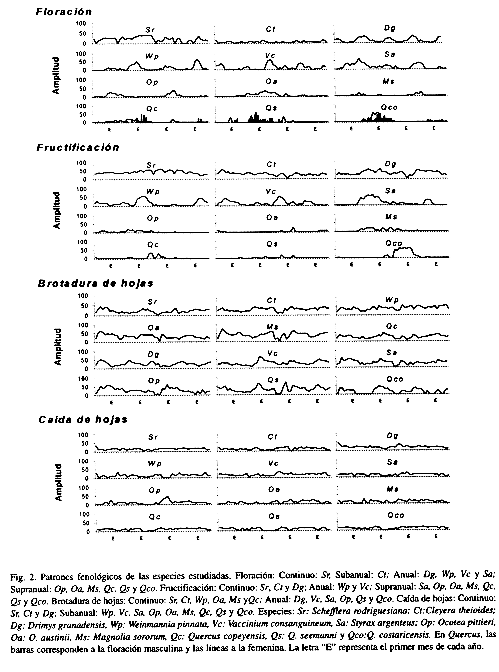
<body><![CDATA[<P><FONT FACE="Arial,Helvetica"><FONT SIZE=-1>El estudio se realiz&oacute; en cuatro sitios ubicados en un transecto altitudinal a lo largo de la Carretera Interamericana Sur, en el sector noroccidental de la Cordillera de Talamanca, Costa Rica: Divisi&oacute;n (2 050 msnm), Macho Mora (2 550 msnm), Villa Mills (2 700 msnm) y Asunci&oacute;n (2 900 msnm), con una separaci&oacute;n m&aacute;xima de 20 km entre los sitios de menor y mayor altitud. El &aacute;rea que cubre los cuatro sitios se localiza entre los coordenadas geogr&aacute;ficas 09&deg;30’54’’ y 09&deg;35’40’’ latitud norte y 83&deg;43’05’’ y 83&deg;44’50’’ longitud oeste. Una descripci&oacute;n detallada de estos sitios puede encontrarse en<A HREF="#Orozco, L. 1992"> Orozco (1992</A>) y <A HREF="#Orozco, L. 1997">Orozco y Camacho (1997</A>).</FONT></FONT>      <P><FONT FACE="Arial,Helvetica"><FONT SIZE=-1>Seg&uacute;n registros de estaciones pluviogr&aacute;ficas cercanas, la precipitaci&oacute;n es de 3 767 mm anuales cerca del sitio de menor altitud (2 260 msnm, Estaci&oacute;n Divisi&oacute;n) y de 2 611 mm anuales en el sitio de mayor altitud (3 000 msnm, Estaci&oacute;n Villa Mills). En ambos casos existe una &eacute;poca seca bien definida entre diciembre a marzo-abril, con precipitaciones mensuales menores a 100 mm (<A HREF="#fig. 1">Fig. 1</A>).</FONT></FONT>     <CENTER><A NAME="fig. 1"></A><IMG SRC="/img/fbpe/rbt/v46n3/0188i01.GIF" HEIGHT=247 WIDTH=302></CENTER> &nbsp;     
<BR>&nbsp;      <P><FONT FACE="Arial,Helvetica"><FONT SIZE=-1>Para la Estaci&oacute;n Villa Mills (3 000 msnm), la temperatura promedio anual es de 7.3&deg;C. Enero es el m&aacute;s fr&iacute;o, con temperaturas que bajan hasta -3&deg;C. La humedad relativa del aire es siempre muy alta, con promedios mensuales entre 88 y 96 %. El brillo solar en el mes con m&aacute;s sol (febrero) es de 7.5 horas/d&iacute;a en promedio y en el mes con menos sol (setiembre) es de 3 horas/d&iacute;a (<A HREF="#Blaser">Blaser y Camacho 1991</A>).</FONT></FONT>      <P><FONT FACE="Arial,Helvetica"><FONT SIZE=-1>De acuerdo con la clasificaci&oacute;n de zonas de vida de <A HREF="#Holdridge">Holdridge (1982</A>), el sitio Divisi&oacute;n pertenece al Bosque Pluvial Montano Bajo, y los restantes al Bosque Pluvial Montano. La topograf&iacute;a es plana en Villa Mills (0-15%), ondulada en Asunci&oacute;n (20-40%) hasta escarpada en Divisi&oacute;n y Macho Mora (10-70%). Seg&uacute;n los an&aacute;lisis efectuados, los suelos son de muy baja fertilidad natural, fuertemente &aacute;cidos, con pH medidos en agua entre 3.5 y 4.6, de textura franco-arcillosa, profundos y con baja pedregosidad (<A HREF="#Jiménez">Jim&eacute;nez <I>et al.</I> 1988</A>, <A HREF="#Blaser">Blaser y Camacho 1991</A>, <A HREF="#Orozco, L. 1992">Orozco 1992</A>).</FONT></FONT>      <P><FONT FACE="Arial,Helvetica"><FONT SIZE=-1><B>Recolecci&oacute;n de datos</B>: Las observaciones se realizaron en una red de parcelas temporales instaladas para el estudio de la estructura y composici&oacute;n flor&iacute;sticas de las comunidades boscosas del piso montano de Costa Rica (<A HREF="#Orozco, L. 1992">Orozco 1992</A>). Se observaron 295 &aacute;rboles de 34 especies arb&oacute;reas, de los cuales se evaluaron &uacute;nicamente 160 &aacute;rboles de 12 especies seleccionadas por su valor econ&oacute;mico actual o potencial. Por diferencias en la composici&oacute;n flor&iacute;stica de los rodales, tres de estas especies fueron muestreadas en los cuatro sitios, dos en tres sitios y siete especies en dos sitios (<A HREF="#CUADRO 1">Cuadro 1</A>).</FONT></FONT> <DIR> <DIR>&nbsp;     <CENTER><A NAME="CUADRO 1"></A><FONT FACE="Arial,Helvetica"><FONT SIZE=-1>CUADRO&nbsp; 1</FONT></FONT></CENTER> </DIR> </DIR>      <CENTER><FONT FACE="Arial,Helvetica"><FONT SIZE=-1>Especies observadas por sitio y par&aacute;metros dasom&eacute;tricos</FONT></FONT></CENTER>      <CENTER><FONT FACE="Arial,Helvetica"><FONT SIZE=-1>&nbsp;</FONT></FONT></CENTER>      ]]></body>
<body><![CDATA[<CENTER><FONT FACE="Arial,Helvetica"><FONT SIZE=-1>&nbsp;</FONT></FONT></CENTER>      <CENTER><TABLE BORDER=0 WIDTH="86%" > <TR> <TD>     <CENTER><FONT FACE="Arial,Helvetica"><FONT SIZE=-1>Especies</FONT></FONT></CENTER> </TD>  <TD>     <CENTER>&nbsp;</CENTER> </TD>  <TD>     <CENTER>&nbsp;</CENTER> </TD>  <TD>     <CENTER><FONT FACE="Arial,Helvetica"><FONT SIZE=-1>Sitios</FONT></FONT></CENTER> </TD>  <TD>     <CENTER>&nbsp;</CENTER> </TD>  <TD>     <CENTER>&nbsp;</CENTER> </TD>  <TD>     <CENTER><FONT FACE="Arial,Helvetica"><FONT SIZE=-1>Dap&nbsp;</FONT></FONT></CENTER> </TD>  <TD>     <CENTER><FONT FACE="Arial,Helvetica"><FONT SIZE=-1>Alto&nbsp;</FONT></FONT></CENTER> </TD>  <TD>     ]]></body>
<body><![CDATA[<CENTER><FONT FACE="Arial,Helvetica"><FONT SIZE=-1>D. Copa&nbsp;</FONT></FONT></CENTER> </TD>  <TD>     <CENTER><FONT FACE="Arial,Helvetica"><FONT SIZE=-1>Est. mad.</FONT></FONT></CENTER> </TD> </TR>  <TR> <TD>     <CENTER>&nbsp;</CENTER> </TD>  <TD>     <CENTER><FONT FACE="Arial,Helvetica"><FONT SIZE=-1>D</FONT></FONT></CENTER> </TD>  <TD>     <CENTER><FONT FACE="Arial,Helvetica"><FONT SIZE=-1>M</FONT></FONT></CENTER> </TD>  <TD>     <CENTER><FONT FACE="Arial,Helvetica"><FONT SIZE=-1>V</FONT></FONT></CENTER> </TD>  <TD>     <CENTER><FONT FACE="Arial,Helvetica"><FONT SIZE=-1>A</FONT></FONT></CENTER> </TD>  <TD>     <CENTER><FONT FACE="Arial,Helvetica"><FONT SIZE=-1>Tot</FONT></FONT></CENTER> </TD>  <TD>     <CENTER><FONT FACE="Arial,Helvetica"><FONT SIZE=-1>(cm)</FONT></FONT></CENTER> </TD>  <TD>     <CENTER><FONT FACE="Arial,Helvetica"><FONT SIZE=-1>(m)</FONT></FONT></CENTER> </TD>  <TD>     ]]></body>
<body><![CDATA[<CENTER><FONT FACE="Arial,Helvetica"><FONT SIZE=-1>(m)</FONT></FONT></CENTER> </TD>  <TD>     <CENTER>&nbsp;</CENTER> </TD> </TR>  <TR> <TD><FONT FACE="Arial,Helvetica"><FONT SIZE=-1>Araliaceae</FONT></FONT></TD>  <TD>     <CENTER>&nbsp;</CENTER> </TD>  <TD>     <CENTER>&nbsp;</CENTER> </TD>  <TD>     <CENTER>&nbsp;</CENTER> </TD>  <TD>     <CENTER>&nbsp;</CENTER> </TD>  <TD>     <CENTER>&nbsp;</CENTER> </TD>  <TD>     <CENTER>&nbsp;</CENTER> </TD>  <TD>     <CENTER>&nbsp;</CENTER> </TD>  <TD>     <CENTER>&nbsp;</CENTER> </TD>  <TD>     ]]></body>
<body><![CDATA[<CENTER>&nbsp;</CENTER> </TD> </TR>  <TR> <TD><I><FONT FACE="Arial,Helvetica"><FONT SIZE=-1>&nbsp;&nbsp; Schefflera rodriguesiana</FONT></FONT></I></TD>  <TD>     <CENTER><FONT FACE="Arial,Helvetica"><FONT SIZE=-1></FONT></FONT>&nbsp;</CENTER> </TD>  <TD>     <CENTER><FONT FACE="Arial,Helvetica"><FONT SIZE=-1></FONT></FONT>&nbsp;</CENTER> </TD>  <TD>     <CENTER><FONT FACE="Arial,Helvetica"><FONT SIZE=-1>7</FONT></FONT></CENTER> </TD>  <TD>     <CENTER><FONT FACE="Arial,Helvetica"><FONT SIZE=-1>4</FONT></FONT></CENTER> </TD>  <TD>     <CENTER><FONT FACE="Arial,Helvetica"><FONT SIZE=-1>11</FONT></FONT></CENTER> </TD>  <TD>     <CENTER><FONT FACE="Arial,Helvetica"><FONT SIZE=-1>36</FONT></FONT></CENTER> </TD>  <TD>     <CENTER><FONT FACE="Arial,Helvetica"><FONT SIZE=-1>20</FONT></FONT></CENTER> </TD>  <TD>     <CENTER><FONT FACE="Arial,Helvetica"><FONT SIZE=-1>15</FONT></FONT></CENTER> </TD>  <TD>     <CENTER><FONT FACE="Arial,Helvetica"><FONT SIZE=-1>S</FONT></FONT></CENTER> </TD> </TR>  <TR> <TD><FONT FACE="Arial,Helvetica"><FONT SIZE=-1>Cunoniaceae</FONT></FONT></TD>  <TD><FONT FACE="Arial,Helvetica"><FONT SIZE=-1></FONT></FONT></TD>  <TD><FONT FACE="Arial,Helvetica"><FONT SIZE=-1></FONT></FONT></TD>  <TD><FONT FACE="Arial,Helvetica"><FONT SIZE=-1></FONT></FONT></TD>  <TD><FONT FACE="Arial,Helvetica"><FONT SIZE=-1></FONT></FONT></TD>  <TD><FONT FACE="Arial,Helvetica"><FONT SIZE=-1></FONT></FONT></TD>  <TD><FONT FACE="Arial,Helvetica"><FONT SIZE=-1></FONT></FONT></TD>  <TD><FONT FACE="Arial,Helvetica"><FONT SIZE=-1></FONT></FONT></TD>  <TD><FONT FACE="Arial,Helvetica"><FONT SIZE=-1></FONT></FONT></TD>  <TD><FONT FACE="Arial,Helvetica"><FONT SIZE=-1></FONT></FONT></TD> </TR>  <TR> <TD><I><FONT FACE="Arial,Helvetica"><FONT SIZE=-1>&nbsp;&nbsp; Weinmannia pinnata</FONT></FONT></I></TD>  <TD><FONT FACE="Arial,Helvetica"><FONT SIZE=-1></FONT></FONT></TD>  <TD><FONT FACE="Arial,Helvetica"><FONT SIZE=-1></FONT></FONT></TD>  <TD>     ]]></body>
<body><![CDATA[<CENTER><FONT FACE="Arial,Helvetica"><FONT SIZE=-1>8</FONT></FONT></CENTER> </TD>  <TD>     <CENTER><FONT FACE="Arial,Helvetica"><FONT SIZE=-1>5</FONT></FONT></CENTER> </TD>  <TD>     <CENTER><FONT FACE="Arial,Helvetica"><FONT SIZE=-1>13</FONT></FONT></CENTER> </TD>  <TD>     <CENTER><FONT FACE="Arial,Helvetica"><FONT SIZE=-1>33</FONT></FONT></CENTER> </TD>  <TD>     <CENTER><FONT FACE="Arial,Helvetica"><FONT SIZE=-1>23</FONT></FONT></CENTER> </TD>  <TD>     <CENTER><FONT FACE="Arial,Helvetica"><FONT SIZE=-1>11</FONT></FONT></CENTER> </TD>  <TD>     <CENTER><FONT FACE="Arial,Helvetica"><FONT SIZE=-1>S</FONT></FONT></CENTER> </TD> </TR>  <TR> <TD><FONT FACE="Arial,Helvetica"><FONT SIZE=-1>Ericaceae</FONT></FONT></TD>  <TD><FONT FACE="Arial,Helvetica"><FONT SIZE=-1></FONT></FONT></TD>  <TD><FONT FACE="Arial,Helvetica"><FONT SIZE=-1></FONT></FONT></TD>  <TD><FONT FACE="Arial,Helvetica"><FONT SIZE=-1></FONT></FONT></TD>  <TD><FONT FACE="Arial,Helvetica"><FONT SIZE=-1></FONT></FONT></TD>  <TD><FONT FACE="Arial,Helvetica"><FONT SIZE=-1></FONT></FONT></TD>  <TD><FONT FACE="Arial,Helvetica"><FONT SIZE=-1></FONT></FONT></TD>  <TD><FONT FACE="Arial,Helvetica"><FONT SIZE=-1></FONT></FONT></TD>  <TD><FONT FACE="Arial,Helvetica"><FONT SIZE=-1></FONT></FONT></TD>  <TD><FONT FACE="Arial,Helvetica"><FONT SIZE=-1></FONT></FONT></TD> </TR>  <TR> <TD><I><FONT FACE="Arial,Helvetica"><FONT SIZE=-1>&nbsp;&nbsp; Vaccinium consanguineum</FONT></FONT></I></TD>  <TD><FONT FACE="Arial,Helvetica"><FONT SIZE=-1></FONT></FONT></TD>  <TD>     <CENTER><FONT FACE="Arial,Helvetica"><FONT SIZE=-1>5</FONT></FONT></CENTER> </TD>  <TD>     <CENTER><FONT FACE="Arial,Helvetica"><FONT SIZE=-1>5</FONT></FONT></CENTER> </TD>  <TD>     <CENTER><FONT FACE="Arial,Helvetica"><FONT SIZE=-1>5</FONT></FONT></CENTER> </TD>  <TD>     ]]></body>
<body><![CDATA[<CENTER><FONT FACE="Arial,Helvetica"><FONT SIZE=-1>15</FONT></FONT></CENTER> </TD>  <TD>     <CENTER><FONT FACE="Arial,Helvetica"><FONT SIZE=-1>26</FONT></FONT></CENTER> </TD>  <TD>     <CENTER><FONT FACE="Arial,Helvetica"><FONT SIZE=-1>12</FONT></FONT></CENTER> </TD>  <TD>     <CENTER><FONT FACE="Arial,Helvetica"><FONT SIZE=-1>12</FONT></FONT></CENTER> </TD>  <TD>     <CENTER><FONT FACE="Arial,Helvetica"><FONT SIZE=-1>I</FONT></FONT></CENTER> </TD> </TR>  <TR> <TD><FONT FACE="Arial,Helvetica"><FONT SIZE=-1>Fagaceae</FONT></FONT></TD>  <TD><FONT FACE="Arial,Helvetica"><FONT SIZE=-1></FONT></FONT></TD>  <TD><FONT FACE="Arial,Helvetica"><FONT SIZE=-1></FONT></FONT></TD>  <TD><FONT FACE="Arial,Helvetica"><FONT SIZE=-1></FONT></FONT></TD>  <TD><FONT FACE="Arial,Helvetica"><FONT SIZE=-1></FONT></FONT></TD>  <TD><FONT FACE="Arial,Helvetica"><FONT SIZE=-1></FONT></FONT></TD>  <TD><FONT FACE="Arial,Helvetica"><FONT SIZE=-1></FONT></FONT></TD>  <TD><FONT FACE="Arial,Helvetica"><FONT SIZE=-1></FONT></FONT></TD>  <TD><FONT FACE="Arial,Helvetica"><FONT SIZE=-1></FONT></FONT></TD>  <TD><FONT FACE="Arial,Helvetica"><FONT SIZE=-1></FONT></FONT></TD> </TR>  <TR> <TD><I><FONT FACE="Arial,Helvetica"><FONT SIZE=-1>&nbsp;&nbsp; Quercus seemannii</FONT></FONT></I></TD>  <TD>     <CENTER><FONT FACE="Arial,Helvetica"><FONT SIZE=-1>4</FONT></FONT></CENTER> </TD>  <TD>     <CENTER><FONT FACE="Arial,Helvetica"><FONT SIZE=-1>5</FONT></FONT></CENTER> </TD>  <TD>     <CENTER><FONT FACE="Arial,Helvetica"><FONT SIZE=-1></FONT></FONT>&nbsp;</CENTER> </TD>  <TD>     <CENTER><FONT FACE="Arial,Helvetica"><FONT SIZE=-1></FONT></FONT>&nbsp;</CENTER> </TD>  <TD>     <CENTER><FONT FACE="Arial,Helvetica"><FONT SIZE=-1>9</FONT></FONT></CENTER> </TD>  <TD>     ]]></body>
<body><![CDATA[<CENTER><FONT FACE="Arial,Helvetica"><FONT SIZE=-1>55</FONT></FONT></CENTER> </TD>  <TD>     <CENTER><FONT FACE="Arial,Helvetica"><FONT SIZE=-1>32</FONT></FONT></CENTER> </TD>  <TD>     <CENTER><FONT FACE="Arial,Helvetica"><FONT SIZE=-1>21</FONT></FONT></CENTER> </TD>  <TD>     <CENTER><FONT FACE="Arial,Helvetica"><FONT SIZE=-1>D</FONT></FONT></CENTER> </TD> </TR>  <TR> <TD><I><FONT FACE="Arial,Helvetica"><FONT SIZE=-1>&nbsp;&nbsp; Quercus copeyensis</FONT></FONT></I></TD>  <TD>     <CENTER><FONT FACE="Arial,Helvetica"><FONT SIZE=-1>6</FONT></FONT></CENTER> </TD>  <TD>     <CENTER><FONT FACE="Arial,Helvetica"><FONT SIZE=-1>6</FONT></FONT></CENTER> </TD>  <TD>     <CENTER><FONT FACE="Arial,Helvetica"><FONT SIZE=-1>7</FONT></FONT></CENTER> </TD>  <TD>     <CENTER><FONT FACE="Arial,Helvetica"><FONT SIZE=-1>3</FONT></FONT></CENTER> </TD>  <TD>     <CENTER><FONT FACE="Arial,Helvetica"><FONT SIZE=-1>22</FONT></FONT></CENTER> </TD>  <TD>     <CENTER><FONT FACE="Arial,Helvetica"><FONT SIZE=-1>73</FONT></FONT></CENTER> </TD>  <TD>     ]]></body>
<body><![CDATA[<CENTER><FONT FACE="Arial,Helvetica"><FONT SIZE=-1>35</FONT></FONT></CENTER> </TD>  <TD>     <CENTER><FONT FACE="Arial,Helvetica"><FONT SIZE=-1>19</FONT></FONT></CENTER> </TD>  <TD>     <CENTER><FONT FACE="Arial,Helvetica"><FONT SIZE=-1>D</FONT></FONT></CENTER> </TD> </TR>  <TR> <TD><I><FONT FACE="Arial,Helvetica"><FONT SIZE=-1>&nbsp;&nbsp; Quercus costaricensis</FONT></FONT></I></TD>  <TD><FONT FACE="Arial,Helvetica"><FONT SIZE=-1></FONT></FONT></TD>  <TD><FONT FACE="Arial,Helvetica"><FONT SIZE=-1></FONT></FONT></TD>  <TD>     <CENTER><FONT FACE="Arial,Helvetica"><FONT SIZE=-1>12</FONT></FONT></CENTER> </TD>  <TD>     <CENTER><FONT FACE="Arial,Helvetica"><FONT SIZE=-1>4</FONT></FONT></CENTER> </TD>  <TD>     <CENTER><FONT FACE="Arial,Helvetica"><FONT SIZE=-1>16</FONT></FONT></CENTER> </TD>  <TD>     <CENTER><FONT FACE="Arial,Helvetica"><FONT SIZE=-1>67</FONT></FONT></CENTER> </TD>  <TD>     <CENTER><FONT FACE="Arial,Helvetica"><FONT SIZE=-1>33</FONT></FONT></CENTER> </TD>  <TD>     <CENTER><FONT FACE="Arial,Helvetica"><FONT SIZE=-1>22</FONT></FONT></CENTER> </TD>  <TD>     <CENTER><FONT FACE="Arial,Helvetica"><FONT SIZE=-1>D</FONT></FONT></CENTER> </TD> </TR>  <TR> <TD><FONT FACE="Arial,Helvetica"><FONT SIZE=-1>Lauraceae</FONT></FONT></TD>  <TD><FONT FACE="Arial,Helvetica"><FONT SIZE=-1></FONT></FONT></TD>  <TD><FONT FACE="Arial,Helvetica"><FONT SIZE=-1></FONT></FONT></TD>  <TD><FONT FACE="Arial,Helvetica"><FONT SIZE=-1></FONT></FONT></TD>  <TD><FONT FACE="Arial,Helvetica"><FONT SIZE=-1></FONT></FONT></TD>  <TD><FONT FACE="Arial,Helvetica"><FONT SIZE=-1></FONT></FONT></TD>  <TD><FONT FACE="Arial,Helvetica"><FONT SIZE=-1></FONT></FONT></TD>  <TD><FONT FACE="Arial,Helvetica"><FONT SIZE=-1></FONT></FONT></TD>  <TD><FONT FACE="Arial,Helvetica"><FONT SIZE=-1></FONT></FONT></TD>  <TD><FONT FACE="Arial,Helvetica"><FONT SIZE=-1></FONT></FONT></TD> </TR>  <TR> <TD><FONT FACE="Arial,Helvetica"><FONT SIZE=-1><I>&nbsp;&nbsp; Ocotea pittierii</I>&nbsp;</FONT></FONT></TD>  <TD><FONT FACE="Arial,Helvetica"><FONT SIZE=-1></FONT></FONT></TD>  <TD><FONT FACE="Arial,Helvetica"><FONT SIZE=-1></FONT></FONT></TD>  <TD>     ]]></body>
<body><![CDATA[<CENTER><FONT FACE="Arial,Helvetica"><FONT SIZE=-1>5</FONT></FONT></CENTER> </TD>  <TD>     <CENTER><FONT FACE="Arial,Helvetica"><FONT SIZE=-1>5</FONT></FONT></CENTER> </TD>  <TD>     <CENTER><FONT FACE="Arial,Helvetica"><FONT SIZE=-1>10</FONT></FONT></CENTER> </TD>  <TD>     <CENTER><FONT FACE="Arial,Helvetica"><FONT SIZE=-1>25</FONT></FONT></CENTER> </TD>  <TD>     <CENTER><FONT FACE="Arial,Helvetica"><FONT SIZE=-1>17</FONT></FONT></CENTER> </TD>  <TD>     <CENTER><FONT FACE="Arial,Helvetica"><FONT SIZE=-1>8</FONT></FONT></CENTER> </TD>  <TD>     <CENTER><FONT FACE="Arial,Helvetica"><FONT SIZE=-1>S</FONT></FONT></CENTER> </TD> </TR>  <TR> <TD><I><FONT FACE="Arial,Helvetica"><FONT SIZE=-1>&nbsp;&nbsp; Ocotea austinii&nbsp;</FONT></FONT></I></TD>  <TD><FONT FACE="Arial,Helvetica"><FONT SIZE=-1></FONT></FONT></TD>  <TD><FONT FACE="Arial,Helvetica"><FONT SIZE=-1></FONT></FONT></TD>  <TD>     <CENTER><FONT FACE="Arial,Helvetica"><FONT SIZE=-1>5</FONT></FONT></CENTER> </TD>  <TD>     <CENTER><FONT FACE="Arial,Helvetica"><FONT SIZE=-1>5</FONT></FONT></CENTER> </TD>  <TD>     <CENTER><FONT FACE="Arial,Helvetica"><FONT SIZE=-1>10</FONT></FONT></CENTER> </TD>  <TD>     ]]></body>
<body><![CDATA[<CENTER><FONT FACE="Arial,Helvetica"><FONT SIZE=-1>29</FONT></FONT></CENTER> </TD>  <TD>     <CENTER><FONT FACE="Arial,Helvetica"><FONT SIZE=-1>23</FONT></FONT></CENTER> </TD>  <TD>     <CENTER><FONT FACE="Arial,Helvetica"><FONT SIZE=-1>11</FONT></FONT></CENTER> </TD>  <TD>     <CENTER><FONT FACE="Arial,Helvetica"><FONT SIZE=-1>S</FONT></FONT></CENTER> </TD> </TR>  <TR> <TD><FONT FACE="Arial,Helvetica"><FONT SIZE=-1>Magnoliaceae</FONT></FONT></TD>  <TD><FONT FACE="Arial,Helvetica"><FONT SIZE=-1></FONT></FONT></TD>  <TD><FONT FACE="Arial,Helvetica"><FONT SIZE=-1></FONT></FONT></TD>  <TD><FONT FACE="Arial,Helvetica"><FONT SIZE=-1></FONT></FONT></TD>  <TD><FONT FACE="Arial,Helvetica"><FONT SIZE=-1></FONT></FONT></TD>  <TD><FONT FACE="Arial,Helvetica"><FONT SIZE=-1></FONT></FONT></TD>  <TD><FONT FACE="Arial,Helvetica"><FONT SIZE=-1></FONT></FONT></TD>  <TD><FONT FACE="Arial,Helvetica"><FONT SIZE=-1></FONT></FONT></TD>  <TD><FONT FACE="Arial,Helvetica"><FONT SIZE=-1></FONT></FONT></TD>  <TD><FONT FACE="Arial,Helvetica"><FONT SIZE=-1></FONT></FONT></TD> </TR>  <TR> <TD><I><FONT FACE="Arial,Helvetica"><FONT SIZE=-1>&nbsp; Magnolia sororum</FONT></FONT></I></TD>  <TD>     <CENTER><FONT FACE="Arial,Helvetica"><FONT SIZE=-1>5</FONT></FONT></CENTER> </TD>  <TD>     <CENTER><FONT FACE="Arial,Helvetica"><FONT SIZE=-1>5</FONT></FONT></CENTER> </TD>  <TD>     <CENTER><FONT FACE="Arial,Helvetica"><FONT SIZE=-1></FONT></FONT>&nbsp;</CENTER> </TD>  <TD>     <CENTER><FONT FACE="Arial,Helvetica"><FONT SIZE=-1></FONT></FONT>&nbsp;</CENTER> </TD>  <TD>     <CENTER><FONT FACE="Arial,Helvetica"><FONT SIZE=-1>10</FONT></FONT></CENTER> </TD>  <TD>     <CENTER><FONT FACE="Arial,Helvetica"><FONT SIZE=-1>31</FONT></FONT></CENTER> </TD>  <TD>     ]]></body>
<body><![CDATA[<CENTER><FONT FACE="Arial,Helvetica"><FONT SIZE=-1>24</FONT></FONT></CENTER> </TD>  <TD>     <CENTER><FONT FACE="Arial,Helvetica"><FONT SIZE=-1>11</FONT></FONT></CENTER> </TD>  <TD>     <CENTER><FONT FACE="Arial,Helvetica"><FONT SIZE=-1>S</FONT></FONT></CENTER> </TD> </TR>  <TR> <TD><FONT FACE="Arial,Helvetica"><FONT SIZE=-1>Styracaceae</FONT></FONT></TD>  <TD><FONT FACE="Arial,Helvetica"><FONT SIZE=-1></FONT></FONT></TD>  <TD><FONT FACE="Arial,Helvetica"><FONT SIZE=-1></FONT></FONT></TD>  <TD><FONT FACE="Arial,Helvetica"><FONT SIZE=-1></FONT></FONT></TD>  <TD><FONT FACE="Arial,Helvetica"><FONT SIZE=-1></FONT></FONT></TD>  <TD><FONT FACE="Arial,Helvetica"><FONT SIZE=-1></FONT></FONT></TD>  <TD><FONT FACE="Arial,Helvetica"><FONT SIZE=-1></FONT></FONT></TD>  <TD><FONT FACE="Arial,Helvetica"><FONT SIZE=-1></FONT></FONT></TD>  <TD><FONT FACE="Arial,Helvetica"><FONT SIZE=-1></FONT></FONT></TD>  <TD><FONT FACE="Arial,Helvetica"><FONT SIZE=-1></FONT></FONT></TD> </TR>  <TR> <TD><I><FONT FACE="Arial,Helvetica"><FONT SIZE=-1>&nbsp; Styrax argenteus</FONT></FONT></I></TD>  <TD>     <CENTER><FONT FACE="Arial,Helvetica"><FONT SIZE=-1>5</FONT></FONT></CENTER> </TD>  <TD>     <CENTER><FONT FACE="Arial,Helvetica"><FONT SIZE=-1></FONT></FONT>&nbsp;</CENTER> </TD>  <TD>     <CENTER><FONT FACE="Arial,Helvetica"><FONT SIZE=-1>5</FONT></FONT></CENTER> </TD>  <TD>     <CENTER><FONT FACE="Arial,Helvetica"><FONT SIZE=-1></FONT></FONT>&nbsp;</CENTER> </TD>  <TD>     <CENTER><FONT FACE="Arial,Helvetica"><FONT SIZE=-1>10</FONT></FONT></CENTER> </TD>  <TD>     <CENTER><FONT FACE="Arial,Helvetica"><FONT SIZE=-1>24</FONT></FONT></CENTER> </TD>  <TD>     <CENTER><FONT FACE="Arial,Helvetica"><FONT SIZE=-1>20</FONT></FONT></CENTER> </TD>  <TD>     ]]></body>
<body><![CDATA[<CENTER><FONT FACE="Arial,Helvetica"><FONT SIZE=-1>10</FONT></FONT></CENTER> </TD>  <TD>     <CENTER><FONT FACE="Arial,Helvetica"><FONT SIZE=-1>S</FONT></FONT></CENTER> </TD> </TR>  <TR> <TD><FONT FACE="Arial,Helvetica"><FONT SIZE=-1>Theaceae</FONT></FONT></TD>  <TD><FONT FACE="Arial,Helvetica"><FONT SIZE=-1></FONT></FONT></TD>  <TD><FONT FACE="Arial,Helvetica"><FONT SIZE=-1></FONT></FONT></TD>  <TD><FONT FACE="Arial,Helvetica"><FONT SIZE=-1></FONT></FONT></TD>  <TD><FONT FACE="Arial,Helvetica"><FONT SIZE=-1></FONT></FONT></TD>  <TD><FONT FACE="Arial,Helvetica"><FONT SIZE=-1></FONT></FONT></TD>  <TD><FONT FACE="Arial,Helvetica"><FONT SIZE=-1></FONT></FONT></TD>  <TD><FONT FACE="Arial,Helvetica"><FONT SIZE=-1></FONT></FONT></TD>  <TD><FONT FACE="Arial,Helvetica"><FONT SIZE=-1></FONT></FONT></TD>  <TD><FONT FACE="Arial,Helvetica"><FONT SIZE=-1></FONT></FONT></TD> </TR>  <TR> <TD><I><FONT FACE="Arial,Helvetica"><FONT SIZE=-1>&nbsp; Cleyera theioides</FONT></FONT></I></TD>  <TD>     <CENTER><FONT FACE="Arial,Helvetica"><FONT SIZE=-1>2</FONT></FONT></CENTER> </TD>  <TD>     <CENTER><FONT FACE="Arial,Helvetica"><FONT SIZE=-1>5</FONT></FONT></CENTER> </TD>  <TD>     <CENTER><FONT FACE="Arial,Helvetica"><FONT SIZE=-1>5</FONT></FONT></CENTER> </TD>  <TD>     <CENTER><FONT FACE="Arial,Helvetica"><FONT SIZE=-1>4</FONT></FONT></CENTER> </TD>  <TD>     <CENTER><FONT FACE="Arial,Helvetica"><FONT SIZE=-1>16</FONT></FONT></CENTER> </TD>  <TD>     <CENTER><FONT FACE="Arial,Helvetica"><FONT SIZE=-1>25</FONT></FONT></CENTER> </TD>  <TD>     <CENTER><FONT FACE="Arial,Helvetica"><FONT SIZE=-1>20</FONT></FONT></CENTER> </TD>  <TD>     <CENTER><FONT FACE="Arial,Helvetica"><FONT SIZE=-1>11</FONT></FONT></CENTER> </TD>  <TD>     ]]></body>
<body><![CDATA[<CENTER><FONT FACE="Arial,Helvetica"><FONT SIZE=-1>S</FONT></FONT></CENTER> </TD> </TR>  <TR> <TD><I><FONT FACE="Arial,Helvetica"><FONT SIZE=-1>Winteraceae</FONT></FONT></I></TD>  <TD><FONT FACE="Arial,Helvetica"><FONT SIZE=-1></FONT></FONT></TD>  <TD><FONT FACE="Arial,Helvetica"><FONT SIZE=-1></FONT></FONT></TD>  <TD><FONT FACE="Arial,Helvetica"><FONT SIZE=-1></FONT></FONT></TD>  <TD><FONT FACE="Arial,Helvetica"><FONT SIZE=-1></FONT></FONT></TD>  <TD><FONT FACE="Arial,Helvetica"><FONT SIZE=-1></FONT></FONT></TD>  <TD><FONT FACE="Arial,Helvetica"><FONT SIZE=-1></FONT></FONT></TD>  <TD><FONT FACE="Arial,Helvetica"><FONT SIZE=-1></FONT></FONT></TD>  <TD><FONT FACE="Arial,Helvetica"><FONT SIZE=-1></FONT></FONT></TD>  <TD><FONT FACE="Arial,Helvetica"><FONT SIZE=-1></FONT></FONT></TD> </TR>  <TR> <TD><I><FONT FACE="Arial,Helvetica"><FONT SIZE=-1>&nbsp; Drimys granadensis</FONT></FONT></I></TD>  <TD>     <CENTER><FONT FACE="Arial,Helvetica"><FONT SIZE=-1>3</FONT></FONT></CENTER> </TD>  <TD>     <CENTER><FONT FACE="Arial,Helvetica"><FONT SIZE=-1>5</FONT></FONT></CENTER> </TD>  <TD>     <CENTER><FONT FACE="Arial,Helvetica"><FONT SIZE=-1>5</FONT></FONT></CENTER> </TD>  <TD>     <CENTER><FONT FACE="Arial,Helvetica"><FONT SIZE=-1>5</FONT></FONT></CENTER> </TD>  <TD>     <CENTER><FONT FACE="Arial,Helvetica"><FONT SIZE=-1>18</FONT></FONT></CENTER> </TD>  <TD>     <CENTER><FONT FACE="Arial,Helvetica"><FONT SIZE=-1>33</FONT></FONT></CENTER> </TD>  <TD>     <CENTER><FONT FACE="Arial,Helvetica"><FONT SIZE=-1>19</FONT></FONT></CENTER> </TD>  <TD>     <CENTER><FONT FACE="Arial,Helvetica"><FONT SIZE=-1>13</FONT></FONT></CENTER> </TD>  <TD>     <CENTER><FONT FACE="Arial,Helvetica"><FONT SIZE=-1>S</FONT></FONT></CENTER> </TD> </TR> </TABLE></CENTER> <FONT FACE="Arial,Helvetica"><FONT SIZE=-1>&nbsp;&nbsp;&nbsp;&nbsp;</FONT></FONT>     ]]></body>
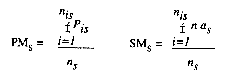
<body><![CDATA[<BR><FONT FACE="Arial,Helvetica"><FONT SIZE=-1>Sitios: D=Divisi&oacute;n (2 050 msnm), M= Macho Mora (2 550 msnm), V= Villa Mills (2 700 msnm), A= Asunci&oacute;n (2 900 msnm).</FONT></FONT>     <BR><FONT FACE="Arial,Helvetica"><FONT SIZE=-1>Dap: di&aacute;metro a la altura del pecho promedio. Alto: altura total promedio. D. copa: di&aacute;metro de copa. Est. mad.: estrato de madurez: D: dosel superior (m&aacute;s de 28 m), S: subdosel (entre 16 y 28), I: dosel inferior (menos de 16m) (adaptado de<A HREF="#Orozco, L. 1992"> Orozco 1992</A>).</FONT></FONT>     <BR>&nbsp;      <P><FONT FACE="Arial,Helvetica"><FONT SIZE=-1>El per&iacute;odo de observaci&oacute;n se extendi&oacute; por 49 meses, de julio de 1986 a julio de 1990, con un registro por mes calendario, durante los cuales se observaron los eventos de brotadura y ca&iacute;da del follaje, floraci&oacute;n (incluy&oacute; brotes y flores maduras) y fructificaci&oacute;n (incluy&oacute; frutos inmaduros y maduros). Se utiliz&oacute; una simplificaci&oacute;n de la escala de <A HREF="#Fournier, L. A. 1974">Fournier (1974</A>) para cuantificar visualmente la magnitud de la producci&oacute;n de cada fenofase. La escala empleada va de 0 a 3, donde "0" corresponde a una producci&oacute;n nula, "1" a una producci&oacute;n que cubre hasta un 33% de la cobertura de la copa, "2" a una producci&oacute;n que cubre entre un 34 y un 66% de la cobertura de la copa y "3" a una producci&oacute;n que cubre m&aacute;s de un 67% de la cobertura de la copa.</FONT></FONT>     <BR><FONT FACE="Arial,Helvetica"><FONT SIZE=-1>La identificaci&oacute;n de las especies fue realizada en el Herbario Nacional de Costa Rica. Para cada individuo observado se tomaron dos muestras testigo de herbario, que fueron depositadas en el Herbario Nacional y en el Herbario de la Unidad de Manejo de Bosques Naturales del CATIE.</FONT></FONT>     <BR>&nbsp;     <BR>&nbsp;     <BR><FONT FACE="Arial,Helvetica"><FONT SIZE=-1><B>An&aacute;lisis de datos</B>: Los registros mensuales de producci&oacute;n fueron convertidos a porcentajes utilizando el punto medio de cada clase. Para cada fenofase, se calcularon valores mensuales de producci&oacute;n por especie (PM) y de sincron&iacute;a por especie (SM):</FONT></FONT>      <P><A NAME="FORMULA 1"></A><IMG SRC="/img/fbpe/rbt/v46n3/0188i02.GIF" HEIGHT=78 WIDTH=226>      
<P><FONT FACE="Arial,Helvetica"><FONT SIZE=-1>donde s= especie; P <SUB>is</SUB>= punto medio del valor de producci&oacute;n observado en el individuo i de la especie s; n<SUB>s</SUB> = n&uacute;mero de individuos muestrados de la especie s; na<SUB>s</SUB> = n&uacute;mero de individuos de la especie s en una determinada fenofase.</FONT></FONT>      ]]></body>
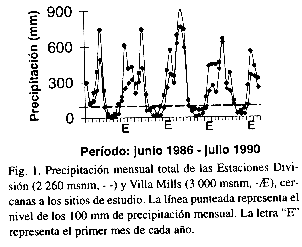
<body><![CDATA[<P><FONT FACE="Arial,Helvetica"><FONT SIZE=-1>Los promedios de los valores de producci&oacute;n de cada per&iacute;odo de actividad se usaron para dar una indicaci&oacute;n del tama&ntilde;o de la cosecha. Un promedio menor a 20% indic&oacute; baja producci&oacute;n, entre 20 y 50% se consider&oacute; de mediana producci&oacute;n y de m&aacute;s de 50% de alta producci&oacute;n.</FONT></FONT>     <BR><FONT FACE="Arial,Helvetica"><FONT SIZE=-1>&nbsp;</FONT></FONT>     <BR><FONT FACE="Arial,Helvetica"><FONT SIZE=-1>Adem&aacute;s, se calcul&oacute; un &iacute;ndice de sincronismo (IS) para determinar si un evento se manifest&oacute; de manera sincr&oacute;nica, el cual result&oacute; ser la mediana de los valores mensuales de sincron&iacute;a (SM<SUB>s</SUB><SUP>)</SUP> cuando la fenofase se mostr&oacute; activa. Si el valor del &iacute;ndice fue mayor a 0.75 se consider&oacute; el evento como altamente sincr&oacute;nico; entre 0.75 y 0.5 se consider&oacute; como sincr&oacute;nico; entre 0.5 y 0.25 como poco sincr&oacute;nico y menor a 0.25 como asincr&oacute;nico.</FONT></FONT>     <BR>&nbsp;     <BR><FONT FACE="Arial,Helvetica"><FONT SIZE=-1>Para examinar el efecto del sitio y del tiempo sobre la ocurrencia y la producci&oacute;n de cada fenofase se realizaron an&aacute;lisis de varianza para mediciones repetidas. Debido a que el postulado de la homogeneidad de las varianzas no se cumpli&oacute;, los datos originales de producci&oacute;n promedio mensual fueron transformados (transformaci&oacute;n angular) para utilizarlos en este an&aacute;lisis en particular. Se consider&oacute; que existi&oacute; efecto de un factor solo cuando los resultados indicaron diferencias significativas a nivel de <I>P</I> &lt; 0.05.</FONT></FONT>     <BR><FONT FACE="Arial,Helvetica"><FONT SIZE=-1>El comportamiento fenol&oacute;gico por especie se describi&oacute; con base en la evaluaci&oacute;n de las variables de producci&oacute;n, sincron&iacute;a, duraci&oacute;n y la identificaci&oacute;n de los patrones de foliaci&oacute;n, floraci&oacute;n y fructificaci&oacute;n, siguiendo la clasificaci&oacute;n propuesta por <A HREF="#Newstrom, L.">Newstrom <I>et al. </I>(1994</A>). Finalmente, se realizaron pruebas de correlaci&oacute;n simple para establecer el grado de asociaci&oacute;n entre el evento observado y la precipitaci&oacute;n registrada en la estaci&oacute;n pluviogr&aacute;fica de Villa Mills (3 000 msnm).</FONT></FONT>     <BR>&nbsp;      <P><B><FONT FACE="Arial,Helvetica"><FONT SIZE=-1>Resultados</FONT></FONT></B>      <P><FONT FACE="Arial,Helvetica"><FONT SIZE=-1>Para las cuatro fenofases evaluadas, los an&aacute;lisis de varianza indican diferencias altamente significativas entre meses y entre especies, as&iacute; como en la interacci&oacute;n sitios-meses y especies-meses (<A HREF="#CUADRO 2">Cuadro 2</A>). Estos resultados sugieren que no existe un &uacute;nico patr&oacute;n de ocurrencia del evento analizado en el &aacute;mbito de comunidad y que, por otra parte, ninguna de las especies contribuye a establecer picos de ocurrencia del evento en el tiempo. Aunque las diferencias por efecto del sitio son significativas en los eventos de floraci&oacute;n y fructificaci&oacute;n (<A HREF="#CUADRO 2">Cuadro 2</A>), un an&aacute;lisis de varianza realizado por especie revela que el sitio tiene influencia directa en la intensidad y la ocurrencia del evento solo en <I>Quercus copeyensis </I>(<I>P</I> = 0.0002 en la floraci&oacute;n y <I>P</I> = 0.0085 en la fructificaci&oacute;n).</FONT></FONT>     <CENTER>&nbsp;</CENTER>      ]]></body>
<body><![CDATA[<CENTER>&nbsp;</CENTER>      <CENTER><A NAME="CUADRO 2"></A><FONT FACE="Arial,Helvetica"><FONT SIZE=-1>CUADRO 2</FONT></FONT></CENTER>      <CENTER><FONT FACE="Arial,Helvetica"><FONT SIZE=-1>&nbsp;</FONT></FONT></CENTER>      <CENTER><FONT FACE="Arial,Helvetica"><FONT SIZE=-1>Resultados del an&aacute;lisis de varianza para mediciones repetidas</FONT></FONT></CENTER> &nbsp;     <BR>&nbsp;     <CENTER><TABLE BORDER=0 WIDTH="84%" > <TR> <TD>     <CENTER>&nbsp;</CENTER> </TD>  <TD COLSPAN="2">     <CENTER><FONT FACE="Arial,Helvetica"><FONT SIZE=-1>Floraci&oacute;n</FONT></FONT></CENTER> </TD>  <TD COLSPAN="2">     <CENTER><FONT FACE="Arial,Helvetica"><FONT SIZE=-1>Fructificaci&oacute;n</FONT></FONT></CENTER> </TD>  <TD COLSPAN="2">     <CENTER><FONT FACE="Arial,Helvetica"><FONT SIZE=-1>Brotadura</FONT></FONT></CENTER> </TD>  <TD COLSPAN="2">     ]]></body>
<body><![CDATA[<CENTER><FONT FACE="Arial,Helvetica"><FONT SIZE=-1>Ca&iacute;da de hojas</FONT></FONT></CENTER> </TD> </TR>  <TR> <TD><FONT FACE="Arial,Helvetica"><FONT SIZE=-1>Efectos</FONT></FONT></TD>  <TD>     <CENTER><FONT FACE="Arial,Helvetica"><FONT SIZE=-1>F</FONT></FONT></CENTER> </TD>  <TD>     <CENTER><FONT FACE="Arial,Helvetica"><FONT SIZE=-1>P</FONT></FONT></CENTER> </TD>  <TD>     <CENTER><FONT FACE="Arial,Helvetica"><FONT SIZE=-1>F</FONT></FONT></CENTER> </TD>  <TD>     <CENTER><FONT FACE="Arial,Helvetica"><FONT SIZE=-1>P</FONT></FONT></CENTER> </TD>  <TD>     <CENTER><FONT FACE="Arial,Helvetica"><FONT SIZE=-1>F</FONT></FONT></CENTER> </TD>  <TD>     <CENTER><FONT FACE="Arial,Helvetica"><FONT SIZE=-1>P</FONT></FONT></CENTER> </TD>  <TD>     <CENTER><FONT FACE="Arial,Helvetica"><FONT SIZE=-1>F</FONT></FONT></CENTER> </TD>  <TD>     <CENTER><FONT FACE="Arial,Helvetica"><FONT SIZE=-1>P</FONT></FONT></CENTER> </TD> </TR>  <TR> <TD><FONT FACE="Arial,Helvetica"><FONT SIZE=-1>&nbsp;</FONT></FONT></TD>  <TD><FONT FACE="Arial,Helvetica"><FONT SIZE=-1>&nbsp;</FONT></FONT></TD>  <TD><FONT FACE="Arial,Helvetica"><FONT SIZE=-1>&nbsp;</FONT></FONT></TD>  <TD><FONT FACE="Arial,Helvetica"><FONT SIZE=-1>&nbsp;</FONT></FONT></TD>  <TD><FONT FACE="Arial,Helvetica"><FONT SIZE=-1>&nbsp;</FONT></FONT></TD>  <TD><FONT FACE="Arial,Helvetica"><FONT SIZE=-1>&nbsp;</FONT></FONT></TD>  <TD><FONT FACE="Arial,Helvetica"><FONT SIZE=-1>&nbsp;</FONT></FONT></TD>  <TD><FONT FACE="Arial,Helvetica"><FONT SIZE=-1>&nbsp;</FONT></FONT></TD>  <TD><FONT FACE="Arial,Helvetica"><FONT SIZE=-1>&nbsp;</FONT></FONT></TD> </TR>  <TR> <TD><FONT FACE="Arial,Helvetica"><FONT SIZE=-1>Sitios</FONT></FONT></TD>  <TD>     <CENTER><FONT FACE="Arial,Helvetica"><FONT SIZE=-1>3.09</FONT></FONT></CENTER> </TD>  <TD>     ]]></body>
<body><![CDATA[<CENTER><FONT FACE="Arial,Helvetica"><FONT SIZE=-1>0.0490</FONT></FONT></CENTER> </TD>  <TD>     <CENTER><FONT FACE="Arial,Helvetica"><FONT SIZE=-1>3.73</FONT></FONT></CENTER> </TD>  <TD>     <CENTER><FONT FACE="Arial,Helvetica"><FONT SIZE=-1>0.0127</FONT></FONT></CENTER> </TD>  <TD>     <CENTER><FONT FACE="Arial,Helvetica"><FONT SIZE=-1>1.27</FONT></FONT></CENTER> </TD>  <TD>     <CENTER><FONT FACE="Arial,Helvetica"><FONT SIZE=-1>0.2857</FONT></FONT></CENTER> </TD>  <TD>     <CENTER><FONT FACE="Arial,Helvetica"><FONT SIZE=-1>1.01</FONT></FONT></CENTER> </TD>  <TD>     <CENTER><FONT FACE="Arial,Helvetica"><FONT SIZE=-1>0.3887</FONT></FONT></CENTER> </TD> </TR>  <TR> <TD><FONT FACE="Arial,Helvetica"><FONT SIZE=-1>Especies</FONT></FONT></TD>  <TD>     <CENTER><FONT FACE="Arial,Helvetica"><FONT SIZE=-1>9.53</FONT></FONT></CENTER> </TD>  <TD>     <CENTER><FONT FACE="Arial,Helvetica"><FONT SIZE=-1>0.0001</FONT></FONT></CENTER> </TD>  <TD>     <CENTER><FONT FACE="Arial,Helvetica"><FONT SIZE=-1>42.46</FONT></FONT></CENTER> </TD>  <TD>     ]]></body>
<body><![CDATA[<CENTER><FONT FACE="Arial,Helvetica"><FONT SIZE=-1>0.0001</FONT></FONT></CENTER> </TD>  <TD>     <CENTER><FONT FACE="Arial,Helvetica"><FONT SIZE=-1>9.19</FONT></FONT></CENTER> </TD>  <TD>     <CENTER><FONT FACE="Arial,Helvetica"><FONT SIZE=-1>0.0001</FONT></FONT></CENTER> </TD>  <TD>     <CENTER><FONT FACE="Arial,Helvetica"><FONT SIZE=-1>2.24</FONT></FONT></CENTER> </TD>  <TD>     <CENTER><FONT FACE="Arial,Helvetica"><FONT SIZE=-1>0.0001</FONT></FONT></CENTER> </TD> </TR>  <TR> <TD><FONT FACE="Arial,Helvetica"><FONT SIZE=-1>Meses</FONT></FONT></TD>  <TD>     <CENTER><FONT FACE="Arial,Helvetica"><FONT SIZE=-1>12.00</FONT></FONT></CENTER> </TD>  <TD>     <CENTER><FONT FACE="Arial,Helvetica"><FONT SIZE=-1>0.0001</FONT></FONT></CENTER> </TD>  <TD>     <CENTER><FONT FACE="Arial,Helvetica"><FONT SIZE=-1>8.76</FONT></FONT></CENTER> </TD>  <TD>     <CENTER><FONT FACE="Arial,Helvetica"><FONT SIZE=-1>0.0001</FONT></FONT></CENTER> </TD>  <TD>     <CENTER><FONT FACE="Arial,Helvetica"><FONT SIZE=-1>24.68</FONT></FONT></CENTER> </TD>  <TD>     ]]></body>
<body><![CDATA[<CENTER><FONT FACE="Arial,Helvetica"><FONT SIZE=-1>0.0001</FONT></FONT></CENTER> </TD>  <TD>     <CENTER><FONT FACE="Arial,Helvetica"><FONT SIZE=-1>11.17</FONT></FONT></CENTER> </TD>  <TD>     <CENTER><FONT FACE="Arial,Helvetica"><FONT SIZE=-1>0.0001</FONT></FONT></CENTER> </TD> </TR>  <TR> <TD><FONT FACE="Arial,Helvetica"><FONT SIZE=-1>Meses-sitios</FONT></FONT></TD>  <TD>     <CENTER><FONT FACE="Arial,Helvetica"><FONT SIZE=-1>3.10</FONT></FONT></CENTER> </TD>  <TD>     <CENTER><FONT FACE="Arial,Helvetica"><FONT SIZE=-1>0.0001</FONT></FONT></CENTER> </TD>  <TD>     <CENTER><FONT FACE="Arial,Helvetica"><FONT SIZE=-1>3.32</FONT></FONT></CENTER> </TD>  <TD>     <CENTER><FONT FACE="Arial,Helvetica"><FONT SIZE=-1>0.0001</FONT></FONT></CENTER> </TD>  <TD>     <CENTER><FONT FACE="Arial,Helvetica"><FONT SIZE=-1>3.48</FONT></FONT></CENTER> </TD>  <TD>     <CENTER><FONT FACE="Arial,Helvetica"><FONT SIZE=-1>0.0001</FONT></FONT></CENTER> </TD>  <TD>     <CENTER><FONT FACE="Arial,Helvetica"><FONT SIZE=-1>2.53</FONT></FONT></CENTER> </TD>  <TD>     ]]></body>
<body><![CDATA[<CENTER><FONT FACE="Arial,Helvetica"><FONT SIZE=-1>0.0001</FONT></FONT></CENTER> </TD> </TR>  <TR> <TD><FONT FACE="Arial,Helvetica"><FONT SIZE=-1>Meses-especies</FONT></FONT></TD>  <TD>     <CENTER><FONT FACE="Arial,Helvetica"><FONT SIZE=-1>5.87</FONT></FONT></CENTER> </TD>  <TD>     <CENTER><FONT FACE="Arial,Helvetica"><FONT SIZE=-1>0.0001</FONT></FONT></CENTER> </TD>  <TD>     <CENTER><FONT FACE="Arial,Helvetica"><FONT SIZE=-1>6.76</FONT></FONT></CENTER> </TD>  <TD>     <CENTER><FONT FACE="Arial,Helvetica"><FONT SIZE=-1>0.0001</FONT></FONT></CENTER> </TD>  <TD>     <CENTER><FONT FACE="Arial,Helvetica"><FONT SIZE=-1>4.63</FONT></FONT></CENTER> </TD>  <TD>     <CENTER><FONT FACE="Arial,Helvetica"><FONT SIZE=-1>0.0001</FONT></FONT></CENTER> </TD>  <TD>     <CENTER><FONT FACE="Arial,Helvetica"><FONT SIZE=-1>3.01</FONT></FONT></CENTER> </TD>  <TD>     <CENTER><FONT FACE="Arial,Helvetica"><FONT SIZE=-1>0.0001</FONT></FONT></CENTER> </TD> </TR> </TABLE></CENTER> &nbsp;     <BR><FONT FACE="Arial,Helvetica"><FONT SIZE=-1>&nbsp;F: valor F en el an&aacute;lisis de varianza, <I>P:</I> probabilidad.</FONT></FONT>     ]]></body>
<body><![CDATA[<BR>&nbsp;      <P><FONT FACE="Arial,Helvetica"><FONT SIZE=-1><B>Floraci&oacute;n</B>: Los patrones de floraci&oacute;n (<A HREF="#FIG. 2">Fig. 2</A>) muestra que <I>Schefflera rodriguesiana</I> present&oacute; floraci&oacute;n continua, con actividad sincr&oacute;nica durante once meses de cada a&ntilde;o y con cosechas de baja a mediana producci&oacute;n. <I>Cleyera theioides </I>mostr&oacute; un patr&oacute;n subanual, con cosechas asincr&oacute;nicas y de baja producci&oacute;n, que en conjunto se extendieron por diez meses del a&ntilde;o.</FONT></FONT>     <BR>&nbsp;     <BR>&nbsp;     <BR>&nbsp;     <CENTER><A NAME="FIG. 2"></A><IMG SRC="/img/fbpe/rbt/v46n3/0188i03.GIF" HEIGHT=672 WIDTH=499></CENTER> &nbsp;     
<BR>&nbsp;      <P><FONT FACE="Arial,Helvetica"><FONT SIZE=-1>Cuatro especies mostraron floraciones anuales (<I>Drimys granadensis, Weinmannia pinnata</I>, <I>Vaccinium consanguineum </I>y<I> Styrax argenteus</I>), con una duraci&oacute;n promedio de seis meses y con poca sincron&iacute;a intraespec&iacute;fica (IS entre 0.32 y 0.45). En todas estas especies, el evento mostr&oacute; picos de cosechas mediana a altamente productivas, intercaladas con cosechas de baja producci&oacute;n cada dos a&ntilde;os. Adem&aacute;s, se dio una correlaci&oacute;n significativa entre la precipitaci&oacute;n y la ocurrencia de este evento en las cuatro especies: <I>W. pinnata</I> concentra la floraci&oacute;n en la &eacute;poca de menor precipitaci&oacute;n (r=0.58, <I>P</I>=0.0001, Spearman), mientras que las otras tres en la de mayor precipitaci&oacute;n (r=0.42, <I>P</I>=0.0023; r=0.29, <I>P</I>=0.010, r=0.45, <I>P</I>=0.0010, Spearman, respectivamente).</FONT></FONT>      <P><FONT FACE="Arial,Helvetica"><FONT SIZE=-1>Las seis especies restantes parecen tener patrones supranuales de floraci&oacute;n. <I>Ocotea pittieri</I> mostr&oacute; una floraci&oacute;n cada dos a&ntilde;os, que se inici&oacute; en la &eacute;poca seca y se extendi&oacute; por siete meses y <I>O. austinii</I> present&oacute; un solo per&iacute;odo de floraci&oacute;n en cuatro a&ntilde;os, que se extendi&oacute; por trece meses. En ambas especies las cosechas fueron de bajas a medianamente productivas y poco sincr&oacute;nicas (IS de 0.42 y 0.25, respectivamente). <I>Magnoliasororum</I> mostr&oacute; peque&ntilde;as manifestaciones del evento cada dos a&ntilde;os, que se presentaron de manera asincr&oacute;nica en los primeros dos o tres meses de la &eacute;poca lluviosa.</FONT></FONT>      <P><FONT FACE="Arial,Helvetica"><FONT SIZE=-1>En las tres especies del g&eacute;nero <I>Quercus</I>, el per&iacute;odo de floraci&oacute;n masculina fue m&aacute;s corto que el de la femenina y se manifest&oacute; con uno o dos meses de anticipaci&oacute;n. En <I>Q. copeyensis </I>se present&oacute; un prolongado per&iacute;odo de floraci&oacute;n femenina de doce meses de duraci&oacute;n (en 1988), con peque&ntilde;os picos de floraciones masculinas de corta duraci&oacute;n (dos a tres meses) y asincr&oacute;nicos, entre noviembre y marzo de cada a&ntilde;o. En <I>Q. seemannii </I>ocurri&oacute; igualmente un per&iacute;odo de floraci&oacute;n femenina entre setiembre de 1987 y marzo de 1988, con picos anuales de floraci&oacute;n masculina, entre noviembre-diciembre y enero, excepto en 1990. <I>Q. costaricensis</I> present&oacute; un evento m&aacute;s sincr&oacute;nico y compacto, con una floraci&oacute;n femenina de diez meses que inici&oacute; durante la estaci&oacute;n lluviosa y present&oacute; un pico de mayor producci&oacute;n en la &eacute;poca seca y una sola floraci&oacute;n masculina de siete meses, con un pico de mayor producci&oacute;n de octubre a enero, al final de la &eacute;poca lluviosa e inicios de la seca. Estos resultados sugieren que algunas especies de <I>Quercus</I> de este sector de la Cordillera de Talamanca pueden presentar floraciones masculinas cada a&ntilde;o, pero con verdaderos per&iacute;odos reproductivos cada dos o m&aacute;s a&ntilde;os.</FONT></FONT>      ]]></body>
<body><![CDATA[<P><FONT FACE="Arial,Helvetica"><FONT SIZE=-1>Los patrones de floraci&oacute;n antes mencionados exhiben una alta correlaci&oacute;n con el tama&ntilde;o de la semilla de las especies estudiadas (<I>r=</I> 0.730, <I>P=</I> 0.0001, Spearman). As&iacute;, las especies de floraci&oacute;n continua y subanual poseen semillas muy peque&ntilde;as (menos de 2 mm); las especies con picos de floraci&oacute;n anual bien definidos, semillas peque&ntilde;as (entre 2 y 5 mm), y las especies con patrones de floraci&oacute;n supranuales, semillas medianas a grandes (mayores a 8 mm y hasta m&aacute;s de 20 mm).</FONT></FONT>     <BR>&nbsp;     <BR>&nbsp;     <BR><FONT FACE="Arial,Helvetica"><FONT SIZE=-1><B>Fructificaci&oacute;n:</B> La identificaci&oacute;n de los patrones de fructificaci&oacute;n se torna dif&iacute;cil en algunas especies, ya sea porque los frutos de la misma cosecha permanecen en el &aacute;rbol por largo tiempo (caso de <I>D. granadensis, C. theioides, S. argenteus </I>y <I>M. sororum</I>); o por el contrario, desaparecen r&aacute;pidamente de la copa del &aacute;rbol porque los frutos son muy apetecibles para la fauna silvestre (como las <I>Ocotea</I>), o porque son abortados (como en los <I>Quercus</I>).</FONT></FONT>      <P><FONT FACE="Arial,Helvetica"><FONT SIZE=-1>Seg&uacute;n la <A HREF="#FIG. 2">Fig. 2</A>, tres especies mostraron fructificaci&oacute;n continua (<I>S. rodriguesiana, C. theioides </I>y <I>D. granadensis</I>), pues el evento se manifest&oacute; durante todos los meses de observaci&oacute;n, con alta sincron&iacute;a entre los individuos y con cosechas muy productivas. Se presume que el patr&oacute;n de <I>D. granadensis</I> es anual, pero no identificable debido a la persistencia de los frutos en el &aacute;rbol.</FONT></FONT>      <P><FONT FACE="Arial,Helvetica"><FONT SIZE=-1>Dos especies mostraron fructificaci&oacute;n anual con tendencia a la supranualidad (<I>W. pinnata </I>y <I>V. consanguineum</I>). En <I>W. pinnata, </I>el evento se manifest&oacute;, de manera sincr&oacute;nica, dos meses despu&eacute;s de iniciada la floraci&oacute;n y se extendi&oacute; por seis meses de cada a&ntilde;o, con cosechas de mediana a alta producci&oacute;n en picos supranuales de dos a&ntilde;os. En <I>V. consanguineum,</I> la fructificaci&oacute;n se present&oacute; tres meses despu&eacute;s de iniciada la floraci&oacute;n y se extendi&oacute; por cuatro a seis meses, con incrementos de cosechas cada dos a&ntilde;os.</FONT></FONT>      <P><FONT FACE="Arial,Helvetica"><FONT SIZE=-1><I>S. argenteus </I>y<I> O. pittieri</I> presentaron picos supranuales de fructificaci&oacute;n cada dos a&ntilde;os. En la primera especie, estos picos fueron de muy baja producci&oacute;n, se presentaron cuatro a cinco meses despu&eacute;s de iniciada la floraci&oacute;n y perduraron por cinco o seis meses, durante la &eacute;poca lluviosa. La segunda especie present&oacute; dos picos de fructificaci&oacute;n: el primero altamente productivo y sincr&oacute;nico se inici&oacute; cuatro meses despu&eacute;s del primer pico de floraci&oacute;n y se extendi&oacute; por casi doce meses; el segundo dos a&ntilde;os despu&eacute;s, de poca producci&oacute;n, asincr&oacute;nico y con una duraci&oacute;n de solo tres meses.</FONT></FONT>     <BR>&nbsp;     <BR><FONT FACE="Arial,Helvetica"><FONT SIZE=-1>En el resto de las especies se observ&oacute; solo un per&iacute;odo de fructificaci&oacute;n en los cuatro a&ntilde;os de observaci&oacute;n. En <I>Q. costaricensis</I> se present&oacute; una cosecha de frutos, sincr&oacute;nica y muy productiva un a&ntilde;o despu&eacute;s de iniciada la floraci&oacute;n femenina y seis meses despu&eacute;s de finalizada la floraci&oacute;n masculina, la cual se extendi&oacute; por ocho meses (de agosto 88 a marzo 89).</FONT></FONT>     <BR><FONT FACE="Arial,Helvetica"><FONT SIZE=-1><I>M. sororum</I> inici&oacute; un per&iacute;odo de fructificaci&oacute;n una vez finalizada la floraci&oacute;n, el cual se extendi&oacute; por casi un a&ntilde;o pues las infrutescencias persistieron en el &aacute;rbol por largo tiempo, con una cosecha poco sincr&oacute;nica (IS=0.23) y de baja producci&oacute;n.</FONT></FONT>     ]]></body>
<body><![CDATA[<BR><FONT FACE="Arial,Helvetica"><FONT SIZE=-1><I>O. austinii </I>present&oacute; una peque&ntilde;a y asincr&oacute;nica cosecha de frutos en la &eacute;poca de lluvias, ocho meses despu&eacute;s del principal pico de floraci&oacute;n, y lo que parece una nueva manifestaci&oacute;n del evento al final del estudio, dos a&ntilde;os despu&eacute;s.</FONT></FONT>     <BR>&nbsp;     <BR><FONT FACE="Arial,Helvetica"><FONT SIZE=-1><I>Q. copeyensis</I> y <I>Q. seemannii </I>mostraron cosechas que se extendieron de mayo a diciembre en la primera y de julio a febrero en la segunda. Ambas cosechas pueden considerarse asincr&oacute;nicas (IS= 0.19 y 0.16, respectivamente) y de baja a mediana producci&oacute;n.</FONT></FONT>     <BR><FONT FACE="Arial,Helvetica"><FONT SIZE=-1><B>Foliaci&oacute;n</B>: Las comunidades vegetales del piso Montano y Montano Bajo son t&iacute;picamente perennifolias y no presentan especies arb&oacute;reas caducifolias o semicaducifolias.</FONT></FONT>      <P><FONT FACE="Arial,Helvetica"><FONT SIZE=-1>La brotadura de las hojas es un evento muy din&aacute;mico, a juzgar por los resultados presentados en la <A HREF="#FIG. 2">Fig. 2</A>. Se manifest&oacute; altamente sincr&oacute;nico (IS mayor a 0.71) en todas las especies estudiadas, con picos de cosechas de mediana a alta producci&oacute;n. Adem&aacute;s, mostr&oacute; una asociaci&oacute;n significativa con la precipitaci&oacute;n mensual en seis de las especies estudiadas: <I>D. granadensis, V. consanguineum, S. argenteus, O. pittieri, Q. seemannii </I>y <I>Q. costaricensis</I> (r=0.40, <I>P</I>=0.0042, r=0.39, <I>P</I>=0.0048; r=0.41, <I>P</I>=0.0031; r=0.40, <I>P</I>=0.0036; r=0.34, <I>P</I>=0.0101; r=0.37, <I>P=</I>0.0080, Spearman), con picos anuales en los meses m&aacute;s secos.</FONT></FONT>     <BR><FONT FACE="Arial,Helvetica"><FONT SIZE=-1>La mayor&iacute;a de las especies presentaron un descenso en la producci&oacute;n de hojas nuevas entre agosto y octubre de 1988, meses en que la precipitaci&oacute;n alcanz&oacute; los mayores niveles en los cuatro a&ntilde;os de estudio (m&aacute;s de 500 mm mensuales).</FONT></FONT>     <BR><FONT FACE="Arial,Helvetica"><FONT SIZE=-1>La ca&iacute;da de las hojas ocurri&oacute; de manera continua y sin cambios abruptos a trav&eacute;s del a&ntilde;o, en las doce especies estudiadas (<A HREF="#FIG. 2">Fig. 2</A>). Tambi&eacute;n aqu&iacute;, el evento fue altamente sincr&oacute;nico (IS mayor a 0.83), aunque de baja a mediana productividad. Cuatro especies mostraron correlaci&oacute;n con la precipitaci&oacute;n: <I>S. argenteus, Q. costaricensis</I>, <I>D. granadensis </I>y<I> Q. seemannii</I> (r=0.41, <I>P</I>=0.0031; r=0.40, <I>P</I>=0.0039, r=0.38, <I>P</I>=0.0020; r=0.45, <I>P</I>=0.0038, Spearman, respectivamente). En las dos primeras, la ca&iacute;da de las hojas se intensific&oacute; en la &eacute;poca lluviosa, mientras que en las otras dos ocurri&oacute; en la &eacute;poca seca.</FONT></FONT>     <BR>&nbsp;      <P><B><FONT FACE="Arial,Helvetica"><FONT SIZE=-1>Discusi&oacute;n</FONT></FONT></B>      <P><FONT FACE="Arial,Helvetica"><FONT SIZE=-1>Los resultados obtenidos de los an&aacute;lisis de varianza para mediciones repetidas son similares a otros estudios (<A HREF="#Kinnaird, M.">Kinnaird 1992</A>, <A HREF="#Chin Sun">Chin Sun <I>et al.</I> 1996</A>). Las diferencias significativas entre especies revelan la variedad de patrones existentes producto de las diferentes fisiolog&iacute;as y las diferencias entre meses demuestran la variaci&oacute;n de la producci&oacute;n en el tiempo. La ausencia de diferencias significativas entre sitios en la mayor&iacute;a de las especies demuestra que estas tienen comportamientos fenol&oacute;gicos similares en un &aacute;rea determinada, restringida en este caso, a los bosques montanos del sector noroccidental de la Cordillera de Talamanca, Costa Rica. Como lo se&ntilde;alan <A HREF="#Blaser">Blaser y Camacho (1991</A>) y <A HREF="#Orozco, L. 1992">Orozco (1992</A>), estos bosques presentan par&aacute;metros estructurales muy similares, aunque con variaciones locales en composici&oacute;n flor&iacute;stica. Por otra parte, los diagramas de precipitaci&oacute;n de la <A HREF="#fig. 1">Fig. 1</A>, que abarcan estaciones localizadas muy cerca de los sitios a menor y mayor altitud, muestran la existencia de un &uacute;nico patr&oacute;n de lluvias en la zona.</FONT></FONT>     ]]></body>
<body><![CDATA[<BR>&nbsp;     <BR><FONT FACE="Arial,Helvetica"><FONT SIZE=-1>La actividad foliar sugiere una cierta estacionalidad a nivel de la comunidad, con picos de brotadura del follaje al final de la &eacute;poca lluviosa para los <I>Quercus</I> y durante la &eacute;poca seca para la mayor&iacute;a de las otras especies estudiadas. Por su parte, la ca&iacute;da de las hojas, aunque con un patr&oacute;n continuo, parece intensificarse durante los &uacute;ltimos meses de la &eacute;poca de lluvias. Este comportamiento ha sido se&ntilde;alado tambi&eacute;n por <A HREF="#Céspedes, R.">C&eacute;spedes (1991</A>) para <I>Q. seemannii</I> y por otros autores en especies de diferentes tipos de bosques (<A HREF="#Frankie, G.">Frankie <I>et al. </I>1974</A>, <A HREF="#Fournier, L. A. 1976">Fournier 1976</A>, <A HREF="#Borchert, R. 1995.">Borchert 1995</A>).</FONT></FONT>     <BR>&nbsp;     <BR><FONT FACE="Arial,Helvetica"><FONT SIZE=-1>El evento de floraci&oacute;n de la mayor&iacute;a de las especies estudiadas mostr&oacute; picos hacia el final de la &eacute;poca seca y durante la lluviosa, mientras que las floraciones supranuales de los <I>Quercus</I> presentaron un incremento de la cosecha al final de la &eacute;poca lluviosa e inicios de la seca. Al igual que en este estudio, <A HREF="#Kaul, R.">Kaul <I>et al.</I> (1986)</A> observaron floraciones de <I>Quercus </I>de los bosques montanos de Borneo al final de la &eacute;poca lluviosa. Los mismos autores se&ntilde;alan que como la polinizaci&oacute;n en este g&eacute;nero es anem&oacute;fila, no necesita que la floraci&oacute;n coincida con los picos de poblaciones de insectos; y m&aacute;s aun, que probablemente no sea efectiva bajo condiciones de alta precipitaci&oacute;n. Para algunas de las otras especies (<I>Schefflera, Magnolia, Drimys</I>) diversos autores (<A HREF="#Hartshorn">Hartshorn 1983</A>, <A HREF="#Lawton, R.">Lawton 1983</A>, <A HREF="#Rojas,">Rojas <I>et al.</I> 1992</A>) coinciden en ubicar la floraci&oacute;n durante los meses de lluvias, ya que insectos como abejas, escarabajos, mariposas y avispas son posibles agentes polinizadores.</FONT></FONT>     <BR>&nbsp;     <BR><FONT FACE="Arial,Helvetica"><FONT SIZE=-1>Para las especies estudiadas, resulta evidente la concentraci&oacute;n de las fructificaciones durante la &eacute;poca lluviosa. La manifestaci&oacute;n asincr&oacute;nica del evento en varias especies (<I>M. sororum, O. austinni, </I>y <I>Q. seemannii</I>) y los valores obtenidos en el an&aacute;lisis de varianza para <I>Q. copeyensis</I> (<I>P</I>= 0.0085) sugieren que estas especies pueden tener comportamientos diferentes o desfasados entre los cuatro sitios muestreados. En el caso de <I>M. sororum, </I>se comprob&oacute; que la especie muestra un patr&oacute;n diferente en otros sitios: cosechas anuales simult&aacute;neas de flores y frutos, sumamente productivas y que persist&iacute;an por seis o siete meses durante la &eacute;poca de lluvias en &aacute;rboles que crec&iacute;an en condiciones de completa apertura, lo cual lo confirma las observaciones de <A HREF="#Rojas,">Rojas <I>et al.</I> (1992</A>).Como lo se&ntilde;alan <A HREF="#Newstrom, L.">Newstrom <I>et al.</I> (1994</A>) las variaciones de comportamiento pueden deberse a las condiciones de luz que caracterizan los diferentes ecosistemas.</FONT></FONT>     <BR>&nbsp;     <BR><FONT FACE="Arial,Helvetica"><FONT SIZE=-1>Para <I>Q. costaricensis, </I><A HREF="#Blaser">Blaser (1987</A>) citado por <A HREF="#Quirós, L.">Quir&oacute;s (1990</A>), informa de una cosecha masiva entre 1985 y 1986, que con relaci&oacute;n a la cosecha de 1988-89 sugiere que la especie presenta periodos de fructificaci&oacute;n altamente productivos cada tres a&ntilde;os; comportamiento que <A HREF="#Burger, W. 1983.">Burger (1983</A>) interpreta como una estrategia para saturar los herb&iacute;voros.</FONT></FONT>     <BR><FONT FACE="Arial,Helvetica"><FONT SIZE=-1>Los s&iacute;ndromes de dispersi&oacute;n de las di&aacute;sporas de las especies estudiadas (seg&uacute;n <A HREF="#Burger, W. 1977.">Burger 1977</A>, <A HREF="#Lawton, R.">Lawton 1983</A>, <A HREF="#Rojas,">Rojas <I>et al.</I> 1992</A> y observaciones personales) sugieren que se da un claro predominio de la zoocoria, a excepci&oacute;n posiblemente de <I>W. pinnata</I>, la cual posee frutos peque&ntilde;os, secos, que se abren parcialmente por un lado, liberando las semillas (Gentry 1993). Considerando que la mayor&iacute;a de las especies (excepto <I>Q. costaricensis</I> y las continuas <I>S. rodriguesiana y C. theioides)</I> concentran la producci&oacute;n de frutos en los primeros meses de la &eacute;poca lluviosa, se presume que a finales de la &eacute;poca seca e inicios de la lluviosa las poblaciones de animales y aves se incrementan en los bosques montanos de la Cordillera de Talamanca, debido a la mayor disponibilidad de fuentes alimenticias (n&eacute;ctar, polen, frutos, insectos polinizadores). Esta aseveraci&oacute;n apoya la impresi&oacute;n de<A HREF="#Wolf"> Wolf (1976)</A>, quien al estudiar las poblaciones de aves del Cerro de la Muerte (2 900 msnm), muy cerca a los sitios de estudio, observ&oacute; una marcada coincidencia entre la fructificaci&oacute;n y las &eacute;pocas de procreaci&oacute;n de la avifauna.</FONT></FONT>     <BR>&nbsp;      ]]></body>
<body><![CDATA[<P><B><FONT FACE="Arial,Helvetica"><FONT SIZE=-1>Resumen</FONT></FONT></B>      <P><FONT FACE="Arial,Helvetica"><FONT SIZE=-1>Durante 49 meses se observ&oacute; la fenolog&iacute;a de 160 &aacute;rboles de 12 especies arb&oacute;reas de los bosques montanos de Costa Rica, mediante la evaluaci&oacute;n de cuatro fenofases: floraci&oacute;n, fructificaci&oacute;n, brotadura y ca&iacute;da del follaje. Se encontraron diferentes patrones de ocurrencia en cada evento. La floraci&oacute;n ocurre de manera continua en una especie y subanual en otra, cuatro especies muestran floraciones anuales y las seis restantes floraciones supranuales. De manera general, las floraciones se concentran de noviembre a mayo, a finales de la &eacute;poca lluviosa y durante la seca. La fructificaci&oacute;n es continua en tres especies, anual en dos y supranual en las siete restantes, con mayor producci&oacute;n de frutos hacia el final de la &eacute;poca seca y primeros meses de la lluviosa. La brotadura de las hojas es un evento muy din&aacute;mico y altamente sincr&oacute;nico en todas las especies estudiadas, con ritmos anuales en seis especies. La ca&iacute;da de las hojas ocurre de manera continua y sin cambios abruptos a trav&eacute;s del a&ntilde;o, en las doce especies estudiadas.</FONT></FONT>     <BR>&nbsp;      <P><B><FONT FACE="Arial,Helvetica"><FONT SIZE=-1>Agradecimientos</FONT></FONT></B>      <P><FONT FACE="Arial,Helvetica"><FONT SIZE=-1>A la Cooperaci&oacute;n Suiza para el Desarrollo (COSUDE) por el financiamiento otorgado al Proyecto Silvicultura de Bosques Naturales del Centro Agron&oacute;mico Tropical de Investigaci&oacute;n y Ense&ntilde;anza (CATIE), en el seno del cual se realiz&oacute; este estudio. A E. Arn&aacute;ez, Q. Jim&eacute;nez y B. V&iacute;lchez y a tres revisores an&oacute;nimos por sus comentarios para mejorar el manuscrito.</FONT></FONT>     <BR>&nbsp;      <P><B><FONT FACE="Arial,Helvetica"><FONT SIZE=-1>Referencias</FONT></FONT></B>      <!-- ref --><P><A NAME="Blaser"></A><FONT FACE="Arial,Helvetica"><FONT SIZE=-1>Blaser, J. &amp; M. Camacho. 1991. Estructura, composici&oacute;n y aspectos silviculturales de un bosque de roble (<I>Quercus</I> spp.) del piso montano en Costa Rica. CATIE, Turrialba, Costa Rica. 68p.</FONT></FONT>    &nbsp;&nbsp;&nbsp;&nbsp;&nbsp;&nbsp;&nbsp;&nbsp;[&#160;<a href="javascript:void(0);" onclick="javascript: window.open('/scielo.php?script=sci_nlinks&ref=1146060&pid=S0034-7744199800030000600001&lng=','','width=640,height=500,resizable=yes,scrollbars=1,menubar=yes,');">Links</a>&#160;]<!-- end-ref --><!-- ref --><P><A NAME="Borchert, R. 1980."></A><FONT FACE="Arial,Helvetica"><FONT SIZE=-1>Borchert, R. 1980. Phenology and ecophysiology of tropical trees: <I>Erythrina poeppigiana</I> O.F. Cook. Ecology 61: 1065-1074.</FONT></FONT>    &nbsp;&nbsp;&nbsp;&nbsp;&nbsp;&nbsp;&nbsp;&nbsp;[&#160;<a href="javascript:void(0);" onclick="javascript: window.open('/scielo.php?script=sci_nlinks&ref=1146061&pid=S0034-7744199800030000600002&lng=','','width=640,height=500,resizable=yes,scrollbars=1,menubar=yes,');">Links</a>&#160;]<!-- end-ref --><!-- ref --><P><A NAME="Borchert, R. 1995."></A><FONT FACE="Arial,Helvetica"><FONT SIZE=-1>Borchert, R. 1995.&nbsp; Phenology and flowering periodicity of neotropical dry forest species: evidence from herbarium collections. J. Trop. Ecol. 12: 65-80.</FONT></FONT>    &nbsp;&nbsp;&nbsp;&nbsp;&nbsp;&nbsp;&nbsp;&nbsp;[&#160;<a href="javascript:void(0);" onclick="javascript: window.open('/scielo.php?script=sci_nlinks&ref=1146062&pid=S0034-7744199800030000600003&lng=','','width=640,height=500,resizable=yes,scrollbars=1,menubar=yes,');">Links</a>&#160;]<!-- end-ref --><!-- ref --><P><A NAME="Bullock, S.H. 1981"></A><FONT FACE="Arial,Helvetica"><FONT SIZE=-1>Bullock, S.H. &amp; K. Bawa. 1981. Sexual dimorphism and the annual flowering pattern in <I>Jacaratia dolichaula</I> (D. Smith) Woodson (Caricaceae) in a Costa Rican rain forest. Ecology 62: 1494-1504.</FONT></FONT>    &nbsp;&nbsp;&nbsp;&nbsp;&nbsp;&nbsp;&nbsp;&nbsp;[&#160;<a href="javascript:void(0);" onclick="javascript: window.open('/scielo.php?script=sci_nlinks&ref=1146063&pid=S0034-7744199800030000600004&lng=','','width=640,height=500,resizable=yes,scrollbars=1,menubar=yes,');">Links</a>&#160;]<!-- end-ref --><!-- ref --><P><A NAME="Bullock 1983"></A><FONT FACE="Arial,Helvetica"><FONT SIZE=-1>Bullock, S.H., J. H. Beach &amp; K. Bawa. 1983. Episodic flowering and sexual dimorphism in <I>Guarea rhopalocarpa</I> Radlk. (Meliaceae) in a Costa Rican rain forest. Ecology 64: 851-862.</FONT></FONT>    &nbsp;&nbsp;&nbsp;&nbsp;&nbsp;&nbsp;&nbsp;&nbsp;[&#160;<a href="javascript:void(0);" onclick="javascript: window.open('/scielo.php?script=sci_nlinks&ref=1146064&pid=S0034-7744199800030000600005&lng=','','width=640,height=500,resizable=yes,scrollbars=1,menubar=yes,');">Links</a>&#160;]<!-- end-ref --><!-- ref --><P><A NAME="Burger, W. 1977."></A><FONT FACE="Arial,Helvetica"><FONT SIZE=-1>Burger, W. 1977. Flora costaricensis: Fagaceae. Fieldiana Bot. 40: 74-75.</FONT></FONT>    &nbsp;&nbsp;&nbsp;&nbsp;&nbsp;&nbsp;&nbsp;&nbsp;[&#160;<a href="javascript:void(0);" onclick="javascript: window.open('/scielo.php?script=sci_nlinks&ref=1146065&pid=S0034-7744199800030000600006&lng=','','width=640,height=500,resizable=yes,scrollbars=1,menubar=yes,');">Links</a>&#160;]<!-- end-ref --><!-- ref --><P><A NAME="Burger, W. 1983."></A><FONT FACE="Arial,Helvetica"><FONT SIZE=-1>Burger, W. 1983. <I>Quercus costaricensis</I>, p. 318<I>. In</I> D. Janzen (ed.). Costa Rican Natural History. University of Chicago, Chicago.</FONT></FONT>    &nbsp;&nbsp;&nbsp;&nbsp;&nbsp;&nbsp;&nbsp;&nbsp;[&#160;<a href="javascript:void(0);" onclick="javascript: window.open('/scielo.php?script=sci_nlinks&ref=1146066&pid=S0034-7744199800030000600007&lng=','','width=640,height=500,resizable=yes,scrollbars=1,menubar=yes,');">Links</a>&#160;]<!-- end-ref --><!-- ref --><P><A NAME="Céspedes, R."></A><FONT FACE="Arial,Helvetica"><FONT SIZE=-1>C&eacute;spedes, R. 1991. Fenolog&iacute;a de <I>Quercus semannii</I> Lieb. (Fagaceae) en Cartago, Costa Rica. Rev. Biol. Trop. 39: 243-248.</FONT></FONT>    &nbsp;&nbsp;&nbsp;&nbsp;&nbsp;&nbsp;&nbsp;&nbsp;[&#160;<a href="javascript:void(0);" onclick="javascript: window.open('/scielo.php?script=sci_nlinks&ref=1146067&pid=S0034-7744199800030000600008&lng=','','width=640,height=500,resizable=yes,scrollbars=1,menubar=yes,');">Links</a>&#160;]<!-- end-ref --><!-- ref --><P><A NAME="Chin Sun"></A><FONT FACE="Arial,Helvetica"><FONT SIZE=-1>Chin Sun, B. A. K., K. A. Kristensen, V. Munyaligoga, J. Mvukiyumwami, K. Kajondo &amp; T. Moermond. 1996. Tree phenology in a tropical montane forest in Rwanda. Biotropica 28: 668-681.</FONT></FONT>    &nbsp;&nbsp;&nbsp;&nbsp;&nbsp;&nbsp;&nbsp;&nbsp;[&#160;<a href="javascript:void(0);" onclick="javascript: window.open('/scielo.php?script=sci_nlinks&ref=1146068&pid=S0034-7744199800030000600009&lng=','','width=640,height=500,resizable=yes,scrollbars=1,menubar=yes,');">Links</a>&#160;]<!-- end-ref --><!-- ref --><P><A NAME="Fleming"></A><FONT FACE="Arial,Helvetica"><FONT SIZE=-1>Fleming, T. H. &amp; C. F. Williams. 1990. Phenology, seed dispersal and recruitment in <I>Cecropia peltata</I> (Moraceae) in Costa Rican tropical dry forest. J. Trop. Ecol. 6: 163-178.</FONT></FONT>    &nbsp;&nbsp;&nbsp;&nbsp;&nbsp;&nbsp;&nbsp;&nbsp;[&#160;<a href="javascript:void(0);" onclick="javascript: window.open('/scielo.php?script=sci_nlinks&ref=1146069&pid=S0034-7744199800030000600010&lng=','','width=640,height=500,resizable=yes,scrollbars=1,menubar=yes,');">Links</a>&#160;]<!-- end-ref --><!-- ref --><P><A NAME="Fournier, L. A. 1974"></A><FONT FACE="Arial,Helvetica"><FONT SIZE=-1>Fourmier, L. A. 1974. Un m&eacute;todo cuantitativo para la medici&oacute;n de car&aacute;cter&iacute;sticas fenol&oacute;gicas en &aacute;rboles. Turrialba 24: 422-423.</FONT></FONT>    &nbsp;&nbsp;&nbsp;&nbsp;&nbsp;&nbsp;&nbsp;&nbsp;[&#160;<a href="javascript:void(0);" onclick="javascript: window.open('/scielo.php?script=sci_nlinks&ref=1146070&pid=S0034-7744199800030000600011&lng=','','width=640,height=500,resizable=yes,scrollbars=1,menubar=yes,');">Links</a>&#160;]<!-- end-ref --><!-- ref --><P><A NAME="Fournier, L. A. 1976"></A><FONT FACE="Arial,Helvetica"><FONT SIZE=-1>Fournier, L. A. 1976. Observaciones fenol&oacute;gicas en el bosque h&uacute;medo premontano de San Pedro de Montes de Oca, Costa Rica. Turrialba 26: 54-59.</FONT></FONT>    &nbsp;&nbsp;&nbsp;&nbsp;&nbsp;&nbsp;&nbsp;&nbsp;[&#160;<a href="javascript:void(0);" onclick="javascript: window.open('/scielo.php?script=sci_nlinks&ref=1146071&pid=S0034-7744199800030000600012&lng=','','width=640,height=500,resizable=yes,scrollbars=1,menubar=yes,');">Links</a>&#160;]<!-- end-ref --><!-- ref --><P><A NAME="Frankie, G."></A><FONT FACE="Arial,Helvetica"><FONT SIZE=-1>Frankie, G. W., H. B. Baker &amp; P. A. Opler. 1974. Comparative phenological studies of trees in tropical wet and dry forest in a lowlands of Costa Rica. J. Ecol. 62: 881-919.</FONT></FONT>    &nbsp;&nbsp;&nbsp;&nbsp;&nbsp;&nbsp;&nbsp;&nbsp;[&#160;<a href="javascript:void(0);" onclick="javascript: window.open('/scielo.php?script=sci_nlinks&ref=1146072&pid=S0034-7744199800030000600013&lng=','','width=640,height=500,resizable=yes,scrollbars=1,menubar=yes,');">Links</a>&#160;]<!-- end-ref --><!-- ref --><P><A NAME="Gentry, A. H. 1974."></A><FONT FACE="Arial,Helvetica"><FONT SIZE=-1>Gentry, A. H. 1974. Flowering phenology and diversity in tropical Bignoniaceae. Biotropica 6: 64-68.</FONT></FONT>    &nbsp;&nbsp;&nbsp;&nbsp;&nbsp;&nbsp;&nbsp;&nbsp;[&#160;<a href="javascript:void(0);" onclick="javascript: window.open('/scielo.php?script=sci_nlinks&ref=1146073&pid=S0034-7744199800030000600014&lng=','','width=640,height=500,resizable=yes,scrollbars=1,menubar=yes,');">Links</a>&#160;]<!-- end-ref --><!-- ref --><P><A NAME="Gentry, A. H. 1993"></A><FONT FACE="Arial,Helvetica"><FONT SIZE=-1>Gentry, A. H. 1993. Woody plants of Northwest South America (Colombia, Ecuador, Peru). Conservation International, Washington, DC. 895 p.</FONT></FONT>    &nbsp;&nbsp;&nbsp;&nbsp;&nbsp;&nbsp;&nbsp;&nbsp;[&#160;<a href="javascript:void(0);" onclick="javascript: window.open('/scielo.php?script=sci_nlinks&ref=1146074&pid=S0034-7744199800030000600015&lng=','','width=640,height=500,resizable=yes,scrollbars=1,menubar=yes,');">Links</a>&#160;]<!-- end-ref --><!-- ref --><P><A NAME="Gómez"></A><FONT FACE="Arial,Helvetica"><FONT SIZE=-1>G&oacute;mez F., P. &amp; L. A. Fournier. 1996. Fenolog&iacute;a y ecofisiolog&iacute;a de dos poblaciones de <I>Tabebuia rosea</I> (roble sabana) en Costa Rica (Bignoniaceae). Rev. Biol. Trop. 44: 61-70</FONT></FONT>    &nbsp;&nbsp;&nbsp;&nbsp;&nbsp;&nbsp;&nbsp;&nbsp;[&#160;<a href="javascript:void(0);" onclick="javascript: window.open('/scielo.php?script=sci_nlinks&ref=1146075&pid=S0034-7744199800030000600016&lng=','','width=640,height=500,resizable=yes,scrollbars=1,menubar=yes,');">Links</a>&#160;]<!-- end-ref --><!-- ref --><P><A NAME="Haber"></A><FONT FACE="Arial,Helvetica"><FONT SIZE=-1>Haber, W.A. &amp; G. W. Frankie. 1982. Pollination of Luehea (Tiliaceae) in Costa Rica deciduous.Ecology 63: 1740-1750.</FONT></FONT>    &nbsp;&nbsp;&nbsp;&nbsp;&nbsp;&nbsp;&nbsp;&nbsp;[&#160;<a href="javascript:void(0);" onclick="javascript: window.open('/scielo.php?script=sci_nlinks&ref=1146076&pid=S0034-7744199800030000600017&lng=','','width=640,height=500,resizable=yes,scrollbars=1,menubar=yes,');">Links</a>&#160;]<!-- end-ref --><!-- ref --><P><A NAME="Hartshorn"></A><FONT FACE="Arial,Helvetica"><FONT SIZE=-1>Hartshorn, G. S. 1983. <I>Drimys granadensis</I>, p. 236. <I>In</I> D. Janzen (ed.). Costa Rican Natural History. The University of Chicago Press, Chicago.</FONT></FONT>    &nbsp;&nbsp;&nbsp;&nbsp;&nbsp;&nbsp;&nbsp;&nbsp;[&#160;<a href="javascript:void(0);" onclick="javascript: window.open('/scielo.php?script=sci_nlinks&ref=1146077&pid=S0034-7744199800030000600018&lng=','','width=640,height=500,resizable=yes,scrollbars=1,menubar=yes,');">Links</a>&#160;]<!-- end-ref --><!-- ref --><P><A NAME="Holdridge"></A><FONT FACE="Arial,Helvetica"><FONT SIZE=-1>Holdridge, L. R. 1982. Ecolog&iacute;a basada en zonas de vida. IICA, San Jos&eacute;, Costa Rica. 216 p.</FONT></FONT>    &nbsp;&nbsp;&nbsp;&nbsp;&nbsp;&nbsp;&nbsp;&nbsp;[&#160;<a href="javascript:void(0);" onclick="javascript: window.open('/scielo.php?script=sci_nlinks&ref=1146078&pid=S0034-7744199800030000600019&lng=','','width=640,height=500,resizable=yes,scrollbars=1,menubar=yes,');">Links</a>&#160;]<!-- end-ref --><!-- ref --><P><A NAME="Huxley"></A><FONT FACE="Arial,Helvetica"><FONT SIZE=-1>Huxley, P. A. 1983. Phenology of tropical woody perennials and seasonal crop plants with reference to their management in agroforestry systems, p. 503-525. <I>In</I> P. A. Huxley (ed.). Plant research and agroforestry. International Center for Research in Agroforestry, Nairobi, Kenia.</FONT></FONT>    &nbsp;&nbsp;&nbsp;&nbsp;&nbsp;&nbsp;&nbsp;&nbsp;[&#160;<a href="javascript:void(0);" onclick="javascript: window.open('/scielo.php?script=sci_nlinks&ref=1146079&pid=S0034-7744199800030000600020&lng=','','width=640,height=500,resizable=yes,scrollbars=1,menubar=yes,');">Links</a>&#160;]<!-- end-ref --><!-- ref --><P><A NAME="Jiménez"></A><FONT FACE="Arial,Helvetica"><FONT SIZE=-1>Jim&eacute;nez, W., A. Chaverri, R. Miranda &amp; I. Rojas. 1988. Aproximaciones silviculturales al manejo de un robledal (<I>Quercus </I>spp.) en San Gerardo de Dota, Costa Rica. Turrialba 38: 208-214.</FONT></FONT>    &nbsp;&nbsp;&nbsp;&nbsp;&nbsp;&nbsp;&nbsp;&nbsp;[&#160;<a href="javascript:void(0);" onclick="javascript: window.open('/scielo.php?script=sci_nlinks&ref=1146080&pid=S0034-7744199800030000600021&lng=','','width=640,height=500,resizable=yes,scrollbars=1,menubar=yes,');">Links</a>&#160;]<!-- end-ref --><!-- ref --><P><A NAME="Kaul, R."></A><FONT FACE="Arial,Helvetica"><FONT SIZE=-1>Kaul, R. B., E. C. Abbe &amp; L. B. Abbe. 1986. Reproductive phenology of the oak family (Fagaceae) in the lowland rain forest of Borneo. Biotropica 18: 51-55.</FONT></FONT>    &nbsp;&nbsp;&nbsp;&nbsp;&nbsp;&nbsp;&nbsp;&nbsp;[&#160;<a href="javascript:void(0);" onclick="javascript: window.open('/scielo.php?script=sci_nlinks&ref=1146081&pid=S0034-7744199800030000600022&lng=','','width=640,height=500,resizable=yes,scrollbars=1,menubar=yes,');">Links</a>&#160;]<!-- end-ref --><!-- ref --><P><A NAME="Kappelle"></A><FONT FACE="Arial,Helvetica"><FONT SIZE=-1>Kappelle, M. 1996. Los bosques de roble <I>(Quercus</I>) de la Cordillera de Talamanca, Costa Rica: biodiversidad, ecolog&iacute;a, conservaci&oacute;n y desarrollo. Universidad de Amsterdam, Amsterdam, Pa&iacute;ses Bajos/Instituto Nacional de Biodiversidad, Heredia, Costa Rica. 336 p.</FONT></FONT>    &nbsp;&nbsp;&nbsp;&nbsp;&nbsp;&nbsp;&nbsp;&nbsp;[&#160;<a href="javascript:void(0);" onclick="javascript: window.open('/scielo.php?script=sci_nlinks&ref=1146082&pid=S0034-7744199800030000600023&lng=','','width=640,height=500,resizable=yes,scrollbars=1,menubar=yes,');">Links</a>&#160;]<!-- end-ref --><!-- ref --><P><A NAME="Kinnaird, M."></A><FONT FACE="Arial,Helvetica"><FONT SIZE=-1>Kinnaird, M. F. 1992. Phenology of flowering and fruiting of an East African riverine forest ecosystems. Biotropica 24: 187-194.</FONT></FONT>    &nbsp;&nbsp;&nbsp;&nbsp;&nbsp;&nbsp;&nbsp;&nbsp;[&#160;<a href="javascript:void(0);" onclick="javascript: window.open('/scielo.php?script=sci_nlinks&ref=1146083&pid=S0034-7744199800030000600024&lng=','','width=640,height=500,resizable=yes,scrollbars=1,menubar=yes,');">Links</a>&#160;]<!-- end-ref --><!-- ref --><P><A NAME="Lawton, R."></A><FONT FACE="Arial,Helvetica"><FONT SIZE=-1>Lawton, R. 1983. <I>Didymopanax pittieri</I>, p. 233. <I>In</I> D. Janzen (ed.). Costa Rican Natural History. The University of Chicago Press, Chicago.</FONT></FONT>    &nbsp;&nbsp;&nbsp;&nbsp;&nbsp;&nbsp;&nbsp;&nbsp;[&#160;<a href="javascript:void(0);" onclick="javascript: window.open('/scielo.php?script=sci_nlinks&ref=1146084&pid=S0034-7744199800030000600025&lng=','','width=640,height=500,resizable=yes,scrollbars=1,menubar=yes,');">Links</a>&#160;]<!-- end-ref --><!-- ref --><P><A NAME="Madrigal"></A><FONT FACE="Arial,Helvetica"><FONT SIZE=-1>Madrigal Jim&eacute;nez, T. A. 1997. Fenolog&iacute;a y ecofisiolog&iacute;a del <I>Quercus oocarpa</I> (Fagaceae) Cartago, Costa Rica. Rev. Biol. Trop. 44(3)/45(1): 117-123.</FONT></FONT>    &nbsp;&nbsp;&nbsp;&nbsp;&nbsp;&nbsp;&nbsp;&nbsp;[&#160;<a href="javascript:void(0);" onclick="javascript: window.open('/scielo.php?script=sci_nlinks&ref=1146085&pid=S0034-7744199800030000600026&lng=','','width=640,height=500,resizable=yes,scrollbars=1,menubar=yes,');">Links</a>&#160;]<!-- end-ref --><!-- ref --><P><A NAME="Marquis, R."></A><FONT FACE="Arial,Helvetica"><FONT SIZE=-1>Marquis, R. J. 1988. Phenological variation in the neotropical understory shrub <I>Piper arieianum</I>: causes and consequenses. Ecology 69: 1552-1565.</FONT></FONT>    &nbsp;&nbsp;&nbsp;&nbsp;&nbsp;&nbsp;&nbsp;&nbsp;[&#160;<a href="javascript:void(0);" onclick="javascript: window.open('/scielo.php?script=sci_nlinks&ref=1146086&pid=S0034-7744199800030000600027&lng=','','width=640,height=500,resizable=yes,scrollbars=1,menubar=yes,');">Links</a>&#160;]<!-- end-ref --><!-- ref --><P><A NAME="Mooney, H."></A><FONT FACE="Arial,Helvetica"><FONT SIZE=-1>Mooney, H. A., O. Bjorkman, A. E. Hall, E. Medina &amp; P. B. Tomlinson. 1980. The study of physiological ecology of tropical plants -current status and needs. Bio-Science 30: 22-26.</FONT></FONT>    &nbsp;&nbsp;&nbsp;&nbsp;&nbsp;&nbsp;&nbsp;&nbsp;[&#160;<a href="javascript:void(0);" onclick="javascript: window.open('/scielo.php?script=sci_nlinks&ref=1146087&pid=S0034-7744199800030000600028&lng=','','width=640,height=500,resizable=yes,scrollbars=1,menubar=yes,');">Links</a>&#160;]<!-- end-ref --><!-- ref --><P><A NAME="Newstrom, L."></A><FONT FACE="Arial,Helvetica"><FONT SIZE=-1>Newstrom, L. E., G. W. Frankie &amp; H. G. Baker. 1994. A new classification for plant phenology based on flowering patterns in lowland tropical rain forest trees at La Selva, Costa Rica. Biotropica 26: 141-159.</FONT></FONT>    &nbsp;&nbsp;&nbsp;&nbsp;&nbsp;&nbsp;&nbsp;&nbsp;[&#160;<a href="javascript:void(0);" onclick="javascript: window.open('/scielo.php?script=sci_nlinks&ref=1146088&pid=S0034-7744199800030000600029&lng=','','width=640,height=500,resizable=yes,scrollbars=1,menubar=yes,');">Links</a>&#160;]<!-- end-ref --><!-- ref --><P><A NAME="Opler, P. 1975"></A><FONT FACE="Arial,Helvetica"><FONT SIZE=-1>Opler, P. A., H. G. Baker &amp; G. W. Frankie. 1975. Reproductive biology of some Costa Rican <I>Cordia</I> species (Boraginaceae). Biotropica 7: 234-240.</FONT></FONT>    &nbsp;&nbsp;&nbsp;&nbsp;&nbsp;&nbsp;&nbsp;&nbsp;[&#160;<a href="javascript:void(0);" onclick="javascript: window.open('/scielo.php?script=sci_nlinks&ref=1146089&pid=S0034-7744199800030000600030&lng=','','width=640,height=500,resizable=yes,scrollbars=1,menubar=yes,');">Links</a>&#160;]<!-- end-ref --><!-- ref --><P><A NAME="Opler, .1980"></A><FONT FACE="Arial,Helvetica"><FONT SIZE=-1>Opler, P. A., G. W. Frankie &amp; H. G. Baker. 1980. Comparative phenological studies of treelet and shrub species in tropical wet and dry forest in a lowlands of Costa Rica. J. Ecol. 68: 167-188.</FONT></FONT>    &nbsp;&nbsp;&nbsp;&nbsp;&nbsp;&nbsp;&nbsp;&nbsp;[&#160;<a href="javascript:void(0);" onclick="javascript: window.open('/scielo.php?script=sci_nlinks&ref=1146090&pid=S0034-7744199800030000600031&lng=','','width=640,height=500,resizable=yes,scrollbars=1,menubar=yes,');">Links</a>&#160;]<!-- end-ref --><!-- ref --><P><A NAME="Orozco, L. 1992"></A><FONT FACE="Arial,Helvetica"><FONT SIZE=-1>Orozco, L. 1992. Estudio ecol&oacute;gico y de estructura horizontal de seis comunidades boscosas de la Cordillera de Talamanca, Costa Rica. CATIE, Turrialba, Costa Rica. 33 p.</FONT></FONT>    &nbsp;&nbsp;&nbsp;&nbsp;&nbsp;&nbsp;&nbsp;&nbsp;[&#160;<a href="javascript:void(0);" onclick="javascript: window.open('/scielo.php?script=sci_nlinks&ref=1146091&pid=S0034-7744199800030000600032&lng=','','width=640,height=500,resizable=yes,scrollbars=1,menubar=yes,');">Links</a>&#160;]<!-- end-ref --><!-- ref --><P><A NAME="Orozco, L. 1997"></A><FONT FACE="Arial,Helvetica"><FONT SIZE=-1>Orozco, L. &amp; M. Camacho. 1997. Cambios estructurales y flor&iacute;sticos en el bosque montano de la Cordillera de Talamanca, Costa Rica. Rev. For. Cent. 19: 32-36.</FONT></FONT>    &nbsp;&nbsp;&nbsp;&nbsp;&nbsp;&nbsp;&nbsp;&nbsp;[&#160;<a href="javascript:void(0);" onclick="javascript: window.open('/scielo.php?script=sci_nlinks&ref=1146092&pid=S0034-7744199800030000600033&lng=','','width=640,height=500,resizable=yes,scrollbars=1,menubar=yes,');">Links</a>&#160;]<!-- end-ref --><!-- ref --><P><A NAME="Quirós, L."></A><FONT FACE="Arial,Helvetica"><FONT SIZE=-1>Quir&oacute;s, L. 1990. Caracterizaci&oacute;n, almacenamiento y conservaci&oacute;n de semillas de <I>Quercus costaricensis</I> Liebmann (encino). Tesis Lic., Universidad Nacional. Heredia, Costa Rica. 84 p.</FONT></FONT>    &nbsp;&nbsp;&nbsp;&nbsp;&nbsp;&nbsp;&nbsp;&nbsp;[&#160;<a href="javascript:void(0);" onclick="javascript: window.open('/scielo.php?script=sci_nlinks&ref=1146093&pid=S0034-7744199800030000600034&lng=','','width=640,height=500,resizable=yes,scrollbars=1,menubar=yes,');">Links</a>&#160;]<!-- end-ref --><!-- ref --><P><A NAME="Reich"></A><FONT FACE="Arial,Helvetica"><FONT SIZE=-1>Reich, P. B. &amp; R. Borchert. 1982. Phenology and ecophysiology of the tropical tree <I>Tabebuia neochrysantha</I> (Bignoniaceae). Ecology 63: 294-299.</FONT></FONT>    &nbsp;&nbsp;&nbsp;&nbsp;&nbsp;&nbsp;&nbsp;&nbsp;[&#160;<a href="javascript:void(0);" onclick="javascript: window.open('/scielo.php?script=sci_nlinks&ref=1146094&pid=S0034-7744199800030000600035&lng=','','width=640,height=500,resizable=yes,scrollbars=1,menubar=yes,');">Links</a>&#160;]<!-- end-ref --><!-- ref --><P><A NAME="Rojas,"></A><FONT FACE="Arial,Helvetica"><FONT SIZE=-1>Rojas, F., G. Torres, E. Arn&aacute;ez &amp; I. Moreira. 1992. Especies forestales tropicales. Magnolia. Editorial Tecnol&oacute;gica de Costa Rica, Cartago, Costa Rica. 6 p.</FONT></FONT>    &nbsp;&nbsp;&nbsp;&nbsp;&nbsp;&nbsp;&nbsp;&nbsp;[&#160;<a href="javascript:void(0);" onclick="javascript: window.open('/scielo.php?script=sci_nlinks&ref=1146095&pid=S0034-7744199800030000600036&lng=','','width=640,height=500,resizable=yes,scrollbars=1,menubar=yes,');">Links</a>&#160;]<!-- end-ref --><!-- ref --><P><A NAME="Vílchez"></A><FONT FACE="Arial,Helvetica"><FONT SIZE=-1>V&iacute;lchez, B. &amp; O. Murillo. 1995. An&aacute;lisis fenol&oacute;gico y de la biolog&iacute;a reproductiva del ja&uacute;l en Costa Rica. Tecnolog&iacute;a en Marcha (Costa Rica) 12: 65-73.</FONT></FONT>    &nbsp;&nbsp;&nbsp;&nbsp;&nbsp;&nbsp;&nbsp;&nbsp;[&#160;<a href="javascript:void(0);" onclick="javascript: window.open('/scielo.php?script=sci_nlinks&ref=1146096&pid=S0034-7744199800030000600037&lng=','','width=640,height=500,resizable=yes,scrollbars=1,menubar=yes,');">Links</a>&#160;]<!-- end-ref --><!-- ref --><P><A NAME="Wolf"></A><FONT FACE="Arial,Helvetica"><FONT SIZE=-1>Wolf, L. L. 1976. Avifauna of the Cerro de la Muerte region, Costa Rica. Am. M. Novitates 2606: 1-37.</FONT></FONT>    &nbsp;&nbsp;&nbsp;&nbsp;&nbsp;&nbsp;&nbsp;&nbsp;[&#160;<a href="javascript:void(0);" onclick="javascript: window.open('/scielo.php?script=sci_nlinks&ref=1146097&pid=S0034-7744199800030000600038&lng=','','width=640,height=500,resizable=yes,scrollbars=1,menubar=yes,');">Links</a>&#160;]<!-- end-ref --><BR>&nbsp;     <BR>&nbsp;     <BR><A NAME="1a"></A><FONT FACE="Arial,Helvetica"><FONT SIZE=-1><SUP><A HREF="#1">1</A></SUP>Proyecto Silvicultura Bosques Naturales, CATIE, Turrialba, Costa Rica.</FONT></FONT>     <BR><FONT FACE="Arial,Helvetica"><FONT SIZE=-1>Fax (507) 556 1533, Correo electr&oacute;nico <A HREF="mailto:mcamacho@catie.ac.cr">mcamacho@catie.ac.cr</A>, <A HREF="mailto:lorozco@catie.ac">lorozco@catie.ac</A></FONT></FONT>      ]]></body><back>
<ref-list>
<ref id="B1">
<nlm-citation citation-type="book">
<person-group person-group-type="author">
<name>
<surname><![CDATA[Blaser]]></surname>
<given-names><![CDATA[J.]]></given-names>
</name>
<name>
<surname><![CDATA[Camacho]]></surname>
<given-names><![CDATA[M.]]></given-names>
</name>
</person-group>
<source><![CDATA[Estructura, composición y aspectos silviculturales de un bosque de roble (Quercus spp.) del piso montano en Costa Rica.]]></source>
<year>1991</year>
<publisher-loc><![CDATA[Turrialba ]]></publisher-loc>
<publisher-name><![CDATA[CATIE]]></publisher-name>
</nlm-citation>
</ref>
<ref id="B2">
<nlm-citation citation-type="journal">
<person-group person-group-type="author">
<name>
<surname><![CDATA[Borchert]]></surname>
<given-names><![CDATA[R.]]></given-names>
</name>
</person-group>
<article-title xml:lang="en"><![CDATA[Phenology and ecophysiology of tropical trees: Erythrina poeppigiana O.F. Cook.]]></article-title>
<source><![CDATA[Ecology]]></source>
<year>1980</year>
<volume>61</volume>
<page-range>1065-1074</page-range></nlm-citation>
</ref>
<ref id="B3">
<nlm-citation citation-type="journal">
<person-group person-group-type="author">
<name>
<surname><![CDATA[Borchert]]></surname>
<given-names><![CDATA[R.]]></given-names>
</name>
</person-group>
<article-title xml:lang="en"><![CDATA[Phenology and flowering periodicity of neotropical dry forest species: evidence from herbarium collections]]></article-title>
<source><![CDATA[J. Trop. Ecol.]]></source>
<year>1995</year>
<volume>12</volume>
<page-range>65-80</page-range></nlm-citation>
</ref>
<ref id="B4">
<nlm-citation citation-type="journal">
<person-group person-group-type="author">
<name>
<surname><![CDATA[Bullock]]></surname>
<given-names><![CDATA[S.H.]]></given-names>
</name>
<name>
<surname><![CDATA[Bawa]]></surname>
<given-names><![CDATA[K.]]></given-names>
</name>
</person-group>
<article-title xml:lang="en"><![CDATA[Sexual dimorphism and the annual flowering pattern in Jacaratia dolichaula (D. Smith) Woodson (Caricaceae) in a Costa Rican rain forest]]></article-title>
<source><![CDATA[Ecology]]></source>
<year>1981</year>
<volume>62</volume>
<page-range>1494-1504</page-range></nlm-citation>
</ref>
<ref id="B5">
<nlm-citation citation-type="journal">
<person-group person-group-type="author">
<name>
<surname><![CDATA[Bullock]]></surname>
<given-names><![CDATA[S.H.]]></given-names>
</name>
<name>
<surname><![CDATA[Beach]]></surname>
<given-names><![CDATA[J. H.]]></given-names>
</name>
<name>
<surname><![CDATA[Bawa.]]></surname>
<given-names><![CDATA[K.]]></given-names>
</name>
</person-group>
<article-title xml:lang="en"><![CDATA[Episodic flowering and sexual dimorphism in Guarea rhopalocarpa Radlk. (Meliaceae) in a Costa Rican rain forest]]></article-title>
<source><![CDATA[Ecology]]></source>
<year>1983</year>
<volume>64</volume>
<page-range>851-862</page-range></nlm-citation>
</ref>
<ref id="B6">
<nlm-citation citation-type="journal">
<person-group person-group-type="author">
<name>
<surname><![CDATA[Burger]]></surname>
<given-names><![CDATA[W.]]></given-names>
</name>
</person-group>
<article-title xml:lang="en"><![CDATA[Flora costaricensis: Fagaceae]]></article-title>
<source><![CDATA[Fieldiana Bot.]]></source>
<year>1977</year>
<volume>40</volume>
<page-range>74-75</page-range></nlm-citation>
</ref>
<ref id="B7">
<nlm-citation citation-type="book">
<person-group person-group-type="author">
<name>
<surname><![CDATA[Burger]]></surname>
<given-names><![CDATA[W.]]></given-names>
</name>
</person-group>
<article-title xml:lang="en"><![CDATA[Quercus costaricensis]]></article-title>
<person-group person-group-type="editor">
<name>
<surname><![CDATA[Janzen]]></surname>
<given-names><![CDATA[D.]]></given-names>
</name>
</person-group>
<source><![CDATA[Costa Rican Natural History]]></source>
<year>1983</year>
<page-range>318</page-range><publisher-loc><![CDATA[Chicago ]]></publisher-loc>
<publisher-name><![CDATA[University of Chicago]]></publisher-name>
</nlm-citation>
</ref>
<ref id="B8">
<nlm-citation citation-type="journal">
<person-group person-group-type="author">
<name>
<surname><![CDATA[Céspedes]]></surname>
<given-names><![CDATA[R.]]></given-names>
</name>
</person-group>
<article-title xml:lang="es"><![CDATA[Fenología de Quercus semannii Lieb. (Fagaceae) en Cartago, Costa Rica]]></article-title>
<source><![CDATA[Rev. Biol. Trop.]]></source>
<year>1991</year>
<volume>39</volume>
<page-range>243-248</page-range></nlm-citation>
</ref>
<ref id="B9">
<nlm-citation citation-type="journal">
<person-group person-group-type="author">
<name>
<surname><![CDATA[Chin Sun]]></surname>
<given-names><![CDATA[B. A. K.]]></given-names>
</name>
<name>
<surname><![CDATA[Kristensen]]></surname>
<given-names><![CDATA[K. A.]]></given-names>
</name>
<name>
<surname><![CDATA[Munyaligoga]]></surname>
<given-names><![CDATA[V.]]></given-names>
</name>
<name>
<surname><![CDATA[Mvukiyumwami]]></surname>
<given-names><![CDATA[J.]]></given-names>
</name>
<name>
<surname><![CDATA[Kajondo]]></surname>
<given-names><![CDATA[K.]]></given-names>
</name>
<name>
<surname><![CDATA[Moermond]]></surname>
<given-names><![CDATA[T.]]></given-names>
</name>
</person-group>
<article-title xml:lang="en"><![CDATA[Tree phenology in a tropical montane forest in Rwanda]]></article-title>
<source><![CDATA[Biotropica]]></source>
<year>1996</year>
<volume>28</volume>
<page-range>668-681</page-range></nlm-citation>
</ref>
<ref id="B10">
<nlm-citation citation-type="journal">
<person-group person-group-type="author">
<name>
<surname><![CDATA[Fleming]]></surname>
<given-names><![CDATA[T. H.]]></given-names>
</name>
<name>
<surname><![CDATA[Williams]]></surname>
<given-names><![CDATA[C. F.]]></given-names>
</name>
</person-group>
<article-title xml:lang="en"><![CDATA[Phenology, seed dispersal and recruitment in Cecropia peltata (Moraceae) in Costa Rican tropical dry forest.]]></article-title>
<source><![CDATA[J. Trop. Ecol.]]></source>
<year>1990</year>
<volume>6</volume>
<page-range>163-178</page-range></nlm-citation>
</ref>
<ref id="B11">
<nlm-citation citation-type="journal">
<person-group person-group-type="author">
<name>
<surname><![CDATA[Fourmier]]></surname>
<given-names><![CDATA[L. A.]]></given-names>
</name>
</person-group>
<article-title xml:lang="es"><![CDATA[Un método cuantitativo para la medición de carácterísticas fenológicas en árboles]]></article-title>
<source><![CDATA[Turrialba]]></source>
<year>1974</year>
<volume>24</volume>
<page-range>422-423</page-range></nlm-citation>
</ref>
<ref id="B12">
<nlm-citation citation-type="journal">
<person-group person-group-type="author">
<name>
<surname><![CDATA[Fournier]]></surname>
<given-names><![CDATA[L. A.]]></given-names>
</name>
</person-group>
<article-title xml:lang="es"><![CDATA[Observaciones fenológicas en el bosque húmedo premontano de San Pedro de Montes de Oca, Costa Rica]]></article-title>
<source><![CDATA[Turrialba]]></source>
<year>1976</year>
<volume>26</volume>
<page-range>54-59</page-range></nlm-citation>
</ref>
<ref id="B13">
<nlm-citation citation-type="journal">
<person-group person-group-type="author">
<name>
<surname><![CDATA[Frankie]]></surname>
<given-names><![CDATA[G. W.]]></given-names>
</name>
<name>
<surname><![CDATA[Baker]]></surname>
<given-names><![CDATA[H. B.]]></given-names>
</name>
<name>
<surname><![CDATA[Opler]]></surname>
<given-names><![CDATA[P. A.]]></given-names>
</name>
</person-group>
<article-title xml:lang="en"><![CDATA[Comparative phenological studies of trees in tropical wet and dry forest in a lowlands of Costa Rica]]></article-title>
<source><![CDATA[J. Ecol.]]></source>
<year>1974</year>
<volume>62</volume>
<page-range>881-919</page-range></nlm-citation>
</ref>
<ref id="B14">
<nlm-citation citation-type="journal">
<person-group person-group-type="author">
<name>
<surname><![CDATA[Gentry]]></surname>
<given-names><![CDATA[A. H.]]></given-names>
</name>
</person-group>
<article-title xml:lang="en"><![CDATA[Flowering phenology and diversity in tropical Bignoniaceae]]></article-title>
<source><![CDATA[Biotropica]]></source>
<year>1974</year>
<volume>6</volume>
<page-range>64-68</page-range></nlm-citation>
</ref>
<ref id="B15">
<nlm-citation citation-type="book">
<person-group person-group-type="author">
<name>
<surname><![CDATA[Gentry]]></surname>
<given-names><![CDATA[A. H.]]></given-names>
</name>
</person-group>
<source><![CDATA[Woody plants of Northwest South America (Colombia, Ecuador, Peru).]]></source>
<year>1993</year>
<publisher-loc><![CDATA[Washington, DC ]]></publisher-loc>
<publisher-name><![CDATA[Conservation International]]></publisher-name>
</nlm-citation>
</ref>
<ref id="B16">
<nlm-citation citation-type="journal">
<person-group person-group-type="author">
<name>
<surname><![CDATA[Gómez]]></surname>
<given-names><![CDATA[F., P]]></given-names>
</name>
<name>
<surname><![CDATA[Fournier]]></surname>
<given-names><![CDATA[L. A.]]></given-names>
</name>
</person-group>
<article-title xml:lang="es"><![CDATA[Fenología y ecofisiología de dos poblaciones de Tabebuia rosea (roble sabana) en Costa Rica]]></article-title>
<source><![CDATA[Rev. Biol. Trop.]]></source>
<year>1996</year>
<volume>44</volume>
<page-range>61-70</page-range></nlm-citation>
</ref>
<ref id="B17">
<nlm-citation citation-type="journal">
<person-group person-group-type="author">
<name>
<surname><![CDATA[Haber]]></surname>
<given-names><![CDATA[W.A.]]></given-names>
</name>
<name>
<surname><![CDATA[Frankie]]></surname>
<given-names><![CDATA[G. W.]]></given-names>
</name>
</person-group>
<article-title xml:lang="en"><![CDATA[Pollination of Luehea (Tiliaceae) in Costa Rica deciduous]]></article-title>
<source><![CDATA[Ecology]]></source>
<year>1982</year>
<volume>63</volume>
<page-range>1740-1750</page-range></nlm-citation>
</ref>
<ref id="B18">
<nlm-citation citation-type="book">
<person-group person-group-type="author">
<name>
<surname><![CDATA[Hartshorn]]></surname>
<given-names><![CDATA[G. S.]]></given-names>
</name>
</person-group>
<article-title xml:lang="en"><![CDATA[Drimys granadensis]]></article-title>
<person-group person-group-type="editor">
<name>
<surname><![CDATA[Janzen]]></surname>
<given-names><![CDATA[D.]]></given-names>
</name>
</person-group>
<source><![CDATA[Costa Rican Natural History]]></source>
<year>1983</year>
<page-range>236</page-range><publisher-loc><![CDATA[Chicago ]]></publisher-loc>
<publisher-name><![CDATA[The University of Chicago Press]]></publisher-name>
</nlm-citation>
</ref>
<ref id="B19">
<nlm-citation citation-type="book">
<person-group person-group-type="author">
<name>
<surname><![CDATA[Holdridge]]></surname>
<given-names><![CDATA[L. R.]]></given-names>
</name>
</person-group>
<source><![CDATA[Ecología basada en zonas de vida]]></source>
<year>1982</year>
<publisher-loc><![CDATA[San José ]]></publisher-loc>
<publisher-name><![CDATA[IICA]]></publisher-name>
</nlm-citation>
</ref>
<ref id="B20">
<nlm-citation citation-type="">
<person-group person-group-type="author">
<name>
<surname><![CDATA[Huxley]]></surname>
<given-names><![CDATA[P. A.]]></given-names>
</name>
</person-group>
<article-title xml:lang="en"><![CDATA[Phenology of tropical woody perennials and seasonal crop plants with reference to their management in agroforestry systems]]></article-title>
<person-group person-group-type="editor">
<name>
<surname><![CDATA[Huxley]]></surname>
<given-names><![CDATA[P. A.]]></given-names>
</name>
</person-group>
<source><![CDATA[.). Plant research and agroforestry. International Center for Research in Agroforestry, Nairobi, Kenia]]></source>
<year>1983</year>
<page-range>503-525</page-range></nlm-citation>
</ref>
<ref id="B21">
<nlm-citation citation-type="journal">
<person-group person-group-type="author">
<name>
<surname><![CDATA[Jiménez]]></surname>
<given-names><![CDATA[W.]]></given-names>
</name>
<name>
<surname><![CDATA[Chaverri]]></surname>
<given-names><![CDATA[A.]]></given-names>
</name>
<name>
<surname><![CDATA[Miranda]]></surname>
<given-names><![CDATA[R.]]></given-names>
</name>
<name>
<surname><![CDATA[Rojas]]></surname>
<given-names><![CDATA[I.]]></given-names>
</name>
</person-group>
<article-title xml:lang="es"><![CDATA[Aproximaciones silviculturales al manejo de un robledal (Quercus spp.) en San Gerardo de Dota, Costa Rica]]></article-title>
<source><![CDATA[Turrialba]]></source>
<year>1988</year>
<volume>38</volume>
<page-range>208-214</page-range></nlm-citation>
</ref>
<ref id="B22">
<nlm-citation citation-type="journal">
<person-group person-group-type="author">
<name>
<surname><![CDATA[Kaul]]></surname>
<given-names><![CDATA[R. B.]]></given-names>
</name>
<name>
<surname><![CDATA[Abbe]]></surname>
<given-names><![CDATA[E. C.]]></given-names>
</name>
<name>
<surname><![CDATA[Abbe]]></surname>
<given-names><![CDATA[L. B.]]></given-names>
</name>
</person-group>
<article-title xml:lang="en"><![CDATA[Reproductive phenology of the oak family (Fagaceae) in the lowland rain forest of Borneo]]></article-title>
<source><![CDATA[Biotropica]]></source>
<year>1986</year>
<volume>18</volume>
<page-range>51-55</page-range></nlm-citation>
</ref>
<ref id="B23">
<nlm-citation citation-type="book">
<person-group person-group-type="author">
<name>
<surname><![CDATA[Kappelle]]></surname>
<given-names><![CDATA[M.]]></given-names>
</name>
</person-group>
<source><![CDATA[Los bosques de roble (Quercus) de la Cordillera de Talamanca, Costa Rica: biodiversidad, ecología, conservación y desarrollo]]></source>
<year>1996</year>
<publisher-loc><![CDATA[Heredia ]]></publisher-loc>
<publisher-name><![CDATA[Universidad de Amsterdam, Amsterdam, Países Bajos/Instituto Nacional de Biodiversidad]]></publisher-name>
</nlm-citation>
</ref>
<ref id="B24">
<nlm-citation citation-type="journal">
<person-group person-group-type="author">
<name>
<surname><![CDATA[Kinnaird]]></surname>
<given-names><![CDATA[M. F.]]></given-names>
</name>
</person-group>
<article-title xml:lang="en"><![CDATA[Phenology of flowering and fruiting of an East African riverine forest ecosystems]]></article-title>
<source><![CDATA[Biotropica]]></source>
<year>1992</year>
<volume>24</volume>
<page-range>187-194</page-range></nlm-citation>
</ref>
<ref id="B25">
<nlm-citation citation-type="book">
<person-group person-group-type="author">
<name>
<surname><![CDATA[Lawton]]></surname>
<given-names><![CDATA[R.]]></given-names>
</name>
</person-group>
<article-title xml:lang="en"><![CDATA[Didymopanax pittieri]]></article-title>
<person-group person-group-type="editor">
<name>
<surname><![CDATA[Janzen]]></surname>
<given-names><![CDATA[D.]]></given-names>
</name>
</person-group>
<source><![CDATA[Costa Rican Natural History]]></source>
<year>1983</year>
<month>.</month>
<page-range>233</page-range><publisher-loc><![CDATA[Chicago ]]></publisher-loc>
<publisher-name><![CDATA[The University of Chicago Press]]></publisher-name>
</nlm-citation>
</ref>
<ref id="B26">
<nlm-citation citation-type="journal">
<person-group person-group-type="author">
<name>
<surname><![CDATA[Madrigal Jiménez]]></surname>
<given-names><![CDATA[T. A.]]></given-names>
</name>
</person-group>
<article-title xml:lang="es"><![CDATA[Fenología y ecofisiología del Quercus oocarpa (Fagaceae) Cartago, Costa Rica]]></article-title>
<source><![CDATA[Rev. Biol. Trop.]]></source>
<year>1997</year>
<volume>44</volume>
<numero>3</numero>
<issue>3</issue>
<page-range>117-123</page-range></nlm-citation>
</ref>
<ref id="B27">
<nlm-citation citation-type="journal">
<person-group person-group-type="author">
<name>
<surname><![CDATA[Marquis]]></surname>
<given-names><![CDATA[R. J.]]></given-names>
</name>
</person-group>
<article-title xml:lang="en"><![CDATA[Phenological variation in the neotropical understory shrub Piper arieianum: causes and consequenses]]></article-title>
<source><![CDATA[Ecology]]></source>
<year>1988</year>
<volume>69</volume>
<page-range>1552-1565</page-range></nlm-citation>
</ref>
<ref id="B28">
<nlm-citation citation-type="journal">
<person-group person-group-type="author">
<name>
<surname><![CDATA[Mooney]]></surname>
<given-names><![CDATA[H. A.]]></given-names>
</name>
<name>
<surname><![CDATA[Bjorkman]]></surname>
<given-names><![CDATA[O.]]></given-names>
</name>
<name>
<surname><![CDATA[Hall]]></surname>
<given-names><![CDATA[A. E.]]></given-names>
</name>
<name>
<surname><![CDATA[Medina]]></surname>
<given-names><![CDATA[E.]]></given-names>
</name>
<name>
<surname><![CDATA[Tomlinson]]></surname>
<given-names><![CDATA[P. B.]]></given-names>
</name>
</person-group>
<article-title xml:lang="en"><![CDATA[The study of physiological ecology of tropical plants -current status and needs]]></article-title>
<source><![CDATA[Bio-Science]]></source>
<year>1980</year>
<volume>30</volume>
<page-range>22-26</page-range></nlm-citation>
</ref>
<ref id="B29">
<nlm-citation citation-type="journal">
<person-group person-group-type="author">
<name>
<surname><![CDATA[Newstrom]]></surname>
<given-names><![CDATA[L. E.]]></given-names>
</name>
<name>
<surname><![CDATA[Frankie]]></surname>
<given-names><![CDATA[G. W.]]></given-names>
</name>
<name>
<surname><![CDATA[Baker]]></surname>
<given-names><![CDATA[H. G.]]></given-names>
</name>
</person-group>
<article-title xml:lang="en"><![CDATA[A new classification for plant phenology based on flowering patterns in lowland tropical rain forest trees at La Selva, Costa Rica]]></article-title>
<source><![CDATA[Biotropica]]></source>
<year>1994</year>
<volume>26</volume>
<page-range>141-159</page-range></nlm-citation>
</ref>
<ref id="B30">
<nlm-citation citation-type="journal">
<person-group person-group-type="author">
<name>
<surname><![CDATA[Opler]]></surname>
<given-names><![CDATA[P. A]]></given-names>
</name>
<name>
<surname><![CDATA[Baker]]></surname>
<given-names><![CDATA[H. G.]]></given-names>
</name>
<name>
<surname><![CDATA[Frankie]]></surname>
<given-names><![CDATA[G. W.]]></given-names>
</name>
</person-group>
<article-title xml:lang="en"><![CDATA[Reproductive biology of some Costa Rican Cordia species (Boraginaceae)]]></article-title>
<source><![CDATA[Biotropica]]></source>
<year>1975</year>
<volume>7</volume>
<page-range>234-240</page-range></nlm-citation>
</ref>
<ref id="B31">
<nlm-citation citation-type="journal">
<person-group person-group-type="author">
<name>
<surname><![CDATA[Opler]]></surname>
<given-names><![CDATA[P. A]]></given-names>
</name>
<name>
<surname><![CDATA[Frankie]]></surname>
<given-names><![CDATA[G. W.]]></given-names>
</name>
<name>
<surname><![CDATA[Baker]]></surname>
<given-names><![CDATA[H. G.]]></given-names>
</name>
</person-group>
<article-title xml:lang="en"><![CDATA[Comparative phenological studies of treelet and shrub species in tropical wet and dry forest in a lowlands of Costa Rica]]></article-title>
<source><![CDATA[J. Ecol.]]></source>
<year>1980</year>
<volume>68</volume>
<page-range>167-188</page-range></nlm-citation>
</ref>
<ref id="B32">
<nlm-citation citation-type="book">
<person-group person-group-type="author">
<name>
<surname><![CDATA[Orozco]]></surname>
<given-names><![CDATA[L.]]></given-names>
</name>
</person-group>
<source><![CDATA[Estudio ecológico y de estructura horizontal de seis comunidades boscosas de la Cordillera de Talamanca, Costa Rica]]></source>
<year>1992</year>
<publisher-loc><![CDATA[Turrialba ]]></publisher-loc>
<publisher-name><![CDATA[CATIE]]></publisher-name>
</nlm-citation>
</ref>
<ref id="B33">
<nlm-citation citation-type="journal">
<person-group person-group-type="author">
<name>
<surname><![CDATA[Orozco]]></surname>
<given-names><![CDATA[L.]]></given-names>
</name>
<name>
<surname><![CDATA[Camacho]]></surname>
<given-names><![CDATA[M.]]></given-names>
</name>
</person-group>
<article-title xml:lang="es"><![CDATA[Cambios estructurales y florísticos en el bosque montano de la Cordillera de Talamanca, Costa Rica]]></article-title>
<source><![CDATA[Rev. For. Cent.]]></source>
<year>1997</year>
<volume>19</volume>
<page-range>32-36</page-range></nlm-citation>
</ref>
<ref id="B34">
<nlm-citation citation-type="">
<person-group person-group-type="author">
<name>
<surname><![CDATA[Quirós]]></surname>
<given-names><![CDATA[L.]]></given-names>
</name>
</person-group>
<source><![CDATA[Caracterización, almacenamiento y conservación de semillas de Quercus costaricensis Liebmann (encino)]]></source>
<year>1990</year>
<month>.</month>
</nlm-citation>
</ref>
<ref id="B35">
<nlm-citation citation-type="journal">
<person-group person-group-type="author">
<name>
<surname><![CDATA[Reich]]></surname>
<given-names><![CDATA[P. B]]></given-names>
</name>
<name>
<surname><![CDATA[Borchert]]></surname>
<given-names><![CDATA[R.]]></given-names>
</name>
</person-group>
<article-title xml:lang="en"><![CDATA[Phenology and ecophysiology of the tropical tree Tabebuia neochrysantha (Bignoniaceae)]]></article-title>
<source><![CDATA[Ecology]]></source>
<year>1982</year>
<volume>63</volume>
<page-range>294-299</page-range></nlm-citation>
</ref>
<ref id="B36">
<nlm-citation citation-type="book">
<person-group person-group-type="author">
<name>
<surname><![CDATA[Rojas]]></surname>
<given-names><![CDATA[F.]]></given-names>
</name>
<name>
<surname><![CDATA[Torres]]></surname>
<given-names><![CDATA[G.]]></given-names>
</name>
<name>
<surname><![CDATA[Arnáez]]></surname>
<given-names><![CDATA[E.]]></given-names>
</name>
<name>
<surname><![CDATA[Moreira]]></surname>
<given-names><![CDATA[I.]]></given-names>
</name>
</person-group>
<source><![CDATA[Especies forestales tropicales. Magnolia]]></source>
<year>1992</year>
<publisher-loc><![CDATA[Cartago ]]></publisher-loc>
<publisher-name><![CDATA[Editorial Tecnológica de Costa Rica]]></publisher-name>
</nlm-citation>
</ref>
<ref id="B37">
<nlm-citation citation-type="journal">
<person-group person-group-type="author">
<name>
<surname><![CDATA[Vílchez]]></surname>
<given-names><![CDATA[B.]]></given-names>
</name>
<name>
<surname><![CDATA[Murillo]]></surname>
<given-names><![CDATA[O]]></given-names>
</name>
</person-group>
<article-title xml:lang="es"><![CDATA[Análisis fenológico y de la biología reproductiva del jaúl en Costa Rica]]></article-title>
<source><![CDATA[Tecnología en Marcha (Costa Rica)]]></source>
<year>1995</year>
<volume>12</volume>
<page-range>65-73</page-range></nlm-citation>
</ref>
<ref id="B38">
<nlm-citation citation-type="journal">
<person-group person-group-type="author">
<name>
<surname><![CDATA[Wolf]]></surname>
<given-names><![CDATA[L. L.]]></given-names>
</name>
</person-group>
<article-title xml:lang="es"><![CDATA[Avifauna of the Cerro de la Muerte region, Costa Rica]]></article-title>
<source><![CDATA[Am. M. Novitates]]></source>
<year>1976</year>
<volume>2606</volume>
<page-range>1-37</page-range></nlm-citation>
</ref>
</ref-list>
</back>
</article>