<?xml version="1.0" encoding="ISO-8859-1"?><article xmlns:mml="http://www.w3.org/1998/Math/MathML" xmlns:xlink="http://www.w3.org/1999/xlink" xmlns:xsi="http://www.w3.org/2001/XMLSchema-instance">
<front>
<journal-meta>
<journal-id>0001-6002</journal-id>
<journal-title><![CDATA[Acta Médica Costarricense]]></journal-title>
<abbrev-journal-title><![CDATA[Acta méd. costarric]]></abbrev-journal-title>
<issn>0001-6002</issn>
<publisher>
<publisher-name><![CDATA[Colegio de Médicos y Cirujanos de Costa Rica]]></publisher-name>
</publisher>
</journal-meta>
<article-meta>
<article-id>S0001-60022015000100005</article-id>
<title-group>
<article-title xml:lang="es"><![CDATA[Predictores de parto pretérmino en la población adolescente]]></article-title>
<article-title xml:lang="en"><![CDATA[Predictors of preterm delivery in adolescents]]></article-title>
</title-group>
<contrib-group>
<contrib contrib-type="author">
<name>
<surname><![CDATA[Leal-Mateos]]></surname>
<given-names><![CDATA[Manrique]]></given-names>
</name>
<xref ref-type="aff" rid="A01"/>
</contrib>
<contrib contrib-type="author">
<name>
<surname><![CDATA[Giacomín-Carmiol]]></surname>
<given-names><![CDATA[Loretta]]></given-names>
</name>
<xref ref-type="aff" rid="A02"/>
</contrib>
</contrib-group>
<aff id="A01">
<institution><![CDATA[,Hospital Calderón Guardia  ]]></institution>
<addr-line><![CDATA[ ]]></addr-line>
</aff>
<aff id="A02">
<institution><![CDATA[,Hospital Calderón Guardia  ]]></institution>
<addr-line><![CDATA[ ]]></addr-line>
</aff>
<pub-date pub-type="pub">
<day>00</day>
<month>03</month>
<year>2015</year>
</pub-date>
<pub-date pub-type="epub">
<day>00</day>
<month>03</month>
<year>2015</year>
</pub-date>
<volume>57</volume>
<numero>1</numero>
<fpage>29</fpage>
<lpage>32</lpage>
<copyright-statement/>
<copyright-year/>
<self-uri xlink:href="http://www.scielo.sa.cr/scielo.php?script=sci_arttext&amp;pid=S0001-60022015000100005&amp;lng=en&amp;nrm=iso"></self-uri><self-uri xlink:href="http://www.scielo.sa.cr/scielo.php?script=sci_abstract&amp;pid=S0001-60022015000100005&amp;lng=en&amp;nrm=iso"></self-uri><self-uri xlink:href="http://www.scielo.sa.cr/scielo.php?script=sci_pdf&amp;pid=S0001-60022015000100005&amp;lng=en&amp;nrm=iso"></self-uri><abstract abstract-type="short" xml:lang="es"><p><![CDATA[Objetivo: identificar los principales factores de riesgo que inducen un parto pretérmino en pacientes adolescentes. Métodos: se realizó un estudio observacional de corte transversal, mediante el análisis secundario de la base de datos del estudio original &#8220;Características del control prenatal de pacientes adolescentes atendidas en la consulta de obstetricia. Hospital Rafael Ángel Calderón Guardia, 2010&#8221;. Las variables relacionadas con el control prenatal se categorizaron según la dicotomía Sí/ No, y mediante una regresión logística, se estimó la razón de probabilidades ajustada en cuanto a la presencia de parto pretérmino. Resultados: la edad promedio de las pacientes fue de 16,6 años (DE + 1,6). El parto pretérmino se presentó en el 13,3% de los casos (n = 48, IC 95% 10,1- 17,4). Las enfermedades médicas asociadas al embarazo (OR 3,5, IC 95% 1,3-9,6), la multiparidad (OR 3,6, IC 95% 1,3-10,3) y la falta de un control prenatal adecuado (OR 10,1, IC 95% 3,2-32,3) fueron las principales variables independientes para la presencia de un parto pretérmino. Conclusiones: las enfermedades médicas asociadas al embarazo, la presencia de 2 o más embarazos y la falta de un control prenatal adecuado, fueron las principales variables independientes para la predisposición a un parto pretérmino en la población de adolescentes.]]></p></abstract>
<abstract abstract-type="short" xml:lang="en"><p><![CDATA[Aim: To identify the risk factors for preterm delivery in pregnant adolescents during their prenatal care. Methods: An observational cross-sectional study was conducted through secondary analysis of the data base from the original study &#8220;Characteristics of prenatal care of pregnant adolescents, Obstetrics Department of the Rafael Angel Calderon Guardia Hospital, 2010&#8221;. The variables related to prenatal care were categorized according to the yes/no dichotomy and by using a regression, the adjusted odds ratio (OR) regarding presence of preterm labor, was calculated for each of them. Results: The mean age of the patients was 16.6years (SD±1.6). Preterm delivery occurred in 13.3% of the cases (n= 48, 95% CI 10.1 to 17.4). The medical illnesses associated to pregnancy (OR3.5, 95% CI 1.3 to 9.6), two or more pregnancies (OR3.6, 95% CI 1.3 to 10.3) and the lack of adequate prenatal care(OR 10.1, 95% CI 3.2 to 32.3) were the main independent variables for preterm labor. Conclusions: Medical illnesses associated to pregnancy, two or more pregnancies and the lack of adequate prenatal care are the main independent variables in preterm labor in the adolescent population.]]></p></abstract>
<kwd-group>
<kwd lng="en"><![CDATA[Pregnancy]]></kwd>
<kwd lng="en"><![CDATA[adolescent]]></kwd>
<kwd lng="en"><![CDATA[prenatal care]]></kwd>
<kwd lng="en"><![CDATA[preterm delivery]]></kwd>
</kwd-group>
</article-meta>
</front><body><![CDATA[ <div class="Section1">     <div>     <p class="MsoNormal" style="text-align: right;" align="right"><b  style=""><span style="font-family: Verdana;">Original<o:p></o:p></span></b></p>     <p class="MsoNormal" style="text-align: center;" align="center"><span  class="SpellE"><b style=""><span style="font-family: Verdana;">Predictores</span></b></span><b  style=""><span style="font-family: Verdana;"> de parto <span class="SpellE">pret&#233;rmino</span> en la poblaci&#243;n adolescente</span></b><b  style=""><span style="font-size: 18pt; font-family: Verdana;"><o:p></o:p></span></b></p>     <div>     <p class="MsoNormal" style="text-align: center;" align="center"><b  style=""><span style="font-family: Verdana;" lang="EN-US">(Predictors of preterm delivery in adolescents)<o:p></o:p></span></b></p>     <p class="MsoNormal" style="text-align: center;" align="center"><b  style=""><span style="font-size: 11pt; font-family: Verdana;">Manrique Leal-Mateos<sup><a href="#1_">1</a><a name="3_"></a>*</sup> y Loretta <span class="SpellE">Giacom&#237;n</span>-Carmiol<sup><a  href="#2_">2</a><a name="4_"></a>*</sup><o:p></o:p></span></b></p>     <div>     <div>     <p class="MsoNormal"><b style=""><span  style="font-size: 11pt; font-family: Verdana;"></span></b></p> <hr style="width: 100%; height: 2px;">     ]]></body>
<body><![CDATA[<p class="MsoNormal"><b style=""><span  style="font-size: 11pt; font-family: Verdana;">Resumen <o:p></o:p></span></b></p> </div>     <p style="text-align: justify;" class="MsoNormal"><b><span  style="font-size: 10pt; font-family: Verdana;">Objetivo: </span></b><span style="font-size: 10pt; font-family: Verdana;">identificar los principales factores de riesgo que inducen un parto <span  class="SpellE">pret&#233;rmino</span> en pacientes adolescentes. <o:p></o:p></span></p>     <div style="text-align: justify;"></div>     <p style="text-align: justify;" class="MsoNormal"><b><span  style="font-size: 10pt; font-family: Verdana;">M&#233;todos</span></b><span  style="font-size: 10pt; font-family: Verdana;">: se realiz&#243; un estudio <span class="SpellE">observacional</span> de corte transversal, mediante el an&#225;lisis secundario de la base de datos del estudio original <i>&#8220;Caracter&#237;sticas del control prenatal de pacientes adolescentes atendidas en la consulta de obstetricia. Hospital Rafael &#193;ngel Calder&#243;n Guardia, 2010&#8221;</i>. Las variables relacionadas con el control prenatal se <span  class="SpellE">categorizaron</span> seg&#250;n la dicotom&#237;a S&#237;/ No, y mediante una regresi&#243;n log&#237;stica, se estim&#243; la <i>raz&#243;n de probabilidades ajustada </i>en cuanto a la presencia de parto <span class="SpellE">pret&#233;rmino</span>. <o:p></o:p></span></p>     <div style="text-align: justify;"></div>     <p style="text-align: justify;" class="MsoNormal"><b><span  style="font-size: 10pt; font-family: Verdana;">Resultados</span></b><span  style="font-size: 10pt; font-family: Verdana;">: la edad promedio de las pacientes fue de 16,6 a&#241;os (DE <u>+ </u>1,6). El parto <span  class="SpellE">pret&#233;rmino</span> se present&#243; en el 13,3% de los casos (n = 48, IC 95% 10,1- 17,4). Las enfermedades m&#233;dicas asociadas al embarazo (OR 3,5, IC 95% 1,3-9,6), <i>la <span class="SpellE">multiparidad</span> </i>(OR 3,6, IC 95% 1,3-10,3) y <i>la falta de un control prenatal adecuado </i>(OR 10,1, IC 95% 3,2-32,3) fueron las principales variables independientes para la presencia de un parto <span class="SpellE">pret&#233;rmino</span>. <o:p></o:p></span></p>     <div style="text-align: justify;"></div>     <p style="text-align: justify;" class="MsoNormal"><b><span  style="font-size: 10pt; font-family: Verdana;">Conclusiones</span></b><span  style="font-size: 10pt; font-family: Verdana;">: las enfermedades m&#233;dicas asociadas al embarazo, la presencia de 2 o m&#225;s embarazos y la falta de un control prenatal adecuado, fueron las principales variables independientes para la predisposici&#243;n a un parto <span class="SpellE">pret&#233;rmino</span> en la poblaci&#243;n de adolescentes. <o:p></o:p></span></p>     <div style="text-align: justify;"></div>     <p style="text-align: justify;" class="MsoNormal"><b><span  style="font-size: 10pt; font-family: Verdana;">Descriptores:</span></b><span  style="font-size: 10pt; font-family: Verdana;"> embarazo, adolescentes, control prenatal, parto <span class="SpellE">pret&#233;rmino</span> <o:p></o:p></span></p> </div>     ]]></body>
<body><![CDATA[<div>     <div>     <p class="MsoNormal"><b style=""><span  style="font-size: 11pt; font-family: Verdana;" lang="EN-US">Abstract <o:p></o:p></span></b></p> </div>     <p style="text-align: justify;" class="MsoNormal"><b><span  style="font-size: 10pt; font-family: Verdana;" lang="EN-US">Aim: </span></b><span  style="font-size: 10pt; font-family: Verdana;" lang="EN-US">To identify the risk factors for preterm delivery in pregnant adolescents during their prenatal care. <o:p></o:p></span></p>     <div style="text-align: justify;"></div>     <p style="text-align: justify;" class="MsoNormal"><b><span  style="font-size: 10pt; font-family: Verdana;" lang="EN-US">Methods: </span></b><span  style="font-size: 10pt; font-family: Verdana;" lang="EN-US">An observational cross-sectional study was conducted through secondary analysis of the data base from the original study <i>&#8220;Characteristics of prenatal care of pregnant adolescents, Obstetrics Department of the <st1:place  w:st="on"><st1:placename w:st="on">Rafael</st1:placename> <st1:placename  w:st="on">Angel</st1:placename> <st1:placename w:st="on">Calderon</st1:placename> <st1:placename w:st="on">Guardia</st1:placename> <st1:placetype  w:st="on">Hospital</st1:placetype></st1:place>, 2010&#8221;</i>. The variables related to prenatal care were categorized according to the yes/no dichotomy and by using a regression, the adjusted odds ratio (OR) regarding presence of preterm labor, was calculated for each of them. <o:p></o:p></span></p>     <div style="text-align: justify;"></div>     <p style="text-align: justify;" class="MsoNormal"><b><span  style="font-size: 10pt; font-family: Verdana;" lang="EN-US">Results: </span></b><span  style="font-size: 10pt; font-family: Verdana;" lang="EN-US">The mean age of the patients was 16.6years (SD&#177;1.6). Preterm delivery occurred in 13.3% of the cases (n= 48, 95% CI 10.1 to 17.4). The <i>medical illnesses associated to pregnancy </i>(OR3.5, 95% CI 1.3 to 9.6), <i>two or more pregnancies </i>(OR3.6, 95% CI 1.3 to 10.3) and <i>the lack of adequate prenatal <span class="GramE">care<span style="font-style: normal;">(</span></span></i>OR 10.1, 95% CI 3.2 to 32.3) were the main independent variables for preterm labor. <o:p></o:p></span></p>     <div style="text-align: justify;"></div>     <p style="text-align: justify;" class="MsoNormal"><b><span  style="font-size: 10pt; font-family: Verdana;" lang="EN-US">Conclusions: </span></b><span style="font-size: 10pt; font-family: Verdana;"  lang="EN-US">Medical illnesses associated to pregnancy, two or more pregnancies and the lack of adequate prenatal care are the main independent variables in preterm labor in the adolescent population. <o:p></o:p></span></p>     ]]></body>
<body><![CDATA[<div style="text-align: justify;"></div>     <p style="text-align: justify;" class="MsoNormal"><b><span  style="font-size: 10pt; font-family: Verdana;" lang="EN-US">Keywords: </span></b><span  style="font-size: 10pt; font-family: Verdana;" lang="EN-US">Pregnancy, adolescent, prenatal care, preterm delivery. <o:p></o:p></span></p>     <p class="MsoNormal"><span  style="font-size: 10pt; font-family: Verdana;"></span></p> <hr style="width: 100%; height: 2px;">     <p style="text-align: justify;" class="MsoNormal"><span  style="font-size: 10pt; font-family: Verdana;">El embarazo en adolescentes es considerado factor de riesgo para un parto <span  class="SpellE">pret&#233;rmino</span>. La mayor&#237;a de la evidencia muestra que el bajo peso al nacer y el parto antes de las 37 semanas, son las posibilidades m&#225;s frecuentes en la madre adolescente.<a href="#1"><sup><a>1-4</a> </sup></a><o:p></o:p></span></p>     <div style="text-align: justify;"></div>     <p style="text-align: justify;" class="MsoNormal"><span  style="font-size: 10pt; font-family: Verdana;">En 2012 se publicaron las estad&#237;sticas de la Cl&#237;nica de Adolescentes del Servicio de Obstetricia del Hospital &#8220;Dr. Rafael &#193;ngel Calder&#243;n Guardia&#8221; (HCG), en las cuales se mostraba que el 16,5% de las madres adolescentes eran hospitalizadas durante su embarazo, y que la principal causa de hospitalizaci&#243;n era la amenaza de parto <span  class="SpellE">pret&#233;rmino</span>. Asimismo, indicaron que, a pesar del esfuerzo del personal de salud, el 62,5% de las pacientes internadas por esta causa, ingresaron al Servicio en la fase activa de su labor y tuvieron su parto antes de las 37 semanas.<a href="#5"><sup><a>5</a> </sup></a><o:p></o:p></span></p>     <div style="text-align: justify;"></div>     <p style="text-align: justify;" class="MsoNormal"><span  style="font-size: 10pt; font-family: Verdana;">Por tanto, el estudio tiene como objetivo principal identificar la presencia de algunos factores de riesgo reconocidos durante el control prenatal, que ayuden a identificar, predecir o establecer pron&#243;stico de forma temprana a las pacientes con posibilidad de un parto <span class="SpellE">pret&#233;rmino</span>. <o:p></o:p></span></p> </div>     <div>     <div>     ]]></body>
<body><![CDATA[<p class="MsoNormal"><b style=""><span  style="font-size: 11pt; font-family: Verdana;">M&#233;todos <o:p></o:p></span></b></p> </div>     <p style="text-align: justify;" class="MsoNormal"><span  style="font-size: 10pt; font-family: Verdana;">Se realiz&#243; un estudio <span class="SpellE">observacional</span> de corte transversal, mediante el an&#225;lisis secundario de la base de datos del estudio original <i>&#8220;Caracter&#237;sticas del control prenatal de pacientes adolescentes atendidas en la consulta de obstetricia. Hospital Rafael &#193;ngel Calder&#243;n Guardia, 2010&#8221;. </i><sup>5 </sup>La investigaci&#243;n cont&#243; con la aprobaci&#243;n del Comit&#233; de &#201;tica del Hospital (Oficio CLOBI-47-12-2013). <o:p></o:p></span></p>     <div style="text-align: justify;"></div>     <p style="text-align: justify;" class="MsoNormal"><span  style="font-size: 10pt; font-family: Verdana;">Los factores de riesgo hist&#243;ricamente establecidos para un parto <span  class="SpellE">pret&#233;rmino</span> en la paciente adolescente, y que pudieron ser identificados mediante el control prenatal fueron: edad menor de 15 a&#241;os, estado civil, riesgo familiar, embarazo planeado, &#237;ndice de masa corporal (IMC) <span class="SpellE">pregestacional</span>, tabaquismo, paridad, anemia, enfermedades m&#233;dicas asociadas o inducidas por el embarazo, bacteriuria <span class="SpellE">asintom&#225;tica</span>, infecci&#243;n urinaria, control prenatal inadecuado <i>y </i>falta de recibo del <i>curso de preparaci&#243;n para el parto. </i><o:p></o:p></span></p>     <div style="text-align: justify;"></div>     <p style="text-align: justify;" class="MsoNormal"><span  style="font-size: 10pt; font-family: Verdana;">Para la evaluaci&#243;n del <i>riesgo familiar </i>de cada paciente, se utiliz&#243; el test denominado <i>APGAR familiar</i>, el cual valora la adaptaci&#243;n, participaci&#243;n, gradiente de crecimiento, afecto y resoluci&#243;n familiar en cada paciente adolescente.<a href="#6"><sup><a>6</a> </sup></a><o:p></o:p></span></p>     <div style="text-align: justify;"></div>     <p style="text-align: justify;" class="MsoNormal"><span  style="font-size: 10pt; font-family: Verdana;">El control prenatal se clasific&#243; como adecuado si se present&#243; de forma precoz (primera cita de control prenatal en primer trimestre), con al menos 5 citas de control durante el embarazo y basado en un enfoque de riesgo.<a  href="#10"><sup><a>10</a> </sup></a><o:p></o:p></span></p>     <div style="text-align: justify;"></div>     <p style="text-align: justify;" class="MsoNormal"><span  style="font-size: 10pt; font-family: Verdana;">Se utiliz&#243; el programa <span class="SpellE">EpiInfo</span> 2002 para el procesamiento de los datos. Las variables cualitativas se analizaron mediante frecuencias y proporciones. Los resultados derivados de las variables cuantitativas se expresaron mediante medidas de tendencia central (promedio) y de dispersi&#243;n (desviaci&#243;n est&#225;ndar). La relaci&#243;n entre variables cualitativas se efectu&#243; mediante la prueba estad&#237;stica de Chi cuadrado (x<sup>2</sup>). <o:p></o:p></span></p>     ]]></body>
<body><![CDATA[<div style="text-align: justify;"></div>     <p style="text-align: justify;" class="MsoNormal"><span  style="font-size: 10pt; font-family: Verdana;">Posteriormente, cada una de las variables se <span class="SpellE">categoriz&#243;</span> de forma dicot&#243;mica, seg&#250;n su presencia (S&#237;/No) y se calcul&#243; la <i>raz&#243;n de probabilidades ajustada (OR)</i>, mediante una regresi&#243;n log&#237;stica. <o:p></o:p></span></p> </div>     <div>     <div>     <p class="MsoNormal"><b style=""><span  style="font-size: 11pt; font-family: Verdana;">Resultados <o:p></o:p></span></b></p> </div>     <p style="text-align: justify;" class="MsoNormal"><span  style="font-size: 10pt; font-family: Verdana;">Del total de las 360 pacientes estudiadas, el promedio de edad fue de 16,6 a&#241;os (desviaci&#243;n est&#225;ndar (DE) <u>+ </u>1,16). El 3,1% (n=11; intervalo de confianza (IC) 95% 1,6-5,6) present&#243; edades menores de 15 a&#241;os. <o:p></o:p></span></p>     <div style="text-align: justify;"></div>     <p style="text-align: justify;" class="MsoNormal"><span  style="font-size: 10pt; font-family: Verdana;">El 56,1% (n=202; IC del 95% 50,8-61,3) de las pacientes se encontraba solteras al momento de su primera cita de control prenatal. El 79,2% (n=285; IC 95% 74,6-83,2) report&#243; su embarazo como &#8220;no planeado&#8221;. Se identific&#243; a 234 pacientes (65%; IC 95% 59,8-69,8) con antecedentes de <i>riesgo familiar</i>, siendo el m&#225;s frecuente el de <i>padres divorciados, </i>con un 25,8% (n=93; IC 95% 21,6-30,7) de los casos. La prevalencia del consumo de tabaco fue del 18,1% (n=65; IC 95% 14,3-22,5). <o:p></o:p></span></p>     <div style="text-align: justify;"></div>     <p style="text-align: justify;" class="MsoNormal"><span  style="font-size: 10pt; font-family: Verdana;">En relaci&#243;n con su control prenatal, el 89,7% (n=323; IC 95% 86,1-92,7) de las pacientes cursaba con su primer embarazo. El periodo <span  class="SpellE">intergen&#233;sico</span> de las pacientes con 2 o m&#225;s embarazos fue de 11 meses (rango 6-24). El 94,4% (n=340; IC 95% 91,4-96,5) cont&#243; con un control prenatal adecuado y &#250;nicamente el 59,2% (n=213; 53,9-64,3) particip&#243; en el <i>curso de preparaci&#243;n para el parto</i>. <o:p></o:p></span></p>     ]]></body>
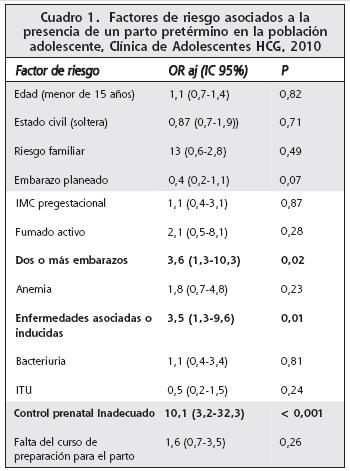
<body><![CDATA[<div style="text-align: justify;"></div>     <p style="text-align: justify;" class="MsoNormal"><span  style="font-size: 10pt; font-family: Verdana;">&#218;nicamente el 62,6% (n=221; IC 95% 57,3-67,7) present&#243; un &#237;ndice de masa corporal (IMC) <span class="SpellE">pregestacional</span> normal. La ganancia promedio de peso durante el embarazo fue de 12,1 <span class="SpellE">Kg</span> (DS + 4,7). El 12,2% (n=44; IC 95% 9,1-16,2) de las pacientes present&#243; anemia. El valor promedio de hemoglobina <span class="SpellE">preparto</span> fue de 12,3 g/<span class="SpellE">dl</span> (DS + 0,97). El 25,8% (n=93; IC 95% 21<span class="GramE">,430,7</span>) present&#243; <i>bacteriuria <span  class="SpellE">asintom&#225;tica</span> </i>y el 31,1% (n=112; IC 95% 24,4-36,2) necesit&#243; ser tratado por <i>infecciones del tracto urinario</i>. El 64,2% (n=231; IC 58,9-69,1) present&#243; alguna condici&#243;n m&#233;dica previa al embarazo, o inducida por este, que pudiera influir en la posibilidad de un parto <span class="SpellE">pret&#233;rmino</span>. <o:p></o:p></span></p>     <div style="text-align: justify;"></div>     <div>     <div style="text-align: justify;"></div>     <p style="text-align: justify;" class="MsoNormal"><span  style="font-size: 10pt; font-family: Verdana;">El <a  href="/img/revistas/amc/v57n1/art05t1.jpg">Cuadro 1</a> muestra la <i>raz&#243;n de probabilidades ajustada (OR <span  class="SpellE">aj</span>) </i>para las variables de estudio. <o:p></o:p></span></p>     <div style="text-align: justify;"></div>     <p style="text-align: justify;" class="MsoNormal"><span  style="font-size: 10pt; font-family: Verdana;">Las enfermedades m&#233;dicas asociadas o inducidas al embarazo (OR 3,5, IC 95% 1,3-9.6), la presencia de 2 o m&#225;s embarazos (OR 3,6, IC 95% 1,3-10,3) y un control prenatal inadecuado (OR 10,1, IC 95% 3,2-32,3), fueron las principales variables independientes para ocasionar un parto <span  class="SpellE">pret&#233;rmino</span> en la poblaci&#243;n adolescente. <o:p></o:p></span></p> </div> </div>     <div>     <div>     ]]></body>
<body><![CDATA[<p class="MsoNormal"><b style=""><span  style="font-size: 11pt; font-family: Verdana;">Discusi&#243;n <o:p></o:p></span></b></p>     <p style="text-align: justify;" class="MsoNormal"><span  style="font-size: 10pt; font-family: Verdana;">Al igual que el estudio original, este muestra los resultados obtenidos en las pacientes que asistieron a la consulta de adolescentes del HCG en el a&#241;o precedente a la ejecuci&#243;n de la investigaci&#243;n. Al ser un estudio de base hospitalaria y no poblacional, los resultados son aplicables &#250;nicamente a las pacientes atendidas en el HCG. <o:p></o:p></span></p>     <div style="text-align: justify;"></div>     <p style="text-align: justify;" class="MsoNormal"><span  style="font-size: 10pt; font-family: Verdana;">Al utilizar historias cl&#237;nicas de los expedientes m&#233;dicos de las pacientes como fuente de datos, el estudio no se encuentra libre de sesgos de informaci&#243;n. <o:p></o:p></span></p>     <div style="text-align: justify;"></div>     <p style="text-align: justify;" class="MsoNormal"><span  style="font-size: 10pt; font-family: Verdana;">Con estas limitaciones metodol&#243;gicas, se muestra como mediante un control prenatal adecuado, se pueden identificar diferentes factores de riesgo que, siendo intervenidos de forma temprana, podr&#237;an reducir la prevalencia de un parto <span class="SpellE">pret&#233;rmino</span> en la poblaci&#243;n adolescente. <o:p></o:p></span></p>     <div style="text-align: justify;"></div>     <p style="text-align: justify;" class="MsoNormal"><span  style="font-size: 10pt; font-family: Verdana;">Diferentes autores ya han identificado varios factores de riesgo asociados a la <span  class="SpellE">prematuridad</span> en la madre adolescente. Algunos, incluso este estudio, determinaron como un control prenatal inadecuado el factor de riesgo de mayor peso, para provocar la propensi&#243;n al parto prematuro y sus complicaciones.<a href="#1"><sup><a>1-4</a> </sup></a><o:p></o:p></span></p>     <div style="text-align: justify;"></div>     <p style="text-align: justify;" class="MsoNormal"><span  style="font-size: 10pt; font-family: Verdana;">A pesar de esto, es importante resaltar que este principal factor de riesgo es sujeto de reducci&#243;n o eliminaci&#243;n por parte de personal de salud de la CCSS. Los Equipos B&#225;sicos de Atenci&#243;n Primaria, mediante la visita domiciliar, podr&#237;an identificar tempranamente a las adolescentes embarazadas y remitirlas a los centros de salud para que inicien de forma oportuna su control prenatal. Lo anterior ayudar&#237;a tambi&#233;n al reconocimiento temprano de signos y s&#237;ntomas que sugieran la presencia o descompensaci&#243;n de enfermedades m&#233;dicas asociadas o inducidas por el embarazo, y que son causa de la predisposici&#243;n de las adolescentes al inicio prematuro de la labor de parto. <o:p></o:p></span></p>     ]]></body>
<body><![CDATA[<div style="text-align: justify;"></div>     <p style="text-align: justify;" class="MsoNormal"><span  style="font-size: 10pt; font-family: Verdana;">En relaci&#243;n con la paridad como factor de riesgo<span class="GramE">,<a  href="#7"><sup>7,8</sup></a></span><sup> </sup>estos mismos equipos b&#225;sicos de atenci&#243;n podr&#237;an captar en el postparto a estas pacientes, para que inicien o asistan a las consulta de anticoncepci&#243;n y prevengan nuevos embarazos. <o:p></o:p></span></p>     <div style="text-align: justify;"></div>     <p style="text-align: justify;" class="MsoNormal"><span  style="font-size: 10pt; font-family: Verdana;">Por tanto, el esfuerzo que pueda hacer el personal de salud para garantizarle a la madre adolescente un <i>control prenatal adecuado </i>y <i>la prevenci&#243;n de un segundo embarazo, </i>parecen ser las estrategias m&#225;s importantes en la previsi&#243;n de un parto <span class="SpellE">pret&#233;rmino</span>. Seg&#250;n la Organizaci&#243;n Mundial de Salud, en su monograf&#237;a sobre el Embarazo en Adolescentes, de 2008, y otras publicaciones<span  class="GramE">,<a href="#9"><sup>9</sup></a></span><sup> </sup>las medidas dirigidas al acceso oportuno al control prenatal y a los m&#233;todos de planificaci&#243;n familiar actuales, podr&#237;an tener un impacto positivo en los resultados adversos que presenta el embarazo en adolescentes. <o:p></o:p></span></p>     <p class="MsoNormal"><b><span  style="font-size: 10pt; font-family: Verdana;">Conflicto de inter&#233;s: </span></b><span  style="font-size: 10pt; font-family: Verdana;">los autores declaran que no tienen asociaciones comerciales que puedan significar un conflicto de inter&#233;s con el art&#237;culo sometido a valoraci&#243;n. <o:p></o:p></span></p> </div> </div>     <div>     <div>     <p class="MsoNormal"><b style=""><span  style="font-size: 11pt; font-family: Verdana;" lang="EN-US"></span></b></p> <hr style="width: 100%; height: 2px;">     <p class="MsoNormal"><b style=""><span  style="font-size: 11pt; font-family: Verdana;" lang="EN-US">Referencias <o:p></o:p></span></b></p>     <!-- ref --><p class="MsoNormal"><span  style="font-size: 10pt; font-family: Verdana;" lang="EN-US"><a name="1"></a>1. Fraser <span class="GramE">AM</span>, <span class="SpellE">Brockert</span> JE, Ward RH. <span class="GramE">Association of Young maternal age with adverse reproductive outcomes.</span> <span  class="GramE">NEJM 1995; 332:1113-1117.    &nbsp;&nbsp;&nbsp;&nbsp;&nbsp;&nbsp;&nbsp;&nbsp;[&#160;<a href="javascript:void(0);" onclick="javascript: window.open('/scielo.php?script=sci_nlinks&ref=071130&pid=S0001-6002201500010000500001&lng=','','width=640,height=500,resizable=yes,scrollbars=1,menubar=yes,');">Links</a>&#160;]<!-- end-ref --></span> <o:p></o:p></span></p>     <!-- ref --><p class="MsoNormal"><span  style="font-size: 10pt; font-family: Verdana;" lang="EN-US"><a name="2"></a>2. Chen XK, <span class="SpellE">Wen</span> SW, Fleming N, <span class="SpellE">Demissie</span> K, Rhoads G, Walker M. Teenage pregnancy and adverse birth outcomes: A large population based retrospective cohort study. <span class="SpellE">Int</span> J <span class="SpellE">Epidemiol</span>. 2007<span class="GramE">;36:368</span>-373.    &nbsp;&nbsp;&nbsp;&nbsp;&nbsp;&nbsp;&nbsp;&nbsp;[&#160;<a href="javascript:void(0);" onclick="javascript: window.open('/scielo.php?script=sci_nlinks&ref=071132&pid=S0001-6002201500010000500002&lng=','','width=640,height=500,resizable=yes,scrollbars=1,menubar=yes,');">Links</a>&#160;]<!-- end-ref --> <o:p></o:p></span></p>     <!-- ref --><p class="MsoNormal"><span  style="font-size: 10pt; font-family: Verdana;" lang="EN-US"><a name="3"></a>3. <span class="SpellE">Malabarey</span> OT, <span class="SpellE">Balaya</span> J, <span class="SpellE">Klam</span> SL, <span class="SpellE">Shrim</span> A. Pregnancies in Young adolescent mother: A population-based study on 37 million births. J <span class="SpellE">Pediatr</span> <span class="SpellE">Adolesc</span> Gynecol. 2012<span class="GramE">;25:98</span>-102.    &nbsp;&nbsp;&nbsp;&nbsp;&nbsp;&nbsp;&nbsp;&nbsp;[&#160;<a href="javascript:void(0);" onclick="javascript: window.open('/scielo.php?script=sci_nlinks&ref=071134&pid=S0001-6002201500010000500003&lng=','','width=640,height=500,resizable=yes,scrollbars=1,menubar=yes,');">Links</a>&#160;]<!-- end-ref --> <o:p></o:p></span></p>     <!-- ref --><p class="MsoNormal"><span  style="font-size: 10pt; font-family: Verdana;" lang="EN-US"><a name="4"></a>4. <span class="SpellE">Lepp&#228;lathi</span> S, <span class="SpellE">Gissler</span> M, <span class="SpellE">Mentula</span> M, <span class="SpellE">Heikinheimo</span> O. Is teenage pregnancy an obstetric risk in welfare society? <span class="GramE">A population-based study in <st1:country-region  w:st="on"><st1:place w:st="on">Finland</st1:place></st1:country-region>, from 2006-2011.</span> <span class="GramE">BMJ Open.</span> 2013<span  class="GramE">;3:e003225</span>.    &nbsp;&nbsp;&nbsp;&nbsp;&nbsp;&nbsp;&nbsp;&nbsp;[&#160;<a href="javascript:void(0);" onclick="javascript: window.open('/scielo.php?script=sci_nlinks&ref=071136&pid=S0001-6002201500010000500004&lng=','','width=640,height=500,resizable=yes,scrollbars=1,menubar=yes,');">Links</a>&#160;]<!-- end-ref --> <o:p></o:p></span></p> </div>     <!-- ref --><p class="MsoNormal"><span  style="font-size: 10pt; font-family: Verdana;" lang="EN-US"><a name="5"></a>5. <span class="SpellE">Giacomin-Carmiol</span> L, Leal-<span  class="SpellE">Mateos</span> M. <span class="SpellE">Caracter&#237;sticas</span> <st1:place w:st="on"><st1:state  w:st="on"><span class="GramE">del</span></st1:state></st1:place> control prenatal de <span class="SpellE">pacientes</span> <span  class="SpellE">adolescentes</span> <span class="SpellE">atendidas</span> en la <span class="SpellE">consulta</span> de <span class="SpellE">Obstetricia</span>, Hospital &#8220;Dr. Rafael <span  class="SpellE">&#193;ngel</span> <span class="SpellE">Calder&#243;n</span> Guardia&#8221;, 2010. <span class="SpellE"><span class="GramE">Acta</span></span><span  class="GramE"> <span class="SpellE">M&#233;d</span> <span class="SpellE">Costarric</span>.</span> 2012<span class="GramE">;54:97</span>-101.    &nbsp;&nbsp;&nbsp;&nbsp;&nbsp;&nbsp;&nbsp;&nbsp;[&#160;<a href="javascript:void(0);" onclick="javascript: window.open('/scielo.php?script=sci_nlinks&ref=071138&pid=S0001-6002201500010000500005&lng=','','width=640,height=500,resizable=yes,scrollbars=1,menubar=yes,');">Links</a>&#160;]<!-- end-ref --> <o:p></o:p></span></p>     <!-- ref --><p class="MsoNormal"><span  style="font-size: 10pt; font-family: Verdana;" lang="EN-US"><a name="6"></a>6. <span class="SpellE">Smilkstein</span> G. The physician and family <span class="GramE">function</span> assessment. <span  class="SpellE">Fam</span> Systems Med. 1984<span class="GramE">;2:263</span>-278.    &nbsp;&nbsp;&nbsp;&nbsp;&nbsp;&nbsp;&nbsp;&nbsp;[&#160;<a href="javascript:void(0);" onclick="javascript: window.open('/scielo.php?script=sci_nlinks&ref=071140&pid=S0001-6002201500010000500006&lng=','','width=640,height=500,resizable=yes,scrollbars=1,menubar=yes,');">Links</a>&#160;]<!-- end-ref --> <o:p></o:p></span></p>     <!-- ref --><p class="MsoNormal"><span  style="font-size: 10pt; font-family: Verdana;" lang="EN-US"><a name="7"></a>7. <span class="SpellE">Blankson</span> ML, <span class="SpellE">Cliver</span> SP, Goldenberg RL, Hickey CA, Jin J, <span class="SpellE">Dubard</span> MB. <span class="GramE">Health behavior and outcomes in sequential pregnancies of black and white adolescents.</span> <span  class="GramE">JAMA.</span> 1993<span class="GramE">;269:14013</span>.    &nbsp;&nbsp;&nbsp;&nbsp;&nbsp;&nbsp;&nbsp;&nbsp;[&#160;<a href="javascript:void(0);" onclick="javascript: window.open('/scielo.php?script=sci_nlinks&ref=071142&pid=S0001-6002201500010000500007&lng=','','width=640,height=500,resizable=yes,scrollbars=1,menubar=yes,');">Links</a>&#160;]<!-- end-ref --> <o:p></o:p></span></p>     <!-- ref --><p class="MsoNormal"><span  style="font-size: 10pt; font-family: Verdana;" lang="EN-US"><a name="8"></a>8. Smith GC, Pell JP. Teen pregnancy and risk of <span class="SpellE">perinatal</span> outcomes associated with first and second birth: Population based retrospective cohort study. </span><span  style="font-size: 10pt; font-family: Verdana;">BMJ. 2001<span  class="GramE">;323:1</span>-5.    &nbsp;&nbsp;&nbsp;&nbsp;&nbsp;&nbsp;&nbsp;&nbsp;[&#160;<a href="javascript:void(0);" onclick="javascript: window.open('/scielo.php?script=sci_nlinks&ref=071144&pid=S0001-6002201500010000500008&lng=','','width=640,height=500,resizable=yes,scrollbars=1,menubar=yes,');">Links</a>&#160;]<!-- end-ref --> <o:p></o:p></span></p>     <!-- ref --><p class="MsoNormal"><span  style="font-size: 10pt; font-family: Verdana;"><a name="9"></a>9. <span  class="SpellE">Tocce</span> KM, <span class="SpellE">Jeanelle</span> L, <span class="SpellE">Teal</span> S. <span class="SpellE">Rapid</span> <span class="SpellE">repeat</span> <span class="SpellE">pregnancy</span> in <span class="SpellE">adolescents</span>: Do <span class="SpellE">immediate</span> <span class="SpellE">postpartum</span> <span class="SpellE">contraceptive</span> <span class="SpellE">implants</span> <span class="SpellE">make</span> a <span class="SpellE">difference</span>? <span class="SpellE">Am</span> J <span class="SpellE">Obset</span> <span  class="SpellE">Gynecol</span>. 2012<span class="GramE">;206:e1</span>-e7.    &nbsp;&nbsp;&nbsp;&nbsp;&nbsp;&nbsp;&nbsp;&nbsp;[&#160;<a href="javascript:void(0);" onclick="javascript: window.open('/scielo.php?script=sci_nlinks&ref=071146&pid=S0001-6002201500010000500009&lng=','','width=640,height=500,resizable=yes,scrollbars=1,menubar=yes,');">Links</a>&#160;]<!-- end-ref --> <o:p></o:p></span></p>     <!-- ref --><p class="MsoNormal"><span  style="font-size: 10pt; font-family: Verdana;"><a name="10"></a>10. Caja Costarricense de Seguro Social. Gu&#237;as de atenci&#243;n integral de las mujeres, ni&#241;os y ni&#241;as en el periodo prenatal, parto y postparto. Caja Costarricense de Seguro Social, San Jos&#233;, Costa Rica, Unidad de Imprenta CCSS, 2009.    &nbsp;&nbsp;&nbsp;&nbsp;&nbsp;&nbsp;&nbsp;&nbsp;[&#160;<a href="javascript:void(0);" onclick="javascript: window.open('/scielo.php?script=sci_nlinks&ref=071148&pid=S0001-6002201500010000500010&lng=','','width=640,height=500,resizable=yes,scrollbars=1,menubar=yes,');">Links</a>&#160;]<!-- end-ref --> <o:p></o:p></span></p>     <p class="MsoNormal"><b style=""><span  style="font-size: 10pt; font-family: Verdana;">Afiliaci&#243;n de los autores: <o:p></o:p></span></b></p>     ]]></body>
<body><![CDATA[<p class="MsoNormal"><sup><span  style="font-size: 10pt; font-family: Verdana;"><a name="1_"></a><a  href="#3_">1</a></span></sup><span  style="font-size: 10pt; font-family: Verdana;">Servicio de Medicina Materno-Fetal, Hospital Calder&#243;n Guardia. <sup>    <br> <a name="2_"></a><a href="#4_">2</a></sup>Asistente y coordinadora de la Cl&#237;nica del Adolescente, Servicio de Medicina Materno-Fetal, Hospital Calder&#243;n Guardia </span><span  style="font-size: 10pt; font-family: Symbol;"><span style=""></span></span><span  style="font-size: 10pt; font-family: Verdana;">manrique.leal@gmail.com <o:p></o:p></span></p>     <p class="MsoNormal"><b><span  style="font-size: 10pt; font-family: Verdana;">Fuentes de apoyo: </span></b><span  style="font-size: 10pt; font-family: Verdana;">este estudio no posee una fuente de financiamiento externa a la CCSS. <o:p></o:p></span></p>     <p class="MsoNormal"><b><i><span  style="font-size: 10pt; font-family: Verdana;"></span></i></b></p> <hr style="width: 100%; height: 2px;">     <p style="text-align: center;" class="MsoNormal"><b><i><span  style="font-size: 10pt; font-family: Verdana;">Fecha recibido:</span></i></b><i><span  style="font-size: 10pt; font-family: Verdana;"> 19 de marzo de 2014 <b>Fecha aprobado:</b> 23 de octubre de 2014 </span></i><span  style="font-size: 10pt; font-family: Verdana;"><o:p></o:p></span></p> </div> </div> </div> </div>      ]]></body><back>
<ref-list>
<ref id="B1">
<label>1</label><nlm-citation citation-type="journal">
<person-group person-group-type="author">
<name>
<surname><![CDATA[Fraser]]></surname>
<given-names><![CDATA[AM]]></given-names>
</name>
<name>
<surname><![CDATA[Brockert]]></surname>
<given-names><![CDATA[JE]]></given-names>
</name>
<name>
<surname><![CDATA[Ward]]></surname>
<given-names><![CDATA[RH]]></given-names>
</name>
</person-group>
<article-title xml:lang="en"><![CDATA[Association of Young maternal age with adverse reproductive outcomes]]></article-title>
<source><![CDATA[NEJM]]></source>
<year>1995</year>
<volume>332</volume>
<page-range>1113-1117</page-range></nlm-citation>
</ref>
<ref id="B2">
<label>2</label><nlm-citation citation-type="journal">
<person-group person-group-type="author">
<name>
<surname><![CDATA[Chen]]></surname>
<given-names><![CDATA[XK]]></given-names>
</name>
<name>
<surname><![CDATA[Wen]]></surname>
<given-names><![CDATA[SW]]></given-names>
</name>
<name>
<surname><![CDATA[Fleming]]></surname>
<given-names><![CDATA[N]]></given-names>
</name>
<name>
<surname><![CDATA[Demissie]]></surname>
<given-names><![CDATA[K]]></given-names>
</name>
<name>
<surname><![CDATA[Rhoads]]></surname>
<given-names><![CDATA[G]]></given-names>
</name>
<name>
<surname><![CDATA[Walker]]></surname>
<given-names><![CDATA[M]]></given-names>
</name>
</person-group>
<article-title xml:lang="en"><![CDATA[Teenage pregnancy and adverse birth outcomes: A large population based retrospective cohort study]]></article-title>
<source><![CDATA[Int J Epidemiol]]></source>
<year>2007</year>
<volume>36</volume>
<page-range>368-373</page-range></nlm-citation>
</ref>
<ref id="B3">
<label>3</label><nlm-citation citation-type="journal">
<person-group person-group-type="author">
<name>
<surname><![CDATA[Malabarey]]></surname>
<given-names><![CDATA[OT]]></given-names>
</name>
<name>
<surname><![CDATA[Balaya]]></surname>
<given-names><![CDATA[J]]></given-names>
</name>
<name>
<surname><![CDATA[Klam]]></surname>
<given-names><![CDATA[SL]]></given-names>
</name>
<name>
<surname><![CDATA[Shrim]]></surname>
<given-names><![CDATA[A]]></given-names>
</name>
</person-group>
<article-title xml:lang="en"><![CDATA[Pregnancies in Young adolescent mother: A population-based study on 37 million births]]></article-title>
<source><![CDATA[J Pediatr Adolesc Gynecol]]></source>
<year>2012</year>
<volume>25</volume>
<page-range>98-102</page-range></nlm-citation>
</ref>
<ref id="B4">
<label>4</label><nlm-citation citation-type="journal">
<person-group person-group-type="author">
<name>
<surname><![CDATA[Leppälathi]]></surname>
<given-names><![CDATA[S]]></given-names>
</name>
<name>
<surname><![CDATA[Gissler]]></surname>
<given-names><![CDATA[M]]></given-names>
</name>
<name>
<surname><![CDATA[Mentula]]></surname>
<given-names><![CDATA[M]]></given-names>
</name>
<name>
<surname><![CDATA[Heikinheimo]]></surname>
<given-names><![CDATA[O]]></given-names>
</name>
</person-group>
<article-title xml:lang="en"><![CDATA[Is teenage pregnancy an obstetric risk in welfare society? A population-based study in Finland, from 2006-2011]]></article-title>
<source><![CDATA[BMJ Open]]></source>
<year>2013</year>
<page-range>3:e003225</page-range></nlm-citation>
</ref>
<ref id="B5">
<label>5</label><nlm-citation citation-type="journal">
<person-group person-group-type="author">
<name>
<surname><![CDATA[Giacomin-Carmiol]]></surname>
<given-names><![CDATA[L]]></given-names>
</name>
<name>
<surname><![CDATA[Leal-Mateos]]></surname>
<given-names><![CDATA[M]]></given-names>
</name>
</person-group>
<article-title xml:lang="en"><![CDATA[Características del control prenatal de pacientes adolescentes atendidas en la consulta de Obstetricia, Hospital &#8220;Dr. Rafael Ángel Calderón Guardia&#8221;, 2010]]></article-title>
<source><![CDATA[Acta Méd Costarric]]></source>
<year>2012</year>
<volume>54</volume>
<page-range>97-101</page-range></nlm-citation>
</ref>
<ref id="B6">
<label>6</label><nlm-citation citation-type="journal">
<person-group person-group-type="author">
<name>
<surname><![CDATA[Smilkstein]]></surname>
<given-names><![CDATA[G]]></given-names>
</name>
</person-group>
<article-title xml:lang="en"><![CDATA[The physician and family function assessment]]></article-title>
<source><![CDATA[Fam Systems Med]]></source>
<year>1984</year>
<volume>2</volume>
<page-range>263-278</page-range></nlm-citation>
</ref>
<ref id="B7">
<label>7</label><nlm-citation citation-type="journal">
<person-group person-group-type="author">
<name>
<surname><![CDATA[Blankson]]></surname>
<given-names><![CDATA[ML]]></given-names>
</name>
<name>
<surname><![CDATA[Cliver]]></surname>
<given-names><![CDATA[SP]]></given-names>
</name>
<name>
<surname><![CDATA[Goldenberg]]></surname>
<given-names><![CDATA[RL]]></given-names>
</name>
<name>
<surname><![CDATA[Hickey]]></surname>
<given-names><![CDATA[CA]]></given-names>
</name>
<name>
<surname><![CDATA[Jin]]></surname>
<given-names><![CDATA[J]]></given-names>
</name>
<name>
<surname><![CDATA[Dubard]]></surname>
<given-names><![CDATA[MB]]></given-names>
</name>
</person-group>
<article-title xml:lang="en"><![CDATA[Health behavior and outcomes in sequential pregnancies of black and white adolescents]]></article-title>
<source><![CDATA[JAMA]]></source>
<year>1993</year>
<volume>269</volume>
<numero>14013</numero>
<issue>14013</issue>
</nlm-citation>
</ref>
<ref id="B8">
<label>8</label><nlm-citation citation-type="journal">
<person-group person-group-type="author">
<name>
<surname><![CDATA[Smith]]></surname>
<given-names><![CDATA[GC]]></given-names>
</name>
<name>
<surname><![CDATA[Pell]]></surname>
<given-names><![CDATA[JP]]></given-names>
</name>
</person-group>
<article-title xml:lang="en"><![CDATA[Teen pregnancy and risk of perinatal outcomes associated with first and second birth: Population based retrospective cohort study]]></article-title>
<source><![CDATA[BMJ]]></source>
<year>2001</year>
<volume>323</volume>
<page-range>1-5</page-range></nlm-citation>
</ref>
<ref id="B9">
<label>9</label><nlm-citation citation-type="journal">
<person-group person-group-type="author">
<name>
<surname><![CDATA[Tocce]]></surname>
<given-names><![CDATA[KM]]></given-names>
</name>
<name>
<surname><![CDATA[Jeanelle]]></surname>
<given-names><![CDATA[L]]></given-names>
</name>
<name>
<surname><![CDATA[Teal]]></surname>
<given-names><![CDATA[S]]></given-names>
</name>
</person-group>
<article-title xml:lang="en"><![CDATA[Rapid repeat pregnancy in adolescents: Do immediate postpartum contraceptive implants make a difference?]]></article-title>
<source><![CDATA[Am J Obset Gynecol]]></source>
<year>2012</year>
<volume>206</volume>
<page-range>e1-e7</page-range></nlm-citation>
</ref>
<ref id="B10">
<label>10</label><nlm-citation citation-type="book">
<collab>Caja Costarricense de Seguro Social</collab>
<source><![CDATA[Guías de atención integral de las mujeres, niños y niñas en el periodo prenatal, parto y postparto]]></source>
<year>2009</year>
<publisher-loc><![CDATA[San José ]]></publisher-loc>
<publisher-name><![CDATA[Caja Costarricense de Seguro Social]]></publisher-name>
</nlm-citation>
</ref>
</ref-list>
</back>
</article>