<?xml version="1.0" encoding="ISO-8859-1"?><article xmlns:mml="http://www.w3.org/1998/Math/MathML" xmlns:xlink="http://www.w3.org/1999/xlink" xmlns:xsi="http://www.w3.org/2001/XMLSchema-instance">
<front>
<journal-meta>
<journal-id>1659-2913</journal-id>
<journal-title><![CDATA[Revista Costarricense de Psicología]]></journal-title>
<abbrev-journal-title><![CDATA[Rev. Costarric. Psic]]></abbrev-journal-title>
<issn>1659-2913</issn>
<publisher>
<publisher-name><![CDATA[Colegio Profesional de Psicólogos de Costa Rica]]></publisher-name>
</publisher>
</journal-meta>
<article-meta>
<article-id>S1659-29132015000100002</article-id>
<title-group>
<article-title xml:lang="en"><![CDATA[2-Heptanone Produces Sensorial-Emotional Changes, Depending on Length of Exposure]]></article-title>
<article-title xml:lang="es"><![CDATA[La 2-heptanona produce cambios sensorio-emocionales, dependiendo del tiempo de exposición]]></article-title>
</title-group>
<contrib-group>
<contrib contrib-type="author">
<name>
<surname><![CDATA[Gutiérrez-García]]></surname>
<given-names><![CDATA[Ana G]]></given-names>
</name>
<xref ref-type="aff" rid="A01"/>
</contrib>
<contrib contrib-type="author">
<name>
<surname><![CDATA[Contreras]]></surname>
<given-names><![CDATA[Carlos M]]></given-names>
</name>
<xref ref-type="aff" rid="A02"/>
</contrib>
<contrib contrib-type="author">
<name>
<surname><![CDATA[Mendoza-López]]></surname>
<given-names><![CDATA[Remedios]]></given-names>
</name>
<xref ref-type="aff" rid="A03"/>
</contrib>
</contrib-group>
<aff id="A01">
<institution><![CDATA[,Universidad Veracruzana  ]]></institution>
<addr-line><![CDATA[Veracruz ]]></addr-line>
<country>México</country>
</aff>
<aff id="A02">
<institution><![CDATA[,Universidad Nacional Autónoma de México  ]]></institution>
<addr-line><![CDATA[Veracruz ]]></addr-line>
<country>México</country>
</aff>
<aff id="A03">
<institution><![CDATA[,Universidad Veracruza­na  ]]></institution>
<addr-line><![CDATA[Veracruz ]]></addr-line>
<country>México</country>
</aff>
<pub-date pub-type="pub">
<day>00</day>
<month>06</month>
<year>2015</year>
</pub-date>
<pub-date pub-type="epub">
<day>00</day>
<month>06</month>
<year>2015</year>
</pub-date>
<volume>34</volume>
<numero>1</numero>
<fpage>04</fpage>
<lpage>17</lpage>
<copyright-statement/>
<copyright-year/>
<self-uri xlink:href="http://www.scielo.sa.cr/scielo.php?script=sci_arttext&amp;pid=S1659-29132015000100002&amp;lng=en&amp;nrm=iso"></self-uri><self-uri xlink:href="http://www.scielo.sa.cr/scielo.php?script=sci_abstract&amp;pid=S1659-29132015000100002&amp;lng=en&amp;nrm=iso"></self-uri><self-uri xlink:href="http://www.scielo.sa.cr/scielo.php?script=sci_pdf&amp;pid=S1659-29132015000100002&amp;lng=en&amp;nrm=iso"></self-uri><abstract abstract-type="short" xml:lang="en"><p><![CDATA[2-Heptanone is an alarm pheromone contained in some human fluids, but its role is unknown in chemical communication. In part one of this study, a sample of 24 women provided urine specimens taken around their supposed ovulation days, and a second sample 12 days later. As exclusion criteria, women with anxiety (based on the State-Trait Anxiety Inventory, Spielberger), mood disorders (based on the Clinical Diagnosis of Depression Questionnaire), and premenstrual dysphoric disorder (based on the Daily Symptoms Report) were not included in the study. Gas chromatography/mass spectrometry indicated that urinary 2-heptanone content was increased approximately two-fold during pre-menstruation compared with the days around ovulation. In part two of this study, 141 male and female volunteers, sniffed this ketone and with a simple questionnaire it was determined that the longest tested duration (180 s) of sniffing 2-heptanone lowered the acceptance of sniffing this ketone again, compared with the shorter sniffing durations (5 and 60 s), with no differences between sexes. The increased con­centration of 2-heptanone during the day before menstruation may be considered as part of the functional changes preceding menstruation and sniffing this ketone may produce sensorial-emotional changes depending on time of sniffing, the significance of this deserves further study.]]></p></abstract>
<abstract abstract-type="short" xml:lang="es"><p><![CDATA[La 2-heptanona es una feromona de alarma detectable en algunos fluidos humanos, pero se desconoce su papel en la comunicación química. En la primer parte del estudio, 24 mujeres jóvenes y sanas, proveyeron una primera muestra de orina alrededor del día de ovulación y una segunda 12 días más tarde. Como criterio de exclusión, se descartaron mujeres con ansiedad (Inventario de Ansiedad Estado-Rasgo, Spielberger), trastornos del estado de ánimo (Cuestionario de diagnóstico clínico de depresión) y trastorno disfórico premenstrual (basado en los sínto­mas diarios de informe). La cromatografía de gases/espectrometría de masas indicó que el contenido urinario de 2-heptanona aumentó aproximadamente al doble antes de la menstruación en comparación con los días cercanos a la ovulación. En la segunda parte del estudio, otros 141 voluntarios (femeninos y masculinos) inhalaron esta ce­tona y con ello se determinó que con el tiempo más prolongado (180 s) de exposición por olfateo a la 2-heptanona disminuyó la aceptación para olerla nuevamente, en comparación con los tiempos más cortos de olfateo (5 y 60 s). Lo anterior se evidenció mediante las respuestas a un cuestionario simple. No hubo diferencias significativas por género. El aumento de la concentración urinaria de 2-heptanona, durante el día antes de la menstruación, se consideraría como parte de los cambios funcionales premenstruales y el hecho de oler esta cetona produciría cambios sensorial-emocionales dependiendo del tiempo de exposición, cuyo significado requiere mayor estudio.]]></p></abstract>
<kwd-group>
<kwd lng="en"><![CDATA[2-Heptanone]]></kwd>
<kwd lng="en"><![CDATA[Chemosignals]]></kwd>
<kwd lng="en"><![CDATA[Menstrual cycle]]></kwd>
<kwd lng="en"><![CDATA[Pheromones]]></kwd>
<kwd lng="en"><![CDATA[Olfactory system]]></kwd>
<kwd lng="es"><![CDATA[2-heptanona]]></kwd>
<kwd lng="es"><![CDATA[quimioseñales]]></kwd>
<kwd lng="es"><![CDATA[ciclo menstrual]]></kwd>
<kwd lng="es"><![CDATA[feromonas]]></kwd>
<kwd lng="es"><![CDATA[sistema olfatorio]]></kwd>
</kwd-group>
</article-meta>
</front><body><![CDATA[ <div class="Section1">     <p class="MsoNormal" style="text-align: center;" align="center"><b  style=""><span style="font-family: Verdana;">2-Heptanone Produces Sensorial-Emotional Changes, Depending on Length of Exposure</span></b><span  class="A10"><span style="font-family: Verdana; font-style: normal;"  lang="EN-US"></span></span><span style="font-family: Verdana;"  lang="EN-US"><o:p></o:p></span></p>     <p class="MsoNormal" style="text-align: center;" align="center"><b  style=""><span style="font-family: Verdana;">La 2-heptanona produce cambios sensorio- emocionales, dependiendo del tiempo de exposición</span></b><span  class="A10"><span style="font-family: Verdana;" lang="ES-CR"></span></span><span  style="font-family: Verdana;" lang="ES-CR"><o:p></o:p></span></p>     <p class="MsoNormal" style="text-align: center;" align="center"><b  style=""><span style="font-size: 11pt; font-family: Verdana;"  lang="ES-CR">Ana G. Gutiérrez-García, Carlos M. Contreras &amp; Remedios Mendoza-López<o:p></o:p></span></b></p>     <p class="MsoNormal"><span  style="font-size: 9pt; color: rgb(33, 29, 30);" lang="ES-CR"><o:p>&nbsp;</o:p></span></p>     <p class="MsoNormal"><span  style="font-size: 9pt; color: rgb(33, 29, 30);" lang="ES-CR"><o:p><a  name="Correspondencia2"></a>&nbsp;</o:p></span><span  style="font-size: 10pt; font-family: Verdana;" lang="EN-US">*<a  href="#Correspondencia_1">Dirección para correspondencia</a>:     <br> </span></p>     <p class="MsoNormal"><b style=""><span  style="font-size: 11pt; font-family: Verdana;" lang="EN-US"></span></b></p> <hr style="width: 100%; height: 2px;">     <p class="MsoNormal"><b style=""><span  style="font-size: 11pt; font-family: Verdana;" lang="EN-US">Abstract<o:p></o:p></span></b></p>     <p style="text-align: justify;" class="MsoNormal"><span  style="font-size: 10pt; font-family: Verdana;" lang="EN-US">2-Heptanone is an alarm pheromone contained in some human fluids, but its role is unknown in chemical com­munication. In part one of this <span class="GramE">study</span>, a sample of 24 women provided urine specimens taken around their sup­posed ovulation days, and a second sample 12 days later. As exclusion criteria, women with anxiety (based on the State-Trait Anxiety Inventory, <span class="SpellE">Spielberger</span>), mood disorders (based on the Clinical Diagnosis of Depression Questionnaire), and premenstrual <span class="SpellE">dysphoric</span> disorder (based on the Daily Symptoms Report) were not included in the study. Gas chromatography/mass spectrometry indicated that urinary 2-heptanone content was increased approximately two-fold during pre-menstruation compared with the days around ovulation. In part two of this study, 141 male and female volunteers, sniffed this <span  class="SpellE">ketone</span> and with a simple questionnaire it was determined that the longest tested duration (180 s) of sniffing 2-heptanone lowered the acceptance of sniffing this <span class="SpellE">ketone</span> again, compared with the shorter sniffing durations (5 and 60 s), with no differences between sexes. The increased con­centration of 2-heptanone during the day before menstruation may be considered as part of the functional changes preceding menstruation and sniffing this <span  class="SpellE">ketone</span> may produce sensorial-emotional changes depending on time of sniffing, the significance of this deserves further study. <o:p></o:p></span></p>     ]]></body>
<body><![CDATA[<div style="text-align: justify;"></div>     <p style="text-align: justify;" class="MsoNormal"><span  style="font-size: 10pt; font-family: Verdana;" lang="EN-US">Keywords</span><span  style="font-size: 10pt; font-family: Verdana;" lang="EN-US">: 2-Heptanone, <span class="SpellE">Chemosignals</span>, Menstrual cycle, Pheromones, Olfactory system<o:p></o:p></span></p> <b style=""><span style="font-size: 11pt; font-family: Verdana;"  lang="ES-CR">Resumen<o:p></o:p></span></b>     <p style="text-align: justify;" class="MsoNormal"><span  style="font-size: 10pt; font-family: Verdana;" lang="ES-CR">La 2-<span class="SpellE">heptanona</span> es una feromona de alarma detectable en algunos fluidos humanos, pero se desconoce su papel en la comunicación química. En la primer parte del estudio, 24 mujeres jóvenes y sanas, proveyeron una primera muestra de orina alrededor del día de ovulación y una segunda 12 días más tarde. Como criterio de exclusión, se descartaron mujeres con ansiedad (Inventario de Ansiedad Estado-Rasgo, <span class="SpellE">Spielberger</span>), trastornos del estado de ánimo (Cuestionario de diagnóstico clínico de depresión) y trastorno disfórico premenstrual (basado en los sínto­mas diarios de informe). La cromatografía de gases/espectrometría de masas indicó que el contenido urinario de 2-<span class="SpellE">heptanona</span> aumentó aproximadamente al doble antes de la menstruación en comparación con los días cercanos a la ovulación. En la segunda parte del estudio, otros 141 voluntarios (femeninos y masculinos) inhalaron esta ce­tona y con ello se determinó que con el tiempo más prolongado (180 s) de exposición por olfateo a la 2-<span  class="SpellE">heptanona</span> disminuyó la aceptación para olerla nuevamente, en comparación con los tiempos más cortos de olfateo (5 y 60 s). Lo anterior se evidenció mediante las respuestas a un cuestionario simple. No hubo diferencias significativas por género. El aumento de la concentración urinaria de 2-<span  class="SpellE">heptanona</span>, durante el día antes de la menstruación, se consideraría como parte de los cambios funcionales premenstruales y el hecho de oler esta cetona produciría cambios sensorial-emocionales dependiendo del tiempo de exposición, cuyo significado requiere mayor estudio. <o:p></o:p></span></p>     <div style="text-align: justify;"></div>     <p style="text-align: justify;" class="MsoNormal"><span  style="font-size: 10pt; font-family: Verdana;" lang="ES-CR">Palabras clave:<i> </i></span><span  style="font-size: 10pt; font-family: Verdana;" lang="ES-CR">2-<span  class="SpellE">heptanona</span>, <span class="SpellE">quimioseñales</span>, ciclo menstrual, feromonas, sistema olfatorio    <br> </span></p> <hr style="width: 100%; height: 2px;">     <p style="text-align: justify;" class="MsoNormal"><span class="SpellE"><span  class="A11"><span style="font-size: 10pt; font-family: Verdana;"  lang="ES-CR">Attractiveness</span></span></span><span class="A11"><span  style="font-size: 10pt; font-family: Verdana;" lang="ES-CR"> <span  class="SpellE">during</span> <span class="SpellE">the</span> menstrual <span class="SpellE">cycle</span> <span class="SpellE">depends</span> <span class="SpellE">on</span> estradiol <span class="SpellE">and</span> <span class="SpellE">progesterone</span> <span class="SpellE">levels</span> (<span class="SpellE">Puts</span> et al., 2013). </span></span><span class="A11"><span  style="font-size: 10pt; font-family: Verdana;" lang="EN-US">Males perceive (Singh &amp; <span class="SpellE">Bronstad</span>, 2001) and distinguish (<span class="SpellE">Gildersleeve</span>, <span  class="SpellE">Haselton</span>, Larson &amp; <span class="SpellE">Pillsworth</span>, 2012) <span class="SpellE">women´s</span> scents in the follicular phase as more pleasant compared with the <span class="SpellE">luteal</span> phase. Women and men usually prefer <span class="SpellE">women´s</span> scents in the fertile-phases to their scents in other phases of the menstrual cycle (Woodward, Thompson &amp; <span class="SpellE">Gangestad</span>, 2015). Men exposed to the scent of an ovulating woman display higher levels of testosterone than when exposed to the scent of a non-ovulating woman, which may be related with the beginning of a romantic courtship (Miller &amp; <span  class="SpellE">Maner</span>, 2010).</span></span><span class="A11"><span style="font-size: 10pt;"  lang="EN-US"><o:p></o:p></span></span></p>     <div style="text-align: justify;"></div>     <p style="text-align: justify;" class="MsoNormal"><span class="A11"><span  style="font-size: 10pt; font-family: Verdana;" lang="EN-US">Compared with the <span class="SpellE">luteal</span> phase, the <span  class="SpellE">amygdala</span> is activated during the follicular phase, providing women with greater social sensitivity and seemingly facilitating social interaction (<span  class="SpellE">Derntl</span> et al., 2008b). Accuracy in facial emotion recognition, a prerequisite for successful social interaction, also improves (<span class="SpellE">Derntl</span>, <span class="SpellE">Kryspin-Exner</span>, <span class="SpellE">Fernbach</span>, Moser &amp; <span class="SpellE">Habel</span>, 2008a); and the <span  class="SpellE">luteal</span> phase relates with a decreased identification of negative emotions, as angry or sad (<span class="SpellE">Guapo</span> et al., 2009). Through hormonal control, mating is facilitated during the follicular phase, and this situation shifts during the <span class="SpellE">luteal</span> phase, involv­ing emotional processing. However, it is unknown whether the existence of additional cues, such as some odoriferous substances, may indicate a period of infertility<o:p></o:p></span></span></p>     <div style="text-align: justify;"></div>     ]]></body>
<body><![CDATA[<p style="text-align: justify;" class="MsoNormal"><span class="A11"><span  style="font-size: 10pt; font-family: Verdana;" lang="EN-US">In rodents, the emission of olfactory signals is able to modify behavior when perceived by another member of the same species. The active compounds are largely volatile substances that tend to bind to proteins excreted in the urine (Novotny, 2003), providing information about age (<span class="SpellE">Osada</span> et al., 2003), reproductive and sexual status (<span class="SpellE">Achiraman</span> et al., 2011), and stressful situations (<span class="SpellE">Gutiérrez-García</span> et al., 2006). Two <span class="SpellE">ketones</span> released in dominant rats, 2-heptanone and 6-methyl-5-hepten-2-one, generate psy­chosocial stress when perceived by subordinate rats (<span class="SpellE">Pohorecky</span> et al., 2008). In rodents, 2-heptanone is considered an alarm pheromone. It is present in rodent urine, and its content increases in rats that are subjected to unavoidable stress, while the smell of urine that comes from <span  class="SpellE">preputial</span> gland-stressed rats produces anxiety-like behavior in the short term. In the long-term, it can produce despair in otherwise intact rats (<span class="SpellE">Gutiérrez-García</span>, Contreras, Mendoza-<span class="SpellE">López</span>, <span class="SpellE">García-Barradas</span> &amp; Cruz-<span class="SpellE">Sánchez</span>, 2007).<o:p></o:p></span></span></p>     <div style="text-align: justify;"></div>     <p style="text-align: justify;" class="MsoNormal"><span class="A11"><span  style="font-size: 10pt; font-family: Verdana;" lang="EN-US">These observations suggest that duration of exposure may influence emotional reactions pro­duced by contact with 2-heptanone, while the role played by 2-heptanone may depend on <span  class="SpellE">gonadal</span> func­tions. Both possibilities require further exploration.<o:p></o:p></span></span></p>     <div style="text-align: justify;"></div>     <p style="text-align: justify;" class="MsoNormal"><span class="A11"><span  style="font-size: 10pt; font-family: Verdana;" lang="EN-US">Human skin emits a wide variety of volatile substances as a primary source of body odor (Gal­lagher et al., 2008). Approximately 1,840 volatile organic compounds have been identified in healthy individuals. Among these, 2-heptanone has been found in feces, urine, breath, and saliva; but not skin (Lacy Costello et al., 2014). Whether the release of this alarm substance is linked to the menstrual cycle and whether the smell of 2-heptanone produces time-dependent emotional sensations in humans, are unknown.<o:p></o:p></span></span></p>     <div style="text-align: justify;"></div>     <p style="text-align: justify;" class="MsoNormal"><span class="A11"><span  style="font-size: 10pt; font-family: Verdana;" lang="EN-US">This study consists of two complementary designs: The first, aimed to determine changes in urine 2-heptanone depending on menstrual cycle phases in healthy young volunteers. The second, aimed to explore if inhalation of 2-heptanone by healthy volunteers produces any emotional reactions.<o:p></o:p></span></span></p> <b style=""><span style="font-size: 11pt; font-family: Verdana;"  lang="EN-US">Method</span></b><b style=""><span  style="font-family: Verdana;" lang="EN-US"><o:p></o:p></span></b>     <p style="text-align: justify;" class="MsoNormal"><span class="A11"><span  style="font-size: 10pt; font-family: Verdana;" lang="EN-US">This study was conducted according to the Helsinki Declaration, and was authorized by the Psy­chology <span  class="SpellE">School´s</span> Ethical Committee (<st1:place w:st="on"><st1:city  w:st="on">Universidad <span class="SpellE">Veracruzana</span></st1:city>, <st1:country-region w:st="on">Mexico</st1:country-region></st1:place>). All participants gave written informed consent for sample collection and application of the tests.</span></span><span  class="A11"><span style="font-size: 10pt;" lang="EN-US"><o:p></o:p></span></span></p>     <p class="MsoNormal"><b style=""><span  style="font-size: 11pt; font-family: Verdana;" lang="EN-US">Part 1: Measure of 2-heptanone</span></b><b style=""><span  style="font-size: 11pt;" lang="ES-CR"><o:p></o:p></span></b></p> <b style=""><span style="font-size: 11pt; font-family: Verdana;"  lang="EN-US">Participants <o:p></o:p></span></b>     <p style="text-align: justify;" class="MsoNormal"><span class="A11"><span  style="font-size: 10pt; font-family: Verdana;" lang="EN-US">Twenty-four healthy women participated in this part of the study. They were 23-33 years old (mean 21.3 ± 0.63 years). An interview was conducted to exclude from the study women who suffered from any general systemic disease, premenstrual <span  class="SpellE">dysphoric</span> disorder, or mood disorders, women who were taking hormonal or psychotropic medication, and women who used alcohol or drugs. At the time of invitation, volunteers were asked to complete a brief interview directed to meet criteria for study <span class="GramE">inclusion,</span> and to determinate the regularity of their past three menstrual periods. Only volunteers with a regular menstrual cycle were included. Other exclusion criteria included pregnancy and their own decision not to enter the study.</span></span><span class="A11"><span  style="font-size: 10pt;" lang="EN-US"><o:p></o:p></span></span></p>     ]]></body>
<body><![CDATA[<div style="text-align: justify;"></div>     <p style="text-align: justify;" class="MsoNormal"><span class="A11"><span  style="font-size: 10pt; font-family: Verdana;" lang="EN-US">All of the participants were instructed to measure their <span class="SpellE">axillary</span> temperature daily immediately after awakening during two consecutive <span  class="GramE">menstruation</span> cycles and keep the corresponding record. A temperature increase of 0,5-1,0ºC in approximately the middle of the menstrual cycle was considered the day of ovulation. From this date onward, the next menstruation was calculated as occurring ap­proximately 14 days later. In the second recorded cycle, women were asked to complete daily the Daily Symptoms Report (DSR, Freeman, De <span class="SpellE">Rubeis</span> &amp; <span class="SpellE">Rickels</span>, 1996). On these days, when volunteers detect­ed an increased <span class="SpellE">axillary</span> temperature, they were instructed to collect a 10 ml sample of their first urine of the day, immediately after awakening. A second urine sample was collected approximately 12 days later. Volunteers agreed to deliver the urine samples to the principal researcher within three hours after collection and where they were immediately stored at -20ºC. On the same day of urine collection, they were asked to attend an interview (8:00 to 10:00 A.M.). In these two sessions, test scores were obtained on the two scales of the State-Trait Anxiety Inventory (STAI-S [for state anxiety] and STAI-T [for trait anxiety] (Spielberg &amp; <span class="SpellE">Díaz</span>-Guerrero, 1975) and for depression on the Clinical Diagnosis Questionnaire (CDQ, <span  class="SpellE">Calderón</span> Narvaez, 1992).<o:p></o:p></span></span></p>     <div style="text-align: justify;"></div>     <p style="text-align: justify;" class="MsoNormal"><span class="A11"><span  style="font-size: 10pt; font-family: Verdana;" lang="EN-US">This part of the study was designed to explore changes in the urinary content of 2-heptanone related to the menstrual cycle. The <span class="SpellE">volunteer´s</span> health in this part of the study was confirmed by diverse instruments: Scores on the DSR did not reach the criterion level for premenstrual tension. This instru­ment has been validated and is currently used in clinical trials. The investigators used a version of the STAI that was validated for the Mexican population (Spielberg &amp; <span class="SpellE">Díaz</span>-Guerrero, 1975). The scores on the STAI did not reach the criterion level for state anxiety. Lastly, the Depressive Syndrome version of the CDQ has also been validated in México (Torres-Castillo, <span class="SpellE">Hernández</span> &amp; Ortega-Soto, 1991) with acceptable sensitivity and specificity (<span class="SpellE">Jurado</span> et al., 1998). The scores on the CDQ did not reach the criterion level for depression. None of the applied scales indicated anxiety, depression, or premenstrual <span  class="SpellE">dysphoric</span> disorder.<o:p></o:p></span></span></p>     <p class="MsoNormal"><b style=""><span  style="font-size: 11pt; font-family: Verdana;" lang="EN-US">Head-Space-Gas Chromatography/Mass Spectrometry Analysis</span></b><b style=""><span  style="font-size: 11pt;" lang="EN-US"><o:p></o:p></span></b></p>     <p style="text-align: justify;" class="MsoNormal"><span  style="font-size: 10pt; font-family: Verdana;" lang="EN-US">The urine samples were stored at -20°C and then thawed at room temperature before analyzing. The analysis of volatile compounds was performed using a gas chromatograph (Agilent Technologies, 6890N) equipped with a static head-space sampler (Agilent Technologies, 7694E). A 10 ml urine sample was introduced into a 20 ml headspace vial and sealed with a PTFE/silicone rubber Teflon cap. Each vial was equilibrated at 85°C for 45 min in the static headspace sampler. The headspace samples were injected into a DB-5 capillary column (J&amp;W Scientific, 60.0 m x 0.25 mm x 0.25 </span><span  style="font-size: 10pt; font-family: Verdana;" lang="ES-CR">&#956;</span><span  style="font-size: 10pt; font-family: Verdana;" lang="EN-US">m film thickness). The injector temperature was 250°C, with helium (1.0 ml/min) as the carrier gas. The oven temperature was maintained at 40°C for 5 min and was then increased to 210°C at a rate of 30°C/min. Finally, the temperature was increased to 213°C at a rate of 3°C/min for 3 min. 2-Heptanone was identified by mass spectrometry using a mass detector (Agilent Technologies, 5975 inert XL). Mass spectra were obtained by ionization by electronic impact at 70 <span class="SpellE">eV</span>, and 2-heptanone was identified based on its retention indices and by matching its 70 <span class="SpellE">eV</span> mass spectra with those contained in the mass spectra (HP <span class="SpellE">Chemstation</span>-NIST 05 Mass Spectral search program, version 2.0d). In addition, a comparison with</span><span class="A11"><span style="font-size: 11pt;"  lang="EN-US"> </span></span><span class="A11"><span  style="font-size: 10pt; font-family: Verdana;" lang="EN-US">a 2-heptanone standard (catalog no. 537683, Sigma-Aldrich) was analyzed under the same conditions.</span></span><span class="A11"><span  style="font-size: 10pt;" lang="EN-US"><o:p></o:p></span></span></p>     <p class="MsoNormal"><b style=""><span  style="font-size: 11pt; font-family: Verdana;" lang="EN-US">Part 2: Inhalation of 2-heptanone</span></b><b style=""><span  style="font-size: 11pt;" lang="EN-US"><o:p></o:p></span></b></p>     <p class="MsoNormal"><span class="A11"><b><span  style="font-size: 11pt; font-family: Verdana;" lang="EN-US">Participants</span></b></span><b  style=""><span style="font-size: 11pt; font-family: Verdana;"  lang="EN-US"><o:p></o:p></span></b></p>     <p style="text-align: justify;" class="MsoNormal"><span class="A11"><span  style="font-size: 10pt; font-family: Verdana;" lang="EN-US">One hundred forty-one young, healthy, undergraduate students participated in this part of the study (47 men and 94 women, 18-36 years old, mean: 20.2 ± 0.21 years). All volunteers were students with good hygienic habits and they used minimal additional cosmetics and perfumes above normal soap. By means of a brief interview, individuals with a history of general systemic disease were excluded. Other exclusion criteria included nose surgery, nasal illness, allergies, flu, and a smoking habit.</span></span><span style="font-size: 10pt; font-family: Verdana;"  lang="EN-US"><o:p></o:p></span></p>     <div style="text-align: justify;"></div>     ]]></body>
<body><![CDATA[<p style="text-align: justify;" class="MsoNormal"><span class="A11"><span  style="font-size: 10pt; font-family: Verdana;" lang="EN-US">Because emotional states vary during the menstrual cycle (Reed, Levin &amp; Evans, 2008), volun­teers were divided into three groups and tested as follows: The A group included volunteers with men­struation two weeks prior to the tests (<i>n </i>= 46, 18-27 years old, mean age 19.9 ± 0.32 years ), the B group included volunteers who were tested approximately three weeks after their previous menstruation (<i>n </i>= 48 women, 18-36 years old, mean age 20.4 ± 0.45), and the C group included age-matched males (<i>n </i>= 47, 18-21 years old, mean age 20.0 ± 0.29 years).</span></span><span class="A11"><span  style="font-size: 10pt;" lang="EN-US"><o:p></o:p></span></span></p>     <p class="MsoNormal"><span class="A11"><b><span  style="font-size: 11pt; font-family: Verdana;" lang="EN-US">Sniffing 2-heptanone</span></b></span><b style=""><span style="font-size: 11pt;"  lang="EN-US"><o:p></o:p></span></b></p>     <p style="text-align: justify;" class="MsoNormal"><span class="A11"><span  style="font-size: 10pt; font-family: Verdana;" lang="EN-US">In a classroom, at the same hour of day (between 10:00 A.M. and 12:00 P.M.), each participant re­ceived a threaded glass tube (16 x 100 ml; no. 0825, Pyrex, México City, México) that contained 0.41 mg/ml 2-heptanone (Sigma Chemical, St. Louis, MO, USA) from a previously prepared stock. The selected concentration (1:1000 ml) corresponded to the olfactory detection range reported for mice (<span class="SpellE">Leinders-Zu­fall</span> et al., 2000). The distance from the tube to the nose was 5 cm.</span></span><span  class="A11"><span style="font-size: 10pt;" lang="EN-US"><o:p></o:p></span></span></p>     <p class="MsoNormal"><span class="A11"><b><span  style="font-size: 11pt; font-family: Verdana;" lang="EN-US">Procedures: Experimental groups </span></b></span><span style="" lang="EN-US"><o:p></o:p></span></p>     <p style="text-align: justify;" class="MsoNormal"><span class="A11"><span  style="font-size: 10pt; font-family: Verdana;" lang="EN-US">A first group (17 men and 30 women) was asked to gently but continuously sniff the contents of the test tube for 5 s. A second group (15 men and 30 women) sniffed 2-heptanone for 60 s. A third group (15 men and 34 women) did so for 180 s. After sniffing the contents, all of the volunteers were asked to complete a brief, simple questionnaire that was specifically designed to test any sensorial-emotional experience as a consequence of olfactory perception. Each volunteer sniffed the <span class="SpellE">ketone</span> only once.</span></span><span  class="A11"><span style="font-size: 10pt;" lang="EN-US"><o:p></o:p></span></span></p>     <p class="MsoNormal"><b style=""><span  style="font-size: 11pt; font-family: Verdana;" lang="EN-US">Instrument</span></b><b  style=""><span style="font-size: 11pt;" lang="EN-US"><o:p></o:p></span></b></p>     <p style="text-align: justify;" class="MsoNormal"><span class="A11"><span  style="font-size: 10pt; font-family: Verdana;" lang="EN-US">The olfactory perception questionnaire was based on <span class="SpellE">Distel</span> et al. (1999), with some modifications. It consisted of intermixed positive and negative statements that explored (a) pleasant/unpleasant per­ception ("<i>Smelling this substance produces a pleasant/unpleasant feeling</i>"), (b) relaxation/nervousness ("<i>Smelling this makes me relaxed/nervous</i>"), and (c) acceptance/refusal ("<i>I do/do not desire to smell it again</i>"). The volunteers were asked to freely select one (but no more than three) of the possible respons­es that best represented their experience after sniffing 2-heptanone. For each questionnaire, selected statements received a score of 1, and statements that were left blank received a score of 0.</span></span><span class="A11"><span  style="font-size: 10pt;" lang="EN-US"><o:p></o:p></span></span></p>     <p class="MsoNormal"><span class="A11"><b><span  style="font-size: 11pt; font-family: Verdana;" lang="EN-US">Statistical analysis</span></b></span><span style="font-size: 11pt;" lang="EN-US"><o:p></o:p></span></p>     <p style="text-align: justify;" class="MsoNormal"><span class="A11"><span  style="font-size: 10pt; font-family: Verdana;" lang="EN-US">General data was analyzed by one-way ANOVA. A paired <i>t</i>-test was used to compare the amount of urinary 2-heptanone from females who were included in the first part of the study in two longitudinal samples: days around ovulation vs. the expected day before menstruation. The same statistical test was used to analyze the scores from the CDQ and STAI tests. Values of <i>p </i>&#8804; .05 were considered statistically significant. The data are expressed as mean ± standard error of the mean.</span></span><span class="A11"><span style="font-size: 10pt;"  lang="EN-US"><o:p></o:p></span></span></p>     <div style="text-align: justify;"></div>     ]]></body>
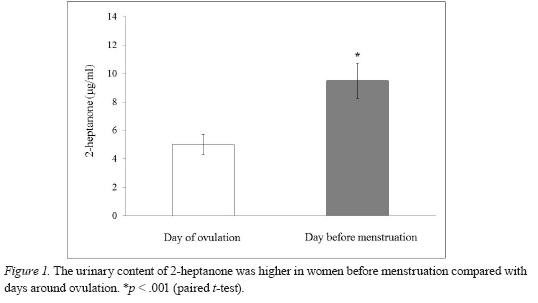
<body><![CDATA[<p style="text-align: justify;" class="MsoNormal"><span  style="font-size: 10pt; font-family: Verdana;" lang="EN-US">The nonparametric Cochran Q test was used for the sensorial emotional questionnaire that was applied after sniffing 2-heptanone. Values of p &#8804; .05 were initially considered statistically significant. As the first step in the analysis, a general profile</span><span  class="A11"><span style="font-size: 11pt;" lang="EN-US"> </span></span><span  class="A11"><span style="font-size: 10pt; font-family: Verdana;"  lang="EN-US">of selected statements was analyzed (six statements, <span  class="SpellE">Bonferroni</span> adjustment, <i>p </i>&#8804; .008). The A, B, and C groups were then compared (<span class="SpellE">Bonferroni</span> adjustment, <i>p </i>&#8804; .01). <span class="GramE">The effect of duration of sniffing (5, 60, and 180 s) on the number of responders for each state­ment was then analyzed (<span class="SpellE">Bonferroni</span> adjustment, <i>p </i>&#8804; <span style="color: windowtext;">.01).</span></span></span></span><span  style="" lang="EN-US"><o:p></o:p></span></p>     <p class="MsoNormal"><b style=""><span  style="font-size: 11pt; font-family: Verdana;" lang="EN-US">Results<o:p></o:p></span></b></p>     <p style="text-align: justify;" class="MsoNormal"><span class="A11"><span  style="font-size: 10pt; font-family: Verdana;" lang="EN-US">Volunteers were classmates, therefore the samples were very similar, except in age, but no statis­tically significant differences were found (<span class="GramE">F<span  class="A15"><span style="">(</span></span></span></span></span><span  class="A15"><span style="font-size: 10pt; font-family: Verdana;"  lang="EN-US">2,136) </span></span><span class="A11"><span  style="font-size: 10pt; font-family: Verdana;" lang="EN-US">= 0.387, <i>p </i>= 0.680).</span></span><span class="A11"><span  style="font-size: 10pt;" lang="EN-US"><o:p></o:p></span></span></p>     <p class="MsoNormal"><b><span  style="font-size: 11pt; font-family: Verdana;" lang="EN-US">Tests</span></b><span  style="font-size: 11pt;" lang="EN-US"><o:p></o:p></span></p>     <p style="text-align: justify;" class="MsoNormal"><span class="A11"><span  style="font-size: 10pt; font-family: Verdana;" lang="EN-US">None of the participants reached the criterion for a diagnosis of premenstrual syndrome, accord­ing to DSR scores (<i>t</i></span></span><span class="A15"><span  style="font-size: 10pt; font-family: Verdana;" lang="EN-US">23 </span></span><span  class="A11"><span style="font-size: 10pt; font-family: Verdana;"  lang="EN-US">= 1348, <i>p </i>= 1.91). The scores on both of the STAI scales indicated mild anxiety, but no significant differences were found between the days around ovulation and premenstrual days (STAI-T: <i>t</i></span></span><span  class="A15"><span style="font-size: 10pt; font-family: Verdana;"  lang="EN-US">23 </span></span><span class="A11"><span  style="font-size: 10pt; font-family: Verdana;" lang="EN-US">= 1.602, <i>p </i>= 0.123; STAI-S: <i>t</i></span></span><span class="A15"><span  style="font-size: 10pt; font-family: Verdana;" lang="EN-US">23 </span></span><span  class="A11"><span style="font-size: 10pt; font-family: Verdana;"  lang="EN-US">= -0.196, <i>p </i>= 0.846). No significant differences were found on the CDQ (<i>t</i></span></span><span  class="A15"><span style="font-size: 10pt; font-family: Verdana;"  lang="EN-US">23 </span></span><span class="A11"><span  style="font-size: 10pt; font-family: Verdana;" lang="EN-US">= 1.750, <i>p </i>= 0.093), in which the scores were within the normal mood range (<a  href="/img/revistas/rcp/v34n1/art01t1.jpg">table 1</a>).</span></span><span  class="A11"><span style="font-size: 10pt;" lang="EN-US"><o:p></o:p></span></span></p>     <p class="MsoNormal"><span class="A11"><b style=""><span  style="font-size: 11pt; font-family: Verdana;" lang="EN-US">Urinary 2-heptanone</span></b></span><b style=""><span style="font-size: 11pt;"  lang="EN-US"><o:p></o:p></span></b></p>     <p style="text-align: justify;" class="MsoNormal"><span class="A11"><span  style="font-size: 10pt; font-family: Verdana;" lang="EN-US">The urinary concentration of 2-heptanone was higher in the samples obtained before menstrua­tion compared with the samples obtained around ovulation (<i>t</i></span></span><span  class="A15"><span style="font-size: 10pt; font-family: Verdana;"  lang="EN-US">23 </span></span><span class="A11"><span  style="font-size: 10pt; font-family: Verdana;" lang="EN-US">= 3.643, <i>p </i>&lt; .001; <a href="/img/revistas/rcp/v34n1/art01i1.jpg">Fig. 1</a>).</span></span><span  class="A11"><span style="font-size: 10pt;" lang="EN-US"><o:p></o:p></span></span></p>     <p class="MsoNormal"><b style=""><span  style="font-size: 11pt; font-family: Verdana;" lang="EN-US">Sniffing 2-heptanone</span></b><b style=""><span style="font-size: 11pt;"  lang="EN-US"><o:p></o:p></span></b></p>     <p class="MsoNormal"><span class="A11"><b><span  style="font-size: 11pt; font-family: Verdana;" lang="EN-US">Sensorial-emotional responses</span></b></span><span style="font-family: Verdana;"  lang="EN-US"><o:p></o:p></span></p>     <p style="text-align: justify;" class="MsoNormal"><span class="A11"><span  style="font-size: 10pt; font-family: Verdana;" lang="EN-US">The general profile of selected statements, independent of group but considering the duration of sniffing, indicated that the majority of the responses after sniffing 2-heptanone for 5 s occurred for statements that explored feelings of pleasure (60.4%) and acceptance (72.9%; Cochran Q test = 75.806,</span></span><span  class="A11"><span style="font-size: 10pt;" lang="EN-US"><o:p></o:p></span></span></p>     ]]></body>
<body><![CDATA[<div style="text-align: justify;"></div>     <p style="text-align: justify;" class="MsoNormal"><span class="SpellE"><span  class="GramE"><span class="A11"><i><span  style="font-size: 10pt; font-family: Verdana;" lang="EN-US">df</span></i></span></span></span><span  class="A11"><i><span style="font-size: 10pt; font-family: Verdana;"  lang="EN-US"> </span></i></span><span class="A11"><span  style="font-size: 10pt; font-family: Verdana;" lang="EN-US">= 5, <i>p </i>&lt; .0001). Similar distributions of responses were observed after sniffing the <span class="SpellE">ketone</span> for 60 s (<i>pleasant </i>= 55.5%, <i>acceptance </i>= 57.7%; Cochran <i>Q </i>test = 47.741, <span class="SpellE"><i>df</i></span><i> </i>= 5, <i>p </i>&lt; .0001); and after sniffing the <span class="SpellE">ketone</span> for 180 s, but with a reduction of responders (<i>pleasant </i>= 39.5%, <i>acceptance </i>= 43.7%; Cochran <i>Q </i>test = 19.951, <span class="SpellE"><i>df</i></span><i> </i>= 5, <i>p </i>&lt; 0.001). Therefore, with the longest duration tested, a reduction of pleasure and acceptance was observed among responders.<o:p></o:p></span></span></p>     <div style="text-align: justify;"></div>     <p style="text-align: justify;" class="MsoNormal"><span class="A11"><span  style="font-size: 10pt; font-family: Verdana;" lang="EN-US">Non-significant differences were found in the number of responders for the following statements among the A, B, and C groups: <i>pleasant </i>(Cochran <i>Q </i>test = 2.000, <span  class="SpellE"><i>df</i></span><i> </i>= 2, <i>p </i>= 0.367), <i>unpleasant </i>(Cochran <i>Q </i>test = 1.000, <span class="SpellE"><i>df</i></span><i> </i>= 2, <i>p </i>= 0.606), <i>relaxed </i>(Cochran <i>Q </i>test = 0.060, <span  class="SpellE"><i>df</i></span><i> </i>= 2, <i>p </i>= 0.970), <i>nervous </i>(Cochran <i>Q </i>test = 2.700, <span class="SpellE"><i>df</i></span><i> </i>= 2, <i>p </i>= 0.259), <i>acceptance </i>(Cochran <i>Q </i>test = 0.787, <span class="SpellE"><i>df</i></span><i> </i>= 2, <i>p </i>= 0.674), and <i>refusal </i>(Cochran <i>Q </i>test = 3.125, <span  class="SpellE"><i>df</i></span><i> </i>= 2, <i>p </i>= 0.209).<o:p></o:p></span></span></p>     <div style="text-align: justify;"></div>     <p style="text-align: justify;" class="MsoNormal"><span class="A11"><span  style="font-size: 10pt; font-family: Verdana;" lang="EN-US">An analysis of duration of sniffing, independent of group, indicated non-significant differences in <i>pleasant </i>(Cochran <i>Q </i>test = 3.257, <span class="SpellE"><i>df</i></span><i> </i>= 2, <i>p </i>= 0.196), <i>unpleasant </i>(Cochran <i>Q </i>test = 0.461, <span class="SpellE"><i>df</i></span><i> </i>= 2, <i>p </i>= 0.793), <i>relaxed </i></span></span><span  style="font-size: 10pt; font-family: Verdana;" lang="EN-US">(<span  class="A11"><span style="">Cochran <i>Q </i>test = 0.001, <span class="SpellE"><i>df</i></span><i> </i>= 2, <i>p </i>= 1.000), <i>nervous </i>(Cochran <i>Q </i>test = 0.375, <span  class="SpellE"><i>df</i></span><i> </i>= 2, <i>p </i>= 0.829), and <i>refusal </i>(Cochran <i>Q </i>test = 4.800, <span class="SpellE"><i>df</i></span><i> </i>= 2, <i>p </i>= 0.090). The only statement with significant differences based on duration of sniffing was acceptance (5 s: 75.5%; 60 s: 57.7%; 180 s: 42.2%; Cochran <i>Q </i>test = 10.242, <span  class="SpellE"><i>df</i></span><i> </i>= 2, <i>p </i>&lt; .005).<o:p></o:p></span></span></span></p>     <p class="MsoNormal"><b style=""><span  style="font-size: 11pt; font-family: Verdana;" lang="EN-US">Discussion</span></b><b  style=""><span style="font-size: 11pt;" lang="EN-US"><o:p></o:p></span></b></p>     <p style="text-align: justify;" class="MsoNormal"><span class="A11"><span  style="font-size: 10pt; font-family: Verdana;" lang="EN-US">The present study sought to determine variations in menstrual cycle-related urinary content of 2-heptanone and sensorial-emotional reactions to sniffing 2-heptanone in young, healthy volunteers in different groups. The urinary content of 2-heptanone was higher before menstruation compared with <span class="SpellE">peri</span>-ovulation days. Therefore, premenstrual increase in urinary release of 2-heptanone observed in this study appears to involve a functional process. Independent of gender, differences in sensation depended on the duration of sniffing: longer inhalation time was associated with less acceptance of sniffing 2-heptanone again.</span></span><span class="A11"><span style="font-size: 10pt;"  lang="EN-US"><o:p></o:p></span></span></p>     <div style="text-align: justify;"></div>     <p style="text-align: justify;" class="MsoNormal"><span class="A11"><span  style="font-size: 10pt; font-family: Verdana;" lang="EN-US">The metabolism of 2-heptanone is well known in some microorganisms, namely fungi (<span class="SpellE">Cakmakci</span> et al., 2013; Gehrig &amp; Knight, 1958; <span class="SpellE">Pasanen</span>, <span class="SpellE">Korpi</span>, <span class="SpellE">Kalliokoski</span> &amp; <span class="SpellE">Pasanen</span>, 1997); it is formed from <span  class="SpellE">octanoic</span> acid (<span class="SpellE">Larroche</span>, 1996; <span class="SpellE">Larroche</span>, <span class="SpellE">Besson</span> &amp; <span class="SpellE">Gros</span>, 1994). This 8-C fatty acid, following a </span></span><span class="A11"><span  style="font-size: 10pt; font-family: Verdana;" lang="ES-CR">&#946;</span></span><span  class="A11"><span style="font-size: 10pt; font-family: Verdana;"  lang="EN-US">-ox­idation process, produces </span></span><span  class="A11"><span style="font-size: 10pt; font-family: Verdana;"  lang="ES-CR">&#946;</span></span><span class="A11"><span  style="font-size: 10pt; font-family: Verdana;" lang="EN-US">-<span  class="SpellE">ketoacids</span>. Once b-<span class="SpellE">ketoacids</span> are <span class="SpellE">decarboxylated</span> through the loss of one carbon, alkan-2 one compounds are formed (<span  class="SpellE">Schaft</span> van <span class="SpellE">der</span>, Burg <span class="SpellE">ter</span>, Bosch van den &amp; Cohen, 1992). <span class="SpellE">Octanoic</span> acid and 2-heptanone, among other compounds, are naturally contained in several nutritional sources (<span class="SpellE">Atasoy</span>, <span  class="SpellE">Hayaloglu</span>, <span class="SpellE">Kirmaci</span>, <span class="SpellE">Levent</span> &amp; <span class="SpellE">Türko<span style="font-family: Tahoma;">&#487;</span>lu</span>, 2013; Delgado, <span class="SpellE">González-Crespo</span>, Cava &amp; <span class="SpellE">Ramírez</span>, 2011; <st1:city w:st="on"><st1:place  w:st="on">Santos</st1:place></st1:city>, <span class="SpellE">Villarino</span>, <span class="SpellE">Zosa</span> &amp; <span class="SpellE">Dayrit</span>, 2011). <span class="SpellE">Octanoic</span> acid enjoys preferential absorption in the gastrointestinal tract, and its transportation into mitochondria for oxidation occurs independently of the <span class="SpellE">carnitine</span> transport system (<span  class="SpellE">Jong-Yeon</span>, <span class="SpellE">Hickner</span>, <span class="SpellE">Dohm</span> &amp; <span class="SpellE">Houmard</span>, 2002; <span class="SpellE">Papamandjaris</span>, Mac­Dougall &amp; Jones, 1998). It is consequently susceptible to metabolic transformation in the human body (<span class="SpellE">Carnielli</span> et al., 1994), suggesting the possibility that 2-heptanone may be formed through fatty acid oxidation. The property of elongation and <span class="SpellE">desaturation</span> of fatty acids also suggests that this <span class="SpellE">ketone</span> may be produced in other organisms. 2-Heptanone is detectable in other mammals (<span class="SpellE">Pohorecky</span> et al., 2008; Wood, 2003), as well as humans (Lacy Costello et al., 2014), though this finding needs to be confirmed.<o:p></o:p></span></span></p>     ]]></body>
<body><![CDATA[<div style="text-align: justify;"></div>     <p style="text-align: justify;" class="MsoNormal"><span class="SpellE"><span  class="A11"><span style="font-size: 10pt; font-family: Verdana;"  lang="EN-US">Cortisol</span></span></span><span class="A11"><span  style="font-size: 10pt; font-family: Verdana;" lang="EN-US"> at physiological concentrations is a potent stimulus of <span class="SpellE">lipolysis</span> in human adipose tissue (<span  class="SpellE">Djurhuus</span> et al., 2002). The release of <span  class="SpellE">cortisol</span> is very sensitive to stress. Independent of gender, sub­jects who are most sensitive to stress also exhibit the highest <span class="SpellE">cortisol</span> response (Childs, <span class="SpellE">Dlugos</span> &amp; De Wit, 2010). <span class="SpellE">Estradiol</span> plasma levels upon awakening peak in the <span class="SpellE">peri-ovulatory</span> phase, whereas progesterone peaks in the early to mid-<span class="SpellE">luteal</span> phase, but <span  class="SpellE">cortisol</span> does not change during the menstrual cycle (<span class="SpellE">Ahn</span> et al., 2011; <span class="SpellE">Gröschl</span>, <span class="SpellE">Rauh</span>, <span class="SpellE">Schmid</span> &amp; <span class="SpellE">Dörr</span>, 2001; <span class="SpellE">Kudielka</span> &amp; <span class="SpellE">Kirschbaum</span>, 2003) or shows slight increases during the mid-<span class="SpellE">luteal</span> phase (<span class="SpellE">Andreano</span>, <span class="SpellE">Arjomandi</span> &amp; Cahill, 2008). In healthy women who are subject­ed to psychosocial stress, the levels of salivary <span class="SpellE">cortisol</span> are positively associated with post-task subjective stress in the <span class="SpellE">luteal</span> phase, whereas the converse association is observed in the follicular phase (Duchesne &amp; <span class="SpellE">Pruessner</span>, 2013). Therefore, <span  class="SpellE">cortisol</span> levels in response to environmental stimuli are higher during the follicular phase than during the <span class="SpellE">luteal</span> phase. <span class="SpellE">Cortisol</span> levels increase in anxious women who are subject­ed to a stressful situation, particularly during their follicular phase (<span class="SpellE">Hlavacova</span>, <span class="SpellE">Wawruch</span>, <span class="SpellE">Tisonova</span> &amp; <span class="SpellE">Jezova</span>, 2008), which may increase the likelihood of <span class="SpellE">lipolysis</span>, which in turn may explain the increased amount of urine 2-heptanone before menstruation in our study.<o:p></o:p></span></span></p>     <div style="text-align: justify;"></div>     <p style="text-align: justify;" class="MsoNormal"><span class="A11"><span  style="font-size: 10pt; font-family: Verdana;" lang="EN-US">In this study, we did not measure the concentration of 2-heptanone that was actually sniffed. However, we maintained the same concentration of 2-heptanone for all of the groups and changed sniff­ing durations in the different groups of volunteers. In mice, the threshold concentration for perceiving 2-heptanone is approximately 10</span></span><span  class="A16"><span style="font-size: 10pt; font-family: Verdana;"  lang="EN-US">-11</span></span><span class="A11"><span  style="font-size: 10pt; font-family: Verdana;" lang="EN-US">-10</span></span><span  class="A16"><span style="font-size: 10pt; font-family: Verdana;"  lang="EN-US">-10 </span></span><span class="A11"><span  style="font-size: 10pt; font-family: Verdana;" lang="EN-US">M (<span  class="SpellE">Leinders-Zufall</span> et al., 2000). A similar concentration pro­duces changes in extracellular recordings of the basal <span class="SpellE">amygdala</span> in rats (Contreras, <span class="SpellE">Gutiérrez-García</span>, Molina-<span class="SpellE">Jiménez</span> &amp; Mendoza-<span  class="SpellE">López</span>, 2012).<o:p></o:p></span></span></p>     <div style="text-align: justify;"></div>     <p style="text-align: justify;" class="MsoNormal"><span class="A11"><span  style="font-size: 10pt; font-family: Verdana;" lang="EN-US">Although 2-heptanone is considered an alarm pheromone (<span class="SpellE">Gutiérrez-García</span> et al., 2007), we did not find any changes in nervous/relaxed states, which may indicate that sniffing 2-heptanone did not produce any signs of anxiety in humans rather than more subtle sensations. Anxiety may be considered an adaptive response (<span  class="SpellE">Guti<span style="color: black;">e&#769;</span>rrez-Garc<span  style="color: black;">i&#769;</span>a</span> &amp; Contreras, 2013). In rodents that are subjected to unavoid­able stress, the urinary delivery of 2-heptanone is reduced by a benzodiazepine (<span class="SpellE">Gutiérrez-García</span> et al., 2006), indicating that 2-heptanone delivery has two complementary meanings: (a) as a chemical signal that indicates the presence of danger and (b) the subject that emits the <span class="SpellE">ketone</span> into its environment expe­riences some degree of adaptive anxiety, and the receptor individual supposedly reacts according to the duration of exposure.<o:p></o:p></span></span></p>     <div style="text-align: justify;"></div>     <p style="text-align: justify;" class="MsoNormal"><span  style="font-size: 10pt; font-family: Verdana;" lang="EN-US">Chemosensory anxiety signals may be mediated by the olfactory system and activate many areas of the human brain (<span  class="SpellE">Prehn-Kristensen</span> et al., 2009). In rats, exposed to an alarm pheromone, <span class="SpellE">Fos</span> expres­sion increases in the anterior-division lateral and medial areas of the bed nucleus of the <span  class="SpellE">stria</span> <span class="SpellE">terminalis</span>, <span  class="SpellE">paraventricular</span> nucleus, <span class="SpellE">dorsomedial</span> hypothalamic nucleus, <span class="SpellE">anterodorsal</span> medial, lateral and <span class="SpellE">basolateral</span> <span class="SpellE">amygdaloid</span> nucleus, <span class="SpellE">ventrolateral</span> <span  class="SpellE">periaqueductal</span> gray matter, <span class="SpellE">laterodorsal</span> <span  class="SpellE">tegmental</span> nucleus, and locus <span class="SpellE">coeruleus</span> (<span  class="SpellE">Kiyokawa</span>, <span class="SpellE">Kikusui</span>, Takeuchi &amp; Mori, 2005). In mice, the olfactory system receptors have been identified (<span class="SpellE">Xu</span> et al., 2005). In other mammals, similar receptor systems may exist, with informa­tion reaching deep temporal lobe structures. The <span  class="SpellE">amygdala</span> has been shown to be activated in volunteers who sniffed human sweat samples from donors who were subjected to emotional stress (<span class="SpellE">Mujica-Parodi</span> et al., 2009). The <span class="SpellE">amygdala</span> complex and hippocampus constitute an anatomical substrate of emotional memory (Paz &amp; Pare, 2013; Phelps, 2002), and connections between the olfactory system and <span  class="SpellE">amygda­la</span> complex have been reported (<span  class="SpellE">Gutiérrez-Castellanos</span>, <span class="SpellE">Martínez</span>-Marcos, <span class="SpellE">Martínez-García</span> &amp; <span class="SpellE">Lanuza</span>, 2010). Moreover, the actions of 2-heptanone on this circuit and on the <span class="SpellE">vomeronasal</span> organ have been reported (Contreras et al., 2012; Contreras, <span  class="SpellE">Gutiérrez-García</span> &amp; Molina-<span  class="SpellE">Jiménez</span>, 2013; Molina-<span class="SpellE">Jiménez</span>, <span class="SpellE">Gutiérrez-García</span> &amp; Contreras, 2013). The lowered acceptance by volunteers who sniffed 2-heptanone for a relatively long time (180 s) seemingly involves the temporal lobe <span class="SpellE">amygdala</span> complex and its olfac­tory connections, thus providing an emotional experience.</span><span style=""  lang="EN-US"><o:p></o:p></span></p>     <div style="text-align: justify;"></div>     <p style="text-align: justify;" class="MsoNormal"><span class="A11"><span  style="font-size: 10pt; font-family: Verdana;" lang="EN-US">Sweat from anxious men may induce anxiety in females who sniff it (Albrecht et al., 2010), par­ticularly in socially anxious females (Pause, Adolph, <span class="SpellE">Prehn-Kristensen</span> &amp; <span class="SpellE">Ferstl</span>, 2009; <span class="SpellE">Prehn</span>, <span class="SpellE">Ohrt</span>, <span class="SpellE">Sojka</span>, <span  class="SpellE">Ferstl</span> &amp; Pause, 2006) or when the donors are stressed female volunteers (<span  class="SpellE">Ackerl</span>, <span class="SpellE">Atzmueller</span> &amp; <span class="SpellE">Grammer</span>, 2002). However, no differences by sex were observed in the perception of odors when the scent stimulus came from females (but not so from males) who experienced a "happy situation". When the stimulus came from individuals who experienced a "scary situation", both sexes identified the stim­ulus as coming from men (but not from women) (Chen &amp; <span class="SpellE">Haviland</span>-Jones, 2000). Female sweat samples from anxious individuals also decreased the positive priming of face perception (Pause, <span class="SpellE">Ohrt</span>, <span class="SpellE">Prehn</span> &amp; <span class="SpellE">Ferstl</span>, 2004).</span></span><span  class="A11"><span style="font-size: 10pt;" lang="EN-US"><o:p></o:p></span></span></p>     ]]></body>
<body><![CDATA[<p style="text-align: justify;" class="MsoNormal"><span class="A11"><span  style="font-size: 10pt; font-family: Verdana;" lang="EN-US">Notably, in these studies the source of the scents did not include 2-heptanone. Nonetheless, the observations suggest some sex differences in the identification of scents. However, we did not observe any such differences. Our interpretation of the present results is based on the lowering of acceptance to smell 2-heptanone again with the longest sniffing duration. We did not explore specific sex differences in acceptance. Although women are more sensitive to male odors (Singh &amp; <span  class="SpellE">Bronstad</span>, 2001), their olfac­tory threshold is highest during the active menstrual phase compared with other phases of the menstrual cycle (<span class="SpellE">Navarrete</span>-Palacios, Hudson, Reyes-Guerrero &amp; Guevara-<span class="SpellE">Guzmán</span>, 2003), which may help ex­plain the similarities found in responses between sexes when they inhaled 2-heptanone.<o:p></o:p></span></span></p>     <div style="text-align: justify;"></div>     <p style="text-align: justify;" class="MsoNormal"><span class="A11"><span  style="font-size: 10pt; font-family: Verdana;" lang="EN-US">Our study has two limitations. First, the menstrual cycle was controlled based solely on changes in body temperature. We did not perform any other precise measures (e.g., analysis of vaginal mucus or hormonal plasma levels). Therefore, ovulation was only inferred. However, in this part of the study, we employed a longitudinal design, in which the same volunteers underwent two stages of the study, includ­ing urine collection. Second, we did not include a structured questionnaire to explore sensory-emotional responses in the volunteers who sniffed 2-heptanone. We simply asked the volunteers to mark previous­ly elaborated phrases. However, they were free to select between affirmative and negative responses and to leave some answers blank. Importantly, the results were obtained from different groups of volunteers who were asked to sniff the <span class="SpellE">ketone</span> for different lengths of time.<o:p></o:p></span></span></p>     <div style="text-align: justify;"></div>     <p style="text-align: justify;" class="MsoNormal"><span class="A11"><span  style="font-size: 10pt; font-family: Verdana;" lang="EN-US">In conclusion, healthy young women exhibited an increase in urinary 2-heptanone content before menstruation, which may be considered a part of functional changes preceding menstruation, and a rel­atively long period of time sniffing 2-heptanone decreased feelings of acceptance in healthy volunteers.<o:p></o:p></span></span></p>     <p class="MsoNormal"><b style=""><span  style="font-size: 11pt; font-family: Verdana;" lang="EN-US"></span></b></p> <hr style="width: 100%; height: 2px;">     <p class="MsoNormal"><b style=""><span  style="font-size: 11pt; font-family: Verdana;" lang="EN-US">References</span></b><b  style=""><span style="font-size: 11pt;" lang="EN-US"><o:p></o:p></span></b></p>     <!-- ref --><p class="MsoNormal"><span class="SpellE"><span  style="font-size: 10pt; font-family: Verdana;" lang="EN-US">Achiraman</span></span><span  style="font-size: 10pt; font-family: Verdana;" lang="EN-US">, S., <span class="SpellE">Archunan</span>, G., <span class="SpellE">Sankarganesh</span>, D., <span class="SpellE">Rajagopal</span>, T., <span class="SpellE">Rengarajan</span>, R. L., <span class="SpellE">Kokilavani</span>, P., ..., &amp; <span  class="SpellE">Kannan</span>, S. (Aug, 2011). Biochemical analysis of female mice urine with reference to endocrine function: a key tool for estrus detection. <i>Zoological Science, 28</i>(8), 600-605. http://dx.doi.org/10.2108/zsj.28.600.    &nbsp;&nbsp;&nbsp;&nbsp;&nbsp;&nbsp;&nbsp;&nbsp;[&#160;<a href="javascript:void(0);" onclick="javascript: window.open('/scielo.php?script=sci_nlinks&ref=793297&pid=S1659-2913201500010000200001&lng=','','width=640,height=500,resizable=yes,scrollbars=1,menubar=yes,');">Links</a>&#160;]<!-- end-ref --> <o:p></o:p></span></p>     <!-- ref --><p class="MsoNormal"><span class="SpellE"><span  style="font-size: 10pt; font-family: Verdana;" lang="EN-US">Ackerl</span></span><span  style="font-size: 10pt; font-family: Verdana;" lang="EN-US">, K., <span class="SpellE">Atzmueller</span>, M., &amp; <span  class="SpellE">Grammer</span>, K. (Apr, 2002). <span class="GramE">The scent of fear.</span> <span  class="SpellE"><i>Neuroendocrinology</i></span><i> Letters, 23</i>(2), 79-84. <span class="GramE">Retrieved from http://bit.ly/1dCACMi.    &nbsp;&nbsp;&nbsp;&nbsp;&nbsp;&nbsp;&nbsp;&nbsp;[&#160;<a href="javascript:void(0);" onclick="javascript: window.open('/scielo.php?script=sci_nlinks&ref=793299&pid=S1659-2913201500010000200002&lng=','','width=640,height=500,resizable=yes,scrollbars=1,menubar=yes,');">Links</a>&#160;]<!-- end-ref --></span><o:p></o:p></span></p>     <!-- ref --><p class="MsoNormal"><span class="SpellE"><span  style="font-size: 10pt; font-family: Verdana;" lang="EN-US">Ahn</span></span><span  style="font-size: 10pt; font-family: Verdana;" lang="EN-US">, R. S., <span  class="SpellE">Choi</span>, J. H., <span class="SpellE">Choi</span>, B. C., Kim, J. H., Lee, S. H., &amp; Sung, S. S. (Dec, 2011). <span class="SpellE"><span  class="GramE">Cortisol</span></span><span class="GramE">, estradiol-17<span  style="" lang="ES-CR">&#946;</span>, and progesterone secretion within the first hour after awakening in women with regular menstrual cycles.</span> <i>Journal of Endocrinology, 211</i>(3), 285-295. <span  class="SpellE"><span class="GramE">doi</span></span>: 10.1530/JOE-11-0247 Retrieved from http://bit.ly/1JZVclR.    &nbsp;&nbsp;&nbsp;&nbsp;&nbsp;&nbsp;&nbsp;&nbsp;[&#160;<a href="javascript:void(0);" onclick="javascript: window.open('/scielo.php?script=sci_nlinks&ref=793301&pid=S1659-2913201500010000200003&lng=','','width=640,height=500,resizable=yes,scrollbars=1,menubar=yes,');">Links</a>&#160;]<!-- end-ref --><o:p></o:p></span></p>     <!-- ref --><p class="MsoNormal"><span  style="font-size: 10pt; font-family: Verdana;" lang="EN-US">Albrecht, J., <span class="SpellE">Demmel</span>, M., <span class="SpellE">Schöpf</span>, V., <span class="SpellE">Kleemann</span>, A. M., <span class="SpellE">Kopietz</span>, R., May, J.<span class="GramE">, ...,</span> &amp; <span class="SpellE">Wiesmann</span>, M. (Jan, 2010). Smelling chemosensory signals of males in anxious versus <span class="SpellE">nonaxious</span> condition increases state anxiety of female subjects. <i>Chemical Senses, 36</i>(1), 19-27. <span class="SpellE"><span class="GramE">doi</span></span>: 10.1093/chemse/bjq087 Retrieved from http://bit.ly/1ADrsJt.    &nbsp;&nbsp;&nbsp;&nbsp;&nbsp;&nbsp;&nbsp;&nbsp;[&#160;<a href="javascript:void(0);" onclick="javascript: window.open('/scielo.php?script=sci_nlinks&ref=793303&pid=S1659-2913201500010000200004&lng=','','width=640,height=500,resizable=yes,scrollbars=1,menubar=yes,');">Links</a>&#160;]<!-- end-ref --><o:p></o:p></span></p>     <!-- ref --><p class="MsoNormal"><span class="SpellE"><span  style="font-size: 10pt; font-family: Verdana;" lang="EN-US">Andreano</span></span><span  style="font-size: 10pt; font-family: Verdana;" lang="EN-US">, J. M., <span class="SpellE">Arjomandi</span>, H., &amp; Cahill, L. (Jul, 2008). Menstrual cycle modulation of the relationship between <span  class="SpellE">cortisol</span> and long-term memory. <span class="SpellE"><i>Psychoneuroendocrinology</i></span><i>, 33</i>(6), 874-882. <span class="SpellE">doi</span>: 10.1016/j.psyneuen.2008.03.009 Retrieved from http://bit.ly/1LOX9R7.    &nbsp;&nbsp;&nbsp;&nbsp;&nbsp;&nbsp;&nbsp;&nbsp;[&#160;<a href="javascript:void(0);" onclick="javascript: window.open('/scielo.php?script=sci_nlinks&ref=793305&pid=S1659-2913201500010000200005&lng=','','width=640,height=500,resizable=yes,scrollbars=1,menubar=yes,');">Links</a>&#160;]<!-- end-ref --><o:p></o:p></span></p>     <!-- ref --><p class="MsoNormal"><span class="SpellE"><span  style="font-size: 10pt; font-family: Verdana;" lang="EN-US">Atasoy</span></span><span  style="font-size: 10pt; font-family: Verdana;" lang="EN-US">, A. F., <span class="SpellE">Hayaloglu</span>, A. A., <span  class="SpellE">Kirmaci</span>, H., <span class="SpellE">Levent</span>, O. &amp; <span class="SpellE">Türko<span  style="font-family: Tahoma;">&#487;</span>lu</span>, H. (Oct, 2013). Effects of partial substitution of <span class="SpellE">caprine</span> for ovine milk on the volatile compounds of fresh and mature Urfa cheeses. <i>Small Ruminant Research, 115</i>(1-3), 113-123. http://dx.doi.org/10.1016/j.smallrumres.2013.09.002.    &nbsp;&nbsp;&nbsp;&nbsp;&nbsp;&nbsp;&nbsp;&nbsp;[&#160;<a href="javascript:void(0);" onclick="javascript: window.open('/scielo.php?script=sci_nlinks&ref=793307&pid=S1659-2913201500010000200006&lng=','','width=640,height=500,resizable=yes,scrollbars=1,menubar=yes,');">Links</a>&#160;]<!-- end-ref --><o:p></o:p></span></p>     <!-- ref --><p class="MsoNormal"><span class="SpellE"><span  style="font-size: 10pt; font-family: Verdana;" lang="EN-US">Cakmakci</span></span><span  style="font-size: 10pt; font-family: Verdana;" lang="EN-US">, S., <span class="SpellE">Dagdemir</span>, E., <span class="SpellE">Hayaloglu</span>, A. A., <span class="SpellE">Gurses</span>, M., Cetin, B. &amp; <span  class="SpellE">Tahmas-Kahyaoglu</span>, D. (Aug, 2013). Effect of <span  class="SpellE">Penicillium</span> <span class="SpellE">roqueforti</span> and incorporation of whey cheese on volatile profiles and sensory characteristics of mould-ripened Civil cheese<i>. International Journal of Dairy Technology, 66</i>(4), 512-526. <span class="SpellE">doi</span>: 10.1111/1471-0307.12069 Retrieved from http://bit.ly/1Fflxpw.    &nbsp;&nbsp;&nbsp;&nbsp;&nbsp;&nbsp;&nbsp;&nbsp;[&#160;<a href="javascript:void(0);" onclick="javascript: window.open('/scielo.php?script=sci_nlinks&ref=793309&pid=S1659-2913201500010000200007&lng=','','width=640,height=500,resizable=yes,scrollbars=1,menubar=yes,');">Links</a>&#160;]<!-- end-ref --><o:p></o:p></span></p>     <!-- ref --><p class="MsoNormal"><span  style="font-size: 10pt; font-family: Verdana;" lang="ES-CR">Calderón <span class="SpellE">Narvaez</span>, G. (1992). Cuestionario clínico para el diagnóstico de los cuadros depresivos. <i>Revista Médica IMSS, 30, </i>377-380.    &nbsp;&nbsp;&nbsp;&nbsp;&nbsp;&nbsp;&nbsp;&nbsp;[&#160;<a href="javascript:void(0);" onclick="javascript: window.open('/scielo.php?script=sci_nlinks&ref=793311&pid=S1659-2913201500010000200008&lng=','','width=640,height=500,resizable=yes,scrollbars=1,menubar=yes,');">Links</a>&#160;]<!-- end-ref --> <o:p></o:p></span></p>     <!-- ref --><p class="MsoNormal"><span  style="font-size: 10pt; font-family: Verdana;" lang="ES-CR">Carnielli, V. P., Sulkers, E. J., Moretti, C., Wattimena, J. L., Goudoever van, J. B., Degenhart, H. J., …, &amp; Sauer, P. J. (Oct, 1994). </span><span  style="font-size: 10pt; font-family: Verdana;" lang="EN-US">Conversion of <span class="SpellE">octanoic</span> acid into long-chain saturated fatty acids in premature infants fed a formula containing medium-chain triglycerides. Metabolism: <i>Clinical and Experimental, 43</i>(10), 1287-1292. Retrieved from http://bit.ly/1RwyrIj.    &nbsp;&nbsp;&nbsp;&nbsp;&nbsp;&nbsp;&nbsp;&nbsp;[&#160;<a href="javascript:void(0);" onclick="javascript: window.open('/scielo.php?script=sci_nlinks&ref=793313&pid=S1659-2913201500010000200009&lng=','','width=640,height=500,resizable=yes,scrollbars=1,menubar=yes,');">Links</a>&#160;]<!-- end-ref --> <o:p></o:p></span></p>     <!-- ref --><p class="MsoNormal"><span  style="font-size: 10pt; font-family: Verdana;" lang="EN-US">Chen, D., &amp; Haviland-Jones, J. (Dec, 2000). Human olfactory communication of emotion. <i>Perceptual and Motor Skills, 91</i>(3 Pt 1), 771-781. <span class="SpellE">doi</span>: 10.2466/pms.2000.91.3.771.    &nbsp;&nbsp;&nbsp;&nbsp;&nbsp;&nbsp;&nbsp;&nbsp;[&#160;<a href="javascript:void(0);" onclick="javascript: window.open('/scielo.php?script=sci_nlinks&ref=793315&pid=S1659-2913201500010000200010&lng=','','width=640,height=500,resizable=yes,scrollbars=1,menubar=yes,');">Links</a>&#160;]<!-- end-ref --><o:p></o:p></span></p>     <!-- ref --><p class="MsoNormal"><span  style="font-size: 10pt; font-family: Verdana;" lang="EN-US">Childs, E., <span class="SpellE">Dlugos</span>, A., &amp; De Wit, H. (May, 2010). Cardiovascular, hormonal, and emotional responses to the TSST in relation to sex and menstrual cycle phase. <i>Psychophysiology, 47</i>(3), 550-559. <span class="SpellE">doi</span>: 10.1111/j.1469-8986.2009.00961.x Retrieved from http://bit.ly/1coDmeL.    &nbsp;&nbsp;&nbsp;&nbsp;&nbsp;&nbsp;&nbsp;&nbsp;[&#160;<a href="javascript:void(0);" onclick="javascript: window.open('/scielo.php?script=sci_nlinks&ref=793317&pid=S1659-2913201500010000200011&lng=','','width=640,height=500,resizable=yes,scrollbars=1,menubar=yes,');">Links</a>&#160;]<!-- end-ref --><o:p></o:p></span></p>     <!-- ref --><p class="MsoNormal"><span  style="font-size: 10pt; font-family: Verdana;">Contreras, C. M., Gutiérrez-García, A. G. &amp; Molina-Jiménez, T. (Sep, 2013). </span><span  style="font-size: 10pt; font-family: Verdana;" lang="EN-US">Anterior olfactory organ removal produces anxiety-like behavior and increases spontaneous neuronal firing rate in basal <span class="SpellE">amygdala</span>. <span class="SpellE"><i>Behavioural</i></span><i> Brain Research, 252</i>, 101-109. doi:10.1016/j.bbr.2013.05.037 Retrieved from http://bit.ly/1BvifOj.    &nbsp;&nbsp;&nbsp;&nbsp;&nbsp;&nbsp;&nbsp;&nbsp;[&#160;<a href="javascript:void(0);" onclick="javascript: window.open('/scielo.php?script=sci_nlinks&ref=793319&pid=S1659-2913201500010000200012&lng=','','width=640,height=500,resizable=yes,scrollbars=1,menubar=yes,');">Links</a>&#160;]<!-- end-ref --><o:p></o:p></span></p>     <!-- ref --><p class="MsoNormal"><span  style="font-size: 10pt; font-family: Verdana;" lang="ES-CR">Contreras, C. M., Gutiérrez-García, A. G., Molina-Jiménez, T., &amp; Mendoza-López, M. R. (<span class="SpellE">Aug</span>, 2012). </span><span  style="font-size: 10pt; font-family: Verdana;" lang="EN-US">2-Heptanone increases the firing rate of the basal <span class="SpellE">amygdala</span>: role of anterior olfactory epithelial organs. <span class="SpellE"><i>Neuropsychobiology</i></span><i>, 66</i>(3), 167-173. <span class="SpellE">doi</span>: 10.1159/000339946 Retrieved from http://bit.ly/1Rwymo3.    &nbsp;&nbsp;&nbsp;&nbsp;&nbsp;&nbsp;&nbsp;&nbsp;[&#160;<a href="javascript:void(0);" onclick="javascript: window.open('/scielo.php?script=sci_nlinks&ref=793321&pid=S1659-2913201500010000200013&lng=','','width=640,height=500,resizable=yes,scrollbars=1,menubar=yes,');">Links</a>&#160;]<!-- end-ref --><o:p></o:p></span></p>     <!-- ref --><p class="MsoNormal"><span  style="font-size: 10pt; font-family: Verdana;" lang="EN-US">Delgado, F. J., <span class="SpellE">González-Crespo</span>, J., Cava, R., &amp; <span class="SpellE">Ramírez</span>, R. (Dec, 2011). Formation of the aroma of a raw goat milk cheese during maturation <span  class="SpellE">analysed</span> by SPME-GC-MS. <i>Food Chemistry, 129</i>(3), 1156-1163. doi:10.1016/j.foodchem.2011.05.096 Retrieved fromhttp://bit.ly/1HYb1as.    &nbsp;&nbsp;&nbsp;&nbsp;&nbsp;&nbsp;&nbsp;&nbsp;[&#160;<a href="javascript:void(0);" onclick="javascript: window.open('/scielo.php?script=sci_nlinks&ref=793323&pid=S1659-2913201500010000200014&lng=','','width=640,height=500,resizable=yes,scrollbars=1,menubar=yes,');">Links</a>&#160;]<!-- end-ref --><o:p></o:p></span></p>     <!-- ref --><p class="MsoNormal"><span class="SpellE"><span  style="font-size: 10pt; font-family: Verdana;" lang="EN-US">Derntl</span></span><span  style="font-size: 10pt; font-family: Verdana;" lang="EN-US">, B., <span class="SpellE">Kryspin-Exner</span>, I., <span  class="SpellE">Fernbach</span>, E., Moser, E., &amp; <span class="SpellE">Habel</span>, U. (Jan, 2008a). Emotion recognition accuracy in healthy young females is associated with cycle phase. <i>Hormones and Behavior, 53</i>(1), 90-95. doi:10.1016/j.yhbeh.2007.09.006 Retrieved from http://bit.ly/1SHEifC.    &nbsp;&nbsp;&nbsp;&nbsp;&nbsp;&nbsp;&nbsp;&nbsp;[&#160;<a href="javascript:void(0);" onclick="javascript: window.open('/scielo.php?script=sci_nlinks&ref=793325&pid=S1659-2913201500010000200015&lng=','','width=640,height=500,resizable=yes,scrollbars=1,menubar=yes,');">Links</a>&#160;]<!-- end-ref --> <o:p></o:p></span></p>     <!-- ref --><p class="MsoNormal"><span class="SpellE"><span  style="font-size: 10pt; font-family: Verdana;" lang="EN-US">Derntl</span></span><span  style="font-size: 10pt; font-family: Verdana;" lang="EN-US">, B., <span class="SpellE">Windischberger</span>, C., Robinson, S., <span  class="SpellE">Lamplmayr</span>, E., <span class="SpellE">Kryspin-Exner</span>, <st1:place w:st="on">I.</st1:place>, <span class="SpellE">Gur</span>, R.C., …, &amp; <span class="SpellE">Habel</span>, U. (Sep, 2008b). Facial emotion recognition and <span class="SpellE">amygdala</span> activation are associated with menstrual cycle phase. <span class="SpellE"><i>Psychoneuroendocrinology</i></span><i>, 33</i>(8), 1031-1040. doi:10.1016/j.psyneuen.2008.04.014 Retrieved from http://bit.ly/1GKzfX1.    &nbsp;&nbsp;&nbsp;&nbsp;&nbsp;&nbsp;&nbsp;&nbsp;[&#160;<a href="javascript:void(0);" onclick="javascript: window.open('/scielo.php?script=sci_nlinks&ref=793327&pid=S1659-2913201500010000200016&lng=','','width=640,height=500,resizable=yes,scrollbars=1,menubar=yes,');">Links</a>&#160;]<!-- end-ref --><o:p></o:p></span></p>     <!-- ref --><p class="MsoNormal"><span class="SpellE"><span  style="font-size: 10pt; font-family: Verdana;" lang="EN-US">Distel</span></span><span  style="font-size: 10pt; font-family: Verdana;" lang="EN-US">, H., <span class="SpellE">Ayabe-Kanamura</span>, S., <span  class="SpellE">Martínez-Gómez</span>, M., <span class="SpellE">Schicker</span>, <st1:place w:st="on">I.</st1:place>, <span class="SpellE">Kobayakawa</span>, T., Saito, S., &amp; Hudson, R. (Apr, 1999). Perception of everyday odors: correlation between intensity, familiarity and strength of hedonic <span class="SpellE">judgement</span>. <i>Chemical Senses, 24</i>(2), 191-199. <span class="SpellE">doi</span>: 10.1093/chemse/24.2.191. Retrieved from http://bit.ly/1Ku5rwL.    &nbsp;&nbsp;&nbsp;&nbsp;&nbsp;&nbsp;&nbsp;&nbsp;[&#160;<a href="javascript:void(0);" onclick="javascript: window.open('/scielo.php?script=sci_nlinks&ref=793329&pid=S1659-2913201500010000200017&lng=','','width=640,height=500,resizable=yes,scrollbars=1,menubar=yes,');">Links</a>&#160;]<!-- end-ref --><o:p></o:p></span></p>     <!-- ref --><p class="MsoNormal"><span class="SpellE"><span  style="font-size: 10pt; font-family: Verdana;" lang="EN-US">Djurhuus</span></span><span  style="font-size: 10pt; font-family: Verdana;" lang="EN-US">, C. B., <span class="SpellE">Gravholt</span>, C. H., Nielsen, S., <span  class="SpellE">Mengel</span>, A., Christiansen, J. S., Schmitz, O. E., &amp; <span class="SpellE">Møller</span>, N. (Jul, 2002). Effects of <span  class="SpellE">cortisol</span> on <span class="SpellE">lipolysis</span> and regional interstitial glycerol levels in humans. <i>American Journal of Physiology and Endocrinology Metabolism, 283</i>(1), E172-E177. <span class="SpellE">Doi</span>: 10.1152/ajpendo.00544.2001. Retrieved from http://bit.ly/1dCAsEw.    &nbsp;&nbsp;&nbsp;&nbsp;&nbsp;&nbsp;&nbsp;&nbsp;[&#160;<a href="javascript:void(0);" onclick="javascript: window.open('/scielo.php?script=sci_nlinks&ref=793331&pid=S1659-2913201500010000200018&lng=','','width=640,height=500,resizable=yes,scrollbars=1,menubar=yes,');">Links</a>&#160;]<!-- end-ref --><o:p></o:p></span></p>     <!-- ref --><p class="MsoNormal"><span  style="font-size: 10pt; font-family: Verdana;" lang="EN-US">Duchesne, A., &amp; <span class="SpellE">Pruessner</span>, J. C. (Dec, 2013). Association between subjective and <span  class="SpellE">cortisol</span> stress response depends on the menstrual cycle phase. <span  class="SpellE"><i>Psychoneuroendocrinology</i></span><i>, 38</i>(12), 3155-3159. <span class="SpellE">doi</span>: 10.1016/j.psyneuen.2013.08.009 Retrieved from http://bit.ly/1Ku5t7L.    &nbsp;&nbsp;&nbsp;&nbsp;&nbsp;&nbsp;&nbsp;&nbsp;[&#160;<a href="javascript:void(0);" onclick="javascript: window.open('/scielo.php?script=sci_nlinks&ref=793333&pid=S1659-2913201500010000200019&lng=','','width=640,height=500,resizable=yes,scrollbars=1,menubar=yes,');">Links</a>&#160;]<!-- end-ref --><o:p></o:p></span></p>     <!-- ref --><p class="MsoNormal"><span  style="font-size: 10pt; font-family: Verdana;" lang="EN-US">Freeman, E. W., <span class="SpellE">DeRubeis</span>, R. J., &amp; <span class="SpellE">Rickels</span>, K. (Nov, 1996). Reliability and validity of a daily diary for premenstrual syndrome. <i>Psychiatry Research, 65</i>(2), 97-106. doi:10.1016/S0165-1781(96)02929-0. Retrieved from http://bit.ly/1ADrfFS.    &nbsp;&nbsp;&nbsp;&nbsp;&nbsp;&nbsp;&nbsp;&nbsp;[&#160;<a href="javascript:void(0);" onclick="javascript: window.open('/scielo.php?script=sci_nlinks&ref=793335&pid=S1659-2913201500010000200020&lng=','','width=640,height=500,resizable=yes,scrollbars=1,menubar=yes,');">Links</a>&#160;]<!-- end-ref --><o:p></o:p></span></p>     <!-- ref --><p class="MsoNormal"><span  style="font-size: 10pt; font-family: Verdana;" lang="EN-US">Gallagher, M., <span class="SpellE">Wysocki</span>, C. J., <st1:place w:st="on">Leyden</st1:place>, J. J., <span  class="SpellE">Spielman</span>, A. I., Sun, X., &amp; <span class="SpellE">Preti</span>, G. (Sep, 2008). Analyses of volatile organic compounds from human skin. <i>British Journal of Dermatology, 159</i>(4), 780-791. <span class="SpellE">doi</span>: 10.1111/j.1365-2133.2008.08748.x Retrieved from http://1.usa.gov/1eEzYOv.    &nbsp;&nbsp;&nbsp;&nbsp;&nbsp;&nbsp;&nbsp;&nbsp;[&#160;<a href="javascript:void(0);" onclick="javascript: window.open('/scielo.php?script=sci_nlinks&ref=793337&pid=S1659-2913201500010000200021&lng=','','width=640,height=500,resizable=yes,scrollbars=1,menubar=yes,');">Links</a>&#160;]<!-- end-ref --><o:p></o:p></span></p>     <!-- ref --><p class="MsoNormal"><span  style="font-size: 10pt; font-family: Verdana;" lang="EN-US">Gehrig, R. F., &amp; Knight, S. G. (Nov, 1958). Formation of <span class="SpellE">ketones</span> from fatty acids by spores of <span class="SpellE">Penicillium</span> <span class="SpellE">roqueforti</span>. <i>Nature, 182</i>(4644), 1237. doi:10.1038/1821237a0 <o:p></o:p></span>&nbsp;&nbsp;&nbsp;&nbsp;&nbsp;&nbsp;&nbsp;&nbsp;[&#160;<a href="javascript:void(0);" onclick="javascript: window.open('/scielo.php?script=sci_nlinks&ref=793339&pid=S1659-2913201500010000200022&lng=','','width=640,height=500,resizable=yes,scrollbars=1,menubar=yes,');">Links</a>&#160;]<!-- end-ref --><!-- ref --><p class="MsoNormal"><span class="SpellE"><span  style="font-size: 10pt; font-family: Verdana;" lang="EN-US">Gildersleeve</span></span><span  style="font-size: 10pt; font-family: Verdana;" lang="EN-US">, K. A., <span class="SpellE">Haselton</span>, M. G., Larson, C. M., &amp; <span class="SpellE">Pillsworth</span>, E. G. (Feb, 2012). Body odor attractiveness as a cue of impending ovulation in women: evidence from a study using hormone-confirmed ovulation. <i>Hormones and Behavior, 61</i>(2), 157-166. <span class="SpellE">doi</span>: 10.1016/j.yhbeh.2011.11.005. Retrieved from http://bit.ly/1J9y7xL.    &nbsp;&nbsp;&nbsp;&nbsp;&nbsp;&nbsp;&nbsp;&nbsp;[&#160;<a href="javascript:void(0);" onclick="javascript: window.open('/scielo.php?script=sci_nlinks&ref=793340&pid=S1659-2913201500010000200023&lng=','','width=640,height=500,resizable=yes,scrollbars=1,menubar=yes,');">Links</a>&#160;]<!-- end-ref --><o:p></o:p></span></p>     <!-- ref --><p class="MsoNormal"><span class="SpellE"><span  style="font-size: 10pt; font-family: Verdana;" lang="EN-US">Gröschl</span></span><span  style="font-size: 10pt; font-family: Verdana;" lang="EN-US">, M., <span class="SpellE">Rauh</span>, M., <span class="SpellE">Schmid</span>, P. &amp; <span class="SpellE">Dörr</span> HG. (Sep, 2001). Relationship between salivary progesterone, 17-hydroxyprogesterone, and <span class="SpellE">cortisol</span> levels throughout the normal menstrual cycle of healthy <span  class="SpellE">postmenarcheal</span> girls. <i>Fertility and Sterility, 76</i>(3), 615-617. Retrieved from http://bit.ly/1d4P0Mv.    &nbsp;&nbsp;&nbsp;&nbsp;&nbsp;&nbsp;&nbsp;&nbsp;[&#160;<a href="javascript:void(0);" onclick="javascript: window.open('/scielo.php?script=sci_nlinks&ref=793342&pid=S1659-2913201500010000200024&lng=','','width=640,height=500,resizable=yes,scrollbars=1,menubar=yes,');">Links</a>&#160;]<!-- end-ref --><o:p></o:p></span></p>     <!-- ref --><p class="MsoNormal"><span class="SpellE"><span  style="font-size: 10pt; font-family: Verdana;" lang="EN-US">Guapo</span></span><span  style="font-size: 10pt; font-family: Verdana;" lang="EN-US">, V. G., <span class="SpellE">Graeff</span>, F. G., <span class="SpellE">Zani</span>, A. T., <span class="SpellE">Labate</span>, C.M., dos Reis, R. M., &amp; Del-Ben, C.M. (Aug, 2009). Effects of sex hormonal levels and phases of the menstrual cycle in the processing of emotional faces. <span class="SpellE"><i>Psychoneuroendocrinology</i></span><i>, 34</i>(7), 1087-1094. <span class="SpellE">doi</span>: 10.1016/j.psyneuen.2009.02.007. Retrieved from http://bit.ly/1FkKG3c.    &nbsp;&nbsp;&nbsp;&nbsp;&nbsp;&nbsp;&nbsp;&nbsp;[&#160;<a href="javascript:void(0);" onclick="javascript: window.open('/scielo.php?script=sci_nlinks&ref=793344&pid=S1659-2913201500010000200025&lng=','','width=640,height=500,resizable=yes,scrollbars=1,menubar=yes,');">Links</a>&#160;]<!-- end-ref --><o:p></o:p></span></p>     <!-- ref --><p class="MsoNormal"><span  style="font-size: 10pt; font-family: Verdana;">Gutiérrez-Castellanos, N., Martínez-Marcos, A., Martínez-García, F., &amp; Lanuza, E. (Sep, 2010). </span><span  style="font-size: 10pt; font-family: Verdana;" lang="EN-US">Chemosensory function of the <span class="SpellE">amygdala</span>. <i>Vitamins and Hormones, 83, </i>165-196. <span class="SpellE">doi</span>: 10.1016/S0083-6729(10)83007-9.    &nbsp;&nbsp;&nbsp;&nbsp;&nbsp;&nbsp;&nbsp;&nbsp;[&#160;<a href="javascript:void(0);" onclick="javascript: window.open('/scielo.php?script=sci_nlinks&ref=793346&pid=S1659-2913201500010000200026&lng=','','width=640,height=500,resizable=yes,scrollbars=1,menubar=yes,');">Links</a>&#160;]<!-- end-ref --> <o:p></o:p></span></p>     <!-- ref --><p class="MsoNormal"><span class="SpellE"><span  style="font-size: 10pt; font-family: Verdana;" lang="EN-US">Guti<span  style="color: black;">e&#769;</span>rrez-Garc<span style="color: black;">i&#769;</span>a</span></span><span  style="font-size: 10pt; font-family: Verdana;" lang="EN-US">, A. G., &amp; Contreras, C. M. (Mar, 2013). Anxiety: an adaptive emotion. In F. <span class="SpellE">Durbano</span> (Ed.), <i>New Insights into Anxiety Disorders </i>(pp. 21-37). <st1:city w:st="on"><st1:place w:st="on">Rijeka</st1:place></st1:city>, <span class="SpellE">Croacia</span>: INTECH. <span class="SpellE">doi</span>: 10.5772/53223 Retrieved from http://bit.ly/1LOX0xb.    &nbsp;&nbsp;&nbsp;&nbsp;&nbsp;&nbsp;&nbsp;&nbsp;[&#160;<a href="javascript:void(0);" onclick="javascript: window.open('/scielo.php?script=sci_nlinks&ref=793348&pid=S1659-2913201500010000200027&lng=','','width=640,height=500,resizable=yes,scrollbars=1,menubar=yes,');">Links</a>&#160;]<!-- end-ref --><o:p></o:p></span></p>     ]]></body>
<body><![CDATA[<!-- ref --><p class="MsoNormal"><span class="SpellE"><span  style="font-size: 10pt; font-family: Verdana;" lang="EN-US">Gutiérrez-García</span></span><span  style="font-size: 10pt; font-family: Verdana;" lang="EN-US">, A. G., Contreras, C. M., Mendoza-<span class="SpellE">López</span>, M. R., Cruz-<span class="SpellE">Sánchez</span>, S., <span class="SpellE">García-Barradas</span>, O., <span class="SpellE">Rodríguez-Landa</span>, J. F., &amp; Bernal-Morales, B. (Feb, 2006). A single session of emotional stress produces anxiety in <span  class="SpellE">Wistar</span> rats. <span class="SpellE"><i>Behavioural</i></span><i> Brain Research, 167</i>(1), 30-35. doi:10.1016/j.bbr.2005.08.011 Retrieved from http://bit.ly/1FJmwBT.    &nbsp;&nbsp;&nbsp;&nbsp;&nbsp;&nbsp;&nbsp;&nbsp;[&#160;<a href="javascript:void(0);" onclick="javascript: window.open('/scielo.php?script=sci_nlinks&ref=793350&pid=S1659-2913201500010000200028&lng=','','width=640,height=500,resizable=yes,scrollbars=1,menubar=yes,');">Links</a>&#160;]<!-- end-ref --><o:p></o:p></span></p>     <!-- ref --><p class="MsoNormal"><span class="SpellE"><span  style="font-size: 10pt; font-family: Verdana;" lang="EN-US">Gutiérrez-García</span></span><span  style="font-size: 10pt; font-family: Verdana;" lang="EN-US">, A. G., Contreras, C. M., Mendoza-<span class="SpellE">López</span>, M. R., <span class="SpellE">García-Barradas</span>, O., &amp; Cruz-<span  class="SpellE">Sánchez</span>, J. S. (Feb, 2007). Urine from stressed rats increases immobility in receptor rats forced to swim: role of 2-heptanone. <i>Physiology and Behavior, 91</i>(1), 166-172. doi:10.1016/j.physbeh.2007.02.006 Retrieved from http://bit.ly/1Bvi6un.    &nbsp;&nbsp;&nbsp;&nbsp;&nbsp;&nbsp;&nbsp;&nbsp;[&#160;<a href="javascript:void(0);" onclick="javascript: window.open('/scielo.php?script=sci_nlinks&ref=793352&pid=S1659-2913201500010000200029&lng=','','width=640,height=500,resizable=yes,scrollbars=1,menubar=yes,');">Links</a>&#160;]<!-- end-ref --><o:p></o:p></span></p>     <!-- ref --><p class="MsoNormal"><span class="SpellE"><span  style="font-size: 10pt; font-family: Verdana;" lang="PT-BR">Hlavacova</span></span><span  style="font-size: 10pt; font-family: Verdana;" lang="PT-BR">, N., <span class="SpellE">Wawruch</span>, M., <span class="SpellE">Tisonova</span>, J., &amp; <span class="SpellE">Jezova</span>, D. (<span class="SpellE">Dec</span>, 2008). </span><span class="SpellE"><span  style="font-size: 10pt; font-family: Verdana;" lang="EN-US">Neuroendocrine</span></span><span  style="font-size: 10pt; font-family: Verdana;" lang="EN-US"> activation during combined mental and physical stress in women depends on trait anxiety and the phase of the menstrual cycle. <i>Annals of the <st1:place  w:st="on"><st1:placename w:st="on">New York</st1:placename> <st1:placetype  w:st="on">Academy</st1:placetype></st1:place> of Sciences, 1148</i>, 520-525. <span class="SpellE">doi</span>: 10.1196/annals.1410.030 Retrieved from http://bit.ly/1FkKEIG.    &nbsp;&nbsp;&nbsp;&nbsp;&nbsp;&nbsp;&nbsp;&nbsp;[&#160;<a href="javascript:void(0);" onclick="javascript: window.open('/scielo.php?script=sci_nlinks&ref=793354&pid=S1659-2913201500010000200030&lng=','','width=640,height=500,resizable=yes,scrollbars=1,menubar=yes,');">Links</a>&#160;]<!-- end-ref --><o:p></o:p></span></p>     <!-- ref --><p class="MsoNormal"><span class="SpellE"><span  style="font-size: 10pt; font-family: Verdana;" lang="EN-US">Jong-Yeon</span></span><span  style="font-size: 10pt; font-family: Verdana;" lang="EN-US">, K., <span class="SpellE">Hickner</span>, R. C., <span class="SpellE">Dohm</span>, G. L., &amp; <span class="SpellE">Houmard</span>, J. A. (Apr, 2002). Long- and medium-chain fatty acid oxidation is increased in exercise-trained human skeletal muscle. </span><span class="SpellE"><i><span  style="font-size: 10pt; font-family: Verdana;" lang="PT-BR">Metabolism</span></i></span><i><span  style="font-size: 10pt; font-family: Verdana;" lang="PT-BR">, 51</span></i><span style="font-size: 10pt; font-family: Verdana;"  lang="PT-BR">(4), 460-464. <span class="SpellE">doi</span>:10.1053/meta.2002.31326 <span class="SpellE">Retrieved</span> <span class="SpellE">from</span> http://bit.ly/1FSDCyx.    &nbsp;&nbsp;&nbsp;&nbsp;&nbsp;&nbsp;&nbsp;&nbsp;[&#160;<a href="javascript:void(0);" onclick="javascript: window.open('/scielo.php?script=sci_nlinks&ref=793356&pid=S1659-2913201500010000200031&lng=','','width=640,height=500,resizable=yes,scrollbars=1,menubar=yes,');">Links</a>&#160;]<!-- end-ref --><o:p></o:p></span></p>     <!-- ref --><p class="MsoNormal"><span  style="font-size: 10pt; font-family: Verdana;" lang="PT-BR">Jurado, S., <span class="SpellE">Villegas</span>, M., <span class="SpellE">Méndez</span>, L., Rodríguez, F., <span class="SpellE">Loperena</span>, V., &amp; Varela. </span><span  style="font-size: 10pt; font-family: Verdana;" lang="ES-CR">R. (1998, mayo-<span class="SpellE">jun</span>). La estandarización del inventario de depresión de Beck para los residentes de la Ciudad de México. </span><span  class="SpellE"><i><span style="font-size: 10pt; font-family: Verdana;"  lang="EN-US">Salud</span></i></span><i><span  style="font-size: 10pt; font-family: Verdana;" lang="EN-US"> Mental, 21</span></i><span style="font-size: 10pt; font-family: Verdana;"  lang="EN-US">(3), 26-31. <span class="SpellE">Recuperado</span> de http://bit.ly/1HTjvlU.    &nbsp;&nbsp;&nbsp;&nbsp;&nbsp;&nbsp;&nbsp;&nbsp;[&#160;<a href="javascript:void(0);" onclick="javascript: window.open('/scielo.php?script=sci_nlinks&ref=793358&pid=S1659-2913201500010000200032&lng=','','width=640,height=500,resizable=yes,scrollbars=1,menubar=yes,');">Links</a>&#160;]<!-- end-ref --><o:p></o:p></span></p>     ]]></body>
<body><![CDATA[<!-- ref --><p class="MsoNormal"><span class="SpellE"><span  style="font-size: 10pt; font-family: Verdana;" lang="EN-US">Kiyokawa</span></span><span  style="font-size: 10pt; font-family: Verdana;" lang="EN-US">, Y., <span class="SpellE">Kikusui</span>, T., Takeuchi, Y., &amp; Mori, Y. (May, 2005). Mapping the neural circuit activated by alarm pheromone perception by c-<span class="SpellE">fos</span> <span class="SpellE">inmunihistochemistry</span>. <i>Brain Research, 1043</i>(1-2), 145-154. doi:10.1016/j.brainres.2005.02.061 Retrieved from http://bit.ly/1FSDwa1.    &nbsp;&nbsp;&nbsp;&nbsp;&nbsp;&nbsp;&nbsp;&nbsp;[&#160;<a href="javascript:void(0);" onclick="javascript: window.open('/scielo.php?script=sci_nlinks&ref=793360&pid=S1659-2913201500010000200033&lng=','','width=640,height=500,resizable=yes,scrollbars=1,menubar=yes,');">Links</a>&#160;]<!-- end-ref --><o:p></o:p></span></p>     <!-- ref --><p class="MsoNormal"><span class="SpellE"><span  style="font-size: 10pt; font-family: Verdana;" lang="EN-US">Kudielka</span></span><span  style="font-size: 10pt; font-family: Verdana;" lang="EN-US">, B. M., &amp; <span class="SpellE">Kirschbaum</span>, C. (Jan, 2003). Awakening <span class="SpellE">cortisol</span> responses are influenced by health status and awakening time but not by menstrual cycle phase. <span class="SpellE"><i>Psychoneuroendocrinology</i></span><i>, 28</i>(1), 35-47. doi:10.1016/S0306-4530(02)00008-2 Retrieved from http://bit.ly/1PTBYTU.    &nbsp;&nbsp;&nbsp;&nbsp;&nbsp;&nbsp;&nbsp;&nbsp;[&#160;<a href="javascript:void(0);" onclick="javascript: window.open('/scielo.php?script=sci_nlinks&ref=793362&pid=S1659-2913201500010000200034&lng=','','width=640,height=500,resizable=yes,scrollbars=1,menubar=yes,');">Links</a>&#160;]<!-- end-ref --><o:p></o:p></span></p>     <!-- ref --><p class="MsoNormal"><span  style="font-size: 10pt; font-family: Verdana;" lang="EN-US">Lacy Costello de, B., <span class="SpellE">Amann</span>, A., Al-<span class="SpellE">Kateb</span>, H., Flynn, C., <span  class="SpellE">Filipiak</span>, W., Khalid, T., …, &amp; <span class="SpellE">Ratcliffe</span>, N. M. (Mar, 2014). A review of the volatiles from the healthy human body. <i>Journal of Breath Research, 8</i>(1), 014001. doi:10.1088/1752-7155/8/1/014001 Retrieved from http://bit.ly/1FJms54.    &nbsp;&nbsp;&nbsp;&nbsp;&nbsp;&nbsp;&nbsp;&nbsp;[&#160;<a href="javascript:void(0);" onclick="javascript: window.open('/scielo.php?script=sci_nlinks&ref=793364&pid=S1659-2913201500010000200035&lng=','','width=640,height=500,resizable=yes,scrollbars=1,menubar=yes,');">Links</a>&#160;]<!-- end-ref --><o:p></o:p></span></p>     <!-- ref --><p class="MsoNormal"><span class="SpellE"><span  style="font-size: 10pt; font-family: Verdana;" lang="EN-US">Larroche</span></span><span  style="font-size: 10pt; font-family: Verdana;" lang="EN-US">, C. (Jan, 1996). Internal substrate concentrations during biotransformation of <span class="SpellE">octanoic</span> acid into 2-heptanone by spores of <span class="SpellE">Penicillium</span> <span  class="SpellE">roquefortii</span>. <i>Journal of Industrial Microbiology and Biotechnology, 16</i>(1), 29-35. <span  class="SpellE">doi</span>: 10.1007/BF01569918 Retrieved from http://bit.ly/1BvhVPL.    &nbsp;&nbsp;&nbsp;&nbsp;&nbsp;&nbsp;&nbsp;&nbsp;[&#160;<a href="javascript:void(0);" onclick="javascript: window.open('/scielo.php?script=sci_nlinks&ref=793366&pid=S1659-2913201500010000200036&lng=','','width=640,height=500,resizable=yes,scrollbars=1,menubar=yes,');">Links</a>&#160;]<!-- end-ref --><o:p></o:p></span></p>     <!-- ref --><p class="MsoNormal"><span class="SpellE"><span  style="font-size: 10pt; font-family: Verdana;" lang="EN-US">Larroche</span></span><span  style="font-size: 10pt; font-family: Verdana;" lang="EN-US">, C., <span class="SpellE">Besson</span>, <st1:place w:st="on">I.</st1:place>, &amp; <span class="SpellE">Gros</span>, J. B. (Feb, 1994). Behavior of spores of <span class="SpellE">Penicillium</span> <span class="SpellE">roquefortii</span> during fed-batch bioconversion of <span class="SpellE">octanoic</span> acid into 2-heptanone. <i>Biotechnology and Bioengineering, 44</i>(6), 699-709. <span  class="SpellE">doi</span>: 10.1002/bit.260440606 Retrieved from http://bit.ly/1SHE4VE.    &nbsp;&nbsp;&nbsp;&nbsp;&nbsp;&nbsp;&nbsp;&nbsp;[&#160;<a href="javascript:void(0);" onclick="javascript: window.open('/scielo.php?script=sci_nlinks&ref=793368&pid=S1659-2913201500010000200037&lng=','','width=640,height=500,resizable=yes,scrollbars=1,menubar=yes,');">Links</a>&#160;]<!-- end-ref --><o:p></o:p></span></p>     ]]></body>
<body><![CDATA[<!-- ref --><p class="MsoNormal"><span class="SpellE"><span  style="font-size: 10pt; font-family: Verdana;" lang="EN-US">Leinders-Zufall</span></span><span  style="font-size: 10pt; font-family: Verdana;" lang="EN-US">, T., Lane, A. P., Puce, A. C., Ma, W., Novotny, M., Shipley, M. T., &amp; <span class="SpellE">Zufall</span>, F. (Nov, 2000). Ultrasensitive pheromone detection by mammalian <span class="SpellE">vomeronasal</span> neurons. <i>Nature, 405</i>(6788), 792-796. doi:10.1038/35015572.    &nbsp;&nbsp;&nbsp;&nbsp;&nbsp;&nbsp;&nbsp;&nbsp;[&#160;<a href="javascript:void(0);" onclick="javascript: window.open('/scielo.php?script=sci_nlinks&ref=793370&pid=S1659-2913201500010000200038&lng=','','width=640,height=500,resizable=yes,scrollbars=1,menubar=yes,');">Links</a>&#160;]<!-- end-ref --> <o:p></o:p></span></p>     <!-- ref --><p class="MsoNormal"><span  style="font-size: 10pt; font-family: Verdana;" lang="EN-US">Miller, S. L., &amp; <span class="SpellE">Maner</span>, J. K. (Feb, 2010). Scent of a woman: men's testosterone responses to olfactory ovulation cues. <i>Psychological Sciences, 21</i>(2), 276-283. <span  class="SpellE">doi</span>: 10.1177/0956797609357733 Retrieved from http://bit.ly/1d4OPkd.    &nbsp;&nbsp;&nbsp;&nbsp;&nbsp;&nbsp;&nbsp;&nbsp;[&#160;<a href="javascript:void(0);" onclick="javascript: window.open('/scielo.php?script=sci_nlinks&ref=793372&pid=S1659-2913201500010000200039&lng=','','width=640,height=500,resizable=yes,scrollbars=1,menubar=yes,');">Links</a>&#160;]<!-- end-ref --><o:p></o:p></span></p>     <!-- ref --><p class="MsoNormal"><span  style="font-size: 10pt; font-family: Verdana;" lang="EN-US">Molina-Jiménez, T., Gutiérrez-García, A. G., &amp; Contreras, C. M. (2013, jul-ago). An alarm pheromone increases the <span  class="SpellE">responsivity</span> of amygdaline-<span class="SpellE">hippocampal</span> neurons. <span class="SpellE"><i>Salud</i></span><i> Mental, 36</i>(4), 279-284. Retrieved from http://bit.ly/1Jdlf8g.    &nbsp;&nbsp;&nbsp;&nbsp;&nbsp;&nbsp;&nbsp;&nbsp;[&#160;<a href="javascript:void(0);" onclick="javascript: window.open('/scielo.php?script=sci_nlinks&ref=793374&pid=S1659-2913201500010000200040&lng=','','width=640,height=500,resizable=yes,scrollbars=1,menubar=yes,');">Links</a>&#160;]<!-- end-ref --><o:p></o:p></span></p>     <!-- ref --><p class="MsoNormal"><span class="SpellE"><span  style="font-size: 10pt; font-family: Verdana;" lang="EN-US">Mujica-Parodi</span></span><span  style="font-size: 10pt; font-family: Verdana;" lang="EN-US">, L. R., <span class="SpellE">Strey</span>, H. H., <st1:city w:st="on">Frederick</st1:city>, B., <st1:place w:st="on"><st1:state w:st="on">Savoy</st1:state></st1:place>, R., Cox, D., <span class="SpellE">Botanov</span>, Y., ..., &amp; Weber, J. (Jul, 2009). Chemosensory cues to <span class="SpellE">conspecific</span> emotional stress activate <span class="SpellE">amygdala</span> in humans. <span  class="SpellE"><i>PLoS</i></span><i> One, 4</i>(7), e6415. <span  class="SpellE">doi</span>: 10.1371/journal.pone.0006415 Retrieved from http://bit.ly/1DfSm8t.    &nbsp;&nbsp;&nbsp;&nbsp;&nbsp;&nbsp;&nbsp;&nbsp;[&#160;<a href="javascript:void(0);" onclick="javascript: window.open('/scielo.php?script=sci_nlinks&ref=793376&pid=S1659-2913201500010000200041&lng=','','width=640,height=500,resizable=yes,scrollbars=1,menubar=yes,');">Links</a>&#160;]<!-- end-ref --><o:p></o:p></span></p>     <!-- ref --><p class="MsoNormal"><span  style="font-size: 10pt; font-family: Verdana;" lang="ES-CR">Navarrete-Palacios, E., Hudson, R., Reyes-Guerrero, G., &amp; Guevara-Guzmán, R. (<span  class="SpellE">Jul</span>, 2003). </span><span  style="font-size: 10pt; font-family: Verdana;" lang="EN-US">Lower olfactory threshold during the <span class="SpellE">ovulatory</span> phase of the menstrual cycle. <i>Biological Psychology, 63</i>(3), 269-279. doi:10.1016/S0301-0511(03)00076-0 Retrieved from http://bit.ly/1PTBBZx.    &nbsp;&nbsp;&nbsp;&nbsp;&nbsp;&nbsp;&nbsp;&nbsp;[&#160;<a href="javascript:void(0);" onclick="javascript: window.open('/scielo.php?script=sci_nlinks&ref=793378&pid=S1659-2913201500010000200042&lng=','','width=640,height=500,resizable=yes,scrollbars=1,menubar=yes,');">Links</a>&#160;]<!-- end-ref --><o:p></o:p></span></p>     ]]></body>
<body><![CDATA[<!-- ref --><p class="MsoNormal"><span  style="font-size: 10pt; font-family: Verdana;" lang="ES-CR">Navarrete-Palacios, Hudson, Reyes-Guerrero &amp; Guevara-Guzmán (<span class="SpellE">Jul</span>, 2003). </span><span style="font-size: 10pt; font-family: Verdana;"  lang="EN-US">Lower olfactory threshold during the <span class="SpellE">ovulatory</span> phase of the menstrual cycle. <span class="SpellE"><i>Biol</i></span><i> <span class="SpellE">Psychol</span>, 63</i>(3), 269-279.    &nbsp;&nbsp;&nbsp;&nbsp;&nbsp;&nbsp;&nbsp;&nbsp;[&#160;<a href="javascript:void(0);" onclick="javascript: window.open('/scielo.php?script=sci_nlinks&ref=793380&pid=S1659-2913201500010000200043&lng=','','width=640,height=500,resizable=yes,scrollbars=1,menubar=yes,');">Links</a>&#160;]<!-- end-ref --><o:p></o:p></span></p>     <!-- ref --><p class="MsoNormal"><span  style="font-size: 10pt; font-family: Verdana;" lang="EN-US">Novotny, M. V. (Feb, 2003). Pheromones, binding proteins and receptor responses in rodents. <i>Biochemical Society Transactions, 31</i>(Pt 1), 117-122. Retrieved from http://bit.ly/1RwxzDM.    &nbsp;&nbsp;&nbsp;&nbsp;&nbsp;&nbsp;&nbsp;&nbsp;[&#160;<a href="javascript:void(0);" onclick="javascript: window.open('/scielo.php?script=sci_nlinks&ref=793382&pid=S1659-2913201500010000200044&lng=','','width=640,height=500,resizable=yes,scrollbars=1,menubar=yes,');">Links</a>&#160;]<!-- end-ref --><o:p></o:p></span></p>     <!-- ref --><p class="MsoNormal"><span class="SpellE"><span  style="font-size: 10pt; font-family: Verdana;" lang="EN-US">Osada</span></span><span  style="font-size: 10pt; font-family: Verdana;" lang="EN-US">, K., Yamazaki, K., Curran, M., Bard, J., Smith, B. C. P., &amp; Beauchamp, G. K. (May, 2003). The scent of age. <i>Proceeding Biological Sciences, 270</i>(1518), 929-933. <span class="SpellE">doi</span>: 10.1098/rspb.2002.2308 Retrieved from http://bit.ly/1LSHI9S.    &nbsp;&nbsp;&nbsp;&nbsp;&nbsp;&nbsp;&nbsp;&nbsp;[&#160;<a href="javascript:void(0);" onclick="javascript: window.open('/scielo.php?script=sci_nlinks&ref=793384&pid=S1659-2913201500010000200045&lng=','','width=640,height=500,resizable=yes,scrollbars=1,menubar=yes,');">Links</a>&#160;]<!-- end-ref --><o:p></o:p></span></p>     <!-- ref --><p class="MsoNormal"><span class="SpellE"><span  style="font-size: 10pt; font-family: Verdana;" lang="EN-US">Papamandjaris</span></span><span  style="font-size: 10pt; font-family: Verdana;" lang="EN-US">, A. A., MacDougall, D. E., &amp; Jones, P. J. (Feb, 1998). Medium chain fatty acid metabolism and energy expenditure: obesity treatment implications. <i>Life Sciences, 62</i>(14), 1203-1215. doi:10.1016/S0024-3205(97)01143-0 Retrieved from http://bit.ly/1HTj8b2.    &nbsp;&nbsp;&nbsp;&nbsp;&nbsp;&nbsp;&nbsp;&nbsp;[&#160;<a href="javascript:void(0);" onclick="javascript: window.open('/scielo.php?script=sci_nlinks&ref=793386&pid=S1659-2913201500010000200046&lng=','','width=640,height=500,resizable=yes,scrollbars=1,menubar=yes,');">Links</a>&#160;]<!-- end-ref --><o:p></o:p></span></p>     <!-- ref --><p class="MsoNormal"><span class="SpellE"><span  style="font-size: 10pt; font-family: Verdana;">Pasanen</span></span><span  style="font-size: 10pt; font-family: Verdana;">, P., <span  class="SpellE">Korpi</span>, A., <span class="SpellE">Kalliokoski</span>, P., &amp; <span  class="SpellE">Pasanen</span>, A. L. (<span class="SpellE">Jun</span>, 1997). </span><span  style="font-size: 10pt; font-family: Verdana;" lang="EN-US">Growth and volatile metabolite production of <span class="SpellE">Aspergillus</span> <span class="SpellE">versicolor</span> in house dust. <i>Environment International, 23</i>(4), 425-432. doi:10.1016/S0160-4120(97)00027-5 Retrieved from http://bit.ly/1GKya1l.    &nbsp;&nbsp;&nbsp;&nbsp;&nbsp;&nbsp;&nbsp;&nbsp;[&#160;<a href="javascript:void(0);" onclick="javascript: window.open('/scielo.php?script=sci_nlinks&ref=793388&pid=S1659-2913201500010000200047&lng=','','width=640,height=500,resizable=yes,scrollbars=1,menubar=yes,');">Links</a>&#160;]<!-- end-ref --><o:p></o:p></span></p>     ]]></body>
<body><![CDATA[<!-- ref --><p class="MsoNormal"><span  style="font-size: 10pt; font-family: Verdana;" lang="EN-US">Pause, B. M., <span class="SpellE">Ohrt</span>, A., <span class="SpellE">Prehn</span>, A., &amp; <span class="SpellE">Ferstl</span>, R. (Nov, 2004). Positive emotional priming of facial affect perception in females is diminished by chemosensory anxiety signals. <i>Chemical Senses, 29</i>(9), 797-805. <span class="SpellE">doi</span>: 10.1093/chemse/bjh245 Retrieved from http://bit.ly/1GKy8Xm.    &nbsp;&nbsp;&nbsp;&nbsp;&nbsp;&nbsp;&nbsp;&nbsp;[&#160;<a href="javascript:void(0);" onclick="javascript: window.open('/scielo.php?script=sci_nlinks&ref=793390&pid=S1659-2913201500010000200048&lng=','','width=640,height=500,resizable=yes,scrollbars=1,menubar=yes,');">Links</a>&#160;]<!-- end-ref --><o:p></o:p></span></p>     <!-- ref --><p class="MsoNormal"><span  style="font-size: 10pt; font-family: Verdana;" lang="EN-US">Pause, B. M., Adolph, D., <span class="SpellE">Prehn-Kristensen</span>, A., &amp; <span class="SpellE">Ferstl</span>, R. (Nov, 2009). Startle response <span class="SpellE">potentiation</span> to chemosensory anxiety signals in socially anxious individuals. <i>International Journal of Psychophysiology, 74</i>(2), 88-92. <span class="SpellE">doi</span>: 10.1016/j.ijpsycho.2009.07.008 Retrieved from http://bit.ly/1FJmdqt.    &nbsp;&nbsp;&nbsp;&nbsp;&nbsp;&nbsp;&nbsp;&nbsp;[&#160;<a href="javascript:void(0);" onclick="javascript: window.open('/scielo.php?script=sci_nlinks&ref=793392&pid=S1659-2913201500010000200049&lng=','','width=640,height=500,resizable=yes,scrollbars=1,menubar=yes,');">Links</a>&#160;]<!-- end-ref --><o:p></o:p></span></p>     <!-- ref --><p class="MsoNormal"><span  style="font-size: 10pt; font-family: Verdana;" lang="EN-US">Paz, R., &amp; Pare, D. (Jun, 2013). Physiological basis for emotional modulation of memory circuits by the <span  class="SpellE">amygdala</span>. <i>Current Opinion Neurobiology, 23</i>(3), 381-386. <span  class="SpellE">doi</span>: 10.1016/j.conb.2013.01.008 Retrieved from http://1.usa.gov/1GKy8qa.    &nbsp;&nbsp;&nbsp;&nbsp;&nbsp;&nbsp;&nbsp;&nbsp;[&#160;<a href="javascript:void(0);" onclick="javascript: window.open('/scielo.php?script=sci_nlinks&ref=793394&pid=S1659-2913201500010000200050&lng=','','width=640,height=500,resizable=yes,scrollbars=1,menubar=yes,');">Links</a>&#160;]<!-- end-ref --><o:p></o:p></span></p>     <!-- ref --><p class="MsoNormal"><span  style="font-size: 10pt; font-family: Verdana;" lang="EN-US">Phelps, E. A. (Apr, 2002). Human emotional and memory: interaction of the <span class="SpellE">amygdala</span> and <span  class="SpellE">hippocampal</span> complex. <i>Current Opinion Neurobiology, 14</i>, 198-202. doi:10.1016/j.conb.2004.03.015 Retrieved from http://bit.ly/1d4OH46.    &nbsp;&nbsp;&nbsp;&nbsp;&nbsp;&nbsp;&nbsp;&nbsp;[&#160;<a href="javascript:void(0);" onclick="javascript: window.open('/scielo.php?script=sci_nlinks&ref=793396&pid=S1659-2913201500010000200051&lng=','','width=640,height=500,resizable=yes,scrollbars=1,menubar=yes,');">Links</a>&#160;]<!-- end-ref --><o:p></o:p></span></p>     <!-- ref --><p class="MsoNormal"><span class="SpellE"><span  style="font-size: 10pt; font-family: Verdana;" lang="EN-US">Pohorecky</span></span><span  style="font-size: 10pt; font-family: Verdana;" lang="EN-US">, L. A., <span class="SpellE">Blakley</span>, G. G., Ma, E. W., <span  class="SpellE">Soini</span>, H. A., <span class="SpellE">Wiesler</span>, D., Bruce, K. E., &amp; Novotny, M. V. (Apr, 2008). Social housing influences the composition of volatile compounds in the <span class="SpellE">preputial</span> glands of male rats. <i>Hormones and Behavior, 53</i>(4), 536-545. <span class="SpellE">doi</span>: 10.1016/j.yhbeh.2007.12.006 Retrieved from http://bit.ly/1FJm1aM.    &nbsp;&nbsp;&nbsp;&nbsp;&nbsp;&nbsp;&nbsp;&nbsp;[&#160;<a href="javascript:void(0);" onclick="javascript: window.open('/scielo.php?script=sci_nlinks&ref=793398&pid=S1659-2913201500010000200052&lng=','','width=640,height=500,resizable=yes,scrollbars=1,menubar=yes,');">Links</a>&#160;]<!-- end-ref --><o:p></o:p></span></p>     ]]></body>
<body><![CDATA[<!-- ref --><p class="MsoNormal"><span class="SpellE"><span  style="font-size: 10pt; font-family: Verdana;" lang="EN-US">Prehn</span></span><span  style="font-size: 10pt; font-family: Verdana;" lang="EN-US">, A., <span class="SpellE">Ohrt</span>, A., <span class="SpellE">Sojka</span>, B., <span class="SpellE">Ferstl</span>, R. &amp; Pause, B. M. (Feb, 2006). Chemosensory anxiety signals augment the startle reflex in humans. <i>Neurosciences Letters, 394</i>(2), 127-130. doi:10.1016/j.neulet.2005.10.012 Retrieved from http://bit.ly/1d4OGwZ.    &nbsp;&nbsp;&nbsp;&nbsp;&nbsp;&nbsp;&nbsp;&nbsp;[&#160;<a href="javascript:void(0);" onclick="javascript: window.open('/scielo.php?script=sci_nlinks&ref=793400&pid=S1659-2913201500010000200053&lng=','','width=640,height=500,resizable=yes,scrollbars=1,menubar=yes,');">Links</a>&#160;]<!-- end-ref --><o:p></o:p></span></p>     <!-- ref --><p class="MsoNormal"><span class="SpellE"><span  style="font-size: 10pt; font-family: Verdana;" lang="EN-US">Prehn-Kristensen</span></span><span  style="font-size: 10pt; font-family: Verdana;" lang="EN-US">, A., <span class="SpellE">Wiesner</span>, C., Bergmann, T. O., Wolff, S., Jansen, O., <span class="SpellE">Mehdorn</span>, H. M., ..., &amp; Pause, B. M. (Jun, 2009). Induction of empathy by the smell of anxiety. <span  class="SpellE"><i>PLoS</i></span><i> One, 4</i>(6), e5987. <span class="SpellE">doi</span>: 10.1371/journal.pone.0005987 Retrieved from http://bit.ly/1SHDRll<o:p></o:p></span>&nbsp;&nbsp;&nbsp;&nbsp;&nbsp;&nbsp;&nbsp;&nbsp;[&#160;<a href="javascript:void(0);" onclick="javascript: window.open('/scielo.php?script=sci_nlinks&ref=793402&pid=S1659-2913201500010000200054&lng=','','width=640,height=500,resizable=yes,scrollbars=1,menubar=yes,');">Links</a>&#160;]<!-- end-ref --><!-- ref --><p class="MsoNormal"><span  style="font-size: 10pt; font-family: Verdana;" lang="EN-US">Puts, D. A., Bailey, D. H., Cárdenas, R. A., <span class="SpellE">Burriss</span>, R. P., Welling, L. L., Wheatley, J. R., &amp; <span class="SpellE">Dawood</span>, K. (Jan, 2013). Women's attractiveness changes with <span class="SpellE">estradiol</span> and progesterone across the <span  class="SpellE">ovulatory</span> cycle. <i>Hormones and Behavior, 63</i>(1), 13-19. <span class="SpellE">doi</span>: 10.1016/j.yhbeh.2012.11.007 Retrieved from http://bit.ly/1d4OFJF.    &nbsp;&nbsp;&nbsp;&nbsp;&nbsp;&nbsp;&nbsp;&nbsp;[&#160;<a href="javascript:void(0);" onclick="javascript: window.open('/scielo.php?script=sci_nlinks&ref=793403&pid=S1659-2913201500010000200055&lng=','','width=640,height=500,resizable=yes,scrollbars=1,menubar=yes,');">Links</a>&#160;]<!-- end-ref --><o:p></o:p></span></p>     <!-- ref --><p class="MsoNormal"><span  style="font-size: 10pt; font-family: Verdana;" lang="EN-US">Reed, S. C., Levin, F. R., &amp; Evans, S. M. (Jun, 2008). Changes in mood, cognitive performance and appetite in the late <span  class="SpellE">luteal</span> and follicular phases of the menstrual cycle in women with and without PMDD (premenstrual <span class="SpellE">dysphoric</span> disorder). <i>Hormones and Behavior, 54</i>(1), 185-193. <span  class="SpellE">doi</span>: 10.1016/j.yhbeh.2008.02.018 Retrieved from http://1.usa.gov/1coCOWb.    &nbsp;&nbsp;&nbsp;&nbsp;&nbsp;&nbsp;&nbsp;&nbsp;[&#160;<a href="javascript:void(0);" onclick="javascript: window.open('/scielo.php?script=sci_nlinks&ref=793405&pid=S1659-2913201500010000200056&lng=','','width=640,height=500,resizable=yes,scrollbars=1,menubar=yes,');">Links</a>&#160;]<!-- end-ref --><o:p></o:p></span></p>     <!-- ref --><p class="MsoNormal"><span  style="font-size: 10pt; font-family: Verdana;" lang="EN-US">Santos, J. E. R., <span class="SpellE">Villarino</span>, B. J., <span class="SpellE">Zosa</span>, A. R., &amp; <span  class="SpellE">Dayrit</span>, F. M. (Dec, 2011). Analysis of volatile organic compounds in virgin coconut oil and their sensory <span class="SpellE">attibutes</span>. <i>Philippine Journal of Science, 140</i>(2), 161-171. Retrieved from http://bit.ly/1FkKiSm.    &nbsp;&nbsp;&nbsp;&nbsp;&nbsp;&nbsp;&nbsp;&nbsp;[&#160;<a href="javascript:void(0);" onclick="javascript: window.open('/scielo.php?script=sci_nlinks&ref=793407&pid=S1659-2913201500010000200057&lng=','','width=640,height=500,resizable=yes,scrollbars=1,menubar=yes,');">Links</a>&#160;]<!-- end-ref --><o:p></o:p></span></p>     <!-- ref --><p class="MsoNormal"><span class="SpellE"><span  style="font-size: 10pt; font-family: Verdana;">Schaft</span></span><span  style="font-size: 10pt; font-family: Verdana;"> van <span  class="SpellE">der</span>, P. H., <span class="SpellE">Burg</span> <span class="SpellE">ter</span>, N., Bosch van den, S., &amp; Cohen, A. M. (Mar, 1992). </span><span  style="font-size: 10pt; font-family: Verdana;" lang="EN-US">Fed-batch production of 2-heptanone by <span class="SpellE">Fusarium</span> <span  class="SpellE">poae</span>. <i>Applied Microbiology and Biotechnology, 36</i>(6), 709-711. <span class="SpellE">doi</span>: 10.1007/BF00172179 Retrieved from http://bit.ly/1LSJQhO.    &nbsp;&nbsp;&nbsp;&nbsp;&nbsp;&nbsp;&nbsp;&nbsp;[&#160;<a href="javascript:void(0);" onclick="javascript: window.open('/scielo.php?script=sci_nlinks&ref=793409&pid=S1659-2913201500010000200058&lng=','','width=640,height=500,resizable=yes,scrollbars=1,menubar=yes,');">Links</a>&#160;]<!-- end-ref --><o:p></o:p></span></p>     <!-- ref --><p class="MsoNormal"><span  style="font-size: 10pt; font-family: Verdana;" lang="EN-US">Singh, D., &amp; <span class="SpellE">Bronstad</span>, P. M. (Apr, 2001). Female body odor is a potential cue to ovulation. <i>Proceeding Biological Sciences, 268</i>(1469), 797-801. <span class="SpellE">doi</span>: 10.1098/rspb.2001.1589 Retrieved from http://bit.ly/1PTDyoC.    &nbsp;&nbsp;&nbsp;&nbsp;&nbsp;&nbsp;&nbsp;&nbsp;[&#160;<a href="javascript:void(0);" onclick="javascript: window.open('/scielo.php?script=sci_nlinks&ref=793411&pid=S1659-2913201500010000200059&lng=','','width=640,height=500,resizable=yes,scrollbars=1,menubar=yes,');">Links</a>&#160;]<!-- end-ref --><o:p></o:p></span></p>     <!-- ref --><p class="MsoNormal"><span  style="font-size: 10pt; font-family: Verdana;" lang="ES-CR">Spielberg, C. D., &amp; Díaz-Guerrero, R. (1975). <i>IDARE. Inventario de Ansiedad: Rasgo-Estado</i>. Ciudad de México: Manual Moderno.    &nbsp;&nbsp;&nbsp;&nbsp;&nbsp;&nbsp;&nbsp;&nbsp;[&#160;<a href="javascript:void(0);" onclick="javascript: window.open('/scielo.php?script=sci_nlinks&ref=793413&pid=S1659-2913201500010000200060&lng=','','width=640,height=500,resizable=yes,scrollbars=1,menubar=yes,');">Links</a>&#160;]<!-- end-ref --> <o:p></o:p></span></p>     <!-- ref --><p class="MsoNormal"><span  style="font-size: 10pt; font-family: Verdana;" lang="ES-CR">Torres-Castillo, M., Hernández, E. &amp; Ortega-Soto, H. (1991, <span class="SpellE">jun</span>). Validez y reproducibilidad del Inventario para Depresión de Beck en un hospital de cardiología. <i>Salud Mental, 14</i>(2), 1-6. Recuperado de http://bit.ly/1d4PiCW.    &nbsp;&nbsp;&nbsp;&nbsp;&nbsp;&nbsp;&nbsp;&nbsp;[&#160;<a href="javascript:void(0);" onclick="javascript: window.open('/scielo.php?script=sci_nlinks&ref=793415&pid=S1659-2913201500010000200061&lng=','','width=640,height=500,resizable=yes,scrollbars=1,menubar=yes,');">Links</a>&#160;]<!-- end-ref --><o:p></o:p></span></p>     <!-- ref --><p class="MsoNormal"><span  style="font-size: 10pt; font-family: Verdana;" lang="ES-CR">Wood, W. F. (<span class="SpellE">Dec</span>, 2003). <span class="SpellE">Volatile</span> <span class="SpellE">components</span> in <span class="SpellE">metatarsal</span> <span class="SpellE">glands</span> <span class="SpellE">of</span> <span  class="SpellE">sika</span> <span class="SpellE">deer</span>, Cervus <span class="SpellE">nippon</span>. </span><i><span style="font-size: 10pt; font-family: Verdana;"  lang="EN-US">Journal of Chemical Ecology, 29</span></i><span  style="font-size: 10pt; font-family: Verdana;" lang="EN-US">(12), 2729-2733. <span class="SpellE">doi</span>: 10.1023/B:JOEC.0000008016.44795.8ª Retrieved from http://bit.ly/1FSEva4.    &nbsp;&nbsp;&nbsp;&nbsp;&nbsp;&nbsp;&nbsp;&nbsp;[&#160;<a href="javascript:void(0);" onclick="javascript: window.open('/scielo.php?script=sci_nlinks&ref=793417&pid=S1659-2913201500010000200062&lng=','','width=640,height=500,resizable=yes,scrollbars=1,menubar=yes,');">Links</a>&#160;]<!-- end-ref --><o:p></o:p></span></p>     <!-- ref --><p class="MsoNormal"><span  style="font-size: 10pt; font-family: Verdana;" lang="EN-US">Woodward, S. L., Thompson, M. E., &amp; <span class="SpellE">Gangestad</span>, S. W. (Jan, 2015). Women exposed to the scents of fertile-phase and <span class="SpellE">luteal</span>-phase women: evaluative, competitive, and endocrine responses. <i>Adaptive Human Behavior and Physiology</i>. <span class="SpellE">doi</span>: 10.1007/s40750-014-0019-8 Retrieved from http://bit.ly/1JdmUuB.    &nbsp;&nbsp;&nbsp;&nbsp;&nbsp;&nbsp;&nbsp;&nbsp;[&#160;<a href="javascript:void(0);" onclick="javascript: window.open('/scielo.php?script=sci_nlinks&ref=793419&pid=S1659-2913201500010000200063&lng=','','width=640,height=500,resizable=yes,scrollbars=1,menubar=yes,');">Links</a>&#160;]<!-- end-ref --> <o:p></o:p></span></p>     <!-- ref --><p class="MsoNormal"><span class="SpellE"><span  style="font-size: 10pt; font-family: Verdana;" lang="EN-US">Xu</span></span><span  style="font-size: 10pt; font-family: Verdana;" lang="EN-US">, F., Schaefer, M., Kida, <st1:place w:st="on">I.</st1:place>, Schafer, J., Liu, N., Rothman, D. L., ..., &amp; Shepherd, G. M. (Sep, 2005). Simultaneous activation of mouse main and accessory olfactory bulbs by odors or pheromones. <i>Journal of Comparative Neurology, 489</i>(4), 491-500. <span class="SpellE">doi</span>: 10.1002/cne.20652 Retrieved from http://bit.ly/1EG6FQz.    &nbsp;&nbsp;&nbsp;&nbsp;&nbsp;&nbsp;&nbsp;&nbsp;[&#160;<a href="javascript:void(0);" onclick="javascript: window.open('/scielo.php?script=sci_nlinks&ref=793421&pid=S1659-2913201500010000200064&lng=','','width=640,height=500,resizable=yes,scrollbars=1,menubar=yes,');">Links</a>&#160;]<!-- end-ref --><o:p></o:p></span></p> <span style="font-size: 9pt; color: rgb(33, 29, 30);" lang="EN-US"><o:p></o:p></span><span  style="font-size: 10pt; font-family: Verdana;" lang="ES-CR"><a  name="Correspondencia_1"></a><a href="#Correspondencia2">*</a>Correspondencia a:    <br> Universidad Veracruzana, México<o:p></o:p></span>     <p class="MsoNormal"><span  style="font-size: 10pt; font-family: Verdana;" lang="ES-CR">Ana G. Gutiérrez-García, Facultad de Psicología y Laboratorio de Neurofarmacología, Instituto de <span class="SpellE">Neuroetología</span>, Universidad Veracruzana, Xalapa 91190, Veracruz, México.<o:p></o:p></span></p>     <p class="MsoNormal"><span  style="font-size: 10pt; font-family: Verdana;" lang="ES-CR">Carlos M. Contreras-Pérez, Unidad Periférica Xalapa, Instituto de Investigaciones Biomédicas, Universidad Nacional Autónoma de México <span  class="SpellE">and</span> Laboratorio de Neurofarmacología, Instituto de <span class="SpellE">Neuroetología</span>, Universidad Veracruzana, <span class="SpellE">both</span> in Xalapa 91190, Veracruz, México.<o:p></o:p></span></p>     <p class="MsoNormal"><span  style="font-size: 10pt; font-family: Verdana;" lang="ES-CR">Remedios Mendoza-López, Unidad de Servicios de Apoyo en Resolución Analítica (SARA), Universidad Veracruza­na, Xalapa 91190, Veracruz, México.<o:p></o:p></span></p>     <p class="MsoNormal"><span  style="font-size: 10pt; font-family: Verdana;" lang="EN-US">This work was supported by the <span class="SpellE">Sistema</span> <span class="SpellE">Nacional</span> de <span class="SpellE">Investigadores</span> (Exp. 754 (CMC) and 32755 [AGGG]). The authors are grateful to Michael <span  class="SpellE">Arends</span> for reviewing the manuscript.<o:p></o:p></span></p>     <p class="MsoNormal"><span  style="font-size: 10pt; font-family: Verdana;" lang="EN-US">Corresponding author: Carlos M. Contreras <span class="SpellE">Pérez</span>, <span  class="SpellE">Laboratorio</span> de <span class="SpellE">Neurofarmacología</span>, Av. Dr. Luis <span class="SpellE">Castelazo</span> s/n, Col. Industrial Las <span class="SpellE">Ánimas</span>, <st1:place  w:st="on"><st1:city w:st="on"><span class="SpellE">Xalapa</span></st1:city>, <st1:state w:st="on">Veracruz</st1:state>, <st1:postalcode w:st="on">91190</st1:postalcode></st1:place>, México. Tel: +52 (228) 8418900, ext. 13613. Fax: +52 (228) 8418918. E-mail: <span  class="SpellE">ccontreras@uv.mx</span>; <span class="SpellE">contreras@biomedicas.unam.mx</span><o:p></o:p></span></p>     <p class="MsoNormal"><b><span  style="font-size: 10pt; font-family: Verdana;" lang="EN-US">About the authors <o:p></o:p></span></b></p>     ]]></body>
<body><![CDATA[<p class="MsoNormal"><span class="A1"><b><span  style="font-size: 10pt; font-family: Verdana;" lang="EN-US">Ana Gloria <span class="SpellE">Gutiérrez-García</span> </span></b></span><span class="A1"><span  style="font-size: 10pt; font-family: Verdana;" lang="EN-US">is a researcher at the <st1:placetype w:st="on">Institute</st1:placetype> of <st1:placename w:st="on"><span class="SpellE">Neuroethology</span></st1:placename> and Professor of Psychobiology at the <st1:placetype w:st="on">School</st1:placetype> of <st1:placename w:st="on">Psychology</st1:placename> (<st1:city  w:st="on"><i>Universidad <span class="SpellE">Veracruzana</span></i></st1:city>, <st1:country-region w:st="on">Mexico</st1:country-region>), and a member of the National Researcher System (<st1:country-region  w:st="on"><st1:place w:st="on">Mexico</st1:place></st1:country-region>). Dr. <span class="SpellE">Guti­érrez-García</span> is a Psychologist and holds a Doctorate in Neurosciences from the National Autonomous University of Mexico (UNAM). Her field of expertise covers the study of emotions, affective disorders, affect formation and pheromones, mixing behavioral and ethological issues from a neurobiological approach.</span></span><span  class="A1"><span style="font-size: 10pt;" lang="EN-US"><o:p></o:p></span></span></p>     <p class="MsoNormal"><span class="A1"><b><span  style="font-size: 10pt; font-family: Verdana;" lang="EN-US">Carlos M. Contreras-<span class="SpellE">Pérez</span> </span></b></span><span  class="A1"><span style="font-size: 10pt; font-family: Verdana;"  lang="EN-US">is senior researcher at the Biomedical Research Institute (National Autonomous University of Mexico, UNAM), and member of the National Researcher System (<st1:country-region  w:st="on"><st1:place w:st="on">Mexico</st1:place></st1:country-region>). Dr. Contreras is a Medical Doctor and Doctor of Sciences (UNAM) where he has taught Physiological Psychology for the past three decades. He later received training in Biological Psychiatry in <st1:country-region w:st="on">Mexico</st1:country-region> and Experimental Psychology at the <st1:placetype w:st="on">University</st1:placetype> of <st1:placename w:st="on">Wisconsin</st1:placename>, <st1:place  w:st="on"><st1:city w:st="on">Madison</st1:city>, <st1:country-region  w:st="on">USA</st1:country-region></st1:place>. During the past 40 years he has been studying and continuously publishing his results on the neurophysiology, neurochemistry, and <span  class="SpellE">ethology</span> of affective disorders.<o:p></o:p></span></span></p>     <p class="MsoNormal"><span class="SpellE"><span class="A1"><b><span  style="font-size: 10pt; font-family: Verdana;" lang="EN-US">María</span></b></span></span><span  class="A1"><b><span style="font-size: 10pt; font-family: Verdana;"  lang="EN-US"> <span class="SpellE">Remedios</span> Mendoza-<span  class="SpellE">López</span> </span></b></span><span class="A1"><span  style="font-size: 10pt; font-family: Verdana;" lang="EN-US">is a researcher in Analytical Chemical Support Services at the <st1:place  w:st="on"><st1:city w:st="on">Universidad <span class="SpellE">Veracruzana</span></st1:city>, <st1:country-region w:st="on">Mexico</st1:country-region></st1:place>. She is a Chemist (Universidad <span class="SpellE">Michoacana</span> de San <span  class="SpellE">Nicolás</span> de <st1:state w:st="on">Hidalgo</st1:state>, <st1:country-region  w:st="on">Mexico</st1:country-region>), received a masters degree at the Center for Research and Advanced Studies (CINVESTAV, <st1:country-region w:st="on">Mexico</st1:country-region>), and a Doctor of Sciences degree at the <st1:placetype w:st="on">Institute</st1:placetype> of <st1:placename w:st="on"><span class="SpellE">Neu­roethology</span></st1:placename> <i>(<st1:place w:st="on"><st1:city w:st="on">Universidad <span  class="SpellE">Veracruzana</span></st1:city><span  style="font-style: normal;">, <st1:country-region w:st="on">Mexico</st1:country-region></span></st1:place><span  style="font-style: normal;">). At present, she is working as a professor in Instrumental Chemical Analysis and Food Toxicology at the </span><st1:place  w:st="on"><st1:city w:st="on">Universidad <span class="SpellE">Veracruzana</span></st1:city><span  style="font-style: normal;">, <st1:country-region w:st="on">Mexico</st1:country-region></span></st1:place><span  style="font-style: normal;">. </span></i></span></span><span  style="font-size: 10pt; font-family: Verdana;" lang="EN-US">First Published: June, 29th, 2015</span><span style="" lang="EN-US"><o:p></o:p></span></p> <span style="font-size: 10pt; font-family: Verdana;" lang="EN-US"><o:p> </o:p> <hr style="width: 100%; height: 2px;"></span>     <div style="text-align: center;"><span  style="font-size: 10pt; font-family: Verdana;" lang="EN-US">Received 21 January 2015 Revised 13 May 2015Accepted 30 May 2015<o:p></o:p></span></div> </div>      ]]></body><back>
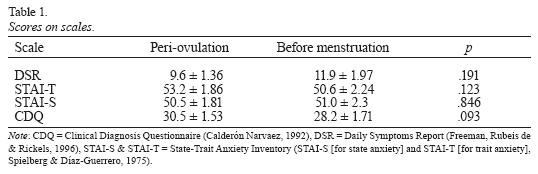
<ref-list>
<ref id="B1">
<nlm-citation citation-type="journal">
<person-group person-group-type="author">
<name>
<surname><![CDATA[Achiraman]]></surname>
<given-names><![CDATA[S]]></given-names>
</name>
<name>
<surname><![CDATA[Archunan]]></surname>
<given-names><![CDATA[G]]></given-names>
</name>
<name>
<surname><![CDATA[Sankarganesh]]></surname>
<given-names><![CDATA[D]]></given-names>
</name>
<name>
<surname><![CDATA[Rajagopal]]></surname>
<given-names><![CDATA[T]]></given-names>
</name>
<name>
<surname><![CDATA[Rengarajan]]></surname>
<given-names><![CDATA[R. L]]></given-names>
</name>
<name>
<surname><![CDATA[Kokilavani]]></surname>
<given-names><![CDATA[P]]></given-names>
</name>
<name>
<surname><![CDATA[Kannan]]></surname>
<given-names><![CDATA[S]]></given-names>
</name>
</person-group>
<article-title xml:lang="en"><![CDATA[Biochemical analysis of female mice urine with reference to endocrine function: a key tool for estrus detection]]></article-title>
<source><![CDATA[Zoological Science]]></source>
<year>Aug,</year>
<month> 2</month>
<day>01</day>
<volume>28</volume>
<numero>8</numero>
<issue>8</issue>
<page-range>600-605</page-range></nlm-citation>
</ref>
<ref id="B2">
<nlm-citation citation-type="journal">
<person-group person-group-type="author">
<name>
<surname><![CDATA[Ackerl]]></surname>
<given-names><![CDATA[K]]></given-names>
</name>
<name>
<surname><![CDATA[Atzmueller]]></surname>
<given-names><![CDATA[M]]></given-names>
</name>
<name>
<surname><![CDATA[Grammer]]></surname>
<given-names><![CDATA[K]]></given-names>
</name>
</person-group>
<article-title xml:lang="en"><![CDATA[The scent of fear]]></article-title>
<source><![CDATA[Neuroendocrinology Letters]]></source>
<year>Apr,</year>
<month> 2</month>
<day>00</day>
<volume>23</volume>
<numero>2</numero>
<issue>2</issue>
<page-range>79-84</page-range></nlm-citation>
</ref>
<ref id="B3">
<nlm-citation citation-type="journal">
<person-group person-group-type="author">
<name>
<surname><![CDATA[Ahn]]></surname>
<given-names><![CDATA[R. S]]></given-names>
</name>
<name>
<surname><![CDATA[Choi]]></surname>
<given-names><![CDATA[J. H]]></given-names>
</name>
<name>
<surname><![CDATA[Choi]]></surname>
<given-names><![CDATA[B. C]]></given-names>
</name>
<name>
<surname><![CDATA[Kim]]></surname>
<given-names><![CDATA[J. H]]></given-names>
</name>
<name>
<surname><![CDATA[Lee]]></surname>
<given-names><![CDATA[S. H]]></given-names>
</name>
<name>
<surname><![CDATA[Sung]]></surname>
<given-names><![CDATA[S. S]]></given-names>
</name>
</person-group>
<article-title xml:lang="en"><![CDATA[Cortisol, estradiol-17&#946;, and progesterone secretion within the first hour after awakening in women with regular menstrual cycles]]></article-title>
<source><![CDATA[Journal of Endocrinology]]></source>
<year>Dec,</year>
<month> 2</month>
<day>01</day>
<volume>211</volume>
<numero>3</numero>
<issue>3</issue>
<page-range>285-295</page-range></nlm-citation>
</ref>
<ref id="B4">
<nlm-citation citation-type="journal">
<person-group person-group-type="author">
<name>
<surname><![CDATA[Albrecht]]></surname>
<given-names><![CDATA[J]]></given-names>
</name>
<name>
<surname><![CDATA[Demmel]]></surname>
<given-names><![CDATA[M]]></given-names>
</name>
<name>
<surname><![CDATA[Schöpf]]></surname>
<given-names><![CDATA[V]]></given-names>
</name>
<name>
<surname><![CDATA[Kleemann]]></surname>
<given-names><![CDATA[A. M]]></given-names>
</name>
<name>
<surname><![CDATA[Kopietz]]></surname>
<given-names><![CDATA[R]]></given-names>
</name>
<name>
<surname><![CDATA[May]]></surname>
<given-names><![CDATA[J]]></given-names>
</name>
<name>
<surname><![CDATA[Wiesmann]]></surname>
<given-names><![CDATA[M]]></given-names>
</name>
</person-group>
<article-title xml:lang="en"><![CDATA[Smelling chemosensory signals of males in anxious versus nonaxious condition increases state anxiety of female subjects]]></article-title>
<source><![CDATA[Chemical Senses]]></source>
<year>Jan,</year>
<month> 2</month>
<day>01</day>
<volume>36</volume>
<numero>1</numero>
<issue>1</issue>
<page-range>19-27</page-range></nlm-citation>
</ref>
<ref id="B5">
<nlm-citation citation-type="journal">
<person-group person-group-type="author">
<name>
<surname><![CDATA[Andreano]]></surname>
<given-names><![CDATA[J. M]]></given-names>
</name>
<name>
<surname><![CDATA[Arjomandi]]></surname>
<given-names><![CDATA[H]]></given-names>
</name>
<name>
<surname><![CDATA[Cahill]]></surname>
<given-names><![CDATA[L]]></given-names>
</name>
</person-group>
<article-title xml:lang="en"><![CDATA[Menstrual cycle modulation of the relationship between cortisol and long-term memory]]></article-title>
<source><![CDATA[Psychoneuroendocrinology]]></source>
<year>Jul,</year>
<month> 2</month>
<day>00</day>
<volume>33</volume>
<numero>6</numero>
<issue>6</issue>
<page-range>874-882</page-range></nlm-citation>
</ref>
<ref id="B6">
<nlm-citation citation-type="journal">
<person-group person-group-type="author">
<name>
<surname><![CDATA[Atasoy]]></surname>
<given-names><![CDATA[A. F]]></given-names>
</name>
<name>
<surname><![CDATA[Hayaloglu]]></surname>
<given-names><![CDATA[. A]]></given-names>
</name>
<name>
<surname><![CDATA[Kirmaci]]></surname>
<given-names><![CDATA[H]]></given-names>
</name>
<name>
<surname><![CDATA[Levent]]></surname>
<given-names><![CDATA[O]]></given-names>
</name>
<name>
<surname><![CDATA[Türko&#487;lu]]></surname>
<given-names><![CDATA[H]]></given-names>
</name>
</person-group>
<article-title xml:lang="en"><![CDATA[Effects of partial substitution of caprine for ovine milk on the volatile compounds of fresh and mature Urfa cheeses]]></article-title>
<source><![CDATA[Small Ruminant Research]]></source>
<year>Oct,</year>
<month> 2</month>
<day>01</day>
<volume>115</volume>
<page-range>1-3</page-range><page-range>113-123</page-range></nlm-citation>
</ref>
<ref id="B7">
<nlm-citation citation-type="journal">
<person-group person-group-type="author">
<name>
<surname><![CDATA[Cakmakci]]></surname>
<given-names><![CDATA[S]]></given-names>
</name>
<name>
<surname><![CDATA[Dagdemir]]></surname>
<given-names><![CDATA[E]]></given-names>
</name>
<name>
<surname><![CDATA[Hayaloglu]]></surname>
<given-names><![CDATA[A. A]]></given-names>
</name>
<name>
<surname><![CDATA[Gurses]]></surname>
<given-names><![CDATA[M]]></given-names>
</name>
<name>
<surname><![CDATA[Cetin]]></surname>
<given-names><![CDATA[B]]></given-names>
</name>
<name>
<surname><![CDATA[Tahmas-Kahyaoglu]]></surname>
<given-names><![CDATA[D]]></given-names>
</name>
</person-group>
<article-title xml:lang="en"><![CDATA[Effect of Penicillium roqueforti and incorporation of whey cheese on volatile profiles and sensory characteristics of mould-ripened Civil cheese]]></article-title>
<source><![CDATA[International Journal of Dairy Technology]]></source>
<year>Aug,</year>
<month> 2</month>
<day>01</day>
<volume>66</volume>
<numero>4</numero>
<issue>4</issue>
<page-range>512-526</page-range></nlm-citation>
</ref>
<ref id="B8">
<nlm-citation citation-type="journal">
<person-group person-group-type="author">
<name>
<surname><![CDATA[Calderón Narvaez]]></surname>
<given-names><![CDATA[G]]></given-names>
</name>
</person-group>
<article-title xml:lang="es"><![CDATA[Cuestionario clínico para el diagnóstico de los cuadros depresivos]]></article-title>
<source><![CDATA[Revista Médica IMSS]]></source>
<year>1992</year>
<volume>30</volume>
<page-range>377-380</page-range></nlm-citation>
</ref>
<ref id="B9">
<nlm-citation citation-type="journal">
<person-group person-group-type="author">
<name>
<surname><![CDATA[Carnielli]]></surname>
<given-names><![CDATA[V. P]]></given-names>
</name>
<name>
<surname><![CDATA[Sulkers]]></surname>
<given-names><![CDATA[E. J]]></given-names>
</name>
<name>
<surname><![CDATA[Moretti]]></surname>
<given-names><![CDATA[C]]></given-names>
</name>
<name>
<surname><![CDATA[Wattimena]]></surname>
<given-names><![CDATA[J. L]]></given-names>
</name>
<name>
<surname><![CDATA[Goudoever van]]></surname>
<given-names><![CDATA[J. B]]></given-names>
</name>
<name>
<surname><![CDATA[Degenhart]]></surname>
<given-names><![CDATA[H. J]]></given-names>
</name>
<name>
<surname><![CDATA[Sauer]]></surname>
<given-names><![CDATA[P. J]]></given-names>
</name>
</person-group>
<article-title xml:lang="en"><![CDATA[Conversion of octanoic acid into long-chain saturated fatty acids in premature infants fed a formula containing medium-chain triglycerides: Metabolism]]></article-title>
<source><![CDATA[Clinical and Experimental]]></source>
<year>Oct,</year>
<month> 1</month>
<day>99</day>
<volume>43</volume>
<numero>10</numero>
<issue>10</issue>
<page-range>1287-1292</page-range></nlm-citation>
</ref>
<ref id="B10">
<nlm-citation citation-type="journal">
<person-group person-group-type="author">
<name>
<surname><![CDATA[Chen]]></surname>
<given-names><![CDATA[D]]></given-names>
</name>
<name>
<surname><![CDATA[Haviland-Jones]]></surname>
<given-names><![CDATA[J]]></given-names>
</name>
</person-group>
<article-title xml:lang="en"><![CDATA[Human olfactory communication of emotion]]></article-title>
<source><![CDATA[Perceptual and Motor Skills]]></source>
<year>Dec,</year>
<month> 2</month>
<day>00</day>
<volume>91</volume>
<numero>3</numero>
<issue>3</issue>
<page-range>771-781</page-range></nlm-citation>
</ref>
<ref id="B11">
<nlm-citation citation-type="journal">
<person-group person-group-type="author">
<name>
<surname><![CDATA[Childs]]></surname>
<given-names><![CDATA[E]]></given-names>
</name>
<name>
<surname><![CDATA[Dlugos]]></surname>
<given-names><![CDATA[A]]></given-names>
</name>
<name>
<surname><![CDATA[De Wit]]></surname>
<given-names><![CDATA[H]]></given-names>
</name>
</person-group>
<article-title xml:lang="es"><![CDATA[Cardiovascular, hormonal, and emotional responses to the TSST in relation to sex and menstrual cycle phase]]></article-title>
<source><![CDATA[Psychophysiology]]></source>
<year>May,</year>
<month> 2</month>
<day>01</day>
<volume>47</volume>
<numero>3</numero>
<issue>3</issue>
<page-range>550-559</page-range></nlm-citation>
</ref>
<ref id="B12">
<nlm-citation citation-type="journal">
<person-group person-group-type="author">
<name>
<surname><![CDATA[Contreras]]></surname>
<given-names><![CDATA[C. M]]></given-names>
</name>
<name>
<surname><![CDATA[Gutiérrez-García]]></surname>
<given-names><![CDATA[A. G]]></given-names>
</name>
<name>
<surname><![CDATA[Molina-Jiménez]]></surname>
<given-names><![CDATA[T]]></given-names>
</name>
</person-group>
<article-title xml:lang="en"><![CDATA[Anterior olfactory organ removal produces anxiety-like behavior and increases spontaneous neuronal firing rate in basal amygdala]]></article-title>
<source><![CDATA[Behavioural Brain Research]]></source>
<year>Sep,</year>
<month> 2</month>
<day>01</day>
<volume>252</volume>
<page-range>101-109</page-range></nlm-citation>
</ref>
<ref id="B13">
<nlm-citation citation-type="journal">
<person-group person-group-type="author">
<name>
<surname><![CDATA[Contreras]]></surname>
<given-names><![CDATA[C. M]]></given-names>
</name>
<name>
<surname><![CDATA[Gutiérrez-García]]></surname>
<given-names><![CDATA[A. G]]></given-names>
</name>
<name>
<surname><![CDATA[Molina-Jiménez]]></surname>
<given-names><![CDATA[T]]></given-names>
</name>
<name>
<surname><![CDATA[Mendoza-López]]></surname>
<given-names><![CDATA[M. R]]></given-names>
</name>
</person-group>
<article-title xml:lang="en"><![CDATA[2-Heptanone increases the firing rate of the basal amygdala: role of anterior olfactory epithelial organs]]></article-title>
<source><![CDATA[Neuropsychobiology]]></source>
<year>Aug,</year>
<month> 2</month>
<day>01</day>
<volume>66</volume>
<numero>3</numero>
<issue>3</issue>
<page-range>167-173</page-range></nlm-citation>
</ref>
<ref id="B14">
<nlm-citation citation-type="journal">
<person-group person-group-type="author">
<name>
<surname><![CDATA[Delgado]]></surname>
<given-names><![CDATA[F. J]]></given-names>
</name>
<name>
<surname><![CDATA[González-Crespo]]></surname>
<given-names><![CDATA[J]]></given-names>
</name>
<name>
<surname><![CDATA[Cava]]></surname>
<given-names><![CDATA[R]]></given-names>
</name>
<name>
<surname><![CDATA[Ramírez]]></surname>
<given-names><![CDATA[R]]></given-names>
</name>
</person-group>
<article-title xml:lang="en"><![CDATA[Formation of the aroma of a raw goat milk cheese during maturation analysed by SPME-GC-MS]]></article-title>
<source><![CDATA[Food Chemistry]]></source>
<year>Dec,</year>
<month> 2</month>
<day>01</day>
<volume>129</volume>
<numero>3</numero>
<issue>3</issue>
<page-range>1156-1163</page-range></nlm-citation>
</ref>
<ref id="B15">
<nlm-citation citation-type="journal">
<person-group person-group-type="author">
<name>
<surname><![CDATA[Derntl]]></surname>
<given-names><![CDATA[B]]></given-names>
</name>
<name>
<surname><![CDATA[Kryspin-Exner]]></surname>
<given-names><![CDATA[I]]></given-names>
</name>
<name>
<surname><![CDATA[Fernbach]]></surname>
<given-names><![CDATA[E]]></given-names>
</name>
<name>
<surname><![CDATA[Moser]]></surname>
<given-names><![CDATA[E]]></given-names>
</name>
<name>
<surname><![CDATA[Habel]]></surname>
<given-names><![CDATA[U]]></given-names>
</name>
</person-group>
<article-title xml:lang="en"><![CDATA[Emotion recognition accuracy in healthy young females is associated with cycle phase]]></article-title>
<source><![CDATA[Hormones and Behavior]]></source>
<year>Jan,</year>
<month> 2</month>
<day>00</day>
<volume>53</volume>
<numero>1</numero>
<issue>1</issue>
<page-range>90-95</page-range></nlm-citation>
</ref>
<ref id="B16">
<nlm-citation citation-type="journal">
<person-group person-group-type="author">
<name>
<surname><![CDATA[Derntl]]></surname>
<given-names><![CDATA[B]]></given-names>
</name>
<name>
<surname><![CDATA[Windischberger]]></surname>
<given-names><![CDATA[C]]></given-names>
</name>
<name>
<surname><![CDATA[Robinson]]></surname>
<given-names><![CDATA[S]]></given-names>
</name>
<name>
<surname><![CDATA[Lamplmayr]]></surname>
<given-names><![CDATA[E]]></given-names>
</name>
<name>
<surname><![CDATA[Kryspin-Exner]]></surname>
<given-names><![CDATA[I]]></given-names>
</name>
<name>
<surname><![CDATA[Gur]]></surname>
<given-names><![CDATA[R.C]]></given-names>
</name>
<name>
<surname><![CDATA[Habel]]></surname>
<given-names><![CDATA[U]]></given-names>
</name>
</person-group>
<article-title xml:lang="en"><![CDATA[Facial emotion recognition and amygdala activation are associated with menstrual cycle phase]]></article-title>
<source><![CDATA[Psychoneuroendocrinology]]></source>
<year>Sep,</year>
<month> 2</month>
<day>00</day>
<volume>33</volume>
<numero>8</numero>
<issue>8</issue>
<page-range>1031-1040</page-range></nlm-citation>
</ref>
<ref id="B17">
<nlm-citation citation-type="journal">
<person-group person-group-type="author">
<name>
<surname><![CDATA[Distel]]></surname>
<given-names><![CDATA[H]]></given-names>
</name>
<name>
<surname><![CDATA[Ayabe-Kanamura]]></surname>
<given-names><![CDATA[S]]></given-names>
</name>
<name>
<surname><![CDATA[Martínez-Gómez]]></surname>
<given-names><![CDATA[M]]></given-names>
</name>
<name>
<surname><![CDATA[Schicker]]></surname>
<given-names><![CDATA[I]]></given-names>
</name>
<name>
<surname><![CDATA[Kobayakawa]]></surname>
<given-names><![CDATA[T]]></given-names>
</name>
<name>
<surname><![CDATA[Saito]]></surname>
<given-names><![CDATA[S]]></given-names>
</name>
<name>
<surname><![CDATA[Hudson]]></surname>
<given-names><![CDATA[R]]></given-names>
</name>
</person-group>
<article-title xml:lang="en"><![CDATA[Perception of everyday odors: correlation between intensity, familiarity and strength of hedonic judgement]]></article-title>
<source><![CDATA[Chemical Senses]]></source>
<year>Apr,</year>
<month> 1</month>
<day>99</day>
<volume>24</volume>
<numero>2</numero>
<issue>2</issue>
<page-range>191-199</page-range></nlm-citation>
</ref>
<ref id="B18">
<nlm-citation citation-type="journal">
<person-group person-group-type="author">
<name>
<surname><![CDATA[Djurhuus]]></surname>
<given-names><![CDATA[C. B]]></given-names>
</name>
<name>
<surname><![CDATA[Gravholt]]></surname>
<given-names><![CDATA[C. H]]></given-names>
</name>
<name>
<surname><![CDATA[Nielsen]]></surname>
<given-names><![CDATA[S]]></given-names>
</name>
<name>
<surname><![CDATA[Mengel]]></surname>
<given-names><![CDATA[A]]></given-names>
</name>
<name>
<surname><![CDATA[Christiansen]]></surname>
<given-names><![CDATA[J. S]]></given-names>
</name>
<name>
<surname><![CDATA[Schmitz]]></surname>
<given-names><![CDATA[O. E]]></given-names>
</name>
<name>
<surname><![CDATA[Møller]]></surname>
<given-names><![CDATA[N]]></given-names>
</name>
</person-group>
<article-title xml:lang="en"><![CDATA[Effects of cortisol on lipolysis and regional interstitial glycerol levels in humans]]></article-title>
<source><![CDATA[American Journal of Physiology and Endocrinology Metabolism]]></source>
<year>Jul,</year>
<month> 2</month>
<day>00</day>
<volume>283</volume>
<numero>1</numero>
<issue>1</issue>
<page-range>E172-E177</page-range></nlm-citation>
</ref>
<ref id="B19">
<nlm-citation citation-type="journal">
<person-group person-group-type="author">
<name>
<surname><![CDATA[Duchesne]]></surname>
<given-names><![CDATA[A]]></given-names>
</name>
<name>
<surname><![CDATA[Pruessner]]></surname>
<given-names><![CDATA[J. C]]></given-names>
</name>
</person-group>
<article-title xml:lang="en"><![CDATA[Association between subjective and cortisol stress response depends on the menstrual cycle phase]]></article-title>
<source><![CDATA[Psychoneuroendocrinology]]></source>
<year>Dec,</year>
<month> 2</month>
<day>01</day>
<volume>38</volume>
<numero>12</numero>
<issue>12</issue>
<page-range>3155-3159</page-range></nlm-citation>
</ref>
<ref id="B20">
<nlm-citation citation-type="journal">
<person-group person-group-type="author">
<name>
<surname><![CDATA[Freeman]]></surname>
<given-names><![CDATA[E. W]]></given-names>
</name>
<name>
<surname><![CDATA[DeRubeis]]></surname>
</name>
<name>
<surname><![CDATA[Rickels]]></surname>
<given-names><![CDATA[K]]></given-names>
</name>
</person-group>
<article-title xml:lang="en"><![CDATA[Reliability and validity of a daily diary for premenstrual syndrome]]></article-title>
<source><![CDATA[Psychiatry Research]]></source>
<year>Nov,</year>
<month> 1</month>
<day>99</day>
<volume>65</volume>
<numero>2</numero>
<issue>2</issue>
<page-range>97-106</page-range></nlm-citation>
</ref>
<ref id="B21">
<nlm-citation citation-type="journal">
<person-group person-group-type="author">
<name>
<surname><![CDATA[Gallagher]]></surname>
<given-names><![CDATA[M]]></given-names>
</name>
<name>
<surname><![CDATA[Wysocki]]></surname>
<given-names><![CDATA[C. J]]></given-names>
</name>
<name>
<surname><![CDATA[Leyden]]></surname>
<given-names><![CDATA[J. J]]></given-names>
</name>
<name>
<surname><![CDATA[Spielman]]></surname>
<given-names><![CDATA[A. I]]></given-names>
</name>
<name>
<surname><![CDATA[Sun]]></surname>
<given-names><![CDATA[X]]></given-names>
</name>
<name>
<surname><![CDATA[Preti]]></surname>
<given-names><![CDATA[G]]></given-names>
</name>
</person-group>
<article-title xml:lang="en"><![CDATA[Analyses of volatile organic compounds from human skin]]></article-title>
<source><![CDATA[British Journal of Dermatology]]></source>
<year>Sep,</year>
<month> 2</month>
<day>00</day>
<volume>159</volume>
<numero>4</numero>
<issue>4</issue>
<page-range>780-791</page-range></nlm-citation>
</ref>
<ref id="B22">
<nlm-citation citation-type="journal">
<person-group person-group-type="author">
<name>
<surname><![CDATA[Gehrig]]></surname>
<given-names><![CDATA[R. F]]></given-names>
</name>
<name>
<surname><![CDATA[Knight]]></surname>
<given-names><![CDATA[S. G]]></given-names>
</name>
</person-group>
<article-title xml:lang="en"><![CDATA[Formation of ketones from fatty acids by spores of Penicillium roqueforti]]></article-title>
<source><![CDATA[Nature]]></source>
<year>Nov,</year>
<month> 1</month>
<day>95</day>
<volume>182</volume>
<page-range>4644</page-range></nlm-citation>
</ref>
<ref id="B23">
<nlm-citation citation-type="journal">
<person-group person-group-type="author">
<name>
<surname><![CDATA[Gildersleeve]]></surname>
<given-names><![CDATA[K. A]]></given-names>
</name>
<name>
<surname><![CDATA[Haselton]]></surname>
<given-names><![CDATA[G]]></given-names>
</name>
<name>
<surname><![CDATA[Larson]]></surname>
<given-names><![CDATA[C. M]]></given-names>
</name>
<name>
<surname><![CDATA[Pillsworth]]></surname>
<given-names><![CDATA[E. G]]></given-names>
</name>
</person-group>
<article-title xml:lang="en"><![CDATA[Body odor attractiveness as a cue of impending ovulation in women: evidence from a study using hormone-confirmed ovulation]]></article-title>
<source><![CDATA[Hormones and Behavior]]></source>
<year>Feb,</year>
<month> 2</month>
<day>01</day>
<volume>61</volume>
<numero>2</numero>
<issue>2</issue>
<page-range>157-166</page-range></nlm-citation>
</ref>
<ref id="B24">
<nlm-citation citation-type="journal">
<person-group person-group-type="author">
<name>
<surname><![CDATA[Gröschl]]></surname>
<given-names><![CDATA[M]]></given-names>
</name>
<name>
<surname><![CDATA[Rauh]]></surname>
<given-names><![CDATA[M]]></given-names>
</name>
<name>
<surname><![CDATA[Schmid]]></surname>
<given-names><![CDATA[P]]></given-names>
</name>
<name>
<surname><![CDATA[Dörr]]></surname>
<given-names><![CDATA[HG]]></given-names>
</name>
</person-group>
<article-title xml:lang="en"><![CDATA[Relationship between salivary progesterone, 17-hydroxyprogesterone, and cortisol levels throughout the normal menstrual cycle of healthy postmenarcheal girls]]></article-title>
<source><![CDATA[Fertility and Sterility]]></source>
<year>Sep,</year>
<month> 2</month>
<day>00</day>
<volume>76</volume>
<numero>3</numero>
<issue>3</issue>
<page-range>615-617</page-range></nlm-citation>
</ref>
<ref id="B25">
<nlm-citation citation-type="journal">
<person-group person-group-type="author">
<name>
<surname><![CDATA[Guapo]]></surname>
<given-names><![CDATA[V. G]]></given-names>
</name>
<name>
<surname><![CDATA[Graeff]]></surname>
<given-names><![CDATA[F. G]]></given-names>
</name>
<name>
<surname><![CDATA[Zani]]></surname>
<given-names><![CDATA[A. T]]></given-names>
</name>
<name>
<surname><![CDATA[Labate]]></surname>
<given-names><![CDATA[C.M]]></given-names>
</name>
<name>
<surname><![CDATA[dos Reis]]></surname>
<given-names><![CDATA[R. M]]></given-names>
</name>
<name>
<surname><![CDATA[Del-Ben]]></surname>
<given-names><![CDATA[C.M]]></given-names>
</name>
</person-group>
<article-title xml:lang="en"><![CDATA[Effects of sex hormonal levels and phases of the menstrual cycle in the processing of emotional faces]]></article-title>
<source><![CDATA[Psychoneuroendocrinology]]></source>
<year>Aug,</year>
<month> 2</month>
<day>00</day>
<volume>34</volume>
<numero>7</numero>
<issue>7</issue>
<page-range>1087-1094</page-range></nlm-citation>
</ref>
<ref id="B26">
<nlm-citation citation-type="journal">
<person-group person-group-type="author">
<name>
<surname><![CDATA[Gutiérrez-Castellanos]]></surname>
<given-names><![CDATA[N]]></given-names>
</name>
<name>
<surname><![CDATA[Martínez-Marcos]]></surname>
<given-names><![CDATA[A]]></given-names>
</name>
<name>
<surname><![CDATA[Martínez-García]]></surname>
<given-names><![CDATA[F]]></given-names>
</name>
<name>
<surname><![CDATA[Lanuza]]></surname>
<given-names><![CDATA[E]]></given-names>
</name>
</person-group>
<article-title xml:lang="en"><![CDATA[Chemosensory function of the amygdala]]></article-title>
<source><![CDATA[Vitamins and Hormones]]></source>
<year>Sep,</year>
<month> 2</month>
<day>01</day>
<volume>83</volume>
<page-range>165-196</page-range></nlm-citation>
</ref>
<ref id="B27">
<nlm-citation citation-type="">
<person-group person-group-type="author">
<name>
<surname><![CDATA[Gutie&#769;rrez-Garci&#769;a]]></surname>
<given-names><![CDATA[A. G]]></given-names>
</name>
<name>
<surname><![CDATA[Contreras]]></surname>
<given-names><![CDATA[C. M]]></given-names>
</name>
</person-group>
<article-title xml:lang="en"><![CDATA[Anxiety: an adaptive emotion]]></article-title>
<person-group person-group-type="editor">
<name>
<surname><![CDATA[Durbano]]></surname>
<given-names><![CDATA[F]]></given-names>
</name>
</person-group>
<source><![CDATA[New Insights into Anxiety Disorders]]></source>
<year>Mar,</year>
<month> 2</month>
<day>01</day>
<page-range>21-37</page-range></nlm-citation>
</ref>
<ref id="B28">
<nlm-citation citation-type="journal">
<person-group person-group-type="author">
<name>
<surname><![CDATA[Gutiérrez-García]]></surname>
<given-names><![CDATA[A. G]]></given-names>
</name>
<name>
<surname><![CDATA[Contreras]]></surname>
<given-names><![CDATA[C. M]]></given-names>
</name>
<name>
<surname><![CDATA[Mendoza-López]]></surname>
<given-names><![CDATA[M. R]]></given-names>
</name>
<name>
<surname><![CDATA[Cruz-Sánchez]]></surname>
<given-names><![CDATA[S]]></given-names>
</name>
<name>
<surname><![CDATA[García-Barradas]]></surname>
<given-names><![CDATA[O]]></given-names>
</name>
<name>
<surname><![CDATA[Rodríguez-Landa]]></surname>
<given-names><![CDATA[J. F]]></given-names>
</name>
<name>
<surname><![CDATA[Bernal-Morales]]></surname>
<given-names><![CDATA[B]]></given-names>
</name>
</person-group>
<article-title xml:lang="en"><![CDATA[A single session of emotional stress produces anxiety in Wistar rats]]></article-title>
<source><![CDATA[Behavioural Brain Research]]></source>
<year>Feb,</year>
<month> 2</month>
<day>00</day>
<volume>167</volume>
<numero>1</numero>
<issue>1</issue>
<page-range>30-35</page-range></nlm-citation>
</ref>
<ref id="B29">
<nlm-citation citation-type="journal">
<person-group person-group-type="author">
<name>
<surname><![CDATA[Gutiérrez-García]]></surname>
<given-names><![CDATA[A. G]]></given-names>
</name>
<name>
<surname><![CDATA[Contreras]]></surname>
<given-names><![CDATA[C. M]]></given-names>
</name>
<name>
<surname><![CDATA[Mendoza-López]]></surname>
<given-names><![CDATA[M. R]]></given-names>
</name>
<name>
<surname><![CDATA[García-Barradas]]></surname>
<given-names><![CDATA[O]]></given-names>
</name>
<name>
<surname><![CDATA[Cruz-Sánchez]]></surname>
<given-names><![CDATA[J. S]]></given-names>
</name>
</person-group>
<article-title xml:lang="en"><![CDATA[Urine from stressed rats increases immobility in receptor rats forced to swim: role of 2-heptanone]]></article-title>
<source><![CDATA[Physiology and Behavior]]></source>
<year>Feb,</year>
<month> 2</month>
<day>00</day>
<volume>91</volume>
<numero>1</numero>
<issue>1</issue>
<page-range>166-172</page-range></nlm-citation>
</ref>
<ref id="B30">
<nlm-citation citation-type="journal">
<person-group person-group-type="author">
<name>
<surname><![CDATA[Hlavacova]]></surname>
<given-names><![CDATA[N]]></given-names>
</name>
<name>
<surname><![CDATA[Wawruch]]></surname>
<given-names><![CDATA[M]]></given-names>
</name>
<name>
<surname><![CDATA[Tisonova]]></surname>
<given-names><![CDATA[J]]></given-names>
</name>
<name>
<surname><![CDATA[Jezova]]></surname>
<given-names><![CDATA[D]]></given-names>
</name>
</person-group>
<article-title xml:lang="en"><![CDATA[Neuroendocrine activation during combined mental and physical stress in women depends on trait anxiety and the phase of the menstrual cycle]]></article-title>
<source><![CDATA[Annals of the New York Academy of Sciences]]></source>
<year>Dec,</year>
<month> 2</month>
<day>00</day>
<volume>1148</volume>
<page-range>520-525</page-range></nlm-citation>
</ref>
<ref id="B31">
<nlm-citation citation-type="journal">
<person-group person-group-type="author">
<name>
<surname><![CDATA[Jong-Yeon]]></surname>
<given-names><![CDATA[K]]></given-names>
</name>
<name>
<surname><![CDATA[Hickner]]></surname>
<given-names><![CDATA[R. C]]></given-names>
</name>
<name>
<surname><![CDATA[Dohm]]></surname>
<given-names><![CDATA[G. L]]></given-names>
</name>
<name>
<surname><![CDATA[Houmard]]></surname>
<given-names><![CDATA[J. A]]></given-names>
</name>
</person-group>
<article-title xml:lang="en"><![CDATA[Long- and medium-chain fatty acid oxidation is increased in exercise-trained human skeletal muscle]]></article-title>
<source><![CDATA[Metabolism]]></source>
<year>Apr,</year>
<month> 2</month>
<day>00</day>
<volume>51</volume>
<numero>4</numero>
<issue>4</issue>
<page-range>460-464</page-range></nlm-citation>
</ref>
<ref id="B32">
<nlm-citation citation-type="journal">
<person-group person-group-type="author">
<name>
<surname><![CDATA[Jurado]]></surname>
<given-names><![CDATA[S]]></given-names>
</name>
<name>
<surname><![CDATA[Villegas]]></surname>
<given-names><![CDATA[M]]></given-names>
</name>
<name>
<surname><![CDATA[Méndez]]></surname>
<given-names><![CDATA[L]]></given-names>
</name>
<name>
<surname><![CDATA[Rodríguez]]></surname>
<given-names><![CDATA[F]]></given-names>
</name>
<name>
<surname><![CDATA[Loperena]]></surname>
<given-names><![CDATA[V]]></given-names>
</name>
<name>
<surname><![CDATA[Varela]]></surname>
<given-names><![CDATA[R]]></given-names>
</name>
</person-group>
<article-title xml:lang="es"><![CDATA[La estandarización del inventario de depresión de Beck para los residentes de la Ciudad de México]]></article-title>
<source><![CDATA[Salud Mental]]></source>
<year>1998</year>
<month>, </month>
<day>ma</day>
<volume>21</volume>
<numero>3</numero>
<issue>3</issue>
<page-range>26-31</page-range></nlm-citation>
</ref>
<ref id="B33">
<nlm-citation citation-type="journal">
<person-group person-group-type="author">
<name>
<surname><![CDATA[Kiyokawa]]></surname>
<given-names><![CDATA[Y]]></given-names>
</name>
<name>
<surname><![CDATA[Kikusui]]></surname>
<given-names><![CDATA[T]]></given-names>
</name>
<name>
<surname><![CDATA[Takeuchi]]></surname>
<given-names><![CDATA[Y]]></given-names>
</name>
<name>
<surname><![CDATA[Mori]]></surname>
<given-names><![CDATA[Y]]></given-names>
</name>
</person-group>
<article-title xml:lang="en"><![CDATA[apping the neural circuit activated by alarm pheromone perception by c-fos inmunihistochemistry]]></article-title>
<source><![CDATA[Brain Research]]></source>
<year>May,</year>
<month> 2</month>
<day>00</day>
<volume>1043</volume>
<page-range>1-2</page-range><page-range>145-154</page-range></nlm-citation>
</ref>
<ref id="B34">
<nlm-citation citation-type="journal">
<person-group person-group-type="author">
<name>
<surname><![CDATA[Kudielka]]></surname>
<given-names><![CDATA[B. M]]></given-names>
</name>
<name>
<surname><![CDATA[Kirschbaum]]></surname>
<given-names><![CDATA[C]]></given-names>
</name>
</person-group>
<article-title xml:lang="en"><![CDATA[Awakening cortisol responses are influenced by health status and awakening time but not by menstrual cycle phase]]></article-title>
<source><![CDATA[Psychoneuroendocrinology]]></source>
<year>Jan,</year>
<month> 2</month>
<day>00</day>
<volume>28</volume>
<numero>1</numero>
<issue>1</issue>
<page-range>35-47</page-range></nlm-citation>
</ref>
<ref id="B35">
<nlm-citation citation-type="journal">
<person-group person-group-type="author">
<name>
<surname><![CDATA[Lacy Costello de]]></surname>
<given-names><![CDATA[B]]></given-names>
</name>
<name>
<surname><![CDATA[Amann]]></surname>
<given-names><![CDATA[A]]></given-names>
</name>
<name>
<surname><![CDATA[Al-Kateb]]></surname>
<given-names><![CDATA[H]]></given-names>
</name>
<name>
<surname><![CDATA[Flynn]]></surname>
<given-names><![CDATA[C]]></given-names>
</name>
<name>
<surname><![CDATA[Filipiak]]></surname>
<given-names><![CDATA[W]]></given-names>
</name>
<name>
<surname><![CDATA[Khalid]]></surname>
<given-names><![CDATA[T]]></given-names>
</name>
<name>
<surname><![CDATA[Ratcliffe]]></surname>
<given-names><![CDATA[N. M]]></given-names>
</name>
</person-group>
<article-title xml:lang="en"><![CDATA[A review of the volatiles from the healthy human body]]></article-title>
<source><![CDATA[Journal of Breath Research]]></source>
<year>Mar,</year>
<month> 2</month>
<day>01</day>
<volume>8</volume>
<numero>1</numero>
<issue>1</issue>
</nlm-citation>
</ref>
<ref id="B36">
<nlm-citation citation-type="journal">
<person-group person-group-type="author">
<name>
<surname><![CDATA[Larroche]]></surname>
<given-names><![CDATA[C]]></given-names>
</name>
</person-group>
<article-title xml:lang="en"><![CDATA[substrate concentrations during biotransformation of octanoic acid into 2-heptanone by spores of Penicillium roquefortii]]></article-title>
<source><![CDATA[Journal of Industrial Microbiology and Biotechnology]]></source>
<year>Jan,</year>
<month> 1</month>
<day>99</day>
<volume>16</volume>
<numero>1</numero>
<issue>1</issue>
<page-range>29-35</page-range></nlm-citation>
</ref>
<ref id="B37">
<nlm-citation citation-type="journal">
<person-group person-group-type="author">
<name>
<surname><![CDATA[Larroche]]></surname>
<given-names><![CDATA[C]]></given-names>
</name>
<name>
<surname><![CDATA[Besson]]></surname>
<given-names><![CDATA[I]]></given-names>
</name>
<name>
<surname><![CDATA[Gros]]></surname>
<given-names><![CDATA[J. B]]></given-names>
</name>
</person-group>
<article-title xml:lang="en"><![CDATA[Behavior of spores of Penicillium roquefortii during fed-batch bioconversion of octanoic acid into 2-heptanone]]></article-title>
<source><![CDATA[Biotechnology and Bioengineering]]></source>
<year>Feb,</year>
<month> 1</month>
<day>99</day>
<volume>44</volume>
<numero>6</numero>
<issue>6</issue>
<page-range>699-709</page-range></nlm-citation>
</ref>
<ref id="B38">
<nlm-citation citation-type="journal">
<person-group person-group-type="author">
<name>
<surname><![CDATA[Leinders-Zufall]]></surname>
<given-names><![CDATA[T]]></given-names>
</name>
<name>
<surname><![CDATA[Lane]]></surname>
<given-names><![CDATA[A. P]]></given-names>
</name>
<name>
<surname><![CDATA[Puce]]></surname>
<given-names><![CDATA[A. C]]></given-names>
</name>
<name>
<surname><![CDATA[Ma]]></surname>
<given-names><![CDATA[W]]></given-names>
</name>
<name>
<surname><![CDATA[Novotny]]></surname>
<given-names><![CDATA[M]]></given-names>
</name>
<name>
<surname><![CDATA[Shipley]]></surname>
<given-names><![CDATA[M. T]]></given-names>
</name>
<name>
<surname><![CDATA[Zufall]]></surname>
<given-names><![CDATA[F]]></given-names>
</name>
</person-group>
<article-title xml:lang="en"><![CDATA[Ultrasensitive pheromone detection by mammalian vomeronasal neurons]]></article-title>
<source><![CDATA[Nature]]></source>
<year>Nov,</year>
<month> 2</month>
<day>00</day>
<volume>405</volume>
<numero>6788</numero>
<issue>6788</issue>
<page-range>792-796</page-range></nlm-citation>
</ref>
<ref id="B39">
<nlm-citation citation-type="journal">
<person-group person-group-type="author">
<name>
<surname><![CDATA[Miller]]></surname>
<given-names><![CDATA[S. L]]></given-names>
</name>
<name>
<surname><![CDATA[Maner]]></surname>
<given-names><![CDATA[J. K]]></given-names>
</name>
</person-group>
<article-title xml:lang="en"><![CDATA[Scent of a woman: men's testosterone responses to olfactory ovulation cues]]></article-title>
<source><![CDATA[Psychological Sciences]]></source>
<year>Feb,</year>
<month> 2</month>
<day>01</day>
<volume>21</volume>
<numero>2</numero>
<issue>2</issue>
<page-range>276-283</page-range></nlm-citation>
</ref>
<ref id="B40">
<nlm-citation citation-type="journal">
<person-group person-group-type="author">
<name>
<surname><![CDATA[Molina-Jiménez]]></surname>
<given-names><![CDATA[T]]></given-names>
</name>
<name>
<surname><![CDATA[Gutiérrez-García]]></surname>
<given-names><![CDATA[A. G]]></given-names>
</name>
<name>
<surname><![CDATA[Contreras]]></surname>
<given-names><![CDATA[C. M]]></given-names>
</name>
</person-group>
<article-title xml:lang="en"><![CDATA[An alarm pheromone increases the responsivity of amygdaline-hippocampal neurons]]></article-title>
<source><![CDATA[Salud Mental]]></source>
<year>2013</year>
<month>, </month>
<day>ju</day>
<volume>36</volume>
<numero>4</numero>
<issue>4</issue>
<page-range>279-284</page-range></nlm-citation>
</ref>
<ref id="B41">
<nlm-citation citation-type="journal">
<person-group person-group-type="author">
<name>
<surname><![CDATA[Mujica-Parodi]]></surname>
<given-names><![CDATA[L. R]]></given-names>
</name>
<name>
<surname><![CDATA[Strey]]></surname>
<given-names><![CDATA[H. H]]></given-names>
</name>
<name>
<surname><![CDATA[Frederick]]></surname>
<given-names><![CDATA[B]]></given-names>
</name>
<name>
<surname><![CDATA[Savoy]]></surname>
<given-names><![CDATA[R]]></given-names>
</name>
<name>
<surname><![CDATA[Cox]]></surname>
<given-names><![CDATA[D]]></given-names>
</name>
<name>
<surname><![CDATA[Botanov]]></surname>
<given-names><![CDATA[Y]]></given-names>
</name>
<name>
<surname><![CDATA[Weber]]></surname>
<given-names><![CDATA[J]]></given-names>
</name>
</person-group>
<article-title xml:lang="en"><![CDATA[Chemosensory cues to conspecific emotional stress activate amygdala in humans]]></article-title>
<source><![CDATA[PLoS One]]></source>
<year>Jul,</year>
<month> 2</month>
<day>00</day>
<volume>4</volume>
<numero>7</numero>
<issue>7</issue>
<page-range>e6415</page-range></nlm-citation>
</ref>
<ref id="B42">
<nlm-citation citation-type="journal">
<person-group person-group-type="author">
<name>
<surname><![CDATA[Navarrete-Palacios]]></surname>
<given-names><![CDATA[E]]></given-names>
</name>
<name>
<surname><![CDATA[Hudson]]></surname>
<given-names><![CDATA[R]]></given-names>
</name>
<name>
<surname><![CDATA[Reyes-Guerrero]]></surname>
<given-names><![CDATA[G]]></given-names>
</name>
<name>
<surname><![CDATA[Guevara-Guzmán]]></surname>
<given-names><![CDATA[R]]></given-names>
</name>
</person-group>
<article-title xml:lang="en"><![CDATA[Lower olfactory threshold during the ovulatory phase of the menstrual cycle]]></article-title>
<source><![CDATA[Biological Psychology]]></source>
<year>Jul,</year>
<month> 2</month>
<day>00</day>
<volume>63</volume>
<numero>3</numero>
<issue>3</issue>
<page-range>269-279</page-range></nlm-citation>
</ref>
<ref id="B43">
<nlm-citation citation-type="journal">
<person-group person-group-type="author">
<name>
<surname><![CDATA[Navarrete-Palacios]]></surname>
</name>
<name>
<surname><![CDATA[Hudson]]></surname>
</name>
<name>
<surname><![CDATA[Reyes-Guerrero]]></surname>
</name>
<name>
<surname><![CDATA[Guevara-Guzmán]]></surname>
</name>
</person-group>
<article-title xml:lang="en"><![CDATA[Lower olfactory threshold during the ovulatory phase of the menstrual cycle]]></article-title>
<source><![CDATA[Biol Psychol]]></source>
<year>Jul,</year>
<month> 2</month>
<day>00</day>
<volume>63</volume>
<numero>3</numero>
<issue>3</issue>
<page-range>269-279</page-range></nlm-citation>
</ref>
<ref id="B44">
<nlm-citation citation-type="journal">
<person-group person-group-type="author">
<name>
<surname><![CDATA[Novotny]]></surname>
<given-names><![CDATA[M. V]]></given-names>
</name>
</person-group>
<article-title xml:lang="en"><![CDATA[Pheromones, binding proteins and receptor responses in rodents]]></article-title>
<source><![CDATA[Biochemical Society Transactions]]></source>
<year>Feb,</year>
<month> 2</month>
<day>00</day>
<volume>31</volume>
<numero>1</numero>
<issue>1</issue>
<page-range>117-122</page-range></nlm-citation>
</ref>
<ref id="B45">
<nlm-citation citation-type="journal">
<person-group person-group-type="author">
<name>
<surname><![CDATA[Osada]]></surname>
<given-names><![CDATA[K]]></given-names>
</name>
<name>
<surname><![CDATA[Yamazaki]]></surname>
<given-names><![CDATA[K]]></given-names>
</name>
<name>
<surname><![CDATA[Curran]]></surname>
<given-names><![CDATA[M]]></given-names>
</name>
<name>
<surname><![CDATA[Bard]]></surname>
<given-names><![CDATA[J]]></given-names>
</name>
<name>
<surname><![CDATA[Smith]]></surname>
<given-names><![CDATA[B. C. P]]></given-names>
</name>
<name>
<surname><![CDATA[Beauchamp]]></surname>
<given-names><![CDATA[G. K]]></given-names>
</name>
</person-group>
<article-title xml:lang="en"><![CDATA[The scent of age]]></article-title>
<source><![CDATA[Proceeding Biological Sciences]]></source>
<year>May,</year>
<month> 2</month>
<day>00</day>
<volume>270</volume>
<numero>1518</numero>
<issue>1518</issue>
<page-range>929-933</page-range></nlm-citation>
</ref>
<ref id="B46">
<nlm-citation citation-type="journal">
<person-group person-group-type="author">
<name>
<surname><![CDATA[Papamandjaris]]></surname>
<given-names><![CDATA[A. A]]></given-names>
</name>
<name>
<surname><![CDATA[MacDougall]]></surname>
<given-names><![CDATA[D. E]]></given-names>
</name>
<name>
<surname><![CDATA[Jones]]></surname>
<given-names><![CDATA[P. J]]></given-names>
</name>
</person-group>
<article-title xml:lang="en"><![CDATA[Medium chain fatty acid metabolism and energy expenditure: obesity treatment implications]]></article-title>
<source><![CDATA[Life Sciences]]></source>
<year>Feb,</year>
<month> 1</month>
<day>99</day>
<volume>62</volume>
<numero>14</numero>
<issue>14</issue>
<page-range>1203-1215</page-range></nlm-citation>
</ref>
<ref id="B47">
<nlm-citation citation-type="journal">
<person-group person-group-type="author">
<name>
<surname><![CDATA[Pasanen]]></surname>
<given-names><![CDATA[P]]></given-names>
</name>
<name>
<surname><![CDATA[Korpi]]></surname>
<given-names><![CDATA[A]]></given-names>
</name>
<name>
<surname><![CDATA[Kalliokoski]]></surname>
<given-names><![CDATA[P]]></given-names>
</name>
<name>
<surname><![CDATA[Pasanen]]></surname>
<given-names><![CDATA[A. L]]></given-names>
</name>
</person-group>
<article-title xml:lang="en"><![CDATA[Growth and volatile metabolite production of Aspergillus versicolor in house dust]]></article-title>
<source><![CDATA[Environment International]]></source>
<year>Jun,</year>
<month> 1</month>
<day>99</day>
<volume>23</volume>
<numero>4</numero>
<issue>4</issue>
<page-range>425-432</page-range></nlm-citation>
</ref>
<ref id="B48">
<nlm-citation citation-type="journal">
<person-group person-group-type="author">
<name>
<surname><![CDATA[Pause]]></surname>
<given-names><![CDATA[B. M]]></given-names>
</name>
<name>
<surname><![CDATA[Ohrt]]></surname>
<given-names><![CDATA[A]]></given-names>
</name>
<name>
<surname><![CDATA[Prehn]]></surname>
<given-names><![CDATA[A]]></given-names>
</name>
<name>
<surname><![CDATA[Ferstl]]></surname>
<given-names><![CDATA[R]]></given-names>
</name>
</person-group>
<article-title xml:lang="en"><![CDATA[Positive emotional priming of facial affect perception in females is diminished by chemosensory anxiety signals]]></article-title>
<source><![CDATA[Chemical Senses]]></source>
<year>Nov,</year>
<month> 2</month>
<day>00</day>
<volume>29</volume>
<numero>9</numero>
<issue>9</issue>
<page-range>797-805</page-range></nlm-citation>
</ref>
<ref id="B49">
<nlm-citation citation-type="journal">
<person-group person-group-type="author">
<name>
<surname><![CDATA[Pause]]></surname>
<given-names><![CDATA[B. M]]></given-names>
</name>
<name>
<surname><![CDATA[Adolph]]></surname>
<given-names><![CDATA[D]]></given-names>
</name>
<name>
<surname><![CDATA[Prehn-Kristensen]]></surname>
<given-names><![CDATA[A]]></given-names>
</name>
<name>
<surname><![CDATA[Ferstl]]></surname>
<given-names><![CDATA[R]]></given-names>
</name>
</person-group>
<article-title xml:lang="en"><![CDATA[Startle response potentiation to chemosensory anxiety signals in socially anxious individuals]]></article-title>
<source><![CDATA[International Journal of Psychophysiology]]></source>
<year>Nov,</year>
<month> 2</month>
<day>00</day>
<volume>74</volume>
<numero>2</numero>
<issue>2</issue>
<page-range>88-92</page-range></nlm-citation>
</ref>
<ref id="B50">
<nlm-citation citation-type="journal">
<person-group person-group-type="author">
<name>
<surname><![CDATA[Paz]]></surname>
<given-names><![CDATA[R]]></given-names>
</name>
<name>
<surname><![CDATA[Pare]]></surname>
<given-names><![CDATA[D]]></given-names>
</name>
</person-group>
<article-title xml:lang="en"><![CDATA[Physiological basis for emotional modulation of memory circuits by the amygdala]]></article-title>
<source><![CDATA[Current Opinion Neurobiology]]></source>
<year>Jun,</year>
<month> 2</month>
<day>01</day>
<volume>23</volume>
<numero>3</numero>
<issue>3</issue>
<page-range>381-386</page-range></nlm-citation>
</ref>
<ref id="B51">
<nlm-citation citation-type="journal">
<person-group person-group-type="author">
<name>
<surname><![CDATA[Phelps]]></surname>
<given-names><![CDATA[E. A]]></given-names>
</name>
</person-group>
<article-title xml:lang="en"><![CDATA[Human emotional and memory: interaction of the amygdala and hippocampal complex]]></article-title>
<source><![CDATA[Current Opinion Neurobiology]]></source>
<year>Apr,</year>
<month> 2</month>
<day>00</day>
<volume>14</volume>
<page-range>198-202</page-range></nlm-citation>
</ref>
<ref id="B52">
<nlm-citation citation-type="journal">
<person-group person-group-type="author">
<name>
<surname><![CDATA[Pohorecky]]></surname>
<given-names><![CDATA[L. A]]></given-names>
</name>
<name>
<surname><![CDATA[Blakley]]></surname>
<given-names><![CDATA[G]]></given-names>
</name>
<name>
<surname><![CDATA[Ma]]></surname>
<given-names><![CDATA[E. W]]></given-names>
</name>
<name>
<surname><![CDATA[Soini]]></surname>
<given-names><![CDATA[H. A]]></given-names>
</name>
<name>
<surname><![CDATA[Wiesler]]></surname>
<given-names><![CDATA[D]]></given-names>
</name>
<name>
<surname><![CDATA[Bruce]]></surname>
<given-names><![CDATA[K. E]]></given-names>
</name>
<name>
<surname><![CDATA[Novotny]]></surname>
<given-names><![CDATA[M. V]]></given-names>
</name>
</person-group>
<article-title xml:lang="en"><![CDATA[Social housing influences the composition of volatile compounds in the preputial glands of male rats]]></article-title>
<source><![CDATA[Hormones and Behavior]]></source>
<year>Apr,</year>
<month> 2</month>
<day>00</day>
<volume>53</volume>
<numero>4</numero>
<issue>4</issue>
<page-range>536-545</page-range></nlm-citation>
</ref>
<ref id="B53">
<nlm-citation citation-type="journal">
<person-group person-group-type="author">
<name>
<surname><![CDATA[Prehn]]></surname>
<given-names><![CDATA[A]]></given-names>
</name>
<name>
<surname><![CDATA[Ohrt]]></surname>
<given-names><![CDATA[A]]></given-names>
</name>
<name>
<surname><![CDATA[Sojka]]></surname>
<given-names><![CDATA[B]]></given-names>
</name>
<name>
<surname><![CDATA[Ferstl]]></surname>
<given-names><![CDATA[R]]></given-names>
</name>
<name>
<surname><![CDATA[Pause]]></surname>
<given-names><![CDATA[B. M]]></given-names>
</name>
</person-group>
<article-title xml:lang="en"><![CDATA[Chemosensory anxiety signals augment the startle reflex in humans]]></article-title>
<source><![CDATA[Neurosciences Letters]]></source>
<year>Feb,</year>
<month> 2</month>
<day>00</day>
<volume>394</volume>
<numero>2</numero>
<issue>2</issue>
<page-range>127-130</page-range></nlm-citation>
</ref>
<ref id="B54">
<nlm-citation citation-type="journal">
<person-group person-group-type="author">
<name>
<surname><![CDATA[Prehn-Kristensen]]></surname>
<given-names><![CDATA[A]]></given-names>
</name>
<name>
<surname><![CDATA[Wiesner]]></surname>
<given-names><![CDATA[C]]></given-names>
</name>
<name>
<surname><![CDATA[Bergmann]]></surname>
<given-names><![CDATA[T. O]]></given-names>
</name>
<name>
<surname><![CDATA[Wolff]]></surname>
<given-names><![CDATA[S]]></given-names>
</name>
<name>
<surname><![CDATA[Jansen]]></surname>
<given-names><![CDATA[O]]></given-names>
</name>
<name>
<surname><![CDATA[Mehdorn]]></surname>
<given-names><![CDATA[H. M]]></given-names>
</name>
<name>
<surname><![CDATA[Pause]]></surname>
<given-names><![CDATA[B. M]]></given-names>
</name>
</person-group>
<article-title xml:lang="en"><![CDATA[Induction of empathy by the smell of anxiety]]></article-title>
<source><![CDATA[PLoS One]]></source>
<year>Jun,</year>
<month> 2</month>
<day>00</day>
<volume>4</volume>
<numero>6</numero>
<issue>6</issue>
<page-range>e5987</page-range></nlm-citation>
</ref>
<ref id="B55">
<nlm-citation citation-type="journal">
<person-group person-group-type="author">
<name>
<surname><![CDATA[Puts]]></surname>
<given-names><![CDATA[D. A]]></given-names>
</name>
<name>
<surname><![CDATA[Bailey]]></surname>
<given-names><![CDATA[D. H]]></given-names>
</name>
<name>
<surname><![CDATA[Cárdenas]]></surname>
<given-names><![CDATA[R. A]]></given-names>
</name>
<name>
<surname><![CDATA[Burriss]]></surname>
<given-names><![CDATA[R. P]]></given-names>
</name>
<name>
<surname><![CDATA[Welling]]></surname>
<given-names><![CDATA[L. L]]></given-names>
</name>
<name>
<surname><![CDATA[Wheatley]]></surname>
<given-names><![CDATA[J. R]]></given-names>
</name>
<name>
<surname><![CDATA[Dawood]]></surname>
<given-names><![CDATA[K]]></given-names>
</name>
</person-group>
<article-title xml:lang="en"><![CDATA[Women's attractiveness changes with estradiol and progesterone across the ovulatory cycle]]></article-title>
<source><![CDATA[Hormones and Behavior]]></source>
<year>Jan,</year>
<month> 2</month>
<day>01</day>
<volume>63</volume>
<numero>1</numero>
<issue>1</issue>
<page-range>13-19</page-range></nlm-citation>
</ref>
<ref id="B56">
<nlm-citation citation-type="journal">
<person-group person-group-type="author">
<name>
<surname><![CDATA[Reed]]></surname>
<given-names><![CDATA[S. C]]></given-names>
</name>
<name>
<surname><![CDATA[Levin]]></surname>
<given-names><![CDATA[F. R]]></given-names>
</name>
<name>
<surname><![CDATA[Evans]]></surname>
<given-names><![CDATA[S. M]]></given-names>
</name>
</person-group>
<article-title xml:lang="en"><![CDATA[Changes in mood, cognitive performance and appetite in the late luteal and follicular phases of the menstrual cycle in women with and without PMDD (premenstrual dysphoric disorder)]]></article-title>
<source><![CDATA[Hormones and Behavior]]></source>
<year>Jun,</year>
<month> 2</month>
<day>00</day>
<volume>54</volume>
<numero>1</numero>
<issue>1</issue>
<page-range>185-193</page-range></nlm-citation>
</ref>
<ref id="B57">
<nlm-citation citation-type="journal">
<person-group person-group-type="author">
<name>
<surname><![CDATA[Santos]]></surname>
<given-names><![CDATA[J. E. R]]></given-names>
</name>
<name>
<surname><![CDATA[Villarino]]></surname>
<given-names><![CDATA[B]]></given-names>
</name>
<name>
<surname><![CDATA[Zosa]]></surname>
<given-names><![CDATA[A. R]]></given-names>
</name>
<name>
<surname><![CDATA[Dayrit]]></surname>
<given-names><![CDATA[F. M]]></given-names>
</name>
</person-group>
<article-title xml:lang="en"><![CDATA[Analysis of volatile organic compounds in virgin coconut oil and their sensory attibutes]]></article-title>
<source><![CDATA[Philippine Journal of Science]]></source>
<year>Dec,</year>
<month> 2</month>
<day>01</day>
<volume>140</volume>
<numero>2</numero>
<issue>2</issue>
<page-range>161-171</page-range></nlm-citation>
</ref>
<ref id="B58">
<nlm-citation citation-type="journal">
<person-group person-group-type="author">
<name>
<surname><![CDATA[Schaft van der]]></surname>
<given-names><![CDATA[P. H]]></given-names>
</name>
<name>
<surname><![CDATA[Burg ter]]></surname>
<given-names><![CDATA[N]]></given-names>
</name>
<name>
<surname><![CDATA[Bosch van den]]></surname>
<given-names><![CDATA[S]]></given-names>
</name>
<name>
<surname><![CDATA[Cohen]]></surname>
<given-names><![CDATA[A. M]]></given-names>
</name>
</person-group>
<article-title xml:lang="en"><![CDATA[Fed-batch production of 2-heptanone by Fusarium poae]]></article-title>
<source><![CDATA[Applied Microbiology and Biotechnology]]></source>
<year>Mar,</year>
<month> 1</month>
<day>99</day>
<volume>36</volume>
<numero>6</numero>
<issue>6</issue>
<page-range>709-711</page-range></nlm-citation>
</ref>
<ref id="B59">
<nlm-citation citation-type="journal">
<person-group person-group-type="author">
<name>
<surname><![CDATA[Singh]]></surname>
<given-names><![CDATA[D]]></given-names>
</name>
<name>
<surname><![CDATA[Bronstad]]></surname>
<given-names><![CDATA[P. M]]></given-names>
</name>
</person-group>
<article-title xml:lang="en"><![CDATA[Female body odor is a potential cue to ovulation]]></article-title>
<source><![CDATA[Proceeding Biological Sciences]]></source>
<year>Apr,</year>
<month> 2</month>
<day>00</day>
<volume>268</volume>
<numero>1469</numero>
<issue>1469</issue>
<page-range>797-801</page-range></nlm-citation>
</ref>
<ref id="B60">
<nlm-citation citation-type="book">
<person-group person-group-type="author">
<name>
<surname><![CDATA[Spielberg]]></surname>
<given-names><![CDATA[C. D]]></given-names>
</name>
<name>
<surname><![CDATA[Díaz-Guerrero]]></surname>
<given-names><![CDATA[R]]></given-names>
</name>
</person-group>
<source><![CDATA[Inventario de Ansiedad: Rasgo-Estado]]></source>
<year>1975</year>
<publisher-loc><![CDATA[Ciudad de México ]]></publisher-loc>
<publisher-name><![CDATA[Manual Moderno]]></publisher-name>
</nlm-citation>
</ref>
<ref id="B61">
<nlm-citation citation-type="journal">
<person-group person-group-type="author">
<name>
<surname><![CDATA[Torres-Castillo]]></surname>
<given-names><![CDATA[M]]></given-names>
</name>
<name>
<surname><![CDATA[Hernández]]></surname>
<given-names><![CDATA[E]]></given-names>
</name>
<name>
<surname><![CDATA[Ortega-Soto]]></surname>
<given-names><![CDATA[H]]></given-names>
</name>
</person-group>
<source><![CDATA[Salud Mental]]></source>
<year>1991</year>
<month>, </month>
<day>ju</day>
<volume>14</volume>
<numero>2</numero>
<issue>2</issue>
<page-range>1-6</page-range></nlm-citation>
</ref>
<ref id="B62">
<nlm-citation citation-type="journal">
<person-group person-group-type="author">
<name>
<surname><![CDATA[Wood]]></surname>
<given-names><![CDATA[W. F]]></given-names>
</name>
</person-group>
<article-title xml:lang="en"><![CDATA[Volatile components in metatarsal glands of sika deer, Cervus nippon]]></article-title>
<source><![CDATA[Journal of Chemical Ecology]]></source>
<year>Dec,</year>
<month> 2</month>
<day>00</day>
<volume>29</volume>
<numero>12</numero>
<issue>12</issue>
<page-range>2729-2733</page-range></nlm-citation>
</ref>
<ref id="B63">
<nlm-citation citation-type="journal">
<person-group person-group-type="author">
<name>
<surname><![CDATA[Woodward]]></surname>
<given-names><![CDATA[S. L]]></given-names>
</name>
<name>
<surname><![CDATA[Thompson]]></surname>
<given-names><![CDATA[M. E]]></given-names>
</name>
<name>
<surname><![CDATA[Gangestad]]></surname>
<given-names><![CDATA[S. W]]></given-names>
</name>
</person-group>
<article-title xml:lang="en"><![CDATA[Women exposed to the scents of fertile-phase and luteal-phase women: evaluative, competitive, and endocrine responses]]></article-title>
<source><![CDATA[Adaptive Human Behavior and Physiology]]></source>
<year>Jan,</year>
<month> 2</month>
<day>01</day>
</nlm-citation>
</ref>
<ref id="B64">
<nlm-citation citation-type="journal">
<person-group person-group-type="author">
<name>
<surname><![CDATA[Xu]]></surname>
<given-names><![CDATA[F]]></given-names>
</name>
<name>
<surname><![CDATA[Schaefer]]></surname>
<given-names><![CDATA[M]]></given-names>
</name>
<name>
<surname><![CDATA[Kida]]></surname>
<given-names><![CDATA[I]]></given-names>
</name>
<name>
<surname><![CDATA[Schafer]]></surname>
<given-names><![CDATA[J]]></given-names>
</name>
<name>
<surname><![CDATA[Liu]]></surname>
<given-names><![CDATA[N]]></given-names>
</name>
<name>
<surname><![CDATA[Rothman]]></surname>
<given-names><![CDATA[D. L]]></given-names>
</name>
<name>
<surname><![CDATA[Shepherd]]></surname>
<given-names><![CDATA[G. M]]></given-names>
</name>
</person-group>
<article-title xml:lang="en"><![CDATA[Simultaneous activation of mouse main and accessory olfactory bulbs by odors or pheromones]]></article-title>
<source><![CDATA[Journal of Comparative Neurology]]></source>
<year>Sep,</year>
<month> 2</month>
<day>00</day>
<volume>489</volume>
<numero>4</numero>
<issue>4</issue>
<page-range>491-500</page-range></nlm-citation>
</ref>
</ref-list>
</back>
</article>