<?xml version="1.0" encoding="ISO-8859-1"?><article xmlns:mml="http://www.w3.org/1998/Math/MathML" xmlns:xlink="http://www.w3.org/1999/xlink" xmlns:xsi="http://www.w3.org/2001/XMLSchema-instance">
<front>
<journal-meta>
<journal-id>1659-1321</journal-id>
<journal-title><![CDATA[Agronomía Mesoamericana]]></journal-title>
<abbrev-journal-title><![CDATA[Agron. Mesoam]]></abbrev-journal-title>
<issn>1659-1321</issn>
<publisher>
<publisher-name><![CDATA[Universidad de Costa Rica]]></publisher-name>
</publisher>
</journal-meta>
<article-meta>
<article-id>S1659-13212013000200012</article-id>
<title-group>
<article-title xml:lang="es"><![CDATA[Aislamiento de Bacillus solubilizadores de fosfatos asociados al cultivo del arroz]]></article-title>
</title-group>
<contrib-group>
<contrib contrib-type="author">
<name>
<surname><![CDATA[Tejera-Hernández]]></surname>
<given-names><![CDATA[Berto]]></given-names>
</name>
<xref ref-type="aff" rid="A02"/>
</contrib>
<contrib contrib-type="author">
<name>
<surname><![CDATA[Heydrich-Pérez]]></surname>
<given-names><![CDATA[Mayra]]></given-names>
</name>
<xref ref-type="aff" rid="A02"/>
</contrib>
<contrib contrib-type="author">
<name>
<surname><![CDATA[Rojas-Badía]]></surname>
<given-names><![CDATA[Marcia M.]]></given-names>
</name>
<xref ref-type="aff" rid="A02"/>
</contrib>
</contrib-group>
<aff id="A01">
<institution><![CDATA[,Este trabajo forma parte de la tesis de maestría en Microbiología del primer autor  ]]></institution>
<addr-line><![CDATA[ ]]></addr-line>
</aff>
<aff id="A02">
<institution><![CDATA[,Universidad de la Habana Facultad de Biología Departamento de Microbiología y Virología]]></institution>
<addr-line><![CDATA[ La Habana]]></addr-line>
<country>Cuba</country>
</aff>
<pub-date pub-type="pub">
<day>00</day>
<month>12</month>
<year>2013</year>
</pub-date>
<pub-date pub-type="epub">
<day>00</day>
<month>12</month>
<year>2013</year>
</pub-date>
<volume>24</volume>
<numero>2</numero>
<fpage>357</fpage>
<lpage>364</lpage>
<copyright-statement/>
<copyright-year/>
<self-uri xlink:href="http://www.scielo.sa.cr/scielo.php?script=sci_arttext&amp;pid=S1659-13212013000200012&amp;lng=en&amp;nrm=iso"></self-uri><self-uri xlink:href="http://www.scielo.sa.cr/scielo.php?script=sci_abstract&amp;pid=S1659-13212013000200012&amp;lng=en&amp;nrm=iso"></self-uri><self-uri xlink:href="http://www.scielo.sa.cr/scielo.php?script=sci_pdf&amp;pid=S1659-13212013000200012&amp;lng=en&amp;nrm=iso"></self-uri><abstract abstract-type="short" xml:lang="es"><p><![CDATA[Aislamiento de Bacillus solubilizadores de fosfatos asociados al cultivo del arroz. El objetivo de este trabajo fue determinar la capacidad de bacterias del género Bacillus pro-venientes del cultivo del arroz (Oryza sativa L.) en solubilizar fosfatos. Los aislamientos se obtuvieron utilizando el modelo Microcosmos de los cultivares Iacuba 30 y Perla, en el año 2008 en Bauta, La Habana, Cuba. Hubo 58 aislados, tanto rizosféricos como endófitos de la raíz y de la parte aérea, que presentaban características distintivas del género Bacillus, como respuesta positiva a la tinción de Gram, forma bacilar y formación de endospora. Se realizó la detección cualitativa en cuanto a la capacidad de solubilización de fosfatos. Solo 19 aislamientos mostraron solubilización en medio sólido NBRIP y en algunos casos cambiaron la coloración del medio de azul a amarillo, lo que indica la producción de ácidos. Se seleccionaron los positivos para la cuantificación en medio líquido. Las cepas mostraron un comportamiento diferente cuando se midió el fosfato solubilizado a distintos tiempos, variando el máximo de solubilización.]]></p></abstract>
<abstract abstract-type="short" xml:lang="en"><p><![CDATA[Phosphate solubilization by rice associate Bacillus. The objective pursued with this study was to isolate Bacillus bacteria from rice (Oryza sativa L.) and determine its potential for phosphate solubilization. Isolates were obtained using the Microcosm model from Iacuba 30 and Perla cultivar, established by Bauta (2008) in La Habana, Cuba. Fifty eight isolates were obtained from the rice rhizosphere and inside of the roots and leaves with characteristics typical of Bacillus, such as Gram positive, rod cells and endospore formation. The qualitative capacity of these isolates for phosphate solubilization was assayed in solid NBRIP medium; the results revealed that only 19 strains solubilized inorganic phosphate and some of them changed the medium color from blue to yellow, presumably due to acid excretion. Positives were selected for assay in liquid medium, and they showed different responses in terms of time and maximum phosphate solubilization.]]></p></abstract>
<kwd-group>
<kwd lng="es"><![CDATA[Bacilli]]></kwd>
<kwd lng="es"><![CDATA[fosfatos inorgánicos]]></kwd>
<kwd lng="es"><![CDATA[Oryza sativa L.]]></kwd>
<kwd lng="en"><![CDATA[Bacilli]]></kwd>
<kwd lng="en"><![CDATA[inorganic phosphate]]></kwd>
<kwd lng="en"><![CDATA[Oryza sativa L.]]></kwd>
</kwd-group>
</article-meta>
</front><body><![CDATA[ <div style="text-align: justify;">     <div style="text-align: center;"><font style="font-weight: bold;"  size="4"><span style="font-family: verdana;">Aislamiento de <span  style="font-style: italic;"><span style="font-weight: bold;">B</span>acillus </span>solubilizadores de fosfatos asociados al cultivo del arroz    <br> </span></font><font size="2"><span style="font-family: verdana;"><span  style="font-weight: bold;">    <br> </span></span></font><font style="font-weight: bold;" size="4"><span  style="font-family: verdana;">Phosphate solubilization by rice associate Bacillus</span></font><font size="2"><span  style="font-family: verdana;"><span style="font-weight: bold;"></span></span></font><font  style="font-weight: bold;" size="4"><span style="font-family: verdana;"><br  style="font-family: verdana;"> </span></font></div> <br style="font-family: verdana;">     <div style="text-align: center;"><font size="2"><span      style="font-family: verdana;">Berto Tejera-Hern&aacute;ndez<sup><a      href="#2">2</a><a name="3"></a>*</sup>,     Mayra Heydrich-P&eacute;rez<a href="#2"><sup>2</sup></a>, Marcia     M. Rojas-Bad&iacute;a<a href="#2"><sup>2</sup></a></span></font><br      style="font-family: verdana;">     ]]></body>
<body><![CDATA[</div>     <font size="2"><span style="font-family: verdana;"></span></font><br      style="font-family: verdana;">     <font size="2"><span style="font-family: verdana;"><a name="Corres3"></a>*<a      href="#Corres2">Direcci&oacute;n para correspondencia</a></span></font><br      style="font-family: verdana;">     <hr style="width: 100%; height: 2px;"><font style="font-weight: bold;"      size="3"><span style="font-family: verdana;">Resumen</span></font><br      style="font-family: verdana;">     <font size="2"></font><br style="font-family: verdana;">     ]]></body>
<body><![CDATA[<font size="2"><span style="font-family: verdana;"><span      style="font-weight: bold;"></span>El     objetivo     de este trabajo fue determinar la capacidad de bacterias del     g&eacute;nero <span style="font-style: italic;">Bacillus </span>pro-venientes     del cultivo del arroz (<span style="font-style: italic;">Oryza     sativa L.) </span>en solubilizar fosfatos. Los aislamientos se     obtuvieron     utilizando el modelo Microcosmos de los cultivares Iacuba 30 y Perla,     en el a&ntilde;o 2008 en Bauta, La Habana, Cuba. Hubo 58 aislados,     ]]></body>
<body><![CDATA[tanto rizosf&eacute;ricos como end&oacute;fitos de la ra&iacute;z y de     la parte a&eacute;rea, que presentaban caracter&iacute;sticas     distintivas del g&eacute;nero <span style="font-style: italic;">Bacillus</span>,     como respuesta positiva a la     tinci&oacute;n de Gram, forma bacilar y formaci&oacute;n de endospora.     Se realiz&oacute; la detecci&oacute;n cualitativa en cuanto a la     capacidad de solubilizaci&oacute;n de fosfatos. Solo 19 aislamientos     mostraron solubilizaci&oacute;n en medio s&oacute;lido NBRIP y en     algunos casos cambiaron la coloraci&oacute;n del medio de azul a     amarillo, lo que indica la producci&oacute;n de &aacute;cidos. Se     ]]></body>
<body><![CDATA[seleccionaron los positivos para la cuantificaci&oacute;n en medio     l&iacute;quido. Las cepas mostraron un comportamiento diferente cuando     se midi&oacute; el fosfato solubilizado a distintos tiempos, variando     el m&aacute;ximo de solubilizaci&oacute;n.</span></font><br      style="font-family: verdana;">     <font size="2"></font><br style="font-family: verdana;">     <font size="2"><span style="font-family: verdana;"><span      style="font-weight: bold;">Palabras claves:</span> <span      style="font-style: italic;">Bacilli</span>, fosfatos     inorg&aacute;nicos, <span style="font-style: italic;">Oryza sativa L.</span></span></font><br     ]]></body>
<body><![CDATA[ style="font-family: verdana;">     <font size="2"></font><br style="font-family: verdana;">     <font style="font-weight: bold;" size="3"><span      style="font-family: verdana;">Abstract</span></font><br      style="font-family: verdana;">     <font size="2"></font><br style="font-family: verdana;">     <font size="2"><span style="font-family: verdana;"><span      style="font-weight: bold;"></span>The objective pursued with this     study was to     isolate <span style="font-style: italic;">Bacillus </span>bacteria     ]]></body>
<body><![CDATA[from rice (<span style="font-style: italic;">Oryza sativa L.</span>)     and determine     its potential for phosphate solubilization. Isolates were obtained     using the Microcosm model from Iacuba 30 and Perla cultivar,     established by Bauta (2008) in La Habana, Cuba. Fifty eight isolates     were obtained from the rice rhizosphere and inside of the roots and     leaves with characteristics typical of <span      style="font-style: italic;">Bacillus</span>, such as Gram positive,     rod cells and endospore formation. The qualitative capacity of these     isolates for phosphate solubilization was assayed in solid NBRIP     ]]></body>
<body><![CDATA[medium; the results revealed that only 19 strains solubilized inorganic     phosphate and some of them changed the medium color from blue to     yellow, presumably due to acid excretion. Positives were selected for     assay in liquid medium, and they showed different responses in terms of     time and maximum phosphate solubilization.</span></font><br      style="font-family: verdana;">     <font size="2"></font><br style="font-family: verdana;">     <font size="2"><span style="font-family: verdana;"><span      style="font-weight: bold;">Keywords:</span> <span      style="font-style: italic;">Bacilli</span>, inorganic     ]]></body>
<body><![CDATA[phosphate, <span style="font-style: italic;">Oryza sativa L.</span></span></font><br      style="font-family: verdana;">     <font size="2"><span style="font-family: verdana;">&nbsp;</span></font><br      style="font-family: verdana;">     <hr style="width: 100%; height: 2px;"><font style="font-weight: bold;"      size="3"><span style="font-family: verdana;">Introducci&oacute;n</span></font><br      style="font-family: verdana;">     <font size="2"></font><br style="font-family: verdana;">     <font size="2"><span style="font-family: verdana;">El f&oacute;sforo es     uno de los     ]]></body>
<body><![CDATA[nutrientes m&aacute;s limitantes en el crecimiento de las plantas.     Dentro de las funciones que le han sido atribuidas se encuentran la     captaci&oacute;n, almacenamiento y transferencia de energ&iacute;a     adem&aacute;s de formar parte de macromol&eacute;culas tales como     &aacute;cidos nucleicos y fosfol&iacute;pidos presentes en la membrana     citoplasm&aacute;tica. Una gran porci&oacute;n de fosfatos     inorg&aacute;nicos aplicados al suelo como fertilizantes son     inmovilizados despu&eacute;s de su aplicaci&oacute;n, permaneciendo de     forma inasequible para la planta (Rengel y Marschner 2005). Esto     permite predecir que aquellos microorganismos que colonicen la     ]]></body>
<body><![CDATA[ra&iacute;z de estas plantas y que tengan la capacidad de solubilizar     el f&oacute;sforo, act&uacute;en como promotores del crecimiento     vegetal (Idriss <span style="font-style: italic;">et al.</span> 2002).</span></font><br      style="font-family: verdana;">     <font size="2"></font><br style="font-family: verdana;">     <font size="2"><span style="font-family: verdana;">Las formas     inorg&aacute;nicas de     f&oacute;sforo son solubilizadas por un grupo de microorganismos     heterotr&oacute;ficos que excretan &aacute;cidos org&aacute;nicos, los     cuales disuelven minerales ricos en f&oacute;sforo o quelan cationes     ]]></body>
<body><![CDATA[unidos al f&oacute;sforo liberando a este a la soluci&oacute;n (He <span      style="font-style: italic;">et     al.</span> 2002). El g&eacute;nero <span style="font-style: italic;">Bacillus     </span>es uno de los m&aacute;s     estudiados respecto a esta capacidad y se plantea como mecanismo     principal de solubilizaci&oacute;n, la excreci&oacute;n al medio de     &aacute;cidos org&aacute;nicos (Rajankar <span      style="font-style: italic;">et al.</span> 2007).</span></font><br      style="font-family: verdana;">     <font size="2"></font><br style="font-family: verdana;">     ]]></body>
<body><![CDATA[<font size="2"><span style="font-family: verdana;">El arroz constituye     uno de los     alimentos m&aacute;s importantes para la poblaci&oacute;n mundial y su     producci&oacute;n se encuentra concentrada fundamentalmente en Asia.     Esto hace que si algunos de estos pa&iacute;ses productores vieran     afectadas su producci&oacute;n, tambi&eacute;n se afectar&iacute;a el     consumo mundial (FAO 2007). El crecimiento de la poblaci&oacute;n     mundial es un factor que influye seriamente en el incremento de la     demanda de arroz (United Nations Population Fund 2011), lo que ha     conllevado a un incremento sustancial de la demanda y uso de     ]]></body>
<body><![CDATA[fertilizantes qu&iacute;micos (Witt <span style="font-style: italic;">et     al.</span> 2009).</span></font><br style="font-family: verdana;">     <font size="2"></font><br style="font-family: verdana;">     <font size="2"><span style="font-family: verdana;">Es por esto que     aumentar la     cantidad de pa&iacute;ses productores y la producci&oacute;n constituye     un reto para la humanidad en diversos sentidos. Una de las     alternativas que se han encontrado para incrementar la     producci&oacute;n y a la vez proteger el medio ambiente, es el empleo     de bacterias solubilizadoras de fosfatos en cultivos de inter&eacute;s     ]]></body>
<body><![CDATA[econ&oacute;mico. Seg&uacute;n plantean Salimpour <span      style="font-style: italic;">et al.</span> (2010), la     aplicaci&oacute;n de estos inoculantes puede potenciar la eficiencia     del uso del f&oacute;sforo natural o sint&eacute;tico y optimizar la     aplicaci&oacute;n de fertilizantes en este cultivo. </span></font><br      style="font-family: verdana;">     <font size="2"></font><br style="font-family: verdana;">     <font size="2"><span style="font-family: verdana;">El objetivo de este     trabajo fue     determinar la capacidad de bacterias del g&eacute;nero <span     ]]></body>
<body><![CDATA[ style="font-style: italic;">Bacillus     </span>provenientes del cultivo del arroz (<span      style="font-style: italic;">Oryza sativa L.</span>) en solubilizar     fosfatos.</span></font><br style="font-family: verdana;">     <font size="2"></font><br style="font-family: verdana;">     <font style="font-weight: bold;" size="3"><span      style="font-family: verdana;">Materiales y M&eacute;todos</span></font><br      style="font-family: verdana;">     <font size="2"></font><br style="font-family: verdana;">     <font style="font-weight: bold;" size="2"><span     ]]></body>
<body><![CDATA[ style="font-family: verdana;">Aislamiento</span></font><br      style="font-family: verdana;">     <font size="2"></font><br style="font-family: verdana;">     <font size="2"><span style="font-family: verdana;">Se realizaron tres     muestreos del     g&eacute;nero <span style="font-style: italic;">Bacillus </span>en el     cultivo del arroz, los cultivares Iacuba     30 y Perla, entre los meses de febrero y marzo del a&ntilde;o 2008 en     campos del Instituto de Investigaciones del Arroz, en Bauta, La Habana     (Cuba), que nunca hab&iacute;an sido biofertilizados. Las muestras se     ]]></body>
<body><![CDATA[tomaron de plantas de aproximadamente quince d&iacute;as despu&eacute;s     de germinadas. La toma de estas se realiz&oacute; seg&uacute;n el     modelo propuesto por Hern&aacute;ndez (2002).</span></font><br      style="font-family: verdana;">     <font size="2"></font><br style="font-family: verdana;">     <font size="2"><span style="font-family: verdana;">Para el aislamiento     se     utiliz&oacute; el modelo microcosmos (Kabir <span      style="font-style: italic;">et al.</span> 1995). Se     desinfectaron las semillas de arroz (<span style="font-style: italic;">Oryza     ]]></body>
<body><![CDATA[sativa L.</span>) siguiendo la     metodolog&iacute;a propuesta por Garc&iacute;a <span      style="font-style: italic;">et al.</span> (2008). Las     semillas desinfectadas se colocaron en c&aacute;maras h&uacute;medas     entre tres y cinco d&iacute;as para su pregerminaci&oacute;n y se     sembraron en la columna con suelo rizosf&eacute;rico de este cultivo,     adem&aacute;s se le a&ntilde;adi&oacute; agua destilada est&eacute;ril     con el objetivo de mantener la humedad necesaria para la     germinaci&oacute;n de la semilla. Las columnas se colocaron a     temperatura ambiente durante catorce d&iacute;as, en un     ]]></body>
<body><![CDATA[fotoper&iacute;odo de ocho horas de luz y catorce de oscuridad.</span></font><br      style="font-family: verdana;">     <font size="2"></font><br style="font-family: verdana;">     <font size="2"><span style="font-family: verdana;">En condiciones     as&eacute;pticas se     tomaron las pl&aacute;ntulas para separar la ra&iacute;z de la parte     a&eacute;rea para el aislamiento de los end&oacute;fitos de estas zonas     de la planta. Para aislar rizobacterias del g&eacute;nero <span      style="font-style: italic;">Bacillus </span>se     tom&oacute; un gramo del suelo rizosf&eacute;rico y se adicion&oacute;     ]]></body>
<body><![CDATA[a un tubo que conten&iacute;a 9 ml de soluci&oacute;n salina (NaCl al     0,85%), se agit&oacute; vigorosamente con un agitador (Genie).     Seguidamente se hicieron diluciones decimales seriadas hasta 10-6 en     soluci&oacute;n salina fisiol&oacute;gica est&eacute;ril al 0,85% que     se calentaron a 80&deg;C durante 30 minutos y se sembraron por     diseminaci&oacute;n en medio Agar Triptona Soya (TSA, OXOID) y se     incubaron a 37&ordm;C durante 24 horas. </span></font><br      style="font-family: verdana;">     <font size="2"></font><br style="font-family: verdana;">     <font size="2"><span style="font-family: verdana;">Para el aislamiento     ]]></body>
<body><![CDATA[de     microorganismos end&oacute;fitos se realiz&oacute; la     desinfecci&oacute;n (Garc&iacute;a 2008) y la posterior     maceraci&oacute;n de los tejidos a&eacute;reos y radiculares en     soluci&oacute;n salina. Se tom&oacute; 1 ml de macerado y se     adicionaron a un tubo con 9 ml de soluci&oacute;n salina     est&eacute;ril, se agit&oacute; vigorosamente y a partir de este se     realizaron diluciones decimales seriadas. Posteriormente, se     procedi&oacute; de la forma descrita para obtener representantes del     g&eacute;nero <span style="font-style: italic;">Bacillus</span>.</span></font><br     ]]></body>
<body><![CDATA[ style="font-family: verdana;">     <font size="2"></font><br style="font-family: verdana;">     <font size="2"><span style="font-family: verdana;">A las 24 horas de     incubaci&oacute;n, a partir de las placas de TSA con crecimiento, se     tomaron muestras de las colonias con caracter&iacute;sticas diferentes,     teniendo en cuenta forma, tama&ntilde;o, color, bordes,     elevaci&oacute;n, y se pasaron a placas por agotamiento para su     purificaci&oacute;n. Se realiz&oacute; la observaci&oacute;n     microsc&oacute;pica con tinci&oacute;n de Gram para comprobar la pureza     y determinar las caracter&iacute;sticas micromorfol&oacute;gicas y     ]]></body>
<body><![CDATA[tintoriales de los mismos, as&iacute; como la presencia de esporas. Las     cepas aisladas se conservaron en tubos con agar nutriente y en glicerol     al 20% a -20&deg;C.</span></font><br style="font-family: verdana;">     <font size="2"></font><br style="font-family: verdana;">     <font style="font-weight: bold;" size="2"><span      style="font-family: verdana;">Determinaci&oacute;n de la     solubilizaci&oacute;n de fosfatos</span></font><br      style="font-family: verdana;">     <font size="2"></font><br style="font-family: verdana;">     <font size="2"><span style="font-family: verdana;">La     ]]></body>
<body><![CDATA[determinaci&oacute;n cualitativa     de la solubilizaci&oacute;n de fosfatos se llev&oacute; a cabo por     siembra directa en el medio de cultivo NBRIP s&oacute;lido (Glucosa     10g, Ca<sub>3</sub>PO<sub>4</sub> 5g, MgCl<sub>2</sub>6H<sub>2</sub>O     5g 0,25g, KCl 0,2g, (NH<sub>4</sub>)<sub>2</sub> SO<sub>4</sub> 0.1g,     Agar     20g, H<sub>2</sub>O destilada 1L) (Nautiyal 1999) al cual se le     a&ntilde;adi&oacute; azul de bromofenol como indicador de pH a una     concentraci&oacute;n de 0,025 g/l, lo cual permite observar la     producci&oacute;n de &aacute;cido por un cambio de coloraci&oacute;n de     ]]></body>
<body><![CDATA[azul a amarillo. Las placas se incubaron a 37&deg;C durante 24 horas.</span></font><br      style="font-family: verdana;">     <font size="2"></font><br style="font-family: verdana;">     <font style="font-weight: bold;" size="2"><span      style="font-family: verdana;">Cuantificaci&oacute;n de la     solubilizaci&oacute;n de fosfatos</span></font><br      style="font-family: verdana;">     <font size="2"></font><br style="font-family: verdana;">     <font size="2"><span style="font-family: verdana;">Para la     cuantificaci&oacute;n de     ]]></body>
<body><![CDATA[fosfato soluble en medio NBRIP l&iacute;quido se sigui&oacute; la     metodolog&iacute;a utilizada por Alikhani <span      style="font-style: italic;">et al.</span> (2007) y la misma se     realiz&oacute; a 0, 24, 48 y 42 horas de incubaci&oacute;n a 37&deg;C y     bajo condiciones de agitaci&oacute;n y por triplicado. Se ajust&oacute;     la concentraci&oacute;n celular de 10<sup>8</sup> cel/ml de los     aislados en     soluci&oacute;n salina al 0,85% tomando como referencia el tubo 0,5 de     la escala Mc Farland (NCCSL 1993).</span></font><br      style="font-family: verdana;">     ]]></body>
<body><![CDATA[<font size="2"></font><br style="font-family: verdana;">     <font style="font-weight: bold;" size="3"><span      style="font-family: verdana;">Resultados y Discusi&oacute;n</span></font><br      style="font-family: verdana;">     <font size="2"></font><br style="font-family: verdana;">     <font style="font-weight: bold;" size="2"><span      style="font-family: verdana;">Obtenci&oacute;n y selecci&oacute;n     de los aislados</span></font><br style="font-family: verdana;">     <font size="2"></font><br style="font-family: verdana;">     <font size="2"><span style="font-family: verdana;">Se obtuvieron 58     ]]></body>
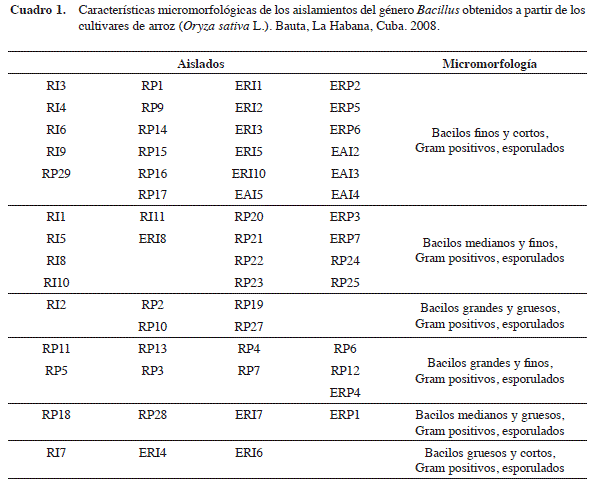
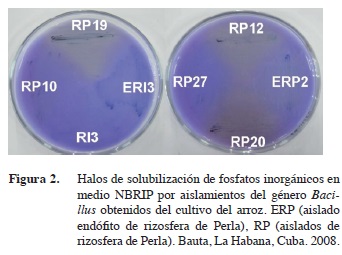
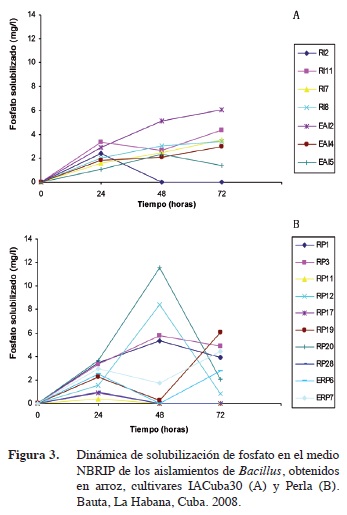
<body><![CDATA[aislados,     distribuidos entre la rizosfera y el interior de ra&iacute;ces y hojas,     en los dos cultivares de arroz muestreados: IACuba 30 y Perla (<a      href="/img/revistas/am/v24n2/a12i1.jpg">Figura     1</a>).    <br> </span></font>    <br> <font size="2"><span style="font-family: verdana;">El modelo microcosmos, empleado para el aislamiento de microorganismos asociados a plantas, tiene como ventaja que simula las condiciones de campo, adem&aacute;s los exudados radicales liberados por la planta permiten la quimiotaxis positiva de los microorganismos hacia la ra&iacute;z y el aislamiento de microorganismos rizosf&eacute;ricos y aut&oacute;ctonos (Kabir <span  style="font-style: italic;">et al.</span> 1995).</span></font><br style="font-family: verdana;"> <font size="2"></font><br style="font-family: verdana;"> <font size="2"><span style="font-family: verdana;">La presencia de diferentes g&eacute;neros bacterianos asociados a plantas de arroz cultivados en este mismo tipo de suelo y localidad, se ha informado previamente por Rives <span style="font-style: italic;">et al.</span> (2006), entre los que se incluyen <span style="font-style: italic;">Azospirillum, Herbaspirillum, Azotobacter, Burkholderia</span> y <span  style="font-style: italic;">Pseudomonas</span>, as&iacute; como especies del g&eacute;nero <span style="font-style: italic;">Bacillus </span>(Beneduzi <span style="font-style: italic;">et al.</span> 2008).</span></font><br  style="font-family: verdana;"> <font size="2"></font><br style="font-family: verdana;"> <font size="2"><span style="font-family: verdana;">Se obtuvieron 34 aislamientos del cultivar Perla y 24 del cultivar IACuba 30, distribuidos entre 36 de la rizosfera, 16 del interior de la ra&iacute;ces y 4 del interior de las hojas. La mayor&iacute;a de los aislamientos obtenidos son rizosf&eacute;ricos donde existe mayor diversidad de microorganismos que en el interior de la planta. Estos microorganismos end&oacute;fitos establecen una relaci&oacute;n m&aacute;s estrecha con su hospedero, lo que implica un reconocimiento a nivel molecular mucho m&aacute;s espec&iacute;fico (Bai <span style="font-style: italic;">et al.</span> 2003). En este sentido, tambi&eacute;n se plantea que estos microorganismos tienen ventajas competitivas respecto a aquellos que habitan en la rizosfera, debido a que existe una mayor disponibilidad de nutrientes dentro de la planta (James 2000); adem&aacute;s estos microorganismos se encuentran menos expuestos a las condiciones adversas del medio ambiente (Mu&ntilde;oz-Rojas y Caballero-Mellado 2003).</span></font><br style="font-family: verdana;"> <font size="2"></font><br style="font-family: verdana;"> <font size="2"><span style="font-family: verdana;">Para la selecci&oacute;n de las cepas se tuvo en cuenta que las bacterias crecieran despu&eacute;s del tratamiento a 80&deg;C durante 30 min, la respuesta a la tinci&oacute;n de Gram, la forma y la presencia de endosporas, caracter&iacute;sticas que se pueden observar en el <a href="/img/revistas/am/v24n2/a12t1.gif">Cuadro 1</a> y que dirigen la selecci&oacute;n hacia el g&eacute;nero <span style="font-style: italic;">Bacillus</span>, lo que habr&iacute;a que corroborar posteriormente por otras metodolog&iacute;as.</span></font><br  style="font-family: verdana;"> <font size="2"></font><br style="font-family: verdana;"> <font size="2"><span style="font-family: verdana;">La diversidad en cuanto a h&aacute;bitat de este g&eacute;nero se ha demostrado por la predominancia del mismo entre los bacilos Gram positivos aislados en suelos cultivados y dedicados al pasto sin pr&aacute;cticas de arado (Garbeva <span style="font-style: italic;">et al.</span> 2008). En este sentido, se plantea que los g&eacute;neros <span style="font-style: italic;">Bacillus </span>y <span  style="font-style: italic;">Pseudomonas </span>predominan en la rizosfera por encima del resto de los g&eacute;neros asociados a la misma (Adesemoye <span style="font-style: italic;">et al.</span> 2008).</span></font><br  style="font-family: verdana;"> <font size="2"></font><br style="font-family: verdana;"> <font style="font-weight: bold;" size="2"><span  style="font-family: verdana;">Determinaci&oacute;n cualitativa de la capacidad de solu-bilizar fosfato inorg&aacute;nico</span></font><br  style="font-family: verdana;"> <font size="2"></font><br style="font-family: verdana;"> <font size="2"><span style="font-family: verdana;">Varios estudios han puesto en evidencia la capacidad solubilizadora de fosfatos por diferentes especies microbianas (Khan <span style="font-style: italic;">et al.</span> 2010). Entre las bacterias destacan los g&eacute;neros: <span style="font-style: italic;">Pseudomonas, Bacillus, Rhizobium, Burkholderia, Achromobacter, Agrobacterium, Microccocus, Aerobacter, Flavobacterium, Enterobacter, Pantoea, Klebsiella, Rhodobacter, Arthrobacter, Serratia </span>y <span style="font-style: italic;">Erwinia </span>(Pati&ntilde;o 2010).</span></font><br style="font-family: verdana;"> <font size="2"></font><br style="font-family: verdana;"> <font size="2"><span style="font-family: verdana;">En este experimento la solubilizaci&oacute;n de fosfato inorg&aacute;nico se puso de manifiesto por la formaci&oacute;n de un halo transparente en el medio NBRIP para los aislados RI2, RI7, RI8, RI11, EAI2, EAI4, EAI5, RP1, RP3, RP5, RP6, RP11, RP12, RP17, RP19, RP20, RP28, ERP2, ERP6, ERP7. Esto significa que el 29,31% de los aislados tienen esta capacidad. En la <a href="/img/revistas/am/v24n2/a12i2.jpg">Figura 2</a> se observa alrededor del crecimiento microbiano de los aislados RP19, RP20, RP12 y ERP2 una zona clara, que evidencia la solubilizaci&oacute;n de fosfatos. Este cambio de coloraci&oacute;n ocurri&oacute; alrededor del crecimiento de las cepas RP19, RP12 y RP20, lo que se encuentra relacionado con el mecanismo a trav&eacute;s del cual se lleva a cabo la solubilizaci&oacute;n de fosfatos.    <br> <br style="font-family: verdana;"> </span></font> <font size="2"><span style="font-family: verdana;">Uno de los principales mecanismos de la solubilizaci&oacute;n de fosfatos es a trav&eacute;s de la excreci&oacute;n de &aacute;cidos org&aacute;nicos al medio (Rodr&iacute;guez y Fraga 1999). Esto ocurre debido a que se lleva a cabo un intercambio cati&oacute;nico que permite que el fosfato insoluble se convierta a formas solubles, por lo que el mismo podr&iacute;a estar disponible para la planta. Dentro de los &aacute;cidos org&aacute;nicos excretados m&aacute;s comunes se encuentran el &aacute;cido c&iacute;trico, &aacute;cido l&aacute;ctico, &aacute;cido succ&iacute;nico y el &aacute;cido propi&oacute;nico, siendo este &uacute;ltimo uno de los principales compuestos utilizados por especies como <span style="font-style: italic;">Bacillus megaterium</span> para llevar a cabo la solubilizaci&oacute;n de fosfatos (Chen <span  style="font-style: italic;">et al.</span> 2006).</span></font><br  style="font-family: verdana;"> <font size="2"></font><br style="font-family: verdana;"> <font style="font-weight: bold;" size="2"><span  style="font-family: verdana;">Determinaci&oacute;n cuantitativa de la capacidad de solubilizar fosfato inorg&aacute;nico</span></font><br  style="font-family: verdana;"> <font size="2"></font><br style="font-family: verdana;"> <font size="2"><span style="font-family: verdana;">Las concentraciones de fosfato soluble variaron entre las 0,23 y 11,58 mg/l. Los aislados RP20 y RP12 se destacan por su capacidad de solubilizar fosfato a las 48 horas de crecimiento (<a href="/img/revistas/am/v24n2/a12i3.jpg">Figura 3</a>).    <br>     <br style="font-family: verdana;">     ]]></body>
<body><![CDATA[</span></font>     <font size="2"><span style="font-family: verdana;">En algunos aislados     que resultaron     ser positivos ante la determinaci&oacute;n cualitativa como RI2, RP11,     RP17y RP28 solo se encontr&oacute; fosfato soluble a las 24 horas de     incubaci&oacute;n y en bajas concentraciones. Esto podr&iacute;a estar     relacionado con el hecho de que estos microorganismos llevan a cabo el     proceso de solubilizaci&oacute;n de fosfatos para potenciar el     crecimiento al inicio de este o que el estado del medio de cultivo     influya en la producci&oacute;n de los metabolitos encargados de este     ]]></body>
<body><![CDATA[proceso.</span></font><br style="font-family: verdana;">     <font size="2"></font><br style="font-family: verdana;">     <font size="2"><span style="font-family: verdana;">Al analizar la     din&aacute;mica de     solubilizaci&oacute;n de fosfatos, se puede observar que los     aislamientos presentan un comportamiento diferente. EAI5, RP1, RP3,     RP12 y RP20 tuvieron el m&aacute;ximo de solubilizaci&oacute;n a las 48     horas, mientras que RI11, RI7, RI8, EAI2, EAI4, RP19, ERP6, ERP7 a las     72 horas, el cual fue el tiempo m&aacute;ximo del experimento.</span></font><br      style="font-family: verdana;">     ]]></body>
<body><![CDATA[<font size="2"></font><br style="font-family: verdana;">     <font size="2"><span style="font-family: verdana;">En una etapa inicial     (hasta las 48     horas de incubaci&oacute;n) se solubiliz&oacute; el fosfato para     consumirlo posteriormente. Algunos microorganismos exhiben     represi&oacute;n de actividad solubilizadora ante la presencia de     f&oacute;sforo soluble y en otros no ocurr&iacute;a represi&oacute;n     (Mikanova <span style="font-style: italic;">et al.</span> 1997).</span></font><br      style="font-family: verdana;">     <font size="2"></font><br style="font-family: verdana;">     ]]></body>
<body><![CDATA[<font size="2"><span style="font-family: verdana;">En algunas cepas de     <span style="font-style: italic;">Bacillus</span>, la     mayor solubilizaci&oacute;n ocurri&oacute; despu&eacute;s de las 18 a     24 horas del crecimiento bacteriano, correspondi&oacute; con la fase     logar&iacute;tmica del crecimiento, mientras que en otras a partir de     las 18 horas comenz&oacute; un decrecimiento, sin encontrar alguna     explicaci&oacute;n a ello (V&aacute;zquez <span      style="font-style: italic;">et al.</span> 2000). Este hecho     tambi&eacute;n ocurre con las cepas estudiadas pero despu&eacute;s de     las 48 horas, lo que probablemente se deba al consumo de f&oacute;sforo     ]]></body>
<body><![CDATA[por el mismo microorganismo en el medio de cultivo o que el     f&oacute;sforo disponible regule el proceso de solubilizaci&oacute;n en     algunas cepas y en otras no.</span></font><br      style="font-family: verdana;">     <font size="2"></font><br style="font-family: verdana;">     <font size="2"><span style="font-family: verdana;">En especies del     g&eacute;nero     <span style="font-style: italic;">Bacillus </span>se ha demostrado la     capacidad de los mismos para solubilizar     fosfatos, esto ha sido relacionado con su actividad promotora del     ]]></body>
<body><![CDATA[crecimiento vegetal en diferentes cultivos de inter&eacute;s     econ&oacute;mico como el ma&iacute;z y el trigo (Egamberdiyeva <span      style="font-style: italic;">et al.</span>     2004). En este sentido se ha informado acerca de esta capacidad en     especies como <span style="font-style: italic;">B. subtilis</span> y <span      style="font-style: italic;">B. megaterium</span> (Rajankar <span      style="font-style: italic;">et al.</span> 2007). Esta     &uacute;ltima especie tambi&eacute;n ha sido aislada de la planta <span      style="font-style: italic;">Cicer     arietinum </span>demostrando una alta eficiencia solubilizadora de     ]]></body>
<body><![CDATA[fosfato en     medio Pikovskaya&#8217;s relacionado con efecto positivo sobre el crecimiento     radicular (Sharma <span style="font-style: italic;">et al.</span>     2007).</span></font><br style="font-family: verdana;">     <font size="2"></font><br style="font-family: verdana;">     <font size="2"><span style="font-family: verdana;">Por otra parte, se     sabe que     especies de este g&eacute;nero como <span style="font-style: italic;">B.     amyloliquefaciens</span> aislado de     rizosfera de papa solubilizan fosfato en el mismo medio de cultivo     ]]></body>
<body><![CDATA[utilizado en este trabajo (Calvo <span style="font-style: italic;">et     al.</span> 2010). Adem&aacute;s se informa     que <span style="font-style: italic;">B. circulans</span> aislado de     la rizosfera de manzana solubiliza fosfatos     en medio Pikovskaya combinado con la producci&oacute;n de &aacute;cido     indolac&eacute;tico y sider&oacute;foros (Metha <span      style="font-style: italic;">et al.</span> 2010).</span></font><br      style="font-family: verdana;">     <font size="2"></font><br style="font-family: verdana;">     <font size="2"><span style="font-family: verdana;">Algunas especies     ]]></body>
<body><![CDATA[como <span style="font-style: italic;">B.     liqueniformis</span> y <span style="font-style: italic;">B.     amyloliquefaciens</span> solubilizan fosfatos a     trav&eacute;s de la excreci&oacute;n de una mezcla de &aacute;cidos     org&aacute;nicos como el &aacute;cido l&aacute;ctico,     isoval&eacute;rico, isobut&iacute;rico y ac&eacute;tico (Metha y     Nautiyal 2001).</span></font><br style="font-family: verdana;">     <font size="2"></font><br style="font-family: verdana;">     <font size="2"><span style="font-family: verdana;">Otros mecanismos     involucran el     ]]></body>
<body><![CDATA[intercambio cati&oacute;nico, permitiendo que el fosfato insoluble se     convierta a formas solubles por lo que el mismo podr&iacute;a estar     disponible para la planta (Khan <span style="font-style: italic;">et     al.</span> 2009). Por otra parte, se ha     demostrado que algunas especies como <span style="font-style: italic;">B.     subtilis</span> y <span style="font-style: italic;">B. megaterium</span>     se     destacan por ser buenos solubilizadores de f&oacute;sforo     inorg&aacute;nico (Rajankar <span style="font-style: italic;">et al.</span>     2007).</span></font><br style="font-family: verdana;">     ]]></body>
<body><![CDATA[<font size="2"></font><br style="font-family: verdana;">     <font size="2"><span style="font-family: verdana;">Al analizar los     porcentajes de     cepas con esta capacidad se observa que es ligeramente mayor en cepas     rizosf&eacute;ricas (36,8%), debido a que estos microorganismos se     encuentran en un ambiente donde la mayor cantidad de fosfato se     presentan en formas insolubles (Goldstein 1994), por lo que     tendr&iacute;an que haber evolucionado hacia la utilizaci&oacute;n de     esta fuente de nutrientes en las condiciones en que normalmente se     encuentran en el suelo. En el caso del g&eacute;nero <span     ]]></body>
<body><![CDATA[ style="font-style: italic;">Bacillus </span>se     plantea que son microorganismos end&oacute;fitos facultativos por lo     que el hallazgo de microorganismos end&oacute;fitos solubilizadores de     fosfato, en este caso el 25%, permite predecir que pudieron estar en     contacto con fuentes de fosfato insoluble del suelo en alg&uacute;n     momento de su ciclo de vida.</span></font><br      style="font-family: verdana;">     <br style="font-family: verdana;">     <font size="2"><span style="font-family: verdana;">Se identificaron 19     cepas de     ]]></body>
<body><![CDATA[<span style="font-style: italic;">Bacillus </span>con la capacidad de     solubilizar fosfatos inorg&aacute;nicos lo     que demuestra sus potencialidades en la estimulaci&oacute;n del     crecimiento vegetal. Estas pudieran contribuir positivamente al     crecimiento de la planta como ocurre en el algod&oacute;n (Qureshi <span      style="font-style: italic;">et     al.</span> 2012), Kiwi (Erturk <span style="font-style: italic;">et al.</span>     2010), tomate (Felici <span style="font-style: italic;">et al.</span>     2008) y     algunos vegetales (Ademoseye <span style="font-style: italic;">et al.</span>     ]]></body>
<body><![CDATA[2008), entre otros cultivos.</span></font><br      style="font-family: verdana;">     <br style="font-family: verdana;">     <hr style="width: 100%; height: 2px;"><font style="font-weight: bold;"      size="3"><span style="font-family: verdana;">Literatura citada</span></font><br      style="font-family: verdana;">     <font size="2"></font><br style="font-family: verdana;">     <font size="2"><span style="font-family: verdana;">Adesemoye, AO;     Obini, M; Ugoji, EO.     2008. Comparison of plant growth-promotion with <span     ]]></body>
<body><![CDATA[ style="font-style: italic;">Pseudomonas aeruginosa</span>     and <span style="font-style: italic;">Bacillus subtilis </span>in     three vegetables. Brazilian Journal of     <!-- ref -->Microbiology 39:423-426.    &nbsp;&nbsp;&nbsp;&nbsp;&nbsp;&nbsp;&nbsp;&nbsp;[&#160;<a href="javascript:void(0);" onclick="javascript: window.open('/scielo.php?script=sci_nlinks&ref=327799&pid=S1659-1321201300020001200001&lng=','','width=640,height=500,resizable=yes,scrollbars=1,menubar=yes,');">Links</a>&#160;]<!-- end-ref --><!-- ref --></span></font><br style="font-family: verdana;"> <font size="2"></font><br style="font-family: verdana;"> <font size="2"><span style="font-family: verdana;">Alikhani, HA; Rastin-Saleh, N; Antoun, H. 2007. Phosphate solubilization activity of rhizobia native Iranian soils. <span style="font-style: italic;">In </span>Vel&aacute;zquez, E.; Rodr&iacute;guez-Barrueco, C. eds. First International Meeting on Microbial Phosphate Solubilization. Springer, Netherlands. p. 35-41.    &nbsp;&nbsp;&nbsp;&nbsp;&nbsp;&nbsp;&nbsp;&nbsp;[&#160;<a href="javascript:void(0);" onclick="javascript: window.open('/scielo.php?script=sci_nlinks&ref=327800&pid=S1659-1321201300020001200002&lng=','','width=640,height=500,resizable=yes,scrollbars=1,menubar=yes,');">Links</a>&#160;]<!-- end-ref --><!-- ref --></span></font><br  style="font-family: verdana;"> <font size="2"></font><br style="font-family: verdana;"> <font size="2"><span style="font-family: verdana;">Bai, Y; Zhou, X; Smith, DL. 2003. Enhanced soybean plant growth resulting from coinoculation of <span  style="font-style: italic;">Bacillus </span>strains with <span style="font-style: italic;">Bradyrhizobium japonicum</span>. Crop Sci. 43:1774-1781.    &nbsp;&nbsp;&nbsp;&nbsp;&nbsp;&nbsp;&nbsp;&nbsp;[&#160;<a href="javascript:void(0);" onclick="javascript: window.open('/scielo.php?script=sci_nlinks&ref=327801&pid=S1659-1321201300020001200003&lng=','','width=640,height=500,resizable=yes,scrollbars=1,menubar=yes,');">Links</a>&#160;]<!-- end-ref --><!-- ref --></span></font><br  style="font-family: verdana;"> <font size="2"></font><br style="font-family: verdana;"> <font size="2"><span style="font-family: verdana;">Beneduzi, A; Peres, D; Vargas, LK; Bodanese-Zanettini, MH; Passaglia, LMP. 2008. Evaluation of genetic diversity and plant growth promoting activities of nitrogen-fixing bacilli isolated from rice fields in South Brazil. Applied Soil Ecology 39:311-32.    &nbsp;&nbsp;&nbsp;&nbsp;&nbsp;&nbsp;&nbsp;&nbsp;[&#160;<a href="javascript:void(0);" onclick="javascript: window.open('/scielo.php?script=sci_nlinks&ref=327802&pid=S1659-1321201300020001200004&lng=','','width=640,height=500,resizable=yes,scrollbars=1,menubar=yes,');">Links</a>&#160;]<!-- end-ref --><br>     <!-- ref --><br> Calvo, P; Orme&ntilde;o-Orrillo, E; Mart&iacute;nez-Romero, E; Z&uacute;&ntilde;iga, D. 2010. Characterization of <span  style="font-style: italic;">Bacillus </span>isolates of potato rhizosphere from andean soils of Per&uacute; and their potential PGPR characteristics. Brazilian Journal of Microbiology 41:899-906.    &nbsp;&nbsp;&nbsp;&nbsp;&nbsp;&nbsp;&nbsp;&nbsp;[&#160;<a href="javascript:void(0);" onclick="javascript: window.open('/scielo.php?script=sci_nlinks&ref=327804&pid=S1659-1321201300020001200005&lng=','','width=640,height=500,resizable=yes,scrollbars=1,menubar=yes,');">Links</a>&#160;]<!-- end-ref --><!-- ref --></span></font><br style="font-family: verdana;"> <font size="2"></font><br style="font-family: verdana;"> <font size="2"><span style="font-family: verdana;">Chen, YP; Rekha, PD; Arun, AB; Shen, FT; Lai, W; Young, CC. 2006. Phosphate solubilizing bacteria from subtropical soil and their tricalcium phosphate solubilizing abilities. Applied Soil Ecology 34:33-41.    &nbsp;&nbsp;&nbsp;&nbsp;&nbsp;&nbsp;&nbsp;&nbsp;[&#160;<a href="javascript:void(0);" onclick="javascript: window.open('/scielo.php?script=sci_nlinks&ref=327805&pid=S1659-1321201300020001200006&lng=','','width=640,height=500,resizable=yes,scrollbars=1,menubar=yes,');">Links</a>&#160;]<!-- end-ref --><!-- ref --> </span></font><br  style="font-family: verdana;"> <font size="2"></font><br style="font-family: verdana;"> <font size="2"><span style="font-family: verdana;">Egamberdiyeva, D; Juraeva, D; Poberejskaya, S; Myachina, O; Teryuhova, P; Seydalieva, L; Aliev, A. 2004. Improvement of wheat and cotton growth and nutrient uptake by phosphate solubilizing bacteria. <span style="font-style: italic;">In </span>26 th Southern Conservation Tillage Conference. Raleigh, North Carolina, USA. p. 58-66.    &nbsp;&nbsp;&nbsp;&nbsp;&nbsp;&nbsp;&nbsp;&nbsp;[&#160;<a href="javascript:void(0);" onclick="javascript: window.open('/scielo.php?script=sci_nlinks&ref=327806&pid=S1659-1321201300020001200007&lng=','','width=640,height=500,resizable=yes,scrollbars=1,menubar=yes,');">Links</a>&#160;]<!-- end-ref --><!-- ref --></span></font><br  style="font-family: verdana;"> <font size="2"></font><br style="font-family: verdana;"> <font size="2"><span style="font-family: verdana;">Erturk, Y; Ercisli. S; Haznedar, A; Cakmakci, R. 2010. Effects&nbsp; of&nbsp; plant&nbsp; growth&nbsp; promoting&nbsp; rhizobacteria (PGPR) on rooting and root growth of kiwifruit (<span style="font-style: italic;">Actinidia deliciosa</span>) stem cuttings. Biol Res 43:91-98.    &nbsp;&nbsp;&nbsp;&nbsp;&nbsp;&nbsp;&nbsp;&nbsp;[&#160;<a href="javascript:void(0);" onclick="javascript: window.open('/scielo.php?script=sci_nlinks&ref=327807&pid=S1659-1321201300020001200008&lng=','','width=640,height=500,resizable=yes,scrollbars=1,menubar=yes,');">Links</a>&#160;]<!-- end-ref --><br>     <br> </span></font>     <!-- ref --><div style="text-align: left;"><font size="2"><span  style="font-family: verdana;">FAO (Food and Agriculture Organization of the United Nations). 2007. FAO production yearbook. <span style="font-style: italic;">In</span> FAO rice market monitor, trade and markets division, Food and Agriculture Organization of the United Nations. Roma, Italia. Volume X Issue No. 3 (en l&iacute;nea). Consultado 13 mayo 2010. Disponible en <a href="http://www.%20fao.org">http://www. fao.org</a>    &nbsp;&nbsp;&nbsp;&nbsp;&nbsp;&nbsp;&nbsp;&nbsp;[&#160;<a href="javascript:void(0);" onclick="javascript: window.open('/scielo.php?script=sci_nlinks&ref=327810&pid=S1659-1321201300020001200009&lng=','','width=640,height=500,resizable=yes,scrollbars=1,menubar=yes,');">Links</a>&#160;]<!-- end-ref --><br> </span></font><br style="font-family: verdana;"> </div>     <!-- ref --><div style="text-align: left;"><font size="2"><span  style="font-family: verdana;">Felici, C; Vettori, L; Giraldi, E; Forino, LMC; Toffanin, A; Tagliasacchi, AM; Nuti, M. 2008. Single and co-inoculation of <span style="font-style: italic;">Bacillus subtilis</span> and <span style="font-style: italic;">Azospirillum brasilense</span> on <span style="font-style: italic;">Lycopersicon esculentum</span>: Effects on plant growth and rhizosphere microbial community. Applied Soil Ecology 40:260-270.    &nbsp;&nbsp;&nbsp;&nbsp;&nbsp;&nbsp;&nbsp;&nbsp;[&#160;<a href="javascript:void(0);" onclick="javascript: window.open('/scielo.php?script=sci_nlinks&ref=327812&pid=S1659-1321201300020001200010&lng=','','width=640,height=500,resizable=yes,scrollbars=1,menubar=yes,');">Links</a>&#160;]<!-- end-ref --><!-- ref --></span></font><br  style="font-family: verdana;"> </div> <br style="font-family: verdana;"> <font size="2"><span style="font-family: verdana;">Garbeva, P; Van Elsas, JD; Van Veen, JA. 2008. Rhizosphere microbial community and its response to plant species and soil history. Plant Soil 302:19-32.    &nbsp;&nbsp;&nbsp;&nbsp;&nbsp;&nbsp;&nbsp;&nbsp;[&#160;<a href="javascript:void(0);" onclick="javascript: window.open('/scielo.php?script=sci_nlinks&ref=327813&pid=S1659-1321201300020001200011&lng=','','width=640,height=500,resizable=yes,scrollbars=1,menubar=yes,');">Links</a>&#160;]<!-- end-ref --><!-- ref --></span></font><br  style="font-family: verdana;"> <font size="2"></font><br style="font-family: verdana;"> <font size="2"><span style="font-family: verdana;">Garc&iacute;a, JC; Hern&aacute;ndez, A; Acebo, Y; Rives, N. 2008. Obtenci&oacute;n de un nuevo m&eacute;todo de desinfecci&oacute;n de semillas de arroz. Cultivos Tropicales 29:55-59.    &nbsp;&nbsp;&nbsp;&nbsp;&nbsp;&nbsp;&nbsp;&nbsp;[&#160;<a href="javascript:void(0);" onclick="javascript: window.open('/scielo.php?script=sci_nlinks&ref=327814&pid=S1659-1321201300020001200012&lng=','','width=640,height=500,resizable=yes,scrollbars=1,menubar=yes,');">Links</a>&#160;]<!-- end-ref --><!-- ref --></span></font><br  style="font-family: verdana;"> <font size="2"></font><br style="font-family: verdana;"> <font size="2"><span style="font-family: verdana;">Goldstein, AH. 1994. Involvement of the quinoprotein glucose dehydrogenises in the solubilization of exogenous phosphates by gram-negative bacteria. <span  style="font-style: italic;">In</span> Torriani Gorini, A; Yagil, E; Silver, S. eds. Phosphate in Microorganisms: Cellular and Molecular Biology. Washington, D. C. USA, ASM Press. p. 197-203.    &nbsp;&nbsp;&nbsp;&nbsp;&nbsp;&nbsp;&nbsp;&nbsp;[&#160;<a href="javascript:void(0);" onclick="javascript: window.open('/scielo.php?script=sci_nlinks&ref=327815&pid=S1659-1321201300020001200013&lng=','','width=640,height=500,resizable=yes,scrollbars=1,menubar=yes,');">Links</a>&#160;]<!-- end-ref --><br>     <!-- ref --><br> He, ZL; Bian, W; Zhu, J. 2002. Screening and identification of microorganisms capable of utilizing phosphate adsorbed by goethite. Comm. Soil Sci. Plant Anal. 33:647-663.    &nbsp;&nbsp;&nbsp;&nbsp;&nbsp;&nbsp;&nbsp;&nbsp;[&#160;<a href="javascript:void(0);" onclick="javascript: window.open('/scielo.php?script=sci_nlinks&ref=327817&pid=S1659-1321201300020001200014&lng=','','width=640,height=500,resizable=yes,scrollbars=1,menubar=yes,');">Links</a>&#160;]<!-- end-ref --><!-- ref --></span></font><br  style="font-family: verdana;"> <font size="2"></font><br style="font-family: verdana;"> <font size="2"><span style="font-family: verdana;">Hern&aacute;ndez, A. 2002. Obtenci&oacute;n de un biopreparado a partir de rizobacterias asociadas al cultivo del ma&iacute;z (<span style="font-style: italic;">Zea mays</span> L.). Tesis de doctorado. La Habana, Cuba, Facultad de Biolog&iacute;a, Universidad de La Habana. 93 p.    &nbsp;&nbsp;&nbsp;&nbsp;&nbsp;&nbsp;&nbsp;&nbsp;[&#160;<a href="javascript:void(0);" onclick="javascript: window.open('/scielo.php?script=sci_nlinks&ref=327818&pid=S1659-1321201300020001200015&lng=','','width=640,height=500,resizable=yes,scrollbars=1,menubar=yes,');">Links</a>&#160;]<!-- end-ref --><!-- ref --></span></font><br style="font-family: verdana;"> <font size="2"></font><br style="font-family: verdana;"> <font size="2"><span style="font-family: verdana;">Idriss, EE; Makarewicz, O; Farouk, A; Rosner, K; Greiner, R; Bochow, H; Richter, T; Borriss, R. 2002. Extracellular phytase activity of <span style="font-style: italic;">Bacillus amyloliquefaciens</span> FZB45 contributes to its plant-growth-promoting effect. Microbiology 148:2097-2109.    &nbsp;&nbsp;&nbsp;&nbsp;&nbsp;&nbsp;&nbsp;&nbsp;[&#160;<a href="javascript:void(0);" onclick="javascript: window.open('/scielo.php?script=sci_nlinks&ref=327819&pid=S1659-1321201300020001200016&lng=','','width=640,height=500,resizable=yes,scrollbars=1,menubar=yes,');">Links</a>&#160;]<!-- end-ref --><!-- ref --></span></font><br style="font-family: verdana;"> <font size="2"></font><br style="font-family: verdana;"> <font size="2"><span style="font-family: verdana;">James, EK; Gyaneshwar, P; Barraquio, WL; Mathan, N; Ladha, J. 2000. Endophytic diazotrophs associated with rice. <span style="font-style: italic;">In </span>Ladha, JK; Reddy, PM. eds. The quest for nitrogen fixation in rice. International Rice Research Institute, Los Ba&ntilde;os, Laguna, Philippines. p. 119-140.    &nbsp;&nbsp;&nbsp;&nbsp;&nbsp;&nbsp;&nbsp;&nbsp;[&#160;<a href="javascript:void(0);" onclick="javascript: window.open('/scielo.php?script=sci_nlinks&ref=327820&pid=S1659-1321201300020001200017&lng=','','width=640,height=500,resizable=yes,scrollbars=1,menubar=yes,');">Links</a>&#160;]<!-- end-ref --><!-- ref --></span></font><br  style="font-family: verdana;"> <font size="2"></font><br style="font-family: verdana;"> <font size="2"><span style="font-family: verdana;">Kabir, M; Faure, D; Heulin, T; Achoawk, W; Bally R. 1995. Oligonucleotide probes based on 16S rRNA sequences for the identification of four <span  style="font-style: italic;">Azospirillum </span>species. Can. J. Microbiol 41:1081-1087.    &nbsp;&nbsp;&nbsp;&nbsp;&nbsp;&nbsp;&nbsp;&nbsp;[&#160;<a href="javascript:void(0);" onclick="javascript: window.open('/scielo.php?script=sci_nlinks&ref=327821&pid=S1659-1321201300020001200018&lng=','','width=640,height=500,resizable=yes,scrollbars=1,menubar=yes,');">Links</a>&#160;]<!-- end-ref --><!-- ref --></span></font><br style="font-family: verdana;"> <font size="2"></font><br style="font-family: verdana;"> <font size="2"><span style="font-family: verdana;">Khan, MS; Zaidi, A; Wani, PA; Ahemad, M; Oves, M. 2009. Functional diversity among plant growth-promoting rhizobacteria: current status. Microbial Strategies for Crop Improvement. Cap6. Berlin Heidelberg, Deushland, Springer-Verlag. p. 105-131.    &nbsp;&nbsp;&nbsp;&nbsp;&nbsp;&nbsp;&nbsp;&nbsp;[&#160;<a href="javascript:void(0);" onclick="javascript: window.open('/scielo.php?script=sci_nlinks&ref=327822&pid=S1659-1321201300020001200019&lng=','','width=640,height=500,resizable=yes,scrollbars=1,menubar=yes,');">Links</a>&#160;]<!-- end-ref --><!-- ref --></span></font><br  style="font-family: verdana;"> <font size="2"></font><br style="font-family: verdana;"> <font size="2"><span style="font-family: verdana;">Khan, MS; Zaidi, A; Ahemad, M; Oves, M; Wani, PA. 2010. Plant growth promotion by phosphate solubilizing fungi &#8211; current perspective. Arch Agron Soil Scien 56(1):73-98.    &nbsp;&nbsp;&nbsp;&nbsp;&nbsp;&nbsp;&nbsp;&nbsp;[&#160;<a href="javascript:void(0);" onclick="javascript: window.open('/scielo.php?script=sci_nlinks&ref=327823&pid=S1659-1321201300020001200020&lng=','','width=640,height=500,resizable=yes,scrollbars=1,menubar=yes,');">Links</a>&#160;]<!-- end-ref --><!-- ref --></span></font><br style="font-family: verdana;"> <font size="2"></font><br style="font-family: verdana;"> <font size="2"><span style="font-family: verdana;">Metha, S; Nautiyal, S. 2001. An efficient method for qualitative screening of phosphate- solubilizing bacteria. Current Microbiology 43:51-55.    &nbsp;&nbsp;&nbsp;&nbsp;&nbsp;&nbsp;&nbsp;&nbsp;[&#160;<a href="javascript:void(0);" onclick="javascript: window.open('/scielo.php?script=sci_nlinks&ref=327824&pid=S1659-1321201300020001200021&lng=','','width=640,height=500,resizable=yes,scrollbars=1,menubar=yes,');">Links</a>&#160;]<!-- end-ref --><!-- ref --></span></font><br  style="font-family: verdana;"> <font size="2"></font><br style="font-family: verdana;"> <font size="2"><span style="font-family: verdana;">Metha, P; Chauhan, A; Mahajan, R; Mahajan, PK; Shirkot, CK. 2010. Strain of <span  style="font-style: italic;">Bacillus circulans </span>isolated from apple rhizosphere showing plant growth promoting potential. Current Science 98(4):538-542.    &nbsp;&nbsp;&nbsp;&nbsp;&nbsp;&nbsp;&nbsp;&nbsp;[&#160;<a href="javascript:void(0);" onclick="javascript: window.open('/scielo.php?script=sci_nlinks&ref=327825&pid=S1659-1321201300020001200022&lng=','','width=640,height=500,resizable=yes,scrollbars=1,menubar=yes,');">Links</a>&#160;]<!-- end-ref --><!-- ref --></span></font><br  style="font-family: verdana;"> <font size="2"></font><br style="font-family: verdana;"> <font size="2"><span style="font-family: verdana;">Mikanova, O; Kubat, J; Simon, T; Vorisek, K; Randova, D. 1997. Influence of soluble phosphate on P-solubilizing activity of bacteria. Rostlinna-Vyroba-UZPI 43:421-424.    &nbsp;&nbsp;&nbsp;&nbsp;&nbsp;&nbsp;&nbsp;&nbsp;[&#160;<a href="javascript:void(0);" onclick="javascript: window.open('/scielo.php?script=sci_nlinks&ref=327826&pid=S1659-1321201300020001200023&lng=','','width=640,height=500,resizable=yes,scrollbars=1,menubar=yes,');">Links</a>&#160;]<!-- end-ref --><!-- ref --></span></font><br  style="font-family: verdana;"> <font size="2"></font><br style="font-family: verdana;"> <font size="2"><span style="font-family: verdana;">Mu&ntilde;oz-Rojas, J; Caballero-Mellado, J. 2003. Population dynamics of <span  style="font-style: italic;">Gluconacetobacter diazotrophicus </span>in sugarcane cultivars and its effects on plant growth. Microb. Ecol. 46:454-464.    &nbsp;&nbsp;&nbsp;&nbsp;&nbsp;&nbsp;&nbsp;&nbsp;[&#160;<a href="javascript:void(0);" onclick="javascript: window.open('/scielo.php?script=sci_nlinks&ref=327827&pid=S1659-1321201300020001200024&lng=','','width=640,height=500,resizable=yes,scrollbars=1,menubar=yes,');">Links</a>&#160;]<!-- end-ref --><!-- ref --></span></font><br style="font-family: verdana;"> <font size="2"></font><br style="font-family: verdana;"> <font size="2"><span style="font-family: verdana;">Nautiyal, SC. 1999. An efficient microbiological growth medium for screening phosphate solubilizing microorganism. FEMS Microbiology Letters 170:265-275.    &nbsp;&nbsp;&nbsp;&nbsp;&nbsp;&nbsp;&nbsp;&nbsp;[&#160;<a href="javascript:void(0);" onclick="javascript: window.open('/scielo.php?script=sci_nlinks&ref=327828&pid=S1659-1321201300020001200025&lng=','','width=640,height=500,resizable=yes,scrollbars=1,menubar=yes,');">Links</a>&#160;]<!-- end-ref --><!-- ref --></span></font><br  style="font-family: verdana;"> <font size="2"></font><br style="font-family: verdana;"> <font size="2"><span style="font-family: verdana;">NCCLS (Natural Committee for Clinical Laboratory Standards). 1993. Performance standards for antimicrobial disk. Susceptibility test. Approved standard. p. 238.    &nbsp;&nbsp;&nbsp;&nbsp;&nbsp;&nbsp;&nbsp;&nbsp;[&#160;<a href="javascript:void(0);" onclick="javascript: window.open('/scielo.php?script=sci_nlinks&ref=327829&pid=S1659-1321201300020001200026&lng=','','width=640,height=500,resizable=yes,scrollbars=1,menubar=yes,');">Links</a>&#160;]<!-- end-ref --><!-- ref --></span></font><br  style="font-family: verdana;"> <font size="2"></font><br style="font-family: verdana;"> <font size="2"><span style="font-family: verdana;">Pati&ntilde;o, CO. 2010. Solubilizaci&oacute;n de fosfatos por poblaciones bacterianas aisladas de un suelo del valle del cauca. Estudio de biodiversidad y eficiencia. Tesis Doctorado en Ciencias Agropecuarias L&iacute;nea de Investigaci&oacute;n Manejo de Suelos y Aguas. Universidad Nacional de Colombia, Colombia. 133 p.    &nbsp;&nbsp;&nbsp;&nbsp;&nbsp;&nbsp;&nbsp;&nbsp;[&#160;<a href="javascript:void(0);" onclick="javascript: window.open('/scielo.php?script=sci_nlinks&ref=327830&pid=S1659-1321201300020001200027&lng=','','width=640,height=500,resizable=yes,scrollbars=1,menubar=yes,');">Links</a>&#160;]<!-- end-ref --><!-- ref --></span></font><br  style="font-family: verdana;"> <font size="2"></font><br style="font-family: verdana;"> <font size="2"><span style="font-family: verdana;">Qureshi, MA; Ahmad, ZA; Akhtar, N; Iqbal, A; Mujeeb, F; Shakir, MA. 2012. Role of phosphate solubilizing bacteria (PSB) in enhancing P availability and promoting cotton growth. The Journal of Animal &amp; Plant Sciences 22(1):204-210.    &nbsp;&nbsp;&nbsp;&nbsp;&nbsp;&nbsp;&nbsp;&nbsp;[&#160;<a href="javascript:void(0);" onclick="javascript: window.open('/scielo.php?script=sci_nlinks&ref=327831&pid=S1659-1321201300020001200028&lng=','','width=640,height=500,resizable=yes,scrollbars=1,menubar=yes,');">Links</a>&#160;]<!-- end-ref --><!-- ref --></span></font><br  style="font-family: verdana;"> <font size="2"></font><br style="font-family: verdana;"> <font size="2"><span style="font-family: verdana;">Rajankar, PN; Tambekar, DH; Wate, SR. 2007. Study of phosphate solubilization efficiences of fungi and bacteria isolated from saline belt of Purna river basin. Research Journal of Agriculture and Biological Sciences 3(6):701-703.    &nbsp;&nbsp;&nbsp;&nbsp;&nbsp;&nbsp;&nbsp;&nbsp;[&#160;<a href="javascript:void(0);" onclick="javascript: window.open('/scielo.php?script=sci_nlinks&ref=327832&pid=S1659-1321201300020001200029&lng=','','width=640,height=500,resizable=yes,scrollbars=1,menubar=yes,');">Links</a>&#160;]<!-- end-ref --><!-- ref --></span></font><br  style="font-family: verdana;"> <font size="2"></font><br style="font-family: verdana;"> <font size="2"><span style="font-family: verdana;">Rengel, Z; Marschner P. 2005. Nutrient availability in the rizosphere: exploiting genotypic differences. New Phytologyst 168:305-312.    &nbsp;&nbsp;&nbsp;&nbsp;&nbsp;&nbsp;&nbsp;&nbsp;[&#160;<a href="javascript:void(0);" onclick="javascript: window.open('/scielo.php?script=sci_nlinks&ref=327833&pid=S1659-1321201300020001200030&lng=','','width=640,height=500,resizable=yes,scrollbars=1,menubar=yes,');">Links</a>&#160;]<!-- end-ref --><!-- ref --></span></font><br  style="font-family: verdana;"> <font size="2"></font><br style="font-family: verdana;"> <font size="2"><span style="font-family: verdana;">Rives, N; Hern&aacute;ndez, A; Acebo, Y; Heydrich, M. 2006. Caracterizaci&oacute;n de algunos g&eacute;neros bacterianos asociados al cultivo del arroz variedad J-104. Revista Cubana del Arroz 2(3):7-13.    &nbsp;&nbsp;&nbsp;&nbsp;&nbsp;&nbsp;&nbsp;&nbsp;[&#160;<a href="javascript:void(0);" onclick="javascript: window.open('/scielo.php?script=sci_nlinks&ref=327834&pid=S1659-1321201300020001200031&lng=','','width=640,height=500,resizable=yes,scrollbars=1,menubar=yes,');">Links</a>&#160;]<!-- end-ref --><!-- ref --></span></font><br  style="font-family: verdana;"> <font size="2"></font><br style="font-family: verdana;"> <font size="2"><span style="font-family: verdana;">Rodr&iacute;guez, H; Fraga, R. 1999. Phosphate solubilizing bacteria and their role in plant growth promotion. Biotechnology Advances 17:319-339.    &nbsp;&nbsp;&nbsp;&nbsp;&nbsp;&nbsp;&nbsp;&nbsp;[&#160;<a href="javascript:void(0);" onclick="javascript: window.open('/scielo.php?script=sci_nlinks&ref=327835&pid=S1659-1321201300020001200032&lng=','','width=640,height=500,resizable=yes,scrollbars=1,menubar=yes,');">Links</a>&#160;]<!-- end-ref --><!-- ref --></span></font><br  style="font-family: verdana;"> <font size="2"></font><br style="font-family: verdana;"> <font size="2"><span style="font-family: verdana;">Salimpour, S; Khavazi, K; Nadian, H; Besharati, H; Miransari, M. 2010. Enhancing phosphorous availability to canola (<span style="font-style: italic;">Brassica napus L.</span>) using P solubilizing and sulfur oxidizing bacteria. Aust. J.&nbsp; Crop Sci. 4(5):330-334.    &nbsp;&nbsp;&nbsp;&nbsp;&nbsp;&nbsp;&nbsp;&nbsp;[&#160;<a href="javascript:void(0);" onclick="javascript: window.open('/scielo.php?script=sci_nlinks&ref=327836&pid=S1659-1321201300020001200033&lng=','','width=640,height=500,resizable=yes,scrollbars=1,menubar=yes,');">Links</a>&#160;]<!-- end-ref --><!-- ref --></span></font><br  style="font-family: verdana;"> <font size="2"></font><br style="font-family: verdana;"> <font size="2"><span style="font-family: verdana;">Sharma, K; Dak, G; Agrawal, A; Bhatnagar, M; Sharma, R. 2007. Effect of phosphate solubilizing bacteria on the germination of <span style="font-style: italic;">Cicer arietinum </span>seeds and seedling growth. Journal of Herbal Medicine and Toxicology 1(1):61-63.    &nbsp;&nbsp;&nbsp;&nbsp;&nbsp;&nbsp;&nbsp;&nbsp;[&#160;<a href="javascript:void(0);" onclick="javascript: window.open('/scielo.php?script=sci_nlinks&ref=327837&pid=S1659-1321201300020001200034&lng=','','width=640,height=500,resizable=yes,scrollbars=1,menubar=yes,');">Links</a>&#160;]<!-- end-ref --><!-- ref --></span></font><br  style="font-family: verdana;"> <font size="2"></font><br style="font-family: verdana;"> <font size="2"><span style="font-family: verdana;">United Nations Population Fund. 2011. The state of world population 2011: people and possibilities in a world of 7 billion. New York, USA. 124 p.    &nbsp;&nbsp;&nbsp;&nbsp;&nbsp;&nbsp;&nbsp;&nbsp;[&#160;<a href="javascript:void(0);" onclick="javascript: window.open('/scielo.php?script=sci_nlinks&ref=327838&pid=S1659-1321201300020001200035&lng=','','width=640,height=500,resizable=yes,scrollbars=1,menubar=yes,');">Links</a>&#160;]<!-- end-ref --><!-- ref --></span></font><br  style="font-family: verdana;"> <font size="2"></font><br style="font-family: verdana;"> <font size="2"><span style="font-family: verdana;">V&aacute;zquez, P; Holguin, G; Puente, ME; L&oacute;pez-Cort&eacute;s, A; Bashan, Y. 2000. Phosphate-solubilizing microorganisms associated with the rhizosphere of mangroves in a semiarid coastal lagoon. Biol Fertil Soils 30:460-468.    &nbsp;&nbsp;&nbsp;&nbsp;&nbsp;&nbsp;&nbsp;&nbsp;[&#160;<a href="javascript:void(0);" onclick="javascript: window.open('/scielo.php?script=sci_nlinks&ref=327839&pid=S1659-1321201300020001200036&lng=','','width=640,height=500,resizable=yes,scrollbars=1,menubar=yes,');">Links</a>&#160;]<!-- end-ref --><!-- ref --></span></font><br  style="font-family: verdana;"> <font size="2"></font><br style="font-family: verdana;"> <font size="2"><span style="font-family: verdana;">Witt, C; Pasuquin, JM; Sulewsk, G. 2009. Predicting agronomic boundaries of future fertilizer needs in AgriStats. Better Crops 93:16-18.    &nbsp;&nbsp;&nbsp;&nbsp;&nbsp;&nbsp;&nbsp;&nbsp;[&#160;<a href="javascript:void(0);" onclick="javascript: window.open('/scielo.php?script=sci_nlinks&ref=327840&pid=S1659-1321201300020001200037&lng=','','width=640,height=500,resizable=yes,scrollbars=1,menubar=yes,');">Links</a>&#160;]<!-- end-ref --><br>     <br> <a name="Corres2"></a><a href="#Corres3">*</a>Correspondencia a:<span  style="font-style: italic;">     <br> </span></span></font><font size="2"><span style="font-family: verdana;"><sup><a  name="2"></a><a href="#3">2</a></sup>Berto Tejera-Hern&aacute;ndez: </span></font><font  size="2"><span style="font-family: verdana;">Departamento de Microbiolog&iacute;a y Virolog&iacute;a, Facultad de Biolog&iacute;a, Universidad de la Habana. Calle 25 # 455 e/ J e I Vedado, La Habana, Cuba. Tel. (537)8329241. berto@fbio.uh.cu</span></font>    <br> <font size="2"><span style="font-family: verdana;"><a href="#3"><sup>2</sup></a>Mayra Heydrich-P&eacute;rez: </span></font><font size="2"><span  style="font-family: verdana;">Departamento de Microbiolog&iacute;a y Virolog&iacute;a, Facultad de Biolog&iacute;a, Universidad de la Habana. Calle 25 # 455 e/ J e I Vedado, La Habana, Cuba. Tel. (537)8329241. mayra@fbio.uh.cu</span></font>    <br> <font size="2"><span style="font-family: verdana;"><a href="#3"><sup>2</sup></a>Marcia M. Rojas-Bad&iacute;a:</span></font><font size="2"><span  style="font-family: verdana;"> Departamento de Microbiolog&iacute;a y Virolog&iacute;a, Facultad de Biolog&iacute;a, Universidad de la Habana. Calle 25 # 455 e/ J e I Vedado, La Habana, Cuba. Tel. (537)8329241. marcia@fbio.uh.cu (Autor para correspondencia).&nbsp; </span></font>    ]]></body>
<body><![CDATA[<br> <font size="2"><span style="font-family: verdana;">Este trabajo forma parte de la tesis de maestr&iacute;a en Microbiolog&iacute;a del primer autor. </span></font>&nbsp; <font size="2"><span style="font-family: verdana;"></span></font>    <br> <hr style="width: 100%; height: 2px;">     <div style="text-align: center;"><font size="2"><span  style="font-family: verdana;"></span></font><font  style="font-weight: bold;" size="2"><span style="font-family: verdana;">Recibido: 28 de febrero, 2012. Aceptado: 28 de octubre, 2013. </span></font>    <br> </div> </div>      ]]></body><back>
<ref-list>
<ref id="B1">
<nlm-citation citation-type="journal">
<person-group person-group-type="author">
<name>
<surname><![CDATA[Adesemoye]]></surname>
<given-names><![CDATA[AO]]></given-names>
</name>
<name>
<surname><![CDATA[Obini]]></surname>
<given-names><![CDATA[M]]></given-names>
</name>
<name>
<surname><![CDATA[Ugoji]]></surname>
<given-names><![CDATA[EO]]></given-names>
</name>
</person-group>
<article-title xml:lang="en"><![CDATA[Comparison of plant growth-promotion with Pseudomonas aeruginosa and Bacillus subtilis in three vegetables.]]></article-title>
<source><![CDATA[Brazilian Journal of Microbiology]]></source>
<year>2008</year>
<volume>39</volume>
<page-range>423-426</page-range></nlm-citation>
</ref>
<ref id="B2">
<nlm-citation citation-type="book">
<person-group person-group-type="author">
<name>
<surname><![CDATA[Alikhani]]></surname>
<given-names><![CDATA[HA]]></given-names>
</name>
<name>
<surname><![CDATA[Rastin-Saleh]]></surname>
<given-names><![CDATA[N]]></given-names>
</name>
<name>
<surname><![CDATA[Antoun]]></surname>
<given-names><![CDATA[H.]]></given-names>
</name>
</person-group>
<article-title xml:lang="en"><![CDATA[Phosphate solubilization activity of rhizobia native Iranian soils]]></article-title>
<person-group person-group-type="editor">
<name>
<surname><![CDATA[Velázquez]]></surname>
<given-names><![CDATA[E.]]></given-names>
</name>
<name>
<surname><![CDATA[Rodríguez-Barrueco]]></surname>
<given-names><![CDATA[C.]]></given-names>
</name>
</person-group>
<source><![CDATA[First International Meeting on Microbial Phosphate Solubilization.]]></source>
<year>2007</year>
<page-range>35-41</page-range><publisher-name><![CDATA[Springer]]></publisher-name>
</nlm-citation>
</ref>
<ref id="B3">
<nlm-citation citation-type="journal">
<person-group person-group-type="author">
<name>
<surname><![CDATA[Bai]]></surname>
<given-names><![CDATA[Y]]></given-names>
</name>
<name>
<surname><![CDATA[Zhou]]></surname>
<given-names><![CDATA[X]]></given-names>
</name>
<name>
<surname><![CDATA[Smith]]></surname>
<given-names><![CDATA[DL.]]></given-names>
</name>
</person-group>
<article-title xml:lang="en"><![CDATA[Enhanced soybean plant growth resulting from coinoculation of Bacillus strains with Bradyrhizobium japonicum.]]></article-title>
<source><![CDATA[Crop Sci.]]></source>
<year>2003</year>
<volume>43</volume>
<page-range>1774-1781</page-range></nlm-citation>
</ref>
<ref id="B4">
<nlm-citation citation-type="journal">
<person-group person-group-type="author">
<name>
<surname><![CDATA[Beneduzi]]></surname>
<given-names><![CDATA[A]]></given-names>
</name>
<name>
<surname><![CDATA[Peres]]></surname>
<given-names><![CDATA[D]]></given-names>
</name>
<name>
<surname><![CDATA[Vargas]]></surname>
<given-names><![CDATA[LK]]></given-names>
</name>
<name>
<surname><![CDATA[Bodanese-Zanettini]]></surname>
<given-names><![CDATA[MH]]></given-names>
</name>
<name>
<surname><![CDATA[Passaglia]]></surname>
<given-names><![CDATA[LMP.]]></given-names>
</name>
</person-group>
<article-title xml:lang="en"><![CDATA[Evaluation of genetic diversity and plant growth promoting activities of nitrogen-fixing bacilli isolated from rice fields in South Brazil]]></article-title>
<source><![CDATA[Applied Soil Ecology]]></source>
<year>2008</year>
<volume>39</volume>
<page-range>311-32</page-range></nlm-citation>
</ref>
<ref id="B5">
<nlm-citation citation-type="journal">
<person-group person-group-type="author">
<name>
<surname><![CDATA[Calvo]]></surname>
<given-names><![CDATA[P]]></given-names>
</name>
<name>
<surname><![CDATA[Ormeño-Orrillo]]></surname>
<given-names><![CDATA[E]]></given-names>
</name>
<name>
<surname><![CDATA[Martínez-Romero]]></surname>
<given-names><![CDATA[E]]></given-names>
</name>
<name>
<surname><![CDATA[Zúñiga]]></surname>
<given-names><![CDATA[D.]]></given-names>
</name>
</person-group>
<article-title xml:lang="en"><![CDATA[Characterization of Bacillus isolates of potato rhizosphere from andean soils of Perú and their potential PGPR characteristics.]]></article-title>
<source><![CDATA[Brazilian Journal of Microbiology]]></source>
<year>2010</year>
<volume>41</volume>
<page-range>899-906</page-range></nlm-citation>
</ref>
<ref id="B6">
<nlm-citation citation-type="journal">
<person-group person-group-type="author">
<name>
<surname><![CDATA[Chen]]></surname>
<given-names><![CDATA[YP]]></given-names>
</name>
<name>
<surname><![CDATA[Rekha]]></surname>
<given-names><![CDATA[PD]]></given-names>
</name>
<name>
<surname><![CDATA[Arun]]></surname>
<given-names><![CDATA[AB]]></given-names>
</name>
<name>
<surname><![CDATA[Shen]]></surname>
<given-names><![CDATA[FT]]></given-names>
</name>
<name>
<surname><![CDATA[Lai]]></surname>
<given-names><![CDATA[W]]></given-names>
</name>
<name>
<surname><![CDATA[Young]]></surname>
<given-names><![CDATA[CC]]></given-names>
</name>
</person-group>
<article-title xml:lang="en"><![CDATA[Phosphate solubilizing bacteria from subtropical soil and their tricalcium phosphate solubilizing abilities.]]></article-title>
<source><![CDATA[Applied Soil Ecology]]></source>
<year>2006</year>
<volume>34</volume>
<page-range>33-41</page-range></nlm-citation>
</ref>
<ref id="B7">
<nlm-citation citation-type="confpro">
<person-group person-group-type="author">
<name>
<surname><![CDATA[Egamberdiyeva]]></surname>
<given-names><![CDATA[D]]></given-names>
</name>
<name>
<surname><![CDATA[Juraeva]]></surname>
<given-names><![CDATA[D]]></given-names>
</name>
<name>
<surname><![CDATA[Poberejskaya]]></surname>
<given-names><![CDATA[S]]></given-names>
</name>
<name>
<surname><![CDATA[Myachina]]></surname>
<given-names><![CDATA[O]]></given-names>
</name>
<name>
<surname><![CDATA[Teryuhova]]></surname>
<given-names><![CDATA[P]]></given-names>
</name>
<name>
<surname><![CDATA[Seydalieva]]></surname>
<given-names><![CDATA[L]]></given-names>
</name>
<name>
<surname><![CDATA[Aliev]]></surname>
<given-names><![CDATA[A.]]></given-names>
</name>
</person-group>
<source><![CDATA[of wheat and cotton growth and nutrient uptake by phosphate solubilizing bacteria.]]></source>
<year>2004</year>
<conf-name><![CDATA[26 th Southern Conservation Tillage Conference]]></conf-name>
<conf-loc>Raleigh North Carolina</conf-loc>
<page-range>58-66</page-range></nlm-citation>
</ref>
<ref id="B8">
<nlm-citation citation-type="journal">
<person-group person-group-type="author">
<name>
<surname><![CDATA[Erturk]]></surname>
<given-names><![CDATA[Y]]></given-names>
</name>
<name>
<surname><![CDATA[Ercisli]]></surname>
<given-names><![CDATA[S]]></given-names>
</name>
<name>
<surname><![CDATA[Haznedar]]></surname>
<given-names><![CDATA[A]]></given-names>
</name>
<name>
<surname><![CDATA[Cakmakci]]></surname>
<given-names><![CDATA[R.]]></given-names>
</name>
</person-group>
<article-title xml:lang="en"><![CDATA[Effects of plant growth promoting rhizobacteria (PGPR) on rooting and root growth of kiwifruit (Actinidia deliciosa) stem cuttings.]]></article-title>
<source><![CDATA[Biol Res]]></source>
<year>2010</year>
<volume>43</volume>
<page-range>91-98</page-range></nlm-citation>
</ref>
<ref id="B9">
<nlm-citation citation-type="">
<collab>FAO</collab>
<source><![CDATA[FAO production yearbook]]></source>
<year>2007</year>
<volume>X</volume>
<publisher-loc><![CDATA[Roma ]]></publisher-loc>
</nlm-citation>
</ref>
<ref id="B10">
<nlm-citation citation-type="journal">
<person-group person-group-type="author">
<name>
<surname><![CDATA[Felici]]></surname>
<given-names><![CDATA[C]]></given-names>
</name>
<name>
<surname><![CDATA[Vettori]]></surname>
<given-names><![CDATA[L]]></given-names>
</name>
<name>
<surname><![CDATA[Giraldi]]></surname>
<given-names><![CDATA[E]]></given-names>
</name>
<name>
<surname><![CDATA[Forino]]></surname>
<given-names><![CDATA[LMC]]></given-names>
</name>
<name>
<surname><![CDATA[Toffanin]]></surname>
<given-names><![CDATA[A]]></given-names>
</name>
<name>
<surname><![CDATA[Tagliasacchi]]></surname>
<given-names><![CDATA[AM]]></given-names>
</name>
<name>
<surname><![CDATA[Nuti]]></surname>
<given-names><![CDATA[M.]]></given-names>
</name>
</person-group>
<article-title xml:lang="en"><![CDATA[Single and co-inoculation of Bacillus subtilis and Azospirillum brasilense on Lycopersicon esculentum:: Effects on plant growth and rhizosphere microbial community.]]></article-title>
<source><![CDATA[Applied Soil Ecology]]></source>
<year>2008</year>
<volume>40</volume>
<page-range>260-270</page-range></nlm-citation>
</ref>
<ref id="B11">
<nlm-citation citation-type="journal">
<person-group person-group-type="author">
<name>
<surname><![CDATA[Garbeva]]></surname>
<given-names><![CDATA[P]]></given-names>
</name>
<name>
<surname><![CDATA[Van Elsas]]></surname>
<given-names><![CDATA[JD]]></given-names>
</name>
<name>
<surname><![CDATA[Van Veen]]></surname>
<given-names><![CDATA[JA]]></given-names>
</name>
</person-group>
<article-title xml:lang="en"><![CDATA[Rhizosphere microbial community and its response to plant species and soil history.]]></article-title>
<source><![CDATA[Plant Soil]]></source>
<year>2008</year>
<volume>302</volume>
<page-range>19-32</page-range></nlm-citation>
</ref>
<ref id="B12">
<nlm-citation citation-type="journal">
<person-group person-group-type="author">
<name>
<surname><![CDATA[García]]></surname>
<given-names><![CDATA[JC]]></given-names>
</name>
<name>
<surname><![CDATA[Hernández]]></surname>
<given-names><![CDATA[A]]></given-names>
</name>
<name>
<surname><![CDATA[Acebo]]></surname>
<given-names><![CDATA[Y]]></given-names>
</name>
<name>
<surname><![CDATA[Rives]]></surname>
<given-names><![CDATA[N.]]></given-names>
</name>
</person-group>
<article-title xml:lang="es"><![CDATA[Obtención de un nuevo método de desinfección de semillas de arroz.]]></article-title>
<source><![CDATA[Cultivos Tropicales]]></source>
<year>2008</year>
<volume>29</volume>
<page-range>55-59</page-range></nlm-citation>
</ref>
<ref id="B13">
<nlm-citation citation-type="book">
<person-group person-group-type="author">
<name>
<surname><![CDATA[Goldstein]]></surname>
<given-names><![CDATA[AH]]></given-names>
</name>
</person-group>
<article-title xml:lang="en"><![CDATA[Involvement of the quinoprotein glucose dehydrogenises in the solubilization of exogenous phosphates by gram-negative bacteria.]]></article-title>
<person-group person-group-type="editor">
<name>
<surname><![CDATA[Torriani Gorini]]></surname>
<given-names><![CDATA[A]]></given-names>
</name>
<name>
<surname><![CDATA[Yagil]]></surname>
<given-names><![CDATA[E]]></given-names>
</name>
<name>
<surname><![CDATA[Silver]]></surname>
<given-names><![CDATA[S.]]></given-names>
</name>
</person-group>
<source><![CDATA[Phosphate in Microorganisms:: Cellular and Molecular Biology.]]></source>
<year>1994</year>
<page-range>197-203</page-range><publisher-loc><![CDATA[^eWashington, D. C. Washington, D. C.]]></publisher-loc>
<publisher-name><![CDATA[ASM Press]]></publisher-name>
</nlm-citation>
</ref>
<ref id="B14">
<nlm-citation citation-type="journal">
<person-group person-group-type="author">
<name>
<surname><![CDATA[He]]></surname>
<given-names><![CDATA[ZL]]></given-names>
</name>
<name>
<surname><![CDATA[Bian]]></surname>
<given-names><![CDATA[W]]></given-names>
</name>
<name>
<surname><![CDATA[Zhu]]></surname>
<given-names><![CDATA[J.]]></given-names>
</name>
</person-group>
<article-title xml:lang="en"><![CDATA[Screening and identification of microorganisms capable of utilizing phosphate adsorbed by goethite.]]></article-title>
<source><![CDATA[Comm. Soil Sci. Plant Anal.]]></source>
<year>2002</year>
<volume>33</volume>
<page-range>647-663</page-range></nlm-citation>
</ref>
<ref id="B15">
<nlm-citation citation-type="">
<person-group person-group-type="author">
<name>
<surname><![CDATA[Hernández]]></surname>
<given-names><![CDATA[A.]]></given-names>
</name>
</person-group>
<source><![CDATA[Obtención de un biopreparado a partir de rizobacterias asociadas al cultivo del maíz (Zea mays L.).]]></source>
<year>2002</year>
<page-range>93</page-range></nlm-citation>
</ref>
<ref id="B16">
<nlm-citation citation-type="journal">
<person-group person-group-type="author">
<name>
<surname><![CDATA[Idriss]]></surname>
<given-names><![CDATA[EE]]></given-names>
</name>
<name>
<surname><![CDATA[Makarewicz]]></surname>
<given-names><![CDATA[O]]></given-names>
</name>
<name>
<surname><![CDATA[Farouk]]></surname>
<given-names><![CDATA[A]]></given-names>
</name>
<name>
<surname><![CDATA[Rosner]]></surname>
<given-names><![CDATA[K]]></given-names>
</name>
<name>
<surname><![CDATA[Greiner]]></surname>
<given-names><![CDATA[R]]></given-names>
</name>
<name>
<surname><![CDATA[Bochow]]></surname>
<given-names><![CDATA[H]]></given-names>
</name>
<name>
<surname><![CDATA[Richter]]></surname>
<given-names><![CDATA[T]]></given-names>
</name>
<name>
<surname><![CDATA[Borriss]]></surname>
<given-names><![CDATA[R.]]></given-names>
</name>
</person-group>
<article-title xml:lang="en"><![CDATA[Extracellular phytase activity of Bacillus amyloliquefaciens FZB45 contributes to its plant-growth-promoting effect.]]></article-title>
<source><![CDATA[Microbiology]]></source>
<year>2002</year>
<volume>148</volume>
<page-range>2097-2109</page-range></nlm-citation>
</ref>
<ref id="B17">
<nlm-citation citation-type="book">
<person-group person-group-type="author">
<name>
<surname><![CDATA[James]]></surname>
<given-names><![CDATA[EK]]></given-names>
</name>
<name>
<surname><![CDATA[Gyaneshwar]]></surname>
<given-names><![CDATA[P]]></given-names>
</name>
<name>
<surname><![CDATA[Barraquio]]></surname>
<given-names><![CDATA[WL]]></given-names>
</name>
<name>
<surname><![CDATA[Mathan]]></surname>
<given-names><![CDATA[N]]></given-names>
</name>
<name>
<surname><![CDATA[Ladha]]></surname>
<given-names><![CDATA[J.]]></given-names>
</name>
</person-group>
<article-title xml:lang="en"><![CDATA[Endophytic diazotrophs associated with rice.]]></article-title>
<person-group person-group-type="editor">
<name>
<surname><![CDATA[Ladha]]></surname>
<given-names><![CDATA[JK]]></given-names>
</name>
<name>
<surname><![CDATA[Reddy]]></surname>
<given-names><![CDATA[P]]></given-names>
</name>
</person-group>
<source><![CDATA[The quest for nitrogen fixation in rice]]></source>
<year>2000</year>
<page-range>119-</page-range><publisher-loc><![CDATA[Los Baños^eLaguna Laguna]]></publisher-loc>
<publisher-name><![CDATA[International Rice Research Institute]]></publisher-name>
</nlm-citation>
</ref>
<ref id="B18">
<nlm-citation citation-type="journal">
<person-group person-group-type="author">
<name>
<surname><![CDATA[Kabir]]></surname>
<given-names><![CDATA[M]]></given-names>
</name>
<name>
<surname><![CDATA[Faure]]></surname>
<given-names><![CDATA[D]]></given-names>
</name>
<name>
<surname><![CDATA[Heulin]]></surname>
<given-names><![CDATA[T]]></given-names>
</name>
<name>
<surname><![CDATA[Achoawk]]></surname>
<given-names><![CDATA[W]]></given-names>
</name>
<name>
<surname><![CDATA[Bally]]></surname>
<given-names><![CDATA[R]]></given-names>
</name>
</person-group>
<article-title xml:lang="en"><![CDATA[Oligonucleotide probes based on 16S rRNA sequences for the identification of four Azospirillum species.]]></article-title>
<source><![CDATA[Can. J. Microbiol]]></source>
<year>1995</year>
<page-range>41</page-range><page-range>1081-1087</page-range></nlm-citation>
</ref>
<ref id="B19">
<nlm-citation citation-type="book">
<person-group person-group-type="author">
<name>
<surname><![CDATA[Khan]]></surname>
<given-names><![CDATA[MS]]></given-names>
</name>
<name>
<surname><![CDATA[Zaidi]]></surname>
<given-names><![CDATA[A]]></given-names>
</name>
<name>
<surname><![CDATA[Wani]]></surname>
<given-names><![CDATA[PA]]></given-names>
</name>
<name>
<surname><![CDATA[Ahemad]]></surname>
<given-names><![CDATA[M]]></given-names>
</name>
<name>
<surname><![CDATA[Oves]]></surname>
<given-names><![CDATA[M.]]></given-names>
</name>
</person-group>
<source><![CDATA[Functional diversity among plant growth-promoting rhizobacteria: current status]]></source>
<year>2009</year>
<volume>6</volume>
<page-range>105-131</page-range><publisher-loc><![CDATA[^eBerlin Heidelberg Berlin Heidelberg]]></publisher-loc>
<publisher-name><![CDATA[Springer-Verlag]]></publisher-name>
</nlm-citation>
</ref>
<ref id="B20">
<nlm-citation citation-type="journal">
<person-group person-group-type="author">
<name>
<surname><![CDATA[Khan]]></surname>
<given-names><![CDATA[MS]]></given-names>
</name>
<name>
<surname><![CDATA[Zaidi]]></surname>
<given-names><![CDATA[A]]></given-names>
</name>
<name>
<surname><![CDATA[Ahemad]]></surname>
<given-names><![CDATA[M]]></given-names>
</name>
<name>
<surname><![CDATA[Oves]]></surname>
<given-names><![CDATA[M]]></given-names>
</name>
<name>
<surname><![CDATA[Wani]]></surname>
<given-names><![CDATA[PA]]></given-names>
</name>
</person-group>
<article-title xml:lang="en"><![CDATA[Plant growth promotion by phosphate solubilizing fungi - current perspective]]></article-title>
<source><![CDATA[Arch Agron Soil Scien]]></source>
<year>2010</year>
<volume>56</volume>
<numero>1</numero>
<issue>1</issue>
<page-range>73-98</page-range></nlm-citation>
</ref>
<ref id="B21">
<nlm-citation citation-type="journal">
<person-group person-group-type="author">
<name>
<surname><![CDATA[Metha]]></surname>
<given-names><![CDATA[S]]></given-names>
</name>
<name>
<surname><![CDATA[Nautiyal]]></surname>
<given-names><![CDATA[S.]]></given-names>
</name>
</person-group>
<article-title xml:lang="en"><![CDATA[An efficient method for qualitative screening of phosphate- solubilizing bacteria.]]></article-title>
<source><![CDATA[Current Microbiology]]></source>
<year>2001</year>
<volume>43</volume>
<page-range>51-55</page-range></nlm-citation>
</ref>
<ref id="B22">
<nlm-citation citation-type="journal">
<person-group person-group-type="author">
<name>
<surname><![CDATA[Metha]]></surname>
<given-names><![CDATA[P]]></given-names>
</name>
<name>
<surname><![CDATA[Chauhan]]></surname>
<given-names><![CDATA[A]]></given-names>
</name>
<name>
<surname><![CDATA[Mahajan]]></surname>
<given-names><![CDATA[R]]></given-names>
</name>
<name>
<surname><![CDATA[Mahajan]]></surname>
<given-names><![CDATA[PK]]></given-names>
</name>
<name>
<surname><![CDATA[Shirkot]]></surname>
<given-names><![CDATA[CK]]></given-names>
</name>
</person-group>
<article-title xml:lang="en"><![CDATA[Strain of Bacillus circulans isolated from apple rhizosphere showing plant growth promoting potential.]]></article-title>
<source><![CDATA[Current Science]]></source>
<year>2010</year>
<volume>98</volume>
<numero>4</numero>
<issue>4</issue>
<page-range>538-542</page-range></nlm-citation>
</ref>
<ref id="B23">
<nlm-citation citation-type="journal">
<person-group person-group-type="author">
<name>
<surname><![CDATA[Mikanova]]></surname>
<given-names><![CDATA[O]]></given-names>
</name>
<name>
<surname><![CDATA[Kubat]]></surname>
<given-names><![CDATA[J]]></given-names>
</name>
<name>
<surname><![CDATA[Simon]]></surname>
<given-names><![CDATA[T]]></given-names>
</name>
<name>
<surname><![CDATA[Vorisek]]></surname>
<given-names><![CDATA[K]]></given-names>
</name>
<name>
<surname><![CDATA[Randova]]></surname>
<given-names><![CDATA[D.]]></given-names>
</name>
</person-group>
<article-title xml:lang="en"><![CDATA[Influence of soluble phosphate on P-solubilizing activity of bacteria]]></article-title>
<source><![CDATA[Rostlinna-Vyroba-UZPI]]></source>
<year>1997</year>
<volume>43</volume>
<page-range>421-424</page-range></nlm-citation>
</ref>
<ref id="B24">
<nlm-citation citation-type="journal">
<person-group person-group-type="author">
<name>
<surname><![CDATA[Muñoz-Rojas]]></surname>
<given-names><![CDATA[J]]></given-names>
</name>
<name>
<surname><![CDATA[Caballero-Mellado]]></surname>
<given-names><![CDATA[J.]]></given-names>
</name>
</person-group>
<article-title xml:lang="en"><![CDATA[Population dynamics of Gluconacetobacter diazotrophicus in sugarcane cultivars and its effects on plant growth.]]></article-title>
<source><![CDATA[Microb. Ecol]]></source>
<year>2003</year>
<page-range>46</page-range><page-range>454-464</page-range></nlm-citation>
</ref>
<ref id="B25">
<nlm-citation citation-type="journal">
<person-group person-group-type="author">
<name>
<surname><![CDATA[Nautiyal]]></surname>
<given-names><![CDATA[SC.]]></given-names>
</name>
</person-group>
<article-title xml:lang="en"><![CDATA[An efficient microbiological growth medium for screening phosphate solubilizing microorganism.]]></article-title>
<source><![CDATA[FEMS Microbiology Letters]]></source>
<year>1999</year>
<volume>170</volume>
<page-range>265-275</page-range></nlm-citation>
</ref>
<ref id="B26">
<nlm-citation citation-type="book">
<collab>NCCLS (Natural Committee for Clinical Laboratory Standards).</collab>
<source><![CDATA[Performance standards for antimicrobial disk.: Susceptibility test]]></source>
<year>1993</year>
<page-range>238</page-range><publisher-name><![CDATA[Approved standard]]></publisher-name>
</nlm-citation>
</ref>
<ref id="B27">
<nlm-citation citation-type="">
<person-group person-group-type="author">
<name>
<surname><![CDATA[Patiño]]></surname>
<given-names><![CDATA[CO.]]></given-names>
</name>
</person-group>
<source><![CDATA[Solubilización de fosfatos por poblaciones bacterianas aisladas de un suelo del valle del cauca.: Estudio de biodiversidad y eficiencia.]]></source>
<year>2010</year>
<page-range>133</page-range></nlm-citation>
</ref>
<ref id="B28">
<nlm-citation citation-type="journal">
<person-group person-group-type="author">
<name>
<surname><![CDATA[Qureshi]]></surname>
<given-names><![CDATA[MA]]></given-names>
</name>
<name>
<surname><![CDATA[Ahmad]]></surname>
<given-names><![CDATA[ZA]]></given-names>
</name>
<name>
<surname><![CDATA[Akhtar]]></surname>
<given-names><![CDATA[N]]></given-names>
</name>
<name>
<surname><![CDATA[Iqbal]]></surname>
<given-names><![CDATA[A]]></given-names>
</name>
<name>
<surname><![CDATA[Mujeeb]]></surname>
<given-names><![CDATA[F]]></given-names>
</name>
<name>
<surname><![CDATA[Shakir]]></surname>
<given-names><![CDATA[MA]]></given-names>
</name>
</person-group>
<article-title xml:lang="en"><![CDATA[Role of phosphate solubilizing bacteria (PSB) in enhancing P availability and promoting cotton growth.]]></article-title>
<source><![CDATA[The Journal of Animal & Plant Sciences]]></source>
<year>2012</year>
<volume>22</volume><volume>1</volume>
<page-range>204-210</page-range></nlm-citation>
</ref>
<ref id="B29">
<nlm-citation citation-type="journal">
<person-group person-group-type="author">
<name>
<surname><![CDATA[Rajankar]]></surname>
<given-names><![CDATA[PN]]></given-names>
</name>
<name>
<surname><![CDATA[Tambekar]]></surname>
<given-names><![CDATA[DH]]></given-names>
</name>
<name>
<surname><![CDATA[Wate]]></surname>
<given-names><![CDATA[SR]]></given-names>
</name>
</person-group>
<article-title xml:lang="en"><![CDATA[Study of phosphate solubilization efficiences of fungi and bacteria isolated from saline belt of Purna river basin]]></article-title>
<source><![CDATA[Research Journal of Agriculture and Biological Sciences]]></source>
<year>2007</year>
<volume>3</volume><volume>6</volume>
<page-range>701-703</page-range></nlm-citation>
</ref>
<ref id="B30">
<nlm-citation citation-type="journal">
<person-group person-group-type="author">
<name>
<surname><![CDATA[Rengel]]></surname>
<given-names><![CDATA[Z]]></given-names>
</name>
<name>
<surname><![CDATA[Marschner]]></surname>
<given-names><![CDATA[P.]]></given-names>
</name>
</person-group>
<article-title xml:lang="en"><![CDATA[Nutrient availability in the rizosphere:: exploiting genotypic differences.]]></article-title>
<source><![CDATA[New Phytologyst]]></source>
<year>2005</year>
<volume>168</volume>
<page-range>305-312</page-range></nlm-citation>
</ref>
<ref id="B31">
<nlm-citation citation-type="journal">
<person-group person-group-type="author">
<name>
<surname><![CDATA[Rives]]></surname>
<given-names><![CDATA[N]]></given-names>
</name>
<name>
<surname><![CDATA[Hernández]]></surname>
<given-names><![CDATA[A]]></given-names>
</name>
<name>
<surname><![CDATA[Acebo]]></surname>
<given-names><![CDATA[Y]]></given-names>
</name>
<name>
<surname><![CDATA[Heydrich]]></surname>
<given-names><![CDATA[M.]]></given-names>
</name>
</person-group>
<article-title xml:lang="en"><![CDATA[Caracterización de algunos géneros bacterianos asociados al cultivo del arroz variedad J-104.]]></article-title>
<source><![CDATA[Revista Cubana del Arroz]]></source>
<year>2006</year>
<volume>2</volume>
<numero>3</numero>
<issue>3</issue>
<page-range>7-13</page-range></nlm-citation>
</ref>
<ref id="B32">
<nlm-citation citation-type="journal">
<person-group person-group-type="author">
<name>
<surname><![CDATA[Rodríguez]]></surname>
<given-names><![CDATA[H]]></given-names>
</name>
<name>
<surname><![CDATA[Fraga]]></surname>
<given-names><![CDATA[R.]]></given-names>
</name>
</person-group>
<article-title xml:lang="en"><![CDATA[Phosphate solubilizing bacteria and their role in plant growth promotion.]]></article-title>
<source><![CDATA[Biotechnology Advances]]></source>
<year>1999</year>
<volume>17</volume>
<page-range>319-339</page-range></nlm-citation>
</ref>
<ref id="B33">
<nlm-citation citation-type="journal">
<person-group person-group-type="author">
<name>
<surname><![CDATA[Salimpour]]></surname>
<given-names><![CDATA[S]]></given-names>
</name>
<name>
<surname><![CDATA[Khavazi]]></surname>
<given-names><![CDATA[K]]></given-names>
</name>
<name>
<surname><![CDATA[Nadian]]></surname>
<given-names><![CDATA[H]]></given-names>
</name>
<name>
<surname><![CDATA[Besharati]]></surname>
<given-names><![CDATA[H]]></given-names>
</name>
<name>
<surname><![CDATA[Miransari]]></surname>
<given-names><![CDATA[M.]]></given-names>
</name>
</person-group>
<article-title xml:lang="en"><![CDATA[Enhancing phosphorous availability to canola (Brassica napus L.) using P solubilizing and sulfur oxidizing bacteria.]]></article-title>
<source><![CDATA[Aust. J. Crop Sci.]]></source>
<year>2010</year>
<volume>4</volume>
<numero>5</numero>
<issue>5</issue>
<page-range>330-334</page-range></nlm-citation>
</ref>
<ref id="B34">
<nlm-citation citation-type="journal">
<person-group person-group-type="author">
<name>
<surname><![CDATA[Sharma]]></surname>
<given-names><![CDATA[K]]></given-names>
</name>
<name>
<surname><![CDATA[Dak]]></surname>
<given-names><![CDATA[G]]></given-names>
</name>
<name>
<surname><![CDATA[Agrawal]]></surname>
<given-names><![CDATA[A]]></given-names>
</name>
<name>
<surname><![CDATA[Bhatnagar]]></surname>
<given-names><![CDATA[M]]></given-names>
</name>
<name>
<surname><![CDATA[Sharma]]></surname>
<given-names><![CDATA[R]]></given-names>
</name>
</person-group>
<article-title xml:lang="en"><![CDATA[Effect of phosphate solubilizing bacteria on the germination of Cicer arietinum seeds and seedling growth.]]></article-title>
<source><![CDATA[Journal of Herbal Medicine and Toxicology]]></source>
<year>2007</year>
<volume>1</volume>
<numero>1</numero>
<issue>1</issue>
<page-range>61-63</page-range></nlm-citation>
</ref>
<ref id="B35">
<nlm-citation citation-type="">
<collab>United Nations Population Fund</collab>
<source><![CDATA[The state of world population 2011:: people and possibilities in a world of 7 billion.]]></source>
<year>2011</year>
<page-range>124</page-range><publisher-loc><![CDATA[^eNew York New York]]></publisher-loc>
</nlm-citation>
</ref>
<ref id="B36">
<nlm-citation citation-type="journal">
<person-group person-group-type="author">
<name>
<surname><![CDATA[Vázquez]]></surname>
<given-names><![CDATA[P]]></given-names>
</name>
<name>
<surname><![CDATA[Holguin]]></surname>
<given-names><![CDATA[G]]></given-names>
</name>
<name>
<surname><![CDATA[Puente]]></surname>
<given-names><![CDATA[ME]]></given-names>
</name>
<name>
<surname><![CDATA[López-Cortés]]></surname>
<given-names><![CDATA[A]]></given-names>
</name>
<name>
<surname><![CDATA[Bashan]]></surname>
<given-names><![CDATA[Y]]></given-names>
</name>
</person-group>
<article-title xml:lang="en"><![CDATA[Phosphate-solubilizing microorganisms associated with the rhizosphere of mangroves in a semiarid coastal lagoon.]]></article-title>
<source><![CDATA[Biol Fertil Soils]]></source>
<year>2000</year>
<volume>30</volume>
<page-range>460-468</page-range></nlm-citation>
</ref>
<ref id="B37">
<nlm-citation citation-type="journal">
<person-group person-group-type="author">
<name>
<surname><![CDATA[Witt]]></surname>
<given-names><![CDATA[C]]></given-names>
</name>
<name>
<surname><![CDATA[Pasuquin]]></surname>
<given-names><![CDATA[JM]]></given-names>
</name>
<name>
<surname><![CDATA[Sulewsk]]></surname>
<given-names><![CDATA[G.]]></given-names>
</name>
</person-group>
<article-title xml:lang="en"><![CDATA[Predicting agronomic boundaries of future fertilizer needs in AgriStats.]]></article-title>
<source><![CDATA[Better Crops]]></source>
<year>2009</year>
<volume>93</volume>
<page-range>16-18</page-range></nlm-citation>
</ref>
</ref-list>
</back>
</article>