<?xml version="1.0" encoding="ISO-8859-1"?><article xmlns:mml="http://www.w3.org/1998/Math/MathML" xmlns:xlink="http://www.w3.org/1999/xlink" xmlns:xsi="http://www.w3.org/2001/XMLSchema-instance">
<front>
<journal-meta>
<journal-id>1659-1321</journal-id>
<journal-title><![CDATA[Agronomía Mesoamericana]]></journal-title>
<abbrev-journal-title><![CDATA[Agron. Mesoam]]></abbrev-journal-title>
<issn>1659-1321</issn>
<publisher>
<publisher-name><![CDATA[Universidad de Costa Rica]]></publisher-name>
</publisher>
</journal-meta>
<article-meta>
<article-id>S1659-13212012000200004</article-id>
<title-group>
<article-title xml:lang="es"><![CDATA[Efecto del ácido salicílico y la nutrición mineral sobre la calidad de plántulas de chile habanero]]></article-title>
<article-title xml:lang="en"><![CDATA[Effect of the salicylic acid and nutrition on quality of habanero pepper seedlings]]></article-title>
</title-group>
<contrib-group>
<contrib contrib-type="author">
<name>
<surname><![CDATA[Guzmán-Antonio]]></surname>
<given-names><![CDATA[Adolfo]]></given-names>
</name>
<xref ref-type="aff" rid="A02"/>
</contrib>
<contrib contrib-type="author">
<name>
<surname><![CDATA[Borges-Gómez]]></surname>
<given-names><![CDATA[Lizette]]></given-names>
</name>
<xref ref-type="aff" rid="A02"/>
</contrib>
<contrib contrib-type="author">
<name>
<surname><![CDATA[Pinzón-López]]></surname>
<given-names><![CDATA[Luis]]></given-names>
</name>
<xref ref-type="aff" rid="A02"/>
</contrib>
<contrib contrib-type="author">
<name>
<surname><![CDATA[Ruiz-Sánchez]]></surname>
<given-names><![CDATA[Esaú]]></given-names>
</name>
<xref ref-type="aff" rid="A02"/>
</contrib>
<contrib contrib-type="author">
<name>
<surname><![CDATA[Zúñiga- Aguilar]]></surname>
<given-names><![CDATA[José]]></given-names>
</name>
<xref ref-type="aff" rid="A02"/>
</contrib>
</contrib-group>
<aff id="A01">
<institution><![CDATA[,División de Estudios de Posgrado e Investigación del Instituto Tecnológico de Conkal  ]]></institution>
<addr-line><![CDATA[Conkal Yucatán]]></addr-line>
<country>México</country>
</aff>
<aff id="A02">
<institution><![CDATA[,Centro de Investigación Científica de Yucatán  ]]></institution>
<addr-line><![CDATA[ ]]></addr-line>
<country>México</country>
</aff>
<pub-date pub-type="pub">
<day>00</day>
<month>12</month>
<year>2012</year>
</pub-date>
<pub-date pub-type="epub">
<day>00</day>
<month>12</month>
<year>2012</year>
</pub-date>
<volume>23</volume>
<numero>2</numero>
<fpage>247</fpage>
<lpage>257</lpage>
<copyright-statement/>
<copyright-year/>
<self-uri xlink:href="http://www.scielo.sa.cr/scielo.php?script=sci_arttext&amp;pid=S1659-13212012000200004&amp;lng=en&amp;nrm=iso"></self-uri><self-uri xlink:href="http://www.scielo.sa.cr/scielo.php?script=sci_abstract&amp;pid=S1659-13212012000200004&amp;lng=en&amp;nrm=iso"></self-uri><self-uri xlink:href="http://www.scielo.sa.cr/scielo.php?script=sci_pdf&amp;pid=S1659-13212012000200004&amp;lng=en&amp;nrm=iso"></self-uri><abstract abstract-type="short" xml:lang="es"><p><![CDATA[El objetivo del presente estudio fue evaluar el efecto del ácido salicílico y la fertilización con N, P y K en el crecimiento y estado nutricional en plántulas de chile habanero (Capsicum chinense Jacq). La investigación se desarrolló en Yucatán, México en noviembre de 2008 y diciembre de 2009. Se evaluó el efecto del ácido salicílico y la fertilización química utilizada por productores de plántulas de chile habanero con cuatro tratamientos: T1) sin ácido salicílico y sin fertilización; T2) aplicación de 10-8 M de ácido salicílico; T3) aplicación de 190 mg/l de cada nutrimento de NPK y T4) aplicaciones de 10-8 M de ácido salicílico más 190 mg/l de NPK. La calidad de las plántulas se evaluó midiendo características de crecimiento de vástago (hojas + tallo) y raíz. Se analizó también N, P, K, Ca, Mg, Cu, Fe, Zn y Mn en la plántula completa. Se estimó la esbeltez y el índice de calidad de Dickson. Los resultados mostraron diferencias (P&#8804;0,05) en las variables del vástago. La fertilización favoreció la acumulación de materia seca. En cuanto a altura, número de hojas, diámetro de tallo y área foliar, T3 y T4 fueron iguales. En raíz, se observaron diferencias en densidad de peso y de longitud, materia seca, área y longitud específica reportando valores altos con T3, excepto longitud específica; siendo T4 quien mostró mayor valor. El análisis nutrimental fue significativo (P&#8804;0,05); T3 mostró mayor contenido de N, P, Ca, Mg y Mn. Para K, Zn y Fe los tratamientos T3 y T4 fueron iguales, solamente Cu fue mayor con T4. En conclusión, la aplicación de ácido salicílico favoreció algunas características de crecimiento pero no mejoró significativamente la calidad de las plántulas.]]></p></abstract>
<abstract abstract-type="short" xml:lang="en"><p><![CDATA[The objective of this study was to evaluate the effect of salicylic acid and N P K fertilization on the growth and mineral status of habanero pepper seedlings (Capsicum chinense Jacq.). The study was developed in Yucatan, Mexico in November 2008 and December 2009. Seedlings were exposed to four treatments: T1) without salicylic acid and fertilization; T2) application of 10-8 M salicylic acid; T3) application of 190 mg/l de NPK and T4) application of 10-8 M of salicylic acid + 190 mg/l of NPK. The quality of seedlings was evaluated by measuring growth characteristic of shoot and root. The content of N, P, K, Ca, Mg, Cu, Fe, Zn and Mn was analyzed in whole seedlings. The slenderness and the index of quality of Dickson were also considered. The results showed significant differences (P&#8804;0.05) on shoot growth. Applications of fertilizer caused increase on shoot dry weight. Plant height, number of leaves, stem diameter, and foliar area were not significantly different between T3 and T4. Significant differences were observed on root dry weight, specific root length, root weight density and root length density. All variables except specific root length were significantly higher with the fertilizer treatment. The latest had the highest value in the treatment T4. Significant differences (P&#8804;0.05) were observed in tissue mineral content. Seedlings treated with T3 showed the highest content of N, P, Ca, Mg and Mn. The content of K, Zn and Fe was not significantly different between T3 and T4. In conclusion, the application of salicylic acid favored seedling growth but it did not improve significantly the quality of habanero pepper seedlings.]]></p></abstract>
<kwd-group>
<kwd lng="es"><![CDATA[Capsicum chinense]]></kwd>
<kwd lng="es"><![CDATA[composición nutrimental]]></kwd>
<kwd lng="es"><![CDATA[Capsicum chinense]]></kwd>
<kwd lng="es"><![CDATA[nutrimental composition]]></kwd>
</kwd-group>
</article-meta>
</front><body><![CDATA[  <font 2="" size=""> </font>     <div style="text-align: justify;">     <div style="text-align: center;"><font 2="" size=""><font  style="font-weight: bold;" size="4"><span style="font-family: verdana;"><font  2="">Efecto del &aacute;cido salic&iacute;lico y la nutrici&oacute;n mineral sobre la calidad de pl&aacute;ntulas de chile habanero    <br> </font></span></font></font><font 2="" size=""><font  style="font-weight: bold;" size="4"><span style="font-family: verdana;"><font  2="">Effect of the salicylic acid and nutrition on quality of habanero pepper seedlings</font></span></font></font><font 2="" size=""><font  2="" size=""><font size="-1"><span style="font-family: verdana;"></span></font></font></font></div> <font 2="" size=""><font 2="" size=""><font size="-1"><br  style="font-family: verdana;"> </font></font></font>     <div style="text-align: center;"><font 2="" size=""><font 2="" size=""><font  size="-1"><span style="font-family: verdana; font-style: italic;">Adolfo Guzm&aacute;n-Antonio<sup><a href="#2">2</a><a name="4"></a>*</sup>, Lizette Borges-G&oacute;mez<a href="#2"><sup>2</sup></a>, Luis Pinz&oacute;n-L&oacute;pez<a href="#2"><sup>2</sup></a>, Esa&uacute; Ruiz-S&aacute;nchez<a href="#2"><sup>2</sup></a>, Jos&eacute; Z&uacute;&ntilde;iga-Aguilar<sup><a href="#3">3</a><a  name="5"></a>*</sup></span></font></font></font><br  style="font-family: verdana;"> </div> <font 2="" size=""><font 2="" size=""><font size="-1"><span  style="font-family: verdana;">    <br> <a name="Correspondencia2"></a>*<a href="#Correspondencia1">Direcci&oacute;n para correspondencia</a>    <br>     </span></font></font></font><font 2=""><font 2=""><span      style="font-family: verdana; font-weight: bold;"></span></font></font>     <hr style="width: 100%; height: 2px;"><font 2=""><font 2=""><span     ]]></body>
<body><![CDATA[ style="font-family: verdana; font-weight: bold;">Resumen</span></font></font><font      2="" size=""><font 2="" size=""><font size="-1"><br      style="font-family: verdana;">     <br style="font-family: verdana;">     <span style="font-family: verdana;"><span style="font-weight: bold;"></span>El     objetivo del     presente estudio fue evaluar el efecto del &aacute;cido     salic&iacute;lico y la fertilizaci&oacute;n con N, P y K en el     crecimiento y estado nutricional en pl&aacute;ntulas de chile habanero     (<span style="font-style: italic;">Capsicum chinense</span>     ]]></body>
<body><![CDATA[Jacq).&nbsp; La&nbsp; investigaci&oacute;n&nbsp;     se&nbsp; desarroll&oacute;&nbsp; en Yucat&aacute;n,&nbsp; M&eacute;xico     en&nbsp; noviembre de 2008 y diciembre de 2009. Se evalu&oacute;&nbsp;     el efecto del &aacute;cido salic&iacute;lico y la fertilizaci&oacute;n     qu&iacute;mica utilizada por&nbsp;&nbsp; productores de     pl&aacute;ntulas de chile&nbsp; habanero con cuatro tratamientos: T1)     sin &aacute;cido salic&iacute;lico y sin fertilizaci&oacute;n; T2)     aplicaci&oacute;n de 10<sup>-8</sup> M de &aacute;cido     salic&iacute;lico; T3)     aplicaci&oacute;n de 190 mg/l de cada nutrimento de NPK y T4)     ]]></body>
<body><![CDATA[aplicaciones de <!-- big --><small>10</small><sup      style="font-family: verdana;">-8</sup><span      style="font-family: verdana;"> M de &aacute;cido salic&iacute;lico     m&aacute;s 190     mg/l de NPK. La calidad de las pl&aacute;ntulas se evalu&oacute;     midiendo caracter&iacute;sticas de&nbsp; crecimiento de v&aacute;stago     (hojas + tallo) y ra&iacute;z. Se analiz&oacute; tambi&eacute;n N, P,     K, Ca, Mg, Cu, Fe, Zn y Mn en la pl&aacute;ntula completa. Se     estim&oacute; la esbeltez y el &iacute;ndice de calidad de Dickson. Los     resultados mostraron diferencias (P&#8804;0,05) en las variables del     ]]></body>
<body><![CDATA[v&aacute;stago. La&nbsp; fertilizaci&oacute;n favoreci&oacute; la     acumulaci&oacute;n de materia&nbsp; seca. En cuanto a altura,     n&uacute;mero de hojas, di&aacute;metro de tallo y &aacute;rea foliar,     T3 y T4 fueron iguales. En ra&iacute;z, se observaron diferencias en     densidad de peso y de longitud, materia seca, &aacute;rea y longitud     espec&iacute;fica reportando valores altos con T3, excepto longitud     espec&iacute;fica; siendo T4 quien mostr&oacute; mayor valor. El     an&aacute;lisis&nbsp; nutrimental&nbsp; fue&nbsp; significativo     (P&#8804;0,05);&nbsp; T3&nbsp; mostr&oacute; mayor contenido de N, P, Ca, Mg     y Mn. Para K, Zn y Fe los tratamientos T3 y T4 fueron iguales,     ]]></body>
<body><![CDATA[solamente Cu fue mayor con T4. En conclusi&oacute;n, la     aplicaci&oacute;n de &aacute;cido salic&iacute;lico favoreci&oacute;     algunas&nbsp; caracter&iacute;sticas de crecimiento pero no     mejor&oacute; significativamente la calidad de las pl&aacute;ntulas.</span><!-- /big --></span><!-- big --><br      style="font-family: verdana;">     <!-- /big --><br style="font-family: verdana;">     <span style="font-family: verdana;"><span style="font-weight: bold;">Palabras     clave.</span> <span style="font-style: italic;">Capsicum chinense</span>,     composici&oacute;n nutrimental.</span><br style="font-family: verdana;">     <span style="font-family: verdana;">&nbsp;</span><br     ]]></body>
<body><![CDATA[ style="font-family: verdana;">     </font></font></font><font style="font-weight: bold;" 2=""><font 2=""><span      style="font-family: verdana;">Abstract</span></font></font><font 2=""      size=""><font 2="" size=""><font size="-1"><br      style="font-family: verdana;">     <br style="font-family: verdana;">     <span style="font-family: verdana;">The objective of this study was to     evaluate the     effect of salicylic acid and N P K fertilization on the growth and     mineral status of habanero pepper seedlings (<span     ]]></body>
<body><![CDATA[ style="font-style: italic;">Capsicum&nbsp;     chinense</span>&nbsp; Jacq.).&nbsp; The&nbsp; study&nbsp; was&nbsp;     developed&nbsp; in Yucatan, Mexico in November 2008 and December&nbsp;     2009. Seedlings&nbsp; were&nbsp; exposed&nbsp; to&nbsp; four&nbsp;     treatments:&nbsp; T1)&nbsp; without salicylic acid and fertilization;     T2)&nbsp; application of 10<!-- big --><sup>-8</sup> M salicylic     acid; T3) application of 190 mg/l de NPK and T4) application of     10<sup>-8</sup> M of salicylic acid + 190 mg/l of NPK. The     quality of seedlings was evaluated by measuring growth characteristic     of shoot and root. The content of N, P, K, Ca, Mg, Cu, Fe, Zn and Mn     ]]></body>
<body><![CDATA[was analyzed in whole seedlings. The slenderness and the index of&nbsp;     quality of Dickson were also considered. The results showed significant     differences (P&#8804;0.05) on shoot growth. Applications of fertilizer caused     increase&nbsp; on&nbsp; shoot&nbsp; dry&nbsp; weight.&nbsp; Plant&nbsp;     height,&nbsp; number&nbsp; of leaves, stem diameter, and foliar area     were not significantly different between T3 and T4. Significant     differences&nbsp; were observed on root dry weight, specific root     length, root weight density and root length density. All variables     except specific root&nbsp; length&nbsp; were&nbsp; significantly&nbsp;     higher&nbsp; with&nbsp; the&nbsp; fertilizer treatment. The latest had     ]]></body>
<body><![CDATA[the highest value in the treatment T4. Significant differences (P&#8804;0.05)     were observed in tissue mineral&nbsp; content.&nbsp; Seedlings&nbsp;     treated&nbsp; with&nbsp; T3&nbsp; showed&nbsp; the highest content of     N, P, Ca, Mg and Mn. The content of K, Zn and Fe was not     significantly&nbsp; different between T3 and T4. In conclusion, the     application of salicylic acid favored seedling&nbsp; growth&nbsp;     but&nbsp; it&nbsp; did&nbsp; not&nbsp; improve&nbsp; significantly the     quality of habanero pepper seedlings.<!-- /big --></span><br      style="font-family: verdana;">     <br style="font-family: verdana; font-weight: bold;">     ]]></body>
<body><![CDATA[<span style="font-family: verdana;"><span style="font-weight: bold;">Key&nbsp;&nbsp;     &nbsp;words:</span>&nbsp;&nbsp; &nbsp;<span style="font-style: italic;">Capsicum     chinense</span>, nutrimental composition.</span></font></font></font><font      style="font-weight: bold;" 2=""><font 2=""><br      style="font-family: verdana;">     <span style="font-family: verdana;"></span></font></font>     <hr style="width: 100%; height: 2px;"><font style="font-weight: bold;"      2=""><font 2=""><span style="font-family: verdana;">Introducci&oacute;n</span></font></font><font      2="" size=""><font 2="" size=""><font size="-1"><br      style="font-family: verdana;">     ]]></body>
<body><![CDATA[<br style="font-family: verdana;">     <span style="font-family: verdana;">Los chiles pertenecen al     g&eacute;nero <span style="font-style: italic;">Capsicum</span>, de la     familia     Solan&aacute;cea. Existen 27 especies de <span      style="font-style: italic;">Capsicum</span> de las cuales cinco     son domesticadas y cultivadas: <span style="font-style: italic;">C.     annum, C. baccatum, C. chinense, C.     frutescens </span>y<span style="font-style: italic;"> C. pubescens</span>.     El chile habanero (<span style="font-style: italic;">Capsicum     ]]></body>
<body><![CDATA[chinense</span> Jacq.) ocupa el primer lugar en producci&oacute;n en     Yucat&aacute;n con una superficie de producci&oacute;n de 262,22 ha a     cielo abierto y de 41,14 ha en invernadero (SIAP 2011). El chile     habanero se utiliza como fruto fresco o procesado en forma de curtidos,     enlatados, pastas, salsas y congelados (Gonz&aacute;lez et al. 2006).     Otro uso importante del chile es la aplicaci&oacute;n de la capsicina     en el tratamiento de la salud (Maggi 1992, Vergara <span      style="font-style: italic;">et al.</span> 2006).</span><br      style="font-family: verdana;">     <br style="font-family: verdana;">     ]]></body>
<body><![CDATA[<span style="font-family: verdana;">Uno de los mayores retos en la     producci&oacute;n del chile habanero es     contar con pl&aacute;ntulas sanas, vigorosas y de excelente calidad al     momento del trasplante (Preciado <span style="font-style: italic;">et     al.</span> 2002). Las hormonas     end&oacute;genas juegan un papel importante en el crecimiento y     desarrollo en la parte a&eacute;rea y radical (Wang <span      style="font-style: italic;">et al.</span> 2009); en     las plantas, se reconocen cinco tipos de hormonas de crecimiento:     auxinas, citoquininas, giberelinas, &aacute;cido absc&iacute;sico y     ]]></body>
<body><![CDATA[etileno. Adem&aacute;s, existen otras sustancias que pueden     clasificarse como fitohormonas: brasinoesteroides, &aacute;cido     salic&iacute;lico, jasmonato y &oacute;xido n&iacute;trico (McSteen y     Zhao 2008). Los brasinosteroides, auxinas, &aacute;cido     salic&iacute;lico y &aacute;cido giber&eacute;lico promueven el     crecimiento de las plantas mientras que el etileno y &aacute;cido     absc&iacute;sico lo suprimen (Savaldi-Goldstein <span      style="font-style: italic;">et al.</span> 2007).</span><br      style="font-family: verdana;">     <br style="font-family: verdana;">     ]]></body>
<body><![CDATA[<span style="font-family: verdana;">El &aacute;cido salic&iacute;lico     (AS) adem&aacute;s de favorecer el     crecimiento vegetal, est&aacute; involucrado en diversos procesos     fisiol&oacute;gicos tales como termog&eacute;nesis, resistencia a     pat&oacute;genos, inducci&oacute;n a la floraci&oacute;n, el     crecimiento de ra&iacute;ces y absorci&oacute;n de nutrimentos (Hayat     <span style="font-style: italic;">et al.</span> 2007,     Larqu&eacute;-Saavedra y Mart&iacute;n-Mex 2007). No     obstante, tambi&eacute;n existen reportes sobre el efecto inhibidor del     AS en el crecimiento de ra&iacute;ces como&nbsp; una&nbsp;     ]]></body>
<body><![CDATA[respuesta&nbsp; alelop&aacute;tica&nbsp; (Shettel&nbsp; y&nbsp; Balke     1983). Entre los efectos ben&eacute;ficos del AS se tiene los     reportados por Villanueva <span style="font-style: italic;">et al.</span>     (2009) en crisantemos (<span style="font-style: italic;">Chrysantemum     morifolium</span>) en donde se favoreci&oacute; el crecimiento de la     planta en     di&aacute;metro y altura; G&oacute;mez y Cepeda (2010) reportaron los     beneficios del AS en canola al reducirse las necesidades de riego     adem&aacute;s de aumentar el n&uacute;mero de silicuas y de granos. Por     otra parte, Gallego <span style="font-style: italic;">et al.</span>     ]]></body>
<body><![CDATA[(2011) mencionan que los niveles de AS son     inversamente proporcionales a los niveles de lignina y al crecimiento     en algunas plantas, se&ntilde;alando que el AS es un componente central     en el crecimiento al reducir la formaci&oacute;n de carbohidratos en la     membrana celular. Se ha mencionado la importancia de las aplicaciones     del AS en el crecimiento y desarrollo de las plantas. Sin embargo, no     existen documentos que evidencien el efecto del AS y la     fertilizaci&oacute;n qu&iacute;mica sobre la calidad de     pl&aacute;ntulas de chile habanero.</span><br      style="font-family: verdana;">     ]]></body>
<body><![CDATA[<br style="font-family: verdana;">     <span style="font-family: verdana;">El objetivo del presente estudio     fue evaluar el efecto del &aacute;cido     salic&iacute;lico y la fertilizaci&oacute;n con N, P y K en el     crecimiento y estado nutricional en pl&aacute;ntulas de chile habanero     (<span style="font-style: italic;">C. chinense</span> Jacq).</span><br      style="font-family: verdana;">     <br style="font-family: verdana;">     </font></font></font><font 2=""><font 2=""><span      style="font-family: verdana; font-weight: bold;">Materiales y     ]]></body>
<body><![CDATA[M&eacute;todos</span></font></font><font 2="" size=""><font 2="" size=""><font      size="-1"><br style="font-family: verdana;">     <br style="font-family: verdana;">     <span style="font-family: verdana;">El estudio se desarroll&oacute; en     el Instituto Tecnol&oacute;gico de     Conkal (IT-Conkal) y en el Centro de Investigaci&oacute;n     Cient&iacute;fica de Yucat&aacute;n (CICY) durante el periodo de     noviembre 2008 a diciembre 2009.</span><br style="font-family: verdana;">     <br style="font-family: verdana;">     <span style="font-family: verdana;">La germinaci&oacute;n de las     ]]></body>
<body><![CDATA[semillas y el desarrollo de las     pl&aacute;ntulas se realiz&oacute; en el CICY ubicado en la Ciudad de     M&eacute;rida 20&ordm;58&acute;N y 89&ordm;37&acute;O a una altitud de     8 msnm; se utilizaron semillas de chile habanero (C. chinense Jacq.)     variedad Naranja, las cuales fueron germinadas en una estructura     aislada con una malla anti&aacute;fidos con dimensiones de 1,40 x 2 m     colocada dentro de un invernadero a un intervalo de temperatura y     humedad relativa registradas en 24 h entre 20 y 30&deg;C y 80%     respectivamente. Para su germinaci&oacute;n se utilizaron bandejas de     poliestireno de 200 cavidades, las cuales fueron desinfectadas con     ]]></body>
<body><![CDATA[hipoclorito de sodio al 1% durante 15 min. Se utiliz&oacute; sustrato     comercial elaborado para la germinaci&oacute;n de semillas, el cual     est&aacute; conformado de turba, perlita y piedra caliza.&nbsp; Cada     celda fue llenada con el sustrato y se coloc&oacute; superficialmente     una semilla por celda; posteriormente se mantuvieron cubiertas con     pl&aacute;stico negro para mantener la temperatura y humedad hasta el     desarrollo del embri&oacute;n; el tiempo transcurrido desde la siembra     hasta la formaci&oacute;n del embri&oacute;n fue de cuatro d&iacute;as,     momento en que fue retirada la cubierta; a los nueve d&iacute;as todas     las semillas hab&iacute;an germinado.</span><br     ]]></body>
<body><![CDATA[ style="font-family: verdana;">     <br style="font-family: verdana;">     <span style="font-family: verdana;">Los tratamientos evaluados fueron:     T1) sin aplicaciones de &aacute;cido     salic&iacute;lico y sin fertilizaci&oacute;n (0AS+0F); T2) con     aplicaci&oacute;n de &aacute;cido salic&iacute;lico (AS); T3 con     aplicaci&oacute;n de fertilizante qu&iacute;mico (F) y T4) con     aplicaci&oacute;n de &aacute;cido salic&iacute;lico y fertilizante     (AS+F). La dosis de fertilizaci&oacute;n fue la com&uacute;nmente     utilizada por los productores de pl&aacute;ntulas (soluci&oacute;n con     ]]></body>
<body><![CDATA[190 mg/l de cada nutrimento N-P2O5-K2O). Para ello se aplic&oacute; por     aspersi&oacute;n 320 ml por bandeja para los tratamientos T3 y T4 lo     que corresponde a 1,6 ml/planta. La aplicaci&oacute;n del fertilizante     se realiz&oacute; cada cinco d&iacute;as a partir de los quince     d&iacute;as despu&eacute;s de la germinaci&oacute;n (DDG) haciendo un     total de siete aplicaciones y un volumen total de soluci&oacute;n de     2,25 l por bandeja. La edad de las pl&aacute;ntulas para la     aplicaci&oacute;n de la fertilizaci&oacute;n fue a los </span><span      style="font-family: verdana;">15, 20, 25, 30, 35, 40, 45 DDG. La     dosis de AS (10-8 M) y el volumen     ]]></body>
<body><![CDATA[aplicado por aspersi&oacute;n (200 ml de la soluci&oacute;n), se     eligieron de acuerdo a las recomendaciones sugeridas por     Villanueva-Couoh <span style="font-style: italic;">et al.</span>     (2009) y Larqu&eacute;-Saavedra <span style="font-style: italic;">et     al.</span> (2010).     El volumen aplicado por planta de AS fue de 1 ml y los d&iacute;as     de&nbsp; aplicaci&oacute;n fueron a los 17, 22, 24 y 26 DDG. Los     d&iacute;as en que no se realizaron aplicaciones de los tratamientos     las pl&aacute;ntulas fueron regadas con agua &uacute;nicamente.</span><br      style="font-family: verdana;">     ]]></body>
<body><![CDATA[<br style="font-family: verdana;">     <span style="font-family: verdana;">Para el desarrollo del experimento     se utiliz&oacute; un total de ocho     bandejas, dos por tratamiento, para un total&nbsp; de&nbsp; 1600&nbsp;     pl&aacute;ntulas,&nbsp; teniendo&nbsp; as&iacute;&nbsp; 400&nbsp;     pl&aacute;ntulas por tratamiento. La distribuci&oacute;n de estos se     realiz&oacute; de acuerdo a un dise&ntilde;o de bloques completos al     azar con tres repeticiones. Cada una estuvo representada por 120     plantas para hacer un total de 360 por unidad experimental, dejando 40     plantas para el efecto de borde. Para la evaluaci&oacute;n de los     ]]></body>
<body><![CDATA[tratamientos se utilizaron 30 pl&aacute;ntulas por fecha programada de     muestreo, para un total de 90 utilizadas para las variables     destructivas.</span><br style="font-family: verdana;">     <br style="font-family: verdana; font-weight: bold;">     <span style="font-family: verdana;"><span style="font-weight: bold;">Variables     evaluadas.</span> Se realizaron     muestreos destructivos a los 30, 40     y 50 DDG. Las fechas fueron elegidas considerando un tiempo de     respuesta del AS y la fertilizaci&oacute;n sobre las     caracter&iacute;sticas de calidad de las pl&aacute;ntulas. En cada     ]]></body>
<body><![CDATA[muestreo se seleccionaron 30 pl&aacute;ntulas de la parte central de la     charola para la evaluaci&oacute;n de las variables: altura de     pl&aacute;ntula de la base del tallo al &aacute;pice de crecimiento;     n&uacute;mero de hojas; di&aacute;metro del tallo a 1 cm de la base;     producci&oacute;n de materia seca del v&aacute;stago (MSV), el cual se     refiere a la parte a&eacute;rea de la pl&aacute;ntula,     producci&oacute;n de materia seca de la ra&iacute;z (MSR) y el     &aacute;rea de la l&aacute;mina foliar (AF).</span><br      style="font-family: verdana;">     <br style="font-family: verdana;">     ]]></body>
<body><![CDATA[<span style="font-family: verdana;">Se evaluaron caracter&iacute;sticas     del sistema radical asociadas a la     absorci&oacute;n de nutrimentos y agua como: &aacute;rea de la     ra&iacute;z; longitud radical espec&iacute;fica (LRE), que describe la     relaci&oacute;n entre longitud radical (cm) y su biomasa (mg); densidad     de peso radical (DPR), la cual describe la masa de ra&iacute;z     producida (mg) por unidad de volumen (cm<sup>3</sup>) del sustrato o     medio en el     cual se desarrolla y la densidad de longitud radical (DLR) que describe     la longitud de ra&iacute;z (cm) por unidad de volumen del sustrato     ]]></body>
<body><![CDATA[(cm<sup>3</sup>).</span><br style="font-family: verdana;">     <br style="font-family: verdana;">     <span style="font-family: verdana;">El &aacute;rea foliar junto con las     variables de la ra&iacute;z se     obtuvieron por digitalizaci&oacute;n de los tejidos para obtener una     imagen en un formato tipo TIF. La medici&oacute;n del &aacute;rea     foliar y variables de la ra&iacute;z se realizaron con el programa     RootEdge Ver. 2.3 (Kaspar y Ewing </span><span      style="font-family: verdana;">1997). Previo a la     digitalizaci&oacute;n, las ra&iacute;ces fueron     ]]></body>
<body><![CDATA[separadas del sustrato mediante lavados con agua corriente y     te&ntilde;idas con colorante rojo Congo al 1%.</span><br      style="font-family: verdana;">     <br style="font-family: verdana;">     <span style="font-family: verdana;">Al&nbsp; finalizar&nbsp; el&nbsp;     desarrollo&nbsp; de&nbsp; la&nbsp;     pl&aacute;ntula&nbsp; (50 d&iacute;as despu&eacute;s de la     germinaci&oacute;n) se calcularon los siguientes &iacute;ndices     morfol&oacute;gicos: relaci&oacute;n materia seca del v&aacute;stago y     materia radical (MSV/MSR); el &iacute;ndice de esbeltez mediante la     ]]></body>
<body><![CDATA[relaci&oacute;n entre la altura de la pl&aacute;ntula (cm) y el     di&aacute;metro del tallo (mm) y el &iacute;ndice de calidad de Dickson     que integra los dos &iacute;ndices anteriores,&nbsp; mediante&nbsp;     la&nbsp; relaci&oacute;n&nbsp; de&nbsp; la&nbsp; materia&nbsp; seca     total&nbsp; de&nbsp; la&nbsp; pl&aacute;ntula&nbsp; (MST)&nbsp; y&nbsp;     la&nbsp; suma&nbsp; del&nbsp; cociente de esbeltez y la relaci&oacute;n     MSV/MSR (Birchler <span style="font-style: italic;">et al.</span>     1998).&nbsp; El&nbsp; an&aacute;lisis&nbsp;     qu&iacute;mico&nbsp; de&nbsp; las&nbsp; plantas&nbsp; se&nbsp;     llev&oacute; a cabo en el Laboratorio de Agua-Suelo-Planta del     ]]></body>
<body><![CDATA[IT-Conkal ubicado en el municipio de Conkal cuya ubicaci&oacute;n&nbsp;     geogr&aacute;fica es&nbsp; 21&ordm;04&acute;00&acute;N&nbsp; y&nbsp;     89&ordm;&nbsp; 32&acute;00&acute;O a una altitud de 8 msnm. El     contenido de minerales se determin&oacute; a los 50 d&iacute;as     despu&eacute;s de la germinaci&oacute;n siguiendo la metodolog&iacute;a     descrita en AOAC (2000); el N se determin&oacute; por el m&eacute;todo     Kjeldahl, el an&aacute;lisis de P por el m&eacute;todo del Molibdato de     sodio utilizando un espectrofot&oacute;metro de luz UV-Visible; el K,     Ca, Mg, Cu, Fe, Zn y Mn por espectrofotometr&iacute;a de     absorci&oacute;n at&oacute;mica. Los resultados obtenidos fueron     ]]></body>
<body><![CDATA[analizados estad&iacute;sticamente mediante el ANOVA y     comparaci&oacute;n de medias por Tukey con un nivel de confianza del     95%. Se realiz&oacute; un an&aacute;lisis de regresi&oacute;n simple     entre las principales variables del v&aacute;stago y de la ra&iacute;z.     Los an&aacute;lisis se realizaron mediante el paquete     estad&iacute;stico Sigma Stat (V. 3.5) y Statgraphics (V. 5.1.), con un     nivel de confianza de 95%.</span><br style="font-family: verdana;">     </font></font></font><font 2=""><font 2=""><br      style="font-family: verdana; font-weight: bold;">     <span style="font-family: verdana; font-weight: bold;">Resultados y     ]]></body>
<body><![CDATA[Discusi&oacute;n</span></font></font><font 2="" size=""><font 2=""      size=""><font size="-1"><br style="font-family: verdana;">     <br style="font-family: verdana;">     <span style="font-family: verdana;">En general, las pl&aacute;ntulas     producidas sin fertilizaci&oacute;n     tuvieron un crecimiento pobre independientemente de la     aplicaci&oacute;n del &aacute;cido salic&iacute;lico. La     fertilizaci&oacute;n qu&iacute;mica (T3) mostr&oacute; favorecer la     mayor&iacute;a de las caracter&iacute;sticas morfol&oacute;gicas     evaluadas. Los resultados obtenidos de cada variable evaluada fueron     ]]></body>
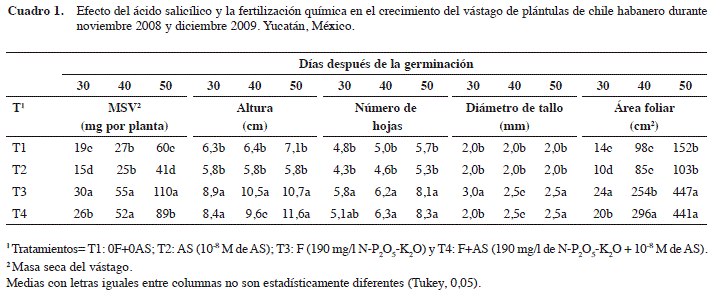
<body><![CDATA[las siguientes:</span><br style="font-family: verdana;">     <br style="font-family: verdana; font-weight: bold;">     <span style="font-family: verdana;"><span style="font-weight: bold;">Variables     de crecimiento.</span> La     materia seca del v&aacute;stago (MSV), la     altura, n&uacute;mero de hojas, di&aacute;metro del tallo y &aacute;rea     foliar (AF) de las pl&aacute;ntulas vari&oacute; significativamente     entre tratamientos y d&iacute;as de evaluaci&oacute;n (<a      href="/img/revistas/am/v23n2/a04t1.gif">Cuadro 1</a>). En     todas las variables de crecimiento los mayores valores se observaron en     ]]></body>
<body><![CDATA[los tratamientos T3 (F) y T4 (F+AS).    <br>     <br>     </span></font></font></font><font 2="" size=""><font 2="" size=""><font      size="-1"><span style="font-family: verdana;">A los 50 d&iacute;as     despu&eacute;s     de la germinaci&oacute;n, tiempo en     que las pl&aacute;ntulas est&aacute;n listas para el trasplante, la     mayor producci&oacute;n de MSV (110 mg/planta), y &aacute;rea foliar     (447 cm<sup>2</sup>) se obtuvo en T3, mientras que la mayor altura     ]]></body>
<body><![CDATA[(11,6 cm) y     n&uacute;mero de hojas (8,3 hojas) se observ&oacute; en T4.     Monta&ntilde;o-Mata y N&uacute;&ntilde;ez (2003) se&ntilde;alan que el     trasplante puede realizarse cuando las pl&aacute;ntulas alcanzan entre     7 y 12 cm de altura y desarrollan ocho hojas; en este sentido,     a&uacute;n cuando para algunas variables de crecimiento la     aplicaci&oacute;n de fertilizantes fue suficiente para tener un buen     crecimiento de las pl&aacute;ntulas, la adici&oacute;n de AS     adem&aacute;s de la fertilizaci&oacute;n qu&iacute;mica     favoreci&oacute; la altura y el n&uacute;mero de hojas.</span><br     ]]></body>
<body><![CDATA[ style="font-family: verdana;">     <br style="font-family: verdana;">     <span style="font-family: verdana;">El efecto del AS en la altura de     pl&aacute;ntulas ha sido observado en     tomate en el cual se increment&oacute; el 14,8% con aplicaciones de     10<sup>-6</sup> M de AS (Larqu&eacute;-Saavedra <span      style="font-style: italic;">et al.</span> 2010). Los     efectos del AS se han reflejado tambi&eacute;n en un aumento en la     producci&oacute;n de biomasa en soya y pino (San Miguel <span      style="font-style: italic;">et al.</span> 2003) y     ]]></body>
<body><![CDATA[en la altura en soya (Zhao <span style="font-style: italic;">et al.</span>     1995). De acuerdo a Salisbury&nbsp; y     Ross (1994) las modificaciones tenidas en el crecimiento se deben a que     el &aacute;cido salic&iacute;lico fomenta la producci&oacute;n de     &aacute;cido indolac&eacute;tico y de&nbsp; &aacute;cido     naftalenac&eacute;tico que son reportados como los&nbsp; principales     reguladores de crecimiento vegetal. Sin&nbsp; embargo, en este estudio     el efecto positivo del &aacute;cido salic&iacute;lico se obtuvo     solamente cuando las pl&aacute;ntulas recibieron fertilizaci&oacute;n     qu&iacute;mica.</span><br style="font-family: verdana;">     ]]></body>
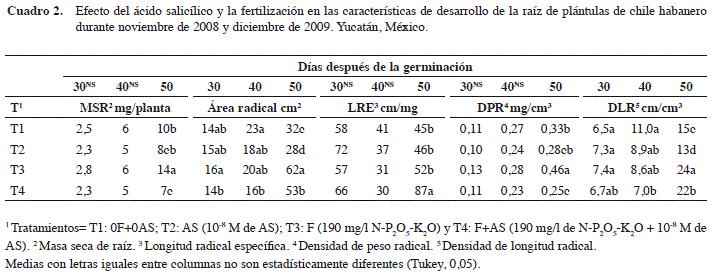
<body><![CDATA[<br style="font-family: verdana;">     <span style="font-family: verdana;">En cuanto al crecimiento de la     ra&iacute;z, se presentaron diferencias     significativas solamente a los 50 d&iacute;as despu&eacute;s de la     germinaci&oacute;n en MSR, LRE y DPR (<a      href="/img/revistas/am/v23n2/a04t2.gif">Cuadro 2</a>), mientras que el     &aacute;rea de ra&iacute;z y DLR mostraron diferencias durante el     crecimiento de la pl&aacute;ntula.</span><br      style="font-family: verdana;">     <br style="font-family: verdana;">     ]]></body>
<body><![CDATA[<span style="font-family: verdana;">Con las aplicaciones de AS se tuvo     menor producci&oacute;n de MSR; su     efecto puede observarse en T2 (8 mg/planta) y en su uso combinado con     la fertilizaci&oacute;n qu&iacute;mica T4 (7 mg/planta). Por el     contrario, la aplicaci&oacute;n &uacute;nica del fertilizante     qu&iacute;mico mostr&oacute; la mayor MSR. Este efecto inhibitorio del     AS ha sido tambi&eacute;n reportado por Saxena y Rashid (1980), causado     posiblemente por toxicidad. Sin embargo, otros estudios realizados     sobre el uso de diferentes dosis de &aacute;cido salic&iacute;lico en     cultivos como en pino, crisantemo (<span style="font-style: italic;">Catharanthus     ]]></body>
<body><![CDATA[roseus</span>) y tomate     mostraron incrementos en la producci&oacute;n de MSR (San Miguel <span      style="font-style: italic;">et al.</span>     2003, Villanueva-Couoh <span style="font-style: italic;">et al.</span>     2009, Echeverr&iacute;a-Machado <span style="font-style: italic;">et     al.</span>     2007, Larqu&eacute;-Saavedra <span style="font-style: italic;">et al.</span>     2010). Esto sugiere la importancia     de realizar nuevos experimentos donde se eval&uacute;e el efecto de     diferentes dosis de &aacute;cido salic&iacute;lico en chile habanero.</span><br     ]]></body>
<body><![CDATA[ style="font-family: verdana;">     <br style="font-family: verdana;">     <span style="font-family: verdana;">La fertilizaci&oacute;n     qu&iacute;mica conjuntamente con     hormonas&nbsp;&nbsp; end&oacute;genas&nbsp;&nbsp; tiene&nbsp;&nbsp;     un&nbsp;&nbsp; papel&nbsp;&nbsp; importante en&nbsp; el&nbsp;     crecimiento&nbsp; de&nbsp; la&nbsp; ra&iacute;z&nbsp; (Wang&nbsp;     <span style="font-style: italic;">et&nbsp; al.</span>&nbsp; 2009); esto     concuerda con lo observado en T4 (AS+F)     al obtenerse una mayor longitud por unidad de biomasa de ra&iacute;z     ]]></body>
<body><![CDATA[(LRE = 87 cm/mg) lo cual facilita que las ra&iacute;ces tengan mayor     superficie para absorber agua y nutrimentos despu&eacute;s del     trasplante (Eissenstat 1991).</span><br style="font-family: verdana;">     <br style="font-family: verdana;">     <span style="font-family: verdana;"></span><span      style="font-family: verdana;">Por el contrario, las aplicaciones     aisladas de AS (T2) y de     fertilizaci&oacute;n qu&iacute;mica F (T3) registraron en 47 y 42%     menor en el crecimiento que con la combinaci&oacute;n de ambos (F+AS).     El valor alto de LRE en T4 est&aacute; relacionado con&nbsp; la     ]]></body>
<body><![CDATA[producci&oacute;n de biomasa de ra&iacute;z por unidad de volumen de     sustrato (DPR). Seg&uacute;n Eissenstat (1991), cuando se tiene baja     producci&oacute;n de biomasa de ra&iacute;z por unidad de volumen del     sustrato, significa que se tiene mayor ventaja para explorar el suelo     ya que las ra&iacute;ces con reducida biomasa por cm<sup>3</sup> de     suelo, o sustrato como en este caso, tienen un menor di&aacute;metro     que les permite una mayor proliferaci&oacute;n. En este estudio el     menor valor de DPR fue para T4 (0,25 mg/cm3) coincidiendo con el mayor     valor para LRE para este mismo tratamiento.</span><br      style="font-family: verdana;">     ]]></body>
<body><![CDATA[<br style="font-family: verdana;">     <span style="font-family: verdana;">En cuanto al &aacute;rea radical,     esta es una caracter&iacute;stica de     la cual depende en gran medida la absorci&oacute;n de nutrimentos, ya     que a mayor &aacute;rea superficial se tiene mayor superficie de     contacto para realizar la absorci&oacute;n de nutrimentos.</span><br      style="font-family: verdana;">     <br style="font-family: verdana;">     <span style="font-family: verdana;">Diferentes estudios se&ntilde;alan     que el movimiento de K y P hacia la     ]]></body>
<body><![CDATA[ra&iacute;z se realiza por difusi&oacute;n (Barber 1984, Tinker y Nye     2000) y para el caso del chile habanero, una vez en las inmediaciones     de la ra&iacute;z la absorci&oacute;n de K por cm<sup>2</sup> de     ra&iacute;z se     realiza a una velocidad de entre 3,3x10<sup>-4</sup> y 4,8x10<sup>-4</sup>     mM/s     (Borges-G&oacute;mez <span style="font-style: italic;">et al.</span>     2006). El N se mueve principalmente por     flujo de masa pero hasta el momento, al igual que para P, no se tiene     infor&not;maci&oacute;n sobre su absorci&oacute;n por unidad de     ]]></body>
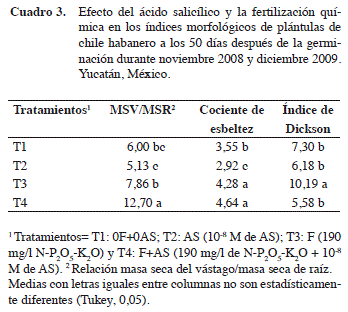
<body><![CDATA[&aacute;rea superficial de ra&iacute;z. Los tratamientos T3 y T4 que     contienen fertili&not;zante qu&iacute;mico son los que reportaron mayor     &aacute;rea de ra&iacute;z a los 50 DDG (62 y 53 cm<sup>2</sup>     respectivamente),     indicando que la fertilizaci&oacute;n qu&iacute;mica favoreci&oacute;     esta variable.</span><br style="font-family: verdana;">     <br style="font-family: verdana;">     <span style="font-family: verdana;">En la evaluaci&oacute;n de los     &iacute;ndices de crecimiento a los 50     DDG, la relaci&oacute;n entre MSV:MSR vari&oacute; entre 5,13 en el T2     ]]></body>
<body><![CDATA[y 12,7 en el T4 (<a href="#tab_3">Cuadro 3</a>). De acuerdo a     Baston-Wilson (1988) los     cambios en las relaciones de MSV:MSR pueden ser atribuibles a     deficiencias de macronutrimentos, agua y CO<sub>2</sub>. Seg&uacute;n     el modelo de     Thornley (1972), los factores que determinan la relaci&oacute;n MSV:MSR     son los suministros de C y N en la parte a&eacute;rea y la ra&iacute;z     respectivamente. As&iacute; que cuando decrece la adquisici&oacute;n de     C se tiene un incremento en la relaci&oacute;n MSV:MSR, mientras que     cuando decrece el suministro de N puede causarse el decremento de esta     ]]></body>
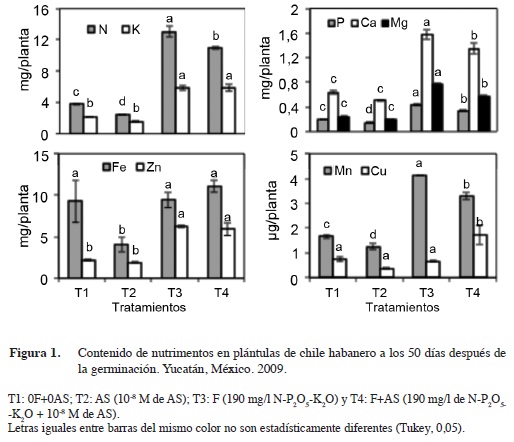
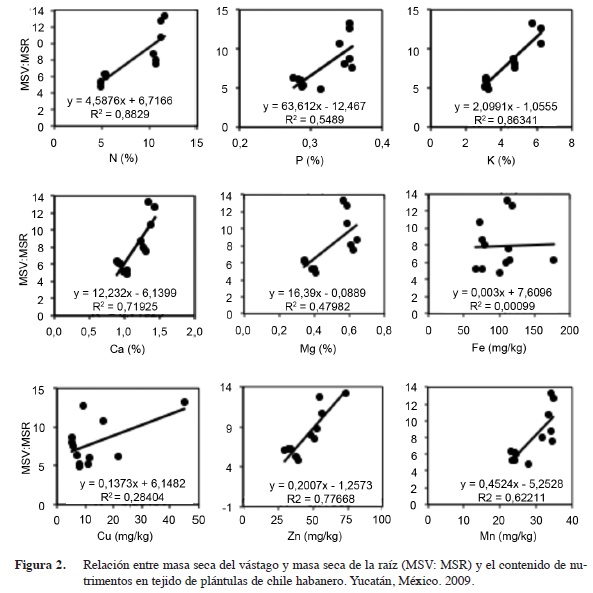
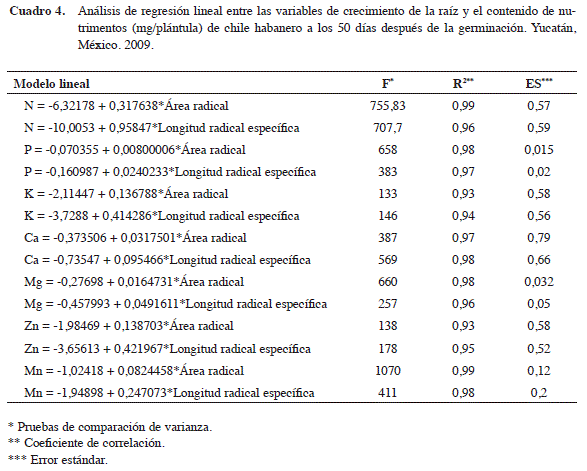
<body><![CDATA[relaci&oacute;n. Lo anterior podr&iacute;a explicar la relaci&oacute;n     MSV:MSR obtenida en los tratamientos T1 y T2 en donde no se     aplic&oacute; N.    <br>     <br> </span></font></font></font>     <div style="text-align: center;"><font 2="" size=""><a name="tab_3"></a><img  alt="" src="/img/revistas/am/v23n2/a04t3.gif"  style="width: 348px; height: 312px;"><font 2="" size=""><font size="-1"><span  style="font-family: verdana;"></span></font></font></font><br  style="font-family: verdana;"> <font 2="" size=""><font 2="" size=""><font size="-1"><span  style="font-family: verdana;"></span></font></font></font></div> <font 2="" size=""><font 2="" size=""><font size="-1"><br  style="font-family: verdana;"> &nbsp;<span style="font-family: verdana;"></span><span  style="font-family: verdana;">La relaci&oacute;n entre MSV:MSR aument&oacute; de 7,86 en las pl&aacute;ntulas que recibieron fertilizaci&oacute;n a 12,70 cuando se combin&oacute; fertilizaci&oacute;n con AS. La alta relaci&oacute;n entre MSV/MSR en T4 (AS+F) fue ocasionada por la baja producci&oacute;n de biomasa de ra&iacute;z (7 mg/planta), probablemente debido a un efecto inhibitorio del AS.</span><br style="font-family: verdana;"> <br style="font-family: verdana;"> <span style="font-family: verdana;">Las variables de cociente de esbeltez e &iacute;ndice de Dickson (Dickson <span style="font-style: italic;">et al.</span> 1960) han sido utilizados para evaluar la calidad de pl&aacute;ntulas en diversos cultivos; por ejemplo en pino (Reyes-Reyes <span style="font-style: italic;">et al.</span> 2005), caf&eacute; (Arizaleta y Pire 2008), vara de perlilla (MendozaBautista <span style="font-style: italic;">et al.</span> 2011) entre otros. Estas variables relacionan las caracter&iacute;sticas de altura, di&aacute;metro del tallo y la producci&oacute;n de masa seca, y a&uacute;n cuando no han sido utilizados para medir la calidad de pl&aacute;ntulas hort&iacute;colas, sus aplicaciones pueden ser &uacute;tiles para evaluar la calidad de las pl&aacute;ntulas producidas en contenedores.</span><br  style="font-family: verdana;"> <br style="font-family: verdana;"> <span style="font-family: verdana;">En este estudio, el cociente de esbeltez vari&oacute; entre 2,92 para T2 (AS) y 4,64 para T4 (F+AS). Por otro lado, el &iacute;ndice de Dickson vari&oacute; entre 5,58 para T4 (F+AS) y 10,19 para T3 (F), mostrando que la mayor esbeltez y vigor en las pl&aacute;ntulas se tuvieron en T3 y T4, esto sugiere para estos dos tratamientos una mayor sobrevivencia del trasplante y un mejor desarrollo en campo. No obstante, en el &iacute;ndice de Dickson fue T3 quien mostr&oacute; el menor valor y esto se debe a que este &iacute;ndice considera la relaci&oacute;n de la masa seca total de la pl&aacute;ntula (T3 = 96 mg) y la suma del cociente de esbeltez (altura/di&aacute;metro T3 = 4,64) y la relaci&oacute;n MSV:MSR (T3 = 12,7). Por lo tanto, el valor bajo del &iacute;ndice de Dickson se debe a la baja producci&oacute;n de biomasa radical. Debe tomarse en cuenta que estos &iacute;ndices de calidad son utilizados por primera vez en cultivos hort&iacute;colas, por lo que deber&aacute;n realizarse m&aacute;s estudios en&nbsp; estas especies.</span><br style="font-family: verdana;"> <br style="font-family: verdana;"> <span style="font-family: verdana;"><span style="font-weight: bold;">Extracci&oacute;n nutrimental.</span> Los resultados de contenido de nutrimentos en las pl&aacute;ntulas mostraron diferencias (p&gt;0,0001) en todos los minerales estudiados (N, P, K, Ca, Mg, Cu, Fe, Zn y Mn). En el tratamiento T3 (F) se registraron los mayores contenidos de nutrimentos en tejido con excepci&oacute;n de K, Fe y Zn, los cuales fueron similares a T4 (F+AS) (<a href="/img/revistas/am/v23n2/a04i1.jpg">Figura 1</a>); con estos resultados se destaca el efecto de la fertilizaci&oacute;n y la combinaci&oacute;n de este con el &aacute;cido salic&iacute;lico en la nutrici&oacute;n de las pl&aacute;ntulas.    <br>     <br> </span></font></font></font> <font 2="" size=""><font 2="" size=""><font size="-1"><span  style="font-family: verdana;">Cada&nbsp; especie&nbsp; tiene&nbsp; requerimientos&nbsp; particulares de&nbsp; nutrimentos&nbsp; que&nbsp; permiten&nbsp; un&nbsp; crecimiento&nbsp; y&nbsp; un vigor&nbsp; &oacute;ptimo&nbsp; (Timmer&nbsp; y&nbsp; Armstrong&nbsp; 1987);&nbsp; estos requerimientos&nbsp; no&nbsp; son&nbsp; constantes&nbsp; y&nbsp; cambian&nbsp; seg&uacute;n las plantas y el medio donde crecen y se desarrollan. Por ejemplo, en la producci&oacute;n de pl&aacute;ntulas de chile jalape&ntilde;o, Preciado <span style="font-style: italic;">et al.</span> (2007) reportaron contenidos entre 12,6 y 28,7 mg por planta de N; entre 0,93 y 1,11 de P y entre 9,9 y 14 mg de K; quedando solamente el contenido de N del T3 en pl&aacute;ntulas de chile habanero entre el rango reportado para chile jalape&ntilde;o. Estas diferencias se atribuyen a la biomasa producida.</span><br  style="font-family: verdana;"> <br style="font-family: verdana;"> <span style="font-family: verdana;">En trabajos anteriores realizados en pl&aacute;ntulas de mel&oacute;n donde se evalu&oacute; el efecto de la aplicaci&oacute;n de diferentes soluciones nutritivas, se observ&oacute; un mayor crecimiento y acumulaci&oacute;n de nutrimentos en las pl&aacute;ntulas al igual que en este trabajo (Preciado <span style="font-style: italic;">et al.</span> 2002). En general, la pr&aacute;ctica de aplicar soluciones nutritivas en la producci&oacute;n de pl&aacute;ntulas constituye una alternativa para obtener estas de buena calidad. En chile habanero se observ&oacute; que la fertilizaci&oacute;n qu&iacute;mica (T3) aument&oacute; el contenido de minerales en las pl&aacute;ntulas al contrario que con el &aacute;cido salic&iacute;lico la absorci&oacute;n de algunos nutrimentos (K, Fe y Zn) fue igual.</span><br style="font-family: verdana;"> <br style="font-family: verdana;"> <span style="font-family: verdana;"><span style="font-weight: bold;">Interacciones de las variables de crecimiento y la nutrici&oacute;n de las pl&aacute;ntulas.</span> Estudios realizados en tejido de tabaco bajo diferentes condiciones de nutrici&oacute;n y de irradiaci&oacute;n, mostraron una relaci&oacute;n significativa (R<sup>2</sup>= 0,84) entre MSV: MSR y el contenido de N convertido en prote&iacute;na soluble (Andrew <span  style="font-style: italic;">et al.</span> 2006). La relaci&oacute;n entre MSV: MSR y el contenido de N total en pl&aacute;ntulas de chile habanero fue similar (R<sup>2</sup> </span><span  style="font-family: verdana;">= 0,88) (<a  href="/img/revistas/am/v23n2/a04i2.jpg">Figura 2</a>).    <br>     <br> </span></font></font></font><font 2="" size=""><font 2="" size=""><font  size="-1"><span style="font-family: verdana;">Otras relaciones significativas se observaron entre MSV: MSR y los contenidos de K, Ca, Zn y Mn; mientras que la relaci&oacute;n entre MSV: MSR y los contenidos de P, Mg, Fe y Cu no fue significativo. En cuanto a las relaciones existentes sobre la absorci&oacute;n de nutrimentos y las caracter&iacute;sticas de la ra&iacute;z, estudios previos se&ntilde;alan que el factor m&aacute;s importante que influye en la absorci&oacute;n de nutrimentos es la longitud y el &aacute;rea superficial (Barber 1984, Tinker y Nye 2000), esto explica las altas relaciones encontradas en el an&aacute;lisis de regresi&oacute;n entre estas dos variables (<a href="/img/revistas/am/v23n2/a04t4.gif">Cuadro 4</a>), indicando que a un mayor contenido nutrimental se tendr&aacute; un mejor desarrollo de la ra&iacute;z.    ]]></body>
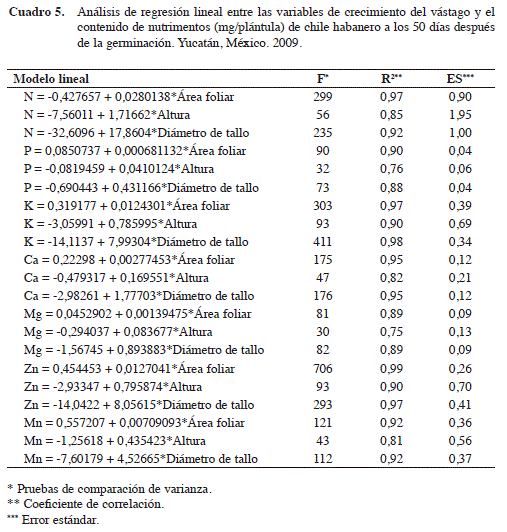
<body><![CDATA[<br> </span></font></font></font><font 2="" size=""><font 2="" size=""><font  size="-1"><br style="font-family: verdana;"> <span style="font-family: verdana;">Del mismo modo, se observ&oacute; una relaci&oacute;n positiva entre las variables de crecimiento del v&aacute;stago y el contenido de nutrimentos en la pl&aacute;ntula (<a  href="/img/revistas/am/v23n2/a04t5.gif">Cuadro 5</a>), mostrando las tendencias entre el estatus nutrimental de la pl&aacute;ntula y las caracter&iacute;sticas de la pl&aacute;ntula. Los resultados de los valores de las ecuaciones pueden ser utilizados para calcular los valores de cada nutrimento de&nbsp; acuerdo&nbsp; a&nbsp; las&nbsp; caracter&iacute;sticas&nbsp; de&nbsp; crecimiento&nbsp; de la pl&aacute;ntula. En este sentido, es posible predecir el estado nutricional mediante la aplicaci&oacute;n de dichas ecuaciones.    <br>     <br> </span></font></font></font> <font 2="" size=""><font 2="" size=""><font size="-1"><span  style="font-family: verdana;">Las aplicaciones del &aacute;cido salic&iacute;lico (10<sup>-8</sup> M) en combinaci&oacute;n con fertilizaci&oacute;n de N, P y K (190 mg/l de N-P<sub>2</sub>O<sub>5</sub>-K<sub>2</sub>O) solo incrementaron la altura, n&uacute;mero de hojas y longitud radical espec&iacute;fica de las pl&aacute;ntulas en chile habanero. Todas las dem&aacute;s variables de crecimiento se ven favorecidas al emplear &uacute;nicamente la fertilizaci&oacute;n qu&iacute;mica; el &aacute;cido salic&iacute;lico solamente tiene efectos favorables cuando las plantas reciben fertilizaci&oacute;n qu&iacute;mica y por s&iacute; solo no favorece el crecimiento de las pl&aacute;ntulas de chile habanero.</span><span style="font-family: verdana;"> </span><br  style="font-family: verdana;"> <span style="font-family: verdana;"></span></font></font></font><font  2=""><font 2=""><span style="font-family: verdana; font-weight: bold;"></span></font></font> <hr style="width: 100%; height: 2px;">    <!-- ref --><br> <font 2=""><font 2=""><span  style="font-family: verdana; font-weight: bold;">Literatura citada</span></font></font><font  2="" size=""><font 2="" size=""><font size="-1"><br  style="font-family: verdana;"> <br style="font-family: verdana;"> <span style="font-family: verdana;">Andrew, M; Raven, JA; Lea, PJ; Sprent, JI. 2006. A role for shoot protein in shoot&#8211;root dry matter&nbsp; allocation in higher plants. Annals of Botany 97:3-10.    &nbsp;&nbsp;&nbsp;&nbsp;&nbsp;&nbsp;&nbsp;&nbsp;[&#160;<a href="javascript:void(0);" onclick="javascript: window.open('/scielo.php?script=sci_nlinks&ref=313029&pid=S1659-1321201200020000400001&lng=','','width=640,height=500,resizable=yes,scrollbars=1,menubar=yes,');">Links</a>&#160;]<!-- end-ref --><!-- ref --></span><br style="font-family: verdana;"> <br style="font-family: verdana;"> <span style="font-family: verdana;">AOAC (Association of Official Analytical Chemist). 2000. Official&nbsp; methods&nbsp; of&nbsp; analysis. 17&nbsp; ed.&nbsp; Gaithersg, Maryland, USA. p. 3-25.    &nbsp;&nbsp;&nbsp;&nbsp;&nbsp;&nbsp;&nbsp;&nbsp;[&#160;<a href="javascript:void(0);" onclick="javascript: window.open('/scielo.php?script=sci_nlinks&ref=313030&pid=S1659-1321201200020000400002&lng=','','width=640,height=500,resizable=yes,scrollbars=1,menubar=yes,');">Links</a>&#160;]<!-- end-ref --><!-- ref --></span><br style="font-family: verdana;"> <br style="font-family: verdana;"> <span style="font-family: verdana;">Arizaleta, M; Pire, R. 2008. Respuesta de pl&aacute;ntulas de cafeto al tama&ntilde;o de la bolsa y fertilizaci&oacute;n con nitr&oacute;geno y f&oacute;sforo en vivero. Agrociencia 42:47-55.    &nbsp;&nbsp;&nbsp;&nbsp;&nbsp;&nbsp;&nbsp;&nbsp;[&#160;<a href="javascript:void(0);" onclick="javascript: window.open('/scielo.php?script=sci_nlinks&ref=313031&pid=S1659-1321201200020000400003&lng=','','width=640,height=500,resizable=yes,scrollbars=1,menubar=yes,');">Links</a>&#160;]<!-- end-ref --><!-- ref --></span><br  style="font-family: verdana;"> <br style="font-family: verdana;"> <span style="font-family: verdana;">Barber, SA. 1984. Soil nutrient bioavailability: A mechanistic approach. Wiley &amp; Sons, Inc., New York, USA. 398 p.    &nbsp;&nbsp;&nbsp;&nbsp;&nbsp;&nbsp;&nbsp;&nbsp;[&#160;<a href="javascript:void(0);" onclick="javascript: window.open('/scielo.php?script=sci_nlinks&ref=313032&pid=S1659-1321201200020000400004&lng=','','width=640,height=500,resizable=yes,scrollbars=1,menubar=yes,');">Links</a>&#160;]<!-- end-ref --><br>     <!-- ref --><br> Bastow-Wilson, J. 1988. A review of evidence on the control of shoot: root ratio, in&nbsp; relation to models. Annals of Botany 61: 433-449.    &nbsp;&nbsp;&nbsp;&nbsp;&nbsp;&nbsp;&nbsp;&nbsp;[&#160;<a href="javascript:void(0);" onclick="javascript: window.open('/scielo.php?script=sci_nlinks&ref=313034&pid=S1659-1321201200020000400005&lng=','','width=640,height=500,resizable=yes,scrollbars=1,menubar=yes,');">Links</a>&#160;]<!-- end-ref --><!-- ref --></span><br  style="font-family: verdana;"> <br style="font-family: verdana;"> <span style="font-family: verdana;">Birchler, T; Rowse, RW; Royo, A; Pardos, M. 1998. La planta ideal: Revisi&oacute;n del concepto,&nbsp; par&aacute;metros definitorios e implementaci&oacute;n pr&aacute;ctica. Investigaci&oacute;n Agraria Sistemas de Recursos Forestales 7(1-2):109-121.    &nbsp;&nbsp;&nbsp;&nbsp;&nbsp;&nbsp;&nbsp;&nbsp;[&#160;<a href="javascript:void(0);" onclick="javascript: window.open('/scielo.php?script=sci_nlinks&ref=313035&pid=S1659-1321201200020000400006&lng=','','width=640,height=500,resizable=yes,scrollbars=1,menubar=yes,');">Links</a>&#160;]<!-- end-ref --><!-- ref --></span><br  style="font-family: verdana;"> <br style="font-family: verdana;"> <span style="font-family: verdana;">Borges-G&oacute;mez,&nbsp; L;&nbsp; Chuc-Puc,&nbsp; J;&nbsp; Escamilla-Bencomo,&nbsp; A; Medina-Lara, F. 2006.&nbsp; Cin&eacute;tica de la absorci&oacute;n de potasio por las&nbsp; ra&iacute;ces de chile habanero (<span style="font-style: italic;">Capsicum chinense</span> Jacq.). Agrociencia 40:431-440.    &nbsp;&nbsp;&nbsp;&nbsp;&nbsp;&nbsp;&nbsp;&nbsp;[&#160;<a href="javascript:void(0);" onclick="javascript: window.open('/scielo.php?script=sci_nlinks&ref=313036&pid=S1659-1321201200020000400007&lng=','','width=640,height=500,resizable=yes,scrollbars=1,menubar=yes,');">Links</a>&#160;]<!-- end-ref --><!-- ref --></span><br style="font-family: verdana;"> <br style="font-family: verdana;"> <span style="font-family: verdana;">Dickson, A; Leaf, AL; Hosner, IE. 1960. Quality appraisal of white spruce and white pine seedlings stock in nurseries. Forest Chronicle 36:10-13.    &nbsp;&nbsp;&nbsp;&nbsp;&nbsp;&nbsp;&nbsp;&nbsp;[&#160;<a href="javascript:void(0);" onclick="javascript: window.open('/scielo.php?script=sci_nlinks&ref=313037&pid=S1659-1321201200020000400008&lng=','','width=640,height=500,resizable=yes,scrollbars=1,menubar=yes,');">Links</a>&#160;]<!-- end-ref --><!-- ref --></span><br style="font-family: verdana;"> <br style="font-family: verdana;"> <span style="font-family: verdana;">Echeverr&iacute;a-Machado,&nbsp; I;&nbsp; Escobedo&nbsp; Grac&iacute;a-Medrano,&nbsp; RM; Larqu&eacute;-Saavedra, A. 2007. Responses of transformed Catharanthus roseus roots to&nbsp; femtomolar concentrations of salicylic acid. Plant Physiology and Biochemestry 45:501-507.    &nbsp;&nbsp;&nbsp;&nbsp;&nbsp;&nbsp;&nbsp;&nbsp;[&#160;<a href="javascript:void(0);" onclick="javascript: window.open('/scielo.php?script=sci_nlinks&ref=313038&pid=S1659-1321201200020000400009&lng=','','width=640,height=500,resizable=yes,scrollbars=1,menubar=yes,');">Links</a>&#160;]<!-- end-ref --><!-- ref --></span><br style="font-family: verdana;"> <br style="font-family: verdana;"> <span style="font-family: verdana;">Eissenstat, DM. 1991. On the relationship between specific root length and rate of root proliferation: a field study using citrus rootstocks. New Phytologist 118:63-68.    &nbsp;&nbsp;&nbsp;&nbsp;&nbsp;&nbsp;&nbsp;&nbsp;[&#160;<a href="javascript:void(0);" onclick="javascript: window.open('/scielo.php?script=sci_nlinks&ref=313039&pid=S1659-1321201200020000400010&lng=','','width=640,height=500,resizable=yes,scrollbars=1,menubar=yes,');">Links</a>&#160;]<!-- end-ref --><!-- ref --></span><br style="font-family: verdana;"> <br style="font-family: verdana;"> <span style="font-family: verdana;">Gallego, GL; Escamilla, TL; Jackson, LA; Dixon, RA. 2011. Salicylic acid mediates the reduced growth of lignin down-regulated plants. Plant Biology 108(51):20814-20819.    &nbsp;&nbsp;&nbsp;&nbsp;&nbsp;&nbsp;&nbsp;&nbsp;[&#160;<a href="javascript:void(0);" onclick="javascript: window.open('/scielo.php?script=sci_nlinks&ref=313040&pid=S1659-1321201200020000400011&lng=','','width=640,height=500,resizable=yes,scrollbars=1,menubar=yes,');">Links</a>&#160;]<!-- end-ref --><!-- ref --></span><br style="font-family: verdana;"> <br style="font-family: verdana;"> <span style="font-family: verdana;">G&oacute;mez,&nbsp; LBL; Cepeda, VMA. 2010. &Aacute;cido&nbsp; salic&iacute;lico: inductor de resistencia a sequ&iacute;a en canola de riego bajo labranza reducida. Folleto t&eacute;cnico No. 2 SAGARPA. INIFAP-CIRPAC. Uruapan, Mich., M&eacute;xico. 48 p.    &nbsp;&nbsp;&nbsp;&nbsp;&nbsp;&nbsp;&nbsp;&nbsp;[&#160;<a href="javascript:void(0);" onclick="javascript: window.open('/scielo.php?script=sci_nlinks&ref=313041&pid=S1659-1321201200020000400012&lng=','','width=640,height=500,resizable=yes,scrollbars=1,menubar=yes,');">Links</a>&#160;]<!-- end-ref --><!-- ref --></span><br  style="font-family: verdana;"> <br style="font-family: verdana;"> <span style="font-family: verdana;">Gonz&aacute;lez, TE;&nbsp; Guti&eacute;rrez,&nbsp; L;&nbsp; Contreras,&nbsp; F.&nbsp; 2006.&nbsp; El&nbsp; chile habanero de Yucat&aacute;n. Usos culinarios tradicionales del chile habanero. Ciencia y Desarrollo. El conocimiento a tu alcance. Consejo Nacional de Ciencia y Tecnolog&iacute;a. M&eacute;xico.&nbsp; Consulta 15 ene 2007. Disponible en http://www.conacyt.mx/comunicacion/revista/195/Articulos/Chilehabanero/Habanero00.html.    &nbsp;&nbsp;&nbsp;&nbsp;&nbsp;&nbsp;&nbsp;&nbsp;[&#160;<a href="javascript:void(0);" onclick="javascript: window.open('/scielo.php?script=sci_nlinks&ref=313042&pid=S1659-1321201200020000400013&lng=','','width=640,height=500,resizable=yes,scrollbars=1,menubar=yes,');">Links</a>&#160;]<!-- end-ref --><!-- ref --></span><br  style="font-family: verdana;"> <br style="font-family: verdana;"> <span style="font-family: verdana;">Hayat, S; Ali, B; Ahmad, A. 2007. Salicylic acid: Biosynthesis, metabolism and physiological&nbsp; role in plants p. 1-11. <span  style="font-style: italic;">In</span> Hayat, S; Ahmad, A. eds. Salicylic&nbsp; acid a plant hormone. Springer. Dordrecht, The Netherlands. 401 p.    &nbsp;&nbsp;&nbsp;&nbsp;&nbsp;&nbsp;&nbsp;&nbsp;[&#160;<a href="javascript:void(0);" onclick="javascript: window.open('/scielo.php?script=sci_nlinks&ref=313043&pid=S1659-1321201200020000400014&lng=','','width=640,height=500,resizable=yes,scrollbars=1,menubar=yes,');">Links</a>&#160;]<!-- end-ref --><!-- ref --></span><br  style="font-family: verdana;"> <br style="font-family: verdana;"> <span style="font-family: verdana;">Kaspar,&nbsp; TC;&nbsp; Ewing,&nbsp; RP.&nbsp; 1997.&nbsp; Rootedge.&nbsp; Software&nbsp; for measuring root length from desktop scanner images. Agronomy Journal 89:932-940.    &nbsp;&nbsp;&nbsp;&nbsp;&nbsp;&nbsp;&nbsp;&nbsp;[&#160;<a href="javascript:void(0);" onclick="javascript: window.open('/scielo.php?script=sci_nlinks&ref=313044&pid=S1659-1321201200020000400015&lng=','','width=640,height=500,resizable=yes,scrollbars=1,menubar=yes,');">Links</a>&#160;]<!-- end-ref --><!-- ref --></span><br  style="font-family: verdana;"> <br style="font-family: verdana;"> <span style="font-family: verdana;">Larqu&eacute;-Saavedra, A; Mart&iacute;n-Mex, R. 2007. Effects of salicylic acid on the bioproductivity of plants p. 15-24. In Hayat, S; Ahmad, A. eds. Salicylic acid a plant hormone. Springer. Dordrecht, The Netherlands. 401 p.    &nbsp;&nbsp;&nbsp;&nbsp;&nbsp;&nbsp;&nbsp;&nbsp;[&#160;<a href="javascript:void(0);" onclick="javascript: window.open('/scielo.php?script=sci_nlinks&ref=313045&pid=S1659-1321201200020000400016&lng=','','width=640,height=500,resizable=yes,scrollbars=1,menubar=yes,');">Links</a>&#160;]<!-- end-ref --><!-- ref --></span><br style="font-family: verdana;"> <br style="font-family: verdana;"> <span style="font-family: verdana;">Larqu&eacute;-Saavedra, A; Mart&iacute;n-Mex, R; Nexticapan-Garc&eacute;z, A; Vergara-Yoisura, S; Guti&eacute;rrez-Rend&oacute;n, M. 2010. Efecto del &aacute;cido salic&iacute;lico en el crecimiento de pl&aacute;ntulas de&nbsp; tomate (<span style="font-style: italic;">Lycopersicon esculentum</span> Mill.).&nbsp; Revista Chapingo Serie Horticultura 16(3):183-187.    &nbsp;&nbsp;&nbsp;&nbsp;&nbsp;&nbsp;&nbsp;&nbsp;[&#160;<a href="javascript:void(0);" onclick="javascript: window.open('/scielo.php?script=sci_nlinks&ref=313046&pid=S1659-1321201200020000400017&lng=','','width=640,height=500,resizable=yes,scrollbars=1,menubar=yes,');">Links</a>&#160;]<!-- end-ref --><!-- ref --></span><br style="font-family: verdana;"> <br style="font-family: verdana;"> <span style="font-family: verdana;">Maggi,&nbsp; CA.&nbsp; 1992.&nbsp; Therapeutic&nbsp; potential&nbsp; of&nbsp;&nbsp; capsaicinlike molecules&#8211;studies in animals&nbsp; and humans. Life Science 51:1777-1781.    &nbsp;&nbsp;&nbsp;&nbsp;&nbsp;&nbsp;&nbsp;&nbsp;[&#160;<a href="javascript:void(0);" onclick="javascript: window.open('/scielo.php?script=sci_nlinks&ref=313047&pid=S1659-1321201200020000400018&lng=','','width=640,height=500,resizable=yes,scrollbars=1,menubar=yes,');">Links</a>&#160;]<!-- end-ref --><!-- ref --></span><br  style="font-family: verdana;"> <br style="font-family: verdana;"> <span style="font-family: verdana;">McSteen, P; Zhao, Y. 2008. Plant hormones and signaling: common themes and new developments. Development Cell 14(4):467-73.    &nbsp;&nbsp;&nbsp;&nbsp;&nbsp;&nbsp;&nbsp;&nbsp;[&#160;<a href="javascript:void(0);" onclick="javascript: window.open('/scielo.php?script=sci_nlinks&ref=313048&pid=S1659-1321201200020000400019&lng=','','width=640,height=500,resizable=yes,scrollbars=1,menubar=yes,');">Links</a>&#160;]<!-- end-ref --><!-- ref --></span><br  style="font-family: verdana;"> <br style="font-family: verdana;"> <span style="font-family: verdana;">Mendoza-Bautista, C; Garc&iacute;a-Moreno, F;&nbsp; Rodr&iacute;guez-Trejo, DA; Castro-Zavala, S. 2011. Radiaci&oacute;n solar y calidad de planta en una plantaci&oacute;n de vara de perlilla (<span style="font-style: italic;">Symphoricarpos microphyllus</span> H. B. K.). Agrociencia 45: 235-243.    &nbsp;&nbsp;&nbsp;&nbsp;&nbsp;&nbsp;&nbsp;&nbsp;[&#160;<a href="javascript:void(0);" onclick="javascript: window.open('/scielo.php?script=sci_nlinks&ref=313049&pid=S1659-1321201200020000400020&lng=','','width=640,height=500,resizable=yes,scrollbars=1,menubar=yes,');">Links</a>&#160;]<!-- end-ref --><!-- ref --></span><br  style="font-family: verdana;"> <br style="font-family: verdana;"> <span style="font-family: verdana;">Monta&ntilde;o-Mata, NJ; N&uacute;&ntilde;ez, JC. 2003. Evaluaci&oacute;n del efecto de la edad de trasplante sobre el rendimiento en tres selecciones de aj&iacute; dulce <span  style="font-style: italic;">Capsicum chinense</span> Jacq. en Jusep&iacute;n, estado Monagas. Revista de&nbsp; la&nbsp; Facultad de Agronomia (LUZ) 20:144-155.    &nbsp;&nbsp;&nbsp;&nbsp;&nbsp;&nbsp;&nbsp;&nbsp;[&#160;<a href="javascript:void(0);" onclick="javascript: window.open('/scielo.php?script=sci_nlinks&ref=313050&pid=S1659-1321201200020000400021&lng=','','width=640,height=500,resizable=yes,scrollbars=1,menubar=yes,');">Links</a>&#160;]<!-- end-ref --><!-- ref --></span><br  style="font-family: verdana;"> <br style="font-family: verdana;"> <span style="font-family: verdana;">Preciado, RP; Baca, GA; Tirado, JL; Kohashi-Shibata, J; Tijerina, L; Mart&iacute;nez, A. 2002. Nitr&oacute;geno y potasio en la producci&oacute;n de pl&aacute;ntulas de mel&oacute;n. Terra 20:267-276.    &nbsp;&nbsp;&nbsp;&nbsp;&nbsp;&nbsp;&nbsp;&nbsp;[&#160;<a href="javascript:void(0);" onclick="javascript: window.open('/scielo.php?script=sci_nlinks&ref=313051&pid=S1659-1321201200020000400022&lng=','','width=640,height=500,resizable=yes,scrollbars=1,menubar=yes,');">Links</a>&#160;]<!-- end-ref --><!-- ref --></span><br  style="font-family: verdana;"> <br style="font-family: verdana;"> <span style="font-family: verdana;">Preciado, RP; Lara-Herrera, A; Segura, CMA; Rueda, PEO; Orozco, VJA; Yescas, CP; Montemayor,&nbsp; TJA. 2007. Amonio y fosfato en el&nbsp; crecimiento&nbsp; de pl&aacute;ntulas de chile jalape&ntilde;o. Terra Latinoamericana 26:37-42.    &nbsp;&nbsp;&nbsp;&nbsp;&nbsp;&nbsp;&nbsp;&nbsp;[&#160;<a href="javascript:void(0);" onclick="javascript: window.open('/scielo.php?script=sci_nlinks&ref=313052&pid=S1659-1321201200020000400023&lng=','','width=640,height=500,resizable=yes,scrollbars=1,menubar=yes,');">Links</a>&#160;]<!-- end-ref --><!-- ref --></span><br style="font-family: verdana;"> <br style="font-family: verdana;"> <span style="font-family: verdana;">Reyes-Reyes,&nbsp; J;&nbsp; Aldrete,&nbsp; A;&nbsp; Cetina-Alcal&aacute;,&nbsp; VM;&nbsp; LopezUpton,&nbsp; J.&nbsp; 2005.&nbsp; Producci&oacute;n&nbsp; de&nbsp; pl&aacute;ntulas&nbsp; de&nbsp; <span style="font-style: italic;">Pinus pseudostrobus</span> var. Alpuncensis en sustratos a base de aserr&iacute;n. Revista Chapingo Serie Ciencias Forestales y del Ambiente 11(2):105-110.    &nbsp;&nbsp;&nbsp;&nbsp;&nbsp;&nbsp;&nbsp;&nbsp;[&#160;<a href="javascript:void(0);" onclick="javascript: window.open('/scielo.php?script=sci_nlinks&ref=313053&pid=S1659-1321201200020000400024&lng=','','width=640,height=500,resizable=yes,scrollbars=1,menubar=yes,');">Links</a>&#160;]<!-- end-ref --><!-- ref --></span><br style="font-family: verdana;"> <br style="font-family: verdana;"> <span style="font-family: verdana;">Salisbury, FB; Ross, CW. 1994. Fisiolog&iacute;a vegetal. Traducido por Gonz&aacute;lez, V. V. Edit. Iberoam&eacute;rica, M&eacute;xico. 673 p.    &nbsp;&nbsp;&nbsp;&nbsp;&nbsp;&nbsp;&nbsp;&nbsp;[&#160;<a href="javascript:void(0);" onclick="javascript: window.open('/scielo.php?script=sci_nlinks&ref=313054&pid=S1659-1321201200020000400025&lng=','','width=640,height=500,resizable=yes,scrollbars=1,menubar=yes,');">Links</a>&#160;]<!-- end-ref --><!-- ref --></span><br  style="font-family: verdana;"> <br style="font-family: verdana;"> <span style="font-family: verdana;">San&nbsp; Miguel, R; Guti&eacute;rrez, M; Larqu&eacute;-Saavedra, A.&nbsp; 2003. Salicylic acid increases the biomass accumulation of <span style="font-style: italic;">Pinus patula</span>. Southern. Journal of Applied&nbsp; Forestry 27:52-54.    &nbsp;&nbsp;&nbsp;&nbsp;&nbsp;&nbsp;&nbsp;&nbsp;[&#160;<a href="javascript:void(0);" onclick="javascript: window.open('/scielo.php?script=sci_nlinks&ref=313055&pid=S1659-1321201200020000400026&lng=','','width=640,height=500,resizable=yes,scrollbars=1,menubar=yes,');">Links</a>&#160;]<!-- end-ref --><!-- ref --></span><br  style="font-family: verdana;"> <br style="font-family: verdana;"> <span style="font-family: verdana;">Savaldi-Goldstein, S; Peto, C; Chory, J. 2007. The epidermis both drives and restricts plant shoot&nbsp; growth. Nature 446:199-202.    &nbsp;&nbsp;&nbsp;&nbsp;&nbsp;&nbsp;&nbsp;&nbsp;[&#160;<a href="javascript:void(0);" onclick="javascript: window.open('/scielo.php?script=sci_nlinks&ref=313056&pid=S1659-1321201200020000400027&lng=','','width=640,height=500,resizable=yes,scrollbars=1,menubar=yes,');">Links</a>&#160;]<!-- end-ref --><!-- ref --></span><br  style="font-family: verdana;"> <br style="font-family: verdana;"> <span style="font-family: verdana;">Saxena, PK, Rashid, A. 1980. Differentiation on bud cell on the protonema of the moss <span style="font-style: italic;">Anoectanquium fhomsonii</span>. Effect of aspirina and salicyc acid. Z. Pflanzenphysiology 99:187-189.    &nbsp;&nbsp;&nbsp;&nbsp;&nbsp;&nbsp;&nbsp;&nbsp;[&#160;<a href="javascript:void(0);" onclick="javascript: window.open('/scielo.php?script=sci_nlinks&ref=313057&pid=S1659-1321201200020000400028&lng=','','width=640,height=500,resizable=yes,scrollbars=1,menubar=yes,');">Links</a>&#160;]<!-- end-ref --><!-- ref --></span><br  style="font-family: verdana;"> <br style="font-family: verdana;"> <span style="font-family: verdana;">Shettel,&nbsp; NL; Balke,&nbsp; NE.&nbsp; 1983.&nbsp; Plant&nbsp; growth&nbsp; response&nbsp; to several allelopathic chemicals. Weed Science 31:293-298.    &nbsp;&nbsp;&nbsp;&nbsp;&nbsp;&nbsp;&nbsp;&nbsp;[&#160;<a href="javascript:void(0);" onclick="javascript: window.open('/scielo.php?script=sci_nlinks&ref=313058&pid=S1659-1321201200020000400029&lng=','','width=640,height=500,resizable=yes,scrollbars=1,menubar=yes,');">Links</a>&#160;]<!-- end-ref --><!-- ref --></span><br style="font-family: verdana;"> <br style="font-family: verdana;"> <span style="font-family: verdana;">SIAP (Sistema de Informaci&oacute;n Agroalimentaria y&nbsp; Pesca). Anuario estad&iacute;stico de la producci&oacute;n agr&iacute;cola. Gobierno Federal. M&eacute;xico. (en l&iacute;nea).&nbsp; Consultado 19 septiembre 2012. Disponible en http://www.siap.gob.mx.    &nbsp;&nbsp;&nbsp;&nbsp;&nbsp;&nbsp;&nbsp;&nbsp;[&#160;<a href="javascript:void(0);" onclick="javascript: window.open('/scielo.php?script=sci_nlinks&ref=313059&pid=S1659-1321201200020000400030&lng=','','width=640,height=500,resizable=yes,scrollbars=1,menubar=yes,');">Links</a>&#160;]<!-- end-ref --><!-- ref --></span><br  style="font-family: verdana;"> <br style="font-family: verdana;"> <span style="font-family: verdana;">Thornley, JHM. 1972. A balanced quantitative&nbsp; model&nbsp; for root: shoot ratios in vegetative plants. Annals of Botany 68:211-216.    &nbsp;&nbsp;&nbsp;&nbsp;&nbsp;&nbsp;&nbsp;&nbsp;[&#160;<a href="javascript:void(0);" onclick="javascript: window.open('/scielo.php?script=sci_nlinks&ref=313060&pid=S1659-1321201200020000400031&lng=','','width=640,height=500,resizable=yes,scrollbars=1,menubar=yes,');">Links</a>&#160;]<!-- end-ref --><!-- ref --></span><br  style="font-family: verdana;"> <br style="font-family: verdana;"> <span style="font-family: verdana;">Timmer, VR; Armstrong, G. 1987. Growth and nutrition of containerized <span style="font-style: italic;">Pinus resinosa</span> at exponentially increasing nutrient additions.&nbsp; Canadian Journal of Forest Research 17:644-647.    &nbsp;&nbsp;&nbsp;&nbsp;&nbsp;&nbsp;&nbsp;&nbsp;[&#160;<a href="javascript:void(0);" onclick="javascript: window.open('/scielo.php?script=sci_nlinks&ref=313061&pid=S1659-1321201200020000400032&lng=','','width=640,height=500,resizable=yes,scrollbars=1,menubar=yes,');">Links</a>&#160;]<!-- end-ref --><!-- ref --></span><br  style="font-family: verdana;"> <br style="font-family: verdana;"> <span style="font-family: verdana;">Tinker, PB; Nye, PH. 2000. Solute movement in the rhizosphere. Oxford University Press. USA. 444 p.    &nbsp;&nbsp;&nbsp;&nbsp;&nbsp;&nbsp;&nbsp;&nbsp;[&#160;<a href="javascript:void(0);" onclick="javascript: window.open('/scielo.php?script=sci_nlinks&ref=313062&pid=S1659-1321201200020000400033&lng=','','width=640,height=500,resizable=yes,scrollbars=1,menubar=yes,');">Links</a>&#160;]<!-- end-ref --><!-- ref --></span><br style="font-family: verdana;"> <br style="font-family: verdana;"> <span style="font-family: verdana;">Villanueva-Couoh, E; Alc&aacute;ntar-Gonz&aacute;lez, G;&nbsp; S&aacute;nchez-Garc&iacute;a, P; Soria-Fregoso, M; Larque-Saavedra, A. 2009. Efecto del &aacute;cido&nbsp; salic&iacute;lico y dimetilsulf&oacute;xido en la floraci&oacute;n&nbsp; de&nbsp; [<span style="font-style: italic;">Chrysanthemum&nbsp; morifolium</span> (Ramat) Kitamura] en Yucat&aacute;n. Revista Chapingo Serie Horticultura 15(2):25-31.    &nbsp;&nbsp;&nbsp;&nbsp;&nbsp;&nbsp;&nbsp;&nbsp;[&#160;<a href="javascript:void(0);" onclick="javascript: window.open('/scielo.php?script=sci_nlinks&ref=313063&pid=S1659-1321201200020000400034&lng=','','width=640,height=500,resizable=yes,scrollbars=1,menubar=yes,');">Links</a>&#160;]<!-- end-ref --><!-- ref --></span><br  style="font-family: verdana;"> <br style="font-family: verdana;"> <span style="font-family: verdana;">Vergara, D; Lozada-Requena, I; Aguilar, OJ. 2006. Efecto de la capsicina sobre la producci&oacute;n de TN F-&#945; en c&eacute;lulas mononucleares.&nbsp; Estudio&nbsp; piloto.&nbsp; Revista&nbsp; Peruana&nbsp; de Medicina Experimental y Salud P&uacute;blica 23(1):52-55.    &nbsp;&nbsp;&nbsp;&nbsp;&nbsp;&nbsp;&nbsp;&nbsp;[&#160;<a href="javascript:void(0);" onclick="javascript: window.open('/scielo.php?script=sci_nlinks&ref=313064&pid=S1659-1321201200020000400035&lng=','','width=640,height=500,resizable=yes,scrollbars=1,menubar=yes,');">Links</a>&#160;]<!-- end-ref --><!-- ref --></span><br style="font-family: verdana;"> <br style="font-family: verdana;"> <span style="font-family: verdana;">Wang, B; Tao, L; Qi-Wei, H; Xing-Ming, Y; Qi-Rong, S. 2009. Effect of N fertilizers on root growth and endogenous hormones in strawberry. Pedosphere 1:86-95.    &nbsp;&nbsp;&nbsp;&nbsp;&nbsp;&nbsp;&nbsp;&nbsp;[&#160;<a href="javascript:void(0);" onclick="javascript: window.open('/scielo.php?script=sci_nlinks&ref=313065&pid=S1659-1321201200020000400036&lng=','','width=640,height=500,resizable=yes,scrollbars=1,menubar=yes,');">Links</a>&#160;]<!-- end-ref --><!-- ref --></span><br style="font-family: verdana;"> <br style="font-family: verdana;"> <span style="font-family: verdana;">Zhao, HJ; Lin, XW; Shi, HZ; Chang, SM. 1995. The regulating effects of phenolic compounds on&nbsp; the physiological&nbsp; characteristics&nbsp; and&nbsp; yield&nbsp; of&nbsp; soybeans. Acta Agron&oacute;mica Sinica 21:351-355.    &nbsp;&nbsp;&nbsp;&nbsp;&nbsp;&nbsp;&nbsp;&nbsp;[&#160;<a href="javascript:void(0);" onclick="javascript: window.open('/scielo.php?script=sci_nlinks&ref=313066&pid=S1659-1321201200020000400037&lng=','','width=640,height=500,resizable=yes,scrollbars=1,menubar=yes,');">Links</a>&#160;]<!-- end-ref --><br>     <br> <a name="Correspondencia1"></a><a href="#Correspondencia2">*</a>Correspondencia a:    <br> </span></font></font></font><font 2="" size=""><font 2="" size=""><font  size="-1"><span style="font-family: verdana;"><span  style="font-style: italic;">Adolfo Guzm&aacute;n-Antonio.</span> </span></font></font></font><font 2=""  size=""><font 2="" size=""><font size="-1"><span  style="font-family: verdana;">Divisi&oacute;n de Estudios de Posgrado e Investigaci&oacute;n del Instituto Tecnol&oacute;gico de Conkal. Km 16.3 antigua carretera M&eacute;rida-Motul. Conkal, Yucat&aacute;n, M&eacute;xico. CP 97345. adolfoalberto10@hotmail.com. </span></font></font></font>    <br> <font 2="" size=""><font 2="" size=""><font size="-1"><span  style="font-family: verdana;"><span style="font-style: italic;">Lizette Borges-G&oacute;mez.</span> </span></font></font></font><font 2=""  size=""><font 2="" size=""><font size="-1"><span  style="font-family: verdana;">Divisi&oacute;n de Estudios de Posgrado e Investigaci&oacute;n del Instituto Tecnol&oacute;gico de Conkal. Km 16.3 antigua carretera M&eacute;rida-Motul. Conkal, Yucat&aacute;n, M&eacute;xico. CP 97345.&nbsp; lizette_borges@hotmail.com (autor para correspondencia). </span></font></font></font>    <br> <font 2="" size=""><font 2="" size=""><font size="-1"><span  style="font-family: verdana;"><span style="font-style: italic;">Luis Pinz&oacute;n-L&oacute;pez.</span> </span></font></font></font><font  2="" size=""><font 2="" size=""><font size="-1"><span  style="font-family: verdana;">Divisi&oacute;n de Estudios de Posgrado e Investigaci&oacute;n del Instituto Tecnol&oacute;gico de Conkal. Km 16.3 antigua carretera M&eacute;rida-Motul. Conkal, Yucat&aacute;n, M&eacute;xico. CP 97345.&nbsp; lpinlo@yahoo.com. mx; esauruizmx@yahoo.com.mx. </span></font></font></font>    <br> <font 2="" size=""><font 2="" size=""><font size="-1"><span  style="font-family: verdana;"><span style="font-style: italic;">Esa&uacute; Ruiz-S&aacute;nchez.</span> </span></font></font></font><font 2=""  size=""><font 2="" size=""><font size="-1"><span  style="font-family: verdana;">Divisi&oacute;n de Estudios de Posgrado e Investigaci&oacute;n del Instituto Tecnol&oacute;gico de Conkal. Km 16.3 antigua carretera M&eacute;rida-Motul. Conkal, Yucat&aacute;n, M&eacute;xico. CP 97345. esauruizmx@yahoo.com.mx. </span></font></font></font>    <br> <font 2="" size=""><font 2="" size=""><font size="-1"><span  style="font-family: verdana;">Jos&eacute; Z&uacute;&ntilde;iga-Aguilar. </span></font></font></font><font 2=""  size=""><font 2="" size=""><font size="-1"><span  style="font-family: verdana;">Centro de Investigaci&oacute;n Cient&iacute;fica de Yucat&aacute;n, M&eacute;xico. zuniga@cicy.mx</span></font></font></font><font  2="" size=""><font 2="" size=""><font size="-1"><span  style="font-family: verdana;"></span></font></font></font><font  style="font-weight: bold;" 2="" size=""><font size="-1"><span  style="font-family: verdana;"> </span></font></font>    <br> <font 2="" size=""><font 2="" size=""><font size="-1"><span  style="font-family: verdana;">1. Este trabajo forma parte de la tesis de Maestr&iacute;a en Ciencias en Horticultura Tropical del primer autor.    <br> <a name="2"></a><a href="#4">2</a>.Divisi&oacute;n de Estudios de Posgrado e Investigaci&oacute;n del Instituto Tecnol&oacute;gico de Conkal. Km 16.3 antigua carretera M&eacute;rida-Motul. Conkal, Yucat&aacute;n, M&eacute;xico. CP 97345. adolfoalberto10@hotmail.com; lizette_borges@hotmail.com (autor para correspondencia); lpinlo@yahoo.com.mx; esauruizmx@yahoo.com.mx;</span><br  style="font-family: verdana;"> <span style="font-family: verdana;"><a name="3"></a><a href="#5">3</a>. Centro de Investigaci&oacute;n Cient&iacute;fica de Yucat&aacute;n, M&eacute;xico. zuniga@cicy.mx</span></font></font></font><br  style="font-family: verdana; font-weight: bold;">     ]]></body>
<body><![CDATA[<div style="text-align: center;"><font 2="" size=""><font  style="font-weight: bold;" 2="" size=""><font size="-1"><span  style="font-family: verdana;"></span></font></font></font> <hr style="width: 100%; height: 2px;"><font 2="" size=""><font  style="font-weight: bold;" 2="" size=""><font size="-1"><span  style="font-family: verdana;">Recibido: 15 de enero, 2012. Aceptado: 9 de octubre, 2012.</span></font></font><br  style="font-family: verdana;"> </font></div> <font 2="" size=""><font 2="" size=""> </font></font></div>      ]]></body><back>
<ref-list>
<ref id="B1">
<nlm-citation citation-type="journal">
<person-group person-group-type="author">
<name>
<surname><![CDATA[Andrew]]></surname>
<given-names><![CDATA[M]]></given-names>
</name>
<name>
<surname><![CDATA[Raven]]></surname>
<given-names><![CDATA[JA]]></given-names>
</name>
<name>
<surname><![CDATA[Lea]]></surname>
<given-names><![CDATA[PJ]]></given-names>
</name>
<name>
<surname><![CDATA[Sprent]]></surname>
<given-names><![CDATA[JI]]></given-names>
</name>
</person-group>
<article-title xml:lang="en"><![CDATA[A role for shoot protein in shoot-root dry matter allocation in higher plants]]></article-title>
<source><![CDATA[Annals of Botany]]></source>
<year>2006</year>
<volume>97</volume>
<page-range>3-10</page-range></nlm-citation>
</ref>
<ref id="B2">
<nlm-citation citation-type="">
<collab>AOAC (Association of Official Analytical Chemist)</collab>
<source><![CDATA[Official methods of analysis]]></source>
<year>2000</year>
<edition>17</edition>
<page-range>3-25</page-range><publisher-loc><![CDATA[Gaithersg^eMaryland Maryland]]></publisher-loc>
</nlm-citation>
</ref>
<ref id="B3">
<nlm-citation citation-type="journal">
<person-group person-group-type="author">
<name>
<surname><![CDATA[Arizaleta]]></surname>
<given-names><![CDATA[M]]></given-names>
</name>
<name>
<surname><![CDATA[Pire]]></surname>
<given-names><![CDATA[R.]]></given-names>
</name>
</person-group>
<article-title xml:lang="es"><![CDATA[Respuesta de plántulas de cafeto al tamaño de la bolsa y fertilización con nitrógeno y fósforo en vivero]]></article-title>
<source><![CDATA[Agrociencia]]></source>
<year>2008</year>
<volume>42</volume>
<page-range>47-55</page-range></nlm-citation>
</ref>
<ref id="B4">
<nlm-citation citation-type="book">
<person-group person-group-type="author">
<name>
<surname><![CDATA[Barber]]></surname>
<given-names><![CDATA[SA.]]></given-names>
</name>
</person-group>
<source><![CDATA[Soil nutrient bioavailability: A mechanistic approach]]></source>
<year>1984</year>
<page-range>398</page-range><publisher-loc><![CDATA[^eNew York New York]]></publisher-loc>
<publisher-name><![CDATA[Wiley & Sons, Inc.]]></publisher-name>
</nlm-citation>
</ref>
<ref id="B5">
<nlm-citation citation-type="journal">
<person-group person-group-type="author">
<name>
<surname><![CDATA[Bastow-Wilson]]></surname>
<given-names><![CDATA[J.]]></given-names>
</name>
</person-group>
<article-title xml:lang="en"><![CDATA[A review of evidence on the control of shoot: root ratio, in relation to models]]></article-title>
<source><![CDATA[Annals of Botany]]></source>
<year>1988</year>
<volume>61</volume>
<page-range>433-449</page-range></nlm-citation>
</ref>
<ref id="B6">
<nlm-citation citation-type="journal">
<person-group person-group-type="author">
<name>
<surname><![CDATA[Birchler]]></surname>
<given-names><![CDATA[T]]></given-names>
</name>
<name>
<surname><![CDATA[Rowse]]></surname>
<given-names><![CDATA[RW]]></given-names>
</name>
<name>
<surname><![CDATA[Royo]]></surname>
<given-names><![CDATA[A]]></given-names>
</name>
<name>
<surname><![CDATA[Pardos]]></surname>
<given-names><![CDATA[M]]></given-names>
</name>
</person-group>
<article-title xml:lang="es"><![CDATA[La planta ideal: Revisión del concepto, parámetros definitorios e implementación práctica]]></article-title>
<source><![CDATA[Investigación Agraria Sistemas de Recursos Forestales]]></source>
<year>1998</year>
<volume>7</volume>
<numero>1-2</numero>
<issue>1-2</issue>
<page-range>109-121</page-range></nlm-citation>
</ref>
<ref id="B7">
<nlm-citation citation-type="journal">
<person-group person-group-type="author">
<name>
<surname><![CDATA[Borges-Gómez]]></surname>
<given-names><![CDATA[L]]></given-names>
</name>
<name>
<surname><![CDATA[Chuc-Puc]]></surname>
<given-names><![CDATA[J]]></given-names>
</name>
<name>
<surname><![CDATA[Escamilla-Bencomo]]></surname>
<given-names><![CDATA[A]]></given-names>
</name>
<name>
<surname><![CDATA[Medina-Lara]]></surname>
<given-names><![CDATA[F]]></given-names>
</name>
</person-group>
<article-title xml:lang="es"><![CDATA[Cinética de la absorción de potasio por las raíces de chile habanero (Capsicum chinense Jacq.)]]></article-title>
<source><![CDATA[Agrociencia]]></source>
<year>2006</year>
<volume>40</volume>
<page-range>431-440</page-range></nlm-citation>
</ref>
<ref id="B8">
<nlm-citation citation-type="journal">
<person-group person-group-type="author">
<name>
<surname><![CDATA[Dickson]]></surname>
<given-names><![CDATA[A]]></given-names>
</name>
<name>
<surname><![CDATA[Leaf]]></surname>
<given-names><![CDATA[AL]]></given-names>
</name>
<name>
<surname><![CDATA[Hosner]]></surname>
<given-names><![CDATA[IE]]></given-names>
</name>
</person-group>
<article-title xml:lang="en"><![CDATA[Quality appraisal of white spruce and white pine seedlings stock in nurseries]]></article-title>
<source><![CDATA[Forest Chronicle]]></source>
<year>1960</year>
<volume>36</volume>
<page-range>10-13</page-range></nlm-citation>
</ref>
<ref id="B9">
<nlm-citation citation-type="journal">
<person-group person-group-type="author">
<name>
<surname><![CDATA[Echeverría-Machado]]></surname>
<given-names><![CDATA[I]]></given-names>
</name>
<name>
<surname><![CDATA[Escobedo Gracía-Medrano]]></surname>
<given-names><![CDATA[RM]]></given-names>
</name>
<name>
<surname><![CDATA[Larqué-Saavedra]]></surname>
<given-names><![CDATA[A.]]></given-names>
</name>
</person-group>
<article-title xml:lang="en"><![CDATA[Responses of transformed Catharanthus roseus roots to femtomolar concentrations of salicylic acid]]></article-title>
<source><![CDATA[Plant Physiology and Biochemestry]]></source>
<year>2007</year>
<volume>45</volume>
<page-range>501-507</page-range></nlm-citation>
</ref>
<ref id="B10">
<nlm-citation citation-type="journal">
<person-group person-group-type="author">
<name>
<surname><![CDATA[Eissenstat]]></surname>
<given-names><![CDATA[DM]]></given-names>
</name>
</person-group>
<article-title xml:lang="en"><![CDATA[On the relationship between specific root length and rate of root proliferation: a field study using citrus rootstocks]]></article-title>
<source><![CDATA[New Phytologist]]></source>
<year>1991</year>
<volume>118</volume>
<page-range>63-68</page-range></nlm-citation>
</ref>
<ref id="B11">
<nlm-citation citation-type="journal">
<person-group person-group-type="author">
<name>
<surname><![CDATA[Gallego]]></surname>
<given-names><![CDATA[GL]]></given-names>
</name>
<name>
<surname><![CDATA[Escamilla]]></surname>
<given-names><![CDATA[TL]]></given-names>
</name>
<name>
<surname><![CDATA[Jackson]]></surname>
<given-names><![CDATA[LA]]></given-names>
</name>
<name>
<surname><![CDATA[Dixon]]></surname>
<given-names><![CDATA[RA]]></given-names>
</name>
</person-group>
<article-title xml:lang="en"><![CDATA[Salicylic acid mediates the reduced growth of lignin down-regulated plants]]></article-title>
<source><![CDATA[Plant Biology]]></source>
<year>2011</year>
<volume>108</volume>
<numero>51</numero>
<issue>51</issue>
<page-range>20814-20819</page-range></nlm-citation>
</ref>
<ref id="B12">
<nlm-citation citation-type="book">
<person-group person-group-type="author">
<name>
<surname><![CDATA[Gómez]]></surname>
<given-names><![CDATA[LBL]]></given-names>
</name>
<name>
<surname><![CDATA[Cepeda]]></surname>
<given-names><![CDATA[VMA]]></given-names>
</name>
</person-group>
<source><![CDATA[Ácido salicílico: inductor de resistencia a sequía en canola de riego bajo labranza reducida]]></source>
<year>2010</year>
<page-range>48</page-range><publisher-loc><![CDATA[Uruapan^eMich Mich]]></publisher-loc>
<publisher-name><![CDATA[SAGARPAINIFAP-CIRPAC]]></publisher-name>
</nlm-citation>
</ref>
<ref id="B13">
<nlm-citation citation-type="book">
<person-group person-group-type="author">
<name>
<surname><![CDATA[González]]></surname>
<given-names><![CDATA[TE]]></given-names>
</name>
<name>
<surname><![CDATA[Gutiérrez]]></surname>
<given-names><![CDATA[L]]></given-names>
</name>
<name>
<surname><![CDATA[Contreras]]></surname>
<given-names><![CDATA[F.]]></given-names>
</name>
</person-group>
<source><![CDATA[El chile habanero de Yucatán: Usos culinarios tradicionales del chile habanero. Ciencia y Desarrollo. El conocimiento a tu alcance]]></source>
<year>2006</year>
<publisher-name><![CDATA[Consejo Nacional de Ciencia y Tecnología]]></publisher-name>
</nlm-citation>
</ref>
<ref id="B14">
<nlm-citation citation-type="book">
<person-group person-group-type="author">
<name>
<surname><![CDATA[Hayat]]></surname>
<given-names><![CDATA[S]]></given-names>
</name>
<name>
<surname><![CDATA[Ali]]></surname>
<given-names><![CDATA[B]]></given-names>
</name>
<name>
<surname><![CDATA[Ahmad]]></surname>
<given-names><![CDATA[A.]]></given-names>
</name>
</person-group>
<article-title xml:lang="en"><![CDATA[Salicylic acid: Biosynthesis, metabolism and physiological role in plants]]></article-title>
<person-group person-group-type="editor">
<name>
<surname><![CDATA[Hayat]]></surname>
<given-names><![CDATA[S]]></given-names>
</name>
<name>
<surname><![CDATA[Ahmad]]></surname>
<given-names><![CDATA[A.]]></given-names>
</name>
</person-group>
<source><![CDATA[Salicylic acid a plant hormone]]></source>
<year>2007</year>
<page-range>1-11</page-range><page-range>401</page-range><publisher-loc><![CDATA[^eDordrecht Dordrecht]]></publisher-loc>
<publisher-name><![CDATA[Springer]]></publisher-name>
</nlm-citation>
</ref>
<ref id="B15">
<nlm-citation citation-type="journal">
<person-group person-group-type="author">
<name>
<surname><![CDATA[Kaspar]]></surname>
<given-names><![CDATA[TC]]></given-names>
</name>
<name>
<surname><![CDATA[Ewing]]></surname>
<given-names><![CDATA[RP]]></given-names>
</name>
</person-group>
<article-title xml:lang="en"><![CDATA[Rootedge: Software for measuring root length from desktop scanner images]]></article-title>
<source><![CDATA[Agronomy Journal]]></source>
<year>1997</year>
<volume>89</volume>
<page-range>932-940</page-range></nlm-citation>
</ref>
<ref id="B16">
<nlm-citation citation-type="book">
<person-group person-group-type="author">
<name>
<surname><![CDATA[Larqué-Saavedra]]></surname>
<given-names><![CDATA[A]]></given-names>
</name>
<name>
<surname><![CDATA[Martín-Mex]]></surname>
<given-names><![CDATA[R.]]></given-names>
</name>
</person-group>
<article-title xml:lang="en"><![CDATA[Effects of salicylic acid on the bioproductivity of plants]]></article-title>
<person-group person-group-type="editor">
<name>
<surname><![CDATA[Hayat]]></surname>
<given-names><![CDATA[S]]></given-names>
</name>
<name>
<surname><![CDATA[Ahmad]]></surname>
<given-names><![CDATA[A.]]></given-names>
</name>
</person-group>
<source><![CDATA[Salicylic acid a plant hormone]]></source>
<year>2007</year>
<page-range>15-24</page-range><page-range>401</page-range><publisher-loc><![CDATA[^eDordrecht Dordrecht]]></publisher-loc>
<publisher-name><![CDATA[Springer]]></publisher-name>
</nlm-citation>
</ref>
<ref id="B17">
<nlm-citation citation-type="journal">
<person-group person-group-type="author">
<name>
<surname><![CDATA[Larqué-Saavedra]]></surname>
<given-names><![CDATA[A]]></given-names>
</name>
<name>
<surname><![CDATA[Martín-Mex]]></surname>
<given-names><![CDATA[R]]></given-names>
</name>
<name>
<surname><![CDATA[Nexticapan-Garcéz]]></surname>
<given-names><![CDATA[A]]></given-names>
</name>
<name>
<surname><![CDATA[Vergara-Yoisura]]></surname>
<given-names><![CDATA[S]]></given-names>
</name>
<name>
<surname><![CDATA[Gutiérrez-Rendón]]></surname>
<given-names><![CDATA[M.]]></given-names>
</name>
</person-group>
<article-title xml:lang="es"><![CDATA[Efecto del ácido salicílico en el crecimiento de plántulas de tomate (Lycopersicon esculentum Mill.).]]></article-title>
<source><![CDATA[Revista Chapingo Serie Horticultura]]></source>
<year>2010</year>
<volume>16</volume>
<numero>3</numero>
<issue>3</issue>
<page-range>183-187</page-range></nlm-citation>
</ref>
<ref id="B18">
<nlm-citation citation-type="journal">
<person-group person-group-type="author">
<name>
<surname><![CDATA[Maggi]]></surname>
<given-names><![CDATA[CA]]></given-names>
</name>
</person-group>
<article-title xml:lang="en"><![CDATA[Therapeutic potential of capsaicinlike molecules-studies in animals and humans.]]></article-title>
<source><![CDATA[Life Science]]></source>
<year>1992</year>
<volume>51</volume>
<page-range>1777-1781</page-range></nlm-citation>
</ref>
<ref id="B19">
<nlm-citation citation-type="journal">
<person-group person-group-type="author">
<name>
<surname><![CDATA[McSteen]]></surname>
<given-names><![CDATA[P]]></given-names>
</name>
<name>
<surname><![CDATA[Zhao]]></surname>
<given-names><![CDATA[Y.]]></given-names>
</name>
</person-group>
<article-title xml:lang="en"><![CDATA[Plant hormones and signaling: common themes and new developments]]></article-title>
<source><![CDATA[Development Cell]]></source>
<year>2008</year>
<volume>14</volume>
<numero>4</numero>
<issue>4</issue>
<page-range>467-73</page-range></nlm-citation>
</ref>
<ref id="B20">
<nlm-citation citation-type="journal">
<person-group person-group-type="author">
<name>
<surname><![CDATA[Mendoza-Bautista]]></surname>
<given-names><![CDATA[C]]></given-names>
</name>
<name>
<surname><![CDATA[García-Moreno]]></surname>
<given-names><![CDATA[F]]></given-names>
</name>
<name>
<surname><![CDATA[Rodríguez-Trejo]]></surname>
<given-names><![CDATA[DA]]></given-names>
</name>
<name>
<surname><![CDATA[Castro-Zavala]]></surname>
<given-names><![CDATA[S.]]></given-names>
</name>
</person-group>
<article-title xml:lang="es"><![CDATA[Radiación solar y calidad de planta en una plantación de vara de perlilla (Symphoricarpos microphyllus H. B. K.)]]></article-title>
<source><![CDATA[Agrociencia]]></source>
<year>2011</year>
<volume>45</volume>
<page-range>235-243.</page-range></nlm-citation>
</ref>
<ref id="B21">
<nlm-citation citation-type="journal">
<person-group person-group-type="author">
<name>
<surname><![CDATA[Montaño-Mata]]></surname>
<given-names><![CDATA[NJ]]></given-names>
</name>
<name>
<surname><![CDATA[Núñez]]></surname>
<given-names><![CDATA[JC]]></given-names>
</name>
</person-group>
<article-title xml:lang="es"><![CDATA[Evaluación del efecto de la edad de trasplante sobre el rendimiento en tres selecciones de ají dulce Capsicum chinense Jacq. en Jusepín, estado Monagas]]></article-title>
<source><![CDATA[Revista de la Facultad de Agronomia (LUZ)]]></source>
<year>2003</year>
<volume>20</volume>
<page-range>144-155</page-range></nlm-citation>
</ref>
<ref id="B22">
<nlm-citation citation-type="journal">
<person-group person-group-type="author">
<name>
<surname><![CDATA[Preciado]]></surname>
<given-names><![CDATA[RP]]></given-names>
</name>
<name>
<surname><![CDATA[Baca]]></surname>
<given-names><![CDATA[GA]]></given-names>
</name>
<name>
<surname><![CDATA[Tirado]]></surname>
<given-names><![CDATA[JL]]></given-names>
</name>
<name>
<surname><![CDATA[Kohashi-Shibata]]></surname>
<given-names><![CDATA[J]]></given-names>
</name>
<name>
<surname><![CDATA[Tijerina]]></surname>
<given-names><![CDATA[L]]></given-names>
</name>
<name>
<surname><![CDATA[Martínez]]></surname>
<given-names><![CDATA[A.]]></given-names>
</name>
</person-group>
<article-title xml:lang="es"><![CDATA[Nitrógeno y potasio en la producción de plántulas de melón]]></article-title>
<source><![CDATA[Terra]]></source>
<year>2002</year>
<volume>20</volume>
<page-range>267-276</page-range></nlm-citation>
</ref>
<ref id="B23">
<nlm-citation citation-type="journal">
<person-group person-group-type="author">
<name>
<surname><![CDATA[Preciado]]></surname>
<given-names><![CDATA[RP]]></given-names>
</name>
<name>
<surname><![CDATA[Lara-Herrera]]></surname>
<given-names><![CDATA[A]]></given-names>
</name>
<name>
<surname><![CDATA[Segura]]></surname>
<given-names><![CDATA[CMA]]></given-names>
</name>
<name>
<surname><![CDATA[Rueda]]></surname>
<given-names><![CDATA[PEO]]></given-names>
</name>
<name>
<surname><![CDATA[Orozco]]></surname>
<given-names><![CDATA[VJA]]></given-names>
</name>
<name>
<surname><![CDATA[Yescas]]></surname>
<given-names><![CDATA[CP]]></given-names>
</name>
<name>
<surname><![CDATA[Montemayor]]></surname>
<given-names><![CDATA[TJA]]></given-names>
</name>
</person-group>
<article-title xml:lang="es"><![CDATA[Amonio y fosfato en el crecimiento de plántulas de chile]]></article-title>
<source><![CDATA[Terra Latinoamericana]]></source>
<year>2007</year>
<volume>26</volume>
<page-range>37-42</page-range></nlm-citation>
</ref>
<ref id="B24">
<nlm-citation citation-type="journal">
<person-group person-group-type="author">
<name>
<surname><![CDATA[Reyes-Reyes]]></surname>
<given-names><![CDATA[J]]></given-names>
</name>
<name>
<surname><![CDATA[Aldrete]]></surname>
<given-names><![CDATA[A]]></given-names>
</name>
<name>
<surname><![CDATA[Cetina-Alcalá]]></surname>
<given-names><![CDATA[VM]]></given-names>
</name>
<name>
<surname><![CDATA[LopezUpton]]></surname>
<given-names><![CDATA[J]]></given-names>
</name>
</person-group>
<article-title xml:lang="es"><![CDATA[Producción de plántulas de Pinus pseudostrobus var. Alpuncensis en sustratos a base de aserrín]]></article-title>
<source><![CDATA[Revista Chapingo Serie Ciencias Forestales y del Ambiente]]></source>
<year>2005</year>
<volume>11</volume>
<numero>2</numero>
<issue>2</issue>
<page-range>105-110</page-range></nlm-citation>
</ref>
<ref id="B25">
<nlm-citation citation-type="book">
<person-group person-group-type="author">
<name>
<surname><![CDATA[Salisbury]]></surname>
<given-names><![CDATA[FB]]></given-names>
</name>
<name>
<surname><![CDATA[Ross]]></surname>
<given-names><![CDATA[CW]]></given-names>
</name>
<name>
<surname><![CDATA[González]]></surname>
<given-names><![CDATA[V. V.]]></given-names>
</name>
</person-group>
<source><![CDATA[Fisiología vegetal]]></source>
<year>1994</year>
<page-range>673</page-range><publisher-name><![CDATA[Edit. Iberoamérica]]></publisher-name>
</nlm-citation>
</ref>
<ref id="B26">
<nlm-citation citation-type="journal">
<person-group person-group-type="author">
<name>
<surname><![CDATA[San Miguel]]></surname>
<given-names><![CDATA[R]]></given-names>
</name>
<name>
<surname><![CDATA[Gutiérrez]]></surname>
<given-names><![CDATA[M]]></given-names>
</name>
<name>
<surname><![CDATA[Larqué-Saavedra]]></surname>
<given-names><![CDATA[A]]></given-names>
</name>
</person-group>
<article-title xml:lang="en"><![CDATA[Salicylic acid increases the biomass accumulation of Pinus patula]]></article-title>
<source><![CDATA[Southern. Journal of Applied Forestry]]></source>
<year>2003</year>
<volume>27</volume>
<page-range>52-54</page-range></nlm-citation>
</ref>
<ref id="B27">
<nlm-citation citation-type="journal">
<person-group person-group-type="author">
<name>
<surname><![CDATA[Savaldi-Goldstein]]></surname>
<given-names><![CDATA[S]]></given-names>
</name>
<name>
<surname><![CDATA[Peto]]></surname>
<given-names><![CDATA[C]]></given-names>
</name>
<name>
<surname><![CDATA[Chory]]></surname>
<given-names><![CDATA[J.]]></given-names>
</name>
</person-group>
<article-title xml:lang="en"><![CDATA[The epidermis both drives and restricts plant shoot growth]]></article-title>
<source><![CDATA[Nature]]></source>
<year>2007</year>
<volume>446</volume>
<page-range>199-202</page-range></nlm-citation>
</ref>
<ref id="B28">
<nlm-citation citation-type="journal">
<person-group person-group-type="author">
<name>
<surname><![CDATA[Saxena]]></surname>
<given-names><![CDATA[PK]]></given-names>
</name>
<name>
<surname><![CDATA[Rashid]]></surname>
<given-names><![CDATA[A]]></given-names>
</name>
</person-group>
<article-title xml:lang="en"><![CDATA[Differentiation on bud cell on the protonema of the moss Anoectanquium fhomsonii. Effect of aspirina and salicyc acid]]></article-title>
<source><![CDATA[Z. Pflanzenphysiology]]></source>
<year>1980</year>
<volume>99</volume>
<page-range>187-189</page-range></nlm-citation>
</ref>
<ref id="B29">
<nlm-citation citation-type="journal">
<person-group person-group-type="author">
<name>
<surname><![CDATA[Shettel]]></surname>
<given-names><![CDATA[NL]]></given-names>
</name>
<name>
<surname><![CDATA[Balke]]></surname>
<given-names><![CDATA[NE]]></given-names>
</name>
</person-group>
<article-title xml:lang="en"><![CDATA[Plant growth response to several allelopathic chemicals]]></article-title>
<source><![CDATA[Weed Science]]></source>
<year>1983</year>
<volume>31</volume>
<page-range>293-298</page-range></nlm-citation>
</ref>
<ref id="B30">
<nlm-citation citation-type="book">
<collab>SIAP (Sistema de Información Agroalimentaria y Pesca)</collab>
<source><![CDATA[Anuario estadístico de la producción agrícola]]></source>
<year></year>
<publisher-name><![CDATA[Gobierno Federal]]></publisher-name>
</nlm-citation>
</ref>
<ref id="B31">
<nlm-citation citation-type="journal">
<person-group person-group-type="author">
<name>
<surname><![CDATA[Thornley]]></surname>
<given-names><![CDATA[JHM]]></given-names>
</name>
</person-group>
<article-title xml:lang="en"><![CDATA[A balanced quantitative model for root: shoot ratios in vegetative plants]]></article-title>
<source><![CDATA[Annals of Botany]]></source>
<year>1972</year>
<volume>68</volume>
<page-range>211-216</page-range></nlm-citation>
</ref>
<ref id="B32">
<nlm-citation citation-type="journal">
<person-group person-group-type="author">
<name>
<surname><![CDATA[Timmer]]></surname>
<given-names><![CDATA[VR]]></given-names>
</name>
<name>
<surname><![CDATA[Armstrong]]></surname>
<given-names><![CDATA[G]]></given-names>
</name>
</person-group>
<article-title xml:lang="en"><![CDATA[Growth and nutrition of containerized Pinus resinosa at exponentially increasing nutrient additions]]></article-title>
<source><![CDATA[Canadian Journal of Forest Research]]></source>
<year>1987</year>
<volume>17</volume>
<page-range>644-647</page-range></nlm-citation>
</ref>
<ref id="B33">
<nlm-citation citation-type="book">
<person-group person-group-type="author">
<name>
<surname><![CDATA[Tinker]]></surname>
<given-names><![CDATA[PB]]></given-names>
</name>
<name>
<surname><![CDATA[Nye]]></surname>
<given-names><![CDATA[PH]]></given-names>
</name>
</person-group>
<source><![CDATA[Solute movement in the rhizosphere]]></source>
<year>2000</year>
<page-range>444</page-range><publisher-name><![CDATA[Oxford University Press]]></publisher-name>
</nlm-citation>
</ref>
<ref id="B34">
<nlm-citation citation-type="journal">
<person-group person-group-type="author">
<name>
<surname><![CDATA[Villanueva-Couoh]]></surname>
<given-names><![CDATA[E]]></given-names>
</name>
<name>
<surname><![CDATA[Alcántar-González]]></surname>
<given-names><![CDATA[G]]></given-names>
</name>
<name>
<surname><![CDATA[Sánchez-García]]></surname>
<given-names><![CDATA[P]]></given-names>
</name>
<name>
<surname><![CDATA[Soria-Fregoso]]></surname>
<given-names><![CDATA[M]]></given-names>
</name>
<name>
<surname><![CDATA[Larque-Saavedra]]></surname>
<given-names><![CDATA[A.]]></given-names>
</name>
</person-group>
<article-title xml:lang="es"><![CDATA[Efecto del ácido salicílico y dimetilsulfóxido en la floración de [Chrysanthemum morifolium (Ramat) Kitamura] en Yucatán.]]></article-title>
<source><![CDATA[Revista Chapingo Serie Horticultura]]></source>
<year>2009</year>
<volume>15</volume>
<numero>2</numero>
<issue>2</issue>
<page-range>25-31</page-range></nlm-citation>
</ref>
<ref id="B35">
<nlm-citation citation-type="journal">
<person-group person-group-type="author">
<name>
<surname><![CDATA[Vergara]]></surname>
<given-names><![CDATA[D]]></given-names>
</name>
<name>
<surname><![CDATA[Lozada-Requena]]></surname>
<given-names><![CDATA[I]]></given-names>
</name>
<name>
<surname><![CDATA[Aguilar]]></surname>
<given-names><![CDATA[OJ]]></given-names>
</name>
</person-group>
<article-title xml:lang="es"><![CDATA[Efecto de la capsicina sobre la producción de TN F-&#945; en células mononucleares: Estudio piloto]]></article-title>
<source><![CDATA[Revista Peruana de Medicina Experimental y Salud Pública]]></source>
<year>2006</year>
<volume>23</volume>
<numero>1</numero>
<issue>1</issue>
<page-range>52-55</page-range></nlm-citation>
</ref>
<ref id="B36">
<nlm-citation citation-type="journal">
<person-group person-group-type="author">
<name>
<surname><![CDATA[Wang]]></surname>
<given-names><![CDATA[B]]></given-names>
</name>
<name>
<surname><![CDATA[Tao]]></surname>
<given-names><![CDATA[L]]></given-names>
</name>
<name>
<surname><![CDATA[Qi-Wei]]></surname>
<given-names><![CDATA[H]]></given-names>
</name>
<name>
<surname><![CDATA[Xing-Ming]]></surname>
<given-names><![CDATA[Y]]></given-names>
</name>
<name>
<surname><![CDATA[Qi-Rong]]></surname>
<given-names><![CDATA[S]]></given-names>
</name>
</person-group>
<article-title xml:lang="en"><![CDATA[Effect of N fertilizers on root growth and endogenous hormones in strawberry]]></article-title>
<source><![CDATA[Pedosphere]]></source>
<year>2009</year>
<volume>1</volume>
<page-range>86-95</page-range></nlm-citation>
</ref>
<ref id="B37">
<nlm-citation citation-type="journal">
<person-group person-group-type="author">
<name>
<surname><![CDATA[Zhao]]></surname>
<given-names><![CDATA[HJ]]></given-names>
</name>
<name>
<surname><![CDATA[Lin]]></surname>
<given-names><![CDATA[XW]]></given-names>
</name>
<name>
<surname><![CDATA[Shi]]></surname>
<given-names><![CDATA[HZ]]></given-names>
</name>
<name>
<surname><![CDATA[Chang]]></surname>
<given-names><![CDATA[SM]]></given-names>
</name>
</person-group>
<article-title xml:lang="en"><![CDATA[The regulating effects of phenolic compounds on the physiological characteristics and yield of soybeans.]]></article-title>
<source><![CDATA[Acta Agronómica Sinica]]></source>
<year>1995</year>
<volume>21</volume>
<page-range>351-355</page-range></nlm-citation>
</ref>
</ref-list>
</back>
</article>