<?xml version="1.0" encoding="ISO-8859-1"?><article xmlns:mml="http://www.w3.org/1998/Math/MathML" xmlns:xlink="http://www.w3.org/1999/xlink" xmlns:xsi="http://www.w3.org/2001/XMLSchema-instance">
<front>
<journal-meta>
<journal-id>1659-1321</journal-id>
<journal-title><![CDATA[Agronomía Mesoamericana]]></journal-title>
<abbrev-journal-title><![CDATA[Agron. Mesoam]]></abbrev-journal-title>
<issn>1659-1321</issn>
<publisher>
<publisher-name><![CDATA[Universidad de Costa Rica]]></publisher-name>
</publisher>
</journal-meta>
<article-meta>
<article-id>S1659-13212012000200001</article-id>
<title-group>
<article-title xml:lang="es"><![CDATA[Aislamiento y evaluación In Vitro de la Antagonistas de Botrytis cinerea en mora]]></article-title>
<article-title xml:lang="en"><![CDATA[Isolation and in vitro evaluation of antagonists to Botrytis cinerea in blackberry]]></article-title>
</title-group>
<contrib-group>
<contrib contrib-type="author">
<name>
<surname><![CDATA[Calvo-Araya]]></surname>
<given-names><![CDATA[José Alonso]]></given-names>
</name>
<xref ref-type="aff" rid="A02"/>
</contrib>
<contrib contrib-type="author">
<name>
<surname><![CDATA[Rivera-Coto]]></surname>
<given-names><![CDATA[Germán]]></given-names>
</name>
<xref ref-type="aff" rid="A02"/>
</contrib>
<contrib contrib-type="author">
<name>
<surname><![CDATA[Orozco-Cayasso]]></surname>
<given-names><![CDATA[Steffany]]></given-names>
</name>
<xref ref-type="aff" rid="A02"/>
</contrib>
<contrib contrib-type="author">
<name>
<surname><![CDATA[Orozco-Rodríguez]]></surname>
<given-names><![CDATA[Rafael]]></given-names>
</name>
<xref ref-type="aff" rid="A02"/>
</contrib>
</contrib-group>
<aff id="A02">
<institution><![CDATA[,Universidad Nacional Escuela de Ciencias Agrarias ]]></institution>
<addr-line><![CDATA[ Heredia]]></addr-line>
<country>Costa Rica</country>
</aff>
<pub-date pub-type="pub">
<day>00</day>
<month>12</month>
<year>2012</year>
</pub-date>
<pub-date pub-type="epub">
<day>00</day>
<month>12</month>
<year>2012</year>
</pub-date>
<volume>23</volume>
<numero>2</numero>
<fpage>225</fpage>
<lpage>231</lpage>
<copyright-statement/>
<copyright-year/>
<self-uri xlink:href="http://www.scielo.sa.cr/scielo.php?script=sci_arttext&amp;pid=S1659-13212012000200001&amp;lng=en&amp;nrm=iso"></self-uri><self-uri xlink:href="http://www.scielo.sa.cr/scielo.php?script=sci_abstract&amp;pid=S1659-13212012000200001&amp;lng=en&amp;nrm=iso"></self-uri><self-uri xlink:href="http://www.scielo.sa.cr/scielo.php?script=sci_pdf&amp;pid=S1659-13212012000200001&amp;lng=en&amp;nrm=iso"></self-uri><abstract abstract-type="short" xml:lang="es"><p><![CDATA[El objetivo de este estudio fue determinar la capacidad antagónica de hongos a Botrytis cinerea en el cultivo de la mora en Costa Rica. Durante el primer semestre del 2009 se aislaron 35 hongos filamentosos habitantes del carpoplano de frutos de mora, de los cuales seis cepas de Trichoderma fueron seleccionadas para su evaluación in vitro contra B. cinerea por medio de la técnica de cultivos duales. En la evaluación se determinó la competencia por sustrato y el efecto antibiótico. Para evaluar la competencia por sustrato se utilizó la escala de Bell y en el caso del efecto antibiótico se calculó el porcentaje de inhibición del crecimiento. Todas las cepas evaluadas compitieron eficientemente por sustrato contra B. cinerea, destacaron los aislamientos Lu13 y Lu15, que alcanzaron el grado I en la escala usada, donde el antagonista sobrepasó y creció sobre el patógeno cubriendo el 100% del medio de cultivo. Los restantes aislamientos de Trichoderma alcanzaron el grado II de antagonismo. En cuanto al efecto antibiótico, todos los aislamientos inhibieron el crecimiento micelial de B. cinerea, cuatro de ellos alcanzaron un valor mayor al 80% al ser evaluados en condiciones in vitro.]]></p></abstract>
<abstract abstract-type="short" xml:lang="en"><p><![CDATA[The aim of this study was to determine the antagonistic capacity of fungi to B. cinerea in blackberry crops in Costa Rica. During the first semester of 2009, 35 isolates of native filamentous fungi from the carpoplane of blackberry fruits were obtained, six of which belonging to the genus Trichoderma sp. were selected to evaluate their antagonistic effect in vitro against B. cinerea through the dual-culture technique. In this evaluation, competition for the substrate and the antibiotic effect were determined. The first one was calculated using Bell&#8217;s scale, and for the assessment of antibiotic effect, percent inhibition of radial growth (PIRG) was calculated. All tested isolates effectively competed for substrate against B. cinerea, within Trichoderma strains Lu13 and Lu15 excelled, achieving grade I in the scale used, where the antagonist overgrew the pathogen covering 100% of the culture medium. The remaining isolates of Trichoderma, were classified in grade II of antagonism. As to the antibiotic effect, all isolates inhibited mycelia growth of B. cinerea, four of which showed an effectiveness higher than 80% in this in vitro screening technique.]]></p></abstract>
<kwd-group>
<kwd lng="es"><![CDATA[moho gris]]></kwd>
<kwd lng="es"><![CDATA[pruebas de antagonismo]]></kwd>
<kwd lng="es"><![CDATA[Trichoderma]]></kwd>
<kwd lng="es"><![CDATA[antibiosis]]></kwd>
<kwd lng="en"><![CDATA[gray mold]]></kwd>
<kwd lng="en"><![CDATA[antagonistic test]]></kwd>
<kwd lng="en"><![CDATA[Trichoderma]]></kwd>
<kwd lng="en"><![CDATA[antibiosis]]></kwd>
</kwd-group>
</article-meta>
</front><body><![CDATA[  <font 2="" size=""> </font>     <div style="text-align: right;">     <div style="text-align: justify;">     <div style="text-align: center;"><font style="font-weight: bold;" 2=""  size="+1"><font 2=""><span style="font-family: verdana;">Aislamiento y evaluaci&oacute;n <span style="font-style: italic;">In Vitro</span> de la Antagonistas de <span style="font-style: italic;">Botrytis cinerea</span> en mora    <br> </span></font></font><font style="font-weight: bold;" 2="" size="+1"><font  2=""><span style="font-family: verdana;">Isolation and <span  style="font-style: italic;">in vitro</span> evaluation of antagonists to <span style="font-style: italic;">Botrytis cinerea</span> in blackberry</span></font></font><!-- big --><font 2="" size="-1"><!-- big --><font 2=""><span  style="font-family: verdana;"><span style="font-weight: bold;"></span> </span></font><!-- /big --></font><!-- /big --><br style="font-family: verdana;"> </div> <font 2="" size="-1"><br  style="font-family: verdana; font-style: italic;"> </font>     <div style="text-align: center;"><font 2="" size="-1"><font  style="font-style: italic;" 2=""><span style="font-family: verdana;">Jos&eacute; Alonso Calvo-Araya<span style="text-decoration: underline;"></span><sup><a  href="#2">2</a><a name="3"></a>*</sup>, Germ&aacute;n Rivera-Coto<a href="#2"><sup>2</sup></a>, Steffany Orozco-Cayasso<a href="#2"><sup><span  style="text-decoration: line-through;">2</span></sup></a>, Rafael Orozco-Rodr&iacute;guez<a href="#2"><sup>2</sup></a></span></font></font><br  style="font-family: verdana;"> </div> <font 2="" size="-1"> <font 2=""><span style="font-family: verdana;"></span></font>    <br>     <span style="font-family: verdana;"><a name="Correspondencia2"></a>*<a      href="#Correspondencia1">Direcci&oacute;n para     correspondencia</a></span><a href="#Correspondencia1">     ]]></body>
<body><![CDATA[</a><br style="font-family: verdana;">     </font><font style="font-weight: bold;" 2=""><font 2=""><span      style="font-family: verdana;"></span></font></font>     <hr style="width: 100%; height: 2px;"><font style="font-weight: bold;"      2=""><font 2=""><span style="font-family: verdana;">Resumen</span></font></font><font      2="" size="-1"><br style="font-family: verdana;">     <br style="font-family: verdana;">     <font 2=""><span style="font-family: verdana;"><span      style="font-weight: bold;"></span>El&nbsp; objetivo de     este estudio fue determinar la capacidad&nbsp; antag&oacute;nica de     ]]></body>
<body><![CDATA[hongos a <span style="font-style: italic;">Botrytis cinerea</span> en     el cultivo de la mora en Costa Rica.     Durante el primer semestre del 2009 se aislaron 35 hongos filamentosos     habitantes del carpoplano de frutos de mora, de los cuales seis&nbsp;     cepas&nbsp; de&nbsp; <span style="font-style: italic;">Trichoderma</span>&nbsp;     fueron&nbsp; seleccionadas&nbsp;     para&nbsp; su evaluaci&oacute;n in vitro contra <span      style="font-style: italic;">B. cinerea</span> por medio de     la t&eacute;cnica de cultivos duales.&nbsp; En la evaluaci&oacute;n se     determin&oacute; la competencia por sustrato y el efecto     ]]></body>
<body><![CDATA[antibi&oacute;tico. Para evaluar la competencia por sustrato se     utiliz&oacute; la escala de Bell y en el caso del efecto     antibi&oacute;tico se calcul&oacute; el porcentaje de inhibici&oacute;n     del crecimiento. Todas las cepas evaluadas compitieron eficientemente     por sustrato contra <span style="font-style: italic;">B. cinerea</span>,     destacaron los aislamientos Lu13 y     Lu15, que alcanzaron el grado I en la escala usada, donde el     antagonista sobrepas&oacute; y creci&oacute; sobre el pat&oacute;geno     cubriendo el 100% del medio de&nbsp; cultivo. Los restantes     aislamientos de <span style="font-style: italic;">Trichoderma</span>&nbsp;     ]]></body>
<body><![CDATA[alcanzaron el grado II de     antagonismo. En cuanto al efecto antibi&oacute;tico, todos los     aislamientos inhibieron el&nbsp; crecimiento micelial de <span      style="font-style: italic;">B. cinerea</span>,     cuatro de ellos alcanzaron un valor mayor al 80% al ser evaluados en     condiciones <span style="font-style: italic;">in vitro</span>.</span></font><br      style="font-family: verdana;">     <br style="font-family: verdana; font-weight: bold;">     <font 2=""><span style="font-family: verdana;"><span      style="font-weight: bold;">Palabras clave:     ]]></body>
<body><![CDATA[</span>moho gris, pruebas     de&nbsp; antagonismo, <span style="font-style: italic;">Trichoderma</span>,     antibiosis.</span></font><br style="font-family: verdana;">     <br style="font-family: verdana;">     </font><font style="font-weight: bold;" 2=""><font 2=""><span      style="font-family: verdana;">Abstract</span></font></font><font 2=""      size="-1"><br style="font-family: verdana;">     <br style="font-family: verdana;">     <font 2=""><span style="font-family: verdana;"><span      style="font-weight: bold;"></span>The     ]]></body>
<body><![CDATA[aim of this study was to determine the antagonistic capacity of fungi     to <span style="font-style: italic;">B. cinerea</span> in blackberry     crops in Costa Rica. During the first     semester of 2009, 35&nbsp; isolates of native filamentous fungi from     the carpoplane of blackberry fruits were obtained, six of which     belonging to the genus <span style="font-style: italic;">Trichoderma</span>     sp.&nbsp; were selected to evaluate     their antagonistic effect in vitro against <span      style="font-style: italic;">B. cinerea</span> through&nbsp;     the&nbsp; dual-culture&nbsp;&nbsp; technique.&nbsp; In&nbsp; this&nbsp;     ]]></body>
<body><![CDATA[evaluation, competition for the substrate and the antibiotic effect     were determined. The first one was calculated using Bell&#8217;s scale, and     for the assessment of antibiotic effect, percent inhibition of radial     growth (PIRG) was calculated.&nbsp; All tested isolates effectively     competed for substrate against <span style="font-style: italic;">B.     cinerea</span>, within <span style="font-style: italic;">Trichoderma</span>&nbsp;     strains&nbsp; Lu13&nbsp; and&nbsp; Lu15&nbsp; excelled,&nbsp; achieving     grade I in the scale&nbsp; used, where the antagonist overgrew the     pathogen&nbsp; covering 100% of the culture medium. The remaining     isolates of <span style="font-style: italic;">Trichoderma</span>, were     ]]></body>
<body><![CDATA[classified in grade II of&nbsp;     antagonism. As&nbsp; to&nbsp; the&nbsp; antibiotic&nbsp; effect,&nbsp;     all&nbsp; isolates inhibited&nbsp; mycelia&nbsp; growth&nbsp; of&nbsp;     <span style="font-style: italic;">B.&nbsp; cinerea</span>,&nbsp;     four&nbsp; of&nbsp; which showed an     effectiveness&nbsp; higher than 80% in this in vitro screening     technique.</span></font><br style="font-family: verdana;">     <br style="font-family: verdana;">     <font 2=""><span style="font-family: verdana;"><span      style="font-weight: bold;">Key words:</span> gray     ]]></body>
<body><![CDATA[mold, antagonistic     test, <span style="font-style: italic;">Trichoderma</span>,antibiosis.</span></font><font      2=""><span style="font-family: verdana;">&nbsp; </span></font><br      style="font-family: verdana;">     <font 2=""><span style="font-family: verdana;"></span></font></font>     <hr style="width: 100%; height: 2px;"><font 2=""><font      style="font-weight: bold;" 2=""><span style="font-family: verdana;">Introducci&oacute;n</span></font></font><font      2="" size="-1"><br style="font-family: verdana;">     <br style="font-family: verdana;">     <font 2=""><span style="font-family: verdana;">En Costa Rica,     ]]></body>
<body><![CDATA[el cultivo de la     mora (<span style="font-style: italic;">Rubus</span> spp.) es realizado     en peque&ntilde;as unidades productivas,     como una opci&oacute;n de diversificaci&oacute;n agr&iacute;cola y     fuente alterna de ingresos para los agricultores. Durante la     &uacute;ltima d&eacute;cada, la mora ha gozado de gran     aceptaci&oacute;n por parte de los consumidores, tanto nacionales como     extranjeros, principalmente por las propiedades medicinales y     alimenticias que presenta y las diversas formas de consumirla. Como     consecuencia esta actividad productiva ha ido en ascenso y en la     ]]></body>
<body><![CDATA[actualidad re&uacute;ne un n&uacute;mero superior a 800 familias de     productores, que de manera integrada participan en las labores de     manejo agron&oacute;mico del cultivo (MAG 2008).</span></font><br      style="font-family: verdana;">     <br style="font-family: verdana;">     <font 2=""><span style="font-family: verdana;">Conforme esta     actividad se ha     incrementado, los problemas de &iacute;ndole fitosanitario se han hecho     m&aacute;s evidentes y entre ellos destaca la enfermedad conocida como     moho gris, la cual constituye una de las principales limitantes para la     ]]></body>
<body><![CDATA[producci&oacute;n de esta fruta. El agente etiol&oacute;gico de la     enfermedad es <span style="font-style: italic;">Botrytis cinerea</span>     P. Mich. ex Pers., el cual causa     pudriciones en varios tipos de frutos menores, como el ar&aacute;ndano     (<span style="font-style: italic;">Vaccinium</span> sp.), frambuesa (<span      style="font-style: italic;">Rubus idaeus</span> L.) y uva (<span      style="font-style: italic;">Vitis     vin&iacute;fera </span>L.), produciendo grandes p&eacute;rdidas tanto     en campo     como en almacenamiento (Pitt y Hocking 2009).</span></font><br     ]]></body>
<body><![CDATA[ style="font-family: verdana;">     <br style="font-family: verdana;">     <font 2=""><span style="font-family: verdana;">El m&eacute;todo     tradicionalmente     usado para el combate de <span style="font-style: italic;">B. cinerea</span>     ha sido el uso de fungicidas     sint&eacute;ticos. Sin embargo, este fitopat&oacute;geno ha     desarrollado resistencia a dichos compuestos qu&iacute;micos debido a     su uso repetitivo (Molina <span style="font-style: italic;">et al.</span>     2006). Adem&aacute;s del problema     ]]></body>
<body><![CDATA[mencionado, actualmente los consumidores muestran una preferencia por     productos agr&iacute;colas libres de compuestos qu&iacute;micos debido     a los efectos secundarios de estos sobre la salud humana y el medio     ambiente.</span></font><br style="font-family: verdana;">     <br style="font-family: verdana;">     <font 2=""><span style="font-family: verdana;">En este     contexto, aparece como una     opci&oacute;n viable la b&uacute;squeda de un m&eacute;todo de combate     biol&oacute;gico como parte de una estrategia dentro del concepto de     manejo integrado de enfermedades, para reducir los problemas     ]]></body>
<body><![CDATA[ocasionados por <span style="font-style: italic;">B. cinerea</span> en     el cultivo de la mora en peque&ntilde;as     unidades productivas, donde su uso constituir&iacute;a un valor     agregado al producto final.</span></font><br      style="font-family: verdana;">     <br style="font-family: verdana;">     <font 2=""><span style="font-family: verdana;">El objetivo de     este estudio fue     determinar la capacidad antag&oacute;nica de hongos a <span      style="font-style: italic;">Botrytis cinerea</span>     ]]></body>
<body><![CDATA[en el cultivo de la mora en Costa Rica.</span></font><br      style="font-family: verdana;">     <br style="font-family: verdana;">     </font><font 2=""><font style="font-weight: bold;" 2=""><span      style="font-family: verdana;">Materiales y     M&eacute;todos</span></font></font><font 2="" size="-1"><br      style="font-family: verdana;">     <br style="font-family: verdana;">     <font 2=""><span style="font-family: verdana;">Se muestrearon     plantaciones de mora     ]]></body>
<body><![CDATA[org&aacute;nica localizadas en cuatro zonas productoras de Costa Rica:     La Trinidad, San Mart&iacute;n y Buena Vista pertenecientes a la     provincia de San Jos&eacute; y La Luchita localizada en la provincia de     Cartago (<a href="/img/revistas/am/v23n2/a01t1.gif">Cuadro 1</a>).    <br>     <br>     </span></font></font><font 2="" size="-1"><font      style="font-weight: bold;" 2=""><span style="font-family: verdana;">Obtenci&oacute;n     de frutos en el     campo</span></font><br style="font-family: verdana;">     ]]></body>
<body><![CDATA[<br style="font-family: verdana;">     <font 2=""><span style="font-family: verdana;">Durante&nbsp;     los&nbsp; meses&nbsp;     de&nbsp; febrero&nbsp; a&nbsp; junio&nbsp; del&nbsp; a&ntilde;o 2009,     se realizaron cuatro visitas a cada sitio para recolectar frutos     directamente de plantas de mora. La selecci&oacute;n de plantas en las     parcelas y de frutos de los estratos bajo, medio y alto en cada planta     se hizo de manera aleatoria, los cuales se escogieron en tres estados     fenol&oacute;gicos de desarrollo: maduros (con tono p&uacute;rpura),     verdes (de totalmente verdes a levemente rosa) y reci&eacute;n     ]]></body>
<body><![CDATA[formados. Cada fruto se empac&oacute; de forma que no sufriera     da&ntilde;os mec&aacute;nicos y luego el material se transport&oacute;     al Laboratorio de Fitopatolog&iacute;a de la Universidad Nacional de     Costa Rica donde se refriger&oacute; a una temperatura de 6&ordm;C     hasta su an&aacute;lisis.</span></font><br style="font-family: verdana;">     <br style="font-family: verdana; font-weight: bold;">     <font style="font-weight: bold;" 2=""><span      style="font-family: verdana;">Aislamiento de     potenciales hongos     antagonistas</span></font><br style="font-family: verdana;">     ]]></body>
<body><![CDATA[<br style="font-family: verdana;">     <font 2=""><span style="font-family: verdana;">Los frutos     recolectados se     homogeneizaron para escoger un total de diez unidades por parcela, los     cuales se colocaron en un matraz, erlenmeyer con 90 ml de agua     destilada est&eacute;ril, se sometieron a agitaci&oacute;n por 30     minutos. Posteriormente se realizaron diluciones decimales hasta 10-6     en condiciones de esterilidad. De cada una de las diluciones se     tom&oacute; una al&iacute;cuota de 0,25 ml para depositarse por     triplicado en placas Petri con el medio de cultivo papa-dextrosa-agar     ]]></body>
<body><![CDATA[(PDA) + &aacute;cido l&aacute;ctico (25%). Cada al&iacute;cuota se     extendi&oacute; sobre la superficie del medio usando aplicadores     est&eacute;riles con cabeza de algod&oacute;n, de modo&nbsp; que     quedara homog&eacute;neamente distribuida. Los cultivos fueron     incubados en oscuridad a 26&deg;C, hasta&nbsp; que se observaron     colonias fungosas. Los hongos aislados fueron luego purificados en     platos Petri y mantenidos en libre crecimiento a temperatura ambiente.</span></font><br      style="font-family: verdana;">     <br style="font-family: verdana;">     <font style="font-weight: bold;" 2=""><span     ]]></body>
<body><![CDATA[ style="font-family: verdana;">Evaluaci&oacute;n     de antagonistas     en pruebas <span style="font-style: italic;">in vitro</span></span></font><br      style="font-family: verdana;">     <br style="font-family: verdana;">     <font 2=""><span style="font-family: verdana;">La     evaluaci&oacute;n de la     capacidad antag&oacute;nica in vitro se efectu&oacute; por medio de la     t&eacute;cnica de cultivos duales, la cual consiste en colocar en un     extremo de la caja Petri un disco de 5 mm de di&aacute;metro, del medio     ]]></body>
<body><![CDATA[de cultivo que conten&iacute;a el antagonista y en el otro extremo de     la caja un disco igual al anterior, pero en este caso con el agente     fitopat&oacute;geno.</span></font><br style="font-family: verdana;">     <br style="font-family: verdana;">     <font 2=""><span style="font-family: verdana;">Debido a que     antagonistas y     pat&oacute;geno presentan diferencias en sus tasas de crecimiento se     utiliz&oacute; micelio de <span style="font-style: italic;">B. cinerea</span>     con seis d&iacute;as de desarrollo     y micelio de las cepas de los antagonistas con tres d&iacute;as de     ]]></body>
<body><![CDATA[desarrollo. Los cultivos duales se utilizaron para evaluar dos     mecanismos de antagonismo: A) competencia por sustrato y B) antibiosis.</span></font><br      style="font-family: verdana;">     <br style="font-family: verdana;">     <font 2=""><span style="font-family: verdana;">Para evaluar la     competencia por     sustrato de los antagonistas se midieron tres variables: 1)     ubicaci&oacute;n en la escala de clases de Bell <span      style="font-style: italic;">et al.</span> (1982), 2)     tiempo de contacto antagonista-pat&oacute;geno y 3) crecimiento radial.     ]]></body>
<body><![CDATA[La escala de Bell consta de cinco clases: en la uno, el antagonista     ocupa completamente la superficie del medio de cultivo cubriendo     totalmente al pat&oacute;geno; en la dos, el antagonista llega a     sobrepasar las dos terceras partes de la superficie del medio de     cultivo; en la tres, el antagonista y el pat&oacute;geno colonizan cada     uno aproximadamente la mitad de la superficie del medio y ninguno     parece dominar al otro; en la cuatro, el pat&oacute;geno sobrepasa al     crecimiento del antagonista colonizando tres cuartas partes de la caja     Petri y en la clase cinco, el agente fitopat&oacute;geno llega a cubrir     totalmente el plato Petri.</span></font><br     ]]></body>
<body><![CDATA[ style="font-family: verdana;">     <br style="font-family: verdana;">     <font 2=""><span style="font-family: verdana;">El tiempo de     contacto, es el lapso     de tiempo (n&uacute;mero de d&iacute;as) en el cual las cepas de     antagonista y fitopat&oacute;geno entran en contacto. El crecimiento     radial de las cepas es el radio de la colonia expresado en     cent&iacute;metros (cm).</span></font><br style="font-family: verdana;">     <br style="font-family: verdana;">     <font 2=""><span style="font-family: verdana;">Para&nbsp;     ]]></body>
<body><![CDATA[la&nbsp;     comprobaci&oacute;n&nbsp; del efecto&nbsp; antibi&oacute;tico&nbsp; se     evalu&oacute; el porcentaje de inhibici&oacute;n del crecimiento (PIC)     a los siete d&iacute;as, el cual se calcul&oacute; mediante la     f&oacute;rmula utilizada por Skidmore y Dickinson (1976), donde PIC=     [(C1-C2)/C1] x100. C1 es el crecimiento radial del testigo     (fitopat&oacute;geno sin antagonista) y C2 el crecimiento radial del     fitopat&oacute;geno en los tratamientos en cultivo dual.</span></font><br      style="font-family: verdana;">     <br style="font-family: verdana;">     ]]></body>
<body><![CDATA[<font style="font-weight: bold;" 2=""><span      style="font-family: verdana;">Dise&ntilde;o     experimental y     an&aacute;lisis estad&iacute;stico</span></font><br      style="font-family: verdana;">     <br style="font-family: verdana;">     <font 2=""><span style="font-family: verdana;">En esta     investigaci&oacute;n se     utiliz&oacute; un dise&ntilde;o completamente al azar con cuatro     repeticiones por tratamiento (cada uno de los aislamientos de     ]]></body>
<body><![CDATA[antagonistas) y un testigo absoluto del pat&oacute;geno. La unidad     experimental consisti&oacute; en una caja Petri. Los resultados de PIC     y crecimiento radial se analizaron mediante un an&aacute;lisis de     varianza (ANDEVA) y comparaci&oacute;n de medias de Tukey para     determinar diferencias significativas entre tratamientos.&nbsp;     Previo&nbsp; al ANDEVA,&nbsp; los&nbsp; datos&nbsp; fueron explorados     visualmente mediante histogramas y test de normalidad de     Kolmogorov-Smirnov. Debido a que los datos del PIC no presentaron una     distribuci&oacute;n normal, fueron sometidos a una     transformaci&oacute;n Log10 para su normalizaci&oacute;n previo al     ]]></body>
<body><![CDATA[ANDEVA. Para lo anterior se utiliz&oacute; el paquete     estad&iacute;stico PASW Statistics 18.</span></font><br      style="font-family: verdana;">     <font 2=""><span style="font-family: verdana;">&nbsp;</span></font></font><font      2=""><font 2=""><span style="font-family: verdana;"></span></font><br      style="font-family: verdana; font-weight: bold;">     <font style="font-weight: bold;" 2=""><span      style="font-family: verdana;">Resultados y     Discusi&oacute;n</span></font></font><font 2="" size="-1"><br      style="font-family: verdana;">     ]]></body>
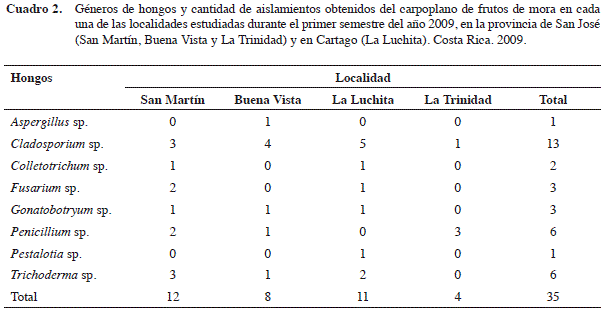
<body><![CDATA[<br style="font-family: verdana;">     <font style="font-weight: bold;" 2=""><span      style="font-family: verdana;">Agentes de     combate biol&oacute;gico     aislados</span></font><br style="font-family: verdana;">     <br style="font-family: verdana;">     <font 2=""><span style="font-family: verdana;">Se aislaron un     total de 35 cepas de     hongos habitantes del carpoplano pertenecientes a ocho g&eacute;neros     diferentes (<a href="/img/revistas/am/v23n2/a01t2.gif">Cuadro 2</a>).    ]]></body>
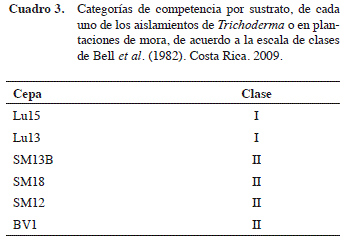
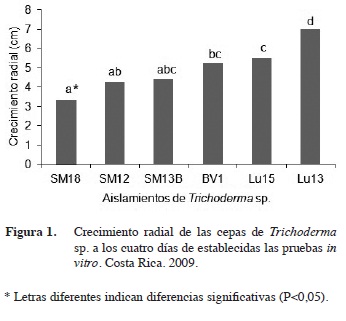
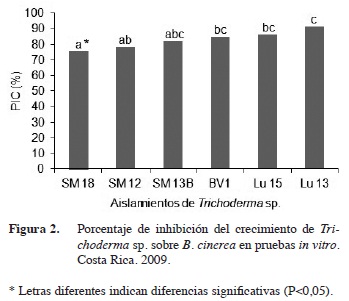
<body><![CDATA[<br>     <br> </span></font></font><font 2="" size="-1"><font 2=""><span  style="font-family: verdana;">La poblaci&oacute;n de hongos recuperados del carpoplano de mora fue muy diversa, predominando el g&eacute;nero&nbsp; <span style="font-style: italic;">Cladosporium</span>&nbsp; sp.,&nbsp; el&nbsp; cual&nbsp; fue&nbsp; obtenido&nbsp; en todas las localidades. Esto coincide con Blakeman y Fokkema (1982) quienes mencionan que este g&eacute;nero es un habitante com&uacute;n de las partes a&eacute;reas de las plantas y algunas especies de &eacute;l son antagonistas de algunos pat&oacute;genos de plantas (Baker y Cook 1982). En&nbsp; frecuencia&nbsp; le&nbsp; siguieron&nbsp; los&nbsp; hongos&nbsp; <span style="font-style: italic;">Penicillium</span> spp. y <span  style="font-style: italic;">Trichoderma</span> spp., el resto de estos aislados fue escaso. La variabilidad encontrada en el n&uacute;mero y tipo entre localidades puede responder a diversos factores, seg&uacute;n lo sugiere Leveau (2006), quien sostiene que las comunidades de hongos sobre las superficies a&eacute;reas de las plantas son determinadas por la combinaci&oacute;n de una serie de factores abi&oacute;ticos (atmosf&eacute;ricos), bi&oacute;ticos (otros organismos y sus interacciones), as&iacute; como por la disponibilidad de nutrientes exudados por la planta. Otra condici&oacute;n que contribuy&oacute; a la heterogeneidad observada, fue la forma en la cual se obtuvo los frutos, dado que estos proven&iacute;an de estratos de plantas de distintas variedades. Hubo diferencias en las comunidades microbianas de las partes a&eacute;reas, a&uacute;n entre hojas de una misma planta, donde poblaciones de una especie pueden ser similares entre s&iacute; pero no id&eacute;nticas (Yang <span  style="font-style: italic;">et al.</span> 2001).</span></font><br  style="font-family: verdana;"> <br style="font-family: verdana; font-weight: bold;"> <font style="font-weight: bold;" 2=""><span  style="font-family: verdana;">Agentes de combate biol&oacute;gico utilizados en las pruebas de antagonismo</span></font><br  style="font-family: verdana;"> <br style="font-family: verdana;"> <font 2=""><span style="font-family: verdana;">Previo a las pruebas definitivas de antagonismo, se realiz&oacute; una serie de pruebas preliminares para descartar aquellos aislamientos que presentaron resultados poco promisorios para el combate de <span style="font-style: italic;">B. cinerea</span> en condiciones <span style="font-style: italic;">in vitro</span>. Como producto de esta selecci&oacute;n se eligieron &uacute;nicamente seis cepas de <span style="font-style: italic;">Trichoderma</span> para ser evaluadas de manera definitiva contra <span style="font-style: italic;">B. cinerea</span>. Estos aislamientos fueron Lu15 y Lu13 procedentes de La Luchita, SM 18, SM 12 y SM 13B obtenidas de San Mart&iacute;n y BV1 de Buena vista.</span></font><br style="font-family: verdana;"> <br style="font-family: verdana;"> <font style="font-weight: bold;" 2=""><span  style="font-family: verdana;">Evaluaci&oacute;n de la competencia por sustrato</span></font><br style="font-family: verdana;"> <br style="font-family: verdana;"> <font 2=""><span style="font-family: verdana;">De conformidad a la escala de&nbsp; Bell <span style="font-style: italic;">et al.</span> (1982), todos los aislamientos de <span style="font-style: italic;">Trichoderma</span> se ubicaron en las categor&iacute;as I y II, lo cual los coloca en la categor&iacute;a de antagonistas de <span style="font-style: italic;">B. cinerea</span> (<a href="#tab_3">Cuadro 3</a>).    <br>     <br> </span></font></font>     <div style="text-align: center;"><font 2="" size="-1"><a name="tab_3"></a><img  alt="" src="/img/revistas/am/v23n2/a01t3.gif"  style="width: 347px; height: 242px;"><font 2=""><span  style="font-family: verdana;"></span></font></font><br  style="font-family: verdana;"> <font 2="" size="-1"><font 2=""><span style="font-family: verdana;"></span></font></font></div> <font 2="" size="-1"><br style="font-family: verdana;"> <font 2=""><span style="font-family: verdana;">Las especies de <span style="font-style: italic;">Trichoderma</span> regularmente presentan resultados satisfactorios en las pruebas de competencia por sustrato. Esto ha sido observado en experimentos realizados por Bell <span style="font-style: italic;">et al.</span> (1982) quienes hallaron que un 65% de las cepas de este hongo se ubicaron en la clase I al evaluarse contra <span  style="font-style: italic;">R. solani</span> G-2 antagonista y un 85% se ubic&oacute; en la clase II al evaluarse contra el mismo hongo R. solani AG-3. Igualmente Arzate <span  style="font-style: italic;">et al.</span> (2006) ubicaron a <span style="font-style: italic;">Trichoderma</span> sp. en la clase I al evaluar el grado de competencia contra <span style="font-style: italic;">Mycosphaerella&nbsp; fijiensis</span> M.&nbsp; Morelet. Tambi&eacute;n&nbsp; Mart&iacute;nez&nbsp; <span  style="font-style: italic;">et&nbsp; al.</span> (2008), obtuvieron m&aacute;s de un 90% de aislamientos de <span  style="font-style: italic;">Trichoderma</span> que clasificaron como clases I y II contra <span  style="font-style: italic;">Rhizoctonia</span> despu&eacute;s de siete d&iacute;as.</span></font><br style="font-family: verdana;"> <br style="font-family: verdana;"> <font 2=""><span style="font-family: verdana;">La competencia por nutrientes y sustrato en la superficie de las plantas es un importante mecanismo de combate biol&oacute;gico contra los pat&oacute;genos que dependen de alimentaci&oacute;n externa, como es el caso de <span  style="font-style: italic;">B. cinerea</span> (Elad y Chet 1987, Roberts 1990). De acuerdo a Campbell (1989) <span  style="font-style: italic;">Botrytis</span> es altamente vulnerable a la competencia por nutrientes y sustrato, lo cual le confiere cierta desventaja frente a otros microorganismos habitantes del carpoplano. Lo anterior ha sido aprovechado por diferentes antagonistas, donde <span style="font-style: italic;">T. viride </span>y<span  style="font-style: italic;"> T. polysporum</span> combatieron efectivamente a <span style="font-style: italic;">B. cinerea</span> en el cultivo de fresa (Tronsmo y Dennis 1977).</span></font><br  style="font-family: verdana;"> <font 2=""><span style="font-family: verdana;"><br  style="font-weight: bold;"> <span style="font-weight: bold;">Tiempo de contacto</span>     <br> <br style="font-family: verdana;"> </span></font><font 2=""><span style="font-family: verdana;">En todos los casos antagonista y pat&oacute;geno hicieron contacto a los tres d&iacute;as. Resultados similares han sido obtenidos por otros autores, quienes han determinado que <span style="font-style: italic;">Trichoderma</span> y diversos pat&oacute;genos (<span style="font-style: italic;">M. fijiensis, R. solani, Sclerotium rolfsii</span> Sacc.) entran en contacto entre uno y tres d&iacute;as despu&eacute;s de establecida la prueba de cultivos duales (Hern&aacute;ndez 2005, Arzate <span  style="font-style: italic;">et al.</span> 2006). </span></font><br  style="font-family: verdana;"> <br style="font-family: verdana;"> <font 2=""><span style="font-family: verdana;">De acuerdo a Michel (2001), un tiempo de contacto corto es una caracter&iacute;stica deseable en un antagonista, ya que entre menor sea este, implicar&aacute; una mayor agresividad.</span></font><br style="font-family: verdana;"> <br style="font-family: verdana; font-weight: bold;"> <font style="font-weight: bold;" 2=""><span  style="font-family: verdana;">Crecimiento radial</span></font><br style="font-family: verdana;"> <br style="font-family: verdana;"> <font 2=""><span style="font-family: verdana;">La&nbsp; cepa&nbsp; Lu13&nbsp; present&oacute;&nbsp; el&nbsp; mayor&nbsp; crecimiento radial (7 cm), a los cuatro d&iacute;as mostrando diferencias significativas respecto a las cepas restantes (P&lt;0,05). Esta cepa cubri&oacute; por completo el plato Petri en el tiempo de incubaci&oacute;n se&ntilde;alado. El resto mostr&oacute; un menor crecimiento radial en el mismo lapso de tiempo (<a href="#fig_1">Figura 1</a>).    <br>     <br> </span></font></font>     <div style="text-align: center;"><font 2="" size="-1"><a name="fig_1"></a><img  alt="" src="/img/revistas/am/v23n2/a01i1.jpg"  style="width: 346px; height: 321px;"><font 2=""><span  style="font-family: verdana;"></span></font></font><br  style="font-family: verdana;"> <font 2="" size="-1"><font 2=""><span style="font-family: verdana;"></span></font></font></div> <font 2="" size="-1"><font 2=""><span style="font-family: verdana;">&nbsp;</span></font><br  style="font-family: verdana;"> <font style="font-weight: bold;" 2=""><span  style="font-family: verdana;">Evaluaci&oacute;n del efecto antibi&oacute;tico</span></font><br style="font-family: verdana;"> <br style="font-family: verdana;"> <font 2=""><span style="font-family: verdana;">El&nbsp; aislamiento&nbsp; Lu13&nbsp; present&oacute;&nbsp; los&nbsp; valores&nbsp; m&aacute;s altos&nbsp; de&nbsp; inhibici&oacute;n&nbsp; del&nbsp; crecimiento&nbsp; con&nbsp; un&nbsp; PIC&nbsp; de 91,43%, valor que es significativamente diferente con respecto a los dem&aacute;s antagonistas (P &lt; 0,05). Asimismo, las cepas Lu15, BV1 y SM13B, mostraron alta capacidad para inhibir el crecimiento de <span  style="font-style: italic;">B. cinerea</span>, presentando valores de PIC superiores al 80%. Sin embargo, no existieron diferencias significativas entre estos tres aislamientos (<a href="#fig_2">Figura 2</a>).    <br>     ]]></body>
<body><![CDATA[<br> </span></font></font>     <div style="text-align: center;"><font 2="" size="-1"><a name="fig_2"></a><img  alt="" src="/img/revistas/am/v23n2/a01i2.jpg"  style="width: 349px; height: 301px;"><font 2=""><span  style="font-family: verdana;"></span></font></font><br  style="font-family: verdana;"> <font 2="" size="-1"><font 2=""><span style="font-family: verdana;"></span></font></font></div> <font 2="" size="-1"><br style="font-family: verdana;"> <font 2=""><span style="font-family: verdana;">La capacidad antibi&oacute;tica desarrollada por el g&eacute;nero <span style="font-style: italic;">Trichoderma</span> se debe principalmente a la producci&oacute;n de los antibi&oacute;ticos peptaibol, trichozianinas A1 y B1. Mediante la producci&oacute;n de estas sustancias <span style="font-style: italic;">Trichoderma</span> sp. logra inhibir la germinaci&oacute;n de las esporas y la elongaci&oacute;n de las hifas de <span  style="font-style: italic;">B. cinerea</span> (Schirmb&ouml;ck <span style="font-style: italic;">et al.</span> 1994). Debido a lo anterior, resulta razonable pensar que la cepa Lu13 es efectiva debido a una alta producci&oacute;n de antibi&oacute;ticos, donde la inhibici&oacute;n es resultado de la concentraci&oacute;n y capacidad de difusi&oacute;n de los compuestos inhibitorios secretados por ella (Swadling y Jeffries 1996). <span style="font-style: italic;">Trichoderma</span> se caracteriza por presentar altos valores de PIC en cultivos duales con hongos fitopat&oacute;genos. Esto es respaldado por Ribamar y Oliveira (1988), quienes obtuvieron resultados de PIC de un 100% cuando <span style="font-style: italic;">Trichoderma</span> compiti&oacute; contra <span style="font-style: italic;">Cladosporium gloeosporioides</span> G.F. Atk. Asimismo Michel <span  style="font-style: italic;">et al.</span> (2005) obtuvieron valores de inhibici&oacute;n de crecimiento de un 94% contra <span  style="font-style: italic;">S. rolfsii</span> en pruebas <span style="font-style: italic;">in vitro</span>.</span></font><br  style="font-family: verdana;"> <br style="font-family: verdana;"> <font 2=""><span style="font-family: verdana;">Con la metodolog&iacute;a empleada se logr&oacute; aislar y evaluar seis cepas de microorganismos antagonistas nativos de <span style="font-style: italic;">B. cinerea</span> provenientes de plantaciones de mora, lo cual es necesario e importante debido a que uno de los principales problemas en la efectividad del combate biol&oacute;gico de hongos fitopat&oacute;genos y otras plagas, es la introducci&oacute;n de microorganismos no nativos en los ecosistemas, condici&oacute;n que puede volverse problem&aacute;tica cuando los agentes de combate biol&oacute;gico utilizados no se encuentran adaptados a las condiciones ambientales donde se van a aplicar. La variaci&oacute;n en la efectividad de los diferentes antagonistas se debe a que la actividad antag&oacute;nica de un microorganismo es muy cambiante. Se ha observado que cepas de <span style="font-style: italic;">Trichoderma</span> sp. var&iacute;an mucho en su efecto antag&oacute;nico debido a la versatilidad de mecanismos que posee, los cuales se expresan dependiendo de las condiciones ambientales prevalentes (Campbell 1989).</span></font><br  style="font-family: verdana;"> <br style="font-family: verdana;"> <font 2=""><span style="font-family: verdana;">Es relevante el efecto antag&oacute;nico de la cepa Lu13, la cual result&oacute; notablemente superior a las dem&aacute;s, esta se ubic&oacute; en la clase I de la escala de Bell, present&oacute; los valores m&aacute;s altos de crecimiento radial, as&iacute; como un porcentaje de inhibici&oacute;n de <span style="font-style: italic;">B. cinerea</span> superior al 90%.</span></font><br  style="font-family: verdana;"> <br style="font-family: verdana;"> <font 2=""><span style="font-family: verdana;">Los antagonistas aislados en la investigaci&oacute;n poseen el potencial para ser agentes de combate biol&oacute;gico de <span style="font-style: italic;">B. cinerea</span>.</span></font><br  style="font-family: verdana;"> </font><font 2=""><font style="font-weight: bold;" 2=""><span  style="font-family: verdana;"></span></font></font> <hr style="width: 100%; height: 2px;">    <!-- ref --><br> <font 2=""><font style="font-weight: bold;" 2=""><span  style="font-family: verdana;">Literatura citada</span></font></font><font 2="" size="-1"><br  style="font-family: verdana;"> <br style="font-family: verdana;"> <font 2=""><span style="font-family: verdana;">Arzate, J; Michel, A; Dom&iacute;nguez, V; Santos, O. 2006. Antagonismo de <span  style="font-style: italic;">Trichoderma</span> spp. sobre <span style="font-style: italic;">Mycosphaerella fijiensis</span> Morelet, agente causal de la Sigatoka Negra del pl&aacute;tano (<span style="font-style: italic;">Musa</span> sp.) <span style="font-style: italic;">in vitro</span> e invernadero. Revista Mexicana de Fitopatolog&iacute;a 24:98-104.    &nbsp;&nbsp;&nbsp;&nbsp;&nbsp;&nbsp;&nbsp;&nbsp;[&#160;<a href="javascript:void(0);" onclick="javascript: window.open('/scielo.php?script=sci_nlinks&ref=311754&pid=S1659-1321201200020000100001&lng=','','width=640,height=500,resizable=yes,scrollbars=1,menubar=yes,');">Links</a>&#160;]<!-- end-ref --><!-- ref --></span></font><br  style="font-family: verdana;"> <br style="font-family: verdana;"> <font 2=""><span style="font-family: verdana;">Baker,&nbsp; K;&nbsp; Cook,&nbsp; R.&nbsp; 1982.&nbsp; Biological&nbsp; control&nbsp; of&nbsp;&nbsp; plant pathogens. The American Phytopathological Society. St. Paul, Minnesota. USA. 433 p.    &nbsp;&nbsp;&nbsp;&nbsp;&nbsp;&nbsp;&nbsp;&nbsp;[&#160;<a href="javascript:void(0);" onclick="javascript: window.open('/scielo.php?script=sci_nlinks&ref=311755&pid=S1659-1321201200020000100002&lng=','','width=640,height=500,resizable=yes,scrollbars=1,menubar=yes,');">Links</a>&#160;]<!-- end-ref --><!-- ref --></span></font><br style="font-family: verdana;"> <br style="font-family: verdana;"> <font 2=""><span style="font-family: verdana;">Bell, D; Well, H; Markham, C. 1982. &#8220;<span style="font-style: italic;">In vitro</span>&#8221; antagonism of&nbsp; <span style="font-style: italic;">Trichoderma</span>&nbsp; species&nbsp; against&nbsp;&nbsp; six&nbsp; fungal&nbsp; plant pathogens. Phytopathology 72:379-382.    &nbsp;&nbsp;&nbsp;&nbsp;&nbsp;&nbsp;&nbsp;&nbsp;[&#160;<a href="javascript:void(0);" onclick="javascript: window.open('/scielo.php?script=sci_nlinks&ref=311756&pid=S1659-1321201200020000100003&lng=','','width=640,height=500,resizable=yes,scrollbars=1,menubar=yes,');">Links</a>&#160;]<!-- end-ref --><!-- ref --></span></font><br  style="font-family: verdana;"> <br style="font-family: verdana;"> <font 2=""><span style="font-family: verdana;">Blakeman, JP; Fokkema, NJ. 1982. Potential for biological control of plant diseases on the&nbsp; phylloplane. Annual Review of Phytopathology 20:167-192.    &nbsp;&nbsp;&nbsp;&nbsp;&nbsp;&nbsp;&nbsp;&nbsp;[&#160;<a href="javascript:void(0);" onclick="javascript: window.open('/scielo.php?script=sci_nlinks&ref=311757&pid=S1659-1321201200020000100004&lng=','','width=640,height=500,resizable=yes,scrollbars=1,menubar=yes,');">Links</a>&#160;]<!-- end-ref --><!-- ref --></span></font><br  style="font-family: verdana;"> <br style="font-family: verdana;"> <font 2=""><span style="font-family: verdana;">Campbell,&nbsp; R. 1989. Biological control of microbial&nbsp; plant pathogens. Cambridge University Press.&nbsp; New York. USA. 218 p.    &nbsp;&nbsp;&nbsp;&nbsp;&nbsp;&nbsp;&nbsp;&nbsp;[&#160;<a href="javascript:void(0);" onclick="javascript: window.open('/scielo.php?script=sci_nlinks&ref=311758&pid=S1659-1321201200020000100005&lng=','','width=640,height=500,resizable=yes,scrollbars=1,menubar=yes,');">Links</a>&#160;]<!-- end-ref --><!-- ref --></span></font><br  style="font-family: verdana;"> <br style="font-family: verdana;"> <font 2=""><span style="font-family: verdana;">Elad,&nbsp; Y;&nbsp; Chet,&nbsp; I.&nbsp; 1987.&nbsp; Possible&nbsp; role&nbsp; of&nbsp; competition&nbsp; for nutrients&nbsp; in&nbsp; biocontrol&nbsp; of&nbsp; <span style="font-style: italic;">Pythium&nbsp; </span>damping-off&nbsp; by bacteria. Phytopathology 77:190-195.    &nbsp;&nbsp;&nbsp;&nbsp;&nbsp;&nbsp;&nbsp;&nbsp;[&#160;<a href="javascript:void(0);" onclick="javascript: window.open('/scielo.php?script=sci_nlinks&ref=311759&pid=S1659-1321201200020000100006&lng=','','width=640,height=500,resizable=yes,scrollbars=1,menubar=yes,');">Links</a>&#160;]<!-- end-ref --><!-- ref --></span></font><br style="font-family: verdana;"> <br style="font-family: verdana;"> <font 2=""><span style="font-family: verdana;">Hern&aacute;ndez, N. 2005. Control biol&oacute;gico de Sclerotium rolfsii Sacc. en el cultivo de cacahuate (<span style="font-style: italic;">Arachis hypogaea L.</span>) con <span  style="font-style: italic;">Trichoderma</span> spp. Tesis de Maestr&iacute;a. Universidad Aut&oacute;noma&nbsp;&nbsp; de&nbsp;&nbsp; Guerrero.&nbsp;&nbsp; Unidad&nbsp; Acad&eacute;mica&nbsp;&nbsp; de Ciencias&nbsp; Agropecuarias y Ambientales. Maestr&iacute;a en Ciencias en Producci&oacute;n Agr&iacute;cola. Iguala,&nbsp; Guerrero, M&eacute;xico. 107 p.    &nbsp;&nbsp;&nbsp;&nbsp;&nbsp;&nbsp;&nbsp;&nbsp;[&#160;<a href="javascript:void(0);" onclick="javascript: window.open('/scielo.php?script=sci_nlinks&ref=311760&pid=S1659-1321201200020000100007&lng=','','width=640,height=500,resizable=yes,scrollbars=1,menubar=yes,');">Links</a>&#160;]<!-- end-ref --><!-- ref --></span></font><br style="font-family: verdana;"> <br style="font-family: verdana;"> <font 2=""><span style="font-family: verdana;">Leveau, JH. 2006. Microbial communities in the phyllosphere. <span style="font-style: italic;">In</span> Riederer, M; M&uuml;ller, C. eds. Biology of the pant cuticle. Blackwell Publishing Ltd. Chennai. India. p. 334-367.    &nbsp;&nbsp;&nbsp;&nbsp;&nbsp;&nbsp;&nbsp;&nbsp;[&#160;<a href="javascript:void(0);" onclick="javascript: window.open('/scielo.php?script=sci_nlinks&ref=311761&pid=S1659-1321201200020000100008&lng=','','width=640,height=500,resizable=yes,scrollbars=1,menubar=yes,');">Links</a>&#160;]<!-- end-ref --></span></font><br style="font-family: verdana;"> <br style="font-family: verdana;"> <font 2=""><span style="font-family: verdana;">MAG (Ministerio de Agricultura y Ganader&iacute;a). 2008. Mora (Rubus spp.) cultivo y manejo poscosecha (en l&iacute;nea). Consultado&nbsp; 9 dic. 2008. Disponible en     <!-- ref --><br> http://www.mag.go.cr/bibioteca_virtual_ciencia/manual_mora_indice.html.    &nbsp;&nbsp;&nbsp;&nbsp;&nbsp;&nbsp;&nbsp;&nbsp;[&#160;<a href="javascript:void(0);" onclick="javascript: window.open('/scielo.php?script=sci_nlinks&ref=311763&pid=S1659-1321201200020000100009&lng=','','width=640,height=500,resizable=yes,scrollbars=1,menubar=yes,');">Links</a>&#160;]<!-- end-ref --><!-- ref --></span></font><br  style="font-family: verdana;"> <br style="font-family: verdana;"> <font 2=""><span style="font-family: verdana;">Mart&iacute;nez,&nbsp; B;&nbsp; Reyes, Y;&nbsp; Infante,&nbsp; D;&nbsp; Gonz&aacute;lez,&nbsp; E;&nbsp; Ba&ntilde;os, H;&nbsp; Cruz,&nbsp; A.&nbsp; 2008.&nbsp; Selecci&oacute;n&nbsp; de&nbsp;&nbsp; aislamientos&nbsp; de <span  style="font-style: italic;">Trichoderma</span> spp. candidatos a&nbsp; biofungicidas para el control de <span  style="font-style: italic;">Rhizoctonia</span> sp. en arroz. Revista Protecci&oacute;n Vegetal 23(2):118-125.    &nbsp;&nbsp;&nbsp;&nbsp;&nbsp;&nbsp;&nbsp;&nbsp;[&#160;<a href="javascript:void(0);" onclick="javascript: window.open('/scielo.php?script=sci_nlinks&ref=311764&pid=S1659-1321201200020000100010&lng=','','width=640,height=500,resizable=yes,scrollbars=1,menubar=yes,');">Links</a>&#160;]<!-- end-ref --><!-- ref --></span></font><br  style="font-family: verdana;"> <br style="font-family: verdana;"> <font 2=""><span style="font-family: verdana;">Michel,&nbsp; A.&nbsp; 2001.&nbsp; Cepas&nbsp; nativas&nbsp; de&nbsp; <span style="font-style: italic;">Trichoderma</span>&nbsp;&nbsp; spp., (Euascomicetes:&nbsp;&nbsp; Hypocreales),&nbsp;&nbsp; su&nbsp;&nbsp;&nbsp; antibiosis&nbsp;&nbsp; y micoparasitismo&nbsp; sobre&nbsp;&nbsp; <span style="font-style: italic;">Fusarium&nbsp;&nbsp; subglutinans </span>y<span style="font-style: italic;"> F.&nbsp;&nbsp; oxysporum&nbsp;</span>&nbsp; (Hyphomycetes:&nbsp;&nbsp; Hyphales).&nbsp;&nbsp; Tesis de Doctorado en Ciencias. Universidad&nbsp; de Colima. Tecom&aacute;n, Colima, M&eacute;xico. 162 p.    &nbsp;&nbsp;&nbsp;&nbsp;&nbsp;&nbsp;&nbsp;&nbsp;[&#160;<a href="javascript:void(0);" onclick="javascript: window.open('/scielo.php?script=sci_nlinks&ref=311765&pid=S1659-1321201200020000100011&lng=','','width=640,height=500,resizable=yes,scrollbars=1,menubar=yes,');">Links</a>&#160;]<!-- end-ref --><!-- ref --></span></font><br  style="font-family: verdana;"> <br style="font-family: verdana;"> <font 2=""><span style="font-family: verdana;">Michel,&nbsp; A;&nbsp; Reyes, A;&nbsp; Otero,&nbsp; M;&nbsp; Rebolledo,&nbsp; O;&nbsp; Lezama, R.&nbsp; 2005. Potencial antag&oacute;nico de <span  style="font-style: italic;">Trichoderma</span> spp., sobre&nbsp; <span style="font-style: italic;">Fusarium&nbsp; oxysporum</span>&nbsp; Schlechtend.:Fr.&nbsp; f.&nbsp; sp. <span style="font-style: italic;">lycopersici</span>&nbsp; (Sacc.)&nbsp; Snyder&nbsp; y&nbsp; Hansen&nbsp; y&nbsp; <span style="font-style: italic;">Sclerotium rolfsii</span> (Sacc.) <span style="font-style: italic;">in vitro</span> e invernadero. Revista Mexicana de Fitopatolog&iacute;a 23:284-291.    &nbsp;&nbsp;&nbsp;&nbsp;&nbsp;&nbsp;&nbsp;&nbsp;[&#160;<a href="javascript:void(0);" onclick="javascript: window.open('/scielo.php?script=sci_nlinks&ref=311766&pid=S1659-1321201200020000100012&lng=','','width=640,height=500,resizable=yes,scrollbars=1,menubar=yes,');">Links</a>&#160;]<!-- end-ref --><!-- ref --></span></font><br  style="font-family: verdana;"> <br style="font-family: verdana;"> <font 2=""><span style="font-family: verdana;">Molina, G; Zald&uacute;a, S; Gonz&aacute;lez, G; Sanfuentes, E.&nbsp; 2006. Selecci&oacute;n&nbsp; de&nbsp; hongos&nbsp; antagonistas&nbsp; para&nbsp; el&nbsp;&nbsp; control biol&oacute;gico de <span style="font-style: italic;">Botrytis cinerea</span> en viveros forestales en Chile. Bosque 27(2):126-134.    &nbsp;&nbsp;&nbsp;&nbsp;&nbsp;&nbsp;&nbsp;&nbsp;[&#160;<a href="javascript:void(0);" onclick="javascript: window.open('/scielo.php?script=sci_nlinks&ref=311767&pid=S1659-1321201200020000100013&lng=','','width=640,height=500,resizable=yes,scrollbars=1,menubar=yes,');">Links</a>&#160;]<!-- end-ref --><!-- ref --></span></font><br  style="font-family: verdana;"> <br style="font-family: verdana;"> <font 2=""><span style="font-family: verdana;">Pitt, J; Hocking, A. 2009. Fungi and food spoilage. Springer. New York. USA. 519 p.    &nbsp;&nbsp;&nbsp;&nbsp;&nbsp;&nbsp;&nbsp;&nbsp;[&#160;<a href="javascript:void(0);" onclick="javascript: window.open('/scielo.php?script=sci_nlinks&ref=311768&pid=S1659-1321201200020000100014&lng=','','width=640,height=500,resizable=yes,scrollbars=1,menubar=yes,');">Links</a>&#160;]<!-- end-ref --><!-- ref --></span></font><br  style="font-family: verdana;"> <br style="font-family: verdana;"> <font 2=""><span style="font-family: verdana;">Ribamar,&nbsp; S;&nbsp; Oliveira,&nbsp; N.&nbsp; 1988.&nbsp; <span style="font-style: italic;">In&nbsp; vitro</span> antagonistic potential of <span  style="font-style: italic;">Trichoderma</span> spp. against&nbsp; <span  style="font-style: italic;">Colletotrichum gloeosporioides</span>&nbsp; agent&nbsp; of&nbsp; antracnose&nbsp; in&nbsp; the&nbsp; passion fruit (Passiflora). Bolet&iacute;n Micol&oacute;gico 13:103-110.    &nbsp;&nbsp;&nbsp;&nbsp;&nbsp;&nbsp;&nbsp;&nbsp;[&#160;<a href="javascript:void(0);" onclick="javascript: window.open('/scielo.php?script=sci_nlinks&ref=311769&pid=S1659-1321201200020000100015&lng=','','width=640,height=500,resizable=yes,scrollbars=1,menubar=yes,');">Links</a>&#160;]<!-- end-ref --><!-- ref --></span></font><br style="font-family: verdana;"> <br style="font-family: verdana;"> <font 2=""><span style="font-family: verdana;">Roberts, R. 1990. Postharvest biological control of gray mold of apple by <span  style="font-style: italic;">Cryptococcus laurentii</span>.&nbsp; Phytopathology 80:526-530.    &nbsp;&nbsp;&nbsp;&nbsp;&nbsp;&nbsp;&nbsp;&nbsp;[&#160;<a href="javascript:void(0);" onclick="javascript: window.open('/scielo.php?script=sci_nlinks&ref=311770&pid=S1659-1321201200020000100016&lng=','','width=640,height=500,resizable=yes,scrollbars=1,menubar=yes,');">Links</a>&#160;]<!-- end-ref --><!-- ref --></span></font><br  style="font-family: verdana;"> <br style="font-family: verdana;"> <font 2=""><span style="font-family: verdana;">Schirmb&ouml;ck,&nbsp; M; Lorito, M; Wang, Y; Hayers, C;&nbsp; Arisan, I; Scala, F; Harman, G; Kubicek, C.&nbsp; 1994. Parallel formation&nbsp; and&nbsp; synergism&nbsp; of&nbsp;&nbsp; hydrolytic&nbsp; enzymes and&nbsp; peptaibol&nbsp;&nbsp; antibiotics,&nbsp;&nbsp; molecular&nbsp; mechanisms involved&nbsp; in the antagonistic activity of <span style="font-style: italic;">Trichoderma</span> <span style="font-style: italic;">harzianum</span> against phytopathogenic fungi.&nbsp; Applied and Environmental Microbiology 60:4364-4370.    &nbsp;&nbsp;&nbsp;&nbsp;&nbsp;&nbsp;&nbsp;&nbsp;[&#160;<a href="javascript:void(0);" onclick="javascript: window.open('/scielo.php?script=sci_nlinks&ref=311771&pid=S1659-1321201200020000100017&lng=','','width=640,height=500,resizable=yes,scrollbars=1,menubar=yes,');">Links</a>&#160;]<!-- end-ref --><!-- ref --></span></font><br style="font-family: verdana;"> <br style="font-family: verdana;"> <font 2=""><span style="font-family: verdana;">Skidmore, AM; Dickinson, CH. 1976. Colony&nbsp; interactions and hyphal interference between&nbsp; <span style="font-style: italic;">Septoria nodorum</span> and&nbsp; phylloplane&nbsp; fungi.&nbsp; Transactions&nbsp; of&nbsp; the&nbsp; British Mycological Society 66(1):57-64.    &nbsp;&nbsp;&nbsp;&nbsp;&nbsp;&nbsp;&nbsp;&nbsp;[&#160;<a href="javascript:void(0);" onclick="javascript: window.open('/scielo.php?script=sci_nlinks&ref=311772&pid=S1659-1321201200020000100018&lng=','','width=640,height=500,resizable=yes,scrollbars=1,menubar=yes,');">Links</a>&#160;]<!-- end-ref --><!-- ref --></span></font><br style="font-family: verdana;"> <br style="font-family: verdana;"> <font 2=""><span style="font-family: verdana;">Solano,&nbsp; J;&nbsp; Villalobos,&nbsp; R.&nbsp; 2001.&nbsp; Aspectos&nbsp;&nbsp; fisiogr&aacute;ficos aplicados a un bosquejo de regionalizaci&oacute;n geogr&aacute;fico clim&aacute;tico de Costa&nbsp; Rica. T&oacute;picos Meteorol&oacute;gicos y Oceanogr&aacute;ficos 8(1):26-39.    &nbsp;&nbsp;&nbsp;&nbsp;&nbsp;&nbsp;&nbsp;&nbsp;[&#160;<a href="javascript:void(0);" onclick="javascript: window.open('/scielo.php?script=sci_nlinks&ref=311773&pid=S1659-1321201200020000100019&lng=','','width=640,height=500,resizable=yes,scrollbars=1,menubar=yes,');">Links</a>&#160;]<!-- end-ref --><!-- ref --></span></font><br  style="font-family: verdana;"> <br style="font-family: verdana;"> <font 2=""><span style="font-family: verdana;">Swadling,&nbsp; I;&nbsp; Jeffries,&nbsp; P.&nbsp; 1996.&nbsp; Isolation&nbsp; of&nbsp;&nbsp; microbial antagonists&nbsp; for&nbsp; biocontrol&nbsp; of&nbsp; grey&nbsp;&nbsp; mould&nbsp; disease of strawberries. Biocontrol&nbsp; Science and Technology (6):125-136.    &nbsp;&nbsp;&nbsp;&nbsp;&nbsp;&nbsp;&nbsp;&nbsp;[&#160;<a href="javascript:void(0);" onclick="javascript: window.open('/scielo.php?script=sci_nlinks&ref=311774&pid=S1659-1321201200020000100020&lng=','','width=640,height=500,resizable=yes,scrollbars=1,menubar=yes,');">Links</a>&#160;]<!-- end-ref --><!-- ref --></span></font><br  style="font-family: verdana;"> <br style="font-family: verdana;"> <font 2=""><span style="font-family: verdana;">Tronsmo, A;&nbsp; Dennis,&nbsp; C.&nbsp; 1977.&nbsp; The&nbsp; use&nbsp; of&nbsp; <span  style="font-style: italic;">Trichoderma</span> species to control strawberry fruit&nbsp; rots. Netherlands Journal of Plant Pathology 83(1):449-455.    &nbsp;&nbsp;&nbsp;&nbsp;&nbsp;&nbsp;&nbsp;&nbsp;[&#160;<a href="javascript:void(0);" onclick="javascript: window.open('/scielo.php?script=sci_nlinks&ref=311775&pid=S1659-1321201200020000100021&lng=','','width=640,height=500,resizable=yes,scrollbars=1,menubar=yes,');">Links</a>&#160;]<!-- end-ref --><!-- ref --></span></font><br style="font-family: verdana;"> <br style="font-family: verdana;"> <font 2=""><span style="font-family: verdana;">Yang, CH; Crowley, DE; Borneman, J; Keen, NT.&nbsp; 2001. Microbial phyllosphere populations are more complex than&nbsp;&nbsp; previously&nbsp;&nbsp; recognized.&nbsp;&nbsp; Proceedings&nbsp;&nbsp; of&nbsp; the National&nbsp; Academy&nbsp; of&nbsp; Sciences&nbsp; of&nbsp; the&nbsp; USA&nbsp; (98): 3889-3894.    &nbsp;&nbsp;&nbsp;&nbsp;&nbsp;&nbsp;&nbsp;&nbsp;[&#160;<a href="javascript:void(0);" onclick="javascript: window.open('/scielo.php?script=sci_nlinks&ref=311776&pid=S1659-1321201200020000100022&lng=','','width=640,height=500,resizable=yes,scrollbars=1,menubar=yes,');">Links</a>&#160;]<!-- end-ref --><br>     <br> <a name="Correspondencia1"></a><a href="#Correspondencia2">*</a>Correspondencia a:    <br> </span></font></font><font style="font-style: italic;" 2="" size="-1"><font  2=""><span style="font-family: verdana;">Jos&eacute; Alonso Calvo-Araya. </span></font></font><font 2="" size="-1"><font  2=""><span style="font-family: verdana;">Escuela de Ciencias Agrarias, Universidad Nacional, Apartado 86-3000. Heredia, Costa Rica. josealonsocalvoaraya@gmail.com.</span></font></font>    <br> <font 2="" size="-1"><font 2=""><span style="font-family: verdana;"><span  style="font-style: italic;">Germ&aacute;n Rivera-Coto.</span> </span></font></font><font 2="" size="-1"><font  2=""><span style="font-family: verdana;">Escuela de Ciencias Agrarias, Universidad Nacional, Apartado 86-3000. Heredia, Costa Rica. grivera@una.ac.cr</span></font></font>    <br> <font style="font-style: italic;" 2="" size="-1"><font 2=""><span  style="font-family: verdana;">Steffany Orozco-Cayasso. </span></font></font><font 2="" size="-1"><font 2=""><span  style="font-family: verdana;">Escuela de Ciencias Agrarias, Universidad Nacional, Apartado 86-3000. Heredia, Costa Rica.</span></font></font><font  style="font-style: italic;" 2="" size="-1"><font 2=""><span  style="font-family: verdana;"> sorozc@una.ac.cr</span></font></font><br style="font-style: italic;"> <font 2="" size="-1"><font 2=""><span style="font-family: verdana;"><span  style="font-style: italic;">Rafael Orozco-Rodr&iacute;guez.</span> </span></font></font><font 2=""  size="-1"><font 2=""><span style="font-family: verdana;">Escuela de Ciencias Agrarias, Universidad Nacional, Apartado 86-3000. Heredia, Costa Rica. rorozco@una.ac.cr    ]]></body>
<body><![CDATA[<br> </span></font></font><font 2="" size="-1"><font 2=""><span  style="font-family: verdana;">1. Este trabajo forma parte de la Tesis de Licenciatura del primer autor realizada en la Escuela de Ciencias Agrarias, Universidad Nacional de Costa Rica, Heredia, Costa Rica.    <br> <a name="2"></a><a href="#3">2</a>. Escuela de Ciencias Agrarias, Universidad Nacional, Apartado 86-3000. Heredia, Costa Rica. josealonsocalvoaraya@gmail.com; grivera@una.ac.cr; sorozc@una.ac.cr; rorozco@una.ac.cr</span></font></font>    <br>     <div style="text-align: center;"><font style="font-weight: bold;" 2=""  size="-1"><font 2=""><span style="font-family: verdana;"></span></font></font><font  style="font-weight: bold;" 2="" size="-1"><font 2=""><span  style="font-family: verdana;"></span></font></font> <hr style="width: 100%; height: 2px;"><font style="font-weight: bold;"  2="" size="-1"><font 2=""><span style="font-family: verdana;">Recibido: 17 de febrero, 2012. Aceptado: 9 octubre, 2012</span></font></font><br  style="font-family: verdana;"> </div> </div> <font 2="" size=""> </font></div> <font 2="" size=""> </font>      ]]></body><back>
<ref-list>
<ref id="B1">
<nlm-citation citation-type="journal">
<person-group person-group-type="author">
<name>
<surname><![CDATA[Arzate]]></surname>
<given-names><![CDATA[J]]></given-names>
</name>
<name>
<surname><![CDATA[Michel]]></surname>
<given-names><![CDATA[A]]></given-names>
</name>
<name>
<surname><![CDATA[Domínguez]]></surname>
<given-names><![CDATA[V]]></given-names>
</name>
<name>
<surname><![CDATA[Santos]]></surname>
<given-names><![CDATA[O]]></given-names>
</name>
</person-group>
<article-title xml:lang="es"><![CDATA[Antagonismo de Trichoderma spp. sobre Mycosphaerella fijiensis Morelet, agente causal de la Sigatoka Negra del plátano (Musa sp.) in vitro e invernadero]]></article-title>
<source><![CDATA[Revista Mexicana de Fitopatología]]></source>
<year>2006</year>
<volume>24</volume>
<page-range>98-104</page-range></nlm-citation>
</ref>
<ref id="B2">
<nlm-citation citation-type="book">
<person-group person-group-type="author">
<name>
<surname><![CDATA[Baker]]></surname>
<given-names><![CDATA[K]]></given-names>
</name>
<name>
<surname><![CDATA[Cook]]></surname>
<given-names><![CDATA[R]]></given-names>
</name>
</person-group>
<source><![CDATA[Biological control of plant pathogens]]></source>
<year>1982</year>
<page-range>433</page-range><publisher-loc><![CDATA[St. Paul^eMinnesota Minnesota]]></publisher-loc>
<publisher-name><![CDATA[The American Phytopathological Society]]></publisher-name>
</nlm-citation>
</ref>
<ref id="B3">
<nlm-citation citation-type="journal">
<person-group person-group-type="author">
<name>
<surname><![CDATA[Bell]]></surname>
<given-names><![CDATA[D]]></given-names>
</name>
<name>
<surname><![CDATA[Well]]></surname>
<given-names><![CDATA[H]]></given-names>
</name>
<name>
<surname><![CDATA[Markham]]></surname>
<given-names><![CDATA[C.]]></given-names>
</name>
</person-group>
<article-title xml:lang="en"><![CDATA[&#8220;In vitro&#8221; antagonism of Trichoderma species against six fungal plant pathogens]]></article-title>
<source><![CDATA[Phytopathology]]></source>
<year>1982</year>
<volume>72</volume>
<page-range>379-382</page-range></nlm-citation>
</ref>
<ref id="B4">
<nlm-citation citation-type="journal">
<person-group person-group-type="author">
<name>
<surname><![CDATA[Blakeman]]></surname>
<given-names><![CDATA[JP]]></given-names>
</name>
<name>
<surname><![CDATA[Fokkema]]></surname>
<given-names><![CDATA[NJ]]></given-names>
</name>
</person-group>
<article-title xml:lang="en"><![CDATA[Potential for biological control of plant diseases on the phylloplane]]></article-title>
<source><![CDATA[Annual Review of Phytopathology]]></source>
<year>1982</year>
<volume>20</volume>
<page-range>167-192</page-range></nlm-citation>
</ref>
<ref id="B5">
<nlm-citation citation-type="book">
<person-group person-group-type="author">
<name>
<surname><![CDATA[Campbell]]></surname>
<given-names><![CDATA[R.]]></given-names>
</name>
</person-group>
<source><![CDATA[Biological control of microbial plant pathogens]]></source>
<year>1989</year>
<page-range>218</page-range><publisher-loc><![CDATA[^eNew York New York]]></publisher-loc>
<publisher-name><![CDATA[Cambridge University Press]]></publisher-name>
</nlm-citation>
</ref>
<ref id="B6">
<nlm-citation citation-type="journal">
<person-group person-group-type="author">
<name>
<surname><![CDATA[Elad]]></surname>
<given-names><![CDATA[Y]]></given-names>
</name>
<name>
<surname><![CDATA[Chet]]></surname>
<given-names><![CDATA[I.]]></given-names>
</name>
</person-group>
<article-title xml:lang="en"><![CDATA[Possible role of competition for nutrients in biocontrol of Pythium damping-off by bacteria]]></article-title>
<source><![CDATA[Phytopathology]]></source>
<year>1987</year>
<volume>77</volume>
<page-range>190-195</page-range></nlm-citation>
</ref>
<ref id="B7">
<nlm-citation citation-type="">
<person-group person-group-type="author">
<name>
<surname><![CDATA[Hernández]]></surname>
<given-names><![CDATA[N.]]></given-names>
</name>
</person-group>
<source><![CDATA[Control biológico de Sclerotium rolfsii Sacc. en el cultivo de cacahuate (Arachis hypogaea L.) con Trichoderma spp]]></source>
<year>2005</year>
<page-range>107</page-range></nlm-citation>
</ref>
<ref id="B8">
<nlm-citation citation-type="book">
<person-group person-group-type="author">
<name>
<surname><![CDATA[Leveau]]></surname>
<given-names><![CDATA[JH.]]></given-names>
</name>
</person-group>
<article-title xml:lang="en"><![CDATA[Microbial communities in the phyllosphere]]></article-title>
<person-group person-group-type="editor">
<name>
<surname><![CDATA[Riederer]]></surname>
<given-names><![CDATA[M]]></given-names>
</name>
<name>
<surname><![CDATA[Müller]]></surname>
<given-names><![CDATA[C.]]></given-names>
</name>
</person-group>
<source><![CDATA[Biology of the pant cuticle]]></source>
<year>2006</year>
<page-range>334-367</page-range><publisher-loc><![CDATA[^eChennai Chennai]]></publisher-loc>
<publisher-name><![CDATA[Blackwell Publishing Ltd]]></publisher-name>
</nlm-citation>
</ref>
<ref id="B9">
<nlm-citation citation-type="">
<collab>MAG (Ministerio de Agricultura y Ganadería).</collab>
<source><![CDATA[Mora (Rubus spp.) cultivo y manejo poscosecha]]></source>
<year>2008</year>
</nlm-citation>
</ref>
<ref id="B10">
<nlm-citation citation-type="journal">
<person-group person-group-type="author">
<name>
<surname><![CDATA[Martínez]]></surname>
<given-names><![CDATA[B]]></given-names>
</name>
<name>
<surname><![CDATA[Reyes]]></surname>
<given-names><![CDATA[Y]]></given-names>
</name>
<name>
<surname><![CDATA[Infante]]></surname>
<given-names><![CDATA[D]]></given-names>
</name>
<name>
<surname><![CDATA[González]]></surname>
<given-names><![CDATA[E]]></given-names>
</name>
<name>
<surname><![CDATA[Baños]]></surname>
<given-names><![CDATA[H]]></given-names>
</name>
<name>
<surname><![CDATA[Cruz]]></surname>
<given-names><![CDATA[A.]]></given-names>
</name>
</person-group>
<article-title xml:lang="es"><![CDATA[Selección de aislamientos de Trichoderma spp. candidatos a biofungicidas para el control de Rhizoctonia sp. en arroz.]]></article-title>
<source><![CDATA[Revista Protección Vegetal]]></source>
<year>2008</year>
<volume>23</volume>
<numero>2</numero>
<issue>2</issue>
<page-range>118-125</page-range></nlm-citation>
</ref>
<ref id="B11">
<nlm-citation citation-type="">
<person-group person-group-type="author">
<name>
<surname><![CDATA[Michel]]></surname>
<given-names><![CDATA[A.]]></given-names>
</name>
</person-group>
<source><![CDATA[Cepas nativas de Trichoderma spp., (Euascomicetes: Hypocreales), su antibiosis y micoparasitismo sobre Fusarium subglutinans y F. oxysporum (Hyphomycetes: Hyphales)]]></source>
<year>2001</year>
<page-range>162</page-range></nlm-citation>
</ref>
<ref id="B12">
<nlm-citation citation-type="journal">
<person-group person-group-type="author">
<name>
<surname><![CDATA[Michel]]></surname>
<given-names><![CDATA[A]]></given-names>
</name>
<name>
<surname><![CDATA[Reyes]]></surname>
<given-names><![CDATA[A]]></given-names>
</name>
<name>
<surname><![CDATA[Otero]]></surname>
<given-names><![CDATA[M]]></given-names>
</name>
<name>
<surname><![CDATA[Rebolledo]]></surname>
<given-names><![CDATA[O]]></given-names>
</name>
<name>
<surname><![CDATA[Lezama]]></surname>
<given-names><![CDATA[R.]]></given-names>
</name>
</person-group>
<article-title xml:lang="es"><![CDATA[Potencial antagónico de Trichoderma spp., sobre Fusarium oxysporum Schlechtend.:Fr. f. sp. lycopersici (Sacc.) Snyder y Hansen y Sclerotium rolfsii (Sacc.) in vitro e invernadero]]></article-title>
<source><![CDATA[Revista Mexicana de Fitopatología]]></source>
<year>2005</year>
<volume>23</volume>
<page-range>284-291</page-range></nlm-citation>
</ref>
<ref id="B13">
<nlm-citation citation-type="journal">
<person-group person-group-type="author">
<name>
<surname><![CDATA[Molina]]></surname>
<given-names><![CDATA[G]]></given-names>
</name>
<name>
<surname><![CDATA[Zaldúa]]></surname>
<given-names><![CDATA[S]]></given-names>
</name>
<name>
<surname><![CDATA[González]]></surname>
<given-names><![CDATA[G]]></given-names>
</name>
<name>
<surname><![CDATA[Sanfuentes]]></surname>
<given-names><![CDATA[E.]]></given-names>
</name>
</person-group>
<article-title xml:lang="es"><![CDATA[Selección de hongos antagonistas para el control biológico de Botrytis cinerea en viveros forestales en Chile]]></article-title>
<source><![CDATA[Bosque]]></source>
<year>2006</year>
<volume>27</volume>
<numero>2</numero>
<issue>2</issue>
<page-range>126-134</page-range></nlm-citation>
</ref>
<ref id="B14">
<nlm-citation citation-type="book">
<person-group person-group-type="author">
<name>
<surname><![CDATA[Pitt]]></surname>
<given-names><![CDATA[J]]></given-names>
</name>
<name>
<surname><![CDATA[Hocking]]></surname>
<given-names><![CDATA[A.]]></given-names>
</name>
</person-group>
<source><![CDATA[Fungi and food spoilage]]></source>
<year>2009</year>
<page-range>519</page-range><publisher-loc><![CDATA[^eNew York New York]]></publisher-loc>
<publisher-name><![CDATA[Springer]]></publisher-name>
</nlm-citation>
</ref>
<ref id="B15">
<nlm-citation citation-type="journal">
<person-group person-group-type="author">
<name>
<surname><![CDATA[Ribamar]]></surname>
<given-names><![CDATA[S]]></given-names>
</name>
<name>
<surname><![CDATA[Oliveira]]></surname>
<given-names><![CDATA[N.]]></given-names>
</name>
</person-group>
<article-title xml:lang="en"><![CDATA[In vitro antagonistic potential of Trichoderma spp. against Colletotrichum gloeosporioides agent of antracnose in the passion fruit (Passiflora).]]></article-title>
<source><![CDATA[Boletín Micológico]]></source>
<year>1988</year>
<volume>13</volume>
<page-range>103-110</page-range></nlm-citation>
</ref>
<ref id="B16">
<nlm-citation citation-type="journal">
<person-group person-group-type="author">
<name>
<surname><![CDATA[Roberts]]></surname>
<given-names><![CDATA[R]]></given-names>
</name>
</person-group>
<article-title xml:lang="en"><![CDATA[Postharvest biological control of gray mold of apple by Cryptococcus laurentii.]]></article-title>
<source><![CDATA[Phytopathology]]></source>
<year>1990</year>
<volume>80</volume>
<page-range>526-530</page-range></nlm-citation>
</ref>
<ref id="B17">
<nlm-citation citation-type="journal">
<person-group person-group-type="author">
<name>
<surname><![CDATA[Schirmböck]]></surname>
<given-names><![CDATA[M]]></given-names>
</name>
<name>
<surname><![CDATA[Lorito]]></surname>
<given-names><![CDATA[M]]></given-names>
</name>
<name>
<surname><![CDATA[Wang]]></surname>
<given-names><![CDATA[Y]]></given-names>
</name>
<name>
<surname><![CDATA[Hayers]]></surname>
<given-names><![CDATA[C]]></given-names>
</name>
<name>
<surname><![CDATA[Arisan]]></surname>
<given-names><![CDATA[I]]></given-names>
</name>
<name>
<surname><![CDATA[Scala]]></surname>
<given-names><![CDATA[F]]></given-names>
</name>
<name>
<surname><![CDATA[Harman]]></surname>
<given-names><![CDATA[G]]></given-names>
</name>
<name>
<surname><![CDATA[Kubicek]]></surname>
<given-names><![CDATA[C.]]></given-names>
</name>
</person-group>
<article-title xml:lang="en"><![CDATA[Parallel formation and synergism of hydrolytic enzymes and peptaibol antibiotics, molecular mechanisms involved in the antagonistic activity of Trichoderma harzianum against phytopathogenic fungi.]]></article-title>
<source><![CDATA[Applied and Environmental Microbiology]]></source>
<year>1994</year>
<volume>60</volume>
<page-range>4364-4370</page-range></nlm-citation>
</ref>
<ref id="B18">
<nlm-citation citation-type="journal">
<person-group person-group-type="author">
<name>
<surname><![CDATA[Skidmore]]></surname>
<given-names><![CDATA[AM]]></given-names>
</name>
<name>
<surname><![CDATA[Dickinson]]></surname>
<given-names><![CDATA[CH]]></given-names>
</name>
</person-group>
<article-title xml:lang="en"><![CDATA[Colony interactions and hyphal interference between Septoria nodorum and phylloplane fungi]]></article-title>
<source><![CDATA[Transactions of the British Mycological Society]]></source>
<year>1976</year>
<volume>66</volume>
<numero>1</numero>
<issue>1</issue>
<page-range>57-64</page-range></nlm-citation>
</ref>
<ref id="B19">
<nlm-citation citation-type="journal">
<person-group person-group-type="author">
<name>
<surname><![CDATA[Solano]]></surname>
<given-names><![CDATA[J]]></given-names>
</name>
<name>
<surname><![CDATA[Villalobos]]></surname>
<given-names><![CDATA[R.]]></given-names>
</name>
</person-group>
<article-title xml:lang="es"><![CDATA[Aspectos fisiográficos aplicados a un bosquejo de regionalización geográfico climático de Costa Rica]]></article-title>
<source><![CDATA[Tópicos Meteorológicos y Oceanográficos]]></source>
<year>2001</year>
<volume>8</volume>
<numero>1</numero>
<issue>1</issue>
<page-range>26-39</page-range></nlm-citation>
</ref>
<ref id="B20">
<nlm-citation citation-type="journal">
<person-group person-group-type="author">
<name>
<surname><![CDATA[Swadling]]></surname>
<given-names><![CDATA[I]]></given-names>
</name>
<name>
<surname><![CDATA[Jeffries]]></surname>
<given-names><![CDATA[P.]]></given-names>
</name>
</person-group>
<article-title xml:lang="en"><![CDATA[Isolation of microbial antagonists for biocontrol of grey mould disease of strawberries]]></article-title>
<source><![CDATA[Biocontrol Science and Technology]]></source>
<year>1996</year>
<numero>6</numero>
<issue>6</issue>
<page-range>125-136</page-range></nlm-citation>
</ref>
<ref id="B21">
<nlm-citation citation-type="journal">
<person-group person-group-type="author">
<name>
<surname><![CDATA[Tronsmo]]></surname>
<given-names><![CDATA[A]]></given-names>
</name>
<name>
<surname><![CDATA[Dennis]]></surname>
<given-names><![CDATA[C]]></given-names>
</name>
</person-group>
<article-title xml:lang="en"><![CDATA[The use of Trichoderma species to control strawberry fruit rots]]></article-title>
<source><![CDATA[Netherlands Journal of Plant Pathology]]></source>
<year>1977</year>
<volume>83</volume>
<numero>1</numero>
<issue>1</issue>
<page-range>449-455</page-range></nlm-citation>
</ref>
<ref id="B22">
<nlm-citation citation-type="journal">
<person-group person-group-type="author">
<name>
<surname><![CDATA[Yang]]></surname>
<given-names><![CDATA[CH]]></given-names>
</name>
<name>
<surname><![CDATA[Crowley]]></surname>
<given-names><![CDATA[DE]]></given-names>
</name>
<name>
<surname><![CDATA[Borneman]]></surname>
<given-names><![CDATA[J]]></given-names>
</name>
<name>
<surname><![CDATA[Keen]]></surname>
<given-names><![CDATA[NT.]]></given-names>
</name>
</person-group>
<article-title xml:lang="en"><![CDATA[Microbial phyllosphere populations are more complex than previously recognized]]></article-title>
<source><![CDATA[Proceedings of the National Academy of Sciences of the USA]]></source>
<year>2001</year>
<numero>98</numero>
<issue>98</issue>
<page-range>3889-3894</page-range></nlm-citation>
</ref>
</ref-list>
</back>
</article>