<?xml version="1.0" encoding="ISO-8859-1"?><article xmlns:mml="http://www.w3.org/1998/Math/MathML" xmlns:xlink="http://www.w3.org/1999/xlink" xmlns:xsi="http://www.w3.org/2001/XMLSchema-instance">
<front>
<journal-meta>
<journal-id>1409-4142</journal-id>
<journal-title><![CDATA[Revista Costarricense de Cardiología]]></journal-title>
<abbrev-journal-title><![CDATA[Rev. costarric. cardiol]]></abbrev-journal-title>
<issn>1409-4142</issn>
<publisher>
<publisher-name><![CDATA[Asociación Costarricense de Cardiología]]></publisher-name>
</publisher>
</journal-meta>
<article-meta>
<article-id>S1409-41422014000100002</article-id>
<title-group>
<article-title xml:lang="es"><![CDATA[La utilidad del monitoreo Holter con saturación de oxígeno en la valoración de pacientes con sospecha de apnea del sueño]]></article-title>
<article-title xml:lang="en"><![CDATA[Use of Ambulatory Holter monitoring with oxygen saturation in evaluation of patients with suspect of sleep apnea]]></article-title>
</title-group>
<contrib-group>
<contrib contrib-type="author">
<name>
<surname><![CDATA[Araya - Gómez]]></surname>
<given-names><![CDATA[Vivien]]></given-names>
</name>
<xref ref-type="aff" rid="A01"/>
</contrib>
<contrib contrib-type="author">
<name>
<surname><![CDATA[Alpízar - Rivas]]></surname>
<given-names><![CDATA[Rodolfo]]></given-names>
</name>
<xref ref-type="aff" rid="A02"/>
</contrib>
</contrib-group>
<aff id="A01">
<institution><![CDATA[,Centro Cardiológico Integral  ]]></institution>
<addr-line><![CDATA[ ]]></addr-line>
</aff>
<aff id="A02">
<institution><![CDATA[,Hospital San Vicente de Paul  ]]></institution>
<addr-line><![CDATA[ ]]></addr-line>
</aff>
<pub-date pub-type="pub">
<day>00</day>
<month>06</month>
<year>2014</year>
</pub-date>
<pub-date pub-type="epub">
<day>00</day>
<month>06</month>
<year>2014</year>
</pub-date>
<volume>16</volume>
<numero>1</numero>
<fpage>05</fpage>
<lpage>12</lpage>
<copyright-statement/>
<copyright-year/>
<self-uri xlink:href="http://www.scielo.sa.cr/scielo.php?script=sci_arttext&amp;pid=S1409-41422014000100002&amp;lng=en&amp;nrm=iso"></self-uri><self-uri xlink:href="http://www.scielo.sa.cr/scielo.php?script=sci_abstract&amp;pid=S1409-41422014000100002&amp;lng=en&amp;nrm=iso"></self-uri><self-uri xlink:href="http://www.scielo.sa.cr/scielo.php?script=sci_pdf&amp;pid=S1409-41422014000100002&amp;lng=en&amp;nrm=iso"></self-uri><abstract abstract-type="short" xml:lang="es"><p><![CDATA[Justificación: los trastornos respiratorios asociados con el sueño son frecuentes. Entre ellos la apnea del sueño ocupa un lugar importante como problema de salud, pues está asociada con la aparición de arritmias, trastornos metabólicos, hipertensión arterial y cardiopatía isquémica. La detección tiene cierto grado de dificultad, puesto que métodos como la polisomnografía pueden ser complejos y costosos. El objetivo de este trabajo es presentar la experiencia con el uso del monitoreo ambulatorio de la saturación de oxígeno de 24 horas (OxyholterR), como método de detección inicial de pacientes con este síndrome. Metodología: estudio descriptivo de los principales hallazgos en los registros de OxyholterR realizados en el Centro Car­diológico Integral entre el año 2005 y 2013, en pacientes con sospecha clínica de apnea del sueño. Por lo tanto se analizó la presencia de las alteraciones en la saturación de oxígeno nocturno según edad y sexo. Y se clasificó dichas alteraciones con base en la duración e intensidad. Se analizó la presencia de arritmias durante los periodos de sueño. Resultados: en 494 estudios, la edad promedio general fue de 65 años, la distribución por género fue: 279 (56 %) hombres y 215 (43 %) mujeres. Un 10 % (51 casos) de los estudios fueron normales, un 90 % (443 casos) mostró alteración significa­tiva en la saturación y en estos, el tiempo con saturación de O2 baja fue menor de 30 minutos en 43 % de los pacientes y mayor de 30 minutos en 57 % de los pacientes. En un 33 % la disminución en la saturación fue leve (Saturación O2 80-88%), en un 39 % moderada (Saturación O2 70-79 %) y en un 28 % severa (Saturación O2<69 %). De los casos con saturación nocturna baja, en 88 (20 %) se documentaron arritmias de predominio nocturno. Conclusiones: la apnea del sueño es un problema de salud frecuente en la población adulta. Existen casos leves y otros severos. El monitoreo ambulatorio Holter con saturación de oxígeno de 24 horas es un método no invasivo, sencillo y útil en la evaluación inicial de los pacientes, quienes muestran signos de este padecimiento.]]></p></abstract>
<abstract abstract-type="short" xml:lang="en"><p><![CDATA[Justification and Objective: the respiratory abnormalities that may occur during the sleep period are frequent. Sleep apnea has an important place as a health problem, because of the association with arrhythmias, metabolic abnormalities, hypertension and ischemic hearth. To diagnosis this condition is not easy because of the complexity and cost of the methods, like the polisomnography. The objective of this paper is to present the experience with the Ambulatory Holter Monitoring with 24 hours Oxygen Saturation (OxyholtherR), as an initial diagnosis method for this condition. Methodology: descriptive study of the main findings in the OxiholtherR in the ¨Centro Cardiológico Integral¨ between the year of 2005 and 2013. The study analyzed the presence of oxygen saturation abnormalities during the night period according to the age, gender, and weight. This abnormalities were classify base on the severity and the time in which the desaturation lasted. Results: we analyzed 494 studies, the age in general average was 65 years, 279 (56 %) were mans and 215 (43 %) women. A 10 % (51 cases) had a normal oxygen saturation level. Of the 443 (90 %) studies that show a significant decrease in saturation, 43 % had this decrement for a period of time less than 30 minutes and 57 % extended for more than 30 minutes until 10 hours. In 33 % of the group with abnormalities show mild decrease in saturation levels (saturation 80 to 88 %), 39% had moderate decrease (saturation 70-79 %) and 28 % show saturation level below 69 % (severe). In the 443 cases with nocturnal low oxygen saturation, 88 patients (20 %) had arrhythmias in the same nocturnal period. Conclusions: sleep apnea is a frequently health problem in adult patients. There are mild and other very severe cases of sleep apnea. The OxyholtherR of 24 h is a simple, not invasive and useful method to begin the evaluation of patients in which there is suspicion of sleep apnea.]]></p></abstract>
<kwd-group>
<kwd lng="es"><![CDATA[Apnea del sueño]]></kwd>
<kwd lng="es"><![CDATA[Oxyholter]]></kwd>
<kwd lng="es"><![CDATA[Monitoreo ambulatorio de saturación de oxígeno]]></kwd>
<kwd lng="es"><![CDATA[Arritmias nocturnas]]></kwd>
<kwd lng="en"><![CDATA[Sleep Apnea]]></kwd>
<kwd lng="en"><![CDATA[Oxyholter]]></kwd>
<kwd lng="en"><![CDATA[Ambulatory Oxygen Saturation]]></kwd>
<kwd lng="en"><![CDATA[Nocturnal Arrhythmias]]></kwd>
</kwd-group>
</article-meta>
</front><body><![CDATA[ <div class="Section1">     <p class="MsoNormal" style="text-align: right;" align="right"><b  style=""><span style="font-family: Verdana;" lang="ES-CR">Trabajo original<o:p></o:p></span></b></p>     <p class="MsoNormal" style="text-align: center;" align="center"><b  style=""><span style="font-family: Verdana;" lang="ES-CR">La utilidad del monitoreo <span class="SpellE">Holter</span> con <span  class="SpellE">saturaciónde</span> oxígeno en la valoración de pacientes con sospecha de apnea del sueño<o:p></o:p></span></b></p>     <p class="MsoNormal"><b style=""><span style="font-family: Verdana;"  lang="EN-US">    <br> Use of Ambulatory <span class="SpellE">Holter</span> monitoring with oxygen saturation in evaluation of patients with suspect of sleep apnea <o:p></o:p></span></b></p>     <p class="MsoNormal" style="text-align: center;" align="center"><span  class="SpellE"><b style=""><span  style="font-size: 11pt; font-family: Verdana;" lang="ES-CR">Vivien</span></b></span><b  style=""><span style="font-size: 11pt; font-family: Verdana;"  lang="ES-CR"> Araya - Gómez<sup><a href="#1_">1</a><a name="3_"></a>*</sup></span></b><span  class="A15"><b style=""><span  style="font-size: 11pt; font-family: Verdana;" lang="ES-CR"></span></b></span><b  style=""><span style="font-size: 11pt; font-family: Verdana;"  lang="ES-CR">, Rodolfo <span class="SpellE">Alpízar</span> - Rivas<sup><a  href="#2_">2</a><a name="4_"></a>*    <br> </sup></span></b></p>     <p class="MsoNormal" style="text-align: left;"><b style=""><span  style="font-size: 11pt; font-family: Verdana;" lang="ES-CR"><sup>    <br> </sup></span></b><span style="font-size: 10pt; font-family: Verdana;"  lang="ES-CR"><a name="Correspondencia2"></a>*<a  href="#Correspondencia1">Dirección para correspondencia:</a></span>    <br> </p>     ]]></body>
<body><![CDATA[<p class="MsoNormal"><b style=""><span  style="font-size: 11pt; font-family: Verdana;" lang="ES-CR"></span></b></p> <hr style="width: 100%; height: 2px;">     <p class="MsoNormal"><b style=""><span  style="font-size: 11pt; font-family: Verdana;" lang="ES-CR">Resumen<o:p></o:p></span></b></p>     <p style="text-align: justify;" class="MsoNormal"><b><span  style="font-size: 10pt; font-family: Verdana;" lang="ES-CR">Justificación: </span></b><span style="font-size: 10pt; font-family: Verdana;"  lang="ES-CR">los trastornos respiratorios asociados con el sueño son frecuentes. Entre ellos la apnea del sueño ocupa un lugar importante como problema de salud, pues está asociada con la aparición de arritmias, trastornos metabólicos, hipertensión arterial y cardiopatía isquémica. La detección tiene cierto grado de dificultad, puesto que métodos como la <span  class="SpellE">polisomnografía</span> pueden ser complejos y costosos. El objetivo de este trabajo es presentar la experiencia con el uso del monitoreo ambulatorio de la saturación de oxígeno de 24 horas (<span class="SpellE">Oxyholter<span class="A14"><i><span  style="font-family: Verdana;">R</span></i></span></span><i>), </i>como método de detección inicial de pacientes con este síndrome. <o:p></o:p></span></p>     <div style="text-align: justify;"></div>     <p style="text-align: justify;" class="MsoNormal"><b><span  style="font-size: 10pt; font-family: Verdana;" lang="ES-CR">Metodología: </span></b><span style="font-size: 10pt; font-family: Verdana;"  lang="ES-CR">estudio descriptivo de los principales hallazgos en los registros de <span class="SpellE">Oxyholter<span class="A14"><span  style="font-family: Verdana;">R</span></span></span></span><span  class="A14"><span style="font-size: 10pt; font-family: Verdana;"  lang="ES-CR"> </span></span><span  style="font-size: 10pt; font-family: Verdana;" lang="ES-CR">realizados en el Centro Car­diológico Integral entre el año 2005 y 2013, en pacientes con sospecha clínica de apnea del sueño. Por lo tanto se analizó la presencia de las alteraciones en la saturación de oxígeno nocturno según edad y sexo. Y se clasificó dichas alteraciones con base en la duración e intensidad. Se analizó la presencia de arritmias durante los periodos de sueño. <o:p></o:p></span></p>     <div style="text-align: justify;"></div>     <p style="text-align: justify;" class="MsoNormal"><b><span  style="font-size: 10pt; font-family: Verdana;" lang="ES-CR">Resultados: </span></b><span style="font-size: 10pt; font-family: Verdana;"  lang="ES-CR">en 494 estudios, la edad promedio general fue de 65 años, la distribución por género fue: 279 (56 %) hombres y 215 (43 %) mujeres. Un 10 % (51 casos) de los estudios fueron normales, un 90 % (443 casos) mostró alteración significa­tiva en la saturación y en estos, el tiempo con saturación de O</span><span class="A16"><span  style="font-size: 10pt; font-family: Verdana;" lang="ES-CR">2 </span></span><span  style="font-size: 10pt; font-family: Verdana;" lang="ES-CR">baja fue menor de 30 minutos en 43 % de los pacientes y mayor de 30 minutos en 57 % de los pacientes. En un 33 % la disminución en la saturación fue leve (Saturación O</span><span class="A16"><span  style="font-size: 10pt; font-family: Verdana;" lang="ES-CR">2 </span></span><span  style="font-size: 10pt; font-family: Verdana;" lang="ES-CR">80-88%), en un 39 % moderada (Saturación O</span><span class="A16"><span  style="font-size: 10pt; font-family: Verdana;" lang="ES-CR">2 </span></span><span  style="font-size: 10pt; font-family: Verdana;" lang="ES-CR">70-79 %) y en un 28 % severa (Saturación O</span><span class="A16"><span  style="font-size: 10pt; font-family: Verdana;" lang="ES-CR">2</span></span><span  style="font-size: 10pt; font-family: Verdana;" lang="ES-CR">&lt;69 %). De los casos con saturación nocturna baja, en 88 (20 %) se documentaron arritmias de predominio nocturno. <o:p></o:p></span></p>     <div style="text-align: justify;"></div>     <p style="text-align: justify;" class="MsoNormal"><b><span  style="font-size: 10pt; font-family: Verdana;" lang="ES-CR">Conclusiones: </span></b><span style="font-size: 10pt; font-family: Verdana;"  lang="ES-CR">la apnea del sueño es un problema de salud frecuente en la población adulta. Existen casos leves y otros severos. El monitoreo ambulatorio <span class="SpellE">Holter</span> con saturación de oxígeno de 24 horas es un método no invasivo, sencillo y útil en la evaluación inicial de los pacientes, quienes muestran signos de este padecimiento.<o:p></o:p></span></p>     <div style="text-align: justify;"></div>     ]]></body>
<body><![CDATA[<p style="text-align: justify;" class="MsoNormal"><b><span  style="font-size: 10pt; font-family: Verdana;" lang="ES-CR">Palabras clave: </span></b><span style="font-size: 10pt; font-family: Verdana;"  lang="ES-CR">Apnea del sueño. <span class="SpellE">Oxyholter</span>. Monitoreo ambulatorio de saturación de oxígeno. Arritmias nocturnas.<o:p></o:p></span></p>     <p class="MsoNormal"><b style=""><span  style="font-size: 11pt; font-family: Verdana;" lang="EN-US">Abstract <o:p></o:p></span></b></p>     <p style="text-align: justify;" class="MsoNormal"><b><span  style="font-size: 10pt; font-family: Verdana;" lang="EN-US">Justification and Objective: </span></b><span  style="font-size: 10pt; font-family: Verdana;" lang="EN-US">the respiratory abnormalities that may occur during the sleep period are frequent. Sleep apnea has an important place as a health problem, because of the association with arrhythmias, metabolic abnormalities, hypertension and ischemic hearth. To diagnosis this condition is not easy because of the complexity and cost of the methods, like the <span class="SpellE">polisomnography</span>. The objective of this paper is to present the experience with the Ambulatory <span  class="SpellE">Holter</span><o:p></o:p></span></p>     <div style="text-align: justify;"></div>     <p style="text-align: justify;" class="MsoNormal"><span class="GramE"><span  style="font-size: 10pt; font-family: Verdana;" lang="EN-US">Monitoring with 24 hours Oxygen Saturation (<span class="SpellE">Oxyholther<i>R</i></span>), as an initial diagnosis method for this condition.</span></span><span  style="font-size: 10pt; font-family: Verdana;" lang="EN-US"> <o:p></o:p></span></p>     <div style="text-align: justify;"></div>     <p style="text-align: justify;" class="MsoNormal"><b><span  style="font-size: 10pt; font-family: Verdana;" lang="EN-US">Methodology: </span></b><span style="font-size: 10pt; font-family: Verdana;"  lang="EN-US">descriptive study of the main findings in the <span class="SpellE">Oxiholther<i>R</i></span><i> </i>in the ¨Centro <span class="SpellE">Cardiológico</span> Integral¨ between the year of 2005 and 2013. The study analyzed the presence of oxygen saturation abnormalities during the night period according to the age, gender, and weight. <span class="GramE">This abnormalities</span> were classify base on the severity and the time in which the <span class="SpellE">desaturation</span> lasted. <o:p></o:p></span></p>     <div style="text-align: justify;"></div>     <p style="text-align: justify;" class="MsoNormal"><b><span  style="font-size: 10pt; font-family: Verdana;" lang="EN-US">Results: </span></b><span  style="font-size: 10pt; font-family: Verdana;" lang="EN-US">we analyzed 494 studies, the age in general average was 65 years, 279 (56 %) were mans and 215 (43 %) women. A 10 % (51 cases) had a normal oxygen saturation level. Of the 443 (90 %) studies that show a significant decrease in saturation, 43 % had this decrement for a period of time less than 30 minutes and 57 % extended for more than 30 minutes until 10 hours. In 33 % of the group with abnormalities show mild decrease in saturation levels (saturation 80 to 88 %), 39% had moderate decrease (saturation 70-79 %) and 28 % show saturation level below 69 % (severe). In the 443 cases with nocturnal low oxygen saturation, 88 patients (20 %) had arrhythmias in the same nocturnal period. <o:p></o:p></span></p>     <div style="text-align: justify;"></div>     ]]></body>
<body><![CDATA[<p style="text-align: justify;" class="MsoNormal"><b><span  style="font-size: 10pt; font-family: Verdana;" lang="EN-US">Conclusions: </span></b><span style="font-size: 10pt; font-family: Verdana;"  lang="EN-US">sleep apnea is a frequently health problem in adult patients. There are mild and other very severe cases of sleep apnea. The <span class="SpellE">Oxyholther<i>R</i></span><i> </i>of 24 h is a simple, not invasive and useful method to begin the evaluation of patients in which there is suspicion of sleep apnea. <o:p></o:p></span></p>     <div style="text-align: justify;"></div>     <p style="text-align: justify;" class="MsoNormal"><b><span  style="font-size: 10pt; font-family: Verdana;" lang="EN-US">Key words: </span></b><span style="font-size: 10pt; font-family: Verdana;"  lang="EN-US">Sleep Apnea. <span class="SpellE"><span class="GramE">Oxyholter</span></span><span  class="GramE">.</span> <span class="GramE">Ambulatory Oxygen Saturation.</span> <span class="GramE">Nocturnal Arrhythmias.</span><o:p></o:p></span></p>     <p class="MsoNormal"><b style=""><span  style="font-size: 11pt; font-family: Verdana;" lang="ES-CR"></span></b></p> <hr style="width: 100%; height: 2px;">     <p class="MsoNormal"><b style=""><span  style="font-size: 11pt; font-family: Verdana;" lang="ES-CR">Introducción<o:p></o:p></span></b></p>     <p style="text-align: justify;" class="MsoNormal"><span  style="font-size: 10pt; font-family: Verdana;" lang="ES-CR">Dentro del síndrome de apnea del sueño (SAS), el cual también se conoce como síndrome de apnea-<span class="SpellE">hipopnea</span> del sueño (SAHS) para incluir episodios de menor severidad y se pueden distinguir tres tipos: la apnea obstructiva del sueño (AOS), la apnea central y la mixta. De estos, el más frecuente es la AOS. <o:p></o:p></span></p>     <div style="text-align: justify;"></div>     <p style="text-align: justify;" class="MsoNormal"><span  style="font-size: 10pt; font-family: Verdana;" lang="ES-CR">El SAS es más común de lo que usualmente se piensa. Afecta aproximadamente al 4% de los hombres adultos y 2 % de las mu­jeres adultas</span><a href="#1"><sup><span  class="A14"><span style="font-size: 10pt; font-family: Verdana;"  lang="ES-CR">1</span></span></sup></a><span  style="font-size: 10pt; font-family: Verdana;" lang="ES-CR">, aunque su prevalencia real posiblemente está sub­estimada</span><a href="#2"><sup><span  class="A14"><span style="font-size: 10pt; font-family: Verdana;"  lang="ES-CR">2</span></span></sup></a><span  style="font-size: 10pt; font-family: Verdana;" lang="ES-CR">.En niños se calcula que su incidencia es de 1-a 3 %, pero puede haber un subregistro</span><a  href="#3"><sup><span class="A14"><span  style="font-size: 10pt; font-family: Verdana;" lang="ES-CR">3</span></span></sup></a><span  style="font-size: 10pt; font-family: Verdana;" lang="ES-CR">. En adultos uno de los factores más asociados con su aparición es la obesidad, mientras que en niños es la hipertrofia de amígdalas.<o:p></o:p></span></p>     <div style="text-align: justify;"></div>     <p style="text-align: justify;" class="MsoNormal"><span  style="font-size: 10pt; font-family: Verdana;" lang="ES-CR">En la AOS se presentan episodios repetitivos de obstrucción o colapso de la vía aérea superior por más de 10 segundos. Estos ocurren mientras la persona duerme. Hay una interrupción tempo­ral ya sea parcial (<span  class="SpellE">hipopnea</span>) o total (apnea) del flujo de aire a los pulmones que provoca disminución en la saturación sanguínea de oxígeno (<span class="SpellE">SatO<span  class="A16"><span style="font-family: Verdana;">2</span></span></span>) y aumento del bióxido de carbono (CO</span><span class="A16"><span  style="font-size: 10pt; font-family: Verdana;" lang="ES-CR">2</span></span><span  style="font-size: 10pt; font-family: Verdana;" lang="ES-CR">). Por consi­guiente se produce un pequeño despertar subconsciente (<span class="SpellE">arousal</span>) que recupera la respiración normal hasta el próximo episodio. <o:p></o:p></span></p>     ]]></body>
<body><![CDATA[<div style="text-align: justify;"></div>     <p style="text-align: justify;" class="MsoNormal"><span  style="font-size: 10pt; font-family: Verdana;" lang="ES-CR">El SAS está asociado a varios problemas de salud que inclu­yen angina de pecho</span><a href="#4"><sup><span class="A14"><span  style="font-size: 10pt; font-family: Verdana;" lang="ES-CR">4<span  class="GramE">,5</span></span></span></sup></a><span  style="font-size: 10pt; font-family: Verdana;" lang="ES-CR">, arritmias nocturnas</span><a href="#6"><sup><span class="A14"><span  style="font-size: 10pt; font-family: Verdana;" lang="ES-CR">6</span></span></sup></a><span  style="font-size: 10pt; font-family: Verdana;" lang="ES-CR">, infarto de miocardio</span><a href="#7"><sup><span class="A14"><span  style="font-size: 10pt; font-family: Verdana;" lang="ES-CR">7</span></span></sup></a><span  style="font-size: 10pt; font-family: Verdana;" lang="ES-CR">, eventos cerebrovasculares</span><span class="A14"><span  style="font-size: 10pt; font-family: Verdana;" lang="ES-CR"><a  href="#8"><sup>8</sup></a> </span></span><span  style="font-size: 10pt; font-family: Verdana;" lang="ES-CR">y accidentes de tránsito</span><a href="#9"><sup><span class="A14"><span  style="font-size: 10pt; font-family: Verdana;" lang="ES-CR">9</span></span></sup></a><span  style="font-size: 10pt; font-family: Verdana;" lang="ES-CR">.<o:p></o:p></span></p>     <div style="text-align: justify;"></div>     <p style="text-align: justify;" class="MsoNormal"><span  style="font-size: 10pt; font-family: Verdana;" lang="ES-CR">El SAS es un factor de riesgo independiente para hipertensión arterial</span><a  href="#10"><sup><span class="A14"><span  style="font-size: 10pt; font-family: Verdana;" lang="ES-CR">10<span  class="GramE">,11</span></span></span></sup></a><span  style="font-size: 10pt; font-family: Verdana;" lang="ES-CR">. <o:p></o:p></span></p>     <div style="text-align: justify;"></div>     <p style="text-align: justify;" class="MsoNormal"><span  style="font-size: 10pt; font-family: Verdana;" lang="ES-CR">La <span class="SpellE">polisomnografía</span> (PSG) ha sido considerada el "gold <span class="SpellE">standard</span>" para el diagnóstico de SAS; sin embargo, su alto costo y complejidad dificultan emplearla y además se lleva a cabo en un ambiente que no es familiar para el paciente, por lo que a veces no se reproduce el verdadero patrón natural de sueño.<o:p></o:p></span></p>     <div style="text-align: justify;"></div>     <p style="text-align: justify;" class="MsoNormal"><span  style="font-size: 10pt; font-family: Verdana;" lang="ES-CR">Los métodos de diagnóstico ideales son aquellos fáciles de uti­lizar y de bajo costo. En este sentido el monitoreo ambulatorio de saturación de oxígeno de 24 horas (<span class="SpellE">MASatO<span class="A16"><span  style="font-family: Verdana;">2</span></span></span>) es una herramienta útil en la evaluación inicial de personas en las que se sospecha de este síndrome, ya que se realiza en el ambiente normal del paciente.<o:p></o:p></span></p>     <div style="text-align: justify;"></div>     <p style="text-align: justify;" class="MsoNormal"><span  style="font-size: 10pt; font-family: Verdana;" lang="ES-CR">El objetivo de este trabajo es presentar los datos que se obtie­nen de un estudio de <span class="SpellE">MASatO<span class="A16"><span  style="font-family: Verdana;">2</span></span></span></span><span  class="A16"><span style="font-size: 10pt; font-family: Verdana;"  lang="ES-CR"> </span></span><span  style="font-size: 10pt; font-family: Verdana;" lang="ES-CR">en la valoración de pacientes con sos­pecha clínica de SAS, sin pretender que sea un sustituto de la PSG.<o:p></o:p></span></p>     ]]></body>
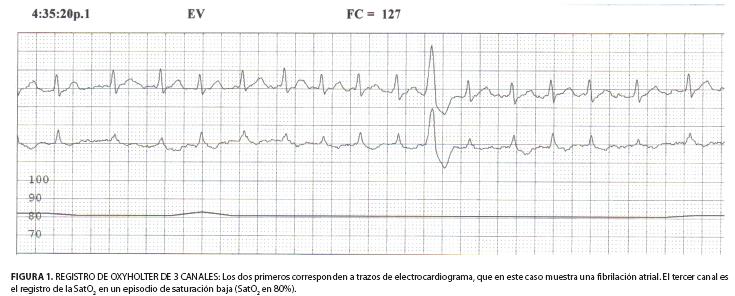
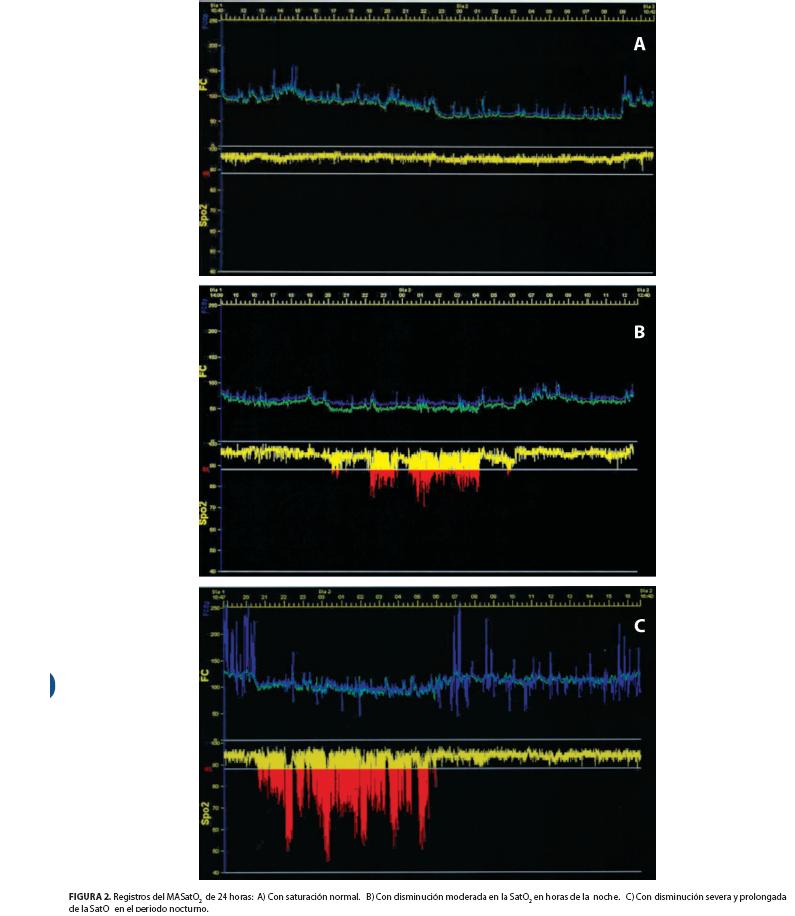
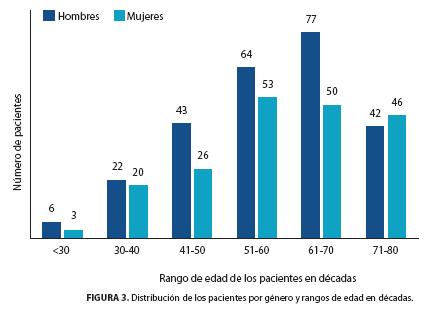
<body><![CDATA[<p class="MsoNormal"><b style=""><span  style="font-size: 11pt; font-family: Verdana;" lang="ES-CR">Métodos<o:p></o:p></span></b></p>     <p style="text-align: justify;" class="MsoNormal"><span  style="font-size: 10pt; font-family: Verdana;" lang="ES-CR">El estudio es de tipo descriptivo donde se analizaron los regis­tros de <span  class="SpellE">oxyholter</span> (OXYH) de 24 horas realizados en el Centro Cardio­lógico integral del año 2005 al 2013. Asimismo, se obtuvieron los datos del "Cuestionario de Berlín</span><span class="A14"><span  style="font-size: 10pt; font-family: Verdana;" lang="ES-CR">12</span></span><span  style="font-size: 10pt; font-family: Verdana;" lang="ES-CR">" en 100 pacientes antes de reali­zarle el estudio, con el fin de evaluar los síntomas clínicos sugestivos de SAS. En este subgrupo se midió la talla y el peso para calcular el índice de masa corporal. Los registros se hicieron con grabado­ras <span  class="SpellE">Oxyholter<span class="A14"><span  style="font-family: Verdana;">R</span></span></span>, marca <span  class="SpellE">NorthEast</span> <span class="SpellE">Monitoring</span>, Inc., de 3 canales: dos trazos electrocardiográficos de superficie y un canal para la oxime­tría (<a  href="/img/revistas/rcc/v16n1/art02i1.jpg">Figura 1</a>). El periodo de grabación fue de 24 horas para incluir tanto horas diurnas como nocturnas. Se le entregó una hoja a cada paciente con las instrucciones y la indicación de anotar las horas de sueño tanto en el día (siestas) como en la noche, así como su activi­dad física y síntomas.<o:p></o:p></span></p>     <div style="text-align: justify;"></div>     <p style="text-align: justify;" class="MsoNormal"><span  style="font-size: 10pt; font-family: Verdana;" lang="ES-CR">También se registraron las características demográficas de los pacientes: edad, sexo, enfermedades concomitantes y medicamen­tos utilizados. <o:p></o:p></span></p>     <div style="text-align: justify;"></div>     <p style="text-align: justify;" class="MsoNormal"><span  style="font-size: 10pt; font-family: Verdana;" lang="ES-CR">En los trazos de oximetría se tomó como normal la <span class="SpellE">SatO<span  class="A16"><span style="font-family: Verdana;">2</span></span></span></span><span  class="A16"><span style="font-size: 10pt; font-family: Verdana;"  lang="ES-CR"> </span></span><span  style="font-size: 10pt; font-family: Verdana;" lang="ES-CR">ma­yor de 88 % (<a href="/img/revistas/rcc/v16n1/art02i2.jpg">Figura 2A</a>) y anormal la <span class="SpellE">SatO<span class="A16"><span  style="font-family: Verdana;">2</span></span></span></span><span  class="A16"><span style="font-size: 10pt; font-family: Verdana;"  lang="ES-CR"> </span></span><span  style="font-size: 10pt; font-family: Verdana;" lang="ES-CR">menor de 88 % (<a href="/img/revistas/rcc/v16n1/art02i2.jpg">Figuras 2B</a> y <a href="/img/revistas/rcc/v16n1/art02i2.jpg"><st1:metricconverter  productid="2C" w:st="on">2C</st1:metricconverter></a>).<o:p></o:p></span></p>     <div style="text-align: justify;"></div>     <p style="text-align: justify;" class="MsoNormal"><span  style="font-size: 10pt; font-family: Verdana;" lang="ES-CR">En los estudios que presentaron periodos de disminución en la <span  class="SpellE">SatO<span class="A16"><span  style="font-family: Verdana;">2</span></span></span></span><span  class="A16"><span style="font-size: 10pt; font-family: Verdana;"  lang="ES-CR"> </span></span><span  style="font-size: 10pt; font-family: Verdana;" lang="ES-CR">se analizó su duración e intensidad. Se registraron las arritmias durante todo el tiempo de grabación, pero se analizaron únicamente las que predominaron en las horas nocturnas (durante el sueño).<o:p></o:p></span></p>     <p class="MsoNormal"><b style=""><span  style="font-size: 11pt; font-family: Verdana;" lang="ES-CR">Resultados<o:p></o:p></span></b></p>     <p style="text-align: justify;" class="MsoNormal"><span  style="font-size: 10pt; font-family: Verdana;" lang="ES-CR">En el periodo estudiado se realizaron 494 registros de OXYH de 24 horas a pacientes con sospecha clínica de SAS, de los cuales 279 (56 %) correspondieron a hombres y 215 (43 %) a mujeres. El prome­dio de edad fue de 65 años, 61 años en el caso de los hombres y 70 años para mujeres (<a  href="/img/revistas/rcc/v16n1/art02i3.jpg">Figura 3</a>).<o:p></o:p></span></p>     ]]></body>
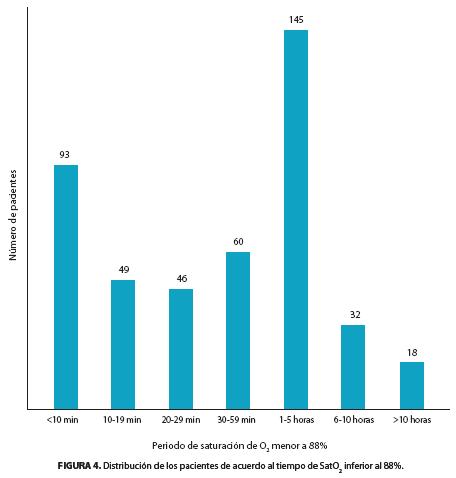
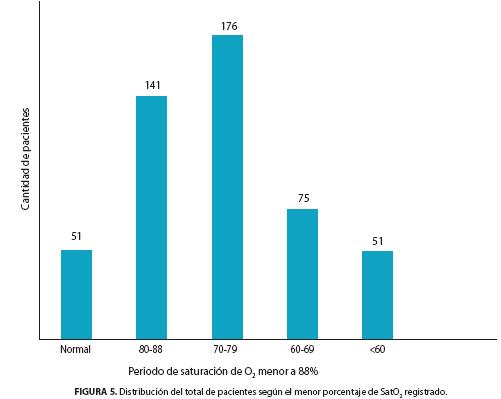
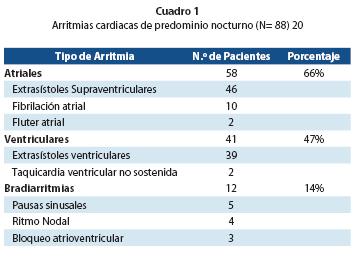
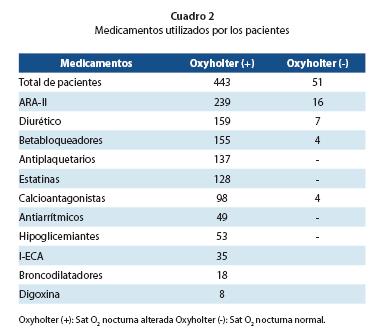
<body><![CDATA[<div style="text-align: justify;"></div>     <p style="text-align: justify;" class="MsoNormal"><span  style="font-size: 10pt; font-family: Verdana;" lang="ES-CR">En 51 casos (10 %) la saturación fue normal durante toda la grabación, en 443 (90 %) se documentó disminución significativa en la <span class="SpellE">SatO<span  class="A16"><span style="font-family: Verdana;">2</span></span></span></span><span  class="A16"><span style="font-size: 10pt; font-family: Verdana;"  lang="ES-CR"> </span></span><span  style="font-size: 10pt; font-family: Verdana;" lang="ES-CR">en los periodos de sueño, tanto diurnos (siestas) como nocturnos. En estos últimos casos la disminución en la saturación de oxígeno fue significativa por periodos de menos de 10 minutos en 93 pacientes (21 %), de <st1:metricconverter  productid="10 a" w:st="on">10 a</st1:metricconverter> 30 minutos en 95 pacientes (22 %) y más de 30 minutos en 255 pacientes (58 %), (<a  href="/img/revistas/rcc/v16n1/art02i4.jpg">Figura 4</a>).<o:p></o:p></span></p>     <div style="text-align: justify;"></div>     <p style="text-align: justify;" class="MsoNormal"><span  style="font-size: 10pt; font-family: Verdana;" lang="ES-CR">En los 443 pacientes (90 %) en los que el <span class="SpellE">MASatO<span  class="A16"><span style="font-family: Verdana;">2</span></span></span></span><span  class="A16"><span style="font-size: 10pt; font-family: Verdana;"  lang="ES-CR"> </span></span><span  style="font-size: 10pt; font-family: Verdana;" lang="ES-CR">estuvo alte­rado, la disminución en la <span class="SpellE">SatO<span class="A16"><span  style="font-family: Verdana;">2</span></span></span></span><span  class="A16"><span style="font-size: 10pt; font-family: Verdana;"  lang="ES-CR"> </span></span><span  style="font-size: 10pt; font-family: Verdana;" lang="ES-CR">fue de forma leve (<span class="SpellE">SatO<span class="A16"><span  style="font-family: Verdana;">2</span></span></span></span><span  class="A16"><span style="font-size: 10pt; font-family: Verdana;"  lang="ES-CR"> </span></span><span  style="font-size: 10pt; font-family: Verdana;" lang="ES-CR">80-88 %) en 141 pacientes (33 %), moderada (<span class="SpellE">SatO<span class="A16"><span  style="font-family: Verdana;">2</span></span></span></span><span  class="A16"><span style="font-size: 10pt; font-family: Verdana;"  lang="ES-CR"> </span></span><span  style="font-size: 10pt; font-family: Verdana;" lang="ES-CR">70-79 %) en 176 pacien­tes (39 %) y severa (<span class="SpellE">SatO<span class="A16"><span  style="font-family: Verdana;">2</span></span></span></span><span  class="A16"><span style="font-size: 10pt; font-family: Verdana;"  lang="ES-CR"> </span></span><span  style="font-size: 10pt; font-family: Verdana;" lang="ES-CR">menor a 69 %) en 126 pacientes (28 %), (<a href="/img/revistas/rcc/v16n1/art02i5.jpg">Figura 5</a>).<o:p></o:p></span></p>     <div style="text-align: justify;"></div>     <p style="text-align: justify;" class="MsoNormal"><span  style="font-size: 10pt; font-family: Verdana;" lang="ES-CR">En esos 443 casos se documentaron arritmias de predominio nocturno en 88 pacientes (20 %), (<a href="/img/revistas/rcc/v16n1/art02t1.jpg">Cuadro 1</a>) dispuestas de la si­guiente manera: <span class="SpellE">atriales</span> en 58 pacientes (66 %), ventriculares en 41 pacientes (47 %) y <span  class="SpellE">bradiarritmias</span> en 12 pacientes (14 %) sin ser excluyentes entre sí, es decir, varios pacientes presentaron combi­naciones de estas arritmias. Muchos pacientes presentaron arritmias tanto diurnas como nocturnas; sin embargo, para efectos de este análisis, solamente se consideraron las que predominaron en los pe­riodos de <span class="SpellE">SatO<span  class="A16"><span style="font-family: Verdana;">2</span></span></span></span><span  class="A16"><span style="font-size: 10pt; font-family: Verdana;"  lang="ES-CR"> </span></span><span  style="font-size: 10pt; font-family: Verdana;" lang="ES-CR">bajos durante el sueño.<o:p></o:p></span></p>     <div style="text-align: justify;"></div>     <p style="text-align: justify;" class="MsoNormal"><span  style="font-size: 10pt; font-family: Verdana;" lang="ES-CR">De los 51 pacientes con <span class="SpellE">MASatO<span class="A16"><span  style="font-family: Verdana;">2</span></span></span></span><span  class="A16"><span style="font-size: 10pt; font-family: Verdana;"  lang="ES-CR"> </span></span><span  style="font-size: 10pt; font-family: Verdana;" lang="ES-CR">normal, ninguno presentó arritmias de predominio nocturno.<o:p></o:p></span></p>     <div style="text-align: justify;"></div>     <p style="text-align: justify;" class="MsoNormal"><span  style="font-size: 10pt; font-family: Verdana;" lang="ES-CR">Del total de 494 pacientes enviados al estudio de OXYH, 360 (73 %) tenían el antecedente de padecer hipertensión arterial, la mayoría en tratamiento con uno o varios medicamentos (<a href="/img/revistas/rcc/v16n1/art02t2.jpg">Cuadro 2</a>). También poseían otras patologías concomitantes que para efectos del presente trabajo no se analizaron.<o:p></o:p></span></p>     ]]></body>
<body><![CDATA[<p class="MsoNormal"><b style=""><span  style="font-size: 11pt; font-family: Verdana;" lang="ES-CR">Discusión<o:p></o:p></span></b></p>     <p style="text-align: justify;" class="MsoNormal"><span  style="font-size: 10pt; font-family: Verdana;" lang="ES-CR">A pesar de que el SAS es muy frecuente y tiene gran repercu­sión clínica se calcula que hasta un 93 % de las mujeres y 82 % de los hombres con SAS moderado a severo no están diagnosticados</span><a href="#2"><sup><span  class="A14"><span style="font-size: 10pt; font-family: Verdana;"  lang="ES-CR">2</span></span></sup></a><span  style="font-size: 10pt; font-family: Verdana;" lang="ES-CR">. Esto se debe, en parte, a que el método tradicional de diagnóstico, la PSG, es complejo y con un costo económico elevado. <o:p></o:p></span></p>     <div style="text-align: justify;"></div>     <p style="text-align: justify;" class="MsoNormal"><span  style="font-size: 10pt; font-family: Verdana;" lang="ES-CR">Mediante un interrogatorio bien dirigido como el "Cuestionario de Berlín</span><span  class="A14"><span style="font-size: 10pt; font-family: Verdana;"  lang="ES-CR">12</span></span><span  style="font-size: 10pt; font-family: Verdana;" lang="ES-CR">" podemos sospechar de AOS (la forma más frecuente de SAS) con un alto grado de probabilidad, si le agregamos un poco más de información, aunque no tanta como la de una PSG, podemos tener una alta probabilidad de acertar con el diagnóstico.<o:p></o:p></span></p>     <div style="text-align: justify;"></div>     <p style="text-align: justify;" class="MsoNormal"><span  style="font-size: 10pt; font-family: Verdana;" lang="ES-CR">Desde hace varios años se estudia la posibilidad de utilizar mé­todos más sencillos para su evaluación. Si bien es cierto la PSG pue­de analizar 10 o más variables (electroencefalograma, movimientos oculares, electromiografía, electrocardiograma, oximetría, esfuerzo respiratorio, registro de sonidos para evaluar los ronquidos, movi­miento de extremidades, video, etc.), muchos de estos parámetros se pueden valorar clínicamente y otros son importantes principal­mente para determinar el tipo de SAS, por ejemplo diferenciar entre AOS o apnea central (AC). Esto se hace por la medición del flujo aé­reo y el patrón respiratorio. La apnea se define como la interrupción completa del flujo <span class="SpellE">inspiratorio</span> de aire durante un tiempo superior a 10 segundos; si se mantiene el esfuerzo <span class="SpellE">ventilatorio</span> durante este periodo la apnea se considerara obstructiva, si no existe este es­fuerzo se considera de origen central. La <span class="SpellE">hipopnea</span> se define como un episodio de <span class="SpellE">hipoventilación</span> con interrupción del flujo aéreo de al menos 50 % del valor del volumen corriente habitual del sujeto acompañado por disminución de la <span class="SpellE">SatO<span  class="A16"><span style="font-family: Verdana;">2</span></span></span></span><span  class="A16"><span style="font-size: 10pt; font-family: Verdana;"  lang="ES-CR"> </span></span><span  style="font-size: 10pt; font-family: Verdana;" lang="ES-CR">mayores del 4 % y/o <span class="SpellE">mi­crodesperta</span>r asociado. Se denomina índice de apnea/<span class="SpellE">hipopnea</span> (IAH) al número total de apneas e <span class="SpellE">hipopneas</span> dividido entre el tiem­po total de sueño.</span><a><sup><span  class="A14"><span style="font-size: 10pt; font-family: Verdana;"  lang="ES-CR"></span></span></sup></a><sup><a href="#1">1<span  class="GramE">,2</span></a> </sup><span  style="font-size: 10pt; font-family: Verdana;" lang="ES-CR">Muchos de los estudios utilizan este índice en el informe de sus resultados.<o:p></o:p></span></p>     <div style="text-align: justify;"></div>     <p style="text-align: justify;" class="MsoNormal"><span  style="font-size: 10pt; font-family: Verdana;" lang="ES-CR">En el caso del OXYH no podemos reportar el IAH porque no se mide flujo aéreo. Pero tenemos el grado y tiempo de disminución de la <span class="SpellE">SatO<span  class="A16"><span style="font-family: Verdana;">2</span></span></span></span><span  class="A16"><span style="font-size: 10pt; font-family: Verdana;"  lang="ES-CR"> </span></span><span  style="font-size: 10pt; font-family: Verdana;" lang="ES-CR">que se puede correlacionar muy bien con lo que el paciente y su familia observan.<o:p></o:p></span></p>     <div style="text-align: justify;"></div>     <p style="text-align: justify;" class="MsoNormal"><span  style="font-size: 10pt; font-family: Verdana;" lang="ES-CR">Además, existen diferentes tipos de monitores ambulatorios para la valoración de estos casos</span><a href="#13"><sup><span class="A14"><span  style="font-size: 10pt; font-family: Verdana;" lang="ES-CR">13<span  class="GramE">,14</span></span></span></sup></a><span  style="font-size: 10pt; font-family: Verdana;" lang="ES-CR">: la PSG tipo 1 se considera la referencia estándar a la cual los otros tipos de monitores son com­parados. Los tipo 2 son aquellos que tienen varios canales para re­gistro de sueño y medidas respiratorias. Los tipo 3 son aquellos que utilizan al menos 3 canales respiratorios. Los tipo 4 son los que usan al menos un canal respiratorio (oximetría o flujo respiratorio); a este último grupo pertenece el OXYH.<o:p></o:p></span></p>     ]]></body>
<body><![CDATA[<p style="text-align: justify;" class="MsoNormal"><span  style="font-size: 10pt; font-family: Verdana;" lang="ES-CR">La utilidad de la oximetría ambulatoria en el diagnóstico de SAS ya ha sido estudiada</span><span class="A14"><span  style="font-size: 10pt; font-family: Verdana;" lang="ES-CR">15<span  class="GramE">,16</span></span></span><span  style="font-size: 10pt; font-family: Verdana;" lang="ES-CR">. Su sensibilidad y especificidad son buenas, sobre todo si tenemos una probabilidad clínica alta, sin embargo tenemos claro que con el OXYH lo que podemos informar es que el estudio es sugestivo de SAS, pero no se puede determinar si es AOS o AC, para ello se requiere una medición del flujo aéreo y/o esfuer­zo respiratorio</span><span  class="A14"><span style="font-size: 10pt; font-family: Verdana;"  lang="ES-CR">17</span></span><span  style="font-size: 10pt; font-family: Verdana;" lang="ES-CR">. En los reportes de OXYH los gráficos de <span class="SpellE">SatO<span class="A16"><span  style="font-family: Verdana;">2</span></span></span></span><span  class="A16"><span style="font-size: 10pt; font-family: Verdana;"  lang="ES-CR"> </span></span><span  style="font-size: 10pt; font-family: Verdana;" lang="ES-CR">son muy contundentes y fáciles de interpretar (<a href="/img/revistas/rcc/v16n1/art02i2.jpg">Figura 2</a>). Muchas veces el solo hecho de mostrarle al paciente en forma rápida y fácil de en­tender la repercusión que su SAS está teniendo en la <span class="SpellE">SatO<span class="A16"><span  style="font-family: Verdana;">2</span></span></span>, es una buena motivación para que inicien el control del sobrepeso, pues la obesidad es uno de los principales factores que predisponen al AOS</span><span  class="A14"><span style="font-size: 10pt; font-family: Verdana;"  lang="ES-CR">18</span></span><span  style="font-size: 10pt; font-family: Verdana;" lang="ES-CR">. Esto se conoce desde hace muchos años cuando se describió el síndrome de <span  class="SpellE">Pickwick</span> en pacientes muy obesos con <span class="SpellE">hipersomno­lenci</span>a diurna, plétora y edemas</span><span class="A14"><span  style="font-size: 10pt; font-family: Verdana;" lang="ES-CR">19</span></span><span  style="font-size: 10pt; font-family: Verdana;" lang="ES-CR">. Es normal que los músculos de la faringe se relajen durante el sueño, de modo que el calibre de la vía aérea disminuye en toda persona. Sin embargo, en los obesos se ha observado que la grasa depositada en el cuello ejerce una presión adicional en los tejidos, lo cual genera un mayor esfuerzo para inha­lar y exhalar, de tal manera que se <span  class="SpellE">manifesta</span> a través de ronquidos.<o:p></o:p></span></p>     <div style="text-align: justify;"></div>     <p style="text-align: justify;" class="MsoNormal"><span  style="font-size: 10pt; font-family: Verdana;" lang="ES-CR">Como consecuencia de la obesidad y del mismo SAS se generan una serie de trastornos metabólicos y bioquímicos que favorecen la aparición de hipertensión arterial (HTAS), o hacen que una ya exis­tente se vuelva resistente al tratamiento o de difícil control. Hasta hace unos años no se tenía muy claro si la relación entre HTAS y SAS era meramente la coexistencia de dos enfermedades muy frecuen­tes o había una correlación. Se calcula que entre las personas que roncan la HTAS es tres veces más frecuente que en la población ge­neral. Actualmente, esta correlación está bien establecida</span><span class="A14"><span  style="font-size: 10pt; font-family: Verdana;" lang="ES-CR">10<span  class="GramE">,11</span></span></span><span  style="font-size: 10pt; font-family: Verdana;" lang="ES-CR">. Desde la publicación del JNC7 el SAS está encabezando la lista de causas secundarias de HTAS</span><span  class="A14"><span style="font-size: 10pt; font-family: Verdana;"  lang="ES-CR">20</span></span><span  style="font-size: 10pt; font-family: Verdana;" lang="ES-CR">. En nuestro análisis, de los pacientes que tu­vieron un OXYH sugestivo de SAS, el 76 % eran hipertensos en com­paración con los que tuvieron un OXYH normal, en los que el 57 % eran hipertensos.<o:p></o:p></span></p>     <div style="text-align: justify;"></div>     <p style="text-align: justify;" class="MsoNormal"><span  style="font-size: 10pt; font-family: Verdana;" lang="ES-CR">Algunos de los posibles mecanismos que se han descrito para explicar como el SAS contribuye al HTAS en pacientes obesos son: activación simpática, <span  class="SpellE">hiperleptinemia</span>, resistencia a la insulina, ele­vación a los niveles de angiotensina II y aldosterona, estrés oxidativo e inflamatorio, disfunción endotelial, función <span class="SpellE">baro</span>-refleja alterada y efectos en función renal</span><a href="#21"><sup><span class="A14"><span  style="font-size: 10pt; font-family: Verdana;" lang="ES-CR">21<span  class="GramE">,22</span></span></span></sup></a><span  style="font-size: 10pt; font-family: Verdana;" lang="ES-CR">. Desde el punto de vista clínico y tera­péutico la presencia de HTAS resistente a tratamiento y la ausencia de una disminución nocturna de la presión arterial ("non <span  class="SpellE">dipper</span>") en pacientes obesos <span class="GramE">deberá</span> hacer pensar en SAS, principalmente si hay otros síntomas asociados (pobre calidad de sueño, ronquidos con pausas, somnolencia diurna excesiva). Igualmente debemos tener en mente la posibilidad de SAS en pacientes con ganancia de peso inexplicable o dificultad para la pérdida de peso en el contexto de los síntomas asociados antes descritos.<o:p></o:p></span></p>     <div style="text-align: justify;"></div>     <p style="text-align: justify;" class="MsoNormal"><span  style="font-size: 10pt; font-family: Verdana;" lang="ES-CR">Los cambios metabólicos y bioquímicos descritos en el SAS explican también su frecuente asociación con las cardiopatías, de modo que hace algunos años se describió el "síndrome Z" que co­rrespondería a un Síndrome metabólico al que se le incorpora el SAS (específicamente la AOS). </span><span  class="A14"><span style="font-size: 10pt; font-family: Verdana;"  lang="ES-CR"><a href="#23"><sup>23</sup></a><o:p></o:p></span></span></p>     <div style="text-align: justify;"></div>     <p style="text-align: justify;" class="MsoNormal"><span  style="font-size: 10pt; font-family: Verdana;" lang="ES-CR">Algunos de los efectos <span class="SpellE">fisiopatológicos</span> de SAS descritos en el sistema cardiovascular son: reducción en la liberación de oxígeno al miocardio (por hipoxia intermitente y disminución del gasto car­diaco), incremento en la demanda de oxígeno (<span class="SpellE">arousal</span>, activación del sistema simpático, incremento en la <span class="SpellE">postcarga</span> del ventrículo izquierdo por presión negativa <span class="SpellE">intratorácica</span> e incremento de la presión arterial sistémica), isquemia miocárdica nocturna, edema pulmonar nocturno, hipertrofia del ventrículo izquierdo, disfunción izquierda e insuficiencia cardiaca</span><sup><span class="A14"><span  style="font-size: 10pt; font-family: Verdana;" lang="ES-CR">24</span></span></sup><span  style="font-size: 10pt; font-family: Verdana;" lang="ES-CR">. También se ha observado un in­cremento en la agregación plaquetaria y coagulación sanguínea lo que aumenta la susceptibilidad a la trombosis, embolismos cardia­cos y eventos cerebro vasculares</span><sup><span class="A14"><span  style="font-size: 10pt; font-family: Verdana;" lang="ES-CR"><a  href="#8">8</a><span class="GramE">,<a href="#25">25</a></span></span></span></sup><span  style="font-size: 10pt; font-family: Verdana;" lang="ES-CR">.<o:p></o:p></span></p>     <div style="text-align: justify;"></div>     ]]></body>
<body><![CDATA[<p style="text-align: justify;" class="MsoNormal"><span  style="font-size: 10pt; font-family: Verdana;" lang="ES-CR">Las arritmias cardiacas se han reportado con frecuencia en personas con SAS</span><span  class="A14"><span style="font-size: 10pt; font-family: Verdana;"  lang="ES-CR">6<span class="GramE">,<a href="#24"><sup>24,26</sup></a></span></span></span><span  style="font-size: 10pt; font-family: Verdana;" lang="ES-CR">. En su génesis están implicados varios de los factores cardiovasculares señalados anteriormente principalmente el aumento en la actividad simpática por <span class="SpellE">hipoxemia</span> y el aumento de la actividad <span class="SpellE">parasimpática</span> por los episodios repetitivos de obstruc­ción de la vía aérea. En nuestro análisis, las arritmias de predominio nocturno se presentaron únicamente en los pacientes con OXYH sugestivo de SAS. Las arritmias diurnas o de distribución universal (de igual densidad diurna como nocturna) fueron más frecuentes y complejas en los OXYH sugestivos de SAS que en los OXYH normales.<o:p></o:p></span></p>     <div style="text-align: justify;"></div>     <p style="text-align: justify;" class="MsoNormal"><span  style="font-size: 10pt; font-family: Verdana;" lang="ES-CR">No analizamos la incidencia de falla cardiaca ni enfermedad co­ronaria entre los pacientes, pero es probable que muchos de ellos tengan estos padecimientos a juzgar por los medicamentes que consumían (<a  href="/img/revistas/rcc/v16n1/art02t2.jpg">cuadro 2</a>). En algunos estudios se calculan que de los pacientes con falla cardiaca hasta un 50% tienen SAS, en ellos es más frecuente la AC y la mortalidad en estos casos es aún mayor </span><a href="#27"><sup><span class="A14"><span  style="font-size: 10pt; font-family: Verdana;" lang="ES-CR">27</span></span></sup></a><span  style="font-size: 10pt; font-family: Verdana;" lang="ES-CR">. Se postula que esto se debe al aumento en la incidencia de fibrila­ción <span  class="SpellE">atrial</span> y arritmias ventriculares </span><a href="#28"><sup><span class="A14"><span  style="font-size: 10pt; font-family: Verdana;" lang="ES-CR">28,29</span></span></sup></a><span  style="font-size: 10pt; font-family: Verdana;" lang="ES-CR">. En estos pacientes el uso de CPAP puede mejorar significativamente su pronóstico </span><sup><span  class="A14"><span style="font-size: 10pt; font-family: Verdana;"  lang="ES-CR"><a href="#4">4</a>,<a href="#30">30</a></span></span></sup><span  style="font-size: 10pt; font-family: Verdana;" lang="ES-CR">. Se puede utilizar tanto en la AOS como en la AC </span><span class="A14"><span  style="font-size: 10pt; font-family: Verdana;" lang="ES-CR">4</span></span><span  style="font-size: 10pt; font-family: Verdana;" lang="ES-CR">. Con este tratamiento se han observado incrementos en la fracción de eyección, reducción en la actividad del sistema simpático, disminución en la cantidad de arritmias ventriculares (incluso desde los primeros días de su uso), disminución de la mortalidad y de la necesidad de trasplante car­diaco<a href="#30"> </a></span><a  href="#30"><sup><span class="A14"><span  style="font-size: 10pt; font-family: Verdana;" lang="ES-CR">30-34</span></span></sup></a><span  style="font-size: 10pt; font-family: Verdana;" lang="ES-CR">. En varios de los pacientes de esta serie se utilizó el CPAP después del OXYH inicial y muchos de ellos tienen un OXYH de con­trol posterior al uso de CPAP, en los que se registra una mejoría im­portante en el grado de <span class="SpellE">SatO<span  class="A16"><span style="font-family: Verdana;">2</span></span></span></span><span  class="A16"><span style="font-size: 10pt; font-family: Verdana;"  lang="ES-CR"> </span></span><span  style="font-size: 10pt; font-family: Verdana;" lang="ES-CR">nocturna; para efectos del presente trabajo no mostramos estos resultados, pero consideramos que es un excelente material para un análisis posterior.<o:p></o:p></span></p>     <div style="text-align: justify;"></div>     <p style="text-align: justify;" class="MsoNormal"><span  style="font-size: 10pt; font-family: Verdana;" lang="ES-CR">Hasta el momento, no hemos recibido solicitudes para es­tudios de OXYH en población pediátrica, sin embargo se debe tener en mente que los niños que roncan pueden tener una AOS principalmente debido a hipertrofia de adenoides o de amígdalas, que en algunos puede desarrollar retardo en su desarrollo físico o mental. En ellos la forma de tratamiento definitivo es la cirugía de amígdalas o adenoides con los cuales se normalizan los parámetros respiratorios </span><a  href="#35"><sup><span class="A14"><span  style="font-size: 10pt; font-family: Verdana;" lang="ES-CR">35</span></span></sup></a><span  style="font-size: 10pt; font-family: Verdana;" lang="ES-CR">.<o:p></o:p></span></p>     <div style="text-align: justify;"></div>     <p style="text-align: justify;" class="MsoNormal"><span  style="font-size: 10pt; font-family: Verdana;" lang="ES-CR">Debido a que el principal sitio de obstrucción en la AOS es la orofaringe </span><a  href="#36"><sup><span class="A14"><span  style="font-size: 10pt; font-family: Verdana;" lang="ES-CR">36</span></span></sup></a><span  style="font-size: 10pt; font-family: Verdana;" lang="ES-CR">, otros tratamientos que se realizan en algunos casos son: uso de dispositivos para avance <span  class="SpellE">mandibuilar</span> </span><a href="#37"><sup><span  class="A14"><span style="font-size: 10pt; font-family: Verdana;"  lang="ES-CR">37</span></span></sup></a><span  style="font-size: 10pt; font-family: Verdana;" lang="ES-CR">, cirugía <span  class="SpellE">máxilo­mandibula</span>r </span><span class="A14"><span  style="font-size: 10pt; font-family: Verdana;" lang="ES-CR">38 </span></span><span  style="font-size: 10pt; font-family: Verdana;" lang="ES-CR">y cirugía de paladar.<o:p></o:p></span></p>     <div style="text-align: justify;"></div>     <p style="text-align: justify;" class="MsoNormal"><span  style="font-size: 10pt; font-family: Verdana;" lang="ES-CR">En nuestra serie, los estudios de OXYH alterados tuvieron una distribución similar entre hombres y mujeres, lo cual posiblemen­te se debe a que la edad promedio fue de 65 años, y aunque se ha observado que la incidencia de SAS es más frecuente en hom­bres, después de los 50 años de edad esa incidencia es similar en ambos géneros </span><a href="#39"><span class="A14"><span  style="font-size: 10pt; font-family: Verdana;" lang="ES-CR">39</span></span></a><span  style="font-size: 10pt; font-family: Verdana;" lang="ES-CR">.<o:p></o:p></span></p>     <div style="text-align: justify;"></div>     ]]></body>
<body><![CDATA[<p style="text-align: justify;" class="MsoNormal"><span  style="font-size: 10pt; font-family: Verdana;" lang="ES-CR">Este trabajo es un análisis inicial de tipo descriptivo de un mé­todo nuevo en nuestro medio y que abre espacio para una futura investigación en esta área, para profundizar en algunos de los temas que aquí se presentan.<o:p></o:p></span></p>     <div style="text-align: justify;"></div>     <p style="text-align: justify;" class="MsoNormal"><span  style="font-size: 10pt; font-family: Verdana;" lang="ES-CR">En conclusión, el OXYH es un estudio fácil de realizar e interpre­tar, de bajo costo para la evaluación inicial de personas en las que se sospecha SAS. Sus resultados pueden convertirse en la motiva­ción para disminuir de peso en obesos mediante dieta y ejercicio o incluso justificar tratamientos quirúrgicos en casos específicos. En pacientes con arritmias de <span class="GramE">predominio nocturno o hipertensos</span> de difícil control podemos sospechar la presencia de SAS.<o:p></o:p></span></p>     <p class="MsoNormal"><b style=""><span  style="font-size: 11pt; font-family: Verdana;" lang="ES-CR"></span></b></p> <hr style="width: 100%; height: 2px;">     <p class="MsoNormal"><b style=""><span  style="font-size: 11pt; font-family: Verdana;" lang="ES-CR">Referencias<o:p></o:p></span></b></p>     <!-- ref --><p class="MsoNormal"><span  style="font-size: 10pt; font-family: Verdana;" lang="EN-US"><a name="1"></a>1. Young T, <span class="SpellE">Palta</span> M, Dempsey J, <span class="SpellE">Skatrud</span> J, Weber S, <span  class="SpellE">Badr</span> S. <span class="GramE">The occurrence of sleep-disordered breathing among middle-aged adults.</span> </span><span  style="font-size: 10pt; font-family: Verdana;" lang="ES-CR">N <span  class="SpellE">Engl</span> J <span class="SpellE">Med</span> 1993<span class="GramE">;328:1230</span>-1235 <o:p></o:p></span>&nbsp;&nbsp;&nbsp;&nbsp;&nbsp;&nbsp;&nbsp;&nbsp;[&#160;<a href="javascript:void(0);" onclick="javascript: window.open('/scielo.php?script=sci_nlinks&ref=767427&pid=S1409-4142201400010000200001&lng=','','width=640,height=500,resizable=yes,scrollbars=1,menubar=yes,');">Links</a>&#160;]<!-- end-ref --><!-- ref --><p class="MsoNormal"><span  style="font-size: 10pt; font-family: Verdana;" lang="EN-US"><a name="2"></a>2. Young T, Evans L, Finn L, <span class="SpellE">Palta</span> M. Estimation of the clinically diagnosed proportion of sleep apnea syndrome in middle –aged men and women. Sleep1997<span class="GramE">;20</span>: 705-706.    &nbsp;&nbsp;&nbsp;&nbsp;&nbsp;&nbsp;&nbsp;&nbsp;[&#160;<a href="javascript:void(0);" onclick="javascript: window.open('/scielo.php?script=sci_nlinks&ref=767428&pid=S1409-4142201400010000200002&lng=','','width=640,height=500,resizable=yes,scrollbars=1,menubar=yes,');">Links</a>&#160;]<!-- end-ref --><o:p></o:p></span></p>     <!-- ref --><p class="MsoNormal"><span  style="font-size: 10pt; font-family: Verdana;" lang="EN-US"><a name="3"></a>3. <span class="SpellE">Gislason</span> T, <span class="SpellE">Benediktsdottir</span> B. <span class="SpellE">Snoreing</span>, <span class="SpellE">Apneic</span> Episodes, and Nocturnal Hypoxemia <span class="GramE">Among</span> Children 6 Months to 6 Years Old: An Epidemiologic Study of Lower Limit of Prevalence. <span class="GramE">Chest 1995; 107:963-966.    &nbsp;&nbsp;&nbsp;&nbsp;&nbsp;&nbsp;&nbsp;&nbsp;[&#160;<a href="javascript:void(0);" onclick="javascript: window.open('/scielo.php?script=sci_nlinks&ref=767430&pid=S1409-4142201400010000200003&lng=','','width=640,height=500,resizable=yes,scrollbars=1,menubar=yes,');">Links</a>&#160;]<!-- end-ref --></span> <o:p></o:p></span></p>     ]]></body>
<body><![CDATA[<!-- ref --><p class="MsoNormal"><span  style="font-size: 10pt; font-family: Verdana;" lang="EN-US"><a name="4"></a>4. Lung R, Bradley D. Sleep Apnea and Cardiovascular Disease. Am J <span class="SpellE">Respir</span> <span class="SpellE">Crit</span> Care Med 2001<span class="GramE">;164</span>: 2147-2165.    &nbsp;&nbsp;&nbsp;&nbsp;&nbsp;&nbsp;&nbsp;&nbsp;[&#160;<a href="javascript:void(0);" onclick="javascript: window.open('/scielo.php?script=sci_nlinks&ref=767432&pid=S1409-4142201400010000200004&lng=','','width=640,height=500,resizable=yes,scrollbars=1,menubar=yes,');">Links</a>&#160;]<!-- end-ref --> <o:p></o:p></span></p>     <!-- ref --><p class="MsoNormal"><span  style="font-size: 10pt; font-family: Verdana;" lang="EN-US"><a name="5"></a>5. Hayashi M, Fujimoto K, <span class="SpellE">Urushibata</span> K, <span class="SpellE">Uchikawa</span> S, Imamura H, <span  class="GramE">Kubo</span> K. Nocturnal Oxygen <span class="SpellE">Desaturation</span> Correlates With the Severity of Coronary Atherosclerosis in Coronary Artery Disease. Chest 2003<span class="GramE">;124</span>: 936-941.    &nbsp;&nbsp;&nbsp;&nbsp;&nbsp;&nbsp;&nbsp;&nbsp;[&#160;<a href="javascript:void(0);" onclick="javascript: window.open('/scielo.php?script=sci_nlinks&ref=767434&pid=S1409-4142201400010000200005&lng=','','width=640,height=500,resizable=yes,scrollbars=1,menubar=yes,');">Links</a>&#160;]<!-- end-ref --> <o:p></o:p></span></p>     <!-- ref --><p class="MsoNormal"><span  style="font-size: 10pt; font-family: Verdana;" lang="EN-US"><a name="6"></a>6. <span class="SpellE">Hoffsten</span> V, <span class="SpellE">Matlika</span> S. Cardiac Arrhythmias, Snoring and Sleep Apnea. <span class="GramE">Chest 1994; 106: 466-471.    &nbsp;&nbsp;&nbsp;&nbsp;&nbsp;&nbsp;&nbsp;&nbsp;[&#160;<a href="javascript:void(0);" onclick="javascript: window.open('/scielo.php?script=sci_nlinks&ref=767436&pid=S1409-4142201400010000200006&lng=','','width=640,height=500,resizable=yes,scrollbars=1,menubar=yes,');">Links</a>&#160;]<!-- end-ref --></span> <o:p></o:p></span></p>     <!-- ref --><p class="MsoNormal"><span  style="font-size: 10pt; font-family: Verdana;" lang="EN-US"><a name="7"></a>7. Hung J, <span class="SpellE">Whitford</span> E, Parsons RW, Hillman DR. Association of sleep apnea with myocardial infarction in men. <span class="GramE">Lancet 1990; 336:261-264.    &nbsp;&nbsp;&nbsp;&nbsp;&nbsp;&nbsp;&nbsp;&nbsp;[&#160;<a href="javascript:void(0);" onclick="javascript: window.open('/scielo.php?script=sci_nlinks&ref=767438&pid=S1409-4142201400010000200007&lng=','','width=640,height=500,resizable=yes,scrollbars=1,menubar=yes,');">Links</a>&#160;]<!-- end-ref --></span> <o:p></o:p></span></p>     <!-- ref --><p class="MsoNormal"><span  style="font-size: 10pt; font-family: Verdana;" lang="EN-US"><a name="8"></a>8. <span class="SpellE">Bassetli</span> C, <span class="SpellE">Aldrid</span> S. Sleep apnea in acute <span class="SpellE">cerebrovascular</span> diseases: Final Report on 128 patients. <span class="GramE">Sleep 1999; 22:217-223.    &nbsp;&nbsp;&nbsp;&nbsp;&nbsp;&nbsp;&nbsp;&nbsp;[&#160;<a href="javascript:void(0);" onclick="javascript: window.open('/scielo.php?script=sci_nlinks&ref=767440&pid=S1409-4142201400010000200008&lng=','','width=640,height=500,resizable=yes,scrollbars=1,menubar=yes,');">Links</a>&#160;]<!-- end-ref --></span> <o:p></o:p></span></p>     ]]></body>
<body><![CDATA[<!-- ref --><p class="MsoNormal"><span  style="font-size: 10pt; font-family: Verdana;" lang="EN-US"><a name="9"></a>9. <span class="SpellE">Glorge</span> CF, Smiley A. Sleep Apnea &amp; Automobile Crashes. Sleep 1999<span class="GramE">;22:790</span>-795.    &nbsp;&nbsp;&nbsp;&nbsp;&nbsp;&nbsp;&nbsp;&nbsp;[&#160;<a href="javascript:void(0);" onclick="javascript: window.open('/scielo.php?script=sci_nlinks&ref=767442&pid=S1409-4142201400010000200009&lng=','','width=640,height=500,resizable=yes,scrollbars=1,menubar=yes,');">Links</a>&#160;]<!-- end-ref --> <o:p></o:p></span></p>     <!-- ref --><p class="MsoNormal"><span  style="font-size: 10pt; font-family: Verdana;" lang="EN-US"><a  name="10"></a>10. <span class="SpellE">Peppard</span> PE, Young T, <span  class="SpellE">Palta</span> M, <span class="SpellE">Skatrud</span> J. Prospective Study of the association between sleep disordered breathing and hypertension. </span><span class="SpellE"><span  style="font-size: 10pt; font-family: Verdana;" lang="ES-CR">New</span></span><span  style="font-size: 10pt; font-family: Verdana;" lang="ES-CR"> <span  class="SpellE">England</span> J <span class="SpellE">Med</span> 2000; 342:1378-1384.    &nbsp;&nbsp;&nbsp;&nbsp;&nbsp;&nbsp;&nbsp;&nbsp;[&#160;<a href="javascript:void(0);" onclick="javascript: window.open('/scielo.php?script=sci_nlinks&ref=767444&pid=S1409-4142201400010000200010&lng=','','width=640,height=500,resizable=yes,scrollbars=1,menubar=yes,');">Links</a>&#160;]<!-- end-ref --><o:p></o:p></span></p>     <!-- ref --><p class="MsoNormal"><span  style="font-size: 10pt; font-family: Verdana;" lang="EN-US"><a  name="11"></a>11. Nieto J, Young T, Lind B, <span class="SpellE">Shahar</span> E, <span class="SpellE">Samet</span> JM, Redline S, et al. Association of Sleep- disordered Breathing, Sleep Apnea, and Hypertension in a Large Community- Based Study. JAMA 2000; 283:1829-1836.    &nbsp;&nbsp;&nbsp;&nbsp;&nbsp;&nbsp;&nbsp;&nbsp;[&#160;<a href="javascript:void(0);" onclick="javascript: window.open('/scielo.php?script=sci_nlinks&ref=767446&pid=S1409-4142201400010000200011&lng=','','width=640,height=500,resizable=yes,scrollbars=1,menubar=yes,');">Links</a>&#160;]<!-- end-ref --> <o:p></o:p></span></p>     <!-- ref --><p class="MsoNormal"><span  style="font-size: 10pt; font-family: Verdana;" lang="EN-US"><a  name="12"></a>12. <span class="SpellE">Netzer</span> NC, <span  class="SpellE">Stoohs</span> RA, <span class="SpellE">Netzer</span> CM, Clark K, <span class="SpellE">Strohi</span> KP. <span  class="GramE">Using the Berlin Questionnaire to identify patients at risk for the sleep apnea syndrome.</span> Ann Intern Med 1999<span class="GramE">;131:485</span>-491.    &nbsp;&nbsp;&nbsp;&nbsp;&nbsp;&nbsp;&nbsp;&nbsp;[&#160;<a href="javascript:void(0);" onclick="javascript: window.open('/scielo.php?script=sci_nlinks&ref=767448&pid=S1409-4142201400010000200012&lng=','','width=640,height=500,resizable=yes,scrollbars=1,menubar=yes,');">Links</a>&#160;]<!-- end-ref --> <o:p></o:p></span></p>     <!-- ref --><p class="MsoNormal"><span  style="font-size: 10pt; font-family: Verdana;" lang="EN-US"><a  name="13"></a>13. <span class="SpellE">Flemons</span> W, <span  class="SpellE">Littner</span> M, Rowley A, Gay P, Anderson WM, <span  class="SpellE">Hudgel</span> D, et al. Home Diagnosis of Sleep Apnea: A systematic Review of the literature. Chest 2003<span class="GramE">;124</span>: 1543-1579.    &nbsp;&nbsp;&nbsp;&nbsp;&nbsp;&nbsp;&nbsp;&nbsp;[&#160;<a href="javascript:void(0);" onclick="javascript: window.open('/scielo.php?script=sci_nlinks&ref=767450&pid=S1409-4142201400010000200013&lng=','','width=640,height=500,resizable=yes,scrollbars=1,menubar=yes,');">Links</a>&#160;]<!-- end-ref --> <o:p></o:p></span></p>     ]]></body>
<body><![CDATA[<!-- ref --><p class="MsoNormal"><span  style="font-size: 10pt; font-family: Verdana;" lang="EN-US"><a  name="14"></a>14. Ferber RA, <span class="SpellE">Millman</span> RP, Coppola MP, <span class="SpellE">Fleethan</span> F, <span  class="SpellE">Friederich</span> C, <span class="SpellE">Iber</span> C, et al. ASDA standards of practice: Portable recording in the assessment of obstructive sleep apnea. Sleep 1994<span class="GramE">;17:378</span>-392.    &nbsp;&nbsp;&nbsp;&nbsp;&nbsp;&nbsp;&nbsp;&nbsp;[&#160;<a href="javascript:void(0);" onclick="javascript: window.open('/scielo.php?script=sci_nlinks&ref=767452&pid=S1409-4142201400010000200014&lng=','','width=640,height=500,resizable=yes,scrollbars=1,menubar=yes,');">Links</a>&#160;]<!-- end-ref --> <o:p></o:p></span></p>     <!-- ref --><p class="MsoNormal"><span  style="font-size: 10pt; font-family: Verdana;" lang="EN-US"><a  name="15"></a>15. <span class="SpellE">Golpe</span> R, <span  class="SpellE">Jiménez</span> A, <span class="SpellE">Carpizo</span> R. Home Sleep Studies in the Assessment of Sleep Apnea/<span class="SpellE">Hypopnea</span> Syndrome. Chest 2002<span class="GramE">;122:1156</span>-1161.    &nbsp;&nbsp;&nbsp;&nbsp;&nbsp;&nbsp;&nbsp;&nbsp;[&#160;<a href="javascript:void(0);" onclick="javascript: window.open('/scielo.php?script=sci_nlinks&ref=767454&pid=S1409-4142201400010000200015&lng=','','width=640,height=500,resizable=yes,scrollbars=1,menubar=yes,');">Links</a>&#160;]<!-- end-ref --> <o:p></o:p></span></p>     <!-- ref --><p class="MsoNormal"><span  style="font-size: 10pt; font-family: Verdana;" lang="EN-US"><a  name="16"></a>16. Zhang C, Berger M, <span class="SpellE">Molhotia</span> A, <span class="SpellE">Kals</span> S, Portable Diagnostic Devices for Identifying Obstructive Sleep Apnea among Commercial Motor vehicle Drivers: consideration and unanswered questions. Sleep 2012<span class="GramE">;11:1481</span>-1489.    &nbsp;&nbsp;&nbsp;&nbsp;&nbsp;&nbsp;&nbsp;&nbsp;[&#160;<a href="javascript:void(0);" onclick="javascript: window.open('/scielo.php?script=sci_nlinks&ref=767456&pid=S1409-4142201400010000200016&lng=','','width=640,height=500,resizable=yes,scrollbars=1,menubar=yes,');">Links</a>&#160;]<!-- end-ref --> <o:p></o:p></span></p>     <!-- ref --><p class="MsoNormal"><span  style="font-size: 10pt; font-family: Verdana;" lang="EN-US"><a  name="17"></a>17. <span class="SpellE">Collop</span> N, Anderson <span  class="SpellE">McD</span>, <span class="SpellE">Boehlecke</span> B, <span  class="SpellE">Claman</span> D, Goldberg R, Gottlieb D, et al. Clinical Guidelines for the Use of Unattended Portable Monitors in the Diagnosis of Obstructive Sleep Apnea in Adult Patients. </span><span  style="font-size: 10pt; font-family: Verdana;" lang="ES-CR">J <span  class="SpellE">Clin</span> <span class="SpellE">Sleep</span> <span  class="SpellE">Med</span> 2007<span class="GramE">;3:737</span>-747.    &nbsp;&nbsp;&nbsp;&nbsp;&nbsp;&nbsp;&nbsp;&nbsp;[&#160;<a href="javascript:void(0);" onclick="javascript: window.open('/scielo.php?script=sci_nlinks&ref=767458&pid=S1409-4142201400010000200017&lng=','','width=640,height=500,resizable=yes,scrollbars=1,menubar=yes,');">Links</a>&#160;]<!-- end-ref --> <o:p></o:p></span></p>     <!-- ref --><p class="MsoNormal"><span  style="font-size: 10pt; font-family: Verdana;" lang="EN-US"><a  name="18"></a>18. Berger K, <span class="SpellE">Ayappa</span> I, <span  class="SpellE">Chatr-amontri</span> B, <span class="SpellE">Marfatia</span> A, <span class="SpellE">Sorkin</span> B, <span class="SpellE">Rapoport</span> D. Obesity Hypoventilation Syndrome as a Spectrum of Respiratory Disturbances During Sleep. </span><span class="SpellE"><span  style="font-size: 10pt; font-family: Verdana;" lang="ES-CR">Chest</span></span><span  style="font-size: 10pt; font-family: Verdana;" lang="ES-CR"> 2001<span  class="GramE">;120:1231</span>-1238.    &nbsp;&nbsp;&nbsp;&nbsp;&nbsp;&nbsp;&nbsp;&nbsp;[&#160;<a href="javascript:void(0);" onclick="javascript: window.open('/scielo.php?script=sci_nlinks&ref=767460&pid=S1409-4142201400010000200018&lng=','','width=640,height=500,resizable=yes,scrollbars=1,menubar=yes,');">Links</a>&#160;]<!-- end-ref --><o:p></o:p></span></p>     ]]></body>
<body><![CDATA[<!-- ref --><p class="MsoNormal"><span  style="font-size: 10pt; font-family: Verdana;" lang="EN-US"><a  name="19"></a>19. Burwell CS, Robin ED, <span class="SpellE">Wholer</span> RD, <span class="SpellE">Bickelman</span> A. Extreme obesity associated with alveolar hypoventilation: a <span class="SpellE">Pckwickian</span> Syndrome. <span class="GramE">Am</span> J Med 1956; 21 811-818.    &nbsp;&nbsp;&nbsp;&nbsp;&nbsp;&nbsp;&nbsp;&nbsp;[&#160;<a href="javascript:void(0);" onclick="javascript: window.open('/scielo.php?script=sci_nlinks&ref=767462&pid=S1409-4142201400010000200019&lng=','','width=640,height=500,resizable=yes,scrollbars=1,menubar=yes,');">Links</a>&#160;]<!-- end-ref --> <o:p></o:p></span></p>     <!-- ref --><p class="MsoNormal"><span  style="font-size: 10pt; font-family: Verdana;" lang="EN-US"><a  name="20"></a>20. <span class="SpellE">Chobanian</span> A, <span  class="SpellE">Bakris</span> G, Black H, Cushman W, Green L, <span  class="SpellE">Izzo</span> J. The seventh Report of the Joint National Committee on Prevention, Detection, Evaluation Treatment <span class="GramE">Of</span> High Blood Pressure. <span class="GramE">JAMA.</span> 2003<span class="GramE">;289:2560</span>-2571.    &nbsp;&nbsp;&nbsp;&nbsp;&nbsp;&nbsp;&nbsp;&nbsp;[&#160;<a href="javascript:void(0);" onclick="javascript: window.open('/scielo.php?script=sci_nlinks&ref=767464&pid=S1409-4142201400010000200020&lng=','','width=640,height=500,resizable=yes,scrollbars=1,menubar=yes,');">Links</a>&#160;]<!-- end-ref --> <o:p></o:p></span></p>     <!-- ref --><p class="MsoNormal"><span  style="font-size: 10pt; font-family: Verdana;" lang="EN-US"><a  name="21"></a>21. <span class="SpellE">Wolk</span> R, <span  class="SpellE">Shamsuzzaman</span> A, Somers V. Obesity, Sleep Apnea, and Hypertension. Hypertension 2003<span class="GramE">;42:1067</span>-1074.    &nbsp;&nbsp;&nbsp;&nbsp;&nbsp;&nbsp;&nbsp;&nbsp;[&#160;<a href="javascript:void(0);" onclick="javascript: window.open('/scielo.php?script=sci_nlinks&ref=767466&pid=S1409-4142201400010000200021&lng=','','width=640,height=500,resizable=yes,scrollbars=1,menubar=yes,');">Links</a>&#160;]<!-- end-ref --><o:p></o:p></span></p>     <!-- ref --><p class="MsoNormal"><span  style="font-size: 10pt; font-family: Verdana;" lang="EN-US"><a  name="22"></a>22. <span class="SpellE">Ip</span> M, Lam B, Ng M, Lam W, Tsang K, Lam K. Obstructive Sleep Apnea Is Independently Associated with Insulin Resistance. Am J <span class="SpellE">Resp</span> <span  class="SpellE">Crit</span> Care Med 2002<span class="GramE">;165:670</span>-676.    &nbsp;&nbsp;&nbsp;&nbsp;&nbsp;&nbsp;&nbsp;&nbsp;[&#160;<a href="javascript:void(0);" onclick="javascript: window.open('/scielo.php?script=sci_nlinks&ref=767468&pid=S1409-4142201400010000200022&lng=','','width=640,height=500,resizable=yes,scrollbars=1,menubar=yes,');">Links</a>&#160;]<!-- end-ref --> <o:p></o:p></span></p>     <!-- ref --><p class="MsoNormal"><span  style="font-size: 10pt; font-family: Verdana;" lang="EN-US"><a  name="23"></a>23. <span class="SpellE">Wileoxi</span>, McNamara S, Collins FL, <span class="SpellE">Grunstein</span> RR, Sullivan CE. ¨Syndrome Z¨: the interaction of sleep apnea, vascular risk factors and heart disease. <span class="GramE">Thorax 1998; 53:525-528.    &nbsp;&nbsp;&nbsp;&nbsp;&nbsp;&nbsp;&nbsp;&nbsp;[&#160;<a href="javascript:void(0);" onclick="javascript: window.open('/scielo.php?script=sci_nlinks&ref=767470&pid=S1409-4142201400010000200023&lng=','','width=640,height=500,resizable=yes,scrollbars=1,menubar=yes,');">Links</a>&#160;]<!-- end-ref --></span> <o:p></o:p></span></p>     ]]></body>
<body><![CDATA[<!-- ref --><p class="MsoNormal"><span  style="font-size: 10pt; font-family: Verdana;" lang="EN-US"><a  name="24"></a>24. Somers V, White D, <span class="SpellE">Amin</span> R, Abraham W, Costa F, <span class="SpellE">Culebras</span> A, et al. Sleep Apnea an Cardiovascular Disease. J Am <span class="SpellE">Coll</span> Card 2008<span class="GramE">;52:686</span>-717.    &nbsp;&nbsp;&nbsp;&nbsp;&nbsp;&nbsp;&nbsp;&nbsp;[&#160;<a href="javascript:void(0);" onclick="javascript: window.open('/scielo.php?script=sci_nlinks&ref=767472&pid=S1409-4142201400010000200024&lng=','','width=640,height=500,resizable=yes,scrollbars=1,menubar=yes,');">Links</a>&#160;]<!-- end-ref --> <o:p></o:p></span></p>     <!-- ref --><p class="MsoNormal"><span  style="font-size: 10pt; font-family: Verdana;" lang="EN-US"><a  name="25"></a>25. <span class="SpellE">Kanel</span> R, <span  class="SpellE">Loredo</span> J, <span class="SpellE">Ancoli</span> S, Mills P, <span class="SpellE">Natarajan</span> L, <span class="SpellE">Dimsdale</span> J. Association <span class="GramE">Between</span> <span class="SpellE">Polysomnographic</span> measures of Disrupted Sleep and <span class="SpellE">Prothrombotic</span> Factors. Chest; 2007:131:733-739.    &nbsp;&nbsp;&nbsp;&nbsp;&nbsp;&nbsp;&nbsp;&nbsp;[&#160;<a href="javascript:void(0);" onclick="javascript: window.open('/scielo.php?script=sci_nlinks&ref=767474&pid=S1409-4142201400010000200025&lng=','','width=640,height=500,resizable=yes,scrollbars=1,menubar=yes,');">Links</a>&#160;]<!-- end-ref --> <o:p></o:p></span></p>     <!-- ref --><p class="MsoNormal"><span  style="font-size: 10pt; font-family: Verdana;" lang="EN-US"><a  name="26"></a>26. <span class="SpellE">Fichter</span> J, Bauer D, <span  class="SpellE">Arampatzis</span> S, Fries R, <span class="SpellE">Heisel</span> A, <span class="SpellE">Sybrecht</span> G. Sleep-Related Breathing Disorders Are Associated With Ventricular Arrhythmias in patients with an Implantable <span class="SpellE">Cardioveter-Defibrilator</span>. </span><span  class="SpellE"><span style="font-size: 10pt; font-family: Verdana;"  lang="ES-CR">Chest</span></span><span  style="font-size: 10pt; font-family: Verdana;" lang="ES-CR"> 2002<span  class="GramE">;122:558</span>-561.    &nbsp;&nbsp;&nbsp;&nbsp;&nbsp;&nbsp;&nbsp;&nbsp;[&#160;<a href="javascript:void(0);" onclick="javascript: window.open('/scielo.php?script=sci_nlinks&ref=767476&pid=S1409-4142201400010000200026&lng=','','width=640,height=500,resizable=yes,scrollbars=1,menubar=yes,');">Links</a>&#160;]<!-- end-ref --> <o:p></o:p></span></p>     <!-- ref --><p class="MsoNormal"><span  style="font-size: 10pt; font-family: Verdana;" lang="EN-US"><a  name="27"></a>27. <span class="SpellE">Ancoli</span>-Israel S, <span  class="SpellE">DuHamel</span> E, <span class="SpellE">Stepnowsky</span> C, <span class="SpellE">Engler</span> R, Cohen-Zion M, <span  class="SpellE">Marler</span> M. The Relationship <span class="GramE">Between</span> Congestive Heart Failure, Sleep Apnea, and Mortality in Older Men. </span><span class="SpellE"><span  style="font-size: 10pt; font-family: Verdana;" lang="ES-CR">Chest</span></span><span  style="font-size: 10pt; font-family: Verdana;" lang="ES-CR"> 2003<span  class="GramE">;124:1400</span>-1405.    &nbsp;&nbsp;&nbsp;&nbsp;&nbsp;&nbsp;&nbsp;&nbsp;[&#160;<a href="javascript:void(0);" onclick="javascript: window.open('/scielo.php?script=sci_nlinks&ref=767478&pid=S1409-4142201400010000200027&lng=','','width=640,height=500,resizable=yes,scrollbars=1,menubar=yes,');">Links</a>&#160;]<!-- end-ref --><o:p></o:p></span></p>     <!-- ref --><p class="MsoNormal"><span  style="font-size: 10pt; font-family: Verdana;" lang="EN-US"><a  name="28"></a>28. <span class="SpellE">Javaheri</span> S, Parker T.J., Liming J.D., Corbett W.S. <span class="SpellE">Nishiyama</span> H, Wexler L, et al. Sleep Apnea in 81 Ambulatory Male Patients <span class="GramE">With</span> Stable Heart Failure. Circulation 1998<span class="GramE">;97:2154</span>-2159.    &nbsp;&nbsp;&nbsp;&nbsp;&nbsp;&nbsp;&nbsp;&nbsp;[&#160;<a href="javascript:void(0);" onclick="javascript: window.open('/scielo.php?script=sci_nlinks&ref=767480&pid=S1409-4142201400010000200028&lng=','','width=640,height=500,resizable=yes,scrollbars=1,menubar=yes,');">Links</a>&#160;]<!-- end-ref --> <o:p></o:p></span></p>     ]]></body>
<body><![CDATA[<!-- ref --><p class="MsoNormal"><span  style="font-size: 10pt; font-family: Verdana;" lang="EN-US"><a  name="29"></a>29. <st1:place w:st="on">Kasai</st1:place> T, Bradley D. Obstructive Sleep Apnea and Heart Failure. J Am <span class="SpellE">Coll</span> <span class="SpellE">Cardiol</span> 2011; 57:119-27.    &nbsp;&nbsp;&nbsp;&nbsp;&nbsp;&nbsp;&nbsp;&nbsp;[&#160;<a href="javascript:void(0);" onclick="javascript: window.open('/scielo.php?script=sci_nlinks&ref=767482&pid=S1409-4142201400010000200029&lng=','','width=640,height=500,resizable=yes,scrollbars=1,menubar=yes,');">Links</a>&#160;]<!-- end-ref --> <o:p></o:p></span></p>     <!-- ref --><p class="MsoNormal"><span  style="font-size: 10pt; font-family: Verdana;" lang="EN-US"><a  name="30"></a>30. Sin DD, Logan AG, Fitzgerald FS, Liu PP, Bradley TD. Effects of continuous positive airway pressure on cardiovascular outcomes in heart failure patients with and without <span class="SpellE">Cheyne</span>-Stokes respiration. Circulation 2000<span class="GramE">;102:61</span>-66.    &nbsp;&nbsp;&nbsp;&nbsp;&nbsp;&nbsp;&nbsp;&nbsp;[&#160;<a href="javascript:void(0);" onclick="javascript: window.open('/scielo.php?script=sci_nlinks&ref=767484&pid=S1409-4142201400010000200030&lng=','','width=640,height=500,resizable=yes,scrollbars=1,menubar=yes,');">Links</a>&#160;]<!-- end-ref --> <o:p></o:p></span></p>     <!-- ref --><p class="MsoNormal"><span  style="font-size: 10pt; font-family: Verdana;" lang="EN-US"><a  name="31"></a>31. Doherty L, <span class="SpellE">Kiely</span> J, Swan V, <span class="SpellE">McNicholas</span> W. Long-term Effects of Nasal Continuous Positive Airway Pressure Therapy on Cardiovascular Outcomes in Sleep Apnea Syndrome. Chest 2005<span class="GramE">;127:2076</span>-2084.    &nbsp;&nbsp;&nbsp;&nbsp;&nbsp;&nbsp;&nbsp;&nbsp;[&#160;<a href="javascript:void(0);" onclick="javascript: window.open('/scielo.php?script=sci_nlinks&ref=767486&pid=S1409-4142201400010000200031&lng=','','width=640,height=500,resizable=yes,scrollbars=1,menubar=yes,');">Links</a>&#160;]<!-- end-ref --> <o:p></o:p></span></p>     <!-- ref --><p class="MsoNormal"><span  style="font-size: 10pt; font-family: Verdana;" lang="EN-US"><a  name="32"></a>32. Campos-<span class="SpellE">Rodríguez</span> F, <span  class="SpellE">Peña-Griñan</span> N, Reyes-<span class="SpellE">Nuñez</span> N, De la Cruz-Moron I, <span class="SpellE">Pérez-Ronchel</span> J, De la Vega-Gallardo F, Fernandez-<span class="SpellE">Palacin</span> A. Mortality in Obstructive Sleep Apnea-<span class="SpellE">Hypopnea</span> Patients Treated With Positive Airway Pressure. Chest 2005<span class="GramE">;128:624</span>-633.    &nbsp;&nbsp;&nbsp;&nbsp;&nbsp;&nbsp;&nbsp;&nbsp;[&#160;<a href="javascript:void(0);" onclick="javascript: window.open('/scielo.php?script=sci_nlinks&ref=767488&pid=S1409-4142201400010000200032&lng=','','width=640,height=500,resizable=yes,scrollbars=1,menubar=yes,');">Links</a>&#160;]<!-- end-ref --> <o:p></o:p></span></p>     <!-- ref --><p class="MsoNormal"><span  style="font-size: 10pt; font-family: Verdana;" lang="EN-US"><a  name="33"></a>33. Kaneko Y, Floras J, <span class="SpellE">Usui</span> K, <span class="SpellE">Plante</span> J, <span class="SpellE">Tkacova</span> R, Kubo T, Ando S, Bradley D. Cardiovascular Effects of Continuous Positive Airway Pressure in Patients with Heart Failure and Obstructive Sleep Apnea. N <span  class="SpellE">Engl</span> J Med 2003<span class="GramE">;348:1233</span>-1241.    &nbsp;&nbsp;&nbsp;&nbsp;&nbsp;&nbsp;&nbsp;&nbsp;[&#160;<a href="javascript:void(0);" onclick="javascript: window.open('/scielo.php?script=sci_nlinks&ref=767490&pid=S1409-4142201400010000200033&lng=','','width=640,height=500,resizable=yes,scrollbars=1,menubar=yes,');">Links</a>&#160;]<!-- end-ref --> <o:p></o:p></span></p>     ]]></body>
<body><![CDATA[<!-- ref --><p class="MsoNormal"><span  style="font-size: 10pt; font-family: Verdana;" lang="EN-US"><a  name="34"></a>34. <span class="SpellE">Javaheri</span> S. Effects of Continuous Positive Airway Pressure on Sleep Apnea and Ventricular Irritability in Patients With Heart Failure. Circulation 2000<span class="GramE">;101:392</span>-397.    &nbsp;&nbsp;&nbsp;&nbsp;&nbsp;&nbsp;&nbsp;&nbsp;[&#160;<a href="javascript:void(0);" onclick="javascript: window.open('/scielo.php?script=sci_nlinks&ref=767492&pid=S1409-4142201400010000200034&lng=','','width=640,height=500,resizable=yes,scrollbars=1,menubar=yes,');">Links</a>&#160;]<!-- end-ref --> <o:p></o:p></span></p>     <!-- ref --><p class="MsoNormal"><span  style="font-size: 10pt; font-family: Verdana;" lang="EN-US"><a  name="35"></a>35. Marcus C, Chapman D, Davidson S, <span  class="SpellE">McColley</span> S, Brooks L, Jones J, et al Clinical Practice Guideline: Diagnosis and Management of Childhood Obstructive Sleep Apnea Syndrome. Pediatrics 2002<span class="GramE">;109:704</span>-712.    &nbsp;&nbsp;&nbsp;&nbsp;&nbsp;&nbsp;&nbsp;&nbsp;[&#160;<a href="javascript:void(0);" onclick="javascript: window.open('/scielo.php?script=sci_nlinks&ref=767494&pid=S1409-4142201400010000200035&lng=','','width=640,height=500,resizable=yes,scrollbars=1,menubar=yes,');">Links</a>&#160;]<!-- end-ref --> <o:p></o:p></span></p>     <!-- ref --><p class="MsoNormal"><span  style="font-size: 10pt; font-family: Verdana;" lang="EN-US"><a  name="36"></a>36. Rama A, <span class="SpellE">Tekwani</span> S, <span  class="SpellE">Kushida</span> C. Sites of Obstruction in Obstructive Sleep Apnea. Chest 2002<span class="GramE">;122:1139</span>-1147.    &nbsp;&nbsp;&nbsp;&nbsp;&nbsp;&nbsp;&nbsp;&nbsp;[&#160;<a href="javascript:void(0);" onclick="javascript: window.open('/scielo.php?script=sci_nlinks&ref=767496&pid=S1409-4142201400010000200036&lng=','','width=640,height=500,resizable=yes,scrollbars=1,menubar=yes,');">Links</a>&#160;]<!-- end-ref --> <o:p></o:p></span></p>     <!-- ref --><p class="MsoNormal"><span  style="font-size: 10pt; font-family: Verdana;" lang="EN-US"><a  name="37"></a>37. <span class="SpellE">Randerath</span> W, <span  class="SpellE">Heise</span> M, <span class="SpellE">Hinz</span> R, <span  class="SpellE">Ruehle</span> K. <span class="GramE">An Individually</span> Adjustable Oral Appliance <span class="SpellE">vs</span> Continuous Positive Airway Pressure in Mild-to-moderate Obstructive Sleep Apnea Syndrome. Chest 2002<span class="GramE">;122:569</span>-575.    &nbsp;&nbsp;&nbsp;&nbsp;&nbsp;&nbsp;&nbsp;&nbsp;[&#160;<a href="javascript:void(0);" onclick="javascript: window.open('/scielo.php?script=sci_nlinks&ref=767498&pid=S1409-4142201400010000200037&lng=','','width=640,height=500,resizable=yes,scrollbars=1,menubar=yes,');">Links</a>&#160;]<!-- end-ref --> <o:p></o:p></span></p>     <!-- ref --><p class="MsoNormal"><span  style="font-size: 10pt; font-family: Verdana;" lang="EN-US"><a  name="38"></a>38. <span class="SpellE">Prinsell</span> J. <span  class="SpellE">Maxillomandibular</span> Advancement Surgery in a Site-Specific Treatment Approach for Obstructive sleep Apnea in 50 Consecutive Patients. </span><span class="SpellE"><span  style="font-size: 10pt; font-family: Verdana;" lang="ES-CR">Chest</span></span><span  style="font-size: 10pt; font-family: Verdana;" lang="ES-CR"> 1999<span  class="GramE">;116:1519</span>-1529.    &nbsp;&nbsp;&nbsp;&nbsp;&nbsp;&nbsp;&nbsp;&nbsp;[&#160;<a href="javascript:void(0);" onclick="javascript: window.open('/scielo.php?script=sci_nlinks&ref=767500&pid=S1409-4142201400010000200038&lng=','','width=640,height=500,resizable=yes,scrollbars=1,menubar=yes,');">Links</a>&#160;]<!-- end-ref --> <o:p></o:p></span></p>     ]]></body>
<body><![CDATA[<!-- ref --><p class="MsoNormal"><span  style="font-size: 10pt; font-family: Verdana;" lang="EN-US"><a  name="39"></a>39. <span class="SpellE">Tishler</span> P, Larkin E, <span  class="SpellE">Schluchter</span> M, Redline S. Incidence of Sleep- Disordered Breathing in an Urban Adult Population. </span><span  style="font-size: 10pt; font-family: Verdana;" lang="ES-CR">JAMA 2003; 289:2230-2237.    &nbsp;&nbsp;&nbsp;&nbsp;&nbsp;&nbsp;&nbsp;&nbsp;[&#160;<a href="javascript:void(0);" onclick="javascript: window.open('/scielo.php?script=sci_nlinks&ref=767502&pid=S1409-4142201400010000200039&lng=','','width=640,height=500,resizable=yes,scrollbars=1,menubar=yes,');">Links</a>&#160;]<!-- end-ref --><o:p></o:p></span></p>     <p class="MsoNormal"><b><span  style="font-size: 10pt; font-family: Verdana;" lang="ES-CR">Institución donde se realizó el trabajo: </span></b><span  style="font-size: 10pt; font-family: Verdana;" lang="ES-CR">Centro Cardiológico Integral. San José, Costa Rica     <br> <a name="Correspondencia1"></a><a href="#Correspondencia2">*</a>Correspondencia a: correo electrónico vivien.araya@gmail.com Apartado postal 72-6100 Ciudad Colón, Teléfono 8990-0830 Fax 2296-6974. Oficina 2221-2921<o:p></o:p></span></p>     <p class="MsoNormal"><b><span  style="font-size: 10pt; font-family: Verdana;" lang="ES-CR">Abreviaturas: </span></b><span style="font-size: 10pt; font-family: Verdana;"  lang="ES-CR">AC: Apnea Central; AOS: Apnea obstructiva del sueño; IAH: Índice de Apnea/<span class="SpellE">Hipopnea</span>; HTAS: Hipertensión arterial sistémica; <span class="SpellE">MASatO<span class="A16"><span  style="font-family: Verdana;">2</span></span></span>: Monitoreo ambulatorio de saturación de oxigeno; OXYH: <span  class="SpellE">Oxyholter</span>; PSG: <span class="SpellE">Polisomnografía</span>; SAS: Síndrome de apnea del sueño; <span class="SpellE">SatO<span class="A16"><span  style="font-family: Verdana;">2</span></span></span>: Saturación de oxígeno <o:p></o:p></span></p>     <p class="MsoNormal"><b><span  style="font-size: 10pt; font-family: Verdana;" lang="ES-CR">Conflicto de interés: </span></b><span  style="font-size: 10pt; font-family: Verdana;" lang="ES-CR">ninguno.<o:p></o:p></span></p>     <p class="MsoNormal"><span  style="font-size: 10pt; font-family: Verdana;" lang="ES-CR"><a  name="1_"></a><a href="#3_">1</a>. Cardióloga-<span class="SpellE">Electrofisióloga</span>. Centro Cardiológico Integral     <br> <a name="2_"></a><a href="#4_">2</a>. Médico General. Centro Cardiológico Integral, Hospital San Vicente de <span class="SpellE">Paul</span><o:p></o:p></span></p>     <p class="MsoNormal"><span  style="font-size: 10pt; font-family: Verdana;" lang="ES-CR"></span></p> <hr style="width: 100%; height: 2px;">     <p style="text-align: center;" class="MsoNormal"><span  style="font-size: 10pt; font-family: Verdana;" lang="ES-CR">Recibido 02-V-2014. Aceptado 21-V-2014<o:p></o:p></span></p> </div>     ]]></body>
<body><![CDATA[ ]]></body><back>
<ref-list>
<ref id="B1">
<label>1</label><nlm-citation citation-type="journal">
<person-group person-group-type="author">
<name>
<surname><![CDATA[Young]]></surname>
<given-names><![CDATA[T]]></given-names>
</name>
<name>
<surname><![CDATA[Palta]]></surname>
<given-names><![CDATA[M]]></given-names>
</name>
<name>
<surname><![CDATA[Dempsey]]></surname>
<given-names><![CDATA[J]]></given-names>
</name>
<name>
<surname><![CDATA[Skatrud]]></surname>
<given-names><![CDATA[J]]></given-names>
</name>
<name>
<surname><![CDATA[Weber]]></surname>
<given-names><![CDATA[S]]></given-names>
</name>
<name>
<surname><![CDATA[Badr]]></surname>
<given-names><![CDATA[S]]></given-names>
</name>
</person-group>
<article-title xml:lang="en"><![CDATA[The occurrence of sleep-disordered breathing among middle-aged adults]]></article-title>
<source><![CDATA[N Engl J Med]]></source>
<year>1993</year>
<volume>328</volume>
<page-range>1230-1235</page-range></nlm-citation>
</ref>
<ref id="B2">
<label>2</label><nlm-citation citation-type="journal">
<person-group person-group-type="author">
<name>
<surname><![CDATA[Young]]></surname>
<given-names><![CDATA[T]]></given-names>
</name>
<name>
<surname><![CDATA[Evans]]></surname>
<given-names><![CDATA[L]]></given-names>
</name>
<name>
<surname><![CDATA[Finn]]></surname>
<given-names><![CDATA[L]]></given-names>
</name>
<name>
<surname><![CDATA[Palta]]></surname>
<given-names><![CDATA[M]]></given-names>
</name>
</person-group>
<article-title xml:lang="en"><![CDATA[Estimation of the clinically diagnosed proportion of sleep apnea syndrome in middle -aged men and women]]></article-title>
<source><![CDATA[Sleep]]></source>
<year>1997</year>
<volume>20</volume>
<page-range>705-706</page-range></nlm-citation>
</ref>
<ref id="B3">
<label>3</label><nlm-citation citation-type="journal">
<person-group person-group-type="author">
<name>
<surname><![CDATA[Gislason]]></surname>
<given-names><![CDATA[T]]></given-names>
</name>
<name>
<surname><![CDATA[Benediktsdottir]]></surname>
<given-names><![CDATA[B]]></given-names>
</name>
</person-group>
<article-title xml:lang="en"><![CDATA[Snoreing, Apneic Episodes, and Nocturnal Hypoxemia Among Children 6 Months to 6 Years Old: An Epidemiologic Study of Lower Limit of Prevalence]]></article-title>
<source><![CDATA[Chest]]></source>
<year>1995</year>
<volume>107</volume>
<page-range>963-966</page-range></nlm-citation>
</ref>
<ref id="B4">
<label>4</label><nlm-citation citation-type="journal">
<person-group person-group-type="author">
<name>
<surname><![CDATA[Lung]]></surname>
<given-names><![CDATA[R]]></given-names>
</name>
<name>
<surname><![CDATA[Bradley]]></surname>
<given-names><![CDATA[D]]></given-names>
</name>
</person-group>
<article-title xml:lang="en"><![CDATA[Sleep Apnea and Cardiovascular Disease]]></article-title>
<source><![CDATA[Am J Respir Crit Care Med]]></source>
<year>2001</year>
<volume>164</volume>
<page-range>2147-2165</page-range></nlm-citation>
</ref>
<ref id="B5">
<label>5</label><nlm-citation citation-type="journal">
<person-group person-group-type="author">
<name>
<surname><![CDATA[Hayashi]]></surname>
<given-names><![CDATA[M]]></given-names>
</name>
<name>
<surname><![CDATA[Fujimoto]]></surname>
<given-names><![CDATA[K]]></given-names>
</name>
<name>
<surname><![CDATA[Urushibata]]></surname>
<given-names><![CDATA[K]]></given-names>
</name>
<name>
<surname><![CDATA[Uchikawa]]></surname>
<given-names><![CDATA[S]]></given-names>
</name>
<name>
<surname><![CDATA[Imamura]]></surname>
<given-names><![CDATA[H]]></given-names>
</name>
<name>
<surname><![CDATA[Kubo]]></surname>
<given-names><![CDATA[K]]></given-names>
</name>
</person-group>
<article-title xml:lang="en"><![CDATA[Nocturnal Oxygen Desaturation Correlates With the Severity of Coronary Atherosclerosis in Coronary Artery Disease]]></article-title>
<source><![CDATA[Chest]]></source>
<year>2003</year>
<volume>124</volume>
<page-range>936-941</page-range></nlm-citation>
</ref>
<ref id="B6">
<label>6</label><nlm-citation citation-type="journal">
<person-group person-group-type="author">
<name>
<surname><![CDATA[Hoffsten]]></surname>
<given-names><![CDATA[V]]></given-names>
</name>
<name>
<surname><![CDATA[Matlika]]></surname>
<given-names><![CDATA[S]]></given-names>
</name>
</person-group>
<article-title xml:lang="en"><![CDATA[Cardiac Arrhythmias, Snoring and Sleep Apnea]]></article-title>
<source><![CDATA[Chest]]></source>
<year>1994</year>
<volume>106</volume>
<page-range>466-471</page-range></nlm-citation>
</ref>
<ref id="B7">
<label>7</label><nlm-citation citation-type="journal">
<person-group person-group-type="author">
<name>
<surname><![CDATA[Hung]]></surname>
<given-names><![CDATA[J]]></given-names>
</name>
<name>
<surname><![CDATA[Whitford]]></surname>
<given-names><![CDATA[E]]></given-names>
</name>
<name>
<surname><![CDATA[Parsons]]></surname>
<given-names><![CDATA[RW]]></given-names>
</name>
<name>
<surname><![CDATA[Hillman]]></surname>
<given-names><![CDATA[DR]]></given-names>
</name>
</person-group>
<article-title xml:lang="en"><![CDATA[Association of sleep apnea with myocardial infarction in men]]></article-title>
<source><![CDATA[Lancet]]></source>
<year>1990</year>
<volume>336</volume>
<page-range>261-264</page-range></nlm-citation>
</ref>
<ref id="B8">
<label>8</label><nlm-citation citation-type="journal">
<person-group person-group-type="author">
<name>
<surname><![CDATA[Bassetli]]></surname>
<given-names><![CDATA[C]]></given-names>
</name>
<name>
<surname><![CDATA[Aldrid]]></surname>
<given-names><![CDATA[S]]></given-names>
</name>
</person-group>
<article-title xml:lang="en"><![CDATA[Sleep apnea in acute cerebrovascular diseases: Final Report on 128 patients]]></article-title>
<source><![CDATA[Sleep]]></source>
<year>1999</year>
<volume>22</volume>
<page-range>217-223</page-range></nlm-citation>
</ref>
<ref id="B9">
<label>9</label><nlm-citation citation-type="journal">
<person-group person-group-type="author">
<name>
<surname><![CDATA[Glorge]]></surname>
<given-names><![CDATA[CF]]></given-names>
</name>
<name>
<surname><![CDATA[Smiley]]></surname>
<given-names><![CDATA[A]]></given-names>
</name>
</person-group>
<article-title xml:lang="en"><![CDATA[Sleep Apnea & Automobile Crashes]]></article-title>
<source><![CDATA[Sleep]]></source>
<year>1999</year>
<volume>22</volume>
<page-range>790-795</page-range></nlm-citation>
</ref>
<ref id="B10">
<label>10</label><nlm-citation citation-type="journal">
<person-group person-group-type="author">
<name>
<surname><![CDATA[Peppard]]></surname>
<given-names><![CDATA[PE]]></given-names>
</name>
<name>
<surname><![CDATA[Young]]></surname>
<given-names><![CDATA[T]]></given-names>
</name>
<name>
<surname><![CDATA[Palta]]></surname>
<given-names><![CDATA[M]]></given-names>
</name>
<name>
<surname><![CDATA[Skatrud]]></surname>
<given-names><![CDATA[J]]></given-names>
</name>
</person-group>
<article-title xml:lang="en"><![CDATA[Prospective Study of the association between sleep disordered breathing and hypertension]]></article-title>
<source><![CDATA[New England J Med]]></source>
<year>2000</year>
<volume>342</volume>
<page-range>1378-1384</page-range></nlm-citation>
</ref>
<ref id="B11">
<label>11</label><nlm-citation citation-type="journal">
<person-group person-group-type="author">
<name>
<surname><![CDATA[Nieto]]></surname>
<given-names><![CDATA[J]]></given-names>
</name>
<name>
<surname><![CDATA[Young]]></surname>
<given-names><![CDATA[T]]></given-names>
</name>
<name>
<surname><![CDATA[Lind]]></surname>
<given-names><![CDATA[B]]></given-names>
</name>
<name>
<surname><![CDATA[Shahar]]></surname>
<given-names><![CDATA[E]]></given-names>
</name>
<name>
<surname><![CDATA[Samet]]></surname>
<given-names><![CDATA[JM]]></given-names>
</name>
<name>
<surname><![CDATA[Redline]]></surname>
<given-names><![CDATA[S]]></given-names>
</name>
</person-group>
<article-title xml:lang="en"><![CDATA[Association of Sleep- disordered Breathing, Sleep Apnea, and Hypertension in a Large Community- Based Study]]></article-title>
<source><![CDATA[JAMA]]></source>
<year>2000</year>
<volume>283</volume>
<page-range>1829-1836</page-range></nlm-citation>
</ref>
<ref id="B12">
<label>12</label><nlm-citation citation-type="journal">
<person-group person-group-type="author">
<name>
<surname><![CDATA[Netzer]]></surname>
<given-names><![CDATA[NC]]></given-names>
</name>
<name>
<surname><![CDATA[Stoohs]]></surname>
<given-names><![CDATA[RA]]></given-names>
</name>
<name>
<surname><![CDATA[Netzer]]></surname>
<given-names><![CDATA[CM]]></given-names>
</name>
<name>
<surname><![CDATA[Clark]]></surname>
<given-names><![CDATA[K]]></given-names>
</name>
<name>
<surname><![CDATA[Strohi]]></surname>
<given-names><![CDATA[KP]]></given-names>
</name>
</person-group>
<article-title xml:lang="en"><![CDATA[Using the Berlin Questionnaire to identify patients at risk for the sleep apnea syndrome]]></article-title>
<source><![CDATA[Ann Intern Med]]></source>
<year>1999</year>
<volume>131</volume>
<page-range>485-491</page-range></nlm-citation>
</ref>
<ref id="B13">
<label>13</label><nlm-citation citation-type="journal">
<person-group person-group-type="author">
<name>
<surname><![CDATA[Flemons]]></surname>
<given-names><![CDATA[W]]></given-names>
</name>
<name>
<surname><![CDATA[Littner]]></surname>
<given-names><![CDATA[M]]></given-names>
</name>
<name>
<surname><![CDATA[Rowley]]></surname>
<given-names><![CDATA[A]]></given-names>
</name>
<name>
<surname><![CDATA[Gay]]></surname>
<given-names><![CDATA[P]]></given-names>
</name>
<name>
<surname><![CDATA[Anderson]]></surname>
<given-names><![CDATA[WM]]></given-names>
</name>
<name>
<surname><![CDATA[Hudgel]]></surname>
<given-names><![CDATA[D]]></given-names>
</name>
</person-group>
<article-title xml:lang="en"><![CDATA[Home Diagnosis of Sleep Apnea: A systematic Review of the literature]]></article-title>
<source><![CDATA[Chest]]></source>
<year>2003</year>
<volume>124</volume>
<page-range>1543-1579</page-range></nlm-citation>
</ref>
<ref id="B14">
<label>14</label><nlm-citation citation-type="journal">
<person-group person-group-type="author">
<name>
<surname><![CDATA[Ferber]]></surname>
<given-names><![CDATA[RA]]></given-names>
</name>
<name>
<surname><![CDATA[Millman]]></surname>
<given-names><![CDATA[RP]]></given-names>
</name>
<name>
<surname><![CDATA[Coppola]]></surname>
<given-names><![CDATA[MP]]></given-names>
</name>
<name>
<surname><![CDATA[Fleethan]]></surname>
<given-names><![CDATA[F]]></given-names>
</name>
<name>
<surname><![CDATA[Friederich]]></surname>
<given-names><![CDATA[C]]></given-names>
</name>
<name>
<surname><![CDATA[Iber]]></surname>
<given-names><![CDATA[C]]></given-names>
</name>
</person-group>
<article-title xml:lang="en"><![CDATA[ASDA standards of practice: Portable recording in the assessment of obstructive sleep apnea]]></article-title>
<source><![CDATA[Sleep]]></source>
<year>1994</year>
<volume>17</volume>
<page-range>378-392</page-range></nlm-citation>
</ref>
<ref id="B15">
<label>15</label><nlm-citation citation-type="journal">
<person-group person-group-type="author">
<name>
<surname><![CDATA[Golpe]]></surname>
<given-names><![CDATA[R]]></given-names>
</name>
<name>
<surname><![CDATA[Jiménez]]></surname>
<given-names><![CDATA[A]]></given-names>
</name>
<name>
<surname><![CDATA[Carpizo]]></surname>
<given-names><![CDATA[R]]></given-names>
</name>
</person-group>
<article-title xml:lang="en"><![CDATA[Home Sleep Studies in the Assessment of Sleep Apnea/Hypopnea Syndrome]]></article-title>
<source><![CDATA[Chest]]></source>
<year>2002</year>
<volume>122</volume>
<page-range>1156-1161</page-range></nlm-citation>
</ref>
<ref id="B16">
<label>16</label><nlm-citation citation-type="journal">
<person-group person-group-type="author">
<name>
<surname><![CDATA[Zhang]]></surname>
<given-names><![CDATA[C]]></given-names>
</name>
<name>
<surname><![CDATA[Berger]]></surname>
<given-names><![CDATA[M]]></given-names>
</name>
<name>
<surname><![CDATA[Molhotia]]></surname>
<given-names><![CDATA[A]]></given-names>
</name>
<name>
<surname><![CDATA[Kals]]></surname>
<given-names><![CDATA[S]]></given-names>
</name>
</person-group>
<article-title xml:lang="en"><![CDATA[Portable Diagnostic Devices for Identifying Obstructive Sleep Apnea among Commercial Motor vehicle Drivers: consideration and unanswered questions]]></article-title>
<source><![CDATA[Sleep]]></source>
<year>2012</year>
<volume>11</volume>
<page-range>1481-1489</page-range></nlm-citation>
</ref>
<ref id="B17">
<label>17</label><nlm-citation citation-type="journal">
<person-group person-group-type="author">
<name>
<surname><![CDATA[Collop]]></surname>
<given-names><![CDATA[N]]></given-names>
</name>
<name>
<surname><![CDATA[Anderson]]></surname>
<given-names><![CDATA[McD]]></given-names>
</name>
<name>
<surname><![CDATA[Boehlecke]]></surname>
<given-names><![CDATA[B]]></given-names>
</name>
<name>
<surname><![CDATA[Claman]]></surname>
<given-names><![CDATA[D]]></given-names>
</name>
<name>
<surname><![CDATA[Goldberg]]></surname>
<given-names><![CDATA[R]]></given-names>
</name>
<name>
<surname><![CDATA[Gottlieb]]></surname>
<given-names><![CDATA[D]]></given-names>
</name>
</person-group>
<article-title xml:lang="en"><![CDATA[Clinical Guidelines for the Use of Unattended Portable Monitors in the Diagnosis of Obstructive Sleep Apnea in Adult Patients]]></article-title>
<source><![CDATA[J Clin Sleep Med]]></source>
<year>2007</year>
<volume>3</volume>
<page-range>737-747</page-range></nlm-citation>
</ref>
<ref id="B18">
<label>18</label><nlm-citation citation-type="journal">
<person-group person-group-type="author">
<name>
<surname><![CDATA[Berger]]></surname>
<given-names><![CDATA[K]]></given-names>
</name>
<name>
<surname><![CDATA[Ayappa]]></surname>
<given-names><![CDATA[I]]></given-names>
</name>
<name>
<surname><![CDATA[Chatr-amontri]]></surname>
<given-names><![CDATA[B]]></given-names>
</name>
<name>
<surname><![CDATA[Marfatia]]></surname>
<given-names><![CDATA[A]]></given-names>
</name>
<name>
<surname><![CDATA[Sorkin]]></surname>
<given-names><![CDATA[B]]></given-names>
</name>
<name>
<surname><![CDATA[Rapoport]]></surname>
<given-names><![CDATA[D]]></given-names>
</name>
</person-group>
<article-title xml:lang="en"><![CDATA[Obesity Hypoventilation Syndrome as a Spectrum of Respiratory Disturbances During Sleep]]></article-title>
<source><![CDATA[Chest]]></source>
<year>2001</year>
<volume>120</volume>
<page-range>1231-1238</page-range></nlm-citation>
</ref>
<ref id="B19">
<label>19</label><nlm-citation citation-type="journal">
<person-group person-group-type="author">
<name>
<surname><![CDATA[Burwell]]></surname>
<given-names><![CDATA[CS]]></given-names>
</name>
<name>
<surname><![CDATA[Robin]]></surname>
<given-names><![CDATA[ED]]></given-names>
</name>
<name>
<surname><![CDATA[Wholer]]></surname>
<given-names><![CDATA[RD]]></given-names>
</name>
<name>
<surname><![CDATA[Bickelman]]></surname>
<given-names><![CDATA[A]]></given-names>
</name>
</person-group>
<article-title xml:lang="en"><![CDATA[Extreme obesity associated with alveolar hypoventilation: a Pckwickian Syndrome]]></article-title>
<source><![CDATA[Am J Med]]></source>
<year>1956</year>
<volume>21</volume>
<page-range>811-818</page-range></nlm-citation>
</ref>
<ref id="B20">
<label>20</label><nlm-citation citation-type="journal">
<person-group person-group-type="author">
<name>
<surname><![CDATA[Chobanian]]></surname>
<given-names><![CDATA[A]]></given-names>
</name>
<name>
<surname><![CDATA[Bakris]]></surname>
<given-names><![CDATA[G]]></given-names>
</name>
<name>
<surname><![CDATA[Black]]></surname>
<given-names><![CDATA[H]]></given-names>
</name>
<name>
<surname><![CDATA[Cushman]]></surname>
<given-names><![CDATA[W]]></given-names>
</name>
<name>
<surname><![CDATA[Green]]></surname>
<given-names><![CDATA[L]]></given-names>
</name>
<name>
<surname><![CDATA[Izzo]]></surname>
<given-names><![CDATA[J]]></given-names>
</name>
</person-group>
<article-title xml:lang="en"><![CDATA[The seventh Report of the Joint National Committee on Prevention, Detection, Evaluation Treatment Of High Blood Pressure]]></article-title>
<source><![CDATA[JAMA]]></source>
<year>2003</year>
<volume>289</volume>
<page-range>2560-2571</page-range></nlm-citation>
</ref>
<ref id="B21">
<label>21</label><nlm-citation citation-type="journal">
<person-group person-group-type="author">
<name>
<surname><![CDATA[Wolk]]></surname>
<given-names><![CDATA[R]]></given-names>
</name>
<name>
<surname><![CDATA[Shamsuzzaman]]></surname>
<given-names><![CDATA[A]]></given-names>
</name>
<name>
<surname><![CDATA[Somers]]></surname>
<given-names><![CDATA[V]]></given-names>
</name>
</person-group>
<article-title xml:lang="en"><![CDATA[Obesity, Sleep Apnea, and Hypertension]]></article-title>
<source><![CDATA[Hypertension]]></source>
<year>2003</year>
<volume>42</volume>
<page-range>1067-1074</page-range></nlm-citation>
</ref>
<ref id="B22">
<label>22</label><nlm-citation citation-type="journal">
<person-group person-group-type="author">
<name>
<surname><![CDATA[Ip]]></surname>
<given-names><![CDATA[M]]></given-names>
</name>
<name>
<surname><![CDATA[Lam]]></surname>
<given-names><![CDATA[B]]></given-names>
</name>
<name>
<surname><![CDATA[Ng]]></surname>
<given-names><![CDATA[M]]></given-names>
</name>
<name>
<surname><![CDATA[Lam]]></surname>
<given-names><![CDATA[W]]></given-names>
</name>
<name>
<surname><![CDATA[Tsang]]></surname>
<given-names><![CDATA[K]]></given-names>
</name>
<name>
<surname><![CDATA[Lam]]></surname>
<given-names><![CDATA[K]]></given-names>
</name>
</person-group>
<article-title xml:lang="en"><![CDATA[Obstructive Sleep Apnea Is Independently Associated with Insulin Resistance]]></article-title>
<source><![CDATA[Am J Resp Crit Care Med]]></source>
<year>2002</year>
<volume>165</volume>
<page-range>670-676</page-range></nlm-citation>
</ref>
<ref id="B23">
<label>23</label><nlm-citation citation-type="journal">
<person-group person-group-type="author">
<name>
<surname><![CDATA[Wileoxi, McNamara]]></surname>
<given-names><![CDATA[S]]></given-names>
</name>
<name>
<surname><![CDATA[Collins]]></surname>
<given-names><![CDATA[FL]]></given-names>
</name>
<name>
<surname><![CDATA[Grunstein]]></surname>
<given-names><![CDATA[RR]]></given-names>
</name>
<name>
<surname><![CDATA[Sullivan]]></surname>
<given-names><![CDATA[CE]]></given-names>
</name>
</person-group>
<article-title xml:lang="en"><![CDATA[Syndrome Z: the interaction of sleep apnea, vascular risk factors and heart disease]]></article-title>
<source><![CDATA[Thorax]]></source>
<year>1998</year>
<volume>53</volume>
<page-range>525-528</page-range></nlm-citation>
</ref>
<ref id="B24">
<label>24</label><nlm-citation citation-type="journal">
<person-group person-group-type="author">
<name>
<surname><![CDATA[Somers]]></surname>
<given-names><![CDATA[V]]></given-names>
</name>
<name>
<surname><![CDATA[White]]></surname>
<given-names><![CDATA[D]]></given-names>
</name>
<name>
<surname><![CDATA[Amin]]></surname>
<given-names><![CDATA[R]]></given-names>
</name>
<name>
<surname><![CDATA[Abraham]]></surname>
<given-names><![CDATA[W]]></given-names>
</name>
<name>
<surname><![CDATA[Costa]]></surname>
<given-names><![CDATA[F]]></given-names>
</name>
<name>
<surname><![CDATA[Culebras]]></surname>
<given-names><![CDATA[A]]></given-names>
</name>
</person-group>
<article-title xml:lang="es"><![CDATA[Sleep Apnea an Cardiovascular Disease]]></article-title>
<source><![CDATA[J Am Coll Card]]></source>
<year>2008</year>
<volume>52</volume>
<page-range>686-717</page-range></nlm-citation>
</ref>
<ref id="B25">
<label>25</label><nlm-citation citation-type="journal">
<person-group person-group-type="author">
<name>
<surname><![CDATA[Kanel]]></surname>
<given-names><![CDATA[R]]></given-names>
</name>
<name>
<surname><![CDATA[Loredo]]></surname>
<given-names><![CDATA[J]]></given-names>
</name>
<name>
<surname><![CDATA[Ancoli]]></surname>
<given-names><![CDATA[S]]></given-names>
</name>
<name>
<surname><![CDATA[Mills]]></surname>
<given-names><![CDATA[P]]></given-names>
</name>
<name>
<surname><![CDATA[Natarajan]]></surname>
<given-names><![CDATA[L]]></given-names>
</name>
<name>
<surname><![CDATA[Dimsdale]]></surname>
<given-names><![CDATA[J]]></given-names>
</name>
</person-group>
<article-title xml:lang="en"><![CDATA[Association Between Polysomnographic measures of Disrupted Sleep and Prothrombotic Factors]]></article-title>
<source><![CDATA[Chest]]></source>
<year>2007</year>
<volume>131</volume>
<page-range>733-739</page-range></nlm-citation>
</ref>
<ref id="B26">
<label>26</label><nlm-citation citation-type="journal">
<person-group person-group-type="author">
<name>
<surname><![CDATA[Fichter]]></surname>
<given-names><![CDATA[J]]></given-names>
</name>
<name>
<surname><![CDATA[Bauer]]></surname>
<given-names><![CDATA[D]]></given-names>
</name>
<name>
<surname><![CDATA[Arampatzis]]></surname>
<given-names><![CDATA[S]]></given-names>
</name>
<name>
<surname><![CDATA[Fries]]></surname>
<given-names><![CDATA[R]]></given-names>
</name>
<name>
<surname><![CDATA[Heisel]]></surname>
<given-names><![CDATA[A]]></given-names>
</name>
<name>
<surname><![CDATA[Sybrecht]]></surname>
<given-names><![CDATA[G]]></given-names>
</name>
</person-group>
<article-title xml:lang="en"><![CDATA[Sleep-Related Breathing Disorders Are Associated With Ventricular Arrhythmias in patients with an Implantable Cardioveter-Defibrilator]]></article-title>
<source><![CDATA[Chest]]></source>
<year>2002</year>
<volume>122</volume>
<page-range>558-561</page-range></nlm-citation>
</ref>
<ref id="B27">
<label>27</label><nlm-citation citation-type="journal">
<person-group person-group-type="author">
<name>
<surname><![CDATA[Ancoli-Israel]]></surname>
<given-names><![CDATA[S]]></given-names>
</name>
<name>
<surname><![CDATA[DuHamel]]></surname>
<given-names><![CDATA[E]]></given-names>
</name>
<name>
<surname><![CDATA[Stepnowsky]]></surname>
<given-names><![CDATA[C]]></given-names>
</name>
<name>
<surname><![CDATA[Engler]]></surname>
<given-names><![CDATA[R]]></given-names>
</name>
<name>
<surname><![CDATA[Cohen-Zion]]></surname>
<given-names><![CDATA[M]]></given-names>
</name>
<name>
<surname><![CDATA[Marler]]></surname>
<given-names><![CDATA[M]]></given-names>
</name>
</person-group>
<article-title xml:lang="en"><![CDATA[The Relationship Between Congestive Heart Failure, Sleep Apnea, and Mortality in Older Men]]></article-title>
<source><![CDATA[Chest]]></source>
<year>2003</year>
<volume>124</volume>
<page-range>1400-1405</page-range></nlm-citation>
</ref>
<ref id="B28">
<label>28</label><nlm-citation citation-type="journal">
<person-group person-group-type="author">
<name>
<surname><![CDATA[Javaheri]]></surname>
<given-names><![CDATA[S]]></given-names>
</name>
<name>
<surname><![CDATA[Parker]]></surname>
<given-names><![CDATA[T.J]]></given-names>
</name>
<name>
<surname><![CDATA[Liming]]></surname>
<given-names><![CDATA[J.D]]></given-names>
</name>
<name>
<surname><![CDATA[Corbett]]></surname>
<given-names><![CDATA[W.S]]></given-names>
</name>
<name>
<surname><![CDATA[Nishiyama]]></surname>
<given-names><![CDATA[H]]></given-names>
</name>
<name>
<surname><![CDATA[Wexler]]></surname>
<given-names><![CDATA[L]]></given-names>
</name>
</person-group>
<article-title xml:lang="en"><![CDATA[Sleep Apnea in 81 Ambulatory Male Patients With Stable Heart Failure]]></article-title>
<source><![CDATA[Circulation]]></source>
<year>1998</year>
<volume>97</volume>
<page-range>2154-2159</page-range></nlm-citation>
</ref>
<ref id="B29">
<label>29</label><nlm-citation citation-type="journal">
<person-group person-group-type="author">
<name>
<surname><![CDATA[Kasai]]></surname>
<given-names><![CDATA[T]]></given-names>
</name>
<name>
<surname><![CDATA[Bradley]]></surname>
<given-names><![CDATA[D]]></given-names>
</name>
</person-group>
<article-title xml:lang="en"><![CDATA[Obstructive Sleep Apnea and Heart Failure]]></article-title>
<source><![CDATA[J Am Coll Cardiol]]></source>
<year>2011</year>
<volume>57</volume>
<page-range>119-27</page-range></nlm-citation>
</ref>
<ref id="B30">
<label>30</label><nlm-citation citation-type="journal">
<person-group person-group-type="author">
<name>
<surname><![CDATA[Sin]]></surname>
<given-names><![CDATA[DD]]></given-names>
</name>
<name>
<surname><![CDATA[Logan]]></surname>
<given-names><![CDATA[AG]]></given-names>
</name>
<name>
<surname><![CDATA[Fitzgerald]]></surname>
<given-names><![CDATA[FS]]></given-names>
</name>
<name>
<surname><![CDATA[Liu]]></surname>
<given-names><![CDATA[PP]]></given-names>
</name>
<name>
<surname><![CDATA[Bradley]]></surname>
<given-names><![CDATA[TD]]></given-names>
</name>
</person-group>
<article-title xml:lang="en"><![CDATA[Effects of continuous positive airway pressure on cardiovascular outcomes in heart failure patients with and without Cheyne-Stokes respiration]]></article-title>
<source><![CDATA[Circulation]]></source>
<year>2000</year>
<volume>102</volume>
<page-range>61-66</page-range></nlm-citation>
</ref>
<ref id="B31">
<label>31</label><nlm-citation citation-type="journal">
<person-group person-group-type="author">
<name>
<surname><![CDATA[Doherty]]></surname>
<given-names><![CDATA[L]]></given-names>
</name>
<name>
<surname><![CDATA[Kiely]]></surname>
<given-names><![CDATA[J]]></given-names>
</name>
<name>
<surname><![CDATA[Swan]]></surname>
<given-names><![CDATA[V]]></given-names>
</name>
<name>
<surname><![CDATA[McNicholas]]></surname>
<given-names><![CDATA[W]]></given-names>
</name>
</person-group>
<article-title xml:lang="en"><![CDATA[Long-term Effects of Nasal Continuous Positive Airway Pressure Therapy on Cardiovascular Outcomes in Sleep Apnea Syndrome]]></article-title>
<source><![CDATA[Chest]]></source>
<year>2005</year>
<volume>127</volume>
<page-range>2076-2084</page-range></nlm-citation>
</ref>
<ref id="B32">
<label>32</label><nlm-citation citation-type="journal">
<person-group person-group-type="author">
<name>
<surname><![CDATA[Campos-Rodríguez]]></surname>
<given-names><![CDATA[F]]></given-names>
</name>
<name>
<surname><![CDATA[Peña-Griñan]]></surname>
<given-names><![CDATA[N]]></given-names>
</name>
<name>
<surname><![CDATA[Reyes-Nuñez]]></surname>
<given-names><![CDATA[N]]></given-names>
</name>
<name>
<surname><![CDATA[De la Cruz-Moron]]></surname>
<given-names><![CDATA[I]]></given-names>
</name>
<name>
<surname><![CDATA[Pérez-Ronchel]]></surname>
<given-names><![CDATA[J]]></given-names>
</name>
<name>
<surname><![CDATA[De la Vega-Gallardo]]></surname>
<given-names><![CDATA[F]]></given-names>
</name>
<name>
<surname><![CDATA[Fernandez-Palacin]]></surname>
<given-names><![CDATA[A]]></given-names>
</name>
</person-group>
<article-title xml:lang="en"><![CDATA[Mortality in Obstructive Sleep Apnea-Hypopnea Patients Treated With Positive Airway Pressure]]></article-title>
<source><![CDATA[Chest]]></source>
<year>2005</year>
<volume>128</volume>
<page-range>624-633</page-range></nlm-citation>
</ref>
<ref id="B33">
<label>33</label><nlm-citation citation-type="journal">
<person-group person-group-type="author">
<name>
<surname><![CDATA[Kaneko]]></surname>
<given-names><![CDATA[Y]]></given-names>
</name>
<name>
<surname><![CDATA[Floras]]></surname>
<given-names><![CDATA[J]]></given-names>
</name>
<name>
<surname><![CDATA[Usui]]></surname>
<given-names><![CDATA[K]]></given-names>
</name>
<name>
<surname><![CDATA[Plante]]></surname>
<given-names><![CDATA[J]]></given-names>
</name>
<name>
<surname><![CDATA[Tkacova]]></surname>
<given-names><![CDATA[R]]></given-names>
</name>
<name>
<surname><![CDATA[Kubo]]></surname>
<given-names><![CDATA[T]]></given-names>
</name>
<name>
<surname><![CDATA[Ando]]></surname>
<given-names><![CDATA[S]]></given-names>
</name>
<name>
<surname><![CDATA[Bradley]]></surname>
<given-names><![CDATA[D]]></given-names>
</name>
</person-group>
<article-title xml:lang="en"><![CDATA[Cardiovascular Effects of Continuous Positive Airway Pressure in Patients with Heart Failure and Obstructive Sleep Apnea]]></article-title>
<source><![CDATA[N Engl J Med]]></source>
<year>2003</year>
<volume>348</volume>
<page-range>1233-1241</page-range></nlm-citation>
</ref>
<ref id="B34">
<label>34</label><nlm-citation citation-type="journal">
<person-group person-group-type="author">
<name>
<surname><![CDATA[Javaheri]]></surname>
<given-names><![CDATA[S]]></given-names>
</name>
</person-group>
<article-title xml:lang="en"><![CDATA[Effects of Continuous Positive Airway Pressure on Sleep Apnea and Ventricular Irritability in Patients With Heart Failure]]></article-title>
<source><![CDATA[Circulation]]></source>
<year>2000</year>
<volume>101</volume>
<page-range>392-397</page-range></nlm-citation>
</ref>
<ref id="B35">
<label>35</label><nlm-citation citation-type="journal">
<person-group person-group-type="author">
<name>
<surname><![CDATA[Marcus]]></surname>
<given-names><![CDATA[C]]></given-names>
</name>
<name>
<surname><![CDATA[Chapman]]></surname>
<given-names><![CDATA[D]]></given-names>
</name>
<name>
<surname><![CDATA[Davidson]]></surname>
<given-names><![CDATA[S]]></given-names>
</name>
<name>
<surname><![CDATA[McColley]]></surname>
<given-names><![CDATA[S]]></given-names>
</name>
<name>
<surname><![CDATA[Brooks]]></surname>
<given-names><![CDATA[L]]></given-names>
</name>
<name>
<surname><![CDATA[Jones]]></surname>
<given-names><![CDATA[J]]></given-names>
</name>
</person-group>
<article-title xml:lang="en"><![CDATA[Clinical Practice Guideline: Diagnosis and Management of Childhood Obstructive Sleep Apnea Syndrome]]></article-title>
<source><![CDATA[Pediatrics]]></source>
<year>2002</year>
<volume>109</volume>
<page-range>704-712</page-range></nlm-citation>
</ref>
<ref id="B36">
<label>36</label><nlm-citation citation-type="journal">
<person-group person-group-type="author">
<name>
<surname><![CDATA[Rama]]></surname>
<given-names><![CDATA[A]]></given-names>
</name>
<name>
<surname><![CDATA[Tekwani]]></surname>
<given-names><![CDATA[S]]></given-names>
</name>
<name>
<surname><![CDATA[Kushida]]></surname>
<given-names><![CDATA[C]]></given-names>
</name>
</person-group>
<article-title xml:lang="en"><![CDATA[Sites of Obstruction in Obstructive Sleep Apnea]]></article-title>
<source><![CDATA[Chest]]></source>
<year>2002</year>
<volume>122</volume>
<page-range>1139-1147</page-range></nlm-citation>
</ref>
<ref id="B37">
<label>37</label><nlm-citation citation-type="journal">
<person-group person-group-type="author">
<name>
<surname><![CDATA[Randerath]]></surname>
<given-names><![CDATA[W]]></given-names>
</name>
<name>
<surname><![CDATA[Heise]]></surname>
<given-names><![CDATA[M]]></given-names>
</name>
<name>
<surname><![CDATA[Hinz]]></surname>
<given-names><![CDATA[R]]></given-names>
</name>
<name>
<surname><![CDATA[Ruehle]]></surname>
<given-names><![CDATA[K]]></given-names>
</name>
</person-group>
<article-title xml:lang="en"><![CDATA[An Individually Adjustable Oral Appliance vs Continuous Positive Airway Pressure in Mild-to-moderate Obstructive Sleep Apnea Syndrome]]></article-title>
<source><![CDATA[Chest]]></source>
<year>2002</year>
<volume>122</volume>
<page-range>569-575</page-range></nlm-citation>
</ref>
<ref id="B38">
<label>38</label><nlm-citation citation-type="journal">
<person-group person-group-type="author">
<name>
<surname><![CDATA[Prinsell]]></surname>
<given-names><![CDATA[J]]></given-names>
</name>
</person-group>
<article-title xml:lang="en"><![CDATA[Maxillomandibular Advancement Surgery in a Site-Specific Treatment Approach for Obstructive sleep Apnea in 50 Consecutive Patients]]></article-title>
<source><![CDATA[Chest]]></source>
<year>1999</year>
<volume>116</volume>
<page-range>-1529</page-range></nlm-citation>
</ref>
<ref id="B39">
<label>39</label><nlm-citation citation-type="journal">
<person-group person-group-type="author">
<name>
<surname><![CDATA[Tishler]]></surname>
<given-names><![CDATA[P]]></given-names>
</name>
<name>
<surname><![CDATA[Larkin]]></surname>
<given-names><![CDATA[E]]></given-names>
</name>
<name>
<surname><![CDATA[Schluchter]]></surname>
<given-names><![CDATA[M]]></given-names>
</name>
<name>
<surname><![CDATA[Redline]]></surname>
<given-names><![CDATA[S]]></given-names>
</name>
</person-group>
<article-title xml:lang="en"><![CDATA[Incidence of Sleep- Disordered Breathing in an Urban Adult Population]]></article-title>
<source><![CDATA[JAMA]]></source>
<year>2003</year>
<volume>289</volume>
<page-range>2230-2237</page-range></nlm-citation>
</ref>
</ref-list>
</back>
</article>