<?xml version="1.0" encoding="ISO-8859-1"?><article xmlns:mml="http://www.w3.org/1998/Math/MathML" xmlns:xlink="http://www.w3.org/1999/xlink" xmlns:xsi="http://www.w3.org/2001/XMLSchema-instance">
<front>
<journal-meta>
<journal-id>1409-4142</journal-id>
<journal-title><![CDATA[Revista Costarricense de Cardiología]]></journal-title>
<abbrev-journal-title><![CDATA[Rev. costarric. cardiol]]></abbrev-journal-title>
<issn>1409-4142</issn>
<publisher>
<publisher-name><![CDATA[Asociación Costarricense de Cardiología]]></publisher-name>
</publisher>
</journal-meta>
<article-meta>
<article-id>S1409-41422004000100002</article-id>
<title-group>
<article-title xml:lang="es"><![CDATA[Variabilidad de la frecuencia cardíaca en pacientes con angina inestable: correlación con otros marcadores pronósticos]]></article-title>
</title-group>
<contrib-group>
<contrib contrib-type="author">
<name>
<surname><![CDATA[Gutiérrez Sotelo]]></surname>
<given-names><![CDATA[Oswaldo]]></given-names>
</name>
<xref ref-type="aff" rid="A01"/>
</contrib>
<contrib contrib-type="author">
<name>
<surname><![CDATA[Poutvinsky]]></surname>
<given-names><![CDATA[Vladimir]]></given-names>
</name>
</contrib>
<contrib contrib-type="author">
<name>
<surname><![CDATA[Romero]]></surname>
<given-names><![CDATA[Luis]]></given-names>
</name>
<xref ref-type="aff" rid="A01"/>
</contrib>
<contrib contrib-type="author">
<name>
<surname><![CDATA[Esquivel]]></surname>
<given-names><![CDATA[Lidieth]]></given-names>
</name>
<xref ref-type="aff" rid="A01"/>
</contrib>
</contrib-group>
<aff id="A01">
<institution><![CDATA[,C.C.S.S. Hospital México Servicio de cardiología]]></institution>
<addr-line><![CDATA[San José ]]></addr-line>
<country>Costa Rica</country>
</aff>
<pub-date pub-type="pub">
<day>00</day>
<month>01</month>
<year>2004</year>
</pub-date>
<pub-date pub-type="epub">
<day>00</day>
<month>01</month>
<year>2004</year>
</pub-date>
<volume>6</volume>
<numero>1</numero>
<fpage>7</fpage>
<lpage>12</lpage>
<copyright-statement/>
<copyright-year/>
<self-uri xlink:href="http://www.scielo.sa.cr/scielo.php?script=sci_arttext&amp;pid=S1409-41422004000100002&amp;lng=en&amp;nrm=iso"></self-uri><self-uri xlink:href="http://www.scielo.sa.cr/scielo.php?script=sci_abstract&amp;pid=S1409-41422004000100002&amp;lng=en&amp;nrm=iso"></self-uri><self-uri xlink:href="http://www.scielo.sa.cr/scielo.php?script=sci_pdf&amp;pid=S1409-41422004000100002&amp;lng=en&amp;nrm=iso"></self-uri><abstract abstract-type="short" xml:lang="es"><p><![CDATA[Introducción: La importancia del análisis de la variabilidad de la frecuencia cardíaca (VFC) está bien establecida como marcador pronóstico en pacientes que han tenido infarto agudo de miocardio y en otras cardiopatías. El objetivo de este estudio es establecer la correlación entre las variables de VFC y los índices pronósticos tradicionales en angina inestable Materiales y Métodos: Se reclutaron prospectivamente pacientes con diagnóstico de angina inestable. Se consignaron indicadores de riesgo cardiovascular clínicos (angor de reposo refractario, hipotensión arterial, insuficiencia cardíaca), presencia de cambios dinámicos en el ST-T, fracción de eyección =40% y los hallazgos angiográficos (2 ó más vasos), conformándose entonces dos grupos, de alto riesgo y de bajo riesgo. A todos los pacientes se les realizó un registro electrocardiográfico de 5 minutos y se analizaron diversas variables de VFC en dominio de tiempo y de frecuencia mediante un programa de computadora. Estas variables se compararon entre ambos grupos. Resultados: Se reclutaron 63 pacientes (44 hombres, 70%) con edad promedio de 63 + 10.4 años (35-90); 46 se consideraron de alto riesgo por cambios electrocardiográficos dinámicos y la fracción de eyección disminuida y 17 de bajo riesgo. En el primer grupo, el poder espectral total fue significativamente menor que en el grupo de bajo riesgo (p=0.04). La banda de baja frecuencia mostró diferencia pero sin alcanzar significancia estadística (p=0.07) y otras variables como el SDNN, el NN50 y la banda de baja frecuencia, mostraron sólo tendencia de ser menores en el grupo de alto riesgo. Conclusión: En pacientes con angina inestable de alto riesgo, la presencia de indicadores pronósticos tiene correlación con una menor VFC en dominio de frecuencia.]]></p></abstract>
<abstract abstract-type="short" xml:lang="en"><p><![CDATA[Introduction: The usefullness of heart rate variability (HRV) analysis is well known in myocardial infarction as in other cardiac diseases as a prognostic tool. The primary goal of this study is to determine HRV relationship with other prognostic markers in unstable angina patients. Materials and methods: We studied prospectively patients with diagnosis of unstable angina. We considered predictors of cardiovascular risk (unresponsive rest angina, hipotension, heart failure, dynamic ST changes, ejection fraction less than 40% and angiographic features (2 or more vessels), conforming two groups, high risk and low risk. In every patient was made a 5 minute electrocardiographic recording and we analysed HRV variables in time domain and frequency domain. All this variables were compared between both groups Results: We included 63 patients (44 males, 70%) with mean age 63 + 10.4 years old (35-90); 46 were considered of high risk because dynamic ST changes and depressed ejection fraction and the remaining 17 were considered at low risk. In the first group, total spectral power was statistically different (p=0.04) compared with low-risk group. Low frequency band (LF) was also different but without statistic significance (p=0.07) and other variables like SDNN, NN5 0 and low frequency showed only a trend to be less in the high-risk group. Conclusion: Clinical high-risk patients with unstable angina have low HRV variables. This feature could be predictive of poor survival in follow-up prospective studies.]]></p></abstract>
<kwd-group>
<kwd lng="es"><![CDATA[Variabilidad]]></kwd>
<kwd lng="es"><![CDATA[frecuencia cardíaca]]></kwd>
<kwd lng="es"><![CDATA[angina inestable]]></kwd>
</kwd-group>
</article-meta>
</front><body><![CDATA[  <B><FONT FACE="Arial"><FONT SIZE=-1>TRABAJO ORGINAL</FONT></FONT></B>     <CENTER>&nbsp;</CENTER>      <CENTER><B><FONT FACE="Arial">Variabilidad de la frecuencia card&iacute;aca en pacientes con angina inestable: Correlaci&oacute;n con otros marcadores pron&oacute;sticos.</FONT></B></CENTER> &nbsp;     <BR>&nbsp;     <CENTER><FONT FACE="Arial"><FONT SIZE=-1>&nbsp;Dr. Oswaldo Guti&eacute;rrez Sotelo<A HREF="#*A">**</A>, Vladimir Poutvinsky<A HREF="#*A">*</A>, Dr. Luis Romero <A HREF="#*A">**</A>, Dra. Lidieth Esquivel<A NAME="*R"></A><A HREF="#*A">**</A></FONT></FONT></CENTER> &nbsp;     <BR><B><FONT FACE="Arial"><FONT SIZE=-1>Resumen</FONT></FONT></B>      <P><FONT FACE="Arial"><FONT SIZE=-1><U>Introducci&oacute;n:</U> La importancia del an&aacute;lisis de la variabilidad de la frecuencia card&iacute;aca (VFC) est&aacute; bien establecida como marcador pron&oacute;stico en pacientes que han tenido infarto agudo de miocardio y en otras cardiopat&iacute;as. El objetivo de este estudio es establecer la correlaci&oacute;n entre las variables de VFC y los &iacute;ndices pron&oacute;sticos tradicionales en angina inestable</FONT></FONT>      <P><FONT FACE="Arial"><FONT SIZE=-1><U>Materiales y M&eacute;todos:</U> Se reclutaron prospectivamente pacientes con diagn&oacute;stico de angina inestable. Se consignaron indicadores de riesgo cardiovascular cl&iacute;nicos (angor de reposo refractario, hipotensi&oacute;n arterial, insuficiencia card&iacute;aca), presencia de cambios din&aacute;micos en el ST-T, fracci&oacute;n de eyecci&oacute;n =40% y los hallazgos angiogr&aacute;ficos (2 &oacute; m&aacute;s vasos), conform&aacute;ndose entonces dos grupos, de alto riesgo y de bajo riesgo. A todos los pacientes se les realiz&oacute; un registro electrocardiogr&aacute;fico de 5 minutos y se analizaron diversas variables de VFC en dominio de tiempo y de frecuencia mediante un programa de computadora.</FONT></FONT>      <P><FONT FACE="Arial"><FONT SIZE=-1>Estas variables se compararon entre ambos grupos.</FONT></FONT>      <P><FONT FACE="Arial"><FONT SIZE=-1><U>Resultados:</U> Se reclutaron 63 pacientes (44 hombres, 70%) con edad promedio de 63 + 10.4 a&ntilde;os (35-90); 46 se consideraron de alto riesgo por cambios electrocardiogr&aacute;ficos din&aacute;micos y la fracci&oacute;n de eyecci&oacute;n disminuida y 17 de bajo riesgo. En el primer grupo, el poder espectral total fue significativamente menor que en el grupo de bajo riesgo (p=0.04). La banda de baja frecuencia mostr&oacute; diferencia pero sin alcanzar significancia estad&iacute;stica (p=0.07) y otras variables como el SDNN, el NN50 y la banda de baja frecuencia, mostraron s&oacute;lo tendencia de ser menores en el grupo de alto riesgo.</FONT></FONT>      ]]></body>
<body><![CDATA[<P><FONT FACE="Arial"><FONT SIZE=-1><U>Conclusi&oacute;n:</U> En pacientes con angina inestable de alto riesgo, la presencia de indicadores pron&oacute;sticos tiene correlaci&oacute;n con una menor VFC en dominio de frecuencia.</FONT></FONT>      <P><FONT FACE="Arial"><FONT SIZE=-1><B>Palabras Clave</B>: Variabilidad, frecuencia card&iacute;aca, angina inestable.</FONT></FONT>      <P><B><FONT FACE="Arial"><FONT SIZE=-1>Abstract</FONT></FONT></B>      <P><FONT FACE="Arial"><FONT SIZE=-1><U>Introduction:</U> The usefullness of heart rate variability (HRV) analysis is well known in myocardial infarction as in other cardiac diseases as a prognostic tool. The primary goal of this study is to determine HRV relationship with other prognostic markers in unstable angina patients.</FONT></FONT>      <P><FONT FACE="Arial"><FONT SIZE=-1><U>Materials and methods:</U> We studied prospectively patients with diagnosis of unstable angina. We considered predictors of cardiovascular risk (unresponsive rest angina, hipotension, heart failure, dynamic ST changes, ejection fraction less than 40% and angiographic features (2 or more vessels), conforming two groups, high risk and low risk. In every patient was made a 5 minute electrocardiographic recording and we analysed HRV variables in time domain and frequency domain. All this variables were compared between both groups</FONT></FONT>      <P><FONT FACE="Arial"><FONT SIZE=-1><U>Results:</U> We included 63 patients (44 males, 70%) with mean age 63 + 10.4 years old (35-90); 46 were considered of high risk because dynamic ST changes and depressed ejection fraction and the remaining 17 were considered at low risk. In the first group, total spectral power was statistically different (p=0.04) compared with low-risk group. Low frequency band (LF) was also different but without statistic significance (p=0.07) and other variables like SDNN, NN5 0 and low frequency showed only a trend to be less in the high-risk group.</FONT></FONT>      <P><FONT FACE="Arial"><FONT SIZE=-1><U>Conclusion:</U> Clinical high-risk patients with unstable angina have low HRV variables. This feature could be predictive of poor survival in follow-up prospective studies.</FONT></FONT>      <P><FONT FACE="Arial"><FONT SIZE=-1><B>Key words</B>: .</FONT></FONT>     <BR>&nbsp;      <P><B><FONT FACE="Arial"><FONT SIZE=-1>Introducci&oacute;n</FONT></FONT></B>      ]]></body>
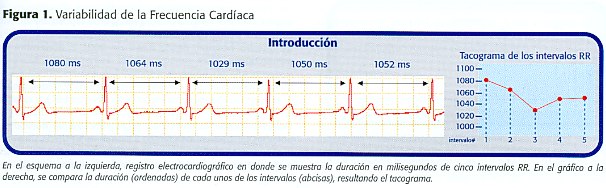
<body><![CDATA[<P><FONT FACE="Arial"><FONT SIZE=-1>Las variaciones en la duraci&oacute;n que hay entre latido y latido card&iacute;acos se denominan "variabilidad de la frecuencia card&iacute;aca" <B>(VFC, <A HREF="#fig1">figura 1</A>) </B>. Si se analiza el comportamiento de estas variaciones a lo largo del d&iacute;a, estas ser&aacute;n m&aacute;s notorias en el per&iacute;odo post-prandial y en la noche, per&iacute;odos en los cuales hay predominio fisiol&oacute;gico del tono auton&oacute;mico parasimp&aacute;tico. Por el contrario, en situaciones en las que predomina el tono simp&aacute;tico ellas ser&aacute;n menos marcadas (<A HREF="#1">1</A>).</FONT></FONT>     <BR>&nbsp;     <CENTER><A NAME="fig1"></A><IMG SRC="/img/fbpe/rcc/v6n1/2381i01.JPG" HEIGHT=188 WIDTH=606></CENTER> &nbsp;     
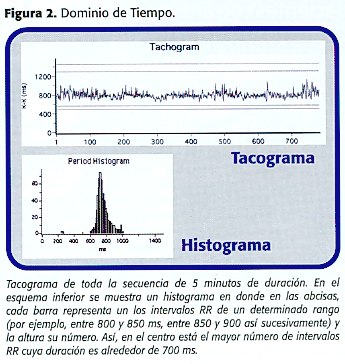
<BR><FONT FACE="Arial"><FONT SIZE=-1>Diversas cariopat&iacute;as tienen como denominador com&uacute;n un tono simp&aacute;tico incrementado cr&oacute;nicamente. En especial en el paciente que ha tenido un infarto de miocardio y en los portadores de insuficiencia card&iacute;aca (<A HREF="#2">2</A>), ese hipertono simp&aacute;tico es uno de los componentes responsables de las muertes s&uacute;bitas, el re-infarto y otras complicaciones que hace de ellas enfermedades de alta mortalidad. No es de extra&ntilde;ar entonces que los beta-bloqueadores (antagonistas del sistema simp&aacute;tico) hayan demostrado contundentemente mejor&iacute;a en la sobrevida en ambas condiciones (<A HREF="#3">3,4,5,6</A>), en parte al menos, al disminuir ese hipertono simp&aacute;tico, el cual podemos medir observando la VFC (<A HREF="#7">7</A>).</FONT></FONT>      <P><FONT FACE="Arial"><FONT SIZE=-1>Hay muchas formas de cuantificar la VFC. La m&aacute;s sencilla es medir cada uno de los intervalos RR a lo largo de un per&iacute;odo de tiempo y calcular variables aritm&eacute;ticas como el RR m&aacute;s largo, el m&aacute;s corto, el promedio de todos los RR y el n&uacute;mero de intervalos RR consecutivos que se diferencien en m&aacute;s de 50 ms. Otros c&aacute;lculos m&aacute;s sofisticados son las variables estad&iacute;sticas como el desv&iacute;o est&aacute;ndar de las variaciones de todos lo RR en un per&iacute;odo dado de tiempo o el desv&iacute;o est&aacute;ndar de las diferencias entre los intervalos RR. Las variables aritm&eacute;ticas y estad&iacute;sticas se denominan en conjunto, variables "en dominio de tiempo". Todos estos c&aacute;lculos de pueden representar tambi&eacute;n gr&aacute;ficamente <B>(<A HREF="#fig2">figura 2</A>)</B>.</FONT></FONT>     <BR><FONT FACE="Arial"><FONT SIZE=-1>&nbsp;</FONT></FONT>     <CENTER><A NAME="fig2"></A><IMG SRC="/img/fbpe/rcc/v6n1/2381i02.JPG" HEIGHT=364 WIDTH=345></CENTER> &nbsp;     
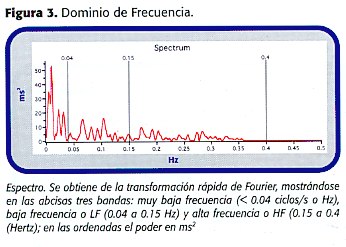
<BR><FONT FACE="Arial"><FONT SIZE=-1>M&aacute;s complejas son las variables denominadas "en dominio de frecuencia". Para calcularlas es necesario realizar an&aacute;lisis matem&aacute;ticos como la transformaci&oacute;n r&aacute;pida de Fourier, c&aacute;lculo de la entrop&iacute;a y muchos otros. La transformaci&oacute;n r&aacute;pida de Fourier descompone en frecuencias (cuya unidad es el Hertz o ciclos por segundo) una onda sinusoidal como es el tacograma <B>(ver las <A HREF="#fig1">figuras 1</A> y <A HREF="#fig2">2</A>) </B>. Las diferentes bandas de frecuencia obtenidas con este m&eacute;todo tienen una correlaci&oacute;n fisiol&oacute;gica: la banda de baja frecuencia tiene correlaci&oacute;n con el tono simp&aacute;tico y la de alta frecuencia con el parasimp&aacute;tico. Por tanto al encontrar valores alterados en estas bandas podremos decir que hay mayor o menor tono simp&aacute;tico o parasimp&aacute;tico <B>(<A HREF="#fig3">figura 3</A></B>). Otros c&aacute;lculos matem&aacute;ticos denominados en conjunto "de din&aacute;mica no linear" tambi&eacute;n han demostrado esa correlaci&oacute;n fisiol&oacute;gica y fisiopatol&oacute;gica (<A HREF="#8">8</A>).</FONT></FONT>     <BR>&nbsp;     <CENTER><A NAME="fig3"></A><IMG SRC="/img/fbpe/rcc/v6n1/2381i03.JPG" HEIGHT=247 WIDTH=346></CENTER> &nbsp;     
]]></body>
<body><![CDATA[<BR><FONT FACE="Arial"><FONT SIZE=-1>Todos estos c&aacute;lculos se pueden realizar con registros electrocardiogr&aacute;ficos breves (por lo general 5 minutos) o prolongados (con registros Holter de 24 horas) y en cada caso hay normas en su metodolog&iacute;a y valores normales (<A HREF="#9">9</A>).</FONT></FONT>      <P><FONT FACE="Arial"><FONT SIZE=-1>Se ha demostrado que el estudio de la VFC tiene utilidad pron&oacute;stica al momento de dar el alta al paciente que ha tenido un infarto o una descompensaci&oacute;n hemodin&aacute;mica (<A HREF="#2">2</A>). Hay una relaci&oacute;n directa entre VFC disminuida y la sobrevida en estas condiciones (<A HREF="#2">2</A>,<A HREF="#7">7</A>). Tambi&eacute;n se ha estudiado la VFC en otras afecciones cardiovasculares como la miocardiopat&iacute;a hipertr&oacute;fica, el s&iacute;ncope neurocardiog&eacute;nico, el prolapso de la v&aacute;lvula mitral, los pacientes con trasplante card&iacute;aco, la miocardiopat&iacute;a chag&aacute;sica entre otras (<A HREF="#8">8</A>) y en situaciones no cardiol&oacute;gicas como la neuropat&iacute;a diab&eacute;tica (<A HREF="#10">10</A>). Hay menos evidencia del comportamiento de la VFC en pacientes que ingresan al hospital con angina inestable. El objetivo de este estudio es establecer la correlaci&oacute;n entre las variables de VFC y los &iacute;ndices pron&oacute;sticos tradicionales en angina inestable.</FONT></FONT>      <P><B><FONT FACE="Arial"><FONT SIZE=-1>Materiales y M&eacute;todos</FONT></FONT></B>      <P><FONT FACE="Arial"><FONT SIZE=-1><U>Pacientes:</U> Es un estudio prospectivo abierto en el que se reclutaron consecutivamente pacientes con diagn&oacute;stico de angina inestable: angina prolongada y/o de reposo, de reciente comienzo y progresiva, internados en la secci&oacute;n de medicina de nuestro hospital, desde mayo de 2001 a noviembre del mismo a&ntilde;o.</FONT></FONT>      <P><FONT FACE="Arial"><FONT SIZE=-1>Se excluyeron a los que durante su hospitalizaci&oacute;n se diagnostic&oacute; infarto agudo de miocardio (con o sin elevaci&oacute;n ST), a quienes en la coronariograf&iacute;a (previa o posterior a su inclusi&oacute;n) se document&oacute; arterias coronarias angiogr&aacute;ficamente normales y aquellos quienes en los &uacute;ltimos 2 meses se hubieran sometido a procedimientos de revascularizaci&oacute;n mioc&aacute;rdica (cirug&iacute;a o angioplast&iacute;a). Tambi&eacute;n fueron exclu&iacute;dos quienes se negaron a participar en el estudio.</FONT></FONT>      <P><FONT FACE="Arial"><FONT SIZE=-1>Los siguientes, fueron los indicadores cl&iacute;nicos considerados como marcadores de riesgo cardiovascular intrahospitalario en angina inestable:</FONT></FONT>      <P><FONT FACE="Arial"><FONT SIZE=-1>- angor de reposo refractario</FONT></FONT>     <BR><FONT FACE="Arial"><FONT SIZE=-1>- hipotensi&oacute;n arterial</FONT></FONT>     <BR><FONT FACE="Arial"><FONT SIZE=-1>- insuficiencia card&iacute;aca</FONT></FONT>     <BR><FONT FACE="Arial"><FONT SIZE=-1>- presencia de cambios din&aacute;micos en el ST-T</FONT></FONT>     ]]></body>
<body><![CDATA[<BR><FONT FACE="Arial"><FONT SIZE=-1>- fracci&oacute;n de eyecci&oacute;n menor de 40%</FONT></FONT>     <BR><FONT FACE="Arial"><FONT SIZE=-1>- obstrucciones coronarias significativas (&lt;75%) en 2 &oacute; m&aacute;s vasos coronarios principales</FONT></FONT>      <P><FONT FACE="Arial"><FONT SIZE=-1>En todos los pacientes se consignaron estos indicadores y se agruparon en dos poblaciones: el grupo de alto riesgo si ten&iacute;a uno o m&aacute;s de estos indicadores, y el de bajo riesgo si no cumpl&iacute;a ninguno de los indicadores mencionados.</FONT></FONT>      <P><FONT FACE="Arial"><FONT SIZE=-1><U>Registro electrocardiogr&aacute;fico:</U> A todos los pacientes se les realiz&oacute; un registro electrocardiogr&aacute;fico de 5 minutos, en condiciones de reposo, respiraci&oacute;n no controlada, en horas de la ma&ntilde;ana (8:30 - 11:30 am) para lo cual se utiliz&oacute; un equipo multiregistrador PowerLab 4SP con bioamplificador y una computadora <I>iBook (Apple&reg;</I>), el programa de computadora <I>Chart </I>v 4.0.1 <I>(ADInstruments) </I>y su extensi&oacute;n "an&aacute;lisis de variabilidad de frecuencia card&iacute;aca" a una velocidad de adquisici&oacute;n de 1000 Hertz.</FONT></FONT>      <P><FONT FACE="Arial"><FONT SIZE=-1><U>Otros ex&aacute;menes auxiliares:</U> Los electrocardiogramas se realizaron con la metodolog&iacute;a convencional de doce derivaciones est&aacute;ndar. Los ecocardiogramas fueron realizados por cardi&oacute;logos no invasivos de nuestro centro en forma ciega, utilizando una valoraci&oacute;n subjetiva para el c&aacute;lculo de la fracci&oacute;n de eyecci&oacute;n. Las coronariograf&iacute;as se realizaron con la metodolog&iacute;a convencional por cardi&oacute;logos hemodinamistas de nuestro centro en forma ciega.</FONT></FONT>      <P><FONT FACE="Arial"><FONT SIZE=-1><U>An&aacute;lisis de los Registros:</U> Se realiz&oacute; mediante el programa de computadora referido, utilizando las siguientes variables en dominio de tiempo:</FONT></FONT>      <P><U><FONT FACE="Arial"><FONT SIZE=-1>Variables aritm&eacute;ticas:</FONT></FONT></U>      <P><FONT FACE="Arial"><FONT SIZE=-1>- NN promedio (promedio de todos los RR o NN)</FONT></FONT>     <BR><FONT FACE="Arial"><FONT SIZE=-1>- NN max (el m&aacute;ximo valor encontrado en un RR)</FONT></FONT>     <BR><FONT FACE="Arial"><FONT SIZE=-1>- NN min (el m&iacute;nimo RR encontrado)</FONT></FONT>      ]]></body>
<body><![CDATA[<P><U><FONT FACE="Arial"><FONT SIZE=-1>Variables estad&iacute;sticas:</FONT></FONT></U>      <P><FONT FACE="Arial"><FONT SIZE=-1>- SDNN (desv&iacute;o est&aacute;ndar de todos los RR)</FONT></FONT>     <BR><FONT FACE="Arial"><FONT SIZE=-1>- NN50 (intervalos RR que se diferencien en 50 ms o m&aacute;s)</FONT></FONT>     <BR><FONT FACE="Arial"><FONT SIZE=-1>- pNN50 (el anterior expresado en porcentaje)</FONT></FONT>      <P><FONT FACE="Arial"><FONT SIZE=-1>Utilizando transformaci&oacute;n r&aacute;pida de Fourier, se consideraron las siguientes variables en dominio de frecuencia:</FONT></FONT>      <P><FONT FACE="Arial"><FONT SIZE=-1>- Poder total</FONT></FONT>     <BR><FONT FACE="Arial"><FONT SIZE=-1>- VLF (banda &lt; 0.04 Hz)</FONT></FONT>     <BR><FONT FACE="Arial"><FONT SIZE=-1>- LF (banda comprendida entre 0.04 y 0.15 Hz)</FONT></FONT>     <BR><FONT FACE="Arial"><FONT SIZE=-1>- HF (banda comprendida entre 0.15 y 0.4 Hz)</FONT></FONT>     <BR><FONT FACE="Arial"><FONT SIZE=-1>- relaci&oacute;n LF/HF</FONT></FONT>      ]]></body>
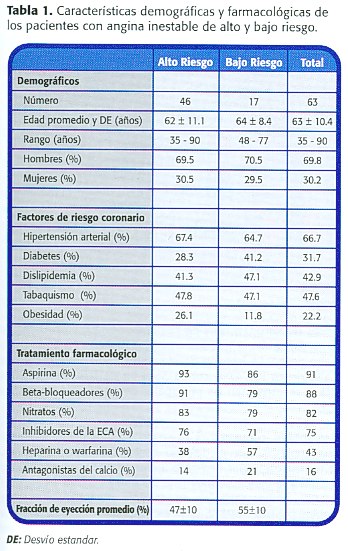
<body><![CDATA[<P><FONT FACE="Arial"><FONT SIZE=-1><U>An&aacute;lisis de los datos:</U> Se compararon todas las variables de VFC entre ambos grupos (alto y bajo riesgo). Para tal efecto se utiliz&oacute; la prueba T de estudiante en los programas systat para windows&reg; y excel para windows &reg; , teniendo como significativa una diferencia si el valor de p fu&eacute; igual o menor de 0.05. El an&aacute;lisis tambi&eacute;n se realiz&oacute; en subgrupos (diab&eacute;ticos, hipertensos, dislipid&eacute;micos, obesos) para conocer si las variables de VFC tuvieron mayor correlaci&oacute;n con las variables tradicionales en un subgrupo determinado que en todo el grupo.</FONT></FONT>      <P><B><FONT FACE="Arial"><FONT SIZE=-1>Resultados</FONT></FONT></B>      <P><FONT FACE="Arial"><FONT SIZE=-1>Se reclutaron 63 pacientes (44 hombres) con edad promedio de 63 + 10.4 a&ntilde;os (35-79); 46 se consideraron de alto riesgo, todos incluidos por los criterios cambios electrocardiogr&aacute;ficos din&aacute;micos y fracci&oacute;n de eyecci&oacute;n disminuida. Ning&uacute;n paciente present&oacute; hipotensi&oacute;n, insuficiencia card&iacute;aca o angina refractaria. Los 17 pacientes restantes se consideraron en el grupo de bajo riesgo por no reunir ninguno de los criterios utilizados en este estudio. Del total de pacientes, 41 tuvieron datos de la coronariograf&iacute;a, 33 de los cuales se incluyeron en el grupo de alto riesgo. La fracci&oacute;n de eyecci&oacute;n promedio en el grupo de alto riesgo fue 47%, contra 55% en de bajo riesgo. En la <B><A HREF="#tabla1">tabla 1</A> </B>se consignan las principales caracter&iacute;sticas de ambos grupos.</FONT></FONT>     <BR>&nbsp;     <CENTER><A NAME="tabla1"></A><IMG SRC="/img/fbpe/rcc/v6n1/2381i04.JPG" HEIGHT=551 WIDTH=348></CENTER> &nbsp;     
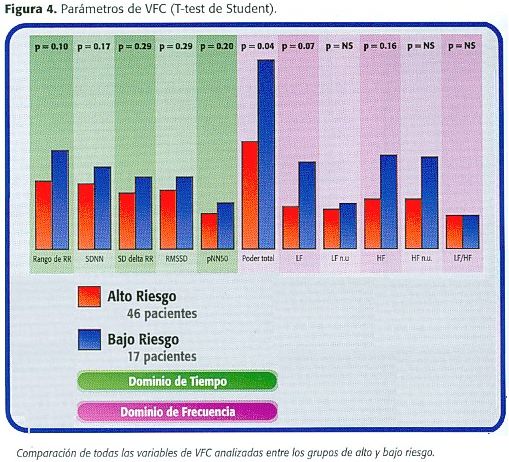
<BR><FONT FACE="Arial"><FONT SIZE=-1>En el an&aacute;lisis comparativo, el grupo de alto riesgo present&oacute; una menor VFC que el de bajo riesgo. Las variables de VFC que mostraron mayor deterioro fueron el poder espectral total (p=0.04) y la banda de muy baja frecuencia o <I>"low frequency" </I>(p=0.07), ambas variables de dominio de frecuencia. Otras variables como el SDNN, el NN50 (dominio de tiempo) y la banda de baja frecuencia, mostraron s&oacute;lo tendencia de ser menores en el grupo de alto riesgo <B>(<A HREF="#fig4">figura 4</A>)</B>.</FONT></FONT>     <BR><FONT FACE="Arial"><FONT SIZE=-1>&nbsp;</FONT></FONT>     <CENTER><A NAME="fig4"></A><IMG SRC="/img/fbpe/rcc/v6n1/2381i5.JPG" HEIGHT=462 WIDTH=509></CENTER> &nbsp;     
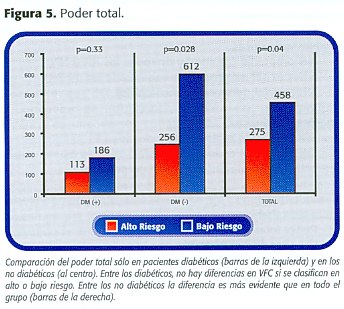
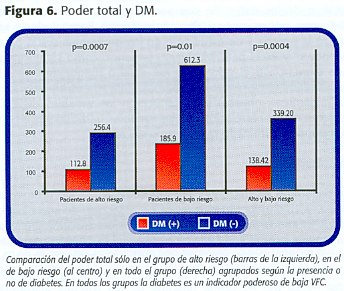
<BR><FONT FACE="Arial"><FONT SIZE=-1>Al realizarse un an&aacute;lisis comparativo similar pero s&oacute;lo en los pacientes diab&eacute;ticos (n= 20), al separarlos en grupos de alto y bajo riesgo mediante los criterios cl&iacute;nicos de este estudio, con ninguna variable se demostr&oacute; mayor diferencia, incluidas el poder total y la banda de baja frecuencia <B>(<A HREF="#fig5">figura 5</A>) </B>que s&iacute; mostraron diferencia cuando se analiz&oacute; a todo el grupo. Por el contrario, cuando se realiz&oacute; el an&aacute;lisis excluyendo a los diab&eacute;ticos, se encontr&oacute; que las diferencias de poder total y HF fueron mucho m&aacute;s significativas que las encontradas en todo el grupo. Por ejemplo, con el poder total el valor de p fue 0.028. Tambi&eacute;n se realiz&oacute; el an&aacute;lisis comparativo s&oacute;lo de la poblaci&oacute;n de alto riesgo (n=46) separ&aacute;ndolos en diab&eacute;ticos y en no diab&eacute;ticos. La diferencia de poder espectral total entre ambos subgrupos fueron marcadamente significativa (p=0.0007). Tambi&eacute;n se analiz&oacute; la poblaci&oacute;n de bajo riesgo de la misma manera y la diferencia tambi&eacute;n fue significativa (p=0.01). As&iacute;, en ambos casos la presencia de diabetes es un potente indicador de VFC disminuida <B>(<A HREF="#fig6">figura 6</A>) </B>. Hallazgos similares aunque con menor poder estad&iacute;stico se observ&oacute; con la hipertensi&oacute;n arterial y poder total (p=0.056) y menor a&uacute;n con los otros factores de riesgo coronario.</FONT></FONT>     <BR>&nbsp;     ]]></body>
<body><![CDATA[<CENTER><A NAME="fig5"></A><IMG SRC="/img/fbpe/rcc/v6n1/2381i06.JPG" HEIGHT=309 WIDTH=344></CENTER>      
<CENTER>&nbsp;</CENTER>      <CENTER><A NAME="fig6"></A><IMG SRC="/img/fbpe/rcc/v6n1/2381i07.JPG" HEIGHT=291 WIDTH=344></CENTER>      
<CENTER>&nbsp;</CENTER> &nbsp;     <BR><B><FONT FACE="Arial"><FONT SIZE=-1>Limitaciones:</FONT></FONT></B>      <P><FONT FACE="Arial"><FONT SIZE=-1>Aunque los resultados demuestran que existe correlaci&oacute;n entre los indicadores cl&iacute;nicos y la VFC, el poder estad&iacute;stico depende en forma directa del tama&ntilde;o de la muestra.</FONT></FONT>      <P><FONT FACE="Arial"><FONT SIZE=-1>Esta poblaci&oacute;n est&aacute; preseleccionada ya que en nuestro hospital los pacientes cr&iacute;ticamente enfermos se internan en &aacute;reas de cuidados cr&iacute;ticos, sin embargo la informaci&oacute;n obtenida es &uacute;til para el sistema de trabajo del centro hospitalario.</FONT></FONT>      <P><FONT FACE="Arial"><FONT SIZE=-1>En este estudio no se analiz&oacute; si esta correlaci&oacute;n cl&iacute;nica con VFC es independiente de la fracci&oacute;n de eyecci&oacute;n por an&aacute;lisis multivariado, aunque se conoce que &eacute;sta es muy sensible pero poco espec&iacute;fica. El an&aacute;lisis de VFC es un excelente complemento que puede aumentar el poder predictivo de eventos cardiovasculares, hecho que se ha comprobado en otros estudios.</FONT></FONT>      <P><B><FONT FACE="Arial"><FONT SIZE=-1>Conclusi&oacute;n</FONT></FONT></B>      <P><FONT FACE="Arial"><FONT SIZE=-1>En pacientes con angina inestable de alto riesgo, la presencia de indicadores pron&oacute;sticos tiene correlaci&oacute;n con una menor VFC en dominio de frecuencia. Este hallazgo sugiere que en estudios de seguimiento, este m&eacute;todo podr&iacute;a ser predictivo de menor sobrevida.</FONT></FONT>      ]]></body>
<body><![CDATA[<P><B><FONT FACE="Arial"><FONT SIZE=-1>Referencias</FONT></FONT></B>      <P><A NAME="1"></A><FONT FACE="Arial"><FONT SIZE=-1>1. Landsberg L, Young J. Fisiolog&iacute;a y farmacolog&iacute;a del sistema nervioso aut&oacute;nomo. En: Isselbacher K, Braunwald E, Wilson J D, Martin J, Fauci A, Kasper D, ed. Principios de medicina interna de Harrison. 13&ordf; ed. Espa&ntilde;a: Interamericana-Mc Graw-Hill, 1994: vol 1: 481-497.</FONT></FONT>      <P><A NAME="2"></A><FONT FACE="Arial"><FONT SIZE=-1>2. Baroreflex sensitivity and heart-rate variability in prediction of total cardiac mortality after myocardial infarction. ATRAMI (Autonomic Tone and Reflexes After Myocardial Infarction) Investigators.Lancet. 351(9101):478-84, 1998</FONT></FONT>      <!-- ref --><P><A NAME="3"></A><FONT FACE="Arial"><FONT SIZE=-1>3. BHAT &szlig;-Bloquer Heart Attack Trial Research Group. A Randomizad Trial of Propranolol in Patients with Acute Myocardial Infarction, I.Mortality Results. JAMA 1982;247:1707-1714</FONT></FONT>    &nbsp;&nbsp;&nbsp;&nbsp;&nbsp;&nbsp;&nbsp;&nbsp;[&#160;<a href="javascript:void(0);" onclick="javascript: window.open('/scielo.php?script=sci_nlinks&ref=733574&pid=S1409-4142200400010000200003&lng=','','width=640,height=500,resizable=yes,scrollbars=1,menubar=yes,');">Links</a>&#160;]<!-- end-ref --><!-- ref --><P><A NAME="4"></A><FONT FACE="Arial"><FONT SIZE=-1>4. The ISIS-1 investigators. First International Study of Infarct Survival (ISIS-1). Lancet 1986; 2 (8498):57-66.</FONT></FONT>    &nbsp;&nbsp;&nbsp;&nbsp;&nbsp;&nbsp;&nbsp;&nbsp;[&#160;<a href="javascript:void(0);" onclick="javascript: window.open('/scielo.php?script=sci_nlinks&ref=733575&pid=S1409-4142200400010000200004&lng=','','width=640,height=500,resizable=yes,scrollbars=1,menubar=yes,');">Links</a>&#160;]<!-- end-ref --><!-- ref --><P><A NAME="5"></A><FONT FACE="Arial"><FONT SIZE=-1>5. Packer M, Coats AJS, Fowler MB, et al. for the Carvedilol Prospective Randomized Cumulative Survival Study Group. N Engl J Med 2001;334:1651-8.</FONT></FONT>    &nbsp;&nbsp;&nbsp;&nbsp;&nbsp;&nbsp;&nbsp;&nbsp;[&#160;<a href="javascript:void(0);" onclick="javascript: window.open('/scielo.php?script=sci_nlinks&ref=733576&pid=S1409-4142200400010000200005&lng=','','width=640,height=500,resizable=yes,scrollbars=1,menubar=yes,');">Links</a>&#160;]<!-- end-ref --><!-- ref --><P><A NAME="6"></A><FONT FACE="Arial"><FONT SIZE=-1>6. Cleland JG. Beta-blockers for heart failure: why, which, when, and where. Med Clin North Am 2003; 87(2): 339-71</FONT></FONT>    &nbsp;&nbsp;&nbsp;&nbsp;&nbsp;&nbsp;&nbsp;&nbsp;[&#160;<a href="javascript:void(0);" onclick="javascript: window.open('/scielo.php?script=sci_nlinks&ref=733577&pid=S1409-4142200400010000200006&lng=','','width=640,height=500,resizable=yes,scrollbars=1,menubar=yes,');">Links</a>&#160;]<!-- end-ref --><P><A NAME="7"></A><FONT FACE="Arial"><FONT SIZE=-1>7. Bigger JT., Fleiss JL., Steinman RC., Rolnitzky LM., Kleiger RE., Rottman JN.: Correlations Among Time and Frequency Domain Measures of Heart Rate Variability Two Weeks After Acute Myocardial Infarction. Am J Cardiol 1992;69: 891-898</FONT></FONT>      <!-- ref --><P><A NAME="8"></A><FONT FACE="Arial"><FONT SIZE=-1>8. Guti&eacute;rrez O. Variabilidad de la frecuencia card&iacute;aca. Aplicaciones en cardiolog&iacute;a. Cardiolog&iacute;a al d&iacute;a (Bucaramanga, Colombia) 2001; 4: 11-18</FONT></FONT>    &nbsp;&nbsp;&nbsp;&nbsp;&nbsp;&nbsp;&nbsp;&nbsp;[&#160;<a href="javascript:void(0);" onclick="javascript: window.open('/scielo.php?script=sci_nlinks&ref=733579&pid=S1409-4142200400010000200008&lng=','','width=640,height=500,resizable=yes,scrollbars=1,menubar=yes,');">Links</a>&#160;]<!-- end-ref --><!-- ref --><P><A NAME="9"></A><FONT FACE="Arial"><FONT SIZE=-1>9. Task force Task Force of the European Society of Cardiology and the North American Society of Pacing and Electrophysiology: Heart Rate Variability: Standard of Measurement, Physiological Interpretation and Clinical Use. Circulation 1996; 93:1043-1065)</FONT></FONT>    &nbsp;&nbsp;&nbsp;&nbsp;&nbsp;&nbsp;&nbsp;&nbsp;[&#160;<a href="javascript:void(0);" onclick="javascript: window.open('/scielo.php?script=sci_nlinks&ref=733580&pid=S1409-4142200400010000200009&lng=','','width=640,height=500,resizable=yes,scrollbars=1,menubar=yes,');">Links</a>&#160;]<!-- end-ref --><!-- ref --><P><A NAME="10"></A><FONT FACE="Arial"><FONT SIZE=-1>10. Guti&eacute;rrez O, Putvinsky A, Padilla J, Ram&iacute;rez C, Mora C. Variabilidad de la Frecuencia Card&iacute;aca en individuos sanos costarricenses. Revista Costarricense de Cardiolog&iacute;a 2000; 2: 4-12</FONT></FONT>    &nbsp;&nbsp;&nbsp;&nbsp;&nbsp;&nbsp;&nbsp;&nbsp;[&#160;<a href="javascript:void(0);" onclick="javascript: window.open('/scielo.php?script=sci_nlinks&ref=733581&pid=S1409-4142200400010000200010&lng=','','width=640,height=500,resizable=yes,scrollbars=1,menubar=yes,');">Links</a>&#160;]<!-- end-ref --><!-- ref --><P><A NAME="11"></A><FONT FACE="Arial"><FONT SIZE=-1>11. Guti&eacute;rrez O. Variabilidad de la Frecuencia Card&iacute;aca en individuos sanos costarricenses. Revista Costarricense de Cardiolog&iacute;a 1999; 11:3-10</FONT></FONT>    &nbsp;&nbsp;&nbsp;&nbsp;&nbsp;&nbsp;&nbsp;&nbsp;[&#160;<a href="javascript:void(0);" onclick="javascript: window.open('/scielo.php?script=sci_nlinks&ref=733582&pid=S1409-4142200400010000200011&lng=','','width=640,height=500,resizable=yes,scrollbars=1,menubar=yes,');">Links</a>&#160;]<!-- end-ref --><P><A NAME="12"></A><FONT FACE="Arial"><FONT SIZE=-1>12. Catipovic-Veselica K, Durijancek J, Bracic-Kalan M, Amidzic V, Mrdenovic S, Kozmar D, Buri D, Catipovic B .Heart rate and heart-rate variability in patients with acute coronary heart disease classified on Bortner’s scale as type A and type B. Psychol Rep 1997; 80:775-84 (abstract)</FONT></FONT>      <P><A NAME="13"></A><FONT FACE="Arial"><FONT SIZE=-1>13. Loricchio ML, Di Clemente D, Saccone V, Caccamo L, Borghi A, Bugiardini R. An analysis of the variability of the heart rate and its significance in the risk stratification of patients with unstable angina. Cardiologia 1994; 39:335-43</FONT></FONT>      <P><A NAME="14"></A><FONT FACE="Arial"><FONT SIZE=-1>14. Huang J, Sopher SM, Leatham E, Redwood S, Camm AJ, Kaski JC. Heart rate variability depression in patients with unstable angina. Am Heart J 1995; 130:772-79</FONT></FONT>      <P><A NAME="15"></A><FONT FACE="Arial"><FONT SIZE=-1>15. Manfrini O, Pizzi C, Trer&egrave; D, Fontana F, Bugiardini R.Parasympathetic failure and risk of subsequent coronary events in unstable angina and non-ST-segment elevation myocardial infarction. Eur Heart J 2003;24:1560-6</FONT></FONT>      <P><A NAME="16"></A><FONT FACE="Arial"><FONT SIZE=-1>16. Catipovic-Veselica K, Durjancek J, Amidzic V, Buric D, Kozmar D, Vizner-Lovric I. Heart rate and heart rate variability in acute coronary heart disease. Acta Med Croatica 1996 50:75-9 (abstract)</FONT></FONT>      <P><A NAME="17"></A><FONT FACE="Arial"><FONT SIZE=-1>17. Lanza GA; Pedrotti P; Rebuzzi AG; Pasceri V; Quaranta G; Maseri A. Usefulness of the addition of heart rate variability to Holter monitoring in predicting in-hospital cardiac events in patients with unstable angina pectoris. Am J Cardiol 1997; 80(3): 263-7</FONT></FONT>      <P><A NAME="18"></A><FONT FACE="Arial"><FONT SIZE=-1>18. Wennerblom B, Lurje L, Westberg S, Johansson M, Lomsky M, Vahisalo R, Hjalmarson A. Effects on heart rate variability of isosorbide-5-mononitrate and metoprolol in patients with recent onset of angina pectoris. Cardiology 1998 89:87-93</FONT></FONT>      <P><A NAME="19"></A><FONT FACE="Arial"><FONT SIZE=-1>19. Dovgalevsky PY, Rybak OK, Furman NV. Relationship between parameters of heart rate variability, angiographical severity of coronary atherosclerosis and functional class of angina in patients with ischemic heart disease. Kardiologiia 2002 42:17-20 (Abstract)</FONT></FONT>      ]]></body>
<body><![CDATA[<P><A NAME="20"></A><FONT FACE="Arial"><FONT SIZE=-1>20. Wennerblom B, Lurje L, Tygesen H, Vahisalo R, Hjalmarson A. Patients with uncomplicated coronary artery disease have reduced heart rate variability mainly affecting vagal tone. Heart 2000 Mar 83:290-4</FONT></FONT>     <BR><FONT FACE="Arial"><FONT SIZE=-1>&nbsp;</FONT></FONT>     <BR><FONT FACE="Arial"><FONT SIZE=-1>&nbsp;</FONT></FONT>     <BR><A NAME="*A"></A><FONT FACE="Arial"><FONT SIZE=-1><A HREF="#*R">*</A> Interno de Medicina.</FONT></FONT>     <BR><FONT FACE="Arial"><FONT SIZE=-1>&nbsp;</FONT></FONT>     <BR><FONT FACE="Arial"><FONT SIZE=-1><A HREF="#*R">**</A> Servicio de cardiolog&iacute;a, Hospital M&eacute;xico, C.C.S.S., San Jos&eacute;, Costa</FONT></FONT>     <BR><FONT FACE="Arial"><FONT SIZE=-1>Rica.. C&aacute;tedra de Medicina, Universidad de Costa Rica. Correspondencia: Ap. Postal 471-1300</FONT></FONT>     <BR><FONT FACE="Arial,Helvetica"><FONT SIZE=-1>San Jos&eacute;, Costa Rica. Telefax (506) 231-3856, e-mail: <A HREF="mailto:oswcr@hotmail.com">oswcr@hotmail.com</A></FONT></FONT>      <P><FONT FACE="Arial"><FONT SIZE=-1>&nbsp;</FONT></FONT>      ]]></body><back>
<ref-list>
<ref id="B1">
<nlm-citation citation-type="book">
<person-group person-group-type="author">
<name>
<surname><![CDATA[Landsberg]]></surname>
<given-names><![CDATA[L]]></given-names>
</name>
<name>
<surname><![CDATA[Young]]></surname>
<given-names><![CDATA[J]]></given-names>
</name>
</person-group>
<article-title xml:lang="es"><![CDATA[Fisiología y farmacología del sistema nervioso autónomo]]></article-title>
<person-group person-group-type="editor">
<name>
<surname><![CDATA[Isselbacher]]></surname>
<given-names><![CDATA[K]]></given-names>
</name>
<name>
<surname><![CDATA[Braunwald]]></surname>
<given-names><![CDATA[E]]></given-names>
</name>
<name>
<surname><![CDATA[Wilson]]></surname>
<given-names><![CDATA[J D]]></given-names>
</name>
</person-group>
<source><![CDATA[Principios de medicina interna de Harrison]]></source>
<year>1994</year>
<volume>1</volume>
<edition>13 ed</edition>
<page-range>481-497</page-range><publisher-name><![CDATA[Interamericana-Mc Graw-Hill]]></publisher-name>
</nlm-citation>
</ref>
<ref id="B2">
<nlm-citation citation-type="journal">
<collab>ATRAMI (Autonomic Tone and Reflexes After Myocardial Infarction) Investigators</collab>
<article-title xml:lang="en"><![CDATA[Baroreflex sensitivity and heart-rate variability in prediction of total cardiac mortality after myocardial infarction]]></article-title>
<source><![CDATA[Lancet]]></source>
<year>1998</year>
<volume>351</volume>
<numero>^s9101</numero>
<issue>^s9101</issue>
<supplement>9101</supplement>
<page-range>478-84</page-range></nlm-citation>
</ref>
<ref id="B3">
<nlm-citation citation-type="journal">
<collab>BHAT ß-Bloquer Heart Attack Trial Research Group</collab>
<article-title xml:lang="en"><![CDATA[A Randomizad Trial of Propranolol in Patients with Acute Myocardial Infarction, I.Mortality Results]]></article-title>
<source><![CDATA[JAMA]]></source>
<year>1982</year>
<volume>247</volume>
<page-range>1707-1714</page-range></nlm-citation>
</ref>
<ref id="B4">
<nlm-citation citation-type="journal">
<collab>The ISIS-1 investigators</collab>
<article-title xml:lang="en"><![CDATA[First International Study of Infarct Survival (ISIS-1)]]></article-title>
<source><![CDATA[Lancet]]></source>
<year>1986</year>
<volume>2</volume><volume>8498</volume>
<page-range>57-66</page-range></nlm-citation>
</ref>
<ref id="B5">
<nlm-citation citation-type="journal">
<person-group person-group-type="author">
<name>
<surname><![CDATA[Packer]]></surname>
<given-names><![CDATA[M]]></given-names>
</name>
<name>
<surname><![CDATA[Coats]]></surname>
<given-names><![CDATA[AJS]]></given-names>
</name>
<name>
<surname><![CDATA[Fowler]]></surname>
<given-names><![CDATA[MB]]></given-names>
</name>
</person-group>
<article-title xml:lang="en"><![CDATA[for the Carvedilol Prospective Randomized Cumulative Survival Study Group]]></article-title>
<source><![CDATA[N Engl J Med]]></source>
<year>2001</year>
<volume>334</volume>
<page-range>1651-8</page-range></nlm-citation>
</ref>
<ref id="B6">
<nlm-citation citation-type="journal">
<person-group person-group-type="author">
<name>
<surname><![CDATA[Cleland]]></surname>
<given-names><![CDATA[JG]]></given-names>
</name>
</person-group>
<article-title xml:lang="en"><![CDATA[Beta-blockers for heart failure: why, which, when, and where]]></article-title>
<source><![CDATA[Med Clin North Am]]></source>
<year>2003</year>
<volume>87</volume>
<numero>^s2</numero>
<issue>^s2</issue>
<supplement>2</supplement>
<page-range>339-71</page-range></nlm-citation>
</ref>
<ref id="B7">
<nlm-citation citation-type="journal">
<person-group person-group-type="author">
<name>
<surname><![CDATA[Bigger]]></surname>
<given-names><![CDATA[JT]]></given-names>
</name>
<name>
<surname><![CDATA[Fleiss]]></surname>
<given-names><![CDATA[JL]]></given-names>
</name>
<name>
<surname><![CDATA[Steinman]]></surname>
<given-names><![CDATA[RC]]></given-names>
</name>
</person-group>
<article-title xml:lang="en"><![CDATA[Correlations Among Time and Frequency Domain Measures of Heart Rate Variability Two Weeks After Acute Myocardial Infarction]]></article-title>
<source><![CDATA[Am J Cardiol]]></source>
<year>1992</year>
<volume>69</volume>
<page-range>891-898</page-range></nlm-citation>
</ref>
<ref id="B8">
<nlm-citation citation-type="journal">
<person-group person-group-type="author">
<name>
<surname><![CDATA[Gutiérrez]]></surname>
<given-names><![CDATA[O]]></given-names>
</name>
</person-group>
<article-title xml:lang="es"><![CDATA[Variabilidad de la frecuencia cardíaca. Aplicaciones en cardiología]]></article-title>
<source><![CDATA[Cardiología al día]]></source>
<year>2001</year>
<volume>4</volume>
<page-range>11-18</page-range></nlm-citation>
</ref>
<ref id="B9">
<nlm-citation citation-type="journal">
<collab>Task force Task Force of the European Society of Cardiology and the North American Society of Pacing and Electrophysiology</collab>
<article-title xml:lang="en"><![CDATA[Heart Rate Variability: Standard of Measurement, Physiological Interpretation and Clinical Use]]></article-title>
<source><![CDATA[Circulation]]></source>
<year>1996</year>
<volume>93</volume>
<page-range>1043-1065</page-range></nlm-citation>
</ref>
<ref id="B10">
<nlm-citation citation-type="journal">
<person-group person-group-type="author">
<name>
<surname><![CDATA[Gutiérrez]]></surname>
<given-names><![CDATA[O]]></given-names>
</name>
<name>
<surname><![CDATA[Putvinsky]]></surname>
<given-names><![CDATA[A]]></given-names>
</name>
<name>
<surname><![CDATA[Padilla]]></surname>
<given-names><![CDATA[J]]></given-names>
</name>
<name>
<surname><![CDATA[Ramírez]]></surname>
<given-names><![CDATA[C]]></given-names>
</name>
<name>
<surname><![CDATA[Mora]]></surname>
<given-names><![CDATA[C]]></given-names>
</name>
</person-group>
<article-title xml:lang="es"><![CDATA[Variabilidad de la Frecuencia Cardíaca en individuos sanos costarricenses]]></article-title>
<source><![CDATA[Revista Costarricense de Cardiología]]></source>
<year>2000</year>
<volume>2</volume>
<page-range>4-12</page-range></nlm-citation>
</ref>
<ref id="B11">
<nlm-citation citation-type="journal">
<person-group person-group-type="author">
<name>
<surname><![CDATA[Gutiérrez]]></surname>
<given-names><![CDATA[O]]></given-names>
</name>
</person-group>
<article-title xml:lang="es"><![CDATA[Variabilidad de la Frecuencia Cardíaca en individuos sanos costarricenses]]></article-title>
<source><![CDATA[Revista Costarricense de Cardiología]]></source>
<year>1999</year>
<volume>11</volume>
<page-range>3-10</page-range></nlm-citation>
</ref>
<ref id="B12">
<nlm-citation citation-type="journal">
<person-group person-group-type="author">
<name>
<surname><![CDATA[Catipovic-Veselica]]></surname>
<given-names><![CDATA[K]]></given-names>
</name>
<name>
<surname><![CDATA[Durijancek]]></surname>
<given-names><![CDATA[J]]></given-names>
</name>
<name>
<surname><![CDATA[Bracic-Kalan]]></surname>
<given-names><![CDATA[M]]></given-names>
</name>
</person-group>
<article-title xml:lang="en"><![CDATA[Heart rate and heart-rate variability in patients with acute coronary heart disease classified on Bortner’s scale as type A and type B]]></article-title>
<source><![CDATA[Psychol Rep]]></source>
<year>1997</year>
<volume>80</volume>
<page-range>775-84</page-range></nlm-citation>
</ref>
<ref id="B13">
<nlm-citation citation-type="journal">
<person-group person-group-type="author">
<name>
<surname><![CDATA[Loricchio]]></surname>
<given-names><![CDATA[ML]]></given-names>
</name>
<name>
<surname><![CDATA[Di Clemente]]></surname>
<given-names><![CDATA[D]]></given-names>
</name>
<name>
<surname><![CDATA[Saccone]]></surname>
<given-names><![CDATA[V]]></given-names>
</name>
</person-group>
<article-title xml:lang="en"><![CDATA[An analysis of the variability of the heart rate and its significance in the risk stratification of patients with unstable angina]]></article-title>
<source><![CDATA[Cardiologia]]></source>
<year>1994</year>
<volume>39</volume>
<page-range>335-43</page-range></nlm-citation>
</ref>
<ref id="B14">
<nlm-citation citation-type="journal">
<person-group person-group-type="author">
<name>
<surname><![CDATA[Huang]]></surname>
<given-names><![CDATA[J]]></given-names>
</name>
<name>
<surname><![CDATA[Sopher]]></surname>
<given-names><![CDATA[SM]]></given-names>
</name>
<name>
<surname><![CDATA[Leatham]]></surname>
<given-names><![CDATA[E]]></given-names>
</name>
</person-group>
<article-title xml:lang="en"><![CDATA[Heart rate variability depression in patients with unstable angina]]></article-title>
<source><![CDATA[Am Heart J]]></source>
<year>1995</year>
<volume>130</volume>
<page-range>772-79</page-range></nlm-citation>
</ref>
<ref id="B15">
<nlm-citation citation-type="journal">
<person-group person-group-type="author">
<name>
<surname><![CDATA[Manfrini]]></surname>
<given-names><![CDATA[O]]></given-names>
</name>
<name>
<surname><![CDATA[Pizzi]]></surname>
<given-names><![CDATA[C]]></given-names>
</name>
<name>
<surname><![CDATA[Trerè]]></surname>
<given-names><![CDATA[D]]></given-names>
</name>
</person-group>
<article-title xml:lang="en"><![CDATA[Parasympathetic failure and risk of subsequent coronary events in unstable angina and non-ST-segment elevation myocardial infarction]]></article-title>
<source><![CDATA[Eur Heart J]]></source>
<year>2003</year>
<volume>24</volume>
<page-range>1560-6</page-range></nlm-citation>
</ref>
<ref id="B16">
<nlm-citation citation-type="journal">
<person-group person-group-type="author">
<name>
<surname><![CDATA[Catipovic-Veselica]]></surname>
<given-names><![CDATA[K]]></given-names>
</name>
<name>
<surname><![CDATA[Durjancek]]></surname>
<given-names><![CDATA[J]]></given-names>
</name>
<name>
<surname><![CDATA[Amidzic]]></surname>
<given-names><![CDATA[V]]></given-names>
</name>
<name>
<surname><![CDATA[Buric]]></surname>
<given-names><![CDATA[D]]></given-names>
</name>
<name>
<surname><![CDATA[Kozmar]]></surname>
<given-names><![CDATA[D]]></given-names>
</name>
</person-group>
<article-title xml:lang="en"><![CDATA[Heart rate and heart rate variability in acute coronary heart disease]]></article-title>
<source><![CDATA[Acta Med Croatica]]></source>
<year>1996</year>
<volume>50</volume>
<page-range>75-9</page-range></nlm-citation>
</ref>
<ref id="B17">
<nlm-citation citation-type="journal">
<person-group person-group-type="author">
<name>
<surname><![CDATA[Lanza]]></surname>
<given-names><![CDATA[GA]]></given-names>
</name>
<name>
<surname><![CDATA[Pedrotti]]></surname>
<given-names><![CDATA[P]]></given-names>
</name>
<name>
<surname><![CDATA[Rebuzzi]]></surname>
<given-names><![CDATA[AG]]></given-names>
</name>
</person-group>
<article-title xml:lang="en"><![CDATA[Usefulness of the addition of heart rate variability to Holter monitoring in predicting in-hospital cardiac events in patients with unstable angina pectoris]]></article-title>
<source><![CDATA[Am J Cardiol]]></source>
<year>1997</year>
<volume>80</volume>
<numero>^s3</numero>
<issue>^s3</issue>
<supplement>3</supplement>
<page-range>263-7</page-range></nlm-citation>
</ref>
</ref-list>
</back>
</article>