<?xml version="1.0" encoding="ISO-8859-1"?><article xmlns:mml="http://www.w3.org/1998/Math/MathML" xmlns:xlink="http://www.w3.org/1999/xlink" xmlns:xsi="http://www.w3.org/2001/XMLSchema-instance">
<front>
<journal-meta>
<journal-id>1409-4142</journal-id>
<journal-title><![CDATA[Revista Costarricense de Cardiología]]></journal-title>
<abbrev-journal-title><![CDATA[Rev. costarric. cardiol]]></abbrev-journal-title>
<issn>1409-4142</issn>
<publisher>
<publisher-name><![CDATA[Asociación Costarricense de Cardiología]]></publisher-name>
</publisher>
</journal-meta>
<article-meta>
<article-id>S1409-41422003000300007</article-id>
<title-group>
<article-title xml:lang="es"><![CDATA[La respuesta inflamatoria en la insuficiencia cardíaca crónica: papel de las citocinas pro-inflamatorias]]></article-title>
</title-group>
<contrib-group>
<contrib contrib-type="author">
<name>
<surname><![CDATA[Suárez Arana]]></surname>
<given-names><![CDATA[Ricardo]]></given-names>
</name>
<xref ref-type="aff" rid="A01"/>
</contrib>
<contrib contrib-type="author">
<name>
<surname><![CDATA[Suárez]]></surname>
<given-names><![CDATA[José Alejandro]]></given-names>
</name>
<xref ref-type="aff" rid="A02"/>
</contrib>
<contrib contrib-type="author">
<name>
<surname><![CDATA[Villarroel Abrego]]></surname>
<given-names><![CDATA[Hugo]]></given-names>
</name>
<xref ref-type="aff" rid="A03"/>
</contrib>
</contrib-group>
<aff id="A01">
<institution><![CDATA[,Universidad de El Salvador Facultad de Medicina ]]></institution>
<addr-line><![CDATA[ ]]></addr-line>
</aff>
<aff id="A02">
<institution><![CDATA[,Tufts University Baystate Medical Center ]]></institution>
<addr-line><![CDATA[Massachusetts ]]></addr-line>
<country>U.S.A</country>
</aff>
<aff id="A03">
<institution><![CDATA[,Universidad Salvadoreña Facultad de Ciencias de la Salud ]]></institution>
<addr-line><![CDATA[ ]]></addr-line>
<country>El Salvador</country>
</aff>
<pub-date pub-type="pub">
<day>00</day>
<month>12</month>
<year>2003</year>
</pub-date>
<pub-date pub-type="epub">
<day>00</day>
<month>12</month>
<year>2003</year>
</pub-date>
<volume>5</volume>
<numero>3</numero>
<fpage>31</fpage>
<lpage>38</lpage>
<copyright-statement/>
<copyright-year/>
<self-uri xlink:href="http://www.scielo.sa.cr/scielo.php?script=sci_arttext&amp;pid=S1409-41422003000300007&amp;lng=en&amp;nrm=iso"></self-uri><self-uri xlink:href="http://www.scielo.sa.cr/scielo.php?script=sci_abstract&amp;pid=S1409-41422003000300007&amp;lng=en&amp;nrm=iso"></self-uri><self-uri xlink:href="http://www.scielo.sa.cr/scielo.php?script=sci_pdf&amp;pid=S1409-41422003000300007&amp;lng=en&amp;nrm=iso"></self-uri></article-meta>
</front><body><![CDATA[  <B><FONT FACE="Arial"><FONT SIZE=-1>REVISION</FONT></FONT></B>     <CENTER>&nbsp;</CENTER>      <CENTER><B><FONT FACE="Arial">La Respuesta Inflamatoria en la Insuficiencia Card&iacute;aca Cr&oacute;nica: Papel de las Citocinas Pro-inflamatorias.</FONT></B></CENTER>      <CENTER><I><FONT FACE="Arial"><FONT SIZE=-1>&nbsp;</FONT></FONT></I></CENTER> &nbsp;     <CENTER><FONT FACE="Arial"><FONT SIZE=-1>Dr.Ricardo Su&aacute;rez Arana<A NAME="*R"></A><A HREF="#*A">*</A>, Dr.Jos&eacute; Alejandro Su&aacute;rez<A HREF="#*A">**</A>, Dr.Hugo Villarroel Abrego<A HREF="#*A">***</A></FONT></FONT></CENTER>       <P><B><FONT FACE="Arial"><FONT SIZE=-1>Introducci&oacute;n</FONT></FONT></B>      <P><FONT FACE="Arial"><FONT SIZE=-1>Existen numerosas publicaciones en las revistas m&eacute;dicas de las diversas &aacute;reas de la medicina, tanto de &iacute;ndole cl&iacute;nico como experimental, que sugieren que las llamadas citocinas pro-inflamatorias, en especial el Factor de Necrosis Tumoral alfa (FNT-alfa), juegan un papel muy importante en la patogenia de la insuficiencia card&iacute;aca cr&oacute;nica. El FNT-alfa, que se cre&iacute;a era producido &uacute;nicamente por c&eacute;lulas del sistema inmunol&oacute;gico (particularmente monocitos y macr&oacute;fagos activados), se ha encontrado tambi&eacute;n que puede sintetizarse en las c&eacute;lulas mioc&aacute;rdicas (miocitos) del coraz&oacute;n insuficiente, pero no en el normal. En el laboratorio se manejan modelos de coraz&oacute;n con sobrecarga de presi&oacute;n o de volumen, que hacen que el miocardio insuficiente sea capaz de sintetizar estas mol&eacute;culas, en particular el FNT-alfa. Por esta raz&oacute;n se les llama tambi&eacute;n citocinas estr&eacute;s-inducidas. Estas citocinas producen una franca disminuci&oacute;n del inotropismo mioc&aacute;rdico, estimulan la s&iacute;ntesis del tejido conectivo intersticial, causan una miocardiopat&iacute;a e inducen apoptosis, tanto in vivo como in vitro. La expresi&oacute;n de receptores espec&iacute;ficos para estas citocinas se encuentran elevadas en la insuficiencia card&iacute;aca cr&oacute;nica.</FONT></FONT>      <P><FONT FACE="Arial"><FONT SIZE=-1>Estas biomol&eacute;culas son capaces por s&iacute; mismas de producir un s&iacute;ndrome de insuficiencia contr&aacute;ctil del miocardio y el FNT-alfa (tambi&eacute;n conocido como caquectina) se cree que es causante en gran parte de la caquexia observada en los cardi&oacute;patas terminales. Dado que los niveles del FNT-alfa est&aacute;n en relaci&oacute;n con la severidad de la insuficiencia card&iacute;aca, se considera que estas mol&eacute;culas son mediadores importantes en la progresi&oacute;n de la enfermedad. La obtenci&oacute;n de compuestos qu&iacute;micos que contrarresten estas citocinas, podr&iacute;an ser de gran utilidad en el manejo de este s&iacute;ndrome congestivo.</FONT></FONT>      <P><B><FONT FACE="Arial"><FONT SIZE=-1>Coraz&oacute;n e Inflamaci&oacute;n</FONT></FONT></B>      <P><FONT FACE="Arial"><FONT SIZE=-1>Desde hace m&aacute;s de 200 a&ntilde;os se sabe que el coraz&oacute;n puede ser asiento de procesos infecciosos e inflamatorios en sus diversos componentes anat&oacute;micos: pericardio, miocardio, endocardio y v&aacute;lvulas. Pero no fue si no a comienzos de los a&ntilde;os 90s del reci&eacute;n pasado siglo, en que por primera vez se demuestra que la placa ateromatosa, lesi&oacute;n primordial de la aterosclerosis, puede presentar un componente inflamatorio desde el punto de vista histopatol&oacute;gico (<A HREF="#37">37</A>, <A HREF="#47">47</A>, <A HREF="#48">48</A>). Estos primeros estudios se hicieron en arterias coronarias. Tambi&eacute;n se descubri&oacute; que durante el proceso evolutivo de la aterosclerosis hay un componente inflamatorio cr&oacute;nico sist&eacute;mico de baja intensidad (<A HREF="#64">64</A>, <A HREF="#68">68</A>, <A HREF="#79">79</A>, <A HREF="#90">90</A>, <A HREF="#123">123</A>, <A HREF="#124">124</A>, <A HREF="#126">126</A>). Cuando dicho proceso inflamatorio se incrementa, es capaz de provocar cambios en la placa ateromatosa que aumenta su vulnerabilidad, causando la ruptura, que es la culpable en gran parte, de los s&iacute;ndromes coronarios agudos (<A HREF="#79">79</A>, <A HREF="#90">90</A>, <A HREF="#123">123</A>, <A HREF="#124">124</A>, <A HREF="#125">125</A>). Este proceso inflamatorio de baja intensidad se hace evidente el encontrarse que la Prote&iacute;na C Reactiva (PCR), que es un marcador sensible de inflamaci&oacute;n, se encuentra elevada moderadamente, siendo un percusor importante de un evento coronario agudo, cuando sus niveles s&eacute;ricos se incrementan (<A HREF="#95">95</A>, <A HREF="#105">105</A>, <A HREF="#121">121</A>, <A HREF="#122">122</A>). En dichas investigaciones se us&oacute; la PCR sensibilizada.</FONT></FONT>      ]]></body>
<body><![CDATA[<P><FONT FACE="Arial"><FONT SIZE=-1>Por muchos a&ntilde;os se crey&oacute; que el desarrollo de la placa ateromatosa era estrictamente un proceso degenerativo cuyos agentes causales eran los ya conocidos factores de riesgo coronario. Nunca antes se pens&oacute; que hubiese en su g&eacute;nesis un componente inflamatorio.</FONT></FONT>      <P><FONT FACE="Arial"><FONT SIZE=-1>Para sorpresa a&uacute;n mayor de la comunidad m&eacute;dica, se descubri&oacute; que varios microorganismos como el Helicobacter pylori, la Chlamidia pneumoniae, los citomegalovirus y los miembros del grupo de virus del herpes, ten&iacute;an alguna participaci&oacute;n en el desarrollo de la placa ateromatosa. Este hecho plantea la interrogante de que cierto grupo de antibi&oacute;ticos, especialmente macr&oacute;lidos de la &uacute;ltima generaci&oacute;n (azitromicina) pudieran ser de alguna utilidad en el tratamiento de los s&iacute;ndromes coronarios agudos. No es objetivo de esta revisi&oacute;n hacer un escrutinio detallado de la evidencia al respecto.</FONT></FONT>      <P><FONT FACE="Arial"><FONT SIZE=-1>Tambi&eacute;n a comienzos de la d&eacute;cada de los 90s del siglo pasado se empez&oacute; a sospechar que en la insuficiencia card&iacute;aca cr&oacute;nica podr&iacute;an existir los componentes inflamatorios. Con este pensamiento Pye y cols. (<A HREF="#21">21</A>) en un estudio de investigaci&oacute;n cl&iacute;nica en pacientes con insuficiencia card&iacute;aca cr&oacute;nica, encontraron niveles s&eacute;ricos altos de PCR y que hab&iacute;a una relaci&oacute;n entre la gravedad del padecimiento y las cifras de este marcador de inflamaci&oacute;n.</FONT></FONT>      <P><FONT FACE="Arial"><FONT SIZE=-1>Con el mismo prop&oacute;sito se public&oacute; un trabajo de investigaci&oacute;n cl&iacute;nica orientado a medir la eritrosedimentaci&oacute;n (ESM) en individuos con insuficiencia card&iacute;aca cr&oacute;nica. En dicho estudio se encontr&oacute; que en los casos leves a moderados la ESM se encontraba muy aumentada, pero en las formas moderadas-severas, era normal o a&uacute;n baja (<A HREF="#25">25</A>). Este es un hallazgo aparentemente parad&oacute;jico.</FONT></FONT>      <P><B><FONT FACE="Arial"><FONT SIZE=-1>Insuficiencia Card&iacute;aca y Citocinas</FONT></FONT></B>      <P><FONT FACE="Arial"><FONT SIZE=-1>En 1975, Carswell y cols. (<A HREF="#1">1</A>) descubrieron el factor de necrosis tumoral-alfa (FNT-alfa), al encontrar en ratones a los que se les hab&iacute;a inyectado endotoxina, un compuesto que, al inyectarlo a otros roedores afectos por un estirpe tumoral determinada provocaba la necrosis del tumor. De all&iacute; el nombre de FNT con que se le llam&oacute;. Este compuesto result&oacute; ser una citocina con m&uacute;ltiples actividades biol&oacute;gicas.</FONT></FONT>      <P><FONT FACE="Arial"><FONT SIZE=-1>Las citocinas, que juegan un papel muy importante en la respuesta inflamatoria inmunol&oacute;gicamente inducida, son biomol&eacute;culas muy peque&ntilde;as (15 a 30 kDa), de naturaleza proteica. Son secretadas por c&eacute;lulas que pertenecen al sistema inmunol&oacute;gico, principalmente monocitos y macr&oacute;fagos activos, en respuesta a varios est&iacute;mulos inductores, entre ellos los causados por microorganismos (<A HREF="#9">9</A>, <A HREF="#10">10</A>, <A HREF="#15">15</A>, <A HREF="#20">20</A>).</FONT></FONT>      <P><FONT FACE="Arial"><FONT SIZE=-1>Varios estudios de investigaci&oacute;n experimental hab&iacute;an puesto de manifiesto que el FNT-alfa ten&iacute;a, entre algunas de sus caracter&iacute;sticas biol&oacute;gicas, marcados efectos inotr&oacute;picos negativos en el coraz&oacute;n sano, y que podr&iacute;a ser el factor que causaba la insuficiencia card&iacute;aca severa observada en el choque endot&oacute;xico causado por bacterias Gram negativas (<A HREF="#4">4</A>, <A HREF="#5">5</A>, <A HREF="#6">6</A>, <A HREF="#8">8</A>, <A HREF="#10">10</A>, <A HREF="#12">12</A>, <A HREF="#15">15</A>, <A HREF="#26">26</A>, <A HREF="#36">36</A>, <A HREF="#42">42</A>, <A HREF="#49">49</A>, <A HREF="#52">52</A>), pero fueron Levine y cols. del grupo de investigaci&oacute;n de Milton Packer, del Centro M&eacute;dico Monte Sinai, de Nueva York, quienes en un trabajo de investigaci&oacute;n cl&iacute;nica monumental demuestran, por vez primera, que en los pacientes con insuficiencia card&iacute;aca cr&oacute;nica se encuentran niveles elevados del FNT-alfa, siendo los t&iacute;tulos tanto m&aacute;s altos cuando m&aacute;s severa es la insuficiencia (<A HREF="#19">19</A>). Este estudio, ya un cl&aacute;sico en el &aacute;rea de investigaci&oacute;n de las citocinas, provoc&oacute; un enorme inter&eacute;s en esa &aacute;rea, lo que hizo que se iniciaran muchos estudios experimentales como cl&iacute;nicos, sobre esta interesante biomol&eacute;cula que pertenece al grupo de las citocinas pro-inflamatorias (<A HREF="#3">3</A>, <A HREF="#4">4</A>, <A HREF="#5">5</A>, <A HREF="#6">6</A>, <A HREF="#8">8</A>, <A HREF="#10">10</A>, <A HREF="#12">12</A>, <A HREF="#15">15</A>, <A HREF="#54">54</A>, <A HREF="#56">56</A>). Entre el grupo de citocinas pro-inflamatorias estudiadas, se encontr&oacute; que la Interleucina-1 (IL-1) y la Interleucina-6 (IL-6) ten&iacute;an participaci&oacute;n en el s&iacute;ndrome de insuficiencia card&iacute;aca cr&oacute;nica (<A HREF="#9">9</A>, <A HREF="#13">13</A>, <A HREF="#16">16</A>, <A HREF="#29">29</A>, <A HREF="#42">42</A>, <A HREF="#43">43</A>, <A HREF="#50">50</A>, <A HREF="#61">61</A>, <A HREF="#72">72</A>, <A HREF="#76">76</A>). &Uacute;ltimamente se ha reportado que la Interleucina-18 (IL-18), biol&oacute;gicamente relacionada a la IL-1, tambi&eacute;n participa en dicho s&iacute;ndrome (<A HREF="#92">92</A>, <A HREF="#101">101</A>, <A HREF="#108">108</A>). El FNT-alfa y la IL-6 parecen ser las m&aacute;s activas, o por lo menos han sido las m&aacute;s estudiadas. (<A HREF="#9">9</A>, <A HREF="#11">11</A>, <A HREF="#19">19</A>, <A HREF="#61">61</A>, <A HREF="#63">63</A>).</FONT></FONT>      <P><FONT FACE="Arial"><FONT SIZE=-1>Hemos mencionado que estas citocinas pro-inflamatorias eran sintetizadas y secretadas por mol&eacute;culas del sistema inmunol&oacute;gico, particularmente monocitos y macr&oacute;fagos activados, en respuesta a varios tipos de est&iacute;mulos inductores, frecuentemente de tipo infeccioso. Sin embargo, en 1995 se publicaron varios trabajos de investigaci&oacute;n muy bien dise&ntilde;ados, en los que se descubri&oacute; que algunas c&eacute;lulas nucleares del coraz&oacute;n, particularmente los miocitos, eran capaces de sintetizar y secretar estas citocinas, principalmente el FNT-alfa, en respuesta a varios inductores de tipo mec&aacute;nico, como sobrecargas volum&eacute;tricas o de presi&oacute;n (<A HREF="#42">42</A>, <A HREF="#54">54</A>, <A HREF="#72">72</A>). Por esa raz&oacute;n, algunos investigadores las llaman tambi&eacute;n citocinas estr&eacute;s-inducidas (<A HREF="#41">41</A>, <A HREF="#49">49</A>, <A HREF="#54">54</A>).</FONT></FONT>      <P><FONT FACE="Arial"><FONT SIZE=-1>Este descubrimiento estremeci&oacute; el edificio de la Inmunolog&iacute;a, que establec&iacute;a, casi como un dogma de fe, que los componentes de la respuesta inmunol&oacute;gica, como las citocinas, &uacute;nicamente podr&iacute;an ser secretadas por dichas c&eacute;lulas y no por otras, como son los miocitos.</FONT></FONT>      ]]></body>
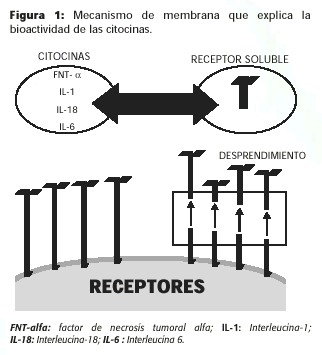
<body><![CDATA[<P><FONT FACE="Arial"><FONT SIZE=-1>Otro importante hallazgo fue que los miocitos sanos, sometidos a ning&uacute;n tipo de estr&eacute;s, tanto mec&aacute;nico como infeccioso, eran incapaces de sintetizar dichas citocinas. Los numerosos estudios de investigaci&oacute;n, experimentales como cl&iacute;nicos, han encontrado que <U>las citocinas inflamatorias tienen muchos efectos sobre el aparato cardiovascular. Entre ellos tenemos: la insuficiencia card&iacute;aca, edema agudo de pulm&oacute;n, caquexia card&iacute;aca, miocardiopat&iacute;a, desacoplamiento del receptor beta de la adenilciclasa (el segundo mensajero), activaci&oacute;n del sistema gen&eacute;tico para promover su s&iacute;ntesis, disfunci&oacute;n endotelial y apoptosis</U> (<A HREF="#3">3</A>, <A HREF="#4">4</A>, <A HREF="#5">5</A>, <A HREF="#6">6</A>, <A HREF="#7">7</A>, <A HREF="#8">8</A>, <A HREF="#9">9</A>, <A HREF="#10">10</A>, <A HREF="#12">12</A>, <A HREF="#13">13</A>, <A HREF="#16">16</A>, <A HREF="#26">26</A>, <A HREF="#30">30</A>, <A HREF="#50">50</A>, <A HREF="#54">54</A>, <A HREF="#55">55</A>, <A HREF="#56">56</A>, <A HREF="#57">57</A>, <A HREF="#66">66</A>, <A HREF="#71">71</A>, <A HREF="#84">84</A>, <A HREF="#85">85</A>). Los primeros estudios que estas citocinas estuvieron orientados a la investigaci&oacute;n de la patogenia del choque endot&oacute;xico, especialmente del FNT-alfa. La caquectina, relacionada con la caquexia observada en el c&aacute;ncer terminal, result&oacute; ser el mismo FNT-alfa, que tiene tambi&eacute;n una participaci&oacute;n importante en la caquexia del card&iacute;aco en su fase terminal (<A HREF="#4">4</A>, <A HREF="#8">8</A>, <A HREF="#22">22</A>, <A HREF="#67">67</A>, <A HREF="#92">92</A>).</FONT></FONT>      <P><FONT FACE="Arial"><FONT SIZE=-1>Al ser sintetizadas y secretadas por un miocito "enfermo" y no por las c&eacute;lulas del sistema inmunol&oacute;gico, se plantea la duda de que si a esta respuesta se le puede llamar con toda propiedad una "respuesta inmunol&oacute;gica", a pesar que estas biomol&eacute;culas pertenecen al grupo de los "efectores" de dicho sistema. Existe pues una controversia al respecto.</FONT></FONT>      <P><FONT FACE="Arial"><FONT SIZE=-1>Las citocinas "estr&eacute;s inducidas" tienen muchos efectos biol&oacute;gicos comunes con el llamado "fenotipo" de la insuficiencia card&iacute;aca. Esto hizo que se presumiera que estas mol&eacute;culas biol&oacute;gicamente muy activas jugaran un papel decisivo en la insuficiencia card&iacute;aca cr&oacute;nica (<A HREF="#41">41</A>, <A HREF="#56">56</A>, <A HREF="#60">60</A>, <A HREF="#65">65</A>, <A HREF="#93">93</A>, <A HREF="#101">101</A>). Nace as&iacute; la "hip&oacute;tesis de las citocinas" (<A HREF="#54">54</A>, <A HREF="#119">119</A>), y se plantea la interrogante de que estas biomol&eacute;culas podr&iacute;an tener alguna participaci&oacute;n en la progresi&oacute;n o deterioro de la insuficiencia card&iacute;aca. Esta "hip&oacute;tesis de las citocinas" no significa que estas mol&eacute;culas sean la causa de la insuficiencia card&iacute;aca, sino que su papel est&aacute; en relaci&oacute;n con la progresi&oacute;n cl&iacute;nica del s&iacute;ndrome de falla contr&aacute;ctil del coraz&oacute;n. Un hecho muy interesante es que no existe una diferencia en la expresi&oacute;n de las citocinas pro-inflamatorias, tanto en la disfunci&oacute;n causada por una miocardiopat&iacute;a dilatada primaria como en la fase dilatada de la insuficiencia card&iacute;aca de la cardiopat&iacute;a isqu&eacute;mica (<A HREF="#101">101</A>). Tambi&eacute;n muy interesante es el hecho de que la expresi&oacute;n del FNT-alfa es independiente de que el tipo de sobrecarga card&iacute;aca sea volum&eacute;trica o de presi&oacute;n.</FONT></FONT>      <P><FONT FACE="Arial"><FONT SIZE=-1>La mayor&iacute;a de los efectos biol&oacute;gicos de las citocinas son mediados a trav&eacute;s del mecanismo "agonista/receptor". Por lo tanto para involucrar a estas bio-mol&eacute;culas en la patog&eacute;nesis de la insuficiencia card&iacute;aca cr&oacute;nica, se ten&iacute;a que demostrar la existencia de receptores mioc&aacute;rdicos para estas citocinas pro-inflamatorias. Estos receptores fueron detectados en las membranas de los miocitos enfermos (<A HREF="#52">52</A>, <A HREF="#53">53</A>, <A HREF="#57">57</A>, <A HREF="#69">69</A>, <A HREF="#74">74</A>, <A HREF="#75">75</A>, <A HREF="#78">78</A>, <A HREF="#81">81</A>, <A HREF="#87">87</A>, <A HREF="#93">93</A>, <A HREF="#101">101</A>, <A HREF="#109">109</A>, <A HREF="#117">117</A>, <A HREF="#119">119</A>). Se han descrito dos receptores del FNT-alfa: el receptor 1 del FNT-alfa (E1-FNT-alfa) y el receptor 2 del FNT-alfa (E2-FNT-alfa). Los dos receptores se encuentran en proporciones similares en el miocardio normal (<A HREF="#52">52</A>, <A HREF="#53">53</A>, <A HREF="#93">93</A>, <A HREF="#101">101</A>). Sin embargo, los efectos biol&oacute;gicos de cada receptor son distintos, teniendo ambos igual afinidad de fijaci&oacute;n para el FNT-alfa. El efecto inotr&oacute;pico negativo es mediado por la interacci&oacute;n del FNT-alfa con el R1-FNT-alfa (<A HREF="#53">53</A>, <A HREF="#93">93</A>, <A HREF="#101">101</A>).</FONT></FONT>      <P><FONT FACE="Arial"><FONT SIZE=-1>Los complejos citocina-receptor del miocardio se desprenden, formando los llamados complejos solubles del receptor, que circulan libremente en el compartimiento vascular. Al desprenderse, ligan las citocinas en forma continua, contribuyendo as&iacute; a mantener un equilibrio o modulaci&oacute;n en el sistema (<A HREF="#fig1">Figura 1</A>).</FONT></FONT>     <BR><FONT FACE="Arial"><FONT SIZE=-1>&nbsp;</FONT></FONT>     <CENTER><A NAME="fig1"></A><IMG SRC="/img/fbpe/rcc/v5n3/2273i01.JPG" HEIGHT=355 WIDTH=322></CENTER> &nbsp;     
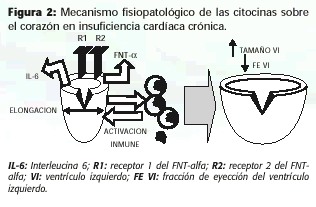
<BR><FONT FACE="Arial"><FONT SIZE=-1>Con toda la informaci&oacute;n cient&iacute;fica, tanto a nivel cl&iacute;nico como experimental, se demuestra que las citocinas pro-inflamatorias juegan un papel importante en la remodelaci&oacute;n del ventr&iacute;culo izquierdo (dilataci&oacute;n), que llevan al paciente a la fase terminal de su padecimiento (<A HREF="#fig2">Figura 2</A>).</FONT></FONT>     <BR><FONT FACE="Arial"><FONT SIZE=-1>&nbsp;</FONT></FONT>     <CENTER><A NAME="fig2"></A><IMG SRC="/img/fbpe/rcc/v5n3/2273i02.JPG" HEIGHT=207 WIDTH=316></CENTER> &nbsp;     
]]></body>
<body><![CDATA[<BR><FONT FACE="Arial"><FONT SIZE=-1>Adem&aacute;s de los efectos inotr&oacute;picos negativos de estas citocinas, hay tambi&eacute;n otros efectos nocivos sobre el miocardio, como lo hemos mencionado. Otro de los mecanismos que causan el remodelado (dilataci&oacute;n de las c&aacute;maras card&iacute;acas), es el da&ntilde;o sobre la matriz extracelular. Dicho da&ntilde;o consiste en la degradaci&oacute;n progresiva de la matriz por la activaci&oacute;n de las metaloprote&iacute;nasas de la matriz (MPMs) inducidas principalmente por el FNT-alfa (<A HREF="#110">110</A>, <A HREF="#119">119</A>). La "digesti&oacute;n" de la malla de col&aacute;geno fibrilar le quita soporte a los miocitos y favorece as&iacute; la dilataci&oacute;n ventricular.</FONT></FONT>      <P><FONT FACE="Arial"><FONT SIZE=-1>Ridker (<A HREF="#125">125</A>) ha acu&ntilde;ado el concepto del "suelo com&uacute;n" (common soil, en ingl&eacute;s) para explicar la multiplicidad de factores que intervienen en el proceso inflamatorio del coraz&oacute;n y sus relaciones con la diabetes mellitus tipo II. Al presente ya se visualizan las "puntas de los icebergs" pero a&uacute;n no conocemos en "profundidad" las conexiones precisas de estos mecanismos a nivel celular y molecular.</FONT></FONT>      <P><B><FONT FACE="Arial"><FONT SIZE=-1>Progresi&oacute;n de la Insuficiencia Card&iacute;aca Cr&oacute;nica</FONT></FONT></B>      <P><FONT FACE="Arial"><FONT SIZE=-1>Se ha observado que durante varios a&ntilde;os la insuficiencia card&iacute;aca se manten&iacute;a controlada en forma m&aacute;s o menos estable con el esquema terap&eacute;utico cl&aacute;sico de digital y diur&eacute;tico, pero que s&uacute;bitamente y sin causa aparente, se presentaba un deterioro de la condici&oacute;n hemodin&aacute;mica que r&aacute;pidamente llevaba al paciente a la muerte, ya por falla mec&aacute;nica o por una arritmia maligna (<A HREF="#75">75</A>, <A HREF="#101">101</A>, <A HREF="#126">126</A>). Esta progresi&oacute;n de la enfermedad se asocia a un franco incremento en la actividad del eje neuro-endocrino, particularmente un aumento en los niveles s&eacute;ricos de angiotensina II, norepinefrina y Endotelina-1(E-1), as&iacute; como tambi&eacute;n una elevaci&oacute;n en la actividad de la arginina-vasopresina (hormona antidiur&eacute;tica) (<A HREF="#58">58</A>, <A HREF="#75">75</A>, <A HREF="#101">101</A>, <A HREF="#103">103</A>, <A HREF="#106">106</A>). La sospecha de que el incremento en los niveles s&eacute;ricos de estas hormonas estuviese estrechamente relacionado al deterioro de la insuficiencia card&iacute;aca cr&oacute;nica fue corroborado cuando al tratar a estos pacientes con inhibidores de la enzima convertidora o convertasa (IECA’s) y bloqueadores beta-adren&eacute;rgicos se observaba una notable mejor&iacute;a de los s&iacute;ntomas cl&iacute;nicos, disminuyendo ambi&eacute;n la morbi-mortalidad de la enfermedad (<A HREF="#31">31</A>, <A HREF="#39">39</A>, <A HREF="#86">86</A>, <A HREF="#94">94</A>, <A HREF="#96">96</A>, <A HREF="#112">112</A>, <A HREF="#113">113</A>, <A HREF="#114">114</A>, <A HREF="#118">118</A>). Numerosos trabajos en tal sentido, tanto experimentales como cl&iacute;nicos, se llevaron a cabo en varios pa&iacute;ses. La creciente disponibilidad de f&aacute;rmacos antagonistas neuro-hormonales ha transformado la terapia de la insuficiencia card&iacute;aca de un esquema b&aacute;sicamente paliativo (digital/diur&eacute;ticos) a uno que modifica la evoluci&oacute;n de la enfermedad (<A HREF="#75">75</A>). Pero esa no fue toda la historia: se pens&oacute; que hab&iacute;a otros factores qu&iacute;micos que podr&iacute;an explicar ese deterioro de la funci&oacute;n mioc&aacute;rdica y se empez&oacute; a explorar la posibilidad de que ciertas bio-mol&eacute;culas cardiodepresoras como el FNT-alfa, podr&iacute;an tambi&eacute;n producirse en la insuficiencia card&iacute;aca cr&oacute;nica y acelerar el deterioro cl&iacute;nico. (<A HREF="#27">27</A>, <A HREF="#29">29</A>, <A HREF="#36">36</A>, <A HREF="#42">42</A>, <A HREF="#43">43</A>, <A HREF="#52">52</A>, <A HREF="#101">101</A>, <A HREF="#126">126</A>).</FONT></FONT>      <P><FONT FACE="Arial"><FONT SIZE=-1>Revisemos brevemente algunos mecanismos que act&uacute;an en la g&eacute;nesis de la insuficiencia card&iacute;aca cr&oacute;nica en su fase terminal. La vasoconstricci&oacute;n sist&eacute;mica es un importante mecanismo compensatorio en la insuficiencia card&iacute;aca. Esta respuesta vasoconstrictora depende de la integridad del sistema nervioso simpato-adrenal y del eje renina-angiotensina-aldosterona (<A HREF="#58">58</A>). Este mecanismo provoca una importante disfunci&oacute;n endotelial, demostrada en numerosos trabajos cl&iacute;nicos y experimentales, que es en definitiva el causante mayor de la vasoconstricci&oacute;n (<A HREF="#24">24</A>, <A HREF="#27">27</A>, <A HREF="#30">30</A>, <A HREF="#40">40</A>, <A HREF="#43">43</A>, <A HREF="#46">46</A>, <A HREF="#58">58</A>, <A HREF="#73">73</A>, <A HREF="#76">76</A>, <A HREF="#83">83</A>, <A HREF="#100">100</A>, <A HREF="#102">102</A>, <A HREF="#106">106</A>, <A HREF="#107">107</A>). Adem&aacute;s de la alteraci&oacute;n de la vasodilataci&oacute;n endotelio-dependiente, el aumento en la circulaci&oacute;n de la E-1 que se observa en la insuficiencia card&iacute;aca, puede jugar tambi&eacute;n un papel importante en dicha vasoconstricci&oacute;n.</FONT></FONT>      <P><FONT FACE="Arial"><FONT SIZE=-1>Se ha visto que los cambios en la E-1 plasm&aacute;tica est&aacute;n relacionados a incrementos en las otras neurohormonas como la vasopresina y la norepinefrina que estimulan in-vitro la liberaci&oacute;n de endotelina (<A HREF="#27">27</A>, <A HREF="#43">43</A>, <A HREF="#94">94</A>). Adem&aacute;s, el estr&eacute;s inducido por los cambios hemodin&aacute;micos llevan tambi&eacute;n a un r&aacute;pido aumento en la circulaci&oacute;n plasm&aacute;tica de los niveles de la E-1. La principal fuente de E-1 es el lecho vascular pulmonar, y su secreci&oacute;n aumenta en relaci&oacute;n a la severidad de la insuficiencia card&iacute;aca. Esta endotelina es la causante del importante aumento de la resistencia vascular pulmonar en la insuficiencia card&iacute;aca (<A HREF="#43">43</A>). El marcado aumento de los vasoconstrictores derivados del endotelio parece ser una consecuencia, mas que una causa de la insuficiencia card&iacute;aca (<A HREF="#58">58</A>, <A HREF="#101">101</A>). En realidad la vasoconstricci&oacute;n es uno de los m&aacute;s importantes mecanismos compensatorios que ocurren en la insuficiencia card&iacute;aca, y descansa grandemente en hormonas tales como la vasopresina y la norepinefrina que inducen la producci&oacute;n de endotelina (<A HREF="#45">45</A>). Adem&aacute;s la norepinefrina de por s&iacute; es un vasoconstrictor a trav&eacute;s de su mecanismo alfa-agonista adren&eacute;rgico. Este aumento consecuente de la post-carga explica la disminuci&oacute;n del d&eacute;bito card&iacute;aco en un coraz&oacute;n ya deprimido.</FONT></FONT>      <P><FONT FACE="Arial"><FONT SIZE=-1>Las citocinas pro-inflamatorias, en especial el FNT-alfa, tienen aparte de su efecto inotropo-negativo, un efecto inductor de la disfunci&oacute;n endotelial, con el consiguiente incremento en la respuesta vasoconstrictora. Adem&aacute;s, el eje neurohormonal incrementa la s&iacute;ntesis y liberaci&oacute;n de las citocinas pro-inflamatorias (<A HREF="#102">102</A>, <A HREF="#103">103</A>). Vemos pues, que el estr&eacute;s hemodin&aacute;mico estimula la producci&oacute;n de estas citocinas (de all&iacute; el nombre de estr&eacute;s–inducidas, que tambi&eacute;n reciben) y tambi&eacute;n existe una interacci&oacute;n citocinas/eje neurohormonal en la modulaci&oacute;n de dicha respuesta (<A HREF="#102">102</A>, <A HREF="#103">103</A>).</FONT></FONT>      <P><FONT FACE="Arial"><FONT SIZE=-1>Los s&iacute;ntomas limitantes de la insuficiencia card&iacute;aca incluyen fatiga, que es una expresi&oacute;n de bajo gasto card&iacute;aco, y disnea, provocada por la congesti&oacute;n pulmonar pasiva cr&oacute;nica. La fatiga marcada, que a veces llega a ser invalidante, tambi&eacute;n se explica por la marcada vasoconstricci&oacute;n que lleva a una pobre perfusi&oacute;n tisular (<A HREF="#58">58</A>, <A HREF="#59">59</A>). Esta condici&oacute;n de bajo gasto con hipoperfusi&oacute;n tisular, en particular del tejido muscular, que se observa en la insuficiencia card&iacute;aca cr&oacute;nica, ha llevado a Andrew J. S. Coats a formular la "hip&oacute;tesis muscular" de la insuficiencia card&iacute;aca cr&oacute;nica.</FONT></FONT>      <P><FONT FACE="Arial"><FONT SIZE=-1>Probablemente los mensajes a nivel molecular que conducen a este deterioro en la insuficiencia card&iacute;aca se originen en el &aacute;rea tisular y promuevan a una respuesta vasoconstrictora a&uacute;n mayor, transformando la respuesta al inicio compensatoria en una respuesta delet&eacute;rea al final, ya que compromete a&uacute;n m&aacute;s la condici&oacute;n metab&oacute;lica tisular. Este mecanismo tambi&eacute;n explicar&iacute;a la progresi&oacute;n cl&iacute;nica de la enfermedad. De hecho, en esta etapa, la fatiga muscular se vuelve mas intensa y el gasto card&iacute;aco disminuye a&uacute;n m&aacute;s. El correlato farmacol&oacute;gico corrobora esta situaci&oacute;n: el paciente mejora con los f&aacute;rmacos inhibidores de la convertasa y los bloqueadores beta-adren&eacute;rgicos. Adem&aacute;s se demuestra una mejor&iacute;a de la disfunci&oacute;n endotelial, mejor perfusi&oacute;n tisular y menos disnea/fatiga.</FONT></FONT>      <P><FONT FACE="Arial"><FONT SIZE=-1>Aunque no hay duda de la interacci&oacute;n eje neuro-hormonal/citocinas pro-inflamatorias, no existe sin embargo una demostraci&oacute;n de tal interacci&oacute;n a nivel molecular (<A HREF="#101">101</A>).</FONT></FONT>      ]]></body>
<body><![CDATA[<P><B><FONT FACE="Arial"><FONT SIZE=-1>Uso de F&aacute;rmacos Anticitocinas en la insuficiencia Card&iacute;aca Cr&oacute;nica</FONT></FONT></B>      <P><FONT FACE="Arial"><FONT SIZE=-1>Ha sido ampliamente documentado que las citocinas pro-inflamatorias deprimen la contractilidad mioc&aacute;rdica y contribuyen a la importante disfunci&oacute;n endotelial observada en la insuficiencia card&iacute;aca cr&oacute;nica, favoreciendo as&iacute; la progresi&oacute;n (deterioro) de la enfermedad ("hip&oacute;tesis de las citocinas"). Con esta informaci&oacute;n, es l&oacute;gico suponer que si su actividad es antagonizada podemos mejorar la condici&oacute;n hemodin&aacute;mica del coraz&oacute;n y detener temporalmente su progresi&oacute;n.</FONT></FONT>      <P><FONT FACE="Arial"><FONT SIZE=-1>Siendo esta respuesta de las citocinas mediada en parte por el sistema inmunol&oacute;gico se propone lo que los entendidos en la materia llaman el "manejo inmunomodulatorio" de la enfermedad (<A HREF="#97">97</A>, <A HREF="#104">104</A>, <A HREF="#111">111</A>, <A HREF="#115">115</A>, <A HREF="#116">116</A>).</FONT></FONT>      <P><FONT FACE="Arial"><FONT SIZE=-1>Los trabajos sobre el uso de los inhibidores de la enzima convertidora de angiotensina (IECA’s) han demostrado que su uso provoca un descenso de FNT-alfa, probablemente debido a que modifica favorablemente la condici&oacute;n hemodin&aacute;mica de los pacientes, disminuyendo el factor de estr&eacute;s mec&aacute;nico (citocinas estr&eacute;s–inducidas), aunque no se descarta de que pueda haber una interrelaci&oacute;n entre las neurohormonas (norepinefrina, angiotensina) y las citocinas pro-inflamatorias, en particular el FNT-alfa. Por ese o esos mecanismos podr&iacute;amos decir que los f&aacute;rmacos tipo IECA tienen un efecto anticitocina, directo y/o indirecto.</FONT></FONT>      <P><FONT FACE="Arial"><FONT SIZE=-1>En 1998, en un estudio publicado en Lancet, Sliwa y colaboradores informan de los efectos ben&eacute;ficos del f&aacute;rmaco pentoxifilina sobre la funci&oacute;n ventricular izquierda en pacientes con insuficiencia card&iacute;aca cr&oacute;nica causada por miocardiopat&iacute;a dilatada idiop&aacute;tica (<A HREF="#77">77</A>). Este fue un estudio peque&ntilde;o, que incluy&oacute; 28 pacientes, en quienes se demostr&oacute; una mejor&iacute;a de la fracci&oacute;n de eyecci&oacute;n ventricular izquierda medida por ecocardiograf&iacute;a. Auque los resultados son muy buenos se considera que el estudio es muy peque&ntilde;o y con un dise&ntilde;o experimental un poco laxo como para sacar conclusiones definitivas, sugiri&eacute;ndose hacer un estudio mayor y con mejores controles. Dos a&ntilde;os despu&eacute;s, en el 2000, Bozkurt y su grupo, del Centro M&eacute;dico de la Universidad de Baylor, Texas, presenta los resultados de un estudio abierto en que usaron talidomida en pacientes con insuficiencia card&iacute;aca avanzada y niveles altos del FNT-alfa, con una respuesta cl&iacute;nica aceptable (<A HREF="#98">98</A>). Pero el estudio es tambi&eacute;n muy peque&ntilde;o y no permite sacar conclusiones firmes. Estos ser&iacute;an indicios que gozan de cierta solidez, que los f&aacute;rmacos que disminuyen los niveles del FNT-alfa puedan mejorar el pron&oacute;stico de este s&iacute;ndrome.</FONT></FONT>      <P><FONT FACE="Arial"><FONT SIZE=-1>La talidomida y la pentoxifilina se consideran drogas que son inhibidores inespec&iacute;ficos de las citocinas, al afectar la s&iacute;ntesis de los mediadores inflamatorios bloqueando su activaci&oacute;n transcripcional (manipulaci&oacute;n gen&eacute;tica).</FONT></FONT>      <P><FONT FACE="Arial"><FONT SIZE=-1>Este mismo grupo, en 1999 (<A HREF="#89">89</A>), hab&iacute;an publicado un peque&ntilde;o trabajo sobre el uso del etanercept (Enbrel &reg;, comercialmente) en el que se demostraban un franca mejor&iacute;a cl&iacute;nica de los pacientes. Ellos investigaron este f&aacute;rmaco despu&eacute;s de conocer los resultados que se hab&iacute;an obtenido con este medicamento en individuos que hab&iacute;an recibido endotoxina por v&iacute;a endovenosa (51). El etanercept se ha usado con &eacute;xito en el tratamiento de la artritis reumatoide, llevando a remisiones cl&iacute;nicas. Es un receptor del FNT-alfa, de origen recombinante humano, con una afinidad 100 veces mayor que la de los receptores naturales del FNT-alfa por esta citocina.</FONT></FONT>      <P><FONT FACE="Arial"><FONT SIZE=-1>Basado en estos estudios preliminares Anker publica un art&iacute;culo titulado: &iquest;Ha llegado el momento del uso de la terapia anticitocina en la insuficiencia card&iacute;aca cr&oacute;nica? (<A HREF="#104">104</A>). El autor afirma que hay pruebas suficientes del efecto negativo de estas citocinas sobre la evoluci&oacute;n de la enfermedad y que ha llegado la hora en que se dise&ntilde;en estudios m&aacute;s completas para valorar el uso de f&aacute;rmacos anticitocinas en la insuficiencia card&iacute;aca de larga data.</FONT></FONT>      <P><FONT FACE="Arial"><FONT SIZE=-1>Se dise&ntilde;an entonces dos grandes estudios multic&eacute;ntricos para valorar el uso de etanercept en la insuficiencia card&iacute;aca cr&oacute;nica. Uno de ellos es el RENAISSANCE (acr&oacute;nimo de "The Randomized Etanercept North AmerIcan Strategy to Study ANtagonism of CytokinEs"), que se desarroll&oacute; en Norteam&eacute;rica. El otro, llamado RECOVER (acr&oacute;nimo de "Research into Etanercept CytOkine antagonism in VEntRicular Dysfunction"), que se realiz&oacute; en Europa y Australia. El resumen de estos dos grandes estudios se sintetiza en el RENEWAL (acr&oacute;nimo de "Randomized EtaNErcept Worldwide EvALuation"). Ambos estudios incluyeron un total de 2.048 pacientes, con un excelente dise&ntilde;o experimental (<A HREF="#120">120</A>). Los puntos finales fueron ingresos hospitalarios y muerte por agravamiento de su insuficiencia card&iacute;aca. Fueron dos estudios muy costosos y al final las conclusiones de los resultados fueron que el etanercept empeor&oacute; la condici&oacute;n card&iacute;aca. Al lector que tenga especial inter&eacute;s por los resultados de ambos estudios le sugerimos revisarlos, ellos son: 1) Anker S D, Cotas AJS: How to RECOVER for RENAISSANCE? The significance of the results of RECOVER, RENAISSANCE, RENEWAL and ATTACH. Int. J. Cardiol. 2002; 6:123- 32 y 2) Mann DL: Inflammatory Mediators and the Failing Heart. Past, Present, and the Foreseeable Future. Circ. Res. 2002; 91: 988-998 (<A HREF="#119">119</A>, <A HREF="#120">120</A>). En ambos art&iacute;culos tambi&eacute;n se revisan los resultados del estudio ATTACH (acr&oacute;nimo de "The AnTi-TNF-alfa Therapy Against CHF"). Este fue un estudio peque&ntilde;o de fase II en insuficiencia card&iacute;aca cr&oacute;nica moderada a avanzada, que estudio a 150 pacientes tratados con infliximab (Remicade&reg;, comercialmente). Este es un f&aacute;rmaco del tipo anticuerpo monoclonal contra el FNT-alfa, ya usado con &eacute;xito en la enfermedad de Crohn. En este estudio se demostr&oacute; la ineficacia de dicho f&aacute;rmaco en la insuficiencia card&iacute;aca, ya que no solo tuvo un efecto beneficioso nulo, sino que empeor&oacute; la condici&oacute;n cl&iacute;nica de los pacientes. Ante estos resultados Anker y Coats (<A HREF="#120">120</A>) se preguntan: &iquest;Ha muerto la hip&oacute;tesis de las citocinas? Mann (<A HREF="#119">119</A>) se hace igual cuestionamiento.</FONT></FONT>      <P><FONT FACE="Arial"><FONT SIZE=-1>Sin embargo, ellos mismos afirman que es tan convincente el efecto negativo cardiovascular que tienen las citocinas pro-inflamatorias que es prematuro descartar el uso de f&aacute;rmacos anticitocinas en esta condici&oacute;n cl&iacute;nica. Probablemente habr&aacute; que hacer una mejor selecci&oacute;n de los pacientes y estudiar nuevas dosis. Podr&iacute;a ser que dichos f&aacute;rmacos puedan tener efectos colaterales t&oacute;xicos sobre el coraz&oacute;n, independientemente de su acci&oacute;n anticitocina, sobre todo teniendo en cuenta que act&uacute;an a nivel de membrana celular. Estos reconocidos autores piensan que es muy prematuro proclamar: " ha muerto el rey, larga vida al rey".</FONT></FONT>      ]]></body>
<body><![CDATA[<P><B><FONT FACE="Arial"><FONT SIZE=-1>Conclusi&oacute;n</FONT></FONT></B>      <P><FONT FACE="Arial"><FONT SIZE=-1>La "hip&oacute;tesis de las citocinas" ha abierto una nueva ruta en el conocimiento del papel de las citocinas pro-inflamatorias en la patog&eacute;nesis de la insuficiencia card&iacute;aca. Hay que continuar con los estudios de los f&aacute;rmacos anticitocinas. Es probable que en el futuro cercano, estas drogas ocupen un lugar de privilegio en el manejo de la insuficiencia card&iacute;aca como el que ahora tienen los IECAs y los bloqueadores beta.</FONT></FONT>      <P><B><FONT FACE="Arial"><FONT SIZE=-1>Referencias</FONT></FONT></B>      <!-- ref --><P><A NAME="1"></A><FONT FACE="Arial"><FONT SIZE=-1>1. Carswell EA, Old IJ, Kassel RI, Et al: An endotoxin induced serum that causes necrosis of tumors. Proc Nat Acad Sci USA. 1975: 72: 234-248</FONT></FONT>    &nbsp;&nbsp;&nbsp;&nbsp;&nbsp;&nbsp;&nbsp;&nbsp;[&#160;<a href="javascript:void(0);" onclick="javascript: window.open('/scielo.php?script=sci_nlinks&ref=740705&pid=S1409-4142200300030000700001&lng=','','width=640,height=500,resizable=yes,scrollbars=1,menubar=yes,');">Links</a>&#160;]<!-- end-ref --><!-- ref --><P><A NAME="2"></A><FONT FACE="Arial"><FONT SIZE=-1>2. Cohn JN, Levine TB, Olivari MT, et al: plasma norepinephrine as a guide to prognosis in patients with chronic congestive hert failure. N Engl J Med. 1984; 311: 819-823.</FONT></FONT>    &nbsp;&nbsp;&nbsp;&nbsp;&nbsp;&nbsp;&nbsp;&nbsp;[&#160;<a href="javascript:void(0);" onclick="javascript: window.open('/scielo.php?script=sci_nlinks&ref=740706&pid=S1409-4142200300030000700002&lng=','','width=640,height=500,resizable=yes,scrollbars=1,menubar=yes,');">Links</a>&#160;]<!-- end-ref --><!-- ref --><P><A NAME="3"></A><FONT FACE="Arial"><FONT SIZE=-1>3. Sugarman BJ, Aggarwal BB, Hass PE, et al: Recombinant hunan necrosis factor-alpha:effects on proliferation of normal and transformed cells in vitro. Science. 1985; 230: 943-945.</FONT></FONT>    &nbsp;&nbsp;&nbsp;&nbsp;&nbsp;&nbsp;&nbsp;&nbsp;[&#160;<a href="javascript:void(0);" onclick="javascript: window.open('/scielo.php?script=sci_nlinks&ref=740707&pid=S1409-4142200300030000700003&lng=','','width=640,height=500,resizable=yes,scrollbars=1,menubar=yes,');">Links</a>&#160;]<!-- end-ref --><!-- ref --><P><A NAME="4"></A><FONT FACE="Arial"><FONT SIZE=-1>4. Beutler B, Milsark IW, Cerami AC: passive inmunization against cachectjn/tumor necrosis factor protecs mice from lethal effect of endotoxina. Science. 1985; 229:869-871.</FONT></FONT>    &nbsp;&nbsp;&nbsp;&nbsp;&nbsp;&nbsp;&nbsp;&nbsp;[&#160;<a href="javascript:void(0);" onclick="javascript: window.open('/scielo.php?script=sci_nlinks&ref=740708&pid=S1409-4142200300030000700004&lng=','','width=640,height=500,resizable=yes,scrollbars=1,menubar=yes,');">Links</a>&#160;]<!-- end-ref --><!-- ref --><P><A NAME="5"></A><FONT FACE="Arial"><FONT SIZE=-1>5. Hariri RJ, Fahey TJ III, Zentella A, et al: Shock and tissue injury induced by recombinant human cachectin. Science. 1986; 234: 470-474.</FONT></FONT>    &nbsp;&nbsp;&nbsp;&nbsp;&nbsp;&nbsp;&nbsp;&nbsp;[&#160;<a href="javascript:void(0);" onclick="javascript: window.open('/scielo.php?script=sci_nlinks&ref=740709&pid=S1409-4142200300030000700005&lng=','','width=640,height=500,resizable=yes,scrollbars=1,menubar=yes,');">Links</a>&#160;]<!-- end-ref --><!-- ref --><P><A NAME="6"></A><FONT FACE="Arial"><FONT SIZE=-1>6. Maury CPJ: Tumor necrosis factor-an overview. Acta Med Scand. 1986; 220: 387-394.</FONT></FONT>    &nbsp;&nbsp;&nbsp;&nbsp;&nbsp;&nbsp;&nbsp;&nbsp;[&#160;<a href="javascript:void(0);" onclick="javascript: window.open('/scielo.php?script=sci_nlinks&ref=740710&pid=S1409-4142200300030000700006&lng=','','width=640,height=500,resizable=yes,scrollbars=1,menubar=yes,');">Links</a>&#160;]<!-- end-ref --><!-- ref --><P><A NAME="7"></A><FONT FACE="Arial"><FONT SIZE=-1>7. Scudire P, Lam KS, Ryan KJ, et al: Raised serum levels of tumor necrosis factor in parasitic infections. Lancet. 1986; 11: 1364-1365</FONT></FONT>    &nbsp;&nbsp;&nbsp;&nbsp;&nbsp;&nbsp;&nbsp;&nbsp;[&#160;<a href="javascript:void(0);" onclick="javascript: window.open('/scielo.php?script=sci_nlinks&ref=740711&pid=S1409-4142200300030000700007&lng=','','width=640,height=500,resizable=yes,scrollbars=1,menubar=yes,');">Links</a>&#160;]<!-- end-ref --><!-- ref --><P><A NAME="8"></A><FONT FACE="Arial"><FONT SIZE=-1>8. Tracey KJ, Beutler B, Lowry SF, et al: Shock and tissue injury induced by recombinant human cachectin. Science. 1986; 234: 470-474</FONT></FONT>    &nbsp;&nbsp;&nbsp;&nbsp;&nbsp;&nbsp;&nbsp;&nbsp;[&#160;<a href="javascript:void(0);" onclick="javascript: window.open('/scielo.php?script=sci_nlinks&ref=740712&pid=S1409-4142200300030000700008&lng=','','width=640,height=500,resizable=yes,scrollbars=1,menubar=yes,');">Links</a>&#160;]<!-- end-ref --><!-- ref --><P><A NAME="9"></A><FONT FACE="Arial"><FONT SIZE=-1>9. Le J, Vilcek J: Tumor necrosis factor and interleukin-1 cytokines with multiple overlapping biological activities. Lab invest. 1987: 56: 234- 248.</FONT></FONT>    &nbsp;&nbsp;&nbsp;&nbsp;&nbsp;&nbsp;&nbsp;&nbsp;[&#160;<a href="javascript:void(0);" onclick="javascript: window.open('/scielo.php?script=sci_nlinks&ref=740713&pid=S1409-4142200300030000700009&lng=','','width=640,height=500,resizable=yes,scrollbars=1,menubar=yes,');">Links</a>&#160;]<!-- end-ref --><!-- ref --><P><A NAME="10"></A><FONT FACE="Arial"><FONT SIZE=-1>10. Mathison JC, Wolfson E, Ulevith RJ: Participation of tumor necrosis factor in the mediation of gram negative bacterial lipopolysaccharide-induced injury in rabbits. J Clin Invest. 1988; 81: 1925-1937.</FONT></FONT>    &nbsp;&nbsp;&nbsp;&nbsp;&nbsp;&nbsp;&nbsp;&nbsp;[&#160;<a href="javascript:void(0);" onclick="javascript: window.open('/scielo.php?script=sci_nlinks&ref=740714&pid=S1409-4142200300030000700010&lng=','','width=640,height=500,resizable=yes,scrollbars=1,menubar=yes,');">Links</a>&#160;]<!-- end-ref --><!-- ref --><P><A NAME="11"></A><FONT FACE="Arial"><FONT SIZE=-1>11. Seckinger P, Isaaz S, Dayer JM: a human inhibitor of tumor necrosis factor-alpha. J Exp Med. 1988; 167: 1511-1516.</FONT></FONT>    &nbsp;&nbsp;&nbsp;&nbsp;&nbsp;&nbsp;&nbsp;&nbsp;[&#160;<a href="javascript:void(0);" onclick="javascript: window.open('/scielo.php?script=sci_nlinks&ref=740715&pid=S1409-4142200300030000700011&lng=','','width=640,height=500,resizable=yes,scrollbars=1,menubar=yes,');">Links</a>&#160;]<!-- end-ref --><!-- ref --><P><A NAME="12"></A><FONT FACE="Arial"><FONT SIZE=-1>12. Peetre C, Thysell H, Grubb A, Olson I: A tumor necrosis factor binding protein is present in human biological fluids. Exp Hematol. 1988; 14: 414-419.</FONT></FONT>    &nbsp;&nbsp;&nbsp;&nbsp;&nbsp;&nbsp;&nbsp;&nbsp;[&#160;<a href="javascript:void(0);" onclick="javascript: window.open('/scielo.php?script=sci_nlinks&ref=740716&pid=S1409-4142200300030000700012&lng=','','width=640,height=500,resizable=yes,scrollbars=1,menubar=yes,');">Links</a>&#160;]<!-- end-ref --><!-- ref --><P><A NAME="13"></A><FONT FACE="Arial"><FONT SIZE=-1>13. Matsumori A, Yamada T, Susuki H, et al: increased circulating citokines in patients with myocarditid and cardiomiapathy. Hypertension. 1989;13: 706-711</FONT></FONT>    &nbsp;&nbsp;&nbsp;&nbsp;&nbsp;&nbsp;&nbsp;&nbsp;[&#160;<a href="javascript:void(0);" onclick="javascript: window.open('/scielo.php?script=sci_nlinks&ref=740717&pid=S1409-4142200300030000700013&lng=','','width=640,height=500,resizable=yes,scrollbars=1,menubar=yes,');">Links</a>&#160;]<!-- end-ref --><!-- ref --><P><A NAME="14"></A><FONT FACE="Arial"><FONT SIZE=-1>14. Gulick T, Chung MK, Pieper SJ, et al. interleukin 1 and tumor necrosis factor inhibit cardiac myocite beta-adrenergic responsivness. Proc Natl Acad Sci USA. 1989; 86: 6753-6757.</FONT></FONT>    &nbsp;&nbsp;&nbsp;&nbsp;&nbsp;&nbsp;&nbsp;&nbsp;[&#160;<a href="javascript:void(0);" onclick="javascript: window.open('/scielo.php?script=sci_nlinks&ref=740718&pid=S1409-4142200300030000700014&lng=','','width=640,height=500,resizable=yes,scrollbars=1,menubar=yes,');">Links</a>&#160;]<!-- end-ref --><!-- ref --><P><A NAME="15"></A><FONT FACE="Arial"><FONT SIZE=-1>15. Natanson C, Eichenholz PW, Danner RL, et al: Endotoxin and tumor necrosis factor challenges in dogs simulate profile of human septic shock. J Exp Med. 1989; 169: 823-832.</FONT></FONT>    &nbsp;&nbsp;&nbsp;&nbsp;&nbsp;&nbsp;&nbsp;&nbsp;[&#160;<a href="javascript:void(0);" onclick="javascript: window.open('/scielo.php?script=sci_nlinks&ref=740719&pid=S1409-4142200300030000700015&lng=','','width=640,height=500,resizable=yes,scrollbars=1,menubar=yes,');">Links</a>&#160;]<!-- end-ref --><!-- ref --><P><A NAME="16"></A><FONT FACE="Arial"><FONT SIZE=-1>16. Hosenpud JD, Campbell SM, Mendelson DJ. Interleukin-1-induced myocardial depression in an isolated heart preparation. J Heart Transplant. 1989; 8: 460-464.</FONT></FONT>    &nbsp;&nbsp;&nbsp;&nbsp;&nbsp;&nbsp;&nbsp;&nbsp;[&#160;<a href="javascript:void(0);" onclick="javascript: window.open('/scielo.php?script=sci_nlinks&ref=740720&pid=S1409-4142200300030000700016&lng=','','width=640,height=500,resizable=yes,scrollbars=1,menubar=yes,');">Links</a>&#160;]<!-- end-ref --><!-- ref --><P><A NAME="17"></A><FONT FACE="Arial"><FONT SIZE=-1>17. Ferrari R, AnsndI: Neurohumoral changes in untrated heart failure. Cardiovas Drug Ther. 1989; 3: 979-986.</FONT></FONT>    &nbsp;&nbsp;&nbsp;&nbsp;&nbsp;&nbsp;&nbsp;&nbsp;[&#160;<a href="javascript:void(0);" onclick="javascript: window.open('/scielo.php?script=sci_nlinks&ref=740721&pid=S1409-4142200300030000700017&lng=','','width=640,height=500,resizable=yes,scrollbars=1,menubar=yes,');">Links</a>&#160;]<!-- end-ref --><!-- ref --><P><A NAME="18"></A><FONT FACE="Arial"><FONT SIZE=-1>18. Cavero PG, Miller WL, Heublein, et al: Endothelin in experimental congestive heart failure in the anesthetized dog, am J Physiol. 1990; 259: F312-317.</FONT></FONT>    &nbsp;&nbsp;&nbsp;&nbsp;&nbsp;&nbsp;&nbsp;&nbsp;[&#160;<a href="javascript:void(0);" onclick="javascript: window.open('/scielo.php?script=sci_nlinks&ref=740722&pid=S1409-4142200300030000700018&lng=','','width=640,height=500,resizable=yes,scrollbars=1,menubar=yes,');">Links</a>&#160;]<!-- end-ref --><!-- ref --><P><A NAME="19"></A><FONT FACE="Arial"><FONT SIZE=-1>19. Levine B, Kalman J, Mayer L, et al: Elevated circulating levels of tumor necrosis factor in severe chronic heart failure. N Engl J Med. 1990; 223: 236-241.</FONT></FONT>    &nbsp;&nbsp;&nbsp;&nbsp;&nbsp;&nbsp;&nbsp;&nbsp;[&#160;<a href="javascript:void(0);" onclick="javascript: window.open('/scielo.php?script=sci_nlinks&ref=740723&pid=S1409-4142200300030000700019&lng=','','width=640,height=500,resizable=yes,scrollbars=1,menubar=yes,');">Links</a>&#160;]<!-- end-ref --><!-- ref --><P><A NAME="20"></A><FONT FACE="Arial"><FONT SIZE=-1>20. Arai K, Lee F, Miyajima A, et al: Citokines: coordinators of immune and inflammatory responses. Ann Rev Biochem. 1990; 59: 783-831.</FONT></FONT>    &nbsp;&nbsp;&nbsp;&nbsp;&nbsp;&nbsp;&nbsp;&nbsp;[&#160;<a href="javascript:void(0);" onclick="javascript: window.open('/scielo.php?script=sci_nlinks&ref=740724&pid=S1409-4142200300030000700020&lng=','','width=640,height=500,resizable=yes,scrollbars=1,menubar=yes,');">Links</a>&#160;]<!-- end-ref --><!-- ref --><P><A NAME="21"></A><FONT FACE="Arial"><FONT SIZE=-1>21. Pye M, Rae AP, Cobbe SM: Study of C-reactive protein concentration in heart failure. Br Heart J 1990; 63: 228-230.</FONT></FONT>    &nbsp;&nbsp;&nbsp;&nbsp;&nbsp;&nbsp;&nbsp;&nbsp;[&#160;<a href="javascript:void(0);" onclick="javascript: window.open('/scielo.php?script=sci_nlinks&ref=740725&pid=S1409-4142200300030000700021&lng=','','width=640,height=500,resizable=yes,scrollbars=1,menubar=yes,');">Links</a>&#160;]<!-- end-ref --><!-- ref --><P><A NAME="22"></A><FONT FACE="Arial"><FONT SIZE=-1>22. McMueeay J, Abdullah I, Dargie HJ, Shapiro D: Increased concentrations of tumor necrosis factor in "cachectic" patients with severe chronic heart failure. Br Heart J, 1991; 66: 356-358.</FONT></FONT>    &nbsp;&nbsp;&nbsp;&nbsp;&nbsp;&nbsp;&nbsp;&nbsp;[&#160;<a href="javascript:void(0);" onclick="javascript: window.open('/scielo.php?script=sci_nlinks&ref=740726&pid=S1409-4142200300030000700022&lng=','','width=640,height=500,resizable=yes,scrollbars=1,menubar=yes,');">Links</a>&#160;]<!-- end-ref --><!-- ref --><P><A NAME="23"></A><FONT FACE="Arial"><FONT SIZE=-1>23. Sampaio EP, Sarno EN, Galilly R, et al: Thalidomide selectively inhibits tumor necrosis factor-alpha production by stimulate human monocytes. J Exp Med. 1991; 173: 699-703.</FONT></FONT>    &nbsp;&nbsp;&nbsp;&nbsp;&nbsp;&nbsp;&nbsp;&nbsp;[&#160;<a href="javascript:void(0);" onclick="javascript: window.open('/scielo.php?script=sci_nlinks&ref=740727&pid=S1409-4142200300030000700023&lng=','','width=640,height=500,resizable=yes,scrollbars=1,menubar=yes,');">Links</a>&#160;]<!-- end-ref --><!-- ref --><P><A NAME="24"></A><FONT FACE="Arial"><FONT SIZE=-1>24. Remes J, Tikkanen I, Fyhrquist, et al: Neuroendocrine activity in untreated heart failure. Br Heart J. 199; 65: 249-255</FONT></FONT>    &nbsp;&nbsp;&nbsp;&nbsp;&nbsp;&nbsp;&nbsp;&nbsp;[&#160;<a href="javascript:void(0);" onclick="javascript: window.open('/scielo.php?script=sci_nlinks&ref=740728&pid=S1409-4142200300030000700024&lng=','','width=640,height=500,resizable=yes,scrollbars=1,menubar=yes,');">Links</a>&#160;]<!-- end-ref --><!-- ref --><P><A NAME="25"></A><FONT FACE="Arial"><FONT SIZE=-1>25. Haber HL, Leavy JA, Kessler PD, et al: the ESR in congestive heart failure. N Engl J Med. 1991; 324: 353-358.</FONT></FONT>    &nbsp;&nbsp;&nbsp;&nbsp;&nbsp;&nbsp;&nbsp;&nbsp;[&#160;<a href="javascript:void(0);" onclick="javascript: window.open('/scielo.php?script=sci_nlinks&ref=740729&pid=S1409-4142200300030000700025&lng=','','width=640,height=500,resizable=yes,scrollbars=1,menubar=yes,');">Links</a>&#160;]<!-- end-ref --><!-- ref --><P><A NAME="26"></A><FONT FACE="Arial"><FONT SIZE=-1>26. Pagani FD, Baker IS, His C, et al: Left ventricular systolic and diastolic dysfunction after infusion of tumor necrosis factor-alpha in conscious dogs. J Clin Invest. 1992; 90: 389-398.</FONT></FONT>    &nbsp;&nbsp;&nbsp;&nbsp;&nbsp;&nbsp;&nbsp;&nbsp;[&#160;<a href="javascript:void(0);" onclick="javascript: window.open('/scielo.php?script=sci_nlinks&ref=740730&pid=S1409-4142200300030000700026&lng=','','width=640,height=500,resizable=yes,scrollbars=1,menubar=yes,');">Links</a>&#160;]<!-- end-ref --><!-- ref --><P><A NAME="27"></A><FONT FACE="Arial"><FONT SIZE=-1>27. Stevenson LW, Fonarow GC; endothelin and the vascular choir in heart failure. J Am Coll Cardiol. 1992; 20: 854-857.</FONT></FONT>    &nbsp;&nbsp;&nbsp;&nbsp;&nbsp;&nbsp;&nbsp;&nbsp;[&#160;<a href="javascript:void(0);" onclick="javascript: window.open('/scielo.php?script=sci_nlinks&ref=740731&pid=S1409-4142200300030000700027&lng=','','width=640,height=500,resizable=yes,scrollbars=1,menubar=yes,');">Links</a>&#160;]<!-- end-ref --><!-- ref --><P><A NAME="28"></A><FONT FACE="Arial"><FONT SIZE=-1>28. Eichorn FJ: the paradox of beta-adrenergic blockade for the management of congestive heart failure. Am J Med. 1992; 92: 527-538.</FONT></FONT>    &nbsp;&nbsp;&nbsp;&nbsp;&nbsp;&nbsp;&nbsp;&nbsp;[&#160;<a href="javascript:void(0);" onclick="javascript: window.open('/scielo.php?script=sci_nlinks&ref=740732&pid=S1409-4142200300030000700028&lng=','','width=640,height=500,resizable=yes,scrollbars=1,menubar=yes,');">Links</a>&#160;]<!-- end-ref --><!-- ref --><P><A NAME="29"></A><FONT FACE="Arial"><FONT SIZE=-1>29. Dutka DP, Elborn JS, Delarmre F, et al: Tumor necrosis factor-alpha in severe cardiac failure. Br Heart J. 1993; 70: 141- 143.</FONT></FONT>    &nbsp;&nbsp;&nbsp;&nbsp;&nbsp;&nbsp;&nbsp;&nbsp;[&#160;<a href="javascript:void(0);" onclick="javascript: window.open('/scielo.php?script=sci_nlinks&ref=740733&pid=S1409-4142200300030000700029&lng=','','width=640,height=500,resizable=yes,scrollbars=1,menubar=yes,');">Links</a>&#160;]<!-- end-ref --><!-- ref --><P><A NAME="30"></A><FONT FACE="Arial"><FONT SIZE=-1>30. Drexler H, Hayoz D, Munzel T, et al : Endothelial function in congestive heart failure. Am Heart J. 1993; 126: 761-764.</FONT></FONT>    &nbsp;&nbsp;&nbsp;&nbsp;&nbsp;&nbsp;&nbsp;&nbsp;[&#160;<a href="javascript:void(0);" onclick="javascript: window.open('/scielo.php?script=sci_nlinks&ref=740734&pid=S1409-4142200300030000700030&lng=','','width=640,height=500,resizable=yes,scrollbars=1,menubar=yes,');">Links</a>&#160;]<!-- end-ref --><!-- ref --><P><A NAME="31"></A><FONT FACE="Arial"><FONT SIZE=-1>31. Pfeffer MA: Angiotensin-converting enzyme inhibition in congestive heart failure: Benefif and perspective. Am Heart J. 1993; 126; 789-793.</FONT></FONT>    &nbsp;&nbsp;&nbsp;&nbsp;&nbsp;&nbsp;&nbsp;&nbsp;[&#160;<a href="javascript:void(0);" onclick="javascript: window.open('/scielo.php?script=sci_nlinks&ref=740735&pid=S1409-4142200300030000700031&lng=','','width=640,height=500,resizable=yes,scrollbars=1,menubar=yes,');">Links</a>&#160;]<!-- end-ref --><!-- ref --><P><A NAME="32"></A><FONT FACE="Arial"><FONT SIZE=-1>32. Treasure CB, Alexander RW: The dysfunctional endothelium in heart failure. J Am Coll Cardiol. 1993; 22: 129A-134A.</FONT></FONT>    &nbsp;&nbsp;&nbsp;&nbsp;&nbsp;&nbsp;&nbsp;&nbsp;[&#160;<a href="javascript:void(0);" onclick="javascript: window.open('/scielo.php?script=sci_nlinks&ref=740736&pid=S1409-4142200300030000700032&lng=','','width=640,height=500,resizable=yes,scrollbars=1,menubar=yes,');">Links</a>&#160;]<!-- end-ref --><!-- ref --><P><A NAME="33"></A><FONT FACE="Arial"><FONT SIZE=-1>33. L&uuml;scher TF, Noll G: Endothelium-despendent vasomotion in aging, hypertension and heart failure. Circulation. 1993; 87(Suppl. 7): 97-103</FONT></FONT>    &nbsp;&nbsp;&nbsp;&nbsp;&nbsp;&nbsp;&nbsp;&nbsp;[&#160;<a href="javascript:void(0);" onclick="javascript: window.open('/scielo.php?script=sci_nlinks&ref=740737&pid=S1409-4142200300030000700033&lng=','','width=640,height=500,resizable=yes,scrollbars=1,menubar=yes,');">Links</a>&#160;]<!-- end-ref --><!-- ref --><P><A NAME="34"></A><FONT FACE="Arial"><FONT SIZE=-1>34. Francis GS, Cohn JN, Johnson G, et al: Plasma norepinefhrine, plasma renin activity and congestive heart failure. Relations to survival and the effects of therapy in V- HeFT II. The V-VeFT VA Cooperative Studies Group. Circulation. 1993; 87(Suppl. 6): V140-V148.</FONT></FONT>    &nbsp;&nbsp;&nbsp;&nbsp;&nbsp;&nbsp;&nbsp;&nbsp;[&#160;<a href="javascript:void(0);" onclick="javascript: window.open('/scielo.php?script=sci_nlinks&ref=740738&pid=S1409-4142200300030000700034&lng=','','width=640,height=500,resizable=yes,scrollbars=1,menubar=yes,');">Links</a>&#160;]<!-- end-ref --><!-- ref --><P><A NAME="35"></A><FONT FACE="Arial"><FONT SIZE=-1>35. Yokahoma T, Vaca L, Rossen RD, et al: Cellular basis for the negative inotropic effects of tumor necrosis factor-alpha in the adult mammalian heart. J Clin Invest. 1993; 92: 2303-2312.</FONT></FONT>    &nbsp;&nbsp;&nbsp;&nbsp;&nbsp;&nbsp;&nbsp;&nbsp;[&#160;<a href="javascript:void(0);" onclick="javascript: window.open('/scielo.php?script=sci_nlinks&ref=740739&pid=S1409-4142200300030000700035&lng=','','width=640,height=500,resizable=yes,scrollbars=1,menubar=yes,');">Links</a>&#160;]<!-- end-ref --><!-- ref --><P><A NAME="36"></A><FONT FACE="Arial"><FONT SIZE=-1>36. Wiedermann CJ, Bienpold H, Herold M, et al: Increased levels of serum neopterin and decreased production of neutrophil superoxide anions in chronic heart failure with elevated levels of tumor necrosis factor-alpha. J Am Coll Cardiol. 1993; 22: 1897-1901.</FONT></FONT>    &nbsp;&nbsp;&nbsp;&nbsp;&nbsp;&nbsp;&nbsp;&nbsp;[&#160;<a href="javascript:void(0);" onclick="javascript: window.open('/scielo.php?script=sci_nlinks&ref=740740&pid=S1409-4142200300030000700036&lng=','','width=640,height=500,resizable=yes,scrollbars=1,menubar=yes,');">Links</a>&#160;]<!-- end-ref --><P><A NAME="37"></A><FONT FACE="Arial"><FONT SIZE=-1>37. Ross R: Pathogenesis of atherosclerosis : a perspective for the 19990s. Nature. 1993; 362: 801-809.</FONT></FONT>      ]]></body>
<body><![CDATA[<!-- ref --><P><A NAME="38"></A><FONT FACE="Arial"><FONT SIZE=-1>38. Zabel P, Schade FU, Schalaak M: Inhibition of endogenous TNF formation by pentoxifylline. Immunobiology. 1993; 187; 447-463.</FONT></FONT>    &nbsp;&nbsp;&nbsp;&nbsp;&nbsp;&nbsp;&nbsp;&nbsp;[&#160;<a href="javascript:void(0);" onclick="javascript: window.open('/scielo.php?script=sci_nlinks&ref=740742&pid=S1409-4142200300030000700038&lng=','','width=640,height=500,resizable=yes,scrollbars=1,menubar=yes,');">Links</a>&#160;]<!-- end-ref --><!-- ref --><P><A NAME="39"></A><FONT FACE="Arial"><FONT SIZE=-1>39. Drexler H: Endothelial dysfunction in heart and potential for reversal by ACE inhibition. Br Heart J. 1994; J72: S11-S14.</FONT></FONT>    &nbsp;&nbsp;&nbsp;&nbsp;&nbsp;&nbsp;&nbsp;&nbsp;[&#160;<a href="javascript:void(0);" onclick="javascript: window.open('/scielo.php?script=sci_nlinks&ref=740743&pid=S1409-4142200300030000700039&lng=','','width=640,height=500,resizable=yes,scrollbars=1,menubar=yes,');">Links</a>&#160;]<!-- end-ref --><!-- ref --><P><A NAME="40"></A><FONT FACE="Arial"><FONT SIZE=-1>40. Hirooka Y, Imaizumi T, Tagawa T, et al: Effects of L-Arginine on impaired acetyl-choline-induced and ischemic vasomotion of the forearm in patients with heart failure. Circulation. 1994; 90: 658-668.</FONT></FONT>    &nbsp;&nbsp;&nbsp;&nbsp;&nbsp;&nbsp;&nbsp;&nbsp;[&#160;<a href="javascript:void(0);" onclick="javascript: window.open('/scielo.php?script=sci_nlinks&ref=740744&pid=S1409-4142200300030000700040&lng=','','width=640,height=500,resizable=yes,scrollbars=1,menubar=yes,');">Links</a>&#160;]<!-- end-ref --><!-- ref --><P><A NAME="41"></A><FONT FACE="Arial"><FONT SIZE=-1>41. Mann DL, Young JB: Basic Mechanisms in congestive heart failure: Recognizing the role of pro inflammatory cytokines. Chest 1994; 105: 897-904.</FONT></FONT>    &nbsp;&nbsp;&nbsp;&nbsp;&nbsp;&nbsp;&nbsp;&nbsp;[&#160;<a href="javascript:void(0);" onclick="javascript: window.open('/scielo.php?script=sci_nlinks&ref=740745&pid=S1409-4142200300030000700041&lng=','','width=640,height=500,resizable=yes,scrollbars=1,menubar=yes,');">Links</a>&#160;]<!-- end-ref --><!-- ref --><P><A NAME="42"></A><FONT FACE="Arial"><FONT SIZE=-1>42. Matsumori A, Yamada T, Susuki H, et al: Increased circulating cytokines in patients with myocarditid and cardiomyopathy. Br Heart J 1194; 72: 651-566.</FONT></FONT>    &nbsp;&nbsp;&nbsp;&nbsp;&nbsp;&nbsp;&nbsp;&nbsp;[&#160;<a href="javascript:void(0);" onclick="javascript: window.open('/scielo.php?script=sci_nlinks&ref=740746&pid=S1409-4142200300030000700042&lng=','','width=640,height=500,resizable=yes,scrollbars=1,menubar=yes,');">Links</a>&#160;]<!-- end-ref --><!-- ref --><P><A NAME="43"></A><FONT FACE="Arial"><FONT SIZE=-1>43. Tsutamoto T, Wada A, Maeda Y, et al: relation between endothelin-1 spillover in the lugs and pulmonary vascular resistance in patients with chronic Herat failure. J Am Coll Cardiol 1194; 23: 1427-1433.</FONT></FONT>    &nbsp;&nbsp;&nbsp;&nbsp;&nbsp;&nbsp;&nbsp;&nbsp;[&#160;<a href="javascript:void(0);" onclick="javascript: window.open('/scielo.php?script=sci_nlinks&ref=740747&pid=S1409-4142200300030000700043&lng=','','width=640,height=500,resizable=yes,scrollbars=1,menubar=yes,');">Links</a>&#160;]<!-- end-ref --><!-- ref --><P><A NAME="44"></A><FONT FACE="Arial"><FONT SIZE=-1>44. Cody RJ; The clinical potential of renin inhibitors and angiotensina antagonists. Drugs 1994; 47: 585-598.</FONT></FONT>    &nbsp;&nbsp;&nbsp;&nbsp;&nbsp;&nbsp;&nbsp;&nbsp;[&#160;<a href="javascript:void(0);" onclick="javascript: window.open('/scielo.php?script=sci_nlinks&ref=740748&pid=S1409-4142200300030000700044&lng=','','width=640,height=500,resizable=yes,scrollbars=1,menubar=yes,');">Links</a>&#160;]<!-- end-ref --><!-- ref --><P><A NAME="45"></A><FONT FACE="Arial"><FONT SIZE=-1>45. Nakamura M, Funakoshi T, Arakawa N, et al: Effect of angiotensina-converting enzyme inhibitors on endothelium-dependent peripheral vasodilatation in patients with chronic heart failure. J Am Coll Cardiol 1994; 24: 1321-1327.</FONT></FONT>    &nbsp;&nbsp;&nbsp;&nbsp;&nbsp;&nbsp;&nbsp;&nbsp;[&#160;<a href="javascript:void(0);" onclick="javascript: window.open('/scielo.php?script=sci_nlinks&ref=740749&pid=S1409-4142200300030000700045&lng=','','width=640,height=500,resizable=yes,scrollbars=1,menubar=yes,');">Links</a>&#160;]<!-- end-ref --><!-- ref --><P><A NAME="46"></A><FONT FACE="Arial"><FONT SIZE=-1>46. Paulus JW: Endothelial control of vascular and myocardial function in heart failure. Cardiovas Drugs Ther. 1994; 8: 437-446.</FONT></FONT>    &nbsp;&nbsp;&nbsp;&nbsp;&nbsp;&nbsp;&nbsp;&nbsp;[&#160;<a href="javascript:void(0);" onclick="javascript: window.open('/scielo.php?script=sci_nlinks&ref=740750&pid=S1409-4142200300030000700046&lng=','','width=640,height=500,resizable=yes,scrollbars=1,menubar=yes,');">Links</a>&#160;]<!-- end-ref --><!-- ref --><P><A NAME="47"></A><FONT FACE="Arial"><FONT SIZE=-1>47. Van der Waal AC, Becker EA, Loos CM, Das PK: Site of rupture orverosion of thrombosescoronary atherosclerotic plaques is characterizedby an inflammatory process irrespective of the dominant plaque morphology. Circulation. 1194; 89: 34-44.</FONT></FONT>    &nbsp;&nbsp;&nbsp;&nbsp;&nbsp;&nbsp;&nbsp;&nbsp;[&#160;<a href="javascript:void(0);" onclick="javascript: window.open('/scielo.php?script=sci_nlinks&ref=740751&pid=S1409-4142200300030000700047&lng=','','width=640,height=500,resizable=yes,scrollbars=1,menubar=yes,');">Links</a>&#160;]<!-- end-ref --><!-- ref --><P><A NAME="48"></A><FONT FACE="Arial"><FONT SIZE=-1>48. Alexander RW: Inflammations and coronary artery disease. N Engl J Med. 1194; 331: 468-469.</FONT></FONT>    &nbsp;&nbsp;&nbsp;&nbsp;&nbsp;&nbsp;&nbsp;&nbsp;[&#160;<a href="javascript:void(0);" onclick="javascript: window.open('/scielo.php?script=sci_nlinks&ref=740752&pid=S1409-4142200300030000700048&lng=','','width=640,height=500,resizable=yes,scrollbars=1,menubar=yes,');">Links</a>&#160;]<!-- end-ref --><!-- ref --><P><A NAME="49"></A><FONT FACE="Arial"><FONT SIZE=-1>49. Kapadia S, Lee JR, Torre-Amione G, et al: Tumor necrosis factor gene and protein expression in adult feline myocardium after endotoxina administration. J Clin Invest. 1995; 96: 1042-1052.</FONT></FONT>    &nbsp;&nbsp;&nbsp;&nbsp;&nbsp;&nbsp;&nbsp;&nbsp;[&#160;<a href="javascript:void(0);" onclick="javascript: window.open('/scielo.php?script=sci_nlinks&ref=740753&pid=S1409-4142200300030000700049&lng=','','width=640,height=500,resizable=yes,scrollbars=1,menubar=yes,');">Links</a>&#160;]<!-- end-ref --><!-- ref --><P><A NAME="50"></A><FONT FACE="Arial"><FONT SIZE=-1>50. Thaik CM, Calderone A. Takahashi N, Colucci WS. Interleukin-Ib modulates the growth and phenotype of neonatal rat cardiac myocites. J Clin Invest. 1995; 96: 1093-1099.</FONT></FONT>    &nbsp;&nbsp;&nbsp;&nbsp;&nbsp;&nbsp;&nbsp;&nbsp;[&#160;<a href="javascript:void(0);" onclick="javascript: window.open('/scielo.php?script=sci_nlinks&ref=740754&pid=S1409-4142200300030000700050&lng=','','width=640,height=500,resizable=yes,scrollbars=1,menubar=yes,');">Links</a>&#160;]<!-- end-ref --><!-- ref --><P><A NAME="51"></A><FONT FACE="Arial"><FONT SIZE=-1>51. Suffredini AF, Reda D, Banks SM, et al: Effects of recombinant dimeric TNF receptors on human inflammatory responses following intravenous endotoxina administration. J Immunol. 1995; 155: 5038-5045.</FONT></FONT>    &nbsp;&nbsp;&nbsp;&nbsp;&nbsp;&nbsp;&nbsp;&nbsp;[&#160;<a href="javascript:void(0);" onclick="javascript: window.open('/scielo.php?script=sci_nlinks&ref=740755&pid=S1409-4142200300030000700051&lng=','','width=640,height=500,resizable=yes,scrollbars=1,menubar=yes,');">Links</a>&#160;]<!-- end-ref --><!-- ref --><P><A NAME="52"></A><FONT FACE="Arial"><FONT SIZE=-1>52. Torre-Amione G, Kapadia S, Lee J, et al: Expression and functional significance of tumor necrosis factor receptors in human myocardium. Circulation. 1995; 92: 1487-1493.</FONT></FONT>    &nbsp;&nbsp;&nbsp;&nbsp;&nbsp;&nbsp;&nbsp;&nbsp;[&#160;<a href="javascript:void(0);" onclick="javascript: window.open('/scielo.php?script=sci_nlinks&ref=740756&pid=S1409-4142200300030000700052&lng=','','width=640,height=500,resizable=yes,scrollbars=1,menubar=yes,');">Links</a>&#160;]<!-- end-ref --><!-- ref --><P><A NAME="53"></A><FONT FACE="Arial"><FONT SIZE=-1>53. Ferrari R, Bachetti T, Confortini R, et al: Tumor necrosis factor soluble receptors in patients with various degrees of congestive heart failure. Circulation. 1995; 92: 1479-1486.</FONT></FONT>    &nbsp;&nbsp;&nbsp;&nbsp;&nbsp;&nbsp;&nbsp;&nbsp;[&#160;<a href="javascript:void(0);" onclick="javascript: window.open('/scielo.php?script=sci_nlinks&ref=740757&pid=S1409-4142200300030000700053&lng=','','width=640,height=500,resizable=yes,scrollbars=1,menubar=yes,');">Links</a>&#160;]<!-- end-ref --><!-- ref --><P><A NAME="54"></A><FONT FACE="Arial"><FONT SIZE=-1>54. Seta Y, Shan K, Bozkurt B, et al: Basic mechanisms in heart failure: the cytokine hypothesis. J Cardiac Fail. 1996; 2: 243-249.</FONT></FONT>    &nbsp;&nbsp;&nbsp;&nbsp;&nbsp;&nbsp;&nbsp;&nbsp;[&#160;<a href="javascript:void(0);" onclick="javascript: window.open('/scielo.php?script=sci_nlinks&ref=740758&pid=S1409-4142200300030000700054&lng=','','width=640,height=500,resizable=yes,scrollbars=1,menubar=yes,');">Links</a>&#160;]<!-- end-ref --><!-- ref --><P><A NAME="55"></A><FONT FACE="Arial"><FONT SIZE=-1>55. Krown KA, Page MT, Nguyen C; et al: Tumor necrosis factor-alpha-induced apoptosis in cardiac myocites; &iquest;involvement of the sphingolipid signalling cascade in cardiac cell death? J Clin Invest. 1996; 96: 2854-2865.</FONT></FONT>    &nbsp;&nbsp;&nbsp;&nbsp;&nbsp;&nbsp;&nbsp;&nbsp;[&#160;<a href="javascript:void(0);" onclick="javascript: window.open('/scielo.php?script=sci_nlinks&ref=740759&pid=S1409-4142200300030000700055&lng=','','width=640,height=500,resizable=yes,scrollbars=1,menubar=yes,');">Links</a>&#160;]<!-- end-ref --><!-- ref --><P><A NAME="56"></A><FONT FACE="Arial"><FONT SIZE=-1>56. Torre Amione G , Kapadia S, Benedict CR, et al. pro-inflammatory citokine levels in patients with depressed left ventricular ejection fraction: a report from the Studies of Left Ventricular Dysfuncion (SOLVD). J Am Coll Cardiol. 1996; 27: 1201-1206.</FONT></FONT>    &nbsp;&nbsp;&nbsp;&nbsp;&nbsp;&nbsp;&nbsp;&nbsp;[&#160;<a href="javascript:void(0);" onclick="javascript: window.open('/scielo.php?script=sci_nlinks&ref=740760&pid=S1409-4142200300030000700056&lng=','','width=640,height=500,resizable=yes,scrollbars=1,menubar=yes,');">Links</a>&#160;]<!-- end-ref --><!-- ref --><P><A NAME="57"></A><FONT FACE="Arial"><FONT SIZE=-1>57. Torre-Amione G, Kapadia S, Lee J, et al. Tumor necrosis factor-alpha and tumor necrosis factor receptors in the failing human Herat, Circulation. 1996; 93: 704-711.</FONT></FONT>    &nbsp;&nbsp;&nbsp;&nbsp;&nbsp;&nbsp;&nbsp;&nbsp;[&#160;<a href="javascript:void(0);" onclick="javascript: window.open('/scielo.php?script=sci_nlinks&ref=740761&pid=S1409-4142200300030000700057&lng=','','width=640,height=500,resizable=yes,scrollbars=1,menubar=yes,');">Links</a>&#160;]<!-- end-ref --><!-- ref --><P><A NAME="58"></A><FONT FACE="Arial"><FONT SIZE=-1>58. Vanhoutte, PM: Endothelium-dependent Responses in Condestive Heart Failure. J Mol Cell Cardiol. 1996; 28: 2233-2240.</FONT></FONT>    &nbsp;&nbsp;&nbsp;&nbsp;&nbsp;&nbsp;&nbsp;&nbsp;[&#160;<a href="javascript:void(0);" onclick="javascript: window.open('/scielo.php?script=sci_nlinks&ref=740762&pid=S1409-4142200300030000700058&lng=','','width=640,height=500,resizable=yes,scrollbars=1,menubar=yes,');">Links</a>&#160;]<!-- end-ref --><!-- ref --><P><A NAME="59"></A><FONT FACE="Arial"><FONT SIZE=-1>59. Coats AJS: The " Muscle Hypothesis" of Chronic Heart Failure. J Mol Cell Cardiol. 1996; 28: 2255-2262.</FONT></FONT>    &nbsp;&nbsp;&nbsp;&nbsp;&nbsp;&nbsp;&nbsp;&nbsp;[&#160;<a href="javascript:void(0);" onclick="javascript: window.open('/scielo.php?script=sci_nlinks&ref=740763&pid=S1409-4142200300030000700059&lng=','','width=640,height=500,resizable=yes,scrollbars=1,menubar=yes,');">Links</a>&#160;]<!-- end-ref --><!-- ref --><P><A NAME="60"></A><FONT FACE="Arial"><FONT SIZE=-1>60. Kubota T, McTiernan CF, Frye CS, et al: Dilated cardiomyopathy in transgenic mice with cardiac specific overexpression of tumor necrosis factor-alpha. Circu Res. 1997; 81: 627-635.</FONT></FONT>    &nbsp;&nbsp;&nbsp;&nbsp;&nbsp;&nbsp;&nbsp;&nbsp;[&#160;<a href="javascript:void(0);" onclick="javascript: window.open('/scielo.php?script=sci_nlinks&ref=740764&pid=S1409-4142200300030000700060&lng=','','width=640,height=500,resizable=yes,scrollbars=1,menubar=yes,');">Links</a>&#160;]<!-- end-ref --><!-- ref --><P><A NAME="61"></A><FONT FACE="Arial"><FONT SIZE=-1>61. MacGowan GA, Mann DL, Kormos RL et al: Circulating interleukin-6 in severe heart failure. Am J Cardiol. 1997; 79: 1128-1131.</FONT></FONT>    &nbsp;&nbsp;&nbsp;&nbsp;&nbsp;&nbsp;&nbsp;&nbsp;[&#160;<a href="javascript:void(0);" onclick="javascript: window.open('/scielo.php?script=sci_nlinks&ref=740765&pid=S1409-4142200300030000700061&lng=','','width=640,height=500,resizable=yes,scrollbars=1,menubar=yes,');">Links</a>&#160;]<!-- end-ref --><!-- ref --><P><A NAME="62"></A><FONT FACE="Arial"><FONT SIZE=-1>62. Oral H, Dorn GW II, Mann DL: Sphingosine mediates the immediate negative inotropic effects of tumor necrosis factor-alpha in the adult mammalian cardiac myocyte. J Biol Chem. 1997; 272: 4836-4842.</FONT></FONT>    &nbsp;&nbsp;&nbsp;&nbsp;&nbsp;&nbsp;&nbsp;&nbsp;[&#160;<a href="javascript:void(0);" onclick="javascript: window.open('/scielo.php?script=sci_nlinks&ref=740766&pid=S1409-4142200300030000700062&lng=','','width=640,height=500,resizable=yes,scrollbars=1,menubar=yes,');">Links</a>&#160;]<!-- end-ref --><!-- ref --><P><A NAME="63"></A><FONT FACE="Arial"><FONT SIZE=-1>63. Yokoyama T, Nakano M, Bednarczyk JL, et al: Tumor necrosis factor-alpha provokes a hypertrophic growth response in adult cardiac myocites. Circulation. 1997; 95: 1247-1252.</FONT></FONT>    &nbsp;&nbsp;&nbsp;&nbsp;&nbsp;&nbsp;&nbsp;&nbsp;[&#160;<a href="javascript:void(0);" onclick="javascript: window.open('/scielo.php?script=sci_nlinks&ref=740767&pid=S1409-4142200300030000700063&lng=','','width=640,height=500,resizable=yes,scrollbars=1,menubar=yes,');">Links</a>&#160;]<!-- end-ref --><!-- ref --><P><A NAME="64"></A><FONT FACE="Arial"><FONT SIZE=-1>64. Eriksson SV, Kjeshus J, Eneroth P, Swedberg K. Neopterin, tumor necrosis factor, C-reactive protein and prostaglandin E2 in patients with severe congestive heart failure treated with enalapril. Circulation. 1997; 96(suppl I): I-322. Abstract.</FONT></FONT>    &nbsp;&nbsp;&nbsp;&nbsp;&nbsp;&nbsp;&nbsp;&nbsp;[&#160;<a href="javascript:void(0);" onclick="javascript: window.open('/scielo.php?script=sci_nlinks&ref=740768&pid=S1409-4142200300030000700064&lng=','','width=640,height=500,resizable=yes,scrollbars=1,menubar=yes,');">Links</a>&#160;]<!-- end-ref --><!-- ref --><P><A NAME="65"></A><FONT FACE="Arial"><FONT SIZE=-1>65. Kapadia S, Oral H, Lee J, et al: Hemodyamic regulation of tumor necrosis factor-alpha gene and protein expression in adult feline myocardium. Circ Res. 1997; 81: 187-195.</FONT></FONT>    &nbsp;&nbsp;&nbsp;&nbsp;&nbsp;&nbsp;&nbsp;&nbsp;[&#160;<a href="javascript:void(0);" onclick="javascript: window.open('/scielo.php?script=sci_nlinks&ref=740769&pid=S1409-4142200300030000700065&lng=','','width=640,height=500,resizable=yes,scrollbars=1,menubar=yes,');">Links</a>&#160;]<!-- end-ref --><!-- ref --><P><A NAME="66"></A><FONT FACE="Arial"><FONT SIZE=-1>66. Olivetti G, Abbi R, Quaini F, et al: Apoptosis in the failing human heart. N Engl J Med. 1997; 336: 1131-1141.</FONT></FONT>    &nbsp;&nbsp;&nbsp;&nbsp;&nbsp;&nbsp;&nbsp;&nbsp;[&#160;<a href="javascript:void(0);" onclick="javascript: window.open('/scielo.php?script=sci_nlinks&ref=740770&pid=S1409-4142200300030000700066&lng=','','width=640,height=500,resizable=yes,scrollbars=1,menubar=yes,');">Links</a>&#160;]<!-- end-ref --><!-- ref --><P><A NAME="67"></A><FONT FACE="Arial"><FONT SIZE=-1>67. Anker SD, Chua TP, Ponikowski P, et al: Hormonal changes and catabolic/anabolic imbalance in chronic heart failure and their importance for cardiac cachexia. Circulation. 1997; 96: 526-534.</FONT></FONT>    &nbsp;&nbsp;&nbsp;&nbsp;&nbsp;&nbsp;&nbsp;&nbsp;[&#160;<a href="javascript:void(0);" onclick="javascript: window.open('/scielo.php?script=sci_nlinks&ref=740771&pid=S1409-4142200300030000700067&lng=','','width=640,height=500,resizable=yes,scrollbars=1,menubar=yes,');">Links</a>&#160;]<!-- end-ref --><!-- ref --><P><A NAME="68"></A><FONT FACE="Arial"><FONT SIZE=-1>68. Ridker PM, Cushman M, Stampfer MJ, et al: Inflammation, aspirine, and the risk of cardiovascular disease in apparently healthy men. N Engl J Med. 1997; 336: 973-979.</FONT></FONT>    &nbsp;&nbsp;&nbsp;&nbsp;&nbsp;&nbsp;&nbsp;&nbsp;[&#160;<a href="javascript:void(0);" onclick="javascript: window.open('/scielo.php?script=sci_nlinks&ref=740772&pid=S1409-4142200300030000700068&lng=','','width=640,height=500,resizable=yes,scrollbars=1,menubar=yes,');">Links</a>&#160;]<!-- end-ref --><!-- ref --><P><A NAME="69"></A><FONT FACE="Arial"><FONT SIZE=-1>69. Anker SD, Egerer KR, Volk HD, et al: Elevated Soluble CD14 receptors and altered cytokines in chronic heart failure: Am J Cardiol. 1997; 79: 1426-1429.</FONT></FONT>    &nbsp;&nbsp;&nbsp;&nbsp;&nbsp;&nbsp;&nbsp;&nbsp;[&#160;<a href="javascript:void(0);" onclick="javascript: window.open('/scielo.php?script=sci_nlinks&ref=740773&pid=S1409-4142200300030000700069&lng=','','width=640,height=500,resizable=yes,scrollbars=1,menubar=yes,');">Links</a>&#160;]<!-- end-ref --><!-- ref --><P><A NAME="70"></A><FONT FACE="Arial"><FONT SIZE=-1>70. Bryant D, Becker L, Richardson J, et al: Cardiac failure in transgenic mice with myocardial expression of tumor necrosis factor-alpha. Circulation. 1198; 97: 1375-1381.</FONT></FONT>    &nbsp;&nbsp;&nbsp;&nbsp;&nbsp;&nbsp;&nbsp;&nbsp;[&#160;<a href="javascript:void(0);" onclick="javascript: window.open('/scielo.php?script=sci_nlinks&ref=740774&pid=S1409-4142200300030000700070&lng=','','width=640,height=500,resizable=yes,scrollbars=1,menubar=yes,');">Links</a>&#160;]<!-- end-ref --><!-- ref --><P><A NAME="71"></A><FONT FACE="Arial"><FONT SIZE=-1>71. Hetts SW: To die or not to die. An overview of apoptosis and its role in desease. JAMA. 1998; 279: 300-307.</FONT></FONT>    &nbsp;&nbsp;&nbsp;&nbsp;&nbsp;&nbsp;&nbsp;&nbsp;[&#160;<a href="javascript:void(0);" onclick="javascript: window.open('/scielo.php?script=sci_nlinks&ref=740775&pid=S1409-4142200300030000700071&lng=','','width=640,height=500,resizable=yes,scrollbars=1,menubar=yes,');">Links</a>&#160;]<!-- end-ref --><!-- ref --><P><A NAME="72"></A><FONT FACE="Arial"><FONT SIZE=-1>72. Bozkurt B, Kibbs S, Clubb Jr M, et al: Pathophysiologically relevant concentrations of tumor necrosis factor-alpha promote progressive left ventricular disfunction and remodelling in rats. Circulation. 1998; 97: 1382-1391.</FONT></FONT>    &nbsp;&nbsp;&nbsp;&nbsp;&nbsp;&nbsp;&nbsp;&nbsp;[&#160;<a href="javascript:void(0);" onclick="javascript: window.open('/scielo.php?script=sci_nlinks&ref=740776&pid=S1409-4142200300030000700072&lng=','','width=640,height=500,resizable=yes,scrollbars=1,menubar=yes,');">Links</a>&#160;]<!-- end-ref --><!-- ref --><P><A NAME="73"></A><FONT FACE="Arial"><FONT SIZE=-1>73. Panas D, Khadour FH, Szabo C, Schultz R. Proinflammatory cytokines depress cardiac afficiency by a nitric oxide-dependent mechanism. Am J Physiol. 1998; 275: H 1016-H 1023.</FONT></FONT>    &nbsp;&nbsp;&nbsp;&nbsp;&nbsp;&nbsp;&nbsp;&nbsp;[&#160;<a href="javascript:void(0);" onclick="javascript: window.open('/scielo.php?script=sci_nlinks&ref=740777&pid=S1409-4142200300030000700073&lng=','','width=640,height=500,resizable=yes,scrollbars=1,menubar=yes,');">Links</a>&#160;]<!-- end-ref --><!-- ref --><P><A NAME="74"></A><FONT FACE="Arial"><FONT SIZE=-1>74. Meldrum DR: Tumor necrosis factor in the heart. Am J Physiol. 1998; 274: R 577-R 595.</FONT></FONT>    &nbsp;&nbsp;&nbsp;&nbsp;&nbsp;&nbsp;&nbsp;&nbsp;[&#160;<a href="javascript:void(0);" onclick="javascript: window.open('/scielo.php?script=sci_nlinks&ref=740778&pid=S1409-4142200300030000700074&lng=','','width=640,height=500,resizable=yes,scrollbars=1,menubar=yes,');">Links</a>&#160;]<!-- end-ref --><!-- ref --><P><A NAME="75"></A><FONT FACE="Arial"><FONT SIZE=-1>75. Kapadia S, Dibbs Z, Kerrelmeyer K, et al: The role of cytokines in the failing human heart. In: Crawford M, ed. Cardiology Clinics. Philadelphia, Pa: WB Saunders; 1998: 645- 656.</FONT></FONT>    &nbsp;&nbsp;&nbsp;&nbsp;&nbsp;&nbsp;&nbsp;&nbsp;[&#160;<a href="javascript:void(0);" onclick="javascript: window.open('/scielo.php?script=sci_nlinks&ref=740779&pid=S1409-4142200300030000700075&lng=','','width=640,height=500,resizable=yes,scrollbars=1,menubar=yes,');">Links</a>&#160;]<!-- end-ref --><!-- ref --><P><A NAME="76"></A><FONT FACE="Arial"><FONT SIZE=-1>76. Tsutamoto T, Hisanaga T, Wada A, et al: Interleukin-6 spillver in the peripheral circulation increases with the severity of heart failure, and high plasma level of interleukin-6 is an important prognostic predictor in patients with congestive heart failure. J Am Coll Cardiol. 1998; 31: 391-398.</FONT></FONT>    &nbsp;&nbsp;&nbsp;&nbsp;&nbsp;&nbsp;&nbsp;&nbsp;[&#160;<a href="javascript:void(0);" onclick="javascript: window.open('/scielo.php?script=sci_nlinks&ref=740780&pid=S1409-4142200300030000700076&lng=','','width=640,height=500,resizable=yes,scrollbars=1,menubar=yes,');">Links</a>&#160;]<!-- end-ref --><!-- ref --><P><A NAME="77"></A><FONT FACE="Arial"><FONT SIZE=-1>77. Sliwa K, Skudicky D, Candy G, et al: Randomized investigation of effects of penttoxifylline on left ventricular performance in idiopathic dilated cardiomyopathy. Lancet. 1998; 351: 1091-1093.</FONT></FONT>    &nbsp;&nbsp;&nbsp;&nbsp;&nbsp;&nbsp;&nbsp;&nbsp;[&#160;<a href="javascript:void(0);" onclick="javascript: window.open('/scielo.php?script=sci_nlinks&ref=740781&pid=S1409-4142200300030000700077&lng=','','width=640,height=500,resizable=yes,scrollbars=1,menubar=yes,');">Links</a>&#160;]<!-- end-ref --><!-- ref --><P><A NAME="78"></A><FONT FACE="Arial"><FONT SIZE=-1>78. Ceconi C, Curello S, Banchetti T, et al: Tumor necrosis factor in congestive heart failure: a mechanism of disease for the new millennium?. Prog Cardiovas Dis. 1998; 41 (suppl I): 25-30.</FONT></FONT>    &nbsp;&nbsp;&nbsp;&nbsp;&nbsp;&nbsp;&nbsp;&nbsp;[&#160;<a href="javascript:void(0);" onclick="javascript: window.open('/scielo.php?script=sci_nlinks&ref=740782&pid=S1409-4142200300030000700078&lng=','','width=640,height=500,resizable=yes,scrollbars=1,menubar=yes,');">Links</a>&#160;]<!-- end-ref --><!-- ref --><P><A NAME="79"></A><FONT FACE="Arial"><FONT SIZE=-1>79. Hasper D, Hummel M, Kleber FX, et al: Systemic inflammation in patients with heart failure. Eu Heart J. 1998; 19: 761-765.</FONT></FONT>    &nbsp;&nbsp;&nbsp;&nbsp;&nbsp;&nbsp;&nbsp;&nbsp;[&#160;<a href="javascript:void(0);" onclick="javascript: window.open('/scielo.php?script=sci_nlinks&ref=740783&pid=S1409-4142200300030000700079&lng=','','width=640,height=500,resizable=yes,scrollbars=1,menubar=yes,');">Links</a>&#160;]<!-- end-ref --><!-- ref --><P><A NAME="80"></A><FONT FACE="Arial"><FONT SIZE=-1>80. Givertz MM, Colucci WS: New targets for heart-failure therapy: endothelin, inflammatory cytokines, and oxidative stress. Lancet. 1998; 352 (suppl I) SI34-SI38.</FONT></FONT>    &nbsp;&nbsp;&nbsp;&nbsp;&nbsp;&nbsp;&nbsp;&nbsp;[&#160;<a href="javascript:void(0);" onclick="javascript: window.open('/scielo.php?script=sci_nlinks&ref=740784&pid=S1409-4142200300030000700080&lng=','','width=640,height=500,resizable=yes,scrollbars=1,menubar=yes,');">Links</a>&#160;]<!-- end-ref --><!-- ref --><P><A NAME="81"></A><FONT FACE="Arial"><FONT SIZE=-1>81. Koller-Strametz J, Pacer R, Frey B, et al: Circulating tumor necrosis factor-alpha levels in chronic Herat failure: relation to its soluble receptor II, interleukin-6, and neurohumoral variables. J Heart Lung Transplant. 1198; 17: 356-362.</FONT></FONT>    &nbsp;&nbsp;&nbsp;&nbsp;&nbsp;&nbsp;&nbsp;&nbsp;[&#160;<a href="javascript:void(0);" onclick="javascript: window.open('/scielo.php?script=sci_nlinks&ref=740785&pid=S1409-4142200300030000700081&lng=','','width=640,height=500,resizable=yes,scrollbars=1,menubar=yes,');">Links</a>&#160;]<!-- end-ref --><!-- ref --><P><A NAME="82"></A><FONT FACE="Arial"><FONT SIZE=-1>82. Franco F, Thomas GD, Giroir BP, et al: Magnetic resonance imaging and invasive evaluation of development of heart failure in transgenic mice with myocardial expression of tumor necrosis factor-alpha. Circulation. 1999; 99: 448-454.</FONT></FONT>    &nbsp;&nbsp;&nbsp;&nbsp;&nbsp;&nbsp;&nbsp;&nbsp;[&#160;<a href="javascript:void(0);" onclick="javascript: window.open('/scielo.php?script=sci_nlinks&ref=740786&pid=S1409-4142200300030000700082&lng=','','width=640,height=500,resizable=yes,scrollbars=1,menubar=yes,');">Links</a>&#160;]<!-- end-ref --><!-- ref --><P><A NAME="83"></A><FONT FACE="Arial"><FONT SIZE=-1>83. Kumar A, Brar R, Wang P, et al: Role of nitric oxide and cGMP in human septic serum-induced depression of cardiac myocyte contractility. Am J Physiol. 1999; 276: R265-R276.</FONT></FONT>    &nbsp;&nbsp;&nbsp;&nbsp;&nbsp;&nbsp;&nbsp;&nbsp;[&#160;<a href="javascript:void(0);" onclick="javascript: window.open('/scielo.php?script=sci_nlinks&ref=740787&pid=S1409-4142200300030000700083&lng=','','width=640,height=500,resizable=yes,scrollbars=1,menubar=yes,');">Links</a>&#160;]<!-- end-ref --><!-- ref --><P><A NAME="84"></A><FONT FACE="Arial"><FONT SIZE=-1>84. Agnoletti L, Curello S, Banchetti T, et al: Serum from patients with severe heart failure dowregulates eNOS and is proapoptotic: role of tumor necrosis factor-alpha. Circulation; 1999; 100: 1983-1991.</FONT></FONT>    &nbsp;&nbsp;&nbsp;&nbsp;&nbsp;&nbsp;&nbsp;&nbsp;[&#160;<a href="javascript:void(0);" onclick="javascript: window.open('/scielo.php?script=sci_nlinks&ref=740788&pid=S1409-4142200300030000700084&lng=','','width=640,height=500,resizable=yes,scrollbars=1,menubar=yes,');">Links</a>&#160;]<!-- end-ref --><!-- ref --><P><A NAME="85"></A><FONT FACE="Arial"><FONT SIZE=-1>85. Mann DL: Mechanisms and models in heart failure: a combinatorial approach. Circulation; 1999; 100; 999-1088.</FONT></FONT>    &nbsp;&nbsp;&nbsp;&nbsp;&nbsp;&nbsp;&nbsp;&nbsp;[&#160;<a href="javascript:void(0);" onclick="javascript: window.open('/scielo.php?script=sci_nlinks&ref=740789&pid=S1409-4142200300030000700085&lng=','','width=640,height=500,resizable=yes,scrollbars=1,menubar=yes,');">Links</a>&#160;]<!-- end-ref --><!-- ref --><P><A NAME="86"></A><FONT FACE="Arial"><FONT SIZE=-1>86. Gullestad L, Aukrust P, Ueland T, et al: Effect of high-versus low-dose angiotensina converting enzyme inhibition on cytokine levels in chronic failure. J Am Coll Cardiol. 1999; 34: 2061-2067.</FONT></FONT>    &nbsp;&nbsp;&nbsp;&nbsp;&nbsp;&nbsp;&nbsp;&nbsp;[&#160;<a href="javascript:void(0);" onclick="javascript: window.open('/scielo.php?script=sci_nlinks&ref=740790&pid=S1409-4142200300030000700086&lng=','','width=640,height=500,resizable=yes,scrollbars=1,menubar=yes,');">Links</a>&#160;]<!-- end-ref --><!-- ref --><P><A NAME="87"></A><FONT FACE="Arial"><FONT SIZE=-1>87. Dibss Z, Thornby J, white BG, Mann DL: Natural variability of circulating levels of cytokines and citokine receptors in patients with heart failure: implications for clinical trials. J Am Coll Cardiol. 1999; 33: 1935-1942.</FONT></FONT>    &nbsp;&nbsp;&nbsp;&nbsp;&nbsp;&nbsp;&nbsp;&nbsp;[&#160;<a href="javascript:void(0);" onclick="javascript: window.open('/scielo.php?script=sci_nlinks&ref=740791&pid=S1409-4142200300030000700087&lng=','','width=640,height=500,resizable=yes,scrollbars=1,menubar=yes,');">Links</a>&#160;]<!-- end-ref --><!-- ref --><P><A NAME="88"></A><FONT FACE="Arial"><FONT SIZE=-1>88. Niebauer J, Volk HD, Kemp M,et al: Endotoxin and immune activation in chronic heart failure: a prospective cohort study. Lancet. 1999; 353: 1838-1842.</FONT></FONT>    &nbsp;&nbsp;&nbsp;&nbsp;&nbsp;&nbsp;&nbsp;&nbsp;[&#160;<a href="javascript:void(0);" onclick="javascript: window.open('/scielo.php?script=sci_nlinks&ref=740792&pid=S1409-4142200300030000700088&lng=','','width=640,height=500,resizable=yes,scrollbars=1,menubar=yes,');">Links</a>&#160;]<!-- end-ref --><!-- ref --><P><A NAME="89"></A><FONT FACE="Arial"><FONT SIZE=-1>89. Deswal A, Bozkurt B, Seta Y, et al: A phase I trial of tumor necrosis factor receptor (p75) fusion protein (TNFR:Fc) in patients with advanced heart failure. Circulation. 1999; 99: 3224-3226.</FONT></FONT>    &nbsp;&nbsp;&nbsp;&nbsp;&nbsp;&nbsp;&nbsp;&nbsp;[&#160;<a href="javascript:void(0);" onclick="javascript: window.open('/scielo.php?script=sci_nlinks&ref=740793&pid=S1409-4142200300030000700089&lng=','','width=640,height=500,resizable=yes,scrollbars=1,menubar=yes,');">Links</a>&#160;]<!-- end-ref --><!-- ref --><P><A NAME="90"></A><FONT FACE="Arial"><FONT SIZE=-1>90. Ross R: Atherosclerosis-an inflammatory disease. N Engl J Med. 1999;340: 115-126.</FONT></FONT>    &nbsp;&nbsp;&nbsp;&nbsp;&nbsp;&nbsp;&nbsp;&nbsp;[&#160;<a href="javascript:void(0);" onclick="javascript: window.open('/scielo.php?script=sci_nlinks&ref=740794&pid=S1409-4142200300030000700090&lng=','','width=640,height=500,resizable=yes,scrollbars=1,menubar=yes,');">Links</a>&#160;]<!-- end-ref --><!-- ref --><P><A NAME="91"></A><FONT FACE="Arial"><FONT SIZE=-1>91. Liu L, Zhao SP: The changes of circulating tumor necrosis factor levels in patients with congestive heart failure influenced by therapy. Int J Cardiol. 1999; 69: 77-82.</FONT></FONT>    &nbsp;&nbsp;&nbsp;&nbsp;&nbsp;&nbsp;&nbsp;&nbsp;[&#160;<a href="javascript:void(0);" onclick="javascript: window.open('/scielo.php?script=sci_nlinks&ref=740795&pid=S1409-4142200300030000700091&lng=','','width=640,height=500,resizable=yes,scrollbars=1,menubar=yes,');">Links</a>&#160;]<!-- end-ref --><!-- ref --><P><A NAME="92"></A><FONT FACE="Arial"><FONT SIZE=-1>92. Anker SD, Rauchhaus M: Insights into the pathogenesis of chronic heart failure: immune activation and cachexia. Curr Opin Cardiol. 1999; 14: 211-216.</FONT></FONT>    &nbsp;&nbsp;&nbsp;&nbsp;&nbsp;&nbsp;&nbsp;&nbsp;[&#160;<a href="javascript:void(0);" onclick="javascript: window.open('/scielo.php?script=sci_nlinks&ref=740796&pid=S1409-4142200300030000700092&lng=','','width=640,height=500,resizable=yes,scrollbars=1,menubar=yes,');">Links</a>&#160;]<!-- end-ref --><!-- ref --><P><A NAME="93"></A><FONT FACE="Arial"><FONT SIZE=-1>93. Herrera-Garza E, Cubillos-Garz&oacute;n A, Stetson, SJ, et al: Factor de necrosis tumoral-alfa: un mediador en la patog&eacute;nesis de la insuficiencia card&iacute;aca. Arch Inst Cardiol Mex. 1999; 69: 462-468.</FONT></FONT>    &nbsp;&nbsp;&nbsp;&nbsp;&nbsp;&nbsp;&nbsp;&nbsp;[&#160;<a href="javascript:void(0);" onclick="javascript: window.open('/scielo.php?script=sci_nlinks&ref=740797&pid=S1409-4142200300030000700093&lng=','','width=640,height=500,resizable=yes,scrollbars=1,menubar=yes,');">Links</a>&#160;]<!-- end-ref --><!-- ref --><P><A NAME="94"></A><FONT FACE="Arial"><FONT SIZE=-1>94. Opie LH: ACE Inhibitors for Congestive Heart Failure. En Opie LH. Angiotensin Converting Enzyme Inhibitors. The Advance Continues. University of Cape Town Press. Third Edition, 1999; 6: 131-153.</FONT></FONT>    &nbsp;&nbsp;&nbsp;&nbsp;&nbsp;&nbsp;&nbsp;&nbsp;[&#160;<a href="javascript:void(0);" onclick="javascript: window.open('/scielo.php?script=sci_nlinks&ref=740798&pid=S1409-4142200300030000700094&lng=','','width=640,height=500,resizable=yes,scrollbars=1,menubar=yes,');">Links</a>&#160;]<!-- end-ref --><!-- ref --><P><A NAME="95"></A><FONT FACE="Arial"><FONT SIZE=-1>95. Koenig W, Sund M, Froelich M, et al: C-reactive protein, a sensitive marker of inflammation, predicts future risk of coronary heart disease in initially healthy men: results from the MONICA study (Monitoring Trends and Determinants in Cardiovascular Diesease). Ausburg Cohort Study, 1984 to 1992. Circulation. 1999; 99: 237-242.</FONT></FONT>    &nbsp;&nbsp;&nbsp;&nbsp;&nbsp;&nbsp;&nbsp;&nbsp;[&#160;<a href="javascript:void(0);" onclick="javascript: window.open('/scielo.php?script=sci_nlinks&ref=740799&pid=S1409-4142200300030000700095&lng=','','width=640,height=500,resizable=yes,scrollbars=1,menubar=yes,');">Links</a>&#160;]<!-- end-ref --><!-- ref --><P><A NAME="96"></A><FONT FACE="Arial"><FONT SIZE=-1>96. Prabhu SD, Chandrasekar B, Murray DR, Freeman GI: Beta-adrenergic blockade in developing heart failure: effect on myocardial inflammatory cytokines, nitric oxide, and remodelling. Circulation. 2000; 101: 2103-2109.</FONT></FONT>    &nbsp;&nbsp;&nbsp;&nbsp;&nbsp;&nbsp;&nbsp;&nbsp;[&#160;<a href="javascript:void(0);" onclick="javascript: window.open('/scielo.php?script=sci_nlinks&ref=740800&pid=S1409-4142200300030000700096&lng=','','width=640,height=500,resizable=yes,scrollbars=1,menubar=yes,');">Links</a>&#160;]<!-- end-ref --><!-- ref --><P><A NAME="97"></A><FONT FACE="Arial"><FONT SIZE=-1>97. Baumgarten G, Knuefermann P, Mann DL: Cytokines as emerging targets in the treatment of heart failure. Trends Cardiovasc Med. 2000; 10: 216-223.</FONT></FONT>    &nbsp;&nbsp;&nbsp;&nbsp;&nbsp;&nbsp;&nbsp;&nbsp;[&#160;<a href="javascript:void(0);" onclick="javascript: window.open('/scielo.php?script=sci_nlinks&ref=740801&pid=S1409-4142200300030000700097&lng=','','width=640,height=500,resizable=yes,scrollbars=1,menubar=yes,');">Links</a>&#160;]<!-- end-ref --><!-- ref --><P><A NAME="98"></A><FONT FACE="Arial"><FONT SIZE=-1>98. Bozkurt B, Chee A, Lee-Jackson D, et al: Results of an open label dose response study of thalidomide in patients with advanced failure and elevated levels of TNF. J Am Coll Cardiol. 2000; 35: 172A. Astract.</FONT></FONT>    &nbsp;&nbsp;&nbsp;&nbsp;&nbsp;&nbsp;&nbsp;&nbsp;[&#160;<a href="javascript:void(0);" onclick="javascript: window.open('/scielo.php?script=sci_nlinks&ref=740802&pid=S1409-4142200300030000700098&lng=','','width=640,height=500,resizable=yes,scrollbars=1,menubar=yes,');">Links</a>&#160;]<!-- end-ref --><!-- ref --><P><A NAME="99"></A><FONT FACE="Arial"><FONT SIZE=-1>99. Rauchhaus M, Doehner W, Francis DP: Plasma cytokine parameters and mortality in patients with chronic heart failure. Circulation. 2000; 102: 3060-3067.</FONT></FONT>    &nbsp;&nbsp;&nbsp;&nbsp;&nbsp;&nbsp;&nbsp;&nbsp;[&#160;<a href="javascript:void(0);" onclick="javascript: window.open('/scielo.php?script=sci_nlinks&ref=740803&pid=S1409-4142200300030000700099&lng=','','width=640,height=500,resizable=yes,scrollbars=1,menubar=yes,');">Links</a>&#160;]<!-- end-ref --><!-- ref --><P><A NAME="100"></A><FONT FACE="Arial"><FONT SIZE=-1>100. Kalra D, Baumgarten G, Dibbs Z, et al: Nitric oxide provokes tumor necrosis factor-alpha expression in adult feline myocardium through a cGMO-dependent pathway. Circulation. 2000; 102: 1302-1307.</FONT></FONT>    &nbsp;&nbsp;&nbsp;&nbsp;&nbsp;&nbsp;&nbsp;&nbsp;[&#160;<a href="javascript:void(0);" onclick="javascript: window.open('/scielo.php?script=sci_nlinks&ref=740804&pid=S1409-4142200300030000700100&lng=','','width=640,height=500,resizable=yes,scrollbars=1,menubar=yes,');">Links</a>&#160;]<!-- end-ref --><!-- ref --><P><A NAME="101"></A><FONT FACE="Arial"><FONT SIZE=-1>101. Mann DL, Knueferman P, Baumgarten G: Cytokines in ischemic heart disease. Dialogues in Cardiovascular Medicine. 2000; 5: 135-146.</FONT></FONT>    &nbsp;&nbsp;&nbsp;&nbsp;&nbsp;&nbsp;&nbsp;&nbsp;[&#160;<a href="javascript:void(0);" onclick="javascript: window.open('/scielo.php?script=sci_nlinks&ref=740805&pid=S1409-4142200300030000700101&lng=','','width=640,height=500,resizable=yes,scrollbars=1,menubar=yes,');">Links</a>&#160;]<!-- end-ref --><!-- ref --><P><A NAME="102"></A><FONT FACE="Arial"><FONT SIZE=-1>102. Agnoletti, L, Comini, L: Do Cytokines and endothelial function have an impact on myocardial activity. Dialogues in Cardiovascular Medicine. 2000; 5: 149-153.</FONT></FONT>    &nbsp;&nbsp;&nbsp;&nbsp;&nbsp;&nbsp;&nbsp;&nbsp;[&#160;<a href="javascript:void(0);" onclick="javascript: window.open('/scielo.php?script=sci_nlinks&ref=740806&pid=S1409-4142200300030000700102&lng=','','width=640,height=500,resizable=yes,scrollbars=1,menubar=yes,');">Links</a>&#160;]<!-- end-ref --><!-- ref --><P><A NAME="103"></A><FONT FACE="Arial"><FONT SIZE=-1>103. Drexler H, Schieffer B: What are the implications of the interaction between the neurohomoral system and the cytokines? Dialogues in Cardiovascular Medicine. 2000; 5: 154-161</FONT></FONT>    &nbsp;&nbsp;&nbsp;&nbsp;&nbsp;&nbsp;&nbsp;&nbsp;[&#160;<a href="javascript:void(0);" onclick="javascript: window.open('/scielo.php?script=sci_nlinks&ref=740807&pid=S1409-4142200300030000700103&lng=','','width=640,height=500,resizable=yes,scrollbars=1,menubar=yes,');">Links</a>&#160;]<!-- end-ref --><!-- ref --><P><A NAME="104"></A><FONT FACE="Arial"><FONT SIZE=-1>104. Anker SD: Has the time arrived to use anticytokine therapy in chronic heart failulre? Dialogues in Cardiovascular Medicine. 2000; 5:162-170.</FONT></FONT>    &nbsp;&nbsp;&nbsp;&nbsp;&nbsp;&nbsp;&nbsp;&nbsp;[&#160;<a href="javascript:void(0);" onclick="javascript: window.open('/scielo.php?script=sci_nlinks&ref=740808&pid=S1409-4142200300030000700104&lng=','','width=640,height=500,resizable=yes,scrollbars=1,menubar=yes,');">Links</a>&#160;]<!-- end-ref --><!-- ref --><P><A NAME="105"></A><FONT FACE="Arial"><FONT SIZE=-1>105. Ridker PM, Hennekens C H, Buring J E, Rifai N: C-reactive protein and others marker of inflammation in the prediction of cardiovascular disease in women. N Engl J Med. 2000; 342: 836-843.</FONT></FONT>    &nbsp;&nbsp;&nbsp;&nbsp;&nbsp;&nbsp;&nbsp;&nbsp;[&#160;<a href="javascript:void(0);" onclick="javascript: window.open('/scielo.php?script=sci_nlinks&ref=740809&pid=S1409-4142200300030000700105&lng=','','width=640,height=500,resizable=yes,scrollbars=1,menubar=yes,');">Links</a>&#160;]<!-- end-ref --><!-- ref --><P><A NAME="106"></A><FONT FACE="Arial"><FONT SIZE=-1>106. Sharma R, Coats AJS, Anker SD: The role of inflammatory mediators in chronic heart failure: Cytokines, nitric oxide, and endothelin-I. Int J Cardiol. 2000; 72: 175-186.</FONT></FONT>    &nbsp;&nbsp;&nbsp;&nbsp;&nbsp;&nbsp;&nbsp;&nbsp;[&#160;<a href="javascript:void(0);" onclick="javascript: window.open('/scielo.php?script=sci_nlinks&ref=740810&pid=S1409-4142200300030000700106&lng=','','width=640,height=500,resizable=yes,scrollbars=1,menubar=yes,');">Links</a>&#160;]<!-- end-ref --><!-- ref --><P><A NAME="107"></A><FONT FACE="Arial"><FONT SIZE=-1>107. Bolger A P, Anker SD: Tumor necrosis factor in chronic heart failure: a peripheral view on pathogenesis, clinical manisfestations and therapeutic implications. Drugs. 2000; 60: 1247-1257.</FONT></FONT>    &nbsp;&nbsp;&nbsp;&nbsp;&nbsp;&nbsp;&nbsp;&nbsp;[&#160;<a href="javascript:void(0);" onclick="javascript: window.open('/scielo.php?script=sci_nlinks&ref=740811&pid=S1409-4142200300030000700107&lng=','','width=640,height=500,resizable=yes,scrollbars=1,menubar=yes,');">Links</a>&#160;]<!-- end-ref --><!-- ref --><P><A NAME="108"></A><FONT FACE="Arial"><FONT SIZE=-1>108. Pomerantz BJ, Reznikow IL, Harken AH, Dinarello CA: inhibition of capase I reduces human myocardial ischemic dysfunction via inhibition of II-18 and II-I beta. Proc Natl Acad Sci USA. 2001; 98: 2871-2879.</FONT></FONT>    &nbsp;&nbsp;&nbsp;&nbsp;&nbsp;&nbsp;&nbsp;&nbsp;[&#160;<a href="javascript:void(0);" onclick="javascript: window.open('/scielo.php?script=sci_nlinks&ref=740812&pid=S1409-4142200300030000700108&lng=','','width=640,height=500,resizable=yes,scrollbars=1,menubar=yes,');">Links</a>&#160;]<!-- end-ref --><!-- ref --><P><A NAME="109"></A><FONT FACE="Arial"><FONT SIZE=-1>109. Lisman KA, Stetson SJ, Koerner MM, et al: Managing heart failure with immunomodulatory agents. En: Crowford M. ed. Cardioly Clinics./Philadelphia, Pa: W. B. Saunders, 2001: 617-625.</FONT></FONT>    &nbsp;&nbsp;&nbsp;&nbsp;&nbsp;&nbsp;&nbsp;&nbsp;[&#160;<a href="javascript:void(0);" onclick="javascript: window.open('/scielo.php?script=sci_nlinks&ref=740813&pid=S1409-4142200300030000700109&lng=','','width=640,height=500,resizable=yes,scrollbars=1,menubar=yes,');">Links</a>&#160;]<!-- end-ref --><!-- ref --><P><A NAME="110"></A><FONT FACE="Arial"><FONT SIZE=-1>110. Sivasubramanian N, Coker ML, Kurrelmeyer KM, et al: Left ventricular remodelling in transgenic mice with cardiac restricted over expression of tumor necrosis factor. Circulation. 2001; 104: 826-831.</FONT></FONT>    &nbsp;&nbsp;&nbsp;&nbsp;&nbsp;&nbsp;&nbsp;&nbsp;[&#160;<a href="javascript:void(0);" onclick="javascript: window.open('/scielo.php?script=sci_nlinks&ref=740814&pid=S1409-4142200300030000700110&lng=','','width=640,height=500,resizable=yes,scrollbars=1,menubar=yes,');">Links</a>&#160;]<!-- end-ref --><!-- ref --><P><A NAME="111"></A><FONT FACE="Arial"><FONT SIZE=-1>111. Fischtscherer S, Rossig L, Breuer S, et al: Tumor necrosis factor antagonism with etanercept improves systemic endothelial vasorreactivity patients with advanced heart failure. Circulation. 2001; 104: 3023-3025.</FONT></FONT>    &nbsp;&nbsp;&nbsp;&nbsp;&nbsp;&nbsp;&nbsp;&nbsp;[&#160;<a href="javascript:void(0);" onclick="javascript: window.open('/scielo.php?script=sci_nlinks&ref=740815&pid=S1409-4142200300030000700111&lng=','','width=640,height=500,resizable=yes,scrollbars=1,menubar=yes,');">Links</a>&#160;]<!-- end-ref --><!-- ref --><P><A NAME="112"></A><FONT FACE="Arial"><FONT SIZE=-1>112. Wei GC, Sirois M G, Qu R, et al: Effects of quinapril on myocardial function, ventricular remodelling, and cardiac cytokine espression in congestive heart failure in the rat. Cardiovasc Drugs The. 2001;14: 234- 235.</FONT></FONT>    &nbsp;&nbsp;&nbsp;&nbsp;&nbsp;&nbsp;&nbsp;&nbsp;[&#160;<a href="javascript:void(0);" onclick="javascript: window.open('/scielo.php?script=sci_nlinks&ref=740816&pid=S1409-4142200300030000700112&lng=','','width=640,height=500,resizable=yes,scrollbars=1,menubar=yes,');">Links</a>&#160;]<!-- end-ref --><!-- ref --><P><A NAME="113"></A><FONT FACE="Arial"><FONT SIZE=-1>113. Gurlek A, Kilickap M, Dincer I, et al: Effect of losartan on circulating TNF-alpha levels and left ventricular systolic performance in patients with heart failure. J Cardiovasc Risk. 2001; 8: 279-282.</FONT></FONT>    &nbsp;&nbsp;&nbsp;&nbsp;&nbsp;&nbsp;&nbsp;&nbsp;[&#160;<a href="javascript:void(0);" onclick="javascript: window.open('/scielo.php?script=sci_nlinks&ref=740817&pid=S1409-4142200300030000700113&lng=','','width=640,height=500,resizable=yes,scrollbars=1,menubar=yes,');">Links</a>&#160;]<!-- end-ref --><!-- ref --><P><A NAME="114"></A><FONT FACE="Arial"><FONT SIZE=-1>114. Gullestad L, Ueland T, Brunsvig A, et al: Effect of metoprolol on cytokine levels in chronic heart failure: a substudy in the metoprolol Controlled-Release Randomised Intervention Trial in Heart Failure (MERIT-HF). Am Heart J. 2001; 141: 418-421.</FONT></FONT>    &nbsp;&nbsp;&nbsp;&nbsp;&nbsp;&nbsp;&nbsp;&nbsp;[&#160;<a href="javascript:void(0);" onclick="javascript: window.open('/scielo.php?script=sci_nlinks&ref=740818&pid=S1409-4142200300030000700114&lng=','','width=640,height=500,resizable=yes,scrollbars=1,menubar=yes,');">Links</a>&#160;]<!-- end-ref --><!-- ref --><P><A NAME="115"></A><FONT FACE="Arial"><FONT SIZE=-1>115. Deswal A, Misra A, Bozkurt B: The role of anti-cytokine therapy in the failing heart. Heart Fail Rev. 2001; 6: 143-151.</FONT></FONT>    &nbsp;&nbsp;&nbsp;&nbsp;&nbsp;&nbsp;&nbsp;&nbsp;[&#160;<a href="javascript:void(0);" onclick="javascript: window.open('/scielo.php?script=sci_nlinks&ref=740819&pid=S1409-4142200300030000700115&lng=','','width=640,height=500,resizable=yes,scrollbars=1,menubar=yes,');">Links</a>&#160;]<!-- end-ref --><!-- ref --><P><A NAME="116"></A><FONT FACE="Arial"><FONT SIZE=-1>116. Bozkurt B, Torre-Amione G, Warren MS, et al: Results on the targeted anti-tumor necrosis factor therapy with etanercept (ENBREL) in patients with advanced heart failure. Circulation. 2001; 103: 1044-1047.</FONT></FONT>    &nbsp;&nbsp;&nbsp;&nbsp;&nbsp;&nbsp;&nbsp;&nbsp;[&#160;<a href="javascript:void(0);" onclick="javascript: window.open('/scielo.php?script=sci_nlinks&ref=740820&pid=S1409-4142200300030000700116&lng=','','width=640,height=500,resizable=yes,scrollbars=1,menubar=yes,');">Links</a>&#160;]<!-- end-ref --><!-- ref --><P><A NAME="117"></A><FONT FACE="Arial"><FONT SIZE=-1>117. Mann DL. Recents instgts into the role of tumor necrosis factor in the failing heart, Heart Fail Rev. 2001; 6: 71-80.</FONT></FONT>    &nbsp;&nbsp;&nbsp;&nbsp;&nbsp;&nbsp;&nbsp;&nbsp;[&#160;<a href="javascript:void(0);" onclick="javascript: window.open('/scielo.php?script=sci_nlinks&ref=740821&pid=S1409-4142200300030000700117&lng=','','width=640,height=500,resizable=yes,scrollbars=1,menubar=yes,');">Links</a>&#160;]<!-- end-ref --><!-- ref --><P><A NAME="118"></A><FONT FACE="Arial"><FONT SIZE=-1>118. Krum H: The Theraoeutic Role of Beta-adrenoreceptor-Blocking Agents. En Eyd&eacute;n L. Prevention of Disease Progression Throughout the Cardiovascular Continuum. The Role of Adrenergic Blockade. Springer-Verlag Berlin Heidelberg New York. 2001; 96-106.</FONT></FONT>    &nbsp;&nbsp;&nbsp;&nbsp;&nbsp;&nbsp;&nbsp;&nbsp;[&#160;<a href="javascript:void(0);" onclick="javascript: window.open('/scielo.php?script=sci_nlinks&ref=740822&pid=S1409-4142200300030000700118&lng=','','width=640,height=500,resizable=yes,scrollbars=1,menubar=yes,');">Links</a>&#160;]<!-- end-ref --><!-- ref --><P><A NAME="119"></A><FONT FACE="Arial"><FONT SIZE=-1>119. Mann DL: Inflammatory Mediators and the Failing Heart. Past, Pressent, and the Foreseeable Future. Circ. Res. 2002; 91: 988-998.</FONT></FONT>    &nbsp;&nbsp;&nbsp;&nbsp;&nbsp;&nbsp;&nbsp;&nbsp;[&#160;<a href="javascript:void(0);" onclick="javascript: window.open('/scielo.php?script=sci_nlinks&ref=740823&pid=S1409-4142200300030000700119&lng=','','width=640,height=500,resizable=yes,scrollbars=1,menubar=yes,');">Links</a>&#160;]<!-- end-ref --><!-- ref --><P><A NAME="120"></A><FONT FACE="Arial"><FONT SIZE=-1>120. Anker SD, Coats AJS: How to RECOVER from RENAISSANCE? The significance of the results of RECOVER, RENAISSANCE, RENEWAL and ATTACH. Int J Cardiol. 2002; 86: 123-130</FONT></FONT>    &nbsp;&nbsp;&nbsp;&nbsp;&nbsp;&nbsp;&nbsp;&nbsp;[&#160;<a href="javascript:void(0);" onclick="javascript: window.open('/scielo.php?script=sci_nlinks&ref=740824&pid=S1409-4142200300030000700120&lng=','','width=640,height=500,resizable=yes,scrollbars=1,menubar=yes,');">Links</a>&#160;]<!-- end-ref --><!-- ref --><P><A NAME="121"></A><FONT FACE="Arial"><FONT SIZE=-1>121. Albert CM, Rifai N, Stampfer MJ, Ridker PM: Prospective study of C-Reactive Protein, homocysteine, and plasma lipid level as predictors of sudden cardiac death. Circulation. 2002; 105: 2595-2599.</FONT></FONT>    &nbsp;&nbsp;&nbsp;&nbsp;&nbsp;&nbsp;&nbsp;&nbsp;[&#160;<a href="javascript:void(0);" onclick="javascript: window.open('/scielo.php?script=sci_nlinks&ref=740825&pid=S1409-4142200300030000700121&lng=','','width=640,height=500,resizable=yes,scrollbars=1,menubar=yes,');">Links</a>&#160;]<!-- end-ref --><!-- ref --><P><A NAME="122"></A><FONT FACE="Arial"><FONT SIZE=-1>122. Pradhan AD, Manson JE, Rossuw JE, et al: Inflammatory biomarkers, hormone replacements therapy, and incident coronary heart disease: prospective analysis from the omen&acute;s Health Initiative observational estudy. JAMA. 2002; 288: 980-987.</FONT></FONT>    &nbsp;&nbsp;&nbsp;&nbsp;&nbsp;&nbsp;&nbsp;&nbsp;[&#160;<a href="javascript:void(0);" onclick="javascript: window.open('/scielo.php?script=sci_nlinks&ref=740826&pid=S1409-4142200300030000700122&lng=','','width=640,height=500,resizable=yes,scrollbars=1,menubar=yes,');">Links</a>&#160;]<!-- end-ref --><!-- ref --><P><A NAME="123"></A><FONT FACE="Arial"><FONT SIZE=-1>123. Libby P, Ridker PM, Masseri A: Inflammation and atherosclerosis. Circulation. 2002;105:1135-1143.</FONT></FONT>    &nbsp;&nbsp;&nbsp;&nbsp;&nbsp;&nbsp;&nbsp;&nbsp;[&#160;<a href="javascript:void(0);" onclick="javascript: window.open('/scielo.php?script=sci_nlinks&ref=740827&pid=S1409-4142200300030000700123&lng=','','width=640,height=500,resizable=yes,scrollbars=1,menubar=yes,');">Links</a>&#160;]<!-- end-ref --><!-- ref --><P><A NAME="124"></A><FONT FACE="Arial"><FONT SIZE=-1>124. Buffon A, Biasucci IM, Liuzzo G, et al: Widespread coronary inflammation in unstable angina. N Engl J Med. 2002; 347: 5-12.</FONT></FONT>    &nbsp;&nbsp;&nbsp;&nbsp;&nbsp;&nbsp;&nbsp;&nbsp;[&#160;<a href="javascript:void(0);" onclick="javascript: window.open('/scielo.php?script=sci_nlinks&ref=740828&pid=S1409-4142200300030000700124&lng=','','width=640,height=500,resizable=yes,scrollbars=1,menubar=yes,');">Links</a>&#160;]<!-- end-ref --><!-- ref --><P><A NAME="125"></A><FONT FACE="Arial"><FONT SIZE=-1>125. Ridker Pm: On Evolutionary Biology, Inflammation, Infection, and the Causes of Atherosclerosis. Circulation. 2002; 105: 2-4</FONT></FONT>    &nbsp;&nbsp;&nbsp;&nbsp;&nbsp;&nbsp;&nbsp;&nbsp;[&#160;<a href="javascript:void(0);" onclick="javascript: window.open('/scielo.php?script=sci_nlinks&ref=740829&pid=S1409-4142200300030000700125&lng=','','width=640,height=500,resizable=yes,scrollbars=1,menubar=yes,');">Links</a>&#160;]<!-- end-ref --><!-- ref --><P><A NAME="126"></A><FONT FACE="Arial"><FONT SIZE=-1>126. Mann DL: Comunicaci&oacute;n Personal. 2003, Enero 23.I</FONT></FONT>    &nbsp;&nbsp;&nbsp;&nbsp;&nbsp;&nbsp;&nbsp;&nbsp;[&#160;<a href="javascript:void(0);" onclick="javascript: window.open('/scielo.php?script=sci_nlinks&ref=740830&pid=S1409-4142200300030000700126&lng=','','width=640,height=500,resizable=yes,scrollbars=1,menubar=yes,');">Links</a>&#160;]<!-- end-ref --><BR>&nbsp;      ]]></body>
<body><![CDATA[<P><A NAME="*A"></A><FONT FACE="Arial"><FONT SIZE=-1><A HREF="#*R">*</A> Profesor de Medicina,Facultad de Medicina,Universidad de El Salvador,</FONT></FONT>      <P><FONT FACE="Arial"><FONT SIZE=-1><A HREF="#*R">**</A> Fellow, Cardiolog&iacute;a Intervencionista, Baystate Medical Center – Tufts University (West Campus), Massachusetts, U.S.A.</FONT></FONT><FONT FACE="Arial"><FONT SIZE=-1><A HREF="#*R"></A></FONT></FONT>      <P><FONT FACE="Arial"><FONT SIZE=-1><A HREF="#*R">***</A> Profesor de Medicina,Facultad de Ciencias de la Salud; Universidad Salvadore&ntilde;a "Alberto Masferrer " El Salvador..</FONT></FONT>      ]]></body><back>
<ref-list>
<ref id="B1">
<label>1</label><nlm-citation citation-type="journal">
<person-group person-group-type="author">
<name>
<surname><![CDATA[Carswell]]></surname>
<given-names><![CDATA[EA]]></given-names>
</name>
<name>
<surname><![CDATA[Old]]></surname>
<given-names><![CDATA[IJ]]></given-names>
</name>
<name>
<surname><![CDATA[Kassel]]></surname>
<given-names><![CDATA[RI]]></given-names>
</name>
</person-group>
<article-title xml:lang="en"><![CDATA[An endotoxin induced serum that causes necrosis of tumors]]></article-title>
<source><![CDATA[Proc Nat Acad Sci USA]]></source>
<year>1975</year>
<volume>72</volume>
<page-range>234-248</page-range></nlm-citation>
</ref>
<ref id="B2">
<label>2</label><nlm-citation citation-type="journal">
<person-group person-group-type="author">
<name>
<surname><![CDATA[Cohn]]></surname>
<given-names><![CDATA[JN]]></given-names>
</name>
<name>
<surname><![CDATA[Levine]]></surname>
<given-names><![CDATA[TB]]></given-names>
</name>
<name>
<surname><![CDATA[Olivari]]></surname>
<given-names><![CDATA[MT]]></given-names>
</name>
</person-group>
<article-title xml:lang="en"><![CDATA[plasma norepinephrine as a guide to prognosis in patients with chronic congestive hert failure]]></article-title>
<source><![CDATA[N Engl J Med]]></source>
<year>1984</year>
<volume>311</volume>
<page-range>819-823</page-range></nlm-citation>
</ref>
<ref id="B3">
<label>3</label><nlm-citation citation-type="journal">
<person-group person-group-type="author">
<name>
<surname><![CDATA[Sugarman]]></surname>
<given-names><![CDATA[BJ]]></given-names>
</name>
<name>
<surname><![CDATA[Aggarwal]]></surname>
<given-names><![CDATA[BB]]></given-names>
</name>
<name>
<surname><![CDATA[Hass]]></surname>
<given-names><![CDATA[PE]]></given-names>
</name>
</person-group>
<article-title xml:lang="en"><![CDATA[Recombinant hunan necrosis factor-alpha:effects on proliferation of normal and transformed cells in vitro]]></article-title>
<source><![CDATA[Science]]></source>
<year>1985</year>
<volume>230</volume>
<page-range>943-945</page-range></nlm-citation>
</ref>
<ref id="B4">
<label>4</label><nlm-citation citation-type="journal">
<person-group person-group-type="author">
<name>
<surname><![CDATA[Beutler]]></surname>
<given-names><![CDATA[B]]></given-names>
</name>
<name>
<surname><![CDATA[Milsark]]></surname>
<given-names><![CDATA[IW]]></given-names>
</name>
<name>
<surname><![CDATA[Cerami]]></surname>
<given-names><![CDATA[AC]]></given-names>
</name>
</person-group>
<article-title xml:lang="en"><![CDATA[passive inmunization against cachectjn/tumor necrosis factor protecs mice from lethal effect of endotoxina]]></article-title>
<source><![CDATA[Science]]></source>
<year>1985</year>
<volume>229</volume>
<page-range>869-871</page-range></nlm-citation>
</ref>
<ref id="B5">
<label>5</label><nlm-citation citation-type="journal">
<person-group person-group-type="author">
<name>
<surname><![CDATA[Hariri]]></surname>
<given-names><![CDATA[RJ]]></given-names>
</name>
<name>
<surname><![CDATA[Fahey]]></surname>
<given-names><![CDATA[TJ]]></given-names>
</name>
<name>
<surname><![CDATA[Zentella]]></surname>
<given-names><![CDATA[A]]></given-names>
</name>
</person-group>
<article-title xml:lang="en"><![CDATA[Shock and tissue injury induced by recombinant human cachectin]]></article-title>
<source><![CDATA[Science]]></source>
<year>1986</year>
<volume>234</volume>
<page-range>470-474</page-range></nlm-citation>
</ref>
<ref id="B6">
<label>6</label><nlm-citation citation-type="journal">
<person-group person-group-type="author">
<name>
<surname><![CDATA[Maury]]></surname>
<given-names><![CDATA[CPJ]]></given-names>
</name>
</person-group>
<article-title xml:lang="en"><![CDATA[Tumor necrosis factor-an overview]]></article-title>
<source><![CDATA[Acta Med Scand]]></source>
<year>1986</year>
<volume>220</volume>
<page-range>387-394</page-range></nlm-citation>
</ref>
<ref id="B7">
<label>7</label><nlm-citation citation-type="journal">
<person-group person-group-type="author">
<name>
<surname><![CDATA[Scudire]]></surname>
<given-names><![CDATA[P]]></given-names>
</name>
<name>
<surname><![CDATA[Lam]]></surname>
<given-names><![CDATA[KS]]></given-names>
</name>
<name>
<surname><![CDATA[Ryan]]></surname>
<given-names><![CDATA[KJ]]></given-names>
</name>
</person-group>
<article-title xml:lang="en"><![CDATA[Raised serum levels of tumor necrosis factor in parasitic infections]]></article-title>
<source><![CDATA[Lancet]]></source>
<year>1986</year>
<volume>11</volume>
<page-range>1364-1365</page-range></nlm-citation>
</ref>
<ref id="B8">
<label>8</label><nlm-citation citation-type="journal">
<person-group person-group-type="author">
<name>
<surname><![CDATA[Tracey]]></surname>
<given-names><![CDATA[KJ]]></given-names>
</name>
<name>
<surname><![CDATA[Beutler]]></surname>
<given-names><![CDATA[B]]></given-names>
</name>
<name>
<surname><![CDATA[Lowry]]></surname>
<given-names><![CDATA[SF]]></given-names>
</name>
</person-group>
<article-title xml:lang="en"><![CDATA[Shock and tissue injury induced by recombinant human cachectin]]></article-title>
<source><![CDATA[Science]]></source>
<year>1986</year>
<volume>234</volume>
<page-range>470-474</page-range></nlm-citation>
</ref>
<ref id="B9">
<label>9</label><nlm-citation citation-type="journal">
<person-group person-group-type="author">
<name>
<surname><![CDATA[Le]]></surname>
<given-names><![CDATA[J]]></given-names>
</name>
<name>
<surname><![CDATA[Vilcek]]></surname>
<given-names><![CDATA[J]]></given-names>
</name>
</person-group>
<article-title xml:lang="en"><![CDATA[Tumor necrosis factor and interleukin-1 cytokines with multiple overlapping biological activities]]></article-title>
<source><![CDATA[Lab invest]]></source>
<year>1987</year>
<volume>56</volume>
<page-range>234- 248</page-range></nlm-citation>
</ref>
<ref id="B10">
<label>10</label><nlm-citation citation-type="journal">
<person-group person-group-type="author">
<name>
<surname><![CDATA[Mathison]]></surname>
<given-names><![CDATA[JC]]></given-names>
</name>
<name>
<surname><![CDATA[Wolfson]]></surname>
<given-names><![CDATA[E]]></given-names>
</name>
<name>
<surname><![CDATA[Ulevith]]></surname>
<given-names><![CDATA[RJ]]></given-names>
</name>
</person-group>
<article-title xml:lang="en"><![CDATA[Participation of tumor necrosis factor in the mediation of gram negative bacterial lipopolysaccharide-induced injury in rabbits]]></article-title>
<source><![CDATA[J Clin Invest]]></source>
<year>1988</year>
<volume>81</volume>
<page-range>1925-1937</page-range></nlm-citation>
</ref>
<ref id="B11">
<label>11</label><nlm-citation citation-type="journal">
<person-group person-group-type="author">
<name>
<surname><![CDATA[Seckinger]]></surname>
<given-names><![CDATA[P]]></given-names>
</name>
<name>
<surname><![CDATA[Isaaz]]></surname>
<given-names><![CDATA[S]]></given-names>
</name>
<name>
<surname><![CDATA[Dayer]]></surname>
<given-names><![CDATA[JM]]></given-names>
</name>
</person-group>
<article-title xml:lang="en"><![CDATA[a human inhibitor of tumor necrosis factor-alpha]]></article-title>
<source><![CDATA[J Exp Med]]></source>
<year>1988</year>
<volume>167</volume>
<page-range>1511-1516</page-range></nlm-citation>
</ref>
<ref id="B12">
<label>12</label><nlm-citation citation-type="journal">
<person-group person-group-type="author">
<name>
<surname><![CDATA[Peetre]]></surname>
<given-names><![CDATA[C]]></given-names>
</name>
<name>
<surname><![CDATA[Thysell]]></surname>
<given-names><![CDATA[H]]></given-names>
</name>
<name>
<surname><![CDATA[Grubb]]></surname>
<given-names><![CDATA[A]]></given-names>
</name>
<name>
<surname><![CDATA[Olson]]></surname>
<given-names><![CDATA[I]]></given-names>
</name>
</person-group>
<article-title xml:lang="en"><![CDATA[A tumor necrosis factor binding protein is present in human biological fluids]]></article-title>
<source><![CDATA[Exp Hematol]]></source>
<year>1988</year>
<volume>14</volume>
<page-range>414-419</page-range></nlm-citation>
</ref>
<ref id="B13">
<label>13</label><nlm-citation citation-type="journal">
<person-group person-group-type="author">
<name>
<surname><![CDATA[Matsumori]]></surname>
<given-names><![CDATA[A]]></given-names>
</name>
<name>
<surname><![CDATA[Yamada]]></surname>
<given-names><![CDATA[T]]></given-names>
</name>
<name>
<surname><![CDATA[Susuki]]></surname>
<given-names><![CDATA[H]]></given-names>
</name>
</person-group>
<article-title xml:lang="en"><![CDATA[increased circulating citokines in patients with myocarditid and cardiomiapathy]]></article-title>
<source><![CDATA[Hypertension]]></source>
<year>1989</year>
<volume>13</volume>
<page-range>706-711</page-range></nlm-citation>
</ref>
<ref id="B14">
<label>14</label><nlm-citation citation-type="journal">
<person-group person-group-type="author">
<name>
<surname><![CDATA[Gulick]]></surname>
<given-names><![CDATA[T]]></given-names>
</name>
<name>
<surname><![CDATA[Chung]]></surname>
<given-names><![CDATA[MK]]></given-names>
</name>
<name>
<surname><![CDATA[Pieper]]></surname>
<given-names><![CDATA[SJ]]></given-names>
</name>
</person-group>
<article-title xml:lang="en"><![CDATA[interleukin 1 and tumor necrosis factor inhibit cardiac myocite beta-adrenergic responsivness]]></article-title>
<source><![CDATA[Proc Natl Acad Sci USA]]></source>
<year>1989</year>
<volume>86</volume>
<page-range>6753-6757</page-range></nlm-citation>
</ref>
<ref id="B15">
<label>15</label><nlm-citation citation-type="journal">
<person-group person-group-type="author">
<name>
<surname><![CDATA[Natanson]]></surname>
<given-names><![CDATA[C]]></given-names>
</name>
<name>
<surname><![CDATA[Eichenholz]]></surname>
<given-names><![CDATA[PW]]></given-names>
</name>
<name>
<surname><![CDATA[Danner]]></surname>
<given-names><![CDATA[RL]]></given-names>
</name>
</person-group>
<article-title xml:lang="en"><![CDATA[Endotoxin and tumor necrosis factor challenges in dogs simulate profile of human septic shock]]></article-title>
<source><![CDATA[J Exp Med]]></source>
<year>1989</year>
<volume>169</volume>
<page-range>823-832</page-range></nlm-citation>
</ref>
<ref id="B16">
<label>16</label><nlm-citation citation-type="journal">
<person-group person-group-type="author">
<name>
<surname><![CDATA[Hosenpud]]></surname>
<given-names><![CDATA[JD]]></given-names>
</name>
<name>
<surname><![CDATA[Campbell]]></surname>
<given-names><![CDATA[SM]]></given-names>
</name>
<name>
<surname><![CDATA[Mendelson]]></surname>
<given-names><![CDATA[DJ]]></given-names>
</name>
</person-group>
<article-title xml:lang="en"><![CDATA[Interleukin-1-induced myocardial depression in an isolated heart preparation]]></article-title>
<source><![CDATA[J Heart Transplant]]></source>
<year>1989</year>
<volume>8</volume>
<page-range>460-464</page-range></nlm-citation>
</ref>
<ref id="B17">
<label>17</label><nlm-citation citation-type="journal">
<person-group person-group-type="author">
<name>
<surname><![CDATA[Ferrari]]></surname>
<given-names><![CDATA[R]]></given-names>
</name>
</person-group>
<article-title xml:lang="en"><![CDATA[AnsndI: Neurohumoral changes in untrated heart failure]]></article-title>
<source><![CDATA[Cardiovas Drug Ther]]></source>
<year>1989</year>
<volume>3</volume>
<page-range>979-986</page-range></nlm-citation>
</ref>
<ref id="B18">
<label>18</label><nlm-citation citation-type="journal">
<person-group person-group-type="author">
<name>
<surname><![CDATA[Cavero]]></surname>
<given-names><![CDATA[PG]]></given-names>
</name>
<name>
<surname><![CDATA[Miller]]></surname>
<given-names><![CDATA[WL]]></given-names>
</name>
<name>
<surname><![CDATA[Heublein]]></surname>
</name>
</person-group>
<article-title xml:lang="en"><![CDATA[Endothelin in experimental congestive heart failure in the anesthetized dog, am]]></article-title>
<source><![CDATA[J Physiol]]></source>
<year>1990</year>
<volume>259</volume>
<page-range>F312-317</page-range></nlm-citation>
</ref>
<ref id="B19">
<label>19</label><nlm-citation citation-type="journal">
<person-group person-group-type="author">
<name>
<surname><![CDATA[Levine]]></surname>
<given-names><![CDATA[B]]></given-names>
</name>
<name>
<surname><![CDATA[Kalman]]></surname>
<given-names><![CDATA[J]]></given-names>
</name>
<name>
<surname><![CDATA[Mayer]]></surname>
<given-names><![CDATA[L]]></given-names>
</name>
</person-group>
<article-title xml:lang="en"><![CDATA[Elevated circulating levels of tumor necrosis factor in severe chronic heart failure]]></article-title>
<source><![CDATA[N Engl J Med]]></source>
<year>1990</year>
<volume>223</volume>
<page-range>236-241</page-range></nlm-citation>
</ref>
<ref id="B20">
<label>20</label><nlm-citation citation-type="journal">
<person-group person-group-type="author">
<name>
<surname><![CDATA[Arai]]></surname>
<given-names><![CDATA[K]]></given-names>
</name>
<name>
<surname><![CDATA[Lee]]></surname>
<given-names><![CDATA[F]]></given-names>
</name>
<name>
<surname><![CDATA[Miyajima]]></surname>
<given-names><![CDATA[A]]></given-names>
</name>
</person-group>
<article-title xml:lang="en"><![CDATA[Citokines: coordinators of immune and inflammatory responses]]></article-title>
<source><![CDATA[Ann Rev Biochem]]></source>
<year>1990</year>
<volume>59</volume>
<page-range>783-831</page-range></nlm-citation>
</ref>
<ref id="B21">
<label>21</label><nlm-citation citation-type="journal">
<person-group person-group-type="author">
<name>
<surname><![CDATA[Pye]]></surname>
<given-names><![CDATA[M]]></given-names>
</name>
<name>
<surname><![CDATA[Rae]]></surname>
<given-names><![CDATA[AP]]></given-names>
</name>
<name>
<surname><![CDATA[Cobbe]]></surname>
<given-names><![CDATA[SM]]></given-names>
</name>
</person-group>
<article-title xml:lang="en"><![CDATA[Study of C-reactive protein concentration in heart failure]]></article-title>
<source><![CDATA[Br Heart J]]></source>
<year>1990</year>
<volume>63</volume>
<page-range>228-230</page-range></nlm-citation>
</ref>
<ref id="B22">
<label>22</label><nlm-citation citation-type="journal">
<person-group person-group-type="author">
<name>
<surname><![CDATA[McMueeay]]></surname>
<given-names><![CDATA[J]]></given-names>
</name>
<name>
<surname><![CDATA[Abdullah]]></surname>
<given-names><![CDATA[I]]></given-names>
</name>
<name>
<surname><![CDATA[Dargie]]></surname>
<given-names><![CDATA[HJ]]></given-names>
</name>
<name>
<surname><![CDATA[Shapiro]]></surname>
<given-names><![CDATA[D]]></given-names>
</name>
</person-group>
<article-title xml:lang="en"><![CDATA[Increased concentrations of tumor necrosis factor in "cachectic" patients with severe chronic heart failure]]></article-title>
<source><![CDATA[Br Heart J]]></source>
<year>1991</year>
<volume>66</volume>
<page-range>356-358</page-range></nlm-citation>
</ref>
<ref id="B23">
<label>23</label><nlm-citation citation-type="journal">
<person-group person-group-type="author">
<name>
<surname><![CDATA[Sampaio]]></surname>
<given-names><![CDATA[EP]]></given-names>
</name>
<name>
<surname><![CDATA[Sarno]]></surname>
<given-names><![CDATA[EN]]></given-names>
</name>
<name>
<surname><![CDATA[Galilly]]></surname>
<given-names><![CDATA[R]]></given-names>
</name>
</person-group>
<article-title xml:lang="en"><![CDATA[Thalidomide selectively inhibits tumor necrosis factor-alpha production by stimulate human monocytes]]></article-title>
<source><![CDATA[J Exp Med]]></source>
<year>1991</year>
<volume>173</volume>
<page-range>699-703</page-range></nlm-citation>
</ref>
<ref id="B24">
<label>24</label><nlm-citation citation-type="journal">
<person-group person-group-type="author">
<name>
<surname><![CDATA[Remes]]></surname>
<given-names><![CDATA[J]]></given-names>
</name>
<name>
<surname><![CDATA[Tikkanen]]></surname>
<given-names><![CDATA[I]]></given-names>
</name>
<name>
<surname><![CDATA[Fyhrquist]]></surname>
</name>
</person-group>
<article-title xml:lang="en"><![CDATA[Neuroendocrine activity in untreated heart failure]]></article-title>
<source><![CDATA[Br Heart J]]></source>
<year>199</year>
<volume>65</volume>
<page-range>249-255</page-range></nlm-citation>
</ref>
<ref id="B25">
<label>25</label><nlm-citation citation-type="journal">
<person-group person-group-type="author">
<name>
<surname><![CDATA[Haber]]></surname>
<given-names><![CDATA[HL]]></given-names>
</name>
<name>
<surname><![CDATA[Leavy]]></surname>
<given-names><![CDATA[JA]]></given-names>
</name>
<name>
<surname><![CDATA[Kessler]]></surname>
<given-names><![CDATA[PD]]></given-names>
</name>
</person-group>
<article-title xml:lang="en"><![CDATA[the ESR in congestive heart failure]]></article-title>
<source><![CDATA[N Engl J Med]]></source>
<year>1991</year>
<volume>324</volume>
<page-range>353-358</page-range></nlm-citation>
</ref>
<ref id="B26">
<label>26</label><nlm-citation citation-type="journal">
<person-group person-group-type="author">
<name>
<surname><![CDATA[Pagani]]></surname>
<given-names><![CDATA[FD]]></given-names>
</name>
<name>
<surname><![CDATA[Baker]]></surname>
<given-names><![CDATA[IS]]></given-names>
</name>
<name>
<surname><![CDATA[His]]></surname>
<given-names><![CDATA[C]]></given-names>
</name>
</person-group>
<article-title xml:lang="en"><![CDATA[Left ventricular systolic and diastolic dysfunction after infusion of tumor necrosis factor-alpha in conscious dogs]]></article-title>
<source><![CDATA[J Clin Invest]]></source>
<year>1992</year>
<volume>90</volume>
<page-range>389-398</page-range></nlm-citation>
</ref>
<ref id="B27">
<label>27</label><nlm-citation citation-type="journal">
<person-group person-group-type="author">
<name>
<surname><![CDATA[Stevenson]]></surname>
<given-names><![CDATA[LW]]></given-names>
</name>
<name>
<surname><![CDATA[Fonarow]]></surname>
<given-names><![CDATA[GC]]></given-names>
</name>
</person-group>
<article-title xml:lang="en"><![CDATA[endothelin and the vascular choir in heart failure]]></article-title>
<source><![CDATA[J Am Coll Cardiol]]></source>
<year>1992</year>
<volume>20</volume>
<page-range>854-857</page-range></nlm-citation>
</ref>
<ref id="B28">
<label>28</label><nlm-citation citation-type="journal">
<person-group person-group-type="author">
<name>
<surname><![CDATA[Eichorn]]></surname>
<given-names><![CDATA[FJ]]></given-names>
</name>
</person-group>
<article-title xml:lang="en"><![CDATA[the paradox of beta-adrenergic blockade for the management of congestive heart failure]]></article-title>
<source><![CDATA[Am J Med]]></source>
<year>1992</year>
<volume>92</volume>
<page-range>527-538</page-range></nlm-citation>
</ref>
<ref id="B29">
<label>29</label><nlm-citation citation-type="journal">
<person-group person-group-type="author">
<name>
<surname><![CDATA[Dutka]]></surname>
<given-names><![CDATA[DP]]></given-names>
</name>
<name>
<surname><![CDATA[Elborn]]></surname>
<given-names><![CDATA[JS]]></given-names>
</name>
<name>
<surname><![CDATA[Delarmre]]></surname>
<given-names><![CDATA[F]]></given-names>
</name>
</person-group>
<article-title xml:lang="en"><![CDATA[Tumor necrosis factor-alpha in severe cardiac failure]]></article-title>
<source><![CDATA[Br Heart J]]></source>
<year>1993</year>
<volume>70</volume>
<page-range>141- 143</page-range></nlm-citation>
</ref>
<ref id="B30">
<label>30</label><nlm-citation citation-type="journal">
<person-group person-group-type="author">
<name>
<surname><![CDATA[Drexler]]></surname>
<given-names><![CDATA[H]]></given-names>
</name>
<name>
<surname><![CDATA[Hayoz]]></surname>
<given-names><![CDATA[D]]></given-names>
</name>
<name>
<surname><![CDATA[Munzel]]></surname>
<given-names><![CDATA[T]]></given-names>
</name>
</person-group>
<article-title xml:lang="en"><![CDATA[Endothelial function in congestive heart failure]]></article-title>
<source><![CDATA[Am Heart J]]></source>
<year>1993</year>
<volume>126</volume>
<page-range>761-764</page-range></nlm-citation>
</ref>
<ref id="B31">
<label>31</label><nlm-citation citation-type="journal">
<person-group person-group-type="author">
<name>
<surname><![CDATA[Pfeffer]]></surname>
<given-names><![CDATA[MA]]></given-names>
</name>
</person-group>
<article-title xml:lang="en"><![CDATA[Angiotensin-converting enzyme inhibition in congestive heart failure: Benefif and perspective]]></article-title>
<source><![CDATA[Am Heart J]]></source>
<year>1993</year>
<volume>126</volume>
<page-range>789-793</page-range></nlm-citation>
</ref>
<ref id="B32">
<label>32</label><nlm-citation citation-type="journal">
<person-group person-group-type="author">
<name>
<surname><![CDATA[Treasure]]></surname>
<given-names><![CDATA[CB]]></given-names>
</name>
<name>
<surname><![CDATA[Alexander]]></surname>
<given-names><![CDATA[RW]]></given-names>
</name>
</person-group>
<article-title xml:lang="en"><![CDATA[The dysfunctional endothelium in heart failure]]></article-title>
<source><![CDATA[J Am Coll Cardiol]]></source>
<year>1993</year>
<volume>22</volume>
<page-range>129A-134A</page-range></nlm-citation>
</ref>
<ref id="B33">
<label>33</label><nlm-citation citation-type="journal">
<person-group person-group-type="author">
<name>
<surname><![CDATA[Lüscher]]></surname>
<given-names><![CDATA[TF]]></given-names>
</name>
<name>
<surname><![CDATA[Noll]]></surname>
<given-names><![CDATA[G]]></given-names>
</name>
</person-group>
<article-title xml:lang="en"><![CDATA[Endothelium-despendent vasomotion in aging, hypertension and heart failure]]></article-title>
<source><![CDATA[Circulation]]></source>
<year>1993</year>
<volume>87</volume>
<numero>^s7</numero>
<issue>^s7</issue>
<supplement>7</supplement>
<page-range>97-103</page-range></nlm-citation>
</ref>
<ref id="B34">
<label>34</label><nlm-citation citation-type="journal">
<person-group person-group-type="author">
<name>
<surname><![CDATA[Francis]]></surname>
<given-names><![CDATA[GS]]></given-names>
</name>
<name>
<surname><![CDATA[Cohn]]></surname>
<given-names><![CDATA[JN]]></given-names>
</name>
<name>
<surname><![CDATA[Johnson]]></surname>
<given-names><![CDATA[G]]></given-names>
</name>
</person-group>
<article-title xml:lang="en"><![CDATA[Plasma norepinefhrine, plasma renin activity and congestive heart failure. Relations to survival and the effects of therapy in V- HeFT II. The V-VeFT VA Cooperative Studies Group]]></article-title>
<source><![CDATA[Circulation]]></source>
<year>1993</year>
<volume>87</volume>
<numero>^s6</numero>
<issue>^s6</issue>
<supplement>6</supplement>
<page-range>V140-V148</page-range></nlm-citation>
</ref>
<ref id="B35">
<label>35</label><nlm-citation citation-type="journal">
<person-group person-group-type="author">
<name>
<surname><![CDATA[Yokahoma]]></surname>
<given-names><![CDATA[T]]></given-names>
</name>
<name>
<surname><![CDATA[Vaca]]></surname>
<given-names><![CDATA[L]]></given-names>
</name>
<name>
<surname><![CDATA[Rossen]]></surname>
<given-names><![CDATA[RD]]></given-names>
</name>
</person-group>
<article-title xml:lang="en"><![CDATA[Cellular basis for the negative inotropic effects of tumor necrosis factor-alpha in the adult mammalian heart]]></article-title>
<source><![CDATA[J Clin Invest]]></source>
<year>1993</year>
<volume>92</volume>
<page-range>2303-2312</page-range></nlm-citation>
</ref>
<ref id="B36">
<label>36</label><nlm-citation citation-type="journal">
<person-group person-group-type="author">
<name>
<surname><![CDATA[Wiedermann]]></surname>
<given-names><![CDATA[CJ]]></given-names>
</name>
<name>
<surname><![CDATA[Bienpold]]></surname>
<given-names><![CDATA[H]]></given-names>
</name>
<name>
<surname><![CDATA[Herold]]></surname>
<given-names><![CDATA[M]]></given-names>
</name>
</person-group>
<article-title xml:lang="en"><![CDATA[Increased levels of serum neopterin and decreased production of neutrophil superoxide anions in chronic heart failure with elevated levels of tumor necrosis factor-alpha]]></article-title>
<source><![CDATA[J Am Coll Cardiol]]></source>
<year>1993</year>
<volume>22</volume>
<page-range>1897-1901</page-range></nlm-citation>
</ref>
<ref id="B37">
<label>37</label><nlm-citation citation-type="journal">
<person-group person-group-type="author">
<name>
<surname><![CDATA[Ross]]></surname>
<given-names><![CDATA[R]]></given-names>
</name>
</person-group>
<article-title xml:lang="en"><![CDATA[Pathogenesis of atherosclerosis : a perspective for the 1990s]]></article-title>
<source><![CDATA[Nature]]></source>
<year>1993</year>
<volume>362</volume>
<page-range>801-809</page-range></nlm-citation>
</ref>
<ref id="B38">
<label>38</label><nlm-citation citation-type="journal">
<person-group person-group-type="author">
<name>
<surname><![CDATA[Zabel]]></surname>
<given-names><![CDATA[P]]></given-names>
</name>
<name>
<surname><![CDATA[Schade]]></surname>
<given-names><![CDATA[FU]]></given-names>
</name>
<name>
<surname><![CDATA[Schalaak]]></surname>
<given-names><![CDATA[M]]></given-names>
</name>
</person-group>
<article-title xml:lang="en"><![CDATA[Inhibition of endogenous TNF formation by pentoxifylline]]></article-title>
<source><![CDATA[Immunobiology]]></source>
<year>1993</year>
<volume>187</volume>
<page-range>447-463</page-range></nlm-citation>
</ref>
<ref id="B39">
<label>39</label><nlm-citation citation-type="journal">
<person-group person-group-type="author">
<name>
<surname><![CDATA[Drexler]]></surname>
<given-names><![CDATA[H]]></given-names>
</name>
</person-group>
<article-title xml:lang="en"><![CDATA[Endothelial dysfunction in heart and potential for reversal by ACE inhibition]]></article-title>
<source><![CDATA[Br Heart J]]></source>
<year>1994</year>
<volume>J72</volume>
<page-range>S11-S14</page-range></nlm-citation>
</ref>
<ref id="B40">
<label>40</label><nlm-citation citation-type="journal">
<person-group person-group-type="author">
<name>
<surname><![CDATA[Hirooka]]></surname>
<given-names><![CDATA[Y]]></given-names>
</name>
<name>
<surname><![CDATA[Imaizumi]]></surname>
<given-names><![CDATA[T]]></given-names>
</name>
<name>
<surname><![CDATA[Tagawa]]></surname>
<given-names><![CDATA[T]]></given-names>
</name>
</person-group>
<article-title xml:lang="en"><![CDATA[Effects of L-Arginine on impaired acetyl-choline-induced and ischemic vasomotion of the forearm in patients with heart failure]]></article-title>
<source><![CDATA[Circulation]]></source>
<year>1994</year>
<volume>90</volume>
<page-range>658-668</page-range></nlm-citation>
</ref>
<ref id="B41">
<label>41</label><nlm-citation citation-type="journal">
<person-group person-group-type="author">
<name>
<surname><![CDATA[Mann]]></surname>
<given-names><![CDATA[DL]]></given-names>
</name>
<name>
<surname><![CDATA[Young]]></surname>
<given-names><![CDATA[JB]]></given-names>
</name>
</person-group>
<article-title xml:lang="en"><![CDATA[Basic Mechanisms in congestive heart failure: Recognizing the role of pro inflammatory cytokines]]></article-title>
<source><![CDATA[Chest]]></source>
<year>1994</year>
<volume>105</volume>
<page-range>897-904</page-range></nlm-citation>
</ref>
<ref id="B42">
<label>42</label><nlm-citation citation-type="journal">
<person-group person-group-type="author">
<name>
<surname><![CDATA[Matsumori]]></surname>
<given-names><![CDATA[A]]></given-names>
</name>
<name>
<surname><![CDATA[Yamada]]></surname>
<given-names><![CDATA[T]]></given-names>
</name>
<name>
<surname><![CDATA[Susuki]]></surname>
<given-names><![CDATA[H]]></given-names>
</name>
</person-group>
<article-title xml:lang="en"><![CDATA[Increased circulating cytokines in patients with myocarditid and cardiomyopathy]]></article-title>
<source><![CDATA[Br Heart J]]></source>
<year>1194</year>
<volume>72</volume>
<page-range>651-566</page-range></nlm-citation>
</ref>
<ref id="B43">
<label>43</label><nlm-citation citation-type="journal">
<person-group person-group-type="author">
<name>
<surname><![CDATA[Tsutamoto]]></surname>
<given-names><![CDATA[T]]></given-names>
</name>
<name>
<surname><![CDATA[Wada]]></surname>
<given-names><![CDATA[A]]></given-names>
</name>
<name>
<surname><![CDATA[Maeda]]></surname>
<given-names><![CDATA[Y]]></given-names>
</name>
</person-group>
<article-title xml:lang="en"><![CDATA[relation between endothelin-1 spillover in the lugs and pulmonary vascular resistance in patients with chronic Herat failure]]></article-title>
<source><![CDATA[J Am Coll Cardiol]]></source>
<year>1194</year>
<volume>23</volume>
<page-range>1427-1433</page-range></nlm-citation>
</ref>
<ref id="B44">
<label>44</label><nlm-citation citation-type="journal">
<person-group person-group-type="author">
<name>
<surname><![CDATA[Cody]]></surname>
<given-names><![CDATA[RJ]]></given-names>
</name>
</person-group>
<article-title xml:lang="en"><![CDATA[The clinical potential of renin inhibitors and angiotensina antagonists]]></article-title>
<source><![CDATA[Drugs]]></source>
<year>1994</year>
<volume>47</volume>
<page-range>585-598</page-range></nlm-citation>
</ref>
<ref id="B45">
<label>45</label><nlm-citation citation-type="journal">
<person-group person-group-type="author">
<name>
<surname><![CDATA[Nakamura]]></surname>
<given-names><![CDATA[M]]></given-names>
</name>
<name>
<surname><![CDATA[Funakoshi]]></surname>
<given-names><![CDATA[T]]></given-names>
</name>
<name>
<surname><![CDATA[Arakawa]]></surname>
<given-names><![CDATA[N]]></given-names>
</name>
</person-group>
<article-title xml:lang="en"><![CDATA[Effect of angiotensina-converting enzyme inhibitors on endothelium-dependent peripheral vasodilatation in patients with chronic heart failure]]></article-title>
<source><![CDATA[J Am Coll Cardiol]]></source>
<year>1994</year>
<volume>24</volume>
<page-range>1321-1327</page-range></nlm-citation>
</ref>
<ref id="B46">
<label>46</label><nlm-citation citation-type="journal">
<person-group person-group-type="author">
<name>
<surname><![CDATA[Paulus]]></surname>
<given-names><![CDATA[JW]]></given-names>
</name>
</person-group>
<article-title xml:lang="en"><![CDATA[Endothelial control of vascular and myocardial function in heart failure]]></article-title>
<source><![CDATA[Cardiovas Drugs Ther]]></source>
<year>1994</year>
<volume>8</volume>
<page-range>437-446</page-range></nlm-citation>
</ref>
<ref id="B47">
<label>47</label><nlm-citation citation-type="journal">
<person-group person-group-type="author">
<name>
<surname><![CDATA[Van der Waal]]></surname>
<given-names><![CDATA[AC]]></given-names>
</name>
<name>
<surname><![CDATA[Becker]]></surname>
<given-names><![CDATA[EA]]></given-names>
</name>
<name>
<surname><![CDATA[Loos]]></surname>
<given-names><![CDATA[CM]]></given-names>
</name>
<name>
<surname><![CDATA[Das]]></surname>
<given-names><![CDATA[PK]]></given-names>
</name>
</person-group>
<article-title xml:lang="en"><![CDATA[Site of rupture orverosion of thrombosescoronary atherosclerotic plaques is characterizedby an inflammatory process irrespective of the dominant plaque morphology]]></article-title>
<source><![CDATA[Circulation]]></source>
<year>1194</year>
<volume>89</volume>
<page-range>34-44</page-range></nlm-citation>
</ref>
<ref id="B48">
<label>48</label><nlm-citation citation-type="journal">
<person-group person-group-type="author">
<name>
<surname><![CDATA[Alexander]]></surname>
<given-names><![CDATA[RW]]></given-names>
</name>
</person-group>
<article-title xml:lang="en"><![CDATA[Inflammations and coronary artery disease]]></article-title>
<source><![CDATA[N Engl J Med]]></source>
<year>1194</year>
<volume>331</volume>
<page-range>468-469</page-range></nlm-citation>
</ref>
<ref id="B49">
<label>49</label><nlm-citation citation-type="journal">
<person-group person-group-type="author">
<name>
<surname><![CDATA[Kapadia]]></surname>
<given-names><![CDATA[S]]></given-names>
</name>
<name>
<surname><![CDATA[Lee]]></surname>
<given-names><![CDATA[JR]]></given-names>
</name>
<name>
<surname><![CDATA[Torre-Amione]]></surname>
<given-names><![CDATA[G]]></given-names>
</name>
</person-group>
<article-title xml:lang="en"><![CDATA[Tumor necrosis factor gene and protein expression in adult feline myocardium after endotoxina administration]]></article-title>
<source><![CDATA[J Clin Invest]]></source>
<year>1995</year>
<volume>96</volume>
<page-range>1042-1052</page-range></nlm-citation>
</ref>
<ref id="B50">
<label>50</label><nlm-citation citation-type="journal">
<person-group person-group-type="author">
<name>
<surname><![CDATA[Thaik]]></surname>
<given-names><![CDATA[CM]]></given-names>
</name>
<name>
<surname><![CDATA[Calderone]]></surname>
<given-names><![CDATA[A]]></given-names>
</name>
<name>
<surname><![CDATA[Takahashi]]></surname>
<given-names><![CDATA[N]]></given-names>
</name>
<name>
<surname><![CDATA[Colucci]]></surname>
<given-names><![CDATA[WS]]></given-names>
</name>
</person-group>
<article-title xml:lang="en"><![CDATA[Interleukin-Ib modulates the growth and phenotype of neonatal rat cardiac myocites]]></article-title>
<source><![CDATA[J Clin Invest]]></source>
<year>1995</year>
<volume>96</volume>
<page-range>1093-1099</page-range></nlm-citation>
</ref>
<ref id="B51">
<label>51</label><nlm-citation citation-type="journal">
<person-group person-group-type="author">
<name>
<surname><![CDATA[Suffredini]]></surname>
<given-names><![CDATA[AF]]></given-names>
</name>
<name>
<surname><![CDATA[Reda]]></surname>
<given-names><![CDATA[D]]></given-names>
</name>
<name>
<surname><![CDATA[Banks]]></surname>
<given-names><![CDATA[SM]]></given-names>
</name>
</person-group>
<article-title xml:lang="en"><![CDATA[Effects of recombinant dimeric TNF receptors on human inflammatory responses following intravenous endotoxina administration]]></article-title>
<source><![CDATA[J Immunol]]></source>
<year>1995</year>
<volume>155</volume>
<page-range>5038-5045</page-range></nlm-citation>
</ref>
<ref id="B52">
<label>52</label><nlm-citation citation-type="journal">
<person-group person-group-type="author">
<name>
<surname><![CDATA[Torre-Amione]]></surname>
<given-names><![CDATA[G]]></given-names>
</name>
<name>
<surname><![CDATA[Kapadia]]></surname>
<given-names><![CDATA[S]]></given-names>
</name>
<name>
<surname><![CDATA[Lee]]></surname>
<given-names><![CDATA[J]]></given-names>
</name>
</person-group>
<article-title xml:lang="en"><![CDATA[Expression and functional significance of tumor necrosis factor receptors in human myocardium]]></article-title>
<source><![CDATA[Circulation]]></source>
<year>1995</year>
<volume>92</volume>
<page-range>1487-1493</page-range></nlm-citation>
</ref>
<ref id="B53">
<label>53</label><nlm-citation citation-type="journal">
<person-group person-group-type="author">
<name>
<surname><![CDATA[Ferrari]]></surname>
<given-names><![CDATA[R]]></given-names>
</name>
<name>
<surname><![CDATA[Bachetti]]></surname>
<given-names><![CDATA[T]]></given-names>
</name>
<name>
<surname><![CDATA[Confortini]]></surname>
<given-names><![CDATA[R]]></given-names>
</name>
</person-group>
<article-title xml:lang="en"><![CDATA[Tumor necrosis factor soluble receptors in patients with various degrees of congestive heart failure]]></article-title>
<source><![CDATA[Circulation]]></source>
<year>1995</year>
<volume>92</volume>
<page-range>1479-1486</page-range></nlm-citation>
</ref>
<ref id="B54">
<label>54</label><nlm-citation citation-type="journal">
<person-group person-group-type="author">
<name>
<surname><![CDATA[Seta]]></surname>
<given-names><![CDATA[Y]]></given-names>
</name>
<name>
<surname><![CDATA[Shan]]></surname>
<given-names><![CDATA[K]]></given-names>
</name>
<name>
<surname><![CDATA[Bozkurt]]></surname>
<given-names><![CDATA[B]]></given-names>
</name>
</person-group>
<article-title xml:lang="en"><![CDATA[Basic mechanisms in heart failure: the cytokine hypothesis]]></article-title>
<source><![CDATA[J Cardiac Fail]]></source>
<year>1996</year>
<volume>2</volume>
<page-range>243-249</page-range></nlm-citation>
</ref>
<ref id="B55">
<label>55</label><nlm-citation citation-type="journal">
<person-group person-group-type="author">
<name>
<surname><![CDATA[Krown]]></surname>
<given-names><![CDATA[KA]]></given-names>
</name>
<name>
<surname><![CDATA[Page]]></surname>
<given-names><![CDATA[MT]]></given-names>
</name>
<name>
<surname><![CDATA[Nguyen]]></surname>
<given-names><![CDATA[C]]></given-names>
</name>
</person-group>
<article-title xml:lang="en"><![CDATA[Tumor necrosis factor-alpha-induced apoptosis in cardiac myocites; ¿involvement of the sphingolipid signalling cascade in cardiac cell death?]]></article-title>
<source><![CDATA[J Clin Invest]]></source>
<year>1996</year>
<volume>96</volume>
<page-range>2854-2865</page-range></nlm-citation>
</ref>
<ref id="B56">
<label>56</label><nlm-citation citation-type="journal">
<person-group person-group-type="author">
<name>
<surname><![CDATA[Torre Amione]]></surname>
<given-names><![CDATA[G]]></given-names>
</name>
<name>
<surname><![CDATA[Kapadia]]></surname>
<given-names><![CDATA[S]]></given-names>
</name>
<name>
<surname><![CDATA[Benedict]]></surname>
<given-names><![CDATA[CR]]></given-names>
</name>
</person-group>
<article-title xml:lang="en"><![CDATA[pro-inflammatory citokine levels in patients with depressed left ventricular ejection fraction: a report from the Studies of Left Ventricular Dysfuncion (SOLVD)]]></article-title>
<source><![CDATA[J Am Coll Cardiol]]></source>
<year>1996</year>
<volume>27</volume>
<page-range>1201-1206</page-range></nlm-citation>
</ref>
<ref id="B57">
<label>57</label><nlm-citation citation-type="journal">
<person-group person-group-type="author">
<name>
<surname><![CDATA[Torre-Amione]]></surname>
<given-names><![CDATA[G]]></given-names>
</name>
<name>
<surname><![CDATA[Kapadia]]></surname>
<given-names><![CDATA[S]]></given-names>
</name>
<name>
<surname><![CDATA[Lee]]></surname>
<given-names><![CDATA[J]]></given-names>
</name>
</person-group>
<article-title xml:lang="en"><![CDATA[Tumor necrosis factor-alpha and tumor necrosis factor receptors in the failing human Herat]]></article-title>
<source><![CDATA[Circulation]]></source>
<year>1996</year>
<volume>93</volume>
<page-range>704-711</page-range></nlm-citation>
</ref>
<ref id="B58">
<label>58</label><nlm-citation citation-type="journal">
<person-group person-group-type="author">
<name>
<surname><![CDATA[Vanhoutte]]></surname>
<given-names><![CDATA[PM]]></given-names>
</name>
</person-group>
<article-title xml:lang="en"><![CDATA[Endothelium-dependent Responses in Condestive Heart Failure]]></article-title>
<source><![CDATA[J Mol Cell Cardiol]]></source>
<year>1996</year>
<volume>28</volume>
<page-range>2233-2240</page-range></nlm-citation>
</ref>
<ref id="B59">
<label>59</label><nlm-citation citation-type="journal">
<person-group person-group-type="author">
<name>
<surname><![CDATA[Coats]]></surname>
<given-names><![CDATA[AJS]]></given-names>
</name>
</person-group>
<article-title xml:lang="en"><![CDATA[The " Muscle Hypothesis" of Chronic Heart Failure]]></article-title>
<source><![CDATA[J Mol Cell Cardiol]]></source>
<year>1996</year>
<volume>28</volume>
<page-range>2255-2262</page-range></nlm-citation>
</ref>
<ref id="B60">
<label>60</label><nlm-citation citation-type="journal">
<person-group person-group-type="author">
<name>
<surname><![CDATA[Kubota]]></surname>
<given-names><![CDATA[T]]></given-names>
</name>
<name>
<surname><![CDATA[McTiernan]]></surname>
<given-names><![CDATA[CF]]></given-names>
</name>
<name>
<surname><![CDATA[Frye]]></surname>
<given-names><![CDATA[CS]]></given-names>
</name>
</person-group>
<article-title xml:lang="en"><![CDATA[Dilated cardiomyopathy in transgenic mice with cardiac specific overexpression of tumor necrosis factor-alpha]]></article-title>
<source><![CDATA[Circu Res]]></source>
<year>1997</year>
<volume>81</volume>
<page-range>627-635</page-range></nlm-citation>
</ref>
<ref id="B61">
<label>61</label><nlm-citation citation-type="journal">
<person-group person-group-type="author">
<name>
<surname><![CDATA[MacGowan]]></surname>
<given-names><![CDATA[GA]]></given-names>
</name>
<name>
<surname><![CDATA[Mann]]></surname>
<given-names><![CDATA[DL]]></given-names>
</name>
<name>
<surname><![CDATA[Kormos]]></surname>
<given-names><![CDATA[RL]]></given-names>
</name>
</person-group>
<article-title xml:lang="en"><![CDATA[Circulating interleukin-6 in severe heart failure]]></article-title>
<source><![CDATA[Am J Cardiol]]></source>
<year>1997</year>
<volume>79</volume>
<page-range>1128-1131</page-range></nlm-citation>
</ref>
<ref id="B62">
<label>62</label><nlm-citation citation-type="journal">
<person-group person-group-type="author">
<name>
<surname><![CDATA[Oral]]></surname>
<given-names><![CDATA[H]]></given-names>
</name>
<name>
<surname><![CDATA[Dorn]]></surname>
<given-names><![CDATA[GW]]></given-names>
</name>
<name>
<surname><![CDATA[Mann]]></surname>
<given-names><![CDATA[DL]]></given-names>
</name>
</person-group>
<article-title xml:lang="en"><![CDATA[Sphingosine mediates the immediate negative inotropic effects of tumor necrosis factor-alpha in the adult mammalian cardiac myocyte]]></article-title>
<source><![CDATA[J Biol Chem]]></source>
<year>1997</year>
<volume>272</volume>
<page-range>4836-4842</page-range></nlm-citation>
</ref>
<ref id="B63">
<label>63</label><nlm-citation citation-type="journal">
<person-group person-group-type="author">
<name>
<surname><![CDATA[Yokoyama]]></surname>
<given-names><![CDATA[T]]></given-names>
</name>
<name>
<surname><![CDATA[Nakano]]></surname>
<given-names><![CDATA[M]]></given-names>
</name>
<name>
<surname><![CDATA[Bednarczyk]]></surname>
<given-names><![CDATA[JL]]></given-names>
</name>
</person-group>
<article-title xml:lang="en"><![CDATA[Tumor necrosis factor-alpha provokes a hypertrophic growth response in adult cardiac myocites]]></article-title>
<source><![CDATA[Circulation]]></source>
<year>1997</year>
<volume>95</volume>
<page-range>1247-1252</page-range></nlm-citation>
</ref>
<ref id="B64">
<label>64</label><nlm-citation citation-type="journal">
<person-group person-group-type="author">
<name>
<surname><![CDATA[Eriksson]]></surname>
<given-names><![CDATA[SV]]></given-names>
</name>
<name>
<surname><![CDATA[Kjeshus]]></surname>
<given-names><![CDATA[J]]></given-names>
</name>
<name>
<surname><![CDATA[Eneroth]]></surname>
<given-names><![CDATA[P]]></given-names>
</name>
<name>
<surname><![CDATA[Swedberg]]></surname>
<given-names><![CDATA[K]]></given-names>
</name>
</person-group>
<article-title xml:lang="en"><![CDATA[Neopterin, tumor necrosis factor, C-reactive protein and prostaglandin E2 in patients with severe congestive heart failure treated with enalapril]]></article-title>
<source><![CDATA[Circulation]]></source>
<year>1997</year>
<volume>96</volume>
<numero>^sI</numero>
<issue>^sI</issue>
<supplement>I</supplement>
<page-range>I-322</page-range></nlm-citation>
</ref>
<ref id="B65">
<label>65</label><nlm-citation citation-type="journal">
<person-group person-group-type="author">
<name>
<surname><![CDATA[Kapadia]]></surname>
<given-names><![CDATA[S]]></given-names>
</name>
<name>
<surname><![CDATA[Oral]]></surname>
<given-names><![CDATA[H]]></given-names>
</name>
<name>
<surname><![CDATA[Lee]]></surname>
<given-names><![CDATA[J]]></given-names>
</name>
</person-group>
<article-title xml:lang="en"><![CDATA[Hemodyamic regulation of tumor necrosis factor-alpha gene and protein expression in adult feline myocardium]]></article-title>
<source><![CDATA[Circ Res]]></source>
<year>1997</year>
<volume>81</volume>
<page-range>187-195</page-range></nlm-citation>
</ref>
<ref id="B66">
<label>66</label><nlm-citation citation-type="journal">
<person-group person-group-type="author">
<name>
<surname><![CDATA[Olivetti]]></surname>
<given-names><![CDATA[G]]></given-names>
</name>
<name>
<surname><![CDATA[Abbi]]></surname>
<given-names><![CDATA[R]]></given-names>
</name>
<name>
<surname><![CDATA[Quaini]]></surname>
<given-names><![CDATA[F]]></given-names>
</name>
</person-group>
<article-title xml:lang="en"><![CDATA[Apoptosis in the failing human heart]]></article-title>
<source><![CDATA[N Engl J Med]]></source>
<year>1997</year>
<volume>336</volume>
<page-range>1131-1141</page-range></nlm-citation>
</ref>
<ref id="B67">
<label>67</label><nlm-citation citation-type="journal">
<person-group person-group-type="author">
<name>
<surname><![CDATA[Anker]]></surname>
<given-names><![CDATA[SD]]></given-names>
</name>
<name>
<surname><![CDATA[Chua]]></surname>
<given-names><![CDATA[TP]]></given-names>
</name>
<name>
<surname><![CDATA[Ponikowski]]></surname>
<given-names><![CDATA[P]]></given-names>
</name>
</person-group>
<article-title xml:lang="en"><![CDATA[Hormonal changes and catabolic/anabolic imbalance in chronic heart failure and their importance for cardiac cachexia]]></article-title>
<source><![CDATA[Circulation]]></source>
<year>1997</year>
<volume>96</volume>
<page-range>526-534</page-range></nlm-citation>
</ref>
<ref id="B68">
<label>68</label><nlm-citation citation-type="journal">
<person-group person-group-type="author">
<name>
<surname><![CDATA[Ridker]]></surname>
<given-names><![CDATA[PM]]></given-names>
</name>
<name>
<surname><![CDATA[Cushman]]></surname>
<given-names><![CDATA[M]]></given-names>
</name>
<name>
<surname><![CDATA[Stampfer]]></surname>
<given-names><![CDATA[MJ]]></given-names>
</name>
</person-group>
<article-title xml:lang="en"><![CDATA[Inflammation, aspirine, and the risk of cardiovascular disease in apparently healthy men]]></article-title>
<source><![CDATA[N Engl J Med]]></source>
<year>1997</year>
<volume>336</volume>
<page-range>973-979</page-range></nlm-citation>
</ref>
<ref id="B69">
<label>69</label><nlm-citation citation-type="journal">
<person-group person-group-type="author">
<name>
<surname><![CDATA[Anker]]></surname>
<given-names><![CDATA[SD]]></given-names>
</name>
<name>
<surname><![CDATA[Egerer]]></surname>
<given-names><![CDATA[KR]]></given-names>
</name>
<name>
<surname><![CDATA[Volk]]></surname>
<given-names><![CDATA[HD]]></given-names>
</name>
</person-group>
<article-title xml:lang="en"><![CDATA[Elevated Soluble CD14 receptors and altered cytokines in chronic heart failure]]></article-title>
<source><![CDATA[Am J Cardiol]]></source>
<year>1997</year>
<volume>79</volume>
<page-range>1426-1429</page-range></nlm-citation>
</ref>
<ref id="B70">
<label>70</label><nlm-citation citation-type="journal">
<person-group person-group-type="author">
<name>
<surname><![CDATA[Bryant]]></surname>
<given-names><![CDATA[D]]></given-names>
</name>
<name>
<surname><![CDATA[Becker]]></surname>
<given-names><![CDATA[L]]></given-names>
</name>
<name>
<surname><![CDATA[Richardson]]></surname>
<given-names><![CDATA[J]]></given-names>
</name>
</person-group>
<article-title xml:lang="en"><![CDATA[Cardiac failure in transgenic mice with myocardial expression of tumor necrosis factor-alpha]]></article-title>
<source><![CDATA[Circulation]]></source>
<year>1198</year>
<volume>97</volume>
<page-range>1375-1381</page-range></nlm-citation>
</ref>
<ref id="B71">
<label>71</label><nlm-citation citation-type="journal">
<person-group person-group-type="author">
<name>
<surname><![CDATA[Hetts]]></surname>
<given-names><![CDATA[SW]]></given-names>
</name>
</person-group>
<article-title xml:lang="en"><![CDATA[To die or not to die. An overview of apoptosis and its role in desease]]></article-title>
<source><![CDATA[JAMA]]></source>
<year>1998</year>
<volume>279</volume>
<page-range>300-307</page-range></nlm-citation>
</ref>
<ref id="B72">
<label>72</label><nlm-citation citation-type="journal">
<person-group person-group-type="author">
<name>
<surname><![CDATA[Bozkurt]]></surname>
<given-names><![CDATA[B]]></given-names>
</name>
<name>
<surname><![CDATA[Kibbs]]></surname>
<given-names><![CDATA[S]]></given-names>
</name>
<name>
<surname><![CDATA[Clubb Jr]]></surname>
<given-names><![CDATA[M]]></given-names>
</name>
</person-group>
<article-title xml:lang="en"><![CDATA[Pathophysiologically relevant concentrations of tumor necrosis factor-alpha promote progressive left ventricular disfunction and remodelling in rats]]></article-title>
<source><![CDATA[Circulation]]></source>
<year>1998</year>
<volume>97</volume>
<page-range>1382-1391</page-range></nlm-citation>
</ref>
<ref id="B73">
<label>73</label><nlm-citation citation-type="journal">
<person-group person-group-type="author">
<name>
<surname><![CDATA[Panas]]></surname>
<given-names><![CDATA[D]]></given-names>
</name>
<name>
<surname><![CDATA[Khadour]]></surname>
<given-names><![CDATA[FH]]></given-names>
</name>
<name>
<surname><![CDATA[Szabo]]></surname>
<given-names><![CDATA[C]]></given-names>
</name>
<name>
<surname><![CDATA[Schultz]]></surname>
<given-names><![CDATA[R]]></given-names>
</name>
</person-group>
<article-title xml:lang="en"><![CDATA[Proinflammatory cytokines depress cardiac afficiency by a nitric oxide-dependent mechanism]]></article-title>
<source><![CDATA[Am J Physiol]]></source>
<year>1998</year>
<volume>275</volume>
<page-range>H 1016-H 1023</page-range></nlm-citation>
</ref>
<ref id="B74">
<label>74</label><nlm-citation citation-type="journal">
<person-group person-group-type="author">
<name>
<surname><![CDATA[Meldrum]]></surname>
<given-names><![CDATA[DR]]></given-names>
</name>
</person-group>
<article-title xml:lang="en"><![CDATA[Tumor necrosis factor in the heart]]></article-title>
<source><![CDATA[Am J Physiol]]></source>
<year>1998</year>
<volume>274</volume>
<page-range>R 577-R 595</page-range></nlm-citation>
</ref>
<ref id="B75">
<label>75</label><nlm-citation citation-type="book">
<person-group person-group-type="author">
<name>
<surname><![CDATA[Kapadia]]></surname>
<given-names><![CDATA[S]]></given-names>
</name>
<name>
<surname><![CDATA[Dibbs]]></surname>
<given-names><![CDATA[Z]]></given-names>
</name>
<name>
<surname><![CDATA[Kerrelmeyer]]></surname>
<given-names><![CDATA[K]]></given-names>
</name>
</person-group>
<article-title xml:lang="en"><![CDATA[The role of cytokines in the failing human heart]]></article-title>
<person-group person-group-type="editor">
<name>
<surname><![CDATA[Crawford]]></surname>
<given-names><![CDATA[M]]></given-names>
</name>
</person-group>
<source><![CDATA[Cardiology Clinics]]></source>
<year>1998</year>
<page-range>645- 656</page-range><publisher-loc><![CDATA[Philadelphia ]]></publisher-loc>
<publisher-name><![CDATA[WB Saunders]]></publisher-name>
</nlm-citation>
</ref>
<ref id="B76">
<label>76</label><nlm-citation citation-type="journal">
<person-group person-group-type="author">
<name>
<surname><![CDATA[Tsutamoto]]></surname>
<given-names><![CDATA[T]]></given-names>
</name>
<name>
<surname><![CDATA[Hisanaga]]></surname>
<given-names><![CDATA[T]]></given-names>
</name>
<name>
<surname><![CDATA[Wada]]></surname>
<given-names><![CDATA[A]]></given-names>
</name>
</person-group>
<article-title xml:lang="en"><![CDATA[Interleukin-6 spillver in the peripheral circulation increases with the severity of heart failure, and high plasma level of interleukin-6 is an important prognostic predictor in patients with congestive heart failure]]></article-title>
<source><![CDATA[J Am Coll Cardiol]]></source>
<year>1998</year>
<volume>31</volume>
<page-range>391-398</page-range></nlm-citation>
</ref>
<ref id="B77">
<label>77</label><nlm-citation citation-type="journal">
<person-group person-group-type="author">
<name>
<surname><![CDATA[Sliwa]]></surname>
<given-names><![CDATA[K]]></given-names>
</name>
<name>
<surname><![CDATA[Skudicky]]></surname>
<given-names><![CDATA[D]]></given-names>
</name>
<name>
<surname><![CDATA[Candy]]></surname>
<given-names><![CDATA[G]]></given-names>
</name>
</person-group>
<article-title xml:lang="en"><![CDATA[Randomized investigation of effects of penttoxifylline on left ventricular performance in idiopathic dilated cardiomyopathy]]></article-title>
<source><![CDATA[Lancet]]></source>
<year>1998</year>
<volume>351</volume>
<page-range>1091-1093</page-range></nlm-citation>
</ref>
<ref id="B78">
<label>78</label><nlm-citation citation-type="journal">
<person-group person-group-type="author">
<name>
<surname><![CDATA[Ceconi]]></surname>
<given-names><![CDATA[C]]></given-names>
</name>
<name>
<surname><![CDATA[Curello]]></surname>
<given-names><![CDATA[S]]></given-names>
</name>
<name>
<surname><![CDATA[Banchetti]]></surname>
<given-names><![CDATA[T]]></given-names>
</name>
</person-group>
<article-title xml:lang="en"><![CDATA[Tumor necrosis factor in congestive heart failure: a mechanism of disease for the new millennium?]]></article-title>
<source><![CDATA[Prog Cardiovas Dis]]></source>
<year>1998</year>
<volume>41</volume>
<numero>^sI</numero>
<issue>^sI</issue>
<supplement>I</supplement>
<page-range>25-30</page-range></nlm-citation>
</ref>
<ref id="B79">
<label>79</label><nlm-citation citation-type="journal">
<person-group person-group-type="author">
<name>
<surname><![CDATA[Hasper]]></surname>
<given-names><![CDATA[D]]></given-names>
</name>
<name>
<surname><![CDATA[Hummel]]></surname>
<given-names><![CDATA[M]]></given-names>
</name>
<name>
<surname><![CDATA[Kleber]]></surname>
<given-names><![CDATA[FX]]></given-names>
</name>
</person-group>
<article-title xml:lang="en"><![CDATA[Systemic inflammation in patients with heart failure]]></article-title>
<source><![CDATA[Eu Heart J]]></source>
<year>1998</year>
<volume>19</volume>
<page-range>761-765</page-range></nlm-citation>
</ref>
<ref id="B80">
<label>80</label><nlm-citation citation-type="journal">
<person-group person-group-type="author">
<name>
<surname><![CDATA[Givertz]]></surname>
<given-names><![CDATA[MM]]></given-names>
</name>
<name>
<surname><![CDATA[Colucci]]></surname>
<given-names><![CDATA[WS]]></given-names>
</name>
</person-group>
<article-title xml:lang="en"><![CDATA[New targets for heart-failure therapy: endothelin, inflammatory cytokines, and oxidative stress]]></article-title>
<source><![CDATA[Lancet]]></source>
<year>1998</year>
<volume>352</volume>
<numero>^sI</numero>
<issue>^sI</issue>
<supplement>I</supplement>
<page-range>SI34-SI38</page-range></nlm-citation>
</ref>
<ref id="B81">
<label>81</label><nlm-citation citation-type="journal">
<person-group person-group-type="author">
<name>
<surname><![CDATA[Koller-Strametz]]></surname>
<given-names><![CDATA[J]]></given-names>
</name>
<name>
<surname><![CDATA[Pacer]]></surname>
<given-names><![CDATA[R]]></given-names>
</name>
<name>
<surname><![CDATA[Frey]]></surname>
<given-names><![CDATA[B]]></given-names>
</name>
</person-group>
<article-title xml:lang="en"><![CDATA[Circulating tumor necrosis factor-alpha levels in chronic Herat failure: relation to its soluble receptor II, interleukin-6, and neurohumoral variables]]></article-title>
<source><![CDATA[J Heart Lung Transplant]]></source>
<year>1198</year>
<volume>17</volume>
<page-range>356-362</page-range></nlm-citation>
</ref>
<ref id="B82">
<label>82</label><nlm-citation citation-type="journal">
<person-group person-group-type="author">
<name>
<surname><![CDATA[Franco]]></surname>
<given-names><![CDATA[F]]></given-names>
</name>
<name>
<surname><![CDATA[Thomas]]></surname>
<given-names><![CDATA[GD]]></given-names>
</name>
<name>
<surname><![CDATA[Giroir]]></surname>
<given-names><![CDATA[BP]]></given-names>
</name>
</person-group>
<article-title xml:lang="en"><![CDATA[Magnetic resonance imaging and invasive evaluation of development of heart failure in transgenic mice with myocardial expression of tumor necrosis factor-alpha]]></article-title>
<source><![CDATA[Circulation]]></source>
<year>1999</year>
<volume>99</volume>
<page-range>448-454</page-range></nlm-citation>
</ref>
<ref id="B83">
<label>83</label><nlm-citation citation-type="journal">
<person-group person-group-type="author">
<name>
<surname><![CDATA[Kumar]]></surname>
<given-names><![CDATA[A]]></given-names>
</name>
<name>
<surname><![CDATA[Brar]]></surname>
<given-names><![CDATA[R]]></given-names>
</name>
<name>
<surname><![CDATA[Wang]]></surname>
<given-names><![CDATA[P]]></given-names>
</name>
</person-group>
<article-title xml:lang="en"><![CDATA[Role of nitric oxide and cGMP in human septic serum-induced depression of cardiac myocyte contractility]]></article-title>
<source><![CDATA[Am J Physiol]]></source>
<year>1999</year>
<volume>276</volume>
<page-range>R265-R276</page-range></nlm-citation>
</ref>
<ref id="B84">
<label>84</label><nlm-citation citation-type="journal">
<person-group person-group-type="author">
<name>
<surname><![CDATA[Agnoletti]]></surname>
<given-names><![CDATA[L]]></given-names>
</name>
<name>
<surname><![CDATA[Curello]]></surname>
<given-names><![CDATA[S]]></given-names>
</name>
<name>
<surname><![CDATA[Banchetti]]></surname>
<given-names><![CDATA[T]]></given-names>
</name>
</person-group>
<article-title xml:lang="en"><![CDATA[Serum from patients with severe heart failure dowregulates eNOS and is proapoptotic: role of tumor necrosis factor-alpha]]></article-title>
<source><![CDATA[Circulation]]></source>
<year>1999</year>
<volume>100</volume>
<page-range>1983-1991</page-range></nlm-citation>
</ref>
<ref id="B85">
<label>85</label><nlm-citation citation-type="journal">
<person-group person-group-type="author">
<name>
<surname><![CDATA[Mann]]></surname>
<given-names><![CDATA[DL]]></given-names>
</name>
</person-group>
<article-title xml:lang="en"><![CDATA[Mechanisms and models in heart failure: a combinatorial approach]]></article-title>
<source><![CDATA[Circulation]]></source>
<year>1999</year>
<volume>100</volume>
<page-range>999-1088</page-range></nlm-citation>
</ref>
<ref id="B86">
<label>86</label><nlm-citation citation-type="journal">
<person-group person-group-type="author">
<name>
<surname><![CDATA[Gullestad]]></surname>
<given-names><![CDATA[L]]></given-names>
</name>
<name>
<surname><![CDATA[Aukrust]]></surname>
<given-names><![CDATA[P]]></given-names>
</name>
<name>
<surname><![CDATA[Ueland]]></surname>
<given-names><![CDATA[T]]></given-names>
</name>
</person-group>
<article-title xml:lang="en"><![CDATA[Effect of high-versus low-dose angiotensina converting enzyme inhibition on cytokine levels in chronic failure]]></article-title>
<source><![CDATA[J Am Coll Cardiol]]></source>
<year>1999</year>
<volume>34</volume>
<page-range>2061-2067</page-range></nlm-citation>
</ref>
<ref id="B87">
<label>87</label><nlm-citation citation-type="journal">
<person-group person-group-type="author">
<name>
<surname><![CDATA[Dibss]]></surname>
<given-names><![CDATA[Z]]></given-names>
</name>
<name>
<surname><![CDATA[Thornby]]></surname>
<given-names><![CDATA[J]]></given-names>
</name>
<name>
<surname><![CDATA[white]]></surname>
<given-names><![CDATA[BG]]></given-names>
</name>
<name>
<surname><![CDATA[Mann]]></surname>
<given-names><![CDATA[DL]]></given-names>
</name>
</person-group>
<article-title xml:lang="en"><![CDATA[Natural variability of circulating levels of cytokines and citokine receptors in patients with heart failure: implications for clinical trials]]></article-title>
<source><![CDATA[J Am Coll Cardiol]]></source>
<year>1999</year>
<volume>33</volume>
<page-range>1935-1942</page-range></nlm-citation>
</ref>
<ref id="B88">
<label>88</label><nlm-citation citation-type="journal">
<person-group person-group-type="author">
<name>
<surname><![CDATA[Niebauer]]></surname>
<given-names><![CDATA[J]]></given-names>
</name>
<name>
<surname><![CDATA[Volk]]></surname>
<given-names><![CDATA[HD]]></given-names>
</name>
<name>
<surname><![CDATA[Kemp]]></surname>
<given-names><![CDATA[M]]></given-names>
</name>
</person-group>
<article-title xml:lang="en"><![CDATA[Endotoxin and immune activation in chronic heart failure: a prospective cohort study]]></article-title>
<source><![CDATA[Lancet]]></source>
<year>1999</year>
<volume>353</volume>
<page-range>1838-1842</page-range></nlm-citation>
</ref>
<ref id="B89">
<label>89</label><nlm-citation citation-type="journal">
<person-group person-group-type="author">
<name>
<surname><![CDATA[Deswal]]></surname>
<given-names><![CDATA[A]]></given-names>
</name>
<name>
<surname><![CDATA[Bozkurt]]></surname>
<given-names><![CDATA[B]]></given-names>
</name>
<name>
<surname><![CDATA[Seta]]></surname>
<given-names><![CDATA[Y]]></given-names>
</name>
</person-group>
<article-title xml:lang="en"><![CDATA[A phase I trial of tumor necrosis factor receptor (p75) fusion protein (TNFR:Fc) in patients with advanced heart failure]]></article-title>
<source><![CDATA[Circulation]]></source>
<year>1999</year>
<volume>99</volume>
<page-range>3224-3226</page-range></nlm-citation>
</ref>
<ref id="B90">
<label>90</label><nlm-citation citation-type="journal">
<person-group person-group-type="author">
<name>
<surname><![CDATA[Ross]]></surname>
<given-names><![CDATA[R]]></given-names>
</name>
</person-group>
<article-title xml:lang="en"><![CDATA[Atherosclerosis-an inflammatory disease]]></article-title>
<source><![CDATA[N Engl J Med]]></source>
<year>1999</year>
<volume>340</volume>
<page-range>115-126</page-range></nlm-citation>
</ref>
<ref id="B91">
<label>91</label><nlm-citation citation-type="journal">
<person-group person-group-type="author">
<name>
<surname><![CDATA[Liu]]></surname>
<given-names><![CDATA[L]]></given-names>
</name>
<name>
<surname><![CDATA[Zhao]]></surname>
<given-names><![CDATA[SP]]></given-names>
</name>
</person-group>
<article-title xml:lang="en"><![CDATA[The changes of circulating tumor necrosis factor levels in patients with congestive heart failure influenced by therapy]]></article-title>
<source><![CDATA[Int J Cardiol]]></source>
<year>1999</year>
<volume>69</volume>
<page-range>77-82</page-range></nlm-citation>
</ref>
<ref id="B92">
<label>92</label><nlm-citation citation-type="journal">
<person-group person-group-type="author">
<name>
<surname><![CDATA[Anker]]></surname>
<given-names><![CDATA[SD]]></given-names>
</name>
<name>
<surname><![CDATA[Rauchhaus]]></surname>
<given-names><![CDATA[M]]></given-names>
</name>
</person-group>
<article-title xml:lang="en"><![CDATA[Insights into the pathogenesis of chronic heart failure: immune activation and cachexia]]></article-title>
<source><![CDATA[Curr Opin Cardiol]]></source>
<year>1999</year>
<volume>14</volume>
<page-range>211-216</page-range></nlm-citation>
</ref>
<ref id="B93">
<label>93</label><nlm-citation citation-type="journal">
<person-group person-group-type="author">
<name>
<surname><![CDATA[Herrera-Garza]]></surname>
<given-names><![CDATA[E]]></given-names>
</name>
<name>
<surname><![CDATA[Cubillos-Garzón]]></surname>
<given-names><![CDATA[A]]></given-names>
</name>
<name>
<surname><![CDATA[Stetson]]></surname>
<given-names><![CDATA[SJ]]></given-names>
</name>
</person-group>
<article-title xml:lang="es"><![CDATA[Factor de necrosis tumoral-alfa: un mediador en la patogénesis de la insuficiencia cardíaca]]></article-title>
<source><![CDATA[Arch Inst Cardiol Mex]]></source>
<year>1999</year>
<volume>69</volume>
<page-range>462-468</page-range></nlm-citation>
</ref>
<ref id="B94">
<label>94</label><nlm-citation citation-type="book">
<person-group person-group-type="author">
<name>
<surname><![CDATA[Opie]]></surname>
<given-names><![CDATA[LH]]></given-names>
</name>
</person-group>
<article-title xml:lang="en"><![CDATA[ACE Inhibitors for Congestive Heart Failure]]></article-title>
<person-group person-group-type="editor">
<name>
<surname><![CDATA[Opie]]></surname>
<given-names><![CDATA[LH]]></given-names>
</name>
</person-group>
<source><![CDATA[Angiotensin Converting Enzyme Inhibitors. The Advance Continues]]></source>
<year>1999</year>
<volume>6</volume>
<edition>Third Edition</edition>
<page-range>131-153</page-range><publisher-name><![CDATA[University of Cape Town Press]]></publisher-name>
</nlm-citation>
</ref>
<ref id="B95">
<label>95</label><nlm-citation citation-type="journal">
<person-group person-group-type="author">
<name>
<surname><![CDATA[Koenig]]></surname>
<given-names><![CDATA[W]]></given-names>
</name>
<name>
<surname><![CDATA[Sund]]></surname>
<given-names><![CDATA[M]]></given-names>
</name>
<name>
<surname><![CDATA[Froelich]]></surname>
<given-names><![CDATA[M]]></given-names>
</name>
</person-group>
<article-title xml:lang="en"><![CDATA[C-reactive protein, a sensitive marker of inflammation, predicts future risk of coronary heart disease in initially healthy men: results from the MONICA study (Monitoring Trends and Determinants in Cardiovascular Diesease): Ausburg Cohort Study,1984 to 1992]]></article-title>
<source><![CDATA[Circulation]]></source>
<year>1999</year>
<volume>99</volume>
<page-range>237-242</page-range></nlm-citation>
</ref>
<ref id="B96">
<label>96</label><nlm-citation citation-type="journal">
<person-group person-group-type="author">
<name>
<surname><![CDATA[Prabhu]]></surname>
<given-names><![CDATA[SD]]></given-names>
</name>
<name>
<surname><![CDATA[Chandrasekar]]></surname>
<given-names><![CDATA[B]]></given-names>
</name>
<name>
<surname><![CDATA[Murray]]></surname>
<given-names><![CDATA[DR]]></given-names>
</name>
<name>
<surname><![CDATA[Freeman]]></surname>
<given-names><![CDATA[GI]]></given-names>
</name>
</person-group>
<article-title xml:lang="en"><![CDATA[Beta-adrenergic blockade in developing heart failure: effect on myocardial inflammatory cytokines, nitric oxide, and remodelling]]></article-title>
<source><![CDATA[Circulation]]></source>
<year>2000</year>
<volume>101</volume>
<page-range>2103-2109</page-range></nlm-citation>
</ref>
<ref id="B97">
<label>97</label><nlm-citation citation-type="journal">
<person-group person-group-type="author">
<name>
<surname><![CDATA[Baumgarten]]></surname>
<given-names><![CDATA[G]]></given-names>
</name>
<name>
<surname><![CDATA[Knuefermann]]></surname>
<given-names><![CDATA[P]]></given-names>
</name>
<name>
<surname><![CDATA[Mann]]></surname>
<given-names><![CDATA[DL]]></given-names>
</name>
</person-group>
<article-title xml:lang="en"><![CDATA[Cytokines as emerging targets in the treatment of heart failure]]></article-title>
<source><![CDATA[Trends Cardiovasc Med]]></source>
<year>2000</year>
<volume>10</volume>
<page-range>216-223</page-range></nlm-citation>
</ref>
<ref id="B98">
<label>98</label><nlm-citation citation-type="journal">
<person-group person-group-type="author">
<name>
<surname><![CDATA[Bozkurt]]></surname>
<given-names><![CDATA[B]]></given-names>
</name>
<name>
<surname><![CDATA[Chee]]></surname>
<given-names><![CDATA[A]]></given-names>
</name>
<name>
<surname><![CDATA[Lee-Jackson]]></surname>
<given-names><![CDATA[D]]></given-names>
</name>
</person-group>
<article-title xml:lang="en"><![CDATA[Results of an open label dose response study of thalidomide in patients with advanced failure and elevated levels of TNF]]></article-title>
<source><![CDATA[J Am Coll Cardiol]]></source>
<year>2000</year>
<volume>35</volume>
<page-range>172A</page-range></nlm-citation>
</ref>
<ref id="B99">
<label>99</label><nlm-citation citation-type="journal">
<person-group person-group-type="author">
<name>
<surname><![CDATA[Rauchhaus]]></surname>
<given-names><![CDATA[M]]></given-names>
</name>
<name>
<surname><![CDATA[Doehner]]></surname>
<given-names><![CDATA[W]]></given-names>
</name>
<name>
<surname><![CDATA[Francis]]></surname>
<given-names><![CDATA[DP]]></given-names>
</name>
</person-group>
<article-title xml:lang="en"><![CDATA[Plasma cytokine parameters and mortality in patients with chronic heart failure]]></article-title>
<source><![CDATA[Circulation]]></source>
<year>2000</year>
<volume>102</volume>
<page-range>3060-3067</page-range></nlm-citation>
</ref>
<ref id="B100">
<label>100</label><nlm-citation citation-type="journal">
<person-group person-group-type="author">
<name>
<surname><![CDATA[Kalra]]></surname>
<given-names><![CDATA[D]]></given-names>
</name>
<name>
<surname><![CDATA[Baumgarten]]></surname>
<given-names><![CDATA[G]]></given-names>
</name>
<name>
<surname><![CDATA[Dibbs]]></surname>
<given-names><![CDATA[Z]]></given-names>
</name>
</person-group>
<article-title xml:lang="en"><![CDATA[Nitric oxide provokes tumor necrosis factor-alpha expression in adult feline myocardium through a cGMO-dependent pathway]]></article-title>
<source><![CDATA[Circulation]]></source>
<year>2000</year>
<volume>102</volume>
<page-range>1302-1307</page-range></nlm-citation>
</ref>
<ref id="B101">
<label>101</label><nlm-citation citation-type="journal">
<person-group person-group-type="author">
<name>
<surname><![CDATA[Mann]]></surname>
<given-names><![CDATA[DL]]></given-names>
</name>
<name>
<surname><![CDATA[Knueferman]]></surname>
<given-names><![CDATA[P]]></given-names>
</name>
<name>
<surname><![CDATA[Baumgarten]]></surname>
<given-names><![CDATA[G]]></given-names>
</name>
</person-group>
<article-title xml:lang="en"><![CDATA[Cytokines in ischemic heart disease]]></article-title>
<source><![CDATA[Dialogues in Cardiovascular Medicine]]></source>
<year>2000</year>
<volume>5</volume>
<page-range>135-146</page-range></nlm-citation>
</ref>
<ref id="B102">
<label>102</label><nlm-citation citation-type="journal">
<person-group person-group-type="author">
<name>
<surname><![CDATA[Agnoletti]]></surname>
<given-names><![CDATA[L]]></given-names>
</name>
<name>
<surname><![CDATA[Comini]]></surname>
<given-names><![CDATA[L]]></given-names>
</name>
</person-group>
<article-title xml:lang="en"><![CDATA[Do Cytokines and endothelial function have an impact on myocardial activity]]></article-title>
<source><![CDATA[Dialogues in Cardiovascular Medicine]]></source>
<year>2000</year>
<volume>5</volume>
<page-range>149-153</page-range></nlm-citation>
</ref>
<ref id="B103">
<label>103</label><nlm-citation citation-type="journal">
<person-group person-group-type="author">
<name>
<surname><![CDATA[Drexler]]></surname>
<given-names><![CDATA[H]]></given-names>
</name>
<name>
<surname><![CDATA[Schieffer]]></surname>
<given-names><![CDATA[B]]></given-names>
</name>
</person-group>
<article-title xml:lang="en"><![CDATA[What are the implications of the interaction between the neurohomoral system and the cytokines?]]></article-title>
<source><![CDATA[Dialogues in Cardiovascular Medicine]]></source>
<year>2000</year>
<volume>5</volume>
<page-range>154-161</page-range></nlm-citation>
</ref>
<ref id="B104">
<label>104</label><nlm-citation citation-type="journal">
<person-group person-group-type="author">
<name>
<surname><![CDATA[Anker]]></surname>
<given-names><![CDATA[SD]]></given-names>
</name>
</person-group>
<article-title xml:lang="en"><![CDATA[Has the time arrived to use anticytokine therapy in chronic heart failulre?]]></article-title>
<source><![CDATA[Dialogues in Cardiovascular Medicine]]></source>
<year>2000</year>
<volume>5</volume>
<page-range>162-170</page-range></nlm-citation>
</ref>
<ref id="B105">
<label>105</label><nlm-citation citation-type="journal">
<person-group person-group-type="author">
<name>
<surname><![CDATA[Ridker]]></surname>
<given-names><![CDATA[PM]]></given-names>
</name>
<name>
<surname><![CDATA[Hennekens]]></surname>
<given-names><![CDATA[C H]]></given-names>
</name>
<name>
<surname><![CDATA[Buring]]></surname>
<given-names><![CDATA[J E]]></given-names>
</name>
<name>
<surname><![CDATA[Rifai]]></surname>
<given-names><![CDATA[N]]></given-names>
</name>
</person-group>
<article-title xml:lang="en"><![CDATA[C-reactive protein and others marker of inflammation in the prediction of cardiovascular disease in women]]></article-title>
<source><![CDATA[N Engl J Med]]></source>
<year>2000</year>
<volume>342</volume>
<page-range>836-843</page-range></nlm-citation>
</ref>
<ref id="B106">
<label>106</label><nlm-citation citation-type="journal">
<person-group person-group-type="author">
<name>
<surname><![CDATA[Sharma]]></surname>
<given-names><![CDATA[R]]></given-names>
</name>
<name>
<surname><![CDATA[Coats]]></surname>
<given-names><![CDATA[AJS]]></given-names>
</name>
<name>
<surname><![CDATA[Anker]]></surname>
<given-names><![CDATA[SD]]></given-names>
</name>
</person-group>
<article-title xml:lang="en"><![CDATA[The role of inflammatory mediators in chronic heart failure: Cytokines, nitric oxide, and endothelin-I]]></article-title>
<source><![CDATA[Int J Cardiol]]></source>
<year>2000</year>
<volume>72</volume>
<page-range>175-186</page-range></nlm-citation>
</ref>
<ref id="B107">
<label>107</label><nlm-citation citation-type="journal">
<person-group person-group-type="author">
<name>
<surname><![CDATA[Bolger]]></surname>
<given-names><![CDATA[A P]]></given-names>
</name>
<name>
<surname><![CDATA[Anker]]></surname>
<given-names><![CDATA[SD]]></given-names>
</name>
</person-group>
<article-title xml:lang="en"><![CDATA[Tumor necrosis factor in chronic heart failure: a peripheral view on pathogenesis, clinical manisfestations and therapeutic implications]]></article-title>
<source><![CDATA[Drugs]]></source>
<year>2000</year>
<volume>60</volume>
<page-range>1247-1257</page-range></nlm-citation>
</ref>
<ref id="B108">
<label>108</label><nlm-citation citation-type="journal">
<person-group person-group-type="author">
<name>
<surname><![CDATA[Pomerantz]]></surname>
<given-names><![CDATA[BJ]]></given-names>
</name>
<name>
<surname><![CDATA[Reznikow]]></surname>
<given-names><![CDATA[IL]]></given-names>
</name>
<name>
<surname><![CDATA[Harken]]></surname>
<given-names><![CDATA[AH]]></given-names>
</name>
<name>
<surname><![CDATA[Dinarello]]></surname>
<given-names><![CDATA[CA]]></given-names>
</name>
</person-group>
<article-title xml:lang="en"><![CDATA[inhibition of capase I reduces human myocardial ischemic dysfunction via inhibition of II-18 and II-I beta]]></article-title>
<source><![CDATA[Proc Natl Acad Sci USA]]></source>
<year>2001</year>
<volume>98</volume>
<page-range>2871-2879</page-range></nlm-citation>
</ref>
<ref id="B109">
<label>109</label><nlm-citation citation-type="book">
<person-group person-group-type="author">
<name>
<surname><![CDATA[Lisman]]></surname>
<given-names><![CDATA[KA]]></given-names>
</name>
<name>
<surname><![CDATA[Stetson]]></surname>
<given-names><![CDATA[SJ]]></given-names>
</name>
<name>
<surname><![CDATA[Koerner]]></surname>
<given-names><![CDATA[MM]]></given-names>
</name>
</person-group>
<article-title xml:lang="en"><![CDATA[Managing heart failure with immunomodulatory agents]]></article-title>
<person-group person-group-type="editor">
<name>
<surname><![CDATA[Crowford]]></surname>
<given-names><![CDATA[M]]></given-names>
</name>
</person-group>
<source><![CDATA[Cardioly Clinics]]></source>
<year>2001</year>
<page-range>617-625</page-range><publisher-loc><![CDATA[Philadelphia^ePa Pa]]></publisher-loc>
<publisher-name><![CDATA[W. B. Saunders]]></publisher-name>
</nlm-citation>
</ref>
<ref id="B110">
<label>110</label><nlm-citation citation-type="journal">
<person-group person-group-type="author">
<name>
<surname><![CDATA[Sivasubramanian]]></surname>
<given-names><![CDATA[N]]></given-names>
</name>
<name>
<surname><![CDATA[Coker]]></surname>
<given-names><![CDATA[ML]]></given-names>
</name>
<name>
<surname><![CDATA[Kurrelmeyer]]></surname>
<given-names><![CDATA[KM]]></given-names>
</name>
</person-group>
<article-title xml:lang="en"><![CDATA[Left ventricular remodelling in transgenic mice with cardiac restricted over expression of tumor necrosis factor]]></article-title>
<source><![CDATA[Circulation]]></source>
<year>2001</year>
<volume>104</volume>
<page-range>826-831</page-range></nlm-citation>
</ref>
<ref id="B111">
<label>111</label><nlm-citation citation-type="journal">
<person-group person-group-type="author">
<name>
<surname><![CDATA[Fischtscherer]]></surname>
<given-names><![CDATA[S]]></given-names>
</name>
<name>
<surname><![CDATA[Rossig]]></surname>
<given-names><![CDATA[L]]></given-names>
</name>
<name>
<surname><![CDATA[Breuer]]></surname>
<given-names><![CDATA[S]]></given-names>
</name>
</person-group>
<article-title xml:lang="en"><![CDATA[Tumor necrosis factor antagonism with etanercept improves systemic endothelial vasorreactivity patients with advanced heart failure]]></article-title>
<source><![CDATA[Circulation]]></source>
<year>2001</year>
<volume>104</volume>
<page-range>3023-3025</page-range></nlm-citation>
</ref>
<ref id="B112">
<label>112</label><nlm-citation citation-type="journal">
<person-group person-group-type="author">
<name>
<surname><![CDATA[Wei]]></surname>
<given-names><![CDATA[GC]]></given-names>
</name>
<name>
<surname><![CDATA[Sirois]]></surname>
<given-names><![CDATA[M G]]></given-names>
</name>
<name>
<surname><![CDATA[Qu]]></surname>
<given-names><![CDATA[R]]></given-names>
</name>
</person-group>
<article-title xml:lang="en"><![CDATA[Effects of quinapril on myocardial function, ventricular remodelling, and cardiac cytokine espression in congestive heart failure in the rat]]></article-title>
<source><![CDATA[Cardiovasc Drugs The]]></source>
<year>2001</year>
<volume>14</volume>
<page-range>234- 235</page-range></nlm-citation>
</ref>
<ref id="B113">
<label>113</label><nlm-citation citation-type="journal">
<person-group person-group-type="author">
<name>
<surname><![CDATA[Gurlek]]></surname>
<given-names><![CDATA[A]]></given-names>
</name>
<name>
<surname><![CDATA[Kilickap]]></surname>
<given-names><![CDATA[M]]></given-names>
</name>
<name>
<surname><![CDATA[Dincer]]></surname>
<given-names><![CDATA[I]]></given-names>
</name>
</person-group>
<article-title xml:lang="en"><![CDATA[Effect of losartan on circulating TNF-alpha levels and left ventricular systolic performance in patients with heart failure]]></article-title>
<source><![CDATA[J Cardiovasc Risk]]></source>
<year>2001</year>
<volume>8</volume>
<page-range>279-282</page-range></nlm-citation>
</ref>
<ref id="B114">
<label>114</label><nlm-citation citation-type="journal">
<person-group person-group-type="author">
<name>
<surname><![CDATA[Gullestad]]></surname>
<given-names><![CDATA[L]]></given-names>
</name>
<name>
<surname><![CDATA[Ueland]]></surname>
<given-names><![CDATA[T]]></given-names>
</name>
<name>
<surname><![CDATA[Brunsvig]]></surname>
<given-names><![CDATA[A]]></given-names>
</name>
</person-group>
<article-title xml:lang="en"><![CDATA[Effect of metoprolol on cytokine levels in chronic heart failure: a substudy in the metoprolol Controlled-Release Randomised Intervention Trial in Heart Failure (MERIT-HF)]]></article-title>
<source><![CDATA[Am Heart J]]></source>
<year>2001</year>
<volume>141</volume>
<page-range>418-421</page-range></nlm-citation>
</ref>
<ref id="B115">
<label>115</label><nlm-citation citation-type="journal">
<person-group person-group-type="author">
<name>
<surname><![CDATA[Deswal]]></surname>
<given-names><![CDATA[A]]></given-names>
</name>
<name>
<surname><![CDATA[Misra]]></surname>
<given-names><![CDATA[A]]></given-names>
</name>
<name>
<surname><![CDATA[Bozkurt]]></surname>
<given-names><![CDATA[B]]></given-names>
</name>
</person-group>
<article-title xml:lang="en"><![CDATA[The role of anti-cytokine therapy in the failing heart]]></article-title>
<source><![CDATA[Heart Fail Rev]]></source>
<year>2001</year>
<volume>6</volume>
<page-range>143-151</page-range></nlm-citation>
</ref>
<ref id="B116">
<label>116</label><nlm-citation citation-type="journal">
<person-group person-group-type="author">
<name>
<surname><![CDATA[Bozkurt]]></surname>
<given-names><![CDATA[B]]></given-names>
</name>
<name>
<surname><![CDATA[Torre-Amione]]></surname>
<given-names><![CDATA[G]]></given-names>
</name>
<name>
<surname><![CDATA[Warren]]></surname>
<given-names><![CDATA[MS]]></given-names>
</name>
</person-group>
<article-title xml:lang="en"><![CDATA[Results on the targeted anti-tumor necrosis factor therapy with etanercept (ENBREL) in patients with advanced heart failure]]></article-title>
<source><![CDATA[Circulation]]></source>
<year>2001</year>
<volume>103</volume>
<page-range>1044-1047</page-range></nlm-citation>
</ref>
<ref id="B117">
<label>117</label><nlm-citation citation-type="journal">
<person-group person-group-type="author">
<name>
<surname><![CDATA[Mann]]></surname>
<given-names><![CDATA[DL]]></given-names>
</name>
</person-group>
<article-title xml:lang="en"><![CDATA[Recents instgts into the role of tumor necrosis factor in the failing heart]]></article-title>
<source><![CDATA[Heart Fail Rev]]></source>
<year>2001</year>
<volume>6</volume>
<page-range>71-80</page-range></nlm-citation>
</ref>
<ref id="B118">
<label>118</label><nlm-citation citation-type="book">
<person-group person-group-type="author">
<name>
<surname><![CDATA[Krum]]></surname>
<given-names><![CDATA[H]]></given-names>
</name>
</person-group>
<article-title xml:lang="en"><![CDATA[The Theraoeutic Role of Beta-adrenoreceptor-Blocking Agents]]></article-title>
<person-group person-group-type="editor">
<name>
<surname><![CDATA[Eydén]]></surname>
<given-names><![CDATA[L]]></given-names>
</name>
</person-group>
<source><![CDATA[Prevention of Disease Progression Throughout the Cardiovascular Continuum. The Role of Adrenergic Blockade]]></source>
<year>2001</year>
<page-range>96-106</page-range><publisher-loc><![CDATA[New York ]]></publisher-loc>
<publisher-name><![CDATA[Springer-Verlag]]></publisher-name>
</nlm-citation>
</ref>
<ref id="B119">
<label>119</label><nlm-citation citation-type="journal">
<person-group person-group-type="author">
<name>
<surname><![CDATA[Mann]]></surname>
<given-names><![CDATA[DL]]></given-names>
</name>
</person-group>
<article-title xml:lang="en"><![CDATA[Inflammatory Mediators and the Failing Heart. Past, Pressent, and the Foreseeable Future]]></article-title>
<source><![CDATA[Circ. Res]]></source>
<year>2002</year>
<volume>91</volume>
<page-range>988-998</page-range></nlm-citation>
</ref>
<ref id="B120">
<label>120</label><nlm-citation citation-type="journal">
<person-group person-group-type="author">
<name>
<surname><![CDATA[Anker]]></surname>
<given-names><![CDATA[SD]]></given-names>
</name>
<name>
<surname><![CDATA[Coats]]></surname>
<given-names><![CDATA[AJS]]></given-names>
</name>
</person-group>
<article-title xml:lang="en"><![CDATA[How to RECOVER from RENAISSANCE? The significance of the results of RECOVER, RENAISSANCE, RENEWAL and ATTACH]]></article-title>
<source><![CDATA[Int J Cardiol]]></source>
<year>2002</year>
<volume>86</volume>
<page-range>123-130</page-range></nlm-citation>
</ref>
<ref id="B121">
<label>121</label><nlm-citation citation-type="journal">
<person-group person-group-type="author">
<name>
<surname><![CDATA[Albert]]></surname>
<given-names><![CDATA[CM]]></given-names>
</name>
<name>
<surname><![CDATA[Rifai]]></surname>
<given-names><![CDATA[N]]></given-names>
</name>
<name>
<surname><![CDATA[Stampfer]]></surname>
<given-names><![CDATA[MJ]]></given-names>
</name>
<name>
<surname><![CDATA[Ridker]]></surname>
<given-names><![CDATA[PM]]></given-names>
</name>
</person-group>
<article-title xml:lang="en"><![CDATA[Prospective study of C-Reactive Protein, homocysteine, and plasma lipid level as predictors of sudden cardiac death]]></article-title>
<source><![CDATA[Circulation]]></source>
<year></year>
<volume>2002</volume><volume>105</volume>
<page-range>2595-2599</page-range></nlm-citation>
</ref>
<ref id="B122">
<label>122</label><nlm-citation citation-type="journal">
<person-group person-group-type="author">
<name>
<surname><![CDATA[Pradhan]]></surname>
<given-names><![CDATA[AD]]></given-names>
</name>
<name>
<surname><![CDATA[Manson]]></surname>
<given-names><![CDATA[JE]]></given-names>
</name>
<name>
<surname><![CDATA[Rossuw]]></surname>
<given-names><![CDATA[JE]]></given-names>
</name>
</person-group>
<article-title xml:lang="en"><![CDATA[Inflammatory biomarkers, hormone replacements therapy, and incident coronary heart disease: prospective analysis from the omen´s Health Initiative observational estudy]]></article-title>
<source><![CDATA[JAMA]]></source>
<year>2002</year>
<volume>288</volume>
<page-range>980-987</page-range></nlm-citation>
</ref>
<ref id="B123">
<label>123</label><nlm-citation citation-type="journal">
<person-group person-group-type="author">
<name>
<surname><![CDATA[Libby]]></surname>
<given-names><![CDATA[P]]></given-names>
</name>
<name>
<surname><![CDATA[Ridker]]></surname>
<given-names><![CDATA[PM]]></given-names>
</name>
<name>
<surname><![CDATA[Masseri]]></surname>
<given-names><![CDATA[A]]></given-names>
</name>
</person-group>
<article-title xml:lang="en"><![CDATA[Inflammation and atherosclerosis]]></article-title>
<source><![CDATA[Circulation]]></source>
<year>2002</year>
<volume>105</volume>
<page-range>1135-1143</page-range></nlm-citation>
</ref>
<ref id="B124">
<label>124</label><nlm-citation citation-type="journal">
<person-group person-group-type="author">
<name>
<surname><![CDATA[Buffon]]></surname>
<given-names><![CDATA[A]]></given-names>
</name>
<name>
<surname><![CDATA[Biasucci]]></surname>
<given-names><![CDATA[IM]]></given-names>
</name>
<name>
<surname><![CDATA[Liuzzo]]></surname>
<given-names><![CDATA[G]]></given-names>
</name>
</person-group>
<article-title xml:lang="en"><![CDATA[Widespread coronary inflammation in unstable angina]]></article-title>
<source><![CDATA[N Engl J Med]]></source>
<year>2002</year>
<volume>347</volume>
<page-range>5-12</page-range></nlm-citation>
</ref>
<ref id="B125">
<label>125</label><nlm-citation citation-type="journal">
<person-group person-group-type="author">
<name>
<surname><![CDATA[Ridker]]></surname>
<given-names><![CDATA[Pm]]></given-names>
</name>
</person-group>
<article-title xml:lang="es"><![CDATA[On Evolutionary Biology, Inflammation, Infection, and the Causes of Atherosclerosis]]></article-title>
<source><![CDATA[Circulation]]></source>
<year>2002</year>
<volume>105</volume>
<page-range>2-4</page-range></nlm-citation>
</ref>
<ref id="B126">
<label>126</label><nlm-citation citation-type="">
<person-group person-group-type="author">
<name>
<surname><![CDATA[Mann]]></surname>
<given-names><![CDATA[DL]]></given-names>
</name>
</person-group>
<source><![CDATA[Comunicación Personal]]></source>
<year>2003</year>
</nlm-citation>
</ref>
</ref-list>
</back>
</article>