<?xml version="1.0" encoding="ISO-8859-1"?><article xmlns:mml="http://www.w3.org/1998/Math/MathML" xmlns:xlink="http://www.w3.org/1999/xlink" xmlns:xsi="http://www.w3.org/2001/XMLSchema-instance">
<front>
<journal-meta>
<journal-id>1409-4142</journal-id>
<journal-title><![CDATA[Revista Costarricense de Cardiología]]></journal-title>
<abbrev-journal-title><![CDATA[Rev. costarric. cardiol]]></abbrev-journal-title>
<issn>1409-4142</issn>
<publisher>
<publisher-name><![CDATA[Asociación Costarricense de Cardiología]]></publisher-name>
</publisher>
</journal-meta>
<article-meta>
<article-id>S1409-41422001000200006</article-id>
<title-group>
<article-title xml:lang="es"><![CDATA[Puesta al día en el tratamiento de la insuficiencia cardíaca congestiva crónica]]></article-title>
</title-group>
<contrib-group>
<contrib contrib-type="author">
<name>
<surname><![CDATA[Cai]]></surname>
<given-names><![CDATA[Daniel]]></given-names>
</name>
<xref ref-type="aff" rid="A01"/>
</contrib>
</contrib-group>
<aff id="A01">
<institution><![CDATA[,CCSS Hospital Max Peralta Servicio de Cardiología]]></institution>
<addr-line><![CDATA[Cartago ]]></addr-line>
<country>Costa Rica</country>
</aff>
<pub-date pub-type="pub">
<day>00</day>
<month>08</month>
<year>2001</year>
</pub-date>
<pub-date pub-type="epub">
<day>00</day>
<month>08</month>
<year>2001</year>
</pub-date>
<volume>3</volume>
<numero>2</numero>
<fpage>22</fpage>
<lpage>30</lpage>
<copyright-statement/>
<copyright-year/>
<self-uri xlink:href="http://www.scielo.sa.cr/scielo.php?script=sci_arttext&amp;pid=S1409-41422001000200006&amp;lng=en&amp;nrm=iso"></self-uri><self-uri xlink:href="http://www.scielo.sa.cr/scielo.php?script=sci_abstract&amp;pid=S1409-41422001000200006&amp;lng=en&amp;nrm=iso"></self-uri><self-uri xlink:href="http://www.scielo.sa.cr/scielo.php?script=sci_pdf&amp;pid=S1409-41422001000200006&amp;lng=en&amp;nrm=iso"></self-uri></article-meta>
</front><body><![CDATA[  <B><FONT FACE="Arial">&nbsp;Revisiones</FONT></B>     <BR>&nbsp;     <BR>&nbsp;     <CENTER><B><FONT FACE="Arial">Puesta al d&iacute;a en el tratamiento de la insuficiencia card&iacute;aca congestiva cr&oacute;nica</FONT></B></CENTER> &nbsp;     <BR>&nbsp;     <CENTER><B><FONT FACE="Arial"><FONT SIZE=-1>&nbsp;Dr. Daniel Cai.<A NAME="*a"></A><A HREF="#*">*</A></FONT></FONT></B></CENTER> &nbsp;      <P><B><FONT FACE="Arial"><FONT SIZE=-1>Introducci&oacute;n</FONT></FONT></B>      <P><FONT FACE="Arial"><FONT SIZE=-1>La insuficiencia card&iacute;aca congestiva (ICC) es un s&iacute;ndrome que resulta de la alteraci&oacute;n de la funci&oacute;n de la bomba ventricular izquierda, caracterizado por un impedimento al vaciamiento ventricular izquierdo o al llenado del mismo. S&iacute;ntomas t&iacute;picos incluyen disnea, edema, hasta la disfunci&oacute;n org&aacute;nica. Recientemente se ha clasificado como insuficiencia card&iacute;aca de disfunci&oacute;n sist&oacute;lica, de disfunci&oacute;n diast&oacute;lica; este art&iacute;culo trata de la disfunci&oacute;n sist&oacute;lica primordialmente.</FONT></FONT>      <P><FONT FACE="Arial"><FONT SIZE=-1>La insuficiencia card&iacute;aca es una entidad que afecta 4.8 millones de personas en los Estados Unidos, y la prevalencia se acerca a 6-10% en pacientes mayores de 65 a&ntilde;os, siendo su prevalencia general de 1.5 a 2 %.</FONT></FONT>      <P><FONT FACE="Arial"><FONT SIZE=-1>Se dice que se presentan unos 400 mil a 700 mil casos nuevos por a&ntilde;o, y hay cerca de 20 millones de pacientes asintom&aacute;ticos que desarrollar&aacute;n s&iacute;ntomas dentro de 1 a 5 a&ntilde;os.</FONT></FONT>      ]]></body>
<body><![CDATA[<P><FONT FACE="Arial"><FONT SIZE=-1>En cuanto a la importancia en relaci&oacute;n a la demanda de atenci&oacute;n m&eacute;dica debido a esta entidad, hay datos de que en los Estados Unidos se producen unos 3.5 millones de hospitalizaciones por a&ntilde;o; siendo la primera causa de hospitalizaciones en pacientes mayores de 65 a&ntilde;os. Adem&aacute;s, un tercio de pacientes hospitalizados por ICC son reingresados al hospital en los siguientes 90 d&iacute;as, y el costo de hospitalizaci&oacute;n es el doble en comparaci&oacute;n con pacientes con c&aacute;ncer, lo cual denota su importancia para el sistema de salud de una poblaci&oacute;n.</FONT></FONT>      <P><FONT FACE="Arial"><FONT SIZE=-1>Se dice que 250 mil personas mueren por a&ntilde;o como consecuencia directa o indirecta de insuficiencia card&iacute;aca; y el riesgo de muerte es 5-10% por a&ntilde;o en pacientes con s&iacute;ntomas leves, y hasta 30-40% por a&ntilde;o en casos de enfermedad avanzada.</FONT></FONT>     <BR>&nbsp;     <BR>&nbsp;     <BR><B><FONT FACE="Arial"><FONT SIZE=-1>Etiolog&iacute;a y fisiopatolog&iacute;a.</FONT></FONT></B>      <P><FONT FACE="Arial"><FONT SIZE=-1>Este s&iacute;ndrome cl&iacute;nico es el resultado de la evoluci&oacute;n de diversas entidades que pueden afectar la funci&oacute;n y estructura del coraz&oacute;n. Dentro de las causas de la insuficiencia card&iacute;aca, se encuentra que un 60% corresponde a cardiopat&iacute;a isqu&eacute;mica, un 18% se debe a miocardiopat&iacute;a dilatada, 12% est&aacute; relacionado a valvulopat&iacute;as, y un 10% se atribuye a cardiopat&iacute;a hipertensiva. (<A HREF="#1">1</A>)</FONT></FONT>      <P><FONT FACE="Arial"><FONT SIZE=-1>Existe una gran variabilidad de s&iacute;ntomas en relaci&oacute;n al grado de disfunci&oacute;n card&iacute;aca, que puede ir desde alteraciones de predominio diast&oacute;lico a sist&oacute;lico, pasando por las entidades mixtas; a pesar de esto, un 80-90% de los pacientes con insuficiencia card&iacute;aca tienen s&iacute;ntomas por disfunci&oacute;n sist&oacute;lica ventricular izquierda, con fracci&oacute;n de eyecci&oacute;n menor o igual a 40% (<A HREF="#1">1</A>).</FONT></FONT>      <P><FONT FACE="Arial"><FONT SIZE=-1>La relaci&oacute;n entre la disfunci&oacute;n y los s&iacute;ntomas no es directamente proporcional, y existen pacientes con grados de disfunci&oacute;n ventricular importante sin la presencia de s&iacute;ntomas.</FONT></FONT>      <P><FONT FACE="Arial"><FONT SIZE=-1>Existen factores no card&iacute;acos involucrados en esta entidad, y que repercuten sobre la funci&oacute;n card&iacute;aca, dentro de estos factores se puede citar la funci&oacute;n vascular perif&eacute;rica, la fisiolog&iacute;a musculoesquel&eacute;tica, la din&aacute;mica pulmonar, y la actividad neurohumoral y auton&oacute;mica.</FONT></FONT>      <P><FONT FACE="Arial"><FONT SIZE=-1>Los factores neurohumorales end&oacute;genos cumplen un rol importante en la aceleraci&oacute;n del proceso de remodelaci&oacute;n ventricular. Estas sustancias como la norepinefrina, angiotensina II, aldosterona, endotelina, vasopresina, citocinas, factores de crecimiento, especies reactivas de ox&iacute;geno y el &oacute;xido n&iacute;trico, afectan la estructura y funci&oacute;n del coraz&oacute;n(<A HREF="#2">2</A>). En los &uacute;ltimos 20 a&ntilde;os se ha descubierto que en la insuficiencia card&iacute;aca hay una activaci&oacute;n importante del sistema nervioso adren&eacute;rgico, se ha visto que los niveles de norepinefrina en el plasma de los pacientes con insuficiencia card&iacute;aca, son 50 veces m&aacute;s de lo normal en pacientes sin tratamiento; lo cual es equivalente a los niveles liberados observados en el individuo con coraz&oacute;n sano durante los momentos de m&aacute;ximo esfuerzo. Con estas altas concentraciones de norepinefrina, hay da&ntilde;o directo sobre las c&eacute;lulas mioc&aacute;rdicas, llevando a muerte celular. (<A HREF="#3">3</A>) En la cl&iacute;nica, las investigaciones muestran una relaci&oacute;n significativa entre mortalidad y concentraciones de noradrenalina. (<A HREF="#4">4</A>)</FONT></FONT>      ]]></body>
<body><![CDATA[<P><FONT FACE="Arial"><FONT SIZE=-1>Por otra parte, de los 5 receptores (beta 1, beta 2, alfa 1, AT1 y AT2) en la c&eacute;lula mioc&aacute;rdica, solo beta 1 y AT1 muestran una reducci&oacute;n en la densidad, y aumentan la densidad de beta 2, AT2 y alfa 1. Con esto disminuye en un 50 a 60 % la se&ntilde;al de la v&iacute;a de los beta receptores, y se reduce la reserva de la capacidad de ejercicio.(<A HREF="#5">5</A>) (<A HREF="#6">6</A>)</FONT></FONT>      <P><FONT FACE="Arial"><FONT SIZE=-1>Conociendo la fisiopatolog&iacute;a de la insuficiencia card&iacute;aca, se conciben tres v&iacute;as de intervenci&oacute;n terap&eacute;utica para mejorar la funci&oacute;n ventricular izquierda:</FONT></FONT>     <BLOCKQUOTE><FONT FACE="Arial"><FONT SIZE=-1><B>1.</B> Drogas que incrementan la FE por estimulaci&oacute;n directa de la contractilidad: Dobutamina y Milrinone.</FONT></FONT>     <BR><FONT FACE="Arial"><FONT SIZE=-1><B>2.</B> Relajaci&oacute;n vascular perif&eacute;rica: Vasodilatadores.</FONT></FONT>     <BR><FONT FACE="Arial"><FONT SIZE=-1><B>3.</B> Drogas que afectan el proceso de remodelaci&oacute;n card&iacute;aca: inhibidores de la enzima convertidora de angiotensina (IECA), beta bloqueadores y nitratos.</FONT></FONT>     <BR>&nbsp;</BLOCKQUOTE> <B><FONT FACE="Arial"><FONT SIZE=-1>Evaluaci&oacute;n.</FONT></FONT></B>      <P><FONT FACE="Arial"><FONT SIZE=-1>La evaluaci&oacute;n de un paciente con insuficiencia card&iacute;aca debe hacerse de manera sistem&aacute;tica, siguiendo pasos escalonados:</FONT></FONT>     <BLOCKQUOTE><FONT FACE="Arial"><FONT SIZE=-1><B>1.</B> Clasificaci&oacute;n seg&uacute;n New York Heart Association (NYHA).</FONT></FONT>     <BR><FONT FACE="Arial"><FONT SIZE=-1><B>2.</B> Evaluaci&oacute;n de la retenci&oacute;n de l&iacute;quidos.</FONT></FONT>     <BR><FONT FACE="Arial"><FONT SIZE=-1><B>3.</B> Valoraci&oacute;n de la funci&oacute;n sist&oacute;lica y diast&oacute;lica delventr&iacute;culo izquierdo.</FONT></FONT></BLOCKQUOTE> <FONT FACE="Arial"><FONT SIZE=-1>No se justifica la valoraci&oacute;n hemodin&aacute;mica, neurohumoral o electrofisiol&oacute;gica, o por m&eacute;todos de im&aacute;genes no invasivas para FE en pacientes estables.</FONT></FONT>      ]]></body>
<body><![CDATA[<P><FONT FACE="Arial"><FONT SIZE=-1>Para valorar la evoluci&oacute;n se puede recurrir a medidas de progresi&oacute;n de la enfermedad tales como:</FONT></FONT>     <BLOCKQUOTE><FONT FACE="Arial"><FONT SIZE=-1><B>1.</B> Muerte.</FONT></FONT>     <BR><FONT FACE="Arial"><FONT SIZE=-1><B>2.</B> Paciente resucitado despu&eacute;s de muerte s&uacute;bita.</FONT></FONT>     <BR><FONT FACE="Arial"><FONT SIZE=-1><B>3.</B> Empeoramiento de los s&iacute;ntomas.</FONT></FONT>     <BR><FONT FACE="Arial"><FONT SIZE=-1><B>4.</B>Necesidad de nuevos medicamentos.</FONT></FONT>     <BR><FONT FACE="Arial"><FONT SIZE=-1><B>5.</B> Necesidad de hospitalizaci&oacute;n.</FONT></FONT></BLOCKQUOTE> <FONT FACE="Arial"><FONT SIZE=-1>Con estas medidas, se puede valorar la respuesta al tratamiento, o la necesidad de hacer cambios en el manejo de estos pacientes, y el uso en investigaci&oacute;n.</FONT></FONT>     <BR>&nbsp;      <P><B><FONT FACE="Arial"><FONT SIZE=-1>Tratamiento.</FONT></FONT></B>      <P><FONT FACE="Arial"><FONT SIZE=-1>Las metas a corto plazo de la terapia est&aacute;n dirigidas al alivio de los s&iacute;ntomas, lo cual debe mejorar la capacidad funcional y la calidad de vida del paciente. Las metas a largo plazo incluyen la reducci&oacute;n de la mortalidad y la reversi&oacute;n o el enlentecimiento de la progresi&oacute;n de las anomal&iacute;as estructurales del ventr&iacute;culo izquierdo, referidas como remodelaci&oacute;n. (<A HREF="#7">7</A>)</FONT></FONT>     <BR>&nbsp;      ]]></body>
<body><![CDATA[<P><B><FONT FACE="Arial"><FONT SIZE=-1>Prevenci&oacute;n.</FONT></FONT></B>      <P><FONT FACE="Arial"><FONT SIZE=-1>Es muy importante evitar que el paciente llegue a tener insuficiencia card&iacute;aca. Si ya tiene alg&uacute;n grado de disfuci&oacute;n es fundamental retrazar la aparici&oacute;n de s&iacute;ntomas o el empeoramiento de estos. En cuanto a medidas preventivas se recomienda:</FONT></FONT>     <BLOCKQUOTE><FONT FACE="Arial"><FONT SIZE=-1><B>1</B>. Intervenci&oacute;n sobre los factores de riesgo de enfermedad arterial coronaria.</FONT></FONT>     <BR><FONT FACE="Arial"><FONT SIZE=-1><B>2.</B> Reperfusi&oacute;n y antagonistas neurohumorales luego de infarto agudo al miocardio.</FONT></FONT>     <BR><FONT FACE="Arial"><FONT SIZE=-1><B>3.</B> Los pacientes con disfunci&oacute;n ventricular reciente o antigua deben tratarse con inhibidores de la ECA y beta bloqueadores.</FONT></FONT>     <BR><FONT FACE="Arial"><FONT SIZE=-1>&nbsp;</FONT></FONT></BLOCKQUOTE> <B><FONT FACE="Arial"><FONT SIZE=-1>Medidas generales.</FONT></FONT></B>      <P><FONT FACE="Arial"><FONT SIZE=-1>Se recomiendan medidas generales como:</FONT></FONT>     <BLOCKQUOTE><FONT FACE="Arial"><FONT SIZE=-1><B>1.</B> Disminuir el riesgo de nueva lesi&oacute;n.</FONT></FONT>     <BR><FONT FACE="Arial"><FONT SIZE=-1><B>2.</B> Mantener el balance de l&iacute;quidos. (&lt;3 g. NaCl / d&iacute;a)</FONT></FONT>     <BR><FONT FACE="Arial"><FONT SIZE=-1><B>3.</B> Mejorar la condici&oacute;n f&iacute;sica. (incentivar y limitar la actividad f&iacute;sica).</FONT></FONT>     ]]></body>
<body><![CDATA[<BR><FONT FACE="Arial"><FONT SIZE=-1><B>4.</B> Medidas selectivas para algunos pacientes (tratamiento de arritmias, anticoagulaci&oacute;n y terapia de revascularizaci&oacute;n en pacientes con angina).</FONT></FONT>     <BR><FONT FACE="Arial"><FONT SIZE=-1><B>5.</B> Medidas farmacol&oacute;gicas a evitar: antiarr&iacute;tmicos en arritmias ventriculares asintom&aacute;ticas, mayor&iacute;a de calcio antagonistas, AINES (Anti-inflamatorios no esteroideos).</FONT></FONT>     <BR><FONT FACE="Arial"><FONT SIZE=-1><B>6.</B> Otras recomendaciones: Inmunizaci&oacute;n contra influenza y pneumococo, supervisi&oacute;n cercana de los pacientes.</FONT></FONT>     <BR>&nbsp;</BLOCKQUOTE> <B><FONT FACE="Arial"><FONT SIZE=-1>Tratamiento</FONT></FONT></B>      <P><FONT FACE="Arial"><FONT SIZE=-1>Drogas aprobadas y recomendadas para uso general:</FONT></FONT>     <BLOCKQUOTE>     <BLOCKQUOTE><FONT FACE="Arial"><FONT SIZE=-1>– Diur&eacute;ticos.</FONT></FONT>     <BR><FONT FACE="Arial"><FONT SIZE=-1>– Inhibidores de ECA.</FONT></FONT>     <BR><FONT FACE="Arial"><FONT SIZE=-1>– Beta bloqueadores.</FONT></FONT>     <BR><FONT FACE="Arial"><FONT SIZE=-1>– Digit&aacute;licos.</FONT></FONT></BLOCKQUOTE> </BLOCKQUOTE> <B><FONT FACE="Arial"><FONT SIZE=-1>Diur&eacute;ticos.</FONT></FONT></B>      ]]></body>
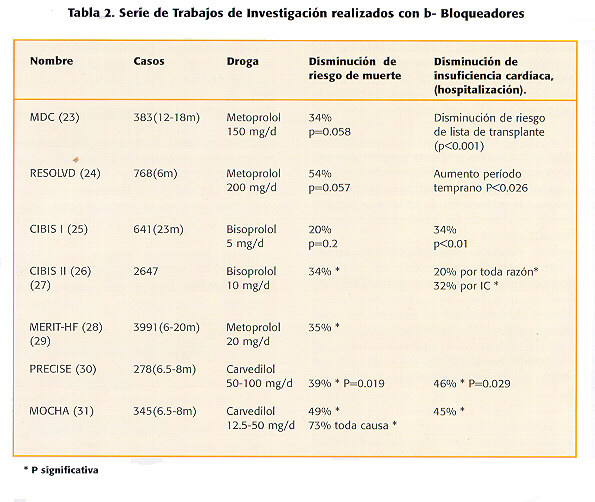
<body><![CDATA[<P><FONT FACE="Arial"><FONT SIZE=-1>Los diur&eacute;ticos son drogas que aumentan la excreci&oacute;n urinaria de sodio, por lo que funcionan en los pacientes con insuficiencia card&iacute;aca al atenuar la sobrecarga de l&iacute;quidos. Dentro de las razones fundamentales para usar diur&eacute;ticos en insuficiencia card&iacute;aca, est&aacute; el hecho de que alivian los s&iacute;ntomas m&aacute;s r&aacute;pido que otros f&aacute;rmacos, constituyen el &uacute;nico grupo de drogas adecuado ante la retenci&oacute;n de l&iacute;quidos, y su uso apropiado es un elemento clave en el tratamiento exitoso con otras drogas.</FONT></FONT>      <P><FONT FACE="Arial"><FONT SIZE=-1>La meta con el uso de diur&eacute;ticos es mejorar o eliminar los s&iacute;ntomas en los pacientes con insuficiencia card&iacute;aca, sin embargo sus efectos sobre morbimortalidad a&uacute;n no se conocen, por lo que no deben usarse solos, sino en combinaci&oacute;n con otras drogas. Se recomienda la combinaci&oacute;n con IECA y beta bloqueadores, y se ha visto que el uso a largo plazo de estas drogas puede disminuir la necesidad de diur&eacute;ticos en ciertos pacientes. En grandes estudios multic&eacute;ntricos realizados con pacientes bien controlados en relaci&oacute;n con s&iacute;ntomas y retenci&oacute;n de l&iacute;quidos, se ha demostrado que los diur&eacute;ticos solos son incapaces de mantener estabilidad cl&iacute;nica a largo plazo, sin embargo el riesgo de descompensaci&oacute;n se disminuye al combinar diur&eacute;ticos con digoxina o IECA. (<A HREF="#8">8</A>) (<A HREF="#9">9</A>) (<A HREF="#10">10</A>) (<A HREF="#11">11</A>).</FONT></FONT>      <P><FONT FACE="Arial"><FONT SIZE=-1>Ante la resistencia a los diur&eacute;ticos, que puede aparece en la evoluci&oacute;n de la insuficiencia card&iacute;aca, se puede corregir con la administraci&oacute;n intravenosa de estas drogas, con la combinaci&oacute;n de dos a m&aacute;s diur&eacute;ticos, o utilizando f&aacute;rmacos que incrementen el flujo renal por corto tiempo como Dopamina o Dobutamina. Debe evitarse el uso de AINES ya que pueden inhibir el efecto natriur&eacute;tico de muchos diur&eacute;ticos (especialmente los de asa), y potenciar la tendencia de estos a causar azotemia.</FONT></FONT>      <P><FONT FACE="Arial"><FONT SIZE=-1>El uso de diur&eacute;ticos acarrea riesgos para el paciente tales como el desbalance de electrolitos (potasio y magnesio), la activaci&oacute;n neurohumoral especialmente del sistema renina angiotensina aldosterona, hipotensi&oacute;n y azotemia.</FONT></FONT>     <BR>&nbsp;     <BR>&nbsp;     <BR><B><FONT FACE="Arial"><FONT SIZE=-1>IECA.</FONT></FONT></B>      <P><FONT FACE="Arial"><FONT SIZE=-1>Hay cinco IECA aprobados por la FDA para el tratamiento de la insuficiencia card&iacute;aca: Captopril, Enalapril, Lisinopril, Quinapril y Fosinopril. El Ramipril est&aacute; aprobado para la insuficiencia card&iacute;aca post infarto agudo al miocardio.</FONT></FONT>      <P><FONT FACE="Arial"><FONT SIZE=-1>En muchos (pero no todos) modelos experimentales de insuficiencia card&iacute;aca, los IECA tienen efectos favorables sobre la remodelaci&oacute;n card&iacute;aca y la supervivencia. (<A HREF="#12">12</A>) (<A HREF="#13">13</A>) (<A HREF="#14">14</A>) (<A HREF="#15">15</A><B>)</B></FONT></FONT>     <CENTER><A NAME="tabla1"></A><IMG SRC="/img/fbpe/rcc/v3n2/0913i1.GIF" BORDER=0 HEIGHT=236 WIDTH=650></CENTER>      
]]></body>
<body><![CDATA[<CENTER>&nbsp;</CENTER>      <CENTER>&nbsp;</CENTER>      <CENTER><A NAME="tabla2"></A><IMG SRC="/img/fbpe/rcc/v3n2/0913i2.JPG" HEIGHT=502 WIDTH=595></CENTER> &nbsp;      
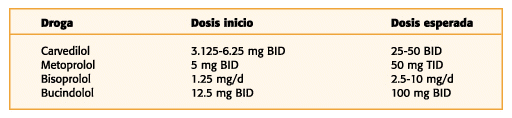
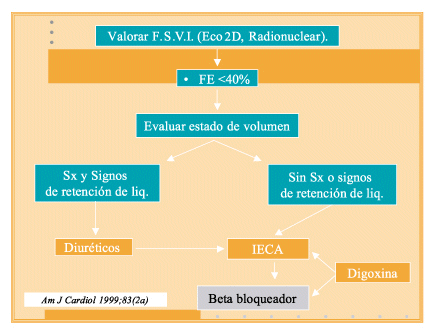
<P><FONT FACE="Arial"><FONT SIZE=-1>Todo paciente con insuficiencia card&iacute;aca NYHA clase II o III, debe recibir un beta bloqueador; sin embargo no deben usarse para estabilizar pacientes con descompensaciones agudas incluyendo aquellos que tienen retenci&oacute;n significativa de l&iacute;quidos, que est&eacute;n recibiendo terapia intravenosa para la insuficiencia card&iacute;aca, o que requieran hospitalizaci&oacute;n por la enfermedad. A&uacute;n se necesitan m&aacute;s datos para confirmar el uso de estas drogas en pacientes con insuficiencia card&iacute;aca NYHA clase IV. Sin embargo, el estudio COPERNICUS, valor&oacute; el uso de carvedilol en 2289 pacientes con NYHA clase IV de insuficiencia card&iacute;aca, con un tasa de mortalidad con placebo de 18.5%, y un efecto marcadamente positivo del carvedilol sobre estos pacientes. Esta serie se detuvo el 14 de marzo del 2000, (<A HREF="#32">32</A>) demostrando un beneficio significativo con el uso de carvedilol, con una reducci&oacute;n de un 35% de todas las causas de mortalidad en comparaci&oacute;n con placebo.</FONT></FONT>      <P><FONT FACE="Arial"><FONT SIZE=-1>El uso combinado de beta bloqueadores con IECA muestra beneficios aditivos.</FONT></FONT>      <P><FONT FACE="Arial"><FONT SIZE=-1>Antes de iniciar tratamiento con beta bloqueadores, se debe asegurar que la dosis de diur&eacute;ticos es &oacute;ptima. La mejor&iacute;a sintom&aacute;tica se observa 2 a 3 meses despu&eacute;s del inicio con &eacute;sta droga, sin embargo, a pesar de no haber mejor&iacute;a sintom&aacute;tica en este per&iacute;odo el riesgo de progresi&oacute;n de la enfermedad disminuye.</FONT></FONT>      <P><FONT FACE="Arial"><FONT SIZE=-1>A pesar de que varios beta bloqueadores han mostrado ser efectivos en series cl&iacute;nicas controladas, solo Carvedilol ha sido aprobado por la FDA para el manejo de la insuficiencia card&iacute;aca. La hip&oacute;tesis de las ventajas de bloqueadores no selectivos sobre los selectivos esta siendo evaluada por el estudio COMET, con m&aacute;s de 3 mil pacientes por 4 a&ntilde;os, con resultados hasta el 2001.</FONT></FONT>     <BR>&nbsp;     <CENTER><IMG SRC="/img/fbpe/rcc/v3n2/0913i3.GIF" BORDER=0 HEIGHT=118 WIDTH=512></CENTER>       
<P><FONT FACE="Arial"><FONT SIZE=-1>Los efectos secundarios pueden aparecer al inicio del tratamiento, sin embargo hay buena tolerancia a largo plazo. Dentro de los riesgos del tratamiento est&aacute;n la hipotensi&oacute;n, la retenci&oacute;n de l&iacute;quidos y el empeoramiento de la insuficiencia card&iacute;aca, el bloqueo card&iacute;aco y la bradicardia.</FONT></FONT>     ]]></body>
<body><![CDATA[<BR>&nbsp;      <P><FONT FACE="Arial"><FONT SIZE=-1><B>Digit&aacute;licos</B>.</FONT></FONT>      <P><FONT FACE="Arial"><FONT SIZE=-1>Estas drogas inhiben la bomba Na K ATPasa a nivel sist&eacute;mico; la inhibici&oacute;n de &eacute;sta a nivel vagal sensibiliza barorreceptores card&iacute;acos lo que causa disminuci&oacute;n de est&iacute;mulo simp&aacute;tico; a nivel renal se disminuye la reabsorci&oacute;n de sodio y se suprime la secreci&oacute;n de renina, reduciendo as&iacute; los efectos del sistema renina angiotensina aldosterona.</FONT></FONT>      <P><FONT FACE="Arial"><FONT SIZE=-1>En la insuficiencia card&iacute;aca, los digit&aacute;licos act&uacute;an principalmente atenuando la activaci&oacute;n de sistemas neurohormonales, y no como inotr&oacute;picos positivos. (<A HREF="#33">33</A>) (<A HREF="#34">34</A>) (<A HREF="#35">35</A>) (<A HREF="#36">36</A>).</FONT></FONT>      <P><FONT FACE="Arial"><FONT SIZE=-1>La digoxina es el &uacute;nico gluc&oacute;sido card&iacute;aco evaluado en series controladas con placebo por la FDA. En un grupo de series DIG (Digitalis Investigation Grop) con 6800 pacientes, el tratamiento con digoxina no afect&oacute; la sobrevida, aunque disminuy&oacute; el riesgo de hospitalizaci&oacute;n por insuficiencia card&iacute;aca en un 28%. (<A HREF="#37">37</A>)</FONT></FONT>     <BR>&nbsp;      <P><B><FONT FACE="Arial"><FONT SIZE=-1>Usos cl&iacute;nicos de la digoxina:</FONT></FONT></B>      <P><FONT FACE="Arial"><FONT SIZE=-1>La digoxina est&aacute; recomendada para mejorar la condici&oacute;n cl&iacute;nica en la disfunci&oacute;n sist&oacute;lica ventricular izquierda, y debe ser usada en combinaci&oacute;n con diur&eacute;ticos, IECA y beta bloqueadores. Tambi&eacute;n se recomienda su uso en los casos de fibrilaci&oacute;n auricular. No hay datos para recomendar el uso de digoxina en pacientes con NYHA clase I. Tampoco esta indicada para estabilizar pacientes con descompensaciones agudas de insuficiencia card&iacute;aca, excepto ante fibrilaci&oacute;n auricular.</FONT></FONT>      <P><FONT FACE="Arial"><FONT SIZE=-1>Existe poca relaci&oacute;n entre los niveles s&eacute;ricos de digoxina y los efectos terap&eacute;uticos, y no se sabe si grandes dosis son m&aacute;s efectivas que peque&ntilde;as dosis en el manejo de la insuficiencia card&iacute;aca. En cuanto a la toxicidad con digoxina, &eacute;sta puede ocurrir con niveles menores, especialmente si hay hipokalemia, hipomagnesemia o hipotiroidismo, casos en que hay que valorar el uso de estas drogas. La digoxina es bien tolerada en muchos pacientes con insuficiencia card&iacute;aca. (<A HREF="#38">38</A>) (<A HREF="#39">39</A>) (<A HREF="#40">40</A>) (<A HREF="#41">41</A>).</FONT></FONT>      <P><FONT FACE="Arial"><FONT SIZE=-1>Pueden utilizarse dosis de 0,25 mg por d&iacute;a, aunque dosis menores como 0,125 mg por d&iacute;a o cada dos d&iacute;as pueden tener efectos apropiados. Se recomiendan dosis bajas especialmente en pacientes mayores de 70 a&ntilde;os o con insuficiencia renal cr&oacute;nica. Dosis mayores, como 0,375-05 mg por d&iacute;a son a veces utilizadas en casos de fibrilaci&oacute;n atrial con alta respuesta ventricular. A&uacute;n no se sabe si a largo plazo el uso de dosis terap&eacute;uticas ejerce efectos adversos sobre el coraz&oacute;n.</FONT></FONT>     ]]></body>
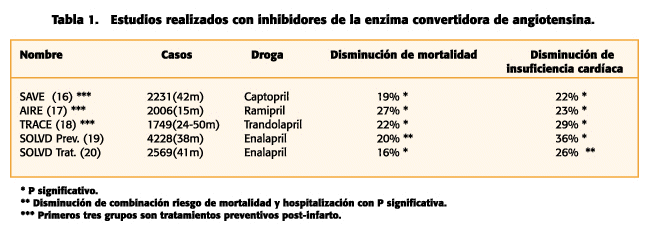
<body><![CDATA[<CENTER></CENTER>      <CENTER><A NAME="fig1"></A><B><FONT FACE="Arial"><FONT SIZE=-1>Tratamiento combinado en la disfunci&oacute;n s&iacute;stolica ventricular.(fig.1)</FONT></FONT></B></CENTER>      <CENTER><B><FONT FACE="Arial"><FONT SIZE=-1>&nbsp;</FONT></FONT></B></CENTER>      <CENTER><IMG SRC="/img/fbpe/rcc/v3n2/0913i4.GIF" BORDER=0 HEIGHT=335 WIDTH=433></CENTER>       
<P><FONT FACE="Arial"><FONT SIZE=-1>En pacientes con disfunci&oacute;n ventricular izquierda (FE&lt;40%), en caso de retenci&oacute;n de l&iacute;quidos se utilizan inicialmente los diur&eacute;ticos, puede agregarse terapia con IECA. Los beta bloqueadores se pueden utilizar cuando no hay datos cl&iacute;nicos de retenci&oacute;n de l&iacute;quidos. En pacientes sin retenci&oacute;n de l&iacute;quidos, se inicia la terapia con IECA y beta bloqueador. La digoxina se utiliza asociado a IECA y beta bloqueador tempranamente cuando los pacientes son sintom&aacute;ticos, o cuando aparecen s&iacute;ntomas durante la terapia con estas dos drogas. (<A HREF="#42">42</A>).</FONT></FONT>     <BR>&nbsp;      <P><B><FONT FACE="Arial"><FONT SIZE=-1>Otras drogas.</FONT></FONT></B>      <P><FONT FACE="Arial"><FONT SIZE=-1>Drogas no aprobadas, recomendadas para el uso en algunos pacientes.</FONT></FONT>     <BLOCKQUOTE><FONT FACE="Arial"><FONT SIZE=-1><B>1.</B> Hidralazina y Dinitrato de isosorbide.</FONT></FONT>     <BR><FONT FACE="Arial"><FONT SIZE=-1><B>2</B>. Bloqueadores de receptores de angiotensina.</FONT></FONT>     ]]></body>
<body><![CDATA[<BR><FONT FACE="Arial"><FONT SIZE=-1><B>3.</B> Antagonistas de Aldosterona.</FONT></FONT>     <BR><FONT FACE="Arial"><FONT SIZE=-1><B>4.</B> Calcio antagonistas.</FONT></FONT>     <BR><FONT FACE="Arial"><FONT SIZE=-1><B>5.</B> Antiarr&iacute;tmicos.</FONT></FONT>     <BR><FONT FACE="Arial"><FONT SIZE=-1><B>6.</B> Anticoagulantes.</FONT></FONT>     <BR>&nbsp;</BLOCKQUOTE> <B><FONT FACE="Arial"><FONT SIZE=-1>Hidralazina y Dinitrato de isosorbide.</FONT></FONT></B>      <P><FONT FACE="Arial"><FONT SIZE=-1>El uso de vasodilatadores por v&iacute;a intravenosa tiene efectos hemodin&aacute;micos favorables para el tratamiento a corto plazo de descompensaciones agudas de insuficiencia card&iacute;aca; sin embargo el uso a largo plazo no produce beneficios, e incluso puede incrementar el riesgo de insuficiencia card&iacute;aca y muerte. (<A HREF="#43">43</A>) (<A HREF="#44">44</A>) (<A HREF="#45">45</A>)</FONT></FONT>      <P><FONT FACE="Arial"><FONT SIZE=-1>Hay evidencia reciente que sugiere que la hidralazina y el dinitrato de isosorbide act&uacute;an a un nivel principalmente bioqu&iacute;mico. Mientras la hidralazina tiene efectos antioxidantes que pueden interferir con los mecanismos bioqu&iacute;micos y moleculares responsables de la progresi&oacute;n de la insuficiencia card&iacute;aca, los nitratos inhiben el crecimiento anormal del miocardio y los vasos, atenuando el proceso de remodelaci&oacute;n ventricular. (<A HREF="#46">46</A>) (<A HREF="#47">47</A>) (<A HREF="#48">48</A>) (<A HREF="#49">49</A>) (<A HREF="#50">50</A>) (<A HREF="#51">51</A>).</FONT></FONT>      <P><FONT FACE="Arial"><FONT SIZE=-1>En el estudio V-HeFT I se muestra que la combinaci&oacute;n de los dos medicamentos reduce la mortalidad de 25-30% en comparaci&oacute;n con Prazosin. (<A HREF="#52">52</A>)</FONT></FONT>      <P><FONT FACE="Arial"><FONT SIZE=-1>El estudio V-HeFT II muestra que el tratamiento con Enalapril se relaciona con una reducci&oacute;n del riesgo de muerte a los 2 a&ntilde;os de un 28% en comparaci&oacute;n con la combinaci&oacute;n de vasodilatadores. Sin embargo, la combinaci&oacute;n de vasodilatadores tuvo efectos m&aacute;s favorables sobre la fracci&oacute;n de eyecci&oacute;n y la tolerancia al ejercicio que los IECA. (<A HREF="#53">53</A>)</FONT></FONT>      <P><FONT FACE="Arial"><FONT SIZE=-1>La combinaci&oacute;n de hidralazina y dinitrato de isosorbide es una terapia alternativa efectiva ante la intolerancia y/o contraindicaci&oacute;n a los IECA, sin embargo a&uacute;n faltan datos para comprobar su beneficio (<A HREF="#54">54</A>). Estos f&aacute;rmacos no est&aacute;n aprobados por la FDA.</FONT></FONT>      ]]></body>
<body><![CDATA[<P><FONT FACE="Arial"><FONT SIZE=-1>Dosis: Al inicio con hidralazina 25 mg TID y dinitrato de Isosorbide 10 mg TID, hasta 75 mg de hidralazina TID y 40 mg de dinitrato de isosorbide TID.</FONT></FONT>     <BR>&nbsp;      <P><B><FONT FACE="Arial"><FONT SIZE=-1>Bloqueadores del receptor de angiotensina.</FONT></FONT></B>      <P><FONT FACE="Arial"><FONT SIZE=-1>El estudio ELITE con Losartan se asoci&oacute; con un 46% de menor riesgo de muerte en comparaci&oacute;n con Captopril, sin embargo no hubo significancia en cuanto a sobrevida, y tampoco hubo diferencia en cuanto a la frecuencia de hospitalizaci&oacute;n por insuficiencia card&iacute;aca, ni en el riesgo combinado de morbilidad y mortalidad. (<A HREF="#55">55</A>)</FONT></FONT>      <P><FONT FACE="Arial"><FONT SIZE=-1>El estudio ELITE II (<A HREF="#68">68</A>), con 288 centros en 45 pa&iacute;ses, con 3152 pacientes en tratamiento con Losartan, realizado para evaluar los efectos de &eacute;ste medicamento comparado con Captopril sobre la mortalidad de pac. con ICC sintom&aacute;tica por un per&iacute;odo de seguimiento promedio de 1,5 a&ntilde;os; mostr&oacute; que el Losartan no fue superior al Captopril en reducir la mortalidad en pac. mayores de 60 a&ntilde;os con ICC. Sin embargo, Losartan fue mejor tolerado que el Captopril. Otros estudios en proceso son ValHeFT y CHARM. (<A HREF="#56">56</A>)</FONT></FONT>      <P><FONT FACE="Arial"><FONT SIZE=-1>Por falta de evidencia concluyente que soporte el uso de los bloqueadores del receptor de angiotensina II, estas drogas se prescriben solo al haber intolerancia a IECA. Sin embargo, estas drogas, al igual que IECA tambi&eacute;n producen hipotensi&oacute;n, empeoramiento de funci&oacute;n renal e hiperkalemia.</FONT></FONT>      <P><FONT FACE="Arial"><FONT SIZE=-1>Muchos bloqueadores del receptor de angiotensina II se han aprobado para el uso en hipertensi&oacute;n arterial, pero ninguno se ha aprobado en insuficiencia card&iacute;aca.</FONT></FONT>     <BR>&nbsp;      <P><B><FONT FACE="Arial"><FONT SIZE=-1>Antagonistas de aldosterona.</FONT></FONT></B>      <P><FONT FACE="Arial"><FONT SIZE=-1>La aldosterona puede tener efectos adversos sobre la estructura y funci&oacute;n del coraz&oacute;n as&iacute; como de la circulaci&oacute;n perif&eacute;rica; por esto, el bloqueo de la aldosterona puede jugar un papel importante sobre la disminuci&oacute;n del riesgo de progresi&oacute;n de la insuficiencia card&iacute;aca.</FONT></FONT>      ]]></body>
<body><![CDATA[<P><FONT FACE="Arial"><FONT SIZE=-1>En el estudio RALES, realizado con 1663 pacientes NYHA clase IV, se utilizaron dosis de 25 mg/d de espironolactona por 24 meses asociado a terapia convencional, randomizado con placebo; y se demostr&oacute; que la espironolactona se asoci&oacute; con una reducci&oacute;n de la mortalidad en un 27%, disminuci&oacute;n en hospitalizaciones por insuficiencia card&iacute;aca de un 36%, y reducci&oacute;n de un 22% en el riesgo combinado de muerte u hospitalizaci&oacute;n.</FONT></FONT>      <P><FONT FACE="Arial"><FONT SIZE=-1>El uso de dosis bajas de espironolactona debe considerarse en pacientes con clase IV, sin embargo, su eficacia y seguridad en insuficiencia card&iacute;aca de leve a moderada a&uacute;n se desconoce. (<A HREF="#57">57</A>) (<A HREF="#58">58</A>)</FONT></FONT>     <BR>&nbsp;      <P><B><FONT FACE="Arial"><FONT SIZE=-1>Calcio antagonistas.</FONT></FONT></B>      <P><FONT FACE="Arial"><FONT SIZE=-1>La administraci&oacute;n de los calcio antagonistas no produce mejor&iacute;a sintom&aacute;tica ni mayor tolerancia al ejercicio, adem&aacute;s el tratamiento a corto o largo plazo puede ocasionar reacciones adversas a nivel cardiovascular.</FONT></FONT>      <P><FONT FACE="Arial"><FONT SIZE=-1>Recientes estudios han enfocado el uso de nuevos calcio antagonistas en pacientes con insuficiencia card&iacute;aca cr&oacute;nica, tales como amlodipina, felodipina. El estudio RAISE, realizado con 1153 pacientes utilizando amlodipina, no muestra ning&uacute;n efecto sobre el riesgo combinado de muerte y hospitalizaci&oacute;n; a pesar de esto se observ&oacute; una tendencia a la disminuci&oacute;n de todas las causas de mortalidad. En casos de miocardiopat&iacute;a no isqu&eacute;mica, amlodipina se ha asociado con una disminuci&oacute;n del 45% en el riesgo de muerte. (<A HREF="#59">59</A>) Por falta de evidencia que apoye, los calcio antagonistas no deben ser usados para el tratamiento de la insuficiencia card&iacute;aca.</FONT></FONT>     <BR>&nbsp;      <P><B><FONT FACE="Arial"><FONT SIZE=-1>Antiarritmicos.</FONT></FONT></B>      <P><FONT FACE="Arial"><FONT SIZE=-1>Todos los antiarr&iacute;tmicos pueden suprimir ritmos ventriculares ect&oacute;picos en pacientes con insuficiencia card&iacute;aca, pero esta acci&oacute;n no ha llevado a la reducci&oacute;n del riesgo de muerte s&uacute;bita en series controladas. En general estos f&aacute;rmacos no son recomendados para pacientes con arritmias ventriculares asintom&aacute;ticas o no sostenidas. S&iacute; debe considerarse el uso de antiarr&iacute;tmicos o dispositivos especiales en:</FONT></FONT>      <P><FONT FACE="Arial"><FONT SIZE=-1><B>1.</B> Taquicardia ventricular sostenida o hemodin&aacute;micamente desestabilizante, fibrilaci&oacute;n ventricular, o historia de resucitaci&oacute;n de muerte s&uacute;bita.</FONT></FONT>      ]]></body>
<body><![CDATA[<P><FONT FACE="Arial"><FONT SIZE=-1><B>2.</B> Arritmias atriales recurrentes o sostenidas, asociadas a s&iacute;ntomas, inestabilidad hemodin&aacute;mica o alta respuesta ventricular.</FONT></FONT>      <P><FONT FACE="Arial"><FONT SIZE=-1>Los antiarr&iacute;tmicos clase I no deben ser usados en pacientes con ICC. Algunos de clase III no parecen incrementar el riesgo de muerte en pacientes con ICC, y pueden usarse para el tratamiento de arritmias atriales en disfunci&oacute;n ventricular izquierda como Amidarona.</FONT></FONT>      <P><FONT FACE="Arial"><FONT SIZE=-1>La amiodarona no se recomienda como uso general para prevenir la muerte en pacientes con ICC que ya est&eacute;n tratados con drogas que reduzcan la mortalidad.</FONT></FONT>      <P><FONT FACE="Arial"><FONT SIZE=-1>Al utilizar antiarr&iacute;tmicos, se debe monitorear y corregir los niveles de potasio y magnesio.</FONT></FONT>     <BR>&nbsp;      <P><B><FONT FACE="Arial"><FONT SIZE=-1>Anticoagulantes.</FONT></FONT></B>      <P><FONT FACE="Arial"><FONT SIZE=-1>El riesgo de tromboembolismo en pacientes cl&iacute;nicamente estables es bajo (1-3% por a&ntilde;o) a&uacute;n en aquellos con FE deprimida o con evidencia ecocardiogr&aacute;fica de trombos intracard&iacute;acos. (<A HREF="#60">60</A>) (<A HREF="#61">61</A>) (<A HREF="#62">62</A>) (<A HREF="#63">63</A>) (<A HREF="#64">64</A>)</FONT></FONT>      <P><FONT FACE="Arial"><FONT SIZE=-1>Algunos autores describen que el accidente vascular cerebral (AVC) no tiene relaci&oacute;n con la severidad de la insuficiencia card&iacute;aca; sin embargo, estudios muestran un 18% de aumento en el riesgo de eventos cerebrovasculares en hombres por cada 5% que disminuya la fracci&oacute;n de eyecci&oacute;n, pero el incremento de &eacute;ste riesgo no es significativo. Para las mujeres, existe un 58% de aumento en el riesgo de eventos de tromboembolismo por cada 10% de disminuci&oacute;n de la fracci&oacute;n de eyecci&oacute;n. Mientras la tasa de AVC en mujeres es de 1.4% anual con FE de 21 a 30%, esta incrementa 2.4% por a&ntilde;o con FE de 10% o menos; esto demuestra que las pacientes femeninas con fracciones de eyecci&oacute;n menor tienen mayor tendencia al AVC.</FONT></FONT>      <P><FONT FACE="Arial"><FONT SIZE=-1>Por otro lado, la tasa de AVC recurrente es mucho mayor que la tasa del primer episodio de AVC en pacientes con insuficiencia card&iacute;aca. Se documenta que la tasa de AVC recurrente a los cinco a&ntilde;os del primer episodio es de un 45%. En cuanto a la tasa de hemorragia intracerebral, esta es de 0.3% por a&ntilde;o con el uso de warfarina (INR 2.8-4.8), y se acerca a 0.2% con aspirina; y la tasa de sangrado mayor es de 1.3-1.5%; se deduce entonces que la anticoagulaci&oacute;n en prevenci&oacute;n primaria tiene beneficio limitado.</FONT></FONT>      <P><FONT FACE="Arial"><FONT SIZE=-1>Para definir el beneficio de la anticoagulaci&oacute;n en la disfunci&oacute;n ventricular sist&oacute;lica hay dos estudios en proceso, WATCH y WARCEF, los cuales tienen una duraci&oacute;n de 3 a 5 a&ntilde;os, y se espera definan la utilidad de la terapia anticoagulante en la insuficiencia card&iacute;aca (<A HREF="#65">65</A>).</FONT></FONT>      ]]></body>
<body><![CDATA[<P><FONT FACE="Arial"><FONT SIZE=-1>Dentro de las recomendaciones para el uso de Warfarina est&aacute;n: (<A HREF="#54">54</A>) (<A HREF="#66">66</A>) (<A HREF="#67">67</A>)</FONT></FONT>     <BLOCKQUOTE><FONT FACE="Arial"><FONT SIZE=-1><B>1.</B> Trombos ventriculares documentados por ecocardiograf&iacute;a.</FONT></FONT>     <BR><FONT FACE="Arial"><FONT SIZE=-1><B>2.</B> Fibrilaci&oacute;n atrial.</FONT></FONT>     <BR><FONT FACE="Arial"><FONT SIZE=-1><B>3.</B> Embolismo pulmonar y trombosis venosa profunda cr&oacute;nica, o eventos emb&oacute;licos previos.</FONT></FONT>     <BR><FONT FACE="Arial"><FONT SIZE=-1><B>4.</B> Post infarto agudo al miocardio de cara anterior.</FONT></FONT>     <BR><FONT FACE="Arial"><FONT SIZE=-1>&nbsp;</FONT></FONT></BLOCKQUOTE> <B><FONT FACE="Arial"><FONT SIZE=-1>Terapia inotr&oacute;pica positiva.</FONT></FONT></B>      <P><FONT FACE="Arial"><FONT SIZE=-1>Por la falta de datos que demuestren eficacia y consenso acerca de la toxicidad; el uso intermitente de infusiones de inotr&oacute;picos positivos no se recomienda en el tratamiento de la insuficiencia card&iacute;aca, incluso en estadios avanzados. M&aacute;s a&uacute;n, el uso a largo plazo de inotr&oacute;picos positivos intravenosos pueden aumentar el riesgo de muerte; sin embargo pueden ser necesarios en pacientes seleccionados como aquellos refractarios a tratamiento, quienes no pueden dejar la terapia intravenosa, o aquellos que no pueden egresar del hospital debido a su pobre respuesta al tratamiento.</FONT></FONT>     <BR>&nbsp;      <P><B><FONT FACE="Arial"><FONT SIZE=-1>Conclusiones</FONT></FONT></B>      <P><FONT FACE="Arial"><FONT SIZE=-1>La Insuficiencia Card&iacute;aca Congestiva Cr&oacute;nica es una enfermedad com&uacute;n con incidencia y prevalencia crecientes que representa un reto a la Salud P&uacute;blica en siglo XXI. Existen variadas opciones terap&eacute;uticas, algunas de ellas con suficiente soporte cient&iacute;fico que respaldan su uso en la mayo&iacute;a de los pacientes, si no existen contraindicaciones (IECA, algunos betabloqueantes y la Espironolactona) y otras alternativas dependiendo de la condici&oacute;n individual de cada paciente, tambi&eacute;n de demostrada efectividad pero sin influencias significativas sobre la mortalidad.</FONT></FONT>      ]]></body>
<body><![CDATA[<P><FONT FACE="Arial"><FONT SIZE=-1>En &uacute;ltimo caso y como todo en Medicina, de acuerdo al juicio sabio y actualizado del m&eacute;dico que mantiene un estrecho seguimiento de la terap&uacute;tica, haciendo los ajustes pertinentes, durante una fluida relaci&oacute;n con su paciente, se lograr&aacute;n los mayores beneficios en una enfermedad que hoy por hoy no tiene cura definitiva.</FONT></FONT>     <BR>&nbsp;      <P><B><FONT FACE="Arial"><FONT SIZE=-1>Referencias</FONT></FONT></B>      <!-- ref --><P><A NAME="1"></A><FONT FACE="Arial,Helvetica"><FONT SIZE=-1>1. Khan, M. G. Heart disease diagnosis and therapy: a practical approach. Williams &amp; Wilkins, 1996: 191.</FONT></FONT>    &nbsp;&nbsp;&nbsp;&nbsp;&nbsp;&nbsp;&nbsp;&nbsp;[&#160;<a href="javascript:void(0);" onclick="javascript: window.open('/scielo.php?script=sci_nlinks&ref=730824&pid=S1409-4142200100020000600001&lng=','','width=640,height=500,resizable=yes,scrollbars=1,menubar=yes,');">Links</a>&#160;]<!-- end-ref --><!-- ref --><P><A NAME="2"></A><FONT FACE="Arial,Helvetica"><FONT SIZE=-1>2. Colucci, W. S. Molecular and cellular mechanisms of myocardial failure. Am J Cardiol 1997;80(11A)15L-25L</FONT></FONT>    &nbsp;&nbsp;&nbsp;&nbsp;&nbsp;&nbsp;&nbsp;&nbsp;[&#160;<a href="javascript:void(0);" onclick="javascript: window.open('/scielo.php?script=sci_nlinks&ref=730825&pid=S1409-4142200100020000600002&lng=','','width=640,height=500,resizable=yes,scrollbars=1,menubar=yes,');">Links</a>&#160;]<!-- end-ref --><!-- ref --><P><A NAME="3"></A><FONT FACE="Arial,Helvetica"><FONT SIZE=-1>3. Esler, M., et al. Adrenergic nervous system in heart failure. Am J Cardiol 1997;80(11A):7L-14L</FONT></FONT>    &nbsp;&nbsp;&nbsp;&nbsp;&nbsp;&nbsp;&nbsp;&nbsp;[&#160;<a href="javascript:void(0);" onclick="javascript: window.open('/scielo.php?script=sci_nlinks&ref=730826&pid=S1409-4142200100020000600003&lng=','','width=640,height=500,resizable=yes,scrollbars=1,menubar=yes,');">Links</a>&#160;]<!-- end-ref --><!-- ref --><P><A NAME="4"></A><FONT FACE="Arial,Helvetica"><FONT SIZE=-1>4. Francis, G. S., Cohn, J. N., Johnson, G. et al. Plasma norepinephrine, plasma renin activity and congestive heart failure. Relations to survival and the effects of therapy in V-HeFT II follow-up. Circulation 1993; 87(Suppl VI): VI-40-8.</FONT></FONT>    &nbsp;&nbsp;&nbsp;&nbsp;&nbsp;&nbsp;&nbsp;&nbsp;[&#160;<a href="javascript:void(0);" onclick="javascript: window.open('/scielo.php?script=sci_nlinks&ref=730827&pid=S1409-4142200100020000600004&lng=','','width=640,height=500,resizable=yes,scrollbars=1,menubar=yes,');">Links</a>&#160;]<!-- end-ref --><!-- ref --><P><A NAME="5"></A><FONT FACE="Arial,Helvetica"><FONT SIZE=-1>5. Bristoco, M. R. Mechanism of action of beta-blocking agents in heart failure. Am J Cardiol 1997;80(11A)26L-40L</FONT></FONT>    &nbsp;&nbsp;&nbsp;&nbsp;&nbsp;&nbsp;&nbsp;&nbsp;[&#160;<a href="javascript:void(0);" onclick="javascript: window.open('/scielo.php?script=sci_nlinks&ref=730828&pid=S1409-4142200100020000600005&lng=','','width=640,height=500,resizable=yes,scrollbars=1,menubar=yes,');">Links</a>&#160;]<!-- end-ref --><!-- ref --><P><A NAME="6"></A><FONT FACE="Arial,Helvetica"><FONT SIZE=-1>6. Jackson, G., et al. ABC of heart failure: pathophysiology. BMJ 2000; 320: 167-169.</FONT></FONT>    &nbsp;&nbsp;&nbsp;&nbsp;&nbsp;&nbsp;&nbsp;&nbsp;[&#160;<a href="javascript:void(0);" onclick="javascript: window.open('/scielo.php?script=sci_nlinks&ref=730829&pid=S1409-4142200100020000600006&lng=','','width=640,height=500,resizable=yes,scrollbars=1,menubar=yes,');">Links</a>&#160;]<!-- end-ref --><!-- ref --><P><A NAME="7"></A><FONT FACE="Arial,Helvetica"><FONT SIZE=-1>7. Cohn, J. N. Overview of the treatment of heart failure. Am J Cardiol 1997;80(11A-6L)</FONT></FONT>    &nbsp;&nbsp;&nbsp;&nbsp;&nbsp;&nbsp;&nbsp;&nbsp;[&#160;<a href="javascript:void(0);" onclick="javascript: window.open('/scielo.php?script=sci_nlinks&ref=730830&pid=S1409-4142200100020000600007&lng=','','width=640,height=500,resizable=yes,scrollbars=1,menubar=yes,');">Links</a>&#160;]<!-- end-ref --><!-- ref --><P><A NAME="8"></A><FONT FACE="Arial,Helvetica"><FONT SIZE=-1>8. Wilson JR, et al. Effect of diuresis on the performance of the failing left ventricle in man. Am J Med 1981; 70:234-239</FONT></FONT>    &nbsp;&nbsp;&nbsp;&nbsp;&nbsp;&nbsp;&nbsp;&nbsp;[&#160;<a href="javascript:void(0);" onclick="javascript: window.open('/scielo.php?script=sci_nlinks&ref=730831&pid=S1409-4142200100020000600008&lng=','','width=640,height=500,resizable=yes,scrollbars=1,menubar=yes,');">Links</a>&#160;]<!-- end-ref --><!-- ref --><P><A NAME="9"></A><FONT FACE="Arial,Helvetica"><FONT SIZE=-1>9. Parker JO. The effects of oral ibopamine in patients with mild heart failure: a double-blind placebo controlled comparison of furosemide. Int J Cardiol 1993;40:221-227.</FONT></FONT>    &nbsp;&nbsp;&nbsp;&nbsp;&nbsp;&nbsp;&nbsp;&nbsp;[&#160;<a href="javascript:void(0);" onclick="javascript: window.open('/scielo.php?script=sci_nlinks&ref=730832&pid=S1409-4142200100020000600009&lng=','','width=640,height=500,resizable=yes,scrollbars=1,menubar=yes,');">Links</a>&#160;]<!-- end-ref --><!-- ref --><P><A NAME="10"></A><FONT FACE="Arial,Helvetica"><FONT SIZE=-1>10. Richardson A, et al. Double- blind comparison of captopril alone against frusemide plus amiloride in mild heart failure. Lancet 1987;2:709-711.</FONT></FONT>    &nbsp;&nbsp;&nbsp;&nbsp;&nbsp;&nbsp;&nbsp;&nbsp;[&#160;<a href="javascript:void(0);" onclick="javascript: window.open('/scielo.php?script=sci_nlinks&ref=730833&pid=S1409-4142200100020000600010&lng=','','width=640,height=500,resizable=yes,scrollbars=1,menubar=yes,');">Links</a>&#160;]<!-- end-ref --><!-- ref --><P><A NAME="11"></A><FONT FACE="Arial,Helvetica"><FONT SIZE=-1>11. The Captopril-Digoxin Multicenter Research Group. Comparative effects of therapy with captopril and digoxin in patients with mild to moderate heart failure. JAMA 1988;259:539-544.</FONT></FONT>    &nbsp;&nbsp;&nbsp;&nbsp;&nbsp;&nbsp;&nbsp;&nbsp;[&#160;<a href="javascript:void(0);" onclick="javascript: window.open('/scielo.php?script=sci_nlinks&ref=730834&pid=S1409-4142200100020000600011&lng=','','width=640,height=500,resizable=yes,scrollbars=1,menubar=yes,');">Links</a>&#160;]<!-- end-ref --><!-- ref --><P><A NAME="12"></A><FONT FACE="Arial,Helvetica"><FONT SIZE=-1>12. McDonald KM, et al. Relative effects of 1-adrenoreceptor blockade, converting enzyme inhibitor therapy and angiotensin II subtype 1 receptor blockade on ventricular remodeling in the dog. Circulation 1994;90:3034-3046.</FONT></FONT>    &nbsp;&nbsp;&nbsp;&nbsp;&nbsp;&nbsp;&nbsp;&nbsp;[&#160;<a href="javascript:void(0);" onclick="javascript: window.open('/scielo.php?script=sci_nlinks&ref=730835&pid=S1409-4142200100020000600012&lng=','','width=640,height=500,resizable=yes,scrollbars=1,menubar=yes,');">Links</a>&#160;]<!-- end-ref --><!-- ref --><P><A NAME="13"></A><FONT FACE="Arial,Helvetica"><FONT SIZE=-1>13. Mc Donald KM, Mock J, D`Aloia, Parrish T, Hauer K, Francis G, Stillman A, Cohn JN. Bradykinin antagonism inhibits the antigrowth effect of converting enzyme inhibition in the dog myocardium after discrete transmural myocardial necrosis. Circulation 1995;91:2043-2048.</FONT></FONT>    &nbsp;&nbsp;&nbsp;&nbsp;&nbsp;&nbsp;&nbsp;&nbsp;[&#160;<a href="javascript:void(0);" onclick="javascript: window.open('/scielo.php?script=sci_nlinks&ref=730836&pid=S1409-4142200100020000600013&lng=','','width=640,height=500,resizable=yes,scrollbars=1,menubar=yes,');">Links</a>&#160;]<!-- end-ref --><P><A NAME="14"></A><FONT FACE="Arial,Helvetica"><FONT SIZE=-1>14. Lambert C, et al. Comparative study of converting enzyme inhibition and angiotensin II receptor antagonism on survival from chronic heart failure in cardiomyopathic hamsters. (Abstr.) Eur heart J 1998;19 (suppl):132.</FONT></FONT>      <!-- ref --><P><A NAME="15"></A><FONT FACE="Arial,Helvetica"><FONT SIZE=-1>15. Schieffer B, et al. Comparative effects of chronic angiotensin – converting enzyme inhibition and angiotensin II type 1 receptor blockade on cardiac remodeling after myocardial infarction in the rat. Circulation 1994:89:2273-2282.</FONT></FONT>    &nbsp;&nbsp;&nbsp;&nbsp;&nbsp;&nbsp;&nbsp;&nbsp;[&#160;<a href="javascript:void(0);" onclick="javascript: window.open('/scielo.php?script=sci_nlinks&ref=730838&pid=S1409-4142200100020000600015&lng=','','width=640,height=500,resizable=yes,scrollbars=1,menubar=yes,');">Links</a>&#160;]<!-- end-ref --><!-- ref --><P><A NAME="16"></A><FONT FACE="Arial,Helvetica"><FONT SIZE=-1>16. Pfeffer MA, Braunwald E et al. On behalf of the SAVE Investigators. Effect of captopril on mortality and morbidity in patients with left ventricular dysfunction after myocardial infarction: results of the survival and ventricular enlargement trial. N Engl J Med 1992;327:669-677.</FONT></FONT>    &nbsp;&nbsp;&nbsp;&nbsp;&nbsp;&nbsp;&nbsp;&nbsp;[&#160;<a href="javascript:void(0);" onclick="javascript: window.open('/scielo.php?script=sci_nlinks&ref=730839&pid=S1409-4142200100020000600016&lng=','','width=640,height=500,resizable=yes,scrollbars=1,menubar=yes,');">Links</a>&#160;]<!-- end-ref --><!-- ref --><P><A NAME="17"></A><FONT FACE="Arial,Helvetica"><FONT SIZE=-1>17. The Acute Infarction Ramipril Efficacy (AIRE) Study Investigators. Effect of ramipril on mortality and morbidity of survivors of acute myocardial infarction with clinical evidence of heart failure. Lancet 1993;342:821-828.</FONT></FONT>    &nbsp;&nbsp;&nbsp;&nbsp;&nbsp;&nbsp;&nbsp;&nbsp;[&#160;<a href="javascript:void(0);" onclick="javascript: window.open('/scielo.php?script=sci_nlinks&ref=730840&pid=S1409-4142200100020000600017&lng=','','width=640,height=500,resizable=yes,scrollbars=1,menubar=yes,');">Links</a>&#160;]<!-- end-ref --><!-- ref --><P><A NAME="18"></A><FONT FACE="Arial,Helvetica"><FONT SIZE=-1>18. Kober L, Torp-Pedersen C et al. For the Trandolapril Cardiac Evaluation (TRACE) Study Group. A clinical trial of the angiotensin-converting-enzyme inhibitor trandolapril in patients with left ventricular dysfunction after myocardial infarction. N.Engl J Med 1995;333:1670-1676.</FONT></FONT>    &nbsp;&nbsp;&nbsp;&nbsp;&nbsp;&nbsp;&nbsp;&nbsp;[&#160;<a href="javascript:void(0);" onclick="javascript: window.open('/scielo.php?script=sci_nlinks&ref=730841&pid=S1409-4142200100020000600018&lng=','','width=640,height=500,resizable=yes,scrollbars=1,menubar=yes,');">Links</a>&#160;]<!-- end-ref --><!-- ref --><P><A NAME="19"></A><FONT FACE="Arial,Helvetica"><FONT SIZE=-1>19. The SOLVD Investigators. Effect of enalapril on mortality and the development of heart failure in asymptomatic patients with reduced left ventricular ejection fractions. N Engl J Med 1992;327:685-691.</FONT></FONT>    &nbsp;&nbsp;&nbsp;&nbsp;&nbsp;&nbsp;&nbsp;&nbsp;[&#160;<a href="javascript:void(0);" onclick="javascript: window.open('/scielo.php?script=sci_nlinks&ref=730842&pid=S1409-4142200100020000600019&lng=','','width=640,height=500,resizable=yes,scrollbars=1,menubar=yes,');">Links</a>&#160;]<!-- end-ref --><!-- ref --><P><A NAME="20"></A><FONT FACE="Arial,Helvetica"><FONT SIZE=-1>20. The SOLVD Investigators. Effect of enalapril on survival in patients with reduced left ventricular ejection fractions and congestive heart failure. N Engl J Med 1991;325:293-302.</FONT></FONT>    &nbsp;&nbsp;&nbsp;&nbsp;&nbsp;&nbsp;&nbsp;&nbsp;[&#160;<a href="javascript:void(0);" onclick="javascript: window.open('/scielo.php?script=sci_nlinks&ref=730843&pid=S1409-4142200100020000600020&lng=','','width=640,height=500,resizable=yes,scrollbars=1,menubar=yes,');">Links</a>&#160;]<!-- end-ref --><!-- ref --><P><A NAME="21"></A><FONT FACE="Arial,Helvetica"><FONT SIZE=-1>21. Garg R, Yusuf S, for the Collaborative Group on ACE Inhibitor Trials. Overview of randomized trials of angiotensin-converting enzyme inhibitors on mortality and morbidity in patients with heart failure. JAMA 1995;273:1450-1456.</FONT></FONT>    &nbsp;&nbsp;&nbsp;&nbsp;&nbsp;&nbsp;&nbsp;&nbsp;[&#160;<a href="javascript:void(0);" onclick="javascript: window.open('/scielo.php?script=sci_nlinks&ref=730844&pid=S1409-4142200100020000600021&lng=','','width=640,height=500,resizable=yes,scrollbars=1,menubar=yes,');">Links</a>&#160;]<!-- end-ref --><!-- ref --><P><A NAME="22"></A><FONT FACE="Arial,Helvetica"><FONT SIZE=-1>22. Das Gupta, P. D., Lahiri, A. Can intravenous B-blockade predict long-term haemodynamic benefit in chronic congestive heart failure secondary to ischemic heart disease? J Cardiovasc Pharmacol 1990; 19 (Suppl 1):s62-s67.</FONT></FONT>    &nbsp;&nbsp;&nbsp;&nbsp;&nbsp;&nbsp;&nbsp;&nbsp;[&#160;<a href="javascript:void(0);" onclick="javascript: window.open('/scielo.php?script=sci_nlinks&ref=730845&pid=S1409-4142200100020000600022&lng=','','width=640,height=500,resizable=yes,scrollbars=1,menubar=yes,');">Links</a>&#160;]<!-- end-ref --><!-- ref --><P><A NAME="23"></A><FONT FACE="Arial,Helvetica"><FONT SIZE=-1>23. Waagstein F, Bristow MR, Swedberg K, Camerini F, Fowler MB, Silver MA, Gilberth EM, Johnson MR, Goss FG, Hjalmarson A, for the Metroprolol in Dilated Cardiomyopathy (MDC) Trial Study Group. Beneficial effects of metoprolol in idiopathic dilated cardiomyopathy. Lancet 1993;342:1441-1446.</FONT></FONT>    &nbsp;&nbsp;&nbsp;&nbsp;&nbsp;&nbsp;&nbsp;&nbsp;[&#160;<a href="javascript:void(0);" onclick="javascript: window.open('/scielo.php?script=sci_nlinks&ref=730846&pid=S1409-4142200100020000600023&lng=','','width=640,height=500,resizable=yes,scrollbars=1,menubar=yes,');">Links</a>&#160;]<!-- end-ref --><!-- ref --><P><A NAME="24"></A><FONT FACE="Arial,Helvetica"><FONT SIZE=-1>24. Tsuyuki RT, et al. Combination neurohormonal blockade with ACE inhibitors, angiotensin II antagonists and beta-blockers in patients with congestive heart failure: design of the Randomized Evaluation of Strategies of Left Ventricular Dysfunction (RESOLVD) Pilot Study. Can J Cardiol 1997;13:1166-1174.</FONT></FONT>    &nbsp;&nbsp;&nbsp;&nbsp;&nbsp;&nbsp;&nbsp;&nbsp;[&#160;<a href="javascript:void(0);" onclick="javascript: window.open('/scielo.php?script=sci_nlinks&ref=730847&pid=S1409-4142200100020000600024&lng=','','width=640,height=500,resizable=yes,scrollbars=1,menubar=yes,');">Links</a>&#160;]<!-- end-ref --><!-- ref --><P><A NAME="25"></A><FONT FACE="Arial,Helvetica"><FONT SIZE=-1>25. CIBIS Investigators and Committees. A randomized trial of B-blockade in heart failure: the Cardiac Insufficiency Bisoprolol Study (CIBIS). Circulation 1994;90:1765-1773.</FONT></FONT>    &nbsp;&nbsp;&nbsp;&nbsp;&nbsp;&nbsp;&nbsp;&nbsp;[&#160;<a href="javascript:void(0);" onclick="javascript: window.open('/scielo.php?script=sci_nlinks&ref=730848&pid=S1409-4142200100020000600025&lng=','','width=640,height=500,resizable=yes,scrollbars=1,menubar=yes,');">Links</a>&#160;]<!-- end-ref --><!-- ref --><P><A NAME="26"></A><FONT FACE="Arial,Helvetica"><FONT SIZE=-1>26. CIBIS II Scientific Committee. Design of the Cardiac Insufficiency Bisoprolol Study II (CIBIS II) Fundam Clin Pharmacol 1997;11:138-142.</FONT></FONT>    &nbsp;&nbsp;&nbsp;&nbsp;&nbsp;&nbsp;&nbsp;&nbsp;[&#160;<a href="javascript:void(0);" onclick="javascript: window.open('/scielo.php?script=sci_nlinks&ref=730849&pid=S1409-4142200100020000600026&lng=','','width=640,height=500,resizable=yes,scrollbars=1,menubar=yes,');">Links</a>&#160;]<!-- end-ref --><!-- ref --><P><A NAME="27"></A><FONT FACE="Arial,Helvetica"><FONT SIZE=-1>27. CIBIS II Investigators and Committees. The Cardiac Insufficiency Bisoprolol Study (CIBIS-II): a randomised trial. Lancet 1999;353:9-13.</FONT></FONT>    &nbsp;&nbsp;&nbsp;&nbsp;&nbsp;&nbsp;&nbsp;&nbsp;[&#160;<a href="javascript:void(0);" onclick="javascript: window.open('/scielo.php?script=sci_nlinks&ref=730850&pid=S1409-4142200100020000600027&lng=','','width=640,height=500,resizable=yes,scrollbars=1,menubar=yes,');">Links</a>&#160;]<!-- end-ref --><!-- ref --><P><A NAME="28"></A><FONT FACE="Arial,Helvetica"><FONT SIZE=-1>28. The International Steering Committee. Rationale, design and organization of the Metoprolol CR/XL. Randomized Intervention Trial in Heart Failure (MERIT-HF). Am J Cardiol 1997;80(suppl 9B):54J-58J.</FONT></FONT>    &nbsp;&nbsp;&nbsp;&nbsp;&nbsp;&nbsp;&nbsp;&nbsp;[&#160;<a href="javascript:void(0);" onclick="javascript: window.open('/scielo.php?script=sci_nlinks&ref=730851&pid=S1409-4142200100020000600028&lng=','','width=640,height=500,resizable=yes,scrollbars=1,menubar=yes,');">Links</a>&#160;]<!-- end-ref --><!-- ref --><P><A NAME="29"></A><FONT FACE="Arial,Helvetica"><FONT SIZE=-1>29. MERIT-HF Investigators. Communication with Gottlieb SS. Goldstein S, Wedel H concerning the results of the MERIT –HF Trial. October-November, 1998.</FONT></FONT>    &nbsp;&nbsp;&nbsp;&nbsp;&nbsp;&nbsp;&nbsp;&nbsp;[&#160;<a href="javascript:void(0);" onclick="javascript: window.open('/scielo.php?script=sci_nlinks&ref=730852&pid=S1409-4142200100020000600029&lng=','','width=640,height=500,resizable=yes,scrollbars=1,menubar=yes,');">Links</a>&#160;]<!-- end-ref --><!-- ref --><P><A NAME="30"></A><FONT FACE="Arial,Helvetica"><FONT SIZE=-1>30. Packer M, Colucci WS et al. For the PRECISE Study Group. Double-blind, placebo-controlled study of the effects of carvedilol in patients with moderate to severe heart failure. Circulation 1996;94:2793-2799.</FONT></FONT>    &nbsp;&nbsp;&nbsp;&nbsp;&nbsp;&nbsp;&nbsp;&nbsp;[&#160;<a href="javascript:void(0);" onclick="javascript: window.open('/scielo.php?script=sci_nlinks&ref=730853&pid=S1409-4142200100020000600030&lng=','','width=640,height=500,resizable=yes,scrollbars=1,menubar=yes,');">Links</a>&#160;]<!-- end-ref --><!-- ref --><P><A NAME="31"></A><FONT FACE="Arial,Helvetica"><FONT SIZE=-1>31. Bristow MR, Gilberth EM et al. For the MOCHA Investigators. Carvedilol produces dose-related improvements in left ventricular function and survival in subjets with chronic heart failure. Circulation 1996;94:2807-2816.</FONT></FONT>    &nbsp;&nbsp;&nbsp;&nbsp;&nbsp;&nbsp;&nbsp;&nbsp;[&#160;<a href="javascript:void(0);" onclick="javascript: window.open('/scielo.php?script=sci_nlinks&ref=730854&pid=S1409-4142200100020000600031&lng=','','width=640,height=500,resizable=yes,scrollbars=1,menubar=yes,');">Links</a>&#160;]<!-- end-ref --><!-- ref --><P><A NAME="32"></A><FONT FACE="Arial,Helvetica"><FONT SIZE=-1>32. COPERNICUS investigatores, Carvedilul Prospective Randonmised Cumulative Survivaql Trial No publia, Roche, F. Holffman - La Roche Ltd., Switzeriand 2000.</FONT></FONT>    &nbsp;&nbsp;&nbsp;&nbsp;&nbsp;&nbsp;&nbsp;&nbsp;[&#160;<a href="javascript:void(0);" onclick="javascript: window.open('/scielo.php?script=sci_nlinks&ref=730855&pid=S1409-4142200100020000600032&lng=','','width=640,height=500,resizable=yes,scrollbars=1,menubar=yes,');">Links</a>&#160;]<!-- end-ref --><!-- ref --><P><A NAME="33"></A><FONT FACE="Arial,Helvetica"><FONT SIZE=-1>33. Fergusson DW, Berg WJ et al. Sympathoinhibitory responses to digitalis glycosides in heart failure patients: direct evidence from sympathetic neural recording. Circulation 1989;80:65-77.</FONT></FONT>    &nbsp;&nbsp;&nbsp;&nbsp;&nbsp;&nbsp;&nbsp;&nbsp;[&#160;<a href="javascript:void(0);" onclick="javascript: window.open('/scielo.php?script=sci_nlinks&ref=730856&pid=S1409-4142200100020000600033&lng=','','width=640,height=500,resizable=yes,scrollbars=1,menubar=yes,');">Links</a>&#160;]<!-- end-ref --><!-- ref --><P><A NAME="34"></A><FONT FACE="Arial,Helvetica"><FONT SIZE=-1>34. Covit AB, et al. Suppression of the renin-angiotensin system by intravenous digoxin in chronic congestive heart failure. Am J Med 1983;75:445-447.</FONT></FONT>    &nbsp;&nbsp;&nbsp;&nbsp;&nbsp;&nbsp;&nbsp;&nbsp;[&#160;<a href="javascript:void(0);" onclick="javascript: window.open('/scielo.php?script=sci_nlinks&ref=730857&pid=S1409-4142200100020000600034&lng=','','width=640,height=500,resizable=yes,scrollbars=1,menubar=yes,');">Links</a>&#160;]<!-- end-ref --><!-- ref --><P><A NAME="35"></A><FONT FACE="Arial,Helvetica"><FONT SIZE=-1>35. Ferguson DW, et al. Sympathoinhibitory responses to digitalis glycosides in heart failure patients: direct evidence from sympathetic neural recordings. Circulation 1989;80:65-77.</FONT></FONT>    &nbsp;&nbsp;&nbsp;&nbsp;&nbsp;&nbsp;&nbsp;&nbsp;[&#160;<a href="javascript:void(0);" onclick="javascript: window.open('/scielo.php?script=sci_nlinks&ref=730858&pid=S1409-4142200100020000600035&lng=','','width=640,height=500,resizable=yes,scrollbars=1,menubar=yes,');">Links</a>&#160;]<!-- end-ref --><!-- ref --><P><A NAME="36"></A><FONT FACE="Arial,Helvetica"><FONT SIZE=-1>36. Gheorghiade M, et al. A neurohormonal modulator in heart failure? Circulation 1991;84:2181-2186.</FONT></FONT>    &nbsp;&nbsp;&nbsp;&nbsp;&nbsp;&nbsp;&nbsp;&nbsp;[&#160;<a href="javascript:void(0);" onclick="javascript: window.open('/scielo.php?script=sci_nlinks&ref=730859&pid=S1409-4142200100020000600036&lng=','','width=640,height=500,resizable=yes,scrollbars=1,menubar=yes,');">Links</a>&#160;]<!-- end-ref --><!-- ref --><P><A NAME="37"></A><FONT FACE="Arial,Helvetica"><FONT SIZE=-1>37. The Digitalis Investigation Group. The effect of digoxin on mortality and morbidity in patients with heart failure. N Engl J Med 1997;336:525-533.</FONT></FONT>    &nbsp;&nbsp;&nbsp;&nbsp;&nbsp;&nbsp;&nbsp;&nbsp;[&#160;<a href="javascript:void(0);" onclick="javascript: window.open('/scielo.php?script=sci_nlinks&ref=730860&pid=S1409-4142200100020000600037&lng=','','width=640,height=500,resizable=yes,scrollbars=1,menubar=yes,');">Links</a>&#160;]<!-- end-ref --><!-- ref --><P><A NAME="38"></A><FONT FACE="Arial,Helvetica"><FONT SIZE=-1>38. Arnold SB, et al. Long-term digitalis therapy improves left ventricular function in heart failure. N Engl J Med 1980;303:1443-1448.</FONT></FONT>    &nbsp;&nbsp;&nbsp;&nbsp;&nbsp;&nbsp;&nbsp;&nbsp;[&#160;<a href="javascript:void(0);" onclick="javascript: window.open('/scielo.php?script=sci_nlinks&ref=730861&pid=S1409-4142200100020000600038&lng=','','width=640,height=500,resizable=yes,scrollbars=1,menubar=yes,');">Links</a>&#160;]<!-- end-ref --><!-- ref --><P><A NAME="39"></A><FONT FACE="Arial,Helvetica"><FONT SIZE=-1>39. Slatton ML, et al. Does digoxin provide additional hemodynamic and autonomic benefit at higher doses in patients with mild to moderate heart failure and normal sinus rhythm? J Am Coll Cardiol 1997;29:1206-1213.</FONT></FONT>    &nbsp;&nbsp;&nbsp;&nbsp;&nbsp;&nbsp;&nbsp;&nbsp;[&#160;<a href="javascript:void(0);" onclick="javascript: window.open('/scielo.php?script=sci_nlinks&ref=730862&pid=S1409-4142200100020000600039&lng=','','width=640,height=500,resizable=yes,scrollbars=1,menubar=yes,');">Links</a>&#160;]<!-- end-ref --><!-- ref --><P><A NAME="40"></A><FONT FACE="Arial,Helvetica"><FONT SIZE=-1>40. Fogelman AM, et al. Fallibility of plasma-digoxin in differentiating toxic from non-toxic patients. Lancet 1971;2:727-729.</FONT></FONT>    &nbsp;&nbsp;&nbsp;&nbsp;&nbsp;&nbsp;&nbsp;&nbsp;[&#160;<a href="javascript:void(0);" onclick="javascript: window.open('/scielo.php?script=sci_nlinks&ref=730863&pid=S1409-4142200100020000600040&lng=','','width=640,height=500,resizable=yes,scrollbars=1,menubar=yes,');">Links</a>&#160;]<!-- end-ref --><!-- ref --><P><A NAME="41"></A><FONT FACE="Arial,Helvetica"><FONT SIZE=-1>41. Ingelfinger JA, et al. The serum digitalis concentration does it diagnose digitalis toxicity? N Engl J Med 1976;294:867-870.</FONT></FONT>    &nbsp;&nbsp;&nbsp;&nbsp;&nbsp;&nbsp;&nbsp;&nbsp;[&#160;<a href="javascript:void(0);" onclick="javascript: window.open('/scielo.php?script=sci_nlinks&ref=730864&pid=S1409-4142200100020000600041&lng=','','width=640,height=500,resizable=yes,scrollbars=1,menubar=yes,');">Links</a>&#160;]<!-- end-ref --><!-- ref --><P><A NAME="42"></A><FONT FACE="Arial,Helvetica"><FONT SIZE=-1>42. Milton Packer y Jay N. Cohn. Consensus Recommendations form the management of chronic heart failure. Am J Cardiol 1999. Vol 83-24 A.</FONT></FONT>    &nbsp;&nbsp;&nbsp;&nbsp;&nbsp;&nbsp;&nbsp;&nbsp;[&#160;<a href="javascript:void(0);" onclick="javascript: window.open('/scielo.php?script=sci_nlinks&ref=730865&pid=S1409-4142200100020000600042&lng=','','width=640,height=500,resizable=yes,scrollbars=1,menubar=yes,');">Links</a>&#160;]<!-- end-ref --><!-- ref --><P><A NAME="43"></A><FONT FACE="Arial,Helvetica"><FONT SIZE=-1>43. Franciosa JA, et al. Contrating inmediate and longterm effects of isosobide dinitrate on exercise capacity in congestive heart failure. Am J Med 1980;69:559-566.</FONT></FONT>    &nbsp;&nbsp;&nbsp;&nbsp;&nbsp;&nbsp;&nbsp;&nbsp;[&#160;<a href="javascript:void(0);" onclick="javascript: window.open('/scielo.php?script=sci_nlinks&ref=730866&pid=S1409-4142200100020000600043&lng=','','width=640,height=500,resizable=yes,scrollbars=1,menubar=yes,');">Links</a>&#160;]<!-- end-ref --><!-- ref --><P><A NAME="44"></A><FONT FACE="Arial,Helvetica"><FONT SIZE=-1>44. Conradson TB, et al. Clinical efficacy of oral hydralazine in chronic heart failure. One year- double-blind placebo controlled study. Am Heart J 1984;108:1001-1006.</FONT></FONT>    &nbsp;&nbsp;&nbsp;&nbsp;&nbsp;&nbsp;&nbsp;&nbsp;[&#160;<a href="javascript:void(0);" onclick="javascript: window.open('/scielo.php?script=sci_nlinks&ref=730867&pid=S1409-4142200100020000600044&lng=','','width=640,height=500,resizable=yes,scrollbars=1,menubar=yes,');">Links</a>&#160;]<!-- end-ref --><!-- ref --><P><A NAME="45"></A><FONT FACE="Arial,Helvetica"><FONT SIZE=-1>45. Cowley AJ, et al. Long-term evaluation of treatment of chronic heart failure: a 1-year comparative trial of flosequinan and captopril. Cardiovasc Drug Ther 1994;8:829-836.</FONT></FONT>    &nbsp;&nbsp;&nbsp;&nbsp;&nbsp;&nbsp;&nbsp;&nbsp;[&#160;<a href="javascript:void(0);" onclick="javascript: window.open('/scielo.php?script=sci_nlinks&ref=730868&pid=S1409-4142200100020000600045&lng=','','width=640,height=500,resizable=yes,scrollbars=1,menubar=yes,');">Links</a>&#160;]<!-- end-ref --><!-- ref --><P><A NAME="46"></A><FONT FACE="Arial,Helvetica"><FONT SIZE=-1>46. Garg UC, et al. Nitric oxide- generating vasodilators and 8-bromocyclic guanosine monophosphate inhibit mitogenesis and proliferation of cultured rat vascular smooth muscle cells. J Clin Invest 1989;83:1774-1777.</FONT></FONT>    &nbsp;&nbsp;&nbsp;&nbsp;&nbsp;&nbsp;&nbsp;&nbsp;[&#160;<a href="javascript:void(0);" onclick="javascript: window.open('/scielo.php?script=sci_nlinks&ref=730869&pid=S1409-4142200100020000600046&lng=','','width=640,height=500,resizable=yes,scrollbars=1,menubar=yes,');">Links</a>&#160;]<!-- end-ref --><!-- ref --><P><A NAME="47"></A><FONT FACE="Arial,Helvetica"><FONT SIZE=-1>47. Calderone A, et al. Nitric oxide, atrial natriuretic peptide and cyclic GMP inhibit the growth-promoting effects of norepinephrine in cardiac myocytes and fibroblasts. J Clin Invest 1998; 101:812-818.</FONT></FONT>    &nbsp;&nbsp;&nbsp;&nbsp;&nbsp;&nbsp;&nbsp;&nbsp;[&#160;<a href="javascript:void(0);" onclick="javascript: window.open('/scielo.php?script=sci_nlinks&ref=730870&pid=S1409-4142200100020000600047&lng=','','width=640,height=500,resizable=yes,scrollbars=1,menubar=yes,');">Links</a>&#160;]<!-- end-ref --><!-- ref --><P><A NAME="48"></A><FONT FACE="Arial,Helvetica"><FONT SIZE=-1>48. Munzel T, et al. Hydralazine prevents nitroglycerin tolerance by inhibiting activation of a membrane-bound NADH oxidase. A new action of an old drug. J Clin Invest 1996;98:1465-1470.</FONT></FONT>    &nbsp;&nbsp;&nbsp;&nbsp;&nbsp;&nbsp;&nbsp;&nbsp;[&#160;<a href="javascript:void(0);" onclick="javascript: window.open('/scielo.php?script=sci_nlinks&ref=730871&pid=S1409-4142200100020000600048&lng=','','width=640,height=500,resizable=yes,scrollbars=1,menubar=yes,');">Links</a>&#160;]<!-- end-ref --><!-- ref --><P><A NAME="49"></A><FONT FACE="Arial,Helvetica"><FONT SIZE=-1>49. Yue T-L, et al. Carvedilol, a new vasodilator and beta-adrenoceptor antagonist, is an antioxidant and free radical scavenger. J Pharmacol Exp Ther 1992;263:92-98.</FONT></FONT>    &nbsp;&nbsp;&nbsp;&nbsp;&nbsp;&nbsp;&nbsp;&nbsp;[&#160;<a href="javascript:void(0);" onclick="javascript: window.open('/scielo.php?script=sci_nlinks&ref=730872&pid=S1409-4142200100020000600049&lng=','','width=640,height=500,resizable=yes,scrollbars=1,menubar=yes,');">Links</a>&#160;]<!-- end-ref --><!-- ref --><P><A NAME="50"></A><FONT FACE="Arial,Helvetica"><FONT SIZE=-1>50. Dhalla AK, et al. Role of oxidative stress in transition of hypertrophy to heart failure. J Am Coll Cardiol 1996;28:506-514.</FONT></FONT>    &nbsp;&nbsp;&nbsp;&nbsp;&nbsp;&nbsp;&nbsp;&nbsp;[&#160;<a href="javascript:void(0);" onclick="javascript: window.open('/scielo.php?script=sci_nlinks&ref=730873&pid=S1409-4142200100020000600050&lng=','','width=640,height=500,resizable=yes,scrollbars=1,menubar=yes,');">Links</a>&#160;]<!-- end-ref --><!-- ref --><P><A NAME="51"></A><FONT FACE="Arial,Helvetica"><FONT SIZE=-1>51. Keith M, et al. Increased oxidative stress in patients with congestive heart failure. J Am Coll Cardiol 1998;31:1352-1356.</FONT></FONT>    &nbsp;&nbsp;&nbsp;&nbsp;&nbsp;&nbsp;&nbsp;&nbsp;[&#160;<a href="javascript:void(0);" onclick="javascript: window.open('/scielo.php?script=sci_nlinks&ref=730874&pid=S1409-4142200100020000600051&lng=','','width=640,height=500,resizable=yes,scrollbars=1,menubar=yes,');">Links</a>&#160;]<!-- end-ref --><!-- ref --><P><A NAME="52"></A><FONT FACE="Arial,Helvetica"><FONT SIZE=-1>52. Cohn JN, et al. Effect of vasodilator therapy on mortality in chronic congestive heart failure: results of the Veterans Administration Cooperative Study. N Engl J Med 1986;314:1547-1552.g</FONT></FONT>    &nbsp;&nbsp;&nbsp;&nbsp;&nbsp;&nbsp;&nbsp;&nbsp;[&#160;<a href="javascript:void(0);" onclick="javascript: window.open('/scielo.php?script=sci_nlinks&ref=730875&pid=S1409-4142200100020000600052&lng=','','width=640,height=500,resizable=yes,scrollbars=1,menubar=yes,');">Links</a>&#160;]<!-- end-ref --><!-- ref --><P><A NAME="53"></A><FONT FACE="Arial,Helvetica"><FONT SIZE=-1>53. Cohn JN, et al. A comparison of enalapril with hydralazine-isosorbide dinitrate in the treatment of chronic congestive heart failure. N Engl J Med 1991;325:303-310.</FONT></FONT>    &nbsp;&nbsp;&nbsp;&nbsp;&nbsp;&nbsp;&nbsp;&nbsp;[&#160;<a href="javascript:void(0);" onclick="javascript: window.open('/scielo.php?script=sci_nlinks&ref=730876&pid=S1409-4142200100020000600053&lng=','','width=640,height=500,resizable=yes,scrollbars=1,menubar=yes,');">Links</a>&#160;]<!-- end-ref --><!-- ref --><P><A NAME="54"></A><FONT FACE="Arial,Helvetica"><FONT SIZE=-1>54. Marso, S. P., et al. Manual of cardiovascular medicine. Lippincott Williams &amp; Wilkins, 2000: 110-112.</FONT></FONT>    &nbsp;&nbsp;&nbsp;&nbsp;&nbsp;&nbsp;&nbsp;&nbsp;[&#160;<a href="javascript:void(0);" onclick="javascript: window.open('/scielo.php?script=sci_nlinks&ref=730877&pid=S1409-4142200100020000600054&lng=','','width=640,height=500,resizable=yes,scrollbars=1,menubar=yes,');">Links</a>&#160;]<!-- end-ref --><!-- ref --><P><A NAME="55"></A><FONT FACE="Arial,Helvetica"><FONT SIZE=-1>55. Pitt B, Segal R, Mart&iacute;nez FA et al. On behalf of ELITE Study Investigators. Randomised trial of losartan versus captopril in patients over 65 with heart failure (Evaluation of Losartan in the Elderly Study, ELITE). Lancet 1997;349:747-752.</FONT></FONT>    &nbsp;&nbsp;&nbsp;&nbsp;&nbsp;&nbsp;&nbsp;&nbsp;[&#160;<a href="javascript:void(0);" onclick="javascript: window.open('/scielo.php?script=sci_nlinks&ref=730878&pid=S1409-4142200100020000600055&lng=','','width=640,height=500,resizable=yes,scrollbars=1,menubar=yes,');">Links</a>&#160;]<!-- end-ref --><!-- ref --><P><A NAME="56"></A><FONT FACE="Arial,Helvetica"><FONT SIZE=-1>56. ELITE II Investigators y Commuttee: Efectos de Losartan versus Captopril sobre la mortalidad en pacientes con insuficiencia cardiaca sistom&aacute;tica: raz&oacute;n fundamental, dise&ntilde;o y caracter&iacute;sticas b&aacute;sicas de los pacientes en el estudio de supervivencia de Losartan en la insuficiencia cardiaca. ELITE II. Journal of Cardiac Failure Vol 5 N.2 June 1999 P 146-151.</FONT></FONT>    &nbsp;&nbsp;&nbsp;&nbsp;&nbsp;&nbsp;&nbsp;&nbsp;[&#160;<a href="javascript:void(0);" onclick="javascript: window.open('/scielo.php?script=sci_nlinks&ref=730879&pid=S1409-4142200100020000600056&lng=','','width=640,height=500,resizable=yes,scrollbars=1,menubar=yes,');">Links</a>&#160;]<!-- end-ref --><!-- ref --><P><A NAME="57"></A><FONT FACE="Arial,Helvetica"><FONT SIZE=-1>57. The RALES Investigators. Effectiveness of spironolactone added to an angiotensin-converting enzyme inhibitor and a loop diuretic for severe chronic congestive heart failure (The Randomized Aldactone Evaluation Study RALES). Am J Cardiol 1996;78:902-907.</FONT></FONT>    &nbsp;&nbsp;&nbsp;&nbsp;&nbsp;&nbsp;&nbsp;&nbsp;[&#160;<a href="javascript:void(0);" onclick="javascript: window.open('/scielo.php?script=sci_nlinks&ref=730880&pid=S1409-4142200100020000600057&lng=','','width=640,height=500,resizable=yes,scrollbars=1,menubar=yes,');">Links</a>&#160;]<!-- end-ref --><!-- ref --><P><A NAME="58"></A><FONT FACE="Arial,Helvetica"><FONT SIZE=-1>58. Pitt B. Presentation of the results of the RALES Trial. American Heart Association Scientific Sessions. Dallas, Texas, November 1998.</FONT></FONT>    &nbsp;&nbsp;&nbsp;&nbsp;&nbsp;&nbsp;&nbsp;&nbsp;[&#160;<a href="javascript:void(0);" onclick="javascript: window.open('/scielo.php?script=sci_nlinks&ref=730881&pid=S1409-4142200100020000600058&lng=','','width=640,height=500,resizable=yes,scrollbars=1,menubar=yes,');">Links</a>&#160;]<!-- end-ref --><P><A NAME="59"></A><FONT FACE="Arial,Helvetica"><FONT SIZE=-1>59. Packer M, O Connor Cm et al. For the Prospective Randomized Amlodipine Survival Evaluation Study Group. Effect of amlodipine on morbidity and mortality in severe chronic heart failure. N Engl J Med 1996;335:1107-1114.</FONT></FONT>      <!-- ref --><P><A NAME="60"></A><FONT FACE="Arial,Helvetica"><FONT SIZE=-1>60. Dunkman WB, Johnson GR et al. Incidence of thromboembolic events in congestive heart failure. Circulation 1993;87 (suppl VI):94-101.</FONT></FONT>    &nbsp;&nbsp;&nbsp;&nbsp;&nbsp;&nbsp;&nbsp;&nbsp;[&#160;<a href="javascript:void(0);" onclick="javascript: window.open('/scielo.php?script=sci_nlinks&ref=730883&pid=S1409-4142200100020000600060&lng=','','width=640,height=500,resizable=yes,scrollbars=1,menubar=yes,');">Links</a>&#160;]<!-- end-ref --><!-- ref --><P><A NAME="61"></A><FONT FACE="Arial,Helvetica"><FONT SIZE=-1>61. Dunkman WB. Thromboembolism and antithrombotic therapy in congestive heart failure. J Cardiovasc Risk 1995;2:107-117.</FONT></FONT>    &nbsp;&nbsp;&nbsp;&nbsp;&nbsp;&nbsp;&nbsp;&nbsp;[&#160;<a href="javascript:void(0);" onclick="javascript: window.open('/scielo.php?script=sci_nlinks&ref=730884&pid=S1409-4142200100020000600061&lng=','','width=640,height=500,resizable=yes,scrollbars=1,menubar=yes,');">Links</a>&#160;]<!-- end-ref --><!-- ref --><P><A NAME="62"></A><FONT FACE="Arial,Helvetica"><FONT SIZE=-1>62. Cioffi G, et al. Systemic thromboembolism in chronic heart failure. A prospective study in 406 patients. Eur Heart J 1996;17:1381-1389.</FONT></FONT>    &nbsp;&nbsp;&nbsp;&nbsp;&nbsp;&nbsp;&nbsp;&nbsp;[&#160;<a href="javascript:void(0);" onclick="javascript: window.open('/scielo.php?script=sci_nlinks&ref=730885&pid=S1409-4142200100020000600062&lng=','','width=640,height=500,resizable=yes,scrollbars=1,menubar=yes,');">Links</a>&#160;]<!-- end-ref --><!-- ref --><P><A NAME="63"></A><FONT FACE="Arial,Helvetica"><FONT SIZE=-1>63. Baker DW, et al. Management of heart failure. IV. Anticoagulation for patients with heart failure due to left ventricular systolic dysfunction. JAMA 1994;272:1614-1618.</FONT></FONT>    &nbsp;&nbsp;&nbsp;&nbsp;&nbsp;&nbsp;&nbsp;&nbsp;[&#160;<a href="javascript:void(0);" onclick="javascript: window.open('/scielo.php?script=sci_nlinks&ref=730886&pid=S1409-4142200100020000600063&lng=','','width=640,height=500,resizable=yes,scrollbars=1,menubar=yes,');">Links</a>&#160;]<!-- end-ref --><!-- ref --><P><A NAME="64"></A><FONT FACE="Arial,Helvetica"><FONT SIZE=-1>64. Katz SD. Left ventricular thrombus and the incidence of thromboembolism in patients with congestive heart failure: Can clinical factors identify patients at increased risk? J Cardiovasc Risk 1995;2:97-102.</FONT></FONT>    &nbsp;&nbsp;&nbsp;&nbsp;&nbsp;&nbsp;&nbsp;&nbsp;[&#160;<a href="javascript:void(0);" onclick="javascript: window.open('/scielo.php?script=sci_nlinks&ref=730887&pid=S1409-4142200100020000600064&lng=','','width=640,height=500,resizable=yes,scrollbars=1,menubar=yes,');">Links</a>&#160;]<!-- end-ref --><!-- ref --><P><A NAME="65"></A><FONT FACE="Arial,Helvetica"><FONT SIZE=-1>65. Pullicino, P. M., et al. Stroke in patients with heart failure and reduced left ventricular ejection fraction. Neurology 2000; 54.</FONT></FONT>    &nbsp;&nbsp;&nbsp;&nbsp;&nbsp;&nbsp;&nbsp;&nbsp;[&#160;<a href="javascript:void(0);" onclick="javascript: window.open('/scielo.php?script=sci_nlinks&ref=730888&pid=S1409-4142200100020000600065&lng=','','width=640,height=500,resizable=yes,scrollbars=1,menubar=yes,');">Links</a>&#160;]<!-- end-ref --><!-- ref --><P><A NAME="66"></A><FONT FACE="Arial,Helvetica"><FONT SIZE=-1>66. Murphy, J. G., et al. Mayo Clinic Cardiology Review. Futura Publishing Company, Inc, 1997:597-612</FONT></FONT>    &nbsp;&nbsp;&nbsp;&nbsp;&nbsp;&nbsp;&nbsp;&nbsp;[&#160;<a href="javascript:void(0);" onclick="javascript: window.open('/scielo.php?script=sci_nlinks&ref=730889&pid=S1409-4142200100020000600066&lng=','','width=640,height=500,resizable=yes,scrollbars=1,menubar=yes,');">Links</a>&#160;]<!-- end-ref --><!-- ref --><P><A NAME="67"></A><FONT FACE="Arial,Helvetica"><FONT SIZE=-1>67. Milton Packer, et al. Consensus recommendations for the management of chronic heart failure. Am J Cardiol 1999 83:30 A.</FONT></FONT>    &nbsp;&nbsp;&nbsp;&nbsp;&nbsp;&nbsp;&nbsp;&nbsp;[&#160;<a href="javascript:void(0);" onclick="javascript: window.open('/scielo.php?script=sci_nlinks&ref=730890&pid=S1409-4142200100020000600067&lng=','','width=640,height=500,resizable=yes,scrollbars=1,menubar=yes,');">Links</a>&#160;]<!-- end-ref --><!-- ref --><P><A NAME="68"></A><FONT FACE="Arial,Helvetica"><FONT SIZE=-1>68. Pitt B., Poole-Wilson PA, Segal R, et al. Lancet 2000, 355: 1582-1587.</FONT></FONT>    &nbsp;&nbsp;&nbsp;&nbsp;&nbsp;&nbsp;&nbsp;&nbsp;[&#160;<a href="javascript:void(0);" onclick="javascript: window.open('/scielo.php?script=sci_nlinks&ref=730891&pid=S1409-4142200100020000600068&lng=','','width=640,height=500,resizable=yes,scrollbars=1,menubar=yes,');">Links</a>&#160;]<!-- end-ref --><BR>&nbsp;      <P><A NAME="*"></A><FONT FACE="Arial"><FONT SIZE=-1><I><A HREF="#*a">*</A></I>Servicio de Cardiolog&iacute;a, Hospital Max Peralta, CCSS, Cartago,Costa Rica.</FONT></FONT><I></I>      ]]></body><back>
<ref-list>
<ref id="B1">
<nlm-citation citation-type="book">
<person-group person-group-type="author">
<name>
<surname><![CDATA[Khan]]></surname>
<given-names><![CDATA[M. G]]></given-names>
</name>
</person-group>
<source><![CDATA[Heart disease diagnosis and therapy: a practical approach]]></source>
<year>1996</year>
<page-range>191</page-range><publisher-name><![CDATA[Williams & Wilkins]]></publisher-name>
</nlm-citation>
</ref>
<ref id="B2">
<nlm-citation citation-type="journal">
<person-group person-group-type="author">
<name>
<surname><![CDATA[Colucci]]></surname>
<given-names><![CDATA[W. S.]]></given-names>
</name>
</person-group>
<article-title xml:lang="en"><![CDATA[Molecular and cellular mechanisms of myocardial failure]]></article-title>
<source><![CDATA[Am J Cardiol]]></source>
<year>1997</year>
<volume>80</volume>
<numero>^s11A</numero>
<issue>^s11A</issue>
<supplement>11A</supplement>
<page-range>15L-25L</page-range></nlm-citation>
</ref>
<ref id="B3">
<nlm-citation citation-type="journal">
<person-group person-group-type="author">
<name>
<surname><![CDATA[Esler]]></surname>
<given-names><![CDATA[M]]></given-names>
</name>
</person-group>
<article-title xml:lang="en"><![CDATA[Adrenergic nervous system in heart failure]]></article-title>
<source><![CDATA[Am J Cardiol]]></source>
<year>1997</year>
<volume>80</volume>
<numero>^s11A</numero>
<issue>^s11A</issue>
<supplement>11A</supplement>
<page-range>7L-14L</page-range></nlm-citation>
</ref>
<ref id="B4">
<nlm-citation citation-type="journal">
<person-group person-group-type="author">
<name>
<surname><![CDATA[Francis]]></surname>
<given-names><![CDATA[G. S]]></given-names>
</name>
<name>
<surname><![CDATA[Cohn]]></surname>
<given-names><![CDATA[J. N]]></given-names>
</name>
<name>
<surname><![CDATA[Johnson]]></surname>
<given-names><![CDATA[G]]></given-names>
</name>
</person-group>
<article-title xml:lang="en"><![CDATA[Plasma norepinephrine, plasma renin activity and congestive heart failure. Relations to survival and the effects of therapy in V-HeFT II follow-up]]></article-title>
<source><![CDATA[Circulation]]></source>
<year>1993</year>
<volume>87</volume>
<numero>^sVI</numero>
<issue>^sVI</issue>
<supplement>VI</supplement>
<page-range>VI-40-8</page-range></nlm-citation>
</ref>
<ref id="B5">
<nlm-citation citation-type="journal">
<person-group person-group-type="author">
<name>
<surname><![CDATA[Bristoco]]></surname>
<given-names><![CDATA[M. R]]></given-names>
</name>
</person-group>
<article-title xml:lang="en"><![CDATA[Mechanism of action of beta-blocking agents in heart failure]]></article-title>
<source><![CDATA[Am J Cardiol]]></source>
<year>1997</year>
<volume>80</volume>
<numero>^s11A</numero>
<issue>^s11A</issue>
<supplement>11A</supplement>
<page-range>26L-40L</page-range></nlm-citation>
</ref>
<ref id="B6">
<nlm-citation citation-type="journal">
<person-group person-group-type="author">
<name>
<surname><![CDATA[Jackson]]></surname>
<given-names><![CDATA[G]]></given-names>
</name>
</person-group>
<article-title xml:lang="en"><![CDATA[ABC of heart failure: pathophysiology]]></article-title>
<source><![CDATA[BMJ]]></source>
<year>2000</year>
<volume>320</volume>
<page-range>167-169</page-range></nlm-citation>
</ref>
<ref id="B7">
<nlm-citation citation-type="journal">
<person-group person-group-type="author">
<name>
<surname><![CDATA[Cohn]]></surname>
<given-names><![CDATA[J. N]]></given-names>
</name>
</person-group>
<article-title xml:lang="en"><![CDATA[Overview of the treatment of heart failure]]></article-title>
<source><![CDATA[Am J Cardiol]]></source>
<year>1997</year>
<volume>80</volume>
<page-range>11A-6L</page-range></nlm-citation>
</ref>
<ref id="B8">
<nlm-citation citation-type="journal">
<person-group person-group-type="author">
<name>
<surname><![CDATA[Wilson]]></surname>
<given-names><![CDATA[JR]]></given-names>
</name>
</person-group>
<article-title xml:lang="en"><![CDATA[Effect of diuresis on the performance of the failing left ventricle in man]]></article-title>
<source><![CDATA[Am J Med]]></source>
<year>1981</year>
<volume>70</volume>
<page-range>234-239</page-range></nlm-citation>
</ref>
<ref id="B9">
<nlm-citation citation-type="journal">
<person-group person-group-type="author">
<name>
<surname><![CDATA[Parker]]></surname>
<given-names><![CDATA[JO]]></given-names>
</name>
</person-group>
<article-title xml:lang="en"><![CDATA[The effects of oral ibopamine in patients with mild heart failure: a double-blind placebo controlled comparison of furosemide]]></article-title>
<source><![CDATA[Int J Cardiol]]></source>
<year>1993</year>
<volume>40</volume>
<page-range>221-227</page-range></nlm-citation>
</ref>
<ref id="B10">
<nlm-citation citation-type="journal">
<person-group person-group-type="author">
<name>
<surname><![CDATA[Richardson]]></surname>
<given-names><![CDATA[A]]></given-names>
</name>
</person-group>
<article-title xml:lang="en"><![CDATA[Double- blind comparison of captopril alone against frusemide plus amiloride in mild heart failure]]></article-title>
<source><![CDATA[Lancet]]></source>
<year>1987</year>
<volume>2</volume>
<page-range>709-711</page-range></nlm-citation>
</ref>
<ref id="B11">
<nlm-citation citation-type="journal">
<collab>The Captopril-Digoxin Multicenter Research Group</collab>
<article-title xml:lang="en"><![CDATA[Comparative effects of therapy with captopril and digoxin in patients with mild to moderate heart failure]]></article-title>
<source><![CDATA[JAMA]]></source>
<year>1988</year>
<volume>259</volume>
<page-range>539-544</page-range></nlm-citation>
</ref>
<ref id="B12">
<nlm-citation citation-type="journal">
<person-group person-group-type="author">
<name>
<surname><![CDATA[McDonald]]></surname>
<given-names><![CDATA[KM]]></given-names>
</name>
</person-group>
<article-title xml:lang="en"><![CDATA[Relative effects of 1-adrenoreceptor blockade, converting enzyme inhibitor therapy and angiotensin II subtype 1 receptor blockade on ventricular remodeling in the dog]]></article-title>
<source><![CDATA[Circulation]]></source>
<year>1994</year>
<volume>90</volume>
<page-range>3034-3046</page-range></nlm-citation>
</ref>
<ref id="B13">
<nlm-citation citation-type="journal">
<person-group person-group-type="author">
<name>
<surname><![CDATA[Mc Donald]]></surname>
<given-names><![CDATA[KM]]></given-names>
</name>
<name>
<surname><![CDATA[Mock J]]></surname>
<given-names><![CDATA[D`Aloia]]></given-names>
</name>
<name>
<surname><![CDATA[Parrish]]></surname>
<given-names><![CDATA[T]]></given-names>
</name>
<name>
<surname><![CDATA[Hauer]]></surname>
<given-names><![CDATA[K]]></given-names>
</name>
<name>
<surname><![CDATA[Francis]]></surname>
<given-names><![CDATA[G]]></given-names>
</name>
<name>
<surname><![CDATA[Stillman]]></surname>
<given-names><![CDATA[A]]></given-names>
</name>
<name>
<surname><![CDATA[Cohn]]></surname>
<given-names><![CDATA[JN]]></given-names>
</name>
</person-group>
<article-title xml:lang="en"><![CDATA[Bradykinin antagonism inhibits the antigrowth effect of converting enzyme inhibition in the dog myocardium after discrete transmural myocardial necrosis]]></article-title>
<source><![CDATA[Circulation]]></source>
<year>1995</year>
<volume>91</volume>
<page-range>2043-2048</page-range></nlm-citation>
</ref>
<ref id="B14">
<nlm-citation citation-type="journal">
<person-group person-group-type="author">
<name>
<surname><![CDATA[Lambert]]></surname>
<given-names><![CDATA[C]]></given-names>
</name>
</person-group>
<article-title xml:lang="en"><![CDATA[Comparative study of converting enzyme inhibition and angiotensin II receptor antagonism on survival from chronic heart failure in cardiomyopathic hamsters]]></article-title>
<source><![CDATA[Eur heart J]]></source>
<year>1998</year>
<volume>19</volume>
<numero>^sl</numero>
<issue>^sl</issue>
<supplement>l</supplement>
<page-range>132</page-range></nlm-citation>
</ref>
<ref id="B15">
<nlm-citation citation-type="journal">
<person-group person-group-type="author">
<name>
<surname><![CDATA[Schieffer]]></surname>
<given-names><![CDATA[B]]></given-names>
</name>
</person-group>
<article-title xml:lang="en"><![CDATA[Comparative effects of chronic angiotensin - converting enzyme inhibition and angiotensin II type 1 receptor blockade on cardiac remodeling after myocardial infarction in the rat]]></article-title>
<source><![CDATA[Circulation]]></source>
<year>1994</year>
<volume>89</volume>
<page-range>2273-2282</page-range></nlm-citation>
</ref>
<ref id="B16">
<nlm-citation citation-type="journal">
<person-group person-group-type="author">
<name>
<surname><![CDATA[Pfeffer]]></surname>
<given-names><![CDATA[MA]]></given-names>
</name>
<name>
<surname><![CDATA[Braunwald]]></surname>
<given-names><![CDATA[E]]></given-names>
</name>
</person-group>
<article-title xml:lang="en"><![CDATA[Effect of captopril on mortality and morbidity in patients with left ventricular dysfunction after myocardial infarction: results of the survival and ventricular enlargement trial]]></article-title>
<source><![CDATA[N Engl J Med]]></source>
<year>1992</year>
<volume>327</volume>
<page-range>669-677</page-range></nlm-citation>
</ref>
<ref id="B17">
<nlm-citation citation-type="journal">
<collab>The Acute Infarction Ramipril Efficacy (AIRE) Study Investigators</collab>
<article-title xml:lang="en"><![CDATA[Effect of ramipril on mortality and morbidity of survivors of acute myocardial infarction with clinical evidence of heart failure]]></article-title>
<source><![CDATA[Lancet]]></source>
<year>1993</year>
<volume>342</volume>
<page-range>821-828</page-range></nlm-citation>
</ref>
<ref id="B18">
<nlm-citation citation-type="journal">
<person-group person-group-type="author">
<name>
<surname><![CDATA[Kober]]></surname>
<given-names><![CDATA[L]]></given-names>
</name>
<name>
<surname><![CDATA[Torp-Pedersen]]></surname>
<given-names><![CDATA[C]]></given-names>
</name>
</person-group>
<article-title xml:lang="en"><![CDATA[A clinical trial of the angiotensin-converting-enzyme inhibitor trandolapril in patients with left ventricular dysfunction after myocardial infarction]]></article-title>
<source><![CDATA[N.Engl J Med]]></source>
<year>1995</year>
<volume>333</volume>
<page-range>1670-1676</page-range></nlm-citation>
</ref>
<ref id="B19">
<nlm-citation citation-type="journal">
<collab>The SOLVD Investigators</collab>
<article-title xml:lang="en"><![CDATA[Effect of enalapril on mortality and the development of heart failure in asymptomatic patients with reduced left ventricular ejection fractions]]></article-title>
<source><![CDATA[N Engl J Med]]></source>
<year>1992</year>
<volume>327</volume>
<page-range>685-691</page-range></nlm-citation>
</ref>
<ref id="B20">
<nlm-citation citation-type="journal">
<collab>The SOLVD Investigators</collab>
<article-title xml:lang="en"><![CDATA[Effect of enalapril on survival in patients with reduced left ventricular ejection fractions and congestive heart failure]]></article-title>
<source><![CDATA[N Engl J Med]]></source>
<year>1991</year>
<volume>325</volume>
<page-range>293-302</page-range></nlm-citation>
</ref>
<ref id="B21">
<nlm-citation citation-type="journal">
<person-group person-group-type="author">
<name>
<surname><![CDATA[Garg]]></surname>
<given-names><![CDATA[R]]></given-names>
</name>
<name>
<surname><![CDATA[Yusuf]]></surname>
<given-names><![CDATA[S]]></given-names>
</name>
</person-group>
<article-title xml:lang="en"><![CDATA[Overview of randomized trials of angiotensin-converting enzyme inhibitors on mortality and morbidity in patients with heart failure]]></article-title>
<source><![CDATA[JAMA]]></source>
<year>1995</year>
<volume>273</volume>
<page-range>1450-1456</page-range></nlm-citation>
</ref>
<ref id="B22">
<nlm-citation citation-type="journal">
<person-group person-group-type="author">
<name>
<surname><![CDATA[Das Gupta]]></surname>
<given-names><![CDATA[P. D]]></given-names>
</name>
<name>
<surname><![CDATA[Lahiri]]></surname>
<given-names><![CDATA[A]]></given-names>
</name>
</person-group>
<article-title xml:lang="en"><![CDATA[Can intravenous B-blockade predict long-term haemodynamic benefit in chronic congestive heart failure secondary to ischemic heart disease?]]></article-title>
<source><![CDATA[J Cardiovasc Pharmacol]]></source>
<year>1990</year>
<volume>1</volume>
<page-range>s62-s67</page-range></nlm-citation>
</ref>
<ref id="B23">
<nlm-citation citation-type="journal">
<person-group person-group-type="author">
<name>
<surname><![CDATA[Waagstein]]></surname>
<given-names><![CDATA[F]]></given-names>
</name>
<name>
<surname><![CDATA[Bristow]]></surname>
<given-names><![CDATA[MR]]></given-names>
</name>
<name>
<surname><![CDATA[Swedberg]]></surname>
<given-names><![CDATA[K]]></given-names>
</name>
<name>
<surname><![CDATA[Camerini]]></surname>
<given-names><![CDATA[F]]></given-names>
</name>
<name>
<surname><![CDATA[Fowler]]></surname>
<given-names><![CDATA[MB]]></given-names>
</name>
<name>
<surname><![CDATA[Silver]]></surname>
<given-names><![CDATA[MA]]></given-names>
</name>
<name>
<surname><![CDATA[Gilberth]]></surname>
<given-names><![CDATA[EM]]></given-names>
</name>
<name>
<surname><![CDATA[Johnson]]></surname>
<given-names><![CDATA[MR]]></given-names>
</name>
<name>
<surname><![CDATA[Goss]]></surname>
<given-names><![CDATA[FG]]></given-names>
</name>
<name>
<surname><![CDATA[Hjalmarson]]></surname>
<given-names><![CDATA[A]]></given-names>
</name>
</person-group>
<article-title xml:lang="en"><![CDATA[Beneficial effects of metoprolol in idiopathic dilated cardiomyopathy]]></article-title>
<source><![CDATA[Lancet]]></source>
<year>1993</year>
<volume>342</volume>
<page-range>1441-1446</page-range></nlm-citation>
</ref>
<ref id="B24">
<nlm-citation citation-type="journal">
<person-group person-group-type="author">
<name>
<surname><![CDATA[Tsuyuki]]></surname>
<given-names><![CDATA[RT]]></given-names>
</name>
</person-group>
<article-title xml:lang="en"><![CDATA[Combination neurohormonal blockade with ACE inhibitors, angiotensin II antagonists and beta-blockers in patients with congestive heart failure: design of the Randomized Evaluation of Strategies of Left Ventricular Dysfunction (RESOLVD) Pilot Study]]></article-title>
<source><![CDATA[Can J Cardiol]]></source>
<year>1997</year>
<volume>13</volume>
<page-range>1166-1174</page-range></nlm-citation>
</ref>
<ref id="B25">
<nlm-citation citation-type="journal">
<collab>CIBIS Investigators and Committees</collab>
<article-title xml:lang="en"><![CDATA[A randomized trial of B-blockade in heart failure: the Cardiac Insufficiency Bisoprolol Study (CIBIS)]]></article-title>
<source><![CDATA[Circulation]]></source>
<year>1994</year>
<volume>90</volume>
<page-range>1765-1773</page-range></nlm-citation>
</ref>
<ref id="B26">
<nlm-citation citation-type="journal">
<collab>CIBIS II Scientific Committee</collab>
<article-title xml:lang="en"><![CDATA[Design of the Cardiac Insufficiency Bisoprolol Study II (CIBIS II)]]></article-title>
<source><![CDATA[Fundam Clin Pharmacol]]></source>
<year>1997</year>
<volume>11</volume>
<page-range>138-142</page-range></nlm-citation>
</ref>
<ref id="B27">
<nlm-citation citation-type="journal">
<collab>CIBIS II Investigators and Committees</collab>
<article-title xml:lang="en"><![CDATA[The Cardiac Insufficiency Bisoprolol Study (CIBIS-II): a randomised trial]]></article-title>
<source><![CDATA[Lancet]]></source>
<year>1999</year>
<volume>353</volume>
<page-range>9-13</page-range></nlm-citation>
</ref>
<ref id="B28">
<nlm-citation citation-type="journal">
<collab>The International Steering Committee</collab>
<article-title xml:lang="en"><![CDATA[Rationale, design and organization of the Metoprolol CR/XL. Randomized Intervention Trial in Heart Failure (MERIT-HF)]]></article-title>
<source><![CDATA[Am J Cardiol]]></source>
<year>1997</year>
<volume>80</volume>
<numero>^s9B</numero>
<issue>^s9B</issue>
<supplement>9B</supplement>
<page-range>54J-58J</page-range></nlm-citation>
</ref>
<ref id="B29">
<nlm-citation citation-type="">
<collab>MERIT-HF Investigators</collab>
<source><![CDATA[Communication with Gottlieb SS. Goldstein S, Wedel H concerning the results of the MERIT -HF Trial]]></source>
<year>Octo</year>
<month>be</month>
<day>r-</day>
</nlm-citation>
</ref>
<ref id="B30">
<nlm-citation citation-type="journal">
<person-group person-group-type="author">
<name>
<surname><![CDATA[Packer]]></surname>
<given-names><![CDATA[M]]></given-names>
</name>
<name>
<surname><![CDATA[Colucci]]></surname>
<given-names><![CDATA[WS]]></given-names>
</name>
</person-group>
<article-title xml:lang="en"><![CDATA[Double-blind, placebo-controlled study of the effects of carvedilol in patients with moderate to severe heart failure]]></article-title>
<source><![CDATA[Circulation]]></source>
<year>1996</year>
<volume>94</volume>
<page-range>2793-2799</page-range></nlm-citation>
</ref>
<ref id="B31">
<nlm-citation citation-type="journal">
<person-group person-group-type="author">
<name>
<surname><![CDATA[Bristow]]></surname>
<given-names><![CDATA[MR]]></given-names>
</name>
<name>
<surname><![CDATA[Gilberth]]></surname>
<given-names><![CDATA[EM]]></given-names>
</name>
</person-group>
<article-title xml:lang="en"><![CDATA[Carvedilol produces dose-related improvements in left ventricular function and survival in subjets with chronic heart failure]]></article-title>
<source><![CDATA[Circulation]]></source>
<year>1996</year>
<volume>94</volume>
<page-range>2807-2816</page-range></nlm-citation>
</ref>
<ref id="B32">
<nlm-citation citation-type="book">
<collab>COPERNICUS investigatores</collab>
<source><![CDATA[Carvedilul Prospective Randonmised Cumulative Survivaql Trial No publia]]></source>
<year>2000</year>
<publisher-name><![CDATA[La Roche Ltd]]></publisher-name>
</nlm-citation>
</ref>
<ref id="B33">
<nlm-citation citation-type="journal">
<person-group person-group-type="author">
<name>
<surname><![CDATA[Fergusson]]></surname>
<given-names><![CDATA[DW]]></given-names>
</name>
<name>
<surname><![CDATA[Berg]]></surname>
<given-names><![CDATA[WJ]]></given-names>
</name>
</person-group>
<article-title xml:lang="en"><![CDATA[Sympathoinhibitory responses to digitalis glycosides in heart failure patients: direct evidence from sympathetic neural recording]]></article-title>
<source><![CDATA[Circulation]]></source>
<year>1989</year>
<volume>80</volume>
<page-range>65-77</page-range></nlm-citation>
</ref>
<ref id="B34">
<nlm-citation citation-type="journal">
<person-group person-group-type="author">
<name>
<surname><![CDATA[Covit]]></surname>
<given-names><![CDATA[AB]]></given-names>
</name>
</person-group>
<article-title xml:lang="en"><![CDATA[Suppression of the renin-angiotensin system by intravenous digoxin in chronic congestive heart failure]]></article-title>
<source><![CDATA[Am J Med]]></source>
<year>1983</year>
<volume>75</volume>
<page-range>445-447</page-range></nlm-citation>
</ref>
<ref id="B35">
<nlm-citation citation-type="journal">
<person-group person-group-type="author">
<name>
<surname><![CDATA[Ferguson]]></surname>
<given-names><![CDATA[DW]]></given-names>
</name>
</person-group>
<article-title xml:lang="en"><![CDATA[Sympathoinhibitory responses to digitalis glycosides in heart failure patients: direct evidence from sympathetic neural recordings]]></article-title>
<source><![CDATA[Circulation]]></source>
<year>1989</year>
<volume>80</volume>
<page-range>65-77</page-range></nlm-citation>
</ref>
<ref id="B36">
<nlm-citation citation-type="journal">
<person-group person-group-type="author">
<name>
<surname><![CDATA[Gheorghiade]]></surname>
<given-names><![CDATA[M]]></given-names>
</name>
</person-group>
<article-title xml:lang="en"><![CDATA[A neurohormonal modulator in heart failure?]]></article-title>
<source><![CDATA[Circulation]]></source>
<year>1991</year>
<volume>84</volume>
<page-range>2181-2186</page-range></nlm-citation>
</ref>
<ref id="B37">
<nlm-citation citation-type="journal">
<collab>The Digitalis Investigation Group</collab>
<article-title xml:lang="en"><![CDATA[The effect of digoxin on mortality and morbidity in patients with heart failure]]></article-title>
<source><![CDATA[N Engl J Med]]></source>
<year>1997</year>
<volume>336</volume>
<page-range>525-533</page-range></nlm-citation>
</ref>
<ref id="B38">
<nlm-citation citation-type="journal">
<person-group person-group-type="author">
<name>
<surname><![CDATA[Arnold]]></surname>
<given-names><![CDATA[SB]]></given-names>
</name>
</person-group>
<article-title xml:lang="en"><![CDATA[Long-term digitalis therapy improves left ventricular function in heart failure]]></article-title>
<source><![CDATA[N Engl J Med]]></source>
<year>1980</year>
<volume>303</volume>
<page-range>1443-1448</page-range></nlm-citation>
</ref>
<ref id="B39">
<nlm-citation citation-type="journal">
<person-group person-group-type="author">
<name>
<surname><![CDATA[Slatton]]></surname>
<given-names><![CDATA[ML]]></given-names>
</name>
</person-group>
<article-title xml:lang="en"><![CDATA[Does digoxin provide additional hemodynamic and autonomic benefit at higher doses in patients with mild to moderate heart failure and normal sinus rhythm?]]></article-title>
<source><![CDATA[J Am Coll Cardiol]]></source>
<year>1997</year>
<volume>29</volume>
<page-range>1206-1213</page-range></nlm-citation>
</ref>
<ref id="B40">
<nlm-citation citation-type="journal">
<person-group person-group-type="author">
<name>
<surname><![CDATA[Fogelman]]></surname>
<given-names><![CDATA[AM]]></given-names>
</name>
</person-group>
<article-title xml:lang="en"><![CDATA[Fallibility of plasma-digoxin in differentiating toxic from non-toxic patients]]></article-title>
<source><![CDATA[Lancet]]></source>
<year>1971</year>
<volume>2</volume>
<page-range>727-729</page-range></nlm-citation>
</ref>
<ref id="B41">
<nlm-citation citation-type="journal">
<person-group person-group-type="author">
<name>
<surname><![CDATA[Ingelfinger]]></surname>
<given-names><![CDATA[JA]]></given-names>
</name>
</person-group>
<article-title xml:lang="en"><![CDATA[The serum digitalis concentration does it diagnose digitalis toxicity?]]></article-title>
<source><![CDATA[N Engl J Med]]></source>
<year>1976</year>
<volume>294</volume>
<page-range>867-870</page-range></nlm-citation>
</ref>
<ref id="B42">
<nlm-citation citation-type="journal">
<person-group person-group-type="author">
<name>
<surname><![CDATA[Milton]]></surname>
<given-names><![CDATA[Packer]]></given-names>
</name>
<name>
<surname><![CDATA[Cohn]]></surname>
<given-names><![CDATA[Jay N]]></given-names>
</name>
</person-group>
<article-title xml:lang="en"><![CDATA[Consensus Recommendations form the management of chronic heart failure]]></article-title>
<source><![CDATA[Am J Cardiol]]></source>
<year>1999</year>
<volume>83</volume>
<page-range>24 A</page-range></nlm-citation>
</ref>
<ref id="B43">
<nlm-citation citation-type="journal">
<person-group person-group-type="author">
<name>
<surname><![CDATA[Franciosa]]></surname>
<given-names><![CDATA[JA]]></given-names>
</name>
</person-group>
<article-title xml:lang="en"><![CDATA[Contrating inmediate and longterm effects of isosobide dinitrate on exercise capacity in congestive heart failure]]></article-title>
<source><![CDATA[Am J Med]]></source>
<year>1980</year>
<volume>69</volume>
<page-range>559-566</page-range></nlm-citation>
</ref>
<ref id="B44">
<nlm-citation citation-type="journal">
<person-group person-group-type="author">
<name>
<surname><![CDATA[Conradson]]></surname>
<given-names><![CDATA[TB]]></given-names>
</name>
</person-group>
<article-title xml:lang="en"><![CDATA[Clinical efficacy of oral hydralazine in chronic heart failure: One year- double-blind placebo controlled study]]></article-title>
<source><![CDATA[Am Heart J]]></source>
<year>1984</year>
<volume>108</volume>
<page-range>1001-1006</page-range></nlm-citation>
</ref>
<ref id="B45">
<nlm-citation citation-type="journal">
<person-group person-group-type="author">
<name>
<surname><![CDATA[Cowley]]></surname>
<given-names><![CDATA[AJ]]></given-names>
</name>
</person-group>
<article-title xml:lang="en"><![CDATA[Long-term evaluation of treatment of chronic heart failure: a 1-year comparative trial of flosequinan and captopril]]></article-title>
<source><![CDATA[Cardiovasc Drug Ther]]></source>
<year>1994</year>
<volume>8</volume>
<page-range>829-836</page-range></nlm-citation>
</ref>
<ref id="B46">
<nlm-citation citation-type="journal">
<person-group person-group-type="author">
<name>
<surname><![CDATA[Garg]]></surname>
<given-names><![CDATA[UC]]></given-names>
</name>
</person-group>
<article-title xml:lang="en"><![CDATA[Nitric oxide- generating vasodilators and 8-bromocyclic guanosine monophosphate inhibit mitogenesis and proliferation of cultured rat vascular smooth muscle cells]]></article-title>
<source><![CDATA[J Clin Invest]]></source>
<year>1989</year>
<volume>83</volume>
<page-range>1774-1777</page-range></nlm-citation>
</ref>
<ref id="B47">
<nlm-citation citation-type="journal">
<person-group person-group-type="author">
<name>
<surname><![CDATA[Calderone]]></surname>
<given-names><![CDATA[A]]></given-names>
</name>
</person-group>
<article-title xml:lang="en"><![CDATA[Nitric oxide, atrial natriuretic peptide and cyclic GMP inhibit the growth-promoting effects of norepinephrine in cardiac myocytes and fibroblasts]]></article-title>
<source><![CDATA[J Clin Invest]]></source>
<year>1998</year>
<volume>101</volume>
<page-range>812-818</page-range></nlm-citation>
</ref>
<ref id="B48">
<nlm-citation citation-type="journal">
<person-group person-group-type="author">
<name>
<surname><![CDATA[Munzel]]></surname>
<given-names><![CDATA[T]]></given-names>
</name>
</person-group>
<article-title xml:lang="en"><![CDATA[Hydralazine prevents nitroglycerin tolerance by inhibiting activation of a membrane-bound NADH oxidase. A new action of an old drug]]></article-title>
<source><![CDATA[J Clin Invest]]></source>
<year>1996</year>
<volume>98</volume>
<page-range>1465-1470</page-range></nlm-citation>
</ref>
<ref id="B49">
<nlm-citation citation-type="journal">
<person-group person-group-type="author">
<name>
<surname><![CDATA[Yue]]></surname>
<given-names><![CDATA[T-L]]></given-names>
</name>
</person-group>
<article-title xml:lang="en"><![CDATA[Carvedilol, a new vasodilator and beta-adrenoceptor antagonist, is an antioxidant and free radical scavenger]]></article-title>
<source><![CDATA[J Pharmacol Exp Ther]]></source>
<year>1992</year>
<volume>263</volume>
<page-range>92-98</page-range></nlm-citation>
</ref>
<ref id="B50">
<nlm-citation citation-type="journal">
<person-group person-group-type="author">
<name>
<surname><![CDATA[Dhalla]]></surname>
<given-names><![CDATA[AK]]></given-names>
</name>
</person-group>
<article-title xml:lang="en"><![CDATA[Role of oxidative stress in transition of hypertrophy to heart failure]]></article-title>
<source><![CDATA[J Am Coll Cardiol]]></source>
<year>1996</year>
<volume>28</volume>
<page-range>506-514</page-range></nlm-citation>
</ref>
<ref id="B51">
<nlm-citation citation-type="journal">
<person-group person-group-type="author">
<name>
<surname><![CDATA[Keith]]></surname>
<given-names><![CDATA[M]]></given-names>
</name>
</person-group>
<article-title xml:lang="en"><![CDATA[Increased oxidative stress in patients with congestive heart failure]]></article-title>
<source><![CDATA[J Am Coll Cardiol]]></source>
<year>1998</year>
<volume>31</volume>
<page-range>1352-1356</page-range></nlm-citation>
</ref>
<ref id="B52">
<nlm-citation citation-type="journal">
<person-group person-group-type="author">
<name>
<surname><![CDATA[Cohn]]></surname>
<given-names><![CDATA[JN]]></given-names>
</name>
</person-group>
<article-title xml:lang="en"><![CDATA[Effect of vasodilator therapy on mortality in chronic congestive heart failure: results of the Veterans Administration Cooperative Study]]></article-title>
<source><![CDATA[N Engl J Med]]></source>
<year>1986</year>
<volume>314</volume>
<page-range>1547-1552</page-range></nlm-citation>
</ref>
<ref id="B53">
<nlm-citation citation-type="journal">
<person-group person-group-type="author">
<name>
<surname><![CDATA[Cohn]]></surname>
<given-names><![CDATA[JN]]></given-names>
</name>
</person-group>
<article-title xml:lang="en"><![CDATA[A comparison of enalapril with hydralazine-isosorbide dinitrate in the treatment of chronic congestive heart failure]]></article-title>
<source><![CDATA[N Engl J Med]]></source>
<year>1991</year>
<volume>325</volume>
<page-range>303-310</page-range></nlm-citation>
</ref>
<ref id="B54">
<nlm-citation citation-type="book">
<person-group person-group-type="author">
<name>
<surname><![CDATA[Marso]]></surname>
<given-names><![CDATA[S. P]]></given-names>
</name>
</person-group>
<source><![CDATA[Manual of cardiovascular medicine]]></source>
<year>2000</year>
<page-range>110-112</page-range><publisher-name><![CDATA[Lippincott Williams & Wilkins]]></publisher-name>
</nlm-citation>
</ref>
<ref id="B55">
<nlm-citation citation-type="journal">
<person-group person-group-type="author">
<name>
<surname><![CDATA[Pitt]]></surname>
<given-names><![CDATA[B]]></given-names>
</name>
<name>
<surname><![CDATA[Segal]]></surname>
<given-names><![CDATA[R]]></given-names>
</name>
<name>
<surname><![CDATA[Martínez]]></surname>
<given-names><![CDATA[FA]]></given-names>
</name>
</person-group>
<article-title xml:lang="en"><![CDATA[On behalf of ELITE Study Investigators. Randomised trial of losartan versus captopril in patients over 65 with heart failure (Evaluation of Losartan in the Elderly Study, ELITE)]]></article-title>
<source><![CDATA[Lancet]]></source>
<year>1997</year>
<volume>349</volume>
<page-range>747-752</page-range></nlm-citation>
</ref>
<ref id="B56">
<nlm-citation citation-type="journal">
<collab>ELITE II Investigators y Commuttee</collab>
<article-title xml:lang="es"><![CDATA[Efectos de Losartan versus Captopril sobre la mortalidad en pacientes con insuficiencia cardiaca sistomática: razón fundamental, diseño y características básicas de los pacientes en el estudio de supervivencia de Losartan en la insuficiencia cardiaca. ELITE II]]></article-title>
<source><![CDATA[Journal of Cardiac Failure]]></source>
<year>June</year>
<month> 1</month>
<day>99</day>
<volume>5</volume>
<numero>^s2</numero>
<issue>^s2</issue>
<supplement>2</supplement>
<page-range>146-151</page-range></nlm-citation>
</ref>
<ref id="B57">
<nlm-citation citation-type="journal">
<collab>The RALES Investigators</collab>
<article-title xml:lang="en"><![CDATA[Effectiveness of spironolactone added to an angiotensin-converting enzyme inhibitor and a loop diuretic for severe chronic congestive heart failure (The Randomized Aldactone Evaluation Study RALES)]]></article-title>
<source><![CDATA[Am J Cardiol]]></source>
<year>1996</year>
<volume>78</volume>
<page-range>902-907</page-range></nlm-citation>
</ref>
<ref id="B58">
<nlm-citation citation-type="book">
<person-group person-group-type="author">
<name>
<surname><![CDATA[Pitt]]></surname>
<given-names><![CDATA[B]]></given-names>
</name>
</person-group>
<source><![CDATA[Presentation of the results of the RALES Trial]]></source>
<year>Nove</year>
<month>mb</month>
<day>er</day>
<publisher-loc><![CDATA[Dallas^eTexas Texas]]></publisher-loc>
<publisher-name><![CDATA[American Heart Association Scientific Sessions]]></publisher-name>
</nlm-citation>
</ref>
<ref id="B59">
<nlm-citation citation-type="journal">
<person-group person-group-type="author">
<name>
<surname><![CDATA[Packer]]></surname>
<given-names><![CDATA[M]]></given-names>
</name>
<name>
<surname><![CDATA[O Connor]]></surname>
<given-names><![CDATA[Cm]]></given-names>
</name>
</person-group>
<article-title xml:lang="en"><![CDATA[Effect of amlodipine on morbidity and mortality in severe chronic heart failure: For the Prospective Randomized Amlodipine Survival Evaluation Study Group]]></article-title>
<source><![CDATA[N Engl J Med]]></source>
<year>1996</year>
<volume>335</volume>
<page-range>1107-1114</page-range></nlm-citation>
</ref>
<ref id="B60">
<nlm-citation citation-type="journal">
<person-group person-group-type="author">
<name>
<surname><![CDATA[Dunkman]]></surname>
<given-names><![CDATA[WB]]></given-names>
</name>
<name>
<surname><![CDATA[Johnson]]></surname>
<given-names><![CDATA[GR]]></given-names>
</name>
</person-group>
<article-title xml:lang="en"><![CDATA[Incidence of thromboembolic events in congestive heart failure]]></article-title>
<source><![CDATA[Circulation]]></source>
<year>1993</year>
<volume>87</volume>
<numero>^sVI</numero>
<issue>^sVI</issue>
<supplement>VI</supplement>
<page-range>94-101</page-range></nlm-citation>
</ref>
<ref id="B61">
<nlm-citation citation-type="journal">
<person-group person-group-type="author">
<name>
<surname><![CDATA[Dunkman]]></surname>
<given-names><![CDATA[WB]]></given-names>
</name>
</person-group>
<article-title xml:lang="en"><![CDATA[Thromboembolism and antithrombotic therapy in congestive heart failure]]></article-title>
<source><![CDATA[J Cardiovasc Risk]]></source>
<year>1995</year>
<volume>2</volume>
<page-range>107-117</page-range></nlm-citation>
</ref>
<ref id="B62">
<nlm-citation citation-type="journal">
<person-group person-group-type="author">
<name>
<surname><![CDATA[Cioffi]]></surname>
<given-names><![CDATA[G]]></given-names>
</name>
</person-group>
<article-title xml:lang="en"><![CDATA[Systemic thromboembolism in chronic heart failure. A prospective study in 406 patients]]></article-title>
<source><![CDATA[Eur Heart J]]></source>
<year>1996</year>
<volume>17</volume>
<page-range>1381-1389</page-range></nlm-citation>
</ref>
<ref id="B63">
<nlm-citation citation-type="journal">
<person-group person-group-type="author">
<name>
<surname><![CDATA[Baker]]></surname>
<given-names><![CDATA[DW]]></given-names>
</name>
</person-group>
<article-title xml:lang="en"><![CDATA[Management of heart failure. IV: Anticoagulation for patients with heart failure due to left ventricular systolic dysfunction]]></article-title>
<source><![CDATA[JAMA]]></source>
<year>1994</year>
<volume>272</volume>
<page-range>1614-1618</page-range></nlm-citation>
</ref>
<ref id="B64">
<nlm-citation citation-type="journal">
<person-group person-group-type="author">
<name>
<surname><![CDATA[Katz]]></surname>
<given-names><![CDATA[SD]]></given-names>
</name>
</person-group>
<article-title xml:lang="en"><![CDATA[Left ventricular thrombus and the incidence of thromboembolism in patients with congestive heart failure: Can clinical factors identify patients at increased risk?]]></article-title>
<source><![CDATA[J Cardiovasc Risk]]></source>
<year>1995</year>
<volume>2</volume>
<page-range>97-102</page-range></nlm-citation>
</ref>
<ref id="B65">
<nlm-citation citation-type="journal">
<person-group person-group-type="author">
<name>
<surname><![CDATA[Pullicino]]></surname>
<given-names><![CDATA[P. M]]></given-names>
</name>
</person-group>
<article-title xml:lang="en"><![CDATA[Stroke in patients with heart failure and reduced left ventricular ejection fraction]]></article-title>
<source><![CDATA[Neurology]]></source>
<year>2000</year>
<volume>54</volume>
</nlm-citation>
</ref>
<ref id="B66">
<nlm-citation citation-type="book">
<person-group person-group-type="author">
<name>
<surname><![CDATA[Murphy]]></surname>
<given-names><![CDATA[J. G]]></given-names>
</name>
</person-group>
<source><![CDATA[Mayo Clinic Cardiology Review]]></source>
<year>1997</year>
<page-range>597-612</page-range><publisher-name><![CDATA[Futura Publishing Company, Inc]]></publisher-name>
</nlm-citation>
</ref>
<ref id="B67">
<nlm-citation citation-type="journal">
<person-group person-group-type="author">
<name>
<surname><![CDATA[Packer]]></surname>
<given-names><![CDATA[Milton]]></given-names>
</name>
</person-group>
<article-title xml:lang="en"><![CDATA[Consensus recommendations for the management of chronic heart failure]]></article-title>
<source><![CDATA[Am J Cardiol]]></source>
<year>1999</year>
<volume>83</volume>
<page-range>30 A</page-range></nlm-citation>
</ref>
<ref id="B68">
<nlm-citation citation-type="journal">
<person-group person-group-type="author">
<name>
<surname><![CDATA[Pitt]]></surname>
<given-names><![CDATA[B]]></given-names>
</name>
<name>
<surname><![CDATA[Poole-Wilson]]></surname>
<given-names><![CDATA[PA]]></given-names>
</name>
<name>
<surname><![CDATA[Segal]]></surname>
<given-names><![CDATA[R]]></given-names>
</name>
</person-group>
<source><![CDATA[Lancet]]></source>
<year>2000</year>
<volume>355</volume>
<page-range>1582-1587</page-range></nlm-citation>
</ref>
</ref-list>
</back>
</article>