<?xml version="1.0" encoding="ISO-8859-1"?><article xmlns:mml="http://www.w3.org/1998/Math/MathML" xmlns:xlink="http://www.w3.org/1999/xlink" xmlns:xsi="http://www.w3.org/2001/XMLSchema-instance">
<front>
<journal-meta>
<journal-id>1409-4142</journal-id>
<journal-title><![CDATA[Revista Costarricense de Cardiología]]></journal-title>
<abbrev-journal-title><![CDATA[Rev. costarric. cardiol]]></abbrev-journal-title>
<issn>1409-4142</issn>
<publisher>
<publisher-name><![CDATA[Asociación Costarricense de Cardiología]]></publisher-name>
</publisher>
</journal-meta>
<article-meta>
<article-id>S1409-41422001000100007</article-id>
<title-group>
<article-title xml:lang="es"><![CDATA[Manejo actual del síndrome coronario agudo: segunda parte, angina inestable-infarto del miocardio no-Q.]]></article-title>
</title-group>
<contrib-group>
<contrib contrib-type="author">
<name>
<surname><![CDATA[Obón Arellano]]></surname>
<given-names><![CDATA[Alfonso]]></given-names>
</name>
<xref ref-type="aff" rid="A01"/>
</contrib>
</contrib-group>
<aff id="A01">
<institution><![CDATA[,Hospital Cima  ]]></institution>
<addr-line><![CDATA[San José ]]></addr-line>
<country>Costa Rica</country>
</aff>
<pub-date pub-type="pub">
<day>00</day>
<month>04</month>
<year>2001</year>
</pub-date>
<pub-date pub-type="epub">
<day>00</day>
<month>04</month>
<year>2001</year>
</pub-date>
<volume>3</volume>
<numero>1</numero>
<fpage>49</fpage>
<lpage>65</lpage>
<copyright-statement/>
<copyright-year/>
<self-uri xlink:href="http://www.scielo.sa.cr/scielo.php?script=sci_arttext&amp;pid=S1409-41422001000100007&amp;lng=en&amp;nrm=iso"></self-uri><self-uri xlink:href="http://www.scielo.sa.cr/scielo.php?script=sci_abstract&amp;pid=S1409-41422001000100007&amp;lng=en&amp;nrm=iso"></self-uri><self-uri xlink:href="http://www.scielo.sa.cr/scielo.php?script=sci_pdf&amp;pid=S1409-41422001000100007&amp;lng=en&amp;nrm=iso"></self-uri></article-meta>
</front><body><![CDATA[  &nbsp;     <BR><B><FONT FACE="Arial,Helvetica">REVISI&Oacute;N</FONT></B>     <CENTER><B><FONT FACE="Arial,Helvetica"><FONT COLOR="#000000">Manejo actual del s&iacute;ndrome coronario agudo.</FONT></FONT></B></CENTER>      <CENTER><B><FONT FACE="Arial,Helvetica"><FONT COLOR="#000000">Segunda parte: angina inestable-infarto del miocardio no-Q.</FONT></FONT></B></CENTER>      <CENTER>&nbsp;</CENTER>      <CENTER><A NAME="*a"></A><B><FONT FACE="Arial,Helvetica"><FONT SIZE=-1><A HREF="#*">*</A>Dr. Alfonso Ob&oacute;n Arellano.</FONT></FONT></B></CENTER> &nbsp;     <BR>&nbsp;      <P><B><FONT FACE="Arial,Helvetica"><FONT SIZE=-1>Introducci&oacute;n</FONT></FONT></B>      <P class="MsoNormal"><FONT FACE="Arial,Helvetica"><FONT SIZE=-1>La angina inestable, el infarto del miocardio con o sin onda Q constituyen el denominado S&iacute;ndrome Coronario Agudo (SCA).Estas entidades tienen una relaci&oacute;n fisiopatol&oacute;gica com&uacute;n y representan estad&iacute;os diferentes de fisura, ruptura y formaci&oacute;n de un trombo en la placa ateroscler&oacute;tica (<A HREF="#1">1</A>,<A HREF="#2">2</A>). De no tratarse agresivamente la angina inestable progresa hacia la muerte en el 5 a 10% de los pacientes y al infarto no mortal en el 10 a 20%, ocurriendo estos eventos en los primeros d&iacute;as a semanas del inicio de los s&iacute;ntomas (<A HREF="#12">12</A>).</FONT></FONT>      <P class="MsoNormal"><FONT FACE="Arial,Helvetica"><FONT SIZE=-1>Una vez iniciado el proceso la manifestaci&oacute;n cl&iacute;nica depender&aacute; de:</FONT></FONT>      ]]></body>
<body><![CDATA[<P class="MsoNormal"><FONT FACE="Arial,Helvetica"><FONT SIZE=-1><B>1</B>. La rapidez de la oclusi&oacute;n.</FONT></FONT>     <BR>&nbsp;     <DIV class="MsoNormal"><FONT FACE="Arial,Helvetica"><FONT SIZE=-1><B>2.</B> Si la oclusi&oacute;n es completa o incompleta.</FONT></FONT></DIV>      <DIV class="MsoNormal"><FONT FACE="Arial,Helvetica"><FONT SIZE=-1><B>3.</B> De la habilidad de la arteria infartada de reclutar circulaci&oacute;n colateral.</FONT></FONT></DIV>      <DIV class="MsoNormal"><FONT FACE="Arial,Helvetica"><FONT SIZE=-1><B>4.</B> De si la oclusi&oacute;n tiene la caracter&iacute;stica de ser transitoria con ciclos recurrentes de trombosis y lisis espont&aacute;nea con lo cual permite al miocardio adaptarse a la isquemia y desarrollar circulaci&oacute;n colateral.</FONT></FONT>     <BR>&nbsp;</DIV>      <DIV class="MsoNormal"><U><FONT FACE="Arial,Helvetica"><FONT SIZE=-1>Causas del S&iacute;ndrome Coronario Agudo.</FONT></FONT></U></DIV>      <DIV class="MsoNormal"><FONT FACE="Arial,Helvetica"><FONT SIZE=-1>Las lesiones ateromatosas de las arterias coronarias se inician en &eacute;pocas tempranas de la vida y por lo general toman muchos a&ntilde;os de "maduraci&oacute;n" para que sean responsables de producir isquemia mioc&aacute;rdica (<A HREF="#3">3</A>).Es la trombosis superpuesta sobre una placa ateroscler&oacute;tica la que modifica la evoluci&oacute;n relativamente benigna de una enfermedad convirti&eacute;ndola en una condici&oacute;n inestable responsable del SCA (<A HREF="#4">4</A>).</FONT></FONT>     <BR>&nbsp;</DIV>      <DIV class="MsoNormal"><B><FONT FACE="Arial,Helvetica"><FONT SIZE=-1>Vulnerabilidad de la placa:</FONT></FONT></B></DIV>      ]]></body>
<body><![CDATA[<DIV class="MsoNormal"><FONT FACE="Arial,Helvetica"><FONT SIZE=-1>Hay varios factores determinantes en el desarrollo de la inestabilidad y ruptura de la placa:</FONT></FONT>     <BR>&nbsp;</DIV>      <DIV class="MsoNormal"><FONT FACE="Arial,Helvetica"><FONT SIZE=-1><B>1</B>. El tama&ntilde;o y la consistencia del n&uacute;cleo ateromatoso.</FONT></FONT></DIV>      <DIV class="MsoNormal"><FONT FACE="Arial,Helvetica"><FONT SIZE=-1><B>2</B>. El grosor de la capa fibrosa que rodea al n&uacute;cleo.</FONT></FONT></DIV>      <DIV class="MsoNormal"><FONT FACE="Arial,Helvetica"><FONT SIZE=-1><B>3.</B> El proceso de inflamaci&oacute;n y reparaci&oacute;n dentro de la capa.</FONT></FONT></DIV>      <DIV class="MsoNormal"><FONT FACE="Arial,Helvetica"><FONT SIZE=-1><B>4</B>. "Fatiga" de la capa fibrosa.</FONT></FONT></DIV>      <DIV class="MsoNormal"><FONT FACE="Arial,Helvetica"><FONT SIZE=-1>El evento inicial en los SCA es la ruptura de la placa en una arteria coronaria (<A HREF="#5">5</A>-<A HREF="#6">6</A>):</FONT></FONT></DIV>      <DIV class="MsoNormal"><FONT FACE="Arial,Helvetica"><FONT SIZE=-1>El n&uacute;cleo lip&iacute;dico de una placa est&aacute; compuesto de colesterol LDL oxidado y de macr&oacute;fagos y est&aacute; separado del lumen vascular por una capa fibrosa (<A HREF="#7">7</A>). La combinaci&oacute;n de la degradaci&oacute;n enzim&aacute;tica y de las fuerzas mec&aacute;nicas externas en la arteria conllevan a la ruptura de la capa fibrosa y exposici&oacute;n del material ateromatoso altamente pro-coagulable hacia el torrente sangu&iacute;neo. El dep&oacute;sito y la infiltraci&oacute;n de macr&oacute;fagos provoca una liberaci&oacute;n enzim&aacute;tica que lleva a la digesti&oacute;n de elastina y col&aacute;geno de la capa fibrosa (<A HREF="#8">8</A>). El desgarro por estr&eacute;s y las fuerzas mec&aacute;nicas de la s&iacute;stole act&uacute;an en los sitios inestables de la placa provocando mayor ruptura; contribuyendo a este proceso otros factores tales como hipertensi&oacute;n, fumado, liberaci&oacute;n de catecolaminas y espasmo coronario.</FONT></FONT>     <BR><FONT FACE="Arial,Helvetica"><FONT SIZE=-1>&nbsp;</FONT></FONT></DIV>      <DIV class="MsoNormal"><FONT FACE="Arial,Helvetica"><FONT SIZE=-1>El segundo evento es la <B>formaci&oacute;n del trombo</B>.</FONT></FONT></DIV>      ]]></body>
<body><![CDATA[<DIV class="MsoNormal">&nbsp;     <BR><FONT FACE="Arial,Helvetica"><FONT SIZE=-1>Se presentan cuatro estad&iacute;os:</FONT></FONT></DIV>  <UL>     <DIV class="MsoNormal"><FONT FACE="Arial,Helvetica"><FONT SIZE=-1><B>1</B>. Adhesividad Plaquetaria.</FONT></FONT></DIV>     </UL>      <DIV class="MsoNormal"> <UL><FONT FACE="Arial,Helvetica"><FONT SIZE=-1><B>2</B>. Activaci&oacute;n del Factor de Coagulaci&oacute;n.</FONT></FONT>    </UL> </DIV>      <DIV class="MsoNormal"> <UL><FONT FACE="Arial,Helvetica"><FONT SIZE=-1><B>3</B>. Propagaci&oacute;n del Trombo.</FONT></FONT>    </UL> </DIV>      <DIV class="MsoNormal"> <UL><FONT FACE="Arial,Helvetica"><FONT SIZE=-1><B>4</B>. Organizaci&oacute;n del Trombo.</FONT></FONT>    </UL> </DIV>      ]]></body>
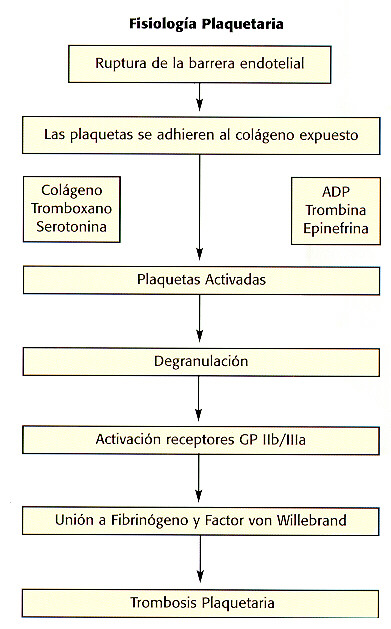
<body><![CDATA[<DIV class="MsoNormal"><FONT FACE="Arial,Helvetica"><FONT SIZE=-1><B>1.</B><U>Adhesividad Plaquetaria</U><B>:</B> Es el paso inicial en la trombosis arterial, ocurre cuando las plaquetas se adhieren al sitio de la lesi&oacute;n vascular (<A HREF="#9">9</A>). El endotelio normalmente presenta una superficie lisa que no permite la adherencia de los elementos celulares de la circulaci&oacute;n.</FONT></FONT></DIV>      <DIV class="MsoNormal"><FONT FACE="Arial,Helvetica"><FONT SIZE=-1>La ruptura de la placa o el da&ntilde;o al endotelio expone varias prote&iacute;nas de la pared endotelial que se unen a ciertos receptores espec&iacute;ficos de las plaquetas provocando su adherencia. Este receptor denominado glicoprote&iacute;na Ib-IX es el receptor plaquetario principal y se une al factor von Willebrand en la pared arterial. Este &uacute;ltimo sufre cambios en su superficie con lo cual promueve la adhesi&oacute;n. Una vez depositadas las plaquetas &eacute;stas se extienden para cubrir la mayor parte de la lesi&oacute;n liberando contenido de los gr&aacute;nulos intracelulares, con lo cual contribuye al inicio del proceso de la trombosis.</FONT></FONT>     <BR>&nbsp;</DIV>      <DIV class="MsoNormal"><FONT FACE="Arial,Helvetica"><FONT SIZE=-1><B>2.</B><U>Activaci&oacute;n del Factor de Coagulaci&oacute;n</U><B>:</B> El segundo paso en la formaci&oacute;n del trombo es la activaci&oacute;n en cascada de los factores de la coagulaci&oacute;n (<A HREF="#10">10</A>).</FONT></FONT></DIV>      <DIV class="MsoNormal"><FONT FACE="Arial,Helvetica"><FONT SIZE=-1>Las v&iacute;as intr&iacute;nseca y extr&iacute;nseca convergen en un punto com&uacute;n, la activaci&oacute;n del Factor X y de la Protrombina. La lesi&oacute;n arterial expone el factor VII al Factor Tisular. Este &uacute;ltimo estimula la actividad enzim&aacute;tica del Factor VIIa para la activaci&oacute;n de Factores IX y X. Al activar el factor X se generan peque&ntilde;as cantidades de Trombina. Esta activa los cofactores V y VIII con lo cual se genera mayor cantidad de Trombina. Esta a su vez es un agonista plaquetario muy potente que recluta m&aacute;s plaquetas al trombo..</FONT></FONT>     <BR>&nbsp;</DIV>      <DIV class="MsoNormal"><FONT FACE="Arial,Helvetica"><FONT SIZE=-1><B>3.</B><U>Propagaci&oacute;n del Trombo:</U> Esta se realiza cuando m&aacute;s plaquetas se incorporan a la masa creciente del trombo. A diferencia de la adhesi&oacute;n,&nbsp; la agregaci&oacute;n de las plaquetas requiere de la activaci&oacute;n de un segundo receptor denominado Glicoprote&iacute;na IIb/IIIa. Una vez que se activa une el fibrinog&eacute;no a la plaqueta manteni&eacute;ndolas fuertemente unidas.</FONT></FONT>     <BR>&nbsp;</DIV>      <DIV class="MsoNormal"><FONT FACE="Arial,Helvetica"><FONT SIZE=-1><B>4.</B><U>Organizaci&oacute;n del Trombo</U><B>:</B> El desarrollo de un trombo es un balance entre dos fuerzas opuestas, una que promueve la propagaci&oacute;n de &eacute;ste y las fuerzas opuestas que lo eroden y disminuyen su tama&ntilde;o. El resultado final depender&aacute; de la magnitud de cada una de estas fuerzas ya sea provocando la oclusi&oacute;n total de la arteria, un trombo mural o la disoluci&oacute;n del co&aacute;gulo.</FONT></FONT></DIV>      <DIV class="MsoNormal"><FONT FACE="Arial,Helvetica"><FONT SIZE=-1>El Dr Fuster (<A HREF="#1">1</A>-<A HREF="#2">2</A>) propone la siguiente explicaci&oacute;n de los SCA, la angina inestable y del infarto no Q. En la primera una leve lesi&oacute;n de la placa permite la formaci&oacute;n de un trombo l&aacute;bil que junto con la vasoconstricci&oacute;n secundaria ocluye la arteria por unos 10 a 20 minutos. En el infarto no Q la duraci&oacute;n de la oclusi&oacute;n es m&aacute;s prolongada debido probablemente a mayor da&ntilde;o de la placa ateroscler&oacute;tica con lo cual provoca mayor lesi&oacute;n a nivel del m&uacute;sculo card&iacute;aco . La reperfusi&oacute;n espont&aacute;nea ocurre aproximadamente a las dos horas con lo cual se previene el desarrollo del infarto con ondas Q.</FONT></FONT></DIV>      ]]></body>
<body><![CDATA[<DIV class="MsoNormal"><FONT FACE="Arial,Helvetica"><FONT SIZE=-1>El Dr Wood realiz&oacute; estudios angiogr&aacute;ficos examinando las arterias coronarias en el infarto no Q (<A HREF="#11">11</A>). Observ&oacute; que solamente el 25% de estos infartos ten&iacute;an oclusi&oacute;n total de la arteria afectada y en el 85% de estos pacientes presentaban buen desarrollo de la circulaci&oacute;n colateral. Existen diferencias angiogr&aacute;ficas entre la angina inestable y el infarto no Q. En la primera la oclusi&oacute;n total de la arteria infartada es de un 10 a 20% y en el segundo es de 20 a 40%.</FONT></FONT></DIV>      <DIV class="MsoNormal"><FONT FACE="Arial,Helvetica"><FONT SIZE=-1>El papel central de la trombosis en la patog&eacute;nesis del SCA ha sido demostrada en numerosos estudios (<A HREF="#12">12</A>):</FONT></FONT></DIV>      <BR>&nbsp;     <DIV class="MsoNormal"><FONT FACE="Arial,Helvetica"><FONT SIZE=-1>* En autopsias se ha identificado el trombo en el sitio de la ruptura de la placa (<A HREF="#13">13</A>).</FONT></FONT></DIV>      <DIV class="MsoNormal"><FONT FACE="Arial,Helvetica"><FONT SIZE=-1>* Tejido obtenido de aterectom&iacute;a coronaria en pacientes con angina inestable o infarto del miocardio ha demostrado una elevada incidencia de lesiones tromb&oacute;ticas agudas (<A HREF="#14">14</A>).</FONT></FONT></DIV>      <DIV class="MsoNormal"><FONT FACE="Arial,Helvetica"><FONT SIZE=-1>* Estudios con angioscop&iacute;a coronaria han mostrado frecuentemente la presencia de trombosis (<A HREF="#15">15</A>-<A HREF="#16">16</A>).</FONT></FONT></DIV>      <DIV class="MsoNormal"><FONT FACE="Arial,Helvetica"><FONT SIZE=-1>* La angiograf&iacute;a coronaria ha demostrado ulceraci&oacute;n o irregularidades sugestivas de ruptura de la placa y/o trombosis (<A HREF="#17">17</A>-<A HREF="#18">18</A>).</FONT></FONT></DIV>      <DIV class="MsoNormal"><FONT FACE="Arial,Helvetica"><FONT SIZE=-1>* La elevaci&oacute;n de marcadores de actividad plaquetaria y de fibrina se han encontrado como evidencia de trombosis activa (<A HREF="#19">19</A>-<A HREF="#20">20</A>).</FONT></FONT></DIV>      <DIV class="MsoNormal"><FONT FACE="Arial,Helvetica"><FONT SIZE=-1>* Hay evidencia de mejor&iacute;a cl&iacute;nica en pacientes con el SCA tratados con terapia antitromb&oacute;tica (<A HREF="#21">21</A>).</FONT></FONT></DIV>      <DIV class="MsoNormal"><FONT FACE="Arial,Helvetica"><FONT SIZE=-1>*Marcadores de da&ntilde;o mioc&aacute;rdico positivo.</FONT></FONT>     ]]></body>
<body><![CDATA[<BR>&nbsp;     <BR>&nbsp;</DIV>      <CENTER><IMG SRC="/img/fbpe/rcc/v3n1/0732i1.JPG" HEIGHT=313 WIDTH=562></CENTER>       
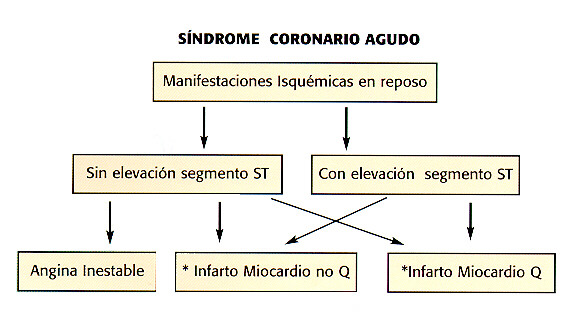
<P>&nbsp;     <DIV class="MsoNormal"><FONT FACE="Arial,Helvetica"><FONT SIZE=-1>El diagn&oacute;stico de estas entidades no se puede realizar en la presentaci&oacute;n temprana inicial sino que se realiza retrospectivamente al analizar los cambios evolutivos del segmento ST y la evoluci&oacute;n de los marcadores bioqu&iacute;micos de da&ntilde;o mioc&aacute;rdico.</FONT></FONT></DIV>      <DIV class="MsoNormal"><FONT FACE="Arial,Helvetica"><FONT SIZE=-1>La Angina Inestable se presenta de tres maneras cl&iacute;nicas:</FONT></FONT>     <BR>&nbsp;</DIV>      <DIV class="MsoNormal"><FONT FACE="Arial,Helvetica"><FONT SIZE=-1><B>1</B>. Angina en reposo.</FONT></FONT></DIV>      <DIV class="MsoNormal"><FONT FACE="Arial,Helvetica"><FONT SIZE=-1><B>2</B>. Angina severa de inicio reciente.</FONT></FONT></DIV>      <DIV class="MsoNormal"><FONT FACE="Arial,Helvetica"><FONT SIZE=-1><B>3</B>. Angina in crescendo.</FONT></FONT>     ]]></body>
<body><![CDATA[<BR>&nbsp;</DIV>      <DIV class="MsoNormal"><FONT FACE="Arial,Helvetica"><FONT SIZE=-1>La clasificaci&oacute;n de angina inestable publicada por el Dr Braunwald en 1989 (<A HREF="#23">23</A>) es muy utilizada en la actualidad. El analiz&oacute; la severidad de las manifestaciones cl&iacute;nicas, las circunstancias en que &eacute;sta se presenta, del tratamiento m&eacute;dico anti-anginoso y de si los episodios de dolor se acompa&ntilde;aban de cambios electrocar-diogr&aacute;ficos transitorios.</FONT></FONT>     <BR>&nbsp;</DIV>      <DIV class="MsoNormal"><FONT FACE="Arial,Helvetica"><FONT SIZE=-1><U>Severidad de la angina</U><B>:</B></FONT></FONT></DIV>      <DIV class="MsoNormal"><FONT FACE="Arial,Helvetica"><FONT SIZE=-1>Clase I:Angina severa acelerada o de inicio reciente.</FONT></FONT></DIV>      <DIV class="MsoNormal"><FONT FACE="Arial,Helvetica"><FONT SIZE=-1>Clase II: Angina en reposo en el &uacute;ltimo mes pero no en las &uacute;ltimas 48 horas.</FONT></FONT></DIV>      <DIV class="MsoNormal"><FONT FACE="Arial,Helvetica"><FONT SIZE=-1>Clase III: Angina en reposo en las &uacute;ltimas 48 horas.</FONT></FONT>     <BR>&nbsp;</DIV>      <DIV class="MsoNormal"><FONT FACE="Arial,Helvetica"><FONT SIZE=-1><U>Circunstancias Cl&iacute;nicas</U><B>:</B></FONT></FONT></DIV>      <DIV class="MsoNormal"><FONT FACE="Arial,Helvetica"><FONT SIZE=-1>A. Angina inestable secundaria a condiciones&nbsp; extracard&iacute;acas: (anemia, infecciones, fiebre,hipotensi&oacute;n, taquicardia, tirotoxicosis, hipoxemia).</FONT></FONT></DIV>      ]]></body>
<body><![CDATA[<DIV class="MsoNormal"><FONT FACE="Arial,Helvetica"><FONT SIZE=-1>B. Angina inestable primaria.</FONT></FONT></DIV>      <DIV class="MsoNormal"><FONT FACE="Arial,Helvetica"><FONT SIZE=-1>C. Angina post infarto ( dos semanas posterior a un IAM).</FONT></FONT>     <BR>&nbsp;</DIV>      <DIV class="MsoNormal"><FONT FACE="Arial,Helvetica"><FONT SIZE=-1><U>Intensidad del tratamiento m&eacute;dico</U><B>:</B></FONT></FONT></DIV>      <DIV class="MsoNormal"><FONT FACE="Arial,Helvetica"><FONT SIZE=-1>Grupo 1: Angina cr&oacute;nica estable sin tratamiento m&eacute;dico.</FONT></FONT></DIV>      <DIV class="MsoNormal"><FONT FACE="Arial,Helvetica"><FONT SIZE=-1>Grupo 2: Angina cr&oacute;nica estable con tratamiento m&eacute;dico.</FONT></FONT></DIV>      <DIV class="MsoNormal"><FONT FACE="Arial,Helvetica"><FONT SIZE=-1>Grupo3: Angina inestable en presencia de tratamiento anti-isqu&eacute;mico m&aacute;ximo.</FONT></FONT>     <BR>&nbsp;</DIV>      <DIV class="MsoNormal"><FONT FACE="Arial,Helvetica"><FONT SIZE=-1>Debido&nbsp; a la evoluci&oacute;n de los SCA en relaci&oacute;n a las troponinas card&iacute;acas el Dr Braunwald modific&oacute; la clasificaci&oacute;n recientemente (<A HREF="#45">45</A>), la clase IIIB la subdivide en una Troponina positiva (riesgo de muerte o de infarto al mes es de 15 a 20%) y otra Troponina negativa ( mejor pron&oacute;stico ).</FONT></FONT>     <BR>&nbsp;</DIV>      ]]></body>
<body><![CDATA[<DIV class="MsoNormal"><FONT FACE="Arial,Helvetica"><FONT SIZE=-1>El desarrollo de esta clasificaci&oacute;n se bas&oacute; en eventos cl&iacute;nicos y ha sido validada en numerosos estudios. Ahmed y colaboradores (<A HREF="#24">24</A>) reportaron que el factor m&aacute;s importante en poder predecir la presencia de trombos intra coronarios y de lesiones complejas fue el grado de la clasificaci&oacute;n de la angina basada en par&aacute;metros cl&iacute;nicos. Danges et al (<A HREF="#25">25</A>) encontraron que la clase III y C estaban asociadas con lesiones arteriales complejas y con disminuci&oacute;n importante del flujo coronario. De Servi et al (<A HREF="#26">26</A>) report&oacute; que pacientes con angina de inicio reciente o acelerada sin dolor en reposo (clase I B) ten&iacute;an lesiones calcificadas con mayor frecuencia que los pacientes con angina en reposo (clase II B y IIIB) los cuales presentaban principalmente trombosis o hemorragias intra-placa. Owa et al (<A HREF="#27">27</A>) demostr&oacute; que la clase III estaba asociada con una mayor incidencia de trombosis intra coronaria y un riesgo mayor de evolucionar a un infarto del miocardio.</FONT></FONT>     <BR>&nbsp;</DIV>      <DIV class="MsoNormal"><U><FONT FACE="Arial,Helvetica"><FONT SIZE=-1>Caracter&iacute;sticas Cl&iacute;nicas:</FONT></FONT></U></DIV>      <DIV class="MsoNormal"><FONT FACE="Arial,Helvetica"><FONT SIZE=-1><U>El dolor isqu&eacute;mico</U> en los episodios de angina se describe como una sensaci&oacute;n de molestia o de opresi&oacute;n localizada vagamente al t&oacute;rax o brazo asociada a la actividad f&iacute;sica o estr&eacute;s emocional y se alivia r&aacute;pidamente (menos de 5 minutos) con reposo y/o el uso de nitroglicerina sublingual. Los pacientes con angina inestable tienen las mismas caracter&iacute;sticas cl&iacute;nicas de la angina estable excepto que los episodios son m&aacute;s prolongados y m&aacute;s severos, ocurren con menos esfuerzo f&iacute;sico y pueden aparecer en reposo. Algunos no presentan molestias en el t&oacute;rax pero s&iacute; relacionadas al cuello, mand&iacute;bula, o&iacute;do o brazo. En los ancianos es caracter&iacute;stico el inicio o empeoramiento de disnea, n&aacute;usea y v&oacute;mito, diaforesis y fatiga f&aacute;cil. Ciertas condiciones de dolor at&iacute;pico pueden tener relaci&oacute;n con isquemia coronaria. En el Estudio Multic&eacute;ntrico de Dolor Tor&aacute;cico (<A HREF="#28">28</A>) se realiz&oacute; el diagn&oacute;stico de isquemia aguda en 22% de pacientes que presentaban dolor tor&aacute;cico punzante, en 13% de pacientes con dolor tipo pleur&iacute;tico y en 7% de pacientes&nbsp; el dolor se reproduc&iacute;a con la palpaci&oacute;n.</FONT></FONT>     <BR>&nbsp;</DIV>      <DIV class="MsoNormal"><FONT FACE="Arial,Helvetica"><FONT SIZE=-1><U>El examen f&iacute;sico</U> por lo general no aporta datos de importancia a menos que se presenten manifestaciones cl&iacute;nicas asociados de insuficiencia card&iacute;aca o choque cardiog&eacute;nico. Permite descartar ciertas condiciones que provocan angina secundaria.</FONT></FONT>     <BR>&nbsp;</DIV>      <DIV class="MsoNormal"><FONT FACE="Arial,Helvetica"><FONT SIZE=-1><U>El electrocardiograma</U> es el ex&aacute;men m&aacute;s utilizado en la evaluaci&oacute;n del dolor tor&aacute;cico. Debe recordarse que se usa para confirmar la impresi&oacute;n cl&iacute;nica inicial y no como &uacute;nico medio para obtener un diagn&oacute;stico. Los hallazgos son muy variables. En el estudio TIMI -IIIB (<A HREF="#29">29</A>) y TIMI-III Registry (<A HREF="#30">30</A>) la depresi&oacute;n del segmento ST se encontr&oacute; en una tercera parte de los pacientes con SCA, la inversi&oacute;n de la onda T en la mitad y un electrocardiograma normal en el resto. <U>Un electrocardiograma normal en un paciente con dolor tor&aacute;cico no excluye la posibilidad de un SCA, ya que de 1 a 6% desarrollar&aacute;n un infarto agudo del miocardio sin elevaci&oacute;n del ST y 4% angina inestable (<A HREF="#31"> 31</A>,<A HREF="#32">32</A>).</U> Solamente la depresi&oacute;n del segmento ST ha demostrado ser un factor de riesgo independiente de mal pron&oacute;stico.</FONT></FONT>     <BR><FONT FACE="Arial,Helvetica"><FONT SIZE=-1>&nbsp;</FONT></FONT></DIV>      <DIV class="MsoNormal"><FONT FACE="Arial,Helvetica"><FONT SIZE=-1>Debe tomarse en cuenta que el electrocardiograma da la informaci&oacute;n de un proceso din&aacute;mico y cambiante, por esta raz&oacute;n se deber&aacute;n obtener trazos en serie o monitorizar el segmento ST en forma continua, con lo cual se pueden detectar episodios de isquemia transitoria y poder prevenir la posibilidad de muerte o de infarto no fatal (<A HREF="#33">33</A>,<A HREF="#34">34</A>).</FONT></FONT></DIV>      ]]></body>
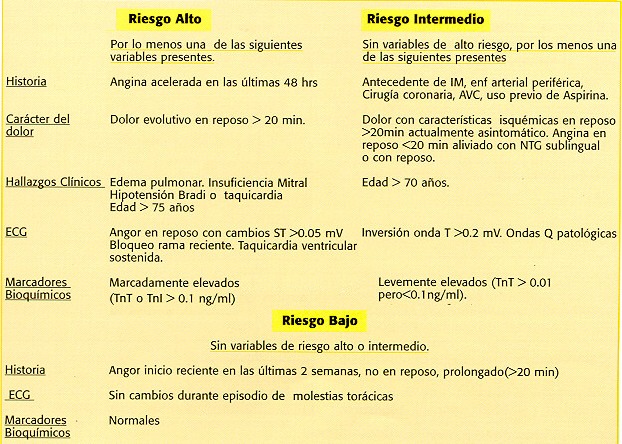
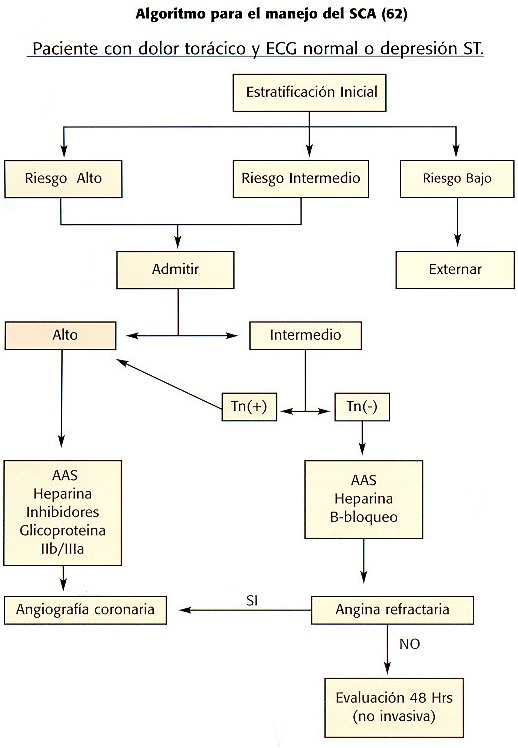
<body><![CDATA[<DIV class="MsoNormal"><U><FONT FACE="Arial,Helvetica"><FONT SIZE=-1>Marcadores Bioqu&iacute;micos de Da&ntilde;o Mioc&aacute;rdico.</FONT></FONT></U></DIV>       <P class="MsoNormal"><FONT FACE="Arial,Helvetica"><FONT SIZE=-1>Son muy &uacute;tiles en pacientes que presentan dolor isqu&eacute;mico y sin cambios importantes del electrocardiograma. Permiten obtener un diagn&oacute;stico, dan informaci&oacute;n sobre pron&oacute;stico y ayudan a seleccionar el tratamiento adecuado (<A HREF="#35">35</A>).</FONT></FONT>      <P class="MsoNormal"><FONT FACE="Arial,Helvetica"><FONT SIZE=-1><U>La Creatin-fosfokinasa y la fracci&oacute;n MB</U> han sido los marcadores m&aacute;s utilizados en el SCA hasta hace unos pocos a&ntilde;os. Presentan algunas limitaciones, sobre todo que se encuentran niveles bajos de CK-MB en personas sanas y tambi&eacute;n pueden estar elevados cuando hay da&ntilde;o severo al m&uacute;sculo esquel&eacute;tico. Existe en una forma CK-MB 2 en el tejido card&iacute;aco y es convertida por una lisina-carboxipeptidasa a CK-MB1 cuando es liberada al suero. Cuando esto ocurre r&aacute;pidamente la conversi&oacute;n de CK-MB 2 no se realiza inmediatamente por lo que la relaci&oacute;n CK-MB 2 / CK-MB1 se eleva. Una relaci&oacute;n de CK-MB 2 a CK-MB 1 mayor de 1.5 y una CK-MB 2 mayor de 1 U/lt es indicativo de una necrosis en evoluci&oacute;n (<A HREF="#36">36</A>,<A HREF="#37">37</A>,<A HREF="#38">38</A>).</FONT></FONT>      <P class="MsoNormal"><FONT FACE="Arial,Helvetica"><FONT SIZE=-1>Mioglobina. Es una prote&iacute;na de bajo peso molecular presente en el m&uacute;sculo esquel&eacute;tico y card&iacute;aco, muy sensible para detectar da&ntilde;o mioc&aacute;rdico pero poco espec&iacute;fica. Es r&aacute;pidamente liberada del miocardio necr&oacute;tico y r&aacute;pidamente eliminada por los ri&ntilde;ones. Niveles elevados de mioglobina se detectan tambi&eacute;n en pacientes con angina inestable (<A HREF="#39">39</A>).</FONT></FONT>      <P class="MsoNormal"><FONT FACE="Arial,Helvetica"><FONT SIZE=-1><U>Troponinas: </U>han sido estudiadas extensamente y fueron aprobadas para uso cl&iacute;nico por la Food and Drug Administration en 1994. Las troponinas card&iacute;acas se encuentran ausentes en el plasma de personas sanas, es por esta raz&oacute;n que a&uacute;n peque&ntilde;as elevaciones indican necrosis mioc&aacute;rdica. En el documento en conjunto de la Sociedad Europea de Cardiolog&iacute;a y el Colegio Americano del Coraz&oacute;n (40) han recomendado que la elevaci&oacute;n de la troponina sea parte de la definici&oacute;n del IAM. Es muy claro en la actualidad que cualquier nivel de da&ntilde;o mioc&aacute;rdico, detectado por elevaci&oacute;n de las troponinas implica un factor evolutivo de mal pron&oacute;stico. Esta condici&oacute;n no s&oacute;lo es cierta para los eventos espont&aacute;neos sino tambi&eacute;n para aquellos que ocurren en las intervenciones de revascularizaci&oacute;n. En la actualidad no existe un umbral en la elevaci&oacute;n de las troponinas que se pueda considerar seguro. De tal manera que toda necrosis mioc&aacute;rdica que se detecte por elevaci&oacute;n de las troponinas debe ser considerada un infarto del miocardio (<A HREF="#40">40</A>). Por lo tanto pacientes que se presentaban con un SCA que eran CK-MB negativo pero troponina positivo eran considerados angina inestable, con la nueva definici&oacute;n se consideran IM no Q. Los pacientes que se presenten con dolor isqu&eacute;mico t&iacute;pico deben ser clasificados como portadores del SCA ya sea con o sin elevaci&oacute;n del segmento ST y luego reclasificados horas m&aacute;s tarde en pacientes con troponina y CK-MB positiva o negativa (<A HREF="#41">41</A>,<A HREF="#42">42</A>,<A HREF="#43">43</A>).</FONT></FONT>      <P class="MsoNormal"><FONT FACE="Arial,Helvetica"><FONT SIZE=-1>Establecer tempranamente si hay evidencia de da&ntilde;o mioc&aacute;rdico en los SCA sin elevaci&oacute;n del ST es muy importante ya que son pacientes que en la mayor&iacute;a presentan enfermedad coronaria severa, lesiones complejas y trombosis visible en la angiograf&iacute;a coronaria (<A HREF="#44">44</A>).</FONT></FONT>      <P class="MsoNormal"><FONT FACE="Arial,Helvetica"><FONT SIZE=-1>Los estudios PRISM (<A HREF="#46">46</A>),CAPTURE (<A HREF="#47">47</A>),EPIC (<A HREF="#48">48</A>), y FRISC-I (<A HREF="#49">49</A>) mostraron que pacientes con el SCA sin elevaci&oacute;n del ST con aumento de la troponina se benefician con el tratamiento con los inhibidores de la glicoproteina IIb/IIIa y/o con el uso de Heparinas de Bajo Peso Molecular (<A HREF="#50">50</A>). Este efecto del tratamiento dirigido a controlar la agregaci&oacute;n plaquetaria y la formaci&oacute;n de trombina en los pacientes que presentan elevaci&oacute;n de troponinas corrobora la hip&oacute;tesis de que la embolizaci&oacute;n de micro trombos es la explicaci&oacute;n de la elevaci&oacute;n de la troponina en los SCA sin elevaci&oacute;n del ST (<A HREF="#51">51</A>). Sin embargo el estudio GUSTO-IV ACS presentado en Amsterdam recientemente en la reuni&oacute;n de la Sociedad Europea de Cardiolog&iacute;a evaluando el tratamiento con Abciximab asociado a heparina y aspirina en pacientes estratificados por medio de troponina sorprendentemente no mostr&oacute; beneficio de este esquema terap&eacute;utico. El 60% de los pacientes ten&iacute;an troponinas alteradas y la mortalidad a los treinta d&iacute;as fue de s&oacute;lo 8% en el grupo placebo y el grupo tratado con Abciximab no mostr&oacute; ning&uacute;n beneficio adicional. Por estas razones es que en la actualidad para algunos autores no es conveniente recomendar el uso rutinario de los bloqueadores de la glicoproteina IIb/IIIa en los SCA solamente por el aumento de las troponinas card&iacute;acas.</FONT></FONT>      <P class="MsoNormal"><FONT FACE="Arial,Helvetica"><FONT SIZE=-1>Los pacientes de bajo riesgo con SCA y troponina normal son un grupo con una incidencia muy baja de eventos card&iacute;acos futuros (54). No ocurre as&iacute; con la evoluci&oacute;n de pacientes de riesgo intermedio con troponina negativa que pueden desarrollar poste-riormente complicaciones card&iacute;acas.</FONT></FONT>      <P class="MsoNormal"><FONT FACE="Arial,Helvetica"><FONT SIZE=-1>Grupos de bajo, intermedio y de alto riesgo pueden ser identificados usando las variables cl&iacute;nicas, electrocardiogr&aacute;ficas obtenidas en admisi&oacute;n y con un per&iacute;odo de observaci&oacute;n de 6 a 12 horas durante el cual se analizar&aacute; la presencia de da&ntilde;o mioc&aacute;rdico. Pacientes de bajo riesgo que no tienen evidencia de necrosis mioc&aacute;rdica y que no mostraron complicaciones en el per&iacute;odo de observaci&oacute;n pueden ser externados y controlados posteriormente. Por el contrario pacientes de riesgo intermedio o alto deben ser admitidos a pesar de que no exista evidencia de da&ntilde;o celular (<A HREF="#41">41</A>,<A HREF="#55">55</A>,<A HREF="#56">56</A>).</FONT></FONT>     <BR>&nbsp;     ]]></body>
<body><![CDATA[<DIV class="MsoNormal"><B><FONT FACE="Arial,Helvetica"><FONT SIZE=-1>Otros marcadores de necrosis mioc&aacute;rdica en estudio:</FONT></FONT></B></DIV>       <P class="MsoNormal"><FONT FACE="Arial,Helvetica"><FONT SIZE=-1>Diferentes grupos entre ellos el Dr Maseri han demostrado que los pacientes con angina inestable y con infarto del miocardio sin elevaci&oacute;n del ST que presentan elevaciones de marcadores de inflamaci&oacute;n como son la prote&iacute;na C reactiva, fibrin&oacute;geno, una prote&iacute;na en suero parecida al amiloide A, y la interleukina 1 y 6 por lo general tienen una mayor incidencia de complicaciones cardiovasculares que los pacientes con marcadores normales (<A HREF="#57">57</A>,<A HREF="#58">58</A>,<A HREF="#59">59</A>,<A HREF="#60">60</A>,<A HREF="#85">85</A>,<A HREF="#86">86</A>.).</FONT></FONT>     <BR>&nbsp;     <DIV class="MsoNormal"><U><FONT FACE="Arial,Helvetica"><FONT SIZE=-1>Ecocardiograf&iacute;a.</FONT></FONT></U></DIV>       <P class="MsoNormal"><FONT FACE="Arial,Helvetica"><FONT SIZE=-1>Estudio muy &uacute;til para obtener informaci&oacute;n sobre funci&oacute;n sist&oacute;lica y alteraciones de la contractilidad segmentaria. Debe recordarse que se requiere una lesi&oacute;n que comprometa m&aacute;s del 20% del grosor de la pared mioc&aacute;rdica para que se detecte una alteraci&oacute;n de la contractilidad segmentaria por Ecocardiograf&iacute;a. Esta t&eacute;cnica no distingue isquemia de infarto, ni lesiones recientes de antiguas.</FONT></FONT>      <P class="MsoNormal"><B><FONT FACE="Arial,Helvetica"><FONT SIZE=-1>Estratificaci&oacute;n de riesgo.</FONT></FONT></B>      <P class="MsoNormal"><FONT FACE="Arial,Helvetica"><FONT SIZE=-1>La historia cl&iacute;nica, el examen f&iacute;sico, el electrocardiograma y los marcadores de da&ntilde;o mioc&aacute;rdico pueden ser integrados para valorar el riesgo de infarto o muerte en pacientes que se presentan con el SCA (<A HREF="#61">61</A>).</FONT></FONT>     <BR>&nbsp;     <BR>&nbsp;     <CENTER><IMG SRC="/img/fbpe/rcc/v3n1/0732i02.JPG" HEIGHT=444 WIDTH=622></CENTER> &nbsp;     
]]></body>
<body><![CDATA[<DIV class="MsoNormal"><B><FONT FACE="Arial,Helvetica"><FONT SIZE=-1>Tratamiento:</FONT></FONT></B></DIV>       <P class="MsoNormal"><FONT FACE="Arial,Helvetica"><FONT SIZE=-1>El manejo del SCA se ha vuelto multifactorial debido a quela terapia va dirigida a los diferentes estad&iacute;os fisiopatol&oacute;gicos que desencadenan este S&iacute;ndrome, desde la activaci&oacute;n de la placa, la isquemia hasta la necrosis celular. En los pacientes que presentan IM con elevaci&oacute;n del ST, la restauraci&oacute;n del flujo al miocardio con la disoluci&oacute;n del trombo por medio de la trombol&iacute;sis es de suma importancia. En los pacientes con angina inestable o IM sin elevaci&oacute;n ST la estabilizaci&oacute;n de la placa para prevenir la progresi&oacute;n de la enfermedad, la recurrencia de la trombosis y de la vasoconstricci&oacute;n son mandatorias. (<A HREF="#63">63</A>).</FONT></FONT>     <BR>&nbsp;     <CENTER><IMG SRC="/img/fbpe/rcc/v3n1/0732i03.JPG" HEIGHT=748 WIDTH=518></CENTER> &nbsp;     
<DIV class="MsoNormal"><B><FONT FACE="Arial,Helvetica"><FONT SIZE=-1>Tratamiento Intra Hospitalario:</FONT></FONT></B></DIV>       <P class="MsoNormal"><U><FONT FACE="Arial,Helvetica"><FONT SIZE=-1>A. Medidas Generales:</FONT></FONT></U>      <P class="MsoNormal"><FONT FACE="Arial,Helvetica"><FONT SIZE=-1>1. Reposo</FONT></FONT>     <BR>&nbsp;     <DIV class="MsoNormal"><FONT FACE="Arial,Helvetica"><FONT SIZE=-1>2. Monitoreo electrocardiogr&aacute;fico continuo.</FONT></FONT></DIV>      <DIV class="MsoNormal"><FONT FACE="Arial,Helvetica"><FONT SIZE=-1>3. Ox&iacute;geno si hay cianosis, insuficiencia respiratoria, o saturaci&oacute;n &lt; 90 %.</FONT></FONT></DIV>      ]]></body>
<body><![CDATA[<DIV class="MsoNormal"><FONT FACE="Arial,Helvetica"><FONT SIZE=-1>4. Sulfato de Morfina si persiste dolor o edema agudo pulmonar.</FONT></FONT>     <BR>&nbsp;</DIV>      <DIV class="MsoNormal"><U><FONT FACE="Arial,Helvetica"><FONT SIZE=-1>B. Terapia Anti-Isqu&eacute;mica</FONT></FONT></U></DIV>      <DIV class="MsoNormal"><FONT FACE="Arial,Helvetica"><FONT SIZE=-1><B>1</B>.<U>Nitroglicerina</U>: act&uacute;a reduciendo el consumo de ox&iacute;geno del miocardio. Produce una disminuci&oacute;n de la pre-carga al dilatar el lecho venoso y disminuye la post carga al dilatar modestamente la circulaci&oacute;n arterial. Se utiliza sublingual inicialmente en tres dosis con intervalos de 5 minutos. En pacientes que no alivian el dolor se utiliza la v&iacute;a intravenosa a dosis de 5 a 10 microgr /min aumentando hasta alivio del dolor o disminuci&oacute;n de la presi&oacute;n arterial sist&oacute;lica en un 10% en pacientes normo- tensos y 30% en hipertensos (64). Usar con precauci&oacute;n en presencia de bradicardia severa, hipotensi&oacute;n, taquicardia, infarto del ventr&iacute;culo derecho. No usarla en pacientes que hayan ingerido Sildenafil (Viagra) en las &uacute;ltimas 24 horas por la posibilidad de producir hipotensi&oacute;n profunda y muerte (<A HREF="#65">65</A>).</FONT></FONT>     <BR>&nbsp;</DIV>      <DIV class="MsoNormal"><FONT FACE="Arial,Helvetica"><FONT SIZE=-1><B>2</B>.<U>Agentes Bloqueadores Beta Adren&eacute;rgicos</U>: Deben utilizarse tempranamente en ausencia de contraindicaciones, por la v&iacute;a intravenosa en pacientes de alto riesgo y por la v&iacute;a oral en pacientes con riesgo moderado o bajo. No hay evidencia en la actualidad de que un agente sea mejor que otro. Disminuyen el trabajo y el consumo de ox&iacute;geno del miocardio, favorecen la disminuci&oacute;n de la frecuencia card&iacute;aca con lo cual aumenta la duraci&oacute;n de la di&aacute;stole y por lo tanto mejoran la perfusi&oacute;n coronaria. En revisiones extensas de la literatura o meta an&aacute;lisis (<A HREF="#66">66</A>) se redujo en un 13% la progresi&oacute;n hacia el IM en pacientes con angor inestable. Otros estudios no han sido tan claros en mostrar beneficio en IM no Q (<A HREF="#67">67</A>). Extrapolando consideraciones fisiopatol&oacute;gicas y de experiencias de otras formas de enfermedad coronaria es que &eacute;ste grupo de medicamentos se consideran parte rutinaria del tratamiento del SCA. Contraindicaciones para su uso son: bradicardia severa, bloqueo aur&iacute;culo ventricular de segundo y tercer grado, edema agudo pulmonar, choque cardiog&eacute;nico, asma y EPOC severo.</FONT></FONT>     <BR>&nbsp;</DIV>      <DIV class="MsoNormal"><FONT FACE="Arial,Helvetica"><FONT SIZE=-1><B>3</B>.<U>Antagonistas del Calcio</U>. Tienen efectos vasodilatadores y algunos reducen la frecuencia card&iacute;aca. Se recomiendan en aquellos pacientes con s&iacute;ntomas persistentes o recurrentes despu&eacute;s de haber utilizado nitroglicerina y beta bloqueadores. Tambi&eacute;n se usan en aquellos que presenten contraindicaciones para el uso de beta bloqueadores.</FONT></FONT></DIV>      <DIV class="MsoNormal"><FONT FACE="Arial,Helvetica"><FONT SIZE=-1>El uso de estos agentes va a depender del estado de la funci&oacute;n contr&aacute;ctil del miocardio, del estado hemodin&aacute;mico, de la conducci&oacute;n aur&iacute;culo ventricular y de la funci&oacute;n del nodo sinusal. De no presentar contraindicaciones los agentes que m&aacute;s se utilizan en la actualidad son el Verapamil o Diltiazem (<A HREF="#68">68</A>,<A HREF="#69">69</A>,<A HREF="#70">70</A>). La Nifedipina de acci&oacute;n corta no est&aacute; indicada. Otros antagonistas como la Amlodipina est&aacute;n adquiriendo gran popularidad porque no deprimen la funci&oacute;n contr&aacute;ctil del ventr&iacute;culo izquierdo y en la actualidad est&aacute;n en proceso de estudio en el SCA.</FONT></FONT></DIV>      <DIV class="MsoNormal"><FONT FACE="Arial,Helvetica"><FONT SIZE=-1><B>4</B><U>.Inhibidores de la Enzima Convertidora de Angiotensina</U>. Son utilizados en los pacientes que persisten con hipertensi&oacute;n a pesar de haber sido tratados con nitroglicerina y con beta bloqueadores, en pacientes con disfunci&oacute;n sist&oacute;lica o insuficiencia card&iacute;aca y en los pacientes diab&eacute;ticos (<A HREF="#71">71</A>). El beneficio observado en pacientes con IM con elevaci&oacute;n del ST no se vio reflejado en los pacientes con IM sin elevaci&oacute;n del ST (<A HREF="#72">72</A>). Actualmente se sugiere que podr&iacute;an ser &uacute;tiles en todos los pacientes con enfermedad ateroscler&oacute;tica (<A HREF="#120">120</A>).</FONT></FONT></DIV>      ]]></body>
<body><![CDATA[<DIV class="MsoNormal"><U><FONT FACE="Arial,Helvetica"><FONT SIZE=-1>C. Terapia Antiplaquetaria:</FONT></FONT></U></DIV>       <P class="MsoNormal"><FONT FACE="Arial,Helvetica"><FONT SIZE=-1><B>1</B>.<U>Aspirina</U>. Excelente medicamento en el tratamiento de los SCA. Debe utilizarse de inmediato ante cualquier manifestaci&oacute;n de enfermedad coronaria y continuarse por tiempo indefinido en pacientes que no presenten contraindicaciones. Numerosos estudios han demostrado su utilidad en la angina inestable y el IM no Q, con una reducci&oacute;n mayor del 50% en el riesgo de muerte o de IM (<A HREF="#73">73-</A><A HREF="#74">74</A>). En el estudio ISIS-2 redujo la mortalidad por m&aacute;s del 25% y la posibilidad de re- infarto en m&aacute;s del 40% (<A HREF="#75">75</A>).</FONT></FONT>      <P class="MsoNormal"><FONT FACE="Arial,Helvetica"><FONT SIZE=-1>Act&uacute;a inhibiendo irreversiblemente la ciclo oxigenasa 1 de las plaquetas, previene la formaci&oacute;n de tromboxano A2, disminuyendo la agregaci&oacute;n plaquetaria por esta v&iacute;a (<A HREF="#84">84</A>).</FONT></FONT>      <P class="MsoNormal"><FONT FACE="Arial,Helvetica"><FONT SIZE=-1><B>2</B>.<U>Ticlopidina y Clopidogrel</U>. Son dos antagonistas del Difosfato de Adenosina aprobados para uso como terapia antiplaquetaria (80). Se utilizan en pacientes que no pueden usar aspirina ya sea por alergia o por intolerancia g&aacute;strica. El estudio CAPRIE&nbsp; (<A HREF="#76">76</A>) compar&oacute; el uso de aspirina versus clopidogrel en pacientes con riesgo de eventos isqu&eacute;micos. Este &uacute;ltimo demostr&oacute; ser igual o levemente superior a la aspirina, pero con una incidencia un poco mayor de efectos adversos.</FONT></FONT>      <P class="MsoNormal"><U><FONT FACE="Arial,Helvetica"><FONT SIZE=-1>D. Terapia Anticoagulante:</FONT></FONT></U>      <P class="MsoNormal"><FONT FACE="Arial,Helvetica"><FONT SIZE=-1><B>1</B>.<U>Heparina</U>. Ejerce su efecto anticoagulante acelerando la acci&oacute;n de la antitrombina circulante, una enzima proteol&iacute;tica que inactiva el Factor IIa (trombina), el Factor IXa y el Factor Xa. Previene la propagaci&oacute;n pero no lisa al trombo ya establecido. El Dr Oler (<A HREF="#77">77</A>) en un meta-an&aacute;lisis de la literatura mostr&oacute; una reducci&oacute;n del 33% en muerte o en IM en pacientes tratados con heparina y aspirina versus la aspirina sola, &eacute;ste estudio y otros (<A HREF="#78">78</A>) soportan el uso de la combinaci&oacute;n de la terapia antiplaquetaria y anticoagulante en los SCA.</FONT></FONT>      <P class="MsoNormal"><FONT FACE="Arial,Helvetica"><FONT SIZE=-1>Un gran avance en el tratamiento anticoagulante ha sido el desarrollo de las Heparinas de Bajo Peso Molecular que son una combinaci&oacute;n de inhibidores de la Trombina y el Factor Xa. Tienen un peso molecular de 400 a 500 Da en comparaci&oacute;n con la Heparina no Fraccionada que es de 12.000 a 15.000. Presentan ciertas ventajas sobre la heparina est&aacute;ndar que las han hecho m&aacute;s populares. Inhiben al Factor Xa y bloquean la actividad y generaci&oacute;n de la trombina. Inducen una mayor liberaci&oacute;n del inhibidor de la v&iacute;a del Factor Tisular y no es neutralizada por el Factor Plaquetario 4 (<A HREF="#79">79</A>). No aumenta la permeabilidad capilar (lo cual lleva a tener menos complicaciones de sangrado) y tiene menor incidencia de trombocitopenia. Adem&aacute;s de la facilidad de la administraci&oacute;n subcut&aacute;nea y el no tener que realizar monitoreos de anticoagulaci&oacute;n. Hay evidencia convincente que las Heparinas de Bajo Peso Molecular son m&aacute;s efectivas que placebo y por lo menos tan efectivas como la Heparina no Fraccionada en reducir la muerte y el infarto recurrente en pacientes con angor inestable o con IM no Q. Entre estos est&aacute;n el estudio ESSENCE(<A HREF="#81">81</A>) y TIMI-IIB (<A HREF="#82">82</A>) y el meta an&aacute;lisis de ambos (<A HREF="#83">83</A>) que demostraron una mayor eficacia de la Enoxaparina sobre la Heparina no Fraccionada.</FONT></FONT>      <P class="MsoNormal"><FONT FACE="Arial,Helvetica"><FONT SIZE=-1><B>2</B>. <U>Antagonistas de los receptores de la Glicoprote&iacute;na IIb/IIIa</U>. Los receptores GP IIb/IIIa son espec&iacute;ficos de las plaquetas y codificados por diferentes genes en el brazo largo del cromosoma 17. Cada plaqueta tiene de 50.000 a 80.000 receptores. Estos son muy importantes porque es la v&iacute;a final com&uacute;n en la agregaci&oacute;n plaquetaria que lleva a la formaci&oacute;n del trombo (<A HREF="#87">87</A>,<A HREF="#88">88</A>).</FONT></FONT>     <CENTER><IMG SRC="/img/fbpe/rcc/v3n1/0732i4.JPG" BORDER=0 HEIGHT=629 WIDTH=391></CENTER>       
<P class="MsoNormal"><FONT FACE="Arial,Helvetica"><FONT SIZE=-1>La identificaci&oacute;n de estos receptores ha llevado al desarrollo de bloqueadores espec&iacute;ficos. Estos act&uacute;an ocupando un sitio en los receptores con lo cual previenen la uni&oacute;n al fibrin&oacute;geno y evitan la agregaci&oacute;n plaquetaria.</FONT></FONT>     ]]></body>
<body><![CDATA[<CENTER><U><FONT FACE="Arial,Helvetica"><FONT SIZE=-1>Clasificaci&oacute;n de los Inhibidores de la GP IIb/IIIa</FONT></FONT></U></CENTER>      <CENTER><FONT FACE="Arial,Helvetica"><FONT SIZE=-1>&nbsp;</FONT></FONT></CENTER>      <CENTER><TABLE BORDER=0 CELLSPACING=0 CELLPADDING=0 WIDTH="55%" > <TR> <TD WIDTH="50%"><B><FONT FACE="Arial,Helvetica"><FONT SIZE=-1>Forma</FONT></FONT></B></TD>  <TD COLSPAN="2" WIDTH="50%"><B><FONT FACE="Arial,Helvetica"><FONT SIZE=-1>Inhibidor</FONT></FONT></B></TD> </TR>  <TR> <TD WIDTH="50%">     <DIV class="MsoNormal"><FONT FACE="Arial,Helvetica"><FONT SIZE=-1>1. Anticuerpo Monoclonal</FONT></FONT></DIV> </TD>  <TD COLSPAN="2" WIDTH="50%"><FONT FACE="Arial,Helvetica"><FONT SIZE=-1>Abciximab</FONT></FONT></TD> </TR>  <TR> <TD WIDTH="50%"><FONT FACE="Arial,Helvetica"><FONT SIZE=-1>2. Antagonista Natural GP IIb/IIIa</FONT></FONT></TD>  <TD COLSPAN="2" WIDTH="50%"><FONT FACE="Arial,Helvetica"><FONT SIZE=-1>Veneno serpiente</FONT></FONT></TD> </TR>  <TR> <TD WIDTH="50%"><FONT FACE="Arial,Helvetica"><FONT SIZE=-1>3. Antagonista Sint&eacute;tico GPIIb/IIIa&nbsp;</FONT></FONT></TD>  <TD WIDTH="25%"></TD>  <TD WIDTH="25%"></TD> </TR>  <TR> <TD WIDTH="50%"> <UL>     <LI> <FONT FACE="Arial,Helvetica"><FONT SIZE=-1>P&eacute;ptido</FONT></FONT></LI>     </UL>  <UL>     <LI> <FONT FACE="Arial,Helvetica"><FONT SIZE=-1>No p&eacute;ptido</FONT></FONT></LI>     </UL> </TD>  <TD WIDTH="25%"><FONT FACE="Arial,Helvetica"><FONT SIZE=-1>Eptifibatide</FONT></FONT>&nbsp;      <P><FONT FACE="Arial,Helvetica"><FONT SIZE=-1>Tirofiban</FONT></FONT>&nbsp;     <BR><FONT FACE="Arial,Helvetica"><FONT SIZE=-1>Lamifiban</FONT></FONT></TD>  <TD WIDTH="25%"></TD> </TR> </TABLE></CENTER> &nbsp;     ]]></body>
<body><![CDATA[<DIV class="MsoNormal"><FONT FACE="Arial,Helvetica"><FONT SIZE=-1>Trabajos extensos de investigaci&oacute;n llevaron al desarrollo de cuatro productos de utilizaci&oacute;n cl&iacute;nica los cuales han sido analizados en m&uacute;ltiples estudios. Lo que ha llamado la atenci&oacute;n es lo heterog&eacute;neo de la informaci&oacute;n obtenida. En los estudios con inhibidores GPIIb/IIIa durante la revascularizaci&oacute;n percut&aacute;nea la disminuci&oacute;n de los eventos coronarios fue de aproximadamente 35 a 50% a treinta d&iacute;as plazo (<A HREF="#89">89</A>,<A HREF="#90">90</A>,<A HREF="#91">91</A>). En la angina inestable y el IM no Q los estudios <B>(denominados las 4 P)</B>: PURSUIT (<A HREF="#92">92</A>), PRISM (<A HREF="#93">93</A>), PRISM-PLUS (<A HREF="#94">94</A>), PARAGON (<A HREF="#95">95</A>), mostraron solamente un beneficio modesto en la reducci&oacute;n de los eventos cardiovasculares. Se observ&oacute; que de 15 a 32 eventos se previenen por cada 1000 pacientes tratados, lo que representa un incremento terap&eacute;utico adicional al uso de la aspirina y de la heparina (<A HREF="#96">96</A>,<A HREF="#97">97</A>,<A HREF="#98">98</A>).</FONT></FONT>     <BR><FONT FACE="Arial,Helvetica"><FONT SIZE=-1>&nbsp;</FONT></FONT></DIV>      <DIV class="MsoNormal"><FONT FACE="Arial,Helvetica"><FONT SIZE=-1>El beneficio m&aacute;s evidente con el uso de estos medicamentos ha sido en pacientes con evidencia de necrosis mioc&aacute;rdica (troponina positivo) y en aquellos que van a ser sometidos a revascularizaci&oacute;n percut&aacute;nea temprana (<A HREF="#47">47</A>).</FONT></FONT></DIV>       <P class="MsoNormal"><FONT FACE="Arial,Helvetica"><FONT SIZE=-1>Contrariamente a lo que ocurre con la terapia IV, la v&iacute;a oral no ha demostrado ning&uacute;n beneficio tal y como como se reporta en los estudios con Sibrafiban, Xemilofiban y Orbofiban (<A HREF="#99">99</A>,<A HREF="#100">100</A>).</FONT></FONT>      <P class="MsoNormal"><FONT FACE="Arial,Helvetica"><FONT SIZE=-1><U>Contraindicaciones</U><B>:</B></FONT></FONT>      <P class="MsoNormal"><FONT FACE="Arial,Helvetica"><FONT SIZE=-1><B>1</B>. Plaquetopenia &lt; 100.000.</FONT></FONT>     <DIV class="MsoNormal"><FONT FACE="Arial,Helvetica"><FONT SIZE=-1><B>2</B>. Sangrado activo.</FONT></FONT></DIV>      <DIV class="MsoNormal"><FONT FACE="Arial,Helvetica"><FONT SIZE=-1><B>3</B>. Historia de AVC o de Isquemia Cerebral Transitoria.</FONT></FONT></DIV>      <DIV class="MsoNormal"><FONT FACE="Arial,Helvetica"><FONT SIZE=-1><B>4</B>. Cirug&iacute;a mayor reciente (&lt;1mes).</FONT></FONT></DIV>      <DIV class="MsoNormal"><FONT FACE="Arial,Helvetica"><FONT SIZE=-1><B>5</B>. Alergia al medicamento.</FONT></FONT></DIV>      ]]></body>
<body><![CDATA[<DIV class="MsoNormal"><FONT FACE="Arial,Helvetica"><FONT SIZE=-1><B>3.</B> <U>Trombol&iacute;sis</U>: El fracaso de estos medicamentos en la angina inestable y el IM no Q ha sido demostrado en numerosos estudios, donde no se ha observado ning&uacute;n beneficio y s&iacute; una mayor posibilidad de progresar a un IM(101), por lo tanto su uso est&aacute; restringido en la actualidad.</FONT></FONT></DIV>      <DIV class="MsoNormal"><I><FONT FACE="Arial,Helvetica"><FONT SIZE=-1>Recomendaciones del Colegio Americano y de la Sociedad Americana del Coraz&oacute;n (<A HREF="#63">63</A>) para el uso de terapia Antiplaquetaria y Anticoagulante en la Angina Inestable y el IM no Q.</FONT></FONT></I>     <BR>&nbsp;     <BR>&nbsp;<FONT FACE="Arial,Helvetica"><FONT SIZE=-1><U>Clase 1</U><B>.</B></FONT></FONT></DIV>      <DIV class="MsoNormal"><FONT FACE="Arial,Helvetica"><FONT SIZE=-1><B>1</B>. La terapia antiplaquetaria debe usarse de inmediato. La aspirina es la droga de elecci&oacute;n y debe continuarse indefinidamente.</FONT></FONT></DIV>      <DIV class="MsoNormal"><FONT FACE="Arial,Helvetica"><FONT SIZE=-1><B>2</B>. Ticlopidina o Clopidogrel se utiliza en aquellos pacientes que no pueden usar aspirina por hipersensibilidad o intolerancia g&aacute;strica.</FONT></FONT></DIV>      <DIV class="MsoNormal"><FONT FACE="Arial,Helvetica"><FONT SIZE=-1><B>3</B>. Se debe agregar Heparina no Fraccionada IV o Heparina de Bajo Peso Molecular Sub-cut&aacute;nea.</FONT></FONT></DIV>      <DIV class="MsoNormal"><FONT FACE="Arial,Helvetica"><FONT SIZE=-1><B>4</B>. Un antagonista de los receptores plaquetarios GPIIb/IIIa se debe administrar asociado a la aspirina y heparina en los pacientes con isquemia persistente, a los de alto riesgo y aquellos en los que se planea realizar la revascularizaci&oacute;n percut&aacute;nea</FONT></FONT>     <BR><FONT FACE="Arial,Helvetica"><FONT SIZE=-1>.</FONT></FONT></DIV>      <DIV class="MsoNormal"><U><FONT FACE="Arial,Helvetica"><FONT SIZE=-1>Medicamentos Recomendados(63).</FONT></FONT></U></DIV>      ]]></body>
<body><![CDATA[<DIV class="MsoNormal"><I><U><FONT FACE="Arial,Helvetica"><FONT SIZE=-1>Terapia Antiplaquetaria por v&iacute;a oral:</FONT></FONT></U></I></DIV>      <DIV class="MsoNormal"><FONT FACE="Arial,Helvetica"><FONT SIZE=-1><U>Aspirina</U>: dosis inicial inmediata de 162-325 mg disuelta en la boca, seguida de 75-160mg diarios.</FONT></FONT></DIV>      <DIV class="MsoNormal"><FONT FACE="Arial,Helvetica"><FONT SIZE=-1><U>Clopidogrel(Plavix)</U>: dosis de 75 mg diarios. Se puede utilizar impregnaci&oacute;n (4 a 8 comp) 300-600 mg cuando se requiere de acci&oacute;n r&aacute;pida.</FONT></FONT></DIV>      <DIV class="MsoNormal"><FONT FACE="Arial,Helvetica"><FONT SIZE=-1><U>Ticlopidina(Ticlid)</U>: dosis de 250 mg dos veces por d&iacute;a. Impregnaci&oacute;n con 500mg. Se requiere de controles peri&oacute;dicos de plaquetas y leucograma.</FONT></FONT></DIV>      <DIV class="MsoNormal"><FONT FACE="Arial,Helvetica"><FONT SIZE=-1><U>Heparina</U>:</FONT></FONT></DIV>      <DIV class="MsoNormal"><FONT FACE="Arial,Helvetica"><FONT SIZE=-1><U>Dalteparina(Fragmin)</U>. dosis de 120 UI/Kg subcut&aacute;nea cada 12 horas(m&aacute;ximo 10.000 UI cada 12 horas).</FONT></FONT></DIV>      <DIV class="MsoNormal"><FONT FACE="Arial,Helvetica"><FONT SIZE=-1><U>Enoxaparina (Clexane-Lovenox)</U> dosis de 1mg/Kg subcut&aacute;nea cada 12 horas. La primera dosis puede ir precedida de un bolo de 30 mg IV.</FONT></FONT></DIV>      <DIV class="MsoNormal"><FONT FACE="Arial,Helvetica"><FONT SIZE=-1><U>Heparina no Fraccionada</U>. Bolo de 60-70 U/Kg IV (m&aacute;ximo 5.000 Uds) seguido por infusi&oacute;n de 12 a 15 U/Kg/hr (m&aacute;ximo 1.000U/h) para mantener TPT entre 1.5-2.5 veces el control.</FONT></FONT></DIV>      <DIV class="MsoNormal"><I><U><FONT FACE="Arial,Helvetica"><FONT SIZE=-1>Terapia Antiplaquetaria Intravenosa:</FONT></FONT></U></I></DIV>      <DIV class="MsoNormal"><FONT FACE="Arial,Helvetica"><FONT SIZE=-1><U>Abciximab (ReoPro)</U>: Dosis de 0.25 mg/Kg en bolo seguido por infusi&oacute;n de 0.125 microg/Kg/min(m&aacute;ximo 10 microg/min) por 12 a 24 horas.</FONT></FONT></DIV>      ]]></body>
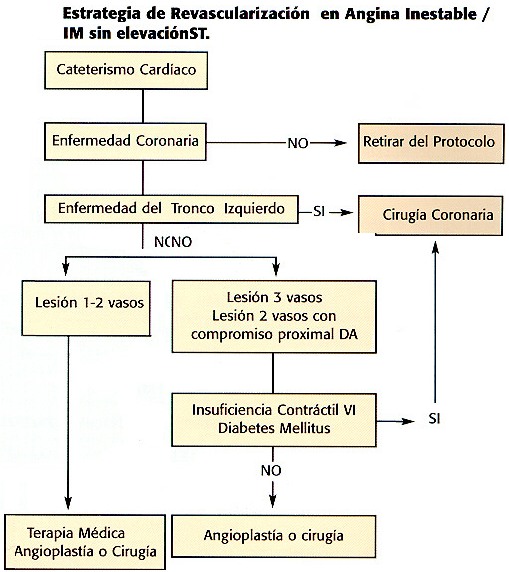
<body><![CDATA[<DIV class="MsoNormal"><FONT FACE="Arial,Helvetica"><FONT SIZE=-1><U>Eptifibatide (Integrilin):</U> Dosis de 180 microg/Kg en bolo seguido por una infusi&oacute;n de 2.0microg/Kg/min por 72 a 96 horas.</FONT></FONT></DIV>      <DIV class="MsoNormal"><FONT FACE="Arial,Helvetica"><FONT SIZE=-1><U>Tirofiban (Aggrastat)</U>: dosis de 0.4 microg/Kg/min por 30 minutos seguido por una infusi&oacute;n de 0.1 microg/Kg/min por 48 a 96 horas.</FONT></FONT>     <BR>&nbsp;</DIV>      <DIV class="MsoNormal"><U><FONT FACE="Arial,Helvetica"><FONT SIZE=-1>Estrategia conservadora versus invasiva para el manejo del S&iacute;ndrome Coronario Agudo:</FONT></FONT></U></DIV>      <DIV class="MsoNormal"><FONT FACE="Arial,Helvetica"><FONT SIZE=-1>En el estudio TIMI III B (<A HREF="#29">29</A>) publicado en 1994 se compar&oacute; en 1.473 pacientes con SCA el resultado obtenido con una terapia conservadora en la cual la angiograf&iacute;a coronaria se realizaba &uacute;nicamente en los pacientes que presentaban isquemia recurrente versus la terapia invasiva con angiograf&iacute;a y revascularizaci&oacute;n temprana entre las 18 a 48 horas de la randomizaci&oacute;n. El estudio no mostr&oacute; diferencias en cuanto a muerte, IM o angina refractaria en los dos grupos tratados. Estos resultados motivaron al Colegio y a la Asociaci&oacute;n Americana del Coraz&oacute;n a cambiar en 1966 los lineamientos del manejo del IM establecidos anteriormente que recomendaban la angiograf&iacute;a coronaria para todos los pacientes con IM no Q (<A HREF="#103">103</A>). A partir de esa fecha se han publicado art&iacute;culos que favorecen la terapia conservadora como VANQWISH (<A HREF="#104">104</A>,<A HREF="#120">120</A>.) y otros que favorecen la revascularizaci&oacute;n temprana como el estudio FRISC II (<A HREF="#105">105</A>) y el de los investigadores MITI (<A HREF="#106">106</A>). Todos estos estudios fueron realizados en la era pre-stent y antes del uso rutinario de los inhibidores GP IIb/IIIa. Estudios m&aacute;s recientes como EPISTENT (<A HREF="#107">107</A>) utilizando estas dos modalidades terap&eacute;uticas asociadas en el SCA han mostrado mayor beneficio en los pacientes tratados. Otros estudios, como el TACTICS-TIMI 18 (<A HREF="#108">108</A>) est&aacute;n evaluando la mejor alternativa terap&eacute;utica para el manejo de estos s&iacute;ndromes. Mientras tanto seguimos con la inquietud que el Dr Welty comenta en un editorial de la revista Journal of American College of Cardiology de Marzo del 2000 cuyo t&iacute;tulo es El Manejo Optimo del IM sin Elevaci&oacute;n del ST Permanece Confuso(<A HREF="#109">109</A>).</FONT></FONT></DIV>      <DIV class="MsoNormal"><FONT FACE="Arial,Helvetica"><FONT SIZE=-1>Las recomendaciones del Colegio y de la Asociaci&oacute;n Americana sobre el manejo de la Angina Inestable / IM sin elevaci&oacute;n del ST reci&eacute;n publicadas (<A HREF="#63">63</A>) son las siguientes:</FONT></FONT>     <BR>&nbsp;</DIV>      <DIV class="MsoNormal"><U><FONT FACE="Arial,Helvetica"><FONT SIZE=-1>Clase I:</FONT></FONT></U></DIV>      <DIV class="MsoNormal"><FONT FACE="Arial,Helvetica"><FONT SIZE=-1><B>1</B>. Se utiliza la estrategia invasiva temprana en los pacientes que presenten alguno de los siguientes indicadores de alto riesgo:</FONT></FONT></DIV>      <DIV class="MsoNormal"><FONT FACE="Arial,Helvetica"><FONT SIZE=-1>a. Pacientes con angor / isquemia recurrente en reposo o con actividad leve a pesar de terapia anti-isqu&eacute;mica intensa.</FONT></FONT></DIV>      ]]></body>
<body><![CDATA[<DIV class="MsoNormal"><FONT FACE="Arial,Helvetica"><FONT SIZE=-1>b. Pacientes con angor / isquemia recurrente con s&iacute;ntomas de insuficiencia card&iacute;aca, galope, edema pulmonar, o con insuficiencia mitral reciente o que haya empeorado.</FONT></FONT></DIV>      <DIV class="MsoNormal"><FONT FACE="Arial,Helvetica"><FONT SIZE=-1>c. Pacientes con hallazgos de ser de alto riesgo en estudios no invasivos.</FONT></FONT></DIV>      <DIV class="MsoNormal"><FONT FACE="Arial,Helvetica"><FONT SIZE=-1>d. Funci&oacute;n sist&oacute;lica del ventr&iacute;culo izquierdo menor de 40%.</FONT></FONT></DIV>      <DIV class="MsoNormal"><FONT FACE="Arial,Helvetica"><FONT SIZE=-1>e. Inestabilidad hemodin&aacute;mica.</FONT></FONT></DIV>      <DIV class="MsoNormal"><FONT FACE="Arial,Helvetica"><FONT SIZE=-1>f. Taquicardia ventricular sostenida.</FONT></FONT></DIV>      <DIV class="MsoNormal"><FONT FACE="Arial,Helvetica"><FONT SIZE=-1>g. Angioplast&iacute;a coronaria en los &uacute;ltimos 6 meses.</FONT></FONT></DIV>      <DIV class="MsoNormal"><FONT FACE="Arial,Helvetica"><FONT SIZE=-1>h. Antecedente de cirug&iacute;a coronaria.</FONT></FONT></DIV>      <DIV class="MsoNormal">&nbsp;     <BR><FONT FACE="Arial,Helvetica"><FONT SIZE=-1><B>2</B>. En ausencia de estos hallazgos, se puede utilizar ya sea una estrategia temprana conservadora o invasiva en pacientes hospitalizados que no tengan contraindicaci&oacute;nes para revascularizaci&oacute;n.</FONT></FONT></DIV>      <DIV class="MsoNormal">&nbsp;     ]]></body>
<body><![CDATA[<BR><FONT FACE="Arial,Helvetica"><FONT SIZE=-1>El cateterismo card&iacute;aco se debe realizar solamente en aquellos pacientes que sean potencialmente candidatos para revascularizaci&oacute;n, ya sea por medio de la angioplast&iacute;a o de la cirug&iacute;a. No se debe utilizar en pacientes con enfermedades severas graves en las cuales el riesgo es mayor que el beneficio que se puede obtener.</FONT></FONT></DIV>      <DIV class="MsoNormal">&nbsp;     <BR><B><FONT FACE="Arial,Helvetica"><FONT SIZE=-1>La angiograf&iacute;a coronaria en pacientes con angor inestable / IM sin elevaci&oacute;n del ST muestra:</FONT></FONT></B></DIV>      <DIV class="MsoNormal"><FONT FACE="Arial,Helvetica"><FONT SIZE=-1><B>a</B>. 10-20% tienen coronarias normales o enfermedad m&iacute;nima.</FONT></FONT></DIV>      <DIV class="MsoNormal"><FONT FACE="Arial,Helvetica"><FONT SIZE=-1><B>b</B>. 30-35% son lesiones de un solo vaso.</FONT></FONT></DIV>      <DIV class="MsoNormal"><FONT FACE="Arial,Helvetica"><FONT SIZE=-1><B>c</B>. 40-50% son lesiones m&uacute;ltiples.</FONT></FONT></DIV>      <DIV class="MsoNormal"><FONT FACE="Arial,Helvetica"><FONT SIZE=-1><B>d</B>. 4-10% son lesiones significativas del tronco izquierdo.</FONT></FONT>     <BR>&nbsp;     <CENTER><IMG SRC="/img/fbpe/rcc/v3n1/0732i05.JPG" HEIGHT=572 WIDTH=509></CENTER>      
<CENTER>&nbsp;</CENTER> </DIV>      ]]></body>
<body><![CDATA[<DIV class="MsoNormal"><FONT FACE="Arial,Helvetica"><FONT SIZE=-1>Continuando con el manejo integral de los SCA est&aacute; la modificaci&oacute;n de los factores de riesgo coronario especialmente la hipercolesterolemia. Con el nombre de Prevenci&oacute;n Secundaria Temprana en pacientes con SCA es como se conoce la nueva t&aacute;ctica terap&eacute;utica de disminuir agresivamente los l&iacute;pidos intra hospitalariamente en el momento de ser admitido por un SCA. Est&aacute; demostrado que disminuye la isquemia (<A HREF="#110">110</A>), probablemente al mejorar la funci&oacute;n endotelial con lo cual previene la vasoconstricci&oacute;n secundaria y tambi&eacute;n reduce el est&iacute;mulo de la inflamaci&oacute;n, estabilizando la placa ateroscler&oacute;tica. Tres estudios fueron presentados en la reuni&oacute;n de la Sociedad Americana del Coraz&oacute;n en New Orleans en noviembre del a&ntilde;o pasado. Uno de la Cleveland Clinic (<A HREF="#111">111</A>), y otros dos de grupos Alemanes (<A HREF="#112">112</A>,<A HREF="#113">113</A>) mostrando excelente resultados con el uso temprano de estatinas. Realiz&aacute;ndose actualmente se encuentra el estudio Aggrastat to Zocor (conocido como A to Z) valorando el uso de la Simvastatina asociada a Tirofiban y Aspirina y el estudio MIRACL (<A HREF="#114">114</A>) con dosis altas de Atorvastatina.</FONT></FONT>     <BR>&nbsp;</DIV>      <DIV class="MsoNormal"><FONT FACE="Arial,Helvetica"><FONT SIZE=-1><U>Recordatorio importante es el manejo de la prevenci&oacute;n secundaria en los SCA. </U>(Lamentablemente muchas veces omitida).</FONT></FONT></DIV>      <DIV class="MsoNormal"><FONT FACE="Arial,Helvetica"><FONT SIZE=-1><B><FONT COLOR="#3333FF">A</FONT></B>spirina 75 a 325 mg/d&iacute;a. Si hay contraindicaci&oacute;n se utiliza Clopidogrel 75mg/d&iacute;a.</FONT></FONT></DIV>      <DIV class="MsoNormal"><FONT FACE="Arial,Helvetica"><FONT SIZE=-1><B><FONT COLOR="#3333FF">B</FONT></B>eta bloqueadores si no hay contraindicaciones.</FONT></FONT></DIV>      <DIV class="MsoNormal"><FONT FACE="Arial,Helvetica"><FONT SIZE=-1><B><FONT COLOR="#3333FF">C</FONT></B>olesterol. Reducir LDL &lt; 100 mg/dl. Uso de agentes reductores(<A HREF="#117">117</A>).</FONT></FONT></DIV>      <DIV class="MsoNormal"><FONT FACE="Arial,Helvetica"><FONT SIZE=-1><B><FONT COLOR="#3333FF">D</FONT></B>ieta. Mediterr&aacute;nea (Lyon) (<A HREF="#115">115</A>,<A HREF="#116">116</A>). Simple de realizar y con reducci&oacute;n de la mortalidad total del 56% a cuatro a&ntilde;os y de muertepor enfermedad card&iacute;aca o infarto no fatal en 72%.</FONT></FONT></DIV>      <DIV class="MsoNormal"><FONT FACE="Arial,Helvetica"><FONT SIZE=-1><B><FONT COLOR="#3333FF">D</FONT></B>iabetes. Niveles &oacute;ptimos de glicemia.</FONT></FONT></DIV>       <P class="MsoNormal"><FONT FACE="Arial,Helvetica"><FONT SIZE=-1><B><FONT COLOR="#3333FF">E</FONT></B>jercicio regulado, disminuci&oacute;n de peso, manejo adecuado del estr&eacute;s.</FONT></FONT>      <P class="MsoNormal"><FONT FACE="Arial,Helvetica"><FONT SIZE=-1><B><FONT COLOR="#3333FF">F</FONT></B>umado. Suspenderlo a trav&eacute;s de programas especiales y educaci&oacute;n.</FONT></FONT>      ]]></body>
<body><![CDATA[<P class="MsoNormal"><FONT FACE="Arial,Helvetica"><FONT SIZE=-1><B><FONT COLOR="#3333FF">G</FONT></B>en&eacute;tica, de gran inter&eacute;s para el futuro (<A HREF="#118">118</A>).</FONT></FONT>      <P class="MsoNormal"><FONT FACE="Arial,Helvetica"><FONT SIZE=-1><B><FONT COLOR="#3366FF">H</FONT></B>ipertensi&oacute;n bien controlada, preferiblemente con inhibidores de ECA.</FONT></FONT>      <P class="MsoNormal"><FONT FACE="Arial,Helvetica"><FONT SIZE=-1>Art&iacute;culo interesante (<A HREF="#119">119</A>) Deben ser los Inhibidores de ECA terapia est&aacute;ndar en los pacientes con enfermedad ateroscler&oacute;tica.&nbsp; J Am Coll Cardiol 2001;37:1-8.</FONT></FONT>     <BR>&nbsp;     <DIV class="MsoNormal"><B><FONT FACE="Arial,Helvetica"><FONT SIZE=-1>Referencias</FONT></FONT></B></DIV>       <!-- ref --><P class="MsoNormal"><A NAME="1"></A><FONT FACE="Arial,Helvetica"><FONT SIZE=-1>1.Fuster V,Badimon L,Badimon J J,Chesebro J H. The pathogenesis of coronary artery disease and the acute coronary syndromes ( Part I ).N Engl J Med 1992; 326: 242-50.</FONT></FONT>    &nbsp;&nbsp;&nbsp;&nbsp;&nbsp;&nbsp;&nbsp;&nbsp;[&#160;<a href="javascript:void(0);" onclick="javascript: window.open('/scielo.php?script=sci_nlinks&ref=725003&pid=S1409-4142200100010000700001&lng=','','width=640,height=500,resizable=yes,scrollbars=1,menubar=yes,');">Links</a>&#160;]<!-- end-ref --><!-- ref --><P class="MsoNormal"><A NAME="2"></A><FONT FACE="Arial,Helvetica"><FONT SIZE=-1>2.Fuster V, Badimon L, Badimon J J, Chesebro J H. The pathogenesis of coronary artery disease and the acute coronary syndromes ( Part II ) N Engl J Med 1992;326:310-318.</FONT></FONT>    &nbsp;&nbsp;&nbsp;&nbsp;&nbsp;&nbsp;&nbsp;&nbsp;[&#160;<a href="javascript:void(0);" onclick="javascript: window.open('/scielo.php?script=sci_nlinks&ref=725004&pid=S1409-4142200100010000700002&lng=','','width=640,height=500,resizable=yes,scrollbars=1,menubar=yes,');">Links</a>&#160;]<!-- end-ref --><!-- ref --><P class="MsoNormal"><A NAME="3"></A><FONT FACE="Arial,Helvetica"><FONT SIZE=-1>3.Fuster V,Badimon L, Cohen M,Ambrose JA.et al. Insights into the pathogenesis of acute ischemic syndromes. Circulation 1988;77:1213-20.</FONT></FONT>    &nbsp;&nbsp;&nbsp;&nbsp;&nbsp;&nbsp;&nbsp;&nbsp;[&#160;<a href="javascript:void(0);" onclick="javascript: window.open('/scielo.php?script=sci_nlinks&ref=725005&pid=S1409-4142200100010000700003&lng=','','width=640,height=500,resizable=yes,scrollbars=1,menubar=yes,');">Links</a>&#160;]<!-- end-ref --><!-- ref --><P class="MsoNormal"><A NAME="4"></A><FONT FACE="Arial,Helvetica"><FONT SIZE=-1>4.Dalager - Pederson S,Morre Pederson E,Ringgaard S,Falk E. Coronary Artery Disease: Plaque Vulnerability,Disruption and Thrombosis.From Fuster V. The Vulnerable Atherosclerotic Plaque.American Heart Association.Monograph Series.1999:1-23.</FONT></FONT>    &nbsp;&nbsp;&nbsp;&nbsp;&nbsp;&nbsp;&nbsp;&nbsp;[&#160;<a href="javascript:void(0);" onclick="javascript: window.open('/scielo.php?script=sci_nlinks&ref=725006&pid=S1409-4142200100010000700004&lng=','','width=640,height=500,resizable=yes,scrollbars=1,menubar=yes,');">Links</a>&#160;]<!-- end-ref --><!-- ref --><P class="MsoNormal"><A NAME="5"></A><FONT FACE="Arial,Helvetica"><FONT SIZE=-1>5.Dlavies M J, Thhomas A C. Plaque fissuring the cause of acute myocardial infarction,sudden ischemic death, and crescendo angina. Br Heart J 1985;53:363-73.</FONT></FONT>    &nbsp;&nbsp;&nbsp;&nbsp;&nbsp;&nbsp;&nbsp;&nbsp;[&#160;<a href="javascript:void(0);" onclick="javascript: window.open('/scielo.php?script=sci_nlinks&ref=725007&pid=S1409-4142200100010000700005&lng=','','width=640,height=500,resizable=yes,scrollbars=1,menubar=yes,');">Links</a>&#160;]<!-- end-ref --><!-- ref --><P class="MsoNormal"><A NAME="6"></A><FONT FACE="Arial,Helvetica"><FONT SIZE=-1>6.Plutzky J. Atherosclerotic Plaque rupture: emerging insights and opportunities. Am J Cardiol 1999;84:15J-20J.</FONT></FONT>    &nbsp;&nbsp;&nbsp;&nbsp;&nbsp;&nbsp;&nbsp;&nbsp;[&#160;<a href="javascript:void(0);" onclick="javascript: window.open('/scielo.php?script=sci_nlinks&ref=725008&pid=S1409-4142200100010000700006&lng=','','width=640,height=500,resizable=yes,scrollbars=1,menubar=yes,');">Links</a>&#160;]<!-- end-ref --><!-- ref --><P class="MsoNormal"><A NAME="7"></A><FONT FACE="Arial,Helvetica"><FONT SIZE=-1>7.Libby P. Molecular bases of the Acute Coronary Syndromes.Circulation 1995;91:2844-50.</FONT></FONT>    &nbsp;&nbsp;&nbsp;&nbsp;&nbsp;&nbsp;&nbsp;&nbsp;[&#160;<a href="javascript:void(0);" onclick="javascript: window.open('/scielo.php?script=sci_nlinks&ref=725009&pid=S1409-4142200100010000700007&lng=','','width=640,height=500,resizable=yes,scrollbars=1,menubar=yes,');">Links</a>&#160;]<!-- end-ref --><!-- ref --><P class="MsoNormal"><A NAME="8"></A><FONT FACE="Arial,Helvetica"><FONT SIZE=-1>8.Moreno P R,Falk E,Palacios JF,Neewell JB,Fuster V,FallonJ.Macrophage infiltration in Acute Coronary Syndromes: implications for plaque rupture.Circulation 1994;90:775-8.</FONT></FONT>    &nbsp;&nbsp;&nbsp;&nbsp;&nbsp;&nbsp;&nbsp;&nbsp;[&#160;<a href="javascript:void(0);" onclick="javascript: window.open('/scielo.php?script=sci_nlinks&ref=725010&pid=S1409-4142200100010000700008&lng=','','width=640,height=500,resizable=yes,scrollbars=1,menubar=yes,');">Links</a>&#160;]<!-- end-ref --><!-- ref --><P class="MsoNormal"><A NAME="9"></A><FONT FACE="Arial,Helvetica"><FONT SIZE=-1>9.Hamm CW,Lorenz RL,Bleifeld W,Kupper W et al.Biochemical evidence of platelet activation in patients with persistent unstable angina.J Am Coll Cardiol 1987;10:998-1004.</FONT></FONT>    &nbsp;&nbsp;&nbsp;&nbsp;&nbsp;&nbsp;&nbsp;&nbsp;[&#160;<a href="javascript:void(0);" onclick="javascript: window.open('/scielo.php?script=sci_nlinks&ref=725011&pid=S1409-4142200100010000700009&lng=','','width=640,height=500,resizable=yes,scrollbars=1,menubar=yes,');">Links</a>&#160;]<!-- end-ref --><!-- ref --><P class="MsoNormal"><A NAME="10"></A><FONT FACE="Arial,Helvetica"><FONT SIZE=-1>10.Falk E, Shah PK,and Fuster V.Coronary Plaque Disruption.Circulation 1995;92:657.</FONT></FONT>    &nbsp;&nbsp;&nbsp;&nbsp;&nbsp;&nbsp;&nbsp;&nbsp;[&#160;<a href="javascript:void(0);" onclick="javascript: window.open('/scielo.php?script=sci_nlinks&ref=725012&pid=S1409-4142200100010000700010&lng=','','width=640,height=500,resizable=yes,scrollbars=1,menubar=yes,');">Links</a>&#160;]<!-- end-ref --><!-- ref --><P class="MsoNormal"><A NAME="11"></A><FONT FACE="Arial,Helvetica"><FONT SIZE=-1>11.DeWood MA, Stiffer WF, Simpson CS,et al.Coronary angiografic findings soon after non Q wave myocardial infarction.N Engl J Med1986;315:417-23.</FONT></FONT>    &nbsp;&nbsp;&nbsp;&nbsp;&nbsp;&nbsp;&nbsp;&nbsp;[&#160;<a href="javascript:void(0);" onclick="javascript: window.open('/scielo.php?script=sci_nlinks&ref=725013&pid=S1409-4142200100010000700011&lng=','','width=640,height=500,resizable=yes,scrollbars=1,menubar=yes,');">Links</a>&#160;]<!-- end-ref --><!-- ref --><P class="MsoNormal"><A NAME="12"></A><FONT FACE="Arial,Helvetica"><FONT SIZE=-1>12.Cannon C.Curr Probl Cardiol.1999;24:683-744.</FONT></FONT>    &nbsp;&nbsp;&nbsp;&nbsp;&nbsp;&nbsp;&nbsp;&nbsp;[&#160;<a href="javascript:void(0);" onclick="javascript: window.open('/scielo.php?script=sci_nlinks&ref=725014&pid=S1409-4142200100010000700012&lng=','','width=640,height=500,resizable=yes,scrollbars=1,menubar=yes,');">Links</a>&#160;]<!-- end-ref --><!-- ref --><P class="MsoNormal"><A NAME="13"></A><FONT FACE="Arial,Helvetica"><FONT SIZE=-1>13.Falk E.Unstable Angina with fatal outcome:dynamic coronary thrombosis leading to infarction and/or sudden death.Circulation 1985;71:699-708.</FONT></FONT>    &nbsp;&nbsp;&nbsp;&nbsp;&nbsp;&nbsp;&nbsp;&nbsp;[&#160;<a href="javascript:void(0);" onclick="javascript: window.open('/scielo.php?script=sci_nlinks&ref=725015&pid=S1409-4142200100010000700013&lng=','','width=640,height=500,resizable=yes,scrollbars=1,menubar=yes,');">Links</a>&#160;]<!-- end-ref --><!-- ref --><P class="MsoNormal"><A NAME="14"></A><FONT FACE="Arial,Helvetica"><FONT SIZE=-1>14.Sullivan E,Kearney M ,Isner J,Topol E,Losordo D.Pathology of unstable angina:analysis of biopsies obtained by directional coronary atherectomy. J Throm Thrombolysis.1994;I:63-71.</FONT></FONT>    &nbsp;&nbsp;&nbsp;&nbsp;&nbsp;&nbsp;&nbsp;&nbsp;[&#160;<a href="javascript:void(0);" onclick="javascript: window.open('/scielo.php?script=sci_nlinks&ref=725016&pid=S1409-4142200100010000700014&lng=','','width=640,height=500,resizable=yes,scrollbars=1,menubar=yes,');">Links</a>&#160;]<!-- end-ref --><!-- ref --><P class="MsoNormal"><A NAME="15"></A><FONT FACE="Arial,Helvetica"><FONT SIZE=-1>15.Sherman CT,Litvack F,Grundfest W,LeeM et al. Coronary angioscopy in patients with unstable angina pectoris. N Engl J Med 1986;315:913-9.</FONT></FONT>    &nbsp;&nbsp;&nbsp;&nbsp;&nbsp;&nbsp;&nbsp;&nbsp;[&#160;<a href="javascript:void(0);" onclick="javascript: window.open('/scielo.php?script=sci_nlinks&ref=725017&pid=S1409-4142200100010000700015&lng=','','width=640,height=500,resizable=yes,scrollbars=1,menubar=yes,');">Links</a>&#160;]<!-- end-ref --><!-- ref --><P class="MsoNormal"><A NAME="16"></A><FONT FACE="Arial,Helvetica"><FONT SIZE=-1>16.MizunoK,Satumo K,Miyamoto A, Arakawa E,et al.Angioscopic evaluation of coronary artery thrombi in acute coronary syndromes. N Engl J Med 1992;326:287-91.</FONT></FONT>    &nbsp;&nbsp;&nbsp;&nbsp;&nbsp;&nbsp;&nbsp;&nbsp;[&#160;<a href="javascript:void(0);" onclick="javascript: window.open('/scielo.php?script=sci_nlinks&ref=725018&pid=S1409-4142200100010000700016&lng=','','width=640,height=500,resizable=yes,scrollbars=1,menubar=yes,');">Links</a>&#160;]<!-- end-ref --><!-- ref --><P class="MsoNormal"><A NAME="17"></A><FONT FACE="Arial,Helvetica"><FONT SIZE=-1>17.The TIMI III A investigators. Early effects of tissue-type plasminogen activator added to conventional therapy on the culprit lesion in patients presenting with ischemic cardiac pain at rest. Results of the Thrombolysis in Myocardial Ischemia (TIMI IIIA) trial.Circulation 1993;87:38-</FONT></FONT>    &nbsp;&nbsp;&nbsp;&nbsp;&nbsp;&nbsp;&nbsp;&nbsp;[&#160;<a href="javascript:void(0);" onclick="javascript: window.open('/scielo.php?script=sci_nlinks&ref=725019&pid=S1409-4142200100010000700017&lng=','','width=640,height=500,resizable=yes,scrollbars=1,menubar=yes,');">Links</a>&#160;]<!-- end-ref --><!-- ref --><P class="MsoNormal"><A NAME="18"></A><FONT FACE="Arial,Helvetica"><FONT SIZE=-1>18.AmbroseJA,HjemdaMosenCE,BorricoS,GorlinR,FusterV.Angiographic demostration of a common link between unstable angina and non Q wave myocardial infarction Am J Cardiol 1988;61:244-7.</FONT></FONT>    &nbsp;&nbsp;&nbsp;&nbsp;&nbsp;&nbsp;&nbsp;&nbsp;[&#160;<a href="javascript:void(0);" onclick="javascript: window.open('/scielo.php?script=sci_nlinks&ref=725020&pid=S1409-4142200100010000700018&lng=','','width=640,height=500,resizable=yes,scrollbars=1,menubar=yes,');">Links</a>&#160;]<!-- end-ref --><!-- ref --><P class="MsoNormal"><A NAME="19"></A><FONT FACE="Arial,Helvetica"><FONT SIZE=-1>19.Fitsgerald DJ,RoyL,Catella F, Fitzgerald GA.Platelet activation in unstable coronary disease.N Engl J Med 1986;315:983-9.</FONT></FONT>    &nbsp;&nbsp;&nbsp;&nbsp;&nbsp;&nbsp;&nbsp;&nbsp;[&#160;<a href="javascript:void(0);" onclick="javascript: window.open('/scielo.php?script=sci_nlinks&ref=725021&pid=S1409-4142200100010000700019&lng=','','width=640,height=500,resizable=yes,scrollbars=1,menubar=yes,');">Links</a>&#160;]<!-- end-ref --><!-- ref --><P class="MsoNormal"><A NAME="20"></A><FONT FACE="Arial,Helvetica"><FONT SIZE=-1>20.Alexopoloulos D,Ambrose JA, Stump D,Borrico S et al.Thrombosis related markers in unstable angina. J AmColl Cardiol 1991;17:866-71.</FONT></FONT>    &nbsp;&nbsp;&nbsp;&nbsp;&nbsp;&nbsp;&nbsp;&nbsp;[&#160;<a href="javascript:void(0);" onclick="javascript: window.open('/scielo.php?script=sci_nlinks&ref=725022&pid=S1409-4142200100010000700020&lng=','','width=640,height=500,resizable=yes,scrollbars=1,menubar=yes,');">Links</a>&#160;]<!-- end-ref --><!-- ref --><P class="MsoNormal"><A NAME="21"></A><FONT FACE="Arial,Helvetica"><FONT SIZE=-1>21.Oler A,Whooley MA,Oler J,Grady D.Adding heparin to aspirin reduces the incidence of myocardial infarction and death in patients with unstable angina.A Meta Analysis.JAMA 1996;276:811-5.</FONT></FONT>    &nbsp;&nbsp;&nbsp;&nbsp;&nbsp;&nbsp;&nbsp;&nbsp;[&#160;<a href="javascript:void(0);" onclick="javascript: window.open('/scielo.php?script=sci_nlinks&ref=725023&pid=S1409-4142200100010000700021&lng=','','width=640,height=500,resizable=yes,scrollbars=1,menubar=yes,');">Links</a>&#160;]<!-- end-ref --><P class="MsoNormal"><A NAME="22"></A><FONT FACE="Arial,Helvetica"><FONT SIZE=-1>22.A definition of advanced type of atherosclerotic lesions and a histological classification of atherosclerosis: a report from the Committee on Vascular Lesions of the Council on Atherosclerosis,American Heart Association.Circulation 1995;92:1355-1374.</FONT></FONT>      <!-- ref --><P class="MsoNormal"><A NAME="23"></A><FONT FACE="Arial,Helvetica"><FONT SIZE=-1>23.Braunwald E:Unstable Angina:A classification Circulation1989;80:410-4</FONT></FONT>    &nbsp;&nbsp;&nbsp;&nbsp;&nbsp;&nbsp;&nbsp;&nbsp;[&#160;<a href="javascript:void(0);" onclick="javascript: window.open('/scielo.php?script=sci_nlinks&ref=725025&pid=S1409-4142200100010000700023&lng=','','width=640,height=500,resizable=yes,scrollbars=1,menubar=yes,');">Links</a>&#160;]<!-- end-ref --><!-- ref --><P class="MsoNormal"><A NAME="24"></A><FONT FACE="Arial,Helvetica"><FONT SIZE=-1>24.Ahmed WH,Bittl JA ,Braunwald E.Relation between clinical presentation and angiographic findings in unstable angina pectoris,and comparison with that in stable angina. Am J Cardiol 1993;72:544-550.</FONT></FONT>    &nbsp;&nbsp;&nbsp;&nbsp;&nbsp;&nbsp;&nbsp;&nbsp;[&#160;<a href="javascript:void(0);" onclick="javascript: window.open('/scielo.php?script=sci_nlinks&ref=725026&pid=S1409-4142200100010000700024&lng=','','width=640,height=500,resizable=yes,scrollbars=1,menubar=yes,');">Links</a>&#160;]<!-- end-ref --><!-- ref --><P class="MsoNormal"><A NAME="25"></A><FONT FACE="Arial,Helvetica"><FONT SIZE=-1>25.Danges G,Mehran R,Wallenstein S et al.Correlation of angiographic morphology and clinical presentation in unstable angina. J Am Coll Cardiol 1997;29:519-525.</FONT></FONT>    &nbsp;&nbsp;&nbsp;&nbsp;&nbsp;&nbsp;&nbsp;&nbsp;[&#160;<a href="javascript:void(0);" onclick="javascript: window.open('/scielo.php?script=sci_nlinks&ref=725027&pid=S1409-4142200100010000700025&lng=','','width=640,height=500,resizable=yes,scrollbars=1,menubar=yes,');">Links</a>&#160;]<!-- end-ref --><!-- ref --><P class="MsoNormal"><A NAME="26"></A><FONT FACE="Arial,Helvetica"><FONT SIZE=-1>26.DeServiS,ArbustiniE,Marsica F et al.Correlation of angiographic morphology findings in unstable angina.Am J Cardiol 1996;77:128-132.</FONT></FONT>    &nbsp;&nbsp;&nbsp;&nbsp;&nbsp;&nbsp;&nbsp;&nbsp;[&#160;<a href="javascript:void(0);" onclick="javascript: window.open('/scielo.php?script=sci_nlinks&ref=725028&pid=S1409-4142200100010000700026&lng=','','width=640,height=500,resizable=yes,scrollbars=1,menubar=yes,');">Links</a>&#160;]<!-- end-ref --><!-- ref --><P class="MsoNormal"><A NAME="27"></A><FONT FACE="Arial,Helvetica"><FONT SIZE=-1>27.Owa M,OrigasaH,Saito M.Predictive validity of the Braunwald classification of unstable angina for angiographic finding,short-term prognosis,and treatment selection.Angiology.1997;48:663-670.</FONT></FONT>    &nbsp;&nbsp;&nbsp;&nbsp;&nbsp;&nbsp;&nbsp;&nbsp;[&#160;<a href="javascript:void(0);" onclick="javascript: window.open('/scielo.php?script=sci_nlinks&ref=725029&pid=S1409-4142200100010000700027&lng=','','width=640,height=500,resizable=yes,scrollbars=1,menubar=yes,');">Links</a>&#160;]<!-- end-ref --><!-- ref --><P class="MsoNormal"><A NAME="28"></A><FONT FACE="Arial,Helvetica"><FONT SIZE=-1>28.Lee T,Cook E,Weisberg M,Sargent RK et al,Acute chest pain in the Emergency Room:identification and examination of low-risk patients. Arch Intern Med 1985;145:65-9.</FONT></FONT>    &nbsp;&nbsp;&nbsp;&nbsp;&nbsp;&nbsp;&nbsp;&nbsp;[&#160;<a href="javascript:void(0);" onclick="javascript: window.open('/scielo.php?script=sci_nlinks&ref=725030&pid=S1409-4142200100010000700028&lng=','','width=640,height=500,resizable=yes,scrollbars=1,menubar=yes,');">Links</a>&#160;]<!-- end-ref --><!-- ref --><P class="MsoNormal"><A NAME="29"></A><FONT FACE="Arial,Helvetica"><FONT SIZE=-1>29.TIMI IIIB Investigators.Effects of tissue plasminogen activator and a comparison of early invasive and conservative strategies in unstable angina and non Q wave myocardial infarction.Circulation1994;89:1545-1556.</FONT></FONT>    &nbsp;&nbsp;&nbsp;&nbsp;&nbsp;&nbsp;&nbsp;&nbsp;[&#160;<a href="javascript:void(0);" onclick="javascript: window.open('/scielo.php?script=sci_nlinks&ref=725031&pid=S1409-4142200100010000700029&lng=','','width=640,height=500,resizable=yes,scrollbars=1,menubar=yes,');">Links</a>&#160;]<!-- end-ref --><!-- ref --><P class="MsoNormal"><A NAME="30"></A><FONT FACE="Arial,Helvetica"><FONT SIZE=-1>30.Cannon CP,McCabe CH,StoneP,et al.The electrocardiogram predicts one year outcome of patients with unstable angina and non Q wave myocardial infarction:results of the TIMI III Registry ECG Ancillary Study.J Am Coll Cardiol.1997;30:133-140.</FONT></FONT>    &nbsp;&nbsp;&nbsp;&nbsp;&nbsp;&nbsp;&nbsp;&nbsp;[&#160;<a href="javascript:void(0);" onclick="javascript: window.open('/scielo.php?script=sci_nlinks&ref=725032&pid=S1409-4142200100010000700030&lng=','','width=640,height=500,resizable=yes,scrollbars=1,menubar=yes,');">Links</a>&#160;]<!-- end-ref --><!-- ref --><P class="MsoNormal"><A NAME="31"></A><FONT FACE="Arial,Helvetica"><FONT SIZE=-1>31.RouanGW,LeeT,CookE,BrandDA,lWeisbergM,GoldmanL.Clinical characteristics and outcome of acute myocardial infarction in patients with initially normal or nonspecific electrocardiograms ( a report from the Multicenter Chest Pain Study ).Am J Cardiol 1989;64:1087-92.</FONT></FONT>    &nbsp;&nbsp;&nbsp;&nbsp;&nbsp;&nbsp;&nbsp;&nbsp;[&#160;<a href="javascript:void(0);" onclick="javascript: window.open('/scielo.php?script=sci_nlinks&ref=725033&pid=S1409-4142200100010000700031&lng=','','width=640,height=500,resizable=yes,scrollbars=1,menubar=yes,');">Links</a>&#160;]<!-- end-ref --><!-- ref --><P class="MsoNormal"><A NAME="32"></A><FONT FACE="Arial,Helvetica"><FONT SIZE=-1>32.Slater DK, Hlatky M A,Mark DB,Harrell FE,et al.Outcome in suspected acute myocardial infarction with normal or minimally abnormal admission electrocardiographic findings.Am J Cardiol 1987;60:766-70.</FONT></FONT>    &nbsp;&nbsp;&nbsp;&nbsp;&nbsp;&nbsp;&nbsp;&nbsp;[&#160;<a href="javascript:void(0);" onclick="javascript: window.open('/scielo.php?script=sci_nlinks&ref=725034&pid=S1409-4142200100010000700032&lng=','','width=640,height=500,resizable=yes,scrollbars=1,menubar=yes,');">Links</a>&#160;]<!-- end-ref --><!-- ref --><P class="MsoNormal"><A NAME="33"></A><FONT FACE="Arial,Helvetica"><FONT SIZE=-1>33.Patel DJ,Knight CJ,Holdright DR et al. Long term prognosis in unstable angina: the importance of early risk stratification using continuous ST segment monitoring.Eur Heart J 1998;19:240-9.</FONT></FONT>    &nbsp;&nbsp;&nbsp;&nbsp;&nbsp;&nbsp;&nbsp;&nbsp;[&#160;<a href="javascript:void(0);" onclick="javascript: window.open('/scielo.php?script=sci_nlinks&ref=725035&pid=S1409-4142200100010000700033&lng=','','width=640,height=500,resizable=yes,scrollbars=1,menubar=yes,');">Links</a>&#160;]<!-- end-ref --><!-- ref --><P class="MsoNormal"><A NAME="34"></A><FONT FACE="Arial,Helvetica"><FONT SIZE=-1>34.Gottlieb SO,Weisfeldt M L,Ouyang P,et al.Silent ischemia as a marker for early unfavorable outcomes in patients with unstable angina.N Engl J Med 1986;314:1214-11219.</FONT></FONT>    &nbsp;&nbsp;&nbsp;&nbsp;&nbsp;&nbsp;&nbsp;&nbsp;[&#160;<a href="javascript:void(0);" onclick="javascript: window.open('/scielo.php?script=sci_nlinks&ref=725036&pid=S1409-4142200100010000700034&lng=','','width=640,height=500,resizable=yes,scrollbars=1,menubar=yes,');">Links</a>&#160;]<!-- end-ref --><!-- ref --><P class="MsoNormal"><A NAME="35"></A><FONT FACE="Arial,Helvetica"><FONT SIZE=-1>35.Roberts R,Fromm RE.Management of acute coronary sindromes based on risk stratification by biochemical markers: an idea whose time has come.Circulation 1998;98:1831-3.</FONT></FONT>    &nbsp;&nbsp;&nbsp;&nbsp;&nbsp;&nbsp;&nbsp;&nbsp;[&#160;<a href="javascript:void(0);" onclick="javascript: window.open('/scielo.php?script=sci_nlinks&ref=725037&pid=S1409-4142200100010000700035&lng=','','width=640,height=500,resizable=yes,scrollbars=1,menubar=yes,');">Links</a>&#160;]<!-- end-ref --><!-- ref --><P class="MsoNormal"><A NAME="36"></A><FONT FACE="Arial,Helvetica"><FONT SIZE=-1>36.Puleo PR,Meyer D,Wathen C,et al.Use of a rapid assay of subforms of creatine-kinase-MB to diagnose or rule out acute myocardial infarction.N Engl J Med 1994;331:561-6</FONT></FONT>    &nbsp;&nbsp;&nbsp;&nbsp;&nbsp;&nbsp;&nbsp;&nbsp;[&#160;<a href="javascript:void(0);" onclick="javascript: window.open('/scielo.php?script=sci_nlinks&ref=725038&pid=S1409-4142200100010000700036&lng=','','width=640,height=500,resizable=yes,scrollbars=1,menubar=yes,');">Links</a>&#160;]<!-- end-ref --><!-- ref --><P class="MsoNormal"><A NAME="37"></A><FONT FACE="Arial,Helvetica"><FONT SIZE=-1>37.Newby LK,Gibler WB,Ohman WM,et al.Biochemical markers in suspected Acute Myocardial Infarction.Clin Chem 1995;41:1263.</FONT></FONT>    &nbsp;&nbsp;&nbsp;&nbsp;&nbsp;&nbsp;&nbsp;&nbsp;[&#160;<a href="javascript:void(0);" onclick="javascript: window.open('/scielo.php?script=sci_nlinks&ref=725039&pid=S1409-4142200100010000700037&lng=','','width=640,height=500,resizable=yes,scrollbars=1,menubar=yes,');">Links</a>&#160;]<!-- end-ref --><!-- ref --><P class="MsoNormal"><A NAME="38"></A><FONT FACE="Arial,Helvetica"><FONT SIZE=-1>38.Puleo PR,Guadagno PA, Roberts R,Scheel MV,et al.Early diagnosis of acute myocardial infarction based on assay for subforms of creatine kinase-MB.Circulation.1990;82:759-64.</FONT></FONT>    &nbsp;&nbsp;&nbsp;&nbsp;&nbsp;&nbsp;&nbsp;&nbsp;[&#160;<a href="javascript:void(0);" onclick="javascript: window.open('/scielo.php?script=sci_nlinks&ref=725040&pid=S1409-4142200100010000700038&lng=','','width=640,height=500,resizable=yes,scrollbars=1,menubar=yes,');">Links</a>&#160;]<!-- end-ref --><!-- ref --><P class="MsoNormal"><A NAME="39"></A><FONT FACE="Arial,Helvetica"><FONT SIZE=-1>39.Adams JE,Abendschein DR,Jaffe AS.Biochemical markers of myocardial injury.Is MB creatinine kinase the choice for the 1990.Circulation 1993;88:750-63.</FONT></FONT>    &nbsp;&nbsp;&nbsp;&nbsp;&nbsp;&nbsp;&nbsp;&nbsp;[&#160;<a href="javascript:void(0);" onclick="javascript: window.open('/scielo.php?script=sci_nlinks&ref=725041&pid=S1409-4142200100010000700039&lng=','','width=640,height=500,resizable=yes,scrollbars=1,menubar=yes,');">Links</a>&#160;]<!-- end-ref --><!-- ref --><P class="MsoNormal"><A NAME="40"></A><FONT FACE="Arial,Helvetica"><FONT SIZE=-1>40.Antman E,Bassand JP,KleinW,et al. Myocardial Infarction Redefined.A consensus document of the Joint European Society of Cardiology/American College of Cardiology committee for the redefinition of Myocardial Infarction.J Am Coll Cardiol 2000;36:959-69.</FONT></FONT>    &nbsp;&nbsp;&nbsp;&nbsp;&nbsp;&nbsp;&nbsp;&nbsp;[&#160;<a href="javascript:void(0);" onclick="javascript: window.open('/scielo.php?script=sci_nlinks&ref=725042&pid=S1409-4142200100010000700040&lng=','','width=640,height=500,resizable=yes,scrollbars=1,menubar=yes,');">Links</a>&#160;]<!-- end-ref --><!-- ref --><P class="MsoNormal"><A NAME="41"></A><FONT FACE="Arial,Helvetica"><FONT SIZE=-1>41.de Winter R.Risk Stratification with Cardiac Troponin I in Acute Coronary Syndromes.J Am Coll Cardiol 2000;36:1824-6.</FONT></FONT>    &nbsp;&nbsp;&nbsp;&nbsp;&nbsp;&nbsp;&nbsp;&nbsp;[&#160;<a href="javascript:void(0);" onclick="javascript: window.open('/scielo.php?script=sci_nlinks&ref=725043&pid=S1409-4142200100010000700041&lng=','','width=640,height=500,resizable=yes,scrollbars=1,menubar=yes,');">Links</a>&#160;]<!-- end-ref --><!-- ref --><P class="MsoNormal"><A NAME="42"></A><FONT FACE="Arial,Helvetica"><FONT SIZE=-1>42.Hamm CW,Ravkilde J,Gerhardt W,et al.The prognostic value of serum Troponin T in Unstable Angina.N Engl J Med 1994;327:146-50.</FONT></FONT>    &nbsp;&nbsp;&nbsp;&nbsp;&nbsp;&nbsp;&nbsp;&nbsp;[&#160;<a href="javascript:void(0);" onclick="javascript: window.open('/scielo.php?script=sci_nlinks&ref=725044&pid=S1409-4142200100010000700042&lng=','','width=640,height=500,resizable=yes,scrollbars=1,menubar=yes,');">Links</a>&#160;]<!-- end-ref --><!-- ref --><P class="MsoNormal"><A NAME="43"></A><FONT FACE="Arial,Helvetica"><FONT SIZE=-1>43.Ohman EM,Armstrong PW,Christenson RH,et al.Cardiac Troponin T levels for risk stratification in acute myocardial ischemiaGUSTO II A Investigators N Engl J Med 1996;335:1333-41.</FONT></FONT>    &nbsp;&nbsp;&nbsp;&nbsp;&nbsp;&nbsp;&nbsp;&nbsp;[&#160;<a href="javascript:void(0);" onclick="javascript: window.open('/scielo.php?script=sci_nlinks&ref=725045&pid=S1409-4142200100010000700043&lng=','','width=640,height=500,resizable=yes,scrollbars=1,menubar=yes,');">Links</a>&#160;]<!-- end-ref --><!-- ref --><P class="MsoNormal"><A NAME="44"></A><FONT FACE="Arial,Helvetica"><FONT SIZE=-1>44.Heeschen C,vandenBrand MJ,Hamm CW, Simoons ML. Angiographic findings in patients with refractory unstable angina according to Troponin T status.Circulation 1999;100:1509-14.</FONT></FONT>    &nbsp;&nbsp;&nbsp;&nbsp;&nbsp;&nbsp;&nbsp;&nbsp;[&#160;<a href="javascript:void(0);" onclick="javascript: window.open('/scielo.php?script=sci_nlinks&ref=725046&pid=S1409-4142200100010000700044&lng=','','width=640,height=500,resizable=yes,scrollbars=1,menubar=yes,');">Links</a>&#160;]<!-- end-ref --><!-- ref --><P class="MsoNormal"><A NAME="45"></A><FONT FACE="Arial,Helvetica"><FONT SIZE=-1>45.Hanam CH,Braunwald E. A Classification of Unstable Angina Revisited.Circulation 2000;102:118-122.</FONT></FONT>    &nbsp;&nbsp;&nbsp;&nbsp;&nbsp;&nbsp;&nbsp;&nbsp;[&#160;<a href="javascript:void(0);" onclick="javascript: window.open('/scielo.php?script=sci_nlinks&ref=725047&pid=S1409-4142200100010000700045&lng=','','width=640,height=500,resizable=yes,scrollbars=1,menubar=yes,');">Links</a>&#160;]<!-- end-ref --><!-- ref --><P class="MsoNormal"><A NAME="46"></A><FONT FACE="Arial,Helvetica"><FONT SIZE=-1>46.Heeschen C,Hamm CW,Goldman B,Deu A et al.Troponin concentrations for stratification of patients with Acute Coronary Syndromes in relation to therapeutic efficacy of Tirofiban. PRISM Study Investigators. Platelet Receptor Inhibition in Ischemic Syndrome Management.Lancet 1999;354:1757-62.</FONT></FONT>    &nbsp;&nbsp;&nbsp;&nbsp;&nbsp;&nbsp;&nbsp;&nbsp;[&#160;<a href="javascript:void(0);" onclick="javascript: window.open('/scielo.php?script=sci_nlinks&ref=725048&pid=S1409-4142200100010000700046&lng=','','width=640,height=500,resizable=yes,scrollbars=1,menubar=yes,');">Links</a>&#160;]<!-- end-ref --><!-- ref --><P class="MsoNormal"><A NAME="47"></A><FONT FACE="Arial,Helvetica"><FONT SIZE=-1>47.The CAPTURE Investigators:Randomized placebo controlled trial of Abciximab before and during coronary intervention in refractory unstable angina: the Capture Study.Lancet 1997;349:1429-1435.</FONT></FONT>    &nbsp;&nbsp;&nbsp;&nbsp;&nbsp;&nbsp;&nbsp;&nbsp;[&#160;<a href="javascript:void(0);" onclick="javascript: window.open('/scielo.php?script=sci_nlinks&ref=725049&pid=S1409-4142200100010000700047&lng=','','width=640,height=500,resizable=yes,scrollbars=1,menubar=yes,');">Links</a>&#160;]<!-- end-ref --><!-- ref --><P class="MsoNormal"><A NAME="48"></A><FONT FACE="Arial,Helvetica"><FONT SIZE=-1>48.The EPIC Investigators:Use of a monoclonal antibody directed against the platelet Glycoprotein IIb/IIIa receptor in high-risk coronary angioplasty.N Engl J Med 1994;330:956-961.</FONT></FONT>    &nbsp;&nbsp;&nbsp;&nbsp;&nbsp;&nbsp;&nbsp;&nbsp;[&#160;<a href="javascript:void(0);" onclick="javascript: window.open('/scielo.php?script=sci_nlinks&ref=725050&pid=S1409-4142200100010000700048&lng=','','width=640,height=500,resizable=yes,scrollbars=1,menubar=yes,');">Links</a>&#160;]<!-- end-ref --><!-- ref --><P class="MsoNormal"><A NAME="49"></A><FONT FACE="Arial,Helvetica"><FONT SIZE=-1>49.Lindahl B,Venge P,Wallentin L.The FRISC experience with Troponin T.Use as decision tool and comparison with other prognostic markers.Eur Heart J 1998;19Suppl N:W51-N58.</FONT></FONT>    &nbsp;&nbsp;&nbsp;&nbsp;&nbsp;&nbsp;&nbsp;&nbsp;[&#160;<a href="javascript:void(0);" onclick="javascript: window.open('/scielo.php?script=sci_nlinks&ref=725051&pid=S1409-4142200100010000700049&lng=','','width=640,height=500,resizable=yes,scrollbars=1,menubar=yes,');">Links</a>&#160;]<!-- end-ref --><!-- ref --><P class="MsoNormal"><A NAME="50"></A><FONT FACE="Arial,Helvetica"><FONT SIZE=-1>50.Boersma E,Akkerhuis KM,Theroux P,Califf RM,Topol EJ.Platelet glycoprotein IIb/IIIa receptor inhibition in non-ST elevation Acute Coronary Syndromes:early benefit during medical treatment only,with additional protection during percutaneous coronary intervention. Circulation 1999;100:2045-8.</FONT></FONT>    &nbsp;&nbsp;&nbsp;&nbsp;&nbsp;&nbsp;&nbsp;&nbsp;[&#160;<a href="javascript:void(0);" onclick="javascript: window.open('/scielo.php?script=sci_nlinks&ref=725052&pid=S1409-4142200100010000700050&lng=','','width=640,height=500,resizable=yes,scrollbars=1,menubar=yes,');">Links</a>&#160;]<!-- end-ref --><!-- ref --><P class="MsoNormal"><A NAME="51"></A><FONT FACE="Arial,Helvetica"><FONT SIZE=-1>51.Hamm CW. Unstable Angina: the breaktrough (editorial).Eur Heart J 1999;20:1517-9.</FONT></FONT>    &nbsp;&nbsp;&nbsp;&nbsp;&nbsp;&nbsp;&nbsp;&nbsp;[&#160;<a href="javascript:void(0);" onclick="javascript: window.open('/scielo.php?script=sci_nlinks&ref=725053&pid=S1409-4142200100010000700051&lng=','','width=640,height=500,resizable=yes,scrollbars=1,menubar=yes,');">Links</a>&#160;]<!-- end-ref --><!-- ref --><P class="MsoNormal"><A NAME="52"></A><FONT FACE="Arial,Helvetica"><FONT SIZE=-1>52.Wallentin L,Lagerquist B Husted S,Kontwy F,et al.Outcome at 1 year after an invasive compared with a non-invasive strategy in unstable coronary artery disease: the FRISC II invasive randomized trial.Frisc investigators. Fast Revascularization during instability in Coronary Artery Disease.Lancet 2000;356:9-16.</FONT></FONT>    &nbsp;&nbsp;&nbsp;&nbsp;&nbsp;&nbsp;&nbsp;&nbsp;[&#160;<a href="javascript:void(0);" onclick="javascript: window.open('/scielo.php?script=sci_nlinks&ref=725054&pid=S1409-4142200100010000700052&lng=','','width=640,height=500,resizable=yes,scrollbars=1,menubar=yes,');">Links</a>&#160;]<!-- end-ref --><!-- ref --><P class="MsoNormal"><A NAME="53"></A><FONT FACE="Arial,Helvetica"><FONT SIZE=-1>53.Bertrand ME, Smoons ML,Fox K,Wallentin L ,et al. Management of Acute Coronary Syndromes: Acute Coronary Syndromes without persistent ST segment elevation.Recommendations of the Task Force of the European Society of Cardiology. Eur Heart J 2000;21:1406-32.</FONT></FONT>    &nbsp;&nbsp;&nbsp;&nbsp;&nbsp;&nbsp;&nbsp;&nbsp;[&#160;<a href="javascript:void(0);" onclick="javascript: window.open('/scielo.php?script=sci_nlinks&ref=725055&pid=S1409-4142200100010000700053&lng=','','width=640,height=500,resizable=yes,scrollbars=1,menubar=yes,');">Links</a>&#160;]<!-- end-ref --><!-- ref --><P class="MsoNormal"><A NAME="54"></A><FONT FACE="Arial,Helvetica"><FONT SIZE=-1>54.Hamm CW,Goldman BU,HeeschenC,Kreyman G et al, Emergency Room triage of patients with acute chest pain by means of rapid testing for cardiac Troponin T or Troponin I.N Engl J Med 1997:337:1648-53.</FONT></FONT>    &nbsp;&nbsp;&nbsp;&nbsp;&nbsp;&nbsp;&nbsp;&nbsp;[&#160;<a href="javascript:void(0);" onclick="javascript: window.open('/scielo.php?script=sci_nlinks&ref=725056&pid=S1409-4142200100010000700054&lng=','','width=640,height=500,resizable=yes,scrollbars=1,menubar=yes,');">Links</a>&#160;]<!-- end-ref --><!-- ref --><P class="MsoNormal"><A NAME="55"></A><FONT FACE="Arial,Helvetica"><FONT SIZE=-1>55.Kontos M C, Anderson FP,Alimard R,Ornato JP,et al. Ability of Troponin I to predict cardiac events in patients admitted from the emergency department. J Am Coll Cardiol 2000;36:1818-23.</FONT></FONT>    &nbsp;&nbsp;&nbsp;&nbsp;&nbsp;&nbsp;&nbsp;&nbsp;[&#160;<a href="javascript:void(0);" onclick="javascript: window.open('/scielo.php?script=sci_nlinks&ref=725057&pid=S1409-4142200100010000700055&lng=','','width=640,height=500,resizable=yes,scrollbars=1,menubar=yes,');">Links</a>&#160;]<!-- end-ref --><!-- ref --><P class="MsoNormal"><A NAME="56"></A><FONT FACE="Arial,Helvetica"><FONT SIZE=-1>56.Johnson PA,Goldman L,Sacks D ,et al.Cardiac Troponin T as a marker for Myocardial Ischemia in patients seen at the Emergency Department for acute chest pain.Am Heart J 1999;137:1137-44.</FONT></FONT>    &nbsp;&nbsp;&nbsp;&nbsp;&nbsp;&nbsp;&nbsp;&nbsp;[&#160;<a href="javascript:void(0);" onclick="javascript: window.open('/scielo.php?script=sci_nlinks&ref=725058&pid=S1409-4142200100010000700056&lng=','','width=640,height=500,resizable=yes,scrollbars=1,menubar=yes,');">Links</a>&#160;]<!-- end-ref --><!-- ref --><P class="MsoNormal"><A NAME="57"></A><FONT FACE="Arial,Helvetica"><FONT SIZE=-1>57.Berck BC, Weintraub WS,Alexander RW. Elevation of C-Reactive protein in "Active coronary artery disease. Am J Cardiol 1990;65:168.</FONT></FONT>    &nbsp;&nbsp;&nbsp;&nbsp;&nbsp;&nbsp;&nbsp;&nbsp;[&#160;<a href="javascript:void(0);" onclick="javascript: window.open('/scielo.php?script=sci_nlinks&ref=725059&pid=S1409-4142200100010000700057&lng=','','width=640,height=500,resizable=yes,scrollbars=1,menubar=yes,');">Links</a>&#160;]<!-- end-ref --><!-- ref --><P class="MsoNormal"><A NAME="58"></A><FONT FACE="Arial,Helvetica"><FONT SIZE=-1>58.Liuzzo G,Biasucci LM,Gallimorre JR,et al.The prognostic value of C-reactive protein in severe angina. N Engl J Med 1994;331:407.</FONT></FONT>    &nbsp;&nbsp;&nbsp;&nbsp;&nbsp;&nbsp;&nbsp;&nbsp;[&#160;<a href="javascript:void(0);" onclick="javascript: window.open('/scielo.php?script=sci_nlinks&ref=725060&pid=S1409-4142200100010000700058&lng=','','width=640,height=500,resizable=yes,scrollbars=1,menubar=yes,');">Links</a>&#160;]<!-- end-ref --><!-- ref --><P class="MsoNormal"><A NAME="59"></A><FONT FACE="Arial,Helvetica"><FONT SIZE=-1>59.Biasucci LM,LiuzzoGkFantuzzi G et al.Increasing levels of interleukinIL-1Ra and Il-6 during the first 2 days of hospitalization in Unstable Angina are associated with increased risk of in hospital coronary events. Circulation 1999;99:2079.</FONT></FONT>    &nbsp;&nbsp;&nbsp;&nbsp;&nbsp;&nbsp;&nbsp;&nbsp;[&#160;<a href="javascript:void(0);" onclick="javascript: window.open('/scielo.php?script=sci_nlinks&ref=725061&pid=S1409-4142200100010000700059&lng=','','width=640,height=500,resizable=yes,scrollbars=1,menubar=yes,');">Links</a>&#160;]<!-- end-ref --><!-- ref --><P class="MsoNormal"><A NAME="60"></A><FONT FACE="Arial,Helvetica"><FONT SIZE=-1>60.Morrow DA,Rifai N,Antman EM,et al. Serum Amyloid A predicts early mortality in acute coronary syndromes: a TIMI II A substudy. J Am Coll Cardiol 2000;35:358-62.</FONT></FONT>    &nbsp;&nbsp;&nbsp;&nbsp;&nbsp;&nbsp;&nbsp;&nbsp;[&#160;<a href="javascript:void(0);" onclick="javascript: window.open('/scielo.php?script=sci_nlinks&ref=725062&pid=S1409-4142200100010000700060&lng=','','width=640,height=500,resizable=yes,scrollbars=1,menubar=yes,');">Links</a>&#160;]<!-- end-ref --><!-- ref --><P class="MsoNormal"><A NAME="61"></A><FONT FACE="Arial,Helvetica"><FONT SIZE=-1>61.Unstable Angina: Diagnosis and Management.May 1994. Braunwald E,MarkD,Jones R et al Unstable Angina: diagnosis and management.Rockville MD.Agency for Health Care Policy and Research and the National Heart,Lung,and Blood Institute.</FONT></FONT>    &nbsp;&nbsp;&nbsp;&nbsp;&nbsp;&nbsp;&nbsp;&nbsp;[&#160;<a href="javascript:void(0);" onclick="javascript: window.open('/scielo.php?script=sci_nlinks&ref=725063&pid=S1409-4142200100010000700061&lng=','','width=640,height=500,resizable=yes,scrollbars=1,menubar=yes,');">Links</a>&#160;]<!-- end-ref --><!-- ref --><P class="MsoNormal"><A NAME="62"></A><FONT FACE="Arial,Helvetica"><FONT SIZE=-1>62.Braunwald E,Joones RH,Mark D,et al.Diagnosis and managing Unstable Angina.Circulation 1994;90:613-22.</FONT></FONT>    &nbsp;&nbsp;&nbsp;&nbsp;&nbsp;&nbsp;&nbsp;&nbsp;[&#160;<a href="javascript:void(0);" onclick="javascript: window.open('/scielo.php?script=sci_nlinks&ref=725064&pid=S1409-4142200100010000700062&lng=','','width=640,height=500,resizable=yes,scrollbars=1,menubar=yes,');">Links</a>&#160;]<!-- end-ref --><!-- ref --><P class="MsoNormal"><A NAME="63"></A><FONT FACE="Arial,Helvetica"><FONT SIZE=-1>63.Braunwald E,Antman E, Beasley JW,et al. ACC/AHA guidelines for the management of patients with Unstable Angina and non-ST segment elevation MI: executive sumary and recommendations: A report of the American Collegue of Cardiology/American Heart Association Task Force on Practice Guideliness. J Am Coll Cardiol 2000;36:970-1062.</FONT></FONT>    &nbsp;&nbsp;&nbsp;&nbsp;&nbsp;&nbsp;&nbsp;&nbsp;[&#160;<a href="javascript:void(0);" onclick="javascript: window.open('/scielo.php?script=sci_nlinks&ref=725065&pid=S1409-4142200100010000700063&lng=','','width=640,height=500,resizable=yes,scrollbars=1,menubar=yes,');">Links</a>&#160;]<!-- end-ref --><!-- ref --><P class="MsoNormal"><A NAME="64"></A><FONT FACE="Arial,Helvetica"><FONT SIZE=-1>64.Gibbons R, Chatterje K,Daley J,et al.ACC/AHA/ACP-ASIM guidelines for the management of patients with Chronic Stable Angina . J Am Coll Cardiol 1999;33:2097-197.</FONT></FONT>    &nbsp;&nbsp;&nbsp;&nbsp;&nbsp;&nbsp;&nbsp;&nbsp;[&#160;<a href="javascript:void(0);" onclick="javascript: window.open('/scielo.php?script=sci_nlinks&ref=725066&pid=S1409-4142200100010000700064&lng=','','width=640,height=500,resizable=yes,scrollbars=1,menubar=yes,');">Links</a>&#160;]<!-- end-ref --><!-- ref --><P class="MsoNormal"><A NAME="65"></A><FONT FACE="Arial,Helvetica"><FONT SIZE=-1>65.Cheitlin MD,Hutter A,Brindis R,et al.ACC/AHA expert consensus document: use of Sildenafil(Viagra) in patients with cardiovascular disease:American College of Cardiology/American Heart Association. J Am Coll Cardiol 1999;33:273-82.</FONT></FONT>    &nbsp;&nbsp;&nbsp;&nbsp;&nbsp;&nbsp;&nbsp;&nbsp;[&#160;<a href="javascript:void(0);" onclick="javascript: window.open('/scielo.php?script=sci_nlinks&ref=725067&pid=S1409-4142200100010000700065&lng=','','width=640,height=500,resizable=yes,scrollbars=1,menubar=yes,');">Links</a>&#160;]<!-- end-ref --><!-- ref --><P class="MsoNormal"><A NAME="66"></A><FONT FACE="Arial,Helvetica"><FONT SIZE=-1>66.YusufS , Wittes J,Friedman L. Overview of results of randomized clinical trials in heart diseaseII.Unstable Angina, Heart Failure, primary prevention with aspirin,and risk factor modification.JAMA1988;260:2259-63.</FONT></FONT>    &nbsp;&nbsp;&nbsp;&nbsp;&nbsp;&nbsp;&nbsp;&nbsp;[&#160;<a href="javascript:void(0);" onclick="javascript: window.open('/scielo.php?script=sci_nlinks&ref=725068&pid=S1409-4142200100010000700066&lng=','','width=640,height=500,resizable=yes,scrollbars=1,menubar=yes,');">Links</a>&#160;]<!-- end-ref --><!-- ref --><P class="MsoNormal"><A NAME="67"></A><FONT FACE="Arial,Helvetica"><FONT SIZE=-1>67.Gheorghiade M,Schultz L,Tilley B,et al.Effects of Propanolol in non-Q wave acute Myocardial Infarction in the Beta Blocker Heart Attack Trial. Am J Cardiol 1990;66:129-33.</FONT></FONT>    &nbsp;&nbsp;&nbsp;&nbsp;&nbsp;&nbsp;&nbsp;&nbsp;[&#160;<a href="javascript:void(0);" onclick="javascript: window.open('/scielo.php?script=sci_nlinks&ref=725069&pid=S1409-4142200100010000700067&lng=','','width=640,height=500,resizable=yes,scrollbars=1,menubar=yes,');">Links</a>&#160;]<!-- end-ref --><!-- ref --><P class="MsoNormal"><A NAME="68"></A><FONT FACE="Arial,Helvetica"><FONT SIZE=-1>68.Gibson R,Boden WE, Theroux P, Strauss H, et al.Diltiazem and reinfarction in patients with non -Q wave myocardial infarction.Results of a double-blind,randomized,multicenter trial.&nbsp; N Engl J Med 1986;315:423-9.</FONT></FONT>    &nbsp;&nbsp;&nbsp;&nbsp;&nbsp;&nbsp;&nbsp;&nbsp;[&#160;<a href="javascript:void(0);" onclick="javascript: window.open('/scielo.php?script=sci_nlinks&ref=725070&pid=S1409-4142200100010000700068&lng=','','width=640,height=500,resizable=yes,scrollbars=1,menubar=yes,');">Links</a>&#160;]<!-- end-ref --><!-- ref --><P class="MsoNormal"><A NAME="69"></A><FONT FACE="Arial,Helvetica"><FONT SIZE=-1>69.The Multicenter Diltiazem Post infarction Trial Research Group. The effect of diltiazem on mortality and reinfarction after myocardial infarction.N Engl J Med 1988;319:385-92.</FONT></FONT>    &nbsp;&nbsp;&nbsp;&nbsp;&nbsp;&nbsp;&nbsp;&nbsp;[&#160;<a href="javascript:void(0);" onclick="javascript: window.open('/scielo.php?script=sci_nlinks&ref=725071&pid=S1409-4142200100010000700069&lng=','','width=640,height=500,resizable=yes,scrollbars=1,menubar=yes,');">Links</a>&#160;]<!-- end-ref --><!-- ref --><P class="MsoNormal"><A NAME="70"></A><FONT FACE="Arial,Helvetica"><FONT SIZE=-1>70.The Danish Study Group on Verapamil in Myocardial Infarction.Verapamil in acute myocardial infarction. Eur Heart J 1984;5:516-28.</FONT></FONT>    &nbsp;&nbsp;&nbsp;&nbsp;&nbsp;&nbsp;&nbsp;&nbsp;[&#160;<a href="javascript:void(0);" onclick="javascript: window.open('/scielo.php?script=sci_nlinks&ref=725072&pid=S1409-4142200100010000700070&lng=','','width=640,height=500,resizable=yes,scrollbars=1,menubar=yes,');">Links</a>&#160;]<!-- end-ref --><!-- ref --><P class="MsoNormal"><A NAME="71"></A><FONT FACE="Arial,Helvetica"><FONT SIZE=-1>71.Yusuf S,Sleight P, Pogue J, Bosch J,Davies R, Dagenais G Effects of an angiotensin-converting enzime inhibitor,ramipril,on cardiovascular events in high risk patients. The Heart Outcomes prevention Evaluation Study Investigators. N Engl J Med 2000;342:145-53.</FONT></FONT>    &nbsp;&nbsp;&nbsp;&nbsp;&nbsp;&nbsp;&nbsp;&nbsp;[&#160;<a href="javascript:void(0);" onclick="javascript: window.open('/scielo.php?script=sci_nlinks&ref=725073&pid=S1409-4142200100010000700071&lng=','','width=640,height=500,resizable=yes,scrollbars=1,menubar=yes,');">Links</a>&#160;]<!-- end-ref --><!-- ref --><P class="MsoNormal"><A NAME="72"></A><FONT FACE="Arial,Helvetica"><FONT SIZE=-1>72.ISIS-4.Collaborative Group.ISIS-4:randomized factorial trial assessing early oral captopril,oral monitrate, and intravenous magnesium sulphate in 58050 patients with suspected acute myocardial infarction.Lancet 1995;345:669-85.</FONT></FONT>    &nbsp;&nbsp;&nbsp;&nbsp;&nbsp;&nbsp;&nbsp;&nbsp;[&#160;<a href="javascript:void(0);" onclick="javascript: window.open('/scielo.php?script=sci_nlinks&ref=725074&pid=S1409-4142200100010000700072&lng=','','width=640,height=500,resizable=yes,scrollbars=1,menubar=yes,');">Links</a>&#160;]<!-- end-ref --><!-- ref --><P class="MsoNormal"><A NAME="73"></A><FONT FACE="Arial,Helvetica"><FONT SIZE=-1>73.Lewis HD, Davis JW, Archibald D,lSteinke W,et al. Protective effects of aspirin against acute myocardial infarction and death in men with unstable angina.N Engl J Med 1983;309:396-403.</FONT></FONT>    &nbsp;&nbsp;&nbsp;&nbsp;&nbsp;&nbsp;&nbsp;&nbsp;[&#160;<a href="javascript:void(0);" onclick="javascript: window.open('/scielo.php?script=sci_nlinks&ref=725075&pid=S1409-4142200100010000700073&lng=','','width=640,height=500,resizable=yes,scrollbars=1,menubar=yes,');">Links</a>&#160;]<!-- end-ref --><!-- ref --><P class="MsoNormal"><A NAME="74"></A><FONT FACE="Arial,Helvetica"><FONT SIZE=-1>74.Cohen M,Xiong J ,Parry G,et al.Prospective comparison of unstable angina versus non-Q wave myocardial infarction during anti thrombotic therapy.J Am Coll Cardiol 1993;22:1338-44.</FONT></FONT>    &nbsp;&nbsp;&nbsp;&nbsp;&nbsp;&nbsp;&nbsp;&nbsp;[&#160;<a href="javascript:void(0);" onclick="javascript: window.open('/scielo.php?script=sci_nlinks&ref=725076&pid=S1409-4142200100010000700074&lng=','','width=640,height=500,resizable=yes,scrollbars=1,menubar=yes,');">Links</a>&#160;]<!-- end-ref --><!-- ref --><P class="MsoNormal"><A NAME="75"></A><FONT FACE="Arial,Helvetica"><FONT SIZE=-1>75.ISIS-2 (Second International Study of Infarct Survival ) Collaborative Group.Randomized trial of intravenous streptokinase,oral aspirin,both or neither among 17187 cases of suspected acute myocardial infarction:ISIS-2.Lancet 1988;2:349-60.</FONT></FONT>    &nbsp;&nbsp;&nbsp;&nbsp;&nbsp;&nbsp;&nbsp;&nbsp;[&#160;<a href="javascript:void(0);" onclick="javascript: window.open('/scielo.php?script=sci_nlinks&ref=725077&pid=S1409-4142200100010000700075&lng=','','width=640,height=500,resizable=yes,scrollbars=1,menubar=yes,');">Links</a>&#160;]<!-- end-ref --><!-- ref --><P class="MsoNormal"><A NAME="76"></A><FONT FACE="Arial,Helvetica"><FONT SIZE=-1>76.CAPRIE Steering Committee. A randomized,blinded,trial of Clopidogrel versus Aspirin in patients at Risk of Ischaemic Events (CAPRIE) Lancet 1996;348:1329-39.</FONT></FONT>    &nbsp;&nbsp;&nbsp;&nbsp;&nbsp;&nbsp;&nbsp;&nbsp;[&#160;<a href="javascript:void(0);" onclick="javascript: window.open('/scielo.php?script=sci_nlinks&ref=725078&pid=S1409-4142200100010000700076&lng=','','width=640,height=500,resizable=yes,scrollbars=1,menubar=yes,');">Links</a>&#160;]<!-- end-ref --><!-- ref --><P class="MsoNormal"><A NAME="77"></A><FONT FACE="Arial,Helvetica"><FONT SIZE=-1>77.Oler A,Whooley MA,Oler J ,et al.Meta-Analisis of the benefit of heparin plus aspirin compared with aspirin alone in unstable angina/ non-ST elevation MI. JAMA 1996;276:811-5.</FONT></FONT>    &nbsp;&nbsp;&nbsp;&nbsp;&nbsp;&nbsp;&nbsp;&nbsp;[&#160;<a href="javascript:void(0);" onclick="javascript: window.open('/scielo.php?script=sci_nlinks&ref=725079&pid=S1409-4142200100010000700077&lng=','','width=640,height=500,resizable=yes,scrollbars=1,menubar=yes,');">Links</a>&#160;]<!-- end-ref --><!-- ref --><P class="MsoNormal"><A NAME="78"></A><FONT FACE="Arial,Helvetica"><FONT SIZE=-1>78.Holdrigh D,PatelD,Cunningham D,et al.Comparison of the effect of heparin and aspirin versus aspirin alone on transient&nbsp; myocardial ischemia and in hospital prognosis in patients with unstable angina. J Am Coll Cardiol 1994;24:39-45.</FONT></FONT>    &nbsp;&nbsp;&nbsp;&nbsp;&nbsp;&nbsp;&nbsp;&nbsp;[&#160;<a href="javascript:void(0);" onclick="javascript: window.open('/scielo.php?script=sci_nlinks&ref=725080&pid=S1409-4142200100010000700078&lng=','','width=640,height=500,resizable=yes,scrollbars=1,menubar=yes,');">Links</a>&#160;]<!-- end-ref --><!-- ref --><P class="MsoNormal"><A NAME="79"></A><FONT FACE="Arial,Helvetica"><FONT SIZE=-1>79.Hirsh J,Fuster V.Guide to anticoagulation therapy. Part I: Heparin. Circulation 1994;89:1449-68.</FONT></FONT>    &nbsp;&nbsp;&nbsp;&nbsp;&nbsp;&nbsp;&nbsp;&nbsp;[&#160;<a href="javascript:void(0);" onclick="javascript: window.open('/scielo.php?script=sci_nlinks&ref=725081&pid=S1409-4142200100010000700079&lng=','','width=640,height=500,resizable=yes,scrollbars=1,menubar=yes,');">Links</a>&#160;]<!-- end-ref --><!-- ref --><P class="MsoNormal"><A NAME="80"></A><FONT FACE="Arial,Helvetica"><FONT SIZE=-1>80.Quinn M, Fitzgeral D. Ticlopidine and Clopidogrel.&nbsp; Circulation.1999;100:1667-1672.</FONT></FONT>    &nbsp;&nbsp;&nbsp;&nbsp;&nbsp;&nbsp;&nbsp;&nbsp;[&#160;<a href="javascript:void(0);" onclick="javascript: window.open('/scielo.php?script=sci_nlinks&ref=725082&pid=S1409-4142200100010000700080&lng=','','width=640,height=500,resizable=yes,scrollbars=1,menubar=yes,');">Links</a>&#160;]<!-- end-ref --><!-- ref --><P class="MsoNormal"><A NAME="81"></A><FONT FACE="Arial,Helvetica"><FONT SIZE=-1>81.Cohen M,Dermers C,Gurfinkel EP,et al.For the Efficacy and Safety of Subcutaneous Enoxaparin in Non -Q-Wave Coronary Events Study Group.A comparison of low molecular weight heparin with unfractionated heparin for ustable coronary artery disease. N Engl J Med 1997;100:1593-601.</FONT></FONT>    &nbsp;&nbsp;&nbsp;&nbsp;&nbsp;&nbsp;&nbsp;&nbsp;[&#160;<a href="javascript:void(0);" onclick="javascript: window.open('/scielo.php?script=sci_nlinks&ref=725083&pid=S1409-4142200100010000700081&lng=','','width=640,height=500,resizable=yes,scrollbars=1,menubar=yes,');">Links</a>&#160;]<!-- end-ref --><!-- ref --><P class="MsoNormal"><A NAME="82"></A><FONT FACE="Arial,Helvetica"><FONT SIZE=-1>82.Antman EM,Mcabe CH,Gurfinkel EP,et al.Enoxaparin prevents death and cardiac ischemic events in unstable angina/non Q wave myocardial infarction:results of the Thrombolysis in Myocardial Infarction (TIMI)IIB.Circulation 1999;100:1593-601.</FONT></FONT>    &nbsp;&nbsp;&nbsp;&nbsp;&nbsp;&nbsp;&nbsp;&nbsp;[&#160;<a href="javascript:void(0);" onclick="javascript: window.open('/scielo.php?script=sci_nlinks&ref=725084&pid=S1409-4142200100010000700082&lng=','','width=640,height=500,resizable=yes,scrollbars=1,menubar=yes,');">Links</a>&#160;]<!-- end-ref --><!-- ref --><P class="MsoNormal"><A NAME="83"></A><FONT FACE="Arial,Helvetica"><FONT SIZE=-1>83.Antman E M,Cohen M,Radley D ,et al.Assessment of the treatment effect of Enoxaparin for Unstable angina/Non Q wave Myocardial Infarction. TIMI-IIB-ESSENCE meta-analysis. Circulation 1999;100:1602-8.</FONT></FONT>    &nbsp;&nbsp;&nbsp;&nbsp;&nbsp;&nbsp;&nbsp;&nbsp;[&#160;<a href="javascript:void(0);" onclick="javascript: window.open('/scielo.php?script=sci_nlinks&ref=725085&pid=S1409-4142200100010000700083&lng=','','width=640,height=500,resizable=yes,scrollbars=1,menubar=yes,');">Links</a>&#160;]<!-- end-ref --><!-- ref --><P class="MsoNormal"><A NAME="84"></A><FONT FACE="Arial,Helvetica"><FONT SIZE=-1>84.Awtry E,Loscalzo J.Aspirin.Circulation 2000;101:1206-1218.</FONT></FONT>    &nbsp;&nbsp;&nbsp;&nbsp;&nbsp;&nbsp;&nbsp;&nbsp;[&#160;<a href="javascript:void(0);" onclick="javascript: window.open('/scielo.php?script=sci_nlinks&ref=725086&pid=S1409-4142200100010000700084&lng=','','width=640,height=500,resizable=yes,scrollbars=1,menubar=yes,');">Links</a>&#160;]<!-- end-ref --><!-- ref --><P class="MsoNormal"><A NAME="85"></A><FONT FACE="Arial,Helvetica"><FONT SIZE=-1>85.Shah P.Circulatin Markers of Inflammation for Vascular Risks Prediction.Circulation 2000;101:1758-1759.</FONT></FONT>    &nbsp;&nbsp;&nbsp;&nbsp;&nbsp;&nbsp;&nbsp;&nbsp;[&#160;<a href="javascript:void(0);" onclick="javascript: window.open('/scielo.php?script=sci_nlinks&ref=725087&pid=S1409-4142200100010000700085&lng=','','width=640,height=500,resizable=yes,scrollbars=1,menubar=yes,');">Links</a>&#160;]<!-- end-ref --><!-- ref --><P class="MsoNormal"><A NAME="86"></A><FONT FACE="Arial,Helvetica"><FONT SIZE=-1>86.Liuzzo G,Biasucci L,Gallimore R ,et al.Enhaced Inflamatory Response in Patients with Preinfarction Unstable Angina. J Am Coll Cardiol 1999:34:1696-703.</FONT></FONT>    &nbsp;&nbsp;&nbsp;&nbsp;&nbsp;&nbsp;&nbsp;&nbsp;[&#160;<a href="javascript:void(0);" onclick="javascript: window.open('/scielo.php?script=sci_nlinks&ref=725088&pid=S1409-4142200100010000700086&lng=','','width=640,height=500,resizable=yes,scrollbars=1,menubar=yes,');">Links</a>&#160;]<!-- end-ref --><!-- ref --><P class="MsoNormal"><A NAME="87"></A><FONT FACE="Arial,Helvetica"><FONT SIZE=-1>87.Lefkovits J,Plow EF, Topol EJ. Platelet glycoprotein II b/IIIa receptores in cardiovascular medicine. N Engl J Med 1995;332:1553-9.</FONT></FONT>    &nbsp;&nbsp;&nbsp;&nbsp;&nbsp;&nbsp;&nbsp;&nbsp;[&#160;<a href="javascript:void(0);" onclick="javascript: window.open('/scielo.php?script=sci_nlinks&ref=725089&pid=S1409-4142200100010000700087&lng=','','width=640,height=500,resizable=yes,scrollbars=1,menubar=yes,');">Links</a>&#160;]<!-- end-ref --><!-- ref --><P class="MsoNormal"><A NAME="88"></A><FONT FACE="Arial,Helvetica"><FONT SIZE=-1>88.Coller B S. Blockade of platelet GP IIb/IIIa receptors as an antithrombotic strategy. Circulation 1995.92:2372-8.</FONT></FONT>    &nbsp;&nbsp;&nbsp;&nbsp;&nbsp;&nbsp;&nbsp;&nbsp;[&#160;<a href="javascript:void(0);" onclick="javascript: window.open('/scielo.php?script=sci_nlinks&ref=725090&pid=S1409-4142200100010000700088&lng=','','width=640,height=500,resizable=yes,scrollbars=1,menubar=yes,');">Links</a>&#160;]<!-- end-ref --><!-- ref --><P class="MsoNormal"><A NAME="89"></A><FONT FACE="Arial,Helvetica"><FONT SIZE=-1>89.The EPIC investigators. Use of a monoclonal antibody directed against the platelet glycoprotein IIb/IIIa receptor in high-risk coronary angioplasty: the EPIC Investigation. N Engl J Med 1994;330:956-61.</FONT></FONT>    &nbsp;&nbsp;&nbsp;&nbsp;&nbsp;&nbsp;&nbsp;&nbsp;[&#160;<a href="javascript:void(0);" onclick="javascript: window.open('/scielo.php?script=sci_nlinks&ref=725091&pid=S1409-4142200100010000700089&lng=','','width=640,height=500,resizable=yes,scrollbars=1,menubar=yes,');">Links</a>&#160;]<!-- end-ref --><!-- ref --><P class="MsoNormal"><A NAME="90"></A><FONT FACE="Arial,Helvetica"><FONT SIZE=-1>90.The EPILOG Investigators. Platelet Glycoprotein IIb/IIIa receptor blockade and low-dose heparin during percutaneous coronary revascularization: the Epilog Investigators. N Engl J Med 1997;336:1689-96.</FONT></FONT>    &nbsp;&nbsp;&nbsp;&nbsp;&nbsp;&nbsp;&nbsp;&nbsp;[&#160;<a href="javascript:void(0);" onclick="javascript: window.open('/scielo.php?script=sci_nlinks&ref=725092&pid=S1409-4142200100010000700090&lng=','','width=640,height=500,resizable=yes,scrollbars=1,menubar=yes,');">Links</a>&#160;]<!-- end-ref --><!-- ref --><P class="MsoNormal"><A NAME="91"></A><FONT FACE="Arial,Helvetica"><FONT SIZE=-1>91.Lincoff AM,Califf RM,Moliterno DJ,et al.Coomplementary clinical benefits of coronary artery stenting and blockade of platelet glycoprotein IIb/IIIa receptors. Evaluation of Platelet IIb/IIIa Inhibition in Stenting Investigators N Engl J Med 1999;341:319-27.</FONT></FONT>    &nbsp;&nbsp;&nbsp;&nbsp;&nbsp;&nbsp;&nbsp;&nbsp;[&#160;<a href="javascript:void(0);" onclick="javascript: window.open('/scielo.php?script=sci_nlinks&ref=725093&pid=S1409-4142200100010000700091&lng=','','width=640,height=500,resizable=yes,scrollbars=1,menubar=yes,');">Links</a>&#160;]<!-- end-ref --><!-- ref --><P class="MsoNormal"><A NAME="92"></A><FONT FACE="Arial,Helvetica"><FONT SIZE=-1>92. The PURSUIT Trial Investigators: Inhibition of Platelet Glycoprotein IIb/IIIa with Eptibatide in patients with acute coronary syndromes. N Engl J Med 1998;339:436-443.</FONT></FONT>    &nbsp;&nbsp;&nbsp;&nbsp;&nbsp;&nbsp;&nbsp;&nbsp;[&#160;<a href="javascript:void(0);" onclick="javascript: window.open('/scielo.php?script=sci_nlinks&ref=725094&pid=S1409-4142200100010000700092&lng=','','width=640,height=500,resizable=yes,scrollbars=1,menubar=yes,');">Links</a>&#160;]<!-- end-ref --><!-- ref --><P class="MsoNormal"><A NAME="93"></A><FONT FACE="Arial,Helvetica"><FONT SIZE=-1>93.The Platelet Receptor Inhibition in Ischemic Syndrome Management( PRISM)Study Investigators. A comparison of Aspirin plus Tirofiban with Aspirin plus Heparin for Unstable Angina. N Engl J Med 1998;338:1498-1505.</FONT></FONT>    &nbsp;&nbsp;&nbsp;&nbsp;&nbsp;&nbsp;&nbsp;&nbsp;[&#160;<a href="javascript:void(0);" onclick="javascript: window.open('/scielo.php?script=sci_nlinks&ref=725095&pid=S1409-4142200100010000700093&lng=','','width=640,height=500,resizable=yes,scrollbars=1,menubar=yes,');">Links</a>&#160;]<!-- end-ref --><!-- ref --><P class="MsoNormal"><A NAME="94"></A><FONT FACE="Arial,Helvetica"><FONT SIZE=-1>94.The Platelet Receptor Inhibition in Ischemic Syndrome Management in patients limited by unstable signs and symptoms (PRISM-PLUS) Study Investigators. Inhibition of the platelet glycoprotein IIb/IIIa receptor with Tirofiban in unstable angina and non-Q wave myocardial infarction. N Engl J Med 1998;338:1488-1497.</FONT></FONT>    &nbsp;&nbsp;&nbsp;&nbsp;&nbsp;&nbsp;&nbsp;&nbsp;[&#160;<a href="javascript:void(0);" onclick="javascript: window.open('/scielo.php?script=sci_nlinks&ref=725096&pid=S1409-4142200100010000700094&lng=','','width=640,height=500,resizable=yes,scrollbars=1,menubar=yes,');">Links</a>&#160;]<!-- end-ref --><!-- ref --><P class="MsoNormal"><A NAME="95"></A><FONT FACE="Arial,Helvetica"><FONT SIZE=-1>95.The PARAGON Investigators: International, randomized, controlled trial of Lamifiban, Heparin or both in unstable angina. Circulation 1998;97:2386-2395.</FONT></FONT>    &nbsp;&nbsp;&nbsp;&nbsp;&nbsp;&nbsp;&nbsp;&nbsp;[&#160;<a href="javascript:void(0);" onclick="javascript: window.open('/scielo.php?script=sci_nlinks&ref=725097&pid=S1409-4142200100010000700095&lng=','','width=640,height=500,resizable=yes,scrollbars=1,menubar=yes,');">Links</a>&#160;]<!-- end-ref --><!-- ref --><P class="MsoNormal"><A NAME="96"></A><FONT FACE="Arial,Helvetica"><FONT SIZE=-1>96.Lincoff M, Califf R,Topol E. Platelet Glycoprotein IIb/IIIa receptor blockade in coronary artery disease. J Am Coll Cardiol 2000;35:1103-15.</FONT></FONT>    &nbsp;&nbsp;&nbsp;&nbsp;&nbsp;&nbsp;&nbsp;&nbsp;[&#160;<a href="javascript:void(0);" onclick="javascript: window.open('/scielo.php?script=sci_nlinks&ref=725098&pid=S1409-4142200100010000700096&lng=','','width=640,height=500,resizable=yes,scrollbars=1,menubar=yes,');">Links</a>&#160;]<!-- end-ref --><!-- ref --><P class="MsoNormal"><A NAME="97"></A><FONT FACE="Arial,Helvetica"><FONT SIZE=-1>97.Chew D, Moliterno D .A critical Appraisal of platelet Glycoprotein IIb/IIIa inhibition.J Am Coll Cardiol 2000;36:2028-35.</FONT></FONT>    &nbsp;&nbsp;&nbsp;&nbsp;&nbsp;&nbsp;&nbsp;&nbsp;[&#160;<a href="javascript:void(0);" onclick="javascript: window.open('/scielo.php?script=sci_nlinks&ref=725099&pid=S1409-4142200100010000700097&lng=','','width=640,height=500,resizable=yes,scrollbars=1,menubar=yes,');">Links</a>&#160;]<!-- end-ref --><!-- ref --><P class="MsoNormal"><A NAME="98"></A><FONT FACE="Arial,Helvetica"><FONT SIZE=-1>98.Scarborough R, Kleiman N, Phillips D. Platelet Glycoprotein IIb/IIIa antagonists.What are the Relevant Issues Concerning their Pharmacology and clinical use ? Circulation 1999:100:437-444.</FONT></FONT>    &nbsp;&nbsp;&nbsp;&nbsp;&nbsp;&nbsp;&nbsp;&nbsp;[&#160;<a href="javascript:void(0);" onclick="javascript: window.open('/scielo.php?script=sci_nlinks&ref=725100&pid=S1409-4142200100010000700098&lng=','','width=640,height=500,resizable=yes,scrollbars=1,menubar=yes,');">Links</a>&#160;]<!-- end-ref --><!-- ref --><P class="MsoNormal"><A NAME="99"></A><FONT FACE="Arial,Helvetica"><FONT SIZE=-1>99.Newby LK. A randomized comparison of Sibrafiban,an oral glycoprotein (GP)IIb /IIIa receptor antagonist,with and without aspirin versus aspirin after acute coronary syndromes (ACS): results of the second SYMPHONY Trial. J Am Coll Cardiol 2000;36:319-20.</FONT></FONT>    &nbsp;&nbsp;&nbsp;&nbsp;&nbsp;&nbsp;&nbsp;&nbsp;[&#160;<a href="javascript:void(0);" onclick="javascript: window.open('/scielo.php?script=sci_nlinks&ref=725101&pid=S1409-4142200100010000700099&lng=','','width=640,height=500,resizable=yes,scrollbars=1,menubar=yes,');">Links</a>&#160;]<!-- end-ref --><!-- ref --><P class="MsoNormal"><A NAME="100"></A><FONT FACE="Arial,Helvetica"><FONT SIZE=-1>100.Kereiakes DJ,Kleiman N,Ferguson JJ,et al. Pharmacodynamic efficacy, clinical safety and outcomes after prolonged glycoprotein IIb/IIIa, receptor blockade with oral Xemilofiban: results of a multicenter, placebo, controlled, randomized trial. Circulation 1998;98:1268-78.</FONT></FONT>    &nbsp;&nbsp;&nbsp;&nbsp;&nbsp;&nbsp;&nbsp;&nbsp;[&#160;<a href="javascript:void(0);" onclick="javascript: window.open('/scielo.php?script=sci_nlinks&ref=725102&pid=S1409-4142200100010000700100&lng=','','width=640,height=500,resizable=yes,scrollbars=1,menubar=yes,');">Links</a>&#160;]<!-- end-ref --><!-- ref --><P class="MsoNormal"><A NAME="101"></A><FONT FACE="Arial,Helvetica"><FONT SIZE=-1>101.Effects of tissue plasminogen activator and a comparison of early invasive and conservative strategies in unstable angina and non-Q-wave myocardial infarction: results of the TIMI III B trial.Thrombolysis in Myocardial Ischemia. Circulation 1994;89:1545-56.</FONT></FONT>    &nbsp;&nbsp;&nbsp;&nbsp;&nbsp;&nbsp;&nbsp;&nbsp;[&#160;<a href="javascript:void(0);" onclick="javascript: window.open('/scielo.php?script=sci_nlinks&ref=725103&pid=S1409-4142200100010000700101&lng=','','width=640,height=500,resizable=yes,scrollbars=1,menubar=yes,');">Links</a>&#160;]<!-- end-ref --><!-- ref --><P class="MsoNormal"><A NAME="102"></A><FONT FACE="Arial,Helvetica"><FONT SIZE=-1>102.Guidelines for coronary angiography: a report of the American College of Cardiology/American Heart Association Task Force on Assessement of Diagnostic and Therapeutic Cardiovascular Procedures. J Am Coll Cardiol 1987;10:935-50.</FONT></FONT>    &nbsp;&nbsp;&nbsp;&nbsp;&nbsp;&nbsp;&nbsp;&nbsp;[&#160;<a href="javascript:void(0);" onclick="javascript: window.open('/scielo.php?script=sci_nlinks&ref=725104&pid=S1409-4142200100010000700102&lng=','','width=640,height=500,resizable=yes,scrollbars=1,menubar=yes,');">Links</a>&#160;]<!-- end-ref --><!-- ref --><P class="MsoNormal"><A NAME="103"></A><FONT FACE="Arial,Helvetica"><FONT SIZE=-1>103.Ryan TJ, Amderson J L, Antman E M,et al.ACC/AHA guidelines for the management of patients with acute myocardial infarction: a report of the American College of Cardiology/ American Heart Association task force on practice guidelines(Committee on management of Acute Myocardial Infarction ). J Am Coll Cardiol 1996;28:1328-428.</FONT></FONT>    &nbsp;&nbsp;&nbsp;&nbsp;&nbsp;&nbsp;&nbsp;&nbsp;[&#160;<a href="javascript:void(0);" onclick="javascript: window.open('/scielo.php?script=sci_nlinks&ref=725105&pid=S1409-4142200100010000700103&lng=','','width=640,height=500,resizable=yes,scrollbars=1,menubar=yes,');">Links</a>&#160;]<!-- end-ref --><!-- ref --><P class="MsoNormal"><A NAME="104"></A><FONT FACE="Arial,Helvetica"><FONT SIZE=-1>104.Boden W E,Orourke R A,Crawford M H,Blaustein AS, Deedwania PC, Zoble RG,et al. Outcomes in patients with acute-non Q wave myocardial infarction randomly assigned to an invasive as compared with a conservative strategy. N Engl J Med 1998;338:1785-92.</FONT></FONT>    &nbsp;&nbsp;&nbsp;&nbsp;&nbsp;&nbsp;&nbsp;&nbsp;[&#160;<a href="javascript:void(0);" onclick="javascript: window.open('/scielo.php?script=sci_nlinks&ref=725106&pid=S1409-4142200100010000700104&lng=','','width=640,height=500,resizable=yes,scrollbars=1,menubar=yes,');">Links</a>&#160;]<!-- end-ref --><!-- ref --><P class="MsoNormal"><A NAME="105"></A><FONT FACE="Arial,Helvetica"><FONT SIZE=-1>105.Fragmin and Fast Revascularization during InStability in coronary artery disease Investigators. Invasive compared with non-invasive treatment in unstable coronary artery: FRISC II prospective randomized multicentre study. Lancet 1999;354:708-15.</FONT></FONT>    &nbsp;&nbsp;&nbsp;&nbsp;&nbsp;&nbsp;&nbsp;&nbsp;[&#160;<a href="javascript:void(0);" onclick="javascript: window.open('/scielo.php?script=sci_nlinks&ref=725107&pid=S1409-4142200100010000700105&lng=','','width=640,height=500,resizable=yes,scrollbars=1,menubar=yes,');">Links</a>&#160;]<!-- end-ref --><!-- ref --><P class="MsoNormal"><A NAME="106"></A><FONT FACE="Arial,Helvetica"><FONT SIZE=-1>106.Scull GS,Martin JS, Weaver WD, Every NR, for the MITI investigators. Early angiography versus conservative treatment in patients with non-ST- elevation acute myocardial infarction. J Am Coll Cardiol 2000;35:895-902.</FONT></FONT>    &nbsp;&nbsp;&nbsp;&nbsp;&nbsp;&nbsp;&nbsp;&nbsp;[&#160;<a href="javascript:void(0);" onclick="javascript: window.open('/scielo.php?script=sci_nlinks&ref=725108&pid=S1409-4142200100010000700106&lng=','','width=640,height=500,resizable=yes,scrollbars=1,menubar=yes,');">Links</a>&#160;]<!-- end-ref --><!-- ref --><P class="MsoNormal"><A NAME="107"></A><FONT FACE="Arial,Helvetica"><FONT SIZE=-1>107.The EPISTENT Investigators Randomized placebo- controlled and balloon-angioplasty controlled trial to assess safety of coronary stenting with use of platelet glycoprotein IIb/IIIa blockade. Lancet 1998;352:87-92.</FONT></FONT>    &nbsp;&nbsp;&nbsp;&nbsp;&nbsp;&nbsp;&nbsp;&nbsp;[&#160;<a href="javascript:void(0);" onclick="javascript: window.open('/scielo.php?script=sci_nlinks&ref=725109&pid=S1409-4142200100010000700107&lng=','','width=640,height=500,resizable=yes,scrollbars=1,menubar=yes,');">Links</a>&#160;]<!-- end-ref --><!-- ref --><P class="MsoNormal"><A NAME="108"></A><FONT FACE="Arial,Helvetica"><FONT SIZE=-1>108.Cannon CP,Weintraub WS, Demopoulos L Aa, Robertson DH Gormley GJ, Braunwald E for the TACTICS-TIMI 18 Investigators. Invasive versus Conservative strategies in unstable angina and non Q wave myocardial infarction following treatment with Tirofiban: rationale and study design of the international TACTIC-TIMI 18 trial. Am J Cardiol 1998;82:731-6.</FONT></FONT>    &nbsp;&nbsp;&nbsp;&nbsp;&nbsp;&nbsp;&nbsp;&nbsp;[&#160;<a href="javascript:void(0);" onclick="javascript: window.open('/scielo.php?script=sci_nlinks&ref=725110&pid=S1409-4142200100010000700108&lng=','','width=640,height=500,resizable=yes,scrollbars=1,menubar=yes,');">Links</a>&#160;]<!-- end-ref --><!-- ref --><P class="MsoNormal"><A NAME="109"></A><FONT FACE="Arial,Helvetica"><FONT SIZE=-1>109.Welty F. Optimal Management of Non-ST Segment Elevation Myocardial Infarction Remains Unclear . J Am Coll Cardiol 2000;35:903-906.</FONT></FONT>    &nbsp;&nbsp;&nbsp;&nbsp;&nbsp;&nbsp;&nbsp;&nbsp;[&#160;<a href="javascript:void(0);" onclick="javascript: window.open('/scielo.php?script=sci_nlinks&ref=725111&pid=S1409-4142200100010000700109&lng=','','width=640,height=500,resizable=yes,scrollbars=1,menubar=yes,');">Links</a>&#160;]<!-- end-ref --><!-- ref --><P class="MsoNormal"><A NAME="110"></A><FONT FACE="Arial,Helvetica"><FONT SIZE=-1>110.Andrews TC,Raby K,Barry J,et al. Effect of cholesterol reduction on Myocardial Ischemia in patients with coronary artery disease. Circulation 1997;95:324-8.</FONT></FONT>    &nbsp;&nbsp;&nbsp;&nbsp;&nbsp;&nbsp;&nbsp;&nbsp;[&#160;<a href="javascript:void(0);" onclick="javascript: window.open('/scielo.php?script=sci_nlinks&ref=725112&pid=S1409-4142200100010000700110&lng=','','width=640,height=500,resizable=yes,scrollbars=1,menubar=yes,');">Links</a>&#160;]<!-- end-ref --><P class="MsoNormal"><A NAME="111"></A><FONT FACE="Arial,Helvetica"><FONT SIZE=-1>111.Aronow H,Wolski K, Lauer M. Marked reduction in mortality with early Lipid-Lowering after ST and non-ST elevation Acute Coronary Syndromes .[Abstract].Circulation 2000;102:II-435.</FONT></FONT>      <P class="MsoNormal"><A NAME="112"></A><FONT FACE="Arial,Helvetica"><FONT SIZE=-1>112.Hamm C, Heeschen C, Boehm M ,et al. Role of Statins in patients with Acute Coronary Syndromes.</FONT></FONT>     <DIV class="MsoNormal"><FONT FACE="Arial,Helvetica"><FONT SIZE=-1>[Abstract ].Circulation 2000;102: II-435.</FONT></FONT>     <BR>&nbsp;</DIV>      <DIV class="MsoNormal"><A NAME="113"></A><FONT FACE="Arial,Helvetica"><FONT SIZE=-1>113.Walter D, Fichtlscherer Sl, Britten M,et al. Initiation of Statin Therapy Inmeditely after Stent Implantation: Profund Benefit with Acute Coronary Syndromes. [Abstract] Circulation 2000;102:II-435.</FONT></FONT>     ]]></body>
<body><![CDATA[<BR>&nbsp;</DIV>      <!-- ref --><DIV class="MsoNormal"><A NAME="114"></A><FONT FACE="Arial,Helvetica"><FONT SIZE=-1>114.Scwartz G G, Oliver M and Ezekowitz MD,et al. Rationale and design of the Myocardial Ischemia Reduction with Aggressive Cholesterol Lowering (MIRACL) study that evaluates Atorvastatin in Unstable Angina Pectoris and in non-Q-wave acute myocardial infarction. J Am Coll Cardiol 1998,82:703-710.</FONT></FONT>    &nbsp;&nbsp;&nbsp;&nbsp;&nbsp;&nbsp;&nbsp;&nbsp;[&#160;<a href="javascript:void(0);" onclick="javascript: window.open('/scielo.php?script=sci_nlinks&ref=725119&pid=S1409-4142200100010000700114&lng=','','width=640,height=500,resizable=yes,scrollbars=1,menubar=yes,');">Links</a>&#160;]<!-- end-ref --><BR>&nbsp;</DIV>      <!-- ref --><DIV class="MsoNormal"><A NAME="115"></A><FONT FACE="Arial,Helvetica"><FONT SIZE=-1>115.de Lorgeril M, Salen P,Martin J,Monjaud I,Delaye J,Mamelle N. Mediterranean diet,traditional risk factors and the rate of cardiovascular complications after myocardial infaarction: Final report of the Lyon Diet Heart Study. Circulation 1999;99:779-85.</FONT></FONT>    &nbsp;&nbsp;&nbsp;&nbsp;&nbsp;&nbsp;&nbsp;&nbsp;[&#160;<a href="javascript:void(0);" onclick="javascript: window.open('/scielo.php?script=sci_nlinks&ref=725121&pid=S1409-4142200100010000700115&lng=','','width=640,height=500,resizable=yes,scrollbars=1,menubar=yes,');">Links</a>&#160;]<!-- end-ref --><BR>&nbsp;</DIV>      <!-- ref --><DIV class="MsoNormal"><A NAME="116"></A><FONT FACE="Arial,Helvetica"><FONT SIZE=-1>116. Leaf A, Dietary Prevention of Coronary Heart Disease The Lyon Heart Study. Circulation 1999;99:733-735.</FONT></FONT>    &nbsp;&nbsp;&nbsp;&nbsp;&nbsp;&nbsp;&nbsp;&nbsp;[&#160;<a href="javascript:void(0);" onclick="javascript: window.open('/scielo.php?script=sci_nlinks&ref=725123&pid=S1409-4142200100010000700116&lng=','','width=640,height=500,resizable=yes,scrollbars=1,menubar=yes,');">Links</a>&#160;]<!-- end-ref --><BR>&nbsp;</DIV>      <!-- ref --><DIV class="MsoNormal"><A NAME="117"></A><FONT FACE="Arial,Helvetica"><FONT SIZE=-1>117.Sacks FM, Pfeller MA, Moye L E, et al. The effect of pravastatin on coronary events after myocardial infarction in patients with average Cholesterol levels. N Engl J Med 1996;335:1001-9.</FONT></FONT>    &nbsp;&nbsp;&nbsp;&nbsp;&nbsp;&nbsp;&nbsp;&nbsp;[&#160;<a href="javascript:void(0);" onclick="javascript: window.open('/scielo.php?script=sci_nlinks&ref=725125&pid=S1409-4142200100010000700117&lng=','','width=640,height=500,resizable=yes,scrollbars=1,menubar=yes,');">Links</a>&#160;]<!-- end-ref --><BR>&nbsp;</DIV>      <!-- ref --><DIV class="MsoNormal"><A NAME="118"></A><FONT FACE="Arial,Helvetica"><FONT SIZE=-1>118.O'Brien T,Simari D. Gene therapy for Atherosclerotic Cardiovascular Diseasee: A time for Optimism and Caution.&nbsp; Mayo Clinic Proc 2000;75:831-834.</FONT></FONT>    &nbsp;&nbsp;&nbsp;&nbsp;&nbsp;&nbsp;&nbsp;&nbsp;[&#160;<a href="javascript:void(0);" onclick="javascript: window.open('/scielo.php?script=sci_nlinks&ref=725127&pid=S1409-4142200100010000700118&lng=','','width=640,height=500,resizable=yes,scrollbars=1,menubar=yes,');">Links</a>&#160;]<!-- end-ref --><BR>&nbsp;</DIV>      <!-- ref --><DIV class="MsoNormal"><A NAME="119"></A><FONT FACE="Arial,Helvetica"><FONT SIZE=-1>119.O'keefe J,Wetzel M,Moe R,Brosnahan K, Lavie K. Should and angiotensin -converting enzyme inhibitor be standar therapy for patients with atherosclerotic disease. J Am Coll Cardiol.2001;37:1-8.</FONT></FONT>    &nbsp;&nbsp;&nbsp;&nbsp;&nbsp;&nbsp;&nbsp;&nbsp;[&#160;<a href="javascript:void(0);" onclick="javascript: window.open('/scielo.php?script=sci_nlinks&ref=725129&pid=S1409-4142200100010000700119&lng=','','width=640,height=500,resizable=yes,scrollbars=1,menubar=yes,');">Links</a>&#160;]<!-- end-ref --><BR><FONT FACE="Arial,Helvetica"><FONT SIZE=-1>&nbsp;</FONT></FONT></DIV>      <!-- ref --><DIV class="MsoNormal"><A NAME="120"></A><FONT FACE="Arial,Helvetica"><FONT SIZE=-1>120.Wexler L,Blaustein A,Lavori P,Lehman K,el al.Non-Q-wave Myocardial infarction following thrombolytic therapy:a comparison of outcomes in patients randomized to invasive or conservative post-infarct assessment strategies in the Veterans Affairs Non-Q-Wave Infarction Strategies in Hospital (VANQWISH) trial.J Am Coll Cardiol 2001;37:19-25</FONT></FONT>    &nbsp;&nbsp;&nbsp;&nbsp;&nbsp;&nbsp;&nbsp;&nbsp;[&#160;<a href="javascript:void(0);" onclick="javascript: window.open('/scielo.php?script=sci_nlinks&ref=725131&pid=S1409-4142200100010000700120&lng=','','width=640,height=500,resizable=yes,scrollbars=1,menubar=yes,');">Links</a>&#160;]<!-- end-ref --><BR><FONT FACE="Arial,Helvetica"><FONT SIZE=-1>&nbsp;</FONT></FONT></DIV>      <DIV class="MsoNormal"><A NAME="*"></A><FONT FACE="Arial,Helvetica"><FONT SIZE=-1><A HREF="#*a">*</A>Hospital Cima-San Jos&eacute;, Costa Rica</FONT></FONT></DIV>       ]]></body><back>
<ref-list>
<ref id="B1">
<nlm-citation citation-type="journal">
<person-group person-group-type="author">
<name>
<surname><![CDATA[Fuster]]></surname>
<given-names><![CDATA[V]]></given-names>
</name>
<name>
<surname><![CDATA[Badimon]]></surname>
<given-names><![CDATA[L]]></given-names>
</name>
<name>
<surname><![CDATA[Badimon]]></surname>
<given-names><![CDATA[J J]]></given-names>
</name>
<name>
<surname><![CDATA[Chesebro]]></surname>
<given-names><![CDATA[J H]]></given-names>
</name>
</person-group>
<article-title xml:lang="en"><![CDATA[The pathogenesis of coronary artery disease and the acute coronary syndromes ( Part I )]]></article-title>
<source><![CDATA[N Engl J Med]]></source>
<year>1992</year>
<volume>326</volume>
<page-range>242-50</page-range></nlm-citation>
</ref>
<ref id="B2">
<nlm-citation citation-type="journal">
<person-group person-group-type="author">
<name>
<surname><![CDATA[Fuster]]></surname>
<given-names><![CDATA[V]]></given-names>
</name>
<name>
<surname><![CDATA[Badimon]]></surname>
<given-names><![CDATA[L]]></given-names>
</name>
<name>
<surname><![CDATA[Badimon]]></surname>
<given-names><![CDATA[J J]]></given-names>
</name>
<name>
<surname><![CDATA[Chesebro]]></surname>
<given-names><![CDATA[J H]]></given-names>
</name>
</person-group>
<article-title xml:lang="en"><![CDATA[The pathogenesis of coronary artery disease and the acute coronary syndromes]]></article-title>
<source><![CDATA[N Engl J Med]]></source>
<year>1992</year>
<volume>326</volume>
<page-range>310-318</page-range></nlm-citation>
</ref>
<ref id="B3">
<nlm-citation citation-type="journal">
<person-group person-group-type="author">
<name>
<surname><![CDATA[Fuster]]></surname>
<given-names><![CDATA[V]]></given-names>
</name>
<name>
<surname><![CDATA[Badimon]]></surname>
<given-names><![CDATA[L]]></given-names>
</name>
<name>
<surname><![CDATA[Cohen]]></surname>
<given-names><![CDATA[M]]></given-names>
</name>
<name>
<surname><![CDATA[Ambrose]]></surname>
<given-names><![CDATA[JA]]></given-names>
</name>
</person-group>
<article-title xml:lang="en"><![CDATA[Insights into the pathogenesis of acute ischemic syndromes]]></article-title>
<source><![CDATA[Circulation]]></source>
<year>1988</year>
<volume>77</volume>
<page-range>1213-20</page-range></nlm-citation>
</ref>
<ref id="B4">
<nlm-citation citation-type="book">
<person-group person-group-type="author">
<name>
<surname><![CDATA[Dalager - Pederson]]></surname>
<given-names><![CDATA[S]]></given-names>
</name>
<name>
<surname><![CDATA[Morre Pederson]]></surname>
<given-names><![CDATA[E]]></given-names>
</name>
<name>
<surname><![CDATA[Ringgaard]]></surname>
<given-names><![CDATA[S]]></given-names>
</name>
<name>
<surname><![CDATA[Falk]]></surname>
<given-names><![CDATA[E]]></given-names>
</name>
</person-group>
<article-title xml:lang="en"><![CDATA[Coronary Artery Disease:: Plaque Vulnerability,Disruption and Thrombosis]]></article-title>
<source><![CDATA[Fuster V: The Vulnerable Atherosclerotic Plaque]]></source>
<year>1999</year>
<page-range>1-23</page-range><publisher-name><![CDATA[American Heart Association]]></publisher-name>
</nlm-citation>
</ref>
<ref id="B5">
<nlm-citation citation-type="journal">
<person-group person-group-type="author">
<name>
<surname><![CDATA[Dlavies]]></surname>
<given-names><![CDATA[M J]]></given-names>
</name>
<name>
<surname><![CDATA[Thhomas]]></surname>
<given-names><![CDATA[A C]]></given-names>
</name>
</person-group>
<article-title xml:lang="en"><![CDATA[Plaque fissuring the cause of acute myocardial infarction,sudden ischemic death, and crescendo angina]]></article-title>
<source><![CDATA[Br Heart J]]></source>
<year>1985</year>
<volume>53</volume>
<page-range>363-73</page-range></nlm-citation>
</ref>
<ref id="B6">
<nlm-citation citation-type="journal">
<person-group person-group-type="author">
<name>
<surname><![CDATA[Plutzky]]></surname>
<given-names><![CDATA[J]]></given-names>
</name>
</person-group>
<article-title xml:lang="en"><![CDATA[Atherosclerotic Plaque rupture:: emerging insights and opportunities]]></article-title>
<source><![CDATA[Am J Cardiol]]></source>
<year>1999</year>
<volume>84</volume>
<page-range>15J-20J</page-range></nlm-citation>
</ref>
<ref id="B7">
<nlm-citation citation-type="journal">
<person-group person-group-type="author">
<name>
<surname><![CDATA[Libby]]></surname>
<given-names><![CDATA[P]]></given-names>
</name>
</person-group>
<article-title xml:lang="en"><![CDATA[Molecular bases of the Acute Coronary Syndromes]]></article-title>
<source><![CDATA[Circulation]]></source>
<year>1995</year>
<volume>91</volume>
<page-range>2844-50</page-range></nlm-citation>
</ref>
<ref id="B8">
<nlm-citation citation-type="journal">
<person-group person-group-type="author">
<name>
<surname><![CDATA[Moreno]]></surname>
<given-names><![CDATA[P R]]></given-names>
</name>
<name>
<surname><![CDATA[Falk]]></surname>
<given-names><![CDATA[E]]></given-names>
</name>
<name>
<surname><![CDATA[Palacios]]></surname>
<given-names><![CDATA[JF]]></given-names>
</name>
<name>
<surname><![CDATA[Neewell]]></surname>
<given-names><![CDATA[JB]]></given-names>
</name>
<name>
<surname><![CDATA[Fuster]]></surname>
<given-names><![CDATA[V]]></given-names>
</name>
<name>
<surname><![CDATA[Fallon]]></surname>
<given-names><![CDATA[J]]></given-names>
</name>
</person-group>
<article-title xml:lang="en"><![CDATA[Macrophage infiltration in Acute Coronary Syndromes:: implications for plaque rupture]]></article-title>
<source><![CDATA[Circulation]]></source>
<year>1994</year>
<volume>90</volume>
<page-range>775-8</page-range></nlm-citation>
</ref>
<ref id="B9">
<nlm-citation citation-type="journal">
<person-group person-group-type="author">
<name>
<surname><![CDATA[Hamm]]></surname>
<given-names><![CDATA[CW]]></given-names>
</name>
<name>
<surname><![CDATA[Lorenz]]></surname>
<given-names><![CDATA[RL]]></given-names>
</name>
<name>
<surname><![CDATA[Bleifeld]]></surname>
<given-names><![CDATA[W]]></given-names>
</name>
<name>
<surname><![CDATA[Kupper]]></surname>
<given-names><![CDATA[W]]></given-names>
</name>
</person-group>
<article-title xml:lang="en"><![CDATA[Biochemical evidence of platelet activation in patients with persistent unstable angina]]></article-title>
<source><![CDATA[J Am Coll Cardiol]]></source>
<year>1987</year>
<volume>10</volume>
<page-range>998-1004</page-range></nlm-citation>
</ref>
<ref id="B10">
<nlm-citation citation-type="journal">
<person-group person-group-type="author">
<name>
<surname><![CDATA[Falk]]></surname>
<given-names><![CDATA[E]]></given-names>
</name>
<name>
<surname><![CDATA[Shah]]></surname>
<given-names><![CDATA[PK]]></given-names>
</name>
<name>
<surname><![CDATA[Fuster]]></surname>
<given-names><![CDATA[V]]></given-names>
</name>
</person-group>
<article-title xml:lang="en"><![CDATA[Coronary Plaque Disruption]]></article-title>
<source><![CDATA[Circulation]]></source>
<year>1995</year>
<volume>92</volume>
<page-range>657</page-range></nlm-citation>
</ref>
<ref id="B11">
<nlm-citation citation-type="journal">
<person-group person-group-type="author">
<name>
<surname><![CDATA[DeWood]]></surname>
<given-names><![CDATA[MA]]></given-names>
</name>
<name>
<surname><![CDATA[Stiffer]]></surname>
<given-names><![CDATA[WF]]></given-names>
</name>
<name>
<surname><![CDATA[Simpson]]></surname>
<given-names><![CDATA[CS]]></given-names>
</name>
</person-group>
<article-title xml:lang="en"><![CDATA[Coronary angiografic findings soon after non Q wave myocardial infarction]]></article-title>
<source><![CDATA[N Engl J Med]]></source>
<year>1986</year>
<volume>315</volume>
<page-range>417-23</page-range></nlm-citation>
</ref>
<ref id="B12">
<nlm-citation citation-type="journal">
<person-group person-group-type="author">
<name>
<surname><![CDATA[Cannon]]></surname>
<given-names><![CDATA[C]]></given-names>
</name>
</person-group>
<source><![CDATA[Curr Probl Cardiol]]></source>
<year>1999</year>
<volume>24</volume>
<page-range>683-744</page-range></nlm-citation>
</ref>
<ref id="B13">
<nlm-citation citation-type="journal">
<person-group person-group-type="author">
<name>
<surname><![CDATA[Falk]]></surname>
<given-names><![CDATA[E]]></given-names>
</name>
</person-group>
<article-title xml:lang="en"><![CDATA[Unstable Angina with fatal outcome:dynamic coronary thrombosis leading to infarction and/or sudden death]]></article-title>
<source><![CDATA[Circulation]]></source>
<year>1985</year>
<volume>71</volume>
<page-range>699-708</page-range></nlm-citation>
</ref>
<ref id="B14">
<nlm-citation citation-type="journal">
<person-group person-group-type="author">
<name>
<surname><![CDATA[Sullivan]]></surname>
<given-names><![CDATA[E]]></given-names>
</name>
<name>
<surname><![CDATA[Kearney]]></surname>
<given-names><![CDATA[M]]></given-names>
</name>
<name>
<surname><![CDATA[Isner]]></surname>
<given-names><![CDATA[J]]></given-names>
</name>
<name>
<surname><![CDATA[Topol]]></surname>
<given-names><![CDATA[E]]></given-names>
</name>
<name>
<surname><![CDATA[Losordo]]></surname>
<given-names><![CDATA[D]]></given-names>
</name>
</person-group>
<article-title xml:lang="en"><![CDATA[Pathology of unstable angina:: analysis of biopsies obtained by directional coronary atherectomy]]></article-title>
<source><![CDATA[J Throm Thrombolysis]]></source>
<year>1994</year>
<volume>I</volume>
<page-range>63-71</page-range></nlm-citation>
</ref>
<ref id="B15">
<nlm-citation citation-type="journal">
<person-group person-group-type="author">
<name>
<surname><![CDATA[Sherman]]></surname>
<given-names><![CDATA[CT]]></given-names>
</name>
<name>
<surname><![CDATA[Litvack]]></surname>
<given-names><![CDATA[F]]></given-names>
</name>
<name>
<surname><![CDATA[Grundfest]]></surname>
<given-names><![CDATA[W]]></given-names>
</name>
<name>
<surname><![CDATA[Lee]]></surname>
<given-names><![CDATA[M]]></given-names>
</name>
</person-group>
<article-title xml:lang="en"><![CDATA[Coronary angioscopy in patients with unstable angina pectoris]]></article-title>
<source><![CDATA[N Engl J Med]]></source>
<year>1986</year>
<volume>315</volume>
<page-range>913-9</page-range></nlm-citation>
</ref>
<ref id="B16">
<nlm-citation citation-type="journal">
<person-group person-group-type="author">
<name>
<surname><![CDATA[Mizuno]]></surname>
<given-names><![CDATA[K]]></given-names>
</name>
<name>
<surname><![CDATA[Satumo]]></surname>
<given-names><![CDATA[K]]></given-names>
</name>
<name>
<surname><![CDATA[Miyamoto]]></surname>
<given-names><![CDATA[A]]></given-names>
</name>
<name>
<surname><![CDATA[Arakawa]]></surname>
<given-names><![CDATA[E]]></given-names>
</name>
</person-group>
<article-title xml:lang="en"><![CDATA[Angioscopic evaluation of coronary artery thrombi in acute coronary syndromes]]></article-title>
<source><![CDATA[N Engl J Med]]></source>
<year>1992</year>
<volume>326</volume>
<page-range>287-91</page-range></nlm-citation>
</ref>
<ref id="B17">
<nlm-citation citation-type="journal">
<collab>The TIMI III A investigators</collab>
<article-title xml:lang="en"><![CDATA[Early effects of tissue-type plasminogen activator added to conventional therapy on the culprit lesion in patients presenting with ischemic cardiac pain at rest: Results of the Thrombolysis in Myocardial Ischemia (TIMI IIIA) trial]]></article-title>
<source><![CDATA[Circulation]]></source>
<year>1993</year>
<volume>87</volume>
<page-range>38</page-range></nlm-citation>
</ref>
<ref id="B18">
<nlm-citation citation-type="journal">
<person-group person-group-type="author">
<name>
<surname><![CDATA[Ambrose]]></surname>
<given-names><![CDATA[JA]]></given-names>
</name>
<name>
<surname><![CDATA[Hjemda Mosen]]></surname>
<given-names><![CDATA[CE]]></given-names>
</name>
<name>
<surname><![CDATA[Borrico]]></surname>
<given-names><![CDATA[S]]></given-names>
</name>
<name>
<surname><![CDATA[Gorlin]]></surname>
<given-names><![CDATA[R]]></given-names>
</name>
<name>
<surname><![CDATA[Fuster]]></surname>
<given-names><![CDATA[V]]></given-names>
</name>
</person-group>
<article-title xml:lang="en"><![CDATA[Angiographic demostration of a common link between unstable angina and non Q wave myocardial infarction]]></article-title>
<source><![CDATA[Am J Cardiol]]></source>
<year>1988</year>
<volume>61</volume>
<page-range>244-7</page-range></nlm-citation>
</ref>
<ref id="B19">
<nlm-citation citation-type="journal">
<person-group person-group-type="author">
<name>
<surname><![CDATA[Fitsgerald]]></surname>
<given-names><![CDATA[DJ]]></given-names>
</name>
<name>
<surname><![CDATA[Roy]]></surname>
<given-names><![CDATA[L]]></given-names>
</name>
<name>
<surname><![CDATA[Catella]]></surname>
<given-names><![CDATA[F]]></given-names>
</name>
<name>
<surname><![CDATA[Fitzgerald]]></surname>
<given-names><![CDATA[GA]]></given-names>
</name>
</person-group>
<article-title xml:lang="en"><![CDATA[Platelet activation in unstable coronary disease]]></article-title>
<source><![CDATA[N Engl J Med]]></source>
<year>1986</year>
<volume>315</volume>
<page-range>983-9</page-range></nlm-citation>
</ref>
<ref id="B20">
<nlm-citation citation-type="journal">
<person-group person-group-type="author">
<name>
<surname><![CDATA[Alexopoloulos]]></surname>
<given-names><![CDATA[D]]></given-names>
</name>
<name>
<surname><![CDATA[Ambrose]]></surname>
<given-names><![CDATA[JA]]></given-names>
</name>
<name>
<surname><![CDATA[Stump]]></surname>
<given-names><![CDATA[D]]></given-names>
</name>
<name>
<surname><![CDATA[Borrico]]></surname>
<given-names><![CDATA[S]]></given-names>
</name>
</person-group>
<article-title xml:lang="en"><![CDATA[Thrombosis related markers in unstable angina]]></article-title>
<source><![CDATA[J AmColl Cardiol]]></source>
<year>1991</year>
<volume>17</volume>
<page-range>866-71</page-range></nlm-citation>
</ref>
<ref id="B21">
<nlm-citation citation-type="journal">
<person-group person-group-type="author">
<name>
<surname><![CDATA[Oler]]></surname>
<given-names><![CDATA[A]]></given-names>
</name>
<name>
<surname><![CDATA[Whooley]]></surname>
<given-names><![CDATA[MA]]></given-names>
</name>
<name>
<surname><![CDATA[Oler]]></surname>
<given-names><![CDATA[J]]></given-names>
</name>
<name>
<surname><![CDATA[Grady]]></surname>
<given-names><![CDATA[D]]></given-names>
</name>
</person-group>
<article-title xml:lang="en"><![CDATA[Adding heparin to aspirin reduces the incidence of myocardial infarction and death in patients with unstable angina: A Meta Analysis]]></article-title>
<source><![CDATA[JAMA]]></source>
<year>1996</year>
<volume>276</volume>
<page-range>811-5</page-range></nlm-citation>
</ref>
<ref id="B22">
<nlm-citation citation-type="journal">
<article-title xml:lang="en"><![CDATA[A definition of advanced type of atherosclerotic lesions and a histological classification of atherosclerosis:: a report from the Committee on Vascular Lesions of the Council on Atherosclerosis,American Heart Association]]></article-title>
<source><![CDATA[Circulation]]></source>
<year>1995</year>
<volume>92</volume>
<page-range>1355-1374</page-range></nlm-citation>
</ref>
<ref id="B23">
<nlm-citation citation-type="journal">
<person-group person-group-type="author">
<name>
<surname><![CDATA[Braunwald]]></surname>
<given-names><![CDATA[E]]></given-names>
</name>
</person-group>
<article-title xml:lang="en"><![CDATA[Unstable Angina: A classification]]></article-title>
<source><![CDATA[Circulation]]></source>
<year>1989</year>
<volume>80</volume>
<page-range>410-4</page-range></nlm-citation>
</ref>
<ref id="B24">
<nlm-citation citation-type="journal">
<person-group person-group-type="author">
<name>
<surname><![CDATA[Ahmed]]></surname>
<given-names><![CDATA[WH]]></given-names>
</name>
<name>
<surname><![CDATA[Bittl]]></surname>
<given-names><![CDATA[JA]]></given-names>
</name>
<name>
<surname><![CDATA[Braunwald]]></surname>
<given-names><![CDATA[E]]></given-names>
</name>
</person-group>
<article-title xml:lang="en"><![CDATA[Relation between clinical presentation and angiographic findings in unstable angina pectoris,and comparison with that in stable angina]]></article-title>
<source><![CDATA[Am J Cardiol]]></source>
<year>1993</year>
<volume>72</volume>
<page-range>544-550</page-range></nlm-citation>
</ref>
<ref id="B25">
<nlm-citation citation-type="journal">
<person-group person-group-type="author">
<name>
<surname><![CDATA[Danges]]></surname>
<given-names><![CDATA[G]]></given-names>
</name>
<name>
<surname><![CDATA[Mehran]]></surname>
<given-names><![CDATA[R]]></given-names>
</name>
<name>
<surname><![CDATA[Wallenstein]]></surname>
<given-names><![CDATA[S]]></given-names>
</name>
</person-group>
<article-title xml:lang="en"><![CDATA[Correlation of angiographic morphology and clinical presentation in unstable angina]]></article-title>
<source><![CDATA[J Am Coll Cardiol]]></source>
<year>1997</year>
<volume>29</volume>
<page-range>519-525</page-range></nlm-citation>
</ref>
<ref id="B26">
<nlm-citation citation-type="journal">
<person-group person-group-type="author">
<name>
<surname><![CDATA[DeServi]]></surname>
<given-names><![CDATA[S]]></given-names>
</name>
<name>
<surname><![CDATA[Arbustini]]></surname>
<given-names><![CDATA[E]]></given-names>
</name>
<name>
<surname><![CDATA[Marsica]]></surname>
<given-names><![CDATA[F]]></given-names>
</name>
</person-group>
<article-title xml:lang="en"><![CDATA[Correlation of angiographic morphology findings in unstable angina]]></article-title>
<source><![CDATA[Am J Cardiol]]></source>
<year>1996</year>
<volume>77</volume>
<page-range>128-132</page-range></nlm-citation>
</ref>
<ref id="B27">
<nlm-citation citation-type="journal">
<person-group person-group-type="author">
<name>
<surname><![CDATA[Owa]]></surname>
<given-names><![CDATA[M]]></given-names>
</name>
<name>
<surname><![CDATA[Origasa]]></surname>
<given-names><![CDATA[H]]></given-names>
</name>
<name>
<surname><![CDATA[Saito]]></surname>
<given-names><![CDATA[M]]></given-names>
</name>
</person-group>
<article-title xml:lang="en"><![CDATA[Predictive validity of the Braunwald classification of unstable angina for angiographic finding,short-term prognosis,and treatment selection]]></article-title>
<source><![CDATA[Angiology]]></source>
<year>1997</year>
<volume>48</volume>
<page-range>663-670</page-range></nlm-citation>
</ref>
<ref id="B28">
<nlm-citation citation-type="journal">
<person-group person-group-type="author">
<name>
<surname><![CDATA[Lee]]></surname>
<given-names><![CDATA[T]]></given-names>
</name>
<name>
<surname><![CDATA[Cook]]></surname>
<given-names><![CDATA[E]]></given-names>
</name>
<name>
<surname><![CDATA[Weisberg]]></surname>
<given-names><![CDATA[M]]></given-names>
</name>
<name>
<surname><![CDATA[Sargent]]></surname>
<given-names><![CDATA[RK]]></given-names>
</name>
</person-group>
<article-title xml:lang="en"><![CDATA[Acute chest pain in the Emergency Room:: identification and examination of low-risk patients]]></article-title>
<source><![CDATA[Arch Intern Med]]></source>
<year>1985</year>
<volume>145</volume>
<page-range>65-9</page-range></nlm-citation>
</ref>
<ref id="B29">
<nlm-citation citation-type="journal">
<collab>TIMI IIIB Investigators</collab>
<article-title xml:lang="en"><![CDATA[Effects of tissue plasminogen activator and a comparison of early invasive and conservative strategies in unstable angina and non Q wave myocardial infarction]]></article-title>
<source><![CDATA[Circulation]]></source>
<year>1994</year>
<volume>89</volume>
<page-range>1545-1556</page-range></nlm-citation>
</ref>
<ref id="B30">
<nlm-citation citation-type="journal">
<person-group person-group-type="author">
<name>
<surname><![CDATA[Cannon]]></surname>
<given-names><![CDATA[CP]]></given-names>
</name>
<name>
<surname><![CDATA[McCabe]]></surname>
<given-names><![CDATA[CH]]></given-names>
</name>
<name>
<surname><![CDATA[Stone]]></surname>
<given-names><![CDATA[P]]></given-names>
</name>
</person-group>
<article-title xml:lang="en"><![CDATA[The electrocardiogram predicts one year outcome of patients with unstable angina and non Q wave myocardial infarction: results of the TIMI III Registry ECG Ancillary Study]]></article-title>
<source><![CDATA[J Am Coll Cardiol]]></source>
<year>1997</year>
<volume>30</volume>
<page-range>133-140</page-range></nlm-citation>
</ref>
<ref id="B31">
<nlm-citation citation-type="journal">
<person-group person-group-type="author">
<name>
<surname><![CDATA[Rouan]]></surname>
<given-names><![CDATA[GW]]></given-names>
</name>
<name>
<surname><![CDATA[Lee]]></surname>
<given-names><![CDATA[T]]></given-names>
</name>
<name>
<surname><![CDATA[Cook]]></surname>
<given-names><![CDATA[E]]></given-names>
</name>
<name>
<surname><![CDATA[Brand]]></surname>
<given-names><![CDATA[DA]]></given-names>
</name>
<name>
<surname><![CDATA[lWeisberg]]></surname>
<given-names><![CDATA[M]]></given-names>
</name>
<name>
<surname><![CDATA[Goldman]]></surname>
<given-names><![CDATA[L]]></given-names>
</name>
</person-group>
<article-title xml:lang="en"><![CDATA[Clinical characteristics and outcome of acute myocardial infarction in patients with initially normal or nonspecific electrocardiograms ( a report from the Multicenter Chest Pain Study )]]></article-title>
<source><![CDATA[Am J Cardiol]]></source>
<year>1989</year>
<volume>64</volume>
<page-range>1087-92</page-range></nlm-citation>
</ref>
<ref id="B32">
<nlm-citation citation-type="journal">
<person-group person-group-type="author">
<name>
<surname><![CDATA[Slater]]></surname>
<given-names><![CDATA[DK]]></given-names>
</name>
<name>
<surname><![CDATA[Hlatky]]></surname>
<given-names><![CDATA[M A]]></given-names>
</name>
<name>
<surname><![CDATA[Mark]]></surname>
<given-names><![CDATA[DB]]></given-names>
</name>
<name>
<surname><![CDATA[Harrell]]></surname>
<given-names><![CDATA[FE]]></given-names>
</name>
</person-group>
<article-title xml:lang="en"><![CDATA[Outcome in suspected acute myocardial infarction with normal or minimally abnormal admission electrocardiographic findings]]></article-title>
<source><![CDATA[Am J Cardiol]]></source>
<year>1987</year>
<volume>60</volume>
<page-range>766-70</page-range></nlm-citation>
</ref>
<ref id="B33">
<nlm-citation citation-type="journal">
<person-group person-group-type="author">
<name>
<surname><![CDATA[Patel]]></surname>
<given-names><![CDATA[DJ]]></given-names>
</name>
<name>
<surname><![CDATA[Knight]]></surname>
<given-names><![CDATA[CJ]]></given-names>
</name>
<name>
<surname><![CDATA[Holdright]]></surname>
<given-names><![CDATA[DR]]></given-names>
</name>
</person-group>
<article-title xml:lang="en"><![CDATA[Long term prognosis in unstable angina:: the importance of early risk stratification using continuous ST segment monitoring]]></article-title>
<source><![CDATA[Eur Heart J]]></source>
<year>1998</year>
<volume>19</volume>
<page-range>240-9</page-range></nlm-citation>
</ref>
<ref id="B34">
<nlm-citation citation-type="journal">
<person-group person-group-type="author">
<name>
<surname><![CDATA[Gottlieb]]></surname>
<given-names><![CDATA[SO]]></given-names>
</name>
<name>
<surname><![CDATA[Weisfeldt]]></surname>
<given-names><![CDATA[M L]]></given-names>
</name>
<name>
<surname><![CDATA[Ouyang]]></surname>
<given-names><![CDATA[P]]></given-names>
</name>
</person-group>
<article-title xml:lang="en"><![CDATA[Silent ischemia as a marker for early unfavorable outcomes in patients with unstable angina]]></article-title>
<source><![CDATA[N Engl J Med]]></source>
<year>1986</year>
<volume>314</volume>
<page-range>1214-11219</page-range></nlm-citation>
</ref>
<ref id="B35">
<nlm-citation citation-type="journal">
<person-group person-group-type="author">
<name>
<surname><![CDATA[Roberts]]></surname>
<given-names><![CDATA[R]]></given-names>
</name>
<name>
<surname><![CDATA[Fromm]]></surname>
<given-names><![CDATA[RE]]></given-names>
</name>
</person-group>
<article-title xml:lang="en"><![CDATA[Management of acute coronary sindromes based on risk stratification by biochemical markers: an idea whose time has come]]></article-title>
<source><![CDATA[Circulation]]></source>
<year>1998</year>
<volume>98</volume>
<page-range>1831-3</page-range></nlm-citation>
</ref>
<ref id="B36">
<nlm-citation citation-type="journal">
<person-group person-group-type="author">
<name>
<surname><![CDATA[Puleo]]></surname>
<given-names><![CDATA[PR]]></given-names>
</name>
<name>
<surname><![CDATA[Meyer]]></surname>
<given-names><![CDATA[D]]></given-names>
</name>
<name>
<surname><![CDATA[Wathen]]></surname>
<given-names><![CDATA[C]]></given-names>
</name>
</person-group>
<article-title xml:lang="en"><![CDATA[Use of a rapid assay of subforms of creatine-kinase-MB to diagnose or rule out acute myocardial infarction]]></article-title>
<source><![CDATA[N Engl J Med]]></source>
<year>1994</year>
<volume>331</volume>
<page-range>561-6</page-range></nlm-citation>
</ref>
<ref id="B37">
<nlm-citation citation-type="journal">
<person-group person-group-type="author">
<name>
<surname><![CDATA[Newby]]></surname>
<given-names><![CDATA[LK]]></given-names>
</name>
<name>
<surname><![CDATA[Gibler]]></surname>
<given-names><![CDATA[WB]]></given-names>
</name>
<name>
<surname><![CDATA[Ohman]]></surname>
<given-names><![CDATA[WM]]></given-names>
</name>
</person-group>
<article-title xml:lang="en"><![CDATA[Biochemical markers in suspected Acute Myocardial Infarction]]></article-title>
<source><![CDATA[Clin Chem]]></source>
<year>1995</year>
<volume>41</volume>
<page-range>1263</page-range></nlm-citation>
</ref>
<ref id="B38">
<nlm-citation citation-type="journal">
<person-group person-group-type="author">
<name>
<surname><![CDATA[Puleo]]></surname>
<given-names><![CDATA[PR]]></given-names>
</name>
<name>
<surname><![CDATA[Guadagno]]></surname>
<given-names><![CDATA[PA]]></given-names>
</name>
<name>
<surname><![CDATA[Roberts]]></surname>
<given-names><![CDATA[R]]></given-names>
</name>
<name>
<surname><![CDATA[Scheel]]></surname>
<given-names><![CDATA[MV]]></given-names>
</name>
</person-group>
<article-title xml:lang="en"><![CDATA[Early diagnosis of acute myocardial infarction based on assay for subforms of creatine kinase-MB]]></article-title>
<source><![CDATA[Circulation]]></source>
<year>1990</year>
<volume>82</volume>
<page-range>759-64</page-range></nlm-citation>
</ref>
<ref id="B39">
<nlm-citation citation-type="journal">
<person-group person-group-type="author">
<name>
<surname><![CDATA[Adams]]></surname>
<given-names><![CDATA[JE]]></given-names>
</name>
<name>
<surname><![CDATA[Abendschein]]></surname>
<given-names><![CDATA[DR]]></given-names>
</name>
<name>
<surname><![CDATA[Jaffe]]></surname>
<given-names><![CDATA[AS]]></given-names>
</name>
</person-group>
<article-title xml:lang="en"><![CDATA[Biochemical markers of myocardial injury.Is MB creatinine kinase the choice for the 1990]]></article-title>
<source><![CDATA[Circulation]]></source>
<year>1993</year>
<volume>88</volume>
<page-range>750-63</page-range></nlm-citation>
</ref>
<ref id="B40">
<nlm-citation citation-type="journal">
<person-group person-group-type="author">
<name>
<surname><![CDATA[Antman]]></surname>
<given-names><![CDATA[E]]></given-names>
</name>
<name>
<surname><![CDATA[Bassand]]></surname>
<given-names><![CDATA[JP]]></given-names>
</name>
<name>
<surname><![CDATA[Klein]]></surname>
<given-names><![CDATA[W]]></given-names>
</name>
</person-group>
<article-title xml:lang="en"><![CDATA[Myocardial Infarction Redefined: A consensus document of the Joint European Society of Cardiology/American College of Cardiology committee for the redefinition of Myocardial Infarction]]></article-title>
<source><![CDATA[J Am Coll Cardiol]]></source>
<year>2000</year>
<volume>36</volume>
<page-range>959-69</page-range></nlm-citation>
</ref>
<ref id="B41">
<nlm-citation citation-type="journal">
<person-group person-group-type="author">
<name>
<surname><![CDATA[de Winter]]></surname>
<given-names><![CDATA[R]]></given-names>
</name>
</person-group>
<article-title xml:lang="en"><![CDATA[Risk Stratification with Cardiac Troponin I in Acute Coronary Syndromes]]></article-title>
<source><![CDATA[J Am Coll Cardiol]]></source>
<year>2000</year>
<volume>36</volume>
<page-range>1824-6</page-range></nlm-citation>
</ref>
<ref id="B42">
<nlm-citation citation-type="journal">
<person-group person-group-type="author">
<name>
<surname><![CDATA[Hamm]]></surname>
<given-names><![CDATA[CW]]></given-names>
</name>
<name>
<surname><![CDATA[Ravkilde]]></surname>
<given-names><![CDATA[J]]></given-names>
</name>
<name>
<surname><![CDATA[Gerhardt]]></surname>
<given-names><![CDATA[W]]></given-names>
</name>
</person-group>
<article-title xml:lang="en"><![CDATA[The prognostic value of serum Troponin T in Unstable Angina]]></article-title>
<source><![CDATA[N Engl J Med]]></source>
<year>1994</year>
<volume>327</volume>
<page-range>146-50</page-range></nlm-citation>
</ref>
<ref id="B43">
<nlm-citation citation-type="journal">
<person-group person-group-type="author">
<name>
<surname><![CDATA[Ohman]]></surname>
<given-names><![CDATA[EM]]></given-names>
</name>
<name>
<surname><![CDATA[Armstrong]]></surname>
<given-names><![CDATA[PW]]></given-names>
</name>
<name>
<surname><![CDATA[Christenson]]></surname>
<given-names><![CDATA[RH]]></given-names>
</name>
</person-group>
<article-title xml:lang="en"><![CDATA[Cardiac Troponin T levels for risk stratification in acute myocardial ischemiaGUSTO II A Investigators]]></article-title>
<source><![CDATA[N Engl J Med]]></source>
<year>1996</year>
<volume>335</volume>
<page-range>1333-41</page-range></nlm-citation>
</ref>
<ref id="B44">
<nlm-citation citation-type="journal">
<person-group person-group-type="author">
<name>
<surname><![CDATA[Heeschen]]></surname>
<given-names><![CDATA[C]]></given-names>
</name>
<name>
<surname><![CDATA[vandenBrand]]></surname>
<given-names><![CDATA[MJ]]></given-names>
</name>
<name>
<surname><![CDATA[Hamm]]></surname>
<given-names><![CDATA[CW]]></given-names>
</name>
<name>
<surname><![CDATA[Simoons]]></surname>
<given-names><![CDATA[ML]]></given-names>
</name>
</person-group>
<article-title xml:lang="en"><![CDATA[Angiographic findings in patients with refractory unstable angina according to Troponin T status]]></article-title>
<source><![CDATA[Circulation]]></source>
<year>1999</year>
<volume>100</volume>
<page-range>1509-14</page-range></nlm-citation>
</ref>
<ref id="B45">
<nlm-citation citation-type="journal">
<person-group person-group-type="author">
<name>
<surname><![CDATA[Hanam]]></surname>
<given-names><![CDATA[CH]]></given-names>
</name>
<name>
<surname><![CDATA[Braunwald]]></surname>
<given-names><![CDATA[E]]></given-names>
</name>
</person-group>
<article-title xml:lang="en"><![CDATA[A Classification of Unstable Angina Revisited]]></article-title>
<source><![CDATA[Circulation]]></source>
<year>2000</year>
<volume>102</volume>
<page-range>118-122</page-range></nlm-citation>
</ref>
<ref id="B46">
<nlm-citation citation-type="journal">
<person-group person-group-type="author">
<name>
<surname><![CDATA[Heeschen]]></surname>
<given-names><![CDATA[C]]></given-names>
</name>
<name>
<surname><![CDATA[Hamm]]></surname>
<given-names><![CDATA[CW]]></given-names>
</name>
<name>
<surname><![CDATA[Goldman]]></surname>
<given-names><![CDATA[B]]></given-names>
</name>
<name>
<surname><![CDATA[Deu]]></surname>
<given-names><![CDATA[A]]></given-names>
</name>
</person-group>
<article-title xml:lang="en"><![CDATA[Troponin concentrations for stratification of patients with Acute Coronary Syndromes in relation to therapeutic efficacy of Tirofiban: PRISM Study Investigators. Platelet Receptor Inhibition in Ischemic Syndrome Management]]></article-title>
<source><![CDATA[Lancet]]></source>
<year>1999</year>
<volume>354</volume>
<page-range>1757-62</page-range></nlm-citation>
</ref>
<ref id="B47">
<nlm-citation citation-type="journal">
<collab>The CAPTURE Investigators</collab>
<article-title xml:lang="en"><![CDATA[Randomized placebo controlled trial of Abciximab before and during coronary intervention in refractory unstable angina:: the Capture Study]]></article-title>
<source><![CDATA[Lancet]]></source>
<year>1997</year>
<volume>349</volume>
<page-range>1429-1435</page-range></nlm-citation>
</ref>
<ref id="B48">
<nlm-citation citation-type="journal">
<collab>^dThe EPIC Investigators</collab>
<article-title xml:lang="en"><![CDATA[Use of a monoclonal antibody directed against the platelet Glycoprotein IIb/IIIa receptor in high-risk coronary angioplasty]]></article-title>
<source><![CDATA[N Engl J Med]]></source>
<year>1994</year>
<volume>330</volume>
<page-range>956-961</page-range></nlm-citation>
</ref>
<ref id="B49">
<nlm-citation citation-type="journal">
<person-group person-group-type="author">
<name>
<surname><![CDATA[Lindahl]]></surname>
<given-names><![CDATA[B]]></given-names>
</name>
<name>
<surname><![CDATA[Venge]]></surname>
<given-names><![CDATA[P]]></given-names>
</name>
<name>
<surname><![CDATA[Wallentin]]></surname>
<given-names><![CDATA[L]]></given-names>
</name>
</person-group>
<article-title xml:lang="en"><![CDATA[The FRISC experience with Troponin T.Use as decision tool and comparison with other prognostic markers]]></article-title>
<source><![CDATA[Eur Heart J]]></source>
<year>1998</year>
<volume>19</volume>
<numero>^sN</numero>
<issue>^sN</issue>
<supplement>N</supplement>
<page-range>W51-N58</page-range></nlm-citation>
</ref>
<ref id="B50">
<nlm-citation citation-type="journal">
<person-group person-group-type="author">
<name>
<surname><![CDATA[Boersma]]></surname>
<given-names><![CDATA[E]]></given-names>
</name>
<name>
<surname><![CDATA[Akkerhuis]]></surname>
<given-names><![CDATA[KM]]></given-names>
</name>
<name>
<surname><![CDATA[Theroux]]></surname>
<given-names><![CDATA[P]]></given-names>
</name>
<name>
<surname><![CDATA[Califf]]></surname>
<given-names><![CDATA[RM]]></given-names>
</name>
<name>
<surname><![CDATA[Topol]]></surname>
<given-names><![CDATA[EJ]]></given-names>
</name>
</person-group>
<article-title xml:lang="en"><![CDATA[Platelet glycoprotein IIb/IIIa receptor inhibition in non-ST elevation Acute Coronary Syndromes:: early benefit during medical treatment only,with additional protection during percutaneous coronary intervention]]></article-title>
<source><![CDATA[Circulation]]></source>
<year>1999</year>
<volume>100</volume>
<page-range>2045-8</page-range></nlm-citation>
</ref>
<ref id="B51">
<nlm-citation citation-type="journal">
<person-group person-group-type="author">
<name>
<surname><![CDATA[Hamm]]></surname>
<given-names><![CDATA[CW]]></given-names>
</name>
</person-group>
<article-title xml:lang="en"><![CDATA[Unstable Angina:: the breaktrough]]></article-title>
<source><![CDATA[Eur Heart J]]></source>
<year>1999</year>
<volume>20</volume>
<page-range>1517-9</page-range></nlm-citation>
</ref>
<ref id="B52">
<nlm-citation citation-type="journal">
<person-group person-group-type="author">
<name>
<surname><![CDATA[Wallentin]]></surname>
<given-names><![CDATA[L]]></given-names>
</name>
<name>
<surname><![CDATA[Lagerquist]]></surname>
<given-names><![CDATA[B]]></given-names>
</name>
<name>
<surname><![CDATA[Husted]]></surname>
<given-names><![CDATA[S]]></given-names>
</name>
<name>
<surname><![CDATA[Kontwy]]></surname>
<given-names><![CDATA[F]]></given-names>
</name>
</person-group>
<article-title xml:lang="en"><![CDATA[Outcome at 1 year after an invasive compared with a non-invasive strategy in unstable coronary artery disease:: the FRISC II invasive randomized trial.Frisc investigators. Fast Revascularization during instability in Coronary Artery Disease]]></article-title>
<source><![CDATA[Lancet]]></source>
<year>2000</year>
<volume>356</volume>
<page-range>9-16</page-range></nlm-citation>
</ref>
<ref id="B53">
<nlm-citation citation-type="journal">
<person-group person-group-type="author">
<name>
<surname><![CDATA[Bertrand]]></surname>
<given-names><![CDATA[ME]]></given-names>
</name>
<name>
<surname><![CDATA[Smoons]]></surname>
<given-names><![CDATA[ML]]></given-names>
</name>
<name>
<surname><![CDATA[Fox]]></surname>
<given-names><![CDATA[K]]></given-names>
</name>
<name>
<surname><![CDATA[Wallentin]]></surname>
<given-names><![CDATA[L]]></given-names>
</name>
</person-group>
<article-title xml:lang="en"><![CDATA[Management of Acute Coronary Syndromes:: Acute Coronary Syndromes without persistent ST segment elevation.Recommendations of the Task Force of the European Society of Cardiology]]></article-title>
<source><![CDATA[Eur Heart J]]></source>
<year>2000</year>
<volume>21</volume>
<page-range>1406-32</page-range></nlm-citation>
</ref>
<ref id="B54">
<nlm-citation citation-type="journal">
<person-group person-group-type="author">
<name>
<surname><![CDATA[Hamm]]></surname>
<given-names><![CDATA[CW]]></given-names>
</name>
<name>
<surname><![CDATA[Goldman]]></surname>
<given-names><![CDATA[BU]]></given-names>
</name>
<name>
<surname><![CDATA[Heeschen]]></surname>
<given-names><![CDATA[C]]></given-names>
</name>
<name>
<surname><![CDATA[Kreyman]]></surname>
<given-names><![CDATA[G]]></given-names>
</name>
</person-group>
<article-title xml:lang="en"><![CDATA[Emergency Room triage of patients with acute chest pain by means of rapid testing for cardiac Troponin T or Troponin]]></article-title>
<source><![CDATA[I.N Engl J Med]]></source>
<year>1997</year>
<volume>337</volume>
<page-range>1648-53</page-range></nlm-citation>
</ref>
<ref id="B55">
<nlm-citation citation-type="journal">
<person-group person-group-type="author">
<name>
<surname><![CDATA[Kontos]]></surname>
<given-names><![CDATA[M C]]></given-names>
</name>
<name>
<surname><![CDATA[Anderson]]></surname>
<given-names><![CDATA[FP]]></given-names>
</name>
<name>
<surname><![CDATA[Alimard]]></surname>
<given-names><![CDATA[R]]></given-names>
</name>
<name>
<surname><![CDATA[Ornato]]></surname>
<given-names><![CDATA[JP]]></given-names>
</name>
</person-group>
<article-title xml:lang="es"><![CDATA[Ability of Troponin I to predict cardiac events in patients admitted from the emergency department]]></article-title>
<source><![CDATA[J Am Coll Cardiol]]></source>
<year>2000</year>
<volume>36</volume>
<page-range>1818-23</page-range></nlm-citation>
</ref>
<ref id="B56">
<nlm-citation citation-type="journal">
<person-group person-group-type="author">
<name>
<surname><![CDATA[Johnson]]></surname>
<given-names><![CDATA[PA]]></given-names>
</name>
<name>
<surname><![CDATA[Goldman]]></surname>
<given-names><![CDATA[L]]></given-names>
</name>
<name>
<surname><![CDATA[Sacks]]></surname>
<given-names><![CDATA[D]]></given-names>
</name>
</person-group>
<article-title xml:lang="en"><![CDATA[Cardiac Troponin T as a marker for Myocardial Ischemia in patients seen at the Emergency Department for acute chest pain]]></article-title>
<source><![CDATA[Am Heart J]]></source>
<year>1999</year>
<volume>137</volume>
<page-range>1137-44</page-range></nlm-citation>
</ref>
<ref id="B57">
<nlm-citation citation-type="journal">
<person-group person-group-type="author">
<name>
<surname><![CDATA[Berck]]></surname>
<given-names><![CDATA[BC]]></given-names>
</name>
<name>
<surname><![CDATA[Weintraub]]></surname>
<given-names><![CDATA[WS]]></given-names>
</name>
<name>
<surname><![CDATA[Alexander]]></surname>
<given-names><![CDATA[RW]]></given-names>
</name>
</person-group>
<article-title xml:lang="en"><![CDATA[Elevation of C-Reactive protein in "Active coronary artery disease]]></article-title>
<source><![CDATA[Am J Cardiol]]></source>
<year>1990</year>
<volume>65</volume>
<page-range>168</page-range></nlm-citation>
</ref>
<ref id="B58">
<nlm-citation citation-type="journal">
<person-group person-group-type="author">
<name>
<surname><![CDATA[Liuzzo]]></surname>
<given-names><![CDATA[G]]></given-names>
</name>
<name>
<surname><![CDATA[Biasucci]]></surname>
<given-names><![CDATA[LM]]></given-names>
</name>
<name>
<surname><![CDATA[Gallimorre]]></surname>
<given-names><![CDATA[JR]]></given-names>
</name>
</person-group>
<article-title xml:lang="en"><![CDATA[The prognostic value of C-reactive protein in severe angina]]></article-title>
<source><![CDATA[N Engl J Med]]></source>
<year>1994</year>
<volume>331</volume>
<page-range>407</page-range></nlm-citation>
</ref>
<ref id="B59">
<nlm-citation citation-type="journal">
<person-group person-group-type="author">
<name>
<surname><![CDATA[Biasucci]]></surname>
<given-names><![CDATA[LM]]></given-names>
</name>
<name>
<surname><![CDATA[Liuzzo]]></surname>
<given-names><![CDATA[Gk]]></given-names>
</name>
<name>
<surname><![CDATA[Fantuzzi]]></surname>
<given-names><![CDATA[G]]></given-names>
</name>
</person-group>
<article-title xml:lang="en"><![CDATA[Increasing levels of interleukinIL-1Ra and Il-6 during the first 2 days of hospitalization in Unstable Angina are associated with increased risk of in hospital coronary events]]></article-title>
<source><![CDATA[Circulation]]></source>
<year>1999</year>
<volume>99</volume>
<page-range>2079</page-range></nlm-citation>
</ref>
<ref id="B60">
<nlm-citation citation-type="journal">
<person-group person-group-type="author">
<name>
<surname><![CDATA[Morrow]]></surname>
<given-names><![CDATA[DA]]></given-names>
</name>
<name>
<surname><![CDATA[Rifai]]></surname>
<given-names><![CDATA[N]]></given-names>
</name>
<name>
<surname><![CDATA[Antman]]></surname>
<given-names><![CDATA[EM]]></given-names>
</name>
</person-group>
<article-title xml:lang="en"><![CDATA[Serum Amyloid A predicts early mortality in acute coronary syndromes:: a TIMI II A substudy]]></article-title>
<source><![CDATA[J Am Coll Cardiol]]></source>
<year>2000</year>
<volume>35</volume>
<page-range>358-62</page-range></nlm-citation>
</ref>
<ref id="B61">
<nlm-citation citation-type="book">
<person-group person-group-type="author">
<name>
<surname><![CDATA[Braunwald]]></surname>
<given-names><![CDATA[E]]></given-names>
</name>
<name>
<surname><![CDATA[Mark]]></surname>
<given-names><![CDATA[D]]></given-names>
</name>
<name>
<surname><![CDATA[Jones]]></surname>
<given-names><![CDATA[R]]></given-names>
</name>
</person-group>
<source><![CDATA[Unstable Angina:: Diagnosis and Management]]></source>
<year>May </year>
<month>19</month>
<day>94</day>
<publisher-loc><![CDATA[Rockville^eMD MD]]></publisher-loc>
<publisher-name><![CDATA[Agency for Health Care Policy and Research and the National Heart,Lung,and Blood Institute]]></publisher-name>
</nlm-citation>
</ref>
<ref id="B62">
<nlm-citation citation-type="journal">
<person-group person-group-type="author">
<name>
<surname><![CDATA[Braunwald]]></surname>
<given-names><![CDATA[E]]></given-names>
</name>
<name>
<surname><![CDATA[Joones]]></surname>
<given-names><![CDATA[RH]]></given-names>
</name>
<name>
<surname><![CDATA[Mark]]></surname>
<given-names><![CDATA[D]]></given-names>
</name>
</person-group>
<article-title xml:lang="en"><![CDATA[Diagnosis and managing Unstable Angina]]></article-title>
<source><![CDATA[Circulation]]></source>
<year>1994</year>
<volume>90</volume>
<page-range>613-22</page-range></nlm-citation>
</ref>
<ref id="B63">
<nlm-citation citation-type="journal">
<person-group person-group-type="author">
<name>
<surname><![CDATA[Braunwald]]></surname>
<given-names><![CDATA[E]]></given-names>
</name>
<name>
<surname><![CDATA[Antman]]></surname>
<given-names><![CDATA[E]]></given-names>
</name>
<name>
<surname><![CDATA[Beasley]]></surname>
<given-names><![CDATA[JW]]></given-names>
</name>
</person-group>
<article-title xml:lang="en"><![CDATA[ACC/AHA guidelines for the management of patients with Unstable Angina and non-ST segment elevation MI:: executive sumary and recommendations: A report of the American Collegue of Cardiology/American Heart Association Task Force on Practice Guideliness]]></article-title>
<source><![CDATA[J Am Coll Cardiol]]></source>
<year>2000</year>
<volume>36</volume>
<page-range>970-1062</page-range></nlm-citation>
</ref>
<ref id="B64">
<nlm-citation citation-type="journal">
<person-group person-group-type="author">
<name>
<surname><![CDATA[Gibbons]]></surname>
<given-names><![CDATA[R]]></given-names>
</name>
<name>
<surname><![CDATA[Chatterje]]></surname>
<given-names><![CDATA[K]]></given-names>
</name>
<name>
<surname><![CDATA[Daley]]></surname>
<given-names><![CDATA[J]]></given-names>
</name>
</person-group>
<article-title xml:lang="en"><![CDATA[ACC/AHA/ACP-ASIM guidelines for the management of patients with Chronic Stable Angina]]></article-title>
<source><![CDATA[J Am Coll Cardiol]]></source>
<year>1999</year>
<volume>33</volume>
<page-range>2097-197</page-range></nlm-citation>
</ref>
<ref id="B65">
<nlm-citation citation-type="journal">
<person-group person-group-type="author">
<name>
<surname><![CDATA[Cheitlin]]></surname>
<given-names><![CDATA[MD]]></given-names>
</name>
<name>
<surname><![CDATA[Hutter]]></surname>
<given-names><![CDATA[A]]></given-names>
</name>
<name>
<surname><![CDATA[Brindis]]></surname>
<given-names><![CDATA[R]]></given-names>
</name>
</person-group>
<article-title xml:lang="en"><![CDATA[ACC/AHA expert consensus document: use of Sildenafil(Viagra) in patients with cardiovascular disease:: American College of Cardiology/American Heart Association]]></article-title>
<source><![CDATA[J Am Coll Cardiol]]></source>
<year>1999</year>
<volume>33</volume>
<page-range>273-82</page-range></nlm-citation>
</ref>
<ref id="B66">
<nlm-citation citation-type="journal">
<person-group person-group-type="author">
<name>
<surname><![CDATA[Yusuf]]></surname>
<given-names><![CDATA[S]]></given-names>
</name>
<name>
<surname><![CDATA[Wittes]]></surname>
<given-names><![CDATA[J]]></given-names>
</name>
<name>
<surname><![CDATA[Friedman]]></surname>
<given-names><![CDATA[L]]></given-names>
</name>
</person-group>
<article-title xml:lang="en"><![CDATA[Overview of results of randomized clinical trials in heart diseaseII: Unstable Angina, Heart Failure, primary prevention with aspirin,and risk factor modification]]></article-title>
<source><![CDATA[JAMA]]></source>
<year>1988</year>
<volume>260</volume>
<page-range>2259-63</page-range></nlm-citation>
</ref>
<ref id="B67">
<nlm-citation citation-type="journal">
<person-group person-group-type="author">
<name>
<surname><![CDATA[Gheorghiade]]></surname>
<given-names><![CDATA[M]]></given-names>
</name>
<name>
<surname><![CDATA[Schultz]]></surname>
<given-names><![CDATA[L]]></given-names>
</name>
<name>
<surname><![CDATA[Tilley]]></surname>
<given-names><![CDATA[B]]></given-names>
</name>
</person-group>
<article-title xml:lang="en"><![CDATA[Effects of Propanolol in non-Q wave acute Myocardial Infarction in the Beta Blocker Heart Attack Trial]]></article-title>
<source><![CDATA[Am J Cardiol]]></source>
<year>1990</year>
<volume>66</volume>
<page-range>129-33</page-range></nlm-citation>
</ref>
<ref id="B68">
<nlm-citation citation-type="journal">
<person-group person-group-type="author">
<name>
<surname><![CDATA[Gibson]]></surname>
<given-names><![CDATA[R]]></given-names>
</name>
<name>
<surname><![CDATA[Boden]]></surname>
<given-names><![CDATA[WE]]></given-names>
</name>
<name>
<surname><![CDATA[Theroux]]></surname>
<given-names><![CDATA[P]]></given-names>
</name>
<name>
<surname><![CDATA[Strauss]]></surname>
<given-names><![CDATA[H]]></given-names>
</name>
</person-group>
<article-title xml:lang="en"><![CDATA[Diltiazem and reinfarction in patients with non -Q wave myocardial infarction.Results of a double-blind,randomized,multicenter trial]]></article-title>
<source><![CDATA[N Engl J Med]]></source>
<year>1986</year>
<volume>315</volume>
<page-range>423-9</page-range></nlm-citation>
</ref>
<ref id="B69">
<nlm-citation citation-type="journal">
<collab>The Multicenter Diltiazem Post infarction Trial Research Group</collab>
<article-title xml:lang="en"><![CDATA[The effect of diltiazem on mortality and reinfarction after myocardial infarction]]></article-title>
<source><![CDATA[N Engl J Med]]></source>
<year>1988</year>
<volume>319</volume>
<page-range>385-92</page-range></nlm-citation>
</ref>
<ref id="B70">
<nlm-citation citation-type="journal">
<collab>The Danish Study Group on Verapamil in Myocardial Infarction</collab>
<article-title xml:lang="en"><![CDATA[Verapamil in acute myocardial infarction]]></article-title>
<source><![CDATA[Eur Heart J]]></source>
<year>1984</year>
<volume>5</volume>
<page-range>516-28</page-range></nlm-citation>
</ref>
<ref id="B71">
<nlm-citation citation-type="journal">
<person-group person-group-type="author">
<name>
<surname><![CDATA[Yusuf]]></surname>
<given-names><![CDATA[S]]></given-names>
</name>
<name>
<surname><![CDATA[Sleight]]></surname>
<given-names><![CDATA[P]]></given-names>
</name>
<name>
<surname><![CDATA[Pogue]]></surname>
<given-names><![CDATA[J]]></given-names>
</name>
<name>
<surname><![CDATA[Bosch]]></surname>
<given-names><![CDATA[J]]></given-names>
</name>
<name>
<surname><![CDATA[Davies]]></surname>
<given-names><![CDATA[R]]></given-names>
</name>
<name>
<surname><![CDATA[Dagenais]]></surname>
<given-names><![CDATA[G]]></given-names>
</name>
</person-group>
<article-title xml:lang="en"><![CDATA[Effects of an angiotensin-converting enzime inhibitor,ramipril,on cardiovascular events in high risk patients: The Heart Outcomes prevention Evaluation Study Investigators]]></article-title>
<source><![CDATA[N Engl J Med]]></source>
<year>2000</year>
<volume>342</volume>
<page-range>145-53</page-range></nlm-citation>
</ref>
<ref id="B72">
<nlm-citation citation-type="journal">
<collab>ISIS-4.Collaborative Group</collab>
<article-title xml:lang="en"><![CDATA[ISIS-4:randomized factorial trial assessing early oral captopril,oral monitrate, and intravenous magnesium sulphate in 58050 patients with suspected acute myocardial infarction]]></article-title>
<source><![CDATA[Lancet]]></source>
<year>1995</year>
<volume>345</volume>
<page-range>669-85</page-range></nlm-citation>
</ref>
<ref id="B73">
<nlm-citation citation-type="journal">
<person-group person-group-type="author">
<name>
<surname><![CDATA[Lewis]]></surname>
<given-names><![CDATA[HD]]></given-names>
</name>
<name>
<surname><![CDATA[Davis]]></surname>
<given-names><![CDATA[JW]]></given-names>
</name>
<name>
<surname><![CDATA[Archibald]]></surname>
<given-names><![CDATA[D]]></given-names>
</name>
<name>
<surname><![CDATA[lSteinke]]></surname>
<given-names><![CDATA[W]]></given-names>
</name>
</person-group>
<article-title xml:lang="en"><![CDATA[Protective effects of aspirin against acute myocardial infarction and death in men with unstable angina]]></article-title>
<source><![CDATA[N Engl J Med]]></source>
<year>1983</year>
<volume>309</volume>
<page-range>396-403</page-range></nlm-citation>
</ref>
<ref id="B74">
<nlm-citation citation-type="journal">
<person-group person-group-type="author">
<name>
<surname><![CDATA[Cohen]]></surname>
<given-names><![CDATA[M]]></given-names>
</name>
<name>
<surname><![CDATA[Xiong]]></surname>
<given-names><![CDATA[J]]></given-names>
</name>
<name>
<surname><![CDATA[Parry]]></surname>
<given-names><![CDATA[G]]></given-names>
</name>
</person-group>
<article-title xml:lang="en"><![CDATA[Prospective comparison of unstable angina versus non-Q wave myocardial infarction during anti thrombotic therapy]]></article-title>
<source><![CDATA[J Am Coll Cardiol]]></source>
<year>1993</year>
<volume>22</volume>
<page-range>1338-44</page-range></nlm-citation>
</ref>
<ref id="B75">
<nlm-citation citation-type="journal">
<collab>ISIS-2 (Second International Study of Infarct Survival ) Collaborative Group</collab>
<article-title xml:lang="en"><![CDATA[Randomized trial of intravenous streptokinase,oral aspirin,both or neither among 17187 cases of suspected acute myocardial infarction:ISIS-2]]></article-title>
<source><![CDATA[Lancet]]></source>
<year>1988</year>
<volume>2</volume>
<page-range>349-60</page-range></nlm-citation>
</ref>
<ref id="B76">
<nlm-citation citation-type="journal">
<collab>CAPRIE Steering Committee</collab>
<article-title xml:lang="en"><![CDATA[A randomized,blinded,trial of Clopidogrel versus Aspirin in patients at Risk of Ischaemic Events (CAPRIE)]]></article-title>
<source><![CDATA[Lancet]]></source>
<year>1996</year>
<volume>348</volume>
<page-range>1329-39</page-range></nlm-citation>
</ref>
<ref id="B77">
<nlm-citation citation-type="journal">
<person-group person-group-type="author">
<name>
<surname><![CDATA[Oler]]></surname>
<given-names><![CDATA[A]]></given-names>
</name>
<name>
<surname><![CDATA[Whooley]]></surname>
<given-names><![CDATA[MA]]></given-names>
</name>
<name>
<surname><![CDATA[Oler]]></surname>
<given-names><![CDATA[J]]></given-names>
</name>
</person-group>
<article-title xml:lang="en"><![CDATA[Meta-Analisis of the benefit of heparin plus aspirin compared with aspirin alone in unstable angina/ non-ST elevation MI]]></article-title>
<source><![CDATA[JAMA]]></source>
<year>1996</year>
<volume>276</volume>
<page-range>811-5</page-range></nlm-citation>
</ref>
<ref id="B78">
<nlm-citation citation-type="journal">
<person-group person-group-type="author">
<name>
<surname><![CDATA[Holdrigh]]></surname>
<given-names><![CDATA[D]]></given-names>
</name>
<name>
<surname><![CDATA[Patel]]></surname>
<given-names><![CDATA[D]]></given-names>
</name>
<name>
<surname><![CDATA[Cunningham]]></surname>
<given-names><![CDATA[D]]></given-names>
</name>
</person-group>
<article-title xml:lang="en"><![CDATA[Comparison of the effect of heparin and aspirin versus aspirin alone on transient myocardial ischemia and in hospital prognosis in patients with unstable angina]]></article-title>
<source><![CDATA[J Am Coll Cardiol]]></source>
<year>1994</year>
<volume>24</volume>
<page-range>39-45</page-range></nlm-citation>
</ref>
<ref id="B79">
<nlm-citation citation-type="journal">
<person-group person-group-type="author">
<name>
<surname><![CDATA[Hirsh]]></surname>
<given-names><![CDATA[J]]></given-names>
</name>
<name>
<surname><![CDATA[Fuster]]></surname>
<given-names><![CDATA[V]]></given-names>
</name>
</person-group>
<article-title xml:lang="en"><![CDATA[Guide to anticoagulation therapy: Part I: Heparin]]></article-title>
<source><![CDATA[Circulation]]></source>
<year>1994</year>
<volume>89</volume>
<page-range>1449-68</page-range></nlm-citation>
</ref>
<ref id="B80">
<nlm-citation citation-type="journal">
<person-group person-group-type="author">
<name>
<surname><![CDATA[Quinn]]></surname>
<given-names><![CDATA[M]]></given-names>
</name>
<name>
<surname><![CDATA[Fitzgeral]]></surname>
<given-names><![CDATA[D]]></given-names>
</name>
</person-group>
<article-title xml:lang="en"><![CDATA[Ticlopidine and Clopidogrel]]></article-title>
<source><![CDATA[Circulation]]></source>
<year>1999</year>
<volume>100</volume>
<page-range>1667-1672</page-range></nlm-citation>
</ref>
<ref id="B81">
<nlm-citation citation-type="journal">
<person-group person-group-type="author">
<name>
<surname><![CDATA[Cohen]]></surname>
<given-names><![CDATA[M]]></given-names>
</name>
<name>
<surname><![CDATA[Dermers]]></surname>
<given-names><![CDATA[C]]></given-names>
</name>
<name>
<surname><![CDATA[Gurfinkel]]></surname>
<given-names><![CDATA[EP]]></given-names>
</name>
</person-group>
<article-title xml:lang="en"><![CDATA[A comparison of low molecular weight heparin with unfractionated heparin for ustable coronary artery disease]]></article-title>
<source><![CDATA[N Engl J Med]]></source>
<year>1997</year>
<volume>100</volume>
<page-range>1593-601</page-range></nlm-citation>
</ref>
<ref id="B82">
<nlm-citation citation-type="journal">
<person-group person-group-type="author">
<name>
<surname><![CDATA[Antman]]></surname>
<given-names><![CDATA[EM]]></given-names>
</name>
<name>
<surname><![CDATA[Mcabe]]></surname>
<given-names><![CDATA[CH]]></given-names>
</name>
<name>
<surname><![CDATA[Gurfinkel]]></surname>
<given-names><![CDATA[EP]]></given-names>
</name>
</person-group>
<article-title xml:lang="en"><![CDATA[Enoxaparin prevents death and cardiac ischemic events in unstable angina/non Q wave myocardial infarction:: results of the Thrombolysis in Myocardial Infarction (TIMI)IIB]]></article-title>
<source><![CDATA[Circulation]]></source>
<year>1999</year>
<volume>100</volume>
<page-range>1593-601</page-range></nlm-citation>
</ref>
<ref id="B83">
<nlm-citation citation-type="journal">
<person-group person-group-type="author">
<name>
<surname><![CDATA[Antman]]></surname>
<given-names><![CDATA[E M]]></given-names>
</name>
<name>
<surname><![CDATA[Cohen]]></surname>
<given-names><![CDATA[M]]></given-names>
</name>
<name>
<surname><![CDATA[Radley]]></surname>
<given-names><![CDATA[D]]></given-names>
</name>
</person-group>
<article-title xml:lang="en"><![CDATA[Assessment of the treatment effect of Enoxaparin for Unstable angina/Non Q wave Myocardial Infarction: TIMI-IIB-ESSENCE meta-analysis]]></article-title>
<source><![CDATA[Circulation]]></source>
<year>1999</year>
<volume>100</volume>
<page-range>1602-8</page-range></nlm-citation>
</ref>
<ref id="B84">
<nlm-citation citation-type="journal">
<person-group person-group-type="author">
<name>
<surname><![CDATA[Awtry]]></surname>
<given-names><![CDATA[E]]></given-names>
</name>
<name>
<surname><![CDATA[Loscalzo]]></surname>
<given-names><![CDATA[J]]></given-names>
</name>
</person-group>
<article-title xml:lang="en"><![CDATA[Aspirin]]></article-title>
<source><![CDATA[Circulation]]></source>
<year>2000</year>
<volume>101</volume>
<page-range>1206-1218</page-range></nlm-citation>
</ref>
<ref id="B85">
<nlm-citation citation-type="journal">
<person-group person-group-type="author">
<name>
<surname><![CDATA[Shah]]></surname>
<given-names><![CDATA[P]]></given-names>
</name>
</person-group>
<article-title xml:lang="en"><![CDATA[Circulatin Markers of Inflammation for Vascular Risks Prediction]]></article-title>
<source><![CDATA[Circulation]]></source>
<year>2000</year>
<volume>101</volume>
<page-range>1758-1759</page-range></nlm-citation>
</ref>
<ref id="B86">
<nlm-citation citation-type="journal">
<person-group person-group-type="author">
<name>
<surname><![CDATA[Liuzzo]]></surname>
<given-names><![CDATA[G]]></given-names>
</name>
<name>
<surname><![CDATA[Biasucci]]></surname>
<given-names><![CDATA[L]]></given-names>
</name>
<name>
<surname><![CDATA[Gallimore]]></surname>
<given-names><![CDATA[R]]></given-names>
</name>
</person-group>
<article-title xml:lang="en"><![CDATA[Enhaced Inflamatory Response in Patients with Preinfarction Unstable Angina]]></article-title>
<source><![CDATA[J Am Coll Cardiol]]></source>
<year>1999</year>
<volume>34</volume>
<page-range>1696-703</page-range></nlm-citation>
</ref>
<ref id="B87">
<nlm-citation citation-type="journal">
<person-group person-group-type="author">
<name>
<surname><![CDATA[Lefkovits]]></surname>
<given-names><![CDATA[J]]></given-names>
</name>
<name>
<surname><![CDATA[Plow]]></surname>
<given-names><![CDATA[EF]]></given-names>
</name>
<name>
<surname><![CDATA[Topol]]></surname>
<given-names><![CDATA[EJ]]></given-names>
</name>
</person-group>
<article-title xml:lang="en"><![CDATA[Platelet glycoprotein II b/IIIa receptores in cardiovascular medicine]]></article-title>
<source><![CDATA[N Engl J Med]]></source>
<year>1995</year>
<volume>332</volume>
<page-range>1553-9</page-range></nlm-citation>
</ref>
<ref id="B88">
<nlm-citation citation-type="journal">
<person-group person-group-type="author">
<name>
<surname><![CDATA[Coller]]></surname>
<given-names><![CDATA[B S]]></given-names>
</name>
</person-group>
<article-title xml:lang="en"><![CDATA[Blockade of platelet GP IIb/IIIa receptors as an antithrombotic strategy]]></article-title>
<source><![CDATA[Circulation]]></source>
<year>1995</year>
<volume>92</volume>
<page-range>2372-8</page-range></nlm-citation>
</ref>
<ref id="B89">
<nlm-citation citation-type="journal">
<collab>The EPIC investigators</collab>
<article-title xml:lang="en"><![CDATA[Use of a monoclonal antibody directed against the platelet glycoprotein IIb/IIIa receptor in high-risk coronary angioplasty:: the EPIC Investigation]]></article-title>
<source><![CDATA[N Engl J Med]]></source>
<year>1994</year>
<volume>330</volume>
<page-range>956-61</page-range></nlm-citation>
</ref>
<ref id="B90">
<nlm-citation citation-type="journal">
<collab>The EPILOG Investigators</collab>
<article-title xml:lang="en"><![CDATA[Platelet Glycoprotein IIb/IIIa receptor blockade and low-dose heparin during percutaneous coronary revascularization:: the Epilog Investigators]]></article-title>
<source><![CDATA[N Engl J Med]]></source>
<year>1997</year>
<volume>336</volume>
<page-range>1689-96</page-range></nlm-citation>
</ref>
<ref id="B91">
<nlm-citation citation-type="journal">
<person-group person-group-type="author">
<name>
<surname><![CDATA[Lincoff]]></surname>
<given-names><![CDATA[AM]]></given-names>
</name>
<name>
<surname><![CDATA[Califf]]></surname>
<given-names><![CDATA[RM]]></given-names>
</name>
<name>
<surname><![CDATA[Moliterno]]></surname>
<given-names><![CDATA[DJ]]></given-names>
</name>
</person-group>
<article-title xml:lang="en"><![CDATA[Coomplementary clinical benefits of coronary artery stenting and blockade of platelet glycoprotein IIb/IIIa receptors: Evaluation of Platelet IIb/IIIa Inhibition in Stenting Investigators]]></article-title>
<source><![CDATA[N Engl J Med]]></source>
<year>1999</year>
<volume>341</volume>
<page-range>319-27</page-range></nlm-citation>
</ref>
<ref id="B92">
<nlm-citation citation-type="journal">
<collab>The PURSUIT Trial Investigators</collab>
<article-title xml:lang="en"><![CDATA[Inhibition of Platelet Glycoprotein IIb/IIIa with Eptibatide in patients with acute coronary syndromes]]></article-title>
<source><![CDATA[N Engl J Med]]></source>
<year>1998</year>
<volume>339</volume>
<page-range>436-443</page-range></nlm-citation>
</ref>
<ref id="B93">
<nlm-citation citation-type="journal">
<collab>The Platelet Receptor Inhibition in Ischemic Syndrome Management( PRISM)</collab>
<article-title xml:lang="en"><![CDATA[A comparison of Aspirin plus Tirofiban with Aspirin plus Heparin for Unstable Angina]]></article-title>
<source><![CDATA[N Engl J Med]]></source>
<year>1998</year>
<volume>338</volume>
<page-range>1498-1505</page-range></nlm-citation>
</ref>
<ref id="B94">
<nlm-citation citation-type="journal">
<collab>The Platelet Receptor Inhibition in Ischemic Syndrome Management in patients limited by unstable signs and symptoms (PRISM-PLUS)</collab>
<article-title xml:lang="en"><![CDATA[Inhibition of the platelet glycoprotein IIb/IIIa receptor with Tirofiban in unstable angina and non-Q wave myocardial infarction]]></article-title>
<source><![CDATA[N Engl J Med]]></source>
<year>1998</year>
<volume>338</volume>
<page-range>1488-1497</page-range></nlm-citation>
</ref>
<ref id="B95">
<nlm-citation citation-type="journal">
<collab>The PARAGON Investigators</collab>
<article-title xml:lang="en"><![CDATA[International, randomized, controlled trial of Lamifiban, Heparin or both in unstable angina]]></article-title>
<source><![CDATA[Circulation]]></source>
<year>1998</year>
<volume>97</volume>
<page-range>2386-2395</page-range></nlm-citation>
</ref>
<ref id="B96">
<nlm-citation citation-type="journal">
<person-group person-group-type="author">
<name>
<surname><![CDATA[Lincoff]]></surname>
<given-names><![CDATA[M]]></given-names>
</name>
<name>
<surname><![CDATA[Califf]]></surname>
<given-names><![CDATA[R]]></given-names>
</name>
<name>
<surname><![CDATA[Topol]]></surname>
<given-names><![CDATA[E]]></given-names>
</name>
</person-group>
<article-title xml:lang="en"><![CDATA[Platelet Glycoprotein IIb/IIIa receptor blockade in coronary artery disease]]></article-title>
<source><![CDATA[J Am Coll Cardiol]]></source>
<year>2000</year>
<volume>35</volume>
<page-range>1103-15</page-range></nlm-citation>
</ref>
<ref id="B97">
<nlm-citation citation-type="journal">
<person-group person-group-type="author">
<name>
<surname><![CDATA[Chew]]></surname>
<given-names><![CDATA[D]]></given-names>
</name>
<name>
<surname><![CDATA[Moliterno]]></surname>
<given-names><![CDATA[D]]></given-names>
</name>
</person-group>
<article-title xml:lang="en"><![CDATA[A critical Appraisal of platelet Glycoprotein IIb/IIIa inhibition]]></article-title>
<source><![CDATA[J Am Coll Cardiol]]></source>
<year>2000</year>
<volume>36</volume>
<page-range>2028-35</page-range></nlm-citation>
</ref>
<ref id="B98">
<nlm-citation citation-type="journal">
<person-group person-group-type="author">
<name>
<surname><![CDATA[Scarborough]]></surname>
<given-names><![CDATA[R]]></given-names>
</name>
<name>
<surname><![CDATA[Kleiman]]></surname>
<given-names><![CDATA[N]]></given-names>
</name>
<name>
<surname><![CDATA[Phillips]]></surname>
<given-names><![CDATA[D]]></given-names>
</name>
</person-group>
<article-title xml:lang="en"><![CDATA[Platelet Glycoprotein IIb/IIIa antagonists.What are the Relevant Issues Concerning their Pharmacology and clinical use ?]]></article-title>
<source><![CDATA[Circulation]]></source>
<year>1999</year>
<volume>100</volume>
<page-range>437-444</page-range></nlm-citation>
</ref>
<ref id="B99">
<nlm-citation citation-type="journal">
<person-group person-group-type="author">
<name>
<surname><![CDATA[Newby]]></surname>
<given-names><![CDATA[LK]]></given-names>
</name>
</person-group>
<article-title xml:lang="en"><![CDATA[A randomized comparison of Sibrafiban,an oral glycoprotein (GP)IIb /IIIa receptor antagonist,with and without aspirin versus aspirin after acute coronary syndromes (ACS):: results of the second SYMPHONY Trial]]></article-title>
<source><![CDATA[J Am Coll Cardiol]]></source>
<year></year>
<volume>2000</volume><volume>36</volume>
<page-range>319-20</page-range></nlm-citation>
</ref>
<ref id="B100">
<nlm-citation citation-type="journal">
<person-group person-group-type="author">
<name>
<surname><![CDATA[Kereiakes]]></surname>
<given-names><![CDATA[DJ]]></given-names>
</name>
<name>
<surname><![CDATA[Kleiman]]></surname>
<given-names><![CDATA[N]]></given-names>
</name>
<name>
<surname><![CDATA[Ferguson]]></surname>
<given-names><![CDATA[JJ]]></given-names>
</name>
</person-group>
<article-title xml:lang="en"><![CDATA[Pharmacodynamic efficacy, clinical safety and outcomes after prolonged glycoprotein IIb/IIIa, receptor blockade with oral Xemilofiban:: results of a multicenter, placebo, controlled, randomized trial]]></article-title>
<source><![CDATA[Circulation]]></source>
<year>1998</year>
<volume>98</volume>
<page-range>1268-78</page-range></nlm-citation>
</ref>
<ref id="B101">
<nlm-citation citation-type="journal">
<article-title xml:lang="en"><![CDATA[Effects of tissue plasminogen activator and a comparison of early invasive and conservative strategies in unstable angina and non-Q-wave myocardial infarction:: results of the TIMI III B trial.Thrombolysis in Myocardial Ischemia]]></article-title>
<source><![CDATA[Circulation]]></source>
<year>1994</year>
<volume>89</volume>
<page-range>1545-56</page-range></nlm-citation>
</ref>
<ref id="B102">
<nlm-citation citation-type="journal">
<article-title xml:lang="en"><![CDATA[Guidelines for coronary angiography:: a report of the American College of Cardiology/American Heart Association Task Force on Assessement of Diagnostic and Therapeutic Cardiovascular Procedures]]></article-title>
<source><![CDATA[J Am Coll Cardiol]]></source>
<year>1987</year>
<volume>10</volume>
<page-range>935-50</page-range></nlm-citation>
</ref>
<ref id="B103">
<nlm-citation citation-type="journal">
<person-group person-group-type="author">
<name>
<surname><![CDATA[Ryan]]></surname>
<given-names><![CDATA[TJ]]></given-names>
</name>
<name>
<surname><![CDATA[Amderson]]></surname>
<given-names><![CDATA[J L]]></given-names>
</name>
<name>
<surname><![CDATA[Antman]]></surname>
<given-names><![CDATA[E M]]></given-names>
</name>
</person-group>
<article-title xml:lang="en"><![CDATA[ACC/AHA guidelines for the management of patients with acute myocardial infarction:: a report of the American College of Cardiology/ American Heart Association task force on practice guidelines(Committee on management of Acute Myocardial Infarction ).]]></article-title>
<source><![CDATA[J Am Coll Cardiol]]></source>
<year>1996</year>
<volume>28</volume>
<page-range>1328-428</page-range></nlm-citation>
</ref>
<ref id="B104">
<nlm-citation citation-type="journal">
<person-group person-group-type="author">
<name>
<surname><![CDATA[Boden]]></surname>
<given-names><![CDATA[W E]]></given-names>
</name>
<name>
<surname><![CDATA[Orourke]]></surname>
<given-names><![CDATA[R A]]></given-names>
</name>
<name>
<surname><![CDATA[Crawford]]></surname>
<given-names><![CDATA[M H]]></given-names>
</name>
<name>
<surname><![CDATA[Blaustein]]></surname>
<given-names><![CDATA[AS]]></given-names>
</name>
<name>
<surname><![CDATA[Deedwania]]></surname>
<given-names><![CDATA[PC]]></given-names>
</name>
<name>
<surname><![CDATA[Zoble]]></surname>
<given-names><![CDATA[RG]]></given-names>
</name>
</person-group>
<article-title xml:lang="en"><![CDATA[Outcomes in patients with acute-non Q wave myocardial infarction randomly assigned to an invasive as compared with a conservative strategy]]></article-title>
<source><![CDATA[N Engl J Med]]></source>
<year>1998</year>
<volume>338</volume>
<page-range>1785-92</page-range></nlm-citation>
</ref>
<ref id="B105">
<nlm-citation citation-type="journal">
<collab>Fragmin and Fast Revascularization during InStability in coronary artery disease Investigators</collab>
<article-title xml:lang="en"><![CDATA[Invasive compared with non-invasive treatment in unstable coronary artery:: FRISC II prospective randomized multicentre study]]></article-title>
<source><![CDATA[Lancet]]></source>
<year>1999</year>
<volume>354</volume>
<page-range>708-15</page-range></nlm-citation>
</ref>
<ref id="B106">
<nlm-citation citation-type="journal">
<person-group person-group-type="author">
<name>
<surname><![CDATA[Scull]]></surname>
<given-names><![CDATA[GS]]></given-names>
</name>
<name>
<surname><![CDATA[Martin]]></surname>
<given-names><![CDATA[JS]]></given-names>
</name>
<name>
<surname><![CDATA[Weaver]]></surname>
<given-names><![CDATA[WD]]></given-names>
</name>
<name>
<surname><![CDATA[Every]]></surname>
<given-names><![CDATA[NR]]></given-names>
</name>
</person-group>
<article-title xml:lang="en"><![CDATA[Early angiography versus conservative treatment in patients with non-ST- elevation acute myocardial infarction]]></article-title>
<source><![CDATA[J Am Coll Cardiol]]></source>
<year>2000</year>
<volume>35</volume>
<page-range>895-902</page-range></nlm-citation>
</ref>
<ref id="B107">
<nlm-citation citation-type="journal">
<collab>The EPISTENT Investigators</collab>
<article-title xml:lang="en"><![CDATA[Randomized placebo- controlled and balloon-angioplasty controlled trial to assess safety of coronary stenting with use of platelet glycoprotein IIb/IIIa blockade]]></article-title>
<source><![CDATA[Lancet]]></source>
<year>1998</year>
<volume>352</volume>
<page-range>87-92</page-range></nlm-citation>
</ref>
<ref id="B108">
<nlm-citation citation-type="journal">
<person-group person-group-type="author">
<name>
<surname><![CDATA[Cannon]]></surname>
<given-names><![CDATA[CP]]></given-names>
</name>
<name>
<surname><![CDATA[Weintraub]]></surname>
<given-names><![CDATA[WS]]></given-names>
</name>
<name>
<surname><![CDATA[Demopoulos]]></surname>
<given-names><![CDATA[L Aa]]></given-names>
</name>
<name>
<surname><![CDATA[Robertson]]></surname>
<given-names><![CDATA[DH]]></given-names>
</name>
<name>
<surname><![CDATA[Gormley]]></surname>
<given-names><![CDATA[GJ]]></given-names>
</name>
<name>
<surname><![CDATA[Braunwald]]></surname>
<given-names><![CDATA[E]]></given-names>
</name>
</person-group>
<article-title xml:lang="en"><![CDATA[Invasive versus Conservative strategies in unstable angina and non Q wave myocardial infarction following treatment with Tirofiban:: rationale and study design of the international TACTIC-TIMI 18 trial]]></article-title>
<source><![CDATA[Am J Cardiol]]></source>
<year>1998</year>
<volume>82</volume>
<page-range>731-6</page-range></nlm-citation>
</ref>
<ref id="B109">
<nlm-citation citation-type="journal">
<person-group person-group-type="author">
<name>
<surname><![CDATA[Welty]]></surname>
<given-names><![CDATA[F]]></given-names>
</name>
</person-group>
<article-title xml:lang="en"><![CDATA[Optimal Management of Non-ST Segment Elevation Myocardial Infarction Remains Unclear]]></article-title>
<source><![CDATA[J Am Coll Cardiol]]></source>
<year>2000</year>
<volume>35</volume>
<page-range>903-906</page-range></nlm-citation>
</ref>
<ref id="B110">
<nlm-citation citation-type="journal">
<person-group person-group-type="author">
<name>
<surname><![CDATA[Andrews]]></surname>
<given-names><![CDATA[TC]]></given-names>
</name>
<name>
<surname><![CDATA[Raby]]></surname>
<given-names><![CDATA[K]]></given-names>
</name>
<name>
<surname><![CDATA[Barry]]></surname>
<given-names><![CDATA[J]]></given-names>
</name>
</person-group>
<article-title xml:lang="en"><![CDATA[Effect of cholesterol reduction on Myocardial Ischemia in patients with coronary artery disease]]></article-title>
<source><![CDATA[Circulation]]></source>
<year>1997</year>
<volume>95</volume>
<page-range>324-8</page-range></nlm-citation>
</ref>
<ref id="B111">
<nlm-citation citation-type="journal">
<person-group person-group-type="author">
<name>
<surname><![CDATA[Aronow]]></surname>
<given-names><![CDATA[H]]></given-names>
</name>
<name>
<surname><![CDATA[Wolski]]></surname>
<given-names><![CDATA[K]]></given-names>
</name>
<name>
<surname><![CDATA[Lauer]]></surname>
<given-names><![CDATA[M]]></given-names>
</name>
</person-group>
<article-title xml:lang="en"><![CDATA[Marked reduction in mortality with early Lipid-Lowering after ST and non-ST elevation Acute Coronary Syndromes]]></article-title>
<source><![CDATA[Circulation]]></source>
<year>2000</year>
<volume>102</volume>
<page-range>II-435</page-range></nlm-citation>
</ref>
<ref id="B112">
<nlm-citation citation-type="journal">
<person-group person-group-type="author">
<name>
<surname><![CDATA[Hamm]]></surname>
<given-names><![CDATA[C]]></given-names>
</name>
<name>
<surname><![CDATA[Heeschen]]></surname>
<given-names><![CDATA[C]]></given-names>
</name>
<name>
<surname><![CDATA[Boehm]]></surname>
<given-names><![CDATA[M]]></given-names>
</name>
</person-group>
<article-title xml:lang="en"><![CDATA[Role of Statins in patients with Acute Coronary Syndromes]]></article-title>
<source><![CDATA[Circulation]]></source>
<year>2000</year>
<volume>102</volume>
<page-range>II-435</page-range></nlm-citation>
</ref>
<ref id="B113">
<nlm-citation citation-type="journal">
<person-group person-group-type="author">
<name>
<surname><![CDATA[Walter]]></surname>
<given-names><![CDATA[D]]></given-names>
</name>
<name>
<surname><![CDATA[Fichtlscherer]]></surname>
<given-names><![CDATA[Sl]]></given-names>
</name>
<name>
<surname><![CDATA[Britten]]></surname>
<given-names><![CDATA[M]]></given-names>
</name>
</person-group>
<article-title xml:lang="en"><![CDATA[Initiation of Statin Therapy Inmeditely after Stent Implantation:: Profund Benefit with Acute Coronary Syndromes]]></article-title>
<source><![CDATA[Circulation]]></source>
<year>2000</year>
<volume>102</volume>
<page-range>II-435</page-range></nlm-citation>
</ref>
<ref id="B114">
<nlm-citation citation-type="journal">
<person-group person-group-type="author">
<name>
<surname><![CDATA[Scwartz]]></surname>
<given-names><![CDATA[G G]]></given-names>
</name>
<name>
<surname><![CDATA[Oliver]]></surname>
<given-names><![CDATA[M]]></given-names>
</name>
<name>
<surname><![CDATA[Ezekowitz]]></surname>
<given-names><![CDATA[MD]]></given-names>
</name>
</person-group>
<article-title xml:lang="en"><![CDATA[Rationale and design of the Myocardial Ischemia Reduction with Aggressive Cholesterol Lowering (MIRACL) study that evaluates Atorvastatin in Unstable Angina Pectoris and in non-Q-wave acute myocardial infarction]]></article-title>
<source><![CDATA[J Am Coll Cardiol]]></source>
<year>1998</year>
<volume>82</volume>
<page-range>703-710</page-range></nlm-citation>
</ref>
<ref id="B115">
<nlm-citation citation-type="journal">
<person-group person-group-type="author">
<name>
<surname><![CDATA[de Lorgeril]]></surname>
<given-names><![CDATA[M]]></given-names>
</name>
<name>
<surname><![CDATA[Salen]]></surname>
<given-names><![CDATA[P]]></given-names>
</name>
<name>
<surname><![CDATA[Martin]]></surname>
<given-names><![CDATA[J]]></given-names>
</name>
<name>
<surname><![CDATA[Monjaud]]></surname>
<given-names><![CDATA[I]]></given-names>
</name>
<name>
<surname><![CDATA[Delaye]]></surname>
<given-names><![CDATA[J]]></given-names>
</name>
<name>
<surname><![CDATA[Mamelle]]></surname>
<given-names><![CDATA[N]]></given-names>
</name>
</person-group>
<article-title xml:lang="en"><![CDATA[Mediterranean diet,traditional risk factors and the rate of cardiovascular complications after myocardial infaarction:: Final report of the Lyon Diet Heart Study]]></article-title>
<source><![CDATA[Circulation]]></source>
<year>1999</year>
<volume>99</volume>
<page-range>779-85</page-range></nlm-citation>
</ref>
<ref id="B116">
<nlm-citation citation-type="journal">
<person-group person-group-type="author">
<name>
<surname><![CDATA[Leaf]]></surname>
<given-names><![CDATA[A]]></given-names>
</name>
</person-group>
<article-title xml:lang="en"><![CDATA[Dietary Prevention of Coronary Heart Disease The Lyon Heart Study]]></article-title>
<source><![CDATA[Circulation]]></source>
<year>1999</year>
<volume>99</volume>
<page-range>733-735</page-range></nlm-citation>
</ref>
<ref id="B117">
<nlm-citation citation-type="journal">
<person-group person-group-type="author">
<name>
<surname><![CDATA[Sacks]]></surname>
<given-names><![CDATA[FM]]></given-names>
</name>
<name>
<surname><![CDATA[Pfeller]]></surname>
<given-names><![CDATA[MA]]></given-names>
</name>
<name>
<surname><![CDATA[Moye]]></surname>
<given-names><![CDATA[L E]]></given-names>
</name>
</person-group>
<article-title xml:lang="en"><![CDATA[The effect of pravastatin on coronary events after myocardial infarction in patients with average Cholesterol levels]]></article-title>
<source><![CDATA[N Engl J Med]]></source>
<year>1996</year>
<volume>335</volume>
<page-range>1001-9</page-range></nlm-citation>
</ref>
<ref id="B118">
<nlm-citation citation-type="journal">
<person-group person-group-type="author">
<name>
<surname><![CDATA[O'Brien]]></surname>
<given-names><![CDATA[T]]></given-names>
</name>
<name>
<surname><![CDATA[Simari]]></surname>
<given-names><![CDATA[D]]></given-names>
</name>
</person-group>
<article-title xml:lang="en"><![CDATA[Gene therapy for Atherosclerotic Cardiovascular Diseasee:: A time for Optimism and Caution]]></article-title>
<source><![CDATA[Mayo Clinic Proc]]></source>
<year>2000</year>
<volume>75</volume>
<page-range>831-834</page-range></nlm-citation>
</ref>
<ref id="B119">
<nlm-citation citation-type="journal">
<person-group person-group-type="author">
<name>
<surname><![CDATA[O'keefe]]></surname>
<given-names><![CDATA[J]]></given-names>
</name>
<name>
<surname><![CDATA[Wetzel]]></surname>
<given-names><![CDATA[M]]></given-names>
</name>
<name>
<surname><![CDATA[Moe]]></surname>
<given-names><![CDATA[R]]></given-names>
</name>
<name>
<surname><![CDATA[Brosnahan]]></surname>
<given-names><![CDATA[K]]></given-names>
</name>
<name>
<surname><![CDATA[Lavie]]></surname>
<given-names><![CDATA[K]]></given-names>
</name>
</person-group>
<article-title xml:lang="en"><![CDATA[Should and angiotensin -converting enzyme inhibitor be standar therapy for patients with atherosclerotic disease]]></article-title>
<source><![CDATA[J Am Coll Cardiol]]></source>
<year>2001</year>
<volume>37</volume>
<page-range>1-8</page-range></nlm-citation>
</ref>
<ref id="B120">
<nlm-citation citation-type="journal">
<person-group person-group-type="author">
<name>
<surname><![CDATA[Wexler]]></surname>
<given-names><![CDATA[L]]></given-names>
</name>
<name>
<surname><![CDATA[Blaustein]]></surname>
<given-names><![CDATA[A]]></given-names>
</name>
<name>
<surname><![CDATA[Lavori]]></surname>
<given-names><![CDATA[P]]></given-names>
</name>
<name>
<surname><![CDATA[Lehman]]></surname>
<given-names><![CDATA[K]]></given-names>
</name>
</person-group>
<article-title xml:lang="en"><![CDATA[Non-Q-wave Myocardial infarction following thrombolytic therapy:: a comparison of outcomes in patients randomized to invasive or conservative post-infarct assessment strategies in the Veterans Affairs Non-Q-Wave Infarction Strategies in Hospital (VANQWISH) trial]]></article-title>
<source><![CDATA[J Am Coll Cardiol]]></source>
<year></year>
<volume>2001</volume><volume>37</volume>
<page-range>19-25</page-range></nlm-citation>
</ref>
</ref-list>
</back>
</article>