<?xml version="1.0" encoding="ISO-8859-1"?><article xmlns:mml="http://www.w3.org/1998/Math/MathML" xmlns:xlink="http://www.w3.org/1999/xlink" xmlns:xsi="http://www.w3.org/2001/XMLSchema-instance">
<front>
<journal-meta>
<journal-id>1409-3871</journal-id>
<journal-title><![CDATA[Lankesteriana]]></journal-title>
<abbrev-journal-title><![CDATA[Lankesteriana]]></abbrev-journal-title>
<issn>1409-3871</issn>
<publisher>
<publisher-name><![CDATA[Lankester Botanical Garden, University of Costa Rica]]></publisher-name>
</publisher>
</journal-meta>
<article-meta>
<article-id>S1409-38712015000200003</article-id>
<title-group>
<article-title xml:lang="en"><![CDATA[Three new species of Masdevallia (orchidaceae: pleurothallidinae) from the ayacucho and puno regions in Peru]]></article-title>
</title-group>
<contrib-group>
<contrib contrib-type="author">
<name>
<surname><![CDATA[Dalström]]></surname>
<given-names><![CDATA[Stig]]></given-names>
</name>
<xref ref-type="aff" rid="A01"/>
</contrib>
<contrib contrib-type="author">
<name>
<surname><![CDATA[Ruíz Pérez]]></surname>
<given-names><![CDATA[Saul]]></given-names>
</name>
<xref ref-type="aff" rid="A02"/>
</contrib>
</contrib-group>
<aff id="A01">
<institution><![CDATA[,University of Costa Rica  ]]></institution>
<addr-line><![CDATA[ Cartago]]></addr-line>
</aff>
<aff id="A02">
<institution><![CDATA[,Perú  ]]></institution>
<addr-line><![CDATA[ ]]></addr-line>
</aff>
<pub-date pub-type="pub">
<day>00</day>
<month>08</month>
<year>2015</year>
</pub-date>
<pub-date pub-type="epub">
<day>00</day>
<month>08</month>
<year>2015</year>
</pub-date>
<volume>15</volume>
<numero>2</numero>
<fpage>141</fpage>
<lpage>149</lpage>
<copyright-statement/>
<copyright-year/>
<self-uri xlink:href="http://www.scielo.sa.cr/scielo.php?script=sci_arttext&amp;pid=S1409-38712015000200003&amp;lng=en&amp;nrm=iso"></self-uri><self-uri xlink:href="http://www.scielo.sa.cr/scielo.php?script=sci_abstract&amp;pid=S1409-38712015000200003&amp;lng=en&amp;nrm=iso"></self-uri><self-uri xlink:href="http://www.scielo.sa.cr/scielo.php?script=sci_pdf&amp;pid=S1409-38712015000200003&amp;lng=en&amp;nrm=iso"></self-uri><abstract abstract-type="short" xml:lang="en"><p><![CDATA[Three new species of Masdevallia, subgenus Masdevallia are described, illustrated with line drawings and color photographs, one dwarf species in section Coriaceae and two attractive and rather large species in section Masdevallia. The former section is also treated as the genus Byrsella by Luer (2006). All three new species are distinguished by unique combinations of features that separate them from all other species in the large genus Masdevallia.]]></p></abstract>
<kwd-group>
<kwd lng="en"><![CDATA[New Masdevallia]]></kwd>
<kwd lng="en"><![CDATA[Pleurothallidinae]]></kwd>
<kwd lng="en"><![CDATA[Epidendreae]]></kwd>
<kwd lng="en"><![CDATA[Epidendroideae]]></kwd>
<kwd lng="en"><![CDATA[Peru]]></kwd>
</kwd-group>
</article-meta>
</front><body><![CDATA[ <div style="text-align: justify;">     <div style="text-align: center;"><font  style="font-family: Verdana; font-weight: bold;" size="4">Three new species of <i>Masdevallia</i> (orchidaceae: pleurothallidinae) from the ayacucho and puno regions in Peru</font>    <br> </div>     <br>     <div style="text-align: center;"><font style="font-family: Verdana;"  size="2">Stig Dalstr&ouml;m<sup><a href="#1">1</a><a name="3"></a>*</sup> &amp; Saul Ru&iacute;z P&eacute;rez<sup><a href="#2">2</a><a name="4"></a>*</sup></font>    <br> </div> <hr style="width: 100%; height: 2px;"><font  style="font-family: Verdana;" size="2"> </font><font  style="font-family: Verdana; font-weight: bold;" size="3">Abstract</font>    <br>     <br> <font style="font-family: Verdana;" size="2">Three new species of <i>Masdevallia</i>, subgenus <i>Masdevallia</i> are described, illustrated with line drawings and color photographs, one dwarf species in section Coriaceae and two attractive and rather large species in section <i>Masdevallia</i>. The former section is also treated as the genus Byrsella by Luer (2006). All three new species are distinguished by unique combinations of features that separate them from all other species in the large genus <i>Masdevallia</i>.</font>    <br>     <br> <font style="font-family: Verdana;" size="2"><span  style="font-weight: bold;">Key words</span>: New <i>Masdevallia</i>, Pleurothallidinae, Epidendreae, Epidendroideae, Peru</font> <hr style="width: 100%; height: 2px;"><font  style="font-family: Verdana;" size="2"> </font><font  style="font-family: Verdana;" size="2">In 2006 the popular genus <i>Masdevallia</i> Ru&iacute;z &amp; Pav. had become expansive with over 500 species, classed into numerous subdivisions (Luer, 2000a, 2000b, 2001, 2002, 2003). This vast number of species, in combination with molecular investigations by various authors (Abele et al., 2005; Pridgeon &amp; Chase, 2001), encouraged Luer to split the genus into 16 new genera, in addition to the 4 already existing, which included <i>Masdevallia</i> (Luer, 2006). Although splitting large genera into smaller units may sometimes be helpful in order to make them more easily surveyed from a taxonomic point of view, the authors do not recognize the advantages of the 2006 division of <i>Masdevallia</i>. We find it more difficult to identify which genus many of the morphologically similar species really belong to, and believe it to be more user-friendly and practical to maintain the previous and more conservative taxonomic treatment of the genus, as circumscribed by Luer (2000a, 2000b, 2001, 2002, 2003).</font>    ]]></body>
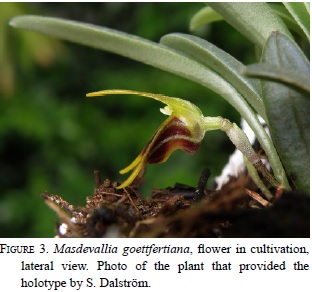
<body><![CDATA[<br>     <br> <font style="font-family: Verdana;" size="2">Taxonomic treatment</font>    <br>     <br> <font style="font-family: Verdana;" size="2"><i>Masdevallia</i> <i>goettfertiana</i> Dalstr&ouml;m &amp; Ru&iacute;z-P&eacute;rez, <i>sp. nov.</i></font>    <br>     <br> <font style="font-family: Verdana;" size="2">TYPE: Peru. Puno, Cerro Marr&oacute;n, 2000 m, S 14&deg;12.351&#8217;; W 69&deg; 13.408&#8217;, flowered in cultivation by Per&uacute;flora in December 2013, <span  style="font-style: italic;">S. Dalstr&ouml;m et al.</span> 3743 (holotype: USM). <a  href="/img/revistas/lankesteriana/v15n2/a03i1.jpg">Figs. 1</a>-<a  href="#fig_3">3</a>.</font>    <br> <a href="/img/revistas/lankesteriana/v15n2/a03i2.jpg"><small><span  style="font-family: verdana;">Fig 2</span></small></a>    <br> <a name="fig_3"></a>     <div style="text-align: center;"><img alt=""  src="/img/revistas/lankesteriana/v15n2/a03i3.jpg"  style="width: 312px; height: 292px;">    <br> </div> <font style="font-family: Verdana;" size="2">&nbsp;</font>    ]]></body>
<body><![CDATA[<br> <font style="font-family: Verdana; font-weight: bold;" size="2">Diagnosis</font>    <br>     <br> <font style="font-family: Verdana;" size="2"><i>Masdevallia</i> <i>goettfertiana</i> belongs to the subgenus <i>Masdevallia</i>, section Coriaceae which is mainly characterized by the thick leaf, the fleshy sepals, petals without any descending process, and a fleshy and verrucose lip. The dwarf plant habit with fleshy, pale glaucous leaves in combination with the fleshy flower with apically very narrow petals readily separate this species from all others in the genus.</font>    <br>     <br> <font style="font-family: Verdana;" size="2">Epiphytic <span style="font-style: italic;">herb</span></font><span  style="font-style: italic;">. </span><font  style="font-family: Verdana;" size="2"><span  style="font-style: italic;">Plant</span> dwarf for the subgenus, caespitose. <i>Ramicauls</i> erect, slender, to <i>ca.</i> 7 mm long, enclosed basally by 3 to 4 tubular sheaths. <span style="font-style: italic;">Leaf</span> glaucous on both sides, erect to arching, coriaceous and fleshy, petiolate, blade basally conduplicate and cuneate, elliptic, obtuse, 35&#8211;55 &times; 7&#8211;8 mm, including the 5&#8211;15 mm long petiole. <span  style="font-style: italic;">Inflorescence</span> purple mottled, erect, terete, uniflowered, with a to <i>ca.</i> 15 mm long peduncle; <span style="font-style: italic;">peduncular bract</span> 1, basal, tubular, <i>ca.</i> 4.5 mm long; <span style="font-style: italic;">floral bract</span> appressed, tubular, <i>ca.</i> 6 mm long; <span style="font-style: italic;">pedicel</span> to <span style="font-style: italic;">ca</span>. 6 mm long; <span style="font-style: italic;">ovary</span> deeply sulcate, indistinctly rugose, <i>ca.</i> 2.5 mm long. <span style="font-style: italic;">Flower</span> shallowly cupulate and fleshy; <span style="font-style: italic;">dorsal sepal</span> pale yellow, carinate externally, glabrous, connate to the lateral sepals for <i>ca.</i> 3&#8211;4 mm, then broadly acuminate and turning into an indistinct fleshy cauda, <i>ca.</i> 15 &times; 5 mm, including the tail; <span style="font-style: italic;">lateral sepals</span> similar in texture, dark brown, except for the pale translucent base covered by dark purple spots, and the yellow indistinct and short tails, indistinctly carinate externally, <i>ca.</i> 12&#8211;13 &times; 12&#8211;13 mm combined, including the <i>ca.</i> 2&#8211;3 mm long tails, connate to each other for <i>ca.</i> 4&#8211;5 mm; <span  style="font-style: italic;">petals</span> whitish, cartilaginous, obliquely and narrowly ovate and with a short fleshy, ventral keel, then with a narrow and elongate midsection with a rounded apex, <i>ca.</i> 4 &times; 1 mm; <span style="font-style: italic;">lip</span> dorsally dark purple, ventrally white, fleshy and minutely erose, hinged on the column foot by a minute strap-like tissue, lamina ovate, obtuse, with indistinct angles above the middle, carnose and sub-verrucose, basally distinctly channeled, which turns into a shallow, longitudinal groove above the middle, and with a recurved apex, <i>ca.</i> 4 &times; 2 mm when flattened; <span  style="font-style: italic;">column</span> pale yellowish green with purple lateral stripes, almost straight, <i>ca.</i> 4.5 mm long, with an equally long, curved foot with a hook-shaped apex; <span  style="font-style: italic;">anther cap</span> whitish and campanulate; <span style="font-style: italic;">pollinia</span> not seen.</font>    <br>     <br> <font style="font-family: Verdana;" size="2">The first plant of <i>Masdevallia</i> <i>goettfertiana</i> was found growing epiphytically at eye level on a dead branch along an old and well frequented trail. The habitat is characterized by secondary and very dense brush vegetation. The original plant was without any flower at the time of collection, but flowered the following year in cultivation. The dwarf plant with fleshy and glaucous leaves immediately gave rise to the notion that it probably represented something different and probably a new species. It came as a surprise, however, to realize that this small but charming orchid belongs to the section <i>Coriaceae</i> Rchb.f. a group of usually much larger species.</font>    <br>     <br> <font style="font-family: Verdana;" size="2">Additional material seen    <br>     ]]></body>
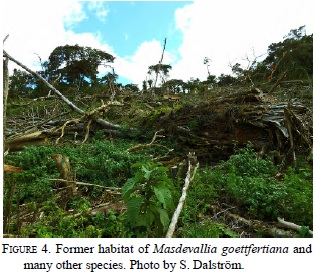
<body><![CDATA[<br> Peru. Only a small population of plants has been observed in the same location as the holotype. No other collections known.</font>    <br>     <br> <font style="font-family: Verdana;" size="2">Distribution and habitat: <i>Masdevallia</i> <i>goettfertiana</i> has only been found in a single location in scrubby and dense cloud forest on Cerro Marr&oacute;n, between San Juan del Oro and Pilcopata, where the habitat is severely threatened by deforestation. <a href="#fig_4">Fig. 4</a>.</font>    <br>     <br> <a name="fig_4"></a>     <div style="text-align: center;"><img alt=""  src="/img/revistas/lankesteriana/v15n2/a03i4.jpg"  style="width: 316px; height: 274px;">    <br> </div>     <br> <font style="font-family: Verdana;" size="2"><!-- big --><span  style="font-weight: bold;">Eponymy</span><!-- /big -->    <br>     <br> This species is named in honor of Peter G&ouml;ttfert, of V&auml;ster&aring;s, Sweden, an avid orchid enthusiast and well known Swedish nursery man, who is also a great supporter of orchid research. </font>    ]]></body>
<body><![CDATA[<br>     <br> <font style="font-family: Verdana;" size="2"><i>Masdevallia</i> <i>robineae</i> Dalstr&ouml;m &amp; Ru&iacute;z-P&eacute;rez, <i>sp. nov.</i></font>    <br>     <br> <font style="font-family: Verdana;" size="2">TYPE: Peru. Puno, east of Ollachea, Camatani, La Villa, epiphytic in mossy cloud forest at 2115 &#8211; 2200 m elevation, flowered in cultivation Nov. 2014, <span style="font-style: italic;">S. Dalstr&ouml;m</span> 3774 (holotype: USM). <a  href="/img/revistas/lankesteriana/v15n2/a03i5.jpg">Fig. 5</a>.</font>    <br>     <br> <font style="font-family: Verdana;" size="2"><span  style="font-style: italic;">Diagnosis</span>. <i>Masdevallia</i> <i>robineae</i> belongs to the subgenus <i>Masdevallia</i>, section <i>Masdevallia</i>, subsection <i>Masdevallia</i>, and is distinguished by the white and basally pale yellow flower, with a triangular and rather flat lip with a truncate apex with an indistinct apiculum.</font>    <br>     <br> <font style="font-family: Verdana;" size="2">Lithophytic or epiphytic <span style="font-style: italic;"><i>herb. Plant</i></span> medium sized to large for the genus, caespitose. <i>Ramicauls</i> erect, slender, to <i>ca.</i> 4 cm long, enclosed basally by 2 or 3 tubular sheaths. <i>Leaf</i> erect to arching, coriaceous, petiolate, blade basally conduplicate and cuneate, elliptic, obtuse, to <i>ca.</i> 14 &times; 2 cm, including the <i>ca.</i> 4 cm long petiole. <i>Inflorescence</i> erect, terete and slender, single flowered, with a to <i>ca.</i> 13 cm long peduncle; <i>peduncular bracts</i> 2 (one hidden inside basal bract), tubular, below the middle of the peduncle, to <i>ca.</i> 16 mm long; floral bract appressed, tubular, to <i>ca.</i> 12 mm long; <i>pedicel</i> to <i>ca.</i> 13 mm long; <i>ovary</i> smooth, indistinctly sulcate, with scattered minute &#8216;fungal-pits&#8217; (tiny pits where some fungi appear to establish in the wild), <i>ca.</i> 11 mm long. <i>Flower</i> attractive, cupulate; <i>dorsal sepal</i> basally pale lemon yellow and apically whitish, indistinctly carinate externally, glabrous, basally cuneate and connate to the lateral sepals for <i>ca.</i> 10 mm, then obtuse and acuminate into a narrow, suberect to arching yellow tail, <i>ca.</i> 60 &times; 12 mm, including the <i>ca.</i> 45 mm long tail; <span  style="font-style: italic;">lateral sepals</span> similar in coloration but with pale orange basally, indistinctly carinate externally, glabrous, connate to each other for <i>ca.</i> 20 mm, broadly and slightly obliquely elliptic, obtuse, acuminate with pale greenish yellow tails, <i>ca.</i> 65 &times; 27 mm combined, including the <i>ca.</i> 40 mm long tails; <i>petals</i> white, cartilaginous and slightly oblique, unguiculate, with a distinct ventral lobe, extending longitudinally and ending in a fleshy ridge near the bluntly obtuse apex, <i>ca.</i> 7 &times; 2.5 mm; <i>lip</i> white, hinged on the apex of the hook-shaped column foot via a canaliculated, strap-like structure, cuneate with involute basal margins in a fresh state (cordate basally when flattened), lamina almost triangular with a bluntly truncate and minutely apiculate apex, almost flat but with a shallow longitudinal groove and indistinctly erect lateral lobes, <i>ca.</i> 5.5&#8211;6.0 &times; 3 mm when flattened; <i>column</i> white with a purple base, curved downwards, <i>ca.</i> 6 mm long, with an slightly shorter, apically hook- shaped foot ; <i>anther cap</i> white and campanulate; <i>pollinia</i> 2, minute and pyriform.</font>    <br>     <br> <font style="font-family: Verdana;" size="2"><i>Masdevallia</i> <i>robineae</i> (<a href="/img/revistas/lankesteriana/v15n2/a03i5.jpg">Figs. 5</a>-<a href="/img/revistas/lankesteriana/v15n2/a03i7.jpg">7</a>) is an attractive species and is sympatric with the equally attractive and rare <i>M. leonii</i> (<a href="/img/revistas/lankesteriana/v15n2/a03i8.jpg">Fig. 8</a>) of subsection <i>Caudatae</i>.</font>    ]]></body>
<body><![CDATA[<br>     <br> <font style="font-family: Verdana;" size="2">Generally, the former species has a much longer leaf of a more slender shape, versus the much shorter, broadly ovate and paddle-shaped <i>Leaf</i> of the latter species. The <i>Flower</i>s are also quite different in shape. However, a plant with longer and slender leaves was found without flowers previous to the discovery of the type plant of <span style="font-style: italic;">M.</span> <i>robineae</i>. It was believed to be something &#8216;different&#8217; from <i>M. leonii</i>, which had previously been observed in&nbsp;</font><font  style="font-family: Verdana;" size="2">flower.</font><font  style="font-family: Verdana;" size="2"> When the &#8216;long-leaved&#8217; plant later flowered, however, it turned out to be a perfect <span style="font-style: italic;">M. leonii</span>. Whether this was the result of natural hybridization or just some freak anomaly is unknown.</font>    <br>     <br> <font style="font-family: Verdana;" size="2">Additional material seen: Peru. Puno, east of Ollachea, Camatani, La Villa, lithophytic in shade on mossy boulder along the road, at 2200 m elevation, S 013&deg; 43.832&#8217;; W 70&deg; 27.602. Digital photo (Dalstr&ouml;m archives). Only a few plants have been observed in the type area, growing epiphytically or lithophytically on mossy boulders. No other material seen.</font>    <br>     <br> <font style="font-family: Verdana;" size="2">Distribution and habitat: <i>Masdevallia</i> <i>robineae</i> is only known from the steep and locally densely forested valley between Ollachea and San Gaban, Puno, at the altitude of <i>ca.</i> 2100&#8211;2200 m. <a href="/img/revistas/lankesteriana/v15n2/a03i9.jpg">Fig. 9</a>.</font>    <br> &nbsp;    <br> <font style="font-family: Verdana;" size="2">Eponymy: This species is named in honor of Robine Coppens by the request of her grandfather, Guido Deburghgraeve of Liedekerke, Belgium, who discovered the type plant.</font>    <br>     <br> <font style="font-family: Verdana;" size="2"><i>Masdevallia</i> <i>roseogena</i> Dalstr&ouml;m &amp; Ru&iacute;z-P&eacute;rez, <span  style="font-style: italic;"><i>sp. nov.</i></span></font>    ]]></body>
<body><![CDATA[<br>     <br> <font style="font-family: Verdana;" size="2">TYPE: Peru. Ayacucho, Calicanto, collected by a team lead by Sa&uacute;l Ru&iacute;z on the ridge above the village, in wet scrubby cloud forest at <i>ca.</i> 2500 &#8211; 2600 m elevation, 5 Dec. 2010, <i>Flower</i>ed in cultivation by Per&uacute;flora in December 2013, S. Dalstr&ouml;m et al 3722 (holotype: USM). <a  href="/img/revistas/lankesteriana/v15n2/a03i10.jpg">Figs. 10</a>, <a  href="/img/revistas/lankesteriana/v15n2/a03i11.jpg">11</a>.</font>    <br> &nbsp;    <br> <font style="font-family: Verdana;" size="2">Diagnosis. <i>Masdevallia</i> <i>roseogena</i> belongs to subgenus <i>Masdevallia</i>, section <i>Masdevallia</i>, subsection <i>Masdevallia</i> and , and is distinguished by the attractive snowy white flowers covered by rosy magenta spots and flush on the petalslip, and internally and externally on the lateral sepals, and with a broadly ovate, minutely apiculate lip without any visible dorsal callus.</font>    <br>     <br> <font style="font-family: Verdana;" size="2">Epiphytic or terrestrial <i>herb. Plant</i> medium to large for the genus, caespitose. <i>Ramicauls</i> erect, slender, <i>ca.</i> 3&#8211;4 cm long, enclosed basally by 3 to 4 tubular sheaths. <i>Leaf</i> erect to arching, coriaceous, petiolate, blade basally conduplicate and cuneate, more or less el<i>lip</i>tic, obtuse, <i>ca.</i> 12.5 &times; 2.5 cm, including the <i>ca.</i> 4 cm long petiole. <i>Inflorescence</i> erect, terete and slender, single-flowered, with a to <i>ca.</i> 10 cm long peduncle; <i>peduncular bracts</i> 2, tubular, below the middle of the peduncle, to <i>ca.</i> 1 cm long; floral bracts appressed, tubular, to <i>ca.</i> 1.2 cm long; <i>pedicel</i> to <i>ca.</i> 2.5 cm long; <i>ovary</i> smooth and indistinctly sulcate, with scattered minute &#8216;fungal-pits&#8217;, <i>ca.</i> 6 mm long. <i>Flower</i> attractive, cupulate; <i>dorsal sepal</i> snowy white with rose-magenta flush externally and richly spotted internally, glabrous and carinate externally,&nbsp;</font><font style="font-family: Verdana;"  size="2">densely microscopically glandular internally, connate to the<span  style="font-style: italic;"> lateral sepals</span> for <i>ca.</i> 13&#8211;15 mm, then acute and apically extended into an elongate and narrow tail, <i>ca.</i> 13 &times; 50 mm, including the 30 mm long, basally white, then purple, gradually turning olive green tail; lateral sepals similar in texture and coloration, glabrous and carinate externally, microscopically glandular internally, connate for <i>ca.</i> 15 mm, then slightly and obliquely obtuse, extending in a slender tail, <i>ca.</i>50 &times; 20 mm combined, including the <i>ca.</i> 25 mm long tails; <i>petals</i> white with rose-magenta markings, cartilaginous and slightly oblique, indistinctly unguiculate with a distinct, curved lateral lobe, forming a fleshy, longitudinal ridge ending near the truncate and apiculate apex, <i>ca.</i> 5.5 &times; 2 mm; <i>lip</i> white suffused with rose-magenta and a pale yellow apex, hinged on the hook-shaped <i>column</i> foot via a minute strap-like structure, lamina ovate, minutely sub- verrucose dorsally, obtuse and apiculate when flattened, but revolute and ventrally concave in the natural state, with a shallow notch at the base, <i>ca.</i>4.5&#8211;5.0 &times; 3.2&#8211;3.5 mm when flattened; <i>column</i> white with purple edges, straight, <i>ca.</i> 4 mm long, with an equally long, curved, apically hook-shaped foot ; <i>anther cap</i> white and campanulate; <i>pollinia</i> not seen.</font>    <br>     <br> <font style="font-family: Verdana;" size="2">Additional material seen: Peru. Only a few scattered plants have been discovered in the same area as the holotype. No other collections known. This region is subject to intense deforestation and habitat destruction, particularly at higher elevations.</font>    <br>     <br> <font style="font-family: Verdana;" size="2">Distribution and habitat: <i>Masdevallia</i> <i>roseogena</i> has only been found in a single location along the densely forested ridge above the village of Calicanto, Ayacucho. <a  href="/img/revistas/lankesteriana/v15n2/a03i12.jpg">Figs. 12</a>, <a  href="/img/revistas/lankesteriana/v15n2/a03i13.jpg">13</a>.</font>    ]]></body>
<body><![CDATA[<br>     <br> <font style="font-family: Verdana;" size="2">Etymology: This species is named in reference to the white <i>Flower</i>s with a rosy &#8216;blush&#8217; on the lateral sides of the sepals (the &#8216;cheeks&#8217;); Latin for rosy-red producing, and &#8216;gena&#8217; referring to the cheeks.</font>    <br>     <br> <font style="font-family: Verdana;" size="2"><i>Masdevallia</i> <i>roseogena</i> was originally discovered by a team lead by Sa&uacute;l Ru&iacute;z in extremely wet and dense, scrubby cloud forest along the ridge above the small town of Calicanto in the Ayacucho region. This is a dangerous area, teeming with military presence and subject to occasional violence by the Shining Path movement. This in turn renders the local population extremely suspicious of foreigners and their whereabouts.</font>    <br> <font style="font-family: Verdana;" size="2">&nbsp;</font>    <br> <font style="font-family: Verdana; font-weight: bold;" size="3">Acknowledgments</font>    <br>     <br> <font style="font-family: Verdana;" size="2">We thank the staff at the Instituto Recursos Naturales (INRENA), and Betty Mill&aacute;n and Ricardo Fern&aacute;ndez at the Universidad de San Marcos, Museo de Historia Natural, Lima, for providing assistance. We also thank Wesley Higgins for commenting on the manuscript, Manolo Arias Silva and his family and staff of Per&uacute;flora for logistic support and hospitality, and Steven Beckendorf, Guido Deburghgraeve, Jan S&ouml;nnemark, Howard Liebman and others for stimulating and helpful company in the field. </font>    <br> <hr style="width: 100%; height: 2px;"><font  style="font-family: Verdana; font-weight: bold;" size="3">Literature cited</font>    <br>     ]]></body>
<body><![CDATA[<br>     <!-- ref --><div style="text-align: left;"><font style="font-family: Verdana;"  size="2">Abele, C., Rudolph, B., Thiede, J. &amp; Rohwer, J. G. (2005). Phylogeny of the genus <i>Masdevallia</i> Ru&iacute;z &amp; Pav., based on morphological an molecular data. Proceedings of the 18th World Orchid Conference, Dijon, France, 111-115.    &nbsp;&nbsp;&nbsp;&nbsp;&nbsp;&nbsp;&nbsp;&nbsp;[&#160;<a href="javascript:void(0);" onclick="javascript: window.open('/scielo.php?script=sci_nlinks&ref=559281&pid=S1409-3871201500020000300001&lng=','','width=640,height=500,resizable=yes,scrollbars=1,menubar=yes,');">Links</a>&#160;]<!-- end-ref --></font>    <br>     <!-- ref --><br> <font style="font-family: Verdana;" size="2">Luer, C. A. (2000a). Icones Pleurothallidinarum XIX. Systematics of <i>Masdevallia</i> part one. <span style="font-style: italic;">Monogr. Syst. Bot. Missouri Bot. Gard</span>., 77, 1-264.    &nbsp;&nbsp;&nbsp;&nbsp;&nbsp;&nbsp;&nbsp;&nbsp;[&#160;<a href="javascript:void(0);" onclick="javascript: window.open('/scielo.php?script=sci_nlinks&ref=559284&pid=S1409-3871201500020000300002&lng=','','width=640,height=500,resizable=yes,scrollbars=1,menubar=yes,');">Links</a>&#160;]<!-- end-ref --></font>    <br>     <!-- ref --><br> <font style="font-family: Verdana;" size="2">Luer, C. A. (2000b). Icones Pleurothallidinarum XXI. Systematics of <i>Masdevallia</i> part two. <span style="font-style: italic;">Monogr. Syst. Bot. Missouri Bot. Gard.</span>, 82, 265-518.    &nbsp;&nbsp;&nbsp;&nbsp;&nbsp;&nbsp;&nbsp;&nbsp;[&#160;<a href="javascript:void(0);" onclick="javascript: window.open('/scielo.php?script=sci_nlinks&ref=559287&pid=S1409-3871201500020000300003&lng=','','width=640,height=500,resizable=yes,scrollbars=1,menubar=yes,');">Links</a>&#160;]<!-- end-ref --></font>    <br>     ]]></body>
<body><![CDATA[<!-- ref --><br> <font style="font-family: Verdana;" size="2">Luer, C. A. (2001). Icones Pleurothallidinarum XXII. Systematics of <i>Masdevallia</i> part three. <span style="font-style: italic;">Monogr. Syst. Bot. Missouri Bot. Gard.</span>, 86, 510-780.    &nbsp;&nbsp;&nbsp;&nbsp;&nbsp;&nbsp;&nbsp;&nbsp;[&#160;<a href="javascript:void(0);" onclick="javascript: window.open('/scielo.php?script=sci_nlinks&ref=559290&pid=S1409-3871201500020000300004&lng=','','width=640,height=500,resizable=yes,scrollbars=1,menubar=yes,');">Links</a>&#160;]<!-- end-ref --></font>    <br>     <!-- ref --><br> <font style="font-family: Verdana;" size="2">Luer, C. A. (2002). Icones Pleurothallidinarum XXIII. Systematics of <i>Masdevallia</i> part four. <span style="font-style: italic;">Monogr. Syst. Bot. Missouri Bot. Gard.</span>, 87, 781-1047.    &nbsp;&nbsp;&nbsp;&nbsp;&nbsp;&nbsp;&nbsp;&nbsp;[&#160;<a href="javascript:void(0);" onclick="javascript: window.open('/scielo.php?script=sci_nlinks&ref=559293&pid=S1409-3871201500020000300005&lng=','','width=640,height=500,resizable=yes,scrollbars=1,menubar=yes,');">Links</a>&#160;]<!-- end-ref --></font>    <br>     <!-- ref --><br> <font style="font-family: Verdana;" size="2">Luer, C. A. (2003). Icones Pleurothallidinarum XXV. Systematics of <i>Masdevallia</i> part five. <span style="font-style: italic;">Monogr. Syst. Bot. Missouri Bot. Gard.</span>, 91, 1049-1293.    &nbsp;&nbsp;&nbsp;&nbsp;&nbsp;&nbsp;&nbsp;&nbsp;[&#160;<a href="javascript:void(0);" onclick="javascript: window.open('/scielo.php?script=sci_nlinks&ref=559296&pid=S1409-3871201500020000300006&lng=','','width=640,height=500,resizable=yes,scrollbars=1,menubar=yes,');">Links</a>&#160;]<!-- end-ref --></font>    <br>     <!-- ref --><br> <font style="font-family: Verdana;" size="2">Luer, C. A. (2006). Icones Pleurothallidinarum XXVIII. A reconsideration of <i>Masdevallia</i>, Systematics of Specklinia and vegetatively similar taxa (Orchidaceae). <span  style="font-style: italic;">Monogr. Syst. Bot. Missouri Bot. Gard.</span>, 105.    &nbsp;&nbsp;&nbsp;&nbsp;&nbsp;&nbsp;&nbsp;&nbsp;[&#160;<a href="javascript:void(0);" onclick="javascript: window.open('/scielo.php?script=sci_nlinks&ref=559299&pid=S1409-3871201500020000300007&lng=','','width=640,height=500,resizable=yes,scrollbars=1,menubar=yes,');">Links</a>&#160;]<!-- end-ref --></font>    <br>     <!-- ref --><br> <font style="font-family: Verdana;" size="2">Pridgeon, A. M. &amp; Chase, M. W. (2001). A phylogenetic reclassification of Pleurothallidinae. <span  style="font-style: italic;">Lindleyana</span>, 16(4), 235-271.    &nbsp;&nbsp;&nbsp;&nbsp;&nbsp;&nbsp;&nbsp;&nbsp;[&#160;<a href="javascript:void(0);" onclick="javascript: window.open('/scielo.php?script=sci_nlinks&ref=559302&pid=S1409-3871201500020000300008&lng=','','width=640,height=500,resizable=yes,scrollbars=1,menubar=yes,');">Links</a>&#160;]<!-- end-ref --></font>    <br> </div>     <br> <font style="font-family: Verdana;" size="2"><a name="1"></a><a  href="#3">1</a>. 2304 Ringling Boulevard, unit 119, Sarasota FL 34237, U.S.A. Lankester Botanical Garden, University of Costa Rica, Cartago, Costa Rica National Biodiversity Centre, Serbithang, Bhutan. Corresponding author: stigdalstrom@gmail.com</font>    <br> <font style="font-family: Verdana;" size="2"><a name="2"></a><a  href="#4">2</a>. Allamanda 142, Surco, Lima 33, Per&uacute;</font>    <br> <hr style="width: 100%; height: 2px;">     <div style="text-align: center;"><font  style="font-family: Verdana; font-weight: bold;" size="2">Received 11 March 2015. Accepted 2 June 2015. </font></div> </div>      ]]></body><back>
<ref-list>
<ref id="B1">
<nlm-citation citation-type="confpro">
<person-group person-group-type="author">
<name>
<surname><![CDATA[Abele]]></surname>
<given-names><![CDATA[C.]]></given-names>
</name>
<name>
<surname><![CDATA[Rudolph]]></surname>
<given-names><![CDATA[B.]]></given-names>
</name>
<name>
<surname><![CDATA[Thiede]]></surname>
<given-names><![CDATA[J.]]></given-names>
</name>
<name>
<surname><![CDATA[Rohwer]]></surname>
<given-names><![CDATA[J. G.]]></given-names>
</name>
</person-group>
<source><![CDATA[Phylogeny of the genus Masdevallia Ruíz & Pav., based on morphological an molecular data]]></source>
<year>2005</year>
<conf-name><![CDATA[ Proceedings of the 18th World Orchid Conference]]></conf-name>
<conf-loc>Dijon Dijon</conf-loc>
<page-range>111-115</page-range></nlm-citation>
</ref>
<ref id="B2">
<nlm-citation citation-type="journal">
<person-group person-group-type="author">
<name>
<surname><![CDATA[Luer]]></surname>
<given-names><![CDATA[C. A]]></given-names>
</name>
</person-group>
<article-title xml:lang="en"><![CDATA[Icones Pleurothallidinarum XIX: Systematics of Masdevallia part one]]></article-title>
<source><![CDATA[Monogr. Syst. Bot. Missouri Bot. Gard]]></source>
<year>2000</year>
<volume>77</volume>
<page-range>1-264</page-range></nlm-citation>
</ref>
<ref id="B3">
<nlm-citation citation-type="journal">
<person-group person-group-type="author">
<name>
<surname><![CDATA[Luer]]></surname>
<given-names><![CDATA[C. A]]></given-names>
</name>
</person-group>
<article-title xml:lang="en"><![CDATA[Icones Pleurothallidinarum XXI: Systematics of Masdevallia part two]]></article-title>
<source><![CDATA[Monogr. Syst. Bot. Missouri Bot. Gard]]></source>
<year>2000</year>
<volume>82</volume>
<page-range>265-518</page-range></nlm-citation>
</ref>
<ref id="B4">
<nlm-citation citation-type="journal">
<person-group person-group-type="author">
<name>
<surname><![CDATA[Luer]]></surname>
<given-names><![CDATA[C. A.]]></given-names>
</name>
</person-group>
<article-title xml:lang="en"><![CDATA[Icones Pleurothallidinarum XXII: Systematics of Masdevallia part three]]></article-title>
<source><![CDATA[Monogr. Syst. Bot. Missouri Bot. Gard.]]></source>
<year>2001</year>
<volume>86</volume>
<page-range>510-780</page-range></nlm-citation>
</ref>
<ref id="B5">
<nlm-citation citation-type="journal">
<person-group person-group-type="author">
<name>
<surname><![CDATA[Luer]]></surname>
<given-names><![CDATA[C. A.]]></given-names>
</name>
</person-group>
<article-title xml:lang="en"><![CDATA[Icones Pleurothallidinarum XXIII: Systematics of Masdevallia part four]]></article-title>
<source><![CDATA[Monogr. Syst. Bot. Missouri Bot. Gard.]]></source>
<year>2002</year>
<volume>87</volume>
<page-range>781-1047</page-range></nlm-citation>
</ref>
<ref id="B6">
<nlm-citation citation-type="journal">
<person-group person-group-type="author">
<name>
<surname><![CDATA[Luer]]></surname>
<given-names><![CDATA[C. A.]]></given-names>
</name>
</person-group>
<article-title xml:lang="en"><![CDATA[Icones Pleurothallidinarum: XXV Systematics of Masdevallia part five]]></article-title>
<source><![CDATA[Monogr. Syst. Bot. Missouri Bot. Gard.]]></source>
<year>2003</year>
<volume>91</volume>
<page-range>1049-1293</page-range></nlm-citation>
</ref>
<ref id="B7">
<nlm-citation citation-type="journal">
<person-group person-group-type="author">
<name>
<surname><![CDATA[Luer]]></surname>
<given-names><![CDATA[C. A.]]></given-names>
</name>
</person-group>
<article-title xml:lang="en"><![CDATA[Icones Pleurothallidinarum: XXVIII A reconsideration of Masdevallia, Systematics of Specklinia and vegetatively similar taxa (Orchidaceae)]]></article-title>
<source><![CDATA[Monogr. Syst. Bot. Missouri Bot. Gard.]]></source>
<year>2006</year>
<volume>105</volume>
</nlm-citation>
</ref>
<ref id="B8">
<nlm-citation citation-type="journal">
<person-group person-group-type="author">
<name>
<surname><![CDATA[Pridgeon]]></surname>
<given-names><![CDATA[A. M.]]></given-names>
</name>
<name>
<surname><![CDATA[Chase]]></surname>
<given-names><![CDATA[M. W.]]></given-names>
</name>
</person-group>
<article-title xml:lang="en"><![CDATA[A phylogenetic reclassification of Pleurothallidinae]]></article-title>
<source><![CDATA[Lindleyana]]></source>
<year>2001</year>
<volume>16</volume>
<numero>4</numero>
<issue>4</issue>
<page-range>235-271</page-range></nlm-citation>
</ref>
</ref-list>
</back>
</article>