<?xml version="1.0" encoding="ISO-8859-1"?><article xmlns:mml="http://www.w3.org/1998/Math/MathML" xmlns:xlink="http://www.w3.org/1999/xlink" xmlns:xsi="http://www.w3.org/2001/XMLSchema-instance">
<front>
<journal-meta>
<journal-id>1409-3871</journal-id>
<journal-title><![CDATA[Lankesteriana]]></journal-title>
<abbrev-journal-title><![CDATA[Lankesteriana]]></abbrev-journal-title>
<issn>1409-3871</issn>
<publisher>
<publisher-name><![CDATA[Lankester Botanical Garden, University of Costa Rica]]></publisher-name>
</publisher>
</journal-meta>
<article-meta>
<article-id>S1409-38712014000200002</article-id>
<title-group>
<article-title xml:lang="en"><![CDATA[Notes on Costa Rican Pterichis (Orchidaceae) - new taxa and additions to national orchid flora]]></article-title>
</title-group>
<contrib-group>
<contrib contrib-type="author">
<name>
<surname><![CDATA[Kolanowska]]></surname>
<given-names><![CDATA[Marta]]></given-names>
</name>
</contrib>
</contrib-group>
<aff id="A01">
<institution><![CDATA[,University of Gda&#324;sk  ]]></institution>
<addr-line><![CDATA[ ]]></addr-line>
<country>Poland</country>
</aff>
<pub-date pub-type="pub">
<day>00</day>
<month>12</month>
<year>2014</year>
</pub-date>
<pub-date pub-type="epub">
<day>00</day>
<month>12</month>
<year>2014</year>
</pub-date>
<volume>14</volume>
<numero>2</numero>
<fpage>99</fpage>
<lpage>108</lpage>
<copyright-statement/>
<copyright-year/>
<self-uri xlink:href="http://www.scielo.sa.cr/scielo.php?script=sci_arttext&amp;pid=S1409-38712014000200002&amp;lng=en&amp;nrm=iso"></self-uri><self-uri xlink:href="http://www.scielo.sa.cr/scielo.php?script=sci_abstract&amp;pid=S1409-38712014000200002&amp;lng=en&amp;nrm=iso"></self-uri><self-uri xlink:href="http://www.scielo.sa.cr/scielo.php?script=sci_pdf&amp;pid=S1409-38712014000200002&amp;lng=en&amp;nrm=iso"></self-uri><abstract abstract-type="short" xml:lang="en"><p><![CDATA[A new species of the orchid genus Pterichis, P. herrerae, and a new variety of P. habenarioides, P. habenarioides var. costaricensis, are described and illustrated based on Costa Rican material. Information about new Costa Rican records of P. pauciflora and P. parvifolia is provided. An updated key to Costa Rican species of Pterichis is presented.]]></p></abstract>
<kwd-group>
<kwd lng="en"><![CDATA[Costa Rica]]></kwd>
<kwd lng="en"><![CDATA[new species]]></kwd>
<kwd lng="en"><![CDATA[Orchidaceae]]></kwd>
<kwd lng="en"><![CDATA[Pterichis]]></kwd>
<kwd lng="en"><![CDATA[taxonomy]]></kwd>
</kwd-group>
</article-meta>
</front><body><![CDATA[ <div class="Section1">     <p class="MsoNormal" style="text-align: center;" align="center"><b  style=""><span style="font-size: 11pt; font-family: Verdana;"  lang="EN-US">Notes on <span class="SpellE"><span class="GramE">costa</span></span><span  class="GramE"> <span class="SpellE">rican</span></span> <span  class="SpellE"><i>pterichis</i></span><i> </i>(<span class="SpellE">orchidaceae</span>) – new <span  class="SpellE">taxa</span> and additions to national orchid flora<o:p></o:p></span></b></p>     <p class="MsoNormal" style="text-align: center;" align="center"><b  style=""><span style="font-size: 11pt; font-family: Verdana;"  lang="EN-US">Marta <span class="SpellE">Kolanows<span  style="color: black;">k</span>a</span><o:p></o:p></span></b></p>     <br> <span class="A1"><span style="font-size: 10pt; font-family: Verdana;"  lang="EN-US"><a name="Correspondencia2"></a>*<a  href="#Correspondencia1">Dirección para correspondencia:</a></span></span>    <br>     <p class="MsoNormal"><span class="A3"><span  style="font-size: 10pt; font-family: Verdana;" lang="EN-US"><o:p></o:p></span></span></p>     <p style="font-weight: bold;" class="MsoNormal"><span  style="font-size: 10pt; font-family: Verdana;" lang="EN-US"><o:p> </o:p> <hr style="width: 100%; height: 2px;"></span></p>     <p style="text-align: justify;" class="MsoNormal"><span  style="font-weight: bold;" class="A1"><span  style="font-size: 10pt; font-family: Verdana;" lang="EN-US">A</span></span><span  class="A1"><span  style="font-size: 10pt; font-family: Verdana; color: rgb(34, 30, 31);"  lang="EN-US"><span style="font-weight: bold;">bstract:</span> </span></span><span  class="A4"><span style="font-size: 10pt; font-family: Verdana;"  lang="EN-US">A new species of the orchid genus <span class="SpellE"><i>Pterichis</i></span><i>, P. <span class="SpellE">herrerae</span></i>, and a new variety of <i>P. <span class="SpellE">habenarioides</span></i>, <i>P. <span  class="SpellE">habenarioides</span> </i>var. <span class="SpellE"><i>costaricensis</i></span>, are described and illustrated based on Costa Rican material. Information about new Costa Rican records of <i>P. <span class="SpellE">pauciflora</span> </i>and <i>P. <span class="SpellE">parvifolia</span> </i>is provided. An updated key to Costa Rican species of <span class="SpellE"><i>Pterichis</i></span><i> </i>is presented. </span></span><span  style="font-size: 10pt; font-family: Verdana;" lang="EN-US"><o:p></o:p></span></p>     <p style="text-align: justify;" class="MsoNormal"><span class="A1"><span  style="font-size: 10pt; font-family: Verdana; color: rgb(34, 30, 31);"  lang="EN-US"><span style="font-weight: bold;">Key words:</span> </span></span><st1:country-region  w:st="on"><st1:place w:st="on"><span class="A4"><span  style="font-size: 10pt; font-family: Verdana;" lang="EN-US">Costa Rica</span></span></st1:place></st1:country-region><span  class="A4"><span style="font-size: 10pt; font-family: Verdana;"  lang="EN-US">, new species, <span class="SpellE">Orchidaceae</span>, <span  class="SpellE"><i>Pterichis</i></span>, taxonomy<o:p></o:p></span></span></p>     <p style="text-align: justify;" class="MsoNormal"><span class="GramE"><b><span  style="font-size: 10pt; font-family: Verdana;" lang="EN-US"></span></b></span></p> <hr style="width: 100%; height: 2px;">     ]]></body>
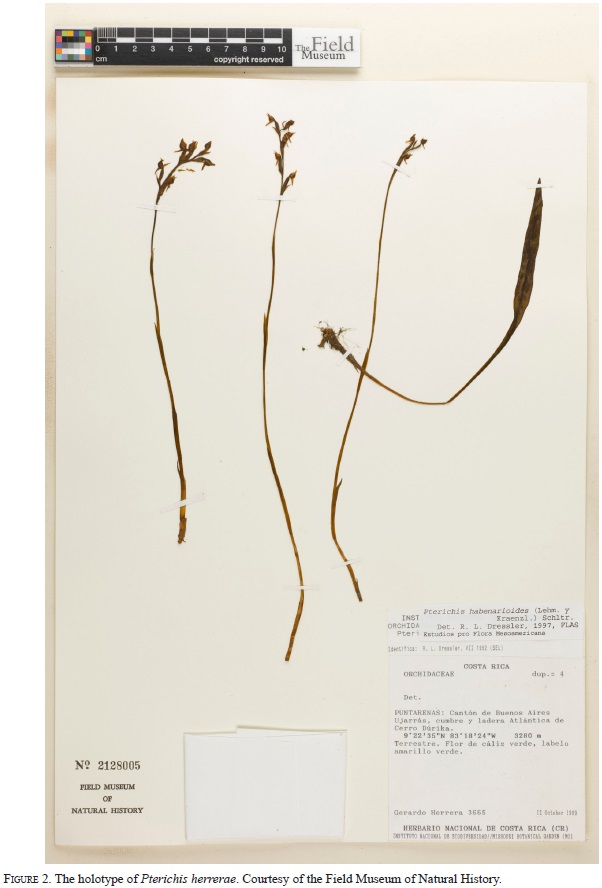
<body><![CDATA[<p style="text-align: justify;" class="MsoNormal"><span class="GramE"><b><span  style="font-size: 10pt; font-family: Verdana;" lang="EN-US">Introduction</span></b><span  style="font-size: 10pt; font-family: Verdana;" lang="EN-US">.</span></span><span  style="font-size: 10pt; font-family: Verdana;" lang="EN-US"> The <span class="SpellE">Neotropical</span> orchid genus <span  class="SpellE"><i>Pterichis</i></span><i> </i>was described by John Lindley (1840) based on Peruvian <i>P. <span  class="SpellE">galeata</span>. </i>The author considered this species similar to <span class="SpellE"><i>Sarcoglottis</i></span><i> </i>C. <span  class="SpellE">Presl</span>, but subsequent morphological (<span class="SpellE">Pfitzer</span> 1887) and molecular (<span class="SpellE">eg</span>. Salazar <i>et al. </i>2003) studies revealed that the two genera are not closely related. Another orchid genus which Lindley found similar to his newly established <span  class="SpellE"><i>Pterichis</i></span><i> </i>in the <span class="SpellE">gynostemium</span> structure was <span  class="SpellE"><i>Cryptostylis</i></span><i> </i>R. Br., but this genus was classified by <span class="SpellE">Szlachetko</span> &amp; <span  class="SpellE">Rutkowski</span> (2000) in different subfamilies based <span class="SpellE">i.a</span>. on their anther form and position. Molecular data (Salazar <i>et al. </i>2009) indicates that <span class="SpellE"><i>Pterichis</i></span><i> </i>is sister to other <span class="SpellE">Cranichidinae</span> (e.g., <span  class="SpellE"><i>Cranichis</i></span><i> </i>Sw.<i>, <span class="SpellE">Ponthieva</span> </i>R. Br. and <span  class="SpellE"><i>Baskervilla</i></span><i> </i><span class="SpellE">Lindl</span>.).<o:p></o:p></span></p>     <p style="text-align: justify;" class="MsoNormal"><span  style="font-size: 10pt; font-family: Verdana;" lang="EN-US">Morphologically representatives of <span class="SpellE"><i>Pterichis</i></span><i> </i>are easily distinguished from other <span class="SpellE">cranichid</span> orchids based on their floral characters. The abbreviate, massive <span  class="SpellE">gynostemium</span> is observed also in <span  class="SpellE"><i>Cranichis</i></span><i>, <span class="SpellE">Fuertesiella</span> </i><span class="SpellE"><span  class="GramE">Schltr</span></span><span class="GramE">.<i>,</i></span><i> <span class="SpellE">Pseudocentrum</span> </i><span class="SpellE">Lindl</span>. <span class="GramE">and</span> <span class="SpellE"><i>Ponthieva</i></span><i>. </i>From the two latter genera <span class="SpellE"><i>Pterichis</i></span><i> </i>differs in the petals and lip being free from the column part and from other two by the <span class="SpellE">scape</span> developing separately from leaves. <o:p></o:p></span></p>     <p style="text-align: justify;" class="MsoNormal"><span  style="font-size: 10pt; font-family: Verdana;" lang="EN-US">Plants of <span  class="SpellE"><i>Pterichis</i></span><i> </i>produce tuberous, clustered roots. The non-<span class="SpellE">resupinate</span> flowers are arranged into a loosely to <span class="SpellE">subdensely</span> flowered raceme (rarely congested). The <span class="SpellE">tepals</span> of <span class="SpellE"><i>Pterichis</i></span><i> </i>are <span  class="SpellE">subsimilar</span>, with the petals narrower than the dorsal sepal and often <span  class="SpellE">adnate</span> to it. The sessile lip is concave, usually with a pubescent disc and ornamented with swollen cells or knob-like projections along the margins. The <span  class="SpellE">gynostemium</span> is short and erect, and the motile anther is much longer than the rest of the column. Four oblong-ovoid <span  class="SpellE">pollinia</span> are produced. The <span class="SpellE">rostellum</span> is narrow, delicate, <span class="SpellE"><span class="GramE">filiform</span></span> and the <span class="SpellE">hamulus</span> is finger-like (<span  class="SpellE">Szlachetko</span> &amp; <span class="SpellE">Rutkowski</span> 2000).<o:p></o:p></span></p>     <p style="text-align: justify;" class="MsoNormal"><span  style="font-size: 10pt; font-family: Verdana;" lang="EN-US">The plants of <span class="SpellE"><i>Pterichis</i></span><i> </i>grow terrestrially and they are usually found in grassy slopes or shrubby <span class="SpellE">paramo</span> above 2800 m of elevation. Most of the currently recognized 25 species are distributed along the Andes; however, some species occur in <st1:country-region w:st="on">Jamaica</st1:country-region>, <st1:country-region  w:st="on">Panama</st1:country-region> and <st1:country-region  w:st="on"><st1:place w:st="on">Costa Rica</st1:place></st1:country-region> (<span class="SpellE">Cribb</span> 2003, <span class="SpellE">Dueñas</span> <span class="SpellE">Gómez</span> &amp; <span class="SpellE">Fernández</span> Alonso 2009). <o:p></o:p></span></p>     <p style="text-align: justify;" class="MsoNormal"><span  style="font-size: 10pt; font-family: Verdana;" lang="EN-US">Dressler (2003) reported two species of <span class="SpellE"><i>Pterichis</i></span><i> </i>from <st1:country-region w:st="on"><st1:place w:st="on">Costa Rica</st1:place></st1:country-region>: <i>P. <span class="SpellE">habenarioides</span> </i>(F. <span  class="SpellE">Lehm</span>. &amp; <span class="SpellE">Kraenzl</span>.) <span class="SpellE"><span  class="GramE">Schltr</span></span><span class="GramE">. and <i>P. <span  class="SpellE">galeata</span> </i><span class="SpellE">Lindl</span>.</span> <span class="GramE">considering</span> <i>P. <span class="SpellE">costaricensis</span> </i>Ames &amp; C. <span class="SpellE">Schweinf</span>. <span class="GramE">and</span> <i>P. <span class="SpellE">leo</span> </i>L.D. <span class="SpellE">Gómez</span> &amp; <span class="SpellE">Gómez-Laur</span>. <span class="GramE">as</span> their respective synonyms. The Costa Rican populations are found in the elevations above 2250 m, often in wet <span  class="SpellE">montane</span> forest and <span class="SpellE">paramo</span>. <o:p></o:p></span></p>     <p style="text-align: justify;" class="MsoNormal"><span  style="font-size: 10pt; font-family: Verdana;" lang="EN-US">During recent studies of herbarium specimens a new species of <span class="SpellE"><i>Pterichis</i></span><i> </i>was found and is described here. Moreover, an unusual form of <i>P. <span  class="SpellE">habenarioides</span> </i>recognized in Costa Rican material is proposed here as a new variety. <span class="GramE">Two species of <span class="SpellE"><i>Pterichis</i></span><i>, P. <span class="SpellE">pauciflora</span> </i><span class="SpellE">Schltr</span>. and <i>P. <span class="SpellE">parvifolia</span> </i>(<span  class="SpellE">Lindl</span>.)</span> <span class="SpellE">Schltr</span>. are reported here for <st1:country-region w:st="on"><st1:place  w:st="on">Costa Rica</st1:place></st1:country-region> for the first time.<o:p></o:p></span></p>     <p style="text-align: justify;" class="MsoNormal"><span class="GramE"><b><span  style="font-size: 10pt; font-family: Verdana;" lang="EN-US">Material and Methods</span></b><span  style="font-size: 10pt; font-family: Verdana;" lang="EN-US">.</span></span><span  style="font-size: 10pt; font-family: Verdana;" lang="EN-US"> Dried herbarium specimens of <span class="SpellE"><i>Pterichis</i></span>, over 180 in total, deposited or borrowed from AMES, COL, CUVC, F, FLAS, FMB, HUA, K, MO, NY, P, PSO, SEL, VALLE and W were examined. Every studied specimen was photographed and the data from the labels were recorded. The presence and shape of the leaf as well as the length and the surface of the <span  class="SpellE">scape</span> were studied. The examination of the vegetative structures included the form and number of the tubular sheaths enveloping the <span class="SpellE">scape</span> and the form of the floral bracts and ovaries. From each <span  class="GramE">specimens</span> 3-5 flowers were examined. The <span class="SpellE">perianth</span> parts were studied after rehydrating flowers in boiling water.<o:p></o:p></span></p>     <p class="MsoNormal"><b style=""><span  style="font-size: 11pt; font-family: Verdana;" lang="EN-US">New <span  class="SpellE">taxa</span><o:p></o:p></span></b></p>     <p class="MsoNormal"><span class="SpellE"><span  style="font-size: 10pt; font-family: Verdana;" lang="EN-US">Pterichis</span></span><span  style="font-size: 10pt; font-family: Verdana;" lang="EN-US"> <span class="SpellE">herrerae</span> <span class="SpellE"><span  class="GramE">Kolan</span></span><span class="GramE">.,</span> sp. <span  class="SpellE">nov</span>.<o:p></o:p></span></p>     <p style="text-align: justify;" class="MsoNormal"><span  style="font-size: 10pt; font-family: Verdana;">TYPE: Costa Rica. Puntarenas. Cantón de Buenos Aires, <span class="SpellE">Ujarrás</span>, cumbre y ladera Atlántica de Cerro <span class="SpellE">Dúrika</span>, 9°22'35"N 83°18'24"W, 3280 m, 12 <span class="SpellE">Oct</span> 1989, G. Herrera 3665 (<span class="SpellE">holotype</span>, F<span class="GramE">!</span>; <span class="SpellE">isotypes</span>, F!, MO, SEL). Fig. <a href="/img/revistas/lankesteriana/v14n2/02i1.jpg">1</a>–<a  href="/img/revistas/lankesteriana/v14n2/a02i2.jpg">2</a>.<o:p></o:p></span></p>     ]]></body>
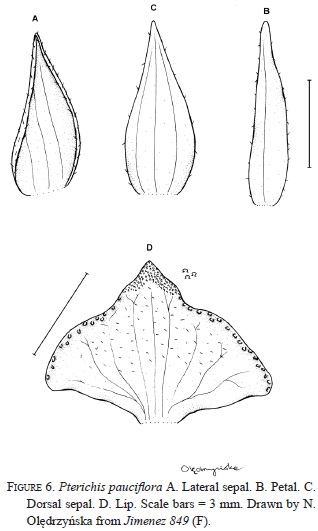
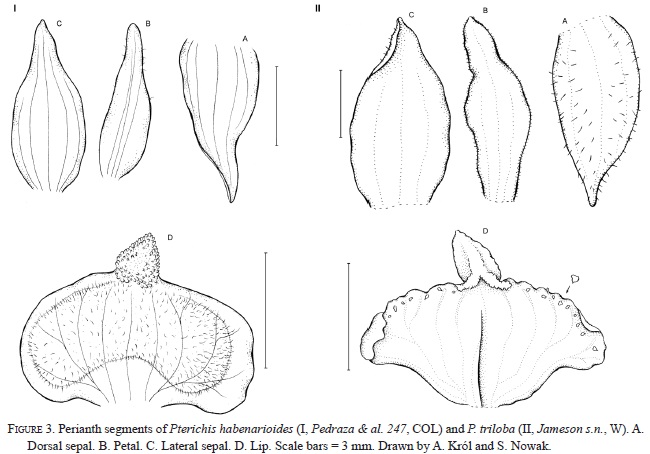
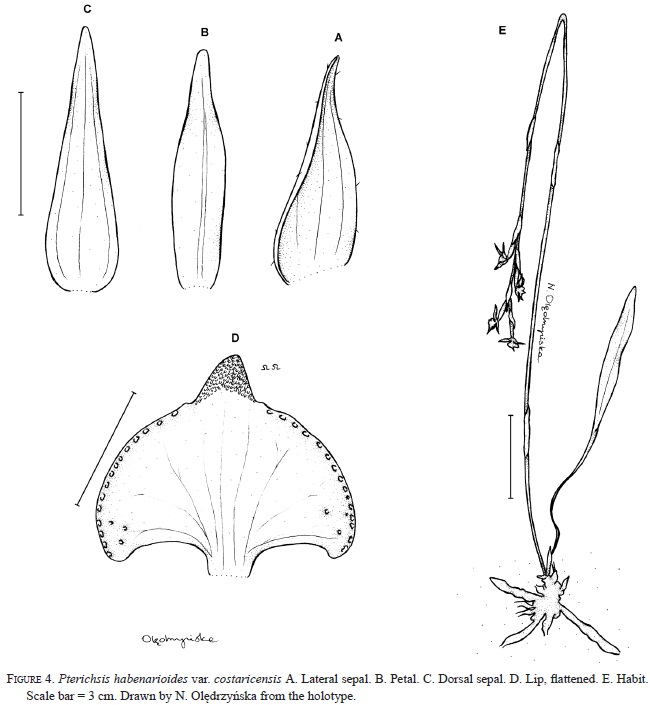
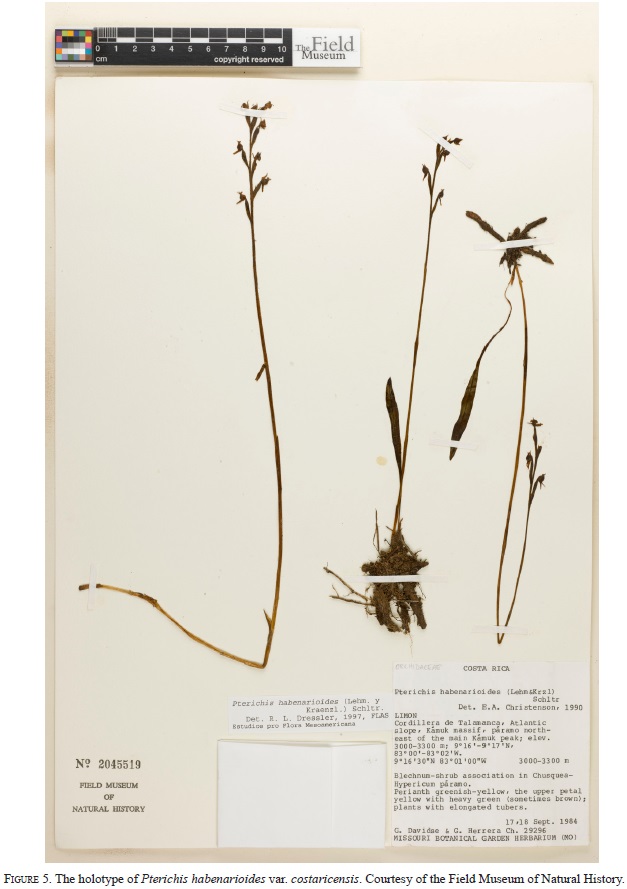
<body><![CDATA[<p style="text-align: justify;" class="MsoNormal"><span class="GramE"><span  style="font-size: 10pt; font-family: Verdana;" lang="EN-US">Diagnosis.</span></span><span  style="font-size: 10pt; font-family: Verdana;" lang="EN-US"> This species resembles P. <span class="SpellE">habenarioides</span> and P. <span class="SpellE">triloba</span> (<span class="SpellE">Lindl</span>.) <span class="SpellE"><span class="GramE">Schltr</span></span><span  class="GramE">.,</span> but it is distinguished by the <span class="SpellE">cordate</span> lip base, obliquely ovate, rounded lip lateral lobes and lip margins ornamented with prominent, knob-like projections.<o:p></o:p></span></p>     <p style="text-align: justify;" class="MsoNormal"><span class="GramE"><span  style="font-size: 10pt; font-family: Verdana;" lang="EN-US">Plant up to 32 cm tall.</span></span><span  style="font-size: 10pt; font-family: Verdana;" lang="EN-US"> <span class="GramE">Leaf basal, long-<span class="SpellE">petiolate</span>; blade 9.5 cm long, linear-<span class="SpellE">lanceolate</span>, acute; petiole 12 cm long.</span> <span class="SpellE">Scape</span> up to 27 cm long, with 4 glabrous, tubular sheaths, pubescent in the upper part. Spike 2.7&#8722;5.0 cm long, pubescent, <span class="SpellE">subdensely</span> 4&#8722;10-flowered. Flowers green with yellowish-green lip. Floral bracts up to 8 mm long, 3 mm wide, pubescent, narrowly ovate, <span class="SpellE">subobtuse</span>. <span  class="GramE">Ovary 9 mm long, pubescent.</span> <span class="GramE">Dorsal sepal 7.0 × 1.5 mm, externally sparsely ciliate, <span class="SpellE">lanceolate</span>, obtuse, 3-veined.</span> Petals 6.8 × 1.2 mm, <span class="SpellE">adnate</span> to dorsal sepal, sparsely ciliate along margins, linear-<span  class="SpellE">lanceolate</span>, <span class="SpellE">unguiculate</span> at the base and constricted in the upper third, acute, 3-veined. Lateral sepals 6.5 × 2.5 mm, externally sparsely ciliate, obliquely ovate, <span class="SpellE">subacute</span>, <span  class="GramE">2</span>-veined. Lip about 5 × 7 mm, 3-lobed, <span  class="SpellE">cordate</span> at the base; middle lobe about 1/4 of the lip length, <span  class="SpellE">reflexed</span>, triangular-ovate, acute, densely glandular-pubescent; lateral lobes obliquely triangular-ovate, rounded; disc 5-veined, veins branching, margins ornamented with knob-like projections and swollen cells in the basal part. </span><span  class="SpellE"><span style="font-size: 10pt; font-family: Verdana;">Gynostemium</span></span><span  style="font-size: 10pt; font-family: Verdana;"> 2.5 <span  class="SpellE">mm</span> long. <span class="SpellE">Fruit</span> <span  class="SpellE">not</span> <span class="SpellE">seen</span>.<o:p></o:p></span></p>     <p style="text-align: justify;" class="MsoNormal"><span class="GramE"><span  style="font-size: 10pt; font-family: Verdana;" lang="EN-US">Etymology.</span></span><span  style="font-size: 10pt; font-family: Verdana;" lang="EN-US"> <span class="GramE">Dedicated to collector of the type specimen.</span><o:p></o:p></span></p>     <p style="text-align: justify;" class="MsoNormal"><span class="GramE"><span  style="font-size: 10pt; font-family: Verdana;" lang="EN-US">Distribution and ecology.</span></span><span  style="font-size: 10pt; font-family: Verdana;" lang="EN-US"> So far this species is known exclusively from Costa Rican <st1:place  w:st="on"><st1:placetype w:st="on">province</st1:placetype> of <st1:placename  w:st="on">Puntarenas</st1:placename></st1:place>, where it was found growing terrestrially at the altitude of over 3200 m. <span class="GramE">Flowering</span> occurs at least in October.<o:p></o:p></span></p>     <p style="text-align: justify;" class="MsoNormal"><span  style="font-size: 10pt; font-family: Verdana; color: black;"  lang="EN-US">T</span><span  style="font-size: 10pt; font-family: Verdana;" lang="EN-US">axono<span  style="color: black;">m</span>ic notes. This species resembles P. <span  class="SpellE">habenarioides</span> (<span class="SpellE">F.Lehm</span>. &amp; <span class="SpellE">Kraenzl</span>.) <span class="SpellE"><span  class="GramE">Schltr</span></span><span class="GramE">. and P. <span  class="SpellE">triloba</span> (<span class="SpellE">Lindl</span>.)</span> <span class="SpellE"><span class="GramE">Schltr</span></span><span  class="GramE">. (<a href="/img/revistas/lankesteriana/v14n2/a02i3.jpg">Fig. 3</a>).</span> From the latter species P. <span class="SpellE">herrerae</span> is easily distinguished by the <span class="SpellE">cordate</span> lip base (vs. truncate in P. <span class="SpellE">triloba</span>), the 5-veined lip disc (vs. 7-veined) and presence of numerous (over 30 in total) knob-like projections along the lip margins (vs. 8&#8722;10 projections on each side). The floral bracts of P. <span class="SpellE">habenarioides</span> are glabrous, its dorsal sepal is ovate-<span class="SpellE">lanceolate</span> (vs. <span  class="SpellE">lanceolate</span> in P. <span class="SpellE">herrerae</span>), the petals are <span  class="SpellE">obovate-lanceolate</span>, not <span class="SpellE">unguiculate</span> (vs. linear-<span  class="SpellE">lanceolate</span> above, <span class="SpellE">unguiculate</span> basally), and the lip is transversely triangular-elliptic in outline (vs. <span class="SpellE">cordate</span> in P. <span class="SpellE">herrerae</span>). Another similar species is the South American P. <span class="SpellE">diuris</span> <span class="SpellE">Rchb</span>. f., which has petals free from dorsal sepal, the lip base is truncate and disc lacks any knob-like projections.<o:p></o:p></span></p>     <p style="text-align: justify;" class="MsoNormal"><span class="SpellE"><span  style="font-size: 10pt; font-family: Verdana;">Pterichsis</span></span><span  style="font-size: 10pt; font-family: Verdana;"> <span class="SpellE">habenarioides</span> var. <span class="SpellE"><span class="GramE">costaricensis</span></span> <span class="SpellE">Kolan</span>., var. nov. <o:p></o:p></span></p>     <p style="text-align: justify;" class="MsoNormal"><span  style="font-size: 10pt; font-family: Verdana;" lang="EN-US">Diagnosis: Distinguished from <i>P. <span class="SpellE">habenarioides</span> var. <span class="SpellE">habenarioides</span> </i>by the glabrous dorsal sepal and petals, the sparsely ciliate, 2-veined lateral sepals, and the lateral lobes of the lip form auricles.<o:p></o:p></span></p>     <p style="text-align: justify;" class="MsoNormal"><span  style="font-size: 10pt; font-family: Verdana;">TYPE: Costa Rica. <span  class="SpellE">Limon</span>. Cordillera de Talamanca, <span class="SpellE">Atlantic</span> <span  class="SpellE">slope</span>, <span class="SpellE">Kámuk</span> <span class="SpellE">massif</span>, páramo <span class="SpellE">north</span>-<span class="SpellE">east</span> <span class="SpellE">of</span> <span class="SpellE">the</span> <span class="SpellE">main</span> <span  class="SpellE">Kámuk</span> <span class="SpellE">peak</span>, 9°16'30"N 83°01'00"W, 3000&#8722;3300 m, 17&#8722;19 Sep 1984, <i>G. <span class="SpellE">Davidse</span> &amp; G. Herrera 29296 </i>(<span class="SpellE">holotype</span>, F<span  class="GramE">!</span>; <span class="SpellE">isotype</span>: CR). </span><span  class="GramE"><span style="font-size: 10pt; font-family: Verdana;"  lang="EN-US">Fig. <a  href="/img/revistas/lankesteriana/v14n2/a02i4.jpg">4</a>–<a  href="/img/revistas/lankesteriana/v14n2/a02i5.jpg">5</a>.</span></span><span  style="font-size: 10pt; font-family: Verdana;" lang="EN-US"><o:p></o:p></span></p>     <p style="text-align: justify;" class="MsoNormal"><span class="GramE"><i><span  style="font-size: 10pt; font-family: Verdana;" lang="EN-US">Plants </span></i><span  style="font-size: 10pt; font-family: Verdana;" lang="EN-US">up to 40 cm tall.</span></span><span  style="font-size: 10pt; font-family: Verdana;" lang="EN-US"> <span  class="GramE"><i>Leaf </i>basal, <span class="SpellE">petiolate</span>; blade 5.5-6.0 cm long, linear-<span  class="SpellE">lanceolate</span>, acute; petiole 4.5-6.5 cm long.</span> <span class="SpellE"><span class="GramE"><i>Scape</i></span></span><span  class="GramE"><i> </i>up to 36 cm long, <span class="SpellE">scape</span> with 3-4 tubular sheaths.</span> <i>Flower </i>greenish-yellow, lip yellow with green or brown veins. <span  class="GramE"><i>Floral bracts </i>up to 13 mm long, 4 mm wide, pubescent.</span> <span class="GramE"><i>Ovary </i>up to 13 mm long, pubescent.</span> <span  class="GramE"><i>Dorsal sepal </i>6.5 mm long, 1.5 mm wide, glabrous, <span class="SpellE">lanceolate</span>, obtuse, 3-veined.</span> <span  class="GramE"><i>Petals </i>5.9 × 1.2 mm, <span class="SpellE">adnate</span> to dorsal sepal, glabrous, <span class="SpellE">ligulatelanceolate</span>, obtuse, 2-veined.</span> <i>Lateral sepals </i>5.5 × 1.8 mm, ovate, obtuse, sparsely ciliate, <span  class="GramE">2</span>-veined. <i>Lip </i>6 mm long and about the same wide, indistinctly 3-lobed; middle lobe broadly ovate, short, densely glandular-pubescent, obtuse, <span  class="SpellE">reflexed</span>; lateral lobes obliquely ovate, rounded; disc 5-veined, lateral veins branching, ornamented with numerous swollen cells along the margins. </span><span  class="SpellE"><i><span style="font-size: 10pt; font-family: Verdana;">Gynostemium</span></i></span><i><span  style="font-size: 10pt; font-family: Verdana;"> </span></i><span  style="font-size: 10pt; font-family: Verdana;">2.5 <span  class="SpellE">mm</span> long. <span class="SpellE"><i>Fruit</i></span><i> </i><span  class="SpellE">not</span> <span class="SpellE">seen</span>.<o:p></o:p></span></p>     <p style="text-align: justify;" class="MsoNormal"><span  style="font-size: 10pt; font-family: Verdana;" lang="EN-US">Etymology: In reference to the origin of the type specimen.<o:p></o:p></span></p>     ]]></body>
<body><![CDATA[<p style="text-align: justify;" class="MsoNormal"><span class="GramE"><span  style="font-size: 10pt; font-family: Verdana;" lang="EN-US">Distribution and ecology.</span></span><span  style="font-size: 10pt; font-family: Verdana;" lang="EN-US"> So far this variety is known exclusively from <st1:place w:st="on">Cordillera de Talamanca</st1:place>. The population was found growing in <span  class="SpellE"><i>Blechnum</i></span>-shrub association in <span  class="SpellE"><i>Chusquea-Hypericum</i></span><i> </i><span class="SpellE">paramo</span>. Flowering occurs in September.<o:p></o:p></span></p>     <p style="text-align: justify;" class="MsoNormal"><span class="GramE"><span  style="font-size: 10pt; font-family: Verdana;" lang="EN-US">Examined Specimens <span class="SpellE">of<i>P</i></span><i>.</i></span></span><i><span  style="font-size: 10pt; font-family: Verdana;" lang="EN-US"> <span  class="SpellE"><span class="GramE">habenarioides</span></span> var. <span  class="SpellE">habenarioides</span></span></i><span  style="font-size: 10pt; font-family: Verdana;" lang="EN-US">: <st1:country-region  w:st="on"><st1:place w:st="on">Colombia</st1:place></st1:country-region>. </span><span style="font-size: 10pt; font-family: Verdana;">Boyacá. <span  class="SpellE">Mpio</span>. <span class="GramE">de</span> <span  class="SpellE">Chinavita</span>. <span class="GramE">Cerro</span> <span class="SpellE">Mamapacha</span>. Vereda Mundo Nuevo, Laguna La Jarilla, <span class="SpellE">paramo</span>, 3300 m, 26 <span class="SpellE">Jul</span> 2001, <i>H. <span  class="SpellE">Duenas</span>, F. Cortes, J. <span class="SpellE">Farfan</span>, <span class="SpellE">E.C</span>. Buitrago, <span class="SpellE">M.F</span>. <span class="SpellE">Rodriguez</span> &amp; J. Puentes 3107 </i>(COL<span class="GramE">!</span>), Cauca. <span  class="SpellE">Mpio</span>. <span class="GramE">de</span> <span  class="SpellE">Purace</span>. Parque Nacional Natural de <span class="SpellE">Purace</span>. <span  class="SpellE">Cercanias</span> de la Laguna San Rafael, 3300 m, 6 <span  class="SpellE">Oct</span> 1984, <i>G. Lozano, O. Rangel, <span  class="SpellE">L.F</span>. de <span class="SpellE">Turbay</span>, A. Sanabria &amp; N. Espejo 4654 </i>(COL<span class="GramE">!</span>), Macizo Colombiano. <span  class="SpellE">Paramo</span> de Las Papas. Colinas al SE de la Laguna La Magdalena, vertiente del <span  class="SpellE">rio</span> Magdalena, 3350-3450 m, 12 Sep 1958, <span  class="SpellE"><i>Idrobo</i></span><i>, Pinto &amp; <span  class="SpellE">Bischler</span> 3249 </i>(COL<span class="GramE">!</span>), Macizo Colombiano. <span  class="SpellE">Paramo</span> Las Papas. Filo entre el <span  class="SpellE">Boqueron</span> y el cerro de Penas Blancas, 3330 m, 14 Sep 1958, <span class="SpellE"><i>Idrobo</i></span><i>, Pinto 7 <span class="SpellE">Bischler</span> 3321 </i>(COL<span  class="GramE">!</span>), Macizo Colombiano. Valle del Cauca, cerca de su nacimiento, 3000 m, 19 Sep 1958, <span class="SpellE"><i>Idrobo</i></span><i>, Pinto &amp; <span  class="SpellE">Bischler</span> 3460 </i>(COL<span class="GramE">!</span>), Macizo Colombiano. Valle de Las Papas, alrededores de Valencia, Los Andes. Alt. 3150 m. <span class="SpellE">Wet</span> <span class="SpellE">cienga</span> <span class="SpellE">between</span> <span class="SpellE">scrub</span> <span  class="SpellE">patches</span>, <span class="SpellE">an</span> <span class="SpellE">extension</span> <span  class="SpellE">of</span> <span class="SpellE">Station</span> 4, <span  class="SpellE">approx</span>. 3 <span class="SpellE">km</span> <span class="SpellE">from</span> casa <span class="SpellE">of</span> Hacienda Los Andes, 1 <span  class="SpellE">Oct</span> 1958, <span class="SpellE"><i>Barclay</i></span><i> &amp; P. <span  class="SpellE">Juajibioy</span> 5892 </i>(COL<span class="GramE">!</span>), <span class="SpellE">Paramo</span> Guanacas. <i>Lehmann 6419 </i>(K<span class="GramE">!</span>), Cundinamarca. <span class="SpellE">D.C</span>., localidad 20, Parque Nacional Natural <span class="SpellE">Sumapaz</span>, vereda Santa Rosa, arriba de la laguna Casa Blanca, 3500 m, 7 <span class="SpellE">Aug</span> 1998, <i>P. Pedraza, P. Franco, D. <span class="SpellE">Stancik</span> &amp; A. Neira 247 <span  class="SpellE">p.p</span>. </i>(COL!), Bogotá. <span class="SpellE">Paramo</span> de Cruz Verde, 3200 m, 6 Sep 1977, <i>G. Morales &amp; <span class="SpellE">Flenley</span> 30 </i>(COL<span  class="GramE">!</span>), San Miguel. <i>Schneider 673 </i>(COL<span class="GramE">!</span>), Huila. <span class="SpellE">Mpio</span>. <span class="GramE">de</span> Gigante. <span class="SpellE">Vered</span> Ventanas, Cerro de Miraflores, subida desde el Campamento 1, en bosque andino de <span class="SpellE"><i>Winmannia</i></span><i>, <span class="SpellE">Brunellia</span>, <span class="SpellE">Clusia</span> </i>hasta el <span class="SpellE">subparamo</span> (3050 m), con <span  class="SpellE"><i>Dipostephium</i></span><i>, <span class="SpellE">Brachyotum</span>, <span class="SpellE">Gynoxis</span>, <span class="SpellE">Weinmannia</span>, </i>12-16 <span class="SpellE">Aug</span> 1997, <span class="SpellE"><i>J.L</i></span><i>. <span class="SpellE">Fernandez</span> Alonso, E. Linares, P. <span class="SpellE">Balcazar</span>, R. <span  class="SpellE">Vasquez</span>, J. <span class="SpellE">Velez</span> &amp; G. Salazar 14851 </i>(COL!), Meta. Macizo de <span class="SpellE">Sumapaz</span>. Alrededores de la Laguna La Guitarra, <span class="SpellE">alt.</span> 3380-3420 m, 4 <span  class="SpellE">Jul</span> 1981, <i>S. <span class="SpellE">Diaz</span> P. 2404 </i>(COL<span  class="GramE">!</span>), Nariño/Putumayo. <span class="SpellE">Mpio</span>. <span class="GramE">de</span> Santiago Vereda. <span class="SpellE">Paramo</span> del Bordoncillo. 1°11’N, 77°06’W, 3200-3400 m, 17 <span class="SpellE">Apr</span> 1993, <i>A. Munoz &amp; D. <span class="SpellE">Ramirez</span> 414 </i>(COL), <span  class="SpellE">Quindio</span>. <span class="SpellE">Pijao</span>. <span  class="SpellE">Paramo</span> del Chili, <span class="SpellE">km</span> 28, <span class="SpellE">paramo</span>, 3600 m, 17 Sep 1998, <i>Gil-Correa 115 &amp; N. Ocampo, M. <span class="SpellE">Piepenbring</span>, C. <span class="SpellE">Velez</span> </i>(COL<span class="GramE">!</span>), <i>Sine loc. Lehmann 6419 </i>(K!).<o:p></o:p></span></p>     <p class="MsoNormal"><b style=""><span  style="font-size: 11pt; font-family: Verdana;" lang="EN-US">New records<o:p></o:p></span></b></p>     <p style="text-align: justify;" class="MsoNormal"><span class="SpellE"><i><span  style="font-size: 10pt; font-family: Verdana;" lang="EN-US">Pterichis</span></i></span><i><span  style="font-size: 10pt; font-family: Verdana;" lang="EN-US"> <span class="SpellE">pauciflora</span> </span></i><span class="SpellE"><span  class="GramE"><span style="font-size: 10pt; font-family: Verdana;"  lang="EN-US">Schltr</span></span></span><span class="GramE"><span  style="font-size: 10pt; font-family: Verdana;" lang="EN-US">.,</span></span><span  style="font-size: 10pt; font-family: Verdana;" lang="EN-US"> <span class="SpellE">Repert</span>. Spec. Nov. <span class="SpellE">Regni</span> Veg., <span class="SpellE">Beih</span>. 8: 41. 1921.<o:p></o:p></span></p>     <p style="text-align: justify;" class="MsoNormal"><span class="GramE"><span  style="font-size: 10pt; font-family: Verdana;" lang="EN-US">TYPE(</span></span><span  class="SpellE"><span style="font-size: 10pt; font-family: Verdana;"  lang="EN-US">Garay</span></span><span  style="font-size: 10pt; font-family: Verdana;" lang="EN-US"> 1978): <st1:country-region  w:st="on"><st1:place w:st="on">Ecuador</st1:place></st1:country-region>. Loja, in <span class="SpellE">Andibus</span> <span class="SpellE">orientalibus</span>, 3000&#8722;3400 m, <i>Lehmann 7111 </i>(<span class="SpellE">holotype</span>: B<img alt="" src="/img/revistas/lankesteriana/v14n2/a02i8.jpg"  style="width: 9px; height: 22px;">, <span class="SpellE">lectotype</span>, K!). <o:p></o:p></span></p>     <p style="text-align: justify;" class="MsoNormal"><i><span  style="font-size: 10pt; font-family: Verdana;" lang="EN-US">Plant </span></i><span  style="font-size: 10pt; font-family: Verdana;" lang="EN-US">14&#8722;62 cm tall, erect. <span class="GramE"><i>Leaf </i>basal, <span  class="SpellE">petiolate</span>; petiole 2&#8722;3 cm long; blade about 5 × 1&#8722;2 cm, linear to oblong-<span  class="SpellE">lanceolate</span>, acute.</span> <span class="SpellE"><i>Scape</i></span><i> </i>up to 58 cm tall, erect, minutely <span class="SpellE">puberulent</span> in the upper part, with 3&#8722;6 tubular, pubescent sheaths. <i>Spike </i>2&#8722;4 cm long, pubescent, loosely to <span class="SpellE">subdensely</span> 5&#8722;10-flowered. <span class="GramE"><i>Flowers </i>yellowish-orange to yellowish-brown according to the herbarium label.</span> <i>Floral bracts </i>up to 8 mm long, ovate-<span class="SpellE">lanceolate</span>, glabrous. <span  class="SpellE">Pedicellate</span> ovary 9&#8722;11 mm long, densely glandular. <span class="GramE"><i>Dorsal sepal </i>6.0&#8722;6.8 × 1.7&#8722;2.2 mm, ovate-<span class="SpellE">lanceolate</span> to ovate, obtuse, almost glabrous, 3-veined.</span> <span class="GramE"><i>Petals </i>6.0&#8722;6.5 × 1.0&#8722;1.2 mm, <span class="SpellE">adnate</span> to dorsal sepal, obliquely linear-<span class="SpellE">lanceolate</span>, acuminate, margin sparsely ciliate, l-veined.</span> <span class="GramE"><i>Lateral sepals </i>5.5&#8722;6.5 × 1.5&#8722;2 mm, obliquely ovate-<span class="SpellE">lanceolate</span> to ovate, concave, acuminate, glabrous or sparsely ciliate externally, 3&#8722;4-veined.</span> <i>Lip </i>5<span class="GramE">,0</span> × 4.5&#8722;7.0 mm, indistinctly 3-lobed; basal part triangular-elliptic; apical lobe triangular, obtuse, <span class="SpellE">reflexed</span>, <span class="SpellE">glandulose-papillose</span>; disc 7-veined, margin ornamented with swollen cells. <span  class="SpellE"><span class="GramE"><i>Gynostemium</i></span></span><span  class="GramE"><i> </i>2.3 mm long.</span> <span class="GramE"><i>Fruit </i>not seen.</span><o:p></o:p></span></p>     <p style="text-align: justify;" class="MsoNormal"><span class="SpellE"><span  style="font-size: 10pt; font-family: Verdana;" lang="PT-BR">Representative</span></span><span  style="font-size: 10pt; font-family: Verdana;" lang="PT-BR"> <span class="SpellE">specimens</span>: Costa Rica. <span class="SpellE">Puntarenas</span>. </span><span style="font-size: 10pt; font-family: Verdana;">Cantón de Coto Brus. <span class="SpellE">P.N</span>. La Amistad, Cuenca Térraba-Sierpe, Cerro <span class="SpellE">Echandi</span>, 9°01'57"N 82°49'19"W, 3000&#8722;3150 m, 13 <span class="SpellE">Aug</span> 1997, <i>Gamboa &amp; al. 1718 </i>(FLAS!); Cartago. Carretera Panamericana Sur, 2700 m, 17 <span  class="SpellE">Jul</span> 1963, <i>A. <span class="SpellE">Jimenez</span> 849 </i>(F<span class="GramE">!</span>, <a  href="/img/revistas/lankesteriana/v14n2/a02i6.jpg">Fig. 6</a>).<o:p></o:p></span></p>     <p style="text-align: justify;" class="MsoNormal"><span class="GramE"><span  style="font-size: 10pt; font-family: Verdana;" lang="EN-US">Distribution and ecology.</span></span><span  style="font-size: 10pt; font-family: Verdana;" lang="EN-US"> Until now this species was reported from <st1:country-region w:st="on">Ecuador</st1:country-region> and <st1:country-region w:st="on"><st1:place w:st="on">Colombia</st1:place></st1:country-region>. In <st1:country-region w:st="on"><st1:place w:st="on">Costa Rica</st1:place></st1:country-region> it was found growing terrestrially in <span class="SpellE">paramo</span>, forest edges and vegetation with <i>Sphagnum </i>at the altitude above 2700 m. Flowering occurs in July and August.<o:p></o:p></span></p>     <p style="text-align: justify;" class="MsoNormal"><span  style="font-size: 10pt; font-family: Verdana; color: black;"  lang="EN-US">O</span><span  style="font-size: 10pt; font-family: Verdana;" lang="EN-US">ther speci<span  style="color: black;">m</span>ens exa<span style="color: black;">m</span>ined: <st1:country-region w:st="on"><st1:place w:st="on">Colombia</st1:place></st1:country-region>. <span class="GramE">Boyacá.</span> </span><span class="SpellE"><span  style="font-size: 10pt; font-family: Verdana;">Mpio</span></span><span  style="font-size: 10pt; font-family: Verdana;">. Arcabuco. Santuario de Flora y Fauna de <span class="SpellE">Igauque</span>. Camino a la Laguna. <span class="SpellE">Paramo</span> dominado por <span  class="SpellE"><i>Espeletia</i></span><i>, <span class="SpellE">Calamagrostis</span>, <span class="SpellE">Hypericum</span>, <span class="SpellE">Lupinus</span>, <span class="SpellE">Monnina</span>, <span class="SpellE">Cavendishia</span>, Castilleja, </i>3600 m, 24 Sep 2002, <i>H. <span class="SpellE">Duenas</span>, F. Cortes &amp; N. Aranguren 3130 </i>(COL<span class="GramE">!</span>), <span  class="SpellE">Mpio</span>. Villa de Leyva. Parque Nacional Natural santuario de <span class="SpellE">Iguaque</span>, 3700 m, 20 <span class="SpellE">Jul</span> 1979, <i>M. <span  class="SpellE">Melampy</span> 207 </i>(COL<span class="GramE">!</span>), <span class="SpellE">Mpio</span>. Pesca. <span class="SpellE">Paramo</span> de la Cortadera. Vereda La Pena, 3600 m, 21 <span class="SpellE">Aug</span> 1982, <i>M. Bejarano B. 245 </i>(COL<span class="GramE">!</span>), Cundinamarca. <span class="SpellE">D.C</span>., localidad 20, Parque Nacional Natural <span class="SpellE">Sumapaz</span>, vereda Santa Rosa, arriba de la laguna Casa Blanca, 3500 m, 7 <span class="SpellE">Aug</span> 1998, <i>P. Pedraza, P. Franco, D. <span class="SpellE">Stancik</span> &amp; A. Neira 247 <span class="SpellE">p.p</span>. </i>(COL!), Bogotá. <span  class="SpellE">Paramo</span> de <span class="SpellE">Monserrate</span>, 3000 m, 26 <span  class="SpellE">Jul</span> 1943, <i>Schneider 243 </i>(COL<span class="GramE">!</span>), Carretera <span class="SpellE">Paramo</span> de Palacio a <span  class="SpellE">Rio</span> Chuza, cabeceras Valle <span class="SpellE">Chocolatel</span>.<o:p></o:p></span></p>     <p style="text-align: justify;" class="MsoNormal"><span  style="font-size: 10pt; font-family: Verdana;">Vertiente pedregoso con <span class="SpellE"><i>Calamagrostis</i></span><i> <span class="SpellE">effusa</span> </i>y <span class="SpellE"><i>Oreobolus</i></span><i> <span class="SpellE">obtusangulus</span>, </i>3700 m, 9 Sep 1972, <i>A.M. <span class="SpellE">Cleef</span> 5435 </i>(COL<span class="GramE">!</span>), <span class="SpellE">Paramo</span> entre <span class="SpellE">Cogua</span> y San Cayetano. Laguna Verde y alrededores <span class="SpellE">Paramo</span> seco con <span class="SpellE"><i>Calamagrostis</i></span><i> <span  class="SpellE">effusa</span>, </i>2 <span class="SpellE">km</span> al NW de la Laguna, 3600 m, 19 <span  class="SpellE">Aug</span> 1972, <i>A.M. <span class="SpellE">Cleef</span>, <span class="SpellE">M.T</span>. Murillo &amp; van <span class="SpellE">der</span> <span class="SpellE">Hammen</span> 5164 </i>(COL<span class="GramE">!</span>), Meta. Macizo de <span  class="SpellE">Sumapaz</span>. Alrededores de la Laguna El <span class="SpellE">Sorbedero</span>, 3550 m, 4 <span class="SpellE">Jul</span> 1981, <i>S. <span  class="SpellE">Diaz</span> P., A.M. <span class="SpellE">Cleef</span>, van <span class="SpellE">der</span> <span class="SpellE">Hammen</span>, O. Rangel &amp; S. Salamanca 2472 </i>(COL<span class="GramE">!</span>), Upland E <span class="SpellE">of</span> <span class="SpellE">Sesquile</span>, 3300 m, 5 <span class="SpellE">Jul</span> 1947, <span class="SpellE"><i>Haught</i></span><i> 5929 </i>(COL!). Ecuador. Loja. <i>Lehmann 7111 </i>(K<span class="GramE">!</span>).<o:p></o:p></span></p>     ]]></body>
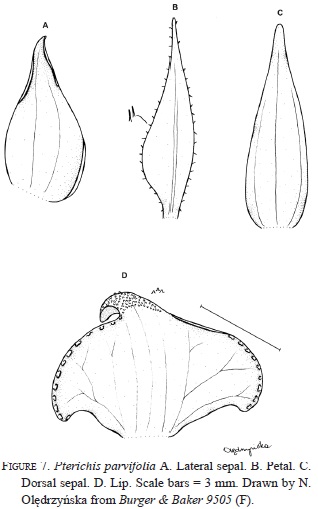
<body><![CDATA[<p style="text-align: justify;" class="MsoNormal"><span class="SpellE"><span  class="GramE"><i><span style="font-size: 10pt; font-family: Verdana;"  lang="EN-US">Pterichis</span></i></span></span><span class="GramE"><i><span  style="font-size: 10pt; font-family: Verdana;" lang="EN-US"> <span  class="SpellE">parvifolia</span> </span></i><span  style="font-size: 10pt; font-family: Verdana;" lang="EN-US">(<span  class="SpellE">Lindl</span>.)</span></span><span  style="font-size: 10pt; font-family: Verdana;" lang="EN-US"> <span  class="SpellE"><span class="GramE">Schltr</span></span><span  class="GramE">.,</span> Bot. <span class="SpellE">Jahrb</span>. Syst. 45: 389. 1911. </span><span style="font-size: 10pt;" lang="EN-US">&#8801;</span><span  style="font-size: 10pt; font-family: Verdana;" lang="EN-US"> <span class="SpellE"><i>Acraea</i></span><i> <span class="SpellE">parvifolia</span> </i><span class="SpellE"><span class="GramE">Lindl</span></span><span  class="GramE">.,</span> Pl. <span class="SpellE">Hartw</span>.: 155. </span><span  style="font-size: 10pt; font-family: Verdana;">1845.<o:p></o:p></span></p>     <p style="text-align: justify;" class="MsoNormal"><span  style="font-size: 10pt; font-family: Verdana;">TYPE: Ecuador. Loja. <span  class="SpellE"><i>Hartweg</i></span><i> 50 </i>(K-<span class="SpellE">Lindl</span>.<span class="GramE">!</span>). <o:p></o:p></span></p>     <p style="text-align: justify;" class="MsoNormal"><i><span  style="font-size: 10pt; font-family: Verdana;" lang="EN-US">Plant </span></i><span  style="font-size: 10pt; font-family: Verdana;" lang="EN-US">about 37 cm tall. <span class="GramE"><i>Leaf </i>basal, <span class="SpellE">petiolate</span>; petiole 6.5&#8722;9 cm long, canaliculated; blade up to 11.0 × 0.6&#8722;1.0 cm, linear-<span class="SpellE">lanceolate</span>, <span class="SpellE">subacute</span>.</span> <span class="SpellE"><i>Scape</i></span><i> </i>about 25 cm tall, pubescent, with 5 sheaths decreasing in size distally along the <span class="SpellE">scape</span>, pubescent in upper half. <i>Spike </i>8&#8722;9 cm long, pubescent, loosely several-flowered. <span class="GramE"><i>Flowers </i>greenish with yellow lip with brownish veins.</span> <i>Floral bracts </i>up to 9 mm long, glabrous, ovate-<span class="SpellE">lanceolate</span>, <span class="GramE">acute</span>. <span class="SpellE"><span class="GramE">Pedicellate</span></span><span  class="GramE"> <i>ovary </i>up to 13 mm long, pubescent.</span> <span class="GramE"><i>Dorsal sepal </i>7 × 2 mm, ovate-<span class="SpellE">lanceolate</span>, <span  class="SpellE">subacuminate</span>, obtuse, glabrous, 3-veined.</span> <i>Petals </i>7.0 × 1.5 mm, ciliate along margins, <span class="SpellE">unguiculate</span> in lower fifth, obliquely oblong-<span class="SpellE">lanceolate</span>, <span class="SpellE">subacute</span>, <span class="GramE">2</span>-veined. <i>Lateral sepals </i>5.5 × 2.5 mm, glabrous, obliquely ovate, <span class="SpellE">subacuminate</span>, <span  class="GramE">2</span>-veined. <i>Lip </i>about 5&#8722;6 × 7 mm, 3-lobed, base truncate; middle lobe <span class="SpellE">reflexed</span>, densely glandular-pubescent, ovate-triangular, <span class="SpellE">subobtuse</span>; lateral lobes obliquely ovate; disc 5-veined, lateral lobes branching, margin ornamented with a row of prominent papillae. <span class="SpellE"><span class="GramE"><i>Gynostemium</i></span></span><span  class="GramE"><i> </i>2 mm long.</span> <span class="GramE"><i>Fruit </i>not seen.</span><o:p></o:p></span></p>     <p style="text-align: justify;" class="MsoNormal"><span  style="font-size: 10pt; font-family: Verdana;" lang="EN-US">Representative specimen: <st1:country-region w:st="on"><st1:place w:st="on">Costa Rica</st1:place></st1:country-region>. <st1:city w:st="on"><st1:place w:st="on"><span class="GramE">San Jose</span></st1:place></st1:city><span  class="GramE"> and Cartago.</span> Below the highest point of <span  class="SpellE">Interamerican</span> Highway, northwest of La Asuncion, 9°34'N 83°45'W, 3000-3200 m, 27 Oct 1975, <i>W. Burger &amp; R. Baker 9505 </i>(F!, <a  href="/img/revistas/lankesteriana/v14n2/a02i7.jpg">Fig. 7</a>).<o:p></o:p></span></p>     <p style="text-align: justify;" class="MsoNormal"><span class="GramE"><span  style="font-size: 10pt; font-family: Verdana;" lang="EN-US">Distribution and ecology.</span></span><span  style="font-size: 10pt; font-family: Verdana;" lang="EN-US"> Until now this species was reported from <st1:country-region w:st="on">Peru</st1:country-region>, <st1:country-region w:st="on">Ecuador</st1:country-region> and <st1:country-region  w:st="on"><st1:place w:st="on">Colombia</st1:place></st1:country-region>. In <st1:country-region w:st="on"><st1:place w:st="on">Costa Rica</st1:place></st1:country-region> it was found in steep wet grassy slope at an altitude of about 3000-3200 m. Flowering occurs at least in October.<o:p></o:p></span></p>     <p style="text-align: justify;" class="MsoNormal"><span class="SpellE"><span  style="font-size: 10pt; font-family: Verdana; color: black;">O</span><span  style="font-size: 10pt; font-family: Verdana;">ther</span></span><span  style="font-size: 10pt; font-family: Verdana;"> <span class="SpellE">speci<span  style="color: black;">m</span>ens</span> <span class="SpellE">exa<span  style="color: black;">m</span>ined</span>: Colombia. Nariño. <span class="SpellE">Mpio</span>. <span class="SpellE">Guachucal</span>-<span  class="SpellE">Cumbal</span>. <span class="SpellE">Paramo</span> de <span  class="SpellE">Infernillo</span>. <span class="SpellE">The</span> <span  class="SpellE">ridge</span> in <span class="SpellE">direction</span> <span  class="SpellE">to</span> <span class="SpellE">Vulcan</span> <span  class="SpellE">Cumbal</span>. <span class="SpellE">Grassy</span> <span class="SpellE">paramo</span> <span  class="SpellE">with</span> <span class="SpellE"><i>Calamagrostis</i></span><i> <span class="SpellE">effusa</span>, Cortadera, <span class="SpellE">Diplostephium</span>, <span class="SpellE">Espeletia</span>, Puya. </i><span class="SpellE">Flowers</span> <span class="SpellE">yellowish</span>, 3700 m, 5-9 Mar 1999, <span  class="SpellE"><i>Stancik</i></span><i> 2687 </i>(COL<span class="GramE">!</span>), <span class="SpellE">Mpio</span>. <span class="SpellE">Mallama</span>-<span class="SpellE">Piedrahancha</span>. Vereda Pueblo Viejo. <span class="SpellE">Paramo</span> del <span  class="SpellE">Infernillo</span>. Reserve Natural Pueblo Viejo. <span class="SpellE">Km</span> 97 <span  class="SpellE">via</span> Pasto-Tumaco, <span class="SpellE">desvio</span> a la izquierda viajando hacia Tumaco y <span class="SpellE">ascenda</span> de 2 <span class="SpellE">km</span> por la carretera <span  class="SpellE">via</span> Pueblo Viejo <span class="SpellE">Coleccion</span> entre la <span  class="SpellE">Cabana</span> principal de la reserve y el sitio “La <span class="SpellE">Lagunetas</span>”, 1°03'02.9"-1°01'16.2"N, 77°46'43.7"-77°47'7.8"W, 3318-3739 m, 8 Jan 2009, <span class="SpellE"><i>L.M</i></span><i>. Caballero, O. Rivera <span  class="SpellE">Diaz</span>, G. Silva, C. <span class="SpellE">Leguizamo</span>, M. Ayala, J. Gil &amp; M. <span class="SpellE">Rodriguez</span> LMC3 </i>(COL!). Ecuador. Loja. <span class="SpellE"><i>Hartweg</i></span><i> 50 </i>(K-<span  class="SpellE">Lindl</span>.<span class="GramE">!</span>).<o:p></o:p></span></p>     <p style="text-align: justify;" class="MsoNormal"><span class="GramE"><span  class="A1"><span style="font-size: 10pt; font-family: Verdana;"  lang="EN-US">A</span></span><span class="A1"><span  style="font-size: 10pt; font-family: Verdana; color: rgb(34, 30, 31);"  lang="EN-US">c</span></span><span class="A1"><span  style="font-size: 10pt; font-family: Verdana;" lang="EN-US">k</span></span><span  class="A1"><span  style="font-size: 10pt; font-family: Verdana; color: rgb(34, 30, 31);"  lang="EN-US">nowledg</span></span><span class="A1"><span  style="font-size: 10pt; font-family: Verdana;" lang="EN-US">m</span></span><span  class="A1"><span  style="font-size: 10pt; font-family: Verdana; color: rgb(34, 30, 31);"  lang="EN-US">ents.</span></span></span><span class="A1"><span  style="font-size: 10pt; font-family: Verdana; color: rgb(34, 30, 31);"  lang="EN-US"> </span></span><span class="A5"><span  style="font-size: 10pt; font-family: Verdana;" lang="EN-US">Anna <span class="SpellE">Król</span>, Natalia <span class="SpellE">Ol&#281;drzy&#324;ska</span> and <span class="SpellE">S&#322;awomir</span> Nowak are thanked for preparing illustrations. The Curators and staff of the cited herbaria are thanked for providing access to their collections. I am grateful to Professor <span  class="SpellE">Dariusz</span> L. <span class="SpellE">Szlachetko</span> for his valuable comments on the manuscript. The research described here was financed by the Faculty of Biology, <st1:place w:st="on"><st1:placetype  w:st="on">University</st1:placetype> of <st1:placename w:st="on"><span  class="SpellE">Gda&#324;sk</span></st1:placename></st1:place> (538-L150-B065-13).<o:p></o:p></span></span></p>     <p class="MsoNormal"><b style=""><span  style="font-size: 11pt; font-family: Verdana;" lang="EN-US"></span></b></p> <hr style="width: 100%; height: 2px;">     <p class="MsoNormal"><b style=""><span  style="font-size: 11pt; font-family: Verdana;" lang="EN-US">Literature cited<o:p></o:p></span></b></p>     <!-- ref --><p class="MsoNormal"><span class="SpellE"><span  style="font-size: 10pt; font-family: Verdana;" lang="EN-US">Cribb</span></span><span  style="font-size: 10pt; font-family: Verdana;" lang="EN-US">, P. 2003. <span class="SpellE"><span class="GramE"><i>Pterichis</i></span></span><span  class="GramE">.</span> Pp. 53–56. <span class="GramE"><i>in</i></span>: A. M. <span class="SpellE">Pridgeon</span>, P. J. <span class="SpellE">Cribb</span>, M. C. Chase &amp; F. N. Rasmussen (eds.), <i>Genera <span class="SpellE">Orchidacearum</span></i>. <st1:state w:st="on">New York</st1:state>, <st1:city w:st="on">Oxford</st1:city>, <st1:place w:st="on"><st1:placename w:st="on">Oxford</st1:placename> <st1:placetype  w:st="on">University</st1:placetype></st1:place> Press.    &nbsp;&nbsp;&nbsp;&nbsp;&nbsp;&nbsp;&nbsp;&nbsp;[&#160;<a href="javascript:void(0);" onclick="javascript: window.open('/scielo.php?script=sci_nlinks&ref=551179&pid=S1409-3871201400020000200001&lng=','','width=640,height=500,resizable=yes,scrollbars=1,menubar=yes,');">Links</a>&#160;]<!-- end-ref --><o:p></o:p></span></p>     <!-- ref --><p class="MsoNormal"><span  style="font-size: 10pt; font-family: Verdana;" lang="EN-US">Dressler, R. L. 2003. <span class="SpellE"><span class="GramE">Orchidaceae</span></span><span  class="GramE">.</span> Pp. 1–595. <i>in</i>: B. E. <span class="SpellE">Hammel</span>, M. H. <span class="SpellE">Grayum</span>, C. Herrera &amp; N. Zamora (eds.), <i>Manual de <span class="SpellE">Plantas</span> de Costa Rica, <span class="SpellE">vol</span> III: <span  class="SpellE">Monocotiledóneas</span> (<span class="SpellE">Orchidaceae-Zingiberaceae</span>)</i>. <span  class="SpellE"><span class="GramE">Monogr</span></span><span  class="GramE">.</span> <span class="GramE">Syst. Bot. Missouri Bot. <span class="SpellE">Gard</span>.</span> 93: 1–884.    &nbsp;&nbsp;&nbsp;&nbsp;&nbsp;&nbsp;&nbsp;&nbsp;[&#160;<a href="javascript:void(0);" onclick="javascript: window.open('/scielo.php?script=sci_nlinks&ref=551181&pid=S1409-3871201400020000200002&lng=','','width=640,height=500,resizable=yes,scrollbars=1,menubar=yes,');">Links</a>&#160;]<!-- end-ref --><o:p></o:p></span></p>     <!-- ref --><p class="MsoNormal"><span class="SpellE"><span class="GramE"><span  style="font-size: 10pt; font-family: Verdana;" lang="EN-US">Dueñas</span></span></span><span  class="GramE"><span style="font-size: 10pt; font-family: Verdana;"  lang="EN-US"> <span class="SpellE">Gómez</span>, H.C., <span  class="SpellE">Fernández</span> Alonso, J.L. 2009.</span></span><span  style="font-size: 10pt; font-family: Verdana;" lang="EN-US"> </span><span  style="font-size: 10pt; font-family: Verdana;">Sinopsis de la Subfamilia <span class="SpellE">Spiranthoideae</span> (<span  class="SpellE">Orchidaceae</span>) en Colombia, parte II. </span><span  style="font-size: 10pt; font-family: Verdana;" lang="EN-US">Rev. Acad. <span class="SpellE">Colomb</span>. <span class="SpellE">Ci</span>. Exact. 33<span class="GramE">( 127</span>): 157-181.    &nbsp;&nbsp;&nbsp;&nbsp;&nbsp;&nbsp;&nbsp;&nbsp;[&#160;<a href="javascript:void(0);" onclick="javascript: window.open('/scielo.php?script=sci_nlinks&ref=551183&pid=S1409-3871201400020000200003&lng=','','width=640,height=500,resizable=yes,scrollbars=1,menubar=yes,');">Links</a>&#160;]<!-- end-ref --><o:p></o:p></span></p>     <!-- ref --><p class="MsoNormal"><span class="SpellE"><span  style="font-size: 10pt; font-family: Verdana;" lang="EN-US">Garay</span></span><span  style="font-size: 10pt; font-family: Verdana;" lang="EN-US">, L. A. 1978. 225(1) <span class="SpellE">Orchidaceae</span>, <span  class="SpellE">Cypripedioideae</span>, <span class="SpellE">Orchidoideae</span>, <span class="SpellE">Neottioideae</span>. Pp. 1–305. <span class="GramE"><i>in</i></span>: G. <span  class="SpellE">Harling</span> &amp; B. <span class="SpellE">Sparre</span> (eds.), <i>Flora of <st1:country-region  w:st="on"><st1:place w:st="on">Ecuador</st1:place></st1:country-region> </i>9. <st1:placetype w:st="on"><span class="GramE">University</span></st1:placetype><span  class="GramE"> of <st1:placename w:st="on">Goteborg</st1:placename>, <st1:place  w:st="on"><st1:city w:st="on">Stockholm</st1:city>, <st1:country-region  w:st="on">Sweden</st1:country-region></st1:place>.    &nbsp;&nbsp;&nbsp;&nbsp;&nbsp;&nbsp;&nbsp;&nbsp;[&#160;<a href="javascript:void(0);" onclick="javascript: window.open('/scielo.php?script=sci_nlinks&ref=551185&pid=S1409-3871201400020000200004&lng=','','width=640,height=500,resizable=yes,scrollbars=1,menubar=yes,');">Links</a>&#160;]<!-- end-ref --></span><o:p></o:p></span></p>     <!-- ref --><p class="MsoNormal"><span  style="font-size: 10pt; font-family: Verdana;" lang="EN-US">Lindley, J. 1840. <span class="GramE"><i>The Genera and Species of Orchidaceous Plants</i>.</span> Part 7(1): 441–528.    &nbsp;&nbsp;&nbsp;&nbsp;&nbsp;&nbsp;&nbsp;&nbsp;[&#160;<a href="javascript:void(0);" onclick="javascript: window.open('/scielo.php?script=sci_nlinks&ref=551187&pid=S1409-3871201400020000200005&lng=','','width=640,height=500,resizable=yes,scrollbars=1,menubar=yes,');">Links</a>&#160;]<!-- end-ref --><o:p></o:p></span></p>     <!-- ref --><p class="MsoNormal"><span class="SpellE"><span  style="font-size: 10pt; font-family: Verdana;" lang="EN-US">Pfitzer</span></span><span  style="font-size: 10pt; font-family: Verdana;" lang="EN-US">, E. H. H. 1887. <span class="SpellE"><span class="GramE">Entwurf</span></span><span  class="GramE"> <span class="SpellE">einer</span> <span class="SpellE">natürlichen</span> <span class="SpellE">Anordnung</span> <span class="SpellE">der</span> <span  class="SpellE">Orchideen</span>.</span> </span><span  style="font-size: 10pt; font-family: Verdana;">Carl <span  class="SpellE">Winter's</span> <span class="SpellE">Universitätsbuchhandlung</span>, Heidelberg, <span  class="SpellE">Germany</span>.    &nbsp;&nbsp;&nbsp;&nbsp;&nbsp;&nbsp;&nbsp;&nbsp;[&#160;<a href="javascript:void(0);" onclick="javascript: window.open('/scielo.php?script=sci_nlinks&ref=551189&pid=S1409-3871201400020000200006&lng=','','width=640,height=500,resizable=yes,scrollbars=1,menubar=yes,');">Links</a>&#160;]<!-- end-ref --><o:p></o:p></span></p>     <!-- ref --><p class="MsoNormal"><span  style="font-size: 10pt; font-family: Verdana;">Salazar, G. A., M. W. Chase, M. A. Soto &amp; M. <span class="SpellE">Ingrouille</span>. </span><span  style="font-size: 10pt; font-family: Verdana;" lang="EN-US">2003. <span  class="SpellE">Phylogenetics</span> of <span class="SpellE">Cranichideae</span> with emphasis on <span  class="SpellE"><span class="A5"><span style="">Spiranthinae</span></span></span><span  class="A5"><span style=""> (<span class="SpellE">Orchidaceae</span>, <span  class="SpellE">Orchidoideae</span>): evidence from plastid and nuclear DNA sequences. </span></span></span><span  class="SpellE"><span class="A5"><span  style="font-size: 10pt; font-family: Verdana;" lang="ES-CR">Am</span></span></span><span  class="A5"><span style="font-size: 10pt; font-family: Verdana;"  lang="ES-CR">. J. Bot. 90: 777–795.    &nbsp;&nbsp;&nbsp;&nbsp;&nbsp;&nbsp;&nbsp;&nbsp;[&#160;<a href="javascript:void(0);" onclick="javascript: window.open('/scielo.php?script=sci_nlinks&ref=551191&pid=S1409-3871201400020000200007&lng=','','width=640,height=500,resizable=yes,scrollbars=1,menubar=yes,');">Links</a>&#160;]<!-- end-ref --></span></span><span  style="font-size: 10pt; font-family: Verdana;" lang="ES-CR"><o:p></o:p></span></p>     <!-- ref --><p class="MsoNormal"><span class="A5"><span  style="font-size: 10pt; font-family: Verdana;" lang="ES-CR">Salazar, G. A., L. I. Cabrera, S. <span class="SpellE">Madriñán</span> &amp; M. W. Chase. </span></span><span class="A5"><span  style="font-size: 10pt; font-family: Verdana;" lang="EN-US">2009. <span  class="SpellE">Phylogenetic</span> relationships of <span  class="SpellE">Cranichidinae</span> and <span class="SpellE">Prescottiinae</span> (<span class="SpellE">Orchidaceae</span>, <span class="SpellE">Cranichideae</span>) inferred from plastid and nuclear DNA sequences. </span></span><span class="A5"><span  style="font-size: 10pt; font-family: Verdana;" lang="ES-CR">Ann. Bot. 104(3): 403–416.    &nbsp;&nbsp;&nbsp;&nbsp;&nbsp;&nbsp;&nbsp;&nbsp;[&#160;<a href="javascript:void(0);" onclick="javascript: window.open('/scielo.php?script=sci_nlinks&ref=551193&pid=S1409-3871201400020000200008&lng=','','width=640,height=500,resizable=yes,scrollbars=1,menubar=yes,');">Links</a>&#160;]<!-- end-ref --><o:p></o:p></span></span></p>     <!-- ref --><p><span class="SpellE"><span class="A5"><span  style="font-size: 10pt; font-family: Verdana;" lang="ES-CR">Szlachetko</span></span></span><span  class="A5"><span style="font-size: 10pt; font-family: Verdana;"  lang="ES-CR"> D. L. &amp; P. <span class="SpellE">Rutkowski</span>. 2000. <span  class="SpellE">Gynostemia</span> <span class="SpellE">Orchidalium</span> 1. Acta Bot. <span  class="SpellE">Fenn</span>. 169: 1-380.    &nbsp;&nbsp;&nbsp;&nbsp;&nbsp;&nbsp;&nbsp;&nbsp;[&#160;<a href="javascript:void(0);" onclick="javascript: window.open('/scielo.php?script=sci_nlinks&ref=551195&pid=S1409-3871201400020000200009&lng=','','width=640,height=500,resizable=yes,scrollbars=1,menubar=yes,');">Links</a>&#160;]<!-- end-ref --></span></span>    <br> </p> <span class="A3"><span style="font-size: 10pt;" lang="EN-US"><o:p></o:p></span></span><span  class="GramE"><span class="A3"><span  style="font-size: 10pt; font-family: Verdana;" lang="EN-US"><a  name="Correspondencia1"></a><a href="#Correspondencia2">*</a>Department of Plant Taxonomy and Nature Conservation, <st1:place w:st="on"><st1:placetype  w:st="on">University</st1:placetype> of <st1:placename w:st="on"><span  class="SpellE">Gda&#324;sk</span></st1:placename></st1:place></span></span><span  style="font-size: 10pt; font-family: Verdana;" lang="EN-US"> <span class="SpellE"><span class="A3">ul</span></span><span class="A3">. Wita Stwosza 59, 80-308 Gdánsk, Poland</span></span></span><span  class="SpellE"></span><span class="SpellE"></span><st1:city w:st="on"><span  class="SpellE"></span></st1:city><span class="A3"><span  style="font-size: 10pt; font-family: Verdana;" lang="EN-US"><st1:place  w:st="on"><st1:country-region w:st="on"></st1:country-region></st1:place> martakolanowska@wp.pl</span></span> </div>      ]]></body><back>
<ref-list>
<ref id="B1">
<nlm-citation citation-type="book">
<person-group person-group-type="author">
<name>
<surname><![CDATA[Cribb]]></surname>
<given-names><![CDATA[P]]></given-names>
</name>
</person-group>
<article-title xml:lang="en"><![CDATA[Pterichis]]></article-title>
<person-group person-group-type="editor">
<name>
<surname><![CDATA[Pridgeon]]></surname>
<given-names><![CDATA[A. M]]></given-names>
</name>
<name>
<surname><![CDATA[Cribb]]></surname>
<given-names><![CDATA[P. J]]></given-names>
</name>
<name>
<surname><![CDATA[Chase]]></surname>
<given-names><![CDATA[M. C]]></given-names>
</name>
<name>
<surname><![CDATA[Rasmussen]]></surname>
<given-names><![CDATA[F. N]]></given-names>
</name>
</person-group>
<source><![CDATA[Genera Orchidacearum]]></source>
<year>2003</year>
<page-range>53-56</page-range><publisher-loc><![CDATA[New YorkOxford ]]></publisher-loc>
<publisher-name><![CDATA[Oxford University Press]]></publisher-name>
</nlm-citation>
</ref>
<ref id="B2">
<nlm-citation citation-type="">
<person-group person-group-type="author">
<name>
<surname><![CDATA[Dressler]]></surname>
<given-names><![CDATA[R. L]]></given-names>
</name>
</person-group>
<article-title xml:lang="en"><![CDATA[Orchidaceae]]></article-title>
<person-group person-group-type="editor">
<name>
<surname><![CDATA[Hammel]]></surname>
<given-names><![CDATA[B. E]]></given-names>
</name>
<name>
<surname><![CDATA[Grayum]]></surname>
<given-names><![CDATA[M. H]]></given-names>
</name>
<name>
<surname><![CDATA[Herrera]]></surname>
<given-names><![CDATA[C]]></given-names>
</name>
<name>
<surname><![CDATA[Zamora]]></surname>
<given-names><![CDATA[N]]></given-names>
</name>
</person-group>
<source><![CDATA[Manual de Plantas de Costa Rica, vol III: Monocotiledóneas (Orchidaceae-Zingiberaceae)]]></source>
<year>2003</year>
<volume>93</volume>
<page-range>1-595</page-range><page-range>1-884</page-range></nlm-citation>
</ref>
<ref id="B3">
<nlm-citation citation-type="journal">
<person-group person-group-type="author">
<name>
<surname><![CDATA[Dueñas Gómez]]></surname>
<given-names><![CDATA[H.C]]></given-names>
</name>
<name>
<surname><![CDATA[Fernández Alonso]]></surname>
<given-names><![CDATA[J.L]]></given-names>
</name>
</person-group>
<article-title xml:lang="es"><![CDATA[Sinopsis de la Subfamilia Spiranthoideae (Orchidaceae) en Colombia, parte II]]></article-title>
<source><![CDATA[Rev. Acad. Colomb. Ci. Exact]]></source>
<year>2009</year>
<volume>33</volume>
<numero>127</numero>
<issue>127</issue>
<page-range>157-181</page-range></nlm-citation>
</ref>
<ref id="B4">
<nlm-citation citation-type="book">
<person-group person-group-type="author">
<name>
<surname><![CDATA[Garay]]></surname>
<given-names><![CDATA[L. A]]></given-names>
</name>
</person-group>
<article-title xml:lang="es"><![CDATA[Orchidaceae, Cypripedioideae, Orchidoideae, Neottioideae]]></article-title>
<person-group person-group-type="editor">
<name>
<surname><![CDATA[Harling]]></surname>
<given-names><![CDATA[G]]></given-names>
</name>
<name>
<surname><![CDATA[Sparre]]></surname>
<given-names><![CDATA[B]]></given-names>
</name>
</person-group>
<source><![CDATA[Flora of Ecuador 9]]></source>
<year>1978</year>
<page-range>1-305</page-range><publisher-loc><![CDATA[Stockholm ]]></publisher-loc>
<publisher-name><![CDATA[University of Goteborg]]></publisher-name>
</nlm-citation>
</ref>
<ref id="B5">
<nlm-citation citation-type="journal">
<person-group person-group-type="author">
<name>
<surname><![CDATA[Lindley]]></surname>
<given-names><![CDATA[J]]></given-names>
</name>
</person-group>
<source><![CDATA[The Genera and Species of Orchidaceous Plants]]></source>
<year>1840</year>
<volume>7</volume>
<numero>1</numero>
<issue>1</issue>
<page-range>441-528</page-range></nlm-citation>
</ref>
<ref id="B6">
<nlm-citation citation-type="book">
<person-group person-group-type="author">
<name>
<surname><![CDATA[Pfitzer]]></surname>
<given-names><![CDATA[E. H. H]]></given-names>
</name>
</person-group>
<source><![CDATA[Entwurf einer natürlichen Anordnung der Orchideen]]></source>
<year>1887</year>
<publisher-loc><![CDATA[Heidelberg ]]></publisher-loc>
<publisher-name><![CDATA[Carl Winter&#8217;s Universitätsbuchhandlung]]></publisher-name>
</nlm-citation>
</ref>
<ref id="B7">
<nlm-citation citation-type="journal">
<person-group person-group-type="author">
<name>
<surname><![CDATA[Salazar]]></surname>
<given-names><![CDATA[G. A]]></given-names>
</name>
<name>
<surname><![CDATA[Chase]]></surname>
<given-names><![CDATA[M. W]]></given-names>
</name>
<name>
<surname><![CDATA[Soto]]></surname>
<given-names><![CDATA[M. A]]></given-names>
</name>
<name>
<surname><![CDATA[Ingrouille]]></surname>
<given-names><![CDATA[M]]></given-names>
</name>
</person-group>
<article-title xml:lang="en"><![CDATA[Phylogenetics of Cranichideae with emphasis on Spiranthinae (Orchidaceae, Orchidoideae): evidence from plastid and nuclear DNA sequences]]></article-title>
<source><![CDATA[Am. J. Bot]]></source>
<year>2003</year>
<volume>90</volume>
<page-range>777-795</page-range></nlm-citation>
</ref>
<ref id="B8">
<nlm-citation citation-type="journal">
<person-group person-group-type="author">
<name>
<surname><![CDATA[Salazar]]></surname>
<given-names><![CDATA[G. A]]></given-names>
</name>
<name>
<surname><![CDATA[Cabrera]]></surname>
<given-names><![CDATA[L. I]]></given-names>
</name>
<name>
<surname><![CDATA[Madriñán]]></surname>
<given-names><![CDATA[S]]></given-names>
</name>
<name>
<surname><![CDATA[Chase]]></surname>
<given-names><![CDATA[M. W]]></given-names>
</name>
</person-group>
<article-title xml:lang="en"><![CDATA[Phylogenetic relationships of Cranichidinae and Prescottiinae (Orchidaceae, Cranichideae) inferred from plastid and nuclear DNA sequences]]></article-title>
<source><![CDATA[Ann. Bot]]></source>
<year>2009</year>
<volume>104</volume>
<numero>3</numero>
<issue>3</issue>
<page-range>403-416</page-range></nlm-citation>
</ref>
<ref id="B9">
<nlm-citation citation-type="journal">
<person-group person-group-type="author">
<name>
<surname><![CDATA[Szlachetko]]></surname>
<given-names><![CDATA[D. L]]></given-names>
</name>
<name>
<surname><![CDATA[Rutkowski]]></surname>
<given-names><![CDATA[P]]></given-names>
</name>
</person-group>
<article-title xml:lang="en"><![CDATA[Gynostemia Orchidalium 1]]></article-title>
<source><![CDATA[Acta Bot. Fenn]]></source>
<year>2000</year>
<volume>169</volume>
<page-range>1-380</page-range></nlm-citation>
</ref>
</ref-list>
</back>
</article>