<?xml version="1.0" encoding="ISO-8859-1"?><article xmlns:mml="http://www.w3.org/1998/Math/MathML" xmlns:xlink="http://www.w3.org/1999/xlink" xmlns:xsi="http://www.w3.org/2001/XMLSchema-instance">
<front>
<journal-meta>
<journal-id>1409-1429</journal-id>
<journal-title><![CDATA[Revista Costarricense de Salud Pública]]></journal-title>
<abbrev-journal-title><![CDATA[Rev. costarric. salud pública]]></abbrev-journal-title>
<issn>1409-1429</issn>
<publisher>
<publisher-name><![CDATA[Asociación Costarricense de Salud Pública]]></publisher-name>
</publisher>
</journal-meta>
<article-meta>
<article-id>S1409-14292013000200003</article-id>
<title-group>
<article-title xml:lang="es"><![CDATA[La institucionalización de la política universal de salud en Costa Rica y sus retos actuales]]></article-title>
<article-title xml:lang="en"><![CDATA[The Institutionalization of Universal Health Policy in Costa Rica and Current Challenges]]></article-title>
</title-group>
<contrib-group>
<contrib contrib-type="author">
<name>
<surname><![CDATA[Muiser]]></surname>
<given-names><![CDATA[Jorine]]></given-names>
</name>
<xref ref-type="aff" rid="A01"/>
</contrib>
</contrib-group>
<aff id="A01">
<institution><![CDATA[,University of Costa Rica  ]]></institution>
<addr-line><![CDATA[ ]]></addr-line>
</aff>
<pub-date pub-type="pub">
<day>00</day>
<month>12</month>
<year>2013</year>
</pub-date>
<pub-date pub-type="epub">
<day>00</day>
<month>12</month>
<year>2013</year>
</pub-date>
<volume>22</volume>
<numero>2</numero>
<fpage>94</fpage>
<lpage>103</lpage>
<copyright-statement/>
<copyright-year/>
<self-uri xlink:href="http://www.scielo.sa.cr/scielo.php?script=sci_arttext&amp;pid=S1409-14292013000200003&amp;lng=en&amp;nrm=iso"></self-uri><self-uri xlink:href="http://www.scielo.sa.cr/scielo.php?script=sci_abstract&amp;pid=S1409-14292013000200003&amp;lng=en&amp;nrm=iso"></self-uri><self-uri xlink:href="http://www.scielo.sa.cr/scielo.php?script=sci_pdf&amp;pid=S1409-14292013000200003&amp;lng=en&amp;nrm=iso"></self-uri><abstract abstract-type="short" xml:lang="en"><p><![CDATA[Objective: To analyze the role of the Ministry of Health in Costa Rican public policy. Methods: The analysis is a case study comparing two periods (1950 - 1990 and 1990 - 2010) using qualitative data collection instruments, including review of literature and institutional documents as well as in-depth interviews and focus group discussions, all with data triangulation. Results: The analysis found important differences between two periods: before the 1990s,consecutive governments were strongly committed to the pursuit of universal health coverage (UHC); afterwards, resources moved to the Caja Costarricense de Seguro Social (CCSS) and the private sector, causing a chain of effects that complicated the search for financial sustainability. Discussion: The 1990s health system reforms were a turning point in Costa Rica&#8217;s UHC process. Searching for increased efficiency and sustainability, primary health care was integrated into the CCSS schemes triggering an implicit boom in private sector activity, also related to changes in the political-economic context. The plan to strengthen the Health Ministry&#8217;s stewardship role did not really succeed. UHC in Costa Rica enjoys strong popular support, which guarantees a level of political sustainability, but to ensure its financial sustainability, concerted government action is required to improve interinstitutional, sectorial and inter-sectorial coordination.]]></p></abstract>
<abstract abstract-type="short" xml:lang="es"><p><![CDATA[Objetivo: Analizar el papel del Ministerio de Salud en la política pública costarricense. Métodos: El análisis es un estudio de caso que compara dos periodos (1950 - 1990 y 1990 -2010) utilizando instrumentos de recolección de información cualitativos, incluyendo la revisión de literatura y documentos institucionales, además de entrevistas a profundidad y grupos focales, todo con triangulación de datos. Resultados: El análisis encuentra diferencias importantes entre los dos periodos: antes de los 1990s, gobiernos consecutivos estaban fuertemente comprometidos para lograr la cobertura universal de salud (CUS); después, los recursos de poder se movieron hacia la Caja Costarricense de Seguro Social (CCSS) y el sector privado causando una cadena de efectos que complicó la búsqueda de sostenibilidad financiera. Discusión: La reforma de salud de los 1990s fue un punto de cambio en el proceso hacia la CUS en Costa Rica. Buscando más eficiencia y sostenibilidad, la red de salud primaria se integró en el esquema de la CCSS lo que desencadenó un auge implícito en la actividad del sector privado, relacionado también con cambios en el contexto político-económico. El plan de fortalecer el papel de rectoría por parte del Ministerio de Salud no se efectuó. La CUS en Costa Rica cuenta con fuerte apoyo popular lo que le da cierto grado de sostenibilidad política, pero para garantizar la sostenibilidad financiera se requiere acción concertada del gobierno para mejorar la coordinación inter-institucional, sectorial e inter-sectorial.]]></p></abstract>
<kwd-group>
<kwd lng="es"><![CDATA[Health Policy]]></kwd>
<kwd lng="es"><![CDATA[Health Insurance]]></kwd>
<kwd lng="es"><![CDATA[Public Policy]]></kwd>
<kwd lng="en"><![CDATA[Política de Salud]]></kwd>
<kwd lng="en"><![CDATA[Seguro de Salud]]></kwd>
<kwd lng="en"><![CDATA[Política Social]]></kwd>
</kwd-group>
</article-meta>
</front><body><![CDATA[ <div class="Section1">     <p class="MsoNormal" style="text-align: right;" align="right"><b  style=""><span style="font-family: Verdana;">Original<o:p></o:p></span></b></p>     <p class="MsoNormal" style="text-align: center;" align="center"><b  style=""><span style="font-family: Verdana;">La institucionalizaci&#243;n de la pol&#237;tica universal de salud en Costa Rica y sus retos actuales<o:p></o:p></span></b></p>     <p class="MsoNormal" style="text-align: center;" align="center"><b  style=""><span style="font-family: Verdana;" lang="EN-US">    <br> The Institutionalization of Universal Health Policy in <st1:place w:st="on"><st1:country-region  w:st="on">Costa Rica</st1:country-region></st1:place> and Current Challenges<o:p></o:p></span></b></p>     <p class="MsoNormal" style="text-align: center;" align="center"><span  class="SpellE"><b style=""><span  style="font-size: 11pt; font-family: Verdana;" lang="EN-US">    <br> Jorine</span></b></span><b style=""><span  style="font-size: 11pt; font-family: Verdana;" lang="EN-US"> <span  class="SpellE">Muiser</span>, <span class="SpellE">MSc    <br> </span></span></b></p>     <p class="MsoNormal" style="text-align: left;"><span  style="font-size: 10pt; font-family: Verdana;" lang="EN-US"><a  name="Correspondencia2"></a>*<a href="#Correspondencia1">Direcci&#243;n para correspondencia:</a></span>    <br> <b style=""><span style="font-size: 11pt; font-family: Verdana;"  lang="EN-US"><span class="SpellE"></span><o:p></o:p></span></b></p>     ]]></body>
<body><![CDATA[<div> <hr style="width: 100%; height: 2px;">     <p class="MsoNormal"><span class="SpellE"><b style=""><span  style="font-size: 11pt; font-family: Verdana;">Abstract</span></b></span><b  style=""><span style="font-size: 11pt; font-family: Verdana;"> <o:p></o:p></span></b></p>     <p style="text-align: justify;" class="MsoNormal"><b><span  style="font-size: 10pt; font-family: Verdana;" lang="EN-US">Objective: </span></b><span style="font-size: 10pt; font-family: Verdana;"  lang="EN-US">To analyze the role of the Ministry of Health in Costa Rican public policy. <o:p></o:p></span></p>     <div style="text-align: justify;"></div>     <p style="text-align: justify;" class="MsoNormal"><b><span  style="font-size: 10pt; font-family: Verdana;" lang="EN-US">Methods: </span></b><span  style="font-size: 10pt; font-family: Verdana;" lang="EN-US">The analysis is a case study comparing two periods (1950 &#8211; 1990 and 1990 - 2010) using qualitative data collection instruments, including review of literature and institutional documents as well as in-depth interviews and focus group discussions, all with data triangulation. <o:p></o:p></span></p>     <div style="text-align: justify;"></div>     <p style="text-align: justify;" class="MsoNormal"><b><span  style="font-size: 10pt; font-family: Verdana;" lang="EN-US">Results: </span></b><span  style="font-size: 10pt; font-family: Verdana;" lang="EN-US">The analysis found important differences between two periods: before the 1990s<span class="GramE">,consecutive</span> governments were strongly committed to the pursuit of universal health coverage (UHC); afterwards, resources moved to the <span class="SpellE"><i>Caja</i></span><i> <span class="SpellE">Costarricense</span> de <span class="SpellE">Seguro</span> Social (CCSS) </i>and the private sector, causing a chain of effects that complicated the search for financial sustainability. <o:p></o:p></span></p>     <div style="text-align: justify;"></div>     <p style="text-align: justify;" class="MsoNormal"><b><span  style="font-size: 10pt; font-family: Verdana;" lang="EN-US">Discussion: </span></b><span style="font-size: 10pt; font-family: Verdana;"  lang="EN-US">The 1990s health system reforms were a turning point in <st1:country-region  w:st="on"><st1:place w:st="on">Costa Rica</st1:place></st1:country-region>&#8217;s UHC process. Searching for increased efficiency and sustainability, primary health care was integrated into the CCSS schemes triggering an implicit boom in private sector activity, also related to changes in the political-economic context. The plan to strengthen the Health Ministry&#8217;s stewardship role did not really succeed. UHC in <st1:country-region w:st="on"><st1:place w:st="on">Costa Rica</st1:place></st1:country-region> enjoys strong popular support, which guarantees a level of political sustainability, but to ensure its financial sustainability, concerted government action is required to improve <span class="SpellE">interinstitutional</span>, <span  class="SpellE">sectorial</span> and inter-<span class="SpellE">sectorial</span> coordination. <o:p></o:p></span></p>     <p class="MsoNormal"><b><span  style="font-size: 10pt; font-family: Verdana;" lang="EN-US">Key words: </span></b><span style="font-size: 10pt; font-family: Verdana;"  lang="EN-US">Health Policy, Health Insurance, <span class="GramE">Public</span> Policy (source: <span class="SpellE">MeSH</span>, NLM) <o:p></o:p></span></p> </div>     ]]></body>
<body><![CDATA[<div>     <div>     <p class="MsoNormal"><b style=""><span  style="font-size: 11pt; font-family: Verdana;">Resumen <o:p></o:p></span></b></p>     <p style="text-align: justify;" class="MsoNormal"><b><span  style="font-size: 10pt; font-family: Verdana;">Objetivo: </span></b><span style="font-size: 10pt; font-family: Verdana;">Analizar el papel del Ministerio de Salud en la pol&#237;tica p&#250;blica costarricense. <o:p></o:p></span></p>     <div style="text-align: justify;"></div>     <p style="text-align: justify;" class="MsoNormal"><b><span  style="font-size: 10pt; font-family: Verdana;">M&#233;todos: </span></b><span style="font-size: 10pt; font-family: Verdana;">El an&#225;lisis es un estudio de caso que compara dos periodos (1950 &#8211; 1990 y 1990 -2010) utilizando instrumentos de recolecci&#243;n de informaci&#243;n cualitativos, incluyendo la revisi&#243;n de literatura y documentos institucionales, adem&#225;s de entrevistas a profundidad y grupos focales, todo con triangulaci&#243;n de datos. <o:p></o:p></span></p>     <div style="text-align: justify;"></div>     <p style="text-align: justify;" class="MsoNormal"><b><span  style="font-size: 10pt; font-family: Verdana;">Resultados: </span></b><span style="font-size: 10pt; font-family: Verdana;">El an&#225;lisis encuentra diferencias importantes entre los dos periodos: antes de los 1990s, gobiernos consecutivos estaban fuertemente comprometidos para lograr la cobertura universal de salud (CUS); despu&#233;s, los recursos de poder se movieron hacia la Caja Costarricense de Seguro Social (CCSS) y el sector privado causando una cadena de efectos que complic&#243; la b&#250;squeda de sostenibilidad financiera. <o:p></o:p></span></p>     <div style="text-align: justify;"></div>     <p style="text-align: justify;" class="MsoNormal"><b><span  style="font-size: 10pt; font-family: Verdana;">Discusi&#243;n: </span></b><span style="font-size: 10pt; font-family: Verdana;">La reforma de salud de los 1990s fue un punto de cambio en el proceso hacia la CUS en Costa Rica. Buscando m&#225;s eficiencia y sostenibilidad, la red de salud primaria se integr&#243; en el esquema de la CCSS lo que desencaden&#243; un auge impl&#237;cito en la actividad del sector privado, relacionado tambi&#233;n con cambios en el contexto pol&#237;tico-econ&#243;mico. El plan de fortalecer el papel de rector&#237;a por parte del Ministerio de Salud no se efectu&#243;. La CUS en Costa Rica cuenta con fuerte apoyo popular lo que le da cierto grado de sostenibilidad pol&#237;tica, pero para garantizar la sostenibilidad financiera se requiere acci&#243;n concertada del gobierno para mejorar la coordinaci&#243;n <span class="SpellE">inter</span>-institucional, sectorial e <span class="SpellE">inter</span>-sectorial. <o:p></o:p></span></p>     ]]></body>
<body><![CDATA[<p style="text-align: justify;" class="MsoNormal"><b><span  style="font-size: 10pt; font-family: Verdana;">Palabras clave: </span></b><span style="font-size: 10pt; font-family: Verdana;">Pol&#237;tica de Salud, Seguro de Salud, Pol&#237;tica Social (fuente: <span  class="SpellE">DeCS</span>, BIREME) <o:p></o:p></span></p> </div>     <div>     <p class="MsoNormal"><span  style="font-size: 10pt; font-family: Verdana;" lang="EN-US"></span></p> <hr style="width: 100%; height: 2px;">     <p style="text-align: justify;" class="MsoNormal"><span  style="font-size: 10pt; font-family: Verdana;" lang="EN-US">The guard [&#8230;] did not have social guarantees, so he never felt like a Costa Rican. </span><span  style="font-size: 10pt; font-family: Verdana;">&#8216;El vigilante (&#8230;) no ten&#237;a garant&#237;as sociales, por lo tanto no se sinti&#243; nunca un costarricense&#8217; <sup>(<a href="#1">1</a>)</sup>. <o:p></o:p></span></p>     <div style="text-align: justify;"></div>     <p style="text-align: justify;" class="MsoNormal"><span  style="font-size: 10pt; font-family: Verdana;" lang="EN-US">The population of <st1:country-region w:st="on"><st1:place w:st="on">Costa Rica</st1:place></st1:country-region> often considers universal health care (UHC), institutionalized in the more than 70 years old <span class="SpellE"><i>Caja</i></span><i> <span  class="SpellE">Costarricense</span> de <span class="SpellE">Seguro</span> Social (CCSS) </i>as a given. Most living generations do not know their country without it and for many the CCSS has become a part of their national identity. Indeed, <st1:country-region  w:st="on"><st1:place w:st="on">Costa Rica</st1:place></st1:country-region>&#8217;s UHC scheme has achieved and continues to do so, many successes in population health despite the country&#8217;s modest resources. Life expectancy at birth is now getting close to 80 years on average for both sexes. Not for nothing, Costa Rica was one of the four case studies presented in the &#8216;Good health at low cost&#8217; report published by the Rockefeller Foundation in <st1:metricconverter  productid="1985, a" w:st="on">1985, a</st1:metricconverter> report that was revisited in 2011 <sup>(<a href="#2">2</a>)</sup>. <o:p></o:p></span></p>     <div style="text-align: justify;"></div>     <p style="text-align: justify;" class="MsoNormal"><span  style="font-size: 10pt; font-family: Verdana;" lang="EN-US">The analysis presented here describes not so much what the country has achieved, as <span class="SpellE">thatis</span> documented in previous studies <sup>(<a href="#3">3-6</a>)</sup>, nor does it provide a historic actor centered analysis that was the focus of a paper complementary to this one <sup>(<a  href="#7">7</a>)</sup>. This study explores more in depth the role of the Health Ministry in the achievement and sustenance of UHC since the creation of the CCSS in <st1:metricconverter  productid="1941, in" w:st="on">1941, in</st1:metricconverter> particular in view of the context in which it operated and the way it coordinated its actions with other actors. It follows the proposal by Walt and Gilson (1994) and discusses their assumption that health policy was generally low on the policy agenda before the 1980s given the <span class="SpellE">supposedconsensus</span> about how to implement <span class="SpellE">it<span class="GramE">,and</span></span> high <span class="SpellE">afterwardswhen</span> the field became more complex. Methodologically, the analysis explores the behavior <span class="SpellE">offour</span> groups of factors that determine the health policy process: context, content (formal rules), actors and process (the implementation of formal rules depending on context and unwritten or informal rules). Given <span class="SpellE">itsimportance</span> for UHC, the analysis focuses <span class="SpellE">onthestewardship</span> function. Guided by indications from key informants, the analysis represents a preliminary exploration of the relationship of the government and Health Ministry with the CCSS and private sector respectively. Data were collected using qualitative research instruments, in particular literature reviews and in-depths interviews with key informants. <o:p></o:p></span></p>     <p class="MsoNormal"><b style=""><span  style="font-size: 11pt; font-family: Verdana;" lang="EN-US">Concept definitions and methodology of research </span></b><b><span  style="font-size: 11pt; font-family: Verdana; color: rgb(34, 30, 31);"  lang="EN-US"><o:p></o:p></span></b></p> </div> </div>     <div>     ]]></body>
<body><![CDATA[<div style="text-align: justify;"></div>     <div>     <div style="text-align: justify;"></div>     <p style="text-align: justify;" class="MsoNormal"><span  style="font-size: 10pt; font-family: Verdana;" lang="EN-US">This health policy analysis is part of a larger research project that aims to unravel the policy process of UHC in <st1:country-region  w:st="on"><st1:place w:st="on">Costa Rica</st1:place></st1:country-region>. This paper presents a first exploration of the stewardship function; how the function <span class="SpellE">wasshaped</span> and implemented over time, and how the Health Ministry coordinated its actions with the CCSS and other actors over time. <o:p></o:p></span></p>     <div style="text-align: justify;"></div>     <p style="text-align: justify;" class="MsoNormal"><span  style="font-size: 10pt; font-family: Verdana;" lang="EN-US">Following the WHO definition, stewardship is considered &#8216;arguably the most important&#8217; health system function that should primarily be exercised by the Health Ministry. The <span class="SpellE">latter&#8216;must</span> oversee and guide the working and development of the nation&#8217;s health actions on the government&#8217;s behalf&#8217;. On top of that, the government-as-a-whole should assume the tasks that go beyond the Health Ministry&#8217;s mandate, including affecting the behavior of actors in other sectors of the economy. Stewardship at the level of government means guaranteeing coherence and consistency in the health policy process; at the level of health care purchasers and providers it implies guaranteeing that resources are used efficiently and equitably <sup>(<a href="#8">8</a>)</sup>. <o:p></o:p></span></p>     <div style="text-align: justify;"></div>     <p style="text-align: justify;" class="MsoNormal"><span  style="font-size: 10pt; font-family: Verdana;" lang="EN-US">The analysis distinguishes the periods before and after the 1990s.In line with Walt and Gilson, for both of these periods, four groups of factors were analyzed: the key actors in the health policy process, the formal or written rules that prescribe their responsibilities and duties (content)<span class="GramE">,the</span> context in which they operate, and the informal rules that explain how they actually implement those rules (process). Actors and institutions are distinguished and assumed to reciprocally influence each other depending on their relative access to power resources, perceptions, interests, past experiences and policies <sup>(<a href="#9">9</a>) (<a  href="#10">10</a>) (<a href="#11">11</a>)</sup>.The approach differs principally from traditional institutionalism that only analyzes formal rules and neglects that implementation depends on the actors and their context. Qualitative instruments used to collect data and information include a review of previous studies on Costa Rica&#8217;s health system development and reform processes; a review of literature on historic socio-economic and political developments, as well as on public administration; a review of institutional documents, in particular health legislative documents, institutional rules and regulations and institutional annual reports; 17 in-depth interviews and 2 focus group discussions with institutional and non-institutional actors selected through a <s>s</s>now-ball mechanism prioritizing the representation of the main institutions: the Health Ministry, the CCSS and the private health sector. <o:p></o:p></span></p>     <div style="text-align: justify;"></div>     <p style="text-align: justify;" class="MsoNormal"><span  style="font-size: 10pt; font-family: Verdana;" lang="EN-US">Questions focused on: 1) how was universal health coverage achieved and sustained and within what context; 2) who were the key actors and how did they coordinate their actions; 3) what implied the role of stewardship in <span class="SpellE">theprocess</span>; and 4) what are the main <span class="SpellE">challengestoday</span>. Literature review was used mainly to further explore contextual changes over time, to analyze the relevant formal rules on UHC and to collect statistics describing health and social outcomes. Data triangulation distilled out the most broadly supported conclusions. The study limitations are the relatively restricted number of in-depth interviews carried out <span class="SpellE">offeringpersonal</span> perceptions of 17 key informants <span class="SpellE">only.This</span> is particularly important given the significant differences found in the perceptions of those related to the CCSS or Health Ministry respectively, in particular since the 1990s health sector reform. <o:p></o:p></span></p> </div> </div>     ]]></body>
<body><![CDATA[<div>     <div>     <p class="MsoNormal"><b style=""><span  style="font-size: 11pt; font-family: Verdana;" lang="EN-US">Findings <o:p></o:p></span></b></p>     <p style="text-align: justify;" class="MsoNormal"><span  style="font-size: 10pt; font-family: Verdana;" lang="EN-US">The findings of the study are presented in three sub-sections focusing on changes before and after the 1990s in: context, formal rules, and actors, their relative access to power resources and process. <o:p></o:p></span></p>     <p class="MsoNormal"><st1:metricconverter productid="1. A" w:st="on"><span  style="font-size: 10pt; font-family: Verdana;" lang="EN-US">1.<u> A</u></span></st1:metricconverter><u><span  style="font-size: 10pt; font-family: Verdana;" lang="EN-US"> changing context <o:p></o:p></span></u></p>     <p style="text-align: justify;" class="MsoNormal"><st1:place w:st="on"><st1:country-region  w:st="on"><span style="font-size: 10pt; font-family: Verdana;"  lang="EN-US">Costa Rica</span></st1:country-region></st1:place><span  style="font-size: 10pt; font-family: Verdana;" lang="EN-US">&#8217;s population, less than a million until the 1960s, included 2<span  class="GramE">,3</span> and 4,6 million <span class="SpellE">peoplerespectively</span> by 1980 and 2010 (Centro <span class="SpellE">Centroamericano</span> de <span  class="SpellE">Poblaci&#243;n</span> 2013). A coffee and banana exporter, the country experienced social conflicts during the pre-Second World War period in the middle of which the CCSS was founded. According to key informants, <span class="SpellE">Calder&#243;n</span> Guardia, President of the Republic between 1940 and 1944, was asked by US President Roosevelt to implement social programs in support of his New Deal plan. Having negotiated a social pact with <st1:city w:st="on"><st1:place  w:st="on">San Jos&#233;</st1:place></st1:city>&#8217;s Bishop <span  class="SpellE">Sanabria</span> and the Communist Party&#8217;s Secretary Mora, <span class="SpellE">Calder&#243;n</span> managed to get his social security bill through Parliament. It turned out helpful that several key actor, including <span class="SpellE">Calder&#243;n</span> and Mora, were ex-students from <st1:place w:st="on"><st1:placename w:st="on">Leuven</st1:placename> <st1:placetype w:st="on">University</st1:placetype></st1:place> as confirmed by key informants. <o:p></o:p></span></p>     <div style="text-align: justify;"></div>     <p style="text-align: justify;" class="MsoNormal"><span  style="font-size: 10pt; font-family: Verdana;" lang="EN-US">After the Second World War, in 1949<span class="GramE">,the</span> abolition of the army and the social security scheme as designed <span  class="SpellE">originally,were</span> integrated into a new Constitution passed by Jos&#233; <span class="SpellE">Figueres</span>&#8217; sh<s>o</s>rt interim government that followed a 48-days-during civil war. After <span  class="SpellE">handingbackpower</span> to the legitimate <span class="SpellE">President<span class="GramE">,he</span></span> was elected in 1953and 1970 <span class="SpellE">respectivelyto</span> continue his socio-democratic institution building process. While applauded by many, <span class="SpellE">Figueres</span>&#8217; intentions have also been described critically and his interim government <span class="SpellE">characterizedas</span> a political system dominated by the &#8216;extreme center&#8217; &#8230; &#8216;<span  class="SpellE">witha</span> low tolerance to the dissidence in the extremes of the ideological spectrum&#8217; <sup>(<a href="#12">12</a>)</sup>. Indeed, he prohibited the communist party, and health policy, among other policies, was implemented largely top-down. <o:p></o:p></span></p>     <div style="text-align: justify;"></div>     <p style="text-align: justify;" class="MsoNormal"><span  style="font-size: 10pt; font-family: Verdana;" lang="EN-US">During the1950-1980s, consecutive governments in <st1:country-region w:st="on"><st1:place  w:st="on">Costa Rica</st1:place></st1:country-region> based their policies <span class="SpellE">onthe</span> premises of the Welfare State. Different from other Central American countries, the policies had impact, as public resources used to finance civil wars in neighboring countries, were effectively invested <span class="SpellE">ineducation</span> and health. Based on <span class="SpellE">animport</span> substitution model, economic growth and wealth distribution were promoted simultaneously. Autonomous institutions, providing services like water and sanitation, electricity and telephony, were created to generate public employment and opportunities for social mobility. In line with <span class="SpellE">Immergut&#8217;s</span> arguments and as key actors also confirm, through universal social policies, solidarity was constructed that in turn facilitated the finance base to further <span  class="SpellE">expandthose</span> policies <sup>(<a href="#13">13</a>)</sup>. Health policy formed an inherent part of the national development strategy with the government taking the lead in the promotion <span class="SpellE">ofUHC</span> as one of <span  class="SpellE">thesocial</span> determinants of health (Focus group 1). <o:p></o:p></span></p>     ]]></body>
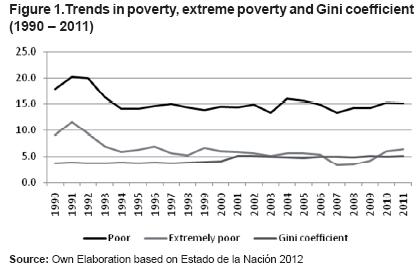
<body><![CDATA[<p style="text-align: justify;" class="MsoNormal"><span  style="font-size: 10pt; font-family: Verdana;" lang="EN-US">The international economic crisis of the 1980s and the following introduction of Structural Adjustment Programs (<span  class="SpellE">SAPs</span>) initiated contextual changes. These developments affected <st1:country-region  w:st="on"><st1:place w:st="on">Costa Rica</st1:place></st1:country-region>, although differently from other countries in the <span class="SpellE">region.Being</span> an &#8216;island of peace&#8217; in a conflictive region, the country enjoyed continuous support from multi- and bilateral donors. Within this context, <st1:country-region w:st="on">Costa Rica</st1:country-region>&#8217;s leadership looked for new economic opportunities on the global market, both in Europe and the <st1:country-region  w:st="on"><st1:place w:st="on">United States</st1:place></st1:country-region>. By the 1990s, an elite group developed, linked to transnational companies making fluency in English and computer skills the new instruments for social mobility. Social programs and public spending reduced, but not as radically as elsewhere. <st1:country-region w:st="on">Costa Rica</st1:country-region>&#8217;s public health care scheme was not privatized as for example in <st1:country-region  w:st="on"><st1:place w:st="on">Chile</st1:place></st1:country-region>. Public employment however was largely replaced by jobs in the private sector and private health spending started to increase. </span><span  style="font-size: 10pt; font-family: Verdana; color: rgb(34, 30, 31);"  lang="EN-US"><o:p></o:p></span></p>     <div style="text-align: justify;"></div> </div>     <div style="text-align: justify;"></div>     <p style="text-align: justify;" class="MsoNormal"><st1:country-region  w:st="on"><st1:place w:st="on"><span  style="font-size: 10pt; font-family: Verdana; color: rgb(34, 30, 31);"  lang="EN-US">Costa Rica</span></st1:place></st1:country-region><span  style="font-size: 10pt; font-family: Verdana; color: rgb(34, 30, 31);"  lang="EN-US"> today is <span class="SpellE">experiencingthe</span> consequences of the demographic and epidemiological transition. It is an ageing society with non-communicable diseases representing 62 % of the health burden in 2008 (WHO Global Health Observatory Data Repository). In socio-economic terms, the country moved <span class="SpellE">froma</span> poor to an upper middle economy and from one of the most equal countries in Latin <span  class="SpellE">Americato</span> one of the few with a widening income gap. Poverty decreased between 1991 and 1994 from 31,9to 20<span class="GramE">,0</span> % of the population, of which11,7 and 5,8 % <span class="SpellE">representedby</span> extreme poverty respectively, but as shown in <a  href="/img/revistas/rcsp/v22n2/art03i1.jpg">Figure 1</a>, these numbers did not improve ever since. At the same time, the income <span class="SpellE">gapwidenedover</span> those two decades with the <span class="SpellE">Gini</span>-coefficient increasing from 3,7 to 5,2 overall showing a steep increase in particular in the period 2000-2001(Estado de la <span class="SpellE">Naci&#243;n</span> 2012). Since the 1990s, increases in total health expenditure take place mostly in the form of out-of-pocket payments. <o:p></o:p></span></p>     <div style="text-align: justify;"> </div>     <div>     <div style="text-align: justify;"></div>     <div>     <div style="text-align: justify;"></div>     <p style="text-align: justify;" class="MsoNormal"><span  style="font-size: 10pt; font-family: Verdana;" lang="EN-US">Health outcomes continue to remain favorable in <st1:country-region w:st="on"><st1:place  w:st="on">Costa Rica</st1:place></st1:country-region> but are argued to be rooted in the past. There is uncertainty about the future impact of chronic disease on these indicators given the high level of risk factors prevalent in the country and the relatively low resolving capacity of the CCSS in this respect <sup>(<a href="#14">14</a>)</sup>. <o:p></o:p></span></p>     ]]></body>
<body><![CDATA[<p style="text-align: justify;" class="MsoNormal"><span  style="font-size: 10pt; font-family: Verdana;" lang="EN-US">2. <u>Constitutional, general and specific formal rules </u>The CCSS was founded in 1941 as an institution with <span  class="SpellE">fullpolitical</span> and administrative autonomy. Following its Constitutive Act, the CCSS is an autonomous institution responsible for the governance and administration of the social insurances and is not submitted to the Executive Branch in matters of governance and the administration of those insurances, their resources or reserves apart from public employment and salaries (<span class="SpellE">Ley</span> <span class="SpellE">Constitutiva</span> de la <span class="SpellE">Caja</span> <span class="SpellE">Costarricense</span> de <span class="SpellE">Seguro</span> Social). <o:p></o:p></span></p>     <p style="text-align: justify;" class="MsoNormal"><b style=""><span  style="font-size: 11pt; font-family: Verdana;" lang="EN-US">Constitutional rules <o:p></o:p></span></b></p>     <div style="text-align: justify;"></div>     <p style="text-align: justify;" class="MsoNormal"><span  style="font-size: 10pt; font-family: Verdana;" lang="EN-US">The 1949 Constitution formulates the responsibility of the state and consecutive governments for the well-being of <st1:country-region  w:st="on"><st1:place w:st="on">Costa Rica</st1:place></st1:country-region>&#8217;s residents through the production and redistribution of wealth as well as for a healthy and ecologically balanced environment. It also establishes (or better confirms, because it was in the previous Constitution as well) social insurances for manual and &#8216;white collar&#8217; workers under responsibility of the CCSS. <span class="GramE">Importantly, <span  class="SpellE">aconstitutional</span> amendment in 1968 <span class="SpellE">limitsthe</span> autonomy of autonomous institutions to administrative independence only establishing that the autonomous institutions of the State enjoy administrative independence <span  class="SpellE">butthat</span> they are subject to the law in matters of governance.</span> <span class="GramE">(Art. 188 of the Reformed Constitution of <st1:country-region w:st="on"><st1:place w:st="on">Costa Rica</st1:place></st1:country-region>).</span> The decision to reform the Constitution was made after a heated debate in Parliament and two decades of problems created by autonomous institutions enjoying full political independence: &#8216;The 1968 amendment was a response to the original Article 188 of the Constitution that created an institutional archipelago resulting in the Executive <span class="SpellE">Branchand</span> the President of the Republic having no power to govern&#8217; <sup>(<a  href="#15">15</a>)</sup>. The amendment, meant to improve inter-institutional coordination, had little effect on the health sector. According to key informants, the quality of the coordination between the Health Ministry and CCSS generally depended, despite existing <span class="SpellE">rules<span class="GramE">,on</span></span> the quality of the relationship between its leaders. <o:p></o:p></span></p>     <p class="MsoNormal"><b style=""><span  style="font-size: 11pt; font-family: Verdana;" lang="EN-US">General rules <o:p></o:p></span></b></p>     <p style="text-align: justify;" class="MsoNormal"><span  style="font-size: 10pt; font-family: Verdana;" lang="EN-US">Improved inter-institutional coordination continues to be the goal of a series of reforms shaping Public Administration during the period 1950-<st1:metricconverter productid="1980. In" w:st="on">1980. In</st1:metricconverter> 1970, during <span class="SpellE">Figueres</span>&#180; second administration, the President of the Republic is made to assign four out of the seven members of the autonomous institutions&#8217; Boards with three members remaining from the previous administration to safeguard continuation. As of 1974, the President nominates among those four, one as Executive <span  class="SpellE">Presidenttolead</span> that Board and coordinate the institution&#8217;s actions with the President of the Republic, the Ministers of Government and Executive Presidents of other relevant autonomous institutions. <o:p></o:p></span></p>     <div style="text-align: justify;"></div> </div>     <div style="text-align: justify;"></div>     <div>     <div style="text-align: justify;"></div>     ]]></body>
<body><![CDATA[<p style="text-align: justify;" class="MsoNormal"><span  style="font-size: 10pt; font-family: Verdana;" lang="EN-US">Also in 1974, the newly created National Planning System establishes ministerial planning offices, decentralized institutions and local and regional public entities as well as coordination and advisory mechanisms. The1978 General Act on Public Administration gives Ministers responsibility for <span class="SpellE">sectorial</span> <span class="SpellE">coordinationand</span> the 1983 <span class="SpellE">Sectorialization</span> Act nominates them as <span class="SpellE">sector&#8216;stewards</span>&#8217;. The 1983 health <span  class="SpellE">sectorConstitutive</span> Act reconfirms the Health Ministry&#8217;s authority over private actors acting on health as well (already established in the 1973 General Health Act). <o:p></o:p></span></p>     <p class="MsoNormal"><b style=""><span  style="font-size: 11pt; font-family: Verdana;" lang="EN-US">Specific health policy related rules <o:p></o:p></span></b></p>     <p style="text-align: justify;" class="MsoNormal"><span  style="font-size: 10pt; font-family: Verdana;" lang="EN-US">The 1961 Social Security <span class="SpellE">Universalization</span> Act commits consecutive governments in <st1:country-region w:st="on"><st1:place  w:st="on">Costa Rica</st1:place></st1:country-region> to expand social security coverage across the population within ten years. The 1973 Hospital Transfer Act facilitates <span class="SpellE">theuniversalization</span> process transferring most (semi-) public and private hospitals in the country to the CCSS. The General Health Act, also from 1973, reaffirms that population health is of public interest mentored and monitored by the state. <o:p></o:p></span></p>     <div style="text-align: justify;"></div>     <p style="text-align: justify;" class="MsoNormal"><span  style="font-size: 10pt; font-family: Verdana;" lang="EN-US">It makes explicit that the definition of the national health policy, norms, planning and coordination of all public and private health related actions corresponds to the Executive Branch through the Health <span  class="SpellE">Ministry.The</span> <span class="SpellE">Actattributes</span> power at times of national emergencies <span class="SpellE">tothe</span> Health Ministry to impose its authority over <span class="SpellE">allpublic</span> and private actors, but does not limit the Health Ministry&#8217;s mandate to such events (although it is sometimes interpreted as such). <o:p></o:p></span></p>     <div style="text-align: justify;"></div>     <p style="text-align: justify;" class="MsoNormal"><span  style="font-size: 10pt; font-family: Verdana;" lang="EN-US">The Health Ministry&#8217;s Organizational Act, also from 1973, reaffirms the leading role of the Health Ministry in health policy <span class="SpellE">andconfirms</span> that it exercises the jurisdiction and <span class="SpellE">technicalcontrol</span> over all public and private institutions that realize actions on health in all of its forms. It adds, however, that the actions of the Health Ministry in terms of service provision cannot damage those actions that are realized by other institutions, and that no other duty attributed to the Health Ministry by law or regulation can be of damage to the attributes the law gives to the autonomous institutions of the health sector. Willingly or not, the <span class="SpellE">Actlimits</span> the Health Ministry&#8217;s attributes to so-called negative coordination, implying government organizations and programs &#8216;merely to get out of each other&#8217;s way&#8217; rather than to produce negative interactions among themselves <sup>(<a  href="#16">16</a>)</sup>. <o:p></o:p></span></p>     <div style="text-align: justify;"></div>     <p style="text-align: justify;" class="MsoNormal"><span  style="font-size: 10pt; font-family: Verdana;" lang="EN-US">The rule is one of several that limit the Health Ministry&#8217;s authority over other social actors. The same Act, for example, <span  class="SpellE">whileestablishing</span> the National Health Advisory Board as an advisory organ responsible to collaborate with the Minister in the health policy formulation process, formally <span class="SpellE">requiresthe</span> CCSS and other institutions to send a representative, but not necessarily its <span class="SpellE">leaders.In</span> 1989, the National Health System is constituted by decree, positioning the autonomous institutions and private health sector once again within the Health Ministry&#8217;s domain, but without changing any of these legal imperfections. <o:p></o:p></span></p>     <div style="text-align: justify;"></div>     ]]></body>
<body><![CDATA[<p style="text-align: justify;" class="MsoNormal"><span  style="font-size: 10pt; font-family: Verdana;" lang="EN-US">From different perspective, parliament takes over the CCSS attribution to increase social insurance contributions when considered necessary in 1990. This <span class="SpellE">limitsthe</span> institution&#8217;s capacity to unilaterally increase its funding <span class="SpellE">baseat</span> times of financial hardship which had been a crucial instrument to safeguarding a degree of financial independency from the government in the past <sup>(<a  href="#17">17</a>)</sup>. <o:p></o:p></span></p>     <p style="text-align: justify;" class="MsoNormal"><span  style="font-size: 10pt; font-family: Verdana;" lang="EN-US">The reform would reinforce the negative impact of the government&#8217;s structural avoidance since the 1980s, to timely pay its contributions to the CCSS and increase problems related to financial liquidity for the institution. After <st1:metricconverter productid="1990, a"  w:st="on">1990, a</st1:metricconverter> new set of health policy rules is adopted seeking to consolidate UHC and to make the CCSS scheme more efficient and sustainable. The 1994 health sector reforms, financed by two grants from the World Bank and Inter-American Development Bank respectively, facilitates the integration of primary health care within the CCSS and the institutional strengthening of the Health Ministry as health system steward. The latter was meant to improve the governance of the health system at large; the former to change the focus within the CCSS network from curative care to prevention and health promotion and to enhance the scheme&#8217;s efficiency, responsiveness and sustainability. <o:p></o:p></span></p>     <div style="text-align: justify;"></div>     <p style="text-align: justify;" class="MsoNormal"><span  style="font-size: 10pt; font-family: Verdana;" lang="EN-US">The 1998 Des-concentration of <st1:place w:st="on"><st1:placename w:st="on">CCSS</st1:placename> <st1:placetype w:st="on">Hospitals</st1:placetype></st1:place> and Clinics <span class="SpellE">Actsupports</span> the same objectives establishing an internal market within the CCSS network based on contractual arrangements and community Health <span class="SpellE">Boardsto</span> enhance social participation. In <st1:metricconverter productid="2008, a"  w:st="on">2008, a</st1:metricconverter> new regulation <span  class="SpellE">forthe</span> Health <span class="SpellE">Ministryis</span> <span class="SpellE">adoptedby</span> decree reformulating its mandate into guiding the activities of all public and private actors towards the Social Production of Health, defined for the first time in 1989 with all previous legislation accept for the 1983 health sector constitutional decree, remaining in force. The Health Minister&#8217;s role is described as one of <span class="SpellE">sectorial</span> and inter-<span  class="SpellE">sectorial</span> coordination (<span class="SpellE">Reglamento</span> <span class="SpellE">Org&#225;nico</span> <st1:state w:st="on"><st1:place  w:st="on"><span class="GramE">del</span></st1:place></st1:state> <span  class="SpellE">Ministerio</span> de <span class="SpellE">Salud</span> 2008). <o:p></o:p></span></p>     <div style="text-align: justify;"></div>     <p style="text-align: justify;" class="MsoNormal"><span  style="font-size: 10pt; font-family: Verdana;" lang="EN-US">Notably, coordination as an instrument of public administration is not an unambiguous concept. Peters, referring to <span  class="SpellE">Scharpf</span> (1964), distinguishes four degrees of coordination with an increasing investment of political capital. As mentioned above, negative coordination involves government organizations and programs to not disturb each other; positive coordination refers to working together; policy integration to different public organizations developing shared <span  class="SpellE">goalsto</span> be pursued; and strategy development to having a clear vision for the future of policy and government. UHC could be an example of such a strategy and success towards achieving it may depend in a large part on the degree of coordination achieved within a certain context. <o:p></o:p></span></p> </div>     <div>     <div style="text-align: justify;"></div>     <p style="text-align: justify;" class="MsoNormal"><span  style="font-size: 10pt; font-family: Verdana;" lang="EN-US">3. <u>Actors, their relative access to power resources and process <o:p></o:p></u></span></p>     <div style="text-align: justify;"></div>     ]]></body>
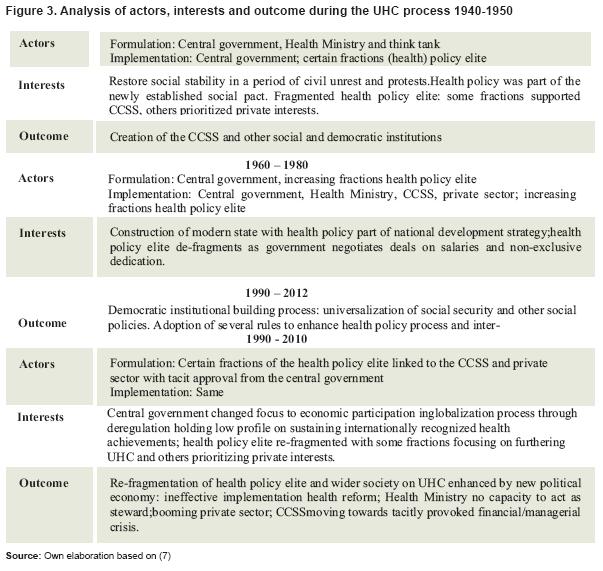
<body><![CDATA[<p style="text-align: justify;" class="MsoNormal"><span  style="font-size: 10pt; font-family: Verdana;" lang="EN-US">As key actors in Costa Rica&#8217;s health policy <span class="SpellE">proce</span> <span class="SpellE">ss,informantsmentioned</span> consecutive governments and the Health Ministry as its delegate, the CCSS and private actors, next to political parties, medical unions and the <span  class="SpellE">population.The</span> relative importance of each of these actors has changed over time <sup>(<a href="#7">7</a>)</sup>. Most important, before the 1990s, consecutive governments pushed the UHC construction process and the expansion of the CCSS. The Health Ministry played its role as government delegate and as provider of primary health care in marginal rural and urban areas. Conflictive interests between the Health Ministry and the <span class="SpellE">CCSSwere</span> resolved through government intervention with the President of the Republic stressing the <span class="SpellE">need,according</span> to key informants, <span  class="SpellE">forboth</span> institutions to work together: <i>&#8216;I want the Ministry and the CCSS working together, not fighting, as it was the tradition </i><sup>(<a href="#7">7</a>)</sup><i>. <o:p></o:p></i></span></p>     <div style="text-align: justify;"></div>     <p style="text-align: justify;" class="MsoNormal"><span  style="font-size: 10pt; font-family: Verdana;" lang="EN-US">Private health care providers, who had opposed the UHC scheme in the beginning, became neutral players by the 1970s. Health policies were reinforced by other social policies shaping apolitical and socio-economic context favorable to UHC <sup>(<a href="#18">18</a>)</sup>. <span  class="SpellE">Solidaritybecamethe</span> essence of <st1:country-region w:st="on">Costa Rica</st1:country-region>&#8217;s UHC model: &#8230; t<i>he essence of (<st1:country-region w:st="on"><st1:place  w:st="on">Costa Rica</st1:place></st1:country-region>&#8217;s health) system in the first instance is the solidarity of the Costa Rican society, because without this solidarity the other principles cannot work. You may want to be universal, but if the people do not accept (financial) solidarity, you cannot achieve it</i> (Key informant 1). <o:p></o:p></span></p>     <div style="text-align: justify;"></div>     <p style="text-align: justify;" class="MsoNormal"><span  style="font-size: 10pt; font-family: Verdana;" lang="EN-US">After the 1990s, universal social policies slowly faded out including the Health Ministry&#8217;s primary health care programs that have been considered central to <st1:country-region w:st="on"><st1:place  w:st="on">Costa Rica</st1:place></st1:country-region>&#8217;s successes in population health (Focus group 1). The reestablishment of the programs under the CCSS implied a substantial part of the Health Ministry&#8217;s staff and resources to be transferred to that institution. The process has been described as a &#8216;traumatic experience&#8217; for many <sup>(<a href="#7">7</a>)</sup>, and t sparked off disputes betwen both institutions that continue until today.</span><span style="" lang="EN-US"> <o:p></o:p></span></p>     <p style="text-align: justify;" class="MsoNormal"><span  style="font-size: 10pt; font-family: Verdana;" lang="EN-US">The Health Ministry lost most of its resources and leadership as the involvement of the government in health policy declined. As a result, the so-called &#8216;national authority&#8217; in health ever really took control of the process. The government focused on economic policies that would allow a trend of implicit privatization on the health care market <sup>(<a href="#19">19</a>)</sup>. Despite the fact that the Health Ministry was health system steward and resources were invested in strengthening this role, the institution never got properly equipped to direct the actions of the CCSS and other social actors. <i>The private sector is not involved in the processes that relate to the stewardship of the Health Ministry&#8230; and the CCSS does whatever it wants ... it does exactly &#8230; what it feels like taking the luxury to not take into account anything the Health Minister says, because the Health Ministry does not have money </i>(Key informant 2). <a  href="/img/revistas/rcsp/v22n2/art03i3.jpg">Figure 3</a> <o:p></o:p></span></p>     <div style="text-align: justify;"></div>     <p style="text-align: justify;" class="MsoNormal"><span  style="font-size: 10pt; font-family: Verdana;" lang="EN-US">Illustrative for the lack of power by the Health Ministry to impose its authority over the social actors, is how the CCSS over time started to neglect the National Health Advisory Board: <i>Whether the Health Ministry convokes the CCSS? From a single provider and the one that had the health services, the Health Ministry transformed into steward, there was a change in the 1990s, a very big transformation at the level CCSS-Health Ministry. &#8230; It were times &#8230; with a lot of hassle and power games between those who worked in the Health Ministry and those who worked for the CCSS, because, those who have the money, strength, political power, and everything else; why would they have to sit and talk with the Health Ministry, for what reason? At that time, there was an absolute power of the CCSS, they said it is better not to go to the Health Ministry, because if I go, they will ask for money for this and for that &#8230;; so I better don&#8217;t go. So the second bosses started to go, not the Executive President, and later the third and then it died</i> (Key informant 3). <o:p></o:p></span></p>     <div style="text-align: justify;"></div>     <p style="text-align: justify;" class="MsoNormal"><span  style="font-size: 10pt; font-family: Verdana;" lang="EN-US">Key informants blame the lack of capacity of the Health Ministry on the Structural Adjustment Programs &#8230;: The Health Ministry had its fundamental momentum (during the 1970s) and it <span class="SpellE">fellwith</span> the crisis of the 1980s. The oil crisis, that is when everything came down, and the only way to pay the State was reducing it, and on top of that, the concept that the State should not be in everything, and that the private firm should do the work, that were the <span class="SpellE">SAPs</span> of the 1980s &#8230; the aim (of the <span class="SpellE">SAPs</span>) was to reduce the State. In health this was a disaster (Key informant 4). &#8230; <o:p></o:p></span></p>     ]]></body>
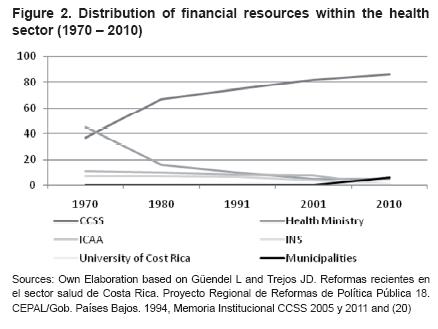
<body><![CDATA[<p style="text-align: justify;" class="MsoNormal"><span class="GramE"><span  style="font-size: 10pt; font-family: Verdana;" lang="EN-US">and</span></span><span  style="font-size: 10pt; font-family: Verdana;" lang="EN-US"> on the fact that no new law was enacted with the 1990s reforms: The reform of the 1990s came without a law, and that law is indispensable. The Health Ministry must have a National Health Commission, where each month will meet the CCSS President, the INS President, the AYA, the municipalities &#8230; (Key informant 5). You ask me whether there is stewardship. I will explain why the stewardship function does not exist. It is because of the law that was never changed (Key informant 6). <a  href="/img/revistas/rcsp/v22n2/art03i2.jpg">Figure 2</a>, illustrates how already since the 1980s the Health Ministry saw its financial resources transfer, relatively, to the <span class="SpellE">CCSSwithother</span> actors on that market, including the Water and Sewage Institute, the University of Costa Rica, the National Insurance Institute and the Municipalities, playing a minor role. <o:p></o:p></span></p>     <div style="text-align: justify;"></div> </div>     <div style="text-align: justify;"></div>     <div>     <div style="text-align: justify;"></div>     <p style="text-align: justify;" class="MsoNormal"><span  style="font-size: 10pt; font-family: Verdana;" lang="EN-US">It <span  class="SpellE">seemsthat</span> before the 1990s, with the government leading the health policy process, and the Health Ministry, <span class="SpellE">CCSS,andprivate</span> health <span  class="SpellE">sectoreachoperating</span> in their own domain, there was a sufficient degree of coordination. The CCSS was still &#8216;under construction&#8217; and the private sector small. It accommodated the interests of the population with capacity to pay to elect their preferred provider and those of the medical doctors, to practice with no exclusive dedication. The public-private mix worked well controlling waiting lines and lists for primary and secondary care, while for specialized hospital care the CCSS was the best option for all. <o:p></o:p></span></p>     <div style="text-align: justify;"></div>     <p style="text-align: justify;" class="MsoNormal"><span  style="font-size: 10pt; font-family: Verdana;" lang="EN-US">The 1994 reforms while successful in bringing all personal health care services under one roof had some unintended outcomes. When health areas and primary health care teams were established across the country under CCSS management, private practitioners, working for the CCSS as well, found ways to catch the demand not served by the public <span  class="SpellE">institutionor</span> maybe to <span class="SpellE">sometimeseven</span> push out CCSS demand to their private clinics: <i>They (the private sector) have benefitted from the reforms more than anyone else; that is why you always see a &#8216;garden&#8217; of private practices next to the services of the CCSS. Today you open a hospital in Heredia and they already open their private practices, because the CCSS will never be able to meet all the demand. They really benefitted from the reform, and in big, and they have filled their pockets. It is good, because the people have options</i> (Key informant 1). <o:p></o:p></span></p>     <p style="text-align: justify;" class="MsoNormal"><span  style="font-size: 10pt; font-family: Verdana;" lang="EN-US">The trend triggered change that was leveraged by a new macro-political context. Not <span class="SpellE">thereform</span> as formulated, but the way it was implemented with no-one pushing for coordinated action, had by-effects in terms of a shift in the distribution of power on the health care market. Not the goal changed, but the process. With a weak Health Ministry, &#8216;holes&#8217; in legislation got subject to interpretation by vested interests and <span class="SpellE">reformsaimed</span> to increase the financial sustainability of the CCSS and strengthen the Health Ministry&#8217;s stewardship role, were blocked. As a result, the shift from curative to preventive care did not take off; the Des-concentration Act was implemented only partially; a project to review the 1973 General Health Act presented by the Health Ministry in the early 21<sup>st </sup><span class="SpellE">centurynever</span> got accepted; and the 2008 Health Ministry&#8217;s new regulation mentioned above was largely neglected by the CCSS and other social actors. <o:p></o:p></span></p>     <div style="text-align: justify;"></div> </div>     ]]></body>
<body><![CDATA[<div style="text-align: justify;"></div> </div>     <div style="text-align: justify;"></div>     <div>     <div style="text-align: justify;"></div>     <div>     <div style="text-align: justify;"></div>     <p style="text-align: justify;" class="MsoNormal"><span  style="font-size: 10pt; font-family: Verdana;" lang="EN-US">The increase in private sector activity made private health expenditure grow between 1999 and 2009 from 23<span class="GramE">,7</span> % to 32,6 %, and out-of-pocket payments from 20,9 % to 28,6 % of total health expenditure. So far, no or little catastrophic health expenditure has <span  class="SpellE">beenfound</span> in <st1:country-region w:st="on"><st1:place  w:st="on">Costa Rica</st1:place></st1:country-region> (6), but the increase in out-of-pocket spending does indicate a <span class="SpellE">relativeloss</span> in <span class="SpellE">UHCthreatening</span> financial risk protection and equity of access. <st1:country-region w:st="on"><st1:place w:st="on">Costa Rica</st1:place></st1:country-region>&#8217;s health outcomes may seem robust, but for key informants these result largely from the past. <span class="SpellE">Theyarguethat</span> new measures <span  class="SpellE">areneeded</span> to sustain that level of outcomes: With (the lack of stewardship) we lose the impact we c<i>an have on the population. What happens is that&#8230; the health indicators in this country are very solid and they have been produced not in 10 or 15 but</i></span><i><span  style="font-size: 10pt; font-family: Verdana;" lang="EN-US"> over 100 years. If we look at the process: in 1922 the Health Secretariat was created, then all the sanitation campaigns that were implemented, that is when begins the whole intensive program, the Social Security, the Water and Sewage Institution, </span></i><span  style="font-size: 10pt; font-family: Verdana; color: rgb(34, 30, 31);"  lang="EN-US"><o:p></o:p></span></p>     <div style="text-align: justify;"></div>     <p style="text-align: justify;" class="MsoNormal"><span class="GramE"><i><span  style="font-size: 10pt; font-family: Verdana; color: rgb(34, 30, 31);"  lang="EN-US">the</span></i></span><i><span  style="font-size: 10pt; font-family: Verdana; color: rgb(34, 30, 31);"  lang="EN-US"> electrification, all the vaccination campaigns, </span></i><span  style="font-size: 10pt; font-family: Verdana; color: rgb(34, 30, 31);"  lang="EN-US"><o:p></o:p></span></p>     <p class="MsoNormal"><span class="GramE"><i><span  style="font-size: 10pt; font-family: Verdana; color: rgb(34, 30, 31);"  lang="EN-US">the</span></i></span><i><span  style="font-size: 10pt; font-family: Verdana; color: rgb(34, 30, 31);"  lang="EN-US"> campaigns of shoes for the children. The impact of these actions is something we do not lose over night, but to sustain it, the actual model demands much more substantial efforts </span></i><span  style="font-size: 10pt; font-family: Verdana; color: rgb(34, 30, 31);"  lang="EN-US">(Key informant 2).</span><span  style="font-size: 10pt; font-family: Verdana;" lang="EN-US"><o:p></o:p></span></p> </div>     ]]></body>
<body><![CDATA[<div>     <div>     <p class="MsoNormal"><b style=""><span  style="font-size: 11pt; font-family: Verdana;" lang="EN-US">Conclusion and discussion <o:p></o:p></span></b></p>     <p style="text-align: justify;" class="MsoNormal"><span  style="font-size: 10pt; font-family: Verdana;" lang="EN-US">In <st1:country-region  w:st="on"><st1:place w:st="on">Costa Rica</st1:place></st1:country-region>, different from Walt and Gilson&#8217;s suggestion, health policy topped the national agenda before the 1980s and became low politics, once UHC was achieved after the 1990s. Through central government imposition emphasizing the need for inter-institutional coordination, the UHC process moved forwards relatively smoothly during the 1960s through 1980s, despite opposition by certain fractions and despite some imperfect or ambiguous rules. When the distribution of power resources on the health care market <span class="SpellE">shifted<span class="GramE">,the</span></span> relative absence of government in health policy and the resulting lack of capacity by the Health Ministry to act as health system steward caused new reforms seeking the sustainability of UHC in <st1:country-region  w:st="on"><st1:place w:st="on">Costa Rica</st1:place></st1:country-region> not or only partially being implemented. One of the reasons why this could happen despite UHC being a formal policy in <st1:country-region w:st="on"><st1:place w:st="on">Costa Rica</st1:place></st1:country-region> seems the sensitivity of those rules within a changing <span  class="SpellE">contextto</span> manipulation by private interests in the absence of a strong steward. Neither the rules nor the <span class="SpellE">goalsmay</span> have really changed after the 1990s, <span class="SpellE">butthe</span> way policy was implemented-ultimately a story of personal relationships-<span  class="GramE">,<span class="SpellE">i.e</span></span>. the process, did. <o:p></o:p></span></p>     <div style="text-align: justify;"></div>     <p style="text-align: justify;" class="MsoNormal"><span  style="font-size: 10pt; font-family: Verdana;" lang="EN-US">Lessons for other countries from <st1:country-region w:st="on"><st1:place  w:st="on">Costa Rica</st1:place></st1:country-region>&#8217;s experiences are that UHC <span class="SpellE">policiesneed</span> to remain structurally high on the policy agenda, not only during the pursuit of UHC but also once this is achieved. <st1:country-region w:st="on"><st1:place  w:st="on">Costa Rica</st1:place></st1:country-region>&#8217;s health system, as any other health system today, and more so than two decades ago, faces increasing challenges posed by the demographic and epidemiological transitions, technological advances, changes in the labor market composition and many other contextual developments. These require <span class="SpellE">thereforms</span> adopted formally during the past decades and/or others possibly, to be effectively implemented if UHC is to be <span class="SpellE">sustained.The</span> key <span class="SpellE">questioniswhether</span> the government (who else?) is willing and capable to re-establish its leadership position in this important process and <span class="SpellE">topush</span> for strategic coordination in view of UHC. <o:p></o:p></span></p> </div>     <div>     <p class="MsoNormal"><b style=""><span  style="font-size: 11pt; font-family: Verdana;" lang="EN-US">Acknowledgements <o:p></o:p></span></b></p>     <p style="text-align: justify;" class="MsoNormal"><span  style="font-size: 10pt; font-family: Verdana;" lang="EN-US">This study has been carried out in cooperation with Juan Rafael Vargas, Johan <span class="SpellE">Retana</span>, Pablo <span  class="SpellE">Slon</span> Montero, Ana Casanova and Monica Acosta. We acknowledge that the study that forms the basis for this article is financially and technically supported by the <st1:city w:st="on"><st1:place  w:st="on">Alliance</st1:place></st1:city> for Health Policy and Systems Research, WHO. Regarding this study we wish to acknowledge the inputs of the Health Systems Financing Department, WHO and the late Guy <span class="SpellE">Carrin</span>, in particular. The authors declare that the study does not represent any conflict of interests with the financing or any other institution. </span><span class="SpellE"><span  style="font-size: 10pt; font-family: Verdana;">The</span></span><span  style="font-size: 10pt; font-family: Verdana;"> autor <span  class="SpellE">thanks</span> Mar&#237;a del <span class="SpellE">Rocio</span> <span class="SpellE">Saenz</span>, Juan Luis <span class="SpellE">Bermudez</span>, Violeta <span class="SpellE">Pallavicini</span> <span class="SpellE">and</span> Di <span class="SpellE">McIntyre</span> <span class="SpellE">for</span> <span class="SpellE">their</span> valuable <span class="SpellE">inputs</span>. <o:p></o:p></span></p>     <div style="text-align: justify;"></div>     ]]></body>
<body><![CDATA[<p style="text-align: justify;" class="MsoNormal"><span class="SpellE"><b  style=""><span style="font-size: 11pt; font-family: Verdana;"></span></b></span></p> <hr style="width: 100%; height: 2px;"><span class="SpellE"><b style=""><span  style="font-size: 11pt; font-family: Verdana;">References</span></b></span><b  style=""><span style="font-size: 11pt; font-family: Verdana;"> <o:p></o:p></span></b>     <!-- ref --><p class="MsoNormal"><span  style="font-size: 10pt; font-family: Verdana;"><a name="1"></a>1. Contreras Castro F. &#218;nica mirando al mar. San Jos&#233;. </span><st1:country-region  w:st="on"><st1:place w:st="on"><span  style="font-size: 10pt; font-family: Verdana;" lang="EN-US">Costa Rica</span></st1:place></st1:country-region><span  style="font-size: 10pt; font-family: Verdana;" lang="EN-US"> 1994: 25.    &nbsp;&nbsp;&nbsp;&nbsp;&nbsp;&nbsp;&nbsp;&nbsp;[&#160;<a href="javascript:void(0);" onclick="javascript: window.open('/scielo.php?script=sci_nlinks&ref=850223&pid=S1409-1429201300020000300001&lng=','','width=640,height=500,resizable=yes,scrollbars=1,menubar=yes,');">Links</a>&#160;]<!-- end-ref --> <o:p></o:p></span></p>     <!-- ref --><p class="MsoNormal"><span  style="font-size: 10pt; font-family: Verdana;" lang="EN-US"><a name="2"></a>2. <span class="SpellE">Balabanova</span> D, McKee M, Mills A. Good Health at Low Cost 25 Years On. What Makes a Successful health System? <span class="GramE">The <st1:place w:st="on"><st1:placename  w:st="on">London</st1:placename> <st1:placetype w:st="on">School</st1:placetype></st1:place> <u>of</u> Hygiene and Tropical Medicine 2011.</span> http://ghlc.lshtm.ac.uk/files/2011/10/ GHLC-<span class="SpellE"><span  class="GramE">book.pdf</span></span><span class="GramE"> .    &nbsp;&nbsp;&nbsp;&nbsp;&nbsp;&nbsp;&nbsp;&nbsp;[&#160;<a href="javascript:void(0);" onclick="javascript: window.open('/scielo.php?script=sci_nlinks&ref=850225&pid=S1409-1429201300020000300002&lng=','','width=640,height=500,resizable=yes,scrollbars=1,menubar=yes,');">Links</a>&#160;]<!-- end-ref --></span><o:p></o:p></span></p> </div>     <div>     <!-- ref --><p class="MsoNormal"><span  style="font-size: 10pt; font-family: Verdana;"><a name="3"></a>3. Miranda Guti&#233;rrez G. La Seguridad Social y el Desarrollo en Costa Rica. San Jos&#233;, Costa Rica. </span><span  style="font-size: 10pt; font-family: Verdana;" lang="EN-US">UNED: 2003 http://www.editlegado.com/miranda-gutierrezguido-seguridad-social-desarrollo-costa-rica-p-1381.html.    &nbsp;&nbsp;&nbsp;&nbsp;&nbsp;&nbsp;&nbsp;&nbsp;[&#160;<a href="javascript:void(0);" onclick="javascript: window.open('/scielo.php?script=sci_nlinks&ref=850228&pid=S1409-1429201300020000300003&lng=','','width=640,height=500,resizable=yes,scrollbars=1,menubar=yes,');">Links</a>&#160;]<!-- end-ref --> <o:p></o:p></span></p>     <!-- ref --><p class="MsoNormal"><span  style="font-size: 10pt; font-family: Verdana;"><a name="4"></a>4. Herrero F, Dur&#225;n F. El sector privado en el sistema de salud de Costa Rica. Serie Financiamiento del Desarrollo 109. CEPAL Unidad de Estudios Especiales. Chile: 2001.    &nbsp;&nbsp;&nbsp;&nbsp;&nbsp;&nbsp;&nbsp;&nbsp;[&#160;<a href="javascript:void(0);" onclick="javascript: window.open('/scielo.php?script=sci_nlinks&ref=850230&pid=S1409-1429201300020000300004&lng=','','width=640,height=500,resizable=yes,scrollbars=1,menubar=yes,');">Links</a>&#160;]<!-- end-ref --> <o:p></o:p></span></p>     ]]></body>
<body><![CDATA[<!-- ref --><p class="MsoNormal"><span  style="font-size: 10pt; font-family: Verdana;"><a name="5"></a>5. Rosero-<span class="SpellE">Bixby</span> L. Evaluaci&#243;n del impacto de la reforma del sector salud en Costa Rica. Revista Panamericana de salud P&#250;blica. </span><span  style="font-size: 10pt; font-family: Verdana;" lang="PT-BR">2004; 15 (2<span class="GramE">):</span>94-103. http://ccp.ucr.ac.cr/bvp/pdf/salud/Rosero%<span class="GramE">20Evaluacion</span> %20Reforma-RPS2004.pdf.    &nbsp;&nbsp;&nbsp;&nbsp;&nbsp;&nbsp;&nbsp;&nbsp;[&#160;<a href="javascript:void(0);" onclick="javascript: window.open('/scielo.php?script=sci_nlinks&ref=850232&pid=S1409-1429201300020000300005&lng=','','width=640,height=500,resizable=yes,scrollbars=1,menubar=yes,');">Links</a>&#160;]<!-- end-ref --><o:p></o:p></span></p>     <!-- ref --><p class="MsoNormal"><span  style="font-size: 10pt; font-family: Verdana;" lang="EN-US"><a name="6"></a>6. <span class="SpellE">Z&#250;&#241;iga-Brenes</span> MP, Vargas JR, <span class="SpellE">Vindas</span> A. Out-<span  class="SpellE">ofpocket</span> and catastrophic health expenditure puzzle; The Costa Rican experience. <span class="GramE">Financing Health in <st1:place w:st="on">Latin America</st1:place>.</span> <span class="GramE">Chapter 6 Vol. 1 Household Spending and Impoverishment.</span> Edited by Felicia Maria <span class="SpellE">Knaul</span>, Rebecca Wong, <span class="GramE">Hector</span> <span class="SpellE">Arreola-Ornelas</span>. <st1:place w:st="on"><st1:placename w:st="on">Harvard</st1:placename> <st1:placetype  w:st="on">University</st1:placetype></st1:place> Press: 2013 http://www.funsalud.org.mx/competitividad/<u> </u>financiamiento/Documentos/Working%20paper%20uno/Costa%20Rica%20WP1.pdf.    &nbsp;&nbsp;&nbsp;&nbsp;&nbsp;&nbsp;&nbsp;&nbsp;[&#160;<a href="javascript:void(0);" onclick="javascript: window.open('/scielo.php?script=sci_nlinks&ref=850234&pid=S1409-1429201300020000300006&lng=','','width=640,height=500,resizable=yes,scrollbars=1,menubar=yes,');">Links</a>&#160;]<!-- end-ref --><u><o:p></o:p></u></span></p>     <!-- ref --><p class="MsoNormal"><span  style="font-size: 10pt; font-family: Verdana;" lang="EN-US"><a name="7"></a>7. Vargas JR, <span class="SpellE">Muiser</span> J. Promoting universal financial protection: A policy analysis of introducing universal health coverage in <st1:country-region w:st="on"><st1:place  w:st="on">Costa Rica</st1:place></st1:country-region> (1940-2000).Health Research Policy and Systems. 2013; 11(28):4.    &nbsp;&nbsp;&nbsp;&nbsp;&nbsp;&nbsp;&nbsp;&nbsp;[&#160;<a href="javascript:void(0);" onclick="javascript: window.open('/scielo.php?script=sci_nlinks&ref=850236&pid=S1409-1429201300020000300007&lng=','','width=640,height=500,resizable=yes,scrollbars=1,menubar=yes,');">Links</a>&#160;]<!-- end-ref --> <o:p></o:p></span></p>     <!-- ref --><p class="MsoNormal"><span  style="font-size: 10pt; font-family: Verdana;" lang="EN-US"><a name="8"></a>8. World Health Report 2000. <span class="GramE">Chapter 6.</span> How is the public interest protected? <span class="GramE">2000: 119.</span> http://www.who.int/whr/2000/en/whr00_ch6_en.pdf.    &nbsp;&nbsp;&nbsp;&nbsp;&nbsp;&nbsp;&nbsp;&nbsp;[&#160;<a href="javascript:void(0);" onclick="javascript: window.open('/scielo.php?script=sci_nlinks&ref=850238&pid=S1409-1429201300020000300008&lng=','','width=640,height=500,resizable=yes,scrollbars=1,menubar=yes,');">Links</a>&#160;]<!-- end-ref --> <o:p></o:p></span></p>     <!-- ref --><p class="MsoNormal"><span  style="font-size: 10pt; font-family: Verdana;" lang="EN-US"><a name="9"></a>9. Walt G and Gilson L. Reforming the health sector in developing countries: the central role of policy analysis. <span  class="GramE">Health Policy and Planning.</span> 1994; 9(4):353-370 http://info.worldbank.org/etools/docs/library/122031/ bangkokCD/BangkokMarch05/Week2/4Thursday/ S2EngagingStakeholders/ReformingtheHealthSector.pdf.    &nbsp;&nbsp;&nbsp;&nbsp;&nbsp;&nbsp;&nbsp;&nbsp;[&#160;<a href="javascript:void(0);" onclick="javascript: window.open('/scielo.php?script=sci_nlinks&ref=850240&pid=S1409-1429201300020000300009&lng=','','width=640,height=500,resizable=yes,scrollbars=1,menubar=yes,');">Links</a>&#160;]<!-- end-ref --> <o:p></o:p></span></p>     ]]></body>
<body><![CDATA[<!-- ref --><p class="MsoNormal"><span  style="font-size: 10pt; font-family: Verdana;"><a name="10"></a>10. Subirats J, <span class="SpellE">Knoepfel</span> P, <span class="SpellE">Larrue</span> C, <span class="SpellE">Varone</span> F. An&#225;lisis y Gesti&#243;n de Pol&#237;ticas P&#250;blicas. Ariel. Ciencia Pol&#237;tica: 2008.    &nbsp;&nbsp;&nbsp;&nbsp;&nbsp;&nbsp;&nbsp;&nbsp;[&#160;<a href="javascript:void(0);" onclick="javascript: window.open('/scielo.php?script=sci_nlinks&ref=850242&pid=S1409-1429201300020000300010&lng=','','width=640,height=500,resizable=yes,scrollbars=1,menubar=yes,');">Links</a>&#160;]<!-- end-ref --> <o:p></o:p></span></p>     <!-- ref --><p class="MsoNormal"><span  style="font-size: 10pt; font-family: Verdana;"><a name="11"></a>11. Flores W. Los principios &#233;ticos y los enfoques asociados a la investigaci&#243;n de la <span class="SpellE">gobernanza</span> en los sistemas de salud: implicaciones conceptuales y metodol&#243;gicas. </span><span  style="font-size: 10pt; font-family: Verdana;" lang="EN-US">Ethical principles and approaches to health systems governance research: conceptual and methodological implications. </span><span  style="font-size: 10pt; font-family: Verdana;">Revista Salud P&#250;blica. 12:1. </span><span style="font-size: 10pt; font-family: Verdana;"  lang="EN-US">Bogot&#225;: 2010. http://www.scielo.org.co/scielo.php?pid=S0124-0064201 0000700003&amp;script=<span class="SpellE">sci_arttext</span>.    &nbsp;&nbsp;&nbsp;&nbsp;&nbsp;&nbsp;&nbsp;&nbsp;[&#160;<a href="javascript:void(0);" onclick="javascript: window.open('/scielo.php?script=sci_nlinks&ref=850244&pid=S1409-1429201300020000300011&lng=','','width=640,height=500,resizable=yes,scrollbars=1,menubar=yes,');">Links</a>&#160;]<!-- end-ref --><o:p></o:p></span></p>     <!-- ref --><p class="MsoNormal"><span  style="font-size: 10pt; font-family: Verdana;" lang="EN-US"><a  name="12"></a>12. <span class="SpellE">Sojo</span> C. <span  class="SpellE">Igualiticos</span> &#8211; La <span class="SpellE">construcci&#243;n</span> social de la <span class="SpellE">desigualdad</span> en Costa Rica, San Jos&#233;, Costa Rica. <span class="GramE">PNUD.</span> <span class="GramE">2010: 68.    &nbsp;&nbsp;&nbsp;&nbsp;&nbsp;&nbsp;&nbsp;&nbsp;[&#160;<a href="javascript:void(0);" onclick="javascript: window.open('/scielo.php?script=sci_nlinks&ref=850246&pid=S1409-1429201300020000300012&lng=','','width=640,height=500,resizable=yes,scrollbars=1,menubar=yes,');">Links</a>&#160;]<!-- end-ref --></span> <o:p></o:p></span></p>     <!-- ref --><p class="MsoNormal"><span  style="font-size: 10pt; font-family: Verdana;" lang="EN-US"><a  name="13"></a>13. Moran M, Rein M. <span class="SpellE">Immergut</span> EM. <span class="GramE">Institutional Constraints on <span  class="SpellE">Policy.The</span> Oxford Handbook of Public Policy.</span> <span class="GramE">Edited by <span class="SpellE">Goodin</span> RE.</span> <span class="GramE">Chapter 27.</span> </span><span style="font-size: 10pt; font-family: Verdana;">2008: 560.    &nbsp;&nbsp;&nbsp;&nbsp;&nbsp;&nbsp;&nbsp;&nbsp;[&#160;<a href="javascript:void(0);" onclick="javascript: window.open('/scielo.php?script=sci_nlinks&ref=850248&pid=S1409-1429201300020000300013&lng=','','width=640,height=500,resizable=yes,scrollbars=1,menubar=yes,');">Links</a>&#160;]<!-- end-ref --> <o:p></o:p></span></p>     <!-- ref --><p class="MsoNormal"><span  style="font-size: 10pt; font-family: Verdana;"><a name="14"></a>14. <span  class="SpellE">Saenz</span> Madrigal MR, Ortiz <span class="SpellE">Barboza</span> A, Guti&#233;rrez Miranda M, Berm&#250;dez Madriz JL, Monge Hern&#225;ndez C. Perspectiva epidemiol&#243;gica y socio institucional del c&#225;ncer de mama en Costa Rica. Heredia. UNA: 2011.    &nbsp;&nbsp;&nbsp;&nbsp;&nbsp;&nbsp;&nbsp;&nbsp;[&#160;<a href="javascript:void(0);" onclick="javascript: window.open('/scielo.php?script=sci_nlinks&ref=850250&pid=S1409-1429201300020000300014&lng=','','width=640,height=500,resizable=yes,scrollbars=1,menubar=yes,');">Links</a>&#160;]<!-- end-ref --> <o:p></o:p></span></p>     ]]></body>
<body><![CDATA[<!-- ref --><p class="MsoNormal"><span  style="font-size: 10pt; font-family: Verdana;"><a name="15"></a>15. Jim&#233;nez Castro <span class="SpellE">W.Un</span> modelo tridimensional: instituciones, sectores y sistemas, aplicable a Costa Rica. Humanitas: Revista de Investigaci&#243;n. 2005; 1(1):27- 52. http://www.buenastareas.com/ensayos/Un-ModeloTridimensional-Instituciones-Sectores-y/314426.html.    &nbsp;&nbsp;&nbsp;&nbsp;&nbsp;&nbsp;&nbsp;&nbsp;[&#160;<a href="javascript:void(0);" onclick="javascript: window.open('/scielo.php?script=sci_nlinks&ref=850252&pid=S1409-1429201300020000300015&lng=','','width=640,height=500,resizable=yes,scrollbars=1,menubar=yes,');">Links</a>&#160;]<!-- end-ref --> <o:p></o:p></span></p>     <!-- ref --><p class="MsoNormal"><span  style="font-size: 10pt; font-family: Verdana;" lang="EN-US"><a  name="16"></a>16. <span class="SpellE">Bouckaert</span> G, Peters BG, <span class="SpellE">Verhoest</span> K. <span class="GramE">The Coordination of Public Sector Organizations Shifting Patterns of Public <span class="SpellE">Management.Political</span> &amp; International Studies Collection.</span> Series: Public Sector Organizations. 2010.    &nbsp;&nbsp;&nbsp;&nbsp;&nbsp;&nbsp;&nbsp;&nbsp;[&#160;<a href="javascript:void(0);" onclick="javascript: window.open('/scielo.php?script=sci_nlinks&ref=850254&pid=S1409-1429201300020000300016&lng=','','width=640,height=500,resizable=yes,scrollbars=1,menubar=yes,');">Links</a>&#160;]<!-- end-ref --> <o:p></o:p></span></p>     <!-- ref --><p class="MsoNormal"><span  style="font-size: 10pt; font-family: Verdana;"><a name="17"></a>17. Jaramillo <span class="SpellE">Antill&#243;n</span> J. Historia y evoluci&#243;n del Seguro Social de Costa Rica: su primer hospital Dr. Rafael &#193;ngel Calder&#243;n Guardia. San Jos&#233;. Costa Rica. EDNASSSCCSS 2004: 113-114.    &nbsp;&nbsp;&nbsp;&nbsp;&nbsp;&nbsp;&nbsp;&nbsp;[&#160;<a href="javascript:void(0);" onclick="javascript: window.open('/scielo.php?script=sci_nlinks&ref=850256&pid=S1409-1429201300020000300017&lng=','','width=640,height=500,resizable=yes,scrollbars=1,menubar=yes,');">Links</a>&#160;]<!-- end-ref --> <o:p></o:p></span></p>     <!-- ref --><p class="MsoNormal"><span  style="font-size: 10pt; font-family: Verdana;"><a name="18"></a>18. Mohs Villalta E. La Salud en Costa Rica. Universidad Estatal a Distancia. San Jos&#233;: 1983.    &nbsp;&nbsp;&nbsp;&nbsp;&nbsp;&nbsp;&nbsp;&nbsp;[&#160;<a href="javascript:void(0);" onclick="javascript: window.open('/scielo.php?script=sci_nlinks&ref=850258&pid=S1409-1429201300020000300018&lng=','','width=640,height=500,resizable=yes,scrollbars=1,menubar=yes,');">Links</a>&#160;]<!-- end-ref --> <o:p></o:p></span></p>     <!-- ref --><p class="MsoNormal"><span  style="font-size: 10pt; font-family: Verdana;"><a name="19"></a>19. Gamboa C&#225;ceres T <span class="SpellE">and</span> Arellano Rodr&#237;guez M. Tendencias neoliberales en la reforma de la gesti&#243;n p&#250;blica en Am&#233;rica Latina. Revista Gerencia y Pol&#237;ticas de Salud. 2007; 6(13):46&#8211; 65. Pontificia Universidad Javeriana.    &nbsp;&nbsp;&nbsp;&nbsp;&nbsp;&nbsp;&nbsp;&nbsp;[&#160;<a href="javascript:void(0);" onclick="javascript: window.open('/scielo.php?script=sci_nlinks&ref=850260&pid=S1409-1429201300020000300019&lng=','','width=640,height=500,resizable=yes,scrollbars=1,menubar=yes,');">Links</a>&#160;]<!-- end-ref --> <o:p></o:p></span></p>     ]]></body>
<body><![CDATA[<!-- ref --><p class="MsoNormal"><span  style="font-size: 10pt; font-family: Verdana;"><a name="20"></a>20. Ministerio de Salud. An&#225;lisis sectorial de salud/ Ministerio de Salud, San Jos&#233;, Costa Rica: 2002: 266.    &nbsp;&nbsp;&nbsp;&nbsp;&nbsp;&nbsp;&nbsp;&nbsp;[&#160;<a href="javascript:void(0);" onclick="javascript: window.open('/scielo.php?script=sci_nlinks&ref=850262&pid=S1409-1429201300020000300020&lng=','','width=640,height=500,resizable=yes,scrollbars=1,menubar=yes,');">Links</a>&#160;]<!-- end-ref --> <o:p></o:p></span></p>     <p class="MsoNormal"><span  style="font-size: 10pt; font-family: Verdana;" lang="EN-US"><a  name="Correspondencia1"></a><a href="#Correspondencia2">*</a>Correspondencia a: Associate Researcher, <st1:place w:st="on"><st1:placetype w:st="on">University</st1:placetype> of <st1:placename w:st="on">Costa Rica</st1:placename></st1:place>, <span class="GramE">jorine.muiser@gmail.com</span> <o:p></o:p></span></p>     <p class="MsoNormal"><span  style="font-size: 10pt; font-family: Verdana;"></span></p> <hr style="width: 100%; height: 2px;">     <p style="text-align: center;" class="MsoNormal"><span  style="font-size: 10pt; font-family: Verdana;"><span  style="font-weight: bold;">Recibido:</span> 04 marzo 2013 <span style="font-weight: bold;">Aprobado:</span> 01 julio 2013 <o:p></o:p></span></p> </div> </div> </div> </div> </div>      ]]></body><back>
<ref-list>
<ref id="B1">
<label>1</label><nlm-citation citation-type="">
<person-group person-group-type="author">
<name>
<surname><![CDATA[Contreras Castro]]></surname>
<given-names><![CDATA[F]]></given-names>
</name>
</person-group>
<source><![CDATA[Única mirando al mar]]></source>
<year>1994</year>
<volume>25</volume>
<publisher-loc><![CDATA[San José ]]></publisher-loc>
</nlm-citation>
</ref>
<ref id="B2">
<label>2</label><nlm-citation citation-type="book">
<person-group person-group-type="author">
<name>
<surname><![CDATA[Balabanova]]></surname>
<given-names><![CDATA[D]]></given-names>
</name>
<name>
<surname><![CDATA[McKee]]></surname>
<given-names><![CDATA[M]]></given-names>
</name>
<name>
<surname><![CDATA[Mills]]></surname>
<given-names><![CDATA[A]]></given-names>
</name>
</person-group>
<source><![CDATA[Good Health at Low Cost 25 Years On. What Makes a Successful health System?]]></source>
<year>2011</year>
<publisher-name><![CDATA[The London School of Hygiene and Tropical Medicine]]></publisher-name>
</nlm-citation>
</ref>
<ref id="B3">
<label>3</label><nlm-citation citation-type="book">
<person-group person-group-type="author">
<name>
<surname><![CDATA[Miranda Gutiérrez]]></surname>
<given-names><![CDATA[G]]></given-names>
</name>
</person-group>
<source><![CDATA[La Seguridad Social y el Desarrollo en Costa Rica]]></source>
<year>2003</year>
<publisher-loc><![CDATA[San José ]]></publisher-loc>
<publisher-name><![CDATA[UNED]]></publisher-name>
</nlm-citation>
</ref>
<ref id="B4">
<label>4</label><nlm-citation citation-type="book">
<person-group person-group-type="author">
<name>
<surname><![CDATA[Herrero]]></surname>
<given-names><![CDATA[F]]></given-names>
</name>
<name>
<surname><![CDATA[Durán]]></surname>
<given-names><![CDATA[F]]></given-names>
</name>
</person-group>
<source><![CDATA[El sector privado en el sistema de salud de Costa Rica: Serie Financiamiento del Desarrollo 109]]></source>
<year>2001</year>
<publisher-name><![CDATA[CEPAL Unidad de Estudios Especiales]]></publisher-name>
</nlm-citation>
</ref>
<ref id="B5">
<label>5</label><nlm-citation citation-type="journal">
<person-group person-group-type="author">
<name>
<surname><![CDATA[Rosero-Bixby]]></surname>
<given-names><![CDATA[L]]></given-names>
</name>
</person-group>
<article-title xml:lang="es"><![CDATA[Evaluación del impacto de la reforma del sector salud en Costa Rica]]></article-title>
<source><![CDATA[Revista Panamericana de salud Pública]]></source>
<year>2004</year>
<volume>15</volume>
<numero>2</numero>
<issue>2</issue>
<page-range>94-103</page-range></nlm-citation>
</ref>
<ref id="B6">
<label>6</label><nlm-citation citation-type="book">
<person-group person-group-type="author">
<name>
<surname><![CDATA[Zúñiga-Brenes]]></surname>
<given-names><![CDATA[MP]]></given-names>
</name>
<name>
<surname><![CDATA[Vargas]]></surname>
<given-names><![CDATA[JR]]></given-names>
</name>
<name>
<surname><![CDATA[Vindas]]></surname>
<given-names><![CDATA[A]]></given-names>
</name>
</person-group>
<article-title xml:lang="en"><![CDATA[Out-ofpocket and catastrophic health expenditure puzzle; The Costa Rican experience: Financing Health in Latin America]]></article-title>
<person-group person-group-type="editor">
<name>
<surname><![CDATA[Knaul]]></surname>
<given-names><![CDATA[Felicia Maria]]></given-names>
</name>
<name>
<surname><![CDATA[Wong]]></surname>
<given-names><![CDATA[Rebecca]]></given-names>
</name>
<name>
<surname><![CDATA[Arreola-Ornelas]]></surname>
<given-names><![CDATA[Hector]]></given-names>
</name>
</person-group>
<source><![CDATA[Household Spending and Impoverishment]]></source>
<year>2013</year>
<volume>6</volume>
<publisher-name><![CDATA[Harvard University Press]]></publisher-name>
</nlm-citation>
</ref>
<ref id="B7">
<label>7</label><nlm-citation citation-type="journal">
<person-group person-group-type="author">
<name>
<surname><![CDATA[Vargas]]></surname>
<given-names><![CDATA[JR]]></given-names>
</name>
<name>
<surname><![CDATA[Muiser]]></surname>
<given-names><![CDATA[J]]></given-names>
</name>
</person-group>
<article-title xml:lang="en"><![CDATA[Promoting universal financial protection: A policy analysis of introducing universal health coverage in Costa Rica (1940-2000)]]></article-title>
<source><![CDATA[Health Research Policy and Systems]]></source>
<year>2013</year>
<volume>11</volume>
<numero>28</numero>
<issue>28</issue>
<page-range>4</page-range></nlm-citation>
</ref>
<ref id="B8">
<label>8</label><nlm-citation citation-type="">
<collab>World Health Report</collab>
<source><![CDATA[How is the public interest protected? 2000]]></source>
<year>2000</year>
<volume>6</volume>
</nlm-citation>
</ref>
<ref id="B9">
<label>9</label><nlm-citation citation-type="journal">
<person-group person-group-type="author">
<name>
<surname><![CDATA[Walt]]></surname>
<given-names><![CDATA[G]]></given-names>
</name>
<name>
<surname><![CDATA[Gilson]]></surname>
<given-names><![CDATA[L]]></given-names>
</name>
</person-group>
<article-title xml:lang="en"><![CDATA[Reforming the health sector in developing countries: the central role of policy analysis]]></article-title>
<source><![CDATA[Health Policy and Planning]]></source>
<year>1994</year>
<volume>9</volume>
<numero>4</numero>
<issue>4</issue>
<page-range>353-370</page-range></nlm-citation>
</ref>
<ref id="B10">
<label>10</label><nlm-citation citation-type="">
<person-group person-group-type="author">
<name>
<surname><![CDATA[Subirats]]></surname>
<given-names><![CDATA[J]]></given-names>
</name>
<name>
<surname><![CDATA[Knoepfel]]></surname>
<given-names><![CDATA[P]]></given-names>
</name>
<name>
<surname><![CDATA[Larrue]]></surname>
<given-names><![CDATA[C]]></given-names>
</name>
<name>
<surname><![CDATA[Varone]]></surname>
<given-names><![CDATA[F]]></given-names>
</name>
</person-group>
<source><![CDATA[Análisis y Gestión de Políticas Públicas]]></source>
<year>2008</year>
</nlm-citation>
</ref>
<ref id="B11">
<label>11</label><nlm-citation citation-type="journal">
<person-group person-group-type="author">
<name>
<surname><![CDATA[Flores]]></surname>
<given-names><![CDATA[W]]></given-names>
</name>
</person-group>
<article-title xml:lang="es"><![CDATA[Los principios éticos y los enfoques asociados a la investigación de la gobernanza en los sistemas de salud: implicaciones conceptuales y metodológicas]]></article-title>
<source><![CDATA[Revista Salud Pública]]></source>
<year>2010</year>
<volume>12</volume>
<numero>1</numero>
<issue>1</issue>
<publisher-loc><![CDATA[Bogotá ]]></publisher-loc>
</nlm-citation>
</ref>
<ref id="B12">
<label>12</label><nlm-citation citation-type="book">
<person-group person-group-type="author">
<name>
<surname><![CDATA[Sojo]]></surname>
<given-names><![CDATA[C]]></given-names>
</name>
</person-group>
<source><![CDATA[Igualiticos: La construcción social de la desigualdad en Costa Rica]]></source>
<year>2010</year>
<volume>68</volume>
<publisher-loc><![CDATA[San José ]]></publisher-loc>
<publisher-name><![CDATA[PNUD]]></publisher-name>
</nlm-citation>
</ref>
<ref id="B13">
<label>13</label><nlm-citation citation-type="book">
<person-group person-group-type="author">
<name>
<surname><![CDATA[Moran]]></surname>
<given-names><![CDATA[M]]></given-names>
</name>
<name>
<surname><![CDATA[Rein]]></surname>
<given-names><![CDATA[M]]></given-names>
</name>
</person-group>
<source><![CDATA[Immergut EM: Institutional Constraints on Policy]]></source>
<year>2008</year>
<volume>27</volume><volume>560</volume>
<publisher-name><![CDATA[The Oxford Handbook of Public Policy]]></publisher-name>
</nlm-citation>
</ref>
<ref id="B14">
<label>14</label><nlm-citation citation-type="book">
<person-group person-group-type="author">
<name>
<surname><![CDATA[Saenz Madrigal]]></surname>
<given-names><![CDATA[MR]]></given-names>
</name>
<name>
<surname><![CDATA[Ortiz Barboza]]></surname>
<given-names><![CDATA[A]]></given-names>
</name>
<name>
<surname><![CDATA[Gutiérrez Miranda]]></surname>
<given-names><![CDATA[M]]></given-names>
</name>
<name>
<surname><![CDATA[Bermúdez Madriz]]></surname>
<given-names><![CDATA[JL]]></given-names>
</name>
<name>
<surname><![CDATA[Monge Hernández]]></surname>
<given-names><![CDATA[C]]></given-names>
</name>
</person-group>
<source><![CDATA[Perspectiva epidemiológica y socio institucional del cáncer de mama en Costa Rica]]></source>
<year>2011</year>
<publisher-loc><![CDATA[Heredia ]]></publisher-loc>
<publisher-name><![CDATA[UNA]]></publisher-name>
</nlm-citation>
</ref>
<ref id="B15">
<label>15</label><nlm-citation citation-type="journal">
<person-group person-group-type="author">
<name>
<surname><![CDATA[Jiménez Castro]]></surname>
<given-names><![CDATA[W]]></given-names>
</name>
</person-group>
<article-title xml:lang="es"><![CDATA[Un modelo tridimensional: instituciones, sectores y sistemas, aplicable a Costa Rica. Humanitas]]></article-title>
<source><![CDATA[Revista de Investigación]]></source>
<year>2005</year>
<volume>1</volume>
<numero>1</numero>
<issue>1</issue>
<page-range>27- 52</page-range></nlm-citation>
</ref>
<ref id="B16">
<label>16</label><nlm-citation citation-type="">
<person-group person-group-type="author">
<name>
<surname><![CDATA[Bouckaert]]></surname>
<given-names><![CDATA[G]]></given-names>
</name>
<name>
<surname><![CDATA[Peters]]></surname>
<given-names><![CDATA[BG]]></given-names>
</name>
<name>
<surname><![CDATA[Verhoest]]></surname>
<given-names><![CDATA[K]]></given-names>
</name>
</person-group>
<source><![CDATA[The Coordination of Public Sector Organizations Shifting Patterns of Public Management. Political & International Studies Collection]]></source>
<year>2010</year>
</nlm-citation>
</ref>
<ref id="B17">
<label>17</label><nlm-citation citation-type="book">
<person-group person-group-type="author">
<name>
<surname><![CDATA[Jaramillo Antillón]]></surname>
<given-names><![CDATA[J]]></given-names>
</name>
</person-group>
<source><![CDATA[Historia y evolución del Seguro Social de Costa Rica: su primer hospital Dr. Rafael Ángel Calderón Guardia]]></source>
<year>2004</year>
<publisher-loc><![CDATA[San José ]]></publisher-loc>
<publisher-name><![CDATA[EDNASSS CCSS]]></publisher-name>
</nlm-citation>
</ref>
<ref id="B18">
<label>18</label><nlm-citation citation-type="book">
<person-group person-group-type="author">
<name>
<surname><![CDATA[Mohs Villalta]]></surname>
<given-names><![CDATA[E]]></given-names>
</name>
</person-group>
<source><![CDATA[La Salud en Costa Rica]]></source>
<year>1983</year>
<publisher-loc><![CDATA[San José ]]></publisher-loc>
<publisher-name><![CDATA[Universidad Estatal a Distancia]]></publisher-name>
</nlm-citation>
</ref>
<ref id="B19">
<label>19</label><nlm-citation citation-type="journal">
<person-group person-group-type="author">
<name>
<surname><![CDATA[Gamboa Cáceres]]></surname>
<given-names><![CDATA[T]]></given-names>
</name>
<name>
<surname><![CDATA[Arellano Rodríguez]]></surname>
<given-names><![CDATA[M]]></given-names>
</name>
</person-group>
<article-title xml:lang="es"><![CDATA[Tendencias neoliberales en la reforma de la gestión pública en América Latina]]></article-title>
<source><![CDATA[Revista Gerencia y Políticas de Salud]]></source>
<year>2007</year>
<volume>6</volume>
<numero>13</numero>
<issue>13</issue>
<page-range>46- 65</page-range><publisher-name><![CDATA[Pontificia Universidad Javeriana]]></publisher-name>
</nlm-citation>
</ref>
<ref id="B20">
<label>20</label><nlm-citation citation-type="">
<collab>Ministerio de Salud</collab>
<source><![CDATA[Análisis sectorial de salud/ Ministerio de Salud]]></source>
<year>2002</year>
<volume>266</volume>
<publisher-loc><![CDATA[San José ]]></publisher-loc>
</nlm-citation>
</ref>
</ref-list>
</back>
</article>