<?xml version="1.0" encoding="ISO-8859-1"?><article xmlns:mml="http://www.w3.org/1998/Math/MathML" xmlns:xlink="http://www.w3.org/1999/xlink" xmlns:xsi="http://www.w3.org/2001/XMLSchema-instance">
<front>
<journal-meta>
<journal-id>1409-1429</journal-id>
<journal-title><![CDATA[Revista Costarricense de Salud Pública]]></journal-title>
<abbrev-journal-title><![CDATA[Rev. costarric. salud pública]]></abbrev-journal-title>
<issn>1409-1429</issn>
<publisher>
<publisher-name><![CDATA[Asociación Costarricense de Salud Pública]]></publisher-name>
</publisher>
</journal-meta>
<article-meta>
<article-id>S1409-14292013000100012</article-id>
<title-group>
<article-title xml:lang="en"><![CDATA[Chemical control of Aedes aegypti: a historical perspective]]></article-title>
<article-title xml:lang="es"><![CDATA[Control Químico de Aedes aegypti: Una Perspectiva Histórica]]></article-title>
</title-group>
<contrib-group>
<contrib contrib-type="author">
<name>
<surname><![CDATA[Manjarres-Suarez]]></surname>
<given-names><![CDATA[Alejandra]]></given-names>
</name>
<xref ref-type="aff" rid="A01"/>
</contrib>
<contrib contrib-type="author">
<name>
<surname><![CDATA[Olivero-Verbel]]></surname>
<given-names><![CDATA[Jesus]]></given-names>
</name>
<xref ref-type="aff" rid="A02"/>
</contrib>
</contrib-group>
<aff id="A01">
<institution><![CDATA[,University of Cartagena  ]]></institution>
<addr-line><![CDATA[ ]]></addr-line>
</aff>
<aff id="A02">
<institution><![CDATA[,University of Cartagena  ]]></institution>
<addr-line><![CDATA[ ]]></addr-line>
</aff>
<pub-date pub-type="pub">
<day>00</day>
<month>06</month>
<year>2013</year>
</pub-date>
<pub-date pub-type="epub">
<day>00</day>
<month>06</month>
<year>2013</year>
</pub-date>
<volume>22</volume>
<numero>1</numero>
<fpage>68</fpage>
<lpage>75</lpage>
<copyright-statement/>
<copyright-year/>
<self-uri xlink:href="http://www.scielo.sa.cr/scielo.php?script=sci_arttext&amp;pid=S1409-14292013000100012&amp;lng=en&amp;nrm=iso"></self-uri><self-uri xlink:href="http://www.scielo.sa.cr/scielo.php?script=sci_abstract&amp;pid=S1409-14292013000100012&amp;lng=en&amp;nrm=iso"></self-uri><self-uri xlink:href="http://www.scielo.sa.cr/scielo.php?script=sci_pdf&amp;pid=S1409-14292013000100012&amp;lng=en&amp;nrm=iso"></self-uri><abstract abstract-type="short" xml:lang="en"><p><![CDATA[Objective: To describe the use of chemical insecticides throughout history as the main tool to fight against Aedes aegypti, a vector of dengue virus. Methods: A text mining approach was conducted on databases, such as PUBMED and SCIENCE DIRECT, using the keywords &#8220;Aedes aegypti&#8221;, combined with the words &#8220;insecticides&#8221;, &#8220;resistance&#8221;, &#8220;organochlorines&#8221;, &#8220;organophosphates&#8221;, &#8220;carbamates&#8221; and &#8220;pyrethroids&#8221;. Results related to historical information dealing with the chemical control of Aedes aegypti, in particular those containing data on insecticide resistance for this species, were scrutinized and analyzed. Results: Different chemical groups have been utilized to control A. aegypti, including organochlorine, organophosphate, carbamate and pyrethroid insecticides. In general, the tendency has been to replace a particular pesticide, for which resistance had been detected, for a new one, mosquito-sensitive, and with little evidence of deleterious effects derived from its use. The spread of resistance has been registered in several countries of America, Asia and Africa. Two mechanisms have been highly cited to be responsible for the resistance; the increase activity of detoxifying enzymes, and structural changes in the insecticide target site, mostly within the central nervous system. Conclusion: Excessive use of chemical insecticides and the lack of dosing control have led to widespread resistance in A. aegypti, as no &#8220;safer&#8221; alternative chemical options are available for vector control in different countries, impacting human health.]]></p></abstract>
<abstract abstract-type="short" xml:lang="es"><p><![CDATA[Objetivo: Describir el uso de insecticidas químicos a través de la historia como la principal herramienta contra Aedes aegypti, un mosquito vector del virus del dengue. Métodos: Una búsqueda en minería de textos fue realizada en bases de datos como PubMedy Science Direct, utilizando las palabras clave &#8220;Aedes aegypti&#8221;, en combinación con &#8220;insecticidas&#8221;, &#8220;resistencia&#8221;, &#8220;organoclorados&#8221;, &#8220;organofosforados&#8221;,&#8220;carbamatos&#8221; y &#8220;piretroides&#8221;.Resultados afines con la información histórica relacionada con el control químico del mosquito Aedes aegypti, en particular las que contienen datos sobre la resistencia a insecticidas de esta especie, fueron examinados y analizados. Resultados: Diferentes grupos químicos han sido desarrollados para el control de A. aegypti, siendo los más utilizados organoclorados, organofosforados, carbamatos y piretroides. En general, la tendencia ha sido la de sustituir un pesticida particular, para el que ha sido detectado resistencia, por uno nuevo, mosquito-sensible, y con evidencia de efectos perjudiciales derivados de su uso. La propagación de la resistencia se ha registrado en varios países de América, Asia y África. Dos mecanismos han sido altamente referenciados de ser responsable de la resistencia, el aumento de actividad de las enzimas de desintoxicación, y los cambios estructurales en el sitio de destino de los insecticidas, en su mayoría dentro del sistema nervioso central. Conclusión: El uso excesivo de insecticidas químicos y la falta de control de dosificación han dado lugar a una resistencia generalizada en Aedes aegypti, y alternativas químicas &#8220;más seguras&#8221; no están disponibles para el control de vectores en diferentes países, afectando la salud humana.]]></p></abstract>
<kwd-group>
<kwd lng="en"><![CDATA[Aedes]]></kwd>
<kwd lng="en"><![CDATA[Vector control]]></kwd>
<kwd lng="en"><![CDATA[Insecticide Resistance]]></kwd>
<kwd lng="en"><![CDATA[Toxic Substances]]></kwd>
<kwd lng="es"><![CDATA[Aedes]]></kwd>
<kwd lng="es"><![CDATA[Control de vectores]]></kwd>
<kwd lng="es"><![CDATA[Sustancias Tóxicas]]></kwd>
</kwd-group>
</article-meta>
</front><body><![CDATA[ <div class="Section1">     <p class="MsoNormal" style="text-align: right;" align="right"><b  style=""><span style="font-family: Verdana;" lang="EN-US">Review<o:p></o:p></span></b></p>     <p class="MsoNormal" style="text-align: center;" align="center"><b  style=""><span style="font-family: Verdana;" lang="EN-US">Chemical control of <span class="SpellE"><i>Aedes</i></span><i> <span  class="SpellE">aegypti</span></i>: a historical perspective<o:p></o:p></span></b></p>     <p class="MsoNormal" style="text-align: center;" align="center"><b  style=""><span style="font-family: Verdana;" lang="EN-US">Control <span class="SpellE">Qu&#237;mico</span> de <span class="SpellE"><i>Aedes</i></span><i> <span class="SpellE">aegypti</span></i>: <span class="SpellE">Una</span> <span class="SpellE">Perspectiva</span> <span class="SpellE">Hist&#243;rica</span><o:p></o:p></span></b></p>     <p class="MsoNormal" style="text-align: center;" align="center"><b  style=""><span style="font-size: 11pt; font-family: Verdana;"  lang="EN-US">Alejandra Manjarres-Suarez<sup><a href="#1_">1</a><a  name="3_"></a>*</sup>, Jesus Olivero-Verbel<sup><a href="#2_">2</a><a name="4_"></a>*<o:p></o:p></sup></span></b></p>     <div>     <div>     <p class="MsoNormal"><b style=""><span  style="font-size: 11pt; font-family: Verdana;" lang="EN-US"></span></b></p> <hr style="width: 100%; height: 2px;"><b style=""><span  style="font-size: 11pt; font-family: Verdana;" lang="EN-US">Abstract <o:p></o:p></span></b>     <p style="text-align: justify;" class="MsoNormal"><b style=""><span  style="font-size: 10pt; font-family: Verdana;" lang="EN-US">Objective:</span></b><span  style="font-size: 10pt; font-family: Verdana;" lang="EN-US"> To describe the use of chemical insecticides throughout history as the main tool to fight against <span class="SpellE"><i>Aedes</i></span><i> <span  class="SpellE">aegypti</span></i>, a vector of dengue virus.<o:p></o:p></span></p>     <p style="text-align: justify;" class="MsoNormal"><b><span  style="font-size: 10pt; font-family: Verdana;" lang="EN-US">Methods: </span></b><span  style="font-size: 10pt; font-family: Verdana;" lang="EN-US">A text mining approach was conducted on databases, such as PUBMED and SCIENCE DIRECT, using the keywords &#8220;<span class="SpellE"><i>Aedes</i></span><i> <span  class="SpellE">aegypti</span></i>&#8221;, combined with the words &#8220;insecticides&#8221;, &#8220;resistance&#8221;, &#8220;<span class="SpellE">organochlorines</span>&#8221;, &#8220;organophosphates&#8221;, &#8220;<span class="SpellE">carbamates</span>&#8221; and &#8220;<span class="SpellE">pyrethroids</span>&#8221;. Results related to historical information dealing with the chemical control of <span class="SpellE"><i>Aedes</i></span><i> <span class="SpellE">aegypti</span></i>, in particular those containing data on insecticide resistance for this species, were scrutinized and analyzed.<o:p></o:p></span></p>     ]]></body>
<body><![CDATA[<p style="text-align: justify;" class="MsoNormal"><b><span  style="font-size: 10pt; font-family: Verdana;" lang="EN-US">Results: </span></b><span  style="font-size: 10pt; font-family: Verdana;" lang="EN-US">Different chemical groups have been utilized to control <i>A. <span  class="SpellE">aegypti</span></i>, including <span class="SpellE">organochlorine</span>, organophosphate, <span class="SpellE"><span class="GramE">carbamate</span></span> and <span  class="SpellE">pyrethroid</span> insecticides. In general, the tendency has been to replace a particular pesticide, for which resistance had been detected, for a new one, mosquito-sensitive, and with little evidence of deleterious effects derived from its use. The spread of resistance has been registered in several countries of <st1:country-region w:st="on">America</st1:country-region>, Asia and <st1:place w:st="on">Africa</st1:place>. Two mechanisms have been highly cited to be responsible for the resistance; the increase activity of detoxifying enzymes, and structural changes in the insecticide target site, mostly within the central nervous system.<o:p></o:p></span></p>     <p style="text-align: justify;" class="MsoNormal"><b><span  style="font-size: 10pt; font-family: Verdana;" lang="EN-US">Conclusion: </span></b><span style="font-size: 10pt; font-family: Verdana;"  lang="EN-US">Excessive use of chemical insecticides and the lack of dosing control have led to widespread resistance in <i>A. <span class="SpellE">aegypti</span></i>, as no &#8220;safer&#8221; alternative chemical options are available for vector control in different countries, impacting human health<o:p></o:p></span></p>     <p style="text-align: justify;" class="MsoNormal"><b><span  style="font-size: 10pt; font-family: Verdana;" lang="EN-US">Keywords: </span></b><span  class="SpellE"><i><span style="font-size: 10pt; font-family: Verdana;"  lang="EN-US">Aedes</span></i></span><span  style="font-size: 10pt; font-family: Verdana;" lang="EN-US">, Vector control, Insecticide Resistance, Toxic Substances. (<span  class="GramE">source</span>: <span class="SpellE">MeSH</span>/NLM). <o:p></o:p></span></p>     <p class="MsoNormal"><b style=""><span  style="font-size: 11pt; font-family: Verdana;">Resumen<o:p></o:p></span></b></p>     <p style="text-align: justify;" class="MsoNormal"><b><span  style="font-size: 10pt; font-family: Verdana;">Objetivo: </span></b><span style="font-size: 10pt; font-family: Verdana;">Describir el uso de insecticidas qu&#237;micos a trav&#233;s de la historia como la principal herramienta contra <i>Aedes <span class="SpellE">aegypti</span></i>, un mosquito vector del virus del dengue.<o:p></o:p></span></p>     <p style="text-align: justify;" class="MsoNormal"><b><span  style="font-size: 10pt; font-family: Verdana;">M&#233;todos: </span></b><span style="font-size: 10pt; font-family: Verdana;">Una b&#250;squeda en miner&#237;a de textos fue realizada en bases de datos como <span class="SpellE">PubMedy</span> <span class="SpellE">Science</span> <span class="SpellE">Direct</span>, utilizando las palabras clave &#8220;<i>Aedes <span class="SpellE">aegypti</span></i>&#8221;, en combinaci&#243;n con &#8220;insecticidas&#8221;, &#8220;resistencia&#8221;, &#8220;<span class="SpellE">organoclorados</span>&#8221;, &#8220;organofosforados&#8221;,&#8220;carbamatos&#8221; y &#8220;<span class="SpellE">piretroides</span>&#8221;.Resultados afines con la informaci&#243;n hist&#243;rica relacionada con el control qu&#237;mico del mosquito <i>Aedes <span class="SpellE">aegypti</span></i>, en particular las que contienen datos sobre la resistencia a insecticidas de esta especie, fueron examinados y analizados.<o:p></o:p></span></p>     <p style="text-align: justify;" class="MsoNormal"><b><span  style="font-size: 10pt; font-family: Verdana;">Resultados: </span></b><span style="font-size: 10pt; font-family: Verdana;">Diferentes grupos qu&#237;micos han sido desarrollados para el control de <i>A. <span  class="SpellE">aegypti</span></i>, siendo los m&#225;s utilizados <span  class="SpellE">organoclorados</span>, organofosforados, carbamatos y <span  class="SpellE">piretroides</span>. En general, la tendencia ha sido la de sustituir un pesticida particular, para el que ha sido detectado resistencia, por uno nuevo, mosquito-sensible, y con evidencia de efectos perjudiciales derivados de su uso. La propagaci&#243;n de la resistencia se ha registrado en varios pa&#237;ses de Am&#233;rica, Asia y &#193;frica. Dos mecanismos han sido altamente referenciados de ser responsable de la resistencia, el aumento de actividad de las enzimas de desintoxicaci&#243;n, y los cambios estructurales en el sitio de destino de los insecticidas, en su mayor&#237;a dentro del sistema nervioso central.<o:p></o:p></span></p>     <p style="text-align: justify;" class="MsoNormal"><b><span  style="font-size: 10pt; font-family: Verdana;">Conclusi&#243;n: </span></b><span style="font-size: 10pt; font-family: Verdana;">El uso excesivo de insecticidas qu&#237;micos y la falta de control de dosificaci&#243;n han dado lugar a una resistencia generalizada en <i>Aedes <span  class="SpellE">aegypti</span></i>, y alternativas qu&#237;micas &#8220;m&#225;s seguras&#8221; no est&#225;n disponibles para el control de vectores en diferentes pa&#237;ses, afectando la salud humana.<o:p></o:p></span></p>     <p style="text-align: justify;" class="MsoNormal"><b><span  style="font-size: 10pt; font-family: Verdana;">Palabras claves: </span></b><i><span  style="font-size: 10pt; font-family: Verdana;">Aedes</span></i><span  style="font-size: 10pt; font-family: Verdana;">, Control de vectores, Sustancias T&#243;xicas. </span><span style="font-size: 10pt; font-family: Verdana;"  lang="EN-US">(<span class="SpellE"><span class="GramE">fuente:</span>DeCS</span>/BIREME). <o:p></o:p></span></p> </div>     <div>     ]]></body>
<body><![CDATA[<p class="MsoNormal"><span class="SpellE"><span  style="font-size: 10pt; font-family: Verdana;" lang="EN-US"></span></span></p> <hr style="width: 100%; height: 2px;">     <div style="text-align: justify;"><span class="SpellE"><span  style="font-size: 10pt; font-family: Verdana;" lang="EN-US">Aedes</span></span><span  style="font-size: 10pt; font-family: Verdana;" lang="EN-US"> <span class="SpellE">aegypti</span> (<span class="SpellE">Diptera</span>: <span class="SpellE">Culicidae</span>) is the mosquito responsible for the transmission of dengue in tropical and subtropical regions of the world <sup>(<a  href="#1">1, 2</a>)</sup>, including the South Pacific, Southeast Asia, India, Africa and the subtropical zone of America <sup>(<a href="#3">3</a>)</sup>. This vector is distributed between 35&#176; North and 35&#176; <span class="GramE">South</span>, but it may extend to 45&#176; North to 40&#176; South. Usually, it is found below <st1:metricconverter productid="1200 m"  w:st="on">1200 m</st1:metricconverter>, although it has been reported around <st1:metricconverter productid="2400 m" w:st="on">2400 m</st1:metricconverter> <sup>(<a href="#4">4</a>)</sup>. A. <span class="SpellE">aegypti</span> is native to <st1:place w:st="on">Africa</st1:place> and it probably invaded other continents via transport ships that carried freshwater reservoirs on board, and resupplied in African ports during the fifteenth through seventeenth centuries, being introduced into the rest of the world following the same route <sup>(<a href="#5">5</a>)</sup>. Breeding sites are essentially artificial: urban (vacant lots, salvage yards, landfills) or domestic (tires, bottles, open cans or containers of any kind, drinking water, tanks, pots and jars, among others) <sup>(<a href="#4">4</a>)</sup>.<o:p></o:p></span> </div>     <p style="text-align: justify;" class="MsoNormal"><span  style="font-size: 10pt; font-family: Verdana;" lang="EN-US">Over the last 25 years there has been a global increase in both the distribution of A. <span class="SpellE">aegypti</span> and the epidemic dengue virus activity <sup>(<a href="#5">5</a>)</sup>. It has been estimated that worldwide, 2.5 billion people are at risk of acquiring the disease, approximately 50&#8211;100 million cases of dengue fever are reported each year, 500,000 people with severe dengue require hospitalization, and around 2.5% of diseased people die <sup>(<a href="#6">6</a>)</sup>. The expansion of the mosquito populations may be explained by many factors, including demographic explosion, global warming, and the traffic of people between the infested communities and those previously vector free <sup>(<a href="#7">7</a>)</sup>.<o:p></o:p></span></p>     <p style="text-align: justify;" class="MsoNormal"><span  style="font-size: 10pt; font-family: Verdana;" lang="EN-US">The control of <span class="SpellE">Aedes</span> populations is performed using several strategies, such as environmental management, chemical, biological and integrated control. The first is the most effective, preventing or reducing the breeding of mosquitoes and human-vector pathogen contact. Environmental management is focused on the destruction, alteration, <span class="GramE">disposal</span> or recycling of containers, and natural larval habitats, that produce the <span class="SpellE">greatestnumber</span> of adult <span class="SpellE">Aedesmosquitoes</span> in each community. These activities are concurrently developed with health education programs, utilizing communication strategies that encourage community participation in the planning, execution, and evaluation of container&#8211;management programs. Three types of environmental management programs have been defined: first, environmental modification based on long lasting physical transformations of vector habitats; second, environmental manipulations, aimed to generate temporary changes to vector habitat, as a result of planned activity to produce unfavorable conditions to vector breeding; and third, changes in human habitat or behavior <sup>(<a href="#8">8</a>)</sup>. However, the most widely used control for <span class="SpellE">Aedes</span> populations, due to its effectiveness in regulating larval and adult populations, is the utilization of chemical insecticides <sup>(<a  href="#9">9</a>)</sup>.<o:p></o:p></span></p>     <p style="text-align: justify;" class="MsoNormal"><span  style="font-size: 10pt; font-family: Verdana;" lang="EN-US">There are three methods of applying chemical control. <span class="SpellE">Larvicide</span> application or focal control, used to treat household drinking water containers, has low, relative toxicity, and is safe for humans. Another method is <span class="SpellE">perifocal</span> treatment, which utilizes sprinklers in larval habitats and destroys not only larvae but also adult mosquitoes. Finally, space spraying is generally employed in emergency outbreaks of dengue <sup>(<a href="#8">8</a>)</sup>.<o:p></o:p></span></p>     <p style="text-align: justify;" class="MsoNormal"><span  style="font-size: 10pt; font-family: Verdana;" lang="EN-US">It is important to emphasize that <span class="SpellE">larvicides</span> should be considered as a complementary method to environmental management and those are intended to impact the mosquito density and longevity, as well as other transmission parameters. Another strategy is biological control, which introduces predators or parasites to compete or reduce the populations of </span><span  style="font-size: 10pt; font-family: Verdana; color: rgb(34, 30, 31);"  lang="EN-US">the target species. <span class="SpellE">Larvivorous</span> fish and the biocide <i>Bacillus <span class="SpellE">thuriengensis</span> </i>H -14 (BTI) are the two most frequently employed organisms. According to McCall and <span class="SpellE">Kittayapong</span> <sup>(<a href="#10">10</a>)</sup>, the <span class="SpellE">pyriproxyfen</span>, and insect growth regulator, has also been used for the control of the dengue vector. This method has been documented to only be effective in the immature stages of the vector mosquitoes <sup>(<a href="#11">11</a>)</sup>. Finally, integrated control is the combination of the available control methods in the most effective, economical, and safe manner to decrease vector populations <sup>(<a href="#8">8</a>)</sup>.<o:p></o:p></span></p>     <p style="text-align: justify;" class="MsoNormal"><span  style="font-size: 10pt; font-family: Verdana; color: rgb(34, 30, 31);"  lang="EN-US">As chemical insecticides have been the most important tools employed for the management of dengue vector mosquito, the objective of this review was to describe those pesticides that have been used throughout history in the control of <span class="SpellE"><i>Aedes</i></span><i> <span class="SpellE">aegypti</span></i>. </span><span  style="font-size: 10pt; font-family: Verdana;" lang="EN-US"><o:p></o:p></span></p> </div> </div>     <div>     <div>     <p class="MsoNormal"><b style=""><span  style="font-size: 11pt; font-family: Verdana;" lang="EN-US">Methods <o:p></o:p></span></b></p>     ]]></body>
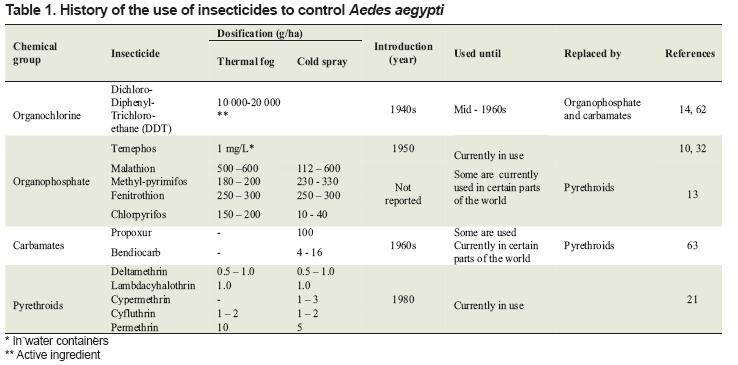
<body><![CDATA[<p style="text-align: justify;" class="MsoNormal"><span  style="font-size: 10pt; font-family: Verdana;" lang="EN-US">This paper consists of a thematic review that was done searching in databases such as PUBMED, SCIENCE DIRECT, books, and <span  class="SpellE">webpages</span> of public health organizations from several countries, including as well <span class="SpellE">theWorldHealthOrganizationandPanamericanHealth</span> Organization. Keywords as &#8220;chemical insecticides&#8221;, &#8220;<span class="SpellE"><i>Aedes</i></span><i> <span class="SpellE">aegypti</span></i>&#8221;, &#8220;resistance&#8221;, &#8220;<span class="SpellE">organochlorines</span>&#8221;, &#8220;organophosphates&#8221;, &#8220;<span class="SpellE">carbamates</span>&#8221; and &#8220;<span class="SpellE">pyrethroids</span>&#8221;, were employed to carry out the search. Aspects such as the history of chemical insecticide use, resistance development, resistance mechanisms, and effects of pesticides on human health, constituted the inclusion criteria to consider citations in the review. <o:p></o:p></span></p> </div>     <div>     <p class="MsoNormal"><b style=""><span  style="font-size: 11pt; font-family: Verdana;" lang="EN-US">Results<o:p></o:p></span></b></p>     <p class="MsoNormal"><b style=""><span  style="font-size: 10pt; font-family: Verdana;" lang="EN-US">Evolution of mosquito control with chemical insecticides </span></b><b><span  style="font-size: 10pt; font-family: Verdana; color: rgb(34, 30, 31);"  lang="EN-US"><o:p></o:p></span></b></p> </div> </div>     <div>     <div>     <p style="text-align: justify;" class="MsoNormal"><span  style="font-size: 10pt; font-family: Verdana;" lang="EN-US">Initially, insect control was carried out with natural products, but the development of chemical insecticides slowed down basic research on this issue <sup>(<a href="#12">12</a>)</sup>.<o:p></o:p></span></p>     <p style="text-align: justify;" class="MsoNormal"><span  style="font-size: 10pt; font-family: Verdana;" lang="EN-US">Throughout history, four common classes of chemical insecticides have been used to control <i>A. <span class="SpellE">aegypti</span></i>: <span class="SpellE">organochlorines</span>, organophosphates, <span  class="SpellE">carbamates</span> and <span class="SpellE">pyrethroids</span> <sup>(<a href="#13">13</a>)</sup>. <span class="SpellE">Organochlorine</span> pesticides are <span class="SpellE">lipophilic</span> compounds with low vapor pressures and slow degradation rates <sup>(<a  href="#14">14</a>)</sup>. These are known for their toxicity, persistence in the environment, and bioaccumulation in the food chain. This last property was one of the main reasons why these were replaced by <span class="SpellE">organo</span> phosphate <span  class="SpellE">espesticides</span>, as they could be more <span class="SpellE">asily</span> degraded in the environment <sup>(<a href="#15">15</a>)</sup>. <span class="SpellE">Organochlorine</span> insecticides were widely used between 1940s and mid 1960s, when they were discontinued due to their environmental effects <sup>(<a href="#14">14</a>)</sup>. Organophosphates (<span class="SpellE">OPs</span>) are pesticides of low persistence in the environment, which are <span  class="SpellE">hydrolysed</span> to high or low pH <sup>(<a href="#16">16</a>)</sup>. These were developed during World War II as nerve gases, and their insecticidal properties were discovered shortly thereafter <sup>(<a href="#17">17</a>)</sup>. The <span  class="SpellE">OPs</span> have become widely used as replacements for <span class="SpellE">organochlorine</span> insecticides because they do not <span class="SpellE">bioaccumulate</span> in organism tissues or the environment <sup>(<a href="#14">14</a>)</sup>. <span class="SpellE">Carbamates</span> are derivatives of the <span class="SpellE">carbamic</span> acid. These chemicals share the same mode of action with <span class="SpellE">OPs</span>, inhibiting the activity of <span class="SpellE">acetylcholinesterase</span>, although this effect can be more easily reversed, and the insects may recover at low doses <sup>(<a href="#18">18</a>)</sup>. These last two types of insecticides have a broad spectrum of activity, rapid environmental degradation <sup>(<a href="#19">19</a>)</sup>, relatively short biological half-lives, and are rapidly metabolized and excreted <sup>(<a href="#14">14</a>)</sup>. The fourth group comprises <span class="SpellE">pyrethroids</span>, the most recently introduced insecticides <sup>(<a href="#20">20</a>)</sup>, entering the marketplace in 1980 <sup>(<a  href="#21">21</a>)</sup>. They are considered safe due to their high insecticidal properties at low application rates, short persistence in the environment, no bioaccumulation and low mammalian toxicity <sup>(<a  href="#22">22</a>)</sup>, reasons supporting their extensive use <sup>(<a href="#23">23</a>)</sup>.<o:p></o:p></span></p>     <p style="text-align: justify;" class="MsoNormal"><span  style="font-size: 10pt; font-family: Verdana;" lang="EN-US">Although there is abundant information regarding the chronological development of insecticides by chemical group, as shown in <a href="/img/revistas/rcsp/v22n1/art12t1.jpg">Table </a><st1:metricconverter  productid="1, in" w:st="on"><a  href="/img/revistas/rcsp/v22n1/art12t1.jpg">1</a>, in</st1:metricconverter> most cases, the records of the introduction and date of their use are not accurate. In general, each country has employed these chemicals based on its particular needs, in particular, according to the occurrence or reemergence of dengue outbreaks in a given time. The replacement of each pesticide for a new one depends on the resistance developed by the vector, and the criteria for effective insecticides considered relevant by authorities in each territory. <span  class="SpellE">Malathion</span>, for example, has been one of the most frequently used. In <st1:country-region  w:st="on"><st1:place w:st="on">Colombia</st1:place></st1:country-region>, it has been utilized since 1980, and it is widely employed today <sup>(<a  href="#24">24</a>)</sup>. <st1:country-region w:st="on"><st1:place  w:st="on">Mexico</st1:place></st1:country-region>, however, suspended its use in 1999 <sup>(<a href="#25">25</a>)</sup>. In <st1:country-region w:st="on">Thailand</st1:country-region>, it was applied since 1950 but its arrest is not documented <sup>(<a  href="#26">26</a>)</sup>, and in <st1:country-region w:st="on"><st1:place  w:st="on">Cuba</st1:place></st1:country-region> it was abandoned with the introduction of <span class="SpellE">pyrethroids</span> <sup>(<a href="#27">27</a>)</sup>. It is important to highlight that in some cases, pesticide use has been carried out combining different classes of insecticides, such as DDT with <span  class="SpellE">pyrethroids</span>, although cross-resistance has been observed <sup>(<a href="#28">28</a>)</sup>. <o:p></o:p></span></p> </div> </div>     <div>     ]]></body>
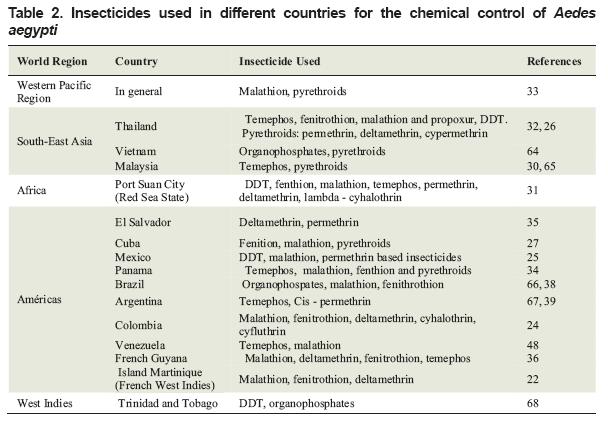
<body><![CDATA[<div>     <p class="MsoNormal"><b style=""><span  style="font-size: 11pt; font-family: Verdana;" lang="EN-US">Reports of chemical insecticide use to control dengue virus vectors <span style=""><o:p></o:p></span></span></b></p>     <p style="text-align: justify;" class="MsoNormal"><span  style="font-size: 10pt; font-family: Verdana;" lang="EN-US">During the last decades, the use of chemical insecticides has been an important component to control the populations of dengue vectors <sup>(<a href="#9">9</a>, <a href="#29">29</a>)</sup>.<o:p></o:p></span></p>     <p style="text-align: justify;" class="MsoNormal"><span  style="font-size: 10pt; font-family: Verdana;" lang="EN-US">Commercially available insecticides used in different countries are shown in <a href="/img/revistas/rcsp/v22n1/art12t2.jpg">Table 2</a>. All these chemicals are not used simultaneously, but each country has employed specific insecticides throughout history, with peculiarities in both use and dosage form. A total of 40 countries from different continents recorded the use of insecticides for control of dengue during 20032005. The most widely used insecticides for vector control have been organophosphates and <span class="SpellE">pyrethroids</span>. In fact, a total of 262 tons of organophosphate (OP) insecticides and 39 tons of <span class="SpellE">pyrethroids</span> per year have been utilized <sup>(<a href="#30">30</a>)</sup>. <o:p></o:p></span></p>     <p style="text-align: justify;" class="MsoNormal"><span  style="font-size: 10pt; font-family: Verdana;" lang="EN-US">Among <span  class="SpellE">OPs</span>, in a global context, 76 % were utilized for space spraying, 23 % for <span  class="SpellE">larviciding</span>, and 1 % for <span class="SpellE">peri</span>-focal spraying, interestingly, 90 % of the total was used in countries from the <st1:country-region  w:st="on"><st1:place w:st="on">Americas</st1:place></st1:country-region>. In the case of <span class="SpellE">pyrethroids</span>, 78 % was for space spraying, and the remaining percentage for <span class="SpellE">peri</span>-focal spraying. <span  class="SpellE">Pyrethroids</span> were used for <span class="SpellE">peri</span>-focal spraying mainly in countries from the <st1:country-region w:st="on"><st1:place  w:st="on">Americas</st1:place></st1:country-region>, and a very small quantity in the Western Pacific. About 50% of the total global usage of <span  class="SpellE">pyrethroid</span> insecticides took place in countries from the Western Pacific and about 47 % in the <st1:country-region w:st="on"><st1:place  w:st="on">Americas</st1:place></st1:country-region>. The amount of <span  class="SpellE">OPs</span> and <span class="SpellE">pyrethroids</span> used for dengue vector control constituted 60 % and 24 %, respectively, of the total annual use of insecticides <sup>(<a href="#30">30</a>)</sup>.<o:p></o:p></span></p>     <p style="text-align: justify;" class="MsoNormal"><span  style="font-size: 10pt; font-family: Verdana;" lang="EN-US">Worldwide, the control of <i>A. <span class="SpellE">aegypti</span> </i>is mostly performed with Ops; being <span class="SpellE"><span  class="GramE">malathion</span></span> the most frequently utilized, constituting 67 % of the average annual use, followed by <span class="SpellE">temephos</span> (22 %) <sup>(<a  href="#30">30</a>)</sup>.This last has been the leading pesticide used as <span class="SpellE">larvicide</span> in Malaysia <sup>(<a href="#31">31</a>)</sup>, Port <span class="SpellE">Suan</span> City (Red Sea State) <sup>(<a href="#32">32</a>)</sup>, Thailand <sup>(<a href="#33">33</a>)</sup>, Panama, El Salvador, Cuba, Martinique Island, French Guiana, Peru, Brazil, Argentina, Venezuela and Colombia <sup>(<a href="#22">22</a>, <a  href="#24">24</a>, <a href="#27">27</a>, <a href="#34">34-41</a>)</sup>. <o:p></o:p></span></p> </div>     <p style="text-align: justify;" class="MsoNormal"><span  style="font-size: 10pt; font-family: Verdana;" lang="EN-US">The main dengue vector control with <span class="SpellE">pyrethroids</span> has been performed with <span class="SpellE">cypermethrin</span> (37 %) and <span class="SpellE">permethrin</span> (45 %), followed by alpha-<span class="SpellE">cypermethrin</span> (14 %) <sup>(<a  href="#30">30</a>)</sup>. Other insecticides have also been critical for the control of <i>A. <span class="SpellE">aegypti</span></i>, including <span class="SpellE">fenthion</span>, <span class="SpellE">fenitrothion</span>, <span class="SpellE">chlorpyrifos</span>, <span class="SpellE">deltamethrin</span>, <span class="SpellE">cyhalothrin</span>, <span class="SpellE">cyfluthrin</span>, <span class="SpellE">propoxur</span>, <span class="SpellE">bendiocarb</span>, <span class="SpellE">dichloro</span> <span class="SpellE">diphenyl</span> <span class="SpellE">trichloroethane</span> (DDT) and <span  class="SpellE">dieldrin</span> <sup>(<a href="#22">22</a>, <a href="#24">24</a>, <a href="#27">27</a>, <a href="#34">34-41</a>)</sup>. According to <span class="GramE">WHO</span>, during <st1:metricconverter productid="2001, in" w:st="on">2001, in</st1:metricconverter> terms of coverage, budget, human resources and amount of insecticide used, <st1:place  w:st="on"><st1:country-region w:st="on">Brazil</st1:country-region></st1:place> was the country with the most extensive program of control of <i>A. <span  class="SpellE">aegypti</span></i>. Reports from 2002 showed that in the <st1:country-region w:st="on"><st1:place w:st="on">Americas</st1:place></st1:country-region>, vector control was mainly carried out with insecticides <sup>(<a  href="#42">42</a>)</sup>. In <st1:place w:st="on"><st1:country-region  w:st="on">Colombia</st1:country-region></st1:place>, for example, the main strategies conducted by local governments for vector control are aerial spraying of the insecticide, using thermal fogging or ultra-<span class="SpellE">lowvolume</span> spraying, in particular with organophosphates, such as <span class="SpellE"><span class="GramE">malathion</span></span> (96 %), <span class="SpellE">fenitrothion</span> (40 %), or the <span  class="SpellE">pyrethroid</span> compound, <span class="SpellE">deltamethrin</span>. Currently, insecticide spraying in <st1:country-region w:st="on"><st1:place w:st="on">Colombia</st1:place></st1:country-region> is recommended for outbreaks, or when cases of Dengue <span  class="SpellE">Haemorrhagic</span> Fever are confirmed <sup>(<a href="#24">24</a>)</sup>. <o:p></o:p></span></p>     <div style="text-align: justify;"> </div> </div>     <div>     <div>     ]]></body>
<body><![CDATA[<p style="text-align: left;" class="MsoNormal"><b style=""><span  style="font-size: 10pt; font-family: Verdana;" lang="EN-US">Resistance registered in <span class="SpellE"><i>Aedes</i></span><i> <span  class="SpellE">aegypti</span> </i><span style=""><o:p></o:p></span></span></b></p>     <p style="text-align: justify;" class="MsoNormal"><span  style="font-size: 10pt; font-family: Verdana;" lang="EN-US">The continued use of insecticides has induced pressure on populations of <i>A. <span class="SpellE">aegypti</span></i>, leading to widespread resistance <sup>(<a href="#43">43</a>)</sup>. Two main mechanisms have been reported to be responsible <sup>(<a href="#28">28</a>)</sup>: the first involves an increased activity of detoxifying enzymes, including <span class="SpellE">esterases</span>, mixed function <span class="SpellE">oxidases</span> (<span class="SpellE">cytochrome</span> P450s), and glutathione S-<span class="SpellE">transferases</span> (<span  class="SpellE">GSTs</span>) <sup>(<a href="#44">44</a>)</sup>; and the second deals with structural changes in the insecticide target site in the central nervous system <sup>(<a href="#45">45</a>)</sup>.<o:p></o:p></span></p>     <p style="text-align: justify;" class="MsoNormal"><span  style="font-size: 10pt; font-family: Verdana;" lang="EN-US">The main insecticide targets are <span class="SpellE">acetylcholinesterase</span>, </span><span style="font-size: 10pt; font-family: Verdana;">&#947;</span><span  style="font-size: 10pt; font-family: Verdana;" lang="EN-US"> -<span class="SpellE">aminobutyric</span> acid (GABA) receptor and the voltage-gated sodium channel <sup>(<a href="#46">46</a>)</sup>.<o:p></o:p></span></p>     <p style="text-align: justify;" class="MsoNormal"><span  style="font-size: 10pt; font-family: Verdana;" lang="EN-US">In <span  class="SpellE">LatinAmerica</span> and the <st1:place w:st="on">Caribbean</st1:place>, several <i>A. <span class="SpellE">aegypti</span> </i>populations have shown strong resistance to <span class="SpellE">OPs</span>, <span class="SpellE">carbamates</span>, and <span class="SpellE">pyrethroids</span>, existing correlations with elevated activities of at least one detoxification enzyme family. The resistance to <span class="SpellE">OPs</span> and <span  class="SpellE">carbamates</span> is connected with <span  class="SpellE">acetylcholinesterase</span> insensitivity <sup>(<a href="#13">13</a>, <a href="#46">46</a>)</sup>. In the case of <span class="SpellE">temephos</span>, for example, the resistance detected to this insecticide was related to the increased activity of <span class="SpellE">esterases</span>, specifically esterase A4 <sup>(<a href="#9">9</a>)</sup>. In addition, several non-synonymous mutations in the gene encoding the trans-membrane voltage-gated sodium channel (<span  class="SpellE">kdr</span> mutations) have been described to confer resistance to <span  class="SpellE">pyrethroids</span> and DDT <sup>(<a href="#22">22</a>)</sup>.<o:p></o:p></span></p>     <p style="text-align: justify;" class="MsoNormal"><span  style="font-size: 10pt; font-family: Verdana;" lang="EN-US">In countries such as Puerto Rico, Dominican Republic, Cuba, French Guiana, and Colombia, among others, have been recorded the resistance development of <span class="SpellE"><i>Aedes</i></span><i> <span  class="SpellE">aegypti</span> </i>to insecticides such as <span  class="SpellE">temephos</span> <sup>(<a href="#9">9</a>, <a href="#37">37, 38</a>, <a href="#47">47-50</a>)</sup> and <span class="SpellE">pyrethroids</span> <sup>(<a href="#13">13</a>, <a href="#37">37</a>, <a href="#44">44</a>, <a href="#51">51</a>, <a href="#54">54</a>)</sup>, showing with these, the evolution of resistance registered worldwide.<o:p></o:p></span></p>     <p style="text-align: justify;" class="MsoNormal"><span  style="font-size: 10pt; font-family: Verdana;" lang="EN-US">Because resistance records, as well as the registered effects in the health of humans, such as <span class="SpellE">immunosuppression</span>; <span class="SpellE">endocrinedisruption</span>; reproductive abnormalities; irritant respiratory <span class="SpellE">symptons</span>; adverse <span  class="SpellE">genotoxic</span> and neurological effects; and cancer (5560), control of <span class="SpellE">Aedes</span> populations is being conducted through more environmentally friendly alternatives, such the use of plant extracts, reducing adverse effects on non-target organisms <sup>(<a  href="#61">61</a>)</sup>. <o:p></o:p></span></p> </div>     <div>     <p class="MsoNormal"><b style=""><span  style="font-size: 11pt; font-family: Verdana;" lang="EN-US">Conclusions <span style=""><o:p></o:p></span></span></b></p>     <p style="text-align: justify;" class="MsoNormal"><span  style="font-size: 10pt; font-family: Verdana;" lang="EN-US">The vector control for <i>A. <span class="SpellE">aegypti</span> </i>has been one of the main strategies against dengue virus transmission, but it is mostly based on chemical in <span class="SpellE">secticides</span>, which induce resistance in mosquitoes and also cause damage to humans and the environment. This resistance is probably due to the lack of regulation in use and in the dosage of each case. This review supports the need to generate mosquito control strategies that are environmentally friendly with minimal affectations on human populations. <o:p></o:p></span></p> </div>     <div>     ]]></body>
<body><![CDATA[<p class="MsoNormal"><b style=""><span  style="font-size: 11pt; font-family: Verdana;" lang="EN-US">Acknowledgements <span style=""><o:p></o:p></span></span></b></p>     <p style="text-align: justify;" class="MsoNormal"><span  style="font-size: 10pt; font-family: Verdana;" lang="EN-US">The authors acknowledge the financial support of the <st1:placetype  w:st="on">University</st1:placetype> of <st1:placename w:st="on">Cartagena</st1:placename>, <st1:place w:st="on"><st1:city w:st="on">Cartagena</st1:city>, <st1:country-region  w:st="on">Colombia</st1:country-region></st1:place>, and <span  class="SpellE">Colciencias</span>, Young Researchers Program, sponsoring Alejandra <span class="SpellE">Manjarres</span>. Technical support from Professor Joseph is highly appreciated. <o:p></o:p></span></p> </div> </div>     <div>     <div>     <p class="MsoNormal"><b style=""><span  style="font-size: 11pt; font-family: Verdana;" lang="EN-US"></span></b></p> <hr style="width: 100%; height: 2px;"><b style=""><span  style="font-size: 11pt; font-family: Verdana;" lang="EN-US">References <o:p></o:p></span></b>     <!-- ref --><p class="MsoNormal"><span  style="font-size: 10pt; font-family: Verdana;" lang="EN-US"><a name="1"></a>1. <span class="SpellE">Preet</span> S, <span class="SpellE">Sneha</span> A. Biochemical evidence of efficacy of potash alum for the control of dengue vector <span class="SpellE">Aedes</span> <span  class="SpellE">aegypti</span> (Linnaeus). <span class="SpellE"><span  class="GramE">Parasitol</span></span><span class="GramE">.</span> Res. 2011; 108 (6):1533-1539.    &nbsp;&nbsp;&nbsp;&nbsp;&nbsp;&nbsp;&nbsp;&nbsp;[&#160;<a href="javascript:void(0);" onclick="javascript: window.open('/scielo.php?script=sci_nlinks&ref=848886&pid=S1409-1429201300010001200001&lng=','','width=640,height=500,resizable=yes,scrollbars=1,menubar=yes,');">Links</a>&#160;]<!-- end-ref --> <o:p></o:p></span></p>     <!-- ref --><p class="MsoNormal"><span  style="font-size: 10pt; font-family: Verdana;" lang="EN-US"><a name="2"></a>2. Morales RE, <span class="SpellE">Ya-Umphan</span> P, <span  class="SpellE">Phumala</span>-Morales N, <span class="SpellE">Komalamisra</span> N, <span class="SpellE">Dujardin</span> JP. Climate associated size and shape changes in <span class="SpellE">Aedes</span> <span class="SpellE">aegypti</span> (<span class="SpellE">Diptera</span>: <span class="SpellE">Culicidae</span>) populations from <st1:country-region w:st="on"><st1:place w:st="on">Thailand</st1:place></st1:country-region>. Infect. <span class="GramE">Genet.</span> <span class="SpellE"><span  class="GramE">Evol</span></span><span class="GramE">.</span> 2010; 10(4):580-585.    &nbsp;&nbsp;&nbsp;&nbsp;&nbsp;&nbsp;&nbsp;&nbsp;[&#160;<a href="javascript:void(0);" onclick="javascript: window.open('/scielo.php?script=sci_nlinks&ref=848888&pid=S1409-1429201300010001200002&lng=','','width=640,height=500,resizable=yes,scrollbars=1,menubar=yes,');">Links</a>&#160;]<!-- end-ref --> <o:p></o:p></span></p>     <!-- ref --><p class="MsoNormal"><span  style="font-size: 10pt; font-family: Verdana;" lang="EN-US"><a name="3"></a>3. <span class="SpellE">Suh</span> SJ, <span class="SpellE">Seo</span> YS, <span class="SpellE">Ahn</span> JH, Park EB, Lee SJ, <span  class="SpellE">Sohn</span> JU, et al. <span class="GramE">A case of imported Dengue Fever with acute hepatitis.</span> </span><span class="SpellE"><span  style="font-size: 10pt; font-family: Verdana;">Korean</span></span><span  style="font-size: 10pt; font-family: Verdana;"> J. <span  class="SpellE">Hepatol</span>. 2007; 13(4):556-559.    &nbsp;&nbsp;&nbsp;&nbsp;&nbsp;&nbsp;&nbsp;&nbsp;[&#160;<a href="javascript:void(0);" onclick="javascript: window.open('/scielo.php?script=sci_nlinks&ref=848890&pid=S1409-1429201300010001200003&lng=','','width=640,height=500,resizable=yes,scrollbars=1,menubar=yes,');">Links</a>&#160;]<!-- end-ref --> <o:p></o:p></span></p>     <!-- ref --><p class="MsoNormal"><span  style="font-size: 10pt; font-family: Verdana;"><a name="4"></a>4. Organizaci&#243;n Panamericana de la Salud. Sistematizaci&#243;n de lecciones aprendidas en proyectos de comunicaci&#243;n para impactar en conductas (COMBI) en dengue en la Regi&#243;n de las Am&#233;ricas. Costa Rica: OPS/OMS. 2011. p. 20-21. Disponible en: guias_normas/lecciones_aprendidas_COMBI.pdf. Consultado en Abril de&nbsp; 2013. http://www.bvs.ins.gob.pe/insprint/SALUD_PUBLICA/DENGUE/.    &nbsp;&nbsp;&nbsp;&nbsp;&nbsp;&nbsp;&nbsp;&nbsp;[&#160;<a href="javascript:void(0);" onclick="javascript: window.open('/scielo.php?script=sci_nlinks&ref=848892&pid=S1409-1429201300010001200004&lng=','','width=640,height=500,resizable=yes,scrollbars=1,menubar=yes,');">Links</a>&#160;]<!-- end-ref --><o:p></o:p></span><small><small><span  style="font-family: verdana;"><!-- big --><!-- /big --></span></small><span  style="font-family: verdana;"></span></small> <o:p></o:p></p> <span style="font-size: 10pt; font-family: Verdana;"></span>     <!-- ref --><p class="MsoNormal"><span  style="font-size: 10pt; font-family: Verdana;" lang="EN-US"><a name="5"></a>5. Jansen CC, Beebe NW. The dengue vector <span class="SpellE">Aedes</span> <span class="SpellE">aegypti</span>: what comes <span class="GramE">next.</span> Microbes Infect. 2010; 12(4):272-279.    &nbsp;&nbsp;&nbsp;&nbsp;&nbsp;&nbsp;&nbsp;&nbsp;[&#160;<a href="javascript:void(0);" onclick="javascript: window.open('/scielo.php?script=sci_nlinks&ref=848894&pid=S1409-1429201300010001200005&lng=','','width=640,height=500,resizable=yes,scrollbars=1,menubar=yes,');">Links</a>&#160;]<!-- end-ref --> <o:p></o:p></span></p>     <!-- ref --><p><span style="font-size: 10pt; font-family: Verdana;" lang="EN-US"><a  name="6"></a>6. World Health Organization. <span class="GramE">Dengue and Severe Dengue.</span> </span><span  style="font-size: 10pt; font-family: Verdana;">2012. <span  class="SpellE">Factsheet</span> No. 117. Disponible en:<o:p></o:p> http://www.who.int/ <span class="SpellE">mediacentre</span>/<span class="SpellE">factsheets</span>/fs117/en/. Consultado el 1 de Abril del 2013.    &nbsp;&nbsp;&nbsp;&nbsp;&nbsp;&nbsp;&nbsp;&nbsp;[&#160;<a href="javascript:void(0);" onclick="javascript: window.open('/scielo.php?script=sci_nlinks&ref=848896&pid=S1409-1429201300010001200006&lng=','','width=640,height=500,resizable=yes,scrollbars=1,menubar=yes,');">Links</a>&#160;]<!-- end-ref --> <o:p></o:p></span></p>     <!-- ref --><p class="MsoNormal"><span  style="font-size: 10pt; font-family: Verdana;" lang="EN-US"><a name="7"></a>7. Espinoza-<span class="SpellE">G&#243;mez</span> F, <span class="SpellE">Hern&#225;ndez-Su&#225;rez</span> CM, <span class="SpellE">Coll</span>-C&#225;rdenas R. Educational campaign versus <span class="SpellE"><span class="GramE">malathion</span></span> spraying for the control of <span class="SpellE">Aedes</span> <span  class="SpellE">aegypti</span> in Colima, <st1:place w:st="on"><st1:country-region w:st="on">Mexico</st1:country-region></st1:place>. </span><span style="font-size: 10pt; font-family: Verdana;">J. <span  class="SpellE">Epidemiol</span>. <span class="SpellE">Commu</span>. H. 2002; 56(2):148-152.    &nbsp;&nbsp;&nbsp;&nbsp;&nbsp;&nbsp;&nbsp;&nbsp;[&#160;<a href="javascript:void(0);" onclick="javascript: window.open('/scielo.php?script=sci_nlinks&ref=848898&pid=S1409-1429201300010001200007&lng=','','width=640,height=500,resizable=yes,scrollbars=1,menubar=yes,');">Links</a>&#160;]<!-- end-ref --><o:p></o:p></span></p>     <!-- ref --><p class="MsoNormal"><span  style="font-size: 10pt; font-family: Verdana;" lang="EN-US"><a name="8"></a>8. World Health Organization. <span class="GramE">Vector surveillance and control.</span> In: Dengue <span class="SpellE">Haemorrhagic</span> Fever &#8211; Diagnosis, treatment, prevention and control. </span><span  style="font-size: 10pt; font-family: Verdana;">2nd ed. <span  class="SpellE">Geneva</span>, 1997. p. 48-59.    &nbsp;&nbsp;&nbsp;&nbsp;&nbsp;&nbsp;&nbsp;&nbsp;[&#160;<a href="javascript:void(0);" onclick="javascript: window.open('/scielo.php?script=sci_nlinks&ref=848900&pid=S1409-1429201300010001200008&lng=','','width=640,height=500,resizable=yes,scrollbars=1,menubar=yes,');">Links</a>&#160;]<!-- end-ref --> <o:p></o:p></span></p>     <!-- ref --><p class="MsoNormal"><span  style="font-size: 10pt; font-family: Verdana;"><a name="9"></a>9. <span  class="SpellE">Bisset</span> JA, Rodr&#237;guez MM, San Mart&#237;n JL, Romero JE, Montoya R. Evaluaci&#243;n de la resistencia a insecticidas de una cepa de Aedes <span class="SpellE">aegypti</span> de El Salvador. </span><span  style="font-size: 10pt; font-family: Verdana;" lang="EN-US">Rev. <span class="SpellE">Panam</span>. <span class="SpellE">Salud</span> Publ. 2009; 26(3):229-234.    &nbsp;&nbsp;&nbsp;&nbsp;&nbsp;&nbsp;&nbsp;&nbsp;[&#160;<a href="javascript:void(0);" onclick="javascript: window.open('/scielo.php?script=sci_nlinks&ref=848902&pid=S1409-1429201300010001200009&lng=','','width=640,height=500,resizable=yes,scrollbars=1,menubar=yes,');">Links</a>&#160;]<!-- end-ref --><o:p></o:p></span></p>     <!-- ref --><p><span style="font-size: 10pt; font-family: Verdana;" lang="EN-US"><a  name="10"></a>10. McCall <span class="SpellE">PJ<span class="GramE">,Kittayapong</span></span> P. Control of dengue vectors: tools and strategies. In: Report of the <span  class="SpellE">Scientif</span> <span class="SpellE"><span  class="GramE">ic</span></span> Working Group on Dengue, 2006. <st1:city w:st="on"><st1:place w:st="on">Geneva</st1:place></st1:city>. World Health Organization on behalf of the Special <span class="SpellE">Programme</span> for Research and Training in Tropical Diseases. </span><span  style="font-size: 10pt; font-family: Verdana;">2007. p. 110-119. Disponible en:<o:p></o:p> http:// <span class="SpellE">www.who.int</span>/<span  class="SpellE">tdr</span>/<span class="SpellE">publications</span>/<span  class="SpellE">documents</span>/<span class="SpellE">swg_dengue</span>_ 2.<span class="SpellE">pdf</span>. <span class="GramE">consultado</span> en Febrero de 2012.    &nbsp;&nbsp;&nbsp;&nbsp;&nbsp;&nbsp;&nbsp;&nbsp;[&#160;<a href="javascript:void(0);" onclick="javascript: window.open('/scielo.php?script=sci_nlinks&ref=848904&pid=S1409-1429201300010001200010&lng=','','width=640,height=500,resizable=yes,scrollbars=1,menubar=yes,');">Links</a>&#160;]<!-- end-ref --> <o:p></o:p></span></p>     <!-- ref --><p class="MsoNormal"><span  style="font-size: 10pt; font-family: Verdana;" lang="EN-US"><a  name="11"></a>11. World Health Organization and Special <span  class="SpellE">Programme</span> for Research and Training in Tropical Diseases. <span class="GramE">Dengue.</span> <span class="GramE">Guidelines for diagnosis, treatment, prevention and control.2009.</span> <span class="SpellE">Disponible</span> en: http://whqlibdoc.who.int/pub lications/2009/9789241547871_eng.pdf. <span  class="SpellE"><span class="GramE">Consultado</span></span><span  class="GramE"> en <span class="SpellE">Marzo</span> del 2011.    &nbsp;&nbsp;&nbsp;&nbsp;&nbsp;&nbsp;&nbsp;&nbsp;[&#160;<a href="javascript:void(0);" onclick="javascript: window.open('/scielo.php?script=sci_nlinks&ref=848906&pid=S1409-1429201300010001200011&lng=','','width=640,height=500,resizable=yes,scrollbars=1,menubar=yes,');">Links</a>&#160;]<!-- end-ref --></span> <o:p></o:p></span></p>     <!-- ref --><p class="MsoNormal"><span class="GramE"><span  style="font-size: 10pt; font-family: Verdana;" lang="EN-US"><a  name="12"></a>12. <span class="SpellE">Shaalan</span> EA, Canyon D, <span class="SpellE">Younes</span> MW, Abdel-<span  class="SpellE">Wahab</span> H, <span class="SpellE">Mansour</span> AH.</span></span><span  style="font-size: 10pt; font-family: Verdana;" lang="EN-US"> <span  class="GramE">A review of botanical <span class="SpellE">phytochemicals</span> with <span class="SpellE">mosquitocidal</span> potential.</span> Environ. Int. 2005; 31(8):11491166.    &nbsp;&nbsp;&nbsp;&nbsp;&nbsp;&nbsp;&nbsp;&nbsp;[&#160;<a href="javascript:void(0);" onclick="javascript: window.open('/scielo.php?script=sci_nlinks&ref=848908&pid=S1409-1429201300010001200012&lng=','','width=640,height=500,resizable=yes,scrollbars=1,menubar=yes,');">Links</a>&#160;]<!-- end-ref --> <o:p></o:p></span></p>     <!-- ref --><p class="MsoNormal"><span  style="font-size: 10pt; font-family: Verdana;" lang="EN-US"><a  name="13"></a>13. Polson KA, <span class="SpellE">Brogdon</span> WG., <st1:place w:st="on"><st1:city w:st="on">Rawlins</st1:city> <st1:state  w:st="on">SC</st1:state></st1:place>, <span class="SpellE">Chadee</span> DD. Characterization of insecticide resistance in Trinidadian strains of <span class="SpellE">Aedes</span> <span  class="SpellE">aegypti</span> mosquitoes. <span class="SpellE"><span class="GramE">Acta</span></span><span  class="GramE"> Trop. 2011; 117:31-38.    &nbsp;&nbsp;&nbsp;&nbsp;&nbsp;&nbsp;&nbsp;&nbsp;[&#160;<a href="javascript:void(0);" onclick="javascript: window.open('/scielo.php?script=sci_nlinks&ref=848910&pid=S1409-1429201300010001200013&lng=','','width=640,height=500,resizable=yes,scrollbars=1,menubar=yes,');">Links</a>&#160;]<!-- end-ref --></span> <o:p></o:p></span></p>     <!-- ref --><p class="MsoNormal"><span  style="font-size: 10pt; font-family: Verdana;" lang="EN-US"><a  name="14"></a>14. Williams PL, James RC, Roberts SM. Principles of toxicology: environmental and industrial applications. 2nd <span  class="GramE">ed</span>. <st1:state w:st="on"><st1:place w:st="on">New York</st1:place></st1:state>. <span class="GramE">John Wiley, 2000.</span> p. 346-353.    &nbsp;&nbsp;&nbsp;&nbsp;&nbsp;&nbsp;&nbsp;&nbsp;[&#160;<a href="javascript:void(0);" onclick="javascript: window.open('/scielo.php?script=sci_nlinks&ref=848912&pid=S1409-1429201300010001200014&lng=','','width=640,height=500,resizable=yes,scrollbars=1,menubar=yes,');">Links</a>&#160;]<!-- end-ref --> <o:p></o:p></span></p>     <!-- ref --><p class="MsoNormal"><span  style="font-size: 10pt; font-family: Verdana;" lang="EN-US"><a  name="15"></a>15. <span class="SpellE">Fatta</span> D, <span  class="SpellE">Canna-Michaelidou</span> S, Michael C, <span  class="SpellE">Demetriou</span> E, <span class="SpellE">Christodoulidou</span> M, <span class="SpellE">Achilleos</span> A, et al. <span class="SpellE">Organochlorine</span> and <span  class="SpellE">organophosphoric</span> insecticides, herbicides and heavy metals residue in industrial wastewaters in Cyprus. J. Hazard Mater. 2007; 145(1-2):169-179.    &nbsp;&nbsp;&nbsp;&nbsp;&nbsp;&nbsp;&nbsp;&nbsp;[&#160;<a href="javascript:void(0);" onclick="javascript: window.open('/scielo.php?script=sci_nlinks&ref=848914&pid=S1409-1429201300010001200015&lng=','','width=640,height=500,resizable=yes,scrollbars=1,menubar=yes,');">Links</a>&#160;]<!-- end-ref --> <o:p></o:p></span></p>     <!-- ref --><p class="MsoNormal"><span  style="font-size: 10pt; font-family: Verdana;" lang="EN-US"><a  name="16"></a>16. <span class="SpellE">Trebse</span> P, <span  class="SpellE">Arcon</span> I. Degradation of <span class="SpellE">organophosphorus</span> compounds by X-ray irradiation. <span class="SpellE"><span  class="GramE">Radiat</span></span><span class="GramE">.</span> <span  class="GramE">Phys. Chem. 2003; 67:527-530.    &nbsp;&nbsp;&nbsp;&nbsp;&nbsp;&nbsp;&nbsp;&nbsp;[&#160;<a href="javascript:void(0);" onclick="javascript: window.open('/scielo.php?script=sci_nlinks&ref=848916&pid=S1409-1429201300010001200016&lng=','','width=640,height=500,resizable=yes,scrollbars=1,menubar=yes,');">Links</a>&#160;]<!-- end-ref --></span> <o:p></o:p></span></p>     <!-- ref --><p class="MsoNormal"><span  style="font-size: 10pt; font-family: Verdana;" lang="EN-US"><a  name="17"></a>17. <span class="SpellE">Grue</span> CE, <st1:street  w:st="on"><st1:address w:st="on"><span class="SpellE">Gibert</span> PL</st1:address></st1:street>, Seeley ME. <span class="SpellE">Neurophysiological</span> and Behavioral Changes in Non-Target Wildlife Exposed to Organophosphate and <span  class="SpellE">Carbamate</span> Pesticides: Thermoregulation, Food Consumption, and Reproduction. </span><span  class="SpellE"><span style="font-size: 10pt; font-family: Verdana;">Amer</span></span><span  style="font-size: 10pt; font-family: Verdana;">. Zool. 1997; 37 (4):369-388.    &nbsp;&nbsp;&nbsp;&nbsp;&nbsp;&nbsp;&nbsp;&nbsp;[&#160;<a href="javascript:void(0);" onclick="javascript: window.open('/scielo.php?script=sci_nlinks&ref=848918&pid=S1409-1429201300010001200017&lng=','','width=640,height=500,resizable=yes,scrollbars=1,menubar=yes,');">Links</a>&#160;]<!-- end-ref --></span><span style="font-size: 10pt; font-family: Verdana;"  lang="EN-US"><o:p></o:p></span></p>     <!-- ref --><p class="MsoNormal"><span  style="font-size: 10pt; font-family: Verdana; color: rgb(34, 30, 31);"  lang="EN-US"><a name="18"></a>18. Dent D. Insect pest management. <span  class="GramE">2nd ed. <st1:city w:st="on"><st1:place w:st="on">London</st1:place></st1:city>.</span> CAB International, 2000. <span class="GramE">p. 85.    &nbsp;&nbsp;&nbsp;&nbsp;&nbsp;&nbsp;&nbsp;&nbsp;[&#160;<a href="javascript:void(0);" onclick="javascript: window.open('/scielo.php?script=sci_nlinks&ref=848920&pid=S1409-1429201300010001200018&lng=','','width=640,height=500,resizable=yes,scrollbars=1,menubar=yes,');">Links</a>&#160;]<!-- end-ref --></span> <o:p></o:p></span></p>     <!-- ref --><p class="MsoNormal"><span  style="font-size: 10pt; font-family: Verdana; color: rgb(34, 30, 31);"  lang="EN-US"><a name="19"></a>19. <span class="SpellE">Marrs</span> TC, <span class="SpellE">Ballantyne</span> B. Pesticide toxicology and international regulation. <span class="GramE">John Wiley &amp; Sons, Ltd. 2004.</span> <span class="GramE">p. <span style="">96.</span></span></span><span  style="font-size: 10pt; font-family: Verdana; color: rgb(34, 30, 31);"  lang="EN-US"> ISBN 0-471-49644-8.    &nbsp;&nbsp;&nbsp;&nbsp;&nbsp;&nbsp;&nbsp;&nbsp;[&#160;<a href="javascript:void(0);" onclick="javascript: window.open('/scielo.php?script=sci_nlinks&ref=848922&pid=S1409-1429201300010001200019&lng=','','width=640,height=500,resizable=yes,scrollbars=1,menubar=yes,');">Links</a>&#160;]<!-- end-ref --> </span><span  style="font-size: 10pt; font-family: Verdana; color: rgb(34, 30, 31);"  lang="EN-US"><o:p></o:p></span></p>     <!-- ref --><p class="MsoNormal"><span  style="font-size: 10pt; font-family: Verdana; color: rgb(34, 30, 31);"  lang="PT-BR"><a name="20"></a>20. Melo-Santos MA, <span class="SpellE">Varjal-Melo</span> JJ, Ara&#250;jo AP, Gomes TC, Paiva MH, Regis LN, <span class="SpellE"><span class="GramE">et</span></span> al. </span><span  style="font-size: 10pt; font-family: Verdana; color: rgb(34, 30, 31);"  lang="EN-US">Resistance to the organophosphate <span class="SpellE">temephos</span>: mechanisms, evolution and reversion in an <span class="SpellE">Aedes</span> <span  class="SpellE">aegypti</span> laboratory strain from Brazil. </span><span  style="font-size: 10pt; font-family: Verdana; color: rgb(34, 30, 31);">Acta <span class="SpellE">Trop</span>. 2010; 113(2):180-189.    &nbsp;&nbsp;&nbsp;&nbsp;&nbsp;&nbsp;&nbsp;&nbsp;[&#160;<a href="javascript:void(0);" onclick="javascript: window.open('/scielo.php?script=sci_nlinks&ref=848924&pid=S1409-1429201300010001200020&lng=','','width=640,height=500,resizable=yes,scrollbars=1,menubar=yes,');">Links</a>&#160;]<!-- end-ref --> <o:p></o:p></span></p>     <!-- ref --><p><span style="font-size: 10pt; font-family: Verdana;" lang="EN-US"><a  name="21"></a>21. <span class="SpellE">Klaassen</span> C. <span  class="SpellE">Casarett</span> and <span class="SpellE">Doull&#180;s</span> toxicology: the basic science of poisons. <span class="GramE">5th ed. Nueva York.</span> <span class="GramE">Mc <span class="SpellE">Graw</span> Hill.</span> 1996. <o:p></o:p></span><span class="GramE"><span  style="font-size: 10pt; font-family: Verdana;" lang="EN-US">p. 10-49.    &nbsp;&nbsp;&nbsp;&nbsp;&nbsp;&nbsp;&nbsp;&nbsp;[&#160;<a href="javascript:void(0);" onclick="javascript: window.open('/scielo.php?script=sci_nlinks&ref=848926&pid=S1409-1429201300010001200021&lng=','','width=640,height=500,resizable=yes,scrollbars=1,menubar=yes,');">Links</a>&#160;]<!-- end-ref --></span></span><span  style="font-size: 10pt; font-family: Verdana;" lang="EN-US"> <o:p></o:p></span></p>     <!-- ref --><p class="MsoNormal"><span  style="font-size: 10pt; font-family: Verdana;" lang="EN-US"><a  name="22"></a>22. <span class="SpellE">Marcombe</span> S, <span  class="SpellE">Poupardin</span> R, <span class="SpellE">Darriet</span> F, Reynaud S, Bonnet J, Strode C, et al. <span class="GramE">Exploring</span> the molecular basis of insecticide resistance in the dengue vector <span  class="SpellE">Aedes</span> <span class="SpellE">aegypti</span>: a case study in <st1:placename  w:st="on">Martinique</st1:placename> <st1:placetype w:st="on">Island</st1:placetype> (<st1:place w:st="on">French West Indies</st1:place>). <span class="GramE">BMC Genomics.</span> 2009; 26 (10):494.    &nbsp;&nbsp;&nbsp;&nbsp;&nbsp;&nbsp;&nbsp;&nbsp;[&#160;<a href="javascript:void(0);" onclick="javascript: window.open('/scielo.php?script=sci_nlinks&ref=848928&pid=S1409-1429201300010001200022&lng=','','width=640,height=500,resizable=yes,scrollbars=1,menubar=yes,');">Links</a>&#160;]<!-- end-ref --> <o:p></o:p></span></p>     <!-- ref --><p><span style="font-size: 10pt; font-family: Verdana;" lang="EN-US"><a  name="23"></a>23. Mani TR, <span class="SpellE">Arunachalam</span> N, <span class="SpellE">Rajendran</span> R, <span class="SpellE">Satyanarayana</span> K, <span class="SpellE">Dash AP</span>. Efficacy of thermal fog application of <span class="SpellE">deltacide</span>, a <o:p></o:p></span><span  class="SpellE"><span class="GramE"><span  style="font-size: 10pt; font-family: Verdana;" lang="EN-US">synergized mixture of</span></span></span><span  style="font-size: 10pt; font-family: Verdana;" lang="EN-US"> <span class="SpellE">pyrethroids</span>, <span class="SpellE">against Aedes</span> <span class="SpellE">aegypti</span>, the vector of dengue. Trop. Med. Int. Health. 2005; 10(12):1298-1304.    &nbsp;&nbsp;&nbsp;&nbsp;&nbsp;&nbsp;&nbsp;&nbsp;[&#160;<a href="javascript:void(0);" onclick="javascript: window.open('/scielo.php?script=sci_nlinks&ref=848930&pid=S1409-1429201300010001200023&lng=','','width=640,height=500,resizable=yes,scrollbars=1,menubar=yes,');">Links</a>&#160;]<!-- end-ref --> <o:p></o:p></span></p>     <!-- ref --><p class="MsoNormal"><span  style="font-size: 10pt; font-family: Verdana;" lang="EN-US"><a  name="24"></a>24. <span class="SpellE">Ocampo</span> CB, Salazar-<span  class="SpellE">Terreros</span> MJ, Mina NJ, McAllister J, <span  class="SpellE">Brogdon</span> W. Insecticide resistance status <span class="SpellE">ofAedes</span> <span  class="SpellE">aegypti</span> in 10 localities in Colombia. <span  class="SpellE">Acta</span> Trop. 2011; 118 (1):37-44.    &nbsp;&nbsp;&nbsp;&nbsp;&nbsp;&nbsp;&nbsp;&nbsp;[&#160;<a href="javascript:void(0);" onclick="javascript: window.open('/scielo.php?script=sci_nlinks&ref=848932&pid=S1409-1429201300010001200024&lng=','','width=640,height=500,resizable=yes,scrollbars=1,menubar=yes,');">Links</a>&#160;]<!-- end-ref --> <o:p></o:p></span></p>     <!-- ref --><p class="MsoNormal"><span  style="font-size: 10pt; font-family: Verdana;" lang="EN-US"><a  name="25"></a>25. <span class="SpellE">Garc&#237;a</span> GP, Flores AE, <span class="SpellE">Fern&#225;ndez</span>-Salas I, <span  class="SpellE">Saavedra-Rodr&#237;guez</span> K, Reyes-Solis G, Lozano-Fuentes S, et al. Recent rapid rise of a <span  class="SpellE">permethrin</span> knock down resistance allele in <span  class="SpellE">Aedes</span> <span class="SpellE">aegypti</span> in M&#233;xico. <span class="SpellE">PLoS</span> Neglect Trop. Dis. 2009; 3(10):e531.    &nbsp;&nbsp;&nbsp;&nbsp;&nbsp;&nbsp;&nbsp;&nbsp;[&#160;<a href="javascript:void(0);" onclick="javascript: window.open('/scielo.php?script=sci_nlinks&ref=848934&pid=S1409-1429201300010001200025&lng=','','width=640,height=500,resizable=yes,scrollbars=1,menubar=yes,');">Links</a>&#160;]<!-- end-ref --> <o:p></o:p></span></p>     <!-- ref --><p class="MsoNormal"><span  style="font-size: 10pt; font-family: Verdana;" lang="EN-US"><a  name="26"></a>26. <span class="SpellE">Yaicharoen</span> R, <span  class="SpellE">Kiatfuengfoo</span> R, <span class="SpellE">Chareonviriyaphap</span> T, <span class="SpellE">Rongnoparut</span> P. Characterization of <span  class="SpellE">deltamethrin</span> resistance in field populations of <span  class="SpellE">Aedes</span> <span class="SpellE">aegypti</span> in Thailand. </span><span style="font-size: 10pt; font-family: Verdana;">J. Vector Ecol. 2005; 30(1):144-150.    &nbsp;&nbsp;&nbsp;&nbsp;&nbsp;&nbsp;&nbsp;&nbsp;[&#160;<a href="javascript:void(0);" onclick="javascript: window.open('/scielo.php?script=sci_nlinks&ref=848936&pid=S1409-1429201300010001200026&lng=','','width=640,height=500,resizable=yes,scrollbars=1,menubar=yes,');">Links</a>&#160;]<!-- end-ref --> <o:p></o:p></span></p>     <!-- ref --><p class="MsoNormal"><span  style="font-size: 10pt; font-family: Verdana;"><a name="27"></a>27. Rodr&#237;guez M, <span class="SpellE">Bisset</span> J, Ricardo Y, P&#233;rez O, Montada D, Figueredo D, et al. Resistencia a insecticidas organofosforados en Aedes <span class="SpellE">aegypti</span> (<span class="SpellE">Diptera</span>: <span class="SpellE">Culicidae</span>) de Santiago de Cuba, 1997-2009. Rev. Cubana <span class="SpellE">Med</span>. <span class="SpellE">Trop</span>. 2010; 62 (3):217-223.    &nbsp;&nbsp;&nbsp;&nbsp;&nbsp;&nbsp;&nbsp;&nbsp;[&#160;<a href="javascript:void(0);" onclick="javascript: window.open('/scielo.php?script=sci_nlinks&ref=848938&pid=S1409-1429201300010001200027&lng=','','width=640,height=500,resizable=yes,scrollbars=1,menubar=yes,');">Links</a>&#160;]<!-- end-ref --> <o:p></o:p></span></p>     <!-- ref --><p><span style="font-size: 10pt; font-family: Verdana;" lang="EN-US"><a  name="28"></a>28. Hemingway J. Insecticide Resistance <span  class="GramE">In</span> <span class="SpellE">Aedes</span> <span  class="SpellE">Aegypti</span>. In: Report of the Scientific Working Group on Dengue, 2006. <o:p></o:p></span><st1:city  w:st="on"><st1:place w:st="on"><span  style="font-size: 10pt; font-family: Verdana;" lang="EN-US">Geneva</span></st1:place></st1:city><span  style="font-size: 10pt; font-family: Verdana;" lang="EN-US">. World Health Organization on behalf of the Special <span class="SpellE">Programme</span> for Research and Training in Tropical Diseases. </span><span  style="font-size: 10pt; font-family: Verdana;" lang="PT-BR">2007. <span  class="GramE">p.</span> 120-122.    &nbsp;&nbsp;&nbsp;&nbsp;&nbsp;&nbsp;&nbsp;&nbsp;[&#160;<a href="javascript:void(0);" onclick="javascript: window.open('/scielo.php?script=sci_nlinks&ref=848940&pid=S1409-1429201300010001200028&lng=','','width=640,height=500,resizable=yes,scrollbars=1,menubar=yes,');">Links</a>&#160;]<!-- end-ref --> <o:p></o:p></span></p>     <!-- ref --><p class="MsoNormal"><span  style="font-size: 10pt; font-family: Verdana;" lang="PT-BR"><a  name="29"></a>29. Pontes RJ, Dantas Filho FF, Alencar CH, <span  class="SpellE">Regazzi</span> AC, Cavalcanti LP, Ramos AN Jr, <span  class="SpellE"><span class="GramE">et</span></span> al. </span><span  style="font-size: 10pt; font-family: Verdana;" lang="EN-US">Impact of water renewal on the residual effect of <span class="SpellE">larvicides</span> in the control of <span class="SpellE">Aedes</span> <span class="SpellE">aegypti</span>. </span><span style="font-size: 10pt; font-family: Verdana;" lang="PT-BR">Mem. I. Oswaldo Cruz. 2010; 105(2): 220-224.    &nbsp;&nbsp;&nbsp;&nbsp;&nbsp;&nbsp;&nbsp;&nbsp;[&#160;<a href="javascript:void(0);" onclick="javascript: window.open('/scielo.php?script=sci_nlinks&ref=848942&pid=S1409-1429201300010001200029&lng=','','width=640,height=500,resizable=yes,scrollbars=1,menubar=yes,');">Links</a>&#160;]<!-- end-ref --> <o:p></o:p></span></p>     <!-- ref --><p class="MsoNormal"><span  style="font-size: 10pt; font-family: Verdana;" lang="EN-US"><a  name="30"></a>30. <span class="SpellE">Zaim</span> M, <span  class="SpellE">Jambulingam</span> P. Global insecticide use for vector-borne disease control. <span class="GramE">In World Health Organization.</span> <span class="GramE">Department of Control of Neglected Tropical Diseases (NTD) WHO Pesticide Evaluation Scheme (WHOPES).</span> <span class="SpellE"><span  class="GramE">3th</span></span><span class="GramE"> ed. <st1:city  w:st="on"><st1:place w:st="on">Geneva</st1:place></st1:city>.</span> <span  class="GramE">WHO Library Cataloguing-in-Publication Data; 2007.</span> p. 38-47.    &nbsp;&nbsp;&nbsp;&nbsp;&nbsp;&nbsp;&nbsp;&nbsp;[&#160;<a href="javascript:void(0);" onclick="javascript: window.open('/scielo.php?script=sci_nlinks&ref=848944&pid=S1409-1429201300010001200030&lng=','','width=640,height=500,resizable=yes,scrollbars=1,menubar=yes,');">Links</a>&#160;]<!-- end-ref --> <o:p></o:p></span></p>     <!-- ref --><p class="MsoNormal"><span  style="font-size: 10pt; font-family: Verdana;" lang="EN-US"><a  name="31"></a>31. Chen CD, <span class="SpellE">Nazni</span> WA, Lee HL, <span class="SpellE">Sofian-Azirun</span> M. Susceptibility of <span  class="SpellE">Aedes</span> <span class="SpellE">aegypti</span> and <span  class="SpellE">Aedes</span> <span class="SpellE">albopictus</span> to <span class="SpellE">temephos</span> in four study sites in Kuala Lumpur City Center and Selangor State, Malaysia. <span class="GramE">Trop. Biomed.</span> 2005; 22 (2):207-216.    &nbsp;&nbsp;&nbsp;&nbsp;&nbsp;&nbsp;&nbsp;&nbsp;[&#160;<a href="javascript:void(0);" onclick="javascript: window.open('/scielo.php?script=sci_nlinks&ref=848946&pid=S1409-1429201300010001200031&lng=','','width=640,height=500,resizable=yes,scrollbars=1,menubar=yes,');">Links</a>&#160;]<!-- end-ref --> <o:p></o:p></span></p>     <!-- ref --><p class="MsoNormal"><span  style="font-size: 10pt; font-family: Verdana;" lang="EN-US"><a  name="32"></a>32. <span class="SpellE">Husham</span> (PEH) AO, <span  class="SpellE">Abdalmagid</span> (PEH, MPH) MA, <span class="SpellE">Brair</span> (PEH, MPEH) M. Status Susceptibility of dengue vector; <span  class="SpellE">Aedes</span> <span class="SpellE">aegypti</span> to different groups of Insecticides in <st1:placename w:st="on">Port Sudan</st1:placename> <st1:placetype  w:st="on">City</st1:placetype> -<st1:place w:st="on"><st1:placename w:st="on">Red Sea</st1:placename> <st1:placetype  w:st="on">State</st1:placetype></st1:place>. <st1:country-region  w:st="on"><st1:place w:st="on">Sudan</st1:place></st1:country-region>. J. Public Health. 2010; 5(4):199-202.    &nbsp;&nbsp;&nbsp;&nbsp;&nbsp;&nbsp;&nbsp;&nbsp;[&#160;<a href="javascript:void(0);" onclick="javascript: window.open('/scielo.php?script=sci_nlinks&ref=848948&pid=S1409-1429201300010001200032&lng=','','width=640,height=500,resizable=yes,scrollbars=1,menubar=yes,');">Links</a>&#160;]<!-- end-ref --><o:p></o:p></span></p>     <!-- ref --><p class="MsoNormal"><span  style="font-size: 10pt; font-family: Verdana; color: rgb(34, 30, 31);"  lang="EN-US"><a name="33"></a>33. <span class="SpellE">Chareonviriyaphap</span> T, <span class="SpellE">Aum-aung</span> B, <span class="SpellE">Ratanatham</span> S. Current insecticide resistance patterns in mosquito vectors in <st1:place  w:st="on"><st1:country-region w:st="on">Thailand</st1:country-region></st1:place>. Se Asian J. Trop. Med. 1999; 30(1):184-194.    &nbsp;&nbsp;&nbsp;&nbsp;&nbsp;&nbsp;&nbsp;&nbsp;[&#160;<a href="javascript:void(0);" onclick="javascript: window.open('/scielo.php?script=sci_nlinks&ref=848950&pid=S1409-1429201300010001200033&lng=','','width=640,height=500,resizable=yes,scrollbars=1,menubar=yes,');">Links</a>&#160;]<!-- end-ref --> <o:p></o:p></span></p>     <!-- ref --><p class="MsoNormal"><span  style="font-size: 10pt; font-family: Verdana; color: rgb(34, 30, 31);"  lang="EN-US"><a name="34"></a>34. World Health Organization Technical Report Series </span><span  style="font-size: 10pt; font-family: Verdana; color: rgb(34, 30, 31);"  lang="EN-US">899. <span class="SpellE">Chemestry</span> and specifications of pesticides. <span class="GramE">Sixteenth report of the WHO Expert Committee on Vector Biology and Control.</span> </span><span class="SpellE"><span  style="font-size: 10pt; font-family: Verdana; color: rgb(34, 30, 31);">Geneva</span></span><span  style="font-size: 10pt; font-family: Verdana; color: rgb(34, 30, 31);">. 2001. p. 9, 13. ISBN 92 4 120899 6.    &nbsp;&nbsp;&nbsp;&nbsp;&nbsp;&nbsp;&nbsp;&nbsp;[&#160;<a href="javascript:void(0);" onclick="javascript: window.open('/scielo.php?script=sci_nlinks&ref=848952&pid=S1409-1429201300010001200034&lng=','','width=640,height=500,resizable=yes,scrollbars=1,menubar=yes,');">Links</a>&#160;]<!-- end-ref --> </span><span  style="font-size: 10pt; font-family: Verdana; color: rgb(34, 30, 31);"><o:p></o:p></span></p>     <!-- ref --><p class="MsoNormal"><span  style="font-size: 10pt; font-family: Verdana; color: rgb(34, 30, 31);"><a  name="35"></a>35. <span class="SpellE">Bisset</span> JA, Rodr&#237;guez MM, C&#225;ceres L. Niveles de resistencia a insecticidas y sus mecanismos en 2 cepas de Aedes <span class="SpellE">aegypti</span> de Panam&#225;. Rev. Cubana <span class="SpellE">Med</span>. <span class="SpellE">Trop</span>. 2003; 55(3):191-195.    &nbsp;&nbsp;&nbsp;&nbsp;&nbsp;&nbsp;&nbsp;&nbsp;[&#160;<a href="javascript:void(0);" onclick="javascript: window.open('/scielo.php?script=sci_nlinks&ref=848954&pid=S1409-1429201300010001200035&lng=','','width=640,height=500,resizable=yes,scrollbars=1,menubar=yes,');">Links</a>&#160;]<!-- end-ref --> <o:p></o:p></span></p>     <!-- ref --><p class="MsoNormal"><span  style="font-size: 10pt; font-family: Verdana; color: rgb(34, 30, 31);"><a  name="36"></a>36. Instituto de Salud, Ambiente y Trabajo. Diagn&#243;stico situacional del uso de DDT y el control de la malaria. Informe regional para M&#233;xico y Centroam&#233;rica. M&#233;xico, D.F. Sin </span><span  style="font-size: 10pt; font-family: Verdana; color: rgb(34, 30, 31);">a&#241;o. Disponible en http://www.cec.org/Storage/44/3646_ <span class="SpellE">InfRegDDTb_ES_EN.pdf</span>. <span class="GramE">consultado</span> en Abril de 2013.    &nbsp;&nbsp;&nbsp;&nbsp;&nbsp;&nbsp;&nbsp;&nbsp;[&#160;<a href="javascript:void(0);" onclick="javascript: window.open('/scielo.php?script=sci_nlinks&ref=848956&pid=S1409-1429201300010001200036&lng=','','width=640,height=500,resizable=yes,scrollbars=1,menubar=yes,');">Links</a>&#160;]<!-- end-ref --> </span><span  style="font-size: 10pt; font-family: Verdana; color: rgb(34, 30, 31);"><o:p></o:p></span></p>     <!-- ref --><p class="MsoNormal"><span  style="font-size: 10pt; font-family: Verdana; color: rgb(34, 30, 31);"  lang="EN-US"><a name="37"></a>37. <span class="SpellE">Dusfour</span> I, <span class="SpellE">Thalmensy</span> V, <span class="SpellE">Gaborit</span> P, <span class="SpellE">Issaly</span> J, <span class="SpellE">Carinci</span> R, <span class="SpellE">Girod</span> R. Multiple insecticide resistance in <span class="SpellE">Aedes</span> <span class="SpellE">aegypti</span> (<span class="SpellE">Diptera</span>: <span class="SpellE">Culicidae</span>) populations compromises the effectiveness of dengue vector control in French Guiana. <st1:place w:st="on"><st2:sn w:st="on"><span class="SpellE">Mem</span></st2:sn> <st2:sn w:st="on">I.</st2:sn></st1:place> <span class="SpellE">Oswaldo</span> Cruz. 2011; 106(3):346-352.    &nbsp;&nbsp;&nbsp;&nbsp;&nbsp;&nbsp;&nbsp;&nbsp;[&#160;<a href="javascript:void(0);" onclick="javascript: window.open('/scielo.php?script=sci_nlinks&ref=848958&pid=S1409-1429201300010001200037&lng=','','width=640,height=500,resizable=yes,scrollbars=1,menubar=yes,');">Links</a>&#160;]<!-- end-ref --> <o:p></o:p></span></p>     <!-- ref --><p class="MsoNormal"><span  style="font-size: 10pt; font-family: Verdana; color: rgb(34, 30, 31);"><a  name="38"></a>38. Vargas F, C&#243;rdova O, Alvarado A. Determinaci&#243;n de la resistencia a insecticidas en Aedes <span class="SpellE">aegypti</span>, <span class="SpellE">Anopheles</span> <span class="SpellE">albimanus</span> y <span class="SpellE">Lutzomyia</span> <span class="SpellE">peruensis</span> procedentes del norte peruano. Rev. <span class="SpellE">Peru</span>. <span  class="SpellE">Med</span>. Exp. Salud <span class="GramE">Publica</span>. 2006; 23(4): 259-264.    &nbsp;&nbsp;&nbsp;&nbsp;&nbsp;&nbsp;&nbsp;&nbsp;[&#160;<a href="javascript:void(0);" onclick="javascript: window.open('/scielo.php?script=sci_nlinks&ref=848960&pid=S1409-1429201300010001200038&lng=','','width=640,height=500,resizable=yes,scrollbars=1,menubar=yes,');">Links</a>&#160;]<!-- end-ref --> <o:p></o:p></span></p>     <!-- ref --><p class="MsoNormal"><span  style="font-size: 10pt; font-family: Verdana; color: rgb(34, 30, 31);"  lang="PT-BR"><a name="39"></a>39. Lima JB, <span class="SpellE">Da-Cunha</span> MP, Da Silva RC, <span class="SpellE">Galardo</span> AK, Soares <span  class="SpellE">Sda</span> S, Braga IA, <span class="SpellE"><span  class="GramE">et</span></span> al. </span><span  style="font-size: 10pt; font-family: Verdana; color: rgb(34, 30, 31);"  lang="EN-US">Resistance of <span class="SpellE">Aedes</span> <span class="SpellE">aegypti</span> to organophosphates in several municipalities in the State of Rio de Janeiro and <span class="SpellE">Esp&#237;rito</span> Santo, Brazil. Am. J. Trop. Med. <span class="SpellE">Hyg</span>. 2003; 68(3):329-333.    &nbsp;&nbsp;&nbsp;&nbsp;&nbsp;&nbsp;&nbsp;&nbsp;[&#160;<a href="javascript:void(0);" onclick="javascript: window.open('/scielo.php?script=sci_nlinks&ref=848962&pid=S1409-1429201300010001200039&lng=','','width=640,height=500,resizable=yes,scrollbars=1,menubar=yes,');">Links</a>&#160;]<!-- end-ref --> <o:p></o:p></span></p>     <!-- ref --><p class="MsoNormal"><span  style="font-size: 10pt; font-family: Verdana; color: rgb(34, 30, 31);"  lang="EN-US"><a name="40"></a>40. <span class="SpellE">Llin&#225;s</span> GA, <span class="SpellE">Seccacini</span> E, <span class="SpellE">Gardenal</span> CN, <span class="SpellE">Licastro</span> S. Current resistance status to <span class="SpellE">temephos</span> in <span class="SpellE">Aedes</span> <span class="SpellE">aegypti</span> from different regions of Argentina. <span class="SpellE"><span class="GramE">Mem</span></span><span  class="GramE">.</span> I. <span class="SpellE">Oswaldo</span> Cruz. 2010; 105(1):113-116.    &nbsp;&nbsp;&nbsp;&nbsp;&nbsp;&nbsp;&nbsp;&nbsp;[&#160;<a href="javascript:void(0);" onclick="javascript: window.open('/scielo.php?script=sci_nlinks&ref=848964&pid=S1409-1429201300010001200040&lng=','','width=640,height=500,resizable=yes,scrollbars=1,menubar=yes,');">Links</a>&#160;]<!-- end-ref --> <o:p></o:p></span></p>     <!-- ref --><p class="MsoNormal"><span  style="font-size: 10pt; font-family: Verdana; color: rgb(34, 30, 31);"  lang="EN-US"><a name="41"></a>41. Alvarez L, <span class="SpellE">Briceno</span> A, <st1:city w:st="on">Oviedo</st1:city> M. Resistance to <span  class="SpellE">Temephos</span> in populations of <span class="SpellE">Aedes</span> <span  class="SpellE">aegypti</span> (<span class="SpellE">Diptera</span>: <span class="SpellE">Culicidae</span>) of the west of <st1:country-region w:st="on"><st1:place w:st="on">Venezuela</st1:place></st1:country-region>. </span><span  style="font-size: 10pt; font-family: Verdana; color: rgb(34, 30, 31);">Rev. <span class="SpellE">Colomb</span>. <span class="SpellE">Entomol</span>. 2006; 32(2):172-</span><span  style="font-size: 10pt; font-family: Verdana; color: rgb(34, 30, 31);">175.    &nbsp;&nbsp;&nbsp;&nbsp;&nbsp;&nbsp;&nbsp;&nbsp;[&#160;<a href="javascript:void(0);" onclick="javascript: window.open('/scielo.php?script=sci_nlinks&ref=848966&pid=S1409-1429201300010001200041&lng=','','width=640,height=500,resizable=yes,scrollbars=1,menubar=yes,');">Links</a>&#160;]<!-- end-ref --> </span><span  style="font-size: 10pt; font-family: Verdana; color: rgb(34, 30, 31);"><o:p></o:p></span></p>     <!-- ref --><p class="MsoNormal"><span  style="font-size: 10pt; font-family: Verdana; color: rgb(34, 30, 31);"><a  name="42"></a>42. <span class="SpellE">Rodriguez</span> R. Estrategias para el control del dengue y del Aedes <span class="SpellE">aegypti</span> en las Am&#233;ricas. Rev. Cubana <span class="SpellE">Med</span>. <span  class="SpellE">Trop</span>. 2002; 54(3): 189-201.    &nbsp;&nbsp;&nbsp;&nbsp;&nbsp;&nbsp;&nbsp;&nbsp;[&#160;<a href="javascript:void(0);" onclick="javascript: window.open('/scielo.php?script=sci_nlinks&ref=848968&pid=S1409-1429201300010001200042&lng=','','width=640,height=500,resizable=yes,scrollbars=1,menubar=yes,');">Links</a>&#160;]<!-- end-ref --> <o:p></o:p></span></p>     <!-- ref --><p class="MsoNormal"><span  style="font-size: 10pt; font-family: Verdana; color: rgb(34, 30, 31);"><a  name="43"></a>43. Montada D, <span class="SpellE">Castex</span> M, Su&#225;rez S, Figueredo D, Leyva </span><span  style="font-size: 10pt; font-family: Verdana; color: rgb(34, 30, 31);">M. Estado de la resistencia a insecticidas en adultos del mosquito Aedes <span class="SpellE">aegypti</span> del municipio Playa, Ciudad de La Habana, Cuba. </span><span  style="font-size: 10pt; font-family: Verdana; color: rgb(34, 30, 31);"  lang="PT-BR">Rev. Cubana Med. Trop. 2005; 57(2):137</span><span  style="font-size: 10pt; font-family: Verdana; color: rgb(34, 30, 31);"  lang="PT-BR">-</span><span  style="font-size: 10pt; font-family: Verdana; color: rgb(34, 30, 31);"  lang="PT-BR">142.    &nbsp;&nbsp;&nbsp;&nbsp;&nbsp;&nbsp;&nbsp;&nbsp;[&#160;<a href="javascript:void(0);" onclick="javascript: window.open('/scielo.php?script=sci_nlinks&ref=848970&pid=S1409-1429201300010001200043&lng=','','width=640,height=500,resizable=yes,scrollbars=1,menubar=yes,');">Links</a>&#160;]<!-- end-ref --> </span><span  style="font-size: 10pt; font-family: Verdana; color: rgb(34, 30, 31);"  lang="PT-BR"><o:p></o:p></span></p>     <!-- ref --><p class="MsoNormal"><span  style="font-size: 10pt; font-family: Verdana; color: rgb(34, 30, 31);"  lang="PT-BR"><a name="44"></a>44. Lima EP, Paiva MH, de Ara&#250;jo AP, da Silva EV, da Silva UM, de Oliveira LN, <span class="SpellE"><span  class="GramE">et</span></span> al. <span class="SpellE">Insecticide</span> <span class="SpellE">resistance</span> in <span class="SpellE">Aedes</span> <span class="SpellE">aegypti</span> <span class="SpellE">populations</span> <span class="SpellE">from</span> Cear&#225;, <span class="SpellE">Brazil</span>. Parasite <span class="SpellE">Vector</span>. 2011; <span class="GramE">12(4):</span>5.    &nbsp;&nbsp;&nbsp;&nbsp;&nbsp;&nbsp;&nbsp;&nbsp;[&#160;<a href="javascript:void(0);" onclick="javascript: window.open('/scielo.php?script=sci_nlinks&ref=848972&pid=S1409-1429201300010001200044&lng=','','width=640,height=500,resizable=yes,scrollbars=1,menubar=yes,');">Links</a>&#160;]<!-- end-ref --> <o:p></o:p></span></p>     <!-- ref --><p class="MsoNormal"><span  style="font-size: 10pt; font-family: Verdana; color: rgb(34, 30, 31);"  lang="PT-BR"><a name="45"></a>45. Martins AJ, Lins RM, <span  class="SpellE">Linss</span> JG, Peixoto AA, Valle D. <span  class="SpellE">Voltage-gated</span> <span class="SpellE">sodium</span> <span class="SpellE">channel</span> <span class="SpellE">polymorphism</span> <span class="SpellE">and</span> <span class="SpellE">metabolic</span> <span class="SpellE">resistance</span> in <span class="SpellE">pyrethroid-resistant</span> <span  class="SpellE">Aedes</span> <span class="SpellE">aegypti</span> <span  class="SpellE">from</span> <span class="SpellE">Brazil</span>. </span><span  style="font-size: 10pt; font-family: Verdana; color: rgb(34, 30, 31);"  lang="EN-US">Am. J. Trop. Med. <span class="SpellE">Hyg</span>. 2009; 81(1):108-115.    &nbsp;&nbsp;&nbsp;&nbsp;&nbsp;&nbsp;&nbsp;&nbsp;[&#160;<a href="javascript:void(0);" onclick="javascript: window.open('/scielo.php?script=sci_nlinks&ref=848974&pid=S1409-1429201300010001200045&lng=','','width=640,height=500,resizable=yes,scrollbars=1,menubar=yes,');">Links</a>&#160;]<!-- end-ref --> <o:p></o:p></span></p>     <!-- ref --><p class="MsoNormal"><span  style="font-size: 10pt; font-family: Verdana;" lang="EN-US"><a  name="46"></a>46<span class="GramE">.SeversonDW,AnthonyNM,AndreevO,ffrench</span>-Constant RH. <span class="GramE">Molecular mapping of insecticide resistance genes in the yellow fever mosquito (<span class="SpellE">Aedes</span> <span  class="SpellE">aegypti</span>).</span> J. <span class="SpellE">Hered</span>. 1997; 88(6):520-524.    &nbsp;&nbsp;&nbsp;&nbsp;&nbsp;&nbsp;&nbsp;&nbsp;[&#160;<a href="javascript:void(0);" onclick="javascript: window.open('/scielo.php?script=sci_nlinks&ref=848976&pid=S1409-1429201300010001200046&lng=','','width=640,height=500,resizable=yes,scrollbars=1,menubar=yes,');">Links</a>&#160;]<!-- end-ref --> <o:p></o:p></span></p>     <!-- ref --><p class="MsoNormal"><span  style="font-size: 10pt; font-family: Verdana;" lang="EN-US"><a  name="47"></a>47. <span class="SpellE">Kamgang</span> B, <span  class="SpellE">Marcombe</span> S, <span class="SpellE">Chandre</span> F, <span class="SpellE">Nchoutpouen</span> E, <span class="SpellE">Nwane</span> P, <span class="SpellE">Etang</span> J, et al. Insecticide susceptibility of <span class="SpellE">Aedes</span> <span  class="SpellE">aegypti</span> and <span class="SpellE">Aedes</span> <span  class="SpellE">albopictus</span> in Central Africa. <span class="SpellE">Parasit</span> Vector. <span  class="GramE">2011; 4:79.    &nbsp;&nbsp;&nbsp;&nbsp;&nbsp;&nbsp;&nbsp;&nbsp;[&#160;<a href="javascript:void(0);" onclick="javascript: window.open('/scielo.php?script=sci_nlinks&ref=848978&pid=S1409-1429201300010001200047&lng=','','width=640,height=500,resizable=yes,scrollbars=1,menubar=yes,');">Links</a>&#160;]<!-- end-ref --></span> <o:p></o:p></span></p>     <!-- ref --><p class="MsoNormal"><span  style="font-size: 10pt; font-family: Verdana;" lang="EN-US"><a  name="48"></a>48. <span class="SpellE">P&#233;rez</span> EE, Molina D. Resistencia focal <span class="GramE">a</span> <span class="SpellE">insecticidas</span> <span class="SpellE">organosint&#233;ticos</span> en <span class="SpellE">Aedes</span> <span class="SpellE">aegypti</span> (<span class="SpellE">Linneaus</span>, 1762) (<span class="SpellE">D&#237;ptera</span>: <span class="SpellE">Culicidae</span>) de <span class="SpellE">diferentes</span> <span class="SpellE">municipios</span> <st1:state w:st="on">del</st1:state> <span class="SpellE">estado</span> <st1:place w:st="on"><st1:city w:st="on">Aragua</st1:city>, <st1:country-region  w:st="on">Venezuela</st1:country-region></st1:place>. <span class="GramE">Bol. de Mal. <span class="SpellE">Salud</span> <span  class="SpellE">Amb</span>.</span> 2009; 49(1):143-150.    &nbsp;&nbsp;&nbsp;&nbsp;&nbsp;&nbsp;&nbsp;&nbsp;[&#160;<a href="javascript:void(0);" onclick="javascript: window.open('/scielo.php?script=sci_nlinks&ref=848980&pid=S1409-1429201300010001200048&lng=','','width=640,height=500,resizable=yes,scrollbars=1,menubar=yes,');">Links</a>&#160;]<!-- end-ref --> <o:p></o:p></span></p>     <!-- ref --><p class="MsoNormal"><span  style="font-size: 10pt; font-family: Verdana;" lang="PT-BR"><a  name="49"></a>49. <span class="SpellE">Marcombe</span> S, <span  class="SpellE">Mathieu</span> RB, <span class="SpellE">Pocquet</span> N, <span class="SpellE">Riaz</span> MA, <span class="SpellE">Poupardin</span> R, <span class="SpellE">S&#233;lior</span> S, <span class="SpellE"><span  class="GramE">et</span></span> al. </span><span style="font-size: 10pt; font-family: Verdana;"  lang="EN-US">Insecticide Resistance in the Dengue Vector <span  class="SpellE">Aedes</span> <span class="SpellE">aegypti</span> from Martinique: Distribution, Mechanisms and Relations with Environmental Factors. <span  class="SpellE"><span class="GramE">PLoS</span></span><span  class="GramE"> One.</span> 2012; 7(2):e30989.    &nbsp;&nbsp;&nbsp;&nbsp;&nbsp;&nbsp;&nbsp;&nbsp;[&#160;<a href="javascript:void(0);" onclick="javascript: window.open('/scielo.php?script=sci_nlinks&ref=848982&pid=S1409-1429201300010001200049&lng=','','width=640,height=500,resizable=yes,scrollbars=1,menubar=yes,');">Links</a>&#160;]<!-- end-ref --> <o:p></o:p></span></p>     <!-- ref --><p class="MsoNormal"><span  style="font-size: 10pt; font-family: Verdana;" lang="EN-US"><a  name="50"></a>50. <span class="SpellE">Vezzani</span> D, <span  class="SpellE">CarbajoAE.Aedes</span> <span class="SpellE">aegypti<span  class="GramE">,Aedes</span></span> <span class="SpellE">albopictus</span>, and dengue in <st1:place w:st="on"><st1:country-region w:st="on">Argentina</st1:country-region></st1:place>: current knowledge and future directions. <st1:place w:st="on"><st2:sn  w:st="on"><span class="SpellE">Mem</span></st2:sn> <st2:sn w:st="on">I.</st2:sn></st1:place> <span class="SpellE">Oswaldo</span> Cruz. 2008; 103(1):66-74.    &nbsp;&nbsp;&nbsp;&nbsp;&nbsp;&nbsp;&nbsp;&nbsp;[&#160;<a href="javascript:void(0);" onclick="javascript: window.open('/scielo.php?script=sci_nlinks&ref=848984&pid=S1409-1429201300010001200050&lng=','','width=640,height=500,resizable=yes,scrollbars=1,menubar=yes,');">Links</a>&#160;]<!-- end-ref --> <o:p></o:p></span></p>     <!-- ref --><p class="MsoNormal"><span  style="font-size: 10pt; font-family: Verdana;"><a name="51"></a>51. Fonseca-Gonz&#225;lez I, Qui&#241;ones ML, <span class="SpellE">Lenhart</span> A, <span class="SpellE">Brogdon</span> WG. </span><span class="GramE"><span  style="font-size: 10pt; font-family: Verdana;" lang="EN-US">Insecticide resistance status of <span class="SpellE">Aedes</span> <span  class="SpellE">aegypti</span> (L.) from <st1:country-region w:st="on"><st1:place w:st="on">Colombia</st1:place></st1:country-region>.</span></span><span  style="font-size: 10pt; font-family: Verdana;" lang="EN-US"> <st1:place w:st="on"><span class="GramE">Pest</span></st1:place><span  class="GramE"> <span class="SpellE">Manag</span>.</span> Sci. 2011; 67(4):430-437.    &nbsp;&nbsp;&nbsp;&nbsp;&nbsp;&nbsp;&nbsp;&nbsp;[&#160;<a href="javascript:void(0);" onclick="javascript: window.open('/scielo.php?script=sci_nlinks&ref=848986&pid=S1409-1429201300010001200051&lng=','','width=640,height=500,resizable=yes,scrollbars=1,menubar=yes,');">Links</a>&#160;]<!-- end-ref --> <o:p></o:p></span></p>     <!-- ref --><p class="MsoNormal"><span  style="font-size: 10pt; font-family: Verdana;" lang="EN-US"><a  name="52"></a>52. <span class="SpellE">Chuaycharoensuk</span> T, <span  class="SpellE">Juntarajumnong</span> W, <span class="SpellE">Boonyuan</span> W, Bangs MJ, <span class="SpellE">Akratanakul</span> P, <span  class="SpellE">Thammapalo</span> S, et al. Frequency of <span class="SpellE">pyrethroid</span> resistance in <span class="SpellE">Aedes</span> <span class="SpellE">aegypti</span> and <span class="SpellE">Aedes</span> <span class="SpellE">albopictus</span> (<span class="SpellE">Diptera</span>: <span class="SpellE">Culicidae</span>) in Thailand. J. Vector Ecol. 2011; 36(1):204-212.    &nbsp;&nbsp;&nbsp;&nbsp;&nbsp;&nbsp;&nbsp;&nbsp;[&#160;<a href="javascript:void(0);" onclick="javascript: window.open('/scielo.php?script=sci_nlinks&ref=848988&pid=S1409-1429201300010001200052&lng=','','width=640,height=500,resizable=yes,scrollbars=1,menubar=yes,');">Links</a>&#160;]<!-- end-ref --> <o:p></o:p></span></p>     <!-- ref --><p class="MsoNormal"><span  style="font-size: 10pt; font-family: Verdana;" lang="EN-US"><a  name="53"></a>53. <span class="SpellE">Marcombe</span> S, <span  class="SpellE">Darriet</span> F, <span class="SpellE">Tolosa</span> M, Agnew P, <span class="SpellE">Duchon</span> S, Etienne M, <span  class="SpellE">etal</span>. <span class="SpellE">Pyrethroid</span> resistance reduces the efficacy of space sprays for dengue control on the <st1:placetype w:st="on">island</st1:placetype> of <st1:placename w:st="on">Martinique</st1:placename> (<st1:place  w:st="on">Caribbean</st1:place>). <span class="SpellE">PLoS</span> Neglect. Trop. D. 2011; 5(6):e1202.    &nbsp;&nbsp;&nbsp;&nbsp;&nbsp;&nbsp;&nbsp;&nbsp;[&#160;<a href="javascript:void(0);" onclick="javascript: window.open('/scielo.php?script=sci_nlinks&ref=848990&pid=S1409-1429201300010001200053&lng=','','width=640,height=500,resizable=yes,scrollbars=1,menubar=yes,');">Links</a>&#160;]<!-- end-ref --> <o:p></o:p></span></p>     <!-- ref --><p class="MsoNormal"><span  style="font-size: 10pt; font-family: Verdana;" lang="EN-US"><a  name="54"></a>54. <span class="SpellE">Mazzarri</span> MB, <span  class="SpellE">Georghiou</span> GP. <span class="GramE">Characterization of resistance to organophosphate, <span class="SpellE">carbamate</span>, and <span class="SpellE">pyrethroid</span> insecticides in field populations of <span class="SpellE">Aedes</span> <span class="SpellE">aegypti</span> from <st1:country-region w:st="on"><st1:place w:st="on">Venezuela</st1:place></st1:country-region>.</span> J. Am. <span class="SpellE">Mosq</span>. Control Assoc. 1995; 11(3):315-322.    &nbsp;&nbsp;&nbsp;&nbsp;&nbsp;&nbsp;&nbsp;&nbsp;[&#160;<a href="javascript:void(0);" onclick="javascript: window.open('/scielo.php?script=sci_nlinks&ref=848992&pid=S1409-1429201300010001200054&lng=','','width=640,height=500,resizable=yes,scrollbars=1,menubar=yes,');">Links</a>&#160;]<!-- end-ref --> <o:p></o:p></span></p>     <!-- ref --><p class="MsoNormal"><span  style="font-size: 10pt; font-family: Verdana;" lang="EN-US"><a  name="55"></a>55. <span class="SpellE">Alavanja</span> MC, Bonner MR. Occupational pesticide exposures and cancer risk: a review. </span><span  style="font-size: 10pt; font-family: Verdana;">J <span class="SpellE">Toxicol</span>. <span class="SpellE">Environ</span>. <span class="SpellE">Health</span>. 2012; 15(4):238-263.    &nbsp;&nbsp;&nbsp;&nbsp;&nbsp;&nbsp;&nbsp;&nbsp;[&#160;<a href="javascript:void(0);" onclick="javascript: window.open('/scielo.php?script=sci_nlinks&ref=848994&pid=S1409-1429201300010001200055&lng=','','width=640,height=500,resizable=yes,scrollbars=1,menubar=yes,');">Links</a>&#160;]<!-- end-ref --> <o:p></o:p></span></p>     <!-- ref --><p class="MsoNormal"><span  style="font-size: 10pt; font-family: Verdana;" lang="EN-US"><a  name="56"></a>56. Oates L, Cohen M. Assessing diet as a modifiable risk factor for pesticide exposure. Int. J. Environ. Res. Public. <span  class="GramE">Health.</span> </span><span  style="font-size: 10pt; font-family: Verdana;">2011; 8(6):1792-1804.    &nbsp;&nbsp;&nbsp;&nbsp;&nbsp;&nbsp;&nbsp;&nbsp;[&#160;<a href="javascript:void(0);" onclick="javascript: window.open('/scielo.php?script=sci_nlinks&ref=848996&pid=S1409-1429201300010001200056&lng=','','width=640,height=500,resizable=yes,scrollbars=1,menubar=yes,');">Links</a>&#160;]<!-- end-ref --><o:p></o:p></span></p>     <!-- ref --><p class="MsoNormal"><span  style="font-size: 10pt; font-family: Verdana; color: rgb(34, 30, 31);"  lang="EN-US"><a name="57"></a>57. <span class="SpellE">Luo</span> Y, Zhang M. Environmental modeling and exposure assessment of sediment-associated <span class="SpellE">pyrethroids</span> in an agricultural watershed. <span class="SpellE"><span class="GramE">PLoS</span></span><span  class="GramE"> One.</span> 2011; 6(1):e15794.    &nbsp;&nbsp;&nbsp;&nbsp;&nbsp;&nbsp;&nbsp;&nbsp;[&#160;<a href="javascript:void(0);" onclick="javascript: window.open('/scielo.php?script=sci_nlinks&ref=848998&pid=S1409-1429201300010001200057&lng=','','width=640,height=500,resizable=yes,scrollbars=1,menubar=yes,');">Links</a>&#160;]<!-- end-ref --> <o:p></o:p></span></p>     <!-- ref --><p class="MsoNormal"><span  style="font-size: 10pt; font-family: Verdana; color: rgb(34, 30, 31);"  lang="EN-US"><a name="58"></a>58. <span class="SpellE">Wetterauer</span> B, Ricking M, <span class="SpellE">Otte</span> JC, <span  class="SpellE">Hallare</span> AV, <span class="SpellE">Rastall</span> A, <span class="SpellE">Erdinger</span> L, et al. Toxicity, dioxin-like activities, and endocrine effects of DDT metabolites--DDA, DDMU, DDMS, and DDCN. Environ <span class="SpellE">Sci</span> <span class="SpellE">Pollut</span> Res Int. 2012; 19(2):403-415.    &nbsp;&nbsp;&nbsp;&nbsp;&nbsp;&nbsp;&nbsp;&nbsp;[&#160;<a href="javascript:void(0);" onclick="javascript: window.open('/scielo.php?script=sci_nlinks&ref=849000&pid=S1409-1429201300010001200058&lng=','','width=640,height=500,resizable=yes,scrollbars=1,menubar=yes,');">Links</a>&#160;]<!-- end-ref --> <o:p></o:p></span></p>     <!-- ref --><p class="MsoNormal"><span  style="font-size: 10pt; font-family: Verdana; color: rgb(34, 30, 31);"  lang="EN-US"><a name="59"></a>59. <span class="SpellE">Kamel</span> F, <span class="SpellE">Hoppin</span> JA. <span class="GramE">Association of pesticide exposure with neurologic dysfunction and disease.</span> Environ. <span  class="GramE">Health <span class="SpellE">Perspect</span>.</span> 2004; 112(9):950-958.    &nbsp;&nbsp;&nbsp;&nbsp;&nbsp;&nbsp;&nbsp;&nbsp;[&#160;<a href="javascript:void(0);" onclick="javascript: window.open('/scielo.php?script=sci_nlinks&ref=849002&pid=S1409-1429201300010001200059&lng=','','width=640,height=500,resizable=yes,scrollbars=1,menubar=yes,');">Links</a>&#160;]<!-- end-ref --> <o:p></o:p></span></p>     <!-- ref --><p class="MsoNormal"><span  style="font-size: 10pt; font-family: Verdana;" lang="PT-BR"><a  name="60"></a>60. <span class="SpellE">Massol</span> RH, <span  class="SpellE">Antollini</span> SS, <span class="SpellE">Barrantes</span> FJ. </span><span class="GramE"><span  style="font-size: 10pt; font-family: Verdana;" lang="EN-US">Effect of <span  class="SpellE">organochlorine</span> insecticides on nicotinic acetylcholine </span><span  style="font-size: 10pt; font-family: Verdana;" lang="EN-US">receptor-rich membranes.</span></span><span  style="font-size: 10pt; font-family: Verdana;" lang="EN-US"> </span><span  class="SpellE"><span style="font-size: 10pt; font-family: Verdana;">Neuropharmacology</span></span><span  style="font-size: 10pt; font-family: Verdana;">. 2000; 39(6):1095-1106.    &nbsp;&nbsp;&nbsp;&nbsp;&nbsp;&nbsp;&nbsp;&nbsp;[&#160;<a href="javascript:void(0);" onclick="javascript: window.open('/scielo.php?script=sci_nlinks&ref=849004&pid=S1409-1429201300010001200060&lng=','','width=640,height=500,resizable=yes,scrollbars=1,menubar=yes,');">Links</a>&#160;]<!-- end-ref --><o:p></o:p></span></p>     <!-- ref --><p class="MsoNormal"><span  style="font-size: 10pt; font-family: Verdana;" lang="EN-US"><a  name="61"></a>61. <span class="SpellE">Chowdhury</span> N, <span  class="SpellE">Ghosh</span> A, Chandra G. Mosquito <span  class="SpellE">larvicidal</span> activities of <span class="SpellE">Solanum</span> <span class="SpellE">villosum</span> berry extract against the dengue vector <span class="SpellE">Stegomyia</span> <span class="SpellE">aegypti</span>. <span class="GramE">BMC Complement <span class="SpellE">Altern</span>.</span> M. 2008; 8:10.    &nbsp;&nbsp;&nbsp;&nbsp;&nbsp;&nbsp;&nbsp;&nbsp;[&#160;<a href="javascript:void(0);" onclick="javascript: window.open('/scielo.php?script=sci_nlinks&ref=849006&pid=S1409-1429201300010001200061&lng=','','width=640,height=500,resizable=yes,scrollbars=1,menubar=yes,');">Links</a>&#160;]<!-- end-ref --> <o:p></o:p></span></p>     <!-- ref --><p class="MsoNormal"><span  style="font-size: 10pt; font-family: Verdana;" lang="EN-US"><a  name="62"></a>62. <span class="SpellE">Dia</span> I, <span  class="SpellE">Diagne</span> CT, <span class="SpellE">Ba</span> Y, <span  class="SpellE">Diallo</span> D, <span class="SpellE">Konate</span> L, <span class="SpellE">Diallo</span> M. Insecticide susceptibility of <span  class="SpellE">Aedes</span> <span class="SpellE">aegypti</span> populations from Senegal and Cape Verde Archipelago. <span class="SpellE"><span class="GramE">Parasit</span></span><span  class="GramE"> Vectors.</span> <span class="GramE">2012; 5:238.</span> <span class="SpellE"><span class="GramE">doi</span></span>: 10.1186/1756-3305-5-238.    &nbsp;&nbsp;&nbsp;&nbsp;&nbsp;&nbsp;&nbsp;&nbsp;[&#160;<a href="javascript:void(0);" onclick="javascript: window.open('/scielo.php?script=sci_nlinks&ref=849008&pid=S1409-1429201300010001200062&lng=','','width=640,height=500,resizable=yes,scrollbars=1,menubar=yes,');">Links</a>&#160;]<!-- end-ref --> <o:p></o:p></span></p>     <!-- ref --><p class="MsoNormal"><span  style="font-size: 10pt; font-family: Verdana;" lang="EN-US"><a  name="63"></a>63. <span class="SpellE">Koc</span> F, <span  class="SpellE">Yigit</span> Y, <span class="SpellE">Kursad</span> Das Y, <span class="SpellE">Gurel</span> Y, <span class="SpellE">Yarali</span> C. Determination of <span class="SpellE">Aldicarb</span>, <span class="SpellE">Propoxur</span>, <span class="SpellE">Carbofuran</span>, <span class="SpellE">Carbaryl</span> and <span class="SpellE">Methiocarb</span> Residues in Honey by HPLC with Post-column <span class="SpellE">Derivatization</span> and Fluorescence Detection after Elution from a <span class="SpellE">Florisil</span> Column. J. Food Drug Anal. 2008; 16(3):39-45. (ART&#205;CULO ADJUNTO) <o:p></o:p></span>&nbsp;&nbsp;&nbsp;&nbsp;&nbsp;&nbsp;&nbsp;&nbsp;[&#160;<a href="javascript:void(0);" onclick="javascript: window.open('/scielo.php?script=sci_nlinks&ref=849010&pid=S1409-1429201300010001200063&lng=','','width=640,height=500,resizable=yes,scrollbars=1,menubar=yes,');">Links</a>&#160;]<!-- end-ref --><!-- ref --><p class="MsoNormal"><span  style="font-size: 10pt; font-family: Verdana;" lang="PT-BR"><a  name="64"></a>64. <span class="SpellE">Kawada</span> H, <span  class="SpellE">Higa</span> Y, <span class="SpellE">Komagata</span> O, Kasai S, <span class="SpellE">Tomita</span> T, <span class="SpellE">Thi</span> <span class="SpellE">Yen</span> N, <span class="SpellE"><span class="GramE">et</span></span> al. </span><span  style="font-size: 10pt; font-family: Verdana;" lang="EN-US">Widespread distribution of a newly found point mutation in voltage-gated sodium channel in <span class="SpellE">pyrethroid</span>-resistant <span class="SpellE">Aedes</span> <span class="SpellE">aegypti</span> populations in <st1:country-region  w:st="on"><st1:place w:st="on">Vietnam</st1:place></st1:country-region>. <span class="SpellE">PLoS</span> Neglect. Trop. D. 2009; 3(10):e527.    &nbsp;&nbsp;&nbsp;&nbsp;&nbsp;&nbsp;&nbsp;&nbsp;[&#160;<a href="javascript:void(0);" onclick="javascript: window.open('/scielo.php?script=sci_nlinks&ref=849011&pid=S1409-1429201300010001200064&lng=','','width=640,height=500,resizable=yes,scrollbars=1,menubar=yes,');">Links</a>&#160;]<!-- end-ref --> <o:p></o:p></span></p>     <!-- ref --><p class="MsoNormal"><span  style="font-size: 10pt; font-family: Verdana;" lang="PT-BR"><a  name="65"></a>65. <span class="SpellE">Wan-Norafikah</span> O, <span class="SpellE">Nazni</span> WA, <span class="SpellE">Noramiza</span> S, <span class="SpellE"><span class="GramE">Shafa&#8217;ar&#173;Ko</span></span>&#8217;<span  class="SpellE">ohar</span> S, <span class="SpellE">Azirol-Hisham</span> A, <span class="SpellE">Nor-Hafizah</span> R. Vertical <o:p></o:p></span><span  class="GramE"><span style="font-size: 10pt; font-family: Verdana;"  lang="EN-US">dispersal</span></span><span  style="font-size: 10pt; font-family: Verdana;" lang="EN-US"> of <span  class="SpellE">Aedes</span> (<span class="SpellE">Stegomyia</span>) spp. in high-rise apartments in <st1:place w:st="on"><st1:city  w:st="on"><span class="SpellE">Putrajaya</span></st1:city>, <st1:country-region  w:st="on">Malaysia</st1:country-region></st1:place>. <span  class="GramE">Trop. Biomed.</span> 2010; 27(3):662-667.    &nbsp;&nbsp;&nbsp;&nbsp;&nbsp;&nbsp;&nbsp;&nbsp;[&#160;<a href="javascript:void(0);" onclick="javascript: window.open('/scielo.php?script=sci_nlinks&ref=849013&pid=S1409-1429201300010001200065&lng=','','width=640,height=500,resizable=yes,scrollbars=1,menubar=yes,');">Links</a>&#160;]<!-- end-ref --> <o:p></o:p></span></p>     <!-- ref --><p class="MsoNormal"><span  style="font-size: 10pt; font-family: Verdana;" lang="EN-US"><a  name="66"></a>66. <span class="SpellE">Montella</span> IR, Martins AJ, <span class="SpellE">Viana</span>-Medeiros PF, Lima JB, Braga IA, Valle D. Insecticide resistance mechanisms of Brazilian <span  class="SpellE">Aedes</span> <span class="SpellE">aegypti</span> populations from 2001 to 2004. Am. J. Trop. Med. <span class="SpellE">Hyg</span>. 2007; 77(3):467-477.    &nbsp;&nbsp;&nbsp;&nbsp;&nbsp;&nbsp;&nbsp;&nbsp;[&#160;<a href="javascript:void(0);" onclick="javascript: window.open('/scielo.php?script=sci_nlinks&ref=849015&pid=S1409-1429201300010001200066&lng=','','width=640,height=500,resizable=yes,scrollbars=1,menubar=yes,');">Links</a>&#160;]<!-- end-ref --> <o:p></o:p></span></p>     <!-- ref --><p class="MsoNormal"><span  style="font-size: 10pt; font-family: Verdana;" lang="EN-US"><a  name="67"></a>67. <span class="SpellE">Garelli</span> FM, Espinosa MO, Weinberg D, <span class="SpellE">Trinelli</span> MA, <span  class="SpellE">G&#252;rtler</span> RE. Water use practices limit the effectiveness of a <span class="SpellE">temephos</span>-based <span  class="SpellE">Aedes</span> <span class="SpellE">aegypti</span> larval control program in <st1:place  w:st="on">Northern Argentina</st1:place>. <span class="SpellE">PLoS</span> Neglect. Trop. D. 2011; 5(3): e991.    &nbsp;&nbsp;&nbsp;&nbsp;&nbsp;&nbsp;&nbsp;&nbsp;[&#160;<a href="javascript:void(0);" onclick="javascript: window.open('/scielo.php?script=sci_nlinks&ref=849017&pid=S1409-1429201300010001200067&lng=','','width=640,height=500,resizable=yes,scrollbars=1,menubar=yes,');">Links</a>&#160;]<!-- end-ref --> <o:p></o:p></span></p>     <!-- ref --><p class="MsoNormal"><span  style="font-size: 10pt; font-family: Verdana;" lang="EN-US"><a  name="68"></a>68. Yan G, <span class="SpellE">Chadee</span> DD, Severson DW. Evidence for genetic hitchhiking effect associated with insecticide resistance in <span class="SpellE">Aedes</span> <span class="SpellE">aegypti</span>. </span><span class="SpellE"><span  style="font-size: 10pt; font-family: Verdana;">Genetics</span></span><span  style="font-size: 10pt; font-family: Verdana;">. 1998; 148(2):793-800.    &nbsp;&nbsp;&nbsp;&nbsp;&nbsp;&nbsp;&nbsp;&nbsp;[&#160;<a href="javascript:void(0);" onclick="javascript: window.open('/scielo.php?script=sci_nlinks&ref=849019&pid=S1409-1429201300010001200068&lng=','','width=640,height=500,resizable=yes,scrollbars=1,menubar=yes,');">Links</a>&#160;]<!-- end-ref --><o:p></o:p></span></p>     ]]></body>
<body><![CDATA[<p class="MsoNormal"><span  style="font-size: 10pt; font-family: Verdana;" lang="EN-US"><sup><a  name="1_"></a><a href="#3_">1</a> </sup>Biologist. <span  class="GramE">Environmental and Computational Chemistry Group.</span> <st1:place w:st="on"><st1:placetype  w:st="on"><span class="GramE">University</span></st1:placetype><span  class="GramE"> of <st1:placename w:st="on">Cartagena</st1:placename></span></st1:place><span  class="GramE">.</span> almas213@yahoo.es<u><o:p></o:p></u></span></p>     <p class="MsoNormal"><span  style="font-size: 10pt; font-family: Verdana;" lang="EN-US"><sup><a  name="2_"></a><a href="#4_">2</a> </sup>Pharmaceutical Chemist. <span  class="GramE">Ph.D. Environmental and Computational Chemistry Group.</span> <span  class="GramE">Faculty of Pharmaceutical Sciences.</span> <span class="GramE">Campus of <span  class="SpellE">Zaragocilla</span>.</span> <st1:place w:st="on"><st1:placetype  w:st="on"><span class="GramE">University</span></st1:placetype><span  class="GramE"> of <st1:placename w:st="on">Cartagena</st1:placename></span></st1:place><span  class="GramE">.</span> </span><span  style="font-size: 10pt; font-family: Verdana;">Cartagena, Colombia. joliverov@unicartagena.edu.com<u><o:p></o:p></u></span></p>     <p class="MsoNormal"><span  style="font-size: 10pt; font-family: Verdana;"></span></p> <hr style="width: 100%; height: 2px;">     <div style="text-align: center;"><span  style="font-size: 10pt; font-family: Verdana;">Recibido: 15 diciembre 2012 Aprobado: 25 mayo 2013 <o:p></o:p></span></div> </div> </div> </div>      ]]></body><back>
<ref-list>
<ref id="B1">
<label>1</label><nlm-citation citation-type="journal">
<person-group person-group-type="author">
<name>
<surname><![CDATA[Preet]]></surname>
<given-names><![CDATA[S]]></given-names>
</name>
<name>
<surname><![CDATA[Sneha]]></surname>
<given-names><![CDATA[A]]></given-names>
</name>
</person-group>
<article-title xml:lang="en"><![CDATA[Biochemical evidence of efficacy of potash alum for the control of dengue vector Aedes aegypti (Linnaeus)]]></article-title>
<source><![CDATA[Parasitol. Res]]></source>
<year>2011</year>
<volume>108</volume>
<numero>6</numero>
<issue>6</issue>
<page-range>1533-1539</page-range></nlm-citation>
</ref>
<ref id="B2">
<label>2</label><nlm-citation citation-type="journal">
<person-group person-group-type="author">
<name>
<surname><![CDATA[Morales]]></surname>
<given-names><![CDATA[RE]]></given-names>
</name>
<name>
<surname><![CDATA[Ya-Umphan]]></surname>
<given-names><![CDATA[P]]></given-names>
</name>
<name>
<surname><![CDATA[Phumala-Morales]]></surname>
<given-names><![CDATA[N]]></given-names>
</name>
<name>
<surname><![CDATA[Komalamisra]]></surname>
<given-names><![CDATA[N]]></given-names>
</name>
<name>
<surname><![CDATA[Dujardin]]></surname>
<given-names><![CDATA[JP]]></given-names>
</name>
</person-group>
<article-title xml:lang="en"><![CDATA[Climate associated size and shape changes in Aedes aegypti (Diptera: Culicidae) populations from Thailand]]></article-title>
<source><![CDATA[Infect. Genet. Evol]]></source>
<year>2010</year>
<volume>10</volume>
<numero>4</numero>
<issue>4</issue>
<page-range>580-585</page-range></nlm-citation>
</ref>
<ref id="B3">
<label>3</label><nlm-citation citation-type="journal">
<person-group person-group-type="author">
<name>
<surname><![CDATA[Suh]]></surname>
<given-names><![CDATA[SJ]]></given-names>
</name>
<name>
<surname><![CDATA[Seo]]></surname>
<given-names><![CDATA[YS]]></given-names>
</name>
<name>
<surname><![CDATA[Ahn]]></surname>
<given-names><![CDATA[JH]]></given-names>
</name>
<name>
<surname><![CDATA[Park]]></surname>
<given-names><![CDATA[EB]]></given-names>
</name>
<name>
<surname><![CDATA[Lee]]></surname>
<given-names><![CDATA[SJ]]></given-names>
</name>
<name>
<surname><![CDATA[Sohn]]></surname>
<given-names><![CDATA[JU]]></given-names>
</name>
</person-group>
<article-title xml:lang="en"><![CDATA[A case of imported Dengue Fever with acute hepatitis]]></article-title>
<source><![CDATA[Korean J. Hepatol]]></source>
<year>2007</year>
<volume>13</volume>
<numero>4</numero>
<issue>4</issue>
<page-range>556-559</page-range></nlm-citation>
</ref>
<ref id="B4">
<label>4</label><nlm-citation citation-type="book">
<collab>Organización Panamericana de la Salud</collab>
<source><![CDATA[Sistematización de lecciones aprendidas en proyectos de comunicación para impactar en conductas (COMBI) en dengue en la Región de las Américas]]></source>
<year>2011</year>
<page-range>20-21</page-range><publisher-name><![CDATA[OPS/OMS]]></publisher-name>
</nlm-citation>
</ref>
<ref id="B5">
<label>5</label><nlm-citation citation-type="journal">
<person-group person-group-type="author">
<name>
<surname><![CDATA[Jansen]]></surname>
<given-names><![CDATA[CC]]></given-names>
</name>
<name>
<surname><![CDATA[Beebe]]></surname>
<given-names><![CDATA[NW]]></given-names>
</name>
</person-group>
<article-title xml:lang="en"><![CDATA[The dengue vector Aedes aegypti: what comes next]]></article-title>
<source><![CDATA[Microbes Infect]]></source>
<year>2010</year>
<volume>12</volume>
<numero>4</numero>
<issue>4</issue>
<page-range>272-279</page-range></nlm-citation>
</ref>
<ref id="B6">
<label>6</label><nlm-citation citation-type="">
<collab>World Health Organization</collab>
<source><![CDATA[Dengue and Severe Dengue]]></source>
<year>2012</year>
<volume>117</volume>
</nlm-citation>
</ref>
<ref id="B7">
<label>7</label><nlm-citation citation-type="journal">
<person-group person-group-type="author">
<name>
<surname><![CDATA[Espinoza-Gómez]]></surname>
<given-names><![CDATA[F]]></given-names>
</name>
<name>
<surname><![CDATA[Hernández-Suárez]]></surname>
<given-names><![CDATA[CM]]></given-names>
</name>
<name>
<surname><![CDATA[Coll-Cárdenas]]></surname>
<given-names><![CDATA[R]]></given-names>
</name>
</person-group>
<article-title xml:lang="en"><![CDATA[Educational campaign versus malathion spraying for the control of Aedes aegypti in Colima, Mexico]]></article-title>
<source><![CDATA[J. Epidemiol. Commu. H]]></source>
<year>2002</year>
<volume>56</volume>
<numero>2</numero>
<issue>2</issue>
<page-range>148-152</page-range></nlm-citation>
</ref>
<ref id="B8">
<label>8</label><nlm-citation citation-type="">
<collab>World Health Organization</collab>
<article-title xml:lang="en"><![CDATA[Vector surveillance and control]]></article-title>
<source><![CDATA[Dengue Haemorrhagic Fever - Diagnosis, treatment, prevention and control]]></source>
<year>1997</year>
<edition>2</edition>
<page-range>48-59</page-range><publisher-loc><![CDATA[Geneva ]]></publisher-loc>
</nlm-citation>
</ref>
<ref id="B9">
<label>9</label><nlm-citation citation-type="journal">
<person-group person-group-type="author">
<name>
<surname><![CDATA[Bisset]]></surname>
<given-names><![CDATA[JA]]></given-names>
</name>
<name>
<surname><![CDATA[Rodríguez]]></surname>
<given-names><![CDATA[MM]]></given-names>
</name>
<name>
<surname><![CDATA[San Martín]]></surname>
<given-names><![CDATA[JL]]></given-names>
</name>
<name>
<surname><![CDATA[Romero]]></surname>
<given-names><![CDATA[JE]]></given-names>
</name>
<name>
<surname><![CDATA[Montoya]]></surname>
<given-names><![CDATA[R]]></given-names>
</name>
</person-group>
<article-title xml:lang="es"><![CDATA[Evaluación de la resistencia a insecticidas de una cepa de Aedes aegypti de El Salvador]]></article-title>
<source><![CDATA[Rev. Panam. Salud Publ]]></source>
<year>2009</year>
<volume>26</volume>
<numero>3</numero>
<issue>3</issue>
<page-range>229-234</page-range></nlm-citation>
</ref>
<ref id="B10">
<label>10</label><nlm-citation citation-type="book">
<person-group person-group-type="author">
<name>
<surname><![CDATA[McCall]]></surname>
<given-names><![CDATA[PJ]]></given-names>
</name>
<name>
<surname><![CDATA[Kittayapong]]></surname>
<given-names><![CDATA[P]]></given-names>
</name>
</person-group>
<article-title xml:lang="en"><![CDATA[Control of dengue vectors: tools and strategies]]></article-title>
<source><![CDATA[Report of the Scientif ic Working Group on Dengue]]></source>
<year>2006</year>
<page-range>110-119</page-range><publisher-loc><![CDATA[Geneva ]]></publisher-loc>
<publisher-name><![CDATA[World Health Organization on behalf of the Special Programme for Research and Training in Tropical Diseases]]></publisher-name>
</nlm-citation>
</ref>
<ref id="B11">
<label>11</label><nlm-citation citation-type="">
<collab>World Health Organization and Special Programme for Research and Training in Tropical Diseases</collab>
<source><![CDATA[Dengue: Guidelines for diagnosis, treatment, prevention and control]]></source>
<year>2009</year>
</nlm-citation>
</ref>
<ref id="B12">
<label>12</label><nlm-citation citation-type="journal">
<person-group person-group-type="author">
<name>
<surname><![CDATA[Shaalan]]></surname>
<given-names><![CDATA[EA]]></given-names>
</name>
<name>
<surname><![CDATA[Canyon]]></surname>
<given-names><![CDATA[D]]></given-names>
</name>
<name>
<surname><![CDATA[Younes]]></surname>
<given-names><![CDATA[MW]]></given-names>
</name>
<name>
<surname><![CDATA[Abdel-Wahab]]></surname>
<given-names><![CDATA[H]]></given-names>
</name>
<name>
<surname><![CDATA[Mansour]]></surname>
<given-names><![CDATA[AH]]></given-names>
</name>
</person-group>
<article-title xml:lang="en"><![CDATA[A review of botanical phytochemicals with mosquitocidal potential]]></article-title>
<source><![CDATA[Environ. Int]]></source>
<year>2005</year>
<volume>31</volume>
<numero>8</numero>
<issue>8</issue>
<page-range>1149-1166</page-range></nlm-citation>
</ref>
<ref id="B13">
<label>13</label><nlm-citation citation-type="journal">
<person-group person-group-type="author">
<name>
<surname><![CDATA[Polson]]></surname>
<given-names><![CDATA[KA]]></given-names>
</name>
<name>
<surname><![CDATA[Brogdon]]></surname>
<given-names><![CDATA[WG]]></given-names>
</name>
<name>
<surname><![CDATA[Rawlins]]></surname>
<given-names><![CDATA[SC]]></given-names>
</name>
<name>
<surname><![CDATA[Chadee]]></surname>
<given-names><![CDATA[DD]]></given-names>
</name>
</person-group>
<article-title xml:lang="en"><![CDATA[Characterization of insecticide resistance in Trinidadian strains of Aedes aegypti mosquitoes]]></article-title>
<source><![CDATA[Acta Trop]]></source>
<year>2011</year>
<volume>117</volume>
<page-range>31-38</page-range></nlm-citation>
</ref>
<ref id="B14">
<label>14</label><nlm-citation citation-type="book">
<person-group person-group-type="author">
<name>
<surname><![CDATA[Williams]]></surname>
<given-names><![CDATA[PL]]></given-names>
</name>
<name>
<surname><![CDATA[James]]></surname>
<given-names><![CDATA[RC]]></given-names>
</name>
<name>
<surname><![CDATA[Roberts]]></surname>
<given-names><![CDATA[SM]]></given-names>
</name>
</person-group>
<source><![CDATA[Principles of toxicology: environmental and industrial applications]]></source>
<year>2000</year>
<edition>2</edition>
<page-range>346-353</page-range><publisher-loc><![CDATA[New York ]]></publisher-loc>
<publisher-name><![CDATA[John Wiley]]></publisher-name>
</nlm-citation>
</ref>
<ref id="B15">
<label>15</label><nlm-citation citation-type="journal">
<person-group person-group-type="author">
<name>
<surname><![CDATA[Fatta]]></surname>
<given-names><![CDATA[D]]></given-names>
</name>
<name>
<surname><![CDATA[Canna-Michaelidou]]></surname>
<given-names><![CDATA[S]]></given-names>
</name>
<name>
<surname><![CDATA[Michael]]></surname>
<given-names><![CDATA[C]]></given-names>
</name>
<name>
<surname><![CDATA[Demetriou]]></surname>
<given-names><![CDATA[E]]></given-names>
</name>
<name>
<surname><![CDATA[Christodoulidou]]></surname>
<given-names><![CDATA[M]]></given-names>
</name>
<name>
<surname><![CDATA[Achilleos]]></surname>
<given-names><![CDATA[A]]></given-names>
</name>
</person-group>
<article-title xml:lang="en"><![CDATA[Organochlorine and organophosphoric insecticides, herbicides and heavy metals residue in industrial wastewaters in Cyprus]]></article-title>
<source><![CDATA[J. Hazard Mater]]></source>
<year>2007</year>
<volume>145</volume>
<numero>1-2</numero>
<issue>1-2</issue>
<page-range>169-179</page-range></nlm-citation>
</ref>
<ref id="B16">
<label>16</label><nlm-citation citation-type="journal">
<person-group person-group-type="author">
<name>
<surname><![CDATA[Trebse]]></surname>
<given-names><![CDATA[P]]></given-names>
</name>
<name>
<surname><![CDATA[Arcon]]></surname>
<given-names><![CDATA[I]]></given-names>
</name>
</person-group>
<article-title xml:lang="en"><![CDATA[Degradation of organophosphorus compounds by X-ray irradiation]]></article-title>
<source><![CDATA[Radiat. Phys. Chem]]></source>
<year>2003</year>
<volume>67</volume>
<page-range>527-530</page-range></nlm-citation>
</ref>
<ref id="B17">
<label>17</label><nlm-citation citation-type="journal">
<person-group person-group-type="author">
<name>
<surname><![CDATA[Grue]]></surname>
<given-names><![CDATA[CE]]></given-names>
</name>
<name>
<surname><![CDATA[Gibert]]></surname>
<given-names><![CDATA[PL]]></given-names>
</name>
<name>
<surname><![CDATA[Seeley]]></surname>
<given-names><![CDATA[ME]]></given-names>
</name>
</person-group>
<article-title xml:lang="en"><![CDATA[Neurophysiological and Behavioral Changes in Non-Target Wildlife Exposed to Organophosphate and Carbamate Pesticides: Thermoregulation, Food Consumption, and Reproduction]]></article-title>
<source><![CDATA[Amer. Zool]]></source>
<year>1997</year>
<volume>37</volume>
<numero>4</numero>
<issue>4</issue>
<page-range>369-388</page-range></nlm-citation>
</ref>
<ref id="B18">
<label>18</label><nlm-citation citation-type="book">
<person-group person-group-type="author">
<name>
<surname><![CDATA[Dent]]></surname>
<given-names><![CDATA[D]]></given-names>
</name>
</person-group>
<source><![CDATA[Insect pest management]]></source>
<year>2000</year>
<edition>2</edition>
<page-range>85</page-range><publisher-loc><![CDATA[London ]]></publisher-loc>
<publisher-name><![CDATA[CAB International]]></publisher-name>
</nlm-citation>
</ref>
<ref id="B19">
<label>19</label><nlm-citation citation-type="book">
<person-group person-group-type="author">
<name>
<surname><![CDATA[Marrs]]></surname>
<given-names><![CDATA[TC]]></given-names>
</name>
<name>
<surname><![CDATA[Ballantyne]]></surname>
<given-names><![CDATA[B]]></given-names>
</name>
</person-group>
<source><![CDATA[Pesticide toxicology and international regulation]]></source>
<year>2004</year>
<page-range>96</page-range><publisher-name><![CDATA[John Wiley & Sons, Ltd]]></publisher-name>
</nlm-citation>
</ref>
<ref id="B20">
<label>20</label><nlm-citation citation-type="journal">
<person-group person-group-type="author">
<name>
<surname><![CDATA[Melo-Santos]]></surname>
<given-names><![CDATA[MA]]></given-names>
</name>
<name>
<surname><![CDATA[Varjal-Melo]]></surname>
<given-names><![CDATA[JJ]]></given-names>
</name>
<name>
<surname><![CDATA[Araújo]]></surname>
<given-names><![CDATA[AP]]></given-names>
</name>
<name>
<surname><![CDATA[Gomes]]></surname>
<given-names><![CDATA[TC]]></given-names>
</name>
<name>
<surname><![CDATA[Paiva]]></surname>
<given-names><![CDATA[MH]]></given-names>
</name>
<name>
<surname><![CDATA[Regis]]></surname>
<given-names><![CDATA[LN]]></given-names>
</name>
</person-group>
<article-title xml:lang="en"><![CDATA[Resistance to the organophosphate temephos: mechanisms, evolution and reversion in an Aedes aegypti laboratory strain from Brazil]]></article-title>
<source><![CDATA[Acta Trop]]></source>
<year>2010</year>
<volume>113</volume>
<numero>2</numero>
<issue>2</issue>
<page-range>180-189</page-range></nlm-citation>
</ref>
<ref id="B21">
<label>21</label><nlm-citation citation-type="book">
<person-group person-group-type="author">
<name>
<surname><![CDATA[Klaassen]]></surname>
<given-names><![CDATA[C]]></given-names>
</name>
</person-group>
<source><![CDATA[Casarett and Doull´s toxicology: the basic science of poisons]]></source>
<year>1996</year>
<edition>5</edition>
<page-range>10-49</page-range><publisher-loc><![CDATA[Nueva York ]]></publisher-loc>
<publisher-name><![CDATA[Mc Graw Hill]]></publisher-name>
</nlm-citation>
</ref>
<ref id="B22">
<label>22</label><nlm-citation citation-type="journal">
<person-group person-group-type="author">
<name>
<surname><![CDATA[Marcombe]]></surname>
<given-names><![CDATA[S]]></given-names>
</name>
<name>
<surname><![CDATA[Poupardin]]></surname>
<given-names><![CDATA[R]]></given-names>
</name>
<name>
<surname><![CDATA[Darriet]]></surname>
<given-names><![CDATA[F]]></given-names>
</name>
<name>
<surname><![CDATA[Reynaud]]></surname>
<given-names><![CDATA[S]]></given-names>
</name>
<name>
<surname><![CDATA[Bonnet]]></surname>
<given-names><![CDATA[J]]></given-names>
</name>
<name>
<surname><![CDATA[Strode]]></surname>
<given-names><![CDATA[C]]></given-names>
</name>
</person-group>
<article-title xml:lang="en"><![CDATA[Exploring the molecular basis of insecticide resistance in the dengue vector Aedes aegypti: a case study in Martinique Island (French West Indies)]]></article-title>
<source><![CDATA[BMC Genomics]]></source>
<year>2009</year>
<volume>26</volume>
<numero>10</numero>
<issue>10</issue>
<page-range>494</page-range></nlm-citation>
</ref>
<ref id="B23">
<label>23</label><nlm-citation citation-type="journal">
<person-group person-group-type="author">
<name>
<surname><![CDATA[Mani]]></surname>
<given-names><![CDATA[TR]]></given-names>
</name>
<name>
<surname><![CDATA[Arunachalam]]></surname>
<given-names><![CDATA[N]]></given-names>
</name>
<name>
<surname><![CDATA[Rajendran]]></surname>
<given-names><![CDATA[R]]></given-names>
</name>
<name>
<surname><![CDATA[Satyanarayana]]></surname>
<given-names><![CDATA[K]]></given-names>
</name>
<name>
<surname><![CDATA[Dash]]></surname>
<given-names><![CDATA[AP]]></given-names>
</name>
</person-group>
<article-title xml:lang="en"><![CDATA[Efficacy of thermal fog application of deltacide, a synergized mixture of pyrethroids, against Aedes aegypti, the vector of dengue]]></article-title>
<source><![CDATA[Trop. Med. Int. Health]]></source>
<year>2005</year>
<volume>10</volume>
<numero>12</numero>
<issue>12</issue>
<page-range>1298-1304</page-range></nlm-citation>
</ref>
<ref id="B24">
<label>24</label><nlm-citation citation-type="journal">
<person-group person-group-type="author">
<name>
<surname><![CDATA[Ocampo]]></surname>
<given-names><![CDATA[CB]]></given-names>
</name>
<name>
<surname><![CDATA[Salazar-Terreros]]></surname>
<given-names><![CDATA[MJ]]></given-names>
</name>
<name>
<surname><![CDATA[Mina]]></surname>
<given-names><![CDATA[NJ]]></given-names>
</name>
<name>
<surname><![CDATA[McAllister]]></surname>
<given-names><![CDATA[J]]></given-names>
</name>
<name>
<surname><![CDATA[Brogdon]]></surname>
<given-names><![CDATA[W]]></given-names>
</name>
</person-group>
<article-title xml:lang="en"><![CDATA[Insecticide resistance status ofAedes aegypti in 10 localities in Colombia]]></article-title>
<source><![CDATA[Acta Trop]]></source>
<year>2011</year>
<volume>118</volume>
<numero>1</numero>
<issue>1</issue>
<page-range>37-44</page-range></nlm-citation>
</ref>
<ref id="B25">
<label>25</label><nlm-citation citation-type="journal">
<person-group person-group-type="author">
<name>
<surname><![CDATA[García]]></surname>
<given-names><![CDATA[GP]]></given-names>
</name>
<name>
<surname><![CDATA[Flores]]></surname>
<given-names><![CDATA[AE]]></given-names>
</name>
<name>
<surname><![CDATA[Fernández-Salas]]></surname>
<given-names><![CDATA[I]]></given-names>
</name>
<name>
<surname><![CDATA[Saavedra-Rodríguez]]></surname>
<given-names><![CDATA[K]]></given-names>
</name>
<name>
<surname><![CDATA[Reyes-Solis]]></surname>
<given-names><![CDATA[G]]></given-names>
</name>
<name>
<surname><![CDATA[Lozano-Fuentes]]></surname>
<given-names><![CDATA[S]]></given-names>
</name>
</person-group>
<article-title xml:lang="en"><![CDATA[Recent rapid rise of a permethrin knock down resistance allele in Aedes aegypti in México]]></article-title>
<source><![CDATA[PLoS Neglect Trop. Dis]]></source>
<year>2009</year>
<volume>3</volume>
<numero>10</numero>
<issue>10</issue>
<page-range>e531</page-range></nlm-citation>
</ref>
<ref id="B26">
<label>26</label><nlm-citation citation-type="journal">
<person-group person-group-type="author">
<name>
<surname><![CDATA[Yaicharoen]]></surname>
<given-names><![CDATA[R]]></given-names>
</name>
<name>
<surname><![CDATA[Kiatfuengfoo]]></surname>
<given-names><![CDATA[R]]></given-names>
</name>
<name>
<surname><![CDATA[Chareonviriyaphap]]></surname>
<given-names><![CDATA[T]]></given-names>
</name>
<name>
<surname><![CDATA[Rongnoparut]]></surname>
<given-names><![CDATA[P]]></given-names>
</name>
</person-group>
<article-title xml:lang="en"><![CDATA[Characterization of deltamethrin resistance in field populations of Aedes aegypti in Thailand]]></article-title>
<source><![CDATA[J. Vector Ecol]]></source>
<year>2005</year>
<volume>30</volume>
<numero>1</numero>
<issue>1</issue>
<page-range>144-150</page-range></nlm-citation>
</ref>
<ref id="B27">
<label>27</label><nlm-citation citation-type="journal">
<person-group person-group-type="author">
<name>
<surname><![CDATA[Rodríguez]]></surname>
<given-names><![CDATA[M]]></given-names>
</name>
<name>
<surname><![CDATA[Bisset]]></surname>
<given-names><![CDATA[J]]></given-names>
</name>
<name>
<surname><![CDATA[Ricardo]]></surname>
<given-names><![CDATA[Y]]></given-names>
</name>
<name>
<surname><![CDATA[Pérez]]></surname>
<given-names><![CDATA[O]]></given-names>
</name>
<name>
<surname><![CDATA[Montada]]></surname>
<given-names><![CDATA[D]]></given-names>
</name>
<name>
<surname><![CDATA[Figueredo]]></surname>
<given-names><![CDATA[D]]></given-names>
</name>
</person-group>
<article-title xml:lang="es"><![CDATA[Resistencia a insecticidas organofosforados en Aedes aegypti (Diptera: Culicidae) de Santiago de Cuba, 1997-2009]]></article-title>
<source><![CDATA[Rev. Cubana Med. Trop]]></source>
<year>2010</year>
<volume>62</volume>
<numero>3</numero>
<issue>3</issue>
<page-range>217-223</page-range></nlm-citation>
</ref>
<ref id="B28">
<label>28</label><nlm-citation citation-type="book">
<person-group person-group-type="author">
<name>
<surname><![CDATA[Hemingway]]></surname>
<given-names><![CDATA[J]]></given-names>
</name>
</person-group>
<article-title xml:lang="en"><![CDATA[Insecticide Resistance In Aedes Aegypti]]></article-title>
<source><![CDATA[Report of the Scientific Working Group on Dengue, 2006]]></source>
<year>2007</year>
<page-range>120-122</page-range><publisher-loc><![CDATA[Geneva ]]></publisher-loc>
<publisher-name><![CDATA[World Health Organization on behalf of the Special Programme for Research and Training in Tropical Diseases]]></publisher-name>
</nlm-citation>
</ref>
<ref id="B29">
<label>29</label><nlm-citation citation-type="journal">
<person-group person-group-type="author">
<name>
<surname><![CDATA[Pontes]]></surname>
<given-names><![CDATA[RJ]]></given-names>
</name>
<name>
<surname><![CDATA[Dantas Filho]]></surname>
<given-names><![CDATA[FF]]></given-names>
</name>
<name>
<surname><![CDATA[Alencar]]></surname>
<given-names><![CDATA[CH]]></given-names>
</name>
<name>
<surname><![CDATA[Regazzi]]></surname>
<given-names><![CDATA[AC]]></given-names>
</name>
<name>
<surname><![CDATA[Cavalcanti]]></surname>
<given-names><![CDATA[LP]]></given-names>
</name>
<name>
<surname><![CDATA[Ramos]]></surname>
<given-names><![CDATA[AN Jr]]></given-names>
</name>
</person-group>
<article-title xml:lang="en"><![CDATA[Impact of water renewal on the residual effect of larvicides in the control of Aedes aegypti]]></article-title>
<source><![CDATA[Mem. I. Oswaldo Cruz]]></source>
<year>2010</year>
<volume>105</volume>
<numero>2</numero>
<issue>2</issue>
<page-range>220-224</page-range></nlm-citation>
</ref>
<ref id="B30">
<label>30</label><nlm-citation citation-type="book">
<person-group person-group-type="author">
<name>
<surname><![CDATA[Zaim]]></surname>
<given-names><![CDATA[M]]></given-names>
</name>
<name>
<surname><![CDATA[Jambulingam]]></surname>
<given-names><![CDATA[P]]></given-names>
</name>
</person-group>
<source><![CDATA[Global insecticide use for vector-borne disease control: In World Health Organization. Department of Control of Neglected Tropical Diseases (NTD) WHO Pesticide Evaluation Scheme (WHOPES)]]></source>
<year>2007</year>
<edition>3</edition>
<page-range>38-47</page-range><publisher-loc><![CDATA[Geneva ]]></publisher-loc>
<publisher-name><![CDATA[WHO Library Cataloguing-in-Publication Data]]></publisher-name>
</nlm-citation>
</ref>
<ref id="B31">
<label>31</label><nlm-citation citation-type="journal">
<person-group person-group-type="author">
<name>
<surname><![CDATA[Chen]]></surname>
<given-names><![CDATA[CD]]></given-names>
</name>
<name>
<surname><![CDATA[Nazni]]></surname>
<given-names><![CDATA[WA]]></given-names>
</name>
<name>
<surname><![CDATA[Lee]]></surname>
<given-names><![CDATA[HL]]></given-names>
</name>
<name>
<surname><![CDATA[Sofian-Azirun]]></surname>
<given-names><![CDATA[M]]></given-names>
</name>
</person-group>
<article-title xml:lang="en"><![CDATA[Susceptibility of Aedes aegypti and Aedes albopictus to temephos in four study sites in Kuala Lumpur City Center and Selangor State, Malaysia]]></article-title>
<source><![CDATA[Trop. Biomed]]></source>
<year>2005</year>
<volume>22</volume>
<numero>2</numero>
<issue>2</issue>
<page-range>207-216</page-range></nlm-citation>
</ref>
<ref id="B32">
<label>32</label><nlm-citation citation-type="journal">
<person-group person-group-type="author">
<name>
<surname><![CDATA[Husham]]></surname>
</name>
<name>
<surname><![CDATA[Abdalmagid]]></surname>
</name>
<name>
<surname><![CDATA[Brair]]></surname>
</name>
</person-group>
<article-title xml:lang="en"><![CDATA[Status Susceptibility of dengue vector; Aedes aegypti to different groups of Insecticides in Port Sudan City -Red Sea State]]></article-title>
<source><![CDATA[Sudan. J. Public Health]]></source>
<year>2010</year>
<volume>5</volume>
<numero>4</numero>
<issue>4</issue>
<page-range>199-202</page-range></nlm-citation>
</ref>
<ref id="B33">
<label>33</label><nlm-citation citation-type="journal">
<person-group person-group-type="author">
<name>
<surname><![CDATA[Chareonviriyaphap]]></surname>
<given-names><![CDATA[T]]></given-names>
</name>
<name>
<surname><![CDATA[Aum-aung]]></surname>
<given-names><![CDATA[B]]></given-names>
</name>
<name>
<surname><![CDATA[Ratanatham]]></surname>
<given-names><![CDATA[S]]></given-names>
</name>
</person-group>
<article-title xml:lang="en"><![CDATA[Current insecticide resistance patterns in mosquito vectors in Thailand]]></article-title>
<source><![CDATA[Se Asian J. Trop. Med]]></source>
<year>1999</year>
<volume>30</volume>
<numero>1</numero>
<issue>1</issue>
<page-range>184-194</page-range></nlm-citation>
</ref>
<ref id="B34">
<label>34</label><nlm-citation citation-type="">
<collab>World Health Organization</collab>
<source><![CDATA[Technical Report Series 899: Chemestry and specifications of pesticides]]></source>
<year>2001</year>
<page-range>9, 13</page-range><publisher-loc><![CDATA[Geneva ]]></publisher-loc>
</nlm-citation>
</ref>
<ref id="B35">
<label>35</label><nlm-citation citation-type="journal">
<person-group person-group-type="author">
<name>
<surname><![CDATA[Bisset]]></surname>
<given-names><![CDATA[JA]]></given-names>
</name>
<name>
<surname><![CDATA[Rodríguez]]></surname>
<given-names><![CDATA[MM]]></given-names>
</name>
<name>
<surname><![CDATA[Cáceres]]></surname>
<given-names><![CDATA[L]]></given-names>
</name>
</person-group>
<article-title xml:lang="es"><![CDATA[Niveles de resistencia a insecticidas y sus mecanismos en 2 cepas de Aedes aegypti de Panamá]]></article-title>
<source><![CDATA[Rev. Cubana Med. Trop]]></source>
<year>2003</year>
<volume>55</volume>
<numero>3</numero>
<issue>3</issue>
<page-range>191-195</page-range></nlm-citation>
</ref>
<ref id="B36">
<label>36</label><nlm-citation citation-type="">
<collab>Instituto de Salud, Ambiente y Trabajo</collab>
<source><![CDATA[Diagnóstico situacional del uso de DDT y el control de la malaria. Informe regional para México y Centroamérica]]></source>
<year></year>
<publisher-loc><![CDATA[México, D.F ]]></publisher-loc>
</nlm-citation>
</ref>
<ref id="B37">
<label>37</label><nlm-citation citation-type="journal">
<person-group person-group-type="author">
<name>
<surname><![CDATA[Dusfour]]></surname>
<given-names><![CDATA[I]]></given-names>
</name>
<name>
<surname><![CDATA[Thalmensy]]></surname>
<given-names><![CDATA[V]]></given-names>
</name>
<name>
<surname><![CDATA[Gaborit]]></surname>
<given-names><![CDATA[P]]></given-names>
</name>
<name>
<surname><![CDATA[Issaly]]></surname>
<given-names><![CDATA[J]]></given-names>
</name>
<name>
<surname><![CDATA[Carinci]]></surname>
<given-names><![CDATA[R]]></given-names>
</name>
<name>
<surname><![CDATA[Girod]]></surname>
<given-names><![CDATA[R]]></given-names>
</name>
</person-group>
<article-title xml:lang="en"><![CDATA[Multiple insecticide resistance in Aedes aegypti (Diptera: Culicidae) populations compromises the effectiveness of dengue vector control in French Guiana]]></article-title>
<source><![CDATA[Mem I. Oswaldo Cruz]]></source>
<year>2011</year>
<volume>106</volume>
<numero>3</numero>
<issue>3</issue>
<page-range>346-352</page-range></nlm-citation>
</ref>
<ref id="B38">
<label>38</label><nlm-citation citation-type="journal">
<person-group person-group-type="author">
<name>
<surname><![CDATA[Vargas]]></surname>
<given-names><![CDATA[F]]></given-names>
</name>
<name>
<surname><![CDATA[Córdova]]></surname>
<given-names><![CDATA[O]]></given-names>
</name>
<name>
<surname><![CDATA[Alvarado]]></surname>
<given-names><![CDATA[A]]></given-names>
</name>
</person-group>
<article-title xml:lang="es"><![CDATA[Determinación de la resistencia a insecticidas en Aedes aegypti, Anopheles albimanus y Lutzomyia peruensis procedentes del norte peruano]]></article-title>
<source><![CDATA[Rev. Peru. Med. Exp. Salud Publica]]></source>
<year>2006</year>
<volume>23</volume>
<numero>4</numero>
<issue>4</issue>
<page-range>259-264</page-range></nlm-citation>
</ref>
<ref id="B39">
<label>39</label><nlm-citation citation-type="journal">
<person-group person-group-type="author">
<name>
<surname><![CDATA[Lima]]></surname>
<given-names><![CDATA[JB]]></given-names>
</name>
<name>
<surname><![CDATA[Da-Cunha]]></surname>
<given-names><![CDATA[MP]]></given-names>
</name>
<name>
<surname><![CDATA[Da Silva]]></surname>
<given-names><![CDATA[RC]]></given-names>
</name>
<name>
<surname><![CDATA[Galardo]]></surname>
<given-names><![CDATA[AK]]></given-names>
</name>
<name>
<surname><![CDATA[Soares Sda]]></surname>
<given-names><![CDATA[S]]></given-names>
</name>
<name>
<surname><![CDATA[Braga]]></surname>
<given-names><![CDATA[IA]]></given-names>
</name>
</person-group>
<article-title xml:lang="en"><![CDATA[Resistance of Aedes aegypti to organophosphates in several municipalities in the State of Rio de Janeiro and Espírito Santo, Brazil]]></article-title>
<source><![CDATA[Am. J. Trop. Med. Hyg]]></source>
<year>2003</year>
<volume>68</volume>
<numero>3</numero>
<issue>3</issue>
<page-range>329-333</page-range></nlm-citation>
</ref>
<ref id="B40">
<label>40</label><nlm-citation citation-type="journal">
<person-group person-group-type="author">
<name>
<surname><![CDATA[Llinás]]></surname>
<given-names><![CDATA[GA]]></given-names>
</name>
<name>
<surname><![CDATA[Seccacini]]></surname>
<given-names><![CDATA[E]]></given-names>
</name>
<name>
<surname><![CDATA[Gardenal]]></surname>
<given-names><![CDATA[CN]]></given-names>
</name>
<name>
<surname><![CDATA[Licastro]]></surname>
<given-names><![CDATA[S]]></given-names>
</name>
</person-group>
<article-title xml:lang="en"><![CDATA[Current resistance status to temephos in Aedes aegypti from different regions of Argentina]]></article-title>
<source><![CDATA[Mem. I. Oswaldo Cruz]]></source>
<year>2010</year>
<volume>105</volume>
<numero>1</numero>
<issue>1</issue>
<page-range>113-116</page-range></nlm-citation>
</ref>
<ref id="B41">
<label>41</label><nlm-citation citation-type="journal">
<person-group person-group-type="author">
<name>
<surname><![CDATA[Alvarez]]></surname>
<given-names><![CDATA[L]]></given-names>
</name>
<name>
<surname><![CDATA[Briceno]]></surname>
<given-names><![CDATA[A]]></given-names>
</name>
<name>
<surname><![CDATA[Oviedo]]></surname>
<given-names><![CDATA[M]]></given-names>
</name>
</person-group>
<article-title xml:lang="en"><![CDATA[Resistance to Temephos in populations of Aedes aegypti (Diptera: Culicidae) of the west of Venezuela]]></article-title>
<source><![CDATA[Rev. Colomb. Entomol]]></source>
<year>2006</year>
<volume>32</volume>
<numero>2</numero>
<issue>2</issue>
<page-range>172-175</page-range></nlm-citation>
</ref>
<ref id="B42">
<label>42</label><nlm-citation citation-type="journal">
<person-group person-group-type="author">
<name>
<surname><![CDATA[Rodriguez]]></surname>
<given-names><![CDATA[R]]></given-names>
</name>
</person-group>
<article-title xml:lang="es"><![CDATA[Estrategias para el control del dengue y del Aedes aegypti en las Américas]]></article-title>
<source><![CDATA[Rev. Cubana Med. Trop]]></source>
<year>2002</year>
<volume>54</volume>
<numero>3</numero>
<issue>3</issue>
<page-range>189-201</page-range></nlm-citation>
</ref>
<ref id="B43">
<label>43</label><nlm-citation citation-type="journal">
<person-group person-group-type="author">
<name>
<surname><![CDATA[Montada]]></surname>
<given-names><![CDATA[D]]></given-names>
</name>
<name>
<surname><![CDATA[Castex]]></surname>
<given-names><![CDATA[M]]></given-names>
</name>
<name>
<surname><![CDATA[Suárez]]></surname>
<given-names><![CDATA[S]]></given-names>
</name>
<name>
<surname><![CDATA[Figueredo]]></surname>
<given-names><![CDATA[D]]></given-names>
</name>
<name>
<surname><![CDATA[Leyva]]></surname>
<given-names><![CDATA[M]]></given-names>
</name>
</person-group>
<article-title xml:lang="es"><![CDATA[Estado de la resistencia a insecticidas en adultos del mosquito Aedes aegypti del municipio Playa, Ciudad de La Habana, Cuba]]></article-title>
<source><![CDATA[Rev. Cubana Med. Trop]]></source>
<year>2005</year>
<volume>57</volume>
<numero>2</numero>
<issue>2</issue>
<page-range>137-142</page-range></nlm-citation>
</ref>
<ref id="B44">
<label>44</label><nlm-citation citation-type="journal">
<person-group person-group-type="author">
<name>
<surname><![CDATA[Lima]]></surname>
<given-names><![CDATA[EP]]></given-names>
</name>
<name>
<surname><![CDATA[Paiva]]></surname>
<given-names><![CDATA[MH]]></given-names>
</name>
<name>
<surname><![CDATA[de Araújo]]></surname>
<given-names><![CDATA[AP]]></given-names>
</name>
<name>
<surname><![CDATA[da Silva]]></surname>
<given-names><![CDATA[EV]]></given-names>
</name>
<name>
<surname><![CDATA[da Silva]]></surname>
<given-names><![CDATA[UM]]></given-names>
</name>
<name>
<surname><![CDATA[de Oliveira]]></surname>
<given-names><![CDATA[LN]]></given-names>
</name>
</person-group>
<article-title xml:lang="en"><![CDATA[Insecticide resistance in Aedes aegypti populations from Ceará, Brazil]]></article-title>
<source><![CDATA[Parasite Vector]]></source>
<year>2011</year>
<volume>12</volume>
<numero>4</numero>
<issue>4</issue>
<page-range>5</page-range></nlm-citation>
</ref>
<ref id="B45">
<label>45</label><nlm-citation citation-type="journal">
<person-group person-group-type="author">
<name>
<surname><![CDATA[Martins]]></surname>
<given-names><![CDATA[AJ]]></given-names>
</name>
<name>
<surname><![CDATA[Lins]]></surname>
<given-names><![CDATA[RM]]></given-names>
</name>
<name>
<surname><![CDATA[Linss]]></surname>
<given-names><![CDATA[JG]]></given-names>
</name>
<name>
<surname><![CDATA[Peixoto]]></surname>
<given-names><![CDATA[AA]]></given-names>
</name>
<name>
<surname><![CDATA[Valle]]></surname>
<given-names><![CDATA[D]]></given-names>
</name>
</person-group>
<article-title xml:lang="en"><![CDATA[Voltage-gated sodium channel polymorphism and metabolic resistance in pyrethroid-resistant Aedes aegypti from Brazil]]></article-title>
<source><![CDATA[Am. J. Trop. Med. Hyg]]></source>
<year>2009</year>
<volume>81</volume>
<numero>1</numero>
<issue>1</issue>
<page-range>108-115</page-range></nlm-citation>
</ref>
<ref id="B46">
<label>46</label><nlm-citation citation-type="journal">
<person-group person-group-type="author">
<name>
<surname><![CDATA[Severson]]></surname>
<given-names><![CDATA[DW]]></given-names>
</name>
<name>
<surname><![CDATA[Anthony]]></surname>
<given-names><![CDATA[NM]]></given-names>
</name>
<name>
<surname><![CDATA[Andreev]]></surname>
<given-names><![CDATA[O]]></given-names>
</name>
<name>
<surname><![CDATA[ffrench-Constant]]></surname>
<given-names><![CDATA[RH]]></given-names>
</name>
</person-group>
<article-title xml:lang="en"><![CDATA[Molecular mapping of insecticide resistance genes in the yellow fever mosquito (Aedes aegypti)]]></article-title>
<source><![CDATA[J. Hered]]></source>
<year>1997</year>
<volume>88</volume>
<numero>6</numero>
<issue>6</issue>
<page-range>520-524</page-range></nlm-citation>
</ref>
<ref id="B47">
<label>47</label><nlm-citation citation-type="journal">
<person-group person-group-type="author">
<name>
<surname><![CDATA[Kamgang]]></surname>
<given-names><![CDATA[B]]></given-names>
</name>
<name>
<surname><![CDATA[Marcombe]]></surname>
<given-names><![CDATA[S]]></given-names>
</name>
<name>
<surname><![CDATA[Chandre]]></surname>
<given-names><![CDATA[F]]></given-names>
</name>
<name>
<surname><![CDATA[Nchoutpouen]]></surname>
<given-names><![CDATA[E]]></given-names>
</name>
<name>
<surname><![CDATA[Nwane]]></surname>
<given-names><![CDATA[P]]></given-names>
</name>
<name>
<surname><![CDATA[Etang]]></surname>
<given-names><![CDATA[J]]></given-names>
</name>
</person-group>
<article-title xml:lang="en"><![CDATA[Insecticide susceptibility of Aedes aegypti and Aedes albopictus in Central Africa]]></article-title>
<source><![CDATA[Parasit Vector]]></source>
<year>2011</year>
<volume>4</volume>
<numero>79</numero>
<issue>79</issue>
</nlm-citation>
</ref>
<ref id="B48">
<label>48</label><nlm-citation citation-type="journal">
<person-group person-group-type="author">
<name>
<surname><![CDATA[Pérez]]></surname>
<given-names><![CDATA[EE]]></given-names>
</name>
<name>
<surname><![CDATA[Molina]]></surname>
<given-names><![CDATA[D]]></given-names>
</name>
</person-group>
<article-title xml:lang="es"><![CDATA[Resistencia focal a insecticidas organosintéticos en Aedes aegypti (Linneaus, 1762) (Díptera: Culicidae) de diferentes municipios del estado Aragua, Venezuela]]></article-title>
<source><![CDATA[Bol. de Mal. Salud Amb]]></source>
<year>2009</year>
<volume>49</volume>
<numero>1</numero>
<issue>1</issue>
<page-range>143-150</page-range></nlm-citation>
</ref>
<ref id="B49">
<label>49</label><nlm-citation citation-type="journal">
<person-group person-group-type="author">
<name>
<surname><![CDATA[Marcombe]]></surname>
<given-names><![CDATA[S]]></given-names>
</name>
<name>
<surname><![CDATA[Mathieu]]></surname>
<given-names><![CDATA[RB]]></given-names>
</name>
<name>
<surname><![CDATA[Pocquet]]></surname>
<given-names><![CDATA[N]]></given-names>
</name>
<name>
<surname><![CDATA[Riaz]]></surname>
<given-names><![CDATA[MA]]></given-names>
</name>
<name>
<surname><![CDATA[Poupardin]]></surname>
<given-names><![CDATA[R]]></given-names>
</name>
<name>
<surname><![CDATA[Sélior]]></surname>
<given-names><![CDATA[S]]></given-names>
</name>
</person-group>
<article-title xml:lang="en"><![CDATA[Insecticide Resistance in the Dengue Vector Aedes aegypti from Martinique: Distribution, Mechanisms and Relations with Environmental Factors]]></article-title>
<source><![CDATA[PLoS One]]></source>
<year>2012</year>
<volume>7</volume>
<numero>2</numero>
<issue>2</issue>
<page-range>e30989</page-range></nlm-citation>
</ref>
<ref id="B50">
<label>50</label><nlm-citation citation-type="journal">
<person-group person-group-type="author">
<name>
<surname><![CDATA[Vezzani]]></surname>
<given-names><![CDATA[D]]></given-names>
</name>
<name>
<surname><![CDATA[Carbajo]]></surname>
<given-names><![CDATA[AE]]></given-names>
</name>
</person-group>
<article-title xml:lang="en"><![CDATA[Aedes aegypti, Aedes albopictus, and dengue in Argentina: current knowledge and future directions]]></article-title>
<source><![CDATA[Mem I. Oswaldo Cruz]]></source>
<year>2008</year>
<volume>103</volume>
<numero>1</numero>
<issue>1</issue>
<page-range>66-74</page-range></nlm-citation>
</ref>
<ref id="B51">
<label>51</label><nlm-citation citation-type="journal">
<person-group person-group-type="author">
<name>
<surname><![CDATA[Fonseca-González]]></surname>
<given-names><![CDATA[I]]></given-names>
</name>
<name>
<surname><![CDATA[Quiñones]]></surname>
<given-names><![CDATA[ML]]></given-names>
</name>
<name>
<surname><![CDATA[Lenhart]]></surname>
<given-names><![CDATA[A]]></given-names>
</name>
<name>
<surname><![CDATA[Brogdon]]></surname>
<given-names><![CDATA[WG]]></given-names>
</name>
</person-group>
<article-title xml:lang="en"><![CDATA[Insecticide resistance status of Aedes aegypti (L.) from Colombia]]></article-title>
<source><![CDATA[Pest Manag. Sci]]></source>
<year>2011</year>
<volume>67</volume>
<numero>4</numero>
<issue>4</issue>
<page-range>430-437</page-range></nlm-citation>
</ref>
<ref id="B52">
<label>52</label><nlm-citation citation-type="journal">
<person-group person-group-type="author">
<name>
<surname><![CDATA[Chuaycharoensuk]]></surname>
<given-names><![CDATA[T]]></given-names>
</name>
<name>
<surname><![CDATA[Juntarajumnong]]></surname>
<given-names><![CDATA[W]]></given-names>
</name>
<name>
<surname><![CDATA[Boonyuan]]></surname>
<given-names><![CDATA[W]]></given-names>
</name>
<name>
<surname><![CDATA[Bangs]]></surname>
<given-names><![CDATA[MJ]]></given-names>
</name>
<name>
<surname><![CDATA[Akratanakul]]></surname>
<given-names><![CDATA[P]]></given-names>
</name>
<name>
<surname><![CDATA[Thammapalo]]></surname>
<given-names><![CDATA[S]]></given-names>
</name>
</person-group>
<article-title xml:lang="en"><![CDATA[Frequency of pyrethroid resistance in Aedes aegypti and Aedes albopictus (Diptera: Culicidae) in Thailand]]></article-title>
<source><![CDATA[J. Vector Ecol]]></source>
<year>2011</year>
<volume>36</volume>
<numero>1</numero>
<issue>1</issue>
<page-range>204-212</page-range></nlm-citation>
</ref>
<ref id="B53">
<label>53</label><nlm-citation citation-type="journal">
<person-group person-group-type="author">
<name>
<surname><![CDATA[Marcombe]]></surname>
<given-names><![CDATA[S]]></given-names>
</name>
<name>
<surname><![CDATA[Darriet]]></surname>
<given-names><![CDATA[F]]></given-names>
</name>
<name>
<surname><![CDATA[Tolosa]]></surname>
<given-names><![CDATA[M]]></given-names>
</name>
<name>
<surname><![CDATA[Agnew]]></surname>
<given-names><![CDATA[P]]></given-names>
</name>
<name>
<surname><![CDATA[Duchon]]></surname>
<given-names><![CDATA[S]]></given-names>
</name>
<name>
<surname><![CDATA[Etienne]]></surname>
<given-names><![CDATA[M]]></given-names>
</name>
</person-group>
<article-title xml:lang="en"><![CDATA[Pyrethroid resistance reduces the efficacy of space sprays for dengue control on the island of Martinique (Caribbean)]]></article-title>
<source><![CDATA[PLoS Neglect. Trop. D]]></source>
<year>2011</year>
<volume>5</volume>
<numero>6</numero>
<issue>6</issue>
<page-range>e1202</page-range></nlm-citation>
</ref>
<ref id="B54">
<label>54</label><nlm-citation citation-type="journal">
<person-group person-group-type="author">
<name>
<surname><![CDATA[Mazzarri]]></surname>
<given-names><![CDATA[MB]]></given-names>
</name>
<name>
<surname><![CDATA[Georghiou]]></surname>
<given-names><![CDATA[GP]]></given-names>
</name>
</person-group>
<article-title xml:lang="en"><![CDATA[Characterization of resistance to organophosphate, carbamate, and pyrethroid insecticides in field populations of Aedes aegypti from Venezuela]]></article-title>
<source><![CDATA[J. Am. Mosq. Control Assoc]]></source>
<year>1995</year>
<volume>11</volume>
<numero>3</numero>
<issue>3</issue>
<page-range>315-322</page-range></nlm-citation>
</ref>
<ref id="B55">
<label>55</label><nlm-citation citation-type="journal">
<person-group person-group-type="author">
<name>
<surname><![CDATA[Alavanja]]></surname>
<given-names><![CDATA[MC]]></given-names>
</name>
<name>
<surname><![CDATA[Bonner]]></surname>
<given-names><![CDATA[MR]]></given-names>
</name>
</person-group>
<article-title xml:lang="en"><![CDATA[Occupational pesticide exposures and cancer risk: a review]]></article-title>
<source><![CDATA[J Toxicol. Environ. Health]]></source>
<year>2012</year>
<volume>15</volume>
<numero>4</numero>
<issue>4</issue>
<page-range>238-263</page-range></nlm-citation>
</ref>
<ref id="B56">
<label>56</label><nlm-citation citation-type="journal">
<person-group person-group-type="author">
<name>
<surname><![CDATA[Oates]]></surname>
<given-names><![CDATA[L]]></given-names>
</name>
<name>
<surname><![CDATA[Cohen]]></surname>
<given-names><![CDATA[M]]></given-names>
</name>
</person-group>
<article-title xml:lang="en"><![CDATA[Assessing diet as a modifiable risk factor for pesticide exposure]]></article-title>
<source><![CDATA[Int. J. Environ. Res. Public. Health]]></source>
<year>2011</year>
<volume>8</volume>
<numero>6</numero>
<issue>6</issue>
<page-range>1792-1804</page-range></nlm-citation>
</ref>
<ref id="B57">
<label>57</label><nlm-citation citation-type="journal">
<person-group person-group-type="author">
<name>
<surname><![CDATA[Luo]]></surname>
<given-names><![CDATA[Y]]></given-names>
</name>
<name>
<surname><![CDATA[Zhang]]></surname>
<given-names><![CDATA[M]]></given-names>
</name>
</person-group>
<article-title xml:lang="en"><![CDATA[Environmental modeling and exposure assessment of sediment-associated pyrethroids in an agricultural watershed]]></article-title>
<source><![CDATA[PLoS One]]></source>
<year>2011</year>
<volume>6</volume>
<numero>1</numero>
<issue>1</issue>
<page-range>e15794</page-range></nlm-citation>
</ref>
<ref id="B58">
<label>58</label><nlm-citation citation-type="journal">
<person-group person-group-type="author">
<name>
<surname><![CDATA[Wetterauer]]></surname>
<given-names><![CDATA[B]]></given-names>
</name>
<name>
<surname><![CDATA[Ricking]]></surname>
<given-names><![CDATA[M]]></given-names>
</name>
<name>
<surname><![CDATA[Otte]]></surname>
<given-names><![CDATA[JC]]></given-names>
</name>
<name>
<surname><![CDATA[Hallare]]></surname>
<given-names><![CDATA[AV]]></given-names>
</name>
<name>
<surname><![CDATA[Rastall]]></surname>
<given-names><![CDATA[A]]></given-names>
</name>
<name>
<surname><![CDATA[Erdinger]]></surname>
<given-names><![CDATA[L]]></given-names>
</name>
</person-group>
<article-title xml:lang="en"><![CDATA[Toxicity, dioxin-like activities, and endocrine effects of DDT metabolites--DDA, DDMU, DDMS, and DDCN]]></article-title>
<source><![CDATA[Environ Sci Pollut Res Int]]></source>
<year>2012</year>
<volume>19</volume>
<numero>2</numero>
<issue>2</issue>
<page-range>403-415</page-range></nlm-citation>
</ref>
<ref id="B59">
<label>59</label><nlm-citation citation-type="journal">
<person-group person-group-type="author">
<name>
<surname><![CDATA[Kamel]]></surname>
<given-names><![CDATA[F]]></given-names>
</name>
<name>
<surname><![CDATA[Hoppin]]></surname>
<given-names><![CDATA[JA]]></given-names>
</name>
</person-group>
<article-title xml:lang="en"><![CDATA[Association of pesticide exposure with neurologic dysfunction and disease]]></article-title>
<source><![CDATA[Environ. Health Perspect]]></source>
<year>2004</year>
<volume>112</volume>
<numero>9</numero>
<issue>9</issue>
<page-range>950-958</page-range></nlm-citation>
</ref>
<ref id="B60">
<label>60</label><nlm-citation citation-type="journal">
<person-group person-group-type="author">
<name>
<surname><![CDATA[Massol]]></surname>
<given-names><![CDATA[RH]]></given-names>
</name>
<name>
<surname><![CDATA[Antollini]]></surname>
<given-names><![CDATA[SS]]></given-names>
</name>
<name>
<surname><![CDATA[Barrantes]]></surname>
<given-names><![CDATA[FJ]]></given-names>
</name>
</person-group>
<article-title xml:lang="en"><![CDATA[Effect of organochlorine insecticides on nicotinic acetylcholine receptor-rich membranes]]></article-title>
<source><![CDATA[Neuropharmacology]]></source>
<year>2000</year>
<volume>39</volume>
<numero>6</numero>
<issue>6</issue>
<page-range>1095-1106</page-range></nlm-citation>
</ref>
<ref id="B61">
<label>61</label><nlm-citation citation-type="journal">
<person-group person-group-type="author">
<name>
<surname><![CDATA[Chowdhury]]></surname>
<given-names><![CDATA[N]]></given-names>
</name>
<name>
<surname><![CDATA[Ghosh]]></surname>
<given-names><![CDATA[A]]></given-names>
</name>
<name>
<surname><![CDATA[Chandra]]></surname>
<given-names><![CDATA[G]]></given-names>
</name>
</person-group>
<article-title xml:lang="en"><![CDATA[Mosquito larvicidal activities of Solanum villosum berry extract against the dengue vector Stegomyia aegypti]]></article-title>
<source><![CDATA[BMC Complement Altern. M]]></source>
<year>2008</year>
<volume>8</volume>
<numero>10</numero>
<issue>10</issue>
</nlm-citation>
</ref>
<ref id="B62">
<label>62</label><nlm-citation citation-type="journal">
<person-group person-group-type="author">
<name>
<surname><![CDATA[Dia]]></surname>
<given-names><![CDATA[I]]></given-names>
</name>
<name>
<surname><![CDATA[Diagne]]></surname>
<given-names><![CDATA[CT]]></given-names>
</name>
<name>
<surname><![CDATA[Ba]]></surname>
<given-names><![CDATA[Y]]></given-names>
</name>
<name>
<surname><![CDATA[Diallo]]></surname>
<given-names><![CDATA[D]]></given-names>
</name>
<name>
<surname><![CDATA[Konate]]></surname>
<given-names><![CDATA[L]]></given-names>
</name>
<name>
<surname><![CDATA[Diallo]]></surname>
<given-names><![CDATA[M]]></given-names>
</name>
</person-group>
<article-title xml:lang="en"><![CDATA[Insecticide susceptibility of Aedes aegypti populations from Senegal and Cape Verde Archipelago]]></article-title>
<source><![CDATA[Parasit Vectors]]></source>
<year>2012</year>
<volume>5</volume>
<page-range>238</page-range></nlm-citation>
</ref>
<ref id="B63">
<label>63</label><nlm-citation citation-type="journal">
<person-group person-group-type="author">
<name>
<surname><![CDATA[Koc]]></surname>
<given-names><![CDATA[F]]></given-names>
</name>
<name>
<surname><![CDATA[Yigit]]></surname>
<given-names><![CDATA[Y]]></given-names>
</name>
<name>
<surname><![CDATA[Kursad Das]]></surname>
<given-names><![CDATA[Y]]></given-names>
</name>
<name>
<surname><![CDATA[Gurel]]></surname>
<given-names><![CDATA[Y]]></given-names>
</name>
<name>
<surname><![CDATA[Yarali]]></surname>
<given-names><![CDATA[C]]></given-names>
</name>
</person-group>
<article-title xml:lang="en"><![CDATA[Determination of Aldicarb, Propoxur, Carbofuran, Carbaryl and Methiocarb Residues in Honey by HPLC with Post-column Derivatization and Fluorescence Detection after Elution from a Florisil Column]]></article-title>
<source><![CDATA[J. Food Drug Anal]]></source>
<year>2008</year>
<volume>16</volume>
<numero>3</numero>
<issue>3</issue>
<page-range>39-45</page-range></nlm-citation>
</ref>
<ref id="B64">
<label>64</label><nlm-citation citation-type="journal">
<person-group person-group-type="author">
<name>
<surname><![CDATA[Kawada]]></surname>
<given-names><![CDATA[H]]></given-names>
</name>
<name>
<surname><![CDATA[Higa]]></surname>
<given-names><![CDATA[Y]]></given-names>
</name>
<name>
<surname><![CDATA[Komagata]]></surname>
<given-names><![CDATA[O]]></given-names>
</name>
<name>
<surname><![CDATA[Kasai]]></surname>
<given-names><![CDATA[S]]></given-names>
</name>
<name>
<surname><![CDATA[Tomita]]></surname>
<given-names><![CDATA[T]]></given-names>
</name>
<name>
<surname><![CDATA[Thi Yen]]></surname>
<given-names><![CDATA[N]]></given-names>
</name>
</person-group>
<article-title xml:lang="en"><![CDATA[Widespread distribution of a newly found point mutation in voltage-gated sodium channel in pyrethroid-resistant Aedes aegypti populations in Vietnam]]></article-title>
<source><![CDATA[PLoS Neglect. Trop. D]]></source>
<year>2009</year>
<volume>3</volume>
<numero>10</numero>
<issue>10</issue>
<page-range>e527</page-range></nlm-citation>
</ref>
<ref id="B65">
<label>65</label><nlm-citation citation-type="journal">
<person-group person-group-type="author">
<name>
<surname><![CDATA[Wan-Norafikah]]></surname>
<given-names><![CDATA[O]]></given-names>
</name>
<name>
<surname><![CDATA[Nazni]]></surname>
<given-names><![CDATA[WA]]></given-names>
</name>
<name>
<surname><![CDATA[Noramiza]]></surname>
<given-names><![CDATA[S]]></given-names>
</name>
<name>
<surname><![CDATA[Shafa&#8217;ar­Ko&#8217;ohar]]></surname>
<given-names><![CDATA[S]]></given-names>
</name>
<name>
<surname><![CDATA[Azirol-Hisham]]></surname>
<given-names><![CDATA[A]]></given-names>
</name>
<name>
<surname><![CDATA[Nor-Hafizah]]></surname>
<given-names><![CDATA[R]]></given-names>
</name>
</person-group>
<article-title xml:lang="en"><![CDATA[Vertical dispersal of Aedes (Stegomyia) spp. in high-rise apartments in Putrajaya, Malaysia]]></article-title>
<source><![CDATA[Trop. Biomed]]></source>
<year>2010</year>
<volume>27</volume>
<numero>3</numero>
<issue>3</issue>
<page-range>662-667</page-range></nlm-citation>
</ref>
<ref id="B66">
<label>66</label><nlm-citation citation-type="journal">
<person-group person-group-type="author">
<name>
<surname><![CDATA[Montella]]></surname>
<given-names><![CDATA[IR]]></given-names>
</name>
<name>
<surname><![CDATA[Martins]]></surname>
<given-names><![CDATA[AJ]]></given-names>
</name>
<name>
<surname><![CDATA[Viana-Medeiros]]></surname>
<given-names><![CDATA[PF]]></given-names>
</name>
<name>
<surname><![CDATA[Lima]]></surname>
<given-names><![CDATA[JB]]></given-names>
</name>
<name>
<surname><![CDATA[Braga]]></surname>
<given-names><![CDATA[IA]]></given-names>
</name>
<name>
<surname><![CDATA[Valle]]></surname>
<given-names><![CDATA[D]]></given-names>
</name>
</person-group>
<article-title xml:lang="en"><![CDATA[Insecticide resistance mechanisms of Brazilian Aedes aegypti populations from 2001 to 2004]]></article-title>
<source><![CDATA[Am. J. Trop. Med. Hyg]]></source>
<year>2007</year>
<volume>77</volume>
<numero>3</numero>
<issue>3</issue>
<page-range>467-477</page-range></nlm-citation>
</ref>
<ref id="B67">
<label>67</label><nlm-citation citation-type="journal">
<person-group person-group-type="author">
<name>
<surname><![CDATA[Garelli]]></surname>
<given-names><![CDATA[FM]]></given-names>
</name>
<name>
<surname><![CDATA[Espinosa]]></surname>
<given-names><![CDATA[MO]]></given-names>
</name>
<name>
<surname><![CDATA[Weinberg]]></surname>
<given-names><![CDATA[D]]></given-names>
</name>
<name>
<surname><![CDATA[Trinelli]]></surname>
<given-names><![CDATA[MA]]></given-names>
</name>
<name>
<surname><![CDATA[Gürtler]]></surname>
<given-names><![CDATA[RE]]></given-names>
</name>
</person-group>
<article-title xml:lang="en"><![CDATA[Water use practices limit the effectiveness of a temephos-based Aedes aegypti larval control program in Northern Argentina]]></article-title>
<source><![CDATA[PLoS Neglect. Trop. D]]></source>
<year>2011</year>
<volume>5</volume>
<numero>3</numero>
<issue>3</issue>
<page-range>e991</page-range></nlm-citation>
</ref>
<ref id="B68">
<label>68</label><nlm-citation citation-type="journal">
<person-group person-group-type="author">
<name>
<surname><![CDATA[Yan]]></surname>
<given-names><![CDATA[G]]></given-names>
</name>
<name>
<surname><![CDATA[Chadee]]></surname>
<given-names><![CDATA[DD]]></given-names>
</name>
<name>
<surname><![CDATA[Severson]]></surname>
<given-names><![CDATA[DW]]></given-names>
</name>
</person-group>
<article-title xml:lang="en"><![CDATA[Evidence for genetic hitchhiking effect associated with insecticide resistance in Aedes aegypti]]></article-title>
<source><![CDATA[Genetics]]></source>
<year>1998</year>
<volume>148</volume>
<numero>2</numero>
<issue>2</issue>
<page-range>793-800</page-range></nlm-citation>
</ref>
</ref-list>
</back>
</article>