<?xml version="1.0" encoding="ISO-8859-1"?><article xmlns:mml="http://www.w3.org/1998/Math/MathML" xmlns:xlink="http://www.w3.org/1999/xlink" xmlns:xsi="http://www.w3.org/2001/XMLSchema-instance">
<front>
<journal-meta>
<journal-id>1409-1429</journal-id>
<journal-title><![CDATA[Revista Costarricense de Salud Pública]]></journal-title>
<abbrev-journal-title><![CDATA[Rev. costarric. salud pública]]></abbrev-journal-title>
<issn>1409-1429</issn>
<publisher>
<publisher-name><![CDATA[Asociación Costarricense de Salud Pública]]></publisher-name>
</publisher>
</journal-meta>
<article-meta>
<article-id>S1409-14292011000200005</article-id>
<title-group>
<article-title xml:lang="en"><![CDATA[Persistence of Chagas disease active transmission among dogs in Venezuela rural community]]></article-title>
<article-title xml:lang="es"><![CDATA[Persistencia de la enfermedad de Chagas y trasmisión activa entre perros en una comunidad rural de Venezuela]]></article-title>
</title-group>
<contrib-group>
<contrib contrib-type="author">
<name>
<surname><![CDATA[Rodríguez-Bonfante]]></surname>
<given-names><![CDATA[Claudina del Carmen]]></given-names>
</name>
<xref ref-type="aff" rid="A01"/>
</contrib>
<contrib contrib-type="author">
<name>
<surname><![CDATA[Rojas]]></surname>
<given-names><![CDATA[María Elena]]></given-names>
</name>
<xref ref-type="aff" rid="A02"/>
</contrib>
<contrib contrib-type="author">
<name>
<surname><![CDATA[Aldana]]></surname>
<given-names><![CDATA[Elis]]></given-names>
</name>
<xref ref-type="aff" rid="A03"/>
</contrib>
<contrib contrib-type="author">
<name>
<surname><![CDATA[Concepción]]></surname>
<given-names><![CDATA[Juan Luis]]></given-names>
</name>
<xref ref-type="aff" rid="A04"/>
</contrib>
<contrib contrib-type="author">
<name>
<surname><![CDATA[Bonfante-Cabarcas]]></surname>
<given-names><![CDATA[Rafael Armando]]></given-names>
</name>
</contrib>
</contrib-group>
<aff id="A01">
<institution><![CDATA[,UCLA  ]]></institution>
<addr-line><![CDATA[ ]]></addr-line>
</aff>
<aff id="A02">
<institution><![CDATA[,UCLA  ]]></institution>
<addr-line><![CDATA[ ]]></addr-line>
</aff>
<aff id="A03">
<institution><![CDATA[,Universidad de los Andes  ]]></institution>
<addr-line><![CDATA[ ]]></addr-line>
</aff>
<aff id="A04">
<institution><![CDATA[,Universidad de los Andes  ]]></institution>
<addr-line><![CDATA[ ]]></addr-line>
</aff>
<pub-date pub-type="pub">
<day>00</day>
<month>12</month>
<year>2011</year>
</pub-date>
<pub-date pub-type="epub">
<day>00</day>
<month>12</month>
<year>2011</year>
</pub-date>
<volume>20</volume>
<numero>2</numero>
<fpage>97</fpage>
<lpage>101</lpage>
<copyright-statement/>
<copyright-year/>
<self-uri xlink:href="http://www.scielo.sa.cr/scielo.php?script=sci_arttext&amp;pid=S1409-14292011000200005&amp;lng=en&amp;nrm=iso"></self-uri><self-uri xlink:href="http://www.scielo.sa.cr/scielo.php?script=sci_abstract&amp;pid=S1409-14292011000200005&amp;lng=en&amp;nrm=iso"></self-uri><self-uri xlink:href="http://www.scielo.sa.cr/scielo.php?script=sci_pdf&amp;pid=S1409-14292011000200005&amp;lng=en&amp;nrm=iso"></self-uri><abstract abstract-type="short" xml:lang="en"><p><![CDATA[Objective: To determine human and canine seroprevalence, entomologic indexes and risk factors for Chagas&#8217; disease transmission in a rural community. Method: 48 houses, 162 people, and 55 canines were sampled. Serum anti-Trypanosoma cruzi antibodies were determined by means of ELISA and MABA techniques using recombinant antigens. Triatomine collection were carried out by passive search by community and an active/systematic house, T. cruzi infection was determined by direct microcopy. Results: 2,47% of the humans and 18.18% of the canines were positive to serum anti-T.cruzi antibodies. The triatomine bugs found was 98.24% and 1.76% Eratyrus mucronatus. Vector&#8217;s indexes were: 0 % vector infection, 18.75% indoor house infestation, 25% outdoor house infestation, 0% indoor house colonization, 83.33 % outdoor house colonization and 4.16% house co-infestation. We obtained an association between house triatomine infestation and visualization of wild animals in the house. Discussion: there are not vector transmission of Chagas disease in the community, however, high dog&#8217;s prevalence is related to their biological habits and behavior]]></p></abstract>
<abstract abstract-type="short" xml:lang="es"><p><![CDATA[Objetivo: Determinar la seroprevalencia humana y canina del índice entomológico y factores de riesgo para la transmisión de la enfermedad de Chagas en una comunidad rural. Materiales y Método: Se incluyeron 48 casas, 162 personas, y se tomaron muestras de 55 caninos. se determinaron anticuerpos séricos anti-Trypanosoma cruzi mediante técnicas de ELISA y MABA, utilizando antígenos recombinantes. La recolección de triatominos se llevó a cabo mediante búsqueda pasiva sistemática en la comunidad y casas. La infección por T. cruzi se determinó mediante microscopia directa. Resultados: El 2,47 % de los humanos y 18,18 % de los caninos fueron positivos al suero anti-T.cruzi. Los triatominos encontrados fueron T. maculata (98,24 %) y Eratyrus mucronatus (1,76%). No hubo infección vectorial, el 18,75 % de infestación intradomiciliaria, 25 % de infestación extradomiciliaria, no hubo colonización intradomiciliar, el 83,33 % de colonización extradomiciliar y el 4,16 % de infestación intradomiciliar. Se obtuvo una asociación entre infestación intradomiciliar por triatominos y la visualización de los animales en la casa. Discusión: No se observo transmisión vectorial de la enfermedad de Chagas en la comunidad, sin embargo, la alta prevalencia en perros está relacionada con sus hábitos biológicos y el comportamiento]]></p></abstract>
<kwd-group>
<kwd lng="en"><![CDATA[Chagas disease]]></kwd>
<kwd lng="en"><![CDATA[Trypanosomiasis]]></kwd>
<kwd lng="en"><![CDATA[Seroepidemiologic Studies]]></kwd>
<kwd lng="en"><![CDATA[Dog disease]]></kwd>
<kwd lng="en"><![CDATA[Venezuela]]></kwd>
<kwd lng="es"><![CDATA[Enfermedad de Chagas]]></kwd>
<kwd lng="es"><![CDATA[Tripanosomiasis]]></kwd>
<kwd lng="es"><![CDATA[Estudios seroepidemiológicos]]></kwd>
<kwd lng="es"><![CDATA[Canis familiaris]]></kwd>
<kwd lng="es"><![CDATA[Venezuela]]></kwd>
</kwd-group>
</article-meta>
</front><body><![CDATA[ <div class="Section1">     <div>     <div>     <div>     <div>     <div>     <p class="MsoNormal" style="text-align: right;" align="right"><b  style=""><span style="font-family: Verdana;" lang="EN-US">Original Breve<o:p></o:p></span></b></p>     <p class="MsoNormal" style="text-align: center;" align="center"><b  style=""><span style="font-family: Verdana;" lang="EN-US">Persistence of <span class="SpellE">Chagas</span> disease active transmission among dogs in <st1:country-region w:st="on"><st1:place w:st="on">Venezuela</st1:place></st1:country-region> rural community<o:p></o:p></span></b></p> </div>     <div>     <p class="MsoNormal" style="text-align: center;" align="center"><b  style=""><span style="font-family: Verdana;">Persistencia de la enfermedad de Chagas y trasmisi&#243;n activa entre perros en una comunidad rural de Venezuela<o:p></o:p></span></b></p> </div>     ]]></body>
<body><![CDATA[<div>     <div style="text-align: center;"><span  style="font-size: 11pt; font-family: Verdana;">Claudina del Carmen Rodr&#237;guez-Bonfante<sup><a name="1_1"></a><a href="#1_">1</a></sup>, Mar&#237;a Elena Rojas<sup><a name="2_2"></a><a href="#2_">2</a></sup>, Elis Aldana<sup><a name="3_3"></a><a href="#3_">3</a></sup>, Juan Luis Concepci&#243;n<a name="4_4"></a><a href="#4_"><sup>4</sup></a>,<o:p></o:p> Rafael Armando <span class="SpellE">Bonfante</span>-Cabarcas<sup>5    <br> </sup></span>     <div style="text-align: left;"><span  style="font-size: 11pt; font-family: Verdana;"></span><span  style="font-size: 10pt; font-family: Verdana;" lang="EN-US"><span  class="SpellE">    <br> <a name="Correspondencia2"></a>*<a href="#Correspondencia1">Corrrespondencia</a>:</span></span>    <br> <span style="font-size: 11pt; font-family: Verdana;"></span></div> </div> </div>     <div> <hr style="width: 100%; height: 2px;">     <p class="MsoNormal"><b style=""><span  style="font-size: 11pt; font-family: Verdana;" lang="EN-US">Abstract<o:p></o:p></span></b></p>     <p style="text-align: justify;" class="MsoNormal"><b><span  style="font-size: 10pt; font-family: Verdana;" lang="EN-US">Objective:</span></b><span  style="font-size: 10pt; font-family: Verdana;" lang="EN-US"> To determine human and canine <span class="SpellE">seroprevalence</span>, entomologic indexes and risk factors for <span class="SpellE">Chagas</span>&#8217; disease transmission in a rural community. <o:p></o:p></span></p>     <p style="text-align: justify;" class="MsoNormal"><b><span  style="font-size: 10pt; font-family: Verdana;" lang="EN-US">Method:</span></b><span  style="font-size: 10pt; font-family: Verdana;" lang="EN-US"> 48 houses, 162 people, and 55 canines were sampled. Serum anti-<span  class="SpellE"><i>Trypanosoma</i></span> <span class="SpellE"><i>cruzi</i></span> antibodies were determined by means of ELISA and MABA techniques using recombinant antigens. <span  class="SpellE">Triatomine</span> <span class="GramE">collection were</span> carried out by passive search by community and an active/systematic house, <i>T.</i> <span  class="SpellE"><i>cruzi</i></span> infection was determined by direct microcopy. <o:p></o:p></span></p>     ]]></body>
<body><![CDATA[<p style="text-align: justify;" class="MsoNormal"><b><span  style="font-size: 10pt; font-family: Verdana;" lang="EN-US">Results:</span></b><span  style="font-size: 10pt; font-family: Verdana;" lang="EN-US"> 2<span  class="GramE">,47</span>% of the humans and 18.18% of the canines were positive to serum anti-<span class="SpellE"><i>T.cruzi</i></span> antibodies. The <span class="SpellE">triatomine</span> bugs found was 98.24% and 1.76% <span class="SpellE"><i>Eratyrus</i></span> <span class="SpellE"><i>mucronatus</i></span>. Vector&#8217;s indexes were: 0 % vector infection, 18.75% indoor house infestation, 25% outdoor house infestation, 0% indoor house colonization, 83.33 % outdoor house colonization and 4.16% house co-infestation. We obtained an association between house <span class="SpellE">triatomine</span> infestation and visualization of wild animals in the house. <o:p></o:p></span></p>     <p class="MsoNormal"><b><span  style="font-size: 10pt; font-family: Verdana;" lang="EN-US">Discussion:</span></b><span  style="font-size: 10pt; font-family: Verdana;" lang="EN-US"> there are not vector transmission of <span class="SpellE">Chagas</span> disease in the community, however, high dog&#8217;s prevalence is related to their biological habits and behavior. <o:p></o:p></span></p>     <p style="text-align: justify;" class="MsoNormal"><b><span  style="font-size: 10pt; font-family: Verdana;" lang="EN-US">Key words:</span></b><span  style="font-size: 10pt; font-family: Verdana;" lang="EN-US"> <span  class="SpellE">Chagas</span> disease, <span class="SpellE">Trypanosomiasis</span>, <span class="SpellE">Seroepidemiologic</span> Studies, Dog disease, <st1:country-region  w:st="on"><st1:place w:st="on">Venezuela</st1:place></st1:country-region>. </span><span style="font-size: 10pt; font-family: Verdana;">(<span  class="SpellE"><span class="GramE">source</span></span>: <span  class="SpellE">MeSh</span>, NLM)<o:p></o:p></span></p> </div>     <div>     <p class="MsoNormal"><b style=""><span  style="font-size: 11pt; font-family: Verdana;">Resumen<o:p></o:p></span></b></p>     <p style="text-align: justify;" class="MsoNormal"><b><span  style="font-size: 10pt; font-family: Verdana;">Objetivo: </span></b><span style="font-size: 10pt; font-family: Verdana;">Determinar la <span class="SpellE">seroprevalencia</span> humana y canina del &#237;ndice entomol&#243;gico y factores de riesgo para la transmisi&#243;n de la enfermedad de Chagas en una comunidad rural.<o:p></o:p></span></p>     <p style="text-align: justify;" class="MsoNormal"><b><span  style="font-size: 10pt; font-family: Verdana;">Materiales y M&#233;todo:</span></b><span style="font-size: 10pt; font-family: Verdana;"> Se incluyeron 48 casas, 162 personas, y se tomaron muestras de 55 caninos. <span class="GramE">se</span> determinaron anticuerpos s&#233;ricos <span class="SpellE">anti</span>-<span class="SpellE">Trypanosoma</span> <span class="SpellE">cruzi</span> mediante t&#233;cnicas de ELISA y MABA, utilizando ant&#237;genos recombinantes. La recolecci&#243;n de <span class="SpellE">triatominos</span> se llev&#243; a cabo mediante b&#250;squeda pasiva sistem&#225;tica en la comunidad y casas. La infecci&#243;n por T. <span class="SpellE">cruzi</span> se determin&#243; mediante microscopia directa. <o:p></o:p></span></p>     <p style="text-align: justify;" class="MsoNormal"><b><span  style="font-size: 10pt; font-family: Verdana;">Resultados:</span></b><span  style="font-size: 10pt; font-family: Verdana;"> El 2,47 % de los humanos y 18,18 % de los caninos fueron positivos al suero <span class="SpellE">anti</span>-<span  class="SpellE">T.cruzi</span>. Los <span class="SpellE">triatominos</span> encontrados fueron T. <span class="SpellE">maculata</span> (98,24 %) y <span class="SpellE">Eratyrus</span> <span class="SpellE">mucronatus</span> (1,76%). No hubo infecci&#243;n vectorial, el 18,75 % de infestaci&#243;n <span  class="SpellE">intradomiciliaria</span>, 25 % de infestaci&#243;n <span  class="SpellE">extradomiciliaria</span>, no hubo colonizaci&#243;n <span  class="SpellE">intradomiciliar</span>, el 83,33 % de colonizaci&#243;n <span  class="SpellE">extradomiciliar</span> y el 4,16 % de infestaci&#243;n <span  class="SpellE">intradomiciliar</span>. Se obtuvo una asociaci&#243;n entre infestaci&#243;n <span class="SpellE">intradomiciliar</span> por <span  class="SpellE">triatominos</span> y la visualizaci&#243;n de los animales en la casa.<o:p></o:p></span></p>     <p style="text-align: justify;" class="MsoNormal"><b><span  style="font-size: 10pt; font-family: Verdana;">Discusi&#243;n:</span></b><span  style="font-size: 10pt; font-family: Verdana;"> No se observo transmisi&#243;n vectorial de la enfermedad de Chagas en la comunidad, sin embargo, la alta prevalencia en perros est&#225; relacionada con sus h&#225;bitos biol&#243;gicos y el comportamiento.<o:p></o:p></span></p>     <div style="text-align: justify;"><b><span  style="font-size: 10pt; font-family: Verdana;">Palabras clave: </span></b><span style="font-size: 10pt; font-family: Verdana;">Enfermedad de Chagas, Tripanosomiasis, Estudios <span class="SpellE">seroepidemiol&#243;gicos</span>, <span class="SpellE"><i>Canis</i></span> <span class="SpellE"><i>familiaris</i></span>, Venezuela. (<span class="GramE">fuente</span>: <span class="SpellE">DeCS</span>, BIREME)<o:p></o:p></span></div> </div>     ]]></body>
<body><![CDATA[<p class="MsoNormal"><span  style="font-size: 13.5pt; color: rgb(33, 29, 30);"><o:p> </o:p> <hr style="width: 100%; height: 2px;"></span></p>     <div>     <p style="text-align: justify;" class="MsoNormal"><span  style="font-size: 10pt; font-family: Verdana;" lang="EN-US">In <st1:place  w:st="on"><st1:country-region w:st="on">Venezuela</st1:country-region></st1:place>, there has been a decline in prevalence rates for <span class="SpellE">Chagas</span> disease, from 44<span class="GramE">,5</span> % in the decade 1950 to 1960(<a href="#1">1</a>), to 9,2 % in the year 1990(<a href="#2">2</a>) and 8,3 % in the year 2000(<a  href="#3">3</a>). These results have been the result of replacement of dwellings by houses, vector elimination through residual insecticide spraying, blood screening and prevention programs in endemic areas (<a href="#2">2</a>) and have led to a significant decrease in the rate of house&#8217;s infestation by <span class="SpellE"><i>Rhodnius</i></span> <span  class="SpellE"><i>prolixus</i></span> (<a href="#2">2</a>), the principal vector in the transmission of <span class="SpellE">Chagas</span>&#8217; disease in <st1:country-region  w:st="on"><st1:place w:st="on">Venezuela</st1:place></st1:country-region>. As a consequence of this fact, secondary vectors are gradually occupying areas left free by <i>R.</i> <span class="SpellE"><i>prolixus</i></span>.<o:p></o:p></span></p>     <p style="text-align: justify;" class="MsoNormal"><span  style="font-size: 10pt; font-family: Verdana;" lang="EN-US">Infestation and/or colonization of human houses by <span class="SpellE"><i>Panstrongylus</i></span> <span class="SpellE"><i>geniculatu</i></span> <span class="GramE">s(</span><a href="#4">4-6</a>), <span  class="SpellE"><i>Triatoma</i></span><i> maculate</i> (<a href="#7">7</a>) and <span class="SpellE"><i>Eratyrus</i></span> <span class="SpellE"><i>mucronatus</i></span> (<a href="#7">7,8</a>) has been documented in <st1:place w:st="on"><st1:country-region  w:st="on">Venezuela</st1:country-region></st1:place>. <i>T.</i> <span class="SpellE"><i>maculata</i></span> is a wild species found naturally infected with <i>T.</i> <span class="SpellE"><i>cruzi</i></span><i>,</i> also it has been frequently observed in the <span class="SpellE">peridomicile</span> (<a href="#9">9</a>), it is often found in coastal and <span  class="SpellE">xerophilous</span> regions; it is considered primarily <span class="SpellE">ornithophily</span>, especially associated with chickens and pigeons in the <span  class="SpellE">peridomicile</span> (<a href="#10">10</a>). <o:p></o:p></span></p>     <p style="text-align: justify;" class="MsoNormal"><span  style="font-size: 10pt; font-family: Verdana;" lang="EN-US">Recently, our team working in a neighbor area observed <i>T.</i> <span class="SpellE"><i>maculata</i></span> as predominant vector, with ability to infest (16<span class="GramE">,4</span> % infestation index) and colonize (39,1 % colonization rate) human dwellings. The presence of T. <span class="SpellE"><i>maculata</i></span> in the domicile and <span  class="SpellE">peridomicile</span> was associated with the presence of hens, disorder in the surroundings, goats, poultry and/or domicile miss distribution; achieving 1,57 % and 6,36 % of human&#8217;s and dog&#8217;s <span class="SpellE">seroprevalences</span>, respectively (<a href="#7">7</a>).<o:p></o:p></span></p>     <p style="text-align: justify;" class="MsoNormal"><span  style="font-size: 10pt; font-family: Verdana;" lang="EN-US">Demonstration of active transmission requires diagnosis of acute disease in the population and/or demonstration of <span  class="SpellE">seropositivity</span> in infants, however, in most cases acute phase is unapparent and social improvements that have occurred in communities at endemic areas has led to a effective protection of children against vector contact. Therefore, <span class="SpellE">seroepidemiology</span> studies in humans have limited significance to demonstrate active transmission.<o:p></o:p></span></p>     <p style="text-align: justify;" class="MsoNormal"><span  style="font-size: 10pt; font-family: Verdana;" lang="EN-US">By contrast, in endemic areas dogs are highly exposed to <span class="SpellE">triatominos</span>, because of their dynamic behavior; sometimes sleep, hunt and feed on wild animals infected meat, while it live in the house in a direct contact with humans. On the other hand, their short <span class="GramE">life make</span> it sentinels for <span  class="SpellE">Chagas</span>&#8217; disease active transmission (<a href="#11">11, 12</a>). Therefore, in the present paper we conducted a <span class="SpellE">seroepidemiologic</span> study to determine active transmission of <span class="SpellE">Chagas</span>&#8217; disease in <i>T.</i> <span class="SpellE"><i>maculata</i></span> infested area.<o:p></o:p></span></p>     <p class="MsoNormal"><b style=""><span  style="font-size: 11pt; font-family: Verdana;" lang="EN-US">Materials and methods <o:p></o:p></span></b></p>     <p style="text-align: justify;" class="MsoNormal"><span  style="font-size: 10pt; font-family: Verdana;" lang="EN-US">The study was conducted in the community of El Paso de <span class="SpellE">Baragua</span>, parish <span class="SpellE">Xaguas</span>, <span class="SpellE">Urdaneta</span> Municipality, Lara State, Venezuela, located at latitude N 10&#176;36&#8217;40&#8217;&#8217;, longitude 70&#176;22&#8217;12&#8217;&#8217;, <st1:metricconverter productid="425 meters" w:st="on">425 meters</st1:metricconverter> above sea level, with a seasonal continental climate with temperatures ranging between <st1:metricconverter  productid="27 &#176;C" w:st="on">27 &#176;C</st1:metricconverter> and <st1:metricconverter  productid="39 &#176;C" w:st="on">39 &#176;C</st1:metricconverter>, with <span  class="SpellE">xerosol</span> soils, 527,8 ml four years rainfall and thorn vegetation. Human activities are agriculture and goat breeding. Most common crops are melon, onion, sorghum, paprika and aloe.<o:p></o:p></span></p>     <p style="text-align: justify;" class="MsoNormal"><span  style="font-size: 10pt; font-family: Verdana;" lang="EN-US">Sampling unit was the house. Houses were selected by stratified cluster on updated area maps. We assumed 99 % confidence level, 2<span class="GramE">,03</span> % maximum error and a prevalence of <span class="SpellE">Chagas</span>&#8217; disease assumed as 5 %.<o:p></o:p></span></p>     ]]></body>
<body><![CDATA[<p style="text-align: justify;" class="MsoNormal"><span  style="font-size: 10pt; font-family: Verdana;" lang="EN-US">Sample was represented by 48 houses. Inclusion criteria were the following: permanent residents of the housing, no discrimination of sex or age and a voluntary written consent. We included canines that were docile enough to allow medical procedures. In total 162 people were studied, 68 males and 94 females and 55 dogs, 48 males and 7 females. Project and written consent was approved by Health Science School Ethics Committee at the Universidad <span class="SpellE">Centrocidental</span> &#8220;<span class="SpellE">Lisandro</span> Alvarado&#8221;.<o:p></o:p></span></p>     <p class="MsoNormal"><b style=""><span  style="font-size: 11pt; font-family: Verdana;" lang="EN-US">Serological diagnosis and entomological studies<o:p></o:p></span></b></p>     <p style="text-align: justify;" class="MsoNormal"><span  style="font-size: 10pt; font-family: Verdana;" lang="EN-US">Determination of serum anti-<span class="SpellE"><i>T.cruzi</i></span> antibodies was performed by ELISA and MABA and collection of <span  class="SpellE">triatomines</span> was carried out through a passive search by inhabitants and by active and systematic review of the domicile and <span  class="SpellE">peridomicile</span> by two members of the research team. Content of the insect&#8217;s distal intestine portion was diluted in saline 0<span  class="GramE">,9</span> % and was studied by optical microscopy in search of <i>T.</i> <span class="SpellE"><i>cruzi</i></span>. For details see Rojas et al, 2008 (<a href="#7">7</a>).<o:p></o:p></span></p>     <p style="text-align: justify;" class="MsoNormal"><span  style="font-size: 10pt; font-family: Verdana;" lang="EN-US">Data are presented in absolute values, percentages or numerical indexes. In order to evaluate relationships between <span  class="SpellE">Chagas</span>&#8217; disease epidemiological risk factors with house infestation or human <span class="SpellE">seropositivity</span>, we did a binary logistic regression analysis, using version 11.0.1 SPSS program. It was accepted as significant a p&lt;0<span class="GramE">,05</span>.<o:p></o:p></span></p>     <p class="MsoNormal"><b style=""><span  style="font-size: 11pt; font-family: Verdana;" lang="EN-US">Results<o:p></o:p></span></b></p>     <p style="text-align: justify;" class="MsoNormal"><span  style="font-size: 10pt; font-family: Verdana;" lang="EN-US">Of the 162 people surveyed, 4 individuals were found to have anti-<span class="SpellE"><i>T.cruzi</i></span><i> </i>antibodies, representing a 2,47 % overall prevalence; three females and one male, their ages were 77, 86, 99 and 27 years old, respectively.<o:p></o:p></span></p>     <p style="text-align: justify;" class="MsoNormal"><span  style="font-size: 10pt; font-family: Verdana;" lang="EN-US">Of the 55 dogs sampled, 10 were <span class="SpellE">seropositive</span>, given an overall prevalence of 18,18%; all were males, the youngest was 8 months old and the oldest 7 years old, while the remaining were distributed as follow: age 3 years (n=3), 2 years (n=2), 5 years (n=2) and 6 years old (n=2).<o:p></o:p></span></p>     <p style="text-align: justify;" class="MsoNormal"><span  style="font-size: 10pt; font-family: Verdana;" lang="EN-US">A total of 114 <span class="SpellE">triatomines</span> were captured, of which 112 (98<span class="GramE">,24</span> %) belonged to <i>T.</i> <span class="SpellE"><i>maculata</i></span> specie: 81 caught in the <span  class="SpellE">peridomicile</span> (35 adults and 46 nymphs) and 31 were captured in the domicile (all adults). Two (1<span class="GramE">,75</span> %) of the specimens corresponded to <i>E.</i> <span class="SpellE"><i>mucronatus</i></span> adults caught in the domicile.<o:p></o:p></span></p>     <p style="text-align: justify;" class="MsoNormal"><span  style="font-size: 10pt; font-family: Verdana;" lang="EN-US">Of the 48 households surveyed, in 9 (18<span class="GramE">,75</span> %) <span  class="SpellE">triatomines</span> were found in the domicile and in 12 (25 %) bugs were found in the <span  class="SpellE">peridomicile</span>. In 11 (91<span class="GramE">,66</span> %) <span class="SpellE">peridomiciles</span> we have collected nymphs, eggs and/or <span class="SpellE">nymphal</span> <span class="SpellE">exosqueletons</span>. In 2 (4<span class="GramE">,16</span> %) household two <span class="SpellE">triatomine</span> species cohabited. Microscopic analysis of <i>T <span class="SpellE">maculata</span></i> and <i>E <span class="SpellE">mucronatus</span></i> dejections showed no presence of parasitic <span class="SpellE">flagellar</span> forms similar to T. <span class="SpellE">cruzi</span>. Of the 11 communities studied, in 10 (90<span class="GramE">,91</span> %) we found <span class="SpellE">triatomines</span>.<o:p></o:p></span></p>     <p style="text-align: justify;" class="MsoNormal"><span  style="font-size: 10pt; font-family: Verdana;" lang="EN-US">When interviewing individuals, 90,9% reported to know vector, 91,82% recognized it from a vector&#8217;s sample, 100% recognized <i>T.</i> <span class="SpellE"><i>maculata</i></span> and 4,95% recognized 2 other vectors.<o:p></o:p></span></p>     ]]></body>
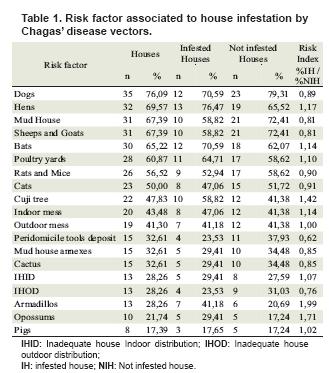
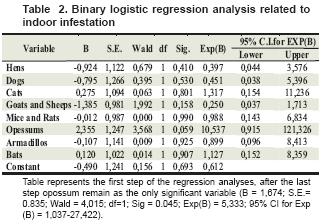
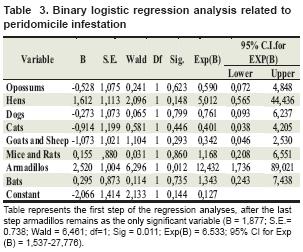
<body><![CDATA[<p class="MsoNormal"><span  style="font-size: 10pt; font-family: Verdana;" lang="EN-US">Human individual risk factors most frequently observed and risk factors associated with housing are displayed in <a  href="#Table1">table 1</a>.<o:p></o:p></span></p>     <p style="text-align: center;" class="MsoNormal"><span  style="font-size: 10pt; font-family: Verdana;" lang="EN-US"><o:p><a  name="Table1"></a><img alt="" src="/img/revistas/rcsp/v20n2/art5t1.jpg"  style="width: 329px; height: 373px;">&nbsp;</o:p></span></p> </div>     <div>     <p style="text-align: justify;" class="MsoNormal"><span  style="font-size: 10pt; font-family: Verdana;" lang="EN-US">When performing statistical analysis, we found an association between observation of armadillo and opossum in and around the house with <span class="SpellE">peridomicile</span> and domicile infestation, respectively (see <a href="#Table2">table 2</a> and <a href="#Table3">3</a>).    <br> </span></p>     <p style="text-align: justify;" class="MsoNormal">    <br> <span style="font-size: 10pt; font-family: Verdana;" lang="EN-US"><o:p></o:p></span></p> </div>     <p style="text-align: center;" class="MsoNormal"><span  style="font-size: 13.5pt; color: rgb(33, 29, 30);" lang="EN-US"><o:p>&nbsp;<a  name="Table2"></a><img alt="" src="/img/revistas/rcsp/v20n2/art5t2.jpg"  style="width: 325px; height: 224px;"></o:p></span></p>     <div>     <p class="MsoNormal"><span class="GramE"><b style=""><span  style="font-size: 10pt; font-family: Verdana;" lang="EN-US"></span></b></span><b  style=""><span style="font-size: 10pt; font-family: Verdana;"  lang="EN-US">    ]]></body>
<body><![CDATA[<br> <o:p></o:p></span></b></p> </div>     <p style="text-align: center;" class="MsoNormal"><b style=""><span  style="font-size: 10pt; font-family: Verdana;" lang="EN-US"><o:p><a  name="Table3"></a><img alt="" src="/img/revistas/rcsp/v20n2/art5t3.jpg"  style="width: 303px; height: 252px;">&nbsp;</o:p></span></b></p>     <div>     <p style="text-align: justify;" class="MsoNormal"><span  style="font-size: 10pt; font-family: Verdana;" lang="EN-US">Table represents the first step of the regression analyses, after the last step opossum remain as the only significant variable (B = 1,674; S.E<span class="GramE">.=</span> 0.835; Wald = 4,015; <span  class="SpellE">df</span>=1; Sig = 0.045; Exp(B) = 5,333; 95% CI for Exp (B) = 1,037-27,422).<o:p></o:p></span></p> </div>     <div>     <p style="text-align: justify;" class="MsoNormal"><span  style="font-size: 10pt; font-family: Verdana;" lang="EN-US">Table represents the first step of the regression analyses, after the last step armadillos remains as the only significant variable (B = 1,877; S.E<span class="GramE">.=</span> 0.738; Wald = 6,461; <span class="SpellE">df</span>=1; Sig = 0.011; Exp(B) = 6.533; 95% CI for Exp (B) = 1,537-27,776).<o:p></o:p></span></p> </div>     <div>     <p class="MsoNormal"><b style=""><span  style="font-size: 11pt; font-family: Verdana;" lang="EN-US">Discussion<o:p></o:p></span></b></p>     <p style="text-align: justify;" class="MsoNormal"><span  style="font-size: 10pt; font-family: Verdana;" lang="EN-US">In this paper, we report <i>T.</i> <span class="SpellE"><i>maculata</i></span> house infestation index above infestation indexes observed in the 60&#8217;s and 70&#8217;s decades in <st1:place w:st="on"><st1:country-region w:st="on">Venezuela</st1:country-region></st1:place> (<a href="#9">9</a>), similar results have been reported recently in neighborhood communities at <span class="SpellE">Xaguas</span> parish (<a href="#7">7</a>). These results indicate that <i>T. <span class="SpellE">maculata</span></i> populations able to infest houses have experienced an increase in recent decades, as a result of ecosystem changes because human forest invasion and lack of <span class="SpellE">triatomino</span> natural food sources.<o:p></o:p></span></p>     <p style="text-align: justify;" class="MsoNormal"><span  style="font-size: 10pt; font-family: Verdana;" lang="EN-US">However, in this study we did not observe house colonization, which coincides with results observed in <span  class="SpellE">Roraima</span> <st1:country-region w:st="on"><st1:place w:st="on">Brazil</st1:place></st1:country-region> (<a href="#13">13</a>). These results contrast with the reported in neighborhood communities at <span class="SpellE">Xaguas</span> parish and in Colombian rural community, where it were observed 39<span class="GramE">,1</span> % and 38,3 % colonization indexes, respectively (<a href="#7">7</a>,<a href="#10">10</a>).<o:p></o:p></span></p>     ]]></body>
<body><![CDATA[<p style="text-align: justify;" class="MsoNormal"><span  style="font-size: 10pt; font-family: Verdana;" lang="EN-US">Soto et al. (<a href="#14">14</a>) studied specimens of <i>T.</i> <span  class="SpellE"><i>maculata</i></span> collected in a same region and they did not found any significant differences between specimens from domicile and <span  class="SpellE">peridomicile</span>, indicating that both vector populations are similar, therefore this specie has not yet developed adaptive mechanisms to domiciliation.<o:p></o:p></span></p>     <p style="text-align: justify;" class="MsoNormal"><span  style="font-size: 10pt; font-family: Verdana;" lang="EN-US">However, high rates of household infestation reported in other parts as <span class="SpellE">Xaguas</span> parish and in Colombian rural community, suggest that populations of <i>T.</i> <span  class="SpellE"><i>maculata</i></span> are at different stages of adaptation to human dwellings and the ability of <i>T.</i> <span class="SpellE"><i>maculata</i></span> to <span class="SpellE">domiciliate</span> might depend on the ecological and environmental characteristics.<o:p></o:p></span></p>     <p style="text-align: justify;" class="MsoNormal"><span  style="font-size: 10pt; font-family: Verdana;" lang="EN-US">This work confirms the presence of <i>E.</i> <span class="SpellE"><i>mucronatus</i></span> in the domicile at <span class="SpellE">Urdaneta</span> <span class="SpellE">municipaly</span>. Domicile infestation by <i>E.</i> <span class="SpellE"><i>Mucronatus</i></span> has been documented in <st1:country-region  w:st="on"><st1:place w:st="on">Venezuela</st1:place></st1:country-region> (<a href="#7">7</a>, <a href="#8">8</a>), suggesting a change in wild vector behavior. <o:p></o:p></span></p>     <p style="text-align: justify;" class="MsoNormal"><span  style="font-size: 10pt; font-family: Verdana;" lang="EN-US">In this study <span class="SpellE">seroprevalence</span> of anti-<span class="SpellE"><i>T.cruzi</i></span> antibodies in dogs was superior to human, indicating that <i>T.</i> <span class="SpellE"><i>cruzi</i></span> transmission dynamics in dogs is different from that of humans. Low <span  class="SpellE">triatomine</span> infection index observed in this study questions transmission vector, however, by observing dog&#8217;s habits, we were able to observe that most ate raw meat and were hunters, indicating oral route as the most feasible to explain high <span class="SpellE">seropositivity</span> rates.<o:p></o:p></span></p>     <p style="text-align: justify;" class="MsoNormal"><span  style="font-size: 10pt; font-family: Verdana;" lang="EN-US">Dog&#8217;s prevalence observed in this study was higher than that observed in studies conducted in <st1:place w:st="on"><st1:country-region  w:st="on">Venezuela</st1:country-region></st1:place> (6<span  class="GramE">,36</span> %) (<a href="#7">7</a>), <st1:place w:st="on"><st1:country-region  w:st="on">Costa Rica</st1:country-region></st1:place> (5<span class="GramE">,2</span> % to 9,9 %) (15, 16) and <st1:place  w:st="on"><st1:country-region w:st="on">United States</st1:country-region></st1:place> (3<span class="GramE">,6</span> % to 7,5 %) (<a href="#17">17, 18</a>), notwithstanding, higher <span  class="SpellE">prevalences</span> have been reported in rural areas of <st1:place w:st="on"><st1:country-region  w:st="on">Venezuela</st1:country-region></st1:place> (67<span  class="GramE">,6</span> %) (<a href="#19">19</a>) and <st1:place w:st="on"><st1:country-region  w:st="on">Argentina</st1:country-region></st1:place> (40 %) (<a href="#20">20</a>).<o:p></o:p></span></p>     <p style="text-align: justify;" class="MsoNormal"><span  style="font-size: 10pt; font-family: Verdana;" lang="EN-US">High <span  class="SpellE">Chagas</span> dog&#8217;s disease prevalence had been related to the presence of acute cases (<a  href="#19">19</a>) and high prevalence of infected inhabitants, both associated with high levels of <span class="SpellE">triatomine</span> infection (20); these phenomena were not observed in this study, indicating that source of dog&#8217;s infection is outside house.<o:p></o:p></span></p>     <p style="text-align: justify;" class="MsoNormal"><span  style="font-size: 10pt; font-family: Verdana;" lang="EN-US">We report an association between <span class="SpellE">triatomine&#8217;s</span> house infestation and the presence of armadillos and opossum around the house. This phenomenon is related to the wild characteristics of the community and because vector migration is happening from the <span class="SpellE">selvatic</span> area to house, acting wild mammals as <span class="SpellE">triatomine</span> carriers.<o:p></o:p></span></p>     <p style="text-align: justify;" class="MsoNormal"><span  style="font-size: 10pt; font-family: Verdana;" lang="EN-US">A high frequency of risk factors related to Chagas&#8217; disease, which are evenly distributed in the community, which together with the presence in the area of all elements of <i>T.</i> <span  class="SpellE"><i>cruzi</i></span> transmission cycle, presages a resurgence of human disease transmission in the short term. This would require an adaptation of <i>T. <span class="SpellE">maculata</span></i> to have as food sources domestic mammals that behave as efficient reservoirs. <o:p></o:p></span></p>     <p class="MsoNormal"><span class="SpellE"><b style=""><span  style="font-size: 11pt; font-family: Verdana;" lang="EN-US">Knowledgments</span></b></span><b  style=""><span style="font-size: 11pt; font-family: Verdana;"  lang="EN-US"><o:p></o:p></span></b></p>     <p style="text-align: justify;" class="MsoNormal"><span  style="font-size: 10pt; font-family: Verdana;" lang="EN-US">Study funded by the <span class="SpellE">Urdaneta</span> Municipality Hall (Lara State, Venezuela) and by FONACIT, Project No 2007001425.<o:p></o:p></span></p>     ]]></body>
<body><![CDATA[<p class="MsoNormal"><b style=""><span  style="font-size: 11pt; font-family: Verdana;" lang="EN-US"><o:p> </o:p> <hr style="width: 100%; height: 2px;"></span></b></p>     <p class="MsoNormal"><span class="SpellE"><b style=""><span  style="font-size: 11pt; font-family: Verdana;">References</span></b></span><b  style=""><span style="font-size: 11pt; font-family: Verdana;"><o:p></o:p></span></b></p>     <!-- ref --><p class="MsoNormal"><span  style="font-size: 10pt; font-family: Verdana;"><a name="1"></a>1. Ach&#233; A. Programa de Control de <st1:personname  productid="la Enfermedad" w:st="on">la Enfermedad</st1:personname> de Chagas en Venezuela. Bol <span class="SpellE">Dir</span> Mal San <span  class="SpellE">Amb</span>. 1993; 33:11-22<o:p></o:p></span>&nbsp;&nbsp;&nbsp;&nbsp;&nbsp;&nbsp;&nbsp;&nbsp;[&#160;<a href="javascript:void(0);" onclick="javascript: window.open('/scielo.php?script=sci_nlinks&ref=851795&pid=S1409-1429201100020000500001&lng=','','width=640,height=500,resizable=yes,scrollbars=1,menubar=yes,');">Links</a>&#160;]<!-- end-ref --><!-- ref --><p class="MsoNormal"><span  style="font-size: 10pt; font-family: Verdana;"><a name="2"></a>2. Ach&#233; A, Matos AJ. <span class="SpellE">Interrupting</span> Chagas&#8217; <span  class="SpellE">disease</span> transmisi&#243;n in Venezuela. <span  class="SpellE">Rev</span> <span class="SpellE">Inst</span> <span  class="SpellE">Med</span> <span class="SpellE">Trop</span> <span class="SpellE">S&#227;o</span> Paulo 2001; 43:37- 43.    &nbsp;&nbsp;&nbsp;&nbsp;&nbsp;&nbsp;&nbsp;&nbsp;[&#160;<a href="javascript:void(0);" onclick="javascript: window.open('/scielo.php?script=sci_nlinks&ref=851796&pid=S1409-1429201100020000500002&lng=','','width=640,height=500,resizable=yes,scrollbars=1,menubar=yes,');">Links</a>&#160;]<!-- end-ref --> <o:p></o:p></span></p>     <!-- ref --><p class="MsoNormal"><span  style="font-size: 10pt; font-family: Verdana;"><a name="3"></a>3. Organizaci&#243;n Panamericana de <st1:personname productid="la Salud"  w:st="on">la Salud</st1:personname> / Organizaci&#243;n Mundial de <st1:personname  productid="la Salud. An&#225;lisis" w:st="on">la Salud. An&#225;lisis</st1:personname> preliminar de la situaci&#243;n de salud de Venezuela. Disponible en:http://www.ops-oms.org.ve/site/venezuela/ven-sit-salud-nuevo.htm. Consultado 05/ junio 2007).    &nbsp;&nbsp;&nbsp;&nbsp;&nbsp;&nbsp;&nbsp;&nbsp;[&#160;<a href="javascript:void(0);" onclick="javascript: window.open('/scielo.php?script=sci_nlinks&ref=851798&pid=S1409-1429201100020000500003&lng=','','width=640,height=500,resizable=yes,scrollbars=1,menubar=yes,');">Links</a>&#160;]<!-- end-ref --><o:p></o:p></span></p>     <!-- ref --><p class="MsoNormal"><span  style="font-size: 10pt; font-family: Verdana;"><a name="4"></a>4. Rodr&#237;guez-<span class="SpellE">Bonfante</span> C, Amaro A, Garc&#237;a M, Mej&#237;as L, Chac&#243;n P, Garc&#237;a R et al. Epidemiolog&#237;a de <st1:personname productid="la Enfermedad" w:st="on">la Enfermedad</st1:personname> de Chagas en el Municipio Andr&#233;s Eloy Blanco, Lara, Venezuela: Infestaci&#243;n <span class="SpellE">triatom&#237;nica</span> y <span class="SpellE">seroprevalencia</span> en humanos. <span  class="SpellE">Cad</span>. <span class="SpellE">Sa&#250;de</span> P&#250;blica, R&#237;o de Janeiro, 2007; 23(5):1133-1140.    &nbsp;&nbsp;&nbsp;&nbsp;&nbsp;&nbsp;&nbsp;&nbsp;[&#160;<a href="javascript:void(0);" onclick="javascript: window.open('/scielo.php?script=sci_nlinks&ref=851800&pid=S1409-1429201100020000500004&lng=','','width=640,height=500,resizable=yes,scrollbars=1,menubar=yes,');">Links</a>&#160;]<!-- end-ref --><o:p></o:p></span></p>     <!-- ref --><p class="MsoNormal"><span  style="font-size: 10pt; font-family: Verdana;"><a name="5"></a>5. Reyes-Lugo M, Rodr&#237;guez-Acosta B. <span class="SpellE">Domiciliation</span> <span class="SpellE">of</span> <span class="SpellE">the</span> <span  class="SpellE">selvatic</span> Chagas <span class="SpellE">disease</span> vector <span class="SpellE"><i>Panstrongylus</i></span> <span class="SpellE"><i>geniculatus</i></span> <span class="SpellE">Latreille</span>, 1811 (<span class="SpellE">Triatominae</span>: <span class="SpellE">Reduviidae</span>) in Venezuela. <span class="SpellE">Trans</span> Royal <span  class="SpellE">Soc</span> <span class="SpellE">Med</span> <span class="SpellE">Hyg</span> 2000; 94: 508.    &nbsp;&nbsp;&nbsp;&nbsp;&nbsp;&nbsp;&nbsp;&nbsp;[&#160;<a href="javascript:void(0);" onclick="javascript: window.open('/scielo.php?script=sci_nlinks&ref=851802&pid=S1409-1429201100020000500005&lng=','','width=640,height=500,resizable=yes,scrollbars=1,menubar=yes,');">Links</a>&#160;]<!-- end-ref --><o:p></o:p></span></p>     <!-- ref --><p class="MsoNormal"><span  style="font-size: 10pt; font-family: Verdana;"><a name="6"></a>6. <span  class="SpellE">Feliciangeli</span> D, Carrasco H, Patterson J, <span  class="SpellE">Suarez</span> B, Mart&#237;nez C, Medina M. <span  class="SpellE">Mixed</span> <span class="SpellE">domestic</span> <span class="SpellE">infestation</span> by <span class="SpellE">Rhodnius</span> <span class="SpellE">prolixus</span> <span class="SpellE">St&#228;l</span>, 1859 <span class="SpellE">and</span> <span class="SpellE">Panstrongylus</span> <span class="SpellE">geniculatus</span> <span class="SpellE">Latreille</span>, 1811, vector <span  class="SpellE">incrimination</span>, <span class="SpellE">and</span> <span class="SpellE">seroprevalence</span> <span class="SpellE">for</span> <span class="SpellE">Trypanosoma</span> <span class="SpellE">cruzi</span> <span class="SpellE">among</span> <span  class="SpellE">inhabitants</span> in El Guamito, Lara State, Venezuela. <span class="SpellE">Am</span> J <span class="SpellE">Trop</span> <span class="SpellE">Med</span> <span  class="SpellE">Hyg</span> 2004; 71: 501-505.    &nbsp;&nbsp;&nbsp;&nbsp;&nbsp;&nbsp;&nbsp;&nbsp;[&#160;<a href="javascript:void(0);" onclick="javascript: window.open('/scielo.php?script=sci_nlinks&ref=851804&pid=S1409-1429201100020000500006&lng=','','width=640,height=500,resizable=yes,scrollbars=1,menubar=yes,');">Links</a>&#160;]<!-- end-ref --> <o:p></o:p></span></p>     <!-- ref --><p class="MsoNormal"><span  style="font-size: 10pt; font-family: Verdana;"><a name="7"></a>7. Rojas ME, et al. Estudio <span class="SpellE">seroepidemiol&#243;gico</span> y entomol&#243;gico sobre la enfermedad de Chagas en un &#225;rea infestada por <span class="SpellE">Triatoma</span> <span class="SpellE">maculata</span> (<span class="SpellE">Erichson</span> 1848) en el centro-occidente de Venezuela. <span class="SpellE">Cad</span> <span class="SpellE">Saude</span> <span class="GramE">Publica</span>. 2008; 24:2323-2333.    &nbsp;&nbsp;&nbsp;&nbsp;&nbsp;&nbsp;&nbsp;&nbsp;[&#160;<a href="javascript:void(0);" onclick="javascript: window.open('/scielo.php?script=sci_nlinks&ref=851806&pid=S1409-1429201100020000500007&lng=','','width=640,height=500,resizable=yes,scrollbars=1,menubar=yes,');">Links</a>&#160;]<!-- end-ref --><o:p></o:p></span></p>     <!-- ref --><p class="MsoNormal"><span  style="font-size: 10pt; font-family: Verdana;"><a name="8"></a>8. Soto A, <span class="SpellE">Barazarte</span> H, Molina D. Primer registro de <span class="SpellE">Eratyrus</span> <span class="SpellE">mucronatus</span>, <span class="SpellE">St&#228;l</span> 1959 (<span class="SpellE">Hem&#237;ptera</span>, <span class="SpellE">Reduvidae</span>) en el ambiente domiciliario en Venezuela. <span class="SpellE">Entomotr&#243;pico</span>, <span  class="SpellE">Boletin</span> de Entomolog&#237;a Venezolano 2001; 16: 215-217.    &nbsp;&nbsp;&nbsp;&nbsp;&nbsp;&nbsp;&nbsp;&nbsp;[&#160;<a href="javascript:void(0);" onclick="javascript: window.open('/scielo.php?script=sci_nlinks&ref=851808&pid=S1409-1429201100020000500008&lng=','','width=640,height=500,resizable=yes,scrollbars=1,menubar=yes,');">Links</a>&#160;]<!-- end-ref --><o:p></o:p></span></p>     <!-- ref --><p class="MsoNormal"><span  style="font-size: 10pt; font-family: Verdana;"><a name="9"></a>9. <span  class="SpellE">Tonn</span> R, Otero M, Mora E, <span class="SpellE">Espinola</span> H, <span class="SpellE">Carcavallo</span> R. Aspectos biol&#243;gicos, ecol&#243;gicos y distribuci&#243;n geogr&#225;fica de <span class="SpellE"><i>Triatoma</i></span> <span class="SpellE"><i>maculata</i></span> (<span class="SpellE">Erichson</span> 1848), (<span class="SpellE">Hemiptera</span>, <span class="SpellE">Reduviidae</span>), en Venezuela. Bol <span class="SpellE">Dir</span> Mal San <span class="SpellE">Amb</span> 1978; 18: 16-24.    &nbsp;&nbsp;&nbsp;&nbsp;&nbsp;&nbsp;&nbsp;&nbsp;[&#160;<a href="javascript:void(0);" onclick="javascript: window.open('/scielo.php?script=sci_nlinks&ref=851810&pid=S1409-1429201100020000500009&lng=','','width=640,height=500,resizable=yes,scrollbars=1,menubar=yes,');">Links</a>&#160;]<!-- end-ref --> <o:p></o:p></span></p>     <!-- ref --><p class="MsoNormal"><span  style="font-size: 10pt; font-family: Verdana;"><a name="10"></a>10. <span  class="SpellE">Luitgards</span>-Moura J, Borges-Pereira J, Costa J, <span  class="SpellE">Zauza</span> P, Rosa-Freitas M. <span class="SpellE">On</span> <span class="SpellE">the</span> <span class="SpellE">possibility</span> <span class="SpellE">of</span> <span class="SpellE">autochthonous</span> Chagas <span class="SpellE">disease</span> in Roraima, Amazon <span  class="SpellE">region</span>, <span class="SpellE">Brazil</span>, 2000-2001. <span class="SpellE">Rev</span> <span class="SpellE">Inst</span> <span class="SpellE">Med</span> <span  class="SpellE">Trop</span> Sao Paulo. 2005; 47(1):45-54.    &nbsp;&nbsp;&nbsp;&nbsp;&nbsp;&nbsp;&nbsp;&nbsp;[&#160;<a href="javascript:void(0);" onclick="javascript: window.open('/scielo.php?script=sci_nlinks&ref=851812&pid=S1409-1429201100020000500010&lng=','','width=640,height=500,resizable=yes,scrollbars=1,menubar=yes,');">Links</a>&#160;]<!-- end-ref --><o:p></o:p></span></p>     <!-- ref --><p class="MsoNormal"><span  style="font-size: 10pt; font-family: Verdana;"><a name="11"></a>11. Cort&#233;s L, Su&#225;rez H. <span class="SpellE">Triatominos</span> (<span  class="SpellE">Reduviidae</span>: <span class="SpellE">Triatominae</span>) en un foco de enfermedad de Chagas en <span class="SpellE">Talaigua</span> Nuevo (Bol&#237;var, Colombia). </span><span class="GramE"><span  style="font-size: 10pt; font-family: Verdana;" lang="PT-BR">Biom&#233;dica (Bogot&#225;) 2004</span></span><span style="font-size: 10pt; font-family: Verdana;"  lang="PT-BR">; 25: 568-574.    &nbsp;&nbsp;&nbsp;&nbsp;&nbsp;&nbsp;&nbsp;&nbsp;[&#160;<a href="javascript:void(0);" onclick="javascript: window.open('/scielo.php?script=sci_nlinks&ref=851814&pid=S1409-1429201100020000500011&lng=','','width=640,height=500,resizable=yes,scrollbars=1,menubar=yes,');">Links</a>&#160;]<!-- end-ref --><o:p></o:p></span></p>     <!-- ref --><p class="MsoNormal"><span  style="font-size: 10pt; font-family: Verdana;" lang="PT-BR"><a  name="12"></a>12. <span class="SpellE">Casta&#241;era</span> MB, <span  class="SpellE">Lauricella</span> MA, <span class="SpellE">Chuit</span> R, <span class="SpellE">Gurtler</span> RE. </span><span class="GramE"><span  style="font-size: 10pt; font-family: Verdana;" lang="EN-US">Evaluation of dogs as sentinels of the transmission of <span class="SpellE"><i>Trypanosoma</i></span> <span class="SpellE"><i>cruzi</i></span> in a rural area of north-western <st1:country-region w:st="on"><st1:place w:st="on">Argentina</st1:place></st1:country-region>.</span></span><span  style="font-size: 10pt; font-family: Verdana;" lang="EN-US"> </span><span style="font-size: 10pt; font-family: Verdana;">Ann <span  class="SpellE">Trop</span> <span class="SpellE">Med</span> <span  class="SpellE">Parasitol</span>. 1998; 92: 671-683.    &nbsp;&nbsp;&nbsp;&nbsp;&nbsp;&nbsp;&nbsp;&nbsp;[&#160;<a href="javascript:void(0);" onclick="javascript: window.open('/scielo.php?script=sci_nlinks&ref=851816&pid=S1409-1429201100020000500012&lng=','','width=640,height=500,resizable=yes,scrollbars=1,menubar=yes,');">Links</a>&#160;]<!-- end-ref --><o:p></o:p></span></p>     <!-- ref --><p class="MsoNormal"><span  style="font-size: 10pt; font-family: Verdana;"><a name="13"></a>13. Cardinal M, Casta&#241;era M, <span class="SpellE">Lauricella</span> M, <span  class="SpellE">Cecere</span> M, Ceballos L, V&#225;zquez-<span  class="SpellE">Prokopec</span> G et al. </span><span class="GramE"><span  style="font-size: 10pt; font-family: Verdana;" lang="EN-US">A prospective study of the effects of sustained vector surveillance following community-wide insecticide application on <span class="SpellE">Trypanosoma</span> <span  class="SpellE">cruzi</span> infection of dogs and cats in rural northwestern <st1:country-region  w:st="on"><st1:place w:st="on">Argentina</st1:place></st1:country-region>.</span></span><span  style="font-size: 10pt; font-family: Verdana;" lang="EN-US"> Am J <span class="SpellE">Trop</span> Med <span class="SpellE"><span  class="GramE">Hyg</span></span><span class="GramE">.</span> <span  class="GramE">2006; 75: 753-761.    &nbsp;&nbsp;&nbsp;&nbsp;&nbsp;&nbsp;&nbsp;&nbsp;[&#160;<a href="javascript:void(0);" onclick="javascript: window.open('/scielo.php?script=sci_nlinks&ref=851818&pid=S1409-1429201100020000500013&lng=','','width=640,height=500,resizable=yes,scrollbars=1,menubar=yes,');">Links</a>&#160;]<!-- end-ref --></span> <o:p></o:p></span></p>     <!-- ref --><p class="MsoNormal"><span  style="font-size: 10pt; font-family: Verdana;" lang="EN-US"><a  name="14"></a>14. Soto <span class="SpellE">Vivas</span> A, <span  class="SpellE">Rodr&#237;guez</span> C, <span class="SpellE">Bonfante-Cabarca</span>, R y <span class="SpellE">Aldana</span> E. <span class="SpellE">Morfometr&#237;a</span> <span class="SpellE">geom&#233;trica</span> de <span class="SpellE"><i>Triatoma</i></span> <span class="SpellE"><i>maculata</i></span> (<span class="SpellE">Erichson</span>, 1848) de <span class="SpellE">ambientes</span> <span class="SpellE">dom&#233;stico</span> y <span class="SpellE">peridom&#233;stico</span>, Estado Lara, Venezuela. </span><span  style="font-size: 10pt; font-family: Verdana;">Bolet&#237;n de <span  class="SpellE">Malariolog&#237;a</span> y Salud Ambiental. 2007. XLVII: 231-235.    &nbsp;&nbsp;&nbsp;&nbsp;&nbsp;&nbsp;&nbsp;&nbsp;[&#160;<a href="javascript:void(0);" onclick="javascript: window.open('/scielo.php?script=sci_nlinks&ref=851820&pid=S1409-1429201100020000500014&lng=','','width=640,height=500,resizable=yes,scrollbars=1,menubar=yes,');">Links</a>&#160;]<!-- end-ref --><o:p></o:p></span></p>     <!-- ref --><p class="MsoNormal"><span  style="font-size: 10pt; font-family: Verdana;"><a name="15"></a>15. Reyes L, <span class="SpellE">Silescky</span> E, Cerdas C, Chinchilla M, Guerrero O, Presencia de anticuerpos contra <span class="SpellE"><i>Trypanosoma</i></span> <span class="SpellE"><i>cruzi</i></span> en perros de Costa Rica. </span><span  class="SpellE"><span class="GramE"><span  style="font-size: 10pt; font-family: Verdana;" lang="EN-US">Parasit</span></span></span><span  class="GramE"><span style="font-size: 10pt; font-family: Verdana;"  lang="EN-US">.</span></span><span  style="font-size: 10pt; font-family: Verdana;" lang="EN-US"> Lat 2002; 57: 66-68.    &nbsp;&nbsp;&nbsp;&nbsp;&nbsp;&nbsp;&nbsp;&nbsp;[&#160;<a href="javascript:void(0);" onclick="javascript: window.open('/scielo.php?script=sci_nlinks&ref=851822&pid=S1409-1429201100020000500015&lng=','','width=640,height=500,resizable=yes,scrollbars=1,menubar=yes,');">Links</a>&#160;]<!-- end-ref --><o:p></o:p></span></p>     <!-- ref --><p class="MsoNormal"><span  style="font-size: 10pt; font-family: Verdana;" lang="EN-US"><a  name="16"></a>16. <span class="SpellE">Zeled&#243;n</span> R, Solano G, <span class="SpellE">Burstin</span> L, <span class="SpellE">Swartzwelder</span> JC Epidemiological pattern of <span class="SpellE">Chagas</span>&#8217; disease in an endemic area of Costa Rica Am J <span class="SpellE">Trop</span> Med <span class="SpellE">Hyg</span>. <span class="GramE">1975; 24:214-225.    &nbsp;&nbsp;&nbsp;&nbsp;&nbsp;&nbsp;&nbsp;&nbsp;[&#160;<a href="javascript:void(0);" onclick="javascript: window.open('/scielo.php?script=sci_nlinks&ref=851824&pid=S1409-1429201100020000500016&lng=','','width=640,height=500,resizable=yes,scrollbars=1,menubar=yes,');">Links</a>&#160;]<!-- end-ref --></span><o:p></o:p></span></p>     <!-- ref --><p class="MsoNormal"><span  style="font-size: 10pt; font-family: Verdana;" lang="EN-US"><a  name="17"></a>17. Beard CB, <span class="SpellE">Pye</span> G, <span  class="SpellE">Steurer</span> FJ, Rodriguez R, <span class="SpellE">Campman</span> R, Peterson AT, et al. <span class="SpellE">Chagas</span> disease in a domestic transmission cycle, southern <st1:state w:st="on">Texas</st1:state>, <st1:country-region  w:st="on"><st1:place w:st="on">USA</st1:place></st1:country-region>. <span  class="SpellE">Emerg</span> Infect Dis. 2003; 9:103-105.    &nbsp;&nbsp;&nbsp;&nbsp;&nbsp;&nbsp;&nbsp;&nbsp;[&#160;<a href="javascript:void(0);" onclick="javascript: window.open('/scielo.php?script=sci_nlinks&ref=851826&pid=S1409-1429201100020000500017&lng=','','width=640,height=500,resizable=yes,scrollbars=1,menubar=yes,');">Links</a>&#160;]<!-- end-ref --> <o:p></o:p></span></p>     <!-- ref --><p class="MsoNormal"><span class="GramE"><span  style="font-size: 10pt; font-family: Verdana;" lang="EN-US"><a  name="18"></a>18. Bradley KK, Bergman DK, Woods JP, <span class="SpellE">Crutcher</span> JM, Kirchhoff LV. Prevalence of American <span class="SpellE">trypanosomiasis</span> (<span class="SpellE">Chagas</span> disease) among dogs in <st1:state w:st="on"><st1:place w:st="on">Oklahoma</st1:place></st1:state>.</span></span><span  style="font-size: 10pt; font-family: Verdana;" lang="EN-US"> J. Am. Vet. Med. Assoc 2000; 217:1853-1857.    &nbsp;&nbsp;&nbsp;&nbsp;&nbsp;&nbsp;&nbsp;&nbsp;[&#160;<a href="javascript:void(0);" onclick="javascript: window.open('/scielo.php?script=sci_nlinks&ref=851828&pid=S1409-1429201100020000500018&lng=','','width=640,height=500,resizable=yes,scrollbars=1,menubar=yes,');">Links</a>&#160;]<!-- end-ref --> <o:p></o:p></span></p>     <!-- ref --><p class="MsoNormal"><span  style="font-size: 10pt; font-family: Verdana;" lang="EN-US"><a  name="19"></a>19. <span class="SpellE">Crisante</span> G, Rojas A, Teixeira MM, <span class="SpellE">A&#241;ez</span> N. Infected dogs as a risk factor in the transmission of human <span class="SpellE"><i>Trypanosoma</i></span><i> <span class="SpellE">cruzi</span></i> infection in western <st1:country-region  w:st="on"><st1:place w:st="on">Venezuela</st1:place></st1:country-region>. <span class="SpellE"><span class="GramE">Acta</span></span><span  class="GramE"> Trop. 2006; 98:247-254.    &nbsp;&nbsp;&nbsp;&nbsp;&nbsp;&nbsp;&nbsp;&nbsp;[&#160;<a href="javascript:void(0);" onclick="javascript: window.open('/scielo.php?script=sci_nlinks&ref=851830&pid=S1409-1429201100020000500019&lng=','','width=640,height=500,resizable=yes,scrollbars=1,menubar=yes,');">Links</a>&#160;]<!-- end-ref --></span> <o:p></o:p></span></p>     <!-- ref --><p class="MsoNormal"><span  style="font-size: 10pt; font-family: Verdana;" lang="EN-US"><a  name="20"></a>20. <span class="SpellE">G&#252;rtler</span> RE, <span  class="SpellE">C&#233;cere</span> MC, <span class="SpellE">Rubel</span> DN, Petersen RM, <st1:city w:st="on"><span class="SpellE"><span  class="GramE">Schweigmann</span></span></st1:city> <st1:state w:st="on">NJ</st1:state>, <span class="SpellE">Lauricella</span> MA et al. <span class="SpellE">Chagas</span> disease in north-west <st1:place  w:st="on"><st1:country-region w:st="on">Argentina</st1:country-region></st1:place>: infected dogs as a risk factor for the domestic transmission of <span class="SpellE"><i>Trypanosoma</i></span> <span class="SpellE"><i>cruzi</i></span>. <span class="GramE">Trans R Soc <span class="SpellE">Trop</span> Med <span class="SpellE">Hyg</span>.</span> <span class="GramE">1991; 85:741-745.    &nbsp;&nbsp;&nbsp;&nbsp;&nbsp;&nbsp;&nbsp;&nbsp;[&#160;<a href="javascript:void(0);" onclick="javascript: window.open('/scielo.php?script=sci_nlinks&ref=851832&pid=S1409-1429201100020000500020&lng=','','width=640,height=500,resizable=yes,scrollbars=1,menubar=yes,');">Links</a>&#160;]<!-- end-ref --></span><o:p></o:p></span></p>     <p class="MsoNormal"><span  style="font-size: 10pt; font-family: Verdana;"><span  style="font-weight: bold;"><a name="Correspondencia1"></a><a  href="#Correspondencia2">*</a>Correspondencia a: </span><a name="1_"></a><a  href="#1_1">1</a> MD <span class="SpellE">MSc</span> Medicina Tropical, Unidad de Investigaciones en Parasitolog&#237;a M&#233;dica, UCLA, claudina.rodriguez@gmail.com    <br> </span><span style="font-size: 10pt; font-family: Verdana;"><a name="2_"></a><a  href="#2_2">2</a> MD, Medicina Integral del Medio Urbano, Universidad Centro-Occidental &#8220;Lisandro Alvarado&#8221; (UCLA), Barquisimeto, <o:p></o:p>Estado Lara, tia_nanena@hotmail.com;    <br> </span><span style="font-size: 10pt; font-family: Verdana;" lang="PT-BR"><a  name="3_"></a><a href="#3_3">3</a> <span class="SpellE">PhD</span> <span  class="SpellE">Biology</span>, Laboratorio de Entomolog&#237;a &#8220;Herman <span class="SpellE">Lent</span>&#8221;, Facultad de Ciencias, Universidad de Los Andes (ULA), M&#233;rida, <o:p></o:p>Estado M&#233;rida, aldana@ula.ve;    <br> </span><span style="font-size: 10pt; font-family: Verdana;"><a name="4_"></a><a  href="#4_4">4</a> <span class="SpellE">PhD</span> Fundamental Medicine, Laboratorio de Enzimolog&#237;a de Par&#225;sitos, CIGEN, ULA, <span class="SpellE">concepci@ula.ve</span>; 5MD <span class="SpellE">PhD</span> <span class="SpellE">Science</span>, Unidad de Bioqu&#237;mica, UCLA, <span class="SpellE">rcabarca@ucla.edu.ve</span>.<o:p></o:p></span> </p> <hr style="width: 100%; height: 2px;">     <p style="text-align: center;" class="MsoNormal"><span  style="font-size: 10pt; font-family: Verdana;" lang="EN-US">Received 25 <span class="SpellE">noviembre</span> 2011 Accepted 15 <span class="SpellE"><span class="GramE">december</span></span> 2011</span><span style="" lang="EN-US"><o:p></o:p></span></p> </div> </div> </div> </div> </div> </div>      ]]></body><back>
<ref-list>
<ref id="B1">
<label>1</label><nlm-citation citation-type="journal">
<person-group person-group-type="author">
<name>
<surname><![CDATA[Aché]]></surname>
<given-names><![CDATA[A]]></given-names>
</name>
</person-group>
<article-title xml:lang="es"><![CDATA[Programa de Control de la Enfermedad de Chagas en Venezuela]]></article-title>
<source><![CDATA[Bol Dir Mal San Amb]]></source>
<year>1993</year>
<volume>33</volume>
<page-range>11-22</page-range></nlm-citation>
</ref>
<ref id="B2">
<label>2</label><nlm-citation citation-type="journal">
<person-group person-group-type="author">
<name>
<surname><![CDATA[Aché]]></surname>
<given-names><![CDATA[A]]></given-names>
</name>
<name>
<surname><![CDATA[Matos]]></surname>
<given-names><![CDATA[AJ]]></given-names>
</name>
</person-group>
<article-title xml:lang="en"><![CDATA[Interrupting Chagas&#8217; disease transmisión in Venezuela]]></article-title>
<source><![CDATA[Rev Inst Med Trop São Paulo]]></source>
<year>2001</year>
<volume>43</volume>
<page-range>37- 43</page-range></nlm-citation>
</ref>
<ref id="B3">
<label>3</label><nlm-citation citation-type="">
<collab>Organización Panamericana de la Salud / Organización Mundial de la Salud</collab>
<source><![CDATA[Análisis preliminar de la situación de salud de Venezuela]]></source>
<year></year>
</nlm-citation>
</ref>
<ref id="B4">
<label>4</label><nlm-citation citation-type="journal">
<person-group person-group-type="author">
<name>
<surname><![CDATA[Rodríguez-Bonfante]]></surname>
<given-names><![CDATA[C]]></given-names>
</name>
<name>
<surname><![CDATA[Amaro]]></surname>
<given-names><![CDATA[A]]></given-names>
</name>
<name>
<surname><![CDATA[García]]></surname>
<given-names><![CDATA[M]]></given-names>
</name>
<name>
<surname><![CDATA[Mejías]]></surname>
<given-names><![CDATA[L]]></given-names>
</name>
<name>
<surname><![CDATA[Chacón]]></surname>
<given-names><![CDATA[P]]></given-names>
</name>
<name>
<surname><![CDATA[García]]></surname>
<given-names><![CDATA[R]]></given-names>
</name>
</person-group>
<article-title xml:lang="es"><![CDATA[Epidemiología de la Enfermedad de Chagas en el Municipio Andrés Eloy Blanco, Lara, Venezuela: Infestación triatomínica y seroprevalencia en humanos]]></article-title>
<source><![CDATA[Cad. Saúde Pública]]></source>
<year>2007</year>
<volume>23</volume>
<numero>5</numero>
<issue>5</issue>
<page-range>1133-1140</page-range><publisher-loc><![CDATA[Río de Janeiro ]]></publisher-loc>
</nlm-citation>
</ref>
<ref id="B5">
<label>5</label><nlm-citation citation-type="journal">
<person-group person-group-type="author">
<name>
<surname><![CDATA[Reyes-Lugo]]></surname>
<given-names><![CDATA[M]]></given-names>
</name>
<name>
<surname><![CDATA[Rodríguez-Acosta]]></surname>
<given-names><![CDATA[B]]></given-names>
</name>
</person-group>
<article-title xml:lang="en"><![CDATA[Domiciliation of the selvatic Chagas disease vector Panstrongylus geniculatus Latreille, 1811 (Triatominae: Reduviidae) in Venezuela]]></article-title>
<source><![CDATA[Trans Royal Soc Med Hyg]]></source>
<year>2000</year>
<volume>94</volume>
<numero>508</numero>
<issue>508</issue>
</nlm-citation>
</ref>
<ref id="B6">
<label>6</label><nlm-citation citation-type="journal">
<person-group person-group-type="author">
<name>
<surname><![CDATA[Feliciangeli]]></surname>
<given-names><![CDATA[D]]></given-names>
</name>
<name>
<surname><![CDATA[Carrasco]]></surname>
<given-names><![CDATA[H]]></given-names>
</name>
<name>
<surname><![CDATA[Patterson]]></surname>
<given-names><![CDATA[J]]></given-names>
</name>
<name>
<surname><![CDATA[Suarez]]></surname>
<given-names><![CDATA[B]]></given-names>
</name>
<name>
<surname><![CDATA[Martínez]]></surname>
<given-names><![CDATA[C]]></given-names>
</name>
<name>
<surname><![CDATA[Medina]]></surname>
<given-names><![CDATA[M]]></given-names>
</name>
</person-group>
<article-title xml:lang="en"><![CDATA[Mixed domestic infestation by Rhodnius prolixus Stäl, 1859 and Panstrongylus geniculatus Latreille, 1811, vector incrimination, and seroprevalence for Trypanosoma cruzi among inhabitants in El Guamito, Lara State, Venezuela]]></article-title>
<source><![CDATA[Am J Trop Med Hyg]]></source>
<year>2004</year>
<volume>71</volume>
<page-range>501-505</page-range></nlm-citation>
</ref>
<ref id="B7">
<label>7</label><nlm-citation citation-type="journal">
<person-group person-group-type="author">
<name>
<surname><![CDATA[Rojas]]></surname>
<given-names><![CDATA[ME]]></given-names>
</name>
</person-group>
<article-title xml:lang="es"><![CDATA[Estudio seroepidemiológico y entomológico sobre la enfermedad de Chagas en un área infestada por Triatoma maculata (Erichson 1848) en el centro-occidente de Venezuela]]></article-title>
<source><![CDATA[Cad Saude Publica]]></source>
<year>2008</year>
<volume>24</volume>
<page-range>2323-2333</page-range></nlm-citation>
</ref>
<ref id="B8">
<label>8</label><nlm-citation citation-type="">
<person-group person-group-type="author">
<name>
<surname><![CDATA[Soto]]></surname>
<given-names><![CDATA[A]]></given-names>
</name>
<name>
<surname><![CDATA[Barazarte]]></surname>
<given-names><![CDATA[H]]></given-names>
</name>
<name>
<surname><![CDATA[Molina]]></surname>
<given-names><![CDATA[D]]></given-names>
</name>
</person-group>
<article-title xml:lang="es"><![CDATA[Primer registro de Eratyrus mucronatus, Stäl 1959 (Hemíptera, Reduvidae) en el ambiente domiciliario en Venezuela]]></article-title>
<source><![CDATA[]]></source>
<year>2001</year>
<volume>16</volume>
<page-range>215-217</page-range></nlm-citation>
</ref>
<ref id="B9">
<label>9</label><nlm-citation citation-type="journal">
<person-group person-group-type="author">
<name>
<surname><![CDATA[Tonn]]></surname>
<given-names><![CDATA[R]]></given-names>
</name>
<name>
<surname><![CDATA[Otero]]></surname>
<given-names><![CDATA[M]]></given-names>
</name>
<name>
<surname><![CDATA[Mora]]></surname>
<given-names><![CDATA[E]]></given-names>
</name>
<name>
<surname><![CDATA[Espinola]]></surname>
<given-names><![CDATA[H]]></given-names>
</name>
<name>
<surname><![CDATA[Carcavallo]]></surname>
<given-names><![CDATA[R]]></given-names>
</name>
</person-group>
<article-title xml:lang="es"><![CDATA[Aspectos biológicos, ecológicos y distribución geográfica de Triatoma maculata (Erichson 1848), (Hemiptera, Reduviidae), en Venezuela]]></article-title>
<source><![CDATA[Bol Dir Mal San Amb]]></source>
<year>1978</year>
<volume>18</volume>
<page-range>16-24</page-range></nlm-citation>
</ref>
<ref id="B10">
<label>10</label><nlm-citation citation-type="journal">
<person-group person-group-type="author">
<name>
<surname><![CDATA[Luitgards-Moura]]></surname>
<given-names><![CDATA[J]]></given-names>
</name>
<name>
<surname><![CDATA[Borges-Pereira]]></surname>
<given-names><![CDATA[J]]></given-names>
</name>
<name>
<surname><![CDATA[Costa]]></surname>
<given-names><![CDATA[J]]></given-names>
</name>
<name>
<surname><![CDATA[Zauza]]></surname>
<given-names><![CDATA[P]]></given-names>
</name>
<name>
<surname><![CDATA[Rosa-Freitas]]></surname>
<given-names><![CDATA[M]]></given-names>
</name>
</person-group>
<article-title xml:lang="en"><![CDATA[On the possibility of autochthonous Chagas disease in Roraima, Amazon region, Brazil, 2000-2001]]></article-title>
<source><![CDATA[Rev Inst Med Trop Sao Paulo]]></source>
<year>2005</year>
<volume>47</volume>
<numero>1</numero>
<issue>1</issue>
<page-range>45-54</page-range></nlm-citation>
</ref>
<ref id="B11">
<label>11</label><nlm-citation citation-type="">
<person-group person-group-type="author">
<name>
<surname><![CDATA[Cortés]]></surname>
<given-names><![CDATA[L]]></given-names>
</name>
<name>
<surname><![CDATA[Suárez]]></surname>
<given-names><![CDATA[H]]></given-names>
</name>
</person-group>
<article-title xml:lang="es"><![CDATA[Triatominos (Reduviidae: Triatominae) en un foco de enfermedad de Chagas en Talaigua Nuevo (Bolívar, Colombia)]]></article-title>
<source><![CDATA[]]></source>
<year>2004</year>
<volume>25</volume>
<page-range>568-574</page-range><publisher-loc><![CDATA[Bogotá ]]></publisher-loc>
</nlm-citation>
</ref>
<ref id="B12">
<label>12</label><nlm-citation citation-type="journal">
<person-group person-group-type="author">
<name>
<surname><![CDATA[Castañera]]></surname>
<given-names><![CDATA[MB]]></given-names>
</name>
<name>
<surname><![CDATA[Lauricella]]></surname>
<given-names><![CDATA[MA]]></given-names>
</name>
<name>
<surname><![CDATA[Chuit]]></surname>
<given-names><![CDATA[R]]></given-names>
</name>
<name>
<surname><![CDATA[Gurtler]]></surname>
<given-names><![CDATA[RE]]></given-names>
</name>
</person-group>
<article-title xml:lang="en"><![CDATA[Evaluation of dogs as sentinels of the transmission of Trypanosoma cruzi in a rural area of north-western Argentina]]></article-title>
<source><![CDATA[Ann Trop Med Parasitol]]></source>
<year>1998</year>
<volume>92</volume>
<page-range>671-683</page-range></nlm-citation>
</ref>
<ref id="B13">
<label>13</label><nlm-citation citation-type="journal">
<person-group person-group-type="author">
<name>
<surname><![CDATA[Cardinal]]></surname>
<given-names><![CDATA[M]]></given-names>
</name>
<name>
<surname><![CDATA[Castañera]]></surname>
<given-names><![CDATA[M]]></given-names>
</name>
<name>
<surname><![CDATA[Lauricella]]></surname>
<given-names><![CDATA[M]]></given-names>
</name>
<name>
<surname><![CDATA[Cecere]]></surname>
<given-names><![CDATA[M]]></given-names>
</name>
<name>
<surname><![CDATA[Ceballos]]></surname>
<given-names><![CDATA[L]]></given-names>
</name>
<name>
<surname><![CDATA[Vázquez-Prokopec]]></surname>
<given-names><![CDATA[G]]></given-names>
</name>
</person-group>
<article-title xml:lang="en"><![CDATA[A prospective study of the effects of sustained vector surveillance following community-wide insecticide application on Trypanosoma cruzi infection of dogs and cats in rural northwestern Argentina]]></article-title>
<source><![CDATA[Am J Trop Med Hyg]]></source>
<year>2006</year>
<volume>75</volume>
<page-range>753-761</page-range></nlm-citation>
</ref>
<ref id="B14">
<label>14</label><nlm-citation citation-type="">
<person-group person-group-type="author">
<name>
<surname><![CDATA[Soto Vivas]]></surname>
<given-names><![CDATA[A]]></given-names>
</name>
<name>
<surname><![CDATA[Rodríguez]]></surname>
<given-names><![CDATA[C]]></given-names>
</name>
<name>
<surname><![CDATA[Bonfante-Cabarca]]></surname>
<given-names><![CDATA[R]]></given-names>
</name>
<name>
<surname><![CDATA[Aldana]]></surname>
<given-names><![CDATA[E]]></given-names>
</name>
</person-group>
<article-title xml:lang="es"><![CDATA[Morfometría geométrica de Triatoma maculata (Erichson, 1848) de ambientes doméstico y peridoméstico, Estado Lara, Venezuela]]></article-title>
<source><![CDATA[]]></source>
<year>2007</year>
<volume>XLVII</volume>
<page-range>231-235</page-range></nlm-citation>
</ref>
<ref id="B15">
<label>15</label><nlm-citation citation-type="journal">
<person-group person-group-type="author">
<name>
<surname><![CDATA[Reyes]]></surname>
<given-names><![CDATA[L]]></given-names>
</name>
<name>
<surname><![CDATA[Silescky]]></surname>
<given-names><![CDATA[E]]></given-names>
</name>
<name>
<surname><![CDATA[Cerdas]]></surname>
<given-names><![CDATA[C]]></given-names>
</name>
<name>
<surname><![CDATA[Chinchilla]]></surname>
<given-names><![CDATA[M]]></given-names>
</name>
<name>
<surname><![CDATA[Guerrero]]></surname>
<given-names><![CDATA[O]]></given-names>
</name>
</person-group>
<article-title xml:lang="es"><![CDATA[Presencia de anticuerpos contra Trypanosoma cruzi en perros de Costa Rica]]></article-title>
<source><![CDATA[Parasit. Lat]]></source>
<year>2002</year>
<volume>57</volume>
<page-range>66-68</page-range></nlm-citation>
</ref>
<ref id="B16">
<label>16</label><nlm-citation citation-type="journal">
<person-group person-group-type="author">
<name>
<surname><![CDATA[Zeledón]]></surname>
<given-names><![CDATA[R]]></given-names>
</name>
<name>
<surname><![CDATA[Solano]]></surname>
<given-names><![CDATA[G]]></given-names>
</name>
<name>
<surname><![CDATA[Burstin]]></surname>
<given-names><![CDATA[L]]></given-names>
</name>
<name>
<surname><![CDATA[Swartzwelder]]></surname>
<given-names><![CDATA[JC]]></given-names>
</name>
</person-group>
<article-title xml:lang="en"><![CDATA[Epidemiological pattern of Chagas&#8217; disease in an endemic area of Costa Rica]]></article-title>
<source><![CDATA[Am J Trop Med Hyg]]></source>
<year>1975</year>
<volume>24</volume>
<page-range>214-225</page-range></nlm-citation>
</ref>
<ref id="B17">
<label>17</label><nlm-citation citation-type="journal">
<person-group person-group-type="author">
<name>
<surname><![CDATA[Beard]]></surname>
<given-names><![CDATA[CB]]></given-names>
</name>
<name>
<surname><![CDATA[Pye]]></surname>
<given-names><![CDATA[G]]></given-names>
</name>
<name>
<surname><![CDATA[Steurer]]></surname>
<given-names><![CDATA[FJ]]></given-names>
</name>
<name>
<surname><![CDATA[Rodriguez]]></surname>
<given-names><![CDATA[R]]></given-names>
</name>
<name>
<surname><![CDATA[Campman]]></surname>
<given-names><![CDATA[R]]></given-names>
</name>
<name>
<surname><![CDATA[Peterson]]></surname>
<given-names><![CDATA[AT]]></given-names>
</name>
</person-group>
<article-title xml:lang="en"><![CDATA[Chagas disease in a domestic transmission cycle, southern Texas, USA]]></article-title>
<source><![CDATA[Emerg Infect Dis]]></source>
<year>2003</year>
<volume>9</volume>
<page-range>103-105</page-range></nlm-citation>
</ref>
<ref id="B18">
<label>18</label><nlm-citation citation-type="journal">
<person-group person-group-type="author">
<name>
<surname><![CDATA[Bradley]]></surname>
<given-names><![CDATA[KK]]></given-names>
</name>
<name>
<surname><![CDATA[Bergman]]></surname>
<given-names><![CDATA[DK]]></given-names>
</name>
<name>
<surname><![CDATA[Woods]]></surname>
<given-names><![CDATA[JP]]></given-names>
</name>
<name>
<surname><![CDATA[Crutcher]]></surname>
<given-names><![CDATA[JM]]></given-names>
</name>
<name>
<surname><![CDATA[Kirchhoff]]></surname>
<given-names><![CDATA[LV]]></given-names>
</name>
</person-group>
<article-title xml:lang="en"><![CDATA[Prevalence of American trypanosomiasis (Chagas disease) among dogs in Oklahoma]]></article-title>
<source><![CDATA[J. Am. Vet. Med. Assoc]]></source>
<year>2000</year>
<volume>217</volume>
<page-range>1853-1857</page-range></nlm-citation>
</ref>
<ref id="B19">
<label>19</label><nlm-citation citation-type="journal">
<person-group person-group-type="author">
<name>
<surname><![CDATA[Crisante]]></surname>
<given-names><![CDATA[G]]></given-names>
</name>
<name>
<surname><![CDATA[Rojas]]></surname>
<given-names><![CDATA[A]]></given-names>
</name>
<name>
<surname><![CDATA[Teixeira]]></surname>
<given-names><![CDATA[MM]]></given-names>
</name>
<name>
<surname><![CDATA[Añez]]></surname>
<given-names><![CDATA[N]]></given-names>
</name>
</person-group>
<article-title xml:lang="en"><![CDATA[Infected dogs as a risk factor in the transmission of human Trypanosoma cruzi infection in western Venezuela]]></article-title>
<source><![CDATA[Acta Trop]]></source>
<year>2006</year>
<volume>98</volume>
<page-range>247-254</page-range></nlm-citation>
</ref>
<ref id="B20">
<label>20</label><nlm-citation citation-type="journal">
<person-group person-group-type="author">
<name>
<surname><![CDATA[Gürtler]]></surname>
<given-names><![CDATA[RE]]></given-names>
</name>
<name>
<surname><![CDATA[Cécere]]></surname>
<given-names><![CDATA[MC]]></given-names>
</name>
<name>
<surname><![CDATA[Rubel]]></surname>
<given-names><![CDATA[DN]]></given-names>
</name>
<name>
<surname><![CDATA[Petersen]]></surname>
<given-names><![CDATA[RM]]></given-names>
</name>
<name>
<surname><![CDATA[Schweigmann]]></surname>
<given-names><![CDATA[NJ]]></given-names>
</name>
<name>
<surname><![CDATA[Lauricella]]></surname>
<given-names><![CDATA[MA]]></given-names>
</name>
</person-group>
<article-title xml:lang="en"><![CDATA[Chagas disease in north-west Argentina: infected dogs as a risk factor for the domestic transmission of Trypanosoma cruzi]]></article-title>
<source><![CDATA[Trans R Soc Trop Med Hyg]]></source>
<year>1991</year>
<volume>85</volume>
<page-range>741-745</page-range></nlm-citation>
</ref>
</ref-list>
</back>
</article>