<?xml version="1.0" encoding="ISO-8859-1"?><article xmlns:mml="http://www.w3.org/1998/Math/MathML" xmlns:xlink="http://www.w3.org/1999/xlink" xmlns:xsi="http://www.w3.org/2001/XMLSchema-instance">
<front>
<journal-meta>
<journal-id>1409-0090</journal-id>
<journal-title><![CDATA[Acta Pediátrica Costarricense]]></journal-title>
<abbrev-journal-title><![CDATA[Acta pediátr. costarric]]></abbrev-journal-title>
<issn>1409-0090</issn>
<publisher>
<publisher-name><![CDATA[Asociación Costarricense de Pediatría]]></publisher-name>
</publisher>
</journal-meta>
<article-meta>
<article-id>S1409-00902001000100003</article-id>
<title-group>
<article-title xml:lang="es"><![CDATA[Infecciones del líquido cefalorraquídeo en pacientes con derivaciones ventrículo peritoneales]]></article-title>
</title-group>
<contrib-group>
<contrib contrib-type="author">
<name>
<surname><![CDATA[Odio]]></surname>
<given-names><![CDATA[Carla M]]></given-names>
</name>
<xref ref-type="aff" rid="A01"/>
</contrib>
<contrib contrib-type="author">
<name>
<surname><![CDATA[Huertas]]></surname>
<given-names><![CDATA[Eduardo]]></given-names>
</name>
<xref ref-type="aff" rid="A01"/>
</contrib>
</contrib-group>
<aff id="A01">
<institution><![CDATA[,CCSS Hospital Nacional de Niños ]]></institution>
<addr-line><![CDATA[San José ]]></addr-line>
<country>Costa Rica</country>
</aff>
<pub-date pub-type="pub">
<day>00</day>
<month>00</month>
<year>2001</year>
</pub-date>
<pub-date pub-type="epub">
<day>00</day>
<month>00</month>
<year>2001</year>
</pub-date>
<volume>15</volume>
<numero>1</numero>
<fpage>16</fpage>
<lpage>23</lpage>
<copyright-statement/>
<copyright-year/>
<self-uri xlink:href="http://www.scielo.sa.cr/scielo.php?script=sci_arttext&amp;pid=S1409-00902001000100003&amp;lng=en&amp;nrm=iso"></self-uri><self-uri xlink:href="http://www.scielo.sa.cr/scielo.php?script=sci_abstract&amp;pid=S1409-00902001000100003&amp;lng=en&amp;nrm=iso"></self-uri><self-uri xlink:href="http://www.scielo.sa.cr/scielo.php?script=sci_pdf&amp;pid=S1409-00902001000100003&amp;lng=en&amp;nrm=iso"></self-uri></article-meta>
</front><body><![CDATA[ <CENTER><B><FONT FACE="Arial,Helvetica">Infecciones del l&iacute;quido cefalorraqu&iacute;deo en pacientes con</FONT></B></CENTER>      <CENTER><B><FONT FACE="Arial,Helvetica">derivaciones ventr&iacute;culo peritoneales</FONT></B></CENTER>      <CENTER>&nbsp;</CENTER>      <CENTER>&nbsp;</CENTER>      <CENTER><B><FONT FACE="Arial,Helvetica"><FONT SIZE=-1>Dra. Carla M. Odio&nbsp;<A NAME="*"></A><A HREF="#*a">*</A> , Dr. Eduardo Huertas</FONT></FONT></B></CENTER> &nbsp;      <P>&nbsp;<FONT FACE="Arial,Helvetica"><FONT SIZE=-1>&nbsp;</FONT></FONT>     <BR><B><FONT FACE="Arial,Helvetica"><FONT SIZE=-1>Introducci&oacute;n</FONT></FONT></B>      <P><FONT FACE="Arial,Helvetica"><FONT SIZE=-1>El refinamiento de las t&eacute;cnicas quir&uacute;rgicas y el mejoramiento en los dispositivos de derivaci&oacute;n del LCR han aumentado la sobrevida y beneficiado la calidad de vida, de los infantes y ni&ntilde;os con hidrocefalia. Actualmente la complicaci&oacute;n m&aacute;s frecuente y discapacitante de estos procediminetos es la infecci&oacute;n del LCR. Puede presentarse como ventriculitis, meningitis y compartimentalizaci&oacute;n del LCR (<A HREF="#1">1-6</A>). Otras complicaciones son el adelgazamiento cortical, el empiema subdural, y las convulsiones. La infecci&oacute;n es la complicaci&oacute;n que m&aacute;s se ha correlacionado con retraso mental y deterioro de la capacidad mental.</FONT></FONT>     <BR><FONT FACE="Arial,Helvetica"><FONT SIZE=-1>( <A HREF="#6">6</A> ).</FONT></FONT>      <P><FONT FACE="Arial,Helvetica"><FONT SIZE=-1>La incidencia var&iacute;a de acuerdo al tipo de derivaci&oacute;n. En caso de derivaci&oacute;n ventr&iacute;culoperitoneal ( D-VP ) oscila entre 2 y 20 % dependiendo del centro hospitalario, en caso de derivaci&oacute;n ventr&iacute;culoatrial (D-VA) oscila entre 19 y 35 % (<A HREF="#7">7-11</A>). Muchos factores se han asociado con el aumento en el riesgo de infecci&oacute;n. Los pacientes menores a 6 meses son los m&aacute;s propensos. Otros factores de riesgo son un tiempo operatorio de m&aacute;s de 60 minutos, procedimientos en los que participen m&aacute;s de 3 cirujanos, y pacientes con mielomeningocele que ameriten colocaci&oacute;n de la derivaci&oacute;n en los primeros 7 d&iacute;as de vida. En cuanto al tipo de procedimiento, los que m&aacute;s se asocian a infecci&oacute;n son el reemplazo total, y la reinserci&oacute;n del sistema despu&eacute;s de infecci&oacute;n (<A HREF="#7">7</A>, <A HREF="#16">16-16</A>).</FONT></FONT>      ]]></body>
<body><![CDATA[<P><FONT FACE="Arial,Helvetica"><FONT SIZE=-1>&nbsp;</FONT></FONT>     <BR><B><FONT FACE="Arial,Helvetica"><FONT SIZE=-1>Fisiopatolog&iacute;a</FONT></FONT></B><B><FONT FACE="Arial,Helvetica"><FONT SIZE=-1></FONT></FONT></B>      <P><FONT FACE="Arial,Helvetica"><FONT SIZE=-1>Las bacterias responsables de la mayor&iacute;a de las infecciones son en su mayor&iacute;a comensales de piel y cuero cabelludo, de baja virulencia. Los g&eacute;rmenes m&aacute;s frecuentemente implicados son los estafilocosos, principalmente los coagulasa.-negativa ya que producen "slime"(baba) o glycocalix, en el 70 % de los casos. En los fol&iacute;culos pilosos tambi&eacute;n se anidan los <I>Streptococcos sp, </I>los<I> Corynebacterium sp,</I> las propionobacterias, los enterococos, y en ocasiones los bacilos conformes Gram-negativos.</FONT></FONT>      <P><FONT FACE="Arial,Helvetica"><FONT SIZE=-1>Estos g&eacute;rmenes ganan acceso a la v&aacute;lvula y al LCR generalmente durante la cirug&iacute;a, en menor proporci&oacute;n, la migraci&oacute;n de los g&eacute;rmenes a la v&aacute;lvula y al LCR ocurre a partir de la herida quir&uacute;rgica durante el per&iacute;odo postoperatorio. Otra forma de</FONT></FONT>     <BR><FONT FACE="Arial,Helvetica"><FONT SIZE=-1>infecci&oacute;n en los que tienen D-VP es por migraci&oacute;n de la punta del cat&eacute;ter distal a una v&iacute;scera hueca, generalmente colon, en estos casos, se produce una infecci&oacute;n retr&oacute;grada por g&eacute;rmenes propios del intestino grueso como los bacilos conformes Gramnegativos, los enterococos, los anaerobios y los hongos tipo <I>Candida sp.</I></FONT></FONT>      <P><FONT FACE="Arial,Helvetica"><FONT SIZE=-1>En pacientes con D-VA puede haber siembra retr&oacute;grada de la punta del cat&eacute;ter dista[ ubicada en aur&iacute;cula derecha, durante episodios de bacteremia o septicemia (<A HREF="#17">17-23</A> ).</FONT></FONT>      <P><FONT FACE="Arial,Helvetica"><FONT SIZE=-1>&nbsp;</FONT></FONT>     <BR><B><FONT FACE="Arial,Helvetica"><FONT SIZE=-1>Presentaci&oacute;n cl&iacute;nica</FONT></FONT></B>     <BR><B><FONT FACE="Arial,Helvetica"><FONT SIZE=-1>&nbsp;</FONT></FONT></B>     <BR><FONT FACE="Arial,Helvetica"><FONT SIZE=-1>La presentaci&oacute;n cl&iacute;nica de las infecciones del LCR en pacientes con derivaciones del mismo, depender&aacute; del tipo de derivaci&oacute;n, del agente ofensor y de la edad del paciente. El tiempo de inicio de la sintomatolog&iacute;a var&iacute;a de acuerdo al tama&ntilde;o del in&oacute;culo y del tipo del pat&oacute;geno. Los bacilos conformes Gram-negativos son m&aacute;s virulentos y causan enfermedad abrumadora. Las infecciones causadas por <I>S aureus </I>a menudo se presentan con infecci&oacute;n de la herida quir&uacute;rgica o formaci&oacute;n de absceso cut&aacute;neo o subcut&aacute;neo Los estafilococos coagulasa negativa generalmente se presentan en una forma menos virulenta y m&aacute;s insidiosa e indolente (<A HREF="#7">7</A>, <A HREF="#24">24-29</A>).</FONT></FONT>      ]]></body>
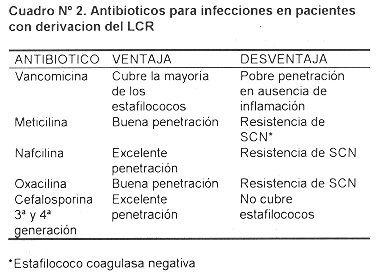
<body><![CDATA[<P><FONT FACE="Arial,Helvetica"><FONT SIZE=-1>El tiempo de inicio de la infecci&oacute;n despu&eacute;s del procedimiento quir&uacute;rgico se ha asociado con el tipo de microorganismo involucrado. Los pacientes infectados por <I>S aureus </I>generalmente tienen un inicio temprano (primeros 15 d&iacute;as postquir&uacute;rgicos) ( <A HREF="#7">7</A>, <A HREF="#16">16</A>, <A HREF="#27">27</A>), mientras que aquellos infectados por estafilococos coagulasa negativa tienen inicio tard&iacute;o (m&aacute;s de 15 d&iacute;as)</FONT></FONT>      <P><FONT FACE="Arial,Helvetica"><FONT SIZE=-1>En los pacientes con D-VA se distinguen tres formas de presentaci&oacute;n de la infecci&oacute;n :1. La sepsis aguda:, se presenta en los 2 a 7 d&iacute;as siguientes a la cirug&iacute;a y se asocia a infecci&oacute;n de la herida quir&uacute;rgica. Existe disfunci&oacute;n valvular, el paciente generalmente se encuentra febril, t&oacute;xico, con anemia, con leucocitosis y desviaci&oacute;n a la izquierda. El hemocultivo es positivo en el 50 a 70% de los casos y el cultivo del LCR es positivo en el 30 % de los casos. El LCR generalmente presenta pleocitosis con predominio de segmentados, hipoglucorraquia y prote&iacute;nas elevadas. 2. La sepsis subaguda:, generalmente se presenta de d&iacute;as a meses despu&eacute;s de la cirug&iacute;a. El paciente tiene un proceso cl&iacute;nico indolente, la fiebre no es alta o puede estar ausente. En el 30-40 % de los casos hay disfunci&oacute;n valvular. El hemocultivo es positivo en el 10 % de los casos y el cultivo del LCR en el 50 %. Las alteraciones del LCR no son llamativas. 3. La infecci&oacute;n inaparente o subicl&iacute;nica:, ocurre de meses a a&ntilde;os despu&eacute;s de la cirug&iacute;a. El LCR es normal y el diagn&oacute;stico generalmente se hace en forma accidental al cultivar el sistema despu&eacute;s de su retiro por disfunci&oacute;n, o porque ya no sea necesaria su permanencia (<A HREF="#30">30-34</A>).</FONT></FONT>      <P><FONT FACE="Arial,Helvetica"><FONT SIZE=-1>En pacientes con D-VP la infecci&oacute;n se divide en temprana si se presenta en los primeros 15 d&iacute;as postoperatorios y en tard&iacute;a si ocurres despu&eacute;s. Los s&iacute;ntomas y signos son generalmente vagos e insidiosos. Hay fiebre, disfunci&oacute;n valvular en el 80-100 % de los casos. Hay v&oacute;mito, nausea e irritabilidad en el 20-30 %. Los signos men&iacute;ngeos no son un hallazgo constante y se presentan en una quinta parte de los casos. Otra quinta parte de los pacientes va a presentar apnea y convulsiones y en el 5 % de los casos va a haber infecci&oacute;n de la herida quir&uacute;rgica o infecci&oacute;n del t&uacute;nel, que consiste en eritema, inflamaci&oacute;n y/ o supuraci&oacute;n de la piel sobre el recorrido del cat&eacute;ter distal o proximal. Otra presentaci&oacute;n cl&iacute;nica en el paciente con D-VP es la peritonitis. Esta puede ser dada por cocos Gram-positivos tipo estafilococos , por siembra al peritoneo y acci&oacute;n de sus toxinas sobre el mismo. Esta modalidad de infecci&oacute;n puede ocurrir de semanas a meses despu&eacute;s de la cirug&iacute;a y las manifestaciones son enteramente abdominales, generalmente sin compromiso neurol&oacute;gico . En estos casos, la punta del cat&eacute;ter distal se puede visualizar libre en la cavidad peritoneal y generalmente no hay formaci&oacute;n de pseudoquiste ni perforaci&oacute;n de v&iacute;scera hueca.</FONT></FONT>      <P><FONT FACE="Arial,Helvetica"><FONT SIZE=-1>La peritonitis secundaria a perforaci&oacute;n de v&iacute;scera hueca se puede presentar de semanas a meses post-cirug&iacute;a. El paciente luce febril, t&oacute;xico, con gran distensi&oacute;n y dolor abdominal. Hay signos men&iacute;ngeos y el LCR muestra gran pleocitosis, elevaci&oacute;n de las prote&iacute;nas y glucosa baja. La mortalidad en estos casos es del 10 al 20 % y el da&ntilde;o permanente al SNC se va a presentar en el 30 % de los sobrevivientes. La infecci&oacute;n generalmente es dada por bacilos conformes Gram-negativos ent&eacute;ricos y en el 12-21 % de los casos la flora es mixta. La infecci&oacute;n del LCR por bacilos conformes Gram-negativos ent&eacute;ricos tambi&eacute;n puede tener como foco de partida el tracto urinario en pacientes con derivaciones ventr&iacute;culo-ureterales o lumbo-ureterales ( <A HREF="#7">7</A>, <A HREF="#16">16</A>, <A HREF="#22">22</A>, <A HREF="#27">27</A>-<A HREF="#29">29</A>, <A HREF="#35">35-39</A>) .</FONT></FONT>      <P><FONT FACE="Arial,Helvetica"><FONT SIZE=-1>La meningitis de origen hemat&oacute;geno en un paciente con derivaci&oacute;n del l&iacute;quido cefalorraqu&iacute;deo tiene un curso similar a la de los pacientes sin derivaci&oacute;n. Los g&eacute;rmenes m&aacute;s frecuentemente implicados son los mismos por edad que los de los pacientes sin derivaciones. La gran mayor&iacute;a de los pacientes va a responder a tratamiento conservador con antibi&oacute;ticos dirigidos, de acuerdo al agente etiol&oacute;gico, sin necesidad alguna de cirgufa. Generalmente no hay disfunci&oacute;n valvular y en la mayor&iacute;a de los pacientes habr&aacute; signos menfngeos. En estos casos el LCR va lvular generalmente presenta las mismas caracter&iacute;sticas que el l&iacute;quido lumbar, a diferencia de los pacientes con infecci&oacute;n relacionada al sistema de derivaci&oacute;n , en los que el LCR valvular o ventricular es anormal y el del espacio lumbar generalmente es normal ( <A HREF="#7">7</A>-<A HREF="#27">27</A> , <A HREF="#40">40-41</A>).</FONT></FONT>     <BR>&nbsp;<FONT FACE="Arial,Helvetica"><FONT SIZE=-1></FONT></FONT>      <P><B><FONT FACE="Arial,Helvetica"><FONT SIZE=-1>Hallazgos del LCR</FONT></FONT></B>     <BR><B><FONT FACE="Arial,Helvetica"><FONT SIZE=-1>&nbsp;</FONT></FONT></B>     <BR><FONT FACE="Arial,Helvetica"><FONT SIZE=-1>El par&aacute;metro m&aacute;s &uacute;til para diferenciar entre infecci&oacute;n y disfunci&oacute;n valvular es el recuento de leucocitos que generalmente es superior a 100 / mm 3 en casos de infecci&oacute;n; el porcentage de neutr&oacute;filos superior al 15 es el otro par&aacute;metro &uacute;til. Los recuentos m&aacute;s altos de leucocitos en el LCR se han observado en pacientes con infecciones por bacilos conformes Gram-negativos El promedio de formas segmentadas usualmente es de 63% (rango de 20-100%). La concentracio&oacute;n promedio de proteina es de 136 mg/dl (rango, 40-375 mg/dl). Los pacientes con hidrocefalia hipertensiva pueden presentar en el LCR leucocitosis y elevaci&oacute;n de las prote&iacute;nas en ausencia de infecci&oacute;n. No se ha visto que la concentraci&oacute;n de proteina sea de utilidad. Se ha encontrado que la hipoglucorraquia se presenta tanto en infecci&oacute;n como en disfunci&oacute;n , por lo que su valor no es de mayor utilidad para diferenciar entre infecci&oacute;n y disfunci&oacute;n sin infecci&oacute;n ( <A HREF="#7">7</A>, <A HREF="#16">16</A>, <A HREF="#24">24</A>,<A HREF="#42"> 42-46</A> ). La eosinofilia tampoco ha sido de ayuda para diferenciar entre infecci&oacute;n y disfunci&oacute;n. El porcentage de eosin&oacute;filos puede estar aumentado en ambos casas. Se ha observado que la eosinofilia puede ser secundaria al efecto de la gentamicina intraventricular y al efecto del &oacute;xido de etileno que se utiliza para esterilizar el material del "shunt" ( <A HREF="#47">47</A> ). <A HREF="#Cuadro1">Cuadro n&deg; 1</A>.</FONT></FONT>      <P><FONT FACE="Arial,Helvetica"><FONT SIZE=-1>&nbsp;<B>Bacteriolog&iacute;a:</B> La bacteriolog&iacute;a del las infecciones del LCR en pacientes con derivaciones del mismo, refleja la flora normal de la piel y del cuero cabelludo del hu&eacute;sped. En una serie de 297 pacientes seguidos por 7 a&ntilde;os, el 75 % de los episodios infecciosos fueron causados por estafilococos coagulasa negativa y <I>S. aureus </I>(<A HREF="#7">7</A>)<I>. </I>Entre los estafilococos predominan los estafilococos coagulasa negativa y se ha visto que de los que producen infecci&oacute;n el 70 % son productores de glicocalix. El 19-22 % de los episodios infecciosos son causados por infecciones por bacilos conformes Gram-negativos que se aislan en cultivo puro o mixto, sobre todo en casos de perforaci&oacute;n de v&iacute;scera hueca por la punta del cat&eacute;ter distal. Otros organismos miscel&aacute;neas tales como enterococos, <I>Bacillus sp,</I> <I>Estreptococos viridans y</I> difteroides pueden coexistir con anaerobios y con bacilos conformes en el 14 % de los pacientes con DVP que presentan infecci&oacute;n del LCR (<A HREF="#17">17-23</A>).</FONT></FONT>      ]]></body>
<body><![CDATA[<P>&nbsp;<FONT FACE="Arial,Helvetica"><FONT SIZE=-1>&nbsp;</FONT></FONT>     <BR><B><FONT FACE="Arial,Helvetica"><FONT SIZE=-1>Diagn&oacute;stico</FONT></FONT></B>     <BR>&nbsp;     <BR><FONT FACE="Arial,Helvetica"><FONT SIZE=-1>Ante la sospecha cl&iacute;nica de una infecci&oacute;n del LCR en un paciente con derivaci&oacute;n, se debe de llegar a un diagn&oacute;stico microbiol&oacute;gico espec&iacute;fico por medio de la tinci&oacute;n de Gram y el cultivo del LCR obtenido del reservorio y de cualquier &aacute;rea con purulencia.&nbsp; Adem&aacute;s, se debe tomar un hemocultivo, principalmente en pacientes con D-VA. La obtenci&oacute;n del LCR debe ser realizada por un neurocirujano o por una persona familiarizada con el procedimiento. Una punci&oacute;n del reservorio o una muestra del LCR a trav&eacute;s del drenaje ventricular externo es esencial para establecer el diagn&oacute;stico de infecci&oacute;n. En el paciente febril, pero con pocas probabilidades de tener infecci&oacute;n asociada a la derivaci&oacute;n, se deben buscar otros focos, sobre todo el tracto urinario, y evitar as&iacute; punciones innecesarias del reservorio y el contaminar la derivaci&oacute;n en el paciente bacter&eacute;mico.</FONT></FONT>      <P><FONT FACE="Arial,Helvetica"><FONT SIZE=-1>Debe afeitarse el cuero cabelludo sobre el reservorio, lavar por tres minutos con clorhexidina y hacer la punci&oacute;n con una aguja N&deg; 21, a la que idealmente se le debe adaptar un raquiman&oacute;metro para medir la presi&oacute;n de apertura y de cierre. En casos de drenaje ventricular externo se debe dejar gotear la muestra en lugar de aspirar para no arrastrar detritos Si s&oacute;lo un mililitro o menos es obtenido, se debe reservrar la muestra para frotis, tinci&oacute;n de Gram y cultivo y dejar de lado la bioqu&iacute;mica. Se debe solicitar que se incube la muestra del LCR por un m&iacute;nimo de 10 d&iacute;as.</FONT></FONT>      <P><FONT FACE="Arial,Helvetica"><FONT SIZE=-1>A todos los pacientes con D-VP. con sitomatolog&iacute;a abdominal se les debe hacer una radiograf&iacute;a simple de abdomen para ubicar la punta del cat&eacute;ter distal y un ultrasonido de abdomen para evidenciar cualquier colecci&oacute;n que pudiera haber. En caso de D-VA, se debe hacer un ecocardiograma buscando vegetaciones.</FONT></FONT>     <BR>&nbsp;     <BR>&nbsp;     <BR><B><FONT FACE="Arial,Helvetica"><FONT SIZE=-1>Manejo</FONT></FONT></B>     <BR><B><FONT FACE="Arial,Helvetica"><FONT SIZE=-1>&nbsp;</FONT></FONT></B>     ]]></body>
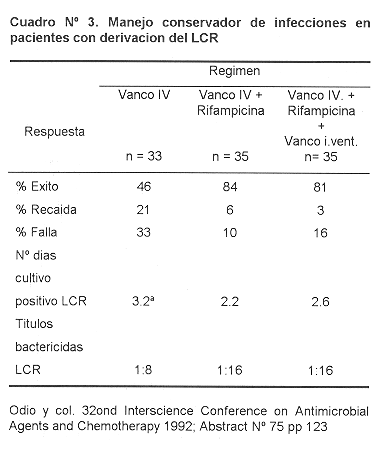
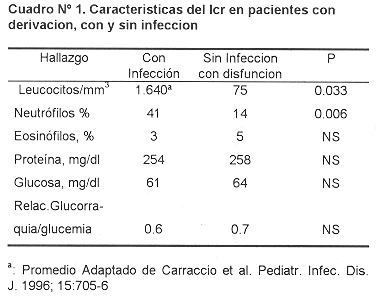
<body><![CDATA[<BR><FONT FACE="Arial,Helvetica"><FONT SIZE=-1>Una vez definida la infecci&oacute;n por criterios cl&iacute;nicos y microbiol&oacute;gicos se debe de iniciar el tratamiento antibi&oacute;tico y decidir el tipo de manejo neuroquir&uacute;rgico que se le dar&aacute; al paciente.</FONT></FONT>      <P><FONT FACE="Arial,Helvetica"><FONT SIZE=-1><B>Quir&uacute;rgico:</B> El m&aacute;s agresivo es el retiro total o parcial del sistema con colocaci&oacute;n de drenaje ventricular externo o exteriorizaci&oacute;n del sistema a un sistema cerrado y una vez esterilizado el LCR, hacer un reemplazo. Se ha asociado a un 94 % de cura en una serie de estudios revisados ( <A HREF="#7">7</A>, <A HREF="#8">8</A>, <A HREF="#22">22</A>, <A HREF="#37">37</A>, <A HREF="#49">49-54</A> ). La segunda modalidad es el reemplazo inmediato en el lado contralateral. Se ha asociado a un 71 % de curaci&oacute;n en el 85 % de los estudios revisados ( <A HREF="#22">22</A>, <A HREF="#48">48-49</A>, <A HREF="#51">51-53</A>, <A HREF="#55">55</A> ). La desventaja de esta modalidad es que si a&uacute;n hay bacterias circulantes en el LCR, &eacute;stas colonizar&aacute;n el sistema y posteriormente causar&aacute;n una recaida. Estas dos modalidades est&aacute;n indicadas en caso de infecci&oacute;n de la herida quir&uacute;rgica, en caso de exposici&oacute;n del sistema en cualquiera de sus partes, en caso de infecci&oacute;n del t&uacute;nel, en caso de infecci&oacute;n por bacilos conformes Gram-negativos, en caso de hongos, de <I>Bacillus sp,</I> en caso de peritonitis con o sin perforaci&oacute;n de v&iacute;scera hueca, y en caso de pacientes con D-VA.</FONT></FONT>      <P><FONT FACE="Arial,Helvetica"><FONT SIZE=-1><B>Antibi&oacute;tico:</B> El tratamiento antibi&oacute;tico se debe instituir apenas se tome la muestra de LCR. Existen varias opciones terap&eacute;uticas dependiendo de su actividad contra los g&eacute;rmenes m&aacute;s frecuentemente implicados y de su penetraci&oacute;n al sistema nervioso central. <A HREF="#Cuadro2">Cuadro N&deg; 2</A>.</FONT></FONT>      <P><FONT FACE="Arial,Helvetica"><FONT SIZE=-1>La vancomicina tiene la ventaja de cubrir la gran mayor&iacute;a de los est&aacute;filococos. El inconveniente es su pobre difusi&oacute;n a trav&eacute;s de la barrrera hematoencef&aacute;lica con poca reacci&oacute;n inflamatoria, como es el caso en este tipo de infecciones (<A HREF="#56">56-58</A>). Las penicilinas antiestafiloc&oacute;cicas, sobre todo la nafcilina penetran bien la barrera hematoencef&aacute;lica, pero tienen el inconveniente de que del 60 al 80 % de los estafilococos coagulana negativa, y el 13 al 25 % de los <I>S aureus </I>son resistentes. Las cefalosporinas de tercera y cuarta generaci&oacute;n tienen buena penetraci&oacute;n, pero no son drogas adecuadas para infecciones por estafilococos; se reservan para infecciones por bacilos conformes Gram-negativos al igual que los aminogluc&oacute;sidos. En caso de infecci&oacute;n por estos g&eacute;rmenes es preferible utilizar las cefalosporinas por el riesgo de nefrotoxicidad que aumenta significativamente a partir del 7&deg; d&iacute;a con aminogluc&oacute;sidos; se sabe que la duraci&oacute;n del tratamiento en estos casos rara vez es inferior a los 21 d&iacute;as.</FONT></FONT>      <P><FONT FACE="Arial,Helvetica"><FONT SIZE=-1>En t&eacute;rminos generales, la terapia emp&iacute;rica inicial recomendada es una penicilina antiestafiloc&oacute;cica y ceftazidima para cubrir tanto estafilococos como bacilos coliformes Gram-negativos ent&eacute;ricos y no ent&eacute;ricos. Esto, si el paciente no luce s&eacute;ptico y no est&aacute; cr&iacute;ticamente enfermo. Si lo estuviera, es preferible inicir la cobertura contra cocos Gram-positivcos con vancomicina y una vez determinada la susceptibilidad del estafilococo, substituir la vancomicina por una penicilina antiestafiloc&oacute;cica tipo oxacilina, meticilina o nafcilina. En caso de infecci&oacute;n por estafilococos, algunos expertos recomiendan la adici&oacute;n de rifampicina por su efecto sinergista con la vancomicina y las penicilinas antiestafiloc&oacute;cicas. La duraci&oacute;n recomendada para infecci&oacute;n por est&aacute;filococos es de 15 d&iacute;as a partir del primer LCR est&eacute;ril y de 17 a 21 d&iacute;as para bacilos conformes Gram-negativos.</FONT></FONT>      <P><FONT FACE="Arial,Helvetica"><FONT SIZE=-1>La administraci&oacute;n concomitante de antibi&oacute;ticos instilados en el ventriculo a trav&eacute;s del reservorio o de un cateter con ventriculostom&iacute;a, no est&aacute; indicada rutinariamente. Esta medida debe reservarse para casos intratables con terapia intravenosa, cuando los cultivos de LCR persisten positivos m&aacute;s all&aacute; de 7 d&iacute;as de tratamiento. Se han utilizado la vancomicina, la gentamicina, la amikacina, la cefazolina, y la cefalotina (<A HREF="#16">16</A>). Con las nuevas cefalosporinas, la experiencia es limitada. Esta modalidad tiene la ventaja de que se alcanzan concentraciones muy altas del f&aacute;rmaco en el ventriculo. La principal desventaja es su neurotoxicidad, dada generalmente por el preservante del antibi&oacute;tico. Existe disparidad de opiniones con respecto a la dosis ideal, adem&aacute;s, el tratamiento se dificulta por la necesidad de estar monitorizando la concentraci&oacute;n de la droga en el LCR ventricular. Un estudio llevado a cabo en el Hospital Nacional de Ni&ntilde;os con infecci&oacute;n por estafilococos, sin infecci&oacute;n de tejidos blandos, sin exposici&oacute;n del sistema y sin peritonitis, compar&oacute; vancomicina intravenosa, versus vancomicina intravenosa m&aacute;s rifampicina oral, verus vancomicina intravenosa m&aacute;s rifampicina oral, m&aacute;s vancomicina intrarreservorio, sin retirar el sistema ( <A HREF="#59">59</A>). El porcentaje de &eacute;xito en los que recibieron terapia combinada fue de 84 y 81 sin que hubiera diferencia estad&iacute;sticamente significativa. En los que recibieron vancomicina sola fue s&oacute;lo de 46 (p&lt; 0.05). El n&uacute;mero de d&iacute;as con cultivo positivo del LCR fue menor en los que recibieron terapia combinada y los t&iacute;tulos bactericidas en el LCR fueron mayores.,<A HREF="#Cuadro3">Cuadro. N&deg; 3</A>.</FONT></FONT>     <BR>&nbsp;     <BR>&nbsp;     <BR><B><FONT FACE="Arial,Helvetica"><FONT SIZE=-1>Prevenci&oacute;n</FONT></FONT></B>     <BR>&nbsp;     ]]></body>
<body><![CDATA[<BR><FONT FACE="Arial,Helvetica"><FONT SIZE=-1><B>Profilaxis antibi&oacute;tica:</B>&nbsp; Existen muchos estudios encaminados a determinar si el uso profil&aacute;ctico de antibi&oacute;ticos, administrados perioperativamente disminuye la incidencia de las infecciones. Las drogas m&aacute;s utilizadas han sido el Trimetroprim/Sulfametoxazole, la nafcilina, la oxacilina, la meticilina y la vancomicina. El TMP/SMX tiene excelente penetraci&oacute;n al LCR a&uacute;n en ausencia de inflamaci&oacute;n . La desventaja es la alta resistencia de los estafilococos coagulasa.-negativa, tal y como lo demostr&oacute; el estudio de Wang y col (<A HREF="#60">60</A>) . La nafcilina es la penicilina antiestafiloc&oacute;cica que mejor difunde al SNC en ausencia de inflamaci&oacute;n men&iacute;ngea. Con esta droga, al igual que con todas la penicilinas antiestafiloc&aacute;cicas, el inconveniente es la alta resistencia reportada de los estafilococos coagulasa- negativa (60-70 %) y de los <I>S aureus</I> (15-30 % ). La vancomicina es activa contra la mayor&iacute;a de los estafilococos pero tiene el inconveniente de penetrar pobremente a trav&eacute;s de meninges no inflamadas y de presentar interacciones con los anest&eacute;sicos ( <A HREF="#61">61</A>). En el metaan&aacute;lisis de Langley y colaboradores ( <A HREF="#62">62</A>), se analizaron 12 estudios prospectivos utilizando diferentes modalidades de beta-lact&aacute;micos; TMPISMZ y vancomicina. El de vancornicina hubo de suspenderse por la alta incidencia de efectos adversos asociados a su administraci&oacute;n incluyendo un caso de shock anafilactoide ( <A HREF="#59">59</A>, <A HREF="#63">63-66</A>,<A HREF="#60">60</A>, <A HREF="#68">68-71</A> ). En cada uno de los estudios analizados el riesgo relativo promedio de infecci&oacute;n estuvo por debajo de uno, sugiriendo beneficio del uso profil&aacute;ctico de antibi&oacute;ticos. El estudio en el que se obtuvieron mejores resultados fue el de Ram Yoguev ( <A HREF="#65">65</A> ) quien utiliz&oacute; nafcilina sola, o nafcilina m&aacute;s rifampicina versus placebo. Hubo un n&uacute;mero significativamente menor de infecciones tempranas en el grupo de antibi&aacute;ticos versus placebo; el efecto protector se limit&oacute; a la prevenci&oacute;n de la infecci&oacute;n temprana, no previno la tard&iacute;a.</FONT></FONT>      <P><FONT FACE="Arial,Helvetica"><FONT SIZE=-1><B>Enfoque de equipo:</B> El enfoque hol&iacute;stico del equipo para la prevenci&oacute;n de las infecciones asociadas a dervaciones del LCR es el que mejores resultados ha obtenido. Este incluye una evaluaci&oacute;n cuidadosa de la integridad de la piel y del cuero cabelludo, que incluye no afeitar ni colocar v&iacute;as en las &aacute;reas sobre o bajo las cuales se vaya a hacer el procedimineto quir&uacute;rgico. El paciente idealmente debe programarse a primera hora de la ma&ntilde;ana, deben de operarse de primero los neonatos. Se recomienda no colocar derivaciones a m&aacute;s de 4 pacientes en un d&iacute;a, que la cirug&iacute;a no se prolongue m&aacute;s all&aacute; de 20 minutos, y que no haya m&aacute;s de 4 personas en la sala de operaciones. El material de la derivaci&oacute;n debe abrirse inmediatamente antes de su colocaci&oacute;n, la permeabilidad de la v&aacute;lvula no se debe probar antes de su colocaci&oacute;n. Se recomienda no practicar m&aacute;s de dos incisiones en la piel. Se deben manejar todos los materiales de la derivaci&oacute;n con instrumentos. La tasa de infecci&oacute;n se ha visto reducida cuando se utilizan derivaciones impregnadas de antibi&oacute;ticos. ( <A HREF="#72">72</A> ).</FONT></FONT>      <P><FONT FACE="Arial,Helvetica"><FONT SIZE=-1>En resumen, la medida m&aacute;s importante en la prevenci&oacute;n de estas infecciones es la adherencia estricta a la t&eacute;cnica as&eacute;ptica tanto antes, como durante y despu&eacute;s del acto quir&uacute;rgico.</FONT></FONT>     <BR>&nbsp;     <BR>&nbsp;     <BR><B><FONT FACE="Arial,Helvetica"><FONT SIZE=-1>Conclusiones</FONT></FONT></B>     <BR>&nbsp;     <BR><FONT FACE="Arial,Helvetica"><FONT SIZE=-1>Se debe sospechar una infecci&oacute;n asociada a una derivaci&oacute;n del LCR en ni&ntilde;os con cirug&iacute;a previa, que se presenten con fiebre, alteraciones neurol&oacute;gicas, irritabilidad y/o evidencia de disfunci&oacute;n de la derivaci&oacute;n. El an&aacute;lisis y el cultivo del LCR del reservorio son esenciales para el diagn&oacute;stico. La terapia antibi&oacute;tico emp&iacute;rica debe inclu&iacute;r una penicilina antiestafiloc&oacute;cia y una cefalosporina de tercera o cuarta generaci&oacute;n que tenga actividad contra P <I>aeruginosa. </I>Si el germen aislado fuera un bacilo conforme Gram-negativo u hongo, o hubiera infecci&oacute;n de t&uacute;nel o exposici&oacute;n del sistema, &eacute;ste deber&aacute; ser retirado con colocaci&oacute;n de drenaje ventricular externo. La profilaxis con nafcilina, o naficilina m&aacute;s rifampicina 6 ( nafcilina ) o 12 ( rifampicina ) horas antes de la cirug&iacute;a puede reducir la incidencia de la infecci&oacute;n temprana. La t&eacute;cnica as&eacute;ptica estricta antes, durante y despu&eacute;s del procedimiento quir&uacute;rgico y el manejo en equipo de estos pacientes son los m&eacute;todos m&aacute;s importantes para prevenir las infecciones.</FONT></FONT>     <BR>&nbsp;     <BR>&nbsp;     ]]></body>
<body><![CDATA[<BR><B><FONT FACE="Arial,Helvetica"><FONT SIZE=-1>Bibliograf&iacute;a</FONT></FONT></B>     <!-- ref --><CENTER><B><FONT FACE="Arial,Helvetica"><FONT SIZE=-1>&nbsp;</FONT></FONT></B></CENTER> <A NAME="1"></A><FONT FACE="Arial,Helvetica"><FONT SIZE=-1>1.&nbsp; Moss A, Hamburger S, Moore R, et al. Use of selected medical device implants in the United States. 1988 Hyattsville. Maryland : National Center for Health Statistics. 1990 )Vital and health statistics: No 191).</FONT></FONT>    &nbsp;&nbsp;&nbsp;&nbsp;&nbsp;&nbsp;&nbsp;&nbsp;[&#160;<a href="javascript:void(0);" onclick="javascript: window.open('/scielo.php?script=sci_nlinks&ref=101953&pid=S1409-0090200100010000300001&lng=','','width=640,height=500,resizable=yes,scrollbars=1,menubar=yes,');">Links</a>&#160;]<!-- end-ref --><!-- ref --><P><A NAME="2"></A><FONT FACE="Arial,Helvetica"><FONT SIZE=-1>2.&nbsp; Gardner P, Leipzig TJ, Sadigh M. lnfections of mechanical cerebrospinal fluid shuts. Curr Clin Top lnfect Dis, 1988;19:185-214.</FONT></FONT>    &nbsp;&nbsp;&nbsp;&nbsp;&nbsp;&nbsp;&nbsp;&nbsp;[&#160;<a href="javascript:void(0);" onclick="javascript: window.open('/scielo.php?script=sci_nlinks&ref=101954&pid=S1409-0090200100010000300002&lng=','','width=640,height=500,resizable=yes,scrollbars=1,menubar=yes,');">Links</a>&#160;]<!-- end-ref --><!-- ref --><P><A NAME="3"></A><FONT FACE="Arial,Helvetica"><FONT SIZE=-1>3.&nbsp; Schoembaum SC, Gardner P, Shillito J. Infections of cerebrospinal fluid shunts epidemiology, clinical manifestations and therapy. J lnfect Dis, 1975;131:543-52</FONT></FONT>    &nbsp;&nbsp;&nbsp;&nbsp;&nbsp;&nbsp;&nbsp;&nbsp;[&#160;<a href="javascript:void(0);" onclick="javascript: window.open('/scielo.php?script=sci_nlinks&ref=101955&pid=S1409-0090200100010000300003&lng=','','width=640,height=500,resizable=yes,scrollbars=1,menubar=yes,');">Links</a>&#160;]<!-- end-ref --><!-- ref --><P><A NAME="4"></A><FONT FACE="Arial,Helvetica"><FONT SIZE=-1>4.&nbsp; Walters BC, Hoffman HJ, Hendrick EB, Humphreys RP. Cerebrospinal fluid shunt infection. lnfluences on management and subsequest outcome, Neurosurg, 1984; 60:1014-21.</FONT></FONT>    &nbsp;&nbsp;&nbsp;&nbsp;&nbsp;&nbsp;&nbsp;&nbsp;[&#160;<a href="javascript:void(0);" onclick="javascript: window.open('/scielo.php?script=sci_nlinks&ref=101956&pid=S1409-0090200100010000300004&lng=','','width=640,height=500,resizable=yes,scrollbars=1,menubar=yes,');">Links</a>&#160;]<!-- end-ref --><!-- ref --><P><A NAME="5"></A><FONT FACE="Arial,Helvetica"><FONT SIZE=-1>5.&nbsp; Chadduck W, Adametz J. Incidence of seizures in patients with myelomeningocele: a mustifactorial analysis. Surg Neurol, 1988; 30:281-5.</FONT></FONT>    &nbsp;&nbsp;&nbsp;&nbsp;&nbsp;&nbsp;&nbsp;&nbsp;[&#160;<a href="javascript:void(0);" onclick="javascript: window.open('/scielo.php?script=sci_nlinks&ref=101957&pid=S1409-0090200100010000300005&lng=','','width=640,height=500,resizable=yes,scrollbars=1,menubar=yes,');">Links</a>&#160;]<!-- end-ref --><!-- ref --><P><A NAME="6"></A><FONT FACE="Arial,Helvetica"><FONT SIZE=-1>6.&nbsp; McLone DG, Gzyewski D, Raimondi J, Sommers RC. Central Nervous system infections as a limiting factor in the intelligence of children with myelomeningocele. Pediatrics, 1982;70:338-42.</FONT></FONT>    &nbsp;&nbsp;&nbsp;&nbsp;&nbsp;&nbsp;&nbsp;&nbsp;[&#160;<a href="javascript:void(0);" onclick="javascript: window.open('/scielo.php?script=sci_nlinks&ref=101958&pid=S1409-0090200100010000300006&lng=','','width=640,height=500,resizable=yes,scrollbars=1,menubar=yes,');">Links</a>&#160;]<!-- end-ref --><!-- ref --><P><A NAME="7"></A><FONT FACE="Arial,Helvetica"><FONT SIZE=-1>7.&nbsp; Odio C, GH McCracken , Jr,. and JD Nelson CSF shunt infections in pediatrics . A seven year experience. Am J Dis Child, 1984; 138:1103-08.</FONT></FONT>    &nbsp;&nbsp;&nbsp;&nbsp;&nbsp;&nbsp;&nbsp;&nbsp;[&#160;<a href="javascript:void(0);" onclick="javascript: window.open('/scielo.php?script=sci_nlinks&ref=101959&pid=S1409-0090200100010000300007&lng=','','width=640,height=500,resizable=yes,scrollbars=1,menubar=yes,');">Links</a>&#160;]<!-- end-ref --><!-- ref --><P><A NAME="8"></A><FONT FACE="Arial,Helvetica"><FONT SIZE=-1>8.&nbsp; James HE, JW Walsh, HD Wiison, JD Connor, . Management of cerebrospinal fluid shunt infections: a clinical experience. Monogr. Neurol Sci .1984; 8:75-7</FONT></FONT>    &nbsp;&nbsp;&nbsp;&nbsp;&nbsp;&nbsp;&nbsp;&nbsp;[&#160;<a href="javascript:void(0);" onclick="javascript: window.open('/scielo.php?script=sci_nlinks&ref=101960&pid=S1409-0090200100010000300008&lng=','','width=640,height=500,resizable=yes,scrollbars=1,menubar=yes,');">Links</a>&#160;]<!-- end-ref --><!-- ref --><P><A NAME="9"></A><FONT FACE="Arial,Helvetica"><FONT SIZE=-1>9.&nbsp; Mates S, J Glaser and K Shapiro. Treatment of cerebrospinal fluid shunt infections with medical therapy alone. Neurosurgery, 1982; 11:781-83.</FONT></FONT>    &nbsp;&nbsp;&nbsp;&nbsp;&nbsp;&nbsp;&nbsp;&nbsp;[&#160;<a href="javascript:void(0);" onclick="javascript: window.open('/scielo.php?script=sci_nlinks&ref=101961&pid=S1409-0090200100010000300009&lng=','','width=640,height=500,resizable=yes,scrollbars=1,menubar=yes,');">Links</a>&#160;]<!-- end-ref --><!-- ref --><P><A NAME="10"></A><FONT FACE="Arial,Helvetica"><FONT SIZE=-1>10. Choux M, L Genitori, D Lang, and G Lena. Shunt implantation: reducing the incidence of shunt infection. J Neurosurgery, 1992; 77:875-80.</FONT></FONT>    &nbsp;&nbsp;&nbsp;&nbsp;&nbsp;&nbsp;&nbsp;&nbsp;[&#160;<a href="javascript:void(0);" onclick="javascript: window.open('/scielo.php?script=sci_nlinks&ref=101962&pid=S1409-0090200100010000300010&lng=','','width=640,height=500,resizable=yes,scrollbars=1,menubar=yes,');">Links</a>&#160;]<!-- end-ref --><!-- ref --><P><A NAME="11"></A><FONT FACE="Arial,Helvetica"><FONT SIZE=-1>11. Erashin Y, DG McLone BBStorrs and R Yoguev, Review of 3,017 procedures for the managemente of hydrocephalus in children. Concepts Pediatr Neurosurg,1986; 9:21-8.</FONT></FONT>    &nbsp;&nbsp;&nbsp;&nbsp;&nbsp;&nbsp;&nbsp;&nbsp;[&#160;<a href="javascript:void(0);" onclick="javascript: window.open('/scielo.php?script=sci_nlinks&ref=101963&pid=S1409-0090200100010000300011&lng=','','width=640,height=500,resizable=yes,scrollbars=1,menubar=yes,');">Links</a>&#160;]<!-- end-ref --><!-- ref --><P><A NAME="12"></A><FONT FACE="Arial,Helvetica"><FONT SIZE=-1>12. Renier D, J Lacombe, A Pierre-kahn , C Sainte-Rose, and JF Hirsch. 1984. Factors causing acute shunt infection-computer analysis of 1, 174 operations. J Neurosurg,1984; 61:1072-1078.</FONT></FONT>    &nbsp;&nbsp;&nbsp;&nbsp;&nbsp;&nbsp;&nbsp;&nbsp;[&#160;<a href="javascript:void(0);" onclick="javascript: window.open('/scielo.php?script=sci_nlinks&ref=101964&pid=S1409-0090200100010000300012&lng=','','width=640,height=500,resizable=yes,scrollbars=1,menubar=yes,');">Links</a>&#160;]<!-- end-ref --><!-- ref --><P><A NAME="13"></A><FONT FACE="Arial,Helvetica"><FONT SIZE=-1>13. Yogev R. 1985. Cerebrospinal fluid shunt infection. : a personal view, Pediatr lnfect Dis J, 1985; 4:113-18.</FONT></FONT>    &nbsp;&nbsp;&nbsp;&nbsp;&nbsp;&nbsp;&nbsp;&nbsp;[&#160;<a href="javascript:void(0);" onclick="javascript: window.open('/scielo.php?script=sci_nlinks&ref=101965&pid=S1409-0090200100010000300013&lng=','','width=640,height=500,resizable=yes,scrollbars=1,menubar=yes,');">Links</a>&#160;]<!-- end-ref --><!-- ref --><P><A NAME="14"></A><FONT FACE="Arial,Helvetica"><FONT SIZE=-1>14. Schimke RT, Ph Black, VH Marck, and MN Swartz. 1961. lndolent Staphylococcus albus or aureus bacteremia after ventriculoantriostomy: role of foreign body in its initiation and perpetuation. N Engl J Med, 1961;264:264-70.</FONT></FONT>    &nbsp;&nbsp;&nbsp;&nbsp;&nbsp;&nbsp;&nbsp;&nbsp;[&#160;<a href="javascript:void(0);" onclick="javascript: window.open('/scielo.php?script=sci_nlinks&ref=101966&pid=S1409-0090200100010000300014&lng=','','width=640,height=500,resizable=yes,scrollbars=1,menubar=yes,');">Links</a>&#160;]<!-- end-ref --><!-- ref --><P><A NAME="15"></A><FONT FACE="Arial,Helvetica"><FONT SIZE=-1>15. James HE. 1984. lnfections associated with cerebrospinal fluid prosthetic devices, P.23-41. In B Sugsarman and E J. Young (ed) lnfections associated with Prosthetic Devices, CRC Press, lnc, Boca Raton Fla</FONT></FONT>    &nbsp;&nbsp;&nbsp;&nbsp;&nbsp;&nbsp;&nbsp;&nbsp;[&#160;<a href="javascript:void(0);" onclick="javascript: window.open('/scielo.php?script=sci_nlinks&ref=101967&pid=S1409-0090200100010000300015&lng=','','width=640,height=500,resizable=yes,scrollbars=1,menubar=yes,');">Links</a>&#160;]<!-- end-ref --><!-- ref --><P><A NAME="16"></A><FONT FACE="Arial,Helvetica"><FONT SIZE=-1>16. George R, L Leibrock and M Epstein. 1979. Long-term analysis of cerebrospinal fluid shunt infections: a 25 years experience. J Neurosurg, 1 979; 51:804-11.</FONT></FONT>    &nbsp;&nbsp;&nbsp;&nbsp;&nbsp;&nbsp;&nbsp;&nbsp;[&#160;<a href="javascript:void(0);" onclick="javascript: window.open('/scielo.php?script=sci_nlinks&ref=101968&pid=S1409-0090200100010000300016&lng=','','width=640,height=500,resizable=yes,scrollbars=1,menubar=yes,');">Links</a>&#160;]<!-- end-ref --><!-- ref --><P><A NAME="17"></A><FONT FACE="Arial,Helvetica"><FONT SIZE=-1>17. Bisno AL, and Sternau L. Infections of Central Nervous System Shunts. In: Infections with Indwelling Medical Devices, 2ond ed , Edited by Alan L Bisno and Francis A Waldvogel . 1994 pp 91-109.</FONT></FONT>    &nbsp;&nbsp;&nbsp;&nbsp;&nbsp;&nbsp;&nbsp;&nbsp;[&#160;<a href="javascript:void(0);" onclick="javascript: window.open('/scielo.php?script=sci_nlinks&ref=101969&pid=S1409-0090200100010000300017&lng=','','width=640,height=500,resizable=yes,scrollbars=1,menubar=yes,');">Links</a>&#160;]<!-- end-ref --><!-- ref --><P><A NAME="18"></A><FONT FACE="Arial,Helvetica"><FONT SIZE=-1>18. Ammirati M, and AJ Raimongi 1987. Cerebrospinal fluid shunt infections in children. Child's Nerv Syst, 1987; 3:106-1 09.</FONT></FONT>    &nbsp;&nbsp;&nbsp;&nbsp;&nbsp;&nbsp;&nbsp;&nbsp;[&#160;<a href="javascript:void(0);" onclick="javascript: window.open('/scielo.php?script=sci_nlinks&ref=101970&pid=S1409-0090200100010000300018&lng=','','width=640,height=500,resizable=yes,scrollbars=1,menubar=yes,');">Links</a>&#160;]<!-- end-ref --><!-- ref --><P><A NAME="19"></A><FONT FACE="Arial,Helvetica"><FONT SIZE=-1>19. Caliaghan RP, SJ Cohen and GT Stewart 1961. Septicemia due to colonization of Spitz-Holter valves by staphylococci: five cases treated with methicillin. Br Med J , 1961; 5229:860-63.</FONT></FONT>    &nbsp;&nbsp;&nbsp;&nbsp;&nbsp;&nbsp;&nbsp;&nbsp;[&#160;<a href="javascript:void(0);" onclick="javascript: window.open('/scielo.php?script=sci_nlinks&ref=101971&pid=S1409-0090200100010000300019&lng=','','width=640,height=500,resizable=yes,scrollbars=1,menubar=yes,');">Links</a>&#160;]<!-- end-ref --><!-- ref --><P><A NAME="20"></A><FONT FACE="Arial,Helvetica"><FONT SIZE=-1>20. Diaz-Mitoma F, GK Hardin, DJ Hoban, RS Roberts, and DE Low. 1987. Clinical significance of a test for slime production in ventriculoperitoneal shunt infections caused by coagulase-negatvie staphylococci. J lnfect Dis, 1987; 156:555-560.</FONT></FONT>    &nbsp;&nbsp;&nbsp;&nbsp;&nbsp;&nbsp;&nbsp;&nbsp;[&#160;<a href="javascript:void(0);" onclick="javascript: window.open('/scielo.php?script=sci_nlinks&ref=101972&pid=S1409-0090200100010000300020&lng=','','width=640,height=500,resizable=yes,scrollbars=1,menubar=yes,');">Links</a>&#160;]<!-- end-ref --><!-- ref --><P><A NAME="21"></A><FONT FACE="Arial,Helvetica"><FONT SIZE=-1>21. 20 Ignelzi r, and WM Kirsch.1975. Follow-up analysis of ventriculoperitoneal and ventriculoatrial shunts fro hydrocephalus. J Neurosurg, 1975; 42:679-82.</FONT></FONT>    &nbsp;&nbsp;&nbsp;&nbsp;&nbsp;&nbsp;&nbsp;&nbsp;[&#160;<a href="javascript:void(0);" onclick="javascript: window.open('/scielo.php?script=sci_nlinks&ref=101973&pid=S1409-0090200100010000300021&lng=','','width=640,height=500,resizable=yes,scrollbars=1,menubar=yes,');">Links</a>&#160;]<!-- end-ref --><!-- ref --><P><A NAME="22"></A><FONT FACE="Arial,Helvetica"><FONT SIZE=-1>22. Parry SW, JF Schuhmacker and RC Liewellyn. 1975. Abdominal pseudocysts and ascitis formation after ventriculoperitoneal shunt procedures. Report of four cases. J Neurosurg, 1975; 43:476-80.</FONT></FONT>    &nbsp;&nbsp;&nbsp;&nbsp;&nbsp;&nbsp;&nbsp;&nbsp;[&#160;<a href="javascript:void(0);" onclick="javascript: window.open('/scielo.php?script=sci_nlinks&ref=101974&pid=S1409-0090200100010000300022&lng=','','width=640,height=500,resizable=yes,scrollbars=1,menubar=yes,');">Links</a>&#160;]<!-- end-ref --><!-- ref --><P><A NAME="23"></A><FONT FACE="Arial,Helvetica"><FONT SIZE=-1>23. Sells CJ, DB Shurtleff, and JD Loeser. 1977. Gram-negqative cerebrospinal fluid shunt-associated infections. Pediatrics, 1977; 59:614-18.</FONT></FONT>    &nbsp;&nbsp;&nbsp;&nbsp;&nbsp;&nbsp;&nbsp;&nbsp;[&#160;<a href="javascript:void(0);" onclick="javascript: window.open('/scielo.php?script=sci_nlinks&ref=101975&pid=S1409-0090200100010000300023&lng=','','width=640,height=500,resizable=yes,scrollbars=1,menubar=yes,');">Links</a>&#160;]<!-- end-ref --><!-- ref --><P><A NAME="24"></A><FONT FACE="Arial,Helvetica"><FONT SIZE=-1>24. Shapiro S, J Boaz, M Kleiman J, Kaisbeck, and J Mealey. 1988. Origin of organisms infecting ventricular shunts. Neurosurgery, 1988; 22:868-72.</FONT></FONT>    &nbsp;&nbsp;&nbsp;&nbsp;&nbsp;&nbsp;&nbsp;&nbsp;[&#160;<a href="javascript:void(0);" onclick="javascript: window.open('/scielo.php?script=sci_nlinks&ref=101976&pid=S1409-0090200100010000300024&lng=','','width=640,height=500,resizable=yes,scrollbars=1,menubar=yes,');">Links</a>&#160;]<!-- end-ref --><P><A NAME="25"></A><FONT FACE="Arial,Helvetica"><FONT SIZE=-1>25. Ronan A, Geoffrey G, Hogg and Geoffrey L. Klug. 1995. Cerebrospinal fluid shunt infections in children. Pediatr lnfect Dis J, 1995; 14:782-6.</FONT></FONT>      <!-- ref --><P><A NAME="26"></A><FONT FACE="Arial,Helvetica"><FONT SIZE=-1>26. SelLs Cj, Shurtleff DB, and Loesser JD. Gramnegative cerebrospinal fluid shunt associated infections . Pediatrics, 1977; 50:614-8.</FONT></FONT>    &nbsp;&nbsp;&nbsp;&nbsp;&nbsp;&nbsp;&nbsp;&nbsp;[&#160;<a href="javascript:void(0);" onclick="javascript: window.open('/scielo.php?script=sci_nlinks&ref=101978&pid=S1409-0090200100010000300026&lng=','','width=640,height=500,resizable=yes,scrollbars=1,menubar=yes,');">Links</a>&#160;]<!-- end-ref --><!-- ref --><P><A NAME="27"></A><FONT FACE="Arial,Helvetica"><FONT SIZE=-1>27. Christensen GD, Baddour LM, Hasty DL, Lowrance JH, Simpson WA. Microbial and foreign body factros in the pathogenesis of medical device infentions, In Bisno Al, Waldvogel FA, eds. Infections associated with indweiling medical devices. Washington DC, American Society for Microbiology, 1989:27-59.</FONT></FONT>    &nbsp;&nbsp;&nbsp;&nbsp;&nbsp;&nbsp;&nbsp;&nbsp;[&#160;<a href="javascript:void(0);" onclick="javascript: window.open('/scielo.php?script=sci_nlinks&ref=101979&pid=S1409-0090200100010000300027&lng=','','width=640,height=500,resizable=yes,scrollbars=1,menubar=yes,');">Links</a>&#160;]<!-- end-ref --><!-- ref --><P><A NAME="28"></A><FONT FACE="Arial,Helvetica"><FONT SIZE=-1>28. Odio CM. lnfections associated with cerebrospinal fluid shunt catheters. In Donowitz L (ed): Hospital Acquired lnfection in the Pediatric Patient. Williams and Wiikins 1988; 99:103-108.</FONT></FONT>    &nbsp;&nbsp;&nbsp;&nbsp;&nbsp;&nbsp;&nbsp;&nbsp;[&#160;<a href="javascript:void(0);" onclick="javascript: window.open('/scielo.php?script=sci_nlinks&ref=101980&pid=S1409-0090200100010000300028&lng=','','width=640,height=500,resizable=yes,scrollbars=1,menubar=yes,');">Links</a>&#160;]<!-- end-ref --><!-- ref --><P><A NAME="29"></A><FONT FACE="Arial,Helvetica"><FONT SIZE=-1>29. Hubschmann OR, Countee RW: Acute abdomen in children with infected ventriculoperitoneal shunts. Arch Surg, 1980; 115:305-7</FONT></FONT>    &nbsp;&nbsp;&nbsp;&nbsp;&nbsp;&nbsp;&nbsp;&nbsp;[&#160;<a href="javascript:void(0);" onclick="javascript: window.open('/scielo.php?script=sci_nlinks&ref=101981&pid=S1409-0090200100010000300029&lng=','','width=640,height=500,resizable=yes,scrollbars=1,menubar=yes,');">Links</a>&#160;]<!-- end-ref --><!-- ref --><P><A NAME="30"></A><FONT FACE="Arial,Helvetica"><FONT SIZE=-1>30. Hubschmann OR, Countee RW, Loeser JD: Gram-negative cerebrosppinal fluid shunt associated infections. Pediatrics, 1980; 59:6141 8.</FONT></FONT>    &nbsp;&nbsp;&nbsp;&nbsp;&nbsp;&nbsp;&nbsp;&nbsp;[&#160;<a href="javascript:void(0);" onclick="javascript: window.open('/scielo.php?script=sci_nlinks&ref=101982&pid=S1409-0090200100010000300030&lng=','','width=640,height=500,resizable=yes,scrollbars=1,menubar=yes,');">Links</a>&#160;]<!-- end-ref --><!-- ref --><P><A NAME="31"></A><FONT FACE="Arial,Helvetica"><FONT SIZE=-1>31. Anderson FM: Ventriculocardic shunts. ldentification and control of practical problems in 143 cases. 1973,J Pediatr, 1973; 82: 222-27.</FONT></FONT>    &nbsp;&nbsp;&nbsp;&nbsp;&nbsp;&nbsp;&nbsp;&nbsp;[&#160;<a href="javascript:void(0);" onclick="javascript: window.open('/scielo.php?script=sci_nlinks&ref=101983&pid=S1409-0090200100010000300031&lng=','','width=640,height=500,resizable=yes,scrollbars=1,menubar=yes,');">Links</a>&#160;]<!-- end-ref --><!-- ref --><P><A NAME="32"></A><FONT FACE="Arial,Helvetica"><FONT SIZE=-1>32. Holt RJ. Bacteriologic studies on colonized ventriculcatrial shunts. Dev. Med Child Neurol, 1970 ; 22 (Suppl):83-7.</FONT></FONT>    &nbsp;&nbsp;&nbsp;&nbsp;&nbsp;&nbsp;&nbsp;&nbsp;[&#160;<a href="javascript:void(0);" onclick="javascript: window.open('/scielo.php?script=sci_nlinks&ref=101984&pid=S1409-0090200100010000300032&lng=','','width=640,height=500,resizable=yes,scrollbars=1,menubar=yes,');">Links</a>&#160;]<!-- end-ref --><!-- ref --><P><A NAME="33"></A><FONT FACE="Arial,Helvetica"><FONT SIZE=-1>33. Fokes EC, Jr. Occult infections of ventriculoatrial shunts, J Neurosurg, 1970 33:517-23.</FONT></FONT>    &nbsp;&nbsp;&nbsp;&nbsp;&nbsp;&nbsp;&nbsp;&nbsp;[&#160;<a href="javascript:void(0);" onclick="javascript: window.open('/scielo.php?script=sci_nlinks&ref=101985&pid=S1409-0090200100010000300033&lng=','','width=640,height=500,resizable=yes,scrollbars=1,menubar=yes,');">Links</a>&#160;]<!-- end-ref --><!-- ref --><P><A NAME="34"></A><FONT FACE="Arial,Helvetica"><FONT SIZE=-1>34. Bruce AM, Lorber JH, Shedden WIH, Zachary RB. Persistent bacteremia following ventriculocaval shunt operations for hydrocephaius in infanta. Dev Med Child Neurol, 1963; 5:461-70</FONT></FONT>    &nbsp;&nbsp;&nbsp;&nbsp;&nbsp;&nbsp;&nbsp;&nbsp;[&#160;<a href="javascript:void(0);" onclick="javascript: window.open('/scielo.php?script=sci_nlinks&ref=101986&pid=S1409-0090200100010000300034&lng=','','width=640,height=500,resizable=yes,scrollbars=1,menubar=yes,');">Links</a>&#160;]<!-- end-ref --><!-- ref --><P><A NAME="35"></A><FONT FACE="Arial,Helvetica"><FONT SIZE=-1>35. Naito H, Toya S, Shizawa H, lizaka Y, Tsukumo D. High incidence of acuto postoperative meningitis and septicemia in patients undergoing craniotomy with ventriculoatrial shunt. Surg Gynecol Obstet, 1973; 137:810-12.</FONT></FONT>    &nbsp;&nbsp;&nbsp;&nbsp;&nbsp;&nbsp;&nbsp;&nbsp;[&#160;<a href="javascript:void(0);" onclick="javascript: window.open('/scielo.php?script=sci_nlinks&ref=101987&pid=S1409-0090200100010000300035&lng=','','width=640,height=500,resizable=yes,scrollbars=1,menubar=yes,');">Links</a>&#160;]<!-- end-ref --><!-- ref --><P><A NAME="36"></A><FONT FACE="Arial,Helvetica"><FONT SIZE=-1>36. Rekate H L, Yonas H, White RJ, Nulsen FE. The acute abdomen in patients with ventriculoperitoneal shunts. Surg Neurol, 1979; 11:442-45.</FONT></FONT>    &nbsp;&nbsp;&nbsp;&nbsp;&nbsp;&nbsp;&nbsp;&nbsp;[&#160;<a href="javascript:void(0);" onclick="javascript: window.open('/scielo.php?script=sci_nlinks&ref=101988&pid=S1409-0090200100010000300036&lng=','','width=640,height=500,resizable=yes,scrollbars=1,menubar=yes,');">Links</a>&#160;]<!-- end-ref --><!-- ref --><P><A NAME="37"></A><FONT FACE="Arial,Helvetica"><FONT SIZE=-1>37. Sekhar LN, Moosy J, Guthkelch AN, Malfunctioning ventriculoperitoneal shunts. Clinical and pathological features. J Neurosurg, 1979; 45:311-14.</FONT></FONT>    &nbsp;&nbsp;&nbsp;&nbsp;&nbsp;&nbsp;&nbsp;&nbsp;[&#160;<a href="javascript:void(0);" onclick="javascript: window.open('/scielo.php?script=sci_nlinks&ref=101989&pid=S1409-0090200100010000300037&lng=','','width=640,height=500,resizable=yes,scrollbars=1,menubar=yes,');">Links</a>&#160;]<!-- end-ref --><!-- ref --><P><A NAME="38"></A><FONT FACE="Arial,Helvetica"><FONT SIZE=-1>38. Forwird K--r, Fewer HD and Stiver HG, Cerebrospinal fluid shunt infections: a review of 35 infections in 32 patients. J Neurosurg, 1983; 59:389-94.</FONT></FONT>    &nbsp;&nbsp;&nbsp;&nbsp;&nbsp;&nbsp;&nbsp;&nbsp;[&#160;<a href="javascript:void(0);" onclick="javascript: window.open('/scielo.php?script=sci_nlinks&ref=101990&pid=S1409-0090200100010000300038&lng=','','width=640,height=500,resizable=yes,scrollbars=1,menubar=yes,');">Links</a>&#160;]<!-- end-ref --><!-- ref --><P><A NAME="39"></A><FONT FACE="Arial,Helvetica"><FONT SIZE=-1>39. Kaufman B A, and McLone DG. 1991 lnfections of cerebrospinal fluid shunt P. 561-585. In WM Scheid, RJ Whitley and DT Durack (ed). lnfections of the Central Nervous System Raven Press, Nrw York.</FONT></FONT>    &nbsp;&nbsp;&nbsp;&nbsp;&nbsp;&nbsp;&nbsp;&nbsp;[&#160;<a href="javascript:void(0);" onclick="javascript: window.open('/scielo.php?script=sci_nlinks&ref=101991&pid=S1409-0090200100010000300039&lng=','','width=640,height=500,resizable=yes,scrollbars=1,menubar=yes,');">Links</a>&#160;]<!-- end-ref --><!-- ref --><P><A NAME="40"></A><FONT FACE="Arial,Helvetica"><FONT SIZE=-1>40<I>. </I>Maayhall CG, Archer NH, Lamb VA, Spadora AC, Baggett JW, Ward JD, and Narayan RK. Ventriculostomy-related infections. A prospective epidemiologic study. N Engl J Med, 1984; 310:553-59.</FONT></FONT>    &nbsp;&nbsp;&nbsp;&nbsp;&nbsp;&nbsp;&nbsp;&nbsp;[&#160;<a href="javascript:void(0);" onclick="javascript: window.open('/scielo.php?script=sci_nlinks&ref=101992&pid=S1409-0090200100010000300040&lng=','','width=640,height=500,resizable=yes,scrollbars=1,menubar=yes,');">Links</a>&#160;]<!-- end-ref --><!-- ref --><P><A NAME="41"></A><FONT FACE="Arial,Helvetica"><FONT SIZE=-1>41. Hellbusch LC, Penn RG. Cerebrospinal fluid shunt infections by unencapsulated Haemophilus influenzae. Childs Nerv Syst, 1989; 5:315-7.</FONT></FONT>    &nbsp;&nbsp;&nbsp;&nbsp;&nbsp;&nbsp;&nbsp;&nbsp;[&#160;<a href="javascript:void(0);" onclick="javascript: window.open('/scielo.php?script=sci_nlinks&ref=101993&pid=S1409-0090200100010000300041&lng=','','width=640,height=500,resizable=yes,scrollbars=1,menubar=yes,');">Links</a>&#160;]<!-- end-ref --><!-- ref --><P><A NAME="42"></A><FONT FACE="Arial,Helvetica"><FONT SIZE=-1>42. Renneis MS, Wald ER. Treatment of Haemophilus influenzae type b meningitis in children with cerebrospinal fluid shunts. J Pediatr; 1980; 97:424-6.</FONT></FONT>    &nbsp;&nbsp;&nbsp;&nbsp;&nbsp;&nbsp;&nbsp;&nbsp;[&#160;<a href="javascript:void(0);" onclick="javascript: window.open('/scielo.php?script=sci_nlinks&ref=101994&pid=S1409-0090200100010000300042&lng=','','width=640,height=500,resizable=yes,scrollbars=1,menubar=yes,');">Links</a>&#160;]<!-- end-ref --><!-- ref --><P><A NAME="43"></A><FONT FACE="Arial,Helvetica"><FONT SIZE=-1>43. Carraccio CL, schwartz ML, Biotny KJ and Fisher MC. Ventricular fluid pleocytosis in children with ventriculoperitoneal shunts. 1996, Pediatr Infect Dis J, 1 996-1 1 5:705-6.</FONT></FONT>    &nbsp;&nbsp;&nbsp;&nbsp;&nbsp;&nbsp;&nbsp;&nbsp;[&#160;<a href="javascript:void(0);" onclick="javascript: window.open('/scielo.php?script=sci_nlinks&ref=101995&pid=S1409-0090200100010000300043&lng=','','width=640,height=500,resizable=yes,scrollbars=1,menubar=yes,');">Links</a>&#160;]<!-- end-ref --><!-- ref --><P><A NAME="44"></A><FONT FACE="Arial,Helvetica"><FONT SIZE=-1>44. Vinchon M, Vallee L, Prin L, Desreumaux P, Dhellemmes P. Cerebrospinal fluid eosinophilia in shunt infections. 1992; Neuropediatrics, 19921 23:235-40.</FONT></FONT>    &nbsp;&nbsp;&nbsp;&nbsp;&nbsp;&nbsp;&nbsp;&nbsp;[&#160;<a href="javascript:void(0);" onclick="javascript: window.open('/scielo.php?script=sci_nlinks&ref=101996&pid=S1409-0090200100010000300044&lng=','','width=640,height=500,resizable=yes,scrollbars=1,menubar=yes,');">Links</a>&#160;]<!-- end-ref --><!-- ref --><P><A NAME="45"></A><FONT FACE="Arial,Helvetica"><FONT SIZE=-1>45. Kjeidsberg CR, Krieg AS. Cerebrospinal fluid cell counts. In: Henry JB, ed. Clinical diagnosis and management by laboratory methods Philadelphia: Saunders, 1979;457-67.</FONT></FONT>    &nbsp;&nbsp;&nbsp;&nbsp;&nbsp;&nbsp;&nbsp;&nbsp;[&#160;<a href="javascript:void(0);" onclick="javascript: window.open('/scielo.php?script=sci_nlinks&ref=101997&pid=S1409-0090200100010000300045&lng=','','width=640,height=500,resizable=yes,scrollbars=1,menubar=yes,');">Links</a>&#160;]<!-- end-ref --><!-- ref --><P><A NAME="46"></A><FONT FACE="Arial,Helvetica"><FONT SIZE=-1>46. Kontopoulos E, Minns RA, O'Hare AE, Eden OB. Sedimentation cytomorphology of the CSF in ventriculitis. 1986. Dev Med Child Neurol, 1986; 28:213-9.</FONT></FONT>    &nbsp;&nbsp;&nbsp;&nbsp;&nbsp;&nbsp;&nbsp;&nbsp;[&#160;<a href="javascript:void(0);" onclick="javascript: window.open('/scielo.php?script=sci_nlinks&ref=101998&pid=S1409-0090200100010000300046&lng=','','width=640,height=500,resizable=yes,scrollbars=1,menubar=yes,');">Links</a>&#160;]<!-- end-ref --><!-- ref --><P><A NAME="47"></A><FONT FACE="Arial,Helvetica"><FONT SIZE=-1>47. Mine S, Sato A, Yamaura A, Tamachi S, Makino H, Tomioka H. Eosinophilia of the cerebrospinal fluid in a case of shunt infection: case report. Neurosurery, 1986; 19:835-6.</FONT></FONT>    &nbsp;&nbsp;&nbsp;&nbsp;&nbsp;&nbsp;&nbsp;&nbsp;[&#160;<a href="javascript:void(0);" onclick="javascript: window.open('/scielo.php?script=sci_nlinks&ref=101999&pid=S1409-0090200100010000300047&lng=','','width=640,height=500,resizable=yes,scrollbars=1,menubar=yes,');">Links</a>&#160;]<!-- end-ref --><!-- ref --><P><A NAME="48"></A><FONT FACE="Arial,Helvetica"><FONT SIZE=-1>48. Pittman T, Williams D, Rathore M, Knutsen AP, Mueller KR. The role of ethylene oxide allergy in sterile shunt malfunctions. Br J Neurosurg, 1994; 8:41-5.</FONT></FONT>    &nbsp;&nbsp;&nbsp;&nbsp;&nbsp;&nbsp;&nbsp;&nbsp;[&#160;<a href="javascript:void(0);" onclick="javascript: window.open('/scielo.php?script=sci_nlinks&ref=102000&pid=S1409-0090200100010000300048&lng=','','width=640,height=500,resizable=yes,scrollbars=1,menubar=yes,');">Links</a>&#160;]<!-- end-ref --><!-- ref --><P><A NAME="49"></A><FONT FACE="Arial,Helvetica"><FONT SIZE=-1>49. Salmon JH,. Adult hydrocephalus: evaluation of shunt therapy in 80 patients. 1972, J Neurosurg, 1972; 37:423-28.</FONT></FONT>    &nbsp;&nbsp;&nbsp;&nbsp;&nbsp;&nbsp;&nbsp;&nbsp;[&#160;<a href="javascript:void(0);" onclick="javascript: window.open('/scielo.php?script=sci_nlinks&ref=102001&pid=S1409-0090200100010000300049&lng=','','width=640,height=500,resizable=yes,scrollbars=1,menubar=yes,');">Links</a>&#160;]<!-- end-ref --><!-- ref --><P><A NAME="50"></A><FONT FACE="Arial,Helvetica"><FONT SIZE=-1>50. Jame HE, Walsh JW, Wiison HD, Connor JD. Management of cerebrospinal fluid shunt infections: aclinical experience. Monogr Neural Sci , 19821 8:75-7.</FONT></FONT>    &nbsp;&nbsp;&nbsp;&nbsp;&nbsp;&nbsp;&nbsp;&nbsp;[&#160;<a href="javascript:void(0);" onclick="javascript: window.open('/scielo.php?script=sci_nlinks&ref=102002&pid=S1409-0090200100010000300050&lng=','','width=640,height=500,resizable=yes,scrollbars=1,menubar=yes,');">Links</a>&#160;]<!-- end-ref --><!-- ref --><P><A NAME="51"></A><FONT FACE="Arial,Helvetica"><FONT SIZE=-1>51. Venes JL. Control of shunt infections: report of 150 consecutive cases. J Neurosurg, 1976; 45:311-14.</FONT></FONT>    &nbsp;&nbsp;&nbsp;&nbsp;&nbsp;&nbsp;&nbsp;&nbsp;[&#160;<a href="javascript:void(0);" onclick="javascript: window.open('/scielo.php?script=sci_nlinks&ref=102003&pid=S1409-0090200100010000300051&lng=','','width=640,height=500,resizable=yes,scrollbars=1,menubar=yes,');">Links</a>&#160;]<!-- end-ref --><!-- ref --><P><A NAME="52"></A><FONT FACE="Arial,Helvetica"><FONT SIZE=-1>52. Shurtleff DB, Foltz EL, Weeks RD, and Loeser J. Therapy of Staphylococcus epidermidis infections associated with cerebrospinal fluid shunts. 1974, Pediatrics, 1974; 53:55-62.</FONT></FONT>    &nbsp;&nbsp;&nbsp;&nbsp;&nbsp;&nbsp;&nbsp;&nbsp;[&#160;<a href="javascript:void(0);" onclick="javascript: window.open('/scielo.php?script=sci_nlinks&ref=102004&pid=S1409-0090200100010000300052&lng=','','width=640,height=500,resizable=yes,scrollbars=1,menubar=yes,');">Links</a>&#160;]<!-- end-ref --><!-- ref --><P><A NAME="53"></A><FONT FACE="Arial,Helvetica"><FONT SIZE=-1>53. Morrice J Jr., and Young DG. Bacterial colonization of Holter valves: a ten year survey. Dev Med Child Neurol , 1974; 16(Suppl 32 ):85-90.</FONT></FONT>    &nbsp;&nbsp;&nbsp;&nbsp;&nbsp;&nbsp;&nbsp;&nbsp;[&#160;<a href="javascript:void(0);" onclick="javascript: window.open('/scielo.php?script=sci_nlinks&ref=102005&pid=S1409-0090200100010000300053&lng=','','width=640,height=500,resizable=yes,scrollbars=1,menubar=yes,');">Links</a>&#160;]<!-- end-ref --><!-- ref --><P><A NAME="54"></A><FONT FACE="Arial,Helvetica"><FONT SIZE=-1>54. Walters BC, Hoffman CH, Hendrick EB, Humphreys RP. Cerebrospinal fluid shunt infection. lnfluences on initial management and subsequent outcome. 1984, J Neurosurg, 1984; 60:1014-21.</FONT></FONT>    &nbsp;&nbsp;&nbsp;&nbsp;&nbsp;&nbsp;&nbsp;&nbsp;[&#160;<a href="javascript:void(0);" onclick="javascript: window.open('/scielo.php?script=sci_nlinks&ref=102006&pid=S1409-0090200100010000300054&lng=','','width=640,height=500,resizable=yes,scrollbars=1,menubar=yes,');">Links</a>&#160;]<!-- end-ref --><!-- ref --><P><A NAME="55"></A><FONT FACE="Arial,Helvetica"><FONT SIZE=-1>55. Younger JJ, Christensen GD, Bartley DL, Simmons JC, and Barrett F. Coagulase-negative staphylococci isolated from cerebrospinal fluid shunts: importance of slime production, species identification, and shunt removal to clinical outcome. 1987, J lnfect Dis, 1987; 156:548-54.</FONT></FONT>    &nbsp;&nbsp;&nbsp;&nbsp;&nbsp;&nbsp;&nbsp;&nbsp;[&#160;<a href="javascript:void(0);" onclick="javascript: window.open('/scielo.php?script=sci_nlinks&ref=102007&pid=S1409-0090200100010000300055&lng=','','width=640,height=500,resizable=yes,scrollbars=1,menubar=yes,');">Links</a>&#160;]<!-- end-ref --><P><A NAME="56"></A><FONT FACE="Arial,Helvetica"><FONT SIZE=-1>56. Nicholas JL, Kamal &iexcl;M, and Eckestein HB. Immediate shunt replacement in the treatment of bacterial colonization of Holtel valves.1970. Dev Med Child Neurol, 1970; 12(Suppl 22):110-13.</FONT></FONT>      <!-- ref --><P><A NAME="57"></A><FONT FACE="Arial,Helvetica"><FONT SIZE=-1>57. Congeni BL, Tan J, Salstrom SJ, Weinstein Li. Kinetics of vancomycin after intraventricular and intravenous admnistration. Pediatr Res, 1979; 13:459-62.</FONT></FONT>    &nbsp;&nbsp;&nbsp;&nbsp;&nbsp;&nbsp;&nbsp;&nbsp;[&#160;<a href="javascript:void(0);" onclick="javascript: window.open('/scielo.php?script=sci_nlinks&ref=102009&pid=S1409-0090200100010000300057&lng=','','width=640,height=500,resizable=yes,scrollbars=1,menubar=yes,');">Links</a>&#160;]<!-- end-ref --><!-- ref --><P><A NAME="58"></A><FONT FACE="Arial,Helvetica"><FONT SIZE=-1>58. McGee SM, Kaplan SL, Mason EO. Ventricular fluid concentrations of vancomycin in children after intravenous and intraventricular admnistration. Pediatr lnfect Dis J1990; 9:138-9.</FONT></FONT>    &nbsp;&nbsp;&nbsp;&nbsp;&nbsp;&nbsp;&nbsp;&nbsp;[&#160;<a href="javascript:void(0);" onclick="javascript: window.open('/scielo.php?script=sci_nlinks&ref=102010&pid=S1409-0090200100010000300058&lng=','','width=640,height=500,resizable=yes,scrollbars=1,menubar=yes,');">Links</a>&#160;]<!-- end-ref --><!-- ref --><P><A NAME="59"></A><FONT FACE="Arial,Helvetica"><FONT SIZE=-1>59. Bayston R, Hart CA, Barnicoat M. lntraventricular vancomycin in the treatment of ventriculitis associated with cerebrospinal fluid shunting and drainage. J Neurol,1987; 50:141923.</FONT></FONT>    &nbsp;&nbsp;&nbsp;&nbsp;&nbsp;&nbsp;&nbsp;&nbsp;[&#160;<a href="javascript:void(0);" onclick="javascript: window.open('/scielo.php?script=sci_nlinks&ref=102011&pid=S1409-0090200100010000300059&lng=','','width=640,height=500,resizable=yes,scrollbars=1,menubar=yes,');">Links</a>&#160;]<!-- end-ref --><P><A NAME="60"></A><FONT FACE="Arial,Helvetica"><FONT SIZE=-1>60. Odio CM, Salas JL, Herrera ML, , and McCracken GH. Treatment of CSF shunt infections. (Abstract N&deg; 75), In: Program and</FONT></FONT>     <BR><FONT FACE="Arial,Helvetica"><FONT SIZE=-1>Abstracts of the 32ond Interscience Conference on Antimicrobial Agents and Chemotherapy. Anneheim, California. 1992.</FONT></FONT>      <!-- ref --><P><A NAME="61"></A><FONT FACE="Arial,Helvetica"><FONT SIZE=-1>61. Wang EEL, Prober CG, Hendrick BE, Hoffman HJ, Humphreys RP. Prophylactic sulfamethoxazole and trimethroprim in ventriculoperitoneal shunt surgery. A doubleblind, randomized, placebo-controlled trial JAMA, 1984;251:174-7.</FONT></FONT>    &nbsp;&nbsp;&nbsp;&nbsp;&nbsp;&nbsp;&nbsp;&nbsp;[&#160;<a href="javascript:void(0);" onclick="javascript: window.open('/scielo.php?script=sci_nlinks&ref=102014&pid=S1409-0090200100010000300061&lng=','','width=640,height=500,resizable=yes,scrollbars=1,menubar=yes,');">Links</a>&#160;]<!-- end-ref --><!-- ref --><P><A NAME="62"></A><FONT FACE="Arial,Helvetica"><FONT SIZE=-1>62. Odio CM, Mohs E, Skiar F, Neison JD, McCracken GH Jr.. Adverse reactions to vancomycin used as prophylaxis for CSF shunt procederes. 1984. Am J Dis Child , 1984; 138:17-9.</FONT></FONT>    &nbsp;&nbsp;&nbsp;&nbsp;&nbsp;&nbsp;&nbsp;&nbsp;[&#160;<a href="javascript:void(0);" onclick="javascript: window.open('/scielo.php?script=sci_nlinks&ref=102015&pid=S1409-0090200100010000300062&lng=','','width=640,height=500,resizable=yes,scrollbars=1,menubar=yes,');">Links</a>&#160;]<!-- end-ref --><!-- ref --><P><A NAME="63"></A><FONT FACE="Arial,Helvetica"><FONT SIZE=-1>63. Langley JM, LeBlanc JC, Drake J, and Milner R. Efficacy of antimicrobial prophylaxis in placement of cerebrospinal fluid shunts: MetaAnalysis. 1993. Clin lnfect Dis, 1993; 17:98-103.</FONT></FONT>    &nbsp;&nbsp;&nbsp;&nbsp;&nbsp;&nbsp;&nbsp;&nbsp;[&#160;<a href="javascript:void(0);" onclick="javascript: window.open('/scielo.php?script=sci_nlinks&ref=102016&pid=S1409-0090200100010000300063&lng=','','width=640,height=500,resizable=yes,scrollbars=1,menubar=yes,');">Links</a>&#160;]<!-- end-ref --><!-- ref --><P><A NAME="64"></A><FONT FACE="Arial,Helvetica"><FONT SIZE=-1>64. Bayston R. Antibiotic prophylaxis in shunt surgery. 1975. Dev Med Child Neurol Suppl, 1975; 35:99-103.</FONT></FONT>    &nbsp;&nbsp;&nbsp;&nbsp;&nbsp;&nbsp;&nbsp;&nbsp;[&#160;<a href="javascript:void(0);" onclick="javascript: window.open('/scielo.php?script=sci_nlinks&ref=102017&pid=S1409-0090200100010000300064&lng=','','width=640,height=500,resizable=yes,scrollbars=1,menubar=yes,');">Links</a>&#160;]<!-- end-ref --><!-- ref --><P><A NAME="65"></A><FONT FACE="Arial,Helvetica"><FONT SIZE=-1>65. Haines SJ, Taylor F. Prophylactic methicillin for shunt operation effects on incidence of shunt malfunction and infection. Child's Brain 1982; 9:10-22.</FONT></FONT>    &nbsp;&nbsp;&nbsp;&nbsp;&nbsp;&nbsp;&nbsp;&nbsp;[&#160;<a href="javascript:void(0);" onclick="javascript: window.open('/scielo.php?script=sci_nlinks&ref=102018&pid=S1409-0090200100010000300065&lng=','','width=640,height=500,resizable=yes,scrollbars=1,menubar=yes,');">Links</a>&#160;]<!-- end-ref --><!-- ref --><P><A NAME="66"></A><FONT FACE="Arial,Helvetica"><FONT SIZE=-1>66. Yogev R, Shinco F, McLone D. Prophylaxis for ventriculo-peritoneal shunt surgery with nafcillin alone of in combination with rifampin (abstract N&deg; 664). In: Program and abstracts of the 23<SUP>rd</SUP> lnterscience Conference on Antimicrobial Agents and Chemotherpay. Washington DC. American Society for Microbiology. 1983.</FONT></FONT>    &nbsp;&nbsp;&nbsp;&nbsp;&nbsp;&nbsp;&nbsp;&nbsp;[&#160;<a href="javascript:void(0);" onclick="javascript: window.open('/scielo.php?script=sci_nlinks&ref=102019&pid=S1409-0090200100010000300066&lng=','','width=640,height=500,resizable=yes,scrollbars=1,menubar=yes,');">Links</a>&#160;]<!-- end-ref --><!-- ref --><P><A NAME="67"></A><FONT FACE="Arial,Helvetica"><FONT SIZE=-1>67. Djindjian M, Fevrier MJ, Otterbein G, Soussy JC. Oxacillin prophylaxis in cerebrospinal fluid shunting: results of a prospective randomized trial in 60 hydrocephalic patients. Surg Neurol, 1986; 25; 178:80.</FONT></FONT>    &nbsp;&nbsp;&nbsp;&nbsp;&nbsp;&nbsp;&nbsp;&nbsp;[&#160;<a href="javascript:void(0);" onclick="javascript: window.open('/scielo.php?script=sci_nlinks&ref=102020&pid=S1409-0090200100010000300067&lng=','','width=640,height=500,resizable=yes,scrollbars=1,menubar=yes,');">Links</a>&#160;]<!-- end-ref --><!-- ref --><P><A NAME="68"></A><FONT FACE="Arial,Helvetica"><FONT SIZE=-1>68. Lambert M, MacKinnon AE, Vaishnav A. Comparison of two methods of phrophylaxis against CSF shunt infection . Z Kinderchir, 1984; 39(suppl 2): 109-10.</FONT></FONT>    &nbsp;&nbsp;&nbsp;&nbsp;&nbsp;&nbsp;&nbsp;&nbsp;[&#160;<a href="javascript:void(0);" onclick="javascript: window.open('/scielo.php?script=sci_nlinks&ref=102021&pid=S1409-0090200100010000300068&lng=','','width=640,height=500,resizable=yes,scrollbars=1,menubar=yes,');">Links</a>&#160;]<!-- end-ref --><!-- ref --><P><A NAME="69"></A><FONT FACE="Arial,Helvetica"><FONT SIZE=-1>69. Blomstedt GC. Results of trimethoprim-sulfamethoxazole prophylaxis in ventriculostomy and shunting procederes. A Double-blind randomized trial.1985. J Neurosurg, 1985; 62:694-7.</FONT></FONT>    &nbsp;&nbsp;&nbsp;&nbsp;&nbsp;&nbsp;&nbsp;&nbsp;[&#160;<a href="javascript:void(0);" onclick="javascript: window.open('/scielo.php?script=sci_nlinks&ref=102022&pid=S1409-0090200100010000300069&lng=','','width=640,height=500,resizable=yes,scrollbars=1,menubar=yes,');">Links</a>&#160;]<!-- end-ref --><!-- ref --><P><A NAME="70"></A><FONT FACE="Arial,Helvetica"><FONT SIZE=-1>70. Schmidt K, Gjerris F, Osgaard O, et al. Antibiotic prophyiaxis in cerebrospinal fluid shunting: a prospective randomized trial in 152 hydrocephalic patients. 1985. Neurosurgery, 1985; 17:1-5.</FONT></FONT>    &nbsp;&nbsp;&nbsp;&nbsp;&nbsp;&nbsp;&nbsp;&nbsp;[&#160;<a href="javascript:void(0);" onclick="javascript: window.open('/scielo.php?script=sci_nlinks&ref=102023&pid=S1409-0090200100010000300070&lng=','','width=640,height=500,resizable=yes,scrollbars=1,menubar=yes,');">Links</a>&#160;]<!-- end-ref --><!-- ref --><P><A NAME="71"></A><FONT FACE="Arial,Helvetica"><FONT SIZE=-1>71. Reider MJ, Frewen TC, DelMaestro RF, Coyle A, Lovell S. The effect of cephalothin prophylaxis on postoperative ventriculoperitoneal shunt infections. 1987. Can Med Assoc J, 1987; 136: 935-8.</FONT></FONT>    &nbsp;&nbsp;&nbsp;&nbsp;&nbsp;&nbsp;&nbsp;&nbsp;[&#160;<a href="javascript:void(0);" onclick="javascript: window.open('/scielo.php?script=sci_nlinks&ref=102024&pid=S1409-0090200100010000300071&lng=','','width=640,height=500,resizable=yes,scrollbars=1,menubar=yes,');">Links</a>&#160;]<!-- end-ref --><!-- ref --><P><A NAME="72"></A><FONT FACE="Arial,Helvetica"><FONT SIZE=-1>72. Blum J, Shwartz M, Voth D. Antibiotic single-dose prophylaxis of shunt infections. Neurosurg Rev, 1989; 12:39-44 .</FONT></FONT>    &nbsp;&nbsp;&nbsp;&nbsp;&nbsp;&nbsp;&nbsp;&nbsp;[&#160;<a href="javascript:void(0);" onclick="javascript: window.open('/scielo.php?script=sci_nlinks&ref=102025&pid=S1409-0090200100010000300072&lng=','','width=640,height=500,resizable=yes,scrollbars=1,menubar=yes,');">Links</a>&#160;]<!-- end-ref --><!-- ref --><P><A NAME="73"></A><FONT FACE="Arial,Helvetica"><FONT SIZE=-1>73. Burke JF. The effective period of preventive antibiotic action in experimental incisions and delmal lesions. Surgery, 1961; 50:161-8.</FONT></FONT>    &nbsp;&nbsp;&nbsp;&nbsp;&nbsp;&nbsp;&nbsp;&nbsp;[&#160;<a href="javascript:void(0);" onclick="javascript: window.open('/scielo.php?script=sci_nlinks&ref=102026&pid=S1409-0090200100010000300073&lng=','','width=640,height=500,resizable=yes,scrollbars=1,menubar=yes,');">Links</a>&#160;]<!-- end-ref --><!-- ref --><P><A NAME="74"></A><FONT FACE="Arial,Helvetica"><FONT SIZE=-1>74. Goummerova L, Hoffman H, Walters B, Humphreys R, Hendrick B. Perioperative antibiotic prophylaxis in shunt surgery (abstract N&deg; 10). In: Scientific Program of the Annual Meeting of the American Association of Neurological Surgeons. Washington DC. American Association of Neurological Surgeons. 1989.</FONT></FONT>    &nbsp;&nbsp;&nbsp;&nbsp;&nbsp;&nbsp;&nbsp;&nbsp;[&#160;<a href="javascript:void(0);" onclick="javascript: window.open('/scielo.php?script=sci_nlinks&ref=102027&pid=S1409-0090200100010000300074&lng=','','width=640,height=500,resizable=yes,scrollbars=1,menubar=yes,');">Links</a>&#160;]<!-- end-ref --><BR>&nbsp;      <P><FONT FACE="Arial,Helvetica"><FONT SIZE=-1>&nbsp;(&nbsp;<A NAME="*a"></A><A HREF="#*">*</A> )Servicio de lnfectolog&iacute;a y Neurocirug&iacute;a, Hospital Nacional de</FONT></FONT>     <BR><FONT FACE="Arial,Helvetica"><FONT SIZE=-1>Ni&ntilde;os, Dr. Carlos Sa&eacute;nz Herrera, San Jos&eacute;, Costa Rica.</FONT></FONT>     <BR><FONT FACE="Arial,Helvetica"><FONT SIZE=-1>Direcci&oacute;n para correspondencia: Dra. Carla Odio, Servicio de lnfectolog&iacute;a,</FONT></FONT>     ]]></body>
<body><![CDATA[<BR><FONT FACE="Arial,Helvetica"><FONT SIZE=-1>Hospital Nacional de Ni&ntilde;os, Apartado 1654-1000, San Jos&eacute;, Costa Rica.</FONT></FONT>     <BR><FONT FACE="Arial,Helvetica"><FONT SIZE=-1>Email: <A HREF="mailto:codio@hnn.sa.cr">codio@hnn.sa.cr</A></FONT></FONT>      <P> <HR SIZE=1 WIDTH="100%">      <P>&nbsp;     <BR>&nbsp;     <CENTER><A NAME="Cuadro1"></A><IMG SRC="/img/fbpe/apc/v15n1/0972i01.GIF" HEIGHT=301 WIDTH=377></CENTER>      
<CENTER>&nbsp;</CENTER>      <CENTER>&nbsp;</CENTER>      <CENTER>&nbsp;<A NAME="Cuadro2"></A><IMG SRC="/img/fbpe/apc/v15n1/0972i02.GIF" HEIGHT=272 WIDTH=376></CENTER>      
<CENTER>&nbsp;</CENTER>      ]]></body>
<body><![CDATA[<CENTER>&nbsp;</CENTER>      <CENTER>&nbsp;<A NAME="Cuadro3"></A><IMG SRC="/img/fbpe/apc/v15n1/0972i03.GIF" HEIGHT=466 WIDTH=379></CENTER>      
<CENTER>&nbsp;</CENTER> &nbsp;      ]]></body><back>
<ref-list>
<ref id="B1">
<nlm-citation citation-type="book">
<person-group person-group-type="author">
<name>
<surname><![CDATA[Moss]]></surname>
<given-names><![CDATA[A]]></given-names>
</name>
<name>
<surname><![CDATA[Hamburger]]></surname>
<given-names><![CDATA[S]]></given-names>
</name>
<name>
<surname><![CDATA[Moore]]></surname>
<given-names><![CDATA[R]]></given-names>
</name>
</person-group>
<source><![CDATA[Use of selected medical device implants in the United States]]></source>
<year>1990</year>
<volume>191</volume>
<publisher-loc><![CDATA[Hyattsville^eMaryland Maryland]]></publisher-loc>
<publisher-name><![CDATA[National Center for Health Statistics]]></publisher-name>
</nlm-citation>
</ref>
<ref id="B2">
<nlm-citation citation-type="journal">
<person-group person-group-type="author">
<name>
<surname><![CDATA[Gardner]]></surname>
<given-names><![CDATA[P]]></given-names>
</name>
<name>
<surname><![CDATA[Leipzig]]></surname>
<given-names><![CDATA[TJ]]></given-names>
</name>
<name>
<surname><![CDATA[Sadigh]]></surname>
<given-names><![CDATA[M]]></given-names>
</name>
</person-group>
<article-title xml:lang="en"><![CDATA[lnfections of mechanical cerebrospinal fluid shuts]]></article-title>
<source><![CDATA[Curr Clin Top lnfect Dis]]></source>
<year>1988</year>
<volume>19</volume>
<page-range>185-214</page-range></nlm-citation>
</ref>
<ref id="B3">
<nlm-citation citation-type="journal">
<person-group person-group-type="author">
<name>
<surname><![CDATA[Schoembaum]]></surname>
<given-names><![CDATA[SC]]></given-names>
</name>
<name>
<surname><![CDATA[Gardner]]></surname>
<given-names><![CDATA[P]]></given-names>
</name>
<name>
<surname><![CDATA[Shillito]]></surname>
</name>
</person-group>
<article-title xml:lang="en"><![CDATA[Infections of cerebrospinal fluid shunts epidemiology, clinical manifestations and therapy]]></article-title>
<source><![CDATA[J lnfect Dis]]></source>
<year>1975</year>
<volume>131</volume>
<page-range>543-52</page-range></nlm-citation>
</ref>
<ref id="B4">
<nlm-citation citation-type="journal">
<person-group person-group-type="author">
<name>
<surname><![CDATA[Walters]]></surname>
<given-names><![CDATA[BC]]></given-names>
</name>
<name>
<surname><![CDATA[Hoffman]]></surname>
<given-names><![CDATA[HJ]]></given-names>
</name>
<name>
<surname><![CDATA[Hendrick]]></surname>
<given-names><![CDATA[EB]]></given-names>
</name>
<name>
<surname><![CDATA[Humphreys]]></surname>
<given-names><![CDATA[RP]]></given-names>
</name>
</person-group>
<article-title xml:lang="en"><![CDATA[Cerebrospinal fluid shunt infection: lnfluences on management and subsequest outcome]]></article-title>
<source><![CDATA[Neurosurg]]></source>
<year>1984</year>
<volume>60</volume>
<page-range>1014-21</page-range></nlm-citation>
</ref>
<ref id="B5">
<nlm-citation citation-type="journal">
<person-group person-group-type="author">
<name>
<surname><![CDATA[Chadduck]]></surname>
<given-names><![CDATA[W]]></given-names>
</name>
<name>
<surname><![CDATA[Adametz]]></surname>
<given-names><![CDATA[J]]></given-names>
</name>
</person-group>
<article-title xml:lang="en"><![CDATA[Incidence of seizures in patients with myelomeningocele: a mustifactorial analysis]]></article-title>
<source><![CDATA[Surg Neurol]]></source>
<year>1988</year>
<volume>30</volume>
<page-range>281-5</page-range></nlm-citation>
</ref>
<ref id="B6">
<nlm-citation citation-type="journal">
<person-group person-group-type="author">
<name>
<surname><![CDATA[McLone]]></surname>
<given-names><![CDATA[DG]]></given-names>
</name>
<name>
<surname><![CDATA[Gzyewski]]></surname>
<given-names><![CDATA[D]]></given-names>
</name>
<name>
<surname><![CDATA[Raimondi]]></surname>
<given-names><![CDATA[J]]></given-names>
</name>
<name>
<surname><![CDATA[Sommers]]></surname>
<given-names><![CDATA[RC]]></given-names>
</name>
</person-group>
<article-title xml:lang="en"><![CDATA[Central Nervous system infections as a limiting factor in the intelligence of children with myelomeningocele]]></article-title>
<source><![CDATA[Pediatrics]]></source>
<year>1982</year>
<volume>70</volume>
<page-range>338-42</page-range></nlm-citation>
</ref>
<ref id="B7">
<nlm-citation citation-type="journal">
<person-group person-group-type="author">
<name>
<surname><![CDATA[Odio]]></surname>
<given-names><![CDATA[C]]></given-names>
</name>
<name>
<surname><![CDATA[McCracken]]></surname>
<given-names><![CDATA[GH]]></given-names>
</name>
<name>
<surname><![CDATA[Nelson]]></surname>
<given-names><![CDATA[JD]]></given-names>
</name>
</person-group>
<article-title xml:lang="en"><![CDATA[CSF shunt infections in pediatrics: A seven year experience]]></article-title>
<source><![CDATA[Am J Dis Child]]></source>
<year>1984</year>
<volume>138</volume>
<page-range>1103-08</page-range></nlm-citation>
</ref>
<ref id="B8">
<nlm-citation citation-type="journal">
<person-group person-group-type="author">
<name>
<surname><![CDATA[James]]></surname>
<given-names><![CDATA[HE]]></given-names>
</name>
<name>
<surname><![CDATA[Walsh]]></surname>
<given-names><![CDATA[JW]]></given-names>
</name>
<name>
<surname><![CDATA[Wiison]]></surname>
<given-names><![CDATA[HD]]></given-names>
</name>
<name>
<surname><![CDATA[Connor]]></surname>
<given-names><![CDATA[JD]]></given-names>
</name>
</person-group>
<article-title xml:lang="en"><![CDATA[Management of cerebrospinal fluid shunt infections: a clinical experience]]></article-title>
<source><![CDATA[Monogr. Neurol Sci]]></source>
<year>1984</year>
<volume>8</volume>
<page-range>75-7</page-range></nlm-citation>
</ref>
<ref id="B9">
<nlm-citation citation-type="journal">
<person-group person-group-type="author">
<name>
<surname><![CDATA[Mates]]></surname>
<given-names><![CDATA[S]]></given-names>
</name>
<name>
<surname><![CDATA[Glaser]]></surname>
<given-names><![CDATA[J]]></given-names>
</name>
<name>
<surname><![CDATA[Shapiro]]></surname>
<given-names><![CDATA[K]]></given-names>
</name>
</person-group>
<article-title xml:lang="en"><![CDATA[Treatment of cerebrospinal fluid shunt infections with medical therapy alone]]></article-title>
<source><![CDATA[Neurosurgery]]></source>
<year>1982</year>
<volume>11</volume>
<page-range>781-83</page-range></nlm-citation>
</ref>
<ref id="B10">
<nlm-citation citation-type="journal">
<person-group person-group-type="author">
<name>
<surname><![CDATA[Choux]]></surname>
<given-names><![CDATA[M]]></given-names>
</name>
<name>
<surname><![CDATA[Genitori]]></surname>
<given-names><![CDATA[L]]></given-names>
</name>
<name>
<surname><![CDATA[Lang]]></surname>
<given-names><![CDATA[D]]></given-names>
</name>
<name>
<surname><![CDATA[Lena]]></surname>
<given-names><![CDATA[G]]></given-names>
</name>
</person-group>
<article-title xml:lang="en"><![CDATA[Shunt implantation: reducing the incidence of shunt infection]]></article-title>
<source><![CDATA[J Neurosurgery]]></source>
<year>1992</year>
<volume>77</volume>
<page-range>875-80</page-range></nlm-citation>
</ref>
<ref id="B11">
<nlm-citation citation-type="journal">
<person-group person-group-type="author">
<name>
<surname><![CDATA[Erashin]]></surname>
<given-names><![CDATA[Y]]></given-names>
</name>
<name>
<surname><![CDATA[McLone]]></surname>
<given-names><![CDATA[DG]]></given-names>
</name>
<name>
<surname><![CDATA[Storrs]]></surname>
<given-names><![CDATA[BB]]></given-names>
</name>
<name>
<surname><![CDATA[Yoguev]]></surname>
<given-names><![CDATA[R]]></given-names>
</name>
</person-group>
<article-title xml:lang="en"><![CDATA[Review of 3,017 procedures for the managemente of hydrocephalus in children]]></article-title>
<source><![CDATA[Concepts Pediatr Neurosurg]]></source>
<year>1986</year>
<volume>9</volume>
<page-range>21-8</page-range></nlm-citation>
</ref>
<ref id="B12">
<nlm-citation citation-type="journal">
<person-group person-group-type="author">
<name>
<surname><![CDATA[Renier]]></surname>
<given-names><![CDATA[D]]></given-names>
</name>
<name>
<surname><![CDATA[Lacombe]]></surname>
<given-names><![CDATA[J]]></given-names>
</name>
<name>
<surname><![CDATA[Pierre-kahn]]></surname>
<given-names><![CDATA[A]]></given-names>
</name>
<name>
<surname><![CDATA[Sainte-Rose]]></surname>
<given-names><![CDATA[C]]></given-names>
</name>
<name>
<surname><![CDATA[Hirsch]]></surname>
<given-names><![CDATA[JF]]></given-names>
</name>
</person-group>
<article-title xml:lang="en"><![CDATA[Factors causing acute shunt infection-computer analysis of 1, 174 operations]]></article-title>
<source><![CDATA[J Neurosurg]]></source>
<year>1984</year>
<month>19</month>
<day>84</day>
<volume>61</volume>
<page-range>1072-1078</page-range></nlm-citation>
</ref>
<ref id="B13">
<nlm-citation citation-type="journal">
<person-group person-group-type="author">
<name>
<surname><![CDATA[Yogev]]></surname>
<given-names><![CDATA[R]]></given-names>
</name>
</person-group>
<article-title xml:lang="en"><![CDATA[Cerebrospinal fluid shunt infection: a personal view]]></article-title>
<source><![CDATA[Pediatr lnfect Dis J]]></source>
<year>1985</year>
<month>19</month>
<day>85</day>
<volume>4</volume>
<page-range>113-18</page-range></nlm-citation>
</ref>
<ref id="B14">
<nlm-citation citation-type="journal">
<person-group person-group-type="author">
<name>
<surname><![CDATA[Schimke]]></surname>
<given-names><![CDATA[RT]]></given-names>
</name>
<name>
<surname><![CDATA[Black]]></surname>
<given-names><![CDATA[Ph]]></given-names>
</name>
<name>
<surname><![CDATA[Marck]]></surname>
<given-names><![CDATA[VH]]></given-names>
</name>
<name>
<surname><![CDATA[Swartz]]></surname>
<given-names><![CDATA[MN]]></given-names>
</name>
</person-group>
<article-title xml:lang="en"><![CDATA[lndolent Staphylococcus albus or aureus bacteremia after ventriculoantriostomy: role of foreign body in its initiation and perpetuation]]></article-title>
<source><![CDATA[N Engl J Med]]></source>
<year>1961</year>
<month>19</month>
<day>61</day>
<volume>264</volume>
<page-range>264-70</page-range></nlm-citation>
</ref>
<ref id="B15">
<nlm-citation citation-type="book">
<person-group person-group-type="author">
<name>
<surname><![CDATA[James]]></surname>
<given-names><![CDATA[HE]]></given-names>
</name>
</person-group>
<article-title xml:lang="en"><![CDATA[lnfections associated with cerebrospinal fluid prosthetic devices]]></article-title>
<person-group person-group-type="editor">
<name>
<surname><![CDATA[Sugsarman]]></surname>
<given-names><![CDATA[B]]></given-names>
</name>
<name>
<surname><![CDATA[Young]]></surname>
<given-names><![CDATA[E J]]></given-names>
</name>
</person-group>
<source><![CDATA[lnfections associated with Prosthetic Devices]]></source>
<year>1984</year>
<page-range>23-41</page-range><publisher-loc><![CDATA[Boca Raton^eFla Fla]]></publisher-loc>
<publisher-name><![CDATA[CRC Press]]></publisher-name>
</nlm-citation>
</ref>
<ref id="B16">
<nlm-citation citation-type="journal">
<person-group person-group-type="author">
<name>
<surname><![CDATA[George]]></surname>
<given-names><![CDATA[R]]></given-names>
</name>
<name>
<surname><![CDATA[Leibrock]]></surname>
<given-names><![CDATA[L]]></given-names>
</name>
<name>
<surname><![CDATA[Epstein]]></surname>
<given-names><![CDATA[M]]></given-names>
</name>
</person-group>
<article-title xml:lang="en"><![CDATA[Long-term analysis of cerebrospinal fluid shunt infections: a 25 years experience]]></article-title>
<source><![CDATA[J Neurosurg]]></source>
<year>1979</year>
<month>19</month>
<day>79</day>
<volume>51</volume>
<page-range>804-11</page-range></nlm-citation>
</ref>
<ref id="B17">
<nlm-citation citation-type="book">
<person-group person-group-type="author">
<name>
<surname><![CDATA[Bisno]]></surname>
<given-names><![CDATA[AL]]></given-names>
</name>
<name>
<surname><![CDATA[Sternau]]></surname>
<given-names><![CDATA[L]]></given-names>
</name>
</person-group>
<article-title xml:lang="en"><![CDATA[Infections of Central Nervous System Shunts]]></article-title>
<source><![CDATA[Infections with Indwelling Medical Devices]]></source>
<year>1994</year>
<edition>2ond</edition>
<page-range>91-109</page-range><publisher-name><![CDATA[Edited by Alan L Bisno and Francis A Waldvogel]]></publisher-name>
</nlm-citation>
</ref>
<ref id="B18">
<nlm-citation citation-type="journal">
<person-group person-group-type="author">
<name>
<surname><![CDATA[Ammirati]]></surname>
<given-names><![CDATA[M]]></given-names>
</name>
<name>
<surname><![CDATA[Raimongi]]></surname>
<given-names><![CDATA[AJ]]></given-names>
</name>
</person-group>
<article-title xml:lang="en"><![CDATA[Cerebrospinal fluid shunt infections in children]]></article-title>
<source><![CDATA[Child's Nerv Syst]]></source>
<year>1987</year>
<month>19</month>
<day>87</day>
<volume>3</volume>
<page-range>106-1 09</page-range></nlm-citation>
</ref>
<ref id="B19">
<nlm-citation citation-type="journal">
<person-group person-group-type="author">
<name>
<surname><![CDATA[Caliaghan]]></surname>
<given-names><![CDATA[RP]]></given-names>
</name>
<name>
<surname><![CDATA[Cohen]]></surname>
<given-names><![CDATA[SJ]]></given-names>
</name>
<name>
<surname><![CDATA[Stewart]]></surname>
<given-names><![CDATA[GT]]></given-names>
</name>
</person-group>
<article-title xml:lang="en"><![CDATA[Septicemia due to colonization of Spitz-Holter valves by staphylococci: five cases treated with methicillin]]></article-title>
<source><![CDATA[Br Med J]]></source>
<year>1961</year>
<month>19</month>
<day>61</day>
<volume>5229</volume>
<page-range>860-63</page-range></nlm-citation>
</ref>
<ref id="B20">
<nlm-citation citation-type="journal">
<person-group person-group-type="author">
<name>
<surname><![CDATA[Diaz-Mitoma]]></surname>
<given-names><![CDATA[F]]></given-names>
</name>
<name>
<surname><![CDATA[Hardin]]></surname>
<given-names><![CDATA[GK]]></given-names>
</name>
<name>
<surname><![CDATA[Hoban]]></surname>
<given-names><![CDATA[DJ]]></given-names>
</name>
<name>
<surname><![CDATA[Roberts]]></surname>
<given-names><![CDATA[RS]]></given-names>
</name>
<name>
<surname><![CDATA[Low]]></surname>
<given-names><![CDATA[DE]]></given-names>
</name>
</person-group>
<article-title xml:lang="en"><![CDATA[Clinical significance of a test for slime production in ventriculoperitoneal shunt infections caused by coagulase-negatvie staphylococci]]></article-title>
<source><![CDATA[J lnfect Dis]]></source>
<year>1987</year>
<month>19</month>
<day>87</day>
<volume>156</volume>
<page-range>555-560</page-range></nlm-citation>
</ref>
<ref id="B21">
<nlm-citation citation-type="journal">
<person-group person-group-type="author">
<name>
<surname><![CDATA[Ignelzi]]></surname>
<given-names><![CDATA[r]]></given-names>
</name>
<name>
<surname><![CDATA[Kirsch]]></surname>
<given-names><![CDATA[WM]]></given-names>
</name>
</person-group>
<article-title xml:lang="en"><![CDATA[Follow-up analysis of ventriculoperitoneal and ventriculoatrial shunts fro hydrocephalus]]></article-title>
<source><![CDATA[J Neurosurg]]></source>
<year>1975</year>
<month>19</month>
<day>75</day>
<volume>42</volume>
<page-range>679-82</page-range></nlm-citation>
</ref>
<ref id="B22">
<nlm-citation citation-type="journal">
<person-group person-group-type="author">
<name>
<surname><![CDATA[Parry]]></surname>
<given-names><![CDATA[SW]]></given-names>
</name>
<name>
<surname><![CDATA[Schuhmacker]]></surname>
<given-names><![CDATA[JF]]></given-names>
</name>
<name>
<surname><![CDATA[Liewellyn]]></surname>
<given-names><![CDATA[RC]]></given-names>
</name>
</person-group>
<article-title xml:lang="en"><![CDATA[Abdominal pseudocysts and ascitis formation after ventriculoperitoneal shunt procedures: Report of four cases]]></article-title>
<source><![CDATA[J Neurosurg]]></source>
<year>1975</year>
<month>19</month>
<day>75</day>
<volume>43</volume>
<page-range>476-80</page-range></nlm-citation>
</ref>
<ref id="B23">
<nlm-citation citation-type="journal">
<person-group person-group-type="author">
<name>
<surname><![CDATA[Sells]]></surname>
<given-names><![CDATA[CJ]]></given-names>
</name>
<name>
<surname><![CDATA[Shurtleff]]></surname>
<given-names><![CDATA[DB]]></given-names>
</name>
<name>
<surname><![CDATA[Loeser]]></surname>
<given-names><![CDATA[JD]]></given-names>
</name>
</person-group>
<article-title xml:lang="en"><![CDATA[Gram-negqative cerebrospinal fluid shunt-associated infections]]></article-title>
<source><![CDATA[Pediatrics]]></source>
<year>1977</year>
<month>19</month>
<day>77</day>
<volume>59</volume>
<page-range>614-18</page-range></nlm-citation>
</ref>
<ref id="B24">
<nlm-citation citation-type="journal">
<person-group person-group-type="author">
<name>
<surname><![CDATA[Shapiro]]></surname>
<given-names><![CDATA[S]]></given-names>
</name>
<name>
<surname><![CDATA[Boaz]]></surname>
<given-names><![CDATA[J]]></given-names>
</name>
<name>
<surname><![CDATA[Kleiman]]></surname>
<given-names><![CDATA[M]]></given-names>
</name>
<name>
<surname><![CDATA[Kaisbeck]]></surname>
<given-names><![CDATA[J]]></given-names>
</name>
<name>
<surname><![CDATA[Mealey]]></surname>
<given-names><![CDATA[J]]></given-names>
</name>
</person-group>
<article-title xml:lang="en"><![CDATA[Origin of organisms infecting ventricular shunts]]></article-title>
<source><![CDATA[Neurosurgery]]></source>
<year>1988</year>
<month>19</month>
<day>88</day>
<volume>22</volume>
<page-range>868-72</page-range></nlm-citation>
</ref>
<ref id="B25">
<nlm-citation citation-type="journal">
<person-group person-group-type="author">
<name>
<surname><![CDATA[Ronan]]></surname>
<given-names><![CDATA[A]]></given-names>
</name>
<name>
<surname><![CDATA[Geoffrey]]></surname>
<given-names><![CDATA[G]]></given-names>
</name>
<name>
<surname><![CDATA[Klug]]></surname>
<given-names><![CDATA[Hogg]]></given-names>
</name>
<name>
<surname><![CDATA[Klug]]></surname>
<given-names><![CDATA[Geoffrey L]]></given-names>
</name>
</person-group>
<article-title xml:lang="en"><![CDATA[Cerebrospinal fluid shunt infections in children]]></article-title>
<source><![CDATA[Pediatr lnfect Dis J]]></source>
<year>1995</year>
<month>19</month>
<day>95</day>
<volume>14</volume>
<page-range>782-6</page-range></nlm-citation>
</ref>
<ref id="B26">
<nlm-citation citation-type="journal">
<person-group person-group-type="author">
<name>
<surname><![CDATA[Sells]]></surname>
<given-names><![CDATA[Cj]]></given-names>
</name>
<name>
<surname><![CDATA[Shurtleff]]></surname>
<given-names><![CDATA[DB]]></given-names>
</name>
<name>
<surname><![CDATA[Loesser]]></surname>
<given-names><![CDATA[JD]]></given-names>
</name>
</person-group>
<article-title xml:lang="en"><![CDATA[Gramnegative cerebrospinal fluid shunt associated infections]]></article-title>
<source><![CDATA[Pediatrics]]></source>
<year>1977</year>
<volume>50</volume>
<page-range>614-8</page-range></nlm-citation>
</ref>
<ref id="B27">
<nlm-citation citation-type="book">
<person-group person-group-type="author">
<name>
<surname><![CDATA[Christensen]]></surname>
<given-names><![CDATA[GD]]></given-names>
</name>
<name>
<surname><![CDATA[Baddour]]></surname>
<given-names><![CDATA[LM]]></given-names>
</name>
<name>
<surname><![CDATA[Hasty]]></surname>
<given-names><![CDATA[DL]]></given-names>
</name>
<name>
<surname><![CDATA[Lowrance]]></surname>
<given-names><![CDATA[JH]]></given-names>
</name>
<name>
<surname><![CDATA[Simpson]]></surname>
<given-names><![CDATA[WA]]></given-names>
</name>
</person-group>
<article-title xml:lang="en"><![CDATA[Microbial and foreign body factros in the pathogenesis of medical device infentions]]></article-title>
<person-group person-group-type="editor">
<name>
<surname><![CDATA[Bisno]]></surname>
<given-names><![CDATA[Al]]></given-names>
</name>
<name>
<surname><![CDATA[Waldvogel]]></surname>
<given-names><![CDATA[FA]]></given-names>
</name>
</person-group>
<source><![CDATA[Infections associated with indweiling medical devices]]></source>
<year>1989</year>
<page-range>27-59</page-range><publisher-loc><![CDATA[^eWashington DC Washington DC]]></publisher-loc>
<publisher-name><![CDATA[American Society for Microbiology]]></publisher-name>
</nlm-citation>
</ref>
<ref id="B28">
<nlm-citation citation-type="book">
<person-group person-group-type="author">
<name>
<surname><![CDATA[Odio]]></surname>
<given-names><![CDATA[CM]]></given-names>
</name>
</person-group>
<article-title xml:lang="en"><![CDATA[lnfections associated with cerebrospinal fluid shunt catheters]]></article-title>
<person-group person-group-type="editor">
<name>
<surname><![CDATA[Donowitz]]></surname>
<given-names><![CDATA[L]]></given-names>
</name>
</person-group>
<source><![CDATA[Hospital Acquired lnfection in the Pediatric Patient]]></source>
<year>1988</year>
<volume>99</volume>
<page-range>103-108</page-range><publisher-name><![CDATA[Williams and Wiikins]]></publisher-name>
</nlm-citation>
</ref>
<ref id="B29">
<nlm-citation citation-type="journal">
<person-group person-group-type="author">
<name>
<surname><![CDATA[Hubschmann]]></surname>
<given-names><![CDATA[OR]]></given-names>
</name>
<name>
<surname><![CDATA[Countee]]></surname>
<given-names><![CDATA[RW]]></given-names>
</name>
</person-group>
<article-title xml:lang="en"><![CDATA[Acute abdomen in children with infected ventriculoperitoneal shunts]]></article-title>
<source><![CDATA[Arch Surg]]></source>
<year>1980</year>
<volume>115</volume>
<page-range>305-7</page-range></nlm-citation>
</ref>
<ref id="B30">
<nlm-citation citation-type="journal">
<person-group person-group-type="author">
<name>
<surname><![CDATA[Hubschmann]]></surname>
<given-names><![CDATA[OR]]></given-names>
</name>
<name>
<surname><![CDATA[Countee]]></surname>
<given-names><![CDATA[RW]]></given-names>
</name>
<name>
<surname><![CDATA[Loeser]]></surname>
<given-names><![CDATA[JD]]></given-names>
</name>
</person-group>
<article-title xml:lang="en"><![CDATA[Gram-negative cerebrosppinal fluid shunt associated infections]]></article-title>
<source><![CDATA[Pediatrics]]></source>
<year>1980</year>
<volume>59</volume>
<page-range>614-18</page-range></nlm-citation>
</ref>
<ref id="B31">
<nlm-citation citation-type="journal">
<person-group person-group-type="author">
<name>
<surname><![CDATA[Anderson]]></surname>
<given-names><![CDATA[FM]]></given-names>
</name>
</person-group>
<article-title xml:lang="en"><![CDATA[Ventriculocardic shunts: ldentification and control of practical problems in 143 cases]]></article-title>
<source><![CDATA[J Pediatr]]></source>
<year>1973</year>
<month>19</month>
<day>73</day>
<volume>82</volume>
<page-range>222-27</page-range></nlm-citation>
</ref>
<ref id="B32">
<nlm-citation citation-type="journal">
<person-group person-group-type="author">
<name>
<surname><![CDATA[Holt]]></surname>
<given-names><![CDATA[RJ]]></given-names>
</name>
</person-group>
<article-title xml:lang="en"><![CDATA[Bacteriologic studies on colonized ventriculcatrial shunts]]></article-title>
<source><![CDATA[Dev. Med Child Neurol]]></source>
<year>1970</year>
<volume>22</volume>
<numero>^sl</numero>
<issue>^sl</issue>
<supplement>l</supplement>
<page-range>83-7</page-range></nlm-citation>
</ref>
<ref id="B33">
<nlm-citation citation-type="journal">
<person-group person-group-type="author">
<name>
<surname><![CDATA[Fokes]]></surname>
<given-names><![CDATA[EC]]></given-names>
</name>
</person-group>
<article-title xml:lang="en"><![CDATA[Occult infections of ventriculoatrial shunts]]></article-title>
<source><![CDATA[J Neurosurg]]></source>
<year>1970</year>
<volume>33</volume>
<page-range>517-23</page-range></nlm-citation>
</ref>
<ref id="B34">
<nlm-citation citation-type="journal">
<person-group person-group-type="author">
<name>
<surname><![CDATA[Bruce]]></surname>
<given-names><![CDATA[AM]]></given-names>
</name>
<name>
<surname><![CDATA[Lorber]]></surname>
<given-names><![CDATA[JH]]></given-names>
</name>
<name>
<surname><![CDATA[Shedden]]></surname>
<given-names><![CDATA[WIH]]></given-names>
</name>
<name>
<surname><![CDATA[Zachary]]></surname>
<given-names><![CDATA[RB]]></given-names>
</name>
</person-group>
<article-title xml:lang="en"><![CDATA[Persistent bacteremia following ventriculocaval shunt operations for hydrocephaius in infanta]]></article-title>
<source><![CDATA[Dev Med Child Neurol]]></source>
<year>1963</year>
<volume>5</volume>
<page-range>461-70</page-range></nlm-citation>
</ref>
<ref id="B35">
<nlm-citation citation-type="journal">
<person-group person-group-type="author">
<name>
<surname><![CDATA[Naito]]></surname>
<given-names><![CDATA[H]]></given-names>
</name>
<name>
<surname><![CDATA[Toya]]></surname>
<given-names><![CDATA[S]]></given-names>
</name>
<name>
<surname><![CDATA[Shizawa]]></surname>
<given-names><![CDATA[H]]></given-names>
</name>
<name>
<surname><![CDATA[lizaka]]></surname>
<given-names><![CDATA[Y]]></given-names>
</name>
<name>
<surname><![CDATA[Tsukumo]]></surname>
<given-names><![CDATA[D]]></given-names>
</name>
</person-group>
<article-title xml:lang="en"><![CDATA[High incidence of acuto postoperative meningitis and septicemia in patients undergoing craniotomy with ventriculoatrial shunt]]></article-title>
<source><![CDATA[Surg Gynecol Obstet]]></source>
<year>1973</year>
<volume>137</volume>
<page-range>810-12</page-range></nlm-citation>
</ref>
<ref id="B36">
<nlm-citation citation-type="journal">
<person-group person-group-type="author">
<name>
<surname><![CDATA[Rekate]]></surname>
<given-names><![CDATA[H L]]></given-names>
</name>
<name>
<surname><![CDATA[Yonas]]></surname>
<given-names><![CDATA[H]]></given-names>
</name>
<name>
<surname><![CDATA[White]]></surname>
<given-names><![CDATA[RJ]]></given-names>
</name>
<name>
<surname><![CDATA[Nulsen]]></surname>
<given-names><![CDATA[FE]]></given-names>
</name>
</person-group>
<article-title xml:lang="en"><![CDATA[The acute abdomen in patients with ventriculoperitoneal shunts]]></article-title>
<source><![CDATA[Surg Neurol]]></source>
<year>1979</year>
<volume>11</volume>
<page-range>442-45</page-range></nlm-citation>
</ref>
<ref id="B37">
<nlm-citation citation-type="journal">
<person-group person-group-type="author">
<name>
<surname><![CDATA[Sekhar]]></surname>
<given-names><![CDATA[LN]]></given-names>
</name>
<name>
<surname><![CDATA[Moosy]]></surname>
<given-names><![CDATA[J]]></given-names>
</name>
<name>
<surname><![CDATA[Guthkelch]]></surname>
<given-names><![CDATA[AN]]></given-names>
</name>
</person-group>
<article-title xml:lang="en"><![CDATA[Malfunctioning ventriculoperitoneal shunts: Clinical and pathological features]]></article-title>
<source><![CDATA[J Neurosurg]]></source>
<year>1979</year>
<volume>45</volume>
<page-range>311-14</page-range></nlm-citation>
</ref>
<ref id="B38">
<nlm-citation citation-type="journal">
<person-group person-group-type="author">
<name>
<surname><![CDATA[Forwird]]></surname>
<given-names><![CDATA[K--r]]></given-names>
</name>
<name>
<surname><![CDATA[Fewer]]></surname>
<given-names><![CDATA[HD]]></given-names>
</name>
<name>
<surname><![CDATA[Stiver]]></surname>
<given-names><![CDATA[HG]]></given-names>
</name>
</person-group>
<article-title xml:lang="en"><![CDATA[Cerebrospinal fluid shunt infections: a review of 35 infections in 32 patients]]></article-title>
<source><![CDATA[J Neurosurg]]></source>
<year>1983</year>
<volume>59</volume>
<page-range>389-94</page-range></nlm-citation>
</ref>
<ref id="B39">
<nlm-citation citation-type="book">
<person-group person-group-type="author">
<name>
<surname><![CDATA[Kaufman]]></surname>
<given-names><![CDATA[B A]]></given-names>
</name>
<name>
<surname><![CDATA[McLone]]></surname>
<given-names><![CDATA[DG]]></given-names>
</name>
</person-group>
<article-title xml:lang="en"><![CDATA[lnfections of cerebrospinal fluid shunt P]]></article-title>
<person-group person-group-type="editor">
<name>
<surname><![CDATA[Scheid]]></surname>
<given-names><![CDATA[WM]]></given-names>
</name>
<name>
<surname><![CDATA[Whitley]]></surname>
<given-names><![CDATA[RJ]]></given-names>
</name>
<name>
<surname><![CDATA[Durack]]></surname>
<given-names><![CDATA[DT]]></given-names>
</name>
</person-group>
<source><![CDATA[lnfections of the Central Nervous System]]></source>
<year>1991</year>
<page-range>561-585</page-range><publisher-loc><![CDATA[Nrw York ]]></publisher-loc>
<publisher-name><![CDATA[Raven Press]]></publisher-name>
</nlm-citation>
</ref>
<ref id="B40">
<nlm-citation citation-type="journal">
<person-group person-group-type="author">
<name>
<surname><![CDATA[Maayhall]]></surname>
<given-names><![CDATA[CG]]></given-names>
</name>
<name>
<surname><![CDATA[Archer]]></surname>
<given-names><![CDATA[NH]]></given-names>
</name>
<name>
<surname><![CDATA[Lamb]]></surname>
<given-names><![CDATA[VA]]></given-names>
</name>
<name>
<surname><![CDATA[Spadora]]></surname>
<given-names><![CDATA[AC]]></given-names>
</name>
<name>
<surname><![CDATA[Baggett]]></surname>
<given-names><![CDATA[JW]]></given-names>
</name>
<name>
<surname><![CDATA[Ward]]></surname>
<given-names><![CDATA[JD]]></given-names>
</name>
<name>
<surname><![CDATA[Narayan]]></surname>
<given-names><![CDATA[RK]]></given-names>
</name>
</person-group>
<article-title xml:lang="en"><![CDATA[Ventriculostomy-related infections: A prospective epidemiologic study]]></article-title>
<source><![CDATA[N Engl J Med]]></source>
<year>1984</year>
<volume>310</volume>
<page-range>553-59</page-range></nlm-citation>
</ref>
<ref id="B41">
<nlm-citation citation-type="journal">
<person-group person-group-type="author">
<name>
<surname><![CDATA[Hellbusch]]></surname>
<given-names><![CDATA[LC]]></given-names>
</name>
<name>
<surname><![CDATA[Penn]]></surname>
<given-names><![CDATA[RG]]></given-names>
</name>
</person-group>
<article-title xml:lang="en"><![CDATA[Cerebrospinal fluid shunt infections by unencapsulated Haemophilus influenzae]]></article-title>
<source><![CDATA[Childs Nerv Syst]]></source>
<year>1989</year>
<volume>5</volume>
<page-range>315-7</page-range></nlm-citation>
</ref>
<ref id="B42">
<nlm-citation citation-type="journal">
<person-group person-group-type="author">
<name>
<surname><![CDATA[Renneis]]></surname>
<given-names><![CDATA[MS]]></given-names>
</name>
<name>
<surname><![CDATA[Wald]]></surname>
<given-names><![CDATA[ER]]></given-names>
</name>
</person-group>
<article-title xml:lang="en"><![CDATA[Treatment of Haemophilus influenzae type b meningitis in children with cerebrospinal fluid shunts]]></article-title>
<source><![CDATA[J Pediatr]]></source>
<year>1980</year>
<volume>97</volume>
<page-range>424-6</page-range></nlm-citation>
</ref>
<ref id="B43">
<nlm-citation citation-type="journal">
<person-group person-group-type="author">
<name>
<surname><![CDATA[Carraccio]]></surname>
<given-names><![CDATA[CL]]></given-names>
</name>
<name>
<surname><![CDATA[schwartz]]></surname>
<given-names><![CDATA[ML]]></given-names>
</name>
<name>
<surname><![CDATA[Biotny]]></surname>
<given-names><![CDATA[KJ]]></given-names>
</name>
<name>
<surname><![CDATA[Fisher]]></surname>
<given-names><![CDATA[MC]]></given-names>
</name>
</person-group>
<article-title xml:lang="en"><![CDATA[Ventricular fluid pleocytosis in children with ventriculoperitoneal shunts]]></article-title>
<source><![CDATA[Pediatr Infect Dis J]]></source>
<year>1996</year>
<month>19</month>
<day>96</day>
<volume>115</volume>
<page-range>705-6</page-range></nlm-citation>
</ref>
<ref id="B44">
<nlm-citation citation-type="journal">
<person-group person-group-type="author">
<name>
<surname><![CDATA[Vinchon]]></surname>
<given-names><![CDATA[M]]></given-names>
</name>
<name>
<surname><![CDATA[Vallee]]></surname>
<given-names><![CDATA[L]]></given-names>
</name>
<name>
<surname><![CDATA[Prin]]></surname>
<given-names><![CDATA[L]]></given-names>
</name>
<name>
<surname><![CDATA[Desreumaux]]></surname>
<given-names><![CDATA[P]]></given-names>
</name>
<name>
<surname><![CDATA[Dhellemmes]]></surname>
<given-names><![CDATA[P]]></given-names>
</name>
</person-group>
<article-title xml:lang="en"><![CDATA[Cerebrospinal fluid eosinophilia in shunt infections]]></article-title>
<source><![CDATA[Neuropediatrics]]></source>
<year>1992</year>
<month>19</month>
<day>92</day>
<volume>123</volume>
<page-range>235-40</page-range></nlm-citation>
</ref>
<ref id="B45">
<nlm-citation citation-type="book">
<person-group person-group-type="author">
<name>
<surname><![CDATA[Kjeidsberg]]></surname>
<given-names><![CDATA[CR]]></given-names>
</name>
<name>
<surname><![CDATA[Krieg]]></surname>
<given-names><![CDATA[AS]]></given-names>
</name>
</person-group>
<article-title xml:lang="en"><![CDATA[Cerebrospinal fluid cell counts]]></article-title>
<person-group person-group-type="editor">
<name>
<surname><![CDATA[Henry]]></surname>
<given-names><![CDATA[JB]]></given-names>
</name>
</person-group>
<source><![CDATA[Clinical diagnosis and management by laboratory methods]]></source>
<year>1979</year>
<page-range>457-67</page-range><publisher-loc><![CDATA[Philadelphia ]]></publisher-loc>
<publisher-name><![CDATA[Saunders]]></publisher-name>
</nlm-citation>
</ref>
<ref id="B46">
<nlm-citation citation-type="journal">
<person-group person-group-type="author">
<name>
<surname><![CDATA[Kontopoulos]]></surname>
<given-names><![CDATA[E]]></given-names>
</name>
<name>
<surname><![CDATA[Minns]]></surname>
<given-names><![CDATA[RA]]></given-names>
</name>
<name>
<surname><![CDATA[O'Hare]]></surname>
<given-names><![CDATA[AE]]></given-names>
</name>
<name>
<surname><![CDATA[Eden]]></surname>
<given-names><![CDATA[OB]]></given-names>
</name>
</person-group>
<article-title xml:lang="en"><![CDATA[Sedimentation cytomorphology of the CSF in ventriculitis]]></article-title>
<source><![CDATA[Dev Med Child Neurol]]></source>
<year>1986</year>
<month>19</month>
<day>86</day>
<volume>28</volume>
<page-range>213-9</page-range></nlm-citation>
</ref>
<ref id="B47">
<nlm-citation citation-type="journal">
<person-group person-group-type="author">
<name>
<surname><![CDATA[Mine]]></surname>
<given-names><![CDATA[S]]></given-names>
</name>
<name>
<surname><![CDATA[Sato]]></surname>
<given-names><![CDATA[A]]></given-names>
</name>
<name>
<surname><![CDATA[Yamaura]]></surname>
<given-names><![CDATA[A]]></given-names>
</name>
<name>
<surname><![CDATA[Tamachi]]></surname>
<given-names><![CDATA[S]]></given-names>
</name>
<name>
<surname><![CDATA[Makino]]></surname>
<given-names><![CDATA[H]]></given-names>
</name>
<name>
<surname><![CDATA[Tomioka]]></surname>
<given-names><![CDATA[H]]></given-names>
</name>
</person-group>
<article-title xml:lang="en"><![CDATA[Eosinophilia of the cerebrospinal fluid in a case of shunt infection: case report]]></article-title>
<source><![CDATA[Neurosurery]]></source>
<year>1986</year>
<volume>19</volume>
<page-range>835-6</page-range></nlm-citation>
</ref>
<ref id="B48">
<nlm-citation citation-type="journal">
<person-group person-group-type="author">
<name>
<surname><![CDATA[Pittman]]></surname>
<given-names><![CDATA[T]]></given-names>
</name>
<name>
<surname><![CDATA[Williams]]></surname>
<given-names><![CDATA[D]]></given-names>
</name>
<name>
<surname><![CDATA[Rathore]]></surname>
<given-names><![CDATA[M]]></given-names>
</name>
<name>
<surname><![CDATA[Knutsen]]></surname>
<given-names><![CDATA[AP]]></given-names>
</name>
<name>
<surname><![CDATA[Mueller]]></surname>
<given-names><![CDATA[KR]]></given-names>
</name>
</person-group>
<article-title xml:lang="en"><![CDATA[The role of ethylene oxide allergy in sterile shunt malfunctions]]></article-title>
<source><![CDATA[Br J Neurosurg]]></source>
<year>1994</year>
<volume>8</volume>
<page-range>41-5</page-range></nlm-citation>
</ref>
<ref id="B49">
<nlm-citation citation-type="journal">
<person-group person-group-type="author">
<name>
<surname><![CDATA[Salmon]]></surname>
<given-names><![CDATA[JH]]></given-names>
</name>
</person-group>
<article-title xml:lang="en"><![CDATA[Adult hydrocephalus: evaluation of shunt therapy in 80 patients]]></article-title>
<source><![CDATA[J Neurosurg]]></source>
<year>1972</year>
<month>19</month>
<day>72</day>
<volume>37</volume>
<page-range>423-28</page-range></nlm-citation>
</ref>
<ref id="B50">
<nlm-citation citation-type="journal">
<person-group person-group-type="author">
<name>
<surname><![CDATA[Jame]]></surname>
<given-names><![CDATA[HE]]></given-names>
</name>
<name>
<surname><![CDATA[Walsh]]></surname>
<given-names><![CDATA[JW]]></given-names>
</name>
<name>
<surname><![CDATA[Wiison]]></surname>
<given-names><![CDATA[HD]]></given-names>
</name>
<name>
<surname><![CDATA[Connor]]></surname>
<given-names><![CDATA[JD]]></given-names>
</name>
</person-group>
<article-title xml:lang="en"><![CDATA[Management of cerebrospinal fluid shunt infections: aclinical experience]]></article-title>
<source><![CDATA[Monogr Neural Sci]]></source>
<year>1982</year>
<volume>18</volume>
<page-range>75-7</page-range></nlm-citation>
</ref>
<ref id="B51">
<nlm-citation citation-type="journal">
<person-group person-group-type="author">
<name>
<surname><![CDATA[Venes]]></surname>
<given-names><![CDATA[JL]]></given-names>
</name>
</person-group>
<article-title xml:lang="en"><![CDATA[Control of shunt infections: report of 150 consecutive cases]]></article-title>
<source><![CDATA[J Neurosurg]]></source>
<year>1976</year>
<volume>45</volume>
<page-range>311-14</page-range></nlm-citation>
</ref>
<ref id="B52">
<nlm-citation citation-type="journal">
<person-group person-group-type="author">
<name>
<surname><![CDATA[Shurtleff]]></surname>
<given-names><![CDATA[DB]]></given-names>
</name>
<name>
<surname><![CDATA[Foltz]]></surname>
<given-names><![CDATA[EL]]></given-names>
</name>
<name>
<surname><![CDATA[Weeks]]></surname>
<given-names><![CDATA[RD]]></given-names>
</name>
<name>
<surname><![CDATA[Loeser]]></surname>
<given-names><![CDATA[J]]></given-names>
</name>
</person-group>
<article-title xml:lang="en"><![CDATA[Therapy of Staphylococcus epidermidis infections associated with cerebrospinal fluid shunts]]></article-title>
<source><![CDATA[Pediatrics]]></source>
<year>1974</year>
<month>19</month>
<day>74</day>
<volume>53</volume>
<page-range>55-62</page-range></nlm-citation>
</ref>
<ref id="B53">
<nlm-citation citation-type="journal">
<person-group person-group-type="author">
<name>
<surname><![CDATA[Morrice]]></surname>
<given-names><![CDATA[J]]></given-names>
</name>
<name>
<surname><![CDATA[Young]]></surname>
<given-names><![CDATA[DG]]></given-names>
</name>
</person-group>
<article-title xml:lang="en"><![CDATA[Bacterial colonization of Holter valves: a ten year survey]]></article-title>
<source><![CDATA[Dev Med Child Neurol]]></source>
<year>1974</year>
<volume>16</volume>
<numero>^s32</numero>
<issue>^s32</issue>
<supplement>32</supplement>
<page-range>85-90</page-range></nlm-citation>
</ref>
<ref id="B54">
<nlm-citation citation-type="journal">
<person-group person-group-type="author">
<name>
<surname><![CDATA[Walters]]></surname>
<given-names><![CDATA[BC]]></given-names>
</name>
<name>
<surname><![CDATA[Hoffman]]></surname>
<given-names><![CDATA[CH]]></given-names>
</name>
<name>
<surname><![CDATA[Hendrick]]></surname>
<given-names><![CDATA[EB]]></given-names>
</name>
<name>
<surname><![CDATA[Humphreys]]></surname>
<given-names><![CDATA[RP]]></given-names>
</name>
</person-group>
<article-title xml:lang="en"><![CDATA[Cerebrospinal fluid shunt infection: lnfluences on initial management and subsequent outcome]]></article-title>
<source><![CDATA[J Neurosurg]]></source>
<year>1984</year>
<month>19</month>
<day>84</day>
<volume>60</volume>
<page-range>1014-21</page-range></nlm-citation>
</ref>
<ref id="B55">
<nlm-citation citation-type="journal">
<person-group person-group-type="author">
<name>
<surname><![CDATA[Younger]]></surname>
<given-names><![CDATA[JJ]]></given-names>
</name>
<name>
<surname><![CDATA[Christensen]]></surname>
<given-names><![CDATA[GD]]></given-names>
</name>
<name>
<surname><![CDATA[Bartley]]></surname>
<given-names><![CDATA[DL]]></given-names>
</name>
<name>
<surname><![CDATA[Simmons]]></surname>
<given-names><![CDATA[JC]]></given-names>
</name>
<name>
<surname><![CDATA[Barrett]]></surname>
<given-names><![CDATA[F]]></given-names>
</name>
</person-group>
<article-title xml:lang="en"><![CDATA[Coagulase-negative staphylococci isolated from cerebrospinal fluid shunts: importance of slime production, species identification, and shunt removal to clinical outcome]]></article-title>
<source><![CDATA[J lnfect Dis]]></source>
<year>1987</year>
<month>19</month>
<day>87</day>
<volume>156</volume>
<page-range>548-54</page-range></nlm-citation>
</ref>
<ref id="B56">
<nlm-citation citation-type="journal">
<person-group person-group-type="author">
<name>
<surname><![CDATA[Nicholas]]></surname>
<given-names><![CDATA[JL]]></given-names>
</name>
<name>
<surname><![CDATA[Kamal]]></surname>
<given-names><![CDATA[IM]]></given-names>
</name>
<name>
<surname><![CDATA[Eckestein]]></surname>
<given-names><![CDATA[HB]]></given-names>
</name>
</person-group>
<article-title xml:lang="en"><![CDATA[Immediate shunt replacement in the treatment of bacterial colonization of Holtel valves]]></article-title>
<source><![CDATA[Dev Med Child Neurol]]></source>
<year>1970</year>
<month>19</month>
<day>70</day>
<volume>12</volume>
<numero>^s22</numero>
<issue>^s22</issue>
<supplement>22</supplement>
<page-range>110-13</page-range></nlm-citation>
</ref>
<ref id="B57">
<nlm-citation citation-type="journal">
<person-group person-group-type="author">
<name>
<surname><![CDATA[Congeni]]></surname>
<given-names><![CDATA[BL]]></given-names>
</name>
<name>
<surname><![CDATA[Tan]]></surname>
<given-names><![CDATA[J]]></given-names>
</name>
<name>
<surname><![CDATA[Salstrom]]></surname>
<given-names><![CDATA[SJ]]></given-names>
</name>
<name>
<surname><![CDATA[Weinstein]]></surname>
<given-names><![CDATA[Li]]></given-names>
</name>
</person-group>
<article-title xml:lang="en"><![CDATA[Kinetics of vancomycin after intraventricular and intravenous admnistration]]></article-title>
<source><![CDATA[Pediatr Res]]></source>
<year>1979</year>
<volume>13</volume>
<page-range>459-62</page-range></nlm-citation>
</ref>
<ref id="B58">
<nlm-citation citation-type="journal">
<person-group person-group-type="author">
<name>
<surname><![CDATA[McGee]]></surname>
<given-names><![CDATA[SM]]></given-names>
</name>
<name>
<surname><![CDATA[Kaplan]]></surname>
<given-names><![CDATA[SL]]></given-names>
</name>
<name>
<surname><![CDATA[Mason]]></surname>
<given-names><![CDATA[EO]]></given-names>
</name>
</person-group>
<article-title xml:lang="en"><![CDATA[Ventricular fluid concentrations of vancomycin in children after intravenous and intraventricular admnistration]]></article-title>
<source><![CDATA[Pediatr lnfect Dis J]]></source>
<year>1990</year>
<volume>9</volume>
<page-range>138-9</page-range></nlm-citation>
</ref>
<ref id="B59">
<nlm-citation citation-type="journal">
<person-group person-group-type="author">
<name>
<surname><![CDATA[Bayston]]></surname>
<given-names><![CDATA[R]]></given-names>
</name>
<name>
<surname><![CDATA[Hart]]></surname>
<given-names><![CDATA[CA]]></given-names>
</name>
<name>
<surname><![CDATA[Barnicoat]]></surname>
<given-names><![CDATA[M]]></given-names>
</name>
</person-group>
<article-title xml:lang="en"><![CDATA[lntraventricular vancomycin in the treatment of ventriculitis associated with cerebrospinal fluid shunting and drainage]]></article-title>
<source><![CDATA[J Neurol]]></source>
<year>1987</year>
<volume>50</volume>
<page-range>141923</page-range></nlm-citation>
</ref>
<ref id="B60">
<nlm-citation citation-type="confpro">
<person-group person-group-type="author">
<name>
<surname><![CDATA[Odio]]></surname>
<given-names><![CDATA[CM]]></given-names>
</name>
<name>
<surname><![CDATA[Salas]]></surname>
<given-names><![CDATA[JL]]></given-names>
</name>
<name>
<surname><![CDATA[Herrera]]></surname>
<given-names><![CDATA[ML]]></given-names>
</name>
<name>
<surname><![CDATA[McCracken]]></surname>
<given-names><![CDATA[GH]]></given-names>
</name>
</person-group>
<article-title xml:lang="en"><![CDATA[Treatment of CSF shunt infections. (Abstract N° 75)]]></article-title>
<source><![CDATA[]]></source>
<year></year>
<conf-name><![CDATA[32ond Interscience Conference on Antimicrobial Agents and Chemotherapy]]></conf-name>
<conf-date>1992</conf-date>
<conf-loc>Anneheim California</conf-loc>
</nlm-citation>
</ref>
<ref id="B61">
<nlm-citation citation-type="journal">
<person-group person-group-type="author">
<name>
<surname><![CDATA[Wang]]></surname>
<given-names><![CDATA[EEL]]></given-names>
</name>
<name>
<surname><![CDATA[Prober]]></surname>
<given-names><![CDATA[CG]]></given-names>
</name>
<name>
<surname><![CDATA[Hendrick]]></surname>
<given-names><![CDATA[BE]]></given-names>
</name>
<name>
<surname><![CDATA[Hoffman]]></surname>
<given-names><![CDATA[HJ]]></given-names>
</name>
<name>
<surname><![CDATA[Humphreys]]></surname>
<given-names><![CDATA[RP]]></given-names>
</name>
</person-group>
<article-title xml:lang="en"><![CDATA[Prophylactic sulfamethoxazole and trimethroprim in ventriculoperitoneal shunt surgery. A doubleblind, randomized, placebo-controlled trial]]></article-title>
<source><![CDATA[JAMA]]></source>
<year>1984</year>
<volume>251</volume>
<page-range>174-7</page-range></nlm-citation>
</ref>
<ref id="B62">
<nlm-citation citation-type="journal">
<person-group person-group-type="author">
<name>
<surname><![CDATA[Odio]]></surname>
<given-names><![CDATA[CM]]></given-names>
</name>
<name>
<surname><![CDATA[Mohs]]></surname>
<given-names><![CDATA[E]]></given-names>
</name>
<name>
<surname><![CDATA[Skiar]]></surname>
<given-names><![CDATA[F]]></given-names>
</name>
<name>
<surname><![CDATA[Neison]]></surname>
<given-names><![CDATA[JD]]></given-names>
</name>
<name>
<surname><![CDATA[McCracken]]></surname>
<given-names><![CDATA[GH]]></given-names>
</name>
</person-group>
<article-title xml:lang="en"><![CDATA[Adverse reactions to vancomycin used as prophylaxis for CSF shunt procederes]]></article-title>
<source><![CDATA[Am J Dis Child]]></source>
<year>1984</year>
<month>19</month>
<day>84</day>
<volume>138</volume>
<page-range>17-9</page-range></nlm-citation>
</ref>
<ref id="B63">
<nlm-citation citation-type="journal">
<person-group person-group-type="author">
<name>
<surname><![CDATA[Langley]]></surname>
<given-names><![CDATA[JM]]></given-names>
</name>
<name>
<surname><![CDATA[LeBlanc]]></surname>
<given-names><![CDATA[JC]]></given-names>
</name>
<name>
<surname><![CDATA[Drake]]></surname>
<given-names><![CDATA[J]]></given-names>
</name>
<name>
<surname><![CDATA[Milner]]></surname>
<given-names><![CDATA[R]]></given-names>
</name>
</person-group>
<article-title xml:lang="en"><![CDATA[Efficacy of antimicrobial prophylaxis in placement of cerebrospinal fluid shunts: MetaAnalysis]]></article-title>
<source><![CDATA[Clin lnfect Dis]]></source>
<year>1993</year>
<month>19</month>
<day>93</day>
<volume>17</volume>
<page-range>98-103</page-range></nlm-citation>
</ref>
<ref id="B64">
<nlm-citation citation-type="journal">
<person-group person-group-type="author">
<name>
<surname><![CDATA[Bayston]]></surname>
<given-names><![CDATA[R]]></given-names>
</name>
</person-group>
<article-title xml:lang="en"><![CDATA[Antibiotic prophylaxis in shunt surgery]]></article-title>
<source><![CDATA[Dev Med Child Neurol Suppl]]></source>
<year>1975</year>
<month>19</month>
<day>75</day>
<volume>35</volume>
<page-range>99-103</page-range></nlm-citation>
</ref>
<ref id="B65">
<nlm-citation citation-type="journal">
<person-group person-group-type="author">
<name>
<surname><![CDATA[Haines]]></surname>
<given-names><![CDATA[SJ]]></given-names>
</name>
<name>
<surname><![CDATA[Taylor]]></surname>
<given-names><![CDATA[F]]></given-names>
</name>
</person-group>
<article-title xml:lang="en"><![CDATA[Prophylactic methicillin for shunt operation effects on incidence of shunt malfunction and infection]]></article-title>
<source><![CDATA[Child's Brain]]></source>
<year>1982</year>
<volume>9</volume>
<page-range>10-22</page-range></nlm-citation>
</ref>
<ref id="B66">
<nlm-citation citation-type="confpro">
<person-group person-group-type="author">
<name>
<surname><![CDATA[Yogev]]></surname>
<given-names><![CDATA[R]]></given-names>
</name>
<name>
<surname><![CDATA[Shinco]]></surname>
<given-names><![CDATA[F]]></given-names>
</name>
<name>
<surname><![CDATA[McLone]]></surname>
<given-names><![CDATA[D]]></given-names>
</name>
</person-group>
<article-title xml:lang="en"><![CDATA[Prophylaxis for ventriculo-peritoneal shunt surgery with nafcillin alone of in combination with rifampin (abstract N° 664)]]></article-title>
<source><![CDATA[]]></source>
<year></year>
<conf-name><![CDATA[23rd lnterscience Conference on Antimicrobial Agents and Chemotherpay]]></conf-name>
<conf-date>1983</conf-date>
<conf-loc>Washington DC </conf-loc>
</nlm-citation>
</ref>
<ref id="B67">
<nlm-citation citation-type="journal">
<person-group person-group-type="author">
<name>
<surname><![CDATA[Djindjian]]></surname>
<given-names><![CDATA[M]]></given-names>
</name>
<name>
<surname><![CDATA[Fevrier]]></surname>
<given-names><![CDATA[MJ]]></given-names>
</name>
<name>
<surname><![CDATA[Otterbein]]></surname>
<given-names><![CDATA[G]]></given-names>
</name>
<name>
<surname><![CDATA[Soussy]]></surname>
<given-names><![CDATA[JC]]></given-names>
</name>
</person-group>
<article-title xml:lang="en"><![CDATA[Oxacillin prophylaxis in cerebrospinal fluid shunting: results of a prospective randomized trial in 60 hydrocephalic patients]]></article-title>
<source><![CDATA[Surg Neurol]]></source>
<year>1986</year>
<volume>25</volume>
<page-range>178:80</page-range></nlm-citation>
</ref>
<ref id="B68">
<nlm-citation citation-type="journal">
<person-group person-group-type="author">
<name>
<surname><![CDATA[Lambert]]></surname>
<given-names><![CDATA[M]]></given-names>
</name>
<name>
<surname><![CDATA[MacKinnon]]></surname>
<given-names><![CDATA[AE]]></given-names>
</name>
<name>
<surname><![CDATA[Vaishnav]]></surname>
<given-names><![CDATA[A]]></given-names>
</name>
</person-group>
<article-title xml:lang="en"><![CDATA[Comparison of two methods of phrophylaxis against CSF shunt infection]]></article-title>
<source><![CDATA[Z Kinderchir]]></source>
<year>1984</year>
<volume>39</volume>
<numero>^s2</numero>
<issue>^s2</issue>
<supplement>2</supplement>
<page-range>109-10</page-range></nlm-citation>
</ref>
<ref id="B69">
<nlm-citation citation-type="journal">
<person-group person-group-type="author">
<name>
<surname><![CDATA[Blomstedt]]></surname>
<given-names><![CDATA[GC]]></given-names>
</name>
</person-group>
<article-title xml:lang="en"><![CDATA[Results of trimethoprim-sulfamethoxazole prophylaxis in ventriculostomy and shunting procederes: A Double-blind randomized trial]]></article-title>
<source><![CDATA[J Neurosurg]]></source>
<year>1985</year>
<month>19</month>
<day>85</day>
<volume>62</volume>
<page-range>694-7</page-range></nlm-citation>
</ref>
<ref id="B70">
<nlm-citation citation-type="journal">
<person-group person-group-type="author">
<name>
<surname><![CDATA[Schmidt]]></surname>
<given-names><![CDATA[K]]></given-names>
</name>
<name>
<surname><![CDATA[Gjerris]]></surname>
<given-names><![CDATA[F]]></given-names>
</name>
<name>
<surname><![CDATA[Osgaard]]></surname>
<given-names><![CDATA[O]]></given-names>
</name>
</person-group>
<article-title xml:lang="en"><![CDATA[Antibiotic prophyiaxis in cerebrospinal fluid shunting: a prospective randomized trial in 152 hydrocephalic patients]]></article-title>
<source><![CDATA[Neurosurgery]]></source>
<year>1985</year>
<month>19</month>
<day>85</day>
<volume>17</volume>
<page-range>1-5</page-range></nlm-citation>
</ref>
<ref id="B71">
<nlm-citation citation-type="journal">
<person-group person-group-type="author">
<name>
<surname><![CDATA[Reider]]></surname>
<given-names><![CDATA[MJ]]></given-names>
</name>
<name>
<surname><![CDATA[Frewen]]></surname>
<given-names><![CDATA[TC]]></given-names>
</name>
<name>
<surname><![CDATA[DelMaestro]]></surname>
<given-names><![CDATA[RF]]></given-names>
</name>
<name>
<surname><![CDATA[Coyle]]></surname>
<given-names><![CDATA[A]]></given-names>
</name>
<name>
<surname><![CDATA[Lovell]]></surname>
<given-names><![CDATA[S]]></given-names>
</name>
</person-group>
<article-title xml:lang="en"><![CDATA[The effect of cephalothin prophylaxis on postoperative ventriculoperitoneal shunt infections]]></article-title>
<source><![CDATA[Can Med Assoc J]]></source>
<year>1987</year>
<month>19</month>
<day>87</day>
<volume>136</volume>
<page-range>935-8</page-range></nlm-citation>
</ref>
<ref id="B72">
<nlm-citation citation-type="journal">
<person-group person-group-type="author">
<name>
<surname><![CDATA[Blum]]></surname>
<given-names><![CDATA[J]]></given-names>
</name>
<name>
<surname><![CDATA[Shwartz]]></surname>
<given-names><![CDATA[M]]></given-names>
</name>
<name>
<surname><![CDATA[Voth]]></surname>
<given-names><![CDATA[D]]></given-names>
</name>
</person-group>
<article-title xml:lang="en"><![CDATA[Antibiotic single-dose prophylaxis of shunt infections]]></article-title>
<source><![CDATA[Neurosurg Rev]]></source>
<year>1989</year>
<volume>12</volume>
<page-range>39-44</page-range></nlm-citation>
</ref>
<ref id="B73">
<nlm-citation citation-type="journal">
<person-group person-group-type="author">
<name>
<surname><![CDATA[Burke]]></surname>
<given-names><![CDATA[JF]]></given-names>
</name>
</person-group>
<article-title xml:lang="en"><![CDATA[The effective period of preventive antibiotic action in experimental incisions and delmal lesions]]></article-title>
<source><![CDATA[Surgery]]></source>
<year>1961</year>
<volume>50</volume>
<page-range>161-8</page-range></nlm-citation>
</ref>
<ref id="B74">
<nlm-citation citation-type="book">
<person-group person-group-type="author">
<name>
<surname><![CDATA[Goummerova]]></surname>
<given-names><![CDATA[L]]></given-names>
</name>
<name>
<surname><![CDATA[Hoffman]]></surname>
<given-names><![CDATA[H]]></given-names>
</name>
<name>
<surname><![CDATA[Walters]]></surname>
<given-names><![CDATA[B]]></given-names>
</name>
<name>
<surname><![CDATA[Humphreys]]></surname>
<given-names><![CDATA[R]]></given-names>
</name>
<name>
<surname><![CDATA[Hendrick]]></surname>
<given-names><![CDATA[B]]></given-names>
</name>
</person-group>
<article-title xml:lang="en"><![CDATA[Perioperative antibiotic prophylaxis in shunt surgery (abstract N° 10)]]></article-title>
<source><![CDATA[Scientific Program of the Annual Meeting of the American Association of Neurological Surgeons]]></source>
<year>1989</year>
<publisher-loc><![CDATA[Washington DC ]]></publisher-loc>
<publisher-name><![CDATA[American Association of Neurological Surgeons]]></publisher-name>
</nlm-citation>
</ref>
</ref-list>
</back>
</article>