<?xml version="1.0" encoding="ISO-8859-1"?><article xmlns:mml="http://www.w3.org/1998/Math/MathML" xmlns:xlink="http://www.w3.org/1999/xlink" xmlns:xsi="http://www.w3.org/2001/XMLSchema-instance">
<front>
<journal-meta>
<journal-id>1409-0090</journal-id>
<journal-title><![CDATA[Acta Pediátrica Costarricense]]></journal-title>
<abbrev-journal-title><![CDATA[Acta pediátr. costarric]]></abbrev-journal-title>
<issn>1409-0090</issn>
<publisher>
<publisher-name><![CDATA[Asociación Costarricense de Pediatría]]></publisher-name>
</publisher>
</journal-meta>
<article-meta>
<article-id>S1409-00901999000100002</article-id>
<title-group>
<article-title xml:lang="es"><![CDATA[Cambio en la concentración de hemoglobina después de una transfusión con dos diferentes dosis de glóbulos rojos empacados: estudio prospectivo, controlado, randomizado]]></article-title>
</title-group>
<contrib-group>
<contrib contrib-type="author">
<name>
<surname><![CDATA[Ramírez Montealegre]]></surname>
<given-names><![CDATA[Denia]]></given-names>
</name>
</contrib>
<contrib contrib-type="author">
<name>
<surname><![CDATA[Rivera Brenes]]></surname>
<given-names><![CDATA[Ramón]]></given-names>
</name>
<xref ref-type="aff" rid="A01"/>
</contrib>
</contrib-group>
<aff id="A01">
<institution><![CDATA[,CCSS Hospital Nacional de Niños Unidad de Cuidados Intensivos]]></institution>
<addr-line><![CDATA[San José ]]></addr-line>
<country>Costa Rica</country>
</aff>
<pub-date pub-type="pub">
<day>00</day>
<month>01</month>
<year>1999</year>
</pub-date>
<pub-date pub-type="epub">
<day>00</day>
<month>01</month>
<year>1999</year>
</pub-date>
<volume>13</volume>
<numero>1</numero>
<fpage>12</fpage>
<lpage>16</lpage>
<copyright-statement/>
<copyright-year/>
<self-uri xlink:href="http://www.scielo.sa.cr/scielo.php?script=sci_arttext&amp;pid=S1409-00901999000100002&amp;lng=en&amp;nrm=iso"></self-uri><self-uri xlink:href="http://www.scielo.sa.cr/scielo.php?script=sci_abstract&amp;pid=S1409-00901999000100002&amp;lng=en&amp;nrm=iso"></self-uri><self-uri xlink:href="http://www.scielo.sa.cr/scielo.php?script=sci_pdf&amp;pid=S1409-00901999000100002&amp;lng=en&amp;nrm=iso"></self-uri><abstract abstract-type="short" xml:lang="es"><p><![CDATA[Objetivo: Documentar el hematocrito (Hto) promedio de los glóbulos rojos empacados (GRE) en nuestro medio en forma prospectiva y valorar si diferentes dosis en mL/kg de GRE obtenían difertentes resultados en el aumento de la hemoglobina (Hb). Sitio: Unidad de Cuidados Intensivos, Hospital Nacional de Niños, San José, Costa Rica Tipo de estudio: prospectivo, controlado, abierto. Materiales y métodos: Se incluyeron todos los pacientes que se encontraban internados en la unidad y que necesitaron una transfusión sanguínea con GRE. Los pacientes se randomizaron en dos grupos: El grupo I recibió GRE a dosis de 10 mL/Kg, se administraron por una vía periférico o central en un tiempo de aproximadamente una hora. El grupo II recibió GRE a dosis de 20 mL/Kg y se administraron de la misma forma que en el grupo anterior. A todos los pacientes se les confeccionó una hoja de recolección de datos en donde se anotaron los siguientes datos pre-transfusión: Edad, sexo, peso, talla, causa de ingreso, Hb, Hto, frecuencia cardiaca, frecuencia respiratoria, parámetros del ventilador (en el caso de que el paciente estuviera ventilado), y presión arterial media. Después de la transfusión, (2 y 6 horas), se documentó a todos los pacientes datos de laboratorio pertinentes como porcentaje de cambio de la Hb y Hto, y datos clínicos como la frecuencia cardiaca, frecuencia respiratoria, presión arterial, uso o no de diuréticos, necesidad de aumento de los parámetros ventiladorios. Resultados: se incluyeron 49 pacientes, 20 varones y 29 mujeres. 6 pacientes fueron excluidos y de los 43 restantes, 20 fueron del grupo I y 23 del grupo II. Ambos grupos fueron comparables con respecto a edad, peso, talla y hemoglobina pre transfusión. El hematocrito medio de la bolsa de GRE fue 66.9 % (DS 6.9) en el grupo I comparado con 67.05 % (DS 8.35) en el grupo II (p = NS). A las 2 horas los pacientes del grupo I tuvieron una Hb media de 11.5 g/dL (DS 1.44) vs 13.6 g/dL (DS 2.3) en el grupo II (p < 0.0001). A las 6 horas postransfusión esta relación se mantuvo, el grupo I tuvo una Hb media de 12.08 g/dL (DS 1.27) vs 14.3 (DS 1.87) en el grupo II (p < 0.0001). El cambio medio de la hemoglobina a las 6 horas post transfusión fue de 2.85 g/dL (DS1.5) en el grupo I en comparación con 5.3 g/dL (DS 1.9) en el grupo II (p < 0.0001). No se documentó ninguna diferencia estadisticamente significativa al valorar la hemoglobina postransfusión a las 2 o a las 6 horas. En los pacientes que se encontraban extubados no hubo diferencia en la frecuencia respiratoria antes o después del procedimiento. Los pacientes del grupo II tuvieron un incremento porcentual significativo de la presión arterial media en comparación con los pacientes del grupo I, 10.3% vs 3.1%, p < 0.0001. Conclusión: Nuestro estudio demuestra una variación significativa en el nivel de hemoglobina postransfusión cuando se utiliza 20 mL/Kg con respecto a 10 mL/Kg de GRE. Esta evaluación permite construir una gráfica que brinda la oportunidad de decidir la dosis de GRE a utilizar en diferentes pacientes. La transfusión a 10 o 20 mL/Kg es un procedimiento seguro que no causa inestabilidad hemodinámica ni altera otros signos vitales de los pacientes.]]></p></abstract>
<kwd-group>
<kwd lng="es"><![CDATA[hemoglobina]]></kwd>
<kwd lng="es"><![CDATA[transfusión]]></kwd>
<kwd lng="es"><![CDATA[glóblulos rojos]]></kwd>
<kwd lng="es"><![CDATA[GRE]]></kwd>
</kwd-group>
</article-meta>
</front><body><![CDATA[ <CENTER><B><FONT FACE="Arial,Helvetica">&nbsp;</FONT></B></CENTER>      <CENTER><B><FONT FACE="Arial,Helvetica">Cambio en la concentraci&oacute;n de hemoglobina despu&eacute;s de una transfusi&oacute;n con dos diferentes dosis de gl&oacute;bulos rojos empacados: estudio prospectivo, controlado, randomizado.</FONT></B></CENTER>      <CENTER>&nbsp;</CENTER>      <CENTER><B><FONT FACE="Arial,Helvetica"><FONT SIZE=-1>&nbsp;</FONT></FONT></B></CENTER>      <CENTER><B><FONT FACE="Arial,Helvetica"><FONT SIZE=-1>Denia Ram&iacute;rez Montealegre (<A NAME="*a"></A><A HREF="#*">*</A>), Ram&oacute;n Rivera Brenes (<A HREF="#**">**</A>)</FONT></FONT></B></CENTER> &nbsp;     <BR>&nbsp;      <P><FONT FACE="Arial,Helvetica"><FONT SIZE=-1><B>Objetivo: </B>Documentar el hematocrito (Hto) promedio de los gl&oacute;bulos rojos empacados (GRE) en nuestro medio en forma prospectiva y valorar si diferentes dosis en mL/kg de GRE obten&iacute;an difertentes resultados en el aumento de la hemoglobina (Hb).</FONT></FONT>      <P><FONT FACE="Arial,Helvetica"><FONT SIZE=-1><B>Sitio: </B>Unidad de Cuidados Intensivos, Hospital Nacional de Ni&ntilde;os, San Jos&eacute;, Costa Rica</FONT></FONT>      <P><FONT FACE="Arial,Helvetica"><FONT SIZE=-1><B>Tipo de estudio: </B>prospectivo, controlado, abierto.</FONT></FONT>      <P><FONT FACE="Arial,Helvetica"><FONT SIZE=-1><B>Materiales y m&eacute;todos: </B>Se incluyeron todos los pacientes que se encontraban internados en la unidad y que necesitaron una transfusi&oacute;n sangu&iacute;nea con GRE. Los pacientes se randomizaron en dos grupos: El grupo I recibi&oacute; GRE a dosis de 10 mL/Kg, se administraron por una v&iacute;a perif&eacute;rico o central en un tiempo de aproximadamente una hora. El grupo II recibi&oacute; GRE a dosis de 20 mL/Kg y se administraron de la misma forma que en el grupo anterior. A todos los pacientes se les confeccion&oacute; una hoja de recolecci&oacute;n de datos en donde se anotaron los siguientes datos pre-transfusi&oacute;n: Edad, sexo, peso, talla, causa de ingreso, Hb, Hto, frecuencia cardiaca, frecuencia respiratoria, par&aacute;metros del ventilador (en el caso de que el paciente estuviera ventilado), y presi&oacute;n arterial media. Despu&eacute;s de la transfusi&oacute;n, (2 y 6 horas), se document&oacute; a todos los pacientes datos de laboratorio pertinentes como porcentaje de cambio de la Hb y Hto, y datos cl&iacute;nicos como la frecuencia cardiaca, frecuencia respiratoria, presi&oacute;n arterial, uso o no de diur&eacute;ticos, necesidad de aumento de los par&aacute;metros ventiladorios.</FONT></FONT>      ]]></body>
<body><![CDATA[<P><FONT FACE="Arial,Helvetica"><FONT SIZE=-1><B>Resultados:</B> se incluyeron 49 pacientes, 20 varones y 29 mujeres. 6 pacientes fueron excluidos y de los 43 restantes, 20 fueron del grupo I y 23 del grupo II. Ambos grupos fueron comparables con respecto a edad, peso, talla y hemoglobina pre transfusi&oacute;n. El hematocrito medio de la bolsa de GRE fue 66.9 % (DS 6.9) en el grupo I comparado con 67.05 % (DS 8.35) en el grupo II (p = NS). A las 2 horas los pacientes del grupo I tuvieron una Hb media de 11.5 g/dL (DS 1.44) vs 13.6 g/dL (DS 2.3) en el grupo II (p &lt; 0.0001). A las 6 horas postransfusi&oacute;n esta relaci&oacute;n se mantuvo, el grupo I tuvo una Hb media de 12.08 g/dL (DS 1.27) vs 14.3 (DS 1.87) en el grupo II (p &lt; 0.0001). El cambio medio de la hemoglobina a las 6 horas post transfusi&oacute;n fue de 2.85 g/dL (DS1.5) en el grupo I en comparaci&oacute;n con 5.3 g/dL (DS 1.9) en el grupo II (p &lt; 0.0001).</FONT></FONT>      <P><FONT FACE="Arial,Helvetica"><FONT SIZE=-1>No se document&oacute; ninguna diferencia estadisticamente significativa al valorar la hemoglobina postransfusi&oacute;n a las 2 o a las 6 horas. En los pacientes que se encontraban extubados no hubo diferencia en la frecuencia respiratoria antes o despu&eacute;s del procedimiento. Los pacientes del grupo II tuvieron un incremento porcentual significativo de la presi&oacute;n arterial media en comparaci&oacute;n con los pacientes del grupo I, 10.3% vs 3.1%, p &lt; 0.0001.</FONT></FONT>      <P><FONT FACE="Arial,Helvetica"><FONT SIZE=-1><B>Conclusi&oacute;n: </B>Nuestro estudio demuestra una variaci&oacute;n significativa en el nivel de hemoglobina postransfusi&oacute;n cuando se utiliza 20 mL/Kg con respecto a 10 mL/Kg de GRE. Esta evaluaci&oacute;n permite construir una gr&aacute;fica que brinda la oportunidad de decidir la dosis de GRE a utilizar en diferentes pacientes. La transfusi&oacute;n a 10 o 20 mL/Kg es un procedimiento seguro que no causa inestabilidad hemodin&aacute;mica ni altera otros signos vitales de los pacientes.</FONT></FONT>      <P><B><FONT FACE="Arial,Helvetica"><FONT SIZE=-1>Palabras clave</FONT></FONT></B>      <P><FONT FACE="Arial,Helvetica"><FONT SIZE=-1>hemoglobina, transfusi&oacute;n, gl&oacute;blulos rojos, GRE.</FONT></FONT>     <BR>&nbsp;      <P><FONT FACE="Arial,Helvetica"><FONT SIZE=-1>M&aacute;s de 22 millones de componentes sangu&iacute;neos son transfundidos cada a&ntilde;o en los Estados Unidos (<A HREF="#1">1</A>). Solo en nuestro hospital se procesan m&aacute;s de 5,000 unidades de sangre donada cada a&ntilde;o de las cuales se obtienen gl&oacute;bulos rojos empacados (GRE), plasma fresco y plaquetas (<A HREF="#2">2</A>). Los GRE son el producto obtenido de la sangre completa, a la cual se le ha retirado la mayor parte del plasma, de leucocitos y de plaquetas. Los gl&oacute;bulos rojos est&aacute;n indicados cuando se debe aumentar la capacidad de transporte de ox&iacute;geno en el paciente, aumentando la hemoglobina o hematocrito a niveles adecuados, no sin antes haber evaluado la condici&oacute;n cl&iacute;nica del paciente para valorar si la anemia amerita ser corregida en forma urgente (<A HREF="#3">3</A>).</FONT></FONT>      <P><FONT FACE="Arial,Helvetica"><FONT SIZE=-1>Nadie sabe a ciencia cierta cual es el nivel de hemoglobina para transfundir a un paciente, hay anemias claramente ferroprivas que presentan cifras de hemoglobina de 2-3 g/dL, las cuales con ferroterapia oral se recuperan sin ninguna complicaci&oacute;n en el lapso de tres semanas a un mes (<A HREF="#2">2</A>). En otras palabras cuando se dispone de terapia espec&iacute;fica, la transfusi&oacute;n de gl&oacute;bulos rojos es inapropiada en un paciente an&eacute;mico cuya condici&oacute;n es estable. En base a lo anterior, las indicaciones m&aacute;s precisas para transfundir gl&oacute;bulos rojos empacados son: Anemia severa causante de signos de hipoxia tisular, sangrado activo con hipovolemia sin respuesta a soluciones cristaloides o coloides, anemia asociada a s&iacute;ndrome de sepsis, hemoglobina baja en pacientes con enfermedad pulmonar severa que requieren ventilaci&oacute;n asistida, p&eacute;rdida sangu&iacute;nea transoperatoria mayor o igual al 15% del volumen sangu&iacute;neo total o con hematocrito menor de 21%, Hb &lt; 7g/dL en un paciente que va a ser sometido a un procedimiento quir&uacute;rgico, y en condiciones especiales de manejo onco-hematol&oacute;gico (<A HREF="#2">2</A>).</FONT></FONT>      <P><FONT FACE="Arial,Helvetica"><FONT SIZE=-1>Sin embargo las indicaciones anteriores han sido objeto de controversia; vgr. estudios cl&iacute;nicos y fisiol&oacute;gicos, establecen que valores de hemoglobinas &lt; 10g/dL son bien tolerados transoperatoriamente. Esos estudios han demostrado que el gasto card&iacute;aco en personas sanas no aumenta en forma significativa, sino hasta que la hemoglobina disminuye por debajo de 7 g/dL (<A HREF="#4">4</A>). En Julio de 1989, el bolet&iacute;n de la F.D.A. establece que: "la capacidad de transporte de ox&iacute;geno puede ser mantenida con valores de hemoglobina de 7 g/dL o menos, siempre y cuando el volumen intravascular sea adecuado para la perfusi&oacute;n tisular" y recomienda un valor m&iacute;nimo de 8 g/dL para someter a un ni&ntilde;o a una cirug&iacute;a (<A HREF="#5">5</A>).</FONT></FONT>      <P><FONT FACE="Arial,Helvetica"><FONT SIZE=-1>El uso de paquetes de gl&oacute;bulos rojos evita una innecesaria aloinmunizaci&oacute;n por m&uacute;ltiples ant&iacute;genos que si contiene la sangre completa, disminuye el riesgo de transmisi&oacute;n de infecciones virales, y garantiza el aprovechamiento de otros hemocomponentes (plaquetas, plasma, crioprecipitados). La dosificaci&oacute;n de GRE tradicional es 10 mL/Kg ya que por matem&aacute;tica, 4 mL/Kg de GRE deber&iacute;an aumentar la Hb en 1 g/dL. Otros autores sostienen que la transfusi&oacute;n de una unidad de sangre total o GRE incremento el hematocrito en aproximadamente un 3% o la concentraci&oacute;n de hemoglobina en 1 g/dL, en un adulto sano de 70 kg (<A HREF="#6">6</A>). No existen estudios controlados que determinen la concentraci&oacute;n de Hb que mejore el pron&oacute;stico de los pacientes en la unidades de cuidados intensivos y la evidencia indirecta sugiere que entre el 17-55 % de todas las transfusiones que se prescriben no son necesarias y que inclusive p&eacute;rdidas leves a moderadas de sangre no est&aacute;n asociadas con un incremento en la morbi-mortalidad de los pacientes (<A HREF="#7">7</A>).</FONT></FONT>      ]]></body>
<body><![CDATA[<P><FONT FACE="Arial,Helvetica"><FONT SIZE=-1>Algunos factores influyen en la concentraci&oacute;n final de la Hb en las bolsas de GRE, entre ellos son importantes la Hb previa del donador, el tiempo de centrifugaci&oacute;n o de sedimentaci&oacute;n y la cantidad de plasma extra&iacute;do. Cualquiera que sea la indicaci&oacute;n &uacute;ltima para transfundir un paciente, debemos estar seguros de utilizar la menor cantidad de GRE necesaria para aumentar la Hb a los niveles deseados y as&iacute; evitar la utilizaci&oacute;n de m&uacute;ltiples donadores para m&uacute;ltiples transfusiones. En nuestro hospital no se ha realizado la medici&oacute;n sistem&aacute;tica del hematocrito de los GRE ni cuanto aumenta la Hb y Hto posterior a una transfusi&oacute;n. El objetivo de este estudio fue documentar estos datos en forma prospectiva y valorar si diferentes dosis en mL/kg de GRE obten&iacute;an difertentes resultados.</FONT></FONT>     <BR><FONT SIZE=-1>&nbsp;</FONT>     <BR><FONT SIZE=-1>&nbsp;</FONT>     <BR><B><FONT FACE="Arial,Helvetica"><FONT SIZE=-1>Materiales y m&eacute;todos</FONT></FONT></B>      <P><FONT FACE="Arial,Helvetica"><FONT SIZE=-1>Durante el per&iacute;odo comprendido entre el 1 de Agosto y el 30 de Setiembre de 1997, se realiz&oacute; un estudio prospectivo, randomizado, abierto en la Unidad de Cuidados Intensivos del Hospital Nacional de Ni&ntilde;os "Dr. Carlos S&aacute;enz Herrera", en San Jos&eacute;, Costa Rica. Durante el per&iacute;odo de estudio se incluyeron todos los pacientes que se encontraban internados en la unidad y que necesitaron una transfusi&oacute;n sangu&iacute;nea con GRE. Los GRE fueron preparados de la manera usual en el Banco de Sangre de nuestro centro, de acuerdo a la receta solicitada por el m&eacute;dico tratante en la unidad de cuidados intensivos. Los pacientes se randomizaron en dos grupos: El grupo I recibi&oacute; GRE a dosis de 10 mL/Kg, se administraron por una v&iacute;a perif&eacute;rico o central en un tiempo de aproximadamente una hora. El grupo II recibi&oacute; GRE a dosis de 20 mL/Kg y se administraron de la misma forma que en el grupo anterior. A todos los pacientes se les confeccion&oacute; una hoja de recolecci&oacute;n de datos en donde se anotaron los siguientes datos pre-transfusi&oacute;n: Edad, sexo, peso, talla, causa de ingreso, Hb, Hto, frecuencia cardiaca, frecuencia respiratoria. par&aacute;metros del ventilador (en el caso de que el paciente estuviera ventilado), y presi&oacute;n arterial media. Despu&eacute;s de la transfusi&oacute;n, (2 y 6 horas), se document&oacute; a todos los pacientes datos de laboratorio pertinentes como porcentaje de cambio de la Hb y Hto, y datos cl&iacute;nicos como la frecuencia cardiaca, frecuencia respiratoria, presi&oacute;n arterial, uso o no de diur&eacute;ticos, necesidad de aumento de los par&aacute;metros ventiladorios. Con el objetivo de evaluar m&aacute;s puramente los resultados, se excluyeron todos los pacientes que recibieron diur&eacute;ticos, todos los pacientes con sangrado activo y todos los pacientes que requirieron administraci&oacute;n de otro tipo de l&iacute;quidos (plasma, soluci&oacute;n fisiol&oacute;gica, alb&uacute;mina) en las 6 horas inmediatas a la transfusi&oacute;n. A todos los pacientes intubados se les valor&oacute; la necesidad de aumentar los par&aacute;metros ventilatorios (presi&oacute;n pico, frecuencia respiratoria, fracci&oacute;n espirada de ox&iacute;geno, presi&oacute;n positiva al final de la espiraci&oacute;n) en las seis horas postransfusi&oacute;n.</FONT></FONT>      <P><FONT FACE="Arial,Helvetica"><FONT SIZE=-1>La randomizaci&oacute;n de los pacientes se realiz&oacute; utilizando una tabla de n&uacute;meros aleatorios generada por computadora por el programa EPI-INFO V6.0. Los datos se tabularon y evaluaron utilizando el paquete estad&iacute;stico Systat V 4.1 y se utiliz&oacute; la prueba de t-test para comparar las medias de las variables dependientes y se acept&oacute; una p &lt; 0.05 como significativa. En los casos en que alguna de las celdas a estudiar tuviera un valor menor de 5 se aplic&oacute; el test exacto de Fisher de dos colas para hacer la comparaci&oacute;n.</FONT></FONT>     <BR><FONT SIZE=-1>&nbsp;</FONT>     <BR><FONT SIZE=-1>&nbsp;</FONT>     <BR><B><FONT FACE="Arial,Helvetica"><FONT SIZE=-1>Resultados</FONT></FONT></B>      <P><FONT FACE="Arial,Helvetica"><FONT SIZE=-1>Durante el tiempo que dur&oacute; el estudio, se incluyeron 49 pacientes, de los cuales 20 eran varones y 29 eran del sexo femenino. 6 pacientes fueron excluidos al completar el estudio, 4 debido a que no qued&oacute; claro si recibieron soluciones intravenosas para aumentar la presi&oacute;n venosa central en las seis horas siguientes a la transfusi&oacute;n, 1 recibi&oacute; una dosis de furosemida y en un paciente no fue posible completar la hoja de recolecci&oacute;n de datos en forma adecuada y completa. De los 43 pacientes restantes, 20 fueron del grupo I y 23 del grupo II. Ambos grupos fueron comparables con respecto a edad, peso, talla y hemoglobina pre transfusi&oacute;n (<A HREF="#Tabla 1">tabla 1</A>).</FONT></FONT>     ]]></body>
<body><![CDATA[<BR><FONT SIZE=-1>&nbsp;</FONT>     <BR><FONT SIZE=-1>&nbsp;</FONT>     <CENTER><A NAME="Tabla 1"></A><B><FONT FACE="Arial,Helvetica"><FONT SIZE=-1>Tabla 1: Caracter&iacute;sticas de los pacientes</FONT></FONT></B></CENTER> <FONT SIZE=-1>&nbsp;</FONT>     <BR><FONT SIZE=-1>&nbsp;</FONT>     <CENTER><TABLE BORDER=0 CELLSPACING=0 CELLPADDING=0 COLS=6 WIDTH="80%" > <TR> <TD>     <CENTER><FONT FACE="Arial,Helvetica"><FONT SIZE=-1>&nbsp;</FONT></FONT></CENTER> </TD>  <TD COLSPAN="2">     <CENTER><FONT FACE="Arial,Helvetica"><FONT SIZE=-1>Grupo I</FONT></FONT></CENTER> </TD>  <TD COLSPAN="2">     <CENTER><FONT FACE="Arial,Helvetica"><FONT SIZE=-1>Grupo II</FONT></FONT></CENTER> </TD>  <TD>     <CENTER><FONT FACE="Arial,Helvetica"><FONT SIZE=-1>&nbsp;</FONT></FONT></CENTER> </TD> </TR>  <TR> <TD>     <CENTER><FONT FACE="Arial,Helvetica"><FONT SIZE=-1>&nbsp;</FONT></FONT></CENTER> </TD>  <TD COLSPAN="2">     ]]></body>
<body><![CDATA[<CENTER><FONT FACE="Arial,Helvetica"><FONT SIZE=-1>n = 20</FONT></FONT></CENTER> </TD>  <TD COLSPAN="2">     <CENTER><FONT FACE="Arial,Helvetica"><FONT SIZE=-1>n = 23</FONT></FONT></CENTER> </TD>  <TD>     <CENTER><FONT FACE="Arial,Helvetica"><FONT SIZE=-1>&nbsp;</FONT></FONT></CENTER> </TD> </TR>  <TR> <TD>     <CENTER><FONT FACE="Arial,Helvetica"><FONT SIZE=-1>&nbsp;</FONT></FONT></CENTER> </TD>  <TD>     <CENTER><FONT FACE="Arial,Helvetica"><FONT SIZE=-1>Media</FONT></FONT></CENTER> </TD>  <TD>     <CENTER><FONT FACE="Arial,Helvetica"><FONT SIZE=-1>DS</FONT></FONT></CENTER> </TD>  <TD>     <CENTER><FONT FACE="Arial,Helvetica"><FONT SIZE=-1>Media</FONT></FONT></CENTER> </TD>  <TD>     <CENTER><FONT FACE="Arial,Helvetica"><FONT SIZE=-1>DS</FONT></FONT></CENTER> </TD>  <TD>     <CENTER><FONT FACE="Arial,Helvetica"><FONT SIZE=-1>P</FONT></FONT></CENTER> </TD> </TR>  <TR> <TD>     <CENTER><FONT FACE="Arial,Helvetica"><FONT SIZE=-1>&nbsp;</FONT></FONT></CENTER> </TD>  <TD>     ]]></body>
<body><![CDATA[<CENTER><FONT FACE="Arial,Helvetica"><FONT SIZE=-1>&nbsp;</FONT></FONT></CENTER> </TD>  <TD>     <CENTER><FONT FACE="Arial,Helvetica"><FONT SIZE=-1>&nbsp;</FONT></FONT></CENTER> </TD>  <TD>     <CENTER><FONT FACE="Arial,Helvetica"><FONT SIZE=-1>&nbsp;</FONT></FONT></CENTER> </TD>  <TD>     <CENTER><FONT FACE="Arial,Helvetica"><FONT SIZE=-1>&nbsp;</FONT></FONT></CENTER> </TD>  <TD>     <CENTER><FONT FACE="Arial,Helvetica"><FONT SIZE=-1>&nbsp;</FONT></FONT></CENTER> </TD> </TR>  <TR> <TD><FONT FACE="Arial,Helvetica"><FONT SIZE=-1>Edad (meses)</FONT></FONT></TD>  <TD>     <CENTER><FONT FACE="Arial,Helvetica"><FONT SIZE=-1>8.25</FONT></FONT></CENTER> </TD>  <TD>     <CENTER><FONT FACE="Arial,Helvetica"><FONT SIZE=-1>43.7</FONT></FONT></CENTER> </TD>  <TD>     <CENTER><FONT FACE="Arial,Helvetica"><FONT SIZE=-1>8.5</FONT></FONT></CENTER> </TD>  <TD>     <CENTER><FONT FACE="Arial,Helvetica"><FONT SIZE=-1>19.9</FONT></FONT></CENTER> </TD>  <TD>     <CENTER><FONT FACE="Arial,Helvetica"><FONT SIZE=-1>NS</FONT></FONT></CENTER> </TD> </TR>  <TR> <TD>     ]]></body>
<body><![CDATA[<CENTER><FONT FACE="Arial,Helvetica"><FONT SIZE=-1>&nbsp;</FONT></FONT></CENTER> </TD>  <TD>     <CENTER><FONT FACE="Arial,Helvetica"><FONT SIZE=-1>&nbsp;</FONT></FONT></CENTER> </TD>  <TD>     <CENTER><FONT FACE="Arial,Helvetica"><FONT SIZE=-1>&nbsp;</FONT></FONT></CENTER> </TD>  <TD>     <CENTER><FONT FACE="Arial,Helvetica"><FONT SIZE=-1>&nbsp;</FONT></FONT></CENTER> </TD>  <TD>     <CENTER><FONT FACE="Arial,Helvetica"><FONT SIZE=-1>&nbsp;</FONT></FONT></CENTER> </TD>  <TD>     <CENTER><FONT FACE="Arial,Helvetica"><FONT SIZE=-1>&nbsp;</FONT></FONT></CENTER> </TD> </TR>  <TR> <TD><FONT FACE="Arial,Helvetica"><FONT SIZE=-1>Peso (kg)</FONT></FONT></TD>  <TD>     <CENTER><FONT FACE="Arial,Helvetica"><FONT SIZE=-1>8.0</FONT></FONT></CENTER> </TD>  <TD>     <CENTER><FONT FACE="Arial,Helvetica"><FONT SIZE=-1>11.1</FONT></FONT></CENTER> </TD>  <TD>     <CENTER><FONT FACE="Arial,Helvetica"><FONT SIZE=-1>5.35</FONT></FONT></CENTER> </TD>  <TD>     <CENTER><FONT FACE="Arial,Helvetica"><FONT SIZE=-1>4.5</FONT></FONT></CENTER> </TD>  <TD>     ]]></body>
<body><![CDATA[<CENTER><FONT FACE="Arial,Helvetica"><FONT SIZE=-1>NS</FONT></FONT></CENTER> </TD> </TR>  <TR> <TD>     <CENTER><FONT FACE="Arial,Helvetica"><FONT SIZE=-1>&nbsp;</FONT></FONT></CENTER> </TD>  <TD>     <CENTER><FONT FACE="Arial,Helvetica"><FONT SIZE=-1>&nbsp;</FONT></FONT></CENTER> </TD>  <TD>     <CENTER><FONT FACE="Arial,Helvetica"><FONT SIZE=-1>&nbsp;</FONT></FONT></CENTER> </TD>  <TD>     <CENTER><FONT FACE="Arial,Helvetica"><FONT SIZE=-1>&nbsp;</FONT></FONT></CENTER> </TD>  <TD>     <CENTER><FONT FACE="Arial,Helvetica"><FONT SIZE=-1>&nbsp;</FONT></FONT></CENTER> </TD>  <TD>     <CENTER><FONT FACE="Arial,Helvetica"><FONT SIZE=-1>&nbsp;</FONT></FONT></CENTER> </TD> </TR>  <TR> <TD><FONT FACE="Arial,Helvetica"><FONT SIZE=-1>Talla (cm)</FONT></FONT></TD>  <TD>     <CENTER><FONT FACE="Arial,Helvetica"><FONT SIZE=-1>62.9</FONT></FONT></CENTER> </TD>  <TD>     <CENTER><FONT FACE="Arial,Helvetica"><FONT SIZE=-1>31.5</FONT></FONT></CENTER> </TD>  <TD>     <CENTER><FONT FACE="Arial,Helvetica"><FONT SIZE=-1>59.2</FONT></FONT></CENTER> </TD>  <TD>     ]]></body>
<body><![CDATA[<CENTER><FONT FACE="Arial,Helvetica"><FONT SIZE=-1>16.7</FONT></FONT></CENTER> </TD>  <TD>     <CENTER><FONT FACE="Arial,Helvetica"><FONT SIZE=-1>NS</FONT></FONT></CENTER> </TD> </TR>  <TR> <TD>     <CENTER><FONT FACE="Arial,Helvetica"><FONT SIZE=-1>&nbsp;</FONT></FONT></CENTER> </TD>  <TD>     <CENTER><FONT FACE="Arial,Helvetica"><FONT SIZE=-1>&nbsp;</FONT></FONT></CENTER> </TD>  <TD>     <CENTER><FONT FACE="Arial,Helvetica"><FONT SIZE=-1>&nbsp;</FONT></FONT></CENTER> </TD>  <TD>     <CENTER><FONT FACE="Arial,Helvetica"><FONT SIZE=-1>&nbsp;</FONT></FONT></CENTER> </TD>  <TD>     <CENTER><FONT FACE="Arial,Helvetica"><FONT SIZE=-1>&nbsp;</FONT></FONT></CENTER> </TD>  <TD>     <CENTER><FONT FACE="Arial,Helvetica"><FONT SIZE=-1>&nbsp;</FONT></FONT></CENTER> </TD> </TR>  <TR> <TD><FONT FACE="Arial,Helvetica"><FONT SIZE=-1>Hb pre</FONT></FONT></TD>  <TD>     <CENTER><FONT FACE="Arial,Helvetica"><FONT SIZE=-1>9.1</FONT></FONT></CENTER> </TD>  <TD>     <CENTER><FONT FACE="Arial,Helvetica"><FONT SIZE=-1>1.03</FONT></FONT></CENTER> </TD>  <TD>     ]]></body>
<body><![CDATA[<CENTER><FONT FACE="Arial,Helvetica"><FONT SIZE=-1>9.3</FONT></FONT></CENTER> </TD>  <TD>     <CENTER><FONT FACE="Arial,Helvetica"><FONT SIZE=-1>0.68</FONT></FONT></CENTER> </TD>  <TD>     <CENTER><FONT FACE="Arial,Helvetica"><FONT SIZE=-1>NS</FONT></FONT></CENTER> </TD> </TR> </TABLE></CENTER> <FONT SIZE=-1>&nbsp;</FONT>     <BR><FONT SIZE=-1>&nbsp;</FONT>     <CENTER><A NAME="Tabla 2"></A><B><FONT FACE="Arial,Helvetica"><FONT SIZE=-1>Tabla 2: Valoraci&oacute;n hemodin&aacute;mica de los pacientes despu&eacute;s de la transfusi&oacute;n</FONT></FONT></B></CENTER> <FONT SIZE=-1>&nbsp;</FONT>     <BR><FONT SIZE=-1>&nbsp;</FONT>     <CENTER><TABLE BORDER=0 CELLSPACING=0 CELLPADDING=0 COLS=8 WIDTH="90%" > <TR> <TD>     <CENTER><FONT FACE="Arial,Helvetica"><FONT SIZE=-1>&nbsp;</FONT></FONT></CENTER> </TD>  <TD COLSPAN="3">     <CENTER><FONT FACE="Arial,Helvetica"><FONT SIZE=-1>Grupo I</FONT></FONT></CENTER> </TD>  <TD COLSPAN="3">     <CENTER><FONT FACE="Arial,Helvetica"><FONT SIZE=-1>Grupo II</FONT></FONT></CENTER> </TD>  <TD>     ]]></body>
<body><![CDATA[<CENTER><FONT FACE="Arial,Helvetica"><FONT SIZE=-1>&nbsp;</FONT></FONT></CENTER> </TD> </TR>  <TR> <TD>     <CENTER><FONT FACE="Arial,Helvetica"><FONT SIZE=-1>&nbsp;</FONT></FONT></CENTER> </TD>  <TD COLSPAN="3">     <CENTER><FONT FACE="Arial,Helvetica"><FONT SIZE=-1>n = 20</FONT></FONT></CENTER> </TD>  <TD COLSPAN="3">     <CENTER><FONT FACE="Arial,Helvetica"><FONT SIZE=-1>n = 23</FONT></FONT></CENTER> </TD>  <TD><FONT SIZE=-1>&nbsp;</FONT></TD> </TR>  <TR> <TD>     <CENTER><FONT FACE="Arial,Helvetica"><FONT SIZE=-1>&nbsp;</FONT></FONT></CENTER> </TD>  <TD>     <CENTER><FONT FACE="Arial,Helvetica"><FONT SIZE=-1>Media</FONT></FONT></CENTER> </TD>  <TD>     <CENTER><FONT FACE="Arial,Helvetica"><FONT SIZE=-1>DS</FONT></FONT></CENTER> </TD>  <TD>     <CENTER><FONT FACE="Arial,Helvetica"><FONT SIZE=-1>p<SUP><A HREF="#2&">&amp;</A></SUP></FONT></FONT></CENTER> </TD>  <TD>     <CENTER><FONT FACE="Arial,Helvetica"><FONT SIZE=-1>Media</FONT></FONT></CENTER> </TD>  <TD>     <CENTER><FONT FACE="Arial,Helvetica"><FONT SIZE=-1>DS</FONT></FONT></CENTER> </TD>  <TD>     ]]></body>
<body><![CDATA[<CENTER><FONT FACE="Arial,Helvetica"><FONT SIZE=-1>p<SUP><A HREF="#2&">&amp;</A></SUP></FONT></FONT></CENTER> </TD>  <TD>     <CENTER><FONT FACE="Arial,Helvetica"><FONT SIZE=-1>p</FONT></FONT></CENTER> </TD> </TR>  <TR> <TD>     <CENTER><FONT FACE="Arial,Helvetica"><FONT SIZE=-1>&nbsp;</FONT></FONT></CENTER> </TD>  <TD>     <CENTER><FONT FACE="Arial,Helvetica"><FONT SIZE=-1>&nbsp;</FONT></FONT></CENTER> </TD>  <TD>     <CENTER><FONT FACE="Arial,Helvetica"><FONT SIZE=-1>&nbsp;</FONT></FONT></CENTER> </TD>  <TD><FONT SIZE=-1>&nbsp;</FONT></TD>  <TD>     <CENTER><FONT FACE="Arial,Helvetica"><FONT SIZE=-1>&nbsp;</FONT></FONT></CENTER> </TD>  <TD>     <CENTER><FONT FACE="Arial,Helvetica"><FONT SIZE=-1>&nbsp;</FONT></FONT></CENTER> </TD>  <TD>     <CENTER><FONT FACE="Arial,Helvetica"><FONT SIZE=-1>&nbsp;</FONT></FONT></CENTER> </TD>  <TD>     <CENTER><FONT FACE="Arial,Helvetica"><FONT SIZE=-1>&nbsp;</FONT></FONT></CENTER> </TD> </TR>  <TR> <TD><FONT FACE="Arial,Helvetica"><FONT SIZE=-1>FC pre&nbsp;</FONT></FONT></TD>  <TD>     <CENTER><FONT FACE="Arial,Helvetica"><FONT SIZE=-1>142.9</FONT></FONT></CENTER> </TD>  <TD>     ]]></body>
<body><![CDATA[<CENTER><FONT FACE="Arial,Helvetica"><FONT SIZE=-1>20.7</FONT></FONT></CENTER> </TD>  <TD>     <CENTER><FONT FACE="Arial,Helvetica"><FONT SIZE=-1>&nbsp;</FONT></FONT></CENTER> </TD>  <TD>     <CENTER><FONT FACE="Arial,Helvetica"><FONT SIZE=-1>143.7</FONT></FONT></CENTER> </TD>  <TD>     <CENTER><FONT FACE="Arial,Helvetica"><FONT SIZE=-1>24.5</FONT></FONT></CENTER> </TD>  <TD>     <CENTER><FONT FACE="Arial,Helvetica"><FONT SIZE=-1>&nbsp;</FONT></FONT></CENTER> </TD>  <TD>     <CENTER><FONT FACE="Arial,Helvetica"><FONT SIZE=-1>NS</FONT></FONT></CENTER> </TD> </TR>  <TR> <TD>     <CENTER><FONT FACE="Arial,Helvetica"><FONT SIZE=-1>&nbsp;</FONT></FONT></CENTER> </TD>  <TD>     <CENTER><FONT FACE="Arial,Helvetica"><FONT SIZE=-1>&nbsp;</FONT></FONT></CENTER> </TD>  <TD>     <CENTER><FONT FACE="Arial,Helvetica"><FONT SIZE=-1>&nbsp;</FONT></FONT></CENTER> </TD>  <TD>     <CENTER><FONT FACE="Arial,Helvetica"><FONT SIZE=-1>&nbsp;</FONT></FONT></CENTER> </TD>  <TD>     ]]></body>
<body><![CDATA[<CENTER><FONT FACE="Arial,Helvetica"><FONT SIZE=-1>&nbsp;</FONT></FONT></CENTER> </TD>  <TD>     <CENTER><FONT FACE="Arial,Helvetica"><FONT SIZE=-1>&nbsp;</FONT></FONT></CENTER> </TD>  <TD>     <CENTER><FONT FACE="Arial,Helvetica"><FONT SIZE=-1>&nbsp;</FONT></FONT></CENTER> </TD>  <TD>     <CENTER><FONT FACE="Arial,Helvetica"><FONT SIZE=-1>&nbsp;</FONT></FONT></CENTER> </TD> </TR>  <TR> <TD><FONT FACE="Arial,Helvetica"><FONT SIZE=-1>FC pos</FONT></FONT></TD>  <TD>     <CENTER><FONT FACE="Arial,Helvetica"><FONT SIZE=-1>128.7</FONT></FONT></CENTER> </TD>  <TD>     <CENTER><FONT FACE="Arial,Helvetica"><FONT SIZE=-1>32.6</FONT></FONT></CENTER> </TD>  <TD>     <CENTER><FONT FACE="Arial,Helvetica"><FONT SIZE=-1>&lt;0.0001</FONT></FONT></CENTER> </TD>  <TD>     <CENTER><FONT FACE="Arial,Helvetica"><FONT SIZE=-1>136.6</FONT></FONT></CENTER> </TD>  <TD>     <CENTER><FONT FACE="Arial,Helvetica"><FONT SIZE=-1>21.8</FONT></FONT></CENTER> </TD>  <TD>     <CENTER><FONT FACE="Arial,Helvetica"><FONT SIZE=-1>&lt;0.0001</FONT></FONT></CENTER> </TD>  <TD>     ]]></body>
<body><![CDATA[<CENTER><FONT FACE="Arial,Helvetica"><FONT SIZE=-1>&nbsp;</FONT></FONT></CENTER> </TD> </TR>  <TR> <TD>     <CENTER><FONT FACE="Arial,Helvetica"><FONT SIZE=-1>&nbsp;</FONT></FONT></CENTER> </TD>  <TD>     <CENTER><FONT FACE="Arial,Helvetica"><FONT SIZE=-1>&nbsp;</FONT></FONT></CENTER> </TD>  <TD>     <CENTER><FONT FACE="Arial,Helvetica"><FONT SIZE=-1>&nbsp;</FONT></FONT></CENTER> </TD>  <TD>     <CENTER><FONT FACE="Arial,Helvetica"><FONT SIZE=-1>&nbsp;</FONT></FONT></CENTER> </TD>  <TD>     <CENTER><FONT FACE="Arial,Helvetica"><FONT SIZE=-1>&nbsp;</FONT></FONT></CENTER> </TD>  <TD>     <CENTER><FONT FACE="Arial,Helvetica"><FONT SIZE=-1>&nbsp;</FONT></FONT></CENTER> </TD>  <TD>     <CENTER><FONT FACE="Arial,Helvetica"><FONT SIZE=-1>&nbsp;</FONT></FONT></CENTER> </TD>  <TD>     <CENTER><FONT FACE="Arial,Helvetica"><FONT SIZE=-1>&nbsp;</FONT></FONT></CENTER> </TD> </TR>  <TR> <TD><FONT FACE="Arial,Helvetica"><FONT SIZE=-1>PAM pre</FONT></FONT></TD>  <TD>     <CENTER><FONT FACE="Arial,Helvetica"><FONT SIZE=-1>57.7</FONT></FONT></CENTER> </TD>  <TD>     ]]></body>
<body><![CDATA[<CENTER><FONT FACE="Arial,Helvetica"><FONT SIZE=-1>13.1</FONT></FONT></CENTER> </TD>  <TD>     <CENTER><FONT FACE="Arial,Helvetica"><FONT SIZE=-1>&nbsp;</FONT></FONT></CENTER> </TD>  <TD>     <CENTER><FONT FACE="Arial,Helvetica"><FONT SIZE=-1>59.0</FONT></FONT></CENTER> </TD>  <TD>     <CENTER><FONT FACE="Arial,Helvetica"><FONT SIZE=-1>16.5</FONT></FONT></CENTER> </TD>  <TD>     <CENTER><FONT FACE="Arial,Helvetica"><FONT SIZE=-1>&nbsp;</FONT></FONT></CENTER> </TD>  <TD>     <CENTER><FONT FACE="Arial,Helvetica"><FONT SIZE=-1>NS</FONT></FONT></CENTER> </TD> </TR>  <TR> <TD>     <CENTER><FONT FACE="Arial,Helvetica"><FONT SIZE=-1>&nbsp;</FONT></FONT></CENTER> </TD>  <TD>     <CENTER><FONT FACE="Arial,Helvetica"><FONT SIZE=-1>&nbsp;</FONT></FONT></CENTER> </TD>  <TD>     <CENTER><FONT FACE="Arial,Helvetica"><FONT SIZE=-1>&nbsp;</FONT></FONT></CENTER> </TD>  <TD>     <CENTER><FONT FACE="Arial,Helvetica"><FONT SIZE=-1>&nbsp;</FONT></FONT></CENTER> </TD>  <TD>     ]]></body>
<body><![CDATA[<CENTER><FONT FACE="Arial,Helvetica"><FONT SIZE=-1>&nbsp;</FONT></FONT></CENTER> </TD>  <TD>     <CENTER><FONT FACE="Arial,Helvetica"><FONT SIZE=-1>&nbsp;</FONT></FONT></CENTER> </TD>  <TD>     <CENTER><FONT FACE="Arial,Helvetica"><FONT SIZE=-1>&nbsp;</FONT></FONT></CENTER> </TD>  <TD>     <CENTER><FONT FACE="Arial,Helvetica"><FONT SIZE=-1>&nbsp;</FONT></FONT></CENTER> </TD> </TR>  <TR> <TD><FONT FACE="Arial,Helvetica"><FONT SIZE=-1>PAM pos</FONT></FONT></TD>  <TD>     <CENTER><FONT FACE="Arial,Helvetica"><FONT SIZE=-1>59.5</FONT></FONT></CENTER> </TD>  <TD>     <CENTER><FONT FACE="Arial,Helvetica"><FONT SIZE=-1>17.5</FONT></FONT></CENTER> </TD>  <TD>     <CENTER><FONT FACE="Arial,Helvetica"><FONT SIZE=-1>NS</FONT></FONT></CENTER> </TD>  <TD>     <CENTER><FONT FACE="Arial,Helvetica"><FONT SIZE=-1>65.1</FONT></FONT></CENTER> </TD>  <TD>     <CENTER><FONT FACE="Arial,Helvetica"><FONT SIZE=-1>16.0</FONT></FONT></CENTER> </TD>  <TD>     <CENTER><FONT FACE="Arial,Helvetica"><FONT SIZE=-1>&lt; 0.0001</FONT></FONT></CENTER> </TD>  <TD>     ]]></body>
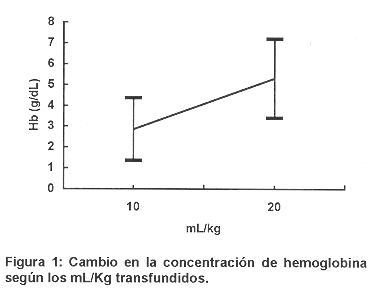
<body><![CDATA[<CENTER><FONT FACE="Arial,Helvetica"><FONT SIZE=-1>&nbsp;</FONT></FONT></CENTER> </TD> </TR> </TABLE></CENTER> <FONT FACE="Arial,Helvetica"><FONT SIZE=-1>(<A NAME="2&"></A><SUP>&amp;</SUP>) En este caso la p valora la respuesta en la FC (frecuencia cardiaca) y la PAM (presi&oacute;n arterial media) dentro del mismo grupo de pacientes.</FONT></FONT>     <BR><FONT SIZE=-1>&nbsp;</FONT>      <P><FONT FACE="Arial,Helvetica"><FONT SIZE=-1>El hematocrito medio de la bolsa de GRE fue 66.9 % (DS 6.9) en el grupo I comparado con 67.05 % (DS 8.35) en el grupo II (p = NS). Se realizaron controles de Hb a las 2 y 6 horas con el fin de valorar si la distribuci&oacute;n de los GRE una vez en el torrente sangu&iacute;neo afectaba su determinaci&oacute;n. A las 2 horas los pacientes del grupo I tuvieron una Hb media de 11.5 g/dL (DS 1.44) comparado con 13.6 g/dL (DS 2.3) en el grupo II (p &lt; 0.0001). A las 6 horas postransfusi&oacute;n esta relaci&oacute;n se mantuvo, el grupo I tuvo una Hb media de 12.08 g/dL (DS 1.27) versus 14.3 (DS 1.87) en el grupo II (p &lt; 0.0001). El cambio medio de la hemoglobina a las 6 horas post transfusi&oacute;n fue de 2.85 g/dL (DS1.5) en el grupo I en comparaci&oacute;n con 5.3 g/dL (DS 1.9) en el grupo II (p &lt; 0.0001). No se document&oacute; ninguna diferencia estadisticamente significativa al valorar la hemoglobina postransfusi&oacute;n a las 2 o a las 6 horas.</FONT></FONT>     <BR><FONT SIZE=-1>&nbsp;</FONT>     <BR><FONT SIZE=-1>&nbsp;</FONT>     <CENTER><A NAME="fig1"></A><IMG SRC="/img/fbpe/apc/v13n1/0676i01.GIF" HEIGHT=288 WIDTH=372></CENTER> <FONT SIZE=-1>&nbsp;</FONT>     
<BR><FONT SIZE=-1>&nbsp;</FONT>     <BR><FONT SIZE=-1>&nbsp;</FONT>      <P><FONT FACE="Arial,Helvetica"><FONT SIZE=-1>Los pacientes se valoraron desde el punto de vista hemodin&aacute;mico antes y despu&eacute;s de la transfusi&oacute;n y en ambos grupos se document&oacute; una disminuci&oacute;n significativa de la frecuencia cardiaca en las 2 horas postransfusi&oacute;n. En los pacientes que se encontraban extubados no hubo diferencia en la frecuencia respiratoria antes o despu&eacute;s del procedimiento. De igual manera se valor&oacute; la presi&oacute;n arterial media y se document&oacute; que los pacientes del grupo II tuvieron un incremento porcentual significativo de la misma en comparaci&oacute;n con los pacientes del grupo I, 10.3% vrs 3.1%, p &lt; 0.0001 (<A HREF="#Tabla 2">tabla II</A>). 1/18 (5.5%) pacientes intubados y ventilados del grupo I requiri&oacute; aumentar la ventilaci&oacute;n mec&aacute;nica posterior a la transfusi&oacute;n comparado con 4/20 (20%), lo cual no fue estadisticamente significativo.</FONT></FONT>      <P><FONT FACE="Arial,Helvetica"><FONT SIZE=-1>Tomando en consideraci&oacute;n que no existi&oacute; diferencias estadisticamente significativas entre los grupos, y utilizando una curva de tendencia calculando la inclinaci&oacute;n de la misma se obtuvo el <A HREF="#fig1">gr&aacute;fico 1</A>, en el cual se demuestra la relaci&oacute;n existente entre los mL/Kg que se quieran transfundir a un paciente y el cambio esperado en la hemoglobina postransfusi&oacute;n.</FONT></FONT>     ]]></body>
<body><![CDATA[<BR><FONT SIZE=-1>&nbsp;</FONT>     <BR><FONT SIZE=-1>&nbsp;</FONT>     <BR><B><FONT FACE="Arial,Helvetica"><FONT SIZE=-1>Discusi&oacute;n</FONT></FONT></B>      <P><FONT FACE="Arial,Helvetica"><FONT SIZE=-1>Niveles bajos de hemoglobina en pacientes criticamente enfermos disparan un sinn&uacute;mero de mecanismos compensatorios dise&ntilde;ados para mantener la homeostasis del organismo, especialmente en lo referente al transporte de ox&iacute;geno a los tejidos. La velocidad y extensi&oacute;n de esta compensaci&oacute;n depende de la velocidad y magnitud de la p&eacute;rdida sangu&iacute;nea o del nivel de hemoglobina previo (<A HREF="#8">8</A>). Un paciente agudamente enfermo y sobre todo cuando existe compromiso respiratorio o cardiovascular debe ser transfundido cuando el nivel de hemoglobina se encuentra bajo. La cifra exacta por debajo de la cual se debe efectuar el procedimiento no est&aacute; clara y la mayor&iacute;a de los autores coinciden que el nivel ideal debe ser entre 10 y 1 2 g/dL (<A HREF="#8">8</A>-<A HREF="#10">10</A>).</FONT></FONT>      <P><FONT FACE="Arial,Helvetica"><FONT SIZE=-1>La transfusi&oacute;n de derivados sangu&iacute;neos no est&aacute; exenta de complicaciones. En el paciente criticamente enfermo y especialmente si se trata de un lactante el exceso de l&iacute;quido derivado de una transfusi&oacute;n puede alterar los signos vitales del paciente debido al aumento del volumen intravascular. En pacientes con cardiopat&iacute;as cong&eacute;nitas e hipertensi&oacute;n pulmonar el aumento en la viscosidad sangu&iacute;nea al aumentar la masa eritrocitaria puede agravar la situaci&oacute;n. Tambi&eacute;n existen complicaciones infecciosas, entre las cuales destacan infecci&oacute;n por citomegalovirus (CMV), hepatitis B y C, VIH etc. De estos el m&aacute;s temido es el CMV ya que no se busca en forma rutinaria en todos los donadores. Estudios en reci&eacute;n nacidos demuestran que el 15% de los pacientes seronegativos transfundidos adquieren la enfermedad y dicho riesgo aumenta en un 3% por cada unidad de sangre utilizada (<A HREF="#11">11</A>).</FONT></FONT>      <P><FONT FACE="Arial,Helvetica"><FONT SIZE=-1>Nuestro estudio nos permiti&oacute; comparar el porcentaje de cambio de la hemoglobina, utilizando dos reg&iacute;menes diferentes de transfusi&oacute;n y a la vez comparar las repercusiones cl&iacute;nicas de ambos procedimientos. El hematocrito medio de los gl&oacute;bulos rojos en el banco de sangre del Hospital Nacional de Ni&ntilde;os fue similar al reportado por otros autores en otros laboratorios airrededor del mundo (<A HREF="#12">12</A>-<A HREF="#14">14</A>). Al comparar las dosis de 10 y 20 mL/Kg documentamos una diferencia estad&iacute;sticamente significativa en el porcentaje de cambio del nivel de la Hb entre los dos reg&iacute;menes, con una variaci&oacute;n porcentual del 57% del nivel previo en el grupo de 20 mL/Kg vs 31% en el grupo de 10 mL/Kg. Esta variaci&oacute;n nos permiti&oacute; confecionar un gr&aacute;fico que demuestra la variaci&oacute;n en la hemoglobina en relaci&oacute;n a la cantidad de gl&oacute;bulos rojos empacados (GRE) transfundidos (<A HREF="#fig1">figura 1</A>). Esto es de extraordinaria importancia ya que en base a la hemoglobina previa podemos establecer la dosis exacta de GRE a transfundir y as&iacute; obtener el cambio deseado, evitando m&uacute;ltiples transfusiones y las complicaciones derivadas de ello.</FONT></FONT>      <P><FONT FACE="Arial,Helvetica"><FONT SIZE=-1>Cuando evaluamos los par&aacute;metros cl&iacute;nicos antes y despu&eacute;s de la transfusi&oacute;n documentamos que en todos los casos hubo una disminuci&oacute;n de la frecuencia cardiaca, lo cual evidencia no solo una mejor&iacute;a del gasto cardiaco sin&oacute; tambi&eacute;n un incremento en el transporte de ox&iacute;geno a los tejidos. En cuanto a la frecuencia respiratoria no evidenciamos cambio en ninguno de los grupos, lo cual es importante ya que a pesar de utilizar 20 mL/Kg los pacientes no empeoraron su funci&oacute;n pulmonar por el exceso de l&iacute;quidos intravenosos. En cuanto a la presi&oacute;n arterial media demostramos que la dosis de 20 mL/Kg produjo un aumento estad&iacute;sticamente significativo en este par&aacute;metro en comparaci&oacute;n con el otro grupo. Esto es importante y beneficioso ya que en el paciente hemodinamicamente inestable los l&iacute;quidos intravenosos mejoran el gasto cardiaco, el transporte de ox&iacute;geno y por ende la presi&oacute;n arterial media. Hay un grupo de pacientes en los cuales la hipervolemia secundaria puede ser perjudicial, especialmente los cardi&oacute;patas y en este grupo de pacientes los l&iacute;quidos se deben utilizar de forma cuidadosa.</FONT></FONT>      <P><FONT FACE="Arial,Helvetica"><FONT SIZE=-1>Para valorar el porcentaje de cambio en la hemoglobina, obtuvimos niveles de la misma a las dos y seis horas postransfusi&oacute;n. No se document&oacute; ninguna diferencia entre hacer el control a una u otra hora por lo que consideramos que la hemoglobina postransfusi&oacute;n se puede tomar en ese per&iacute;odo sin obtener variaciones importantes.</FONT></FONT>      <P><FONT FACE="Arial,Helvetica"><FONT SIZE=-1>En conclusi&oacute;n, nuestro estudio demuestra una variaci&oacute;n significativa en el nivel de hemoglobina postransfusi&oacute;n cuando se utiliza 20 mL/Kg con respecto a 10 mL/Kg de GRE. Esta evaluaci&oacute;n permite construir una gr&aacute;fica que brinda la oportunidad de decidir la dosis de GRE a utilizar en diferentes pacientes. La transfusi&oacute;n a 10 o 20 mL/Kg es un procedimiento seguro que no causa inestabilidad hemodin&aacute;mica ni altera otros signos vitales de los pacientes.</FONT></FONT>     <BR><FONT SIZE=-1>&nbsp;</FONT>     ]]></body>
<body><![CDATA[<BR><FONT SIZE=-1>&nbsp;</FONT>     <BR><B><FONT FACE="Arial,Helvetica"><FONT SIZE=-1>Agradecimientos</FONT></FONT></B>      <P><FONT FACE="Arial,Helvetica"><FONT SIZE=-1>Se agradece profundamente al personal del Laboratorio y Banco de Sangre del Hospital de Ni&ntilde;os por la colaboraci&oacute;n con este estudio.</FONT></FONT>     <BR><FONT SIZE=-1>&nbsp;</FONT>     <BR><FONT SIZE=-1>&nbsp;</FONT>     <BR><B><FONT FACE="Arial,Helvetica"><FONT SIZE=-1>Referencias</FONT></FONT></B>      <!-- ref --><P><A NAME="1"></A><FONT FACE="Arial,Helvetica"><FONT SIZE=-1>1. Rodowski R. Blood transfusi&oacute;n: yesterday, today and tomorrow. World J Surg. 1987;11:86-93.</FONT></FONT>    &nbsp;&nbsp;&nbsp;&nbsp;&nbsp;&nbsp;&nbsp;&nbsp;[&#160;<a href="javascript:void(0);" onclick="javascript: window.open('/scielo.php?script=sci_nlinks&ref=095877&pid=S1409-0090199900010000200001&lng=','','width=640,height=500,resizable=yes,scrollbars=1,menubar=yes,');">Links</a>&#160;]<!-- end-ref --><!-- ref --><P><A NAME="2"></A><FONT FACE="Arial,Helvetica"><FONT SIZE=-1>2. Dur&aacute;n A, Contreras P, Viquez R, P&eacute;rez V, Quintana R et al. Transfusi&oacute;n de hemoderivados en pediatr&iacute;a: Cuando y cual? Acta Pedi&aacute;tica Costarricense 1995; 9:47-54.</FONT></FONT>    &nbsp;&nbsp;&nbsp;&nbsp;&nbsp;&nbsp;&nbsp;&nbsp;[&#160;<a href="javascript:void(0);" onclick="javascript: window.open('/scielo.php?script=sci_nlinks&ref=095878&pid=S1409-0090199900010000200002&lng=','','width=640,height=500,resizable=yes,scrollbars=1,menubar=yes,');">Links</a>&#160;]<!-- end-ref --><!-- ref --><P><A NAME="3"></A><FONT FACE="Arial,Helvetica"><FONT SIZE=-1>3. Tuchschmidt J, Oblitas D, Fried J. Oxygen consumption in sepsis and septic shock. Crit Care Med. 1991;19:664-670.</FONT></FONT>    &nbsp;&nbsp;&nbsp;&nbsp;&nbsp;&nbsp;&nbsp;&nbsp;[&#160;<a href="javascript:void(0);" onclick="javascript: window.open('/scielo.php?script=sci_nlinks&ref=095879&pid=S1409-0090199900010000200003&lng=','','width=640,height=500,resizable=yes,scrollbars=1,menubar=yes,');">Links</a>&#160;]<!-- end-ref --><!-- ref --><P><A NAME="4"></A><FONT FACE="Arial,Helvetica"><FONT SIZE=-1>4. Levine E, Rosen A, Sehgal L, Gould S, Sehgal H et al. Physiologic effects of acute anemia: implications for a reduced transfusion trigger. Transfusion 1990;30:11-14.</FONT></FONT>    &nbsp;&nbsp;&nbsp;&nbsp;&nbsp;&nbsp;&nbsp;&nbsp;[&#160;<a href="javascript:void(0);" onclick="javascript: window.open('/scielo.php?script=sci_nlinks&ref=095880&pid=S1409-0090199900010000200004&lng=','','width=640,height=500,resizable=yes,scrollbars=1,menubar=yes,');">Links</a>&#160;]<!-- end-ref --><!-- ref --><P><A NAME="5"></A><FONT FACE="Arial,Helvetica"><FONT SIZE=-1>5. Messmer KF. Acceptable hematocrit levels in surgical patients. World J Surg 1987; 11: 441-46.</FONT></FONT>    &nbsp;&nbsp;&nbsp;&nbsp;&nbsp;&nbsp;&nbsp;&nbsp;[&#160;<a href="javascript:void(0);" onclick="javascript: window.open('/scielo.php?script=sci_nlinks&ref=095881&pid=S1409-0090199900010000200005&lng=','','width=640,height=500,resizable=yes,scrollbars=1,menubar=yes,');">Links</a>&#160;]<!-- end-ref --><!-- ref --><P><A NAME="6"></A><FONT FACE="Arial,Helvetica"><FONT SIZE=-1>6. Stehling L, Simon T. The red blood cell transfusion trigger. Ach Pathol Lab Med 1994; 118:429-434.</FONT></FONT>    &nbsp;&nbsp;&nbsp;&nbsp;&nbsp;&nbsp;&nbsp;&nbsp;[&#160;<a href="javascript:void(0);" onclick="javascript: window.open('/scielo.php?script=sci_nlinks&ref=095882&pid=S1409-0090199900010000200006&lng=','','width=640,height=500,resizable=yes,scrollbars=1,menubar=yes,');">Links</a>&#160;]<!-- end-ref --><!-- ref --><P><A NAME="7"></A><FONT FACE="Arial,Helvetica"><FONT SIZE=-1>7. Ringer S, Richardson DK, Sacher RA, Keszler M, Churchill WH. Variations in transfusion practice in neonatal intensiva care. Pediatrics 1998; 101:194-200.</FONT></FONT>    &nbsp;&nbsp;&nbsp;&nbsp;&nbsp;&nbsp;&nbsp;&nbsp;[&#160;<a href="javascript:void(0);" onclick="javascript: window.open('/scielo.php?script=sci_nlinks&ref=095883&pid=S1409-0090199900010000200007&lng=','','width=640,height=500,resizable=yes,scrollbars=1,menubar=yes,');">Links</a>&#160;]<!-- end-ref --><!-- ref --><P><A NAME="8"></A><FONT FACE="Arial,Helvetica"><FONT SIZE=-1>8. Weiskopf RB, Viele MK, Feiner J, Kelley S, Lieberman J, et al. Human Cardiovascular and metabolic response to acute, severe isovolemic anemia. JAMA 1998; 279:217-221.</FONT></FONT>    &nbsp;&nbsp;&nbsp;&nbsp;&nbsp;&nbsp;&nbsp;&nbsp;[&#160;<a href="javascript:void(0);" onclick="javascript: window.open('/scielo.php?script=sci_nlinks&ref=095884&pid=S1409-0090199900010000200008&lng=','','width=640,height=500,resizable=yes,scrollbars=1,menubar=yes,');">Links</a>&#160;]<!-- end-ref --><!-- ref --><P><A NAME="9"></A><FONT FACE="Arial,Helvetica"><FONT SIZE=-1>9. Cane R. Hemoglobin: How much is enough? Crit Care Med. 1990; 18:1046-1047.</FONT></FONT>    &nbsp;&nbsp;&nbsp;&nbsp;&nbsp;&nbsp;&nbsp;&nbsp;[&#160;<a href="javascript:void(0);" onclick="javascript: window.open('/scielo.php?script=sci_nlinks&ref=095885&pid=S1409-0090199900010000200009&lng=','','width=640,height=500,resizable=yes,scrollbars=1,menubar=yes,');">Links</a>&#160;]<!-- end-ref --><!-- ref --><P><A NAME="10"></A><FONT FACE="Arial,Helvetica"><FONT SIZE=-1>10. Carson J, Duff A, Berlin J, Lawrence V, Poses R, Huber E, et al. Perioperative blood transfusion and postoperative mortality. JAMA 1998: 279: 199-205.</FONT></FONT>    &nbsp;&nbsp;&nbsp;&nbsp;&nbsp;&nbsp;&nbsp;&nbsp;[&#160;<a href="javascript:void(0);" onclick="javascript: window.open('/scielo.php?script=sci_nlinks&ref=095886&pid=S1409-0090199900010000200010&lng=','','width=640,height=500,resizable=yes,scrollbars=1,menubar=yes,');">Links</a>&#160;]<!-- end-ref --><!-- ref --><P><A NAME="11"></A><FONT FACE="Arial,Helvetica"><FONT SIZE=-1>11. AuBuchon JP. Minimizing donor exposure in hemotherapy. Ach Pathol Lab Med 1994; 118:380-391.</FONT></FONT>    &nbsp;&nbsp;&nbsp;&nbsp;&nbsp;&nbsp;&nbsp;&nbsp;[&#160;<a href="javascript:void(0);" onclick="javascript: window.open('/scielo.php?script=sci_nlinks&ref=095887&pid=S1409-0090199900010000200011&lng=','','width=640,height=500,resizable=yes,scrollbars=1,menubar=yes,');">Links</a>&#160;]<!-- end-ref --><!-- ref --><P><A NAME="12"></A><FONT FACE="Arial,Helvetica"><FONT SIZE=-1>12. Marik P, Sibbald WJ. Effect of Stored blood transfusion on oxygen delivery in patients with sepsis. JAMA 1993; 269: 3024-3029.</FONT></FONT>    &nbsp;&nbsp;&nbsp;&nbsp;&nbsp;&nbsp;&nbsp;&nbsp;[&#160;<a href="javascript:void(0);" onclick="javascript: window.open('/scielo.php?script=sci_nlinks&ref=095888&pid=S1409-0090199900010000200012&lng=','','width=640,height=500,resizable=yes,scrollbars=1,menubar=yes,');">Links</a>&#160;]<!-- end-ref --><!-- ref --><P><A NAME="13"></A><FONT FACE="Arial,Helvetica"><FONT SIZE=-1>13. Stehling L, Luban NL, Anderson K, Sayers M, Long A, et al. Guidelines for blood utilization review. Transfusion 1994; 34:438-448.</FONT></FONT>    &nbsp;&nbsp;&nbsp;&nbsp;&nbsp;&nbsp;&nbsp;&nbsp;[&#160;<a href="javascript:void(0);" onclick="javascript: window.open('/scielo.php?script=sci_nlinks&ref=095889&pid=S1409-0090199900010000200013&lng=','','width=640,height=500,resizable=yes,scrollbars=1,menubar=yes,');">Links</a>&#160;]<!-- end-ref --><!-- ref --><P><A NAME="14"></A><FONT FACE="Arial,Helvetica"><FONT SIZE=-1>14. Welsh G, Mechan K, Goodnough L. Prudent strategies for elective red blood cell transfusion. Ann lntern Med 1992: 116:393-401</FONT></FONT>    &nbsp;&nbsp;&nbsp;&nbsp;&nbsp;&nbsp;&nbsp;&nbsp;[&#160;<a href="javascript:void(0);" onclick="javascript: window.open('/scielo.php?script=sci_nlinks&ref=095890&pid=S1409-0090199900010000200014&lng=','','width=640,height=500,resizable=yes,scrollbars=1,menubar=yes,');">Links</a>&#160;]<!-- end-ref --><BR>&nbsp;&nbsp;      <P><FONT FACE="Arial,Helvetica"><FONT COLOR="#000000"><FONT SIZE=-1>(<A NAME="*"></A><A HREF="#*a">*</A>)Pediatra, (<A NAME="**"></A><A HREF="#*a">**</A>) Asistente Especialista, Unidad de Cuidados Intensivos, Hospital Nacional de Ni&ntilde;os, "Dr. Carlos S&aacute;enz Herrera", Apartado 1654-1000, San Jos&eacute;, Costa Rica. Correo electr&oacute;nico: <A HREF="mailto:rrivera@hnn.sa.cr">rrivera@hnn.sa.cr</A></FONT></FONT></FONT>      ]]></body><back>
<ref-list>
<ref id="B1">
<nlm-citation citation-type="journal">
<person-group person-group-type="author">
<name>
<surname><![CDATA[Rodowski]]></surname>
<given-names><![CDATA[R]]></given-names>
</name>
</person-group>
<article-title xml:lang="en"><![CDATA[Blood transfusión: yesterday, today and tomorrow]]></article-title>
<source><![CDATA[World J Surg]]></source>
<year>1987</year>
<volume>11</volume>
<page-range>86-93</page-range></nlm-citation>
</ref>
<ref id="B2">
<nlm-citation citation-type="journal">
<person-group person-group-type="author">
<name>
<surname><![CDATA[Durán]]></surname>
<given-names><![CDATA[A]]></given-names>
</name>
<name>
<surname><![CDATA[Contreras]]></surname>
<given-names><![CDATA[P]]></given-names>
</name>
<name>
<surname><![CDATA[Viquez]]></surname>
<given-names><![CDATA[R]]></given-names>
</name>
<name>
<surname><![CDATA[Pérez]]></surname>
<given-names><![CDATA[V]]></given-names>
</name>
<name>
<surname><![CDATA[Quintana]]></surname>
<given-names><![CDATA[R]]></given-names>
</name>
</person-group>
<article-title xml:lang="es"><![CDATA[Transfusión de hemoderivados en pediatría: Cuando y cual?]]></article-title>
<source><![CDATA[Acta Pediática Costarricense]]></source>
<year>1995</year>
<volume>9</volume>
<page-range>47-54</page-range></nlm-citation>
</ref>
<ref id="B3">
<nlm-citation citation-type="journal">
<person-group person-group-type="author">
<name>
<surname><![CDATA[Tuchschmidt]]></surname>
<given-names><![CDATA[J]]></given-names>
</name>
<name>
<surname><![CDATA[Oblitas]]></surname>
<given-names><![CDATA[D]]></given-names>
</name>
<name>
<surname><![CDATA[Fried]]></surname>
<given-names><![CDATA[J]]></given-names>
</name>
</person-group>
<article-title xml:lang="en"><![CDATA[Oxygen consumption in sepsis and septic shock]]></article-title>
<source><![CDATA[Crit Care Med.]]></source>
<year>1991</year>
<volume>19</volume>
<page-range>664-670</page-range></nlm-citation>
</ref>
<ref id="B4">
<nlm-citation citation-type="journal">
<person-group person-group-type="author">
<name>
<surname><![CDATA[Levine]]></surname>
<given-names><![CDATA[E]]></given-names>
</name>
<name>
<surname><![CDATA[Rosen]]></surname>
<given-names><![CDATA[A]]></given-names>
</name>
<name>
<surname><![CDATA[Sehgal]]></surname>
<given-names><![CDATA[L]]></given-names>
</name>
<name>
<surname><![CDATA[Gould]]></surname>
<given-names><![CDATA[S]]></given-names>
</name>
<name>
<surname><![CDATA[Sehgal]]></surname>
<given-names><![CDATA[H]]></given-names>
</name>
</person-group>
<article-title xml:lang="en"><![CDATA[Physiologic effects of acute anemia: implications for a reduced transfusion trigger]]></article-title>
<source><![CDATA[Transfusion]]></source>
<year>1990</year>
<volume>30</volume>
<page-range>11-14</page-range></nlm-citation>
</ref>
<ref id="B5">
<nlm-citation citation-type="journal">
<person-group person-group-type="author">
<name>
<surname><![CDATA[Messmer]]></surname>
<given-names><![CDATA[KF]]></given-names>
</name>
</person-group>
<article-title xml:lang="en"><![CDATA[Acceptable hematocrit levels in surgical patients]]></article-title>
<source><![CDATA[World J Surg]]></source>
<year>1987</year>
<volume>11</volume>
<page-range>441-46</page-range></nlm-citation>
</ref>
<ref id="B6">
<nlm-citation citation-type="journal">
<person-group person-group-type="author">
<name>
<surname><![CDATA[Stehling]]></surname>
<given-names><![CDATA[L]]></given-names>
</name>
<name>
<surname><![CDATA[Simon]]></surname>
<given-names><![CDATA[T]]></given-names>
</name>
</person-group>
<article-title xml:lang="en"><![CDATA[The red blood cell transfusion trigger]]></article-title>
<source><![CDATA[Ach Pathol Lab Med]]></source>
<year>1994</year>
<volume>118</volume>
<page-range>429-434</page-range></nlm-citation>
</ref>
<ref id="B7">
<nlm-citation citation-type="journal">
<person-group person-group-type="author">
<name>
<surname><![CDATA[Ringer]]></surname>
<given-names><![CDATA[S]]></given-names>
</name>
<name>
<surname><![CDATA[Richardson]]></surname>
<given-names><![CDATA[DK]]></given-names>
</name>
<name>
<surname><![CDATA[Sacher]]></surname>
<given-names><![CDATA[RA]]></given-names>
</name>
<name>
<surname><![CDATA[Keszler]]></surname>
<given-names><![CDATA[M]]></given-names>
</name>
<name>
<surname><![CDATA[Churchill]]></surname>
<given-names><![CDATA[WH]]></given-names>
</name>
</person-group>
<article-title xml:lang="en"><![CDATA[Variations in transfusion practice in neonatal intensiva care]]></article-title>
<source><![CDATA[Pediatrics]]></source>
<year>1998</year>
<volume>101</volume>
<page-range>194-200</page-range></nlm-citation>
</ref>
<ref id="B8">
<nlm-citation citation-type="journal">
<person-group person-group-type="author">
<name>
<surname><![CDATA[Weiskopf]]></surname>
<given-names><![CDATA[RB]]></given-names>
</name>
<name>
<surname><![CDATA[Viele]]></surname>
<given-names><![CDATA[MK]]></given-names>
</name>
<name>
<surname><![CDATA[Feiner]]></surname>
<given-names><![CDATA[J]]></given-names>
</name>
<name>
<surname><![CDATA[Kelley]]></surname>
<given-names><![CDATA[S]]></given-names>
</name>
<name>
<surname><![CDATA[Lieberman]]></surname>
<given-names><![CDATA[J]]></given-names>
</name>
</person-group>
<article-title xml:lang="en"><![CDATA[Human Cardiovascular and metabolic response to acute, severe isovolemic anemia]]></article-title>
<source><![CDATA[JAMA]]></source>
<year>1998</year>
<volume>279</volume>
<page-range>217-221</page-range></nlm-citation>
</ref>
<ref id="B9">
<nlm-citation citation-type="journal">
<person-group person-group-type="author">
<name>
<surname><![CDATA[Cane]]></surname>
<given-names><![CDATA[R]]></given-names>
</name>
</person-group>
<article-title xml:lang="en"><![CDATA[Hemoglobin: How much is enough?]]></article-title>
<source><![CDATA[Crit Care Med]]></source>
<year>1990</year>
<volume>18</volume>
<page-range>1046-1047</page-range></nlm-citation>
</ref>
<ref id="B10">
<nlm-citation citation-type="journal">
<person-group person-group-type="author">
<name>
<surname><![CDATA[Carson]]></surname>
<given-names><![CDATA[J]]></given-names>
</name>
<name>
<surname><![CDATA[Duff]]></surname>
<given-names><![CDATA[A]]></given-names>
</name>
<name>
<surname><![CDATA[Berlin]]></surname>
<given-names><![CDATA[J]]></given-names>
</name>
<name>
<surname><![CDATA[Lawrence]]></surname>
<given-names><![CDATA[V]]></given-names>
</name>
<name>
<surname><![CDATA[Poses]]></surname>
<given-names><![CDATA[R]]></given-names>
</name>
<name>
<surname><![CDATA[Huber]]></surname>
<given-names><![CDATA[E]]></given-names>
</name>
</person-group>
<article-title xml:lang="en"><![CDATA[Perioperative blood transfusion and postoperative mortality]]></article-title>
<source><![CDATA[JAMA]]></source>
<year>1998</year>
<volume>279</volume>
<page-range>199-205</page-range></nlm-citation>
</ref>
<ref id="B11">
<nlm-citation citation-type="journal">
<person-group person-group-type="author">
<name>
<surname><![CDATA[AuBuchon]]></surname>
<given-names><![CDATA[JP]]></given-names>
</name>
</person-group>
<article-title xml:lang="en"><![CDATA[Minimizing donor exposure in hemotherapy]]></article-title>
<source><![CDATA[Ach Pathol Lab Med]]></source>
<year>1994</year>
<volume>118</volume>
<page-range>380-391</page-range></nlm-citation>
</ref>
<ref id="B12">
<nlm-citation citation-type="journal">
<person-group person-group-type="author">
<name>
<surname><![CDATA[Marik]]></surname>
<given-names><![CDATA[P]]></given-names>
</name>
<name>
<surname><![CDATA[Sibbald]]></surname>
<given-names><![CDATA[WJ]]></given-names>
</name>
</person-group>
<article-title xml:lang="en"><![CDATA[Effect of Stored blood transfusion on oxygen delivery in patients with sepsis]]></article-title>
<source><![CDATA[JAMA]]></source>
<year>1993</year>
<volume>269</volume>
<page-range>3024-3029</page-range></nlm-citation>
</ref>
<ref id="B13">
<nlm-citation citation-type="journal">
<person-group person-group-type="author">
<name>
<surname><![CDATA[Stehling]]></surname>
<given-names><![CDATA[L]]></given-names>
</name>
<name>
<surname><![CDATA[Luban]]></surname>
<given-names><![CDATA[NL]]></given-names>
</name>
<name>
<surname><![CDATA[Anderson]]></surname>
<given-names><![CDATA[K]]></given-names>
</name>
<name>
<surname><![CDATA[Sayers]]></surname>
<given-names><![CDATA[M]]></given-names>
</name>
<name>
<surname><![CDATA[Long]]></surname>
<given-names><![CDATA[A]]></given-names>
</name>
</person-group>
<article-title xml:lang="en"><![CDATA[Guidelines for blood utilization review]]></article-title>
<source><![CDATA[Transfusion]]></source>
<year>1994</year>
<volume>34</volume>
<page-range>438-448</page-range></nlm-citation>
</ref>
<ref id="B14">
<nlm-citation citation-type="journal">
<person-group person-group-type="author">
<name>
<surname><![CDATA[Welsh]]></surname>
<given-names><![CDATA[G]]></given-names>
</name>
<name>
<surname><![CDATA[Mechan]]></surname>
<given-names><![CDATA[K]]></given-names>
</name>
<name>
<surname><![CDATA[Goodnough]]></surname>
<given-names><![CDATA[L]]></given-names>
</name>
</person-group>
<article-title xml:lang="en"><![CDATA[Prudent strategies for elective red blood cell transfusion]]></article-title>
<source><![CDATA[Ann lntern Med]]></source>
<year>1992</year>
<volume>116</volume>
<page-range>393-401</page-range></nlm-citation>
</ref>
</ref-list>
</back>
</article>
