<?xml version="1.0" encoding="ISO-8859-1"?><article xmlns:mml="http://www.w3.org/1998/Math/MathML" xmlns:xlink="http://www.w3.org/1999/xlink" xmlns:xsi="http://www.w3.org/2001/XMLSchema-instance">
<front>
<journal-meta>
<journal-id>1409-0015</journal-id>
<journal-title><![CDATA[Medicina Legal de Costa Rica]]></journal-title>
<abbrev-journal-title><![CDATA[Med. leg. Costa Rica]]></abbrev-journal-title>
<issn>1409-0015</issn>
<publisher>
<publisher-name><![CDATA[Asociación Costarricense de Medicina Forense]]></publisher-name>
</publisher>
</journal-meta>
<article-meta>
<article-id>S1409-00152014000100004</article-id>
<title-group>
<article-title xml:lang="es"><![CDATA[Simulación de síntomas psicóticos y su evaluación para ayudar a establecer inimputabilidad]]></article-title>
</title-group>
<contrib-group>
<contrib contrib-type="author">
<name>
<surname><![CDATA[Mora Víquez]]></surname>
<given-names><![CDATA[Cristian]]></given-names>
</name>
<xref ref-type="aff" rid="A01"/>
</contrib>
</contrib-group>
<aff id="A01">
<institution><![CDATA[,Universidad de Costa Rica-CENDEISSS  ]]></institution>
<addr-line><![CDATA[San José ]]></addr-line>
<country>Costa Rica</country>
</aff>
<pub-date pub-type="pub">
<day>00</day>
<month>03</month>
<year>2014</year>
</pub-date>
<pub-date pub-type="epub">
<day>00</day>
<month>03</month>
<year>2014</year>
</pub-date>
<volume>31</volume>
<numero>1</numero>
<fpage>31</fpage>
<lpage>48</lpage>
<copyright-statement/>
<copyright-year/>
<self-uri xlink:href="http://www.scielo.sa.cr/scielo.php?script=sci_arttext&amp;pid=S1409-00152014000100004&amp;lng=en&amp;nrm=iso"></self-uri><self-uri xlink:href="http://www.scielo.sa.cr/scielo.php?script=sci_abstract&amp;pid=S1409-00152014000100004&amp;lng=en&amp;nrm=iso"></self-uri><self-uri xlink:href="http://www.scielo.sa.cr/scielo.php?script=sci_pdf&amp;pid=S1409-00152014000100004&amp;lng=en&amp;nrm=iso"></self-uri><abstract abstract-type="short" xml:lang="es"><p><![CDATA[El profesional en psicología debe conocer sobre la versatilidad que su rol puede tener en diversos contextos, sobre todo cuando se enfrente a una pregunta jurídica como ayudar a determinar dinámicas de simulación para ayudar a decidir sobre inimputabilidad en un sistema de justicia. Por ello se brinda una recopilación bibliográfica basada en el trabajo final de graduación para optar al grado de psicólogo clínico, titulado &#8220;Simulación de síntomas psicóticos y su evaluación psicológica: algunos elementos psicojurídicos y su relación con aspectos clínicos y forenses en el contexto costarricense&#8221;, en la cual se reflexiona sobre estos temas. En primera instancia se brindará una ubicación general del rol del psicólogo en estas circunstancias, pasando a describir diversas dinámicas de simulación de síntomas psicóticos que abarcan las concepciones de simulación y como se han registrado en síntomas positivos y negativos. Se brindan ejemplos de sintomatología atípica, extraña o exagerada y se concluye con un resumen de pruebas psicológicas que generan tanto indicadores indirectos como otras que tienen como fin específico detectar simulación de psicosis. Una reflexión final abarca la necesidad integrar estos datos con la revisión exhaustiva de información colateral, escogencia y aplicación adecuada de pruebas psicológica y los cuidados pertinentes al describir dinámicas de simulación en una persona, por las delicadas implicaciones que conllevan su diagnóstico.]]></p></abstract>
<abstract abstract-type="short" xml:lang="en"><p><![CDATA[A professional in psychology should know about the versatility that his or her role can have in various contexts, especially when faced with legal treatments as helping to determine dynamic simulation throughout the insanity justice system. Therefore, it provides a bibliography based on the final graduation to obtain the degree of clinical psychologist, entitled &#8220;Simulation of psychotic symptoms and psychological assessment: psycho-legal elements and their relationship to clinical and forensic on costarrican context &#8220; in which we go on reflection on these kind of issues. First of all, we provide a general placement of the role as psychologists in these circumstances, reviewing and describing various dynamic simulations of psychotic symptoms that include the concepts of simulation and are reflected in positive and negative symptoms. Examples are given of atypical symptoms, strange or exaggerated and conclude with a summary of psychological tests that generate both indirect indicators and others that are designed to detect specific simulation of psychosis. One final thought concerns the need to integrate these data with an exhaustive review of collateral information, choice and proper application of psychological tests and appropriate care dynamics simulation to describe a person, by the delicate implications involving diagnosis.]]></p></abstract>
<kwd-group>
<kwd lng="es"><![CDATA[Simulación psicosis]]></kwd>
<kwd lng="es"><![CDATA[trastorno facticio]]></kwd>
<kwd lng="es"><![CDATA[psicología forense]]></kwd>
<kwd lng="es"><![CDATA[pruebas]]></kwd>
<kwd lng="en"><![CDATA[Malingering]]></kwd>
<kwd lng="en"><![CDATA[factitious disorder]]></kwd>
<kwd lng="en"><![CDATA[forensic psychology]]></kwd>
<kwd lng="en"><![CDATA[psychological test]]></kwd>
</kwd-group>
</article-meta>
</front><body><![CDATA[ <div class="Section1">     <p class="MsoNormal" style="text-align: right;" align="right"><b><span  style="font-size: 18pt; color: white;">REVISI&#211;N </span></b><span  style="color: white;">bibliogr&#225;fica </span><b style=""><span  style="font-family: Verdana; color: rgb(0, 51, 102);"><span  style="color: rgb(0, 0, 0);">Revisi&#243;n bibliogr&#225;fica</span><o:p></o:p></span></b></p>     <div>     <p class="MsoNormal" style="text-align: center;" align="center"><b  style=""><span style="font-family: Verdana; color: rgb(0, 51, 102);"><span  style="color: rgb(0, 0, 0);">Simulaci&#243;n de s&#237;ntomas psic&#243;ticos y su evaluaci&#243;n para ayudar a establecer </span><span style="color: rgb(0, 0, 0);" class="SpellE">inimputabilidad</span><o:p></o:p></span></b></p>     <p class="MsoNormal" style="text-align: center;" align="center"><b  style=""><span style="font-size: 11pt; font-family: Verdana;">    <br> Cristian Mora <span class="SpellE">V&#237;quez</span><a href="#1">*</a><a name="2"></a>+    <br> </span></b></p>     <p class="MsoNormal" style="text-align: left;">    <br> <span style="font-size: 10pt; font-family: Verdana;"><a  name="Correspondencia2"></a>*<a href="#Correspondencia1">Direcci&#243;n para correspondencia:</a></span>    <br> <b style=""><span style="font-size: 11pt; font-family: Verdana;"><o:p></o:p></span></b></p>     ]]></body>
<body><![CDATA[<p class="MsoNormal"><b style=""><span  style="font-size: 11pt; font-family: Verdana;"></span></b></p> <hr style="width: 100%; height: 2px;">     <p class="MsoNormal"><b style=""><span  style="font-size: 11pt; font-family: Verdana;">Resumen: <o:p></o:p></span></b></p>     <p style="text-align: justify;" class="MsoNormal"><span  style="font-size: 10pt; font-family: Verdana;">El profesional en psicolog&#237;a debe conocer sobre la versatilidad que su rol puede tener en diversos contextos, sobre todo cuando se enfrente a una pregunta jur&#237;dica como ayudar a determinar din&#225;micas de simulaci&#243;n para ayudar a decidir sobre <span class="SpellE">inimputabilidad</span> en un sistema de justicia. Por ello se brinda una recopilaci&#243;n bibliogr&#225;fica basada en el trabajo final de graduaci&#243;n para optar al grado de psic&#243;logo cl&#237;nico, titulado &#8220;Simulaci&#243;n de s&#237;ntomas psic&#243;ticos y su evaluaci&#243;n psicol&#243;gica: algunos elementos <span class="SpellE">psicojur&#237;dicos</span> y su relaci&#243;n con aspectos cl&#237;nicos y forenses en el contexto costarricense&#8221;, en la cual se reflexiona sobre estos temas. En primera instancia se brindar&#225; una ubicaci&#243;n general del rol del psic&#243;logo en estas circunstancias, pasando a describir diversas din&#225;micas de simulaci&#243;n de s&#237;ntomas psic&#243;ticos que abarcan las concepciones de simulaci&#243;n y como se han registrado en s&#237;ntomas positivos y negativos. Se brindan ejemplos de sintomatolog&#237;a at&#237;pica, extra&#241;a o exagerada y se concluye con un resumen de pruebas psicol&#243;gicas que generan tanto indicadores indirectos como otras que tienen como fin espec&#237;fico detectar simulaci&#243;n de psicosis. Una reflexi&#243;n final abarca la necesidad integrar estos datos con la revisi&#243;n exhaustiva de informaci&#243;n colateral, escogencia y aplicaci&#243;n adecuada de pruebas psicol&#243;gica y los cuidados pertinentes al describir din&#225;micas de simulaci&#243;n en una persona, por las delicadas implicaciones que conllevan su diagn&#243;stico. <o:p></o:p></span></p>     <div>     <p class="MsoNormal"><b style=""><span  style="font-size: 11pt; font-family: Verdana;">Palabras clave: <span  style=""><o:p></o:p></span></span></b></p>     <p style="text-align: justify;" class="MsoNormal"><span  style="font-size: 10pt; font-family: Verdana;">Simulaci&#243;n psicosis, trastorno facticio, psicolog&#237;a forense, pruebas <o:p></o:p></span></p>     <p class="MsoNormal"><b style=""><span  style="font-size: 11pt; font-family: Verdana;" lang="EN-US">Summary: <o:p></o:p></span></b></p>     <p style="text-align: justify;" class="MsoNormal"><span  style="font-size: 10pt; font-family: Verdana;" lang="EN-US">A professional in psychology should know about the versatility that his or her role can have in various contexts, especially when faced with legal treatments as helping to determine dynamic simulation throughout the insanity justice system. Therefore, it provides a bibliography based on the final graduation to obtain the degree of clinical psychologist, entitled &#8220;Simulation of psychotic symptoms and psychological assessment: psycho-legal elements and their relationship to clinical and forensic on <span class="SpellE">costarrican</span> context <span class="GramE">&#8220; in</span> which we go on reflection on these kind of issues. First of all, we provide a general placement of the role as psychologists in these circumstances, reviewing and describing various dynamic simulations of psychotic symptoms that include the concepts of simulation and are reflected in positive and negative symptoms. Examples are given of atypical symptoms, strange or exaggerated and conclude with a summary of psychological tests that generate both indirect indicators and others that are designed to detect specific simulation of psychosis. One final thought concerns the need to integrate these data with an exhaustive review of collateral information, choice and proper application of psychological tests and appropriate care dynamics simulation to describe a person, by the delicate implications involving diagnosis. <o:p></o:p></span></p>     <p class="MsoNormal"><b style=""><span  style="font-size: 11pt; font-family: Verdana;" lang="EN-US">Keywords: <o:p></o:p></span></b></p>     <p style="text-align: justify;" class="MsoNormal"><span class="GramE"><span  style="font-size: 10pt; font-family: Verdana;" lang="EN-US">Malingering, factitious disorder, forensic psychology, psychological test.</span></span><span  style="font-size: 10pt; font-family: Verdana;" lang="EN-US"> <span  style="">&nbsp;</span><o:p></o:p></span></p>     ]]></body>
<body><![CDATA[<p class="MsoNormal"><b style=""><span  style="font-size: 11pt; font-family: Verdana;"></span></b></p> <hr style="width: 100%; height: 2px;">     <p class="MsoNormal"><b style=""><span  style="font-size: 11pt; font-family: Verdana;">Introducci&#243;n <o:p></o:p></span></b></p>     <p style="text-align: justify;" class="MsoNormal"><span  style="font-size: 10pt; font-family: Verdana;">Para Gonz&#225;lez y Santamar&#237;a (2008) la simulaci&#243;n se presenta con mayor medida en valoraciones de discapacidad en lesiones corporales (30%), en comparaci&#243;n a psicopatolog&#237;as en &#225;mbitos forenses (17,4%). En tanto Capilla, Gonz&#225;lez y Santamar&#237;a (2009) encontraron que las patolog&#237;as m&#225;s susceptibles de simulaci&#243;n en contextos m&#233;dico-legales (para gestionar incapacidades o pensiones) se relacionaban con dolor cr&#243;nico y trastornos emocionales; siendo que discapacidad relacionada con trastornos mentales y enfermedades f&#237;sicas para reducir o eliminar responsabilidad legal prevalece en contextos forenses criminales (&#225;mbito en que se centrar&#225; el presente trabajo). <o:p></o:p></span></p>     <p style="text-align: justify;" class="MsoNormal"><span  style="font-size: 10pt; font-family: Verdana;">El C&#243;digo Penal de Costa Rica (art&#237;culo 42) se&#241;ala como inimputable a quien en el momento de la &#8220;acci&#243;n u omisi&#243;n&#8221;, no pueda comprender el car&#225;cter il&#237;cito del hecho a causa de enfermedad mental o grave perturbaci&#243;n de la conciencia (Costa Rica, leyes y decretos, 2011). <o:p></o:p></span></p>     <p style="text-align: justify;" class="MsoNormal"><span  style="font-size: 10pt; font-family: Verdana;">Al ser vital determinar la capacidad mental de las personas, el C&#243;digo Procesal Penal (art&#237;culo 87) establece un &#8220;Examen Mental Obligatorio&#8221; para establecer capacidad de culpabilidad. As&#237; determinar la existencia de un trastorno mental mayor como la psicosis es importante, ya que su diagnostico puede generar una declaraci&#243;n de <span class="SpellE">inimputabilidad</span>. <o:p></o:p></span></p>     <p style="text-align: justify;" class="MsoNormal"><span  style="font-size: 10pt; font-family: Verdana;">El art&#237;culo 86 del C&#243;digo Procesal Penal costarricense establece: &#8220;Si es necesario el internamiento del imputado para elaborar el informe pericial sobre su capacidad, la medida podr&#225; ser ordenada por el tribunal a solicitud de los peritos&#8221;. Esta tarea recae actualmente en las secciones de Psicolog&#237;a-Trabajo Social y en la Secci&#243;n de Psicolog&#237;a y Psiquiatr&#237;a Forense, ambas del Poder Judicial. Pero tambi&#233;n se solicitan pericias al Hospital Nacional Psiqui&#225;trico, que desde el 2011 cre&#243; el &#8220;Centro de Atenci&#243;n para Personas con Enfermedad Mental en Conflicto con la Ley&#8221; (CAPEMCOL), lugar que alberga personas con medidas de seguridad curativas (tratamiento) o cautelares (en la cual se solicitan pericias para establecer <span class="SpellE">inimputabilidad</span>). Para ayudar a responder la pregunta legal de una posible <span  class="SpellE">inimputabilidad</span>, es necesario conocer ciertas din&#225;micas presentes en la simulaci&#243;n de s&#237;ntomas psic&#243;ticos, aspectos que se pretenden describir tanto en su concepci&#243;n te&#243;rica como en las t&#233;cnicas de evaluaci&#243;n psicol&#243;gica que se utilizan para su detecci&#243;n. <span  class="SpellE"><span class="GramE">symptoms</span></span> <span  class="SpellE">and</span> <span class="SpellE">psychological</span> <span class="SpellE">assessment</span>: <span class="SpellE">psycho</span>-legal <span class="SpellE">elements</span> <span class="SpellE">and</span> <span class="SpellE">their</span> <span  class="SpellE">relationship</span> <span class="SpellE">to</span> <span class="SpellE">clinical</span> <span  class="SpellE">and</span> <span class="SpellE">forensic</span> <span  class="SpellE">on</span> <span class="SpellE">costarrican</span> <span class="SpellE">context</span> &#8220; in <span class="SpellE">which</span> <span class="SpellE">we</span> <span  class="SpellE">go</span> <span class="SpellE">on</span> <span  class="SpellE">reflection</span> <span class="SpellE">on</span> <span class="SpellE">these</span> <span  class="SpellE">kind</span> <span class="SpellE">of</span> <span  class="SpellE">issues</span>. </span><span style="font-size: 10pt; font-family: Verdana;" lang="EN-US">First of all, we provide a general placement of the role as psychologists in these circumstances, reviewing and describing various dynamic simulations of psychotic symptoms that include the concepts of simulation and are reflected in positive and negative symptoms. Examples are given of atypical symptoms, strange or exaggerated and conclude with a summary of psychological tests that generate both indirect indicators and others that are designed to detect specific simulation of psychosis. One final thought concerns the need to integrate these data with an exhaustive review of collateral information, choice and proper application of psychological tests and appropriate care dynamics simulation to describe a person, by the delicate implications involving diagnosis. <o:p></o:p></span></p> </div>     <div>     <p class="MsoNormal"><b style=""><span  style="font-size: 11pt; font-family: Verdana;" lang="EN-US">Marco <span  class="SpellE">te&#243;rico</span> <o:p></o:p></span></b></p>     <p class="MsoNormal"><b style=""><span  style="font-size: 10pt; font-family: Verdana;">La simulaci&#243;n seg&#250;n Richard Rogers. <o:p></o:p></span></b></p>     <p style="text-align: justify;" class="MsoNormal"><span  style="font-size: 10pt; font-family: Verdana;">En contextos de poca voluntariedad por parte del evaluado, existe posibilidad de distorsiones deliberadas de la auto-representaci&#243;n. Por ello Rogers (1984) plante&#243; cuatro formas de respuestas que se pueden presentar en pacientes psiqui&#225;tricos con estas condiciones: <o:p></o:p></span><span  style="font-size: 10pt; font-family: Verdana;">    ]]></body>
<body><![CDATA[<br> Respuestas de estilo fiable: Personas que presentan s&#237;ntomas de forma real, los reportan y revelan de manera honesta. <o:p></o:p></span><span  style="font-size: 10pt; font-family: Verdana;">    <br> Respuestas de estilo irrelevantes: Individuos que responden inconsistente y aleatoriamente por desinter&#233;s, falta de comprensi&#243;n,<o:p></o:p></span>    <br> </p> <span class="GramE"><span style="font-size: 10pt; font-family: Verdana;">interferencias</span></span><span  style="font-size: 10pt; font-family: Verdana;"> <span class="SpellE">psic&#243;ticas</span> o intentos de fingir confusi&#243;n. <o:p></o:p></span><span  style="font-size: 10pt; font-family: Verdana;">    <br> Actitud Defensiva: Quienes deliberada y acentuadamente niegan y minimizan s&#237;ntomas f&#237;sicos o psicol&#243;gicos, lo que implica un proceso<o:p></o:p></span>    <br> <span class="GramE"><span style="font-size: 10pt; font-family: Verdana;">consciente</span></span><span  style="font-size: 10pt; font-family: Verdana;"> de distorsi&#243;n deliberada. <o:p></o:p></span><span  style="font-size: 10pt; font-family: Verdana;">    <br> Simulaci&#243;n: Fabricaci&#243;n deliberada o exageraci&#243;n grave de s&#237;ntomas f&#237;sicos o psicol&#243;gicos, cuyas metas externas los distinguir&#237;an de los<o:p></o:p></span>    <br> <span class="GramE"><span style="font-size: 10pt; font-family: Verdana;">trastornos</span></span><span  style="font-size: 10pt; font-family: Verdana;"> facticios (en estos &#250;ltimos se busca exclusivamente asumir un rol de paciente). <o:p></o:p></span>    <br> <span style="font-size: 10pt; font-family: Verdana;">Al ser dif&#237;cil distinguir la simulaci&#243;n bas&#225;ndose solamente en la motivaci&#243;n que la genera, se proponen dos t&#233;rminos descriptivos del estilo de respuesta: </span><span  style="font-size: 10pt; font-family: Verdana;">    <br> La disimulaci&#243;n: Estilo de respuesta en que deliberadamente se distorsionan o tergiversan s&#237;ntomas. A diferencia de los defensivos<o:p></o:p></span> &lt;&gt;<span class="GramE"><span  style="font-size: 10pt; font-family: Verdana;">y</span></span><span  style="font-size: 10pt; font-family: Verdana;"> simuladores, la distorsi&#243;n no parecer&#237;a encajar en un patr&#243;n coherente. <o:p></o:p>    <br> Falta de fiabilidad: Descripci&#243;n generalizada de auto-reportes distorsionados e inexactos, sin poder conocerse las razones de esa<o:p></o:p></span>     ]]></body>
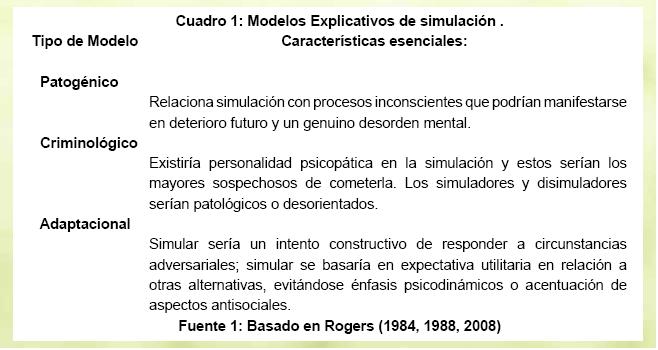
<body><![CDATA[<p style="text-align: justify;" class="MsoNormal"><span class="GramE"><span  style="font-size: 10pt; font-family: Verdana;">incoherencia</span></span><span  style="font-size: 10pt; font-family: Verdana;">, lo que provoca imposibilidad de realizar juicios respecto a su intencionalidad. <o:p></o:p></span></p>     <p style="text-align: justify;" class="MsoNormal"><span  style="font-size: 10pt; font-family: Verdana;">Otro aspecto que ha dificultado el entendimiento del fen&#243;meno de la simulaci&#243;n, son los modelos explicativos <span class="SpellE">pre</span>-existentes en que se contextualiza su din&#225;mica, los cuales se pueden agrupar en tres tipos: <a href="/img/revistas/mlcr/v31n1/art04t1.jpg">Cuadro 1</a> <o:p></o:p></span></p>     <p style="text-align: justify;" class="MsoNormal"><span  style="font-size: 10pt; font-family: Verdana;">La simulaci&#243;n al ser m&#225;s que un fen&#243;meno todo o nada y al trascender lo patol&#243;gico y lo moral, debe visualizarse como un fen&#243;meno complejo y con multiplicidad de variables. Es por ello que para su an&#225;lisis psicol&#243;gico se proponen criterios espec&#237;ficos para clasificarla, que incluir&#237;an tanto un patr&#243;n de s&#237;ntomas auto- <span class="GramE">reportados</span> e informaci&#243;n colateral en la que la motivaci&#243;n individual para fingir no sea exclusivamente el deseo de tener un rol de paciente. Para Matalobos y Gonz&#225;les (2007) el modelo <span class="SpellE">adaptacional</span> de Rogers analiza coste-beneficios presentes en situaciones de relevancia personal, como lo ser&#237;an enfrentarse a procesos legales y llegar a tener una consecuencia <span class="SpellE">aversiva</span> de los mismos. <o:p></o:p></span></p>     <p style="text-align: justify;" class="MsoNormal"><span  style="font-size: 10pt; font-family: Verdana;">Teniendo en cuenta que las conductas y los relatos de s&#237;ntomas simulados responden a construcciones complejas de quien las emite, se iniciar&#225; la descripci&#243;n de una serie de indicios que han sido se&#241;alados por m&#250;ltiples autores como elementos de simulaci&#243;n. Ello con el af&#225;n de que el lector pueda tener insumos para ir recopilando indicadores que deben complementarse con informaci&#243;n colateral y resultado de las pruebas utilizadas en la evaluaci&#243;n. <o:p></o:p></span></p>     <p class="MsoNormal"><b style=""><span  style="font-size: 10pt; font-family: Verdana;">Din&#225;micas e indicios de conductas de simulaci&#243;n. <o:p></o:p></span></b></p>     <p style="text-align: justify;" class="MsoNormal"><span  style="font-size: 10pt; font-family: Verdana;">Seg&#250;n Jim&#233;nez y S&#225;nchez (2004) se tiende a simular s&#237;ntomas aislados y de corta duraci&#243;n (falta de memoria, alucinaciones, ideas delirantes, apat&#237;a, falta de control de los impulsos e hipocondr&#237;as), siendo raro simular s&#237;ndromes psicol&#243;gicos completos por desconocimiento de detalles o coherencia de la patolog&#237;a. Por ello suele encontrarse como evidencia de la simulaci&#243;n una mezcla incoherente e inconsistente de s&#237;ntomas de varias enfermedades y falta de coherencia <span class="SpellE">sintomatol&#243;gica</span>. <o:p></o:p></span></p>     <p style="text-align: justify;" class="MsoNormal"><span class="GramE"><span  style="font-size: 10pt; font-family: Verdana;">Un</span></span><span  style="font-size: 10pt; font-family: Verdana;"> persona que simula puede adoptar una actitud pasiva y de inhibici&#243;n <span  class="SpellE">comportamental</span>, neg&#225;ndose a realizar cualquier actividad alegando enfermedad y llevando al extremo la pasividad (hasta tornarse &#8220;<span class="SpellE">catat&#243;nicos</span>&#8221;); por otra parte simuladores activos manifiestan cualquier tipo de actividad desproporcionada, desordenada e incoherente (gritos, gestos, agresiones, comportamientos rid&#237;culos, gesticulaciones extravagantes) con contestaciones absurdas e il&#243;gicas. <o:p></o:p></span></p> <b style=""><span style="font-size: 10pt; font-family: Verdana;">Hamilton, <span class="SpellE">Fedman</span> y <span class="SpellE">Cunnien</span> (2008) brindan otros ejemplos: <o:p></o:p></span></b><span  style="font-size: 10pt; font-family: Verdana;">    <br>     <br> Esquizofr&#233;nicos han demostrado capacidad de representarse como enfermas o sanas en funci&#243;n de sus objetivos (es decir, personas con una<o:p></o:p></span> <span  class="GramE"><span style="font-size: 10pt; font-family: Verdana;">patolog&#237;a</span></span><span  style="font-size: 10pt; font-family: Verdana;"> real pueden sobredimensionar su enfermedad, o incluso simular otras). <o:p></o:p>    <br> Las motivaciones son diversas, abarcando desde evitar el dolor o problemas legales, hasta obtener indemnizaciones o medicamentos. <o:p></o:p></span> &lt;&gt;<span style="font-size: 10pt; font-family: Symbol;"><span  style=""><span  style="font-family: &quot;Times New Roman&quot;; font-style: normal; font-variant: normal; font-weight: normal; font-size: 7pt; line-height: normal; font-size-adjust: none; font-stretch: normal;"></span></span></span><span  style="font-size: 10pt; font-family: Verdana;">La co-ocurrencia (que alucinaciones se asocien con delirios) tienen una mayor propensi&#243;n a ser intermitentes en simuladores. <o:p></o:p>    ]]></body>
<body><![CDATA[<br> Alucinaciones relacionadas con alcohol cesan al detener el consumo y se caracterizan por ser muy v&#237;vidas. Las m&#225;s comunes son las auditivas en forma de ruido, m&#250;sica y voces ininteligibles; con temas variados que abarcan temas espirituales, persecuci&#243;n o instrucciones de asuntos cotidianos. Se suelen presentar difamaciones, reclamos o amenazas, generando temor y siendo reconocidas como irreales posterior a la crisis (duraci&#243;n aproximada de una semana o menos). <o:p></o:p></span>     <p style="text-align: justify;" class="MsoNormal"><span  style="font-size: 10pt; font-family: Symbol;"><span style=""><span  style="font-family: &quot;Times New Roman&quot;; font-style: normal; font-variant: normal; font-weight: normal; font-size: 7pt; line-height: normal; font-size-adjust: none; font-stretch: normal;"></span></span></span><span  style="font-size: 10pt; font-family: Verdana;">La &#8220;simulaci&#243;n de mutismo&#8221; se presenta como un s&#237;ntoma solitario o parte de una psicosis simulada. <o:p></o:p></span></p>     <p style="text-align: justify;" class="MsoNormal"><span  style="font-size: 10pt; font-family: Verdana;">El mutismo genuino ocurre con o sin <span class="SpellE">catatonia</span> y se reconoce por presencia de ciertas posturas, negativismo, obediencia autom&#225;tica, flexibilidad c&#233;rea y otras caracter&#237;sticas de la esquizofrenia. El mutismo sin <span class="SpellE">catatonia</span> se observa en esquizofr&#233;nicos <span class="SpellE">paranoides</span>, o cr&#243;nicos con aislamiento por largos periodos de tiempo. Etiolog&#237;as m&#233;dicas incluir&#237;an enfermedades neurol&#243;gicas, lesiones en la cabeza, encefalitis por herpes, s&#237;filis terciaria, lesiones del l&#243;bulo frontal, estado <span  class="SpellE">postictal</span>, mutismo <span class="SpellE">acin&#233;tico</span> y encefalopat&#237;a de <span class="SpellE">Wernicke</span>. <o:p></o:p></span></p>     <div style="text-align: justify;"> <span style="font-size: 10pt; font-family: Verdana;">Los delirios (fen&#243;menos aparejados a alucinaciones en cuadros genuinos de psicosis) involucran temas como enfermedad (delirios som&#225;ticos), grandiosidad, celos, amor (erotoman&#237;a), persecuci&#243;n, religi&#243;n y ser pose&#237;do. Los sistemas delirantes reflejar&#225;n el nivel de inteligencia en t&#233;rminos de complejidad y sofisticaci&#243;n; as&#237; delirios nihilistas se asocian con pobreza y enfermedad y los relacionados con culpa a depresi&#243;n. Para delirios genuinos, el contenido m&#225;s extra&#241;o se asocia con pensamiento desorganizado; en demencias reales como Alzheimer involucran creencias <span  class="SpellE">paranoides</span> sobre los cuidadores, robar o ser enga&#241;ados, depresi&#243;n, <span class="SpellE">anosognosia</span>, agresi&#243;n y agitaci&#243;n. <o:p></o:p></span>    <br> <span style="font-size: 10pt; font-family: Verdana;">Pollock (1998) al realizar preguntas detalladas sobre alucinaciones brind&#243; claves para determinar simulaci&#243;n, encontr&#225;ndose que quienes enga&#241;aban sobre su psicosis eran m&#225;s propensos a presentar:</span>    <br> <span style="font-size: 10pt; font-family: Verdana;">Alucinaciones de forma vaga e incomprensible; utilizaban pocas palabras y las describ&#237;an como si se fueran continuas (con m&#225;s de una hora de duraci&#243;n)</span> <o:p></o:p>    <br> </div> <span style="font-size: 10pt; font-family: Verdana;">Deterioro incontrolable e insoportable de las mismas.    <br> Alucinaciones que brindaban &#243;rdenes con mayor frecuencia, a las cuales obedec&#237;an en relaci&#243;n a la comisi&#243;n de delitos.    <br> Ausencia relativa de otros s&#237;ntomas psic&#243;ticos (como ideas delirantes).    <br> Alusinaciones fingidas y at&#237;picas de tipo olfativo y t&#225;ctil (las alucinaciones olfativas se asocian significativamente con enga&#241;os).    ]]></body>
<body><![CDATA[<br> Adem&#225;s de los aspectos citados, es esencial tener en cuenta la evoluci&#243;n cl&#237;nica en aspectos como el tratamiento farmacol&#243;gico, ya que la mejora inmediata es poco probable (el tiempo promedio para alcanzar mejor&#237;a de alucinaciones con medicaci&#243;n antipsic&#243;tica es de 27 d&#237;as; Gundez-Bruce et al, 2005)</span><span style="font-family: verdana;"></span><o:p></o:p>    <br> <!-- big --><span style="font-family: verdana;"></span><!-- /big --> <o:p></o:p><span  style="font-size: 10pt; font-family: Verdana;"></span>     <p class="MsoNormal"><b style=""><span  style="font-size: 10pt; font-family: Verdana;">Simulaci&#243;n de S&#237;ntomas Positivos. <o:p></o:p></span></b></p>     <p style="text-align: justify;" class="MsoNormal"><span  style="font-size: 10pt; font-family: Verdana;">Adentr&#225;ndose en las din&#225;micas de simulaci&#243;n de la psicosis, respecto a las alucinaciones auditivas, Goodwin et al (1971) estudiaron fenomenolog&#237;a genuina con 116 pacientes. La mayor&#237;a escuchaba voces de ambos sexos (75%) y de personas conocidas y desconocidas (88%), escuchando voces tanto interna como externamente. Contrario a estas caracter&#237;sticas genuinas, las alucinaciones auditivas son raramente vagas (7%), inaudibles o con mensajes poco claros. Alucinaciones originales pose&#237;an una amplia gama de intensidad (de susurros a gritos); en contraste las simuladas fueron inveros&#237;miles o altisonantes (Pollock, 1998). <o:p></o:p></span></p>     <p style="text-align: justify;" class="MsoNormal"><span  style="font-size: 10pt; font-family: Verdana;">Los temas de las alucinaciones en esquizofrenia real fueron de aspectos persecutorios, voces amenazantes, obscenas, acusatorias e insultantes (<span  class="SpellE">Sadock</span> y <span class="SpellE">Sadock</span>, 2003) as&#237; como ego-<span  class="SpellE">dist&#243;nicas</span> con comentarios despectivos e insultos (con palabras como &#8220;puta&#8221; en mujeres y referidos a la masculinidad en hombres). <o:p></o:p></span></p>     <p style="text-align: justify;" class="MsoNormal"><span  style="font-size: 10pt; font-family: Verdana;">Estas alucinaciones se simulan menos por su contenido estigmatizante. <o:p></o:p></span></p>     <p style="text-align: justify;" class="MsoNormal"><span  style="font-size: 10pt; font-family: Verdana;">Las alucinaciones visuales reales se describen de tama&#241;o normal, suelen verse personas en colores siendo ocasionales las personas peque&#241;as (&#8220;liliputienses&#8221;), ya que estas se asocian con alcohol y enfermedades org&#225;nicas (Cohen, Alfonso, y <span class="SpellE">Haque</span>, 1994) y psicosis por toxicidad anticolin&#233;rgica. <o:p></o:p></span></p>     <p style="text-align: justify;" class="MsoNormal"><span  style="font-size: 10pt; font-family: Verdana;">Este tipo de alucinaciones no cambian si los ojos est&#225;n cerrados o abiertos, en tanto las inducidas por drogas se observan m&#225;s f&#225;cilmente con los ojos cerrados. Alucinaciones sin forma como destellos de luz, sombras u objetos en movimiento se asocian con enfermedades neurol&#243;gicas y abuso de sustancias (<span class="SpellE">Cummings</span> y Miller, 1987) y en personas mayores de 60 a&#241;os son indicativos de patolog&#237;a ocular como cataratas (Beck y Harris, 1994). <o:p></o:p></span></p>     <p style="text-align: justify;" class="MsoNormal"><span  style="font-size: 10pt; font-family: Verdana;">Alucinaciones por trastornos m&#233;dicos generales o neurol&#243;gico se distinguen de la esquizofrenia por mayor prevalencia de alucinaciones visuales y menor presencia de trastornos del pensamiento, comportamiento extra&#241;o, s&#237;ntomas negativos y habla r&#225;pida (Cornelius et al 1991). Ciertos s&#237;ndromes neurol&#243;gicos pueden producir alucinaciones visuales complejas cuyas causas m&#225;s comunes son trastornos epil&#233;pticos, lesiones del tronco cerebral y de las v&#237;as &#243;pticas. <o:p></o:p></span></p>     <p style="text-align: justify;" class="MsoNormal"><span  style="font-size: 10pt; font-family: Verdana;">Otras alucinaciones que son poco frecuentes en pacientes psic&#243;ticos, pero si se presentan de manera m&#225;s apreciables en personas con patolog&#237;a cerebral real son de contenido musical. Ciertas alucinaciones t&#225;ctiles se presentan en psicosis inducida por coca&#237;na e implican sensaciones de irritaci&#243;n cut&#225;nea o subcut&#225;nea. Otras alucinaciones cenest&#233;sicas (sensaciones infundadas de los estados alterados en &#243;rganos corporales) son de naturaleza extra&#241;a, lo que la convierte en una modalidad poco probable se fingirse. <o:p></o:p></span></p>     ]]></body>
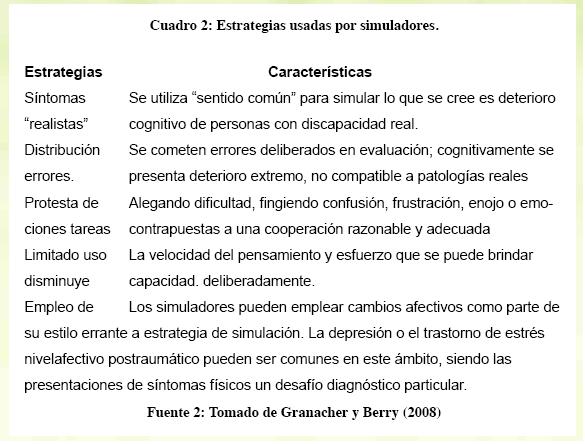
<body><![CDATA[<p class="MsoNormal"><b style=""><span  style="font-size: 10pt; font-family: Verdana;">Otras din&#225;micas a tomarse en cuenta respecto a la simulaci&#243;n. <o:p></o:p></span></b></p>     <p style="text-align: justify;" class="MsoNormal"><span  style="font-size: 10pt; font-family: Verdana;">Un aspecto que se constituye como un buen indicador de simulaci&#243;n, es el conocimiento inadecuado o incompleto de los trastornos fingidos, por ello se tiende a actuar un menor n&#250;mero de s&#237;ntomas y creer que cuanto m&#225;s extra&#241;o sea el comportamiento, m&#225;s convincente la demostraci&#243;n de la supuesta psicosis. Los trastornos formales del pensamiento presentes en la psicosis (la perseverancia, descarrilamiento, neologismos y &#8220;ensalada de palabras&#8221;) adem&#225;s de los s&#237;ntomas negativos (aplanamiento afectivo, <span class="SpellE">alogia</span>, abulia) rara vez se simulan. <o:p></o:p></span></p>     <p style="text-align: justify;" class="MsoNormal"><span  style="font-size: 10pt; font-family: Verdana;">Las estrategias de afrontamiento son importantes, ya que los s&#237;ntomas reales tienden a disminuir cuando hay distracciones con otras actividades. Relatos referidos a la intensificaci&#243;n de alucinaciones reales indican aumento cuando las personas se encuentran solas, empeorando con el uso de la radio y la televisi&#243;n (Leudar et al., 1997). <o:p></o:p></span></p>     <p style="text-align: justify;" class="MsoNormal"><span  style="font-size: 10pt; font-family: Verdana;">Para <span  class="SpellE">Resnick</span> y <span class="SpellE">Knoll</span> (2008) se debe considerar simulaci&#243;n cuando se alega un impulso repentino o irresistible de tipo obsesivo, ya que es extremadamente improbable que un impulso pueda ser incontrolable en su primera aparici&#243;n; los impulsos incontrolables genuinos se caracterizan por persistencia patol&#243;gica de un pensamiento o sentimiento ego-<span class="SpellE">dist&#243;nico</span>. <span class="SpellE">Granacher</span> y Berry (2008) consideran que los simuladores pueden presentarse con quejas fingidas en 3 formas, ya sea con presentaciones de falsas se&#241;ales y s&#237;ntomas cognitivos o neuropsicol&#243;gicos; presentaci&#243;n de falsos signos y s&#237;ntomas psiqui&#225;tricos o bien presencia de falsos signos y s&#237;ntomas som&#225;ticos. Para ello los simuladores echar&#237;an mano de las siguientes estrategias:&nbsp; <a  href="/img/revistas/mlcr/v31n1/art04t2.jpg">Cuadro 2</a> <o:p></o:p></span></p>     <p style="text-align: justify;" class="MsoNormal"><span  style="font-size: 10pt; font-family: Verdana;">Es apreciable como &#8220;simular&#8221; puede tomar m&#250;ltiples particularidades, muchas de las cuales se pueden dilucidar en el transcurrir de una observaci&#243;n conductual y entrevista, pero como se ha insistido, es menester profundizar dicho an&#225;lisis con la aplicaci&#243;n de pruebas y la evaluaci&#243;n de otros elementos. A continuaci&#243;n se brindar&#225;n aspectos que se pueden tomar en cuenta en estas otras &#225;reas de la pericia psicol&#243;gica. <o:p></o:p></span></p>     <p class="MsoNormal"><b style=""><span  style="font-size: 10pt; font-family: Verdana;">Incidencia y aproximaciones a un &#8220;perfil&#8221; de la simulaci&#243;n. <o:p></o:p></span></b></p> <span style="font-size: 10pt; font-family: Verdana;">Para personas que intentan simular en contextos legales, Arce (2006) presenta el siguiente perfil: <o:p></o:p>    <br> La simulaci&#243;n es m&#225;s frecuente en hombres entre 24 y 56 a&#241;os.<o:p></o:p></span><span  style="font-size: 10pt; font-family: Verdana;">    <br> El nivel sociocultural del simulador suele ser bajo. <o:p></o:p></span><span  style="font-size: 10pt; font-family: Symbol;"><span style=""><span  style="font-family: &quot;Times New Roman&quot;; font-style: normal; font-variant: normal; font-weight: normal; font-size: 7pt; line-height: normal; font-size-adjust: none; font-stretch: normal;">    <br> </span></span></span><span  style="font-size: 10pt; font-family: Verdana;">Las personas suelen ser generalmente oportunistas y cambiantes. <o:p></o:p></span><span  style="font-size: 10pt; font-family: Verdana;">    <br> Sus ingresos hospitalarios son escasos y de baja duraci&#243;n. <o:p></o:p></span><span  style="font-size: 10pt; font-family: Verdana;">    ]]></body>
<body><![CDATA[<br> </span>     <div style="text-align: justify;"><span  style="font-size: 10pt; font-family: Verdana;">Rechazan evaluaciones y terapias psicol&#243;gicas y psiqui&#225;tricas, dificultando el conocimiento de la base psicopatol&#243;gica subyacente. <o:p></o:p></span><span  style="font-size: 10pt; font-family: Verdana;"></span>    <br> <span style="font-size: 10pt; font-family: Verdana;">Existe perturbaci&#243;n consciente, con control voluntario de la sintomatolog&#237;a. <o:p></o:p></span><span  style="font-size: 10pt; font-family: Verdana;"></span>    <br> <span style="font-size: 10pt; font-family: Verdana;">Con los citados elementos, se podr&#237;an perfilar un grupo amplio de personas que no representar&#237;an necesariamente a todo el espectro de personas que incurren en intentos de <span class="GramE">simular .</span> Por ello a pesar de tener en cuenta este importante insumo, se continuar&#225; profundizando en din&#225;micas y particularidades que deben tomarse en cuenta para describir din&#225;micas de simulaci&#243;n. </span><span  style="font-size: 10pt; font-family: Verdana;"></span>    <br> <span style="font-size: 10pt; font-family: Verdana;">Rogers (2008) brinda recomendaciones para valorar integralmente trastornos mentales fingidos, trascendiendo lo observable de la conducta:</span><span  style="font-size: 10pt; font-family: Verdana;">    <br> Apreciar s&#237;ntomas extra&#241;os o &#8220;raros&#8221;:    <br> </span></div>     <p class="MsoNormal"  style="margin-left: 14.2pt; text-indent: -14.2pt; text-align: justify;"><span  style="font-size: 10pt; font-family: Verdana;">Adoptar un enfoque multimodal de pruebas y utilizar entrevistas estructuradas para simulaci&#243;n (como<o:p></o:p></span></p>     <div style="text-align: justify;"> <span class="GramE"><span style="font-size: 10pt; font-family: Verdana;">la</span></span><span  style="font-size: 10pt; font-family: Verdana;"> Entrevista Estructurada de Reporte de S&#237;ntomas: SIRS). <o:p></o:p></span>    <br> <span style="font-size: 10pt; font-family: Verdana;">Al ser los s&#237;ntomas extremos o improbables una forma dram&#225;tica de representar sintomatolog&#237;a, para algunos simuladores puede ser<o:p></o:p></span> &lt;&gt;<span class="GramE"><span  style="font-size: 10pt; font-family: Verdana;">absurdo</span></span><span  style="font-size: 10pt; font-family: Verdana;"> intentar realizarlos. Por ello se deben examinar s&#237;ntomas improbables o extremos como una prueba de fingimiento extrema. <o:p></o:p></span>    ]]></body>
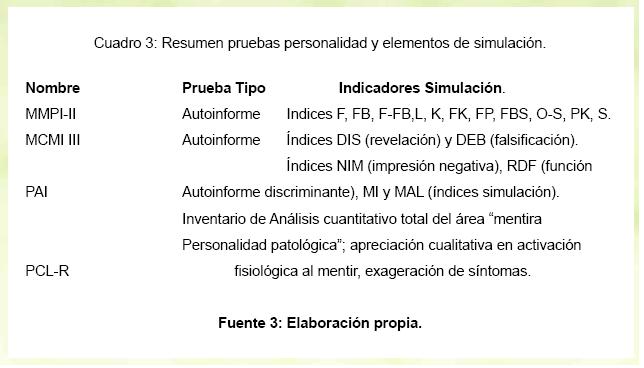
<body><![CDATA[<br> <span style="font-size: 10pt; font-family: Verdana;">Las combinaciones de s&#237;ntomas y patrones espurios de psicopatolog&#237;a ofrecen un enfoque para analizar relaciones entre s&#237;ntomas<o:p></o:p></span></div> <span class="GramE"><span style="font-size: 10pt; font-family: Verdana;">y</span></span><span  style="font-size: 10pt; font-family: Verdana;"> caracter&#237;sticas asociadas. <o:p></o:p>    <br> Analizar &#8220;Lo reportado <span class="SpellE">vrs</span> lo observado&#8221; y los &#8220;estereotipos err&#243;neos&#8221;, por su consistencia y eficacia para detectar simuladores sofisticados. <o:p></o:p></span>     <p style="text-align: justify;" class="MsoNormal"><span  style="font-size: 10pt; font-family: Verdana;">Rogers (2008) cita otras dos estrategias derivadas del SIRS que complementan un escrutinio de la simulaci&#243;n: la observancia de s&#237;ntomas reportados que difieren cualitativamente de los s&#237;ntomas originales; as&#237; como el uso de s&#237;ntomas excesivamente especificados. Esta estrategia deber&#237;a ser complementada por el soporte evaluativo recomendado (revisi&#243;n de informaci&#243;n colateral, entrevistas al evaluado y personas pertinente para la peritaci&#243;n, aplicaci&#243;n de pruebas psicol&#243;gicas), as&#237; como no escatimar en estrategias de valoraci&#243;n, ya que todas las medidas son vulnerables al fingimiento; por ello una evaluaci&#243;n completa debe incluir estrategias m&#250;ltiples de detecci&#243;n. <o:p></o:p></span></p>     <p style="text-align: justify;" class="MsoNormal"><span  style="font-size: 10pt; font-family: Verdana;">Los insumos descritos para ampliar el bagaje de quienes abordar&#225;n casos de simulaci&#243;n <span class="GramE">debe</span> complementarse con instrumentos pertinentes que ayuden a sustentar las conclusiones sobre esta din&#225;mica particular. Por ello se incluye un breve apartado sobre pruebas que pueden generar insumos para determinar simulaci&#243;n. <o:p></o:p></span></p>     <p class="MsoNormal"><b style=""><span  style="font-size: 10pt; font-family: Verdana;">Pruebas psicol&#243;gicas que brindar&#237;an indicios de simulaci&#243;n. <o:p></o:p></span></b></p>     <p style="text-align: justify;" class="MsoNormal"><span  style="font-size: 10pt; font-family: Verdana;">Si bien en m&#250;ltiples pruebas psicol&#243;gicas pueden utilizarse algunos indicadores para advertir elementos de simulaci&#243;n, ya sea por la forma de respuesta o tipo de rendimientos en las mismas, en el presente trabajo se rese&#241;ar&#225;n en primera instancia, diversas pruebas de personalidad pueden bosquejar algunos elementos de simulaci&#243;n, para dar paso posteriormente a pruebas que se abocan espec&#237;ficamente al tema de la simulaci&#243;n de psicosis. <o:p></o:p></span></p>     <p style="text-align: justify;" class="MsoNormal"><span  style="font-size: 10pt; font-family: Verdana;">En cuanto a personalidad, pruebas como el Inventario Multif&#225;sico de Personalidad de Minnesota (MMPIII), el Inventario de Evaluaci&#243;n de la Personalidad (PAI), el Inventario Cl&#237;nico Multiaxial de Millon III (MCMI III) o el Psychopatic Checklist Revised (PCL-R) rese&#241;an una serie de aspectos importantes, como lo son: <a  href="/img/revistas/mlcr/v31n1/art04t3.jpg">Cuadro 3</a>    <br> </span></p>     <p style="text-align: justify;" class="MsoNormal"><span  style="font-size: 10pt; font-family: Verdana;">Asimismo gran diversidad de pruebas pueden generar indicadores indirectos de simulaci&#243;n de sintomatolog&#237;a <span class="SpellE">psic&#243;tica</span> variada. Algunos ejemplos que no pretenden ser exhaustivos (ni que tampoco incluyen simulaci&#243;n de problemas de memoria, que en ocasiones se incluyen como s&#237;ntomas positivos pero que para efectos del presente art&#237;culo no se consideraron), son los siguientes: (<a  href="/img/revistas/mlcr/v31n1/art04t4.jpg">ver cuadro 4</a>) <o:p></o:p></span></p>     <div>     ]]></body>
<body><![CDATA[<div>     <p style="text-align: justify;" class="MsoNormal"><span  style="font-size: 10pt; font-family: Verdana;">Para la valoraci&#243;n espec&#237;fica de simulaci&#243;n de s&#237;ntomas psic&#243;ticos, se describir&#225;n tres pruebas que se utilizan ampliamente en el contexto costarricense. Lo anterior con fines descriptivos y rescatando &#250;nicamente algunos de los m&#250;ltiples aspectos que ofrecen. <o:p></o:p></span></p>     <p class="MsoNormal"><b style=""><span  style="font-size: 10pt; font-family: Verdana;" lang="EN-US">La Miller Forensic <span class="SpellE">Assesment</span> of Symptoms (M-Fast). <o:p></o:p></span></b></p>     <div style="text-align: justify;"><span  style="font-size: 10pt; font-family: Verdana;">Derivada de la SIRS, mide estilos de respuesta para la distinci&#243;n precisa entre estilos honestos, deshonestos o simulados de respuesta (<span  class="SpellE">Guriel</span> y <span class="SpellE">Fremouw</span>, 2006), detectando simulaci&#243;n de psicopatolog&#237;a general. Para su aplicaci&#243;n debe verificarse capacidad cognitiva para comprender los &#237;tems y evitarse condiciones de agitaci&#243;n extrema o marcada incoherencia en el evaluado, recomend&#225;ndose aplicaci&#243;n con cautela en adolescentes. Dise&#241;ada para personas de ambos sexos, mayores de 18 a&#241;os y de cualquier etnia <span style="">o contexto social, ha sido validada en contextos cl&#237;nicos y forenses (Miller, 2001). Se compone de 25 preguntas que se administran entre 5 y 10 minutos, con un punto de corte de &#8805; 6 para sospechar simulaci&#243;n (Smith, 2008). Las respuestas se <span class="SpellE">operacionalizan</span> en las siguientes escalas:<b> <o:p></o:p></b></span></span>    <br> <span style="font-size: 10pt; font-family: Verdana;">Reportado <span class="SpellE">vs</span> observado: compara la descripci&#243;n de la experiencia con la conducta actual. <o:p></o:p></span><span  style="font-size: 10pt; font-family: Verdana;"></span>    <br> <span style="font-size: 10pt; font-family: Verdana;"></span></div> <span style="font-size: 10pt; font-family: Verdana;">Sintomatolog&#237;a extrema: mide s&#237;ntomas reportados como extremos en comparaci&#243;n con s&#237;ntomas t&#237;picos de por pacientes psiqui&#225;tricos.</span><span  style="font-size: 10pt; font-family: Verdana;">    <br> </span>     <div style="text-align: justify;"><span  style="font-size: 10pt; font-family: Verdana;">Combinaciones extra&#241;as: interpretaci&#243;n s&#237;ntomas que no suelen aparecer juntos. </span><span style="font-size: 10pt; font-family: Verdana;"></span>    <br> <span style="font-size: 10pt; font-family: Verdana;">Alucinaciones inusuales: s&#237;ntomas poco frecuentes en pacientes psiqui&#225;tricos.</span><span  style="font-size: 10pt; font-family: Verdana;">    <br> Curso inusual del s&#237;ntoma: percepci&#243;n del curso de enfermedad en la persona.</span> </div>     ]]></body>
<body><![CDATA[<p class="MsoNormal"  style="margin-left: 14.2pt; text-indent: -14.2pt; text-align: justify;"><!--[if !supportLists]--></p>     <div style="text-align: justify;"></div>     <div style="text-align: justify;">     <div style="text-align: justify;"><span  style="font-size: 10pt; font-family: Verdana;">Imagen negativa: eval&#250;a si se tiene una imagen o percepci&#243;n extremadamente negativa de s&#237; mismo, poco com&#250;n en poblaciones</span><span  style="font-size: 10pt; font-family: Verdana;"> psiqui&#225;tricas. Se tiene en consideraci&#243;n que poblaciones como depresivos severos o trastornos l&#237;mite de personalidad podr&#237;an asumir este tipo de posturas. <o:p></o:p></span><span class="SpellE"><span  style="font-size: 10pt; font-family: Verdana;"></span></span>    <br> </div> <span class="SpellE"><span  style="font-size: 10pt; font-family: Verdana;">Sugestibilidad</span></span><span  style="font-size: 10pt; font-family: Verdana;">: mide el hecho de que personas que contestan positivamente las preguntas tienden a ser muy sugestionables. <o:p></o:p></span> </div>     <p style="text-align: justify;" class="MsoNormal"><span  style="font-size: 10pt; font-family: Verdana;">Para Guy, <span class="SpellE">Kwartner</span> y Miller (2006) el M-Fast es atractivo al generar en corto tiempo elementos sobre simulaci&#243;n que se deben profundizar. En poblaci&#243;n costarricense se utiliz&#243; en un estudio de personas que solicitaba pensi&#243;n por invalidez (Carrera, 2005). <o:p></o:p></span></p>     <p class="MsoNormal"><b style=""><span  style="font-size: 10pt; font-family: Verdana;">Inventario Estructurado de Simulaci&#243;n de S&#237;ntomas (SIMS). <o:p></o:p></span></b></p> <span class="SpellE"><span  style="font-size: 10pt; font-family: Verdana;">Widows</span></span><span  style="font-size: 10pt; font-family: Verdana;"> y Smith (2009) desarrollaron esta prueba de autoinforme, con 75 &#237;tems modalidad de respuesta verdadero-falso que brinda informaci&#243;n de variados s&#237;ntomas psiqui&#225;tricos y neuropsicol&#243;gicos simulados (Smith, 2008). El SIMS se utiliza con mayores de 18 a&#241;os y brinda elementos referidos a: <o:p></o:p>    <br> Psicosis (15 &#237;tems): S&#237;ntomas inusuales, extravagantes y at&#237;picos de psicosis.    <br> </span><span style="font-size: 10pt; font-family: Verdana;" lang="PT-BR">Deterioro neurol&#243;gico (15 <span class="SpellE">&#237;tems</span>): <span  class="SpellE">S&#237;ntomas</span> il&#243;gicos o at&#237;picos. <o:p></o:p></span> <!--[if !supportLists]--><span  style="font-size: 10pt; font-family: Symbol;"><span style=""><span  style="font-family: &quot;Times New Roman&quot;; font-style: normal; font-variant: normal; font-weight: normal; font-size: 7pt; line-height: normal; font-size-adjust: none; font-stretch: normal;"></span></span></span><span  style="font-size: 10pt; font-family: Verdana;">    <br> Trastornos amn&#233;sicos (15 &#237;tems): Trastornos de memoria inconsistentes con patrones de deterioro producidos por disfunci&#243;n o da&#241;o cerebral real. </span><span style="font-size: 10pt; font-family: Verdana;">    ]]></body>
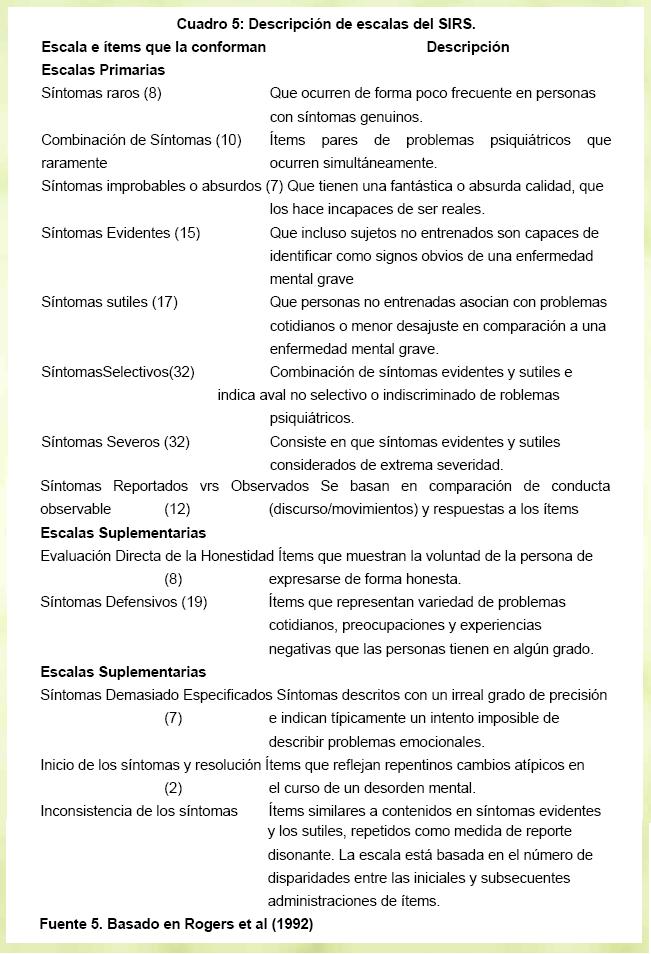
<body><![CDATA[<br> Baja inteligencia: (15 &#237;tems): exageraci&#243;n de d&#233;ficit intelectual al fallar preguntas sencillas de conocimiento general.&nbsp;</span><span  style="font-size: 10pt; font-family: Symbol;"><span style=""> </span></span><span style="font-size: 10pt; font-family: Verdana;">Trastornos afectivos (15 &#237;tems): s&#237;ntomas at&#237;picos de depresi&#243;n y ansiedad. <o:p></o:p></span>     <p class="MsoNormal"><span  style="font-size: 10pt; font-family: Verdana;">Gonz&#225;lez y Santamar&#237;a (2008) indican estudios sobre fiabilidad y convergencia del SIMS con pruebas como el MMPI-2 y el MCMI-III en Espa&#241;a. En un estudio con 229 personas asignados a dos grupos: &#8220;respuesta honesta&#8221; y &#8220;simuladores&#8221;, los &#8220;simuladores&#8221; puntuaron m&#225;s elevado que el grupo control en todas las escalas, respondiendo con exageraci&#243;n para reflejar &#8220;su peor imagen&#8221; (el SIMS correlacion&#243; significativamente con el &#205;ndice Global de Gravedad o &#205;ndice Sintom&#225;tico General del SCL-90-R; <span class="SpellE">Edens</span>, Otto y <span class="SpellE">Dwyer</span>, 1999). <o:p></o:p></span></p>     <p class="MsoNormal"><span  style="font-size: 10pt; font-family: Verdana;">El SIMS no se recomienda para discapacitados graves ni m&#225;s all&#225; de su prop&#243;sito como <span class="SpellE">screening</span> para simulaci&#243;n, ya que para una determinaci&#243;n definitiva de esta se sugieren valoraciones m&#225;s exhaustivas como el SIRS, siendo necesario el complemento de m&#250;ltiples fuentes de informaci&#243;n colateral. La Entrevista Estructurada de Reporte de S&#237;ntomas (SIRS). <o:p></o:p></span></p>     <p style="text-align: justify;" class="MsoNormal"><span  style="font-size: 10pt; font-family: Verdana;">Ideada por Rogers, <span class="SpellE">Bagby</span> y Dickens (1992), valora por medio de 172 elementos simulaci&#243;n, disimulaci&#243;n, datos sobre fingimiento (simulaci&#243;n y desordenes facticios con s&#237;ntomas psic&#243;ticos) y tipos de respuesta honesta, generando evidencia preliminar de respuestas inconsistentes y de c&#243;mo se est&#225; fingiendo. Sus escalas son: (<a href="/img/revistas/mlcr/v31n1/art04t5.jpg">Ver cuadro 5</a>) <o:p></o:p></span></p> </div> </div> </div>     <div>     <div style="text-align: justify;"></div>     <p style="text-align: justify;" class="MsoNormal"><span  style="font-size: 10pt; font-family: Verdana;">Las ocho escalas primarias se basan en estrategias &#250;tiles en la discriminaci&#243;n clave de trastornos fingidos respecto a los genuinos, representando este instrumento una mejora sobre otros m&#233;todos de valoraci&#243;n por su validaci&#243;n a trav&#233;s de la integraci&#243;n de la simulaci&#243;n en grupos de dise&#241;o establecidos, con tasas de clasificaci&#243;n &#243;ptimas del fen&#243;meno replicado en otros estudios. <o:p></o:p></span></p>     <div style="text-align: justify;"> <span style="font-size: 10pt; font-family: Verdana;">Guy, <span  class="SpellE">Kwartner</span> y Miller (2006) lo consideran un instrumento validado por su dise&#241;o y capacidad para distinguir a sujetos con enfermedad mental genuina de quienes pretenden fingirla. Sus propiedades psicom&#233;tricas poseen adecuado respaldo, logrado comprobar su complementariedad y coherencia conceptual, al utilizarse con otras pruebas como lo reflejan los siguientes estudios: <o:p></o:p></span>    <br> <span style="font-size: 10pt; font-family: Verdana;">El MMPI-2: <span class="SpellE">Gassen</span>, <span class="SpellE">Pietz</span>, Spray, y <span class="SpellE">Denney</span> (2007), Lewis, <span  class="SpellE">Simcox</span>, y Berry (2002); <span class="SpellE">McCusker</span>, Moran, <span  class="SpellE">Serfass</span> y Peterson (2003). <o:p></o:p></span><span  style="font-size: 10pt; font-family: Verdana;"></span>    <br> <span style="font-size: 10pt; font-family: Verdana;">El PAI: <span class="SpellE">Boccaccini</span>, <span class="SpellE">Murrie</span>, y Duncan (2006) y <span class="SpellE">Kucharski</span>, <span  class="SpellE">Toomey</span>, Fila y Duncan (2007). <o:p></o:p></span><span  style="font-size: 10pt; font-family: Verdana;"></span>    ]]></body>
<body><![CDATA[<br> <span style="font-size: 10pt; font-family: Verdana;">El SIMS: Lewis. <span class="SpellE">Simcox</span> y Berry (2002); <span  class="SpellE">Vitacco</span>, Rogers, <span class="SpellE">Gabel</span> y <span class="SpellE">Munizza</span> (2007), <span class="SpellE">Clegg</span>, <span class="SpellE">Fremouw</span> y <span class="SpellE">Mogge</span> (2009) <o:p></o:p></span><span  style="font-size: 10pt; font-family: Verdana;"></span>    <br> <span style="font-size: 10pt; font-family: Verdana;"></span></div> <span style="font-size: 10pt; font-family: Verdana;">El M-FAST: Guy y Miller (2004), Jackson, Rogers y Sewell (2005), Miller (2004, 2005); <span class="SpellE">Vitacco</span>, Rogers y sus colegas (2007).</span>     <p class="MsoNormal" style="margin-left: 14.2pt; text-indent: -14.2pt;"></p> </div>     <div>     <p class="MsoNormal"><b style=""><span  style="font-size: 11pt; font-family: Verdana;">Discusi&#243;n<o:p></o:p></span></b></p>     <p style="text-align: justify;" class="MsoNormal"><span  style="font-size: 10pt; font-family: Verdana;">Un proceso de evaluaci&#243;n consiste en diversas etapas: recabar exhaustivamente informaci&#243;n de diversas fuentes colaterales, realizar entrevistas y aplicar pruebas psicol&#243;gicas para as&#237; obtener insumos que sustenten un informe. El paso previo a todo ello es tener clara cual es la consulta legal que da pie a la evaluaci&#243;n, y sobre todo el tener en cuenta cuales son los alcances y las limitaciones que se posee como cient&#237;fico para responder a dicha consulta. <o:p></o:p></span></p>     <p style="text-align: justify;" class="MsoNormal"><span  style="font-size: 10pt; font-family: Verdana;">En un tema complejo como evaluar posibilidad de simulaci&#243;n de psicosis, el rubro de la informaci&#243;n colateral debe reunir elementos cl&#237;nico-psiqui&#225;tricos que permitan ver din&#225;micas esenciales, como lo son evoluci&#243;n de los trastornos e historial hospitalario. <o:p></o:p></span></p>     <p style="text-align: justify;" class="MsoNormal"><span  style="font-size: 10pt; font-family: Verdana;">El evaluador antes de realizar la entrevista debe poseer un manejo de las din&#225;micas de simulaci&#243;n, teniendo en cuenta aspectos como los que se han citado en el presente trabajo; sin ello el proceso de observaci&#243;n conductual y entrevista naufragar&#237;a irremediablemente. <o:p></o:p></span></p>     <p style="text-align: justify;" class="MsoNormal"><span  style="font-size: 10pt; font-family: Verdana;">La escogencia adecuada de pruebas que brinden insumos necesarios para complementar la informaci&#243;n es vital. Para disminuir los sesgos evaluativos, se deben seleccionar pruebas que la literatura cient&#237;fica haya reconocido como v&#225;lidas y confiables en diversos contextos. Para evaluar simulaci&#243;n de s&#237;ntomas psic&#243;ticos se recomienda utilizar pruebas dise&#241;adas espec&#237;ficamente para tales fines, las cuales comprenden desde <span class="SpellE">screening</span> (M-FAST) hasta pruebas como el SIMS o el SIRS las cuales profundizan y describen din&#225;micas particulares de la simulaci&#243;n (en las cuales debe tambi&#233;n profundizarse con investigaciones costarricenses ya que su uso se ha extendido y no se conocen resultados con nuestra poblaci&#243;n). <o:p></o:p></span></p>     <p style="text-align: justify;" class="MsoNormal"><span  style="font-size: 10pt; font-family: Verdana;">La conjunci&#243;n de estos factores, junto al nivel cr&#237;tico y anal&#237;tico del evaluador, puede ayudar a facilitar la toma de decisiones periciales respecto a este complejo tema. <o:p></o:p></span></p> </div>     ]]></body>
<body><![CDATA[<div>     <p class="MsoNormal"><b style=""><span  style="font-size: 11pt; font-family: Verdana;">Conclusi&#243;n <o:p></o:p></span></b></p>     <p style="text-align: justify;" class="MsoNormal"><span  style="font-size: 10pt; font-family: Verdana;">El indicar una din&#225;mica de simulaci&#243;n en un contexto legal posee vital importancia, por lo que se deben asumir cuidados especiales al respecto. Tombaugh (2011) ilustra con algunos motivos, el porqu&#233; se deben extremar cuidados a la hora de emitir una opini&#243;n sobre posibilidad de simulaci&#243;n en un informe <span class="SpellE">psicodiagn&#243;stico</span>:    <br> </span><span style="font-size: 10pt; font-family: Verdana;">Diagnosticar simulaci&#243;n es uno de los juicios cl&#237;nicos m&#225;s peyorativos. Hacerlo sin certeza puede generar secuelas negativas que afecten la vida del usuario.    <br> </span><span style="font-size: 10pt; font-family: Verdana;">La confirmaci&#243;n de este diagn&#243;stico es dif&#237;cil de establecer con absoluta certeza, a menos que la persona lo admita o sea sorprendida simulando los s&#237;ntomas. <o:p></o:p></span>    <br> </p> <span style="font-size: 10pt; font-family: Verdana;"></span>     <div style="text-align: justify;"><span  style="font-size: 10pt; font-family: Verdana;">La simulaci&#243;n no es un fen&#243;meno todo o nada. <o:p></o:p></span><span  style="font-size: 10pt; font-family: Verdana;"></span>    <br> <span style="font-size: 10pt; font-family: Verdana;">Simular no excluye coexistencia simult&#225;nea de s&#237;ntomas genuinos. <o:p></o:p></span>    <br> <span style="font-size: 10pt; font-family: Verdana;">Simular en <span class="GramE">una</span> momento dado no determina que esa din&#225;mica vaya a ocurrir siempre, ya que puede ser circunstancial. Por ello no puede considerarse un rasgo de personalidad. <o:p></o:p></span> </div>     <p style="text-align: justify;" class="MsoNormal"><span  style="font-size: 10pt; font-family: Verdana;">El autor reflexiona que un informe de posible simulaci&#243;n debe indicar intencionalidad, as&#237; como tipo y grado de distorsi&#243;n presentes. Asimismo deber&#237;a tratar de ser m&#225;s factual que acusatorio, expresando existencia de inconsistencia de resultados que permitan dar un diagn&#243;stico, o bien que los resultados obtenidos no sean consistentes con un diagn&#243;stico conocido o con las quejas actuales. Se se&#241;ala que si las din&#225;micas evaluadas generan dudas, se debe indicar este tipo de vac&#237;o, en lugar de se&#241;alar que una persona &#8220;est&#225; simulando&#8221;. <o:p></o:p></span></p>     ]]></body>
<body><![CDATA[<p style="text-align: justify;" class="MsoNormal"><span  style="font-size: 10pt; font-family: Verdana;">Un elemento final: establecer la existencia de simulaci&#243;n no es un fin en s&#237; mismo. La decisi&#243;n legal de establecer <span class="SpellE">inimputabilidad</span> es tomada por los administradores de justicia, por lo que la psicolog&#237;a debe tratar de describir y explicar las din&#225;micas subyacentes de las conductas analizadas, para tratar de desenmara&#241;ar los actos que fueron objeto de una pregunta legal. Las competencias de la psicolog&#237;a llegan hasta ese punto, pero otra gran responsabilidad es tratar de educar sobre los alcances y limitaciones que la ciencia psicol&#243;gica tiene para responder a ciertas preguntas, sobre todo cuando se trata de interrogantes de tipo legal. <o:p></o:p></span></p> </div>     <div>     <p class="MsoNormal"><b style=""><span  style="font-size: 11pt; font-family: Verdana;"></span></b></p> <hr style="width: 100%; height: 2px;">     <p class="MsoNormal"><b style=""><span  style="font-size: 11pt; font-family: Verdana;">Referencias <o:p></o:p></span></b></p>     <!-- ref --><p class="MsoNormal"><span  style="font-size: 10pt; font-family: Verdana;">Aguilar, M. Morales, A (2003). La valoraci&#243;n Judicial de la prueba pericial psicol&#243;gica en los delitos sexuales. Tesis (licenciatura en derecho). Universidad de Costa Rica. Sede Rodrigo <span class="SpellE">Facio</span>. Facultad de Derecho San Jos&#233;, C.R.    &nbsp;&nbsp;&nbsp;&nbsp;&nbsp;&nbsp;&nbsp;&nbsp;[&#160;<a href="javascript:void(0);" onclick="javascript: window.open('/scielo.php?script=sci_nlinks&ref=643142&pid=S1409-0015201400010000400001&lng=','','width=640,height=500,resizable=yes,scrollbars=1,menubar=yes,');">Links</a>&#160;]<!-- end-ref --> <o:p></o:p></span></p>     <!-- ref --><p class="MsoNormal"><span  style="font-size: 10pt; font-family: Verdana;">Aldea, M (1994). Revisi&#243;n del estado actual de los conocimientos sobre la neurosis de renta. Informaciones Psiqui&#225;tricas, 138, 411-436.    &nbsp;&nbsp;&nbsp;&nbsp;&nbsp;&nbsp;&nbsp;&nbsp;[&#160;<a href="javascript:void(0);" onclick="javascript: window.open('/scielo.php?script=sci_nlinks&ref=643144&pid=S1409-0015201400010000400002&lng=','','width=640,height=500,resizable=yes,scrollbars=1,menubar=yes,');">Links</a>&#160;]<!-- end-ref --> <o:p></o:p></span></p>     <!-- ref --><p class="MsoNormal"><span  style="font-size: 10pt; font-family: Verdana;">Arce, R (2006). Evaluaci&#243;n Forense de la Enfermedad Mental en la Incapacidad Temporal: Simulaci&#243;n y Realidad. </span><span class="SpellE"><span  style="font-size: 10pt; font-family: Verdana;" lang="EN-US">Espa&#241;a</span></span><span  style="font-size: 10pt; font-family: Verdana;" lang="EN-US">: Universidad de Santiago de <span class="SpellE">Compostela</span>.    &nbsp;&nbsp;&nbsp;&nbsp;&nbsp;&nbsp;&nbsp;&nbsp;[&#160;<a href="javascript:void(0);" onclick="javascript: window.open('/scielo.php?script=sci_nlinks&ref=643146&pid=S1409-0015201400010000400003&lng=','','width=640,height=500,resizable=yes,scrollbars=1,menubar=yes,');">Links</a>&#160;]<!-- end-ref --> <o:p></o:p></span></p>     ]]></body>
<body><![CDATA[<!-- ref --><p class="MsoNormal"><span class="GramE"><span  style="font-size: 10pt; font-family: Verdana;" lang="EN-US">Beck, J; Harris, M (1994).</span></span><span  style="font-size: 10pt; font-family: Verdana;" lang="EN-US"> <span class="GramE">Visual hallucinations in non-delusional elderly.</span> International Journal of Geriatric Psychiatry, 9, 531&#8211;536.    &nbsp;&nbsp;&nbsp;&nbsp;&nbsp;&nbsp;&nbsp;&nbsp;[&#160;<a href="javascript:void(0);" onclick="javascript: window.open('/scielo.php?script=sci_nlinks&ref=643148&pid=S1409-0015201400010000400004&lng=','','width=640,height=500,resizable=yes,scrollbars=1,menubar=yes,');">Links</a>&#160;]<!-- end-ref --> <o:p></o:p></span></p>     <!-- ref --><p class="MsoNormal"><span class="SpellE"><span  style="font-size: 10pt; font-family: Verdana;">Boccaccini</span></span><span  style="font-size: 10pt; font-family: Verdana;">, M. T., <span  class="SpellE">Murrie</span>, D. C., &amp; Duncan, S. A. (2006). </span><span class="GramE"><span  style="font-size: 10pt; font-family: Verdana;" lang="EN-US">Screening for malingering in a criminal-forensic sample with the Personality Assessment Inventory.</span></span><span  style="font-size: 10pt; font-family: Verdana;" lang="EN-US"> </span><span class="SpellE"><span  style="font-size: 10pt; font-family: Verdana;">Psychological</span></span><span  style="font-size: 10pt; font-family: Verdana;"> <span class="SpellE">Assessment</span>, 18(4), 415&#8211;423.    &nbsp;&nbsp;&nbsp;&nbsp;&nbsp;&nbsp;&nbsp;&nbsp;[&#160;<a href="javascript:void(0);" onclick="javascript: window.open('/scielo.php?script=sci_nlinks&ref=643150&pid=S1409-0015201400010000400005&lng=','','width=640,height=500,resizable=yes,scrollbars=1,menubar=yes,');">Links</a>&#160;]<!-- end-ref --> <o:p></o:p></span></p>     <!-- ref --><p class="MsoNormal"><span  style="font-size: 10pt; font-family: Verdana;">Capilla, P, Gonz&#225;lez, H, Santamar&#237;a, P. (2009). Tasas de prevalencia de simulaci&#243;n: un estudio emp&#237;rico basado en profesionales m&#233;dicos expertos. Comunicaci&#243;n presentada en el IX Congreso Nacional de la Sociedad Espa&#241;ola de Traumatolog&#237;a Laboral &#8211; SETLA. Barcelona, 26-28 de Noviembre de 2009.    &nbsp;&nbsp;&nbsp;&nbsp;&nbsp;&nbsp;&nbsp;&nbsp;[&#160;<a href="javascript:void(0);" onclick="javascript: window.open('/scielo.php?script=sci_nlinks&ref=643152&pid=S1409-0015201400010000400006&lng=','','width=640,height=500,resizable=yes,scrollbars=1,menubar=yes,');">Links</a>&#160;]<!-- end-ref --> <o:p></o:p></span></p>     <!-- ref --><p class="MsoNormal"><span  style="font-size: 10pt; font-family: Verdana;">Carrera, S (2005).Estudio de Confiabilidad y Validez de la Prueba M-FAST: Miller <span class="SpellE">Forensic</span> <span class="SpellE">Assessment</span> <span class="SpellE">of</span> <span class="SpellE">Symptoms</span>. </span><span  class="SpellE"><span class="GramE"><span  style="font-size: 10pt; font-family: Verdana;" lang="EN-US">Tesis</span></span></span><span  class="GramE"><span style="font-size: 10pt; font-family: Verdana;"  lang="EN-US">.</span></span><span  style="font-size: 10pt; font-family: Verdana;" lang="EN-US"> <st1:city  w:st="on"><st1:place w:st="on"><span class="GramE">San Jos&#233;</span></st1:place></st1:city><span  class="GramE">; UCR/CCSS.    &nbsp;&nbsp;&nbsp;&nbsp;&nbsp;&nbsp;&nbsp;&nbsp;[&#160;<a href="javascript:void(0);" onclick="javascript: window.open('/scielo.php?script=sci_nlinks&ref=643154&pid=S1409-0015201400010000400007&lng=','','width=640,height=500,resizable=yes,scrollbars=1,menubar=yes,');">Links</a>&#160;]<!-- end-ref --></span> <o:p></o:p></span></p>     <!-- ref --><p class="MsoNormal"><span class="SpellE"><span  style="font-size: 10pt; font-family: Verdana;" lang="EN-US">Clegg<span  class="GramE">,C</span></span></span><span  style="font-size: 10pt; font-family: Verdana;" lang="EN-US"> <span class="SpellE">Fremouw</span>, <st1:place w:st="on">W <span  class="SpellE">Mogge</span></st1:place>, N (2009). <span class="GramE">Utility of the Structured Inventory of Malingered <span class="SpellE">Symptomatology</span> (SIMS) and the Assessment of Depression Inventory (ADI) in screening for malingering among outpatients seeking to claim disability.</span> </span><span class="SpellE"><span  style="font-size: 10pt; font-family: Verdana;">The</span></span><span  style="font-size: 10pt; font-family: Verdana;"> Journal <span  class="SpellE">of</span> <span class="SpellE">Forensic</span> <span class="SpellE">Psychiatry</span> &amp; <span class="SpellE">Psychology</span>. 20, (2), 239&#8211; 254.    &nbsp;&nbsp;&nbsp;&nbsp;&nbsp;&nbsp;&nbsp;&nbsp;[&#160;<a href="javascript:void(0);" onclick="javascript: window.open('/scielo.php?script=sci_nlinks&ref=643156&pid=S1409-0015201400010000400008&lng=','','width=640,height=500,resizable=yes,scrollbars=1,menubar=yes,');">Links</a>&#160;]<!-- end-ref --> <o:p></o:p></span></p>     ]]></body>
<body><![CDATA[<!-- ref --><p class="MsoNormal"><span  style="font-size: 10pt; font-family: Verdana;">C&#243;digo Penal Costa Rica (26va edici&#243;n) (2011). San Jos&#233;, Costa Rica. Editorial Investigaciones Jur&#237;dicas.    &nbsp;&nbsp;&nbsp;&nbsp;&nbsp;&nbsp;&nbsp;&nbsp;[&#160;<a href="javascript:void(0);" onclick="javascript: window.open('/scielo.php?script=sci_nlinks&ref=643158&pid=S1409-0015201400010000400009&lng=','','width=640,height=500,resizable=yes,scrollbars=1,menubar=yes,');">Links</a>&#160;]<!-- end-ref --> <o:p></o:p></span></p>     <!-- ref --><p class="MsoNormal"><span  style="font-size: 10pt; font-family: Verdana;">C&#243;digo Procesal Penal Costa Rica (15va edici&#243;n) (2011). San Jos&#233;, Costa Rica. Editorial Investigaciones Jur&#237;dicas.    &nbsp;&nbsp;&nbsp;&nbsp;&nbsp;&nbsp;&nbsp;&nbsp;[&#160;<a href="javascript:void(0);" onclick="javascript: window.open('/scielo.php?script=sci_nlinks&ref=643160&pid=S1409-0015201400010000400010&lng=','','width=640,height=500,resizable=yes,scrollbars=1,menubar=yes,');">Links</a>&#160;]<!-- end-ref --> <o:p></o:p></span></p>     <!-- ref --><p class="MsoNormal"><span  style="font-size: 10pt; font-family: Verdana;">Cohen, M, Alfonso, C, <span class="SpellE">Haque</span>, M. (1994). <span  class="SpellE">Lilliputian</span> <span class="SpellE">hallucinations</span> <span class="SpellE">and</span> medical <span class="SpellE">illness</span>. General Hospital <span  class="SpellE">Psychiatry</span>, 16, 141&#8211;143.    &nbsp;&nbsp;&nbsp;&nbsp;&nbsp;&nbsp;&nbsp;&nbsp;[&#160;<a href="javascript:void(0);" onclick="javascript: window.open('/scielo.php?script=sci_nlinks&ref=643162&pid=S1409-0015201400010000400011&lng=','','width=640,height=500,resizable=yes,scrollbars=1,menubar=yes,');">Links</a>&#160;]<!-- end-ref --> <o:p></o:p></span></p>     <!-- ref --><p class="MsoNormal"><span class="GramE"><span  style="font-size: 10pt; font-family: Verdana;" lang="EN-US">Cornelius, J., <span class="SpellE">Mezzich</span>, J., <span class="SpellE">Fabrega</span>, H., Cornelius, M., Myer, J., &amp; Ulrich, R. (1991).</span></span><span  style="font-size: 10pt; font-family: Verdana;" lang="EN-US"> <span  class="GramE">Characterizing organic <span class="SpellE">hallucinosis</span>.</span> Comprehensive Psychiatry, 32, 338&#8211;344.    &nbsp;&nbsp;&nbsp;&nbsp;&nbsp;&nbsp;&nbsp;&nbsp;[&#160;<a href="javascript:void(0);" onclick="javascript: window.open('/scielo.php?script=sci_nlinks&ref=643164&pid=S1409-0015201400010000400012&lng=','','width=640,height=500,resizable=yes,scrollbars=1,menubar=yes,');">Links</a>&#160;]<!-- end-ref --> <o:p></o:p></span></p>     <!-- ref --><p class="MsoNormal"><span  style="font-size: 10pt; font-family: Verdana;" lang="EN-US">Cummings, J. Miller, B (1987). Visual hallucinations: Clinical occurrence and use in differential diagnosis. Western Journal of Medicine, 146, 46&#8211;51.    &nbsp;&nbsp;&nbsp;&nbsp;&nbsp;&nbsp;&nbsp;&nbsp;[&#160;<a href="javascript:void(0);" onclick="javascript: window.open('/scielo.php?script=sci_nlinks&ref=643166&pid=S1409-0015201400010000400013&lng=','','width=640,height=500,resizable=yes,scrollbars=1,menubar=yes,');">Links</a>&#160;]<!-- end-ref --> <o:p></o:p></span></p>     ]]></body>
<body><![CDATA[<!-- ref --><p class="MsoNormal"><span class="SpellE"><span  style="font-size: 10pt; font-family: Verdana;" lang="EN-US">Edens</span></span><span  style="font-size: 10pt; font-family: Verdana;" lang="EN-US">, J.F., Otto, R.K. y Dwyer, T. (1999). Utility of the Structured Inventory of Malingered <span class="SpellE">Symptomatology</span> in identifying persons motivated to <span class="GramE">malinger</span> psychopathology. Journal of the <st1:place w:st="on"><st1:placename w:st="on">American</st1:placename> <st1:placetype w:st="on">Academy</st1:placetype></st1:place> of Psychiatry and the Law, 27, 387-396.    &nbsp;&nbsp;&nbsp;&nbsp;&nbsp;&nbsp;&nbsp;&nbsp;[&#160;<a href="javascript:void(0);" onclick="javascript: window.open('/scielo.php?script=sci_nlinks&ref=643168&pid=S1409-0015201400010000400014&lng=','','width=640,height=500,resizable=yes,scrollbars=1,menubar=yes,');">Links</a>&#160;]<!-- end-ref --> <o:p></o:p></span></p>     <!-- ref --><p class="MsoNormal"><span class="SpellE"><span  style="font-size: 10pt; font-family: Verdana;" lang="EN-US">Gassen</span></span><span  style="font-size: 10pt; font-family: Verdana;" lang="EN-US">, M. <span class="SpellE">Pietz</span>, C. Spray, B. Denney, R. (2007). <span  class="GramE">Accuracy of <span class="SpellE">Megargee&#8217;s</span> criminal offender infrequency (FC) scale in detecting malingering among forensic examinees.</span> Criminal Justice and Behavior, 34(4), 493&#8211;504.    &nbsp;&nbsp;&nbsp;&nbsp;&nbsp;&nbsp;&nbsp;&nbsp;[&#160;<a href="javascript:void(0);" onclick="javascript: window.open('/scielo.php?script=sci_nlinks&ref=643170&pid=S1409-0015201400010000400015&lng=','','width=640,height=500,resizable=yes,scrollbars=1,menubar=yes,');">Links</a>&#160;]<!-- end-ref --> <o:p></o:p></span></p>     <!-- ref --><p class="MsoNormal"><span  style="font-size: 10pt; font-family: Verdana;" lang="EN-US">Goodwin, D. Anderson, P. Rosenthal, R. (1971). Clinical significance of hallucinations in psychiatric disorders: A study of 116 hallucinatory patients. Archives in General </span><span  class="SpellE"><span style="font-size: 10pt; font-family: Verdana;">Psychiatry</span></span><span  style="font-size: 10pt; font-family: Verdana;">, 24, 76&#8211;80.    &nbsp;&nbsp;&nbsp;&nbsp;&nbsp;&nbsp;&nbsp;&nbsp;[&#160;<a href="javascript:void(0);" onclick="javascript: window.open('/scielo.php?script=sci_nlinks&ref=643172&pid=S1409-0015201400010000400016&lng=','','width=640,height=500,resizable=yes,scrollbars=1,menubar=yes,');">Links</a>&#160;]<!-- end-ref --> <o:p></o:p></span></p>     <!-- ref --><p class="MsoNormal"><span class="SpellE"><span  style="font-size: 10pt; font-family: Verdana;">Gonzalez</span></span><span  style="font-size: 10pt; font-family: Verdana;"> H <span class="SpellE">Santamaria</span> P (2008). Inventario estructurado de simulaci&#243;n de s&#237;ntomas -SIMS. Una medida de <span class="SpellE">screening</span> de simulaci&#243;n de s&#237;ntomas psicopatol&#243;gicos y neurol&#243;gicos. </span><span  style="font-size: 10pt; font-family: Verdana;" lang="EN-US">9o <span  class="SpellE">Congreso</span> Virtual de <span class="SpellE">Psiquiatr&#237;a</span>. <span  class="SpellE">Interpsiquis</span> <span class="SpellE">Febrero</span> 2008. <span class="SpellE">Extraido</span> de <span class="SpellE">p&#225;gina</span> web www.Psiquiatria.com, el 27 <span  class="SpellE">enero</span> 2012.    &nbsp;&nbsp;&nbsp;&nbsp;&nbsp;&nbsp;&nbsp;&nbsp;[&#160;<a href="javascript:void(0);" onclick="javascript: window.open('/scielo.php?script=sci_nlinks&ref=643174&pid=S1409-0015201400010000400017&lng=','','width=640,height=500,resizable=yes,scrollbars=1,menubar=yes,');">Links</a>&#160;]<!-- end-ref --> <o:p></o:p></span></p>     <!-- ref --><p class="MsoNormal"><span class="SpellE"><span  style="font-size: 10pt; font-family: Verdana;" lang="EN-US">Guriel</span></span><span  style="font-size: 10pt; font-family: Verdana;" lang="EN-US">, J. <span class="SpellE">Fremouw</span>, W (2006). <span class="GramE">Impact of trauma history and coaching on malingering of posttraumatic stress disorder using the PAI, TSI, and M-FAST.</span> The Journal of Forensic Psychiatry &amp; Psychology, 17, (4), 577 &#8211; 592.    &nbsp;&nbsp;&nbsp;&nbsp;&nbsp;&nbsp;&nbsp;&nbsp;[&#160;<a href="javascript:void(0);" onclick="javascript: window.open('/scielo.php?script=sci_nlinks&ref=643176&pid=S1409-0015201400010000400018&lng=','','width=640,height=500,resizable=yes,scrollbars=1,menubar=yes,');">Links</a>&#160;]<!-- end-ref --> <o:p></o:p></span></p>     ]]></body>
<body><![CDATA[<!-- ref --><p class="MsoNormal"><span class="SpellE"><span  style="font-size: 10pt; font-family: Verdana;" lang="EN-US">Granacher</span></span><span  style="font-size: 10pt; font-family: Verdana;" lang="EN-US">, R. Berry, D (2008). <span class="GramE">Feigned Medical Presentations.</span> En: Clinical Assessment of Malingering and Deception. <span class="GramE">Third Edition.</span> <st1:state w:st="on">New York</st1:state>: The <st1:city  w:st="on"><st1:place w:st="on">Guilford</st1:place></st1:city> Press.    &nbsp;&nbsp;&nbsp;&nbsp;&nbsp;&nbsp;&nbsp;&nbsp;[&#160;<a href="javascript:void(0);" onclick="javascript: window.open('/scielo.php?script=sci_nlinks&ref=643178&pid=S1409-0015201400010000400019&lng=','','width=640,height=500,resizable=yes,scrollbars=1,menubar=yes,');">Links</a>&#160;]<!-- end-ref --> <o:p></o:p></span></p>     <!-- ref --><p class="MsoNormal"><span class="SpellE"><span class="GramE"><span  style="font-size: 10pt; font-family: Verdana;" lang="EN-US">Gundez</span></span></span><span  class="GramE"><span style="font-size: 10pt; font-family: Verdana;"  lang="EN-US">-Bruce, H., <span class="SpellE">McMeniman</span>, M., Robinson, D., <span class="SpellE">Woerner</span>, M., Kane, J., <span  class="SpellE">Schooler</span>, N., et al. (2005).</span></span><span  style="font-size: 10pt; font-family: Verdana;" lang="EN-US"> <o:p></o:p></span>&nbsp;&nbsp;&nbsp;&nbsp;&nbsp;&nbsp;&nbsp;&nbsp;[&#160;<a href="javascript:void(0);" onclick="javascript: window.open('/scielo.php?script=sci_nlinks&ref=643180&pid=S1409-0015201400010000400020&lng=','','width=640,height=500,resizable=yes,scrollbars=1,menubar=yes,');">Links</a>&#160;]<!-- end-ref --> <o:p></o:p></span>     <!-- ref --><p class="MsoNormal"><span  style="font-size: 10pt; font-family: Verdana;" lang="EN-US">Guy, L. Miller, H. (2004). Screening for malingered psychopathology in a correctional setting: Utility of the Miller-Forensic Assessment of Symptoms Test (M-FAST). </span><span  style="font-size: 10pt; font-family: Verdana;">Criminal <span  class="SpellE">Justice</span> <span class="SpellE">and</span> <span  class="SpellE">Behavior</span>, 31(6), 695&#8211;716.    &nbsp;&nbsp;&nbsp;&nbsp;&nbsp;&nbsp;&nbsp;&nbsp;[&#160;<a href="javascript:void(0);" onclick="javascript: window.open('/scielo.php?script=sci_nlinks&ref=643182&pid=S1409-0015201400010000400021&lng=','','width=640,height=500,resizable=yes,scrollbars=1,menubar=yes,');">Links</a>&#160;]<!-- end-ref --> <o:p></o:p></span></p>     <!-- ref --><p class="MsoNormal"><span  style="font-size: 10pt; font-family: Verdana;" lang="EN-US">Guy, L. <span  class="SpellE">Kwartner</span>, P. Miller, H (2006). <span class="GramE">Investigating the M-FAST: Psychometric Properties and Utility to Detect Diagnostic Specific Malingering.</span> </span><span  class="SpellE"><span style="font-size: 10pt; font-family: Verdana;">Behavioral</span></span><span  style="font-size: 10pt; font-family: Verdana;"> <span class="SpellE">Sciences</span> &amp; <span class="SpellE">the</span> <span class="SpellE">Law</span>, 24, 687&#8211;702.    &nbsp;&nbsp;&nbsp;&nbsp;&nbsp;&nbsp;&nbsp;&nbsp;[&#160;<a href="javascript:void(0);" onclick="javascript: window.open('/scielo.php?script=sci_nlinks&ref=643184&pid=S1409-0015201400010000400022&lng=','','width=640,height=500,resizable=yes,scrollbars=1,menubar=yes,');">Links</a>&#160;]<!-- end-ref --> <o:p></o:p></span></p>     <!-- ref --><p class="MsoNormal"><st1:city w:st="on"><st1:place w:st="on"><span  style="font-size: 10pt; font-family: Verdana;" lang="EN-US">Hamilton</span></st1:place></st1:city><span  style="font-size: 10pt; font-family: Verdana;" lang="EN-US">, J. Feldman, M. <span class="SpellE">Cunnien</span>, <span  class="GramE">A</span> (2008) Factitious Disorder in Medical and Psychiatric Practices. En: Clinical Assessment of Malingering and Deception. <span class="GramE">Third Edition.</span> <st1:state w:st="on">New York</st1:state>: The <st1:city w:st="on"><st1:place  w:st="on">Guilford</st1:place></st1:city> Press.    &nbsp;&nbsp;&nbsp;&nbsp;&nbsp;&nbsp;&nbsp;&nbsp;[&#160;<a href="javascript:void(0);" onclick="javascript: window.open('/scielo.php?script=sci_nlinks&ref=643186&pid=S1409-0015201400010000400023&lng=','','width=640,height=500,resizable=yes,scrollbars=1,menubar=yes,');">Links</a>&#160;]<!-- end-ref --> <o:p></o:p></span></p>     ]]></body>
<body><![CDATA[<!-- ref --><p class="MsoNormal"><span  style="font-size: 10pt; font-family: Verdana;" lang="EN-US">Jackson, R. Rogers, R, Sewell, K (2005). Forensic applications of the Miller Forensic Assessment of Symptoms Test (M-FAST): Screening for feigned disorders in competency to stand trial evaluations. </span><span class="SpellE"><span  style="font-size: 10pt; font-family: Verdana;">Law</span></span><span  style="font-size: 10pt; font-family: Verdana;"> <span class="SpellE">and</span> Human <span class="SpellE">Behavior</span>, 29, 199&#8211;210.    &nbsp;&nbsp;&nbsp;&nbsp;&nbsp;&nbsp;&nbsp;&nbsp;[&#160;<a href="javascript:void(0);" onclick="javascript: window.open('/scielo.php?script=sci_nlinks&ref=643188&pid=S1409-0015201400010000400024&lng=','','width=640,height=500,resizable=yes,scrollbars=1,menubar=yes,');">Links</a>&#160;]<!-- end-ref --> <o:p></o:p></span></p>     <!-- ref --><p class="MsoNormal"><span  style="font-size: 10pt; font-family: Verdana;">Jim&#233;nez F S&#225;nchez G (2004) La falsificaci&#243;n de t&#233;cnicas MMPI II un estudio con el MMPI-2. Madrid: I Congreso de Psicolog&#237;a Jur&#237;dica y Forense en Red. Colegio Oficial de Psic&#243;logos.    &nbsp;&nbsp;&nbsp;&nbsp;&nbsp;&nbsp;&nbsp;&nbsp;[&#160;<a href="javascript:void(0);" onclick="javascript: window.open('/scielo.php?script=sci_nlinks&ref=643190&pid=S1409-0015201400010000400025&lng=','','width=640,height=500,resizable=yes,scrollbars=1,menubar=yes,');">Links</a>&#160;]<!-- end-ref --> <o:p></o:p></span></p>     <!-- ref --><p class="MsoNormal"><span class="SpellE"><span  style="font-size: 10pt; font-family: Verdana;" lang="EN-US">Kucharski</span></span><span  style="font-size: 10pt; font-family: Verdana;" lang="EN-US">, L. Toomey, J. Fila, K. Duncan, S (2007). Detection of malingering of Psychiatric Disorder <span class="GramE">With</span> the Personality Assessment Inventory: An Investigation of Criminal Defendants. </span><span  style="font-size: 10pt; font-family: Verdana;">Journal <span  class="SpellE">of</span> <span class="SpellE">Personality</span> <span class="SpellE">Assessment</span>, 88(1), 25&#8211;32.    &nbsp;&nbsp;&nbsp;&nbsp;&nbsp;&nbsp;&nbsp;&nbsp;[&#160;<a href="javascript:void(0);" onclick="javascript: window.open('/scielo.php?script=sci_nlinks&ref=643192&pid=S1409-0015201400010000400026&lng=','','width=640,height=500,resizable=yes,scrollbars=1,menubar=yes,');">Links</a>&#160;]<!-- end-ref --> <o:p></o:p></span></p>     <!-- ref --><p class="MsoNormal"><span class="SpellE"><span class="GramE"><span  style="font-size: 10pt; font-family: Verdana;" lang="EN-US">Leudar</span></span></span><span  class="GramE"><span style="font-size: 10pt; font-family: Verdana;"  lang="EN-US">, <st1:place w:st="on">I.</st1:place>, Thomas, P., McNally, D., &amp; <span class="SpellE">Glinski</span>, A. (1997).</span></span><span  style="font-size: 10pt; font-family: Verdana;" lang="EN-US"> What voices can do with words: Pragmatics of verbal hallucinations. </span><span  class="SpellE"><span style="font-size: 10pt; font-family: Verdana;">Psychological</span></span><span  style="font-size: 10pt; font-family: Verdana;"> Medicine, 27(4), 885&#8211;898.    &nbsp;&nbsp;&nbsp;&nbsp;&nbsp;&nbsp;&nbsp;&nbsp;[&#160;<a href="javascript:void(0);" onclick="javascript: window.open('/scielo.php?script=sci_nlinks&ref=643194&pid=S1409-0015201400010000400027&lng=','','width=640,height=500,resizable=yes,scrollbars=1,menubar=yes,');">Links</a>&#160;]<!-- end-ref --> <o:p></o:p></span></p>     <!-- ref --><p class="MsoNormal"><span  style="font-size: 10pt; font-family: Verdana;" lang="EN-US">Lewis, J. <span  class="SpellE">Simcox</span>, A. Berry, D. (2002). <span class="GramE">Screening for feigned psychiatric symptoms in a forensic sample by using the MMPI-2 and the structured inventory of malingered <span class="SpellE">symptomatology</span>.</span> </span><span  class="SpellE"><span style="font-size: 10pt; font-family: Verdana;">Psychological</span></span><span  style="font-size: 10pt; font-family: Verdana;"> <span class="SpellE">Assessment</span>, 14(2), 170&#8211;176.    &nbsp;&nbsp;&nbsp;&nbsp;&nbsp;&nbsp;&nbsp;&nbsp;[&#160;<a href="javascript:void(0);" onclick="javascript: window.open('/scielo.php?script=sci_nlinks&ref=643196&pid=S1409-0015201400010000400028&lng=','','width=640,height=500,resizable=yes,scrollbars=1,menubar=yes,');">Links</a>&#160;]<!-- end-ref --> <o:p></o:p></span></p>     ]]></body>
<body><![CDATA[<!-- ref --><p class="MsoNormal"><span class="SpellE"><span class="GramE"><span  style="font-size: 10pt; font-family: Verdana;" lang="EN-US">McCusker</span></span></span><span  class="GramE"><span style="font-size: 10pt; font-family: Verdana;"  lang="EN-US">, P. J., Moran, M. J., <span class="SpellE">Serfass</span>, L., &amp; Peterson, K. H. (2003).</span></span><span  style="font-size: 10pt; font-family: Verdana;" lang="EN-US"> Comparability of the MMPI-<st1:metricconverter productid="2 F" w:st="on">2 <span class="GramE">F</span></st1:metricconverter><span class="GramE">(</span>p) and F scales and the SIRS in clinical use with suspected malingerers. </span><span  style="font-size: 10pt; font-family: Verdana;">International Journal <span  class="SpellE">of</span> <span class="SpellE">Offender</span> <span  class="SpellE">Therapy</span> <span class="SpellE">and</span> <span class="SpellE">Comparative</span> <span class="SpellE">Criminology</span>, 47(5), 585&#8211; 596.    &nbsp;&nbsp;&nbsp;&nbsp;&nbsp;&nbsp;&nbsp;&nbsp;[&#160;<a href="javascript:void(0);" onclick="javascript: window.open('/scielo.php?script=sci_nlinks&ref=643198&pid=S1409-0015201400010000400029&lng=','','width=640,height=500,resizable=yes,scrollbars=1,menubar=yes,');">Links</a>&#160;]<!-- end-ref --> <o:p></o:p></span></p>     <!-- ref --><p class="MsoNormal"><span  style="font-size: 10pt; font-family: Verdana;">Matalobos, B. Gonz&#225;lez, H (2007) Detecci&#243;n de simulaci&#243;n en estr&#233;s postraum&#225;tico y depresi&#243;n. <span class="SpellE">EduPsykh&#233;</span>, 6, (1), 21-47.    &nbsp;&nbsp;&nbsp;&nbsp;&nbsp;&nbsp;&nbsp;&nbsp;[&#160;<a href="javascript:void(0);" onclick="javascript: window.open('/scielo.php?script=sci_nlinks&ref=643200&pid=S1409-0015201400010000400030&lng=','','width=640,height=500,resizable=yes,scrollbars=1,menubar=yes,');">Links</a>&#160;]<!-- end-ref --> <o:p></o:p></span></p>     <!-- ref --><p class="MsoNormal"><span  style="font-size: 10pt; font-family: Verdana;" lang="EN-US">Miller, H (2001). M-Fast Miller Forensic Assessment of Symptoms Test. </span><st1:country-region w:st="on"><st1:place  w:st="on"><span style="font-size: 10pt; font-family: Verdana;">USA</span></st1:place></st1:country-region><span  style="font-size: 10pt; font-family: Verdana;">: <span class="SpellE">Psychological</span> <span class="SpellE">Assessment</span> <span class="SpellE">Resources</span>.    &nbsp;&nbsp;&nbsp;&nbsp;&nbsp;&nbsp;&nbsp;&nbsp;[&#160;<a href="javascript:void(0);" onclick="javascript: window.open('/scielo.php?script=sci_nlinks&ref=643202&pid=S1409-0015201400010000400031&lng=','','width=640,height=500,resizable=yes,scrollbars=1,menubar=yes,');">Links</a>&#160;]<!-- end-ref --> <o:p></o:p></span></p>     <!-- ref --><p class="MsoNormal"><span  style="font-size: 10pt; font-family: Verdana;" lang="EN-US">Miller, H. (2004). <span class="GramE">Examining the use of the M-FAST with criminal defendants incompetent to stand trial.</span> </span><span style="font-size: 10pt; font-family: Verdana;">International Journal <span class="SpellE">of</span> <span class="SpellE">Offender</span> <span class="SpellE">Therapy</span> <span class="SpellE">and</span> <span class="SpellE">Comparative</span> <span class="SpellE">Criminology</span>, 48(3), 268&#8211;280.    &nbsp;&nbsp;&nbsp;&nbsp;&nbsp;&nbsp;&nbsp;&nbsp;[&#160;<a href="javascript:void(0);" onclick="javascript: window.open('/scielo.php?script=sci_nlinks&ref=643204&pid=S1409-0015201400010000400032&lng=','','width=640,height=500,resizable=yes,scrollbars=1,menubar=yes,');">Links</a>&#160;]<!-- end-ref --> <o:p></o:p></span></p>     <!-- ref --><p class="MsoNormal"><span  style="font-size: 10pt; font-family: Verdana;" lang="EN-US">Miller, H. (2005). The Miller&#8212;Forensic Assessment of Symptoms Test (M-FAST): Test <span class="SpellE">generalizability</span> and utility across race, literacy, and clinical opinion. </span><span  style="font-size: 10pt; font-family: Verdana;">Criminal <span  class="SpellE">Justice</span> <span class="SpellE">and</span> <span class="SpellE">Behavior</span>, 32(6), 591&#8211;611.    &nbsp;&nbsp;&nbsp;&nbsp;&nbsp;&nbsp;&nbsp;&nbsp;[&#160;<a href="javascript:void(0);" onclick="javascript: window.open('/scielo.php?script=sci_nlinks&ref=643206&pid=S1409-0015201400010000400033&lng=','','width=640,height=500,resizable=yes,scrollbars=1,menubar=yes,');">Links</a>&#160;]<!-- end-ref --> <o:p></o:p></span></p>     ]]></body>
<body><![CDATA[<!-- ref --><p class="MsoNormal"><span class="SpellE"><span class="GramE"><span  style="font-size: 10pt; font-family: Verdana;" lang="EN-US">Mittenberg</span></span></span><span  class="GramE"><span style="font-size: 10pt; font-family: Verdana;"  lang="EN-US">, W. Patton, C. <span class="SpellE">Canyock</span>, <st1:place  w:st="on">E. Condit</st1:place>, D (2002).</span></span><span  style="font-size: 10pt; font-family: Verdana;" lang="EN-US"> Base rates of malingering and symptom exaggeration. </span><span  style="font-size: 10pt; font-family: Verdana;">Journal <span  class="SpellE">of</span> <span class="SpellE">Clinical</span> <span  class="SpellE">and</span> Experimental <span class="SpellE">Psychology</span>, 24, 1094- 1102.    &nbsp;&nbsp;&nbsp;&nbsp;&nbsp;&nbsp;&nbsp;&nbsp;[&#160;<a href="javascript:void(0);" onclick="javascript: window.open('/scielo.php?script=sci_nlinks&ref=643208&pid=S1409-0015201400010000400034&lng=','','width=640,height=500,resizable=yes,scrollbars=1,menubar=yes,');">Links</a>&#160;]<!-- end-ref --> <o:p></o:p></span></p>     <!-- ref --><p class="MsoNormal"><span  style="font-size: 10pt; font-family: Verdana;" lang="EN-US">Pollock, P. (1998). <span class="GramE">Feigning auditory hallucinations by offenders.</span> </span><span  style="font-size: 10pt; font-family: Verdana;">Journal <span  class="SpellE">of</span> <span class="SpellE">Forensic</span> <span  class="SpellE">Psychiatry</span>, 9, 305&#8211;327.    &nbsp;&nbsp;&nbsp;&nbsp;&nbsp;&nbsp;&nbsp;&nbsp;[&#160;<a href="javascript:void(0);" onclick="javascript: window.open('/scielo.php?script=sci_nlinks&ref=643210&pid=S1409-0015201400010000400035&lng=','','width=640,height=500,resizable=yes,scrollbars=1,menubar=yes,');">Links</a>&#160;]<!-- end-ref --> <o:p></o:p></span></p>     <!-- ref --><p class="MsoNormal"><span class="SpellE"><span  style="font-size: 10pt; font-family: Verdana;" lang="EN-US">Resnick</span></span><span  style="font-size: 10pt; font-family: Verdana;" lang="EN-US">, P, Knoll, J (2008). <span class="SpellE">Psicosis</span> Malingered. <span  class="GramE">En Clinical Assessment of Malingering and Deception.</span> <span class="GramE">Third Edition.</span> <st1:state w:st="on">New York</st1:state>: The <st1:city w:st="on"><st1:place w:st="on">Guilford</st1:place></st1:city> Press.    &nbsp;&nbsp;&nbsp;&nbsp;&nbsp;&nbsp;&nbsp;&nbsp;[&#160;<a href="javascript:void(0);" onclick="javascript: window.open('/scielo.php?script=sci_nlinks&ref=643212&pid=S1409-0015201400010000400036&lng=','','width=640,height=500,resizable=yes,scrollbars=1,menubar=yes,');">Links</a>&#160;]<!-- end-ref --> <o:p></o:p></span></p>     <!-- ref --><p class="MsoNormal"><span  style="font-size: 10pt; font-family: Verdana;" lang="EN-US">Rogers, R (1984). <span class="GramE">Toward an empirical model of malingering.</span> Behavioral Sciences and the Law, 2, 93-112.    &nbsp;&nbsp;&nbsp;&nbsp;&nbsp;&nbsp;&nbsp;&nbsp;[&#160;<a href="javascript:void(0);" onclick="javascript: window.open('/scielo.php?script=sci_nlinks&ref=643214&pid=S1409-0015201400010000400037&lng=','','width=640,height=500,resizable=yes,scrollbars=1,menubar=yes,');">Links</a>&#160;]<!-- end-ref --> <o:p></o:p></span></p>     <!-- ref --><p class="MsoNormal"><span  style="font-size: 10pt; font-family: Verdana;" lang="EN-US">Rogers, R. (1988). <span class="GramE">Structured interviews and dissimulation.</span> En R. Rogers (Ed.), Clinical assessment of malingering and deception (1a ed., pp. 250-268). </span><span  style="font-size: 10pt; font-family: Verdana;">Nueva York: <span  class="SpellE">Guilford</span> <span class="SpellE">Press</span>.    &nbsp;&nbsp;&nbsp;&nbsp;&nbsp;&nbsp;&nbsp;&nbsp;[&#160;<a href="javascript:void(0);" onclick="javascript: window.open('/scielo.php?script=sci_nlinks&ref=643216&pid=S1409-0015201400010000400038&lng=','','width=640,height=500,resizable=yes,scrollbars=1,menubar=yes,');">Links</a>&#160;]<!-- end-ref --><!-- ref --> <o:p></o:p></span>&nbsp;&nbsp;&nbsp;&nbsp;&nbsp;&nbsp;&nbsp;&nbsp;[&#160;<a href="javascript:void(0);" onclick="javascript: window.open('/scielo.php?script=sci_nlinks&ref=643217&pid=S1409-0015201400010000400039&lng=','','width=640,height=500,resizable=yes,scrollbars=1,menubar=yes,');">Links</a>&#160;]<!-- end-ref --> <o:p></o:p></span>     <!-- ref --><p class="MsoNormal"><span  style="font-size: 10pt; font-family: Verdana;" lang="EN-US">Rogers, R. <span class="SpellE">Bagby</span>, R. Gillis, J (1992). Improvements in the M Test as a screening measure for malingering. The Bulletin of the <st1:place w:st="on"><st1:placename w:st="on">American</st1:placename> <st1:placetype w:st="on">Academy</st1:placetype></st1:place> of Psychiatry and Law, 20, 101-104.    &nbsp;&nbsp;&nbsp;&nbsp;&nbsp;&nbsp;&nbsp;&nbsp;[&#160;<a href="javascript:void(0);" onclick="javascript: window.open('/scielo.php?script=sci_nlinks&ref=643219&pid=S1409-0015201400010000400040&lng=','','width=640,height=500,resizable=yes,scrollbars=1,menubar=yes,');">Links</a>&#160;]<!-- end-ref --> <o:p></o:p></span></p>     <!-- ref --><p class="MsoNormal"><span  style="font-size: 10pt; font-family: Verdana;" lang="EN-US">Rogers, R. <span class="SpellE">Bagby</span>, M. Dickens, S (1992). SIRS Structured Interview or Reported Symptoms. </span><span  style="font-size: 10pt; font-family: Verdana;">USA; <span  class="SpellE">Psychological</span> <span class="SpellE">Assessment</span> <span class="SpellE">Resources</span>.    &nbsp;&nbsp;&nbsp;&nbsp;&nbsp;&nbsp;&nbsp;&nbsp;[&#160;<a href="javascript:void(0);" onclick="javascript: window.open('/scielo.php?script=sci_nlinks&ref=643221&pid=S1409-0015201400010000400041&lng=','','width=640,height=500,resizable=yes,scrollbars=1,menubar=yes,');">Links</a>&#160;]<!-- end-ref --> <o:p></o:p></span></p>     <!-- ref --><p class="MsoNormal"><st1:city w:st="on"><st1:place w:st="on"><span  class="GramE"><span style="font-size: 10pt; font-family: Verdana;"  lang="EN-US">Rogers</span></span></st1:place></st1:city><span  class="GramE"><span style="font-size: 10pt; font-family: Verdana;"  lang="EN-US">, R., &amp; Cruise, K. (2000).</span></span><span  style="font-size: 10pt; font-family: Verdana;" lang="EN-US"> <span  class="GramE">Malingering and deception among psychopaths.</span> In C. B. <span class="SpellE">Gacono</span> (Ed.), The clinical and forensic assessment of <span class="SpellE">psychopathy</span>: A practitioner&#8217;s guide (pp. 269&#8211;284). </span><span class="SpellE"><span  style="font-size: 10pt; font-family: Verdana;">Mahwah</span></span><span  style="font-size: 10pt; font-family: Verdana;">, NJ: <span  class="SpellE">Erlbaum</span>.    &nbsp;&nbsp;&nbsp;&nbsp;&nbsp;&nbsp;&nbsp;&nbsp;[&#160;<a href="javascript:void(0);" onclick="javascript: window.open('/scielo.php?script=sci_nlinks&ref=643223&pid=S1409-0015201400010000400042&lng=','','width=640,height=500,resizable=yes,scrollbars=1,menubar=yes,');">Links</a>&#160;]<!-- end-ref --> <o:p></o:p></span></p>     <!-- ref --><p class="MsoNormal"><span class="GramE"><span  style="font-size: 10pt; font-family: Verdana;" lang="EN-US">Rogers, R., Harrell, E. H., &amp; <span class="SpellE">Liff</span>, C. D. (1993).</span></span><span  style="font-size: 10pt; font-family: Verdana;" lang="EN-US"> <span  class="GramE">Feigning neuropsychological impairment: A critical review of methodological and clinical considerations.</span> </span><span  class="SpellE"><span style="font-size: 10pt; font-family: Verdana;">Clinical</span></span><span  style="font-size: 10pt; font-family: Verdana;"> <span class="SpellE">Psychology</span> <span class="SpellE">Review</span>, 13, 255&#8211;274.    &nbsp;&nbsp;&nbsp;&nbsp;&nbsp;&nbsp;&nbsp;&nbsp;[&#160;<a href="javascript:void(0);" onclick="javascript: window.open('/scielo.php?script=sci_nlinks&ref=643225&pid=S1409-0015201400010000400043&lng=','','width=640,height=500,resizable=yes,scrollbars=1,menubar=yes,');">Links</a>&#160;]<!-- end-ref --> <o:p></o:p></span></p>     <!-- ref --><p class="MsoNormal"><span class="SpellE"><span  style="font-size: 10pt; font-family: Verdana;" lang="EN-US">Sadock</span></span><span  style="font-size: 10pt; font-family: Verdana;" lang="EN-US">, B. <span class="SpellE">Sadock</span>, V (2003). Kaplan and <span  class="SpellE">Sadock&#8217;s</span> synopsis of psychiatry (9th <span class="GramE">ed</span>.). </span><span  class="SpellE"><span style="font-size: 10pt; font-family: Verdana;">Philidelphia</span></span><span  style="font-size: 10pt; font-family: Verdana;">: <span class="SpellE">Lippincott</span> Williams &amp; Wilkins.    &nbsp;&nbsp;&nbsp;&nbsp;&nbsp;&nbsp;&nbsp;&nbsp;[&#160;<a href="javascript:void(0);" onclick="javascript: window.open('/scielo.php?script=sci_nlinks&ref=643227&pid=S1409-0015201400010000400044&lng=','','width=640,height=500,resizable=yes,scrollbars=1,menubar=yes,');">Links</a>&#160;]<!-- end-ref --> <o:p></o:p></span></p>     <!-- ref --><p class="MsoNormal"><span  style="font-size: 10pt; font-family: Verdana;" lang="EN-US">Smith, G (2008). <span class="GramE">Brief Screening Measures for the Detection of Feigned Psychopathology.</span> En: Clinical Assessment of Malingering and Deception. <span class="GramE">Third Edition.</span> <st1:state w:st="on">New York</st1:state>: The <st1:city w:st="on"><st1:place  w:st="on">Guilford</st1:place></st1:city> Press.    &nbsp;&nbsp;&nbsp;&nbsp;&nbsp;&nbsp;&nbsp;&nbsp;[&#160;<a href="javascript:void(0);" onclick="javascript: window.open('/scielo.php?script=sci_nlinks&ref=643229&pid=S1409-0015201400010000400045&lng=','','width=640,height=500,resizable=yes,scrollbars=1,menubar=yes,');">Links</a>&#160;]<!-- end-ref --> <o:p></o:p></span></p>     <!-- ref --><p class="MsoNormal"><span  style="font-size: 10pt; font-family: Verdana;">Tapias, A (2004). Aproximaciones t&#233;cnico tecnol&#243;gicas para la evaluaci&#243;n de psicopatolog&#237;a en el medio forense. Revista Colombiana de Psicolog&#237;a, 13, 50-56.    &nbsp;&nbsp;&nbsp;&nbsp;&nbsp;&nbsp;&nbsp;&nbsp;[&#160;<a href="javascript:void(0);" onclick="javascript: window.open('/scielo.php?script=sci_nlinks&ref=643231&pid=S1409-0015201400010000400046&lng=','','width=640,height=500,resizable=yes,scrollbars=1,menubar=yes,');">Links</a>&#160;]<!-- end-ref --> <o:p></o:p></span></p>     <!-- ref --><p class="MsoNormal"><span  style="font-size: 10pt; font-family: Verdana;">Tombaugh, T (2011). TOMM Test de Simulaci&#243;n de problemas de memoria. Madrid: TEA.    &nbsp;&nbsp;&nbsp;&nbsp;&nbsp;&nbsp;&nbsp;&nbsp;[&#160;<a href="javascript:void(0);" onclick="javascript: window.open('/scielo.php?script=sci_nlinks&ref=643233&pid=S1409-0015201400010000400047&lng=','','width=640,height=500,resizable=yes,scrollbars=1,menubar=yes,');">Links</a>&#160;]<!-- end-ref --> <o:p></o:p></span></p>     <!-- ref --><p class="MsoNormal"><span class="SpellE"><span class="GramE"><span  style="font-size: 10pt; font-family: Verdana;" lang="EN-US">Vitacco</span></span></span><span  class="GramE"><span style="font-size: 10pt; font-family: Verdana;"  lang="EN-US">, M. J., Rogers, R., Gabel, J., &amp; <span  class="SpellE">Munizza</span>, J. (2007).</span></span><span  style="font-size: 10pt; font-family: Verdana;" lang="EN-US"> An evaluation of malingering screens with competency to stand trial patients: A known-groups comparison. </span><span class="SpellE"><span  style="font-size: 10pt; font-family: Verdana;">Law</span></span><span  style="font-size: 10pt; font-family: Verdana;"> <span class="SpellE">and</span> Human <span class="SpellE">Behavior</span>, 31, 249&#8211; 260.    &nbsp;&nbsp;&nbsp;&nbsp;&nbsp;&nbsp;&nbsp;&nbsp;[&#160;<a href="javascript:void(0);" onclick="javascript: window.open('/scielo.php?script=sci_nlinks&ref=643235&pid=S1409-0015201400010000400048&lng=','','width=640,height=500,resizable=yes,scrollbars=1,menubar=yes,');">Links</a>&#160;]<!-- end-ref --> <o:p></o:p></span></p>     <!-- ref --><p><span class="SpellE"><span  style="font-size: 10pt; font-family: Verdana;">Widows</span></span><span  style="font-size: 10pt; font-family: Verdana;">, M. Smith, G (2009). SIMS Inventario Estructurado de Simulaci&#243;n de S&#237;ntomas. Madrid: TEA Ediciones.    &nbsp;&nbsp;&nbsp;&nbsp;&nbsp;&nbsp;&nbsp;&nbsp;[&#160;<a href="javascript:void(0);" onclick="javascript: window.open('/scielo.php?script=sci_nlinks&ref=643237&pid=S1409-0015201400010000400049&lng=','','width=640,height=500,resizable=yes,scrollbars=1,menubar=yes,');">Links</a>&#160;]<!-- end-ref --><o:p></o:p></span></p>     <p class="MsoNormal"><span  style="font-size: 10pt; font-family: Verdana;"><a name="1"></a><a  href="#2">*</a></span><b><span  style="font-size: 10pt; font-family: Verdana;"> </span></b><span style="font-size: 10pt; font-family: Verdana;">Investigador Criminal y Especialista en Psicolog&#237;a Cl&#237;nica Universidad de Costa Rica-CENDEISSS</span><span  style="font-size: 10pt; font-family: Verdana;">. Especialista en Psicolog&#237;a Cl&#237;nica de la Secci&#243;n de Apoyo Psicol&#243;gico Operacional del Organismo de Investigaci&#243;n Judicial, San Jos&#233;, Costa Rica.    <br> <a name="Correspondencia1"></a><a href="#Correspondencia2">*</a>Correspondencia al email: <span class="SpellE">cmorav@poder</span>-<span class="SpellE">judicial.go.cr</span> <o:p></o:p></span></p>     <p class="MsoNormal"><b><span  style="font-size: 10pt; font-family: Verdana;"></span></b></p> <hr style="width: 100%; height: 2px;">     <p style="text-align: center;" class="MsoNormal"><b><span  style="font-size: 10pt; font-family: Verdana;">Recibido para publicaci&#243;n:</span></b><span  style="font-size: 10pt; font-family: Verdana;"> 29 de Octubre de 2013. <span style="font-weight: bold;">Aceptado:</span> 15 de diciembre de 2013<o:p></o:p></span></p> </div> </div> </div>      ]]></body><back>
<ref-list>
<ref id="B1">
<nlm-citation citation-type="">
<person-group person-group-type="author">
<name>
<surname><![CDATA[Aguilar]]></surname>
<given-names><![CDATA[M]]></given-names>
</name>
<name>
<surname><![CDATA[Morales]]></surname>
<given-names><![CDATA[A]]></given-names>
</name>
</person-group>
<source><![CDATA[La valoración Judicial de la prueba pericial psicológica en los delitos sexuales]]></source>
<year>2003</year>
</nlm-citation>
</ref>
<ref id="B2">
<nlm-citation citation-type="">
<person-group person-group-type="author">
<name>
<surname><![CDATA[Aldea]]></surname>
<given-names><![CDATA[M]]></given-names>
</name>
</person-group>
<source><![CDATA[Revisión del estado actual de los conocimientos sobre la neurosis de renta: Informaciones Psiquiátricas]]></source>
<year>1994</year>
<volume>138</volume>
<page-range>411-436</page-range></nlm-citation>
</ref>
<ref id="B3">
<nlm-citation citation-type="book">
<person-group person-group-type="author">
<name>
<surname><![CDATA[Arce]]></surname>
<given-names><![CDATA[R]]></given-names>
</name>
</person-group>
<source><![CDATA[Evaluación Forense de la Enfermedad Mental en la Incapacidad Temporal: Simulación y Realidad]]></source>
<year>2006</year>
<publisher-name><![CDATA[Universidad de Santiago de Compostela]]></publisher-name>
</nlm-citation>
</ref>
<ref id="B4">
<nlm-citation citation-type="journal">
<person-group person-group-type="author">
<name>
<surname><![CDATA[Beck]]></surname>
<given-names><![CDATA[J]]></given-names>
</name>
<name>
<surname><![CDATA[Harris]]></surname>
<given-names><![CDATA[M]]></given-names>
</name>
</person-group>
<article-title xml:lang="en"><![CDATA[Visual hallucinations in non-delusional elderly]]></article-title>
<source><![CDATA[International Journal of Geriatric Psychiatry]]></source>
<year>1994</year>
<volume>9</volume>
<page-range>531-536</page-range></nlm-citation>
</ref>
<ref id="B5">
<nlm-citation citation-type="journal">
<person-group person-group-type="author">
<name>
<surname><![CDATA[Boccaccini]]></surname>
<given-names><![CDATA[M. T]]></given-names>
</name>
<name>
<surname><![CDATA[Murrie]]></surname>
<given-names><![CDATA[D. C]]></given-names>
</name>
<name>
<surname><![CDATA[Duncan]]></surname>
<given-names><![CDATA[S. A]]></given-names>
</name>
</person-group>
<article-title xml:lang="en"><![CDATA[Screening for malingering in a criminal-forensic sample with the Personality Assessment Inventory]]></article-title>
<source><![CDATA[Psychological Assessment]]></source>
<year>2006</year>
<volume>18</volume>
<numero>4</numero>
<issue>4</issue>
<page-range>415-423</page-range></nlm-citation>
</ref>
<ref id="B6">
<nlm-citation citation-type="confpro">
<person-group person-group-type="author">
<name>
<surname><![CDATA[Capilla]]></surname>
<given-names><![CDATA[P]]></given-names>
</name>
<name>
<surname><![CDATA[González]]></surname>
<given-names><![CDATA[H]]></given-names>
</name>
<name>
<surname><![CDATA[Santamaría]]></surname>
<given-names><![CDATA[P]]></given-names>
</name>
</person-group>
<source><![CDATA[Tasas de prevalencia de simulación: un estudio empírico basado en profesionales médicos expertos]]></source>
<year>2009</year>
<conf-name><![CDATA[ Comunicación presentada en el IX Congreso Nacional de la Sociedad Española de Traumatología Laboral - SETLA]]></conf-name>
<conf-date>26-28 de Noviembre de 2009</conf-date>
<conf-loc>Barcelona </conf-loc>
</nlm-citation>
</ref>
<ref id="B7">
<nlm-citation citation-type="">
<person-group person-group-type="author">
<name>
<surname><![CDATA[Carrera]]></surname>
<given-names><![CDATA[S]]></given-names>
</name>
</person-group>
<source><![CDATA[Estudio de Confiabilidad y Validez de la Prueba M-FAST: Miller Forensic Assessment of Symptoms]]></source>
<year>2005</year>
</nlm-citation>
</ref>
<ref id="B8">
<nlm-citation citation-type="journal">
<person-group person-group-type="author">
<name>
<surname><![CDATA[Clegg]]></surname>
<given-names><![CDATA[C]]></given-names>
</name>
<name>
<surname><![CDATA[Fremouw]]></surname>
<given-names><![CDATA[W]]></given-names>
</name>
<name>
<surname><![CDATA[Mogge]]></surname>
<given-names><![CDATA[N]]></given-names>
</name>
</person-group>
<article-title xml:lang="en"><![CDATA[Utility of the Structured Inventory of Malingered Symptomatology (SIMS) and the Assessment of Depression Inventory (ADI) in screening for malingering among outpatients seeking to claim disability]]></article-title>
<source><![CDATA[The Journal of Forensic Psychiatry & Psychology]]></source>
<year>2009</year>
<volume>20</volume>
<numero>2</numero>
<issue>2</issue>
<page-range>239- 254</page-range></nlm-citation>
</ref>
<ref id="B9">
<nlm-citation citation-type="book">
<source><![CDATA[Código Penal Costa Rica]]></source>
<year>2011</year>
<edition>26</edition>
<publisher-loc><![CDATA[San José ]]></publisher-loc>
<publisher-name><![CDATA[Editorial Investigaciones Jurídicas]]></publisher-name>
</nlm-citation>
</ref>
<ref id="B10">
<nlm-citation citation-type="book">
<source><![CDATA[Código Procesal Penal Costa Rica]]></source>
<year>2011</year>
<edition>15</edition>
<publisher-loc><![CDATA[San José ]]></publisher-loc>
<publisher-name><![CDATA[Editorial Investigaciones Jurídicas]]></publisher-name>
</nlm-citation>
</ref>
<ref id="B11">
<nlm-citation citation-type="journal">
<person-group person-group-type="author">
<name>
<surname><![CDATA[Cohen]]></surname>
<given-names><![CDATA[M]]></given-names>
</name>
<name>
<surname><![CDATA[Alfonso]]></surname>
<given-names><![CDATA[C]]></given-names>
</name>
<name>
<surname><![CDATA[Haque]]></surname>
<given-names><![CDATA[M]]></given-names>
</name>
</person-group>
<article-title xml:lang="en"><![CDATA[Lilliputian hallucinations and medical illness]]></article-title>
<source><![CDATA[General Hospital Psychiatry]]></source>
<year>1994</year>
<volume>16</volume>
<page-range>141-143</page-range></nlm-citation>
</ref>
<ref id="B12">
<nlm-citation citation-type="journal">
<person-group person-group-type="author">
<name>
<surname><![CDATA[Cornelius]]></surname>
<given-names><![CDATA[J]]></given-names>
</name>
<name>
<surname><![CDATA[Mezzich]]></surname>
<given-names><![CDATA[J]]></given-names>
</name>
<name>
<surname><![CDATA[Fabrega]]></surname>
<given-names><![CDATA[H]]></given-names>
</name>
<name>
<surname><![CDATA[Cornelius]]></surname>
<given-names><![CDATA[M]]></given-names>
</name>
<name>
<surname><![CDATA[Myer]]></surname>
<given-names><![CDATA[J]]></given-names>
</name>
<name>
<surname><![CDATA[Ulrich]]></surname>
<given-names><![CDATA[R]]></given-names>
</name>
</person-group>
<article-title xml:lang="en"><![CDATA[Characterizing organic hallucinosis]]></article-title>
<source><![CDATA[Comprehensive Psychiatry]]></source>
<year>1991</year>
<volume>32</volume>
<page-range>338-344</page-range></nlm-citation>
</ref>
<ref id="B13">
<nlm-citation citation-type="journal">
<person-group person-group-type="author">
<name>
<surname><![CDATA[Cummings]]></surname>
<given-names><![CDATA[J]]></given-names>
</name>
<name>
<surname><![CDATA[Miller]]></surname>
<given-names><![CDATA[B]]></given-names>
</name>
</person-group>
<article-title xml:lang="en"><![CDATA[Visual hallucinations: Clinical occurrence and use in differential diagnosis]]></article-title>
<source><![CDATA[Western Journal of Medicine]]></source>
<year>1987</year>
<volume>146</volume>
<page-range>46-51</page-range></nlm-citation>
</ref>
<ref id="B14">
<nlm-citation citation-type="journal">
<person-group person-group-type="author">
<name>
<surname><![CDATA[Edens]]></surname>
<given-names><![CDATA[J.F]]></given-names>
</name>
<name>
<surname><![CDATA[Otto]]></surname>
<given-names><![CDATA[R.K]]></given-names>
</name>
<name>
<surname><![CDATA[Dwyer]]></surname>
<given-names><![CDATA[T]]></given-names>
</name>
</person-group>
<article-title xml:lang="en"><![CDATA[Utility of the Structured Inventory of Malingered Symptomatology in identifying persons motivated to malinger psychopathology]]></article-title>
<source><![CDATA[Journal of the American Academy of Psychiatry and the Law]]></source>
<year>1999</year>
<volume>27</volume>
<page-range>387-396</page-range></nlm-citation>
</ref>
<ref id="B15">
<nlm-citation citation-type="journal">
<person-group person-group-type="author">
<name>
<surname><![CDATA[Gassen]]></surname>
<given-names><![CDATA[M]]></given-names>
</name>
<name>
<surname><![CDATA[Pietz]]></surname>
<given-names><![CDATA[C]]></given-names>
</name>
<name>
<surname><![CDATA[Spray]]></surname>
<given-names><![CDATA[B]]></given-names>
</name>
<name>
<surname><![CDATA[Denney]]></surname>
<given-names><![CDATA[R]]></given-names>
</name>
</person-group>
<article-title xml:lang="en"><![CDATA[Accuracy of Megargee&#8217;s criminal offender infrequency (FC) scale in detecting malingering among forensic examinees]]></article-title>
<source><![CDATA[Criminal Justice and Behavior]]></source>
<year>2007</year>
<volume>34</volume>
<numero>4</numero>
<issue>4</issue>
<page-range>493-504</page-range></nlm-citation>
</ref>
<ref id="B16">
<nlm-citation citation-type="journal">
<person-group person-group-type="author">
<name>
<surname><![CDATA[Goodwin]]></surname>
<given-names><![CDATA[D]]></given-names>
</name>
<name>
<surname><![CDATA[Anderson]]></surname>
<given-names><![CDATA[P]]></given-names>
</name>
<name>
<surname><![CDATA[Rosenthal]]></surname>
<given-names><![CDATA[R]]></given-names>
</name>
</person-group>
<article-title xml:lang="en"><![CDATA[Clinical significance of hallucinations in psychiatric disorders: A study of 116 hallucinatory patients]]></article-title>
<source><![CDATA[Archives in General Psychiatry]]></source>
<year>1971</year>
<volume>24</volume>
<page-range>76-80</page-range></nlm-citation>
</ref>
<ref id="B17">
<nlm-citation citation-type="confpro">
<person-group person-group-type="author">
<name>
<surname><![CDATA[Gonzalez]]></surname>
<given-names><![CDATA[H]]></given-names>
</name>
<name>
<surname><![CDATA[Santamaria]]></surname>
<given-names><![CDATA[P]]></given-names>
</name>
</person-group>
<source><![CDATA[Inventario estructurado de simulación de síntomas -SIMS. Una medida de screening de simulación de síntomas psicopatológicos y neurológicos]]></source>
<year>2008</year>
<conf-name><![CDATA[9 Congreso Virtual de Psiquiatría]]></conf-name>
<conf-date>Febrero 2008</conf-date>
<conf-loc> </conf-loc>
</nlm-citation>
</ref>
<ref id="B18">
<nlm-citation citation-type="journal">
<person-group person-group-type="author">
<name>
<surname><![CDATA[Guriel]]></surname>
<given-names><![CDATA[J]]></given-names>
</name>
<name>
<surname><![CDATA[Fremouw]]></surname>
<given-names><![CDATA[W]]></given-names>
</name>
</person-group>
<article-title xml:lang="en"><![CDATA[Impact of trauma history and coaching on malingering of posttraumatic stress disorder using the PAI, TSI, and M-FAST]]></article-title>
<source><![CDATA[The Journal of Forensic Psychiatry & Psychology]]></source>
<year>2006</year>
<volume>17</volume>
<numero>4</numero>
<issue>4</issue>
<page-range>577-592</page-range></nlm-citation>
</ref>
<ref id="B19">
<nlm-citation citation-type="book">
<person-group person-group-type="author">
<name>
<surname><![CDATA[Granacher]]></surname>
<given-names><![CDATA[R]]></given-names>
</name>
<name>
<surname><![CDATA[Berry]]></surname>
<given-names><![CDATA[D]]></given-names>
</name>
</person-group>
<article-title xml:lang="en"><![CDATA[Feigned Medical Presentations]]></article-title>
<source><![CDATA[Clinical Assessment of Malingering and Deception]]></source>
<year>2008</year>
<edition>Third</edition>
<publisher-loc><![CDATA[New York ]]></publisher-loc>
<publisher-name><![CDATA[The Guilford Press]]></publisher-name>
</nlm-citation>
</ref>
<ref id="B20">
<nlm-citation citation-type="journal">
<person-group person-group-type="author">
<name>
<surname><![CDATA[Gundez-Bruce]]></surname>
<given-names><![CDATA[H]]></given-names>
</name>
<name>
<surname><![CDATA[McMeniman]]></surname>
<given-names><![CDATA[M]]></given-names>
</name>
<name>
<surname><![CDATA[Robinson]]></surname>
<given-names><![CDATA[D]]></given-names>
</name>
<name>
<surname><![CDATA[Woerner]]></surname>
<given-names><![CDATA[M]]></given-names>
</name>
<name>
<surname><![CDATA[Kane]]></surname>
<given-names><![CDATA[J]]></given-names>
</name>
<name>
<surname><![CDATA[Schooler]]></surname>
<given-names><![CDATA[N]]></given-names>
</name>
</person-group>
<article-title xml:lang="en"><![CDATA[Duration of untreated psychosis and time to treatment response for delusions and hallucinations]]></article-title>
<source><![CDATA[American Journal of Psychiatry]]></source>
<year>2005</year>
<volume>162</volume>
<numero>10</numero>
<issue>10</issue>
<page-range>1966-1969</page-range></nlm-citation>
</ref>
<ref id="B21">
<nlm-citation citation-type="journal">
<person-group person-group-type="author">
<name>
<surname><![CDATA[Guy]]></surname>
<given-names><![CDATA[L]]></given-names>
</name>
<name>
<surname><![CDATA[Miller]]></surname>
<given-names><![CDATA[H]]></given-names>
</name>
</person-group>
<article-title xml:lang="en"><![CDATA[Screening for malingered psychopathology in a correctional setting: Utility of the Miller-Forensic Assessment of Symptoms Test (M-FAST)]]></article-title>
<source><![CDATA[Criminal Justice and Behavior]]></source>
<year>2004</year>
<volume>31</volume>
<numero>6</numero>
<issue>6</issue>
<page-range>695-716</page-range></nlm-citation>
</ref>
<ref id="B22">
<nlm-citation citation-type="journal">
<person-group person-group-type="author">
<name>
<surname><![CDATA[Guy]]></surname>
<given-names><![CDATA[L]]></given-names>
</name>
<name>
<surname><![CDATA[Kwartner]]></surname>
<given-names><![CDATA[P]]></given-names>
</name>
<name>
<surname><![CDATA[Miller]]></surname>
<given-names><![CDATA[H]]></given-names>
</name>
</person-group>
<article-title xml:lang="en"><![CDATA[Investigating the M-FAST: Psychometric Properties and Utility to Detect Diagnostic Specific Malingering]]></article-title>
<source><![CDATA[Behavioral Sciences & the Law]]></source>
<year>2006</year>
<volume>24</volume>
<page-range>687-702</page-range></nlm-citation>
</ref>
<ref id="B23">
<nlm-citation citation-type="book">
<person-group person-group-type="author">
<name>
<surname><![CDATA[Hamilton]]></surname>
<given-names><![CDATA[J]]></given-names>
</name>
<name>
<surname><![CDATA[Feldman]]></surname>
<given-names><![CDATA[M]]></given-names>
</name>
<name>
<surname><![CDATA[Cunnien]]></surname>
<given-names><![CDATA[A]]></given-names>
</name>
</person-group>
<article-title xml:lang="en"><![CDATA[Factitious Disorder in Medical and Psychiatric Practices]]></article-title>
<source><![CDATA[Clinical Assessment of Malingering and Deception]]></source>
<year>2008</year>
<edition>Third</edition>
<publisher-loc><![CDATA[New York ]]></publisher-loc>
<publisher-name><![CDATA[The Guilford Press]]></publisher-name>
</nlm-citation>
</ref>
<ref id="B24">
<nlm-citation citation-type="journal">
<person-group person-group-type="author">
<name>
<surname><![CDATA[Jackson]]></surname>
<given-names><![CDATA[R]]></given-names>
</name>
<name>
<surname><![CDATA[Rogers]]></surname>
<given-names><![CDATA[R]]></given-names>
</name>
<name>
<surname><![CDATA[Sewell]]></surname>
<given-names><![CDATA[K]]></given-names>
</name>
</person-group>
<article-title xml:lang="en"><![CDATA[Forensic applications of the Miller Forensic Assessment of Symptoms Test (M-FAST): Screening for feigned disorders in competency to stand trial evaluations]]></article-title>
<source><![CDATA[Law and Human Behavior]]></source>
<year>2005</year>
<volume>29</volume>
<page-range>199-210</page-range></nlm-citation>
</ref>
<ref id="B25">
<nlm-citation citation-type="book">
<person-group person-group-type="author">
<name>
<surname><![CDATA[Jiménez]]></surname>
<given-names><![CDATA[F]]></given-names>
</name>
<name>
<surname><![CDATA[Sánchez]]></surname>
<given-names><![CDATA[G]]></given-names>
</name>
</person-group>
<source><![CDATA[La falsificación de técnicas MMPI II un estudio con el MMPI-2. Madrid: I Congreso de Psicología Jurídica y Forense en Red]]></source>
<year>2004</year>
<publisher-name><![CDATA[Colegio Oficial de Psicólogos]]></publisher-name>
</nlm-citation>
</ref>
<ref id="B26">
<nlm-citation citation-type="journal">
<person-group person-group-type="author">
<name>
<surname><![CDATA[Kucharski]]></surname>
<given-names><![CDATA[L]]></given-names>
</name>
<name>
<surname><![CDATA[Toomey]]></surname>
<given-names><![CDATA[J]]></given-names>
</name>
<name>
<surname><![CDATA[Fila]]></surname>
<given-names><![CDATA[K]]></given-names>
</name>
<name>
<surname><![CDATA[Duncan]]></surname>
<given-names><![CDATA[S]]></given-names>
</name>
</person-group>
<article-title xml:lang="en"><![CDATA[Detection of malingering of Psychiatric Disorder With the Personality Assessment Inventory: An Investigation of Criminal Defendants]]></article-title>
<source><![CDATA[Journal of Personality Assessment]]></source>
<year>2007</year>
<volume>88</volume>
<numero>1</numero>
<issue>1</issue>
<page-range>25-32</page-range></nlm-citation>
</ref>
<ref id="B27">
<nlm-citation citation-type="journal">
<person-group person-group-type="author">
<name>
<surname><![CDATA[Leudar]]></surname>
<given-names><![CDATA[I]]></given-names>
</name>
<name>
<surname><![CDATA[Thomas]]></surname>
<given-names><![CDATA[P]]></given-names>
</name>
<name>
<surname><![CDATA[McNally]]></surname>
<given-names><![CDATA[D]]></given-names>
</name>
<name>
<surname><![CDATA[Glinski]]></surname>
<given-names><![CDATA[A]]></given-names>
</name>
</person-group>
<article-title xml:lang="en"><![CDATA[What voices can do with words: Pragmatics of verbal hallucinations]]></article-title>
<source><![CDATA[Psychological Medicine]]></source>
<year>1997</year>
<volume>27</volume>
<numero>4</numero>
<issue>4</issue>
<page-range>885-898</page-range></nlm-citation>
</ref>
<ref id="B28">
<nlm-citation citation-type="journal">
<person-group person-group-type="author">
<name>
<surname><![CDATA[Lewis]]></surname>
<given-names><![CDATA[J]]></given-names>
</name>
<name>
<surname><![CDATA[Simcox]]></surname>
<given-names><![CDATA[A]]></given-names>
</name>
<name>
<surname><![CDATA[Berry]]></surname>
<given-names><![CDATA[D]]></given-names>
</name>
</person-group>
<article-title xml:lang="en"><![CDATA[Screening for feigned psychiatric symptoms in a forensic sample by using the MMPI-2 and the structured inventory of malingered symptomatology]]></article-title>
<source><![CDATA[Psychological Assessment]]></source>
<year>2002</year>
<volume>14</volume>
<numero>2</numero>
<issue>2</issue>
<page-range>170-176</page-range></nlm-citation>
</ref>
<ref id="B29">
<nlm-citation citation-type="journal">
<person-group person-group-type="author">
<name>
<surname><![CDATA[McCusker]]></surname>
<given-names><![CDATA[P. J]]></given-names>
</name>
<name>
<surname><![CDATA[Moran]]></surname>
<given-names><![CDATA[M. J]]></given-names>
</name>
<name>
<surname><![CDATA[Serfass]]></surname>
<given-names><![CDATA[L]]></given-names>
</name>
<name>
<surname><![CDATA[Peterson]]></surname>
<given-names><![CDATA[K. H]]></given-names>
</name>
</person-group>
<source><![CDATA[International Journal of Offender Therapy and Comparative Criminology]]></source>
<year>2003</year>
<volume>47</volume>
<numero>5</numero>
<issue>5</issue>
<page-range>585- 596</page-range></nlm-citation>
</ref>
<ref id="B30">
<nlm-citation citation-type="journal">
<person-group person-group-type="author">
<name>
<surname><![CDATA[Matalobos]]></surname>
<given-names><![CDATA[B]]></given-names>
</name>
<name>
<surname><![CDATA[González]]></surname>
<given-names><![CDATA[H]]></given-names>
</name>
</person-group>
<article-title xml:lang="es"><![CDATA[Detección de simulación en estrés postraumático y depresión]]></article-title>
<source><![CDATA[EduPsykhé]]></source>
<year>2007</year>
<volume>6</volume>
<numero>1</numero>
<issue>1</issue>
<page-range>21-47</page-range></nlm-citation>
</ref>
<ref id="B31">
<nlm-citation citation-type="book">
<person-group person-group-type="author">
<name>
<surname><![CDATA[Miller]]></surname>
<given-names><![CDATA[H]]></given-names>
</name>
</person-group>
<source><![CDATA[M-Fast Miller Forensic Assessment of Symptoms Test]]></source>
<year>2001</year>
<publisher-name><![CDATA[Psychological Assessment Resources]]></publisher-name>
</nlm-citation>
</ref>
<ref id="B32">
<nlm-citation citation-type="journal">
<person-group person-group-type="author">
<name>
<surname><![CDATA[Miller]]></surname>
<given-names><![CDATA[H]]></given-names>
</name>
</person-group>
<article-title xml:lang="en"><![CDATA[Examining the use of the M-FAST with criminal defendants incompetent to stand trial]]></article-title>
<source><![CDATA[International Journal of Offender Therapy and Comparative Criminology]]></source>
<year>2004</year>
<volume>48</volume>
<numero>3</numero>
<issue>3</issue>
<page-range>268-280</page-range></nlm-citation>
</ref>
<ref id="B33">
<nlm-citation citation-type="journal">
<person-group person-group-type="author">
<name>
<surname><![CDATA[Miller]]></surname>
<given-names><![CDATA[H]]></given-names>
</name>
</person-group>
<article-title xml:lang="en"><![CDATA[The Miller-Forensic Assessment of Symptoms Test (M-FAST): Test generalizability and utility across race, literacy, and clinical opinion]]></article-title>
<source><![CDATA[Criminal Justice and Behavior]]></source>
<year>2005</year>
<volume>32</volume>
<numero>6</numero>
<issue>6</issue>
<page-range>591-611</page-range></nlm-citation>
</ref>
<ref id="B34">
<nlm-citation citation-type="journal">
<person-group person-group-type="author">
<name>
<surname><![CDATA[Mittenberg]]></surname>
<given-names><![CDATA[W]]></given-names>
</name>
<name>
<surname><![CDATA[Patton]]></surname>
<given-names><![CDATA[C]]></given-names>
</name>
<name>
<surname><![CDATA[Canyock]]></surname>
<given-names><![CDATA[E]]></given-names>
</name>
<name>
<surname><![CDATA[Condit]]></surname>
<given-names><![CDATA[D]]></given-names>
</name>
</person-group>
<article-title xml:lang="en"><![CDATA[Base rates of malingering and symptom exaggeration]]></article-title>
<source><![CDATA[Journal of Clinical and Experimental Psychology]]></source>
<year>2002</year>
<volume>24</volume>
<page-range>1094- 1102</page-range></nlm-citation>
</ref>
<ref id="B35">
<nlm-citation citation-type="journal">
<person-group person-group-type="author">
<name>
<surname><![CDATA[Pollock]]></surname>
<given-names><![CDATA[P]]></given-names>
</name>
</person-group>
<article-title xml:lang="en"><![CDATA[Feigning auditory hallucinations by offenders]]></article-title>
<source><![CDATA[Journal of Forensic Psychiatry]]></source>
<year>1998</year>
<volume>9</volume>
<page-range>305-327</page-range></nlm-citation>
</ref>
<ref id="B36">
<nlm-citation citation-type="book">
<person-group person-group-type="author">
<name>
<surname><![CDATA[Resnick]]></surname>
<given-names><![CDATA[P]]></given-names>
</name>
<name>
<surname><![CDATA[Knoll]]></surname>
<given-names><![CDATA[J]]></given-names>
</name>
</person-group>
<article-title xml:lang="en"><![CDATA[Psicosis Malingered]]></article-title>
<source><![CDATA[Clinical Assessment of Malingering and Deception]]></source>
<year>2008</year>
<edition>Third</edition>
<publisher-loc><![CDATA[New York ]]></publisher-loc>
<publisher-name><![CDATA[The Guilford Press]]></publisher-name>
</nlm-citation>
</ref>
<ref id="B37">
<nlm-citation citation-type="journal">
<person-group person-group-type="author">
<name>
<surname><![CDATA[Rogers]]></surname>
<given-names><![CDATA[R]]></given-names>
</name>
</person-group>
<article-title xml:lang="en"><![CDATA[Toward an empirical model of malingering]]></article-title>
<source><![CDATA[Behavioral Sciences and the Law]]></source>
<year>1984</year>
<volume>2</volume>
<page-range>93-112</page-range></nlm-citation>
</ref>
<ref id="B38">
<nlm-citation citation-type="book">
<person-group person-group-type="author">
<name>
<surname><![CDATA[Rogers]]></surname>
<given-names><![CDATA[R]]></given-names>
</name>
</person-group>
<article-title xml:lang="en"><![CDATA[Structured interviews and dissimulation]]></article-title>
<person-group person-group-type="editor">
<name>
<surname><![CDATA[Rogers]]></surname>
<given-names><![CDATA[R]]></given-names>
</name>
</person-group>
<source><![CDATA[Clinical assessment of malingering and deception]]></source>
<year>1988</year>
<edition>1</edition>
<page-range>250-268</page-range><publisher-loc><![CDATA[Nueva York ]]></publisher-loc>
<publisher-name><![CDATA[Guilford Press]]></publisher-name>
</nlm-citation>
</ref>
<ref id="B39">
<nlm-citation citation-type="book">
<person-group person-group-type="author">
<name>
<surname><![CDATA[Rogers]]></surname>
<given-names><![CDATA[R]]></given-names>
</name>
</person-group>
<source><![CDATA[Clinical Assessment of Malingering and Deception]]></source>
<year>2008</year>
<edition>Third</edition>
<publisher-loc><![CDATA[New York ]]></publisher-loc>
<publisher-name><![CDATA[The Guilford Press]]></publisher-name>
</nlm-citation>
</ref>
<ref id="B40">
<nlm-citation citation-type="journal">
<person-group person-group-type="author">
<name>
<surname><![CDATA[Rogers]]></surname>
<given-names><![CDATA[R]]></given-names>
</name>
<name>
<surname><![CDATA[Bagby]]></surname>
<given-names><![CDATA[R]]></given-names>
</name>
<name>
<surname><![CDATA[Gillis]]></surname>
<given-names><![CDATA[J]]></given-names>
</name>
</person-group>
<article-title xml:lang="en"><![CDATA[Improvements in the M Test as a screening measure for malingering]]></article-title>
<source><![CDATA[The Bulletin of the American Academy of Psychiatry and Law]]></source>
<year>1992</year>
<volume>20</volume>
<page-range>101-104</page-range></nlm-citation>
</ref>
<ref id="B41">
<nlm-citation citation-type="book">
<person-group person-group-type="author">
<name>
<surname><![CDATA[Rogers]]></surname>
<given-names><![CDATA[R]]></given-names>
</name>
<name>
<surname><![CDATA[Bagby]]></surname>
<given-names><![CDATA[M]]></given-names>
</name>
<name>
<surname><![CDATA[Dickens]]></surname>
<given-names><![CDATA[S]]></given-names>
</name>
</person-group>
<source><![CDATA[SIRS Structured Interview or Reported Symptoms]]></source>
<year>1992</year>
<publisher-name><![CDATA[Psychological Assessment Resources]]></publisher-name>
</nlm-citation>
</ref>
<ref id="B42">
<nlm-citation citation-type="book">
<person-group person-group-type="author">
<name>
<surname><![CDATA[Rogers]]></surname>
<given-names><![CDATA[R]]></given-names>
</name>
<name>
<surname><![CDATA[Cruise]]></surname>
<given-names><![CDATA[K]]></given-names>
</name>
</person-group>
<article-title xml:lang="en"><![CDATA[Malingering and deception among psychopaths]]></article-title>
<person-group person-group-type="editor">
<name>
<surname><![CDATA[Gacono]]></surname>
<given-names><![CDATA[C. B]]></given-names>
</name>
</person-group>
<source><![CDATA[The clinical and forensic assessment of psychopathy: A practitioner&#8217;s guide]]></source>
<year>2000</year>
<page-range>269-284</page-range><publisher-loc><![CDATA[Mahwah^eNJ NJ]]></publisher-loc>
<publisher-name><![CDATA[Erlbaum]]></publisher-name>
</nlm-citation>
</ref>
<ref id="B43">
<nlm-citation citation-type="journal">
<person-group person-group-type="author">
<name>
<surname><![CDATA[Rogers]]></surname>
<given-names><![CDATA[R]]></given-names>
</name>
<name>
<surname><![CDATA[Harrell]]></surname>
<given-names><![CDATA[E. H]]></given-names>
</name>
<name>
<surname><![CDATA[Liff]]></surname>
<given-names><![CDATA[C. D]]></given-names>
</name>
</person-group>
<article-title xml:lang="en"><![CDATA[Feigning neuropsychological impairment: A critical review of methodological and clinical considerations]]></article-title>
<source><![CDATA[Clinical Psychology Review]]></source>
<year>1993</year>
<volume>13</volume>
<page-range>255-274</page-range></nlm-citation>
</ref>
<ref id="B44">
<nlm-citation citation-type="book">
<person-group person-group-type="author">
<name>
<surname><![CDATA[Sadock]]></surname>
<given-names><![CDATA[B]]></given-names>
</name>
<name>
<surname><![CDATA[Sadock]]></surname>
<given-names><![CDATA[V]]></given-names>
</name>
</person-group>
<source><![CDATA[Kaplan and Sadock&#8217;s synopsis of psychiatry]]></source>
<year>2003</year>
<edition>9</edition>
<publisher-loc><![CDATA[Philidelphia ]]></publisher-loc>
<publisher-name><![CDATA[Lippincott Williams & Wilkins]]></publisher-name>
</nlm-citation>
</ref>
<ref id="B45">
<nlm-citation citation-type="book">
<person-group person-group-type="author">
<name>
<surname><![CDATA[Smith]]></surname>
<given-names><![CDATA[G]]></given-names>
</name>
</person-group>
<article-title xml:lang="en"><![CDATA[Brief Screening Measures for the Detection of Feigned Psychopathology]]></article-title>
<source><![CDATA[Clinical Assessment of Malingering and Deception]]></source>
<year>2008</year>
<edition>Third</edition>
<publisher-loc><![CDATA[New York ]]></publisher-loc>
<publisher-name><![CDATA[The Guilford Press]]></publisher-name>
</nlm-citation>
</ref>
<ref id="B46">
<nlm-citation citation-type="journal">
<person-group person-group-type="author">
<name>
<surname><![CDATA[Tapias]]></surname>
<given-names><![CDATA[A]]></given-names>
</name>
</person-group>
<article-title xml:lang="es"><![CDATA[Aproximaciones técnico tecnológicas para la evaluación de psicopatología en el medio forense]]></article-title>
<source><![CDATA[Revista Colombiana de Psicología]]></source>
<year>2004</year>
<volume>13</volume>
<page-range>50-56</page-range></nlm-citation>
</ref>
<ref id="B47">
<nlm-citation citation-type="book">
<person-group person-group-type="author">
<name>
<surname><![CDATA[Tombaugh]]></surname>
<given-names><![CDATA[T]]></given-names>
</name>
</person-group>
<source><![CDATA[TOMM Test de Simulación de problemas de memoria]]></source>
<year>2011</year>
<publisher-loc><![CDATA[Madrid ]]></publisher-loc>
<publisher-name><![CDATA[TEA]]></publisher-name>
</nlm-citation>
</ref>
<ref id="B48">
<nlm-citation citation-type="journal">
<person-group person-group-type="author">
<name>
<surname><![CDATA[Vitacco]]></surname>
<given-names><![CDATA[M. J]]></given-names>
</name>
<name>
<surname><![CDATA[Rogers]]></surname>
<given-names><![CDATA[R]]></given-names>
</name>
<name>
<surname><![CDATA[Gabel]]></surname>
<given-names><![CDATA[J]]></given-names>
</name>
<name>
<surname><![CDATA[Munizza]]></surname>
<given-names><![CDATA[J]]></given-names>
</name>
</person-group>
<article-title xml:lang="en"><![CDATA[An evaluation of malingering screens with competency to stand trial patients: A known-groups comparison]]></article-title>
<source><![CDATA[Law and Human Behavior]]></source>
<year>2007</year>
<volume>31</volume>
<page-range>249- 260</page-range></nlm-citation>
</ref>
<ref id="B49">
<nlm-citation citation-type="book">
<person-group person-group-type="author">
<name>
<surname><![CDATA[Widows]]></surname>
<given-names><![CDATA[M]]></given-names>
</name>
<name>
<surname><![CDATA[Smith]]></surname>
<given-names><![CDATA[G]]></given-names>
</name>
</person-group>
<source><![CDATA[SIMS Inventario Estructurado de Simulación de Síntomas]]></source>
<year>2009</year>
<publisher-loc><![CDATA[Madrid ]]></publisher-loc>
<publisher-name><![CDATA[TEA Ediciones]]></publisher-name>
</nlm-citation>
</ref>
</ref-list>
</back>
</article>