<?xml version="1.0" encoding="ISO-8859-1"?><article xmlns:mml="http://www.w3.org/1998/Math/MathML" xmlns:xlink="http://www.w3.org/1999/xlink" xmlns:xsi="http://www.w3.org/2001/XMLSchema-instance">
<front>
<journal-meta>
<journal-id>1017-8546</journal-id>
<journal-title><![CDATA[Revista Médica del Hospital Nacional de Niños Dr. Carlos Sáenz Herrera]]></journal-title>
<abbrev-journal-title><![CDATA[Rev. méd. Hosp. Nac. Niños (Costa Rica)]]></abbrev-journal-title>
<issn>1017-8546</issn>
<publisher>
<publisher-name><![CDATA[Editorial Nacional de Salud y Seguridad Social]]></publisher-name>
</publisher>
</journal-meta>
<article-meta>
<article-id>S1017-85461997000100002</article-id>
<title-group>
<article-title xml:lang="es"><![CDATA[Frecuencia del síndrome de X-Frágil en la consulta de genética del Hospital Nacional de Niños]]></article-title>
</title-group>
<contrib-group>
<contrib contrib-type="author">
<name>
<surname><![CDATA[Venegas]]></surname>
<given-names><![CDATA[Patricia]]></given-names>
</name>
<xref ref-type="aff" rid="A01"/>
</contrib>
<contrib contrib-type="author">
<name>
<surname><![CDATA[Fallas]]></surname>
<given-names><![CDATA[Ana Virginia]]></given-names>
</name>
<xref ref-type="aff" rid="A01"/>
</contrib>
<contrib contrib-type="author">
<name>
<surname><![CDATA[Rivera]]></surname>
<given-names><![CDATA[Julio]]></given-names>
</name>
<xref ref-type="aff" rid="A01"/>
</contrib>
<contrib contrib-type="author">
<name>
<surname><![CDATA[Sánchez]]></surname>
<given-names><![CDATA[María A]]></given-names>
</name>
<xref ref-type="aff" rid="A01"/>
</contrib>
</contrib-group>
<aff id="A01">
<institution><![CDATA[,Hospital Nacional de Niños Dr. Carlos Sáenz Herrera Sección de Citogenética Laboratorio Clínico]]></institution>
<addr-line><![CDATA[ ]]></addr-line>
</aff>
<pub-date pub-type="pub">
<day>00</day>
<month>00</month>
<year>1997</year>
</pub-date>
<pub-date pub-type="epub">
<day>00</day>
<month>00</month>
<year>1997</year>
</pub-date>
<volume>32</volume>
<numero>1-2</numero>
<fpage>9</fpage>
<lpage>12</lpage>
<copyright-statement/>
<copyright-year/>
<self-uri xlink:href="http://www.scielo.sa.cr/scielo.php?script=sci_arttext&amp;pid=S1017-85461997000100002&amp;lng=en&amp;nrm=iso"></self-uri><self-uri xlink:href="http://www.scielo.sa.cr/scielo.php?script=sci_abstract&amp;pid=S1017-85461997000100002&amp;lng=en&amp;nrm=iso"></self-uri><self-uri xlink:href="http://www.scielo.sa.cr/scielo.php?script=sci_pdf&amp;pid=S1017-85461997000100002&amp;lng=en&amp;nrm=iso"></self-uri><abstract abstract-type="short" xml:lang="es"><p><![CDATA[Discutimos la importancia de la detección del cromosoma X-Frágil en los estudios de retardo mental que afecta principalmente varones, que es hereditario y que en nuestro medio se presenta como un síndrome de discapacidad mental. Estudiamos 150 niños con retardo mental que fueron enviados a nuestro laboratorio para estudio citogenético por X-Frágil, entre enero de 1995 y julio de 1997. Encontramos 10,6% de positivos; 8,6% varones y 2% de niñas.]]></p></abstract>
<abstract abstract-type="short" xml:lang="en"><p><![CDATA[We discussed the importance of the X-Fragile citogenetic studies in the mental retardation that affects mainly men, is hereditary and in our media presents a mental discapacity syndrome. We studied 150 children with mental retardation, since January 1995 and July 1997. They were refered to our laboratory for X-Fragile analysis. We got 10, 6% of positives: 8,6% boys and 2% girls.]]></p></abstract>
</article-meta>
</front><body><![CDATA[ <CENTER><B><FONT FACE="Arial">Frecuencia del s&iacute;ndrome de X-Fr&aacute;gil en la consulta de gen&eacute;tica del Hospital Nacional de Ni&ntilde;os</FONT></B></CENTER>      <CENTER><B><FONT FACE="Arial"></FONT></B>&nbsp;</CENTER>      <CENTER><B><FONT FACE="Arial"><FONT SIZE=-1></FONT></FONT></B></CENTER>      <CENTER><B><FONT FACE="Arial"><FONT SIZE=-1>Dra. Patricia Venegas<A NAME="*a"></A><A HREF="#*">*</A>, Dra. Ana Virginia Fallas<A HREF="#*">*</A>, Dr. Julio Rivera<A HREF="#*">*</A> y Dra. Mar&iacute;a A. S&aacute;nchez<A HREF="#*">*</A></FONT></FONT></B></CENTER>      <CENTER><FONT SIZE=-1>&nbsp;</FONT></CENTER>      <CENTER><FONT SIZE=-1>&nbsp;</FONT></CENTER> <B><FONT FACE="Arial"><FONT SIZE=-1></FONT></FONT></B>      <P><B><FONT FACE="Arial"><FONT SIZE=-1>Introducci&oacute;n</FONT></FONT></B><FONT SIZE=-1></FONT>      <P><FONT SIZE=-1><FONT FACE="Arial">El s&iacute;ndrome del X-Fr&aacute;gil es la forma m&aacute;s corriente de herencia del retardo mental, con una frecuencia estimada en 1/1.250 varones. Este s&iacute;ndrome segrega como una condici&oacute;n dominante ligada al cromosoma X con penetrancia imcompleta: ambos sexos pueden llevar la mutaci&oacute;n y presentar deficiencia mental. Shermann (cit. en 8), demostr&oacute; que aproximadamente el 30% de las mujeres portadoras son afectadas y el 20% de los varones portadores del cromosoma X-Fr&aacute;gil son fenot&iacute;picamente normales pero pueden transmitir el desorden y tener nietos afectados <SUP>(<A HREF="#2">2</A>,<A HREF="#5">5</A>)</SUP>. Adem&aacute;s el retardo mental que es variable en severidad, los varones afectados exhiben otras manifestaciones cl&iacute;nicas incluyendo macroorquidismo y fascias distintas (cara larga y angosta, orejas grandes), hiperactividad y retraso en el desarrollo motor <SUP>(<A HREF="#1">1</A>)</SUP>. Existe la hip&oacute;tesis de que la inactivaci&oacute;n del cromosoma X juega un importante papel en la etiolog&iacute;a y la expresi&oacute;n del s&iacute;ndrome <SUP>(<A HREF="#5">5</A>)</SUP>.</FONT></FONT><FONT SIZE=-1></FONT>      <P><FONT SIZE=-1><FONT FACE="Arial">El gen fue descubierto en 1991 y se le denomin&oacute; FMR-1 (Fragile X mental retardation). El s&iacute;ndrome de X-Fr&aacute;gil es debido a una expansi&oacute;n que las tripletas CGG en el primer ex&oacute;n resultando en una hipermetilaci&oacute;n y la eliminaci&oacute;n de la expresi&oacute;n del gen <SUP>(<A HREF="#4">4</A>,<A HREF="#8">8</A>)</SUP>. Este s&iacute;ndrome, como su nombre lo indica, est&aacute; asociado a un sitio fr&aacute;gil expresado como una quebradura en el cromosoma Xq27.3 en metafase: su estudio citogen&eacute;tico es indicado en pacientes con historia familiar de retardo mental y etiolog&iacute;a desconocida <SUP>(<A HREF="#3">3</A>)</SUP>.</FONT></FONT>     <BR><B><FONT FACE="Arial"><FONT SIZE=-1>&nbsp;</FONT></FONT></B>     ]]></body>
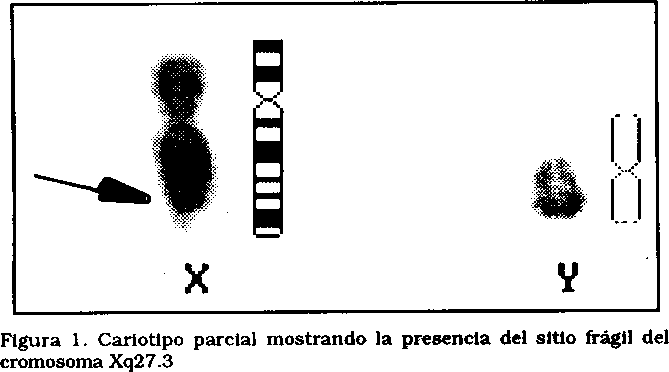
<body><![CDATA[<BR><B><FONT FACE="Arial"><FONT SIZE=-1>&nbsp;</FONT></FONT></B>     <BR><B><FONT FACE="Arial"><FONT SIZE=-1>Materiales y M&eacute;todos</FONT></FONT></B><FONT SIZE=-1></FONT>      <P><FONT SIZE=-1><FONT FACE="Arial">Durante el periodo comprendido entre enero de 1995 y julio de 1997 se atendieron 150 pacientes con retardo mental en <I>Citogen&eacute;tica</I> del Hospital Nacional de Ni&ntilde;os, con el fin de realizarles un estudio por X-Fr&aacute;gil.</FONT></FONT><FONT SIZE=-1></FONT>      <P><FONT SIZE=-1><FONT FACE="Arial">Se aplic&oacute; la t&eacute;cnica del cromosoma X-Fr&aacute;gil que consiste en cultivar 12 gotas de sangre perif&eacute;rica o bien tomada con heparina (ambas de forma est&eacute;ril) en medio de cultivo RPMI 1640. Se incub&oacute; por 96 horas a 37</FONT><FONT FACE=Symbol>&deg;</FONT><FONT FACE="Arial"> C con 5% CO2: 24 hr. previo a la cosecha, se indujo el sitio fr&aacute;gil con 5-fluoro-2-deoxiuridina y se bande&oacute; levemente con tripsina-Giemsa. Se analizaron 100 mitosis revisando en todas ellas la presencia del sitio fr&aacute;gil en el brazo largo del cromosoma X (<A HREF="#figura1">Fig. 1</A>) y de sitios fr&aacute;giles en otros cromosomas como controles positivos.</FONT></FONT><FONT SIZE=-1></FONT>      <P><FONT SIZE=-1><FONT FACE="Arial">&nbsp;</FONT></FONT>     <CENTER><A NAME="figura1"></A><IMG SRC="/img/fbpe/rmhnn/v32n1-2/0120i01.GIF" HEIGHT=372 WIDTH=565></CENTER> <FONT SIZE=-1><FONT FACE="Arial">&nbsp;</FONT></FONT><B><FONT FACE="Arial"><FONT SIZE=-1></FONT></FONT></B>      
<P><B><FONT FACE="Arial"><FONT SIZE=-1>Resultados</FONT></FONT></B><FONT SIZE=-1></FONT>      <P><FONT SIZE=-1><FONT FACE="Arial">En el periodo del estudio se analizaron por X-Fr&aacute;gil 150 pacientes de los cuales 127 (85%) fueron varones y 23 (15%) mujeres. Con X-Fr&aacute;gil positivo hubo 16 (10,6%) cuya distribuci&oacute;n por sexo fue: 13 (8,6%) varones y 3 (2,0%) mujeres; 3 (2%) pacientes presentaron otras alteraciones cromos&oacute;micas: 46, XY, add 16p; 47, XY, +mar ; 46,X, del Xp, respectivamente.</FONT></FONT><FONT SIZE=-1></FONT>      <P><FONT SIZE=-1><FONT FACE="Arial">El porcentaje de positividad en el conteo mit&oacute;tico entre nuestros pacientes oscil&oacute; entre 3% y 45% de sitio X-Fr&aacute;gil.</FONT></FONT>     <BR><B><FONT FACE="Arial"><FONT SIZE=-1>&nbsp;</FONT></FONT></B>     ]]></body>
<body><![CDATA[<BR><B><FONT FACE="Arial"><FONT SIZE=-1>&nbsp;</FONT></FONT></B>     <BR><B><FONT FACE="Arial"><FONT SIZE=-1>Discusi&oacute;n</FONT></FONT></B><FONT SIZE=-1></FONT>      <P><FONT SIZE=-1><FONT FACE="Arial">El comportamiento gen&eacute;tico del s&iacute;ndrome del X-Fr&aacute;gil es complicado y se sale de los patrones mormales de herencia mendeliana.</FONT></FONT><FONT SIZE=-1></FONT>      <P><FONT SIZE=-1><FONT FACE="Arial">El retardo mental es la segunda causa de minusval&iacute;a despu&eacute;s de las lesiones neuromusculoesquel&eacute;ticas en Costa Rica <SUP>(<A HREF="#7">7</A>)</SUP>. En este estudio nos hemos permitido enfatizar un poco m&aacute;s sobre el s&iacute;ndrome del X-Fr&aacute;gil, por tres aspectos fundamentales: es heredado, presenta un cuadro cl&iacute;nico confuso y tiene una frecuencia relativamente alta en nuestros pacientes con retardo mental, por lo que se convierte en un problema de salud importante para nuestro pa&iacute;s.</FONT></FONT><FONT SIZE=-1></FONT>      <P><FONT SIZE=-1><FONT FACE="Arial">La frecuencia encontrada de X-Fr&aacute;gil en pacientes con diagn&oacute;stico de retardo mental es comparable con otro estudio realizado en Costa Rica <SUP>(<A HREF="#7">7</A>)</SUP>, donde la frecuencia en hombres es de 6,4% comparado con un 8,6% de nuestro estudio; en mujeres es de 3,6% comparado con un 2% del nuestro. Seg&uacute;n citan: Castro &amp; Cuenca <SUP>(<A HREF="#1">1</A>)</SUP> en otros pa&iacute;ses los estudios realizados en hombres con retardo mental reportan las siguientes frecuencias: en Alemania es 6,4% en pacientes retardados severos; en Finlandia 4%; en Suecia 7% en pacientes con retardo mental leve y 8.5% con retardo severo; en Jap&oacute;n 5%; en Australia 3,35%. En un estudio realizado en Estados Unidos el porcentaje de positividad fue de un 3,1% y otras alteraciones cromos&oacute;micas de un 3,2% lo que refleja la variabilidad fenot&iacute;pica del s&iacute;ndrome X-Fr&aacute;gil y su entrecruzamiento cl&iacute;nico con otras alteraciones cromos&oacute;micas <SUP>(<A HREF="#6">6</A>)</SUP>. Comparando arbitrariamente esos pa&iacute;ses y el estudio realizado por Castro &amp; Cuenca <SUP>(<A HREF="#1">1</A>) </SUP>en la Escuela Centeno G&uuml;ell de Costa Rica, los porcentajes encontrados en nuestro estudio en varones afectados ocupa el m&aacute;s alto porcentaje pero, aun as&iacute;, dentro de los porcentajes esperados. Estados Unidos en donde existe la opci&oacute;n de realizar diagn&oacute;stico prenatal del X-Fr&aacute;gil tendr&iacute;a el dato m&aacute;s bajo; una diferencia importante con respecto a este &uacute;ltimo pa&iacute;s es que en nuestros pacientes no se observa un entrecruzamiento tan importante con otras alteraciones cromos&oacute;micas ya que s&oacute;lo obtuvimos un 2% de estas alteraciones.</FONT></FONT><FONT SIZE=-1></FONT>      <P><FONT SIZE=-1><FONT FACE="Arial">Es necesario que siempre se acompa&ntilde;e el estudio por X-Fr&aacute;gil con un an&aacute;lisis cromos&oacute;mico constitucional. A los sitios fr&aacute;giles en otros cromosomas no se les conoce importancia cl&iacute;nica.</FONT></FONT><FONT SIZE=-1></FONT>      <P><FONT SIZE=-1><FONT FACE="Arial">Las mujeres presentan menor porcentaje de positividad debido a que son portadoras del gen afectado y su demostraci&oacute;n de positividad en el an&aacute;lisis cariot&iacute;pico puede ser altamente ligado a la presencia o no de discapacidades mentales o simplemente ser una portadora con sitio citogen&eacute;ticamente negativo; la mayor&iacute;a de las veces la detecci&oacute;n en las madres de este sitio fr&aacute;gil se hace tedioso y dif&iacute;cil ya que se deben estudiar hasta 200 mitosis para demostrar la presencia del X-Fr&aacute;gil, si el estudio en el an&aacute;lisis contin&uacute;a negativo se hace necesario acudir a t&eacute;cnicas como RCP y el Southern Blot.</FONT></FONT><FONT SIZE=-1></FONT>      <P><FONT SIZE=-1><FONT FACE="Arial">A diferencia del s&iacute;ndrome de Down, el paciente del s&iacute;ndrome de X-Fr&aacute;gil no presenta caracter&iacute;sticas cl&iacute;nicas tan obvias ; esto acompa&ntilde;ado de la poca informaci&oacute;n y poco conocimiento que rodea a este s&iacute;ndrome, hacen que pueda pasar desapercibido y aumentar as&iacute; la frecuencia y la aparici&oacute;n positiva de m&aacute;s pacientes por la falta oportuna del consejo gen&eacute;tico prenatal, ya que se transmite de generaci&oacute;n en generaci&oacute;n.</FONT></FONT><FONT SIZE=-1></FONT>      <P><FONT SIZE=-1><FONT FACE="Arial">Es de hacer notar que el an&aacute;lisis por X-Fr&aacute;gil es de vital importancia en aquellos casos en donde exista historia familiar de retardo mental de origen desconocido, en donde el pronto diagn&oacute;stico permita dar oportuno consejo gen&eacute;tico, terapia de lenguaje y de comportamiento social y mejorar la calidad de vida de los pacientes.</FONT></FONT>     <BR><B><FONT FACE="Arial"><FONT SIZE=-1>&nbsp;</FONT></FONT></B>     ]]></body>
<body><![CDATA[<BR><B><FONT FACE="Arial"><FONT SIZE=-1>&nbsp;</FONT></FONT></B>     <BR><B><FONT FACE="Arial"><FONT SIZE=-1>Conclusi&oacute;n</FONT></FONT></B><FONT SIZE=-1></FONT>      <P><FONT SIZE=-1><FONT FACE="Arial">El avance en las t&eacute;cnicas citogen&eacute;ticas nos permite correlacionar la cl&iacute;nica con alteraciones cromos&oacute;micas posibilitando un diagn&oacute;stico y pron&oacute;stico m&aacute;s certeros. El paciente ser&aacute; el m&aacute;s beneficiado con una intervenci&oacute;n oportuna de las diferentes disciplinas, como psicolog&iacute;a, consejo gen&eacute;tico, terapia de lenguaje, de comportamiento, etc.</FONT></FONT><FONT SIZE=-1></FONT>      <P><FONT SIZE=-1><FONT FACE="Arial">El porcentaje de varones afectados de un 8,6% es el m&aacute;s alto reportado con respecto a los pa&iacute;ses citados en nuestro estudio, aun as&iacute;, se encuentra dentro de las frecuencias esperadas; las mujeres se ubican con un 2% de positividad.</FONT></FONT>     <BR><B><FONT FACE="Arial"><FONT SIZE=-1>&nbsp;</FONT></FONT></B>     <BR><B><FONT FACE="Arial"><FONT SIZE=-1>&nbsp;</FONT></FONT></B>     <BR><B><FONT FACE="Arial"><FONT SIZE=-1>Resumen</FONT></FONT></B><FONT SIZE=-1></FONT>      <P><FONT SIZE=-1><FONT FACE="Arial">Discutimos la importancia de la detecci&oacute;n del cromosoma X-Fr&aacute;gil en los estudios de retardo mental que afecta principalmente varones, que es hereditario y que en nuestro medio se presenta como un s&iacute;ndrome de discapacidad mental.</FONT></FONT><FONT SIZE=-1></FONT>      <P><FONT SIZE=-1><FONT FACE="Arial">Estudiamos 150 ni&ntilde;os con retardo mental que fueron enviados a nuestro laboratorio para estudio citogen&eacute;tico por X-Fr&aacute;gil, entre enero de 1995 y julio de 1997. Encontramos 10,6% de positivos; 8,6% varones y 2% de ni&ntilde;as.</FONT></FONT>     <BR><B><FONT FACE="Arial"><FONT SIZE=-1>&nbsp;</FONT></FONT></B>     ]]></body>
<body><![CDATA[<BR><B><FONT FACE="Arial"><FONT SIZE=-1>&nbsp;</FONT></FONT></B>     <BR><B><FONT FACE="Arial"><FONT SIZE=-1>Summary</FONT></FONT></B><FONT SIZE=-1></FONT>      <P><FONT SIZE=-1><FONT FACE="Arial">We discussed the importance of the X-Fragile citogenetic studies in the mental retardation that affects mainly men, is hereditary and in our media presents a mental discapacity syndrome.</FONT></FONT><FONT SIZE=-1></FONT>      <P><FONT SIZE=-1><FONT FACE="Arial">We studied 150 children with mental retardation, since January 1995 and July 1997. They were refered to our laboratory for X-Fragile analysis. We got 10, 6% of positives: 8,6% boys and 2% girls.</FONT></FONT>     <BR><B><FONT FACE="Arial"><FONT SIZE=-1>&nbsp;</FONT></FONT></B>     <BR><B><FONT FACE="Arial"><FONT SIZE=-1>&nbsp;</FONT></FONT></B>     <BR><B><FONT FACE="Arial"><FONT SIZE=-1>Bibliograf&iacute;a</FONT></FONT></B>     <BR>&nbsp;     <!-- ref --><BR><A NAME="1"></A><FONT SIZE=-1><FONT FACE="Arial">1. Castro I. &amp; Ccuenca P.: Frecuencia del s&iacute;ndrome del cromosoma X-Fr&aacute;gil en la Escuela de Ense&ntilde;anza Especial "Fernando Centeno G&uuml;ell", Acta Pedi&aacute;trica Costarricense 10:2, 1996.</FONT></FONT><FONT SIZE=-1></FONT>    &nbsp;&nbsp;&nbsp;&nbsp;&nbsp;&nbsp;&nbsp;&nbsp;[&#160;<a href="javascript:void(0);" onclick="javascript: window.open('/scielo.php?script=sci_nlinks&ref=1052362&pid=S1017-8546199700010000200001&lng=','','width=640,height=500,resizable=yes,scrollbars=1,menubar=yes,');">Links</a>&#160;]<!-- end-ref --><!-- ref --><P><A NAME="2"></A><FONT SIZE=-1><FONT FACE="Arial">2. David N.: Fragile X syndrome. Review and current status, Growth, Genetic &amp; Hormones 9:2, 1993.</FONT></FONT><FONT SIZE=-1></FONT>    &nbsp;&nbsp;&nbsp;&nbsp;&nbsp;&nbsp;&nbsp;&nbsp;[&#160;<a href="javascript:void(0);" onclick="javascript: window.open('/scielo.php?script=sci_nlinks&ref=1052363&pid=S1017-8546199700010000200002&lng=','','width=640,height=500,resizable=yes,scrollbars=1,menubar=yes,');">Links</a>&#160;]<!-- end-ref --><!-- ref --><P><A NAME="3"></A><FONT SIZE=-1><FONT FACE="Arial">3. Est&eacute;vez-Gonz&aacute;lez A., Roig C., Piles S. et al.: Fragile X syndrome and mental retardation Rev. Neurol. 143: 1068, 1997.</FONT></FONT><FONT SIZE=-1></FONT>    &nbsp;&nbsp;&nbsp;&nbsp;&nbsp;&nbsp;&nbsp;&nbsp;[&#160;<a href="javascript:void(0);" onclick="javascript: window.open('/scielo.php?script=sci_nlinks&ref=1052364&pid=S1017-8546199700010000200003&lng=','','width=640,height=500,resizable=yes,scrollbars=1,menubar=yes,');">Links</a>&#160;]<!-- end-ref --><!-- ref --><P><A NAME="4"></A><FONT SIZE=-1><FONT FACE="Arial">4. Evan E., Eichler S., Richard A. et al.: Fine structure of the human FMR1 gene Human Molecular Genetics 2:8, 1993.</FONT></FONT><FONT SIZE=-1></FONT>    &nbsp;&nbsp;&nbsp;&nbsp;&nbsp;&nbsp;&nbsp;&nbsp;[&#160;<a href="javascript:void(0);" onclick="javascript: window.open('/scielo.php?script=sci_nlinks&ref=1052365&pid=S1017-8546199700010000200004&lng=','','width=640,height=500,resizable=yes,scrollbars=1,menubar=yes,');">Links</a>&#160;]<!-- end-ref --><!-- ref --><P><A NAME="5"></A><FONT SIZE=-1><FONT FACE="Arial">5. Kirchgessner C., Warren S., &amp; Willard H.: X inactivation of the FMR1 fragile X mental retardation gene J. Med. Genet. 32:925, 1995.</FONT></FONT><FONT SIZE=-1></FONT>    &nbsp;&nbsp;&nbsp;&nbsp;&nbsp;&nbsp;&nbsp;&nbsp;[&#160;<a href="javascript:void(0);" onclick="javascript: window.open('/scielo.php?script=sci_nlinks&ref=1052366&pid=S1017-8546199700010000200005&lng=','','width=640,height=500,resizable=yes,scrollbars=1,menubar=yes,');">Links</a>&#160;]<!-- end-ref --><!-- ref --><P><A NAME="6"></A><FONT SIZE=-1><FONT FACE="Arial">6. Marini T., Pflueger S., Jackson A. et al.: A five-year experience with fragile X testing Setting laboratory standards of practice and cost-effective protocol Diagn. Mol. Pathol. 6: 161, 1997.</FONT></FONT><FONT SIZE=-1></FONT>    &nbsp;&nbsp;&nbsp;&nbsp;&nbsp;&nbsp;&nbsp;&nbsp;[&#160;<a href="javascript:void(0);" onclick="javascript: window.open('/scielo.php?script=sci_nlinks&ref=1052367&pid=S1017-8546199700010000200006&lng=','','width=640,height=500,resizable=yes,scrollbars=1,menubar=yes,');">Links</a>&#160;]<!-- end-ref --><!-- ref --><P><A NAME="7"></A><FONT SIZE=-1><FONT FACE="Arial">7. Secci&oacute;n de Documentaci&oacute;n, Informaci&oacute;n y Registros. Departamento de Apoyo T&eacute;cnico. Bolet&iacute;n Estad&iacute;stico No. 23. Consejo Nacional de Rehabilitaci&oacute;n y Educaci&oacute;n Especial, Costa Rica 12:8, 1994.</FONT></FONT><FONT SIZE=-1></FONT>    &nbsp;&nbsp;&nbsp;&nbsp;&nbsp;&nbsp;&nbsp;&nbsp;[&#160;<a href="javascript:void(0);" onclick="javascript: window.open('/scielo.php?script=sci_nlinks&ref=1052368&pid=S1017-8546199700010000200007&lng=','','width=640,height=500,resizable=yes,scrollbars=1,menubar=yes,');">Links</a>&#160;]<!-- end-ref --><!-- ref --><P><A NAME="8"></A><FONT SIZE=-1><FONT FACE="Arial">8. Ying-Hui Fu, Kuhl D., Pizzuti A. et al.: Variation of the CGG repeat at the Fragile X site results in genetic inestability, Resolution of the Sherman Paradox Cell 77: 1047, 1991.</FONT></FONT>    &nbsp;&nbsp;&nbsp;&nbsp;&nbsp;&nbsp;&nbsp;&nbsp;[&#160;<a href="javascript:void(0);" onclick="javascript: window.open('/scielo.php?script=sci_nlinks&ref=1052369&pid=S1017-8546199700010000200008&lng=','','width=640,height=500,resizable=yes,scrollbars=1,menubar=yes,');">Links</a>&#160;]<!-- end-ref --><BR><FONT SIZE=-1><I><FONT FACE="Arial">&nbsp;</FONT></I></FONT>     <BR><FONT SIZE=-1>&nbsp;</FONT>     <BR>&nbsp;<A NAME="*"></A><FONT SIZE=-1><FONT FACE="Arial"><A HREF="#*a">*</A> Secci&oacute;n de Citogen&eacute;tica, Divisi&oacute;n Hematolog&iacute;a, Laboratorio Cl&iacute;nico. Hospital Nacional de Ni&ntilde;os "Dr. Carlos S&aacute;nez Herrera". Caja Costarricense de Seguro Social, San Jos&eacute;, Costa Rica.</FONT></FONT>      ]]></body><back>
<ref-list>
<ref id="B1">
<label>1</label><nlm-citation citation-type="journal">
<person-group person-group-type="author">
<name>
<surname><![CDATA[Castro]]></surname>
<given-names><![CDATA[I]]></given-names>
</name>
<name>
<surname><![CDATA[Ccuenca]]></surname>
<given-names><![CDATA[P]]></given-names>
</name>
</person-group>
<article-title xml:lang="es"><![CDATA[Frecuencia del síndrome del cromosoma X-Frágil en la Escuela de Enseñanza Especial "Fernando Centeno Güell"]]></article-title>
<source><![CDATA[Acta Pediátrica Costarricense]]></source>
<year>1996</year>
<volume>10</volume>
<page-range>2</page-range></nlm-citation>
</ref>
<ref id="B2">
<label>2</label><nlm-citation citation-type="journal">
<person-group person-group-type="author">
<name>
<surname><![CDATA[David]]></surname>
<given-names><![CDATA[N]]></given-names>
</name>
</person-group>
<article-title xml:lang="en"><![CDATA[Fragile X syndrome]]></article-title>
<source><![CDATA[Review and current status, Growth, Genetic & Hormones]]></source>
<year>1993</year>
<volume>9</volume>
<page-range>2</page-range></nlm-citation>
</ref>
<ref id="B3">
<label>3</label><nlm-citation citation-type="journal">
<person-group person-group-type="author">
<name>
<surname><![CDATA[Estévez-González]]></surname>
<given-names><![CDATA[A]]></given-names>
</name>
<name>
<surname><![CDATA[Roig]]></surname>
<given-names><![CDATA[C]]></given-names>
</name>
<name>
<surname><![CDATA[Piles]]></surname>
<given-names><![CDATA[S]]></given-names>
</name>
</person-group>
<article-title xml:lang="en"><![CDATA[Fragile X syndrome and mental retardation]]></article-title>
<source><![CDATA[Rev. Neurol]]></source>
<year>1997</year>
<volume>143</volume>
<page-range>1068</page-range></nlm-citation>
</ref>
<ref id="B4">
<label>4</label><nlm-citation citation-type="journal">
<person-group person-group-type="author">
<name>
<surname><![CDATA[Evan]]></surname>
<given-names><![CDATA[E]]></given-names>
</name>
<name>
<surname><![CDATA[Eichler]]></surname>
<given-names><![CDATA[S]]></given-names>
</name>
<name>
<surname><![CDATA[Richard]]></surname>
<given-names><![CDATA[A]]></given-names>
</name>
</person-group>
<article-title xml:lang="en"><![CDATA[Fine structure of the human FMR1 gene]]></article-title>
<source><![CDATA[Human Molecular Genetics]]></source>
<year>1993</year>
<volume>2</volume>
<page-range>8</page-range></nlm-citation>
</ref>
<ref id="B5">
<label>5</label><nlm-citation citation-type="journal">
<person-group person-group-type="author">
<name>
<surname><![CDATA[Kirchgessner]]></surname>
<given-names><![CDATA[C]]></given-names>
</name>
<name>
<surname><![CDATA[Warren]]></surname>
<given-names><![CDATA[S]]></given-names>
</name>
<name>
<surname><![CDATA[Willard]]></surname>
<given-names><![CDATA[H]]></given-names>
</name>
</person-group>
<article-title xml:lang="en"><![CDATA[X inactivation of the FMR1 fragile X mental retardation gene]]></article-title>
<source><![CDATA[J. Med. Genet]]></source>
<year>1995</year>
<volume>32</volume>
<page-range>925</page-range></nlm-citation>
</ref>
<ref id="B6">
<label>6</label><nlm-citation citation-type="journal">
<person-group person-group-type="author">
<name>
<surname><![CDATA[Marini]]></surname>
<given-names><![CDATA[T]]></given-names>
</name>
<name>
<surname><![CDATA[Pflueger]]></surname>
<given-names><![CDATA[S]]></given-names>
</name>
<name>
<surname><![CDATA[Jackson]]></surname>
<given-names><![CDATA[A]]></given-names>
</name>
</person-group>
<article-title xml:lang="en"><![CDATA[A five-year experience with fragile X testing Setting laboratory standards of practice and cost-effective protocol]]></article-title>
<source><![CDATA[Diagn. Mol. Pathol]]></source>
<year>1997</year>
<volume>6</volume>
<page-range>161</page-range></nlm-citation>
</ref>
<ref id="B7">
<label>7</label><nlm-citation citation-type="journal">
<collab>Sección de Documentación, Información y Registros^dDepartamento de Apoyo Técnico</collab>
<source><![CDATA[Boletín Estadístico]]></source>
<year>1994</year>
<numero>23</numero>
<issue>23</issue>
</nlm-citation>
</ref>
<ref id="B8">
<label>8</label><nlm-citation citation-type="journal">
<person-group person-group-type="author">
<name>
<surname><![CDATA[Ying-Hui]]></surname>
<given-names><![CDATA[Fu]]></given-names>
</name>
<name>
<surname><![CDATA[Kuhl]]></surname>
<given-names><![CDATA[D]]></given-names>
</name>
<name>
<surname><![CDATA[Pizzuti]]></surname>
<given-names><![CDATA[A]]></given-names>
</name>
</person-group>
<article-title xml:lang="en"><![CDATA[Variation of the CGG repeat at the Fragile X site results in genetic inestability, Resolution of the Sherman Paradox]]></article-title>
<source><![CDATA[Cell]]></source>
<year>1991</year>
<volume>77</volume>
<page-range>1047</page-range></nlm-citation>
</ref>
</ref-list>
</back>
</article>
